On 30 August 2013, a loss of separation assurance occurred between an Airbus A320, registered VH‑VNQ (VNQ), and a Boeing 737, registered VH‑VZB (VZB), 50 km SSE of Hay airport, NSW. VNQ was conducting a passenger flight from Melbourne, Victoria to Cairns, Queensland under the instrument flight rules (IFR). VZB was also conducting an IFR passenger flight in the opposite direction, from Cairns to Melbourne.
Both aircraft were operating in Class A airspace, under the control of an Airservices air traffic controller. The required separation standard in the portion of Class A airspace covered by radar surveillance was 5 NM laterally or 1,000 ft vertically. The majority of air routes in the airspace over which the controller had jurisdiction were one-way routes – aircraft could only operate in the direction marked on the aeronautical charts, but the Melbourne to Cairns route was a two-way route (T139). The airspace also contained a number of east/west routes that crossed T139.
Flight crews were required to plan flights in accordance with levels based on the magnetic heading of the planned track. Within controlled airspace, air traffic control (ATC) may assign and pilots may request a level that does not conform to this requirement. The crew of VNQ had planned to operate at FL360, and the crew of VZB had planned to operate at FL360 to a position inland and abeam Emerald, Queensland, and then at FL370 to Melbourne. However, the change of level planned by VZB had not been initiated, resulting in both aircraft converging at the same flight level.
The controller reported that their focus was on monitoring VNQ’s climb through the levels of a number of aircraft on crossing air routes and only became aware of the aircraft converging at the same level when the Short Term Conflict Alert (STCA) activated. The controller applied compromised separation techniques so that, while there was a loss of separation assurance, radar separation was not infringed.
As a result of this occurrence, Airservices will review the Melbourne to Cairns air route with regard to creating one-way routes, and more generally review similar routes nationally. In addition, Airservices has issued a directive reminding controllers of their responsibilities regarding the application of non-standard levels and subsequent return to standard levels.
In this incident, the timely activation of the STCA and the controller correctly utilising compromised separation techniques ensured that the separation standards were not infringed.
At about 1009 on 31 August 2013, passenger train 7MA8, known as ‘The Overland’, was travelling from Melbourne to Adelaide when it collided with a Holden Rodeo dual cab utility on the Mahers Road level crossing at Inverleigh, Victoria.
The sole occupant of the utility was seriously injured and transferred to Royal Melbourne Hospital. The locomotive crew suffered from shock, but none of the train’s 103 passengers were injured.
What the ATSB found
The ATSB’s investigation found that the driver of the utility was travelling along a maintenance access track adjacent to the railway before he turned into Mahers Road. As a result, he was provided with no warning of the approaching train.
The investigation also found that, at some time in the past, the railway property boundary fence had been removed, thereby providing local vehicle access along the railway maintenance track. As a result, over time and with regular use, the false perception that the maintenance track was part of Gallagher Road was created and reinforced.
Since the maintenance access track was not a public road, neither the ARTC nor the Golden Plains Shire had identified a need to provide traffic control.
What's been done as a result
The Australian Rail Track Corporation and the Golden Plains Shire have advised that they will work together to permanently isolate the rail corridor from Gallagher Road.
Safety message
This incident highlights the need for road and rail authorities to work together in maintaining the integrity of fences and structures used to exclude public access to the railway corridor.
The occurrence also highlights the need for drivers of motor vehicles to be vigilant at railway level crossings.
On 1 September 2013, a Robinson R22 helicopter, registered VH-HVW, departed a stock camp located about 40 NM (70 km) south-west of Lake Nash Station, Northern Territory. Shortly after take-off, the helicopter was observed commencing a steep climbing left turn to depart overhead the camp. As the helicopter turned into a downwind position, the wind appeared to affect the controllability of the aircraft. It appeared that the pilot attempted to respond to the situation, however, there was insufficient altitude to recover. The helicopter contacted the ground and flipped over a number of times before coming to rest. The pilot sustained serious injuries and the helicopter was destroyed.
Wind direction and velocity are important considerations for helicopter pilots. It is crucial that pilots maintain an awareness of the wind and be aware of the consequential effects on helicopter performance. This will assist pilots with responding promptly and appropriately to a situation and preventing a loss of control.
At about 1050 Eastern Standard Time on 31 August 2013, the crew of a Bell Helicopter Co. 412EP helicopter, registered VH-VAS, were tasked to pick up a patient who was reported to have sustained injuries during a fall in the hills around Macs Cove, near Mansfield, Victoria. Due to the confined winch area and the possible fouling hazard associated with nearby trees, the crew elected to conduct a double-lift extraction with the patient in a rescue strop, accompanied by a paramedic. As the paramedic and patient reached the helicopter’s skid‑landing gear, the patient became increasingly unresponsive and began slipping from the rescue strop. The paramedic and winch operator attempted to restrain the patient however, despite their efforts, the patient slipped out of the rescue strop and fell to the ground, sustaining fatal injuries.
What the ATSB found
The ATSB found that, due to the compressive nature of the rescue strop around the patient's chest, combined with the patient’s weight and pre-existing medical conditions, the patient probably lost consciousness during the winch operation. While the rescue strop was serviceable at the time, it was not suitable for the patient and contributed to them falling from the strop following their loss of consciousness.
The ATSB also identified that the operator and Air Ambulance Victoria had limited documented guidance to assist rescue personnel select the most appropriate winching rescue equipment.
What's been done as a result
Concurrent with the release of its preliminary investigation report on 10 October 2013, the ATSB issued a safety advisory notice to helicopter winch operators, noting the circumstances of this accident. The notice advised operators to consider the risk to patients, or other persons being winched, of slipping out of a rescue/retrieval strop and the implications for their operations.
Following this accident, the operator and Air Ambulance Victoria introduced a seat-type harness for patient recovery via winch and issued guidance to their crews on the order of priority of use for rescue equipment during over land winch operations. The Civil Aviation Safety Authority also issued an Airworthiness Bulletin clarifying the use and application of rescue/retrieval strops. In addition, various helicopter emergency medical service providers have improved information sharing to communicate operational knowledge and lessons learnt.
Safety message
The ATSB advises helicopter emergency medical service and other operators carrying out winching operations to note the circumstances of this accident and consider the implications for their operations of the risk of patients or other persons being winched slipping out of a rescue/retrieval strop. In this context the size, weight and medical condition of the person(s) being winched may indicate that other recovery options offer reduced risk.
Preliminary report
Report release date: 10/10/2013
The occurrence
At about 1050 Eastern Standard Time1 on 31 August 2013, the crew of a Bell 412EP helicopter, registered VH-VAS, was tasked to pick up a male patient who was reported to have fallen in the hills around Macs Cove, near Lake Eildon, Victoria (Vic.). The helicopter was contracted by Air Ambulance Victoria to provide emergency medical service (EMS) operations. The crew consisted of a pilot, aircrewman and a flight paramedic. The crew were informed that, due to the difficult terrain and the size of the patient, a winch extraction would likely be required.
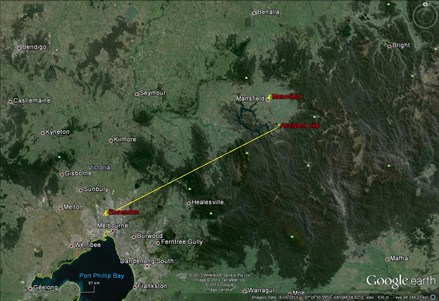
The crew departed Essendon Airport, Vic. for the scene at 1105 (Figure 1). The weather was fine with light north-west winds.
Figure 1: Accident location and flight route
Source: Google earth
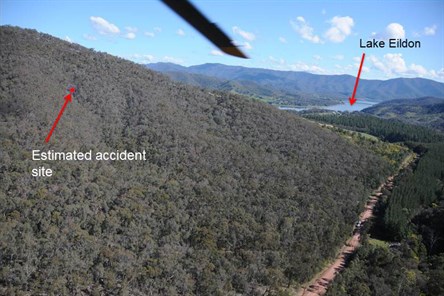
At about 1145 the helicopter arrived overhead the ground party and patient who were located in a heavily-wooded area in steep terrain about 1-1.5 km from the nearest road (Figure 2). The trees in the surrounding area were up to 60 ft high and the crew noted numerous dead branches that could create a hazard for winching operations.
Figure 2: Accident scene looking south-west
Source: Victorian Police
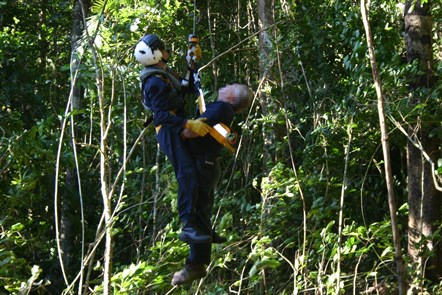
The crew located a suitable area into which to winch the paramedic to assess the patient’s condition. They discussed likely retrieval options and decided that a stretcher winch would be too dangerous due to the steep terrain, surrounding vegetation and the possibility of fouling. Due to the small winch area and the possible fouling hazard, the crew elected for a double-lift extraction with the patient in a rescue/retrieval strop (strop) (Figure 3).
Figure 3: Example of a double-lift with rescue/retrieval strop
Source: ATSB
The paramedic and aircrewman were unable to get the winch portable radio to work, so they decided that the paramedic would use hand signals to indicate whether a winch extraction would be required. The aircrewman winched the paramedic into the site at 1203. The pilot then flew the helicopter to land at Macs Cove, about 1 NM (2 km) to the south-west, and waited about 20 minutes before returning to the scene. This allowed the paramedic time to assess the patient.
At 1224, the helicopter departed Macs Cove to return to the scene. On arrival the crew noted that some trees had been cleared to create a larger winching area and that the patient had been moved to this area. After about 5 minutes the paramedic signalled to the crew that he was ready to winch and the crew positioned the helicopter over the winching area in an approximately 80 ft hover, about 20 ft above the tree canopy.
Initially the winching procedure appeared to proceed normally. The aircrewman reported that the paramedic appeared to have his arms and legs wrapped around the patient, as is the normal procedure. When the paramedic and patient were approximately 30–40 ft above the ground, the aircrewman noticed that they had moved towards the edge of the winch area and close to the upper branches of the trees. The paramedic stated that he came in contact with the branches and had to use both hands to fend off as he came through the tree canopy. The helicopter was moved back and right about 5 ft and the winch continued.
The aircrewman reported that once the paramedic and patient were clear of the canopy, at about 15 ft below the aircraft, he noticed that the patient was moving or wriggling. The aircrewman stopped the winch for a control check, and shortly after resuming the winch noticed that the patient’s arms were not in the usual position in the strop and that the paramedic appeared to be shouting at the patient. The aircrewman elected to continue winching in, and informed the pilot that the patient was slipping.
As the paramedic and patient reached the height of the helicopter’s right skid-landing gear, the paramedic was facing the helicopter and the patient was facing outwards. The paramedic reported attempting to pin the patient against the skid in an attempt to stop him slipping. The aircrewman continued winching until the paramedic’s head was level with the middle of the door opening. At this stage the aircrewman informed the pilot that he could see the patient slipping further. He dropped the winch pendant and reached down, grabbing the patient’s shoulder in an attempt to stop his fall. The aircrewman stated that by this stage the patient appeared to be unresponsive and limp.
Despite the crew’s efforts, the patient slipped out of the strop and fell to the ground, sustaining fatal injuries. Preliminary investigations indicate that the aircraft, winch and rescue equipment were serviceable at the time of the accident, and that the crew were qualified to carry out the task.
Further investigation
The investigation is continuing and will include examination of:
the rescue/retrieval strop design and its potential limitations with respect to the weight and physical dimensions of a patient
potential medical issues associated with patients being winched in rescue strops
the operator’s rescue procedures and protocols
certification procedures for helicopter winching rescue equipment.
Safety action
Although no organisational or systemic issues have been identified at this stage of the investigation, the following proactive safety action has been advised by Air Ambulance Victoria and the operator of the helicopter. In addition, the Australian Transport Safety Bureau (ATSB) has released a Safety Advisory Notice (SAN) advising operators of rescue and other winch-fitted helicopters of the potential hazards associated with the use of the rescue/retrieval strop.
Safety action by Air Ambulance Victoria
Following the winching accident all winching operations were suspended involving Air Ambulance Victoria emergency medical service (EMS) helicopters. This suspension remained in place until the results of an interim investigation by the helicopter operator confirmed that an equipment fault did not contribute to the accident.
In addition, Air Ambulance Victoria has, in conjunction with its EMS contractors, commenced a separate investigation that will examine the availability of suitable alternatives to the current rescue/retrieval strop.
Safety action by the operator
Immediately after the accident the operator suspended all winching operations pending initial investigations. Following its initial investigation and associated risk assessment, winch operations were recommenced.
An interim report has been published by the operator with associated safety action. This included reinforcing the need to critically assess a patient’s physical and medical state and any associated risks before committing to using the rescue/retrieval strop. An order of priority use of rescue equipment was promulgated for application in overland winch operations.
The ATSB advises helicopter emergency medical service and other operators carrying out winching operations to note the circumstances of this accident and consider the implications for their operations of the risk of patients or other persons being winched to slip out of a rescue/retrieval strop. In this context the size, weight and medical condition of the person(s) being winched may indicate that other recovery options offer reduced risk.
1. Eastern Standard Time (EST) was Coordinated Universal Time (UTC) + 10 hours.
The information contained in this web update is released in accordance with section 25 of the Transport Safety Investigation Act 2003 and is derived from the initial investigation of the occurrence. Readers are cautioned that new evidence will become available as the investigation progresses that will enhance the ATSB's understanding of the accident as outlined in this web update. As such, no analysis or findings are included in this update.
Inquest
ATSB Response to Findings
On 4 September 2015, Coroner Stella Struthridge of the Coroner’s Court of Victoria, without holding an inquest, released findings into the 2013 fatal helicopter winching accident involving a Bell Helicopter Co. 412EP. The accident was the subject of ATSB Investigation AO-2013-136.
The ATSB summary explains that a patient died during a retrieval operation for the patient after the patient had become injured in a fall. The patient slipped out of the rescue strop and fell to the ground.
The Coroner referenced the ATSB investigation and noted the ATSB findings that the use of a rescue strop, without employing an integral hypothermic strap was not suitable for the patient’s size and medical condition. The Coroner also noted the ATSB safety issue identified that there was limited guidance for rescue personnel regarding the selection of the most appropriate rescue equipment and the conditions when various types of equipment should be considered.
There were no significant differences in views between the findings of the Coroner and the findings of the ATSB with respect to the manner in which safety could be improved. This included the ATSB’s key safety message that when undertaking a winching operation the implications for the operation of the risk of patients or other persons being winched slipping out of the rescue/retrieval strop.
ATSB investigations and coronial investigations
Coronial investigations are separate to ATSB investigations. In this matter the respective authorities are largely in accord as to the factors that contributed to the development of the accident involving VH-VAS.
The ATSB's report can be downloaded by clicking on the link: Final report
On 26 August 2013, a Qantas Airways Boeing 737 aircraft, registered VH-VZA (VZA) was completing a scheduled passenger flight from Cairns, Queensland to Sydney, New South Wales.
After landing, at about 2010 Eastern Standard Time, VZA was cleared by air traffic control (ATC) to taxi to Bay 6 of the Domestic 1 (DOM 1) apron area at Sydney Airport. At about the same time, the captain observed the lights of a white security vehicle approaching from about 50 m away and about 90° to the right of the aircraft.
As the vehicle approached the intersection of the airside road and taxiway ‘Bravo 2’ the driver reported slowing to between 25 to 30 km/h. He looked to his left, but did not see the lights of VZA. Assuming the area was clear; he directed his attention to the parking bay area to the right.
The captain thought the vehicle would continue along the airside road, however, as the car continued in a northerly direction across the intersection the captain believed it was on a collision course with VZA. Realising the vehicle driver had not seen VZA the captain immediately stopped the aircraft.
The security vehicle continued toward the aircraft then came to an abrupt stop about 10 m to the right of the aircraft’s nose.
The ATSB published a research paper on ground operation occurrences at Australian airports over a 10-year period. This publication highlighted ground operations as potentially being one of the most dangerous areas of aircraft operation. Of the 282 ground occurrences reported to the ATSB between 1 January 1998 and 31 December 2008, 11 per cent happened when the aircraft was approaching the gate. About 37 per cent of the approaching the gate phase occurrences were attributed to near collisions with vehicles. These occurrences required immediate braking action by the flight crew or vehicle driver in order to avoid a collision.
On 19 August 2013 the container ship Mell Selarang berthed at number three berth in the Port of Townsville, Queensland. Stevedores started cargo operations.
Cargo operations continued into 20 August and, at about 0752, the stevedores stopped work for a change of shift. In the quiet period between the two shifts, one of the ship’s seamen decided to grease the hatch landing pads around the open cargo hold when he slipped and fell, landing about 8.5 m below on the top of a container in the cargo hold.
Safety message
This incident highlights the fact that seemingly simple tasks that are undertaken with the best of intentions often have the planning and risk assessment stages inadvertently overlooked. This is particularly the case when the task is undertaken when an unexpected and opportune moment arises to complete the task.
The ATSB SafetyWatch highlights the broad safety concerns that come out of our investigation findings and from the occurrence data reported to us by industry. One of the current safety concerns is marine work practices.
On 26 August 2013, a flight instructor and student pilot were conducting night circuits in a Cessna 172 aircraft, registered VH‑RQZ (RQZ), at Archerfield Airport, Queensland. There were also two other aircraft conducting circuits. The student pilot of RQZ broadcast a call on the CTAF downwind leg of the circuit for runway 10. The pilot of an Agusta AW139 helicopter, registered VH-ESZ (ESZ), then broadcast an inbound call advising they were 5 NM to the north at 1,400 ft above mean sea level.
The pilot of ESZ reported sighting two other aircraft in the circuit and noted that they were unlikely to come into conflict with ESZ.
The student pilot of RQZ then broadcast a call turning base for a touch-and‑go on runway 10 and stated that they were conducting a simulated landing light failure.
About 15 seconds later, the pilot of an instrument flight rules (IFR) aircraft asked the pilot of RQZ to confirm his position, to which the instructor replied that they were turning onto final. Shortly after, the pilot of ESZ broadcast a call advising that he was on a tight left base for runway 10.
When RQZ was on final, the instructor sighted ESZ on a close base in his 10 o’clock position, about 1 NM away and broadcast a call asking the pilot of ESZ whether he had RQZ sighted, but did not hear any response. He then conducted a go-around to ensure separation with ESZ.
When at about 300 ft above ground level, the pilot of ESZ sighted RQZ in his 4 o’clock position, about 100 ft below and 100 m behind ESZ and instructor of RQZ then broadcast that they were going around. The pilot of ESZ tightened the turn onto final and elected to land on the taxiway parallel to runway 10. He had not received a traffic collision avoidance system (TCAS) alert on any aircraft other than the IFR aircraft.
On 14 August 2013, at about 0830 Central Standard Time, the pilot of a Beech BE58 aircraft, registered VH‑ECL, was preparing for a charter flight from Tindal to the Borroloola aeroplane landing area (ALA), Northern Territory.
Using the operator’s elected fuel flow rate for the aircraft of 125 L/hr, the pilot calculated that a minimum of 545 L of fuel was required. The pilot elected to carry 570 L. In preparation for the flight, the pilot referenced the flight data log, which indicated that about 267 L of fuel was on board the aircraft. Consequently, the pilot refuelled the aircraft, adding about 153 L into each of the main fuel tanks. The pilot then conducted fuel drains and found no contaminants present.
During the cruise, the pilot observed the fuel quantity gauge for the right main fuel tank reading zero, but the fuel flow, and engine temperature and pressure indications were normal. The aircraft landed at Borroloola and the passengers disembarked. The pilot re‑checked the fuel calculations and determined that there was sufficient fuel on board for the return trip. The pilot noted that the right fuel quantity gauge was still reading zero and the fuel quantity gauge for the left main tank was indicating about three-quarters full.
On the return flight, when about 50-60 NM from Tindal, the right fuel flow gauge dropped to zero. The pilot shut down the right engine, notified air traffic control and conducted a single-engine landing at Tindal.
This incident highlights the importance of establishing known fuel status regularly and the need to use multiple sources to determine fuel quantity. This is particularly important for determining accurate fuel flow rate calculations and when the fuel quantity on board can only be accurately determined when the fuel tanks are full.
On 26 August 2013, about 2 hours after last light on a dark night, an Alliance Airlines Fokker F28 aircraft, registered VH‑JFB, was taxiing at Williamtown Airport, New South Wales.
As the captain taxied the aircraft onto the runway, air traffic control (ATC) issued departure instructions and a take-off clearance. The captain then momentarily looked down to confirm that the correct departure heading had been entered into the aircraft’s flight management system. As he looked up, he believed he had almost overshot the runway centreline as he observed the threshold markings in front and under the nose of the aircraft, and a line of recessed lights to his left. The captain determined that the recessed lights were runway centreline lights.
Shortly after, the captain commenced the take-off run. Immediately after, the captain noted that the ground area to the left of the runway centreline lights ahead was a different colour than that on the right. He then realised that he had lined up on the runway edge lights. The captain rejected the take-off and steered the aircraft to the right, toward the actual runway centreline.
An internal investigation conducted by Alliance Airlines found that the design of the operational readiness platform (ORP) recessed lighting and obscured centreline markings caused visual confusion during the line-up procedure. This was further compounded by an unserviceable aircraft taxi light and the distraction caused by the requirement for the crew to enter the heading issued by ATC as part of the departure instructions at a critical time. As a result of this occurrence, Alliance Airlines have released an operational notice to crews to increase pilot awareness of ORPs at military airports, and as part of the operator’s accident prevention program, a Take-off Misalignment Hazards publication has been issued.
The Department of Defence also advised the ATSB that scheduled remediation works, which consisted of repainting the runway centreline markings and refreshing the taxiway lead in lines with black contrast lines to highlight the markings had been completed.
In 2010, a research report published by the ATSB identified eight factors common to misaligned take-offs at night, and developed a pilot information card to assist crews in identifying factors that increase the risk of a misaligned take-off.
At 0630 on 8 July 2012, the mess-man on board the Cyprus registered bulk carrier Blue Wave failed to present for duty whilst the ship was off the coast of New South Wales en route to Newcastle. The master was informed, and the crew searched the ship. However, the missing man was not found and so the master advised the Rescue Coordination Centre (RCC) Australia.
In response, RCC Australia tasked air and sea assets to assist the ship in a search of the sea area. The missing man was not located.
Once search operations were discontinued, Blue Wave continued its voyage to Newcastle.
On 9 July 2012, the Cyprus Department of Merchant Shipping requested assistance from the Australian Transport Safety Bureau (ATSB) in obtaining information in relation to the accident.
On 17 July, the information obtained by the ATSB, including statements Police had taken from the crew, was forwarded to the Cyprus Department of Merchant Shipping.
This ATSB external assistance investigation was then closed. Further information in relation to this accident can be obtained from the Cyprus Department of Merchant Shipping.