The ATSB has commenced an investigation into an incident involving a Boeing 737, VH-YFP at Sydney Airport, New South Wales on 17 November 2013.
During unloading, the flight crew detected smoke in the cockpit. The flight crew requested assistance from the aviation rescue and fire fighting services (ARFF) and passenger disembarkation was expedited. Ground staff were not initially notified of the event and continued with their duties. Soon after, they were advised and instructed to move clear of the aircraft. Engineering personnel inspected the aircraft, with nil issues found.
As part of the investigation, the ATSB will interview the flight crew and obtain relevant information.
A report will be released within several months.
On 26 November 2013, the ATSB discontinued the investigation as further information revealed that the source of the reported smoke was external to the aircraft affected and the crew considered it prudent to expedite a normal disembarkation of passengers. There were no anomalies found with the aircraft and the event was minor in nature.
On 31 October 2013, a flight instructor and student pilot were conducting flying training in a Beech A36 (Bonanza) aircraft, registered VH-YEN, at Camden Airport, New South Wales. The purpose of the flight was to enable the student to obtain an aircraft design feature, retractable undercarriage (landing gear) endorsement.
After completing about 45 minutes upper air training in the local training area, they obtained a clearance from ATC for a straight in approach to runway 06 at Camden.
During the approach, the student completed the pre-landing checks, which included extending the landing gear and selecting flap. At about 1445 EDT the aircraft touched down about 50-100 m past the runway threshold and about 2m left of the centreline. The instructor advised the student to re-align the aircraft with the runway centreline. The instructor focussed his attention outside the cockpit watching the re-alignment.
At about the same time, the student became concerned about the length of runway remaining and quickly moved to retract the flaps and prepare the aircraft for take-off. The student had completed all his recent training in a Cessna 182 type aircraft which has the flap control to the right of the power quadrant. This led to him inadvertently manipulating the landing gear lever. The instructor attempted to recover the aircraft, but it veered right, and the nose dug into the grass verge alongside the runway.
As a result of the occurrence, the aircraft operator has advised the ATSB that the company have changed their procedure for retractable design type endorsements. From now, instructors undertaking this type of endorsement training with students are required to conduct a full stop landing on the first approach.
On 8 November 2013, the captain and first officer operating a Qantas Boeing 767 aircraft, registered VH-OGU, prepared to conduct a scheduled passenger service from Melbourne, Victoria to Sydney, New South Wales. The crew obtained the relevant weather information, with no requirements for holding fuel or an alternate indicated.
During the descent into Sydney, the crew switched on the seatbelt sign at about 10,000 ft above mean sea level (AMSL). At about the same time, they observed lightning to the right of the aircraft’s track, with a corresponding red return on the aircraft’s weather radar display.
At about 2026 Eastern Daylight-savings Time, while on approach and descending through 4,200 ft AMSL, the aircraft encountered moderate turbulence for about 2 minutes. At about 3,000 ft AMSL, the crew elected to discontinue the approach, and conducted a missed approach. During the subsequent climb, passing about 4,200 ft AMSL, the aircraft encountered severe turbulence.
The crew reported that full go-around power was required to maintain altitude and speed, and they experienced difficulty controlling the aircraft. In the cabin, one passenger sustained a serious injury; one passenger sustained a minor rib injury and a third passenger sustained a minor injury from an iPad.
After orbiting for about 20 minutes, the crew commenced an approach to runway 16 Right. Passing about 5,000 ft AMSL, the aircraft again encountered severe turbulence and was difficult to control, and the crew again conducted a missed approach and commenced a turn to the north.
At about 2127, based on the remaining fuel quantity and the turbulence on the approach to Sydney, the crew declared a ‘PAN’ and elected to divert to Williamtown, New South Wales. The aircraft landed at Williamtown with fuel reserves intact.
This incident serves as a timely reminder to passengers to safely stow any carry-on baggage, laptops, iPads and other items correctly, as they can become projectiles during turbulence if not properly secured.
On 12 November 2013, a Bell 206B helicopter registered VH-NDL, departed a camp site located 51 NM SE Alice Springs, Northern Territory on a charter flight with the pilot and three passengers on board, in visual meteorological conditions. About an hour into the flight and 2 NM from the landing area the pilot commenced a slow descent from 2,000 feet above the ground (AGL). When lowering the collective, the pilot heard an intermittent grinding noise above the cockpit. The pilot checked the gauges, with nothing unusual noted. The noise continued to develop, and the pilot elected to land. As the helicopter descended through 400 feet (AGL), a clunking noise was heard, and power was lost to the main rotor. The pilot initiated an auto rotation and briefed the passengers for an emergency landing. During the touched down at about 0705, the main rotor blade severed the tail boom. The pilot secured the helicopter, waited for the main rotor to slow and assisted the passengers to exit the helicopter. The helicopter sustained substantial damage; the occupants received nil injuries.
ATSB examination of main drive shaft found that the forward outer coupling had failed, in overload, into five segments. The surfaces of the segments had evidence of discolouration due to over temperature and most of the surfaces had turned into red oxide (which forms in air at high temperatures, estimated to be over 500 °C). There was no detected grease that is needed for lubrication to reduce friction (heat) between and the rotating parts. Without the grease, the gear teeth on the forward inner spherical coupling softened, deformed, fractured and became jammed, resulting in the forward outer coupling shattering into the five segments. The four Temp-Plate indicators (which indicate when there has been excess temperature) were not present on the forward outer coupling exterior. There were no detected remnants of the forward rubber boot that is part of the seal assembly for containment of the grease.
On 10 November 2013, the flight instructor and student pilot of a Cessna 152 aircraft, registered VH‑TNV (TNV), were conducting circuits at Tyabb aerodrome, Victoria. The pilot of a Jabiru J160 aircraft, registered 19-4430 (Jabiru), taxied for a local flight with one passenger on board. The pilot broadcast a taxi call on the CTAF and taxied towards the runway 17 holding point. The pilot stopped the aircraft short of the holding point and turned at an angle to maximise his view of the base and final legs of the circuit.
When on a close downwind leg, in-line with the runway 17 threshold, the pilot of TNV commenced a glide approach. He broadcast turning base for a glide approach, and commenced a continuous turn towards runway 17.
The pilot of the Jabiru heard the broadcast and looked for TNV but was unable to sight the aircraft. He then broadcast that he was lining up and rolling on runway 17, and commenced the take-off run. TNV was on a high close final, and the pilot reported broadcasting turning final. Neither pilot heard the other pilot’s broadcast.
The student pilot of TNV continued the glide approach, aiming to touch down about halfway along the runway. As the Jabiru became airborne, at about 15 ft above ground level, the pilot saw the underside of TNV appear from above and was overtaking the Jabiru very slowly and descending. TNV descended onto the Jabiru and the elevator trim tab impacted the fin of the Jabiru. The Jabiru landed and skidded along the runway.
The pilot of TNV heard a loud bang but did not see the Jabiru and commenced a go-around. The aircraft required full back pressure on the control column and full back trim to climb, so he conducted a low-level circuit and returned for landing. The Jabiru was substantially damaged and TNV sustained damage to the right elevator and trim tab.
On 11 May 2013, the pilot of a Pacific Aerospace Fletcher FU24-950 aircraft was conducting aerial agricultural spraying activities near North Rawajitu, Lampung, Indonesia, when the aircraft collided with terrain. The pilot was fatally injured and the aircraft destroyed.
The National Transportation Safety Committee (NTSC) of Indonesia is responsible for investigating this accident. The aircraft carried an Ag-Nav GPS-based guidance and track monitoring system which the NTSC downloaded using conventional techniques. The normal download yielded data prior to the accident flight. The NTSC requested specialist assistance from the Australian Transport Safety Bureau (ATSB) to recover any accident flight data from the Ag-Nav system non-volatile memory chips that may not yet have been written to the unit's normal file system.
In accordance with clause 5.23 of Annex 13 to the Convention on International Civil Aviation (ICAO Annex 13), and to provide for the necessary protections of the Ag-Nav information, the ATSB appointed an Accredited Representative to assist the NTSC and initiated an investigation under the Australian Transport Safety Investigation Act 2003.
Download, examination and correspondence with the unit's manufacturer yielded no additional data beyond that retrieved in Jakarta. The latest available data from the Ag-Nav unit was found to be on 10 May 2013 consequently no accident flight data was available to assist the NTSC investigation team.
A report detailing the download and data examination was provided to the NTSC on 29 October 2013.
All inquiries regarding the investigation into this accident should be forwarded to the National Transportation Safety Committee of Indonesia.
National Transportation Safety Committee Ministry Of Transportation Republic Of Indonesia Transportation Building 3rd Floor Jalan Medan Merdeka Timur No. 5 Jakarta Pusat 10110 Indonesia
On 6 November 2013, the pilot of a Robinson R44 helicopter, registered VH‑UGC, was conducting a private flight from Latrobe Valley to Mount Buller, Victoria, with three passengers onboard.
At about 1425 Eastern Daylight-savings Time, the helicopter arrived overhead the Mount Buller Township. Two orbits at about 500 ft above ground level (AGL) were conducted to assess the landing area (helipad), the wind conditions and confirm the outside air temperature.
The pilot then commenced an approach to the helipad. When in an out-of-ground-effect hover, he conducted a power check at 21 inches hg manifold pressure. He then reduced the engine power to 18 inches hg and reported that, when about 30 m from the helipad, the helicopter became a bit unstable. He then raised the collective, but the engine appeared to lose power. He attempted to increase the power, but the engine appeared not to respond.
As the front of the helicopter’s skids were about to touch down, the pilot applied full forward cyclic, and reported experiencing mast bump. In response, he raised the collective lever. The low rotor revolutions per minute (RRPM) horn then sounded and the pilot reported the helicopter felt as if it was going to fall backwards. The helicopter rolled onto its side and came to rest about 9 m down an embankment. The helicopter was substantially damaged and the passengers were uninjured.
To maintain a steady hover, an increase in the weight of the helicopter requires more engine power. Increases in altitude and temperature reduce air density, and consequently the engine’s ability to produce power. Mount Buller helipad was at an elevation of 5,400 ft above mean sea level. The pilot reported that the helicopter was at a gross weight of about 1,048 kg when it landed.
On 5 November 2013 and 11 December 2013, two Dash 8-400 aircraft, registered VH-QOT and VH-QOS, were being operated by QantasLink on scheduled passenger flights from Roma to Brisbane and Brisbane to Roma, Queensland respectively. Both flights were crewed by a training captain, operating as pilot monitoring, and a trainee first officer, operating as pilot flying.
Although the two approaches utilised different flap settings, both were conducted using a propeller setting of 1,020 RPM. The early, initial and final stages of the approaches were unremarkable. Both training captains reported that as the aircraft approached the flare, they thought that the respective trainees had handled the approach well.
During landing, both trainees arrested the descent rate by raising the nose of the aircraft. In both cases the maximum pitch attitude was exceeded and the aircraft’s tail contacted the runway. Each aircraft sustained impact and abrasion damage to the fuselage skin and buckling of internal structures in the area of the tail strike sensor.
What the ATSB found
The ATSB’s found that in the last 50 ft of both approaches to land, the pilot flying did not manage engine power commensurate with their aircraft's declining energy state. This induced the pilot to pitch up in each case to control the descent rate and exceed the pitch angle limits.
The ATSB also identified that varied emphasis on the appropriate handling technique and pitch attitude awareness during first officer training did not assure consistent application of an appropriate landing technique in the Dash 8-400 aircraft.
Finally, the use of 15° of landing flap resulted in a margin of 1.9° between the nominal landing flare pitch angle and the tail strike angle. That compared with a margin of 3.9° when using 35° of flap and a typical margin for other transport aircraft of over 5°.
What's been done as a result
In response to these occurrences, QantasLink issued several flight operational bulletins that provided additional information and guidance to assist pilots manage engine power and pitch attitude during landing. In addition, the training provided to training captains has been modified and specific training for pitch monitoring and landing recovery has been incorporated into the cyclic simulator training and proficiency program.
QantasLink flight operations analysis for the 12 months following the introduction of the above safety actions showed a significant reduction in the number of high pitch attitude landing events.
Safety message
Dash 8 pilots are reminded of the inherent risk of tail strike during landing. While all Dash 8-type aircraft have pitch limitations, they are most restrictive on the -400 and -300 variants. Pitch attitudes in excess of 6° must be avoided.
Reducing engine power to idle during the landing flare can cause a sudden and unexpected increase in drag and reduction of lift. An excessive rate of descent during landing must be corrected by applying power. The temptation to control the decent rate by pitching up must be avoided.
The occurrences
VH-QOT
On 5 November 2013, a Bombardier Inc DHC-8-402 (Dash 8-400) aircraft, registered VH-QOT, was being operated by QantasLink on a scheduled passenger flight from Roma to Brisbane, Queensland. The flight crew comprised a training captain, operating as the pilot monitoring (PM)[1], and a trainee first officer (FO), operating as the pilot flying (PF).
The flight crew had signed on at their home base, Brisbane, at 1045 Eastern Standard Time[2] and were rostered to operate two Brisbane to Roma and return flights. The FO conducted the landing at Roma without incident using 35° of landing flaps (Flap 35).
The aircraft departed Roma for Brisbane at 1323 and a visual approach to runway 19 at Brisbane Airport was commenced at about 1420. The weather for the approach included a crosswind of 18 kt and the possibility of light windshear at about 200 ft above the ground. Fifteen degrees of landing flaps (Flap 15) and a propeller RPM of 1,020 (see the section titled Landing configuration guidance) were selected and the target approach speed was increased due to the prevailing wind conditions.
The captain reported that despite the strong crosswind, the approach to land was well handled. Both the captain and the FO recalled that the initial flare[3] led to a smooth/light touchdown and that the aircraft immediately became airborne again. The aircraft subsequently flew level at about 10 ft before settling onto the runway about 4 seconds later.
Engine power, which had been set to flight idle as the aircraft descended through about 10 ft during the initial flare, remained at flight idle through to the second touchdown. That touchdown included a bounce, during which the main landing gear was briefly unloaded. The pitch attitude during this period reached 7.5° nose‑up and the aircraft landed at 1425.
After the second touchdown, which the crew described as a normal Flap 15 landing, the TOUCHED RUNWAY warning light illuminated. Believing the warning to be spurious, the crew contacted air traffic control who, after conducting a runway inspection, advised there was debris on the runway consistent with a tail strike.
VH-QOS
On 11 December 2013, the flight crew of a QantasLink Dash 8-400 aircraft, registered VH‑QOS, signed on at their home base, Brisbane, at 1105. The crew, comprising a training captain and a trainee FO, was rostered to operate a return scheduled passenger flight from Brisbane to Emerald, Queensland, followed by a return flight to Roma.
The FO was the PF for the flight to Emerald and the captain was the PF for the return flight to Brisbane. The landing configuration used for those two landings was Flap 15 and a propeller RPM of 850.
The flight to Roma departed Brisbane at 1655. Prior to descent into Roma, the crew conducted an approach and a threat and error management briefing that discussed the intention to use Flap 35 and a propeller RPM of 1,020 for landing. The briefing also included a reminder not to retard the power too quickly as the use of idle with 1,020 RPM would create more drag than at 850 RPM.
The circuit and approach to land proceeded normally and the captain recalled that, as the aircraft passed through 50 ft, the FO had managed the approach well. At about 30 ft, and as the FO began to flare the aircraft to land, the captain observed the airspeed reducing and called for the FO to apply power. The airspeed reduce further and the aircraft contacted the runway firmly. The captain believed the engine torque at this time was about 20 per cent.
The FO reported being aware of the need not to reduce the power too quickly and was surprised by the captain’s call for additional power. By the time the FO comprehended the intent of the call for more power, the aircraft had contacted the runway. Engine power had been set to flight idle during the flare and touchdown occurred at 1802. The pitch attitude immediately prior to touchdown was 8.4° nose‑up.
Despite the firm landing, the captain believed it to be relatively normal and did not hear any unusual airframe noises. During the landing roll, the crew notice that the TOUCHED RUNWAY warning light was illuminated. The aircraft was taxied to the parking bay and after disembarkation, the crew visually confirmed that a tail strike had occurred.
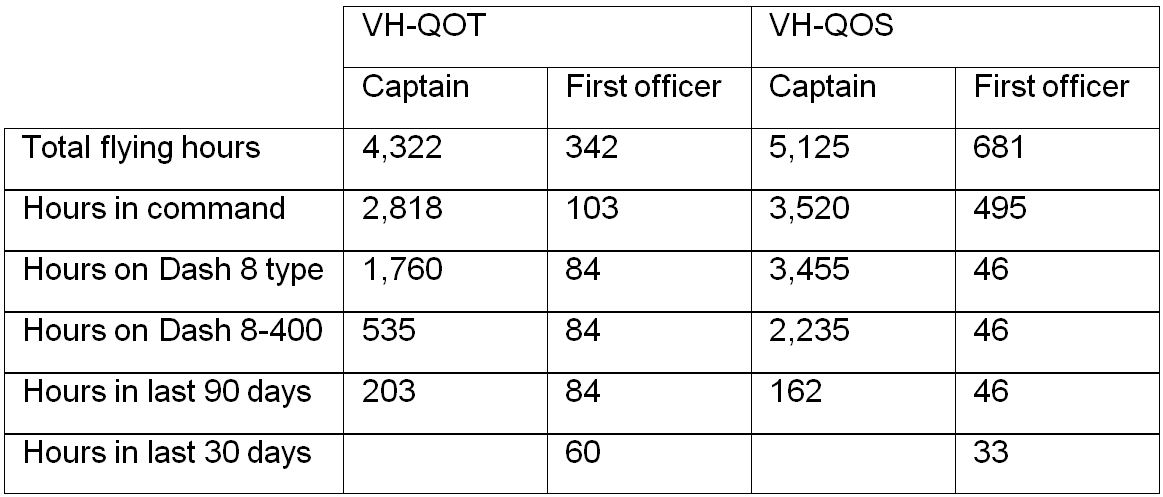
Both training captains held an Air Transport Pilot (Aeroplane) Licence, a multi-engine command instrument rating and a valid Class 1 Medical Certificate. Both first officers (FO) held a Commercial Pilot (Aeroplane) Licence, a multi-engine command instrument rating and a valid Class 1 Medical Certificate. A summary of each pilot’s aeronautical experience is listed at Table 1.
Table 1: Aeronautical experience summary
First officer of VH-QOT
The FO commenced training with QantasLink on 23 April 2013. The following 6 weeks comprised mainly induction and ground training and was completed by early June. That training was conducted with the majority of available days being utilised.
The FO conducted two of the required four fixed base procedural training sessions on 5 and 6 June 2013. That training was followed by an extended period of inactivity and the remaining two sessions were not conducted until 11 and 16 July 2013.
The FO’s endorsement training, which consisted of 12 sessions in a flight simulator, commenced on 23 July 2013. That training included periods of inactivity and was not completed until 10 September 2013, a period of 50 days. Allowing for days off and rest, this endorsement training should typically take between 20 and 30 days to complete.
The FO’s line training, conducted by a suitably-qualified training captain, commenced on 26 September 2013. The FO had completed 24 days of line training prior to the tail strike on 5 November 2013.
First officer of VH-QOS
The FO commenced ground training on 3 June 2013. The FO’s training roster for June and the first 2 weeks of July included induction and ground training with most available days being utilised. For the remainder of July and up to late August, the pilot was on standby for 26 of the 30 available training days.
The FO commenced fixed base procedural training on 27 August 2013 and completed that training on 4 September 2013.
The FO’s endorsement training commenced on 7 September 2013. That training, conducted during the remainder of September and all of October, included periods of inactivity and took 55 days to complete the stipulated 12 sessions.
The FO commenced line training on 5 November 2013. The FO had completed 13 days of line training prior to the tail strike on 11 December 2013.
Fatigue assessment
None of the operating crew members reported any fatigue concerns or health issues in relation to the occurrence flights.
The captain and FO of VH-QOT were on day 4 of a 5-day duty cycle. Both pilots reported being well rested and fit for duty. The current cycle was preceded by 2 days free of duty.
The captain and FO of VH-QOS had completed 10 days free of duty. Both pilots reported being well rested and fit for duty.
Aircraft information
Landing guidance
Bombardier Inc (Bombardier), the aircraft manufacturer, provided landing guidance in its Dash 8 aircraft operating and flight manuals. Normal landings could be conducted with any combination of 15° or 35° of landing flaps (Flap 15 or Flap 35) and a propeller RPM setting of 850 or 1,020. A preferred or optimal landing configuration was not specified.
In addition, a Bombardier pitch awareness video and service letter highlighted the length and susceptibility of the Dash 8-400 aircraft to tail strike as compared to the shorter fuselage variants. The video also detailed the:
location of the possible rear fuselage tail strike area
pitch angles at which the tail may contact the ground
importance of pitch awareness and not exceeding 6° of nose-up pitch during landing
typical approach to land pitch attitudes of about 0° to 1° nose up for Flap 15 and about 2° to 3° nose down for Flap 35
attitude change during the flare to land of approximately 5° for both Flap 15 and Flap 35 approaches
importance of controlling excessive rates of descent by increasing power rather than increasing the nose-up attitude near the ground. An increase in power increases the airflow over the wings directly behind the propellers and, therefore, increases lift even if the forward velocity does not change. If an excessive rate of descent close to touchdown cannot be corrected with power, a go around must be initiated.
Dash 8-400 touched runway indicating system
Most, if not all air transport aircraft have pitch limitations for take-off and landing in order to prevent the aft fuselage contacting the runway. Due to the design and length of the fuselage, the Dash 8‑400 can experience tail contact on landing at pitch attitudes as low as 6.9°.
Additionally, due to reduced flare capability at lesser degrees of flap, there is a greater probability of aft fuselage/runway contact with landing flaps set at 15° than with flaps set at 35°.
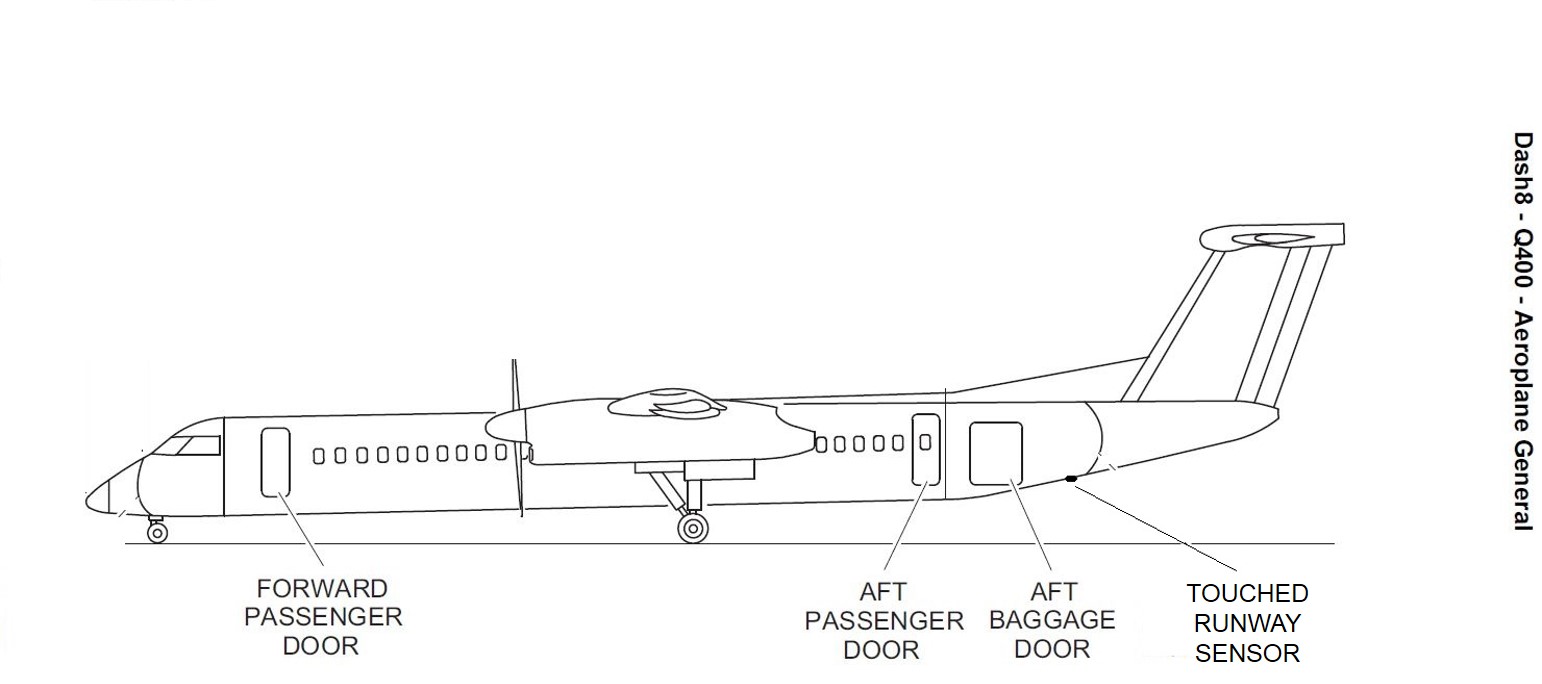
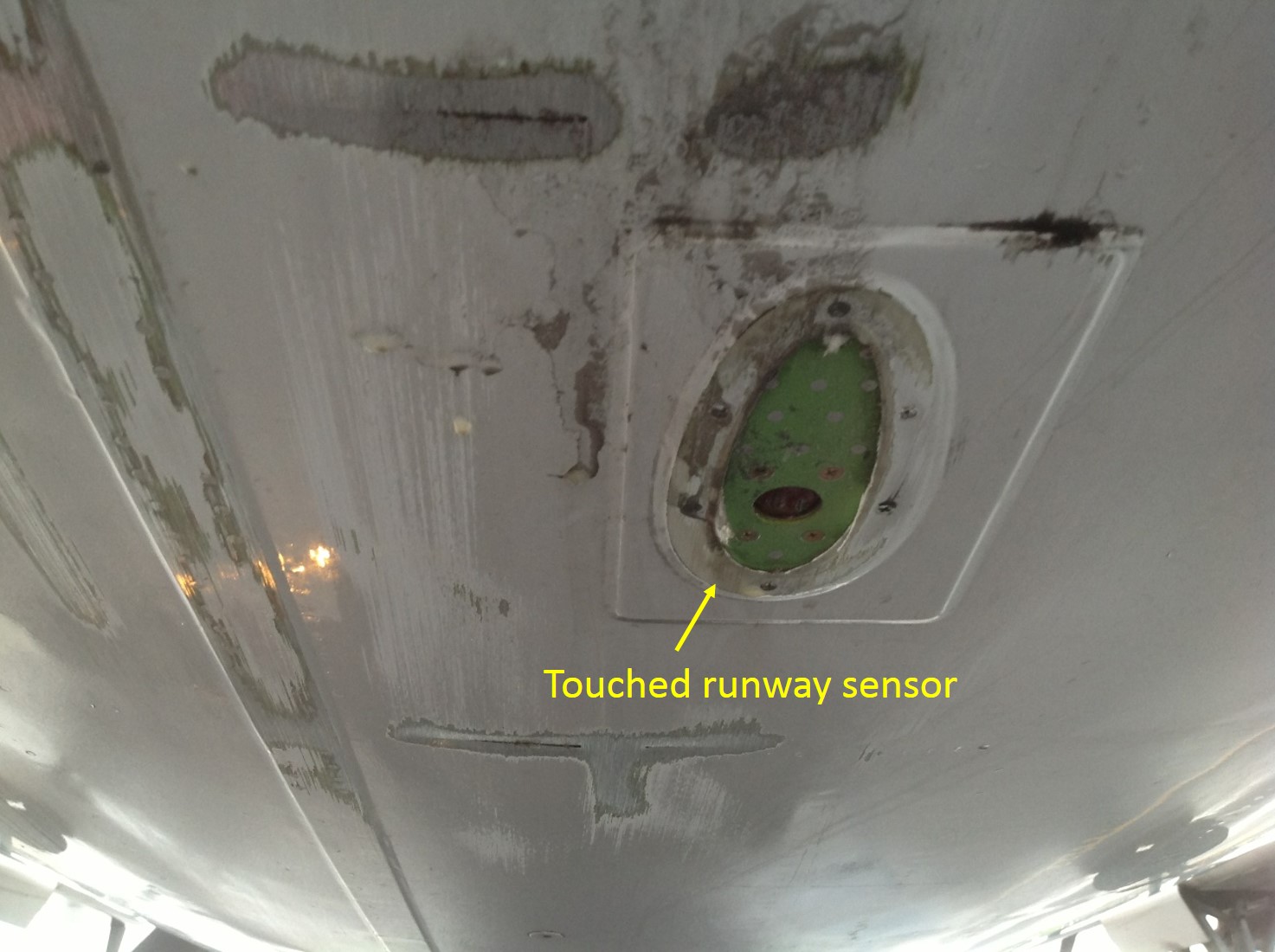
The Dash 8-400 is fitted with a touched runway detection system that includes a frangible switch/sensor located on the underside of the aft fuselage (Figure 1). In the event of a tail strike, a TOUCHED RUNWAY warning light, located on the overhead warning light panel in the cockpit, illuminates.
At touchdown, depending on main gear oleo compression and curvature of the runway surface, tail contact will occur at between 6.9° and 7.5° nose up.
Figure 1: Touched runway detection system – sensor location
Source: Bombardier, modified by the ATSB
Dash 8-300 advisory display
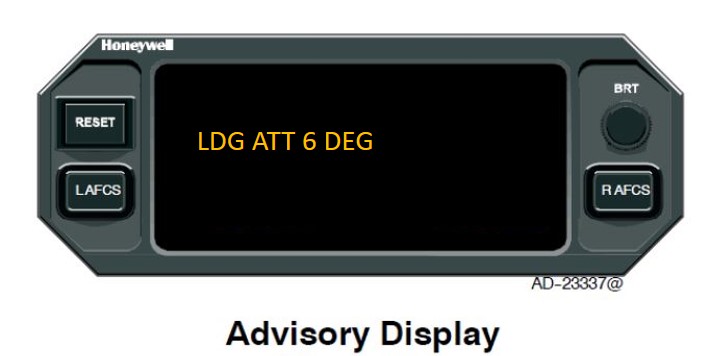
The Dash 8-300 is fitted with an advisory display indicator (Figure 2), which is located in a prominent position on the captain’s and FO’s instrument panel. The four-line colour display shows operational, warning and caution messages including LDG ATT 6 DEG. This message advises flight crew that the landing attitude has reached the certification limit.
Figure 2: Dash 8-300 advisory display
Source: QantasLink, modified by the ATSB
The Dash 8-400 is not fitted with an advisory display. Operational, warning and caution messages in the Dash 8-400 are displayed on the primary flight and navigation displays however, there is no caution message for landing attitude. The primary flight display is located on the pilot’s instrument panel and includes an attitude indicator graduated in increments of 2.5°. During landing in the Dash 8-400, the monitoring pilot is required to monitor the attitude indicator and make advisory calls if the pitch attitude reaches 5° or 6°.
Aircraft damage
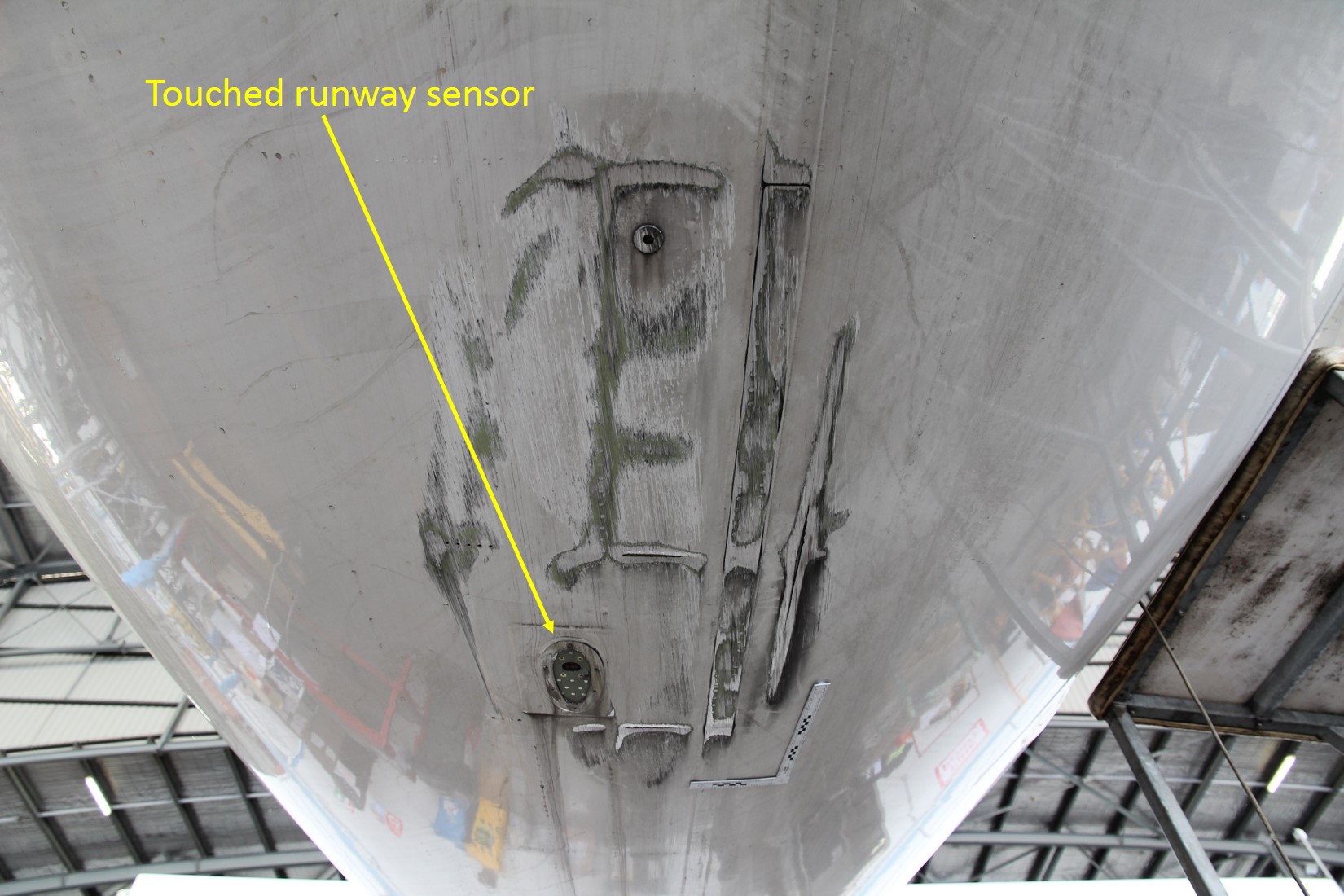
Both aircraft sustained impact and abrasion damage to the aft fuselage skin and buckling of internal structures in the area of the touched runway sensor (Figures 3 and 4).
Figure 3: Damage to the tail section of VH-QOT (looking aft)
Source: ATSB
Figure 4: Damage to tail section of VH-QOS (looking aft)
Source: ATSB
Flight recorders
Flight data recorder - VH-QOT
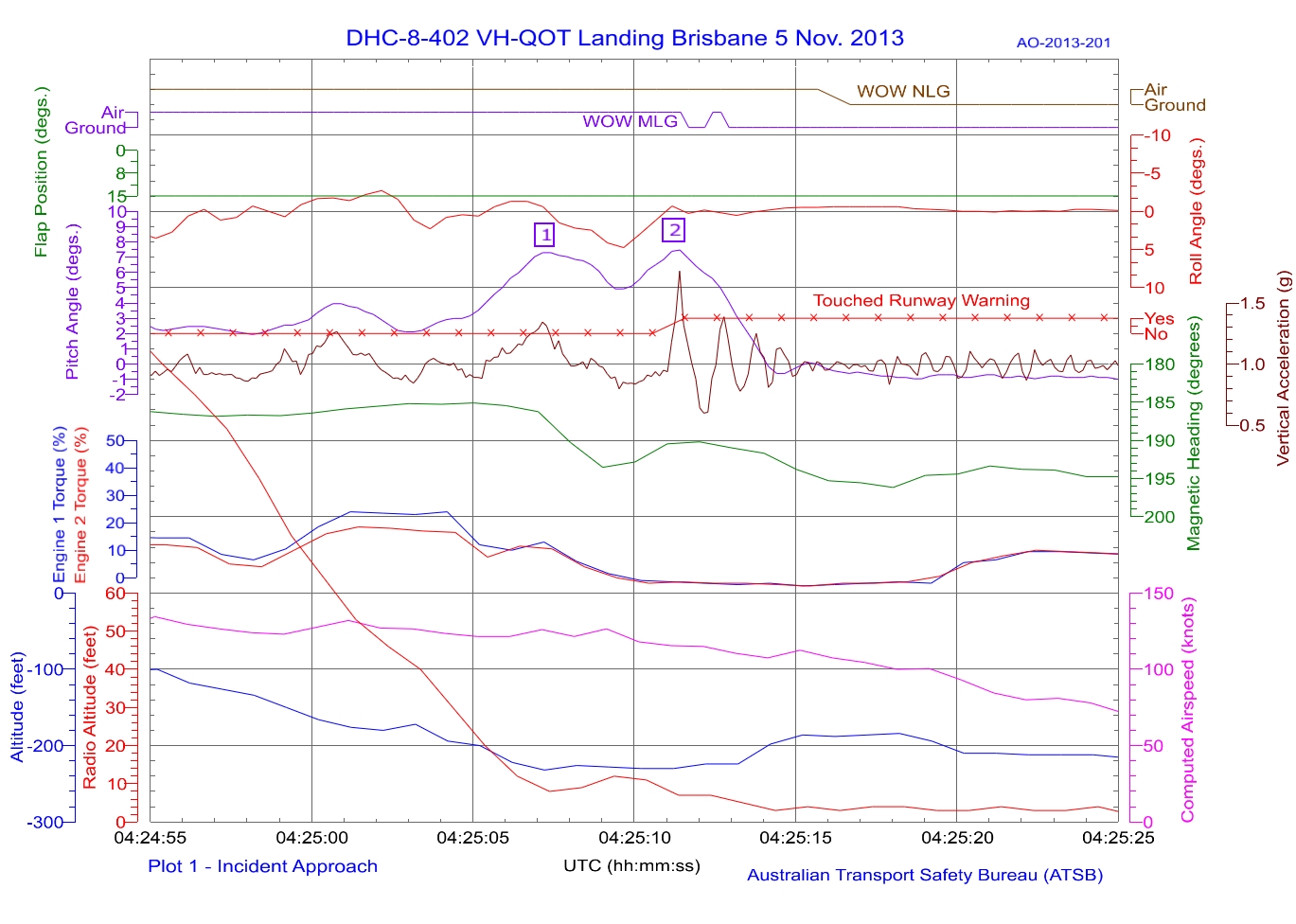
Analysis of recorded data indicated that the flare to land was commenced at about 20 ft. The airspeed at that time was 122 kt, slightly above the vref[4] of 119 kt for the approach but below the target approach speed (vapp)[5] of 127 kt and engine torque about 10 per cent. Expected torque for a Flap 15 landing is about 17 per cent.
During the flare, due to the prevailing crosswind, the FO conducted a ‘de-crabbing manoeuvre’ to align the aircraft with the runway. Flight idle was selected as the aircraft descended through about 10 ft and the pitch attitude during the flare reached a maximum of 7.3°. The recorded data did not register ground contact associated with that flare. However, as the flight crew recalled that initial touchdown was very light, there may have been insufficient weight applied to the main landing gear sensor to record the initial runway contact. The aircraft floated just above the runway for a period of about 4 seconds during which time the airspeed reduced to 116 kt with no change in power. vref was 119 kt.
The pitch attitude at the second touchdown, which included a bounce as the main gear temporarily unloaded, was 7.5°. A data plot is included at appendix A.
Flight data recorder - VH-QOS
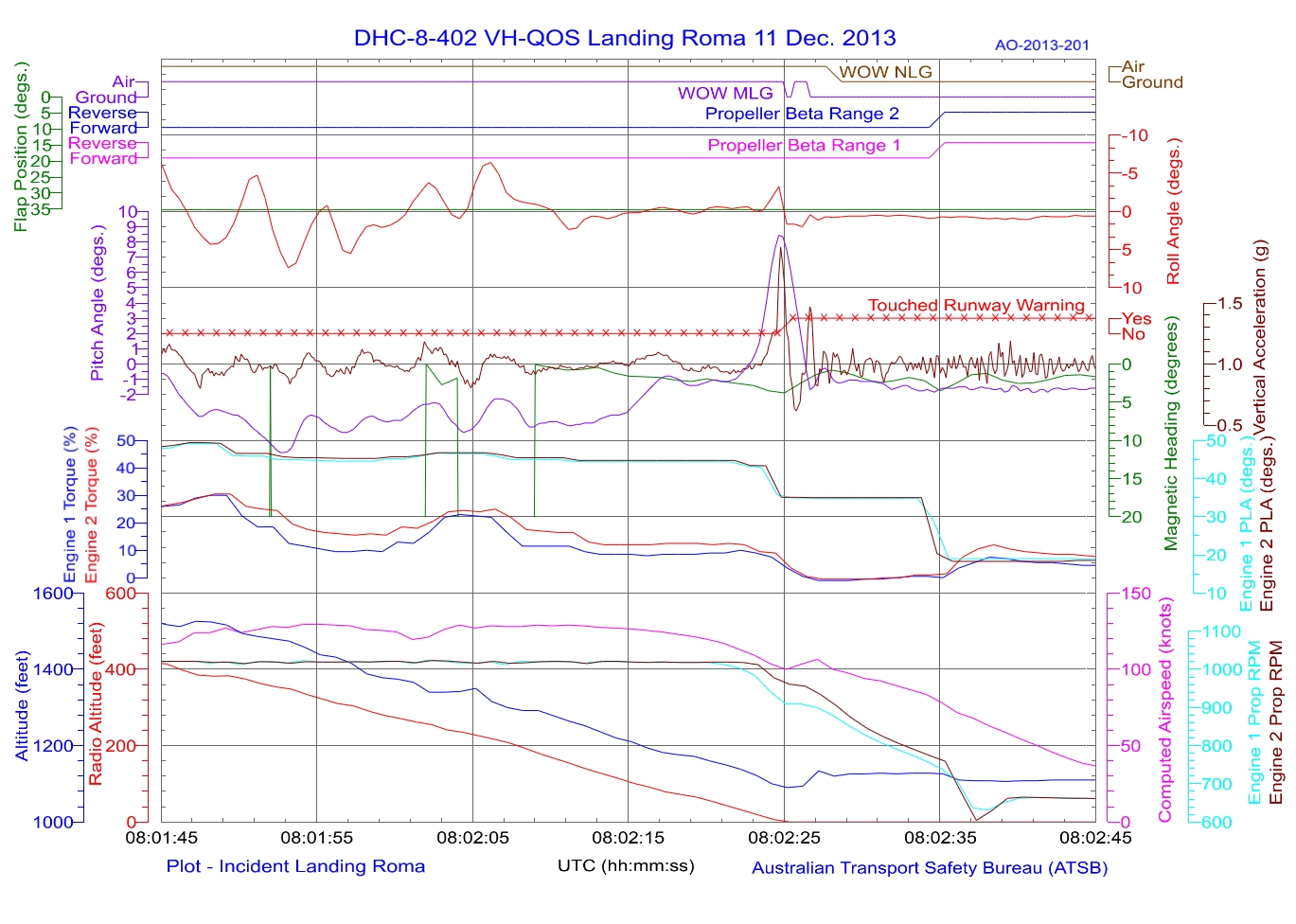
Analysis of recorded data indicated that between 100 ft and 30 ft, the airspeed reduced from 127 kt to 115 kt. The target approach speed was 120 kt and Vref was 113 kt. Engine torque during this period was about 14 per cent, significantly below the expected torque for a Flap 35 landing of about 24 per cent.
The flare to land was commenced at about 30 ft and at about 10 ft, engine power was reduced to flight idle. Touchdown, which included a bounce as the main gear temporarily unloaded, occurred at an airspeed of 100 kt, 13 kt below the Vref of 113 kt. The pitch attitude was 8.4° at that time. A data plot is included at appendix B.
Operator information
First officer training
General
Prior to commencing line operations, all FOs were required to complete the:
QantasLink induction program
Dash 8-400 ground engineering course and other mandatory ground courses, including viewing the Bombardier pitch awareness video
Dash 8-400 endorsement program, which was conducted in the aircraft simulator.
The endorsement program comprised four fixed‑base procedural training sessions and 12 full flight simulator training sessions. The final session included an assessment of the trainee’s competency to progress to line training in the aircraft.
FO line training was conducted on revenue flights under the supervision of an appropriately‑qualified training captain. FOs received between 75 and 100 hours of training followed by a check-to-line assessment.
First officers of VH-QOS and QOT
The FOs of VH-QOS and VH-QOT reported that their simulator training was sporadic, due to a combination of simulator unserviceability and rostering. QantasLink identified a similar irregular training pattern with other trainee FOs due to extended periods of time being on‑call to conduct training.
Pitch attitude awareness
The QantasLink Dash 8-400 flight crew operating manual (FCOM) highlighted that pilot awareness of pitch attitude during touchdown was essential to avoid a touched runway occurrence and cautioned against pitch attitudes in excess of 6°.
The aircraft typically requires a 5° attitude change during the landing flare. When landing with Flap 15, the approach attitude is close to zero so touchdown at around 5° nose up can be expected. When landing with Flap 35 the approach attitude is around 2° nose down with touchdown at about 3° nose up.
The FCOM indicated that the pilot monitoring was required to note the pitch attitude during the landing flare and make a number of advisory calls if the pitch attitude reached 5° or 6° (Table 3).
Table 3: Pitch attitude advisory calls
Pilot monitoring
Pilot flying
Action
‘Five degrees’
‘Checked’
Check attitude and power and adjust if necessary, to avoid further increase.
‘Pitch’
‘Correcting’
Take immediate action to ensure pitch attitude does not exceed 6°.
The FCOM also stated that if the sink rate was too high during the roundout and flare, it was not to be corrected by pitching up beyond 6°. In such cases, an appropriate power increase could be used to further reduce the sink rate or, if necessary, a go around should be conducted.
Landing configuration guidance
At the time of the occurrences, QantasLink did not provide any landing configuration guidance or information additional to that provided by Bombardier. QantasLink did not specify a preferred or optimal landing configuration.
As detailed previously, normal landings could be conducted with any combination of Flap 15 or Flap 35 and a propeller RPM setting of 850 or 1,020. The selected landing configuration was at the discretion of the captain.
Flap 35 provides for a slower approach speed, reduced landing distances and a greater tail strike margin. Despite this, both training captains reported that most pilots preferred to use Flap 15 because the aircraft was more responsive, easier to handle and easier to land. Flap 35 was rarely used for other than training purposes.
A propeller RPM setting of 850 produces less noise in the cabin and less propeller drag. Reduced propeller drag lessens the aircraft’s deceleration if the engine power is reduced to flight idle prematurely. In the event of a go around, propeller RPM will automatically increase to 1,020 RPM. An RPM of 1,020 provides increased sensitivity to power lever inputs and greater control over aircraft performance, and is therefore often used in windy or turbulent conditions.
Analysis of high pitch attitude events
About 5 months prior to these occurrences, QantasLink identified an emerging trend in high pitch attitude occurrences during landing. In response, a focused flight operations analysis was commenced, and remained ongoing, at the time of these occurrences.
In response to these two tail strikes, QantasLink re‑analysed the data and identified an increasing trend of high pitch attitude landings conducted by FOs under training. That finding resulted in the implementation of a number of measures designed to reduce the risk of tail strikes (see the section titled Safety actions).
Information provided by QantasLink identified that, in the 12 months following the introduction of those safety measures, the number of high pitch attitudes during landing reduced significantly.
Previous similar occurrences
At the time of these occurrences, there had been 19 other tail strikes worldwide involving Dash 8‑400 aircraft. Eighteen of these were during landing.
There have been two other previous tail strike occurrences involving Australian-registered Dash 8 aircraft. However, they involved earlier -100 or -200 series aircraft and appear to have been the result of wind‑related environmental effects.
Due to its design and length, the Dash 8-400 has an increased risk of tail strike on landing that must be managed by the flight crew. The tail strikes that occurred on 5 November and 11 December 2013 took place when the affected aircraft were being flown by flight crew members under training. Both tail strikes were characterised by insufficient application of engine power and overpitching during the landing flare.
This analysis will discuss the development of the tail strikes, the operator’s training and the risk controls in place at the time of the occurrences.
The tail strikes
While they had different flap settings, both approaches were conducted using a propeller RPM setting of 1,020. While that RPM setting resulted in higher overall drag compared to that associated with the alternate 850 RPM, the early, initial and final stages of the approaches were unremarkable. Both training captains reported that as the aircraft approached the flare, they thought that the respective trainee first officers (FO) had, as the pilot flying, handled the approach well.
The purpose of the flare is to reduce the rate of descent prior to touchdown. In the Dash 8-400, which has a relatively low tail strike attitude, the flare needs to be effected by careful use of pitch attitude change and engine power management.
In general terms, increasing the pitch attitude increases the lift generated by the wings and will therefore reduce the rate of descent. Due to the design of the Dash 8, the rate of descent can also be reduced by increasing engine power. Any increase in engine power will increase the airflow over the wing and produce additional lift. Conversely, reducing power to flight idle too early can result in a loss of lift and a significant increase in propeller drag, particularly when 1,020 RPM is used.
While not necessarily intuitive, a high sink rate during the flare must not be corrected in the Dash 8-400 by pitching up beyond 6°, as this could result in a tail strike. The correct response is to increase power or, if necessary, conduct a go around.
VH-QOT
The aircraft entered the landing flare at about the desired airspeed and with a power setting that was about 7 per cent lower than normal for the selected flap setting. Although the FO had to contend with a reasonably strong crosswind, the associated de-crabbing manoeuvre appears to have been well handled and not directly related to the tail strike.
During the flare, the sink rate was arrested by increasing the pitch attitude and power was reduced to flight idle as the aircraft descended through about 10 ft. The reduction of power to flight idle resulted in a loss performance and introduced a significant amount of propeller drag. Contrary to the recommended procedure, the rate of descent was reduced by further increasing the pitch attitude to 7.3°.
Following the initial flare and light touchdown, the pitch attitude was reduced to achieve level flight and the aircraft continued to float above the runway with idle power for about 4 seconds. The lack of engine power during this period resulted in a continued loss of performance that was instinctively countered by a further pitch attitude increase beyond the recommended 6° limit. This resulted in the tail contacting the runway.
VH-QOS
In the case of VH-QOS, the aircraft arrived at the flare with an already‑decreasing airspeed and insufficient engine power. These conditions were symptomatic of insufficient performance for the stage of flight. Reducing engine power to flight idle during the flare further reduced the aircraft’s performance and introduced a significant amount of propeller drag.
The inadequate performance, significant propeller drag and additional drag associated with Flap 35 resulted in the airspeed reducing rapidly from 115 kt to 100 kt. While the corresponding loss of lift should have been countered by an increase in engine power, the FO intuitively pitched up further. At touchdown, the airspeed was 13 kt below the minimum airspeed and the pitch attitude was 8.4°.
Conclusion
The selection of flight idle during the landing flare, possibly aggravated by the increased drag associated with a propeller setting of 1,020 RPM, resulted in a significant loss of performance that was incorrectly countered by the respective FO by increasing the aircraft’s pitch attitude.
In both cases, the FO did not manage the engine power commensurate with the aircraft's declining energy state, inducing them to inadvertently pitch up to control the descent rate and exceed the aircraft’s pitch angle limit.
Endorsement training
QantasLink’s identification of an emerging trend in high pitch attitude landings prior to these occurrences highlights the value of analysing flight operations data. The resulting focus on data analysis, while not preventing these occurrences, was a proactive response by QantasLink.
Additional analysis of flight operations data by QantasLink following these two occurrences identified an emerging trend of high pitch attitude occurrences during landing among the trainee FOs. There was a significant reduction in the number of these occurrences in the 12 months following the introduction of safety measures. These measures included:
additional landing guidance
additional training captain guidelines
the implementation of pitch- and landing-focused simulator/line training programs.
This supports the conclusion that the occurrences took place as a result of inadequate landing techniques and pitch attitude awareness deficiencies among those FOs.
Simulator training, both endorsement and recurrent, can be a very powerful and effective training aid. The endorsement training for the FOs that were involved in these two occurrences included minimal normal landings and did not include any specific training to address the risk of tail strike. Had the syllabus included simulator training to reinforce the correct procedure for reducing higher‑than‑normal descent rates on approach and pitch awareness, the tail strikes may not have occurred.
Both FOs reported that their training was conducted over an extended period of time with periods of inactivity between simulator sessions. QantasLink identified that the training schedule for other recently‑employed FOs exhibited similar patterns and in some cases took even longer to complete. Such sporadic training may not provide trainees with adequate opportunity to consolidate and retain newly‑learned skills. However, as the content of the training did not adequately prepare the FOs to land the Dash 8-400 aircraft, it is difficult to assess whether the irregular training pattern may have, in isolation, influenced the development of these occurrences. The potential for the irregular training to have compounded any difficulties experienced by the FOs during their training could not be discounted.
Risk controls
Pitch monitoring
The operator’s procedures required the pilot monitoring to make 5° and 6° pitch attitude calls. However, on both occurrences the pitch attitude went from an acceptable attitude to over 7° in a very short period of time. Given that both flying pilot FOs were under training, it is likely that the training captain’s focus in each case was directed more towards the manipulation of the aircraft rather than the existing pitch attitude.
In the case of VH-QOT, the pitch attitude during the initial flare changed from 3.2° to 7.3° in 2 seconds. There may have been an opportunity for the captain to notice and call the excessive pitch attitude during the 4 second float. However, it appears their focus was more towards ensuring the aircraft settled onto the runway than its pitch attitude.
In the case of VH-QOS, the pitch attitude changed from 1.2° to 8.4° in 1.5 seconds. During this short period the captain called for the FO to add power to arrest the rapidly‑reducing airspeed. The situation developed so rapidly that there was insufficient time for the captain to recognise and make the required pitch attitude calls.
Earlier versions of the Dash 8 are fitted with an advisory display that provides a visual caution when the pitch attitude reaches 6°. The display is located in a prominent position and, if fitted to the occurrence aircraft, may have been of assistance in bringing the high pitch attitude to the attention of the crew. However, given how quickly the situations developed, it seems unlikely that a similar caution would have proved effective in preventing these tail strikes.
Landing flap selection
Most air transport aircraft use flap settings of about 30° or greater for landing. Those settings provide for tail strike margins in excess of 5°. Despite the operational benefits of using Flap 35, full flap on the Dash 8-400, flight crew appear to prefer the use Flap 15 due to the aircraft being more responsive, easier to handle and easier to land. While the use of Flap 15 does provide a performance benefit in the event of a go-around, none of the airports to which QantasLink operated required its use.
While flight crews may prefer the use of Flap 15 for landing, the margin between a normal approach attitude and tail strike attitude in that configuration is reduced from about 4° to about 2°.
Findings
From the evidence available, the following findings are made with respect to the tail strike occurrences involving Dash 8-400 aircraft, registered VH-QOT, at Brisbane Airport, Queensland on 5 November 2013 and Dash 8-400 aircraft, registered VH-QOS, at Roma Airport, Queensland on 11 December 2013. These findings should not be read as apportioning blame or liability to any particular organisation or individual.
Contributing factors
In the last 50 ft of both approaches to land, the first officer, who was the pilot flying, did not manage engine power commensurate with the aircraft's declining energy state, inducing the first officer to inadvertently pitch up to control the descent rate and exceed the pitch angle limits.
Varied emphasis on the appropriate handling technique and pitch attitude awareness during first officer training did not assure consistent application of an appropriate landing technique in the Dash 8-400 aircraft.
Other findings
The use of Flap 15 for landing results in a margin of 1.9° between the nominal landing flare angle and the tail strike angle, compared to a margin of 3.9° when using Flap 35 and a typical margin for other transport aircraft of over 5°.
About 5 months prior to these occurrences, QantasLink identified an emerging trend in high pitch attitude occurrences during landing. In response, a focused flight operations analysis was commenced, and was ongoing, at the time of these occurrences.
Safety issues and actions
The ATSB did not identify any organisational or systemic issues that might adversely affect the future safety of aircraft operations. However, whether or not the ATSB identifies safety issues in the course of an investigation, relevant organisations may proactively initiate safety action in order to reduce their safety risk. The ATSB has been advised of the following proactive safety action in response to this occurrence.
Proactive safety action taken by QantasLink
In response to the tail strikes, QantasLink made a number of changes to their training procedures including:
changes to training captain selection criteria and to the training provided to training captains
amendments to training captain proficiency lesson plans to include pitch attitude monitoring, dedicated training to raise awareness of potential candidate errors and intervention/recovery training
implementation of a pitch attitude monitoring and landing recovery training session as part of the cyclic simulator training and proficiency program
implementation of a new rostering protocol that, where a first officer’s training is disrupted by a period of more than 7 days, they will receive additional training events.
QantasLink also issued several flight operational bulletins that:
provided additional information and guidance on landing techniques covering the approach to land, flare, and appropriate use of engine power
cautioned that reducing power to idle close to the ground or in the flare may cause a sudden and unexpected increase in drag along with a reduction of lift
cautioned that should a higher-than-normal decent rate be experienced during the landing phase, the temptation to control this decent rate by pitching up must be avoided
required all flight crew to review the pitch awareness video by a set date
reminded flight crew of the standard pitch awareness calls and associated actions
provided guidance for bounced and skipped landing recovery
placed restrictions on the use of 1,020 RPM for landing.
Those bulletins have subsequently been incorporated into QantasLink’s operations manuals.
Proactive safety action taken by Bombardier Inc
On 21 September 2016, Bombardier Inc advised that, following a review of the landing guidance provided in their pitch awareness video, they were in the process of amending the associated Flight Operations Service letter to include the following:
PURPOSE
This Flight Operations Service Letter is issued to provide landing guidance for Tailstrike Avoidance on the Q400
DISCUSSION
There have been a number of tailstrikes recently resulting in damage to the aft lower fuselage.
The Aircraft Flight Manual (AFM) is the only approved document with respect to flight management of the aircraft.
Bombardier wishes to remind Operators to be mindful of aircraft pitch attitude during the flare (the following extracted from Section 4.4 of the AFM)
NOTE
To decrease the landing descent rate and not exceed a pitch attitude of 6°, when the landing descent rate is higher than desired, power will be required in the landing flare through to touchdown.
To decrease the landing descent rate at airport altitudes greater than 5,000 ft, it may be necessary to maintain power in the landing flare through to touchdown.
CAUTION
Pitch attitudes greater than 6° in the landing flare may cause the fuselage to contact the runway.
A Pitch Awareness Training video was developed as general guidance to avoid aft lower fuselage contact during the landing and should be considered as examples of approaches and landings. A nominally flat pitch attitude should be expected for flap 35°, while a flap 15° approach will be flown slightly nose-up, when the appropriate VREF speed is adhered to.
While some Q400 operational tailstrikes have included unstable approaches, all Q400 tailstrikes during the landing flare occurred as a result of not respecting the AFM Caution of 6° during the landing flare.
It is important to focus attention on speed management during the approach, which in turn will allow the aircraft to stabilize the appropriate pitch attitude. As each approach for landing can be subtly different, so can the pitch attitude. Management of the absolute pitch attitude during the landing flare to less than 6° at touchdown, as well as increasing power to reduce the sink rate will help flight crew avoid tailstrikes.
Sources and submissions
Sources of information
The sources of information during the investigation included the:
flight crew of VH-QOT and VH-QOS
flight data recorders of VH-QOT and VH-QOS
QantasLink
Bombardier Inc.
Submissions
Under Part 4, Division 2 (Investigation Reports), Section 26 of the Transport Safety Investigation Act 2003 (the Act), the ATSB may provide a draft report, on a confidential basis, to any person whom the ATSB considers appropriate. Section 26 (1) (a) of the Act allows a person receiving a draft report to make submissions to the ATSB about the draft report.
A draft of this report was provided to the flight crew of VH-QOT and VH-QOS, QantasLink, Bombardier Inc, the Transportation Safety Board of Canada and the Civil Aviation Safety Authority.
Submissions were received from a flight crew member of VH‑QOT, QantasLink, Bombardier Inc and the Civil Aviation Safety Authority. The submissions were reviewed and, where considered appropriate, the text of the draft report was amended accordingly.
Appendices
Appendix A – VH-QOT approach and landing data
Source: ATSB
Appendix B – VH-QOS approach and landing data
Source: ATSB
Purpose of safety investigations
The objective of a safety investigation is to enhance transport safety. This is done through:
identifying safety issues and facilitating safety action to address those issues
providing information about occurrences and their associated safety factors to facilitate learning within the transport industry.
It is not a function of the ATSB to apportion blame or provide a means for determining liability. At the same time, an investigation report must include factual material of sufficient weight to support the analysis and findings. At all times the ATSB endeavours to balance the use of material that could imply adverse comment with the need to properly explain what happened, and why, in a fair and unbiased manner. The ATSB does not investigate for the purpose of taking administrative, regulatory or criminal action.
Terminology
An explanation of terminology used in ATSB investigation reports is available here. This includes terms such as occurrence, contributing factor, other factor that increased risk, and safety issue.
Publishing information
Released in accordance with section 25 of the Transport Safety Investigation Act 2003
Ownership of intellectual property rights in this publication
Unless otherwise noted, copyright (and any other intellectual property rights, if any) in this report publication is owned by the Commonwealth of Australia.
Creative Commons licence
With the exception of the Coat of Arms, ATSB logo, and photos and graphics in which a third party holds copyright, this publication is licensed under a Creative Commons Attribution 3.0 Australia licence.
Creative Commons Attribution 3.0 Australia Licence is a standard form licence agreement that allows you to copy, distribute, transmit and adapt this publication provided that you attribute the work.
The ATSB’s preference is that you attribute this publication (and any material sourced from it) using the following wording: Source: Australian Transport Safety Bureau
Copyright in material obtained from other agencies, private individuals or organisations, belongs to those agencies, individuals or organisations. Where you wish to use their material, you will need to contact them directly.
On 31 October 2013, a Cessna 172 aircraft, registered VH-IGS, departed Parafield, on a private flight to the Gum Creek area near Clare, South Australia. The pilot was the sole occupant on board.
The pilot had flown to Parafield earlier in the morning to pick up a part needed to repair a hay cutting machine. The pilot felt pressure to get the part back to the property and repair the machine so that the harvest could continue.
At about 1300 central daylight time, the aircraft arrived overhead a back road the pilot had selected in the Gum Creek area. His intention was to land as close as possible to the hay machine. After conducting two precautionary searches over the road and identifying some powerlines, he commenced the approach onto the road.
Just as the aircraft was touching down, a gust of wind struck the aircraft from the right, moving it rapidly to the left. The pilot attempted to initiate a go-around, but the aircraft continued further left. The left wing struck a large tree and was severed, and the aircraft was further damaged as it continued through a gate and fence. The pilot sustained minor injuries, and the aircraft was substantially damaged.
On 2 November 2013, the pilot of a Bell 206L-1 helicopter, registered VH-VDZ, was conducting passenger-carrying charter operations between Olympic Park oval and Flemington Racecourse, Melbourne, Victoria. At about 1830 Eastern Daylight-saving Time, the pilot prepared to reposition the helicopter from one of the temporary helipads at Olympic Park. There were no passengers on board.
As the pilot lifted the helicopter into a hover it started rolling about the right skid, which was in contact with the ground. The helicopter rapidly rolled further right until the main rotor blades struck the ground. A large amount of main rotor and other high energy debris was released from the helicopter and impacted a nearby marquee, a number of vehicles and a helicopter on an adjacent helipad. The pilot sustained minor injuries.
What the ATSB found
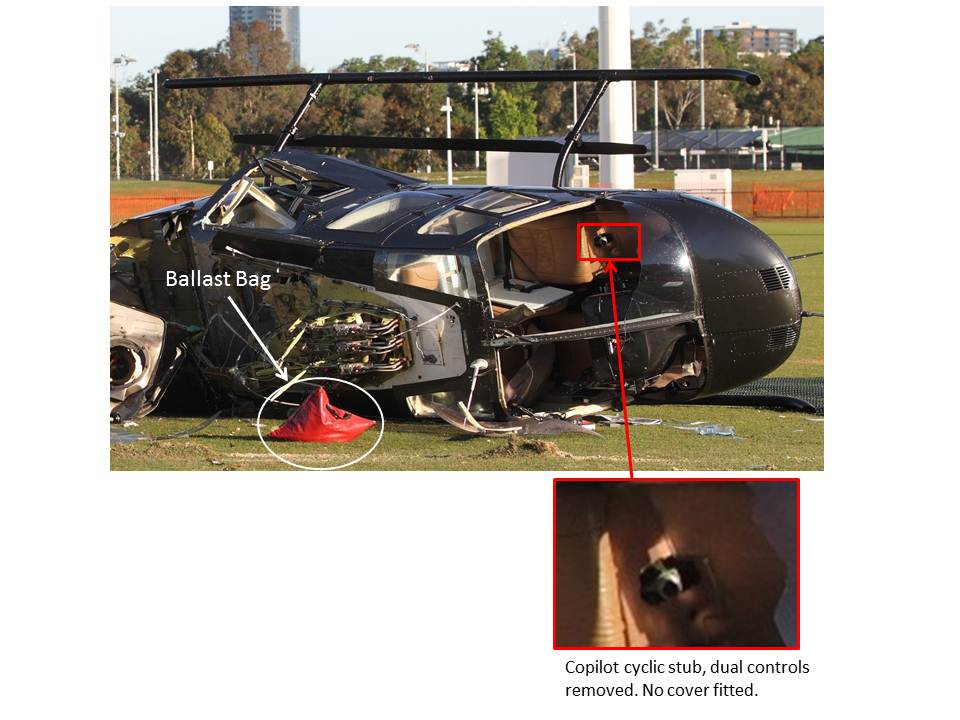
The ATSB found that the pilot did not identify and react to the helicopter’s right-skid low attitude in sufficient time to prevent the helicopter rolling over. In addition, an unsecured ballast bag was positioned on the left front floor of the helicopter, increasing the risk of injury to occupants. Further, the helicopter’s dual flight controls were removed to facilitate the flights. The person who removed the controls did not have the training or authorisation to conduct the maintenance procedure. The left cyclic stub cover was not installed, leaving the stub exposed. This resulted in the potential for the ballast bag to inhibit movement of the pilot’s cyclic control due to fouling of the left cyclic stub.
The ATSB identified safety issues relating to the availability of first aid and emergency response equipment at the oval and the proximity of the helipads to the perimeter fence and public access areas. Each increased the risk of injury to bystanders in the event of an accident.
What's been done as a result
For subsequent operations at the Olympic Park oval for the remainder of the event, the charterer positioned firefighting equipment at each helipad and first aid equipment was made available nearby. In addition, the helipads were repositioned further from the passenger marquee, and passengers were not loaded or unloaded if helicopters were in the process of landing or taking-off from adjacent helipads. Operations at the Olympic Park oval ceased following the 2013 carnival.
Safety message
This accident highlights the importance of coordinated control inputs by pilots during lift-off to control any roll, and if necessary smoothly lowering the collective in coordination with cyclic input to re-establish the helicopter’s weight evenly on the ground before any roll becomes excessive. The importance of properly securing any equipment, particularly if stowed in aircraft cockpits, and of the correct removal and re-fitting of dual flight controls to prevent any obstruction or fouling of the controls is emphasised.
In addition, this accident is a reminder of the risks involved when operating helicopters in public areas. Although the likelihood of a helicopter accident on the ground that results in injuries was found by the ATSB to be low, in the event of an accident, high energy rotor and other debris can travel large distances. Where possible, operators should consider larger distances around helicopter landing areas, in particular when operating close to public areas.
The occurrence
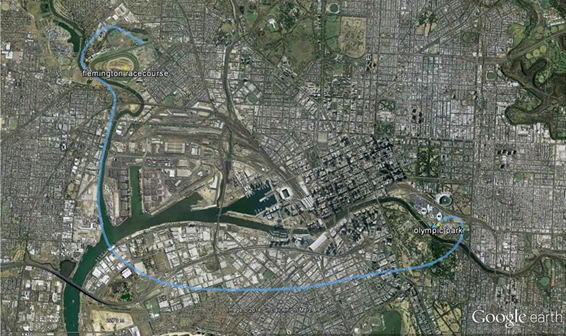
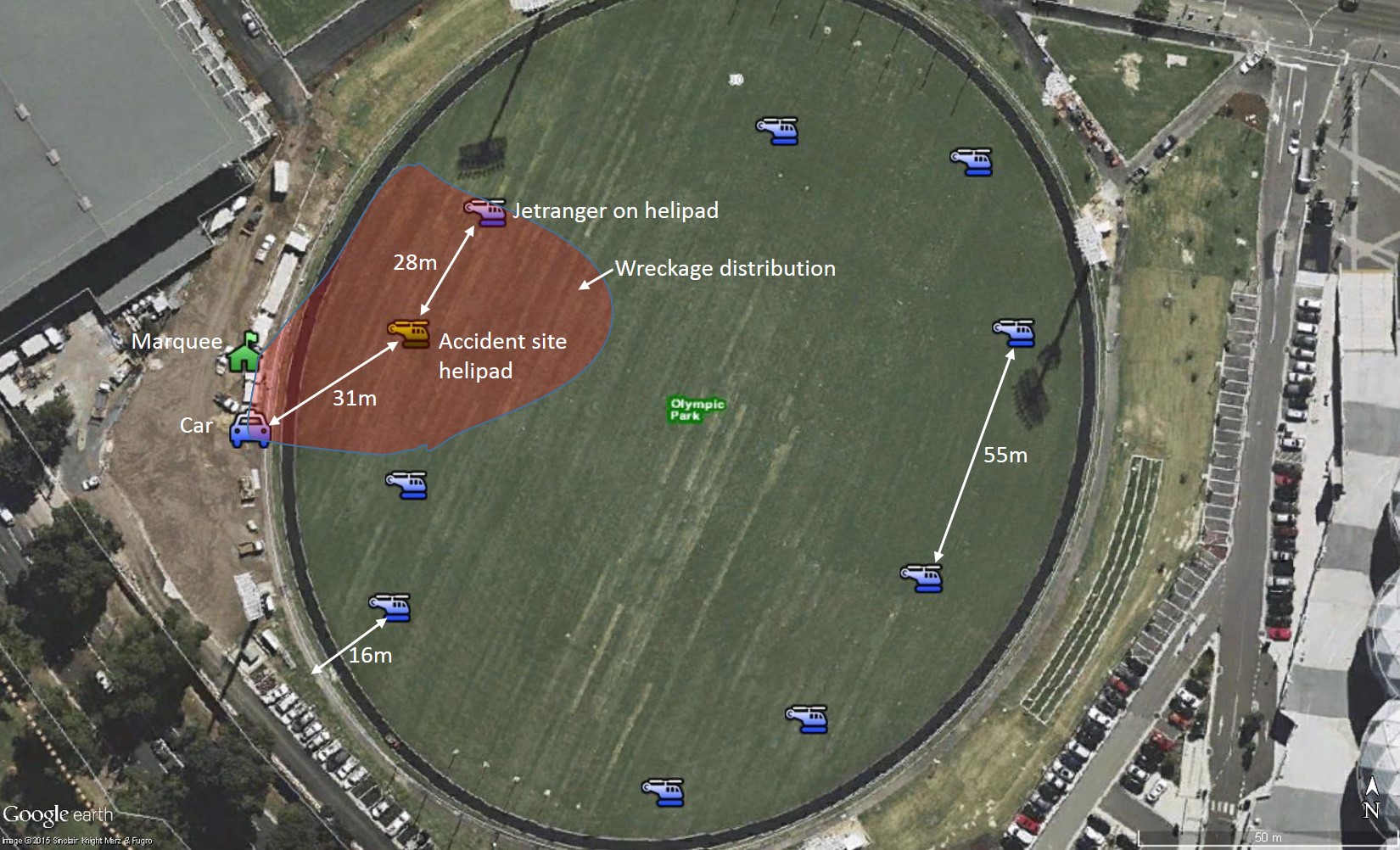
On 2 November 2013, the pilot of a Bell 206L-1 helicopter, registered VH-VDZ (VDZ), was conducting passenger-carrying charter operations between Olympic Park oval and Flemington Racecourse (Flemington), Melbourne, Victoria. At about 1830 Eastern Daylight-saving Time[1] the pilot prepared to reposition the helicopter from one of the temporary landing pads (helipad) on the western side of the oval, to a position that would facilitate a departure for Flemington (Figure 1). The helicopter was orientated on a westerly heading.
Figure 1: Previous flight path of VH-VDZ from Flemington Racecourse to Olympic Park. Yarra River passing through the imagec
Source: Google earth, modified by the ATSB
Before the pilot could lift off and taxi the helicopter for departure, another helicopter approached the oval to land at an adjacent helipad. As the landing helicopter approached from a position that was beyond the view of the departing pilot, a marshaller, who was positioned in front of VDZ, signalled to the pilot of VDZ to hold their position on the helipad. Once the approaching helicopter landed on the adjacent helipad, the pilot of VDZ was given a visual signal by the marshaller to indicate that there were no conflicting aircraft or obstructions and that the pilot was clear to commence taxiing.
As the pilot began to lift VDZ into a hover, witnesses observed the helicopter’s skids lift slightly and drift to its right before the helicopter commenced rolling about the right skid. The pilot did not observe any right drift of the helicopter but affirmed that the right skid seemed to remain ‘stuck’ to the ground.
In rapid succession the left skid continued to rise and the helicopter rolled further right. Reported efforts by the pilot to recover from the roll were ineffective and the helicopter’s main rotor blades struck the ground. A large amount of high energy main rotor and other debris was released from the helicopter and impacted a nearby marquee, a number of vehicles and the helicopter on the adjacent helipad.
The helicopter was extensively damaged. Although witness photographs showed smoke after the rollover, there was no fire. This would suggest that the smoke was a result of escaping oil or hydraulic fluid coming into contact with hot aircraft parts or components.
The pilot sustained minor injuries and was able to exit the wreckage through the damaged front windscreen. Passengers disembarking from the adjacent helicopter, bystanders, company personnel, and others situated at a nearby marquee were not injured by any of the high energy debris.
The charterer[2] secured the services of other operators in support of the passenger-carrying charter flights that day. This provided additional capacity to move passengers between Olympic Park oval and Flemington Racecourse during peak periods.
Personnel information
Pilot
The pilot held a Commercial Pilot (Helicopter) Licence and was endorsed on the Bell 206 (B206) helicopter. The pilot also held a valid Class 1 Aviation Medical Certificate.
The pilot indicated that, at the time of the accident, they had a total aeronautical experience of about 1,020 flying hours, which included about 50 hours flying B206 Jetranger helicopters and about 22 hours flying the B206 Longranger. The pilot’s most recent check flight was conducted on 21 January 2013 in a Robinson R44 helicopter. The pilot was not approved for pilot-permitted maintenance on the B206 in relation to the removal of flight controls (see Conduct of the flights and Dual flight controls).
A review of the pilot’s training file identified that sections relating to the pilot’s ab-initio training, B206 endorsement and recurrent training were incomplete. The pilot’s former employer reported that these sections were missing.
The pilot attended operational briefings 1 week prior to the passenger-carrying charter flights from Olympic Park that day. The briefings, conducted by the charterer’s chief pilot, included preferred routes, airspace boundaries, radio frequencies and other flight procedures. These included passenger loading and helicopter positioning.
Charterer’s chief pilot
The charterer’s chief pilot held the appropriate approvals and endorsements to fulfil their role. Although endorsed to fly the B206 helicopter, the chief pilot was not approved for pilot-permitted maintenance on the B206 in relation to the removal of flight controls.
For the purposes of the contract with Olympic Park for the conduct of flights between Olympic Park oval and Flemington, the charterer undertook a project management role, providing, through its chief pilot and other staff, oversight from both locations throughout the day.
Marshallers
The marshallers stated that they acted in a similar capacity during the previous year’s events. They were reported to have attended a specific ground crew briefing conducted by the charterer’s chief pilot 1 week prior to the event. It was also reported that, on the morning prior to commencing the passenger-carrying charter operations, an additional briefing session was conducted at Olympic Park oval for all operational personnel. The charterer stated that the marshallers had completed first aid training and were instructed on the use of emergency equipment, such as fire extinguishers.
Aircraft information
General information
VH-VDZ (VDZ) was a Bell Helicopter Co. 206L-1/C30P (Bell 206L-1), and was manufactured in the United States in 1981 (serial number 45693). It was first registered in Australia on 20 September 1991 and had accumulated about 6,159 hours total time in service at the time of the accident. The helicopter had been appropriately modified to incorporate a single Rolls-Royce 250-C30P turboshaft engine under a supplemental type certificate.
In the charter role, VDZ had seating for a pilot in the front right seat and six passengers. It was certified for day and night charter operations under the day/night Visual Flight Rules[3].
VDZ was installed with a handheld fire extinguisher.
Maintenance History
Examination of the helicopter’s current maintenance release indicated that it was maintained to a night Visual Flight Rules standard in the charter category. At the time of the accident, all of the scheduled maintenance recorded on the maintenance release had been completed. No maintenance entries were identified on the maintenance release in relation to the removal or installation of the dual flight controls.
Weight and balance
A minimum weight of 170 lb (77 kg) was required in the cockpit to operate the Bell 206L-1. This meant that, due to the reported pilot weight of about 65 kg, supplemental ballast was required for flights in VDZ where no passenger or crew occupied the front left seat. This took the form of a ballast bag (see the section Conduct of the flights), which was placed in the left of the cockpit.
The aircraft’s weight and longitudinal centre of gravity (CofG) at the time of the accident was calculated to be within limits. The lateral CofG was slightly to the right of the helicopter’s centreline.
Meteorological information
Photographic evidence and witness observations indicated a light wind at the time of the accident and that it crossed the helicopter from left to right. Weather observations by the Bureau of Meteorology at a nearby airport recorded that, at about the time of the accident, the wind was from the south at 12 kt.
The Bell 206L-1 flight manual stated that satisfactory stability and control was demonstrated in relative winds of 17 kt from the side of the helicopter. The pilot reported that meteorological conditions at the time did not adversely affect the operation of the aircraft and that the crosswind was within the helicopter’s normal operating limits.
Operational information
Planned operations
In preparation for the flying activities the charterer assessed the Olympic Park helicopter landing site. This enabled the charterer to draft a suite of event-specific documents that was issued to operational crew during a pre-event briefing. This included to all pilots involved in the charter operations on the day of the accident. The documents included information on the locations of the helipads, the passenger access points and hazards at each site, the preferred flight routes and altitudes and relevant emergency procedures.
Prior to the event, representatives of the charterer had meetings with the Victorian Racing Club and the Melbourne and Olympic Park Trust. These meetings reviewed the operational procedures and other requirements surrounding the proposed aviation activities. It was reported that this included items of the charterer’s risk management plan and safe work method statement.
The charterer’s risk management plan identified nine key risks to the operation. The risk areas that were pertinent to the accident included personnel error/fatigue and passenger safety and loading. In order to treat these risks, the charterer required that operational crew had regular breaks, including for meals, passengers were briefed before entering the operational area and all passengers were escorted to and from the helicopters by trained ground crew.
In addition to the risk management plan, the charterer’s safe work method statement[4] established the means to protect the public from hazards associated with operating helicopters from Olympic Park in support of the Spring Racing Carnival 2013. The identified hazards included the potential for members of the public to be struck by a helicopter, be exposed to hazardous and noisy environments, and that a helicopter may be damaged as a result of interference. A number of control measures were imposed by the charterer to reduce the associated risk. These included:
providing a suitable physical barrier such as high visibility fence bunting around the helicopter landing site
attaching warning signs to the fencing
restricting public access by utilising security and ground crew
trained ground crew present during all helicopter operations
locating the helipads away from roads and footpaths
24-hour security at access points
access to first aid facilities, equipment and trained personnel
suitable communications equipment and emergency contact details.
Conduct of the flights
Although the charterer had been conducting spring racing carnival passenger transfer flights for a number of years, it was the pilot’s first time operating the flights. As such, the charterer’s chief pilot elected to accompany the pilot on their first passenger transfer flight from Olympic Park to Flemington. The purpose of the flight was to familiarise the pilot with the designated route and procedures discussed during the pre-event operational briefings. Dual flight controls were fitted to the left pilot’s position as the charterer’s chief pilot would occupy that seat for the flight (see the section Dual flight controls). The charterer reported that the chief pilot did not intend to use, nor used the dual controls during the flight.
The charterer’s chief pilot assessed the pilot’s operation of the helicopter and compliance with the prescribed procedures during the familiarisation flight as ‘satisfactory’. After the familiarisation flight, the charterer’s chief pilot exited the aircraft and the dual flight controls were removed from the left pilot’s position. Removal of the dual flight controls allowed for the possible carriage of an additional passenger during the day’s operations and eliminated the risk of a front seat passenger inadvertently bumping the flight controls.
The pilot reported that a 20 kg supplemental ballast bag was placed on the front left seat during the return leg of the first flight after the familiarisation flight as there were no passengers. The pilot indicated that for all subsequent flights, the ballast bag was positioned unsecured on the front left cockpit floor, regardless of whether there were passengers or not.
The charterer advised that as many passengers were expected to be transferred to and from the spring racing carnival using multiple helicopters, they had developed a specific procedure for passenger loading. This included that:
prior to boarding, passengers were staged at a marquee, given a safety briefing, weighed, and then included on a passenger manifest
passengers were then re-briefed and escorted to the helicopter by the marshallers.
During loading or unloading of passengers, it was normal practice for other helicopters to operate from the adjacent helipads.
A number of return passenger flights were conducted from Olympic Park that morning before a scheduled lunch break. This break also allowed pilots to refuel the helicopters and rest prior to recommencing operations later that afternoon. The pilot of VDZ reported refuelling the helicopter to a total fuel load of 400 lb prior to commencing their last return passenger-carrying flight to Olympic Park before the accident.
The pilot reported that the helicopter operated normally that day.
Emergency response
The charterer had an emergency response plan that was included in the briefing documents issued to operational staff. The plan documented a number of procedures should an aircraft accident be observed. These included for the observer to:
phone for assistance from off-site emergency services, including police, fire and ambulance
render assistance if able or safe to do so
utilise available emergency response first aid equipment and fire extinguishers.
There was no ground-based emergency response equipment readily available at the Olympic Park landing site at the time of the accident.
Helicopter landing site information
Civil Aviation Regulation (CAR) 92 stated that an aircraft shall not land at or take off from any place unless it was ‘suitable for use as an aerodrome for the purposes of the landing and taking-off … having regard to all the circumstances of the proposed landing or take-off’.
, which was current at the time of the accident, provided detailed guidelines for the establishment and use of helicopter landing sites (HLS). A basic HLS was defined as ‘a place that may be used as an aerodrome for infrequent, opportunity and short-term basis for all types of operations, other than RPT [Regular Public Transport], by day under helicopter VMC [Visual Meteorological Conditions].’ The CAAP also recommended that helicopter pilots and operators should ensure that:
…no person outside the helicopter, other than a person essential to the operation, is within 30 metres of the helicopter.
The charterer’s operations manual stated that pilots had to comply with the CAAP. According to the landing site criteria in the CAAP, the landing site at Olympic Park oval was consistent with a basic HLS.
Before conducting helicopter operations, pilots and operators needed to ensure that neither the helicopter nor its rotor downwash constituted a hazard to other aircraft, persons or objects (Civil Aviation Orders 95.7 (paragraph 3.2)). In this regard, it was reported that security personnel and ground staff were employed to restrict public access at the Olympic Park HLS.
As the information contained in CAAP 92-2(1) was not a requirement, other operators were queried by the ATSB regarding the use of HLSs for operations away from their base. Those operators stated that, prior to conducting charter operations requiring the use of HLSs, an in-flight survey of the intended landing site was conducted. Where possible, a ground survey was also undertaken to confirm the suitability of the site.
Dynamic rollover
General
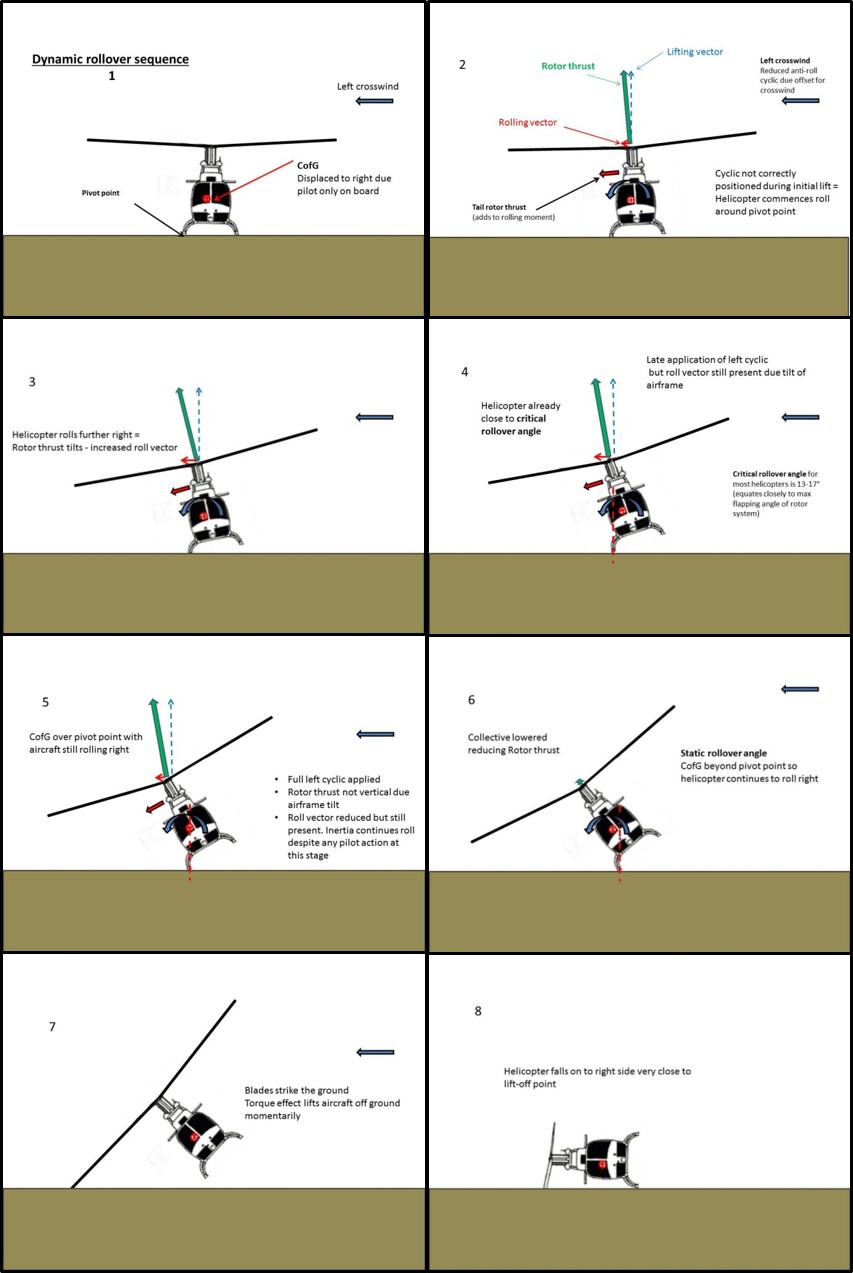
Static rollover occurs when a helicopter is pivoted about one of its landing skids or wheels and the helicopter’s CofG passes outside the in-contact skid or wheel. Once in this position, removal of the original force that raised the helicopter to that angle will not stop the helicopter from rolling further. This angle is termed the ‘static rollover angle’.
A rotors-running helicopter resting with one landing skid or wheel on the ground may, without appropriate pilot input, commence rolling. Under certain circumstances, this roll cannot be controlled and the helicopter rolls over. This condition is known as ‘dynamic rollover’ and is a function of the interaction between the:
horizontal component of the total rotor thrust (or lift) acting about the point of ground contact
weight of the aircraft, initially acting between the helicopter’s skid-landing gear or wheels. This second, counter-rolling moment decreases the greater the roll.
The angle beyond which it is impossible to stop an already-rolling helicopter from further roll is termed the ‘critical angle’.
The principles of dynamic rollover are well-known to helicopter pilots as they are covered during their ab initio and recurrent pilot training. A number of pre-conditions are necessary before a helicopter can sustain dynamic rollover. Depending on the type of helicopter, the roll characteristics may differ but, if not controlled early, the condition is generally catastrophic.
Recovery from dynamic rollover is by smoothly lowering the collective lever while controlling any tendency to roll in the opposite direction with cyclic. Alternatively, some publications suggest that, if normal in-flight rotor rpm is available and a safe take-off is possible, it may be appropriate to lift from the ground. These publications caution that, if a safe take-off is not possible, further application of collective lever only aggravates the situation and worsens the roll.
In general, the application of smooth collective inputs is more effective in avoiding rollover problems than using the cyclic control.
Normal take-off in the Bell 206L-1
The procedure normally used by pilots to lift to the hover (commonly termed ‘pick-up’) is to scan to the front of the helicopter in preparation to establish the necessary hover attitude. A distant object forward of the helicopter is used as a heading reference as the collective lever[5] is slowly raised.
Although initially still on the ground, as the collective lever is raised the pilot controls any tendency to roll/drift and/or yaw[6] with the cyclic control[7] and tail rotor pedals respectively. As the helicopter becomes lighter on the skids and breaks from the ground, the pilot assesses and then makes appropriate control inputs to maintain ground position and heading and control any roll. The pilot applies additional collective lever to lift the helicopter further from the ground and cyclic to establish the hover attitude, thereby maintaining the helicopter’s position over the ground. The tail rotor pedals are used to control heading.
The amount and number of tail rotor pedal and cyclic control inputs during lift-off depends on variables such as the helicopter’s CofG, the slope of the landing area, the wind direction and speed relative to the helicopter, the presence of any turbulence, pilot inputs and so on. Given these variables, appropriate pilot input to control the helicopter during lift-off is crucial.
Viewed from above, the Bell 206L-1 has a counterclockwise rotating main rotor system. This generally requires the application of left tail rotor pedal to counter the right yaw and left cyclic control input to counter any right drift and control any roll during lift-off. The action of countering the right drift can normally be expected to result in the helicopter hovering in a left skid-low attitude. The aim is to make a clean break from the ground with no drift or yaw and with any roll under control before adopting the hover attitude at the appropriate height.
Dynamic rollover in helicopters with counterclockwise rotating main rotors
A number of factors influence the critical angle in helicopters with counterclockwise rotating main rotors such as the B206L-1. These include:
The rate of any roll. The faster any roll allowed to develop by the pilot, the smaller the critical angle. Controlled application of collective lever allows the pilot time to make adjustments for drift, roll or yaw.
Which skid (or wheel in other helicopter types) is in contact with the ground or other object. When this contact is via the right skid, the normal tendency to drift right during lift-off exacerbates any roll. This reduces the critical angle.
Left crosswind at lift-off. A left crosswind results in the main rotor blades ‘flying up’ on the left of the helicopter, adding to the tendency to roll and drift right.
A lateral CofG to the right of the helicopter’s centre-line. Should the pilot raise the collective lever to lift-off without appropriately controlling any drift, a lateral CofG to the right of the helicopter’s centre-line adds to the tendency to drift right during lift-off. If the right landing skid remains in contact with the ground this tendency to drift right will, without appropriate pilot input, result in right roll.
Sloping ground. A take-off from sloping ground requires careful application of cyclic to control roll around the upslope landing skid. In this instance, too little cyclic can result in the helicopter rolling down the slope. Too much into slope cyclic can contribute to the helicopter rolling up the slope.
Failure to address any uncompensated roll with one landing skid or wheel in contact with the ground or other object can result in the helicopter quickly approaching its critical rollover angle. If the roll does not abate, exceedance of the helicopter’s static rollover angle follows. Recovery is not possible and the helicopter rolls over.
Figure 2 illustrates the various forces acting on VDZ during the attempted pick-up to the hover and a representation of the approximate rollover angles relative to the helicopter’s lateral CofG. The perception from the preceding discussion, and representation at Figure 2, may be that dynamic rollover in helicopters with counterclockwise rotating main rotors only occurs to the right. This is not the case. For example, consider a lift-off with the right landing skid down slope. If the pilot applies too much into slope cyclic during lift-off, or maintains too much into slope cyclic after the right skid breaks the ground, the helicopter may roll left, up the slope.
Figure 2: Dynamic rollover of VH-VDZ showing the forces acting on the helicopter during the attempted lift-off and a representation of the approximate rollover angles relative to the helicopter’s lateral CofG
Source: ATSB
Dual flight controls
The pilot reported that, on completion of the familiarisation flight, the dual flight controls were removed from the left pilot’s position by the charterer’s chief pilot. This included removing the left cyclic and collective controls and isolating the tail rotor pedals. Later, the charterer’s chief pilot reported that, although they removed the collective control and isolated the tail rotor pedals, the pilot removed the cyclic control while remaining secured in their seat. The ATSB could not reconcile the respective pilots’ differing recollections of this action.
As the helicopter was still running during the removal of the controls, the pilot remained at the primary (right) flight controls with their seatbelt harness fastened. The cyclic control and collective lever stub covers were not fitted after removal of the respective flight controls. Figure 3 shows the exposed stub of the left cyclic control. Examination of the wreckage identified the dual flight controls and control stub covers in the rear baggage compartment of VDZ.
CAR 1988 Schedule 8 permitted pilots to conduct basic maintenance such as the replacement of seatbelts or harnesses and batteries on Class B aircraft, such as VDZ. However, fitment and removal of dual controls was not permitted under that schedule. This required specific approval by CASA under CAR 1988 sub regulation 42ZC Maintenance on Australian aircraft in Australian territory, and may entail supporting conditions, such as the requirement for training and required the issue of a certificate of approval.
In the case of VDZ, approved pilot maintenance training and the subsequent issue of a certificate of approval would have ensured instruction on the removal of the dual controls, disconnection of the dual tail rotor pedals and fitting of the control stub covers in accordance with the manufacturer’s procedures. The pilot reported that, as no training was provided to them for fitting or removing the dual flight controls, another pilot with the appropriate authority fitted the dual flight controls prior to what became the familiarisation flight with the charterer’s chief pilot.
In 1993, Bell Helicopter Co. (formerly Bell Helicopter TEXTRON) issued an Operations Safety Notice in response to reports of binding of cyclic controls through possible contact between the copilot’s[8] cyclic control assembly (stub) and objects located on the cockpit floor. The safety notice stated that:
…INSTALLATION OF CYCLIC AND COLLECTIVE STUB SAFETY COVERS IS RECOMMENDED WHENEVER THE CO-PILOT QUICK-DISCONNECT DUAL CONTROL STICKS ARE REMOVED.
Another Operations Safety Notice, issued by Bell Helicopter in 1984, highlighted that a fatal helicopter accident resulted from a loss of lateral cyclic control due to an improperly-installed copilot’s quick-disconnect dual cyclic stick (or control).
Ballast bag
There was no manufacturer-specified ballast bag, or method or procedure for securing ballast in the helicopter in the aircraft flight manual. However, the manufacturer advised that was common industry practice to secure any ballast using a seatbelt assembly. Given the right front seat is the primary control position in the Bell 206L-1 helicopter, this suggests that the ballast would be secured with the left front seatbelt.
It was reported by the pilot that whenever a passenger occupied the left front seat, they had their feet on the ballast bag on the floor during flight. There were no passengers on board for the repositioning flight and the bag was not secured to the airframe. This explained the bag being ejected through the copilot’s front window during the rollover, as shown in a sequence of rapid photographs that were taken by a witness to the accident ().
Figure 3: Ballast bag and exposed cyclic control stub (at inset)
Source: ATSB
Wreckage and helipad information
Wreckage examination
Examination of the wreckage and surrounding area indicated that the helicopter was orientated in a westerly direction and the right landing skid was located along the right edge of the helipad landing mat (Figure 4). The right side of the helicopter sustained significant damage and was resting on the ground.
The engine was generating significant power when the main rotor blades impacted the ground as the main rotor transmission and engine were torn from the fuselage and large amount of debris was strewn about the area (Figure 5). Of note, a 1 m section of main rotor blade travelled about 40 m before lodging into a parked car and another section of rotor blade entered the passenger marquee about 30 m from the helipad (Figure 6 and Figure 7). The marquee was not occupied at the time of the rollover and there were no reports of injuries sustained as a result of the flying debris. The furthest piece of debris was located 44 m from the helipad landing mat.
On-site examination of VDZ confirmed the continuity of the flight control system. No mechanical defects were identified that would have precluded normal flight.
Helipad landing mat
The helipad landing mat was secured to the ground by small metal retaining pegs. These pegs were located at various intervals around the edge of the matting and along the midline where two sections of the matting adjoined. All retaining pegs were in place and, when examined, required a small amount of force to dislodge them from the grass and sandy loam subsurface. The charterer had reportedly used the semi-flexible meshed plastic matting on numerous previous occasions without incident. Witness photographs recorded the helicopter positioned with both skids on the landing mat immediately prior to the accident.
Figure 4: Helipad landing mat and right landing skid (looking east)
Source: ATSB
The helipad for VDZ was about 28 m from the perimeter of the oval where plastic bunting and a fence provided a barrier between the public access areas and the helicopter landing site. Distances from other helipads to the perimeter fencing varied, and in some instances were observed to have been closer than that of VDZ. The spacing between each of the helipads varied from about 24 m to 55 m (Figure 5).
Although the distance of some helipads to the perimeter fence or persons was less than the recommended 30 m, there were no reports of issues with rotor downwash or the operation of helicopters from the Olympic Park or Flemington venues.
A helicopter that was operating from the helipad adjacent to VDZ sustained some minor damage from the debris that required an engineering inspection before it departed Olympic Park. It was reported that the passengers on board that helicopter had not yet commenced disembarkation when the accident occurred.
Figure 5: Accident site and wreckage distribution showing the car and marquee that were struck by main rotor blade debris
Source: Google earth, modified by the ATSB
Figure 6: Main rotor debris imbedded in the marquee in the passenger staging area
Source: ATSB
Figure 7: Main rotor debris imbedded in the nearby car
Source: ATSB
Related occurrences
A review of the ATSB’s aviation occurrence database from 2005 to 2014 identified that although a total of 324 helicopter accidents were recorded, only five involved injuries or fatalities to persons located on the ground. Interestingly, 15 occurrences involved some form of helicopter rollover, of which eight were considered to have resulted from dynamic rollover. No fatalities resulted from the dynamic rollover occurrences.
As a comparison, a presentation by the National Transportation Safety Board as part of the NTSB’s 2015 Most Wanted List titled Remarks at Helicopter Association International Industry Government Forum, Alexandria, VA included a review of United States general aviation helicopter accident data. The presentation highlighted that, although there were a proportionally larger number of helicopter accidents, a small percentage were non-fatal dynamic rollover occurrences.
The ATSB has investigated several occurrences involving dynamic rollover. Two are reviewed in the following sections and are available from the ATSB website at www.atsb.gov.au.
On 13 June 2014, at about 0810 Western Standard Time[9], the pilot of a Bell 206 helicopter, registered VH-KSV, departed Mitchell Plateau campground, Western Australia, on a flight to a remote landing site about 30 NM (56 km) away to collect passengers.
As the pilot lowered the helicopter towards the rear of a rocky, sloped sandstone platform, he looked out of the pilot side window to select the best position to touch down. The front portion of the right landing skid touched down first and the right skid was sitting on a rock. The pilot was concerned about the suitability of the landing site and attempted to lift back into the hover. As the pilot raised the collective lever, the helicopter start to roll. The pilot assessed that this may have been an ‘incipient dynamic roll’ and lowered the collective lever. Although the pilot’s action recovered the helicopter from the roll, the helicopter tipped backwards off the edge of the rocky platform and slid about 2 m down the slope before coming to a halt.
On 7 October 2014 at about 0800 Eastern Standard Time[10], the pilot of a Bell 206B3 helicopter, registered VH-CLR, departed Cairns, Queensland with one passenger on board. The purpose of the flight was to conduct a charter flight to Mount Cook, about 9 km south-east of Cooktown Airport, Queensland.
As the pilot had not used the landing area previously, he conducted an aerial reconnaissance of Mount Cook landing area prior to arriving at Cooktown Airport to pick up the remaining passengers. The landing area was a rocky ledge near the top of Mount Cook. To assess the conditions in the area, the pilot made 3–4 practice approaches and a practice landing, touching down with the right skid on the ledge. The pilot assessed that stabilising the helicopter with the right skid on the ledge for embarking and disembarking the passengers was preferable to the previously-decided method of placing both skids on the uneven surface.
During the approach to land, the pilot reported feeling that the helicopter was stable and appeared unaffected by the increased wind. Guidance into the landing area was provided by the charter client’s ground coordinator, who was in radio contact with the pilot.
Just prior to stabilising the helicopter and touching down, the pilot felt it momentarily lift, most likely from a gust of wind, and drift to the right. The right skid scraped along the rock ledge and the helicopter rolled rapidly onto its right side and slid a short distance forward, prior to coming to rest.
The ATSB found that the occurrence was consistent with dynamic rollover.
During the conduct of passenger-carrying charter flights between Olympic Park oval and Flemington Racecourse, Melbourne, Victoria on 2 November 2013, Bell 206L-1 helicopter, registered VH-VDZ, collided with terrain as the pilot prepared to depart from the helipad.
There was no evidence of a mechanical or other helicopter system failure that contributed to the occurrence. In addition, there was no evidence that the helipad landing mat impacted on, or interfered with the helicopter during the pick-up procedure.
This analysis discusses a number of operational considerations in the development of the occurrence, including:
dynamic rollover
the potential for a flight control obstruction to have been a factor
the safety considerations when operating in close proximity to public access areas and gatherings.
Helicopter operations
Dynamic rollover
The lift-off was attempted with a left crosswind and a lateral centre of gravity that was to the right of the helicopter’s centre-line. Together with the helicopter’s normal tendency to drift right during lift-off, had the right landing skid been in contact with the ground and acted as a pivot point, each of these factors increased the tendency of the helicopter to roll right during lift-off.
The pilot recalled that the right landing skid seemed to remain ‘stuck’ to the ground during the attempted lift-off. In contrast, the marshaller reported observing both of the helicopter’s landing skids lift from the ground slightly before the helicopter drifted to the right and the right landing skid again contacted the ground. In either case, an in-contact right skid would have acted as a pivot point as the pilot continued the take-off, increasing the risk of dynamic rollover.
The degree of cyclic input and rate of collective application by the pilot could not be determined. However, the reported rapid rise of the left landing skid from the ground and right roll of the helicopter was consistent with the application of collective lever without appropriately coordinated cyclic input to control any roll. Coordinated control inputs would have allowed the pilot more time to detect and address the roll. In any event, the speed of the roll rapidly reduced the critical angle, increasing the likelihood of rollover.
The most effective means to recover from dynamic rollover is to smoothly lower the collective in coordination with appropriate cyclic input to control any roll and re-establish the helicopter’s weight evenly on the ground. The reported attempt by the pilot to lower the collective lever in response to the rapid roll was ineffective in stopping the roll before the helicopter passed the static rollover angle, after which recovery was not possible.
Helicopter landing sites
While the operation of helicopters near public areas carries a degree of risk, a review of ATSB occurrence data for the period 2005–2014 indicated that the risk of injury or death to people on the ground from helicopter operations was low. Guidance provided in Civil Aviation Advisory Publication (CAAP) 92-2(1) was intended to minimise the potential for injury while operating helicopters from helicopter landing sites and the charterer adopted elements of this guidance in its operations manual. Although the separation between most of the helipads at the Olympic Park oval was at least 24 m, other helipads were located within 15 m of the perimeter fence and nearby public walking tracks. These distances were less than the recommended 30 m in the CAAP, increasing the risk of injury to bystanders from rotor downwash.
The suggested perimeter distance of 30 m from a hovering or taxiing helicopter was intended to address the hazards associated with those operations. This is consistent with the inherent flexibility of a helicopter and its ability to access small landing, winching and other areas as measured by the widespread use of helicopters for search and rescue and aeromedical operations. However, the associated risk of this operational flexibility and utility is that, in the case of an accident during those operations, high energy main rotor and other debris can travel beyond the 30 m distance.
It is therefore prudent that, where possible and operational and/or safety imperatives dictate, operators consider increasing the recommended distance from their helipads to public access areas. This will further reduce the potential for injury in the event of an accident during helicopter operations.
Emergency response and first aid equipment
As the charterer had included an emergency procedure brief in the document suite issued to operational personnel, there was an expectation that those procedures would be followed in the event of an emergency. This included in case of injury to passengers or personnel or the containment of a fire relating to the operation of the helicopter.
Apart from the mandatory first aid and fire extinguishing equipment on board the helicopters, no ground-based fire extinguishing or first aid equipment was available at the Olympic Park basic helicopter landing site. In the case of an accident, the availability of those resources would have provided for a more effective and timely first aid response and offered an immediate response in the case of a minor fire until emergency services arrived. However, had there been a serious fire as a result of the rollover, it could be expected that the intensity of the fire would have been difficult to suppress, no matter what handheld device was used. It is likely that an immediate response by something approaching the Aerodrome Rescue & Fire Fighting Service normally associated with a major airport would be required to extinguish a serious fire.
In this case there was no fire. However, the amount of fuel and hydraulic fluid dispersed around the accident site increased the potential for a fire when combined with an ignition source. Potential ignition sources included the helicopter’s exhaust or other hot components or an electrical spark.
The pilot was the only occupant and was able to escape the smoke by exiting the helicopter through the damaged front windscreen, sustaining minor injuries. The severity of the occurrence may have increased if passengers were on board at the time and a fire erupted. With minimal available means to contain a fire, and a potentially more difficult exit from the rear of the helicopter, the risk of post-accident injury was increased.
Carriage of ballast
Despite the helicopter’s flight manual requirement for supplemental ballast with a combined front seat weight less than 77 kg, there was no indication of the ballast type to be used or method for securing it in the helicopter. As such, the pilot had no guidance as to whether the ballast bag was fit for purpose, though it was reported by the manufacturer as common practice to secure a heavy flight bag or ballast bag in the copilot’s seat using the existing seat harness.
Placing the unrestrained ballast bag on the front left floor was convenient and catered for the high frequency, short duration passenger- and non-passenger-carrying flights. However, it increased the risk that in the event of an emergency or turbulent flight, occupants may be injured by unintended movement of the bag about the cockpit/cabin. In addition, positioning any unrestrained object close to an unprotected control stub, such as the cyclic control, or collective lever increases the risk of control fouling and damage to the control stubs. Steps to mitigate those risks include the installation of the control stub covers.
Dual flight controls
Helicopters are often required to be reconfigured depending on the type of operation. The removal and installation of dual flight controls required a specific maintenance authorisation, often with appropriate conditions such as the completion of relevant training. This authorisation was not held by the either the charterer’s chief pilot or the pilot of the helicopter. Removal of the helicopter’s dual flight controls in those circumstances increased the risk of fouling of the flight controls during the subsequent passenger carrying charter-operations.
Findings
From the evidence available, the following findings are made with respect to the loss of control and collision with terrain involving Bell 206L-1 helicopter, registered VH-VDZ, which occurred 13 km south-east of Essendon Airport, Victoria on 2 November 2013. These findings should not be read as apportioning blame or liability to any particular organisation or individual.
Contributing factors
Given the left crosswind and right lateral centre of gravity, which would have increased the tendency of the helicopter to roll right during liftoff, the pilot did not react to the developing right roll in sufficient time to prevent the dynamic rollover of the helicopter.
Other factors that increased risk
The helicopter’s dual flight controls were removed after the familiarisation flight by a person without the training or authorisation to conduct the maintenance procedure, increasing the risk of fouling of the flight controls during the subsequent passenger-carrying charter operations.
The pilot positioned an unsecured ballast bag on the left front floor of the helicopter, which increased the risk of a control restriction as a result of the exposed cyclic control stub and injury to the aircraft occupants in the case of an accident.
There was limited availability of fire extinguishers and first aid equipment at the Olympic Park basic helicopter landing site, which had the potential to inhibit an effective emergency response.
The proximity of the helipad to the perimeter fence and public access areas of the Olympic Park basic helicopter site increased the risk of injury to bystanders during the passenger-carrying charter operations.
Safety issues and actions
Proactive safety action
Whether or not the ATSB identifies safety issues in the course of an investigation, relevant organisations may proactively initiate safety action in order to reduce their safety risk. The ATSB has been advised of the following proactive safety action in response to this accident.
Charterer of the helicopter
The charterer of the helicopter advised that for subsequent operations during the 2013 Spring Racing Carnival, portable fire extinguishers were located close to each helipad and first aid equipment was made available nearby. In addition, the helipads were repositioned further from the passenger marquee and passengers were not loaded or unloaded if helicopters were in the process of landing or taking off from adjacent helipads.
Operations at the Olympic Park oval ceased following the 2013 carnival.
Sources and submissions
Sources of information
The sources of information during the investigation included the:
pilot of the helicopter
charterer of the helicopter
owner of the helicopter
Civil Aviation Safety Authority (CASA).
References
Wagtendonk, WJ 1996, Principles of Helicopter Flight, Aviation Supplies & Academics, Inc. Washington, USA.
Submissions
Under Part 4, Division 2 (Investigation Reports), Section 26 of the Transport Safety Investigation Act 2003 (the Act), the ATSB may provide a draft report, on a confidential basis, to any person whom the ATSB considers appropriate. Section 26 (1) (a) of the Act allows a person receiving a draft report to make submissions to the ATSB about the draft report.
A draft of this report was provided to the CASA, the aircraft owner, the charterer of the helicopter and the pilot.
Submissions were received from CASA, the charterer of the helicopter and the pilot. The submissions were reviewed and where considered appropriate, the text of the report was amended accordingly.
Purpose of safety investigations
The objective of a safety investigation is to enhance transport safety. This is done through:
identifying safety issues and facilitating safety action to address those issues
providing information about occurrences and their associated safety factors to facilitate learning within the transport industry.
It is not a function of the ATSB to apportion blame or provide a means for determining liability. At the same time, an investigation report must include factual material of sufficient weight to support the analysis and findings. At all times the ATSB endeavours to balance the use of material that could imply adverse comment with the need to properly explain what happened, and why, in a fair and unbiased manner. The ATSB does not investigate for the purpose of taking administrative, regulatory or criminal action.
Terminology
An explanation of terminology used in ATSB investigation reports is available here. This includes terms such as occurrence, contributing factor, other factor that increased risk, and safety issue.
Publishing information
Released in accordance with section 25 of the Transport Safety Investigation Act 2003
Ownership of intellectual property rights in this publication
Unless otherwise noted, copyright (and any other intellectual property rights, if any) in this report publication is owned by the Commonwealth of Australia.
Creative Commons licence
With the exception of the Coat of Arms, ATSB logo, and photos and graphics in which a third party holds copyright, this publication is licensed under a Creative Commons Attribution 3.0 Australia licence.
Creative Commons Attribution 3.0 Australia Licence is a standard form licence agreement that allows you to copy, distribute, transmit and adapt this publication provided that you attribute the work.
The ATSB’s preference is that you attribute this publication (and any material sourced from it) using the following wording: Source: Australian Transport Safety Bureau
Copyright in material obtained from other agencies, private individuals or organisations, belongs to those agencies, individuals or organisations. Where you wish to use their material, you will need to contact them directly.