Unreliable airspeed indication and stall warning involving Airbus A320, VH‑FNP, near Perth, Western Australia, on 12 September 2015
Final report
Report release date: 04/04/2019
Safety summary
What happened
On 12 September 2015, when a Virgin Australia Regional Airlines Airbus A320 aircraft, registered VH-FNP, was passing through about 8,500 ft on departure from Perth Airport, Western Australia, the autothrust and autopilot disconnected, and multiple alerts were generated. The flight crew continued the climb to an altitude of 20,000 ft, where they levelled out to troubleshoot the issues before returning to Perth. During the approach, when the flight crew were aligning the aircraft with the instrument landing system, they received a stall warning. The warning stopped after six seconds and the approach continued for a successful landing.
What the ATSB found
The ATSB found that blocked drain holes in the pitot probes prevented water from being effectively discharged, resulting in erroneous airspeed measurements in all three systems at various times during the take-off and climb. The erroneous airspeeds were not detected by the flight crew, but had been detected by the system, resulting in the autothrust and autopilot disconnecting, and the generation of multiple alerts, including a NAV ADR DISAGREE alert. That alert required the flight crew to crosscheck the three airspeed indications and the result would indicate if they had an airspeed or angle of attack disagreement. Due to the limited space in the alert message area, the NAV ADR DISAGREE alert was initially pushed off the screen by engine related alerts that were programmed to have a higher priority.
The engine related alerts did not require immediate actions by the flight crew, and because of their high-workload, the flight crew did not clear them and action the NAV ADR DISAGREE procedure until after the airspeeds had corrected themselves, and all displayed the same value. This led the flight crew to diagnose it as an angle of attack disagreement, which the procedure informed them, had the ‘risk of undue stall warning’. When they received the stall warning during the approach, the flight crew considered it spurious and disregarded that warning. However, there was nothing wrong with the angle of attack and the warning was real.
The ATSB also found that the NAV ADR DISAGREE alert and the associated procedure in the Airbus A320 may lead the flight crew to incorrectly identify the source of the alert (for example, angle of attack instead of airspeed) when there is a short-term disagreement in the airspeeds.
What's been done as a result
The aircraft manufacturer is in the process of updating the aircraft’s software so that the NAV ADR DISAGREE alert has a higher priority than the associated engine alerts. In the case of multiple alerts, it will take precedence over the other associated alerts and be immediately visible to the flight crew. In addition, the ‘risk of undue stall warning message’ will be removed from the aircraft status related to the NAV ADR DISAGREE alert.
Safety message
Modern aircraft with multiple interacting systems can have many layers between the source information and the flight crew. In such systems, where there is erroneous information from an information source, it is important that alerts and procedures be designed to ensure that the flight crew can correctly diagnose the source of the erroneous information. This is particularly important when the information may be erroneous for a short period.
Airbus A320, VH-FNP
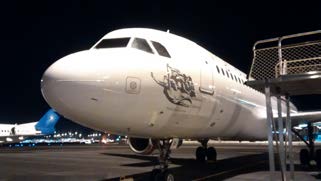
Source: ATSB
The occurrence
Preparation for the flight
On 12 September 2015, a Virgin Australia Regional Airlines (VARA) Airbus A320-231, registered VH-FNP (FNP), was prepared for a charter flight from Perth Airport, Western Australia (WA) to Boolgeeda Airport, WA. When the captain arrived at the aircraft, he noticed the ground engineer had the auxiliary power unit running, which was normal, but also had a ground power unit connected to the aircraft. The engineer informed the captain that this was because the batteries had gone flat during overnight maintenance to rectify a previous issue with a flight management and guidance system.[1] Upon entering the cockpit, the captain found it was still untidy from the overnight maintenance and a number of controls and system configurations were not in their normal settings.
Confirming that the batteries were charging, the captain continued preparation for the flight. The first officer joined the captain at the aircraft and they completed the pre-flight preparation without further issue. The battery charge was completed and the seven cabin crew and 139 passengers boarded ready for departure.
Take-off and climb
At 0636 Western Standard Time,[2] the aircraft pushed back from the terminal and the flight crew started the engines, commencing with engine 2.[3] While engine 2 was starting, the flight crew received two system alerts: ‘park brake on’ and ‘engine 1 shutdown’. The captain discussed this with the engineer, remarking that it was probably related to the overnight maintenance and the batteries being low, but would see what happened when engine 1 was started. However, both alerts appeared to resolve themselves and disappeared before engine 1 start was commenced. The flight crew reported that it was not unusual to receive short ‘spurious’ alerts during engine start, so continued with the preparation for departure. At this time, the captain also remarked to the engineer his concern about possibly getting spurious alerts at a critical time and requested that they hold for a couple of minutes to make sure there were no more alerts.
While the aircraft was being taxied to the runway, the flight crew performed a flight control check, which involved moving all controls to their extents to ensure full and correct movement. The flight crew reported that it is normal system behaviour for the flight control system page to automatically appear on the system display[4] when the controls are moved for this check; however, on this occasion the captain had to manually select the flight controls page. The flight crew discussed this and associating it with the spurious alerts during engine start decided to continue with the flight. The taxi was continued to the end of runway 21 and at 0650, the flight crew commenced the take‑off from runway 21, with the captain as the pilot flying.[5]
During the take-off roll, the first officer announced passing 100 kt, which was confirmed verbally by the captain.[6] The aircraft continued to accelerate; it was rotated and lifted off into a positive climb away to the south on a standard instrument departure.
After making a turn to the west, with the autopilot and autothrust systems engaged, air traffic control (ATC) cancelled the standard instrument departure and cleared them to track direct to Morawa.[7] The flight crew requested, and were cleared, to continue on their current westward heading so that they could clear some showers that were in the area.
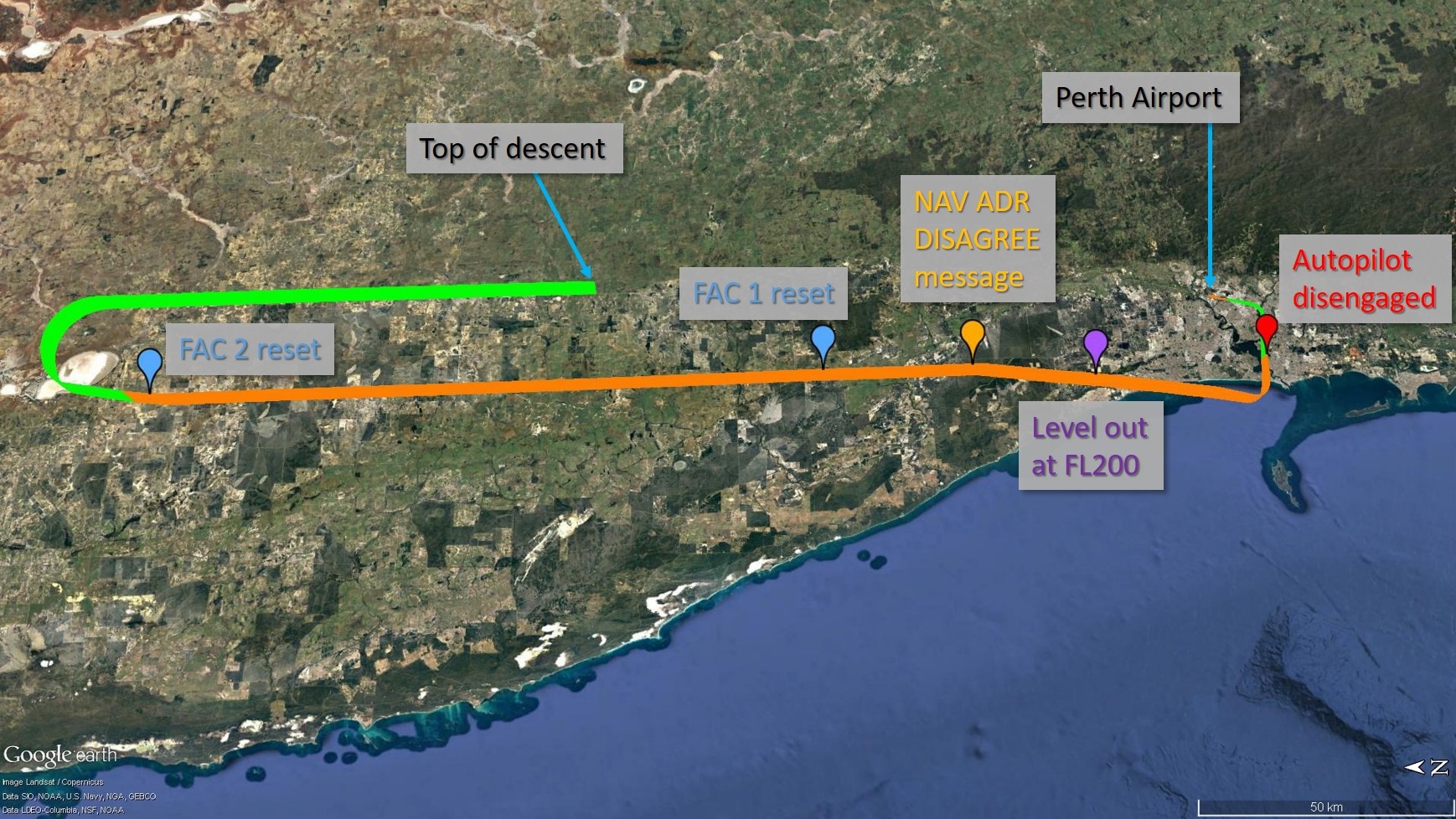
At 0654:39, as the aircraft was climbing through about 8,000 ft above mean sea level, the autothrust disengaged, generating an alert and locking the thrust at the current setting. Ten seconds later, the autopilot disengaged (Figure 1).
Figure 1: The flight path taken by VH-FNP when departing from Perth, up to the point that the autopilot disengaged
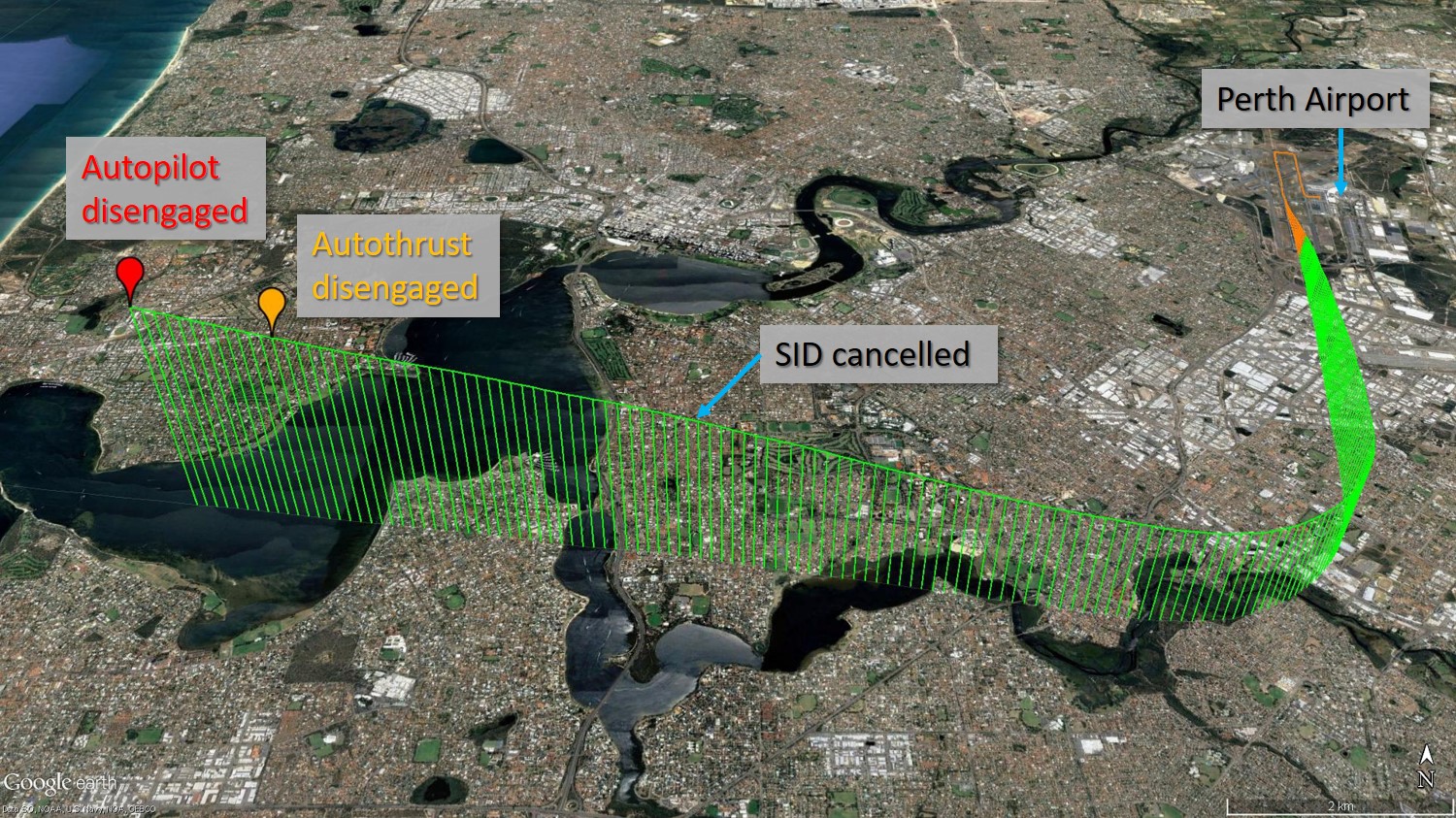
Note: The green flight path indicates when the autopilot was engaged, orange when the autopilot was not engaged. North is toward the top of the image. Source: Google earth, annotated by the ATSB
The flight crew attempted to re-engage the autopilot, but without success. They then identified on the electronic centralised aircraft monitoring (ECAM) system an alert for engine 1 EPR mode[8] fault (ENG 1 EPR MODE FAULT). At this point, the ECAM likely presented the following alerts to the flight crew (Figure 2).
Figure 2: Representation of the ECAM messages presented to the flight crew when the autopilot disengaged[9]
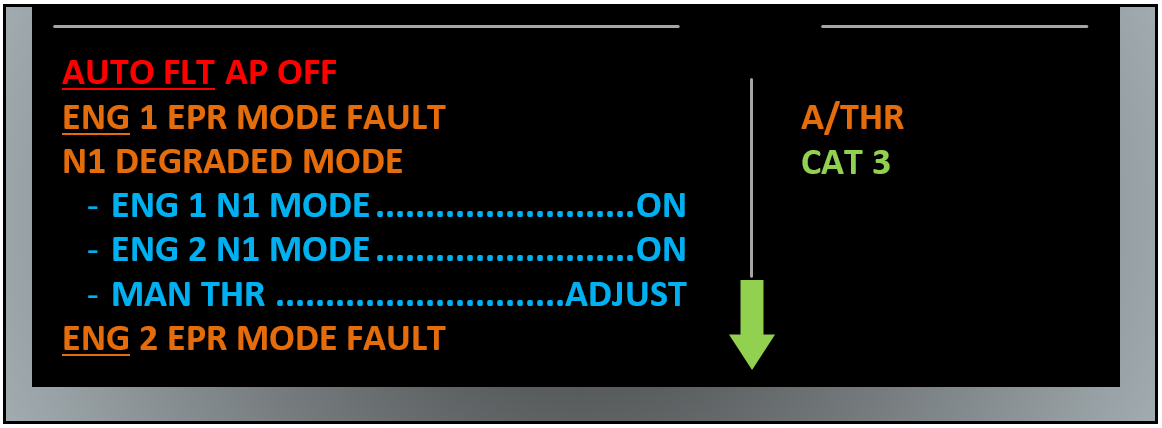
Source: ATSB
The captain took manual control of the aircraft and continued the climb. At this time, the aircraft had automatically changed the mode of airspeed control from ‘managed’ to ‘selected’,[10] and advised the flight crew to set the target airspeed to the green dot speed.[11] However, the green dot speed was not presented to the flight crew on the airspeed indicator, so the captain elected to fly the aircraft at a 10° nose-up attitude to ensure that the aircraft continued to climb.
While continuing the climb, the captain turned the aircraft northward toward the cleared track to Morawa, and asked the first officer to attempt to get some automation back. The captain made comment to the first officer regarding the airspeed limit and the loss of other speed information. The speed indicated on the captain’s display at this time was about 290 kt, 40 kt above their cleared speed of 250 kt.
At 0657:11 (2 minutes and 21 seconds after the autopilot disconnected), while passing through about 15,700 ft, the flight crew were cleared by ATC to flight level (FL)[12] 350. Before acknowledging this, the captain asked the first officer to commence the actions presented on the ECAM related to the alerts (referred to as ECAM actions). However, as the first officer commenced reading from the ECAM, starting with the autoflight (AUTO FLT AP OFF) alert, the captain interrupted him to confirm the clearance from ATC. The first officer confirmed the cleared altitude and attempted to continue with the ECAM actions, but the captain decided that he did not wish to continue to the cleared altitude and asked the first officer to request clearance to FL 200 instead. The request was granted by ATC, who were also informed that they were troubleshooting.
Before continuing with the ECAM actions, the captain asked the first officer to contact the cabin to have the cabin crew and passengers remain seated while they deal with some technical issues.
During this period, the captain’s primary concerns were controlling the aircraft on the correct heading, considering the approach of FL 200, and attempting to get some control of the speed. The first officer again attempted to commence the ECAM actions, but as they started the ENG 1 EPR MODE FAULT actions, ATC contacted the flight crew, to transfer from Perth Departures to Melbourne Centre, which required a change in the radio frequency.
At this time, noting that the aircraft was also approaching FL 200, the captain expressed a concern that the speed would increase as they levelled out so they needed to deal with the engines. The captain asked the first officer to continue with the ECAM actions for the engines, and delay communications with ATC. The ECAM actions for the ENG 1 EPR MODE FAULT involved switching both engines to N1 mode[13] and manually adjusting the thrust. When this was completed and the aircraft levelled out, the first officer reminded the captain of ATC’s request for a frequency change.
The captain noted that the airspeed was coming back down to 250 kt and requested that the first officer speak to Melbourne Centre and inform them of their situation. During the conversation, the captain also requested a change in heading to 360° (north), which would be easier to maintain than a track to a waypoint, when flying manually. The request was approved by ATC.
Troubleshooting and return to Perth
Having organised their ATC clearances, the flight crew then returned their attention to the ECAM actions. The flight crew had already completed all of the actions for the ENG 1 EPR MODE FAULT, but none of those actions resulted in a change to the ECAM display, so the first action taken was to clear that alert. The next message, ENG 2 EPR MODE FAULT required the same action, which having already been completed required only the alert to be cleared. When this was done, the first officer announced that the next alert was NAV ADR DISAGREE. At almost 8 minutes 30 seconds since the autopilot had disconnected, this was the first time that the flight crew had made mention of the NAV ADR DISAGREE (navigation - air data reference disagree) message.
The specified action for the NAV ADR DISAGREE alert was to crosscheck the airspeeds between the captain, first officer and standby indicators. As the first officer started actioning the ECAM, the captain asked him to make a cabin announcement to let the passengers know that they were having some technical issues and that they would be returning to Perth when they had sorted them out. While the captain was asking the first officer to do this, the first officer was heard calling out ‘two-fifty, two-fifty, two-fifty’ [consistent with the airspeed at that time]. The cabin crew were busy making an announcement, so the first officer was not able to make the cabin announcement, and the flight crew continued with the ECAM actions. The captain confirmed with the first officer that there was no disagreement with the airspeeds. Noting that, if there had been an airspeed discrepancy, the air data reference (ADR) check procedure was required, but because there was not, he announced that there was an angle of attack[14] discrepancy.[15]
The flight crew briefly discussed an angle of attack discrepancy. This appeared to cause some confusion, with the first officer reading out some figures of 5° and 6°[16] and indicating that there was no discrepancy. Although the captain had a questioning tone in his voice, they accepted the ECAM instructions and cleared the message.
Upon clearing the NAV ADR DISAGREE alert, a F/CTL ALTN LAW (flight control alternate law)[17] alert was presented. Upon receiving this alert, the captain indicated that the issue might have been more significant than first thought. There were no associated actions for the flight crew to take, only advisory information that protections were lost and that the airspeed limit was 320 kt, so the flight crew cleared the alert. This then brought up an AUTO FLT A/THR OFF (auto flight authothrust off) ECAM alert.[18] Again, there were no actions for the flight crew to attend to, so this alert was cleared.
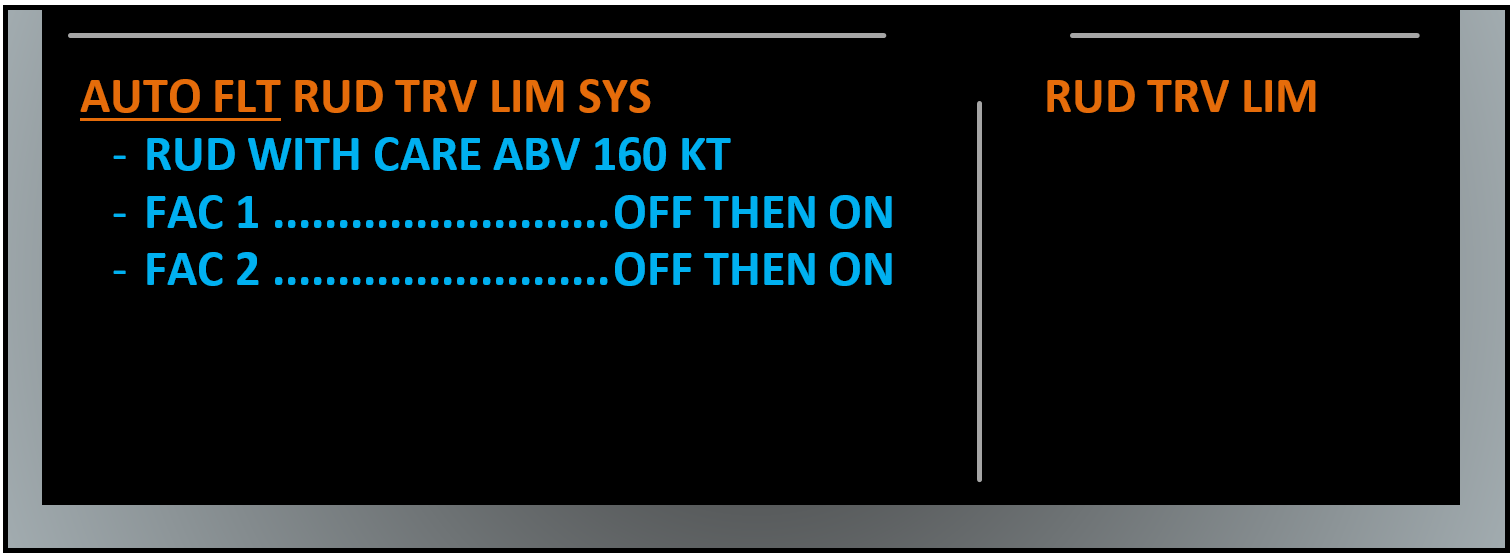
The flight crew were then presented with another ECAM alert, this time for AUTO FLT RUD TRV LIM SYS (autoflight rudder travel limiter system). The ECAM provided advisory information to the flight crew to use the rudder with care above 160 kt. The first officer then switched off, then back on, flight augmentation computer number 1 (FAC 1) in accordance with the ECAM procedure. This resulted in the presentation of two more ECAM alerts. The first, which was likely transitory, was AUTO FLT RUD TRIM1 FAULT (autoflight rudder trim 1 fault) followed by AUTO FLT RUD TRV LIM 2 (autoflight rudder travel limiter 2). The second of these ECAM alerts merely noted that the flight crew be aware of the fault and had no procedure to rectify the fault.
At this point, about 11minutes 30 seconds after the autopilot disconnected, the captain decided to pause the ECAM actions so that they could assess the situation and deal with other activities. The captain asked the first officer to check for any tripped circuit breakers, which required the first officer to leave his seat. No tripped circuit breakers were identified. The captain also took this time to update the cabin crew, passengers and the company. Meanwhile, they continued northward away from Perth.
After communicating with the cabin and the company, the flight crew continued their troubleshooting. This included reviewing the Flight Crew Operating Manual (FCOM) for more detailed information on ECAM alerts and system faults, and attempting to re-engage the autopilot (without success).
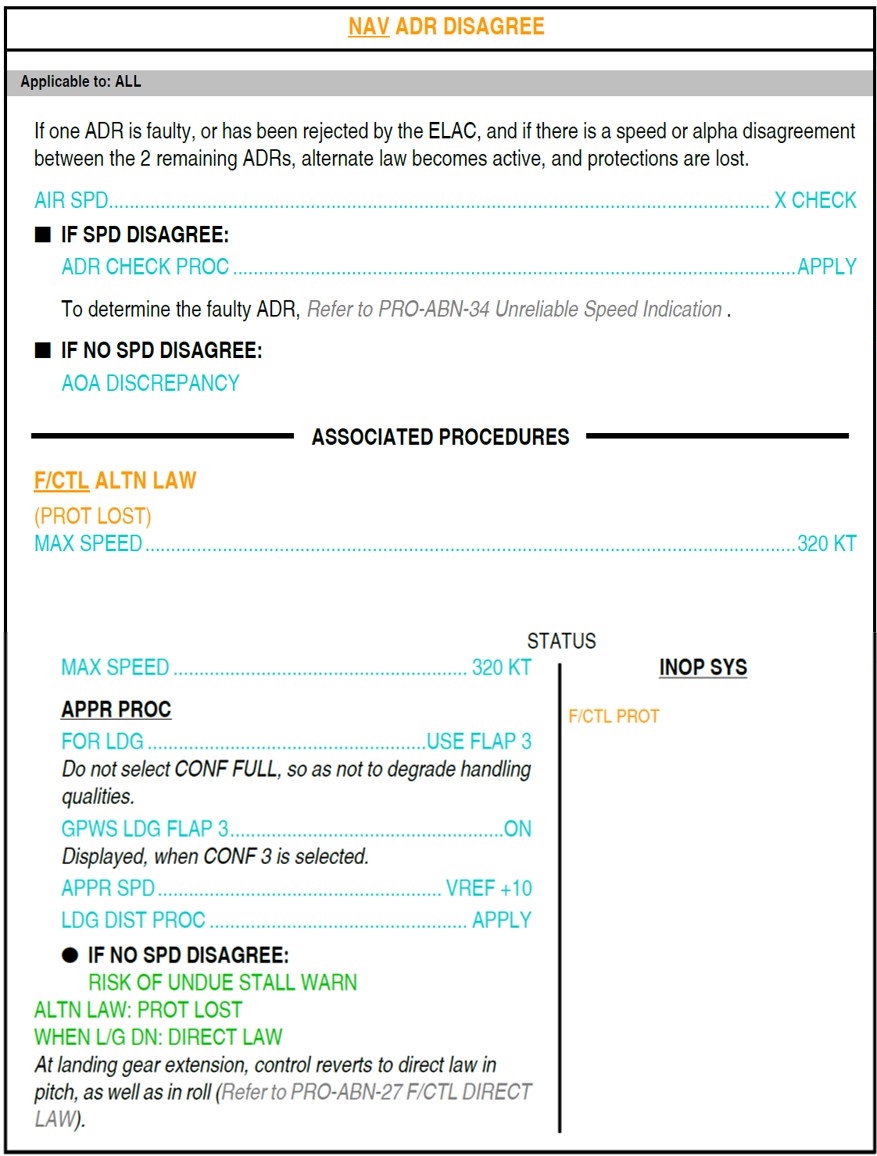
While reviewing the detailed information in the FCOM, the flight crew reviewed the NAV ADR DISAGREE procedure, and the associated alternate law procedure. The information in those procedures advised the flight crew that if there was no speed disagreement, then there was an angle of attack discrepancy and that there was ‘risk of undue stall warning’. It also advised the flight crew that the flight controls would revert to direct law when the landing gear was lowered.
At 0720:42, after advising ATC of their intent to return to Perth, the captain again tried to re‑engage the autopilot. The autopilot did not engage, but the captain noticed that he now had a flight director[19] available. The flight crew discussed the improvement that having this available made to their workload and decided to try resetting FAC 2. After resetting FAC 2, the flight crew found that they had the autopilot back.
Having the autopilot back on, the flight crew returned their attention to preparing from the return and landing. The captain again reviewed the FCOM information highlighting the risk of undue stall warning.
At 0723:45, when the aircraft was about 245 km north of Perth, the flight crew requested, and received, a clearance to return the Perth. After making the turn back towards Perth, the flight crew continued with their preparation for the approach and landing. During their discussions, the captain indicated that he felt some of the alerts might have been spurious.
Having been advised by ATC that descent into Perth was available; the captain transferred control to the first officer, and requested and received a clearance to descend to 10,000 ft. The first officer commenced the descent at 0736, when about 140 km north of Perth.
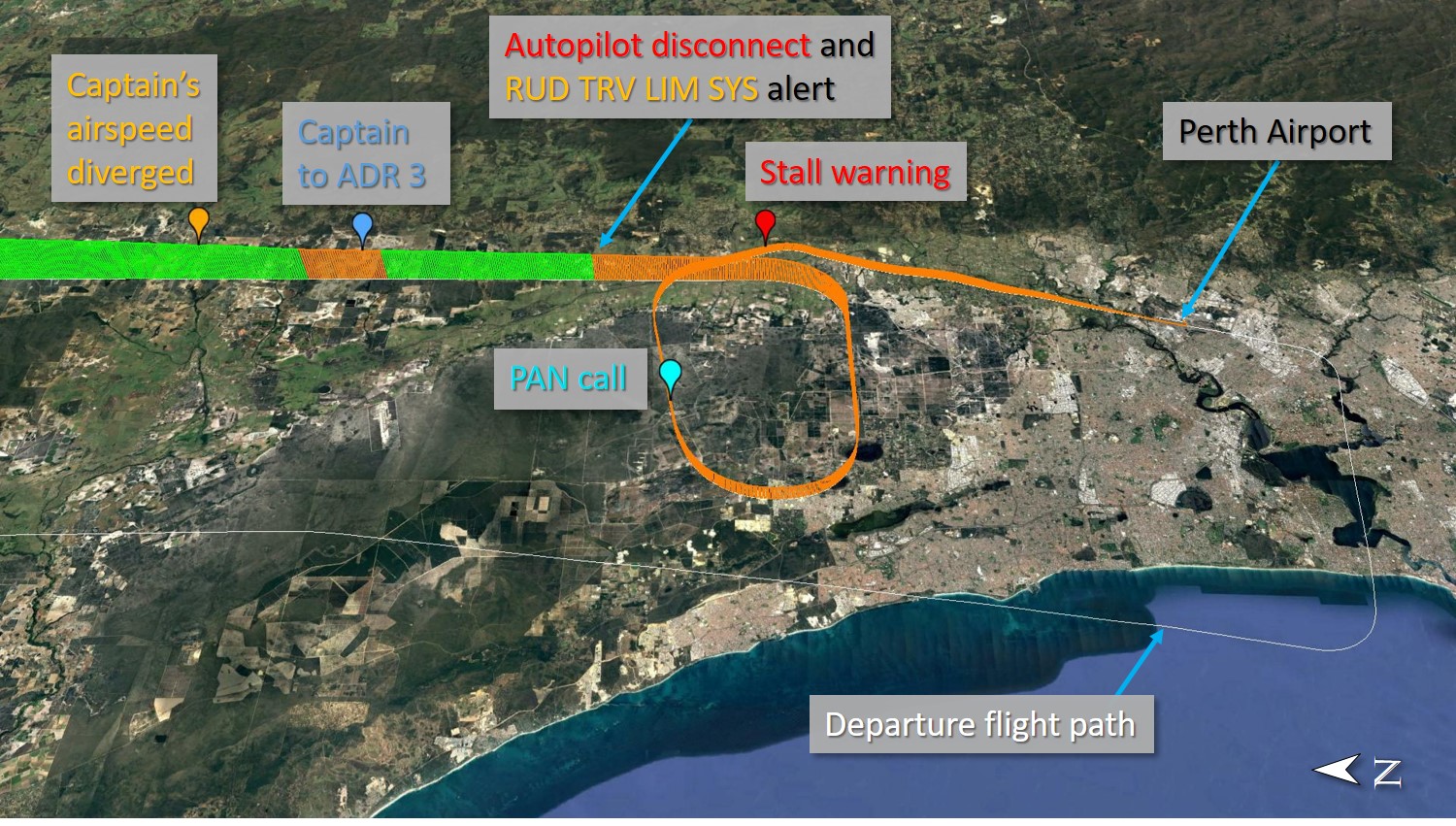
The flight from take-off to the top of descent, indicating where the key events took place is presented in Figure 3.
Figure 3: The flight path from take-off up to top of descent with key points identified
Note: The green flight path indicates when the autopilot was engaged, orange when the autopilot was not engaged. North is toward the left of the image. Source: Google earth, annotated by the ATSB
Descent and landing
The descent progressed normally; the captain had updated the cabin crew and company on the situation and they had been cleared by ATC to descend to 5,000 ft. At 0743, as they were passing through about 10,000 ft, the captain noticed that the airspeed was decreasing and informed the first officer, who had control. The first officer recalled observing that the minimum speed warning area on the captain’s airspeed indicator was increasing and announced that there was a disagreement between the airspeed indicators. At the same time, the captain disconnected the autopilot and both crew checked the airspeeds on all three indicators. They identified that the captain’s was indicating lower than the other two, so the captain switched his air data source to ADR 3. This resulted in the captain’s indicated airspeed increasing to a speed consistent with the first officer’s indicator. The captain then re-engaged the autopilot and continued with their landing preparations.
About 3 minutes later, when the flight crew had completed the approach checklist and been cleared by ATC to descend to 2,500 ft, the autopilot disconnected. At this time, the first officer stated that his airspeed was indicating 220 kt, with a target of 230 kt. The captain did not verbalise what speed his was indicating, but the recorded data from the flight indicated that his was about 230 kt.[20]
The captain checked the ECAM, cleared the autopilot disconnect warning and noted that the RUD TRV LIM SYS alert had reappeared. The captain announced that because they had already had that fault, they would just clear it to get the ECAM status back to what it was.
Noticing that they were probably slightly high on the descent to set up for the approach, the captain contacted ATC and requested radar vectors[21] to the west, so they could get a few more track miles before turning back to intercept the localiser.[22] ATC accepted the request and cleared them to turn to the right and maintain 5,000 ft.
During an orbit to the west, the captain recapped their situation. Particular note was made that they were in alternate law, which would transition to direct law when the landing gear was extended and that [flight envelope] protections were lost. He also reiterated that there was a risk of undue stall warning.
While heading east, back towards the approach path, the captain contacted ATC to declare a PAN,[23] notifying them that they had control system issues, were manually flying the aircraft and were in alternate law. ATC offered the attendance of emergency services for the landing, which the captain accepted.
After commencing a turn to the right to intercept the localiser, the captain took control from the first officer. The captain requested that flaps 1[24] be selected and the target speed reduced to 200 kt. At 0755:02, the aircraft was at an altitude of 2,550 ft and was still in the turn when the stall warning[25] activated. While the stall warning was active, the captain continued the turn and repeatedly announced ‘disregard’. After 6 seconds, the stall warning ceased.
After being cleared by ATC for the approach to runway 21, the captain noted that there was a windshear detection fault. He commented to the first officer that this was to be expected, given the spurious alerts and requested the associated ECAM alert be cleared.[26]
The flight crew continued the approach, and after capturing the glideslope,[27] the captain requested that flap 3 be selected. The first officer noted that the limit speed for flap 3 was 185 kt. The captain noted that his airspeed was indicating 175 kt, but the first officer informed him that his was indicating 190 kt. They continued the approach and the captain requested the target airspeed be set to 145 kt, about 3 kt higher than the calculated approach speed, to carry a little extra speed for the approach.
At about 2,400 ft, the landing gear was extended and the approach continued under manual control. The aircraft touched down at 0800 and the landing was completed without further incident. The attending emergency services were not required and the flight crew taxied the aircraft back to the bay.
The descent and approach flight path, with the key events identified, is presented in Figure 4.
Figure 4: Descent and approach flight path into Perth with key points identified
Note: The green flight path indicates when the autopilot was engaged, orange when the autopilot was not engaged. North is to the left of the image. Source: Google earth, annotated by the ATSB
__________
- An integrated system that computes the aircraft’s position using a database of aircraft performance and navigation data. It can direct the aircraft along a planned flight profile (ground track, vertical and speed profiles).
- Western Standard Time (WST): Coordinated Universal Time (UTC) + 8 hours.
- The engines on the A320 are numbered 1 and 2 from left to right looking forward. That is, engine 1 is on the left wing and engine 2 is on the right wing.
- The system display is a display on the instrument panel dedicated to presenting information about particular systems. The system of interest can be displayed either automatically, in the case of a system failure, or manually selected by the flight crew. Further information is contained in the section titled Electronic instrument system.
- Pilot flying and pilot monitoring: procedurally assigned roles with specifically assigned duties at specific stages of a flight. The pilot flying does most of the flying, except in defined circumstances; such as planning for descent, approach and landing. The pilot monitoring carries out support duties and monitors the pilot flying’s actions and the aircraft’s flight path.
- According to the analysis carried out by the aircraft manufacturer (refer to the section titled Manufacturer’s analysis), an airspeed discrepancy was identified in the stand-by system (CAS 3) during the take-off roll. It could not be determined from the recorded information if CAS 3 was erroneous when the 100 kt check was carried out.
- A navigation waypoint about 300 km to the north of Perth.
- EPR (engine pressure ratio) mode is the engine’s normal operating mode. In this mode, thrust controlled is based upon the ratio of the engine inlet and exhaust pressures. Autothrust requires that EPR mode is available. Further information on the engine modes is in the section titled Power plants.
- This representation is based upon information supplied by Airbus and is prior to the flight crew actioning any of the ECAM procedures.
- The aircraft provides two types of automatic control, managed and selected. In managed mode, the target parameters, for example airspeed, are calculated by the flight guidance and management computers to attain the predetermined flight path. In selected mode, those targets are selected by the flight crew.
- A characteristic speed for the aircraft that gives the best lift-to-drag speed for the clean (flaps and landing gear retracted) aircraft at the current weight. The green dot speed is presented to the flight crew as a green dot on the airspeed indicator. Flying at the green dot speed will achieve the best climb gradient.
- Flight level: at altitudes above 10,000 ft in Australia, an aircraft’s height above mean sea level is referred to as a flight level (FL). FL 350 equates to 35,000 ft
- An alternate engine control mode based upon the rotational speed of the engine’s low-pressure system (N1). Further information on the engine modes is in the section titled Power plants.
- The relative angle of the wing section to the oncoming airflow.
- This was in accordance with the procedure for a NAV ADR DISAGREE alert. Refer to section titled Operating procedures Abnormal procedures - Navigation – ADR disagree for more information.
- The angle of attack is not presented on any of the primary displays in the Airbus A320. It can be displayed on the multipurpose control and display unit in the centre pedestal; however, the first officer reported that these figures were instinctively read out from the pitch attitude of the aircraft and were not angle of attack values.
- The digital ‘fly-by-wire’ control system in the Airbus A320 has three control laws; normal, alternate and direct. Further information on these laws can be found in the Flight control system section of this report.
- The ECAM is designed to prioritise the alerts so that if there are multiple alerts, the alert deemed most important appears higher on the list. This message was likely the alert generated when the autothrust disengaged 10 seconds before the autopilot disengaged, but the other alerts were assigned a higher priority, pushing this alert off the available screen space. Refer to the section titled Electronic instrument system for more information on the ECAM.
- A function of the autoflight system that provides flight guidance information to the flight crew on their flight displays for them to follow with manual control inputs. Accurately following the flight director guidance will have the same result as having the autopilot on. Further information on the flight director can be found in the Auto flight section of this report.
- The aircraft was fitted with a flight data recorder and cockpit voice recorder. Further information is provided in the Recorded information section of this report.
- Radar vectors are tracking directions provided by ATC to assist the flight crew with navigation.
- The localiser is part of a ground based instrument landing system (ILS) that provides lateral (left-right) guidance to the flight crew.
- An internationally recognised radio call announcing an urgency condition, which concerns the safety of an aircraft or its occupants, but where the flight crew does not require immediate assistance.
- The first stage of flaps, which at this stage consisted on extension of the leading edge slats only.
- The stall warning consists of activation of the master warning light and an aural ‘stall’ announcement.
- The alert was likely a real alert, consistent with the system operation, but misinterpreted by the captain. As described in the section of the report titled Operating procedures - Windshear detection fault, the fault warning is inhibited until the flaps are extended, so the captain may not have associated the alert with the factors that led to the fault.
- The glideslope is part of a ground based instrument landing system that provides vertical (up-down) guidance to the flight crew.
Context
Meteorological information
The ATSB obtained weather information for Perth from several sources, including the Bureau of Meteorology (BoM) and the flight crew. The meteorological aerodrome report (METAR) noted the weather conditions at Perth Airport shortly before pushback at 0630 (Table 1).
Table 1: Perth Airport meteorological conditions at 0630
| Wind | 5 kt from 260° |
| Visibility | 10 km, or greater |
| Rain | Light rain in showers |
| Cloud[28] | Few at 1,200 ft Scattered at 3,000 ft Broken at 4,500 ft |
| QNH[29] | 1013 HPa |
There was also a TEMPO[30] present at the time, which indicated that winds could increase to gusts of 35 kt, visibility decrease to 3,000 m in showers with moderate rain, with scattered cloud down to 300 ft and broken cloud down to 800 ft.
The METAR for 0700 showed that there were no significant changes in the weather. The TEMPO was still active.
The weather radar for Perth showed that there were localised showers moving across the region. Figure 5 shows the rain showers in the area at 0650, the time that VH-FNP took off from Perth Airport. The showers were moving from the west towards the east.
Figure 5: Perth weather radar image at 0650 (2250 UTC)
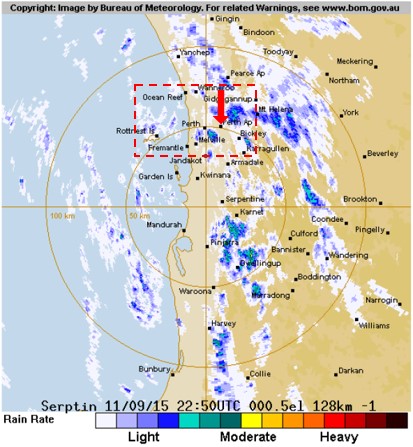
The red arrow indicates the location of Perth Airport and the dashed red rectangle indicates the area presented with the flight path in Figure 6. Source: Bureau of Meteorology, annotated by the ATSB
The flightpath taken by VH-FNP was superimposed over the region highlighted by the dashed red rectangle in the radar, as shown above in Figure 5 (Figure 6).
Figure 6: Overlay of flight path on a zoomed in section of the weather radar image taken at 0650 (2250 UTC), where the region corresponds to the dashed red rectangle in Figure 5
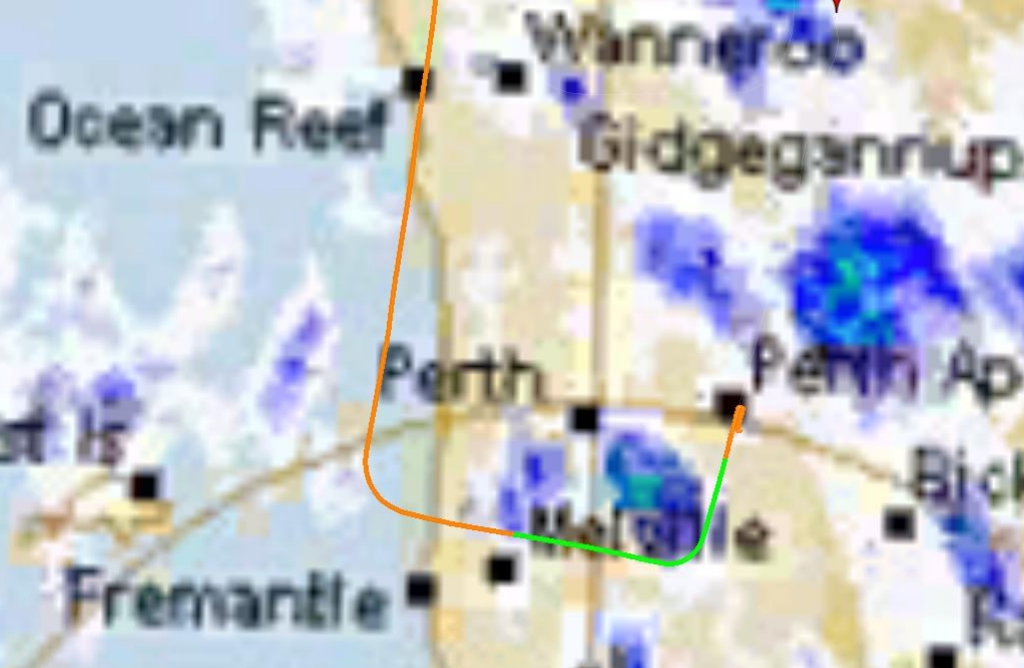
Note: The green flight path indicates when the autopilot was engaged, orange when the autopilot was not engaged. Source: Bureau of Meteorology, annotated by the ATSB
The captain reported that on the evening before the flight, he had been awoken by heavy rain and that it was a ‘wintery morning’ when driving to the airport. The METAR confirmed that there had been 11.4 mm of rain since 0900, on the previous day.
The BoM climate summary for September 2015 showed that Perth Airport received rain on 1, 5, 6, 11, and 12 September 2015. The incident day (12 September) being the wettest day of the month. No rain was recorded at weather stations near Boolgeeda in September 2015.
ATSB observation:
The flight crew reported that the aircraft was in instrument meteorological conditions (IMC)[31] during the climb, and about 10 seconds before the autothrust disconnected, the cockpit voice recorder (CVR) captured the flight crew discussing showers when delaying their turn to the north. Given the flight crew’s reports and the proximity of the flight path to the rain on the weather radar, it was likely that VH-FNP passed through, or along the edges of, a rain cell before the autothrust and autopilot disconnected.
Aircraft information
VH-FNP is an Airbus A320-231 twin-turbine engine low-wing commercial transport aircraft, manufactured in France in 1993.
Skywest Airlines first registered the aircraft in Australia in April 2010 before Virgin Australia Regional Airlines (VARA) purchased Skywest Airlines. Skywest and VARA had primarily operated VH-FNP on charter flights from Perth to remote mining operations in Western Australia; however, more recently had increased its use on regular public transport operations. The occurrence flight was a mining charter flight that was part on an established ongoing contract.
Electronic instrument system
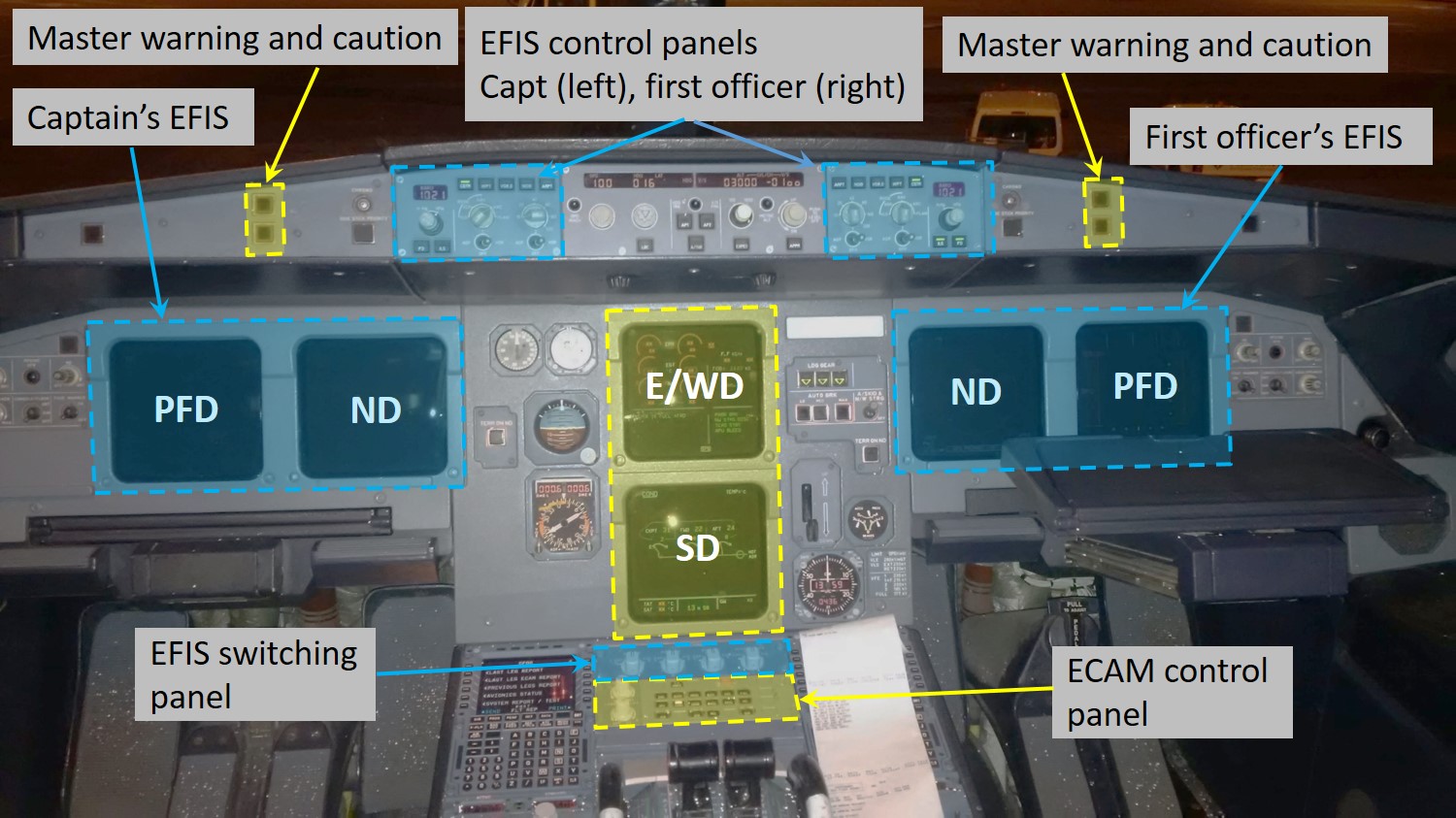
The A320’s electronic instrument system (EIS) presents data to the flight crew regarding the aircraft and its environment. It consists of the electronic flight instrument system (EFIS) and electronic centralised aircraft monitoring (ECAM) system (Figure 7, EFIS component highlighted in blue and ECAM components highlighted in yellow). The EFIS displays mostly flight parameters and navigation data on the primary flight displays (PFDs) and navigation displays (NDs). The ECAM presents data on the engine and warning display (E/WD) and system display (SD). Control and switching panels for the EFIS and ECAM are located on the glareshield and centre console. Master warning and caution lights are located on the glareshield to draw the flight crew’s attention to important messages on the ECAM.
Figure 7: Location of the EIS components in the A320 cockpit
Source: ATSB
The PFD presents flight environment information, such as airspeed, attitude and altitude, and some navigation information, such as heading and instrument landing system, to the flight crew. It also includes some flight mode information, such as autopilot and autothrust status (Figure 8).
Figure 8: Primary flight display – information zones (left) and presentation (right)
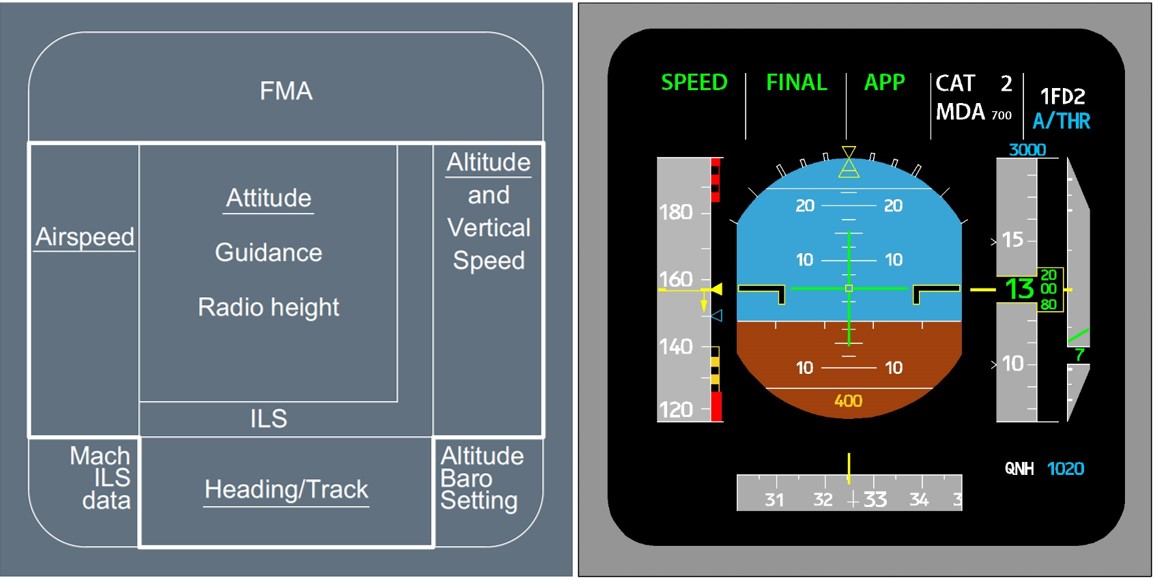
The presentation is an example only and does not contain information from the event flight.Source: Airbus (left) and ATSB (right)
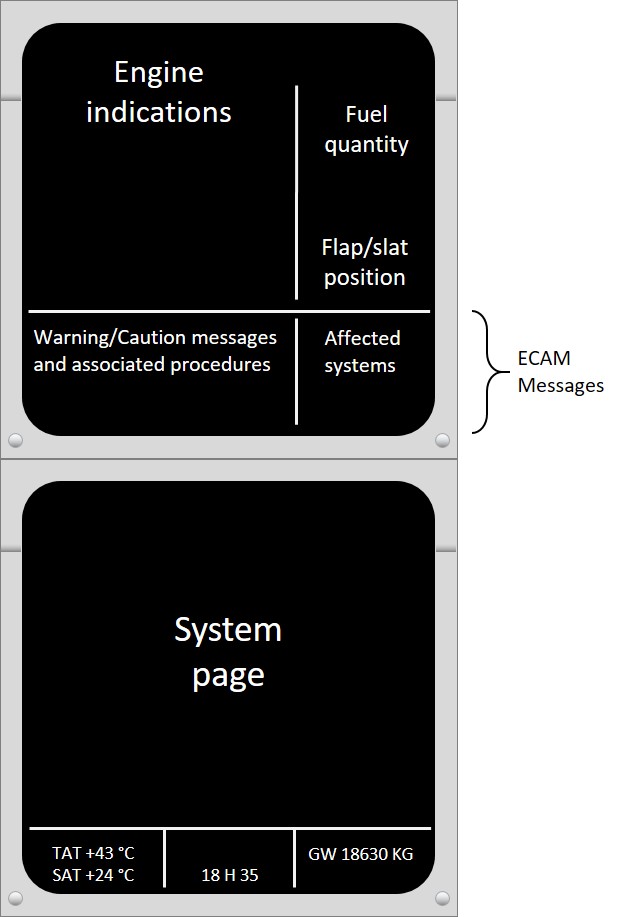
The ECAM is an integrated system that presents data monitored by the aircraft on the engine and warning display and system display pages in the centre of the instrument panel. The displays are divided into dedicated areas to display the following information as shown in Figure 9.
- primary engine indications, fuel quantity, flap and slat position
- warning and caution alerts, or memos
- synoptic diagrams of aircraft systems and status messages
- pertinent flight data (air temperature and gross weight).
Figure 9: ECAM displays – engine/warning display (upper) and system display (lower)
Source: ATSB
The lower part of the E/WD is dedicated to ECAM warning and caution messages. The left section presents the specific warning messages and the right section lists the affected systems, secondary failures, memos or special notices (such as ’LAND ASAP’). When the flight warning computer (FWC) detects a failure, and if there is no flight phase inhibition active, the title of the warning is displayed followed by the associated procedures (actions and information).
The ECAM message area is limited in size and can display a maximum of seven lines. If there are too many messages, or the procedure extends beyond the bottom of the display, a green ‘overflow’ arrow appears at the bottom of the message area, as shown in Figure 2. The flight crew can scroll down to view the additional messages.
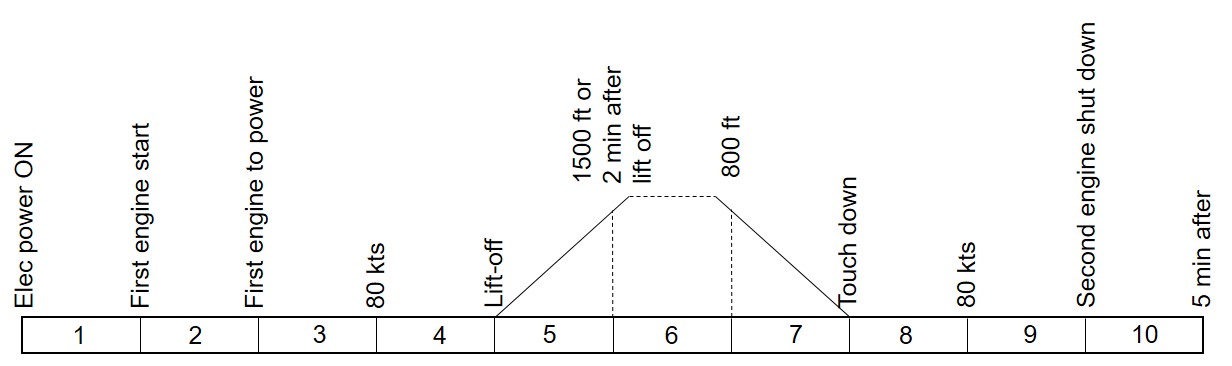
Airbus divides each flight into 10 distinct phases (Figure 10). To prevent distracting the flight crew during high-workload phases, and to prevent unnecessary warnings, the FWC inhibits some warnings from being presented on the ECAM during particular phases.
Figure 10: Airbus flight phases
Source: Airbus and ATSB
The ECAM display uses a colour code to indicate the importance of the failure or the indication, providing the flight crew with an immediate indication of the urgency to take remedial actions (Table 2).
Table 2: ECAM colour coding
| Colour | Importance |
| Red | The configuration or failure requires immediate action. |
| Amber | The flight crew should be aware of the configuration or failure, but need not take immediate action. |
| Green | The item is operating normally. |
| White | Provides guidance while various procedures are executed. |
| Blue | Actions to be carried out, or limitations. |
| Magenta | Message applies to particular pieces of equipment or situations. |
ECAM alerts (warnings and cautions) are further divided into three levels, indicating its importance, with level 1 being the lowest and level 3 being the most critical. Depending upon the level, the message is presented on the ECAM as either a red warning, or amber caution, with an associated aural alert and illumination of a master warning or caution light on the instrument panel glareshield (Table 3).
Table 3: ECAM alert level descriptions
| Level | Description | Aural alert | Visual alert |
| 3 | Red warning: Immediate action required, due to: aircraft is in a dangerous configuration, or limit flight condition (for example, stall) system failure altering the flight safety (for example, engine fire). | Continuous repetitive chime, specific sound or synthetic voice | Flashing red ‘Master Warning’ light. Red warning message on E/WD. Automatic call of the relevant system page on the SD. |
| 2 | Amber caution: The flight crew should be aware of the configuration or failure, but does not need to take immediate action. However, it was intended that time and situation permitting; these cautions should be considered without delay to prevent any further degradation of the affected system. These are for system failures without any direct consequence on the flight safety (For example, green hydraulic system pressure low). | Single chime | Steady amber ‘Master Caution’ light. Amber caution message on E/WD. Automatic call of the relevant system page on the SD. |
| 1 | Amber caution: Requires crew monitoring. These are for system failures leading to a loss of redundancy or system degradation. | None | Amber caution message on E/WD. Generally without procedure. |
When there are multiple ECAM messages, the order in which they are presented is dictated by the alert level. Level 3 has priority over level 2, which has priority over level 1. For alerts of the same level, Airbus has assigned a priority based upon factors decided during design. Airbus advised the ATSB that for A320 aircraft, amber alerts for engine-related failures have a higher priority than amber alerts for navigation and air data failures.
The ECAM’s system display (SD) can display 12 system pages, including engine, bleed air, electrical, hydraulic, and flight control systems. The flight crew, using the ECAM control panel, may manually select each page, or the system may automatically display a page. System pages are automatically displayed when a system failure triggers a caution or warning message, or to advise the flight crew that a relevant parameter has drifted outside of its normal range. If there are no overriding system page priorities, particular pages are also automatically displayed as the flight phase’s default page. For example, the ENGINE page will be displayed for phases 3, 4, and 5 (take‑off phases).
Additionally, during phase 2, when the WHEEL page is the default page, moving either sidestick by more than 3° in pitch or roll, or when the rudder pedal is deflected by more than 22°, the system page will automatically change to the flight control (F/CTL) page. This will only occur during phase 2, as it is associated with a control check.
Park brake
The A320 park brake applies hydraulic pressure to the aircraft brakes. This can be applied at any time, but should only be used on the ground. To prevent the aircraft from landing with the park brake on, the aircraft’s flight warning computer will generate a level 2 amber PARK BRAKE ON alert when the park brake is on during flight. The system inhibits the warning for flight phases 1 to 5 and 8 to 10, all ground phases, so should only activate when the aircraft is airborne.
Auto flight
The aircraft’s auto flight system is centred on the flight management and guidance system (FMGS) and consists of two flight management and guidance computers, and two flight augmentation computers (FAC). The flight management part of the system controls: navigation and navigation radios, flight planning, performance prediction and optimisation, and display management. The flight guidance part provides autopilot, flight director and autothrust functions.
Flight crew interact with the system through two multipurpose control and display units in the centre pedestal and a flight control unit (FCU) in the centre glareshield. The FCU allows the flight crew to select and modify any flight parameters for short-term operation in selected guidance mode. The FCU also includes the autopilot and autothrust engagement controls.
The FMGS provides guidance information to either the flight director, or the autopilot. When the flight director is engaged, flight path guidance information is presented to the flight crew on the PFD. The flight crew then make control inputs to follow the flight path. When the autopilot is engaged, it will automatically make control inputs to guide the aircraft along the flight profile. The autopilot only controls the aerodynamic surface for the aircraft (elevator, aileron and rudder). Automatic engine thrust is provided by the autothrust function.
The FACs provide yaw damping and roll coordination functions through control of the rudder.
Autopilot
The aircraft has two autopilots, AP1 and AP2, which can be engaged by pressing the corresponding button on the FCU. The autopilot is disengaged by either the:
- flight crew take an action on the flight control systems, such as pressing the takeover pushbutton on the sidestick (standard method), pushing the FCU autopilot button when engaged, or moving the sidestick control
- engagement conditions are no longer met.
Detection of certain faults by the aircraft systems can result in the autopilot engagement conditions not being met, disengaging the autopilot.
Autopilot disengagement produces a level 3 alert, with a flashing red master warning light, red AUTO FLT AP OFF message on the ECAM, and an aural ‘cavalry charge’ alert.
Autothrust
The autothrust function connects the FMGS to the engine control system so that it can command the required thrust from the engines. When engaged, the autothrust function can provide a fixed thrust control, or airspeed control. Autothrust can operate independently, or with the autopilot.
Both the autopilot and autothrust systems can control the target airspeed, but both cannot be controlling at the same time. In managed climb and descent modes, the autothrust will hold the engine thrust, and the autopilot will control the airspeed.
The autothrust function requires at least one flight management and guidance computer, one FAC and two air data inertial reference systems to be operative. It will disconnect when the flight crew takes a particular action, such as pressing the instinctive disconnect button on the thrust levers (standard method), or pressing the A/THR button on the FCU, or automatically when the arming conditions are not met.
Autothrust disconnection produces a level 2 alert, with a master caution light, single chime and an amber AUTO FLT A/THR OFF message on the ECAM.
When the autothrust is disconnected and the thrust levers are in the climb detent, the thrust lock function will activate. Thrust lock will lock the thrust at its level prior to the disconnection and display a flashing amber message on the flight mode annunciator in the PFD. Thrust lock is disabled by moving the thrust levers out of the climb detent.
Power plants
VH-FNP was fitted with two International Aero Engines V2500 high-bypass turbofan engines. The engine is of a twin-shaft design, consisting of low-pressure (LP) and high-pressure (HP) systems on separate shafts (Figure 11). The low-pressure system consists of the fan, low-pressure compressor and turbine. Similarly, the high-pressure system consists of a high-pressure compressor and turbine.
Figure 11: V2500 engine schematic diagram
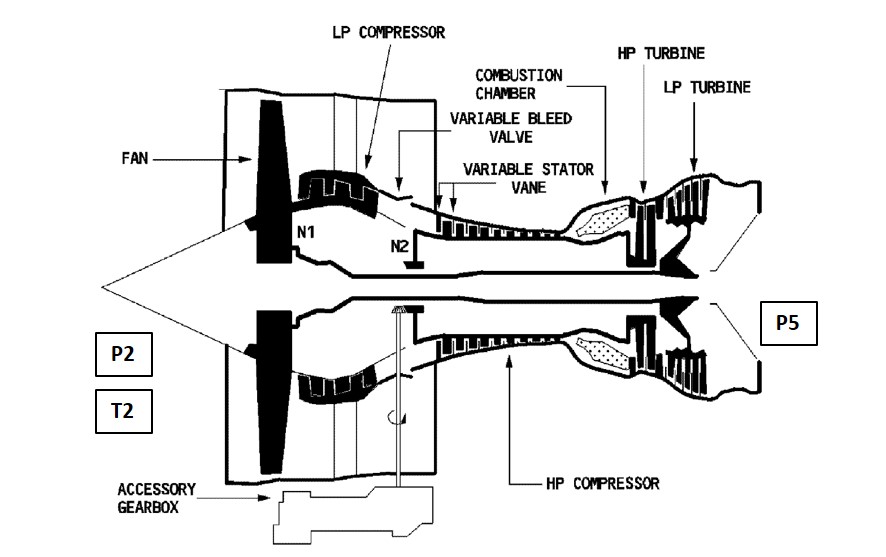
Source: VARA Flight Crew Operating Manual. Additional annotation by ATSB
In normal operation, the engine thrust setting is achieved through control of the engine pressure ratio (EPR).[32] This normal mode of operation is referred to as EPR mode. To operate in EPR mode, the engine control system requires valid pressure and temperature data (P2, P5 and T2). To ensure the integrity of this data, the engine monitors the total air pressure measured by the aircraft’s air data reference (ADR) system. If the engine control system determines that either P2 or P5 are not valid, or cannot verify them against the aircraft supplied ADR data, thrust control will automatically revert to N1 mode. This will result in a level 2 amber ENG 1(2) EPR MODE FAULT alert on the ECAM.
In N1 mode, the rotational speed of the low-pressure system (N1) is controlled. N1 mode has two sub‑modes, rated N1 mode and degraded N1 mode. Reversion to rated N1 mode occurs when either P2 and/or P5 are invalid, and reversion to degraded N1 mode occurs when T2 or the ambient pressure parameters are not valid. Autothrust is not available when in N1 mode.
When in EPR mode, rated N1 mode can be manually selected through the ENG N1 MODE push-button switches on the overhead panel. After an automatic reversion to rated N1 mode, pressing the button confirms the mode.
In the case where the engine core speed drops below the idle speed, with the master switch on, the ECAM will present a level 2 amber ENG 1(2) FAIL alert. However, this warning is inhibited during flight phases 1 and 10 (engine start and after engine shutdown).
Air data reference system
The air data reference (ADR) system[33] senses air temperature, static and total air pressure, and angle of attack information. It then converts them to useable data, such as computed airspeed and altitude, for supply to other aircraft systems, including the FMGS, flight warning computers, flight control system, and engine control system.
The ADR system consists of three independent systems: one for the captain (ADR 1), one for the first officer (ADR 2) and a standby system (ADR 3). Air data is collected from the external airflow via 14 external probes and ports mounted on the forward fuselage (Figure 12).
Figure 12: Air data reference system external probe locations
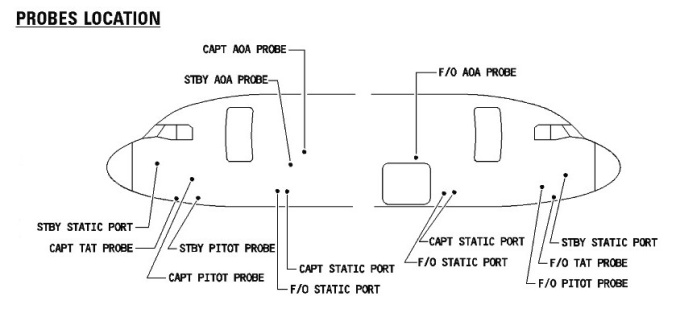
Source: Airbus
Sensors connected to these probes convert the external air conditions to electronic signals, which are then sent to the three air data inertial reference units (ADIRUs) (Figure 13). The ADIRUs then convert these signals to useable system data. The standby system also supplies static and total (pitot) air pressure to direct reading analogue airspeed and altitude indicators on the instrument panel.
Figure 13: Air data reference system schematic
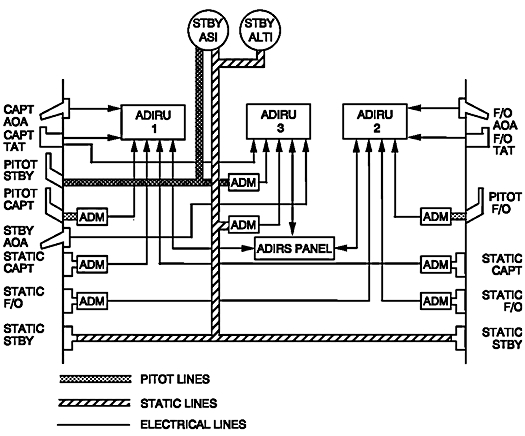
ADM = air data module (the sensor that converts air pressure to an electric signal). Source: Airbus
In the normal configuration, the captain’s PFD presents information from ADIRU 1, the first officer’s from ADIRU 2. However, in case of an ADIRU 1 or 2 failure, ADIRU 3 data can be directed to either the captain’s or first officer’s PFD, as required, using the EFIS switching in the centre pedestal (Figure 7 and Figure 14).
Figure 14: EFIS switching panel. Air data source switch highlighted by yellow box
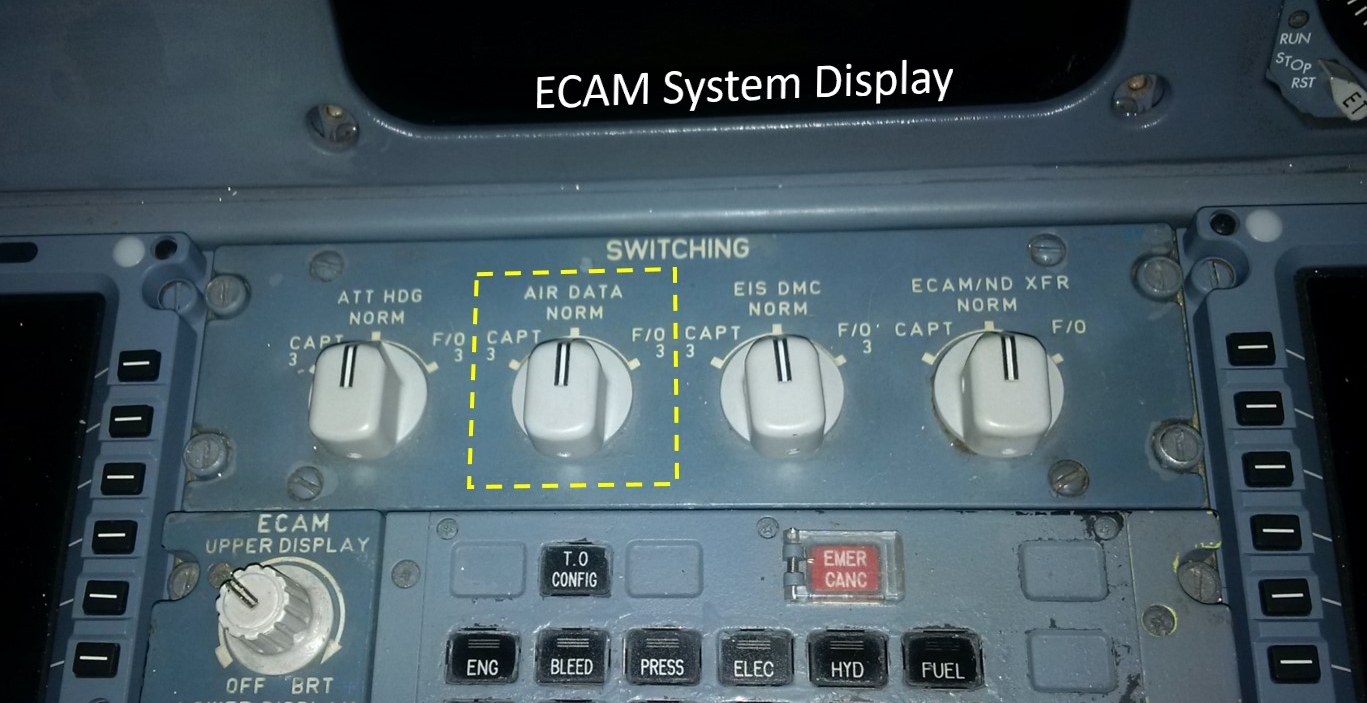
Source: ATSB
All of the external probes and ports are heated to prevent the accumulation of ice, which could degrade their accuracy. The captain’s, first officer’s and standby systems are controlled and monitored by three independent probe heat computers.
The probes are automatically heated when at least one engine is running, or when the aircraft is in flight. They can also be manually operated through a pushbutton in the cockpit. When on the ground, the pitot and total air temperature probes operate at a low level and automatically change to normal power when airborne.
If a fault is detected in any of the ADR systems, a level 2 alert is raised, activating the master caution and presenting an amber NAV ADR 1(2)(3) FAULT message on the ECAM. A FAULT light on the applicable ADR pushbutton switch on the overhead panel is also illuminated to indicate which system is affected.
If one ADR has been detected as being faulty, or has been rejected by the flight control computers, and there is an airspeed or angle of attack disagreement between the remaining two ADRs, then a level 2 alert is raised. This activates the master caution and presents an amber NAV ADR DISAGREE message on the ECAM.
Pitot probe details
The pitot probes collect the total air pressure, which is a combination of the static (ambient) air pressure and the pressure increase due to moving air being brought to a standstill. The difference between the measured total and static air pressure is the component due to the velocity alone, and as such is used to calculate the airspeed.
The pitot probe is a tube with a forward facing opening mounted on the side of the fuselage (Figure 15). To ensure it has clean air, the opening of the probe is held away from the fuselage. To prevent water from blocking the probe, two small drain holes are drilled into the lower side of the probe.
Figure 15: Pitot probe
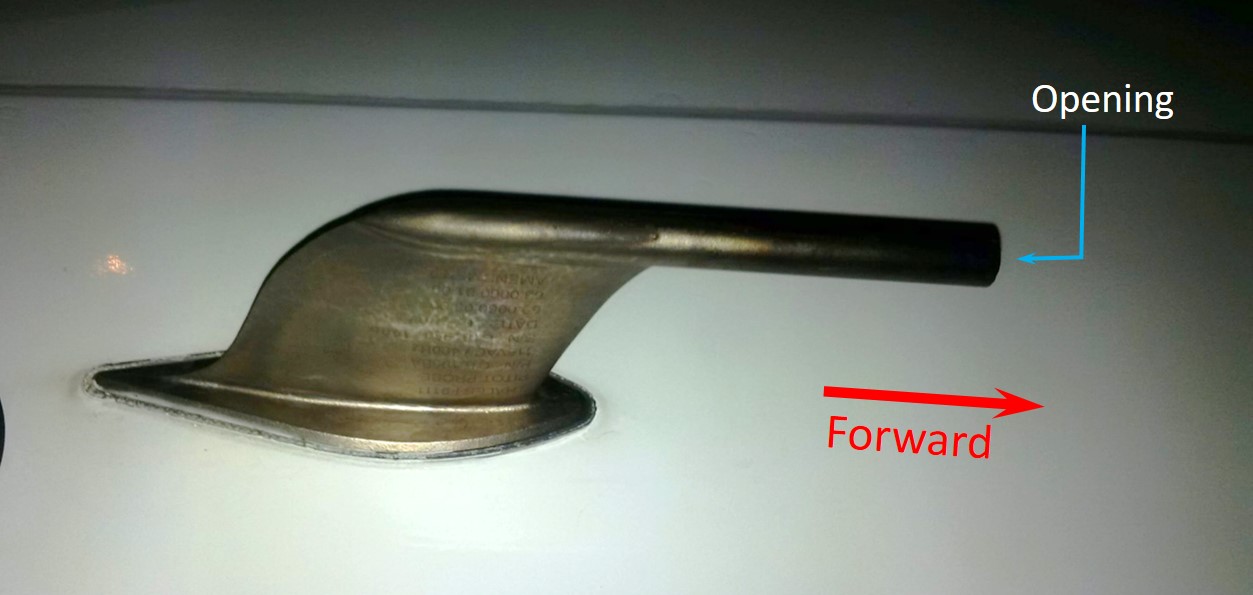
Source: ATSB
Flight control system
General
The Airbus A320 has a digital fly-by-wire control system. Manual control inputs made by the pilots on the sidesticks, or autopilot computer commands, are interpreted by the flight control computers and converted to control surface movements. Seven flight control computers, including the two FACs, control the aircraft’s elevators for pitch control, ailerons and spoilers for roll control, and rudder for yaw control. Signals from these computers are sent directly to the associated control surfaces and to the EIS for presentation of pertinent information.
To prevent damage to the vertical stabiliser, the FACs include a rudder travel limit function. This function reduces the maximum rudder travel deflection at high airspeeds. In the case of a loss of the rudder travel limit system in the clean configuration,[34] the rudder deflection limit is held at the last value. When the slats are extended, the FACs automatically set the rudder deflection limit at the low-speed setting (maximum authorised deflection).
If one FAC is unable to provide rudder travel limit function, a level 1 alert is activated. The master caution is not activated, but an amber RUD TRV LIM 1(2) message is presented on the ECAM. If both FACs are unable to provide the rudder travel limit function, a level 2 alert is activated. This activates the master caution and presents an amber RUD TRV LIM SYS message on the ECAM.
Control laws
The A320 flight control system operates according to three sets of control laws:
- normal law
- alternate law
- direct law.
As the name suggests, normal law is the control law used in normal operation. Under normal law,[35] sidestick inputs command a load factor, which the flight control computers convert to the appropriate elevator deflections. Normal law includes the following flight envelope protections:
- load factor limitation
- pitch attitude protection
- high angle of attack protection, limiting the angle of attack, preventing the aircraft from stalling
- high speed protection
- bank angle protection.
The FACs calculate a speed corresponding to the limit angle of attack, which presented to the flight crew on the airspeed indicators as a minimum speed warning area. The FACs also calculate the minimum and maximum limit speeds, manoeuvring speeds and speed trend. These speeds are included in a set of speeds referred to as ‘characteristic speeds’ presented to the flight crew on their PFDs.
To function in normal law, the flight control computers require valid air data from the ADRs. The computers monitor all three ADR systems to assess the validity of the air data parameters. If the value of a parameter from one ADR differs from the others, the flight control system will discard the non-consistent value and use the other two.[36] However, if all values are different the system cannot determine the correct value and cannot ensure the functions of normal law. In this case, the system will reconfigure the control laws to alternate law, depending on the data it can validate.[37] Reversion to direct law will occur at landing gear extension.
When in alternate law, the control laws are predominantly the same as normal law, but the level of flight envelope protection is reduced. The flight control system has two levels of alternate law, with or without reduced protections.
- Alternate law with reduced protections - provides load factor limitation, low‑speed stability, and high-speed stability. There are no pitch or roll attitude protections and the high angle of attack protections are replaced with a stall warning.
- Alternate law without reduced protections - loses all flight envelope protections, except for load factor limitation. High angle of attack protection is replaced by a stall warning.[38]
For both levels of alternate law, a calculated stall warning speed is presented on the PFD airspeed indicator, replacing the high angle of attack protection speeds.
The type of failure, or the nature of the particular system that failed, dictates which alternate law is used. For example, when the system detects a computed airspeed disagreement, the system reconfigures to alternate law without reduced protections. However, when an angle of attack disagreement is detected, the system will reconfigure to alternate law with reduced protections.
The flight crew is alerted to the reconfiguration to alternate law by the activation of the master caution, presentation of an amber F/CTL ALTN LAW message on the ECAM, and amber ‘x’ symbols replace the green normal envelope protection symbols on the PFD.
Certain other system failures, such as failure of all three inertial reference systems, result in the flight control system reconfiguring to direct law. When in direct law, there is a direct stick-to-elevator and stick-to-roll-control-surface relationship, and the rudders are directly controlled by the rudder pedals through a mechanical interconnect. Automatic elevator and rudder trimming is lost and manual trim must be used. All flight envelope protections are lost except for the stall and overspeed warnings.
When the system reconfigures to direct law, the flight crew is alerted in the same manner as for reconfiguration to alternate law, except the ECAM message is F/CTL DIRECT LAW, it is indicated on the PFD and the flight control page on the system display is automatically displayed.
Centralised fault display system
The electronic systems in the A320 all contain built-in test equipment (BITE), which monitors and identifies any faults within the system. The BITE from all the aircraft’s electronic systems are monitored and recorded by the centralised fault display system (CFDS). The CFDS classifies faults into three classes:
- Class 1 being those indicated to the flight crew by means of the ECAM, or other flight deck effect.
- Class 2 being faults indicated to maintenance personnel by the CFDS and trigger a maintenance alert in the ECAM status page.
- Class 3 are faults indicated to maintenance personnel through the CFDS, but do not trigger a maintenance alert.
Fault messages recorded by the CFDS can be accessed by the flight crew and maintenance personnel through the multipurpose control and display units that form part of the FMGS. The CFDS collates the fault messages into a number of reports. One such report, the post-flight report (PFR), can be accessed at the completion of a flight.[39] The PFR presents a list of the ECAM alerts and failure messages that occurred during the previous flight. The list includes the time, flight phase, ATA number[40] and description of the ECAM and failure messages. The list of failure messages also identifies the source of the failure message.
The order in which the ECAM warning messages are presented on the PFR is the order in which the CFDS received the alerts, and does not necessarily indicate the order in which they were presented to the flight crew on the ECAM.
Reports can be sent to a printer installed in the centre pedestal.
Maintenance personnel can also directly access the BITE of each electronic system through the CFDS. The information from the BITE is used for troubleshooting failures, and is referred to as troubleshooting data.
Maintenance information
Post-flight troubleshooting
Following the incident, the operator’s maintenance personnel downloaded the PFR, troubleshooting data and flight data recorder from the aircraft. Copies of that data were sent to the aircraft manufacturer and the ATSB. The aircraft manufacturer used the data to assist the operator identify the source of the faults and return the aircraft to service. The manufacturer also used that data to perform a detailed analysis of the flight to determine the sequence of events and assess the aircraft system behaviour. A summary of their analysis is presented later in the report in the section titled Manufacturer’s analysis.
The PFR included 23 ECAM warnings and 15 failure messages (Figure 16). Those messages primarily related to the engine control, flight control, auto flight and navigation systems.
Figure 16: Post-flight report from VH-FNP
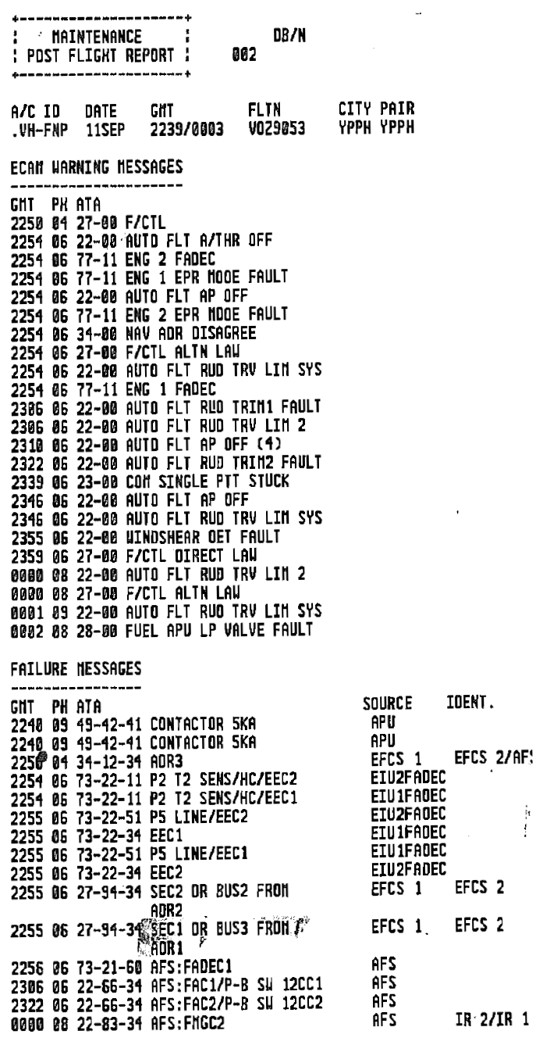
Note: The time used by the CFDS is UTC, identified as GMT (Greenwich Mean Time).
Source: VARA
As part of the troubleshooting, the operator performed a flush of the pitot system (probe and tube connecting probe to air data module). They also cleaned the pitot probe drain holes. Table 4 provides a summary of the results of these actions.
Table 4: Results of pitot system cleaning
| Pitot system | Results |
| 1 (captain) | Water ejected during flushing. One drain hole blocked. |
| 2 (first officer) | Water ejected during flushing. One drain hole blocked. |
| 3 (standby) | Water and an object ejected during flushing. Both drain holes blocked. |
The object ejected from pitot system 3 was not captured, nor was the material cleaned from the drain holes collected. There was no requirement in the maintenance instructions for any ejected material to be collected or analysed.
Troubleshooting tasks and maintenance action recommended by the manufacturer were carried out and the aircraft returned to service without further recurrence of the airspeed issues. The only anomalies identified were those associated with contamination of the pitot probes.
Pitot probe maintenance
The Airbus A320 Maintenance Planning Document included detailed routine cleaning of the pitot probes. It specified that cleaning of one out of the three pitot probes must be performed alternately on pitot 1, 2 and 3 every 6 months or 750 flight hours.
The operator reported to the ATSB that their maintenance planning system specified that the pitot probes be alternated between each probe at an interval of 4 months or 750 flight hours. This was more regular than the interval specified by the manufacturer. The last probe cleaning actions were reportedly carried out on:
- pitot 2 (first officer) on 26 January 2015
- pitot 3 (standby) on 17 May 2015
- pitot 1 (captain) on 6 September 2015.
The operator also reported that they had not previously experienced any issues with contamination of pitot probes in their fleet of aircraft, which included Fokker F50 and F100, and Airbus A320 aircraft. In addition, there had not been any events recorded where the fuselage of VH-FNP near the pitot probes had been contaminated by mud or clay that would explain the contamination identified within the probes.
At the request of the ATSB, the operator performed visual inspections of the pitot probes in their A320 fleet. Those inspections, and reliability data from the operator’s fleet, did not identify any increase in contamination events that indicated a need for inspections over and above the manufacturer’s requirements.
Erratic airspeed indications – maintenance actions
On 15 July 2014, Airbus released an In-Service Information document to A320 operators regarding the maintenance actions for erratic airspeed indications.[41] The purpose for the issue of the document was listed as ‘providing operators with the list of scheduled maintenance actions that will minimize occurrence of airspeed discrepancies, as well as recommended actions to perform on aircraft whenever such an event happens.’ The background to the service information listed a number of erratic airspeed events reported to Airbus, including residual airspeed display on the PFD while the aircraft is not moving, airspeed discrepancies or fluctuations in-flight, and flight controls alternate law activation due to air data discrepancies.
Airbus noted in that information that investigations on A320 family aircraft showed that most of the airspeed discrepancy events, during take-off or approach, were the result of water contamination of the pitot probes and the pitot probe drainage holes being obstructed by external particles. It also noted that pitot probe part number C16195BA, the type fitted to VH-FNP, had an enhanced water trap and relocated drain holes to provide improved behaviour when faced with adverse weather conditions such as heavy rain.
The In-Service Information document provided troubleshooting information specifically for the case of steady residual airspeed indications while on the ground. Those actions included functional testing of the air data modules, flushing of the principal total pressure lines (pitot system), and draining and flushing of the standby system. It was also recommended that after an erratic airspeed event, that the flight control computers be reset to ensure that any latched faults are de-latched before the next flight.
Detailed examination of pitot probes
On 2 November 2015 (about seven weeks after the incident), all three pitot probes (Thales part number C16195BA, manufactured in 2007 and 2008) were removed from the aircraft and sent to the probe manufacturer for detailed examination. The probes were subjected to the manufacturer’s standard acceptance test procedure and compared to the acceptable limitations of the component maintenance manual. Two of the probes were then cut open for detailed examination of anomalies identified in the interior of the probes. Table 5 summarises the findings of the testing and examinations. Further detail of the examinations is provided in Appendix A.
Table 5: Summary of testing and examination of the pitot probes removed from FNP
| Captain’s probe (pitot 1) | Failed the acceptance tests due to one drain hole being blocked by an unidentified black substance (Figure 17) and internal contamination by a red clay substance, an example of which is shown in Figure 18 (left) |
| First officer’s probe (pitot 2) | Passed the acceptance tests and found to be in acceptable condition in accordance with the component maintenance manual |
| Standby probe (pitot 3) | Failed the acceptance tests due to internal contamination by a red clay substance, example of which is shown in Figure 18 (right) |
Figure 17: Image of substance partially blocking one drain hole in the captain's pitot probe
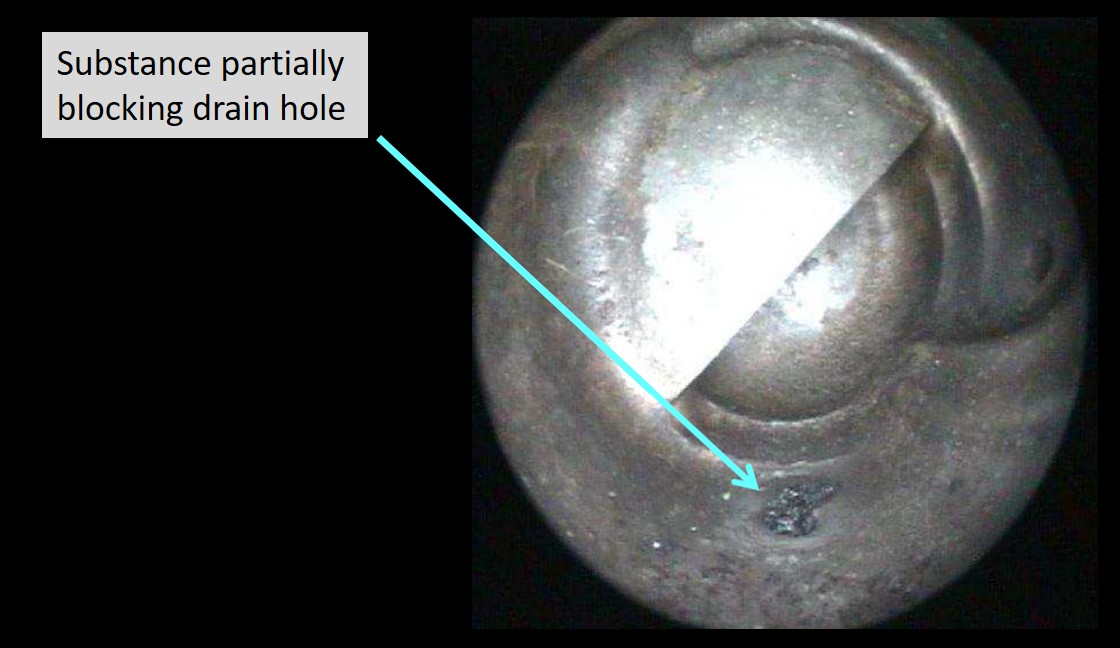
Source: Thales
Figure 18: Examples of the red clay contamination inside the captain’s (left) and standby (right) pitot probes
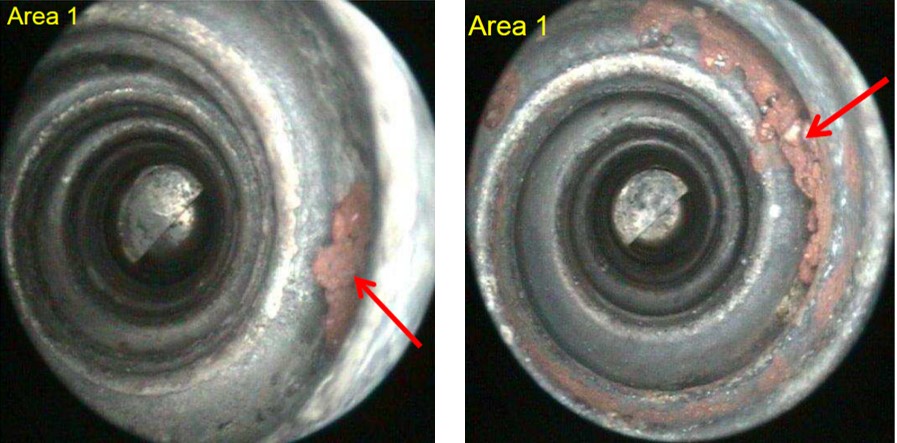
Source: Thales
ATSB observation:
After the incident, the pitot probes were subject to cleaning procedures followed by over 1 month of normal operational service. Thus, the findings of the examinations do not necessarily represent the condition of the tubes at the time of the occurrence.
Other than the contamination, there were no observations made by the manufacturer to indicate that the probes were not otherwise serviceable.
The source of the contamination could not be determined. The aircraft regularly operated into airports associated with iron ore mining operations in north-western Australia, where red mineral rich soils are common. However, the means or timing of ingress could not be determined.
Airworthiness directives
European Aviation Safety Agency (EASA) airworthiness directive (AD), AD 2014-0237R1, in force at the time of the incident, required the replacement of Thales part number C16195BA pitot probes, the type fitted to VH-FNP. The AD was originally issued in November 2014 and required replacement of the probes within 48 months (4 years) after the date of original issue. The background information provided in the AD noted:
Occurrences have been reported on A320 family aeroplanes of airspeed indication discrepancies while flying at high altitudes in inclement weather conditions. Investigation results indicated that A320 aeroplanes equipped with Thales Avionics Part Number (P/N) 50620-10 or P/N C16195AA pitot probes appear to have a greater susceptibility to adverse environmental conditions than aeroplanes equipped with certain other pitot probes.
Prompted by earlier occurrences, DGAC France issued AD 2001-362 to require replacement of Thales (formerly known as Sextant) P/N 50620-10 pitot probes with Thales P/N C16195AA probes.
Since that AD was issued, Thales pitot probe P/N C16195BA was designed, which improved airspeed indication behaviour in heavy rain conditions, but did not demonstrate the same level of robustness to withstand high-altitude ice crystals. Based on these findings, EASA have decided to implement replacement of the affected Thales probes as a precautionary measure to improve the safety level of the affected aeroplanes.
Consequently, EASA issued AD 2014-0237, retaining the requirements of DGAC France AD 2001-362, which was superseded, to require replacement of Thales Avionics pitot probes P/N C16195AA and P/N C16195BA.
On 9 October 2015 (about one month after this incident), AD 2014-0237R1 was superseded by EASA AD 2015-025, which reduced the compliance time from 48 months, to 24 months.
ATSB observation:
Although VH-FNP was still operating with the Thales C16195BA probes, it was within the compliance period for the AD 2014-0237. It was also within the reduced compliance time of the superseding AD.
The ATSB notes that this incident occurred at low altitude and at temperatures where the formation of ice crystals was unlikely. Thus, although the probes were scheduled for replacement due to a susceptibility to blockage, the conditions resulting in the blockage of the probes on VH-FNP were unrelated to those associated with the AD.
Operating procedures
Normal procedures
Use of pitot covers
The FCOM included supplementary procedures for adverse weather, including airports covered with volcanic ash, sand or dust. These procedures included the fitment of pitot probe covers when parked, but were presented as recommendations that operators can consider applying based on their experience and the amount of contaminant.
The operator also contained procedures for securing their aircraft on overnight stays, or for extended periods of time (greater than 3 hours). Among other items, flight crew and engineering personnel were required to, where possible, install covers on pitot and static probes.
Abnormal procedures
During operation, the procedures presented on the ECAM are the primary source of procedural information. They contain the ‘need to know’ information for flight crew to complete the procedure. Further explanatory, ‘nice to know’ information, and detailed information to assist the flight crew in obtaining a full understanding of the logic of the aircraft and pilot interfaces is provided in the FCOM.
The FCOM provides the procedure in a manner that is similar to the presentation on the ECAM, interspersed with the additional information found only in the FCOM. The information presented on the ECAM during the flight was not recorded, so the following information is from the FCOM only. Information likely presented in the ECAM is inferred by the coloured text in a format similar to the ECAM.[42]
Auto flight – autothrust off
The first ECAM alert that the flight crew received was the autothrust disconnection alert (AUTO FLT A/THR OFF). This alert is only generated on the ECAM when the disconnection is involuntary (that is, not initiated by the flight crew). There are no crew actions, and the purpose of the alert is to raise the flight crew’s awareness of the aircraft state. However, the detailed information in the FCOM notes that if the autothrust has failed, the flight crew may be able to recover it by engaging the other autopilot and re-engaging the autothrust.
Auto flight – autopilot off
When the autopilot disconnected, a red ECAM alert was generated. This is a level 3 warning, which would have replaced any lower level alerts from the top line of the ECAM. There were no specific procedures prescribed for this warning. The ECAM message was provided for crew awareness, so they could take manual control, as required.
Engine EPR mode fault
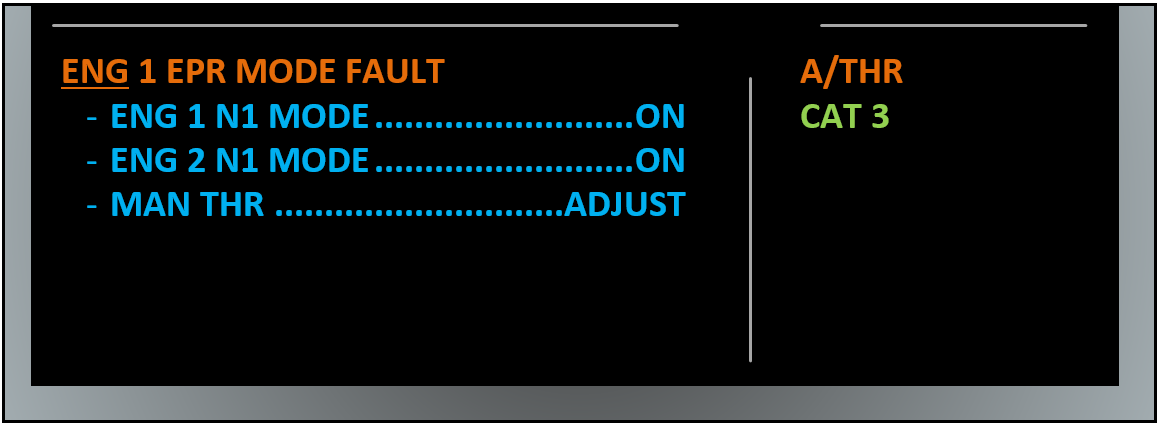
The flight crew discussions on the CVR indicated that the first ECAM message that they were aware of after the autopilot disconnected was the engine 1 EPR mode fault. The ECAM procedure required that the N1 mode be selected ON for both engines, and then the thrust be manually adjusted (Figure 19).
Figure 19: ECAM procedure – engine EPR mode fault
Source: ATSB
The FCOM noted that both engines are selected to N1 mode to ‘ease’ the thrust setting. It also noted that recovery of EPR mode on both engines may be attempted by switching off both ENG N1 MODE pushbutton switches.
Navigation – ADR disagree
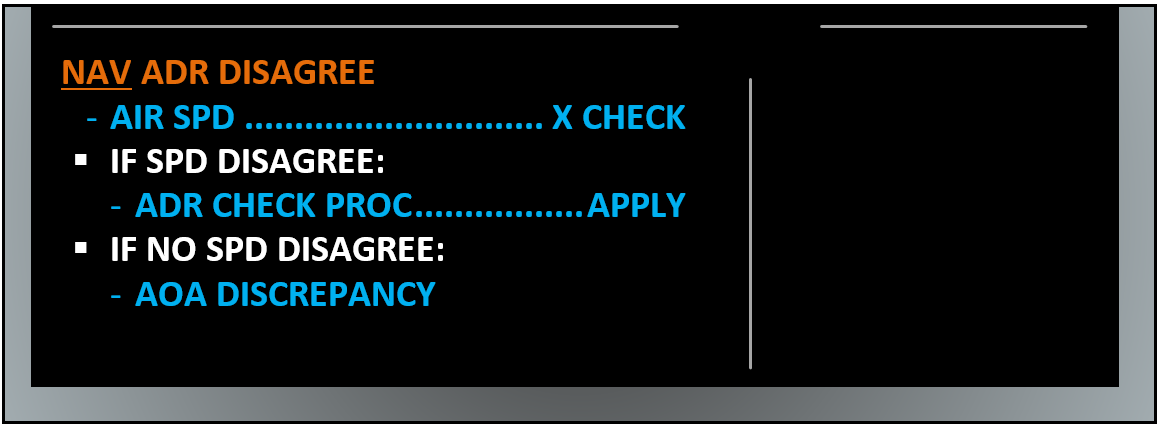
After the flight crew had cleared EPR mode faults for both engines 1 and 2, they were presented with an amber NAV ADR DISAGREE alert. The ECAM procedure for this alert first required the flight crew to cross‑check [compare] the three airspeeds. If the airspeeds disagree, the procedure refers the flight crew to apply the ADR check procedure. If there is no airspeed disagreement, the flight crew are directed to an angle of attack (AOA) discrepancy (Figure 20).
Figure 20: ECAM procedure – navigation ADR disagree
Source: ATSB
Within the NAV ADR DISAGREE procedure in the FCOM, there was associated information on the flight control – alternate law procedure (Figure 21).
Figure 21: FCOM procedure – navigation ADR disagree
Source: VARA A320 FCOM
ATSB observation:
Although the FCOM provided specific procedures for how to manage an airspeed discrepancy (refer to Unreliable airspeed indication/ADR check procedure), the only information the flight crew were provided with for an angle of attack discrepancy was that there was a risk of undue stall warning.
While the angle of attack values could be viewed on the ‘alpha call up’ page on the multipurpose control and display unit, there was no reference to this feature in the procedure to confirm an angle of attack disagreement.
If the system specifically identified a fault in any of the angle of attack systems, an amber ECAM alert (NAV CAPT (F/O)(STBY) AOA FAULT) is raised. The FCOM procedure for that alert was ‘crew awareness’.
Flight control – Alternate law
The flight control alternate law (F/CTL ALTN LAW) ECAM alert did not require any crew actions; it was primarily to bring to the attention of the flight crew the status of the flight control system and the associated limitations. In particular, it included notification that the flight envelope protections were lost.
Auto flight – rudder travel limiter system
After clearing the alternate law ECAM alert, the flight crew were presented with an amber auto flight rudder travel limiter system (AUTO FLT RUD TRV LIM SYS) alert. This alert is activated when both rudder travel limiter systems are inoperative. The ECAM message contains both advisory information regarding rudder use above 160 kt and flight crew actions associated with resetting the two FACs (Figure 22).
Figure 22: ECAM procedure – Auto flight rudder travel limiter system
Source: ATSB
The FCOM provided further information regarding additional limitations for failure of associated systems and landing with the fault. However, none of this was applicable in this case after the flight crew reset the systems during the flight.
After FAC 1 had been reset, the flight crew were presented with an auto flight rudder travel limiter 2 alert. There were no limitations or crew actions associated with this alert. This alert was likely activated when FAC 1 was reset, because rudder travel limiter system 1 was then functional, negating the conditions for the rudder travel limiter system fault message.
The FCOM noted that the alert was for crew awareness.
Stall warning and stall recovery
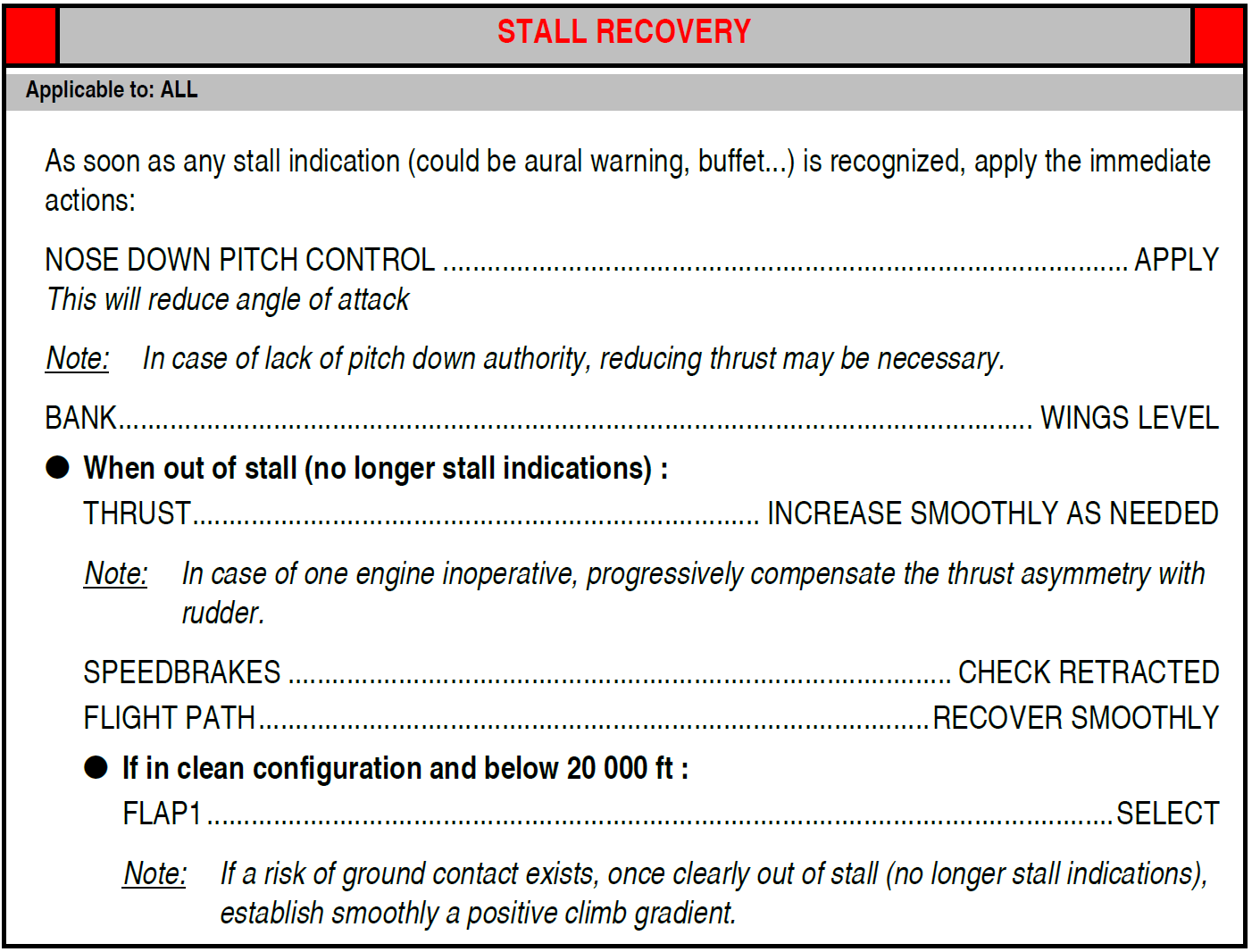
A procedure for stall recovery was also included in the FCOM (Figure 23). The procedure was to pitch the nose down, to reduce the angle of attack, level the wings, and smoothly increase thrust, as required as soon as any stall indication was recognised.
Figure 23: FCOM procedure – Stall recovery
Source: VARA A320 FCOM
Windshear detection fault
The windshear detection function is part of the FACs, and depends on airspeed. When the FACs rejected all ADRs after the detection of the airspeed disagreement during descent, the windshear detection system was disabled and the fault detected by the warning system.
The windshear detection function is only provided for take-off and landing, so the system fault warning was inhibited while the flaps were retracted. As the FACs were not reset after the airspeed disagreement on descent, the windshear detection fault was present, but the flight crew were not alerted to the windshear detection fault until the first stage of flaps were deployed.
The ECAM presents an amber WINDSHEAR DET FAULT message. There are no associated flight crew actions, and the FCOM notes that it is for crew awareness.
Flight control – Direct law
The flight control direct law (F/CTL DIRECT LAW) ECAM alert did not require any crew actions; all information in both the ECAM and FCOM related to limitations associated with the change in the status of the flight control system.
Navigation – Indicated airspeed discrepancy
The ECAM included the NAV IAS DISCREPANCY amber alert, which is activated when there is a discrepancy detected between the airspeeds indicated on the captain’s and first officer’s displays. The associated procedure required the flight crew to cross check the three airspeeds and use the air data switching as required.
ATSB observation:
There was no indication in the recorded data that this alert was raised by the aircraft systems during the climb, indicating that ADR 3 (standby airspeed) was rejected before the ADR 1 and 2 resulting in the system raising the NAV ADR DISAGREE alert.
The manufacturer advised that the NAV ADR DISAGREE inhibits the NAV IAS DISCREPANCY alert. As the NAV ADR DISAGREE alert was latched until the end of the flight, a NAV IAS DISCREPANCY alert was not triggered when the flight crew identified an airspeed discrepancy between the captain’s and first officer’s airspeed displays.
Unreliable airspeed indication/ADR check procedure
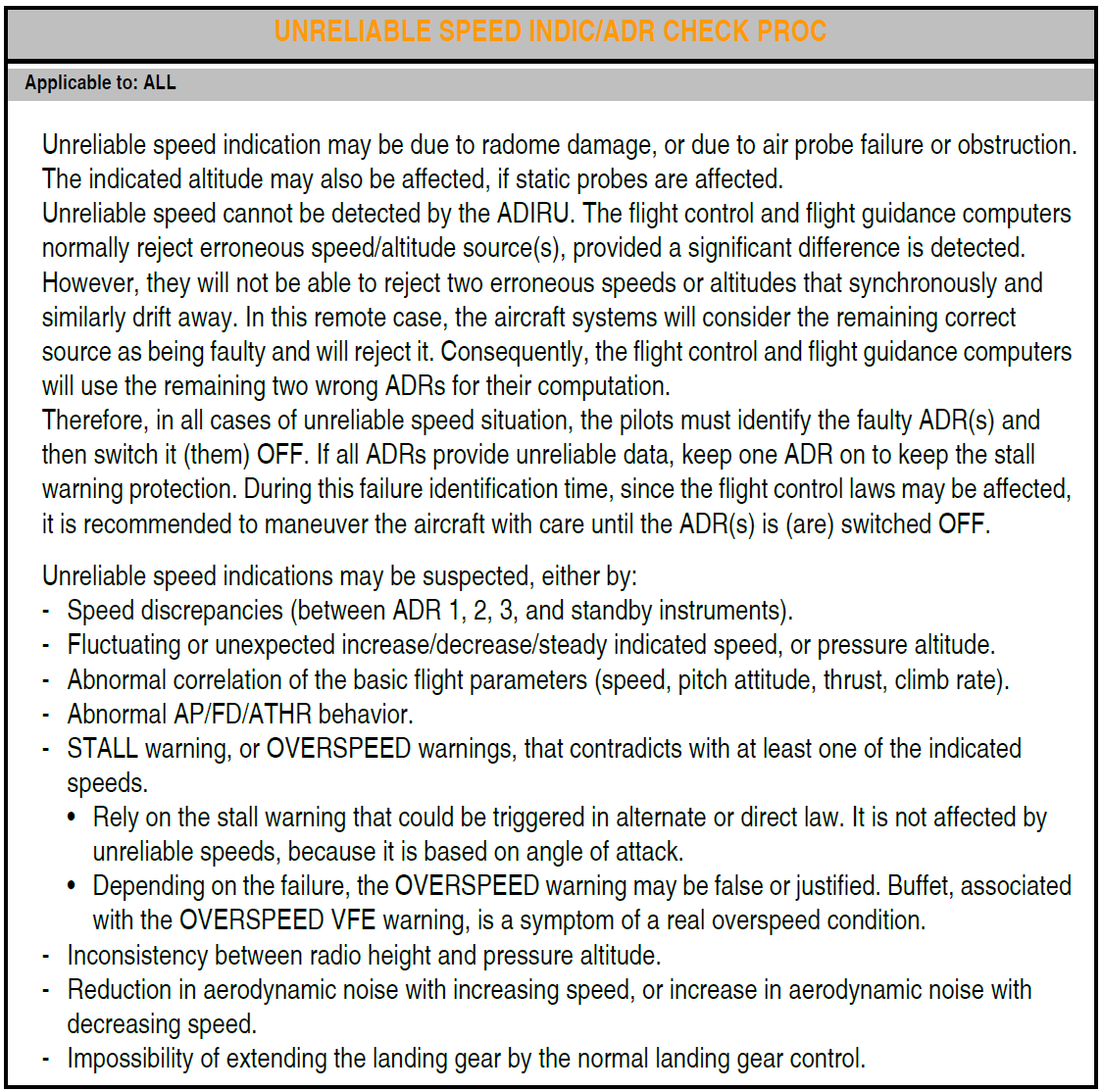
The ADR check procedure referred to in the NAV ADR DISAGREE procedure was combined with the unreliable speed indication procedure. That procedure began with general information regarding sources, identification, and management of unreliable airspeed (Figure 24).
Figure 24: Unreliable airspeed indication/ADR check procedure – lead-in information
Source: VARA A320 FCOM
ATSB observation:
The number and nature of the indications of unreliable airspeed indicate that the development of a situation can be insidious and not necessarily obvious to the flight crew.
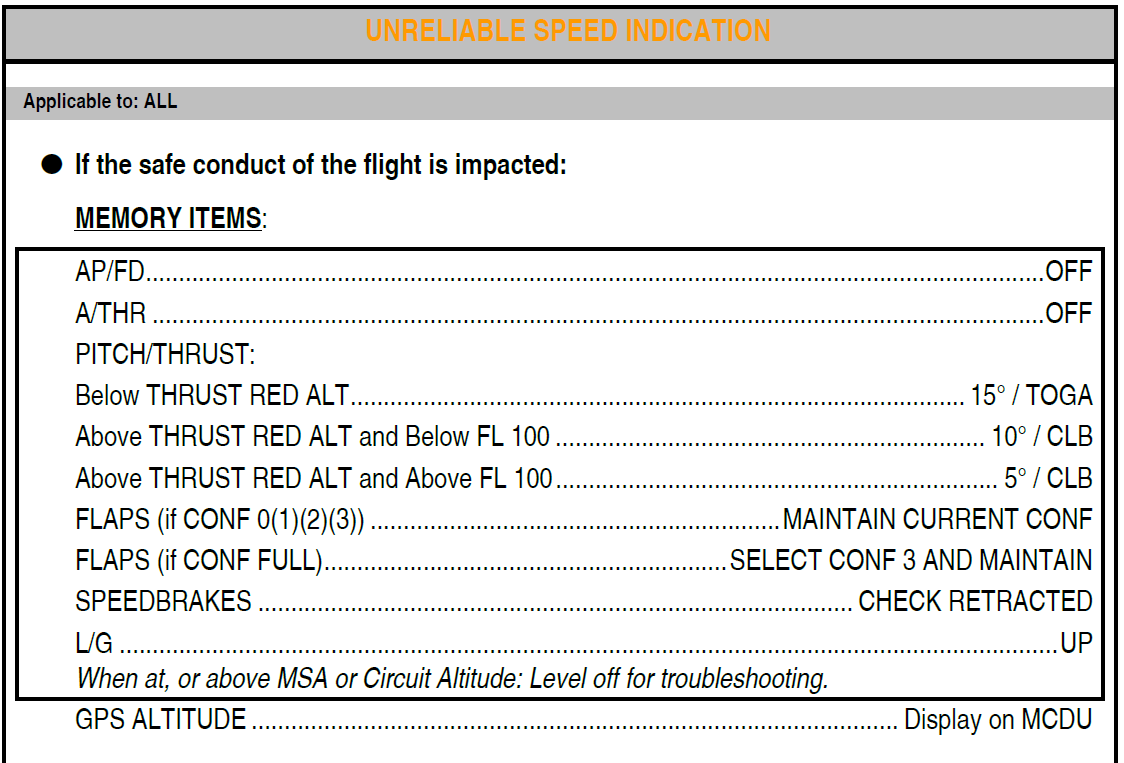
The initial actions required for an unreliable airspeed event were identified as memory items to ensure that the aircraft is in a safe flight state (Figure 25).
Figure 25: Unreliable airspeed indication – Initial actions
Source: VARA A320 FCOM
The remainder of the procedure provides information, such as pitch attitude and thrust settings that ensure that the aircraft is at a safe airspeed for the remaining phases of flight (climb, cruise, descent, and approach). It also includes troubleshooting techniques to identify the affected ADR(s). The procedure required that the affected ADR(s) be switched off to ensure that the flight control and flight guidance computers do not use erroneous, but coherent, data. In the case that all ADRs are affected, or the erroneous ADR cannot be identified, one is to be left on to ensure that stall warning remains available. Particular note is made that flight crew are to respect stall warnings.
ATSB observation:
When the autothrust and autopilot first disconnected, the captain announced that he had control and that he would fly the aircraft ‘ten degrees nose up’. Although this was consistent with the unreliable speed indication procedure when below FL 100, there was no indication from the recorded information or interviews that the captain was aware of an airspeed discrepancy and intentionally carried out that procedure. It was more likely an instinctive reaction to the loss of automation to ensure that the aircraft was in a state that the captain knew was safe.
When the captain’s airspeed deviated from the other indications during the descent, the flight crew were provided with an opportunity to identify that they were confronted with an unreliable airspeed indication event. However, their actions following this do not appear to indicate that they had made this connection.
The act of switching the air data source for the captain’s indicator from CAS 1 to CAS 3 was consistent with the NAV IAS DISCREPANCY alert, but there was no record of the alert having been triggered. Neither was it consistent with the unreliable speed indication procedure, because the crew did not switch off any of the ADRs, the aircraft was not levelled out for troubleshooting, there was no discussion regarding unreliable airspeed, and they did not respond to the stall warning that occurred after the air data source was switched to CAS 3.
Recorded information
The aircraft was fitted with a flight data recorder (FDR) and cockpit voice recorder (CVR) as required by the applicable legislation. The FDR was downloaded by the operator and the digital file sent to the ATSB. The CVR was sent to, and downloaded by the ATSB.
Flight data recorder
The FDR contained about 25 hours of flight data, which included the data from the incident flight, and 19 preceding flights. Plots of the pertinent recorded data are presented in Appendix C. The data showed that:
- Just after starting the first (number 2) engine, the airspeed on the captain’s side increased to about 110 kt before returning to zero after about 2 minutes. During this time, the groundspeed was zero.
- During the temporary airspeed increase after the first engine was started, the angle of attack recorded from ADR 1 (AOA 1) became valid for a short time and showed a value that was greater than 60°, a value inconsistent with a normal flight.
- The flight phase initially changed from 4 to 8 to 9 while the airspeed was active in the first 2 minutes. It remained at phase 9 until about 0645 (22:45 UTC),[43] when the aircraft was taxiing for take-off when it reduced to phase 2.
[Note – Flight phase 2 is the flight phase immediately after engine start until the aircraft was accelerating during take-off; phase 4 is 80 kt to lift-off, phase 8 is touchdown to 80 kt, and phase 9 is from 80 kt to first engine shutdown.]
ATSB observations:
The recorded flight phase was inconsistent with the actual flight phase. This discrepancy explains the abnormal system behaviour on the ground before the flight.
The engine failure and park brake warnings are not inhibited in phases 8 and 9, so when the park brake was on during engine start, the system treated it as being incorrectly set. Also, engine 1 had not been started, so the engine speed was below the threshold to activate an engine failure warning.
In addition, the automatic control system page function is not active in phases 8 and 9, so when the captain performed the pre-flight control checks, the page did not automatically display. The timing of the ‘Extra control check’ (refer to Figure C3 in Appendix C) was such that the flight phase had returned to the correct value when that was carried out, explaining why the page automatically displayed on that occasion.
- The master warning first occurred at the same time that the autopilot disengaged (during initial climb), flight directors disangaged, the control law changed from normal to alternate, and the speed mode changed from managed to selected (noted as ‘Multiple alerts’ in the figures).
- During the climb, the recorded airspeed varied from 210 kt to 325 kt.
- The aircraft was levelled out at 20,000 ft (FL 200).
- Multiple attempts were made to re-engage the autopilot, before it engaged at 0722:50 (23:22:50 UTC). Each of the unsuccessful attempts was associated with a master warning activation.
- There was a sharp change in the computed airspeed (CAS) at about 0742 (23:42 UTC). This was consistent with the time the flight crew identified that the captain’s airspeed was deviating and they changed to ADR 3. AOA 1 became invalid at the same time, confirming the captain’s change to ADR 3. AOA 1 remained invalid for the remainder of the flight, until CAS 3 dropped below 30 kt during landing. The autopilot was disconnected at about the same time, but given that the captain made a control input, this was likely intentional.
- The autopilot again disengaged about 3 minutes after the captain changed to ADR 3. It was not re-engaged during the remainder of the flight.
- The stall warning was activated at 0755:03 (23:55:03 UTC). During this time, the captain made some nose-down inputs; however, the computed airspeed remained relatively constant, varying by 1 kt, during the stall warning. The aircraft was at a roll attitude (bank angle) of about 10° when the stall warning activated, and was further increased by the captain’s sidestick input while the stall warning was active (Appendix C, Figure C6).
- The flight control laws changed from alternate to direct during the approach, consistent with the system logic when the landing gear is extended in alternate law.
- The aircraft landed at 0800:38 (00:00:38 UTC).
- During the landing roll, the CAS temporarily increased from 30 kt to about 80 kt, which was inconsistent with the ground speed, which was about zero. The first officer’s (ADR 2) angle of attack remained valid during this time, indicating that ADR 2 information was being recorded.
Cockpit voice recorder
The cockpit voice recorder contained approximately 2 hours of recorded data from the incident flight. It included conversations between the flight crew, air traffic control and cabin crew, cockpit sounds and alerts and warnings. The recording was clear, and with the flight data recordings and interviews, was used to develop the sequence of events.
Manufacturer’s analysis
The aircraft manufacturer, Airbus, performed an analysis of the flight based upon the FDR data and troubleshooting data from the flight guidance computer and flight augmentation computer. A copy of their analysis was provided to the ATSB.
As part of their analysis, the manufacturer constructed a detailed sequence of events that analysed the system behaviour based upon the recorded data, a summary of which is presented in Appendix D of this report. The manufacturer also examined the engine reversion to N1 mode, modelled the airspeed evolution during key events, examined the stall warning activation, and the anomalous on-ground airspeed events.
Engine reversion to N1 mode
With the assistance of the engine manufacturer, International Aero Engines, Airbus examined the behaviour of the engines during the incident and found that both engines reverted to rated N1 mode following disagreement between the engine inlet pressure sensor (P2) and the aircraft total pressure data from ADR 1 and 2.
Airspeed estimations
The manufacturer estimated the actual airspeeds during the flight using their performance model for the aircraft. The simulation used values recorded during the flight and wind corrections were computed to match the ground speed evolution. The simulations were carried out for the key phases of flight.
Climb phase (0654:05 to 0703:05)
The simulation showed that the recorded CAS 1 deviated from the actual airspeed for a period of about 4 minutes, before returning to the actual airspeed (Figure 26). The simulation showed that CAS 1 was overestimated by up to 60 kts. The estimated and recorded values reconverged at about 0700, shortly before the aircraft was levelled out at FL 200.
Figure 26: Airspeed estimation during the climb phase (recorded – red, estimated – blue)
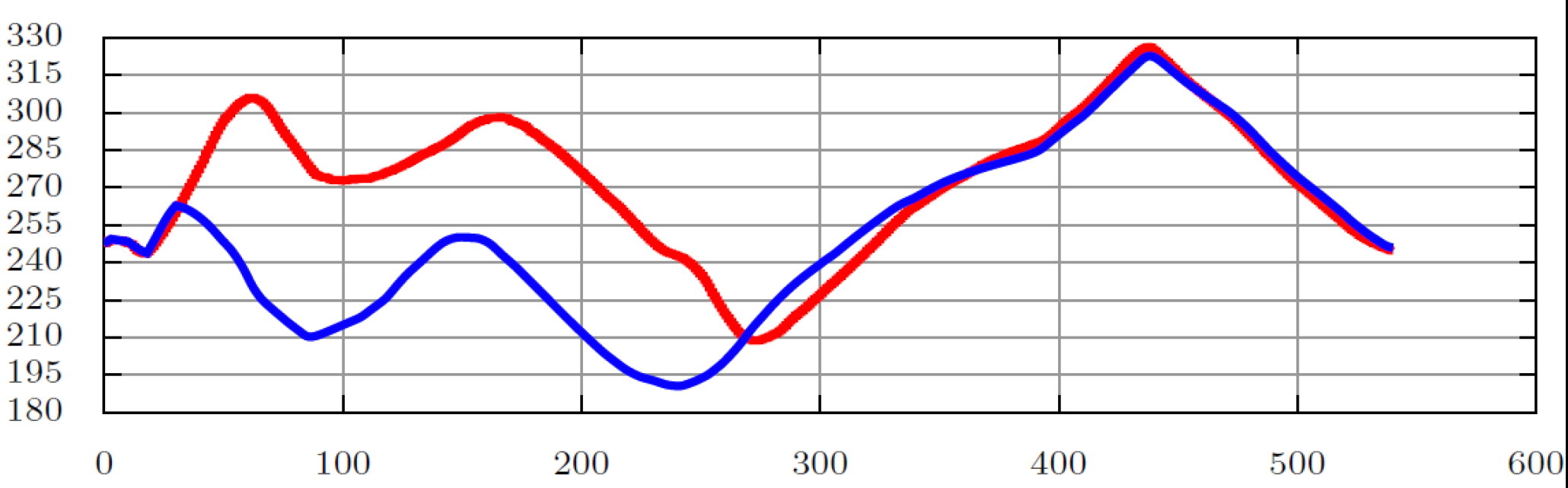
Note: The x-axis is in seconds from 0754:05. The y-axis is airspeed in kt. Source: Airbus
Level flight at FL 200
A simulation of the flight at 0715:55, while maintaining FL 200, showed that the estimated airspeeds were consistent with the recorded computed airspeeds. CAS 1 was recorded during this phase.
Descent phase (0742:32 to 0746:32)
The simulation showed that CAS 1 deviated significantly from the actual airspeed (Figure 27). In this case, the recorded airspeed underestimated the airspeed by up to 60 kt, before the flight crew switched to ADR 3 at about 106 seconds. The correlation between the recorded and estimated airspeeds from this time onwards indicates that ADR 3 was correctly computing the airspeed.
Figure 27: Airspeed estimation during the– descent phase (recorded – red, estimated – blue)
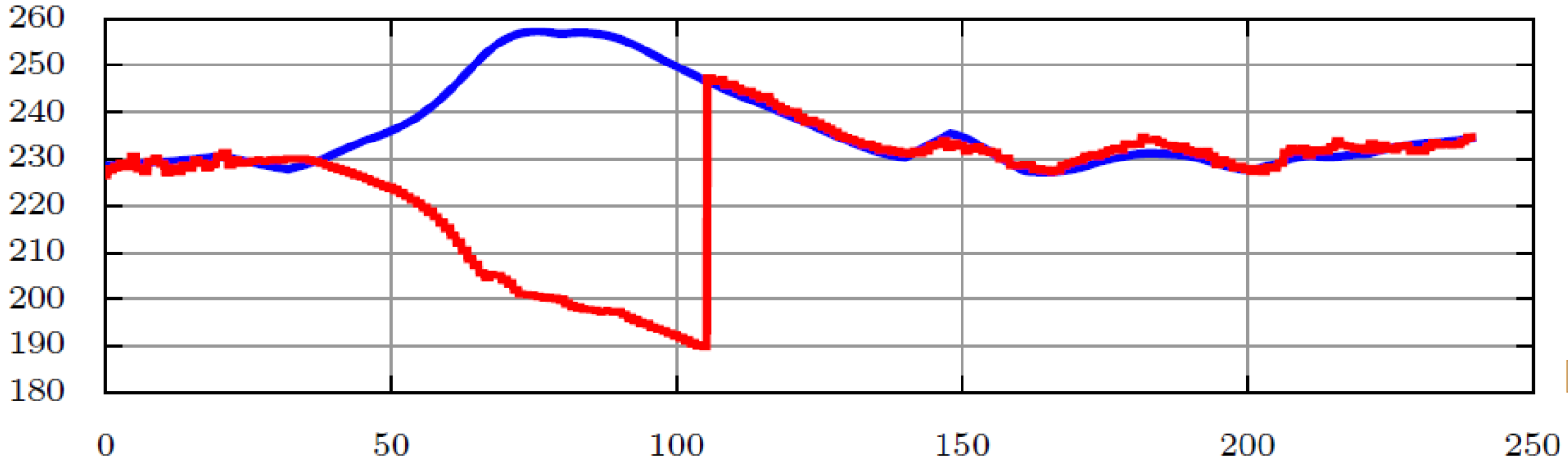
Note: The x-axis is in seconds from 0742:32. The y-axis is airspeed in kt. Source: Airbus
Stall warning
A period of 50 seconds, incorporating the stall warning at 0755:03, was simulated (Figure 28). This showed that, at this time CAS 3, which was the airspeed referenced on the captain’s PFD, was consistent with the actual airspeed.
Figure 28: Airspeed estimation around the time of the stall warning (recorded – red, estimated – blue)
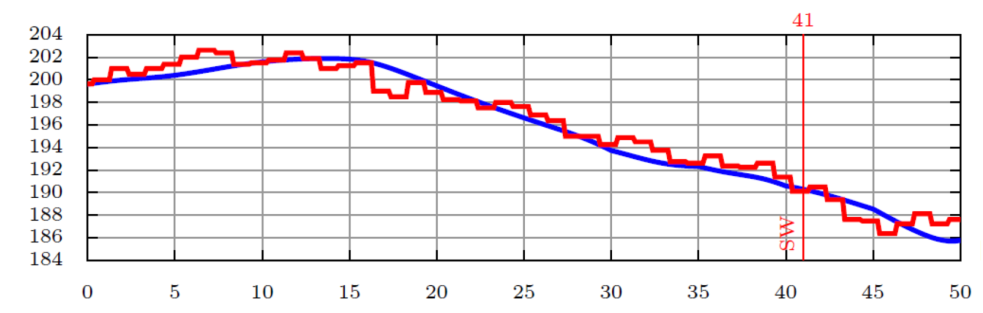
Note: The x-axis is in seconds from 0754:22. The y-axis is airspeed in kt. Source: Airbus
Stall warning activation analysis
The stall warning, which activated at 0755:03 and lasted for 6 seconds, was analysed by the manufacturer. At the time of the stall warning, the aircraft had a Mach number of about 0.3. At this Mach number, the angle of attack threshold to trigger a stall warning is 8°.
The only valid angle of attack recorded on the FDR from this period was that from ADR 2 (AOA 2). At the time the warning activated, AOA 2 was recorded at a value of 7.4°. However, the stall warning logic in the flight warning system only requires one of the three angle of attack values to exceed the threshold. Up until the captain changed over to ADR 3, AOA 1 and AOA 2 had been consistent, so it was most likely that the stall warning was triggered by AOA 3, which was not recorded.
When the stall warning activated, a small lateral acceleration was also recorded, indicating a wind gust from the right side. The placement of the angle of attack probe for ADR 3 is such that a lateral gust could produce a local increase in the angle of attack.[44] In this case, it was probably sufficient to go beyond the stall warning threshold, triggering the warning. Thus, the manufacturer determined that the stall warning experienced by the flight crew while intercepting the Perth runway 21 localiser was a genuine stall warning, albeit nominal.
ATSB observations:
Stall warnings are designed to activate at an angle of attack that provides some margin before the aircraft will actually stall. In this case, the angle of attack measured by one sensor was sufficient to activate the stall warning, but there was no indication that the aircraft had stalled.
In their analysis of the sequence of events (Appendix D), the manufacturer identified that the captain made nose-down control inputs while the stall warning was activated. However, the CVR captured the captain clearly verbalising that he was disregarding the stall warning. Although the nose‑down inputs occurred during the stall warning, there was no significant change in the airspeed and the bank angle was increased during the time the warning was active. Thus, it is more likely that the nose-down control inputs were required to control the desired flight path and not related to the warning.
Airspeed anomalies on the ground
The manufacturer analysed the recorded airspeed anomalies when the aircraft was on the ground, after engine start and after landing.
After engine start, the recorded CAS increased up to 110 kt, before decreasing again to below 30 kt. At the same time, AOA 1 was valid and AOA 2 was invalid, indicating that the recorded value was CAS 1.[45] The increase in CAS 1 was consistent with a temporary obstruction of the pitot probe for ADR 1 (the captain’s side). Activation of the pitot probe heating after engine start heated the air trapped inside the probe, increasing its pressure, which has the same effect as an increase in airspeed.
During the take-off roll, ADR 3 was rejected by the aircraft’s computers. This was probably due to CAS 3 deviating from CAS 1 and CAS 2 and detected by the cross-comparison of airspeeds, which is active above 80 kt.
ATSB observation:
During the take-off roll, the first officer announced passing 100 kt and the captain confirmed this speed. The interaction between the flight crew when conducting this check was captured on the CVR; however, the level of that interaction was not sufficient to determine if the flight crew checked all three airspeed indicators, or only the airspeed on their primary indicators (CAS 1 and CAS 2). As only CAS 1 was recorded by the FDR during the take-off, there was insufficient information to determine if there was an airspeed discrepancy between the standby and primary airspeed indicators when the 100 kt check was carried out by the flight crew.
After landing, below 20 kt ground speed, the recorded CAS temporarily increased to 80 kt, before it decreased to below 30 kt. AOA 2 was valid at that time, so CAS 2 was being recorded on the FDR at that time. This was also consistent with a temporary obstruction of the pitot probe for ADR 2 (the first officer’s side). Without air passing the pitot probes to cool them down, heating of the probe similarly increased the pressure inside the pitot probe, increasing the indicated airspeed.
Manufacturer’s conclusions
Based upon their analysis and the reports of water ejection from the pitot probes during post-flight maintenance, the manufacturer concluded that the fault messages and flight control system reconfigurations experienced during the flight were the result of discrepancies in the computed airspeeds, and that:
• These airspeed discrepancies were due to temporary obstructions of the pitot probes, occurring at least:
- Before take-off on the Captain Source (ADR1)
- During the take-off roll on the Standby source (ADR3)
- During the climb and descent on the Captain source (ADR1)
- During the descent on the F/O [first officer] source (ADR2)
- After landing on the F/O source (ADR2)
They also noted that:
• During the approach, the stall warning was nominally triggered for 6s and nose-down crew actions were recorded on the sidestick (up to ~1/3 of the full forward stick).
Other occurrences
VH-FNP on 9 September 2015
A review of the previous flights contained on the FDR found that on 9 September 2015, the recorded airspeed increased up to around 250 kt while the aircraft was stationary on the ground at Boolgeeda Airport, WA.[46] This was three flights prior to the incident flight on 12 September 2015.
The operator reported that, in this case, the flight crew noticed the erroneous airspeed, and after consultation with the maintenance controller in Perth, completely powered down (engines and electrical) the aircraft. The airspeed was still indicating above 100 kt when the power was removed.
Similar to the 12 September incident, the flight phase transitioned to a post-landing phase before the aircraft had commenced the flight. However, in this case, it then started to fluctuate between 0 and 15, indicating that the aircraft no longer considered the parameter valid.
The operator reported that, after the aircraft had been reset by powering down, it operated normally for several flights prior to the incident flight. However, the FDR captured two more on ground airspeed spikes before the aircraft departed Boolgeeda on 9 September. These airspeed anomalies appear to have again resulted in changes to the flight phase, potentially effecting the logic of a number of systems.
The operator did not conduct any troubleshooting maintenance actions following this event, so it could not be confirmed if the pitot probes were contaminated. However, the system behaviour was consistent with the incident on 12 September 2015, when contamination was identified.
ATSB observation:
The event on 9 September 2015 could be considered to have been an ‘erratic airspeed’ event as defined in the Airbus In-Service Information documentation, which should probably have resulted in some maintenance actions. This would have required the flight crew to report it as an event to the operator’s maintenance personnel, which they appeared to have done during the event, but the restart of the systems appeared to correct the situation. Although the recorded data indicated that there was still an erroneous airspeed situation during the take-off, this was not identified by the flight crew and reported to maintenance. Thus, it is probable that no further maintenance actions were carried out as they considered the restart to have corrected a transient anomaly.
Other indications of airspeed anomalies on VH-FNP
A review of post-flight reports preceding the 12 September 2105 incident, found that ADR 3 had been rejected by the flight control system on three other occasions. No in-flight airspeed anomalies were reported for these flights:
- 9 September 2105 (Boolgeeda to Perth), ADR 3 rejected during flight phase 5 (lift-off to 1,500 ft)
- 11 September 2015 (Perth to Karratha), ADR 3 rejected during flight phase 4 (80 kt to lift-off)
- 11 September 2015 (Karratha to Perth), ADR 3 rejected during flight phase 2 (engine start).
Other unreliable airspeed indication occurrences
The ATSB, and other international agencies, have previously investigated a number of unreliable airspeed events. Due to the complex and proprietary systems included in many modern transport aircraft the symptoms and procedures associated with an unreliable airspeed event can vary between aircraft and manufacturers. To compare and contrast how the unreliable airspeed indications presented themselves and how the flight crew responded to the situation, the ATSB limited a review of other unreliable airspeed indication investigations to those involving other Airbus aircraft .[47] These include:
Airbus A320-232, VH-JQX, 20 September 2010[48]
VH-JQX was on descent through FL 300 when the flight crew received a number of ECAM alerts, including A/THR OFF, F/CTL ALTN LAW, and ENG 1(2) EPR MODE FAULT. At the same time, the captain’s and first officer’s PFDs lost airspeed, altitude and descent data. The outside air temperature was -30°C and there was light rain. After about 2 minutes, the airspeed indications returned to the PFDs.
The incident was not the subject of a full investigation; however, the information presented indicated that the conditions were conducive to icing and the faults and loss of air data was the result of a temporary blockage of the aircraft’s pitot probes.
Airbus A330-202, VH-EBA, 28 October 2009[49]
VH-EBA was operating at FL 390 south of Guam on a flight between Narita, Japan, and Coolangatta, Australia. Soon after entering cloud, the flight crew noticed a rapid drop in the captain’s airspeed indication. Immediately after, the autothrust, autopilot and flight directors disconnected, a NAV ADR DISAGREE alert was activated and the flight control system reconfigured to alternate law.
The investigation found that the airspeed disagreement was due to a temporary obstruction of the captain's and standby pitot probes, probably due to ice crystals. A similar event occurred on the same aircraft on 15 March 2009.
Airbus A330-243, A6-EYJ, 21 November 2013[50]
A6-EYJ was departing Brisbane Airport for a flight to Singapore. One take-off was rejected by the captain after observing an airspeed indication failure on his PFD. The aircraft was examined by maintenance personnel, who transposed air data inertial reference units (ADIRUs) 1 and 2, and the aircraft was dispatched with ADIRU 2 inoperative in accordance with the minimum equipment list.
During the subsequent take-off, the captain became aware of an airspeed discrepancy after V1[51] and the take-off was continued. Once airborne, the autothrust and flight directors automatically disconnected, and the flight controls reconfigured to alternate law. The captain selected ADR 3 for his PFD and declared a MAYDAY,[52] before returning to Brisbane for an overweight landing.
Visual inspection of the pitot probes found that the captain’s probe was obstructed, while the other two probes were clear. Subsequent examination found that the captain’s pitot probe had been blocked by a mud dauber wasp’s nest, likely built while the aircraft was on the ground in Brisbane.
As a result of this occurrence, the operator changed their policy to require covers to be used at Brisbane regardless of time on ground, the airport operator extended their wasp inspection and eradication program and the Civil Aviation Safety Authority produced several publications on the implications of mud wasp activity.
Airbus A321-231, G-EUXM, 20 April 2012[53]
On two separate flights, airspeed indications became temporarily unreliable. On both of those occasions, the flight crew recognised that the airspeed was unreliable and managed it in accordance with the associated procedures.
On the first occasion, although the flight crew had observed unreliable airspeed indications, by the time they actioned the NAV ADR DISAGREE alert, the airspeeds had returned to normal. The flight crew noted and agreed to follow the ‘If no spd [speed] disagree’ section of the associated procedure, which noted that there was an angle of attack discrepancy. Referring to the abnormal procedures, the flight crew identified that the angle of attack fault might cause spurious stall warnings. The flight was diverted to an alternate airport for a landing without further incident.
Following the flight, the pitot probes (which were the same part number as those on VH-FNP) were removed and examined by the manufacturer. No issues with the probes were identified. The investigation determined that the unreliable airspeed indications were likely due to the accumulation of ice crystals in the pitot probes, which was beyond the capability of the heating system to melt and disperse, temporarily blocking the probes.
Airbus A320, 24 January 2007[54]
During a flight from Nuremburg, Germany to London, UK, an Airbus A320 (registration not provided) was in a climb and passing through FL 120 when there was a malfunction of all three airspeed indicators. There was a loud bang near the cockpit window, immediately followed by an ECAM warning display ‘ADR1, ADR2, and ADR3 FAULT’, with simultaneous failure of both autopilots, autothrust and flight directors. The control system mode reconfigured to alternate law.
The captain took manual control of the aircraft and levelled the aircraft out. The flight crew observed that the airspeed indicators presented different values from 230 to 260 kt. The flight crew worked through the associated procedures and diverted to a different airport, landing without further event.
The wings and tailplane had been de-iced prior to the flight, but the fuselage was not. Ice was observed on the forward fuselage after the aircraft landed and at the time of the incident, the aircraft was passing through an inversion where the air temperature increased from -3 °C to +1 °C.
The investigation determined that the loud bang was probably due to the separation of a sheet of ice from the nose of the aircraft. There were no issues identified with the systems, so it was likely that the different airspeed measurements were due to impurities (ice, snow, or water) in the pitot static system pressure lines.
ATSB observations:
In all of these cases, the flight crew happened to observe unreliable airspeed indications.
In only one case did the flight crew progress down the angle of attack discrepancy path; however, in that case, no stall warnings were generated. As such, although it was a somewhat similar situation, how the flight crew would have reacted to any stall warnings is unknown.
In all cases, except the A330 with mud wasp contamination and possibly the 2007 German A320, the contamination was from ice in atmospheric conditions, which were likely beyond the capability of the pitot probe heating to dissipate. There were no indications of probes with blocked drain holes in any of these occurrences.
__________
- Cloud cover: in aviation, cloud cover is reported using words that denote the extent of the cover – ‘few’ indicates that up to a quarter of the sky is covered, ‘scattered’ indicates that cloud is covering between a quarter and a half of the sky, ‘broken’ indicates that more than half to almost all the sky is covered, and ‘overcast’ indicates that all the sky is covered.
- The local atmospheric air pressure at mean sea level.
- Information provided in the weather reports to indicate a temporary deterioration in the forecast weather conditions, during which significant variation in prevailing conditions are expected to last for periods of between 30 and 60 minutes.
- Weather conditions that require pilots to fly primarily by reference to instruments, rather than by outside visual reference. Typically, this means flying in cloud or limited visibility.
- The ratio of the LP turbine exhaust pressure (P5) to the engine intake pressure (P2).
- The air data reference system is part of the air data inertial reference system (ADIRS), the other part being the inertial reference system. This report is only concerned with the air data reference system.
- Flaps and landing gear retracted.
- The description provided is applicable to normal law in flight mode. Normal law includes a number of other modes, such as flare mode, where the control laws differ from those described. However, for the purposes of this report, only the flight mode is described.
- Some of the flight control computers will latch a discarded air data parameter out (that is discontinue using that parameter) until the computer has been reset, even if the parameter returns to being consistent with the other parameters.
- Other system failures may also result in the flight computers reconfiguring to alternate or direct laws.
- The stall warning includes a synthetic voice ‘STALL’ message produced over the audio system and cockpit speaker.
- The CFDS retains the PFRs from the previous 63 flight legs.
- The ATA number is a standardised reference system widely used on commercial aircraft to identify the particular functional area. For example, ATA 27 refers to flight controls.
- Airbus In-Service Information reference 34.13.00004. This document was also applicable to A300, A310, A318, A319, A321, A330, A340, and A380 aircraft.
- Only the applicable information from each procedure is presented here. A copy of the FCOM procedures associated with all the ECAM alerts generated during the flight are presented Appendix B.
- The times recorded on the FDR, as presented in Appendix C, are in UTC.
- The angle of attack probe for ADR 3 is located well below the aircraft’s horizontal axis. Wind from the side of the aircraft will flow around the fuselage, inducing an upward component on the local airflow below the horizontal axis.
- The ADR system logic is such that the airspeed will become valid above 30 kt and the angle of attack will become valid when the airspeed is above 60 kt.
- A plot of the pertinent data from the FDR is presented in Appendix E.
- Airbus reported to the ATSB that according to their database of reports, the failure case of multiple transient total pitot obstructions due to contamination by foreign material on ground occurred at a rate that was considered ‘remote’. Where, remote is defined in the design standard for the aircraft (Joint Aviation Requirements Part 25) as a rate of 10-5 to 10-7 occurrences per flight hour (an average of one occurrence every 100,000 to 10,000,000-flight hours).
- ATSB investigation number AO-2010-070. Available at: www.atsb.gov.au/publications/investigation_reports/2010/aair/ao-2010-070/
- ATSB investigation AO-2009-065, Available at: www.atsb.gov.au/publications/investigation_reports/2009/aair/ao-2009-065/
- ATSB investigation AO-2013-212, Available at: www.atsb.gov.au/publications/investigation_reports/2013/aair/ao-2013-212/
- The maximum speed at which a take-off can be aborted.
- MAYDAY: an internationally recognised radio call announcing a distress condition where an aircraft or its occupants are being threatened by serious and/or imminent danger and the flight crew require immediate assistance.
- United Kingdom Air Accidents Investigation Branch (AAIB) report EW/C2012/04/06. Available at: https://assets.publishing.service.gov.uk/media/5422ffd3e5274a1317000a6f/Airbus_A321-231__G-EUXM_09-13.pdf
- German Federal Bureau of Aircraft Accident Investigation (Bundesstelle für Flugunfalluntersuchung, BFU) report 5X002-0/07.Available at: www.bfu-web.de/EN/Publications/Investigation%20Report/2007/Report_07_5X002_A320_AirspeedIndicators.pdf
Safety analysis
Introduction
After passing through about 8,500 ft on departure from Perth Airport, Western Australia, the autothrust and autopilot disconnected, and multiple alerts were generated. The flight crew continued the climb to an altitude of 20,000 ft, where they levelled out to troubleshoot the issues before returning to Perth. During the approach, when the flight crew were aligning the aircraft with the instrument landing system, they received a stall warning. The warning stopped after 6 seconds and the approach was continued for a successful landing.
This analysis will examine the factors that contributed to the generation of the multiple alerts, the factors that contributed to the flight crew incorrectly diagnosing the source of the alerts, and the subsequent effects on the continued safe flight of the aircraft.
Blocked pitot probes and unreliable airspeed indications
The system behaviour and the warnings received by the flight crew were consistent with discrepancies between the computed airspeeds (CAS) during the flight. Primarily, two unreliable airspeed indication events occurred during the flight. The first was during the climb out of Perth, when the aircraft was passing through 8,500 ft. The second was at about 10,000 ft, when the aircraft was descending back into Perth.
In the absence of technical issues with the measuring devices, airspeed discrepancies are typically a result of a blockage in either the pitot, or static systems. The source of the airspeed inaccuracies can be determined by how the airspeed changes.
For example, in a constant speed climb with a blocked pitot (inlet and drain holes), the total pressure measurement will remain constant while the static pressure decreases. The resulting increase in the pressure difference will lead to an apparent increase in the airspeed.[55] However, in the same flight conditions (constant speed climb) with a blocked static port, the measured static pressure will remain constant, while the total air pressure will decrease, due to its static pressure component decreasing with altitude. This will lead to a decrease in the apparent airspeed. In a similar manner, when descending at a constant speed, a blocked pitot will result in a decreasing apparent airspeed. A blocked static port will result in an apparent increase in speed.
The manufacturer’s simulations identified that during the climb out of Perth, CAS 1 was overestimated for several minutes. Their simulation also showed that during the descent back into Perth, CAS 1 was underestimating the airspeed before the captain changed to air data reference (ADR) system 3. Both of these airspeed discrepancies were consistent with a blockage in the captain’s pitot probe inlet and drain holes.
On both occasions, the total air temperature[56] was above freezing and the probe heating was on. Thus, it was unlikely that the probe was blocked from ice accumulation, as had been experienced on other aircraft investigated for airspeed discrepancies. In this case, given the rainy conditions that existed around Perth on the morning of the incident flight, the captain’s probe was likely blocked by liquid water.
Although the flight data recorder only recorded one CAS parameter, it was inferred from the system behaviour that all three ADR systems produced erroneous airspeed data at various times during the flight. The reports of water being ejected from all three systems during the post-incident servicing was verification that all three pitot systems were affected by water contamination during the flight. The standby system (ADR 3) was potentially further affected by solid matter contamination, as indicated by the dark object ejected when the system was flushed. However, given that simulation showed that it was correctly estimating the speed after the captain selected it as his source, the issues with CAS 3 were also transient.
The erroneous airspeed indications that occurred when the engine was first started indicated that the captain’s pitot probe was probably contaminated before the flight. A similar incident 3 days prior was also consistent with contamination with liquid water. There was no reported rain in the Boolgeeda area in the period around 9 September 2015, but there was in Perth. As such, it was likely that the water contamination was the result of recent rains in the Perth region that became trapped in the system due to the blocked drain holes.
According to the European Aviation Safety Agency airworthiness directives, these probes had improved airspeed indication behaviour in heavy rain, compared to the previously fitted probes. This tolerance to rain was due, in part, to the small drain holes in the probes. This feature is only effective if the holes are open and free for water to escape through them. The post-incident servicing found that there were blockages in at least one of the two drain holes on each probe.
The blocked drain holes likely prevented water contamination from being effectively discharged, leading to temporary obstructions in the pitot probes. The obstructions resulted in erroneous airspeed indications that differed across the three systems. This affected numerous systems, including the engine control, flight control and auto flight systems, degrading their functionality and generating multiple system alerts.
The post-incident servicing actions, which identified the blocked drain holes and foreign object in the standby system, only required the maintenance personnel to clean the system as part of troubleshooting and return to service actions. These actions occurred shortly after the incident and the ATSB had not started a formal investigation. As such, there was no requirement for a forensic examination of the air data systems, and the substance(s) blocking the pitot probes was not identified.
The probes were removed from the aircraft several weeks later, for a detailed forensic examination by the manufacturer. However, the aircraft had been back in operation, so the contaminants that were identified during those examinations could not be conclusively linked to the events on 12 September 2015.
The in-service information distributed to A320 operators in July 2014 listed scheduled maintenance actions to minimise the occurrence of airspeed discrepancies as well as the actions they recommend be performed when such an event happens. That information noted previous occurrences where residual airspeed was displayed on the primary flight display while the aircraft was not moving. It also noted that most of the airspeed discrepancy events investigated by them were due to water in the pitot probes and the probe draining holes being obstructed by external particles; however, it implied that the revised probes, as fitted to FNP had improved their behaviour in adverse weather conditions.
Clearing of the pitot probes, including the drain holes, is a scheduled maintenance action for the aircraft. This cleaning is on a rotational basis, which the operator carried out more frequently than was required by the manufacturer’s schedule. The ATSB was not aware of a rate of adverse pitot probe drain hole blockage to suggest that the cleaning schedule is generally inadequate across the A320 fleet. Other than this event, the operator had not identified a fleet-wide reliability issue to suggest that it was not adequate for their particular operations. In fact, the last probe to be cleaned, the captain’s pitot probe, had been cleaned only 3 days before the first airspeed anomaly at Boolgeeda, and 6 days before the incident flight. Thus, whatever blocked the drain holes of the captain’s probe probably entered the probes shortly after they were cleaned.
The on-ground event on 9 September 2015 was an opportunity for the operator to have identified an unreliable airspeed indication event and carried out the actions recommended by the manufacturer. The aircraft was remote from the maintenance organisation at the time, but the flight crew reportedly contacted them for advice. Following that advice, the flight control system was reset by a complete powering down of the aircraft electrics, which, to the flight crew appeared to correct the airspeed anomaly. The ATSB did not determine why the operator did not perform the actions recommended by the manufacturer. However, given the maintenance personnel were basing it on a report from a flight crew at a remote airport and the aircraft operated on the subsequent return flight to Perth, and for another 2 days without any flight crew identifying airspeed issues, the operator may not have identified it as an unreliable airspeed event.
Diagnosis of the NAV ADR DISAGREE alert source
The flight crew were not aware of and did not action the NAV ADR DISAGREE procedure until about 8 minutes had passed since the alert was generated. By this time, the airspeed discrepancy that had generated the alert was no longer present. Therefore, when the flight crew crosschecked the airspeeds, the airspeeds were consistent and they diagnosed the issue as an angle of attack discrepancy. Several factors were identified that led to the flight crew incorrectly diagnosing the source of the NAV ADR DISAGREE alert when carrying out the associated procedure:
- the flight crew’s high workload
- priority of alerts programmed into the ECAM
- suitability of the NAV ADR DISAGREE procedure for short duration airspeed disagreements.
Flight crew workload
When the captain arrived at the aircraft, it was not in a state in which he would normally receive it. Maintenance work from the previous night had left the batteries flat, the cockpit was in a messy state, and some of the systems required reconfiguring. The captain had not experienced an A320 aircraft with a flat battery before, so had some uncertainties to what effect that may have on the aircraft’s systems.
During the engine start, the flight crew received ‘spurious’ engine failure and park brake on alerts. In addition, when the flight controls were being checked, the system did not automatically display the flight controls page on the electronic centralised aircraft monitoring (ECAM) system display, as expected. Although the system behaviour was not erroneous for the airspeed data it was receiving, it was abnormal and probably confirmed some of the captain’s concerns about the effects of the flat battery. At one point shortly before take-off, the captain commented that most of the problems they ‘have seen are probably a direct result of the flat batteries’.
When the aircraft was in the early stages of climb, a recognised high-workload period, the autothrust and autopilot disconnected, and multiple alerts were triggered. It was likely that the flight crew’s workload was higher than normal from the start of the flight and increased further with the unfavourable weather conditions in the area, including a rain shower through which the aircraft was either in, or at the edges of. At the time, the flight crew had also just been cleared to cancel the standard instrument departure and track direct to their next en route waypoint. The captain requested that this be delayed so that they could clear the weather, suggesting that the workload was high and they did not wish to increase it.
When the automation disconnected and the alerts triggered, it was likely that the flight crew’s workload was very high. The flight crew’s actions in the minutes after, particularly those of the captain indicated that they had reached the limits of their attentional resources and were only dealing with what they perceived to be the most critical issues. Initially, consistent with the normal aviation flight principles of ‘aviate, navigate, communicate’, the captain’s focus was on ensuring that the aircraft was under control and in a stable climb.
When the autothrust disconnected, thrust lock was activated and the aircraft was still climbing. The flight crew had weather, and a likely return to Perth, to deal with, so actioning the amber alerts on the ECAM (those that by definition the flight crew should be aware of, but need not take immediate action) were probably low on their priority list.
When they were preparing to level the aircraft at FL 200, they actioned the engine 1 engine pressure ratio (EPR) mode ECAM to ensure that they had engine control so as to avoid an overspeed situation. Completing the actions associated with the engine 1 EPR mode fault and clearing the message from the ECAM would have brought the next alert message, engine 2 EPR mode fault, into view. The actions for this were the same, so the flight crew left this and turned their attention to what they probably considered were more immediate matters, which at that time was navigating the aircraft to the north of Perth, a required change in ATC frequency, and informing the cabin crew and passengers of their situation.
Comments made by the captain during the flight indicate that he considered that they faced an issue that was greater than a simple individual system failure. This was probably a result of the multiple system alerts, described by the captain as ‘concurrent issues’, and the (unrelated) flat battery situation before flight. This probably made it more difficult for the captain to understand the situation facing them.
In summary, the ATSB found that the flight crew’s workload following multiple system failures was high, affecting their ability to process information quickly and attend to multiple tasks. This, combined with maintaining safe flight, resulted in the flight crew taking about 8 minutes to attend to the engine alerts and action the NAV ADR DISAGREE procedure.
ECAM alert priorities
When multiple alerts are generated, the ECAM is designed to provide the flight crew with the alerts in the order of priority. The highest priority alerts, red alerts, were those that required immediate actions to ensure the safety of flight. Red alerts took precedence above amber alerts; those that required action, but if not performed immediately would not endanger the flight.
Initially, the only alerts that were visible on the ECAM were the red AUTO FLT AP OFF and amber ENG 1 EPR MODE FAULT, and its associated procedure. The NAV ADR DISAGREE message had been triggered, which, in accordance with the priorities set by the manufacturer during the design of the ECAM system, had a lower priority than engine fault messages. Due to the limited space available in the message area on the ECAM display, the NAV ADR DISAGREE message was off screen and not immediately visible to the flight crew.
The system provided the facility for the flight crew to view the messages off the screen, but given that the highest priority message on the screen did not require any immediate actions, there was no reason for the flight crew to divert resources away from their other tasks in a high-workload situation.
On this flight, as the engine ECAM alerts took priority over the NAV ADR DISAGREE alert, the flight crew did not carry out the procedures until after the airspeed had corrected itself, leading to an incorrect diagnosis of the origin of the alert.
Even outside of this situation, an EPR mode fault results in the engines reverting to N1 mode. This would not pose a short-term hazard to the flight, as the flight crew still have control of engine thrust. However, control of the aircraft is dependent upon reliable airspeed information, particularly if already at high or low airspeed. Therefore, unreliable airspeed indications can have a much greater shorter-term effect on the safety of flight, particularly when the flight crew is not aware that their airspeeds are potentially erroneous.
NAV ADR DISAGREE procedure
In the A320, a NAV ADR DISAGREE alert can be triggered by either an airspeed or an angle of attack disagreement. The alert itself does not indicate the source. Determination of the source relies solely upon comparison of the airspeeds across the three indicators. If they disagree, then the source is an airspeed discrepancy and the appropriate airspeed procedure commenced. However, if the airspeeds agree, then by default, the alert must have been generated by an angle of attack disagreement. There is no requirement for the diagnosis to be confirmed by examining the individual angle of attack measurements.
In the A320, flight crew are able to examine the ADR angle-off attack values; however, they are not presented on the primary flight displays, and require the flight crew to access and display a page on the multipurpose control and display unit in the centre pedestal. In this occurrence, the flight crew discussed an angle of attack discrepancy, but for undetermined reasons did not access the angle of attack page to confirm the discrepancy.
Once the NAV ADR DISAGREE alert has been generated, it is latched in the system until it is cleared by the flight crew, even if the conditions that triggered the alert are no longer present. However, this incident highlighted that, if the alert is generated by a temporary airspeed disagreement, and the procedure is not actioned while the airspeeds are in disagreement, then the source of the disagreement can be incorrectly diagnosed. This could result in the flight crew not taking the appropriate actions associated with an unreliable airspeed indication, continue making reference to incorrect airspeed data, or not responding to a valid stall warning.
In addition, according to the flight control system logic, the reconfiguration from normal law to alternate law can be due to, amongst a range of other faults, an airspeed or angle of attack disagreement. Depending on whether it is an airspeed or an angle of attack disagreement, the level of alternate law flight envelope protection will differ (alternate law with or without reduced protections). Therefore, in cases such as this, where either the airspeed or the angle of attack is in disagreement, the aircraft is capable of determining the source of an air data disagreement; however, this information is not provided to the flight crew.
Stall warning
Before commencing the approach, the flight crew had briefed on the possibility of spurious stall warnings, as indicated by the ECAM status associated with the NAV ADR DISAGREE alert. When they then received a stall warning while turning onto the localiser, they disregarded the alert, believing it to be spurious. The flight crew reported that their basis for determining that the warning was spurious was the information provided by the ECAM NAV ADR DISAGREE procedure, which they interpreted as being an expectation that stall warnings would be spurious. There was no indication from the CVR, or interviews, that they confirmed the validity of the warning using other sources such as power and pitch attitude, instead relying on the airspeeds as the primary indicator.
In this case, the stall warning was only nominal and due to a combination of the side gust and the location of the standby angle of attack sensor. However, a stall warning indicates to flight crew that margins from a stall are reduced, increasing the risk of stalling and losing control. The stall warning system logic requires only one sensor to exceed the threshold to trigger the warning. Even in the case of a NAV ADR DISAGREE that was a result of an angle of attack discrepancy, the stall warning may be triggered by a valid angle of attack measurement. There is no ready way for the flight crew to determine this and they should respond as though any warning is valid, particularly when at low altitude.
__________
- Normally, the greater the speed, the greater the component due to speed, and thus, the greater the difference between the pitot and static pressures. However, this difference could be due to a decrease in the static pressure with a constant total pressure.
- The combination of the static (ambient) air temperature and the temperature increase due to rapidly changing the speed of the air when it impacts the aircraft.
Findings
From the analysis of the evidence available, the following findings are made with respect to the unreliable airspeed indications and stall warning event involving the Virgin Australia Regional Airlines Airbus A320, VH-FNP, near Perth Airport on 12 September 2015. These findings should not be read as apportioning blame or liability to any particular organisation or individual.
Safety issues, or system problems, are highlighted in bold to emphasise their importance. A safety issue is an event or condition that increases safety risk and:
(a) can reasonably be regarded as having the potential to adversely affect the safety of future operations
(b) is a characteristic of an organisation or a system, rather than a characteristic of a specific individual, or characteristic of an operating environment at a specific point in time.
Contributing factors
Unreliable airspeed indications
- Drains in all three pitot probes were blocked, preventing water contamination from being effectively discharged.
- Before and during the flight, water temporarily obstructed all three of the aircraft’s pitot probes, resulting in erroneous airspeed indications. Differences in the airspeeds across the three air data reference systems consequently affected the engine control, flight control and auto flight systems, degrading their functionality and generating multiple system alerts.
Diagnosis of NAV ADR DISAGREE alert source
- The flight crew’s workload following multiple system failures was high, affecting their ability to process information quickly. This, combined with maintaining safe flight, resulted in the flight crew taking about 8 minutes to attend to the engine alerts and action the NAV ADR DISAGREE procedure.
- When the flight crew actioned the NAV ADR DISAGREE procedure, the airspeeds were consistent on all indicators, leading them to incorrectly diagnose that the system failure was the result of an angle of attack discrepancy rather than erroneous airspeeds. The procedure informed them that in this situation, there was a risk of undue stall warning.
- Although the NAV ADR DISAGREE had more immediate safety implications relating to unreliable airspeed, the ECAM alert priority logic placed this alert below the engine-related faults. As a result, the NAV ADR DISAGREE alert was not immediately visible to the flight crew due to the limited space available on the ECAM display. [Safety issue]
- A NAV ADR DISAGREE alert can be triggered by either an airspeed discrepancy, or angle of attack discrepancy. The alert does not indicate which, and the associated procedure may lead flight crews to incorrectly diagnosing the source of the alert when the airspeed is erroneous for a short period and no airspeed discrepancy is present when the procedure is carried out. [Safety issue]
Other factors that increased risk
- Believing it to be an erroneous warning due to an angle of attack discrepancy, the flight crew disregarded a real stall warning during the approach.
Additional findings
- The source of the foreign material blocking the pitot probe drain holes could not be identified.
Safety issues and actions
The safety issues identified during this investigation are listed in the Findings and Safety issues and actions sections of this report. The Australian Transport Safety Bureau (ATSB) expects that all safety issues identified by the investigation should be addressed by the relevant organisation(s). In addressing those issues, the ATSB prefers to encourage relevant organisation(s) to proactively initiate safety action, rather than to issue formal safety recommendations or safety advisory notices.
Depending on the level of risk of the safety issue, the extent of corrective action taken by the relevant organisation, or the desirability of directing a broad safety message to the aviation, industry, the ATSB may issue safety recommendations or safety advisory notices as part of the final report.
Priority of NAV ADR DISAGREE alert
Safety issue number: AO-2015-107-SI-01
Safety issue description: Although the NAV ADR DISAGREE had more immediate safety implications relating to unreliable airspeed, the ECAM alert priority logic placed this alert below the engine-related faults. As a result, the NAV ADR DISAGREE alert was not immediately visible to the flight crew due to the limited space available on the ECAM display.
NAV ADR DISAGREE procedure
Safety issue number: AO-2015-107-SI-02
Safety issue description: A NAV ADR DISAGREE alert can be triggered by either an airspeed discrepancy, or angle of attack discrepancy. The alert does not indicate which, and the associated procedure may lead flight crews to incorrectly diagnosing the source of the alert when the airspeed is erroneous for a short period and no airspeed discrepancy is present when the procedure is carried out.
General details
Aircraft details
| Manufacturer and model: | Airbus A320-231 | |
| Year of manufacture: | 1993 | |
| Registration: | VH-FNP | |
| Operator: | Virgin Australia Regional Airlines | |
| Serial number: | 0429 | |
| Total Time In Service | 56,671 hours | |
| Type of operation: | Passenger - charter | |
| Persons on board: | Crew – 9 | Passengers – 139 |
| Injuries: | Crew – Nil | Passengers – Nil |
| Damage: | None | |
Sources and submissions
Sources of information
The sources of information during the investigation included:
- flight crew of VH-FNP
- flight recorders from VH-FNP
- Virgin Australia Regional Airlines
- Airbus
- Bureau of Meteorology.
Submissions
Under Part 4, Division 2 (Investigation Reports), Section 26 of the Transport Safety Investigation Act 2003 (the Act), the Australian Transport Safety Bureau (ATSB) may provide a draft report, on a confidential basis, to any person whom the ATSB considers appropriate. Section 26 (1) (a) of the Act allows a person receiving a draft report to make submissions to the ATSB about the draft report.
A draft of this report was provided to Virgin Australia Regional Airlines, the flight crew of VH-FNP, Airbus, the French Bureau d’Enquêtes et d’Analyses pour la sécurité de l’aviation civile (BEA), and the Civil Aviation Safety Authority.
Submissions were received from Virgin Australia Regional Airlines, the flight crew of VH-FNP, Airbus, the French Bureau d’Enquêtes et d’Analyses pour la sécurité de l’aviation civile (BEA), and the Civil Aviation Safety Authority. The submissions were reviewed and where considered appropriate, the text of the report was amended accordingly.
Glossary
| A/THR | Autothrust |
| AD | Airworthiness directive |
| ADIRU | Air data inertial reference unit |
| ADR | Air data reference |
| ALTN LAW | Alternate law |
| AOA | Angle of attack |
| AP | Autopilot |
| ATC | Air traffic control |
| AUTO FLT | Auto flight |
| BITE | Built-in test equipment |
| BoM | Bureau of Meteorology |
| CAS | Computed airspeed |
| CFDS | Centralised fault display system |
| CMM | Component maintenance manual |
| CVR | Cockpit voice recorder |
| E/WD | Engine and warning display |
| EASA | European Aviation Safety Agency |
| ECAM | Electronic centralised aircraft monitoring |
| EFIS | Electronic flight instrument systems |
| EIS | Electronic instrument system |
| ELAC | Elevator aileron computer |
| EPR | Engine pressure ratio |
| F/CTL | Flight control |
| FAC | Flight augmentation computer |
| FCOM | Flight Crew Operating Manual |
| FCU | Flight control unit |
| FDR | Flight data recorder |
| FL | Flight level |
| FMGS | Flight management and guidance system |
| FWC | Flight warning computer |
| HP | High pressure |
| IMC | Instrument meteorological conditions |
| kt | knot |
| LP | Low pressure |
| METAR | Meteorological aerodrome report |
| N1 | Engine low-pressure system rotational speed |
| NAV | Navigation |
| ND | Navigation display |
| PFD | Primary flight display |
| PFR | Post-flight report |
| RUD TVL LIM SYS | Rudder travel limiter system |
| SD | System display |
| SEC | Spoiler elevator computer |
| SID | Standard instrument departure |
| TLA | Thrust lever angle |
| UTC | Universal coordinated time |
| VARA | Virgin Australia Regional Airlines |
| WST | Western standard time |
Appendices
Appendix A – Detailed examination of pitot probes
On 2 November 2015, all three pitot probes (Thales part number C16195BA, manufactured in 2007 and 2008) were removed from the aircraft and sent to the probe manufacturer for detailed examination. The probes were subjected to the manufacturer’s standard acceptance test procedure and compared to the acceptable limitations of the component maintenance manual (CMM). Two of the probes were then cut open for detailed examination of anomalies identified in the interior of the probes. The following summarises the findings of the testing and examinations.
Captain probe (pitot 1)
The captain’s probe contained some erosion of the leading edge of the mast, closest to the fuselage. There was also slight erosion and corrosion at the pitot tube entrance; however, it was considered acceptable in accordance with the in-service criteria of the CMM.
Internal examination of the probe found that one of the drain holes was partially blocked by a ‘dark solid’ substance (Figure A1). Spectrographic examination found that it consisted predominantly of carbon and oxygen, but its origin was not identified.
Figure A1: Image of substance partially blocking one drain hole in the captain's pitot probe
Source: Thales
Contamination of the interior of the pitot tube by a red substance was also identified in three locations within the captain’s pitot probe (Figure A2). Spectrographic examination of that substance identified that it consisted predominantly of oxygen, silicon, iron, aluminium and carbon and that it had an infrared spectrum consistent with an aluminium silicate clay.
Figure A2: Image of red contamination (red arrows) in the captain’s pitot probe
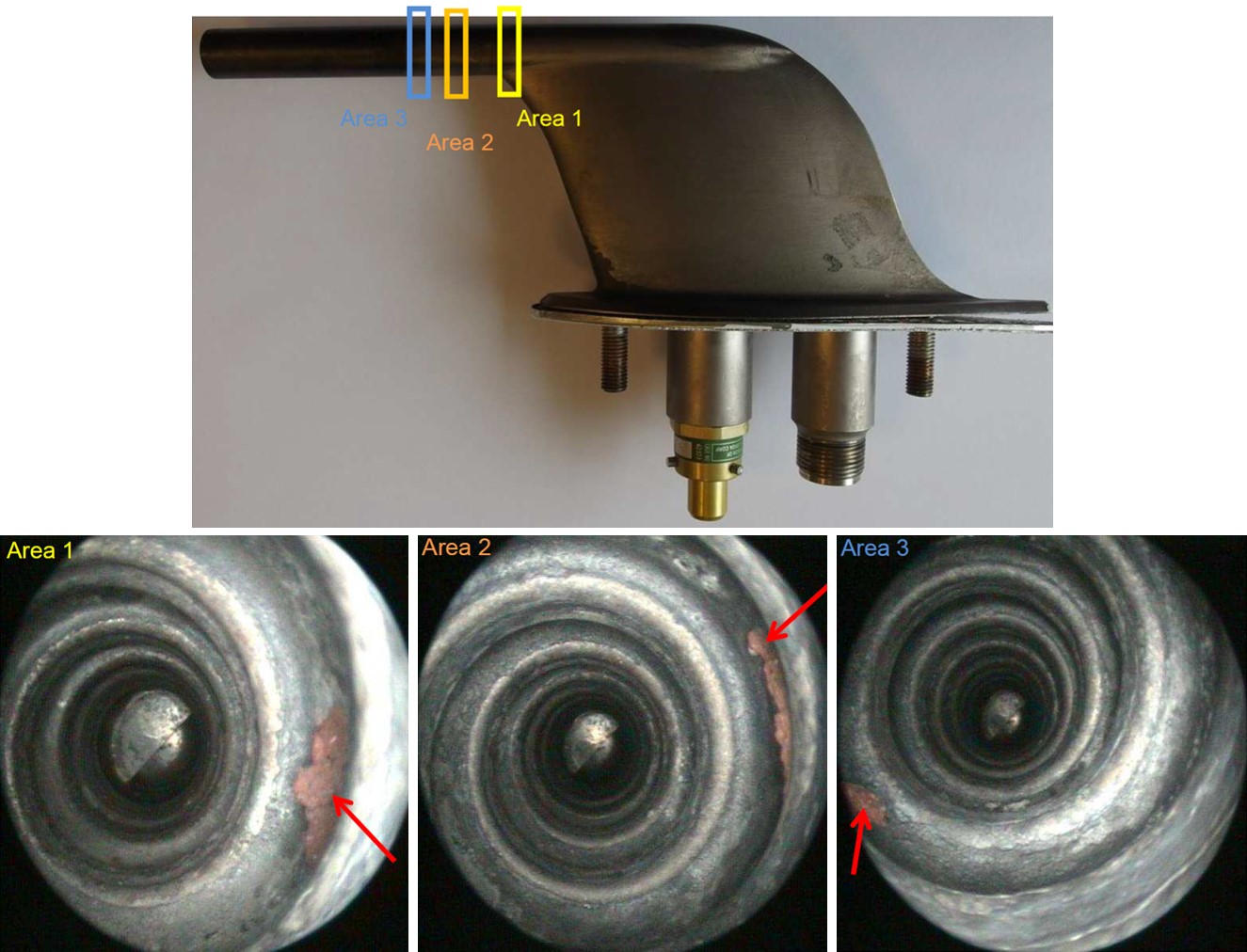
Note: The spiral structure inside the pitot probe tube is the heating element. Source: Thales
The captain’s pitot probe failed the acceptance tests due to the blocked drain hole and the contamination by the red clay substance.
First officer’s probe (pitot 2)
The first officer’s probe contained slight erosion and corrosion at the pitot tube entrance; however, it was considered acceptable in accordance with the in-service criteria of the CMM. The internal pitot tube was in good condition. This probe was found to be in acceptable condition in accordance with the CMM.
Standby probe (pitot 3)
The standby probe was slightly twisted, but was still within the CMM limits. The tube was in good condition, with some very slight erosion and corrosion at the pitot tube entrance; however, it was considered acceptable in accordance with the in-service criteria of the CMM.
Contamination deep within the interior of the pitot tube by a red substance was also identified in the standby pitot probe (Figure A3). Spectrographic examination of that substance identified that it consisted predominantly of oxygen, silicon, iron, aluminium and carbon and that it had an infrared spectrum consistent with an aluminium silicate clay.
Figure A3: Image of red contamination (red arrows) in the standby pitot probe
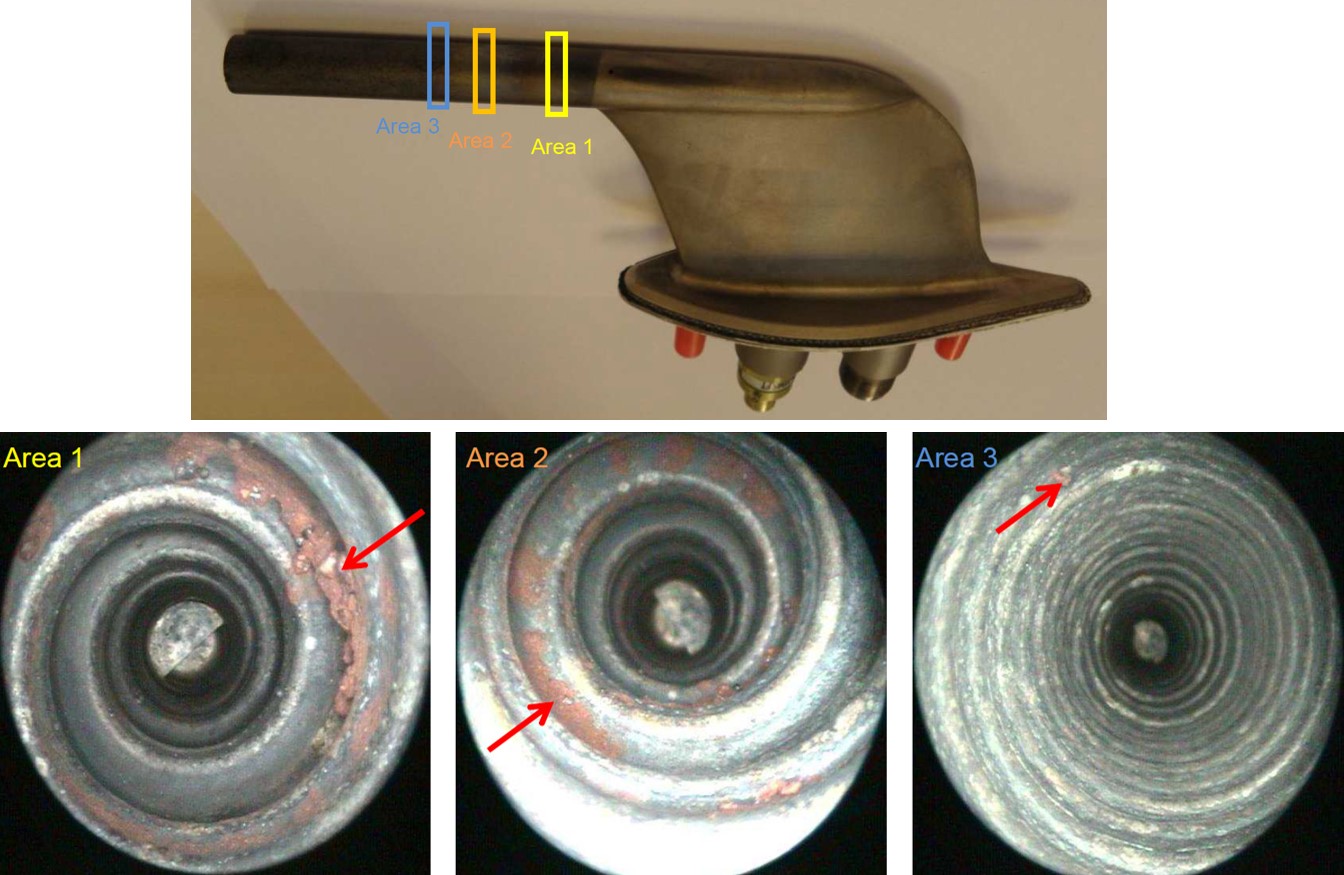
Note: The spiral structure inside the pitot probe tube is the heating element. Source: Thales
The standby pitot probe failed the acceptance tests due to the contamination by the red clay substance.
Appendix B – Flight Crew Operating Manual abnormal procedures
This appendix presents the Virgin Australia Regional Airlines (VARA) full Flight Crew Operating Manual (FCOM) procedures associated with the electronic centralised aircraft monitoring (ECAM) alerts generated during the incident flight. The procedures are presented in the same order in which the flight crew encountered them during the flight.
Figure B1: FCOM procedure – Autoflight autothrust off[57]
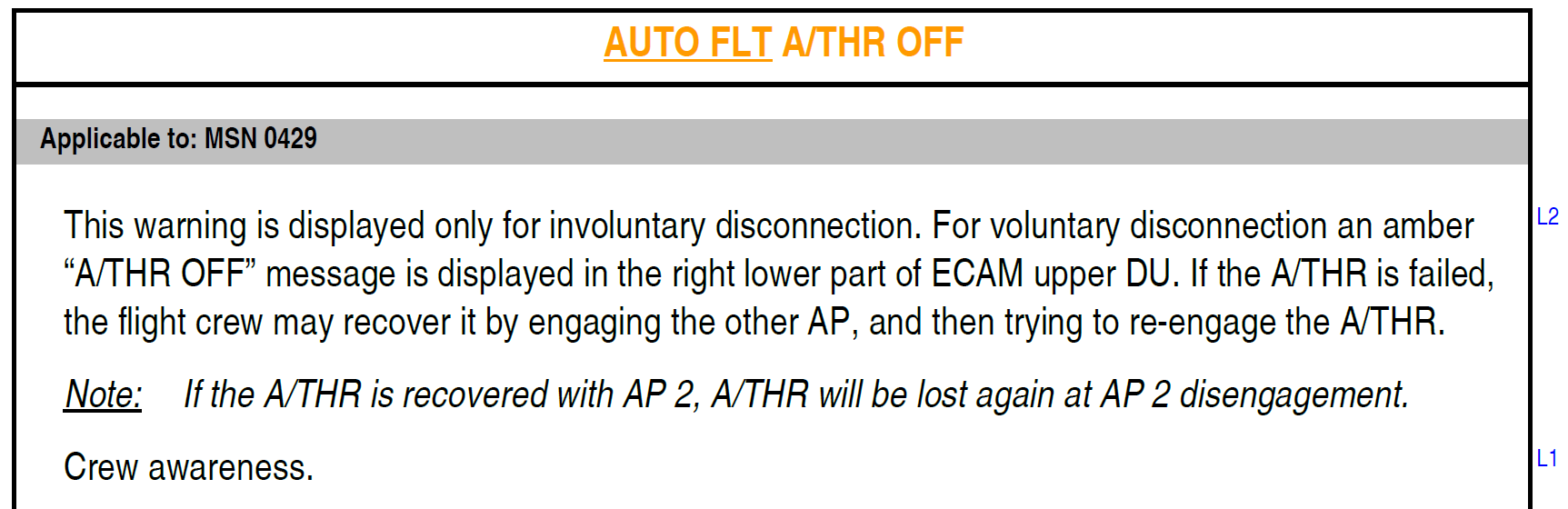
Source: VARA A320 FCOM
Figure B2: FCOM procedure – Auto flight autopilot off
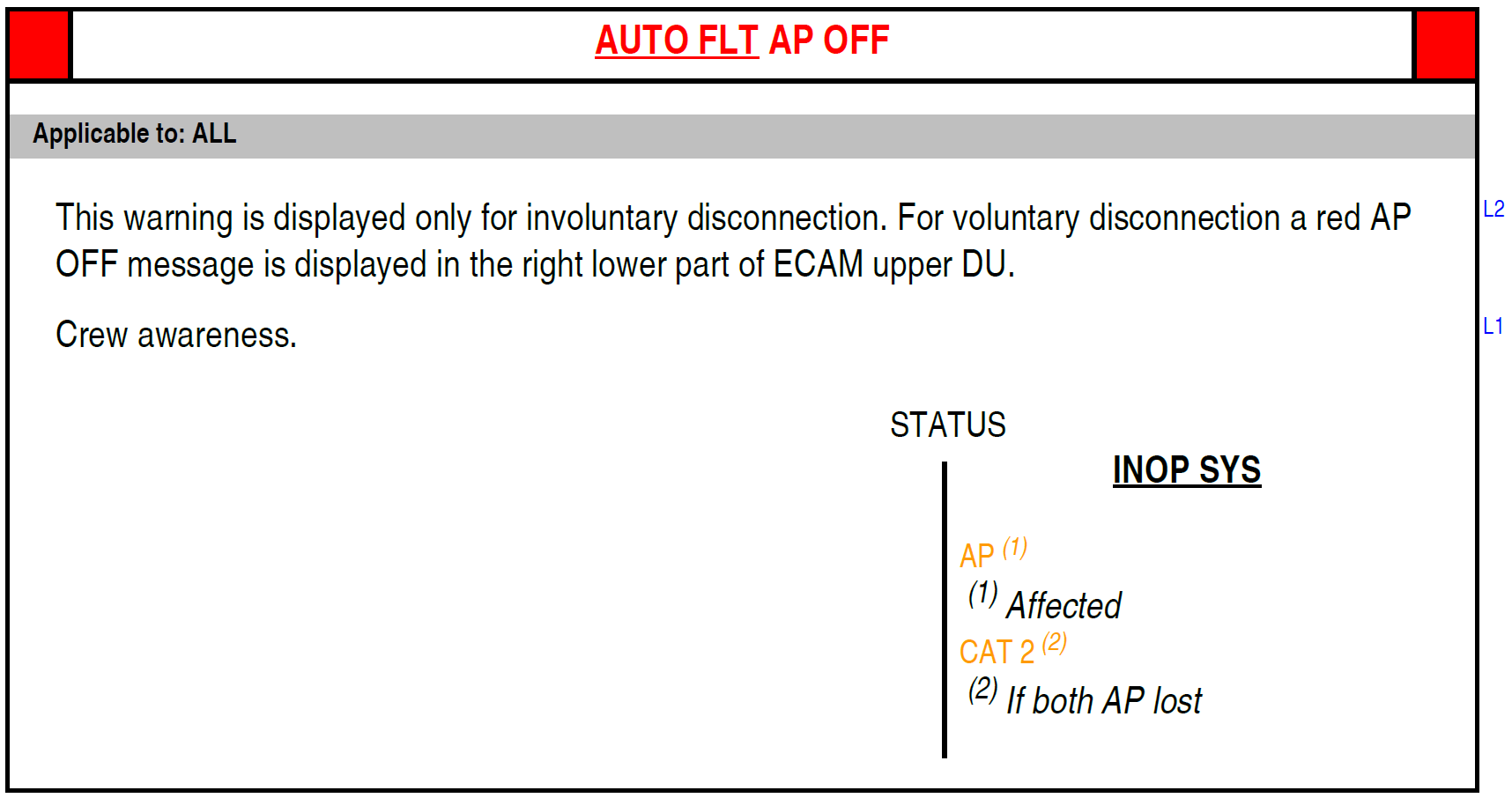
Source: VARA A320 FCOM
Figure B3: FCOM procedure – Engine 1(or 2) EPR mode fault
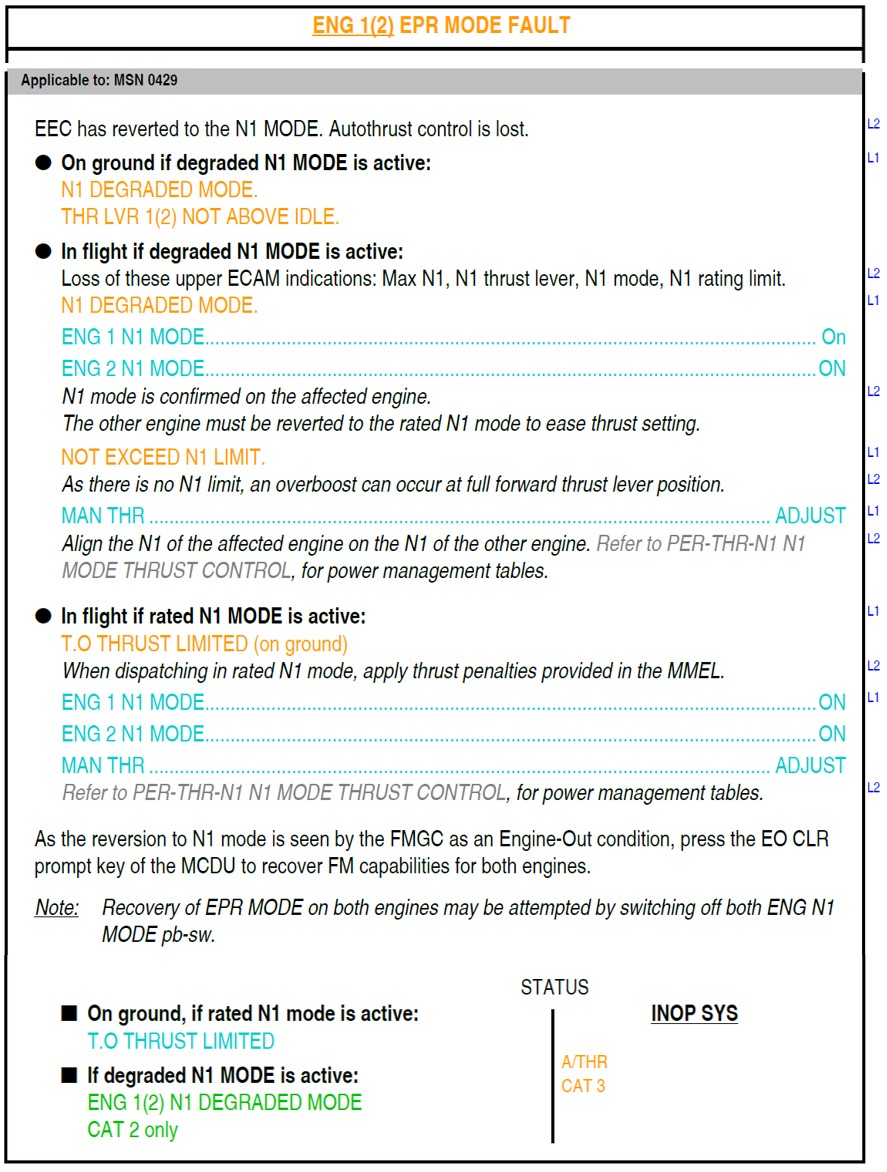
Source: VARA A320 FCOM
Figure B4: FCOM procedure – Navigation ADR disagree
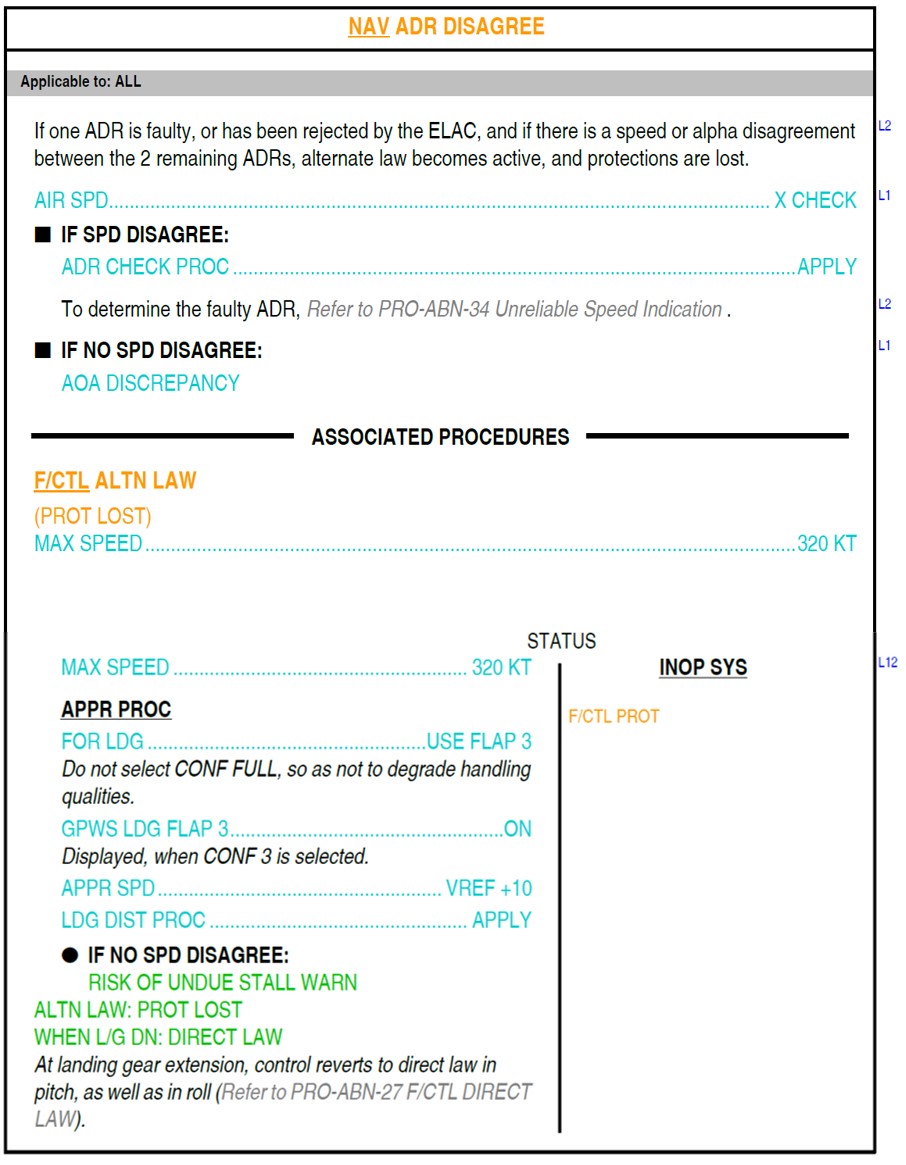
Source: VARA A320 FCOM
Figure B5: FCOM procedure – Navigation captain, first officer, or standby, angle of attack (AOA) fault
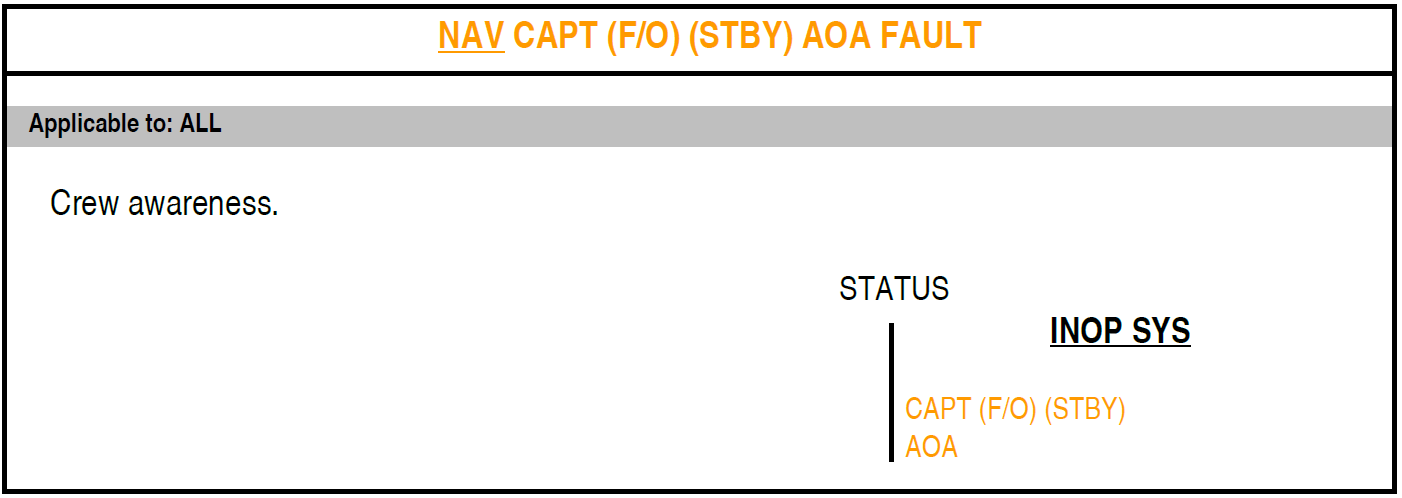
Source: VARA A320 FCOM
Figure B6: FCOM procedure – Flight control alternate law
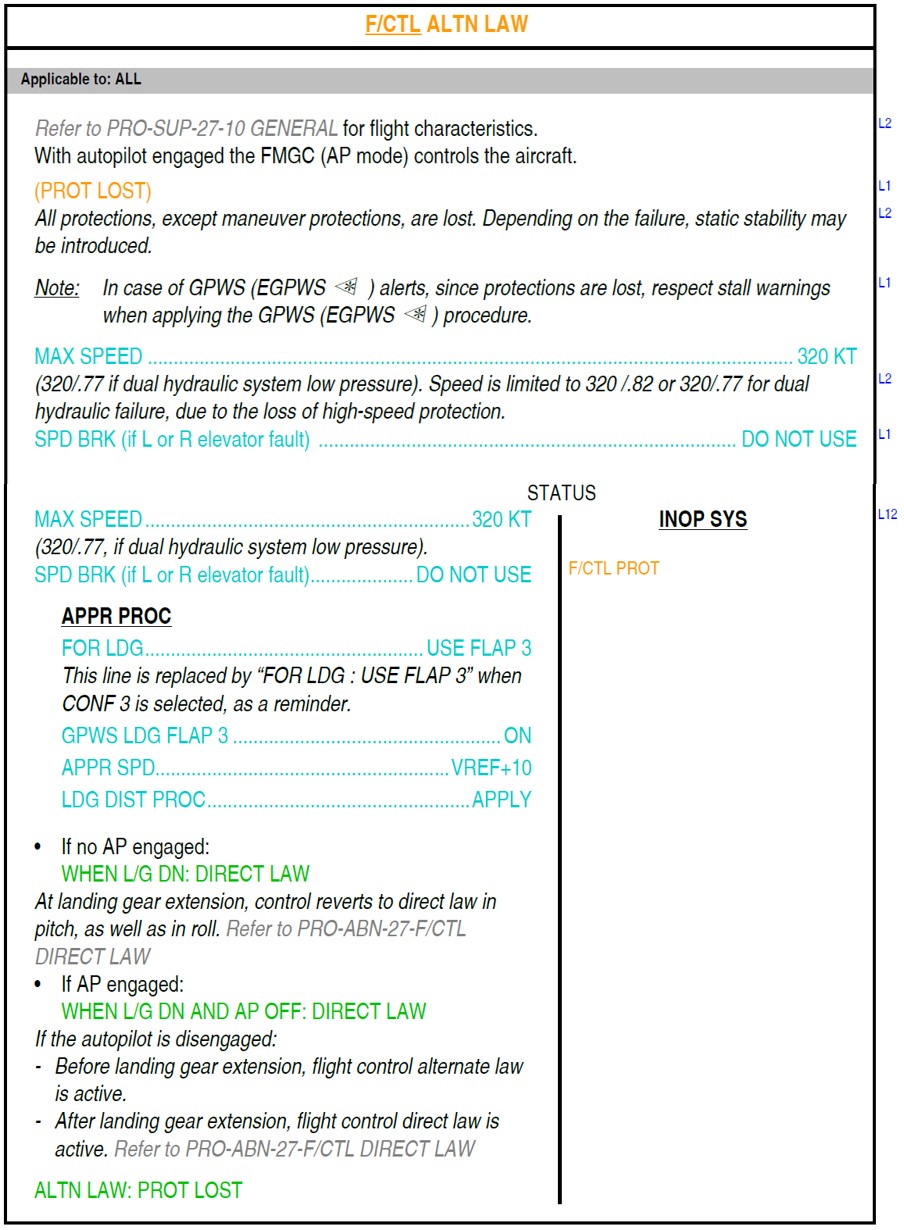
Source: VARA A320 FCOM
Figure B7: FCOM procedure – Auto flight rudder travel limiter system
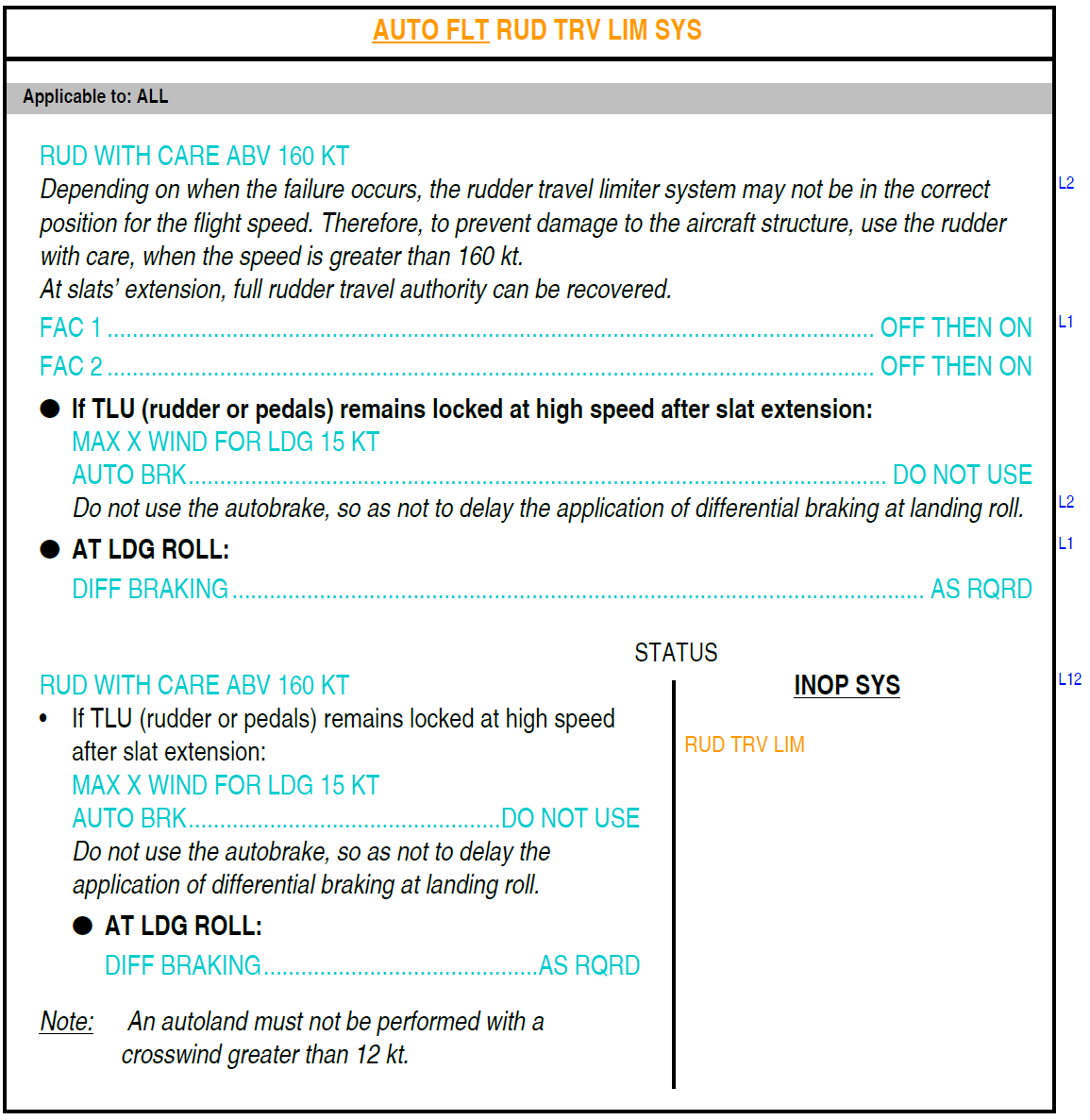
Source: VARA A320 FCOM
Figure B8: FCOM procedure – Auto flight rudder travel limiter 1 (or 2)
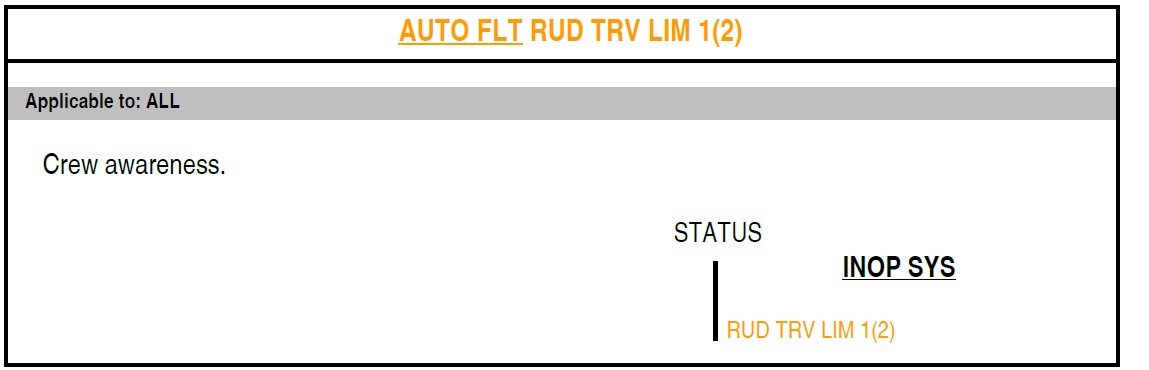
Source: VARA A320 FCOM
Figure B9: FCOM procedure – Auto flight rudder trim 1 (or 2) fault
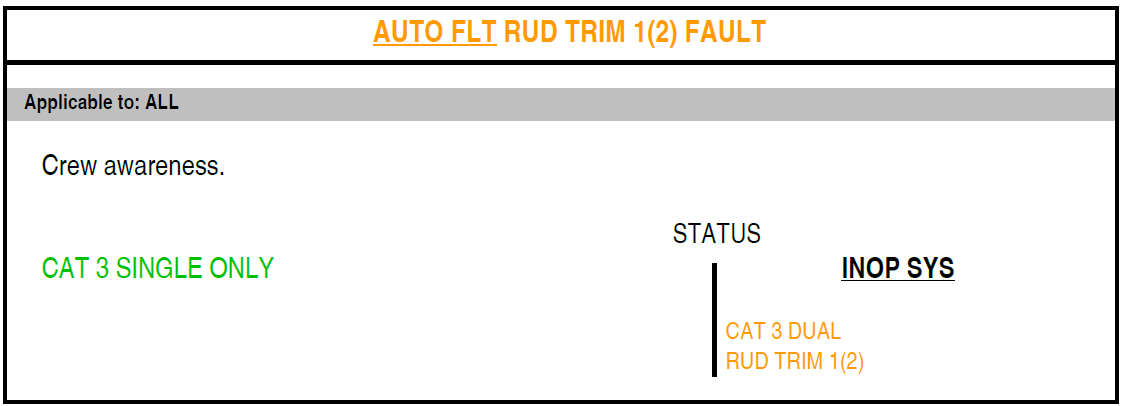
Source: VARA A320 FCOM
Figure B10: FCOM procedure – Windshear detection fault
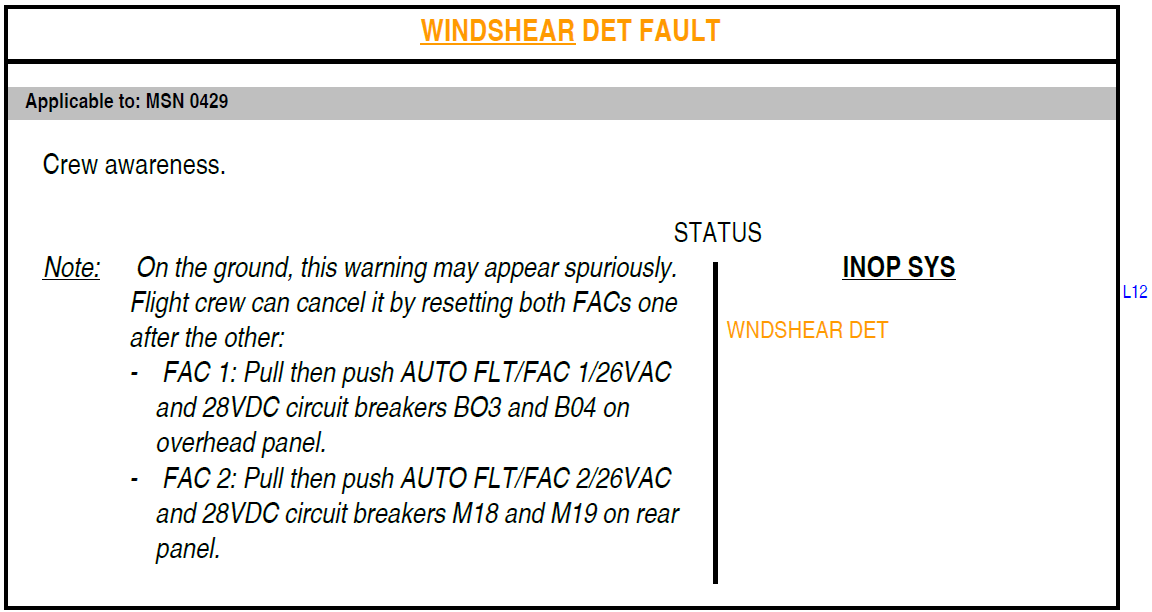
Source: VARA A320 FCOM
Figure B11: FCOM procedure – Flight control direct law
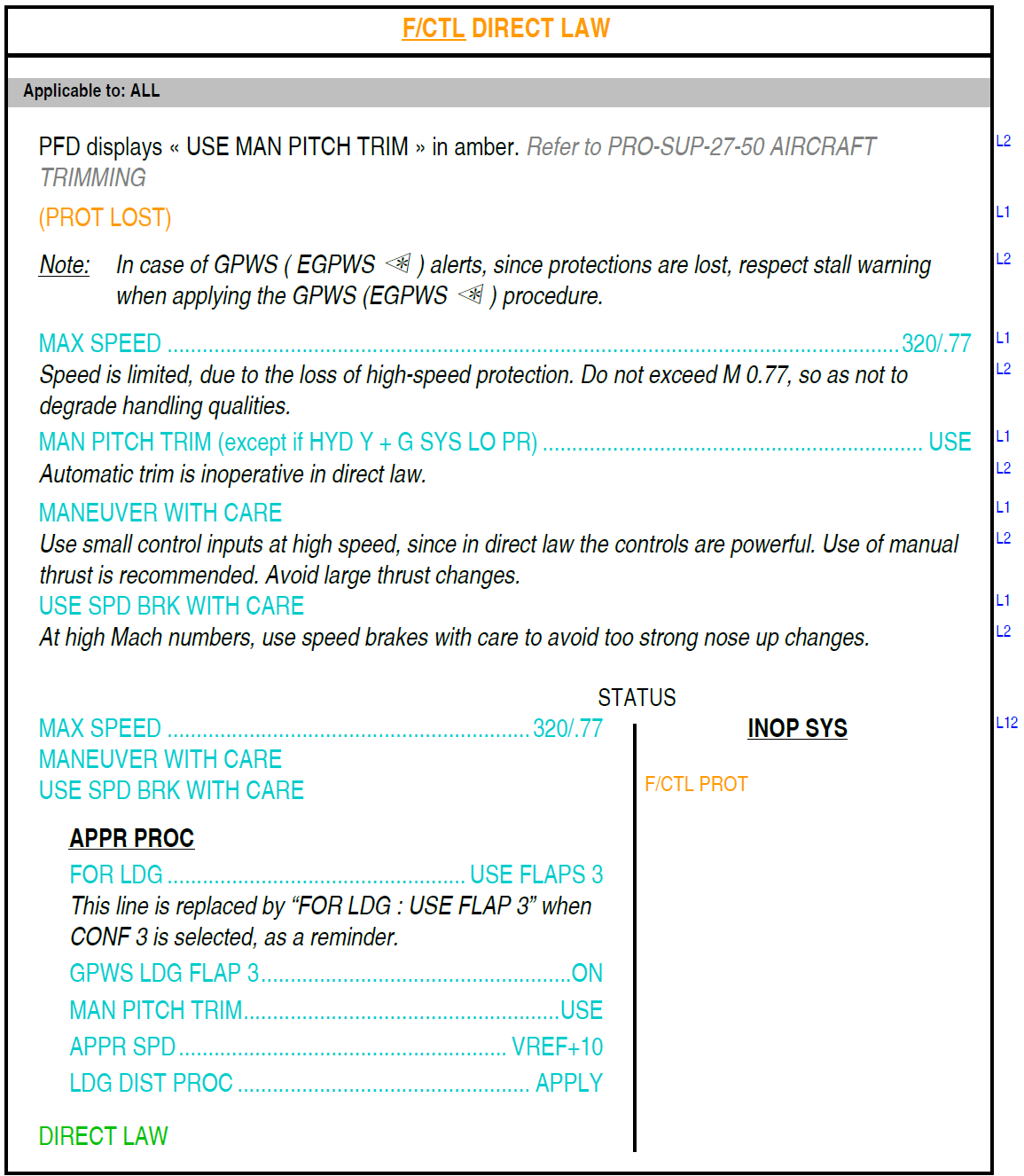
Source: VARA A320 FCOM
Figure B12: FCOM procedure – Navigation indicated airspeed discrepancy
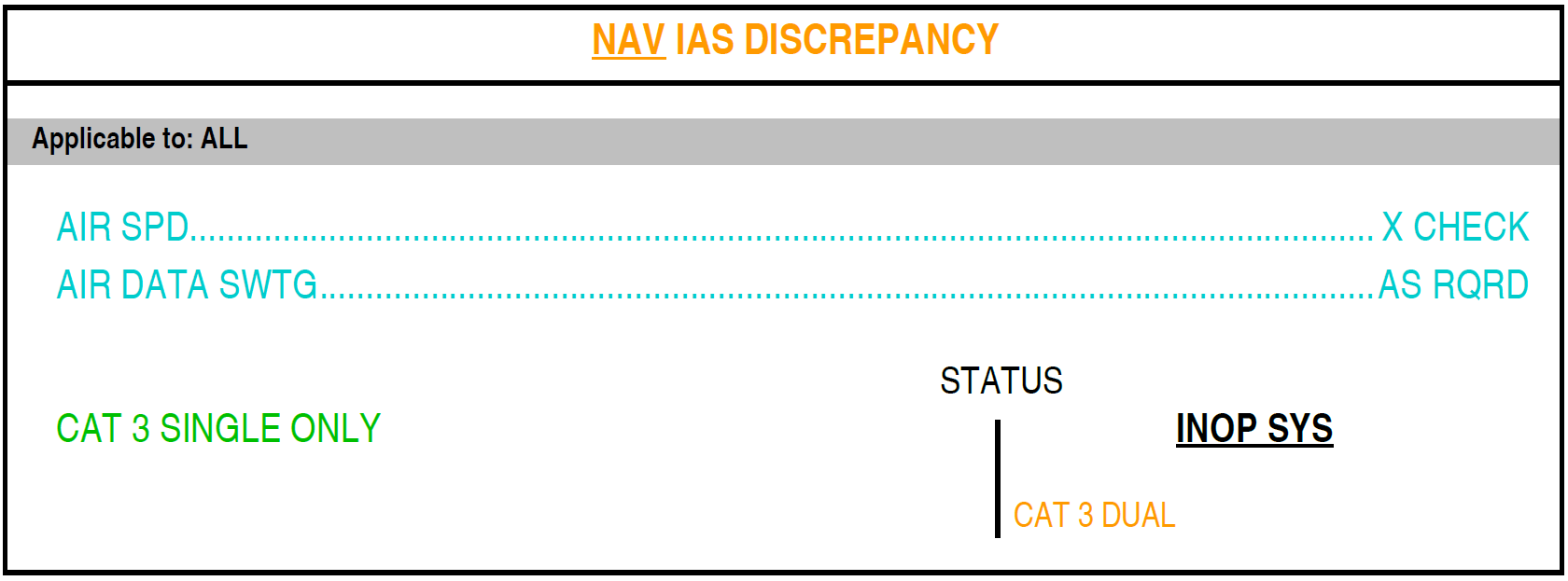
Source: VARA A320 FCOM
Figure B13: FCOM procedure – Stall recovery
Source: VARA A320 FCOM
Figure B14: FCOM procedure – Navigation indicated airspeed discrepancy
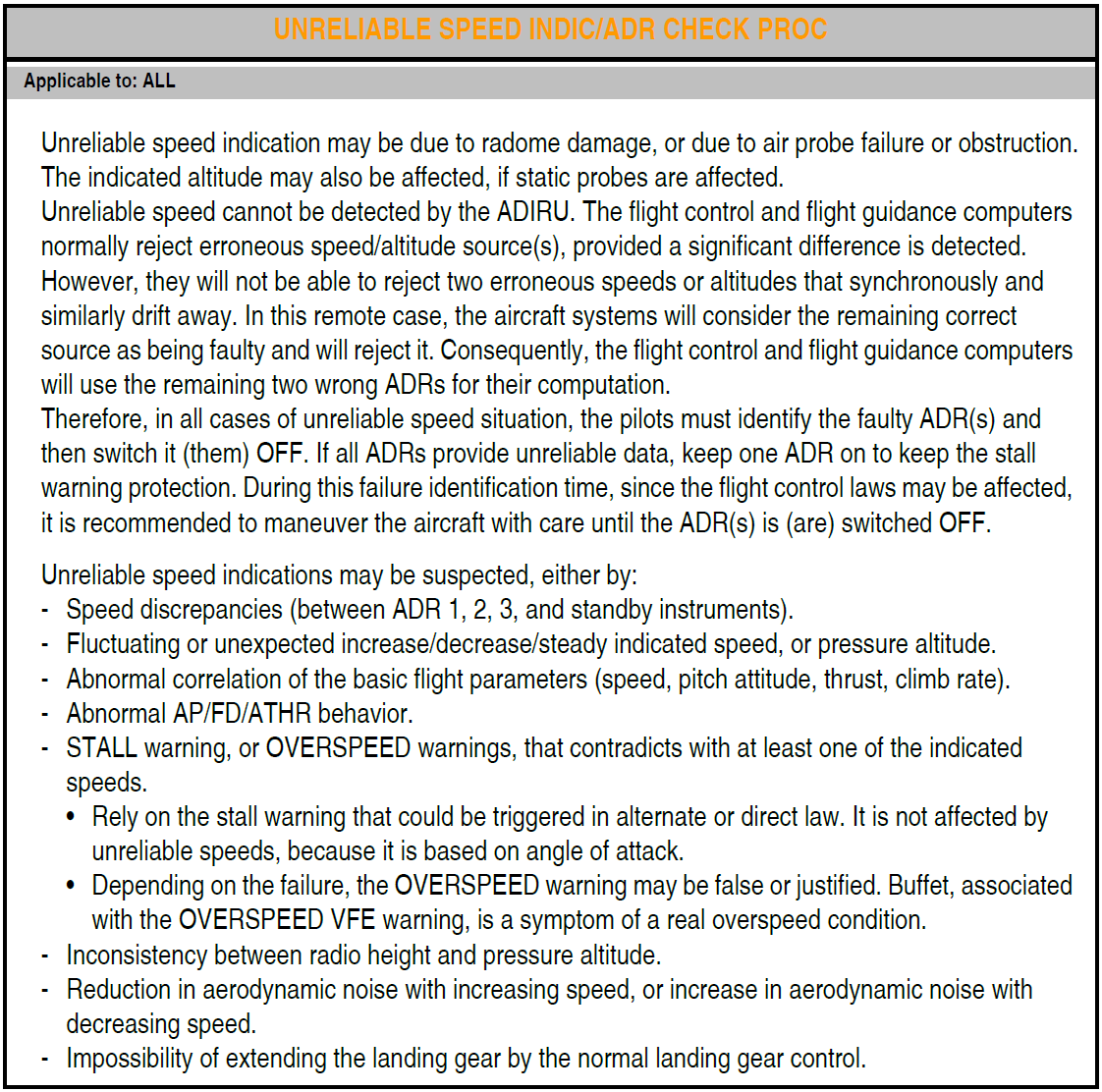

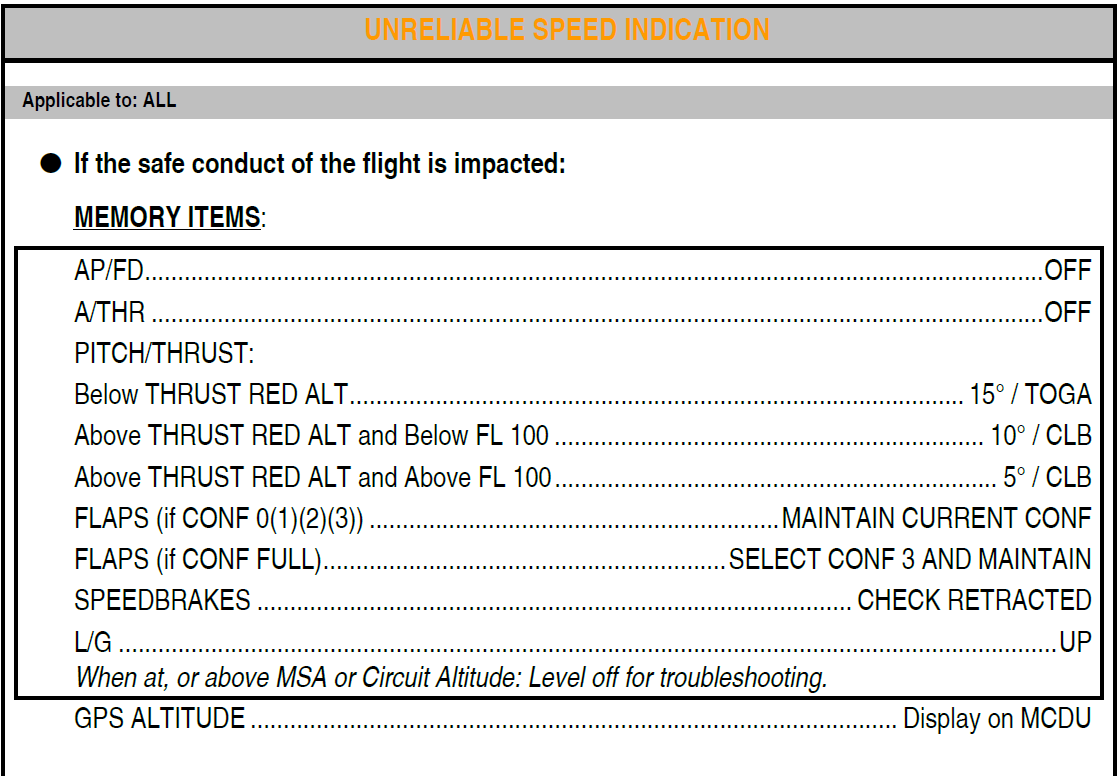
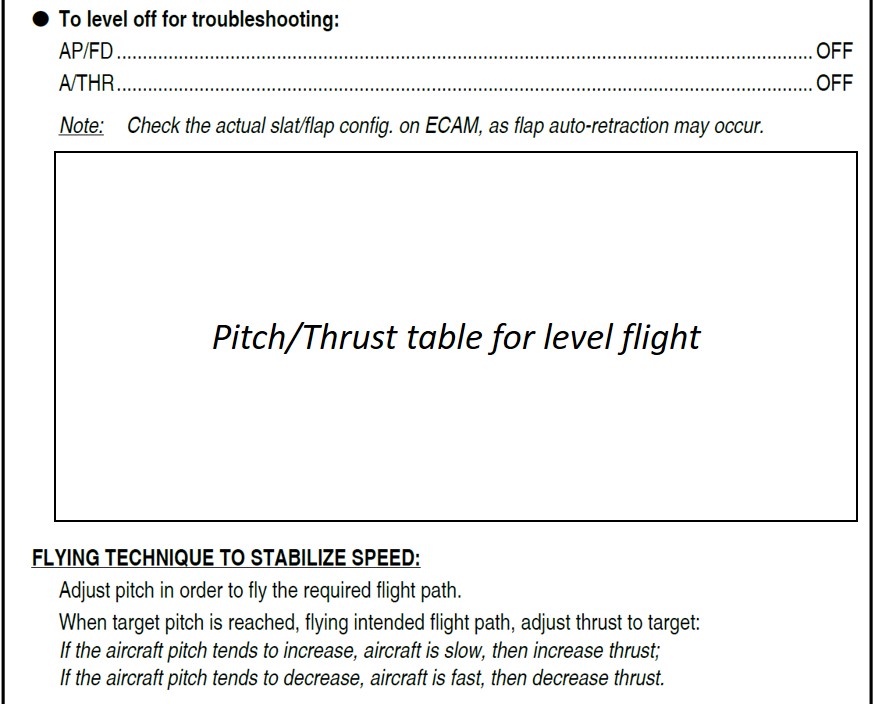
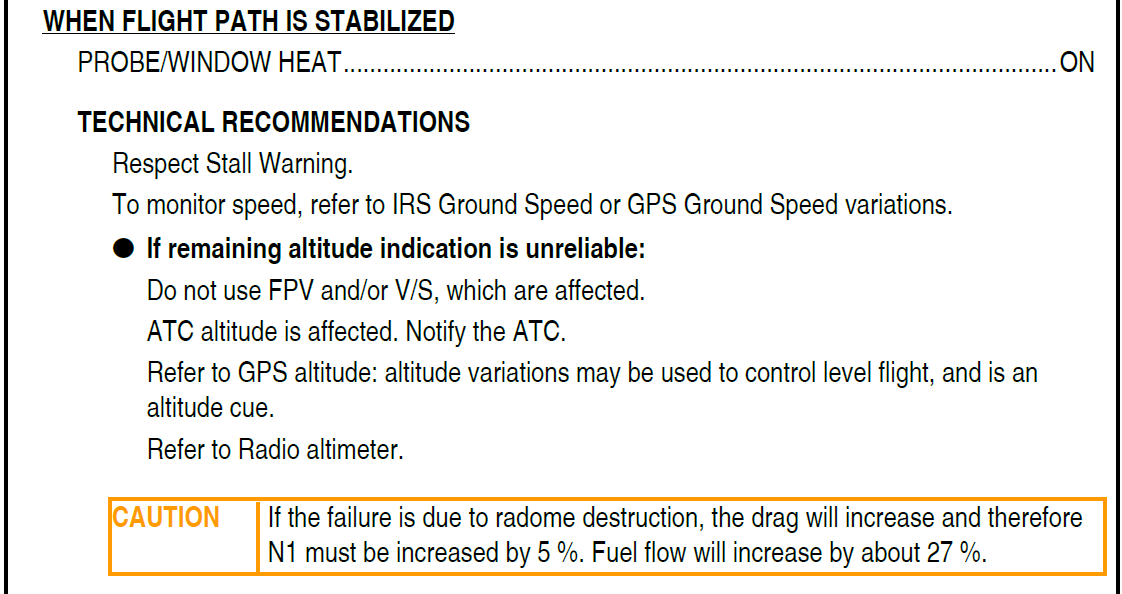
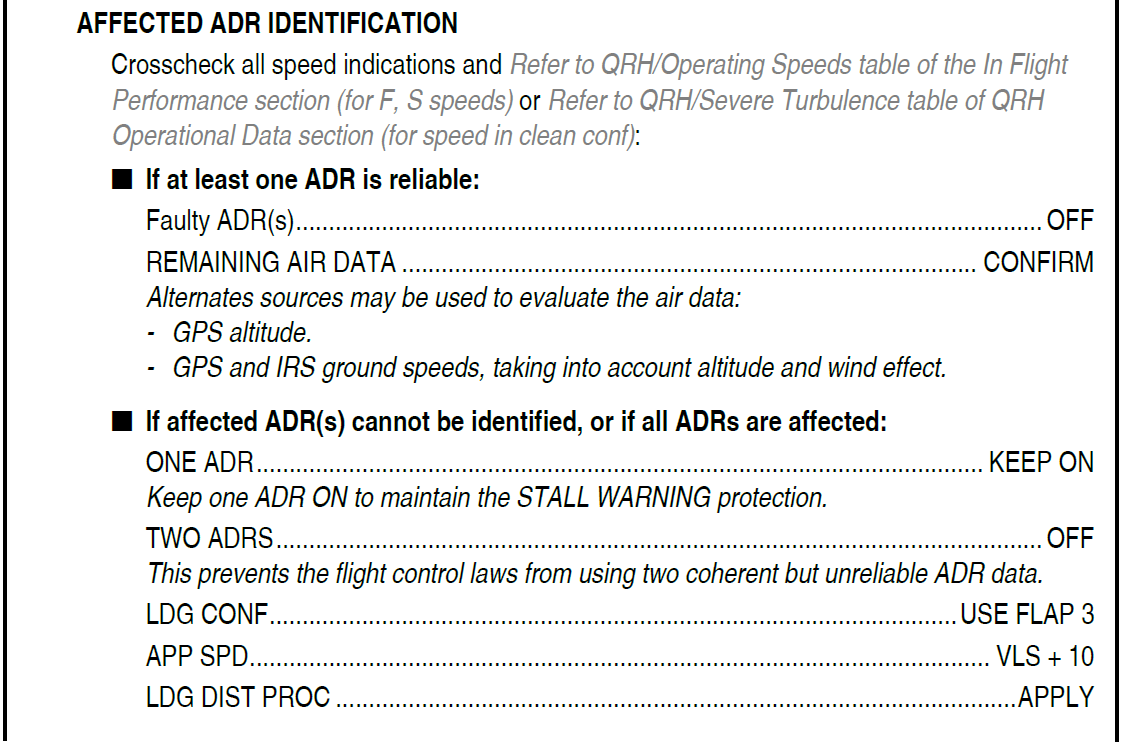
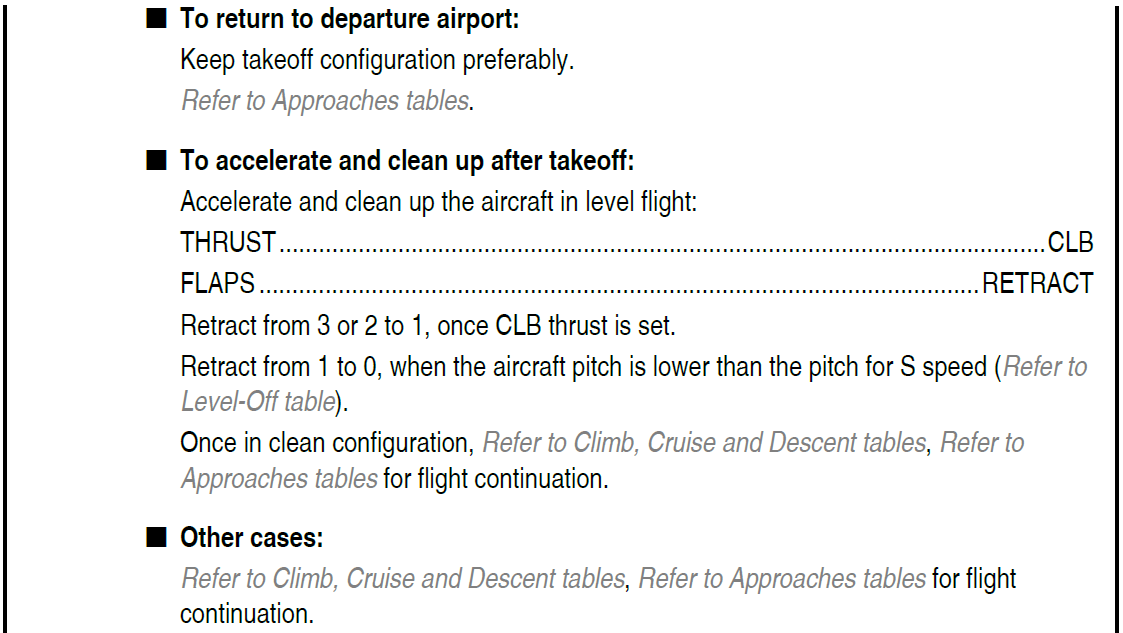
[Remainder of section presents the climb, cruise, descent and approach tables.]
Appendix C – Recorded data from the incident flight on 12 September 2015
The flight data recorder (FDR) contained about 25 hours of flight data, which included the data from the incident flight, and 19 preceding flights. The following figures present data from the incident flight that were applicable to the development of the sequence of events.
Notes about the following FDR data:
- The FDR contained more than 300 individual parameters. Not all of those parameters were required to develop the sequence of events. Only those deemed to be of interest to the investigation are presented.
- Times were recorded in UTC. For local times, add 8 hours to the UTC time. For example, 22:53:25 UTC is 0653:25 WST.
- The FDR started recording when the first (number 2) engine was started.
- Only one source of computed airspeed was recorded. By default, this was the airspeed presented on the captain’s primary flight display, unless it was invalid, in which case the first officer’s side is presented, if valid.
- The FDR recorded the angle of attack from the captain’s and first officer’s systems only. The standby system was not recorded.
Figure C1: Flight data – auto flight parameters (complete flight)
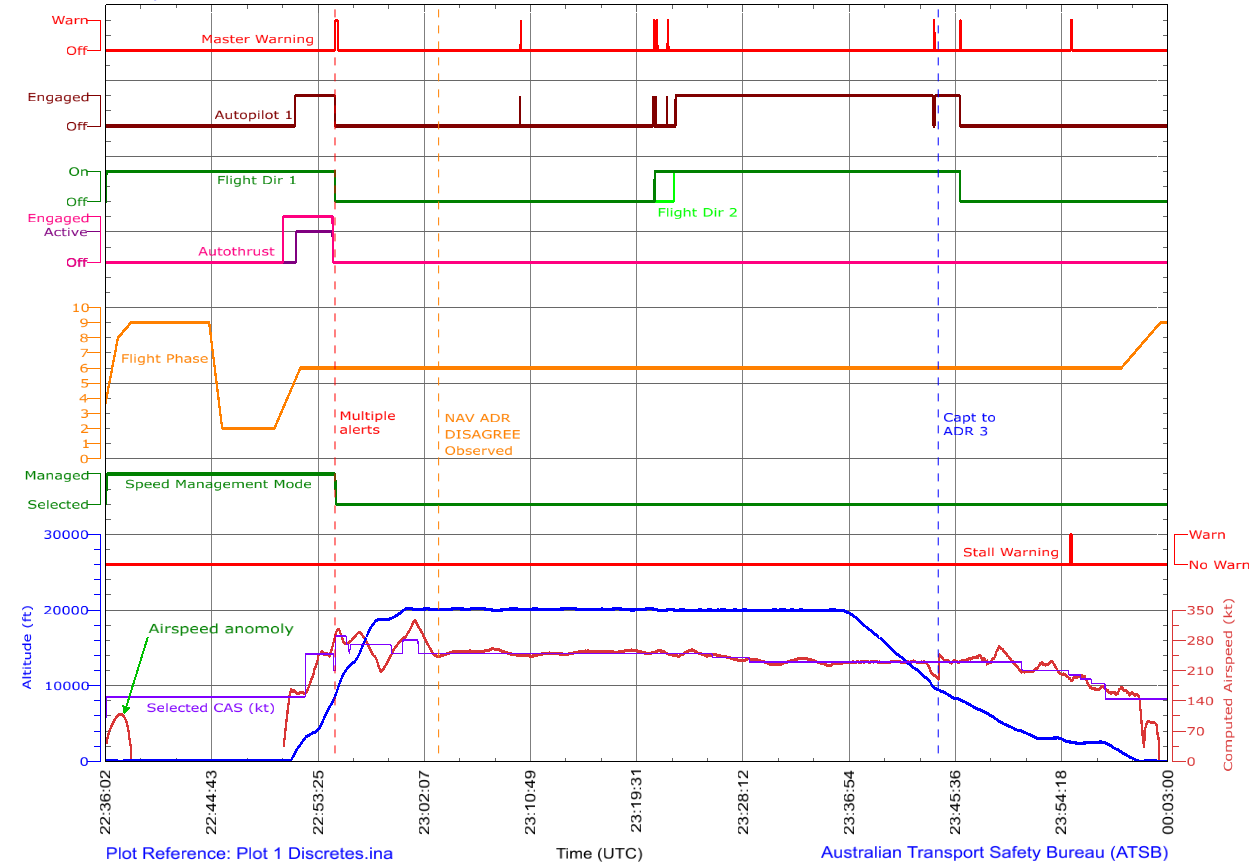
Source: ATSB
Figure C2: Flight data – flight controls (complete flight)
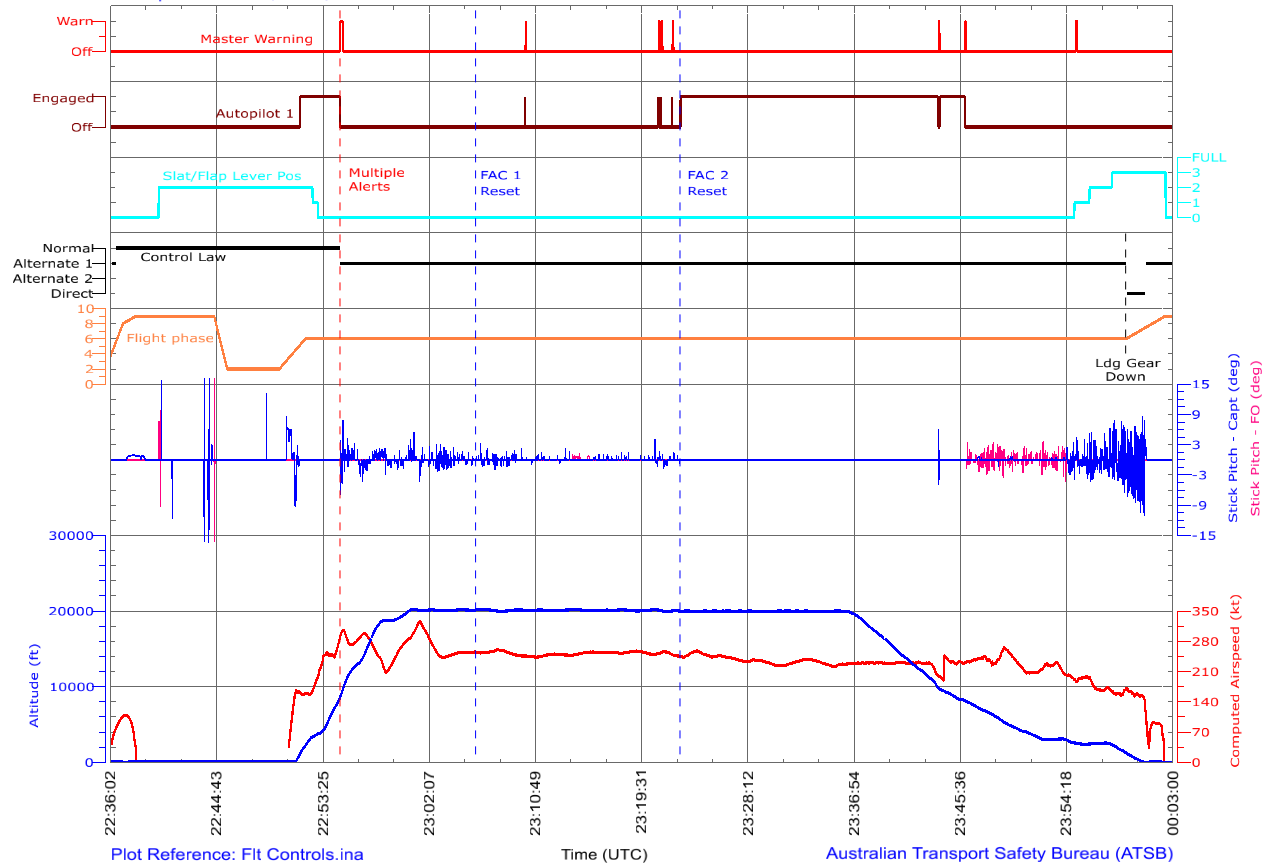
Source: ATSB
Figure C3: Flight data – flight controls (pre-flight and take-off)
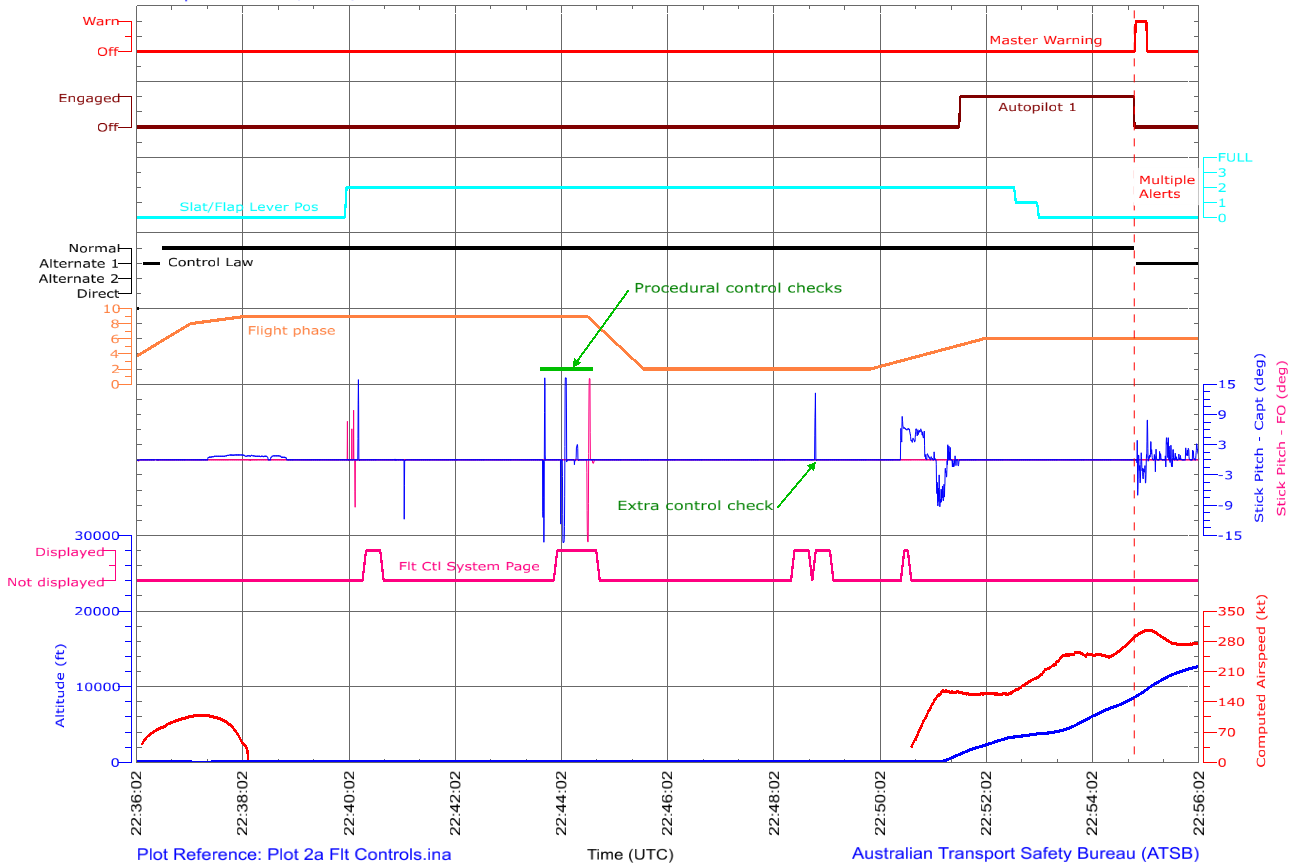
Source: ATSB
Figure C4: Flight data – environmental parameters (complete flight)
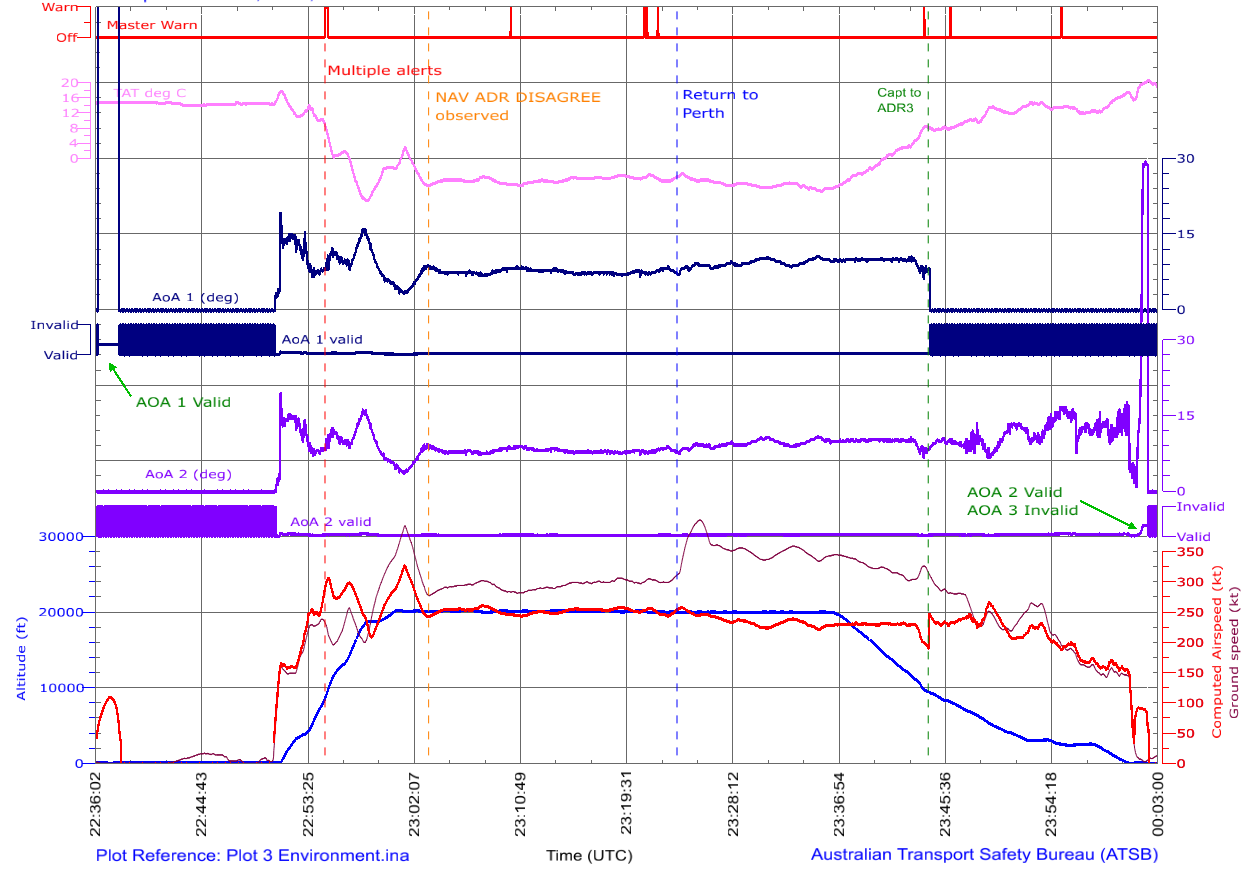
Note: The validity of the angle of attack (AOA) is inferred by its behaviour. When it cycles between maximum and minimum values, it is deemed invalid. Source: ATSB
Figure C5: Flight data – Engine parameters (complete flight)
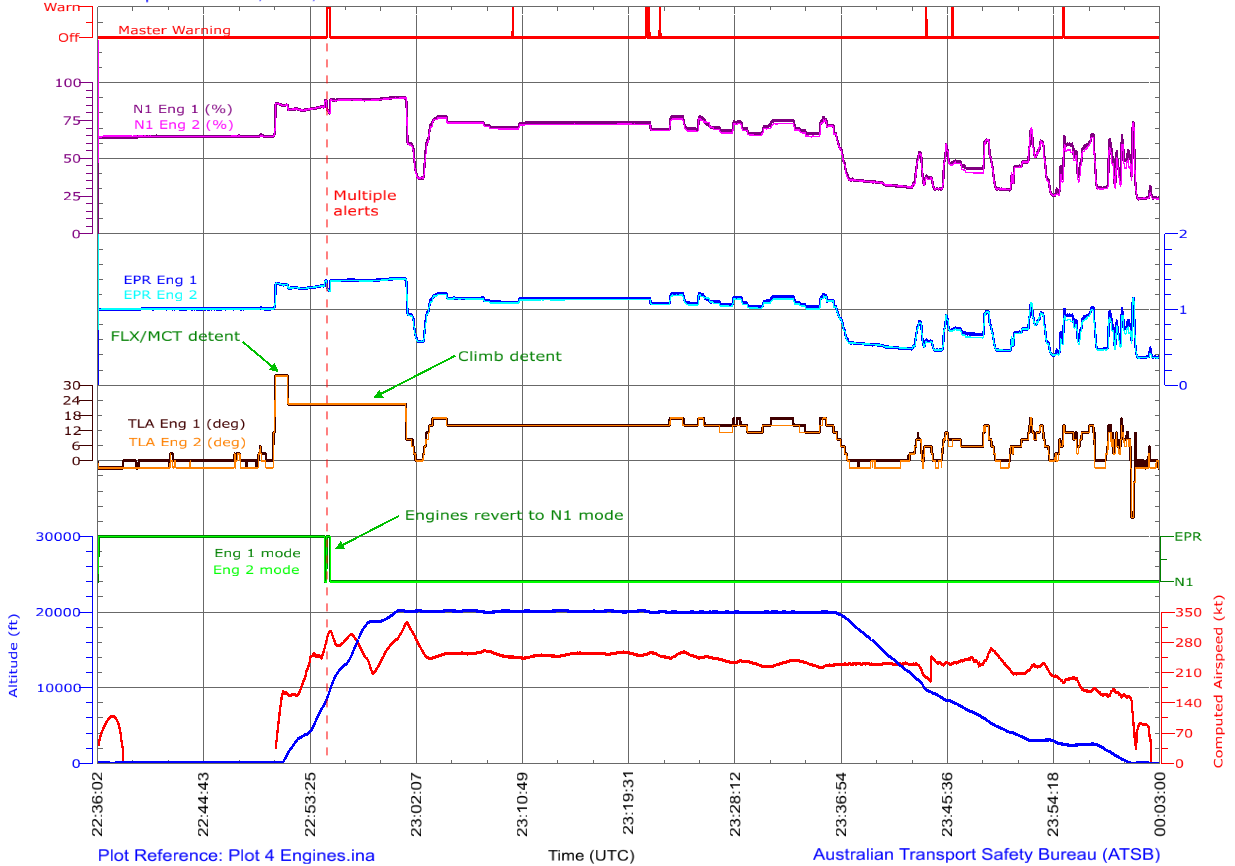
TLA = thrust lever angle. A measure of the thrust lever position. Source: ATSB
Figure C6: Flight data – Key parameters during stall warning
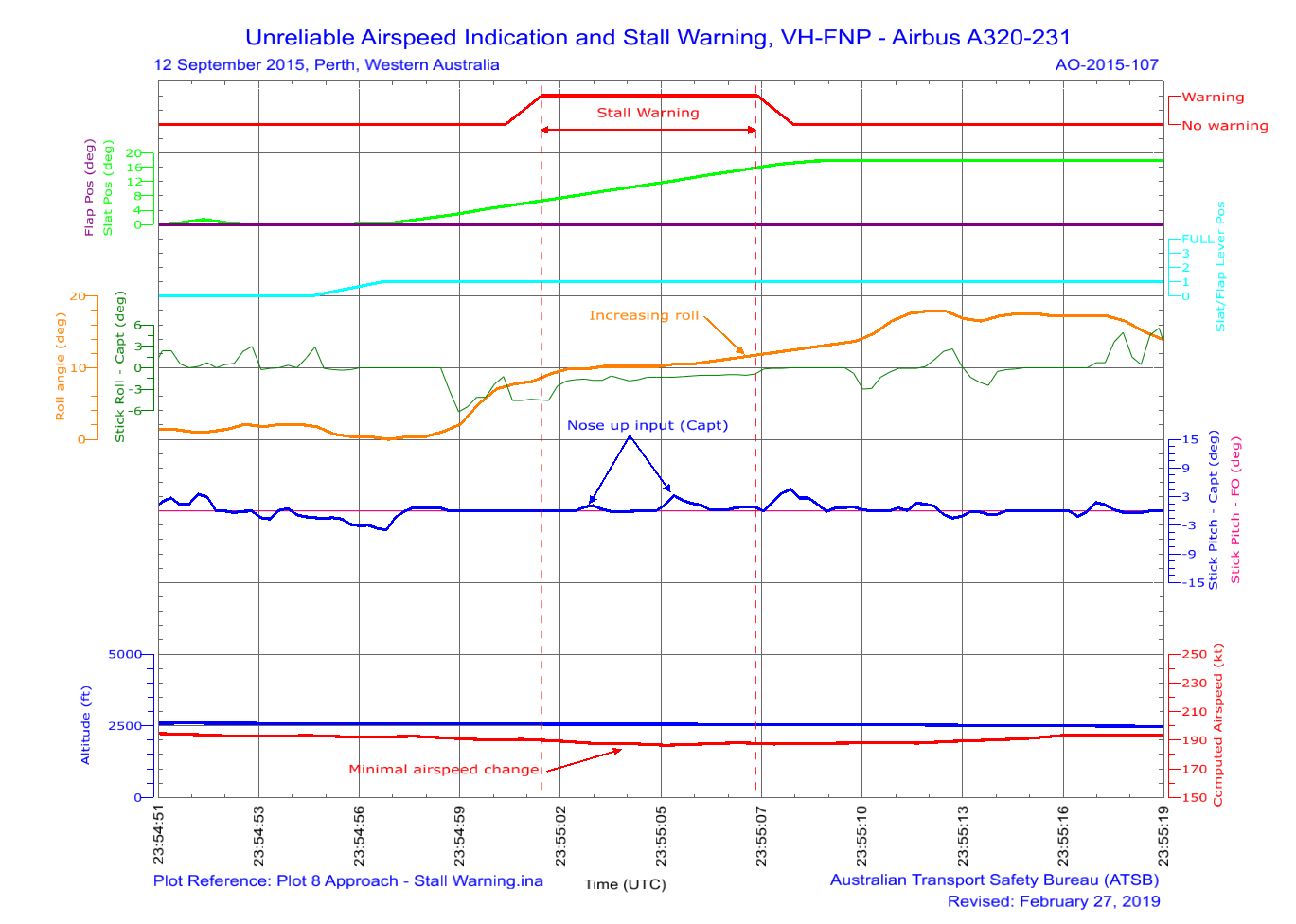
Source: ATSB
Appendix D – Manufacturer’s detailed sequence of events analysis
As part of their analysis of the incident, the aircraft manufacturer, Airbus, performed a detailed sequence of events analysis. Table D1 presents a summary of the key events from the manufacturer’s sequence of event analysis.
Table D1: Summary of key events from manufacturer’s sequence of events analysis
| Phase | Time (WST) | Events |
| Take-off | 0650:43 | Between 80 kts and take-off, ADR 3 was rejected by the ELACs[58] and FACs.[59] This was probably due to a CAS discrepancy. This was latched[60] in the ELACs for the remainder of the flight, but not by the flight guidance computer and FACs. |
| Climb | 0654:39 | Autothrust disconnected. Thrust lock activated. |
| 0654:49 | Engines 1 and 2 reverted from EPR mode to N1 mode, due to the engines rejecting the inlet total pressure, P2. The following ECAM alerts were triggered: - ENG 1 EPR MODE FAULT - ENG 2 EPR MODE FAULT | |
| 0654:50 | Captain’s CAS was 287 kts and increasing. Autopilot 1 involuntary disconnected and both flight directors disengaged. Following ECAM alerts were triggered: - AUTO FLT AP OFF - AUTO FLT RUD TRV LIM SYS - NAV ADR DISAGREE - F/CTL ALTN LAW Loss of autopilot, flight directors and rudder travel limiter were due to rejection of all ADR parameters in both FACs. ADR rejections latched by FACs and characteristic speeds lost. ADR rejection not latched by the flight guidance computer. Because ELACs had already rejected and latched ADR 3, when ADR 1 and ADR 2 disagreed, ELAC reverted to alternate law. The ADR disagree was latched in the ELACs for the remainder of the flight. The ELAC identified the ADR disagree was not due to an angle of attack discrepancy, but from CAS, Mach, or TAS[61] discrepancy. The SECs[62] also detected CAS discrepancies between ADR 1 and 3 and ADR 1 and 2. | |
| 0655:06 | CAS 1 reached peak value of 306 kt. Aircraft pitch angle reached maximum angle. Engines rejected low-pressure turbine exhaust pressure, P5. No effect on engine performance. CAS 1 evolution over this period was not consistent with constant engine thrust and pitch angle. | |
| Cruise | 0701 | Aircraft levelled off at FL200. Thrust levers moved out of climb detent. Thrust lock supressed. |
| 0706:50 | Yaw damper 1 was briefly recorded faulty and the following ECAM messages were triggered: - AUTO FLT RUD TRIM 1 FAULT - AUTO FLT RUD TRV LIM 2 This was consistent with the reset of FAC 1, which was an action requested in the AUTO FLT RUD TRV LIM SYS procedure. Flight director 1 became available, but did not automatically reengage, probably because it had been switched off, before the FAC was reset. | |
| 0707 to 0722 | Several unsuccessful attempts to reengage the autopilot were made. Autopilot engagement was prevented by the flight guidance computer because FAC 2 still rejecting all ADR. At 0721:00, flight director 1 was reengaged. | |
| 0722:00 | Yaw damper 2 briefly recorded faulty and the following ECAM message was triggered: - AUTO FLT RUD TRIM 2 FAULT This was consistent with the reset of FAC 2, which was an action requested in the AUT FLT RUD TRV LIM SYS procedure. | |
| 0722:36 | Flight director 2 automatically reengaged. Autopilot 1 was reengaged. In-flight turn-back initiated [Aircraft turned back towards Perth] | |
| Descent | 0736:25 | Descent into Perth Airport commenced. |
| 0743:00 | Recorded CAS (at the time CAS 1) started to decrease from 230 kt down to 190 kt over 1 minute and 15 seconds. The autopilot pitched nose down and the crew increased thrust to maintain target airspeed. | |
| 0743:33 | FAC and flight guidance computers reject ADR 1 and use ADR 3. Autopilot pitched the aircraft up, indicating that CAS 3 was higher than CAS 1. | |
| 0743:49 | CAS (from ADR 1) was still decreasing. The autopilot was disengaged by a nose-down sidestick input by captain. | |
| 0744:18 | Jump in CAS from 190 kt to 247 kt. Corresponding jump in Mach and altitude. Angle of attack values from ADR 1 recorded as invalid. [This was consistent with the report that the captain switched to ADR 3.] The autopilot was reengaged 7 seconds later. | |
| 0746:00 | The autopilot and both flight directors involuntarily disengaged when both FACs reject all ADR data after a discrepancy between ADR 2 and ADR 3. Autopilot and flight directors remained off for the remainder of the flight. The following ECAM alerts were triggered: - AUTO FLT AP OFF - AUTO FLT RUD TRV LIM SYS This was likely due to the rejection of ADR 2 because ADR 1 had already been already rejected. Reset of the FACs, which was part of AUT FLT RUD TRV LIM SYS procedure, was not carried out. | |
| 0755:00 | Captain manually flying aircraft. Flap setting 1 selected. | |
| 0755:03 | Stall warning triggered for 6 seconds. Angle of attack from ADR 2 recorded as 7.4°. For current speed, stall warning threshold was 8°. Nose-down sidestick inputs of up to ~1/3 of the full forward limit were made by captain. The following ECAM alert was triggered: - WINDSHEAR DET FAULT Windshear fault due to earlier rejection of all ADRs by the FACs. ECAM alert only triggered when in high-lift configuration. | |
| Approach | 0759:13 | Landing gear was extended. Flight control laws reverted from alternate to direct law. |
| Landing | 0700:38 | Landing carried out by captain in direct l. |
Appendix E – Recorded data from 9 September 2015 airspeed anomaly
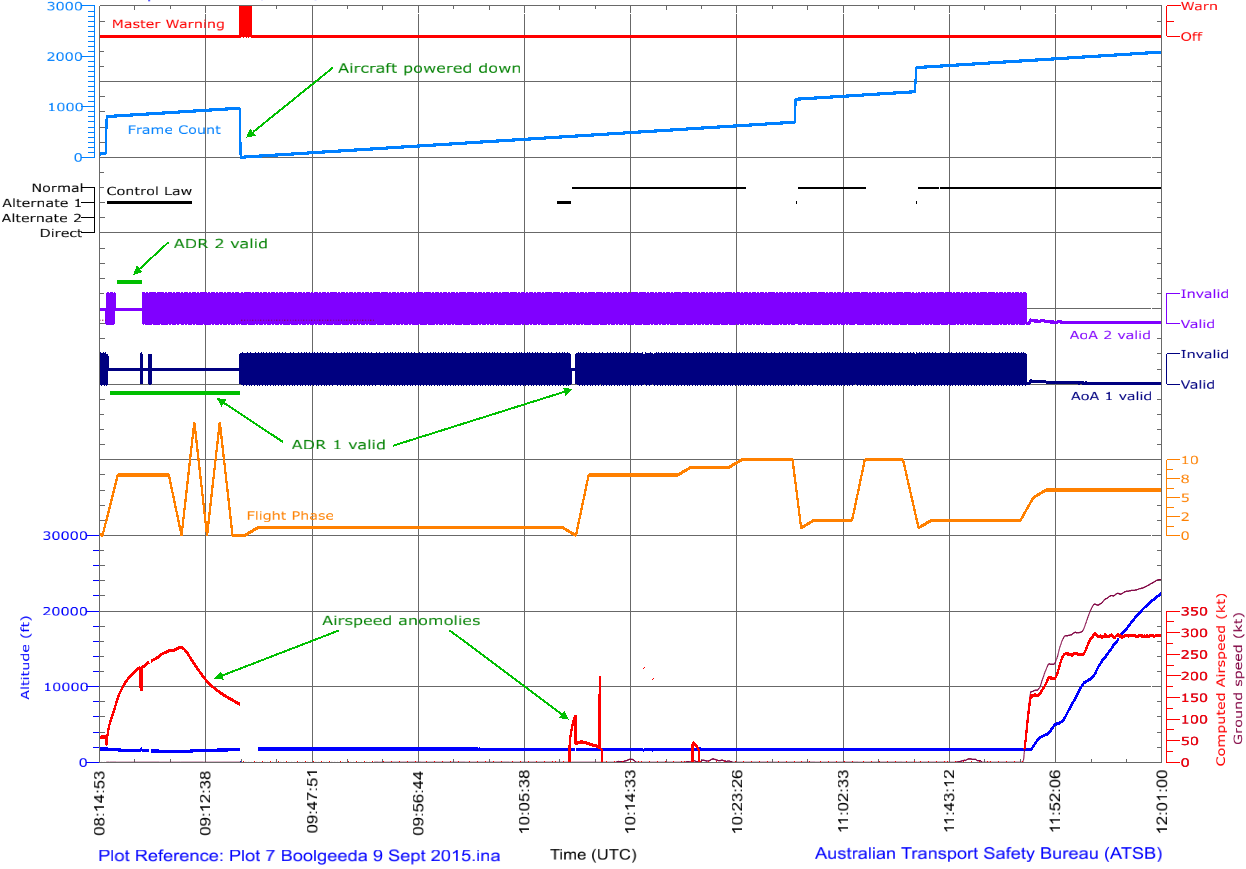
Note: The frame count is a parameter recorded on the FDR that counts in seconds. This count is generated external to the FDR, so when power is removed from the FDR, but other systems have power, the count continues, but is not recorded by the FDR, resulting in steps in the count. If the aircraft is completely powered down, the count resets to zero. Such steps indicate some level of powering down of the aircraft. Source: ATSB
__________
- The FCOM provides three ‘layers’ of information. The associated layer is identified in the right hand margin of the FCOM. Layer 1 (L1) is for ‘Need to know’ and presents information that is necessary in the cockpit. L2 is ‘nice to know’ information, provided in order to fully understand the logic of the aircraft and pilot interfaces. L3 is ‘detailed’ information that are not necessarily needed in flight. L1 is the default level, so is not necessarily identified in the text of FCOM.
- Elevator aileron computers – a flight control system computer
- Flight augmentation computer – a flight control system computer
- Latched means that the system has locked out the parameter from being used again until the system is reset. If the parameter is not latched, it can be used again by the systems when it is in agreement with the other ADR values.
- True airspeed.
- Spoiler elevator computers – a flight control system computer
Purpose of safety investigationsThe objective of a safety investigation is to enhance transport safety. This is done through:
It is not a function of the ATSB to apportion blame or provide a means for determining liability. At the same time, an investigation report must include factual material of sufficient weight to support the analysis and findings. At all times the ATSB endeavours to balance the use of material that could imply adverse comment with the need to properly explain what happened, and why, in a fair and unbiased manner. The ATSB does not investigate for the purpose of taking administrative, regulatory or criminal action. TerminologyAn explanation of terminology used in ATSB investigation reports is available here. This includes terms such as occurrence, contributing factor, other factor that increased risk, and safety issue. Publishing informationReleased in accordance with section 25 of the Transport Safety Investigation Act 2003 Published by: Australian Transport Safety Bureau © Commonwealth of Australia 2019 
Ownership of intellectual property rights in this publication Unless otherwise noted, copyright (and any other intellectual property rights, if any) in this report publication is owned by the Commonwealth of Australia. Creative Commons licence With the exception of the Coat of Arms, ATSB logo, and photos and graphics in which a third party holds copyright, this publication is licensed under a Creative Commons Attribution 3.0 Australia licence. Creative Commons Attribution 3.0 Australia Licence is a standard form licence agreement that allows you to copy, distribute, transmit and adapt this publication provided that you attribute the work. The ATSB’s preference is that you attribute this publication (and any material sourced from it) using the following wording: Source: Australian Transport Safety Bureau Copyright in material obtained from other agencies, private individuals or organisations, belongs to those agencies, individuals or organisations. Where you wish to use their material, you will need to contact them directly. |
Occurrence summary
| Investigation number | AO-2015-107 |
|---|---|
| Occurrence date | 12/09/2015 |
| Location | Near Perth Airport |
| State | Western Australia |
| Report release date | 04/04/2019 |
| Report status | Final |
| Investigation level | Systemic |
| Investigation type | Occurrence Investigation |
| Investigation status | Completed |
| Mode of transport | Aviation |
| Aviation occurrence category | Avionics/flight instruments |
| Occurrence class | Serious Incident |
| Highest injury level | None |
Aircraft details
| Manufacturer | Airbus |
|---|---|
| Model | A320-231 |
| Registration | VH-FNP |
| Serial number | 0429 |
| Aircraft operator | Virgin Australia Regional Airlines |
| Sector | Jet |
| Operation type | Charter |
| Departure point | Perth, Western Australia |
| Destination | Boolgeeda Airport, Western Australia |
| Damage | Nil |