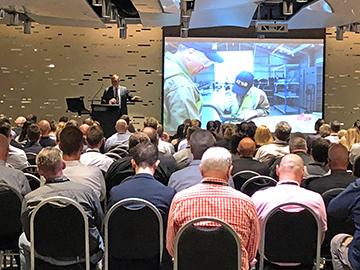
The inaugural FlySafe 2019 Aviation Safety Forum will be held at the Avalon Airshow next month.
In a concerted effort to maintain Australia’s world-leading safety record, Australia’s three government aviation agencies are hosting the inaugural FlySafe 2019 Aviation Safety Forum at the Australian International Airshow next month.
The ATSB has further strengthend its close co-operation with the Defence Flight Safety Bureau.
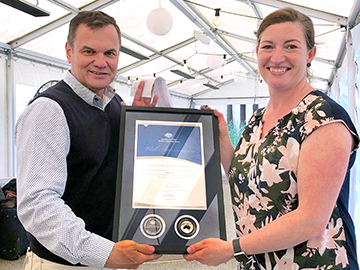
The Australian Transport Safety Bureau (ATSB) has further strengthened its close co-operative arrangement with the Department of Defence, following the completion of a secondment of a Defence Flight Safety Bureau (DFSB) aviation accident investigator to the Bureau.
Squadron Leader Clare Fry, the second Defence aviation accident investigator to be seconded to the ATSB, brought her experience in safety investigation and human factors to the Bureau during her recent five-month secondment.
During her secondment, Squadron Leader Fry deployed to two accident sites involving general aviation aircraft, and was involved in two investigations focusing on high-capacity passenger aircraft. She also participated in a number of training courses, as well as human factors and professional development sessions.
Squadron Leader Fry said her time with the ATSB had been an excellent opportunity, and that she had gained valuable knowledge and experience.
“The ATSB are responsible for a much larger and broader demographic than DFSB, and therefore are exposed to a lot more,” Squadron Leader Fry said. “This has been a good opportunity for me to get some wider experience, and I’ll be taking that experience back to DFSB to strengthen our team.”
“The on-site experience with the ATSB, in particular, has given me some new insights into site safety management and risk assessments. I’m looking forward to the opportunity to incorporate ideas from the ATSB’s methodology to enhance Defence aviation safety investigation.”
ATSB Chief Commissioner Greg Hood said Squadron Leader Fry had been a valuable addition to the ATSB, and that her secondment resulted in both organisations benefiting.
“We are grateful to have had her as part of our organisation, and I’m glad that we continue to maintain and strengthen our already-strong relationship with our Defence counterparts at the DFSB,” Mr Hood said.
There is a close relationship between the two organisations, with a Memorandum of Understanding providing a framework for the ATSB and Defence to cooperate in the investigation of transport safety matters. Both organisations are committed to investigating accidents and analysing occurrence data, with the sole aim of preventing recurrence.
The ATSB signs MOUs with aviation industry associations to help improve transport safety.
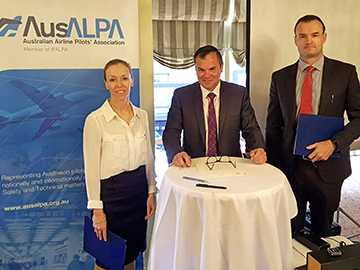
On Friday 17 November, the ATSB signed two new Memoranda of Understanding (MOU) with the Australian Federation of Air Pilots (AFAP) and the Australian and International Air Pilots Association (AIPA).
ATSB Chief Commissioner Greg Hood signed with AFAP President Captain Louise Pole and AIPA President First Officer Mark Sedgwick, respectively.
"The MOUs establish a framework that recognise our interests in working together to improve aviation safety," Mr Hood said. "The ATSB remains an independent body, but we recognise the value in ensuring we can tap into the highest levels of expertise to help us identify safety issues and get the message out there.”
Captain Pole acknowledged the initiative, saying "The ATSB plays an important leadership role as Australia’s national transport safety investigator. Our Safety and Technical Director Stuart Beveridge and Legal Counsel Joseph Wheeler along with myself and others at AFAP were delighted to have been involved in the drafting of this MoU. For 80 years the AFAP has been committed to improving aviation safety and we now look forward to the future opportunities that a more cooperative relationship will bring.”
First Officer Sedgwick for the AIPA said, “The AIPA has for some years had an MOU with the ATSB and we have strongly supported proposals to redevelop and expand an MOU between the ATSB and a wider range of industry participants. We remain committed to continuously improving aviation safety outcomes and our relationship with the ATSB is a vital component in achieving this. AIPA encourages all industry participants to work together to continually improve our already robust safety relationships. We congratulate Chief Commissioner Hood for taking this step and look forward to working with the ATSB."
The ATSB is signing a number of MOUs with industry associations to help with building relationships with organisations and people who share a common interest in improving transport safety. Industry associations can be great advocates for safety action where it is needed.
The ATSB’s annual review of aviation safety occurrences is now with online interactive functionality.
The ATSB has released its annual statistical review of Australian aviation safety occurrences.
The report, which includes an online interactive function, brings together information over ten years – from 2008 to 2017 – to provide insights into current and possible future trends in aviation safety, and takes a detailed look at the accidents and serious incidents in 2017 for each type of aircraft operation.
The new interactive format enables the aviation industry, policy makers and researchers to create data sets specific for their needs, with detailed information on occurrences, operation type, location, injury, and aircraft type, able to be customised by the user.
This new functionality will display the information as charts, tables and on an occurrence map as well as provide links to relevant investigations on the ATSB website.
In 2017, nearly 200 aircraft were involved in accidents in Australia, with 203 involved in a serious incident (an incident with a high probability of an accident).
Across the different operation types:
commercial operations experienced 14 fatalities from 21 accidents
general aviation experienced 21 fatalities from 93 accidents
recreational aviation had five fatalities from 53 accidents.
Sadly, 2017 saw an increase in the number of fatalities from aviation accidents, however – thankfully – there were no fatalities in either high or low-capacity regular public transport operations.
The interactive report underlines the importance of effective and timely reporting of all aviation safety occurrences to provide strong statistical bases for the study and analysis of aviation transport safety. The ATSB wishes to thank those in the aviation community, and the general public, who reported an aviation safety occurrences.
By providing a better way to compare aviation accident and occurrence data across a number different factors means everyone, not just the ATSB, can work to improve to aviation safety.
The report updates the known circumstances of the accident to date. The investigation is continuing.
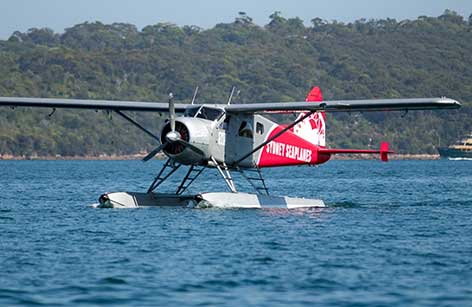
The Australian Transport Safety Bureau (ATSB) have released an interim report into the collision with water involving DHC-2 Beaver floatplane, VH-NOO, which occurred at Jerusalem Bay, adjacent to the Hawkesbury River, NSW, on 31 December 2017.
The interim report updates the known circumstances of the accident to date, including the aircraft’s flight path prior to the accident, environmental conditions, post-accident aircraft examination, maintenance history and pilot experience.
ATSB Executive Director, Transport Safety, Mr Nat Nagy, said it is important to note the ongoing nature of the investigation.
“It is important to note that the ATSB’s investigation into this tragic accident is ongoing, so we are constrained on the information we can release publicly at this time,” Mr Nagy said. “However, the interim report, which we released today, does provide a factual update on the investigation so far. The report does not include any findings or recommendations – these will be provided in a final report, which we do anticipate to be released in the first half of next year.”
After taking-off from Cottage Point, the aircraft climbed and turned right into Cowan Creek heading towards the main Hawkesbury River into the prevailing wind on a standard departure path. However, while over Little Shark Rock Point, the aircraft made a right turn, reversing its direction. The aircraft levelled out before flying on a straight path directly towards Jerusalem Bay with a tailwind. Shortly after, the aircraft entered Jerusalem Bay at an altitude below the surrounding terrain height.
As the aircraft approached Pinta Bay the aircraft was witnessed to make a steep right turn. During the turn, the aircraft’s nose suddenly dropped prior to colliding with the water in a near vertical position.
The interim report outlines the post-accident aircraft examination and aircraft maintenance history with no evidence of any pre-existing issues found.
“With no on board data available from the aircraft itself, transport safety investigators have been able to use witness statements and images retrieved from one of the passenger’s cameras, to determine what happened in the lead up to this accident,” Mr Nagy said. “The ATSB’s investigation is continuing and will now look at a number of factors surrounding the pilot’s health and medical history.
“We have engaged an aviation medical specialist to assist with reviewing the pilot’s medical records as well as the autopsy results, which the ATSB has recently received over the past month. That review is now underway, and we expect the results to appear from that over the coming months.”
Aviation human factors pioneer Dr Rob Lee AO officially inducted into the Australian Aviation Hall of Fame.
Aviation human factors pioneer Dr Rob Lee AO was officially inducted into the Australian Aviation Hall of Fame (AAHOF) during a ceremony in Wollongong on 24 November at the Historical Aircraft Restoration Society’s (HARS) museum at the Illawarra Regional Airport.
The late Dr Lee, who passed away on 27 April 2018, is one of the first non-pilots to be inducted into the AAHOF.
Australian Transport Safety Bureau (ATSB) Chief Commissioner Greg Hood said Dr Lee was a visionary, who made an enormous contribution to the safety of aviation and other industries such as the nuclear industry, both here and overseas.
“He was a pioneer in ensuring that human factors became a key part of international aviation and other safety investigations,” Mr Hood said. “Rob was advised of his induction before he passed away and was greatly humbled and honoured. His passing was an enormous loss to the world, however he leaves a vast legacy in integrated safety systems and human factors.”
Attended by the Deputy Prime Minister, the honourable Michael McCormack MP (pictured above), Dr Lee’s partner, Sue, and brother Barry (pictured below), the induction ceremony remembered the professional triumphs of Dr Lee over his 40 years of service to Australian civil and military aviation.
In 1970, Dr Lee graduated from the Australian National University with First Class Honours in Psychology, winning the Australian Psychological Society Prize. In 1974, he completed his PhD in Psychology at the University of St Andrews, Scotland. His research focused on human performance in complex systems, with particular reference to aircraft operations.
In 1976, Dr Lee was appointed Senior Psychologist, Operational Command, Royal Australian Air Force (RAAF). He became the first RAAF psychologist to serve as a human factors specialist on RAAF aircraft accident investigation teams. In 1983, Dr Lee joined the Bureau of Air Safety Investigation (BASI) as the Bureau’s first human factors specialist. He established and developed the Bureau’s capability in human factors, systems safety and research. Dr Lee became Director of BASI in 1989.
During his directorship, he transformed the Bureau from a purely reactive investigative agency to an innovative multi-skilled organisation that concentrated equally on proactive accident prevention and safety enhancement. As Director of BASI, he increased practical cooperation in air safety investigation in the Asia Pacific region by negotiating memoranda of understanding with Indonesia, Singapore and Taiwan.
In 1999, Dr Lee was appointed Director of Human Factors, Systems Safety and Communications of the new multi-modal ATSB.
Dr Lee’s expertise was in high demand across multiple national and international investigations, including the Gulf Air A320 accident at Bahrain in August 2000, the Singapore Airlines B747 accident at Taipei in October 2000, and the mid-air collision between a B757 and a TU154M over Ueberlingen, Germany, in 2002.
He served as a member of the International Society of Air Safety Investigators, the European Association for Aviation Psychology (EAAP), and the Australasian Society of Aerospace Medicine. He was also Vice-President of the Australian Aviation Psychology Association.
Dr Lee was recognised with many distinguished honours nationally and internationally during his career. In the 2012 Queen’s Birthday Honours, Dr Lee was made an Officer in the General Division of the Order of Australia (AO) for distinguished service to the aviation industry, to the development of air safety and accident investigation standards, and to national and international professional associations.
Retired Chief of Defence Force, Air Chief Marshal Mark Binskin AC, also paid tribute to Dr Lee’s legacy during the induction ceremony.
Chief Commissioner Hood said Dr Lee is remembered as being good humoured, having a positive manner and diplomacy.
“Dr Lee was a talented musician, as the lead guitarist of the band Mid-life Crisis,” Mr Hood said. “Every person in this room can settle more comfortably in their seats when flying because, indeed, the world is a safer place thanks to Dr Rob Lee.”
Dr Lee’s partner, Sue, and brother Barry pictured.
ATSB acknowledges International Civil Aviation Day to raise awareness of development in civil aviation.
Today (Friday 7 December) is International Civil Aviation Day, established by the United Nation’s International Civil Aviation Organisation (ICAO) in 1994 to raise awareness of the importance of international social and economic development in civil aviation.
This year, the day aims to highlight how ICAO’s ‘No Country Left Behind’ (NCLB) initiative encourages member states to assist developing countries so they too can enjoy the benefits of safe and reliable air transportation. NCLB is a broad strategic approach to encourage and assist all ICAO States to meet ICAO’s Standards and Recommended Practices (SARPs).
The Australian Transport Safety Bureau’s Chief Commissioner, Greg Hood, said the Bureau participates in the spirit of the initiative though its involvement in ICAO’s Asia Pacific Accident Investigation Group.
“The day also focuses attention on how ICAO and its member States, like Australia, can work together to encourage and provide assistance to developing countries and their air transport networks,” Mr Hood said. “Through participation in this group, the ATSB works with nations in the region to assist with the establishment and development of their own capability for the independent investigation of aviation accidents and incidents.”
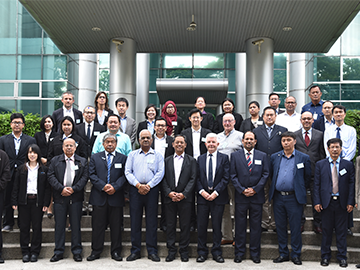
In October, the ATSB and the Indonesian National Transportation Safety Committee (NTSC) conducted a two-day investigation analysis workshop in Bangkok, Thailand, as part of the ICAO Asia Pacific Accident Investigation Group program.
“Participants from 15 nations including Bangladesh, Brunei Darussalam, Cambodia, Macau, India, Indonesia, Japan, Malaysia, Mongolia, Myanmar, New Zealand, Philippines, Korea, Singapore, and Thailand attended the workshop,” Mr Hood said. “Workshop participants received specialist instruction in investigation analysis methodology and completed a range of group exercises to apply the techniques they had learned.
“The success of the investigation analysis workshop clearly demonstrates how ICAO States in the Asia Pacific can work together to improve aviation safety in the region, for the benefit of all.”
The ATSB proudly sponsored the combined AAvPA and PACDEFF human factors and CRM symposium in Sydney.
The Australian Transport Safety Bureau (ATSB) proudly sponsored the combined Australian Aviation Psychological Association’s (AAvPA) and PACDEFF symposium – held in Sydney across 7-9 November – to help foster the exchange of information and the advancement of knowledge and skills in the fields of psychology, human factors and crew resource management (CRM).
As the premier human factors and CRM event in the region, the ATSB’s Chief Commissioner, Greg Hood, and several of the Bureau’s human factors specialists, presented at the symposium on this year’s theme ‘maximising human performance for future systems’.
Chief Commissioner Hood said human factors are a key part of every aviation safety investigation.
“Thanks to the work and dedication of pioneers like the late Dr Rob Lee AO, human factors continues to be a core component of every ATSB safety investigation in the aviation, rail and marine modes of transport,” Mr Hood said during his keynote address.
“Dr Lee was the first human factors specialist to be appointed at the then Bureau of Air Safety Investigation when he joined the organisation in 1983. Dr Lee helped establish and develop the Bureau’s capability in human factors, systems safety and research.”
The ATSB is a world leader in human factors training, with more than 40 courses held since 2000 to educate those who are in a position to influence safety. In October, the ATSB’s latest human factors course was attended by several transport safety investigators and operators from New Zealand, Taiwan, Korea, Hong Kong and Kenya.
“It is a well-known adage that you can’t change the human condition, but you can change the conditions in which humans work,” Mr Hood said.
“Looking at our strengths and limitations, and highlighting that with respect to an occurrence, helps us accurately learn what has happened, why it happened, and how to prevent it.”
The ATSB’s SafetyWatch list, which comprises the most pressing safety priorities identified from its investigation findings, features several human factors concerns, including fatigue, data input errors and in-flight decision making.
Preliminary report into the runaway and derailment of a freight train in Devonport, Tasmania released.
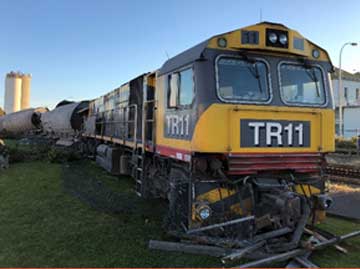
The ATSB has released its preliminary report into the runaway and derailment of a freight train in Devonport, Tasmania on 21 September 2018. The investigation is continuing.
Investigators have found that the train derailed after it rolled away from a loading facility at Railton following its non-response to a series of remote commands.
The ATSB has determined that during loading, the last two wagons of the TasRail freight train were misaligned with the concrete loading chutes. To realign the train, the driver selected reverse on the remote control.
The train was unresponsive. The driver tried multiple times to reset the remote control equipment locally. Shortly after the driver decided to walk to the lead locomotive to do a cold restart at the rear of the locomotive, the train began to roll slowly towards Devonport.
The train did not respond to remote emergency stop commands through the removal of power to the transmitter and gradually gained speed as it rolled away from the loading facility at Railton. The driver alerted TasRail Train Control and the train was routed to a dead-end siding at Devonport.
The train collided with a concrete footing and fence at the end of the siding. Two pedestrians received minor injuries from fence debris. The locomotive and eight wagons were significantly damaged.
Executive Director, Transport Safety Nay Nagy said ATSB investigators had interviewed a number of witnesses and collected relevant documentation about the train, the remote control system and the train network.
“Investigators will now look at the design, serviceability and management of the locomotive, wagons, remote control system and the interface between them at the time of the accident and overall systems compatibility.
“Recovery controls such as runaway protection, emergency response systems and the detection of unauthorised train access will also be examined,” Mr Nagy said.
The investigation is expected to be completed in the second half of next year.
The ATSB has recognised respected Australian aviation author and editor, Macarthur Job OAM.
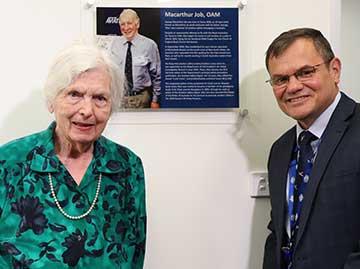
The Australian Transport Safety Bureau (ATSB) has recognised respected Australian aviation author and editor, Macarthur Job OAM, by dedicating its new media studio in his honour, having spent more than half a century promoting aviation safety.
Earlier this year, the ATSB developed an in-house capability to provide media outlets with video and audio content for inclusion in their news coverage on transport safety investigations. The studio, which is used to produce broadcast quality TV and radio material, is located within the Bureau’s central office in Canberra.
ATSB Chief Commissioner Greg Hood officially named the facility the Macarthur Job Studio during a ceremony on 30 October, attended by his widow, Esma Job, along with three of his five children.
“When it came to naming our studio, Mac’s name came to mind immediately,” Mr Hood said, shortly after unveiling a wall plaque that detailed Mr Job’s esteemed career.
“Mac was a pioneer of aviation safety messaging in Australia, editing the principal safety promotion publication of Department of Civil Aviation’s Air Safety Investigation Branch – the Aviation Safety Digest.”
“For 14 years, Mac edited and contributed to the Digest, known in aviation circles as the ‘crash comic’, and he later became a highly regarded author on aviation safety with his highly acclaimed Air Crash and Air Disaster book series.”
Mac, who passed away in August 2014 aged 88, was invited to become a member of the prestigious Guild of Air Pilots and Air Navigators in 1983, through his work as editor of the Aviation Safety Digest. He was also awarded the Medal of the Order of Australia for his services to promote aviation safety in the 2003 Queen's Birthday honours.
Chief Commissioner Hood said the recognition and preservation of our transport safety investigation heritage is very important for the ATSB.
“I am deeply honoured to be able to dedicate our studio in memory of Mac,” Mr Hood said.
“The legacy of his professionalism and skills in amplifying important safety messaging derived from accident investigations, will always be remembered by the ATSB.
“The Macarthur Job Studio is an important capability for the ATSB – we can provide the media with broadcast quality content to help ensure our safety messaging is seen and heard by those in the aviation, marine and rail industries, and the general public.”
In addition to the investigation report and still imagery, media outlets can now download video and audio content directly from the ATSB’s website for most of the high-profile complex investigations.
A number of journalists have provided the ATSB with some positive feedback on the new studio, saying that the readily available content saves valuable time during the production of news reports.