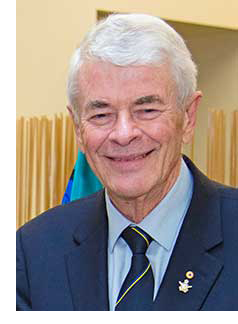
Outgoing Director of Defence Aviation and Air Force Safety awarded for his contribution to improving aviation safety.
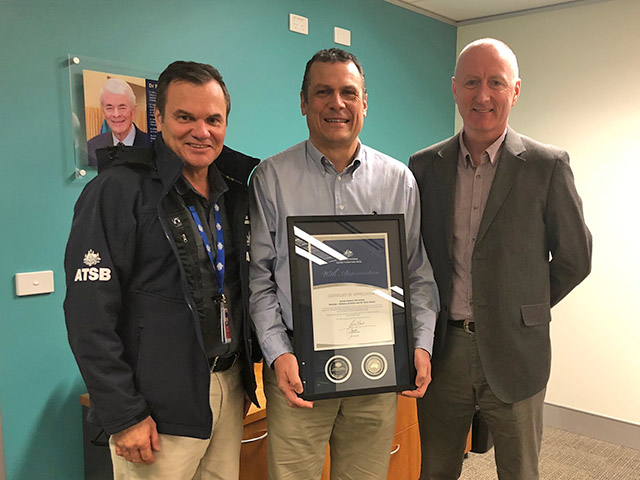
ATSB Chief Commissioner Greg Hood has awarded outgoing Director of Defence Aviation and Air Force Safety (DDAAFS), Group Captain John Grime, with a certificate of appreciation for his contribution to improving aviation safety within the Australian Defence Force.
The presentation ceremony, held at the ATSB's head office in Canberra on 21 June 2018, also afforded an opportunity for Mr Hood to meet the incoming DDAAFS, Group Captain Nigel Ward, who has been promoted from the rank of Wing Commander for the position.
“The ATSB recognises and thanks Group Captain Grime for his service since 2016, and I wish him well in his new role heading up 92 Wing at RAAF Base Edinburgh,” Mr Hood said. “There has been a close relationship between Defence Aviation and Air Force Safety (DAAFS) and the Bureau for many years, with an ongoing memorandum of understanding supporting our co-operation. I am looking forward to continuing this relationship and working closely with Group Captain Ward.”
Last year, the ATSB seconded a DAAFS investigator resource for six months, which offered both organisations an immeasurable learning opportunity. During his secondment, Lieutenant Commander Darryl Whitehead was afforded the opportunity to deploy to a number of accidents including to a fatal Robinson R22 helicopter accident in Cloncurry, Queensland and to a double fatal Diamond DA40 accident in Jimboomba, west of Brisbane.
“There are numerous subtle differences between the two agencies, however we are united in the common goal to improve transport safety,” Mr Hood said. “Underneath the different uniforms, we are essentially all cut from the same cloth. We are committed to investigating accidents and analysing occurrence data with the sole aim of preventing recurrence.”
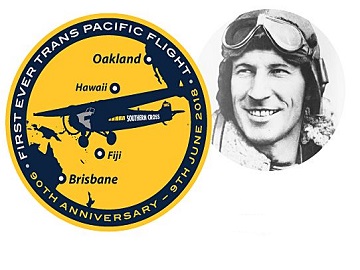
The ATSB has helped mark the 90th anniversary of the first trans-Pacific flight by the Southern Cross.
At 10.50am on Saturday 9 June 2018, ATSB Chief Commissioner, Greg Hood, along with more than 90 other passengers landed at Brisbane Airport on board a specially painted Alliance Airlines’ Fokker 100, VH-FGB.
Their touchdown was exactly 90 years to the minute when Fokker F.VIIb/3m, called Southern Cross, and its four crew completed the first trans-Pacific flight from the USA to Australia.
As the historic records show, Charles Kingsford-Smith, the pilot-in-command of the Southern Cross, along with his co-pilot Charles Ulm, navigator Captain Harry Lyon and radio operator James Warner, took off from Oakland, California at 8.53am on 31 May, 1928 bound for their first stop in Hawaii. The tri-motor Southern Cross landed at Honolulu at 9.49am on 2 June and departed the following day at 5.20am on its second leg bound for Suva, Fiji.
Airborne for a staggering 34 and half hours, the Southern Cross landed in Suva’s Albert Park at 2.21pm on 4 June after flying around 5,000 kilometres.
After three days on the island, the Southern Cross left Fiji on its last leg to Brisbane at 2.52pm on 8 June, some 2,400 kilometres to the east.
Around eight and a half days after leaving Oakland, including over 83 hours in the air and covering about 11,670 kilometres, the Southern Cross landed at Brisbane’s Eagle Farm Airport at 10.50am on 9 June 1928, where they were welcomed by over 15,000 people.
“I am greatly honoured to have been on board for this significant historical flight,” Mr Hood said. “Today, we also flew in a Fokker, in the comfort and with the safety that ‘Smithy’, Ulm, Lyon and Warner would only have dreamed of 90 years ago. Their feat of safely completing the first trans-Pacific flight, set the bar high for aviation safety in Australia.”
Alliance Airlines, now the largest operator of Fokker aircraft in the world, is based at Brisbane Airport, not far from where the Southern Cross touched down 90 years ago.
“I would like to thank Alliance Airlines’ Chairman Steve Padgett for inviting the ATSB to be a part of the celebrations to mark a significant event in Australian aviation’s history,” Mr Hood said. “The ATSB is keen to see important events and achievements in aviation and other modes of transport maintained and acknowledged. In fact, we are currently preparing a number of historical air accident items that we have in our possession to be displayed prominently in the reception area of our Canberra head office.”
The original Southern Cross is on display in a special memorial near Brisbane Airport’s international terminal.
Promoting safety at the Australian Helicopter Industry Association's biennial conference and exposition.
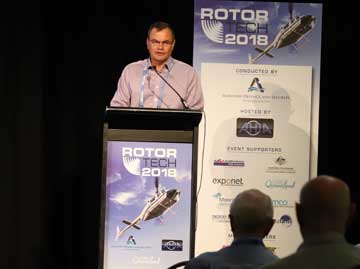
Promoting safety across the Australian helicopter industry, the ATSB has landed at Rotortech 2018 – the Australian Helicopter Industry Association's (AHIA) biennial conference and exposition.
Held at the Novotel Twin Waters on the Sunshine Coast across 24-26 May, Rotortech 2018 attracted more than 500 local and international delegates with interests in the helicopter industry.
ATSB Chief Commissioner, Mr Greg Hood, presented an overview of the Bureau and its role as the nation’s accident investigator to a large audience on day one of the three-day event. During his presentation, Mr Hood also discussed the trend in helicopter accidents in Australia over the past decade and provided an update on several active investigations.
"This was the first time the ATSB has spoken at a Rotortech in its current form," Mr Hood said. "I would like to thank Paul Tyrell, the Chief Executive Officer of the AHIA, for the invitation to engage with the association's members and visitors at Rotortech. I look forward to continuing to strengthen our relationship with the AHIA and its members, and for the ATSB to be involved in future Rotortech events.
"In the past decade, there has been 361 helicopter ‘accidents’ in Australia - that’s an average of about 36 accidents per year. As of last week, there's been seven helicopter accidents in 2018, two of which have been fatal. We are now approaching almost the halfway mark for the calendar year, and we're on track to recording a below average accident rate, which is a great sign."
A highlight of his presentation, Mr Hood jointly launched 'Don't push it, land it' , important safety messaging that encourages helicopter pilots to make a safe precautionary landing if they encounter an abnormal situation in flight.
"In conjunction with the AHIA and the Civil Aviation Safety Authority, I was pleased to launch ‘Don’t push it, land it’, which encourage pilots to use their helicopter’s unique ability to land almost anywhere if it’s not right in flight," Mr Hood said. "Whether they inadvertently fly into instrument meteorological conditions or if something concerns them with their aircraft, our message is clear, make a safe precautionary landing and sort it out on the ground.
"I would personally like to acknowledge and thank Dick Smith, who was the driver and advocate for the ‘Don’t push it, land it’ safety messaging. Over the coming months, the ATSB, CASA and the AHIA will continue to work together in an effort to reduce the rate of avoidable helicopter accidents."
Inside the exposition hall, the ATSB showcased the vital work of its transport safety investigators at its display stand alongside the promotion of 'don't push it, land it'.
A video message from ATSB Chief Commissioner Greg Hood...
A video message from ATSB Chief Commissioner Greg Hood who will again be sleeping without shelter on one of the longest nights of the year with leaders in business, community and government to help change the lives of Australians experiencing homelessness for this year's Vinnies CEO Sleepout.
The ATSB has completed the investigation into an operational non-compliance incident involving a GIE Avions De Transport Regional ATR72 at Cairns Airport.
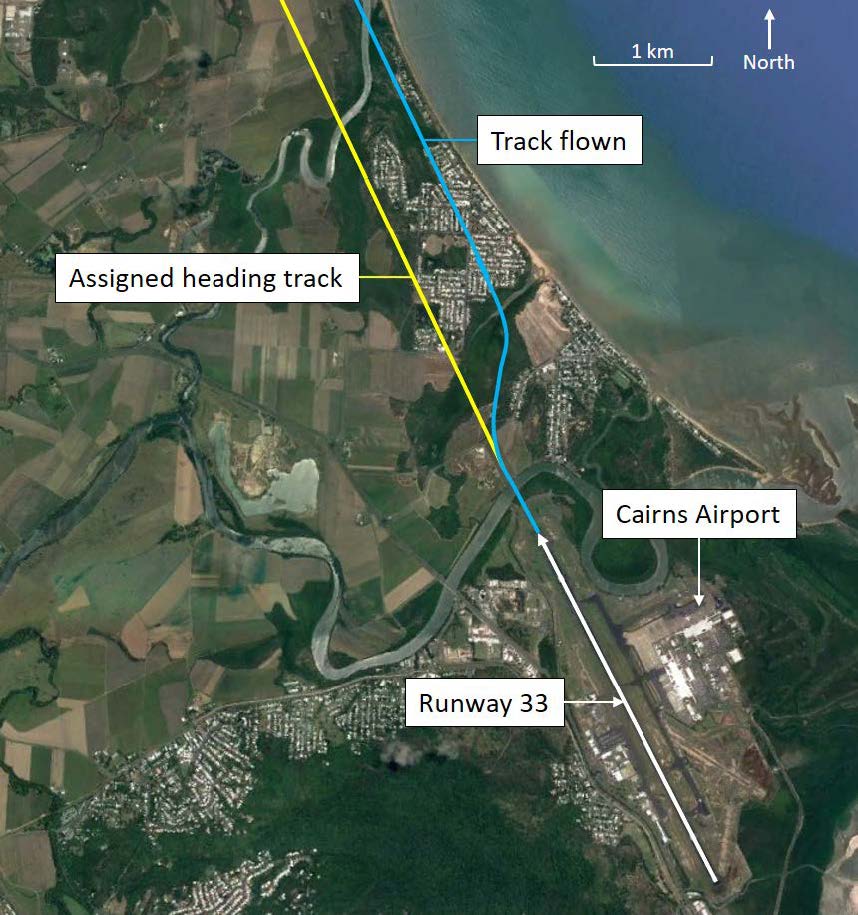
On 4 September 2017, PNG Air charter flight CG950 was cleared for departure from runway 33 with via the CAIRNS TWO standard instrument departure (SID). This SID included an assigned heading component. The captain had not previously used a SID with an assigned heading component for a departure and selected the lateral navigation mode of the flight management system (FMS) for their initial departure.
The aircraft was cleared for take-off with an assigned heading of 335°M. The captain selected the heading bug to 335. The take-off was conducted as normal and as the aircraft climbed through 500 ft, the FMS, in lateral navigation mode, directed a right turn past the assigned heading. As the aircraft turned to 335°M, the FMS continued to command a right turn. The captain followed the FMS and reached a heading of 013°M.
To use an FMS effectively, flight crews need to have a thorough understanding of the system and the effect of each input and selection.
Upon identifying the deviation, the flight crew and air traffic control took immediate action to return the aircraft to its assigned flight path. The flight continued without further incident.
ATSB Executive Director of Transport Safety, Mr Nat Nagy, said the incident was a reminder to flight crews to ensure they use their FMS effectively and to cross-check their flight instrumentation.
“To use an FMS effectively, flight crews need to have a thorough understanding of the system and the effect of each input and selection,” Mr Nagy said.
“Flight crews also need to continuously cross-check their flight instruments and remain aware of the overall flight situation.
“You can never assume that an FMS route or course will be free from error. Always remember to cross-check the instrument displays to ensure that all indications agree.”
A fatal helicopter accident has led to the ATSB issuing a safety advisory notice.
Examination of the helicopter operator’s records revealed the deceased pilot, who was recently employed by the operator, had not undertaken HUET for nine years. The helicopter operator normally required company pilots to complete a HUET course every three years.
HUET involves a replica of a helicopter cabin and fuselage being lowered into a swimming pool and rolled inverted to simulate a crash situation. During the training students practice bracing for impact, identifying primary and secondary exit points, escaping the helicopter and surfacing techniques. ATSB Executive Director, Transport Safety, Mr Nat Nagy said that frequent under water escape training is an important factor in increasing the survivability of an in-water accident.
All helicopter operators involved with overwater operations are encouraged to ensure their aircrews are regularly trained in helicopter underwater escape techniques.
“In light of our initial investigation, the ATSB has contacted all helicopter operators that are involved in overwater operations to deliver a safety advisory notice,” Mr Nagy said. “The ATSB strongly recommends that aircrew and regular passengers on these sorts of operations receive training in under water escape to increase survivability in the event of a ditching such as this one.”
It is our melancholy duty to advise that Dr Rob Lee AO, passed away peacefully on Friday morning 27 April 2018.
It is our melancholy duty to advise that Dr Rob Lee AO, a great leader and aviation safety visionary passed away peacefully on Friday morning 27 April 2018.
In 1970, Dr Lee graduated from the Australian National University with First Class Honours in Psychology, winning the Australian Psychological Society Prize. In 1974, he completed his PhD in Psychology at the University of St Andrews, Scotland. His research was concerned with human performance in complex systems, with particular reference to aircraft.
In 1976, Dr Lee was appointed Senior Psychologist, Operational Command, Royal Australian Air Force (RAAF). He became the first RAAF psychologist to serve as a human factors specialist on RAAF aircraft accident investigation teams.
In 1983, Dr Lee joined the Bureau of Air Safety Investigation (BASI) as the Bureau’s first human factors specialist. He established and developed the Bureau’s capability in human factors, systems safety and research. Dr Lee became Director of BASI in 1989.
During his directorship, he transformed the Bureau from a purely reactive investigative agency to an innovative multi-skilled organisation that concentrated equally on proactive accident prevention and safety enhancement. As Director of BASI, he negotiated the memoranda of understanding to increase practical cooperation in air safety investigation in the Asia Pacific region with Indonesia, Singapore and Taiwan.
In 1999, Dr Lee was appointed Director of Human Factors, Systems Safety and Communications of the new multi-modal Australian Transport Safety Bureau (ATSB).
In 2000, he expanded his influence internationally in human factors and systems safety in aviation and in other high technology industries. He was a human factors analyst on the investigations into the Gulf Air A320 accident at Bahrain in August 2000, the Singapore Airlines B747 accident at Taipei in October 2000, and the mid-air collision between a B757 and a TU154M over Ueberlingen, Germany, in 2002.
He was a member of the Expert Panel on Safety Management Systems appointed by the Special Commission of Inquiry into the Waterfall, NSW, rail accident in January 2003.
He was a member of the Advisory Board of the NSW Independent Transport Safety and Reliability Regulator, and has been a member of the Nuclear Safety Committee of the Australian Radiation Protection and Nuclear Safety Agency for fifteen years.
Dr Lee was a Group Captain in the RAAF Specialist Reserve, in the capacity of a consultant, and regular training course lecturer, on aviation psychology, human factors, systems safety and air safety investigation within the Australian Defence Force. He was an adviser to the Board of Inquiry into the Royal Australian Navy Sea King accident that occurred in Indonesia in April 2005, and was an expert witness on the Board of Inquiry into the fatal Army Black Hawk accident that occurred on HMAS Kanimbla, off Fiji, in November 2006.
He was a member of the International Society of Air Safety Investigators, the European Association for Aviation Psychology (EAAP), and the Australasian Society of Aerospace Medicine. He was also Vice-President of the Australian Aviation Psychology Association. He lectured at the Singapore Aviation Academy on integrated safety management systems, and on human factors, systems safety and risk management.
Dr Lee was co-author with Professor James Reason, Captain Dan Maurino of ICAO and Captain Neil Johnston of Aer Lingus of the book ‘Beyond Aviation Human Factors’, published in 1995. He was an associate editor of the international journal ‘Human Factors and Aerospace Safety’, published by Ashgate, UK.
In 2000, Dr Lee was awarded the Aviation Human Factors Achievement Award by the Australian Aviation Psychology Association.
Dr Lee was a Fellow of the Royal Aeronautical Society, and a Fellow of the Chartered Institute of Logistics and Transport. In 1989 he won the Henry Wigram Award of the New Zealand Division of the Royal Aeronautical Society.
In 2003, Dr Lee was awarded an International Prize by the Captain A. G. Vette Flight Safety Research Trust of New Zealand. The award read: “Your work in the RAAF and as Director with the Australian Bureau of Air Safety Investigation has set an excellent example”.
In 2010, Dr Lee was awarded the Australian Bi-Centennial Award by the Guild of Air Pilots and Air Navigators (GAPAN), “in recognition of an outstanding individual contribution to Australian Aviation”.
From April 2011 to March 2012 he served as Technical and Air Safety Director of the GAPAN.
In the 2012 Queen’s Birthday Honours, Dr Lee was made an Officer in the General Division of the Order of Australia (AO): “For distinguished service to the aviation industry, to the development of air safety and accident investigation standards, and to national and international professional associations”.
In September 2014, he was awarded the 2014 Award of the European Association for Aviation Psychology for “outstanding achievements in Aviation Psychology”.
In December 2017, the ATSB’s primary conference room was named the Rob Lee Room in recognition of his outstanding contribution to improving transport safety in Australia.
Whilst he will long be remembered for such a significant contribution to aviation safety, he will also be remembered for his warmth, his love for his partner Sue and his family, his infectious smile, his international diplomacy, and for his musicianship, as lead guitarist in the Canberra band “Mid-Life Crisis”.
ATSB Chief Commissioner has been recognised for his contribution to Australian aviation.
The A18 A/AA AIRSPACE Chairman's Award recognises leadership excellence and outstanding accomplishments, coupled with remarkable dedication and commitment to the industry.
Mr Hood said he was deeply humbled by the award, which was presented at the A18 AIRSPACE Awards Gala Dinner on Wednesday 18 April 2018.
“It has been a real privilege to be able to dedicate the majority of my working life to the continual improvement of the aviation industry. To receive this award is a great honour and I am very grateful to Aviation/Aerospace Australia.”
Mr Hood has more than 35 years of experience across a wide range of operational, training and management roles within the civil aviation industry.
It has been a real privilege to be able to dedicate the majority of my working life to the continual improvement of the aviation industry.
In his time as ATSB Chief Commissioner, Mr Hood has overseen a number of significant transport safety investigations and report releases across the three modes of aviation, rail and maritime.
Mr Hood began his career as an air traffic controller in the Royal Australian Air Force in 1980, serving at locations throughout Australia and in the Middle East. In 1990, he moved to the Civil Aviation Authority, a predecessor to what is now Airservices Australia to further his career as a civilian air traffic controller.
In 2002, Mr Hood was appointed to lead the management team in Melbourne, and then, in 2005, he led the team responsible for the provision of regional air traffic services, including the operation of regional control towers throughout Australia. He was also integrally involved in the implementation of major air traffic management and technology projects, such as the Australia Advanced Air Traffic System known as TAAATS, the evolution of safety management systems and the introduction of user-preferred routes and flex-tracks.
In 2007, Mr Hood joined the Civil Aviation Safety Authority (CASA), where he held the positions of Group General Manager Personnel, Licensing, Education and Training, then Executive Manager Operations.
He returned to Airservices during 2013 to take on the role of General Manager Demand and Capacity Management and was appointed as the Executive General Manager of the Air Traffic Control Group later the same year. In this position, he was responsible for the management of over 1,300 air traffic management staff, providing services for 11 per cent of the world’s total airspace for more than four million flights annually from 28 air traffic control towers and facilities.
Mr Hood is a Fellow of the Royal Aeronautical Society, a Freeman in the Honourable Company of Air Pilots and a Life Member of the Qantas Founders Museum. Until being appointed as ATSB’s Chief Commissioner, he was also a Board Member of Safeskies Australia and, internationally, Vice-Chair of the steering committee for the Civil Air Navigation Services Organisation’s Operations Standing Committee.
He is also a glider and powered aircraft pilot.
A/AA is a not-for-profit and independent association, with an overarching objective to contribute to the long-term health and sustainability of Australia’s aviation and aerospace sector.
Since its launch in 2010, A/AA has developed and delivered many important initiatives and programs to benefit the broader sector in Australia. In this time the organisation has built a national supporter base from industry and government, and has established a significant network of global relationships and formal partnerships.
ATSB Chief Commissioner will once again participate in the Vinnies CEO Sleepout.
The 2018 Canberra/Goulburn Vinnies CEO Sleepout was officially launched on Wednesday 18 April at the National Museum of Australia.
Money raised will provide people experiencing homelessness with vital access to food and accommodation, as well as education, counseling, employment and health services to help people overcome poverty in the long term.
Last year, participants raised $5.6 million nationally, which equates to 1,949,673 individual support programs, 689,819 beds and 1,590,554 meals.
Mr Hood was the highest fundraiser in the ACT and surrounds last year, raising more than $68,000.
Money raised will provide people experiencing homelessness with vital access to food and accommodation.
“It was my first year participating in the CEO Sleepout,” Mr Hood said. “I was shocked to learn that, even here, in the national capital, more than 1700 people face homelessness each day, including an estimated 289 children.
“I was humbled by the number of people – ranging from industry contacts to employees to personal friends – who rallied to help me exceed my fundraising target last year.”
Last year, Canberra CEOs slept out at the Museum of Australian Democracy at Old Parliament House.
“It was the coldest night of any participating location in the country,” Mr Hood said. “It certainly puts homelessness into perspective when you consider that we were all able to sleep in our warm beds the next night.”
This year Canberra/Goulburn participants will sleep at the National Museum of Australia on 21 June.
The ATSB is now producing briefs that describe safety occurrences.
Every year, the ATSB receives up to 17,000 notifications of safety incidents and accidents in the aviation, marine, and rail sectors. They range in significance, from a major accident with loss of life, to incidents with minimal or no damage.
The vast majority of the reported occurrences do not result in an investigation. Instead, information about the occurrences is retained in the ATSB’s databases, which provide a detailed overview of transport safety in Australia that is used for safety data recording, analysis and research.
The ATSB is now using this information to produce Occurrence Briefs – concise reports that detail the facts surrounding an occurrence as provided in the initial notification and from any follow-up information.
ATSB Chief Commissioner Greg Hood said Occurrence Briefs will provide additional opportunities to learn from the experiences of others.
“The Australian transport industry has a very good reporting culture,” Mr Hood said. “While the vast majority of the notifications submitted do not warrant a full ATSB investigation, many of them can still yield useful safety messages.
“These new Occurrence Briefs will allow for greater industry awareness of potential safety issues and possible safety actions.”