

Organisation structure
The Australian Transport Safety Bureau (ATSB) is Australia's national transport safety investigator
We influence transport safety improvements for the greatest public benefit through our independent no-blame investigations and fostering safety awareness.
Our aspirational vision is ‘Transport without accidents’.
An independent Commonwealth Government statutory agency established under the Transport Safety Investigation Act 2003 (TSI Act), the ATSB improves safety and public confidence in aviation, marine and rail transport.
We do this through:
Our sole focus is the prevention of future accidents and the improvement of transport safety.
In accordance with the TSI Act, the ATSB cannot apportion blame, assist in determining liability or, as a general rule, assist in court proceedings, and we are required to be independent, in the interests of avoiding conflicts of interest and external interference in our role.
We focus on improving transport safety for the greatest public benefit in aviation, rail and marine transport. In prioritising the public benefit, we consider:
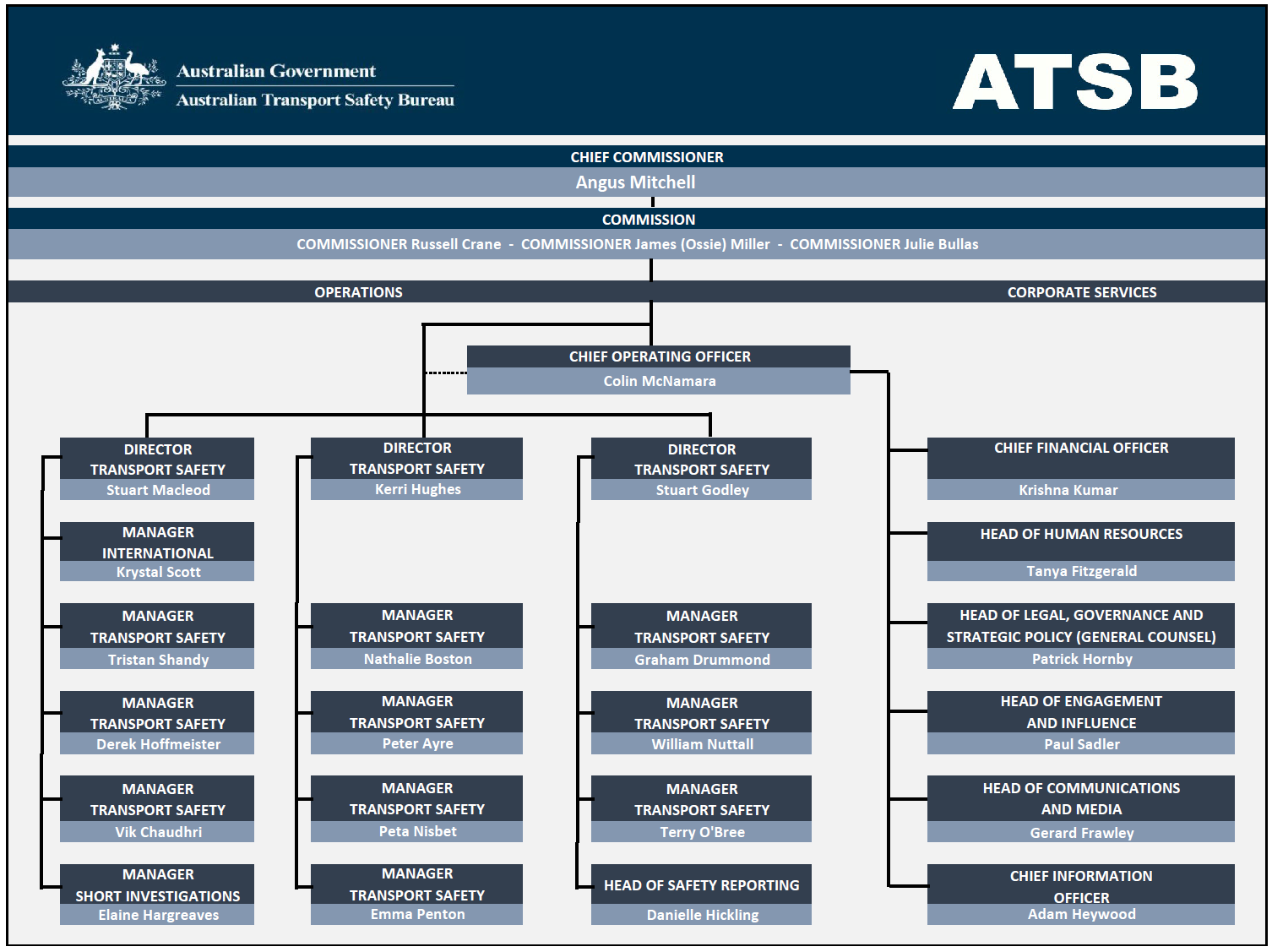
The ATSB is governed by a Commission and is part of the Australian Government’s Infrastructure, Transport, Regional Development, Communications, Sport and the Arts portfolio.
We have approximately 110 staff based in our Canberra head office and our field offices in Brisbane, Melbourne, Perth and Sydney. Our transport safety investigators and managers come from a range of transport industry, human factors and research backgrounds. Their investigation work is supported and enabled by our safety reporting, research, and corporate support functions.
The ATSB is responsible for investigating accidents and transport safety occurrences involving:
We also participate in overseas investigations involving Australian-registered aircraft and Australian-flagged ships, and provide support to our international counterpart investigation agencies, particularly our near neighbours.
We prioritise our investigations to focus on accidents and incidents that have the potential to deliver the greatest public benefit through improvements to transport safety. We focus on the public interest where the safety of passengers and crew on an aircraft, train or ship is concerned, and when it comes to the significant costs that can result from an accident, particularly where there is significant damage to public infrastructure or an impact on the national economy.
Through our independent investigations, we seek to identify safety issues for action by organisations with the responsibility for managing that safety risk. Safety actions taken by operators, industry and regulators in response to safety issues and safety recommendations arising from our investigations reduce the risk of future accidents and incidents.
Our independence from regulators and policy makers means we do not have powers to force operators, manufacturers or regulators to take safety action. Instead, we seek to influence safety action through engaging with our stakeholders, widely communicating our findings, and fostering awareness of safety issues and concerns.
Where we assess a safety issue has not been adequately addressed, we may issue a formal safety recommendation to the organisation with the responsibility for managing that risk.
ATSB investigations do not apportion blame or provide a means for determining liability, and we do not investigate for the purposes of taking administrative, regulatory or criminal action.
Our investigations are aimed at determining the factors which led to an accident or safety incident so that lessons can be learned and transport safety improved in the future. Our ability to conduct an investigation would be compromised if we sought to lay blame, as the future free flow of safety information could not be guaranteed.
As such disciplinary action and criminal or liability assessment are not part of an ATSB safety investigation and would, if necessary, be progressed through separate parallel processes by regulatory authorities or the police.
The no blame approach also supports cooperation with the investigation process, and the reporting of safety occurrences.
In addition to occurrence investigations, the ATSB also produces safety study investigations, safety data analysis reports, occurrence briefs, and safety education campaigns, and maintains a national information dataset of all safety-related occurrences in aviation.
The ATSB manages the REPCON confidential reporting scheme, which allows any person who has an aviation, rail or marine transport safety concern to report it to the ATSB confidentially. The scheme is designed to capture safety concerns — including unsafe practices, procedures and risk controls within an organisation or affected part of the industry.
The Australian Transport Safety Bureau (ATSB) has commenced a transport safety investigation into the collision with terrain of a Cessna A150 Aerobat two-seat light aircraft at Cedarton, approximately 38 km south-west of Sunshine Coast Airport, Queensland, on Wednesday.
The aircraft was hired for a private flight with two pilots on board, and was reported missing after failing to return to Sunshine Coast Airport on Wednesday afternoon. A subsequent search confirmed the aircraft had collided with terrain in bushland at Cedarton. The two pilots on board were fatally injured and the aircraft was destroyed.
A team of four transport safety investigators from the ATSB’s Brisbane office with expertise in aircraft operations, engineering and maintenance is deploying to the accident site on Thursday.
On site, investigators will examine the aircraft wreckage and site surrounds, and seek to recover any relevant components for detailed examination. The ATSB will also analyse available recorded data, review pilot and maintenance records, and interview witnesses and involved parties.
The ATSB asks anyone who may have seen the aircraft in any phase of its flight, or who may have CCTV or dashcam footage, to make contact via our witness form.
A report will be published at the conclusion of the investigation. However, should a critical safety issue be identified during the course of the investigation, the ATSB will immediately notify relevant parties so appropriate safety action can be taken.
No further information is available at this time.
Background: The ATSB is Australia’s national transport safety investigator. The ATSB conducts 'no blame' aviation, rail and marine transport safety investigations to help prevent the occurrence of similar future accidents, and does not investigate for the purpose of taking administrative, regulatory or criminal action. Details on the ATSB’s investigation process can be found here.
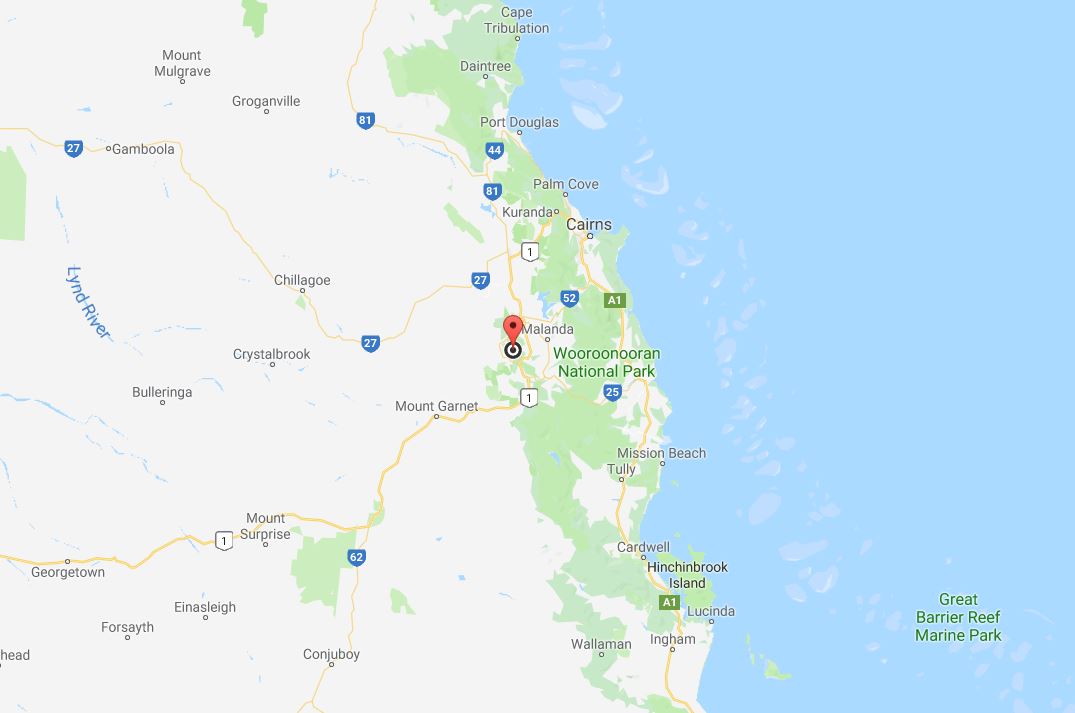
The ATSB has launched an investigation into an accident involving a Cessna 182 light aircraft which collided with terrain in the Herberton Range National Park, Queensland at about 10 am on 8 April.
The aircraft took off from Mount Garnet airfield sometime after 9 am, heading for Atherton aerodrome. Any witnesses that observed the aircraft are asked to call 1800 992 986 or complete the ATSB’s online witness form.
At this stage, the ATSB is liaising with Queensland Police to determine the accessibility of the accident site. The initial ATSB safety investigation will include examination of photographs of the wreckage and the assessment of aircraft and pilot records, weather information and any available recorded data.
The ATSB’s evidence collection will define the size and scope of the investigation and determine the expected timeframe for the completion of a final report.
A report will be published at the completion of the investigation. However, should a critical safety issue be identified during the course of the investigation, the ATSB will immediately notify relevant parties.
No further information is available at this time.
The Australian Transport Safety Bureau’s (ATSB) Executive Director, Transport Safety, Mr Nat Nagy will provide a briefing on the tragic fatal collision with water involving a single-engine seaplane which occurred at Cowan Creek, Hawkesbury River, NSW on Sunday 31 December 2017.
The briefing will outline known facts of the accident, the investigation team’s on-site activities and the investigation process.
Who: Mr Nat Nagy, Executive Director, Transport Safety, ATSB
What: Will read a short statement before taking questions from media
Where: Apple Tree Bay Picnic Area(Opens in a new tab/window), Apple Tree Bay Road, Ku-ring-gai Chase National Park, NSW*
When: 2pm, Tuesday 2 January 2018.
To assist with coordinating the media briefing and to ensure you are added to our database for future briefings and information please register your attendance by emailing: media@atsb.gov.au
*Enter Ku-ring-gai Chase National Park via Bobbin Head Road through North Turramurra, or Ku-ring-gai Chase Road, Mount Colah near Hornsby.
Please note that the entry fee for the National Park will be waived for media and a number of spots will be reserved in the car park.
The Australian Transport Safety Bureau (ATSB) has today released its final report into the reopened investigation of the 18 November 2009 accident involving Israel Aircraft Industries Westwind 1124A aircraft, VH-NGA, near Norfolk Island.
The flight, which was conducting an air ambulance flight, took off from Apia, Samoa, bound for Australia, via Norfolk Island for a fuel stop. On arrival at Norfolk Island, low cloud prevented the crew from making a safe landing. After four unsuccessful approaches, and with insufficient fuel to divert to another airport, the aircraft was ditched into waters 6.4 km west-south-west of the airport. All six occupants evacuated from the aircraft and were rescued by boat.
The ATSB formally reopened its investigation on 4 December 2014 following criticism of its original investigation by the aviation industry and was subject to an inquiry by the Australian Senate’s Rural and Regional Affairs and Transport References Committee.
Prior to commencing the reopened investigation, the ATSB requested the Transportation Safety Board of Canada (TSB) conduct an independent peer review of its investigation methodologies and processes. Its review, which included an examination of two previous aviation investigations along with the original investigation involving VH-NGA, stated that “The TSB Review compared the two organisations’ methodologies against the standards and recommended practices outlined in Annex 13 to the International Civil Aviation Organization (ICAO) Convention on International Civil Aviation, and found they met or exceeded the intent and spirit of those prescribed.”
However, the review also found deficiencies in how the ATSB’s methodologies were applied in the case of the Norfolk Island investigation and identified 14 recommendations for the ATSB to enhance the quality and the way in which it conducts future safety investigations.
Special measures were taken to ensure the reopened investigation remained distinct from the original and to avoid the possibility of any preconceptions or conflicts of interest. As part of those measures, it was conducted by investigators and overseen by managers who had not been involved in the original investigation. Additionally, the ATSB’s current Chief Commissioner, Greg Hood, was not involved in any part of the investigation, as he had been in a senior role at the aviation regulator, the Civil Aviation Safety Authority (CASA), at the time of the accident.
The new investigation team reviewed evidence obtained during the original investigation and acquired a substantial amount of additional information that was not obtained or available to the original investigation team. This new material included data from the aircraft’s recovered flight recorders and over 30 additional interviews with a range of people, including a number of other Westwind pilots from the operator, inspectors from CASA, as well as re-interviewing the flight crew and medical crew who were on board the aircraft.
The Commission review and approval process of the final investigation report was led by the ATSB’s aviation-experienced Commissioner, Chris Manning.
“This investigation report is one of the largest and most thorough safety investigations the ATSB has completed,” said Commissioner Manning. “The ATSB obtained sufficient evidence to establish findings across a number of lines of enquiry, including relating to individual actions, local contextual factors, the operator’s risk controls and regulatory matters.
The significantly large volume of additional evidence and the complex nature of the analysis of a number of the issues meant that the reopened investigation took longer than originally foreseen.
“The ATSB recognises the importance of being able to demonstrate that the reopened investigation addressed identified areas for improvement with the original investigation.” said Commissioner Manning. “A main focus of the reopened investigation was to address all of the relevant points raised by the Senate inquiry. We have also ensured the specific findings of the TSB’s review were fully taken into account in our final report.”
Commissioner Manning added the thoroughness and level of detail in the final report was substantially more than would normally be the case for a safety investigation of this nature. The final report found 36 safety factors, including 16 safety issues. This large number of safety issues and factors was due in part to the amount of information obtained by the reopened investigation and the depth to which it was analysed.
“The ATSB adopted this approach to address a wide range of matters raised by various parties regarding the original investigation report,” said Commissioner Manning. “The ATSB was mindful at all times that the people and organisations involved in this accident have been intently waiting for the results of the reopened investigation and acknowledges the time that it has taken to complete the final report.”
Commissioner Manning said the most fundamental lesson from this reopened investigation for the regulator, operators and flight crews is to recognise that unforecast weather can occur at any aerodrome and can be especially challenging at remote islands and isolated locations.
“Consequently, there is a need for robust and conservative fuel policies, planning and in-flight management procedures for passenger-carrying transport flights to these types of destinations” said Commissioner Manning.
The final investigation report, AO-2009-072 (reopened), ‘Fuel planning event, weather-related event and ditching involving Israel Aircraft Westwind 1124A aircraft, VH-NGA, 6.4 km WSW of Norfolk Island Airport on 18 November 2009’, has been published on the ATSB’s website.
Editor’s note: Broadcast video and audio grabs of Commissioner Manning are available to media outlets on request by emailing: media@atsb.gov.au
The Australian Transport Safety Bureau’s (ATSB) Executive Director, Transport Safety, Mr Nat Nagy will provide a briefing on the tragic double fatal accident of a Cessna 310 aircraft which occurred at Johns River, NSW on Saturday 28 October 2017.
The briefing will outline known facts of the accident, the investigation team’s on-site activities and the investigation process.
Who: Mr Nat Nagy, Executive Director, Transport Safety, ATSB
What: Will read a short statement before taking questions from media.
Where: Johns River Rest Stop(Opens in a new tab/window), Johns River Road (between Royan Street and Thomas Street), Johns River, NSW 2443*
When: 11.00am Tuesday 31 October 2017.
Please register your interest in attending by emailing: atsbinfo@atsb.gov.au
ATSB Senior Media Adviser
Paul Sadler
PH: 1800 020 616
* In the interest of safety, this location is deemed the most suitable and appropriate away from the accident site.
On 11 July 2017, a SOCATA TB-10 Tobago aircraft collided with an object at approximately 6.30pm during its final approach at Parafield Airport in South Australia.
The Australian Transport Safety Bureau (ATSB) commenced an investigation and swabs were taken of the damaged area on the leading edge of the right wing. Those swabs were tested for DNA by the Australian Museum, and the results have established that the object struck was a grey-headed flying fox.
This finding is consistent with the known behaviours of flying foxes, who can travel up to 50 kilometres from their roosts to feed at night.
As a result of this evidence, the ATSB is discontinuing its investigation, concluding the cause of the incident was wildlife strike.
Chief Commissioner Greg Hood said wildlife strike was the most common occurrence reported to the ATSB.
“Last year there was a total of 1954 incidents and accidents involving aircraft collisions with wildlife reported to the ATSB. Our research has found that bats and flying foxes, swallows and martins, kites, and lapwings and plovers are the most commonly struck type of flying animal.
“We will continue to provide information to pilots, aerodrome and airline operators, regulators, and other aviation industry participants on managing the risks associated with bird and animal strikes as part of our focus on improving transport safety.”
The Chief Commissioner also acknowledged the work of the Australian Centre for Wildlife Genomics within the Australian Museum in analysing the samples and delivering its final report to the ATSB.
Further information: AO-2017-073
ATSB Chief Commissioner Greg Hood and SA Police Superintendent James Blandford will provide an on-site media briefing at 11 am (ACST) Thursday, 1 June 2017, at the location of the Renmark aviation accident in South Australia.
Three people died when a Cessna Conquest 441 aircraft, registered VH-XMJ, collided with terrain at 4.30 pm on Tuesday 30 May 2017. The accident occurred about 4 km west of the Renmark airport.
The briefing will outline the known facts of the accident, the investigation team’s on-site activities and the investigation process.
ATSB investigation AO-2017-057
Who: ATSB Chief Commissioner Greg Hood
SA Police Superintendent James Blandford
Where: SA Police Forward Command Post — proceed along Sturt Highway, turn onto
Santos Road (dirt road), travel 5 km, turn left at the witches hat and
proceed to Forward Command Post
When: 11 am ACST, Thursday 1 June 2017
A new report released by the CSIRO today further confirms the most likely location of MH370 is in the new search area identified by the First Principles Review, conducted in November last year.

Dr David Griffin from the CSIRO said the new report features data and analysis from ocean testing of an actual Boeing 777 flaperon.
“Testing an actual flaperon has added an extra level of assurance to the findings from our earlier drift modelling work,” said Dr David Griffin.
“Earlier drift modelling was conducted using replicas of the flaperon found on La Reunion Island. Those replicas had been made of wood and steel, and were designed to float and behave like the original.”
The original MH370 flaperon found on La Reunion is still being examined by the French judiciary. The National Transportation Safety Board (NTSB) of the USA was able to assist in sourcing a genuine flaperon of the same model. This flaperon was cut down to match photographs of MH370’s flaperon, and then testing was done in the waters near Hobart.
“We wanted to see if the genuine flaperon drifted straight downwind like the replicas, or off at an angle, and at what speed through the water,” said Dr Griffin.
“We’ve found that an actual flaperon goes about 20 degrees to the left, and faster than the replicas, as we thought it might. The arrival of MH370’s flaperon at La Reunion in July 2015 now makes perfect sense.
“Knowing how the flaperon, and the other parts of MH370 that have been found, respond to wind and waves is just as important as knowing the currents of the Indian Ocean.
“We add both together in our model to simulate the drift across the ocean, then compare the results with observations of where debris was and wasn’t found, in order to deduce the location of the aircraft.”
The new report’s findings support the conclusions of the first report. It indicates that the most likely location of MH370 is in the new search area identified and recommended by the First Principles Review report, and most likely at the southern end of that, near 35 degrees South.
“We cannot be absolutely certain, but that is where all the evidence we have points us, and this new work leaves us more confident in our findings,” Dr Griffin Said.
The new report (CSIRO Report 2) and previous report (CSIRO Report 1), which CSIRO produced on behalf of the ATSB, are available on the ATSB’s website.