The Australian Transport Safety Bureau did not conduct an on scene investigation of this occurrence. The report presented below was derived from information supplied to the Bureau.
On 8 March 2004 at about 1550 Eastern Summer Time, a glider impacted the ground in Western Victoria. The pilot was fatally injured. Following the accident, the Victorian Coroner's office forwarded a global positioning system (GPS) navigation unit and a data logging unit from the glider to the Bureau for examination.
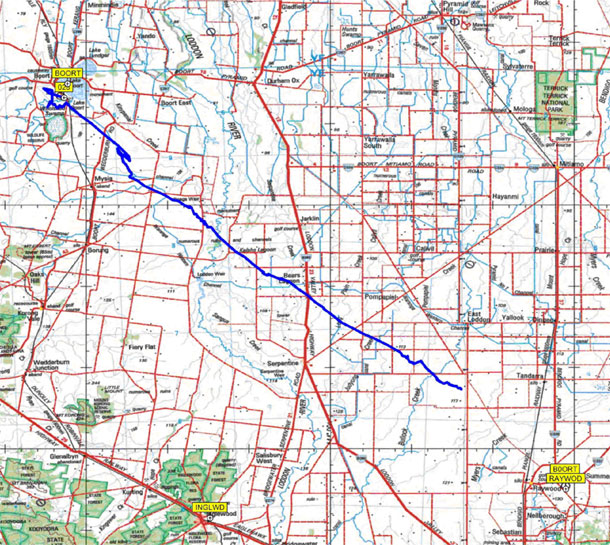
The GPS unit was able to be interrogated and data for the accident flight was downloaded (Fig 1). The data recovered from the GPS showed that the glider departed from Boort and appeared to be tracking towards Raywood. The track stopped at a position coincident with the reported accident site.
No altitude data was recorded by the GPS unit, therefore only the track of the glider was able to be displayed on a map.
The data logging unit sustained impact damage. The unit was connected to a computer with the applicable interrogation software installed. However, when an attempt was made to download the data, the unit returned an error signal, and no data was able to be downloaded.
The aircraft operator issued two safety briefs on the circumstances of the occurrence to flight crew.
An Airservices Australia (Airservices) investigation of the occurrence reported that there were adequate system safeguards, but that many had been breached. The Airservices' investigation made 19 recommendations. At the time of issue of this report, 10 of the recommendations had been actioned. The remaining nine were expected to be actioned by 30 June 2005.
The ATSB will monitor Airservices' action resulting from the investigation recommendations. Any resultant safety action will be published on the Bureau's website.
Analysis
The inadvertent slip by the approach controller was the final action of a number of lapses or omissions that led the pilots to believe that the ILS was available, despite previous advice. The level of situational awareness of the pilots, the fact that the approach was conducted in VMC and the provision of EGPWS warnings were factors that assisted in minimising the failure of other defences in the aviation system.
Summary
A Boeing 737-8BK (737), registered VH-VOB, was en route from Melbourne, Victoria to Adelaide, South Australia on descent from flight level 240 to 3,000 ft. The copilot was flying the aircraft under the supervision of the pilot in command. The pilots were aware of a current notice to airmen (NOTAM) advising that the instrument landing system (ILS) was radiating intermittently on test and was not to be used for navigation. The weather at Adelaide was visual meteorological conditions (VMC) and they intended to conduct a visual approach to land on runway 23. During the turn onto final, the pilots observed that the aircraft's flight instruments indicated that the ILS was operating and after the approach controller instructed them to make an ILS approach, they elected to continue with the autopilot selected. About 20 seconds after ILS glide path (GP) capture by the aircraft's flight management system, the aircraft commenced to descend rapidly and its enhanced ground proximity warning system (EGPWS) announced a SINK RATE caution. The pilot in command immediately assumed control of the aircraft and arrested the rate of descent. During that manoeuvre the EGPWS announced a PULL UP warning.
It is normal operator practice for pilots to fly a visual approach using the ILS if possible. The pilots reported that they were in VMC, at about 3,000 ft, after capturing the GP. The pilot in command reported that because they were visual and there were no terrain concerns he used minimal control inputs during the recovery from the descent. Information from the aircraft's flight data recorder indicated that the maximum rate of descent was 6,100 feet per minute and that it had descended to a radio altitude of 1,180 ft above ground level (2,000 ft above mean sea level) before resuming the approach profile.
Technicians were scheduled to work on the runway 23 ILS and there were three NOTAMs issued for the facility. The pilots had the first two NOTAMs issued on the runway 23 ILS but they did not receive the third NOTAM, as they were en route at the time of issue. The initial NOTAM, advising that the glide path was not available, that the pilots had used to brief themselves, remained current. A precondition for the conduct of work on the ILS was the requirement for VMC. An ILS consists of a number of elements including a GP, a localiser (LLZ) and distance markers. It is identified by a two letter code prefixed with the letter I that is included in the LLZ signal (IAD for runway 23 at Adelaide). Following a request for the LLZ to be made available for a training flight, the technicians released the LLZ for operational use while continuing pre-calibration testing of the GP. Consequently, the LLZ (with the ILS identification code) was serviceable while the GP was operating intermittently and not available for operational use.
The controllers in the Adelaide Air Traffic Control tower had previously included information that the LLZ and the GP were not available on the computerised automatic terminal information system (CATIS) that is used to broadcast operational information to pilots. When the LLZ was returned for operational use, they abbreviated the advice to `localiser available', due to system constraints on the amount of additional information that could be included. The information that the GP was not available was not included in the CATIS. The majority of the additional information consisted of advice of restrictions due to aerodrome works. The CATIS was normally broadcast on the non-directional navigation beacon (NDB) and a very high frequency (VHF) radio transmitter. However, at the time of the occurrence the VHF transmitter was not available and the information was only available on the NDB. Despite listening to that information, the pilots missed the fact that the localiser was available due to the poor quality of the received audio. Consequently, when the pilots reported on first contact with the approach controller that they had received the CATIS they were unaware that only the localiser was available.
The approach controller was on his fourth shift in the current shift cycle. After arriving at work, he self briefed and became aware of the ILS maintenance and the non-availability of the GP. A number of control positions were concentrated to a single position and the controller was not initially required to take an operational role. He undertook other duties before returning about 90 minutes later to open the approach east position. His normal practice was to include a text note on the radar display, near the final approach aid or path, of any pertinent operational information, including restrictions or airspace limits. However, on this occasion, following the handover from the approach west controller, he forgot to make a note for his display.
About 40 seconds before the aircraft captured the GP, the controller advised the pilots, `you should get visual shortly, but you're cleared for the 23 ILS approach'. The pilot in command acknowledged and read back that clearance. The controller later reported that at the time, the fact that the glide path was not available had slipped his mind and he reverted to his normal radio telephony phraseology for aircraft on final.
As a result of this investigation the Australian Transport Safety Bureau has issued the following recommendations:
Recommendation R20040084
The Australian Transport Safety Bureau recommends that Pratt & Whitney plc review the processes used by its Singapore based overhaul joint venture to accomplish VSV ring pin flaring and compliance with service bulletin PW4ENG 72-432, to ensure the processes are appropriate and in accordance with the service bulletin.
Recommendation R20040086
The Australian Transport Safety Bureau recommends that the Civil Aviation Authority of Singapore liaises with Pratt & Witney's Singapore based overhaul joint venture to review the process for accomplishing the ring pin flaring and compliance with the service bulletin PW4ENG72432 to ensure the processes are appropriate and in accordance with the service bulletin.
Recommendation R20040087
The Australian Transport Safety Bureau recommends that Pratt & Whitney plc review Pratt & Whitney PW4000 engine maintenance procedures for ensuring the integrity of high-pressure compressor variable stator vane synchronizing ring pins, to ensure that they adequately address and manage the potential for loss of vane arm pin retention.
Recommendation R20040088
The Australian Transport Safety Bureau recommends that the US Federal Aviation Administration review Pratt & Whitney PW4000 engine maintenance procedures for ensuring the integrity of high-pressure compressor variable stator vane synchronizing ring pins, to ensure that they adequately address and manage the potential for loss of vane arm pin retention.
Significant Factors
Most VSV arm pin retaining flare diameters recorded during the engine disassembly were less than the minimum dimensional limit specified in the engine manufacturer's manual.
Two 6th stage VSV arm pins were missing from the synchronizing ring at the 10 o'clock and 12 o'clock positions.
Four other vane arm pins were loose in the synchronizing ring.
The 6th stage HPC blade failed due to high cyclic stress of the blade in turbulent airflow created by off-schedule stator vane angle.
Maintenance actions in accordance with prescribed procedures for VSV arm pin flaring and a published service bulletin, specifically designed to address VSV synchronizing ring pin security via a tack weld process, failed to prevent pin loss.
Analysis
The documented history of both engines showed that all engine operating parameters matched and were within the expected normal ranges until the loss of thrust event for the right engine, which was observed by the crew and recorded on the Digital Flight Data Recorder.
The damage to the engine was consistent with the failure of a 6th stage HPC blade. This blade, when liberated from its platform, generated debris that caused the trailing edge ricochet damage evident in the 5th stage blades, then travelled downstream in the gas path creating a cascade effect of damage as it collided with other structures.
The absence of integrity in the VSV ring arm pins at the 10 o'clock and 12 o'clock attachment points, due to incorrect or inadequate pin flaring technique and subsequent tack weld breakage, probably allowed the vanes at those positions to move independently of the ring and remain at, or adopt, angles other than those commanded by the engine thrust management computer. This movement was most probably within a range equivalent to the slot machined in the unison ring for the vane arm.
Off-schedule VSV operation can cause higher than normal vibratory stresses in the HPC 6th stage rotor blades and subsequent fatigue fracture of the root attachment. A single vane arm disengaged from the unison ring at any circumferential location, from any of the four variable vane stages, can produce a severe, once per revolution, vibratory excitation within the HPC. These turbulent pulses in turn induced the cyclic stresses on the blades that ultimately led to the blade failure in this occurrence.
The processes of flaring the vane arm pins and then tack welding to provide retention of the pins appears, either to not have been accomplished appropriately by the contracted engine repair facility, or the processes themselves were unsuccessful in meeting their intended purpose. Both of these aspects should be reviewed and addressed by the manufacturer.
Summary
Sequence of events
On 28 February 2004, at 1248 western standard time (WST), the crew of a Boeing Company 767-33A, registered V8-RBG, departed Perth, Western Australia, for Brunei on a scheduled passenger flight. While on climb approaching 11,000 ft, the crew heard a loud bang and observed a high exhaust gas temperature (EGT) accompanied by loss of thrust from the right engine. The right EGT was then observed to be over limits1 at 662 C. The right thrust lever was then closed and all recall items were actioned. The crew declared a MAYDAY2 and Rescue and Fire Fighting Services were placed on local standby at Perth Airport. The crew then returned the aircraft to Perth where they conducted a single engine, overweight landing.
Engineers examined the engine and found that the high pressure (N2) section of the engine could not be rotated. There was also evidence of molten metal debris in the exit screens of the 2.95 bleed air valve and some metal spray in the exhaust duct.
The operator carried out an engine change and shipped the removed engine to its engine heavy maintenance contractor in Taiwan. The engine was then disassembled under the supervision of the Aviation Safety Council of Taiwan on behalf of the ATSB.
The ATSB analyzed the flight information from the aircraft's digital flight data recorder (DFDR) and found that the data was consistent with an in flight loss of engine thrust due to an engine failure. Prior to this failure, no anomalies were observed in the performance of the right engine and parameters for both engines were in close agreement.
Engine description
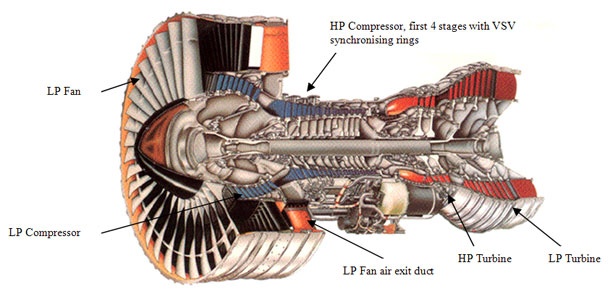
The Pratt & Whitney PW4000 is a third generation, high bypass ratio, commercial turbofan engine (see Figure 1). PW4000 engines have two spools with separate primary and fan duct exhaust systems. The engine has a compression ratio of approximately 30 to 1 and a fan-air to primary-air bypass ratio of approximately 5 to 1.
The low pressure spool (N1) consists of a single stage fan, four-stage low pressure compressor (LPC) and a four-stage low pressure turbine (LPT) on a common shaft.
The high pressure spool (N2) consists of eleven compressor stages driven by a two-stage turbine. The first four stages of the high pressure compressor (HPC) incorporate variable stator vanes (VSV), which are positioned automatically by the full authority digital electronic control.
It utilizes VSV and bleed valves to maintain acceptable stall3 margins throughout the operating envelope of the engine. The VSV are commanded via unison rings and vane arms to change their angle of attack and therefore the angle of attack of the inlet air relative to the compressor blades of the compressor stages at varying engine thrust settings.
The engines also employ Active Clearance Control, which controls the clearances between the turbine blade tips and the turbine case to improve operating efficiency in cruise flight.
Engine disassembly and inspection
Pratt & Whitney engine model PW4056, serial number P724374 was received into the heavy maintenance contractor facility under the supervision of the Aviation Safety Council of Taiwan. The low pressure fan was examined for bird strike damage, with no evidence of such an event found. Upon disassembly, extensive mechanical and thermal damage was noted throughout the engine downstream of the 6th stage compressor. This included severe debris induced airfoil damage to the high pressure compressor (HPC) stages 6 through 15. All 5th stage blades exhibited evidence of blade rubbing at the trailing edge tips, as well as numerous minor debris impact dents to the airfoil trailing edge. The 5th stage VSV also displayed evidence of debris damage to the trailing edges of some vanes. The 5th stage circumferential rub strip had minor abrasion damage; however the 6th and 7th stage rub strips were heavily damaged and were beyond repair limits. The HPC drum also displayed evidence of scraping damage to the knife-edge seals at the 10th and 11th stages.
A boroscope inspection (BSI) was then carried out to inspect the engine gas path. That inspection revealed coating loss and metal spray on the T1 (first stage) nozzle guide vane (NGV). Molten metal was also found blocking several BSI ports.
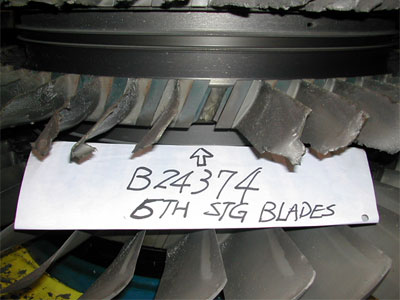
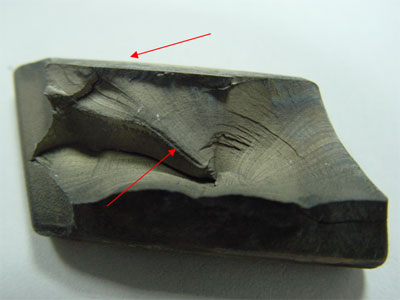
Associated with this was severe impact damage and molten metal spatter to the stator sections of the HPC, particularly the 5th through 14th rotor stages. With the HPC stator and case halves removed, the entire HPC blade rows were examined from front to rear. One HPC blade at the 6th stage was found to be fractured (see Figure 2). The blade attachment for this blade was observed to be intact and still retained within its dove tail slot in the disc. The broken blade attachment was removed and forwarded to a metallurgical laboratory for further analysis.
Figure 2: 6th stage HPC blade missing.
Further examination of the HPC turbine found burning and erosion of the leading-edge tips and also tip rubbing on the T1 turbine blades, and impact damage from debris to the T2 (second stage) NGV with cracking to the concave face of the airfoil. Molten metal spray was also evident between the diffuser case and outer combustion chamber.
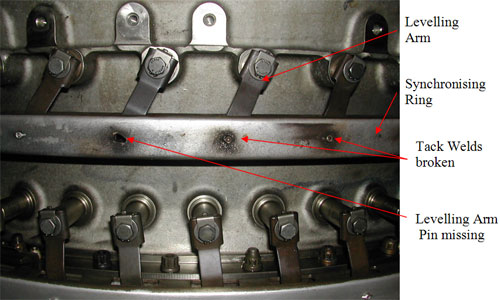
Of note during the engine inspection was the absence of arm attachment pins at the 10 o'clock and 12 o'clock positions for the (VSV) vane arms in the 6th compressor stage synchronizing ring. The remnants of tack-weld material were observed on the synchronizing ring at both locations where the pins were missing.
A pronounced looseness of the remaining four arm attachment pins between these two clock positions on the ring (see Figure 3) was also observed.
Figure 3: VSV synchronising ring and vane arms.
A levelling pin flare diameter check was carried out on the VSV ring assembly during the engine inspection and the measurements recorded for the investigation. It was found, with the exception of one pin, that all pin flare diameters were below the acceptable minimum limit stipulated in the engine manufacturer's table of limits. This flare diameter measurement check, also stipulated in the engine manufacturer's manual5, was to be accomplished prior to the tack welding of the pins to the unison ring. The overhaul facility informed the ATSB that there was no stipulation by the manufacturer to check pin flare diameter after the tack weld process had been completed.
Metallurgical examination of failed blade
The blade platform was examined using macro observation, photographic, fractographic and chemical composition techniques6.
There was evidence of galling to the attachment element faying surfaces of the blade platform. The surfaces were coated with an anti-galling compound during assembly and this compound appeared to have been degraded during the engine's service life. The blade exhibited two crack origin points; one on the pressure side of the airfoil section measuring 3 mm in height from the platform and the other on the opposite surface measuring 2 mm in height from the platform (see Figure 4).
The fracture sites also exhibited distinct beach marking and were typical of a fatigue type crack propagated under high cyclic stress. The striations present indicated that the cracks, which initiated from either side of the airfoil, were as a result of high alternating vibratory stress.
Figure 4: Crack origins (two places).
Engine history
The engine P724374 had completed 14,914 hours and 3,320 cycles since last overhaul at an approved facility in Singapore. During that shop visit, the VSV synchronizing ring vane arm pins were re-flared after pin replacement. The PW4000 engine family had a history of the pins working loose and allowing vanes to cause turbulent engine airflow when liberated from the synchronizing ring, which drove them. This turbulence was a result of the stator vane being allowed to move away from the scheduled vane angle commanded by the engine EEC. There were also instances recorded by the engine manufacturer of this off-schedule movement resulting in HPC compressor blade stress and in several instances, actual failure of the blade in an identical fashion to the failure observed in this investigation.
The engine manufacturer had published several service bulletins (SBs) requiring repetitive inspections in the interim until a more permanent solution could be applied. These SBs required the synchronizing ring rivet pins to be inspected at regular intervals. During the SB accomplishment process on the occurrence engine, all 23 vane arm pins were removed and replaced with new items.
Pratt & Whitney Service Bulletin PW4ENG 72-432 R3 then called up a tack weld of the pins to secure them in place on the synchronizing ring. This process was re-certified as completed on the occurrence engine after the pin replacement and completion of the flaring. The overhaul facility stated that the pin flaring was accomplished in accordance with the manufacturer's required tolerances. Compliance with this weld process was believed by the manufacturer to remedy the problem of pin wear and looseness, and be terminating action on the repetitive inspection requirements. However, the pins were lost even though they had undergone this tack weld process after their replacement (see Figure 5).
Figure 5: Broken tack weld remnants on synchronising ring.
1Type Certificate Data Sheet E24NE specifies a maximum continuous limit of 629o C. The FIM specifies the maximum operating temperature as 650 deg C. At 662 deg C, the temperature was 12 deg C above the maximum operating temperature for a period of 22 seconds. The temperature may have been greater due to EGT Probe blockage and Turbine Cooling Air restriction by molten titanium from the HPC meltdown. 2MAYDAY is the international broadcast for urgent assistance. 3Stall occurs in a turbine engine when the airflow around the compressor blades degenerates and becomes turbulent, destroying the smooth flow of air through the compressor. It may affect one stage or a group of stages. 4Cutaway source: Pratt & Whitney. 5Pratt & Whitney PW4000 (94"/100") CIR manual (PN 51A357). 6Chung Shan Institute of Science and Technology, Aeronautical Systems Research Division, Aero Materials Section, Taiwan R.O.C Report Number 930107.
At 1629 Eastern Daylight-saving Time on 19 February 2004, an Aero Commander 500-S (Shrike) aircraft, registered VH-LST (LST), commenced taxying at Hobart for a Visual Flight Rules (VFR) ferry flight to Devonport. The pilot, who was the sole occupant, reported a departure time of 1643 to air traffic control, with an intention to climb to 8,500 ft and to fly a track of 319 degrees magnetic.
Due to following traffic, the pilot was required to report leaving specific altitudes. At 1646, the pilot reported leaving 4,500 ft, and was advised that air traffic services were terminated. The acknowledgement of that call was the last communication heard from the pilot.
At about 1800, the operator’s staff at Devonport advised the Hobart base that the aircraft had not arrived. The operator advised AusSAR and the Hobart air traffic control tower, and organised company search aircraft from both Hobart and Devonport. The non-flying occupant of the Hobart search aircraft sighted the wreckage at about 1930 (see Figure1). Shortly after, a search and rescue helicopter arrived at the accident site. The pilot of the aircraft was found fatally injured in the wreckage.
Occurrence investigations commenced from 1 July 2003 are
initially categorised as category 4 unless agreed by the ATSB
Executive to be above this level at the outset. As detailed in
Section 21 (2) of the TSI Act 2003, the Executive Director in
empowered to discontinue an investigation at any time. Section 21
(3) of the TSI Act 2003 requires the Executive Director to publish
a statement setting out the reasons for discontinuing an
investigation (commenced from 1 July 2003) within 28 days of
discontinuing the investigation. To obtain a copy of the Brief
Print Public for Discontinued Investigations prior to 1 July
2003.
Occurrence summary
Investigation number
200400634
Occurrence date
24/02/2004
Location
Cairns, Aero.
Report release date
25/02/2004
Report status
Discontinued
Investigation type
Occurrence Investigation
Investigation status
Discontinued
Mode of transport
Aviation
Aviation occurrence category
Depart/app/land wrong runway
Occurrence class
Incident
Highest injury level
None
Aircraft details
Model
C172
Damage
Nil
Aircraft details
Manufacturer
De Havilland Canada/De Havilland Aircraft of Canada
On 10 November 2004, the engine manufacturer issued Service Information Letter Number (SIL) PT6A-053R3 (revision three) to SIL PT6A-053R2, to clarify that the utilisation of the EPL is for emergency use only, in accordance with the aircraft manufacturer's pilot operating handbook. SIL PT6A-053R3 removed any reference to conducting familiarization training with the EPL.
Civil Aviation Safety Authority
The Civil Aviation Safety Authority has advised the ATSB that, following the release of the Bureau's final report, they will issue a letter informing their field offices responsible for surveillance of evidence of operation of the EPL by pilots for in-flight training, and that the operation of the EPL in this manner is in conflict with the aircraft pilot's operating handbook.
RECOMMENDATIONS
The following recommendation was issued by the Australian Transport Safety Bureau on 24 May 2004:
Recommendation 20040058
The Australian Transport Safety Bureau recommends that the Civil Aviation Safety Authority assess the safety benefit of mandating Cessna Alert Bulletin CAB01-15 with regards to the Emergency Power Lever on all Approved Single Engine Turbine Powered Aeroplane Australian registered C208 aircraft.
CASA response
On 14 July 2004, CASA responded to the recommendation as follows:
CASA has assessed the safety benefit of mandating Cessna Alert Bulletin CAB01-15 and has agreed to issue an Airworthiness Directive (AD), which will mandate the Cessna Bulletin.
This recommendation remains on MONITOR status awaiting the issuing of the Airworthiness Directive.
Appendix A: Aircraft manufacturer emergency power lever information
The pilot's operating handbook (POH) included a CAUTION addressing use of the emergency power lever (EPL), which stated:
The emergency power lever and its associated manual override system is considered to be an emergency system and should be used only in the event of a fuel control unit malfunction. When attempting a normal start the pilot must ensure that the emergency power lever is in the NORMAL (full aft) position; otherwise, an overtemperature condition may result.
When using the fuel control manual override system, engine response may be more rapid than when using the power lever. Additional care is required during engine acceleration to avoid exceeding the engine limitations.
Inappropriate use of the emergency power lever may adversely affect engine operation and durability. Use of the emergency power lever during normal operation of the power lever may result in engine surges, or exceeding the ITT[T5], Ng, and torque limits.
The POH stated that a WARNING was an operating procedure, technique, or maintenance practice, which may result in personal injury or loss of life if not carefully followed. A CAUTION was an operating procedure, technique, or maintenance practice, which may result in damage to equipment if not carefully followed.
The aircraft manufacturer advised the ATSB that it 'did not recommend the operation of the EPL for training'.
Appendix B: Engine manufacturer emergency power lever information
In February 1998, the engine manufacturer issued Service Information Letter (SIL) Number PT6A-053R2 addressing the use of the emergency power lever (EPL) in C208 aircraft. Revision 2 (8 January 2004) of that SIL included a statement noting that the EPL was 'sensitive' in movement and should be operated as follows:
Slowly advance the EPL from the "NORMAL" position, to increase power. Slowly decrease the EPL position, to reduce engine power.
NOTE: There may be some lever travel, where the EPL movement results in no change in engine power. This condition is called "deadband" and is typically at least the first inch of travel past the opening detent, which is normal.
NOTE: In the existing installation, EPL sensitivity is further accentuated because maximum EPL travel is attained approximately two inches before the forward range of the slot on the pedestal.
The SIL also noted that:
The EPL should only be used to modulate engine power to allow the pilot to continue flight to the nearest airport should one of the following conditions occur:
Uncommanded engine power roll back and unable to recover with the Power Lever Assembly (PLA).
No response to PLA movement when starting from or around idle.
PLA becomes stuck at or around idle.
The EPL does not duplicate the function of the PLA and should not be used as an optional means of controlling the engine. It must be left in the "NORMAL" position during all normal engine operation.
P&WC would also like to re-emphasize that the system is intended "for emergency purposes only" as outlined in the applicable Cessna Pilot's Operating Handbook (POH) and should be used accordingly. The system can also be used for training purposes under supervision in order to maintain emergency practices proficiency.
NOTE: It is suggested that familiarization training with the EPL be conducted on the ground to ensure better control, less distraction, and close monitoring of the engine parameters for exceedances.
Appendix C: CASA requirements
CASA aircraft requirements
In August 2000, the Civil Aviation Safety Authority (CASA) issued Aircraft Airworthiness Circular (AAC) 1-116 entitled 'Approved Single Engine Turbine Powered Aeroplane' (ASETPA). AAC 1-116 and CAR 174A and 175B documented the requirements for the operation of single-engine turbine powered aircraft permitted to carry passengers for hire or reward under the Instrument Flight Rules (IFR) and at night under the Visual Flight Rules (VFR) subject to CASA approval. CYC was being operated under ASEPTA approval. Eligibility for ASETPA operations approval included a requirement for the aircraft to demonstrate several design standards, increased engine reliability rates, increased maintenance scrutiny and to be equipped with additional equipment including Engine Condition Trend Monitoring (ECTM).
Also included in the criteria was a requirement for the engine ignition system to be:
An automatically activated engine ignition system which activates in the event of a loss of an engine parameter such as engine speed, turbine temperature or engine torque, or
An ignition system which can be selected `ON' and had a duty cycle greater than one hour.
The engine did not have an automatically activated engine ignition system, but it had a duty cycle greater than one hour.
CASA engine requirements
The engine was being maintained in accordance with the requirements of CASA Airworthiness Directive AD/ENG/5 Turbine Engine Continuing Airworthiness Requirements, Amendment 8, effective 11 June 2003. Appendix A, item 2 of this directive included a requirement for the use of a ECTM program. The operator had complied with the requirements of item 2, by utilising the engine manufacturer's ECTM system. The operator had complied with the requirements of the AD/ ENG/5 by having the ECTM data analysed by authorised personnel within the organisation. Appendix A item 8 of this directive also included a requirement for an inspection of the first-stage compressor to be carried out at intervals not to exceed 220 hours time in service.
Appendix D: Engine trend data
The Australian Transport Safety Bureau (ATSB) and the engine manufacturer's representatives conducted a review of the trend data for a period of approximately 18 months prior to the occurrence. That review indicated that both the fuel flow and the engine Ng had been above baseline values (increased) for the majority of the last 3 months of the data. However, engine T5 had been at, or below (decreased), baseline values during the same time frame. According to the data, this T5 downward trend began on 16 April 2003, 9 months prior to the occurrence.
The engine manufacturer provided a detailed description of it's ECTM system in the company publication ECTM User's Guide & Reference Manual (7th edition, September 2001). The manual noted that erosion of the axial compressor normally increased engine parameters for corresponding power settings (eg the compressor was less efficient and power output decreased, therefore the power lever angle must be increased). The manual noted that this change would be progressive as the erosion resulted over a prolonged period. The aircraft ECTM data indicated that the engine Ng baseline was 0.7 percent. The charted values for the 3 month period varied from 0.7 to 2.0 percent (excluding peaks). Referencing delta Ng, the manual stated:
Net change of .75 to 1.0 %: Should be investigated when convenient.
Net change of 1.5 to 2%: Action should be taken as soon as possible.
The engine manufacturer's maintenance manual included a note that stated:
Compressor deterioration (which increases Ng) and hot section normal deterioration (which reduces Ng) may balance each other and the effect deterioration has on Ng will be very small or zero (i.e. Ng will remain constant).
It further noted on the ECTM Shift Fault Isolation Chart that, with all engine parameters increasing, the probable anomaly could be compressor erosion.
1Gas temperatures (T) are measured at various points throughout the engine and are numbered by convention to identify their location within the engine. Examples are inlet air temperature (T1), compressor discharge temperature (T3), and inter turbine temperature (T5).
Significant Factors
The pilots of CYC were conducting in-flight familiarization training using the emergency power lever. That procedure was not contained in the aircraft manufacturer's pilot operating handbook.
The engine manufacturer's documentation contained information on the use of the emergency power lever, which did not preclude the use of the emergency power lever for in-flight familiarization training.
The engine sustained a flameout at an altitude above mean sea level from which reignition of the engine was not successfully completed.
Erosion of the first-stage compressor blades would have reduced the aerodynamic efficiency of the compressor blades.
Analysis
The pilots of CYC were conducting in-flight simulated engine failure training, which involved activation of the emergency power lever (EPL). The engine ignition switch was not in the ON position during the initial operation of the EPL during this training. The pilot's operating handbook (POH) contained a requirement to place the engine ignition switch in the ON position during an actual malfunction of the fuel control unit (FCU). However, because the aircraft manufacturer only included requirements for an actual FCU malfunction, the POH did not address the engine control settings for training of this type.
The POH contained a caution which stated that the use of the EPL was for emergency purposed only, and did not mention the use of the EPL for in-flight or ground familiarization training. The engine manufacturer's Service Information Letter (SIL) noted the use of the EPL for familiarization training, while suggesting that this training be completed on the ground. The discrepancy between these two documents may have led to the flight crew's belief that the use of the EPL for familiarization training in-flight was acceptable.
Disassembly and inspection of the engine and fuel control unit did not identify any anomaly of the engine that could have resulted in the in-flight shutdown (flameout). However, the erosion of the first-stage compressor blades to the engine manufacturer's maximum service limits would have reduced the aerodynamic efficiency of the compressor blades. This may have affected the optimum compression ratio of the compressor section and resulted in decreased airflow through the engine.
According to the pilots, the engine power setting was low (reported at 55% Ng) at the time fuel was manually introduced using the EPL. If the airflow through the engine had been affected by the first-stage compressor erosion, the engine would have had a further reduced airflow rate for that given power setting and excessive fuel may have been introduced.
Analysis of the Engine Condition Trend Monitoring (ECTM) information, which indicated higher parameters for engine fuel flow, T5, and engine gas generator speed (Ng), should have alerted maintenance personnel to the erosion of the compressor. The inspection of the compressor completed 42.4 airframe hours before the incident should have noted and recorded the erosion of the first-stage compressor blades. Additionally, the ECTM information indicated increases in fuel flow and Ng, with marginal decreases in T5 temperatures. The decrease in T5 temperatures below the baseline values was believed to be related to the insulation anomaly of the two thermocouple probes.
Summary
A Cessna C208 aircraft, registered VH-CYC (CYC), with two pilots on board, was being operated for pilot type endorsement training. Air Traffic Control (ATC) had cleared the pilots to conduct upper level air work between 4,000 and 5,000 ft above mean sea level (AMSL) within a 5 NM radius of Green Island, Queensland. Following the upper level air work, the crew requested, and were granted a clearance for, a simulated engine failure and descent to 2,000 ft.
The pilot in command (PIC) reported that while completing the simulated engine failure training, he had retarded the power lever to the FLIGHT IDLE stop and the fuel condition lever to the LOW IDLE range, setting a value of 55% engine gas generator speed (Ng). The pilot under training then set the glide attitude at the best glide speed (for the operating weight) of about 79 knots indicated airspeed (KIAS). The PIC then instructed the pilot under training to place the propeller into the feathered position, and maintain best glide speed. The PIC reported that he instructed the pilot under training to advance the emergency power lever (EPL) to simulate manual introduction of fuel to the engine.
According to the PIC, he then noticed that there was no engine torque increase, with the engine inter-turbine temperature (ITT or T5) and Ng rapidly decreasing, and a strong smell of fuel in the cockpit. While the pilot under training flew the aircraft, the PIC placed the ignition switch to the ON position and also selected START on the engine starter switch. He then reportedly placed the EPL to the CLOSED position, the propeller to the UNFEATHERED position and the fuel condition lever to the IDLE CUTOFF position to clear the excess fuel from the engine. The PIC reported that they then increased the aircraft airspeed to 120 KIAS, at which point he reintroduced fuel into the engine by advancing the fuel condition lever. He reported that following these actions, the strong fuel smell persisted.
As the aircraft approached 1,500 ft, the PIC broadcast a MAYDAY, informing ATC that they had a 'flameout' of the engine and that they were going to complete a forced landing water ditching near Green Island. While the pilot under training flew the aircraft, the PIC placed the propeller into the feathered position, closed the fuel condition lever to the IDLE CUTOFF position and turned off the starter and ignition switches. They then completed a successful landing in a depth of about 2 m of water near Green Island. The pilots evacuated the aircraft without injury.
The aircraft, which sustained minor damage during the ditching, but subsequent substantial damage due to saltwater immersion, was recovered to the mainland. Following examination of all connections and control linkages, the engine was removed for examination under the supervision of the Australian Transport Safety Bureau (ATSB) at the engine manufacturer's overhaul facility. The engine trend monitoring (ETM) data logger was also removed from the aircraft for examination.
Engine information
Manufacturer:
Pratt & Whitney (Canada)
Model:
PT6A-114
Serial number:
17099
Time since new:
8,473.9 hours
Cycles since new:
15,924 cycles
Time since overhaul:
4,713.4 hours
The general condition of the engine was good except for exfoliation corrosion of the magnesium and aluminium alloy components as a result of salt-water immersion. The first-stage axial compressor blades displayed significant erosion of the blade leading edges at the blade root portion of the airfoil. The erosion of the blades measured a maximum of .250 inch (.635 cm). According to the engine manufacturer's maintenance manual, the erosion limits of the compressor blade at the root was .250 inch without repair. The eight engine thermocouple probes were also examined. Testing of the probes indicated that they all passed the heat response test, but two probes did not pass the insulation test. The engine igniters operated satisfactorily when tested.
The engine fuel control unit (FCU) was removed to another facility for disassembly and examination under ATSB supervision. The examination of the FCU revealed no evidence of any internal component failure or anomaly, which would have prevented normal operation prior to salt-water immersion.
Engine temperature indicating system
The engine temperature indicating system consisted of a bus-bar assembly, eight individual thermocouple probes connected in parallel, a wiring harness incorporating a terminal block and an adjustable trim harness incorporating a T1 thermocouple probe.1 The T1 thermocouple probe was connected in parallel with the T5 wiring harness to bias the T5 signal and give the system a reference point. The engine manufacturer's maintenance manual included a note in the Engine Condition Trend Monitoring (ECTM) Shift Fault Isolation Chart stating that the T5 indication usually decreased when the thermocouple probes were unserviceable. The chart also noted that:
If several probes are broken or damaged, the loop resistance would not necessarily fall outside the allowable tolerance. However, erroneous temperature indications could occur due to reduced sampling.
An anomaly with the insulation of the thermocouple probes would typically manifest itself in abnormally low temperature readings.
Engine trend monitoring data logger
The ETM data logger recorded Ng, bus voltage, engine torque, T5, engine shaft horsepower (SHP), fuel consumption, airframe hours, engine total cycles, starts and duration and system exceedances. This information was electronically stored on a removable data key. Information stored on the data key could then be downloaded into a computer. The pilot reported that the data key was installed into the ETM display unit at the commencement of flight. However, after the aircraft was recovered, the data key was not found.
After preservation, the ETM data logger was shipped to the manufacturer for downloading. The manufacturer successfully recovered nineteen exceedances covering a period from 1 January 2003 to 3 February 2004. The majority of those logged were exceedances of propeller RPM and engine SHP.
Engine emergency power lever
The EPL, which was connected through linkages to the manual over-ride lever on the FCU, governed the fuel supply to the engine should a pneumatic section malfunction occur in the FCU. The EPL permitted the pilot to restore engine power by activating the lever to manually introduce fuel to the engine.
The aircraft manufacturer's Service Kit, SK208-142, provided for the installation of mechanical devices allowing for the installation of copper witness wire to the EPL. If the EPL was been moved from the NORMAL position, the copper witness wire would fracture and provide a physical indication that it had been activated. The installation of SK208-142 was not mandatory for Australian registered aircraft. However, the requirements of SK208-142 had been complied with on the aircraft.
Cessna Alert Bulletin, CAB01-15, included a requirement to ensure the fitment of the copper witness wire to the EPL of all aircraft that had SK208-142 installed. Compliance with the requirements of CAB01-15 was not mandated for Australian or United States (US) registered aircraft. According to the flight crew, no copper witness wire was installed on the aircraft at the time of the occurrence.
The aircraft maintenance manual stated that if the EPL witness wire was broken or missing, a determination was to be made as required by the engine maintenance manual, to assess if the engine limitations had been exceeded.
The aircraft manufacturer's information on the operation of the EPL stated that the use of the EPL was for emergency purposes only, and contained cautions about the use of the EPL for any other purposes. Further information about the aircraft manufacturer's use of the EPL is contained in appendix A.
The engine manufacturer's Service Information Letter (SIL) Number PT6A-053R2 addressed the use of the EPL. Although it also stated that the EPL was for emergency purposes only, it mentioned the use of the EPL for training purposes under supervision to maintain emergency practices proficiency. It included a note which suggested that familiarization training using the EPL be conducted on the ground. Further information on the operation of the EPL is contained in appendix B.
The pilot reported that, based on the reference to familiarization training in the SIL, he considered that the use of the EPL for in-flight familiarization training was acceptable.
Civil Aviation Regulation 1988, Part 50E addressed inconsistent requirements relating to aircraft operation and maintenance. Part 50E noted that by order of priority, the aircraft manufacturer's requirements superseded the requirements of an aircraft component manufacturer such as an engine manufacturer.
Recent engine maintenance
Date
Engine hours since new
Maintenance
22 January 2002
7,243.2
Remove and replace two thermocouples, hot section inspection, compressor turbine disc and FCU replaced.
9 July 2002
7,704.1
T5 busbar and thermocouples replaced.
25 November 2002
8,110.9
Compressor turbine disc inspected and reinstalled.
18 November 2003
8,431.5
Inspection in accordance with AD/ENG/5 (compressor first-stage)
28 January 2004
8,482.0
Hot section inspection (extension from 1,250 to 1,760 hours)
There were no engine logbook entries concerning engine compressor erosion. Engine compressor washes had been completed on a periodic basis as required. Civil Aviation Safety Authority requirements for the aircraft are contained in appendix C of this report. Engine trend data for the aircraft's engine are contained in appendix D.
In February 2005, the Robinson Helicopter Company advised the Australian Transport Safety Bureau that it had modified the R22 helicopter type seat structure design to strengthen the seatbelt anchor points for both seats.
Analysis
The circumstances of the accident are consistent with a loss of control due to insufficient main rotor RPM being maintained, and incompatible control inputs from the instructor and the student following the initiation of the simulated engine failure by the instructor. The reported actions by the instructor indicate that he was attempting to recover the situation and allowing the student to follow him through on the controls. The student also recalled attempting to manipulate the helicopter's controls during the descent. It was unlikely that the instructor could have maintained effective control of the helicopter with both pilots manipulating the controls. Procedures for clarifying who is in control at all times, should be established and followed.
The helicopter manufacturer warned that to recover lost main rotor RPM, the pilot must immediately roll on throttle and lower the collective simultaneously. Both pilots reported that they could not lower the collective to the full down position. The activation of the low rotor RPM warning horn during most of the descent confirms that the collective was seldom in the full down position. The instructor reported attempting to increase the throttle position, but it felt like the student had frozen on the throttle. There were no defects found in the examination of the helicopter that would have explained why the collective was not able to be lowered to the full down position or the throttle increased. The manufacturer cautions that once the main rotor RPM decreases below 80%, pilots may not be able to recover control even if the flight controls are correctly positioned. Both pilots recalled seeing the rotor RPM needle in the vicinity of 80% during the descent. The student's recollection suggested that the rotor RPM may have reduced to below 80%.
The investigation was unable to resolve the differences between the statements by the instructor and the student with reference to the way in which the throttle was reduced.
The seat structures are designed to deform during a high G vertical impact, reducing the load transmitted to the seat occupant and increasing survivability. However, in deforming, the seat structure loses significant strength. In this case, the seat structure lost sufficient strength to allow the left anchor point of the left seat lap belt to tear free, increasing the risk of injury to the seat occupant.
Summary
An instructor and student were conducting a training flight from Caloundra aerodrome in a Robinson Helicopter Company Model R22 (R22) helicopter, registered VH-HBI. The weather was fine with a light north-west wind.
The instructor reported that shortly after the helicopter reached the intended initial cruising altitude of 1000 ft, and over a suitable area that was clear of other traffic, he reduced the throttle setting to idle to simulate an engine failure. The instructor said the purpose of the exercise was to test the student's alertness and ability to enter and maintain a stabilised autorotation. He intended to terminate the practice engine failure by introducing engine power at about 500 ft. During interview, the instructor said that he rolled the throttle off quickly but gradually. In a subsequent letter, he advised that he slowly reduced the throttle setting to idle. The instructor advised that he did not announce the simulated failure to the student, and that he had previously initiated 'unannounced' engine failure exercises to the student as part of the student's training.
The instructor reported that the student correctly applied right anti-torque pedal and pulled the cyclic control rearwards, but did not lower the collective lever. He also reported that the low rotor RPM warning horn came on within a few seconds and the airspeed reduced rapidly to between 30 and 40 kts. The instructor said that the helicopter then started shuddering and he lowered the collective as far as it would go and pushed the cyclic forward. He said that, as they approached 500 ft he attempted to increase engine power, but it felt like the student had 'frozen' on the throttle and he was not able to rotate the twist grip. The instructor said that the low rotor RPM horn was on for most of the descent. He said that the rotor RPM was just above the horizontal, around 83%, and the engine RPM was at idle on the engine and rotor RPM indicator (see Figure 1). He said that he did not advise that he was taking control of the helicopter, but provided 'spoken instruction, supported by directive pressure on the controls', because he wanted the student to feel the control movements. Although the instructor recalled applying up collective to cushion the helicopter for landing, the pilots were not able to terminate the helicopter's descent.
The helicopter impacted tidal mudflats near the northern end of Bribie Island in a nearly level attitude with a high rate of descent and low main rotor RPM. The floor of the helicopter sustained significant deformation and physically trapped the student's feet. Both occupants of the helicopter sustained serious injuries during the accident.
An examination of the wreckage did not identify any defect that would have prevented normal operation of the helicopter prior to the accident. The collective was able to be moved to the full down position and there was no indication of any restriction.
The student was unable to recall much of the sequence of events during the occurrence. He said that the instructor did not mention the possibility of unannounced engine failures during the flight. In an interview with the ATSB, he said that the instructor had rolled off the throttle. Later, in a letter he said that the instructor snapped the throttle off very rapidly. The student described the correct response to a simulated engine failure, but said that on this occasion, the collective did not feel like it went all the way down. The student recalled seeing the engine RPM and rotor RPM needles below the horizontal position on the engine and rotor RPM indicator (see Figure 1), when the helicopter was descending through about 700 ft. The student said that during the descent the collective was about halfway up and although he tried to push it down, it didn't feel like it moved.
The helicopter manufacturer advised that deformation of the seats provided additional absorption of vertical energy beyond that required for certification. Both crew seat structures significantly deformed during the impact with the right seat being more affected. The right seat had a plastic first aid kit under it, which had been crushed. The left anchor point of the left seat lap belt had torn free of the seat pan. The rivets attaching the anchor point had stretched, but not separated, however the sheet metal had failed, allowing the anchor point to come free.
The helicopter was operating with a valid maintenance release, and had accrued 387 hrs total time in service. The instructor had accumulated approximately 925 hrs total helicopter experience, of which about 158 hrs was in the R22. He had completed his instructor rating with the same operator, and had a total of about 105 hrs instructional time, all in R22 helicopters. The student pilot held the equivalent of a helicopter student pilot license. He had accrued about 94 hrs in the R22, of which about 16 hrs was in command.
The R22 Pilot's Operating Handbook stated that during an autorotation (prior to the flare), the collective should be adjusted to maintain the rotor RPM in the green arc between 97% and 104%, or approximately 90% to obtain maximum glide distance.
Section 4, page 10 of the R22 Pilot's Operating Handbook stated:
CAUTION - During simulated engine failures, a rapid decrease in rotor RPM will occur, requiring immediate lowering of the collective control to avoid dangerously low rotor RPM. Catastrophic rotor stall could occur if the rotor RPM ever drops below 80% plus 1% per 1000 ft of altitude.
The engine RPM and rotor RPM needles would have been in the horizontal position when the respective RPM values were 80% (see Figure 1). The low rotor RPM warning horn was designed to activate when the rotor RPM was less than 97%. The warning horn did not activate if the collective was in the full down position.
The R22 Pilot's Operating Handbook also included three Safety Notices pertinent to this accident.
The first, titled 'Surprise throttle chops can be deadly', stated:
The student may freeze on the controls, push the wrong pedal, raise instead of lower the collective, or just do nothing. The instructor must be prepared to handle any unexpected student reaction.
The second Safety Notice, titled 'Fatal Accidents caused by Low RPM Rotor Stall', stated:
No matter what causes the low rotor RPM, the pilot must first roll on throttle and lower the collective simultaneously to recover RPM before investigating the problem. It must be a conditioned reflex.
The third Safety Notice, titled 'Practice autorotations cause many training accidents', stated:
As the aircraft descends through 100 feet AGL, make an immediate power recovery unless all of the following conditions exist:
Rotor RPM in middle of green arc,
Airspeed stabilized between 60 and 70 KIAS [knots indicated airspeed],
A normal rate of descent, usually less than 1500 ft/min,
Turns (if any) completed.
This Safety Notice also stated:
Practice autorotations continue to be a primary cause of accidents in the R22 and R44. Each year many helicopters are destroyed practicing for the engine failure that very rarely occurs.
A review of the ATSB database identified 18 accidents between 1985 and 2003 that occurred during autorotation training in Robinson R22 helicopters.
Most flight instructor manuals emphasise the importance of establishing and using procedures that at all times identify which pilot has control of the aircraft. For example, the Flight Instructor Guide - Helicopter (1995) issued by Transport Canada stated:
CONTROL OF AIRCRAFT
2. There should never be any doubt as to who has control of the aircraft. ...:
(d) when the student has control, you must not "ride" the controls. Your student may feel that you are taking control and this could lead to a dangerous situation. Additionally, you may rob your student of the feeling of accomplishing the manoeuvre independently. This is particularly difficult during critical manoeuvres, such as full-on autorotations, when there is little time available to the instructor to correct errors. This procedure must be adhered to at all times.
On the morning of 7 February 2004, the pilot of a Piper Aircraft Corporation PA-28R-200 Arrow, VH-TRZ, conducted a private sightseeing flight over Lake Eildon in Victoria with three passengers onboard. At about 1135 ESuT, witnesses observed the aircraft strike a power cable over the lake. The cable was one of a group of six cables that formed a power line linking Kiewa in north-east Victoria to Melbourne. Each cable was 30.8 mm in diameter, and transmitted 220,000 volts of electricity. The power line was depicted on the Melbourne World Aeronautical Chart, and spanned Lake Eildon between Mt Enterprise and Mount Pinniger. The power line was not fitted with marker devices, and nor was it required to be. The span was 2,222 m in length, and the northern and southern support towers were respectively 1,076 ft and 781 ft above the water level of the lake. The aircraft struck the power cable at about the lowest point of the span, which was about 133 ft above the water level of Lake Eildon. The water level of the lake was 266.53 m above Australian Height Datum on the day of the accident. That was equivalent to 875 ft above mean sea level (AMSL).
The aircraft approached the power line in a south-easterly direction, and the sun's position and elevation at the time were unlikely to have caused the pilot difficulty in observing the cables, which lay at right angles to the aircraft's flight path. Witnesses who observed the aircraft before it struck the cable reported the aircraft had appeared to be operating normally. A number of those witnesses reported that their attention had been drawn to the aircraft because of its low height above the surface of the lake.
The force of the wirestrike dislodged the left wing of the aircraft, and the aircraft descended out of control and impacted the water about 165 m beyond and to the southeast of the cable that was struck. The aircraft was substantially destroyed because of the wirestrike and the subsequent impact with the water. The four aircraft occupants were fatally injured by impact forces when the aircraft impacted the water. The body of the pilot was not located.
The aircraft had valid certificates of registration and airworthiness. The pilot held a Private Pilot (Aeroplane) Licence and was endorsed to fly the aircraft type. He held a current Class 2 medical certificate. The pilot required vision correction, and his wife reported that he was wearing contact lenses on the day of the accident. There were no known physiological or psychological factors that may have affected the pilot's performance.
There was no evidence that environmental, mechanical, operational or other factors contributed to the circumstances of the accident.
Civil Aviation Regulations specify that an aircraft, when not flying over a city, town or populous area, must not fly lower than 500 ft above the highest point of the terrain, and any object on it, within a radius of 600 metres. The aircraft therefore should not have been flown at a height of 133 ft over the surface of the lake. The investigation could not determine why the pilot descended the aircraft to an unsafe height.
The operator advised that, following the occurrence, the aircraft involved was equipped with a new dipstick. An accuracy check was also conducted on the dipsticks fitted to other aircraft in the operator's fleet.
Analysis
The pilot was forced to land on a road when the useable fuel on board the aircraft had been consumed. The aircraft fuel quantity had been verified with an incorrect fuel dipstick that indicated unusable fuel as being useable fuel. The aircraft fuel gauges were capable of indicating fuel quantities that were consistent with the last fuel calibration card in the cockpit.
The incorrect markings on the dipstick accounted for a fuel discrepancy of 23 litres. The investigation could not determine the source of the remaining 20 litre fuel discrepancy.
Summary
The pilot had flown the Cessna 172 aircraft, registered VH-DBG, from Derby to Fitzroy Crossing earlier in the day. The pilot reported that, prior to departure from Derby, he had dipped the tanks using a dipstick, which displayed that there was 100 litres of fuel on board. After arrival at Fitzroy Crossing, the pilot added 44 litres of fuel to the aircraft. The pilot reported that he again used the dipstick to check the amount of fuel. He said that the dipstick displayed that there was 100 litres of fuel on board the aircraft.
The aircraft departed from Fitzroy Crossing and the pilot conducted a scenic flight on the return leg to Derby. As the aircraft was approaching Derby, cruising at 3000 ft, the engine began to splutter and then lost power. The pilot turned the aircraft towards a sealed road and, after transmitting a PAN call, conducted a forced landing onto a road. There were no reported injuries. The pilot reported that the flight time for the return flight was 1.8 hours. He also reported that he had leaned the mixture during the cruise portions of the flight in accordance with the engine manufacturer's operating manual. The ATSB did not attend the site, however the investigation was conducted with reference to information provided by the pilot in command, the operator and several other parties.
The pilot arranged for a licensed aircraft maintenance engineer to attend the aircraft on the road. The engineer reported that when he arrived at the aircraft and checked the fuel tanks, there was no useable fuel in either of the tanks. The pilot also reported that there was no useable fuel remaining in the fuel tanks. The engineer then checked the aircraft engine and fuel system and, after adding fuel, the aircraft was flown back to Derby with no reported problems.
Once the aircraft was back at Derby, further checks of the aircraft and its systems were conducted, with no reported defects found. The engineer reported that he added approximately 60 litres of fuel to each tank in 30 litre increments and found that the cockpit fuel gauges were showing quantities that were consistent with the fuel calibration card that was present in the cockpit.
A post occurrence flight plan of the proposed flight, in accordance with the company operations manual, revealed that the aircraft was required to carry 104 litres of fuel. With this amount of fuel onboard the aircraft, and a normal inflight fuel burn, there would have been 43 litres of fuel remaining in the aircraft at the point where the engine stopped.
The operator conducted an investigation into the circumstances of the occurrence. The operator's investigation found that the dipstick used by the pilot in command to check the fuel quantity incorrectly indicated unusable fuel as useable fuel. The amount of unusable fuel totalled 23 litres.
Without the aircraft wreckage or more detailed information regarding the behaviour of the aircraft in the final stages of the flight, there was insufficient information available to allow any conclusion to be drawn about the development of the accident. Many possible explanations exist.
The fact that no radio transmission was received from the aircraft around the time radar contact was lost could indicate that the aircraft was involved in a sudden or unexpected event at that time that prevented the crew from operating the radio.
The speed regime of the aircraft during the last recorded data points indicated that airframe failure due to aerodynamic overload was unlikely.
The nature of the items from the aircraft that were recovered from the ocean surface indicated that the aircraft cabin had been ruptured during the accident sequence.
Summary
The Ted Smith Aerostar 601 aircraft, registered VH-WRF, departed Coolangatta at 1301 ESuT with a flight instructor and a commercial pilot on board. The aircraft was being operated on a dual training flight in the Byron Bay area, approximately 55 km south-south-east of Coolangatta. The aircraft was operating outside controlled airspace and was not being monitored by air traffic control. The weather in the area was fine with a south-easterly wind at 10 - 12 kts, with scattered cloud in the area with a base of between 2,000 and 2,500 ft.
The purpose of the flight was to introduce the commercial pilot, who was undertaking initial multi-engine training, to asymmetric flight. At approximately 1445, the operator advised Australian Search and Rescue that the aircraft had not returned to Coolangatta, and that it was overdue. Recorded radar information by Airservices Australia revealed that the aircraft had disappeared from radar coverage at 1335. Its position at that time was approximately 18 km east-south-east of Cape Byron. Search vessels later recovered items that were identified as being from the aircraft in the vicinity of the last recorded position of the aircraft. Those items included aircraft checklist pages, a blanket, a seat cushion from the cabin, as well as a number of small pieces of cabin insulation material. No item showed any evidence of heat or fire damage. No further trace of the aircraft was found.
Air traffic control received normal radio transmissions from the aircraft during the departure from Coolangatta and the transit to the operating area. No other transmissions from the aircraft were received. In particular, there were no radio transmissions from the aircraft around 1335.
The instructor was the chief flying instructor of the organisation that owned the aircraft. He held a Grade 1 flight instructor rating. He had extensive civilian and military experience as a pilot and flight instructor, most of which was on single-engine fixed and rotary wing aircraft. At the time of the accident, his total flying experience was 7127.2 hours, with 447.7 hours on multi-engine aircraft. The instructor had accrued 294 hours on Aerostar aircraft of which 194 were as a flying instructor.
The student pilot held a commercial pilot's license and had about 283 hours flying experience at the time of the accident. He commenced flying training on 23 April 2001 on a Mooney M20J aircraft, and first flew solo on 23 July 2001, after 38.3 hours dual instruction. On 21 December 2002, he gained an unrestricted private pilot's license, having flown a total of 181.1 hours. On 19 September 2003, with a total flying experience of 257 hours, the student pilot failed his first commercial pilots license test. On 17 October 2003, he passed the second attempt with a total flight time of 276.9 hours. Excluding the accident flight, the commercial pilot's flight time on Aerostar aircraft was 3.5 hours.
The accident flight was the commercial pilot's fourth in the Aerostar aircraft and was the third flying exercise sequence in the operator's multi-engine training syllabus. The objectives of the exercise included controlling the aircraft after the failure of an engine, recovering from a stall in the take-off configuration, and entering and recovering from a minimum control speed (Vmca) situation. (Vmca is the minimum control speed in flight with one engine inoperative.)
Recorded radar data for the flight showed that the aircraft proceeded from Coolangatta to the east of Byron Bay where it conducted a series of manoeuvres in an area approximately 18 km square, at between 2,500 and 3,000 ft, with occasional brief excursions below 2,500 ft. Between 1313:00 and 1328:00 ESuT, there were three instances, about 4 minutes apart, where the recorded groundspeed of the aircraft decreased rapidly from approximately 150 kts to between 100 and 110 kts before increasing again. Each speed reduction was accompanied by an altitude loss of 200 - 400 ft. Between 1328:40 and 1329:05, the groundspeed decreased from 140 to 118 kts. It then fluctuated between 121 and 112 kts for the next 1 minute and 25 seconds while the recorded altitude reduced from 2,600 to about 1,900 ft. The recorded altitude and ground speed then steadily increased for the next 3 minutes to a maximum of 2,800 ft and 123 kts respectively. During the next 60 seconds, the recorded altitude reduced to 2,500 ft while the groundspeed decreased to 110 kts at 1335:00. At 1335:29, the recorded altitude was 2,600 ft and the groundspeed 108 kts. The last valid radar data was at 1335:37 when the recorded altitude was 2,100 ft, and the groundspeed was 100 kts. The aircraft was tracking in a south-easterly direction from about 1331 until radar contact was lost. There were no sudden or significant changes in the recorded track during that period.
The aircraft was being operated on a valid maintenance release and there were no maintenance items outstanding at the time of the accident. The aircraft was flown from Coolangatta to Sydney and return on the night before the accident and was reported to have operated normally during those flights. The aircraft was not fitted with a stall warning system.