During the procedure turn at the end of a spray run the engine power failed. During the ensuing forced landing the pilot had to overpitch the rotor to avoid power lines. The helicopter landed heavily fracturing the tail boom, damaging the main rotor blades, and collapsing the skids.
Inspection of the engine disclosed that the left exhaust pipe had fractured inside the carburettor heat shroud. The exhaust gases were then ingested by the engine with consequent total loss of power.
The exhaust pipe fracture was caused by fatigue occasioned by the unsupported nature of the installation. The shroud would have masked the fracture growth, which was not in evidence at the last inspection some 40 hours prior to failure.
Significant Factors
1. The engine power failed due to a fractured exhaust pipe.
2. The pilot was forced to overpitch to avoid obstructions.
3. The helicopter landed heavily.
Occurrence summary
Investigation number
199300092
Occurrence date
23/01/1993
Location
28 km south of Smithton
State
Tasmania
Report release date
10/06/1993
Report status
Final
Investigation type
Occurrence Investigation
Investigation status
Completed
Mode of transport
Aviation
Aviation occurrence category
Engine failure or malfunction, Forced/precautionary landing, Hard landing
The aircraft was being employed as a tug to launch gliders. On this occasion, the tug, with the glider in tow, commenced take-off with a crosswind from the right of about 10-15 knots.
Before the tug reached flying speed it began to veer left. The pilot was unable to correct the swing and the glider, which was now airborne, released the tow. The tug ground looped to the left, dislodging the right main landing gear and damaging the right wing and nose cowl. The glider landed on the runway without further incident.
The pilot had commenced a take-off from a low hover when the helicopter nosed up sharply. He lowered the collective pitch lever and opened the throttle, suspecting over-pitching as the cause. The helicopter struck the ground in a slightly nose low attitude with the right hand skid while moving forwards and to the right. The skid separated and the helicopter cartwheeled forwards before coming to rest on its right side.
A bellcrank from the cyclic control system of the helicopter was found fractured after the accident. Metallurgical analysis of the part found that the failure was caused by impact forces experienced during the accident sequence.
The reason for the loss of pitch control was not determined.
The aircraft was landed heavily resulting in the separation of the right-hand brake calliper. The pilot lost directional control of the aircraft, and it veered off the runway and ground looped, causing damage to the ailerons, wingtips and the interplane struts.
The pilot in command was undergoing a check flight with a licensed pilot in the right hand seat acting as check pilot.
Both pilots stated that on downwind a landing gear down indication was noted. The gear down indication was again checked final. The aircraft landed normally on the mainwheels but as the nose was lowered the nose gear collapsed and the propeller and nose struck the runway.
After landing, the pilot stated that the landing gear lever was in the "down" position. The landing gear operation was checked by a maintenance engineer and found to be normal.
The reason for the gear collapse was not determined.
About 20 minutes into the flight the pilot detected a change in engine noise. Scanning the engine instruments, he noticed the manifold pressure and fuel flow indications had decreased and were continuing to fall slowly.
Application of full throttle and rich mixture had no effect, but when he changed fuel tanks, switched the emergency boost pump on, and check each magneto individually, the power decreased further. Leaning the mixture tended to increase power momentarily.
Retarding the throttle a small amount resulted in a substantial loss of power with the aircraft unable to maintain normal flight. After briefing the passengers and transmitting a "Mayday" call, the pilot carried out a forced landing into lightly timbered country. The aircraft was substantially damaged, but the pilot and passengers escaped uninjured.
Subsequent examination revealed that the throttle/mixture control cable support bracket had fractured, causing a loss of throttle movement between the cockpit control and the fuel control unit at the engine. The fracture was the result of a fatigue crack in the support bracket. The crack had propagated over a period of time.
The tug aircraft, VH-WGC, was holding to the left of the threshold of the strip while a knot was being cleared in the tow rope attached to a glider to be launched.
Another glider, VH-IKU, was engaged on solo circuits and was to land to the right of VH-WGC. VH-IKU bounced on landing and began to swing to the left. In an attempt to correct the swing, the pilot mistakenly applied left rudder, and the glider struck the tail of the tug. The occupants of all aircraft escaped without injury.
On 11 June 2015, four Rhomberg Rail Australia track machines were travelling in convoy on the Australian Rail Track Corporation Hunter Valley (NSW) corridor between Maitland and Scone. The vehicles travelled coupled in two pairs as train 5M71N.
To allow a passenger train to pass en route, 5M71N was required to leave the Down main line and enter a siding at Singleton. After arriving at Singleton, the Traffic Officer travelling with 5M71N accessed a local control panel to operate a crossover from the down main line to the siding. The points at each end of the crossover appeared to operate but the indication light on the panel did not illuminate to confirm detection of the points in the required position. The Traffic Officer visually inspected the position of the points from a location adjacent the control panel.
As the points appeared to be set, the Traffic Officer concluded there was likely a fault with the indicator light. The Traffic Officer contacted the Australian Rail Track Corporation Network Control Officer for authority to enter the siding but did not mention that the indication lamp had not illuminated.
At about 0823, as the convoy entered the turnout from the main line, the operator on the lead vehicle saw that the swing-nose crossing in the turnout ahead was not in the correct position. The vehicles were travelling at about 15 km/h and the operator was unable to stop before passing over the crossing - derailing the lead vehicle, M395, and the leading axle of the trailing vehicle, M2256. There were no injuries, but the derailed vehicles obstructed the Down main line.
What the ATSB found
The ATSB found that the machine driving the swing-nose crossing on the Down main line turnout had not operated in conjunction with the companion point machines of the crossover. An internal electrical fault likely resulted in the machine failing to move to the required position. As designed, the E Frame local control panel reverse lamp did not illuminate to confirm the correct operation of the crossover.
The Traffic Officer did not notice the swing-nose point machine failed to operate. As the route appeared to be set correctly, the Traffic Officer concluded that the reverse indication lamp on the E Frame local control panel was faulty. The Traffic Officer did not report the lack of a reverse indication to the NCO and a systematic examination of the crossover was not undertaken before advancing the track machines.
The ATSB also found the operating method and indications displayed were unique for both the E Frame field equipment and the control centre. The Australian Rail Track Corporation procedures did not effectively explain the current operational arrangements for this equipment.
What's been done as a result
The Australian Rail Track Corporation (ARTC) issued an Incident Notice, instructing the Network Control Officers not to authorise passing signals at stop for the turnout route if the REV indication or panel light did not display. Additionally, new Network Information Books and revised guidance documentation for the operation of the E Frame panel were developed.
Rhomberg Rail Australia implemented actions to ensure track personnel are familiar with the operation of the E Frame and the implementation of the ARTC Network Rules.
Safety message
Rail safety workers must fully implement and adhere to the applicable network operational procedures in response to any abnormality observed when operating rail infrastructure. Rail infrastructure managers must ensure that operating procedures and instructions for track equipment are maintained and fully representative of the equipment installed.
The occurrence
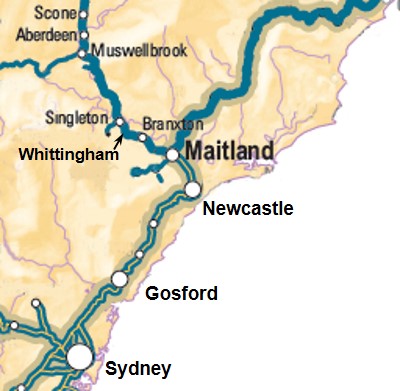
At about 0648[1] on 11 June 2015, a convoy of four Rhomberg Rail Australia (RRA) track vehicles departed Maitland travelling toward Scone in NSW (Figure 1). The vehicles travelled coupled in pairs as train movement 5M71N. As 5M71N approached Whittingham, the RRA Traffic Officer travelling aboard contacted the ARTC Network Control Officer (NCO) at the Broadmeadow control centre to obtain the next authority to proceed.
Figure 1: Locations Maitland to Scone
Map showing the rail line taken by 5M71N from Maitland toward Scone. Source: Geoscience Australia annotations by ATSB
The NCO advised that 5M71N was required to leave the Down main line and enter the Down siding at Singleton to allow a passenger train to pass. The NCO then issued a verbal authority (Track Occupancy Authority) for 5M71N to travel from Whittingham to signal 148.9 at Singleton. The NCO also instructed the RRA Traffic Officer to check that all points in the track were set correctly before proceeding over them.
The NCO told the RRA Traffic Officer to enter the siding at Singleton via the ‘E Frame’ at the northern end of the yard, because the ‘B Frame’ was out of service. The NCO remotely operated the ‘release’ for the E Frame control panel to allow the local operation of the crossover by the RRA Traffic Officer following arrival at signal 148.9.
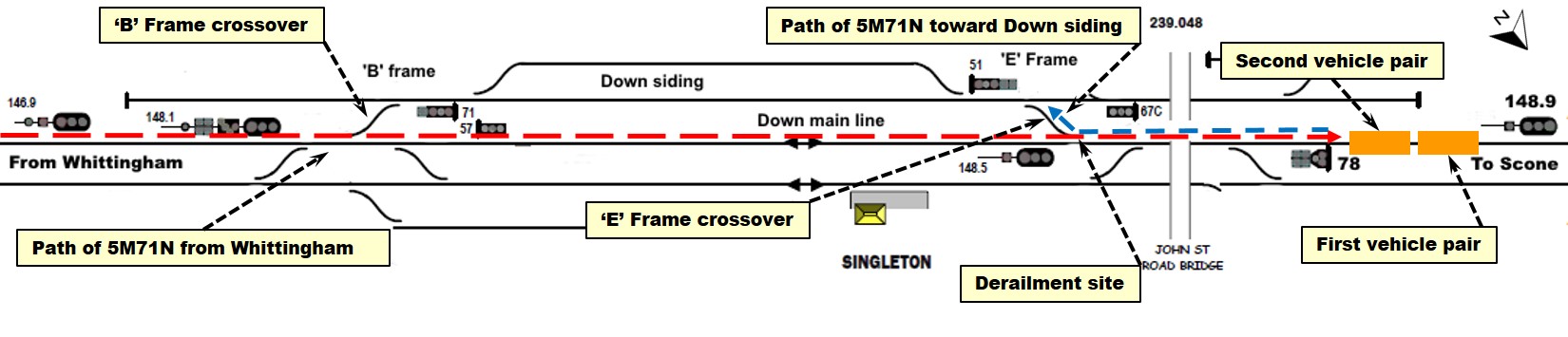
The E Frame control panel operated motorised point machines in the crossover for access to the Down siding. To enable the RRA Traffic Officer to operate the point machines, all vehicles in 5M71N had to pass signal 78. (Figure 2)
Figure 2: Singleton yard simplified track and signal layout
Simplified track layout of Singleton yard showing path of 5M71N. The two pairs of vehicles entered from Whittingham and stopped between signals 78 and 148.9. Once the points in the E Frame crossover were set, the vehicles reversed direction of travel to enter the Down siding via the crossover. Source: Graham Vincent, Track and Signal, annotations by ATSB
After arriving at Singleton, all vehicles in 5M71N stopped clear of 78 signal. The RRA Traffic Officer accessed the E Frame control panel, and as the release was already set, operated the release switch and pushed the points reverse button for access to the siding.
The motorised point machines in the crossover should then move the points to the selected position and the reverse (REV) indication lamp on the panel should illuminate. When illuminated, the reverse indication lamp provides confirmation to the operator that all points had operated correctly.
On this occasion, one of the motorised point machines in the crossover did not move to the reverse position in conjunction with the other machines on the crossover. As designed, the reverse indication lamp on the E Frame panel did not illuminate, indicating a failure had occurred and the points may be in an unsafe condition.
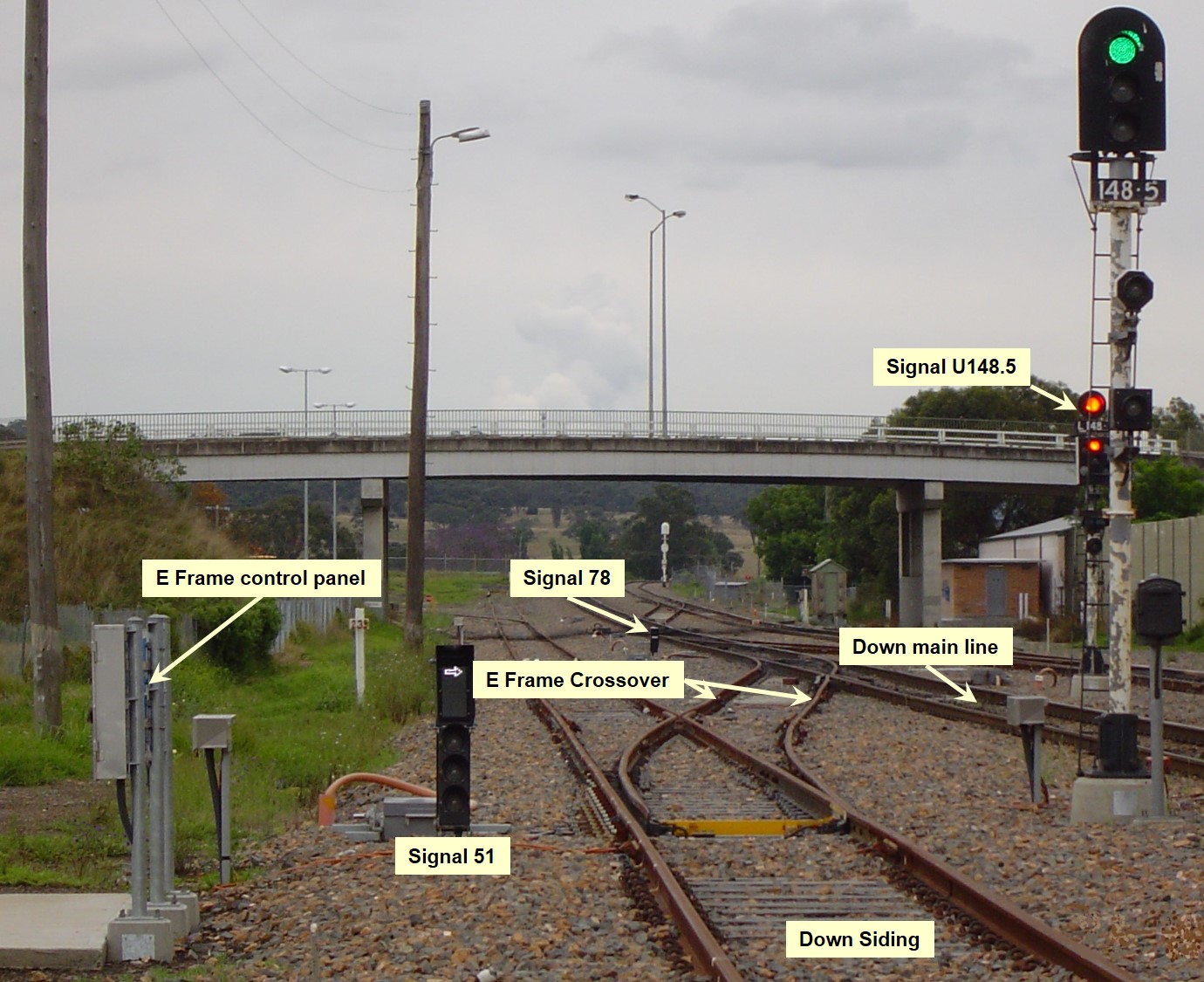
Figure 3: Location E Frame control panel
View looking North along the Down Siding toward signal 78 showing position of the E Frame control panel relative to the E Frame crossover. Source: Australian Rail Track Corporation, annotations by ATSB
Responding to the absence of the REV indication, the RRA Traffic Officer visually inspected the orientation of the points from a location adjacent the E Frame control panel (Figure 3).
Perceiving the alignment was correct, the RRA Traffic Officer discussed the indication lamp anomaly with a co-worker travelling with 5M71N. As the points appeared to have operated, they concluded there was likely a fault with the indication lamp and the crossover was correctly set to proceed.
The RRA Traffic Officer did not inspect the lie of each point on the crossover to confirm whether the corresponding machine had operated to the required position and the locking mechanism had engaged correctly.
The RRA Traffic Officer then contacted the NCO for authority to pass signal 78 at stop and enter the siding, but did not mention that the reverse indication lamp had not illuminated. The NCO, unaware of the points failure, provided a ‘signalman’ authority to pass signal 78, which the Traffic Officer subsequently relayed to the operator of the lead vehicle of 5M71N.
At about 0823, as the lead vehicle traversed the turnout from the Down main line the operator saw the swing-nose crossing ahead was not in the correct position. The vehicle was travelling at about 15 km/h but the operator was unable to stop before passing over the swing-nose crossing.
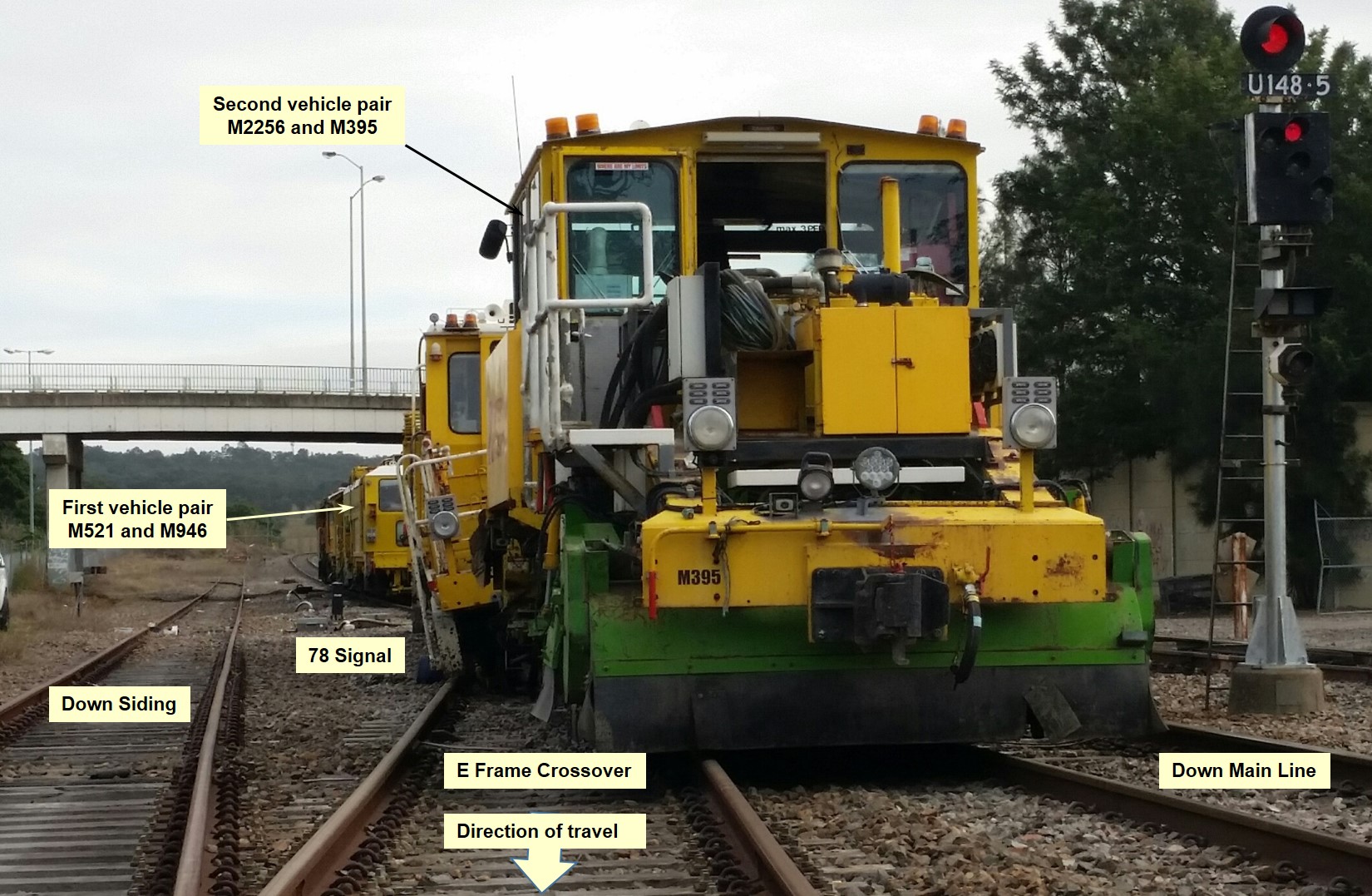
The leading vehicle (M395) and the leading axle of the trailing vehicle (M2256) derailed as they passed over the swing-nose crossing that had failed to operate in conjunction with the other machines in the crossover (Figure 4). The lurching of the vehicles following the derailment impeded the ability of M395’s driver to operate the brake or other controls until the vehicles had stopped. The derailment obstructed the Down main line and resulted in minor damage to the track vehicles. There were no injuries.
Figure 4: Derailed track vehicles M2256 and M395
View from the Down Siding of the derailed vehicles on the crossover. The vehicles M2256 and M395 (in foreground) were the first to pass signal 78 for entry into the Down Siding. The vehicles derailed at the swing-nose crossing that is located at the junction of the E Frame Crossover and Down Main Line rails. Source: Australian Rail Track Corporation, annotations by ATSB
Post-incident, ARTC representatives inspected the crossover; finding that it was likely that the motorised machine that was part of the swing-nose crossing in the turnout on the Down main line had failed to properly operate – rendering the points unsafe. At about 1900 that day, the recovery of the derailed track vehicles and repair to the E Frame points was completed.
Singleton is located at the 238.9 km mark[2] on the Australian Rail Track Corporation (ARTC) Hunter Valley corridor in New South Wales. It is about 46.4 track-km from Maitland and 75.8 track-km from Scone. The Down siding at Singleton was accessible via a crossover at either end of the Singleton yard. A Lever Ground Frame and Control panel, designated ‘B Frame’ and ‘E Frame’ respectively, enabled a qualified worker to locally operate the adjacent crossover after obtaining a release from the NCO.
Train 5M71N
The convoy of track vehicles were transferring from Maitland to Scone under ARTC timetable No 046-2015 and designated as train movement 5M71N.
The convoy comprised four track maintenance vehicles coupled in pairs. The first pair consisted of a Plasser SSP–303 Ballast Regulator (M521) and a Plasser Unimat 08-475/4s Tamper (M946). The second pair consisted of a Plasser 09-32 Tamper (M2256) and a Plasser SSP–100 Ballast Regulator (M395). The first pair of vehicles led the convoy when it departed Maitland and up to the limit of its current authority at Singleton. After the convoy stopped, it was required to reverse the direction of travel in preparation to access the Down siding via the E Frame crossover. The second pair then became the lead vehicles of 5M71N.
Traffic Officer
The RRA Traffic Officer travelling in the second pair of vehicles was the qualified worker in charge of movement 5M71N. The RRA Traffic Officer performed the role of Protection Officer, responsible for the co-ordination of all safeworking arrangements for 5M71N with the NCO.
Safeworking arrangements for Train 5M71N
The ARTC Network Rules required that, in track-circuited territory[3], the vehicles of 5M71N were block worked[4] or authorised for travel under a Track Occupation Authority. This was because the track vehicles were not authorised in the ARTC Train Operating Conditions manual as operating track–circuits reliably. In this case, the NCO managed the progress of 5M71N toward Singleton through the issue of a Track Occupation Authority (TOA) for the required section of track, rather than implementing block working or the remote operation of lineside signals as would be the case for authorised rail traffic such as a passenger train.
The NCO issued a TOA up to signal 148.9 in Singleton, advising the Traffic Officer to enter the Down siding via the ‘E’ Frame. This was because the ‘B’ Frame, which was the first access point to the siding in the direction of travel, was temporarily booked out of use under an Infrastructure Booking Authority (IBA). An IBA is used to tell Train Controllers and Signallers [NCOs] that infrastructure equipment is temporarily or permanently removed from service (booked out of use) or installed/returned to service (booked into use).
E Frame crossover
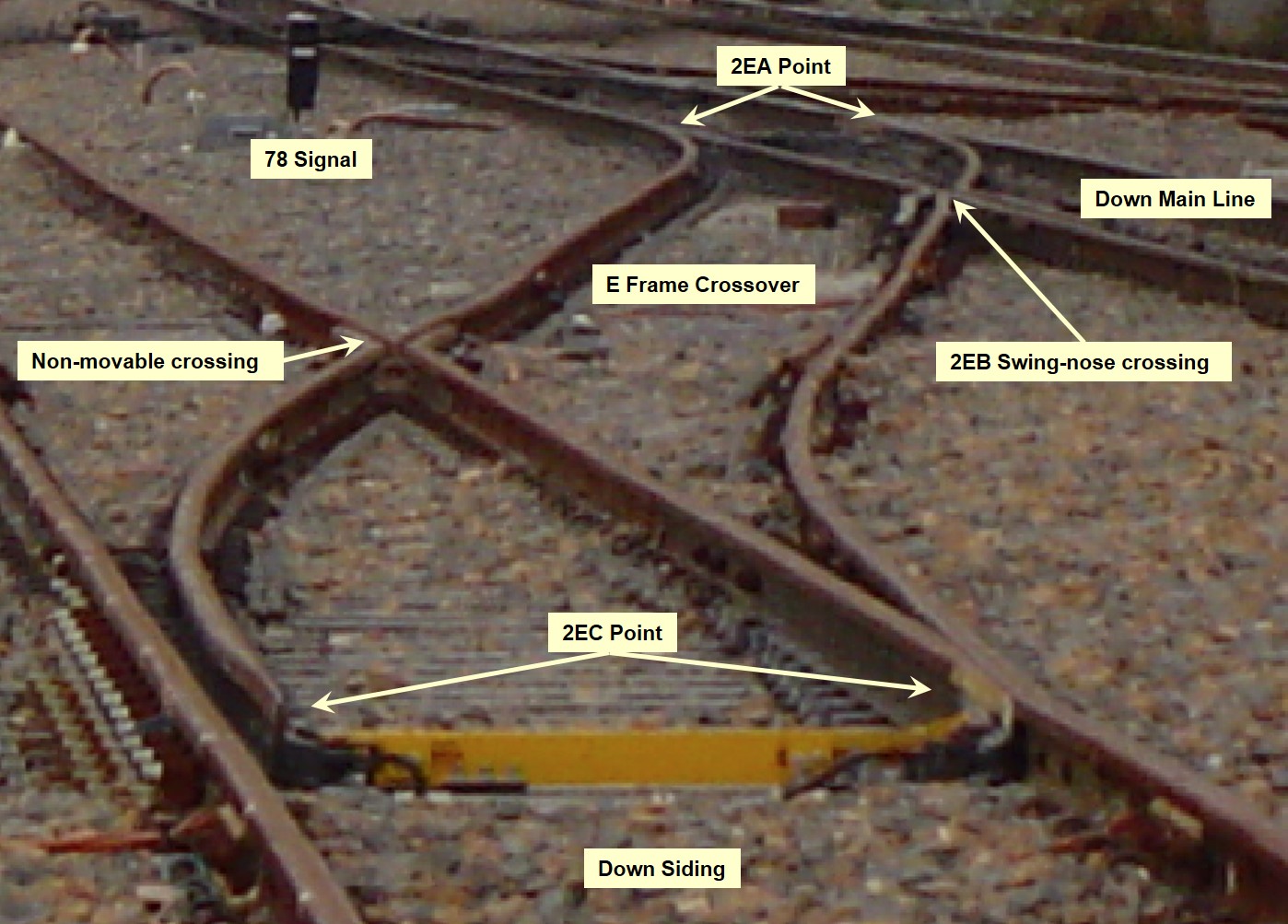
The crossover from the Down main to the Down siding comprised motorised point machines at each end and a motorised swing-nose at the “V” crossing of the turnout on the Down main line. The “V” crossing of the turnout on the Down siding was of a non-movable compound type (Figure 5).
Figure 5: Singleton yard E Frame Crossover
The E Frame Crossover showing 2EA and 2EC points at each end of the crossover and the 2EB swing-nose crossing at the junction of the Down main line and crossover rail. The points illustrated are set for the normal (straight through direction). The vehicle pair (M395 and M2256) derailed at the 2EB swing-nose crossing that did not operate to reverse. Source: Australian Rail Track Corporation, annotations by ATSB
E Frame control panel operation
The operation of E Frame was unique due to its configuration as a ‘ground frame operated by a local control panel’ and the separation of signal and point controls between the Broadmeadow control centre and the local control panel. That is, only local control from E Frame was available for the crossover, and only remote control from the control centre was available for the signal.
Operation of the E Frame required a release from Broadmeadow control centre for the qualified worker to operate a push button to motor the point machines to the reverse position. A light on the control panel (Figure 9) would illuminate to indicate the crossover had operated correctly. The NCO could then give authority to access the Down siding, through the clearance of a fixed signal or other form of authority as required.
A typical local panel configuration provides indicator lights to show that the points are responding to the operation of the point-setting controls and, once operated, are set in the required position. The point indicator lights will also typically display a ‘flashing point transit indicator’ to show that the relevant points are either not in position, the locking not engaged, or the points are in the process of changing position.
The design of the indication lights on the E Frame control panel in this instance, did not include the functionality to display a flashing indication to the operator as the points transitioned. Following selection of the required point-setting control, the corresponding indicator light would extinguish and only illuminate following detection of the points in the correct position. Of note, the panel operation procedure did not document this behaviour.
In this instance, after the Traffic Officer commanded the points to move for access to the Down siding, the reverse light did not illuminate to indicate all motorised machines were in the correct position for safe access the siding. Post-incident, ARTC engineering staff inspected the E Frame and points machines; finding that the E Frame control panel operated correctly but the swing-nose machine did not operate. A motor start capacitor terminal had disconnected in the machine due to a broken mounting plate. While this would have prevented the motor from operating, it could not be conclusively determined if this damage was pre-existing or a consequence of the derailment.
Broadmeadow Phoenix control system
The Phoenix control system at Broadmeadow provided the control and indication functions for the associated signalling infrastructure. The indications provided to the NCO would change dependent on the configuration of the associated field equipment. The screens typically displayed a point (track) indication corresponding to the detected position. The indication would also typically flash to show that the relevant points were not detected in position, the locking not engaged, or the points were changing position.
The segregation of control between Broadmeadow control centre and the local E Frame control panel meant the indications for E Frame points displayed on the Broadmeadow control screens were also unique.
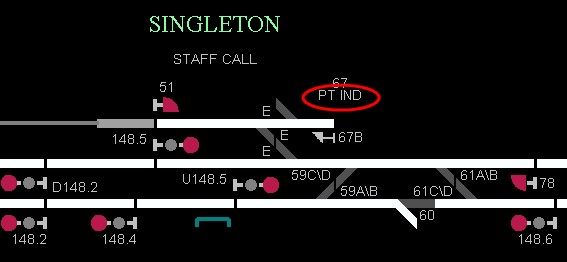
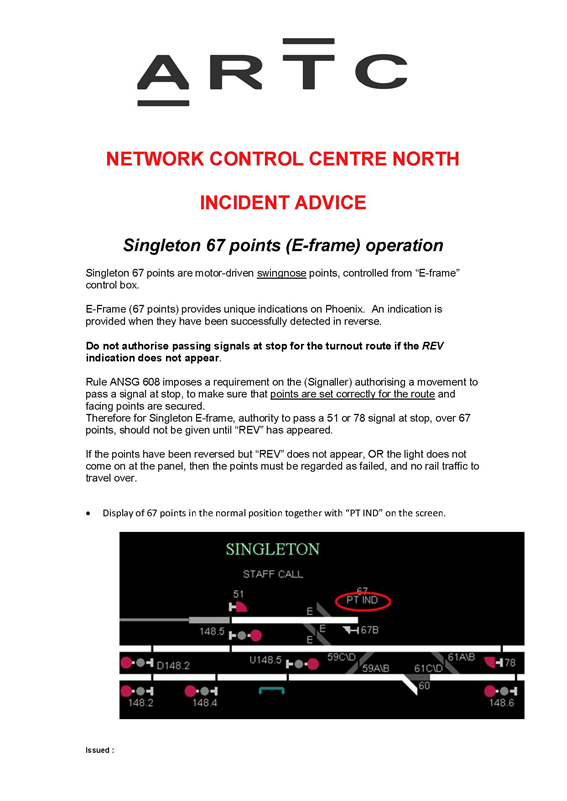
Normally, the track indication for the E Frame points showed them as set for straight-through on the Down main line (Figure 6) and the text ‘PT IND’ was displayed. This indicated to the NCO that the points were set and detected in the normal position.
Figure 6: Phoenix screen extract showing E Frame points detected normal
The E Frame indication (circled) seen by the NCO when the E Frame points were in the normal position. The indications of the tracks over the points show as straight through. This corresponds to the position of the E Frame points. Source: Australian Rail Track Corporation
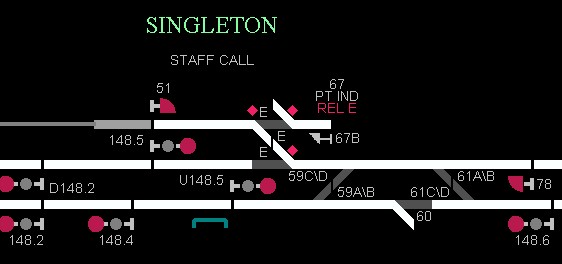
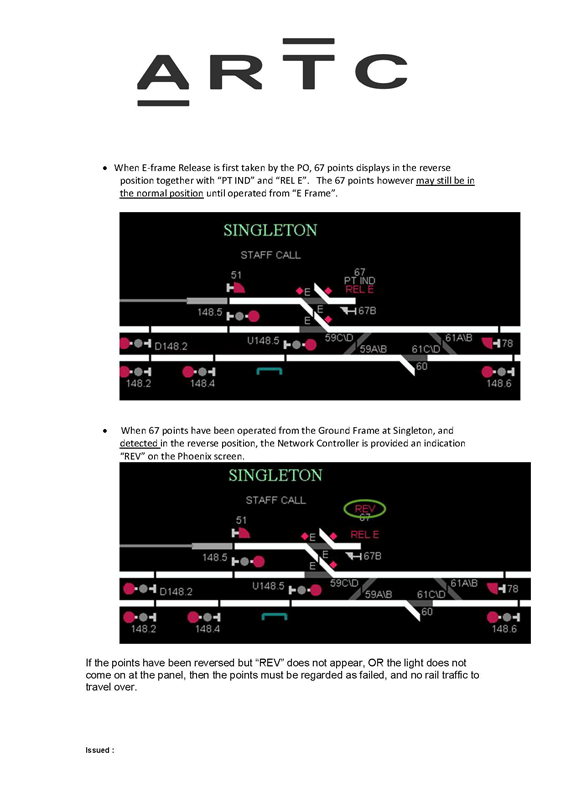
When the NCO provides a ‘release’ for the operation of the E Frame by a qualified worker at Singleton, the track indication for the E Frame points changes to show them released for movement to access the Down siding, and the text ‘REL E’ is displayed (Figure 7). This indicates to the NCO that the points release has been set. Although the Phoenix graphic for the E Frame points was now orientated to represent the points in the reverse position, a qualified worker (at Singleton) may be yet to actually move the points to the reverse position (via the local E Frame panel). That is, when the points release is set, the Phoenix track display graphic at the control centre shows the E Frame crossover in the reverse orientation – regardless of their actual position at Singleton.
Figure 7: Phoenix screen extract showing E Frame released
The ‘REL E’ indication displayed to the NCO after setting the control that allows the qualified worker at Singleton to operate the E Frame. The indications of the tracks over the points show as set for the crossover but the E Frame points may still be set as straight through. Source: Australian Rail Track Corporation
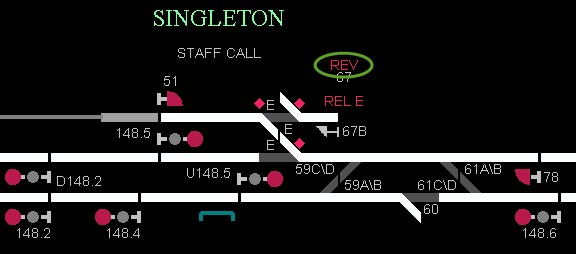
After receiving the release, the qualified worker at Singleton could then operate the points reverse pushbutton. The E Frame points should then travel to the reverse position. Once detection for the reverse position was correct, the text ‘PT IND’ was replaced by ‘REV’ on the Phoenix display (Figure 8). This indicated to the NCO that the points had operated correctly and an authority could be issued for vehicle movement to the Down siding.
The REV indication (circled) seen by the NCO after detection of E Frame points in reverse following the operation by the qualified worker at Singleton. The E Frame points are set for the crossover. Source: Australian Rail Track Corporation
The indications provided to display to the NCO the orientation of the E Frame points are not consistent with those typically displayed for other points within the Phoenix system. This variability in the representation of point positions may result in the NCO misinterpreting the information presented; increasing the risk of a verbal movement authority being provided before it was safe to do so.
The ARTC published, post-incident, an Incident Advice Notice (Appendix A – ARTC Incident Advice) to the NCO’s at Broadmeadow – clarifying the ‘REV’ indication on the Phoenix display for the Singleton E Frame, and procedures for authorising of a movement to pass a signal at stop.
Authorising rail traffic to pass an absolute signal
The method of E Frame operation at Singleton required the qualified worker onsite to coordinate with the NCO to operate the points, before receiving authority from the NCO to pass a signal. If the NCO used a fixed signal to communicate a proceed authority, the signal interlocking would require detection of the correct points position before allowing the signal to clear. If the NCO provided authority without the use of a fixed signal, the NCO was reliant on visually checking the correct indications displayed on the Broadmeadow control panel (Phoenix display) and the qualified worker confirming the correct operation of the points – before the authority could be issued.
Within yard limits, the ARTC Network Rules[5] stipulate the conditions that track vehicles must be worked. These conditions allow travel on the authority of fixed signals or on the Signaller’s (NCO’s) verbal authority. In this case, fixed signal 78 was not available for use as it was booked out of use due to the extended time following the previous rail movement[6] The NCO therefore gave the RRA Traffic Officer a ‘Signallers’ verbal authority to pass 78 signal.
When providing an authority to pass a signal at stop, drivers or track vehicle operators and signallers use a specific form of words. This is to ensure that drivers and track vehicle operators clearly receive and understand the authority to pass an absolute signal at stop.[7] A review of the voice logs from the Broadmeadow network control centre found that the NCO and RRA Traffic Officer did not implement the required communication protocols during the request or provision of the authority to pass 78 signal. While this instance of compliance with the communication protocol was deficient, it was not a contributing factor in the subsequent derailment of the track vehicles.
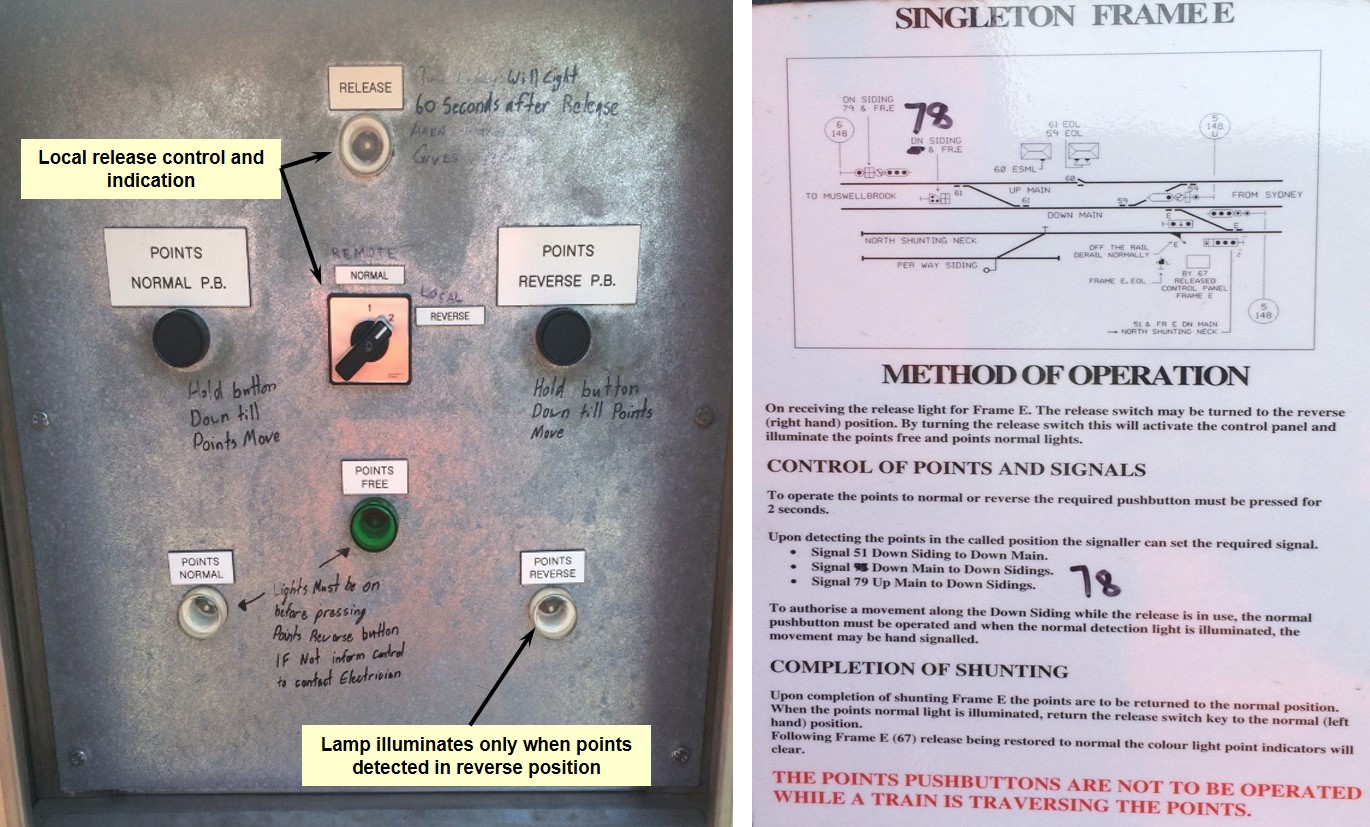
An instruction sheet describing the method of operation for the panel was located within the E Frame’s local control cabinet. This instruction and the local control panel faceplate however, contained various hand written corrections and supplementary advisory instructions for the qualified worker operating the panel (Figure 9).
Figure 9: E Frame local panel faceplate and instruction sheet
The switches and lamps on the E Frame panel used to set and indicate the position of the E Frame points. Each switch and lamp had a permanent label to identify its function. Users had added additional handwritten instructions to clarify the operation and meaning of the various labels and contents of the instruction sheet. Source: Australian Rail Track Corporation, annotations by ATSB
None of the instructions referred to the unique arrangement for the Points Normal or Points Reverse lamps displaying only a steady indication when the points were set in the required position. The absence of a flashing indication during the transition of the points to the reverse position likely contributed to the Traffic Officers perception that the lack of the Points Reverse indication was due to a lamp fault.
In addition to the sheet affixed to the E Frame, instructions for the operation of rail infrastructure are contained in the ARTC NSW Network Rules & Procedures and the ARTC Local Appendix Units. Neither of these documents contained information that reflected the particular method of operation of the Singleton E Frame. Instruction in the ARTC Local Appendix Units applicable to Singleton referenced a different (redundant) arrangement for the operation of E Frame.
It was evident that, at the time of the derailment, the ARTC had not updated all relevant operating procedures/local appendix units to reflect the unique arrangements for the E Frame local control panel. This departure of the equipment arrangements and operational behaviours from documented procedures, may result in a qualified worker misinterpreting the information presented by the indicator panel lights.
Responding to faulty points
The ARTC Network Rules[8] require a qualified worker to respond to an anomaly in the operation of point machines by reporting the occurrence to the Signaller (NCO). The NCO and qualified worker then coordinate to undertake a systematic inspection of the points to diagnose the fault. If the fault cannot be readily rectified the qualified worker may be instructed to operate the points manually and apply additional mechanical locks to prevent unintended operation.
In this instance, the RRA Traffic Officer discussed the E Frame indication anomaly with co-workers, but did not report the issue to the NCO. The RRA Traffic Officer undertook a brief visual inspection of the points, but did not continue to apply the required procedure for responding to faulty points. Based on the sequence of events in this occurrence, the correct implementation of the ARTC Network Rules may have prevented the subsequent derailment of 5M71N.
Following the derailment, Rhomberg Rail Australia developed the following safety actions to ensure their track personnel correctly implement the ARTC Network Rules:
Conduct a full review of the Network Rules with all employees
Develop flow charts to identify the process flow for critical operations of points/transfers.
Complete a ‘standard setting’ workshop with all Resurfacing employees
Update Network Rule folders on all the machines
Create a network rule register
Recertify employees involved in the incident in their respective highest level of safe working
Management observation of Network Rule compliance.
Passing signals at stop
The ARTC Network Rules[9] require a Signaller (NCO) to get available information about the condition of the block ahead, using:
The track indicator diagram
Records of previous rail traffic movements
Work on track authority records
Reports about the location of the last rail traffic to enter the block, or
The signaller at the other end of the section
In this instance, relevant information was obtainable from indications displayed on the Phoenix screen and the RRA Traffic Officer operating the E Frame at Singleton. Using this information the Network Rule required the NCO, before providing authority to pass a signal at stop, to make sure that the:
Points are set correctly for the route, and
Points that are facing points, or become facing points, are secure.
The NCO did not identify the points were correctly set using the indications displayed on the Phoenix screen or confirm with the RRA Traffic Officer that conditions of the track ahead were correct and the points in the crossover secured. Again, the correct implementation of ARTC Network Rules may have prevented the subsequent derailment of 5M71N.
From the evidence available, the following findings are made with respect to the derailment of track vehicles M395 and M2256 at the E Frame swing-nose crossover in Singleton on 11 June 2015. These findings should not be read as apportioning blame or liability to any particular organisation or individual.
Safety issues, or system problems, are highlighted in bold to emphasise their importance. A safety issue is an event or condition that increases safety risk and (a) can reasonably be regarded as having the potential to adversely affect the safety of future operations, and (b) is a characteristic of an organisation or a system, rather than a characteristic of a specific individual, or characteristic of an operating environment at a specific point in time.
Contributing factors
A swing-nose point machine in the Down main line turnout did not operate to reverse in conjunction with companion point machines of the crossover.
The point indication functionality on the E Frame local panel was unique, in that it did not include a ‘flashing point transit indicator’ in the absence of reverse detection.
The Traffic Officer perceived the indicator to be faulty and concluded that all points in the E Frame crossover were set correctly.
The Traffic Officer did not report the (perceived) faulty point indication to the Network Control Officer.
The Traffic Officer did not implement existing network procedures for responding to the (perceived) faulty point indication.
The Network Control Officer did not observe the available Phoenix display information, regarding the condition of the E Frame crossover prior to authorising the passing signal 78 at stop.
Other factors that increased risk
The ARTC Network Control centre procedures did not address the unique operation of the Singleton E Frame equipment to ensure correct and consistent interpretation of the indications provided on the Phoenix display. [Safety issue]
The ARTC Local Appendix Unit North – Volume 3 did not reflect current equipment installation arrangements for E Frame at Singleton. [Safety issue]
Other findings
Local operating instructions and panel for E Frame contained hand-written amendments.
The Network Control Officer and Traffic Officer did not follow the required Network communication protocols when authorising 5M71N to pass 78 signal at stop.
Safety issues and actions
The safety issues identified during this investigation are listed in the Findings and Safety issues and actions sections of this report. The Australian Transport Safety Bureau (ATSB) expects that all safety issues identified by the investigation should be addressed by the relevant organisation(s). In addressing those issues, the ATSB prefers to encourage relevant organisation(s) to proactively initiate safety action, rather than to issue formal safety recommendations or safety advisory notices.
All of the directly involved parties were provided with a draft report and invited to provide submissions. As part of that process, each organisation was asked to communicate what safety actions, if any, they had carried out or were planning to carry out in relation to each safety issue relevant to their organisation.
The initial public version of these safety issues and actions are repeated separately on the ATSB website to facilitate monitoring by interested parties. Where relevant the safety issues and actions will be updated on the ATSB website as information comes to hand.
Unique indications for E Frame on Network control system screens
The ARTC Network Control centre procedures did not address the unique operation of the Singleton E Frame equipment to ensure correct and consistent interpretation of the indications provided on the Phoenix display.
Under Part 4, Division 2 (Investigation Reports), Section 26 of the Transport Safety Investigation Act 2003 (the Act), the Australian Transport Safety Bureau (ATSB) may provide a draft report, on a confidential basis, to any person whom the ATSB considers appropriate. Section 26 (1) (a) of the Act allows a person receiving a draft report to make submissions to the ATSB about the draft report.
A draft of this report was provided to the Australian Rail Track Corporation, Rhomberg Rail Australia, the Office of the National Rail Safety Regulator and the relevant crewmembers of 5M71N.
Submissions were received from Australian Rail Track Corporation, Rhomberg Rail Australia, the Office of the National Rail Safety Regulator and one crewmember of 5M71N. The submissions were reviewed and where considered appropriate, the text of the report was amended accordingly.
Appendices
Appendix A – ARTC Incident Advice
Purpose of safety investigations
The objective of a safety investigation is to enhance transport safety. This is done through:
identifying safety issues and facilitating safety action to address those issues
providing information about occurrences and their associated safety factors to facilitate learning within the transport industry.
It is not a function of the ATSB to apportion blame or provide a means for determining liability. At the same time, an investigation report must include factual material of sufficient weight to support the analysis and findings. At all times the ATSB endeavours to balance the use of material that could imply adverse comment with the need to properly explain what happened, and why, in a fair and unbiased manner. The ATSB does not investigate for the purpose of taking administrative, regulatory or criminal action.
Terminology
An explanation of terminology used in ATSB investigation reports is available here. This includes terms such as occurrence, contributing factor, other factor that increased risk, and safety issue.
Publishing information
Released in accordance with section 25 of the Transport Safety Investigation Act 2003
Ownership of intellectual property rights in this publication
Unless otherwise noted, copyright (and any other intellectual property rights, if any) in this report publication is owned by the Commonwealth of Australia.
Creative Commons licence
With the exception of the Coat of Arms, ATSB logo, and photos and graphics in which a third party holds copyright, this publication is licensed under a Creative Commons Attribution 3.0 Australia licence.
Creative Commons Attribution 3.0 Australia Licence is a standard form licence agreement that allows you to copy, distribute, transmit and adapt this publication provided that you attribute the work.
The ATSB’s preference is that you attribute this publication (and any material sourced from it) using the following wording: Source: Australian Transport Safety Bureau
Copyright in material obtained from other agencies, private individuals or organisations, belongs to those agencies, individuals or organisations. Where you wish to use their material, you will need to contact them directly.
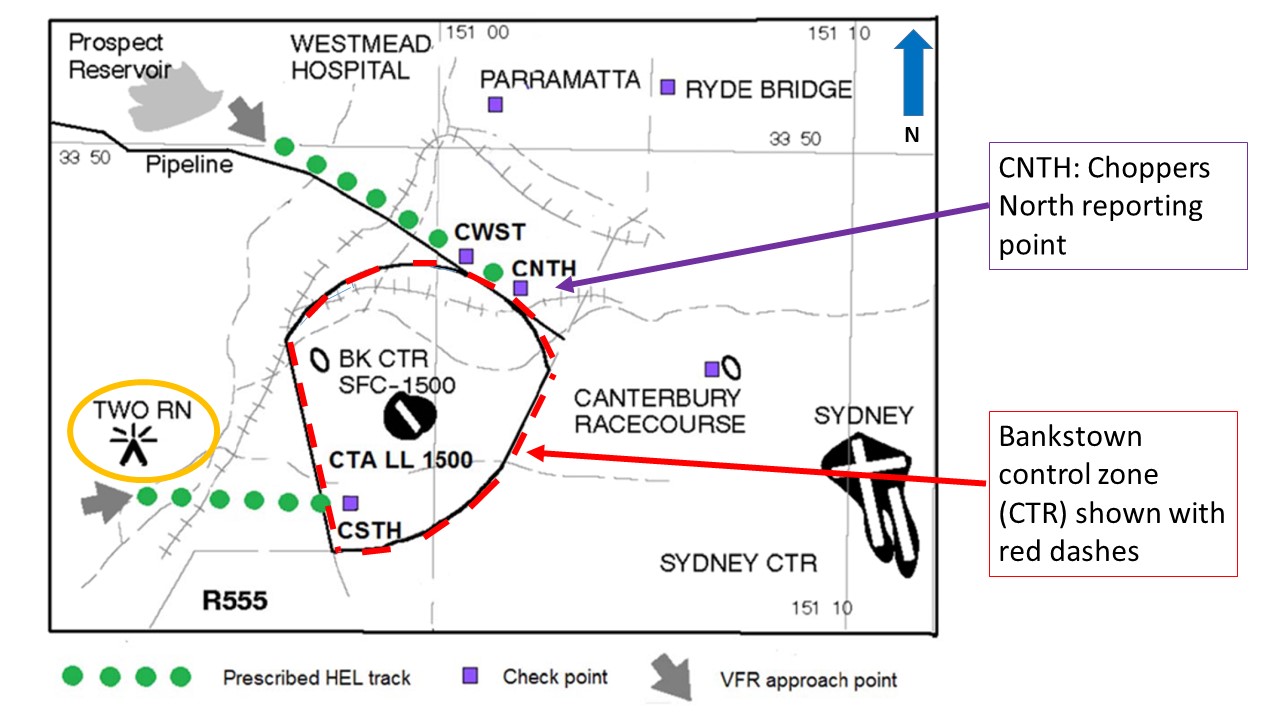
At about 1335 Eastern Standard Time (EST) on 15 July 2015, the pilot of an Extra 300L aircraft (Extra) VHKCF, was returning to Bankstown Airport, New South Wales, after completing a local, private flight. The pilot, the sole person on board, reported inbound to Bankstown Tower at the TWO RN reporting point (Figure 1). At this point, the Extra was maintaining 1,500 ft above mean sea level. Air Traffic Control (ATC) cleared the aircraft to join the crosswind leg of runway 29R and to maintain 1,500 ft.
Shortly after the pilot of the Extra had called inbound, the pilot of a Robinson 44 helicopter (R44), VH-OLG also called Bankstown Tower with inbound details, from overhead the Olympic Stadium, about 6 NM northeast of Bankstown Airport. The R44, with the pilot and three passengers on board, had just completed a scenic charter flight over the Sydney CBD. ATC requested the pilot to report again at Choppers North (Figure 1). The pilot descended to the required 700 ft and reported at Choppers North.
Figure 1: Helicopter inbound procedures diagram for Bankstown Airport.Note the Choppers North inbound reporting point as used by VH-OLG (purple arrow). On this occasion, VH-OLG was inbound from the northeast. TWO RN, the inbound reporting point for VH-KCF is also marked (yellow circle)
From Choppers North, ATC instructed the R44 pilot to continue the approach and report on base leg. The pilot complied with this instruction, and reported on an ‘early base’. ATC then cleared the R44 for a November One (N1) arrival (Figure 2).
N1 arrival
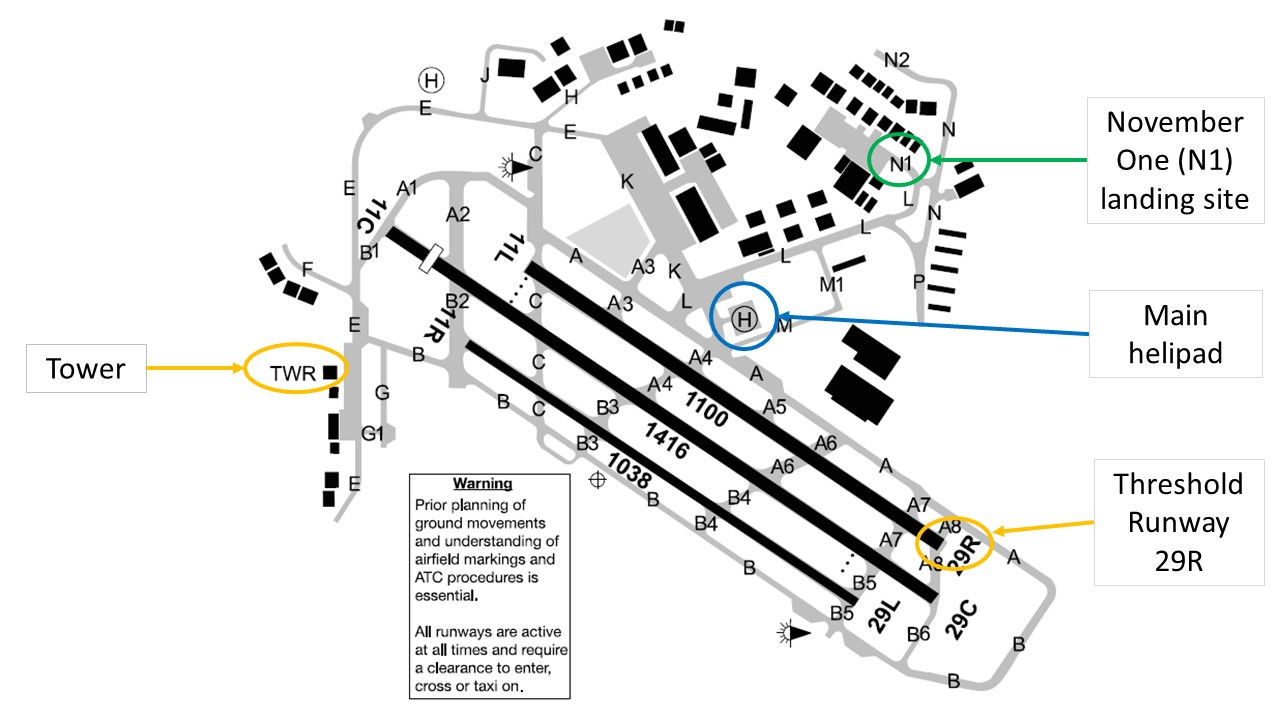
An N1 arrival could only be conducted by appropriately trained and qualified pilots (such as the pilot of the R44). The arrival allowed a visual approach from the helicopter circuit altitude of 700 ft via an oblique approach to taxiway N1 (Figure 2). In an N1 arrival, the Tower were unable to see a helicopter during the latter part of the approach. So the pilot was required to advise the Tower when they had landed.
Figure 2: Bankstown Airport showing the N1 taxiway used as a landing site for a November One arrival (green)
Source: Airservices Australia – ERSA extract for Sydney / Bankstown
Meanwhile, as the Extra tracked to join crosswind for 29R, ATC alerted the pilot about a conflicting DR-107 One Design aircraft. The DR-107 had been cleared for take-off from runway 29C, and to initially maintain runway direction on climb to 1,500 ft.
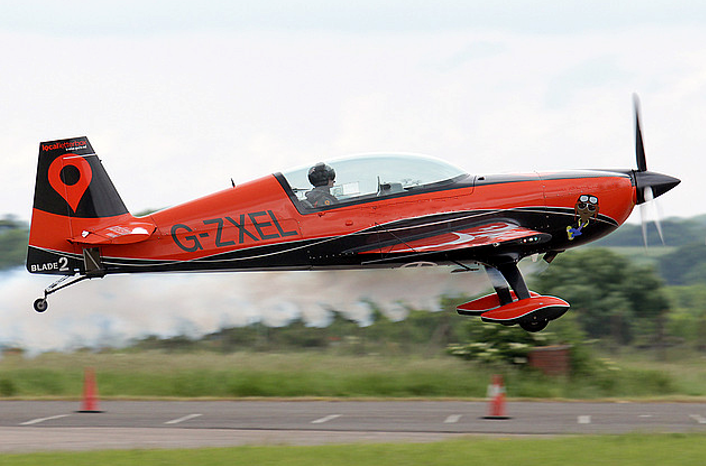
The pilot of the Extra reported sighting the DR-107. The Extra pilot then requested a clearance to conduct a touch and go circuit on runway 29R. Once in receipt of this clearance, the pilot left 1,500 ft on descent, making a continuous turn onto base and then final approach. To enhance forward visibility the pilot then sideslipped the aircraft toward the landing threshold (Figure 3).
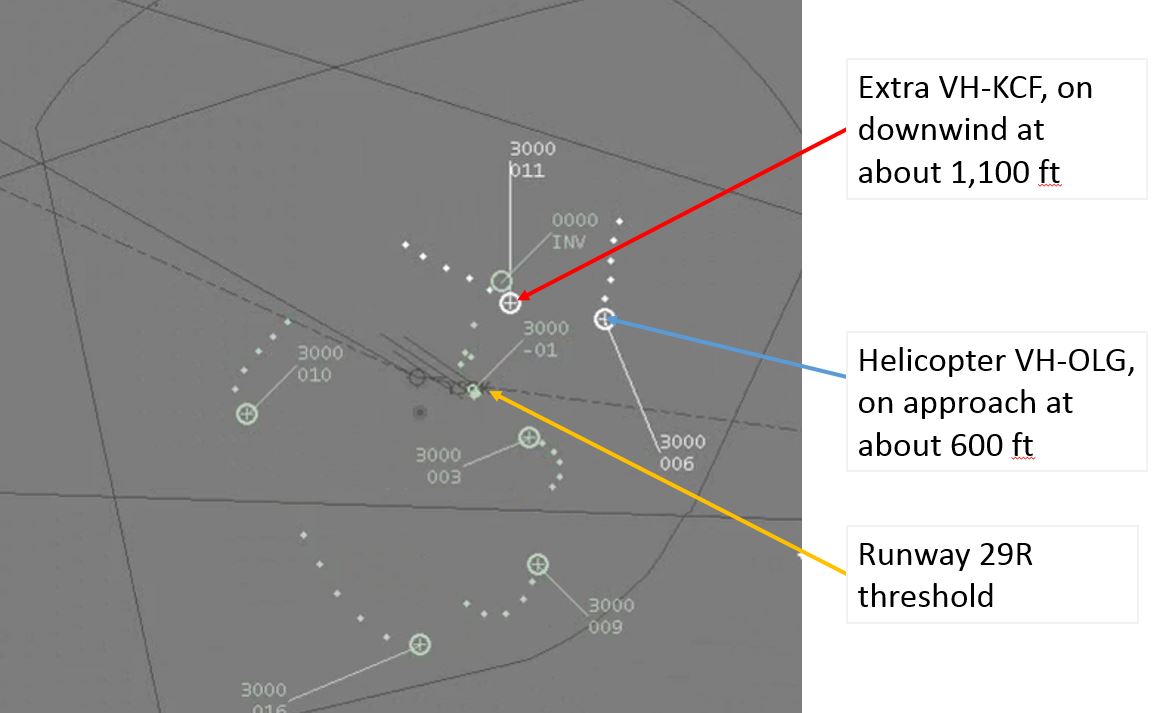
During the descent and sideslip of the Extra, the pilot of the R44 continued their descent at about 100-150 fpm toward N1. While descending through about 350-300 ft, the passengers and pilot on the R44 saw the underside of the Extra pass from right to left in front of the helicopter. They estimated it was within 100 ft of the R44’s altitude and about 70-100 m in front of them (Figure 5).
ATC again advised the pilot of the R44 to report after landing. The pilot replied to ATC that the Extra had just passed very close by them. The pilot of the Extra responded with a comment that they had seen the traffic.
The R44 pilot continued with the landing onto N1, reporting to tower after landing, and the pilot of the Extra, who was still not aware of the helicopter, continued with the touch and go prior to being cleared to land on runway 29C at the completion of another circuit.
Figure 3: An example of an Extra 300 L aircraft showing the seating position of the pilot. This gives an indication of the reduced visibility with the aircraft nose slightly raised, which occurs when the aircraft is at a slower speed
Source: Jim Groom
Figure 5: Radar plot showing both aircraft approaching their relative landing areas
Source: Airservices Australia
Note: Tower Situational Awareness Display (TSAD) was not available for the provision of separation to the controllers in Bankstown tower. These images are included to show what was recorded.
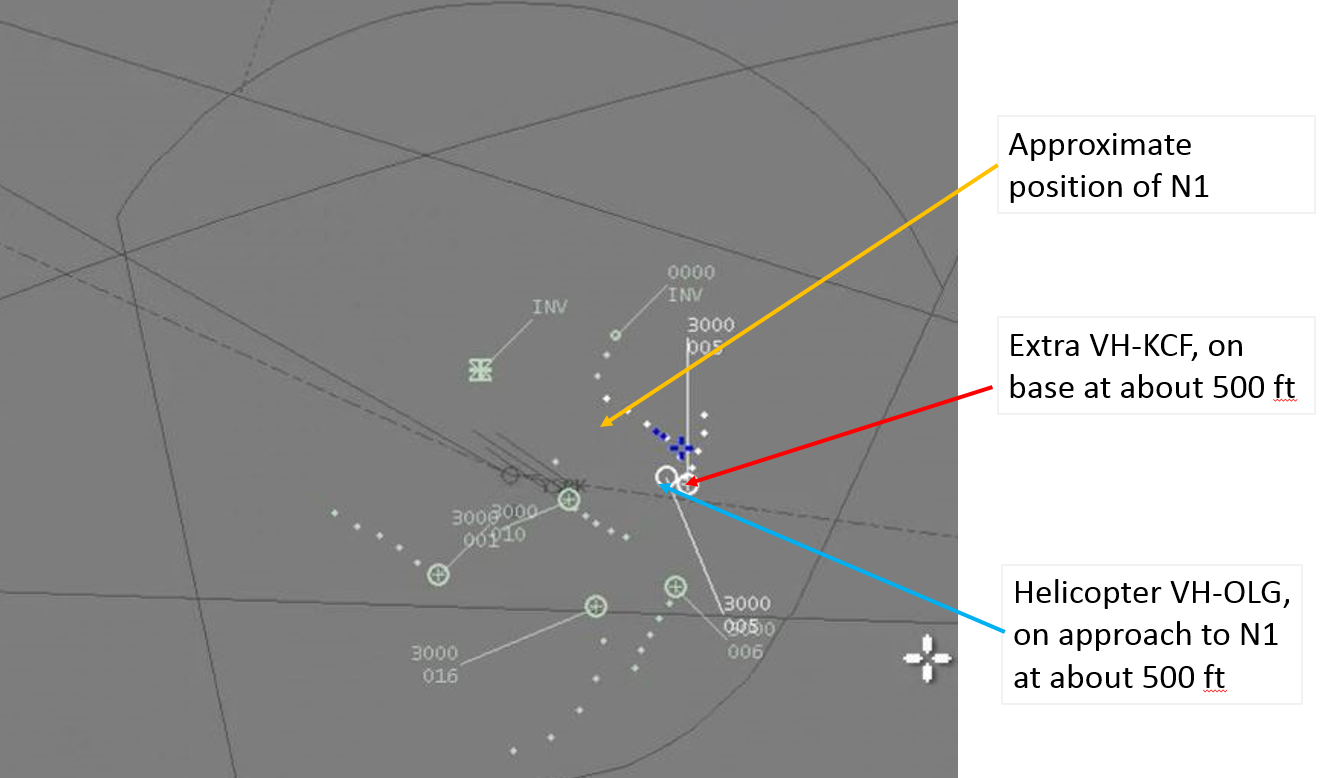
Figure 6: Radar plot showing the R44 VH-OLG (light blue) at about 500 ft tracking toward N1 and VH-KCF (red) on a continuous descending approach to runway 29R
Source: Airservices Australia
Note: Tower Situational Awareness Display (TSAD) was not available for the provision of separation to the controllers in Bankstown tower. These images are included to show what was recorded.
Airservices Australia
According to the Manual of Air Traffic Services, (MATS), in Class D airspace such as Bankstown, ATC should provide a traffic information service for visual flight rules (VFR) to VFR aircraft about other known or observed air traffic which may be in proximity to the position or intended route of flight and to help the pilot avoid a collision.
As per Bankstown ERSA section 14.1 (b), the helicopter was required to remain within the fixed wing circuit during the N1 arrival, thus traffic information would not normally have been provided.
Airservices Australia advised that the tower controller on duty did not assess the traffic to be in confliction, and did not sight the incident.
They also advised that the controller complied with the requirements of the Manual of Air Traffic Services (MATS) and the Aeronautical Information Publication (AIP) in relation to traffic information.
Extra, VH-KCF - Pilot comments
The pilot of the Extra held a Commercial Pilot’s Licence for both fixed wing aircraft and helicopters. They had about 450 tailwheel aircraft hours and about 150 of these on the Extra, VHKCF.
When flying the Extra, as on this day, the pilot completed a continuous descent once cleared for a visual approach on downwind. As per normal in the Extra, the pilot side-slipped the aircraft down final approach. Side-slipping allowed the pilot better forward visibility at the slower approach speed, while also keeping the runway threshold continuously in sight.
The pilot realised in hindsight, that when the potentially conflicting traffic (VH-OLG) was passed late in the circuit, they had assumed ATC was referring to the previous traffic alert involving the DR 107. The pilot was not aware of the R44, nor that a N1 arrival could cause a conflict.
R44 helicopter, VH-OLG - Pilot comments
The pilot held a Commercial Pilot’s Licence (Helicopters) and a Grade 2 Instructor rating (Helicopter) with about 1,300 hours on helicopters. The pilot also held a private licence for fixed wing aircraft and had about 1,000 hours on this category of aircraft.
The pilot stated that Bankstown ATC manage both the fixed wing and helicopter circuits well. However, in recent times felt that there have been a few more ‘near collisions’. This may be due to the increase in helicopter movements, and overall increase in aircraft movements.
The pilot commented that they thought that the pilot of the Extra would not have been able to see the helicopter during the sideslip.
ATSB Comment
A search of the ATSB’s occurrence database for near collision incidents at Bankstown Airport between January 2013 and May 2015 did not reveal any near collisions involving helicopters.
There was one separation occurrence, (201408721), which involved the N1 approach. On that occasion, an inbound helicopter did not track as cleared to N1 and conflicted with another helicopter about to depart N1. ATC issued a safety alert to the helicopter departing N1.
The ATSB monitors trends on all occurrences recorded in its database, including near collisions. Recent trend monitoring identified that another Class D Airport, Jandakot, had a disproportionate rate of aircraft near‑collisions. Specifically, between 2013 and 2015 Jandakot Airport had a near‑collision rate that was at least three times higher than other similar metropolitan Class D airports across Australia. In response to this identified transport safety matter, the ATSB has commenced an investigation to identify the factors that increase the collision risk to aircraft operating at Jandakot Airport (see AI-2015-063 available at www.atsb.gov.au).
Safety message
This incident serves as a reminder to keep a good lookout at all times, including in Class D airspace. Pilots are responsible for maintaining separation in Class D airspace. The Civil Aviation Safety Authority pilot guide for Bankstown Airport, along with seven other Class D airports has been incorporated into the “On Track” pre-flight visualisation tool for both fixed and rotary wing pilots. This tool for VFR pilots is available on the CASA website.
A safety education publication and e-learning tutorials on Class D operations are also available on the CASA website. Note that all these publications are for safety education purposes and do not replace information in the Aeronautical Information Publication (AIP), the en-route supplement Australia (ERSA) and / or Notices to Airman (NOTAMS).
The objective of a safety investigation is to enhance transport safety. This is done through:
identifying safety issues and facilitating safety action to address those issues
providing information about occurrences and their associated safety factors to facilitate learning within the transport industry.
It is not a function of the ATSB to apportion blame or provide a means for determining liability. At the same time, an investigation report must include factual material of sufficient weight to support the analysis and findings. At all times the ATSB endeavours to balance the use of material that could imply adverse comment with the need to properly explain what happened, and why, in a fair and unbiased manner. The ATSB does not investigate for the purpose of taking administrative, regulatory or criminal action.
Terminology
An explanation of terminology used in ATSB investigation reports is available here. This includes terms such as occurrence, contributing factor, other factor that increased risk, and safety issue.
Publishing information
Released in accordance with section 25 of the Transport Safety Investigation Act 2003
Ownership of intellectual property rights in this publication
Unless otherwise noted, copyright (and any other intellectual property rights, if any) in this report publication is owned by the Commonwealth of Australia.
Creative Commons licence
With the exception of the Coat of Arms, ATSB logo, and photos and graphics in which a third party holds copyright, this publication is licensed under a Creative Commons Attribution 3.0 Australia licence.
Creative Commons Attribution 3.0 Australia Licence is a standard form licence agreement that allows you to copy, distribute, transmit and adapt this publication provided that you attribute the work.
The ATSB’s preference is that you attribute this publication (and any material sourced from it) using the following wording: Source: Australian Transport Safety Bureau
Copyright in material obtained from other agencies, private individuals or organisations, belongs to those agencies, individuals or organisations. Where you wish to use their material, you will need to contact them directly.