Occurrence Briefs are concise reports that detail the facts surrounding a transport safety occurrence, as received in the initial notification and any follow-up enquiries. They provide an opportunity to share safety messages in the absence of an investigation.
What happened
On 28 June 2021, at about 0805 local time, the pilot of a Cessna 210N aircraft was conducting a charter flight from Kununurra to Berkeley River Lodge aeroplane landing area (ALA), Western Australia, with four passengers on board.
On arrival at Berkeley River Lodge, the pilot joined the downwind leg of the circuit for runway 11. The landing gear had been extended about 2 NM prior to entering the circuit. The pilot conducted a circuit and actioned the pre-landing checklist. Approaching the threshold of the runway, the pilot elected to conduct a go-around due to windshear and gusting crosswinds.
During the subsequent initial climb, the pilot retracted the landing gear and continued to fly the circuit for a second approach. The pilot reported that, during the second circuit, they were concentrating on the gusty wind conditions and omitted to refer to the pre-landing checklist. On final approach, the pilot thought that the gear was already down from the previous circuit and as a result, the aircraft landed with the wheels up. The pilot reported hearing activation of the landing gear warning horn during the flare, however, mistakenly believed it to be the stall warning horn.
The aircraft sustained minor damage to the propeller and underside of the fuselage.
Safety message
This incident highlights the importance of managing distraction. During times of high workload, distraction can often lead to human error and simple tasks such as selecting the landing gear could be unintentionally omitted. In addition, due to this a pilot may not distinguish the difference between the sound of the stall and landing gear horns. Pilots should be mindful of completing all normal pre-landing checks even during an abnormal situation.
Wheels-up landings are not uncommon. Table 1 shows the number of wheels-up landings reported to the ATSB each year since 2012. The Flight Safety Australia article, Those who won’t: avoiding gear-up landings includes additional information to assist pilots in avoiding these incidents.
Table 1: Wheels-up landings per year
Year
Number of wheels-up landings
2012
17
2013
13
2014
21
2015
10
2016
14
2017
10
2018
13
2019
10
2020
11
2021
8 (at 26 September)
About this report
Decisions regarding whether to conduct an investigation, and the scope of an investigation, are based on many factors, including the level of safety benefit likely to be obtained from an investigation. For this occurrence, no investigation has been conducted and the ATSB did not verify the accuracy of the information. A brief description has been written using information supplied in the notification and any follow-up information in order to produce a short summary report, and allow for greater industry awareness of potential safety issues and possible safety actions.
Occurrence Briefs are concise reports that detail the facts surrounding a transport safety occurrence, as received in the initial notification and any follow-up enquiries. They provide an opportunity to share safety messages in the absence of an investigation.
What happened
On 20 April 2021, a Fairchild SA227 aircraft taxied at Townsville Airport, for a freight charter flight to Brisbane, Queensland. At about 1854 Eastern Standard Time,[1] air traffic control (ATC) cleared the aircraft to line up on runway 01 from taxiway Alpha 1.
It was dark, as last light [2] had occurred approximately 56 minutes earlier. Rain showers had also passed through the area intermittently during the preceding 30 minutes. The automatic terminal information service[3] reported runway conditions at the time as wet, with visibility reducing to 4 km in rain and scattered cloud at 700 ft above ground level.
As the aircraft was entering the runway, and 20 seconds after issuing the line-up clearance, ATC advised the pilot that the aerodrome QNH[4] had changed. This change required the pilot to adjust the altimeter datum that had been set prior to line-up. Twelve seconds later, ATC cleared the aircraft for take-off. As the pilot read back this clearance, completed the before take-off drills, and taxied the aircraft into position on the runway, they reported becoming aware that the aircraft ‘had deviated from the lead-in line’ and ‘started correcting the turn immediately to…regain a track to the centreline’. Having made this correction, and assessing that the runway centreline would be regained shortly after beginning the take-off roll, the pilot commenced a rolling take-off and reported no unusual indications throughout departure.
During routine aerodrome inspections carried out 48 minutes after the aircraft departed, it was discovered that an above ground runway light on the left side of runway 01 had been struck and damaged by an aircraft (Figure 1).
Figure 1: Aircraft tyre tracks and runway light damage
Source: Townsville Airport, annotated by the ATSB
Pre-flight inspections carried out on the aircraft the next day found damage to a propeller blade on the left engine that was consistent with the propeller impacting a foreign object (Figure 2).
Figure 2: Damage sustained to aircraft’s propeller
Source: Operator, annotated by the ATSB
Subsequent engineering inspections by the operator discovered ‘slight witness marks’ of yellow paint on the left main landing gear that was the same colour as the above ground runway lighting fixtures on Townsville’s runway 01.
The operator found that the clearance between an empty SA227 propellor’s tip and the ground was 260 mm. The height of the aerodrome light that was struck was 250 mm. However, it was concluded that a combination of the 789 kg of freight that was on board the aircraft at the time of the occurrence, and the normal range of oleo compression that would be expected during take-off, would reduce the clearance between the propellor blade and the runway light sufficiently to allow a propellor blade to strike the light.
As the landing gear on the SA227 is mounted in the engine nacelle directly behind the propeller, the operator concluded that a propellor blade had struck the runway light during the aircraft’s take-off run, partially destroying the light. The left main wheels then passed over the mounting location of the runway light, impacting the remains of the runway light fixture and leaving the paint witness marks visible on the landing gear assembly. This also resulted in the tyre tracks that remained visible on the runway surface the next day (Figure 1).
The operator concluded that the pilot had become spatially disorientated during the runway line-up sequence, and commenced the take-off from a position further left of the runway centreline than they had perceived (Figure 3), resulting in a propeller blade on the left engine contacting the runway light. An internal investigation by the operator found that a number of factors contributed to the aircraft striking the runway light on take-off. These included:
the runway lead-in lighting not extending to the runway centreline when entering the runway from the Alpha 1 holding point
distraction and high workload of the single pilot while completing the line-up sequence
difficulty in sighting the painted runway lead-in lines due to low lighting conditions and standing water on the ungrooved section of the runway’s surface.
It was further reported by the pilot that the design of the runway, and the wider paved section at the runway’s end to accommodate military aircraft movements, contributed to their not identifying the runway misalignment.
Figure 3: Approximation of planned, perceived, and actual aircraft path during line-up
Source: Google earth, annotated by the ATSB
Historical context
Townsville Airport is a joint user facility with both military and civilian aircraft movements. Runway 01/19 is equipped with an Operational Readiness Platform (ORP) (Figure 4) which is a large, paved apron section at either end of the runway, where military aircraft can be parked. The ORP section is only intended for use by military aircraft, and as such, recessed lighting and markings indicate the normal runway dimensions within this area, as well as the outer edges of the ORP area. At the end of the ORP area, the pavement width reduces to normal runway dimensions and lighting.
At the southern end of the runway, runway lighting indicates the correct path for an aircraft to vacate the runway onto taxiway Alpha 1. However, this lighting is unidirectional, and does not indicate the correct path for an aircraft to take when lining up on the runway from the direction of taxiway Alpha 1 (Figure 4).
Figure 4: Runway lighting and layout of departure end of Townsville Airport Runway 01
ORP area illustrated, as well as the runway lead-in lighting that is not visible to an aircraft entering the runway from taxiway Alpha 1
Source: Townsville Airport, annotated by the ATSB
This is the second occurrence of this type on Townsville’s runway 01. An ATSB investigation examined a previous occurrence on 11 February 2009 that involved a Bombardier DHC-8 aircraft taking off at night (AO-2009-007). The DHC-8 had also lined up and commenced its take-off roll on the runway 01 edge lighting, after entering the runway from holding point A1. The DHC-8 crew had realised their misalignment during the take-off roll, and rejected the take-off after striking a runway side light with the landing gear.
As a result of this and similar occurrences at other airports, the ATSB undertook Aviation Research and Analysis Report Factors influencing misaligned take-off occurrences at night (AR-2009-033), which examined these types of incidents and their causes. This analysis identified eight factors that increased the risk of a misaligned take-off or landing. These factors were,
distraction or divided attention of the flight crew; confusing runway layout; displaced threshold or intersection departure; poor visibility or weather; air traffic control clearance/s issued during runway entry; no runway centreline lighting; flight crew fatigue; and recessed runway edge lighting.
A number of these factors were present during the take-off of the SA227:
The pilot reported being distracted and ‘head down’ during the initial line-up sequence to configure the aircraft for take-off.
Townsville’s runway 01 includes a wider ORP section at its end, which contributed to the pilot’s false perception that they had not travelled across the runway as far as they actually had during the line-up phase.
The weather at the time, which was similar to that of the 2009 DHC-8 occurrence, was wet with rain intermittently reducing visibility.
A change in local QNH had required ATC to contact the pilot during the line-up sequence, adding to the pilot’s workload during this phase.
Townsville’s runway 01 does not have centreline lighting, which reduces the visual cues available to a pilot to confirm the correct runway orientation.
Recessed runway lighting is used to denote the outline of the normal runway dimensions within the ORP area. This has the potential to contribute to spatial disorientation during the line-up phase, as this type of runway lighting is normally used to indicate the centreline on a runway equipped with centreline lighting.
With the exception of crew fatigue, seven of the eight major factors identified by the ATSB as increasing the risk of a misaligned take-off or landing were present in this occurrence.
Safety action
As a result of this occurrence, the aircraft operator has advised the ATSB that a Safety Advisory will be sent to all flight crew identifying the hazards associated with runway alignment on runways equipped with an ORP area. Flight crew have also been reminded of the importance of identifying and managing distractions, and of the option to delay take-off where there is any doubt about the aircrafts position during the line-up sequence.
Townsville Airport has advised the ATSB that it is currently reviewing the existing runway lighting arrangement on runway 01/19, with a view to ensuring that the runway lighting is sufficient to ensure correct alignment with the runway during line up.
Safety message
This incident highlights the potential hazards in runway misalignment, as well as the primary factors previously identified by the ATSB as contributing to these occurrence types. In addition, runways that are equipped with Operational Readiness Platforms pose additional challenges in correct runway identification and alignment.
It is also a reminder to crew of the importance in managing distraction and interruption during critical phases of flight. These threats will always be present in the operational aviation environment, but through effective identification and management, the potential impact on flight safety may be mitigated.
In this occurrence, the pilot correctly identified that they had lost situational awareness during line-up, but had elected to continue the take-off before re-establishing sufficient situational awareness of the aircraft’s position. By halting the line-up to fully re-establish situational awareness, the pilot may have been able to identify the runway misalignment prior to commencing the take-off roll.
About this report
Decisions regarding whether to conduct an investigation, and the scope of an investigation, are based on many factors, including the level of safety benefit likely to be obtained from an investigation. For this occurrence, no investigation has been conducted and the ATSB did not verify the accuracy of the information. A brief description has been written using information supplied in the notification and any follow-up information in order to produce a short summary report, and allow for greater industry awareness of potential safety issues and possible safety actions.
Occurrence Briefs are concise reports that detail the facts surrounding a transport safety occurrence, as received in the initial notification and any follow-up enquiries. They provide an opportunity to share safety messages in the absence of an investigation.
What happened
On 25 August 2021 at 1115 local time, a pilot and engineer were conducting an engine ground run of a Bombardier Challenger 600 aircraft on the apron at Essendon Airport, Victoria. The aircraft was privately owned/operated and had not conducted any flights since 2017.
The nosewheel was chocked, with the left seat foot brakes applied instead of the required parking brake due to previous issues with releasing the park brake. The Challenger’s two turbofan engines were successfully started with normal system indications, and the power levers moved to the low idle position. The power levers were then moved to the high idle position for a short time and then back to low idle, after which the aircraft moved forward and rolled over the chocks.
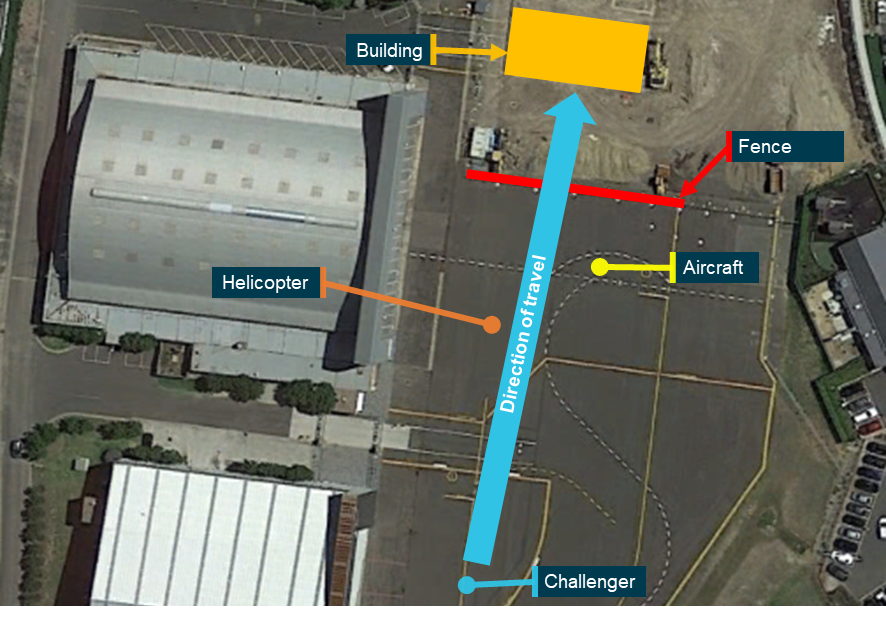
The pilot was applying pressure onto the left seat foot brakes, and tried pumping them, but the aircraft continued to move forward. The pilot then tried using the rudder pedals to steer toward a grass area off the apron without success. The Challenger hit a parked helicopter and another parked aircraft before rolling through a perimeter fence and colliding with a building (Figure 1), bringing the Challenger to rest about 30 seconds after it started to roll.
Figure 1: Challenger path
Source: Google Earth, annotated by the ATSB
The pilot shut down the left engine by moving its power lever to the idle cut-off position. The right engine power lever could not be moved into the cut-off position, so the pilot activated the right engine’s fire extinguishing system, which successfully shut down the engine. The pilot and engineer then exited the aircraft.
The aircraft received substantial damage to the nose, wing leading edge, and winglets. Post‑accident testing of the Challenger’s brake system could not be performed due to hydraulic system damage from the accident.
Safety action
The pilot and engineer are considering the use of additional chocks during aircraft ground running.
Safety message
It is important to follow all operational procedures during engine ground runs, especially those related to securing the aircraft from moving. Positioning the aircraft away from obstacles during the ground run, for example at an airport’s run-up area, can also reduce the risk of colliding with obstacles should the aircraft unexpectedly roll. If this occurs, flight and maintenance crew must be prepared to initiate emergency actions, such as engaging brake systems and immediately shutting down engines.
After an extended period of inactivity, it is important to conduct full system checks before operating an aircraft.
About this report
Decisions regarding whether to conduct an investigation, and the scope of an investigation, are based on many factors, including the level of safety benefit likely to be obtained from an investigation. For this occurrence, no investigation has been conducted and the ATSB did not verify the accuracy of the information. A brief description has been written using information supplied in the notification and any follow-up information in order to produce a short summary report, and allow for greater industry awareness of potential safety issues and possible safety actions.
Occurrence Briefs are concise reports that detail the facts surrounding a transport safety occurrence, as received in the initial notification and any follow-up enquiries. They provide an opportunity to share safety messages in the absence of an investigation.
What happened
On 25 March 2021, at about 2130 Eastern Daylight-saving Time,[1] following a rostered day of flying duties, the pilot of the Diamond DA42 aircraft commenced taxiing at Bankstown Airport, New South Wales, for a session of night circuits to maintain currency.
After the aircraft had rolled forward slightly, the pilot noticed they had left their iPad on the apron and decided to retrieve it before proceeding any further. The pilot engaged the park brake with both engines running and exited the cockpit onto the aircraft’s wing. While the pilot was on the wing, the aircraft moved forward, causing the pilot to lose balance and fall backwards onto the tarmac. The pilot sustained minor hand and leg injuries.
The parking area had a slight decline and the aircraft rolled down the slope. The right wing struck a hangar, and the aircraft went through a perimeter fence, resulting in minor damage to the wing tip and various panels around the nose section of the aircraft.
The pilot reported being unable to regain entry to the cockpit as it rolled away. Once the aircraft had stopped moving, the pilot entered the cockpit and shut down the engines before securing the aircraft.
Park brake
Operation of the park brake is achieved by applying pressure to the toe brake pedals and moving the park brake selector down until it catches. This traps the hydraulic fluid in the brake units and the wheel brakes stay on. The pilot reported being unsure if sufficient pressure was applied to the brake pedals when activating the park brake. The operator advised that following the incident, the park brake was checked and reported to be serviceable.
Fatigue
The pilot reported that at the time of the incident they had been awake for 17 hours. The ATSB publication Fatigue experiences and culture in Australian commercial air transport pilots references studies that found periods of extended wakefulness increase the risk of experiencing a level of fatigue demonstrated to adversely affect performance.
Safety action
As a result of this occurrence, the operator advised the ATSB that the company has introduced a refresher course for all flying staff regarding fatigue management and responsibilities.
Safety message
A more appropriate course of action would have seen the pilot shut down the engines before securing the aircraft with the park brake and then exiting the aircraft to retrieve the iPad from the apron. Lapses in decision making can result from extended periods of wakefulness. The ATSB SafetyWatch highlights the broad safety concerns that come out of our investigation findings and from the occurrence data reported to us by industry. One of the safety concerns is Fatigue.
About this report
Decisions regarding whether to conduct an investigation, and the scope of an investigation, are based on many factors, including the level of safety benefit likely to be obtained from an investigation. For this occurrence, no investigation has been conducted and the ATSB did not verify the accuracy of the information. A brief description has been written using information supplied in the notification and any follow-up information in order to produce a short summary report, and allow for greater industry awareness of potential safety issues and possible safety actions.
Occurrence Briefs are concise reports that detail the facts surrounding a transport safety occurrence, as received in the initial notification and any follow-up enquiries. They provide an opportunity to share safety messages in the absence of an investigation.
What happened
On 14 March 2021, the pilot of a Kavanagh E-240 balloon was conducting a scenic flight over Melbourne, Victoria with 10 passengers on board.
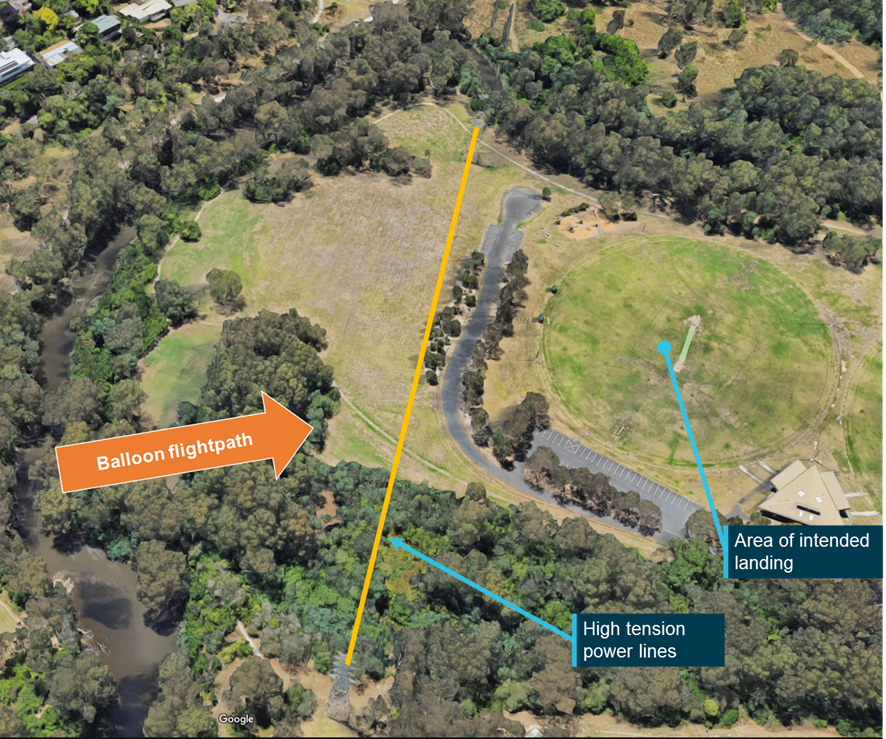
Shortly before 0830 Eastern Daylight-saving Time [1] the balloon approached the planned landing area at Bulleen Park. To reach the landing area, the pilot needed to conduct a descent into a westerly wind. This resulted in the balloon descending over powerlines, which varied from the normal practice of passing over significant obstacles while in level flight. The powerlines were adjacent to the landing area, suspended between two high tension towers (Figure 1), and displayed on the pilot’s iPad.
The pilot conducted the descent so as to pass above the high voltage wires that they could see. However, due to local lighting conditions, approaching the powerlines in a descent and vegetation in the area, the pilot did not see an earthing wire [2] that ran 7.43 m above the high voltage wires.
During the descent, the balloon’s basket struck the earthing wire, which arrested its forward momentum. The basket remained held against the earthing wire, and above the high voltage wires, for about 20 seconds as the pilot engaged the burner to initiate a climb. The balloon then climbed free of the earthing wire, sustaining minor damage in the process.
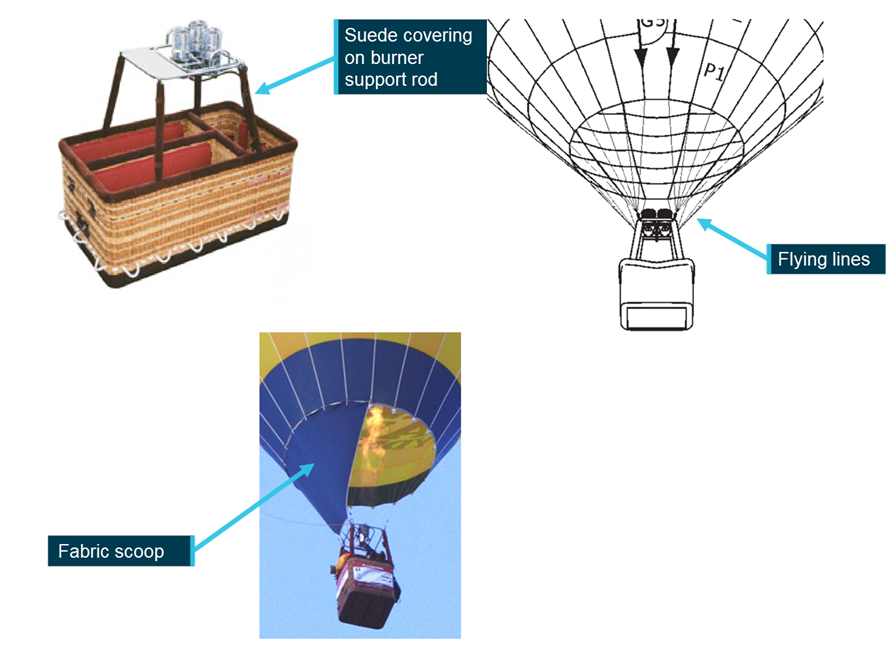
The flight proceeded to an alternative landing area at Westerfolds Park without further incident. The pilot and passengers were uninjured. The balloon sustained damage to five of the 20 woven stainless steel flying lines, the suede covering on a burner support rod and the balloon’s fabric scoop (Figure 2).
Figure 2: Damage to balloon and basket
Source: Kavanagh Balloons, annotated by the ATSB
Safety action
As a result of this incident, the operator has advised the ATSB that it has taken the following safety actions:
instituted a policy that if wind conditions do not permit an approach to this landing area to be conducted in level flight, with a minimum of 40 m clearance above powerlines, the flight is to proceed to the next suitable landing site
reminded pilots that flight should ‘always be carried out with extreme care and consideration to avoid powerline contact’ in line with the operations manual.
Safety message
This incident is an important reminder of the hazards associated with operations around powerlines. It is also a reminder to balloon operators of the importance in planning descents to take place when downwind of any significant obstacles.
In this incident, the pilot had operated into this landing area multiple times and was familiar with the powerlines but struck them anyway. This is not uncommon, as ATSB research indicates that in 63 per cent of wirestrike incidents the pilot was aware of the powerlines that were subsequently struck.
The Australian Ballooning Federation’s Pilot Circular No 18, dated February 2012, also highlights the following hazards to pilots in operations around powerlines that are relevant to this occurrence:
Complacency: Familiarity and repetition regarding operation and location can lead to complacency. Be aware of this and hence be vigilant. Data shows the worst accidents are often made by the most experienced and skilled operators.
Reduced visibility: Sun, mist, haze, contrast. Be vigilant and conservative under these conditions.
See and avoid scanning technique: Avoid focusing too long on close objects or scanning quickly left and right. Focus at a distance and move attention slowly over small arcs pausing briefly for a few seconds each time to closely examine the area.
Decisions regarding whether to conduct an investigation, and the scope of an investigation, are based on many factors, including the level of safety benefit likely to be obtained from an investigation. For this occurrence, no investigation has been conducted and the ATSB did not verify the accuracy of the information. A brief description has been written using information supplied in the notification and any follow-up information in order to produce a short summary report, and allow for greater industry awareness of potential safety issues and possible safety actions.
Occurrence Briefs are concise reports that detail the facts surrounding a transport safety occurrence, as received in the initial notification and any follow-up enquiries. They provide an opportunity to share safety messages in the absence of an investigation.
What happened
On 28 April 2021, at 0830 Eastern Standard Time,[1] a flight instructor and student pilot were conducting circuit training in a Guimbal Cabri G2 helicopter at Redcliffe Airport, Queensland.
The student completed one circuit before the instructor took over control of the helicopter to demonstrate another circuit. The instructor reported the controls felt slightly unusual and initially thought that may be due to the crosswind or their own control inputs at the time. The instructor turned the helicopter onto the crosswind then downwind legs of the circuit, before levelling off at 800 ft.
When the instructor attempted to level the helicopter, it did not respond to cyclic inputs and initially maintained the angle of bank (about 20° to the right), before a small increase in angle of bank and a significant nose-down pitch. The cyclic was full aft and left and the helicopter did not respond to instructor inputs.
The helicopter entered a nose-down descending right turn and the instructor broadcast a MAYDAY[2] call. While moving the cyclic, the instructor regained control of the helicopter and conducting a shallow approach back to the airfield with no further control issues.
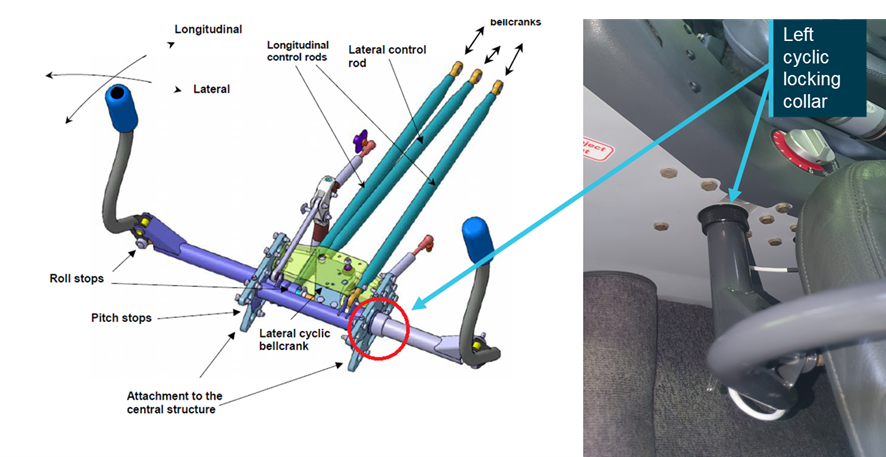
Post-flight inspection of the helicopter revealed the left cyclic locking collar was not secure, allowing the cyclic to disengage (Figure 1). The dual controls had been removed and reinstalled the previous day for a private flight. The position of the left cyclic locking collar was not noted prior to the flight and the right side cyclic was serviceable throughout.
Figure 1: Dual controls showing the left cyclic control locking collar
Source: Aircraft operator
Safety action
As a result of this occurrence, the aircraft operator advised the ATSB of the following proposed safety action:
removal and installation of dual controls by engineers instead of pilots
redesign of the dual control sign in/out register to mitigate confusion
consider dual check sign-off for installation of dual controls
raising a company safety alert to highlight the importance of removing distraction while engaged in safety critical tasks.
The operator assessed that the pilot installing the dual controls may have been distracted, as they were concurrently explaining the installation process to another pilot.
Safety message
This occurrence reinforces the importance of a thorough inspection of all visible flight control components and attachment points following maintenance and before flight.
About this report
Decisions regarding whether to conduct an investigation, and the scope of an investigation, are based on many factors, including the level of safety benefit likely to be obtained from an investigation. For this occurrence, no investigation has been conducted and the ATSB did not verify the accuracy of the information. A brief description has been written using information supplied in the notification and any follow-up information in order to produce a short summary report, and allow for greater industry awareness of potential safety issues and possible safety actions.
Occurrence Briefs are concise reports that detail the facts surrounding a transport safety occurrence, as received in the initial notification and any follow-up enquiries. They provide an opportunity to share safety messages in the absence of an investigation.
What happened
On 11 April 2021, a flight examiner conducted an instrument proficiency check with a commercial pilot in a Vulcanair [1] P.68C aircraft, at an airport near Brisbane, Queensland. At 1000 Eastern Standard Time,[2] as the aircraft was taxied to the apron after the flight, the pilot had difficulty controlling the aircraft’s direction and advised that the rudder seemed jammed.
A post-flight inspection revealed that the top rudder hinge had failed (Figure 1).
Figure 1: Rudder with failed hinge, inset shows failed hinge
Source: Aircraft operator
Maintenance
The aircraft was being maintained in accordance with the Civil Aviation Safety Authority (CASA) maintenance schedule, which required that a periodic inspection be completed every 100 hours or 12 months, whichever came first. The last inspection had been conducted 26 flight hours prior to the occurrence.
The CASA maintenance schedule was detailed in Civil Aviation Advisory Publication (CAAP) 42B-1(1.1). This CAAP required that the flight control surfaces, including the hinge brackets, be inspected for ‘general condition’. It specified that inspection aids such as work stands, mirrors and torches should be used and that ‘surface cleaning of individual components may also be required’. Paragraph 6.7 specified that the procedures ‘prepared by the aeroplane manufacturer are to be used when performing an inspection required by this schedule’.
In 2015, Vulcanair released Service letter 23 revision 1[3] which has since been incorporated into the P.68C maintenance program. The service letter was an alert to all P.68C owners and operators, providing detailed instructions on how to inspect the hinges. In accordance with the manufacturer’s approved maintenance procedures, the inspection was to be completed every 200 flight hours or 1 year, whichever came first. As the Civil Aviation Safety Authority had not issued an airworthiness directive containing the information in Service letter 23, the service letter was not mandatory. The inspection detailed by Service letter 23 had not been completed on this aircraft.
Safety action
CASA’s Continued Operational Safety and Standards section has contacted the European Union Aviation Safety Authority (EASA) small aircraft section and advised them of the incident and two other defects of a similar nature.
The operator’s maintenance repair and overhaul company has submitted the service letter feedback to the aircraft type certificate holder.
CASA is progressing the project to reform the continuing airworthiness and maintenance regulations. This work is being managed under project SS05/01 and status updates are available on the CASA website. The proposed policies include significant improvements to the current regulations, including the rules involving the CASA maintenance schedule. Subject to priorities in CASA’s wider regulatory program, CASA anticipates making the new regulations in 2022.
Consultation on the PAD closed on 18 November 2021.
Safety message
The CASA maintenance schedule was intended for those aircraft listed in Civil Aviation Order 100.5 as having inadequate maintenance schedules. Although no Vulcanair aircraft were on that list, nothing precluded the aircraft being maintained in accordance with the schedule. For operators who maintain aircraft in accordance with the maintenance schedule, CASA’s Maintenance guide for owners/operators stated that:
Under [Civil Aviation Regulation] CAR 42V (1), because all maintenance is required to be carried out in accordance with the applicable approved data, you must still consult with the manufacturer’s maintenance manuals for the airframe, engine and propeller, as well as applicable literature such as service bulletins, for instructions on how to carry out inspections and corrective maintenance action.
A manufacturer may issue service information, such as a service letter, to advise operators about a problem and introduce or clarify an inspection, procedure or new part to prevent the problem recurring.
In 2011, the ATSB investigated a similar occurrence,
, where the aircraft’s two horizontal stabiliser rear attachment brackets failed. During this investigation, the ATSB found that the:
Australian Civil Aviation Regulations 1988 (CAR) were being misinterpreted by some class B aircraft registration holders, to the extent that they believed that their aircraft was exempt from the manufacturer’s supplemental inspections when their aircraft was maintained using the CASA maintenance schedule. While the CASA maintenance schedule did not make any specific reference to the incorporation of the manufacturer’s supplemental inspections, it was a CAR requirement that all aircraft be maintained in accordance with approved maintenance data that, by definition, included those inspections.
About this report
Decisions regarding whether to conduct an investigation, and the scope of an investigation, are based on many factors, including the level of safety benefit likely to be obtained from an investigation. For this occurrence, no investigation has been conducted and the ATSB did not verify the accuracy of the information. A brief description has been written using information supplied in the notification and any follow-up information in order to produce a short summary report, and allow for greater industry awareness of potential safety issues and possible safety actions.
Occurrence Briefs are concise reports that detail the facts surrounding a transport safety occurrence, as received in the initial notification and any follow-up enquiries. They provide an opportunity to share safety messages in the absence of an investigation.
What happened
On 18 April 2021, the pilot of a Cessna 172S aircraft was conducting a private flight from Jandakot Airport to White Gum aeroplane landing area (ALA), Western Australia with two passengers on board. Prior to departure, the pilot provided a safety briefing to the passengers including instructing the front seat passenger to remain clear of the aircraft flight controls.
After landing, the front seat passenger accidentally pushed the left rudder pedal causing the aircraft to veer left off the runway toward trees. The pilot attempted to steer to the right by applying right rudder, which was unsuccessful. The pilot then initiated a go-around. As power was increased, the aircraft turned further left, resulting in the left-wing colliding with a tree. The aircraft rotated through 180° before coming to rest (Figure 1). The two passengers sustained minor injuries and the aircraft was substantially damaged.
Figure 1: Accident site
Source: Aircraft operator
Safety message
This accident highlights the importance of the passenger in the front seat of a dual control aircraft remaining clear of the flight controls (Figure 2). If there is any doubt about a passenger being able to comply with briefing instructions, consideration should be given to seating them in the rear seat.
Figure 2: Cessna 172 dual controls
Source: pinterest.dk
About this report
Decisions regarding whether to conduct an investigation, and the scope of an investigation, are based on many factors, including the level of safety benefit likely to be obtained from an investigation. For this occurrence, no investigation has been conducted and the ATSB did not verify the accuracy of the information. A brief description has been written using information supplied in the notification and any follow-up information in order to produce a short summary report, and allow for greater industry awareness of potential safety issues and possible safety actions.
Occurrence Briefs are concise reports that detail the facts surrounding a transport safety occurrence, as received in the initial notification and any follow-up enquiries. They provide an opportunity to share safety messages in the absence of an investigation.
What happened
On 6 April 2021, at about 0733 Western Standard Time,[1] an Airbus A320 aircraft began its take-off roll on runway 06 at Perth Airport, Western Australia. About 60 seconds later, the A320 was airborne and climbing out ahead, as a Fairchild Industries SA227 aircraft, with two crew and 15 passengers on board, was cleared for take-off from the same runway. The crew reported that the atmospheric conditions at the time were ‘very stable’, with clear skies and a light and variable wind.
As the SA227 climbed through 1,500 ft, the crew experienced an uncommanded ‘strong roll to the left’ that reached approximately 45° angle of bank and required full opposite control input to recover from. A lull then briefly occurred followed by another uncommanded roll, this time to the right, reaching an angle of bank of 35° and again requiring full control input from the crew to recover. The crew reported that the airspeed remained constant at about 150 knots, and the rate of climb was unaffected throughout the occurrence. Following the recovery from the second uncommanded roll, the flight continued to its destination without further incident. No passengers or crew were injured in the incident, and the aircraft did not sustain any damage.
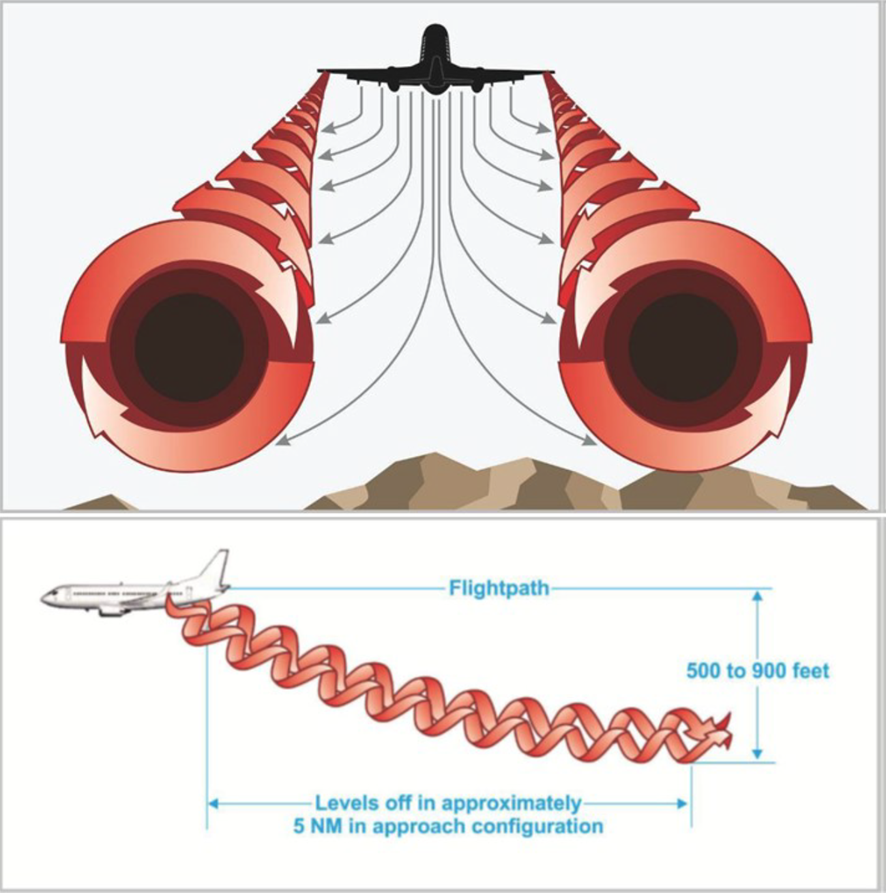
The aircraft operator assessed that the uncommanded roll experienced by the SA227 crew was the result of wake turbulence[2] (Figure 1) generated by the A320 that had departed ahead. The very stable atmospheric conditions at the time of the incident contributed to the wingtip vortices generated by the A320 remaining in the SA227’s flight path longer than would otherwise have been anticipated
Figure 1: Wake turbulence generation
How an aircraft generates wake turbulence in flight, with associated wingtip vortices
To minimise the risk to safety associated with wake turbulence, air traffic control separates aircraft arriving or departing from an airport using wake turbulence separation standards. These are time and/or distance-based measures that limit the separation of leading and following aircraft and are designed to reduce the likelihood and severity of wake turbulence occurrences.
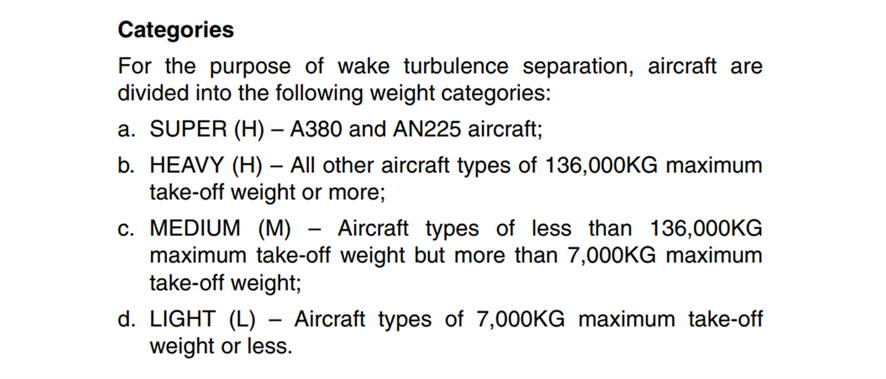
This separation is based on an aircraft’s maximum certified take-off weight, which is used to place it into a Light, Medium, Heavy, or Super wake turbulence category (Figure 2).
Figure 2: Division of aircraft categories based on maximum take-off weight
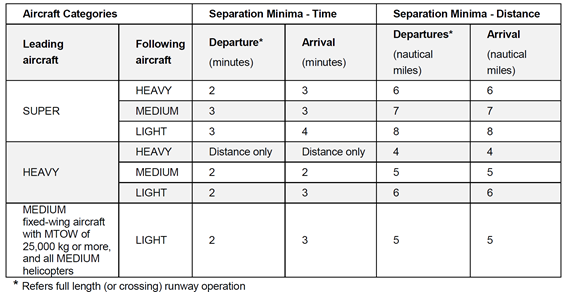
ATC applies the required distance and time separation requirements between aircraft based on which wake turbulence category each aircraft belongs to (Figure 3).
Figure 3: Table of required wake turbulence separation between categories
The SA227’s maximum take-off weight was 7,484 kg and the A320’s was 77,000 kg. Due to the broad range of weights included, both the SA227 and the A320 fall into the Medium wake turbulence category, and as a result ATC is not required to apply wake turbulence separation between them. Despite this, there is a significant difference in size and weight between these two aircraft types, and as such there exists the possibility of a wake turbulence encounter such as that experienced by the SA227 crew.
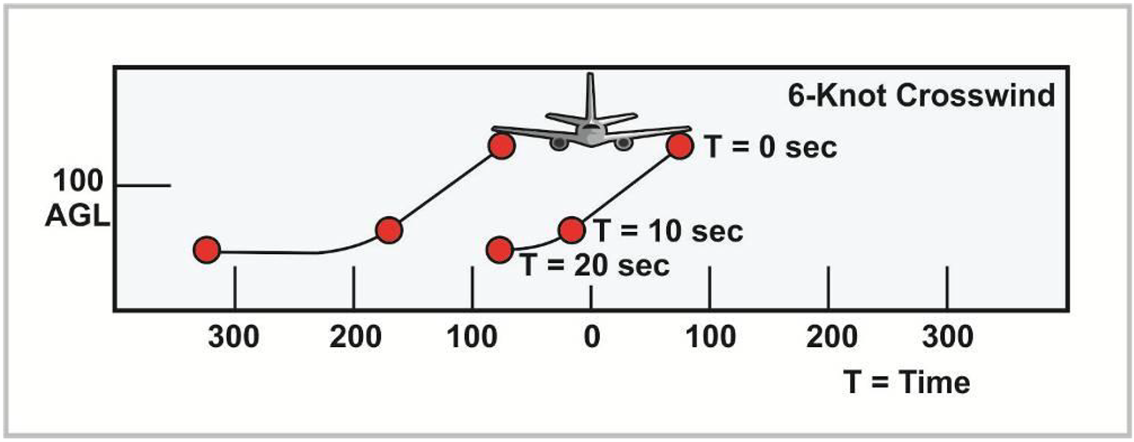
The stable atmospheric conditions on the day also contributed to this occurrence. Wingtip vortices generated by an aircraft are subject to local winds which can displace them from the position in which they are generated (Figure 4). The stable atmospheric conditions reported by the SA227 crew allowed the wingtip vortices to remain stationary behind the A320, and in the SA227’s projected flightpath, longer than would otherwise have been expected.
The operator has advised the ATSB that a reminder of the hazards of wake turbulence will be included in a monthly safety newsletter and distributed to all flight crew.
Safety message
This incident serves as a reminder to flight crew of the hazards associated with wake turbulence, and the limitations of existing wake turbulence separation standards under some circumstances.
ATSB research has found that ‘wake turbulence separation standards will not completely eliminate the hazards associated with wake turbulence vortices’.[3] Therefore, pilots are reminded that existing wake turbulence separation standards may not provide adequate protection against wake turbulence encounters in circumstances of a large size differential between two aircraft within the same wake turbulence category.
About this report
Decisions regarding whether to conduct an investigation, and the scope of an investigation, are based on many factors, including the level of safety benefit likely to be obtained from an investigation. For this occurrence, no investigation has been conducted and the ATSB did not verify the accuracy of the information. A brief description has been written using information supplied in the notification and any follow-up information in order to produce a short summary report, and allow for greater industry awareness of potential safety issues and possible safety actions.
Occurrence Briefs are concise reports that detail the facts surrounding a transport safety occurrence, as received in the initial notification and any follow-up enquiries. They provide an opportunity to share safety messages in the absence of an investigation.
What happened
On 21 March 2021, at about 2200 Eastern Daylight-saving Time,[1] a Piper PA-31-350 aircraft was operating a scheduled freight flight from Moorabbin, Victoria to Devonport, Tasmania. On board was a pilot in command supervising a second company pilot.
During approach, when about 5 NM from Devonport Airport, the low boost pump and low fuel flow warning lights illuminated. The right engine stopped shortly after. The pilot in command confirmed the fuel selector was in the correct position and observed that the fuel gauges indicated three-quarters full, which was as expected. The pilot then attempted to cross-feed fuel from the left engine, which was unsuccessful. By this time, the aircraft was on mid-final and, once assured of making the runway, the pilot stopped troubleshooting and concentrated on landing the aircraft.
After landing, the pilot inspected the fuel cap, which appeared to be secured correctly. However, blue stains were evident on top of the wing consistent with fuel venting out of the fuel cap. The fuel system was subsequently inspected by maintenance personnel with nil defects found with the fuel cap and no blockages in the fuel tank vents.
The pilot later advised that the rubber bladder containing the fuel within the tank was sucked up against the top of the wing as the tank emptied, providing a false indication of the fuel remaining in the tank.
Safety action
As a result of this occurrence, the aircraft operator has advised the ATSB that brighter torches would be carried in the aircraft to ensure flight crew could see the fuel tank caps during night operations. The aircraft operator already had a policy for pilots to check fuel caps for venting after take-off.
Safety message
Fuel starvation happens when the fuel supply to the engine(s) is interrupted although there is adequate fuel on board.
This incident reinforces the need to:
conduct a thorough pre-flight inspection ensuring all fuel tank caps are secured correctly
determine the expected rate of fuel consumption prior to flight
monitor fuel consumption during flight
be fully familiar with the fuel system’s operation.
Decisions regarding whether to conduct an investigation, and the scope of an investigation, are based on many factors, including the level of safety benefit likely to be obtained from an investigation. For this occurrence, no investigation has been conducted and the ATSB did not verify the accuracy of the information. A brief description has been written using information supplied in the notification and any follow-up information in order to produce a short summary report, and allow for greater industry awareness of potential safety issues and possible safety actions.