The Papua New Guinea Accident Investigation Commission (AIC) is conducting an investigation into a collision with terrain involving a Cessna T188C, registered VH-SOY, 171 km east of Mount Hagen Airport, Papua New Guinea, on 23 April 2025. The sole pilot was fatally injured.
The AIC has requested assistance and the appointment of an accredited representative from the ATSB. To facilitate this support and to provide the appropriate protections for the information, the ATSB appointed an accredited representative in accordance with paragraph 5.23 of Annex 13 to the Convention on International Civil Aviation and commenced an investigation under the Australian Transport Safety Investigation Act 2003.
Any enquires relating to the investigation should be directed to the Papua New Guinea Accident Investigation Commission at www.aic.gov.pg.
Occurrence summary
Investigation number
AA-2026-001
Occurrence date
23/04/2025
Location
171 km east of Mount Hagen Airport, Papua New Guinea
Occurrence Briefs are concise reports that detail the facts surrounding a transport safety occurrence, as received in the initial notification and any follow-up enquiries. They provide an opportunity to share safety messages in the absence of an investigation. Because occurrence briefs are not investigations under the Transport Safety Investigation Act 2003, the information in them is de-identified.
What happened
On the afternoon of 5 January 2026 at Parafield Airport, a student was conducting a series of check flights and assessments with an instructor in a Cessna 172. After completing 2 dual training check flights, the instructor approved the student to conduct a solo circuit flight.
Prior to sending the student on the solo flight, the instructor assessed the student’s adherence to standardised approach criteria from the aircraft’s POH.[1] The instructor also assessed the student’s general and situational emergency competency.
On the day of the occurrence, the student was required to complete 1.0 hours of touch‑and‑go[2] training at the aerodrome in accordance with the flight training syllabus.
The student departed and flew a standard circuit. During landing, the aircraft bounced on the runway and the student applied full power to conduct a missed approach. The aircraft was at a low speed, and at approximately 10 ft above the runway, the student retracted 10° of flap and the left wing stalled. The aircraft entered a further developed left wing drop stall and collided with terrain to the left of the runway.
The student exited the aircraft with no injuries, and the engine cowling caught fire which ignited the surrounding grass. The aircraft was subsequently destroyed by the fire (Figure 1).
Figure 1: Aircraft wreckage
Source: Aerodrome operator, annotated by the ATSB
Safety action
The operator has conducted a thorough audit of internal training records and an organisational review of flight training. Changes have been implemented to the instructor standardisation proficiency reviews and the overall training syllabus (pending CASA approval). Some of these changes include:
The operator’s current CASA Part 141 flight training approval contains an existing advanced stall training lesson which was approved and implemented by the company syllabus, to be conducted after the first solo; this is consistent with industry standard flight training. The operator has requested approval from CASA to reposition advanced stall training lessons to earlier in the syllabus. If approved, advanced stall training will be completed prior to the first solo check, ensuring fundamentals are better understood. Additionally, the operator will conduct a circuit emergencies lesson prior to the first solo check.
Recovery from a missed approach and missed landing has been added to circuit consolidation lessons, in addition to the standard lessons within the existing CASA Part 141 flight training syllabus.
Emergency procedures have been added to the internal student study guide and reinforced through structured briefings, in-flight practice, and post-flight debriefs.
Standardisation and proficiency checks for flight instructors are mandatory, ensuring compliance with CASA Part 91. Following this occurrence, the operator has required all instructors to undergo immediate additional checks with an added focus on non‑technical skills, threat and error management, stall identification and recovery including advanced stalling. Further focus has been placed on instructors to be vigilant in assessing their students’ overall competency (particularly regarding recovery from missed approaches and emergency procedures).
Safety message
Pilots must ensure that they are continually assessing the aircraft’s airspeed throughout the landing and take-off phases of flight. If the aircraft does not meet the rotation speed outlined in the POH, the take-off roll should be continued until the appropriate rotation speed is reached. Equally, should the aircraft become unstable during approach, a missed approach should be conducted.
A supportive and encouraging environment is recommended for flight schools, especially during the early stages of training. Should students feel inadequate or not confident (despite their proven level of competency), flight instructors are reminded to promote a safety culture that enables self-assessment.
This occurrence also highlights the importance of monitoring and assessing students’ stall understanding and recovery ability prior to any solo flights being authorised and conducted. A thorough understanding of the missed approach procedure is also encouraged.
About this report
Decisions regarding whether to conduct an investigation, and the scope of an investigation, are based on many factors, including the level of safety benefit likely to be obtained from an investigation. For this occurrence, no investigation has been conducted and the ATSB did not verify the accuracy of the information. A brief description has been written using information supplied in the notification and any follow-up information in order to produce a short summary report, and allow for greater industry awareness of potential safety issues and possible safety actions.
[1]An abbreviation for the Pilot Operating Handbook, published by manufacturers advising pilots of the aircraft parameters.
[2]A standard training exercise where the aircraft lands and does not come to a full stop, rather continues the landing roll transitioning to take-off roll and takes off.
Occurrence summary
Mode of transport
Aviation
Occurrence ID
AB-2026-005
Occurrence date
05/01/2026
Location
Parafield Airport
State
South Australia
Occurrence class
Accident
Aviation occurrence category
Collision with terrain
Highest injury level
None
Brief release date
19/02/2026
Aircraft details
Manufacturer
Cessna Aircraft Company
Model
172M
Sector
Piston
Operation type
Part 141 Recreational, private and commercial pilot flight training
On 24 April 2025, an MX Aircraft MXS single-engine light aircraft, registered N530RH, collided with terrain near the runway while on approach for landing at Langley Air Force Base near Hampton, Virginia, United States. The pilot sustained fatal injuries, and the aircraft was substantially damaged.
The United States National Transportation Safety Board (NTSB) commenced an investigation into the accident and requested assistance and the appointment of an accredited representative from the ATSB.
To facilitate this support and to provide the appropriate protections for the information, the ATSB appointed an accredited representative in accordance with paragraph 5.23 of Annex 13 to the Convention on International Civil Aviation and commenced an investigation under the Australian Transport Safety Investigation Act 2003.
On 2 July 2026, the NTSB released the final investigation report into this accident. Accordingly, the ATSB has concluded its involvement in the investigation. Any enquiries relating to the investigation should be directed to the NTSB.
The ATSB is investigating a collision with terrain involving a Cessna 210N, registered VH-RDH, 15 km south-east of Goolwa Airport, South Australia, on 6 February 2026.
During a flight, the aircraft collided with water and was destroyed, fatally injuring the 3 occupants.
The draft report internal review process has been completed. The draft report has been distributed to directly involved parties (DIPs) to check factual accuracy and ensure natural justice. Any submissions from those parties will be reviewed and, where considered appropriate, the draft report will be amended accordingly.
Following the external review process, any submissions and amendments to the draft report are internally reviewed. Once approved, the final report is prepared for publication and dissemination and released to DIPs prior to its public release.
A preliminary report, which detailed the factual information established during the evidence collection phase, was released on 4 March 2026 (see below).
The final report will be released at the conclusion of the investigation. Should a critical safety issue be identified during the course of the investigation, the ATSB will immediately notify relevant parties, so that appropriate safety action can be taken.
Last updated:
Preliminary report
Report release date: 04/03/2026
This preliminary report details factual information established in the investigation’s early evidence collection phase and has been prepared to provide timely information to the industry and public. Preliminary reports contain no analysis or findings, which will be detailed in the investigation’s final report. The information contained in this preliminary report is released in accordance with section 25 of the Transport Safety Investigation Act 2003.
The occurrence
On 6 February 2026, at about 1608 local time, a Cessna 210N, registered VH-RDH, departed from Goolwa Airport, South Australia, with 3 persons on board for a private local area flight. The persons on board comprised a flight instructor in the front right seat, a commercial pilot licence holder in the front left seat and a passenger, who held a recreational pilot licence, in the second row left seat. The purpose of the flight was for the commercial pilot licence holder to accumulate Cessna 210 flying experience. This was conducted under the supervision of the aircraft operator’s head of training and checking, who was the onboard flight instructor.
Air Traffic Control (ATC) radar detected the aircraft at 1609:45 and the ATC system started generating a track for the aircraft at 1609:50 at an uncorrected altitude[1] of 1,100 ft and groundspeed of 93 kt. Calculated barometric altitude[2] started at 1609:58 and recorded the aircraft at 1,275 ft and a groundspeed of 93 kt.[3] Goolwa Airport CTAF[4] recordings captured a runway 19 upwind departure call from the instructor, that they were climbing through 1,000 ft to 1,500 ft and tracking coastal to the east. The departure call was followed by an amendment that the aircraft was climbing to 2,500 ft for smoother air.
ATC radar tracked the aircraft as it followed the coast to the east at about 2,350 ft for about 5 minutes at about 130 kt. The aircraft then commenced a right turn through south to track west along the coast back towards the mouth of the Murray River (Murray Mouth) at about 136 kt. As the aircraft approached Murray Mouth, the altitude increased and reached 3,375 ft at 1620:52. As the aircraft climbed above 3,000 ft the tracking data shifted slightly south (at 1620:17) and the speed reduced to 74 kt while maintaining a westerly track.
At 1620:57 the aircraft was recorded at an uncorrected altitude of 2,700 ft, still on a westerly track, and the speed had reduced to 66 kt. The ATC system then ceased tracking the aircraft, but it was captured a final time on radar at 1621:05, at an uncorrected altitude of 1,200 ft. Figure 1 depicts the accident flight with 4 data points annotated.
Figure 1: Air traffic control generated track with data points annotated
Airservices Australia generated tracking data for the accident flight with ATSB numbered data points – at data point 2 the aircraft has climbed above 3,000 ft and the track has shifted to the south. Source: Airservices Australia, annotated by the ATSB
A witness located on the west side of Murray Mouth observed the aircraft in a steep descent and used their phone to record the final seconds of the descent. The footage indicated the aircraft was in a left turn spin just prior to colliding with the water in a steep nose down and left-wing low attitude, intact with the landing gear retracted. Several witnesses reported to the ATSB that the engine sounded like it was running until the collision. The 3 occupants were fatally injured and the aircraft was destroyed.
Wreckage inspection
The wreckage was retrieved from the water by South Australia Police prior to the ATSB’s arrival at the site on the afternoon of 7 February 2026. The wreckage was heavily fragmented and missing the engine, propeller, wings, vertical fin and rudder. The main gear was found down and locked and the nose gear retracted. Several seat belts had been cut by emergency services personnel to remove the occupants.
The left front seat was attached to the seat rails and fitted with an inertial reel strap to prevent inadvertent movement in flight. The strap was cut to remove the seat from the aircraft. The front right seat had separated from the seat rails, but the seat lock pins were in the down (locked) position and appeared undamaged. The second row left seat had separated from the floor of the aircraft but was contained within the wreckage. The second row right seat was not fitted. The rear seats (third row) were attached to the airframe.
The elevator control cables were identified, and the elevator trim surface was present and attached to the elevator. The elevator was free to move in the correct sense. Measurements of the elevator trim position were made, and an elevator control cable turnbuckle was removed and, in addition to the aircraft global positioning system unit, retained for further examination.
Further investigation
To date, the ATSB has:
inspected the wreckage and the departure airport’s fuel supply
recovered and retained equipment for further examination
collected records from the aircraft operator and Civil Aviation Safety Authority
collected air traffic control and airport data
collected electronic flight bag data
interviewed witnesses and other Cessna 210 pilots.
The investigation is continuing and will include:
further interviews
a review of aircraft operator and Civil Aviation Safety Authority records
analysis of witness videos, photographs, airport data and interviews
analysis of data from air traffic control, electronic flight bags and from equipment recovered from the aircraft.
A final report will be released at the conclusion of the investigation. Should a critical safety issue be identified during the course of the investigation, the ATSB will immediately notify relevant parties so appropriate and timely safety action can be taken.
Acknowledgements
The ATSB acknowledges the assistance provided by South Australia Police and State Emergency Service personnel.
Purpose of safety investigations
The objective of a safety investigation is to enhance transport safety. This is done through:
identifying safety issues and facilitating safety action to address those issues
providing information about occurrences and their associated safety factors to facilitate learning within the transport industry.
It is not a function of the ATSB to apportion blame or provide a means for determining liability. At the same time, an investigation report must include factual material of sufficient weight to support the analysis and findings. At all times the ATSB endeavours to balance the use of material that could imply adverse comment with the need to properly explain what happened, and why, in a fair and unbiased manner. The ATSB does not investigate for the purpose of taking administrative, regulatory or criminal action.
About ATSB reports
ATSB investigation reports are organised with regard to international standards or instruments, as applicable, and with ATSB procedures and guidelines.
Reports must include factual material of sufficient weight to support the analysis and findings. At all times the ATSB endeavours to balance the use of material that could imply adverse comment with the need to properly explain what happened, and why, in a fair and unbiased manner.
An explanation of terminology used in ATSB investigation reports is available here. This includes terms such as occurrence, contributing factor, other factor that increased risk, and safety issue.
Publishing information
Released in accordance with section 25 of the Transport Safety Investigation Act 2003
Ownership of intellectual property rights in this publication
Unless otherwise noted, copyright (and any other intellectual property rights, if any) in this report publication is owned by the Commonwealth of Australia.
Creative Commons licence
With the exception of the Commonwealth Coat of Arms, ATSB logo, and photos and graphics in which a third party holds copyright, this report is licensed under a Creative Commons Attribution 4.0 International licence.
The CC BY 4.0 licence enables you to distribute, remix, adapt, and build upon our material in any medium or format, so long as attribution is given to the Australian Transport Safety Bureau.
Copyright in material obtained from other agencies, private individuals or organisations, belongs to those agencies, individuals or organisations. Where you wish to use their material, you will need to contact them directly.
[1]Uncorrected altitude data was based on the standard atmosphere altimeter pressure setting of 1013 hPa, rounded to the nearest hundred feet.
[2]The calculated barometric altitude was based on the Adelaide altimeter pressure setting of 1015 hPa.
[3]All speeds in the report are ATC-recorded groundspeeds.
[4]CTAF: common traffic advisory frequency is the radio frequency used by pilots when operating in the vicinity of non‑towered airports.
Occurrence summary
Investigation number
AO-2026-010
Occurrence date
06/02/2026
Occurrence time and timezone
1621 Central Australian Daylight Time
Location
14 km south-east of Goolwa Airport
State
South Australia
Report release date
04/03/2026
Report status
Preliminary
Anticipated completion
Q3 2026
Investigation level
Short
Investigation type
Occurrence Investigation
Investigation phase
Final report: External review
Investigation status
Active
Mode of transport
Aviation
Aviation occurrence category
Collision with terrain, Loss of control
Occurrence class
Accident
Highest injury level
Fatal
Aircraft details
Manufacturer
Cessna Aircraft Company
Model
210N
Registration
VH-RDH
Serial number
21064374
Aircraft operator
Goolwa Air Pty Ltd
Sector
Piston
Operation type
Part 91 General operating and flight rules
Activity
General aviation / Recreational-Other general aviation flying-Other flights
The ATSB is investigating a collision with terrain involving Beechcraft B200C, registration VH‑PUY, near Normanton Airport, Queensland, on 6 February 2026.
After 4 passengers disembarked the aircraft, the pilot planned to conduct a flight from Normanton to Cairns, Queensland. Shortly after take-off from Normanton Airport's runway 32, the aircraft collided with terrain and a post-impact fire ensued. The pilot, who was the sole occupant of the aircraft, sustained fatal injuries, and the aircraft was destroyed.
To date, the ATSB has:
inspected the wreckage
recovered and retained equipment, including the cockpit voice recorder, for further examination
analysed operational and aircraft records from the aircraft operator and Civil Aviation Safety Authority
analysed air traffic control and airport data
analysed electronic flight bag data
interviewed witnesses and company pilots
analysed weather data
analysed data from air traffic control, the Bureau of Meteorology and equipment recovered from the aircraft.
A preliminary report, which detailed factual information established during the evidence collection phase, was released on 2 April 2026. See below.
The ATSB has completed the evidence collection and analysis phases of the investigation and is drafting the final report.
The final report will be released at the conclusion of the investigation. Should a critical safety issue be identified during the course of the investigation, the ATSB will immediately notify relevant parties, so that appropriate safety action can be taken.
Last updated:
Preliminary report
Report release date: 02/04/2026
This preliminary report details factual information established in the investigation’s early evidence collection phase, and has been prepared to provide timely information to the industry and public. Preliminary reports contain no analysis or findings, which will be detailed in the investigation’s final report. The information contained in this preliminary report is released in accordance with section 25 of the Transport Safety Investigation Act 2003.
The occurrence
On the afternoon of 6 February 2026, the pilot of a Beechcraft B200C, registered VH‑PUY and operated by Machjet International, planned to conduct a ferry flight[1] from Cairns to Normanton, followed by a return passenger transport flight[2] from Normanton to Doomadgee, then ferry the aircraft back to Cairns (all locations in Queensland). The flights were conducted under the instrument flight rules (IFR),[3] using callsign Machflight 313.
The aircraft took off from Cairns Airport at about 1318 local time and arrived at Normanton Airport at 1431. At 1455, the aircraft took off from runway 32 at Normanton Airport, with the pilot and 4 passengers on board, arriving at Doomadgee Airport at 1532. The aircraft then departed Doomadgee at 1853, and landed on runway 14 at Normanton Airport at 1932, where the pilot shut down the aircraft and the passengers disembarked.
At 1945:47, the pilot radioed Brisbane Centre air traffic control[4] and advised they were taxiing at Normanton for Cairns on runway 32. The controller responded that there was no reported IFR traffic and issued the pilot a transponder code. The controller then confirmed that the pilot was aware of the significant weather advisory (SIGMET)[5] ‘V03’, which was for frequent thunderstorms in an area that included Normanton Airport (see the section titled Meteorological conditions).
As the pilot had activated the airport lighting during approach, at 1947, a recorded message on the aerodrome frequency response unit was broadcast on the common traffic advisory frequency (CTAF)[6]: ‘Normanton airport airfield lighting 10 minutes remaining’.
At 1948, the pilot broadcast on the CTAF that they were ‘entering and backtracking runway 14’. There were no further recorded transmissions from the pilot. The aircraft then entered and backtracked runway 32.
Based on recorded ADS-B[7] data, the aircraft commenced take-off from runway 32 at 1950. The aircraft accelerated and climbed to a maximum height of about 150 ft above ground level prior to entering a descent (Figure 1).
Figure 1: ADS-B data path of VH-PUY
Source: Google Earth, annotated by the ATSB
The aircraft impacted a small tree, 360 m from the end of the runway, prior to impacting the ground in a wings-level attitude. Following the ground impact, the aircraft slid beneath powerlines and while there was no indication that the aircraft struck the wires, it triggered a local power outage. While sliding along the ground, the aircraft commenced a gradual right yaw,[8] impacting trees and breaking up in the process before coming to rest in flood water 580 m beyond the end of the runway.
At 1951:28, the final ADS-B position transmitted from the aircraft indicated that it:
was 370 m beyond the end of runway 32 (after the initial impact with the tree)
had a ground speed of 162 kt
had descended from the previous transmitted position to that point at 1,100 fpm.
The pilot was fatally injured. A post-impact fire ensued and the aircraft was destroyed.
Context
Pilot information
The pilot held a Commercial Pilot Licence (Aeroplane), a class 1 aviation medical certificate, a command instrument rating and the appropriate endorsements and ratings for the aircraft. The pilot had accrued 1,721 hours total flight time, 381 of which were on the B200 aircraft type. The pilot had completed 191 hours on the aircraft type in the last 90 days, with 116 of those hours as pilot in command.
Aircraft information
VH-PUY was a Beechcraft B200C twin-engine turboprop aircraft, manufactured in the United States in 1981 as serial number BL 41, and first registered in Australia in 1987. The aircraft had retractable landing gear, a pressurised cabin and a T-tail horizontal stabiliser. It was powered by 2 Pratt & Whitney Canada PT6A-42 engines and Hartzell HC-D4N-3A propellers. The aircraft avionics suite included Garmin G600 electronic flight instruments. According to the maintenance release, at the start of the day’s flying on 6 February 2026, the aircraft had accumulated a total time of 23,708.4 hours in service. There were no outstanding defects documented on the maintenance release.
Meteorological conditions
Area forecast
The Bureau of Meteorology grid point wind and temperature forecast, issued at 1604 and valid from 1900 on 6 February at 1,000 ft above mean sea level (AMSL) in the area including Normanton, was wind from 050° at 8 kt and temperature of 27°C.
The graphical area forecast (cloud heights AMSL) issued at 1421 and valid from 1500 to 2100 included the following information:
broken stratocumulus with bases at 1,500 ft and tops at 3,000 ft over land from 1900
broken cumulus/stratocumulus with bases at 3,000 ft and tops above 10,000 ft.
visibility reducing to 2,000 m in isolated to scattered showers of rain associated with:
isolated[10] towering cumulus with bases at 3,000 ft and tops above 10,000 ft
broken stratus with bases 800 ft and tops 3,000 ft
broken cumulus/stratocumulus with bases at 3,000 ft and tops above 10,000 ft.
visibility reducing to 1,000 m in isolated to occasional[11] thunderstorms with rain associated with:
isolated cumulonimbus with bases at 3,000 ft and tops above 10,000 ft
broken stratus with bases at 600 ft and tops at 3,000 ft.
The forecast also included SIGMET V02 valid from 1730–1930, for frequent[12] thunderstorms with tops at flight level 550 moving south-west at 15 kt in a region that included Normanton.
That SIGMET was reissued at 1852 as SIGMET V03, valid from 1930–2130 with no change in detail from V02.
Aerodrome forecast
The aerodrome forecast[13] (all cloud heights above the aerodrome elevation of 73 ft) for Normanton issued at 1630 and valid from 1800 to 0600 (on 7 February) included the following information relevant to the accident flight:
Wind from 350° at 8 kt, visibility greater than 10 km, light showers of rain and scattered cloud at 3,000 ft.
A probability for periods up to 60 minutes between 1800 and 0300 (on 7 February) of:
variable winds at 20 kt gusting to 30 kt
visibility 1,000 m in thunderstorms and rain
broken cloud at 800 ft and scattered cumulonimbus clouds with bases at 3,000 ft.
From 1800–2100, temperature 30°C and QNH[14] 1,008 hPa.
Aerodrome weather observations
Weather observations (all cloud heights above aerodrome elevation) at Normanton Airport between 1900 and 1956 included the following routine weather reports (METAR)[15] and special reports (SPECI)[16].
METAR at 1900: wind from 360° at 4 kt, visibility greater than 10 km, light showers of rain. Cloud broken at 6,200 ft, broken cloud at 7,400 ft, overcast at 8,200 ft. Temperature 31°C, dewpoint 26°C, QNH 1,010 hPa. No rain in the last 10 minutes, 0.2 mm since 0900 local time. Distant lightning detected to the north.
METAR at 1930: wind from 360° at 5 kt, visibility greater than 10 km, scattered cloud at 6,700 ft, broken cloud at 7,900 ft, overcast at 9,300 ft. Temperature 31°C, dewpoint 26°C, QNH 1,011 hPa. No rain in the last 10 minutes, 0.2 mm since 0900 local time. Distant lightning detected to the north-east, east, south-east and north-west.
SPECI at 1940: wind from 350° at 19 kt, visibility greater than 10 km, few cloud at 1,800 ft, scattered cloud at 4,700 ft, broken cloud at 6,700 ft. Temperature 27°C, dewpoint 22°C, QNH 1,011 hPa. No rain in the last 10 minutes, 0.2 mm since 0900 local time. Distant lightning detected in the north, north-east, east, south-east and north-west.
SPECI at 1952: wind from 020° at 16 kt gusting to 26 kt, visibility 7,000 m, thunderstorms in the vicinity, light showers of rain with scattered cloud at 800 ft, broken at 2,000 ft, broken at 4,800 ft. Temperature 25°C, dewpoint 24°C, QNH 1,012 hPa. 0.4 mm of rain in the last 10 minutes, 0.6 mm total rainfall since 0900 local time. Thunderstorms to the north and north-east.
SPECI at 1956: wind from 030° at 15 kt gusting to 25 kt, visibility 5,000 m and thunderstorms in the vicinity. Temperature 25°C, dewpoint 24°C, QNH 1,013 hPa. 0.4 mm of rain in the last 10 minutes, 0.6 mm total rainfall since 0900 local time. Thunderstorms to the north and north-east.
Figure 2 shows the Bureau of Meteorology weather radar, 2 minutes prior to the accident, with light to moderate rain rate detected to the north-west of Normanton.
Figure 2: Radar imagery 2 minutes prior to the accident
Source: Bureau of Meteorology, annotated by the ATSB
Table 1 shows the one-minute weather data from the automatic weather station at Normanton Airport from when the aircraft landed at 1932 to 2010. The data shows that when the aircraft landed at Normanton, the wind was northerly at 5 kt, gusting to 6 kt. As the pilot prepared the aircraft and taxied out, the wind veered to the east-north-east and increased in average and gust speed. The maximum wind speed and gust occurred at 1941. By 2009, the wind average and gust speeds had reduced below 10 kt.
The pilot’s briefing package included the forecast weather, aerodrome weather reports for Normanton and Cairns at 1730 local time and the relevant SIGMETs, consistent with that detailed above.
Sunset times
On 6 February 2026 at Normanton, daylight was from 0625–1913 and civil twilight[17] was 1913–1936. The moon rose at 2205.
Site and wreckage examination
The wreckage trail commenced at an impact mark at the top of a small tree to the left of an extended runway centreline, 360 m from the end of the runway (Figure 3). Propeller slash marks were evident on another tree approximately 20 m after the initial tree impact, followed by evidence of the aircraft fuselage’s impact with the ground.
The left and right wing tips were located embedded in trees on either side of the wreckage trail, 60 m from the initial tree impact. Browning of vegetation commenced from this point onwards in the direction of travel, indicating rupturing of the wing fuel tanks. From there, the aircraft slid, underneath a set of powerlines, with a gradual right yaw that continued until its final resting place. There was no evidence of landing gear marks anywhere in the wreckage trail, indicating that all landing gear was in the ‘up and locked’ position.
The main fuselage was located in an upright position with the empennage fractured at the base of the vertical stabiliser (T-tail), which was lying on its right side. The cockpit had separated from the aircraft at the rear of the pilot’s seat and was resting on its left side, partially submerged in water. The left wing and both engines had separated from the aircraft during the accident sequence. The fuselage, cockpit and right wing were heavily damaged from a post‑impact fire.
Impact damage to the engine propellers indicated they were being driven by the engine during the impact sequence. All flight controls were located with the aircraft and measurements were taken of the flap, rudder trim and elevator trim actuators for further analysis.
Figure 3: Wreckage trail of VH-PUY
Source: ATSB
Further investigation
To date, the ATSB has:
inspected the wreckage
recovered and retained equipment, including the cockpit voice recorder, for further examination
collected operational and aircraft records from the aircraft operator and Civil Aviation Safety Authority
collected air traffic control and airport data
collected electronic flight bag data
interviewed witnesses and company pilots
collected weather data.
The investigation is continuing and will include:
further interviews
analysis of witness videos, photographs, airport data and interviews
review of operational information
analysis of data from air traffic control, the Bureau of Meteorology and equipment recovered from the aircraft.
A final report will be released at the conclusion of the investigation. Should a critical safety issue be identified during the course of the investigation, the ATSB will immediately notify relevant parties so appropriate and timely safety action can be taken.
Acknowledgements
The ATSB acknowledges the assistance provided by the Queensland Police Service and Carpentaria Shire Council.
Purpose of safety investigations
The objective of a safety investigation is to enhance transport safety. This is done through:
identifying safety issues and facilitating safety action to address those issues
providing information about occurrences and their associated safety factors to facilitate learning within the transport industry.
It is not a function of the ATSB to apportion blame or provide a means for determining liability. At the same time, an investigation report must include factual material of sufficient weight to support the analysis and findings. At all times the ATSB endeavours to balance the use of material that could imply adverse comment with the need to properly explain what happened, and why, in a fair and unbiased manner. The ATSB does not investigate for the purpose of taking administrative, regulatory or criminal action.
About ATSB reports
ATSB investigation reports are organised with regard to international standards or instruments, as applicable, and with ATSB procedures and guidelines.
Reports must include factual material of sufficient weight to support the analysis and findings. At all times the ATSB endeavours to balance the use of material that could imply adverse comment with the need to properly explain what happened, and why, in a fair and unbiased manner.
An explanation of terminology used in ATSB investigation reports is available here. This includes terms such as occurrence, contributing factor, other factor that increased risk, and safety issue.
Publishing information
Released in accordance with section 25 of the Transport Safety Investigation Act 2003
Ownership of intellectual property rights in this publication
Unless otherwise noted, copyright (and any other intellectual property rights, if any) in this report publication is owned by the Commonwealth of Australia.
Creative Commons licence
With the exception of the Commonwealth Coat of Arms, ATSB logo, and photos and graphics in which a third party holds copyright, this report is licensed under a Creative Commons Attribution 4.0 International licence.
The CC BY 4.0 licence enables you to distribute, remix, adapt, and build upon our material in any medium or format, so long as attribution is given to the Australian Transport Safety Bureau.
Copyright in material obtained from other agencies, private individuals or organisations, belongs to those agencies, individuals or organisations. Where you wish to use their material, you will need to contact them directly.
[1]Ferry flights were conducted under Part 91 of the Civil Aviation Safety Regulations (CASR).
[2]Passenger transport flights were conducted under Part 135 of the CASR.
[3]Instrument flight rules (IFR): a set of regulations that permit the pilot to operate an aircraft in instrument meteorological conditions (IMC), which have much lower weather minimums than visual flight rules (VFR). Procedures and training are significantly more complex as a pilot must demonstrate competency in IMC conditions while controlling the aircraft solely by reference to instruments. IFR-capable aircraft have greater equipment and maintenance requirements.
[4]Brisbane centre: Brisbane Centre air traffic control is one of 2 major air traffic control centres – the other being in Melbourne. From Brisbane Centre, Airservices manages the airspace over the northern half of Australia, representing around 5% of the world’s total airspace. Brisbane Centre’s flight information region (FIR) neighbours include Indonesia, East Timor, Papua New Guinea, Fiji, New Zealand, and the USA.
[5]Significant meteorological information (SIGMET): a weather advisory service that provides the location, extent, expected movement and change in intensity of potentially hazardous (significant) or extreme meteorological conditions that are dangerous to most aircraft, such as thunderstorms or severe turbulence.
[6]Common Traffic Advisory Frequency (CTAF): a designated frequency on which pilots make positional broadcasts when operating in the vicinity of a non-controlled airport or within a broadcast area.
[7]Automatic dependent surveillance–broadcast (ADS-B): a surveillance technology in which an aircraft determines its position via satellite navigation and periodically broadcasts it, enabling it to be tracked.
[8]Yawing: the motion of an aircraft about its vertical or normal axis.
[9]Cloud cover: in aviation, cloud cover is reported using words that denote the extent of the cover – ‘few’ indicates that up to a quarter of the sky is covered, ‘scattered’ indicates that cloud is covering between a quarter and a half of the sky, ‘broken’ indicates that more than half to almost all the sky is covered, and ‘overcast’ indicates that all the sky is covered.
[10]Isolated thunderstorms and/or cloud: individual features are affecting, or forecast to affect, up to 50% of an area.
[11]Occasional: well-separated features affecting, or are forecast to affect, greater than 50% but not more than 75% of an area.
[12]Frequent thunderstorms: an area of thunderstorms with little or no separation between adjacent storms and covering more than 75% of the affected area.
[13]Aerodrome forecast (TAF): a statement of meteorological conditions expected for a specific period of time in the airspace within a radius of 5 NM (9 km) of the aerodrome reference point.
[14]QNH: the altimeter barometric pressure subscale setting used to indicate the height above mean sea level.
[15]METAR: a routine report of meteorological conditions at an aerodrome. METAR are normally issued on the hour and half hour.
[16]A SPECI is a special report of meteorological conditions, issued when one or more elements meet specified criteria significant to aviation. SPECI is also used to identify reports of observations recorded 10 minutes following an improvement (in visibility, weather or cloud) to above SPECI conditions.
[17]During civil twilight, the sun is between 0–6° below the horizon. There is enough natural sunlight during this period that artificial light may not be required to carry out outdoor activities. Only the brightest celestial objects can be observed by the naked eye during this time.
Occurrence summary
Investigation number
AO-2026-060
Occurrence date
06/02/2026
Occurrence time and timezone
1951 Australian Eastern Standard Time
Location
Near Normanton Airport
State
Queensland
Report release date
02/04/2026
Report status
Preliminary
Anticipated completion
Q1 2027
Investigation level
Defined
Investigation type
Occurrence Investigation
Investigation phase
Final report: Drafting
Investigation status
Active
Mode of transport
Aviation
Aviation occurrence category
Collision with terrain
Occurrence class
Accident
Highest injury level
Fatal
Aircraft details
Manufacturer
Beech Aircraft Corp
Model
B200C
Registration
VH-PUY
Serial number
BL 41
Aircraft operator
Machjet International Pty. Ltd.
Sector
Turboprop
Operation type
Part 91 General operating and flight rules
Activity
General aviation / Recreational-Other general aviation flying-Ferry flights
The ATSB is investigating a collision with terrain involving a Van's RV-8A, registered VH-MKX, near Heck Field aircraft landing area, Queensland, on 27 January 2026.
The pilot had planned to conduct a private flight from Heck Field to Barraba, New South Wales, with one passenger on board. Shortly after becoming airborne off runway 28, the aircraft collided with terrain. The pilot and passenger were fatally injured, and the aircraft was destroyed.
To date, the ATSB investigation has:
evaluated the accident site and aircraft wreckage
interviewed witnesses and other parties
collected closed circuit television footage
analysed aircraft weight and balance
recovered of the engine from the accident site for more detailed examination
collected of maintenance and pilot records.
The continuing investigation will include:
detailed inspection of components recovered from the accident site
analysis of video and audio recordings
examination of pilot and maintenance records
assessment of related occurrences.
The ATSB released a preliminary report, which details factual information established in the investigation’s early evidence collection phase, on 31 March 2026. See below.
A final report will be released at the conclusion of the investigation. Should a critical safety issue be identified during the course of the investigation, the ATSB will immediately notify relevant parties, so that appropriate safety action can be taken.
Last updated:
Preliminary report
Report release date: 31/03/2026
This preliminary report details factual information established in the investigation’s early evidence collection phase, and has been prepared to provide timely information to the industry and public. Preliminary reports contain no analysis or findings, which will be detailed in the investigation’s final report. The information contained in this preliminary report is released in accordance with section 25 of the Transport Safety Investigation Act 2003.
The occurrence
Accident flight details
Early on the morning of 27 January 2026, the pilot of a Van’s Aircraft RV-8A, registered VH‑MKX, commenced preparation for a private flight from the Heck Field aeroplane landing area, Queensland, to Barraba, New South Wales. At 0328 local time, the pilot submitted a location briefing request to the National Aeronautical Information Processing System[1] through OzRunways.[2] At 0450, the pilot and their passenger were observed arriving at Heck Field by security. The pilot later lodged a flight plan with Airservices Australia at 0528 to depart at 0600 and land at Barraba at 0900. At 0538, closed circuit television (CCTV) footage recorded the pilot and passenger boarding the aircraft, with the pilot sitting in the front seat and the passenger in the rear seat.
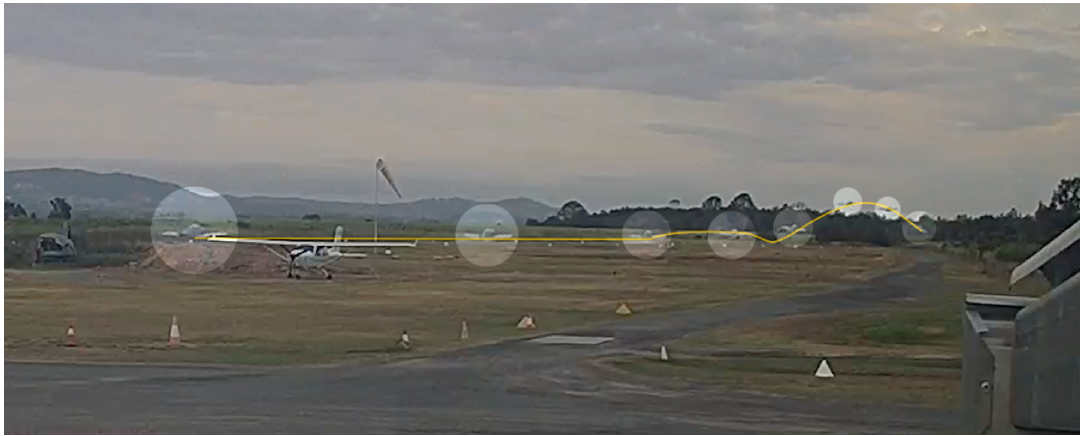
The pilot taxied the aircraft to the start of runway 28[3] and commenced the take-off roll. At 0550:14, the aircraft entered the view of the CCTV around 100 m from the runway threshold and was observed accelerating (Figure 1). Fifteen seconds later, the aircraft had travelled around 350 m whereupon it lifted off, flying just above and along the runway surface. At 0550:32, the aircraft began to sink, after which it pitched up and began to climb with wings level. The climb ceased at 0550:41, then the aircraft started to descend. The footage showed that the right wing dropped and the aircraft subsequently collided with terrain at 0550:43. Both occupants sustained fatal injuries and the aircraft was destroyed.
Figure 1: Montage of frames from CCTV showing the accident flight path
The image has been cropped to show the later portion of the flight. The yellow line shows the indicative path of travel for the aircraft. Source: Heck Field airfield CCTV, annotated by the ATSB
Witness observation
An earwitness located at Heck Field reported that their attention was drawn to the sound of the aircraft due to what they described as abnormal engine noises that developed during the take‑off.
Context
Pilot information
The pilot held a Private Pilot Licence (Aeroplane), issued in 1975, and a Private Pilot Licence (Helicopter), issued in 1993. Their total aeronautical experience was reported to be about 5,500 hours. The available flight records indicated they had flown about 60 hours in the last 6 months. The pilot held a valid class 5 aviation medical certificate[4] through self‑declaration of fitness to fly on 15 December 2025.
Aircraft information
General
The Van’s Aircraft RV-8A is a low-wing, all-metal, amateur-built aircraft. It is supplied in kit form and is designed to be constructed for the education and recreation of the owner. The RV-8A has 2 seats in tandem configuration, has a fixed, tricycle landing gear, and is suitable for cross-country flying or for flying aerobatic manoeuvres.
Construction of VH-MKX, serial number 82025, was completed in 2015.[5] It was fitted with a 4-cylinder, horizontally opposed Subaru EJ25 engine modified for aircraft use driving a MT Propellor 3-blade electric constant speed propeller.
A special certificate of airworthiness in the experimental category[6] was issued in 2024. The aircraft was sold to the pilot of the accident flight in January 2025. The most recent maintenance record available to the investigation, dated 8 January 2025, indicated that the aircraft had accrued 614.5 hours time since new.
Meteorological information
There was no Bureau of Meteorology weather monitoring station for Heck Field, however, the graphical area forecast valid for the time and area did not indicate any significant weather phenomena. The airfield CCTV recorded the windsock movements during the take‑off and indicated a south-easterly wind (between 100º to 160º) at around 5 to 10 kt. Geoscience Australia recorded sunrise at the airfield to be 0515.
Recorded information
The aircraft was not fitted with, nor was it required to have, a flight data recorder or cockpit voice recorder. The aircraft was fitted with an electronic flight instrument system that had the capacity to record flight and engine parameters. This device was damaged beyond the ability to recover data.
Automatic dependent surveillance broadcast (ADS-B)[7] flight tracking data was obtained from ADS-B Exchange, which identified 3 data points for the accident flight (Figure 2). The final data point identified an aircraft ground speed of 68 kt.
CCTV (no audio available) of the take-off was recorded by the Gold Coast Sport Flying Club. Another camera at a nearby industrial property recorded audio of the accident flight in which the sounds of the aircraft engine were apparent. The engine was audible for around 40 seconds and the engine revolutions per minute fluctuated periodically for that time.
Figure 2: Flight tracking data and location of closed-circuit television cameras
Source: Google Earth and ADS-B Exchange flight tracking data, annotated by the ATSB
Wreckage and impact information
The accident site was about 360 m from the end of runway 28, on the same heading, in an area of lightly timbered bushland with some felled trees. The distribution of the wreckage indicated that the aircraft collided with terrain right-wing low, at a high angle of entry, and at a relatively slow speed. The aircraft came to rest inverted and facing in the opposite direction to its flightpath. An immediate fuel-fed, post‑impact fire developed into a bushfire in the surrounding area that required a firefighting helicopter to contain.
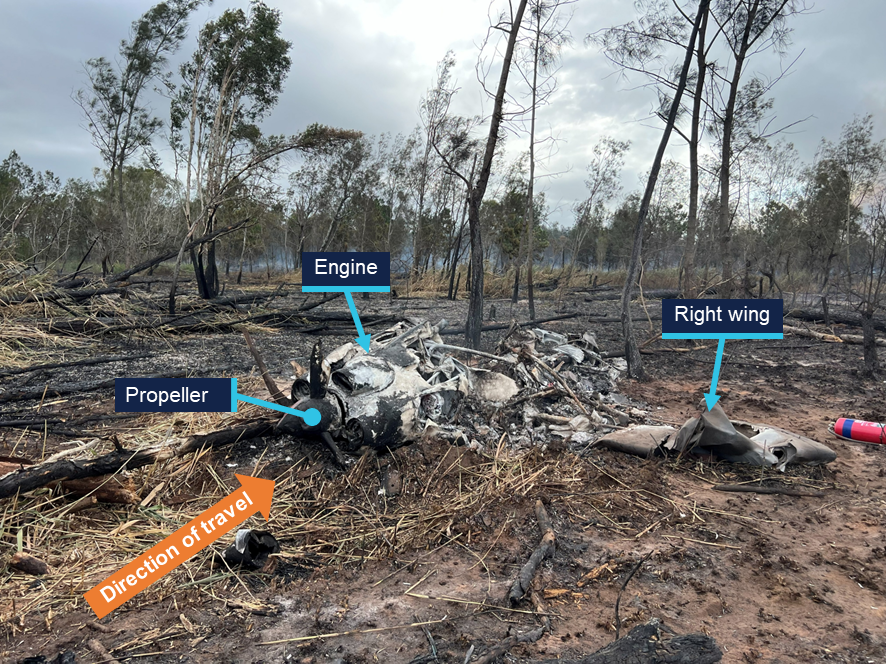
The fire destroyed the aircraft, limiting the extent to which it could be examined (Figure 3). However, all major aircraft components were accounted for at the accident site. Examination of the flap actuator indicated that the flaps were at or near the fully extended position. Damage to the propeller blades showed that the engine was operating at impact. The engine was recovered from the accident site and taken to a facility for detailed inspection by Queensland Police Service vehicle inspection officers under the supervision of the ATSB. The engine was extensively damaged by the fire, which limited the examination. However, based on the available evidence, no obvious malfunction was identified.
Figure 3: Aircraft at the accident site destroyed by the post-impact fire
Source: Queensland Police Service, annotated by the ATSB
Further investigation
To date, the ATSB has:
examined the wreckage and accident site
recovered and examined the engine
recovered and examined avionics components
interviewed involved parties with knowledge of the pilot, passenger, and the aircraft
collected aircraft and pilot documentation.
The investigation is continuing and will include:
review of aircraft maintenance and pilot documentation
further analysis of the take-off sequence using the CCTV recordings and other recorded data
review of the post-mortem information and survivability factors.
A final report will be released at the conclusion of the investigation. Should a critical safety issue be identified during the course of the investigation, the ATSB will immediately notify relevant parties so appropriate and timely safety action can be taken.
Acknowledgements
The ATSB acknowledges the assistance provided by the Queensland Police Service, the Queensland State Emergency Services, and the Gold Coast Sport Flying Club during the onsite phase of the investigation and additional examination of the engine.
Purpose of safety investigations
The objective of a safety investigation is to enhance transport safety. This is done through:
identifying safety issues and facilitating safety action to address those issues
providing information about occurrences and their associated safety factors to facilitate learning within the transport industry.
It is not a function of the ATSB to apportion blame or provide a means for determining liability. At the same time, an investigation report must include factual material of sufficient weight to support the analysis and findings. At all times the ATSB endeavours to balance the use of material that could imply adverse comment with the need to properly explain what happened, and why, in a fair and unbiased manner. The ATSB does not investigate for the purpose of taking administrative, regulatory or criminal action.
About ATSB reports
ATSB investigation reports are organised with regard to international standards or instruments, as applicable, and with ATSB procedures and guidelines.
Reports must include factual material of sufficient weight to support the analysis and findings. At all times the ATSB endeavours to balance the use of material that could imply adverse comment with the need to properly explain what happened, and why, in a fair and unbiased manner.
An explanation of terminology used in ATSB investigation reports is available here. This includes terms such as occurrence, contributing factor, other factor that increased risk, and safety issue.
Publishing information
Released in accordance with section 25 of the Transport Safety Investigation Act 2003
Ownership of intellectual property rights in this publication
Unless otherwise noted, copyright (and any other intellectual property rights, if any) in this report publication is owned by the Commonwealth of Australia.
Creative Commons licence
With the exception of the Commonwealth Coat of Arms, ATSB logo, and photos and graphics in which a third party holds copyright, this report is licensed under a Creative Commons Attribution 4.0 International licence.
The CC BY 4.0 licence enables you to distribute, remix, adapt, and build upon our material in any medium or format, so long as attribution is given to the Australian Transport Safety Bureau.
Copyright in material obtained from other agencies, private individuals or organisations, belongs to those agencies, individuals or organisations. Where you wish to use their material, you will need to contact them directly.
[1]The National Aeronautical Information Processing System is a multi-function, computerised, aeronautical information system that allows users, such as pilots, to obtain weather information and submit flight plans into the air traffic system.
[2]OzRunways is an electronic flight bag application that provides navigation, weather, area briefings and other flight information. It provides the option for live flight tracking by transmitting the device’s position and altitude.
[3]Runway number: the number represents the magnetic heading closest to the runway orientation. In this case 280º.
[4]The class 5 medical self-declaration allows recreational and private pilots to self-assess and self-declare without requiring a medical assessment. Eligibility and operational limitations apply.
[5]This registration and serial number had been previously used for a Van’s RV-8A that was involved in an accident on 1 October 2010. Some components, such as the avionics and electrical system, from the original aircraft were fitted to the accident aircraft.
[6]Experimental category: the Civil Aviation Safety Authority can issue experimental certificates to allow specific operations of aircraft, which are not by their nature type certificated or have modifications incorporated that are not yet approved. Pilots and passengers of experimental aircraft in Australia accept the risk that the aircraft may not meet the same airworthiness safety standards as certified aircraft and, therefore, operate on the basis of informed participation. Informed participation relies on the premise that before the participant takes part, or pays for an activity, they are fully aware of the potential risks and consequences.
[7]Automatic dependent surveillance-broadcast is a surveillance technology in which an aircraft determines its position via satellite navigation and periodically broadcasts it, enabling it to be tracked.
Occurrence summary
Investigation number
AO-2026-005
Occurrence date
27/01/2026
Occurrence time and timezone
0551 Australian Eastern Standard Time
Location
Near Heck Field aeroplane landing area
State
Queensland
Report release date
31/03/2026
Report status
Preliminary
Anticipated completion
Q1 2027
Investigation level
Defined
Investigation type
Occurrence Investigation
Investigation phase
Examination and analysis
Investigation status
Active
Mode of transport
Aviation
Aviation occurrence category
Collision with terrain
Occurrence class
Accident
Highest injury level
Fatal
Aircraft details
Manufacturer
Amateur Built Aircraft
Model
RV-8A
Registration
VH-MKX
Serial number
82025
Sector
Piston
Operation type
Part 91 General operating and flight rules
Activity
General aviation / Recreational-Sport and pleasure flying-Pleasure and personal transport
Occurrence Briefs are concise reports that detail the facts surrounding a transport safety occurrence, as received in the initial notification and any follow-up enquiries. They provide an opportunity to share safety messages in the absence of an investigation. Because occurrence briefs are not investigations under the Transport Safety Investigation Act 2003, the information in them is de-identified.
What happened
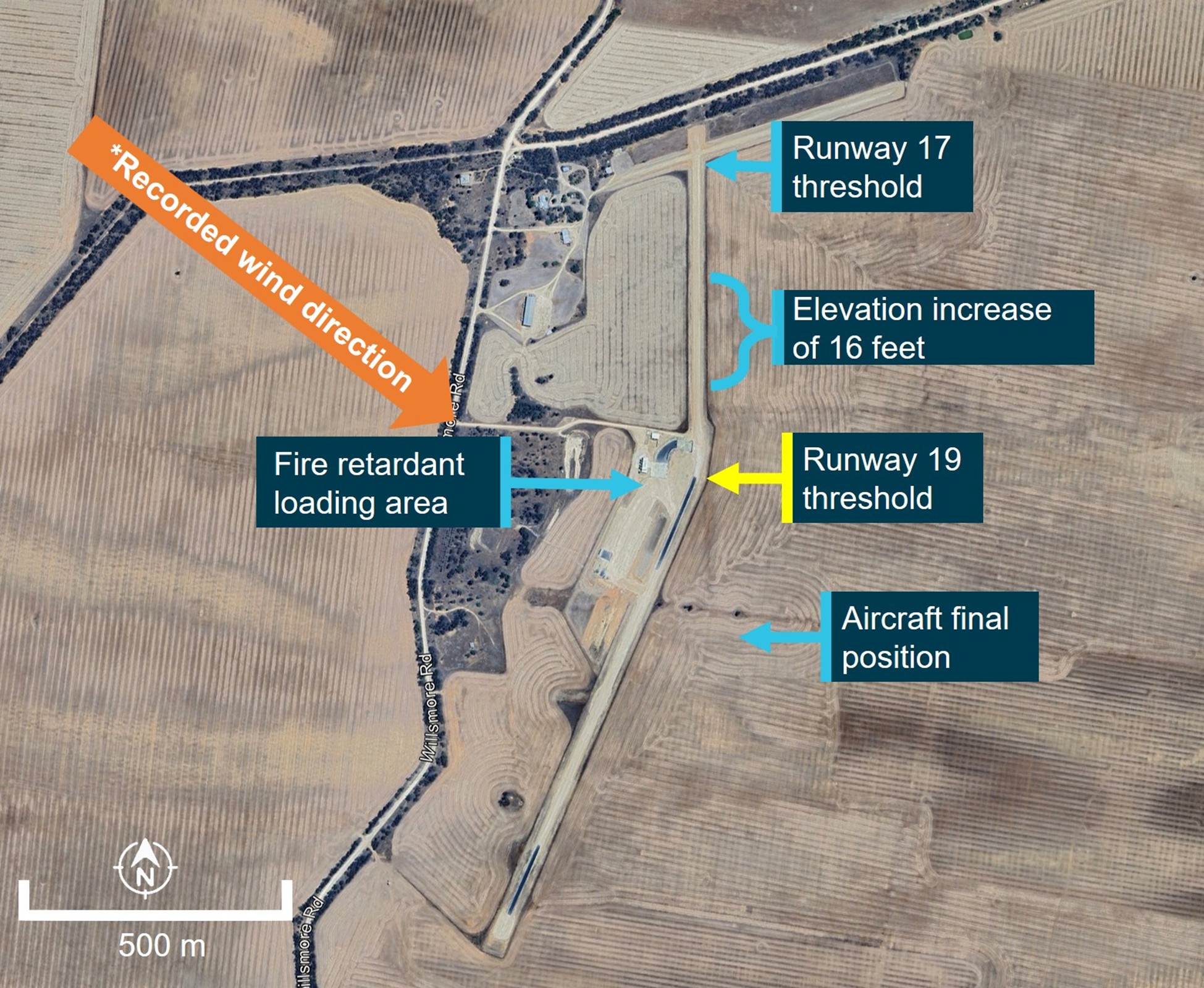
On 4 December 2025, at 1720 local time, an Air Tractor AT-802A was preparing to conduct aerial firefighting operations from Linga Airbase, Victoria. Before departure the pilot briefly consulted electronic maps for Linga Airbase, however, did not observe that runways 17 and 19 were 2 separate runways with runway 19 commencing at the end of runway 17 rather than a single longer runway (Figure 1). After loading the aircraft with fire retardant, the pilot commenced taxi for runway 17, believing they were backtracking to use the entire length of runways 17 and 19. The pilot completed their take-off checks and commenced the take-off roll.
The pilot reported that during the take-off run, due to the upslope on runway 17, they were unable to see the threshold of runway 19 until the aircraft had crested the rise towards the end of runway 17. Unaware of the 20° right turn, on becoming visual with runway 19, the pilot assessed the turn was too sharp to navigate and the aircraft was travelling too fast to stop and not yet fast enough to become airborne.
Figure 1: Linga Airbase, Victoria
* Wind direction was recorded 82 km away at Hopetoun, Victoria. Source: Google Earth, annotated by the ATSB
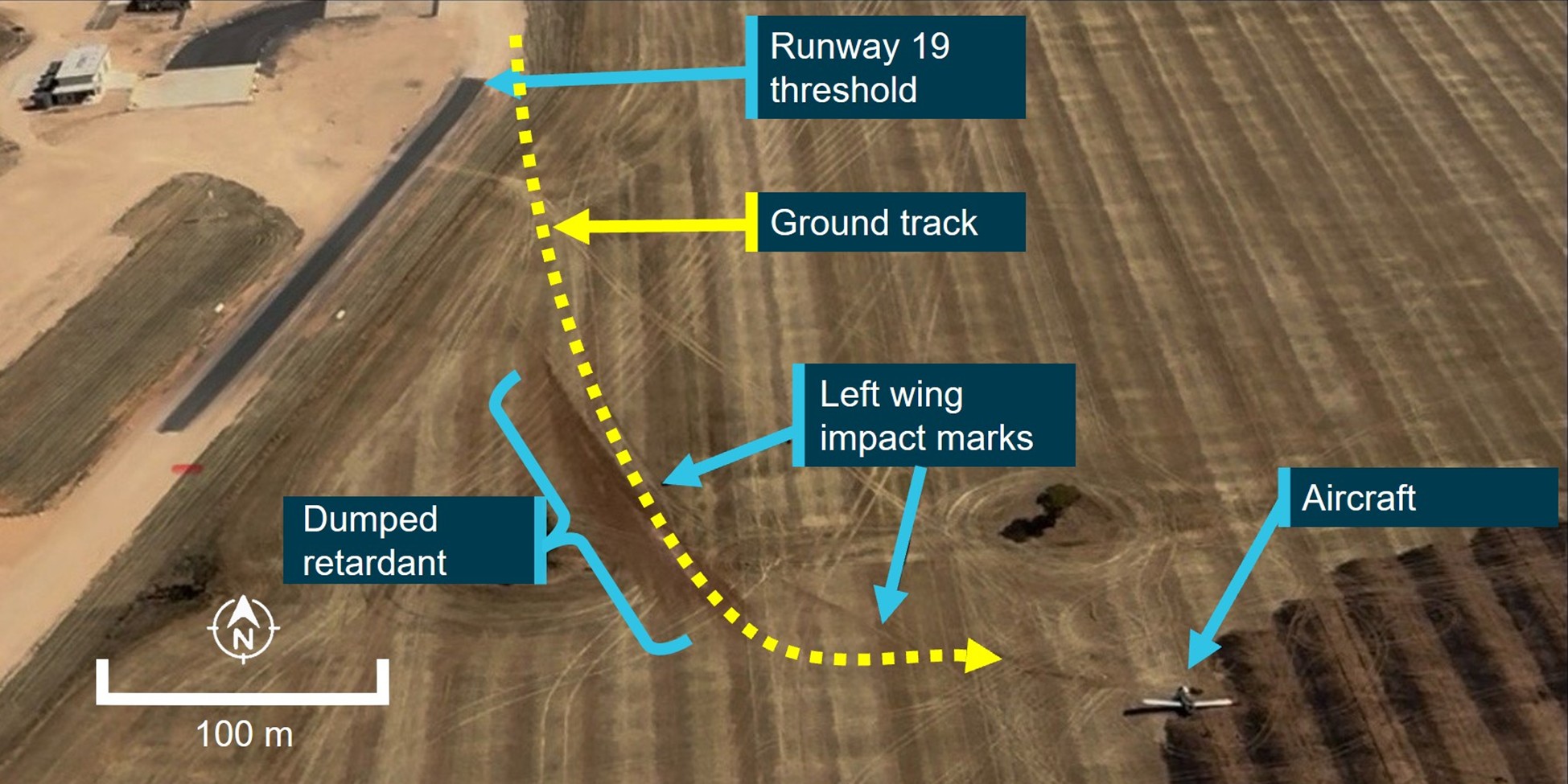
The pilot maintained the runway 17 heading, and the aircraft overran the end of runway 17 into a field, impacting a fence, before becoming airborne. The pilot intended to release the load of fire retardant to reduce weight, however, due to their unfamiliarity with the location of the load release switch in that aircraft, instead activated the aircraft lights, before locating the correct switch and dumping the load. Images show the left-wing tip dragged along the surface of the field while the load was dumped. A witness reported the aircraft briefly became airborne with a nose high attitude and left wing down in a left turn before the left wing again contacted the ground and pulled the aircraft to the ground before coming to a stop (Figure 2).
Figure 2: Occurrence aircraft impact marks and final position
Source: Operator, annotated by the ATSB
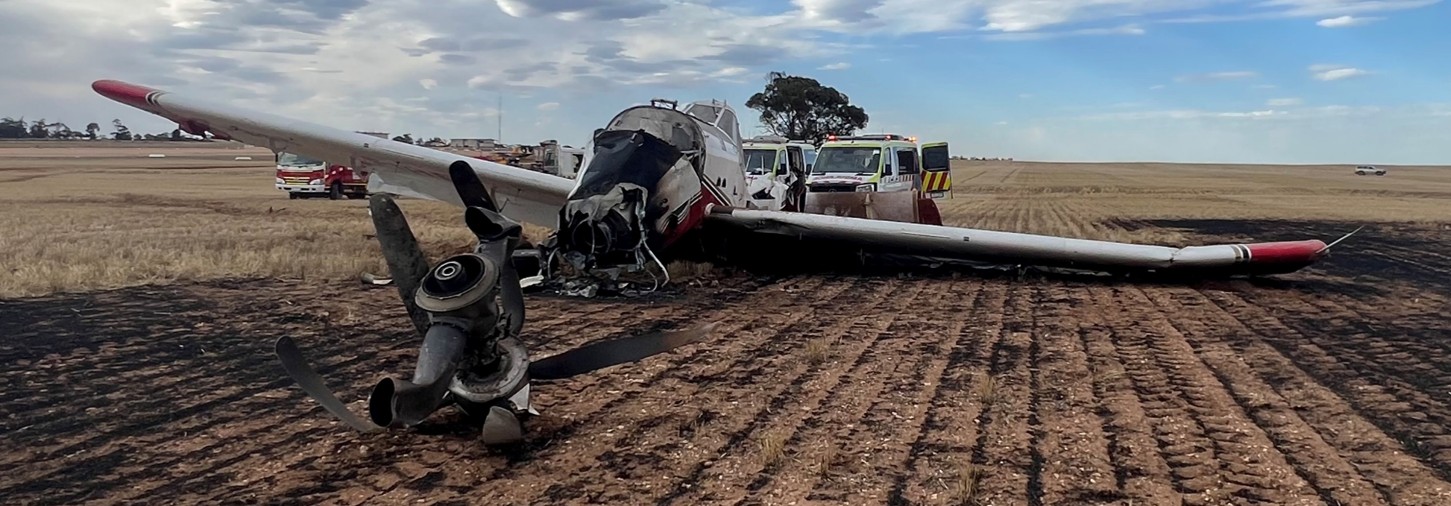
The impact was sufficient to liberate the engine and propeller from the aircraft which subsequently set fire to the field (Figure 3). The local airbase manager and 2 other state government employees attended the scene and were able to put the fire out in the vicinity of the aircraft and were then able to assist the pilot to egress the aircraft.
The pilot sustained minor injuries and was admitted to Mildura hospital. The aircraft was substantially damaged.
Figure 3: Occurrence aircraft
Source: Operator
The pilot reported that they had not previously operated from Linga Airbase, and earlier when arriving in the circuit they joined a midfield crosswind leg for runway 01 before landing, and had not observed the angle of the adjoining runways from the air.
The airbase manager reported other firefighting aircraft had been using runway 19 throughout the day. Linga Airbase runway 17 was about 660 m in length and joined the northern end of runway 19 which measured about 1,000 m in length. The aircraft was loaded with retardant to the western side of where runways 17 and 19 met.
The pilot reported the wind direction during the take-off roll was a crosswind. Conditions around the time of the occurrence recorded at Hopetoun, Victoria indicated temperature of 38°C with winds gusting between 16–33 kt from the north-west.
The aircraft loading log for the day of the occurrence indicated it was loaded with about 2,300 L of fire retardant. This gave the aircraft a take-off weight of about 6,900 kg, which was below the aircraft’s maximum take-off weight for the conditions. The operator reported the aircraft’s performance in the hot conditions required a take-off ground roll distance of about 1,000 m.
Although they were an experienced agricultural pilot, they had not previously operated from that airbase. Although the pilot observed other aircraft depart using runway 19 while reloading, they assumed they were not using the entire length of the runway, and by taxiing and backtracking to the threshold of runway 17 believed they were increasing their take-off roll distance. Performance calculations indicated that due to the air temperature, weight of the aircraft and wind conditions, the aircraft would have required the full length of the longer runway 19 to become airborne.
Safety message
The ATSB SafetyWatch highlights the broad safety concerns that come out of our investigation findings and from the occurrence data reported to us by industry. One of the safety concerns is reducing the severity of injuries in accidents involving small aircraft. As a result of the aircraft’s sudden stop the pilot’s flight helmet was damaged in the occurrence and they suffered a laceration to their head. Therefore, it was likely the pilot’s helmet prevented a more serious head injury.
Thorough pre-flight planning is essential to safe flight and is especially important when operating from unfamiliar airports. A clear understanding of the take-off distances available and runway configuration improves pilots’ situational awareness, reducing the possibility of the unexpected during higher risk stages of flight such as take-off and landing.
Aerial firefighting operations are often conducted in conditions of extreme heat and wind; accurate performance calculations including take-off weight and available runway distance are essential for safe operations in challenging conditions.
About this report
Decisions regarding whether to conduct an investigation, and the scope of an investigation, are based on many factors, including the level of safety benefit likely to be obtained from an investigation. For this occurrence, no investigation has been conducted and the ATSB did not verify the accuracy of the information. A brief description has been written using information supplied in the notification and any follow-up information in order to produce a short summary report, and allow for greater industry awareness of potential safety issues and possible safety actions.
Occurrence Briefs are concise reports that detail the facts surrounding a transport safety occurrence, as received in the initial notification and any follow-up enquiries. They provide an opportunity to share safety messages in the absence of an investigation. Because occurrence briefs are not investigations under the Transport Safety Investigation Act 2003, the information in them is de-identified.
What happened
On 30 November 2025, a de Havilland DH82A Tiger Moth departed South Grafton Aircraft Landing Area, New South Wales, at 1100 local time,[1] for a private flight with only the pilot on board. They departed from runway 26,[2] which was a sealed runway surface. Weather conditions were reported to be CAVOK[3] with a light and variable wind.
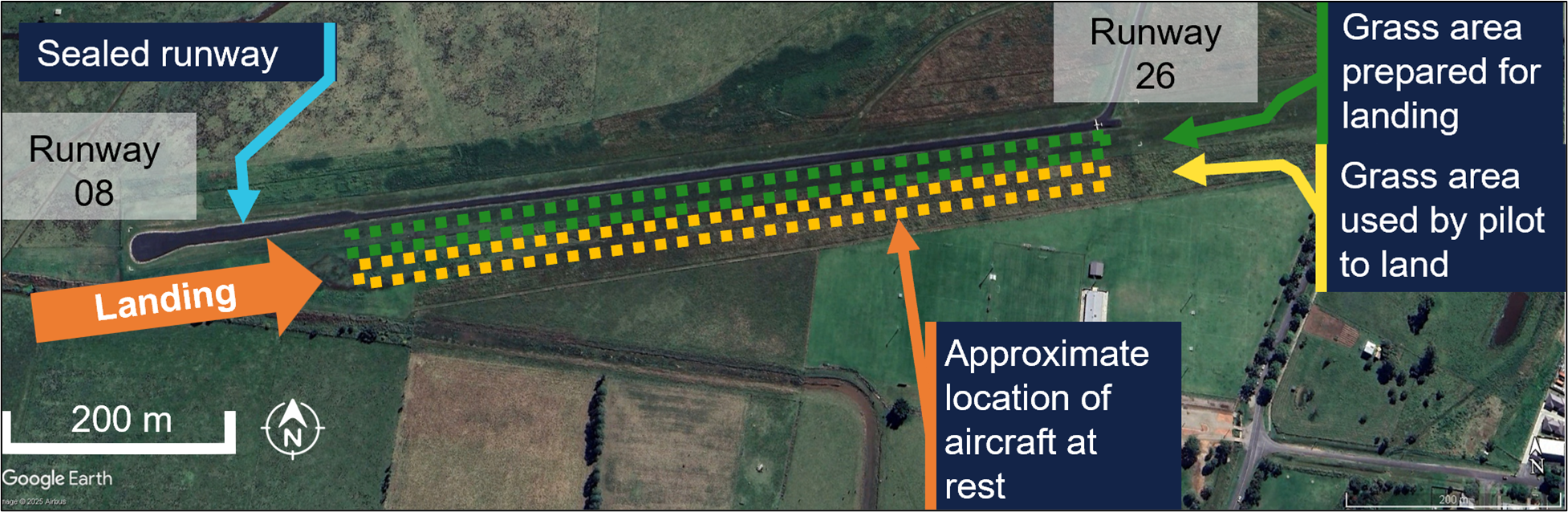
A third party suggested to the pilot that they could consider landing on the freshly mown grass area right of runway 08,[4] on their return to South Grafton. However, the pilot misunderstood the location of the prepared grass landing area.
The pilot believed that the area available was the mowed grass beside the sealed strip further to the right. However, the prepared grass area being referred to by the third party was in between the sealed runway and that understood by pilot (Figure 1).
Figure 1: South Grafton ALA – sealed and grass areas
Source: Google Earth and operator, annotated by the ATSB
A normal approach was flown, aligning the aircraft and touching down on the grass parallel to the sealed strip. However, the landing area selected by the pilot consisted of longer, slashed grass, that was not the surface that had been prepared for use.
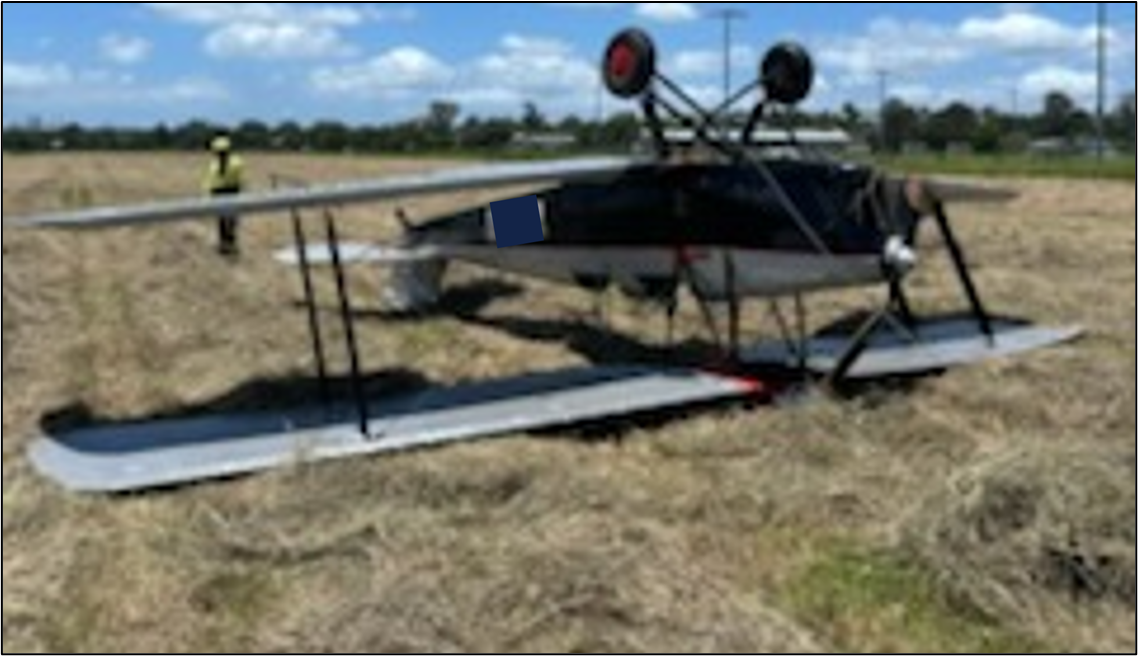
This surface caused undesirable ground handling characteristics on landing. The aircraft landed in a ‘2 point’[5] attitude, then subsequently pitched over on its nose and came to rest on its back. The aircraft sustained significant damage to its airframe and propeller (Figure 2). The pilot exited the aircraft with minor injuries.
Figure 2: The aircraft after the accident
The supplied image had low resolution. Source: Operator
Safety message
The conditions of a landing area can change, and the pilot always needs to review the risk and have a high degree of situational awareness of the conditions.
There was a missed opportunity during taxi to assess the surface conditions and location of the landing area that had not been used by the pilot before. Pilots need to take every opportunity available to prepare themselves with relevant runway conditions.
Landing tailwheel aircraft that have a high centre of gravity can result in a higher likelihood of loss of control during the ground roll, thus placing greater importance on ensuring the runway conditions and surface are appropriate.
If the pilot is not prepared for the landing, or the landing surface does not appear suitable before touchdown, the pilot should consider aborting the landing. This can be achieved by conducting a go-around and is normally the safest course of action if a pilot is not entirely comfortable.
About this report
Decisions regarding whether to conduct an investigation, and the scope of an investigation, are based on many factors, including the level of safety benefit likely to be obtained from an investigation. For this occurrence, no investigation has been conducted and the ATSB did not verify the accuracy of the information. A brief description has been written using information supplied in the notification and any follow-up information in order to produce a short summary report, and allow for greater industry awareness of potential safety issues and possible safety actions.
[1]All times referred to in this brief are local time, Coordinated Universal Time (UTC) + 11 hours.
[3]Ceiling and visibility okay (CAVOK): visibility, cloud and present weather are better than prescribed conditions. For an aerodrome weather report, those conditions are visibility 10 km or more, no significant cloud below 5,000 ft, no cumulonimbus cloud and no other significant weather.
[4]Some pilots consider landing tailwheel aircraft on grass to be preferential due to the surface being more forgiving on aircraft components, such as the tailwheel.
[5]Landing attitude with both main wheels in contact with the runway and the tail wheel in the air.
Occurrence summary
Mode of transport
Aviation
Occurrence ID
AB-2025-063
Occurrence date
30/11/2025
Location
South Grafton Aircraft Landing Area
State
New South Wales
Occurrence class
Accident
Aviation occurrence category
Collision with terrain, Depart/app/land wrong runway, Ground strike
Highest injury level
Minor
Brief release date
23/12/2025
Aircraft details
Manufacturer
de Havilland Aircraft
Model
DH-82A
Sector
Piston
Operation type
Part 91 General operating and flight rules
Departure point
South Grafton Aircraft Landing Area, New South Wales
Destination
South Grafton Aircraft Landing Area, New South Wales
Occurrence Briefs are concise reports that detail the facts surrounding a transport safety occurrence, as received in the initial notification and any follow-up enquiries. They provide an opportunity to share safety messages in the absence of an investigation. Because occurrence briefs are not investigations under the Transport Safety Investigation Act 2003, the information in them is de-identified.
What happened
On 8 November 2025, at approximately 1315 local time,[1] a Boeing A75N1 (Stearman), with one pilot on board, departed a privately-owned runway near Dochra, New South Wales.
The pilot conducted a 30-minute private flight, before returning to the 500 m-long grass runway, orientated almost north-south. The pilot reported that the shorter runway required them to use a ‘short field’ landing technique and that the wind was westerly at less than 10 kt and variable near the ground.
The pilot conducted 3 consecutive landings and take-offs on the southern facing runway. During their third approach, the pilot recognised that the aircraft was about 200 feet higher than normal on final approach, however continued the approach.
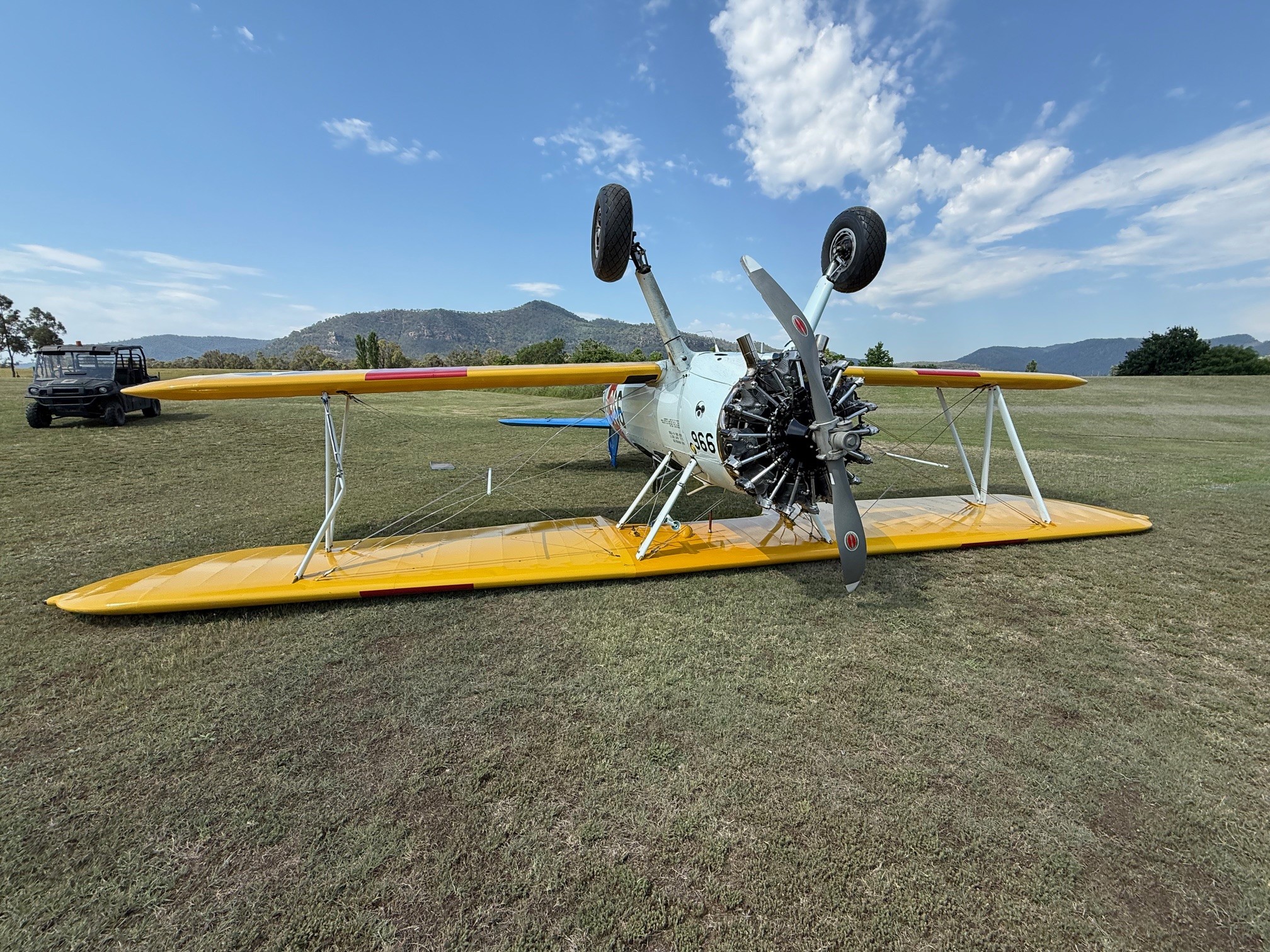
They reported touching down in a 3-point attitude, too far down the runway and applied hard braking which caused the tail to lift once elevator effectiveness reduced. This resulted in the aircraft slowly tipping forward, striking the propeller and then flipping over onto its back and rudder (Figure 1).
Figure 1: Aircraft post-occurrence
Source: Operator
The aircraft sustained damage to its rudder, propeller, wing and strut. The pilot was uninjured.
Safety message
Good landings are made from stable approaches and conducting a go-around is normally the safest course of action if a pilot is not entirely comfortable with the approach.
Pilots should also consider the required approach performance for short field landings of their aircraft when assessing their approach to land with limited runway length. Heavy braking in high centre-of-gravity, tailwheel aircraft increases the risk of loss of control on landing, which places greater importance on ensuring the approach is conducted appropriately.
About this report
Decisions regarding whether to conduct an investigation, and the scope of an investigation, are based on many factors, including the level of safety benefit likely to be obtained from an investigation. For this occurrence, no investigation has been conducted and the ATSB did not verify the accuracy of the information. A brief description has been written using information supplied in the notification and any follow-up information in order to produce a short summary report, and allow for greater industry awareness of potential safety issues and possible safety actions.
[1]All times referred to in this report are local time, Coordinated Universal Time (UTC) + 11 hours.
Occurrence summary
Mode of transport
Aviation
Occurrence ID
AB-2025-060
Occurrence date
08/11/2025
Location
near Dochra
State
New South Wales
Occurrence class
Accident
Aviation occurrence category
Collision with terrain, Control issues, Ground strike
On 23 November 2025, the pilot of a Van’s RV-8, registered VH-YGY, took off from the main runway of an aircraft landing area on private property about 41 km west of Gladstone, Queensland.
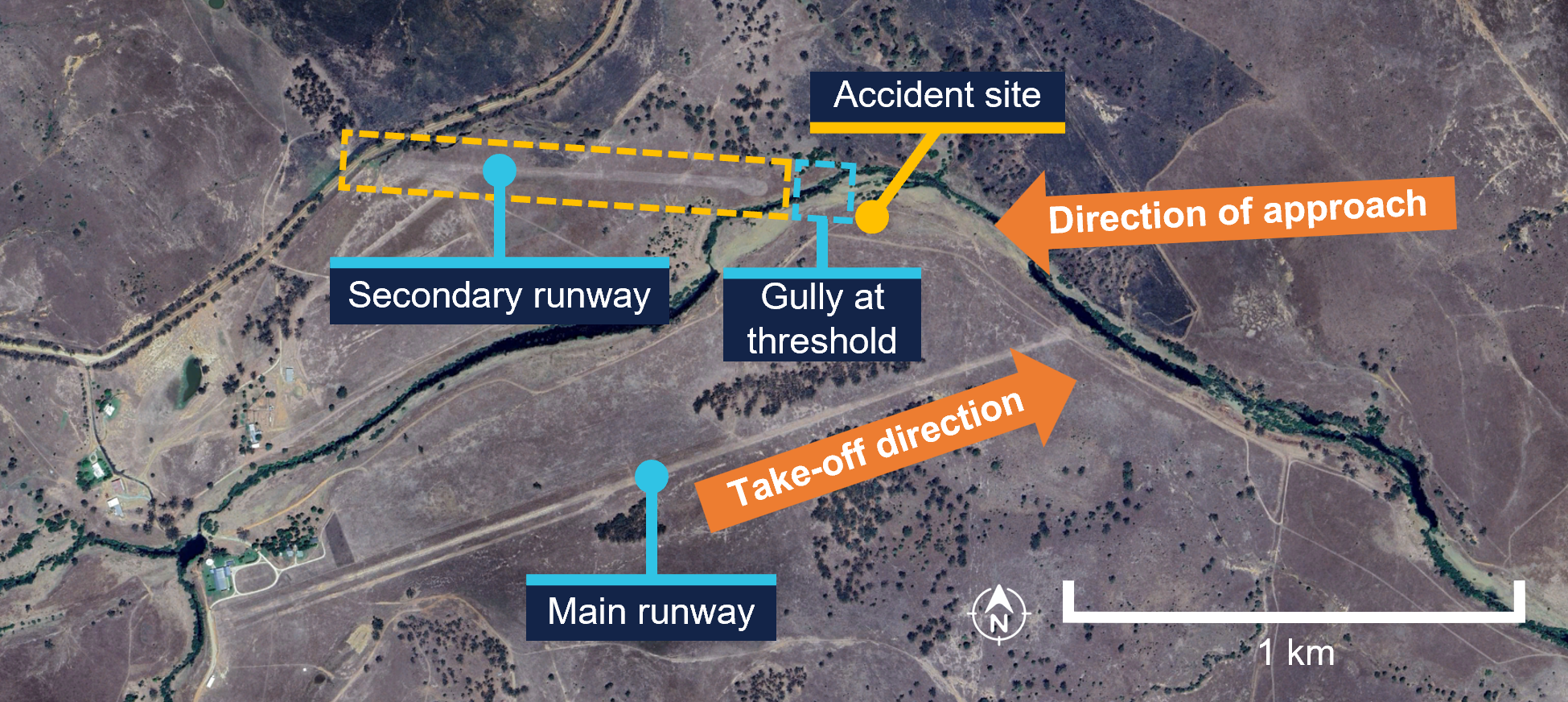
After take-off, there was an issue that resulted in the engine failing in flight, and the pilot attempted to return with the reported intention to land on the secondary runway. Concerned that the aircraft would not make the secondary runway with a deep gully at its threshold, the pilot conducted a forced landing into a nearby paddock.
Fire broke out as the aircraft slid to a stop against a fallen tree. The pilot was seriously injured and extricated themselves from the aircraft, then crawled about 2 km to the property owner’s home where emergency services were notified.
What the ATSB found
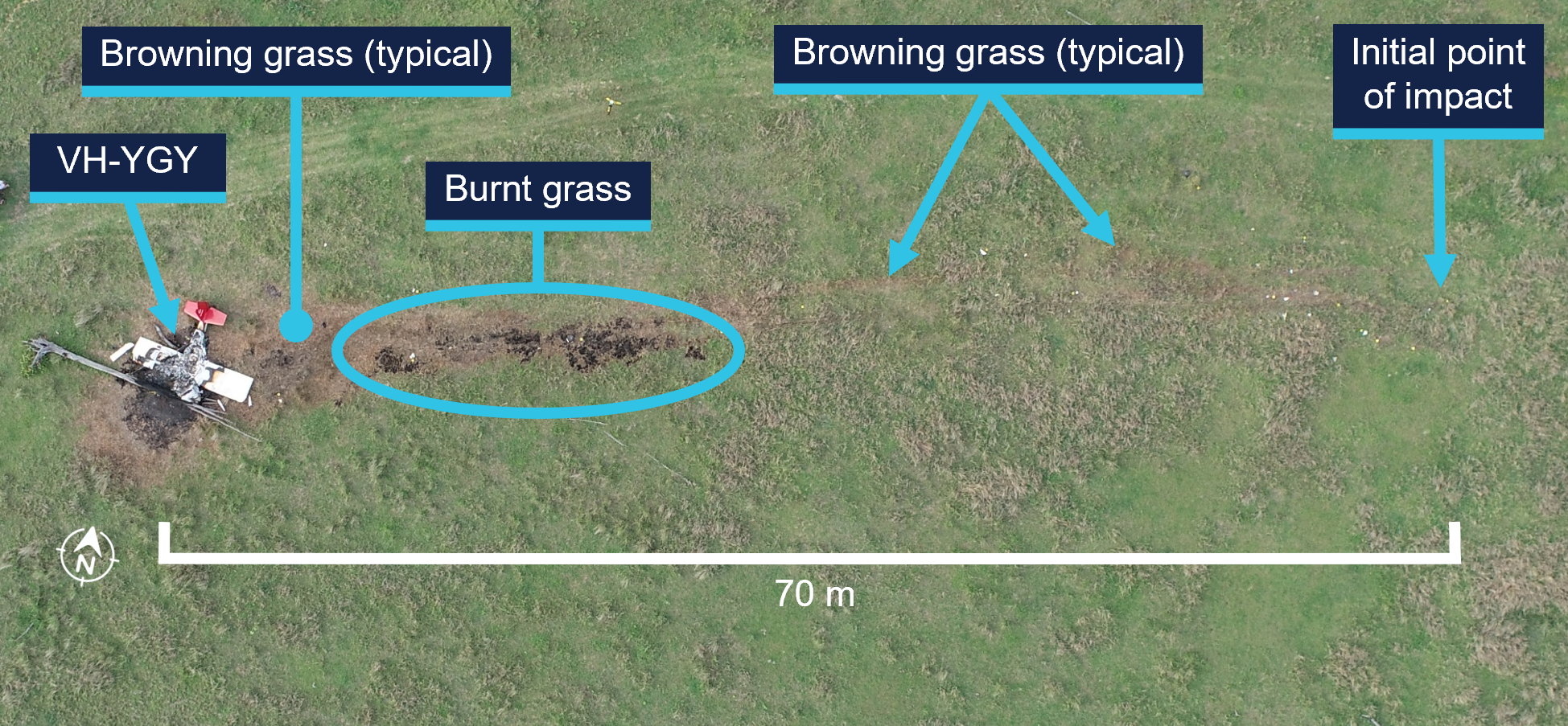
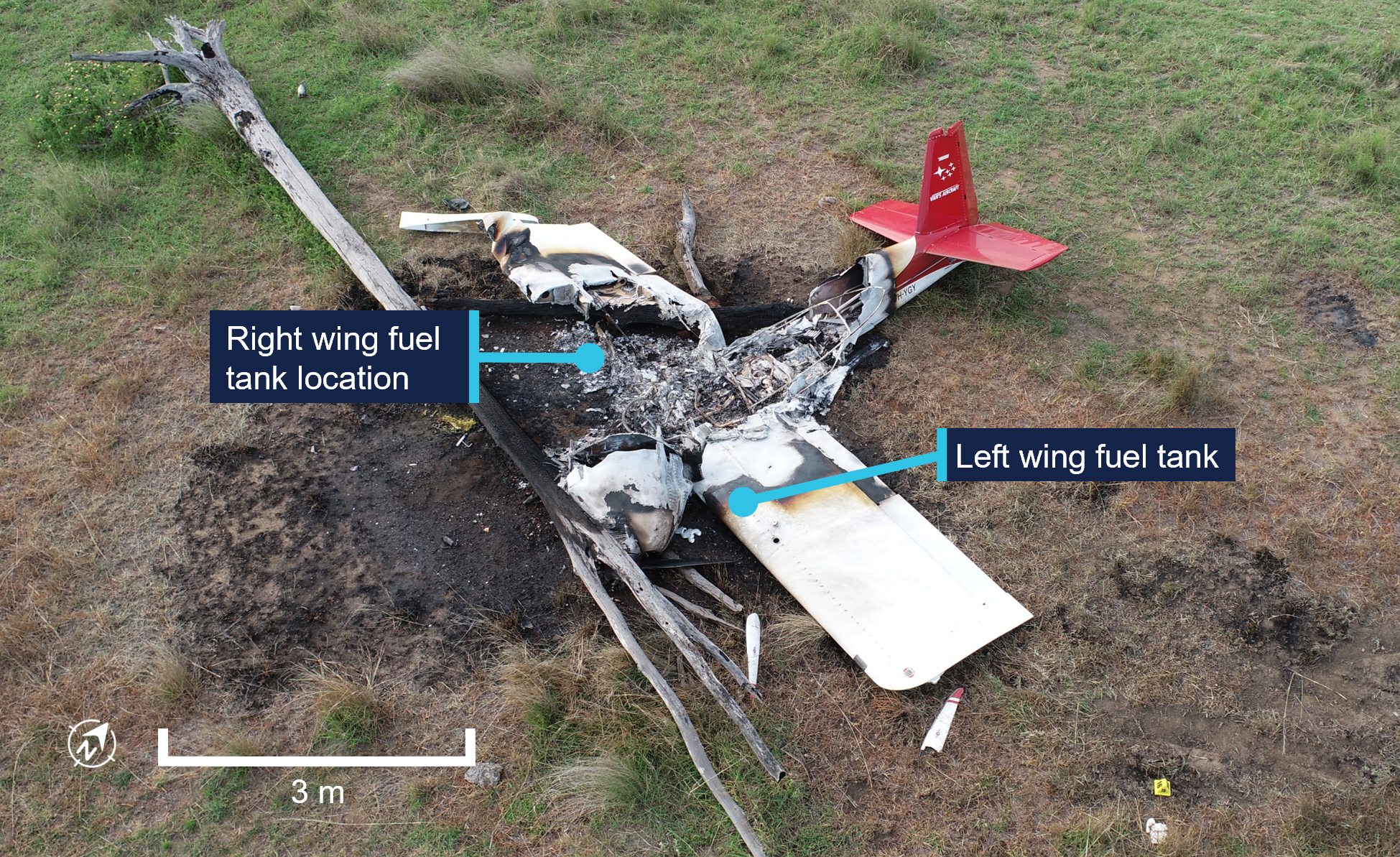
As a result of the aircraft's rate of descent, the impact forces acting on it during the forced landing caused one or both wing fuel tanks to be breached, which intensified, and likely led to, the post‑impact fire.
The fire destroyed most of the aircraft’s engine, cabin, wings, and fuselage which limited the extent to which pre-impact defects could be identified. Because of this, the reason for the aircraft’s engine failing in flight could not be established.
Safety message
Managing a partial power loss or total engine failure during or after take-off increases stress and uncertainty at a time when a pilot’s workload is already high. Pre-flight planning of what actions could be taken should an emergency occur can assist in reducing the pilot’s mental workload and increase the likelihood of a successful recovery. The 2013 ATSB educational publication Avoidable Accidents No. 3: Managing partial power loss after take-off in single-engine aircraft (AR‑2010‑055) provides helpful pilot advice on this topic.
The ATSB SafetyWatch highlights the broad safety concerns that come out of our investigation findings and from the occurrence data reported to us by industry. One of the safety concerns is reducing the severity of injuries in accidents involving small aircraft. A 5-point restraint was likely being worn by the pilot and in several of its investigations, the ATSB has found injuries to aircraft occupants have been avoided, or made less severe, through the appropriate use of multi-point harnesses. Additionally, selection of clothing that is more flame resistant and with more coverage can reduce the severity of burns and offer protection during extrication from a crashed aircraft.
The investigation
The ATSB scopes its investigations based on many factors, including the level of safety benefit likely to be obtained from an investigation and the associated resources required. For this occurrence, the ATSB conducted a limited-scope investigation in order to produce a short investigation report, and allow for greater industry awareness of findings that affect safety and potential learning opportunities.
The occurrence
On the morning of 23 November 2025 at about 0900, the pilot (who was the sole occupant) of a Van’s RV-8, registered VH-YGY, took off heading 060° from the main runway of Old Station1 aircraft landing area (ALA), which is located about 41 km west of Gladstone, Queensland, on private property.
The pilot spoke to the property owner immediately after the accident. According to the property owner, the pilot said that after take-off the engine lost some power and subsequently failed. The pilot later recalled that the engine failed suddenly, without being preceded by a partial power loss.2
The pilot attempted to return to Old Station with the intention to land on the secondary runway (heading 260°). Out of concern that the aircraft would not make the secondary runway and because of a deep gully at its threshold, the pilot made a forced landing into a nearby paddock (Figure 1).
Figure 1: Take-off and approach directions
Source: Google Earth, annotated by the ATSB
The pilot recalled that they sideslipped the aircraft nose left to reduce the aircraft’s energy just before colliding with terrain. The impact forces on the aircraft during the forced landing collapsed the landing gear and one or both wing fuel tanks were breached. Fire broke out as the aircraft slid to a stop against a fallen tree (see Wreckage and impact information). The aircraft was destroyed in the impact and intense fuel-fed fire.
The pilot was seriously injured with a spinal injury and burns. The pilot reported difficulty opening the aircraft canopy, but they extricated themselves from the aircraft, then crawled about 2 km to the property owner’s home where emergency services were notified. There were no witnesses to the flight or the accident.
Context
Pilot information
The pilot was issued with an Australian Private Pilot Licence (Aeroplane) in 1983 and held a current Civil Aviation Safety Regulation Part 61 Private Pilot Licence (Aeroplane) (PPL). The pilot held a valid class 2 civil aviation medical certificate with no restrictions and was required to wear vision correction when flying.
Aircraft information
The Van’s Aircraft RV-8 is a low-wing, all-metal, amateur-built aircraft. It is supplied in kit form and is designed to be constructed for the education and recreation of the owner. The RV-8 has 2 seats in tandem configuration and is suitable for cross-country flying or for flying aerobatic manoeuvres.
Construction of VH-YGY, serial number 80605, was carried out by the pilot of the accident flight and was first registered on 7 July 2010 and issued with a special certificate of airworthiness. The airworthiness category of this certificate was experimental. The aircraft was fitted with a 6‑cylinder, horizontally opposed Eggenfellner E6 engine using automotive 98 octane fuel. The basis of this engine was an automotive Subaru engine with additions and modifications for aircraft use. The aircraft was fitted with a Quinti Avio QA4SE 4‑blade electric constant-speed propeller.
Recent maintenance
As VH-YGY had been constructed by the pilot and the airworthiness category of the special certificate of airworthiness was experimental, the pilot was permitted to carry out their own maintenance on the aircraft.
According to people familiar with the pilot and aircraft, the aircraft had reportedly been difficult to start in the time recent to the accident. On 20 November 2025 at Caboolture Aerodrome, the pilot replaced the fuel pressure regulator fitted to VH-YGY with a new part. The new fuel pressure regulator was an automotive engine part and used to maintain fuel pressure to the engine at 40 psi. The ATSB was unable to determine the exact part used.
The pilot was observed taxiing VH-YGY at Caboolture Aerodrome on 21 November 2025, and on 22 November 2025 flew the aircraft from Caboolture Aerodrome to Old Station ALA.
Meteorological information
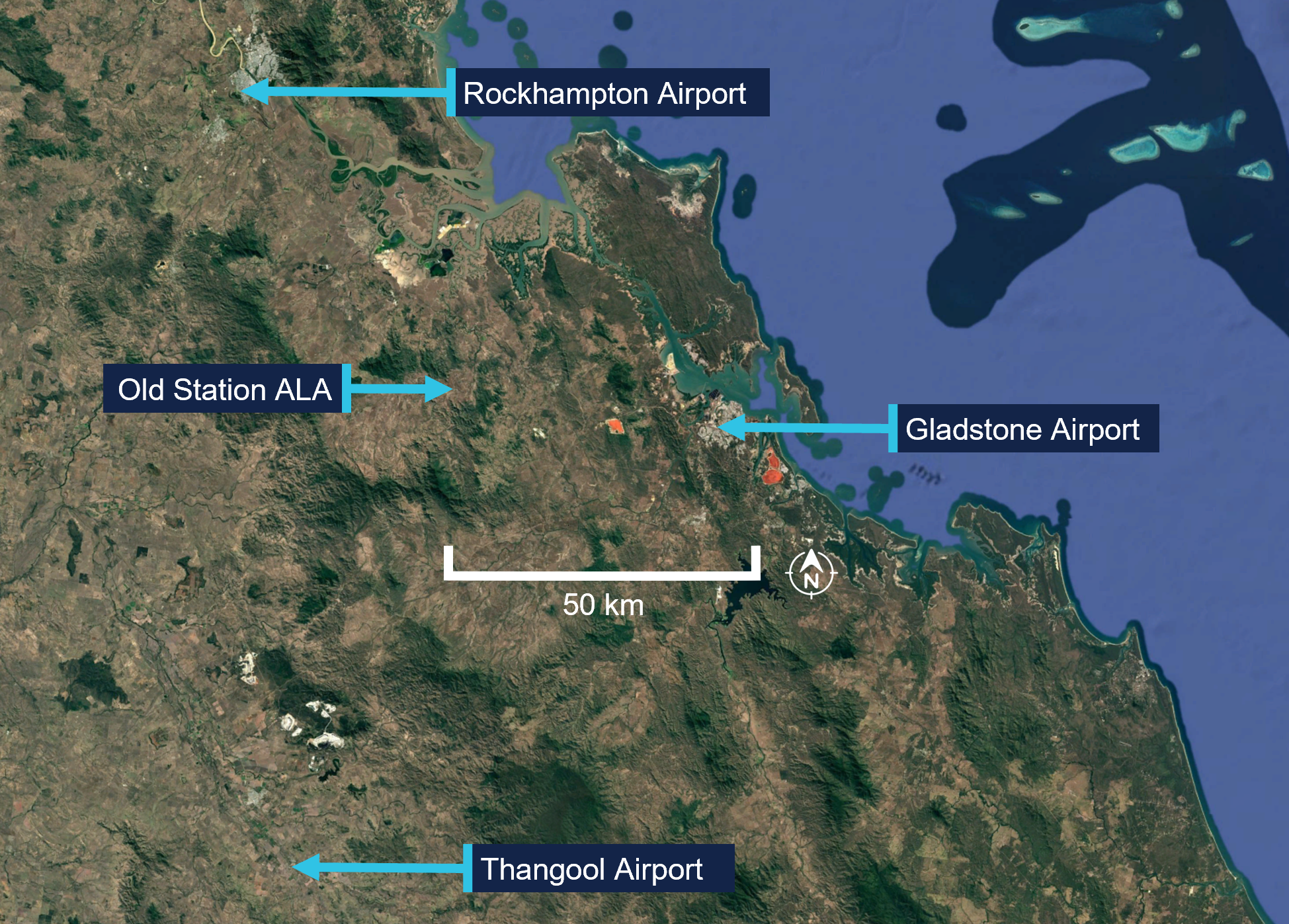
The weather at the aerodrome was reported to be clear with light winds. There were no official weather observations available for Old Station ALA. The nearest official data was obtained from Gladstone Airport located 41 km to the east, Rockhampton Airport located 60 km north-west, and Thangool Airport 78 km south‑south‑west of the property (Figure 2).
Figure 2: Locations of weather observations
Source: Google Earth, annotated by the ATSB
The meteorological aerodrome report (METAR)3 for Gladstone Airport at 0900 reported wind from the north‑east (030°) at 7 kt, visibility greater than 10 km and no cloud detected. There was no rainfall recorded in the previous 24 hours.
The METAR for Rockhampton Airport at 0900 reported a mean wind from the east (080°, varying between 050° and 110°) at 6 kt, visibility greater than 10 km and few clouds at 2,700 AGL. There was no rainfall recorded in the previous 24 hours.
Wreckage and impact information
The accident site was located in open farmland that was flat and slightly sloping down toward the west. The aircraft slid for about 70 m before coming to rest against a fallen tree. As evidenced by post-accident browning of the grass, fuel had been liberated from one or both of the wing fuel tanks from about 7 m from the initial point of impact until where the aircraft came to rest. The grass in the path of the aircraft was burnt in places about 45 m from the initial point of impact and around the aircraft (Figure 3).
Figure 3: Accident site overview
This image was taken on the day of the accident; the browning grass was more prominent in the days following. Source: Queensland Police, annotated by the ATSB
There was no fuel remaining in the aircraft’s fuel tanks suitable for testing. The aircraft’s engine, cabin, wings and fuselage were mostly destroyed by the fire, limiting the extent to which pre-impact defects could be identified (Figure 4).
Figure 4: VH-YGY at the accident site
Note: the left-wing fuel tank cap was removed by first responders for fire suppression. Source: Queensland Police, annotated by the ATSB
However, from the evidence available, the following could be established:
Fragmentation and the position of a propeller blade (1 of 4) indicated that the engine was not running at impact.
Both main landing gear axles, brakes and wheel assemblies had separated from the main landing gear legs which in turn had collapsed under the aircraft.
The wing/fuselage structure and engine mounting frame was buckled by impact forces.
The flap actuator extension was consistent with the flaps being close to, or fully, retracted.
Numerous engine components were destroyed by the fire. This included wiring, flexible hoses and fuel system components. The fuel pressure regulator that had been replaced 3 days prior to the accident was not identified (or any remnants of it) at the accident site or during a follow-up aircraft and engine inspection conducted by the ATSB.
The following avionics were recovered from the accident site and transported to the ATSB Canberra technical facility:
Dynon EFIS-D100 (flight instrumentation)
Garmin aera 500 (global positioning system)
GRT Avionics EIS 6000 (engine information display)
SDS LCD Programmer (engine management).
Recovery of data was not possible because of the extent that they were damaged by fire.
Survival aspects
When assessing the survivability of an aircraft accident, a number of aspects are considered, including:
occupant restraints
forces imparted on the aircraft occupants
liveable space inside the aircraft being maintained
post-impact fire.
The aircraft was fitted with a 5-point4 restraint which was likely being worn by the pilot on the accident flight.
The damage to the main landing gear axle, brake and wheel assemblies along with the main landing gear legs was indicative of high deceleration forces on impact. It was not able to be determined whether the forward cockpit liveable space was reduced to a point where it injured the pilot or hindered their escape.
The pilot was reportedly wearing shorts and a t-shirt.
The aircraft had 2, 80 litre fuel tanks integral5 to the inboard leading edge of each wing. The aircraft was also fitted with optional wing tip fuel tanks, however they were not carrying fuel on the day of the accident. Flexible fuel tanks were not available for the RV‑8.
In 2022, the ATSB investigated a collision with terrain involving a Cessna U206G, west of Norseman, Western Australia, on 3 March 2022.6 The investigation noted that:
Metal fuel tanks are prone to rupturing during an accident impact, allowing fuel to escape and increasing the risk of a post‑impact fire. To improve crashworthiness, the addition of fuel bladders and fuel cells that have been constructed of flexible materials have proven less prone to rupturing during an impact. They are able to withstand greater deformation and puncture less readily and are less likely to expand or tear to form a larger opening from which fuel can escape. Such systems may provide occupants with more time to egress the aircraft and/or reduce the risk of any fire‑related injury.
Partial power loss or engine failure after take-off
During a normal take-off, a pilot’s workload is already high, and in the event of a partial power loss, or total engine failure, the pilot must decide actions to safely recover the aircraft under conditions of stress and uncertainty. Pre-flight planning for a partial or total engine power loss on take-off can help to reduce the pilot’s mental workload in the event of one occurring.
The 2013 ATSB educational publication Avoidable Accidents No. 3: Managing partial power loss after take-off in single-engine aircraft (AR-2010-055) contains the following pre-flight planning considerations should an aircraft suffer a power loss after take‑off (ATSB 2013):
the runway direction and the best direction of any turn
the local wind strength and direction on a particular day
terrain and obstacles
decision points (with regard to aircraft height and performance) where different landing options could be taken, such as:
landing on the remaining runway or aerodrome
landing outside the aerodrome
conducting a turn back towards the aerodrome.
In the event of an engine failure or power loss at a low height, pilots are advised to land straight ahead, or within 30º either side of that heading (Aviation Theory Centre, 2009). Pilots are also advised to only consider a turnback manoeuvre if they have achieved a minimum height, which varies depending on the aircraft type and other factors.
Safety analysis
Engine power loss
There was a difference between the property owner’s recollection of the pilot’s statements soon after the accident, and subsequent recollection by the pilot, as to whether the engine initially lost some power after take-off before stopping completely. Nevertheless, damage to the propeller was consistent with the engine having stopped prior to the point of impact.
The fuel and engine systems of VH-YGY were comprised of numerous components, and a failure of one or more of these components could have contributed to the engine failing in‑flight. The ATSB was unable to determine any reasons for this as the post‑impact fire had damaged or destroyed most of these systems. Of the components that remained, no overt defects were identified. The aircraft had reportedly been difficult to start in the past, but it is not known if the pilot had any issues starting the engine on the day of the accident.
The fuel pressure regulator had been replaced 3 days prior to the accident, and the ATSB considered the possibility of a defect associated with the component’s serviceability or an error in its fitment. The fuel pressure regulator or any remnants of it were not identified in the aircraft wreckage, and it is likely that it had been destroyed during the post-impact fire. Therefore, no conclusions regarding its serviceability or security could be drawn.
Forced landing
Following a complete engine failure, a forced landing is inevitable, whereas in a partial power loss, pilots are faced with making a difficult decision whether to continue flight or to conduct an immediate forced landing. The pilot decided to turn back to the secondary runway of Old Station ALA, as they likely believed this was achievable, based on the circumstances at the time. After they assessed that this was no longer possible and with the onset of the deep gully at the threshold of the runway, the pilot was compelled to make an immediate forced landing.
The forces on the aircraft’s structure because of its rate of descent during the forced landing buckled the wing/fuselage structure, liberated both main landing gear axle, brake and wheel assemblies, collapsed the landing gear, and caused one or both wing fuel tanks to be breached, which intensified the post-impact fire.
The effectiveness of the pilot’s attempt to reduce the aircraft’s energy immediately ahead of the impact could not be determined. Lowering the flaps could have slowed the aircraft for landing, potentially lessening impact damage, although it was not determined if the pilot had time to do so.
Protective clothing
There are no regulatory requirements for the selection of clothing on private or other flights. However, selection of clothing that is more flame resistant and with more coverage can reduce the severity of burns and offer protection during extrication from a crashed aircraft. Fibres such as cotton, flax, nylon, and polyester burn more easily than fibres such as wool and aramids7 which are more flame‑resistant (Silva-Santos and others 2017).
The shorts and t-shirt worn by the pilot on the day of the accident would have offered less protection than a long sleeve shirt and trousers, however it was not determined whether this contributed to the severity of their injuries. While personal preference and comfort are obvious factors in the selection of clothing when flying, consideration should be given to the clothing’s fire resistance and coverage.
Findings
ATSB investigation report findings focus on safety factors (that is, events and conditions that increase risk). Safety factors include ‘contributing factors’ and ‘other factors that increased risk’ (that is, factors that did not meet the definition of a contributing factor for this occurrence but were still considered important to include in the report for the purpose of increasing awareness and enhancing safety). In addition ‘other findings’ may be included to provide important information about topics other than safety factors.
These findings should not be read as apportioning blame or liability to any particular organisation or individual.
From the evidence available, the following findings are made with respect to the forced landing and collision with terrain involving Van's RV-8, VH-YGY, 40 km west of Gladstone Airport, Queensland, on 23 November 2025.
Contributing factors
After take-off, there was an undetermined issue that resulted in the engine failing in flight.
During the forced landing, impact forces as a result of the aircraft's rate of descent collapsed the landing gear, buckled the wing/fuselage structure and caused one or both wing fuel tanks to be breached, which intensified the post-impact fire.
Sources and submissions
Sources of information
The sources of information during the investigation included the:
property owner
associates of the pilot who were familiar with the aircraft
Australian Transport Safety Bureau (2025). Collision with terrain involving Cessna U206G, VH-JVR 124 km west of Norseman, Western Australia, on 3 March 2022 (AO‑2022-011). https://www.atsb.gov.au/investigations/ao-2022-011
Robson, D., Dyer, J. (2009) Flying training manual. A basic pilot training programme (pp 263–264). Aviation Theory Centre.
Silva-Santos MC, Oliveira MS, Giacomin M, Laktim MC and Baruque Ramos J (2017). Flammability on textile of flight crew professional clothing. IOP Conference Series: Materials Science and Engineering.
Submissions
Under section 26 of the Transport Safety Investigation Act 2003, the ATSB may provide a draft report, on a confidential basis, to any person whom the ATSB considers appropriate. That section allows a person receiving a draft report to make submissions to the ATSB about the draft report.
A draft of this report was provided to the following directly involved parties:
pilot
property owner
Civil Aviation Safety Authority.
A submission was received from the pilot.
The submission was reviewed and, where considered appropriate, the text of the report was amended accordingly.
Purpose of safety investigations
The objective of a safety investigation is to enhance transport safety. This is done through:
identifying safety issues and facilitating safety action to address those issues
providing information about occurrences and their associated safety factors to facilitate learning within the transport industry.
It is not a function of the ATSB to apportion blame or provide a means for determining liability. At the same time, an investigation report must include factual material of sufficient weight to support the analysis and findings. At all times the ATSB endeavours to balance the use of material that could imply adverse comment with the need to properly explain what happened, and why, in a fair and unbiased manner. The ATSB does not investigate for the purpose of taking administrative, regulatory or criminal action.
About ATSB reports
ATSB investigation reports are organised with regard to international standards or instruments, as applicable, and with ATSB procedures and guidelines.
Reports must include factual material of sufficient weight to support the analysis and findings. At all times the ATSB endeavours to balance the use of material that could imply adverse comment with the need to properly explain what happened, and why, in a fair and unbiased manner.
An explanation of terminology used in ATSB investigation reports is available here. This includes terms such as occurrence, contributing factor, other factor that increased risk, and safety issue.
Publishing information
Released in accordance with section 25 of the Transport Safety Investigation Act 2003
Ownership of intellectual property rights in this publication
Unless otherwise noted, copyright (and any other intellectual property rights, if any) in this report publication is owned by the Commonwealth of Australia.
Creative Commons licence
With the exception of the Commonwealth Coat of Arms, ATSB logo, and photos and graphics in which a third party holds copyright, this report is licensed under a Creative Commons Attribution 4.0 International licence.
The CC BY 4.0 licence enables you to distribute, remix, adapt, and build upon our material in any medium or format, so long as attribution is given to the Australian Transport Safety Bureau.
Copyright in material obtained from other agencies, private individuals or organisations, belongs to those agencies, individuals or organisations. Where you wish to use their material, you will need to contact them directly.
^Old Station ALA has 2 grass runways–the main runway is oriented 060°/240° magnetic and a shorter, secondary runway is oriented 080°/260° magnetic.
^The pilot was not interviewed by the ATSB, and later provided comment on the draft report regarding the sequence of events.
^METAR (meteorological aerodrome report) is a routine aerodrome weather report issued at half-hourly time intervals. The report ordinarily covers an area of 8 km radius from the aerodrome reference point.
^A 5-point harness is a 4-point harness with an additional crotch strap that prevents ‘submarining’, in which the occupant slides down under the lap belt.
^A fuel tank that is formed by coating a space within the aircraft wing’s internal structure with sealant.
^Collision with terrain involving a Cessna U206G, VH-JVR, 124 km west of Norseman, Western Australia, on 3 March 2022 (AO-2022-011).
^Aramids are a range of synthetic fibres that are heat and fire‑resistant. A common use in aviation is an aramid known as Nomex which is used for fire‑resistant clothing for flight crews.
Occurrence summary
Investigation number
AO-2025-068
Occurrence date
23/11/2025
Occurrence time and timezone
09:00 Australian Eastern Standard Time
Location
40 km west of Gladstone Airport
State
Queensland
Report release date
29/05/2026
Report status
Final
Investigation level
Short
Investigation type
Occurrence Investigation
Investigation phase
Final report: Dissemination
Investigation status
Completed
Mode of transport
Aviation
Aviation occurrence category
Collision with terrain, Engine failure or malfunction, Forced/precautionary landing
Occurrence class
Accident
Highest injury level
Serious
Aircraft details
Manufacturer
Van's Aircraft
Model
RV-8
Registration
VH-YGY
Serial number
80605
Sector
Piston
Operation type
Part 91 General operating and flight rules
Activity
General aviation / Recreational-Unknown general aviation flying