

Summary
The ATSB is investigating a collision with terrain involving a Robinson R22, registered VH‑RDL, at Bankstown Airport, New South Wales, on 3 October 2025.
During training operations, the aircraft collided with terrain and was subsequently destroyed. One occupant was fatally injured and the other person received serious injuries.
The ATSB deployed a team of transport safety investigators to the accident site with experience in operations, maintenance and engineering. Several components were recovered from the accident site for more detailed examination.
The ATSB has commenced the examination and analysis of the initial evidence collected.
To date, the ATSB investigation has:
- examined the aircraft wreckage and other information from the accident site
- retrieved operator procedures
- conducted interviews with the surviving pilot, witnesses and other involved parties.
- reviewed pilot records
- reviewed maintenance records and video evidence.
- reviewed air traffic control communications.
The continuing investigation will include:
- analysis of the audio signatures captured by the recording camera
- further analysis of physical evidence retrieved from the accident site
- interview with Bankstown tower air traffic control.
The ATSB released a preliminary report, which details factual information established in the investigation’s early evidence collection phase, on 17 December 2025. See below.
A final report will be released at the conclusion of the investigation. Should a critical safety issue be identified during the course of the investigation, the ATSB will immediately notify relevant parties, so that appropriate safety action can be taken.
Preliminary report
Report release date: 17/12/2025
This preliminary report details factual information established in the investigation’s early evidence collection phase, and has been prepared to provide timely information to the industry and public. Preliminary reports contain no analysis or findings, which will be detailed in the investigation’s final report. The information contained in this preliminary report is released in accordance with section 25 of the Transport Safety Investigation Act 2003.
The occurrence
On 3 October 2025, a Robinson R22 Beta helicopter, registered VH‑RDL and operated by Bankstown Helicopters,[1] was conducting a training flight at Bankstown Airport, New South Wales. On board the helicopter was a flight instructor, seated in the left seat, and a student pilot in the right seat. The flight instructor was the pilot in command (PIC), however, as it was a training flight, the student pilot was in the seat normally reserved for the PIC.
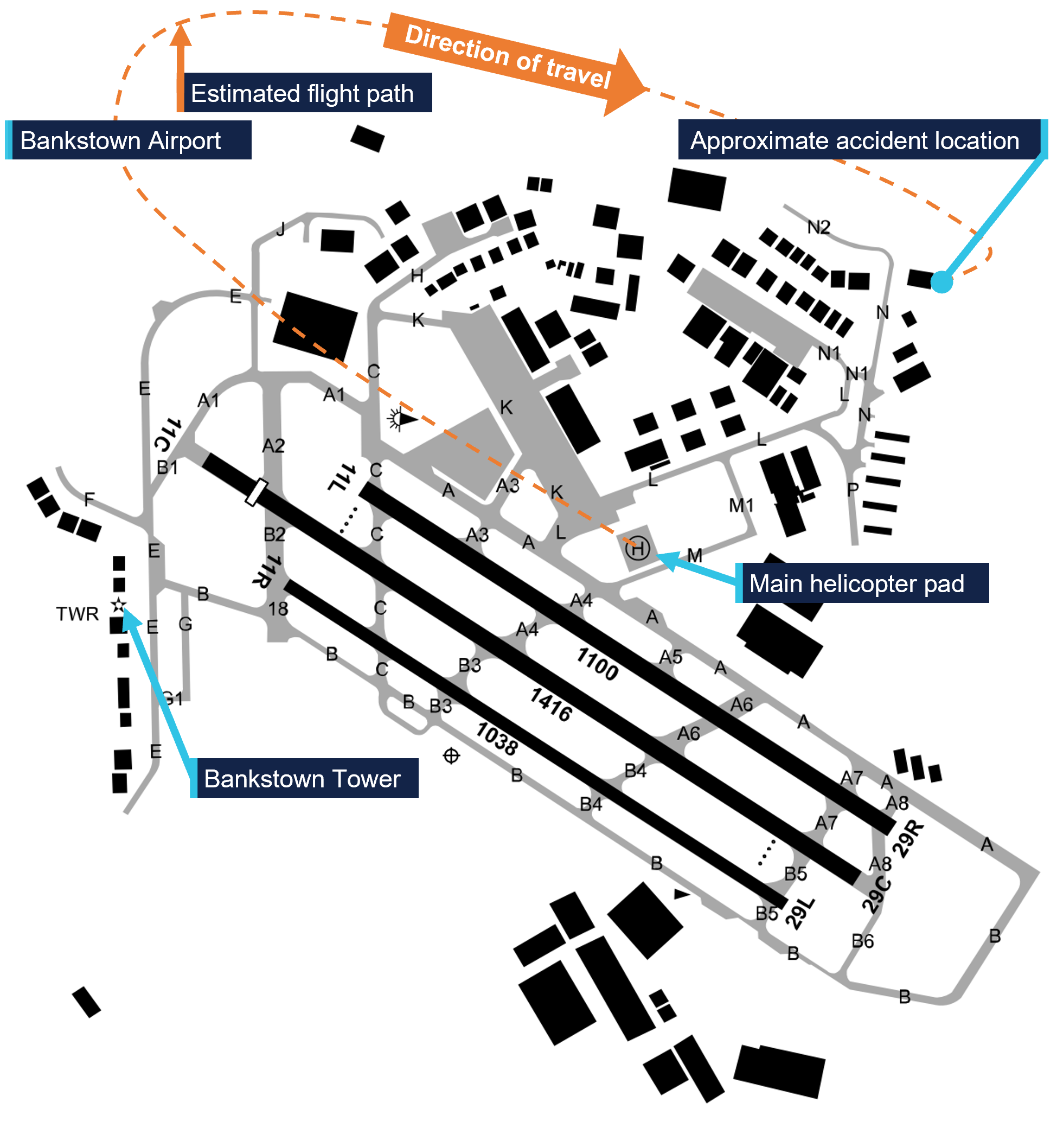
The helicopter departed the main helicopter pad (Figure 1) at about 1328 local time. The plan for the flight was to conduct circuits[2] on runway 29. The student pilot stated to the ATSB that they had planned and prepared to conduct a lesson on practice forced landings. However, due to the weather, the instructor changed the lesson to circuits. Due to the windy conditions on the day, the instructor demonstrated the first circuit, with the student pilot following them on the flight controls.[3]
At about 1329, the instructor made a downwind position radio broadcast and was cleared by Bankstown Tower air traffic control for a ‘stop and go’ on the main pad. In interview with the ATSB, the student pilot recalled that, during the downwind leg of the circuit, the helicopter dropped suddenly and they noticed the revolutions per minute (RPM) reduce but could not recall if this was engine or rotor RPM (see section Helicopter information). The student also recalled hearing a whistling noise prior to the RPM reduction. Following the sudden drop and RPM reduction, the student recalled that the instructor kept their hands on the controls and continued to fly the aircraft while attempting an autorotation,[4] and they could not recall the instructor changing any switch positions.
Dashcam video taken from a parked car captured the helicopter tracking along its flight path, before conducting a turn back into wind toward the airport. The video showed that the helicopter was flared[5] as it approached the ground, likely in an attempt to reduce the rate of descent. The helicopter impacted trees, before colliding with the rear of a car and the ground, coming to rest on its left side. The instructor was fatally injured, and the student was seriously injured. The helicopter was destroyed.
Figure 1: Estimated flight path
Source: Airservices Australia, annotated by the ATSB
Context
Pilot information
The instructor held a Commercial Pilot (Aeroplane) Licence (CPL-A) issued July 1998, and a Commercial Pilot Licence (Helicopter) (CPL-H) issued July 2012. They also held a Grade 1 flight instructor rating for helicopter operations.
The instructor began employment with the operator of VH-RDL in November 2024. Paperwork completed when joining indicated that the instructor had around 877 hours experience on fixed-wing aircraft, and 1,071 hours in helicopters. The instructor’s logbook indicated that, as of September 2025, they had a total helicopter flying experience of 1,131 hours, which included 993 hours as PIC.
The instructor held a class 2 aviation medical certificate, which was current at the time of the accident. To exercise the privileges of a commercial pilot’s licence, pilots normally required a class 1 aviation medical. However, under Civil Aviation Safety Authority (CASA) General Exemption CASA EX28/23, commercial pilots with a class 2 medical certificate can fly commercial flights without passengers if the aircraft’s maximum take-off weight is less than 8,618 kg. This included flight training.[6]
Video evidence showed the instructor was completing pre-flight duties in the office at approximately 0630. Their first flight of the day commenced at 0700 with a hover lesson. This was followed by another general handling instructional flight at 0830. All flights were conducted in VH‑RDL.
The student pilot had approximately 33 hours of flight experience. They did not yet hold a pilot’s licence.
Helicopter information
VH-RDL was a 2-seat Robinson Helicopter Company R22 Beta, serial number 1498, powered by a 4-cylinder Lycoming O-320-B2C engine. The helicopter was manufactured in the United States in 1990 and placed on the Australian aircraft register on 16 April 2002. Bankstown Helicopters had been the registered operator of VH-RDL since 22 February 2024.
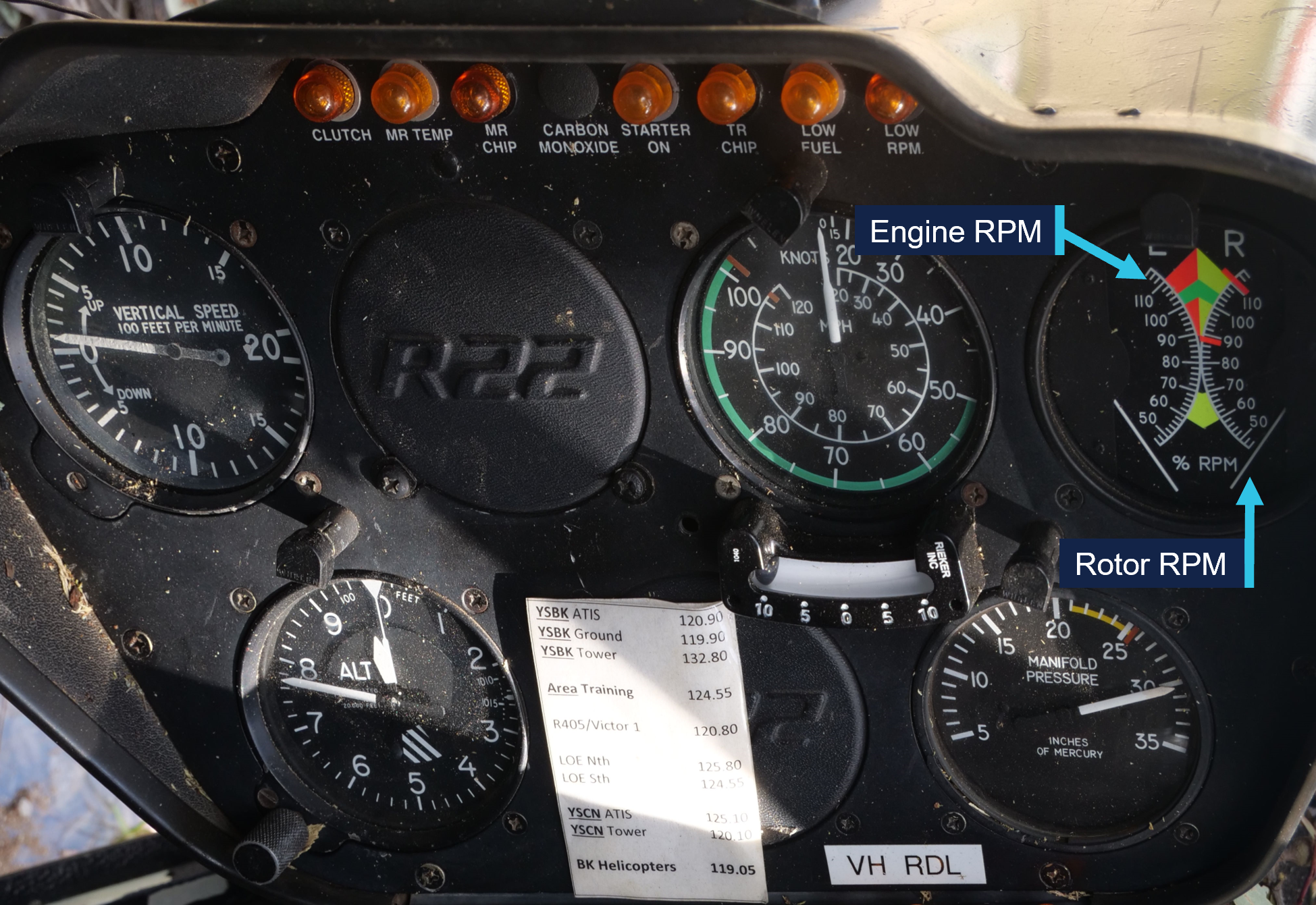
The helicopter had a combined engine and rotor RPM tachometer, which was positioned on the right side of the dashboard in front of the student pilot (Figure 2). The left side of the tachometer showed the engine RPM and the right side showed the rotor RPM. The position of the tachometer required the instructor to look across the dashboard to see the instrument.
Figure 2: VH-RDL engine and rotor RPM tachometer
Source: ATSB
Meteorological information
During taxi, the student pilot reported they had received information ‘golf’ from the automatic terminal information service (ATIS).[7] The information indicated that runway 29 was in use, mechanical turbulence was present on short final, the wind was 220° at 18 kt with a crosswind up to 20 kt, conditions were CAVOK,[8] the temperature was 24°C and QNH[9] 1014 hPa.
The ATSB obtained Bureau of Meteorology weather observations for Bankstown Airport taken at 1-minute intervals, which showed:
- at 1328, the wind was 278° T (true) and 265° M (magnetic) at 18.1 kt
- at 1329, the wind was 269° T (256° M) at 18.1 kt
- at 1330, the wind was 270° T (257° M) at 16.9 kt.
The operator’s alternate chief pilot, who was also instructing that day, had cancelled their flights as they assessed the weather to be challenging for their student’s experience level and the environmental conditions would have likely not resulted in useful learning for them.
Operational information
The operator advised the ATSB that their normal pre-landing checks in the Robinson R22 Beta, performed on the downwind leg of the circuit, included the following:
- warning/caution lights – out
- rpm (engine and rotor) – in the green
- temperatures and pressures – in the green
- fuel – sufficient for go around
- battery – charging
- carburettor heat – on
- hatches and harnesses – secure.
Wreckage information
The helicopter wreckage was contained within a relatively small accident site, with only minor wreckage spread and limited forward projection of debris. This indicated that the helicopter impacted the car and ground with a low forward speed. There was no post‑impact fire. The ATSB’s wreckage examination found that:
- there was sufficient fuel on board the helicopter to sustain continued engine operation
- damage identified in the main rotor system was consistent with low energy flight, as also indicated by the dashcam and the observed spread of the wreckage
- there was no evidence of pre-existing defects with the flight control system
- the pitot system was checked and considered to be serviceable prior to the collision with terrain
- inside the aircraft, the key switches were found in the following positions:
- fuel selector – on
- fuel mixture – rich
- carburettor heat – on
- master switch – off
- magnetos – off
A witness to the accident confirmed that they had switched the master to the off position to secure the helicopter and make it safe. The ATSB was unable to establish how the magnetos came to be in the off position.
It was determined by the ATSB that the engine was intact, and all components were present. Examination of the engine by the ATSB on site identified an absence of physical damage expected of an engine that was operating (rotating) at the time of impact with terrain. The engine examination also found:
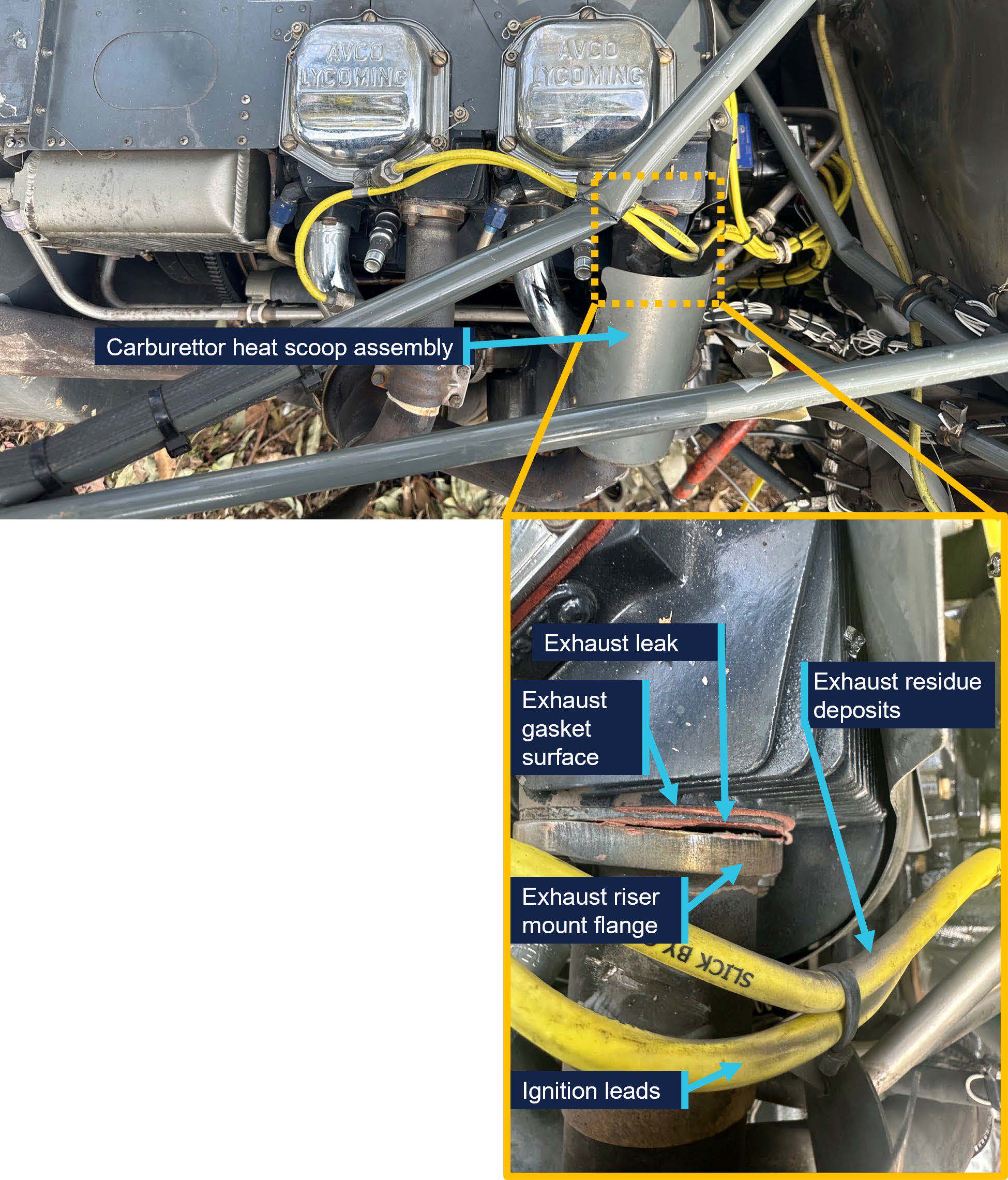
- Evidence of an exhaust gas leak between the exhaust riser mount flange/exhaust gasket surfaces of the no 4 cylinder. The leak was attributed to deformation of the flange that created space between the flange and the gasket (Figure 3). This leak was located directly above the carburettor heat intake scoop opening.
- Deposits of exhaust gas products were present on the no 2 and no 4 cylinder ignition leads that were routed beside the no 4 cylinder exhaust riser.
Figure 3: Exhaust leak found during the onsite inspection
Source: ATSB
Survivability information
First responders and witnesses stated that the instructor and student had their seatbelts on. Neither of them was wearing a helmet and nor were they required to.
Further investigation
- examined the wreckage and other information from the accident site
- obtained operator procedures
- conducted interviews with the student, witnesses and other involved parties
- reviewed the pilot records
- reviewed the helicopter maintenance records
- examined the dashcam video
- reviewed air traffic control communications.
The investigation is continuing and will include:
- an analysis of the audio signatures captured by the dashcam video
- further analysis of physical evidence including the exhaust system components retrieved from the accident site
- a review of the PIC’s experience performing autorotations in all helicopter types and specific to the Robinson R22 Beta
- a review of both the helicopter manufacturer and operator’s procedures for conducting autorotations.
A final report will be released at the conclusion of the investigation. Should a critical safety issue be identified during the course of the investigation, the ATSB will immediately notify relevant parties so appropriate and timely safety action can be taken.
Purpose of safety investigationsThe objective of a safety investigation is to enhance transport safety. This is done through:
It is not a function of the ATSB to apportion blame or provide a means for determining liability. At the same time, an investigation report must include factual material of sufficient weight to support the analysis and findings. At all times the ATSB endeavours to balance the use of material that could imply adverse comment with the need to properly explain what happened, and why, in a fair and unbiased manner. The ATSB does not investigate for the purpose of taking administrative, regulatory or criminal action. About ATSB reportsATSB investigation reports are organised with regard to international standards or instruments, as applicable, and with ATSB procedures and guidelines. Reports must include factual material of sufficient weight to support the analysis and findings. At all times the ATSB endeavours to balance the use of material that could imply adverse comment with the need to properly explain what happened, and why, in a fair and unbiased manner. An explanation of terminology used in ATSB investigation reports is available here. This includes terms such as occurrence, contributing factor, other factor that increased risk, and safety issue. Publishing informationReleased in accordance with section 25 of the Transport Safety Investigation Act 2003 Published by: Australian Transport Safety Bureau © Commonwealth of Australia 2025 
Ownership of intellectual property rights in this publication Unless otherwise noted, copyright (and any other intellectual property rights, if any) in this report publication is owned by the Commonwealth of Australia. Creative Commons licence With the exception of the Commonwealth Coat of Arms, ATSB logo, and photos and graphics in which a third party holds copyright, this report is licensed under a Creative Commons Attribution 4.0 International licence. The CC BY 4.0 licence enables you to distribute, remix, adapt, and build upon our material in any medium or format, so long as attribution is given to the Australian Transport Safety Bureau. Copyright in material obtained from other agencies, private individuals or organisations, belongs to those agencies, individuals or organisations. Where you wish to use their material, you will need to contact them directly. |
[1] Bankstown Helicopters was operated under Civil Aviation Safety Regulation Part 141 as an approved flight training organisation based at Bankstown Airport, New South Wales.
[2] Circuits: a circuit is the specified path to be flown by aircraft operating in the vicinity of an aerodrome. It comprises upwind, crosswind, downwind, base and final approach legs. It creates an orderly flow of traffic from take-off to landing and assists pilots with positioning the aircraft on final at the appropriate altitude and distance from the landing area to make a stabilised approach.
[3] Following on the controls: it is common for students to learn by having their hands and feet on the controls while the instructor manipulates them. This can help students to learn how much input to use for certain controls and when they are appropriate. Students have their hands on the controls but are not making inputs.
[4] Autorotation: is a condition of descending flight where, following engine failure or deliberate disengagement, the rotor blades are driven solely by aerodynamic forces resulting from rate of descent airflow through the rotor. The rate of descent is determined mainly by airspeed.
[5] Flaring: the final nose-up pitch of a landing helicopter used to reduce the rate of descent and forward airspeed to about zero at touchdown, it can also increase the rotor RPM during an autorotation.
[6] https://www.casa.gov.au/licences-and-certificates/aviation-medicals/learn-about-medical-certificates/classes-1-3-medical-certificates#Class2medicalcertificate
[7] Automatic terminal information service (ATIS): provides routine airport and weather information to arriving and departing aircraft by means of continuous and repetitive broadcasts. ATIS information is prefixed with a unique letter identifier and is updated either routinely or when there is a significant change to weather and/or operations.
[8] Ceiling and visibility okay (CAVOK): visibility, cloud and present weather are better than prescribed conditions. For an aerodrome weather report, those conditions are visibility 10 km or more, no significant cloud below 5,000 ft, no cumulonimbus cloud and no other significant weather.
[9] QNH: the altimeter barometric pressure subscale setting used to indicate the height above mean sea level.
Occurrence summary
| Investigation number | AO-2025-059 |
|---|---|
| Occurrence date | 03/10/2025 |
| Occurrence time and timezone | 1330 Australian Eastern Standard Time |
| Location | Bankstown Airport |
| State | New South Wales |
| Report release date | 17/12/2025 |
| Report status | Preliminary |
| Anticipated completion | Q4 2026 |
| Investigation level | Short |
| Investigation type | Occurrence Investigation |
| Investigation phase | Examination and analysis |
| Investigation status | Active |
| Mode of transport | Aviation |
| Aviation occurrence category | Collision with terrain, Engine failure or malfunction |
| Occurrence class | Accident |
| Highest injury level | Fatal |
Aircraft details
| Manufacturer | Robinson Helicopter Co |
|---|---|
| Model | R22 Beta |
| Registration | VH-RDL |
| Serial number | 1498 |
| Aircraft operator | Bankstown Helicopters Pty Limited |
| Sector | Helicopter |
| Operation type | Part 141 Recreational, private and commercial pilot flight training |
| Activity | General aviation / Recreational-Instructional flying-Instructional flying - dual |
| Departure point | Bankstown Airport, New South Wales |
| Destination | Bankstown Airport, New South Wales |
| Injuries | Crew - 1 (fatal) 1 (Serious) |
| Damage | Destroyed |