The ATSB is investigating a collision with terrain involving a scale-replica Spitfire, registered VH-SFX, near Northam Airport, Western Australia, on 24 June 2026.
During the flight, the aircraft collided with terrain resulting in substantial damage. The sole occupant sustained fatal injuries.
The ATSB has commenced the examination and analysis of the initial evidence collected.
To date, the ATSB investigation has included:
interviewing witnesses
examining available closed-circuit television (CCTV) and witness video of the occurrence
examination of aircraft building records, maintenance and pilot records
analysis of engine components to recover engine data
inspection of the aircraft and control surfaces.
The continuing investigation will include further analysis of:
CCTV and witness video
recovered engine data
operational documentation and flight records
aircraft building and maintenance records
aircraft undercarriage operation and function
related occurrences.
A final report will be released at the conclusion of the investigation. Should a critical safety issue be identified during the course of the investigation, the ATSB will immediately notify relevant parties, so that appropriate safety action can be taken.
Last updated:
Occurrence summary
Investigation number
AO-2026-083
Occurrence date
24/06/2026
Occurrence time and timezone
10:50 Australian Western Standard Time
Location
Near Northam Airport
State
Western Australia
Report status
Pending
Anticipated completion
Q4 2026
Investigation level
Short
Investigation type
Occurrence Investigation
Investigation phase
Examination and analysis
Investigation status
Active
Mode of transport
Aviation
Aviation occurrence category
Collision with terrain
Occurrence class
Accident
Highest injury level
Fatal
Aircraft details
Manufacturer
Amateur Built Aircraft
Model
Supermarine Spitfire
Registration
VH-SFX
Serial number
82
Sector
Piston
Operation type
Part 91 General operating and flight rules
Activity
General aviation / Recreational-Unknown general aviation flying
Occurrence Briefs are concise reports that detail the facts surrounding a transport safety occurrence, as received in the initial notification and any follow-up enquiries. They provide an opportunity to share safety messages in the absence of an investigation. Because occurrence briefs are not investigations under the Transport Safety Investigation Act 2003, the information in them is de-identified.
What happened
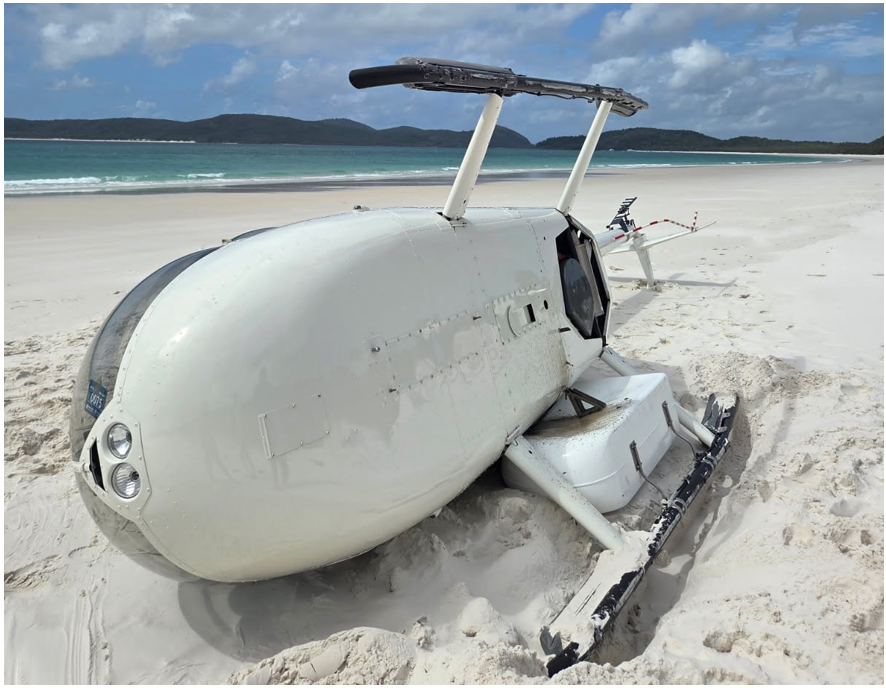
On 10 May 2026, a Robinson R44 helicopter was conducting a scenic flight from Hamilton Island to nearby Whitehaven Beach, Queensland. The flight was conducted in conjunction with a second R44 helicopter. Both helicopters had a pilot and 2 passengers on board from the same group.
At about 0910 local time, both helicopters made an approach to land on Whitehaven Beach from the north. The pilots had planned to land so the helicopters would be nose to nose on the beach, the pilot of the first helicopter had planned to land in the downwind direction. The pilot of the first helicopter accelerated to increase the distance from the second helicopter and reduce any effects of their downwash on the second helicopter’s landing.
Having identified the landing area, the pilot of the first helicopter initiated a left crosswind turn and had intended to bring the helicopter to a hover crosswind at the landing area before conducting a hover turn 90° to the left to land downwind.
The pilot reported they inadvertently overflew the landing area which resulted in them conducting a downwind approach to land. As the aircraft slowed and lost translational lift,1 the pilot applied additional power, however, the helicopter settled into the soft sand with the right skid low. With a high power setting applied and the right skid anchored by the soft sand, the helicopter quickly rolled onto its right side, impacting the main rotor blades onto the sand before coming to a stop.
The pilot then shut off the fuel supply to the engine and switched the battery off before they assisted the passengers to egress from the back seats. One passenger suffered a minor injury to their leg and was treated by the pilot from the onboard first-aid kit. The helicopter was substantially damaged.
Figure 1: Occurrence R44 helicopter
* Note – The main rotor blades had been removed for transport. Source: Operator, adjusted by the ATSB
Wind conditions recorded 12 km away at Hamilton Island, at 0900, indicated an east‑south‑easterly wind at 24 kt.
Safety action
The operator of both helicopters advised that the pilot’s actions were not in accordance with company standard operating procedures and the pilot should have aborted the approach to landing after misjudging the landing area.
Following the occurrence the operator advised they intended to implement a pilot decision‑making course into their pilot training syllabus.
Safety message
Helicopters operate more efficiently at a particular airspeed. At 55 kt, the R44 helicopter uses the least amount of power to maintain height and as airspeed increases or decreases from 55 kt an increase in power is required to maintain the intended flight path.
After misjudging the landing area, the pilot’s decision to continue to land via a downwind approach reduced their airspeed and therefore increased the power required to maintain the desired rate of descent, and consequently was unable to arrest the descent with the power available.
The Robinson R44 pilot operating handbook safety tip number 10 warns pilots on the risks of conducting take-offs and landings downwind:
Never make takeoffs or landings downwind, especially at high altitude. The resulting loss of translational lift can cause the aircraft to settle into the ground or obstacles.
The misjudgement of the intended landing area in aviation is common, and sound pilot decision‑making following the misjudgement is critical to the continued safety of flight. Often the safest outcome is to abort the landing and allow time to reassess the planned approach.
About this report
Decisions regarding whether to conduct an investigation, and the scope of an investigation, are based on many factors, including the level of safety benefit likely to be obtained from an investigation. For this occurrence, no investigation has been conducted and the ATSB did not verify the accuracy of the information. A brief description has been written using information supplied in the notification and any follow-up information in order to produce a short summary report, and allow for greater industry awareness of potential safety issues and possible safety actions.
^Translational lift occurs when clear, undisturbed air flows through the rotor system, either from wind or directional flight improving rotor efficiency
Occurrence summary
Mode of transport
Aviation
Occurrence ID
AB-2026-029
Occurrence date
10/05/2026
Location
Whitehaven Beach
State
Queensland
Occurrence class
Accident
Aviation occurrence category
Collision with terrain, Loss of control
Highest injury level
Minor
Brief release date
05/06/2026
Aircraft details
Manufacturer
Robinson Helicopter Co
Model
R44
Sector
Helicopter
Operation type
Part 133 Air transport operations - rotorcraft
Activity
Commercial air transport-Non-scheduled-Joyflights / sightseeing charters
Occurrence Briefs are concise reports that detail the facts surrounding a transport safety occurrence, as received in the initial notification and any follow-up enquiries. They provide an opportunity to share safety messages in the absence of an investigation. Because occurrence briefs are not investigations under the Transport Safety Investigation Act 2003, the information in them is de-identified.
What happened
On 3 April 2026, the pilot of a Cirrus SR20 planned a private solo flight from Bankstown to Shellharbour, New South Wales. The pilot was planning to complete circuit practice and then return the aircraft to Bankstown.
During cruise to Shellharbour at 2,400 ft AMSL, while operating in autopilot mode, the fuel mixture was leaned1 and the pilot observed multiple brief power reductions shortly thereafter. The vibrations lasted 1–2 seconds and did not persist, and the pilot elected to continue to Shellharbour as planned.
Having completed 3 non-eventful circuits on runway 34 at Shellharbour, a fourth circuit was commenced. While the aircraft was established on downwind, the pilot switched fuel tanks to conserve fuel. A landing and subsequent take‑off for a fifth circuit was then commenced. During upwind at approximately 350–450 ft AMSL, the pilot observed several momentary power losses followed by a sustained loss of power and a significant vibration. The engine was fluctuating between the production of power and loss of power.
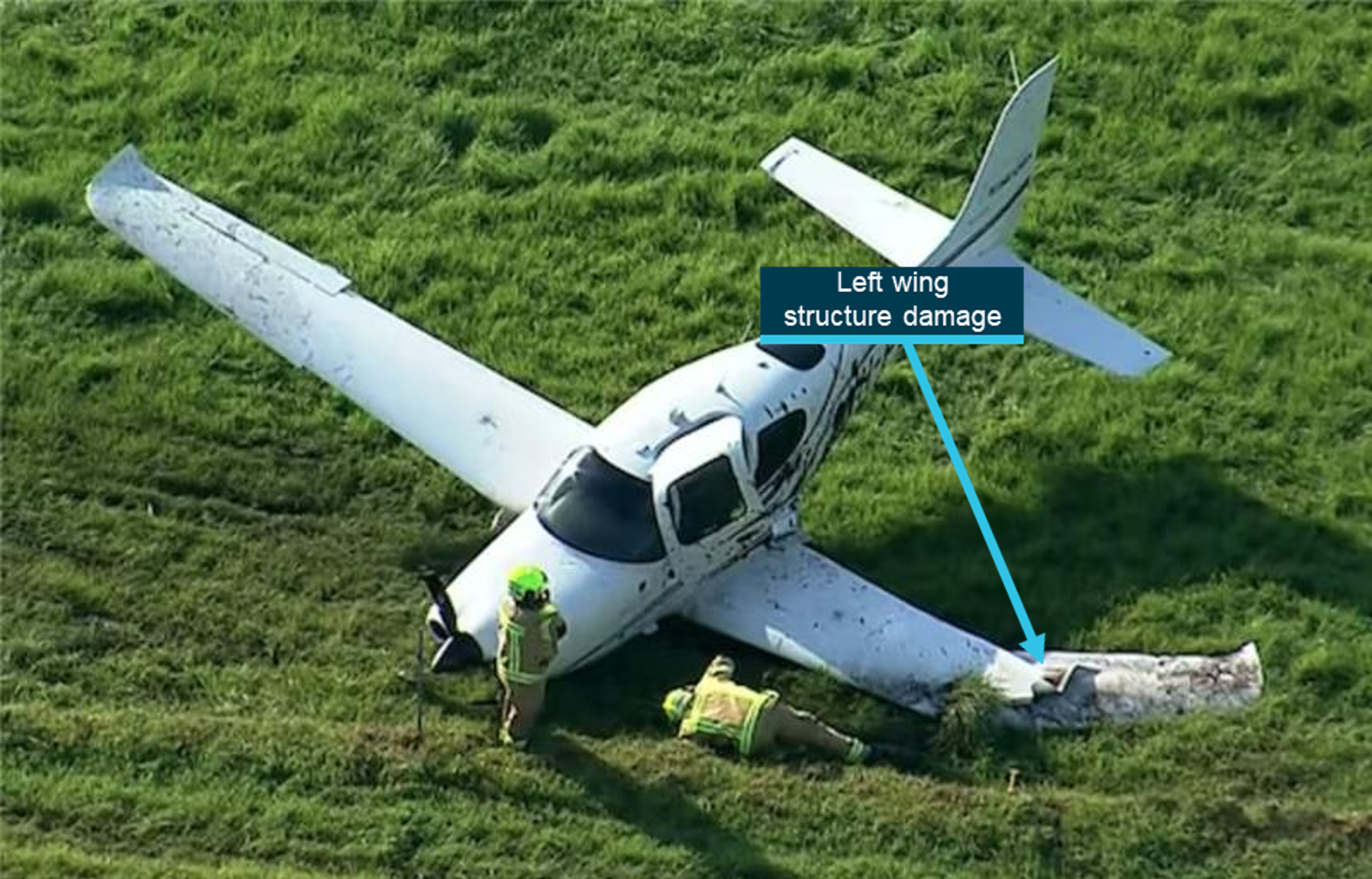
The pilot was aware of the low altitude and low airspeed and conducted a forced landing in a vacant paddock to the west of the airfield. Prior to landing, the pilot confirmed that the throttle was in the full position with an accompanying rich fuel mixture and the fuel pump in the on position. Just prior to touching down, the aircraft entered an aerodynamic stall and collided with terrain resulting in substantial damage to the left wing and undercarriage (Figure 1). The pilot sustained minor injuries.
The post-flight engineering inspection revealed an induction leak at the no. 1 position induction pipe and a brief rough running magneto. Engineers replaced the no. 2 fuel injector nozzle and 2 of the magneto plugs.
Cirrus airframe parachute system
The Cirrus airframe parachute system (CAPS) is designed to safely lower the aircraftand its occupants to the ground, under parachute, in the event of a life-threatening emergency where activation is determined to be safer than continued flight, such as medical incapacitation or airframe failure. In this instance, due to the aircraft’s low altitude, the pilot did not deploy the parachute.
Figure 1: Aircraft wreckage
Source: Media, annotated by the ATSB
Safety message
During emergency operations at low altitude, pilots are encouraged to be decisive when selecting the appropriate landing area, as well as vigilant in maintaining the speed required for a forced landing to avoid a stall prior to touchdown. Should the aircraft enter an aerodynamic stall, execute the stall recovery technique.
About this report
Decisions regarding whether to conduct an investigation, and the scope of an investigation, are based on many factors, including the level of safety benefit likely to be obtained from an investigation. For this occurrence, no investigation has been conducted and the ATSB did not verify the accuracy of the information. A brief description has been written using information supplied in the notification and any follow-up information in order to produce a short summary report, and allow for greater industry awareness of potential safety issues and possible safety actions.
^The mixture is leaned for stages of flight that would require less fuel to maintain efficient engine operation.
Occurrence summary
Mode of transport
Aviation
Occurrence ID
AB-2026-025
Occurrence date
03/04/2026
Location
Shellharbour Airport
State
New South Wales
Occurrence class
Accident
Aviation occurrence category
Collision with terrain, Engine failure or malfunction, Forced/precautionary landing
Highest injury level
Minor
Brief release date
03/06/2026
Aircraft details
Manufacturer
Cirrus Design Corporation
Model
SR20
Sector
Piston
Operation type
Part 91 General operating and flight rules
Activity
General aviation / Recreational – Sport and pleasure flying – Other sport and pleasure
Departure point
Bankstown Airport, New South Wales
Destination
Wollongong (Shellharbour) Airport, New South Wales
The ATSB is investigating the loss of 89 RPAS in water and ground collisions during a drone swarm aerial display at Sydney Harbour, New South Wales, on 25 May 2026.
Following initial evidence collection, the ATSB has commenced the examination and analysis phase of the investigation.
To date the ATSB investigation has included:
Interviewing the involved crew
Analysis of ground based recorded data
Examination of witness video
Collection of meteorological information
Collection of operational documentation and procedures.
The continuing investigation will include further analysis of:
Recorded data
Meteorological information
Operational documentation including emergency procedures
Related and similar occurrences.
A final report will be released at the conclusion of the investigation. Should a critical safety issue be identified during the course of the investigation, the ATSB will immediately notify relevant parties, so that appropriate safety action can be taken.
Last updated:
Occurrence summary
Investigation number
AO-2026-080
Occurrence date
25/05/2026
Occurrence time and timezone
1930 Australian Eastern Standard Time
Location
Sydney Harbour
State
New South Wales
Report status
Pending
Anticipated completion
Q4 2026
Investigation level
Short
Investigation type
Occurrence Investigation
Investigation phase
Examination and analysis
Investigation status
Active
Mode of transport
Aviation
Aviation occurrence category
Collision with terrain, Datalink - RPAS
Occurrence class
Accident
Highest injury level
None
Aircraft details
Manufacturer
SKYMAGIC
Model
X-258
Aircraft operator
Skymagic Live Pte Ltd
Sector
Remotely piloted aircraft
Operation type
Part 101 Unmanned aircraft and rockets
Activity
General aviation / Recreational-Aerial work-Other aerial work
Occurrence Briefs are concise reports that detail the facts surrounding a transport safety occurrence, as received in the initial notification and any follow-up enquiries. They provide an opportunity to share safety messages in the absence of an investigation. Because occurrence briefs are not investigations under the Transport Safety Investigation Act 2003, the information in them is de-identified.
What happened
On 16 April 2026, a pilot and passenger on board a Van’s RV-7 departed Archerfield Airport on a private flight to Fig Tree Aircraft Landing Area (ALA), Queensland. The Fig Tree ALA had a 400 m unsealed grass runway at an elevation of 1,600 ft AMSL. The pilot noted that they were conscious of the increased risk of operating into an airstrip with a short runway and had conducted short field landing practice at Archerfield the day prior.
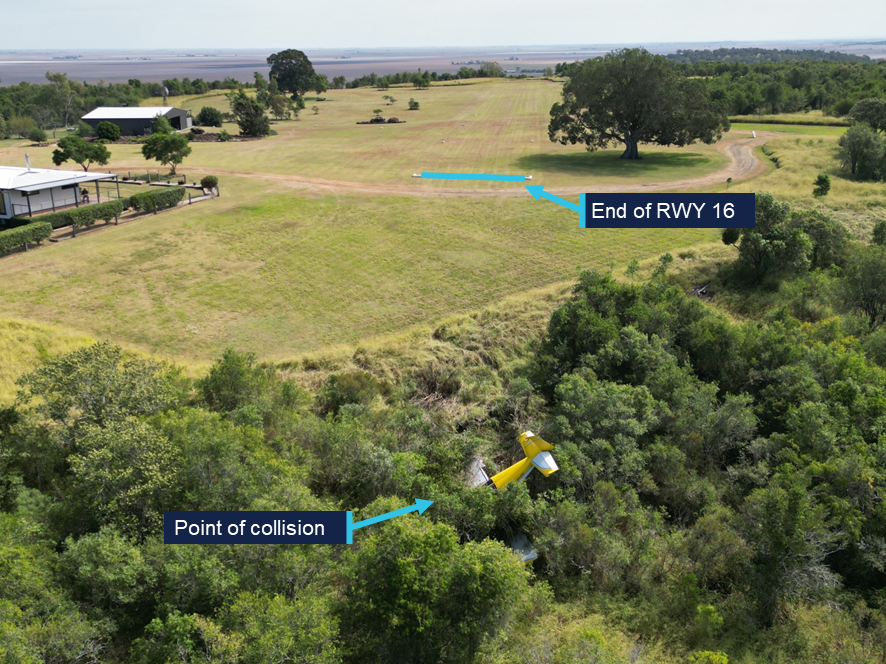
After arriving overhead Fig Tree airfield, a standard field inspection and a go-around was conducted to gain familiarity with the runway characteristics, as was required by the field operator. At 1110 local time, the aircraft commenced an approach and landing on runway 16. As the aircraft touched down midfield on the runway, the pilot determined that with the remaining landing distance available and the aircraft’s high speed, a go-around was required. During the go-around at approximately 20 ft AGL, the aircraft encountered sink and failed to climb as expected. The pilot made the decision to reduce the power to idle and attempted to conduct an off-field landing. The aircraft subsequently collided with thick shrubbery off the end of runway 16, resulting in substantial structural damage. (Figure 1). Both occupants were uninjured and extricated themselves from the aircraft.
After the occurrence, the pilot recalled that the accident approach was faster than anticipated. The operator determined there were no technical faults with the engine that affected the reduced climbing performance.
Figure 1: Fig Tree ALA
Source: Operator, annotated by the ATSB
Safety message
The margin for error while operating at airfields with short runways is limited and requires pilots to conduct the appropriate short field take-off and landing technique. In the case when an approach becomes unsuitable for a safe landing to occur, it is vital that pilots conduct a go-around as soon as practical.
The occurrence also highlights the importance for all pilots to have a personal minimums checklist that aligns with their individual flying experience. If at any time the conditions exceed these minimums or doubt is experienced, pilots should not continue to land and consider using alternative runways, alternative airfields or returning to the departure location if the available fuel permits.
About this report
Decisions regarding whether to conduct an investigation, and the scope of an investigation, are based on many factors, including the level of safety benefit likely to be obtained from an investigation. For this occurrence, no investigation has been conducted and the ATSB did not verify the accuracy of the information. A brief description has been written using information supplied in the notification and any follow-up information in order to produce a short summary report, and allow for greater industry awareness of potential safety issues and possible safety actions.
Occurrence summary
Mode of transport
Aviation
Occurrence ID
AB-2026-026
Occurrence date
16/04/2026
Location
Fig Tree Aircraft Landing Area
State
Queensland
Occurrence class
Accident
Aviation occurrence category
Collision with terrain, Control issues, Missed approach
Highest injury level
None
Brief release date
21/05/2026
Aircraft details
Manufacturer
Van's Aircraft
Model
RV-7
Sector
Piston
Operation type
Part 91 General operating and flight rules
Activity
General aviation / Recreational – Sport and pleasure flying – Pleasure and personal transport
Departure point
Archerfield Airport, Queensland
Destination
Irongate/Fig Tree Aircraft Landing Area, Queensland
Occurrence Briefs are concise reports that detail the facts surrounding a transport safety occurrence, as received in the initial notification and any follow-up enquiries. They provide an opportunity to share safety messages in the absence of an investigation. Because occurrence briefs are not investigations under the Transport Safety Investigation Act 2003, the information in them is de-identified.
What happened
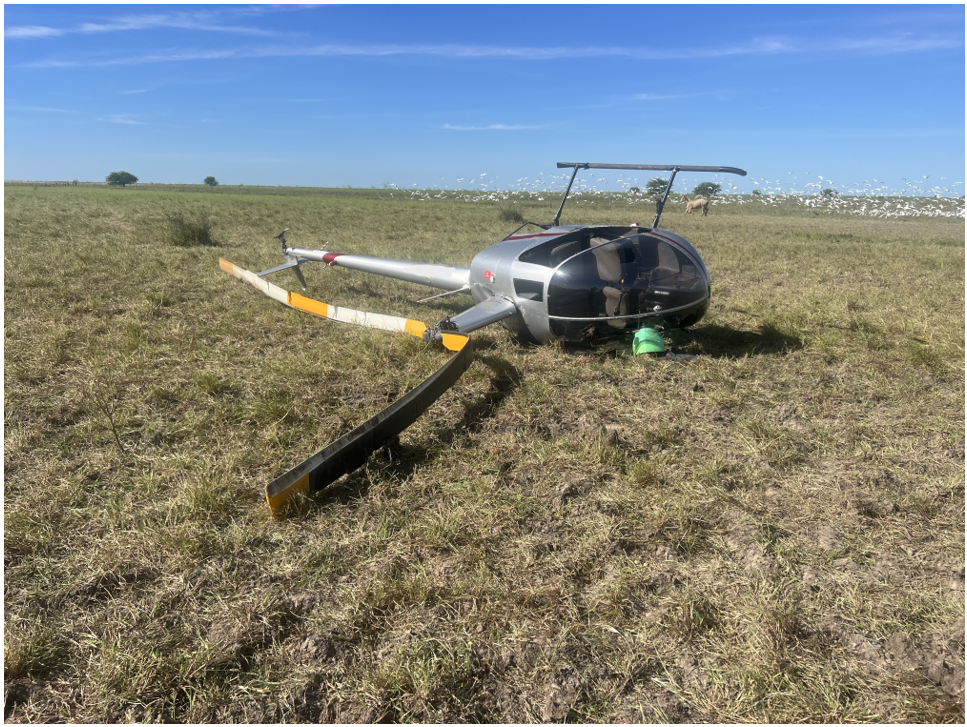
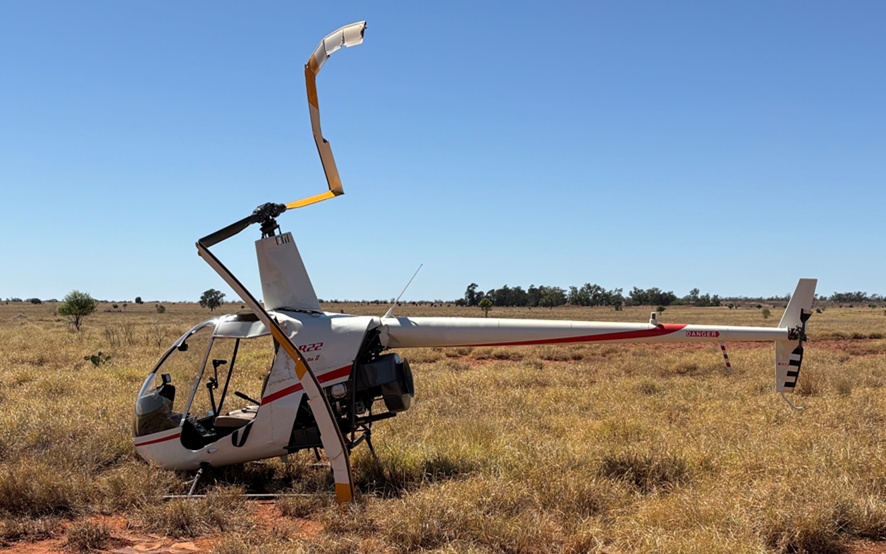
On 28 March 2026 at approximately 1400 local time, a Robinson R22 Beta was conducting commercial aerial mustering operations near Elliott, Northern Territory. As the helicopter was mustering cattle into a yard at about 20 ft above ground level (AGL), the tail of the helicopter contacted the ground, resulting in a loss of control. The pilot reported that they cut the throttle to settle the helicopter, landing upright but with a ‘slight yaw to the right’. As the ground underneath was uneven, the helicopter subsequently rolled over, coming to rest on its right side (Figure 1).
The helicopter sustained substantial damage to the main rotor blades, cockpit window, fuselage and tail rotor. The pilot received minor lacerations and was taken to hospital for further assessment.
Figure 1: R22 resting position
Source: Operator
Safety message
This incident highlights that low-level flying operations have a lower margin for error with minimal time to recover the aircraft in the event of a loss of control.
Low-level flying, particularly during aerial mustering operations, is inherently high risk and therefore requires effective risk management. This should include a risk assessment to consider the hazards common to the type of operation, as well as specific to the location, to develop mitigations and reduce the chance of an accident occurring.
About this report
Decisions regarding whether to conduct an investigation, and the scope of an investigation, are based on many factors, including the level of safety benefit likely to be obtained from an investigation. For this occurrence, no investigation has been conducted and the ATSB did not verify the accuracy of the information. A brief description has been written using information supplied in the notification and any follow-up information in order to produce a short summary report, and allow for greater industry awareness of potential safety issues and possible safety actions.
Occurrence summary
Mode of transport
Aviation
Occurrence ID
AB-2026-021
Occurrence date
28/03/2026
Location
Near Elliott
State
Northern Territory
Occurrence class
Accident
Aviation occurrence category
Collision with terrain, Loss of control
Highest injury level
Minor
Brief release date
18/05/2026
Aircraft details
Manufacturer
Robinson Helicopter Co
Model
R22 Beta
Sector
Helicopter
Operation type
Part 138 Aerial work operations
Activity
General aviation / Recreational-Aerial work-Agricultural mustering
Occurrence Briefs are concise reports that detail the facts surrounding a transport safety occurrence, as received in the initial notification and any follow-up enquiries. They provide an opportunity to share safety messages in the absence of an investigation. Because occurrence briefs are not investigations under the Transport Safety Investigation Act 2003, the information in them is de-identified.
What happened
On the afternoon of 28 March 2026, a Robinson R22 Beta II helicopter with the pilot and a passenger on board was conducting a private, stock monitoring flight around 55 km to the south-east of St George Airport, Queensland. The weather was reported as fine, with 20 km/h (10.8 kt) winds from the south. The pilot reported that while hovering into wind at a height of about 30 ft, they commenced a pedal turn1 to the right, away from a line of trees. During the turn downwind, the turn rate began to increase and they were unable to arrest or control the rotation – estimating that the helicopter spun through approximately 450 degrees before it descended to heavily contact the ground. The rotating motion during ground contact resulted in the helicopter rolling onto its left side, sustaining substantial damage to the main and tail rotors, tail boom and cabin. Both pilot and passenger were able to egress through the right doorway and were uninjured.
Figure 1: Helicopter after being returned upright following the accident
Source: Helicopter operator, edited by the ATSB
Engineering examination
The helicopter was recovered and examined by maintenance personnel, with attention to the tail rotor drive train and controls. No evidence of pre-existing mechanical defects was identified, with all damage consistent with being sustained during the accident sequence.
Safety message
Unanticipated yaw
Directional (yaw) control of single main rotor helicopters is primarily achieved through the pilot’s manipulation of tail rotor thrust. The torque produced by the drive transmitted through the main rotor is counterbalanced by the tail rotor thrust, with the pilot’s control of that thrust allowing controlled movement of the helicopter about its vertical axis.
In the hover and at low forward airspeeds, several aerodynamic effects can influence the anti-torque effectiveness of the tail rotor system. These can produce yaw motions unanticipated by the pilot, and which, if not immediately arrested, can result in a loss of helicopter control. Collectively known as Loss of Tail Rotor Effectiveness (LTE) phenomena, these include:
out-of-ground effect hovers and high-power demand situations such as low‑speed downwind turns
hovering in winds above 8–12 kt (especially when out-of-ground effect).
AC 90-95 recommends the following recovery actions if experiencing LTE:
application of full pedal opposite the direction of rotation
forward cyclic movement to increase speed
reduction in power if altitude permits.
About this report
Decisions regarding whether to conduct an investigation, and the scope of an investigation, are based on many factors, including the level of safety benefit likely to be obtained from an investigation. For this occurrence, no investigation has been conducted and the ATSB did not verify the accuracy of the information. A brief description has been written using information supplied in the notification and any follow-up information in order to produce a short summary report, and allow for greater industry awareness of potential safety issues and possible safety actions.
1
^A low-airspeed helicopter turning action initiated solely with the tail rotor controls (pedals).
Occurrence summary
Mode of transport
Aviation
Occurrence ID
AB-2026-023
Occurrence date
28/03/2026
Location
About 55 km south-east of St George Airport
State
Queensland
Occurrence class
Accident
Aviation occurrence category
Collision with terrain, Loss of control
Highest injury level
None
Brief release date
18/05/2026
Aircraft details
Manufacturer
Robinson Helicopter Co
Model
R22 Beta II
Sector
Helicopter
Operation type
Part 91 General operating and flight rules
Activity
General aviation / Recreational - Sport and pleasure flying - Pleasure and personal transport
Occurrence Briefs are concise reports that detail the facts surrounding a transport safety occurrence, as received in the initial notification and any follow-up enquiries. They provide an opportunity to share safety messages in the absence of an investigation. Because occurrence briefs are not investigations under the Transport Safety Investigation Act 2003, the information in them is de-identified.
What happened
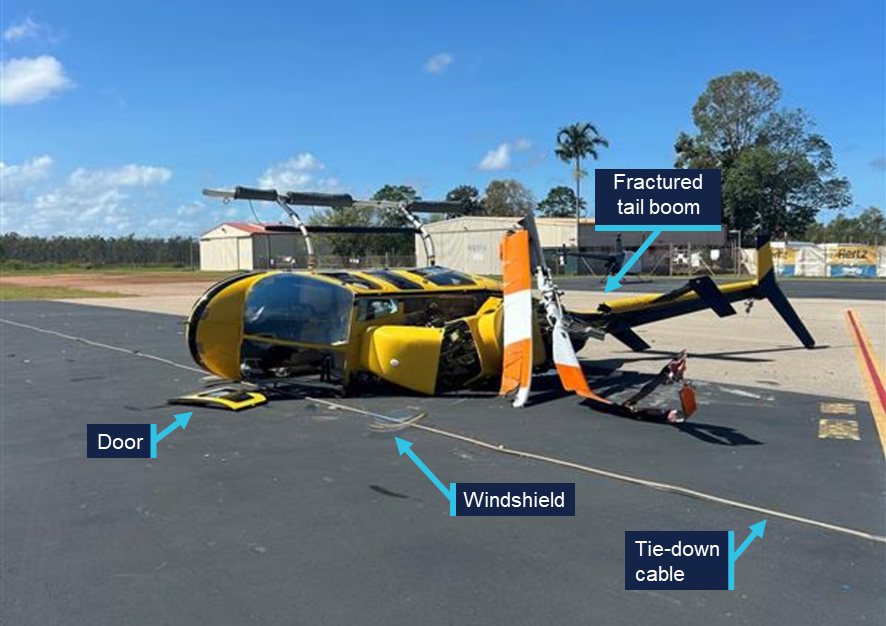
On 27 March 2026, a Bell 206L helicopter was being used to transport a passenger to a remote telecommunications work site. The helicopter made a refuelling stop at Weipa Aerodrome, where the passenger was disembarked to a safe location for the refuelling. In preparation for the subsequent departure, the pilot conducted a visual inspection down both sides of the helicopter, including rechecking the fuel cap was secured and the bowser was safely stowed.
As the pilot initiated the hover for take-off, the passenger notified the pilot that the ground (tie-down) cable was moving while, simultaneously, the helicopter rolled onto its left side, due to the left skid becoming caught on the cable. The pilot and the passenger were able to exit the helicopter uninjured, however the helicopter was substantially damaged.
Figure 1: Aircraft damage
Source: Queensland Police, edited by the ATSB
Safety message
In this occurrence, the proximity of the ground tie-down cable to the helicopter’s skid was not identified during the visual inspection prior to departure from the refuelling stop. Given the significance of the consequences when a skid becomes stuck on an object during take-off, the ATSB emphasises the importance of pilots conducting thorough visual checks when parking helicopters in the vicinity of potential hazards.
About this report
Decisions regarding whether to conduct an investigation, and the scope of an investigation, are based on many factors, including the level of safety benefit likely to be obtained from an investigation. For this occurrence, no investigation has been conducted and the ATSB did not verify the accuracy of the information. A brief description has been written using information supplied in the notification and any follow-up information in order to produce a short summary report, and allow for greater industry awareness of potential safety issues and possible safety actions.
This preliminary report details factual information established in the investigation’s early evidence collection phase, and has been prepared to provide timely information to the industry and public. Preliminary reports contain no analysis or findings, which will be detailed in the investigation’s final report. The information contained in this preliminary report is released in accordance with section 25 of the Transport Safety Investigation Act 2003.
The occurrence
On the afternoon of 29 April 2026, a Diamond DA42 twin-engine aircraft, registered VH‑YQP and operated by Flight Training Adelaide at Parafield Airport, South Australia, was being prepared for a training flight.1 On board was a pilot under instruction (‘the pilot’) seated in the left seat, and an instructor in the right seat. The plan for the flight was to conduct simulated one-engine inoperative (asymmetric) circuits2 in accordance with the multi-engine aeroplane training syllabus.
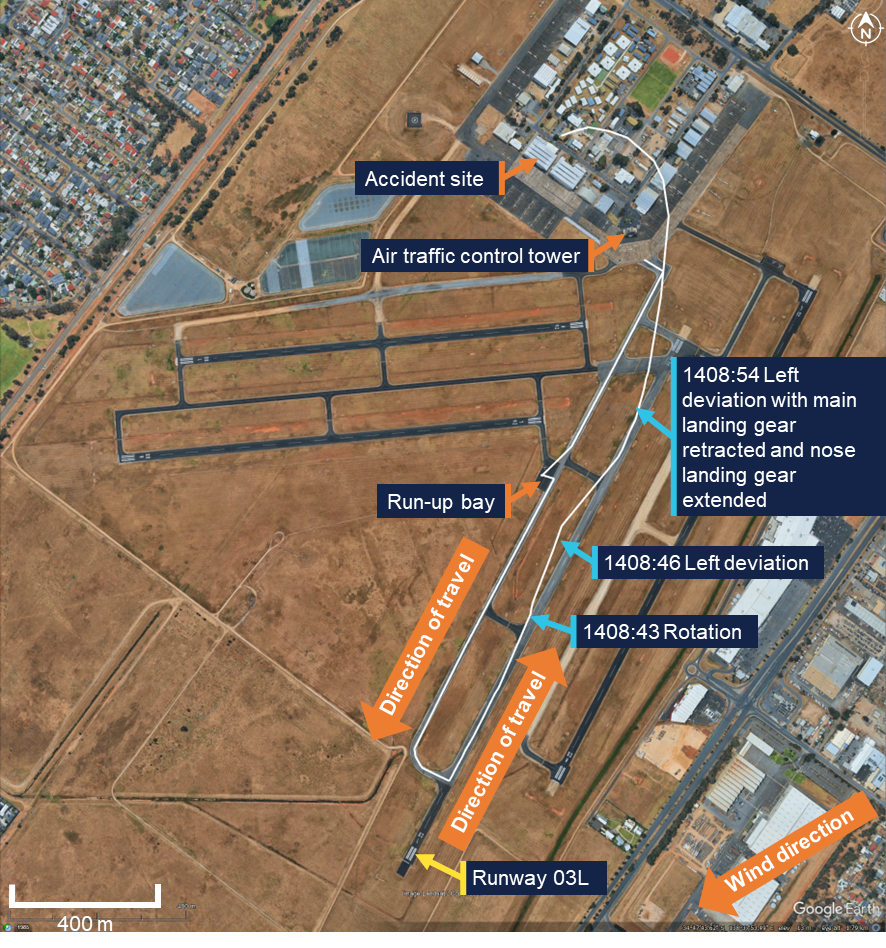
Automatic dependent surveillance-broadcast (ADS-B)3 data showed the aircraft taxied from the apron to the run‑up bay, where they conducted engine ground runs4 (Figure 1). A witness in another aircraft nearby reported that they did not observe any problems with the aircraft at this time. At 1403:52 local time, the pilot contacted the ground air traffic controller to request a taxi clearance and was subsequently cleared to taxi to the holding point at runway 03 left (L).5
At 1407:14, while positioned at the holding point, the pilot requested approval from the tower controller to conduct asymmetric circuits. About a minute later, the controller approved the request and cleared the aircraft for take-off.
The ADS-B data showed that the aircraft began its take-off roll on runway 03L at 1408:29. At 1408:43, the aircraft rotated6 and 3 seconds later (at 1408:46) deviated left of the runway at an estimated airspeed of 75 kt. At 1408:52, closed-circuit television (CCTV) footage showed the landing gear was extended. At 1408:53, the aircraft was realigned with the runway heading, with wings level at 96 ft above ground level and an estimated airspeed of 100 kt. One second later, at 1408:54, the CCTV showed that the main landing gear had been retracted, but the nose landing gear (NLG) remained extended. From this time onwards, the aircraft began veering left of the runway heading.
At 1408:56, the instructor made a radio call on the tower frequency stating ‘engine failure.’ At this time, the aircraft was at 115 ft with an estimated airspeed of 100 kt. No further radio calls were heard from either the pilot or instructor. A witness observed the aircraft’s left engine did not appear to be operating and the left propeller was rotating slowly.
At 1409:02, while at 111 ft and 104 kt, the aircraft pitched up, and banked left. The aircraft continued to turn with the left wing down. At 1409:11, the aircraft reached a maximum altitude of 161 ft and the estimated airspeed had slowed to 90 kt. From this point, the aircraft entered a steep descent. A witness’s photograph taken around this time showed the NLG was still extended and the main landing gear retracted.
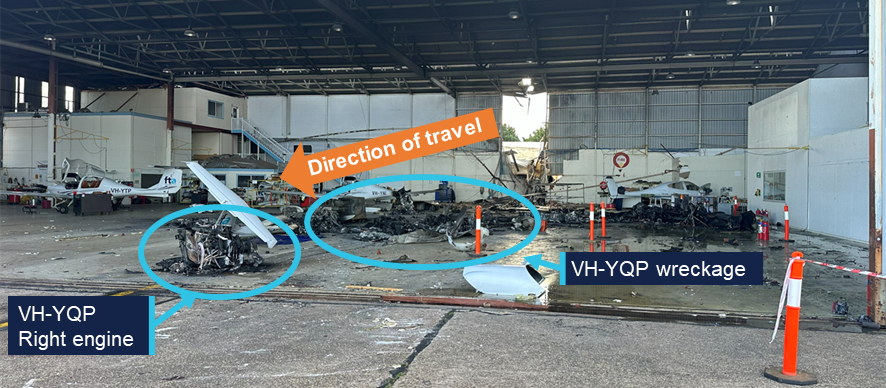
At 1409:15, the left wing of the aircraft struck a room attached to a hangar, before the aircraft continued through the hangar wall and came to rest inside the building. A post‑impact fire ensued, destroying the aircraft as well as damaging another 4 within the hangar. The pilot and instructor were fatally injured. Nine people working in the hangar were reported to be taken to hospital.
Figure 1: Overview of the flight path (track in white)
Source: Google Earth, ADS-B Exchange flight tracking data and CCTV footage, annotated by the ATSB
Context
Personnel information
Instructor
The instructor held a Commercial Pilot Licence (Aeroplane), initially issued in June 2017, with both multi-engine and single-engine aeroplane class ratings. They held a Grade 2 flight instructor rating including a class rating training endorsement for multi-engine aeroplanes. A flight instructor proficiency check was last completed in August 2025, and an instrument multi-engine aircraft proficiency check in November 2025. The instructor held a class 1 aviation medical certificate, valid until July 2026, with no restrictions.
The operator’s records indicated that the instructor had logged 2,592.4 hours total flight time, of which 607 hours were instructing on multi-engine aeroplanes.
Pilot under instruction
The pilot under instruction held a Commercial Pilot Licence (Aeroplane), issued in March 2026, with a class rating for single-engine aeroplanes. They were undergoing training in preparation for a multi-engine aeroplane class rating. The pilot held a class 1 aviation medical certificate, valid until May 2026, with a requirement to wear distance vision correction.
The operator’s records indicated that the pilot had 205.6 hours total flight time, of which 16.9 hours were in the Diamond DA42 aircraft type.
Aircraft information
General
The Diamond DA42 is a 4-seat, low-wing, all composite (carbon fibre) twin-engine aircraft with retractable landing gear. VH-YQP, with serial number 42.213, was manufactured in Austria in 2009 and first registered in Australia in August 2020. It was powered by 2 Textron Lycoming piston engines, the left engine was model IO-360-M1A and right engine was model LIO-360-M1A.7 Each engine was fitted with a 3-blade, constant speed, full feathering MT‑Propeller.
At the time of the accident, the aircraft had a total time in service of 10,120.7 hours. At the last 50-hourly check, conducted and certified on 22 April 2026, the left engine had 2,339.2 hours and the right engine had 188.8 hours total time in service.
Landing gear information
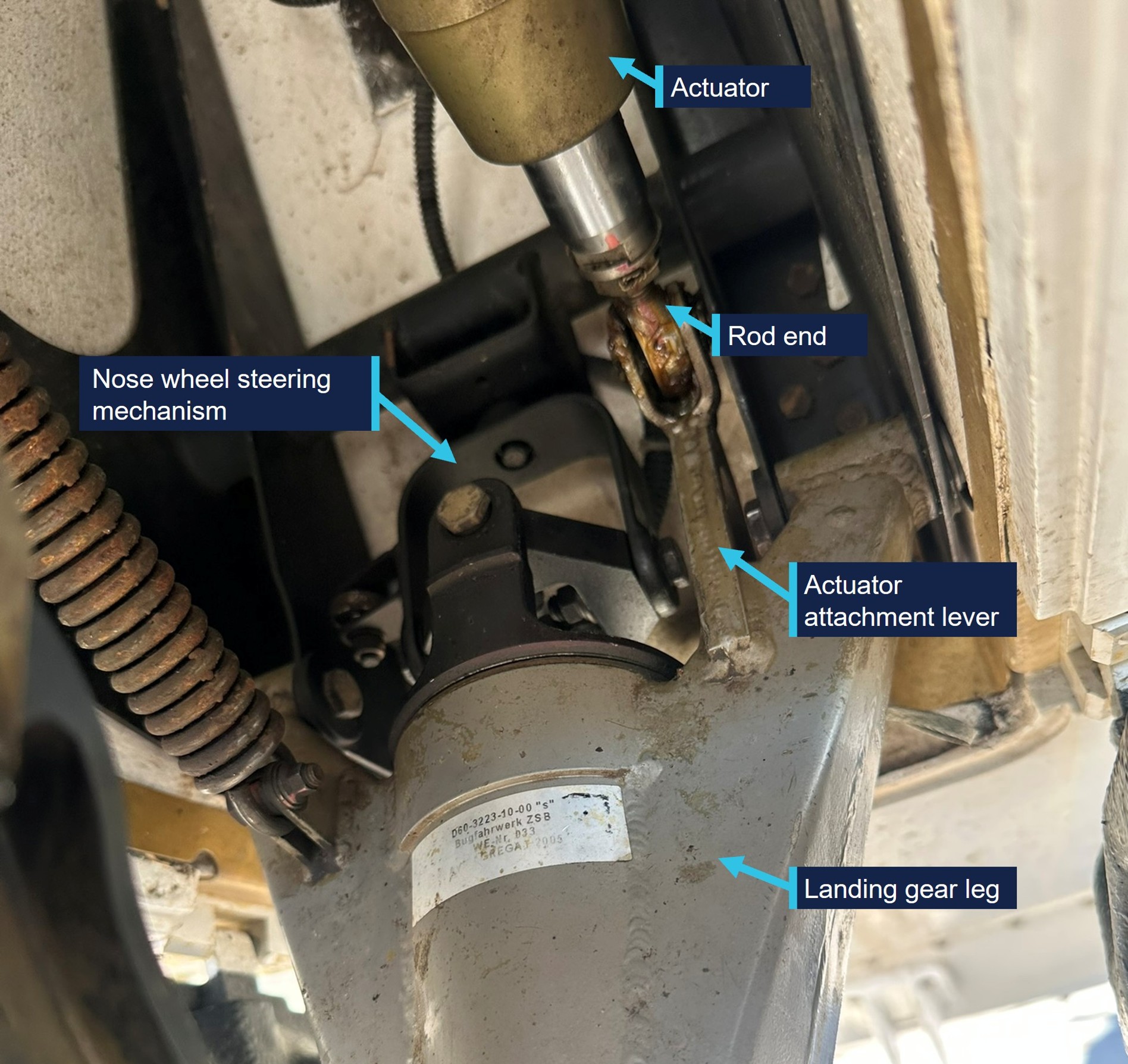
The Diamond DA42 has a hydraulically-driven, retractable tricycle landing gear. The hydraulic pressure is provided by an electric pump. Each landing gear assembly (nose and 2 mains) is fitted with an actuator (Figure 2). When the landing gear lever is moved by the pilot to the ‘up’ position to retract, hydraulic pressure is directed to the actuators. The main landing gears retract first, followed by the nose landing gear (NLG) approximately 1.5 seconds later.
Three green lights on the instrument panel show the pilot if the landing gear is in the down and locked position. Further, a gear unsafe warning light will illuminate red, indicating that the gear is neither in the final up or down and locked position. During normal retraction when the gear reaches its final up position, all lights are extinguished.
The DA42 was also equipped with an audible gear warning. The warning activated when the gear was retracted while the flaps were in the landing position, or the throttle was placed in a position forward of idle, but below approximately 14 inches of manifold pressure.
A 2013 Diamond Aircraft Industries (DAI) mandatory service bulletin (MSB 42-099/1), also published in European Union Aviation Safety Agency (EASA) airworthiness directive (AD) 2013-0121, described bending and, in one case, fracture of the NLG actuator rod end due to cyclic loading caused by interference between the safety washer and the actuator attachment lever. The MSB noted that, ‘due to the nearby steering linkage, a failed rod end bearing with the LDG [landing]-switch in the retracted position may cause interference with the rudder control’. The service bulletin instructed a replacement of the rod end bearing and safety washer. The aircraft’s maintenance log recorded this replacement was completed on VH-YQP.
Another DAI mandatory service bulletin (MSB 42-136/1) published in EASA airworthiness directive AD 2019‑0066 from 2019 described an event where the failure of the NLG actuator attachment lever due to unidentified cracking occurred in-flight. The bulletin indicated that the fractured NLG actuator, which was no longer attached to the gear leg ‘interacted with the rudder/NLG controls in such a way that the rudder was forced into left hand deflection’. The pilot reportedly regained full rudder control after extending the landing gear. The service bulletin introduced a recurring inspection of the NLG lever arm for cracks.
In accordance with the following 3 service bulletins, the NLG on VH-YQP was last inspected on 13 March 2026 by non-destructive evaluation, with no defects noted by the operator’s engineers:
Inspect rudder control system and nose landing gear steering bracket (MSB 42-087)
Inspection of nose landing gear actuator attachment lever (MSB 42-136/1)
Inspection of nose landing gear actuator attachment lever (EASA AD 2019-0066).
Figure 2: Nose landing gear components from an exemplar aircraft
The photograph shows the nose landing gear extended, looking aft. Source: ATSB
Wreckage examination
General
The wreckage was mostly contained within the hangar but was consumed by the post‑impact fire (Figure 3). The ATSB’s onsite wreckage examination found that:
the left engine did not show signs of rotation
the right engine propeller hub showed signs of rotation
the left propeller was in the feathered8 position and the right propeller was in fine pitch9 position
the rudder trim indicator was found in a nose left position
there was fuel in the tanks
all major aircraft components were present at the accident site
the NLG actuator had separated from the leg
where possible, flight control continuity was observed.
The engines, propellers, and NLG actuator were retained by the ATSB for further examination.
Figure 3: Overview of the wreckage
Source: ATSB
Nose landing gear actuator
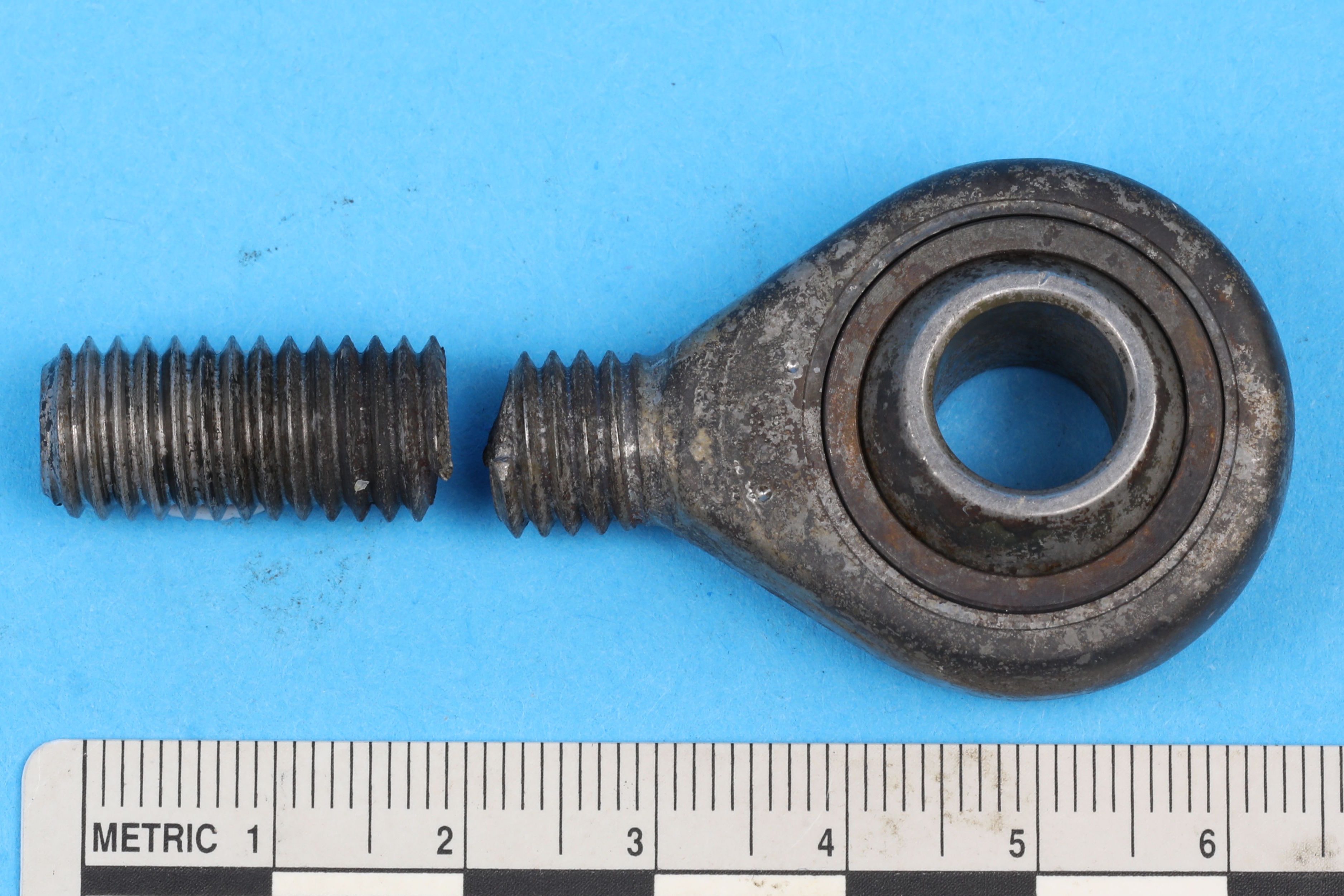
The wreckage examination identified that the NLG actuator rod end had fractured (Figure 4), detaching the actuator from the lever arm on the gear leg (see Figure 2). While metallurgical assessment of the component is ongoing, preliminary examination of the rod end by the ATSB identified indications of progressive (fatigue) cracking.
Figure 4: Fractured actuator rod end
Source: ATSB
Meteorological information
The Bureau of Meteorology weather observations around the time of the accident recorded no significant cloud, with a north-easterly wind, gusting from 12 kt to 22 kt. These observations were consistent with CCTV footage from the airport.
Recorded information
The aircraft was not fitted with, nor was it required to have, a flight data recorder or cockpit voice recorder. The aircraft was fitted with 2 Garmin G1000 devices that had the capacity to record flight and engine parameters. These were recovered to the ATSB’s technical facilities in Canberra, Australian Capital Territory, however, specialist analysis determined that the devices were damaged beyond the ability to recover data.
Initial analysis from ADS-B data and CCTV footage from the accident flight recorded that:
the aircraft’s estimated airspeed while airborne was between 75 kt and 104 kt
the aircraft’s maximum height was 161 ft
the NLG remained extended after the main landing gear had been retracted.
Operational information
The plan for the flight was to conduct simulated one-engine inoperative (asymmetric) circuits. The operator’s procedures for simulating an engine failure after take-off stipulated that the instructor closes the throttle of the appropriate engine to idle, providing that:
• the undercarriage is selected up, gear unsafe warning light out and the airspeed is not below 100 kt.
• the aircraft has reached 400 ft AGL.
The Diamond DA42 flight crew operating procedures manual stipulated the minimum control speed airborne10 (VMCA) is 65 kt and safe single engine speed11 (VSSE) is 90 kt.
ATSB comment
The circumstances of the accident were consistent with pre-accident fracture of the rod end, resulting in the NLG being observed down (while the main gear was retracted). While it was possible that the separated NLG actuator interfered with the steering/rudder controls, as per the previously-reported occurrence in the DAI MSB, further examination and analysis is required by the ATSB. The ATSB is also considering other scenarios to explain the accident sequence.
Safety action
The ATSB has published a safety advisory notice (AO-2026-074-SAN-001) detailing the NLG actuator fracture and the increased risk of an uncommanded left rudder control deflection.
Further investigation
To date, the ATSB has:
examined the aircraft wreckage
interviewed witnesses
obtained CCTV footage
reviewed ADS-B data
obtained operational and maintenance records
obtained air traffic control data.
The investigation is continuing and will include further examination of:
components recovered from the accident site, including the NLG actuator and engines
recorded data
operational documentation
aircraft maintenance records
survivability considerations
related occurrences.
A final report will be released at the conclusion of the investigation. Should a critical safety issue be identified during the course of the investigation, the ATSB will immediately notify relevant parties so appropriate and timely safety action can be taken.
Safety advisory notice video
Acknowledgements
The ATSB acknowledges the significant assistance from the Defence Flight Safety Bureau and Flight Training Adelaide during the onsite phase of the investigation.
Purpose of safety investigations
The objective of a safety investigation is to enhance transport safety. This is done through:
identifying safety issues and facilitating safety action to address those issues
providing information about occurrences and their associated safety factors to facilitate learning within the transport industry.
It is not a function of the ATSB to apportion blame or provide a means for determining liability. At the same time, an investigation report must include factual material of sufficient weight to support the analysis and findings. At all times the ATSB endeavours to balance the use of material that could imply adverse comment with the need to properly explain what happened, and why, in a fair and unbiased manner. The ATSB does not investigate for the purpose of taking administrative, regulatory or criminal action.
About ATSB reports
ATSB investigation reports are organised with regard to international standards or instruments, as applicable, and with ATSB procedures and guidelines.
Reports must include factual material of sufficient weight to support the analysis and findings. At all times the ATSB endeavours to balance the use of material that could imply adverse comment with the need to properly explain what happened, and why, in a fair and unbiased manner.
An explanation of terminology used in ATSB investigation reports is available here. This includes terms such as occurrence, contributing factor, other factor that increased risk, and safety issue.
Publishing information
Released in accordance with section 25 of the Transport Safety Investigation Act 2003
Ownership of intellectual property rights in this publication
Unless otherwise noted, copyright (and any other intellectual property rights, if any) in this report publication is owned by the Commonwealth of Australia.
Creative Commons licence
With the exception of the Commonwealth Coat of Arms, ATSB logo, and photos and graphics in which a third party holds copyright, this report is licensed under a Creative Commons Attribution 4.0 International licence.
The CC BY 4.0 licence enables you to distribute, remix, adapt, and build upon our material in any medium or format, so long as attribution is given to the Australian Transport Safety Bureau.
Copyright in material obtained from other agencies, private individuals or organisations, belongs to those agencies, individuals or organisations. Where you wish to use their material, you will need to contact them directly.
^Flight Training Adelaide operates a fleet of Diamond DA42 aircraft in its multi-engine aeroplane flight training program based at Parafield Airport and another base at Wellcamp, Queensland.
^Circuits: a circuit is the specified path to be flown by aircraft operating in the vicinity of an aerodrome. It comprises upwind, crosswind, downwind, base and final approach legs. It creates an orderly flow of traffic from take-off to landing and assists pilots with positioning the aircraft on final at the appropriate altitude and distance from the landing area to make a stabilised approach.
^Automatic dependent surveillance-broadcast is a surveillance technology in which an aircraft determines its position via satellite navigation and periodically broadcasts it, enabling it to be tracked.
^Checks conducted prior to take-off with engines running.
^Runway number: the number represents the magnetic heading of the runway (for example, runway 03 is oriented 30° magnetic). The runway identification may include L, R or C as required for left, right or centre.
^The positive, nose-up, movement of an aircraft about the lateral (pitch) axis immediately before becoming airborne.
^The letter ‘L’ in the model prefix denotes the reverse rotation of the basic model. For example, model IO-360-M1A has clockwise rotation of the crankshaft. Therefore, LIO-360-M1A has counterclockwise rotation of the crankshaft.
^Feathering: the rotation of propeller blades to an edge-on angle to the airflow to minimise aircraft drag following an in‑flight engine failure or shutdown.
^Fine pitch: refers to a fine or low pitch propeller blade angle position used during low-speed acceleration (such as take‑off and climb).
^The lowest speed directional control can be maintained during asymmetric flight.
^An airspeed factored to provide a safety margin for asymmetric training operations.
Occurrence summary
Investigation number
AO-2026-074
Occurrence date
29/04/2026
Occurrence time and timezone
14:09 Australian Central Standard Time
Location
Parafield Airport
State
South Australia
Report release date
23/06/2026
Report status
Preliminary
Anticipated completion
Q4 2026
Investigation level
Short
Investigation type
Occurrence Investigation
Investigation phase
Examination and analysis
Investigation status
Active
Mode of transport
Aviation
Aviation occurrence category
Collision with terrain, Loss of control
Occurrence class
Accident
Highest injury level
Fatal
Aircraft details
Manufacturer
Diamond Aircraft Industries
Model
DA42
Registration
VH-YQP
Serial number
42.213
Aircraft operator
Flight Training Adelaide Pty Ltd
Sector
Piston
Operation type
Part 142 Integrated and multi-crew pilot flight training
Activity
General aviation / Recreational-Instructional flying-Instructional flying - unknown
Occurrence Briefs are concise reports that detail the facts surrounding a transport safety occurrence, as received in the initial notification and any follow-up enquiries. They provide an opportunity to share safety messages in the absence of an investigation. Because occurrence briefs are not investigations under the Transport Safety Investigation Act 2003, the information in them is de-identified.
What happened
On the morning of 30 of March 2026, a pilot was conducting aerial agricultural spraying operations in a Thrush S2R-T34, consisting of multiple loads.
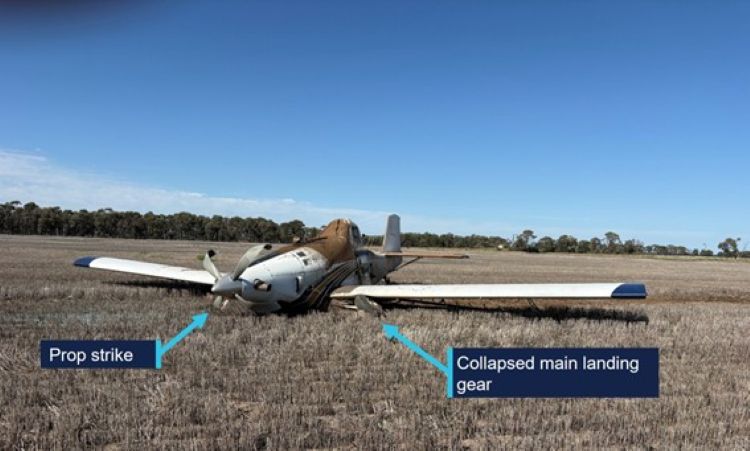
After returning to the work area to conduct the second load at approximately 0830 local time, the aircraft entered the next spray run over a tree line. While the pilot began to round-out the aircraft for the run, prior to releasing the load at approximately 5 ft above ground level, the aircraft collided with terrain. The main landing gear struck the ground first, subsequently collapsing, and the aircraft slid wings level, eventually coming to rest in the paddock.
The initial impact resulted in the main landing gear sustaining most of the damage with further minor damage to the propeller and wings reported by the operator (Figure 1). The pilot was not injured and extracted themself from the aircraft.
Figure 1: Aircraft post-accident
Source: Operator, annotated by the ATSB
A discussion with the operator post-accident revealed the pilot entered the spray run at a low airspeed and was unable to round-out after passing over the tree line. As the aircraft had returned to the work area for the second load of the day, the aircraft was operating close to the maximum operating weight with an approximate load of 1,800 litres on board. This combination probably affected the pilot’s ability to arrest the descending manoeuvre. The pilot reported that they felt ‘fully alert’ and had obtained 12 hours of sleep in the previous 24 hours.
Safety message
Pilots of aircraft conducting agricultural operations must ensure that they maintain continuous situational awareness of the aircraft’s state. Due to the reduced safety margins while flying at low level, effective and active information scanning is key to building an accurate mental model of the pilot’s environment, which enables timely and sound decisions to be made. If an aircraft does enter an abnormal state (such as becoming too slow), effective instrument scanning provides the pilot with information to be able to decide if a spray run or other complex manoeuvring should be aborted.
About this report
Decisions regarding whether to conduct an investigation, and the scope of an investigation, are based on many factors, including the level of safety benefit likely to be obtained from an investigation. For this occurrence, no investigation has been conducted and the ATSB did not verify the accuracy of the information. A brief description has been written using information supplied in the notification and any follow-up information in order to produce a short summary report, and allow for greater industry awareness of potential safety issues and possible safety actions.
Occurrence summary
Mode of transport
Aviation
Occurrence ID
AB-2026-020
Occurrence date
30/03/2026
Location
61 km south-west of Chinchilla
State
Queensland
Occurrence class
Accident
Aviation occurrence category
Collision with terrain
Highest injury level
None
Aircraft details
Manufacturer
Thrush Aircraft
Model
S2R-T34
Sector
Turboprop
Operation type
Part 137 Aerial application operations
Activity
General aviation / Recreational - Aerial work - Agricultural spreading / spraying