

Preliminary report
Report release date: 23/06/2026
| This preliminary report details factual information established in the investigation’s early evidence collection phase, and has been prepared to provide timely information to the industry and public. Preliminary reports contain no analysis or findings, which will be detailed in the investigation’s final report. The information contained in this preliminary report is released in accordance with section 25 of the Transport Safety Investigation Act 2003. |
The occurrence
On the afternoon of 29 April 2026, a Diamond DA42 twin-engine aircraft, registered VH‑YQP and operated by Flight Training Adelaide at Parafield Airport, South Australia, was being prepared for a training flight.1 On board was a pilot under instruction (‘the pilot’) seated in the left seat, and an instructor in the right seat. The plan for the flight was to conduct simulated one-engine inoperative (asymmetric) circuits2 in accordance with the multi-engine aeroplane training syllabus.
Automatic dependent surveillance-broadcast (ADS-B)3 data showed the aircraft taxied from the apron to the run‑up bay, where they conducted engine ground runs4 (Figure 1). A witness in another aircraft nearby reported that they did not observe any problems with the aircraft at this time. At 1403:52 local time, the pilot contacted the ground air traffic controller to request a taxi clearance and was subsequently cleared to taxi to the holding point at runway 03 left (L).5
At 1407:14, while positioned at the holding point, the pilot requested approval from the tower controller to conduct asymmetric circuits. About a minute later, the controller approved the request and cleared the aircraft for take-off.
The ADS-B data showed that the aircraft began its take-off roll on runway 03L at 1408:29. At 1408:43, the aircraft rotated6 and 3 seconds later (at 1408:46) deviated left of the runway at an estimated airspeed of 75 kt. At 1408:52, closed-circuit television (CCTV) footage showed the landing gear was extended. At 1408:53, the aircraft was realigned with the runway heading, with wings level at 96 ft above ground level and an estimated airspeed of 100 kt. One second later, at 1408:54, the CCTV showed that the main landing gear had been retracted, but the nose landing gear (NLG) remained extended. From this time onwards, the aircraft began veering left of the runway heading.
At 1408:56, the instructor made a radio call on the tower frequency stating ‘engine failure.’ At this time, the aircraft was at 115 ft with an estimated airspeed of 100 kt. No further radio calls were heard from either the pilot or instructor. A witness observed the aircraft’s left engine did not appear to be operating and the left propeller was rotating slowly.
At 1409:02, while at 111 ft and 104 kt, the aircraft pitched up, and banked left. The aircraft continued to turn with the left wing down. At 1409:11, the aircraft reached a maximum altitude of 161 ft and the estimated airspeed had slowed to 90 kt. From this point, the aircraft entered a steep descent. A witness’s photograph taken around this time showed the NLG was still extended and the main landing gear retracted.
At 1409:15, the left wing of the aircraft struck a room attached to a hangar, before the aircraft continued through the hangar wall and came to rest inside the building. A post‑impact fire ensued, destroying the aircraft as well as damaging another 4 within the hangar. The pilot and instructor were fatally injured. Nine people working in the hangar were reported to be taken to hospital.
Figure 1: Overview of the flight path (track in white)
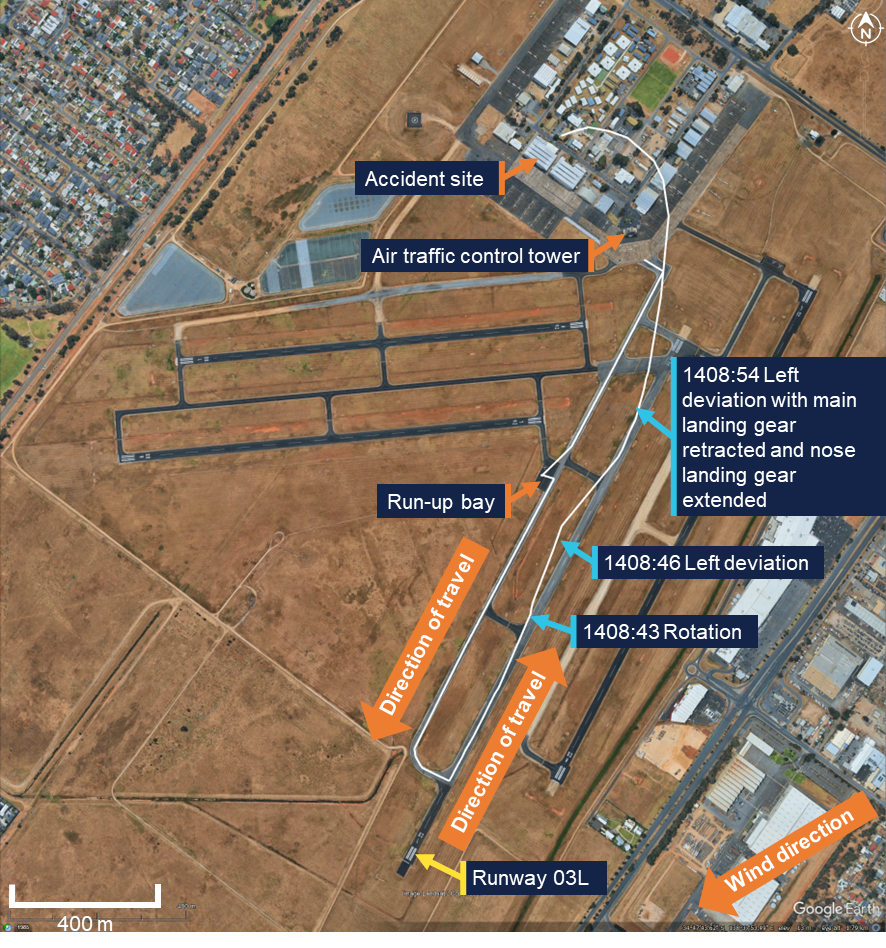
Source: Google Earth, ADS-B Exchange flight tracking data and CCTV footage, annotated by the ATSB
Context
Personnel information
Instructor
The instructor held a Commercial Pilot Licence (Aeroplane), initially issued in June 2017, with both multi-engine and single-engine aeroplane class ratings. They held a Grade 2 flight instructor rating including a class rating training endorsement for multi-engine aeroplanes. A flight instructor proficiency check was last completed in August 2025, and an instrument multi-engine aircraft proficiency check in November 2025. The instructor held a class 1 aviation medical certificate, valid until July 2026, with no restrictions.
The operator’s records indicated that the instructor had logged 2,592.4 hours total flight time, of which 607 hours were instructing on multi-engine aeroplanes.
Pilot under instruction
The pilot under instruction held a Commercial Pilot Licence (Aeroplane), issued in March 2026, with a class rating for single-engine aeroplanes. They were undergoing training in preparation for a multi-engine aeroplane class rating. The pilot held a class 1 aviation medical certificate, valid until May 2026, with a requirement to wear distance vision correction.
The operator’s records indicated that the pilot had 205.6 hours total flight time, of which 16.9 hours were in the Diamond DA42 aircraft type.
Aircraft information
General
The Diamond DA42 is a 4-seat, low-wing, all composite (carbon fibre) twin-engine aircraft with retractable landing gear. VH-YQP, with serial number 42.213, was manufactured in Austria in 2009 and first registered in Australia in August 2020. It was powered by 2 Textron Lycoming piston engines, the left engine was model IO-360-M1A and right engine was model LIO-360-M1A.7 Each engine was fitted with a 3-blade, constant speed, full feathering MT‑Propeller.
At the time of the accident, the aircraft had a total time in service of 10,120.7 hours. At the last 50-hourly check, conducted and certified on 22 April 2026, the left engine had 2,339.2 hours and the right engine had 188.8 hours total time in service.
Landing gear information
The Diamond DA42 has a hydraulically-driven, retractable tricycle landing gear. The hydraulic pressure is provided by an electric pump. Each landing gear assembly (nose and 2 mains) is fitted with an actuator (Figure 2). When the landing gear lever is moved by the pilot to the ‘up’ position to retract, hydraulic pressure is directed to the actuators. The main landing gears retract first, followed by the nose landing gear (NLG) approximately 1.5 seconds later.
Three green lights on the instrument panel show the pilot if the landing gear is in the down and locked position. Further, a gear unsafe warning light will illuminate red, indicating that the gear is neither in the final up or down and locked position. During normal retraction when the gear reaches its final up position, all lights are extinguished.
The DA42 was also equipped with an audible gear warning. The warning activated when the gear was retracted while the flaps were in the landing position, or the throttle was placed in a position forward of idle, but below approximately 14 inches of manifold pressure.
A 2013 Diamond Aircraft Industries (DAI) mandatory service bulletin (MSB 42-099/1), also published in European Union Aviation Safety Agency (EASA) airworthiness directive (AD) 2013-0121, described bending and, in one case, fracture of the NLG actuator rod end due to cyclic loading caused by interference between the safety washer and the actuator attachment lever. The MSB noted that, ‘due to the nearby steering linkage, a failed rod end bearing with the LDG [landing]-switch in the retracted position may cause interference with the rudder control’. The service bulletin instructed a replacement of the rod end bearing and safety washer. The aircraft’s maintenance log recorded this replacement was completed on VH-YQP.
Another DAI mandatory service bulletin (MSB 42-136/1) published in EASA airworthiness directive AD 2019‑0066 from 2019 described an event where the failure of the NLG actuator attachment lever due to unidentified cracking occurred in-flight. The bulletin indicated that the fractured NLG actuator, which was no longer attached to the gear leg ‘interacted with the rudder/NLG controls in such a way that the rudder was forced into left hand deflection’. The pilot reportedly regained full rudder control after extending the landing gear. The service bulletin introduced a recurring inspection of the NLG lever arm for cracks.
In accordance with the following 3 service bulletins, the NLG on VH-YQP was last inspected on 13 March 2026 by non-destructive evaluation, with no defects noted by the operator’s engineers:
- Inspect rudder control system and nose landing gear steering bracket (MSB 42-087)
- Inspection of nose landing gear actuator attachment lever (MSB 42-136/1)
- Inspection of nose landing gear actuator attachment lever (EASA AD 2019-0066).
Figure 2: Nose landing gear components from an exemplar aircraft
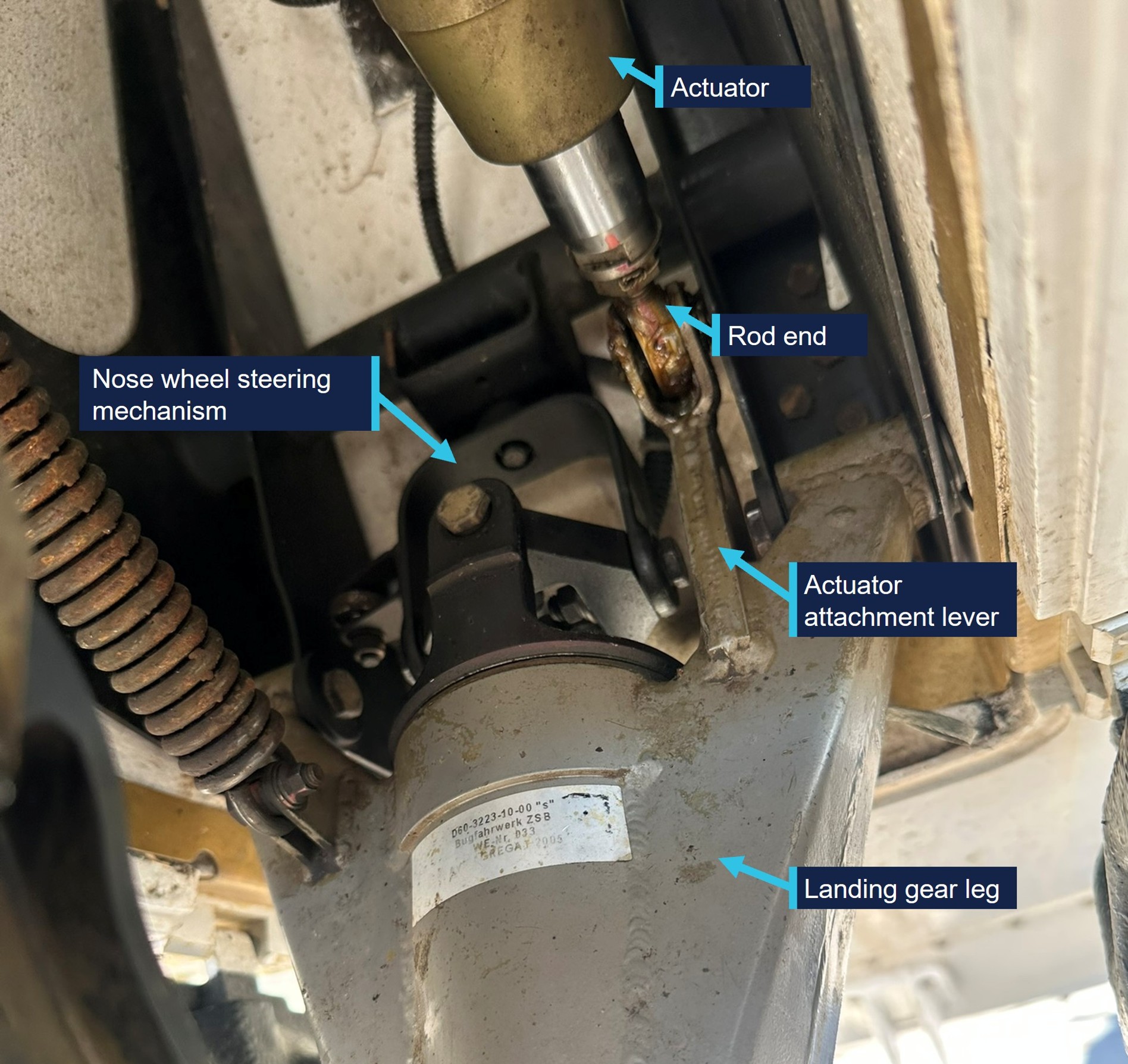
The photograph shows the nose landing gear extended, looking aft. Source: ATSB
Wreckage examination
General
The wreckage was mostly contained within the hangar but was consumed by the post‑impact fire (Figure 3). The ATSB’s onsite wreckage examination found that:
- the left engine did not show signs of rotation
- the right engine propeller hub showed signs of rotation
- the left propeller was in the feathered8 position and the right propeller was in fine pitch9 position
- the rudder trim indicator was found in a nose left position
- there was fuel in the tanks
- all major aircraft components were present at the accident site
- the NLG actuator had separated from the leg
- where possible, flight control continuity was observed.
The engines, propellers, and NLG actuator were retained by the ATSB for further examination.
Figure 3: Overview of the wreckage
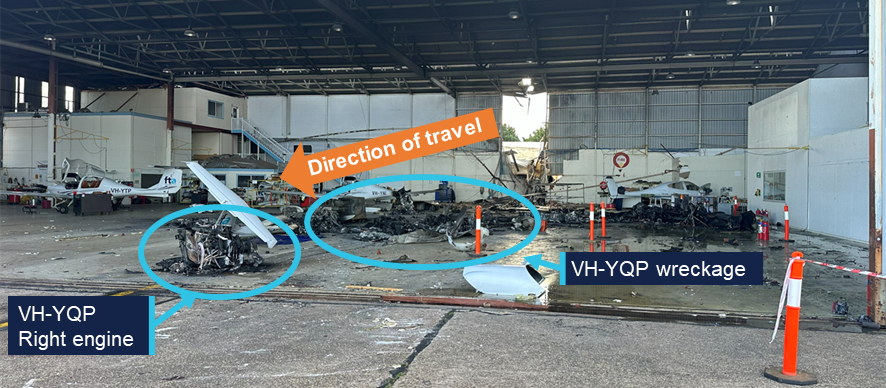
Source: ATSB
Nose landing gear actuator
The wreckage examination identified that the NLG actuator rod end had fractured (Figure 4), detaching the actuator from the lever arm on the gear leg (see Figure 2). While metallurgical assessment of the component is ongoing, preliminary examination of the rod end by the ATSB identified indications of progressive (fatigue) cracking.
Figure 4: Fractured actuator rod end
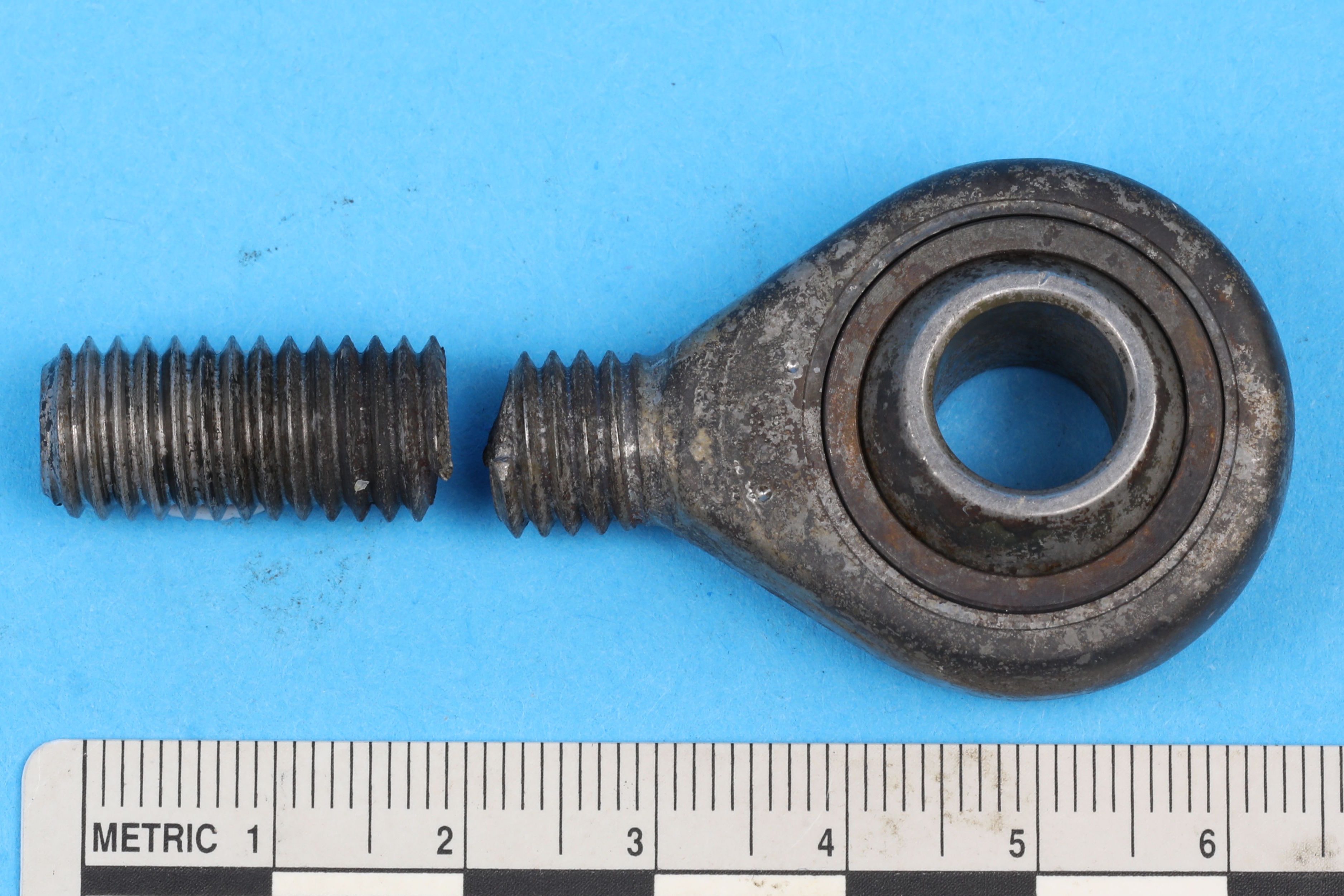
Source: ATSB
Meteorological information
The Bureau of Meteorology weather observations around the time of the accident recorded no significant cloud, with a north-easterly wind, gusting from 12 kt to 22 kt. These observations were consistent with CCTV footage from the airport.
Recorded information
The aircraft was not fitted with, nor was it required to have, a flight data recorder or cockpit voice recorder. The aircraft was fitted with 2 Garmin G1000 devices that had the capacity to record flight and engine parameters. These were recovered to the ATSB’s technical facilities in Canberra, Australian Capital Territory, however, specialist analysis determined that the devices were damaged beyond the ability to recover data.
Initial analysis from ADS-B data and CCTV footage from the accident flight recorded that:
- the aircraft’s estimated airspeed while airborne was between 75 kt and 104 kt
- the aircraft’s maximum height was 161 ft
- the NLG remained extended after the main landing gear had been retracted.
Operational information
The plan for the flight was to conduct simulated one-engine inoperative (asymmetric) circuits. The operator’s procedures for simulating an engine failure after take-off stipulated that the instructor closes the throttle of the appropriate engine to idle, providing that:
• the undercarriage is selected up, gear unsafe warning light out and the airspeed is not below 100 kt.
• the aircraft has reached 400 ft AGL.
The Diamond DA42 flight crew operating procedures manual stipulated the minimum control speed airborne10 (VMCA) is 65 kt and safe single engine speed11 (VSSE) is 90 kt.
ATSB comment
The circumstances of the accident were consistent with pre-accident fracture of the rod end, resulting in the NLG being observed down (while the main gear was retracted). While it was possible that the separated NLG actuator interfered with the steering/rudder controls, as per the previously-reported occurrence in the DAI MSB, further examination and analysis is required by the ATSB. The ATSB is also considering other scenarios to explain the accident sequence.
Safety action
The ATSB has published a safety advisory notice (AO-2026-074-SAN-001) detailing the NLG actuator fracture and the increased risk of an uncommanded left rudder control deflection.
Further investigation
To date, the ATSB has:
- examined the aircraft wreckage
- interviewed witnesses
- obtained CCTV footage
- reviewed ADS-B data
- obtained operational and maintenance records
- obtained air traffic control data.
The investigation is continuing and will include further examination of:
- components recovered from the accident site, including the NLG actuator and engines
- recorded data
- operational documentation
- aircraft maintenance records
- survivability considerations
- related occurrences.
A final report will be released at the conclusion of the investigation. Should a critical safety issue be identified during the course of the investigation, the ATSB will immediately notify relevant parties so appropriate and timely safety action can be taken.
Safety advisory notice video
Acknowledgements
The ATSB acknowledges the significant assistance from the Defence Flight Safety Bureau and Flight Training Adelaide during the onsite phase of the investigation.
Purpose of safety investigationsThe objective of a safety investigation is to enhance transport safety. This is done through:
It is not a function of the ATSB to apportion blame or provide a means for determining liability. At the same time, an investigation report must include factual material of sufficient weight to support the analysis and findings. At all times the ATSB endeavours to balance the use of material that could imply adverse comment with the need to properly explain what happened, and why, in a fair and unbiased manner. The ATSB does not investigate for the purpose of taking administrative, regulatory or criminal action. About ATSB reportsATSB investigation reports are organised with regard to international standards or instruments, as applicable, and with ATSB procedures and guidelines. Reports must include factual material of sufficient weight to support the analysis and findings. At all times the ATSB endeavours to balance the use of material that could imply adverse comment with the need to properly explain what happened, and why, in a fair and unbiased manner. An explanation of terminology used in ATSB investigation reports is available here. This includes terms such as occurrence, contributing factor, other factor that increased risk, and safety issue. Publishing informationReleased in accordance with section 25 of the Transport Safety Investigation Act 2003 Published by: Australian Transport Safety Bureau © Commonwealth of Australia 2026 
Ownership of intellectual property rights in this publication Unless otherwise noted, copyright (and any other intellectual property rights, if any) in this report publication is owned by the Commonwealth of Australia. Creative Commons licence With the exception of the Commonwealth Coat of Arms, ATSB logo, and photos and graphics in which a third party holds copyright, this report is licensed under a Creative Commons Attribution 4.0 International licence. The CC BY 4.0 licence enables you to distribute, remix, adapt, and build upon our material in any medium or format, so long as attribution is given to the Australian Transport Safety Bureau. Copyright in material obtained from other agencies, private individuals or organisations, belongs to those agencies, individuals or organisations. Where you wish to use their material, you will need to contact them directly. |
- ^ Flight Training Adelaide operates a fleet of Diamond DA42 aircraft in its multi-engine aeroplane flight training program based at Parafield Airport and another base at Wellcamp, Queensland.
- ^ Circuits: a circuit is the specified path to be flown by aircraft operating in the vicinity of an aerodrome. It comprises upwind, crosswind, downwind, base and final approach legs. It creates an orderly flow of traffic from take-off to landing and assists pilots with positioning the aircraft on final at the appropriate altitude and distance from the landing area to make a stabilised approach.
- ^ Automatic dependent surveillance-broadcast is a surveillance technology in which an aircraft determines its position via satellite navigation and periodically broadcasts it, enabling it to be tracked.
- ^ Checks conducted prior to take-off with engines running.
- ^ Runway number: the number represents the magnetic heading of the runway (for example, runway 03 is oriented 30° magnetic). The runway identification may include L, R or C as required for left, right or centre.
- ^ The positive, nose-up, movement of an aircraft about the lateral (pitch) axis immediately before becoming airborne.
- ^ The letter ‘L’ in the model prefix denotes the reverse rotation of the basic model. For example, model IO-360-M1A has clockwise rotation of the crankshaft. Therefore, LIO-360-M1A has counterclockwise rotation of the crankshaft.
- ^ Feathering: the rotation of propeller blades to an edge-on angle to the airflow to minimise aircraft drag following an in‑flight engine failure or shutdown.
- ^ Fine pitch: refers to a fine or low pitch propeller blade angle position used during low-speed acceleration (such as take‑off and climb).
- ^ The lowest speed directional control can be maintained during asymmetric flight.
- ^ An airspeed factored to provide a safety margin for asymmetric training operations.
Occurrence summary
| Investigation number | AO-2026-074 |
|---|---|
| Occurrence date | 29/04/2026 |
| Occurrence time and timezone | 1409 Australian Central Standard Time |
| Location | Parafield Airport |
| State | South Australia |
| Report release date | 23/06/2026 |
| Report status | Preliminary |
| Anticipated completion | Q1 2027 |
| Investigation level | Short |
| Investigation type | Occurrence Investigation |
| Investigation phase | Examination and analysis |
| Investigation status | Active |
| Mode of transport | Aviation |
| Aviation occurrence category | Collision with terrain, Loss of control |
| Occurrence class | Accident |
| Highest injury level | Fatal |
Aircraft details
| Manufacturer | Diamond Aircraft Industries |
|---|---|
| Model | DA42 |
| Registration | VH-YQP |
| Serial number | 42.213 |
| Aircraft operator | Flight Training Adelaide Pty Ltd |
| Sector | Piston |
| Operation type | Part 142 Integrated and multi-crew pilot flight training |
| Activity | General aviation / Recreational-Instructional flying-Instructional flying - unknown |
| Departure point | Parafield Airport, South Australia |
| Destination | Parafield Airport, South Australia |
| Injuries | Crew - 2 (fatal), Ground - 9 |
| Damage | Destroyed |