

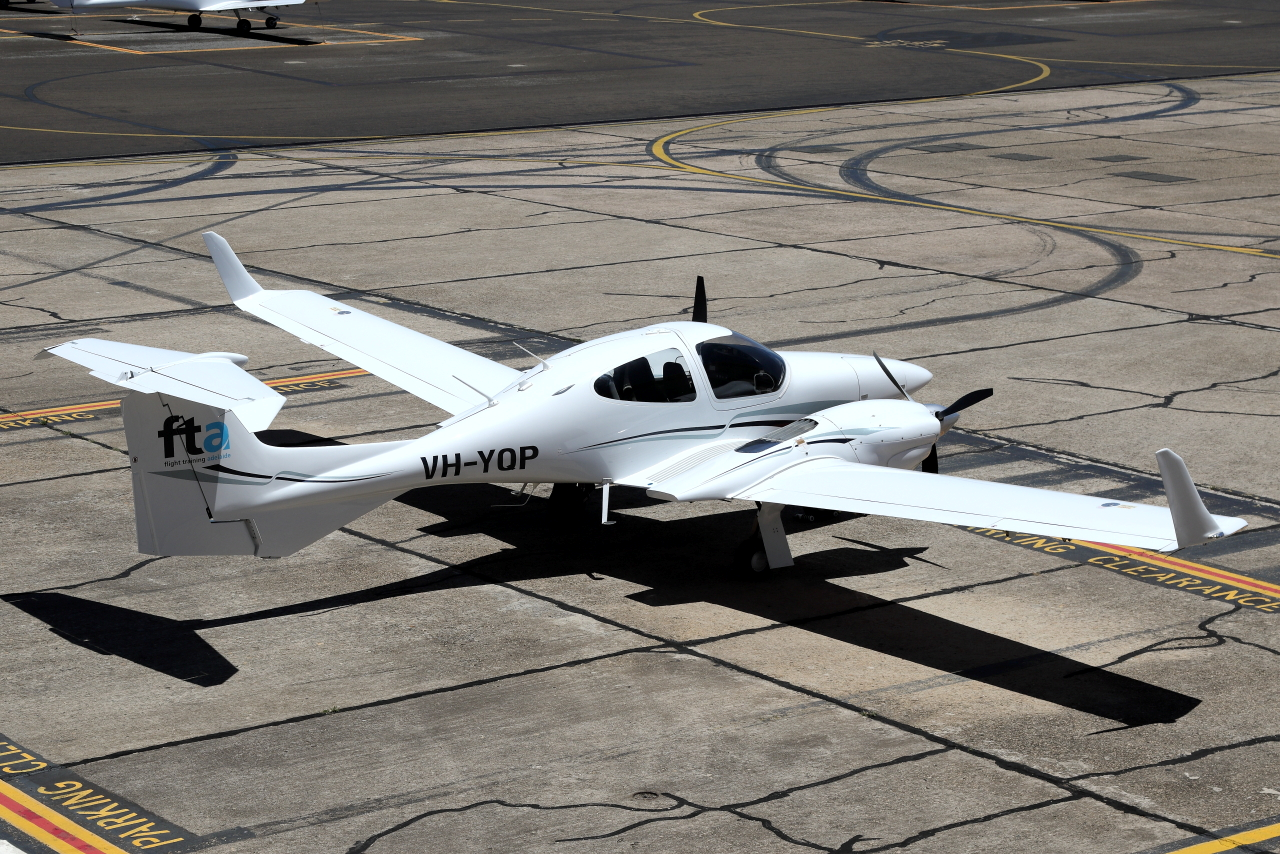
The ATSB’s ongoing investigation into the loss of control accident involving a Diamond DA42 aircraft at Adelaide’s Parafield Airport on 29 April has identified that a component in the nose landing gear had failed due to fatigue and that the nose landing gear remained extended during the flight.
“The failure of a nose landing gear actuator rod, as was found in this accident, is known to have caused in-flight controllability issues with this aircraft type in the past, and is one of a number of scenarios, including loss of engine power in one of the aircraft’s engines, that the ATSB investigation is examining,” ATSB Chief Commissioner Angus Mitchell said in releasing a preliminary report.
The preliminary report, which details factual information collected in the investigation’s early evidence gathering phase, notes a pilot under instruction and a flight instructor were on board the twin-engine aircraft with the intent of conducting simulated engine failure circuits, as part of the multi-engine aeroplane training syllabus.
CCTV footage shows that after the aircraft took off from the runway it deviated left, was realigned with the runway heading, and then began veering left. At the same time, the main landing gear was retracted but the nose landing gear remained extended.
“About 27 seconds after take-off and at 115 ft above ground level, the instructor made a radio call stating ‘engine failure’,” Mr Mitchell noted.
“No further radio calls were heard from either pilot.”
The aircraft then pitched up, banked left and continued to turn with the left wing down. From this point, the aircraft entered a steep descent and collided with a flying school classroom and hangar facility.
Tragically, the two pilots on board were fatally injured. Nine others on the ground were taken to hospital with a range of injuries.
“ATSB transport safety investigators’ examination of the aircraft wreckage identified that the nose landing gear actuator rod had fractured,” Mr Mitchell said.
“While our metallurgical analysis of the broken rod is ongoing, preliminary examination of the rod end has identified indications of fatigue cracking prior to a complete failure of the component.”
The preliminary report notes that the aircraft manufacturer, Diamond Aircraft Industries, issued two mandatory service bulletins, in 2013 and 2019, after other occurrences of fractures in the nose landing gear actuator.
“One of these bulletins described an occurrence where a nose landing gear actuator fractured in flight and, as it was no longer attached to the gear leg, it moved out of position and ‘interacted with the rudder and nose landing gear controls in such a way that the rudder was forced into left hand deflection’,” Mr Mitchell explained.
In that instance the pilot is reported to have regained rudder control after re-extending the landing gear.
Mr Mitchell noted that on aircraft such as the DA42, the nosewheel steering and rudder control systems are interconnected, as on the ground pilots use the rudder pedals for nosewheel steering.
“We are very much in the early stages of this investigation, and while we have determined the existence of a fatigue crack leading to a failure of the rod, and its potential impact with the rudder controls, we need to follow our evidence examination and analysis processes to determine all of the factors that contributed to this tragic accident,” he said.
Mr Mitchell stressed the ATSB is considering a range of scenarios to explain the entire accident sequence, and that a pending teardown inspection of the aircraft engines may give further indications to the full range of contributing factors to this accident.
“Importantly, our onsite examination identified the left engine was not showing signs of producing power on impact, and that the left propeller was in the ‘feathered’ position,” he noted.
“While the left engine post-impact observation may be consistent with an actual engine failure, it may equally be indicative of an assumed or simulated engine failure,” Mr Mitchell explained.
The report notes the operator’s procedures stipulated that simulated engine failures after take-off are not to be attempted until the aircraft has reached a minimum of 400 ft above ground level. The aircraft’s maximum height above the ground during the accident flight was 161 ft.
“While we continue to establish the contributing factors to this accident, we felt it important to raise awareness with operators of the DA42 of the actuator fracture and the increased risk of an uncommanded left rudder control deflection with the release of a safety advisory notice,” Mr Mitchell said.
The ATSB’s advisory notice notes there are many reasons why pilots may experience difficulty with directional control on take-off, in addition to an engine failure, such as flight control mechanism interference.
“In the DA42, re‑extending the landing gear after take-off may not be a usual action considered by pilots, but as noted in the manufacturer’s service bulletin explanation of a previous incident, this action allowed the pilot to regain aircraft control,” Mr Mitchell concluded.
The ATSB will release a final report, detailing findings and the analysis to support those findings, at the conclusion of the investigation.
Read the preliminary report: Collision with terrain involving Diamond DA42, VH-YQP, at Parafield Airport, South Australia, on 29 April 2026
Read the safety advisory notice: Nose landing gear actuator detachment