

| Occurrence Briefs are concise reports that detail the facts surrounding a transport safety occurrence, as received in the initial notification and any follow-up enquiries. They provide an opportunity to share safety messages in the absence of an investigation. Because occurrence briefs are not investigations under the Transport Safety Investigation Act 2003, the information in them is de-identified. |
What happened
On the afternoon of 28 March 2026, a Robinson R22 Beta II helicopter with the pilot and a passenger on board was conducting a private, stock monitoring flight around 55 km to the south-east of St George Airport, Queensland. The weather was reported as fine, with 20 km/h (10.8 kt) winds from the south. The pilot reported that while hovering into wind at a height of about 30 ft, they commenced a pedal turn1 to the right, away from a line of trees. During the turn downwind, the turn rate began to increase and they were unable to arrest or control the rotation – estimating that the helicopter spun through approximately 450 degrees before it descended to heavily contact the ground. The rotating motion during ground contact resulted in the helicopter rolling onto its left side, sustaining substantial damage to the main and tail rotors, tail boom and cabin. Both pilot and passenger were able to egress through the right doorway and were uninjured.
Figure 1: Helicopter after being returned upright following the accident
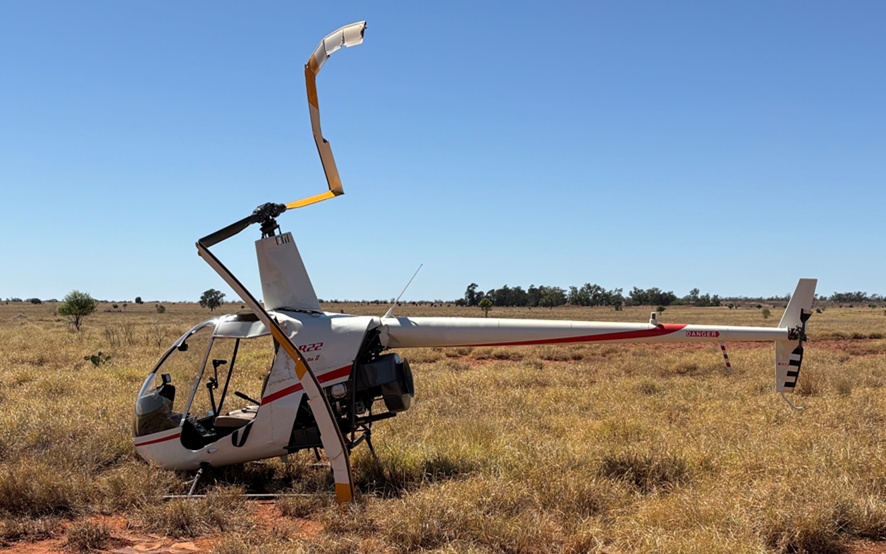
Source: Helicopter operator, edited by the ATSB
Engineering examination
The helicopter was recovered and examined by maintenance personnel, with attention to the tail rotor drive train and controls. No evidence of pre-existing mechanical defects was identified, with all damage consistent with being sustained during the accident sequence.
Safety message
Unanticipated yaw
Directional (yaw) control of single main rotor helicopters is primarily achieved through the pilot’s manipulation of tail rotor thrust. The torque produced by the drive transmitted through the main rotor is counterbalanced by the tail rotor thrust, with the pilot’s control of that thrust allowing controlled movement of the helicopter about its vertical axis.
In the hover and at low forward airspeeds, several aerodynamic effects can influence the anti-torque effectiveness of the tail rotor system. These can produce yaw motions unanticipated by the pilot, and which, if not immediately arrested, can result in a loss of helicopter control. Collectively known as Loss of Tail Rotor Effectiveness (LTE) phenomena, these include:
- main rotor disk vortex interference
- weathercock stability
- tail rotor vortex ring state
- loss of translational lift.
The United States Federal Aviation Administration (FAA) advisory circular AC 90-95 and the Helicopter Flying Handbook - Chapter 11: Helicopter emergencies and hazards explain these effects and recommend avoiding the following flight conditions when operating at forward airspeeds below 30 kt:
- tailwinds
- out-of-ground effect hovers and high-power demand situations such as low‑speed downwind turns
- hovering in winds above 8–12 kt (especially when out-of-ground effect).
AC 90-95 recommends the following recovery actions if experiencing LTE:
- application of full pedal opposite the direction of rotation
- forward cyclic movement to increase speed
- reduction in power if altitude permits.
About this report
Decisions regarding whether to conduct an investigation, and the scope of an investigation, are based on many factors, including the level of safety benefit likely to be obtained from an investigation. For this occurrence, no investigation has been conducted and the ATSB did not verify the accuracy of the information. A brief description has been written using information supplied in the notification and any follow-up information in order to produce a short summary report, and allow for greater industry awareness of potential safety issues and possible safety actions.
| 1 | ^ A low-airspeed helicopter turning action initiated solely with the tail rotor controls (pedals). |
Occurrence summary
| Mode of transport | Aviation |
|---|---|
| Occurrence ID | AB-2026-023 |
| Occurrence date | 28/03/2026 |
| Location | About 55 km south-east of St George Airport |
| State | Queensland |
| Occurrence class | Accident |
| Aviation occurrence category | Collision with terrain, Loss of control |
| Highest injury level | None |
| Brief release date | 18/05/2026 |
Aircraft details
| Manufacturer | Robinson Helicopter Co |
|---|---|
| Model | R22 Beta II |
| Sector | Helicopter |
| Operation type | Part 91 General operating and flight rules |
| Activity | General aviation / Recreational - Sport and pleasure flying - Pleasure and personal transport |
| Departure point | St George Airport, Queensland |
| Injuries | None |
| Damage | Substantial |