Aircraft Communications Addressing and Reporting System.
Acc Rep
Accredited representative. In accordance with Annex 13, the ATSB may assist other overseas agencies in the investigation of accidents and serious incidents that do not involve Australian registered aircraft. In these cases an ATSB investigator would be appointed to the investigation as an accredited representative. On 1 April 2014 the ATSB appointed an accredited representative to the MH370 investigation, at the request of the Malaysian Government.
ADF
Australian Defence Force.
AFP
Australian Federal Police.
Airspace
Any part of the earth's atmosphere that can be used by an aircraft. It is a three-dimensional space where aircraft can operate.
AMSA
Australian Maritime Safety Authority.
Annex 13
Annex 13 of the Convention on International Civil Aviation (Chicago, 1944) provides the international Standards and Recommended Practices for Aircraft Accident Inquiries and was developed by ICAO. These practices are the basis for aviation accident, serious incident and incident investigations, accident prevention and accident and serious incident reporting.
ATC
Air traffic control. ATC is used to manage the safe and orderly flow of aircraft into, out of, and across airspace.
Australian Search and Rescue Region (Zone)
Australia, as signatory to the Convention on International Civil Aviation, 1944; the International Convention for the Safety of Life at Sea, 1974; and the International Convention on Maritime Search and Rescue, 1979, is responsible for search and rescue over a vast area (52.8 million square kilometres) made up of the East Indian, South-west Pacific and Southern oceans. Australia has the same boundaries for aviation and maritime search and rescue.
AUV
An autonomous underwater vehicle (AUV) is a battery-powered self-propelled underwater vehicle that can be launched and retrieved from a search vessel and is pre-programmed with a search mission. The vehicle may be fitted with instruments including sonar and optical imaging systems.
Bathymetry
The study and mapping of sea floor topography. It involves obtaining measurements of the ocean depth and is equivalent to mapping topography on land.
Beaufort Scale
A scale of wind force, developed in 1805 by Admiral Sir Francis Beaufort, which uses observations of the effects of wind on the sea surface to estimate wind speed. Measurements range from 0 (calm) through to 12+ (hurricane).
BFO
Burst frequency offset. BFO is a measure of the difference between the expected frequency of a satellite transmission and the frequency received at the ground station.
BOM
Bureau of Meteorology.
BTO
Burst Timing Offset. BTO is a measure of the time taken for a satellite transmission round trip (ground station to satellite to aircraft and back) and allows a calculation of the distance between the satellite and the aircraft.
Controlled air space
Airspace that is actively monitored and managed by air traffic controllers. To enter controlled airspace, an aircraft must first gain a clearance from an air traffic controller.
CSIRO
Commonwealth Scientific and Industrial Research Organisation.
CVR
Cockpit Voice Recorder. A CVR is a recorder placed in an aircraft for the purpose of facilitating the investigation of an aircraft accident or incident. It records the total audio environment of the cockpit area.
Cyclone
Cyclones are low pressure systems that form over warm tropical waters and have gale force winds (sustained winds of 63 km/h or greater and gusts in excess of 90 km/h) near the centre.
DCA
Department of Civil Aviation, Malaysia.
DEFTECH
DEFTECH is a Malaysian Government defence contractor. It is responsible for the procurement and contract management of chosen operators in the search for MH370, such as Phoenix International.
Depressor
A steel weight that is towed behind a search vessel on a long cable in front of the towfish, to help stabilise it. This allows the towfish to “fly” with less motion above the seafloor, while gathering detailed imagery.
DIRD
Department of Infrastructure and Regional Development.
EOI
Expression of Interest.
FDR
Flight Data Recorder. An FDR is a recorder placed in an aircraft for the purpose of facilitating the investigation of an aircraft accident or incident. It records flight parameters such as indicated airspeed.
Fugro
Fugro Survey Pty Ltd is the Australian owned subsidiary of the Dutch based company, Fugro N.V. It is contracted by the Australian Government to provide vessels, personnel and equipment to conduct a bathymetric survey and underwater search operations for MH370. It operates the vessels Fugro Discovery, Fugro Equator and Fugro Supporter.
GA
Geoscience Australia.
GES
Ground earth station. A satellite ground station sends or receives data from orbiting satellites.
GO Marine
The company, GO Marine, is a subcontractor to Phoenix International. It owns the vessel GO Phoenix used for underwater search operations.
Handshake
Satellite log-on interrogation messages that originate at the ground earth station and are transmitted through the satellite to the aircraft’s satellite communication system.
ICAO
International Civil Aviation Organization.
Inmarsat
A satellite communications company based in the United Kingdom. It owns and operates a global satellite network and is a member of the SSWG.
JACC
Joint Agency Coordination Centre.
Knots
A unit of speed that is equal to one nautical mile (1.852km) per hour.
MBES
Multibeam echo sounder.
MOT
Ministry of Transport, Malaysia.
Nautical mile (NM)
A unit of distance based on the circumference of the earth, used for marine charting and navigating. One nautical mile (NM) is equal to 1.852km.
Phoenix
Phoenix International Holdings Inc. is a company based in the United States. It has been contracted by DEFTECH to supply a vessel, equipment and experts in the search for MH370.
Ping
A pulse of sonar sound.
Primary radar
Primary (or terminal area) radar relies on radio waves reflecting off metallic objects and is effective within a short range from the radar head, which is usually located at an airport.
Priority Search Area
An area, 20 NM to the west or 30 NM to the east of the seventh arc that has been determined as a probable location for MH370, by analysing satellite communications and aircraft performance.
REOI
Request for Expressions of Interest.
RFT
Request for Tender.
RMP
Royal Malaysian Police.
SAS
Synthetic Aperture Sonar. A sonar system which uses sophisticated post-processing of sonar data to combine a number of sonar pings to form an image with higher resolution than conventional sonar.
SATCOM
Satellite communications.
Sea state
A description of sea conditions, recorded using the World Meteorological Organization Sea State Codes. Measurements range from 0 (calm) through to 9 (phenomenal).
Secondary radar
Secondary (or en route) radar returns are dependent on a transponder in the aircraft to reply to an interrogation from a radar ground station.
Seventh arc
Independent analysis of satellite communications and aircraft performance confirms MH370 will be found in close proximity to the arc labelled as the 7th arc. The arc extends from latitude 20 degrees south to latitude 39 degrees south. At the time MH370 reached this arc the aircraft is considered to have exhausted its fuel and to have been descending.
SL Hydrospheric
SL Hydrospheric (Hydrospheric Solutions) is a subcontractor to Phoenix International. It provides Synthetic Aperture Sonar equipment for MH370 underwater search operations.
Sonar buoy
A floating buoy equipped with an acoustic receiver and a radio transmitter that emits radio signals when it detects underwater sounds.
SSS
Sidescan sonar.
SSWG
Search Strategy Working Group. Coordinated by the ATSB, the group of international satellite and aircraft specialists has been working towards defining the most probable position of MH370, at the time of the last satellite communications.
Surface search
A surface search for MH370 was conducted from 18 March to 28 April 2014. Coordinated by AMSA and the JACC, it was carried out by an international fleet of aircraft and ships along the seventh arc.
Swing
The amount of time it takes a vessel to go from its port of departure, out to sea and return to port.
Towfish
A vehicle which is towed behind a search vessel. The vehicle may be fitted with instruments including sonar and optical imaging systems.
TPL
Towed Pinger Locator. A TPL is a device that is towed behind a vessel for detecting the signals being emitted from an underwater locator beacon fitted to an aircraft’s Flight Data Recorder and Cockpit Voice Recorder.
Transponder
A device that emits an identifying signal in response to an interrogating received signal from a communications satellite or ground station.
Tripartite
Shared by or involving three parties. Tripartite meetings that make decisions with regard to MH370 involve the governments of Australia, Malaysia and the People’s Republic of China.
ULB
Underwater locator beacon. A device attached to aviation flight recorders that when immersed in water emits an acoustic signal, to assist with locating an aircraft’s Flight Data Recorder and Cockpit Voice Recorder.
Uncontrolled air space
Airspace that has no supervision by air traffic control, so no clearance is required.
UTC
Coordinated Universal Time. UTC is the worldwide standard for time and date.
WAPOL
Western Australia Police.
Waypoint
A predetermined geographical position that is defined in terms of latitude and longitude coordinates, used for navigation.
9M—MRO
Missing Malaysia Airlines flight MH370’s aircraft registration number.
The ATSB continues to investigate accidents—many fatal—that involve pilots flying with reduced visual references.
Under visual flight rules (VFR), it is crucial that pilots have sufficient visual reference to see and avoid obstacles. Visual cues are also required to maintain orientation so VFR pilots know which way is up and can maintain control of their aircraft. Visual reference can be reduced by cloud, darkness, or atmospheric conditions such as rain, fog, smoke or haze. Two main risks are associated with flying in limited visibility:
loss of orientation, leading to loss of control of an aircraft and an uncontrolled flight into terrain
insufficient visibility to enable a pilot to see and avoid obstacles while remaining under control, known as a controlled flight into terrain.
The same hazards can also apply during night flight because there are often less visual cues at night, even though the visibility may be good.
Accordingly, the ATSB has appointed a Privacy Officer and a Privacy Champion to carry out their respective functions under the Privacy Code. The ATSB publishes this policy to demonstrate its commitment to privacy rights, including by complying with the Privacy Act and the Australian Privacy Principles (APPs).
In this policy, personal information has the same meaning as defined in section 6 of the Privacy Act:
personal information means information or an opinion about an identified individual, or an individual who is reasonably identifiable:
(a) whether the information or opinion is true or not; and
(b) whether the information or opinion is recorded in a material form or not.
Some examples of personal information include names, addresses, banking details, licence and registration numbers, or photographs. It may also include indirectly identifying information, such as the description of an event, where the identities of any persons involved in the event are apparent even though no names are used. Whether or not the description of the event contains personal information may depend on the context and who is reading the information.
Collection of personal information
Solicited personal information
The ATSB generally collects personal information for the purposes of fulfilling the various functions or activities of the ATSB. This includes the ATSB’s primary function of conducting independent aviation, maritime and rail safety investigations under the TSI Act as well as receiving notifications from industry of the occurrence of accidents and incidents.
The TSI Act does contain some coercive information gathering powers that may be used to acquire personal information. However, normally the ATSB seeks to obtain personal information with the consent of the individual concerned.
In some circumstances the ATSB may collect personal information from a third party. This includes where information is provided via the mandatory scheme for the notification of accidents and incidents. The ATSB distributes material that seeks to make participants aware in the aviation, maritime and rail transport industries of the likelihood of their details being passed on to the ATSB if they are involved in an accident or incident. Where practicable, if the ATSB receives personal information via a third party, the ATSB will seek to notify the individual concerned of the circumstances of the collection.
The types of personal information that we generally collect and hold will include:
personal contact details
personnel/employee records including educational or professional qualifications, job application information and pay, superannuation and tax information including tax file numbers (TFNs)
credit card application records
information in delegations
staff conflict of interest declarations
information in ministerial correspondence
Freedom of Information applications
details of persons who attended ATSB training courses
mailing and subscription lists
survey responses where the individual chooses to disclose personal information
contract, tender and submission documents
financial payment records
records for legal proceedings
complaint and feedback information
investigation records including witness statements, flight crew licences, training and qualification details, investigator’s notes and interview reports
records of accidents and incidents notifications.
Sensitive information
Personal information that is ‘sensitive information’ is defined by section 6 of the Privacy Act to include information or an opinion about an individual’s racial or ethnic origin, political opinions, membership of a political association, religious beliefs or affiliations, philosophical beliefs, membership of a professional or trade association, membership of a trade union, sexual orientation or practices, criminal record, health or genetic information, biometric information and templates.
Sensitive information is afforded a higher level of protection under the Privacy Act, including limited circumstances in which it can be collected. The ATSB does not normally have a need to collect the majority of the sensitive information referred to in the definition. The exception is for the aviation, maritime and rail accident investigations it conducts under the TSI Act. For the purpose of fulfilling its statutory functions, the ATSB may collect and hold sensitive personal information, including:
medical reports;
physical and psychological profiles of persons involved in the occurrence;
results of breath tests or blood alcohol levels;
membership of a professional or trade association or trade union; and
criminal records.
Where applicable, after obtaining the information holder’s consent the ATSB will typically obtain the sensitive information after issuing its holder a direction under section 32(1) of the TSI Act. This allows the information to be designated as ‘restricted information’ for the purposes of the TSI Act and afforded additional statutory protection.
Unsolicited personal information
Where the ATSB received unsolicited personal information, the ATSB must determine within a reasonable period if the information could have been collected in accordance with its functions and activities.
If the information could not have been collected in accordance with the ATSB’s functions and activities, and is not contained in a Commonwealth record, the ATSB must ensure the information is lawfully destroyed or de-identified.
Anonymity
The identity of an individual is typically relevant and necessary in order to achieve the ATSB’s purpose for collecting, using, holding or disclosing personal information. It is therefore unlikely to be practicable for the ATSB to deal with individuals who have not identified themselves or who have used a pseudonym. If an individual is concerned about not being able to deal with the ATSB anonymously, they may contact the Privacy Officer and discuss the circumstances.
How the ATSB stores personal information
The ATSB stores all personal information securely and restricts access to a limited number of staff that need access in order to perform their duties or assist individuals. Most personal information held by the ATSB is stored electronically such as on databases, shared drives or in emails, or on hard copy files.
The ATSB takes all reasonable steps to ensure that personal information is protected from misuse, loss and interference.
The ATSB will only use and/or disclose personal information for the purposes for which it was collected (the primary purpose), unless an individual has consented to another use.
There are certain limited circumstances in which the ATSB may use or disclose information for a different purpose (a secondary purpose) without consent, such as where the secondary purpose is:
directly related to the primary purpose for which the information was collected;
required or authorised under an Australian law or has been ordered by a court or tribunal;
necessary to lessen or prevent a serious threat to the life, health or safety of any individual, or public health or safety;
a permitted general situation or health situation, as defined by the Privacy Act; or
an enforcement related activity and the use or disclosure of the information is reasonably necessary.
In relation to information collected from occurrence reporting that you submit to the ATSB, in accordance with the ATSB’s function of improving transport safety, de-identified, anonymised or aggregated information may be shared by the ATSB with other Commonwealth agencies for the purposes of safety research and education. More information on the ATSB’s collection, use and disclosure of transport safety information can be found in the ATSB’s safety information policy statement.
The ATSB is also required to comply with the Freedom of Information Act 1982(Opens in a new tab/window)(FOI Act) under which any person has a legal right to request access to documents held by Commonwealth agencies. The information you provide in occurrence reporting may be the subject of an FOI request. In respect of any personal information that might be contained in a document subject to an FOI request, the ATSB will have regard to the personal privacy provisions and/or consultation mechanisms under the FOI Act.
If the ATSB uses or discloses personal information for a purpose other than what it was originally collected for, the ATSB will keep a written notice of that use or disclosure as required by the APPs.
Disclosure of personal information overseas
The ATSB does not routinely disclose personal information to overseas recipients. However, there may be occasions related to the ATSB’s safety investigation function where this is necessary. In some circumstances there may be parties overseas who are connected with the occurrence of the accident in which case there may need to be a cross-border flow of information. In these cases the ATSB complies with APP 8, including seeking to provide assurances that the information will be protected and used in accordance with the APPs.
Additionally, the ATSB may use third party services (such as Google analytics and YouTube) embedded on our website or linked through our website to manage, provide and maintain user tracking and analytics, including for the purposes of industry engagement, policy consultations and collecting feedback. Google products may use cookies and other information to track and see how users interact with ATSB content. The information generated by the cookie about your use of our website, including your IP address, will be transmitted to and stored by Google on servers in the United States.
Google use this information to evaluate how you use website content, including website activity and internet usage. Google may transfer this information to third parties where required by law, or where third parties process the information on Google's behalf. See Google’s privacy policy(Opens in a new tab/window) for more information.
Occasionally, an individual may be invited by the ATSB to participate in a survey using Survey Monkey (a third party software supplier) for the purposes of receiving industry feedback about a range of matters relevant to the ATSB’s functions. The ATSB will only use the information provided for the purposes of collating and analysing feedback provided, and in accordance with the ATSB’s privacy policy. Participating in a survey is voluntary. An individual is not obliged to provide personal information as part of a survey, but this may be desirable for transparency and further communications between the ATSB and the individual.
Survey Monkey is based in the United States and in the European Union (EU) and the information generated by cookies (including an individual’s IP address) will be transmitted to and stored by Survey Monkey on servers located outside Australia. The ATSB needs to inform you that, should you wish to respond to a survey, you:
understand and acknowledge that this service utilises a third party software platform, which is located in the USA and the EU, and relevant legislation of those countries will apply; and
you understand and acknowledge that Survey Monkey is not subject to the Commonwealth Privacy Act 1988 and you will not be able to seek redress under Australian legislation but will need to seek redress under the laws of the USA and the EU for any privacy breaches.
Response to a voluntary survey may also be undertaken by printing out a copy of the online survey form and emailing the completed document to the relevant ATSB email address.
The ATSB does not use third party suppliers for mandatory occurrence reporting and the database associated with occurrence notifications is stored in Australia.
Access to personal information
Under APP 12, individuals have the right to access their personal information held by the ATSB. There is no cost associated with making a request. The ATSB will process the request and provide access to the information within 30 days after the request is made. If the ATSB decides not to grant access to the information, a written statement of reasons will be provided.
Information on how to apply for access to your personal information under the FOI Act, please go to Freedom of Information on the ATSB website.
To assist ATSB in locating any information held more quickly, an individual is encouraged to provide as much information as possible, such as, dealings they have had with the ATSB.
Correction of personal information
Individuals have the right under APP 13 to request corrections to any of their personal information held by the ATSB that they consider the information is inaccurate, out-of-date, incomplete, irrelevant or misleading. This APP also operates alongside the FOI Act under which an individual may make a request to have personal information amended or annotated.
If an individual considers information held by the ATSB requires correcting, a written request should be sent to the ATSB’s Privacy Officer outlining what aspect of the information needs correction.
There is no charge associated with making a request or for associating the statement with the personal information and notification of the outcome will be provided within 30 days. If the ATSB refuses to correct the information, a written explanation will be provided. However, if the individual requests the ATSB to associate with the information a statement that the information is inaccurate, out of date, incomplete, irrelevant or misleading, the ATSB will take reasonable steps in the circumstances to associate the statement which will make it apparent to users of the information.
If the ATSB has disclosed the information previously to a third party, an individual may request that the third party also be notified of any correction made. If it is reasonable and practical to do so the ATSB will notify the third party of the corrections.
For security reasons, and to protect personal information, applicants may be asked to provide proof of identification.
How to request access or correction
To make a request for access to or correction of personal information, a written request should be sent to the ATSB’s Privacy Officer on the contact details provided at the end of this policy.
Tax File Numbers (TFNs)
The ATSB only collects TFN information where required for human resource purposes. The ATSB adheres to the Privacy (Tax File Number) Rule 2015 for the collection, storage, use, disclosure, security and disposal of TFN information.
Privacy impact assessment register
The ATSB conducts a Privacy Impact Assessment (PIA) for all high privacy risk projects. A project may be a high privacy risk if it has a significant impact on the privacy of individuals. The ATSB maintains and publishes a PIA Register on its website.
Privacy complaints
An individual may complain about the way the ATSB has handled their personal information under the Privacy Act (including the APPs) or Privacy Code. Complaints should be in writing and sent to the Privacy Officer using the contact details provided below.
The complaint should provide sufficient information so the issues and concerns can be investigated. A Privacy
is available on the ATSB website. Notification of an outcome will be provided within 30 days and individuals will be kept up-to-date as to the progress of their complaint.
If an individual is dissatisfied with the ATSB investigation outcome, the individual can contact the Office of the Australian Information Commissioner (OAIC) on the details below about making a privacy complaint(Opens in a new tab/window) to the OAIC.
Review of this privacy policy
This privacy policy will be reviewed regularly and updated versions published on our website.
Accessibility
You can request an alternative format of this document by contacting the ATSB Privacy Officer on the details provided below. If you have a speech or hearing difficulty, you can contact the National Relay Service(Opens in a new tab/window) (NRS) for assistance with your call (available at no additional charge). Dial 1300 555 727 for Voice Relay calls or 133 677 for TTY calls and then ask for 02 6122 1601.
Further information
ATSB contact details:
Privacy Officer Australian Transport Safety Bureau GPO Box 321 Canberra ACT 2601
The Public Interest Disclosure (PID) scheme builds on existing policies and procedures to protect public officials (including current and former APS employees, people exercising powers under a Commonwealth law and contracted service providers) who speak up and ‘blow the whistle’ on suspected wrongdoing by public officials.
The PID scheme provides a transparent process for agencies and government departments to investigate complaints.
encouraging and facilitating the making of disclosures of wrongdoing by public officials
ensuring that public officials who make protected disclosures are supported and protected from adverse consequences relating to the making of a disclosure
ensuring that disclosures are properly investigated and dealt with.
The PID Act does not replace existing processes for dealing with workplace grievances and misconduct, such as bullying and harassment, rather it supplements them.
The ATSB encourages people to come forward if they are aware of wrongdoing within the organisation. People who come forward and report wrongdoing are helping to maintain and promote integrity, accountability and good management within the ATSB.
The ATSB will act on disclosures as appropriate and protect disclosers from any reprisals or threats of reprisals resulting from the making of a disclosure. The ATSB is committed to effectively dealing with and investigating any disclosure of wrongdoing and taking appropriate action if an investigation finds some form of wrongdoing.
describe the steps you need to take to make a report. They also set out the actions the ATSB will take when receiving, dealing with and investigating public interest disclosures involving the ATSB.
A public interest disclosure can be made to the ATSB in person, by telephone or in writing, including by email.
are encouraged as this can help to avoid any confusion or misinterpretation. The completed form can be delivered personally, mailed or emailed to the ATSB.
A public interest disclosure can be reported to any of the following authorised officers in the ATSB at PID@atsb.gov.au:
Peta Nisbet
Gerard Frawley
For more information about the making a public interest disclosure involving the ATSB, please contact Head of Legal Services by phone on 1800 020 616 or email at legal.services@atsb.gov.au.
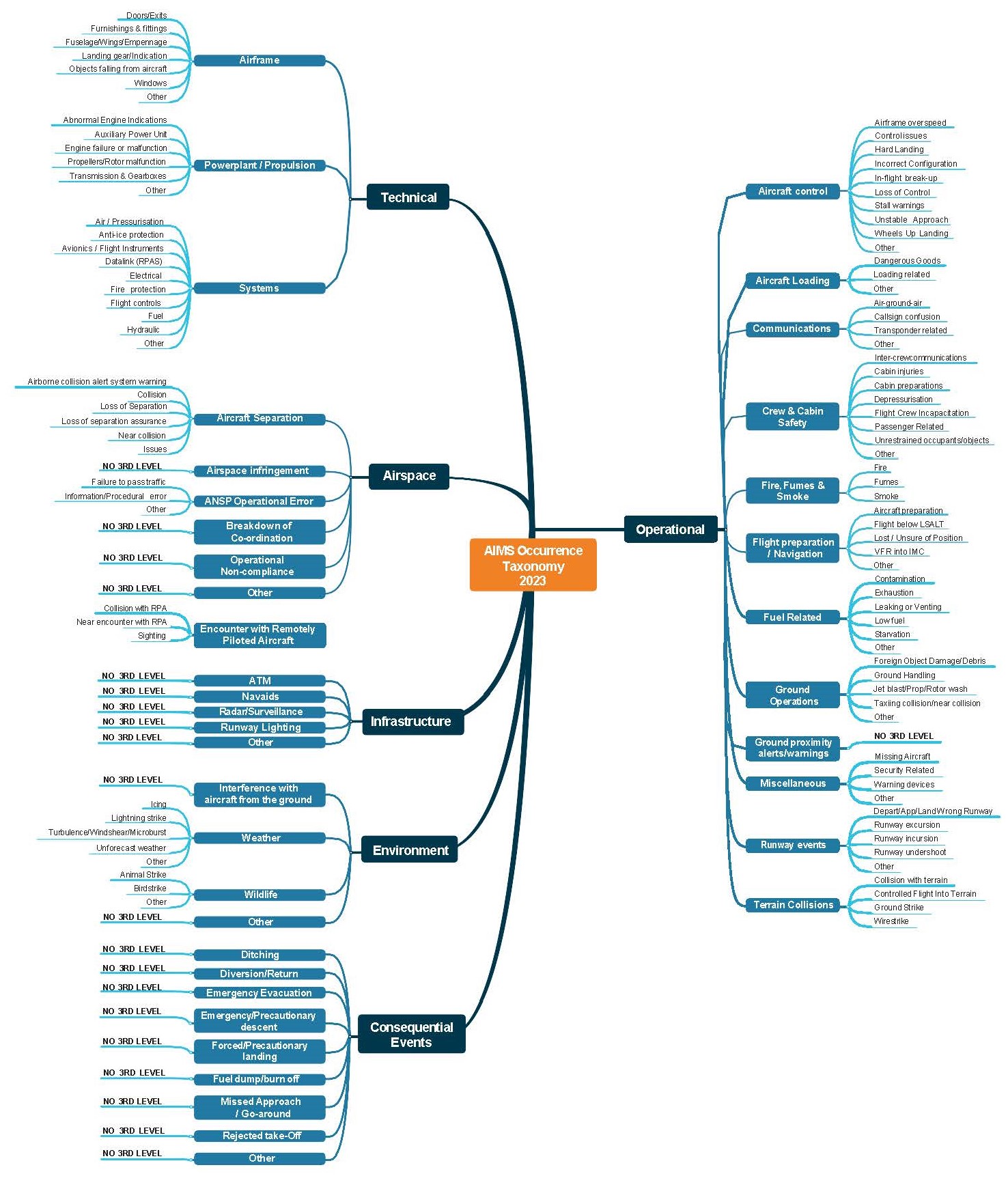
The ATSB uses an occurrence category taxonomy to efficiently and consistently categorise and code transport safety occurrences. These occurrence categories can be used to search through occurrences in the ATSB’s National Aviation Occurrence Database.
A guiding principle behind the ATSB’s occurrence category taxonomy is that a relatively simple coding scheme greatly increases the quality of the data that is recorded in the occurrence database. The taxonomy follows a data-driven approach in that a particular occurrence category is only included in the taxonomy if either;
it is an occurrence category commonly reported to the ATSB
it is an uncommon but important occurrence category
The ATSB Occurrence Category taxonomy is a three-level hierarchy. In general, the structure of the hierarchy follows the ICAO ADREP 2000 model, and is divided into the following Level 1 Occurrence Type groupings;
Operational – occurrences that relate specifically to aircraft operations that involve a human element
Technical – occurrences that relate specifically to a failed aircraft component or system
Airspace – occurrences that relate specifically to controlled and uncontrolled airspace issues
Infrastructure – occurrences that relate specifically to the failure or anomalies with aerodrome and ATC facilities that directly affect an aircraft operation
Environment – occurrences specifically related to external influences that have a direct impact on aircraft operations
Consequential Events – occurrences that relate specifically to an operational necessity as the result of one of the other Level 1 groupings.
Each of the Level 1 Occurrence Category groupings is sub-divided into a number of related Level 2 groupings. In turn, Level 2 Occurrence Category groupings are further sub-divided into Level 3 groupings.
The hierarchical nature of the Taxonomy is of fundamental importance. It allows Level 3 data to be logically aggregated into Level 2 groupings, and then subsequently into Level 1 groupings. This is essential for higher-level data analysis.
In some cases an occurrence category may fall across two or more Level 1 groupings. Rather than create a specific coding for each Level 1 grouping, the hierarchy has been designed to capture it under the more common of the occurrence types.
Occurrence classifications
Prior to 31 December 2022
Accident: an occurrence involving an aircraft where:
a person dies or suffers serious injury
the aircraft is destroyed, or is seriously damaged
any property is destroyed or seriously damaged.
Serious incident: an incident involving circumstances indicating that an accident nearly occurred (ICAO Annex 13).
Incident: an occurrence, other than an accident, associated with the operation of an aircraft which affects or could affect the safety of operation (ICAO Annex 13).
From 1 January 2023
Aircraft accident
A person suffers a fatal aircraft-related injury in relation to the operation of the aircraft; or
A person suffers a serious aircraft-related injury in relation to the operation of the aircraft; or
The aircraft sustains damage or structural failure, or there are reasonable grounds for believing that the aircraft has sustained damage or structural failure, which:
Adversely affects the structural strength, performance or flight characteristics of the aircraft; and
would normally require major repair or replacement of the affected component.
Except for any of the following:
Engine failure;
engine damage limited to a single engine (including damage to its cowlings or accessories);
damage to propellers, wing tips, antennas, probes, vanes, tyres, brakes, wheels, fairings, panels, landing gear doors or windscreens;
damage such as small dents or puncture holes to the aircraft skin;
minor damage to main rotor blades, tail rotor blades or landing gear;
minor damage resulting from hail or bird strike (including holes in the radome); or
the aircraft is missing; or
the aircraft is completely inaccessible
Serious aircraft incident
A serious aircraft incident is an incident involving:
Circumstances indicating that there was a high probability of an aircraft accident (that is, a high probability of a fatal or serious aircraft-related injury and/or the aircraft sustaining damage or structural failure); or
an incident in the following table of incidents that have the potential to be classified as a serious incident.
Aircraft incident
Any event that is associated with the operation of an aircraft and affects, or could affect, the safety of the operation of the aircraft.
The degree to which an occurrence “affects or could affect” the safety of the operation of the aircraft should be understood to mean occurrences that, if not corrected, could endanger the aircraft or its occupants. To be clear, a responsible person is required to report an aircraft incident whether or not it was actually corrected or able to be corrected.
Operation types
The ATSB categorises operation types by the appropriate CASA flight operations regulations (CASR) Part number. Read more about the CASA flight operations regulations on the CASA website(Opens in a new tab/window).
Part 91 General operating and flight rules
Part 101 Unmanned aircraft and rockets
Part 103 Sport and recreational aircraft
Part 105 Parachuting
Part 121 Australian air transport operations - Larger aeroplanes
Part 129 Foreign air transport operators
Part 131 Balloons and hot air airships
Part 132 Limited category aircraft
Part 133 Air transport operations - Rotorcraft
Part 135 Australian air transport operations - Smaller aeroplanes
Part 137 Aerial application operations
Part 138 Aerial work operations
Former operation types
(as applied to occurrences prior to 2 December 2021)
Air transport High capacity – operations conducted in aircraft refers to an aircraft that is certified as having a maximum capacity exceeding 38 seats, or having a maximum payload capability that exceeds 4,200 kg. Includes regular public transport (RPT), charter, check and training, test and ferry.
Air transport Low capacity – operations conducted in aircraft other than high capacity aircraft. That is, aircraft with a maximum capacity of 38 seats or less, or having a maximum payload capability of 4,200 kg or below. Includes regular public transport (RPT), check and training, test and ferry.
Charter – operations involving the carriage of passengers and/or cargo on non-scheduled flights by the aircraft operator, or by the operator’s employees, for trade or commerce (excluding regular public transport (RPT) operations).
Aerial work – includes ambulance, medivac, and other emergency medical service flights; and flying for the purposes of agriculture, mustering, search and rescue, fire control, or survey and photography. Includes commercial activities only.
Flying training – all commercial flying training operations.
Private – all private flying activities, including private (not for reward) operations involving mustering and training.
Business aviation – private operations conducted for the purpose of business.
Sports aviation – includes parachute operations, ballooning, warbird operations, and acrobatics.
Gliding – all non-powered and powered gliders.
Ballooning – all balloon operations.
Military – all operations where a military aircraft is involved.
Unknown/General aviation unknown – where the aircraft operation is unknown, generally due to the aircraft being involved in an airspace incursion or similar where air traffic control have not had aircraft details available.
Activity types
Commercial air transport
Scheduled
International – Scheduled operations of international airlines operating into/out of Australia (includes Qantas international not just foreign airlines, excludes flights to Australian territorial islands).
Domestic – Scheduled operations of domestic airlines operation within Australia (excludes foreign airlines conducting a domestic flight).
Scheduled freight only – Scheduled operations carrying freight only.
Unknown scheduled commercial air transport – Scheduled commercial operations where the activity subtype is unknown (unknown if the operator was conducting international, domestic or carrying freight only operations).
Non-scheduled
Passenger transport charters – Flying involving the carriage of passengers by the aircraft operator or their employees for hire or reward (excludes scheduled airlines operations, includes marine pilot transfers).
Medical transport – Operations as an aerial ambulance for the transport of ill or injured persons (excludes Angel flights).
Non-scheduled freight only – Flying involving the carriage of cargo by the aircraft operator or their employee for fire or reward (excludes scheduled airline freight operations).
Joyflight/sightseeing charters – Flying involving the carriage of passengers for joyflights or sightseeing purposes (includes warbird flights).
Other non-scheduled commercial air transport – Other non-scheduled commercial air transport operations not classified elsewhere (includes aircraft undertow or not board for flight).
Unknown non-scheduled commercial air transport – Non-scheduled commercial air transport operations where the activity subtype is unknown (unknown if the operator was conducting charter, medical transport, non-scheduled freight, joyflight/sightseeing or other non-scheduled operations).
Other commercial air transport
Other commercial air transport operation not classified elsewhere (includes aircraft under tow, not boarded for flight).
Unknown commercial air transport
Commercial air transport operation where the activity type is unknown.
General aviation
Aerial work
Agricultural spreading/spraying – Flying involving the spreading/spraying of chemicals, seeds, and fertilisers (includes flights from the spreading/spraying area).
Agricultural mustering – Aerial stock mustering involving the direct use of aircraft for the movement of livestock.
Other agricultural – Other agricultural activity not classified elsewhere (includes aerial culling and baiting, bore and property inspections).
Unknown agricultural – Agricultural activity where the activity subtype is unknown.
Construction – sling loads – Flying using sling loads for construction purposes.
Other Construction – Flying for construction purposes (excludes sling loads).
Photography – All aerial photographic work (includes media filming operations).
Pipeline / powerline surveying – Aerial inspection patrols along pipelines or powerlines (includes insulator washing).
Other surveying – Flying involving the use of aircraft for surveying not classified elsewhere (including geophysical surveys).
Observation and patrol – Flying involving the use of aircraft for aerial observations and patrol (includes coastal surveillance, customs/border force patrols, traffic monitoring).
Search and rescue – Any search missions (includes evacuations or rescue work).
Policing – Flying involving the use of aircraft in police operations (includes traffic control, ground support, high-speed car pursuits, observation, air patrol).
Firefighting – Flying involving the use of aircraft to combat fires (e.g. spotting, water bombing) (includes flight to and from the fire area).
Advertising – Flying for of advertising purposes (includes skywriting and banner towing advertising).
Other aerial work – Aerial work flying not classified elsewhere (includes stock or fish spotting, cloud seeding, Military target towing, aerial refuelling, military support, medical clinics, radar/nav-aid calibration flights).
Unknown aerial work – Aerial work flying where the activity subtype is unknown.
Own business travel
Business flying not through hire or reward arrangement.
Instructional flying – Includes all training flights
Instructional flying – solo – Solo flying training for the issue or renewal of a licence or rating (includes solo navigation exercises conducted as part of a course of applied flying training).
Instructional flying – dual – Flying training (with an instructor) for the issue or renewal of a license or rating (includes aircraft type endorsement or conversion training).
Instructional flying – other – Instruction flying not classified elsewhere (includes search and rescue training, winching training, aircrew training, flight to maintain currency, load master training).
Instructional flying – unknown – Instruction flying where the activity subtype is unknown.
Sport and pleasure flying
Glider towing – Flying involving an aircraft towing a glider.
Parachute dropping – Flying involving the dropping of parachutists.
Aerobatics – Flying with manoeuvres intentionally performed by an aircraft involving abrupt changes in altitude, abnormal altitude, or abnormal variation in speed (includes aerobatic displays, excludes competitions).
Pleasure and personal transport – Flying for private pleasure, or personal transport not associated with a business or profession (includes paragliding, recreational flying).
Community service flight – Flights that are provided on a voluntary basis for public benefit (includes Angel flights, non-emergency flights provided as part of an organised voluntary or charitable activity, excludes flights a pilot provides to a friend or family member).
Other sport and pleasure flying – Other sport and pleasure flying not classified elsewhere (includes air show, air racing or competition flying, excludes aerobatic displays).
Unknown sport and pleasure flying – Sport and pleasure flying where the activity subtype is unknown.
Other general aviation flying
Test flights – Flying associated with the testing of an aircraft.
Ferry flight – Flying associated with an aircraft delivery or movement to a location for maintenance, hire or other planned use (includes commercial airline aircraft).
Other flights – Other general aviation flying not classified elsewhere (includes demonstration flights of an aircraft with a potential buyer).
Unknown other flights – Other general aviation flight where the activity subtype is unknown.
Unknown general aviation flying
General aviation flight where the activity subtype is unknown.
Military
All flights where a military aircraft is involved.
Unknown activity group
Flying where the activity group is unknown.
Phase of flight
Standing – Aircraft parked and boarded with the intention of flight
Taxiing – Aircraft moving on the ground under its own power
Take-off – Start of the take-off run to 50 feet above the runway
Initial climb – After take-off to a height of up to 3,000 ft AGL
Climb – Portion of flight above 3,000 ft AGL to ‘top of climb’
Cruise – Portion of flight between ‘top of climb’ and ‘top of descent’
Descent – Portion of flight from the ‘top of descent’ to 3,000 ft AGL
Approach – From 3,000 ft AGL to the runway threshold
Landing – From a position over the threshold to the position the aircraft stops on the runway.
Airspace types
CTA: Control area – a Controlled airspace extending upwards from a specified limit above the earth
CTR: Control zone – a controlled airspace surrounding aerodromes with active control towers that extend upwards from the surface of the earth to a specified upper limit.
CTAF: Common traffic advisory frequency – in the vicinity of non-towered aerodromes. CTAF refers to the designated frequency on which pilots make positional broadcasts.
OCTA: Outside controlled airspace
PRD: Includes:
Prohibited areas – an airspace of defined dimensions, above the land areas or territorial waters of a State, within which the flight of aircraft is prohibited. Designation is appropriate only for reasons of military necessity.
Restricted areas – airspace with defined dimensions, above the land areas or territorial waters of a State, within which the flight of aircraft is restricted in accordance with certain specified conditions.
Danger area – an airspace of defined dimensions within or over which activities of potential danger to aircraft flying over the area may exist.
OCA: Oceanic control area
Airspace classes
A – Class A upper en route controlled airspace
Within radar coverage – lower limit above FL180 and upper limit FL600;
Outside radar coverage – lower limit FL245 and upper limit FL600; and
an area extending from 190NM south of Melbourne to Launceston and Hobart, lower limit FL 180 and upper limit FL600.
C – Class C controlled mid-level en route (between class A and E) airspace and in the control area steps to, and the control zones around, major airports
within radar coverage south of Sydney, lower limit FL 125 and upper limit FL 180 under Class A airspace;
in the control area steps associated with controlled aerodromes, excluding control area steps classified as Class D airspace; and
in control zones of defined dimensions.
D – Class D control area steps to, and control zones around, controlled metropolitan and regional airports
control zones of defined dimensions, and associated control area steps, upper limit 4,500 FT.
E – Class E lower level controlled airspace
within radar coverage:
- south of Sydney, lower limit 8,500 FT and upper limit FL 125 under Class C airspace;
- north of Sydney, lower limit 8,500 FT and upper limit FL 180 under Class A airspace;
in the vicinity of Williamtown/Newcastle: coincident with the lateral limits of R578A-E above A045 - when R578 is not active;
outside radar coverage within continental Australia, lower limit FL 180 and upper limit FL245 under Class A airspace;
an area extending from 90 NM south of Melbourne to Launceston and Hobart, lower limit FL125 and upper limit FL 180 under Class A airspace; and
in two corridors, Sydney to Dubbo, lower limit FL 125 and upper limit FL 180, under en route Class E airspace.
G – Class G is non-controlled airspace
It is generally airspace between the ground and controlled airspace above, outside of the control zones and control areas surrounding controlled aerodromes. There is no air traffic separation service provided for any aircraft.
Foreign – Outside of the Australian Flight Information Region (FIR)
PRD – Prohibited, Restricted, or Danger area
Occurrence categories
Operational
Aircraft control
Airframe overspeed: The airspeed limit has been exceeded for the current aircraft configuration as published in the aircraft manual.
Control issues: The flight crew encounter minor aircraft control difficulties while airborne or on the ground.
Hard landing: The operational limits for the aircraft set out in the aircraft's operations manual are exceeded or damage occurs during the landing.
Incorrect configuration: An aircraft system is incorrectly set for the current and/or intended phase of flight.
In-flight break-up: Occurrences involving an airborne structural failure or damage to the airframe, including rotors, to the extent that sustained flight is no longer possible.
Loss of Control: Occurrences where control of the aircraft is lost or there are significant difficulties controlling the aircraft either airborne or on the ground.
Stall Warnings: Any cockpit warning or alert that indicates the aircraft is approaching an aerodynamic stall.
Unstable Approach: A continued approach and/or landing in contravention of the operator SOP relating to their 'stable approach' criteria
Wheels up landing: Occurrences involving a wheels-up landing when the gear is not lowered before contact with the intended landing area.
Aircraft Control – Other: Aircraft control occurrences not specifically covered elsewhere.
Aircraft loading
Dangerous goods: The carriage of dangerous goods in contravention of Commonwealth, State or Territory law.
Loading related: The incorrect loading of an aircraft if the loading adversely affected, or could have affected, any of the following: - the aircraft's weight; - the aircraft's balance; - the aircraft's structural integrity; - the aircraft's performance; - the aircraft's flight characteristics.
Air-ground-air: Communication difficulties between aircraft and Air Traffic Control, ground units or other aircraft, whether an aircraft is airborne or on the ground.
Callsign confusion: Occurrences where an aircraft acknowledges and responds to an instruction issued to another aircraft, or an air traffic controller issues an instruction to the wrong aircraft.
Transponder related: Occurrences relating to the incorrect setting of a code and/or usage of transponder equipment.
Communications– Other: Communications occurrences not specifically covered elsewhere.
Crew & cabin safety
Inter-crew communications: Occurrences relating specifically to a loss or breakdown of communication between flight crew, cabin crew or associated ground staff from the time the aircraft is boarded for flight.
Cabin injuries: A cabin crew member or passenger has suffered an illness or injury.
Cabin preparation: Occurrences where the aircraft cabin has not been appropriately prepared for the current phase of flight.
Depressurisation: Occurrences where the air pressure inside the cabin of a pressurised aircraft reduces to an extent that it requires intervening action by the flight crew.
Flight crew incapacitation: A flight crew member is restricted to nil or limited duties as a result of illness or injury.
Passenger related: Occurrences where the actions of a passenger adversely or potentially affects the safety of the aircraft.
Unrestrained occupants / objects: Occurrences where aircraft occupants or objects are not appropriately restrained for the aircraft operation or phase of flight.
Crew and cabin safety – Other: Cabin safety occurrences not specifically covered elsewhere.
Fire, fumes & smoke
Fire: Occurrences where a fire has been confirmed.
Fumes: Occurrences where abnormal fumes or smells are reported on board the aircraft.
Smoke: Occurrences where smoke is reported to be emanating from: - internally within the aircraft; or - is emitted from an external component of the aircraft; or - a smoke alarm activates.
Flight preparation/navigation
Aircraft preparation: Errors or omissions during the planning phase including inflight planning that affect or might affect aircraft safety in relation to: - the aircraft's weight; - the aircraft's balance; - the aircraft's structural integrity; - the aircraft's performance; - the aircraft's flight characteristics.
Flight below LSALT: An aircraft is operated below the designated or planned Lowest Safe Altitude (LSALT) for the in-flight conditions and phase of flight.
Lost / unsure of position: Occurrences where flight crew are uncertain of the aircraft's position and request assistance from an external source.
VFR into IMC: An aircraft operating under the Visual Flight Rules enters Instrument Meteorological Conditions.
Contamination: Occurrences where the presence of a foreign substance is found in fuel.
Exhaustion: Occurrences where the aircraft has become completely devoid of useable fuel.
Leaking or venting: Occurrences involving the loss of fuel from a fuel tank or fuel system.
Low fuel: The aircraft's supply of fuel becoming so low (whether or not the result of a technical issue) that the safety of the aircraft is compromised.
Starvation: Occurrences where the fuel supply to the engine(s) is interrupted, but there is still usable fuel on board the aircraft.
Fuel – Other: Fuel related occurrences not specifically covered elsewhere.
Ground operations
Foreign object damage / debris: Any loose objects on a runway or a HLS or in an aircraft have caused, or have the potential to cause, damage to an aircraft.
Ground handling: Any ground handling and aircraft servicing that caused, or have the potential to cause damage to the aircraft or injury.
Jet blast / prop / rotor wash: Any air disturbance from a ground-running aircraft propeller, rotor or jet engine that has caused, or has the potential to cause, injury or damage to property.
Taxiing collision / near collision: An aircraft collides with, or nearly collides with, another aircraft, terrain, person or object on the ground or on water, during taxi manoeuvring.
Missing aircraft: Occurrences where an aircraft is presumed to have crashed and the location of the crash is unknown.
Security related: Occurrences where aviation security has been, or is likely to have been, compromised.
Warning device other: The Warning device group of Occurrence Types cover situations in which an aural or visual aircraft warning device activates to alert the flight crew to a situation requiring immediate or prompt corrective action.
Miscellaneous – Other: Miscellaneous occurrences not specifically covered elsewhere.
Runway events
Depart / Approach / Land wrong runway: An aircraft that takes off, lands, attempts to land from final approach or takes off from an area other than that authorised or intended for landing or departure.
Runway excursion: Occurrences where an aircraft departs off the side or end of a runway during take-off or landing.
Runway incursion: The incorrect presence of an aircraft, vehicle or person on the protected area of a surface designated for the landing and take-off of aircraft.
Runway undershoot: Any aircraft attempting a landing and touches down prior to the threshold.
Collision with terrain: Occurrences involving a collision between an airborne aircraft and the ground or water, where the flight crew were aware of the terrain prior to the collision.
Controlled flight into terrain (CFIT): Occurrences where a serviceable aircraft, under flight crew control, is inadvertently flown into terrain, obstacles, or water without either sufficient or timely awareness by the flight crew to prevent the event.
Ground strike: Occurrences where a part of the aircraft drags on, or strikes, the ground or water while the aircraft is in flight, or during take-off or landing.
Wirestrike: Occurrences where an aircraft strikes a wire, such as a powerline, telephone wire, or guy wire, during normal operations.
Technical
Airframe
Doors/Exits: Occurrences where a door (passenger, cargo, or emergency), or its component parts, has exhibited damage or has failed.
Furnishings and fittings: Occurrences where an internal aircraft furnishing or fitting (including its component parts), has exhibited damage or has failed.
Fuselage / Wings / Empennage: Occurrences where the airframe has exhibited damage or has failed.
Landing gear / Indications: Occurrences where aircraft landing gear, brakes (or their component parts) or tyres have exhibited damage, failed or the crew have received indications of a failure in the landing gear system.
Objects falling from aircraft: Objects inadvertently falling from or detaching from an aircraft.
Windows: Occurrences where a window of the aircraft has exhibited damage or has failed.
Air/Pressurisation: Occurrences involving partial or complete loss of normal functioning of an aircraft air system.
Anti-ice protection: Occurrences involving partial or complete loss of systems on aircraft to prevent the formation of ice.
Avionics / Flight instruments: Occurrences involving partial or complete loss of normal functioning of avionics systems or components.
Datalink (RPAS): Occurrences involving the partial or total loss of transmission and/or reception of digital information from a remotely piloted aircraft system (RPAS).
Electrical: Occurrences involving partial or complete loss of normal functioning of the aircraft electrical system.
Fire protection: Occurrences involving partial or complete loss of normal functioning of the aircraft fire protection systems.
Flight controls: Occurrences involving partial or complete loss of normal functioning of the primary or secondary flight control systems of an aircraft.
Fuel: Occurrences involving partial or complete loss of normal functioning of an aircraft fuel system.
Hydraulic: Occurrences relating to a partial or complete loss of an aircraft hydraulic system.
Systems – Other: Technical – Systems occurrences not specifically covered elsewhere.
Airspace
Aircraft separation
Airborne collision alert system warning: Occurrences that result in an airborne collision avoidance system resolution advisory or equivalent type alert.
Collision: Occurrences where there is a collision between two or more aircraft that are airborne, taking off or landing.
Loss of separation (LoS): A failure to maintain a recognised separation standard (vertical, lateral or longitudinal) between aircraft that are being provided with an air traffic service separation service.
Loss of separation assurance: An occurrence where separation has been maintained but has not been planned, actioned or monitored appropriately.
Near collision: An aircraft that is airborne, taking off or landing comes into such close proximity with another aircraft, terrain, person or object where immediate evasive action was required or should have been taken.
Occurrences where there is an unauthorised entry of an aircraft into airspace for which a clearance is required.
ANSP operational error
Failure to pass traffic: Occurrences where the ANSP fails to provide adequate traffic information to a pilot in relation to other aircraft. The information may have been incomplete, incorrect, late or absent.
Information error: Occurrences involving errors in either the delivery or display of operational information by air traffic service officers.
Occurrences where air traffic service personnel have failed to exchange information, obtain agreement on clearances, process the transfer of control, advice or information to be issued to aircraft as necessary for the safe and efficient conduct of flight.
Operational non-compliance
Occurrences where a pilot does not comply with a verbal instruction or published instruction as issued by air traffic service providers.
Airspace – other
Airspace occurrences not specifically covered elsewhere.
Encounter with remotely piloted aircraft
Collision with RPA: Occurrences where an aircraft collides with an RPA either airborne or on the runway strip.
Near encounter with RPA: Occurrences where an aircraft comes in close proximity to an RPA.
Sighting: Occurrences where it is reported that an RPA was observed but no other aircraft was affected.
Infrastructure
Air traffic management (ATM) system
Occurrences involving faults or deficiencies in the Air Traffic Management (ATM) system.
Navaids
Occurrences involving faults or deficiencies in the operation of a navigation aid.
Radar/surveillance
Occurrences involving faults or deficiencies in the operation of a radar or surveillance system used for the purpose of separating aircraft in the air or on the ground.
Runway lighting
Occurrences where aerodrome lighting is inadequate, or has failed.
Infrastructure – other
Infrastructure related occurrences not specifically covered elsewhere.
Environment
Interference with an aircraft from the ground
Any ground based activity that interferes with the operation of an aircraft.
Weather
Icing: Occurrences where icing affects the performance of an aircraft.
Lightning strike: Occurrences where an aircraft is struck by lightning.
Turbulence: Occurrences where turbulence affects the safety of a flight.
Windshear / Microburst: Occurrences where windshear or microburst phenomena affects the safety of a flight.
Unforecast weather: Occurrences where weather conditions that were not forecast or not considered by the flight crew affect the safety of the flight.
Weather – Other: Weather occurrences not specifically covered elsewhere.
Wildlife
Animal strike: Occurrences where an aircraft collides with an animal.
Birdstrike: Occurrences where an aircraft collides with a bird.
Wildlife – Other: Wildlife occurrences not specifically covered elsewhere.
Environment – other
Environmental related occurrences not specifically covered elsewhere.
Consequential events
Ditching
Occurrences where an aircraft is forced to land on water.
Diversion/return
Occurrences where an aircraft does not continue to its intended destination, but either returns to the departure aerodrome or lands at an alternative aerodrome.
Emergency evacuation
Occurrences where crew and/or passengers vacate an aircraft in situations other than normal and usually under the direction of the operational crew.
Emergency/precautionary descent
Emergency descent – Circumstances that require the flight crew to initiate an immediate high-rate descent to a specified altitude to ensure the continued safety of the aircraft and its occupants.
Precautionary descent – Circumstances, other than an ATC clearance, that requires the flight crew to perform a controlled descent to a specified altitude to ensure the safety of the aircraft and its occupants.
Forced/precautionary landing
Forced landing – Circumstances under which an aircraft can no longer sustain normal flight and must land regardless of the terrain.
Precautionary landing – a landing either on land or water made as a precaution, when in the judgement of flight crew, a hazard exists with continued flight.
Fuel dump/burn off
Occurrences where an aircraft dumps or burns off fuel in order to reduce its landing weight to an acceptable limit.
Missed approach/go-around
Occurrences in which the aircraft discontinues its approach to land.
Rejected take-off
Occurrences where an aircraft discontinues the take-off.
Consequential event - Other
Consequential events not specifically covered elsewhere.
Emergency Locator Transmitter (sometimes referred to as an ELB - Emergency Locator Beacon or PLB - Personal Locator beacon)
FDR
Flight data recorder
FL
Flight Level
FMS
Flight Management System (covers FMCG & FMC)
ft
Feet
GPS
Global Positioning System
GNSS
Global Navigation Satellite System
HF
High Frequency
IAS
Indicated Air Speed
IFR
Instrument Flight Rules
ILS
Instrument Landing System
IMC
Instrument Meteorological Conditions
IVA
Independent Visual Approach
kt
Knots
LAHSO
Land and Hold Short Operations
m
Metres
MAYDAY
Radio transmission from flight crew indicating potential life threatening emergency
MEL
Minimum Equipment List
MFD
Multi-Function Display
NDB
Non Directional Beacon
NM
Nautical Mile
NOTAM
Notice to Airmen
NVFR
Night Visual Flight Rules
NVG
Night Vision Goggles
OCTA
Outside Controlled Airspace
PAL
Pilot Activated Lighting
PAN
Radio transmission from flight crew indicating an uncertainty or alert
PAPI
Precision Approach Path Indicator
PFD
Primary Flight Display
RNAV
Area Navigation
RNP
Required Navigation Performance
RPA/S
Remotely Piloted Aircraft / System
RPM
Revolutions Per Minute
RVSM
Reduced Vertical Separation Minima
SARTIME
Latest expected arrival at destination as planned by flight crew
SID
Standard Instrument Departure
STAR
Standard Arrival Route
STCA
Short Term Conflict Alert
TAAATS
The Australian Advanced Air Traffic System
TAF
Terminal Area Forecast
VFR
Visual Flight Rules
VHF
Very High Frequency
VMC
Visual Meteorological Conditions
VOR
VHF Omni-directional Radio Range
Superseded Acronyms
*AIRPROX
An aircraft comes into such close proximity with another aircraft, terrain, person or object where immediate evasive action was required or should have been taken either airborne or on the ground.
*ALERFA
Alert phase
*ARO
Acts, Regs and Order
*ASIR
Air Safety Incident Report
*ATSB
Australian Transport Safety Bureau
*AusFIC
Australian Flight Information Centre
*AusSAR
Australian Search and Rescue
*BOS
Breakdown of Separation
*CASA
Civil Aviation Safety Authority
*CAVOK
Visibility, cloud and present weather better than prescribed values or conditions
*CENSAR
Centralised SARTIME Database
*DETRESFA
Distress phase
*ESIR
Electronic Safety Incident Report
*ETA
Estimated time of arrival
*ETD
Estimated time of departure
FIR
Flight information region
*ft/min
Feet per minute
*FTC
Failure to Comply
*GAAP
General Aviation Airport Procedures
*INCERFA
Uncertainty phase
*LLZ
Localiser
*MBZ
Mandatory Broadcast Zone
*NAIPS
National Aeronautical Information Processing System
The National Aviation Occurrence Database allows you to search for accidents and incidents that have been reported to the ATSB since 1 July 2003. You can search the database using a time period, location, type of occurrence (i.e. what happened), and type of aircraft.
We regularly add new reported occurrences to ensure the database is up to date. However, depending on workload and volume of reports it may take some weeks to verify and include new occurrences.
How does the ATSB collect the data?
ATSB data is collected through the mandatory occurrence reporting requirements of the Transport Safety Investigation Act 2003 and associated Regulations from the aviation industry. It is provided publicly as a result of the cooperative efforts between the ATSB and the aviation industry as a whole.
No, unfortunately you cannot download the entire database.
The ATSB limits the full export of the National Aviation Occurrence Database, which has been made available for general statistical purposes only. This is due in part to the need for the ATSB to preserve confidentiality, continuously update and improve data on receipt of additional information and on-going data cleaning efforts. The National Aviation Occurrence Database is the only authoritative and controlled dataset that is updated regularly. Some data may be missing, incomplete or yet to be reported and/or entered. The ATSB does not endorse, and disclaims any responsibility for, use of the data beyond general statistical purposes.
The ATSB also does not endorse the use of its aviation occurrence data for any commercial purposes.
Taxonomy and terminology
The ATSB uses an occurrence category taxonomy to efficiently and consistently categorise and code transport safety occurrences. Read more here.
Limitations of the data
The data quality and consistency is largely dependent on the details reported to the ATSB. The information in the majority of non-investigated occurrence reports is not subject to verification.
This data is subject to change. The ATSB may need to update and improve the data as it receives additional information and validates the data already received.
ATSB data includes information obtained from all reports that meet the reporting requirements of the Transport Safety Investigation Regulations 2021. Not all notifications reported to the ATSB are classified as incidents, serious incidents or accidents. Those that are deemed to not be a transport safety matter are classified as ‘events’. Events are not included in this database.
Notifications that do not relate to aircraft safety are coded as events (such as cabin injuries not related to the operation of the aircraft, and airport infrastructure, navigation aids and air traffic control facilities failures that do not directly involve an aircraft). In addition, notifications of the following types of notifications when they occur without any other occurrence type event are generally coded as events:
operational non-compliance with air traffic control verbal or published instruction
airspace infringement
breakdown of co-ordination between air navigation service providers.
Prior to October 2014, the ATSB online aviation occurrence database did include operational non-compliance, airspace infringement and breakdown of co-ordination notifications as incidents.
Disclaimer on data use
The ATSB collects aviation safety data and investigates air safety occurrences for the sole purpose of enhancing aviation safety. Consequently, the ATSB material is confined to matters of safety significance and may be misleading if used for any other purpose.
The ATSB aims to publish occurrence data as soon as reasonably practicable after receiving reports from industry. However, depending on workload and the volume of reports received, it may take some weeks to input the data into the database from when we received the report. If you are seeking data or information on a specific recent occurrence that does not appear in search results, you should contact the ATSB via email: atsbinfo@atsb.gov.au
When using this data, it is important to remember that occurrence data is provided to the ATSB by responsible persons as defined in the Transport Safety Investigation Regulations 2021.
The ATSB accepts no liability for any loss or damage suffered by any person or organisation resulting from the use of this data. The ATSB does not warrant the completeness, accuracy or suitability of the data and the database for your intended purpose.