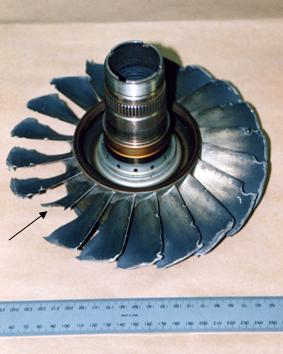
As a result of the contractor's requirements, the operator reported that future flights for the contractor would be operated by two pilots.
Australian Transport Safety Bureau
Fuel exhaustion and starvation accidents accounted for over 6 per cent of all accidents between 1991 and 2000 and the rate remains relatively constant.
In December 2002 the ATSB published a research paper titled `Australian Aviation Accidents Involving Fuel Exhaustion and Starvation'. It is available on the ATSB's website www.atsb.gov.au, or from the Bureau on request.
Analysis
The descriptions of the loss of engine power and the subsequent engine surging were consistent with fuel starvation, a situation where the fuel to the engine is interrupted, although there is adequate fuel on board the aircraft.
Although the left high-pressure fuel pump failed to deliver the required pressure and fuel flow and was found leaking during subsequent testing, it would have had little effect on the development of the occurrence and its defect may have occurred during the accident sequence.
The pilot reported that he had selected inboard tanks for the flight. The investigation was unable to reconcile the pilot's reported recollection of inboard tank selection and the evidence of the remaining fuel quantities in the inboard tanks.
Summary
History of the flight
The Piper Aircraft Corporation PA-31-350 Navajo Chieftain, registered VH-UBC, departed Albury on a charter flight with a pilot and six passengers on board. About 5 minutes into the flight, as the aircraft climbed through approximately 5,000 ft, the pilot reported that the right fuel flow light illuminated. The pilot moved the right engine mixture control lever to full rich and advised the Albury Tower controller that he was returning to Albury. A short time later, the right engine started surging. The pilot reported that he changed the right fuel selector from the inboard to the outboard tank selection, although he was aware that there was only a small quantity of fuel in that tank. The engine continued to surge and he reselected the inboard tank. The pilot reported that he did not shut down the engine and feather the propeller because he thought the engine was producing some power.
The pilot reported that approximately a minute after the onset of the right engine problem, the left fuel flow light illuminated and the left engine also started surging. He advised the controller that he was diverting to Holbrook. The pilot found a break in the clouds and descended the aircraft, maintaining visual contact with the ground. On levelling out after the descent through cloud, he reported that the engines operated smoothly, but at reduced power. He reported that he maintained blue line speed for a short time, before power reduced to a level which would not allow altitude to be maintained. During the descent, the pilot opened the crossfeed valve and checked that all fuel pumps were on, mixture controls were rich and the inboard tanks selected. Unable to restore power, the pilot decided to make an emergency landing in an open field below the aircraft. Before landing, the pilot extended the flaps and the landing gear and instructed the passengers to prepare for an emergency landing.
The aircraft contacted the ground with its right wingtip and slewed for approximately 93 metres while rotating almost 180 degrees to the right. The aircraft was substantially damaged, but there was no fire. Neither the pilot nor the passengers sustained any injuries. The pilot reported that before exiting the aircraft he switched off the fuel pumps, magnetos and master switches.
Weather
The weather at Albury and the surrounding area was overcast with low cloud and fog patches. Rain and isolated thunderstorms were forecast for the area. Moderate icing was forecast above 10,000 feet.
Pilot qualification
The pilot held a Commercial Pilot Licence (Aeroplane) with a Multi-engine Command Instrument Rating and was appropriately endorsed on the aircraft type. He held a valid Class 1 medical. On 4 August 2003 he satisfactorily completed a type proficiency check on the Chieftain aircraft. Although not a training and checking requirement for charter flights, the operator additionally stipulated this check for its pilots.
Aircraft
The aircraft was owned by a locally based company that used it to transport its employees between numerous production facilities and was operated by an Albury based charter and training operator on their behalf.
The aircraft was maintained in accordance with the maintenance requirements applicable at that time and had a valid Maintenance Release. It had flown approximately 50 hours since the last maintenance release (periodic) inspection. There were no outstanding maintenance issues at the time of the accident.
Fuel status
The aircraft had flown during the previous day, returning to Albury late that afternoon. The pilot who flew the aircraft that day reported that the aircraft and its systems operated normally. He refuelled the aircraft for the next day's flying, filling only the inboard tanks. No fuel was added to the outboard tanks and the pilot estimated that about 25 to 35 litres remained in each outboard tank.
The rostered pilot reported that, on the morning of the occurrence, he carried out a preflight check during which he visually inspected the fuel tank contents. The pilot reported that he found both inboard tanks full, but could not see any fuel in the outboard tanks. In accordance with the operator's practice, the pilot started and warmed the engines so that the flight could proceed without delay when the passengers arrived.
The `Before starting engine' and `Before take-off' checklist procedures required the pilot to check that the fuel selector valves were selected to INBOARD tanks. Both the manufacturer's and the operator's `Before taxiing' checklist procedures then required the pilot to check the fuel selector at each detented position. The operator reported that pilots were encouraged to check the operation of the fuel selector valves in all detented positions during the engine warm up run. The pilot reported that in order to conserve the fuel in the inboard tanks for the trip, he preferred to warm the engines using the fuel from the outboard tanks.
The departure had been delayed due to fog at the destination. The flight commenced approximately two hours later than planned, when the fog cleared. The pilot reported that he carried out another engine warm up with the passengers aboard and had checked the INBOARD tanks selection before take-off.
Fuel system
The aircraft fuel system consisted of four fuel cells, two in each wing, and had a total capacity of 734 litres, of which 690 litres were useable. It was also fitted with two long-range nacelle tanks that were not used on this flight. The inboard tanks each had a capacity of 212 litres and each of the outboard tanks 155 litres. The tanks were a bladder type and were located between the main and the rear wing spars. The filler caps were located at the outboard end of each tank. The slenderness of the tanks and the wing dihedral resulted in the fuel accumulating at the inboard end of each tank. That meant that unless the tank was full, or nearly full, it was not possible to assess the quantity of fuel remaining in the tank by visual inspection or by dipping through the filler cap opening.
The left and the right wing fuel systems were independent. Two fuel selector valves, one for each wing's fuel system, allowed the pilot to select either OUTBOARD, OFF or INBOARD positions. When a tank was selected, the fuel was fed to the respective engine system. A crossfeed line with a crossfeed valve was the only interconnection between the two wing fuel systems. The crossfeed valve is normally closed.
Wreckage Examination and Component Testing
The aircraft sustained substantial damage during the emergency landing. The right wing was damaged, the landing gear was torn off and both propellers damaged. Damage to the blades of both propellers was almost identical and was consistent with them rotating at impact. Calculations based on an aircraft speed of about 110 kts, as reported by the pilot, and propeller blade slash marks at the initial point of impact, indicated that both propellers were rotating at approximately 1,830 RPM at impact.
When visually inspected through the filler caps shortly after the accident, both inboard tanks were full, but no fuel could be seen in the outboard tanks. The investigation determined that there were 210 to 211 litres of fuel in each inboard tank. The right outboard tank contained approximately 25 litres and the left outboard tank approximately 1 litre of fuel.
Detailed examination of the tanks and the fuel system found no evidence of flow restriction or the presence of any foreign material inside the system. Fuel samples taken from the aircraft were tested and found to comply with the respective fuel specification. The fuel was of the correct type and grade for the aircraft.
Both engines were removed from the aircraft. When tested, they operated normally in accordance with the manufacturer's test schedule. There was no evidence of any defect that would have accounted for the reported malfunction.
The fuel system and its components were tested in situ, and found to operate normally. The selector valves and the pumps were removed and tested. Operation of all but the left high-pressure fuel pump was normal.
The left high-pressure fuel pump failed to deliver the required pressure and fuel flow and was found to leak at the rate of about 1/4 litre per minute. The test facility specialist reported that the possibility of the fault resulting from damage during the accident could not be excluded.
There was no evidence of any other abnormality of the individual fuel system components and controls.
Fuel consumption
Calculated fuel consumption, based on the manufacturer's Take Off and Climb performance charts, determined that from the time the aircraft commenced take-off to its emergency landing, approximately 32 litres of fuel would have been consumed. In addition, 12 litres of fuel was estimated to have been used during the engine warm ups and taxiing.
On 2 July 2003, the Boeing 747-438 aircraft, registered VH-OJU, operating on a scheduled flight from Singapore, arrived at Sydney at 0511 Eastern Standard Time, during the airport's curfew period. There was a tailwind of around 12 knots when the aircraft landed. The pilot flying selected auto brake setting three and idle reverse thrust in accordance with the curfew requirement. However, during the landing roll the reverse thrust was inadvertently de-selected.
On arrival at the terminal, the pilot in command (PIC) observed a BRAKE TEMP advisory message and notified the ground engineers. At that point, a fire ignited on the right wing landing gear. The flight crew were advised and the PIC ordered an evacuation of the aircraft. On receiving the evacuation announcement, the cabin crew commenced the evacuation drill deploying the aircraft's escape slides. The upper deck left (UDL) door and doors 2 left (L2) and 4 right (R4) escape slides, did not deploy. During the evacuation, the over-wing slide at door right 3 (R3) deflated while in use. As a result of the evacuation, one flight crew member and three passengers were seriously injured. Some passengers evacuated down the slides with their cabin baggage.
During the accident, an additional two brake fires ignited on the right body landing gear, one of which was extinguished by the Aerodrome Rescue and Fire Fighting Service (ARFFS). A subsequent inspection found that the aircraft's landing gear contained an excessive amount of grease with the presence of inappropriate grease on all of the landing gear axles. The three brake units that had caught fire were found to be serviceable but in a worn condition.
The investigation determined that slide R3 did not have any pre-existing defects that contributed to its failure. The nature of the failure was found to be overload of the fabric fibres during the evacuation. The inappropriate grease found on the landing gear axles was general purpose grease used on other components of the landing gear. The time and point of its application to the aircraft axles could not be determined.
The investigation found deficiencies in the operator's maintenance, flight crew and cabin crew procedures. As a result, the operator has issued maintenance memos to its engineering staff clarifying aircraft landing gear lubrication procedures, amended its Aircrew Emergency Procedures Manual, and reviewed cabin crew and flight crew emergency procedures.
As a result of this investigation, the ATSB is issuing safety recommendations to the operator and the Civil Aviation Safety Authority concerning the use of over-wing slides during known brake fires.
At 0735 UTC on 11 August 2003, VH-ANV was cleared on a MANTL 1 departure from runway 24R at Jandakot airport. Onboard were the pilot and five passengers. The aircraft called ready and was cleared to climb to 3,000 feet. The aircraft rotated and the tower staff noticed a sound similar to an asymmetric operation. The aircraft was turned left and subsequently impacted the ground to the southeast of the tower near the NDB site. This Technical Analysis Investigation report should be read in conjunction with ATSB report BO/200303579.
Summary
EXECUTIVE SUMMARY
On 11 August 2003, at about 1535 Western Standard Time, a Cessna Aircraft Company 404 Titan (C404) aircraft, registered VH-ANV, took off from runway 24 right (24R) at Jandakot Airport, WA. One pilot and five passengers were on board the aircraft. The flight was being conducted in the aerial work category, under the instrument flight rules.
Shortly after the aircraft became airborne, while still over the runway, the pilot recognised symptoms that he associated with a failure of the right engine and elected to continue the takeoff. The pilot retracted the landing gear, selected the wing flaps to the up position and feathered the propeller of the right engine.
The pilot later reported that he was concerned about clearing a residential area and obstructions along the flight path ahead, including high-voltage powerlines crossing the aircraft's flight path 2,400 m beyond the runway. The aircraft was approximately 450 m beyond the upwind threshold of runway 24R when the pilot initiated a series of left turns. Analysis of radar records indicated that during the turns, the airspeed of the aircraft reduced significantly below the airspeed required for optimum single-engine performance.
The pilot transmitted to the aerodrome controller that he was returning for a landing and indicated an intention to land on runway 30. However, the airspeed decayed during the subsequent manoeuvring such that he was unable to safely complete the approach to that runway. The pilot was unable to maintain altitude and the aircraft descended into an area of scrub-type terrain, moderately populated with trees. During the impact sequence at about 1537, the outboard portion of the left wing collided with a tree trunk and was sheared off. A significant quantity of fuel was spilled from the wing's fuel tank and ignited. An intense post-impact fire broke out in the vicinity of the wreckage and destroyed the aircraft.
Four passengers and the pilot vacated the aircraft, but sustained serious burns in the process. One of those passengers died from those injuries 85 days after the accident. A fifth passenger did not survive the post-impact fire.
The investigation assessed that the aircraft was below its maximum permitted take-off weight and within centre of gravity limits at the time of the accident. Analysis of radar data indicated that the aircraft was operating significantly below the optimum speed for maximum single-engine climb performance for most of the flight.
A number of factors affect an aircraft's one-engine inoperative performance, including any variation from the airspeed to achieve the one-engine inoperative best rate of climb, control inputs made by the pilot to manage the situation and the effect of manoeuvring/turning the aircraft. One-engine inoperative climb performance would have significantly reduced during the turns, with a loss of at least 25 per cent during a 10 degree angle of bank turn, 50 per cent during a 20 degree angle of bank turn and more than 90 per cent had there been a 30 degree angle of bank turn.
Examination of the right engine revealed a material anomaly with the sleeve bearing from the engine-driven fuel pump. That bearing exhibited evidence of localised adhesive wear (galling) that had restricted the rotation of the pump spindle shaft. The bearing had previously been replaced during the last engine overhaul. Analysis of the bearing revealed that it had been manufactured from material that possessed inferior galling resistance when compared with bearings from similar pumps. The investigation concluded that the specified material for the replacement sleeve bearing was inadequate with respect to its galling resistance. High torsional loads between the spindle shaft and the sleeve bearing had caused the pump's drive shaft to shear at a critical phase of flight. Associated with a loss of drive to the pump shaft was a reduction in fuel pressure, which was insufficient to sustain operation of the engine at take-off power.
Following the occurrence, the operator modified other C404 aircraft in its fleet to incorporate a warning light to indicate low fuel pressure. The ATSB has previously issued three recommendations (see ATSB report BO/200105618) relevant to pilot training for engine-out operations in multi-engine aircraft. Those recommendations are also relevant to the circumstances of this occurrence.
Records from the Fire and Emergency Services Authority of Western Australia (FESA) indicated that the first responding appliances reached the Jandakot Airport emergency gate, about 1,500 m from the accident site, at 1551:52, about 12.5 minutes after being notified by the police. The fire fighting vehicles were not able to track direct to the accident site and had to negotiate runways and bush tracks. The FESA records indicated that the first information from the accident site was received at 1558:28, which stated 'MT is tackling the fire, some persons are out, some persons are missing.'
Following an occurrence at Bankstown Airport in November 2003, the ATSB conducted an investigation at the direction of the Minister for Transport and Regional Services to '…investigate the effectiveness of the fire fighting arrangements for Bankstown Airport as they affected transport safety…'. Bankstown Airport is a General Aviation Aerodrome Procedure (GAAP) aerodrome that had similar provisions for aerodrome rescue and fire fighting services (ARFFS) to Jandakot Airport at the time of the occurrence involving ANV. The ATSB report (200305496) on that investigation is available on the ATSB website.
On 22 June 2003, a Cessna Aircraft Company 172M, registered VH-TUR, drifted to the right shortly after take-off from runway 35 at Wedderburn airfield in NSW and impacted the ground to the north-east of the airfield. The aircraft was destroyed, and the four occupants were fatally injured.
The pilot held a valid Private Pilot Licence (aeroplane) and current class 2 medical certificate. There was no evidence that any physiological or psychological factors had affected the pilot's performance.
A witness at the airfield videoed the aircraft as it took off. Examination of the video revealed that the aircraft became airborne after a take-off roll of about 500 m, with 10 degrees of wing flap extended. As it climbed, the aircraft drifted to the right and entered a right-wing-low sideslip with a nose-up attitude. Witnesses at the airfield observed the aircraft between gaps in the trees to the north-east of the airfield banked to the right in a steep descent and then heard the sound of an impact.
Runway 35 was 1,000 m long and sloped down slightly to the north. The first half of the runway was bitumen and the second half was a mix of hard clay/gravel. Trees about 10 m high surrounded the runway, and sheltered it during crosswind conditions. At the time of the accident, the wind was gusting from the south-west.
The investigation found that the aircraft had been descending steeply in a right turn when it impacted the ground in a westerly direction. Data recovered from a global positioning system found in the wreckage supported other evidence, which indicated that the aircraft entered a spin during a right turn after take-off.
Examination of the wreckage revealed no evidence of pre-existing mechanical defects that may have contributed to the accident. The wing flaps were in the 10 degrees extended position at the time of the accident. The aircraft stall warning system was recovered from the wreckage, tested and found serviceable. The aircraft had sufficient fuel onboard for the planned flight.
An assessment of the aircraft weight indicated that it was approximately 30 kg above maximum allowable take-off weight, and the centre of gravity was calculated to have been towards the aft limit of its normal centre of gravity range. That extra weight would have increased the aircraft stall speed by 1.4% (less than 1 kt), and reduced its climb performance slightly.
Wedderburn was an uncontrolled airfield. It was normal procedure at uncontrolled airfields to maintain runway heading after take-off until the aircraft had reached a height of 500 ft above the airfield, and then to turn left.
As the aircraft climbed out of the shielding effect of the trees beside the runway, the crosswind from the left would have increased markedly. If the aircraft was continuing to climb as it turned to the right, it would have then been in an increasing tailwind. An increasing tailwind will lead to a momentary reduction in aircraft indicated airspeed. The wind was also strong and gusting, and if there had been a wind gust at the same time, it would have caused a greater momentary reduction in aircraft indicated airspeed.
When an aircraft turns away from the wind, at low level, the groundspeed increases. In such circumstances, the view of the ground accelerating below an aircraft may give an illusion of an increased airspeed. For any given nose attitude, an aircraft will fly slower if wing flaps are extended. With 10 degrees of wing flap extended, the aircraft was therefore flying at a lower airspeed in the climb than if the wing flaps had been retracted, if the same attitude was maintained. The aircraft's climb performance would also have been reduced by using 10 degrees of wing flap, compared with using no wing flap. The aircraft take-off performance data in the aircraft operating handbook indicated take-off performance with wing flap retracted, and provided information that 10 degrees of wing flap should be used for take off from a soft surface.
The amount of aerodynamic lift produced by a wing in flight can be changed by a pilot in a number of ways. If the speed of the air flowing over the wing is increased, aerodynamic lift normally increases. The shape of the wing can be changed to an extent by moving the control surfaces, which adjusts the amount of aerodynamic lift. The angle at which the airflow impinges on the wing can be adjusted, which will also change the aerodynamic lift. This angle is known as the angle of attack. In normal flight, if the angle of attack is increased, the aerodynamic lift is also increased, up to a certain angle of attack known as the stalling angle. In contrast, if the angle of attack is increased beyond that stalling angle, the amount of aerodynamic lift decreases. An aircraft flown at a greater angle of attack than the stall angle is commonly described as being aerodynamically 'stalled'.
In steady flight there is a relationship between speed and the angle of attack of the wing. The stall speed is the speed at which the angle of attack coincides with the stall angle for a given configuration.
One effect of flap extension is to increase the relative pitch angle (incidence) between the wing and the fuselage. As a result, in steady flight, an aircraft with flaps extended will fly at a lower speed than one at the same attitude with flaps retracted. If the aircraft was flown at the normal flapless climb attitude, but with 10 degrees of flap extended, it would fly at a lower airspeed. The additional drag produced by the flap extension would also have reduced the climb performance. The aircraft would also have stalled at a lower nose attitude when 10 degrees of wing flap was extended, compared with when the wing flap was retracted.
An aircraft's stall speed increases by a factor of the square root of the secant of the angle of bank, all other things being equal. The aircraft was in a gentle turn at the time the stall occurred. The wing is generally less effective at producing aerodynamic lift when an aircraft is flown out of balance. There is also an increased likelihood of one wing stalling before the other leading to a roll input at the onset of the stall. The accident aircraft had been flown out of balance shortly before the onset of the stall, but it was not known if it was out of balance at the onset of the stall.
The aircraft was observed flying slowly during its climb after takeoff. If the aircraft's airspeed became sufficiently slow in a steady climb, the aircraft would stall. The circumstances were consistent with the aircraft entering a stall and a spin at a height from which it was considered impossible to recover. Some or all of the following factors could have contributed to the aircraft entering a stall:
The aircraft exceeded the maximum allowable take off weight, which would reduce its climb performance
The aircraft was climbing into an increasing tailwind, which would create a momentary reduction in airspeed
The wind was gusting, which could have created a further momentary reduction in airspeed
The takeoff was downwind, which would have led to a higher groundspeed that would give an illusion of higher airspeed. The pilot may have compensated for this illusion by raising the aircraft's nose
The aircraft was turned away from the wind at low level, which could have led to an illusion of increasing airspeed. The pilot may have compensated for this illusion by raising the aircraft's nose
The aircraft was flown out of balance for parts of the flight, which would have reduced its performance
The use of 10 degrees of wing flap would have reduced its climb performance, and meant that the aircraft would have been flying slower for any given nose attitude.
On 27 May 2003, at about 1650 Western Standard Time, the pilot of a Cessna 172P (C172) aircraft, registered VH-AUC, was conducting circuits on runway 06 right (06R) at Jandakot. An instructor and student pilot of a Piper PA-38-112 (Tomahawk) aircraft, registered VH-FIG, were also conducting circuits on runway 06R.
While on downwind for runway 06R, the pilot of the C172 requested a landing on runway 06 left (06L). The aerodrome controller responsible for runway 06R (ADC1) acknowledged that request and instructed the pilot of the C172 to follow the Tomahawk, which was also on downwind for runway 06R. After coordinating with the aerodrome controller responsible for runway 06L (ADC2), the ADC1 cleared the pilot of the C172 to make an approach to runway 06L and instructed the pilot to transfer to the ADC2 frequency. The C172 subsequently passed in close proximity to the Tomahawk while the Tomahawk was on final for runway 06R and the C172 was on right base leg for runway 06L.
Radar data indicated that the crew of the Tomahawk had extended downwind for sequencing with a preceding aircraft and did not turn base for runway 06R until close to the control zone boundary. Radar data also indicated that the pilot of the C172 had turned right base for runway 06L from a late downwind position and had flown an oblique base leg to join final for runway 06L. Sun glare may have contributed to the C172 pilot losing sight of the Tomahawk ahead after it had turned onto the base leg.
The Tomahawk was at about 500 ft above ground level and descending on long final approach to runway 06R when the instructor observed the C172 tracking towards them. The instructor in the Tomahawk attempted to contact the pilot of the C172, but used the callsign of another aircraft believed to be operating in the circuit at the time and received no response. Regardless, the pilot of the C172 would not have heard any transmissions from the instructor, as the pilot was operating on a different frequency, as instructed by ADC1.
The Tomahawk instructor increased the rate of descent of the aircraft and monitored the position of the C172 before it passed directly overhead, left to right, about 50 ft above their aircraft. The instructor reported that the C172 was sighted approximately 20 seconds before it passed overhead. The C172 pilot was unaware of the incident until after landing when it was brought to his attention by the surface movement controller. Due to the distance from the control tower and the angle of observation, the aerodrome controllers could not accurately judge the relative positions between the aircraft on base and final approach.
Following this incident, Airservices Australia issued instructions to Jandakot aerodrome controllers to delay, where practicable, the transfer of aircraft onto another frequency when facilitating a change in landing runway.
On 20 June 2003 at approximately 0840, a Robinson Helicopter Company Model R22 helicopter, registered VH-OHA (OHA), was being used to conduct flying training in the Bankstown training area with an experienced flight instructor and student pilot. The helicopter was observed and heard flying in a normal manner. Witnesses reported subsequently hearing a number of loud bangs and one witness observed what appeared to be a main rotor blade separating from the helicopter. The helicopter descended to the ground in an inverted attitude and both occupants were fatally injured.
Examination of the accident site and helicopter wreckage confirmed that one main rotor blade had failed in-flight. Examination of the helicopter and its systems did not reveal any other abnormality that would have contributed to the loss of the main rotor blade.
The helicopter had recently re-entered service following maintenance which included the fitting of an overhauled engine and the completion of a 100-hourly inspection. The helicopter also underwent maintenance action to rectify a main rotor blade vibration. This maintenance action involved a number of experienced R22 helicopter engineers being consulted about the possible reasons for the main rotor blade vibration. Rectification action was completed in accordance with normal maintenance practices and the manufacturer’s maintenance manual. Subsequent examination of the maintenance manual for the R22 helicopter revealed that it did not contain any information in the tracking and balancing section that indicated that a vibration may be the result of a crack in the main rotor blade. The manufacturer had produced other documentation containing this information, but these documents did not formally form part of the maintenance manual.
The helicopter had been manufactured in 1991 and had been imported into Australia in 1996. In the time prior to the accident it had been owned and operated by a number of organisations and individuals, and was operated both commercially and privately.
Following the accident, industry suggestions about the possible under-recording of time in service on the helicopter led the Australian Transport Safety Bureau to concentrate part of the investigation to the recording of time in service of the helicopter. Coincident with this investigation, a separate investigation of the recording of time in service on the helicopter was conducted by the Australian Civil Aviation Safety Authority (CASA).
Both investigations examined a wide range of documentation and records from numerous sources. The conclusion of both investigations was that the helicopter had not exceeded the mandatory time in service life of 2,200 hours, nor had it exceeded the mandatory calendar time in service life of 12 years. The final time in service of the helicopter was calculated to be 2,055.6 hours and the calendar time in service was 11 years and 8 months.
An examination of the main rotor blade in the ATSB laboratories revealed that it had failed as a result of fatigue crack growth in the blade root fitting at rotor station 10.35. The fatigue crack initiated as a result of localised pitting corrosion in the counterbore of the inboard bolthole. The examination also revealed that while the fatigue failure was in a similar position to two previous main rotor blade failure accidents in Australia, in OHA’s case, there was an area of adhesive disbonding between the main rotor blade skin and blade root fitting. This adhesive disbonding meant that the crack in the blade root fitting did not propagate into the blade skins and so was undetectable using visual means. The two previous failures were linked to under-recording of hours.
The material failure analysis found that the disbonding present on the failed main rotor blade was also present in a number of other main rotor blades that were examined. As a result, the ATSB issued a safety recommendation to the United States Federal Aviation Administration (FAA) and to the Robinson Helicopter Company, seeking that they conduct further testing on main rotor blade root fittings to evaluate the extent of adhesive disbonding in the blade root fitting. This examination was conducted on a total of 51 main rotor blades that had between zero and 2,200 hours time in service. Results of the examination revealed that adhesive disbonding between the spar and root fitting was present in all blades and that the extent of the disbonding was variable.
Subsequent to this accident there was another in-flight failure of a main rotor blade. In February 2004, an R22 helicopter being operated in Israel sustained an in-flight failure of a main rotor blade. This blade had failed as a result of fatigue in the same location as the failure in the Australian accident. The Israeli failure exhibited a similar loss of adhesion and corrosion. Both blades had failed before their mandatory time in service retirement lives and represented a failure of the fatigue fracture control plan. A third failure occurred in New Zealand in November 2004. Preliminary investigations have revealed that the failure may be the result of loadings on the blade that may have exceeded those intended by the manufacturer. The investigation of that accident is continuing.
The manufacturer has issued a safety letter and a service bulletin relating to revised retirement lives for main rotor blades, and has introduced a redesigned main rotor blade into service. The manufacturer indicated that it intends to publish safety alerts and notices on its Internet website as an additional means of bringing safety related information to the notice of owners, operators and maintenance organisations.
The R22 maintenance manual has also been amended by the manufacturer as a result of this investigation. The main rotor blade tracking and balancing section now contains information, which alerts maintenance personnel to the fact that a main rotor blade vibration may be the result of a developing crack.
Safety action taken by the CASA as a result of this accident was to amend an existing airworthiness directive to take into account the findings from the examination of the blade and to introduce additional amendments to the directive, when updated information became available from the manufacturer. They also introduced a discussion paper on the installation of mandatory time in service recorders for helicopters. As at October 2005, CASA was still evaluating the public comments on the discussion paper.
In addition, CASA has drafted a Notice of Proposed Rulemaking (NPRM 0503CS) in which it is proposed to require the retirement of similar main rotor blades by 1 March 2006 on Australian registered Robinson R22 helicopters.
The United States FAA issued a special airworthiness information bulletin and an emergency airworthiness directive.
As a result of several accidents involving main rotor blade failures, the European Aviation Safety Agency, issued an airworthiness directive on 5 July 2005 mandating compliance with the Robinson service bulletin.
The ATSB has contracted research to assess the validity of the usage spectrum assumptions that were used for certification of the Robinson R22 helicopter. A research investigation report on the project is planned to be released in 2006.
The Boeing 717 (717) aircraft, registered VH-VQD, was being operated on a scheduled passenger service under the instrument flight rules from Brisbane to Mackay, with an expected arrival time of 2030 EST. There were rain showers and scattered low cloud in the area at the time and the air traffic controller had issued the crew with a clearance to conduct a runway 14 VOR/DME approach at Mackay. The pilot in command was the handling pilot for the sector.
Late in the cruise segment, the pilot in command asked the copilot to obtain the predicted altitude of the aircraft when it would pass overhead Mackay. The copilot said that he cleared the Mackay altitude constraint (2,500 ft) in the active flight plan page on the multi-function control and display unit (MCDU) of the flight management system (FMS). This enabled the unit to display the predicted altitude. The system displayed 5,100 ft and the copilot conveyed that information to the pilot in command.
The copilot then reinstated the previously set 2,500 ft altitude constraint into the active flight plan. The crew could not positively recall checking the altitude constraint against the Mackay waypoint at the end of that process. Passing overhead Mackay, the copilot entered the minimum descent altitude for the approach (430 ft) in the mode control panel altitude window. The aircraft was being operated on automatic pilot, with profile, navigation and manual speed modes engaged for the VOR/DME approach.
As the aircraft descended on the outbound leg of the approach, the crew noticed that the predicted track for the inbound turn on the map display screen showed a break between the inbound turn and the inbound track. During the inbound turn, the pilot in command became concerned that the aircraft was not going to intercept the inbound radial by the final approach fix at 5 NM by Distance Measuring Equipment (DME), and he and the copilot directed their attention to the aircraft's tracking profile.
A short time later, the pilot in command noted that the aircraft was descending through 1850 ft. Believing that they were too low for that segment of the approach, he asked the copilot to confirm the minimum step altitude. The copilot advised 2,200 ft. The crew then heard the Mackay Tower controller suggest that they 'check altitude', and that the aircraft was 'low on profile'. The pilot in command responded by selecting the autopilot vertical speed mode, commanding the aircraft to climb until it was above 2,200 ft. The crew then continued flying the approach to runway 14 and intercepted the inbound radial at about 6.6 DME.
The minimum crossing altitude at the final approach fix for the runway 14 VOR/DME approach was 760 ft. As the aircraft passed the final approach fix, it was at 1,427 ft, in the landing configuration, and established on the final approach track. The pilot in command indicated that he was 'a bit in shock' at that time over what had happened during the inbound turn but had not considered conducting a missed approach.
At about 800 ft, the copilot said that the runway was to the right. Visibility was satisfactory and the windshield wipers were off. The pilot in command said that he saw the lights the copilot was referring to and began to turn towards them, even though he felt that there was 'something not right', and he could not see the visual approach slope indicator system (T-VASIS) runway approach guidance lighting.
A short time later, the tower controller instructed the crew to climb, adding that the aircraft was 'well off centreline'. The pilot in command said that he was surprised by that instruction and initially did not react. However, when the controller repeated the instruction, about 2 seconds later, the pilot in command initiated a climb straight-ahead.
The pilot in command said that he had commenced the missed approach before the aircraft reached 500 ft on final approach. This was consistent with the information from the flight data recorder. The operator's procedures required the crew to check that the aircraft was aligned with the runway and on glideslope passing 500 ft on final approach.
The recorded flight data showed that the aircraft's track began to diverge right from about 138 degrees when the aircraft was descending through 620 ft at 3 DME on final approach. The missed approach was initiated 25 seconds later when the aircraft was tracking about 177 degrees as it passed 2.3 DME.
After the crew reported level at 2,500 ft during the missed approach, the controller instructed them to turn left when ready and track direct to the VOR. A short time later, the controller advised the crew that if the turn was not initiated, the aircraft would be required to climb to 3,100 ft; the minimum sector altitude. The crew turned the aircraft left and landed at Mackay following a second VOR/DME approach to runway 14.
This report highlights the potential safety benefits of the Flight Safety Foundation ALAR Tool Kit, especially in regard to the conduct of non-precision approaches.
Local safety action
The operator has advised that a review of processes has been carried out and new procedures are in place to ensure that a similar incident does not occur again. Some of the changes were reported to have been in the process of being introduced at the time of the accident.
Reported changes included the following:
Appointment of new personnel to key operational roles
Creation of a position of Flight Training Manager
Creation of a position of Quality Assurance Manager - Engineering
Review of Flight Manual Supplements
Rewriting of the Flight Operations Manual
Issue of a standing order to all pilots that a go-around is to be conducted anytime on approach below 1,000 ft above ground level, if the approach is not stabilised and the sink rate is in excess of 1,000 fpm
Reviewing the use of radio altimeter in non-precision approaches
Rewriting of the Check and Training Manual
Development of a Quick Action Handbook to cover emergency procedures
At the time of the occurrence, replacement aircraft for the Sydney-based aeromedical service were on order. Specifications for the new aircraft included an Enhanced Ground Proximity Warning System. Those aircraft are now in service.
Airservices Australia is reviewing the Manual of Air Traffic Services to clarify and remove the ambiguity relating to descent restrictions for pilots conducting instrument approaches in IMC.
Published with permission of Jeppesen Sanderson, Inc. - NOT TO BE USED FOR NAVIGATION.
Appendix B: Elements of a Stabilised Approach
Note: A suggested definition or policy that might be considered by operators could be as follows: "All flights shall be stabilised by 1,000 feet height above touchdown (HAT) in instrument meteorological conditions (IMC) and by 500 feet HAT in visual meteorological conditions (VMC)." An approach is considered stabilised when all of the following criteria are met:
The aircraft is on the correct flight path
Only small changes in heading and pitch are required to maintain that path
The aircraft speed is not more than Vref + 20 knots indicated airspeed (KIAS) and not less than Vref
The aircraft is in the proper landing configuration (approach configuration for small twins)
Sink rate is maximum 1,000 feet per minute; if an approach requires a sink rate greater than 1,000 feet per minute, a special briefing is to be performed
Power setting appropriate for configuration and not below the minimum power for approach as defined by the aircraft operations manual
All briefings and checklists have been performed
Specific types of approaches are considered stabilised if they also fulfil the following:
Instrument landing system (ILS) approaches - must be flown within one dot of the glideslope or localiser; a category II or III approach must be flown within the expanded localiser band.
Visual approaches - wings must be level on final when the aircraft reaches 500 feet HAT.
Circling approaches - wings must be level on final when aircraft reaches 300 feet HAT
Unique approaches such as the 'old' Hong Kong airport, and the DCA (Washington, D.C.) river visual approach to Runway 18 require a special briefing
Source: Flight Safety Foundation Approach-and-Landing Accident Reduction Task Force.
Analysis
This occurrence is a CFIT accident resulting from inadvertent descent below the MDA on the final segment of a non-precision approach, fortunately without the catastrophic consequences normally associated with such events. The investigation was unable to conclusively determine why the aircraft descended below the MDA while in IMC, or why the descent continued until CFIT could no longer be avoided. However, the investigation identified a number of factors that influenced, or had the potential to influence, the development of the occurrence.
The pilot's workload during the approach was high, primarily due to hand flying of the instrument approach in IMC. A steeper than normal descent angle and higher than normal rate of descent, resulting from the delayed descent clearance from the ADC, added to that workload. While in IMC, with the absence of any alert at the MDA, the pilot relied on specific reference to the altimeter during his instrument scan to alert him to the proximity to the MDA and any descent below it. Although use of the altitude alerter on the final segment of the approach was not established, an alert from a unit configured with the MDA would not be expected until at least 300 ft below the MDA. As such, the altitude alerter was not effective as an immediate alert to descent below MDA.
Given the potential for downdraft activity from convective cells, the 'sinking feeling' experienced by the pilot and the 'falling sensation' experienced by the front seat passenger, indicate that the aircraft probably encountered a convective downdraft shortly before it impacted the surface. It was possible that the heavy rain also had an adverse effect on the sink rate of the aircraft. An absence of specific data prevented the investigation from quantifying the effect of the downdrafts and heavy rain on aircraft performance. Furthermore, the almost simultaneous application of power and the impact indicate that the go-around was initiated well below the MDA. It was therefore not possible to determine if the environmental forces were sufficient to overcome optimum aircraft performance.
In the context of high pilot workload and a high rate of descent probably compounded by downdraft activity, it is possible that, with an expectation of becoming visual before the MDA, the pilot may have become preoccupied with acquiring visual reference to the ground as he descended through 800 ft. As any increased scanning outside the cockpit reduces instrument scan time and therefore time to assimilate the significance of altitude information, the pilot may not have recognised that the descent was continuing unchecked. Had the pilot confirmed that the aircraft was maintaining level flight at the MDA prior to attempting visual acquisition, the risk of inadvertent descent may have been reduced.
The likely trajectory of the King Air over the restaurant indicates that the aircraft overflew the breakwater at sufficient height for any attached landing gear to clear it. Therefore, the left main landing gear was dislodged, and the right main landing gear was impacted, prior to the aircraft passing over the breakwater. Although the lack of impact marks on the tyres suggests impact with water, contact with an outlying reef could not be ruled out. Whatever the surface, the impact force probably had a similar effect to a 'bounced' landing, and helped impart sufficient upward momentum to the aircraft to allow it to clear the buildings on the breakwater as it overflew them in the go-around. Had the aircraft not bounced, it may not have had sufficient height to clear the breakwater, and as a result it could have impacted the buildings with catastrophic consequences. Additionally, had the aircraft not been in the go-around attitude and the nosewheel impacted the water, it may have resulted in the aircraft cartwheeling into the breakwater.
Failure of the landing gear and flaps to retract during the go-around distracted the pilot from the primary task of controlling the aircraft. When the pilot sensed the g-force produced by the inadvertent turn, the depicted attitude on the failed primary attitude indicator was not an accurate representation of the aircraft's attitude. This had the potential to induce loss of control at a low altitude. The pilot's prompt and effective response prevented uncontrolled flight.
CFIT in the approach and landing phases of flight is a well-known and well-researched risk for which there are formal assessment and prevention tools. The operator demonstrated an awareness of that risk, and a desire to treat that risk, by providing FSF CFIT training material to pilots and by conducting the CFIT checklist in February 2002. The operator reported that recommendations arising from the CFIT checklist were adopted by the aviation manager and check and training pilots. Notwithstanding, the investigation found that the ALAR task force recommendations had not been incorporated into the operator's standard operating procedures.
The absence of documented procedures regarding the use of the radio altimeter, flight director and autopilot in the conduct of GPS NPAs allowed for variability in pilot technique and did not provide assurance that the potential safety benefits of using that equipment would be optimised. Also absent was a definition of stabilised approaches and specification of associated go-around criteria in the operator's standard operating procedures; criteria considered by the ALAR task force to have the potential to reduce CFIT risk.
Notwithstanding, the pilot indicated that, had the radio altimeter been serviceable, he would have used it to alert him of proximity to the MDA. Given the demonstrated increased risk of approach-and-landing CFIT without an alert to proximity to MDA, the application of one or more defences to the conduct of the GPS NPA in IMC would have reduced the risk of CFIT. Possible defences included: limiting the rate of descent on final approach; nominating a higher MDA; utilising flight director or autopilot; and operating with two pilots.
Use of the flight director in conjunction with the altitude alerter after the final approach fix would have provided the pilot with an attitude indicator 'fly-up' command when the aircraft descended below MDA. As the primary reference in manual instrument flying is the attitude indicator, it is likely that the pilot would have noticed a 'fly-up' command earlier than recognition of the 'sinking feeling'. This may have prompted an earlier go-around or missed approach and avoided the surface contact.
Autopilots are commonly used to control an aircraft's track and descent profile during an instrument approach. Such use can reduce pilot workload and allows a pilot or crew to monitor the critical parameters of an approach. Had the pilot utilised the autopilot with the altitude capture function armed, after the final approach fix, it would have reduced the risk of inadvertent descent below the MDA.
Although the pilot was aware of stabilised approach criteria, such parameters were not defined in the operator's documentation, nor was a go-around policy specified for any exceedance of such parameters. With a lack of specific data, it is not known if there were any such exceedances during the approach. However, a specific missed approach policy increases the likelihood of a timely missed approach. Conduct of a holding pattern prior to commencement of the approach would have provided increased separation from traffic and probably allowed a more stabilised approach profile. Although the intent of the ATC approach clearance procedures was to prevent the imposition of altitude restrictions during an instrument approach in IMC, those instructions were not clearly defined in the MATS.
The aircraft was not fitted with a ground proximity warning system, nor was it required by regulation. The function of such systems is to prevent CFIT accidents. A ground proximity warning system may have provided the pilot with a more salient warning to enable him to take corrective action in time to avoid ground contact.
Summary
On 15 May 2003, at about 0833 Eastern Standard Time (EST), a Raytheon1 Beech Super King Air B200C, VH-AMR, impacted the sea or a reef about 6 km north-east of Coffs Harbour airport. The impact occurred immediately after the pilot initiated a go-around during an instrument approach to runway 21 in Instrument Meteorological Conditions (IMC) that included heavy rain and restricted visibility. Although the aircraft sustained structural damage and the left main gear detached, the aircraft remained airborne.
During the initial go-around climb, the aircraft narrowly missed a breakwater and adjacent restaurant at the Coffs Harbour boat harbour. Shortly after, the pilot noticed that the primary attitude indicator had failed, requiring him to refer to the standby instrument to recover from an inadvertent turn. The pilot positioned the aircraft over the sea and held for about 30 minutes before returning to Coffs Harbour and landing the damaged aircraft on runway 21. There were no injuries or any other damage to property and/or the environment because of the accident.
The aircraft was on a routine aeromedical flight from Sydney to Coffs Harbour with the pilot, two flight nurses, and a stretcher patient on board. The flight was conducted under instrument flight rules (IFR) in predominantly instrument meteorological conditions (IMC).
During the descent, the enroute air traffic controller advised the pilot to expect the runway 21 Global Positioning System (GPS) non-precision approach (NPA). The pilot reported that he reviewed the approach diagram and planned a 3-degree descent profile. He noted the appropriate altitudes, including the correct minimum descent altitude (MDA) of 580 ft, on a reference card. A copy of the approach diagram used by the pilot is at Appendix A.
The aerodrome controller advised the pilot of the possibility of a holding pattern due to a preceding IFR aircraft being sequenced for an instrument approach to runway 21. The controller subsequently advised that holding would not be required if the initial approach fix (SCHNC)2 was reached not before 0825.
At about 0818, the aerodrome controller advised the pilot of the preceding aircraft that the weather conditions in the area of the final approach were a visibility of 5000 m and an approximate cloud base of 1,000 ft.
At 0825 the aerodrome controller cleared the pilot of the King Air to track the aircraft from the initial approach fix to the intermediate fix (SCHNI) and to descend to not below 3,500 ft. The published minimum crossing altitude was 3,600 ft. About one minute later the pilot reported that he was leaving 5,500 ft and was established inbound on the approach.
At 0828 the pilot reported approaching the intermediate fix and 3,500 ft. The controller advised that further descent was not available until the preceding aircraft was visible from the tower.
At 0829 the controller, having sighted the preceding aircraft, cleared the pilot of the King Air to continue descent to 2,500 ft. The pilot advised the controller that he was 2.2 NM from the final approach fix (SCHNF). At that point an aircraft on a 3-degree approach slope to the threshold would be at about 2,500 ft. The controller then cleared the pilot for the runway 21 GPS approach, effectively a clearance to descend as required.
The pilot subsequently explained that he was high on his planned 3-degree descent profile because separation with the preceding aircraft resulted in a late descent clearance. He had hand flown the approach, and although he recalled setting the altitude alerter to the 3,500 ft and 2,500 ft clearance limits, he could not recall setting the 580 ft MDA. He stated that he had not intended to descend below the MDA until he was visual, and that he had started to scan outside the cockpit at about 800 ft altitude in expectation of becoming visual. The pilot recalled levelling the aircraft, but a short time later experienced a 'sinking feeling'. That prompted him to go-around by advancing the propeller and engine power levers, and establishing the aircraft in a nose-up attitude. The passenger in the right front seat reported experiencing a similar 'falling sensation' and observed the pilot's altimeter moving rapidly 'down through 200 ft' before it stopped at about 50 ft. She saw what looked like a beach and exclaimed 'land' about the same time as the pilot applied power. The pilot felt a 'thump' just after he had initiated the go-around. The passenger recalled feeling a 'jolt' as the aircraft began to climb.
Figure 1. View of Coffs Harbour boat harbour northern breakwater from north-east.
Witnesses on the northern breakwater of the Coffs Harbour boat harbour observed an aircraft appear out of the heavy rain and mist from the north-east. They reported that it seemed to strike the breakwater wall and then passed over an adjacent restaurant at a very low altitude before it was lost from sight. Wheels from the left landing gear were seen to ricochet into the air and one of the two wheels was seen to fall into the water. The other wheel was found lodged among the rocks of the breakwater.
Figure 2. Northern breakwater of Coffs Harbour boat harbour. King Air flight path was from left to right of picture.
During the go-around the pilot unsuccessfully attempted to raise the landing gear, so he reselected the landing gear selector to the 'down' position. He was unable to retract the wing flaps. It was then that he experienced a strong g-force and realised that he was in a turn. He saw that the primary attitude indicator had 'toppled' and referred to the standby attitude indicator, which showed that the aircraft was in a 70-degree right bank. He rapidly regained control of the aircraft and turned it onto an easterly heading, away from land. The inverter fail light illuminated but the pilot did not recall any associated master warning annunciator. He then selected the number-2 inverter to restore power to the primary attitude indicator, and it commenced to operate normally. The pilot observed that the left main landing gear had separated from the aircraft. He continued to manoeuvre over water while awaiting an improvement in weather conditions that would permit a visual approach.
About 4 minutes after the King Air commenced the go-around, the aerodrome controller received a telephone call advising that a person at the Coffs Harbour boat harbour had witnessed an aircraft flying low over the harbour, and that the aircraft had '…hit something and the wheel came off'. The controller contacted the pilot, who confirmed that the aircraft was damaged. The controller declared a distress phase and activated the emergency response services to position for the aircraft's landing. Witnesses reported that the landing was smooth. As the aircraft came to rest on the runway, foam was applied around the aircraft to minimise the likelihood of fire. The occupants exited the aircraft through the main cabin door.
Aircraft damage
The left main landing gear oleo strut was severed, consistent with rapid rearwards bending. It was located in the water about 25 m to the north of the breakwater, with only one of the two wheels attached. The other wheel was found among rocks at the base of the breakwater. There were no impact marks on the tyres. The separation of the left main landing gear from the aircraft damaged the left inboard flap and resulted in an average flap asymmetry of 9 degrees. The impact force bent the right main landing gear rearwards about 5 degrees, but it remained attached to the aircraft. The nose landing gear and propellers displayed no evidence of impact damage.
Figure 3. King Air on runway 21 at Coffs Harbour.
The structural damage resulting from the impact with the sea or reef was consistent with damage sustained in a heavy landing. The impact forces damaged both engine nacelles and main landing gear wheel wells. The wing centre-section outboard ribs rear of the main spar and the lower fairing skins were buckled, and both ailerons were buckled outboard of the inboard hinge points. All of the upper and lower inboard wing assemblies were distorted. The inboard lower fuel tank linings were wrinkled and some fuel tank lining skins were cracked. The inboard wing leading edge upper skins were cracked, and the left wing leading edge upper skin and stringer were wrinkled.
The damage to the tips of the left propeller was consistent with their contact with the runway during the subsequent landing. About 40 mm of the upper left landing gear was ground away during the landing.
Pilot information
The pilot held an Air Transport Pilot (Aeroplane) Licence endorsed with the aeroplane type, and held a Class 1 medical certificate. He also held a command Instrument Rating (multi-engine aeroplane) with approval to conduct GPS NPA procedures. He was current on the aircraft type, and met GPS NPA recency requirements. He had 18,638 hours total flying experience, which included 1,460 hours on type. He was familiar with operating into Coffs Harbour, and had last flown there on the day prior to the occurrence flight.
The pilot reported no physiological or psychological conditions that may have affected his performance. He was within the limits of the operator's prescribed flight and duty time limitations. He said that he slept normally the previous night before rising at 0425 and signing on for duty at 0600 for the scheduled 0700 departure.
Aircraft information
The aircraft was equipped and certified for single-pilot IFR operations. Although the aircraft was fitted with an NPA-capable3 Trimble 2101 GPS receiver, there was no record of the Civil Aviation Safety Authority (CASA) approval required to authorise conduct of GPS NPAs in that particular aircraft. Installation of the GPS was consistent with the CASA requirements that provided for non-precision approach approval.4 However, that approval required a specific supplement that was not incorporated into the aircraft flight manual. Examination of the GPS receiver revealed that it was capable of normal operation, and that its data card was current at the time of the occurrence.
The counter drum-pointer altimeter5 on the pilot's instrument panel and the three-pointer altimeter on the right panel were tested and found to operate normally. Examination of the two independent static systems found no water or obstructions. Functional tests did not reveal any defects or anomalies. Both altimeter sub-scales were found set to the appropriate aerodrome QNH.6 Radar data, recorded down to 3,600 ft, indicated appropriate altitude keeping consistent with a correct QNH setting. Testing of the vertical speed indicator did not reveal any defects or anomalies.
The aircraft was equipped with an altitude alerting system to provide the pilot with visual and aural warnings 1,000 ft before reaching a preselected altitude and for deviations exceeding 300 ft when at a preselected altitude. The altitude alerting system was subsequently tested and found to operate normally.
The aircraft was fitted with a radio (radar) altimeter system that measured actual height above terrain and was able to provide a pilot with an alert when the aircraft reached a preselected height. However, the radio altimeter system was inoperative. This was recorded in the aircraft's maintenance release. The operator's B200 Minimum Equipment List (OMEL), which was approved by CASA, permitted the dispatch of the aircraft without an operative radar altimeter.
The aircraft had two inverters capable of independently supplying power to the main attitude indicator. A master warning and inverter inoperative annunciator indicated failure of an inverter. Flags and full nose-up indication warned a pilot of primary attitude indicator failure. Examination of the inverter number-1 system revealed that its circuit breaker in the left wing was open and, when reset during test, the system functioned normally. The circuit breaker was in a poor condition and operated erratically when tested. The investigation concluded that the circuit breaker had tripped as a result of the impact, but could not determine why there was no associated master warning.
The aircraft was fitted with an automatic flight control system that was capable of controlling the aircraft during the final approach of a GPS NPA.
The aircraft's automatic flight control system included a flight director. When the autopilot was not engaged, the flight director could be used to provide the pilot with attitude and pitch command cues. With an altitude selected, and armed on the altitude alerting system, the pilot would receive a main attitude indicator pitch command to capture and maintain the preselected altitude.
The wing flap system incorporated a safety mechanism that disconnected the power supply to the electric flap motor if any one of the four flap surfaces was 3 to 6 degrees out of phase with the other flaps. Failure of the flap to retract after the impact was consistent with operation of that safety mechanism.
The retractable landing gear was electrically controlled and hydraulically actuated. A safety switch on each main landing gear prevented inadvertent gear retraction by opening the retraction control circuit when weight was on the wheels. Failure of the landing gear to retract after impact was consistent with interruption of the retraction circuit resulting from the disruption of the left main landing gear.
The aircraft was not fitted with a ground proximity warning system, nor was it required to be.
Meteorological information
The Bureau of Meteorology (BoM) forecasts indicated that IMC were to be expected in the Coffs Harbour area. The applicable area forecast (ARFOR) predicted frequent showers over the sea and coastal areas, with localised heavy falls. Moderate turbulence was forecast below 5,000 ft. The Coffs Harbour aerodrome forecast (TAF) predicted that there would be periods of up to an hour duration when the visibility would reduce to 2,000 m in rain showers with broken cloud at 1,000 ft.
The BoM weather radar imagery recorded at Grafton showed that there were a number of large convective cells in the vicinity of Coffs Harbour at the time of the occurrence. There was no associated lightning activity, or any other indication of thunderstorms. Steady rain had fallen in the area throughout the morning prior to the occurrence and heavy rain was reported at the aerodrome shortly after the pilot of the King Air executed the go-around. During the morning, the recorded surface wind at the aerodrome remained a constant light south-south-westerly of about 8 kts, gusting to 12 kts.
A BoM analysis of the weather data indicated that one or more convective cells may have produced downdrafts that affected the aircraft, but the magnitude of any downdrafts could not be determined.
Witnesses sheltering at a caf on the northern breakwater near where the aircraft impacted the surface related that, although there was heavy rain, there were no significant wind gusts at the time of, or immediately following, sighting the aircraft. However, another witness who was working on a boat in the harbour reported that an umbrella was overturned by an easterly wind just after he observed the aircraft overfly the boat harbour.
The pilot commented that the descent and approach had been flown almost entirely in cloud and rain showers with continuous moderate turbulence. Although he had briefly sighted the water at the commencement of the approach, he had not seen land or water throughout the approach or go-around. The pilot indicated that prior to joining the approach he had noticed some weather radar returns, but the intended aircraft track was clear of those areas.
The pilot of the preceding aircraft commenced a runway 21 VOR instrument approach at about 2219. He advised that the heavy showers on the outbound leg were the worst he had 'ever experienced' and that his aircraft was still in cloud and rain on arrival at the MDA.
The pilot in command of a Dash 8 aircraft which landed on runway 03 about 5 minutes after the pilot of the King Air executed the go-around, reported that he could not see the far end of the runway during the landing, and that there appeared to be '…a sheet or wall of water' to the north of the aerodrome. That pilot also reported that after shutdown, the rain '…was torrential'.
The Australian Transport Safety Bureau (ATSB) investigation into a B737 microburst encounter during heavy rain conditions associated with an intense thunderstorm at Brisbane on January 2001 (VH-TJX, BO/200100213) highlighted that significant aerodynamic penalties may be imposed on an aircraft during flight through heavy rain. Those penalties can be sufficient to substantially degrade the flight performance of an aircraft.
GPS Non-Precision Approaches
The GPS NPA provided the pilot with track guidance to the runway via a series of pre-programmed waypoints. Track information was displayed on the pilot's Horizontal Situation Indicator (HSI) as a left or right deflection of a Course Deviation Indicator (CDI) needle. In the absence of electronic vertical course guidance, a series of descending steps, shown on the profile diagram of the approach chart, provided the pilot with terrain clearance guidance.
Civil Aviation Advisory Publications (CAAPs) provided information on relevant regulatory requirements relating to a variety of matters. The CAAPs were intended to aid in the understanding of, and compliance with, regulatory requirements. CAAP 178-1(0), published after the occurrence in October 2003, provided information on non-precision approaches. In the information relating to descent gradients, the following advice was provided:
For an approach to be safe the descent gradient should be neither too steep, nor too shallow. A steep approach requires high rates of descent which are undesirable and increase the risk of inadvertent descent below critical altitudes.
More specifically, Aeronautical Information Publication related that:
Aircraft may commence a segment in excess of the specified commencement altitude provided that any upper altitude limitation is observed. However, rate of descent after the FAF [final approach fix] should not normally exceed 1,000 ft/min.
CAAP 178-1(0) also included advice that the International Civil Aviation Organization has:
… identified that many CFIT [controlled flight into terrain] accidents have occurred because pilots did not possess good situational awareness in regard to terrain beneath the approach flight path …
Controlled flight into terrain and approach-and-landing accident risk
Controlled Flight into Terrain occurs when an airworthy aircraft under the control of the flight crew is flown unintentionally into terrain, obstacles or water, usually with no prior awareness by the crew. According to the Flight Safety Foundation (FSF), CFIT is currently the greatest threat to air safety and is the primary causal event in the approach and landing accidents studied by the FSF Approach and Landing Accident Reduction (ALAR) Task Force.7 FSF analysis of 287 fatal approach-and-landing accidents between 1980 and 1996 showed that, of the accidents where data was available, 75 percent happened where a precision approach aid was not available or was not used.8
The consequences of CFIT are normally severe to catastrophic in terms of loss of life or severe injury and damage to property and/or the environment. All flights can be considered to be at moderate risk of CFIT, based on historical data relating to the frequency and consequences of CFIT accidents. As risk is dependent on consequences and likelihood of an event, the only way that CFIT risk can be reduced is for operators to ensure that the necessary defences are present to reduce its likelihood.
The ATSB has recently completed two investigations into CFIT accidents that involved destruction of the aircraft and loss of life to aircraft occupants (VH-FMN at Mt Gambier, BO/200105769 and IL-76 at Timor, BO/200300263). Both investigations referred to the FSF initiatives in approach-and-landing accident reduction, and the FSF checklist to evaluate CFIT risk as part of its international program to reduce CFIT events that present risk to aircraft, crews, and passengers.
The FSF ALAR Task Force has concluded, amongst other things, that:
establishing and adhering to adequate standard operating procedures (SOPs) and crew decision-making processes improve approach-and-landing safety
failure to recognise the need for a missed approach and failure to execute a missed approach is a major cause of approach-and-landing accidents
unstabilised and rushed approaches contribute to approach-and-landing accidents (FSF definition of stabilised approach is at Appendix B)
the risk of approach-and-landing accidents increases in operations conducted in low light and poor visibility
effective use of radio altimeters will help to prevent approach-and-landing accidents.
An ALAR Tool Kit, which comprised a unique set of pilot briefing notes, videos, presentations, risk-awareness checklists and other tools on compact disc is available from the FSF. In a news release, dated March 2003, the FSF expressed concern that, not everyone in the industry had taken note of the ALAR work.
Air traffic control approach procedures
The Manual of Air Traffic Services (MATS) Part 6.2.6, Approach Clearances, stated that:
Unless authorised to make a visual approach, an IFR flight must conform to the published instrument approach procedure nominated by ATC.
A controller shall not issue an air traffic clearance which authorises or requires a pilot to descend in IMC below the lowest safe altitude for the route segment in a manner different from that specified in:
a. … GPS Arrival procedures b. the procedures, plan and profile diagram of IAL [instrument approach and landing charts] charts published in AIP/FLIP Terminal …
MATS Part 3.4.2 further stated that:
When an aircraft will make an instrument approach, clearance for the approach should be issued at least 3 minutes before the procedure is expected to commence, or as a soon as conditions allow.
MATS Part 6.12.14 also noted that a temporary level restriction during an instrument approach can only be applied to civilian aircraft during practice [instrument] approaches in Visual Meteorological Conditions.
A clearance to conduct a GPS instrument approach authorises a pilot to descend from the IAF altitude to the minimum descent altitude and to continue to the airport for landing if visual, or to make a missed approach if unable to land or the pilot cannot see the airport.
Operator information
The operator was an aeromedical service provider that was contracted to provide crews and aircraft maintenance services for a 24-hour, all weather, aerial ambulance service based at Sydney airport. Instrument approaches promulgated for aerodromes in NSW were non-precision approaches except for Instrument Landing System (ILS) approaches at Sydney and Tamworth.
With regard to formal CFIT risk management at the time of the occurrence the operator reported that:
Pilots are required to watch the CFIT video which is viewed on appointment and annually as part of the recurrent training program. The pilots are issued with the CFIT brochures and checklist. The ALAR Tool Kit has not been used in the past.
The operator advised that, following the Mt Gambier CFIT accident involving VH-FMN (BO/200105769), the following action was initiated:
Synopsis of accident and conditions … included in February 2002 safety report
Flight Safety Foundation CFIT checklist conducted February 2002. Report and recommendations circulated by Aviation Safety Officer and adopted by Aviation Manager/Check & Training pilots.
All aircraft fitted with Flight Profile Annunciators
The operator's documented standard operating procedures did not specifically address, or were considered to be unclear in relation to, the following:
Stabilised approach parameters
Go-around and missed approach policy
Use of radio altimeter in conduct of non-precision approaches
Use of flight director in conduct of non-precision approaches
Use of autopilot in conduct of non-precision approaches.
1 Raytheon Aircraft Company superseded the Beech Aircraft Corporation as the manufacturer of King Airs. 2 Approach fixes are given a five letter designator to identify the fix in the GPS database and on the approach diagram. A copy of the approach diagram is at Appendix A. 3 TSO-C129 Class A1. 4 Airworthiness directive AD/RAD/61 GPS Installation for Non-Precision Approaches required compliance with Civil Aviation Advisory Publication (CAAP) 35-1(0). 5 Type of altimeter recommended in Annex 6 of Convention on International Civil Aviation (Chicago 1944) for aeroplanes operated in accordance with instrument flight rules. 6 The barometric pressure in hectopascals that enables an altimeter to show height above mean sea level. 7 Appendix A of the Flight Safety Foundation, Approach-and-Landing Accident Reduction Task Force, Operations and Training Working Group, Final Report (Version 2.0). 8 Flight Safety Foundation, Approach-and-Landing Accident Reduction Task Force, Analysis of Critical Factors During Approach and Landing in Accidents and Normal Flight, Data Acquisition and Analysis Working Group, Final Report (Version 2.0).
The Boeing 717 aircraft was departing Melbourne for Coolangatta on a regular public transport service. Following a normal take-off the pilot in command (PIC), the handling pilot, called for the landing gear to be retracted. A short time later, he noticed an amber warning appear on the airspeed scale on his primary flight display (PFD) screen. The PIC immediately reduced the aircraft pitch attitude in response to that warning. At about the same time, he noticed that the flaps/slats lever was at the `slats retract' position. The PIC immediately called for the flaps to be re-positioned, but the copilot selected the landing gear up. The PIC again called for the flaps to be re-positioned and the copilot then returned the flap selector to the take-off position. The PIC reduced the pitch attitude further. The airspeed then quickly increased to 15 knots above the reference speed (Vref) as the flaps reached the take-off position. The PIC re-established the normal climb attitude and the flaps and slats were subsequently retracted in accordance with the normal profile. The remainder of the flight was uneventful. Both the PIC and the copilot believed that the stick shaker had activated momentarily during the sequence.
Examination of the flight data recorder from the aircraft revealed the following:
Three seconds after the aircraft became airborne, and at about 30 ft above ground level, the flaps/slats lever was moved from the take-off position and the flaps began to retract.
One second later, as the flaps/slats lever reached the retract position, the stick shaker warning commenced. At that time the aircraft pitch angle was 18.6 degrees and the computed airspeed was 157 kts. Over the next three seconds, the stick shaker warning continued and the aircraft pitch angle reduced to 10.2 degrees. A second later the landing gear handle was recorded in the up position.
The flaps/slats lever began to move from the retracted position about one second after the landing gear handle reached the up position. The flaps reached the fully retracted position less than two seconds later, before immediately beginning to extend again. The slats began to retract but did not reach the fully retracted position before moving back to the extended position. The flaps/slats movement was accompanied by a very brief reactivation of the stick shaker and a further reduction in aircraft pitch angle to about 6 degrees. Computed airspeed at that time was 165 kts. The aircraft then began to accelerate and quickly returned to a normal climb profile.
One altitude loss of 5 feet, and lasting less than three seconds, coincided with the reduction in pitch angle that was made in response to the second stick shaker activation. At that time the aircraft was more than 240 ft above ground level. There was no altitude loss associated with the first stick shaker activation.
Interviews with the PIC and copilot did not reveal any obvious issue that might have led to the copilot retracting the flaps/slats instead of the landing gear. His work schedule, recent life history, and activities leading up to the occurrence were unremarkable. Against that background, the actions of the copilot appear to have been an `action slip', a type of procedural error associated with two actions (landing gear and flaps/slats retraction) that are sequentially linked. As was the case here, in human behaviour there can sometimes be a `spill-over' that triggers the associated action at an inappropriate time.
Primary flight displays are liquid crystal screens that provide attitude, airspeed, altitude, and heading information for each pilot. The airspeed is displayed as a vertical `tape' on the left side of the PFD screen. The aircraft is equipped with a stall warning system that alerts the crew of an `approach-to-stall' condition. The warnings are generated by angle-of-attack, horizontal stabiliser position, and flaps/slats position inputs to the flight control computer (FCC). The FCC displays amber and red sectors (the so-called amber foot/red foot) on the airspeed tape to warn of an `approach-to-stall' condition. The FCC also activates the stickshaker. If the crew does not initiate recovery action, red STALL annunciations appear on the PFDs, a klaxon sounds, and a synthetic voice `stall' warning is activated.
In this occurrence, by reducing the aircraft pitch angle, the PIC responded appropriately and very rapidly to the `amber foot' warning that appeared on the speed tape as soon as the flaps/slats lever was moved from the take-off position. As a result, the aircraft moved from a deteriorating and potentially unsafe flight performance regime to a safe one.
Anecdotal evidence was received early in the investigation that there may have been other inappropriate/inadvertent flap/slat selections in B717 aircraft. As a result, and in cooperation with the operator, a survey was issued to company pilots who flew the aircraft. The survey revealed three other instances of the flap/slats lever being moved through the flaps zero position to the slats retract position. However, all those events occurred above 3,000 feet altitude during initial `clean-up' flap retraction after take-off and the error was recognised and corrected on each occasion. None was associated with landing gear selection after take-off.
In response to the occurrence, the company amended its procedures for flaps/slats retraction approaching the ramp after landing to include the following CAUTION note:
`When retracting flaps/slats to UP/RET, pause at the UP/EXT position until the flaps indicate UP on the PFD prior to retracting the slats. Never move the flap/slat handle to UP/RET in one motion.'
The purpose of the change was to separate the retraction of the flaps and slats into two distinct actions, in an attempt to prevent the retraction of the flaps and slats becoming `learned' as a single continuous action.
The operator has advised that its fleet type operating committee will review the approach checklist procedure, but that any proposed changes will require negotiation with the aircraft manufacturer because the operator's policy is to maintain its checklists consistent with the manufacturer's.
The operator is also examining using this event as a training discussion item for fleets with analog altimeters and will publish an account in its in-house safety magazine or operations newsletter.
Analysis
The non-selection of the QNH on the altimeter subscale and the incorrect selection of the radio frequency probably resulted from a combination of a number of factors. These included the:
preoccupation of the first officer,
possible slightly degraded performance by the pilot in command due to impending illness,
interrupted checklist procedures, and
high workload being experienced by the crew as a result of the meteorological conditions, works in progress and changed conditions at the airfield, and the amended approach requirements.
It could not be established whether the pilot in command's experience with the newer generation cockpit displays contributed to him missing the incorrect altimeter subscale setting. However, if the aircraft had been equipped with a similar display, then the missed changeover from QNE to QNH may not have occurred.
Organisations require multiple defences to prevent hazards, such as human error, from becoming accidents. These defences may include procedures, training and equipment design. In this case, although procedures failed to stop the aircraft from descending below 10,000 ft with the incorrect altimeter subscale, other procedures such as the mandatory missed approach and the culture encouraging missed approaches prevented the error from compounding.
Summary
The Boeing 737 was on a scheduled service from Adelaide to Melbourne. The crew had flown a standard arrival route to a locator/distance measuring equipment approach to runway 27. The weather at the time was overcast with the cloud base at about 2,000 ft with drizzle. Extensive airport works were being conducted on and near runway 27. When the aircraft encountered visual conditions, the pilots found the aircraft high on the approach and attempted to regain the glide path by increasing the aircraft's rate of descent. As the aircraft approached 500 ft above ground level, the rate of descent was assessed as too high and the first officer called for a missed approach to be conducted, which was carried out by the pilot in command.
The aerodrome controller (ADC) instructed the pilot to maintain runway heading, to maintain 3,000 ft, and to call the departure controller radio frequency. Approximately 1 minute later, the departure controller advised the ADC that no radio contact had been made with the aircraft. Subsequent attempts to contact the pilot by radio on several other frequencies were unsuccessful. The departure controller also noted that the aircraft had climbed to 3,400 ft. After approximately a minute, the pilot re-established radio contact with the ADC and advised that he was unable to contact the departure controller. The ADC instructed the pilot to climb to 5,000 ft and to attempt to call the departure controller. The aircraft was observed to climb to 5,400 ft and subsequently the pilot established radio contact with the departure controller.
The pilots thought that the reason why they had been high on the approach was because they incorrectly transcribed the information from the operator's internal notice to airmen (INTAM) regarding amended procedures due to the aerodrome works. The departure controller requested the pilots to confirm the aircraft's altitude and it was during this check that the pilots realised that the barometric settings on the altimeters had not been set to the airfield QNH of 1028 hectopascals (hPa) but rather had been left on 1013 hPa; the setting required for flight above the transition altitude (10,000 ft.) As a result, the aircraft altimeters had under-read by about 450 ft. Once the pilots had corrected the error, the subsequent approach was conducted without further incident.
QNH is the mean sea level pressure derived from the barometric pressure at the station location. The local QNH at an airport is normally derived from an actual pressure reading. Australian aviation regulations require that, when an accurate QNH is set on the pressure-setting subscale of an altimeter planned for use under the Instrument Flight Rules, the altimeter(s) should read the nominated elevation to within 60 ft. QNH should be set on the altimeter pressure-setting subscale of all aircraft cruising in the altimeter setting region, which extends from the earth's surface to the transition altitude of 10,000 ft in Australia. QNE is the standard pressure altimeter setting of 1013.2 hPa that is set for flight above the transition altitude.
The works and consequent limitations on the use of the runway were detailed in a notice to airmen (NOTAM) and in an Aeronautical Information Publication Supplement (AIP/SUP). Some of the restrictions and amendments to the runway 27 usage included a displaced threshold, the installation of a precision approach path indicator (PAPI) vice the normal T-VASIS (which was unavailable) and non-availability of the high intensity approach lighting.
The first officer's experience was primarily on the 737-400 and the pilot in command had primarily flown the newer 737-800, which was equipped with significantly more integrated and up-to-date cockpit displays compared with the 737-400. One of the altitude indication features available on the 737-800 primary flight display (PFD) automatically highlights, in boxed amber, the barometric setting if the STD (Standard) QNE, rather than the local QNH is set and the aircraft descends through the transition flight level. The electronic altimeter is connected to the aircraft's flight management computer (FMC) and therefore can register if the subscale has been changed or not by reconciling the altitude to the database transition and whether or not STD is still set. The 737-400 cockpit displays did not have a similar indication because the altimeters are not connected to the FMC database that includes the aerodrome transition level/altitude information.
Both pilots were on the third consecutive day that required a 0600 departure. They both reported retiring the previous evening between 2000 and 2100. The first officer reported that he had some preoccupation with health issues involving his child. The pilot in command reported that on a later sector that day, he began to feel unwell, experiencing flu-like symptoms.
The instrument approach conducted by the crew was an operator-modified version of the published procedure. The amended approach was issued via a company INTAM that raised the published minimum DME altitudes by 73 ft. Because the modified approach was issued via text rather than a chart, the crew was required to transcribe the changes from the INTAM to their own in-flight briefing notes and they reported that they had taken some effort to ensure that they had transcribed the amendments correctly.
The operator had a sterile cockpit policy that applied from when the fasten seat belts sign was illuminated to when the landing gear was lowered. During this period, the cabin crew was not to contact the technical crew on the flight deck unless an urgent safety-related message needed to be passed. The fasten seat belts sign during this approach was illuminated at 20,000 ft.
The operator's pilots recall the checklist by referring to information listed on the yoke of the aircraft controls. A sliding marker was used to indicate where a checklist procedure was suspended to assist the pilots to regain the place in the checklist. In this case, the descent approach checklist included:
Anti-Ice ON/OFF
Air Cond & Press SET
Altimeters & Instruments SET & X-CHECKED
N1 & IAS Bugs CHECKED & SET
The operator's flight crew training manual required the descent approach checklist to be initiated during the descent and completed passing 10,000 ft. In practice, to enable a crosscheck of the altimeter settings, the pilots were required to stop the checklist at `Altimeters & Instruments' until the aircraft had descended below the transition altitude.
The pilots reported that after sterile cockpit procedures had been invoked and while they were conducting the descent approach checklist, a cabin attendant mistakenly contacted them on the intercom. The barometric subscales on the altimeters were not adjusted after they had recommenced the checklist following descent through the transition altitude.
A later opportunity to correct the missed check was lost when the pilots reported that they had crosschecked the altimeter settings and indications during the approach but they did not notice that the QNH had not been set. When the aircraft became visual at about 5 NM on final approach, the PAPI indication was four whites, indicating that the aircraft was high on glidepath. On seeing the airport, the pilots momentarily accepted the PAPI glidepath indication as being normal, as it was what they would have expected to see for an `on-glidepath' indication when using the T-VASIS.
Although they quickly realised their misinterpretation of the PAPI indication and the pilot increased the rate-of-descent to correct the aircraft's approach profile, the crew were unable to regain the normal approach as they approached 500 ft height above touchdown (HAT). Consequently, they conducted a missed approach as prescribed in the operator's flight administration manual. The manual advised pilots that an approach should be stable by 1,000 ft HAT and if the approach was not stable by 500 ft HAT, then a missed approach, or go-around, was to be conducted. The operator also stated in the manual that, `Flight Crew are encouraged to perform a Missed Approach whenever any doubt exists to the safe continuation of an approach and landing'.
The pilots reported that when pre-setting the frequency it was possible to dial the frequency on the radio control too quickly and the selection could overshoot by 0.25 megahertz. They reported that after they selected what they thought was the departure controller's frequency, the frequency channel appeared too quiet so they returned the selected frequency to the ADC frequency where they regained communications.
The operator reported that the general management processes taught to the company pilots were based on prioritising response and sequence management. This was associated with almost all of the training conducted by the operator, particularly during simulator training.