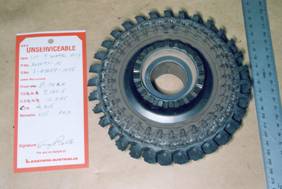
Boeing 747-438, VH-OJI, Singapore

Safety Action

At the time of the drafting of this report, the manufacturer, in addition to actions taken in relation to this and earlier occurrences, was also assessing the feasibility of an on-wing inspection procedure to identify those engines which may be more susceptible to blade release.

1 UTC - Coordinated Universal Time. Singapore local time 0030 on 18 November 2003.

Analysis

The failure of the number 2 engine was attributed to the progressive release of a single blade from the first stage high-pressure compressor disc, and the subsequent titanium metal fire within the compressor assembly.

Liberation of the blade from the compressor disc was due to the cracking and subsequent failure of the blade's dovetail root corners. The extent of galling damage to the dovetail root surfaces of the retained blades strongly suggests that the fatigue cracking mechanism initiated under the influence of stresses induced by uneven dovetail root bedding. Evidence established by the engine manufacturer regarding the initiation of blade dovetail root cracking is consistent with this conclusion.

The procedures recommended by the service bulletin RB211-72-E181, introduced to improve dovetail root bedding, had not been incorporated as the engine had not become due for refurbishment or overhaul since the bulletin was issued.

Summary

Sequence of events

On 17 November 2003, at 1630 UTC, as Boeing Company 747-438 (747), registered VH-OJI, rotated during take-off from Changi International Airport, Singapore, the crew heard a loud bang, and the aircraft yawed left. The aircraft's instrument indications were consistent with a failure of the number 2 (left inboard) engine. The crew shut down the engine and, after dumping fuel, returned to Changi.

An initial inspection found that there had been a failure within the engine's first stage high-pressure compressor assembly (HPC 1). Following removal from the aircraft and return to Australia, the engine was disassembled at the operator's maintenance facility, where the failure was confirmed as the loss of one blade and the extensive thermal and mechanical damage of the remaining blades from the HPC 1 disc. The liberated blade stub was recovered from the engine confines.

Engine

The engine was a Rolls-Royce RB211-524G2-T-19 model, serial number 13211 (see figures 1 and 2). The designation 'T' in the engine model number indicated that the original engine had been upgraded with power-train components from the larger Rolls Royce Trent 700 series engine. That enabled greater fuel efficiency and lower exhaust gas temperatures. At the time of the failure, the engine had operated for a total of 50,847 hours and through 6,659 cycles. Module 41, the engine's high-pressure compressor and turbine system, was fitted at the last engine refurbishment on 18 August 2000 and had operated for 14,166 hours and through 1,456 cycles since installation.

Components received

The HPC 1 blades (including the liberated blade) were removed from the engine by the operator and forwarded to the ATSB for examination. For the purposes of the investigation, the blades were identified by numbering in a counter-clockwise direction (looking rearward), commencing from the blade adjacent to the position of the liberated blade. The blade numbered 21 was not received. All examinable blades carried the part number FK28595 H124, embossed on the underside of the root section.

Blade condition - retained blades

Preliminary examination of the HPC 1 blades that remained on the compressor disc during the failure showed that all sustained extensive damage to the tips and edges such that the blade profiles resembled that of an arrowhead. The melting and loss of the leading and trailing edge corners of the blades (figures 3 and 4) is characteristic of a titanium fire within the assembly. Evidence of metallisation was noted on the blade aerofoil and platform surfaces. A close visual inspection of the blade root section revealed no evidence of cracking around the dovetail corners, nor was there any evidence of isolated or general mechanical damage such as may be sustained during handling or installation.

A study of the condition of the dovetail bedding surfaces found that all exhibited varying levels of surface galling damage across the full width (figure 5), with the damage appearing most pronounced toward the rear (outflow) end of the blade root. Low power stereomicroscopy study of the galling showed a predominantly axial orientation to the damage (transverse to the axes of the dovetail faces).

Several areas showed heavy localised galling, producing a gouging effect with notable metal loss (figure 6). Evidence of frictional heating with associated surface tinting (blueing) surrounded the heavily galled area.

Review of the distribution of dovetail galling found that some blades showed light galling up to and encompassing the transition radius between the upper dovetail edge and the root body (figure 7).

Failed (liberated) blade

The remnant stub of the single blade liberated from the compressor disk, despite extensive damage, showed the 'arrowhead' form produced by the loss of the leading and trailing edge corners (figure 8). Although the blade root fracture features were damaged beyond recognition, the similarity in form to previous failures indicated a high-cycle fatigue cracking mechanism.

The blade root showed the apparent fracture of the complete length of the dovetail toe along the leading (concave) side of the blade and roughly one-half of the toe length on the trailing side (figure 9). Damage and abrasion sustained following the blade loss prevented any useful examination of the fracture surfaces. However, the fracture profiles did not exhibit any associated plastic deformation or bending of the blade root body as could be expected if an external load had been applied to the blade, through impact with a foreign object or other internally liberated component.

Cracking and subsequent failure of the blade's dovetail root corners allowed the blade to move radially outward from its slot, under the influence of centrifugal operating loads. As the blade contacted the compressor housing, the resulting friction initiated the titanium fire that melted the blade corners, before the blade completely released from the slot.

The aerofoil section of the blade stub showed uniform transverse bending in a direction opposing the rotation of the compressor disc (figure 10). The layer of metallisation and melted debris on the inside of the bend showed a degree of cracking and fissuring that suggests deposition prior to the bending of the blade.

Service information

The engine manufacturer was aware of seven similar HPC 1 blade release failures in RB211-524G/H-T series engines worldwide. The ATSB had previously investigated one of those occurrences (see ATSB report BO/200205895). The engine manufacturer was also aware of a failure involving a Trent 700 series engine.

On 6 August 2003, in response to the first five failures, the engine manufacturer published Service Bulletin RB211-72-E181, applicable to the occurrence engine, that introduced a revised dry film lubricant on the stage-1 high pressure compressor blade root. The reason for issue of the service bulletin was the inadequacy of the earlier lubricant in preventing incomplete blade bedding and uneven wear, leading to subsequent high-cycle fatigue cracking and potential failure of the blade root. Accomplishment of the Service Bulletin was required to be denoted by a change in the blade part number, from FK28595 to FW26617. Compliance with the Service Bulletin was listed as 'Recommended', with suggested accomplishment when the engine or engine module was disassembled for refurbishment or overhaul.

The engine manufacturer also indicated that scoring and sharp edge damage in the blade root area, leading to local stress concentrations, may have contributed to HPC 1 blade failures. To prevent that damage, the manufacturer revised the manufacturing process, changing the blade root machining process from broaching to milling.

Occurrence summary

Investigation number 200304815
Occurrence date 17/11/2003
Location Singapore, Changi Aero.
State International
Report release date 22/06/2005
Report status Final
Investigation type Occurrence Investigation
Investigation status Completed
Mode of transport Aviation
Aviation occurrence category Engine failure or malfunction
Occurrence class Incident
Highest injury level None

Aircraft details

Manufacturer The Boeing Company
Model 747
Registration VH-OJI
Serial number 24887
Sector Jet
Operation type Air Transport High Capacity
Departure point Changi International Airport, Singapore
Destination Charles-De-Gaulle, Paris, France
Damage Nil

Piper PA-34-200, VH-CTT

Summary

On 11 November 2003, at about 1240 eastern summer time, a qualified pilot, with a flight instructor, was undertaking multi-engine aircraft training in a Piper Aircraft Corp PA-34-200 Seneca, registered VH-CTT. The training was to include flight with one engine intentionally set to produce little or no thrust. The pilot occupied the left front seat of the aircraft, and the instructor the right front seat.

The aircraft departed runway 11 centre and turned right to operate in the southern training circuit using runway 11 right (11R). They had completed three circuits and were turning onto the final approach to runway 11R, for a fourth touch and go, when the aerodrome controller (ADC) saw that the aircraft's landing gear was not extended. The ADC queried the pilots regarding the landing gear and then saw the landing gear extend as the aircraft continued the approach. Neither pilot acknowledged the ADC's radio transmission. The ADC then issued a clearance for a touch and go to runway 11R. The instructor acknowledged the transmission by reading back that clearance.

Witnesses reported that when the aircraft was almost over the threshold to runway 11R it commenced to diverge right while maintaining a low height. They reported that when the aircraft was abeam the mid length of the runway, it's nose lifted and the aircraft banked steeply to the right before impacting the ground in a near vertical nose-down attitude.

A fire ignited after the impact. The main cabin door, located on the right side, separated from the aircraft during the accident. The instructor vacated the aircraft through that opening about 30 seconds after the aircraft came to rest. The pilot was fatally injured. The instructor received severe burns and was treated in hospital for three and a half weeks before succumbing to those injuries.

The investigation found a number of anomalies in the engines, but these were considered to not have affected the circumstances of the occurrence. The witness descriptions of the aircraft during the go around and the flight profile immediately before impact suggests that it may have been operating in an asymmetric configuration during the go around. However, the investigation was unable to confirm the configuration of the aircraft immediately prior to the accident. Pilot incapacitation was unlikely to have been a factor in the accident.

It is likely that the instructor had reduced the right engine power to simulate the failure of that engine. The indications that both engines were delivering power at impact may reflect recovery actions initiated by the pilots at some stage during the go around. However, any such recovery was apparently too late to be effective. The position of the landing gear prior to impact was most likely retracted, but could not be established by either witness information or wreckage examination. The position of the wing flaps at impact could not be conclusively determined.

The investigation found that control of the aircraft was lost at a height from which recovery was not possible. The reason for the loss of control could not be conclusively determined.

Following a number of accidents in recent years, involving twin-engine aircraft that incurred a loss of some or all engine power, the ATSB implemented a research project (B2005/0085) into power loss related accidents involving twin-engine aircraft. That report was approved for public release 27 June 2005.

On 1 December 2003, the Minister for Transport and Regional Services issued an Instrument of Direction to the Australian Transport Safety Bureau (ATSB). That instrument directed the ATSB to 'investigate the effectiveness of the firefighting arrangements for Bankstown Airport as they affected transport safety at Bankstown Airport on 11 November 2003'. The report of that investigation was issued on 24 December 2004 (BO/200305496) and is available from the ATSB website www.atsb.gov.au or from the Bureau on request.

Related Documents: | Media Release |

Occurrence summary

Investigation number 200304589
Occurrence date 11/11/2003
Location Bankstown, Aero.
State New South Wales
Report release date 27/07/2005
Report status Final
Investigation type Occurrence Investigation
Investigation status Completed
Mode of transport Aviation
Aviation occurrence category Collision with terrain
Occurrence class Accident
Highest injury level Fatal

Aircraft details

Manufacturer Piper Aircraft Corp
Model PA-34
Registration VH-CTT
Serial number 34-7250261
Sector Piston
Operation type Flying Training
Departure point Bankstown, NSW
Destination Bankstown, NSW
Damage Destroyed

Robinson R44 ASTRO, VH-YKL

Summary

A Bell helicopter Company 206 (B206), registered VH-FHY, and a Robinson Helicopter Company R44, registered VH-YKL, were travelling in company returning to Kununurra from a fishing charter to the Cape Dommett area of far north Western Australia.

Approximately seventeen minutes into the journey, the pilot of the lead helicopter, the B206, received a broadcast from the pilot of the R44 stating that "I'm going in hard". The pilot of the B206 immediately turned his aircraft around in a tight right turn and after assuming a reciprocal heading, observed a mushroom cloud of smoke rising from a nearby ridge. The pilot of the B206 immediately broadcast a mayday to Brisbane Centre and began to orbit the site.  Brisbane Centre asked the pilot of the B206 to look for people moving about around the wreckage; none could be seen.

With no signs of life visible, and unable to identify a safe place to land, the pilot of the B206 then continued to Kununurra. The first rescue team into the site confirmed that all four occupants had received fatal injuries. The accident was not considered survivable.

The onsite investigation accounted for all major components of the helicopter at the crash site.  The centre of gravity was found to be outside the forward limit, and the operating weight at the time of the occurrence was found to exceed the maximum allowable operating weight for that helicopter type.

The short radio transmission by the pilot of the R44 did not allude to a specific problem. In the absence of witness reports of the occurrence, and the lack of physical evidence due to post-impact fire, the reason(s) for the descent from cruise altitude, and the subsequent impact with terrain could not be established.

Occurrence summary

Investigation number 200304546
Occurrence date 08/11/2003
Location 43 km NW Kununurra, Aero.
State Western Australia
Report release date 11/07/2005
Report status Final
Investigation type Occurrence Investigation
Investigation status Completed
Mode of transport Aviation
Aviation occurrence category Collision with terrain
Occurrence class Accident
Highest injury level Fatal

Aircraft details

Manufacturer Robinson Helicopter Co
Model R44
Registration VH-YKL
Serial number 0170
Sector Helicopter
Operation type Charter
Damage Nil

C172 aircraft disappears off the Victorian Coast near Warrnambool

Summary

Discontinued Investigation

Statement of Reasons

Occurrence investigations commenced from 1 July 2003 are initially categorised as category 4 unless agreed by the ATSB Executive to be above this level at the outset. As detailed in Section 21 (2) of the TSI Act 2003, the Executive Director in empowered to discontinue an investigation at any time. Section 21 (3) of the TSI Act 2003 requires the Executive Director to publish a statement setting out the reasons for discontinuing an investigation (commenced from 1 July 2003) within 28 days of discontinuing the investigation. To obtain a copy of the Brief Print Public for Discontinued Investigations prior to 1 July 2003.

Occurrence summary

Investigation number 200304392
Occurrence date 10/11/2003
Location Warrnambool
Report release date 11/11/2003
Report status Discontinued
Investigation type Occurrence Investigation
Investigation status Discontinued
Mode of transport Aviation
Aviation occurrence category Collision with terrain
Occurrence class Other
Highest injury level None

Aircraft details

Model C172
Damage Nil

Boeing 767-238, VH-EAL

Safety Action

As a result of this occurrence, the operator has advised the ATSB that:

  • amended procedures for the dissemination of weather information to crews have been trialled since the occurrence, and documented procedures are being amended
  • an audio-visual presentation on the occurrence has been produced and provided to Airservices Australia
  • the audio-visual package was presented at an Airservices Australia/Airline Industry Forum
  • an awareness article was produced for dissemination to crews
  • a program to add a predictive windshear capability to the operators fleet is continuing.

1 Times indicated have been referenced from a number of sources, which used different time bases. Times obtained from the aircraft flight data recorder are EST+3 seconds and those obtained from Brisbane air traffic control are EST+7 seconds.
2 The average direction is based on mid-level wind direction.
3 The BoM reported that thunderstorms that move to the left or right of the average direction of the storm line, typically display severe characteristics.
4 Distance Measuring Equipment.
5 Windshear warning and predictive windshear warning functions were not required to be incorporated in the aircraft weather radar system.
6 BoM staff a meteorologist position in the operator's flight dispatch organisation.
7 Times are EST+3 seconds.

Significant Factors

  1. An intense thunderstorm developed in a short timeframe ahead of the main line of thunderstorms, producing heavy rain, hail and windshear, which the aircraft encountered shortly after take-off.
  2. Air traffic control and Bureau of Meteorology staff did not mutually exchange information regarding the thunderstorm as it developed and approached Coolangatta aerodrome.
  3. Coolangatta Air Traffic Services staff did not ensure that the crew were aware of the changed weather conditions and the new Automatic Terminal Information Service broadcast advising that thunderstorms were in the area.
  4. The crew did not have a complete and timely picture of a hazardous and rapidly deteriorating meteorological situation from which to make an accurate assessment of that situation.


Analysis

2.1 Introduction

The occurrence involving EAL involved a number of issues including the limitations of airborne weather radar, the mutual exchange of information between BoM and air traffic control, and provision of information to the B767 crew. Further, the occurrence involving EAL displayed a number of similarities with a Boeing 737 microburst encounter at Brisbane Airport on 18 January 2001.

2.2 The aircraft

2.2.1 Aircraft weather radar

The aircraft weather radar did not have the capability to provide predictive forward-looking windshear detection and avoidance information to the crew, nor was there a requirement for it to do so. That capability would have provided an early alert to the crew about the hazardous conditions that existed ahead of the aircraft and may have assisted them to avoid or minimise those hazards.

The presence of red or magenta on the aircraft weather radar display is a measure of rainfall intensity. The crew reported areas of red on the display, with no hooks, fingers, contours, scalloped edges or U-shaped returns that could have indicated the presence of hail or other adverse weather conditions. In addition, they reported that they assessed the areas of red on the weather radar display as heavy rain only. The crew could see heavy rain approaching the aerodrome, but were not aware of any associated adverse weather conditions, such as thunderstorm activity and hail. In the absence of any indications of adverse weather from either the aircraft weather radar or ATS, they would have been unaware of the presence of adverse weather conditions in the take-off flight path.

2.2.2 Aircraft flight path

The crew reported that they increased thrust in accordance with the operator's published windshear escape manoeuvre. However, recorded FDR data indicated that, throughout the windshear encounter, both EPR and thrust lever angle (TLA) remained in the take-off position until climb thrust was set when clear of the encounter. The investigation was unable to resolve the discrepancy.

2.2.3 Other aircraft movements

A number of other aircraft movements into and out of Coolangatta Airport occurred in the short time before EAL took off. None of those aircraft reported encountering adverse weather, including the Boeing 737 that took off from runway 32 about 15 minutes before EAL was issued clearance to take-off from the same runway. The absence of any reports of adverse weather encounters likely contributed to the crew of EAL assessing that the weather conditions that they could see visually, and which were displayed on the aircraft weather radar, consisted of heavy rain only.

2.3 Organisational issues

2.3.1 Bureau of Meteorology

The BoM reported that the thunderstorm encountered by EAL developed in a short timeframe ahead of the main line of thunderstorms. Forecasters became aware of the severity of the thunderstorm 9 minutes before EAL was cleared to take-off. Despite observing the storm cell move towards and pass over Coolangatta aerodrome, forecasters did not contact Coolangatta ATS to advise of the approaching hazardous weather.

2.3.2 Air Traffic Services

ATIS Echo was current until 1337:41. ATIS Foxtrot was issued at 1338:22. The crew requested taxi clearance, notifying receipt of ATIS Echo, 45 seconds after ATIS Foxtrot was issued. Accordingly, the crew had not been advised that thunderstorms were present within 5 NM of Coolangatta Airport.

The SMC controller did not inform the crew that the ATIS had changed and did not advise the crew of the change in weather conditions. Accordingly, an opportunity was missed to provide the crew with updated information of the prevailing meteorological conditions at the time that the aircraft was intending to take-off.

Coolangatta ATS controllers could see that the thunderstorm was approaching and that weather conditions were deteriorating, however, they did not contact BoM staff to ascertain the severity of the approaching weather. Consequently, neither BoM nor Coolangatta controllers had a complete picture of the deteriorating meteorological situation. In turn, the crew of EAL was not provided with a complete picture of the meteorological situation in the vicinity of Coolangatta Airport and their intended departure flight path.

Coolangatta ATS reported that they had access to the BoM PC-based METRAD/RAPIC display. Controllers were aware that information depicted on those displays could be up to 10 minutes behind actual time. Due to the rapid development of the thunderstorm cell encountered by EAL, the investigation was unable to confirm if the METRAD/RAPIC display would have been able to provide Coolangatta controllers with sufficient information to advise the crew of EAL of approaching hazardous weather.

2.4 Previous occurrence

The occurrence involving EAL displayed a number of similarities to a Boeing 737 microburst encounter that occurred at Brisbane Airport on 18 January 2001. The circumstances of the occurrence involving EAL indicate that the ATSB recommendations published in ATSB investigation report BO/200100213 remain valid.

Summary

1.1 History of the flight

1.1.1 Overview

On 26 October 2003, at about 1346 Eastern Standard Time, a Boeing 767-238 aircraft, registered VH-EAL, with two pilots, seven cabin crew and 207 passengers, took off from Coolangatta Airport, Queensland, on a scheduled regular public transport service to Sydney, NSW. The aircraft had arrived at Coolangatta earlier that day, having flown the first sector from Sydney to Coolangatta. Shortly after takeoff, passing through an altitude of about 800 ft, the aircraft encountered heavy rain, hail and windshear. The crew reported that they increased thrust in accordance with the operator's published windshear escape manoeuvre. During the windshear encounter, the aircraft descended about 130 ft and a ground proximity warning system (GPWS) Mode 3 aural alert 'DON'T SINK' sounded.

During the subsequent climb, the cabin crew reported to the flight crew that there was damage, in the form of dents, to the leading edges of the wings. After diverting out to sea around the weather, the flight continued to Sydney. The crew configured the aircraft early in the approach to Sydney, in the event of flap and leading-edge device extension difficulties due to the damage, however an uneventful landing was conducted.

1.1.2 Sequence of events
TimeEvent
0145The Bureau of Meteorology (BoM) issued a terminal aerodrome forecast (TAF) for Coolangatta, valid for the period 0400 to 2200 on 26 October. The TAF was a statement of meteorological conditions expected for a specified period in the airspace within a radius of 5 NM of the reference point for Coolangatta Airport. It indicated temporary periods of less than one hour of rain and thunderstorms with associated wind gusts to 35 kts during the period 1400 to 1800 on 26 October, with a requirement for either 60 minutes holding during that period, or diversion to an alternate aerodrome.
 
0823The BoM issued an amended TAF for Coolangatta aerodrome, valid for the period 1000 26 October to 0400 27 October. The indications for rain, thunderstorms and holding were unchanged.
 
0945The BoM forecasting team met to discuss the developing situation and TAF requirements for thunderstorm activity for Brisbane Airport were brought forward to 1400.
 
1250The BoM issued an Airport Warning for Coolangatta Airport indicating that thunderstorms were expected to affect the aerodrome from 1400.
 
1310Coolangatta Automatic Terminal Information Service (ATIS) Echo was issued by Air Traffic Services (ATS). It included information on current wind direction and speed, cloud and visibility. The content of ATIS Echo is discussed at paragraph 1.9. It indicated no adverse weather conditions at Coolangatta.
 
1322The BoM issued a report warning of significant meteorological activity (SIGMET) for the Brisbane Flight Information Region, valid from 1300 to 1900, which warned of a line of active thunderstorms from Dalby to Stanthorpe moving east at 30 kts.
 
1328A Boeing 767 aircraft landed on runway 32 at Coolangatta.
 
1330The BoM radar imagery indicated a thunderstorm developing very rapidly, ahead of the main line of thunderstorms, to the north-west of Coolangatta and starting to move south-east in a direction at least 30 degrees to the right of the average direction of the storm line.
 
1330:03A Boeing 737 aircraft was cleared for takeoff from runway 32 at Coolangatta.
 
1330:24EAL was issued an airways clearance.
 
1332:11An Airtrainer CT4 aircraft was cleared to land on runway 35 at Coolangatta.
 
1336The BoM reported that forecasters first became aware of the severity of the thunderstorm involved in the occurrence at about 1336. The storm continued to intensify and quickly moved to the Coolangatta area.
 
1338:22Coolangatta ATIS 'Foxtrot' was issued. It included information on current wind direction and speed, cloud and visibility, and advice of rain and thunderstorms. The content of ATIS Foxtrot is discussed at paragraph 1.9.
 
1338:27A Raytheon Beech 200 Super King Air aircraft was cleared to land on runway 35 at Coolangatta.
 
1339:07The crew of EAL requested taxi clearance and reported in receipt of ATIS Echo.
 
1340The BoM subsequently advised that the thunderstorm passed over Coolangatta aerodrome between about 1340 and 1349.
 
1343The Coolangatta Tower controller advised the approach controller that visibility at Coolangatta was 2000 m in heavy rain.
 
1345:00EAL was cleared for takeoff from runway 32 and assigned a departure heading of 060 degrees at 2 DME.
 
1346:49The crew of EAL advised the Coolangatta Tower controller that they had stopped the turn and were heading 030 degrees due to weather.
 
1347:51The crew of EAL requested that Approach advise Coolangatta Tower that they encountered heavy rain and hail on departure from runway 32.
 

1.2 Injuries to persons

No injuries to persons were reported.

1.3 Damage to aircraft

A post-flight technical examination revealed substantial damage to the leading-edge slats, leading edge wedge panels, horizontal stabiliser, vertical stabiliser, radome, fuselage area above the pilots' windows, nose-cowls of both engines and fan blades on both engines (see Figures 1 and 2).

1.4 Other damage

Nil.

1.5 Personnel information

1.5.1 Pilot in command

Type of licence: Air Transport Pilot (Aeroplane) Licence
Medical certificate: Class 1
Flying experience (total hours): 11,126
Hours on the type: 5,156
Hours in the preceding 30 days: 47

1.5.2 Copilot

Type of licence: Air Transport Pilot (Aeroplane) Licence
Medical certificate: Class 1
Flying experience (total hours): 3,614
Hours on the type: 924
Hours in the preceding 30 days: 52

Both pilots last completed windshear training as part of the operator's recurrent training matrix during the period December 2002 to January 2003.

1.6 Aircraft information

Manufacturer: Boeing Commercial Airplane Group
Model: 767-238
Serial number: 23306
Registration: VH-EAL

1.6.1 Aircraft weather radar information

The aircraft was fitted with a Collins WXR-700X weather radar system, which did not include a windshear warning or a predictive windshear warning function. The weather radar display was superimposed on the aircraft navigation displays and indicated rainfall intensity in different colours, with green depicting light precipitation, yellow medium precipitation and red or magenta heavy precipitation. The radar manufacturer's documentation stated that red was equivalent to a rainfall rate of 12.7 to 50.8 mm per hour, indicating a storm category of 'strong to very strong'.

Specific guidance on the use of the weather radar was provided to crews in the operator's Flying Manual and a training CD-ROM. A document was also provided to crews on the operator's intranet site. Use of the weather radar was covered as part of the operator's recurrent training matrix.

The crew reported that the weather radar was set according to the operator's requirements for takeoff. During taxi, and the time taken to negotiate a departure heading with ATS, the crew scanned the weather ahead of the aircraft flight path. They reported areas of red on the display, with no hooks, fingers, contours, scalloped edges or U-shaped returns that could have indicated the presence of hail. They reported that they consequently assessed the areas of red on the weather radar display as heavy rain only.

1.7 Meteorological information

1.7.1 Prevailing weather conditions during the afternoon of the occurrence

An intense surface trough was moving across the south-east inland of Queensland, towards the south-east corner and was forecast to move off the south coast by about 1800 to 1900. The atmosphere was very unstable ahead of the trough and scattered to widespread showers and thunderstorms were forecast from about 1400. Computer model output and morning temperature and moisture profiles, obtained from weather balloon flights, indicated very favourable conditions for the development of thunderstorms, and the possibility of associated severe weather phenomena.

During the afternoon, the BoM issued a number of amended forecasts and warnings including area forecasts (ARFORs), TAFs and Airport Warnings for Coolangatta. Those forecasts included reference to thunderstorm activity expected to affect Coolangatta aerodrome after 1400. The Airport Warning for Coolangatta, issued at 1250, indicated that the thunderstorms may produce strong wind gusts and large hail. A SIGMET for the Brisbane Flight Information Region, valid from 1300 to 1900, was issued to warn of a line of active thunderstorms from Dalby to Stanthorpe moving east at 30 kts.

The aircraft operator provided the crew with a meteorological briefing package prior to departure from Sydney. In addition, the crew reported discussing the meteorological situation with the BoM meteorologist, positioned in the operator's flight dispatch organisation, prior to departure from Sydney. Further, they were aware of the line of storms to the west and south-west of Coolangatta, having negotiated past them during the first sector from Sydney to Coolangatta. During the turn-around at Coolangatta, the crew updated the Sydney TAF using the aircraft communications addressing and reporting system (ACARS) and obtained Coolangatta ATIS Echo.

The operator reported that the meteorologist was aware of the development of the thunderstorm in the vicinity of Coolangatta Airport, from the weather radar monitor located in the operator's flight dispatch area. That information was passed to the operator's port staff at Coolangatta, however, it was not passed to the crew of EAL, as the operator did not have a procedure for disseminating such information to crews once they had commenced taxiing.

1.7.2 Bureau of Meteorology - weather radar

The BoM received three-dimensional radar data for the Brisbane to Coolangatta area from weather radars located at Brisbane Airport and Marburg. The Marburg radar was situated on the Little Liverpool Range between Marburg and Rosewood about 50 km west of Brisbane.

The BoM reported that forecasters first became aware of the severe nature of the thunderstorm involved in the occurrence at about 1336. It continued to intensify and quickly moved to the Coolangatta area, passing over Coolangatta Airport between about 1340 and 1349. EAL was issued a takeoff clearance at about 1345. Images of the thunderstorm passing over Coolangatta at 1340 and 1350, including the aircraft flight path from takeoff to 10,000 ft, are depicted at Figures 3 and 4 respectively.

Two-dimensional images from BoM's weather radars were displayed at various air traffic control working positions by means of a PC-based system known within Airservices Australia as METRAD (Meteorological RADar) and within the military as RAPIC (RAdar PICture). The use of METRAD/RAPIC by Air Traffic Services (ATS) controllers is described at paragraph 1.17.1.

1.8 Aids to navigation

Not a factor in this occurrence.

1.9 Communications

All communications between ATS and the crew were recorded by ground based automatic voice recording equipment for the duration of the occurrence. The quality of the aircraft's recorded transmissions was good.

An ATIS broadcast provided advice of conditions pertaining to the operation of aircraft within 5 NM of the respective aerodrome reference point. Coolangatta ATIS Echo was current until 1337:41. ATIS Echo included runway 32 (active runway), wind from 350 degrees at 22 kts, crosswind maximum 15 kts, visibility greater than 10 km and three to four eighths of cloud at 2,500 ft.

At 1338:22 ATIS Foxtrot was issued. It included information to expect a VOR/DME approach, runway 32 wet, wind at 350 degrees at 20 kts, crosswind maximum 15 kts, visibility reducing to 5,000 m in rain and thunderstorms, five to seven eighths of cloud at 2,500 ft and one to two eighths of cloud at 1,500 ft.

At 1339:07, 45 seconds after ATIS Foxtrot was issued, the crew requested taxi clearance and advised having received ATIS Echo. The SMC controller did not advise the crew of the changed ATIS or provide them with the changed conditions.

1.10 Aerodrome information

Runway 32 at Coolangatta was sealed and level. It was 2,042 m long, 45 m wide and aligned on a magnetic heading of 319 degrees.

1.11 Flight recorders

The aircraft was equipped with a Honeywell solid state flight data recorder (FDR). The FDR data indicated that EAL encountered windshear at about 800 ft above ground level. The encounter lasted about 30 seconds and included an 11-second period where the aircraft descended, resulting in a total altitude loss of about 130 ft. The pitch attitude changed from about 20 degrees nose up to 6 degrees nose up during this period. A GPWS Mode 3 aural alert 'DON'T SINK' was recorded for 4 seconds. Take-off thrust was de-rated giving an engine pressure ratio (EPR) of 1.39 and the power setting did not vary during the event. The de-rate is equivalent to a thrust reduction of 9 per cent.

The recorded FDR data indicated that, throughout the windshear encounter, both EPR and thrust lever angle (TLA) remained in the take-off position until climb thrust was set when clear of the encounter.

Recorded FDR data, indicating aircraft pitch attitude and GPWS Mode 3 alert, is depicted at Appendix 1.

1.12 Wreckage information

Not a factor in this occurrence.

1.13 Medical information

The crew reported no physiological or medical condition that could have impaired their performance.

1.14 Fire

Nil.

1.15 Survival aspects

Not a factor in this occurrence.

1.16 Tests and research

Nil.

1.17 Organisational information

1.17.1 Air Traffic Services information

The manual of air traffic services (MATS) was a joint document of Airservices Australia and the Department of Defence. The manual was based on rules published by both those organisations and the Civil Aviation Safety Authority (CASA). Section 5.1.7 of MATS permitted ATS controllers to use the BoM PC-based METRAD/RAPIC two-dimensional weather radar displays, in conjunction with information obtained from other sources, to provide as much information that was available to crews on hazardous weather avoidance. Those displays, which were also available to the general public, were updated every 10 minutes and therefore, could have been up to 10 minutes behind the actual time. Coolangatta ATS reported that they had access to METRAD/RAPIC. ATS did not offer, nor did the crew request, weather information accessed from the METRAD/RAPIC display.

1.18 Additional information

1.18.1 Aircraft flight path information

After encountering the adverse weather, the crew reported that they stopped the cleared turn and attempted to divert around the conditions being experienced. ATS radar data indicated that the aircraft continued on easterly headings to about 70 NM east of the coast, before turning south towards Sydney. The crew was unable to regain the cleared flight-planned route.

1.18.2 Other aircraft movements

There were a number of other aircraft movements into and out of Coolangatta aerodrome preceding the occurrence flight. A Boeing 767 landed on runway 32 at 1328, a Boeing 737 took off from runway 32 at about 1330, a CT4 landed on runway 35 at about 1335 and a B200 Super King Air landed on runway 35 at about 1340. The landing aircraft had approached Coolangatta from the south. No reports of thunderstorm activity, heavy rain, hail or windshear were received from any of those aircraft, except to say that the line of storms was approaching from the west and south-west.

1.18.3 Previous similar occurrence

The occurrence involving EAL displayed a number of similarities to a Boeing 737 microburst encounter that occurred at Brisbane aerodrome on 18 January 2001 (see ATSB investigation report BO/200100213). As a result of that occurrence, the ATSB issued a number of safety recommendations to Airservices Australia, BoM and CASA. Those recommendations included, but were not limited to:

  • a review of air traffic controller initial and recurrent training programs to ensure they adequately addressed the effect of convective weather on aircraft performance and the limitations of airborne weather radar
  • expediting the introduction of an integrated weather radar/air traffic control radar video display system capable of providing multiple weather echo intensity discrimination without degradation of air traffic control radar information
  • an increased emphasis in air traffic controller training programs to ensure that all appropriate sources of information, such as meteorological forecasts, controller observations, radar information, and pilot reports are provided to flight crews
  • development of a standard scale of thunderstorm intensity for use within the aviation industry
  • BoM meteorologists to act as focal points for liaison with air traffic control units.
  • As a result of the occurrence and safety recommendations, the following safety actions were implemented:
  • Airservices Australia produced a hazardous weather training program for its air traffic controllers
  • with the assistance of BoM and the radar manufacturer, the operator produced a CD-ROM based weather radar training program for issue to its crews
  • the operator included information regarding operation of the weather radar and flight in heavy rain in its Flying Manual
  • BoM integrated a qualified meteorologist into the operator's flight dispatch organisation.

1.19 New investigation techniques

Not relevant in this occurrence.

Occurrence summary

Investigation number 200304400
Occurrence date 26/10/2003
Location Coolangatta, Aero.
State Queensland
Report release date 17/03/2005
Report status Final
Investigation type Occurrence Investigation
Investigation status Completed
Mode of transport Aviation
Aviation occurrence category Turbulence/windshear/microburst
Occurrence class Serious Incident
Highest injury level None

Aircraft details

Manufacturer The Boeing Company
Model 767
Registration VH-EAL
Serial number 23306
Sector Jet
Operation type Air Transport High Capacity
Departure point Coolangatta, QLD
Destination Sydney, NSW
Damage Minor

Bell 407, VH-HTD

Summary

EXECUTIVE SUMMARY

On the evening of 17 October 2003, an air ambulance Bell 407 helicopter, registered VH-HTD (HTD), being operated under the 'Aerial Work' category, was tasked with a patient transfer from Hamilton Island to Mackay, Queensland. The crew consisted of a pilot, a paramedic and a crewman. Approximately 35 minutes after the departure of the helicopter from Mackay, the personnel waiting for the helicopter on the island contacted the Ambulance Coordination Centre (ACC) to ask about its status. ACC personnel then made repeated unsuccessful attempts to contact the helicopter before notifying Australian Search and Rescue (AusSAR), who initiated a search for the helicopter. AusSAR dispatched a BK117 helicopter from Hamilton Island to investigate. The crew of the BK117 located floating wreckage, that was later confirmed to be from HTD, at a location approximately 3.2 nautical miles (NM) east of Cape Hillsborough, Queensland. There were no survivors.

Following 12 days of side scan array sonar searches, underwater diving and trawling, the main impact point and location of heavy items of wreckage were located. The wreckage was recovered and examined at a secure on-shore location.

Although the forecast weather conditions did not necessarily preclude flight under the night Visual Flight Rules (VFR), the circumstances of the accident were consistent with pilot disorientation and loss of control during flight in dark night conditions. The effect of cloud on any available celestial lighting, lack of a visible horizon and surface/ground-based lighting, and the pilot's limited instrument flying experience, may have contributed to this accident. Although not able to determine with certainty what factors led to the helicopter departing controlled flight, the investigation determined that mechanical failure was unlikely.

The circumstances of the accident combined most of the risk factors known for many years to be associated with helicopter Emergency Medical Services (EMS) accidents, such as:

Pilot factors

  • the pilot was inexperienced with regards to long distance over water night operations out of sight of land and in the helicopter type
  • the pilot did not hold an instrument rating and had limited instrument flying experience
  • the pilot was new to the organisation and EMS operations.

Operating environment factors

  • the accident occurred on a dark night with no celestial or surface/ground-based lighting
  • the flight path was over water with no fixed surface lit features
  • forecast weather in the area of the helicopter flight path included the possibility of cloud at the altitude flown.

Organisational factors

  • a number of different organisations were involved in providing the service
  • the operation was from a base remote from the operator's main base
  • actual or perceived pressures may have existed to not reject missions due to weather or other reasons
  • an apparent lack of awareness of helicopter EMS safety issues and helicopter night VFR limitations
  • divided and diminished oversight for ensuring safety
  • no single organisation with expertise in aviation having overall oversight for operational safety.

As a result of the investigation, safety recommendations were issued to the Civil Aviation Safety Authority recommending: a review of the night VFR requirements, an assessment of the benefits of additional flight equipment for helicopters operating under night VFR and a review of the operator classification and/or minimum safety standards for helicopter EMS operations.

Following the accident, the Queensland Department of Emergency Services took initiatives to implement:

  • increased safety standards in the Generic Service Agreements to Community Helicopter Providers (CHP) to include increased pilot recency and training requirements, a pilot requirement for a Command Instrument Rating, crew resource management training, a Safety Management System and a Safety Officer
  • the recommendations of the reviews associated with the aeromedical system/network
  • the establishment of a centralised clinical coordination and tasking of aeromedical aircraft and helicopters for Southern Queensland, including all CHP state-wide through a centre in Brisbane, with a parallel system planned for all Northern Queensland by July 2005
  • the establishment of a requirement for a safe arrival broadcast for flights of less than 30 minutes duration and the nomination of a SARTIME for all flights
  • the revision of the standard operating procedures for helicopter emergencies to attempt to establish communication with an aircraft when lost for a maximum 5 minute period, then immediately contacting AusSAR
  • the establishment of a requirement for CHP to provide updated contact/aircraft details on a bi-annual basis and amend the standard operating procedures containing this information accordingly
  • a requirement for CHP operations to ensure sufficient celestial lighting exists for night VFR flights to maintain reference to the horizon.

Related Documents: | Media Release |

Occurrence summary

Investigation number 200304282
Occurrence date 17/10/2003
Location 28 km N Mackay, Aero.
State Queensland
Report release date 15/03/2005
Report status Final
Investigation type Occurrence Investigation
Investigation status Completed
Mode of transport Aviation
Aviation occurrence category Collision with terrain
Occurrence class Accident
Highest injury level Fatal

Aircraft details

Manufacturer Bell Helicopter Co
Model 407
Registration VH-HTD
Serial number 53105
Sector Helicopter
Operation type Aerial Work
Departure point Mackay, QLD
Destination Hamilton Island, QLD
Damage Destroyed

Fairchild SA227-AC, VH-SEF, Brisbane Airport, 9 October 2003

Summary

Preliminary investigation was undertaken into a category 4 occurrence involving a Metroliner aircraft and a Bell 47 helicopter at Brisbane Airport. The ATSB has terminated the investigation based on information from Airservices Australia, following that organisation's investigation into the circumstances of the occurrence.

Status: Downgraded the occurrence to category 5 and investigation discontinued.

Occurrence summary

Investigation number 200304220
Occurrence date 09/10/2003
Location Brisbane airport
Report release date 09/10/2003
Report status Discontinued
Investigation status Discontinued
Mode of transport Aviation
Aviation occurrence category Loss of separation
Occurrence class Serious Incident
Highest injury level None

Aircraft details

Manufacturer Fairchild Industries Inc
Model SA227
Registration VH-SEF
Serial number AC-641
Operation type Air Transport Low Capacity
Damage Nil

Aircraft details

Manufacturer Bell Helicopter Co
Model 47
Registration VH-SON
Serial number 3135
Sector Helicopter
Operation type Aerial Work
Damage Nil

British Aerospace Plc BAe 146-100, VH-NJV, Sydney Airport, NSW, 22 September 2003

Summary

Preliminary investigation was undertaken into a category 4 occurrence involving a BAE 146 aircraft and a tug vehicle towing an aircraft at Sydney Airport. The ATSB has terminated the investigation based on evidence gathered that identified a misunderstanding had occurred due to poor communication. There was no safety benefit to be gained from continuing the investigation.

Status: Downgraded the occurrence to category 5 and investigation discontinued.

Occurrence summary

Investigation number 200304119
Occurrence date 22/09/2003
Location Sydney, Airport
Report release date 22/09/2003
Report status Discontinued
Investigation type Occurrence Investigation
Investigation status Discontinued
Mode of transport Aviation
Aviation occurrence category Runway incursion
Occurrence class Incident
Highest injury level None

Aircraft details

Manufacturer British Aerospace
Model BAe 146
Registration VH-NJV
Operation type Air Transport High Capacity
Damage Nil

Bell 206B, VH-EWH

Summary

The Bell 206 helicopter was being operated on water-bombing tasks in support of fire-fighting east of Armidale, NSW. As the pilot commenced a climb following water pick-up, the `engine out’ audio warning sounded, and the master warning annunciator illuminated as the engine failed. The pilot jettisoned the water and Bambi bucket and conducted an autorotative descent into a cleared area. During the landing the helicopter's main rotor contacted the tail boom and severed the tail rotor assembly. The pilot, the sole occupant, was not injured. The pilot indicated that immediately following the accident, he drained approximately 0.5L of fuel from the helicopter to check for water contamination and fuel boost pump operation.

Occurrence summary

Investigation number 200304105
Occurrence date 01/10/2003
Location 40 km E Armidale, (NDB)
State New South Wales
Report release date 12/07/2004
Report status Final
Investigation type Occurrence Investigation
Investigation status Completed
Mode of transport Aviation
Aviation occurrence category Fuel starvation
Occurrence class Accident
Highest injury level None

Aircraft details

Manufacturer Bell Helicopter Co
Model 206
Registration VH-EWH
Serial number 1380
Sector Helicopter
Operation type Aerial Work
Departure point East of Armidale, NSW
Destination East of Armidale, NSW
Damage Substantial

Piper PA-23-250, VH-WAC

Summary

The pilot, his wife and three children were conducting a private flight from Mareeba, Queensland to Roma, Queensland in the Piper PA-23-250 Aztec aircraft, registered VH-WAC. Prior to departure, the pilot was observed conducting pre-flight activities, including an aircraft inspection, refuelling the aircraft, and engine run-ups.

Related Documents: | Media Release |

Occurrence summary

Investigation number 200304091
Occurrence date 01/10/2003
Location 1 km WSW Mareeba, Aero.
State Queensland
Report release date 13/01/2005
Report status Final
Investigation type Occurrence Investigation
Investigation status Completed
Mode of transport Aviation
Aviation occurrence category Collision with terrain
Occurrence class Accident
Highest injury level Fatal

Aircraft details

Manufacturer Piper Aircraft Corp
Model PA-23
Registration VH-WAC
Sector Piston
Operation type Private
Departure point Mareeba, QLD
Destination Roma, QLD
Damage Destroyed