A privately operated Fairchild Industries SA226-T aircraft, registered VH-LDQ, landed at Gunnedah Airport, New South Wales, on 19 August 2020, where it was then parked overnight. The following day, at about 1230 Eastern Standard Time, the pilot commenced a take-off run on runway 29. As the aircraft accelerated, the pilot saw that there were two holes excavated from the runway pavement. The pilot attempted to avoid the holes, but the aircraft’s left main landing gear struck them. The aircraft sustained damage to the left main landing gear assembly, which resulted in it collapsing, and the left propeller striking the ground. The aircraft veered off the runway and came to rest outside the flight strip.
What the ATSB found
The ATSB found that during pre-flight planning, the pilot had not checked for relevant NOTAMs, including one stating that Gunnedah Airport was closed due to works in progress. Prior to entering the runway and commencing the take-off run, the pilot did not see evidence of the runway works.
A white cross had been placed at the main windsock, visible to aircraft arriving overhead, however, when the pilot had landed the previous afternoon the aerodrome was still open. Further, there was no works safety officer on site or any ground-visible unserviceability markings on the runway, as required by the Civil Aviation Safety Regulations Part 139 Manual of Standards (MOS) for Aerodromes. Aerodrome works staff were not aware of the updated MOS requirements that had come into effect 7 days earlier and had interpreted the superseded MOS to not require unserviceability markings if the whole aerodrome was closed.
What has been done as a result
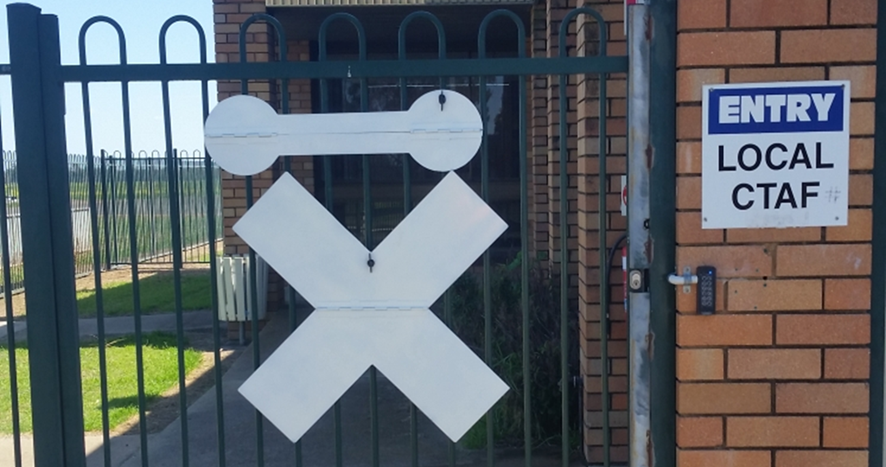
The Gunnedah Airport operator has added folding signs to all entry gates to the airfield, which will display any total unserviceability or restricted operations signals that are currently being displayed in the signals area adjacent to the primary windsock.
Additionally, the airport operator updated their contact details with CASA to ensure timely receipt of updates to requirements.
Safety message
An essential component of pre-flight planning is to check all NOTAMs relevant to the planned flight. This includes NOTAMs regarding all aviation facilities that a pilot plans to use.
To ensure receipt of correspondence that may affect safety of aircraft operations, aerodrome operators should ensure CASA is provided up to date contact details, particularly following changes to staff.
The investigation
Decisions regarding whether to conduct an investigation, and the scope of an investigation, are based on many factors, including the level of safety benefit likely to be obtained from an investigation. For this occurrence, a limited-scope investigation was conducted in order to produce a short investigation report, and allow for greater industry awareness of findings that affect safety and potential learning opportunities.
The occurrence
A privately operated Fairchild Industries SA226-T aircraft, registered VH-LDQ departed Bankstown aerodrome, New South Wales (NSW) on 19 August 2020 at 0720 Eastern Standard Time (EST)[1] for a private flight to Mudgee Airport, NSW.
The aircraft arrived in Mudgee at about 0900, before departing for Dubbo City Regional Airport, NSW, at about 1130. During this time, at 1047, a NOTAM[2] was published, closing Gunnedah airport, NSW, on the following day, 20 August, between 0700 and 1500 for emergency runway works.
The pilot departed Dubbo at about 1515 and arrived at Gunnedah Airport, at about 1550. As the aircraft was taxied to the parking bay, the pilot noticed a rough spot on the asphalt near the end of the runway. The aircraft was then parked for the night.
On 20 August, at about 1225, the pilot advised Brisbane Centre air traffic control that the aircraft was taxiing at Gunnedah for departure. On receiving the taxi call, the controller checked for any current notices to airmen (NOTAM) and found one current for the airport, stating that it was closed due to works in progress. The controller attempted to inform the pilot but was unable to establish contact.
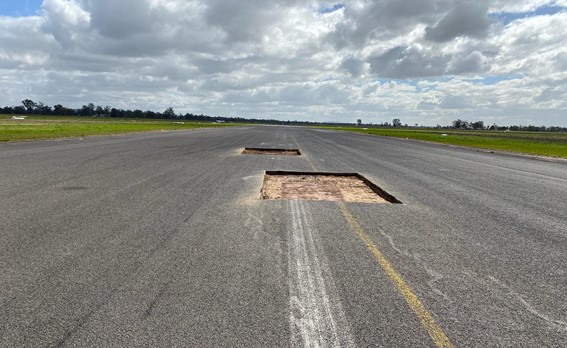
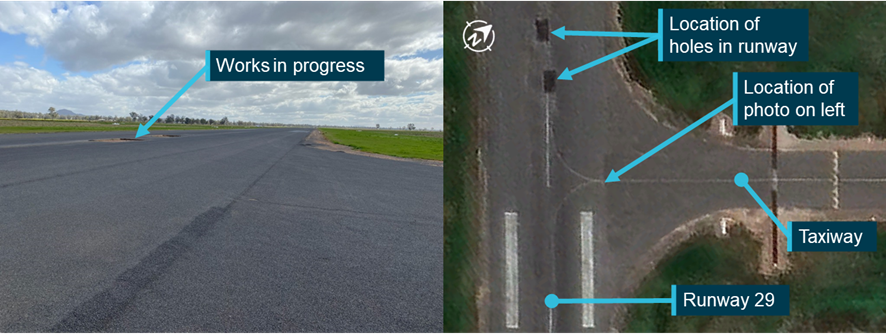
About 5 minutes later, the pilot commenced the take-off run on runway 29 after taxiing by the works in progress (Figure 3) to the threshold and turning around. The pilot reported seeing patches on the pavement in the distance. As the aircraft accelerated and progressed along the runway, it became apparent to the pilot that there were two holes excavated from the runway pavement (3 m wide by 5 m long), which were about 30 cm deep (Figure 1). The pilot attempted to avoid the holes but was unable to clear them with the aircraft’s left main landing gear.
Figure 1: Pavement work in progress on runway 29
Source: Airport operator
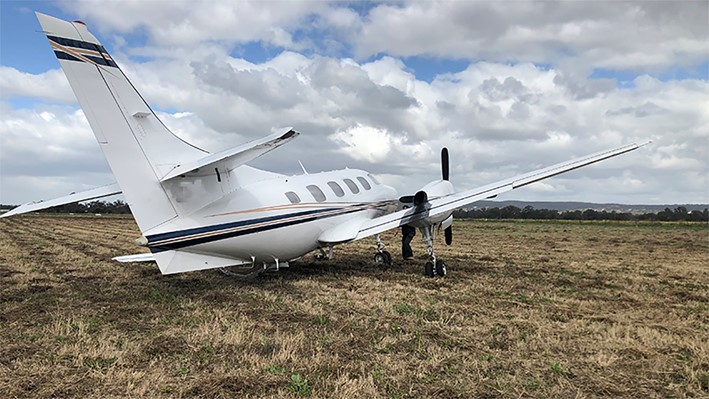
The aircraft sustained damage to the left main landing gear assembly that resulted in it collapsing and the left propeller striking the ground. The aircraft veered off the runway and came to rest outside the flight strip (Figure 2).
Figure 2: Aircraft’s position after the attempted take-off
Source: Airport operator
Context
Gunnedah airport
Gunnedah airport is a certified and non-controlled aerodrome located in northern NSW. It has one asphalt runway and one grass runway that intersect. It is primarily used by the Gunnedah aero club and Gunnedah Flight School. There were no regular public transport services.
Runway works
On 14 August 2020, following jet operations that had been conducted with a pavement concession,[3] the aerodrome reporting officer (ARO) at Gunnedah Airport identified some lifted pavement in the centre of runway 29. The damage was located about 215 m along the runway from the runway 29 threshold, 15 m past the taxiway intersection (Figure 3).
Figure 3: Location of holes on runway in relation to taxiway
Source: Google Earth and airport operator, annotated by the ATSB
On 19 August, the asphalt crew advised the ARO that they would be able to conduct runway repairs on the following day. The ARO reported contacting Airservices Australia by phone, who advised that the airport could be closed at short notice (within 24 hours) with a NOTAM in place if emergency works were required. Additionally, the ARO reported that they confirmed their interpretation of the Civil Aviation Safety Regulations’ Manual of Standards (MOS) for Aerodromes, that unserviceability markings would not be required if the aerodrome was closed. A NOTAM was published at 1047 stating that the aerodrome was not available due to works in progress between 0700 and 1500 EST on 20 August.
At about 1200, the works crew conducting pavement work left the aerodrome for lunch, returning to find the damaged aircraft. After the incident, the NOTAM closing the aerodrome was extended for an additional 24 hours and was cancelled at 1457 on 21 August, following completion of the works.
Aerodrome closures
The MOS required aerodrome operators to ensure that aerodrome works do not create a hazard to aircraft or cause confusion to pilots. If an aerodrome is used for scheduled air transport operations or has emergency services aircraft based at the aerodrome, a method of working plan is required for aerodrome works, unless the aerodrome is closed with 14 days’ notice, or the works are of an emergency nature.
Works are defined to be of an emergency nature if they are to repair unforeseen damage to part of the manoeuvring area, or to remove an obstacle.
Aerodrome unserviceability markings
As defined by the MOS, unserviceability markings are temporary markings used for temporary and permanent closures of runways or taxiways. They consist of white or yellow crosses of various sizes displayed on the surface of a closed or unserviceable area for airborne and taxiing aircraft. When used to mark a runway as unserviceable, the MOS requires a white cross at each end of the runway and at intervals of less than 300 m.
These unserviceability markings are not required on an unserviceable runway at an aerodrome not controlled by an air traffic control provider if all the following exist:
the runway unserviceability is of less than 24 hours duration
the total works period is less than 5 days
a NOTAM has been issued
a works safety officer is present with a vehicle equipped with a radio that allows for emergency 2-way communication with aircraft
if the aerodrome has been closed: a total unserviceability signal is displayed in the signal area (if it exists).
Unserviceability markers
As defined by the MOS, unserviceability markers are a 50 cm tall white cone with a 25 cm wide horizontal red stripe. These markers must be placed at the entrance to, and across, any part of the movement area of an aerodrome (including runways) that are not to be used by aircraft. Additionally, at least three must be displayed across the centreline of any portion of a taxiway, apron or holding bay that is unserviceable.
Aerodrome ground signals
The MOS current at the time of the occurrence, had provision for an optional ground signal area, where temporary ground signals for airborne aircraft can be displayed. The MOS noted that the area was ‘neither compulsory nor necessary because of the requirements for radio carriage and use at certified aerodromes, and the requirement for NOTAMs to be issued for the aerodrome in the event of changes in conditions.’
The aerodrome signal area must be black, 9 m in diameter and located near the primary wind direction indicator. It must have a 1 m-wide border or at least 5 spaced white markers. The markings that could be placed in the signals area included:
total unserviceability signal – consisting of a white cross; must be displayed when an aerodrome is closed to landing aircraft.
restricted operations signal – consisting of a white barbell; to indicate that aircraft are only to use sealed runways, taxiways, and aprons.
At the time of the occurrence, a total unserviceability signal was displayed in the signals area at Gunnedah airport.
Update to Manual of Standards (Aerodromes)
On 13 August 2020 (seven days before the incident), the Civil Aviation Safety Regulations Part 139 (Aerodromes) Manual of Standards (2019) came into force, replacing the previous 2014 MOS. This manual sets out the standards required of certified aerodromes.
A new section was added in Chapter 8 to articulate specific circumstances where unserviceability markings are not required, given that other visual aids or conditions are met. This included the addition of the requirement for a works safety officer with a vehicle and radio. The requirements for the use of unserviceability markers was expanded from situations where it was ‘possible for aircraft to bypass the area safely’, to require marking of all unserviceable movement areas.
Additionally, requirements for the notification and planning of aerodrome works and method of working plans were clarified and updated.
Communication of changes
The Civil Aviation Safety Authority (CASA) began engaging with certified aerodrome operators regarding upcoming changes to MOS 139 in April of 2020 by email and letter, with information provided on the CASA website. CASA sent this information to a mailing list that included an email address associated with Gunnedah Airport, for a person that was no longer working for the airport operator.
The Gunnedah Airport operator’s email system did not generate an ‘undeliverable’ bounce message for email addresses that have previously existed. CASA advised the ATSB that they rely on these bounced emails, or updates from aerodrome operators to ensure that information is received by a nominated person.
Flight Planning
Civil Aviation Regulation 239, required pilots to study all available information appropriate to the intended operation, including current weather reports and forecasts for the route and aerodromes, and the condition of aerodromes to be used.
Aerodrome condition information is typically communicated via a NOTAM. NOTAM and weather information can be obtained through the National Aeronautical Information Processing System Internet Service, a phone briefing, AVFAX or by radio.
The pilot had not checked NOTAM information for Gunnedah Airport before commencing take-off from runway 29.
Safety analysis
Communication of closure
The Gunnedah Airport operator had issued a NOTAM for the emergency runway works in accordance with requirements. The NOTAM issued stated that the aerodrome would be closed due to works in progress, was in place 20 hours prior to the closure and active at the time of the occurrence. Had the pilot checked the NOTAMs prior to flight, as required, they would have been alerted to the fact that the aerodrome was not available for use.
Evidence of works
As well as the active NOTAM at the time of the incident, Gunnedah airport had a total unserviceability signal displayed adjacent to the primary wind direction indicator, to warn pilots that the aerodrome was closed. However, this signal was not visible to a pilot on the manoeuvring surface and nor is it designed to be.
There were no other unserviceability markings or markers in use on this occasion. The Part 139 Manual of Standards (MOS) in force at the time required both, however the use of unserviceability markers on the runway would not have been required had a works safety officer been present. The aerodrome reporting officer was unaware of the introduction of the updated MOS and believed they had adhered to the correct standards. In addition, they interpreted the guidance received from Airservices as confirmation of their understanding of the requirements.
The use of unserviceability markers on the runway or a presence of the works safety officer together with the use of unserviceability markers would also have provided additional risk controls against the attempted take off from the closed runway.
Communication of changes to MOS
CASA relies on aerodrome operators ensuring that they have a valid, monitored email address registered for the distribution of timely updates on associated legislation and requirements. The registered contact for Gunnedah Airport had left the role and new contact details had not been provided to CASA, which mean that this mechanism for receiving updates was unavailable.
Findings
ATSB investigation report findings focus on safety factors (that is, events and conditions that increase risk). Safety factors include ‘contributing factors’ and ‘other factors that increased risk’ (that is, factors that did not meet the definition of a contributing factor for this occurrence but were still considered important to include in the report for the purpose of increasing awareness and enhancing safety). In addition, ‘other findings’ may be included to provide important information about topics other than safety factors.
These findings should not be read as apportioning blame or liability to any particular organisation or individual.
From the evidence available, the following findings are made with respect to the take-off from a closed runway at Gunnedah Airport, New South Wales, involving a Fairchild Industries SA226-T aircraft, registered VH-LDQ on 20 August 2020.
Contributing factors
The pilot had not checked NOTAMs, which advised of the aerodrome closure, and did not see evidence of works.
There was no works safety officer at the aerodrome, or ground visible unserviceability markers or markings on the runway, as required under the Manual of Standards for Aerodromes.
Aerodrome works staff were not aware of the new Manual of Standards requirements and interpreted the previous version to not require unserviceability markers or markings during an aerodrome closure.
Safety actions
Whether or not the ATSB identifies safety issues in the course of an investigation, relevant organisations may proactively initiate safety action in order to reduce their safety risk. The ATSB has been advised of the following proactive safety action in response to this occurrence.
Safety action by Gunnedah Airport operator
Gunnedah Airport operator has added folding signs to all entry gates to the airfield that will reflect any ground signals active in the signals area (Figure 4). They have also updated their contact details with CASA.
Figure 4: New signals signage at Gunnedah airport
Source: Airport operator
Sources and submissions
Sources of information
The sources of information during the investigation included:
Civil Aviation Safety Regulations Part 139 (Aerodromes) Manual of Standards 2019 (as amended 13 August 2020)
Civil Aviation Regulations 1988 (as amended 13 August 2020)
Submissions
Under section 26 of the Transport Safety Investigation Act 2003, the ATSB may provide a draft report, on a confidential basis, to any person whom the ATSB considers appropriate. That section allows a person receiving a draft report to make submissions to the ATSB about the draft report.
A draft of this report was provided to the following directly involved parties:
Gunnedah Airport operator
the Civil Aviation Safety Authority
Airservices Australia
the pilot
Submissions were received from:
the Civil Aviation Safety Authority
The submissions were reviewed and, where considered appropriate, the text of the report was amended accordingly.
Purpose of safety investigations
The objective of a safety investigation is to enhance transport safety. This is done through:
identifying safety issues and facilitating safety action to address those issues
providing information about occurrences and their associated safety factors to facilitate learning within the transport industry.
It is not a function of the ATSB to apportion blame or provide a means for determining liability. At the same time, an investigation report must include factual material of sufficient weight to support the analysis and findings. At all times the ATSB endeavours to balance the use of material that could imply adverse comment with the need to properly explain what happened, and why, in a fair and unbiased manner. The ATSB does not investigate for the purpose of taking administrative, regulatory or criminal action.
Terminology
An explanation of terminology used in ATSB investigation reports is available here. This includes terms such as occurrence, contributing factor, other factor that increased risk, and safety issue.
Publishing information
Released in accordance with section 25 of the Transport Safety Investigation Act 2003
Ownership of intellectual property rights in this publication
Unless otherwise noted, copyright (and any other intellectual property rights, if any) in this report publication is owned by the Commonwealth of Australia.
Creative Commons licence
With the exception of the Coat of Arms, ATSB logo, and photos and graphics in which a third party holds copyright, this publication is licensed under a Creative Commons Attribution 3.0 Australia licence.
Creative Commons Attribution 3.0 Australia Licence is a standard form licence agreement that allows you to copy, distribute, transmit and adapt this publication provided that you attribute the work.
The ATSB’s preference is that you attribute this publication (and any material sourced from it) using the following wording: Source: Australian Transport Safety Bureau
Copyright in material obtained from other agencies, private individuals or organisations, belongs to those agencies, individuals or organisations. Where you wish to use their material, you will need to contact them directly.
On 23 September 2020, the pilot of a Piper PA-28 aircraft, registered VH-TBB, was conducting a ferry flight from Moree to Scone, New South Wales. Shortly after take-off, the pilot began to feel unwell with a warm feeling in their chest, dizziness, breathlessness, some confusion and disorientation. The pilot then observed a localised discolouration on the disposable carbon monoxide (CO) chemical spot detector. As the pilot looked closer at the detector, they noticed the spot rapidly getting darker. The pilot immediately returned to the airport, reduced engine power and opened all the fresh air vents and the side window. The aircraft landed safely at Moree and the pilot was subsequently taken to hospital for medical examination.
What the ATSB found
The ATSB found that the positive indications on two separate disposable CO chemical spot detectors, both during the flight and prior to the post-incident inspection, indicated that the pilot was likely exposed to elevated levels of CO in the aircraft cabin. Despite the pilot’s carboxyhaemoglobin level being mildly elevated, it was likely that their physical symptoms and cognitive effects were associated with CO poisoning.
Safety message
Carbon monoxide is a colourless and odourless gas, and its presence may not be detected until the development of physical symptoms and cognitive effects. Therefore, operators and owners of piston-engine aircraft are strongly encouraged to install a CO detector with an active warning to alert pilots to the presence of elevated levels of CO in the cabin. Should any smell or sensation of illness develop, pilots should check their CO detector, ensure cabin heat has been turned off, open all fresh air vents and windows, make prompt decisions to land as soon as possible, and use all available resources for assistance. Further information on CO poisoning and detectors can be found at the following:
Decisions regarding whether to conduct an investigation, and the scope of an investigation, are based on many factors, including the level of safety benefit likely to be obtained from an investigation. For this occurrence, a limited-scope investigation was conducted in order to produce a short investigation report, and allow for greater industry awareness of findings that affect safety and potential learning opportunities.
The occurrence
On 23 September 2020, the pilot of a Piper PA-28 aircraft, registered VH-TBB, was conducting a ferry flight from Moree to Scone, New South Wales. At about 1418 Eastern Standard Time,[1] the pilot started the engine, carried out engine run-ups[2] and then taxied the aircraft to the runway for departure. The pilot reported the engine was running for about 10 minutes while on the ground in Moree, with the side window, fresh air vents open and the heater off. Prior to take-off, the pilot closed the window and vents.
Shortly after take-off, the pilot began to feel unwell, with a warm feeling in their chest, dizziness, breathlessness, some confusion and disorientation. The pilot then conducted a visual scan of the flight instruments and observed a localised discolouration on the disposable carbon monoxide (CO) chemical spot detector. As the pilot looked closer at the detector, they noticed the spot rapidly getting darker. The pilot immediately turned the aircraft back toward the airport, reduced engine power, and opened all the fresh air vents and the side window.
The aircraft was landed safely at Moree and the engine shut down at 1435. The pilot was subsequently taken to hospital for a medical examination. While receiving supplemental oxygen, the pilot was starting to feel better after about 2 hours.
Context
Medical information
General health and fitness
The pilot was well rested and felt fit to fly on the day of the incident. They had completed two flights in a different aircraft prior to the incident, one of which was from Tamworth to Moree. The pilot felt normal throughout those flights and only became unwell during the incident flight.
The pilot was a non-smoker, was not taking any medication, and had no pre-existing medical condition that could have contributed to the incident.
Carboxyhaemoglobin
A blood sample taken from the pilot about 1.5 hours after engine shut down, indicated a carboxyhaemoglobin (COHb) level of 1 per cent. The pilot was administered oxygen at the hospital, starting about 15 minutes before the blood sample was taken. In total they were on supplemental oxygen for about 5 hours, until their oxygen saturation levels were at 100 per cent.
Carbon monoxide is an odourless, colourless and tasteless gas formed by the incomplete combustion of carbon-containing materials. When inhaled, it preferentially binds to haemoglobin, the oxygen carrying molecule in red blood cells. This creates COHb compounds and prevents oxygen from binding to the molecule and being transported, resulting in oxygen starvation.
As previously discussed in ATSB investigations AO-2020-026 and AO-2017-118, normal endogenous levels of COHb are generally within the range of 0.4-0.7 per cent. However, smokers, and those living in an urban area, may have higher than average levels of 1-6 per cent (Baselt, 2014).
After the source of CO has been removed, COHb will reduce to half its initial value within 4‑5 hours at sea level. This can decrease to 80 minutes with the administration of pure oxygen. Taking into account the CO half-life, the elapsed time since the symptoms and effects were first detected, and the pilot’s brief time on oxygen prior to the blood test, the ATSB estimated that the pilot’s COHb levels were likely between 1.5 to 2 per cent.
Although individuals’ reactions can vary, the physical symptoms and cognitive effects of CO poisoning tend to worsen with an increasing level of COHb (Lacefield et al., 1982). Typically, COHb levels of 10-20 per cent can result in symptoms of breathlessness, while levels of 30-40 per cent can result in mental changes, dizziness and confusion (Knobeloch & Jackson, 1999; Lacefield et al., 1982). While physical symptoms do not generally show at levels below 10 per cent, researchers have found that a person’s ability to perform complex tasks can be adversely affected at levels of 10 per cent or less (Baselt, 2014). Hawkins (1993) also noted that the effects of CO can begin to show with the deterioration of psychomotor function at COHb levels of about 3 per cent.
Aircraft maintenance
Post-incident aircraft inspection
After the incident, and prior to any maintenance activity, engineers conducted ground runs and confirmed that CO was leaking into the cabin with a positive indication on a new, disposable CO chemical spot detector. The engineers then inspected the aircraft, focusing on the engine exhaust system and airframe. The inspection revealed 4-5 pinholes in the exhaust stack that were not covered properly and unserviceable scat (air duct) hoses. No breaches were found in the firewall or the aircraft belly, and the cabin heat valve was functioning correctly. The pinholes were repaired and the scat hoses were replaced. Ground runs were conducted after the repairs and the chemical spot detector showed no indication of CO in the cabin.
Most recent periodic inspection
The last periodic maintenance inspection was completed on 22 May 2020, about 4 months prior to the incident, where the exhaust system was visually inspected using a torch and mirror. The inspection of the exhaust system included the removal of the muffler shroud, security of the baffle cones and the cabin heat flexible hoses. The engineer reported that, exhaust stains on the engine and/or cowling can indicate the existence of an exhaust leak, which was something they looked for during inspections. However, in this case, there were no exhaust system defects recorded in the maintenance documentation.
The owner, who operated the aircraft a few days prior to the incident, reported never having observed a positive indication on the CO detector, nor had they felt unwell during or after a flight. However, they would sometimes smell exhaust fumes when they turned the heater on. The owner advised that they typically never left it on for very long, as CO was always in the back of their mind.
A study conducted by the United States Federal Aviation Administration (2009) noted that a small crack or imperfection can be difficult to see during a visual inspection, which is further impeded by densely packed engine compartments. Further, defects can form after the inspection from erosion and internal fatigue.
Carbon monoxide detector
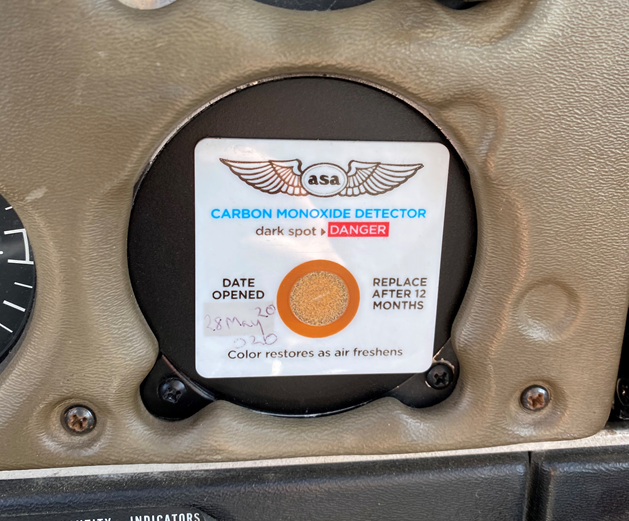
The aircraft was fitted with an Aviation Supplies and Academics disposable CO chemical spot detector, attached to the instrument panel (Figure 1). The detector was only 4 months old, which was within the manufacturer’s 12-month replacement period. It consisted of an orange‑coloured circle (spot) in the middle of the card, which was designed to change colour to grey/black following a chemical reaction with CO in the immediate vicinity. The spot then returns to normal (orange) after it has been exposed to fresh air. The chemical reaction depends on the concentration of CO in the air and the time of exposure. This detector was designed to react to a minimum of 50 parts per million (ppm) of CO within 30 minutes, 100 ppm within 10 minutes and 200 ppm within 4 minutes.
The ATSB’s investigation and corresponding safety advisory notice for AO-2017-118, highlighted the limitations of these types of detectors. Although commonly used in general aviation, they are a passive device that rely on the pilot regularly monitoring the changing colour of the detector throughout the flight. Further, identifying a positive indication is also dependent on the detector being easily visible and accessible, in a well-lit position particularly when operating in a low ambient light environment.
Figure 1: Slightly discoloured carbon monoxide detector, after engine shutdown and the detector being exposed to fresh air
On 31 December 2017, the pilot and five passengers of a de Havilland Canada DHC-2 floatplane, registered VH-NOO, were fatally injured when the aircraft collided with water in Jerusalem Bay, New South Wales. The occupant’s toxicology results identified that they had higher than normal levels of COHb in their blood. This was almost certainly due to elevated levels of CO in the aircraft cabin. The ATSB’s wreckage examination established that several pre-existing cracks in the exhaust collector ring very likely released exhaust gas into the engine/accessory bay. This then very likely entered the cabin through holes in the main firewall where three bolts were missing from the magneto access panels.
On 22 December 2019, the crew of a Cessna 172R aircraft, registered VH-YXZ, were conducting aerial shark patrols. About 2 hours into the second flight of the day, the crew started to experience symptoms typically associated with CO poisoning, and subsequently observed a localised discolouration on the disposable CO chemical spot detector. Soon after, the aircraft was landed safely and the three crew were taken to hospital for assessment. While blood tests confirmed all crew had mildly elevated COHb levels, their physical symptoms and cognitive effects likely resulted from exposure to elevated CO levels in the aircraft cabin. The CO source within the aircraft could not be established. Further, the discrepancy between the low COHb levels and severity of experienced effects could not be resolved.
National Transportation Safety Board investigation (CEN17LA101)
On 2 February 2017, shortly after take-off, the pilot of a Mooney M20C aircraft became incapacitated. The aircraft continued flying until running out of fuel and then collided with terrain, but the pilot survived. The pilot’s COHb level, taken 4.5 hours after the accident, was 13.8 per cent. However, given the half‑life of CO, the pilot’s level would have been at least 28 per cent at the time of the accident. A post-accident inspection of the aircraft identified several cracks in the exhaust muffler. In response to the experience, the pilot stated that:
Current technology has made portable CO detection very accurate and inexpensive. A high resolution detector would have not only prevented this accident flight, but may have alerted me to a compromise in my exhaust system many flight hours before the incident.
Safety analysis
Elevated levels of carbon monoxide
The post-incident aircraft ground runs produced elevated levels of carbon monoxide (CO) in the aircraft cabin, which was resolved once repairs to the exhaust stack and the scat hoses were complete. This indicated that the source of the CO was associated with the items repaired. No obvious breaches were identified that would have allowed CO to enter the cabin and therefore, it was not immediately clear how the exhaust gasses entered the cockpit on this occasion.
However, the observed physical symptoms and cognitive effects reported by the pilot were more likely associated with CO poisoning. This was further supported by the positive indications on the CO chemical spot detector and the blood test indicating a mildly elevated level of carboxyhaemoglobin (COHb). While the extent of the pilot’s symptoms for the recorded COHb level were inconsistent with the literature, research has shown that adverse effects on cognitive functions can occur at levels as low as 3 per cent and that individuals can react differently to COHb.
Findings
ATSB investigation report findings focus on safety factors (that is, events and conditions that increase risk). Safety factors include ‘contributing factors’ and ‘other factors that increased risk’ (that is, factors that did not meet the definition of a contributing factor for this occurrence but were still considered important to include in the report for the purpose of increasing awareness and enhancing safety). In addition ‘other findings’ may be included to provide important information about topics other than safety factors.
These findings should not be read as apportioning blame or liability to any particular organisation or individual.
From the evidence available, the following findings are made with respect to the partial pilot incapacitation involving a Piper PA-28, registered VH-TBB that occurred 19 km south-east of Moree Airport, New South Wales, on 23 September 2020.
Contributing factors
An exhaust leak likely exposed the pilot to elevated levels of carbon monoxide in the aircraft cabin, resulting in mild incapacitation.
Sources and submissions
Sources of information
The sources of information during the investigation included the:
pilot
aircraft owner
repairer for VH-TBB
maintenance organisation for VH-TBB.
References
Baselt, R.C. (2014). Disposition of Toxic Drugs and Chemicals in Man (10th ed.). Seal Beach: Biomedical Publications.
Hawkins, F. H. (1993). Human Factors in Flight (2nd ed.). Aldershot, England: Ashgate Publishing.
Hossein Cheraghi, S., Jorgensen, J., & Myose, R.Y. (2009). Detection and prevention of carbon monoxide exposure in general aviation aircraft (DOT/FAA/AR-09/49). Retrieved from Federal Aviation Administration website: http://www.tc.faa.gov/its/worldpac/techrpt/ar0949.pdf
Lacefield, D. J., Roberts, P. A., & Grape, P. M. (1982). Carbon monoxide in-flight incapacitation: An occasional toxic problem in aviation (FAA-AM-82-15). Oklahoma City, Oklahoma: Federal Aviation Administration.
Submissions
Under section 26 of the Transport Safety Investigation Act 2003, the ATSB may provide a draft report, on a confidential basis, to any person whom the ATSB considers appropriate. That section allows a person receiving a draft report to make submissions to the ATSB about the draft report.
A draft of this report was provided to the following directly involved parties:
pilot
aircraft owner
repairer for VH-TBB
maintenance organisation for VH-TBB.
A submission was received from the pilot. The submission was reviewed and, where considered appropriate, the text of the report was amended accordingly.
Purpose of safety investigations
The objective of a safety investigation is to enhance transport safety. This is done through:
identifying safety issues and facilitating safety action to address those issues
providing information about occurrences and their associated safety factors to facilitate learning within the transport industry.
It is not a function of the ATSB to apportion blame or provide a means for determining liability. At the same time, an investigation report must include factual material of sufficient weight to support the analysis and findings. At all times the ATSB endeavours to balance the use of material that could imply adverse comment with the need to properly explain what happened, and why, in a fair and unbiased manner. The ATSB does not investigate for the purpose of taking administrative, regulatory or criminal action.
Terminology
An explanation of terminology used in ATSB investigation reports is available here. This includes terms such as occurrence, contributing factor, other factor that increased risk, and safety issue.
Publishing information
Released in accordance with section 25 of the Transport Safety Investigation Act 2003
Ownership of intellectual property rights in this publication
Unless otherwise noted, copyright (and any other intellectual property rights, if any) in this report publication is owned by the Commonwealth of Australia.
Creative Commons licence
With the exception of the Coat of Arms, ATSB logo, and photos and graphics in which a third party holds copyright, this publication is licensed under a Creative Commons Attribution 3.0 Australia licence.
Creative Commons Attribution 3.0 Australia Licence is a standard form licence agreement that allows you to copy, distribute, transmit and adapt this publication provided that you attribute the work.
The ATSB’s preference is that you attribute this publication (and any material sourced from it) using the following wording: Source: Australian Transport Safety Bureau
Copyright in material obtained from other agencies, private individuals or organisations, belongs to those agencies, individuals or organisations. Where you wish to use their material, you will need to contact them directly.
1. At approximately 1303 hours Eastern Standard Time on 22nd September 1966 Viscount 832 Type aircraft VH-RMI operated by Ansett Transport Industries (Operations) Pty. Ltd. (trading as Ansett-A.N.A.) experienced a structural failure in flight and struck the ground about 13½ miles on a bearing of 260° magnetic from Winton Aerodrome in the State of Queensland.
2. The aircraft was totally destroyed.
3. At the time of the accident the aircraft was engaged on a regular public transport service from Mt. Isa to Brisbane via Longreach. The service was authorised by an Airline Licence issued to the operator and the flight was designated as Flight 149.
4. The aircraft carried a crew of four and twenty passengers, all of whom were lost as a result of the accident.
5. At the time of the accident the aircraft was proceeding to make an emergency landing at Winton Aerodrome following an emergency descent en route.
6. The forecast weather conditions and the weather conditions actually existing at the time of the flight were not such as to suggest any unusual or hazardous circumstances and had no bearing on the accident.
7. The aircraft departed from Mt. Isa at 1208 hours Eastern Standard Time.
8. The aircraft was loaded within permissible limits and there is no evidence to suggest that anything relating to the load contributed to the accident.
9. After leaving Mt. Isa the aircraft climbed to its cruising height of approximately 17,500 feet and proceeded at that level with the automatic pilot engaged until about 1247 hours.
10. At about 1247 hours the automatic pilot was disengaged prematurely and this was followed shortly after by a descent described in a message from the aircraft as an emergency descent.
11. Messages from the aircraft show that the emergency was indicated by a fire warning being received in the flight compartment.
12. At 1257 hours the crew reported they had a visible fire in No. 2 engine and that they were tracking to Winton.
13. Appropriate action was taken to prepare the aircraft and passengers for an emergency landing.
14. The crew, both pilots and hostesses, were adequately and properly trained and competent to operate VH-RMI on the 22nd September, 1966.
15. Both pilots held appropriate licences and ratings pertinent to the flight and had met the required medical standards.
16. There is no evidence to suggest that on the day of the flight the pilots were not medically fit to undertake their respective duties.
17. The flight plan was correctly and properly prepared and the quantity of fuel carried was more than adequate for the flight.
18. There is no evidence that the flight crew was aware of any unserviceability of the aircraft or any of its components prior to take-off.
19. The evidence supports a conclusion that [the Captain's] decision to divert to Winton rather than continue the flight to Longreach was an appropriate one and that he acted properly in following this course rather than electing to make a forced landing.
20. The crash of the aircraft followed the failure in an upward direction of the port wing between No. 1 and No. 2 engines at approximately 1302½ hours Eastern Standard Time when the aircraft was at a height of 3,500 feet to 4,000 feet above ground level.
21. The port wing failed as a result of a weakening of the main spar due to a fire in No. 2 cell of No. 2 fuel tank.
22. The fire originated in the No. 2 cabin blower and travelled through the rear of No. 2 engine nacelle and port wheel bay to the fuel tank.
23. The fire in No. 2 cabin blower was initiated as a result of a rotor break-up, the blower subsequently being driven in an out-of-balance condition by the quill shaft long enough for the metering unit to become separated from the rear end cover by the resulting vibration.
24. The metering unit continued to be driven after separation and lubricating oil continued to be supplied. The driven rotor lost its rear stub shaft location and caused metal-to-metal contact which generated a temperature sufficiently high to ignite the oil in that area.
25. It is not possible on the evidence to determine what was the cause of the rotor break-up.
26. The rotor break-up was not due to incorrect assembly of the extractor seal shell and the ball bearing and its housing at the last overhaul by Ansett-A.N.A ..
On 29 September 2020, the crew of a Eurocopter AS365 ‘Dauphin’ helicopter, registered VH‑WPX and operated by the Western Australia Police Air Wing, were conducting water winching training exercises near Swanbourne, Western Australia. While conducting winching to a small vessel, a rescue crewman attached to the aircraft winch cable was pulled overboard and dragged through the water. The rescue crewman was recovered a short time later without injury and the helicopter was undamaged.
What the ATSB found
The ATSB found that the winching recovery sequence was interrupted when the rescue crewman lost footing on the deck of the vessel. The interruption, although communicated by the winch operator, was not recognised by the pilot, who expected the usual sequence to continue as had previously occurred on numerous occasions. As a result, the pilot instinctively increased the distance between the helicopter and vessel, and the rescue crewman was dragged overboard by the winch cable.
Further investigation found that crewman overboard drills were not regularly briefed or practiced, contributing to a breakdown in communication. This reduced the crew’s preparedness to respond effectively to such an event.
Finally, and though not a factor contributing directly to this event, the ATSB found that changes to sea state limitations contained within the Western Australia Police Air Wing Rotary Wing Operations Manual, were approved without the required review by the operator’s Safety Action Group. The absence of that review reduced the opportunity to identify any increased risk associated with the change.
What has been done as a result
Following an internal safety review, the Western Australia Police Air Wing amended training and pre-flight briefings to include a crewman overboard scenario, and implemented crewman overboard drills during winch simulation training.
Furthermore, the Police Air Wing has introduced an alternative approach to open water vessel winching, that eliminates the risk while still maintaining the same level of rescue capability to the community.
With respect to easing of sea state limitations, the Police Air Wing has reinforced the importance of following change management principles and formal reviews to mitigate future foreseeable risks.
Safety message
Effective communication between pilots and crewmen is critical when undertaking helicopter winching as the pilot is required to safely manoeuvre the aircraft while unable to visually monitor the progress of the activity.
This incident demonstrates that even during highly trained and well-rehearsed operations, human performance limitations such as expectancy and reduced attention associated with a familiar task, together with deviations from standard phraseology, can have undesired outcomes.
The occurrence
Overview
On 29 September 2020, the crew of a Eurocopter AS365 ‘Dauphin’ helicopter, registered VH‑WPX and operated by the Western Australian Police Air Wing, were conducting water winching training exercises to a vessel in waters off the Perth coastal suburb of Swanbourne, Western Australia. During the training, a rescue crewman was pulled overboard while attached to the aircraft winch and dragged through the water. The rescue crewman was recovered a short time later without injury and the helicopter was undamaged.
Pre-incident flights
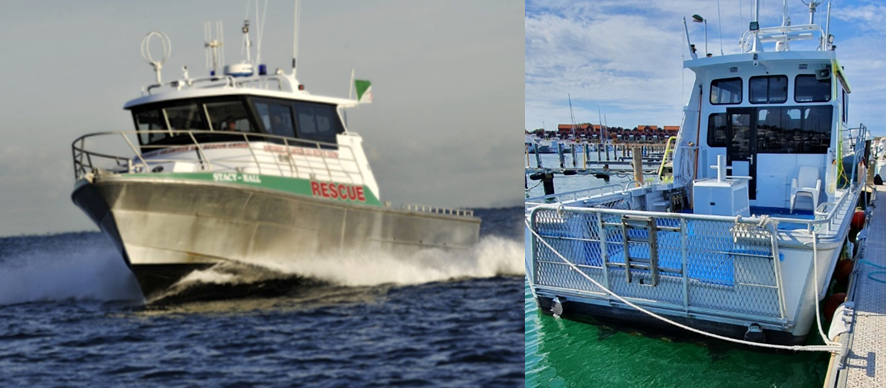
The crew for the training exercises comprised the pilot, four tactical flight officers (TFOs) and one TFO instructor. The day’s training involved the TFOs rotating through the positions of winch operator, rescue crewman and diver. The plan was to conduct an initial vessel winching operator proficiency check for one of the TFOs, as well as recency flights for two of the other crewmembers. The training was conducted with a volunteer marine rescue vessel, Stacy Hall.
The crew commenced duty at 0700 Western Standard Time[1] at the operator’s base at Jandakot, before completing the daily briefing and pre-flight preparation. Data from the onboard GPS unit showed VH-WPX departed Jandakot at 0933 and travelled to the designated training staging area at Rous Head, Fremantle, landing at about 0950.
At 0953, VH-WPX departed for the first training sortie, which was a familiarisation exercise for a novice winch operator in preparation for the planned initial winch training. This exercise was conducted close to shore at a nearby beach.
At 1032, VH-WPX took off on the second training sortie and travelled about 17 km from Rous Head to rendezvous with Stacy Hall, about 1 km offshore from Scarborough. The wind was north-westerly with a westerly swell, and the vessel tracked north through the water to provide a headwind component for VH-WPX.
During the second sortie, the crew onboard the helicopter remarked that the conditions were windy and observed the Stacy Hall was moving around significantly in the water. In response, the TFO instructor requested that the crew of Stacy Hall establish a speed of 10 kt, in order to make a flatter path through the waves. On the advice of the pilot, the vessel’s course was also altered to 330°, to make a more oblique approach to the swell.
The TFO Instructor conducted a demonstration winch cycle then requested the crew of Stacy Hall increase speed to 12 kt to further assess conditions for initial winch training. At the conclusion of the alterations to the vessel’s speed and course, the TFO instructor proposed cancelling the planned initial winch training, because the conditions were perceived as rougher than it looked. The pilot asked whether the remaining qualified crew could undertake the training and the TFO instructor agreed that was possible, but a group discussion/assessment should be conducted first. Consequently, the helicopter returned to Rous Head.
After landing about 1054, the crew discussed the conditions and whether they should continue training with the qualified crew who required operator proficiency checks and recency training. A joint decision was made to assess the sea state from the air and with the vessel underway. While the helicopter was on the ground at Rous Head, the wind had backed to a more westerly direction, and it was agreed that may have created more suitable conditions for continuation of the training with the experienced crew.
At 1131, VH-WPX departed for the third training sortie. The crew contacted the crew of the Stacy Hall en route and requested they alter course to 300° and maintain a speed of 10 kt. During a dummy run to the vessel the winch operator observed that the Stacy Hall was bouncing in the waves, so the crew requested further course and speed changes.
With the Stacy Hall maintaining 12 kt at 320°, the crew conducted the next phase of the training, which was a winch to the vessel with the rescue crewman remaining attached to the winch hook. The exercise progressed to completion, though as the rescue crewman was winched clear of the deck, they swung towards the canopy on the forward end of the deck and required the use of their arms to fend off. The rescue crewman was then safely winched into the helicopter, with the winch operator commenting to the crew that the sequence ‘…was pretty hairy’.
The crew then conducted the third and fourth phases of the training, which were a vessel winching involving the rescue crewman disconnecting from the winch hook and then a helocast and water winch recovery exercise.[2] There were no issues encountered in either exercise, after which the helicopter returned to Rous Head.
The incident flight
At 1203, the helicopter landed at Rous Head and the TFOs rotated roles. For the incident flight, the operational crew consisted of the pilot, the TFO instructor observing the exercise, and three TFOs, one observing and two undertaking the respective roles of winch operator and rescue crewman.
At 1210, VH-WPX took off to rendezvous with the Stacy Hall, which was located about 8 km north of the Rous Head landing area and between 1 and 2 km offshore, west of Swanbourne. After take-off, the crew completed fly‑away checks, pre-landing checks, pilot brief and winch checks. The pilot brief confirmed the crew would undertake two winches onto the vessel, and the vessel would be travelling on a course of 300° at a speed of 12 kt.
The helicopter approached the Stacy Hall and the pilot established the helicopter at the datum position.[3]The crew then conducted a dummy approach run, during which the pilot reported having a good visual hover reference of the vessel. At the completion of the dummy run, the pilot terminated the helicopter at the on-station position.[4]
Onboard winch video recordings showed that at about 1215, the helicopter had moved from the on‑station position to the transfer position[5] and the winch operator commenced lowering the rescue crewman to the deck of the vessel. At 1216, the rescue crewman landed on the aft deck of the rescue vessel and completed simulated checks. Within 2 seconds of landing on the deck, the rescue crewman gave the thumbs-up signal to indicate they were positioned, had completed checks and were ready to be winched up.
The winch operator acknowledged that the rescue crewman had signalled they were clear to be recovered and reported to the pilot ‘one thumb up’ and ‘taking up the slack’. The winch operator then winched in slack in the cable and reported that he and the rescue crewman were ‘ready to winch’. The pilot gave clearance to winch and the winch operator commenced winching.
At the same, the vessel’s interaction with the swell resulted in its deck pitching higher as it travelled over a wave. As a result, the rescue crewman lost their footing and moved down and backwards onto their back as the vessel’s aft deck rose on the swell. The winch operator reported ‘crewman has fallen’ and immediately payed out cable to prevent it from becoming taut.
As the winch operator reported the rescue crewman was ‘adjusting his feet’, the pilot moved the aircraft back and left, increasing separation between the aircraft and the vessel. In response to that movement, the winch operator advised the pilot to move the helicopter ‘forward two’ (see the section titled Winching procedures), then with increased urgency in his tone ‘forward two, forward two’.
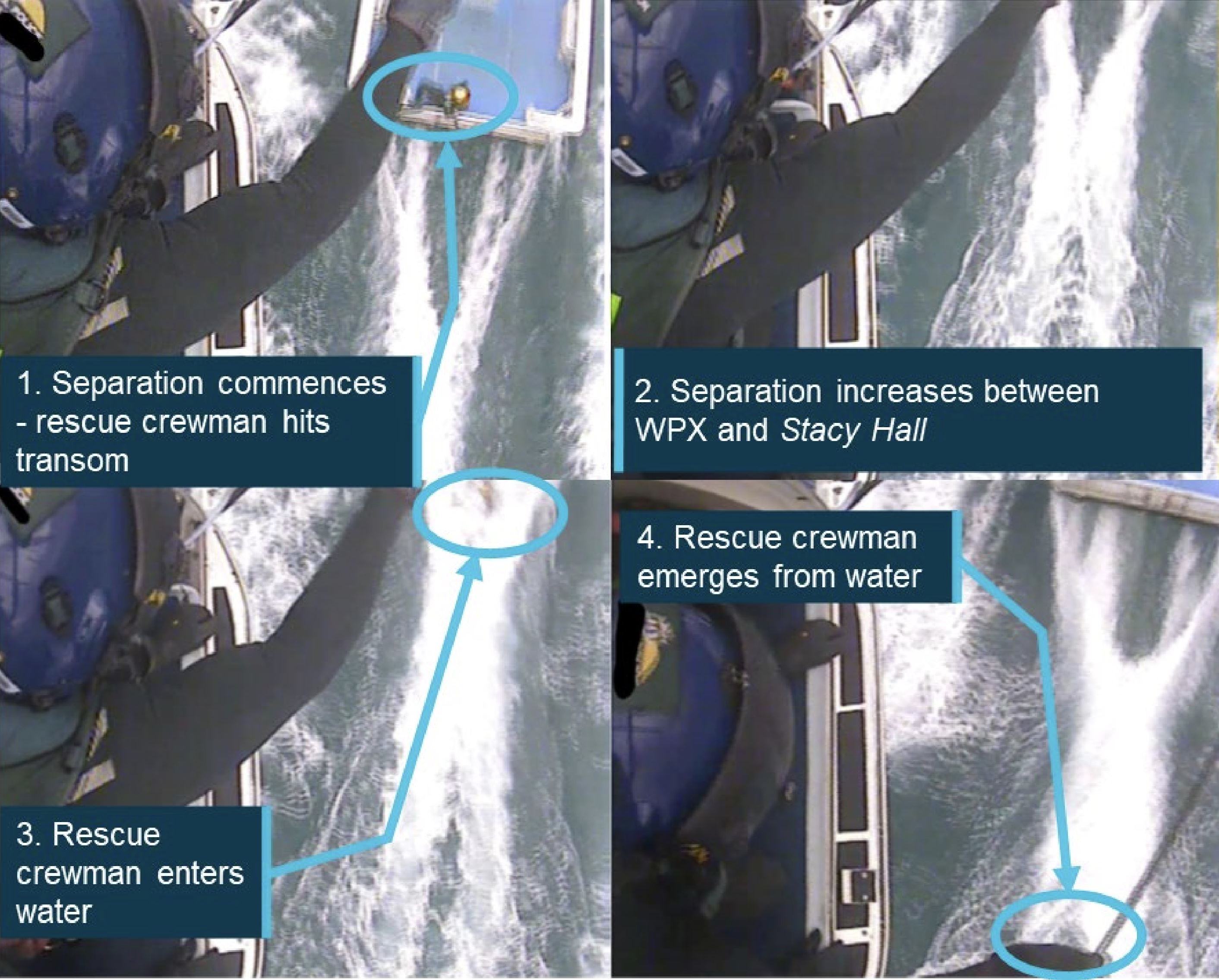
Despite those instructions from the winch operator, the separation between the helicopter and vessel increased. As a result, the winch cable became taut and the rescue crewman was dragged aft along the deck, into the transom and overboard into the water (Figure 1). The following then occurred in quick succession:
The winch operator instructed the pilot ‘back, hold, hold, hold, hold’ with increasing urgency.
The pilot responded, ‘I am holding’.
The aircraft ceased moving away from the vessel and started moving forward as the pilot attempted to maintain position in vicinity of the vessel’s aft deck. The forward movement of the helicopter caused the rescue crewman to be dragged forward through the water towards the vessel.
The winch operator commenced winching in, and the onboard video showed the rescue crewman emerge from the water.
The pilot asked, ‘where is he?’, with the winch operator responding, ‘he’s just here underneath me’.
About 6 seconds elapsed between the crewman falling from the vessel, and emerging clear of the water. Due to the forward momentum of the helicopter, there was a slight swing to the cable as the rescue crewman left the water, which the winch operator controlled by hand. The rescue crewman was then winched into the helicopter, and once inside, confirmed they were uninjured.
The pilot, winch operator and TFO instructor then discussed whether the training should continue. They decided to conduct another dummy run and briefly discussed their observations regarding the incident. The review of the incident did not include discussion of the helicopter movement. However, the TFO instructor provided feedback that in the event of a crewmember falling from the vessel, the correct response was for the winch operator to call ‘crewman overboard’ and ‘hold’.
About 1218 the crew conducted another dummy run, then decided to continue with the original planned training exercises. The crew conducted two further planned vessel winching evolutions followed by a helocast and water winch recovery. Having completed the training sorties, the aircraft returned to Jandakot, landing at 1243.
Figure 1: Rescue crewman overboard
A series of still images captured from on-board video highlighting the commencement of separation and rescue crewman going overboard.
Source: Western Australia Police Force annotated by the ATSB
The Bureau of Meteorology (BoM) forecast for 29 September 2020 was for winds west to north‑westerly at 10 kt, increasing to 10 to 15 kt during the morning and reaching westerly 15 to 20 kt in the afternoon.
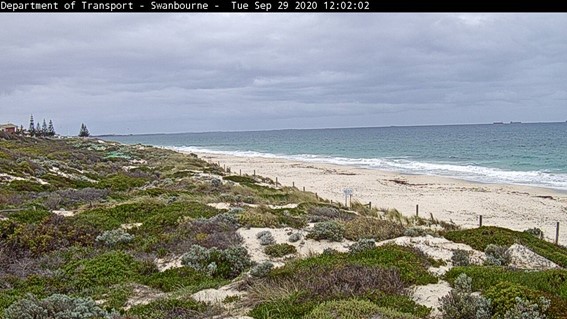
The weather at the time of the incident was overcast with clear visibility (Figure 2). The temperature was about 19°C with wind from the north‑west at 21 km/h (11 kt) gusting to 30 km/h (16 kt).
Sea state
Seas were forecast to be below 1 m, increasing 1 to 1.5 m during the morning with a west to south-westerly swell 1 m to 1.5 m increasing to 1.5 m to 2 m.
Recorded wave data indicated a combined wave height of 0.89 m consisting of a swell height of 0.37 m from 228° (south‑west) and sea 6eight 0.81 m from 264° (west).[1]
Figure 2: Western Australia Department of Transport Swanbourne Beach camera
Source: Western Australia Department of Transport
Flight crew information
The flight crew for the day’s training comprised the pilot, four tactical flight officers (TFOs) and a TFO instructor. Two TFOs drove a vehicle towing a refuelling trailer to the Rous Head staging area while the remainder flew in VH-WPX. The TFOs rotated through roles on the aircraft according to the training, proficiency and recency requirements of each individual.
While the TFO instructor was onboard observing at the time, only the following crew were directly involved and relevant to the incident.
The pilot
The pilot joined the Australian Army as a Blackhawk pilot in 2008 and commenced with the Western Australia (WA) Police Air Wing as a helicopter line pilot in September 2019. At the time of the incident the pilot had accumulated 3,566 flight hours, including 497 hours of helicopter winching - 53 hours of which were water winching. About 320 of their flight hours had been accumulated on VH-WPX.
The winch operator
The winch operator had been with the WA Police Force for almost 20 years and at the Air Wing for just over 10 years, commencing as a TFO in June 2010. At the time of the incident the winch operator had accumulated 1,596 crewman flight hours including 560 winch operator hours. Within this time, the crewman had filled the role of winch operator for 110 cycles of water winching. The winch operator qualified as a TFO instructor in September 2017 but was not performing that role at the time of the incident.
The rescue crewman
The rescue crewman had been with the WA Police Force since 2011, before commencing as an aeroplane TFO in June 2017. After about 12 months in that role, the rescue crewman moved into helicopter operations and had accumulated 864 crewman flight hours. This included 74 cycles filling the role of rescue crewman.
Aircraft information
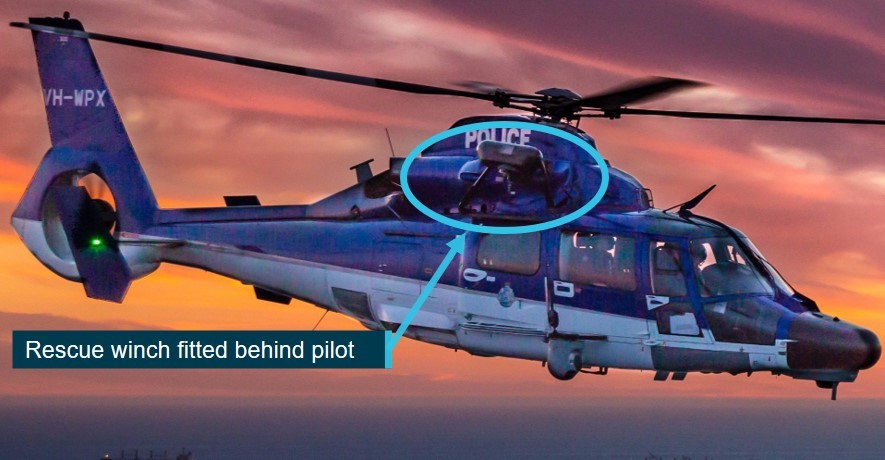
VH‑WPX is a Eurocopter (subsequently Airbus Helicopters) AS365N3+ Dauphin 2 helicopter, configured for single‑pilot operation and equipped with a rescue winch fitted behind the pilot on the right side (Figure 3). It was manufactured in 2011 and operated by the Western Australia Police Air Wing. At the time of the incident, the aircraft had accumulated a total of 4,237 flight hours and 5,671 landings.
After the incident, aircrew viewed onboard winch boom video imagery and identified potential cable shock loading during the recovery of the rescue crewman. WA Police Technical Log records showed that on 1 October 2021, a full cable inspection was conducted in accordance with the Goodrich Rescue Hoist Component Maintenance Manual, with no defects identified.
Figure 3: VH-WPX rescue winch
Source: Western Australia Police Force annotated by the ATSB
Vessel information
The Stacy Hall, callsign ‘Green 1’, is a 12 m aluminium vessel manufactured by Legend Boats (Figure 4). It was powered by twin 450 hp Caterpillar diesel motors capable of sustained operations for up to 24 hours. The vessel was fitted with integrated chart-plotter, sounder and radar, 27MHz, VHF and HF marine radios, radio direction finders and a FLIR infrared camera.
The Stacy Hall had about a 4 m beam with open aft deck, towing post on the fore-aft centreline and folding transom. The vessel was considered to have a large enough aft deck for water winching operations and was regularly utilised when WA Police Force vessels were unavailable.
The WA Police Air Wing Rotary Wing Operations Manual contained six volumes encompassing administration, aircraft operations, training and checking, airworthiness and special operations. Volume 4 provided guidance and requirements for all training and checking whilst volume 6 provided the guidance and instructions for special operations. Volume 6B1 Winching Operations, was accepted by the Civil Aviation Safety Authority in April 2020. The volume detailed aircraft winching training, equipment requirements, guidance, and standard operating procedures.
Planning
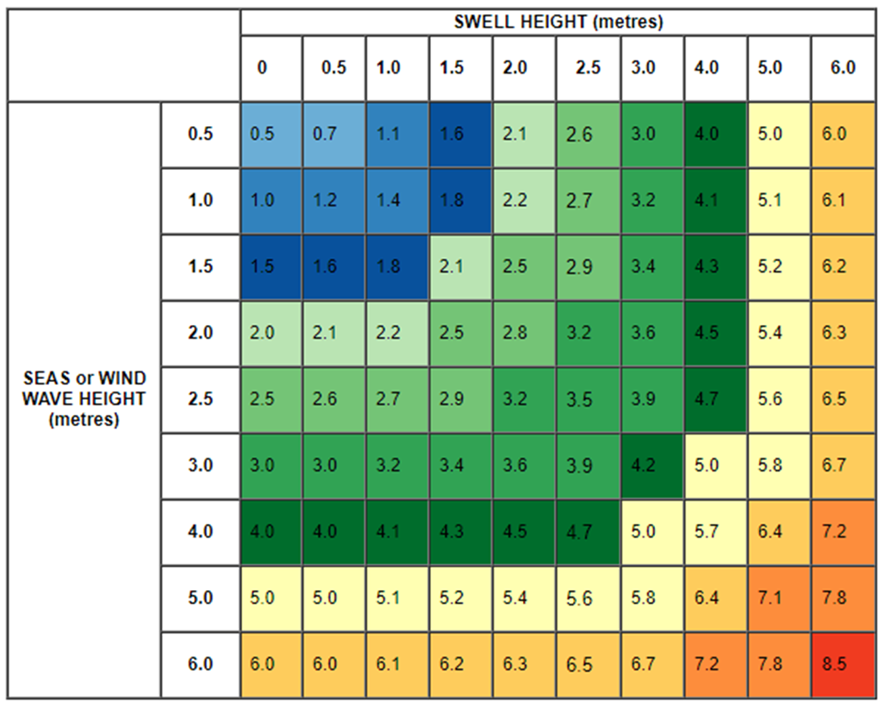
Pre-flight planning was conducted in accordance with the Rotary Wing Operations Manual and utilised the Bureau of Meteorology (BoM) combined sea state lookup table (Table 1). BoM sea state tables provide a projected combined sea state based on the forecast sea and swell height.
Table 1: Bureau of Meteorology total wave height lookup table
Source: Bureau of Meteorology
Volume 6, Winching Operations, section 6B1.55.6 Winching to Vessels – Training stated that:
All training that requires live vessel transfers will only be done:
- In calm to slight sea conditions not exceeding a sea of 1.0m or swell of 1.0m and a combined sea state of 1.4 m (see BOM sea state lookup table on the Bureau of Meteorology website). If conditions are greater than above, then consideration should be given to conducting operations in protected waterways where calm to slight conditions prevail.
- To appropriately sized vessels when underway: an appropriately sized vessel is one where the pilot can be confident of easily maintaining an uninterrupted hover reference from the most overhead winching position, noting that as a minimum there must be at least 10 feet of clearance above the highest obstruction within the immediate aircraft operating area on the vessel.
- To vessels where the winch transfer area is free of obstructions likely to foul the cable or endanger any person during the winching exercises.
- For vessels underway it is acceptable to conduct the transfer to a soft dinghy or raft being towed behind the vessel. The pilots hover reference then can be the vessel towing the soft dinghy or raft.
On 22 September 2020, Operations Manual Bulletin No’ 7-2020, noted that live vessel training sea state conditions were very restrictive for training with fully qualified crews. As a result, the operator’s head of flight operations (HOFO) approved a change to sea state limitations for training of fully qualified crew. The approval increased the nominal conditions for water winch training and live vessel transfer to:
- Seas 2.5 m or less
- Swell 2.5 m or less
- Combined sea and swell 2.5 m or less.
According to Volume 1, Administration, Policy and Procedures, section 1A2.1.1 of the Western Australia Police Air Wing Rotary Wing Operations Manual, the head of flight operations or their delegates, were the only persons who could authorise revisions to the Rotary Wing Operations Manual after such changes have been formally reviewed by the Safety Action Group. On this occasion, no such review by the Safety Action Group was undertaken.
For the training undertaken on 29 September 2020, planning considered information issued by BoM for that day, forecasting a sea height of 1.5 m and a swell height of 1.5 m, resulting in a combined forecasted wave height of 2.1 m (obtained from Table 1). Consequently, training for a fully qualified crew was approved under the operator’s updated procedures.
Winching procedures
The primary source of helicopter winching procedures was volume 6, part 6B1 of the WA Police Air Wing Operations Manual. The procedures for vessel winching included that the helicopter crew were to approach the vessel and conduct an assessment from a reference datum, prior to the transfer of the con[7] to the winch operator. The procedures were then for the winch operator to con the helicopter pilot to the final winch position, before winching the rescue crewman onto the deck of the vessel.
During the conning phase of winch operations, the winch operator issues commands to the helicopter pilot to manoeuvre the helicopter into position, while maintaining clearance from hazards. Conning commands include a numerical indication of the distance to run to the target location, line corrections, rate of closure and rate of descent. While the winch operator has the con, the pilot is generally expected to only manoeuvre the helicopter in response to the winch operator’s commands.
The ATSB reviewed footage from the helicopter winch camera during the incident flight. There were no indications of any issues with how the pilot, or the other crew conducted the approach to the vessel, during the conning of the helicopter to the vessel, or during the winch of the rescue crewman onto the vessel.
Procedures for winching in rescue crewmen
Once the rescue crewman has conducted the required tasks onboard the vessel, the winch operator and the pilot must then conduct the winching in procedure. According to the operations manual, the sequence of commands and steps for this procedure were as follows:
The winch operator calls:
‘crewman has the hook in hand’ to indicate the rescue crewman had hold of the rescue hook
‘hook connected, conducting checks’ to indicate the rescue crewman had connected the hook and was confirming the connection and equipment before winching
‘one thumb up’ to indicate they had seen the rescue crewman give the hand signal indicating the rescue crewman was ready to be winched
‘taking up the slack’ to indicate they were winching in the slack cable to prepare for the winch
‘ready to winch’ to indicate the winch operator was ready to lift the rescue crewman from the deck.
The pilot calls ‘clear to winch’ to indicate they had a good hover reference and were ready for the winch operator to commence winching in
The winch operator calls:
‘winching in’ to indicate they were winching in
‘clear of the deck’. The Winching Operations Manual stated that this call indicated that the rescue crewman had been winched from the deck of vessel and ‘…is in a position where if they were to drift rearward relative to the vessel they would clear all rails and obstacles’.
‘move back and right/left’ to indicate the aircraft was clear to move away from the vessel.
During the incident flight, the crew conducted all calls and steps up to and including the winch operator calling ‘winching in’. Immediately after the winch operator made that call, the winch operator saw that the rescue crewman had fallen on the deck and called ‘crewman has fallen’. The winch operator did not call ‘clear of the deck’.
The pilot advised the ATSB that they commenced moving the helicopter away from the vessel in response to hearing the ‘winching in’ call from the winch operator. The pilot acknowledged that this was not consistent with the procedure, which was to wait until the winch operator called ‘clear to move back and left’.
The pilot believed that they instinctively separated from the vessel because that was the expected sequence of events, based on the procedure and their previous experiences in many similar exercises. The pilot identified that training vessel winch exercises were normally conducted quickly, and they were therefore expecting to commence separating from the vessel immediately after hearing ‘winching in’.
Crewman overboard procedures
Crewman overboard emergency procedures were detailed in the winching operations section of the helicopter operations manual 6B1.48 Winching Emergencies. With regards to ‘rescue crewman overboard – vessel transfers’, the operations manual stated that:
- The winch operator shall announce ‘CREWMAN OVERBOARD’
- The winch operator should take appropriate action to ensure the rescue crewman’s safety. The pilot will manoeuvre the aircraft under direction from the winch operator.
- Once the rescue crewman is clear of the water, the winch operator should give appropriate clearances from the vessel to the pilot.
On this occasion, the winch operator did not announce ‘crewman overboard’, instead they said ‘back’ and ‘hold, hold’ repeatedly with increasing urgency.
The days training on VH‑WPX was to include initial winch operator training for a novice winch operator and several operator proficiency checks and operator recency checks for other qualified tactical flight officers (TFOs). A combination of the swell direction coming from the west, and the wind direction coming from the north-west, resulted in conditions that were moderately challenging but within the operator’s requirements.
The incident flight was the fourth sortie of the day and several operator recency and proficiency checks had been completed during the earlier flights.
The following analysis will discuss the rescue crewman’s fall and the responses and actions of the helicopter crew after the rescue crewman was dragged overboard by the winch cable. The analysis also considers the operators change to sea state limitations for water winch training approvals.
Rescue crewman fall
After completing a dummy approach, the rescue crewman was winched to the aft deck of the vessel and completed safety checks. They then signalled they were ready to be winched up with one raised thumb. Following the winch operator’s communication that they were ready to winch the pilot gave clearance to winch and the winch operator commenced winching.
At about the same time, the vessel experienced increased swell and the deck pitched higher as it travelled over a wave. As a result of that increased movement, the rescue crewman lost their footing and moved down and backwards onto their back as the vessel’s aft deck rose on the swell.
In response to the rescue crewman’s fall, the winch operator stopped the winching recovery and payed out winch cable to enable the rescue crewman to safely regain their footing without the cable becoming taut.
Pilot response
After the winch operator called ‘winching in’, the normal sequence of events involved the pilot promptly being given clearance to separate from the vessel. On this occasion, the winching sequence was interrupted by the crewmember’s fall, during which the winch operator stopped winching in. However, the pilot instinctively continued with the usual winching sequence and separated from the vessel without the rescue crewmember being clear of the deck.
Studies show there will be an inevitable reduction in intentional effort and vigilance as procedural tasks become routine and habitual. As described by Dismukes (2008): for experienced pilots, execution presumably becomes largely automatic and does not require deliberate search of memory to know what to do next. Pilots do not need to form an episodic intention to perform each task and each action step—rather the intention is implicit in the action schema for the task, stored as procedural memory.
Because of this, when routines are interrupted or changed there is an increased likelihood of errors. Reason (1990) described such phenomena as strong habit intrusions, noting that slips of action are most likely to be committed during the performance of highly automatised tasks, in familiar surroundings while experiencing some form of preoccupation or distraction. Dismukes (2008) summarises that:
cues that normally trigger the habitual action are so strongly associated that the habitual action is often retrieved and executed automatically instead of the intended action if the individual does not consciously supervise the process.
Most motor vehicle drivers will appreciate this concept, with the familiar experience of intending to make a stop on our daily commute and instead driving all the way home. The power of such well‑rehearsed routines is that we learn to conduct them without a high level of attention or cognitive effort, making it more difficult to identify when they are changed.
For the pilot of VH-WPX, the vessel winch procedure was frequently practiced. On the day of the incident the pilot had conducted over a dozen manoeuvres overhead and then away from the vessel as planned, and therefore the routines associated with these manoeuvres were particularly well rehearsed at the time. As a result, the pilot probably allocated a lower level of conscious attention to each and every aspect of the vessel winching procedure, including when to commence separating from the vessel.
Expectancy also has a powerful influence on attention and perception, and people are much less likely to notice information they are not expecting – particularly in the context of challenging work. When the pilot heard the winch operator call ‘ready to winch’, they likely expected to continue with the normal procedure and move the helicopter away from the vessel. Consequently, the pilot was less likely to identify that the winch sequence had been interrupted and they needed to maintain position with the vessel.
In summary, reduced attention due to the conduct of a frequently practiced task and low expectation of any interruption probably led to the pilot moving the helicopter away from the vessel without the rescue crewman being clear of the deck.
Communication breakdown
The pilot’s reaction, moving the helicopter back and left, resulted in the rescue crewman being unexpectedly dragged overboard by the winch cable. In response to the initial helicopter movement the winch operator said ‘forward two, forward two’ attempting to con the aircraft back towards the moving vessel. After the rescue crewman fell into the water, the winch operator did not use accepted phraseology in accordance with the operations manual. Instead, they focussed on bringing the helicopter to the hover to prevent the crewman being dragged through the water by telling the pilot to ‘hold’ repeatedly with increasing urgency.
The pilot, unable to directly observe the crewman, did not understand the developing situation or the position of the rescue crewman, who at that time was in the water. As a result, the pilot took the meaning of ‘hold’ to mean maintain a constant position with respect to the moving vessel. The rescue crewman was subsequently dragged through the water, following the moving vessel.
The winch operator’s attention remained focussed on the rescue crewman in the water and consequently their level of communication reduced. This in turn required the pilot to ask ‘where is he’ in an attempt to increase their own situation awareness and mental picture of the developing situation.
The winch operator told the ATSB that ‘crewman overboard’ was a drill and phraseology that, while taught, was not expected to be used. By contrast, all other emergencies were regularly drilled in recency and proficiency checks, including cable fouling, runaway cable, and communications failure and included in briefings.
Responding effectively to a ‘crewman overboard’ emergency is a critical risk control when conducting water winching operations. Regular training, drills and briefings form an integral part of emergency preparedness increasing competence and confidence of crew. The absence of such briefings and drills was a missed opportunity to ensure the crew would respond appropriately.
Additionally, while the crew reviewed the incident immediately after it occurred, the discussion focussed on the actions and phraseology of the winch operator rather than the pilot’s movement of the helicopter as the rescue crewman attempted to regain their footing. Discussion of that element would have provided an opportunity to confirm that the required level of communication/coordination between the pilot and winch operator was in place before the winching activity re-commenced.
Sea state limitation change
On 22 September 2020, Operations Manual Bulletin No’ 7-2020, detailed a change to the operator’s procedure 6B1.55, Winching to Vessels – Training. The change, approved by the Head of Flight Operations, permitted training in a combined sea state up to 2.5 m, an increase from 1.4 m.
The operator’s internal review of this occurrence identified that the easing of sea state tolerances was not tabled for review by the operator’s Safety Action Group in accordance with their change management requirements. However, there was no evidence that a review would have resulted in other thresholds or influenced this event. According to Western Australia Department of Transport data the sea state about the time of the event was observed to be within the revised tolerances. Although conditions were challenging because wind and sea were travelling from different directions, the conditions were not the most difficult previously experienced by the crew.
While the absence of a formal review did not contribute to this incident, it reduced the opportunity to identify any change‑related increase in risk.
Findings
ATSB investigation report findings focus on safety factors (that is, events and conditions that increase risk). Safety factors include ‘contributing factors’ and ‘other factors that increased risk’ (that is, factors that did not meet the definition of a contributing factor for this occurrence but were still considered important to include in the report for the purpose of increasing awareness and enhancing safety). In addition, ‘other findings’ may be included to provide important information about topics other than safety factors.
These findings should not be read as apportioning blame or liability to any particular organisation or individual.
From the evidence available, the following findings are made with respect to the helicopter winching incident involving Eurocopter AS365, registered VH-WPX, that occurred on 29 September 2020 near Swanbourne, Western Australia.
Contributing factors
After signalling they were ready to be winched from the aft deck of the vessel, the rescue crewman slipped and lost footing. This interrupted the usual sequential flow of water winching recovery from a vessel.
With the rescue crewman still on the deck, the pilot reacted to a verbal communication from the winch operator and moved the aircraft away from the vessel, dragging the rescue crewman overboard.
Having provided the ‘clear to winch’ call and received the ‘winching in’ response, the pilot had a high level of expectancy that they would shortly be given clearance to separate from the vessel. This expectancy probably led to the pilot instinctively applying the well‑rehearsed actions to separate and not identifying that the winch sequence had been interrupted.
Other factors that increased risk
After the rescue crewman fell into the water, the winch operator did not use the standard phraseology of 'crewman overboard'. Because of this, the pilot did not have an understanding of the position of the rescue crewman.
Crewman overboard drills were not regularly conducted or briefed prior to the conduct of vessel winching training. This reduced the crew’s preparedness to respond appropriately to such an incident.
The operator increased the tolerances of sea state tables for training without conducting a formal safety review in accordance with their change management procedures. This reduced the opportunity to identify any increased risk associated with the change.
Safety actions
Safety action not associated with an identified safety issue
Whether or not the ATSB identifies safety issues in the course of an investigation, relevant organisations may proactively initiate safety action in order to reduce their safety risk. The ATSB has been advised of the following proactive safety action in response to this occurrence.
In response to an internal investigation into the incident, the Western Australia Police Air Wing advised the ATSB that:
crewman overboard phraseology and response actions have been introduced into Western Australia Police Air Wing Flight Operations and Tactical Flight Officer:
operator proficiency check annual and biannual recency exams.
winch operator training emergency response.
winch simulator training.
open water vessel winching briefs.
Operations Bulletin No. 7-2020, detailing the easing of sea state restrictions, not being reviewed by the Air Wing Safety Action Group prior to distribution was tabled for discussion by the senior management group during the formal investigation review. That discussion emphasised the importance of change management principles to mitigate any foreseeable risks.
Western Australia Police Psychology department is working with Police Air Wing Safety and Quality to develop and introduce mindfulness guidance and training to the Air Wing non‑technical training syllabus.
Police Air Wing have subsequently reviewed open water vessel winching and concluded the inherent risk of open water vessel winching outweighed the operational reward. The Air Wing has consequently removed open water vessel winching to small vessels underway from the Air Wing operational capability and is introducing the process of deploying a rescue raft while winching or helocasting a rescue crewman to the water when required for emergency response purposes. This response method eliminates the risk of transferring persons to small vessels underway while still maintaining the same level of rescue capability to the community when required.
Glossary
BoM Bureau of Meteorology
TFO Tactical flight officer
Sources and submissions
Sources of information
The sources of information during the investigation included the:
crew
onboard video and audio recordings
Western Australia Police Air Wing
Civil Aviation Safety Authority.
References
Dismukes RK (2008) ‘Prospective memory in aviation and everyday settings’, in Kliegel M, McDaniel MA and Einstein GO (eds) Prospective memory: Cognitive, neuroscience, developmental, and applied perspectives, Taylor & Francis Group LLC, New York.
Reason J (1990) Human error, Cambridge University Press, Cambridge UK.
Western Australia (WA) Police, Western Australia Police Air Wing Rotary Wing Operations Manual, Issue 2, revision 5, April 2020.
Submissions
Under section 26 of the Transport Safety Investigation Act 2003, the ATSB may provide a draft report, on a confidential basis, to any person whom the ATSB considers appropriate. That section allows a person receiving a draft report to make submissions to the ATSB about the draft report.
A draft of this report was provided to the following directly involved parties:
the crew
the Western Australian Police Air Wing
the helicopter manufacturer (Airbus Helicopters) and the French Bureau d’Enquêtes et d’Analyses pour la sécurité de l’aviation civile (BEA)
the Civil Aviation Safety Authority.
No submissions were received on the draft report.
Purpose of safety investigations
The objective of a safety investigation is to enhance transport safety. This is done through:
identifying safety issues and facilitating safety action to address those issues
providing information about occurrences and their associated safety factors to facilitate learning within the transport industry.
It is not a function of the ATSB to apportion blame or provide a means for determining liability. At the same time, an investigation report must include factual material of sufficient weight to support the analysis and findings. At all times the ATSB endeavours to balance the use of material that could imply adverse comment with the need to properly explain what happened, and why, in a fair and unbiased manner. The ATSB does not investigate for the purpose of taking administrative, regulatory or criminal action.
Terminology
An explanation of terminology used in ATSB investigation reports is available here. This includes terms such as occurrence, contributing factor, other factor that increased risk, and safety issue.
Publishing information
Released in accordance with section 25 of the Transport Safety Investigation Act 2003
Ownership of intellectual property rights in this publication
Unless otherwise noted, copyright (and any other intellectual property rights, if any) in this report publication is owned by the Commonwealth of Australia.
Creative Commons licence
With the exception of the Coat of Arms, ATSB logo, and photos and graphics in which a third party holds copyright, this publication is licensed under a Creative Commons Attribution 3.0 Australia licence.
Creative Commons Attribution 3.0 Australia Licence is a standard form licence agreement that allows you to copy, distribute, transmit and adapt this publication provided that you attribute the work.
The ATSB’s preference is that you attribute this publication (and any material sourced from it) using the following wording: Source: Australian Transport Safety Bureau
Copyright in material obtained from other agencies, private individuals or organisations, belongs to those agencies, individuals or organisations. Where you wish to use their material, you will need to contact them directly.
Occurrence summary
Investigation number
AO-2020-053
Occurrence date
29/09/2020
Location
Near Perth
State
Western Australia
Report release date
22/09/2021
Report status
Final
Investigation level
Defined
Investigation type
Occurrence Investigation
Investigation status
Completed
Mode of transport
Aviation
Aviation occurrence category
Miscellaneous - Other
Occurrence class
Incident
Highest injury level
None
Aircraft details
Manufacturer
Eurocopter
Model
AS.365N3
Registration
VH-WPX
Serial number
6936
Aircraft operator
State of Western Australia - represented by Commissioner of Police
At about 0830 EST on 17 September 2020, an Airborne XT-912 Tourer, recreational registration 32-6225, while on approach, collided with runway 01 at the Gatton Airpark authorised landing area, Gatton, Queensland. The pilot was fatally injured and the aircraft was destroyed.
In response, Recreational Aviation Australia (RAAus) commenced an investigation into the occurrence. Due to COVID-19 travel restrictions, RAAus requested technical assistance from the Australian Transport Safety Bureau (ATSB) to document and photograph the wreckage and accident site.
To facilitate this work the ATSB has initiated an external investigation under the Transport Safety Investigation Act 2003. These tasks were completed, and the factual information was provided to RAAus on 21 September 2020.
With the completion of this work, the ATSB has concluded its involvement in the investigation of this accident. Any enquiries relating to the accident investigation should be directed to RAAus at: www.raa.asn.au.
_____________
The information contained in this update is released in accordance with section 25 of the Transport Safety Investigation Act 2003 and is derived from the initial investigation of the occurrence. Readers are cautioned that new evidence will become available as the investigation progresses that will enhance the ATSB's understanding of the accident as outlined in this update. As such, no analysis or findings are included.
On 18 September 2020, an Extra EA-300 aeroplane, registered VH-EXR, was conducting circuits at Caloundra Airport, Queensland. A Guimbal Cabri G2 helicopter, registered VH-LTO, joined the circuit ahead of VH-EXR and conducted a stop-and-go on the active runway. VH-EXR landed on the runway and collided with the rear of the hovering helicopter during the landing roll, resulting is substantial damage to both aircraft but fortunately no injuries.
What the ATSB found
The ATSB found that the pilots of VH-EXR did not expect the helicopter to join the 1,000 ft circuit pattern and did not assimilate the helicopter pilot’s radio calls. As a result, they were unaware of the helicopter ahead of them in the circuit.
It was also identified that, on the final leg of the circuit, the pilots of VH-EXR were focused on an additional aircraft ahead of the helicopter. Although a visual inspection of the runway was carried out by the pilots prior to landing, the focus on the additional aircraft, in conjunction with the pilots of VH-EXR not being aware of the helicopter’s presence, resulted in them not sighting the helicopter and continuing the approach to the runway. The nose‑high attitude of EXR during the landing manoeuvre prevented visual identification of the hovering helicopter until immediately before the ground collision, leaving no time for avoiding action.
Safety message
This occurrence highlights the importance of having an awareness of the circuit procedures for differing types of aircraft. Multiple options are available to helicopter traffic at non-towered airports including the active 1,000 ft circuit pattern. A helicopter performing a stop-and-go will usually require significantly more time to clear the runway compared to an aeroplane performing a touch‑and‑go.
The accident also illustrates that, even for experienced pilots, visual identification of unknown traffic is difficult. The alerting provided by circuit‑related radio broadcasts greatly assists the process of sighting traffic that may be a collision risk. Safety around non-towered airports is one of the ATSB’s SafetyWatch priorities.
The investigation
Decisions regarding whether to conduct an investigation, and the scope of an investigation, are based on many factors, including the level of safety benefit likely to be obtained from an investigation. For this occurrence, a limited-scope investigation was conducted in order to produce a short investigation report, and allow for greater industry awareness of findings that affect safety and potential learning opportunities.
The occurrence
On 18 September 2020, at 1215 Eastern Standard Time,[1] the student pilot of a Guimbal Cabri G2 helicopter registered VH-LTO (LTO), departed Redcliffe Airport, Queensland, for a navigation training flight via Caloundra Airport, Queensland. The student pilot was the only person on board.
At about 1230, an Extra EA-300 aeroplane, registered VH-EXR (EXR), taxied for runway 12 at Caloundra Airport to conduct a series of circuits. On board were two pilots. The pilot in command (PIC) occupied the front seat and a second pilot occupied the rear seat for the purpose of a check flight.
At 1236, a Sling aircraft (Aircraft 3), already conducting circuits on runway 12 at Caloundra, contacted EXR on the Caloundra Common Traffic Advisory Frequency (CTAF) for the purpose of traffic separation between themselves and EXR. EXR acknowledged the transmission.
At approximately 1237, the rear seat pilot of EXR broadcast on the CTAF that they were rolling on runway 12 for circuits. The rear seat pilot conducted the take off and approximately two minutes later, contacted Aircraft 3 on the CTAF to request a radio check. Aircraft 3 confirmed EXR’s radio transmission and EXR responded that they were reading Aircraft 3 clearly.
At 1240, the student pilot in LTO made an inbound call on the CTAF reporting that they were 2 NM east of Roy’s Orchard[2] and on climb to 1,500 ft. The student pilot recalled listening to the CTAF for the active runway in use. At 1242, the student pilot reported that they were now 3 NM to the south of Caloundra Airport at 1,500 ft and would be overflying to descend on the non‑active side of the runway (see the section titled Circuit procedures and Figure 4). The pilot of LTO then proceeded to overfly the airport at 1,500 ft and descended to 1,000 ft on the non‑active side. LTO then joined the downwind leg of the active circuit pattern, via midfield crosswind, and broadcast a joining the circuit call.
The student pilot of LTO reported that, at the time of joining the circuit, they visually identified EXR on the upwind leg and Aircraft 3 on the base leg of the circuit. LTO entered the circuit ahead of EXR and then proceeded on the downwind leg of the circuit at a speed of about 80 kt and at a height of 1,000 ft.
On the downwind leg of the collision circuit, the PIC of EXR reported taking control of the aircraft, including radio transmissions, from the rear seat pilot for the purpose of demonstrating the approach and landing technique.
At 12:45:48, the student pilot of LTO made a broadcast that they ‘were turning a right base runway 12 for a stop-and-go[3]. 39 seconds later, at 12:46:27, the PIC of EXR broadcast that they ‘were turning base runway 12 for a touch-and-go[4]number two’. The student pilot of LTO recalled that hearing ‘number two’, provided confirmation that the pilot of EXR had visually identified them and was aware of their intentions.
During final approach the pilot of LTO reduced speed continually by 10 kt for every 100 ft of descent until the aircraft entered a hover at a height of about 7 ft over the runway. The pilots of EXR looked down the runway and identified Aircraft 3 airborne on upwind and elected to continue the approach for a touch-and-go. The PIC of EXR reported that just after landing and prior to advancing the throttle to take off again. LTO appeared ‘directly over the top of the propeller’. The PIC of EXR recalled not having any time to manoeuvre to avoid LTO.
The student pilot of LTO felt and heard a bang as EXR passed underneath. The student pilot maintained control of LTO and landed adjacent to the runway. The student pilot then broadcast a MAYDAY[5] call over the CTAF which Aircraft 3 relayed to Brisbane Air Traffic Control. The rear seat pilot shut EXR down before the aircraft came to a stop on the runway.
LTO sustained multiple propeller strikes underneath the cabin and separation of the right landing skid (Figure 1).
Figure 1: Propeller strike mark and skid damage to VH-LTO
Source: Aeropower, annotated by the ATSB
The propeller of EXR was destroyed by the impact with the fuselage and landing skid of LTO (Figure 2). The right landing skid of LTO punctured the leading edge and fuel tank of the right wing of EXR (Figure 3). The rear seat pilot reported that the after impact the canopy of EXR was covered in fuel. There were no injuries.
Figure 2: Damaged propeller of VH-EXR
Source: Aeropower, annotated by the ATSB
Figure 3: Leading edge wing damage and fuel tank puncture of VH-EXR
Source: Aeropower, annotated by the ATSB
Context
Pilot information
The PIC of EXR held a Civil Aviation Safety Authority (CASA) Commercial Pilot Licence (Aeroplane) that was issued in March 2015. The pilot also held a current flight instructor rating in spin training, aerobatics training, and design feature training[6]. At the time of the occurrence, the pilot had accrued a total flying time of 2,896.3 hours with 455.1 hours on an Extra EA-300.
The rear seat pilot of EXR reported that they held a CASA Air Transport Pilot Licence (Aeroplane), a Multi Engine Command Instrument rating, and a Grade 1 Flight Instructor rating. At the time of the occurrence, the pilot had accrued a total flying time of approximately 16,000 hours.
The student pilot of LTO was undertaking a Commercial Pilot Licence (Helicopter) course that had commenced in January 2020. At the time of the occurrence the student pilot had accrued a total flying time of 65 hours.
Aircraft information
The Extra EA-300, VH-EXR, was manufactured in Germany in 1989 and first registered in Australia in May 2007. It was fitted with a Lycoming AEIO-540-L1B5 reciprocating engine. The fuselage comprises a welded steel tube covered with aluminium and fabric and contains a tandem seating configuration. The wing has a carbon fibre composite spar and carbon composite skins. The landing gear is a fixed taildragger style with composite main legs and fibreglass wheel pants.
The Guimbal Cabri G2, VH-LTO, was manufactured in France in 2014 and first registered in Australia in October 2018. It was fitted with a Lycoming O-360-J2A reciprocating engine. The Cabri G2 has two side by side seats, a three-bladed fully articulated main rotor and a Fenestron type tail rotor. It has skid style landing gear and an all composite monocoque fuselage.
Circuit procedures
The Caloundra entry in the En Route Supplement Australia (ERSA)[7]stated that right circuits were to be flown on runway 12 as part of the noise abatement procedure. This applied to both aeroplane and helicopter operations.
In addition, the CASA Visual Flight Rules Guide stated the following in regard to helicopter circuit operations at non-controlled airports such as Caloundra:
Helicopter pilots can choose to fly a circuit similar to a fixed-wing aircraft but may also fly a circuit either in or contra to the circuit direction at a height of at least 500 ft above the aerodrome elevation and closer to the runway. This can only be done if the associated landing site is outside the runway strip in use; the non-standard circuit does not cross the extended centreline of the runway in use and pilots broadcast their intentions. Check the relevant ERSA for any noise abatement procedures.
The Visual Flight Rules Guide also stated the following in regard to a recommended circuit join at non-controlled airports:
Overfly or circle the aerodrome at least 500 ft above the circuit altitude, which may be 2000 ft or more above the aerodrome elevation. When you have determined the circuit direction position the aircraft to a point well clear (normally the non-active side of the circuit) before descending to a circuit altitude that equates to the aircraft’s performance.
VH-EXR can be classified as a high-performance aircraft as it is capable of a downwind speed of greater than 150 kt. The recommended circuit height for a high-performance aircraft in the CASA Visual Flight Rules Guide is 1,500 ft.
The student pilot of VH-LTO overflew Caloundra Airport at 1,500 ft above the airport elevation prior to descent on the non‑active side of the circuit. On this occasion, that arrival height was appropriate as the pilots of VH‑EXR were conducting circuits at 1,000 ft.
Figure 4: Arrival procedure for a non-controlled airport (left direction circuit). The circuit direction was right at Caloundra.
Circuit naming convention and arrivals procedure for a left turning circuit.
Source: CASA Visual Flight Rules Guide
Recorded information
Avdata[8] recorded all VHF transmissions made on the Caloundra CTAF (Table 1). These recordings were obtained by the ATSB and captured relevant transmissions leading up to the occurrence. These included:
A total of six radio calls broadcast from the pilot of LTO, including two calls prior to LTO’s arrival over Caloundra Airport
The circuit calls made by the pilot/s of EXR and Aircraft 3, including the conversation regarding separation from each other
The MAYDAY call broadcast by the pilot of LTO after the collision.
Table 1: Caloundra CTAF transcript
Time
Callsign
Broadcast
12:30:18
EXR
Caloundra Traffic, Extra ECHO XRAY ROMEO taxiing from the fuel bowser runway 12 for circuits. All stations Caloundra.
12:31:25
EXR
Caloundra Traffic. Extra ECHO XRAY ROMEO entering and backtracking runway 05, holding short of 12. All stations Caloundra
12:33:46
Sling 7788 (Aircraft 3)
Traffic Caloundra, Sling 77, turning base runway 12, touch and go, traffic Caloundra
12:35:41
EXR
Traffic Caloundra, Extra ECHO XRAY ROMEO, entering and backtracking runway 12 for circuits, traffic on upwind sighted, traffic Caloundra
12:35:55
Aircraft 3
Sling 7788 to Extra ECHO XRAY ROMEO, you can just go around us. Do whatever you need to….. you can just circle us and go around us. We will keep an eye out for you.
12:36:02
EXR
You're on upwind are you? Copy, thanks.
12:36:02
Aircraft 3
Yep. I've got my eye on you
12:37:27
EXR
Caloundra Extra ECHO XRAY ROMEO rolling runway 12 for circuits
12:39:04
Aircraft 3
Caloundra Traffic Sling 7788 turning base runway 12 for touch and go Caloundra traffic
12:39:15
EXR
Traffic Caloundra, Extra ECHO XRAY ROMEO request radio check with the sling
12:39:19
Aircraft 3
Yeah, I got you 5
12:39:19
EXR
OK I can hear you 5 by 5 now
12:39:27
LTO
Caloundra Traffic, helicopter LIMA TANGO OSCAR is 2 miles east of Roy's orchard at one thousand two hundred on climb to one thousand five hundred, inbound Caloundra.
12:40:05
EXR
Traffic Caloundra, Extra ECHO XRAY ROMEO is late downwind runway 12 for touch and go, sling on final sighted
12:41:08
EXR
Caloundra traffic, Extra ECHO XRAY ROMEO is final runway 12
12:41:44
EXR
Extra ECHO XRAY ROMEO going around, in an early right turn for downwind runway 12
12:42:09
LTO
Caloundra Traffic Helicopter LIMA TANGO OSCAR is 3 miles south of the field at 1500, inbound with intent to descend on the dead side of runway 12 for a midfield crosswind join. Caloundra Traffic
12:42:27
EXR
Caloundra traffic ECHO XRAY ROMEO is late downwind of runway 12 touch and go
12:43:04
EXR
Traffic Caloundra ECHO XRAY ROMEO base runway 12 touch and go
12:43:48
LTO
Caloundra Traffic Helicopter LIMA TANGO OSCAR is overhead the field 1500 descending on the deadside for a midfield crosswind join runway 12 Caloundra Traffic
12:44:51
LTO
Caloundra Traffic Helicopter LIMA TANGO OSCAR joins the circuit midfield crosswind runway 12
12:45:00
Aircraft 3
Caloundra Traffic Sling 7788 non-standard glide approach 12 touch and go Caloundra
12:45:48
LTO
Caloundra Traffic helicopter LIMA TANGO OSCAR turning right base runway 12 for a stop-and-go, Caloundra Traffic
12:46:27
EXR
Caloundra Traffic Extra ECHO XRAY ROMEO turns base for touch and go. runway 12 number 2
12:48:23
LTO
MAYDAY MAYDAY MAYDAY Helicopter LTO is at Caloundra runway 12 has been contacted by aircraft MAYDAY MAYDAY MAYDAY
Airservices Australia WebTrak[9] data recorded the movements of EXR, LTO, and Aircraft 3 at the time of the occurrence. A snapshot of the data prior to the collision (Figure 5) showed:
Aircraft 3 was airborne and departing runway 12
LTO on late final for runway 12
EXR on early final for runway 12
Figure 5: WebTrak data snapshot with aircraft positions prior to collision at 12:47:10
Source: Airservices Australia and Google Earth, annotated by the ATSB
Radio serviceability
The ATSB conducted transmission and receiving tests of the radio and intercom system in EXR, including testing of the helmet and headset that were used during the occurrence flight. No faults were identified. The Avdata receiver at Caloundra Airport was also tested with no faults identified. The radio in LTO was unable to be tested as it had been removed for access during repair of the aircraft.
The rear seat pilot of EXR conducted a radio check with Aircraft 3 just after take-off at 12:39:15. The pilot did not recall the reason for the radio check but stated that they ‘sometimes carry out a radio check to have confidence in the serviceability of the radio’.
Awareness of helicopter
The PIC of EXR reported that a series of circuits were planned for the purpose of a check flight for the rear seat pilot.
Aircraft 3 was conducting circuits on runway 12 prior to being joined in the circuit by EXR. The PIC of Aircraft 3, cognisant that the much faster EXR would be joining them in the circuit, initiated a conversation over VHF radio stating that EXR could go around them if they needed to and that they would monitor their location (Table 1).
The rear seat pilot controlled EXR whilst also operating the radio for the first two circuits. Both circuits resulted in a go-around[10]. During the first go-around the rear seat pilot recalled hearing a broadcast from LTO. The pilot further recalled that the transmission was possibly a downwind joining call, but they did not recall hearing any further radio transmissions from LTO. On the downwind leg of the collision circuit, the front‑seat PIC of EXR took control of the aircraft, including operation of the radio, to demonstrate a circuit to the rear seat pilot. The PIC of EXR recalled that they did not hear any of the radio transmissions from LTO.
The rear seat pilot further went on to state that due to their expectation for a helicopter to be conducting a 500 ft above ground level circuit to a helipad, the radio call did not require their immediate attention as they expected there would be no conflict and that LTO would make another broadcast.
On the collision circuit, the PIC of EXR made a radio broadcast while turning onto the base leg, stating that they were number two for landing. The PIC recalled that this was due to visually identifying Aircraft 3 ahead on late final. During the subsequent turn onto the final leg of the circuit, both pilots of EXR stated that a visual check of the runway was conducted and noted that Aircraft 3 was airborne and on the upwind leg of the circuit (Figure 5).
The PIC of EXR stated that due to the cockpit visibility limitations of EXR while on final, they performed a side slip to visually check the runway. At this time, the PIC of EXR commented to the rear seat pilot that Aircraft 3 was going to interfere with their next circuit due to inadequate spacing. The PIC of EXR also assessed that the spacing was sufficient to carry out a touch and go. Neither pilot of EXR visually identified LTO prior to landing. Webtrak data recorded that no avoidance manoeuvring was carried out by EXR prior to the collision.
The student pilot of LTO recalled that, when they were on the final leg of the circuit for their stop‑and‑go, they heard EXR broadcast number two for landing and that this gave them an understanding that the pilots of EXR were aware of LTO’s presence.
In discussing the presence of LTO, the PIC of EXR commented to the ATSB that ‘I think we must not have heard the helicopter’s joining the circuit call, and then we haven’t seen them on the runway’. They further stated, ‘helicopters approach Caloundra Airport regularly, but most remain clear of the circuit’. The rear seat pilot of EXR commented that ‘I’ve never known helicopters to be hovering over runways and that helicopters will usually fly lower and keep out of the way of circuit traffic’.
Safety analysis
At about 1236, Aircraft 3 contacted EXR on the Caloundra CTAF for the purpose of establishing separation, as they were aware that the faster EXR would be joining them in the circuit. EXR responded to Aircraft 3 over the CTAF, indicating that both aircraft’s radios were serviceable. A subsequent radio check requested by EXR to Aircraft 3 confirmed this serviceability. Additionally, testing was carried out after the accident on EXR’s radio transmission and receiving functions and Caloundra Airport’s Avdata equipment, with no faults found.
The student pilot of LTO broadcast six radio calls on the CTAF. These calls were all recorded by Avdata, indicating the serviceability of LTO’s transmissions. The student pilot also recalled hearing CTAF transmissions, while inbound to Caloundra, indicating the serviceability of the receiving function of LTO’s radio.
The rear seat pilot reported hearing a broadcast from the pilot of LTO that may have contained information that they were joining downwind however the pilot could not recall the exact content of the broadcast. This call was likely the broadcast at 12:42:09 (Table 1). The rear seat pilot of EXR was conducting a go-around at this time. The rear seat pilot also reported an expectation that helicopters would generally remain clear of circuit traffic. The PIC of EXR reported not hearing any of the calls made by the pilot of LTO and observed that, while helicopters regularly flew into Caloundra Airport, the majority remained clear of the circuit. This indicated that both the pilots of EXR were not expecting helicopter traffic in the active 1,000 ft circuit and that, possibly in combination with focussed attention on their own flight activity, led to the pilots not assimilating the radio calls made by the pilot of LTO.
As a result, both pilots were unaware that the helicopter had joined the 1,000 ft circuit. The PIC of EXR made a base call stating that they were number two, recalling that this was due to visually identifying Aircraft 3 on late final and not LTO which was also ahead of them. The student pilot of LTO heard this call and interpreted it as meaning that they had been sighted by the pilots of EXR. Consequently, they believed that separation between their helicopter and EXR had been established.
The pilots of EXR recalled visually clearing the runway prior to landing and only sighting Aircraft 3 on upwind, identifying that it would likely interfere with their next circuit. This focus on the position of Aircraft 3 hampered the visual identification of LTO ahead of them on the runway. Believing the runway was clear, the PIC of EXR then continued the approach and landing. The nose‑high attitude of EXR during the landing manoeuvre prevented visual identification of the hovering helicopter until immediately before the ground collision.
Findings
ATSB investigation report findings focus on safety factors (that is, events and conditions that increase risk). Safety factors include ‘contributing factors’ and ‘other factors that increased risk’ (that is, factors that did not meet the definition of a contributing factor for this occurrence but were still considered important to include in the report for the purpose of increasing awareness and enhancing safety). In addition, ‘other findings’ may be included to provide important information about topics other than safety factors.
These findings should not be read as apportioning blame or liability to any particular organisation or individual.
From the evidence available, the following findings are made with respect to the collision on the runway between, aeroplane: Extra EA 300 VH-EXR and helicopter: Guimbal Cabri G2 VH-LTO.
Contributing factors
The pilots of the Extra did not assimilate the helicopter pilot’s radio calls, probably due to an expectation that the helicopter would not join the 1,000 ft circuit pattern.
The pilots of the Extra were unaware of the presence of the helicopter in the 1,000 ft circuit pattern and did not sight the helicopter prior to landing, resulting in a collision on the runway.
Sources and submissions
Sources of information
The sources of information during the investigation included:
Under section 26 of the Transport Safety Investigation Act 2003, the ATSB may provide a draft report, on a confidential basis, to any person whom the ATSB considers appropriate. That section allows a person receiving a draft report to make submissions to the ATSB about the draft report.
A draft of this report was provided to the following directly involved parties:
the pilots of VH-EXR
the student pilot of VH-LTO
Aeropower Pty Ltd
Civil Aviation Safety Authority
Submissions were received from:
the pilots of VH-EXR
The submissions were reviewed and, where considered appropriate, the text of the report was amended accordingly.
Purpose of safety investigations
The objective of a safety investigation is to enhance transport safety. This is done through:
identifying safety issues and facilitating safety action to address those issues
providing information about occurrences and their associated safety factors to facilitate learning within the transport industry.
It is not a function of the ATSB to apportion blame or provide a means for determining liability. At the same time, an investigation report must include factual material of sufficient weight to support the analysis and findings. At all times the ATSB endeavours to balance the use of material that could imply adverse comment with the need to properly explain what happened, and why, in a fair and unbiased manner. The ATSB does not investigate for the purpose of taking administrative, regulatory or criminal action.
Terminology
An explanation of terminology used in ATSB investigation reports is available here. This includes terms such as occurrence, contributing factor, other factor that increased risk, and safety issue.
Publishing information
Released in accordance with section 25 of the Transport Safety Investigation Act 2003
Ownership of intellectual property rights in this publication
Unless otherwise noted, copyright (and any other intellectual property rights, if any) in this report publication is owned by the Commonwealth of Australia.
Creative Commons licence
With the exception of the Coat of Arms, ATSB logo, and photos and graphics in which a third party holds copyright, this publication is licensed under a Creative Commons Attribution 3.0 Australia licence.
Creative Commons Attribution 3.0 Australia Licence is a standard form licence agreement that allows you to copy, distribute, transmit and adapt this publication provided that you attribute the work.
The ATSB’s preference is that you attribute this publication (and any material sourced from it) using the following wording: Source: Australian Transport Safety Bureau
Copyright in material obtained from other agencies, private individuals or organisations, belongs to those agencies, individuals or organisations. Where you wish to use their material, you will need to contact them directly.
On 1 September 2020, a Virgin Australia Regional Airlines Fokker 100 aircraft, registered VH‑FNR, was being operated on a scheduled passenger flight from Perth Airport to West Angelas aerodrome, Western Australia. During the landing, the take-off/go-around (TOGA) mode activated, disarming automatic deployment of the lift dumpers. Manual activation of the lift dumpers and reverse thrust did not occur on the first or second attempts by the flight crew. On the third attempt, the lift dumpers and thrust reversers deployed. During the landing roll, an engine speed caution activated as reverse thrust had been selected between the idle and maximum reverse positions.
What the ATSB found
The ATSB found that, during the landing phase, the TOGA mode activated uncommanded for an undetermined reason. This subsequently prevented automatic deployment of the lift dumpers.
It was also established that the aircraft likely landed so softly that the weight on wheels sensors did not immediately activate. This delayed manual activation of the lift dumpers and deployment of reverse thrust.
What has been done as a result
While no faults were found with the TOGA system, the operator has requested that the aircraft manufacturer develop guidance documentation for maintenance of TOGA switch travel and resistance.
Safety message
This incident illustrates that, despite the high reliability of modern flight control systems, flight crews can still be faced with non-normal situations that require their combined judgement and expertise to safely manage.
The investigation
Decisions regarding whether to conduct an investigation, and the scope of an investigation, are based on many factors, including the level of safety benefit likely to be obtained from an investigation. For this occurrence, a limited-scope investigation was conducted in order to produce a short investigation report, and allow for greater industry awareness of findings that affect safety and potential learning opportunities.
The occurrence
On 1 September 2020, at about 1514 Western Standard Time,[1] a Fokker F28 Mk 0100 (Fokker 100) aircraft, registered VH-FNR and operated by Virgin Australia Regional Airlines departed for a scheduled passenger flight from Perth Airport to West Angelas aerodrome, Western Australia. The first officer (FO) was the pilot flying and the captain was the pilot monitoring.[2]
At about 1642, the flight arrived at West Angelas and the flight crew reported that, after touching down right wheel first, they selected the engine thrust reverser levers to the idle position. However, the reversers did not deploy and the levers returned to the stowed position. The FO selected reverse idle a second time. The captain then noted that the thrust reverser and lift dumper deployed messages did not appear on the multi‑function display unit and therefore called ‘negative reverse, negative lift dumpers’ in accordance with standard procedures. The FO noted that the levers had returned to the stowed position again, and moved the levers beyond reverse idle and applied manual braking. Both thrust reversers and lift dumpers then deployed. The flight crew did not recall any bouncing on landing, which they described as a ‘single positive landing’.
Shortly after, an engine speed caution ’N1 in Prohibited Range’ activated for the left engine, as reverse thrust had been selected between idle and maximum reverse. The captain took over control of the aircraft and returned the thrust reverser levers to idle. The landing continued normally to the end of the runway.
At the end, the captain observed that the go-around (GA) flight mode was active on the primary flight display, with the associated pitch-up attitude direction on the flight director. The multi-function display unit was also indicating take-off/go-around (TOGA) thrust mode. This confused the flight crew as they had not activated the TOGA triggers and were on the ground. The flight crew notified operations and maintenance staff, then grounded the aircraft.
Context
Take-off/go-around modes
The take-off and go-around modes are selected by pulling two TOGA triggers located on the thrust levers (Figure 1). When pulled in-flight, the go-around mode is selected, and the aircraft will direct a rotation to a safe climb-out pitch attitude and maintain the current heading. The thrust levers are initially advanced to go-around thrust and then managed to maintain a climb rate of 2,000 ft per minute or airspeed of 200 kt. In addition, the speed brake is automatically retracted if it has been extended and the lift dumpers are disarmed.
If a performance-decreasing windshear is detected, pulling the TOGA triggers will instead activate the windshear recovery mode.
Figure 1: Fokker 100 throttle quadrant
Source: Fokker 100 Aircraft Operating Manual, annotated by the ATSB
Take-off/go-around triggers
Each TOGA trigger contains three internal switches that are operated simultaneously when the trigger is pulled. One switch is connected to each of the flight control computers, and one energises relays to inhibit the anti-icing system and disarm the lift-dumpers. It is only necessary for a single trigger to be pulled for the aircraft to respond.
If one of the switches connected to the flight control computers malfunctions, or the flight computers receive different signals, a ‘no autoland permitted’ (NO ALAND) warning and an autothrottle failure alert is generated. The flight crew did not report receiving any NO ALAND warnings. If the third switch fails, only the lift dumper arming system and anti-ice system would be affected.
The flight crew reported that the motion to actuate the TOGA triggers was an intentional movement that they did not believe could happen accidentally. With one hand resting on the thrust levers, the two middle fingers would need to be extended down behind the thrust levers to reach under the TOGA triggers and pull them up.
Reverse thrust
Each engine has a thrust reverser installed that, when deployed, deflects exhaust flow vertically and forward to slow the aircraft. The thrust reversers for each engine operate independently and are deployed by lifting the thrust reverser lever to either the reverse idle or reverse maximum (‘max’) positions (Figure 1). To lift the thrust reverser lever, the thrust levers must be in the idle position. Thrust reversers will not deploy unless the aircraft is on the ground, as sensed by either of the weight on wheels sensors. More than reverse idle cannot be applied before the reverser doors are completely deployed.
If the engine speed (N1) remains in the restricted reverse range between 57 per cent and 75 per cent for more than 2 seconds, a caution will be presented. After 7 seconds, a warning is presented, and an engine fan inspection is required.
Lift dumpers
The lift dumpers are used to greatly reduce lift and increase braking effectiveness after touchdown. They consist of five hydraulically controlled doors on each wing. The system can be armed to deploy automatically on landing. In this case, the lift dumpers extend when the landing gear wheels spin up on touchdown and the thrust levers are at idle. They retract when the system is disarmed or when thrust levers are advanced. When armed, the system will disarm automatically if the TOGA triggers are activated, or when a thrust lever is advanced to maximum thrust. If the system is not armed, and the aircraft is on the ground, the lift dumpers will extend when reverse thrust is selected.
Weight on wheels sensors
The two main landing gears each have a weight on wheels sensor to detect whether the aircraft is on the ground. Each is a proximity sensor that activates when the landing gear is compressed by at least 20 mm. When the landing gear is compressed, the sensor reads a ‘ground’ state. When uncompressed, the sensor reads an ‘air’ state.
Flight data analysis
The aircraft was fitted with a flight data recorder and a cockpit voice recorder, which were downloaded by the ATSB. The cockpit voice recorder contained 2 hours of audio from the subsequent flight and none from the incident flight. The flight data recorder contained 500 hours of data, including the incident. The flight data was analysed, and selected timings and parameters are presented in Figure 2 and Figure 3. Of note:
At the activation of TOGA mode, the aircraft had an airspeed of 126 kt with engines at idle.
The main landing gear touched down within 0.6 seconds after TOGA mode activation.
The nose wheel touched down after about 3 seconds, however, it took a further 5 seconds before the aircraft recognised that it was on the ground (had positive weight on wheels), and deployed thrust reversers and lift dumpers.
Figure 2: Landing sequence of events
Source: ATSB
Figure 3: VH-FNR flight data for the landing
Source: ATSB
Maintenance actions
Before returning the aircraft to Perth, the TOGA switches, weight on wheels sensors, lift dumpers, thrust reversers, flight computers, and autothrottle systems were tested by maintenance personnel. No anomaly or unserviceability was found.
After relocating to Perth, the wiring of the TOGA switches and operation of the autothrottle system were tested, with no defects found. The aircraft was then returned to service and at the time of publication of this report, there had been no recurrence.
Landing forces analysis
Accelerometer data from about 200 landings of VH-FNR prior to the incident were aggregated. The maximum G loading, and average between the maximum and minimum G loadings (range) during each landing were calculated. The incident landing had a maximum G loading lighter than about 85 per cent of touchdowns, and range of G loadings during landing smaller than about 90 per cent of touchdowns.
Safety analysis
Activation of TOGA mode
Based on the required hand action and the flight crew’s recollection of the incident, the ATSB assessed that the flight crew did not likely activate TOGA mode inadvertently by pulling the TOGA triggers. Rather, the FO’s hands would have been in the process of reaching for and lifting the thrust reverser levers.
In addition, no system or mechanical faults were found, and there has been no recurrence of the incident, which indicated there was not a persistent fault. Therefore, the reason for the TOGA mode activation could not be established. However, the activation of the TOGA mode resulted in the disarming of the lift dumpers, preventing automatic deployment on touchdown.
Weight on wheels sensing
The weight on wheels sensors gave an intermittent weight on wheels signal during landing, even after all wheels had touched down. This prevented reverse thrust from being deployed and the lift dumpers from extending manually. While not an issue in this incident, research has shown that a delay in the deployment of reverse thrust and/or lift dumpers have contributed to runway overrun events (Jenkins & Aaron, 2012).
The intermittent signal was most likely due to a softer than typical landing, combined with the lift‑dumpers not automatically deploying. Failure of the sensors was unlikely, as the sensors settled to a ground state and no further incidents with the sensors had been recorded at the time of publication of this report.
Findings
ATSB investigation report findings focus on safety factors (that is, events and conditions that increase risk). Safety factors include ‘contributing factors’ and ‘other factors that increased risk’ (that is, factors that did not meet the definition of a contributing factor for this occurrence but were still considered important to include in the report for the purpose of increasing awareness and enhancing safety). In addition, ‘other findings’ may be included to provide important information about topics other than safety factors.
These findings should not be read as apportioning blame or liability to any particular organisation or individual.
From the evidence available, the following findings are made with respect to the avionics system event involving Fokker F100, VH-FNR, on 1 September 2020.
Contributing factors
During landing, the take-off/go-around mode activated uncommanded for an undetermined reason, preventing automatic deployment of the lift dumpers.
Other findings
The aircraft landed so softly that the weight on wheels sensors did not immediately activate, which delayed the deployment of reverse thrust and manual extension of the lift dumpers.
Safety actions
Whether or not the ATSB identifies safety issues in the course of an investigation, relevant organisations may proactively initiate safety action in order to reduce their safety risk. All of the directly involved parties are invited to provide submissions to this draft report. As part of that process, each organisation is asked to communicate what safety actions, if any, they have carried out to reduce the risk associated with this type of occurrences in the future. The ATSB has so far been advised of the following proactive safety action in response to this occurrence.
Safety action by Virgin Australia Regional Airlines
While no issue with the TOGA switches were identified, the operator has advised the ATSB that they have contacted the aircraft manufacturer and requested the development of guidance for maintenance of TOGA switch travel and resistance.
Sources and submissions
Sources of information
The sources of information during the investigation included the:
Under section 26 of the Transport Safety Investigation Act 2003, the ATSB may provide a draft report, on a confidential basis, to any person whom the ATSB considers appropriate. That section allows a person receiving a draft report to make submissions to the ATSB about the draft report.
A draft of this report was provided to the following directly involved parties:
Virgin Australia Regional Airlines
flight crew
Fokker Services.
Submissions were received from Fokker Services. The submissions were reviewed and, where considered appropriate, the text of the report was amended accordingly.
Purpose of safety investigations
The objective of a safety investigation is to enhance transport safety. This is done through:
identifying safety issues and facilitating safety action to address those issues
providing information about occurrences and their associated safety factors to facilitate learning within the transport industry.
It is not a function of the ATSB to apportion blame or provide a means for determining liability. At the same time, an investigation report must include factual material of sufficient weight to support the analysis and findings. At all times the ATSB endeavours to balance the use of material that could imply adverse comment with the need to properly explain what happened, and why, in a fair and unbiased manner. The ATSB does not investigate for the purpose of taking administrative, regulatory or criminal action.
Terminology
An explanation of terminology used in ATSB investigation reports is available here. This includes terms such as occurrence, contributing factor, other factor that increased risk, and safety issue.
Publishing information
Released in accordance with section 25 of the Transport Safety Investigation Act 2003
Ownership of intellectual property rights in this publication
Unless otherwise noted, copyright (and any other intellectual property rights, if any) in this report publication is owned by the Commonwealth of Australia.
Creative Commons licence
With the exception of the Coat of Arms, ATSB logo, and photos and graphics in which a third party holds copyright, this publication is licensed under a Creative Commons Attribution 3.0 Australia licence.
Creative Commons Attribution 3.0 Australia Licence is a standard form licence agreement that allows you to copy, distribute, transmit and adapt this publication provided that you attribute the work.
The ATSB’s preference is that you attribute this publication (and any material sourced from it) using the following wording: Source: Australian Transport Safety Bureau
Copyright in material obtained from other agencies, private individuals or organisations, belongs to those agencies, individuals or organisations. Where you wish to use their material, you will need to contact them directly.
Section 21 (2) of the Transport Safety Investigation Act 2003 (TSI Act) empowers the ATSB to discontinue an investigation into a transport safety matter at any time. Section 21 (3) of the TSI Act requires the ATSB to publish a statement setting out the reasons for discontinuing an investigation. The statement is published as a report in accordance with section 25 of the TSI Act, capturing information from the investigation up to the time of discontinuance.
Overview of the investigation
On 15 September 2020, the ATSB commenced an investigation following notification of main rotor blade delamination involving a Robinson R44 Raven I helicopter, registered VH-RJN. The blade defect was identified on 3 April 2020 while the helicopter was undergoing maintenance at Mareeba Airport, Queensland.
In the days prior, VH-RJN was being operated from Gunnawarra Station, Queensland. On the morning of the 3 April 2020, the pilot conducted a pre-flight inspection of the helicopter. No issues were identified other than an intermittent engine starter, which the pilot/owner intended to have rectified later that day by flying the helicopter to a maintenance organisation at Mareeba Airport.
The pilot conducted an inspection of a station fence line in preparation for the arrival of cattle that were being mustered through the property. The pilot then returned to the station homestead before departing to Mareeba for rectification of the starter issue.
While en route to Mareeba, overhead the Herberton Range, the pilot reported encountering a brief period of moderate turbulence that subsided once clear of the range. The helicopter was landed at Mareeba without issue. After resolving the engine starter defect, the maintenance organisation advised the pilot/owner that during a post-flight inspection one of the main rotor blades was found unserviceable. A patch of paint had dislodged from the upper skin at the blade tip due to the development of corrosion damage at the interface with the tip cap (Figure 1).
Figure 1: Main rotor blade tip corrosion damage
Source: ATSB
During the investigation, the ATSB:
Interviewed the pilot/owner of VH-RJN.
Obtained the helicopter’s maintenance records.
Conducted a technical examination of the defective main rotor blade which confirmed that corrosion had developed on the underside surface of the blade in the region of the tip cap. A small portion of the underside skin displayed evidence of minor disbonding at the intersection with the spar-to-skin bond line. The corrosion had progressed underneath a region of primer that had been applied as a protective measure against paint erosion along the leading edge of the blade.
Reasons for the discontinuation
The ATSB uses its limited resources for maximum safety benefit, and in this case there was no effect on the conduct of the flight and that the defect was discovered during a post-flight inspection of the helicopter.
The pre-flight inspection requirements for the main rotor blade are cited by the helicopter manufacturer in the Pilot’s Operating Handbook, as well as within the Maintenance Manual during the conduct of scheduled maintenance. In addition to those requirements, the helicopter manufacturer had previously released a service bulletin that was intended to reduce the likelihood of corrosion developing at the blade tips by a modification to the blade; SB-103 Main Rotor Blade Tip Plate Permanent Removal and Sealant Application. The service bulletin recommended that a plate attached between the blade tip and the tip cap be removed. In this instance the tip cap plate from VH-RJN had remained in place, which may have influenced the development of the corrosion.
A review of the available records on the CASA defect reporting database during the period 2018‑2020 determined that corrosion and associated disbonding at the blade tip has been identified in other instances. The blade damage was typically found during routine maintenance.
The evidence collected during this investigation remains available to be used in future investigations or safety studies. The ATSB will also monitor for any similar occurrences that may indicate a need to undertake a further safety investigation.
Section 21 (2) of the Transport Safety Investigation Act 2003 (TSI Act) empowers the ATSB to discontinue an investigation into a transport safety matter at any time. Section 21 (3) of the TSI Act requires the ATSB to publish a statement setting out the reasons for discontinuing an investigation. This statement is published as a report in accordance with section 25 of the TSI Act, capturing information from the investigation up to the time of discontinuance.
Overview of the investigation
At 0415 Eastern Standard Time on 24 August 2020, a Pacific National containerised waste train, 1221, travelling from Clyde to Tarago, came to a stand near Lake Bathurst (248.400 km). Upon inspection, the train crew reported that the train had derailed the trailing wheels of the lead bogie of the 34th wagon. The derailed wagon, RQEY1962D, suffered damage to the lead bogie and frame. The train had travelled approximately 2.7 km in a derailed state which resulted in damage to track infrastructure. There were no reported injuries to staff or members of the public.
John Holland Rail was the rail infrastructure manager for the line.
ATSB’s preliminary evidence collection revealed:
A package unit bearing assembly on the R2 wheel of the trailing axle of the lead bogie of wagon RQEY1962D seized. After the seizure, the axle journal continued to rotate within the seized bearing as the wheelset rolled on. This caused significant frictional heat and wear of the journal which resulted in the journal shearing off and separating from the wheelset. This is known as a screwed journal. This caused the bogie to collapse under the 34th wagon.
The remains of the failed bearing were inspected at Bearing Engineering Services at Auburn on 14 September 2020. The inspection found that the class D package unit bearing that had failed was effectively destroyed in the incident. The screwed journal section was not recovered from the derailment site however the outer ring and bearing adaptor were recovered from the bogie. The adapter, bearing cup, bearing cones, spacer, outer seal wear ring and cages were fused together and most bearing rollers were lost.
An inspection of maintenance records found the bearing was previously reconditioned on 4 March 2019. Maintenance was completed on the wagon, bogie, wheelset and bearings as required by Pacific National’s wagon maintenance manual.
There were no issues identified with the train management of train 1221.
There were no identified track defects in the region approaching the derailment site.
Wayside detectors that monitor wheel impacts and elevated bearing temperatures did not report impacts or temperatures above alarm limits. Immediately prior to the derailment at Burradoo the R2 bearing temperature was recorded as 60°C, 20°C higher than all other bearings on the wagon, this is below the alarm limit for warm bearings.
Reasons for the discontinuation
The ATSB considered the contributing factors to the derailment were a result of a failed bearing. The reasons for that failure were unable to be conclusively determined.
In response to the incident, Pacific National have proposed the following safety actions be initiated:
Conduct a review of current Pacific National audit programs on bearing overhauler practices with respect to verifying that systems are in place to ensure correct grease quantities are applied to bearings.
Conduct a review of current Pacific National audit programs on wheelset overhauler practices with respect to verifying systems are in place to ensure that axle journals are within the specified limits for diameter.
Review the wagon maintenance manual (WMM 01-12) to determine if the impact levels and allowable response periods are appropriate to manage the risk of bearing failure for D class wheelsets.
Develop data analytics capability to assess if combining the various wayside monitoring measurements could provide an improved insight into the risk of asset failure.
Based on this information, the ATSB considered it was very unlikely that further investigation would identify any systemic safety issues or identify opportunity for the enhancement of transport safety. Consequently, the ATSB has discontinued this investigation.
On 31 August 2020, a Regional Express (REX) SAAB 340B, registered VH-ZRH, and a Shine Aviation Piper PA-31, registered VH-ITF, were both being prepared for their respective passenger transport flights at Carnarvon, Western Australia.
At about 1704 local time, VH-ZRH entered runway 22 just after VH-ITF had commenced its take-off roll on the same runway. The pilot of VH-ITF immediately advised the crew of VH-ZRH that they were rolling and then rejected the take-off. VH-ZRH stopped just inside the runway strip.
What the ATSB found
The ATSB found that, although the crews of both aircraft were aware that they were mutual traffic, their expectations led to an incorrect understanding of the other’s position and/or intentions. This situation led to them not recognising the potential conflict and therefore not directly communicating with each other.
The lookout conducted by the flight crew of VH-ZRH prior to entering the runway was not effective and likely to have been influenced by the crew’s expectation that VH-ITF had already departed.
What has been done as a result
REX advised that the incident was discussed amongst its checking and training organisation for future training events. The operator also published related policy items in an operations notice to highlight the requirements for operating in non-controlled environments. REX also reviewed its human factors and non-technical skills training specifically in relation to communication.
Shine Aviation planned for the incident to be used as a learning tool in order to promote discussion of behaviours and best practice with respect to communications in CTAF environments.
Safety message
This incident highlights the potential effects that expectations can have on how a flight crew perceives information. It is important that flight crew remain vigilant while maintaining situational awareness to counter any expectation bias. Pilots should not hesitate to contact another aircraft if there is any uncertainty as to their position and/or intentions.
The ATSB’s SafetyWatch highlights the broad safety concerns that come out of the bureau’s investigation findings and from occurrence data reported by industry. One of those safety concerns is that insufficient communication between pilots operating in the same area is the most common cause of safety incidents near non-controlled aerodromes. The ATSB booklet A pilot’s guide to staying safe in the vicinity of non-controlled aerodromes outlines many of the common problems that occur at non-controlled aerodromes.
Decisions regarding whether to conduct an investigation, and the scope of an investigation, are based on many factors, including the level of safety benefit likely to be obtained from an investigation. For this occurrence, a limited-scope investigation was conducted in order to produce a short investigation report, and allow for greater industry awareness of findings that affect safety and potential learning opportunities.
The occurrence
On 31 August 2020, a Regional Express (REX) SAAB 340B, registered VH-ZRH, and a Shine Aviation Piper PA-31, registered VH-ITF, were both being prepared for their respective passenger transport flights at Carnarvon, Western Australia. VH-ITF was flying to Geraldton with one pilot and two passengers. VH-ZRH was flying to Perth with three crew (two pilots and one flight attendant) and 30 passengers. Both flights were being conducted under instrument flight rules (IFR).
At 1659:10 Western Standard Time,[1] the pilot of VH-ITF contacted Melbourne centre air traffic control and advised them that they were taxiing at Carnarvon for runway 22 (Figure 1). Melbourne centre advised the pilot that there was no other IFR traffic. Shortly after, the pilot broadcast on the Carnarvon common traffic advisory frequency (CTAF) that they were taxiing for runway 22. At about 1700, the pilot broadcast on the CTAF that they were entering and backtracking runway 22.[2]
While on the aerodrome apron, the flight crew of VH-ZRH observed VH-ITF taxi past. The first officer was outside the aircraft conducting external inspections and the captain was on the flight deck at the time. The CTAF was not yet being monitored (nor was it required to be at that stage), and therefore VH-ITF’s radio calls during this period were not heard by the pilots of VH-ZRH.
At 1702:51, the crew of VH-ZRH contacted Melbourne centre to advise taxi details. Melbourne centre advised the crew to stand by. While waiting for Melbourne centre, the captain directed the first officer to broadcast on the CTAF that they were about to taxi. Although the pilot of VH-ITF heard this taxi call, they did not respond, nor was there any other response to VH-ZRF’s CTAF broadcast. The crew of VH-ZRH then commenced taxiing for runway 22.
At 1703:16 Melbourne centre advised the crew of VH-ZRH that IFR traffic for them was VH-ITF. Melbourne centre stated that VH-ITF was taxiing at Carnarvon for Geraldton and had planned the same route (as VH-ZRH) at 9,000 ft. The crew of VH-ZRH acknowledged the traffic information at 1703:36.
At 1703:44 Melbourne centre contacted the pilot of VH-ITF to confirm they had received the information about VH-ZRH taxiing. The pilot of VH-ITF confirmed they had. At this time, VH-ITF was approaching the threshold of runway 22 and about to turn around and line up. VH-ZRH was approaching the holding point[3] for runway 22. The flight crew of VH-ZRH subsequently reported that they did not hear the exchange between Melbourne centre and the pilot of VH-ITF.
As they approached the holding point, the crew of VH-ZRH completed a lookout for traffic. The first officer stated they were not able to see left (towards the runway threshold) due to their seat position and the aircraft window configuration and therefore they only cleared to the right and front. The captain cleared to the left and front, observing the runway, runway threshold and approach areas. The captain stated that they did not see VH-ITF on the runway.
At about this time, the pilot of VH-ITF broadcast on the CTAF they had lined up and were rolling on runway 22. The flight crew of VH-ZRH did not hear this transmission. Since they believed the runway to be clear, the first officer of VH-ZRH broadcast that they were entering and backtracking runway 22, just prior to passing the holding point at about 1704.
By this time the pilot of VH-ITF had advanced the throttles to about three quarters (of full travel) and they had commenced the take-off roll. The pilot heard and observed VH-ZRH enter the runway and they immediately advised VH-ZRH they were rolling on runway 22. Shortly after, the Carnarvon aerodrome reporting officer (ARO) also advised the crew of VH-ZRH that VH-ITF was on the runway. The pilot of VH-ITF subsequently rejected their take-off and commenced backtracking on runway 22.
The flight crew of VH-ZRH did not hear the pilot VH-ITF’s full transmission but did realise what had occurred and immediately stopped a few metres past the holding point (Figure 1) and prior to crossing the edge of the runway. They then advised the pilot of VH-ITF that their transmissions were readability two[4] and quite scratchy.
The flight crew of VH-ZRH then vacated runway 22, repositioned on taxiway alpha and advised VH-ITF that they would hold short of runway 22. VH-ITF then departed before VH-ZRH continued with their flight.
Figure 1: Aircraft positions at the time of the runway incursion
Source: Google Earth, annotated by the ATSB
Context
Personnel information
The captain of VH-ZRF had a total of 3,088 flight hours, with 2,851 hours on type. They commenced with REX in 2015 and had been a captain since mid-2019.
The first officer had a total of 1,976 flight hours, with 577 hours on type. They had previously worked as a flight instructor and charter pilot (single and multi-engine aircraft) before commencing flying at REX in 2019.
The pilot of VH-ITF had a total of 1,476 flight hours, with 265 hours on type. Their previous experience included flight instruction and charter flying with about 15 months flying multi-engine aircraft.
All three pilots indicated that they were not tired or fatigued prior to commencing their flights.
Aircraft information
VH-ZRH was a SAAB 340B, serial number 340B-392. The SAAB was a twin turboprop engine aircraft capable of carrying up to 36 passengers. It is normally crewed by two pilots and a flight attendant.
VH-ITF was a Piper PA-31 Navajo, serial number 31-7812014. The Navajo was a twin piston-engine aircraft capable of carrying up to 8 passengers. It is normally operated by a single pilot.
Operations at non-controlled aerodromes
Civil Aviation Regulation 166 C (Responsibility for broadcasting on VHF radio) stated that, when operating at non-controlled aerodromes, a pilot was to make a broadcast whenever ‘it is reasonably necessary to do so to avoid a collision, or the risk of a collision’. A civil aviation advisory publication[5] provided further guidance on this as follows:
Whenever pilots determine that there is a potential for traffic conflict, they should make radio broadcasts as necessary to avoid the risk of a collision or an Airprox event. Pilots should not be hesitant to call and clarify another aircraft’s position and intentions if there is any uncertainty.
Both aircraft had been provided traffic advice by Melbourne centre, which clearly indicated that the other aircraft was taxiing at Carnarvon at the same time. Considering the aerodrome configuration (Figure 2), it was reasonable to assume that a potential conflict existed.
Although the crews of both aircraft made appropriate common traffic advisory frequency (CTAF) broadcasts of their position and intentions, they did not communicate directly with one other.
Figure 2: Carnarvon aerodrome chart
Source: Airservices Australia, annotated by the ATSB
Traffic awareness
Although the crew of VH-ZRH had acknowledged the traffic information provided by Melbourne centre, both pilots did not realise that VH-ITF was still taxiing at Carnarvon.
Both pilots believed that VH-ITF had already departed by the time they were ready to taxi. They stated that this belief was due to multiple factors, including:
The pilots estimated at least 10 minutes elapsed between observing VH-ITF taxi past and the incident. They believed this should have been more than sufficient time for VH‑ITF to have already departed. Based on the recorded radio transmissions, the ATSB estimated that the incident occurred at about 1704, 5 minutes after VH-ITF’s taxi call to Melbourne centre and about 1 minute after VH-ZRH commenced taxiing.
They did not receive a response to their CTAF taxi call at 1703 from VH-ITF’s pilot.
They did not observe any traffic on their aircraft’s traffic collision avoidance system (TCAS). The operator subsequently conducted an operational check of the aircraft’s TCAS and no technical faults were identified.
When VH-ITF taxied past them on the apron, the flight crew of VH-ZRH were not yet monitoring the CTAF, nor were they required to do so at that point. The crew were using COM 1 for company communications and COM 2 was not used until ground power was connected, which was sometime after VH-ITF had taxied past. ATSB estimated that this was likely to be after VH-ITF had commenced backtracking on runway 22. Therefore, the crew of VH-ZRH would not have heard VH-ITF’s taxi call or entry/backtracking call on the CTAF and were not able to maintain awareness of VH-ITF’s position.
When providing traffic information to the crew of VH-ZRH, the Melbourne centre clearly stated that the VH-ITF was ‘taxiing at Carnarvon for Geraldton’. The crew of VH-ZRH advised that, in their experience, ATC will provide the same information about another aircraft until they receive a departure call from that aircraft, which can occur sometime after the aircraft has become airborne.
The crew of VH-ZRH did not hear Melbourne centre pass traffic information to VH-ITF, nor did they hear VH-ITF’s CTAF transmission that they were lining up and rolling. The crew stated that, at about the same time as those transmissions, they were confirming the assigned transponder code. Due to an error in the initial readback, the code had to be read back again, which delayed the code’s input. This possibly diverted their attention long enough to not hear the transmissions.
The pilot of VH-ITF believed that VH-ZRH was aware of their position on the runway and would hold short until they had departed. This belief was developed because they had heard Melbourne centre providing VH-ZRH with traffic information. It was then reinforced once VH-ITF had turned around on runway 22 and they had VH-ZRH visual, and thus assumed the crew of VH-ZRH also had them visual.
Visibility from taxiway alpha holding point
Although the captain of VH-ZRH did not see VH-ITF prior to entering the runway, immediately after the incident the captain and first officer were able to see VH-ITF. Upon repositioning at the holding point, the captain noted that the background buildings and terrain made it difficult to identify VH-ITF on the runway threshold.
The ATSB reviewed images of the runway threshold from the holding point on taxiway alpha. Although the images did support the captain’s view of potential difficulty in identifying an aircraft on the threshold, it was noted that the aerodrome reporting officer (ARO), who was positioned on the apron adjacent to taxiway alpha, had VH-ITF in sight.
The pilot of VH-ITF stated that there were no impediments to visibility and, although they were looking from the opposite direction, had VH-ZRH in sight.
VHF transmission quality
The flight crew of VH-ZRH recalled that the transmissions from VH-ITF were faint and quite scratchy. This was supported by the ARO. The ATSB reviewed the CTAF recording and noted that VH-ITF’s transmissions were distinctly weak in comparison to those from VH-ZRH or the ARO but they were still audible and understandable. There was no indication that VH-ITF’s transmissions to Melbourne centre were degraded in any way.
Following the incident, Shine Aviation noted a history of issues relating to VH-ITF’s VHF radio COM 1, all of which were in 2018 and had been already actioned. On 30 September 2020 (after this incident), VH-ITF again experienced an issue with VHF radio COM 1 and maintenance action was commenced to ascertain the cause. The ATSB noted that COM 1 was being used for CTAF transmissions at the time of the incident on 31 August 2020.
VH-ITF’s initial CTAF transmissions were not heard by the crew of VH-ZRH since they were not yet monitoring the CTAF. VH-ITF’s lining up and roll call was probably missed by the crew of VH‑ZRH due to a combination of VH-ITF’s weak CTAF transmission and VH-ZRH’s crew having diverted their attention to transponder code confirmation and entry. However, the ATSB noted that the crew of VH-ZRH also did not perceive the exchange between VH-ITF and Melbourne centre, which was on a radio for which no communications difficulty was identified.
While the crew of VH-ZRH described VH-ITF’s transmissions as faint and difficult to hear, the ATSB noted that, immediately after the incident, communications between VH-ITF and VH-ZRH were established and continued without issue.
There were multiple radio transmissions regarding the movement of VH-ITF, between various parties, over two radio channels (COM 1 and COM 2). It was evident that the crew of VH-ZRH had received (and acknowledged) at least one of these communications advising that VH-ITF was traffic for them, so it was reasonable to assume that a potential conflict existed. Considering the crew’s diverted attention towards their transponder code input at the time of these communications, VH-ITF’s weaker transmissions alone were not considered contributory to the incident.
Safety analysis
In this incident, the crews of both aircraft were provided with sufficient information to aid their situational awareness and be alerted to traffic relevant to them. However, the pilots did not fully comprehend the traffic picture and/or did not recognise the potential conflict that existed.
Although the flight crew of VH-ZRH believed VH-ITF to have departed, the traffic information provided to them by Melbourne centre clearly stated that VH-ITF was still taxiing at Carnarvon. Although it is possible that a controller could provide such information in cases where an aircraft had departed and the crew had not yet made a departure call, the statement that VH-ITF was taxiing (and was therefore a potential conflict) should have been assumed to be true until the crew could confirm otherwise.
Expectations strongly influence where a person will search for information and what they will search for (Wickens and McCarley 2008), and they also influence the perception of information (Wickens and others 2013). In simple terms, people are more likely to see or hear what they expect to see or hear, and less likely to see or hear things they do not expect. Expectations are more likely to have an influence when some of the available cues are not salient. In this case, the flight crew had developed an expectation that VH-ITF had already departed, and it is likely that this expectation then strongly influenced their perception of subsequent information.
In particular, this expectation bias likely influenced the flight crew’s ability to visually scan for traffic prior to entering the runway. As they were not expecting traffic to be there, the captain looked but did not see VH-ITF on the threshold. The ATSB notes that although the background potentially masked VH-ITF from the captain’s scan, the ARO was able to see VH-ITF from a similar position.
The pilot of VH-ITF was fully aware that VH-ZRH was taxiing and, having heard all of that crew’s transmissions, assumed they were equally aware of VH-ITF. The pilot expected VH-ZRH would hold short and, therefore, a potential conflict did not exist. Consequently, the pilot did not believe there was a need for direct radio contact with the other crew to clarify their intentions.
As the pilot of VH-ITF had VH-ZRH visual, they were able to quickly reject the take-off when VH‑ZRH entered the runway.
Findings
ATSB investigation report findings focus on safety factors (that is, events and conditions that increase risk). Safety factors include ‘contributing factors’ and ‘other factors that increased risk’ (that is, factors that did not meet the definition of a contributing factor for this occurrence but were still considered important to include in the report for the purpose of increasing awareness and enhancing safety). In addition, ‘other findings’ may be included to provide important information about topics other than safety factors.
These findings should not be read as apportioning blame or liability to any particular organisation or individual.
From the evidence available, the following findings are made with respect to the runway incursion involving a SAAB 340B, VH-ZRH at Carnarvon Airport, Western Australia, on 31 August 2020.
Contributing factors
The flight crew of VH-ZRH were not aware, as they entered the runway, that VH-ITF had commenced its take-off roll. As a result, a potential conflict existed that required the pilot in command of VH-ITF to reject their take-off.
The lookout conducted by the flight crew of VH-ZRH before entering the runway was not effective in identifying VH-ITF on the runway threshold. This was likely influenced by the crew’s expectation that VH-ITF had already departed.
Although both flight crews were aware that they were mutual traffic, they both had an incorrect understanding of the other’s position and/or intentions, which led to them not recognising the potential conflict and therefore not directly communicating with each other.
Safety actions
Whether or not the ATSB identifies safety issues in the course of an investigation, relevant organisations may proactively initiate safety action in order to reduce their safety risk. The ATSB has been advised of the following proactive safety action in response to this occurrence.
Safety action by Regional Express
Regional Express (REX) reported that the flight crew had been debriefed on all aspects of the incident. The incident was also discussed amongst the REX checking and training organisation for consideration in future training outcomes.
REX also published an operations notice (for pilots) that included related policy items to highlight the requirements for operating in non-controlled environments. It also reviewed its human factors and non-technical skills training specific to communication.
REX advised that operations at non-towered aerodromes continues to be a focus of its safety promotion activities, with recent articles being published in its September 2021 Group Safety Newsletter.
Safety action by Shine Aviation
Shine Aviation’s internal investigation recommended this incident be used as a learning tool to promote discussion of behaviours and best practice with respect to communications in CTAF environments.
Sources and submissions
Sources of information
The sources of information during the investigation included:
the flight crew of VH-ZRH
the pilot of VH-ITF
Regional Express
Shine Aviation
the Carnarvon Shire Council
the Civil Aviation Safety Authority
Airservices Australia.
References
Wickens CD, Hollands JG, Banbury S & Parasuraman R 2013, Engineering psychology and human performance, 4th edition, Pearson Boston, MA.
Under section 26 of the Transport Safety Investigation Act 2003, the ATSB may provide a draft report, on a confidential basis, to any person whom the ATSB considers appropriate. That section allows a person receiving a draft report to make submissions to the ATSB about the draft report.
A draft of this report was provided to the following directly involved parties:
the captain and first officer of VH-ZRH
the pilot of VH-ITF
Regional Express
Shine Aviation
the Civil Aviation Safety Authority.
Submissions were received from:
the captain of VH-ZRH
the first officer of VH-ZRH
Regional Express.
The submissions were reviewed and, where considered appropriate, the text of the report was amended accordingly.
Purpose of safety investigations
The objective of a safety investigation is to enhance transport safety. This is done through:
identifying safety issues and facilitating safety action to address those issues
providing information about occurrences and their associated safety factors to facilitate learning within the transport industry.
It is not a function of the ATSB to apportion blame or provide a means for determining liability. At the same time, an investigation report must include factual material of sufficient weight to support the analysis and findings. At all times the ATSB endeavours to balance the use of material that could imply adverse comment with the need to properly explain what happened, and why, in a fair and unbiased manner. The ATSB does not investigate for the purpose of taking administrative, regulatory or criminal action.
Terminology
An explanation of terminology used in ATSB investigation reports is available here. This includes terms such as occurrence, contributing factor, other factor that increased risk, and safety issue.
Publishing information
Released in accordance with section 25 of the Transport Safety Investigation Act 2003
Ownership of intellectual property rights in this publication
Unless otherwise noted, copyright (and any other intellectual property rights, if any) in this report publication is owned by the Commonwealth of Australia.
Creative Commons licence
With the exception of the Coat of Arms, ATSB logo, and photos and graphics in which a third party holds copyright, this publication is licensed under a Creative Commons Attribution 3.0 Australia licence.
Creative Commons Attribution 3.0 Australia Licence is a standard form licence agreement that allows you to copy, distribute, transmit and adapt this publication provided that you attribute the work.
The ATSB’s preference is that you attribute this publication (and any material sourced from it) using the following wording: Source: Australian Transport Safety Bureau
Copyright in material obtained from other agencies, private individuals or organisations, belongs to those agencies, individuals or organisations. Where you wish to use their material, you will need to contact them directly.