On 19 January 2013, a Robinson R22 Beta II helicopter departed from a station homestead, located 10 km to the east of Manton Dam, Northern Territory. On board the helicopter were a pilot and a passenger.
On return to the homestead and on approach to land, the pilot reported that he had difficulty maintaining control of the helicopter in the hover and he elected to conduct a go-around. At about 40 ft above ground level, and at an airspeed of between 25 to 30 knots, the helicopter suddenly yawed to the right and completed 3 to 4 revolutions before impacting trees. The helicopter came to rest inverted and was seriously damaged. The pilot was able to exit with minor injuries and assisted the passenger, who was seriously injured, to exit the helicopter.
Wind will cause anti torque system thrust variations to occur in helicopters. Certain relative wind directions are more likely to cause tail rotor thrust variations than others. Knowing which direction the wind is coming from is critical – especially in light wind conditions. Any manoeuvre, which requires the pilot to operate in a high-power, low-airspeed environment with a left crosswind or tailwind creates an environment where unanticipated right yaw may occur.
On 19 January 2013, a Bell 206B3 helicopter was being operated on an aerial filming task over hilly terrain on the north-eastern outskirts of Perth, Western Australia. The weather was fine with east to north-easterly winds of 10 to 15 kt.
After hovering and manoeuvring at about 500 ft above ground level to allow the camera operator to record footage of a truck accident, the pilot conducted a right orbit to complete filming and depart the area. The pilot had initiated the turn when the nose of the aircraft moved left, then suddenly and rapidly to the right as the helicopter yawed and developed a rotation of about five revolutions.
The pilot regained some control close to the ground, but assessed that the performance of the helicopter was insufficient to avoid a forced landing. In an area with a number of obstacles the pilot selected a clearing and managed the available energy to perform a low-impact landing. The slope was such that the helicopter immediately rolled over with the engine still operating, but importantly for occupant survivability did not catch fire. The pilot and camera operator sustained minor injuries while the helicopter was seriously damaged.
What the ATSB found
The ATSB found that when the pilot turned to the right to commence the orbit, the helicopter was exposed to a crosswind from the left while at an airspeed around the 30 kt threshold value for susceptibility to loss of tail rotor effectiveness (LTE), precipitating an unanticipated right yaw and temporary loss of control. The pilot regained sufficient control for a forced landing, but he did not use full left pedal as recommended for loss of tail rotor effectiveness, resulting in a likely delay in recovery.
What's been done as a result
The helicopter operator advised that as a result of the accident they conducted an internal investigation and implemented a number of safety actions in relation to LTE training and aerial work guidelines. In addition, the camera operators were issued with flight suits and helmets, and the operator advised the television station of the option to fit an externally-mounted gimbal camera that would allow the camera operator to remain seated and permit left or right orbits during filming operations.
Safety message
Aerial photography from most helicopters at relatively low airspeed and height, over hilly terrain in variable winds, is a challenging task with an inherent risk of LTE. In those circumstances, where visual cues can be misleading, pilot attention to airspeed, height and orientation to local wind is critically important. And, as demonstrated in this occurrence, LTE can be preceded by momentary strong yaw in the opposite direction, a characteristic which is counter-intuitive and has the potential to be confusing for the pilot.
As well as understanding how LTE can occur, pilots should be familiar with the recommended recovery techniques and apply them immediately to the fullest extent possible in the situation.
On 3 January 2013, the student pilot of a Robinson R44 (R44) Raven 1 helicopter, registered VH-RYO (RYO), was preparing for a training flight at Moorabbin, Victoria.
During the takeoff, the student slowly raised the collective and applied some left cyclic and left yaw control pedal, the helicopter became light on the skids, and started to slide and yaw to the left. The left skid then caught on the ground twice. The student became tense and inadvertently raised the collective instead of lowering it to reject the takeoff. He reported that his subsequent movements of the controls were erratic. The helicopter pitched upwards and the tail boom contacted the ground. The helicopter rolled and came to rest on its right side. The student received minor injuries and the helicopter sustained serious damage.
Aircraft fuels are a primary hazard in a post-accident aircraft fire. If ignited they pose danger to survivors, rescue personnel, fire services personnel, etc. This accident highlights the importance of considering all the potential hazards on an accident site before entering, and if there is any doubt, remain clear.
On 9 December 2012, the pilot of a Robinson R44 Raven I helicopter, registered VH-WOH, was conducting aerial spraying activities on a property near Mudgee, New South Wales. Following the completion of a number of spray runs, the helicopter failed to return to the refilling station, and a search was commenced. The helicopter was found about 450 m up a hill from the refilling station, having collided steeply with terrain. The pilot was fatally injured.
What the ATSB found
Analysis of the recovered global positioning system data identified that immediately before the accident the helicopter was climbing up a hill when the speed decreased below about 10 kt (19 km/h). The ATSB found that at the time of the accident the helicopter was over its maximum allowable weight, was too heavy to hover out-of-ground effect and as the speed decreased, the power required exceeded that available from the engine resulting in a probable reduction in main rotor RPM (overpitch) and a descent. The time between this point and the first contact with a tree was insufficient for the pilot to complete a recovery action. The ATSB also found that the spray system on the helicopter had not been installed by an approved aircraft maintenance engineer.
Safety message
This accident highlights the dangers of operating helicopters overweight, especially when performance is critical, such as when low flying or conducting aerial spraying operations. The use of manufacturer’s performance data will assist pilots in avoiding the circumstances associated with this accident.
On 9 November 2012, a student and instructor departed Gold Coast Airport, Queensland for a training flight in a SOCATA TB 20, registered VH-HBB, to Lismore Airport, New South Wales. This included circuit training as part of the student’s conversion to the aircraft type. On their fifth circuit, and while making a left turn from downwind to base, the aircraft aerodynamically stalled, and the left wing dropped steeply. A recovery was commenced, but the aircraft collided with terrain in a paddock to the east of the Bruxner Highway, about 3 km south of Lismore Airport. Both occupants received fatal injuries, and the aircraft was destroyed by the impact and an intense fuel-fed, post-impact fire.
What the ATSB found
The ATSB found that while making a left turn in the circuit, an aerodynamic stall occurred, resulting in a significant left-wing low and nose-down attitude in close proximity to the terrain. The instructor was unable to prevent the stall from occurring due to either insufficient warning or available time to react. Although it appeared that a stall recovery was commenced, the aircraft stalled at an altitude from which they were unable to fully recover to controlled flight before the aircraft collided with the terrain.
The ATSB also found that the aircraft’s engine contained crankcase through bolts from a different engine manufacturer that were installed in the engine prior to the aircraft’s importation into Australia and were probably unapproved for use in that engine. Although these bolts did not contribute to the accident, their installation meant that the continued safe operation of the engine could not be assured.
Safety message
The accident highlights the need for pilots to minimise the risk of aerodynamic stall, particularly when in proximity to the ground, such as during take-off and landing.
In addition, aircraft owners and maintainers should ensure that all parts fitted to their aircraft are appropriately approved for the application. The use of unapproved parts means that aircraft safety cannot be assured.
History
Update 18 December 2012
At about 0825 Eastern Standard Time1 on 9 November 2012, a student pilot and instructor departed Gold Coast/Coolangatta Airport, Queensland, for a training flight in VH-HBB, a SOCATA TB‑20 Trinidad. The student pilot had passed the general flying progress test (GFPT)2, but the student had recently acquired the Trinidad aircraft and was under the supervision of an instructor to undergo conversion training for the new aircraft.
The student had primarily carried out their previous flight training on Cessna 172 aircraft (172) that had fixed landing gear and a fixed pitch propeller. The Trinidad differed from the 172 in a number of ways that included having retractable landing gear and a variable pitch, constant speed propeller. Those features were considered to be ‘special design features’ and the conversion training being undertaken included endorsements for those special design features. The flight on 9 November was the student pilot’s sixth and the instructor’s seventh flight in the aircraft, having accumulated 7.8 hours and 8.9 hours, respectively, during the previous flights.
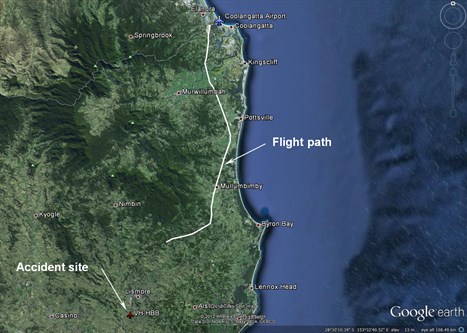
On the day, the aircraft departed from Coolangatta to the north before turning south. The aircraft was initially being tracked by the air traffic control radar, but at about 60 km south-south-west of Coolangatta the aircraft flew outside radar coverage (Figure 1).
Figure 1: Flight path of VH-HBB
Source: Google Earth
The path taken by the aircraft following the loss of radar coverage was unknown. However, at about 0845, the pilot broadcast on the Lismore common traffic advisory frequency (CTAF) that they were about 8 NM (15 km) north of Lismore Airport, New South Wales (NSW) and inbound to conduct circuits3 on runway 33 at Lismore. Reports indicated that the aircraft had completed a number of circuits prior to the accident.
At about 09154, a number of witnesses travelling along the Bruxner Highway between Lismore and Casino, NSW observed the aircraft make an abrupt steep left bank before pitching nose down and rapidly descending. The aircraft’s nose was then observed to have been raised and its rate of descent reduced before crossing the Bruxner Highway at very low height. The aircraft impacted the ground in a paddock adjacent to the highway. Both occupants on board the aircraft were fatally injured.
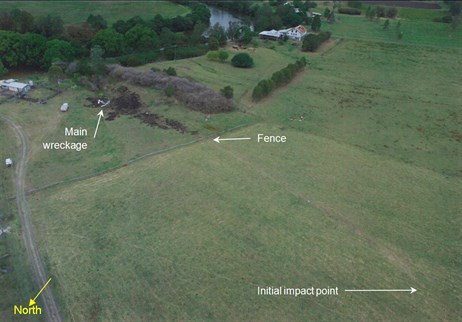
The Australian Transport Safety Bureau (ATSB) initiated an investigation and attended the accident site. The ground impact marks observed by the ATSB indicated that the aircraft impacted the ground in a left wing-low attitude with the nose of the aircraft level, or slightly nose-up. The left main and nose landing gear separated from the aircraft and it continued to skid along the ground. The aircraft continued through a wire fence, where the fuel escaped from the tanks and caught alight, before the right wing impacted the ground and the aircraft flipped over, coming to rest inverted about 170 m after the initial impact point (Figure 2). The engine separated from the fuselage during the impact sequence and came to rest about 13 m beyond the main aircraft wreckage.
Figure 2: Accident site
Source: NSW Police
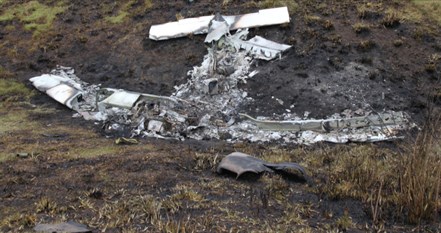
An intense fuel-fed fire continued to burn around the aircraft following the accident. That fire destroyed a substantial amount of the aircraft structure (Figure 3).
The investigation is continuing and will include:
examination of the engine and propeller
examination of the experience of the student and instructor
assessment of the aircraft’s handling qualities.
The evidence will be analysed and a final report completed detailing the findings of the investigation.
Figure 3: Main wreckage
Source: ATSB ______________
[1] Eastern Standard Time was Coordinated Universal Time + 10 hours.
[2] A GFPT indicates that a pilot has attained a standard in the safe control and handling of an aircraft. The test does not assess flight navigation beyond an ability to fly in the vicinity of the departure aerodrome and the approved training area. The pilot remains a student pilot until a private or a commercial flight test has been passed.
[3] A standard rectangular traffic pattern flown around an aerodrome when taking off from, or landing on a runway.
[4] The local time at Lismore was 1015 Eastern Daylight-saving Time (UTC+11).
The information contained in this web update is released in accordance with section 25 of the Transport Safety Investigation Act 2003 and is derived from initial investigation of the occurrence. Readers are cautioned that new evidence will become available as the investigation progresses that will enhance the ATSB’s understanding of the occurrence as outlined in the web update. As such, no analysis or findings are included in this update.
Update 12 November
ATSB investigators began the on-site phase of the investigation on Saturday 10 November.
The team has been liaising with the local police to secure perishable evidence, including the pattern of the wreckage and marks from impact.
The ATSB has retained the aircraft’s engine for later technical examination.
Over the next few days, the team will be:
interviewing witnesses
meeting with the aircraft operator
retrieving aircraft and pilot records.
The on-site wreckage examination will be completed later today and the ATSB aims to finalise the investigation by November 2013.
This page will be updated as significant information comes to hand.
Subscribe now to receive news and information from the ATSB and follow us on twitter @atsbinfo for investigation updates.
9 November 2012
The ATSB is investigating an accident involving a SOCATA TB-20 that collided with terrain at Lismore on 9 November 2012.
The aircraft was seen to bank left and impact the ground. It was destroyed by fire and the two people on board died as a result of the accident.
The ATSB has sent a team of investigators to begin the on-site phase of the investigation.
Investigators will be:
examining the wreckage for evidence
interviewing witnesses and aircraft operator
reviewing maintenance documents.
The ATSB will also review the pilot’s training and experience and collate and analyse witness information.
If you have any information about the accident please call the ATSB on 1800 020 616.
On 11 July 2012, the pilot of a Piper Seneca I, registered VH-LCK, was conducting a freight-carrying flight between Broome and Port Hedland, Western Australia. The flight was conducted at night under the instrument flight rules. Witnesses who heard or saw the aircraft take-off reported hearing unusual noises from the engines during the climb. Other witnesses closer to the accident site reported hearing the engine sound suddenly cut out before the aircraft banked left and descended steeply towards the ground. The aircraft wreckage was located amongst sand dunes, about 880 m beyond the upwind runway threshold. The aircraft was destroyed, and the pilot sustained fatal injuries.
What the ATSB found
The take-off towards the ocean was conducted in dark night conditions with limited external visual cues. An on-board global positioning system (GPS) recorded a reducing ground speed as the aircraft approached and passed overhead the upwind runway threshold, but without a significant increase in climb performance. That reduction in ground speed occurred about the same time witnesses heard unusual noises from the aircraft’s engines.
In the absence of any identified environmental, airframe or structural factors, the witness reports and GPS data were consistent with the aircraft’s performance being affected by a reduction in engine power. Following the likely loss of engine power, the aircraft speed reduced significantly, resulting in uncontrolled flight, a steep descent and collision with terrain.
Although not identified as a factor contributing to this occurrence, post-accident examination of the aircraft’s fuel selector valves found the internal seals had deteriorated and allowed fuel to flow to the engines when the valves were in the OFF position. A review of the aircraft manufacturer’s maintenance instructions revealed this type of internal leakage may not be evident during routine maintenance, although a non-scheduled valve leak procedure was available.
What's been done as a result
The aircraft manufacturer has been advised that their maintenance instructions may not identify deteriorated fuel selector internal seals during routine maintenance. Airworthiness bulletin AWB 28-105, published by the Civil Aviation Safety Authority, recommended that owners and operators of Piper Seneca, and other aircraft fitted with similar fuel selector valves, regularly check their function.
Safety message
This accident highlights the need for pilots to closely monitor their aircraft’s airspeed and initial climb performance during take-off. The need for prompt identification of any performance degradation and optimisation of the aircraft’s available climb performance is emphasised. The accident also highlights the elevated risk associated with dark night conditions, which increase pilot workload, particularly in the case of abnormal aircraft operations.
The investigation also identified the potential for inadvertent operation of the engine magneto switches due to their close proximity to the landing and taxi lights and auxiliary fuel pumps, potentially increasing risk if these switches are operated at a critical stage of flight.
On the morning of 29 April 2012, the owner-pilot of a Cessna 150 aircraft, registered VH-UWR was aerial stock mustering on a cattle station about 55 km north-east of Bourke, New South Wales. Some early patches of fog cleared such that the weather conditions were fine and calm.
After about 1.5 hours in the air, the pilot radioed stockmen on the ground to direct them to an area where cattle were not moving. The aircraft was observed circling over the area then in a steep descent followed by the sound of an impact. The aircraft was seriously damaged, and the pilot sustained fatal injuries.
What the ATSB found
While manoeuvring at low level the pilot inadvertently allowed the aircraft to aerodynamically stall, resulting in a high rate of descent and collision with terrain. There was insufficient information about pilot control inputs to establish the factors that precipitated the stall.
The pilot did not hold a valid medical certificate and had not completed a flight review for a number of years, increasing the risks of operating an aircraft, especially during aerial stock mustering.
Safety message
Pilot proficiency can decline without regular practice of non-routine procedures under the supervision of instructors or approved training/check pilots. As such, pilots should take every opportunity to refresh their knowledge and skills, at a minimum during a flight review every two years.
At about 1555 Eastern Daylight-saving Time on 4 February 2012, a Robinson R44 helicopter, registered VH‑COK, lifted off from Jaspers Brush Aerodrome, New South Wales for aerial photography of the launching of a deep-sea submarine in nearby Jervis Bay. On board the helicopter were the pilot and a camera operator.
Soon after lifting off the pilot’s door opened, and the pilot reached out to close the door. Simultaneously the helicopter abruptly pitched nose-up then steeply nose-down, rolling to the right before the right landing gear skid and main rotor blades struck the ground. A fuel-fed fire started in the vicinity of the fuel tanks and lower mast area prior to the helicopter coming to a stop. Both occupants were fatally injured, and the helicopter was destroyed.
What the ATSB found
The Australian Transport Safety Bureau (ATSB) found that the pilot’s door was not properly latched prior to lift off and opened during the turn to depart. In attempting to shut the door the pilot probably let go of the cyclic control from the normal (right) control hand, allowing for an unintended, abrupt nose-up pitch and the helicopter tail hitting the ground. The helicopter nosed over and impacted the ground. A fire began when one of the fuel tanks was breached.
The ATSB identified that the fatal injuries were due to the post-impact fire, as was the case in a number of other R44 accidents. A number of these R44s, including VH‑COK, had not and were not yet required to have been modified in accordance with a manufacturer service bulletin that specified replacement of aluminium fuel tanks with more impact‑resistant bladder‑type fuel tanks. The installation of these tanks decreased the risk of a post‑accident fire. At the time of the accident, these tanks were required to be fitted by 31 December 2014.
What's been done as a result
In response to this and a number of other fatal accidents in other R44 helicopters, the Civil Aviation Safety Authority (CASA) and the ATSB have separately highlighted the benefits of the upgraded bladder-type fuel tank and related modifications to operational and maintenance personnel. In addition, the helicopter manufacturer has progressively reduced the compliance time on service bulletin SB-78 in respect of the installation of the bladder‑type fuel tanks to 30 April 2013. A second bulletin aimed at removing a possible impact‑related ignition source was also issued and the manufacturer is issuing advisory information emphasising the importance of maintaining control of the helicopter during an unexpected event.
Safety message
This accident highlights the importance of ensuring all doors are secured prior to take-off. That said, the opening of a door in flight will not normally affect the operation of an R44, but the instinctive reaction to immediately deal with such an event can be quite strong. Pilots need to be aware that this reaction may be hard to overcome and in the event of an unexpected situation occurring such as the opening of the door, it is vital that pilots should continue to ‘fly the aircraft’. This includes choosing to land to close the door if necessary. The fitment of bladder-type fuel tanks to R44 helicopters is a worthwhile safety enhancement that could save lives and advice from CASA is that their installation in accordance with the manufacturer’s service bulletin by 30 April 2013 is mandatory.
Preliminary report
Report release date: 09/03/2012
This preliminary report details factual information established in the investigation’s early evidence collection phase and has been prepared to provide timely information to the industry and public. Preliminary reports contain no analysis or findings, which will be detailed in the investigation’s final report. The information contained in this preliminary report is released in accordance with section 25 of the Transport Safety Investigation Act 2003.
What happened
At about 1555 Eastern Daylight-saving Time on 4 February 2012, a Robinson R44 Raven II helicopter, registered VH-COK, lifted off from Jaspers Brush Aerodrome, New South Wales for an aerial filming task at Jervis Bay. On board were the pilot and a camera operator.
Soon after lifting off, the pilot's door opened. The helicopter abruptly pitched nose-up and the tailskid struck the ground. The helicopter then abruptly pitched forward and rolled to the right before the main rotor blades struck the ground. A fuel-fed fire started in the vicinity of the fuel tanks and lower mast area. The fuselage then hit the ground. Both occupants were fatally injured, and the helicopter was destroyed.
On 20 December 2010, the manufacturer issued R44 Service Bulletin 78 (SB 78) requiring that R44 helicopters with all-aluminium fuel tanks be retrofitted with bladder-type fuel tanks as soon as practical, but no later than 31 December 2014. At the time of the accident, about 90% of the helicopters originally fitted with all-aluminium fuel tanks, including VH-COK, had not been retrofitted. On 21 February 2012, the manufacturer issued SB 78A that revised the date of compliance to 31 December 2013.
In addition, the manufacturer released SB 82 in respect of the replacement of existing R44 rotor brake switches. The aim of that bulletin was to reduce the chance of the rotor brake switch as a possible ignition source in the event of a fuel leak.
Although the circumstances of this accident are still under investigation, the Australian Transport Safety Bureau has, in the interest of transport safety, issued a Safety Advisory Notice suggesting that operators and owners of R44 helicopters fitted with all-aluminium fuel tanks actively consider replacing those tanks with bladder-type fuel tanks, as detailed in SB 78A as soon as possible. The existence and content of SB 82 is also highlighted.
On 23 December 2011, a Robinson Helicopter Company R22 Beta, registered VH-LNC departed Caloundra aerodrome on a Trial Instructional Flight (TIF). On board the helicopter were an instructor and student.
Whilst attempting to hover the helicopter the student made a significant and unexpected control input. Before the instructor could take control, the left skid contacted the ground, and the helicopter rolled over and sustained serious damage. The instructor and student were uninjured.
Robinson Helicopter Company has identified inexperienced individuals manipulating the controls and dynamic rollover as a significant factor in helicopter accidents. In response to this accident the helicopter operator has introduced a new policy in regard to TIFs and students manipulating the flight controls below 500 ft above ground level.
At about 1140 Eastern Standard Time on 8 September 2011, a Eurocopter AS350BA helicopter, registered VH-RDU, with a pilot and two passengers on board, collided with terrain on approach to land at a helicopter landing site that was located on a peak of Double Mountain South, Queensland.
The pilot and front seat passenger were fatally injured, and the rear seat passenger received serious injuries. The helicopter was substantially damaged. There was no fire.
Revised final report
Revised final released 18 February 2014
What happened
On 8 September 2011, a chartered Eurocopter AS350BA registered VH-RDU, with a pilot and two passengers on board, collided with terrain on approach to a helicopter landing site (HLS). The HLS was located on a peak of Double Mountain South in the Shoalwater Bay military training area, 93 km north of Rockhampton Airport, Queensland. The pilot and front seat passenger were fatally injured, and the rear seat passenger received serious injuries. The helicopter was substantially damaged and there was no fire.
What the ATSB found
The ATSB found that the pilot lost control of the helicopter at low speed or while hovering. The reason for that loss of control could not be positively established, although it is most likely to have resulted from environmental and operational factors.
The investigation was unable to determine whether authorisation of pilot tasking in this case had complied with the operator’s procedures. The assignment of the pilot to the task did not directly contribute to the accident. However, had a formalised and documented risk assessment of the task been prepared and considered as part of the authorisation process, as prescribed by the operator’s Safety Management System, it is likely there would have been a greater awareness of the suitability or otherwise of the pilot for the tasking. The physical characteristics of the HLS were not a contributing factor to the accident.
However, the HLS was found to be potentially hazardous for a pilot who was unfamiliar with its characteristics and not current with the difficulties likely to be encountered with pinnacle and confined helicopter landing sites.
Safety message
This accident highlights the need for helicopter operators to be aware of the potential safety risks associated with tasking pilots, especially those with little experience on the helicopter type, into an operating environment for which their competency has not been established or regularly checked. While pinnacle and confined area operations are part of the normal competencies of a licenced helicopter pilot, they are degradable skills that should be confirmed current prior to the assignment of flights that may involve such locations.
Supplementary
On 5 September 2013, the Australian Transport Safety Bureau (ATSB) released its final investigation report into the loss of control involving Eurocopter1 AS350BA, registered VH RDU, which occurred 93 km north of Rockhampton Airport, Queensland on 8 September 2011. Subsequently, the ATSB became aware of new and significant evidence in relation to the helicopter’s hydraulic pump drive system, including the associated drive belt. Information had been provided through the ATSB’s confidential reporting scheme (REPCON) indicating the reporter’s safety concerns about the hydraulic pump drive belt. As a result, and in accordance with clause 5.13 of Annex 13 to the Convention on International Civil Aviation Aircraft Accident and Incident Investigation, the ATSB reopened the investigation.
This supplementary report highlights the additional information gained as a result of reopening the investigation and confirms that the drive belt that was installed in VH-RDU at the time of the accident was authorised for use and within its service life limit. Review and analysis of the additional information determined that, while it would be beneficial to add some additional information to the final investigation report, no change was necessary to the findings in the report that was released to the public on 5 September 2013.