On 15 September 2013, the pilot of a Robinson R44 helicopter, registered VH-NUZ, was flying passengers on a private scenic flight over the Montgomery Reef and Buccaneer Archipelago area of Western Australia. The pilot had completed several take-offs and landings at that site already on the day.
After a routine landing at the reef, the pilot shut down the engine. The passengers had disembarked and were standing about 20 to 30 m away.
At about 1530 Western Standard Time the pilot, who was the sole occupant, then started the helicopter’s engine and completed the pre-flight checks. When the pilot raised the collective to bring the helicopter into a hover, it suddenly rotated three times while airborne. The pilot could not regain control and elected to land immediately, however the helicopter landed heavily. The pilot shutdown the engine and exited the helicopter.
The direction that the helicopter rotated could not be ascertained by the pilot or witnesses. The pilot and bystanders were not injured but the helicopter sustained substantial damage as a result of the hard landing.
Based on the information provided, the Australian Transport Safety Bureau (ATSB) was unable to determine what led to the loss of control.
During the investigation, the ATSB was made aware that instances of ‘sudden and violent yawing in forward flight’ had occurred on other ‘low time’ R44 helicopters, being attributed to a ‘sticky inlet valve’, with no recurrence after maintenance rectification.
There were no Service Difficulty Reports (SDR) regarding this issue in the Civil Aviation Safety Authority’s SDR database, making it difficult to pursue this line of enquiry.
The ATSB encourages reporting of occurrences to the ATSB and defects to CASA to allow for continued improvements to aviation safety.
On 6 September 2013, at about 1220 Eastern Standard Time, a Piper PA-28R-200 aircraft, registered VH-MMU, was completing a private flight from White Cliffs, New South Wales, to Birdsville, Queensland. On board the aircraft were the pilot and a passenger.
As it was during the annual Birdsville horse race meeting, the pilot joined the circuit at Birdsville in accordance with the promulgated Airservices Australia Aeronautical Information Publication Supplement (AIP SUP).
The wind was fluctuating during the aircraft’s arrival, at times indicating 010 ° T at 10 kt, but close to landing it was 040 ° T at 10-15 kt. As there were restrictions on the use of runway 03, the pilot elected to fit in with traffic and use runway 32.
The approach to runway 32 placed the aircraft over raised ground and a high fence, where much of the crowd were situated. To remain at a safe altitude above the crowd, the passenger, a more experienced pilot, suggested that the pilot keep the aircraft at least 50 ft above the runway threshold, and flare soon after.
The pilot attempted to comply with this suggestion and prepared for the landing flare, but the passenger advised him that they were too high, and not to reduce the engine power until the aircraft was in a safer landing configuration. The pilot lowered the aircraft’s nose slightly and initiated the flare. The aircraft landed firmly on the main landing gear, then bounced once or twice.
Despite the pilot’s efforts, the aircraft veered to left of the runway and the left wheel subsequently struck a graded mound. The aircraft stopped abruptly. The pilot and his passenger sustained minor injuries, and the aircraft was substantially damaged.
It is important to be aware that the presence of others may influence your decision-making process. Their apparent ability does not mean that others can achieve the same outcome. To be competent, pilots must know, and fly within, their own personal limitations on that particular occasion.
On 1 September 2013, a Robinson R22 helicopter, registered VH-HVW, departed a stock camp located about 40 NM (70 km) south-west of Lake Nash Station, Northern Territory. Shortly after take-off, the helicopter was observed commencing a steep climbing left turn to depart overhead the camp. As the helicopter turned into a downwind position, the wind appeared to affect the controllability of the aircraft. It appeared that the pilot attempted to respond to the situation, however, there was insufficient altitude to recover. The helicopter contacted the ground and flipped over a number of times before coming to rest. The pilot sustained serious injuries and the helicopter was destroyed.
Wind direction and velocity are important considerations for helicopter pilots. It is crucial that pilots maintain an awareness of the wind and be aware of the consequential effects on helicopter performance. This will assist pilots with responding promptly and appropriately to a situation and preventing a loss of control.
On 7 August 2013, the student pilot of a Robinson R22 helicopter registered VH-EGN (EGN) departed from the parking area near the flying school hangar to conduct a session of solo circuits at Camden Airport, New South Wales.
The student had been checked by his instructor earlier that morning and already conducted some solo circuit practice and returned to the parking area.
At the end of the solo circuits, the student taxied EGN back toward the hangar. Facing east, and hovering about 3ft above the ground, the student commenced a left pedal turn to position the helicopter in a westerly direction for landing. The helicopter commenced turning left. When in a downwind position, the student reported that the helicopter weather-cocked into wind and the rotational speed rapidly increased.
The student unsuccessfully attempted to regain control of the helicopter. He then lowered the collective to put EGN on the ground. The right skid struck the ground first, followed by the tail rotor. The student, who was not injured, exited the helicopter. EGN sustained substantial damage.
The United States Federal Aviation Administration (FAA) Helicopter Flying Handbook states that the nose of a helicopter will attempt to weather cock into the relative wind when a tailwind from 120° to 240° is experienced. If sufficient resisting pedal input is not made by the pilot, the helicopter will start a slow, uncommanded turn to either the left or right, depending on the wind direction. If the yaw rate is allowed to develop and the tail of the helicopter moves into this region, the yaw rate can accelerate rapidly. The FAA further stated that, when approaching the downwind portion of a turn, anticipate the helicopter’s tendency to weathercock by applying pedal pressure opposite to the direction of the turn.
On 31 July 2013, a Bell 206B helicopter, registered VH‑SMI, departed Horn Island, Queensland for an aerial filming flight about 5 NM to the north‑east, at the Tuesday Islets. The purpose of the flight was to film a 20 m vessel travelling back and forth along a channel in between the Islets.
After having completed four passes over the vessel, the pilot positioned the helicopter for the next pass. Maintaining 200 ft, the helicopter approached the vessel from behind and to the left. The vessel was travelling into wind. As the helicopter flew abeam the vessel, the pilot initiated a climb and then commenced a right turn to pass in front. At that time, the pilot was monitoring the view finder to ensure that the helicopter’s skids did not impede the film shot.
After having completed the film shot, when at about 450 ft, the helicopter entered an uncommanded yaw right by about 25-30° and started to experience a loss of tail rotor effectiveness (LTE). The helicopter rotation stopped momentarily, but shortly after, it began to yaw right again. Despite the pilot’s attempt to recover the situation, the helicopter continued to yaw right and descend. When below 100 ft, the pilot determined that he was unable to recover, and he prepared for a forced landing onto the water. The emergency flotation system was activated, and the helicopter landed on the water. The occupants received nil injuries.
As a result of this occurrence, the helicopter operator has advised the ATSB that all company pilots will be required to demonstrate their ability to recover from an LTE event during regular flight checks with the Chief Pilot.
Certain operations, such as low speed aerial filming/photography flights, lend themselves to being more at risk to LTE than others. If a helicopter was placed in conditions conducive to LTE, it is crucial that pilots not only recognise the onset of LTE, but respond immediately and appropriately before the situation develops.
At about 1207 on 21 March 2013, a Robinson Helicopter Company R44 helicopter (R44), registered VH-HWQ, landed at a grassed area adjacent to a function centre at Bulli Tops, New South Wales. Shortly after landing, the helicopter was observed to simultaneously lift off, yaw right through 180° and drift towards nearby trees. The helicopter struck branches of the trees before descending, impacting the ground nose low and rolling onto its right side. A short time after coming to rest a fire started and engulfed the helicopter. The pilot and three passengers were fatally injured.
What the ATSB found
The circumstances of this accident were consistent with the helicopter lifting off following a deliberate or inadvertent collective input. The helicopter’s main rotor blades subsequently contacted nearby trees resulting in a loss of control and impact with the ground. The impact sequence resulted in a substantial fuel leak that was followed by an intense fire. This accident was similar to two other relatively recent fatal accidents in Australia involving R44s fitted with all-aluminium fuel tanks in which there was a fatal post-impact fire (PIF) following an otherwise survivable impact. Statistical analysis of helicopter accidents that occurred in Australia and the United States (US) between 1993 and 2013 identified a significantly higher proportion of PIF involving R44s than for other similar helicopter types. That analysis also identified that, despite the introduction of requirements for newly certificated helicopters to have an improved crash-resistant fuel system (CRFS) some 20 years previously, several helicopter types were still being manufactured without a CRFS and that many of the existing civil helicopter fleet were similarly not fitted with a CRFS.
What's been done as a result
Following this accident the Civil Aviation Safety Authority (CASA) took action to increase compliance with the helicopter manufacturer’s Service Bulletin 78B (SB-78B), requiring the fitment of bladder-type fuel tanks and other fuel system improvements. While recognising the action taken by CASA, due to concern that a significant number of Australian owners and operators had at that stage not taken steps to comply with the service bulletin, and were very unlikely to be able to do so by the required date of 30 April 2013, the ATSB released safety recommendation AO-2013-055-SR-001 to CASA that further action be taken. In response CASA released airworthiness directive AD/R44/23 requiring all owners of R44 helicopters in Australia to comply with SB-78B by the required date. Several other national airworthiness authorities (the South African Civil Aviation Authority, the Civil Aviation Authority of New Zealand and the European Aviation Safety Agency) subsequently mandated compliance with SB-78B. At the time of publishing this report the State of Design and Manufacture of the R44 helicopter had not mandated compliance with SB-78B.
The ATSB has issued a safety recommendation to the US Federal Aviation Administration (FAA) that they take action to ensure all R44 operators and owners comply with the manufacturer's Service Bulletin SB-78B and fit bladder-type tanks to improve resistance to post-impact fuel leaks. In addition, the ATSB also recommend that the FAA and European Aviation Safety Agency take action to increase the number of existing and newly-manufactured helicopters that are fitted with a crash-resistant fuel system.
Safety message
This accident highlights the catastrophic consequences of fuel-fed post-impact fire and that the most effective defence is to prevent the fire from occurring at impact by containing the fuel on board, preventing ignition, or both. In that context, the ATSB strongly encourages the fitment of a crash-resistant fuel system where possible.
Preliminary report
Report release date: 05/04/2014
This preliminary report details factual information established in the investigation’s early evidence collection phase and has been prepared to provide timely information to the industry and public. Preliminary reports contain no analysis or findings, which will be detailed in the investigation’s final report. The information contained in this preliminary report is released in accordance with section 25 of the Transport Safety Investigation Act 2003.
Safety summary
What happened
At about 1207 local time on 21 March 2013, a Robinson Helicopter Company R44 helicopter (R44), registered VH-HWQ, was manoeuvring at a grassed area at Bulli Tops, New South Wales. Shortly after landing, the helicopter lifted off and turned to the right. The main rotor struck branches of a nearby tree, and the helicopter descended and then rolled over onto its right side. A fire started on the grass under the rotor mast and the cabin. The pilot and the three passengers were fatally injured.
What the ATSB found
The circumstances of this accident are consistent with two recent R44 accidents in Australia involving low-energy impacts that resulted in the all-aluminium fuel tanks being breached and a fuel-fed fire. R44 accidents result in a significantly higher proportion of post-impact fires than for other similar helicopter types. The accident helicopter was equipped with an all-aluminium tank.
On 20 December 2010 the Robinson Helicopter Company issued Service Bulletin SB-78 providing for the replacement of all-aluminium tanks in R44 helicopters with bladder-type tanks that substantially reduce the likelihood of post-crash fires. On 28 September 2012 the Robinson Helicopter Company revised and reissued the service bulletin as SB-78B. This revision brought forward the compliance date for the service bulletin to 30 April 2013. The ATSB has assessed that about 100 Australian R44 helicopters will not have met the service bulletin by the due date.
What's been done as a result
In response to this accident, the Civil Aviation Safety Authority (CASA) has confirmed its understanding that the great majority of Australian R44 helicopter owners are legally required to comply with Service Bulletin SB-78B. CASA has also undertaken to contact owners who may not be required to comply and then consider further action depending on the response to that contact.
The ATSB remains concerned at the significant risk that many R44 helicopters will not comply with the service bulletin and has recommended that CASA take further action to ensure compliance.
Safety message
The fitment of bladder-type fuel tanks to R44 helicopters is a very important safety enhancement that could save lives and is very strongly encouraged. In addition, regulators and investigation agencies in other countries should take note of this report and consider what steps they can take to increase compliance with the manufacturer’s safety bulletin.
On 17 March 2013, the owner-pilot of an amateur-built scale-replica Spitfire aircraft (VH-VSF) was participating in an air display at Parafield Airport, South Australia. The pilot performed a number of airborne passes above the runways in various directions and completed the display with a slow speed pass at 400 ft with the landing gear and some wing flap extended.
Towards the end of this pass the pilot radioed the tower to coordinate a landing and accepted runway 21 Left with an 11 kt crosswind. By now the pilot had turned right and the Spitfire was near the extended runway centreline and 1 km from the runway threshold at a slow speed. A left turn was then observed and, soon after, a wing dropped and the aircraft entered a steep descent. The aircraft crashed in a factory car park, fatally injuring the pilot and substantially damaging the aircraft.
What the ATSB found
The ATSB found that while coordinating a landing clearance with air traffic control and flying a low-level circuit with a close downwind and base in turbulent conditions, the pilot inadvertently allowed the airspeed to decay. In the subsequent turn (downwind) to adjust the circuit the aircraft aerodynamically stalled, descended steeply, and impacted the ground. The aircraft was prone to aerodynamically stall with little or no aerodynamic precursors and it was not fitted with a stall warning device, increasing the risk of inadvertent stall.
Safety message
Flying in an air display is different to normal operations and places additional demands on a pilot. Pilots who participate in air displays should consider the demands involved and to the extent possible ensure that the complete sequence, including landing, is planned and rehearsed.
Although amateur-built aircraft operated in the experimental category are not required to be fitted with a stall warning device (preferably with aural output), owner-pilots should consider the benefits of such devices as a last line of defence against stalling.
Update
Report release date: 23/07/2013
Updated: 23 July 2013
At about 1350 Central Daylight-saving Time[1] on 17 March 2013, an amateur built, 80 per cent scale replica of the Supermarine Spitfire Mk XXVI, registered VH‑VSF (VSF), took off from runway 21R at Parafield Airport, South Australia. The pilot was participating in an air display held in support of a local aircraft museum. Over the following 7 minutes the pilot completed a handling display orientated along runway 21/03 that was described by witnesses as relatively sedate, with a few steep turns with bank angles up to 60°, but no aerobatics. The weather was clear with a gusty south-easterly wind of up to 20 kt (37 km/h).
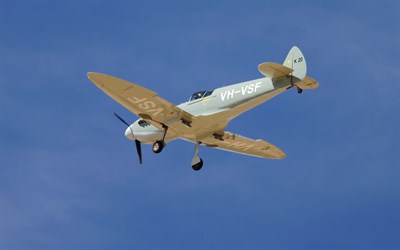
At the completion of his routine the pilot completed a final pass of the crowd on a close right downwind leg for runway 21 at about 350 ft above ground level. The aircraft, which had been operated in the clean configuration and at speeds around 120‑150 kt, was slowed to about 80 kt and configured with the landing gear down and a stage of landing flap as it passed the spectators (Figure 1).
Figure 1: Photograph taken of the Spitfire shortly before the accident as it flew past the spectator area on a downwind position for runway 21 at about 350 ft
Source: Airshow spectator, reproduced with permission
On the downwind leg the pilot communicated his intention to land to the air traffic control tower and enquired whether the wind still favoured a landing on runway 21. The aerodrome controller informed the pilot that the crosswind component was 11 kt (20 km/h) on runway 21 and runway 08 and cleared the pilot to manoeuvre as required to final runway 21L.[2]
A significant number of witnesses, some with piloting experience, observed the aircraft turn right base for runway 21L. They recalled that the aircraft appeared to be flying very slowly prior to an abrupt left turn away from the runway. Their accounts described a loss of control that was consistent with an aerodynamic stall followed by a significant wing drop. The aircraft was then observed to descend steeply toward the ground with a degree of spiral evident along the descent path before being lost to sight behind trees and buildings.
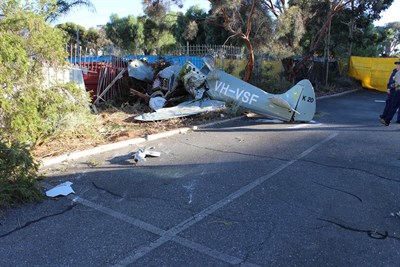
The aerodrome controller witnessed the aircraft descending out of sight and immediately instigated the aerodrome emergency response. A short time later the wreckage of the aircraft was located by emergency services in a factory car park about 1.5 km north of the runway 21L threshold. The pilot sustained fatal injuries and the aircraft was substantially damaged by impact forces (Figure 2). There was no fire.
Figure 2: Aircraft wreckage
Source: ATSB
Damage to the aircraft was consistent with it descending steeply into terrain at a high rate of descent in a wings-level, nose-down attitude. There was no evidence of in-flight structural failure. All of the aircraft’s components were accounted for at the accident site, with no evidence of pre-impact damage. Continuity of the aircraft’s flight and engine control systems was established and on-site evidence indicated that the engine was producing power at ground impact. The fuel tank ruptured on impact with the result that no fuel was available for testing. Examination of the airframe found that the aircraft did not incorporate any stall warning system.
A number of components were recovered from the accident site for technical examination including a global positioning system (GPS) receiver. The wreckage was documented and transported to a secure location for further examination as required.
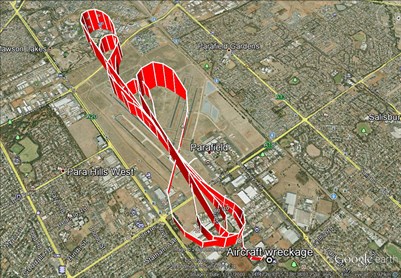
Australian Transport Safety Bureau technical specialists examined the GPS receiver. That examination found that track data was retained in the receiver’s non-volatile memory. The GPS data for the accident flight was downloaded and is depicted at Figure 3.
Figure 3: Accident flight data recovered from GPS receiver[3]
Source: Google earth
A review of the recorded GPS data indicated that the aircraft descended to about 350 ft above ground level and the groundspeed reduced to about 80 kt on the downwind leg. As the aircraft turned onto the base leg for runway 21L, a gradual increase in height to 485 ft and reduction in groundspeed to 55 kt was evident. The position of the aircraft in relation to the runway at this point indicates that a tight turn would most likely have been required to line up on the runway centreline. It is possible that the pilot made a deliberate left turn away from the runway at this stage to allow more room to manoeuvre for final.
The GPS-recorded path of the aircraft was consistent with witness observations and, in combination with recorded wind data from the automatic weather station at Parafield Airport, indicates that the aircraft’s airspeed was close to the stall speed on base leg and most likely below stall speed as it abruptly turned left away from the runway. The GPS recorded time interval from the commencement of the base turn until the collision with terrain was about 20 seconds.
The reduced scale replica Spitfire Mk XXVI is a conventionally-configured, low-wing cantilever monoplane that is manufactured in kit form for construction by owner‑builders. The pilot constructed VSF in 2006 and had maintained it in accordance with the Civil Aviation Regulations since that time.
The pilot held a Commercial Pilot (Aeroplane) Licence and his pilot’s logbook indicated he had 1,665 hours flight experience, 190 of which were on the kit-built Spitfire. The pilot was the sole pilot of the aircraft, held a Class 2 Medical Certificate and was reported to have been rested and in good health prior to the flight. He was described as being meticulous with his approach to flying and maintaining the aircraft.
The investigation is continuing and will include:
further examination of recovered components
analysis of aircraft performance during the flight
review of operational factors and the recorded data.
The final investigation report is planned for release to the public during October 2013.
The information contained in this web update is released in accordance with section 25 of the Transport Safety Investigation Act 2003 and is derived from the initial investigation of the occurrence. Readers are cautioned that new evidence will become available as the investigation progresses that will enhance the ATSB's understanding of the accident as outlined in this web update. As such, no analysis or findings are included in this update.
[1] Central Daylight-saving Time (CDT) was Coordinated universal Time (UTC) + 10.5 hours.
[2] The available runways at Parafield are oriented east-to-west (runways 08/26) and north-north-east-to-south-south-west (runways 03/21). Runways left and right are available in each direction.
[3] The data is represented by a series of individual GPS-recorded track points that have been joined together using a series of straight lines.
On 22 February 2013, VH-TGY (TGY) and VH‑TZJ (TZJ), departed a private airstrip near Bourke for Rumleigh, New South Wales. Both aircraft were to conduct aerial application (spraying) operations, which was supported by two ground personnel (mixers).
TGY landed at the Rumleigh and the mixers loaded the aircraft’s hopper. TGY departed and commenced spraying operations. Shortly after, TZJ landed at Rumleigh and was loaded. As the take‑off run on the south-eastern runway was commenced, TZJ’s fire-bombing door unexpectedly released and the 2,700 L load was jettisoned onto the ground, contaminating the runway.
About 15 minutes after, TGY landed on the north-west runway. When approaching the runway end, the pilot observed mud spraying up from the aircraft’s wheels. The aircraft then commenced sliding and turning to the left. When the left wheel contacted dry ground, the aircraft swung further left and tipped forward, resulting in the propeller contacting the ground. The aircraft then tipped backwards, and the tail wheel assembly detached. TGY sustained substantial damage.
The pilot of TZJ had attempted to contact the pilot of TGY on a number of occasions, but due to an unserviceable radio in TZJ, the broadcasts were not heard. The mixers elected not to contact TGY as they were of the understanding that he had been advised of the contamination by the pilot of TZJ.
A reliable communications system can assist with improving the overall efficiency and safety of an operation. This incident highlights the impact ineffective two-way communications can have on aircraft operations, and in that case, the need to consider alternative means for warning pilots of potential ground hazards.
On 15 February 2013, the crew of a Eurocopter Helicopter MBB‑BK117 B-2 (BK117), registered VH-VSA, were conducting a trauma recovery flight from Port Pirie to Adelaide Hospital, South Australia. After reaching the cruise altitude of 5,000 ft above mean sea level, the crew observed fluctuations of the hydraulic system pressure gauges. Shortly after, the helicopter sustained an uncommanded and violent nose-up pitch and rolled left before descending. The pilot regained control at about 800 ft above ground level. Control checks by the pilot confirmed normal control had resumed and the pilot flew the helicopter back to Port Pirie Aerodrome. No injuries were reported by the occupants and the helicopter sustained minor damage.
What the ATSB found
The ATSB did not find any mechanical or system faults that could account for the hydraulic system pressure fluctuations. The ATSB found that the helicopter was being operated at a weight, density altitude and airspeed, and in meteorological conditions that were conducive to the onset of retreating blade stall. The uncommanded and violent nose-up pitch and left roll were consistent with the onset of that condition. The pilot’s instinctive action of pushing the cyclic control forward delayed recovery from the stall.
What's been done as a result
The operator issued an urgent Immediate Safety Notification advising all company BK117 pilots of the conditions conducive to retreating blade stall and the correct actions to recover from that condition.
Safety message
This incident highlights the importance of pilot awareness of the factors conducive to retreating blade stall, including high all-up weight, high density altitude, high airspeed, manoeuvres that increase flight loads and flight in turbulence. Similarly, the importance of initially reducing collective pitch to optimise recovery is emphasised as incorrect recovery actions can result in loss of control of the helicopter.
On the evening of 28 January 2013, VH‑YFF was being prepared for a scheduled passenger service from Canberra, Australian Capital Territory to the Gold Coast, Queensland. The crew were aware of adverse weather conditions being experienced at the time in south-east Queensland and had been monitoring the weather at the Gold Coast throughout the day.
During the approach, the crew reported that they were in cloud and experiencing rain and a strong right crosswind of about 40-50 kt. The Tower controller advised the crew that the crosswind on the ground was 21 kt. The captain reported that he was mindful of the wind conditions and was prepared to initiate a go-around.
At about 1,000 ft above mean sea level (AMSL), the crew became visual with the runway.
At about 100 ft, the captain noted that the airspeed trend vector was indicating a 20 kt decrease, likely the result of undershoot windshear. The captain momentarily increased engine thrust.
At about 2229, the aircraft touched down about 200 m further along the runway than intended. The first officer (FO) recalled the aircraft touched down on, or slightly right of the runway centreline. At that time, they were experiencing light rain.
After touchdown, the captain perceived that the aircraft was close to the left side of the runway, due to the proximity of the runway edge lights. The captain immediately applied right rudder, however, he inadvertently overcorrected, resulting in the aircraft veering to the right side of the runway. The captain applied left rudder, and the runway centreline was regained. The aircraft was slowed to taxi speed and taxied to the terminal.
Due to the weather conditions and high workload at the time, the captain was not certain if the aircraft was pointing towards the runway edge before touchdown or if the aircraft aquaplaned after touchdown. The FO reported that it felt like the aircraft aquaplaned and drifted to the left. However, after reviewing the flight data, the captain believed that the aircraft flared on centreline and drifted left before touchdown.
Through its SafetyWatch initiative, the ATSB is highlighting an increasing trend in problems with aircraft handling and flight profile when unexpected events arise during the approach to land. When compared to other phases of flight, the approach and landing has a substantially increased workload. Further details are available at www.atsb.gov.au/safetywatch/handling-approach-to-land.aspx