Flight control systems

Boeing 737-476, VH-TJF, Canberra Aerodrome, on 15 December 2002

Summary

At about 1020 Eastern Summer Time on 15 December 2002, a Boeing 737-400 (737) aircraft, registered VH-TJF, departed runway 35 at Canberra Airport for Melbourne. As the aircraft was rotated, the handling pilot felt that the pitch control was unusually stiff. The crew informed air traffic control of the problem and climbed the aircraft to a safe altitude in order to conduct a controllability check. The crew declared an urgency emergency phase as a precaution. The aircraft subsequently landed at Canberra Airport, at about 1115, with airport emergency services in attendance.

The operator’s maintenance personnel could not reproduce the problem on the ground. After investigation and replacement of the system B flight control module an assessment flight was conducted the following day to Melbourne Airport. That flight determined that the defect was still present and the aircraft was relocated to the operator’s maintenance facility in Melbourne for further investigation.

After an extensive investigation by the operator, the elevator binding was reproduced and found to be due to an incorrectly located elevator control cable. The control cable was hooked over the lip of a J shaped floor support beam, beneath the aft galley. The angular deflection of the cable over the floor support beam was such that the cable would only bind intermittently. The cable was repositioned and re-rigged in accordance with the manufacturer’s aircraft maintenance manual. An assessment flight was conducted and it confirmed that the defect was no longer evident.

A scheduled maintenance inspection on the 737 was completed on 13 December 2002. A review of the aircraft’s technical log indicated that on three of the eleven sectors flown since that inspection, reports of heavy and binding flight controls were noted. During the scheduled maintenance inspection completed on 13 December 2002, several flight control cables had been disconnected to carry out a modification that required the removal of the flight control columns. One of those cables was found, during the operator’s subsequent investigation, to be hooked over the aft galley floor support beam. The scheduled maintenance inspection did not require the floor panels to be removed and therefore did not allow a complete inspection of the cables after the modification was completed. Although there was no reported work carried out on the control cable system in that area, several maintenance work cards detailed maintenance near that area.

The operator conducted tests to determine how the cable might have become hooked over the J section floor support beam. With normal operating tension on the cable, a force of approximately 30 kg was required to place the cable over the beam. With only slight tension on the cable and the cable clamped, it could be readily placed over the beam. The test also determined that with the aft galley installed, as was the case, access to the location where the cable was hooked over the floor support beam was very limited.

The manufacturer’s aircraft maintenance manual contained instructions for maintaining a light tension on control cables that were disconnected but not removed. The instructions detailed the installation of cable clamps on the affected cables, to ensure that the cables do not unwind on their cable drums or become displaced from their pulley guides. If the cables were between rig pin locations, then rig pins were to be installed through the applicable cable drum or quadrant.

The aircraft manufacturer indicated that during certification of the 737, tests were performed to determine if an untensioned cable during emergency operations of the flight controls would interfere or hang up on adjacent structure. The manufacturer determined that the J section of the floor support beam did not present a risk.

The operator conducted an inspection of other 737 aircraft and found that two other configurations existed. One installation was the same as the incident aircraft but the cable was located within a plastic tube. The other installation had the floor support beam facing in the opposite direction (J section tail of the beam facing away from the cable). The manufacturer determined that the configuration of the incident aircraft was in accordance with the design drawing for the aircraft and that the floor support beam location was limited to the operator’s fleet.

Occurrence summary

Investigation number 200205893
Occurrence date 15/12/2002
Location Canberra, Aerodrome
State Australian Capital Territory
Report release date 16/09/2004
Report status Final
Investigation type Occurrence Investigation
Investigation status Completed
Mode of transport Aviation
Aviation occurrence category Flight control systems
Occurrence class Serious Incident
Highest injury level None

Aircraft details

Manufacturer The Boeing Company
Model 737
Registration VH-TJF
Serial number 24431
Sector Jet
Operation type Air Transport High Capacity
Departure point Canberra, ACT
Destination Melbourne, Vic.
Damage Nil

Fairchild SA227-AC, VH-UZP, near Casino Aerodrome, NSW, 24 December 2009

Summary

Section 21 (2) of the Transport Safety Investigation Act 2003 (TSI Act) empowers the ATSB to discontinue an investigation at any time. Section 21 (3) of the TSI Act requires the ATSB to publish a statement setting out the reasons for discontinuing an investigation.

An investigation was commenced into a pitch down event involving a Fairchild Industries Inc. SA226-AC on a scheduled freight flight from Moree, NSW to Brisbane, Qld on 24 December 2009. Information from tests conducted by the aircraft operator, on the aircraft after the flight, did not reveal any problems with the aircraft and it was returned to service. The ATSB's analysis of flight recorder data did not disclose any additional safety information. The ATSB has assessed that further investigation was unlikely to produce any benefit for transport safety and has elected to discontinue the investigation.

The data collected in the course of the investigation may be used by the ATSB for future statistical analysis and safety research purposes.

Occurrence summary

Investigation number AO-2009-082
Occurrence date 24/12/2009
Location near Casino Aerodrome
State New South Wales
Report status Discontinued
Investigation level Systemic
Investigation type Occurrence Investigation
Investigation status Discontinued
Mode of transport Aviation
Aviation occurrence category Flight control systems
Occurrence class Serious Incident
Highest injury level None

Aircraft details

Manufacturer Fairchild Industries Inc
Model SA227
Registration VH-UZP
Serial number AC-498
Operation type Air Transport Low Capacity
Departure point Moree, NSW
Destination Brisbane, Qld
Damage Nil

Flight control system event - 520km north-west of Gold Coast Aerodrome, Queensland, on 18 May 2009, VH-VNC, Airbus A320-232

Summary

On 18 May 2009, an Airbus Industrie A320-232 aircraft, registered VH-VNC was on a regular public transport flight from Mackay, Queensland (Qld) to Melbourne, Victoria when at about 1249 Eastern Standard Time, the aircraft started to vibrate. Cockpit indications showed that the left aileron was oscillating. The crew diverted the aircraft to the Gold Coast Aerodrome, Qld and landed.

The source of the aileron oscillation was an internal fault in one of the left aileron's hydraulic servos. The fault was introduced during manufacture by an incorrect adjustment of the servo, which caused internal wear in a number of the servo's hydraulic control components. The aileron servo manufacturer has incorporated a new method of adjusting the aileron servos during assembly to minimise the likelihood of a recurrence of the problem.

During the investigation, it was found that an identical fault had occurred to the same aircraft 8 months prior to this incident. The previous incident was not reported to the Australian Transport Safety Bureau by the operator as required by the Transport Safety Investigation Act 2003. The operator has improved the training of its staff and the reportable event requirements in its safety management system manual in an effort to address the non-reporting risk.

Occurrence summary

Investigation number AO-2009-021
Occurrence date 18/05/2009
Location 520km NW Gold Coast Aerodrome
State Queensland
Report release date 24/08/2010
Report status Final
Investigation level Systemic
Investigation type Occurrence Investigation
Investigation status Completed
Mode of transport Aviation
Aviation occurrence category Flight control systems
Occurrence class Incident
Highest injury level None

Aircraft details

Manufacturer Airbus
Model A320
Registration VH-VNC
Serial number 3275
Sector Jet
Operation type Air Transport High Capacity
Departure point Mackay, Qld
Destination Melbourne, Vic
Damage Nil

Flight control system event, 22km east of Melbourne Airport, Victoria, on 10 August 2008, VH-ZHA, Embraer ERJ170-100

Summary

On 10 August 2008, an Embraer-Empresa Brasileira De Aeronautica ERJ170-100 aircraft, registered VH-ZHA, was being operated on a scheduled passenger service from Sydney NSW to Melbourne Vic. While positioning for landing, the crew selected a 'flaps 1' setting and a number of caution messages appeared on the engine indicating and crew alerting system (EICAS) screen.

The aircraft operator found that the left number 3 slat actuator torque trip limiter had actuated enabling the caution messages to appear on the EICAS screen. The number 3 slat actuator was replaced. A strip and condition report did not identify any failure of the actuator, and the failure was probably a result of operating in icing conditions. As a result of similar occurrences, the slat actuator manufacturer is re-designing the slat actuator seals.

Occurrence summary

Investigation number AO-2008-056
Occurrence date 10/08/2008
Location Melbourne Airport 90deg M/22km
State Victoria
Report release date 21/05/2009
Report status Final
Investigation level Systemic
Investigation type Occurrence Investigation
Investigation status Completed
Mode of transport Aviation
Aviation occurrence category Flight control systems
Occurrence class Serious Incident
Highest injury level None

Aircraft details

Manufacturer Embraer-Empresa Brasileira De Aeronautica
Model ERJ 170
Registration VH-ZHA
Serial number 17000180
Sector Jet
Operation type Air Transport High Capacity
Departure point Sydney, NSW
Destination Melbourne, Vic.
Damage Nil

American Champion Aircraft Corp 7GCBC, VH-MWY, 19 km west of Camden Aerodrome, New South Wales, on 8 May 2008

Summary

On 8 May 2008, the pilot of an American Champion Aircraft (ACA) 'Citabria', model 7GCBC (registered VH-MWY), was returning to Camden Aerodrome, NSW, after a local area flight, when the upper elevator control cable fractured. The pilot was able to maintain control of the aircraft's pitch attitude using wing flaps, and subsequently landed the aircraft safely, with only minor damage to the propeller.

Laboratory examination of the failed cable found the failure (and an adjacent area of significant damage) to have developed from the progressive fatigue cracking of individual cable wires in locations where the cable passed over guide sheaves. The examination also determined that the cable had not been manufactured to conform with the requirements of the accepted standard for aircraft control cables (MIL-DTL-83420).

From 2005, the aircraft manufacturer changed its internal procedures to require that only cable manufactured and certified to MIL-DTL-83420 be used for new aircraft production. Following the cable failure, the Civil Aviation Safety Authority (CASA) published an Airworthiness Bulletin (AWB), highlighting the issues associated with the use of non-MIL standard cables in aircraft control applications, and recommended that owners and maintainers of American Champion Aircraft ensure that periodic inspections are conducted with appropriate veracity.

Occurrence summary

Investigation number AO-2008-032
Occurrence date 08/05/2008
Location Camden Aerodrome NSW W/19 km
State New South Wales
Report release date 24/06/2009
Report status Final
Investigation level Systemic
Investigation type Occurrence Investigation
Investigation status Completed
Mode of transport Aviation
Aviation occurrence category Flight control systems
Occurrence class Serious Incident
Highest injury level None

Aircraft details

Manufacturer American Champion Aircraft Corp
Model 7
Registration VH-MWY
Serial number 1347-2003
Sector Piston
Operation type Private
Departure point Camden, NSW
Destination Camden, NSW
Damage Nil

Flight control system event, 120 km north of Brisbane Airport, Queensland

Summary

The flight crew of the Boeing Company 737-76N aircraft reported that during descent and taxi operations, they felt several rudder 'kicks' in the pilot in command's rudder pedals, accompanied by an audible noise.

Subsequent examination of the pilot in command's rudder pedal jackshaft assembly revealed two bearings and a universal joint were worn excessively.

The wear of the components of the jackshaft assembly, although not desirable, was not an immediate safety of flight concern for the operation of the aircraft.

The operator issued a flight crew operations notice and an engineering notice to highlight the occurrence to personnel.

Occurrence summary

Investigation number 200604949
Occurrence date 25/08/2006
Location 120km N Brisbane Airport
State Queensland
Report release date 10/05/2007
Report status Final
Investigation type Occurrence Investigation
Investigation status Completed
Mode of transport Aviation
Aviation occurrence category Flight control systems
Occurrence class Incident
Highest injury level None

Aircraft details

Manufacturer The Boeing Company
Model 737
Registration VH-VBN
Serial number 33005
Sector Jet
Operation type Air Transport High Capacity
Departure point Cairns, Qld
Destination Brisbane, Qld
Damage Nil

Beech Aircraft V35A, VH-FWE

Safety Action

The Australian Transport Safety Bureau (ATSB) was advised that the Civil Aviation Safety Authority is drafting a Notice of Proposed Rule Making (NPRM) addressing issues related to inspection and replacement of cable terminals.

The ATSB will monitor the NPRM process and any resulting action will be published on the Bureau's website.

Factual Information

On 30 April 2005, the pilot of a Beech Aircraft Corporation V35A Bonanza aircraft, registered VH-FWE, was conducting a private flight from Lilydale, Vic. to Temora, NSW. The pilot reported that while cruising at 7,500 ft, there was a loss of aileron control. Initially the aircraft tended to drift to the right, which he corrected by rolling the aircraft to the left. He then felt something break and the right wing dropped. He turned the aileron control yoke to the left, until it was almost upside down, but the aircraft continued rolling to the right and entered a progressively steeper descent. The pilot broadcast a PAN1advising air traffic control that he had an aileron control problem and that he would attempt to land the aircraft on a local glider field. He reported that he arrested the roll by extending the landing gear, adjusting engine power and applying full left rudder. The pilot subsequently landed the aircraft without the use of wing flaps.

Aircraft

The aircraft was manufactured in 1969 and had recorded 6,154.8 hours in service at the time of the incident. It was maintained in accordance with the applicable maintenance requirements and had a valid Maintenance Release. It had flown approximately 22.9 hours since the last periodic inspection completed in March 2005.

Aileron control examination

When examined, the aircraft's left aileron was found deflected to the fully down position and the right aileron fully up. To return the ailerons to their neutral position, a force was required to overcome the tension of the rudder interconnect bungee spring. Once the force was removed, both ailerons returned to the fully deflected positions. The examination of the aileron control cables revealed that the right aileron 'up' cable terminal, located in the rear spar carry through structure, had failed.

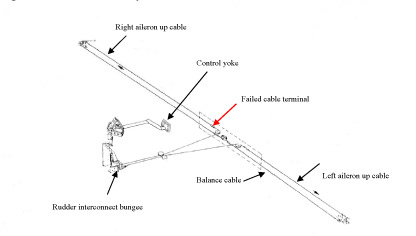
The aircraft manufacturer advised that since the aileron control cables are connected to the rudder interconnect bungee spring, the separation of the right aileron up cable would result in that spring forcing the left aileron down and the right aileron up (Figure 1).

Figure 1: Aileron control system

aair200501905_001.jpg

Terminal examination

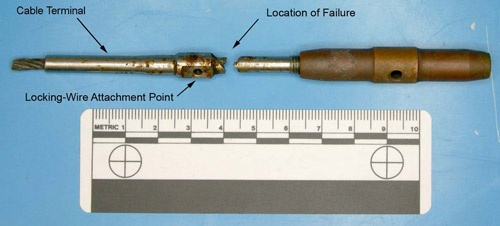
The failed control cable terminal was sent to the Australian Transport Safety Bureau (ATSB) for examination. The terminal shaft that is screwed into the turnbuckle had fractured close to the locking wire attachment point (Figure 2). The examination revealed that the fracture was initiated by stress corrosion cracking2 that had propagated under the surface of the shaft and weakened it to the point of failure.

Figure 2: Failed control cable terminal

aair200501905_002.jpg

The cable terminal was a standard swaged fitting designated AN669. Chemical analysis of the material showed that its composition closely matched that of SAE-AISI 303 stainless steel. A recent US National Transportation Safety Board (NTSB) Safety Recommendation3 identified SAE-AISI 303 stainless steel as being susceptible to stress corrosion cracking when used in a corrosive environment. The Safety Recommendation mentioned that cracking propagates as a function of the time a component is exposed to the corrosive environment rather than its actual time in service and that 'about 18 to 20 years is required for terminals exposed to the most damaging environment to reach their fracture point'.

Terminal inspection

During routine aircraft maintenance inspection of control system cables, corrosion pits on the surface of the cable terminal shaft may be the only visual indication of a potential problem. With the shaft area being typically wrapped with safety wire, the shaft can be difficult to inspect.

In August 2001, The Civil Aviation Safety Authority (CASA) issued Airworthiness Bulletin 27-1 Issue 1, Control Cable Terminal Inspection that was also published on the CASA web site www.casa.gov.au. The Airworthiness Bulletin provided information regarding the susceptibility of control cable terminals made of SAE-AISI 303 stainless steel to failure due to stress corrosion and highlighted the 'importance of meticulous inspection of the terminals'. It recommended that aircraft older than 15 years, and using terminals constructed of SAE-AISI 303 stainless steel, should have their control cable terminals visually inspected on an annual basis.

A review of the aircraft's logbooks found no evidence of the aileron controls having been subjected to any specific inspections to detect corrosion, including the removal of lock wire, within the previous 15 years. Routine maintenance inspections had been conducted during that period.

Both the ATSB and CASA databases contained four reports of similar control cable terminal failures in the period between 1995 and 2004. The NTSB Safety Recommendation mentioned 10 instances of aircraft that were found having fractured or cracked control cable terminals.

  1. PAN is a radio code indicating uncertainty or alert.
  2. A cracking process that requires the simultaneous action of a corrosive environment, such as a chlorine-rich atmosphere in moist coastal areas, and sustained tensile stress.
  3. US National Transportation Safety Board Safety Recommendation A-01-6 through -8 of April 16, 2001.

Summary

The Australian Transport Safety Bureau did not conduct an on-site investigation of this occurrence.

A Beech V35A Bonanza sustained a loss of aileron control while cruising at 7,500 ft. The pilot reported turning the aileron control yoke to the left, but the aircraft continued rolling to the right and entered into a progressively steeper descent. He arrested the roll by extending the landing gear, adjusting engine power and applying full rudder.


Occurrence summary

Investigation number 200501905
Occurrence date 30/04/2005
Location 15 km N Benalla, Aero.
State Victoria
Report release date 16/03/2006
Report status Final
Investigation type Occurrence Investigation
Investigation status Completed
Mode of transport Aviation
Aviation occurrence category Flight control systems
Occurrence class Serious Incident
Highest injury level None

Aircraft details

Manufacturer Beech Aircraft Corp
Model 35
Registration VH-FWE
Serial number D-8825
Sector Piston
Operation type Private
Departure point Lilydale, Victoria
Destination Temora, NSW
Damage Nil

Suspected flight control problem, Boeing 737-838, VH-VXN

Analysis

ANALYSIS

Following the landing at Adelaide on the previous flight, the flight crew inadvertently engaged the 'B' system autopilot in the control wheel steering mode. This inadvertent selection occurred when the 'B' system flight director switch was being moved to the OFF position while the crew were carrying out the 'taxi in' normal procedure. The inadvertent engagement of the autopilot was not detected by the crew.

With an autopilot engaged in the control wheel steering mode, the stabiliser trim wheel would have moved in response to forward or rearward movement of the control column. This movement of the trim wheel and the sounding of the autopilot warning horn during engine shutdown apparently led the crew to assume that there was a fault in the stabiliser trim system.

The next flight was the occurrence flight, which was operated by a different crew. During the climb, the crew noticed the stabiliser trim wheel moving opposite to the direction of the control column movement and they concluded that the apparent fault had recurred in the stabiliser trim system. As a result, the crew performed the non-normal procedure for a runaway stabiliser trim when the trim wheel movement was due to normal activation of the speed trim system.

Factaul Information

On 17 February 2005, a Boeing Company 737-838 aircraft, registered VH-VXN, with seven crew and 150 passengers, was being operated on a scheduled passenger flight from Adelaide, SA to Sydney, NSW. The crew reported that, as the aircraft was climbing through flight level (FL) 180 (18,000 ft), they noticed the stabiliser trim wheel moving opposite to the direction of the control column (elevator) movement.

The pilot in command was the handling pilot for the sector and was manually flying the aircraft when the movement was observed. The crew considered that the trim movement was uncommanded and consequently completed the non-normal procedure for a runaway stabiliser. As the non-normal checklist did not contain the words 'Plan to land at the nearest available airport', the crew levelled the aircraft at FL270 and continued the flight to Sydney.

Following the occurrence, a built in test equipment check was carried out on the flight control system and no faults were found. The two flight control computers were subsequently removed from the aircraft and tested at the operator's avionics workshop with no faults being found in either unit.

Previous flight

A different flight crew operated the aircraft on the preceding flight to Adelaide. That crew reported uncommanded stabiliser trim wheel movement while the aircraft was being taxied to the terminal, after landing at Adelaide. The crew also reported that when the aircraft was shutdown, the autopilot warning horn sounded. They did not notice any autoflight flight director system status annunciations on their respective Electronic Attitude Director Indicator (EADI), nor did they observe the illumination of the autopilot disengage indicator lights on the pilot and copilot instrument panels when the warning horn sounded. The operator's engineering personnel were advised about the apparent uncommanded movement of trim. A built-in test equipment check was subsequently carried out prior to the flight to Sydney but no fault was detected in the flight control system.

Stabiliser trim

The horizontal stabiliser is positioned by the main electric trim motor and is controlled through either of the stabiliser trim switches on each pilot's control column, or by the autopilot trim servo motor. The stabiliser may also be positioned by manually rotating the stabiliser trim wheels located on the control stand between the two pilots.

Pitch control of the aircraft includes a speed trim system. This system is used to improve flight handling characteristics during operations with low gross weight, rearward centre of gravity and high thrust when the autopilot is not engaged. The system provides positive speed stability characteristics to the pilot by adjusting the control column force so that the pilot must provide a significant amount of 'pull' force to reduce airspeed, or a significant amount of 'push' force to increase airspeed. The system trims the stabiliser in the direction calculated to provide the pilot positive speed stability characteristics. Since pilots typically attempt to trim control column force to zero and the speed trim system attempts to trim to positive stick force, the speed trim system operation may be opposite to the direction the pilot is trimming.

Autopilot flight director system

The autopilot flight director system is a dual system consisting of two individual flight control computers and a single mode control panel. The two flight control computers are identified as 'A' and 'B'. For autopilot operation, the computers send control commands to their respective pitch and roll hydraulic servos, which operate the flight controls through two separate hydraulic systems. For flight director operation, each computer positions the flight director command bars on the respective EADI located on the instrument panel for each pilot.

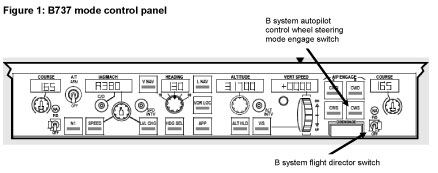
Either autopilot can be engaged in command mode or control wheel steering mode by pushing the appropriate engage switch on the mode control panel, which is located on the glare shield in front of each pilot (Figure 1).

aair200500719_001.jpg

If the autopilot flight director system is engaged in control wheel steering mode, the following system status annunciations will appear above the attitude indications on each pilot's EADI:

FD(the flight director is ON and the autopilot is either OFF or engaged in control wheel steering mode)
CWS P(the autopilot is engaged in control wheel steering pitch mode)
CWS R(the autopilot is engaged in control wheel steering roll mode)

Flight data recorder information

Following the occurrence, data from the aircraft's flight data recorder (FDR) was downloaded and analysed by the aircraft manufacturer and the Australian Transport Safety Bureau (ATSB). The data indicated that during the previous flight the autopilot was engaged after landing at Adelaide. The autopilot was engaged by pushing the control wheel steering mode autopilot engage switch for the 'B' autopilot flight director system. The autopilot engagement occurred when the 'B' system flight director switch was selected to the OFF position while the aircraft was taxiing to the terminal. The flight director switches are usually selected to the OFF position by the crew while carrying out the 'taxi in' normal procedures when the aircraft has vacated the runway after landing.

The 'B' system flight director switch and the control wheel steering engage switch are in close proximity to each other on the glare shield mode control panel, above the centre instrument panel (Figure 1).

The data showed that various up and down trim movements were commanded by the autoflight flight director system following engagement of the control wheel steering mode after landing at Adelaide. The data also showed that the 'B' autopilot flight director system remained engaged when the FDR recording ended for that flight. The aircraft manufacturer advised that 'it is expected that it [the autopilot] disengaged later on (with warning horn) when additional power switching or configuration changes occurred.' The aircraft operator advised that the autopilot would have disengaged when the engines were shutdown and the electrical power source to the autoflight flight director system transferred from the engine driven generators to the auxiliary power unit driven generator.

The aircraft manufacturer also advised that, from their review of the FDR data, 'no trim anomalies could be seen on the following climb out [the occurrence flight]'.

Summary

On 17 February 2005, a Boeing Company 737-838 aircraft, registered VH-VXN, with seven crew and 150 passengers, was being operated on a scheduled passenger flight from Adelaide, SA to Sydney, NSW. The crew reported that, as the aircraft was climbing through flight level (FL) 180 (18,000 ft), they noticed the stabiliser trim wheel moving opposite to the direction of the control column (elevator) movement.

The pilot in command was the handling pilot for the sector and was manually flying the aircraft when the movement was observed. The crew considered that the trim movement was uncommanded and consequently completed the non-normal procedure for a runaway stabiliser. As the non-normal checklist did not contain the words 'Plan to land at the nearest available airport', the crew levelled the aircraft at FL270 and continued the flight to Sydney.

Following the occurrence, a built-in test equipment check was carried out on the flight control system and no faults were found. The two flight control computers were subsequently removed from the aircraft and tested at the operator's avionics workshop with no faults being found in either unit.

Occurrence summary

Investigation number 200500719
Occurrence date 17/02/2005
Location 83 km E Adelaide, (VOR)
Report release date 27/06/2006
Report status Final
Investigation type Occurrence Investigation
Investigation status Completed
Mode of transport Aviation
Aviation occurrence category Flight control systems
Occurrence class Incident
Highest injury level None

Aircraft details

Manufacturer The Boeing Company
Model 737
Registration VH-VXN
Serial number 33484
Sector Jet
Operation type Air Transport High Capacity
Departure point Adelaide, SA
Destination Sydney NSW
Damage Nil

Fairchild SA227-DC, VH-HPE, on 22 March 2004

Safety Action

Aircraft maintenance contractor

As a result of this occurrence, the aircraft maintenance contractor has highlighted the occurrence to all engineering staff and required all maintenance engineers to re-familiarise themselves with procedures in relation to critical maintenance tasks, including duplicate inspections.

Aircraft operator

The aircraft operator published an alert to all company pilots reminding them of their responsibility to confirm the correct sense of aircraft flight control systems prior to departure. The operator also instigated a formal mechanism for crews to apply MEL conditions when operating at a remote aerodrome.

Civil Aviation Safety Authority

As a result of this and other similar occurrences, the Australian Civil Aviation Safety Authority advised the US Federal Aviation Administration of the occurrences and published an article titled Nose up, nose down regarding trim switches in the November/December 2004 issue of Flight Safety Australia magazine. The article analyses the cause of these failures and highlights the importance of maintaining switches and following correct procedures to prevent similar occurrences.

Summary

The pilot in command of the Fairchild Industries SA-227 aircraft, registered VH-HPE, operating a scheduled Regular Public Transport flight, reported that excessive forward control column force had been required 'to trim the aircraft nose down' during departure from Sydney Airport.

The Australian Transport Safety Bureau did not conduct an on-scene investigation of this occurrence.

Report

On Monday, 22 March 2004, the pilot in command of the Fairchild Industries SA-227 aircraft, registered VH-HPE, operating a scheduled Regular Public Transport flight, reported that excessive forward control column force had been required 'to trim the aircraft nose down' during departure from Sydney Airport. The pitch trim selector was switched to the copilot position, control was passed to the copilot, who was then able to trim the aircraft, and the flight continued to Taree, NSW.  After landing, an examination by the crew revealed that the pilot in command's (left side) control yoke pitch trim switch was operating in the reverse sense from normal operation.

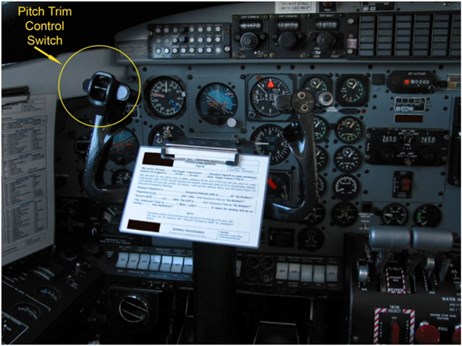
Discussions were held between the flight crew and the operator's chief pilot and chief engineer and a decision was made to continue with the following two scheduled flights before the aircraft returned to a suitable maintenance facility for rectification.  A subsequent engineering examination revealed that the pilot in command's pitch trim switch had been installed upside-down and had to be removed and re-installed in the correct orientation (refer figure 1).  The pitch trim system was checked for correct operation and the aircraft was returned to service.

Figure 1:  Left side pitch trim control switch

VH-HPE-control-switch.jpg

In the days preceding the occurrence, the aircraft underwent scheduled maintenance at a contractor maintenance facility.  During maintenance, there was a requirement to replace the left side control column pivot bearings.  To access the bearings, it was necessary to remove the control yoke and the control yoke pitch trim switch by de-soldering the switch wiring and removing the switch from the yoke housing.  After the control column bearings were replaced, the control yoke was re-installed and the trim switch wiring was re-soldered to the respective terminals.  The trim switch was then re-installed into the control yoke and the engineers reported that they conducted a full installation and duplicate functional check of the pitch trim system and completed the documentation in the aircraft maintenance worksheets.

During the investigation, the aircraft maintenance engineers responsible for the switch installation and functional check indicated that they had completed the work and that the duplicate functional check was conducted with no apparent discrepancies.  The aircraft was then handed over to other maintenance engineers for the completion of further maintenance tasks.  The following day, the scheduled departure of the aircraft was delayed due to on-going maintenance rectifications.  None of these further maintenance tasks involved the aircraft pitch trim system.  Following the delay, the aircraft departed on the occurrence flight after the crew had conducted pre-flight checks, including a check of the pitch trim system cockpit indication for correct operation.  The aircraft maintenance engineers had been assigned the maintenance tasks away from their normal location on a weekend and the aircraft was required for scheduled operations on the Monday morning.

The maintenance contractor and the aircraft operator conducted separate investigations into the trim switch misalignment and concluded that the only plausible scenario leading to the misalignment was that the engineers responsible for the pitch trim switch installation had installed the switch incorrectly. The discrepancy had not been detected during the installation and duplicate functional checks or the flight crew's pre-flight checks.

The type certificate data sheet holder for the aircraft type reported that the aircraft Minimum Equipment List (MEL) provides no relief for flight with one pitch trim system inoperative and so the decision to continue the scheduled flights in this condition was contrary to the requirements of the operator's flight operations manual.

Occurrence summary

Investigation number 200400998
Occurrence date 22/03/2004
Location Sydney, Aero.
State New South Wales
Report release date 17/05/2005
Report status Final
Investigation type Occurrence Investigation
Investigation status Completed
Mode of transport Aviation
Aviation occurrence category Flight control systems
Occurrence class Incident
Highest injury level None

Aircraft details

Manufacturer Fairchild Industries Inc
Model SA227
Registration VH-HPE
Serial number DC-823B
Sector Turboprop
Operation type Air Transport Low Capacity
Departure point Sydney, NSW
Destination Taree, NSW
Damage Nil

Gates Learjet Corporation 45, VH-SQR, Brisbane, Queensland, on 13 March 2003

Summary

The Australian Transport Safety Bureau did not conduct an on-scene investigation of this occurrence. The report presented below was prepared principally from information supplied to the Bureau.

REPORTED INFORMATION

On 13 March 2003, while on final approach during a training flight, the crew of a Lear 45 aircraft, registered VH-SQR, reported feeling a severe vibration through their respective control columns, followed by a rapid 10 to15 degree nose-down pitch change. Attempts to manually trim the nose of the aircraft up failed, with both crew members required to pull back on the control columns in order to regain control of the aircraft.

A subsequent inspection of the aircraft by the operator's engineers revealed that the aircraft's horizontal stabiliser could be moved by hand, vertically, approximately four inches at the leading edge. On examination, the horizontal stabiliser actuator appeared normal, with all attachments in place. However, the actuator was found to have free movement of its shaft in and out of the actuator body. Further detailed examination indicated that the actuator's primary `Acme screw' had failed. With this screw failed, the horizontal stabiliser load should have been retained through a secondary rod, however, the threaded retaining nut had unscrewed from the rod.

The United States National Transportation Safety Board (NTSB) advised the Australian Transport Safety Bureau (ATSB) that they were conducting an investigation into the failure of the horizontal stabiliser actuator, and the ATSB appointed an Accredited Representative to that investigation.

As a result of the incident, the US Federal Aviation Administration (FAA) issued emergency Airworthiness Directive (AD) 2003-06-51, on 20 March 2003, requiring operators to conduct an immediate inspection of Lear 45 aircraft horizontal stabiliser actuators and to remove from service any actuators that were the same part number as the failed one.

The Australian Civil Aviation Safety Authority issued Airworthiness Directive 5/2003, on 21 March 2003, requiring all Australian Lear 45 operators to comply with the requirements of the FAA AD. Additionally, the actuator manufacturer completed a new actuator design and has since had the new actuator certified for fitment to all affected Lear 45 aircraft.

The US NTSB is yet to publish its final investigation report (number ENG03WA011).

Occurrence summary

Investigation number 200301304
Occurrence date 13/03/2003
Location Brisbane, Aero.
State Queensland
Report release date 06/05/2005
Report status Final
Investigation type Occurrence Investigation
Investigation status Completed
Mode of transport Aviation
Aviation occurrence category Flight control systems
Occurrence class Incident
Highest injury level None

Aircraft details

Manufacturer Gates Learjet Corp
Model 45
Registration VH-SQR
Sector Jet
Operation type Flying Training
Departure point Brisbane, QLD
Destination Brisbane, QLD
Damage Nil