Flight below minimum altitude

Flight below minimum altitude occurrences, 40 km south of Cairns Airport, Queensland, on 24 and 26 October 2022

Interim report

Interim report released 28 February 2023

This interim report details factual information established in the investigation’s evidence collection phase and has been prepared to provide timely information to the industry and public. Interim reports contain no analysis or findings, which will be detailed in the investigation’s final report. The information contained in this interim report is released in accordance with section 25 of the Transport Safety Investigation Act 2003.

The occurrences

24 October 2022

On the evening of 24 October 2022, a Virgin Australia Airlines Boeing 737-800 registered VH-VUT operated a flight from Brisbane to Cairns, Queensland. The captain was acting as pilot flying from the right flight crew seat, the first officer was undertaking command training and operating as pilot monitoring in the left flight crew seat.[1]

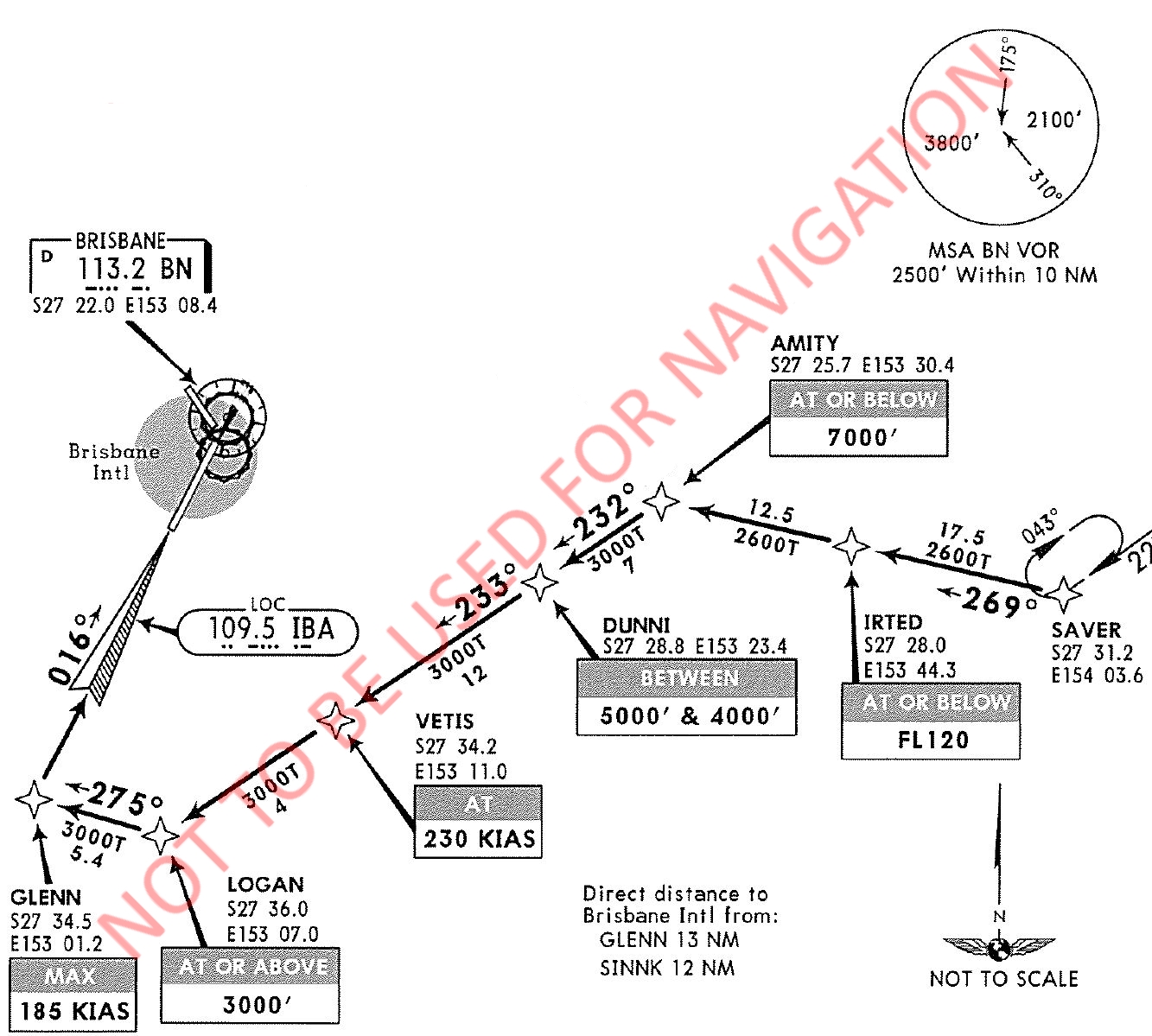
At 1945 local time, the aircraft was cruising in darkness at flight level (FL)[2] 380 about 215 NM to the south of Cairns. At that time, air traffic control (ATC) provided the crew with clearance to conduct the Cairns HENDO 8Y standard arrival (STAR) via the BARIA waypoint[3] transition (Figure 1).

Figure 1: Jeppesen HENDO 8Y standard arrival – VH-VUT

Figure 1: Jeppesen HENDO 8Y standard arrival – VH-VUT

Note: Both Virgin Australia and Qantas (see 26 October occurrence) were using procedure charts provided by Jeppesen.
Source: Virgin Australia, annotated by ATSB

The flight crew entered the HENDO 8Y STAR into the flight management computer (FMC) and selected the BARIA transition. The HENDO 8Y STAR progressed into the required navigation performance (RNP) Y instrument approach for runway 33 at Cairns. While clearance for the approach had not been provided at that time, the crew anticipated the clearance and loaded the approach into the FMC. From HENDO, the minimum altitude for commencing the RNP Y approach was 6,800 ft above mean sea level (AMSL). The HENDO waypoint was located within the 6,500 ft minimum sector altitude (MSA)[4] segment to the south of Cairns.

The approach procedure had two different initial approach fixes (IAF) (Figure 2) with associated paths to a common intermediate fix (IF) at waypoint CS540. From the BASIL IAF, the approach proceeded via CS520, CS521 and CS523, and from the HENDO IAF via CS522 and CS523. In order to load either path into the FMC, the flight crew needed to select one of the two approach transitions (see the section titled Flight management computer).

Figure 2: Jeppesen Cairns RNP Y runway 33 approach chart

Figure 2: Jeppesen Cairns RNP Y runway 33 approach chart

Source: Virgin Australia, annotated by ATSB

The flight crew did not recognise that an approach transition selection was required and consequently did not select one. As a transition had not been selected, the FMC presented a discontinuity in the entered flight path at the HENDO waypoint (see the section titled Flight management computer). The flight crew misidentified the approach IF, CS540, as the IAF and resolved the FMC discontinuity by connecting HENDO to CS540. This selection removed the 6,800 ft descent altitude constraint associated with HENDO in the RNP approach programming.

At 1954, when the aircraft was 136 nm south of HENDO, ATC cleared the flight to track direct to the HENDO waypoint and 6 minutes later the crew commenced descending the aircraft. At 2010:51, when the aircraft was about 11 NM southeast of HENDO, ATC provided the crew with clearance to conduct the RNP Y runway 33 approach.

One minute later, the aircraft approached HENDO descending through about 7,300 ft with the autopilot engaged and an altitude of 6,800 ft selected in the autopilot mode control panel. At about that time, the captain selected the approach’s minimum descent altitude of 800 ft, but sensed that this selection was incorrect and therefore reselected an altitude of 6,800 ft. The captain then reviewed the approach briefing, confirmed that the aircraft was tracking as intended and the vertical navigation autopilot mode was active and again selected 800 ft.

At 2011:38, about 7 NM prior to crossing HENDO, the aircraft descended below 6,800 ft (Figure 3) and 9 seconds later descended below the 6,500 ft MSA. Six seconds later, at 2011:53, ATC observed that the aircraft had descended below 6,800 ft and contacted the crew to confirm the aircraft’s altitude. The captain then reselected 6,800 ft and manually arrested the descent.  ATC then issued a low altitude alert to the crew and advised them to climb immediately. Three seconds later, at 2012:07, the aircraft stopped descending at about 5,920 ft and then commenced a climb. At 2012:28, the aircraft climbed back above 6,800 ft. No ground proximity warning system alerts were generated during the incident.

A missed approach was then commenced, and the crew conducted a second approach without further incident.

Figure 3: Flight path of VH-VUT

Figure 3: Flight path of VH-VUT

Source: Virgin Australia, Airservices and Google Earth, annotated by ATSB

26 October 2022

On the morning of 26 October 2022, a Qantas Airways Boeing 737-800 registered VH-VZA operated a flight from Brisbane to Cairns. The captain was acting as pilot flying, and the first officer was acting as pilot monitoring.

At 0739, in daylight, while the aircraft was in cruise at FL 380 about 225 NM to the south of Cairns, ATC provided the crew with clearance to conduct the Cairns HENDO 8Y STAR via the BARIA waypoint transition (Figure 4).

Figure 4: Jeppesen HENDO 8Y standard arrival – VH-VZA

Figure 4: Jeppesen HENDO 8Y standard arrival – VH-VZA

Source: Virgin Australia, annotated by ATSB

The flight crew entered the HENDO 8Y STAR into the FMC and selected the BARIA transition. While clearance for the RNP Y runway 33 approach had not been provided at that time, the crew anticipated the clearance and loaded the approach. The crew believed that they had only been cleared for the BARIA STAR transition and had not yet received clearance for the HENDO approach transition, and therefore did not select that transition. As the selection had not been made, the FMC did not load the instrument approach segment from the IAF to the IF and presented a discontinuity between HENDO and the IAF waypoint CS540 (see the section titled Flight management computer).

The crew noted that the waypoints CS522 and CS523 were missing from the track presented on the navigation display and contacted ATC to request confirmation of the STAR clearance. ATC then provided a clearance for the HENDO 8Y STAR with a FISHY transition. The crew reviewed the STAR chart and assessed that they could not achieve the required descent profile to proceed via FISHY and requested confirmation of the STAR transition. ATC then confirmed the STAR transition was via BARIA.

The flight crew noted that the track from HENDO to CS540 passed over the locations of CS522 and CS523. As there was no cloud along the flight path and terrain was visible, the crew were not reliant on FMC programming for terrain clearance. As such, the crew decided to join the discontinuity at HENDO to CS540 to proceed with the approach. The captain also selected an altitude 6,800 ft in the autopilot mode control panel.

At 0808:20, when the aircraft was 18 NM east of HENDO with the autopilot engaged and descending through about FL110, ATC provided the crew with clearance to conduct the RNP Y runway 33 approach.

At 0810:42, when the aircraft was about 7 NM east of HENDO, the captain selected 5,500 ft in the autopilot mode control panel and the aircraft descended below 6,800 ft, and 34 seconds later below the 6,500 ft MSA.

The aircraft passed HENDO at 0811:56 at an altitude of about 6,125 ft (Figure 5). Eleven seconds later, ATC contacted the crew to confirm that the aircraft had passed HENDO at the correct altitude. ATC then confirmed with the crew that the flight was operating in visual conditions and provided clearance for a visual approach. The aircraft landed at Cairns without further incident.

Figure 5: Flight path of VH-VZA

Figure 5: Flight path of VH-VZA

Source: Qantas, Airservices and Google Earth, annotated ATSB

Flight management computer

The approach procedure (Figure 2) had two different IAFs with associated paths to a common IF (CS540), from BASIL through waypoints CS520, CS521 and CS523, or from the HENDO through CS522 and CS523. Therefore, the flight crew needed to select one of the two approach transitions (Figure 6). If a transition was not selected, the segment of the approach from the IAF to the IF would not be loaded (the component of the instrument approach from the common IF onwards was automatically loaded).

Figure 6: Flight management computer approach transitions

Figure 6: Flight management computer approach transitions

Source: Virgin Australia, annotated by ATSB

As the crews did not select an approach transition, a discontinuity (Figure 7) was created at the HENDO waypoint associated with the HENDO 8Y STAR. Both crews resolved this discontinuity by connecting HENDO to CS540. This selection removed the 6,800 ft descent altitude constraint associated with HENDO in the RNP approach programming. The segment minimum safe altitudes associated with waypoints CS522 (6,000 ft) and CS523 (4,900 ft) were also removed.

Figure 7: Flight management computer (left) and navigation display (right) showing the discontinuity

Figure 7: Flight management computer (left) and navigation display (right) showing the discontinuity

Source: Virgin Australia, annotated by ATSB

Safety action

The ATSB has been advised of the following proactive safety action in response to these occurrences.

Virgin Australia

Virgin Australia updated flight crew operation notice information for Cairns with detailed guidance for the conduct of the HENDO 8Y arrival and RNP Y runway 33 approach. Virgin Australia also provided guidance to all Boeing 737 flight crew for the conduct of arrivals and approaches where the selection of an approach transition was required.

Qantas

Qantas issued an internal notice to flight crew providing guidance for the conduct of arrivals and approaches where the selection of an approach transition was required.

Further investigation

To date, the ATSB has:

  • interviewed the involved flight crews
  • examined recorded flight data
  • reviewed recorded air traffic control audio and surveillance data
  • reviewed operator and air traffic control procedures

The investigation is continuing and will include further review and examination of:

  • flight crew actions and recency
  • recorded flight data
  • operator and air traffic control procedures
  • instrument procedure and waypoint naming processes and standards
  • arrival and approach chart information and presentation

Should a critical safety issue be identified during the course of the investigation, the ATSB will immediately notify relevant parties so that appropriate and timely safety action can be taken.

A final report will be released at the conclusion of the investigation.

Purpose of safety investigations

The objective of a safety investigation is to enhance transport safety. This is done through:

  • identifying safety issues and facilitating safety action to address those issues
  • providing information about occurrences and their associated safety factors to facilitate learning within the transport industry.

It is not a function of the ATSB to apportion blame or provide a means for determining liability. At the same time, an investigation report must include factual material of sufficient weight to support the analysis and findings. At all times the ATSB endeavours to balance the use of material that could imply adverse comment with the need to properly explain what happened, and why, in a fair and unbiased manner. The ATSB does not investigate for the purpose of taking administrative, regulatory or criminal action.

Terminology

An explanation of terminology used in ATSB investigation reports is available here. This includes terms such as occurrence, contributing factor, other factor that increased risk, and safety issue.

Publishing information 

Released in accordance with section 25 of the Transport Safety Investigation Act 2003

Published by: Australian Transport Safety Bureau

© Commonwealth of Australia 2023

image_5.png

Ownership of intellectual property rights in this publication

Unless otherwise noted, copyright (and any other intellectual property rights, if any) in this report publication is owned by the Commonwealth of Australia.

Creative Commons licence

With the exception of the Coat of Arms, ATSB logo, and photos and graphics in which a third party holds copyright, this publication is licensed under a Creative Commons Attribution 3.0 Australia licence.

Creative Commons Attribution 3.0 Australia Licence is a standard form licence agreement that allows you to copy, distribute, transmit and adapt this publication provided that you attribute the work.

The ATSB’s preference is that you attribute this publication (and any material sourced from it) using the following wording: Source: Australian Transport Safety Bureau

Copyright in material obtained from other agencies, private individuals or organisations, belongs to those agencies, individuals or organisations. Where you wish to use their material, you will need to contact them directly.


[1]     Pilot Flying (PF) and Pilot Monitoring (PM): procedurally assigned roles with specifically assigned duties at specific stages of a flight. The PF does most of the flying, except in defined circumstances; such as planning for descent, approach and landing. The PM carries out support duties and monitors the PF’s actions and the aircraft’s flight path.

[2]     Flight level: at altitudes above 10,000 ft in Australia, an aircraft’s height above mean sea level is referred to as a flight level (FL). FL 380 equates to 38,000 ft.

[3]     Waypoint: A defined position of latitude and longitude coordinates, primarily used for navigation.

[4]     Minimum sector altitude (MSA) and lowest safe altitude (LSALT) are calculated to provide 1,000 ft obstacle clearance for instrument flight rules flights and are published on aeronautical charts and in the Aeronautical Information Publication (AIP) for pilot and controller reference.

Final report

Executive summary

What happened

24 October 2022

On the evening of 24 October 2022, a Virgin Australia Airlines Boeing 737-800, registered VH‑VUT, operated a passenger transport flight from Brisbane to Cairns, Queensland.

At 1945 local time, as the aircraft was cruising in darkness, air traffic control (ATC) provided a clearance for the HENDO 8Y arrival via the BARIA transition. The flight crew entered this arrival, transition and the following required navigation performance (RNP) Y instrument approach for runway 33 at Cairns Airport into the flight management computer (FMC). However, an approach transition was not selected resulting in a discontinuity being presented in the FMC’s programmed flight path between the HENDO arrival waypoint and the approach intermediate fix (IF) waypoint CS540. The flight crew resolved the FMC discontinuity by linking the 2 waypoints resulting in the 6,800 ft descent altitude constraint associated with HENDO in the RNP approach programming not being loaded into the programmed flight path.

As the aircraft approached HENDO, the captain selected the approach’s minimum descent altitude of 800 ft in the autopilot mode control panel and soon after, the aircraft descended below 6,800 ft and then below the minimum sector altitude of 6,500 ft. ATC alerted the crew and issued instructions to climb. The crew climbed the aircraft above 6,800 ft and commenced a missed approach before conducting a second approach and landing without further incident.

26 October 2022

On the morning of 26 October 2022, a Qantas Airways Boeing 737-800, registered VH-VZA operated a passenger transport flight from Brisbane to Cairns.

At 0739, in daylight, while the aircraft was in cruise to the south of Cairns, ATC provided the crew with clearance to conduct the Cairns HENDO 8Y arrival via the BARIA waypoint transition. The flight crew entered this arrival, transition and the following Cairns RNP Y runway 33 approach into the FMC.

The crew did not select an approach transition as they believed they had not yet received clearance for the HENDO approach transition. Consequently, the FMC presented a discontinuity between the HENDO arrival waypoint and the approach IF waypoint, CS540. The crew noted that required waypoints CS522 and CS523 were missing from the track presented on the navigation display, but as the track from HENDO to CS540 passed over those waypoints, the crew linked HENDO to CS540 and proceeded with the approach. This resulted in the 6,800 ft descent altitude constraint associated with HENDO in the RNP approach programming (as well as those associated with CS522 and CS523) not being loaded into the FMC.

As the aircraft approached HENDO, the captain selected 5,500 ft in the autopilot mode control panel and the aircraft subsequently descended below 6,800 ft, and shortly after, below 6,500 ft. Air traffic control contacted the crew and subsequently provided clearance for a visual approach. The aircraft landed at Cairns without further incident.

What the ATSB found

The ATSB found that on both occasions the flight crews did not recognise that an approach transition selection was required in the aircraft’s FMC. Consequently, no approach transition selection was made, and both crews resolved the resulting programmed flight path discontinuity by manually linking the HENDO waypoint associated with the arrival programming to waypoint CS540. This resulted in the removal of descent altitude protections associated with the HENDO waypoint in the approach programming and the resulting programmed flightpaths led to both aircraft descending below the minimum safe altitude.

The ATSB also identified that the Jeppesen RNP Y runway 33 approach chart used by both crews did not include the waypoints HENDO, CS522 and CS523 in the chart’s vertical profile depiction. Furthermore, the map presented the information associated with those waypoints over dense topographical information which limited the ability of both crews to identify the omitted descent restrictions associated with those waypoints. Additionally, the briefing conducted by the flight crews did not identify that data entry errors had removed some altitude protections.

Finally, the ATSB found that on each occasion, air traffic control quickly identified the incidents and took appropriate resolving actions.

What has been done as a result

Two days after the incident, Virgin Australia published a safety update for all flight crew providing contextual information of the occurrence and highlighting the missing waypoints in the vertical profile depiction on the Jeppesen Cairns RNP Y runway 33 chart. The safety update emphasised the requirement for an approach transition selection and was supported by an operational notice to Boeing 737 flight crews for operations into Cairns. The notice highlighted the complex nature of the HENDO 8Y arrival and Cairns RNP Y runway 33 procedure pairing and provided instruction for correct FMC data entry.

The day after the incident, Qantas Airways issued an internal notice to flight crew highlighting that many arrival and approach pairings require the selection of both an arrival transition and approach transition. The notice also described the effects of a non-selection of an approach transition with the information in the notice later incorporated into the Cairns Airport Route Manual Supplement. The details of the incident were also disseminated to all flight crew in a fleet newsletter and incorporated into Qantas’ evidence based training program.

Safety message

These occurrences highlight the risks associated with data entry errors that result in incomplete or incorrect information being entered in flight management systems. While no-one is immune from these errors, the risk can be significantly reduced through thorough and independent cross-checks between pilots and effective:

  • communication
  • operating procedures, and
  • aircraft automation systems and software design.

The occurrences

24 October 2022

On the evening of 24 October 2022 a Virgin Australia Airlines Boeing 737-800, registered VH‑VUT, operated a passenger transport[1] flight from Brisbane to Cairns, Queensland. The captain was acting as pilot flying from the right control seat while the first officer was undertaking command training and operating as pilot monitoring in the left control seat.[2]

At 1945 local time, the aircraft was cruising in darkness at flight level (FL)[3] 380 about 215 NM to the south of Cairns. At that time, air traffic control (ATC) provided the crew with clearance to conduct the Cairns HENDO 8Y standard arrival via the BARIA waypoint[4] transition (Figure 1).

Figure 1: Jeppesen HENDO 8Y standard arrival – VH-VUT

Figure 1: Jeppesen HENDO 8Y standard arrival – VH-VUT

Note: Both Virgin Australia and Qantas Airways (see 26 October occurrence) were using procedure charts provided by Jeppesen.

Source: Virgin Australia, annotated by ATSB

The flight crew entered the HENDO 8Y arrival into the flight management computer (FMC) and selected the BARIA transition. The HENDO 8Y arrival progressed into the required navigation performance (RNP) Y instrument approach for runway 33 at Cairns Airport. While clearance for the approach had not been provided at that time, the crew anticipated the clearance and loaded the approach into the FMC. The HENDO waypoint was located within the 6,500 ft minimum sector altitude (MSA)[5] segment to the south of Cairns and from HENDO, the minimum altitude for commencing the RNP Y approach was 6,800 ft above mean sea level (AMSL).

The approach procedure had 2 different initial approach fixes (IAF) (Figure 2) with associated paths to a common intermediate fix (IF) at waypoint CS540. From the BASIL IAF, the approach proceeded via CS520, CS521 and CS523, and from the HENDO IAF via CS522 and CS523. In order to load either path into the FMC, the flight crew needed to select one of the 2 approach transitions, BASIL or HENDO (see the section titled Flight management computer).

Figure 2: Jeppesen Cairns RNP Y runway 33 approach chart

Figure 2: Jeppesen Cairns RNP Y runway 33 approach chart

Source: Virgin Australia, annotated by ATSB

The flight crew did not recognise that an approach transition selection was required and consequently did not select one. As a transition had not been selected, the FMC presented a discontinuity in the entered flight path from the HENDO waypoint (see the section titled Flight management computer). The flight crew misidentified the approach IF, CS540, as the IAF and resolved the FMC discontinuity by connecting the HENDO arrival waypoint to CS540. This selection meant that the 6,800 ft descent altitude constraint associated with HENDO in the RNP approach programming was not loaded in the FMC.

At 1954, when the aircraft was 136 NM south of HENDO, ATC cleared the flight to track direct to the HENDO waypoint and 6 minutes later the crew commenced descending the aircraft. At 2010:51, when the aircraft was about 11 NM south‑east of HENDO, ATC provided the crew with clearance to conduct the RNP Y runway 33 approach.

As the aircraft approached HENDO, it descended through about 7,300 ft with the autopilot engaged and the HENDO minimum safe altitude of 6,800 ft selected in the autopilot mode control panel. The captain then selected the approach’s minimum descent altitude of 800 ft on the autopilot mode control panel, but sensed that this selection was incorrect and therefore re‑selected an altitude of 6,800 ft. The captain then reviewed the approach briefing, confirmed that the aircraft was tracking as intended, that the vertical navigation autopilot mode[6] was active and then re-selected 800 ft.

At 2011:38, about 7 NM prior to crossing HENDO, the aircraft descended below 6,800 ft (Figure 3) and 9 seconds later descended below the 6,500 ft MSA. Six seconds later, at 2011:53, ATC observed that the aircraft had descended below 6,800 ft and contacted the crew to confirm the aircraft’s altitude. The captain then reselected 6,800 ft and manually arrested the descent. ATC then issued a low altitude alert to the crew and advised them to climb immediately. Three seconds later, at 2012:07, the aircraft stopped descending at about 6,048 ft and then commenced a climb. At 2012:28, the aircraft climbed back above 6,800 ft. No ground proximity warning system alerts were generated during the incident.

A missed approach was then commenced. During preparations for the second approach, the crew recognised that an approach transition selection was required and correctly loaded the RNP Y runway 33 approach using the BASIL transition. The crew then conducted the approach and landed without further incident.

Figure 3: Flight path of VH-VUT

Figure 3: Flight path of VH-VUT

Source: Virgin Australia, Airservices Australia and Google Earth, annotated by ATSB

26 October 2022

On the morning of 26 October 2022 a Qantas Airways Boeing 737-800, registered VH-VZA, operated a passenger transport flight[7] from Brisbane to Cairns. The captain was acting as pilot flying, and the first officer was acting as pilot monitoring.

At 0739, in daylight, while the aircraft was in cruise at FL 380 about 225 NM to the south of Cairns, ATC provided the crew with clearance to conduct the Cairns HENDO 8Y arrival via the BARIA waypoint transition (Figure 4).

Figure 4: Jeppesen HENDO 8Y standard arrival – VH-VZA

Figure 4: Jeppesen HENDO 8Y standard arrival – VH-VZA

Source: Virgin Australia, annotated by ATSB

The flight crew entered the HENDO 8Y arrival into the FMC and selected the BARIA transition. While clearance for the RNP Y runway 33 approach had not been provided at that time, the crew anticipated the clearance and loaded the approach. The crew believed that they had only been cleared for the BARIA arrival transition and had not yet received clearance for the HENDO approach transition, and therefore did not select that transition. As the selection had not been made, the FMC did not load the instrument approach segment from the IAF to the IF and presented a discontinuity between the waypoint HENDO and the IF waypoint CS540 (see the section titled Flight management computer).

The crew noted that the waypoints CS522 and CS523 were missing from the track presented on the navigation display and contacted ATC to request confirmation of the arrival clearance. ATC then provided a clearance for the HENDO 8Y arrival with a FISHY transition. The crew reviewed the arrival chart and assessed that they could not achieve the required descent profile to proceed via FISHY and requested clarification of the arrival transition. ATC then confirmed the arrival transition was via BARIA.

The flight crew noted that the track from HENDO to CS540 passed over the locations of CS522 and CS523. As there was no cloud along the flight path and terrain was visible, the crew were not reliant on FMC programming for terrain clearance. As such, the crew decided to join the discontinuity at HENDO to CS540 and proceed with the approach. The captain also selected the HENDO minimum safe altitude of 6,800 ft in the autopilot mode control panel.

At 0808:20, when the aircraft was 18 NM east of HENDO with the autopilot engaged and descending through about FL110, ATC provided the crew with clearance to conduct the RNP Y runway 33 approach.

At 0810:42, when the aircraft was about 7 NM east of HENDO, the crew noted that the approach vertical profile presented on the primary flight display showed the aircraft to be above the programmed descent path. During the crew’s investigation into the profile deviation, the captain selected 5,500 ft in the autopilot mode control panel. Without the 6,800 ft  HENDO descent altitude programmed into the FMC, the aircraft commenced descending below 6,800 ft, and 34 seconds later below the 6,500 ft MSA.

The aircraft passed HENDO at 0811:56 at an altitude of 6,129 ft (Figure 5). The crew recognised that the aircraft had descended early and selected the altitude hold (ALT HLD) autopilot function to stop further descent. Eleven seconds after the aircraft crossed HENDO, ATC contacted the crew to verify that the aircraft had passed HENDO at the correct altitude. ATC then confirmed with the crew that the flight was operating in visual conditions and provided clearance for a visual approach.

The aircraft landed at Cairns without further incident. After landing, the flight crew discussed the incident and recognised that an approach transition selection was required. The crew then reloaded the approach using the HENDO transition and observed that all waypoints and altitude constraints were correctly programmed.

Figure 5: Flight path of VH-VZA

Figure 5: Flight path of VH-VZA

Source: Qantas, Airservices Australia and Google Earth, annotated ATSB

Context

Crew details

VH-VUT

The captain operated the flight as a training captain from the right control seat. The captain held an air transport pilot licence (aeroplane) and class 1 aviation medical certificate and had over 8,000 hours of flying experience, of which over 3,100 were on the Boeing 737.

The first officer was undergoing command upgrade training and operating the flight from the left control seat. The first officer held an air transport pilot licence (aeroplane) and class 1 aviation medical certificate and had over 8,600 hours of flying experience, of which over 5,200 were on the Boeing 737.

VH-VZA

The captain held an air transport pilot licence (aeroplane) and class 1 aviation medical certificate. The captain had over 13,800 hours of flying experience, of which over 7,400 were on the Boeing 737.

The first officer held an air transport pilot licence (aeroplane) and class 1 aviation medical certificate. The first officer had over 8,700 hours of flying experience, of which over 1,000 were on the Boeing 737.

Fatigue

The ATSB found no indicators that any of the flight crewmembers on either flight were experiencing a level of fatigue known to affect performance.

Meteorology

24 October 2022

The approach was conducted at night and terrain was not visible to the flight crew.

At 2010, 1 minute before VH-VUT descended below the HENDO altitude constraint, the Bureau of Meteorology (BoM) automatic weather station at Cairns Airport recorded the wind as 7 kt from 333° magnetic. Two cloud layers were also present: scattered[8] at 1,710 ft and broken at 2,110 ft above mean sea level (AMSL).

26 October 2022

The approach was conducted during daytime with no cloud and excellent visibility.

At 0800, 10 minutes before VH-VZA descended below the HENDO altitude constraint, the BoM automatic weather station at Cairns Airport recorded the wind as 2 kt from 213° magnetic. No cloud was recorded.

Arrival and approach procedures

Arrival naming

The HENDO 8Y standard arrival procedure included 7 individual transitions which led to a common waypoint, HENDO. The procedure was named after HENDO as the first (and only) common waypoint. The HENDO waypoint was also 1 of 2 initial approach fixes (IAF) for the Cairns RNP Y runway 33 approach. The other IAF, BASIL, was used for a different arrival procedure or following a missed approach.

The HENDO 8Y arrival led to the HENDO IAF and the arrival charts included the wording ‘from HENDO track via RNP Y RWY 33 (AR)’.

Approach transition selection

The two different IAFs of the RNP Y runway 33 approach procedure had associated paths to a common intermediate fix (IF) (CS540): from BASIL through waypoints CS520, CS521 and CS523, or from HENDO through CS522 and CS523. As there were 2 available options, the flight crew needed to select the required approach transition.

Selecting the RNP Y approach procedure in the flight management computer (FMC) provided the final approach procedure path, from CS540 through the final approach fix CS541, toward the runway and, if required, the missed approach procedure. The loaded data also included any associated altitude and speed limitations. To load the approach procedure from the IAF to the IF, the flight crew were required to select an approach transition. Selecting the HENDO transition would have loaded the track from HENDO to CS540, via CS522 and CS523, as well as any associated altitude constraints and speed limitations.

Cairns RNP Y runway 33 procedure chart

Airservices Australia and Jeppesen (an approved data service provider) published charts for the Cairns RNP Y runway 33 procedure. The charts produced by both organisations were designed and published in accordance with International Civil Aviation Organisation (ICAO) guidance.[9] Both of the aircraft involved in these occurrences used arrival and approach charts provided by Jeppesen.

The Airservices Australia chart vertical profile presentation included the full approach including the waypoints CS521, CS522 and HENDO (Figure 6).

Figure 6: Airservices Cairns RNP Y runway 33 approach chart

Figure 6: Airservices Cairns RNP Y runway 33 approach chart

Source: Airservices Australia, annotated by ATSB

The Jeppesen chart (Figure 7) vertical profile did not include the waypoints CS521, CS522, CS523 and HENDO. The chart's vertical profile commenced at waypoint CS540 and approach track information on the map was emphasised with a broader line from this waypoint. The information (including altitude constraint information) relating to waypoints CS521, CS522, CS523, HENDO and their associated segments was presented on the map over shaded topographical information and with an arrow to the associated item.

Figure 7: Jeppesen Cairns RNP Y runway 33 approach chart

Figure 7: Jeppesen Cairns RNP Y runway 33 approach chart

Source: Virgin Australia, annotated by ATSB

To provide a standardised presentation of aeronautical data for Jeppesen charts worldwide, Jeppesen chart design specifications directed that the vertical profile commence at the IF when an approach has multiple transitions. Jeppesen noted that this was the most common worldwide depiction of profile information. As the Cairns RNP Y approach had multiple transitions leading to the CS540 IF, the vertical profile commenced at that waypoint.

Flight management computer

The arrival and approach transitions were both presented on the same FMC Arrivals page (Figure 8). In the case of the HENDO 8Y arrival, the number of available selection lines on the screen was limited to only display 4 of the 7 available transitions. The remaining 3 available arrival transitions were displayed on a second arrivals page. This second page was indicated by a ‘1 / 2’ (page 1 of 2) at the top right of the screen.

The 2 approach transitions were presented on the right side of the arrivals screen. The crews of both aircraft did not recognise that the right column were approach transition selections.

Figure 8: Flight management computer transitions

Figure 8: Flight management computer transitions

Source: Virgin Australia, annotated by ATSB

If an approach transition was not selected, the segment of the approach from the IAF to the IF, and the associated altitude constraints, would not be loaded in the FMC.

As the crews did not select an approach transition, a discontinuity was created at the HENDO waypoint associated with the HENDO 8Y arrival (Figure 9). Both crews resolved this discontinuity by connecting the waypoint HENDO from the arrival procedure to the waypoint CS540 in the approach procedure. As waypoint HENDO in the FMC arrival procedure did not have the 6,800 ft descent altitude constraint (the constraint was only associated with the HENDO approach waypoint), this altitude constraint was not loaded into the FMC. Similarly, the segment minimum safe altitudes associated with waypoints CS522 (6,000 ft) and CS523 (4,900 ft) were not loaded.

Figure 9: Flight management computer (left) and navigation display (right) showing the discontinuity

Figure 9: Flight management computer (left) and navigation display (right) showing the discontinuity

Source: Virgin Australia, annotated by ATSB

Approach briefings

The objective of an approach briefing is to ensure all flight crew understand and share a common mental model for the proposed plan of action. This briefing was normally performed by the pilot flying with the pilot monitoring checking the data entered into the FMC. Both operators provided requirements across training and operation manuals for crews to ensure effective cross checking of data entered into the FMC.

VH-VUT

The Virgin Operating Policies and Procedures Manual provided the following relevant guidance for approach briefings:

10.30.3 Flight management computer Departure and Arrival Confirmation and Crosscheck procedures.
Crews must always confirm reference to the same charts during briefing by crosschecking the identification number, effective date and procedure name.
Flight management computer tracking information (tracks, altitude or speed limits) for departure and arrival must be crosschecked against charted information.

The captain of VH-VUT advised that, when conducting the approach briefing, they normally prioritised the vertical profile. The captain later reported that the absent waypoints in that profile, along with the thicker map line from CS540, may have contributed to their misidentification of CS540 as the IAF.

The captain did not announce the absent waypoints during the briefing. When confirming the data entered into the FMC, the first officer did not independently review the chart and therefore similarly did not identify the missing waypoints and altitude constraints.

During the briefing and check of the entered data, the pilot monitoring (first officer) became confused as to where in the sequence of the data being read the pilot flying (captain) had progressed to. The pilot monitoring sought clarification from the pilot flying, who advised that the brief had moved to the missed approach, a number of waypoints ahead of the pilot monitoring’s anticipated location. The crew did not further investigate the misunderstanding and continued the brief from the missed approach.

VH-VZA

The Qantas Flight Administration Manual provided the following relevant guidance for approach briefings in Boeing aircraft:

21.2.6.4 Arrival and Approach – brief chart page number, together with relevant charted requirements… Nominate planned approach procedures.
Navigation and Altimetry – brief the relevant navigation and altimetry requirements.
• Automation – brief the planned level of automation to be used and the transition to manual flight.
• Landing – brief landing flap configuration, level of reverse thrust and auto-brake setting for planned runway exit.
21.6…Briefing items should be cross-checked to ensure that the parameter has been set on the control panels or programmed in the flight management system correctly.
21.10.1 …ATC clearances received must be confirmed and crosschecked by both pilots.

During the approach briefing the flight crew identified the 2 missing waypoints between HENDO and CS540. However, the captain did not note the altitude restrictions at CS522, CS523 and HENDO and did not announce them during the briefing. Furthermore, the first officer did not independently review the chart, removing an opportunity to identify the missing altitude constraints.

Airways clearances

Both crews were provided with the same approach clearance from air traffic control:

‘descend 6,800, cleared RNP Y runway 33 approach’

This clearance required the crews to adhere to all approach tracking and associated altitude constraints.

The clearance phraseology was consistent with Aeronautical Information Publication[10] guidance in not including reference to the HENDO approach transition. However, for VH-VUT, because a clearance had previously been provided direct to HENDO, the approach clearance should have been prefixed with ‘when established’. As the approach clearance was provided after the FMC data error had already been made and was unlikely to highlight any error, the incorrect phraseology did not contribute to the occurrence.

The air traffic control provider, Airservices Australia, advised that both aircraft had a route clearance to Cairns Airport. This was included in the arrival instruction ‘from HENDO track via the RNP Y runway 33’. For the RNP Y runway 33 approach, the IAFs HENDO and BASIL are subject to the same concept as other RNP approaches with multiple IAFs (for example EA, EB or EC). Therefore, the IAF did not need to be specified with the approach clearance.

Similar occurrences

The HENDO 8Y arrival and RNP Y runway 33 approach were introduced in August 2017, 5 years prior to the occurrences. At the time of the release of this report, the only recorded occurrences involving a descent below minimum altitude in the vicinity of HENDO are the 2 occurrences in this report.

A previous ATSB investigation involving a similar occurrence is summarised below:

ATSB investigation AO-2017-026

On the morning of 22 February 2017, a Singapore Airlines Boeing 777-212, registered 9V-SRP, operated scheduled flight SQ291 from Singapore to Canberra, Australian Capital Territory. Prior to descent, the flight crew prepared to conduct the POLLI FOUR PAPA arrival and associated RNAV-Z approach. As the aircraft descended, ATC instructed the flight crew to conduct the POLLI FOUR BRAVO arrival. As the 2 arrivals were very similar, the flight crew elected to reprogram the POLLI FOUR BRAVO arrival into the FMC while keeping the RNAV-Z approach, creating a discontinuity in the programmed FMC flight path. The captain resolved this discontinuity by manually connecting the arrival waypoint MENZI to the approach at waypoint SCBSI. In doing so, the approach waypoint SCBSG was erased from the programmed FMC approach. The captain manually re-entered SCBSG into the FMC without detecting that an associated 7,500 ft altitude constraint was now missing.

As the aircraft continued the approach it twice descended below minimum safe altitudes before being provided with clearance to complete a visual approach.

Safety analysis

Introduction

On the evening of 24 October 2022, a Boeing 737-800 operated by Virgin Australia Airlines operated a night air transport flight from Brisbane to Cairns, Queensland. On the morning of 26 October 2022, a Boeing 737-800 operated by Qantas Airways operated the same route in daylight. During both flights, the crews did not recognise that an approach transition had to be selected when entering approach data into the flight management computer (FMC) and no selection was made.

This analysis focuses on the reasons for the crews not making the approach transition selection or identifying the data entry error prior to it resulting in both aircraft descending below the minimum safe altitude.

Transition selection

The Cairns HENDO 8Y arrival procedure had 7 arrival transitions and was named after the last waypoint in the procedure (the first common waypoint for the transitions), which was relatively uncommon. The HENDO waypoint was also one of 2 initial approach fixes (IAF) and was therefore also the name of a transition for the approach. The 2 approach transition options were presented on the right-hand side of the same FMC page as the arrival transitions, with 4 arrival transitions on the left-hand side of the same page and the remaining 3 on the next page. The crews of both aircraft did not recognise that the transitions on the right related to the approach and consequently, the requirement to select an approach transition was not immediately apparent to them.

For the crew of VH-VUT, this perception was compounded by the misidentification of the waypoint CS540 as the IAF (see the section below titled Approach chart). Separately, the crew of VH-VZA were influenced by an expectation that the wording of the approach clearance would include the nomination of a transition. However, as an airways clearance to Cairns via the HENDO 8Y arrival and RNP Y approach had been provided, no separate nomination of the approach transition was required or provided.

Ultimately, these factors resulted in both flight crews not recognising that an approach transition selection was required and consequently, none was selected. Not selecting the approach transition resulted in a discontinuity between the waypoints HENDO and CS540 in the programmed flight path.

Discontinuity resolution

Having misidentified CS540 as the IAF, the captain of VH-VUT resolved the discontinuity by manually linking HENDO from the arrival to CS540 in the approach. This presented an approach track that closely aligned with the crew’s expectations, but with the omission of the altitude constraints associated with the approach waypoints HENDO, CS522 and CS523.

On board VH-VZA, after entering the approach without selecting a transition, the crew identified that waypoints were missing from the approach. As the programmed flight path continued along the same track, the crew elected to continue the approach without the entering the waypoints into the FMC and linked the waypoint HENDO from the arrival to CS540 in the approach. This decision was possibly influenced by the fact that the aircraft was operating in visual conditions and the crew were not reliant on the FMC programming for terrain clearance. However, the crew did not identify that altitude constraints associated with the unprogrammed waypoints were omitted from the programmed flight path.

In each case, this led to the approaches continuing with the altitude constraints removed and when an altitude below the minimum safe altitude was selected, the aircraft commenced automatically descending to that altitude. This resulted in both aircraft descending below the approach altitude constraints and then the minimum sector altitude. This was contrary to air traffic control clearances and, for VH-VUT, also reduced obstacle clearance assurance as the flight was conducted in darkness.

Approach chart

The HENDO 8Y arrival and Cairns RNP Y runway 33 approach were a complex procedure pairing with similarly complex charts.

In addition, the Jeppesen approach chart used by both crews was designed and published in accordance with ICAO guidance, but did not include the waypoints HENDO, CS522 and CS523 on the vertical profile depiction. This information was included on a comparable chart produced by Airservices Australia. Had those waypoints been included on the vertical profile of the Jeppesen chart, the likelihood of the descent restrictions being identified would have been increased.

The missing waypoints on the vertical profile and thicker track line from CS540 on the approach chart likely contributed to the captain of VH-VUT misidentifying that waypoint as the IAF. These missing waypoints were also the waypoints omitted from the FMC programming if an approach transition was not selected. Therefore, their omission was not an immediate indicator of a data entry error.

Furthermore, the Jeppesen chart presented the information (including the altitude constraints) associated with the missing waypoints and segments over topographical information on the map and separated from the relevant waypoints and segments. This reduced the readability of the information and may have contributed to the crews not associating the relevant information with their respective waypoints and segments thereby further reducing the crews’ ability to identify the associated altitude constraints.

Approach Briefing

Both operators required the approach briefing to ensure that the data entered into the flight management computer included all relevant waypoints and altitude constraints from the procedure chart.

In each case, the pilot flying read from the procedure chart while the pilot monitoring reviewed the data in the FMC. This method was not fully independent and relied on the pilot flying to identify all applicable details. The missed altitude constraints (and waypoints in the case of VH-VUT) were not read out by the pilot flying and therefore, their omission was not identified by the pilot monitoring’s check. The pilot monitoring’s assessments of the correct data input was also supported by the navigation display map view tracks closely aligning with expectations.

During the approach briefing conducted by the crew of VH-VUT an opportunity was presented to pause the brief and identify the data entry error. This occurred when the pilot monitoring became confused as to the sequence of the data being read by the pilot flying. The pilot monitoring sought clarification from the pilot flying. This likely occurred as the data entered was not complete and should have acted as a trigger for reassessment of that data.

In the case of VH-VZA, the crew did identify the missing waypoints but did not fully consider the altitude constraint implication associated with these waypoints. A comprehensive brief would probably have identified these missing constraints. While the terrain was visible to the crew and they were not reliant on FMC programming for terrain protection, the airways clearance did require adherence to the limiting altitudes.

In summary, the approach briefs conducted by the crews did not ensure that the charts, and the programmed approach flight path, were fully and independently assessed. Therefore, the data entry errors leading to the removal of the altitude protections were not detected.

Air traffic control intervention

On each occasion, air traffic control quickly identified the aircraft descending below the 6,800 ft altitude constraint and immediately contacted the crews. As the VH-VUT incident was at night and not in visual conditions, the controller issued a low altitude alert to the crew and advised them to climb immediately.

The conditions were clear and during daylight for the crew of VH-VZA and therefore air traffic control was able to provide a clearance for a visual approach.

Air traffic control acts to coordinate the flow of aircraft arriving at an airport, but also plays an important role in identifying risks to aircraft. On these occasions, air traffic control intervened quickly and appropriately to resolve the risks of each descent below the minimum safe altitude.

Findings

ATSB investigation report findings focus on safety factors (that is, events and conditions that increase risk). Safety factors include ‘contributing factors’ and ‘other factors that increased risk’ (that is, factors that did not meet the definition of a contributing factor for this occurrence but were still considered important to include in the report for the purpose of increasing awareness and enhancing safety). In addition ‘other findings’ may be included to provide important information about topics other than safety factors. 

These findings should not be read as apportioning blame or liability to any particular organisation or individual.

From the evidence available, the following findings are made with respect to the flight below minimum altitude occurrences, 40 km south of Cairns Airport, Queensland on 24 and 26 October 2022.

Contributing factors

  • Both flight crews did not recognise that an approach transition selection was required in the aircraft’s flight management computer. Not selecting the approach transition resulted in a programmed flight path discontinuity between the waypoints HENDO and CS540.
  • The flight crews of both aircraft resolved the discontinuity by manually linking the HENDO waypoint associated with the arrival programming to waypoint CS540. This selection removed the 6,800 ft descent altitude constraint associated with the HENDO waypoint in the approach programming. With the altitude constraint removed, the programmed flightpaths led to both aircraft descending below the minimum safe altitude.
  • The vertical profile depiction on the Jeppesen RNP Y runway 33 approach chart did not include the waypoints HENDO, CS522 and CS523 and the map presented the information associated with those waypoints over dense topographical information. This likely limited the ability of both crews to identify the descent restrictions associated with those waypoints.
  • Both operator’s instrument approach briefing procedure included a requirement to ensure all necessary waypoints and operational constraints were included in the procedures loaded into the flight management computer. However, the briefing conducted by the flight crews did not identify that data entry errors had removed some altitude protections.

Other findings

  • On each occasion, air traffic control intervened quickly and appropriately to resolve the risks of each descent below the minimum safe altitude.

Safety actions

Whether or not the ATSB identifies safety issues in the course of an investigation, relevant organisations may proactively initiate safety action in order to reduce their safety risk. The ATSB has been advised of the following proactive safety actions in response to this occurrence.

Safety action not associated with an identified safety issue

Proactive safety action by Virgin Australia Airlines
Action number:AO-2022-051-PSA-01
Action organisation:Virgin Australia Airlines

Two days after the incident, Virgin Australia published a safety update for all flight crew regarding the occurrence on 24 October 2022. This update provided contextual information on the occurrence and highlighted the missing waypoints in the vertical profile depiction on the Jeppesen Cairns RNP Y runway 33 chart. The update also emphasised the requirement for an approach transition selection.

Virgin Australia also supported the safety update with a flight crew operational notice to 737 flight crew for operations into Cairns. The notice highlights the complex nature of the HENDO 8Y arrival and Cairns RNP Y runway 33 procedure pairing and provides instruction for correct FMC data entry.

Proactive safety action by Qantas Airways
Action number:AO-2022-051-PSA-02
Action organisation:Qantas Airways

The day after the incident, Qantas Airways issued an internal notice to flight crew highlighting that many arrival and approach pairings require the selection of both an arrival transition and approach transition. This notice also described the effects of a non-selection of an approach transition with the information in the notice later incorporated into the Cairns Airport Route Manual Supplement. The details of the incident were also disseminated to all flight crew in a fleet newsletter and incorporated into Qantas’ evidence based training program.

Proactive safety action by Airservices Australia
Action number:AO-2022-051-PSA-03
Action organisation:Airservices Australia

To ensure that consistent and correct phraseology is used when providing approach clearances at Cairns, Airservices Australia has issued a standardisation directive to the air traffic control unit.

Glossary

AIP                  Aviation information publication

AMSL              Above Mean Sea Level

ATC                 Air traffic control

CASA              Civil Aviation Safety Authority

CASR              Civil Aviation Safety Regulations

FMC                Flight Management Computer

IAF                   Initial Approach Fix

IF                     Intermediate Fix

MSA                 Minimum sector altitude

RNP                 Required navigation performance

Sources and submissions

Sources of information

The sources of information during the investigation included:

  • Airservices Australia
  • Virgin Australia Airlines
  • Qantas Airways
  • Jeppesen
  • the flight crews of both aircraft
  • Civil Aviation Safety Authority
  • recorded aircraft data from VH-VUT and VH-VZA.

Submissions

Under section 26 of the Transport Safety Investigation Act 2003, the ATSB may provide a draft report, on a confidential basis, to any person whom the ATSB considers appropriate. That section allows a person receiving a draft report to make submissions to the ATSB about the draft report.

A draft of this report was provided to the following directly involved parties:

  • Civil Aviation Safety Authority
  • Airservices Australia
  • The United States National Transportation Safety Board
  • Virgin Australia Airlines
  • Qantas Airways
  • Jeppesen
  • the flight crews of both flights.

Submissions were received from:

  • Airservices Australia
  • Qantas Airways
  • the flight crew of VH-VZA.

The submissions were reviewed and, where considered appropriate, the text of the report was amended accordingly.

Purpose of safety investigations

The objective of a safety investigation is to enhance transport safety. This is done through:

  • identifying safety issues and facilitating safety action to address those issues
  • providing information about occurrences and their associated safety factors to facilitate learning within the transport industry.

It is not a function of the ATSB to apportion blame or provide a means for determining liability. At the same time, an investigation report must include factual material of sufficient weight to support the analysis and findings. At all times the ATSB endeavours to balance the use of material that could imply adverse comment with the need to properly explain what happened, and why, in a fair and unbiased manner. The ATSB does not investigate for the purpose of taking administrative, regulatory or criminal action.

Terminology

An explanation of terminology used in ATSB investigation reports is available here. This includes terms such as occurrence, contributing factor, other factor that increased risk, and safety issue.

Publishing information 

Released in accordance with section 25 of the Transport Safety Investigation Act 2003

Published by: Australian Transport Safety Bureau

© Commonwealth of Australia 2023

image_5.png

Ownership of intellectual property rights in this publication

Unless otherwise noted, copyright (and any other intellectual property rights, if any) in this report publication is owned by the Commonwealth of Australia.

Creative Commons licence

With the exception of the Coat of Arms, ATSB logo, and photos and graphics in which a third party holds copyright, this publication is licensed under a Creative Commons Attribution 3.0 Australia licence.

Creative Commons Attribution 3.0 Australia Licence is a standard form licence agreement that allows you to copy, distribute, transmit and adapt this publication provided that you attribute the work.

The ATSB’s preference is that you attribute this publication (and any material sourced from it) using the following wording: Source: Australian Transport Safety Bureau

Copyright in material obtained from other agencies, private individuals or organisations, belongs to those agencies, individuals or organisations. Where you wish to use their material, you will need to contact them directly.


[1]     The flight was operated under Civil Aviation Safety Regulations Part 121 (Air transport operations - larger aeroplanes).

[2]     Pilot Flying (PF) and Pilot Monitoring (PM): procedurally assigned roles with specifically assigned duties at specific stages of a flight. The PF does most of the flying, except in defined circumstances; such as planning for descent, approach and landing. The PM carries out support duties and monitors the PF’s actions and the aircraft’s flight path.

[3]     Flight level: at altitudes above 10,000 ft in Australia, an aircraft’s height above mean sea level is referred to as a flight level (FL). FL 380 equates to 38,000 ft.

[4]     Waypoint: A defined position of latitude and longitude coordinates, primarily used for navigation.

[5]     Minimum sector altitude (MSA) and lowest safe altitude (LSALT) are calculated to provide 1,000 ft obstacle clearance for instrument flight rules flights and are published on aeronautical charts and in the Aeronautical Information Publication (AIP) for pilot and controller reference.

[6]     Vertical navigation (VNAV): This autopilot mode commands the auto flight system to follow the flight management system generated vertical navigation flight path including altitude constraints.

[7]     The flight was operated under Civil Aviation Safety Regulations Part 121 (Air transport operations - larger aeroplanes).

[8]     Cloud cover: in aviation, cloud cover is reported using words that denote the extent of the cover – ‘scattered’ indicates that cloud is covering between a quarter and a half of the sky, ‘broken’ indicates that more than half to almost all the sky is covered.

[9]     International Civil Aviation Organization 2016, Aeronautical Chart Manual third edition, document 8697.

[10]    Aeronautical Information Publication General section 3.4 paragraph 6.14 – Approach and Area Control Services

Occurrence summary

Investigation number AO-2022-051
Occurrence date 24/10/2022
Location 40 km south of Cairns Airport
State Queensland
Report release date 08/08/2023
Report status Final
Investigation level Defined
Investigation type Occurrence Investigation
Investigation status Completed
Mode of transport Aviation
Aviation occurrence category Flight below minimum altitude
Occurrence class Incident
Highest injury level None

Aircraft details

Manufacturer The Boeing Company
Model 737-8FE
Registration VH-VUT
Serial number 36608
Aircraft operator VIRGIN AUSTRALIA AIRLINES PTY LTD
Sector Jet
Operation type Air Transport High Capacity
Departure point Brisbane Airport, Queensland
Destination Cairns Airport, Queensland
Damage Nil

Aircraft details

Manufacturer The Boeing Company
Model 737-838
Registration VH-VZA
Serial number 34195
Aircraft operator QANTAS AIRWAYS LIMITED
Sector Jet
Operation type Air Transport High Capacity
Departure point Brisbane Airport, Queensland
Destination Cairns Airport, Queensland
Damage Nil

Flight below minimum altitude involving Beech Aircraft Corp 95-B55, VH-ALR, 20km north-north-east of Parafield Airport, South Australia, on 12 August 2022

Final report

Executive summary

What happened

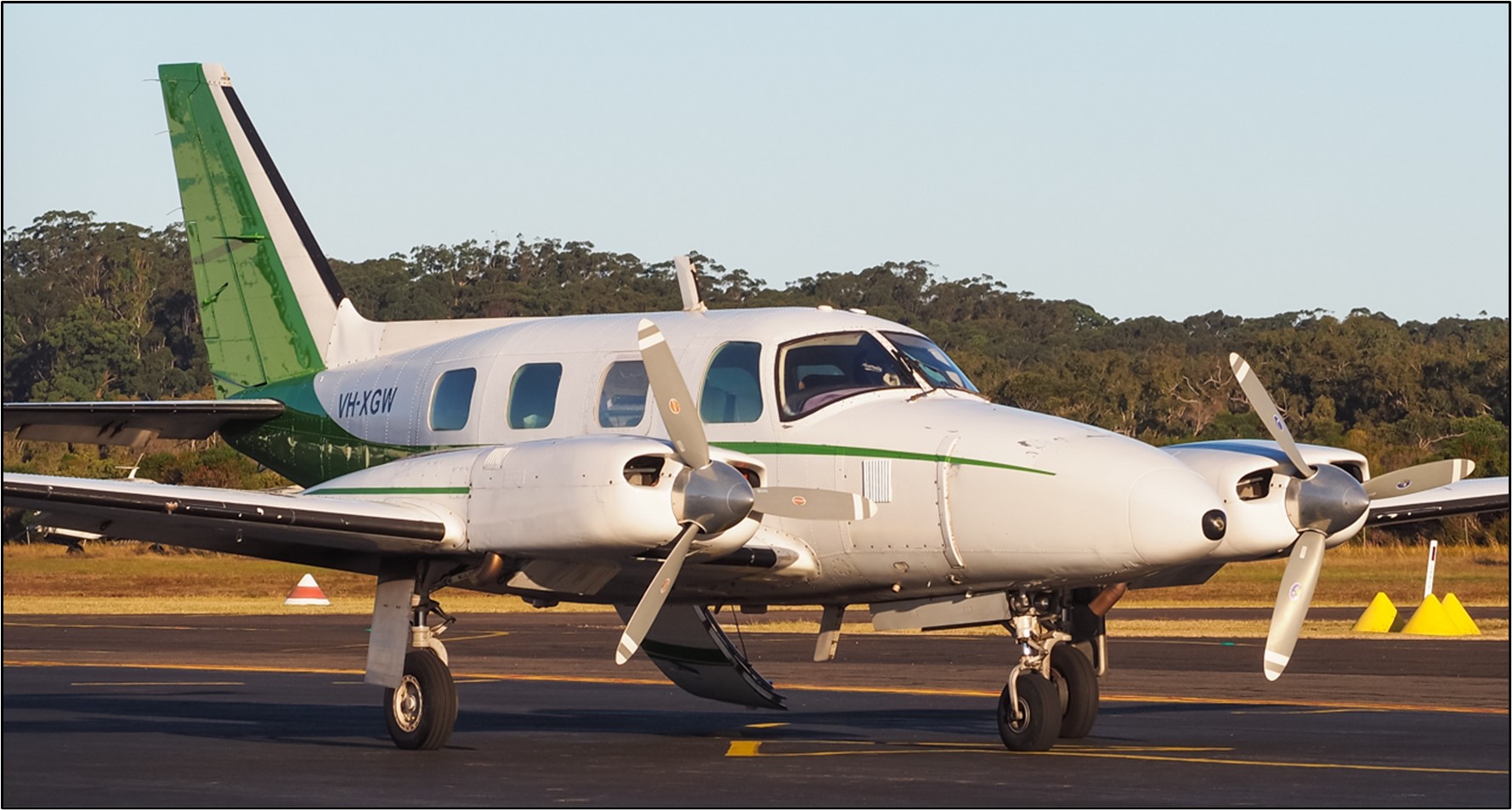
On 12 August 2022, a Beech Aircraft Corp 95-B55, registered VH‑ALR and operated by Hartwig Air, was being repositioned to Parafield Airport, South Australia after completing a series of non‑scheduled air transport passenger flights in the north of the state.

Weather conditions at Parafield when the aircraft arrived required the pilot to conduct an instrument approach procedure. During that approach, about 20 km north-north-east of Parafield and while flying in cloud, the pilot descended the aircraft below a segment minimum safe altitude, activating an automated minimum safe altitude warning to air traffic control.

An air traffic controller established communication with the pilot and advised them of their descent below the segment minimum safe altitude and issued a safety alert. The pilot immediately climbed the aircraft above the segment minimum safe altitude, then continued the approach and landed without further incident.

What the ATSB found

The ATSB found that the pilot was experiencing increased workload during the approach in cloud and turbulent conditions and did not detect their inadvertent descent below the segment minimum safe altitude, until they received the warning from the air traffic controller.

The activation of the air traffic control minimum safe altitude warning instigated communication checks with the pilot, which resulted in them being alerted to the aircraft’s descent below the segment minimum safe altitude and an immediate climb was commenced.

While conducting the approach, the pilot reported that they had been referring to a hand-held paper copy of the instrument approach procedure chart, as the aircraft’s control yoke did not have a chart holder, nor did the pilot have a document holder or kneeboard available, which increased the difficulty monitoring the check altitudes and segment minimum safe altitudes.

The aircraft was about 850 ft above the recommended profile with 7 NM to run when the pilot decided to continue the approach. Continuing the approach from that position required a higher‑than-normal descent rate and had potential to increase the pilot’s workload.

What has been done as a result

Following this incident, the operator arranged for an experienced instrument flight examiner to conduct additional training with the pilot in a synthetic training device.

Safety message

Conducting an instrument approach in instrument meteorological conditions is a high workload procedure, requiring close monitoring by the flight crew of the aircraft’s vertical and lateral navigation to assure it remains clear of terrain.

An important part of conducting the instrument approach required the continuous monitoring of the aircraft’s altitude relevant to the various segment minimum safe altitudes and having the instrument approach procedure chart available in a suitable location that minimises additional workload.

Pilots also need to remain vigilant about the relationship between the procedure commencement altitude and the constant descent final approach path, including that the correct waypoint has been identified for managing the descent profile and ensuring the distance-based check altitudes are correctly interpreted.

The investigation

Decisions regarding the scope of an investigation are based on many factors, including the level of safety benefit likely to be obtained from an investigation and the associated resources required. For this occurrence, a limited-scope investigation was conducted in order to produce a short investigation report, and allow for greater industry awareness of findings that affect safety and potential learning opportunities.

The occurrence

On 12 August 2022, a Beech Aircraft Corp 95-B55, registered VH-ALR and operated by Hartwig Air, was being repositioned to Parafield Airport, South Australia after completing a series of non‑scheduled air transport passenger flights in the north of the state. Those flights had been conducted over two days and were operated under the instrument flight rules (IFR).[1]

The flights conducted on the day of the incident commenced in Innamincka and after refuelling the aircraft at Leigh Creek, the pilot had disembarked their passengers at Port Augusta. Weather conditions for those flights were influenced by a slow-moving low-pressure system to the south of Adelaide, resulting in a south-westerly onshore flow with low cloud, showers, reduced visibility and areas of moderate and severe turbulence. The pilot conducted area navigation (RNAV) global satellite system (GNSS) instrument approaches at Leigh Creek and Port Augusta.

The aircraft departed Port Augusta just after midday (local time) and was climbed to 5,000 ft above mean sea level for the flight to Parafield. As the aircraft approached Adelaide, the weather conditions in the Parafield control zone were unsuitable for a visual arrival and the approach controller instructed the pilot to track the aircraft to waypoint PPFNA,[2] one of the initial approach fixes (IAF) for the Parafield RNAV GNSS RWY 21R[3] instrument approach procedure.[4] The instrument approach procedure chart overlaid with the aircraft’s ground track is depicted at   Figure 1.

Figure 1: Parafield RNAV GNSS RWY 21R instrument approach procedure chart with VH‑ALR track overlaid
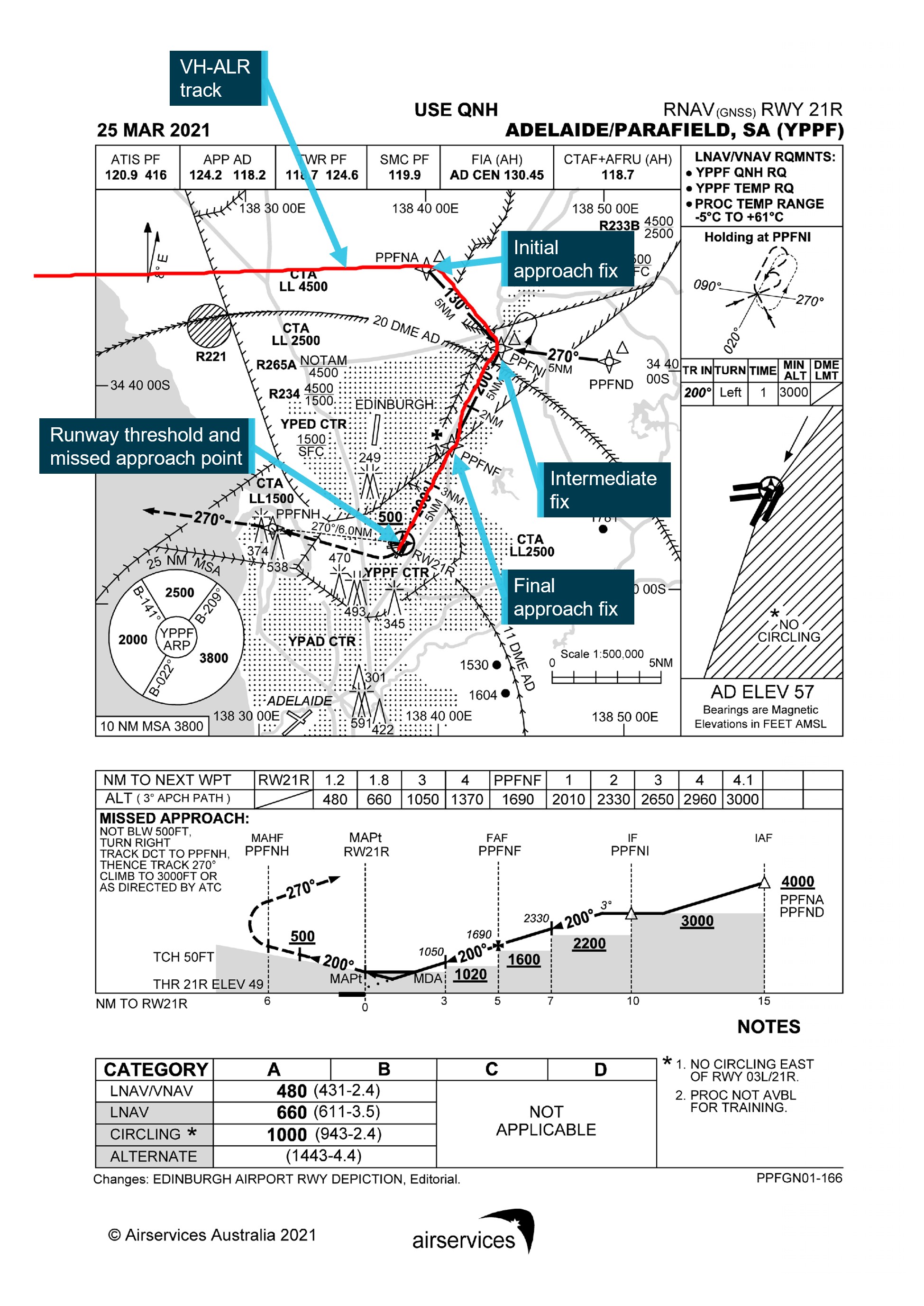
Figure 1: Parafield RNAV GNSS RWY 21R instrument approach procedure chart with VH‑ALR track overlaid

This image depicts the Parafield RNAV GNSS RWY 21R instrument approach procedure chart, overlaid with the aircraft’s ground track.

Source: Airservices Australia (ASA), modified by ATSB

The aircraft was 7 NM west of the IAF, when the approach controller cleared the pilot to descend from 5,000 ft to 4,000 ft, which was the instrument approach procedure’s minimum commencement altitude. The aircraft was approaching the IAF at an altitude of 4,000 ft when the controller issued the pilot clearance to commence the approach and to contact Parafield tower at the intermediate fix (IF), PPFNI.[5][6]

Weather conditions for the approach were reported as turbulent, affecting the aircraft’s speed and attitude control, with the aircraft passing in and out of cloud. The pilot recalled that due to the conditions and to assist with speed control during the initial stages of the descent and approach, they had extended the landing gear and selected approach flap prior to the IAF.

After passing the IAF, the pilot turned the aircraft to track to the IF and commenced descent from 4,000 ft. The segment minimum safe altitude between the IAF and IF was 3,000 ft. During the first part of that segment, the pilot descended the aircraft at an appropriate rate. The aircraft was about 2 NM from the IF when it reached and then descended below the segment minimum safe altitude.

As the aircraft approached and then passed the IF, the descent rate increased slightly, with the pilot turning the aircraft to intercept the final approach track (Figure 1) at an altitude of about 2,000 ft. After the IF, the segment minimum safe altitude reduced to 2,200 ft.

Soon after the aircraft had passed the IF, the approach controller received an automated minimum safe altitude warning (MSAW) from the air traffic control (ATC) software-based monitoring system and attempted to establish radio contact with the pilot. The approach controller then used their ‘hotline’ intercom to contact the Parafield tower controller to check if the pilot had transferred to their frequency. The tower controller established communication with the pilot, advised them that they had descended below the minimum RNAV GNSS segment altitude and requested they confirm their flight conditions. The pilot reported that they were still in cloud. The tower controller then issued a safety alert and suggested an immediate climb. The pilot was already responding to the controller’s previous transmission and had entered a climb to establish the aircraft above the segment minimum safe altitude (Figure 2). In subsequent communication with the tower controller, the pilot elected to continue the approach.

The aircraft’s lateral track was within the required lateral tracking tolerances passing the final approach fix (FAF) PPFNF and about 300 ft above the recommended approach profile. The aircraft was about 4 NM from the runway at an altitude of 1,900 ft when the pilot reported to the tower controller that they were ‘visual’ and the final part of the approach was flown at an airspeed of about 100–110 kt.

The aircraft descent profile during the approach and the lateral tracking accuracy with reference to the global positioning system (GPS) course deviation indicator’s full-scale deflection is depicted in Figure 2.

Figure 2: Descent profile and lateral tracking accuracy during instrument approach
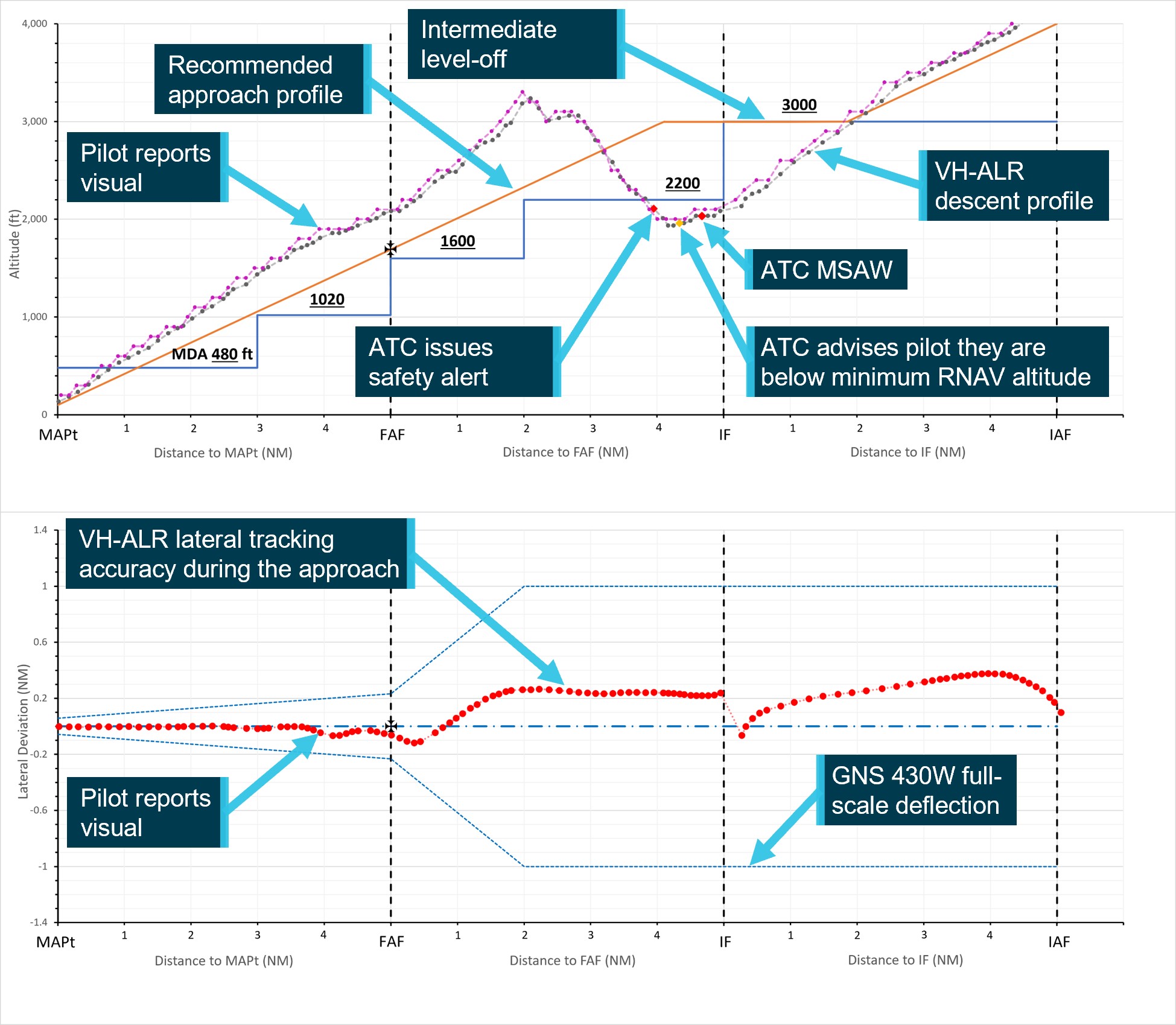
Figure 2: Descent profile and lateral tracking accuracy during instrument approach

The top graph depicts the descent profile of VH-ALR relative to the segment minimum safe altitudes during the instrument approach procedure. The grey dotted line is altitude derived from ADS-B data broadcast by the aircraft (25 ft increments), the purple line is the aircraft’s Mode C transponder altitude (100 ft increments). The lower image displays the lateral tracking accuracy of the aircraft during the instrument approach, together with the position of the full-scale deflection indicated on the course deviation indicator and the display of the GNS 430W.

Source: ATSB illustration of relevant data from the instrument approach procedure, Airservices Australia and FlightRadar24.

Context

Pilot information

The pilot held a Commercial Pilot Licence (Aeroplane) with an instrument rating and multi-engine endorsement.[7] The pilot was required to use vision correction when exercising their licence privileges. At the time of the incident, they had accrued a total aeronautical experience of approximately 1,200 hours, including 90 hours on multi-engine aircraft, 50 hours of which were on Baron series[8] aircraft. Most of the pilot’s Baron flying had been conducted under the instrument flight rules (IFR). Included in their aeronautical experience was about 60 hours of instrument flight time.

The pilot had completed an instrument proficiency check within the previous 12-month period and had recently completed a practice RNAV approach in VH-ALR at Ceduna. Prior to departing on the series of flights associated with the charter, the pilot had also conducted practice instrument landing system and RNAV approaches for Adelaide Airport, using a Civil Aviation Safety Authority (CASA)-approved synthetic training device.

The pilot recalled that they were well rested prior to commencing duty on the morning of the incident. Upon arriving at Parafield Airport, they had been on duty for more than 5 hours and had flown about 4 hours, including sectors in turbulent conditions and with relatively high workload. For the instrument approach into Parafield, the pilot reported feeling ‘moderately’ tired.[9]

Aircraft information

The aircraft was equipped with a conventional set of analogue flight instruments. It was also fitted with a 2-axis autopilot, capable of providing control guidance in the pitch and roll axes. During their post-incident interview, the pilot recalled the autopilot functionality was useful during cruise, but they wouldn’t normally use it when conducting instrument approaches.

VH-ALR was equipped with two, 3-pointer pressure-sensitive altimeters, including one directly in front of the pilot. The altimeters responded to pressure variations in the atmosphere and indicated the aircraft’s altitude above the selected pressure datum, by the pilot reading the relationship between the three indicating pointers.[10] These types of 3‑pointer altimeters are common in general aviation aircraft. Research has shown that such altimeters can be associated with misreading errors, including misreading the altitude by 1,000 ft.[11]

The aircraft was equipped with an assigned altitude indicator, which was designed to be used as a reminder of the altitude assigned by air traffic control (ATC). Altitudes could be manually set by means of individual thumb wheels, but no aural or visual alerts were provided when reaching or leaving the set altitude. The aircraft did not have an altitude alerting system, nor was it required for the type of aircraft and operation.[12]

For conducting RNAV (GNSS) instrument approaches, the aircraft had two global positioning system (GPS) receivers, a Garmin GNS 430W and a Garmin GTN 750. The display panels for the GPS receivers were located to the right of the engine control quadrant. The GTN 750 comprised a moving map display with touch screen functionality and the GNS 430W included the unit’s operating controls and a smaller display panel. The GNS 430W was installed directly below the GTN 750. The selected instrument approach procedure would crossfill between the two units. Neither the GNS 430W or the GTN 750 units could provide vertical profile guidance during the approach.

Meteorological information

The pilot obtained the relevant metrological forecasts prior to departing Innamincka on the morning of the incident. The weather conditions encountered during the flights were consistent with the forecast.

Affecting the aircraft between Port Augusta and Parafield at the selected cruise altitude was broken[13] cumulus and stratocumulus cloud and south westerly winds of about 25 kt. Scattered showers of rain with reduced surface visibility (4,000 m)[14] were forecast with towering cumulus cloud and isolated[15] light to moderate thunderstorms with rain and reduced surface visibility (2,000 m) with cumulonimbus cloud. Moderate turbulence[16] was forecast in cumulus/stratocumulus cloud and severe turbulence[17] and icing in towering cumulus/cumulonimbus cloud and thunderstorms. The freezing level was forecast to be 5,500 ft.

The Parafield Airport forecast (TAF) current at the time VH-ALR departed Port Augusta indicated that an instrument approach would likely be required arriving Parafield, with light showers of rain and broken cloud, 1,600 ft above the aerodrome elevation. The Parafield aerodrome weather reports (METARs) were automatically generated every 30 minutes for routine reports, or as special reports (SPECI) at other times when one or more meteorological elements either deteriorated or improved around specified criteria. A SPECI report was issued 1300 (closest to the time of the aircraft’s arrival), indicating broken cloud 1,700 ft above the aerodrome and overcast cloud at 2,300 ft, but with surface visibility greater than 10 km. Those conditions indicated that a pilot conducting the RNAV GNSS RWY 21R approach and flying the recommended 3‑degree approach profile, could expect to become visual with the runway at about the final approach fix (FAF).

Instrument approach

A RNAV GNSS was a two-dimensional (2D) instrument approach procedure flown using an onboard GPS receiver that complies with relevant airworthiness certification standards, to generate lateral/tracking guidance and the distance to run to next waypoint, allowing for safe navigation of an aircraft operating in instrument meteorological conditions to land at an aerodrome. If the pilot establishes the required visual reference with the runway during the approach, they continue the approach and land. If the required visual reference is not established, the pilot conducts the procedure for a missed approach.

The RNAV GNSS instrument approach procedure chart includes the approach course (comprising a series of waypoints) and information relevant to the vertical navigation of the aircraft. The descent profile was designed to provide a constant descent final approach (CDFA) path from the procedure altitude[18] to an altitude from which a straight-in landing or a circling procedure can be completed. Significantly, the position at which the CDFA intersected the procedure altitude varied between approaches, but occurred during the intermediate or final approach segments. The CDFA angle was shown on the chart’s profile diagram, together with a CDFA altitude/distance scale and advisory crossing altitudes. After commencement of the CDFA, the profile diagram and altitude/distance scale also included the crossing altitude for each of the waypoints.

Each segment of the RNAV GNSS instrument approach procedure specified one or more segment minimum safe altitudes, which were identified by shading on the chart’s profile diagram. When conducting a CDFA, pilots were expected to follow the descent profile, but monitor the descent to ensure the aircraft remains at or above the applicable segment minimum safe altitude.[19]

The instrument approach procedures were pre-programmed in the GPS database from which the pilot selected and activated the required approach. The aircraft’s position relative to the approach course was indicated on the display panels of the GPS receivers and also on the instrument panel’s course deviation indicator displays. The display panel of the GNS 430W receiver provided various operational information for the pilot’s management of the approach, including the current approach segment, the distance to run to the next waypoint and the aircraft’s groundspeed.

The GPS receivers were equipped with receiver autonomous integrity monitoring (RAIM).[20] The pilot recalled they had checked for predicted RAIM outages before arming the approach and there were none indicated. There were no RAIM messages displayed during the conduct of the instrument approach, indicating that the GPS calculated positions were within the required tolerance to conduct the approach.

Operational information

The ATC recordings indicated the pilot had correctly completed the read-back of the QNH[21] provided by the approach controller and the transponder indicated altitude from VH-ALR was consistent with the aircraft operating at the assigned altitude.

The pilot used the aircraft’s flight instruments and flight controls to steer the required approach course, make the required turns to intercept the next approach segment and manage the vertical profile of the descent.

The pilot indicated during interview that they had access to a portable electronic device with electronic flight bag (EFB) capability.[22] At the time of the incident, the operator did not hold a CASA approval to use EFBs, so the pilot also carried printed paper copies of the instrument approach procedure.[23] The aircraft’s control yoke did not have a chart holder, nor did the pilot have a document holder or kneeboard available. Consequently, the pilot reported that the paper chart was held in their hand when referring to it during the approach, including when checking altitudes, tracks and distances.

The pilot had anticipated that weather conditions at Parafield could necessitate an instrument approach and that they had reviewed the Parafield RNAV GNSS approach procedure at breakfast on the morning of the incident and again, prior to departing Port Augusta. The pilot recalled that they had identified the number of segment minimum safe altitude steps during their preflight reviews and briefing of the Parafield RNAV GNSS instrument approach procedure, particularly noting the close proximity of the final approach profile to several of those steps and planned to fly a constant profile descent during the approach. Prior to commencing the approach, they had identified that 3,000 ft was the segment minimum safe altitude prior to the intermediate fix (IF) and did not intend to descend the aircraft below that altitude. When conducting any descent, their normal procedure was to self-announce when there was 1,000 ft to run, but on this occasion the procedure was of limited use given that the descent commenced 1,000 ft above the intermediate level-out altitude.

Approaching the IF the pilot recalled concentrating on managing the aircraft’s speed in the turbulent conditions and monitoring the distance to commence the turn to intercept the final approach track. 

The pilot recalled that they had not yet reached the FAF when the tower controller advised them that they had descended below the minimum altitude, and immediately commenced a climb to above the segment minimum safe altitude. In those weather conditions, the pilot wanted to complete the approach and land as soon as practicable and when the controller asked their intentions, the pilot had elected to continue the approach.

The ATSB used the available data to estimate the aircraft’s airspeed during the final approach, which was within the required handling speeds for that approach segment.[24]

When reviewing the circumstances of the occurrence, the pilot felt those tasks had been prioritised to the detriment of their monitoring the aircraft’s altitude. The pilot did not believe that the descent below the segment minimum safe altitude was because they had misread the three‑pointer altimeter.

Since the occurrence, the pilot had considered that conducting the missed approach procedure was also an option, that could have helped manage any increased workload associated with continuing the approach and they had sufficient fuel to cover that contingency.

The pilot reviewed the Parafield RNAV GNSS RWY 21R instrument approach procedure after the occurrence and had compared that approach with the other procedures flown that day, they noted the variation between how the altitude/distance scales were presented and the waypoints that the altitudes and distances referred to.

The ATSB reviewed the instrument approach procedures flown by the pilot on the day of the incident and noted:

  • arriving at Leigh Creek, the procedure profile depicted a level segment from the IAF to the IF, and the CDFA path commenced about 4.5 NM prior to the FAF
  • arriving at Port Augusta, the procedure profile depicted the aircraft crossing the IAF at a constant altitude, but the CDFA path commenced about 1.9 NM prior to the IF
  • arriving at Parafield from the IAF waypoints PPFNA or PPFND, the procedure profile depicted an intermediate descent commencing at the IAF, but with a segment minimum safe altitude of 3,000 ft until after passing the IF (PPFNI) with the CDFA path commending 4.1 NM prior to the FAF.

For all approaches flown that day, the altitude/distance scale on the profile diagram provided information for the CDFA path, including the waypoint crossing altitudes. In the case of the Parafield approach, the waypoint PPFNI was also denoted as an IAF at an altitude of 3,000 ft.[25]

Safety analysis

On 12 August 2022, a Beech Aircraft Corp 95-B55, registered VH-ALR was being operated on an instrument approach procedure into Parafield Airport, South Australia. During that approach and while flying in cloud and turbulent conditions, the pilot descended the aircraft below a segment minimum safe altitude, activating an automated minimum safe altitude warning to air traffic control. Air traffic control contacted the pilot and advised the pilot of their descent below the segment minimum safe altitude and issued a safety alert. The pilot immediately climbed the aircraft above the segment minimum safe altitude, then continued the approach and landed without further incident.

The ATSB was satisfied that the pilot was adequately rested prior to commencing their duty period. Although the pilot reported that their fatigue levels had increased during the flight, that was to be expected given the weather conditions during the flights conducted that day.

The ATSB concluded there were no issues with the set up or functionality of the aircraft’s altimeters, meaning correct altitude information was available to the pilot. As such, the following analysis will consider factors associated with the descent below minimum safe altitude, use of a paper copy of the instrument approach procedure chart, the pilot’s response to the minimum safe altitude alert warning and the resulting steeper than normal approach to land.

The weather conditions in the vicinity of Parafield required the pilot to conduct an instrument approach. The aircraft was maintaining 4,000 ft above mean sea level as it approached the initial approach fix PPFNA and had been configured to commence the instrument approach procedure. The initial descent from 4,000 ft was conducted at a rate that achieved an approximate 3-degree descent profile.

The pilot had stated that they had left 4,000 ft at commencement of the approach with the intention of levelling out at 3,000 ft. The pilot’s recollection was that descent below the segment minimum safe altitude was not the result of misreading the altimeter or instrument approach procedure, but more due to being distracted by workload in the turbulent weather conditions. That included monitoring the distance to run to the intermediate fix, to initiate the turn to intercept the track for the final approach. Conducting an instrument approach in instrument meteorological conditions added to a high workload procedure, requiring close monitoring of the aircraft’s vertical and lateral navigation by the pilot.

The instrument approach procedure included five segment minimum safe altitudes and the constant descent final approach (CDFA) path that passed close to those limits, which necessitated close monitoring during the descent. During the instrument approach, the pilot would have used one hand on the control column to fly the aircraft, and the other hand to operate the engine and other ancillary controls. The pilot’s use of a paper copy of the instrument approach procedure chart without a chart holder or kneeboard available, made the task of referring to the chart information less convenient and potentially increased the likelihood of misinterpreting check altitudes for the descent or segment minimum safe altitudes that applied.

Following the incident, the pilot reviewed the Parafield instrument approach procedure, together with the other procedures they had flown that day and correctly identified that each procedure’s CDFA path commenced at different positions in relation the initial approach and intermediate fixes. However, they probably had not correlated the relationship between the procedure altitude for commencement of the CDFA path and the significance of that position with the commencement of altitude/distance scale on the instrument approach procedure’s profile diagram. This increased the potential for the pilot to misinterpret the altitude/distance scale and associate the published altitude with the distance to run to an incorrect or out of sequence waypoint.

Although the pilot was experiencing a high workload as the aircraft approached the intermediate fix, they had accurately intercepted the inbound track and had immediately initiated a climb of the aircraft when the tower controller advised their descent below the minimum procedure altitude. Although the aircraft had descended below the segment minimum safe altitude, the lateral tracking of the aircraft was accurate and remained within the lateral tracking requirements for the RNAV GNSS procedure.

The pilot climbed the aircraft above the 2,200 ft segment minimum safe altitude for that stage of the approach and continued the climb. That resulted in the aircraft being about 850 ft above the recommended profile with 7 NM to run to the missed approach point when the tower controller asked the pilot their intentions, and the pilot indicated they would continue the approach. Continuing the approach from that position did require a higher-than-normal descent rate and had potential to increase the pilot’s workload. However, the pilot managed the descent of the aircraft to progressively intercept the approach profile, the aircraft’s speed was maintained within the required parameters for the approach and the lateral tracking was within the required tolerances. The aircraft was about 400 ft above the recommended CDFA path at the final approach fix, with 5 NM to run to the missed approach point and soon after, the pilot reported to the tower controller that they were visual.

Findings

ATSB investigation report findings focus on safety factors (that is, events and conditions that increase risk). Safety factors include ‘contributing factors’ and ‘other factors that increased risk’ (that is, factors that did not meet the definition of a contributing factor for this occurrence but were still considered important to include in the report for the purpose of increasing awareness and enhancing safety). In addition ‘other findings’ may be included to provide important information about topics other than safety factors.

These findings should not be read as apportioning blame or liability to any particular organisation or individual.

From the evidence available, the following findings are made with respect to the flight below minimum altitude involving Beech Aircraft Corp 95-B55, registration VH-ALR near Parafield Airport, South Australia on 12 August 2022.

Contributing factors

  • Approaching the intermediate fix while conducting a RNAV GNSS approach in instrument meteorological conditions and turbulence, the pilot’s workload increased and they did not identify the inadvertent descent below the segment minimum safe altitude.

Other factors that increased risk

  • The pilot reported that they were using a hand-held paper copy of the instrument approach procedure chart, which increased the difficulty monitoring the check altitudes and segment minimum safe altitudes for the various stages of the approach.
  • After climbing the aircraft above the segment minimum safe altitude, the pilot elected to continue the approach which necessitated a steeper than normal descent.

Other findings

  • The activation of the minimum safe altitude warning on the approach controller's console instigated communication checks with the pilot, which resulted in them being alerted to the aircraft’s descent below the segment minimum safe altitude and an immediate climb was commenced.

Safety actions

Whether or not the ATSB identifies safety issues in the course of an investigation, relevant organisations may proactively initiate safety action in order to reduce their safety risk. All of the directly involved parties are invited to provide submissions to this draft report. As part of that process, each organisation is asked to communicate what safety actions, if any, they have carried out to reduce the risk associated with this type of occurrences in the future. The ATSB has so far been advised of the following proactive safety action in response to this occurrence.

Safety action by Hartwig Air

Following this incident, the operator arranged for an experienced instrument flight instructor/examiner to conduct additional training with the pilot in a synthetic training device.

Sources and submissions

Sources of information

The sources of information during the investigation included:

  • the pilot of VH-ALR
  • Airservices Australia
  • Bureau of Meterology.

Submissions

Under section 26 of the Transport Safety Investigation Act 2003, the ATSB may provide a draft report, on a confidential basis, to any person whom the ATSB considers appropriate. That section allows a person receiving a draft report to make submissions to the ATSB about the draft report.

A draft of this report was provided to the following directly involved parties:

  • the pilot of VH-ALR
  • Hartwig Air
  • Civil Aviation Safety Authority
  • Airservices Australia
  • Bureau of Meterology.

There were no submissions received.

Purpose of safety investigations

The objective of a safety investigation is to enhance transport safety. This is done through: 

  • identifying safety issues and facilitating safety action to address those issues
  • providing information about occurrences and their associated safety factors to facilitate learning within the transport industry.

It is not a function of the ATSB to apportion blame or provide a means for determining liability. At the same time, an investigation report must include factual material of sufficient weight to support the analysis and findings. At all times the ATSB endeavours to balance the use of material that could imply adverse comment with the need to properly explain what happened, and why, in a fair and unbiased manner. The ATSB does not investigate for the purpose of taking administrative, regulatory or criminal action.

Terminology

An explanation of terminology used in ATSB investigation reports is available here. This includes terms such as occurrence, contributing factor, other factor that increased risk, and safety issue.

Publishing information

Released in accordance with section 25 of the Transport Safety Investigation Act 2003

Published by: Australian Transport Safety Bureau

© Commonwealth of Australia 2024

image_5.png

Ownership of intellectual property rights in this publication

Unless otherwise noted, copyright (and any other intellectual property rights, if any) in this report publication is owned by the Commonwealth of Australia.

Creative Commons licence

With the exception of the Coat of Arms, ATSB logo, and photos and graphics in which a third party holds copyright, this publication is licensed under a Creative Commons Attribution 3.0 Australia licence.

Creative Commons Attribution 3.0 Australia Licence is a standard form licence agreement that allows you to copy, distribute, transmit and adapt this publication provided that you attribute the work.

The ATSB’s preference is that you attribute this publication (and any material sourced from it) using the following wording: Source: Australian Transport Safety Bureau

Copyright in material obtained from other agencies, private individuals or organisations, belongs to those agencies, individuals or organisations. Where you wish to use their material, you will need to contact them directly.

[1]     Instrument flight rules (IFR): a set of regulations that permit the pilot to operate an aircraft in instrument meteorological conditions (IMC), which have much lower weather minimums than visual flight rules (VFR). Procedures and training are significantly more complex as a pilot must demonstrate competency in IMC conditions while controlling the aircraft solely by reference to instruments, rather than by outside visual reference. Typically, this means flying in cloud or limited visibility. IFR-capable aircraft have greater equipment and maintenance requirements.

[2]     Waypoint: A defined position of latitude and longitude coordinates, primarily used for navigation. These waypoints were incorporated to the GPS receiver’s navigation database and could not be edited by the user. Regular updates were made to the navigation database and ensured the current/correct approach procedure was available.

[3]     Runway number: the number represents the magnetic direction of the runway centreline, and is expressed in 10 degree increments of azimuth. The runway identification may include L, R or C as required for left, right or centre.

[4]     An RNAV GNSS approach is a type of instrument approach procedure that uses a GPS receiver that complies with the relevant airworthiness certification standards, to provide lateral tracking information for the pilot to conduct the approach.

[5]     The relatively late approach clearance was due to visual flight rules (VFR) aircraft operating in the Parafield circuit area. An approach clearance could only be issued once all the VFR aircraft operating in the Parafield control zone were on the ground.

[6]     Waypoint PPFNI was the intermediate fix for the procedure when being conducted from offset sectors (PPFNA and PPFND). For a straight-in approach, PPFNI was designated as the IAF at an altitude of not below 3,000 ft.

[7]     This included 2D and 3D instrument approach operations in instrument meteorological conditions, which included RNAV GNSS procedures. The pilot’s instrument rating and multi-engine endorsement was issued in 2017. Since that time, they had completed 2 instrument proficiency checks.

[8]     The Baron series of aircraft includes the Beech Aircraft Corp 95-B55.

[9]     During interview, the pilot was asked to make a subjective assessment of their fatigue level at the time of the occurrence, using the Samn-Perelli seven-point fatigue scale. The pilot estimated that they had started their duty period fully alert, wide awake (scale point ‘1’), but at the time of the occurrence their fatigue levels had increased, and they were moderately tired (scale point ‘5’).

[10]    Hundreds of feet were indicated by a long and narrow pointer needle, thousands of feet by a short and wide pointer needle and tens of thousands of feet by a long/thin needle with a triangle symbol at the pointer’s tip.

[11]    A summary of research and guidance regarding the design of altimeters is included in Appendix A of the ATSB Aviation Occurrence Report AO-2020-017, Controlled flight into terrain involving Cessna 404, VH-OZO 6 km south-east of Lockhart River Airport, Queensland, on 11 March 2020. This report is available to download from the ATSB website (

).

[12]    An altitude alerting system provides an aural alert (tone) and/or a visual alert when an aircraft on climb/descent approaches the designated altitude and when deviating from that altitude during cruise. Aircraft conducting IFR operations in controlled airspace were required to have either an assigned altitude indicator or an altitude alerting system. For piston-engine aircraft, an altitude alerting system was only required for IFR operations at altitudes 15,000 ft above the standard atmospheric pressure datum 1013.25 hPa.

[13]    Broken describes cloud coverage between 5 to 7 eighths (oktas) of the sky (except for cumulonimbus and towering cumulus cloud).

[14]    Scattered describes well separated features that affect or are forecast to affect, an area with a maximum spatial coverage from 50% to 75%.

[15]    Isolated describes individual features that affect or are forecast to affect, an area with a maximum spatial coverage of up to 50%.

[16]    Moderate turbulence describes appreciable changes in attitude and/or altitude in rapid bumps or jolts, but with the pilot being able to control the aircraft.

[17]    Severe turbulence describes large abrupt changes in attitude and/or altitude, resulting in momentary loss of control of the aircraft flightpath.

[18]    The procedure altitude accommodates a stabilised descent at a prescribed descent gradient/angle in the intermediate/final approach segments.

[19]    Descent below the recommended CDFA to the segment minimum safe altitude can be conducted at pilot discretion but was not a recommended technique.

[20]    Availability of RAIM during the conduct of an RNAV GNSS approach provides an assurance of the integrity of the navigation system and that the calculated position is within the required tolerance for the procedure being flown.

[21]    QNH: the altimeter barometric pressure subscale setting used to indicate the height above mean seal level.

[22]    An EFB can replace traditional paper products in an aircraft, store and display aviation data and perform calculations. This typically also includes functionality such as a moving map display with relevant information overlaid.

[23]    Holders of an air operator certificate required CASA approval before their crews could use an EFB. Operators were required to provide CASA with an exposition including information, procedures, and instructions for the use of EFBs.

[24]    The handling speed stipulated for a category B aircraft during the final approach segment was 85 to 130 kt.

[25]    This configuration for the approach allowed aircraft arriving from the north-east to commence the approach at waypoint PPFNI.

Occurrence summary

Investigation number AO-2022-039
Occurrence date 12/08/2022
Location near Parafield Airport
State South Australia
Report release date 15/05/2024
Report status Final
Investigation level Short
Investigation type Occurrence Investigation
Investigation status Completed
Mode of transport Aviation
Aviation occurrence category Flight below minimum altitude
Occurrence class Incident
Highest injury level None

Aircraft details

Manufacturer Beech Aircraft Corp
Model 95-B55
Registration VH-ALR
Serial number TC-1739
Aircraft operator Bruce Hartwig Flying School Pty Ltd
Sector Piston
Operation type Part 135 Air transport operations - smaller aeroplanes
Departure point Port Augusta Aerodrome, South Australia
Destination Parafield Aerodrome, South Australia
Damage Nil

Flight below minimum altitude involving Aero Commander 500 S, VH-LTP, near Adelaide Airport, South Australia, on 12 August 2021

Final report

Safety summary

What happened

On 12 August 2021, at about 0858 Central Standard Time, an Aero Commander 500-S aircraft, registered VH-LTP, departed Port Lincoln on a private flight to Adelaide, South Australia under instrument flight rules. On board were the pilot and one passenger.

During the descent in instrument meteorological conditions, when passing about 6,000 ft, the aircraft began to encounter turbulence. Following clearance to track direct to the GPS waypoint GULLY, the pilot reported having difficulties entering the area navigation (RNAV) instrument approach data into the aircraft’s touchscreen multi-function display due to turbulence. By the time the pilot had correctly entered it, the aircraft had just passed the waypoint. When the pilot then selected the ‘Direct-To’ option on the display, the autopilot commanded a sharp turn to the right, to commence an orbit to attempt to overfly the waypoint to recapture it.

On observing the aircraft’s track, the controller instructed the pilot to maintain 3,800 ft and to turn onto a heading of 360°, intending to vector the aircraft back towards the waypoint. About 90 seconds later, the controller instructed the pilot to turn onto heading 120°, which the pilot read back. When the controller tried to contact the pilot about 1 minute later, the pilot did not respond and communications were lost.

The aircraft continued on the assigned heading but began descending below its assigned altitude, which was also the minimum sector altitude. For 4 minutes, ATC, with the assistance from the pilot of a nearby aircraft, continued to attempt to contact the pilot of VH-LTP. During this time, the approach controller also issued the pilot three terrain safety alerts.

The pilot contacted the Melbourne Centre controller, who instructed the pilot to transfer back to the Adelaide Approach frequency. Upon regaining communication, the approach controller issued the pilot a terrain safety alert and instructed the pilot to climb immediately to 5,000 ft. The lowest altitude the aircraft descended to was 2,480 ft and the highest point within 5 NM of the aircraft’s track was 1,913 ft.

The aircraft then tracked to Adelaide Airport and landed without further incident.

What the ATSB found

The ATSB found that during the approach, the pilot was experiencing data entry difficulties due to turbulent conditions and inadvertently selected the incorrect radio frequency. Further, several factors including the environmental conditions, data entry difficulties and the timing of the clearance for the GULLY waypoint, likely led to the pilot experiencing a high workload. This in turn, likely affected the pilot’s situational awareness where they did not initially notice the frequency change nor the continued descent and descent below the assigned (minimum sector) altitude.

Safety message

The approach and landing phases are known periods of high workload for pilots. Pilots must continuously monitor aircraft and approach parameters, and the external environment, to ensure they maintain a stable approach profile and make appropriate decisions for a safe landing. The Flight Safety Foundation found that between 1984 and 1994, 50 per cent of controlled flight into terrain accidents were due to inadequate monitoring by the pilot. Distractions and unanticipated events can further increase a pilot’s workload leading to undetected errors and a loss of situational awareness. During high workload phases of flight, pilots should remain focused on monitoring the aircraft instruments and avoid fixating on a problem.

The investigation

Decisions regarding whether to conduct an investigation, and the scope of an investigation, are based on many factors, including the level of safety benefit likely to be obtained from an investigation. For this occurrence, a limited-scope investigation was conducted in order to produce a short investigation report, and allow for greater industry awareness of findings that affect safety and potential learning opportunities.

The occurrence

On 12 August 2021, at about 0858 Central Standard Time,[1] an Aero Commander 500-S aircraft, registered VH-LTP, departed Port Lincoln on a private flight to Adelaide, South Australia under instrument flight rules.[2] On board were the pilot and one passenger.

At about 0930, the pilot made first contact with Adelaide Approach air traffic control (ATC) and was cleared to track direct to Adelaide maintaining 7,000 ft. The controller also advised the pilot to expect vectors for the area navigation Z (RNAV-Z)[3] approach for runway 23. The aircraft was in instrument meteorological conditions (IMC).[4]

About 14 minutes later, the controller cleared the aircraft to descend to 5,000 ft and turn left on a heading of 050°. The pilot recalled the aircraft encountering turbulence during the descent, which started when passing about 6,000 ft. At 0947, the controller cleared the pilot to descend to 3,800 ft and to turn right on a heading of 090°. The controller advised the pilot to expect a clearance shortly to navigate to GPS waypoint GULLY, which was the initial approach fix for the RNAV approach. Less than 1 minute later, when the aircraft was 6 NM north-west of GULLY, the controller cleared the pilot for the RNAV approach and instructed the pilot to track direct to GULLY (Figure 1).

The pilot began tracking to GULLY and reported having difficulties entering the RNAV approach details into the aircraft’s touchscreen multi‑function display (MFD) due to the turbulence. By the time the pilot had correctly entered it, the aircraft had just passed the GULLY waypoint and when the pilot then selected the ‘Direct-To’ option on the display, the autopilot commanded a sharp turn to the right, to orbit back around to recapture the waypoint (Figure 1).

Observing the aircraft’s track away from the waypoint, the controller, at 0951, advised the pilot they had missed the approach and instructed them to maintain 3,800 ft. They then instructed the pilot to turn right on a heading of 360° and to expect vectors back to GULLY.  After turning to the assigned heading, the aircraft started a gentle climb. At 0953, the controller instructed the pilot to turn right onto heading 120° and to expect a clearance to navigate to GULLY shortly. The pilot correctly read back the clearance and later recalled having commenced a descent, realising the aircraft was then above the assigned altitude. This was the last radio call the pilot received from the Adelaide Approach controller before the pilot inadvertently switched the radio frequency back to Melbourne Centre.[5]

About 1 minute later, when the aircraft was 2.5 NM north of GULLY, the controller issued the expected clearance – to resume their own navigation, track direct to GULLY, descend to 3,800 ft and conduct the RNAV approach for runway 23. The controller did not receive a response from the pilot.

The pilot continued on their last assigned heading of 120° and the aircraft began descending below its assigned altitude of 3,800 ft, which was also the minimum sector altitude. For 4 minutes, ATC, with the assistance from the pilot of a nearby aircraft, continued to attempt to contact the pilot of VH-LTP. During this time, the controller also issued the pilot three terrain safety alerts.

At 0957, the pilot of VH-LTP made a radio call to ATC, which was received by the Melbourne Centre, to ask the approach controller whether they should track back to GULLY. When the pilot received no reply, they made another call. The Melbourne Centre controller responded, told the pilot to standby and then instructed them to contact Adelaide Approach on frequency 118.2. The controller then contacted the Adelaide Approach controller to inform them that they had the pilot on the Melbourne Centre frequency, and the pilot was transferring back to the correct frequency. Upon regaining communication with the pilot, the approach controller immediately issued a terrain safety alert and instructed the pilot to climb immediately to 5,000 ft. The aircraft’s altitude at that time was 2,780 ft.

After observing no increase in the aircraft’s altitude for almost 1 minute, the controller contacted the pilot and asked them to confirm climbing to 5,000 ft. The pilot confirmed and the aircraft began to climb. The lowest altitude the aircraft descended to was 2,480 ft, the highest point within 5 NM of the aircraft’s track was 1,913 ft (Figure 2).

Figure 1: VH-LTP flight path (dotted line shows RNAV instrument approach path)

Figure 1: VH-LTP flight path (dotted line shows RNAV instrument approach path)

Source: Google Earth overlaid with Airservices data, annotated by the ATSB

Figure 2: VH-LTP’s altitude relative to the terrain (in feet)

Figure 2: VH-LTP’s altitude relative to the terrain (in feet)

Source: Geoscience terrain data overlaid with Airservices data, annotated by the ATSB

The controller vectored the aircraft back to Adelaide Airport for a RNAV-Z approach for runway 05. The aircraft landed at Adelaide Airport at 1028.

Context

Pilot information

The pilot previously held a Commercial Pilot Licence (Aeroplane), but at the time of the incident was exercising the privileges of a Private Pilot Licence, with an instrument rating and a valid Class 2 Aviation Medical Certificate. The pilot had a total flying experience of about 16,800 hours, they had accrued about 9,800 hours on the Aero Commander 500-S and about 4,700 hours total instrument time. The pilot completed their instrument proficiency check on 29 June 2021 and last flew an RNAV approach in instrument meteorological conditions (IMC) on 6 August 2021.

Weather observations

The pilot reported being aware of forecast IMC prior to departing Port Lincoln and planned their flight accordingly. They reported operating in cloud until the aircraft had descended to 1,000 ft on approach for runway 05, and turbulence from 6,000 to 3,000 ft, with the intensity increasing between 4,000 ft and 3,000 ft.

The pilot’s observations were consistent with the forecast weather conditions.

Garmin GTN 650 touchscreen

The Garmin GTN 650 is a navigation aid that combines GPS, communication and navigation functions in an MFD, capable of showing high resolution terrain mapping, graphical flight planning, multiple weather options and traffic display. The touchscreen uses capacitive technology to sense the proximity of skin to the display, responding to light touches, without the need of pressure for detection.

Functions related to this incident include a ‘Direct-To’ key, which when pressed provided a direct course to a selected waypoint. The navigation and communication frequencies could be changed by touching the standby window and the keypad to enter the desired frequency. To flip between active and standby frequencies, the operator needed to touch the active navigation/communication frequency field (Figure 3). Upon touching the frequency field, a text box ‘Hold for Flip-Flop’ is displayed near the knob. If the active navigation/communication frequency field is touched and held it will switch between the navigation and communication frequencies.

Figure 3: Garmin GTN 650 display screen

Figure 3: Garmin GTN 650 display screen

Source: Garmin, annotated by the ATSB

The pilot reported that when operating in turbulent conditions, they usually put two fingers on the side of the display to stabilise their hand and use their thumb to enter the data. After missing the initial approach fix, and during the second attempt to enter the waypoint into the MFD, the pilot reported that their finger slipped and inadvertently selected the Melbourne Centre frequency, which was the previous frequency selected.

Workload

Speed and timeframe

During the descent, the aircraft’s airspeed was about 170 kt. The pilot reported receiving a late descent to commence the RNAV-Z approach, which resulted in the aircraft being too high and fast to commence the approach. The pilot reported feeling rushed due to the combination of speed and the timing of the descent and approach clearances. The pilot reported their ideal approach speed would be 120-140 kt. However, data from previous flights inbound to Adelaide, that were probably flown by the pilot, show the aircraft conducting approaches at similar speeds.  

Handling speeds for instrument approaches are specified in Airservices Australia’s Aeronautical Information Publication, En Route 1.16.1 These included a range of 120–180 kt indicated airspeed for Category B aircraft during the initial and intermediate approach. VH-LTP was within this range when the pilot was cleared to conduct the RNAV approach.

Monitoring

When assigned heading 120°, the pilot realised the aircraft had climbed since the turning onto the 360° heading, and therefore commenced a descent to the assigned altitude. However, the pilot was unaware the aircraft had subsequently continued to descend while they were out of communication with Adelaide Approach.

The pilot recalled becoming aware that something was wrong when they had not received any further instructions from ATC and recognised the voice of the Melbourne Centre controller. This prompted the pilot to contact the controller, who transferred them back to Adelaide Approach.

Self-assessment

The pilot rated their workload during the incident as 7 out of 10. The pilot reported that typically during an approach, their workload is ‘not too bad’, however, in this incident, the turbulence, difficulties entering in the waypoint, the late clearance for descent and then the aircraft turning away from the approach added to their workload. The pilot thought they were coping well with the situation, but advised that they were busy, with the situation moving quickly and little things were adding up.

Safety analysis

Data entry difficulties

The pilot’s data entry difficulties were consistent with the research conducted on touchscreen interfaces. During turbulent conditions, aircraft touchscreen interfaces have been known to increase data input errors and create slow interaction times. This is due to the display moving or vibrating independently of the pilot's body, which is itself also vibrating. A study conducted by Dodd and others (2014) found that while operating in moderate turbulence, it took pilots over 2 minutes longer to complete a given task when compared to operating in no turbulence. Although necessary when operating in turbulent conditions, stabilising the hand on the edge of the screen can also increase the risk of accidental presses on the edge of the screen (Coutts and others. 2019).

Ineffective monitoring

The pilot was experiencing a high workload, likely due to operating in instrument meteorological conditions, turbulence, encountering data entry difficulties and feeling rushed. This high workload likely resulted in the pilot not initially noticing the frequency change nor the continued descent and descent below the assigned altitude, which was the minimum sector altitude.

Workload is defined as the sum of task demands placed on an individual’s cognitive resources that are used for attention, perception, decision making and action (Skybrary, 2010). Humans are limited in the amount of new information their brain can process at once. Once this limit of cognitive resources has been reached their performance starts to decline with increased error rates and delayed responses, thus resulting in cognitive overload.

During high workload periods, monitoring flight instruments can degrade due to other tasks requiring attention, which can potentially lead to undetected errors (Flight Safety Foundation, 2014). A study on controlled flight into terrain (CFIT) conducted by the International Civil Aviation Organization, Flight Safety Foundation and the United States Federal Aviation Administration (Flight Safety Foundation, n.d.), found that two thirds of all CFIT accidents are a result of altitude error or lack of vertical situational awareness.

Though the pilot reported that they were coping well, pilots are often unaware that their monitoring performance has degraded, subsequently affecting their situational awareness.

Findings

ATSB investigation report findings focus on safety factors (that is, events and conditions that increase risk). Safety factors include ‘contributing factors’ and ‘other factors that increased risk’ (that is, factors that did not meet the definition of a contributing factor for this occurrence but were still considered important to include in the report for the purpose of increasing awareness and enhancing safety). In addition ‘other findings’ may be included to provide important information about topics other than safety factors. 

These findings should not be read as apportioning blame or liability to any particular organisation or individual.

From the evidence available, the following findings are made with respect to the descent below the minimum sector altitude involving an Aero Commander 500-S, registered VH-LTP that occurred near Adelaide Airport, South Australia, on 12 August 2021.

Contributing factors

  • Due to turbulence, the pilot had difficulties entering data into the touchscreen multi-function display and the pilot inadvertently selected the incorrect radio frequency.
  • The pilot was likely experiencing high workload in instrument meteorological conditions resulting in a loss of situational awareness and ineffective monitoring of the instruments. This led to the aircraft descending below the minimum sector altitude before the pilot regained communication with air traffic control.

Other findings

  • The air traffic controller issued another terrain safety alert to the pilot after communications were restored, which likely prevented a controlled flight into terrain accident.

Sources and submissions

Sources of information

The sources of information during the investigation included:

  • the pilot
  • Airservices Australia
  • Bureau of Meteorology
  • Geoscience Australia.

References

Submissions

Under section 26 of the Transport Safety Investigation Act 2003, the ATSB may provide a draft report, on a confidential basis, to any person whom the ATSB considers appropriate. That section allows a person receiving a draft report to make submissions to the ATSB about the draft report.

A draft of this report was provided to the following directly involved parties:

  • the pilot
  • the aircraft operator
  • Airservices Australia.

A submission was received from the pilot. The submission was reviewed and, where considered appropriate, the text of the report was amended accordingly.

Purpose of safety investigations

The objective of a safety investigation is to enhance transport safety. This is done through:

  • identifying safety issues and facilitating safety action to address those issues
  • providing information about occurrences and their associated safety factors to facilitate learning within the transport industry.

It is not a function of the ATSB to apportion blame or provide a means for determining liability. At the same time, an investigation report must include factual material of sufficient weight to support the analysis and findings. At all times the ATSB endeavours to balance the use of material that could imply adverse comment with the need to properly explain what happened, and why, in a fair and unbiased manner. The ATSB does not investigate for the purpose of taking administrative, regulatory or criminal action.

Terminology

An explanation of terminology used in ATSB investigation reports is available here. This includes terms such as occurrence, contributing factor, other factor that increased risk, and safety issue.

Publishing information

Released in accordance with section 25 of the Transport Safety Investigation Act 2003

Published by: Australian Transport Safety Bureau

© Commonwealth of Australia 2022

image_5.png

Ownership of intellectual property rights in this publication

Unless otherwise noted, copyright (and any other intellectual property rights, if any) in this report publication is owned by the Commonwealth of Australia.

Creative Commons licence

With the exception of the Coat of Arms, ATSB logo, and photos and graphics in which a third party holds copyright, this publication is licensed under a Creative Commons Attribution 3.0 Australia licence.

Creative Commons Attribution 3.0 Australia Licence is a standard form licence agreement that allows you to copy, distribute, transmit and adapt this publication provided that you attribute the work.

The ATSB’s preference is that you attribute this publication (and any material sourced from it) using the following wording: Source: Australian Transport Safety Bureau

Copyright in material obtained from other agencies, private individuals or organisations, belongs to those agencies, individuals or organisations. Where you wish to use their material, you will need to contact them directly.

__________

  1. Central Standard Time (CST): Coordinated Universal Time (UTC) + 9.5 hours.
  2. Instrument flight rules (IFR): a set of regulations that permit the pilot to operate an aircraft in instrument meteorological conditions (IMC), which have much lower weather minimums than visual flight rules (VFR).
  3. Area navigation (RNAV) approach: An approach flown along a path of GPS waypoints.
  4. Instrument meteorological conditions (IMC): weather conditions that require pilots to fly primarily by reference to instruments, and therefore under instrument flight rules (IFR), rather than by outside visual reference. Typically, this means flying in cloud or limited visibility.
  5. Melbourne Centre: Responsible for enroute services throughout the Melbourne flight information region, which includes the southern half of Australia and the Southern and Indian oceans.

Occurrence summary

Investigation number AO-2021-033
Occurrence date 12/08/2021
Location 32 km north-east of Adelaide Airport
State South Australia
Report release date 01/03/2022
Report status Final
Investigation level Short
Investigation type Occurrence Investigation
Investigation status Completed
Mode of transport Aviation
Aviation occurrence category Flight below minimum altitude
Occurrence class Incident
Highest injury level None

Aircraft details

Manufacturer Aero Commander
Model 500-S
Registration VH-LTP
Serial number 3323
Aircraft operator Australian Fishing Enterprises
Sector Turboprop
Operation type General Aviation
Departure point Port Lincoln Aerodrome, South Australia
Destination Adelaide Airport, South Australia
Damage Nil

Flight below the minimum safe altitude involving Beechcraft Baron 95-B55, VH-CBG, 5 km north-east of Parafield Airport, South Australia, on 13 May 2021

Final report

Safety summary

What happened

On the evening of 13 May 2021, a Hartwig Air Beechcraft Baron 95-B55 aircraft, registered VH‑CBG, departed Ceduna Airport, South Australia (SA), for a charter flight under the instrument flight rules (IFR) to Parafield Airport, SA, with the pilot and one passenger on‑board. During the flight, the autopilot system did not function as the pilot expected.

At 1851, the aircraft was cleared for a night visual approach and descended towards Parafield Airport. At the time, the pilot’s focus was on the autopilot, resulting in the pilot losing sight of the runway and inadvertently overflying the airport towards an area of rising terrain at an altitude well below the minimum safe altitude. The pilot maintained this altitude and continued the approach while looking for the runway. Despite the night conditions, there was enough light for the airport tower controller to see the aircraft and the hill‑line to the east, so its terrain clearance did not raise concerns.

At 1855, the aircraft re-entered the Parafield control area and was cleared for a visual approach to the runway, landing shortly thereafter.

What the ATSB found

The ATSB found that during the night visual approach under the IFR, the pilot lost situational awareness, probably as a result of distraction due to a perceived autopilot system issue. The approach was then continued at an altitude below the minimum safe altitude, removing obstacle clearance assurance.

What has been done as a result

The operator’s pilot training program has been updated to include a threat and error management course.

Airservices Australia advised that Parafield Airport tower controllers will be provided with a briefing paper about the incident and incorporate any learning opportunities and safety messaging from the ATSB investigation. The briefing will include information on the circling area, descent below the minimum safe altitude during visual approaches, go-arounds, and the ‘safety alert’ procedure. This procedure is intended to warn pilots that their aircraft is in unsafe proximity to terrain, obstruction, active restricted/prohibited areas, or other aircraft.

Safety message

Handling of approaches is one of the ATSB’s SafetyWatch priorities. Due to the reduced visibility at night, a night approach requires even greater pilot awareness. Unless there is a problem affecting flight safety, pilots should remain focussed on monitoring aircraft and approach parameters, which provides assurance that an approach can be safely completed. If a visual approach cannot be completed, pilots must inform air traffic control so assistance can be provided.

If the criteria for the safe continuation of an approach are not met, for example losing sight of the runway, pilots must initiate a go-around and attain a safe altitude to reduce the risk of colliding with obstacles or terrain.

The investigation

Decisions regarding whether to conduct an investigation, and the scope of an investigation, are based on many factors, including the level of safety benefit likely to be obtained from an investigation. For this occurrence, a limited-scope investigation was conducted in order to produce a short investigation report, and allow for greater industry awareness of findings that affect safety and potential learning opportunities.

The occurrence

On 13 May 2021, at 1700 Central Standard Time, [1] a Hartwig Air Beechcraft Baron 95-B55 aircraft, registered VH-CBG (Figure 1), departed Ceduna Airport, South Australia (SA), for a charter flight under the instrument flight rules (IFR) [2] to Parafield Airport, SA, with the pilot and one passenger on-board.

Figure 1: VH-CBG

VH-CBG

Source: Andrew Lesty

During the flight, the pilot noted that when the autopilot was engaged, the aircraft was ‘snaking left to right’ but felt that, overall, its tracking was not greatly affected (the aircraft’s slight left and right lateral motion during the flight was evident in the aircraft’s tracking data). The pilot had also observed the same behaviour on an earlier flight that day.

At 1841, the aircraft was located about 22 NM from the waypoint [3]PORTA (Figure 2). At that time, Adelaide Approach air traffic control (ATC) instructed the pilot to turn left, and 4 minutes later, turn 

right to separate the aircraft from other traffic. The pilot switched the autopilot from navigation (NAV) to heading (HDG) [4] mode and complied with the instructions.

At 1847, the pilot was instructed to resume navigation to PORTA. The pilot recalled switching the autopilot back to NAV mode to track toward PORTA, but the aircraft continued along the previously assigned heading, about 20° to the left of the track to PORTA. Shortly after, ATC requested the pilot to confirm tracking, and after the pilot acknowledged, the aircraft gradually turned right over the next minute until 1849, when it tracked toward PORTA.

Figure 2: Aircraft track from 1838 to 1901

Figure 2: Aircraft track from 1838 to 1901

Source: Google Earth, annotated by ATSB

At 1850, the aircraft was travelling south-east, descending over PORTA at a ground speed of 165 kt (the forecast wind was 20 kt from the south-west) and the autopilot initiated a turn towards the Parafield Airport non-directional beacon (NDB). The aircraft did not turn as quickly as the pilot anticipated, so the autopilot was disconnected, and the pilot completed the turn manually before re-engaging the autopilot.

One minute later, the pilot contacted the Parafield Airport Tower controller and was instructed to descend to 1,500 ft once established in the circling area for runway 21R (see the section titled Circling area), and report ‘visual’ [5] (it was dark at the time). At the same time, two other aircraft were conducting circuits [6] on runway 21R. The pilot selected the autopilot NAV mode to track to the Parafield NDB and reported ‘visual’.

Eighty seconds later, the aircraft descended below 1,700 ft above mean sea level (AMSL) at a ground speed of 180 kt with a 20 kt tailwind. The controller then instructed the pilot to join the right downwind leg of the circuit for the runway. After the pilot acknowledged the instruction, the aircraft continued toward the airport before commencing a slight left turn onto a heading of 022° magnetic, consistent with a downwind heading, but almost directly overhead the runway (Figure 3).

The aircraft passed over the control tower, in line with the upwind leg of the circuit for the reciprocal runway (03L) and descended to about 1,330 ft. At the same time, another aircraft was at 700 ft and turning onto the final leg of the circuit for runway 21R, so the tower controller instructed the pilot of CBG to maintain 1,500 ft. At this time, the pilot believed (incorrectly) that the aircraft was positioned on the downwind leg for runway 21R. Seventeen seconds later, the controller instructed the pilot to make a right turn with the intention of repositioning the aircraft to join final for runway 21R via a teardrop turn.

At 1854, the pilot started a right turn, during which the aircraft proceeded outside both the circling area and Parafield control area (see the section titled Airspace) at an altitude of 1,400 ft and a groundspeed of 157 kt. During the right turn, the pilot could not see the runway and continued flying south-east at 1,400 ft while looking for it.

About 30 seconds later, the tower controller requested confirmation that the pilot was returning to the airport and informed them that the aircraft was in non‑controlled airspace (see the section titled Airspace). Although it was dark, there was enough light for the controller to see the aircraft and the hill-line to the east, and therefore, they were not concerned about the aircraft’s terrain clearance. The pilot maintained a stable aircraft attitude and altitude as they could see the artificial street lighting on the ground, had good visibility ahead and below the aircraft, and were generally familiar with Parafield Airport.

After the pilot confirmed the intention to return to Parafield, the aircraft continued tracking away from the airport and the controller then instructed the pilot to track direct to the airport, maintain 1,500 ft, and join the upwind leg of the circuit. At 1855, with the aircraft still travelling south away from the airport, the controller requested confirmation that the pilot could see the airport. The pilot acknowledged and turned the aircraft towards Parafield Airport.

Figure 3: The approach

The approach

Source: Google Earth, annotated by ATSB

At 1856, the tower controller cleared the aircraft for a visual approach. The aircraft joined the circuit via the crosswind circuit leg for runway 21R, with a subsequent downwind leg ground speed of 138 kt and altitude of 1,000 ft, before landing safely at 1901.

Context

Pilot

The pilot held a Commercial Pilot Licence (Aeroplane) with a total flying time of 1,185 hours, having flown 82 hours in the previous 90 days. The pilot’s total time included 227 hours on the Beechcraft Baron 95-B55 aircraft and a total night flying time of 20 hours.

In discussing the incident, the pilot stated:

  • The behaviour of the autopilot led them to lose confidence in its performance and partly focus on the autopilot during the approach (no defect with the autopilot system was identified after the flight).
  • They felt they were ‘slipping behind the aircraft’ while inbound to Parafield from PORTA.
  • When the aircraft flew over the control tower in line with the runway, they believed the aircraft was positioned on the downwind leg.
  • They were not aware that the aircraft left the circling area and the control area.
  • There was no interaction with the passenger seated in the rear of the aircraft during the approach.

The ATSB collected information about the pilot’s 72 hours of activity prior to the incident, including a statement from the pilot that they felt ‘a little tired’ during the approach to Parafield. However, a review of the evidence identified that it was unlikely that the pilot was experiencing a level of fatigue known to affect performance.

Airspace

Parafield Airport is situated within Class D terminal airspace extending from the ground level up to an altitude of 1,500 ft. This airspace was controlled by an air traffic controller situated in the Parafield control tower. The airspace bordered both the Royal Australian Air Force Base Edinburgh airspace to the north and Adelaide Airport airspace to the south (Figure 4). The airspace east of Parafield Airport was non‑controlled up to 2,500 ft, with Adelaide Airport Class C airspace above that altitude.

Figure 4: Parafield control area

Parafield control area

Source: Airservices, annotated by ATSB

Night visual approach criteria

Minimum altitude requirements during the conduct of a visual approach at night under the IFR is provided in section 1.1 of the Aeronautical Information Publication (AIP) En Route:

En Route 1.1:

- Paragraph 2.11.3.7 Minimum Altitude Requirements

During the conduct of a visual approach, a pilot must descend as necessary to:

…b. by night:

(1) For an IFR flight:

…Maintain an altitude not less than the route segment…MSA [minimum sector altitude]…until the aircraft is:

…within the prescribed circling area for the category of aircraft…and the aerodrome is in sight.

- Paragraph 2.11.3.9

…A pilot who is unable to continue a visual approach which has been authorised by ATC must immediately advise ATC.

Within a 10 NM radius of Parafield Airport, the minimum sector altitude (MSA) was 3,800 ft AMSL, which provided a minimum terrain clearance of 1,000 ft above all objects.

Circling area

The circling area is an area bounded by arcs drawn from the runway thresholds, with the radius of the arcs dependent on an aircraft’s performance category (Category A to E). The performance categories are based on an aircraft’s approach speed range. The Beechcraft Baron 95-B55 was a Category B aircraft with a circling area of 2.66 NM.

The Category B circling area provides obstacle clearance of not less than 300 ft at an altitude not below the appropriate minimum altitude for circling, which in this case was 1,580 ft. Circling was prohibited to the east of runway 21R at Parafield Airport due to relatively high terrain (Figure 5).

Figure 5: Circling area

Circling area

Source: Google Earth, annotated by ATSB

Safety analysis

The aircraft’s track and its handling during the night approach was abnormal. This included a high inbound airspeed and incorrect downwind positioning. The pilot’s statements and recorded aircraft tracking indicate a loss of situational awareness, which involves three stages:

  • obtaining information
  • understanding of what is going on around you
  • identifying what is likely to happen next.

The loss of situational awareness was probably due to the perceived issue with the aircraft’s autopilot system, which distracted the pilot from managing the approach.

As the approach progressed, the pilot’s situational awareness became increasingly compromised, resulting in the aircraft being manoeuvred beyond both the circling area and the Parafield control area at an altitude significantly below the minimum sector altitude.

After turning onto what the pilot incorrectly believed was the circuit’s base leg, the runway could not be visually identified, but the approach was continued while looking for the runway. Familiarity with the airport and a favourable assessment of the prevailing visibility conditions led the pilot to believe that the safest option was to remain within the proximity of the airport and maintain the aircraft’s altitude.

However, the pilot had lost sight of the airport at night when the ability to visually identify obstacles was limited, so the safest option was to climb to the minimum safe altitude. Continuation of the night visual approach well below the minimum safe altitude removed obstacle clearance assurance and increased the terrain collision risk.

Findings

ATSB investigation report findings focus on safety factors (that is, events and conditions that increase risk). Safety factors include ‘contributing factors’ and ‘other factors that increased risk’ (that is, factors that did not meet the definition of a contributing factor for this occurrence but were still considered important to include in the report for the purpose of increasing awareness and enhancing safety). In addition ‘other findings’ may be included to provide important information about topics other than safety factors. 

These findings should not be read as apportioning blame or liability to any particular organisation or individual.

From the evidence available, the following finding is made with respect to the flight below minimum safe altitude involving Beechcraft Baron 95-B55, VH-CBG 5 km north of Parafield Airport, South Australia on 13 May 2021.

Contributing factor

  • During the night visual approach under the instrument flight rules the pilot lost situational awareness, probably as a result of distraction due to a perceived autopilot system issue. The approach was then continued at an altitude below the minimum safe altitude, removing obstacle clearance assurance.

Safety actions

Whether or not the ATSB identifies safety issues in the course of an investigation, relevant organisations may proactively initiate safety action in order to reduce their safety risk. The ATSB has been advised of the following proactive safety action in response to this occurrence.

Safety action by Hartwig Air

The operator advised the ATSB that the operator’s pilot training program was being updated to include a threat and error management course.

Safety action by Airservices Australia

Airservices Australia advised the ATSB that Parafield Airport tower controllers will be provided with a briefing paper about the incident and incorporate any learning opportunities and safety messaging from the ATSB investigation. The briefing will include information on the circling area, descent below the minimum safe altitude during visual approaches, go-arounds, and the ‘safety alert’ procedure.

This procedure states that unless a pilot has advised that action is being taken to resolve an unsafe situation, a tower controller can communicate a safety alert to an aircraft when the controller becomes aware that it is in a situation that places it in unsafe proximity to:

  • terrain
  • obstruction
  • active restricted or prohibited areas
  • other aircraft.

Sources and submissions

Sources of information

The sources of information during the investigation included the:

  • operator
  • pilot
  • Airservices Australia
  • Bureau of Meteorology

Submissions

Under section 26 of the Transport Safety Investigation Act 2003, the ATSB may provide a draft report, on a confidential basis, to any person whom the ATSB considers appropriate. That section allows a person receiving a draft report to make submissions to the ATSB about the draft report.

A draft of this report was provided to the following directly involved parties:

  • operator
  • pilot
  • controller
  • Airservices Australia
  • Civil Aviation Safety Authority.

The controller provided a submission, which was reviewed and, where considered appropriate, the text of the report was amended accordingly.

Purpose of safety investigations

The objective of a safety investigation is to enhance transport safety. This is done through:

  • identifying safety issues and facilitating safety action to address those issues
  • providing information about occurrences and their associated safety factors to facilitate learning within the transport industry.

It is not a function of the ATSB to apportion blame or provide a means for determining liability. At the same time, an investigation report must include factual material of sufficient weight to support the analysis and findings. At all times the ATSB endeavours to balance the use of material that could imply adverse comment with the need to properly explain what happened, and why, in a fair and unbiased manner. The ATSB does not investigate for the purpose of taking administrative, regulatory or criminal action.

Terminology

An explanation of terminology used in ATSB investigation reports is available here. This includes terms such as occurrence, contributing factor, other factor that increased risk, and safety issue.

Publishing information 

Released in accordance with section 25 of the Transport Safety Investigation Act 2003

Published by: Australian Transport Safety Bureau

© Commonwealth of Australia 2021

image_5.png

Ownership of intellectual property rights in this publication

Unless otherwise noted, copyright (and any other intellectual property rights, if any) in this report publication is owned by the Commonwealth of Australia.

Creative Commons licence

With the exception of the Coat of Arms, ATSB logo, and photos and graphics in which a third party holds copyright, this publication is licensed under a Creative Commons Attribution 3.0 Australia licence.

Creative Commons Attribution 3.0 Australia Licence is a standard form licence agreement that allows you to copy, distribute, transmit and adapt this publication provided that you attribute the work.

The ATSB’s preference is that you attribute this publication (and any material sourced from it) using the following wording: Source: Australian Transport Safety Bureau

Copyright in material obtained from other agencies, private individuals or organisations, belongs to those agencies, individuals or organisations. Where you wish to use their material, you will need to contact them directly.

__________

  1. Central Standard Time (CST): Coordinate Universal Time (UTC) + 9.5 hours.
  2. Instrument flight rules (IFR): a set of regulations that permit the pilot to operate an aircraft in instrument meteorological conditions (IMC), which have much lower weather minimums than visual flight rules (VFR). Procedures and training are significantly more complex as a pilot must demonstrate competency in IMC conditions while controlling the aircraft solely by reference to instruments. IFR-capable aircraft have greater equipment and maintenance requirements.
  3. Waypoint: A defined position of latitude and longitude coordinates, primarily used for navigation.
  4. In NAV mode, the autopilot system follows the lateral path commanded by the GPS. When HDG mode is selected, the autopilot steers the aircraft according to a heading manually selected by the pilot.
  5. A request to the pilot to confirm the criteria for visual conditions are met so a visual approach clearance could be authorised by air traffic control (see section 1.1 of the Aeronautical Information Publication (AIP) En Route).
  6. Circuit: a specified pattern flown by aircraft when taking off or landing while maintaining visual contact with the airfield. Typically rectangular in shape and include pattern legs; upwind, crosswind, downwind, base and final.

Occurrence summary

Investigation number AO-2021-021
Occurrence date 13/05/2021
Location 5 km north-east of Parafield Airport
State South Australia
Report release date 22/10/2021
Report status Final
Investigation level Short
Investigation type Occurrence Investigation
Investigation status Completed
Mode of transport Aviation
Aviation occurrence category Flight below minimum altitude
Occurrence class Serious Incident
Highest injury level None

Aircraft details

Manufacturer Beech Aircraft Corp
Model 95-B55
Registration VH-CBG
Serial number TC-1698
Sector Piston
Operation type Charter
Departure point Ceduna, South Australia
Destination Parafield, South Australia
Damage Nil

Flight below minimum safe altitude, Piper PA-31 Mojave, VH-XGW, near Bankstown Airport, New South Wales, on 22 March 2021

Final report

Safety summary

What happened

In the early afternoon of 22 March 2021, a Piper PA‑31P‑350 Mojave aircraft, registered VH-XGW, departed Dubbo Airport, New South Wales (NSW), for a flight conducted under the instrument flight rules to Bankstown Airport, NSW, with one pilot and a crew member on board.

On arrival at Bankstown, the pilot commenced a GPS instrument approach for runway 11C. While the initial part of the approach proceeded normally, the aircraft was observed by the Bankstown tower controller to track 0.5 NM (0.9 km) to the south of the required track, and this was advised to the pilot. After the aircraft passed the final approach fix, due to continued deviation, the tower controller instructed the pilot to discontinue the approach.

The pilot initially acknowledged that instruction but then requested, and was approved by the controller, to continue the approach visually as the aircraft had descended clear of cloud. The pilot then conducted extensive manoeuvring, including two orbits, at low altitude that were not in accordance with the approach requirements, before landing the aircraft safely on runway 11C.

What the ATSB found

The ATSB identified that, while conducting an instrument approach into Bankstown Airport in instrument meteorological conditions, the pilot did not conduct a missed approach when the aircraft exceeded the tracking tolerance limits. That resulted in the aircraft operating significantly below the minimum allowable altitude.

Additionally, having descended visually below the minimum descent altitude and commenced manoeuvring to position the aircraft for a landing at Bankstown Airport, the pilot did not conduct a missed approach when the aircraft exited the circling area and the required visual reference with the runway was lost.

Safety message

Managing approaches is one of the ATSB’s SafetyWatch priorities. Adherence to operational procedures ensures consistency of pilot action and aircraft operation during the approach and landing phases of flight. This, along with careful monitoring of aircraft and approach parameters, ensures instrument approaches are conducted safely.

Most importantly, if the criteria for safe continuation of an approach are not met, the pilot should conduct a missed approach to negate the risk of colliding with obstacles or terrain.

The investigation

Decisions regarding whether to conduct an investigation, and the scope of an investigation, are based on many factors, including the level of safety benefit likely to be obtained from an investigation. For this occurrence, a limited-scope investigation was conducted in order to produce a short investigation report, and allow for greater industry awareness of findings that affect safety and potential learning opportunities.

The occurrence

On 22 March 2021 the pilot of a Piper PA-31P-350/A1 Mojave, registered VH-XGW (Figure 1) conducted pre-flight preparations for an early afternoon flight from Dubbo, New South Wales (NSW), to Bankstown, NSW. The flight was to preposition the aircraft at Bankstown for a medical transport flight planned for later that day. The crew for the flight from Dubbo comprised the pilot and a flight nurse. The aircraft was fitted with a Global Positioning System (GPS)[1navigation unit and autopilot.

Figure 1: VH-XGW

Figure 1: VH-XGW

A photo of VH-XGW.

Source: JETPHOTOS, Kynan Schneider

The aerodrome forecast for Bankstown,[2which was obtained by the pilot and covered the period from 1100 Eastern Daylight‑saving Time[3through to 2200, stated that the expected visibility was greater than 10 km with light rain showers and scattered[4cloud at 1,500 ft above mean sea level (AMSL) and broken cloud at 2,500 ft.

The forecast included temporary changes, where visibility would reduce to 3,000 m in moderate rain showers and the cloud cover would include a broken layer at 800 ft. Having reviewed the forecast and other planning data, the pilot submitted a flight plan, which stated that the flight’s planned duration was 58 minutes, the aircraft had an endurance in excess of 4 hours, and that the flight would be conducted under instrument flight rules (IFR).[5The flight plan also stated that the aircraft was performance category B (CAT B) (see the section titled Circling area).

At 1343, the aircraft departed Dubbo for Bankstown. As the aircraft approached Bankstown, the pilot was cleared to conduct an RNAV-Z(GNSS)RWY11C (RNAV-Z) instrument approach procedure into Bankstown (see the section titled Bankstown RNAV-Z approach). At 1448, the pilot called Bankstown tower and reported approaching the RNAV-Z intermediate approach fix at an altitude of 2,500 ft. In response, the tower instructed the pilot to report at the final approach fix (SBKWF). At this point in the flight the aircraft was in cloud. The pilot reported that the approach into Bankstown was predominantly flown with the use of the aircraft’s autopilot.

Figure 2 shows the aircraft’s flight path[6in relation to the RNAV-Z instrument approach procedure’s required track. The aircraft passed abeam the intermediate approach fix (SBKWI) at 1449:30 and then began diverging from the RNAV-Z approach path as it tracked towards the final approach fix (SBKWF). Approaching SBKWF, the tower advised the pilot that the aircraft was tracking 0.5 NM (0.9 km) to the south of the approach path and enquired whether aircraft operations were normal. The pilot responded that operations were normal.

After the aircraft passed abeam SBKWF, the tower instructed the pilot to conduct the missed approach due to the continued significant deviation from the expected flight path. The pilot responded, ‘going around’–at that time the aircraft was descending through 1,100 ft. Despite the pilot advising the intention to commence the missed approach, further communications then ensued, during which the pilot requested to conduct a circling approach. In response the tower enquired about whether the pilot was visual, and the pilot advised that they were. The aircraft continued to descend and track towards the runway. About 30 seconds after the pilot called ‘going around’, the tower acknowledged the pilot’s ‘visual’ declaration and instructed the pilot to join final for runway 11C.

Figure 2: Aircraft flight path in relation to the RNAV-Z track and related key events

Figure 2: Aircraft flight path in relation to the RNAV-Z track and related key events

A Google Earth image of the aircraft’s approach track with significant events and locations marked.

Source: Google Earth and Airservices Australia, modified by the ATSB.

The pilot advised that, on receipt of the amended tracking instruction from the tower, they checked the GPS distance readout and confirmed that the aircraft was established within the CAT B circling area. Shortly after, the pilot stated that the aircraft entered a rain shower and visibility was momentarily reduced. To retain visual flight conditions, the pilot initiated a sharp left turn. Also, at about this time, the tower cleared the aircraft to land, which the pilot read back.

At 1452:28, as the aircraft was observed to be tracking away from the runway and at an altitude of 500 ft, the tower issued a safety alert for terrain to the pilot, which the pilot acknowledged. The tower followed this up with confirmation that the QNH[7was 1019 (hPa), which the pilot read back. The aircraft continued the left turn to complete a full left orbit. During this orbit, the aircraft descended to an altitude of 400 ft as it crossed the RNAV-Z approach path the second time tracking south. The terrain elevation in that area is about 100 ft.

At 1453:05, as the aircraft exited the orbit to the west of the Warwick Farm racecourse at an altitude of 500 ft, the tower issued a second safety alert for terrain as they had lost sight of the aircraft. The pilot responded that the aircraft was over the Georges River (adjacent to Warwick Farm racecourse) and manoeuvring. Shortly after, the tower advised the pilot that they had regained sight of the aircraft.

The pilot then commenced a second left orbit at an altitude of between 5-600 ft. During this second orbit the tower requested confirmation that the pilot had the aerodrome in sight. The pilot responded in the affirmative, and that the intention was to ‘sort some things out’ while over the racecourse. The tower then instructed the pilot to join final, track as required and report established on final. The pilot acknowledged the instruction. The aircraft had, by then, completed the second orbit and commenced tracking towards the aerodrome. Shortly thereafter, the tower provided further advice concerning weather to the north of the airfield. In response, the pilot positioned the aircraft for a right circuit to runway 11C and landed at 1458.

The pilot later reported that the aircraft performed normally during the flight and that there were no faults with the aircraft or it’s navigation systems.

Context

Instrument approach requirements

Aeronautical Information Publication (AIP) ENR 1.1 paragraph 2.11.2.1[8provided that, unless authorised to make a visual approach, an IFR flight must conform to the published instrument approach procedure nominated by air traffic control (ATC). A pilot can request ATC authorisation to deviate from an instrument approach procedure, and that subsequent authorisation is deemed an instruction from ATC.

The Bankstown automatic terminal information service (ATIS)[9information valid at the time of the occurrence identified that an instrument approach procedure was required for the approach and landing into Bankstown. The relevant components of the information were that:

  • runway 11C was in use
  • instrument approach procedures were in place
  • visibility was 8,000 m, reducing to 3,000 m in rain showers
  • cloud comprised few at 1,000 ft, scattered at 2,000 ft and broken at 3,000 ft
  • the QNH was 1019 hPa.

Bankstown RNAV-Z approach

The RNAV-Z(GNSS)RWY11C approach procedure (Figure 3) is a non-precision approach (NPA) that uses GNSS signals for a 2-dimensional instrument approach procedure. The following features from the chart are relevant to the approach:

  • The approach is designed as a straight-in approach to runway 11C, with the option of conducting circling approaches to the airport’s runways.
  • The minima titles are shaded. This identifies that the published minima could be reduced by 100 ft when using an actual QNH, such as that provided by the Bankstown ATIS.
  • The approach minima, based on the aircraft’s performance category CAT B[10as reported in the flight plan, were:
    • for the straight-in approach, the minimum descent altitude (MDA) of 580 ft AMSL
    • for the circling approach, the MDA of 650 ft AMSL.
  • The plan profile of the chart identified several obstacles around the approach and missed approach track. The highlighted obstacles had the potential to directly affect the approach and/or missed approach flight paths when below the approach minima.[11]
  • The minimum safe altitude within 15 NM of Bankstown Airport was 2,500 ft AMSL.

Figure 3: The RNAV-Z(GNSS)RWY 11C approach procedure chart

Figure 3: The RNAV-Z(GNSS)RWY 11C approach procedure chart

Source: Airservices

The circling area

The required obstacle clearance for circling approaches is established by applying a radius distance, which is based on the aircraft’s performance category, to the threshold of all runways usable by that category of aircraft. For a CAT B aircraft, that radius is 2.66 NM. Tangents are then drawn from the extremities of the arcs to complete the circling area (Figure 4). The circling minima is then determined by applying the required obstacle clearance value of 90 m, or approximately 300 ft, to the highest obstacle within that area.

The pilot reported that, during the conduct of the instrument approach and the subsequent visual manoeuvring, an available option was to remain inside the higher CAT C circling limits (based on a radius of 4.2 NM) and above the required obstacle clearance limit of 400 ft.

The pilot also stated that at no time was the aircraft’s barometric altimeter observed to go below 400 ft. However, with an accurate QNH set, that instrument measures height AMSL within defined accuracy tolerances. Consequently, operating at an altitude of 400 ft within the CAT C circling area for Bankstown Airport did not provide the required terrain clearance as it did not allow for the terrain elevation and obstacles.

Figure 4: CAT B circling area construction

Figure 4: CAT B circling area construction

Source: ICAO Doc 8168 Volume II.

Approach tolerances for the RNAV-Z approach

The following lateral approach tolerances applied to the RNAV-Z approach into Bankstown Airport:[12]

  • For the intermediate segment of the approach, the required navigation performance (RNP)[13is 1.0 NM, which is displayed as full-scale deflection on a course deviation indicator (CDI)[14to the pilot. The target level of safety performance for this segment is within half‑scale CDI deflection—that is 0.5 NM.
  • From 2 NM before the final approach fix, the GPS tracking display transitions to the final segment RNP of 0.3 NM, displayed as full‑scale CDI deflection. The target level of safety performance for the final segment is also half-scale CDI deflection—that is 0.15 NM.
  • Under Civil Aviation Order 20.91,[15a missed approach must be executed if, during the segment of a procedure, the cross-track error/deviation equals or is reasonably likely to equal, the RNP for segment of the procedure.

The aircraft’s GPS unit automatically sets the aircraft navigation instruments’ CDI scale to the RNP limits for the various segments of the RNAV-Z procedure as described above.

An aircraft must be ‘established’ on the instrument approach procedure’s track before commencing descent on the approach procedure.[16Established was defined as within half-scale deflection for GNSS type approaches.

Application of the approach tolerances to the occurrence flight path

The aircraft’s flight path with respect to the approach tolerances is displayed in Figure 5. The half‑scale and full-scale limits are displayed as a surface set to the segment’s minimum segment altitude of 1,400 ft. while the full-scale tracking limits are displayed as the outer red line. The transition from the intermediate segment’s RNP 1.0 NM to the final segment’s RNP 0.3 NM is displayed as a progressively decreasing maximum permissible displacement (decreasing tolerance) from 2.0 NM before final approach fix (SBKWF).

The aircraft’s track early in the intermediate approach segment was within tolerances, but progressively diverged from the required approach path. The decreasing tolerance from 2 NM before SBKWF and the divergent flight path resulted in the aircraft rapidly exceeding the required tracking tolerances for the intermediate segment. It was at around this point in the approach that the tower alerted the pilot to the aircraft tracking 0.5 NM south of the required instrument approach path. As the aircraft passed abeam SBKWF, it was significantly outside of the full-scale RNP limit at an altitude of 1,400 ft.

Figure 5: The aircraft’s initial approach flight path in relation to tracking tolerances

Figure 5: The aircraft’s initial approach flight path in relation to tracking tolerances

Source: Google earth and Airservices, modified by ATSB.

The aircraft’s flight path with respect to the approach tolerances in the final approach segment is displayed in Figure 6. After passing abeam the final approach fix the aircraft’s lateral displacement from the required approach track exceeded the full‑scale RNP limit.

During the final approach segment, the aircraft’s track converged with the required track, but the aircraft was not established within the required tracking tolerances until after the pilot reported being visual to ATC.

At the commencement of the left orbit, and as the aircraft crossed the approach track for the first time, the aircraft was above the straight‑in approach minimum descent altitude of 580 ft. As the orbit continued and the aircraft crossed the approach track for the second time, the aircraft was below the 930 ft segment minimum altitude and had descended below the 580 ft approach minimum descent altitude. The aircraft was also outside of the CAT B circling area (represented by the light blue arc).

Figure 6: The aircraft’s final approach flight path in relation to tracking tolerances

Figure 6: The aircraft’s final approach flight path in relation to tracking tolerances

Source: Google earth and Airservices, modified by ATSB

Missed approach requirements

AIP ENR 1.5 paragraph 1.10.1[17contained specific circumstances where a missed approach must be conducted. These included:

  • during the final segment of an instrument approach, where the aircraft is not maintained within the applicable navigation tolerance for the aid in use
  • when the required visual reference is not established at or before reaching the missed approach point from which the missed approach procedure commences
  • when a landing cannot be made from a runway approach, unless a circling approach can be conducted in weather conditions equal to or better than those specified for circling
  • when visual reference is lost while circling to land from an instrument approach.

In a note following these requirements, ‘visual reference’ was defined as meaning the runway threshold, or approach lights or other markings identifiable with the landing runway were clearly visible to the pilot, and for circling approaches, clear of cloud, in sight of the ground or water and with a flight visibility not less than the minimum specified for circling.

Descent from the minimum descent altitude to the runway

The aim of an instrument approach procedure is to position the aircraft so that the pilot can establish visual contact with the runway and land. The AIP detailed the requirements for the transition from the instrument approach procedure and descent from the MDA to positioning for a landing. These requirements varied depending on whether a straight-in approach or a circling approach was being conducted.

Straight-in approach

For a straight-in approach, AIP ENR 1.5 paragraph 1.8.2[18stated that, provided the required meteorological minima are met, descent below the straight-in MDA may only occur when:

  • visual reference can be maintained and
  • the aircraft is continuously in a position from which a descent to a landing on the intended runway can be made at a normal rate of descent using normal flight manoeuvres that will allow touchdown to occur within the touchdown zone of the runway of intended landing.

The definition of ‘visual reference’ in this context is the same as previously detailed in the section titled Requirements for a missed approach.

Circling approach

The circling approach and visual circling rules are more complex than those for the straight-in approach. The following components of these rules are relevant:[19]

During visual circling, descent below the circling MDA may only occur when the pilot

a. maintains the aircraft within the circling area; and

b. maintains a visibility, along the intended flight path, not less than the minimum specified on the chart for the procedure; and

c. maintains visual contact with the landing runway environment (i.e. the runway threshold or approach lighting or other markings identifiable with the runway); and either ...

e. in daylight only, while complying with a., b. and c., maintains visual contact with obstacles along the intended flight path and an obstacle clearance not less than the minimum for the aircraft performance category until the aircraft is aligned with the landing runway.

Notes that followed these rules stated the following:

Note 1: The concept is as follows: ...

(2) When daylight exists and obstacles can be seen, the pilot has the option of descending from MDA from any position within the circling area while maintaining an obstacle clearance not less than that required for the aircraft performance category.

(3) Once the pilot initiates descent below circling MDA, the obstacle protection offered by visual circling at the MDA ends and they are responsible for ensuring the required clearance from obstacles is maintained visually.

Guidance on non-precision approaches

The Civil Aviation Advisory Publication (CAAP) 178-1(2)[20], provided guidance on the conduct of an NPA, such as the Bankstown Airport RNAV‑Z approach. The CAAP compiled all relevant regulation, standards, and practices into a single document, but also recommended that it be read in conjunction with those sources.

Straight-in approach

The CAAP stated that it is commonly acknowledged that straight-in approaches are significantly safer than circling approaches. For an NPA with a straight in approach, once the criteria for descent from the MDA are met, the required approach path from the MDA to the runway is protected from obstacles by aerodrome and instrument procedure design standards. The visibility requirement for the straight-in approach is based on the distance from the runway threshold where a normal 3-degree approach descent path to the runway intercepts the MDA.

Circling approach

Circling approaches normally require manoeuvring to align the aircraft with a suitable runway other than the designated straight‑in runway. Circling is a visual procedure that can be hazardous if not executed correctly. Visibility for circling operations is based on the relevant aircraft category’s radius of turn, in adverse wind conditions, to enable the aircraft to manoeuvre from a downwind position and align with the landing runway.

This visibility value will most likely be less than that required for a straight-in approach. This is due to the normal profile for the circling approach, which is to remain at or above the circling MDA until the aircraft is established within the aerodrome’s circuit area, and then to visually circle for landing within the circuit while maintaining visual contact with the runway. Obstacle clearance is guaranteed in the normal runway circuit pattern.

The pilot may elect to descend below the circling MDA by day, but only in accordance with specific rules. In doing so the pilot takes responsibility for obstacle clearance. As spot heights on instrument approach and landing charts do not necessarily indicate the highest terrain, or all obstacles in the circling area, pilots should only exercise this option when they are familiar with the terrain in the circling area. Without detailed local knowledge, it is a safer option to utilise the obstacle protection afforded by remaining at the circling MDA until within the circuit area.

Safety analysis

On the afternoon of 22 March 2021, the pilot of VH-XGW commenced a flight from Dubbo to Bankstown. The flight was conducted under instrument flight rules and, due to the prevailing weather conditions, an instrument approach procedure was necessary to enable a landing at Bankstown Airport.

Tracking tolerance exceedance

The ATC clearance for the approach into Bankstown required the conduct of a straight-in instrument approach to runway 11C. As the aircraft passed abeam the intermediate approach fix, the aircraft was within the required half-scale deflection to be established on the approach path, enabling the pilot to commence descent on the approach. However, from that point on the aircraft progressively diverged from the required track.

Approaching abeam the final approach fix, the combination of reducing track tolerance and continued track divergence resulted in the aircraft exceeding the tolerance limit of full-scale deflection, or 0.3 NM track displacement. Significantly, this tracking error resulted in the aircraft being displaced outside of the area that had been surveyed to be clear of obstacles at an altitude of 1,100 ft, well below the Bankstown 15 NM minimum safe altitude of 2,500 ft. Further, the pilot reported that, at this point in the approach, visual flight conditions had not yet been established.

Despite those circumstances, the requirements of the instrument approach and the ATC instruction, the pilot did not conduct the published missed approach procedure.

Descent below the minimum descent altitude

Following initial acknowledgement of the ATC missed approach instruction, the pilot requested a clearance for a circling approach while continuing the descent. During the ensuing 30 seconds of communications, the aircraft descended out of the cloud and the pilot reported being visual to ATC. The pilot also advised that they checked the distance readout to Bankstown Airport and confirmed that the aircraft was within the aerodrome CAT B circling area.

At about the same time, ATC cleared the aircraft to track for final runway 11C. The pilot then initiated descent from MDA at the CAT B circling boundary with the intention of maintaining visual contact with obstacles along the intended flight path at the minimum permitted obstacle clearance height. The pilot considered that this was the safest option, given the weather conditions and the aircraft’s absence of a weather radar.

Such manoeuvring at that position was contrary to the intention of a circling approach, which is normally performed within the surveyed environment of the circuit area as part of visual circling to other than the straight‑in approach runway. More importantly, when compared to the straight-in approach descent profile, it resulted in reduced obstacle clearance, increased pilot workload and an increased risk of an unstable approach.

Loss of visual reference while below MDA

Shortly after entering the CAT B circling area, and with the pilot having reportedly established visual contact with the runway environment, the aircraft entered a rain shower. To maintain visual flight conditions, the pilot commenced a left turn away from the runway. This turn continued in to the first of two left orbits, during which the aircraft exited the CAT B circling area and descended to an altitude of around 400 ft.

The pilot stated that the aircraft was maintained within the larger CAT C circling area and that the required separation with obstacles was maintained. However, flight surveillance data indicated that the aircraft descended below the minimum altitude required to maintain separation from the terrain below the aircraft. Further, ATC was expecting the aircraft to operate within the CAT B circling limits, as stated in the flight plan, and twice during the conduct of the orbits provided terrain alerts to the pilot.

When operating below MDA, collision with terrain or obstacles are the immediate threat. The AIP and CAAP 178 stated that not all terrain and obstacles are marked on aerodrome charts. Further, the only areas where obstacle clearance is assured are those associated with the straight-in approach path, and within the circling area. Outside of these areas, separation from terrain and obstacles while below the MDA is dependent on visual acquisition and avoidance. Additionally, continuation below MDA is predicated on the pilot continuously maintaining visual reference with the runway.

Almost immediately on declaring visual, visibility deteriorated sufficiently for the pilot to initiate a turn away from the runway. The pilot stated that visual reference was only lost momentarily, however, during the left turns away from the airport, the runway environment would have been obscured by the aircraft’s structure for significant periods of time. Despite that, the pilot persisted with the approach and landing rather than conducting the published missed approach. Continuation of the approach resulted in the loss of obstacle clearance assurance and an increased risk to the aircraft occupants.

Findings

ATSB investigation report findings focus on safety factors (that is, events and conditions that increase risk). Safety factors include ‘contributing factors’ and ‘other factors that increased risk’ (that is, factors that did not meet the definition of a contributing factor for this occurrence but were still considered important to include in the report for the purpose of increasing awareness and enhancing safety). In addition, ‘other findings’ may be included to provide important information about topics other than safety factors.

These findings should not be read as apportioning blame or liability to any particular organisation or individual.

From the evidence available, the following findings are made with respect to the flight below minimum safe altitude by VH-XGW on 22 March 2021.

Contributing factors

  • While conducting an instrument approach into Bankstown Airport in instrument meteorological conditions, the pilot did not conduct a missed approach when the aircraft exceeded the tracking tolerance limits. That resulted in the aircraft operating significantly below the minimum allowable altitude.
  • Having descended visually below the minimum descent altitude and commenced manoeuvring to position the aircraft for a landing at Bankstown Airport, the pilot did not conduct a missed approach when the aircraft exited the circling area and the required visual reference with the runway was lost.

Safety actions

Whether or not the ATSB identifies safety issues in the course of an investigation, relevant organisations may proactively initiate safety action in order to reduce their safety risk. All of the directly involved parties are invited to provide submissions to this draft report. As part of that process, each organisation is asked to communicate what safety actions, if any, they have carried out to reduce the risk associated with this type of occurrences in the future.

Sources and submissions

Sources of information

The sources of information during the investigation included the:

  • pilot
  • Civil Aviation Safety Authority
  • AIRMED Australia Pty Ltd
  • Airservices Australia.

Submissions

Under section 26 of the Transport Safety Investigation Act 2003, the ATSB may provide a draft report, on a confidential basis, to any person whom the ATSB considers appropriate. That section allows a person receiving a draft report to make submissions to the ATSB about the draft report.

A draft of this report was provided to the following directly involved parties:

  • the pilot
  • Civil Aviation Safety Authority
  • AIRMED Australia Pty Ltd
  • Airservices Australia.

Submissions were received from:

  • the pilot
  • Civil Aviation Safety Authority.

The submissions were reviewed and, where considered appropriate, the text of the report was amended accordingly.

Purpose of safety investigations

The objective of a safety investigation is to enhance transport safety. This is done through:

  • identifying safety issues and facilitating safety action to address those issues
  • providing information about occurrences and their associated safety factors to facilitate learning within the transport industry.

It is not a function of the ATSB to apportion blame or provide a means for determining liability. At the same time, an investigation report must include factual material of sufficient weight to support the analysis and findings. At all times the ATSB endeavours to balance the use of material that could imply adverse comment with the need to properly explain what happened, and why, in a fair and unbiased manner. The ATSB does not investigate for the purpose of taking administrative, regulatory or criminal action.

Terminology

An explanation of terminology used in ATSB investigation reports is available here. This includes terms such as occurrence, contributing factor, other factor that increased risk, and safety issue.

Publishing information

Released in accordance with section 25 of the Transport Safety Investigation Act 2003

Published by: Australian Transport Safety Bureau

© Commonwealth of Australia 2021

image_5.png

Ownership of intellectual property rights in this publication

Unless otherwise noted, copyright (and any other intellectual property rights, if any) in this report publication is owned by the Commonwealth of Australia.

Creative Commons licence

With the exception of the Coat of Arms, ATSB logo, and photos and graphics in which a third party holds copyright, this publication is licensed under a Creative Commons Attribution 3.0 Australia licence.

Creative Commons Attribution 3.0 Australia Licence is a standard form licence agreement that allows you to copy, distribute, transmit and adapt this publication provided that you attribute the work.

The ATSB’s preference is that you attribute this publication (and any material sourced from it) using the following wording: Source: Australian Transport Safety Bureau

Copyright in material obtained from other agencies, private individuals or organisations, belongs to those agencies, individuals or organisations. Where you wish to use their material, you will need to contact them directly.

__________

  1. GPS is a United States developed Global Navigation Satellite System (GNSS).
  2. Aerodrome Forecast (TAF): a statement of meteorological conditions expected for a specific period of time in the airspace within a radius of 5 NM (9 km) of the aerodrome reference point.
  3. Eastern Daylight saving Time (EDT): Coordinated Universal Time (UTC) + 11 hours.
  4. Cloud cover: in aviation, cloud cover is reported using words that denote the extent of the cover – ‘scattered’ indicates that cloud is covering between a quarter and a half of the sky and ‘broken’ indicates that more than half to almost all the sky is covered.
  5. Instrument flight rules (IFR): a set of regulations that permit the pilot to operate an aircraft in instrument meteorological conditions (IMC), which have much lower weather minimums than visual flight rules (VFR). Procedures and training are significantly more complex as a pilot must demonstrate competency in IMC conditions while controlling the aircraft solely by reference to instruments. IFR-capable aircraft have greater equipment and maintenance requirements.
  6. The aircraft’s position and altitude data were derived from ADS-B and Mode S data transmitted to ATC by VH-XGW. ADS-B positional data was recorded in 5 second intervals. The Mode S pressure altitude data was reported to the nearest 100 ft and automatically adjusted for localised atmospheric pressure to produce an accurate altitude.
  7. QNH: the altimeter barometric pressure subscale used to indicate height above sea level.
  8. AIP ENR 1 GENERAL RULES AND PROCEDURES, section 1.1 GENERAL RULES, subsection 2 OPERATIONS IN CONTROLLED AIRSPACE, sub subsection 2.11 Descent and Approach
  9. Automatic Terminal Information Service (ATIS): The provision of current, routine information to arriving and departing aircraft by means of continuous and repetitive broadcasts during the hours when the unit responsible for the service is in operation.
  10. For the purposes of determining safety-based criteria such as landing minima for an instrument approach procedure, aircraft are separated into performance categories. These categories are based on aircraft configuration and weight criteria and the aircraft’s indicated airspeed under these conditions at the threshold when landing. CAT B covers airspeeds from 91-120 kt.
  11. The approach minima indicate that the limiting obstacles for the straight-in and circling approaches are probably 334 ft for the straight-in approach and 355 ft AMSL for the circling approach.
  12. The tolerances were derived from Civil Aviation Order (CAO) 20.91 and Civil Aviation Advisory Publication (CAAP) 179A-1(1).
  13. RNP: required navigation performance, a statement of the navigation performance necessary for operation within a defined airspace. RNP is similar to the RNAV specification, but RNP requires on board performance monitoring and alerting.
  14. An avionics instrument used for aircraft navigation. The CDI displays the aircraft’s lateral displacement in relation to a specified course to or from a radio navigation beacon, or in relation to a specified GNSS based track.
  15. Civil Aviation Order 20.91 (Instructions and directions for performance-based navigation) Instrument 2014.
  16. AIP ENR 1 GENERAL RULES AND PROCEDURES, section 1.5 HOLDING, APPROACH AND DEPARTURE PROCEDURES, subsection 1. HOLDING AND INSTRUMENT APPROACH TO LAND (IAL) PROCEDURES, sub subsection 1.21 Descent.
  17. AIP ENR 1 GENERAL RULES AND PROCEDURES, section 1.5 HOLDING, APPROACH AND DEPARTURE PROCEDURES, subsection 1. HOLDING AND INSTRUMENT APPROACH TO LAND (IAL) PROCEDURES, sub subsection 1.10 Missed Approach – Standard Procedures.
  18. AIP ENR 1 GENERAL RULES AND PROCEDURES, section 1.5 HOLDING, APPROACH AND DEPARTURE PROCEDURES, subsection 1. HOLDING AND INSTRUMENT APPROACH TO LAND (IAL) PROCEDURES, sub subsection 1.8 Visual Manoeuvring (non-Circling) Subsequent to Non-Precision Approaches (NPA) and Approaches with Vertical Guidance (APV).
  19. AIP ENR 1 GENERAL RULES AND PROCEDURES, section 1.5 HOLDING, APPROACH AND DEPARTURE PROCEDURES, subsection 1. HOLDING AND INSTRUMENT APPROACH TO LAND (IAL) PROCEDURES, sub subsection 1.7 Circling Approaches and Visual Circling.
  20. Titled Non-precision Approaches (NPA) & Approaches with Vertical Guidance (APV).

Occurrence summary

Investigation number AO-2021-014
Occurrence date 22/03/2021
Location 6 km west of Bankstown Airport
State New South Wales
Report release date 06/12/2021
Report status Final
Investigation level Short
Investigation type Occurrence Investigation
Investigation status Completed
Mode of transport Aviation
Aviation occurrence category Flight below minimum altitude
Occurrence class Serious Incident
Highest injury level None

Aircraft details

Manufacturer Piper Aircraft Corp
Model PA-31P-350 Mojave
Registration VH-XGW
Serial number 31P-8414001
Aircraft operator Airmed Australia Pty Ltd
Sector Piston
Operation type Aerial Work
Departure point Dubbo Airport, New South Wales
Destination Bankstown Airport, New South Wales
Damage Nil

Flight below lowest safe altitude and ground proximity alert involving Leonardo Helicopters AW139, VH-PVO, 44 km north-north-west of Latrobe Regional Airport, Victoria, on 4 March 2021

Final report

Safety summary

What happened

On the morning of 4 March 2021, the crew of a Leonardo Helicopters AW139, registered VH-PVO and operated by the Victoria Police Air Wing, were re-assigned from an aerial search near Coldstream to a search and rescue task in Orbost, Victoria. Due to the cloud conditions, the pilot upgraded the flight from visual to instrument flight rules. While en route to Bairnsdale at their cruising altitude of 5,000 ft, the helicopter entered cloud and shortly after the enhanced ground proximity warning system activated with the alert ‘caution terrain’. The pilot initiated a climbing left turn to avoid Mount Baw Baw, which had a maximum elevation of 5,138 ft.

What the ATSB found

The ATSB found that, while en route to Bairnsdale below the lowest safe altitude, the helicopter entered cloud in the vicinity of Mount Baw Baw, which resulted in activation of a ground proximity alert. The pilot identified the location of the terrain threat and conducted a climbing turn away.

The helicopter was below the lowest safe altitude as the pilot had incorrectly assessed the in-flight conditions as visual meteorological conditions after the helicopter reached 5,000 ft in the vicinity of Coldstream (based on their estimate of height above the cloud tops). As a result, the pilot elected to remain at 5,000 ft instead of recalculating the lowest safe altitude as the flight progressed.

The ATSB also found that the operator did not have a procedure for pilots when upgrading from visual to instrument flight rules in-flight. This would reduce the likelihood of an error when replanning in-flight, which was reported to be an infrequent task and higher-than-normal workload task, particularly in single-pilot operations.

What has been done as a result

After the incident, Victoria Police Air Wing developed an instrument flight rules upgrade procedure for inclusion in their operations manual. This procedure includes the acceptable methods for calculating lowest safe altitude and was circulated to all their pilots.

Safety message

This investigation highlighted the importance of lowest safe altitude calculations and to recalculate the lowest safe altitude appropriate for the area of operations.

Operators should also review their operations manual to ensure they have procedures in place to adequately capture their operating procedures in order to minimise the likelihood of decision‑making errors.

The occurrence

On 4 March 2021, at about 1120 Eastern Daylight-saving Time,[1] the crew of a Leonardo Helicopters AW139, registered VH-PVO and operated by the Victoria Police Air Wing, were tasked with a search and rescue in Orbost, Victoria. At the time of the tasking, they were assisting with an aerial search near Coldstream. On board was the pilot and two tactical flight officers.

After receiving the new task, the crew discussed whether there was sufficient fuel onboard to continue to Orbost without returning to their base at Essendon Airport. They decided that they could proceed with the re-tasking without returning to Essendon, but would have to refuel at Bairnsdale Airport, before commencing the task at Orbost. Due to the presence of cloud to the east, in the direction of Bairnsdale, the pilot decided to upgrade the flight from visual[2] to instrument flight rules[3] and contacted air traffic control (ATC) accordingly.

Part of the upgrade to instrument flight rules required the pilot to calculate the lowest safe altitude[4] (LSALT) for the flight. At the time of the upgrade, the helicopter was about 17 NM (31 km) to the north‑north-east of Moorabbin Airport. Therefore, the pilot initially calculated the LSALT of 5,000 ft above mean sea level (AMSL) based on the Moorabbin 25 NM (46 km) minimum sector altitude of 4,700 ft, with the intent to revise en route. The pilot knew they were within the 25 NM minimum sector altitude at the time as they were familiar with the area from previous training exercises. Once this was calculated and a clearance was received from ATC, the pilot set 5,000 ft as the target altitude in the autopilot altitude acquire function.

The helicopter’s forward-looking infrared camera footage recorded the helicopter entering cloud at about 2,800 ft and emerge on top of the cloud at about 4,475 ft (Figure 1), before leveling off at 5,000 ft. At interview, the pilot recalled the helicopter entered cloud at about 2,700 ft and emerged at 3,500–4,000 ft. The pilot turned the volume down on the intercom radios to focus on the other tasks associated with the upgrade, including filing a flight plan with Airservices Australia. The pilot also entered the flight path from Coldstream to Bairnsdale into OzRunways[5] and noted they would be flying through the East Sale restricted airspace[6] to reach Bairnsdale (Figure 2). The pilot was cognisant of the need to obtain an airways clearance for the East Sale restricted airspace early in the flight.

Figure 1: Camera footage exiting cloud at 4,475 ft on climb to 5,000 ft

picture1-ao-2021-010.png

Source: Victoria Police Air Wing

Figure 2: Exemplar flight plan showing the route from Coldstream to Bairnsdale

picture2-ao-2021-010.png

Source: The pilot, using OzRunways, annotated by the ATSB

Several minutes later, the pilot conducted the cruise checks while at 109 kt indicated airspeed[7] and recalled that they were below LSALT as they were now outside the Moorabbin minimum sector altitude. Further, they were below the published grid LSALTs[8] of 6,400 ft and 7,300 ft on their track to Bairnsdale (Figure 2). However, the pilot assessed that they were about 1,000 ft above a layer of cloud and that the conditions were day visual meteorological conditions,[9] which was an acceptable reason to operate below LSALT.[10] Based on this, the pilot decided to continue the flight at 5,000 ft and advised ATC accordingly (Figure 3).

Figure 3: Camera footage at cruising altitude above cloud at 4,998 ft

picture3-ao-2021-010.png

Source: Victoria Police Air Wing

The pilot turned up the intercom radio volume to communicate with the tactical flight officers about the police tasking and plan for the day. To assist the pilot, the tactical flight officer in the front-left seat entered the radio frequency for East Sale. At about 1139, the pilot made several attempts to contact the East Sale air traffic controller but was unsuccessful. The tactical flight officer checked the frequency in the En Route Supplement Australia[11] and confirmed it was correct. Shortly after, the pilot observed the cloud tops beginning to rise while trying to verify the East Sale radio frequency, but initially believed they would pass just over the cloud tops. However, as shown on the camera footage, the helicopter entered the cloud just below the tops while the pilot was continuing to attempt to contact East Sale (Figure 4).

Figure 4: Camera footage of the rising cloud near Mount Baw Baw just prior to the ground proximity alert

picture4-ao-2021-010.png

Source: Victoria Police Air Wing

Upon entering the cloud, the helicopter’s enhanced ground proximity warning system (EGPWS) alert for ‘caution terrain’ activated. In response, the pilot checked the primary flight display, which depicted ‘green hash’ terrain right of track (indicating the location of the terrain hazard). Therefore, the pilot initiated a climbing left turn to the north to avoid the terrain, which was Mount Baw Baw with a maximum elevation of 5,138 ft. Shortly after commencing the climbing turn, a second ‘caution terrain’ alert activated, and the pilot continued the climbing left turn. The helicopter exited the cloud to the north of Mount Baw Baw and the camera footage revealed the sky was clear to the east. The pilot contacted ATC to request a climb to 6,000 ft and the flight continued without further incident. Figure 5 depicts the flight path with the location of Mount Baw Baw and the EGPWS alerts.

Figure 5: Map showing VH-PVO’s flight path with key locations

picture5-ao-2021-010.png

Source: Google Earth, annotated by the ATSB

__________

  1. Australian Eastern Daylight-Saving Time: Coordinated Universal Time (UTC) + 11 hours.
  2. Visual flight rules (VFR): a set of regulations that permit a pilot to operate an aircraft only in weather conditions generally clear enough to allow the pilot to see where the aircraft is going.
  3. Instrument flight rules (IFR): a set of regulations that permit the pilot to operate an aircraft in instrument meteorological conditions (IMC), which have much lower weather minimums than visual flight rules (VFR). Procedures and training are significantly more complex as a pilot must demonstrate competency in IMC conditions while controlling the aircraft solely by reference to instruments. IFR-capable aircraft have greater equipment and maintenance requirements.
  4. Minimum sector altitude (MSA) and lowest safe altitude (LSALT) are calculated to provide 1,000 ft obstacle clearance for IFR flights and are published on aeronautical charts and in the Aeronautical Information Publication (AIP) for pilot and controller reference.
  5. OzRunways: an electronic flight bag application.
  6. Restricted airspace: designated in the interests of public safety, security or for the protection of the environment to restrict the flight of aircraft over the area to aircraft flown in accordance with specified conditions.
  7. Indicated airspeed is obtained from the flight data recorder.
  8. Grid lowest safe altitude: the lowest safe altitude shown for a grid on an instrument flight rules chart (en route chart or terminal area chart).
  9. Visual meteorological conditions (VMC): an aviation flight category in which visual flight rules (VFR) flight is permitted – that is, conditions in which pilots have sufficient visibility to fly the aircraft while maintaining visual separation from terrain and other aircraft.
  10. Refer Civil Aviation Regulation 178: Minimum height for flight under I.F.R., subregulation (4)(d).
  11. The En Route Supplement Australia is a publication that contains information vital for planning a flight and for the pilot in-flight.

Context

Personnel information

The pilot held an Air Transport Pilot’s Licence (Helicopter), multi-engine helicopter instrument rating, a type rating for the AW139, and Class 1 Aviation Medical Certificate. At the time of the incident, the pilot had accumulated 5,094 hours of aeronautical experience, of which 144 hours were on the AW139. The pilot had completed an instrument proficiency check in October 2020 and had recorded 5.8 hours of instrument flight in the previous 90 days, including five instrument approaches.

The pilot reported being well rested on the day of the incident. A review of the sleep and roster information obtained found there was a low likelihood the pilot was experiencing a level of fatigue known to have an adverse effect on performance.

Radar altimeter setting

As part of the ‘after-start’ checklist, the radar altimeter (RADALT)[12] low height warning bug was required to be set to 400 ft. Around the time of the incident, there were known interference issues between the downlink from the camera and the RADALT, which could produce spurious low height RADALT indications. The pilot did not recall any spurious indications or recall referring to the RADALT during the incident flight. They also reported the low height warning bug was likely set to 400 ft as per the after-start checklist.

Recorded information

The helicopter was fitted with an enhanced ground proximity warning system (EGPWS), which would activate when terrain or obstacles were detected about 26 +/-5 seconds ahead of the helicopter. The ‘caution terrain’ alert indicated the helicopter had entered the ‘soft’ threshold for the terrain awareness mode (a ‘warning terrain’ alert would indicate the ‘hard’ threshold). The ‘green’ display reported by the pilot indicated terrain was at least 250 ft below the helicopter’s altitude.[13] According to the helicopter’s flight manual, if a caution alert occurred in-flight, the pilot should ‘verify the aircraft flight path and correct as necessary’.

The ATSB analysed the information from the flight data recorder. Key events included:

  • at 1140:11, the EGPWS alert ‘caution terrain’ activated when the aircraft was at 5,000 ft above mean sea level (AMSL) and 131 kt indicated airspeed
  • at 1140:13, a pitch up and left roll were initiated after the alert
  • at 1140:43 the EGPWS alert ‘caution terrain’ activated again when the aircraft was at 5,150 ft AMSL and 75 kt indicated airspeed.
  • at 1140:45 a pitch up and left roll were initiated again immediately after the second alert.

At the time of the first alert, the helicopter was about 1.8 NM (3.3 km) horizontally and 200 ft above terrain. At the time of the second alert, the helicopter was within 0.8 NM (1.5 km) horizontally and 350 ft above terrain. Figure 6 depicts the flight path with terrain contours and the relative positions of the EGPWS alerts.

Figure 6: Topographic map of flight path showing time of the alerts and altitudes

picture6-ao-2021-010.png

Source: Google Earth and flight data recorder, annotated by the ATSB

Meteorological conditions

The Bureau of Meteorology forecast conditions for the area around Mount Baw Baw for the time of the incident were for broken clouds between 1,000 ft and 3,000 ft. Footage from the forward‑looking infrared camera on the helicopter showed that the cloud base was about 2,800 ft and the cloud tops were about 4,500 ft near Coldstream. On approach to Mount Baw Baw, the helicopter entered cloud at about 5,000 ft, which was just below the cloud tops based on the camera footage. The footage also indicated the sky was clear immediately to the east of Mount Baw Baw.

A briefing occurred at the Victoria Police Air Wing each morning, which included the weather. The pilot recalled discussing the weather at that morning’s briefing and that it was ‘average’ [clouds present] inside the Melbourne basin, but clear outside the basin. In this situation, the pilot reported their standard brief would be, ‘weather is a bit average in the basin this morning…but outside the basin it’s pretty much green [clear] everywhere so we can go anywhere outside the basin, but we might have to fly IFR [instrument flight rules]’. The pilot recalled that the forecast freezing level was above 10,000 ft on the day of the incident and therefore did not expect icing to be a factor if an IFR flight was required.

Visual meteorological conditions

For the sector from Coldstream to Bairnsdale, the helicopter started in Class C (controlled airspace) before leaving Class C and entering Class G airspace (outside controlled airspace). The following criteria apply to visual meteorological conditions (VMC) below 10,000 ft in Class C and Class G airspace:

  • 5,000 m visibility
  • 1,000 ft vertical separation from cloud
  • 1,500 m lateral separation from cloud.

In addition, if operating in Class G airspace at or below 3,000 ft above mean sea level or 1,000 ft above ground level, whichever is highest, the minimum flight visibility was 5,000 m, remaining clear of cloud and in sight of ground or water.

Calculating lowest safe altitude under instrument flight rules

Introduction

The Victoria Police Air Wing operations manual stated that obstacle/terrain avoidance below the lowest safe altitude (LSALT) or minimum sector altitude (MSA) is a pilot responsibility unless using an air traffic services assigned level, in accordance with air traffic surveillance service terrain clearance procedures. Further, responsibility returns to the pilot when the aircraft is being flown in visual meteorological conditions.

The operations manual also outlined that minimum altitudes for IFR operations shall be from one of three methods, in accordance with Aeronautical Information Publication (AIP):

  • pilot calculated
  • IFR charts (terminal area chart/en route chart)
  • departure and approach procedures for minimum sector altitudes and/or instrument approach landing procedures.

The AIP also stated that an aircraft must not be flown under the IFR, lower than the published lowest safe altitude or the pilot calculated lowest safe altitude, unless permitted by Civil Aviation Regulation 178 or otherwise approved by the Civil Aviation Safety Authority.

Civil Aviation Regulation 178: Minimum height for flight under I.F.R., stated that an aircraft cannot be flown below the lowest safe altitude calculated in accordance with published procedures except in accordance with subregulation (4). Subregulation (4)(d) permitted an aircraft to be flown below the lowest safe altitude if it was being flown by day in visual meteorological conditions.

Minimum sector altitude

The AIP stated that MSA was the lowest altitude that provided a minimum clearance of 1,000 ft above all objects located in an area contained within a sector of a circle of 25 NM (46 km) or 10 NM (19 km) radius centred on a significant point, the aerodrome reference point, or the heliport reference point. Moorabbin Airport had a 10 NM MSA of 3,700 ft and a 25 NM MSA in the north-east sector of 4,700 ft. As the helicopter was about 17 NM (31 km) to the north-north-east of Moorabbin Airport, the pilot requested clearance to climb to 5,000 ft as the initial cruise altitude with the intent to revise later when established on track to Bairnsdale.

Grid lowest safe altitude

The grid lowest safe altitude is the lowest safe altitude shown for a grid on an IFR chart (terminal area chart/en route chart). The AIP stated that a pilot using a grid LSALT for obstacle clearance is responsible for determining the allowance for navigation error that should be applied, considering the limitations of the navigation aids or method of navigation being used for position fixing. This navigation error allowance must be applied to the proposed track. The highest grid lowest safe altitude falling within the area covered by the determined navigation error must be used.

When the pilot loaded the flight plan into OzRunways, they were not in the vicinity of a published IFR route for the flight to Bairnsdale, so the pilot had the option to compute a pilot calculated LSALT or to use the published grid lowest safe altitude (Figure 2). The flight plan from Coldstream to Bairnsdale was across three lowest safe grid altitudes, which were 6,400 ft, 7,300 ft and 7,000 ft, with respect to the direction of travel. Therefore, the LSALT required for the route was 7,300 ft.

Instrument flight rules traffic travelling east were required to use the odd thousands of feet for their cruising levels. If the grid LSALT of 7,300 ft was selected, the flight required a cruising level of 9,000 ft to Bairnsdale to remain above LSALT and comply with the IFR cruising levels. The infrared camera footage indicated the sky was almost certainly clear at this level and icing would not have been a risk.

Pilot calculated lowest safe altitude

When the pilot upgraded the flight to IFR, air traffic control (ATC) was advised that the selected cruising level was based on the pilot calculated method for LSALT. The AIP stated that, if a route or route segment was not shown on an AIP aeronautical chart, the lowest safe altitude can be calculated by the pilot. Based on the area to be considered for RNP 2 navigation,[14] this must be within an area of 5 NM (9 km) surrounding and including the departure point, the destination and each side of the nominal track.

Furthermore, if the highest obstacle is more than 360 ft above the height determined for terrain, the LSALT must be 1,000 ft above the highest obstacle. Otherwise, 1,360 ft must be added to the highest terrain and the LSALT rounded up to the nearest 100 ft.

This required a pilot calculated LSALT of 6,500 ft from Coldstream to Bairnsdale, to account for the peak of Mount Baw Baw at 5,138 ft, which would have permitted a cruising level of 7,000 ft in accordance with the IFR cruising levels.

Instrument flight rules upgrade in-flight

Upgrading to IFR in-flight was a relatively infrequent task. The pilot reported that it happened about once every few months. The chief pilot estimated they upgraded once or twice a year, whereas other pilots were unable to provide a frequency. The nature of Victoria Police Air Wing operations required their helicopters to conduct taskings predominantly under visual flight rules in sight of ground or water. However, the nature of the weather and terrain across Victoria required them to have the capability to transit between tasks using IFR procedures over high terrain. Prior to the incident, Victoria Police Air Wing did not have a published procedure for upgrading to IFR in-flight. The tasks involved in an upgrade to IFR would include:

  • calculating the LSALT based on an applicable method
  • reviewing the freezing level and risk of icing
  • entering the LSALT and the destination in the navigation system
  • contacting and filing a flight plan with air traffic control
  • determine a method to climb to LSALT that ensures terrain clearance.

Regarding the last item, when an aircraft departs IFR from an airport, or conducts a missed approach from an instrument approach procedure, it is the compliance with the respective procedure that provides terrain clearance assurance until the aircraft reaches LSALT. Therefore, in the case of an IFR upgrade in-flight, the pilot must determine a suitable method to provide terrain clearance assurance until reaching LSALT.

Related occurrences

A review of the ATSB database found a recent similar occurrence of a helicopter entering instrument meteorological conditions while flying below LSALT.

ATSB occurrence 202002989

On 12 June 2020, a Bell 412 conducting aerial work departed Jandakot Airport, Western Australia under visual flight rules. During climb, the crew requested an upgrade to IFR and a clearance to the south-east. The crew entered cloud at 1,000 ft, which was below the minimum sector altitude of 2,500 ft. The controller issued a safety alert and cleared the helicopter to climb to 4,000 ft.

__________

  1. Radar altimeter measures altitude above the terrain presently below the aircraft.
  2. Yellow indicates the terrain is between 250 ft below to 500 ft above, and red indicates the terrain is at least 500 ft above the helicopter. It should be noted that the colour contours on terrain warning systems may vary across different manufacturers.
  3. RNP 2 (required navigation performance) was the criteria for the Victoria Police Air Wing AW139 helicopters. It is used for en route navigation in Australia under the Performance-Based Navigation (PBN) system, which uses the global navigation satellite system (GNSS) and computerised onboard systems to define the aircraft navigation in terms of accuracy, integrity, continuity and functionality. RNP results in narrower protection areas than traditional navigation methods.

Safety analysis

Introduction

On the morning of 4 March 2021, the crew of a Leonardo Helicopters AW139, registered VH-PVO and operated by the Victoria Police Air Wing, received a ground proximity alert for ‘caution terrain’ while en route from Coldstream to Bairnsdale. As a result, the pilot initiated a climbing left turn to avoid terrain and the helicopter exited the cloud.

The analysis will discuss the calculation of the lowest safe altitude (LSALT), upgrading from visual to instrument flight rules in flight, and related procedures.

Flight into cloud below lowest safe altitude

While en route from Coldstream to Bairnsdale, the helicopter was operating at an altitude of 5,000 ft and was initially above the cloud tops. The peak of Mount Baw Baw, with an elevation of 5,138 ft, was located close to the planned track but was obscured by the formation of orographic uplift cloud for the flight path from west to east. As the required pilot calculated LSALT was 6,500 ft and the grid LSALT was 7,300 ft, the flight at 5,000 ft was below both the LSALTs available for this route. While they recognised the cloud tops were rising, the pilot initially believed the helicopter would clear the tops. This likely resulted in the pilot continuing along track, rather than requesting either a climb or diversion left/right of track, which resulted in the helicopter entering the cloud below LSALT. Almost immediately after entering cloud, the EGPWS alert ‘caution terrain’ activated. In response, the pilot identified the terrain and initiated a climbing left turn.

Assessment of in-flight conditions

As part of the instrument flight rules upgrade, the pilot was required to calculate a LSALT. The pilot used their current location and the 25 NM (46 km) Moorabbin Airport minimum sector altitude of 4,700 ft as the reason for selecting 5,000 ft. The pilot indicated this LSALT was sufficient at the time, with the intent to revise it later in-flight.

After establishing the helicopter in the cruise at 5,000 ft, the pilot completed the cruise checks, which included an altitude check. At the time, the pilot assessed the cloud tops were between 3,500 ft to 4,000 ft. Therefore, at 5,000 ft, the pilot perceived that they were about 1,000 ft above the cloud tops. Visual meteorological conditions require 1,000 ft vertical separation from cloud, which was consistent with the pilot’s assessment of the conditions at the time. Therefore, the pilot assessed that the conditions complied with the regulations permitting instrument flight below the LSALT. Based on this, the pilot decided to continue at 5,000 ft. However, recorded data from the forward-looking infrared camera indicated that the cloud tops were about 4,500 ft in the vicinity of Coldstream, and therefore the helicopter was not operating in visual meteorological conditions, which would have required the pilot to recalculate a LSALT. Therefore, the flight continued below LSALT as a result of the pilot incorrectly assessing the conditions.

IFR upgrade procedure

Although all pilots in the Victoria Police Air Wing maintain instrument ratings, the majority of the flights were operated under visual flight rules for tasking purposes. The incident pilot reported that they did not frequently upgrade from visual to instrument flight rules but needed to be prepared to do so if required by the conditions and tasking. The procedural requirements for an in-flight upgrade would therefore need to be recalled from memory while maintaining sufficient attentional resources on the task of flying and navigating the helicopter in a single-pilot environment. This results in an environment of concurrent task demands, with separate tasks competing for the pilot’s limited resources, which can increase the likelihood of a loss of awareness of the environment.

The purpose of a procedure is to provide the best way to operate the aircraft safely and efficiently by outlining the steps required to be completed at a point in time. This is a rules-based process to accomplish a task, which reduces the need to problem-solve. While the operator did not have an upgrade procedure at the time of the incident, such a procedure would incorporate both regulatory operating requirements and aircraft systems operating requirements. Therefore, a single dedicated procedure could improve the efficiency of recall, thereby reducing the cognitive task demands and likelihood of an error.

Findings

ATSB investigation report findings focus on safety factors (that is, events and conditions that increase risk). Safety factors include ‘contributing factors’ and ‘other factors that increased risk’ (that is, factors that did not meet the definition of a contributing factor for this occurrence but were still considered important to include in the report for the purpose of increasing awareness and enhancing safety). In addition, ‘other findings’ may be included to provide important information about topics other than safety factors. 

These findings should not be read as apportioning blame or liability to any particular organisation or individual.

From the evidence available, the following findings are made with respect to the Flight below lowest safe altitude involving Leonardo Helicopters AW139, VH-PVO, 44 km north-north-west of Latrobe Regional Airport, Victoria, on 4 March 2021.

Contributing factors

  • While en route to Bairnsdale below lowest safe altitude, the helicopter entered cloud in the vicinity of Mount Baw Baw, which resulted in activation of a ground proximity alert. The pilot identified the location of the terrain threat and conducted a climbing turn away.
  • The pilot incorrectly assessed the in-flight conditions as visual meteorological conditions after the helicopter reached 5,000 ft in the vicinity of Coldstream and elected to remain at this altitude instead of recalculating the lowest safe altitude.

Other factors that increased risk

  • The operator did not have a procedure for pilots when upgrading from visual to instrument flight rules in-flight. This would reduce the likelihood of an error when replanning in-flight, which is a higher-than-normal workload task.

Safety actions

Whether or not the ATSB identifies safety issues in the course of an investigation, relevant organisations may proactively initiate safety action in order to reduce their safety risk. All of the directly involved parties are invited to provide submissions to this draft report. As part of that process, each organisation is asked to communicate what safety actions, if any, they have carried out to reduce the risk associated with this type of occurrences in the future. The ATSB has so far been advised of the following proactive safety action in response to this occurrence.

Additional safety action by Victoria Police Air Wing

As a result of the incident, Victoria Police Air Wing have developed an instrument flight rules upgrade procedure to be incorporated into their operations manual. This procedure was circulated to all their pilots and included the acceptable methods for calculating lowest safe altitude and the requirement to ensure terrain clearance while on climb to that altitude.

Glossary

AGL                 Above ground level

AMSL               Above mean sea level

AIP                   Aeronautical Information Publication

ATC                 Air traffic control

CASA               Civil Aviation Safety Authority

EGPWS           Enhanced ground proximity warning system

IFR                   Instrument flight rules

MSA/LSALT      Minimum sector altitude (MSA) and lowest safe altitude (LSALT)

RADALT           Radar altimeter

VFR                 Visual flight rules

VMC                Visual meteorological conditions

Sources and submissions

Sources of information

The sources of information during the investigation included the:

  • pilot
  • front and rear tactical flight officers onboard the flight
  • Victoria Police Air Wing
  • Bureau of Meteorology
  • Airservices Australia
  • Department of Defence
  • Civil Aviation Safety Authority.

Submissions

Under section 26 of the Transport Safety Investigation Act 2003, the ATSB may provide a draft report, on a confidential basis, to any person whom the ATSB considers appropriate. That section allows a person receiving a draft report to make submissions to the ATSB about the draft report.

A draft of this report was provided to the following directly involved parties:

  • The pilot, front and rear tactical flight officers, Victoria Police Air Wing, Airservices Australia, and the Civil Aviation Safety Authority.

Submissions were received from:

  • The pilot, front and rear tactical flight officers, and Victoria Police Air Wing.

The submissions were reviewed and, where considered appropriate, the text of the report was amended accordingly.

Purpose of safety investigations & publishing information

Purpose of safety investigations

The objective of a safety investigation is to enhance transport safety. This is done through:

  • identifying safety issues and facilitating safety action to address those issues
  • providing information about occurrences and their associated safety factors to facilitate learning within the transport industry.

It is not a function of the ATSB to apportion blame or provide a means for determining liability. At the same time, an investigation report must include factual material of sufficient weight to support the analysis and findings. At all times the ATSB endeavours to balance the use of material that could imply adverse comment with the need to properly explain what happened, and why, in a fair and unbiased manner. The ATSB does not investigate for the purpose of taking administrative, regulatory or criminal action.

Terminology

An explanation of terminology used in ATSB investigation reports is available here. This includes terms such as occurrence, contributing factor, other factor that increased risk, and safety issue.

Publishing information

Released in accordance with section 25 of the Transport Safety Investigation Act 2003

Published by: Australian Transport Safety Bureau

© Commonwealth of Australia 2021

image_5.png

Ownership of intellectual property rights in this publication

Unless otherwise noted, copyright (and any other intellectual property rights, if any) in this report publication is owned by the Commonwealth of Australia.

Creative Commons licence

With the exception of the Coat of Arms, ATSB logo, and photos and graphics in which a third party holds copyright, this publication is licensed under a Creative Commons Attribution 3.0 Australia licence.

Creative Commons Attribution 3.0 Australia Licence is a standard form licence agreement that allows you to copy, distribute, transmit and adapt this publication provided that you attribute the work.

The ATSB’s preference is that you attribute this publication (and any material sourced from it) using the following wording: Source: Australian Transport Safety Bureau

Copyright in material obtained from other agencies, private individuals or organisations, belongs to those agencies, individuals or organisations. Where you wish to use their material, you will need to contact them directly.

Occurrence summary

Investigation number AO-2021-010
Occurrence date 04/03/2021
Location 44 km north-north-west of Latrobe Valley aerodrome, Victoria
State Victoria
Report release date 02/12/2021
Report status Final
Investigation level Defined
Investigation type Occurrence Investigation
Investigation status Completed
Mode of transport Aviation
Aviation occurrence category Flight below minimum altitude
Occurrence class Serious Incident
Highest injury level None

Aircraft details

Manufacturer Leonardo Helicopters
Model AW 139
Registration VH-PVO
Serial number 31878
Aircraft operator Starflight Victoria PTY LTD contracted to Victoria Police Air Wing
Sector Helicopter
Operation type Aerial Work
Departure point Essendon Airport, Victoria
Destination Bairnsdale Airport, Victoria
Damage Nil

Flight below the minimum safe altitude involving Fairchild SA227, VH-OZV, 9 km east of Melbourne Airport, Victoria, on 18 January 2021

Final report

Safety summary

What happened

On 18 January 2021, at 2029 Eastern Daylight‑saving Time, a Sharp Airlines Fairchild SA227 aircraft, registered VH-OZV, departed Launceston Airport, Tasmania for a scheduled freight flight to Melbourne Airport, Victoria with one pilot on board.

At 2133, the aircraft was being positioned to commence a night-time Instrument Landing System approach to runway 27 at Melbourne. While joining the approach, a turn was not commenced until after the aircraft crossed the localiser track.

After crossing the localiser track and while descending along the approach glideslope, the aircraft descended clear of cloud and the pilot sighted the runway. At that time, the aircraft was positioned slightly less than full-scale on the course deviation indicator (CDI) to the right of, and tracking away from, the localiser track. From this position, the pilot elected to continue the approach visually. However, exacerbated by a prevailing southerly wind, the aircraft continued tracking away from the localiser and, shortly after, proceeded beyond the full scale of the CDI, requiring that a missed approach be initiated. Despite that, the pilot assessed that the visual approach could be continued.

The aircraft continued to deviate from the localiser track and at 2135, reached a maximum lateral deviation of 0.55 nautical miles. The pilot then turned the aircraft further to track toward the localiser while continuing to descend. At about the same time, the Melbourne Tower air traffic controller noticed the deviation and contacted the pilot.

At 2136, at about 980 ft above mean sea level (about 583 ft above ground level), the aircraft was re‑established within full-scale CDI deflection and landed shortly after.

What the ATSB found

The ATSB found that during approach to the airport in darkness, the aircraft was not maintained within the required navigational tolerance. While that should have resulted in the conduct of a missed approach, the approach was continued with the aircraft manoeuvring significantly below the minimum safe altitude.

Safety message

Handling of approaches is one of the ATSB’s SafetyWatch priorities. Adherence to operational procedures ensures consistency of pilot action and aircraft operation during the approach and landing phases of flight. This, along with careful monitoring of aircraft and approach parameters, provides assurance that an instrument approach can be safely completed.

Most importantly, if the criteria for safe continuation of an approach are not met, the pilot should conduct a missed approach to negate the risk of colliding with obstacles or terrain.

The investigation

Decisions regarding whether to conduct an investigation, and the scope of an investigation, are based on many factors, including the level of safety benefit likely to be obtained from an investigation. For this occurrence, a limited-scope investigation was conducted in order to produce a short investigation report, and allow for greater industry awareness of findings that affect safety and potential learning opportunities.

The occurrence

On 18 January 2021, at 2029 Eastern Daylight‑saving Time,[1] a Sharp Airlines Fairchild SA227 aircraft, registered VH-OZV (Figure 1), departed Launceston Airport, Tasmania for a scheduled freight flight to Melbourne Airport, Victoria with one pilot on board.

Figure 1: VH-OZV

picture1-ao-2021-003.jpg

Source: Jayden Laing

At 2122, the pilot commenced descending the aircraft in darkness from the cruising altitude prior to starting an Instrument Landing System (ILS) approach (see the section titled Instrument landing system) to runway 27 at Melbourne. During the descent, and prior to commencing the approach, the aircraft entered cloud.

At 2133, as the aircraft approached the ILS localiser track from the south‑east, in preparation to intercept the localiser track, the pilot changed the autopilot mode from navigation (NAV) to heading (HDG).[2] The selected heading, in combination with the prevailing southerly wind, resulted in a 36° intercept angle of the ILS localiser track (Figure 2).

Figure 2: Approach profile

Figure 2: Approach profile

Source: Google earth, annotated by the ATSB

The aircraft crossed the localiser track at the waypoint[3] VISAS on a continuation of the intercept angle. After the aircraft crossed the localiser track, the pilot reselected NAV mode to commence the intercept and establish the aircraft on the inbound track. However, the autopilot‑commanded turn toward the localiser track did not occur as quickly as the pilot anticipated so HDG mode was again selected with a commanded heading of 250° magnetic. Soon after selecting HDG mode, the aircraft approached the ILS glideslope. The pilot reported that the aircraft was still within half scale of the localiser course deviation indicator (CDI) so commenced descending along the glideslope and extended the landing gear.

Shortly after intercepting the glideslope, the aircraft descended clear of the cloud base at about 2,000 ft above mean sea level (AMSL) and the pilot sighted the runway. At that time, the aircraft was positioned slightly less than full-scale CDI deflection to the right of the localiser track and diverging away at an angle of about 9°. From this position, the pilot elected to continue the approach visually (see the section titled Night visual approach criteria and Figure 2). The pilot did not advise air traffic control (ATC) that the approach was continuing visually and was not cleared by ATC to conduct a visual approach. Had a visual approach clearance been provided, the pilot would have been required maintain the aircraft within full-scale CDI deflection and above the glideslope.

The aircraft continued tracking away from the localiser with the autopilot in HDG mode. Shortly after the pilot had elected to continue visually, about 6.8 NM from the runway 27 threshold, the aircraft proceeded beyond the full scale of the CDI. The pilot reported that they did not observe the CDI exceed full-scale deflection.

The aircraft continued to deviate from the localiser track. At 2135:17, the aircraft reached a maximum lateral deviation of 0.55 nautical miles (NM) and the pilot disconnected the autopilot to manually intercept the track. At about the same time, ATC personnel in both the Melbourne Airport control tower and Melbourne air traffic control centre observed the aircraft deviating to the north of the localiser track. The tower controller notified the pilot of the deviation and the pilot responded ‘adjusting’. A few seconds later, the aircraft reached a maximum angular deviation from the localiser track of 4.92° at about 1,680 ft AMSL.

The pilot then turned the aircraft further to track toward the approach track as it descended. At 2136:20, at about 980 ft AMSL (about 583 ft above ground level), the aircraft was re‑established within full scale CDI deflection.

The aircraft did not significantly deviate from the ILS glideslope angle during the approach and landed at 2137:39. No defect with the autopilot system or navigation instrumentation was identified after the occurrence.

Meteorology

At 2130, shortly before the approach, the Bureau of Meteorology (BoM) automatic weather station at Melbourne Airport recorded the wind being 18 kt from 228° magnetic. Three cloud layers: Few[4] at 2,034 ft, Scattered at 2,634 ft, and Broken at 3,634 ft AMSL were also present.

Instrument landing system

An Instrument Landing System (ILS) is an instrument approach procedure that provides lateral (localiser) and vertical (glideslope) position information necessary to align an aircraft with the runway for approach and landing. The system uses angular deviation signals from the glideslope antennas (located approximately 1,000 ft from the runway threshold) and the localiser antennas (located past the far end of the runway).

The localiser signals provide the angular deviation from the runway centreline, which in VH-OZV were presented as fly-left or fly-right commands on the CDI. A pilot or the autopilot (in NAV mode) follows these commands to track the localiser centreline. Localiser deviation was displayed in units of dots, where typically full-scale deflection (5 dots) equates to 105 m deviation from the localiser centreline at the runway threshold.

The glideslope signals provide the angular deviation from the nominal glideslope (usually 3°) which were presented as fly-up or fly-down commands on the glideslope indicator to follow the glideslope to the decision altitude.

For both the localiser and glideslope, no additional deviation indications are provided beyond full scale indicator deflection.

Minimum sector altitude

The ILS approach chart (Figure 3) included minimum sector altitudes (MSAs) that provided a minimum terrain clearance of 1,000 ft above all objects located inside a defined area. Within a 10 NM radius of Melbourne Airport, the MSA was 3,300 ft AMSL.

Figure 3: Melbourne Airport runway 27 ILS approach chart

Figure 3: Melbourne Airport runway 27 ILS approach chart

Source: Airservices Australia

Night visual approach criteria

Relevant guidance for the conduct of an instrument approach at night in controlled airspace is provided in sections 1.1 and 1.5 of the Aeronautical Information Publication (AIP) En Route:

En Route 1.1:

- Paragraph 2.11.2.1 ATC Authorisation

Unless authorised to make a visual approach, an instrument flight rules (IFR) flight must conform to the published instrument approach procedure nominated by ATC.

- Paragraph 2.11.3.7 Minimum Altitude Requirements

During the conduct of a visual approach, a pilot must descend as necessary to:

…b. by night:

(1) for an IFR flight:

Maintain an altitude not less than the route segment MSA…until the aircraft is:

…within 10 NM of the aerodrome, established not below the ILS glide path with less than full scale azimuth deflection.

En Route 1.5:

- Paragraph 1.10 Missed Approach – Standard Procedures

(1) A missed approach must be executed if:

during the final segment of an instrument approach, the aircraft is not maintained within the applicable navigation tolerance for the aid in use.

Safety analysis

At about 2133, the aircraft was descending toward Melbourne Airport prior to commencing a night- time ILS approach to runway 27. The intercept of the ILS localiser track did not begin until after the aircraft had already crossed that track at an angle of about 36°. The southerly wind acting on the westbound aircraft resulted in it quickly deviating to the right of the localiser track.

While the aircraft continued deviating right of the track, as long as it was within the full-scale CDI deflection, the pilot was permitted to continue the ILS approach visually only with ATC authorisation. As this authorisation was not requested and provided, the pilot was required to adhere to the tracking tolerances of the ILS approach.  Therefore, once the aircraft tracked beyond full-scale localiser CDI deflection, the pilot was required to conduct the published missed approach procedure.

The pilot reported that they did not observe the CDI exceed full-scale deflection, instead assessing that the visual approach could be continued. Continuing the approach took the aircraft significantly beyond the localiser tracking tolerance at altitudes as low as 980 ft AMSL (2,320 ft below the minimum sector altitude).

As the incident took place at night, the pilot’s ability to visually identify obstacles was limited. The continuation of the night approach outside of the localiser tolerance and below the minimum sector altitude was contrary to the required approach requirements. This in turn removed obstacle clearance assurance, increasing the collision risk to the flight.

Findings

ATSB investigation report findings focus on safety factors (that is, events and conditions that increase risk). Safety factors include ‘contributing factors’ and ‘other factors that increased risk’ (that is, factors that did not meet the definition of a contributing factor for this occurrence but were still considered important to include in the report for the purpose of increasing awareness and enhancing safety). In addition ‘other findings’ may be included to provide important information about topics other than safety factors. 

These findings should not be read as apportioning blame or liability to any particular organisation or individual.

From the evidence available, the following findings are made with respect to the flight below minimum altitude involving Fairchild SA227, VH-OZV 9 km east of Melbourne Airport, Victoria on 18 January 2021.

Contributing factors

  • During approach to the airport in darkness, the aircraft was not maintained within the required navigational tolerance. While that should have resulted in the conduct of a missed approach, the approach was continued with the aircraft manoeuvring significantly below the minimum safe altitude.

Sources and submissions

Sources of information

The sources of information during the investigation included the:

  • operator
  • pilot
  • Airservices Australia
  • Bureau of Meteorology

Submissions

Under section 26 of the Transport Safety Investigation Act 2003, the ATSB may provide a draft report, on a confidential basis, to any person whom the ATSB considers appropriate. That section allows a person receiving a draft report to make submissions to the ATSB about the draft report.

A draft of this report was provided to the following directly involved parties:

  • operator
  • pilot
  • Airservices Australia
  • Civil Aviation Safety Authority

No submissions were received on the draft report.

Purpose of safety investigations

The objective of a safety investigation is to enhance transport safety. This is done through:

  • identifying safety issues and facilitating safety action to address those issues
  • providing information about occurrences and their associated safety factors to facilitate learning within the transport industry.

It is not a function of the ATSB to apportion blame or provide a means for determining liability. At the same time, an investigation report must include factual material of sufficient weight to support the analysis and findings. At all times the ATSB endeavours to balance the use of material that could imply adverse comment with the need to properly explain what happened, and why, in a fair and unbiased manner. The ATSB does not investigate for the purpose of taking administrative, regulatory or criminal action.

Terminology

An explanation of terminology used in ATSB investigation reports is available here. This includes terms such as occurrence, contributing factor, other factor that increased risk, and safety issue.

Publishing information

Released in accordance with section 25 of the Transport Safety Investigation Act 2003

Published by: Australian Transport Safety Bureau

© Commonwealth of Australia 2021

image_5.png

Ownership of intellectual property rights in this publication

Unless otherwise noted, copyright (and any other intellectual property rights, if any) in this report publication is owned by the Commonwealth of Australia.

Creative Commons licence

With the exception of the Coat of Arms, ATSB logo, and photos and graphics in which a third party holds copyright, this publication is licensed under a Creative Commons Attribution 3.0 Australia licence.

Creative Commons Attribution 3.0 Australia Licence is a standard form licence agreement that allows you to copy, distribute, transmit and adapt this publication provided that you attribute the work.

The ATSB’s preference is that you attribute this publication (and any material sourced from it) using the following wording: Source: Australian Transport Safety Bureau

Copyright in material obtained from other agencies, private individuals or organisations, belongs to those agencies, individuals or organisations. Where you wish to use their material, you will need to contact them directly.

__________

  1. Eastern Daylight saving Time (EDT): Coordinated Universal Time (UTC) + 11 hours.
  2. In NAV mode, the autopilot system follows the lateral path commanded by the ILS localiser. When HDG mode is selected, the autopilot steers the aircraft according to a heading manually selected by the pilot.
  3. Waypoint: A defined position of latitude and longitude coordinates, primarily used for navigation.
  4. Cloud cover: in aviation, cloud cover is reported using words that denote the extent of the cover – ‘few’ indicates that up to a quarter of the sky is covered, ‘scattered’ indicates that cloud is covering between a quarter and a half of the sky, ‘broken’ indicates that more than half to almost all the sky is covered, and ‘overcast’ indicates that all the sky is covered.

Occurrence summary

Investigation number AO-2021-003
Occurrence date 18/01/2021
Location 9 km east of Melbourne Airport, Victoria
State Victoria
Report release date 25/06/2021
Report status Final
Investigation level Short
Investigation type Occurrence Investigation
Investigation status Completed
Mode of transport Aviation
Aviation occurrence category Flight below minimum altitude
Occurrence class Incident
Highest injury level None

Aircraft details

Manufacturer Fairchild Industries Inc
Model SA227-AC
Registration VH-OZV
Serial number AC-610B
Aircraft operator Sharp Aviation Pty Ltd
Sector Turboprop
Operation type Air Transport Low Capacity
Departure point Launceston, Tasmania
Destination Melbourne, Victoria
Damage Nil

Descent below minimum safe altitude involving Saab 340, VH-OLM, 9 km south Williamtown Airport, New South Wales, on 28 March 2019

Discontinuation notice

Discontinuation notice

Section 21 (2) of the Transport Safety Investigation Act 2003 (TSI Act) empowers the ATSB to discontinue an investigation into a transport safety matter at any time. Section 21 (3) of the TSI Act requires the ATSB to publish a statement setting out the reasons for discontinuing an investigation. The statement is published as a report in accordance with section 25 of the TSI Act, capturing information from the investigation up to the time of discontinuance.

Overview of the investigation

On 8 May 2019, the ATSB commenced an investigation into the descent below minimum safe altitude involving a Regional Express Saab 340B aircraft, registered VH-OLM which occurred 15 km south-west of Williamtown Aerodrome (Newcastle Airport), New South Wales, on the evening[1] of 28 March 2019, at about 1942 Eastern Daylight-saving Time.[2]

As part of the investigation, the ATSB interviewed the aircraft flight crew and Williamtown Aerodrome air traffic controllers. The operator’s Route Manual was examined for information relating to the conduct of visual approaches and specific information about the operation of flights into Williamtown. The ATSB also reviewed Airservices Australia’s requirements of the conduct of visual approaches[3] and the required segment minimum safe altitude at Williamtown Aerodrome.[4]

Air traffic control (ATC) cleared the flight crew to conduct a visual approach via a right base circuit leg to runway 12, and told the flight crew to report once they were ‘on base’. The aircraft had descended to 900 ft when the flight crew contacted ATC to report that they were on base. The controller then looked for the aircraft again and observed that the aircraft was further away than the expected position (about 4.7 NM south of the airport) and according to the radar display, below the segment minimum safe altitude. The controller then issued a safety alert and instructed the flight crew to climb. The flight crew complied with the instruction to climb. The aircraft landed without further incident.

The ATSB found the flight crew had misjudged the aircraft’s position relative to the aerodrome while conducting a night visual approach.

ATSB comment

Based on a review of the available evidence, the ATSB considered it was unlikely that further investigation would identify any systemic safety issues. Consequently, the ATSB has discontinued this investigation.

The evidence collected during this investigation remains available to be used in future investigations or safety studies. The ATSB will monitor for any similar occurrence that may indicate a need to undertake a further safety investigation.

__________

  1. The approach started five minutes before the end of nautical twilight.
  2. Eastern Daylight-saving Time (EDT) was Coordinated Universal Time (UTC) + 11 hours.
  3. Aeronautical Information Publication, 28 February 2019, Airservices Australia.
  4. DME or GNSS Arrival Procedures Williamtown, NSW (YWLM), 28 February 2019, Airservices Australia.

Occurrence summary

Investigation number AO-2019-022
Occurrence date 28/03/2019
Location 9 km south-west Williamtown Airport
State New South Wales
Report release date 25/05/2020
Report status Discontinued
Investigation level Short
Investigation type Occurrence Investigation
Investigation phase Final report: Dissemination
Investigation status Discontinued
Mode of transport Aviation
Aviation occurrence category Flight below minimum altitude
Occurrence class Incident
Highest injury level None

Aircraft details

Manufacturer Saab Aircraft Co.
Model 340B
Registration VH-OLM
Serial number 340B-205
Aircraft operator Regional Express
Sector Turboprop
Operation type Air Transport Low Capacity
Departure point Sydney, NSW
Destination Williamtown, NSW
Damage Nil

Accredited representative to the TAIC New Zealand investigation into a flight below minimum altitude involving an Airbus A320, VH-VGY, near Christchurch, New Zealand, on 6 August 2017

Summary

On 6 August 2017, an Airbus A320, registered VH-VGY and operated by Jetstar Airways, inadvertently descended below a 2,500 ft minimum safe altitude during an arrival procedure into Christchurch, New Zealand.

As the incident occurred in New Zealand, under paragraph 5.1 of Annex 13 to the Convention on International Civil Aviation and in accordance with the New Zealand Transport Accident Investigation Commission Act 1990, the Transport Accident Investigation Commission (TAIC) commenced an investigation into the occurrence. The Australian Transport Safety Bureau (ATSB), representing the state of the operator and in accordance with paragraph 5.18 of Annex 13, provided an accredited representative to participate in the TAIC inquiry. In accordance with the Australian Transport Safety Investigation Act 2003, an ATSB investigation was commenced to support the TAIC inquiry.

The ATSB has finalised its support of this investigation. The TAIC is responsible for the release of the final investigation report into this incident. TAIC have completed the investigation and published the investigation on their website on 2 May 2019 at  AO-2017-007.

Any enquires regarding the TAIC investigation and report should, in the first instance, be directed to the:

Transport Accident Investigation Commission
Level 9, 114 The Terrace
PO Box 10323
Wellington, 6143, New Zealand

The TAIC can also be contacted via: www.taic.org.nz

___________
The information contained in this update is released in accordance with section 25 of the Transport Safety Investigation Act 2003.


Occurrence summary

Investigation number AE-2018-052
Occurrence date 06/08/2017
Location Christchurch, New Zealand
State International
Report release date 17/05/2019
Report status Final
Investigation level Defined
Investigation type External Investigation
Investigation phase Final report: Dissemination
Investigation status Completed
Mode of transport Aviation
Aviation occurrence category Flight below minimum altitude
Occurrence class Incident
Highest injury level None

Aircraft details

Manufacturer Airbus
Model A320-232
Registration VH-VGY
Aircraft operator Jetstar Airways
Sector Jet
Operation type Air Transport High Capacity
Departure point Wellington, New Zealand
Destination Christchurch, New Zealand
Damage Nil

Flight below minimum altitude involving Boeing 777, ZK-OKN, 23 km south-south-west of Brisbane Airport, Queensland, on 18 November 2017

Final report

What happened

On 18 November 2017, the flight crew of a Boeing 777-319(ER) aircraft, registered ZK-OKN and operated by Air New Zealand, was conducting a scheduled passenger service from Auckland, New Zealand, to Brisbane, Queensland. The flight crew consisted of the aircraft captain, who was the pilot flying (PF), and the first officer, who was the pilot monitoring (PM).[1]

The flight crew commenced duty at 0525 Eastern Standard Time,[2] and the aircraft departed Auckland at 0630. As the aircraft approached descent into Brisbane, the flight crew copied the expected arrival procedures and weather conditions from the ATIS.[3] The ATIS, information ‘OSCAR’ (O), stated that arriving aircraft were to expect an instrument approach to runway 01,[4] and that the wind at the threshold of runway 01 was 180° at 5 kt, with a maximum tailwind of 5 kt. The flight crew programed and briefed for an expected SAVER1P standard arrival procedure with an RNAV-P (RNP) RWY 01 approach. The PF reported that, in response to the expected tailwind on final approach and landing, the approach briefing included the importance of ensuring that the aircraft did not get high during the descent and approach.

Prior to commencing the descent, the aircraft was cleared to conduct a SAVER1A standard arrival procedure for an ILS approach to runway 01 (Figure 1).The flight crew reprogrammed and re-briefed the arrival before commencing the descent.

Figure 1: An extract of the Jeppesen SAVER1A chart

Figure 1: An extract of the Jeppesen SAVER1A chart. Source: Jeppesen, as provided by Air New Zealand

The aircraft’s quick-access recorder (QAR)[5] provided information on the aircraft’s flight parameters, autoflight system altitude targets, and autoflight system modes. During the descent, the aircraft was being controlled by the PF through the use of an autopilot, with flight profile changes being achieved through selections on the mode control panel (MCP) (see Figure 2). Under normal procedures, the flight crew were required to verify autoflight system mode changes, such as those selected on the MCP, had been activated through the required mode being displayed on the flight mode annunciator (FMA). The FMA, located just above the primary flight display (see Figure 2), displayed the active flight modes for, from left to right, the autothrottle, roll and pitch.

Figure 2: Flight deck panels identifying the mode control panel with associated controls, and the primary flight display with the flight mode annunciator expanded.

Figure 2: Flight deck panels identifying the mode control panel with associated controls, and the primary flight display with the flight mode annunciator expanded. Source: Boeing, annotation by ATSB.

Source: Boeing, annotation by ATSB.

The aircraft commenced descent at 0856 with the autopilot selected on and the autoflight system being selected to the LNAV and VNAV modes.[6] Approaching DUNNI, at 0919 with a descent clearance limit of 5,000 ft, air traffic control (ATC) cleared the aircraft to continue the descent to 4,000 ft. In response, the PF set 4,000 on the MCP and the aircraft continued the descent while tracking towards VETIS. At about 0921:15, a change of controllers commenced at the ATC workstation. The handover to the new controller was completed at about 0922:30. During this period the aircraft was approaching VETIS, and the flight crew reported that they were keen for further descent, being mindful of the desire to ensure that the aircraft did not get high on the descent.

Shortly after passing VETIS, at 0922:45, and while maintaining 4,000 ft, ATC cleared the aircraft to descend to 3,000 ft and for the ILS runway 01. The PF selected 3,000 ft in the MCP altitude window (see Figure 3 at 0922:52) and pressed the altitude selector[7] to initiate further descent. The PF later observed that the altitude selector was probably not properly pressed. As a result, the expected flight mode change did not occur and the aircraft did not commence the descent as expected. The QAR data recorded the autoflight pitch remaining in the VNAV mode, however, the flight crew later reported that the VNAV mode changed from VNAV PTH to VNAV ALT. The PF reported that this pitch mode change was unexpected and unfamiliar. The flight crew operations manual stated the following with respect to the pitch mode entering VNAV ALT:

When a conflict occurs between the VNAV profile and the MCP altitude, the airplane levels and the pitch flight mode annunciation becomes VNAV ALT. The airplane maintains altitude. To continue the climb or descent, change the MCP altitude and push the altitude selector or change the pitch mode.

In response, and with the intent of ensuring that the aircraft did not get high on the desired descent profile, the PF selected the V/S[8] mode, and then the FLCH[9] mode, to initiate the descent. The aircraft commenced descending and at 0923:33 the autoflight system commenced reducing the rate of descent to capture the cleared altitude of 3,000 ft—indicated by the ALT[10] mode activating. Shortly after, and as the aircraft passed through LOGAN, the autoflight system transitioned back into the VNAV mode and then the ALT mode.

Figure 3: Flight data for the period 0922.45 (at about VETIS) to 0925.00 (just before GLENN).

Figure 3: Flight data for the period 0922.45 (at about VETIS) to 0925.00 (just before GLENN). Source: ATSB

Source: ATSB

As the aircraft was turning towards GLENN, and maintaining the cleared altitude of 3,000 ft, the PF selected 1,000 ft in the MCP and then the FLCH mode with the intent of continuing the descent further. About 5 seconds later, at 0924:03, the aircraft commenced descent from 3,000 ft. At 0924:14, as the aircraft had passed 2,850 ft, ATC instructed the aircraft to maintain best speed, and at least 180 kt until 5 NM final. The PM acknowledged the instruction.

At 0924:35 the PF raised the MCP target altitude to 2,000 ft and changed the flight mode to V/S. At 0924:50, ATC alerted the aircraft that it was cleared to 3,000 ft and that it was descending through 2,200 ft, which was acknowledged. The aircraft levelled at about 2,000 ft and maintained that altitude until it intercepted the glideslope for the ILS. The aircraft landed at 0929 without further incident.

Pilot comments

The PF later reported that, as a result of not properly pressing the altitude select push button to commence the descent from 4,000 ft, the workload experienced increased significantly. This resulted in what the PF described as a loss of situational awareness. After being alerted by ATC that the aircraft was below the cleared altitude of 3,000 ft, and at that time having the runway in sight and being able to maintain visual conditions until landing, the PF decided to maintain 2,000 ft until the aircraft re-joined the approach profile to reduce the workload.

The PM reported that the PF’s actions in descending below the cleared level were not challenged, as this was the first time that the PM had flown this approach.

Operator’s comments

The crew underwent a training session in the B777 simulator to replicate the event and to identify how the error was able to manifest. The training also represented an opportunity to reinforce the use of the various modes for the approach phase.

The RNAV approaches are regularly treated as step down approaches by controllers. The RNAV approaches were designed to reduce pilot and controller workload, however, they regularly increase the pilot workload and increase the opportunity for crew errors. It is also not uncommon to be taken off an RNAV path, given radar vectors then put back on the RNAV at some point in the RNAV path sequence which also increases pilot workload.

Related occurrences

A number of ATSB investigations have examined occurrences that included altitude deviations in flight path involving foreign crew operating within Australia. Of these, two recent examples are summarised below. Full reports are available at the ATSB website.

ATSB investigation AO-2017-026

On the morning of 22 February 2017, a Singapore Airlines Boeing 777-212, from Singapore Changi Airport, Singapore, to Canberra Airport, Australian Capital Territory, was conducting a standard arrival into Canberra when it descended through an altitude constraint associated with the arrival procedure. The error was the result of FMC entry omissions and the flight crew not identifying the relevant altitude limitation.

ATSB investigation AO-2016-012

During a second approach into Perth Airport, Western Australia, an Airbus A320 aircraft operated by PT Indonesia AirAsia was conducting a VOR approach to runway 06 when the flight crew descended the aircraft earlier than normal, but believed that they were on the correct flight path profile. While descending, both flight crew became concerned that they could not visually identify the runway, and focused their attention outside the aircraft. At about that time, the approach controller received a ‘below minimum safe altitude’ warning for the aircraft. The controller alerted the crew of their low altitude and instructed them to conduct a go-around.

Safety analysis

The approach and landing are phases of flight known to have high workload. That workload can increase exponentially when errors and the unexpected occur. As a result of not pressing the altitude selector properly, and then checking that the required flight mode change occurred on the FMA, the PF’s workload increased substantially. This resulted in the PF losing awareness of the aircraft’s descent profile, and in particular the aircraft’s altitude versus the distance to landing, a component of what is commonly referred to as situational awareness. This loss of descent profile awareness, combined with a preconception that the aircraft should not get high on profile during the positioning for final approach, resulted in the PF initiating a descent below the altitude limit of 3,000 ft that was required to be maintained until the aircraft was established on final approach. The PF identified the error and began levelling the aircraft just before the flight crew were notified by ATC that the aircraft had breached the descent clearance limit.

The PM role requires an awareness of the PF actions as well as an awareness of the aircraft’s flight profile relative to the clearance limit and any limitations associated with the approach procedure. While the PM had not flown this approach before, the monitoring role during the approach was not effectively executed.

Findings

These findings should not be read as apportioning blame or liability to any particular organisation or individual.

  • As a result of high workload, a loss of awareness of the aircraft’s descent profile, and a preconception with ensuring that the aircraft did not get high on the approach flight path, the flight crew initiated a descent below the cleared altitude of 3,000 ft as the aircraft was positioning for final approach. The flight crew corrected the error and levelled the aircraft at about 2,000 ft shortly before being alerted of the altitude breach by ATC.

Safety message

SafetyWatch. Handling of approaches to land continues to be a safety priority for the ATSB.

This investigation identifies how an error can increase workload, particularly during a phase of flight that has an already high workload. It also highlights the importance of confirming mode changes on the FMA. Handling of approaches to land continues to be a safety priority for the ATSB.

Purpose of safety investigations

The objective of a safety investigation is to enhance transport safety. This is done through:

  • identifying safety issues and facilitating safety action to address those issues
  • providing information about occurrences and their associated safety factors to facilitate learning within the transport industry.

It is not a function of the ATSB to apportion blame or provide a means for determining liability. At the same time, an investigation report must include factual material of sufficient weight to support the analysis and findings. At all times the ATSB endeavours to balance the use of material that could imply adverse comment with the need to properly explain what happened, and why, in a fair and unbiased manner. The ATSB does not investigate for the purpose of taking administrative, regulatory or criminal action.

Terminology

An explanation of terminology used in ATSB investigation reports is available here. This includes terms such as occurrence, contributing factor, other factor that increased risk, and safety issue.

Publishing information 

Released in accordance with section 25 of the Transport Safety Investigation Act 2003

Published by: Australian Transport Safety Bureau

© Commonwealth of Australia 2018

image_5.png

Ownership of intellectual property rights in this publication

Unless otherwise noted, copyright (and any other intellectual property rights, if any) in this report publication is owned by the Commonwealth of Australia.

Creative Commons licence

With the exception of the Coat of Arms, ATSB logo, and photos and graphics in which a third party holds copyright, this publication is licensed under a Creative Commons Attribution 3.0 Australia licence.

Creative Commons Attribution 3.0 Australia Licence is a standard form licence agreement that allows you to copy, distribute, transmit and adapt this publication provided that you attribute the work.

The ATSB’s preference is that you attribute this publication (and any material sourced from it) using the following wording: Source: Australian Transport Safety Bureau

Copyright in material obtained from other agencies, private individuals or organisations, belongs to those agencies, individuals or organisations. Where you wish to use their material, you will need to contact them directly.

__________

  1. Pilot Flying (PF) and Pilot Monitoring (PM): procedurally assigned roles with specifically assigned duties at specific stages of a flight. The PF does most of the flying, except in defined circumstances; such as planning for descent, approach and landing. The PM carries out support duties and monitors the PF’s actions and the aircraft’s flight path.
  2. Eastern Standard Time (EST): Coordinated Universal Time (UTC) + 10.0 hours.
  3. Automatic terminal information service, a continuous and repetitive broadcast that provides current, routine information to arriving and departing aircraft. That information normally includes current meteorological conditions at the airfield, as well as expected approach requirements.
  4. Runway number: the number represents the magnetic heading of the runway.
  5. A QAR is an airborne flight data recorder that provides quick and easy access to raw flight data. QARs provide a limited scope of flight data. The QAR data did not identify which autopilot was engaged, nor the specific component of VNAV that was the active mode.
  6. The lateral navigation (LNAV) and vertical navigation (VNAV) modes command the autoflight system to follow the flight management system generated optimum lateral and/or vertical navigation flight path. VNAV is a general descriptor for three sub-component modes, VNAV PTH, VNAV SPD and VNAV ALT. QAR pitch data only identified that VNAV was active, not the specific component.
  7. With the aircraft in level flight, in VNAV PTH or VNAV ALT pitch modes, and the selected altitude as displayed in the altitude window being below the current altitude, pushing the inner altitude selector will result in the aeroplane commencing a descent to the selected altitude.
  8. The vertical speed mode, an autoflight mode that enables the flight crew to command a desired rate of climb or descent from the autoflight system.
  9. Flight level change mode, an autoflight mode that enables the flight crew to command an immediate climb or descent to the target altitude as selected in the altitude window, without reference to any flight management system altitude or speed constraints.
  10. The altitude hold mode (ALT) is activated by either pushing the MCP altitude HOLD switch, or capturing the selected altitude from a V/S, FPA, or FLCH climb or descent.

Occurrence summary

Investigation number AO-2017-113
Occurrence date 18/11/2017
Location 23 km SSW Brisbane Airport
State Queensland
Report release date 26/06/2018
Report status Final
Investigation level Short
Investigation type Occurrence Investigation
Investigation status Completed
Mode of transport Aviation
Aviation occurrence category Flight below minimum altitude
Occurrence class Incident
Highest injury level None

Aircraft details

Manufacturer The Boeing Company
Model 777-319ER
Registration ZK-OKN
Serial number 38406
Aircraft operator Air New Zealand
Sector Jet
Operation type Air Transport High Capacity
Departure point Auckland, NZ
Destination Brisbane, Qld
Damage Nil