On 15 November 2012, an amateur-built SeaRey amphibious aircraft, registered VH-RRZ, was being operated on a private flight with only the pilot on-board. When the aircraft failed to arrive at its destination, search and rescue authorities were notified, and the aircraft was subsequently located on 16 November, having collided with terrain approximately 76 nautical miles north of Weipa, Qld. The aircraft was destroyed by impact forces and the pilot had sustained fatal injuries.
The QLD Police Service (Northern Coronial Office) is investigating this occurrence. Following examination of the aircraft wreckage, QPS officers requested assistance from the Australian Transport Safety Bureau (ATSB) in the recovery of data from a GPS unit found at the accident site. To protect the information supplied by the QLD Police Service and any data recovered from the examined device, the ATSB initiated an external investigation under the provisions of the Transport Safety Investigation Act 2003.
The examination found that the GPS memory chip which contains the flight data was damaged and the data was therefore not able to be recovered. The GPS was returned to the QLD police.
______________
Released in accordance with section 25 of the Transport Safety Investigation Act 2003.
On 25 December 2012, a Bombardier DHC-8-202 aircraft, registered as P2-PXI, sustained an engine failure during approach to Pt. Moresby Airport, Papua New Guinea (PNG). The aircraft continued the approach and landed safely, with no injuries reported.
As the incident occurred in PNG, the PNG Accident Investigation Commission (AIC) was responsible for investigating this occurrence. To assist its investigation, the AIC requested assistance from the Australian Transport Safety Bureau (ATSB) in the download of data from the aircraft’s Flight Data Recorder (FDR) and Cockpit Voice Recorder (CVR).
To facilitate the work, and in accordance with clause 5.23 of Annex 13 to the Convention on International Civil Aviation, the ATSB appointed an accredited representative to assist the PNG AIC and initiated an external aviation safety investigation under the Australian Transport Safety Investigation Act 2003.
Following receipt of the CVR and FDR units on 14 January 2013, both units were successfully downloaded in accordance with the relevant manufacturer’s instructions. The downloaded audio and flight data was examined and confirmed as containing detail from the occurrence flight, before being provided to AIC representatives on 16 January 2013, together with a selection of graphical and tabular presentations of the flight data.
On 14 December 2012, an Airbus A320 operated on a scheduled passenger flight from Hobart, Tasmania to Melbourne, Victoria, without the runway lights being activated for the taxi and take-off roll.
Outside tower hours, Hobart Airport operated as a non-towered uncontrolled airport, operating on a common traffic advisory frequency (CTAF). When operating as a CTAF, the runway lighting was controlled by a pilot activated lighting (PAL) system that was combined with an aerodrome frequency response unit. Two pilot activated lighting systems exist at Australian airports, Pilot Activated Lighting (PAL) and Aerodrome Frequency Response Unit plus PAL (AFRU+PAL). Hobart Airport is equipped with the ARFU+PAL type installation. The two systems differ in their activation methods.
A number of situational factors were associated with the crew not activating the runway lights prior to departure. Defining a specific place for PAL tasks in the crew’s sequence of procedures, and incorporating this into a pre-taxi checklist, could potentially ensure more reliability in performing these tasks.
On 15 December 2012, four DH-82A (Tiger Moth) aircraft departed runway 12 at Luskintyre airport, NSW, for a practice formation flight. The pilot flying VH-DDA (DDA), the formation lead aircraft, applied full power for take-off. Passing through about 50 ft above ground level, the pilot flying noted that the aircraft was not climbing as expected and, realising that full power was not selected, applied full power by moving the throttle fully forward and lowered the nose of the aircraft slightly to gain speed.
As there was insufficient distance remaining to land on the runway, and it had become evident that a forced landing was imminent, the instructing pilot input a slight left bank so that the left wing of DDA took the main force of the impact. The aircraft landed and struck a tree before coming to rest. Both pilots were able to undo their four-point harnesses and exit the aircraft without assistance, although the pilot flying received serious facial injuries.
While both pilots reported that they had not reduced engine power after take-off, the accident was a result of decreasing airspeed and the aircraft being unable to recover following the reapplication of full power. The ATSB could not resolve this ambiguity.
The positive aspects of wearing full restraint harnesses, evacuating the aircraft quickly and extinguishing the fire ensured neither pilot experienced further injuries.
Comprehensive pre-flight briefings are important for all flights to ensure each crew member is aware of their respective roles as well as normal and non-normal operations.
On 17 December 2012, a Cessna 182A aircraft registered VH-SGB, impacted with electrical powerlines that ran alongside a parachute drop zone at Burrum River, Queensland. The pilot was planning to attend a Christmas function at the drop zone and was flying to an airstrip located about 1.5 km to the north. After contacting the powerlines, the aircraft was seen to climb and continue to fly for approximately 500 m before the right wing separated from the aircraft. The aircraft subsequently impacted the ground and the pilot was fatally injured.
What the ATSB found
The powerlines that the aircraft impacted were at a height of approximately 9 m (30 ft) above ground level (AGL) and ran perpendicular to the aircraft’s flight path. The relevant cable marking standards did not require the powerlines to be marked. Weather conditions were fine, and there was no emergency broadcast from the pilot prior to the impact with the powerlines. No pre-existing defects with the aircraft could be identified.
No operational reason for the pilot to fly at a height below 500 ft AGL could be identified by the investigation.
Safety message
A minimum height of 500 ft AGL for flight over non-populated areas is promulgated for very long standing safety reasons. Pilots who choose to fly below this height without an operational reason to do so are exposing themselves, and any passengers that may be on board, to an increased risk of striking powerlines, many of which are difficult to see from the cockpit of an aircraft in flight. The circumstances of this accident highlight that risk.
On 4 December 2012, at about 1618 Western Standard Time, a Qantas Airways Boeing 737‑838 aircraft, registered VH‑VZL, was taking off on runway 06 at Perth Airport, Western Australia on a flight to Canberra, Australian Capital Territory.
During the take-off run, approaching the take-off reference speeds, the airspeed stopped increasing and did not start increasing again for several seconds. The captain noticed that the wind vector on the navigation display was showing a tailwind of about 20-25 kt. The captain disconnected the auto-throttle and ‘fire-walled’ the thrust levers. During the initial climb, the first officer performed a windshear escape manoeuvre.
While there was some cumulonimbus cloud activity about 20–30 NM north of the airport, there were no indications of an impending wind change before take-off.
Before take-off, both pilots checked the windsocks, which showed that headwind conditions existed. Late in the take-off run, a significant wind change occurred, and the aircraft began to experience tailwind conditions of about 20 kt. As the performance calculations had assumed nil wind for take-off, the aircraft failed to achieve the predicted take-off performance.
This incident serves as a reminder to pilots that significant wind changes can occur during take-off, can be difficult to predict, and can occur in the absence of thunderstorm activity. The wind conditions at each end of a runway may differ significantly so that headwind conditions can exist at one end and tailwind conditions at the other end.
Although it did not assist in this case, it is important to monitor the available windsocks before take-off as it is the final opportunity to detect wind changes before the take-off roll begins.
On 9 December 2012, at about 1245 Eastern Daylight –saving Time, a Piper PA-39 aircraft, registered VH-RMA (RMA), departed on a private flight from Tamworth via Griffith, New South Wales, for Bacchus Marsh, Victoria. The pilot, the sole person on board, was ferrying the aircraft for a pre-purchase engineering inspection.
About 75 NM from Griffith, he prepared for a descent from 4,500 ft above mean sea level (AMSL) to 2,500 ft AMSL. He noticed an uncommanded decrease in the left engine revolutions per minute (RPM). He moved the left propeller lever to the maximum position, however, the RPM failed to respond, and the aircraft continued to descend.
The pilot initiated the emergency checklist for the left engine; however, the engine was unresponsive. To utilise all available power, he commenced the emergency checklist for the right engine. Almost immediately, the right engine began to vibrate severely, with a noticeable loss of power, and an increased rate of descent.
The pilot looked for a suitable forced landing area and broadcast his intentions. During the round-out, he decided to extend the landing gear. The propellers contacted the ground, and the aircraft skidded to a halt. The pilot was uninjured, and the aircraft sustained serious damage.
The reason for the reported performance loss on either engine could not be determined.
The Australian ‘Tribe’ of the International Comanche Society maintain a website for pilots who fly or maintain an interest in Comanche aircraft such as RMA. This keeps readers up to date with Civil Aviation Safety Authority (CASA) airworthiness directives, and any other maintenance issues for the Comanche series of aircraft. They also conduct pilot proficiency programs on the type. Further information is available at www.comancheflyer.com.au.
On 9 December 2012 at about 1700 Eastern Standard Time, a Robinson R22 helicopter, registered VH-HTD, departed a fishing camp situated on the mouth of the Normandy River, Queensland, on a private flight. The pilot was the only person on board.
The pilot was tracking north-west along the coastline at about 600 ft above ground level (AGL) when he sighted an object in the water, about 100 m from the coast. The pilot turned the helicopter towards the object and descended to have a closer look.
As the pilot approached the object, he initiated a flare to reduce the airspeed and rate of descent. During the flare, the tail rotor contacted the water, and the helicopter began to rotate to the right about the yaw axis. The pilot closed the throttle, and the helicopter settled into the water and rolled over to the right. The pilot exited through the passenger door without injury and swam to shore.
Robinson Helicopter Company issued Safety Notice SN-19 in regard to the hazards of low-level flight over water, particularly the lack of depth perception. Even choppy water with its constantly varying surface may interfere with normal depth perception and cause a pilot to misjudge their height above water.
On 9 December 2012, the pilot of a Robinson R44 Raven I helicopter, registered VH-WOH, was conducting aerial spraying activities on a property near Mudgee, New South Wales. Following the completion of a number of spray runs, the helicopter failed to return to the refilling station, and a search was commenced. The helicopter was found about 450 m up a hill from the refilling station, having collided steeply with terrain. The pilot was fatally injured.
What the ATSB found
Analysis of the recovered global positioning system data identified that immediately before the accident the helicopter was climbing up a hill when the speed decreased below about 10 kt (19 km/h). The ATSB found that at the time of the accident the helicopter was over its maximum allowable weight, was too heavy to hover out-of-ground effect and as the speed decreased, the power required exceeded that available from the engine resulting in a probable reduction in main rotor RPM (overpitch) and a descent. The time between this point and the first contact with a tree was insufficient for the pilot to complete a recovery action. The ATSB also found that the spray system on the helicopter had not been installed by an approved aircraft maintenance engineer.
Safety message
This accident highlights the dangers of operating helicopters overweight, especially when performance is critical, such as when low flying or conducting aerial spraying operations. The use of manufacturer’s performance data will assist pilots in avoiding the circumstances associated with this accident.
On 26 November 2012, train 9104 was en route from Rankin Dam, near Coober Pedy, South Australia, to Pelican Point at Outer Harbor, SA, when it exceeded the limit of its movement authority at Tarcoola, SA.
The crew of train 9104 had been issued with an authority (TA 84) to travel from Northgate to Tarcoola, occupy the Branch Line and wait for train 1PA8 to pass and an opposing train 6WP2 to cross. Following the departure of 1PA8 from Tarcoola, the crew of the opposing train 6WP2 at Ferguson were issued with an authority to travel to Tarcoola, once 1PA8 had cleared into Ferguson. After the arrival of 1PA8 at Ferguson, 6WP2 departed for Tarcoola as authorised.
At about this time, the crew of train 9104 were issued a further authority (TA 94) to travel from Tarcoola to Ferguson. That authority was conditional upon first fulfilling the instructions contained in their current authority (TA 84; cross 6WP2 at Tarcoola) that had been issued some 2 hours earlier. On receipt of TA 94, the crew set the route and immediately departed Tarcoola towards Ferguson. When clear of the yard limit, the crew reported the departure to the Australian Rail Track Corporation Network Control Officer. The Network Control Officer, realising that there was a conflicting movement on the section (train 6WP2), directed both drivers to stop their trains. The trains came to a stand about 13.5 km apart.
What the ATSB found
The ATSB found that the crew of train 9104 departed Tarcoola yard before completing the cross with train 6WP2 and contrary to the instructions contained in the current train authority TA84. The ATSB concluded that crew error, miscommunication and some procedural weaknesses within the Train Order Working system had contributed to the incident. In addition, the driver of train 9104 was likely experiencing some level of fatigue impairment, probably due to reduced restorative sleep during a recent illness.
The investigation also found that the ARTC train communication system had not been working as designed. As a result, the crew of train 9104 missed a prompt as to the status of local train movements such as train 6WP2 approaching Tarcoola from Ferguson.
What's been done as a result
The ARTC has restored the broadcast feature of the voice communications system at Tarcoola. In addition, the ARTC has installed Centralised Train Control with colour light signalling between Port Augusta (Spencer Junction) and Tarcoola. Final commissioning of the signalling system occurred in June 2014, replacing Train Order Working as the primary safeworking system in that area.
The ARTC has also implemented a trial to address procedural weaknesses within the Train Order Working system. The Office of the National Rail Safety Regulator (ONRSR) is liaising with the ARTC in relation to concluding this matter.
Safety message
Each member of a train crew must ensure they use effective communication strategies to confirm their shared understanding of an authority and compliance with its requirements.
Train crew and rolling stock operators must implement adequate strategies to safeguard against fatigue impairment.
Network managers must ensure that communication protocols and verification procedures used in conjunction with a conditional proceed authority include controls sufficient to mitigate the risks associated with human performance.
The occurrence
Introduction
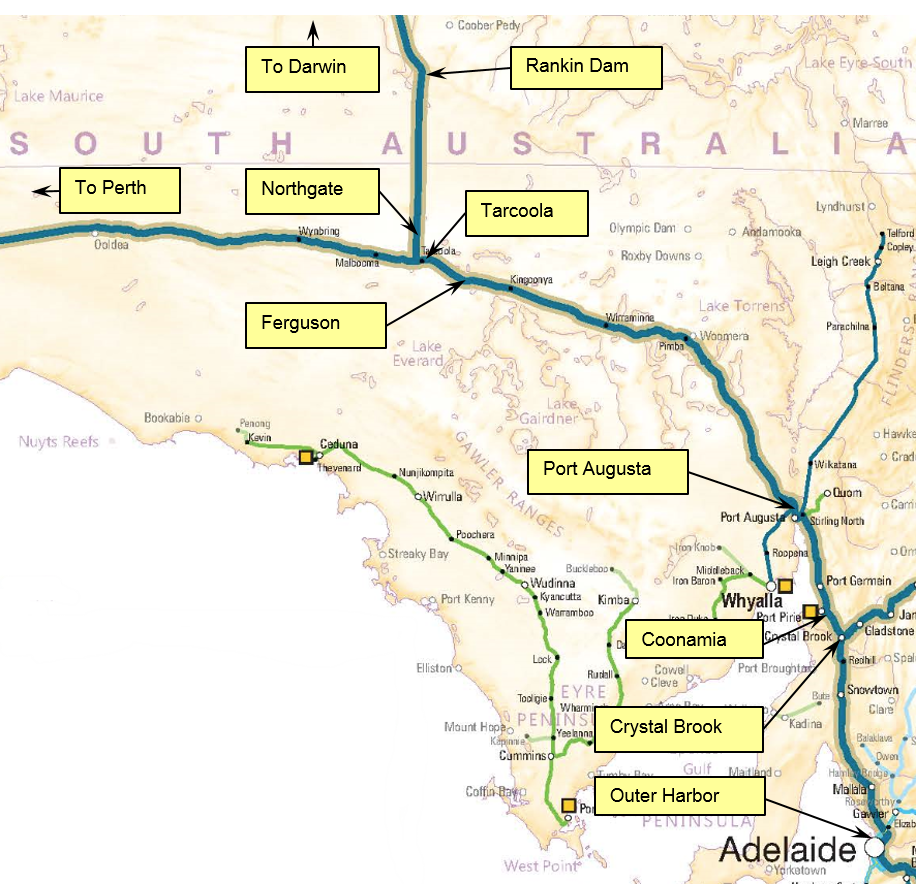
At about 1915[1] on 25 November 2012, Specialised Bulk Rail (SBR) ore train 1903 departed Bolivar, South Australia, working a scheduled return service between Pelican Point at Outer Harbor[2] and Rankin Dam (Figure 1). The train crew consisted of four drivers working the train in pairs on a rotating 8-hour relay shift. The remaining pair of drivers rested in the accommodation provided in an attached crew van.
Figure 1: Locations Adelaide to Rankin Dam
Source: Geoscience Australia annotations by ATSB
The train travelled empty to Rankin Dam and arrived at about 0830 on 26 November, where the working crew handed control of the train to the drivers who had rested in the crew van during that shift. The new crew commenced loading operations while the drivers who had worked the train into Rankin Dam boarded the crew van to rest. At about 1630, the next rostered crew change took place and the rested crew again took control of the train in preparation for departure and the return journey to Adelaide as train 9104. At about 1700, shortly after receiving authority, train 9104 departed Rankin Dam.
The occurrence
At about 1910, the crew contacted the Australian Rail Track Corporation (ARTC) network control centre located at Mile End in Adelaide and advised that they were approaching Northgate[3]. The ARTC Network Control Officer (NCO) provided Train Working Advice[4] to the crew regarding opposing, preceding and following trains.
At 1915, the NCO issued the crew with Proceed Authority[5] TA 84. TA 84 authorised train 9104 to proceed to Tarcoola and take the Branch Line. The instructions on the authority required 9104 to then wait and allow train 1PA8, the Indian Pacific[6] travelling in the same direction, to pass at Tarcoola. A further instruction on the authority required train 9104 to continue to wait at the same location to cross train 6WP2, which was to approach the location in the opposing direction from Ferguson.
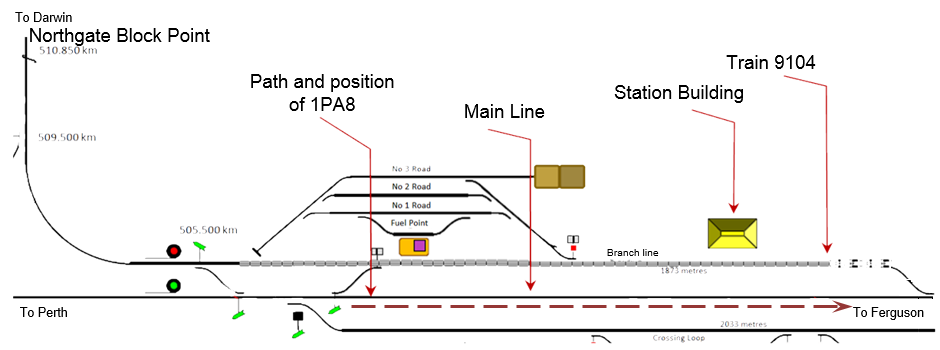
Train 9104 proceeded to Tarcoola, stopping on the Branch Line at about 1935, adjacent to the Tarcoola Station building (Figure 2).
Figure 2: Tarcoola yard showing location of 9104 and path of 1PA8
Source: South Australia Track and Signal (G. Vincent) annotated by ATSB
About 65 minutes later, at 2040, the NCO issued an authority for 1PA8 to enter Tarcoola and take the main line to pass train 9104. The NCO then issued an authority to 1PA8 that authorised it, after fulfilling the pass with 9104, to travel through to the next crossing loop at Ferguson, where it would cross with freight train 6WP2.
Train 1PA8 arrived in Tarcoola, coming to a stand on the main line at about 2050. While in Tarcoola, the crews of trains 9104 and 1PA8 arranged for the train manager of 1PA8 to alight and climb between the wagons of the stationary ore train (9104) to deliver mail to Tarcoola Station.
At 2100, train 1PA8 departed Tarcoola for Ferguson, at which time the westbound opposing train 6WP2 was approaching Ferguson. At 2116, train 6WP2 received an authority to travel to Tarcoola but only after fulfilling the cross with 1PA8 at Ferguson.
At 2138, about 2 hours after 9104 had arrived in Tarcoola, the NCO contacted its crew, stating, ‘9104 we got clearance down to Ferguson so I will give you train authority 94’. In response to this statement, the driver of 9104 immediately left the cab of the locomotive to set the points to access the main line in readiness for their departure, while the second driver received and transcribed the next authority being issued by the NCO. The second driver verified the authority with the NCO then placed it on the desk in front of the driving position. On returning to the locomotive cab, the driver read the authority and prepared the train to depart. The crew did not discuss the content of the authority. Both drivers had overlooked the condition on TA 94, which required them to firstly complete the instructions of the current authority (TA 84), which was to cross with 6WP2 at Tarcoola before departing. At about 2143, train 9104 left Tarcoola bound for Ferguson.
At 2148, the crew of 9104 called the NCO to report that the train had cleared Tarcoola yard. By this time, the Indian Pacific (1PA8) and train 6WP2 had crossed, and 6WP2 was heading towards Tarcoola. The NCO immediately sought confirmation of the message that the train had departed, following which he instructed the crew to stop the train. The NCO then called the crew of 6WP2 and instructed them to stop immediately.
Train 9104 stopped at the 501.500 km mark[7] and train 6WP2 stopped at the 488 km mark. The two opposing trains were about 13.5 km apart, occupying the same section of track.
Post-occurrence
The NCO cancelled the train authorities that were in effect at the time of the incident (TA 84 and TA 94 issued to 9104; TA 91 issued to 6WP2). The NCO then issued a new authority to the crew of train 6WP2, directing them to remain at the 488 km mark.
The NCO issued a new authority to the crew of train 9104 to set back to the Branch Line in Tarcoola. SBR management however, had stood down the crew of train 9104 from duty following the incident, and made subsequent arrangements with ARTC for train 9104 to remain stationary at the 501.500 km point until the relief crew travelling in the crew van completed their rostered rest period. The relief crew returned to duty at about 0030 on 27 November and took charge of train 9104 from the crew who were involved in the incident.
The relief crew reported train 9104 stationary on the Branch Line at Tarcoola at 0043. The NCO then issued an authority to train 6WP2 for departure from the 488 km mark and to travel to Tarcoola.
Tarcoola is located at the 504.500 km mark on the east–west railway that links Adelaide and Perth. It is about 725 track-km from Adelaide and 1,932 track-km from Perth. The Tarcoola yard forms the junction between the east-west railway, and the railway to Darwin in the north.
Track information
The railway between Tarcoola and Port Augusta (Spencer Junction) was a single track with 12 crossing loop locations where rail traffic could cross or pass as authorised by the issue of appropriate authorities by the NCO. The Tarcoola yard primarily consisted of the east-west main line, the line to Darwin (also referred to as the Branch Line) situated on the northern side of the main line, and a crossing loop on the south side of the main line.
All crossing loop locations between Tarcoola and Spencer Junction were equipped with location boards indicating the approach to each location, and yard limit boards and clearance point signs to define the limits of authority for a train movement.
Train and crew information
Train consist
SBR operated train 9104 to provide a bulk ore service for the mining industry at Rankin Dam. The train consisted of two locomotives (CSR006 leading and SCT011 trailing) hauling a fuel wagon, crew accommodation van and 88 loaded wagons. It had an overall length of 1,275 m with a gross mass of 8,271 t.
Train crew
Qualifications and experience
The driver at the controls of train 9104 had about 10 years of rail industry experience and had been employed as a qualified locomotive driver since 2004. The second driver had about 42 years of industry experience and about 32 years of experience as a driver.
Both were qualified to operate trains on the route and were conversant with the safeworking arrangements in use. They were also well acquainted with the relay working operations to Rankin Dam.
Toxicology, medical and physiological factors
On return to the SBR facility at Bolivar on 27 November (the day following the occurrence), the crew involved in the incident underwent a preliminary breath test and drug screening for the presence of alcohol and prescribed drugs[8]. This delay was due to the unavailability of an authorised person to undertake the screening tests en route. The screening tests for both drivers returned a negative indication to the presence of either substance.
An examination of the crew’s health assessment records confirmed that their health assessments were current and that each crewmember had satisfied the standards prescribed by the National Standard for Health Assessment of Rail Safety Workers.
The driver at the controls at the time of the incident had been unwell and reported sick for the first rostered shift commencing on Saturday 24 November, following a two-day period of being rostered off duty. Although the driver was in possession of a medical certificate to certify that he was unfit for work from 22 to 27 November inclusive, the driver elected to commence duty for the relay operation to Rankin Dam on 25 November.
Communications system
Tarcoola is the interface location between two ARTC geographical areas. Train movements between Port Augusta (Spencer Junction) and Tarcoola, including the yard and track segment to Northgate, were controlled by the eastern area NCO. The western area NCO controlled train movements between the yard limit board at the western end of Tarcoola yard and Cook. Communications between the NCOs and train crews was via the ARTC’s National Train Communications System (NTCS).
The NTCS design emulated in part, an open channel (broadcast) communication system, enabling train drivers and track workers to establish and maintain an awareness of rail activities close to their area of operation. The design reduced the amount of overall radio traffic by limiting the broadcast to those activities geographically close by: effectively local radio traffic only.
Post-occurrence investigation established that the open channel functionality of the NTCS was not working as designed in the Tarcoola area. The train crew had been unable to hear broadcast conversations involving other proximal trains and were only privy to the direct communications between themselves and the NCO. Therefore, broadcast information as to the status of other train movements in their vicinity was not available to the crew. The ARTC has since resolved the technical issue with the NTCS at this location.
Safeworking system
Train Order Working
At the time of the occurrence, ARTC used the ‘Train Order Working’ (TOW) system to manage the movement of trains between Tarcoola and Port Augusta[9]. The TOW system relied on the NCO issuing verbal authorities to train crews, who were then required to comply with the authorised instructions, together with any signal indications (if present). The train crews set and verified the position of points in accordance with the authority and/or rules defining the requirements for crossing or passing of trains.
To coordinate the management and issue of these authorities, the NCO used a graphical plot (train graph) to record occupancies and track activities. Reference to the graph was the primary means by which the NCO could record train movements and avoid occupancy conflicts. The accuracy of the information recorded on the graph was vital for the safe operation of TOW, and relied heavily on accurate and timely reporting by train crews and track workers.
Train authorities
In accordance with the ARTC’s rules and procedures, the NCO and train crews were required to record verbal authority information on a Train Authority Form. Procedures also allowed the NCO to issue the next authority for a train to continue, prior to the fulfilment of the current authority. This next authority was in effect once it was verbally issued by the NCO, read back by the recipient, and confirmed as correct by the NCO. While issued and in effect, this authority was not to be actioned until the fulfilment of the previous authority. In this instance, the previous authority remained the current or active authority.
There were several train authority types available to the NCO, as defined in the ARTC Code of Practice for the Interstate Rail Network, and its Addendums and Appendices (CoP). The authority types relevant to this occurrence were:
Proceed Authority (PA):
A formal authority for a train to proceed in the forward direction under normal operating conditions where exclusive occupancy of the track section to which it applies is guaranteed.
Conditional Proceed Authority (CPA):
A formal authority to proceed in the forward direction conditional upon the train crew obeying an instruction to cross or pass another train or trains specified in associated crossing or passing instructions.
Proceed Authority
A PA authorises movement to a defined location and provides instructions to be carried out upon arrival at that location. Consequently, a PA cannot be issued unless the section of track between the train and its intended location is clear of rail traffic and no conflicting authorities have been issued.
Conditional Proceed Authority
A CPA enables the NCO to issue an authority at a point in time when the conditions may not yet be suitable for a train movement, and is conditional on first completing the requirements contained in the previous authority. In effect, the authority was pre-issued but not active, with the intent of expediting the authority process. The wording of a CPA was similar to that of a PA, but the first words of the authority read ‘After fulfilling TA …’
A CPA relied heavily on train crews executing all crossing/passing instructions sequentially and in order of receipt of authorities. While the TOW system was used across different states in Australia on ARTC and other networks, the use of CPAs was unique to the areas of the ARTC network governed by the CoP. The intent of a CPA was to expedite the issue of a PA, subject to obeying instruction to cross or pass one or more trains.
Fulfilled Train Authority
A Train Authority was fulfilled (completed/actioned) when a train had arrived complete (fully intact) at the destination specified on the authority and all instructions prescribed on the authority were completed. The train crew then endorsed the authority with the word ‘Fulfilled.’ There was no requirement for the train crew to contact the NCO in order to fulfil an authority.
In this incident, the NCO issued both train authorities (TA 84 and TA 94) to the train crew in accordance with the ARTC CoP, but the crew of train 9104 proceeded with the instructions documented in TA 94 before they had completed (fulfilled) all the requirements of the previous authority (TA 84).
Reporting train clear of section
Train crews are required to report to the NCO when the train is complete and clear of a section. The NCO then updates the records by endorsing the control copy of the authority as fulfilled and making an appropriate notation on the train graph. The intent of reporting clear of a section is to verify and record that the section behind is now available for further train movements if required.
SBR driver (safeworking) training
SBR had implemented various safeworking procedures and training and assessment programs to manage driver competency. When employing an experienced train driver, SBR undertook an assessment as to their competency against the CoP and re-certified their knowledge of the routes over which they were to operate. To achieve competency, a trainee driver would undergo a staged training and certification process. All qualified drivers were subject to a program of periodic recertification on the routes over which they operated.
Both occurrence drivers’ certifications were current for operation between Pelican Point and Rankin Dam. Both drivers confirmed that they had a good working knowledge of the TOW safeworking system.
Other safeworking occurrences
Manual authority-based safeworking systems, like TOW, are in use extensively throughout the world. The ATSB reviewed a range of recent and historical occurrences, to gauge the extent to which similar incidents have occurred under related or similar safe working systems in Australia and internationally.
Previous occurrences
During the period January 2008 to November 2012, the ARTC issued about 450,000 train authorities, of which around half were CPAs. For the corresponding period, the ARTC recorded 62 safeworking irregularities related to the application of the TOW system. Generally, the safeworking irregularities were the result of procedural/administrative errors by the NCO or train crew during the preparation of an authority, or once current, errors by the train crew that resulted in that authority being exceeded.
The majority of (safeworking) procedural/administrative errors by the NCO involved the issue of an authority to a train crew to occupy the track section ahead before the crew of the preceding train had reported line clearance from that section. Similar errors involved the NCO issuing an authority to a train crew that conflicted with an authority issued to a work gang for occupancy of a track section ahead. These errors were usually self-detected by the NCO or identified when the NCO was challenged by a train crew. The authorities were then cancelled and re-issued.
On four occasions, the NCO mistakenly issued authorities to opposing trains for occupancy of the same section of track. On each occasion, the conflicting authorities were promptly identified and corrected - either by the NCO or a by train crew - before there was any likelihood of collision.
Other safeworking irregularities involved the exceedance of an authority by the train crew, due to their misjudging the stopping distance to the end of their authority, or making an error in the management/implementation of their current TA. Both events resulted in the train continuing into the next section without authority from the NCO. Unlike the safeworking irregularity involving train 9104 on 26 November 2012, these events had not involved other train movements opposing the unauthorised movement.
Mount Christie, South Australia – 22 February 1997[10]
At about 1720 on 22 February 1997, two freight trains collided head-on about 700 m east of the Mount Christie[11] crossing loop. Five train crew members were injured as a result of the collision and there was considerable damage to locomotives, rolling stock and infrastructure.
The subsequent investigation found that it was likely the driver of one of the trains did not realise he was at Mount Christie and failed to stop for the cross with the other train.
Other contributing factors to the collision included:
Lack of action in the part of the observer [second driver] to intervene at an appropriate time while the train was travelling through Mt Christie
The assignment of different VHF radio channels either side of Mt Christie, which resulted the two trains approaching the station on different channels
The lack of a concerted effort by either crew to contact the opposing train on either the local VHF channels or the UHF train control channel
Lack of adequate follow up on changes to the regulations to ensure that the changes were understood and followed by all users
Following the collision at Mt Christie, operational procedures were amended, with the amendments being carried through to subsequent revisions of the CoP. The communication systems available have also changed with the introduction of the NTCS.
While the investigation identified in-cab and train-train communication issues as a contributing factor, it also identified issues associated with the train order system of safeworking and the potential to overlook critical instructions. A number of recommendations were made with respect to the train order system of safeworking, especially with regard to the defences against human error currently built into the system.
The investigation found that the elimination of the proceed-cross-proceed order would likely result in an increase in the use of ‘after fulfilling’ train authorities, and identified that:
These types of Train Orders [Train Authorities] result in two different, valid, Train Orders being in the cab at the same time. Increasing the use of these types of Train Orders may lead to mismanagement of the Train Orders in the cab and resultant errors by the crew
Other investigations involving the use of conditional proceed authorities
In 2002, the National Transportation Safety Board[12] (NTSB) investigated a head-on collision between two opposing freight trains near Clarendon, Texas (USA). The report identified that although the track warrant[13] instructions were complete and the transmission and repetition of the instruction was correct, the engineer was distracted by cell phone use and did not take proper note of the after-arrival stipulation imposed by the track warrant. The after-arrival track warrant contained a set of instructions that the crew were required to execute sequentially; similar to the CPA used on the ARTC network.
The NTSB report[14] tabled in 2003 identified the following issue:
The issuance of after arrival track warrants is useful in keeping traffic moving because the train that is holding the after-arrival track warrant can depart immediately once the opposing train has cleared. Often, a train crew can reduce the speed of the train and synchronize the time of its train’s arrival at the waiting point so the train does not have to stop, thus saving fuel. There is no need to contact the dispatcher, report the opposing train in the clear, and copy a new track warrant. The authority is valid once the opposing train arrives and clears the main track. However, if the train holding the after-arrival leaves the waiting point too soon or, as in this accident, does not wait at all, the result is likely to be a head-on collision.
In September 2010, the NTSB investigated another head on collision between opposing freight trains near Two Harbours Minnesota; again involving the use of after-arrival track warrants. The NTSB report[15] again identified issues with the use of after-arrival track warrants as contributing to the accident, along with fatigue and crew resource management issues.
After examining this incident and a further five significant collisions (1996 to 2010) involving the use of after-arrival track warrants, the NTSB concluded that the use of the after-arrival track warrants was vulnerable to human error and lacked inherent safety redundancies necessary for consistent safe operation. In the absence of a positive train control system,[16] the NTSB considered that the use of the after-arrival warrant posed an unacceptable operational risk.
Train 9104 had arrived at Tarcoola under the authority of TA 84. About 2 hours later, the NCO contacted its crew stating, ‘9104 we got clearance down to Ferguson so I will give you train authority 94.’ The NCO then communicated and issued a Conditional Proceed Authority, TA 94. The train crew, who were conversant with the operation of TOW systems, reacted to the introductory statement from the NCO, forming a perception that the track to Ferguson was now clear for them to proceed. The crew overlooked critical information contained in TA 84 and the conditional nature of TA 94, resulting in them departing Tarcoola, exceeding the limit of their current authority, and creating a significant collision risk with an opposing train movement.
Factors affecting the actions of the train crew
Human performance is highly variable and subject to a number of influencing factors. While the two authorities were issued in accordance with ARTC CoP requirements, the train crew were influenced by a perception that they had authority to proceed, and subsequently departed Tarcoola before TA 84 had been fulfilled. As such, the following analysis examines the factors that may have influenced the train crew’s actions and identifies potential safety issues that increased the risk of human error.
Fatigue
In the context of human performance, fatigue is a physical and psychological condition primarily caused by prolonged wakefulness and/or insufficient or disturbed sleep[17]. Fatigue can have a range of influences on performance, such as decreased short-term memory, slowed reaction time, decreased work efficiency, reduced motivation, increased variability in work performance, and increased errors of omission[18]. Historically, fatigue impairment has been associated with increased risk in rail transport operations, and has been identified as contributory in a number of significant rail accidents and incidents.
With respect to this incident, both drivers were rostered to work between 0100 and 1000 on 24 November (2 days before the incident), but one driver had reported in sick. At 0800 on 25 November, both drivers signed on for duty to work train 1903 to Rankin Dam and the return service 9104; the drivers planning to work 8-hour rotating relay shifts with a second crew. Table 1 details the hours worked by the incident drivers.
This type of rostering system permits the use of two crews of two drivers, each crew alternating 8 hours of driving with 8 hours of rest throughout a relay journey, with rest breaks taken in the crew van while the train is underway. This type of roster arrangement is known as a fast rearwards rotating shift system, where each subsequent shift start time is earlier than the last shift start time (rearward direction of rotation) and the rest break between those shifts is restricted to 8 hours (speed of rotation). It should also be noted that an 8-hour rest break should not be considered to be an 8-hour sleep opportunity. Drivers must also find time to eat, shower and unwind during their 8-hour rest period[19].
Fast rearwards rotating shift systems have been identified as problematic for train drivers’ sleep patterns. In a simulator study comparing fast rearward rotation with an 8-hour rest period, and a slower rearward rotation with a 12-hour rest period, researchers found that all drivers on rearward rotation experienced increasing difficulty in achieving sufficient sleep over the duration of the study (five days). This effect was exacerbated in the fast rotation group[20].
Research has indicated that anything less than 5 to 6 hours sleep in 24 hours, or 12 hours sleep in 48 hours is likely to lead to fatigue-impaired performance[21][22]. SBR’s fatigue modelling estimated that the roster would have permitted the driver around 3.2 hours sleep in the 24 hours, and 10.9 hours sleep in the 48 hours before commencing the occurrence shift, and the second driver around 3.2 hours sleep in the 24 hours, and 9.8 hours sleep in the 48 hours before commencing the occurrence shift[23].
Research in Australian relay operations has found that:
during a 40-hour relay operation with the train departing at 2000, drivers obtained an average of about four hours sleep in each eight-hour rest period. There was a sizeable variation amongst drivers, with some only getting 2.5 hours sleep during rest breaks[24]
during a 5-day relay operation with the train departing about 0330-0500 and incorporating one significant rest period away from the train in the middle of the relay operation, drivers obtained an average of 3.3 hours sleep in each 8-hour rest period, with rest periods at night associated with more sleep than those during the day[25].
During interview, both drivers stated that the duration and quality of their sleep had been compromised while the train was underway and when their rest periods coincided with remarshalling, shunting and loading operations at Penfield and Rankin Dam. It was also noted that the rostered rest periods for the occurrence crew during this relay had minimal overlap with the normal circadian trough, (around 0200 to 0600), when performance is generally at its lowest, and when sleep is usually most restorative. Research has shown that the quantity of sleep obtained during daytime rest breaks in relay vans is generally lower than sleep obtained during rest breaks scheduled during evening hours[26].
The occurrence driver had been ill in the preceding days and reported that both the quality and quantity of his sleep in the period prior to working had been reduced as a result. The driver had reported sick for the shift commencing Saturday 24 November and had produced a medical certificate to SBR, which extended to include 27 November. Nevertheless, he returned to work for a rostered shift on 25 November. Considering this early return to work and the information provided at interview, the driver was likely to have had reduced restorative sleep leading up to his return to work.
The ATSB undertook independent fatigue modelling[27] incorporating the crew’s estimates of their sleep during the previous rest break, and accounting for the degraded sleep environment of the crew van as well as the driver’s reported illness and subsequent compromised sleep prior to working this relay. The modelling suggested that both drivers’ performance, while somewhat degraded due to restricted recent sleep and associated accumulated sleep debt, was likely to have been at a level manageable with the implementation of fatigue countermeasures (such as strategic napping or other similar strategies).
SBR’s management systems included policies, procedures and training materials to address an employee’s fitness for work - including the management of fatigue. The systems outlined the management responsibilities and provided guidance to an employee to ensure awareness of their responsibility to attend work in a fit state to perform their duties. On this occasion, SBR processes did not detect that the driver had an elevated fatigue risk when returning to work prior to the end of a certificated period of medical leave. Based on the use of a fast rearwards rotating shift system with minimal night-time sleep opportunities, and the crew’s estimates of reduced sleep obtained during the period preceding the occurrence, it is likely that at the time of the occurrence, the performance of the crew was to some extent degraded by the effects of restricted restorative prior sleep.
Cognitive (mental) workload and sleep inertia
The term ‘cognitive workload’ refers to a measure of the type or nature of work being undertaken with regard to its demands on an individual’s cognitive resources. Cognitive (mental) workload can be in overload where the demands on working memory are excessive, or in under-load brought about by periods of relative inactivity and boredom. As such, the relationship between workload and fatigue can be graphically represented as a U-shape, with an increased likelihood of fatigue-related error when workload is either very high, or very low[28].
At interview, the driver of train 9104 stated that he was tired during the rostered shifts. To manage fatigue, the driver often took the opportunity (at non-critical times) to have short naps when in the second driver’s seat. Train 9104 had been stationary on the branch line at Tarcoola for about two hours before the occurrence crew received communications from the NCO. The driver stated that he was napping during this time. At interview, the second driver stated that after the passage of the 1PA8 he was lying back in the chair looking for the lights of the approaching train from Ferguson.
When the NCO contacted the train crew to issue the next authority (TA 94), the crew were not engaged in any competing work tasks. With the driver napping and the second driver in low cognitive workload, the effects of drowsiness or disorientation associated with sleep inertia may have contributed to the crew’s interpretation of the NCO’s statement to mean they were clear to depart.[29].
Fatigue management for relay operations
Modern fatigue risk management is based on systematic management of risk, rather than compliance with a set of externally-imposed prescriptive rules[30][31]. Dawson and McCulloch[32] propose a methodology for fatigue risk management represented by five levels of fatigue-related error. Each level corresponds to identifiable hazards (requiring assessment) and control mechanisms (requiring implementation) to manage the risk of fatigue-related incidents (Table 2).
Table 2: Fatigue management
Level of fatigue related error
Hazard assessment
Control mechanisms
Level 5
Fatigue related occurrences
SMS incident / occurrence analysis system
Level 4
Fatigue related errors
Fatigue / error proofing strategies; SMS error analysis system
Training; prior sleep wake data; sleep / medical disorder screening
Level 1
Sleep opportunity
Training, scheduling rules; fatigue modelling; sleep / medical disorder screening
SBR, and the rail industry generally, has implemented control measures to mitigate fatigue-related error, such as two-driver operations or the use of vigilance control systems to monitor driver actions and identify if the driver is alert and in control of the train or incapacitated.
ATSB transport safety report RO-2011-016, involving a collision between two freight trains at Dry Creek in South Australia in 2011[33], examined the fatigue management processes in use by SBR for relay working. The investigation found that SBR’s fatigue management processes were consistent with control mechanisms at Level 1 of the model above, including fatigue awareness training, fatigue modelling, as well as sleep disorder screening. However, as is also the case for this investigation, there were no systems in place to collect and assess information on actual sleep obtained during relay operations. This would have permitted the ongoing review of the validity of fatigue modelling and rostering principles, as well as the identification of appropriate fatigue-proofing strategies for SBR’s specific operations.
Similarly, there was no evidence to indicate that SBR had systems in place to collect and assess information on fatigue-related occurrences, as suggested in the other levels of the model.
In this case, the actual hours worked by the two drivers were generally consistent with SBR’s roster for the operation of train 1903/9104. However, the crew advised at interview that drivers often get tired during rostered (relay working) shifts and take the opportunity to have short naps when the train is standing at a crossing loop for any period.
The findings of the Dry Creek investigation and the evidence in this case (including the driver’s statements regarding more widespread tiredness) highlight the increased fatigue risk associated with reduced quality and duration of sleep obtained by train crew resting in crew vans during relay operations. While a number of Level 1 fatigue controls have been implemented, effective fatigue risk management may benefit from the addition of standardised practices for determining sleep obtained both prior to commencing relay operations and during relay rest breaks. Benefit may also arise from the systematic use of higher-level fatigue controls such as self-report behavioural scales, fatigue-induced error proofing strategies, and monitoring and analysis of sleep obtained whilst on relay operations.
Communication and coordination
Train 9104 had been stationary at Tarcoola for more than two hours before the NCO contacted the crew to issue TA94, authorising them to proceed to Ferguson. The NCO initially stated that they had ‘clearance down to Ferguson’ and then proceeded to issue the CPA. The intended message was ‘clearance to Ferguson after fulfilling TA 84’, but the train crew perceived this communication to mean that they now had authority to depart Tarcoola and proceed to Ferguson. At interview, the crew expressed their frustration at the number of delays, and that they were eager to get underway. The crew further stated that use of the phrase ‘line clearance’ by a NCO generally occurred in situations where trains were following and the train ahead had reported clear of the section. The NCO would then communicate the next TA to the following train en route. The crew thought the use of this phrasing in the context of their situation at Tarcoola was unusual, but did not stop to question the NCO as to the status of the track ahead or the whereabouts of train 6WP2. Instead, believing that the cross with train 6WP2 had changed, they immediately commenced their preparation to depart Tarcoola.
While the second driver remained in the cab to receive and transcribe the details of the new TA, the driver immediately left the cab to set the points for departure. When the driver returned to the cab, he read the new authority (TA 94) which the second driver had completed and placed on the desk. The new authority included the words ‘after fulfilling TA 84’, but the crew had already established a mindset that the line ahead was clear and they were authorised to proceed. The crew did not challenge the authority issued by the NCO or attempt to contact the crew of 6WP2 to confirm their mutual understanding of the authorities issued to each train.
In the absence of any other cues to the contrary, and having interpreted the NCO’s introductory statement to mean that they could proceed, the crew formed the view that the NCO had not dispatched train 6WP2 into the Ferguson to Tarcoola section. The crew overlooked a key requirement within the TOW system that once an authority such as TA 84 was issued, it remains in effect until all requirements are complete and the authority fulfilled, or if a change is required, the authority is cancelled. Were it necessary for the NCO to alter the crossing location of trains 9104 and 6WP2, the TOW provisions in the CoP required the NCO to first cancel TA 84, as it could no longer be fulfilled. With minimal communication, the crew completed their preparations and departed Tarcoola yard without re-examining TA 84, nor discussing its content and meaning.
The communication protocol adopted by the NCO was ambiguous, in that it used the phrase ‘clearance down to Ferguson’ when the line was occupied by train 6WP2 travelling towards Tarcoola. The ARTC CoP states a requirement for messages to be communicated clearly, without ambiguity and using standard radio terms. However, while the CoP provides general guidance on standard radio terms, this is limited to terms associated with beginning and end of communications (such as, receiving, over, out, and roger). There are currently no standard phrases provided for network controllers to communicate the content of a message. Consequently, the communication of safety critical information occurred using variable and unstandardised language, which can contribute directly to the type of errors in understanding as occurred in this instance. Further, sound crew communication strategies, wherein crewmembers confirm their shared understanding of the intent of verbally issued train authorities, would have added an additional layer of defence against errors grounded in individual interpretation of communications.
Safeworking methodology
The process of safely managing the movement of a train over a rail network requires authorities and all associated instructions to be actioned in sequence. This is especially important with respect to a CPA, which can be issued (but not enacted) while conditions exist that may not be suitable for the safe passage of the train concerned.
Management of authorities
The CoP, Volume 3, Section 5: Train Driving Rules/Sub-Section 5.7 Train Crew Verifying Authorities and Other Information prescribes:
(c) In addition to (a) and (b) if a Train Authority is obtained manually, the following apply:
(i) the current Train Authority shall be displayed in clear view of the crew member at the controls of the locomotive and its meaning shall be obeyed; and
(ii) if the train crew consists of more than one crew member, each member of the train crew shall obey the meaning of the Authority and any other information obtained manually.
(d) In EAS[34] and TOW, or when using a Train Authority on the approach to each crossing location, each member of the train crew shall again check the instructions on the display or Train Authority. They shall then verbally advise each other of its contents and ensure its meaning is obeyed by each train crewmember.
SBR provided books with sequentially numbered pages of Train Authority Forms for the train crew to use when receiving a TA. The forms contained fields for the crew to record details of the TA number, train, location, the authority itself and supporting information, and the confirmation of those details with the NCO. SBR driver (safeworking) training required the train crew to complete the Train Authority Forms in accordance with the requirements of the CoP. SBR considered the instructions in the CoP were sufficient and no supplementary procedures or guidelines for crew communication strategies and management of a TA within the cab of the locomotive were required.
The crew of train 9104 were issued CPA (TA 94) for the movement Tarcoola to Ferguson while train 6WP2 was travelling from Ferguson towards Tarcoola. TA 94 was made conditional by the instruction, ‘After fulfilling TA 84 …’, and as such, TA 94 was not the current authority until all instructions contained in TA 84 (including the cross with 6WP2) were complete.
The crew of 9104 took three authorities between Rankin Dam and Tarcoola; the first two authorities were endorsed as ‘Fulfilled’. It is unclear if the crew checked the instructions with each other prior to accessing the crossing locations and fulfilling each TA as required by the CoP.
The last authority received before Tarcoola (TA84) incorrectly recorded the train number as ‘1904’ and the location of receipt as ‘Tarcoola’, but the crewmember repeated the correct location of ‘Northgate’ to the NCO when verifying the order. The NCO challenged the incorrect train number when verifying the order but it remained unchanged on the crew copy of the authority. The Train Authority Form page number for TA84 was also out of sequence from other authorities taken by the crew, both before and after the authority overrun. A number of the pages were missing from the book of forms, and while the reason for their removal was not evident, the crew advised that it was common for crews to either remove pages from the book or enter details on the pages out of sequence. The process undertaken during the preparation and verification of TA84 by the train crew was inconsistent with the CoP requirements, in that if an error was made, such as the location of receipt, it is required to be endorsed as ‘Not Issued’ across the face of each copy (NCO and train crew) and the process to issue the TA repeated. It is likely that the crew did not check the instructions on the train authority form with each other before entering Tarcoola.
After arriving at Tarcoola and before the processes for issuing the next authority were complete, the driver reacted to the NCO’s introductory statement by commencing action to set the points for access to the main line. Following the driver’s return to the cab, it is likely that the crew undertook minimal discussion in relation to the meaning of TA94 before continuing to act on it; thus overlooking the critical instructions contained in the previous authority TA84. Authority TA84 was not marked ‘fulfilled’ but marked as ‘cancelled’. The driver recalled marking TA84 ‘cancelled’ after the occurrence, when the NCO issued a new authority TA97 and cancelling the previous authorities TA84 and TA94.
Following the Mount Christie collision in 1997, the Board of Enquiry into that accident identified a potential safety risk with respect to train authorities. The process of issuing a proceed-cross-proceed authority was in common use at that time, and the Enquiry identified that these authorities risked encouraging crews to focus on the authority’s final destination and potentially overlook critical instructions such as the cross. The board considered eliminating proceed-cross-proceed authorities, but recognised that this would introduce a different risk associated with an increased use of ‘after fulfilling’ (CPA) train orders. The Board’s concern with CPAs was the existence of two different valid train orders in the cab at the same time, which could lead to mismanagement of the Train Orders within the cab and errors by the crew.
The issue of a PA followed by a CPA resulted in two train orders in effect in the cab of train 9104. The train crew’s uncoordinated management of their current PA (TA 84) and the subsequent CPA (TA 94) was similar to the risk identified by the Board of the Mount Christie enquiry. The management of the authorities coupled with the crew’s perception that an introductory comment by the NCO had also formed part of the formal communication of the CPA meant that the ‘after fulfilling’ control included within the CPA (to cue reference back to the current order) was not sufficient to alert the crew to their error.
Safeguards against human error
The NTSB in their investigations recognised that ‘after-arrival track warrants’ were vulnerable to human error. These warrants are functionally similar to a CPA, but included some additional risk controls, such as the requirement for additional information about the arrival of the nominated train(s) to be included in an after-arrival track warrant, as well as an acknowledgement by train crew that the warrant was not in effect until after the arrival of the nominated train.
For this occurrence, a control measure (similar to that of an after-arrival track warrant) would be to include the incomplete conditions that existed at the time of issue (the cross with 6WP2) on the CPA. The requirement to record the imminent cross on the CPA form would provide opportunity for both written and verbal reinforcement of the safeworking instructions that were still to be completed before the CPA would become the current authority.
In this case, once the crew had made the decision to depart Tarcoola, there were no additional control measures left to trap the error. It was not until the driver reported clear of Tarcoola that the NCO became aware that train 9104 had departed before the cross with 6WP2.
The ability to fulfil a train authority without informing the NCO is in contrast to other states using TOW. In Victoria for example, the ARTC Code of Practice for the Victorian Main Line Network, Section 18, Rule 24(b) provides:
The driver must promptly inform the train controller of the time the train order was fulfilled. The train controller’s copy of the train order must be endorsed accordingly.
Introduction of a requirement to report fulfilment may provide an additional opportunity for both train crew and NCO to capture potential errors in completing the current authority prior to departure.
In the USA, the continuing number of serious train-to-train collisions between 2002 and 2010 led the NTSB to conclude that the use of ‘after arrival track warrants’ (for the operational conditions in the USA) posed an unacceptable operational risk. This was despite the additional risk controls introduced and mandated in the warrant following investigations into earlier incidents. The NTSB found that there was an inherent lack of safety redundancies within the system to counter the potential for human error, and that the system in its current form, required additional risk controls to ensure the consistent safe operations of trains.
While errors associated with the application of a CPA are rare, the potential consequences of an error are significant. This occurrence, involving an error associated with the application of a CPA, resulted in two trains travelling on the same section of track in opposing directions.
The ATSB investigation found that in the absence of additional controls against communication errors, the issuing of a CPA to train crew facing an opposing train increases risk to the safe operation of the railway.
Safe movement around rolling stock
The Indian Pacific (1PA8), operated by Great Southern Rail (GSR), arrived in Tarcoola and came to a stand on the main line with the expectation that that the train manager was to deliver the mail to the Tarcoola Station. This involved crossing the branch line occupied by (the ore) train 9104. To circumvent having to walk around the train, which had an overall length of about 1275 metres, the train manager climbed between the wagons of the stationary train.
While the task was completed without incident, it involved an operational risk and a risk of personal injury. The operational risk primarily related to wagons being accidently uncoupled, as had occurred on a previous occasion when the auto-coupler release lever was disturbed and the train subsequently parted. Workers who attempt to move between rolling stock when there is no provision of safety to do so, risk injury from the unintentional movement of the wagons and the danger of exposing themselves to high-pressure air hoses connected between wagons. These hoses are designed to part and can apply injurious force if unintentionally released.
Generally, trackside safety awareness discourages workers from moving between rolling stock in this manner and the practice of rail safety workers climbing between the wagons of an operational train poses an unnecessary risk. The GSR operational procedures did not address the risk from climbing on or under rolling stock. The train crews however, undertook this hazardous activity by coordinating the arrangements locally between the respective crews. In June 2013, GSR introduced a competency-training package consistent with the Australian Qualifications Framework, which prohibits staff crossing under a freight wagon or passenger carriage.
From the evidence available, the following findings are made with respect to the authority exceedance involving train 9104 that occurred at Tarcoola on 26 November 2012. These findings should not be read as apportioning blame or liability to any particular organisation or individual.
Safety issues, or system problems, are highlighted in bold to emphasise their importance. A safety issue is an event or condition that increases safety risk and (a) can reasonably be regarded as having the potential to adversely affect the safety of future operations, and (b) is a characteristic of an organisation or a system, rather than a characteristic of a specific individual, or characteristic of an operating environment at a specific point in time.
Contributing factors
The crew of train 9104 did not fulfil the active proceed authority (TA 84), which contained the instruction to cross with train 6WP2.
The crew of train 9104 did not effectively communicate to confirm their shared understanding of the intent of verbally issued train authorities.
It is likely that the driver of train 9104 was experiencing some level of fatigue impairment, combined with a period of low cognitive (mental) workload at the time of receiving the conditional proceed authority (TA 94).
SBR’s fatigue-management processes were ineffective in identifying the fatigue impairment experienced by the driver leading up to, and at the time of the occurrence. [Safety Issue]
The phraseology adopted by the network control officer in preparing to issue the conditional proceed authority (TA 94) was perceived by the crew of train 9104 to mean they had clearance to proceed to Ferguson.
The ARTC communication protocols did not provide the NCO adequate guidance with respect to standardised phraseology to ensure messages are clear and unambiguous. [Safety Issue]
The procedures in the ARTC CoP for the use and verification of a conditional proceed authority were ineffective in mitigating the risk to the effectiveness of that authority arising from human error. [Safety Issue]
Other factors that increase risk
The broadcast functionality of the National Train Communication System (NTCS) was not working as designed at the time of occurrence, depriving the train crew of supplementary information on the status of other train movements in the vicinity.
The practice of rail safety workers climbing between the wagons of an operational train compromises the safety of workers and the safe operation of trains.
Other findings
The network control officer’s actions in recognising that train 9104 had exceeded its authority and stopping both trains (9104 and 6WP2) averted a potential head on collision between the two trains.
Safety issues and actions
The safety issues identified during this investigation are listed in the Findings and Safety issues and actions sections of this report. The Australian Transport Safety Bureau (ATSB) expects that all safety issues identified by the investigation should be addressed by the relevant organisation(s). In addressing those issues, the ATSB prefers to encourage relevant organisation(s) to proactively initiate safety action, rather than to issue formal safety recommendations or safety advisory notices.
All of the directly involved parties were provided with a draft report and invited to provide submissions. As part of that process, each organisation was asked to communicate what safety actions, if any, they had carried out or were planning to carry out in relation to each safety issue relevant to their organisation.
The management of fatigue impairment
SBR’s fatigue-management processes were ineffective in identifying the fatigue impairment experienced by the driver leading up to, and at the time of the occurrence.
The ARTC communication protocols did not provide the NCO adequate guidance with respect to standardised phraseology to ensure messages are clear and unambiguous.
The procedures in the ARTC CoP for the use and verification of a conditional proceed authority were ineffective in mitigating the risk to the effectiveness of that authority arising from human error.
Investigators from the Australian Transport Safety Bureau (ATSB) conducted interviews with the crew involved.
The sources of information during the investigation included the:
Pacific National Pty Ltd
Specialised Bulk Rail Pty Ltd
The Australian Rail Track Corporation
References
Australian National Railways Commission Board of Inquiry (1997). Investigation Report - Collision of Trains 5NP3 and 6PM9. Mount Christie. Saturday 22 February 1997.
Battelle Memorial Institute (1998). An Overview of the scientific literature concerning fatigue, sleep, and the circadian cycle, Report prepared for the Office of the Chief Scientific and Technical Advisor for Human Factors, US Federal Aviation Administration.
Code of Practice for the Defined Interstate Rail Network, Volume 2 Glossary, Department of Transport and Regional Services (DoTaRS)
Code of Practice for the Defined Interstate Rail Network, Volume 3 Rules, Department of Transport and Regional Services (DoTaRS), Issue 2 ARTC annotated version – May 2002.
Code of Practice for the Victorian Main Line Network, TA20, ARTC (Australian Rail Track Corporation), 7 August 2011
Dawson, D. & McCulloch, K. (2005). Managing fatigue: It’s about sleep. Sleep Medicine Reviews, 9, 365-380.
Jay, SM. Dawson, D. & Lamond, N. (2006).Train drivers’ sleep quality and quantity during extended relay operations, Chronobiology International, 23 (6), 1241-1252.
Lamond, N., Darwent, D. & Dawson, D. (2005). How well do train drivers sleep in relay vans? Industrial Health, 43, 98-104.
Thomas, GR., Rasleaur, TG., & Kuehn, GI. (1997). The effects of work schedule on train handling performance and sleep of locomotive engineers: a simulator study. Federal Railroad Administration.
Thomas, MJW. & Ferguson, SA. (2010). Prior sleep, prior wake, and crew performance during normal flight operations. Aviation, Space, and Environmental Medicine, 81 (7), 665-670.
Tassi, P. & Muzet, A. (2000). Sleep Inertia. Sleep Medicine Reviews, 4 (4), 341-353.
Submissions
Under Part 4, Division 2 (Investigation Reports), Section 26 of the Transport Safety Investigation Act 2003, the ATSB may provide a draft report, on a confidential basis, to any person whom the ATSB considers appropriate. Section 26 (1) (a) of the Act allows a person receiving a draft report to make submissions to the ATSB about the draft report.
A draft report was provided to Great Southern Rail, Office of the National Rail Safety Regulator, Pacific National, Specialised Bulk Rail Pty Ltd, the Australian Rail Track Corporation and the occurrence crew (train 9104).
Submissions were received from Great Southern Rail, Specialised Bulk Rail Pty Ltd, the Australian Rail Track Corporation and the Office of the National Rail Safety Regulator. These were addressed and an amended draft report was prepared and provided to the Directly Involved Parties, seeking review and further commentary.
Purpose of safety investigations
The objective of a safety investigation is to enhance transport safety. This is done through:
identifying safety issues and facilitating safety action to address those issues
providing information about occurrences and their associated safety factors to facilitate learning within the transport industry.
It is not a function of the ATSB to apportion blame or provide a means for determining liability. At the same time, an investigation report must include factual material of sufficient weight to support the analysis and findings. At all times the ATSB endeavours to balance the use of material that could imply adverse comment with the need to properly explain what happened, and why, in a fair and unbiased manner. The ATSB does not investigate for the purpose of taking administrative, regulatory or criminal action.
Terminology
An explanation of terminology used in ATSB investigation reports is available here. This includes terms such as occurrence, contributing factor, other factor that increased risk, and safety issue.
Publishing information
Released in accordance with section 25 of the Transport Safety Investigation Act 2003
Ownership of intellectual property rights in this publication
Unless otherwise noted, copyright (and any other intellectual property rights, if any) in this report publication is owned by the Commonwealth of Australia.
Creative Commons licence
With the exception of the Coat of Arms, ATSB logo, and photos and graphics in which a third party holds copyright, this publication is licensed under a Creative Commons Attribution 3.0 Australia licence.
Creative Commons Attribution 3.0 Australia Licence is a standard form licence agreement that allows you to copy, distribute, transmit and adapt this publication provided that you attribute the work.
The ATSB’s preference is that you attribute this publication (and any material sourced from it) using the following wording: Source: Australian Transport Safety Bureau
Copyright in material obtained from other agencies, private individuals or organisations, belongs to those agencies, individuals or organisations. Where you wish to use their material, you will need to contact them directly.