

Final report
Report release date: 11/11/2025
Investigation summary
What happened
On the night of 7 September 2023, a Malaysia Airlines Airbus A330‑300, registered 9M‑MTL, overran Melbourne Airport (Victoria) runway 34 on take-off. Eleven days later, on the night of 18 September 2023, a Bamboo Airways Boeing 787-9, registered VN‑A819, also overran Melbourne airport runway 34 on take-off. The runway had been temporarily shortened by 1,568 m from the northern (opposite) end due to runway resurfacing works in progress. Both flights lifted off beyond the temporarily displaced runway end, within the 450 m safety zone ahead of the works, and continued to their planned destinations.
The jet blast from each aircraft impacted runway unserviceability lights, works lights and marker cones at the works limit. Personnel were active in the works area at the time of both occurrences however none were physically injured as a result. There was no damage to either aircraft, or injuries to passengers, and both continued with their planned flights.
What the ATSB found
The flight crew of each aircraft reported that they did not recognise that reduced runway length operations would be in effect at the time of departure and used the normal, full‑length of runway 34 for their take-off performance calculations. The resulting reduced‑thrust engine settings extended the aircraft take-off runs beyond the temporary runway end.
Factors such as expectations, workload and time pressures variously influenced the effectiveness of the crews’ reviews of the provided flight information, such that critical information relating to the significantly reduced runway length was not detected.
Each of the flight crews were provided a copy of the relevant runway works notice to airmen (NOTAM), but their review of that information was insufficient to identify that reduced runway length operations would be in effect. Similarly, each flight crew accessed a version of the voice automatic terminal information service (ATIS) that contained information relating to the reduced runway length. However, each crew only recorded the ATIS weather and did not notice the essential aerodrome information relating to the runway.
The respective flight dispatchers, who provided briefing packages for the flight crews of each aircraft, accounted for the reduced runway length in their take-off performance calculations, but because it did not result in an operational restriction, they each did not highlight (draw attention to) the information for the flight crews’ attention. Additionally, in the case of Bamboo Airways, the dispatcher included a misleading crew briefing note that indicated there were no significant NOTAMs for the departure.
While both Malaysia Airlines and Bamboo Airways had an expectation that their dispatchers would highlight the reduced runway length to flight crews, each operator did not ensure that their dispatchers were sufficiently aware of all types of information required to be specifically emphasised.
The Bamboo Airways flight crew also experienced delays and additional workload due to repeated aircraft power outages, which influenced their normal flight information review procedures. Due to the perceived time pressures, the crew did not conduct additional review of the NOTAMs after boarding the aircraft.
Neither flight crew confirmed the ATIS version with air traffic control (ATC) on taxi request, as required and this was not challenged by the duty controller. The Bamboo Airways flight crew also did not review updated ATIS information after the tower controller proactively alerted them to the changed ATIS version when the aircraft was lined up on the runway. Despite this, both flight crews had accessed at least one version of the ATIS with information relating to the runway works, but neither had detected the change in runway length. These and previous, similar occurrences illustrated that while the requirement to confirm ATIS identifier or acknowledge receipt can assist with pilot awareness of information currency, it cannot provide assurance that flight crews have a full awareness of the ATIS content, including essential aerodrome information. If a flight crew does acknowledge ATIS receipt as required, there were no other standard communication procedures in Australia or under International Civil Aviation Organization (ICAO) standards and recommended practices that would provide ATC this assurance.
Prior to commencing take-off on runway 34, the flight crew of both aircraft either did not see the runway works or equipment lights at the far end of the runway or did not recognise them as being associated with a reduction in runway length. Although probably detectable, the lights were not designed or intended for this purpose. Aside from these lights, and temporary runway end lights that would not have provided an effective sense of the distance available from the opposite end of the runway, there was no signage or other visual aids provided to alert departing flight crews to the significant change in runway length.
The use of suitably conspicuous construction or unserviceability signs to draw flight crews’ attention to changes in runway and movement area conditions have been trialled with some success in other jurisdictions. However, the Part 139 (Aerodromes) Manual of Standards 2019 and ICAO Annex 14 Aerodromes did not recommend or provide for these kinds of visual aids for pilots. While visual aids may not always be completely effective, they would provide an additional defensive layer for flight crews, who would otherwise be presented with a visual image almost identical to that of a normal runway.
In summary, the risk controls for preventing a runway excursion on take-off from a reduced length runway were predominantly procedural, relying on the flight crew responsibility to carefully review sources of essential aerodrome information. While the information was available to the flight crews in these occurrences, it was overlooked, which has also been a factor in a number of previous similar occurrences. Despite this, there were limited other preventative risk controls for this scenario. Considering the potentially catastrophic consequence of a runway overrun during reduced length runway works, the introduction of additional defensive layers aimed at directly assuring flight crew awareness and/or visually alerting departing flight crews to significant runway hazards should be considered as mechanisms to further reduce the likelihood of occurrence.
What has been done as a result
Both Malaysia Airlines and Bamboo Airways have updated their procedures and guidance for flight dispatchers to ensure that aeronautical information affecting flight performance, including changes in runway declared distances, is effectively highlighted or directly communicated to flight crews.
Airservices Australia, in consultation with the Civil Aviation Safety Authority (CASA), is examining three change proposals to ATC procedures in providing essential aerodrome information associated with runway works that reduce available runway lengths. If implemented as proposed, the procedures will provide increased assurance that flight crews have received and are aware of safety-critical information, such as temporary runway restrictions. The ATSB will monitor implementation of the change proposals, which are currently expected in March 2026, subject to approvals.
While not as a result of these occurrences, ICAO has implemented amendments to Annex 14 Aerodromes that include the introduction of high conspicuity, unserviceability signage to aerodrome movement areas where there is an operational need to indicate temporary changes to runway declared distances. ICAO noted that introduction of the signs, ‘strongly mitigates the risk of using the wrong TORA [take-off run available] value for take-off.’ CASA noted the proposed ICAO amendments and advised that the standard for unserviceability signs should, pending review, subsequently be provided for in the Part 139 (Aerodromes) Manual of standards 2019, which is aligned with Annex 14 Aerodromes.
Safety message
There is a fundamental pilot responsibility to carefully review all relevant aeronautical information when preparing for a flight, but this process is susceptible to human error. Numerous factors such as workload, distraction, the way the information is presented, and large amounts of less-relevant information can interfere with a person’s comprehension and memory to the extent that even diligent pilots can sometimes overlook critical elements. As a result, while the existing methods of conveying safety‑critical information to pilots are almost always effective, they do not provide a guarantee that all flight crews have a full and correct understanding.
To minimise information errors, flight crews should endeavour to avoid letting external factors diminish the rigour they apply to the review of flight information, such as by taking time for further revision as needed. Similarly, pilots can minimise the likelihood of missing or misunderstood ATIS information by ensuing that they review and record ATIS details in full.
Acknowledging that these types of errors can never be completely eliminated, there remains a need to minimise and accommodate them. Flight dispatchers, aircraft operators, airport operators (and others who create and disseminate the information), individual air traffic controllers, and air traffic services providers can all contribute to an aviation environment that helps ensure pilots are aware of safety-critical information when they need it.
For example, aircraft operators can reduce errors by ensuring that their pilots are effectively reviewing and recording aeronautical information, and that their dispatchers are assisting by communicating or reinforcing with flight crews, all safety-critical flight hazards. Operators should also consider EFB products with enhanced functionality for improving pilot situational awareness around safety-critical NOTAMs.
Although there may not be a requirement for air traffic controllers to directly advise flight crews of certain safety-critical information, controllers can still apply their best judgement if it is prudent to do so, or when there is any doubt over a pilot’s awareness of a significant safety hazard.
Suitably conspicuous visual aids, such as the signage proposed to be introduced to ICAO Annex 14, can also assist as a final defence by providing an indication of changes to the runway conditions, where the runway would otherwise appear normal to flight crews.
Summary video
The occurrences
Overview
Within an 11-day period in September 2023, the ATSB received 2 notifications of runway excursions by scheduled passenger air transport aircraft during take-off at night from runway 34 at Melbourne Airport, Victoria. Runway 34, which was normally 3,657 m long, had been temporarily shortened each night for runway resurfacing works in progress (WIP), leaving 2,089 m available for take-off (Figure 1). Both occurrences were in darkness (past the end of astronomical twilight[1] with the moon well below the horizon) in otherwise good visibility conditions.
Figure 1: Melbourne Airport arrangement relating to the occurrences
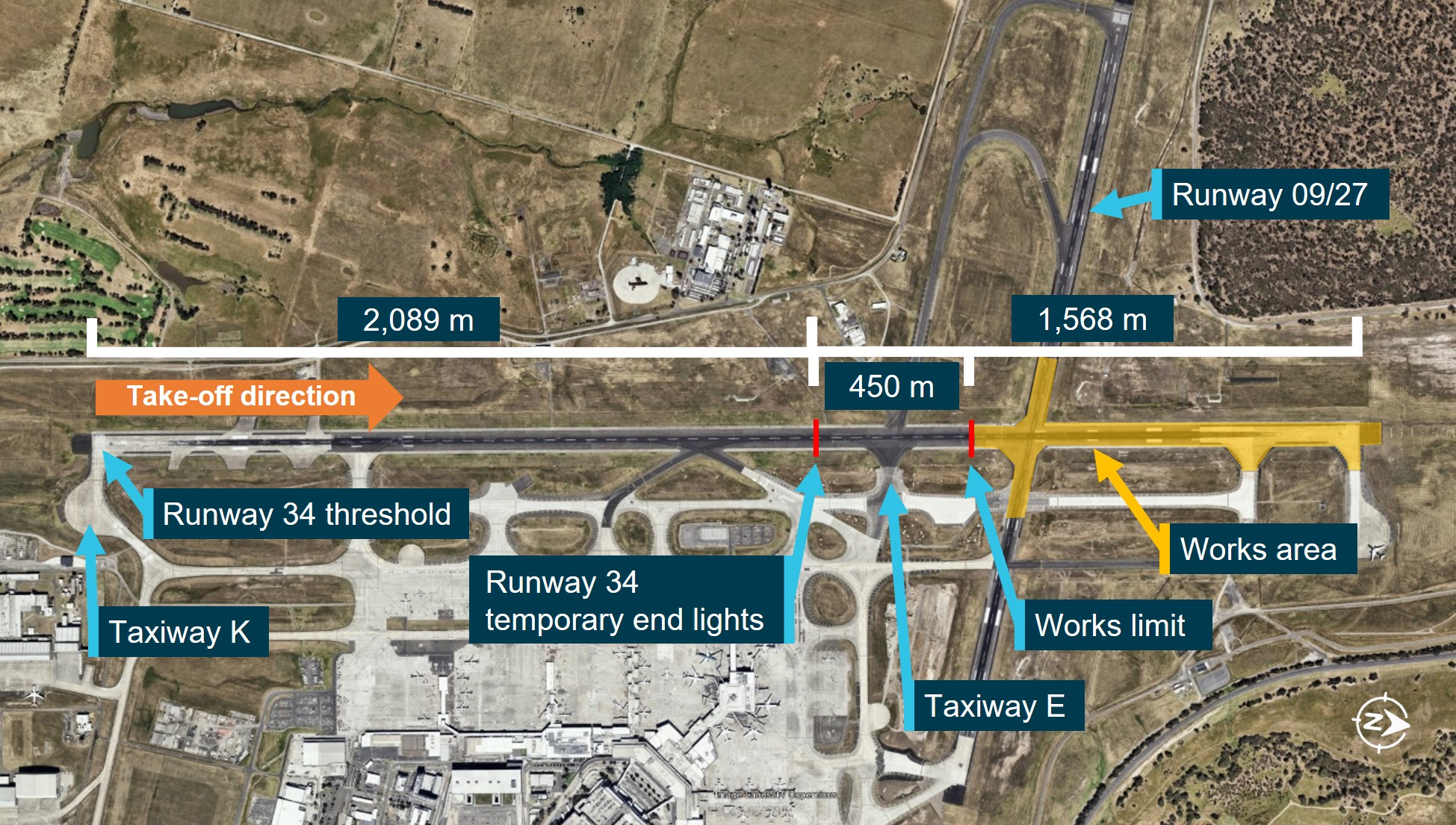
Source: Google Earth, annotated by the ATSB
During individual post-occurrence interviews with the ATSB, the flight crew from both aircraft indicated that they did not identify that the shortened runway was in place and used the full length of runway 34 for their take-off performance calculations. Both crews also advised that they had independently conducted the performance calculations and then crosschecked to ensure that the results agreed.
The reduced‑thrust[2] engine settings used by both flight crews extended the take-off runs beyond the temporary runway end lights into a 450‑metre safety zone[3] before the works limit line.
The jet blast from each aircraft impacted runway unserviceability lights,[4] works lights and marker cones. Personnel were active in the works area at the time of both occurrences. No personnel were physically injured, however there was a reported stress-related injury as a result of the proximity of the aircraft to the works area during the second occurrence. There was no damage to either aircraft, or injuries to passengers, and both flight crews continued with their planned flights.
9M-MTL, 7 September 2023
On the night of 7 September 2023, a Malaysia Airlines Berhad (MAB) Airbus A330-300, registered 9M‑MTL, was scheduled for a 2330[5] departure to fly as a scheduled passenger air transport flight from Melbourne to Kuala Lumpur, Malaysia, as flight MH128. The flight crew comprised the first officer (FO) as the pilot flying (PF), and the captain as the pilot monitoring (PM).[6]
The same flight crew had flown into Melbourne via runway 34 the previous night at about 2030. When approaching Melbourne, the flight crew reported that they checked the NOTAMs,[7] through which they identified that taxiway E would be closed as a result of WIP that evening. Though the NOTAM came into effect after they were scheduled to land, the crew enquired about it with air traffic control (ATC), who confirmed that taxiway E could be used to vacate the runway. The aircraft landed without issue.
At around 2100 on 7 September, prior to leaving their hotel, the flight crew each downloaded a copy of the flight briefing package[8] onto their electronic flight bag (EFB).[9] Both crew went ‘briefly’ through the flight plan, including weather and fuel requirements (but not NOTAMs), before travelling to the airport. After arriving at the airport check-in, the flight crew also picked up a printed copy of the briefing package and immediately proceeded through to the aircraft.
The flight crew arrived at the aircraft at about 2245 and reported commencing with the company standard operating procedures (SOP) and checklists to prepare for the flight. This included another review of the flight briefing package.
The FO reported going through the NOTAMs on their EFB using a split-screen display. The captain recalled going ‘briefly’ through the NOTAMs. One of the NOTAMs in the briefing package (Figure 2) indicated that, at the time of the scheduled departure, runway 34 (which was the planned departure runway) had the length reduced by 1,568 m from the northern end due to WIP. It also stated that the take-off run available (TORA)[10] was 2,089 m.
Figure 2: Runway WIP NOTAM as presented in the 9M-MTL briefing package
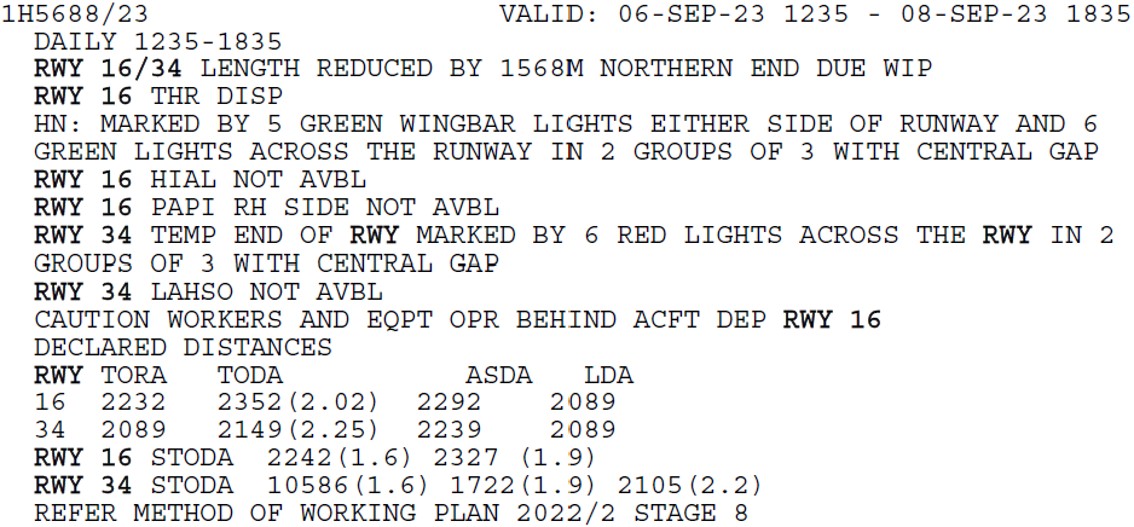
Note: times are in UTC. See Take-off distances for a description of TORA, TODA, ASDA, and LDA. Other abbreviations are defined in the Airservices Australia Aeronautical Information Package (AIP), Part 1 – General (GEN) 2.2. Source: Malaysia Airlines
Both flight crew members reported listening to the automatic terminal information service (ATIS)[11] and writing down the key information (see Flight crew recollections and Access of ATIS information by MAB flight crew). The version of the ATIS that the flight crew accessed was information Oscar[12] which stated ‘reduced runway length in operation’ and gave both the landing distance available (LDA) and the take-off run available (TORA) as 2,089 m. The ATIS audio was broadcast as follows:
MELBOURNE TERMINAL INFORMATION OSCAR, EXPECT GLS OR RNP APPROACH, RUNWAY THREE FOUR DRY, REDUCED RUNWAY LENGTH IN OPERATION, LANDING DISTANCE AVAILABLE TWO ZERO EIGHT NINER METRES, TORA TWO ZERO EIGHT NINER METRES, WIND THREE THREE ZERO DEGREES ONE ZERO KNOTS, VISIBILITY GREATER THAN ONE ZERO KILOMETRES, CLOUD FEW THREE THOUSAND FIVE HUNDRED FEET, TEMPERATURE ONE ZERO, QNH[13] ONE ZERO ZERO FIVE, ON FIRST CONTACT WITH MELBOURNE GROUND, TOWER OR APPROACH, NOTIFY RECEIPT OF INFORMATION OSCAR.
Neither of the crew recalled recognising from the ATIS that the runway length was reduced. In their written records of the ATIS information, there was no mention of the reduced runway length. The captain reported hearing the runway length available but did not note the actual length or recognise that it was reduced from the published length. The captain noted that runway length was often provided in the ATIS at some airports.
The flight crew proceeded with independent performance calculations using the Airbus EFB software FlySmart on their individual EFB. Both crew selected the full length of the runway for their independent calculations, which resulted in the selection of a reduced‑thrust take-off. The crew then crosschecked the two sets of performance figures, which were the same. The captain recalled that during the crew pre-departure briefing, they discussed the WIP and intended to exercise caution, but did not note the shortened runway and thought that the works would not affect their departure.
At 2327, the crew requested flight clearance to Kuala Lumpur and 2 minutes later requested push back from the gate and engine start. At 2337 the crew requested taxi clearance, and were cleared to holding point K (at taxiway K). At 2343, the tower controller[14] gave the aircraft clearance to line up on runway 34 and, about one minute later, cleared the aircraft for take-off. None of the communications between the flight crew and ATC mentioned the shortened runway, the works in progress or the current ATIS version,[15] which had not changed since the flight crew accessed it.
The crew reported that, in accordance with the airline’s standard operating procedure, the FO (as PF) set the thrust and the captain then put a hand on the throttle levers. The captain reported that during the take-off run, they observed that the runway end lights appeared ‘very close’, but they did not take any corrective action. The captain indicated a concern with rejecting the take-off at that point, and also that they did not advance the throttles to take-off/go-around (TOGA)[16] thrust, as they did not want to distract or startle the FO. The FO did not notice the lights.
Aircraft flight data analysis showed that aircraft rotation was initiated by the PF at 160 kt,[17] approximately 250 m before the runway end (Figure 3). Both crew recalled that the initial rate of rotation was slow,[18] which flight data showed was corrected after about 3 seconds. The data recorded weight off the main landing gear after the end of the runway, approximately 170 m before the works limit line.[19] The aircraft radio altitude (RA)[20] was estimated to be approximately 23 ft (7.0 m) as it crossed the works limit and the jet blast affected workers and vehicles on the site. One of those affected indicated that their ‘vehicle shook violently’ as a result. A visual impression of the proximity of the aircraft to the works limit is shown in (Figure 4).
Once the aircraft was stabilised at 10,000 ft, the crew briefly discussed the proximity of the runway end lights during the take-off. There was no indication of any issue with the aircraft and no contact from ATC to indicate any issue, so the crew continued the flight to Kuala Lumpur.
Figure 3: 9M-MTL take-off relative to runway works
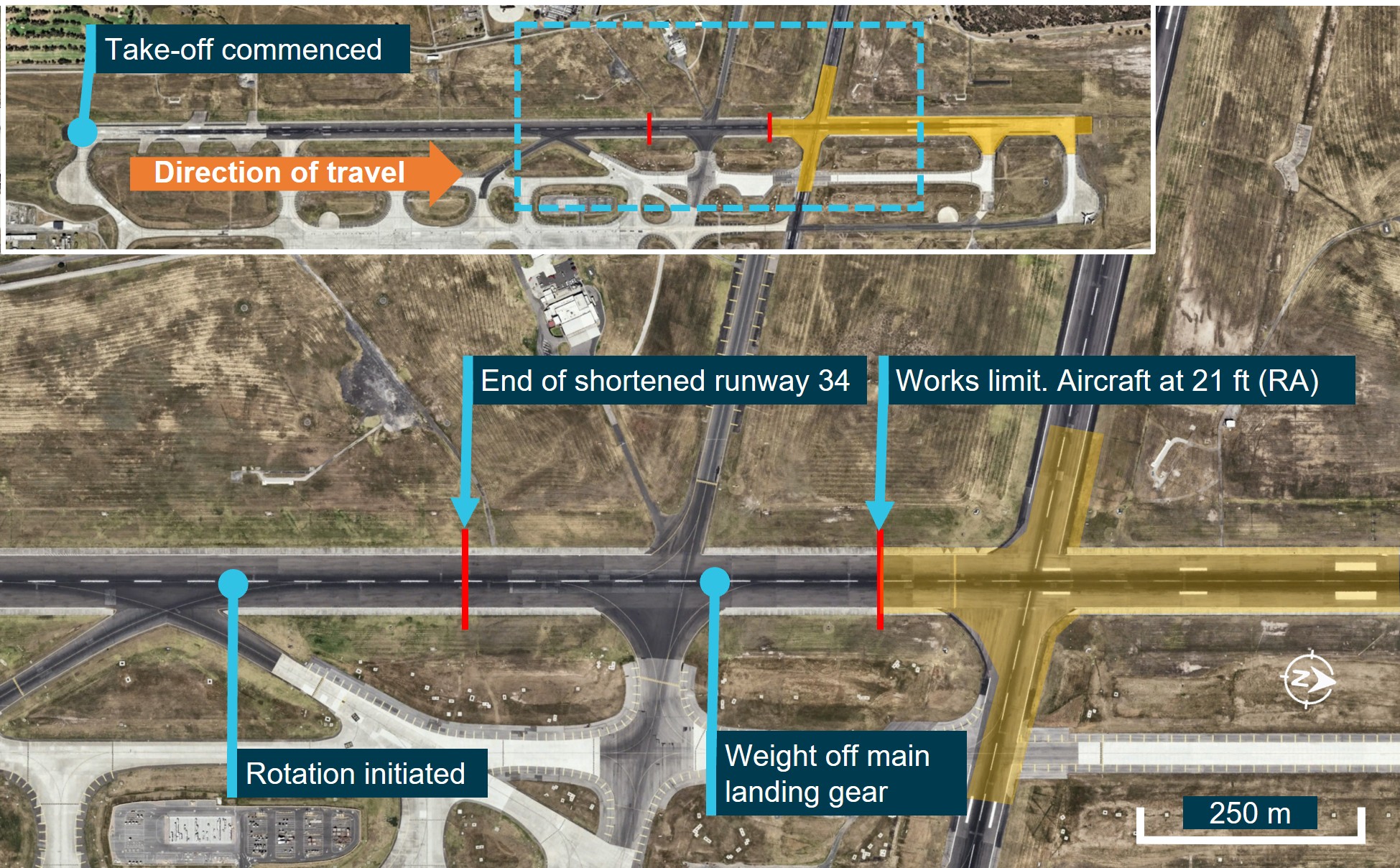
Source: Google Earth, annotated by the ATSB
Figure 4: Visual impression of 9M-MTL over works limit

Source: ATSB
Actions after first occurrence
The airport operator, Australian Pacific Airport Melbourne (APAM), reviewed an incident report from the runway works safety officer on 8 September 2023. After confirming the circumstances of the occurrence, APAM ceased the runway overlay works pending further investigation. APAM liaised with MAB to understand the factors that led to the occurrence. MAB advised APAM that the flight crew were aware of the WIP but had overlooked this during take-off calculations, which were done using the full-length runway. APAM subsequently conducted a risk review for the displaced threshold works[21] and implemented additional safety actions, including updating existing communications and promulgating a safety alert.[22] APAM recommenced the displaced threshold works on 11 September and there were no further reported incidents relating to the works until 18 September.
On 13 September, Airservices Australia released an internal standardisation directive to air traffic controllers (see Air traffic services). The directive identified ‘a recent occurrence’ that highlighted the need to obtain the ATIS identifier from the pilot in command (per the Aerodrome Information Package (AIP) requirement), ‘to ensure pilots in command are in receipt of Essential Aerodrome Information’.
VN-A819, 18 September 2023
On 18 September 2023 at 2230, a Bamboo Airways Vietnam (BAV) Boeing 787-9 aircraft, registered VN-A819, was being prepared to depart Melbourne Airport for scheduled air transport passenger flight QH83 to Hanoi, Vietnam. There were 3 flight crew, who were assigned the roles (according to the operator’s terminology) of pilot in command (PIC) / relief pilot, PM, and PF.[23] For this flight, the PIC sat in the jump seat behind the pilots at the controls, the PM sat in the left pilot’s seat and the PF sat on the right.
The same flight crew had flown into Melbourne via runway 34 at around midday on 17 September. At the time of this arrival there was no WIP and there were no restrictions on the runway or taxiways.
At approximately 2000 on 18 September, prior to leaving their hotel, the flight crew reported downloading and individually reviewing the flight briefing package.[24] The flight dispatcher’s email briefing to the crew, accompanying the briefing package, included several items of particular note for the flight but indicated that there were no special NOTAMs in effect for the flight (Figure 5). The aircraft had an inoperative auxiliary power unit (APU) and had one brake unit (of 8 total) deactivated. The crew then had an initial briefing on the planned flight while on the way to the airport, noting the aircraft defects, but they did not note the WIP and shortened runway.
Figure 5: Excerpt from BAV flight crew dispatcher briefing email

Source: BAV
The flight crew received a printed copy of the flight briefing package at the airport and the PIC reported that a review of the flight information, including NOTAMs was conducted on the EFB as a group. The crew reported observing that the runway NOTAM (essentially the same as the one for the first occurrence, shown in Figure 2) came into effect at 2235,[25] which was 5 minutes after the scheduled departure time (2230).
The PF and PM reported that after arriving at the aircraft, they listened to ATIS information November (see Flight crew recollections and Access of ATIS information by BAV flight crew). The ATIS stated that runway 16/34 was currently closed due to the runway works, that all runways would be closed from 2225, and from 2235 runway 34 would be operational with a displaced threshold. The ATIS was broadcast as:
MELBOURNE TERMINAL INFORMATION NOVEMBER, EXPECT GLS OR ILS APPROACH RUNWAY ZERO NINER TWO SEVEN, RUNWAY ONE SIX THREE FOUR CLOSED DUE WORKS. FROM TIME ONE TWO TWO FIVE ALL RUNWAYS CLOSED, FROM TIME ONE TWO THREE FIVE RUNWAY THREE FOUR WITH DISPLACED THRESHOLD FOR ALL OPERATIONS, WIND THREE SIX ZERO DEGREES SIX KNOTS, CAVOK,[26] TEMPERATURE ONE THREE, QNH ONE ZERO ONE THREE, ON FIRST CONTACT WITH MELBOURNE GROUND, TOWER OR APPROACH, NOTIFY RECEIPT OF INFORMATION NOVEMBER.
The flight crew did not recall recognising the runway closures from ATIS November.
As a result of the APU fault, external power was connected to the aircraft. The crew reported that the power disconnected halfway through flight planning, leaving the aircraft without electrical power. Two further power outages resulted in an estimated 40-minute delay until power was stabilised, and a further 30 minutes to prepare the aircraft again. [27] The flight crew reported that they were experiencing a high workload and time pressures as a result and while they would ordinarily conduct a further review of the flight information prior to departure, this did not occur. The PM accessed the current ATIS information, which had changed to information Oscar from 2220. The aerodrome information was updated, stating that runway 09/27 and runway 16/34 were closed due to WIP and continued to advise that displaced threshold operations would be in effect from 2235:
MELBOURNE TERMINAL INFORMATION OSCAR […] RUNWAY ZERO NINER TWO SEVEN AND ONE SIX THREE FOUR CLOSED DUE WORKS. FROM TIME ONE TWO THREE FIVE RUNWAY THREE FOUR WITH DISPLACED THRESHOLD FOR ALL OPERATIONS…
The flight crew did not recall recognising the runway closures from ATIS Oscar and they did not subsequently listen to the ATIS again.
At 2222 the crew contacted ATC and requested flight clearance to Hanoi. In providing clearance, the delivery controller[28] advised the flight crew to expect to take off from runway 34 and that the ATIS information was now Oscar, which was acknowledged by the crew. The controller did not (and was not required to) mention the runway works or reduced length.
At 2229, due to the APU fault, the crew requested to start one engine at the gate while connected to ground power, which was approved.
ATIS information Papa was broadcast from 2234, stating that the reduced runway length was in operation and provided the associated runway declared distances:
MELBOURNE TERMINAL INFORMATION PAPA…REDUCED RUNWAY LENGTH IN OPERATION TORA TWO ZERO EIGHT NINER METRES, TODA TWO ONE FOUR NINER METRES, ASDA TWO TWO THREE NINER METRES, LANDING DISTANCE AVAILABLE TWO ZERO EIGHT NINER METRES. RUNWAY THREE FOUR DEPARTURES FROM TAXIWAY KILO. CENTRELINE LIGHTS NOT AVAILABLE. RUNWAY ZERO NINER TWO SEVEN CLOSED DUE WORKS…
ATC did not (and was not required to) conduct an all-stations broadcast for the ATIS Papa change.[29]
At 2240, after starting one engine, the flight crew requested and received clearance to push back from the gate and, at 2246, received clearance to taxi to holding point K. The flight crew did not give their current ATIS information identifier to the ground controller[30] on taxi request and the ground controller did not challenge the omission. After commencing taxi, the ground controller contacted the flight crew to advise that their transponder wasn’t showing on the radar, which the crew acknowledged and turned the transponder on.
The flight crew held for about 3 minutes at holding point K for incoming traffic and, at 2254 were cleared to line up on runway 34. About one minute later, when the aircraft was lined up, the tower controller asked the flight crew, ‘confirm you have information Papa’. The crew did not respond to the radio call.
About 25 seconds later, after engaging with another aircraft, the tower controller called VN-A819 again. Once acknowledged, the controller again asked the crew to ‘confirm you have ATIS information Papa’, to which the PM replied, ‘information Papa copy’. At 2256, on receipt of the flight crew’s response, ATC issued the flight take‑off clearance.
During a post-occurrence interview, the PF and PIC recalled recognising at this point that the ATIS version had changed from Oscar to Papa. However, they indicated that in their experience an ATIS revision would normally relate to minor changes in the QNH or wind, and that important changes in the information would have been directly communicated by ATC. The PF also reported feeling under pressure to depart, already being lined up on the runway, with their traffic display showing an aircraft on approach a few miles out behind them.
During the take-off run, the PM and PIC observed that the runway end lights appeared closer than normal at lift-off. ATSB flight data analysis identified the lift-off point[31] as just past the runway intersection with taxiway E (Figure 6). As the aircraft crossed the works limit line, the recorded radio altitude was approximately 15 ft (4.5 m).[32] A visual impression of the proximity of the aircraft to the works limit is shown in Figure 7.
Jet blast on the works limit displaced and damaged unserviceability lights and marking cones. There were no reported physical injuries, however, one worker reported a stress‑related injury as a result of the close proximity of the aircraft to their vehicle.
Figure 6: VN-A819 take-off relative to runway works
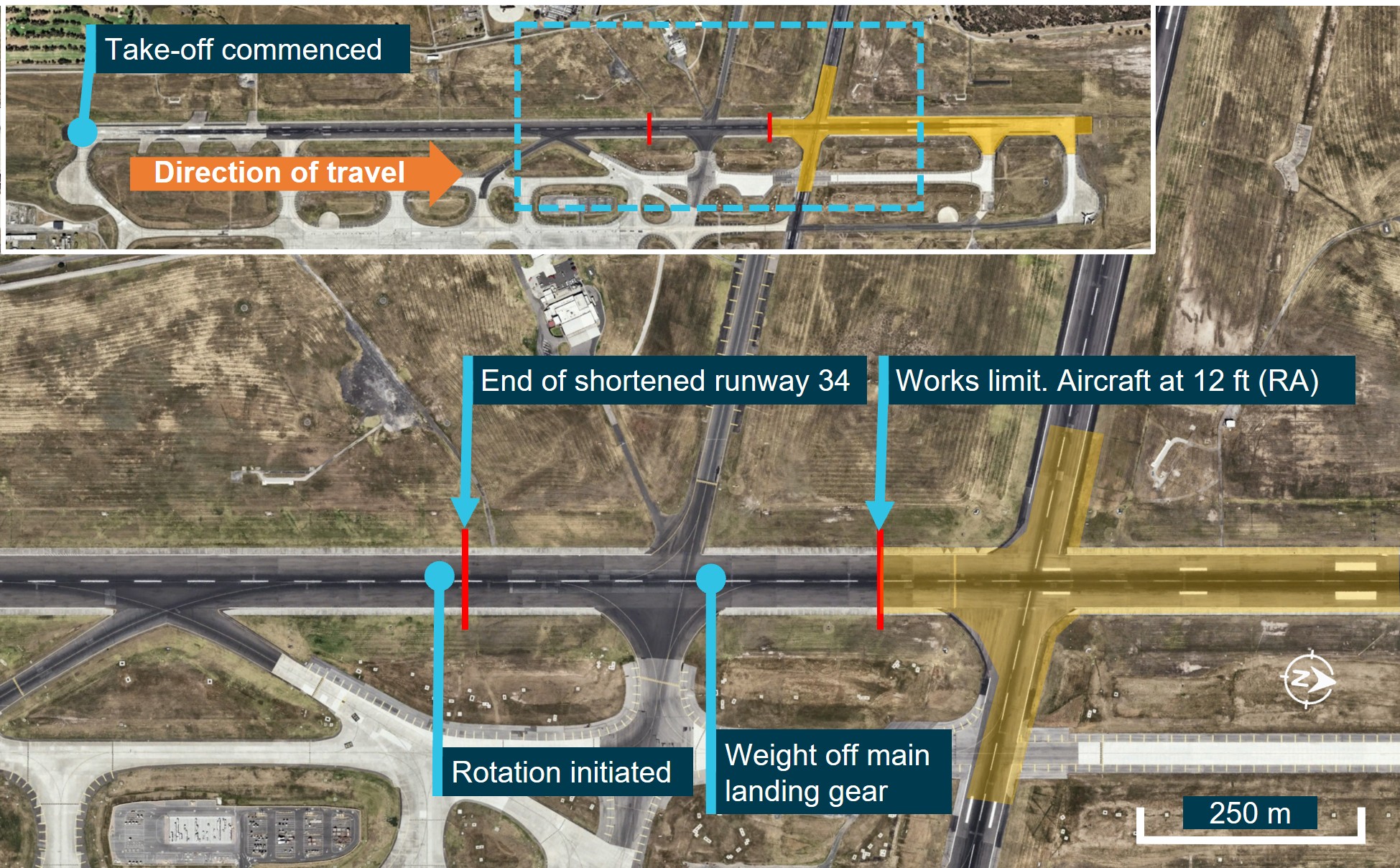
Source: Google Earth, annotated by the ATSB
Figure 7: Visual impression of VN-A819 over works limit

Source: ATSB
After the take-off was completed, the crew discussed the proximity of the runway end lights. The crew reported no indication of any fault with the aircraft and no contact from ATC to indicate any other issue. The crew therefore continued the flight as normal to Hanoi.
Airport operator actions after second occurrence
After being notified of the BAV occurrence by runway workers, APAM ceased works for the remainder of the evening and reopened the runway. The following day, APAM ceased works involving a displaced threshold. To complete the minimum amount of works required for the project, APAM descoped several items and completed the remaining works under a 2-hour night closure of both runways.
Context
Personnel information
Malaysia Airlines flight crew
The Malaysia Airlines Berhad (MAB) flight crew were appropriately licensed and qualified to conduct the flight (Table 1). The MAB flight crew operated the inbound flight to Melbourne Airport on 6 September and had approximately 25 hours rest before commencing duty ahead of the occurrence flight. Neither crew member reported any fatigue concerns.
The captain and first officer had most recently previously operated into Melbourne on 8 April 2023 and 18 July 2023 respectively. Those flights were not affected by the periods of displaced threshold runway works.
Table 1: Malaysia Airlines flight crew details
| Captain | First Officer | |
| License | ATPL | CPL |
| Medical validity | 31 May 2024 | 31 July 2024 |
| Total hours | 19,286 | 5,557 |
| Hours on type (A330) | 934 | 2,206 |
| Flying hours in last 28 days | 34 | 58 |
| Licence proficiency[33] check due | 30 November 2023 | 30 November 2023 |
| Line check[34] due | 30 January 2024 | 31 July 2024 |
Bamboo Airways flight crew
The Bamboo Airways Vietnam (BAV) flight crew were appropriately licensed and qualified to conduct the flight (Table 2). The PIC also held a Boeing 787 type rating instructor endorsement. The crew consisted of 3 pilots who had also operated the inbound flight to Melbourne Airport on 16 September. The crew were subsequently rested for approximately 33 hours in Melbourne before they reported for duty on 18 September. The individual crew members did not report any fatigue concerns.
The most recent flights departing Melbourne for the PIC, PF and PM were conducted on 16 April 2023, 26 June 2023 and 6 August 2023. Those flights were not affected by the periods of displaced threshold runway works.
Table 2: Bamboo Airways flight crew details
| Pilot in Command | Pilot Flying | Pilot Monitoring | |
| License | ATPL | ATPL | ATPL |
| Medical validity | 30 November 2023 | 31 July 2024 | 30 June 2024 |
| Total flying hours | 26,947 | 12,108 | 12,287 |
| Hours on type (B787) | 5,145 | 8,129 | 4,694 |
| Flying hours in last 90 days | 191 | 159 | 194 |
| Licence proficiency check completed | 25 August 2023 | 31 August 2023 | 10 March 2023 |
| Line check completed | 19 December 2022 | 24 February 2023 | 20 August 2023 |
Flight crew recollections
Malaysia Airlines flight crew recollections
During individual post-occurrence interviews with the ATSB, the MAB flight crew recognised that they had not identified the reduced runway length through the provided NOTAMs or the ATIS version accessed.
The crew recalled being aware of the runway WIP from their NOTAM review during their approach to Melbourne the previous evening. However, they indicated that their focus at that time was on the associated taxiway closures (for vacating the runway after landing). The crew suggested that this probably contributed to their expectation that the WIP would not affect their departure on the occurrence flight.
In addition, both crew members observed that:
- the reduced runway length was not mentioned during any radio communications with controllers, and
- they did not notice any clear signs or visual cues to highlight the WIP or indicate that the runway length had changed.
The crew members indicated that, had these additional visual or auditory cues been available, it would likely have assisted with their awareness of the reduced runway length.
Additionally, the FO indicated that reviewing the NOTAMs using the split screen display[35] of their EFB may have affected their ability to detect the shortened runway in the NOTAM list.
Bamboo Airways flight crew recollections
During individual post-occurrence interviews with the ATSB, the BAV flight crew recognised that they had not identified the reduced runway length through the provided NOTAMs. They also did not recall hearing that the runway was ‘shortened’ on either of the ATIS versions accessed.
Regarding their review of the flight information, the crew reported being influenced by their flight dispatcher’s briefing email indicating that there were no special NOTAMs to be aware of for the flight. The crew also noted that the time of the reduced runway length NOTAM effectivity was shortly (5 minutes) after their original scheduled departure, which they said may have caused them to initially overlook the information.
Additionally, the crew reported the high workload resulting from the repeated power outages and feeling under time pressure to depart. The PF advised that the crew would normally have completed an additional review of the available information before pushback, but because of the aircraft issues, they did not have time to do this.
The PF and PM noted that from the time of pushback to the holding point, everything looked normal. There was no advice from ATC regarding the ATIS change or any sign that they were operating with a shortened runway. The crew indicated that receipt of ATIS change advice while waiting at the holding point, rather than when lined up on the runway, would have provided additional time to review.
Recollections of tower controller on duty 18 September
Regarding their request to the BAV flight crew to confirm ATIS P between the line-up and take-off clearances, the tower controller indicated that it was unusual for them to do that. The controller advised that they had no reason to doubt that the flight crew had the current ATIS (P), and that it would have been checked at the time of taxi request in accordance with normal procedures. However, the controller was also aware of the circumstances of the previous occurrence on 7 September and noted that the BAV aircraft was the first to depart on the reduced length runway on 18 September. As such, the controller felt the need to check that the crew had the correct information.
Aircraft information
Both the Airbus A330-300 (9M-MTL) and Boeing 787-9 (VN-A819) are wide-body (dual aisle) twin turbofan engine, long range, air transport operation aircraft. At the time of the occurrence:
- 9M-MTL had a take-off weight of 216.1 tonnes, out of a maximum take-off weight of 233.0 tonnes. There were no listed performance-related defects.
- VN-A819 had a take-off weight of 218.8 tonnes, out of a maximum take-off weight of 252.7 tonnes. The auxiliary power unit and one brake unit (of 8 total) was listed as inoperative.
Take-off performance calculations
Reduced-thrust or derated take-offs are a standard practice to reduce engine wear and overhaul costs when there is more take-off distance available than the aircraft safely needs. Flexible temperature (FLEX in Airbus terminology or assumed temperature in Boeing terminology) settings achieve a reduced-thrust take-off to take advantage of the runway length available by using an artificially high ambient temperature value to limit engine thrust, resulting in longer take-off distances.
Both occurrence crew used electronic flight bag (EFB) systems for pre-flight performance calculations resulting in reduced-thrust take-offs. The MAB aircraft, 9M‑MTL, used the Airbus Flysmart and the BAV aircraft, VN-A819, used the Boeing Onboard Performance Tool.
Both tools enabled flight crews to select the applicable airport and runway for take-off. The runway selection had different options from a drop-down list, that were pre-coded by the aircraft operator. For runway 34, this included ‘RWY 34’ for the normal full length, ‘RWY 34-WIP’ (or TMP) that was correct for the reduced-length runway works, and RWY 34-J for a taxiway J intersection departure. Pilots also had the option of modifying a runway entry if the runway circumstances had not been coded ahead of time.
A comparison of the calculations made by the systems for a full-length and reduced‑length runway applicable to each occurrence, with example performance tool screenshots are shown in Table 3, Figure 8 (MAB) and Table 4, Figure 9 (BAV). In addition to the performance data, both performance tools displayed a graphical representation of the runway and the take-off distances required.[36]
Both crew reported using the full-length runway in their calculations. This resulted in a reduced thrust setting, reduced flaps setting and higher V speeds.[37] This produced an accelerate stop distance required (ASDR)[38] for both aircraft that was significantly in excess of the accelerate stop distance available (ASDA) available at the time (2,239 m).
Table 3: 9M-MTL Airbus Flysmart performancedata comparison between Melbourne runway 34 full-length and reduced-length
| Runway 34 full-length | Runway 34 reduced-length |
Thrust: reduced-thrust 46 °C Flaps: 2 V1:[39] 159 kt VR:[40] 159 kt ASDR: 3,463 m | Thrust: TOGA Flaps: 3 V1: 136 kt VR: 136 kt ASDR: 2,047 m |
Figure 8: Airbus Flysmart screen images showing performance comparison for 9M-MTL for conditions representative of 7 September 2023. Melbourne runway 34 full-length (centre of image) and reduced-length (right).
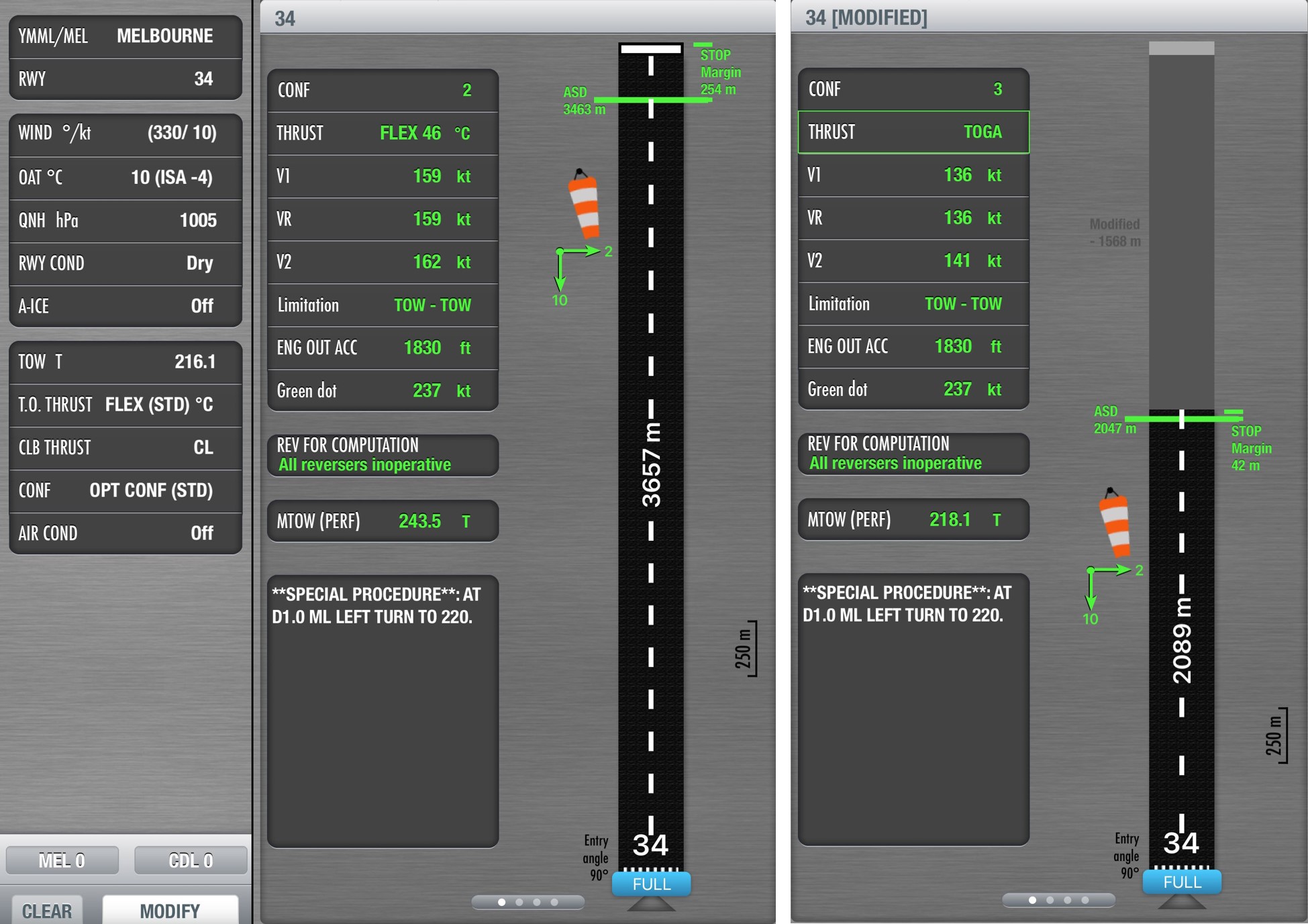
Green text from the top down includes: CONF (flaps setting), thrust, V speeds, and a reduced performance MTOW (maximum take-off weight at which the performance is achievable). The green bar on the runway diagram is the accelerate-stop distance required for the given scenario. Source: Malaysia Airlines, modified by the ATSB
Table 4: VN-A819 Boeing Onboard Performance Tool data comparison between Melbourne runway 34 full-length and reduced-length
| Runway 34 full length | Runway 34 reduced length |
Thrust: reduced-thrust 42 °C Flaps: 5 V1: 165 kt VR: 166 kt ASDR: 3,500 m | Thrust: TOGA Flaps: 20 V1: 144 kt VR: 146 kt ASDR: 2,205 m |
Figure 9: Boeing OPT screen images showing performance comparison for VN‑A819 for conditions representative of 18 September 2023 – Melbourne runway 34 full‑length (left) and reduced‑length (right)
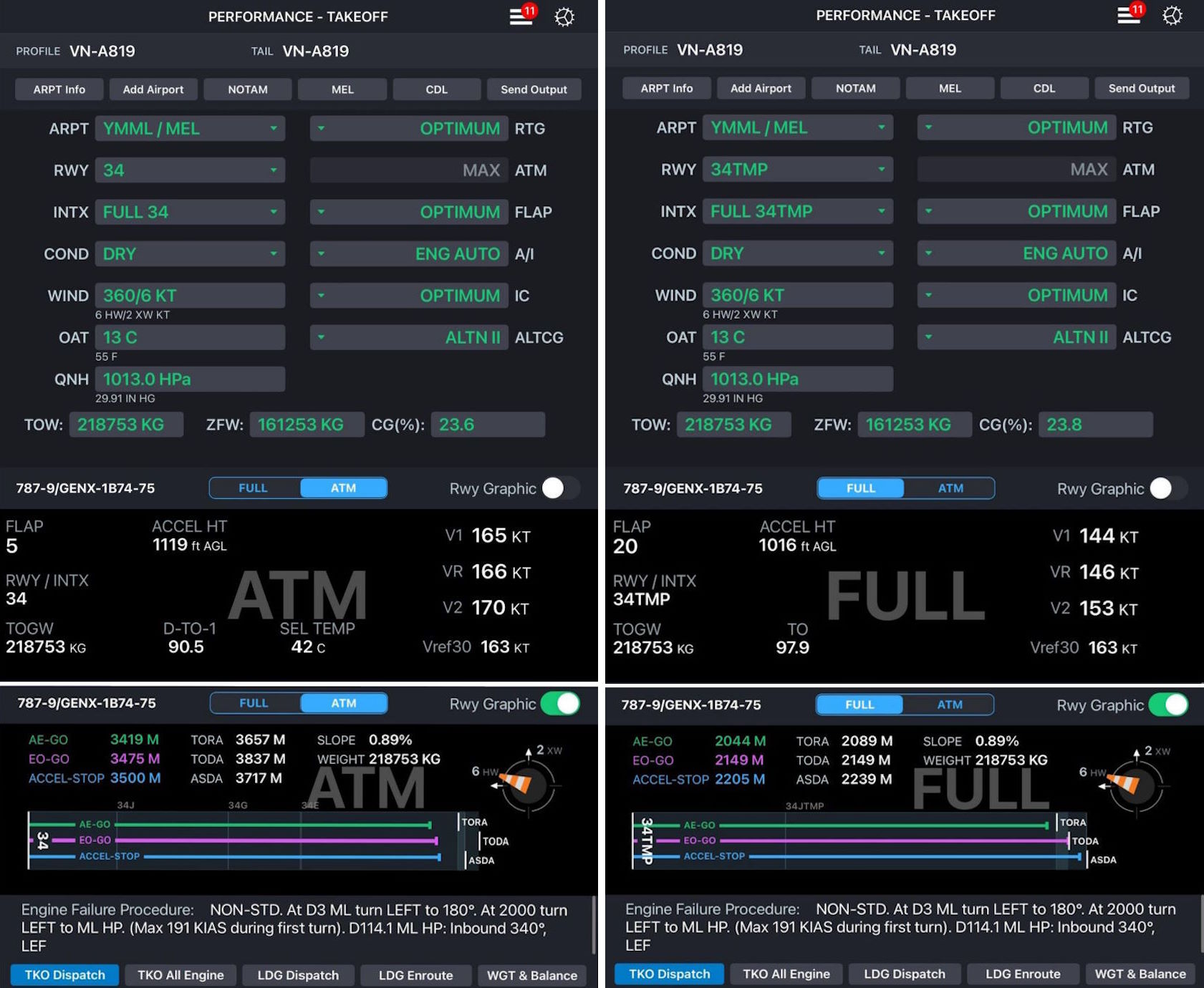
Selections from top left: ARPT (Airport), RWY (Runway), INTX (Intersection),COND (RWY condition), WIND, OAT (outside air temperature), QNH. Key differences being the INTX selection of 34 vs 34 TMP, and the resulting engine select temperature of 42°C vs ‘FULL’ thrust. The runway graphic at the bottom show the take-off distances required against those available, along with the actual figures. Source: Bamboo Airways Vietnam, modified by the ATSB
Recorded information
Recorded data from the following sources was obtained by the ATSB:
- quick access recorder (QAR) from each aircraft
- ATC audio and surface movement radar
- closed-circuit television (CCTV) data from several cameras at Melbourne Airport.
The QAR data was used to inform the take-off performance noted in The occurrences section and shown in Figure 3 and Figure 6. There were no performance issues identified with either aircraft during take-off.
Cockpit voice recorder (CVR) data was overwritten in both events due to continuation of the respective flights to their destination.
Melbourne Airport information
Melbourne Airport is a certified aerodrome[41] operated by Australian Pacific Airport Melbourne (APAM). It operates without a curfew, 24 hours per day, 7 days per week. At the time of the occurrences, it averaged approximately 650 aircraft movements per day, of which about 70 were at night during the reduced runway length operations (comprising about 30 departures and 40 arrivals).
Melbourne Airport had 2 runways:
- 16/34, which was 3,657 m long
- 09/27, which was 2,286 m long.
Runway 16/34 crosses approximately through the middle of 09/27, at a point about
2,680 m from the runway 34 threshold. Runway 16/34 has no significant change in elevation that blocks visibility between the 2 runway ends.
Runway works project
Works affecting runway 16/34
APAM commenced a runway overlay and resurfacing works project on 3 November 2022 that was scheduled to be completed in February 2024. The runway overlay had a design life of 10–12 years and had been most recently resurfaced in 2011.
The works were divided into 16 stages, with stage 8 of the works concerning the intersection of runways 16/34 and 09/27. The works plan involved closure of runway 09/27 and, to maintain an operational runway during the works, the runway 16 threshold was displaced, shortening the length of runways 16 and 34 (Figure 1).
Stage 8 of the works was the only one that had displaced threshold runway operations; it spanned three periods:
- The first period ran from 23 January 2023 until 3 March 2023 for asphalt works. During that time, APAM recorded 3 minor or potential jet blast incidents from aircraft not correctly following the runway 16 lead-on lights at taxiway E. In one of those occurrences the aircraft backtracked into the runway end safety area (RESA) before departing, which resulted in jet blast on a work safety officer vehicle. APAM reported that it followed up with the operators involved. The events were also reported to the ATSB.
- The second period was from 15 to 26 May 2023 for runway grooving works. There were no recorded occurrences relating to the displaced threshold during that period.
- The third period, containing the subject occurrences, commenced on 6 September 2023 for airfield ground lighting installation works and was initially scheduled until 28 September, subject to change. During this period, the displaced threshold operations commenced at 2235 each night and finished at 0435 the following morning. The 6‑hour works period corresponded with the period of the airport’s lowest traffic volume.
Runway distance information
The Part 139 (Aerodromes) Manual of Standards 2019 (Part 139 MOS), made under the Civil Aviation Safety Regulations (CASR), defined the following runway ‘declared distances’, which were also the standard reflected in the International Civil Aviation Organization (ICAO) Annex 14 Aerodromes[42] (Figure 10):
- Take-off run available (TORA). The length of runway declared available and suitable for the ground run of an aeroplane taking off.
- Take-off distance available (TODA). The length of the take-off run available plus the length of the clearway (CWY),[43] if provided.
- Accelerate-stop distance available (ASDA). The length of the take-off run available plus the length of the stopway (SWY),[44] if provided.
- Landing distance available (LDA). The length of runway which is declared available and suitable for the ground run of an aeroplane landing.
Figure 10: Runway declared distances
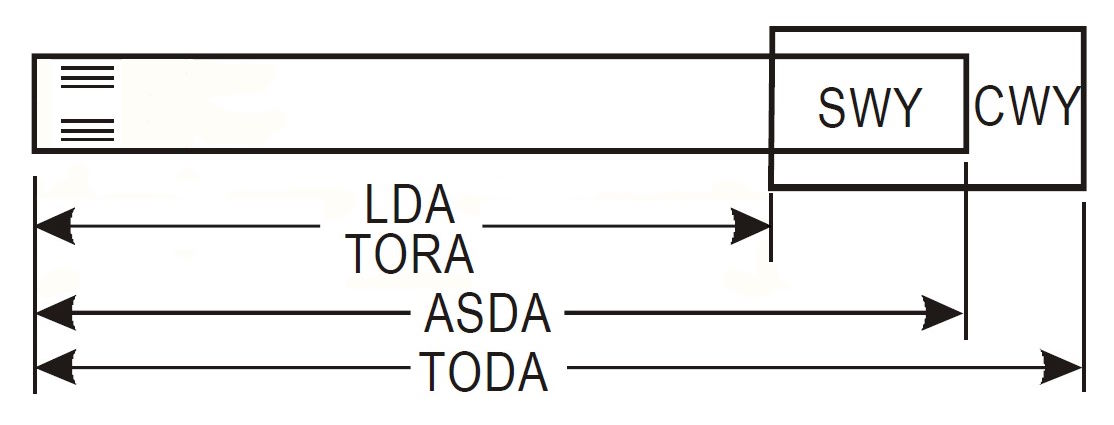
Source: ICAO Annex 14, modified by ATSB
Each distance had an aircraft-performance equivalent (TORR, TODR, ASDR, and LDR respectively, with the final ‘R’ meaning ‘required’) to designate the distances required by a particular aircraft in a nominal set of conditions. For example, pilots can calculate the take-off distance required (TODR) for a particular flight.
Changes in runway declared distances for stage 8 of the works are listed in Table 5.
Table 5: Melbourne runway 34 declared distances
| Declared distance type | Normal distance (m) | Distance (m) during stage 8 runway works |
| Take-off run available (TORA) | 3,657 | 2,089 |
| Take-off distance available (TODA) | 3,837 | 2,149 |
| Accelerate -stop distance available (ASDA) | 3,717 | 2,239 |
| Landing distance available (LDA) | 3,657 | 2,089 |
Works risk management
Civil Aviation Safety Regulations requirements and guidance
The CASR Part 139 required that:
The operator of a certified aerodrome must ensure that any aerodrome works at the aerodrome are carried out in a way that does not create a hazard to aircraft or cause confusion to pilots.
The Part 139 Manual of Standards (MOS) Chapter 15 contained the requirements for the planning and conduct of aerodrome works. The MOS noted that:
Aerodrome works may be carried out without the closure of the aerodrome, provided safety precautions are adhered to.
The MOS required that the aerodrome operator prepare a method of working plan (MOWP), in accordance with Chapter 16 of the MOS, to accurately set out the arrangements for carrying out the works. When preparing the MOWP, the MOS required the aerodrome operator to consult with stakeholders including, but not limited to, air transport operators and the air traffic services (ATS) provider.
CASA also published AC 139-20(0) Safe Planning and Conduct of Aerodrome Works in March 2007.[45] The AC contained advice, guidance and explanatory material to assist aerodrome operators in safely conducting aerodrome works and in complying with the relevant regulatory (MOS) requirements.
The contents of the MOWP, the MOS more broadly, and the AC guidance, essentially aligned with the requirements of ICAO Doc 9981 Procedures for Air Navigation Services (PANS) Aerodromes, as outlined below.
International Civil Aviation Organization (ICAO) procedures
ICAO Doc 9981 PANS Aerodromes specifically mentioned works on operational runways, noting that:
In some cases, conducting works on a runway while maintaining flight operations may be possible. This is a complex activity directly affecting aircraft performance and safety and requires close coordination with ATS [air traffic services] and aircraft operators…It is important to note that additional hazards may arise when works involving a reduction in the available runway distances are conducted.
And:
8.3.3.6 Aerodrome operators shall ensure that procedures are in place for calculating accurate temporarily reduced declared distances (e.g. due to work in progress on the runway). When reduced declared distances are in operation, the aerodrome operator shall ensure that the temporary markings, lighting and signs accurately portray the reduced distances and that they are well-communicated to the AIS [Aeronautical information service] for publication.
The document included an appendix on reduced runway length operations, stating:[46]
1.1 In circumstances where works require the runway length to be reduced below the declared distances, the aerodrome operator shall:
a) identify and assess the associated risk and mitigate as necessary the potential hazards before, during, and on cessation of operations with reduced runway length available and/or WIP in order to ensure the safety of aircraft operations;
b) calculate and establish, where necessary, a revised runway strip, runway end safety area (RESA) and obstacle limitation surfaces (OLS), such as the approach and take-off climb surfaces;
c) establish a safety zone between the area of the runway that is in use and the WIP or unusable runway;
d) promulgate the details of the reduced runway distances established, using all appropriate methods. As a minimum, it is advisable to issue a NOTAM and, when possible, broadcast the information on automatic terminal information service (ATIS);
e) test, wherever practicable, the suitability of a procedure prior to its implementation;
f) ensure that the roles and responsibilities for operations and tasks associated with the reduction of the runway length available and the WIP are clearly understood and complied with;
g) provide markings and lights to clearly indicate the boundary of the safety zone and the WIP area;
h) clearly mark, light and/or barricade any movement area that is to be used by persons involved in the WIP, and not to be used by aircraft;
i) manage and control the movement on or around a runway or taxiway of contracted staff, who may not be as familiar with the aerodrome and aviation practices;
j) consider and address the impact on the ability of RFF [rescue and fire fighting] and emergency services to perform their functions; and
k) promulgate in a timely manner all the relevant operational information to all relevant parties.
APAM risk management actions
ATSB review of the APAM works documentation found that it had addressed the relevant CASA requirements and ICAO procedures.
During the works planning APAM engaged with relevant stakeholders including CASA, Airservices, the local runway safety team (LRST), [47] and external stakeholders, including airlines. APAM produced a method of working plan (MOWP) for the runway overlay project, in accordance with the Part 139 MOS requirements. APAM published the MOWP on the Melbourne Airport website and distributed it in the weeks ahead of the works commencement and when updated throughout the project, to a stakeholder list of aircraft operators and other organisations, including MAB and BAV.
In preparation for stage 8 of the works, APAM completed a risk assessment for the reduced length runway configuration, in accordance with the Australia Pacific Airport Corporation’s (APAC) documented internal risk assessment framework. This framework was designed in accordance with the principles set out in ISO[48] 31000: Risk management – Principles and guidelines.
APAC’s Risk Handbook stated:
The results from the risk identification process should be documented using APAC’s standard risk management system in sufficient detail to support the subsequent assessment and treatment of risks.
ISO 31010 - Risk management - Risk assessment techniques also recommended documentation of risk assessments:
The results of risk assessment, the methodologies used and the rationale for assumptions and any recommendations should be documented…
The purpose of records is to:
- communicate information about risk to decision makers and other stakeholders including regulators;
- provide a record and justification of the rationale for decisions made;
- preserve the results of assessment for future use and reference;
- track performance and trends;
- provide confidence that risks are understood and are being managed appropriately;
- enable verification of the assessment;
- provide an audit trail.
In this case, the process followed the prescribed steps for hazard identification (recorded as the displaced threshold on runway 16/34) followed by risk evaluation and control implementation. To inform the risks and controls for the displaced threshold works, APAM reported holding a risk workshop involving key stakeholders,[49] where the hazards and risk controls were discussed, agreed and entered into the risk software.
APAM identified a range of possible events associated with the displaced threshold works, including a runway incident or incursion, runway excursion/overrun, missed approach and operational interruption. These were grouped together in APAM’s risk management software under a single displaced threshold hazard entity and linked to the agreed risk controls. The risk controls were applicable to one or more of the identified events, however the mechanism or effectiveness by which each of the risk controls would mitigate the individual events was not detailed.
APAM assessed the worst credible outcome of the displaced threshold works as a ‘catastrophic’ consequence with a less than 1-in-10-year likelihood. This related to the highest consequence and lowest likelihood available in APAC’s risk management framework. The description for a catastrophic consequence was not aviation-specific and corresponded to an ‘event causing two or more fatalities and/ or permanent total disability of any employee, visitor or contractor.’ The likelihood criteria carried the description that the ‘risk is not expected to occur.’
The assessment placed the overall risk at a ‘medium’ level, which was the middle of 5 categories, and was the highest level that did not exceed the organisation’s ‘risk tolerance threshold’ according to the APAM safety management system manual. Acceptance of a medium level risk required escalation to APAM’s safety, risk and compliance executive committee. Managing the risk required active monitoring, and monthly review by the aviation safety and risk committee.
As part of the risk assessment process, APAM highlighted 3 recent displaced threshold occurrence investigations involving Australian runway works.[50] One of those investigations involved 2 events where flight crews had misinterpreted which end of the runway had been displaced. The investigation report found that the flight crews had not fully comprehended NOTAM and ATIS information in relation to the reduced length runway. While the basic details of the occurrence (crew misinterpretation) were noted by APAM, the final report had not been published at the time of the APAM review.
Of the 28 risk mitigations documented in APAM’s risk assessment, those that were most relevant to the subject occurrences included:
- Designing the displaced threshold and installing visual aids in accordance with the Part 139 MOS.
- Publication and distribution to all relevant stakeholders. This included communication of the stage 8 operating conditions via the MOWP, aeronautical information circulars (AIC), NOTAM, local works plan and airline operator information brief.
- ATC surveillance and procedures.
APAM also reported considering installation of a variable message board to indicate the reduced runway length, as a visual aid for flight crews, but ultimately decided not to proceed due to concern that it may have posed a distraction, or that pilots may not have understood it was for them.
Additionally, APAM consulted with the LRST and held online ‘runway overlay consultation forums’ for stakeholders (including airlines) at various stages throughout the works. APAM also incorporated safety learnings from the previous (2011) runway overlay project and first 2 displaced threshold periods into additional preventative actions.
There were 2 AICs published for the overlay project. The first contained a general overview of the works stages and operational impacts. The second contained detailed information on the operational impacts for stages 4 and 8, including the shortened runway. The local works plan outlined the process for establishment of the displaced threshold and changes to the airfield and facilities as a result.
The airline operator information brief carried details, maps and schedules for the elements of the works program requiring operational restrictions. It included detailed information on the stage 8 displaced threshold arrangement and corresponding reduced runway length, and highlighted the threats associated with operation on the reduced runway lengths. The brief also included indicative visualisations of the approach to runway 16 and 34 with the displaced threshold in place. Appendix A contains excerpts from revision 6 of the airline operator brief.
Safety action after the first occurrence
As outlined in The occurrences, APAM reported engaging with MAB to understand the factors contributing to the 7 September occurrence, and subsequently conducted a risk review for the displaced threshold works involving key internal personnel and Airservices representation from the Melbourne air traffic control tower. APAM revised down the effectiveness of ATIS as a risk control and took the following additional safety actions:
- A safety alert[51] was sent to all airlines operating into Melbourne Airport. It outlined the circumstances of the 7 September occurrence (that the flight crew did not consider the displaced threshold for their performance calculations and the incorrect runway length was selected for the shortened runway). The alert reinforced that all required information was published via NOTAM, and instructed airlines to ensure that ATIS was monitored for performance calculations. It recommended that INTAMs[52] and safety alerts get issued to flight crews to ensure their awareness. Read receipts and a signed acknowledgement were advised to show that the airlines had received the alert. APAM reported that BAV acknowledged receipt of the airside safety alert on 13 September.
- The aeronautical information circular (AIC)[53] and NOTAM were updated, stating all runway departures must be from taxiway K due to a shortened runway. The AIC also reflected content from the safety alert regarding the incorrect runway length selection occurrence.
- The airline operators information brief was updated and re-published on 12 September. It highlighted that departures from runway 34 during the displaced threshold operations would be via taxiway K only. Also, under a section identifying displaced threshold threats, a highlighted reminder was added for operators to ensure that correct landing and take-off performance information was used and that the runway length available was sufficient for the operation.
Additionally, APAM made a request to Airservices that controllers at Melbourne Tower amend take-off phraseology to include that the runway was shortened. However, according to APAM, this request was declined due to it being non-standard and the phraseology that controllers could use was prescriptive in what it could contain. Airservices explained to the ATSB that it needs to follow international requirements regarding phraseology and that it needs to be consistent when considering international operators, where a change of expected phraseology could introduce confusion. Airservices reinforced that it is required to provide essential aerodrome information through ATIS and that controllers confirm that an aircraft has received the information (through ATIS confirmation). Airservices noted the Global Action Plan for the Prevention of Runway Excursions (GAPPRE) and observed that there were no recommendations to use additional phraseology.
Visual aids
The AIC covering stages 4 and 8 of the works detailed the operational impacts of the displaced threshold works and listed changes to visual aids. The MOWP also described and illustrated the arrangement of visual aids for the stage 8, displaced threshold works, which were compliant with the Part 139 MOS.
Movement area guidance signs
Manual of standards
Aerodromes are required to have surface movement area guidance signs (MAGS) under certain conditions to provide guidance to aircraft and ground personnel. The MOS stated that MAGS may[54] be:
(a) mandatory instruction signs; or
(b) information only signs.
Mandatory instruction MAGS have white lettering on a red background and contain instructions that must be obeyed by pilots.
Mandatory instruction MAGS include the following:
(a) runway designation signs;
(b) CAT I, II or III holding position signs;
(d) runway holding position signs;
(d) aircraft NO ENTRY signs;
(e) vehicular STOP signs;
(f) runway/runway intersection signs.
Information MAGS only convey information. They must be in black lettering on a yellow background, or in yellow lettering on a black background.
Information MAGS include the following:
(a) taxiway location signs;
(b) direction signs;
(c) destination signs;
(d) take-off run available signs;
(e) runway exit signs;
(f) distance-to-go signs;
(g) LAHSO distance-to-go signs.
The MOS did not explicitly specify that this list was exhaustive (that is, whether other types of mandatory instruction MAGS or information MAGS were permitted).
With regards to take-off run available (TORA) MAGS the MOS stated:
A take-off run available sign is to indicate to pilots the length of take-off run available from a particular taxiway from which the AIP[55] indicates that an intersection departure[56] is available.
And:
A take-off run available sign must be provided as a final reassurance to the pilot of an aircraft that the pilot is at the correct take-off location.
The departures from the runway 34 threshold did not represent an intersection departure and therefore did not require a TORA MAGS. However, this did not preclude an aerodrome operator from introducing additional TORA MAGS at full-length runway entry points, and a full runway 34 TORA was ordinarily present at the taxiway K holding point. The MOS required that MAGS displaying declared distance information be obscured if incorrect during a period of temporary displaced threshold. This was completed as part of the nightly works set-up and was noted in the works AIC. The sign was not replaced with the actual (reduced) take-off run available and there was no requirement to do so.
International Civil Aviation Organization Annex 14 Aerodromes
ICAO Annex 14 Aerodromes Volume I: Aerodrome Design and Operations (Seventh Edition, July 2016) stated that:
5.4.2.1 Mandatory instruction signs shall include runway designation signs, category I, II or III holding position signs, runway-holding position signs, road-holding position signs and NO ENTRY signs.
And:
5.4.3.1 An information sign shall be provided where there is an operational need to identify by a sign, a specific location, or routing (direction or destination) information.
5.4.3.2 Information signs shall include: direction signs, location signs, destination signs, runway exit signs, runway vacated signs and intersection take-off signs.
ICAO did not provide a standard for runway distance signs other than intersection take‑off signs, which were for the following purpose:
5.4.3.5 Recommendation.— An intersection take-off sign should be provided when there is an operational need to indicate the remaining take-off run available (TORA) for intersection take-offs.
Examples of intersection take-off signs are shown in Figure 11.
Figure 11: Intersection take-off signs

Source: ICAO
Both Annex 14 and the Part 139 MOS required that signs be frangible in construction to minimise the damage or hazard to an aircraft if struck.
Annex 14 additionally recommended provision of a variable message sign where the instruction or information displayed on the sign is relevant only during a certain period of time. ICAO Doc 9157 Aerodrome Design Manual, Part 4 – Visual Aids, had guidelines for the design of variable message signs, including that:
the sign should only include colour and inscription elements that conform to the basic conventions that are to be followed in the design of mandatory and information signs.
Lights
Melbourne Airport has an extensive system of runway, taxiway, and other lights. Changes were made to the runway lighting for runway 34 during the stage 8 works (Figure 12). This included:
- The runway centreline lighting was not available (switched off) and the runway edge lights were not colour-coded for the displaced threshold.[57]
- Temporary runway 34 end lights were installed, consisting of 6 lights, in 2 groups of 3 with a central gap. This was due to the presence of the declared stopway/starter‑extension, to allow aircraft to pass through for departure from the runway 16 displaced threshold.
- A row of evenly-spaced, low-intensity,[58] unserviceability lights were placed across the works limit line.
Figure 12: Temporary runway 34 end and works limit arrangement
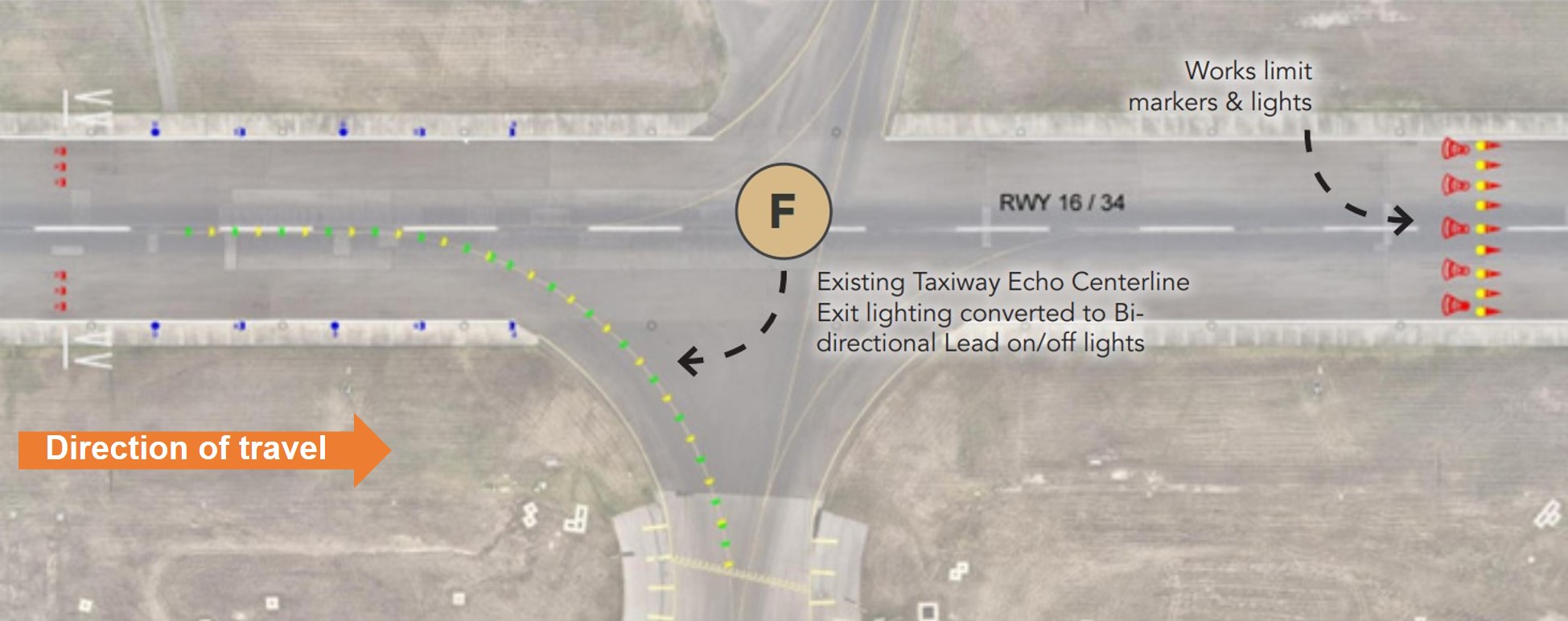
Source: APAM, modified by the ATSB
Additionally, the runway works area also had its own lighting to facilitate the works, and all vehicles operating in the works area were required to have an amber beacon fitted, visible from 360° and up to 200 m from the vehicle in normal daylight conditions. APAM included a representative image of the runway 34 lights on approach in the airline operator brief (Figure13). The image note advised that it was indicative only and that airfield taxiway lighting, and lighting related to the construction works, were not illustrated. Imagery from the threshold of runway 34 showing the occurrence pilot’s perspective of the works was not available to the investigation.
Figure 13: Illustration indicative of modified runway 34 lighting on approach at night
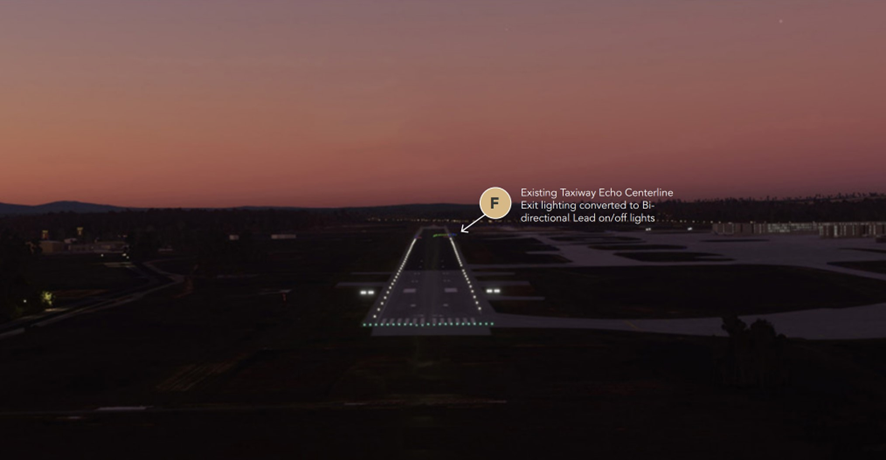
Source: APAM
The unserviceability lights and orange strobe lights at the works limit were visible in CCTV video of the occurrence take-offs, with the camera located on the roof of the terminal building at a distance of approximately 900 m.
Neither occurrence aircraft had taxied close to or in the direction of the active works, such that it would have been evident from the lights that there were works active on the runway. Additionally, none of the flight crew members recalled noting the modified lighting configuration or any of the works lights when lined up at the far end of runway 34, before commencing take-off.
Essential aerodrome information
Air traffic services
Airservices Australia is Australia's principal civil air navigation service provider (that is, the provider of air traffic services (ATS) for civil airports and airspace). The functions of Airservices are outlined in the Air Services Act 1995 and include the provision of air navigation services, aeronautical information, and aviation rescue and firefighting services. At Melbourne Airport, its functions include the provision of surface movement and terminal control services.
The Australian Manual of Air Traffic Services (MATS)[59] outlines requirements, procedures and standards for the provision of air traffic services. The listed ATS objectives included:
prevent collisions between aircraft on the manoeuvring area and obstructions on that area;
provide advice and information useful for the safe and efficient conduct of flights;
Regarding the provision of advice and information, MATS required controllers to:
Ensure all aircraft under your control are given the appropriate details when essential aerodrome information has not been fully covered by NOTAM.
MATS defined ‘essential aerodrome information’ as:
That information relating to the aerodrome and its facilities which a pilot requires in order to operate in safety.
Essential aerodrome information included:
a) construction or maintenance work on, or immediately adjacent to, the movement area;
b) rough or broken surfaces on the movement area whether marked or not;
c) water or contaminants on a runway (including a runway condition report), a taxiway or an apron and, when appropriate, braking action as reported by other aircraft;
d) other temporary hazards, including parked aircraft and animal hazards on the ground or in the air;
e) full or partial failure or irregular operation of the aerodrome lighting system, approach aids or emergency equipment; and
f) any other pertinent information including changes to traffic management initiatives such as LAHSO [land and hold short operations].
Provision of essential aerodrome information could be done by a controller via radiotelephony communications and/or through ATIS (see Automatic Terminal Information Service (ATIS)).
The AIP included standard radiotelephony phraseology for ATC and pilots in Australia. The document stated that the phraseologies and requirements were selected to harmonise with ICAO and international practices where applicable. The AIP referred ATS and pilots to ICAO Doc 4444 PANS Air Traffic Management (PANS-ATM), Doc 9432 (Manual of Radiotelephony) and Annex 10 (Aeronautical Telecommunications) as primary reference documents, and to obtain additional information from these documents as necessary.
Regarding the use of standard phraseology, the AIP stated that the:
Use of standard phrases for radio telephony communication is essential to avoid misunderstanding the intent of messages and to reduce the time required for communication.
When circumstances warrant, and no phraseology is available, clear and concise language should be used to indicate intentions.
The AIP contained the following phraseology for ATC communication of aerodrome information associated with WIP:
CAUTION (WORK IN PROGRESS) (OBSTRUCTION) (position and any necessary advice)
This was consistent with PANS-ATM, except that the latter document additionally contained the following phraseology applicable to communicating runway surface condition:
…LENGTH REDUCED TO (number) METRES
Additionally, under the ‘take-off clearance’ section, PANS-ATM noted that:
Note.— The expression TORA, pronounced TOR-AH, may be used to indicate take-off run available.
MATS included standard phraseology for the provision of essential aerodrome information through ATIS, including reduced runway lengths, as shown in Table 6.
Table 6: MATS standard ATIS phraseology
| Content | Phraseology |
| During runway work resulting in reduced runway lengths | REDUCED RUNWAY LENGTH(S) IN OPERATION ATIS may include: RUNWAY (number), TORA (or LANDING DISTANCE AVAILABLE) (number) METRES |
| Other essential operational information | RWY 21 DISPLACED THRESHOLD SOUTH OF RWY 24 INTERSECTION |
As stated in The occurrences, all of the ATIS versions accessed by the flight crews on 7 and 18 September included essential aerodrome information, including the displaced threshold and reduced runway lengths.
Additionally, MATS required controllers to transmit take-off or landing information to a pilot who has not notified receipt of the current ATIS. This included the runway in use and weather information, but did not specifically include changes in runway declared distances. Pilots were required to give the identifier of the ATIS version accessed, to ATC on taxi request, as notification of ATIS receipt. If this was not done, the controller would be required to prompt the crew to confirm their ATIS version or otherwise communicate the relevant ATIS information directly.
Other than this, there was no specific requirement for controllers to communicate changes in the runway declared distance to flight crews. However, MATS included the following overarching clause:
Do not allow anything in these instructions to preclude you from exercising your best judgement and initiative when:
a) the safety of an aircraft may be considered to be in doubt; or
b) a situation is not covered specifically by these instructions.
It was reported to the ATSB that some of the Melbourne Airport tower controllers were proactively directly communicating the reduced runway length in take-off clearances during the works period.
The MATS was aligned with PANS-ATM, which described ‘essential information on aerodrome conditions’ as, ‘… information necessary to safety in the operation of aircraft, which pertains to the movement area or any facilities usually associated therewith.’ Under Procedures for aerodrome control service, PANS-ATM differed slightly from MATS stating:
Essential information on aerodrome conditions shall be given to every aircraft, except when it is known that the aircraft already has received all or part of the information from other sources. The information shall be given in sufficient time for the aircraft to make proper use of it, and the hazards shall be identified as distinctly as possible.
Note.— “Other sources” include NOTAM, ATIS broadcasts, and the display of suitable signals.
Notice to airmen (NOTAM)
NOTAMs issued for runway works
A notice to airmen (NOTAM) is a notice distributed by means of telecommunication containing information concerning the establishment, condition or change in any aeronautical facility, service, procedure or hazard, the timely knowledge of which is essential to personnel concerned with flight operations.
For aerodrome works where an MOWP is issued, the Part 139 MOS required that:
…a NOTAM giving the time and date of the planned commencement of the works, or a planned change in works stage, must be requested as early as possible but not less than 48 hours before commencement of the works or works stage.
As indicated in The occurrences, APAM arranged various NOTAMs to cover the variety of visual and operational changes to the aerodrome during the different works stages. This included the reduced runway length NOTAM available to the flight crews (as shown in Figure 2), as well as taxiway closures and unserviceable navigation aids and movement area lights.
The NOTAM format provided to the MAB and BAV flight crews appeared to be in accordance with ICAO standard. During interview, one of the MAB crew members stated that they thought the reduced runway length NOTAM was clearly written. None of the flight crew members from either occurrence indicated any specific concern with the NOTAM presentation.
MAB presentation of NOTAMs
MAB indicated that the crew had access to multiple copies of the briefing package: a printed version collected at the airport check-in, an electronic version of the same, and a version provided through their EFBs. Since the latter required internet access to update, the flight crews were required to use the printed version for flight planning after leaving their hotel, as it would contain the latest information.
The MAB briefing package included NOTAMs for the departure, arrival, en route/alternate airports, and crew alert/company NOTAMs. The airport NOTAMs were divided into sub-sections including ‘runway’, ‘approach procedure’, ‘airport’ and ‘company’ NOTAMs. There were 10 Melbourne Airport runway NOTAMS presented to the flight crew over 2 pages. The reduced runway length NOTAM was fifth in the list (see Appendix B).
The NOTAMs were presented in ALL CAPS font, in a single block of text, with margins indented from the NOTAM identifier to assist with differentiating individual NOTAMs. The text included bolding of abbreviations ‘RWY’ and ‘TWY’, and bolding and underlining of ‘U/S’ and ‘CLSD’. There was no emphasis of the reduced runway length operations.
BAV presentation of NOTAMs
BAV also used a printed copy briefing package, to update the one accessible through their EFBs.
BAV’s airport NOTAMs were grouped together under a single heading. There were 19 Melbourne Airport NOTAMs over 3 pages. The reduced runway length NOTAM was sixth in the list (see Appendix B). BAV’s NOTAMs were presented with line breaks but contained no text bolding or highlighting features. There was no emphasis of the reduced runway length operations.
NOTAM effectiveness
The effectiveness of NOTAMs in communicating safety-critical information to pilots has featured in several occurrence investigations (see also Related occurrences). There have also been identified criticisms of the presentation of information to pilots through the NOTAM system, as noted in the 2020 Flight Safety Australia article, Missing the message.[60] The article states that the United States Federal Aviation Administration (FAA) included NOTAMs in its ‘top 5’ hazards in the airspace system partly due to ‘the inability of air traffic controllers or pilots to distinguish between applicable or pertinent NOTAMs in the system.’
The criticisms include the volume of NOTAMs that flight crews receive and limitations with their language (particularly the extensive use of abbreviations and technical syntax), formatting and presentation. Pilots also receive what they consider to be unimportant or less-important information, and there was no highlight or order priority given to the most safety critical NOTAMs in the briefing packages provided to flight crews.
These concerns were highlighted by the US National Transportation Safety Board (NTSB) investigation of the 2017 occurrence involving Air Canada flight 759 at San Francisco, regarding a near-landing on a closed runway (See Related occurrences). The NTSB identified the safety issue that there was a ‘need for more effective presentation of flight operations information to optimise pilot review and retention of relevant information’, noting that:
Although the NOTAM about the runway 28L closure appeared in the flight release and the ACARS [digital data communication system] message that were provided to the flight crew, the presentation of that information did not effectively convey the importance of the runway closure information and promote flight crew review and retention.
Essential information through electronic flight bags
Certain EFB products can assist with pilot situational awareness of essential aerodrome information by filtering and displaying NOTAMs relevant to the destination or departure aerodromes and providing automated alerts and reminders. This information can also be integrated with, and overlaid graphically on, airport diagrams and charts, to assist pilots in visualising hazards such as taxiway closures and runway restrictions.
The EFB product in use by MAB did not automatically integrate NOTAM information onto charts, but pilots could manually add annotations based on NOTAM information. BAV indicated that its EFB product did have the ability to provide notifications to pilots regarding aerodrome unserviceabilities and other operational limitations.[61]
Automatic terminal information service (ATIS)
Content and format of ATIS
ATIS provides current, routine information to arriving and departing aircraft. This is achieved either by means of continuous and repetitive voice broadcasts (voice-ATIS), or receipt of a text-based message via data link (D-ATIS). ATIS eliminates the need for ATC to broadcast the information repeatedly or individually to each aircraft. ATIS is updated either routinely or when changes to aerodrome conditions meet certain thresholds. ATIS versions are identified by consecutive letters of the phonetic alphabet.
In both occurrences, flight crews accessed voice-ATIS, which was voiced by synthetic speech and contained the content shown in The occurrences. The ATIS broadcasts included the request for flight crews, ‘on first contact with ground, tower or approach,’ to notify receipt of ATIS version identifier. This was consistent with Australian aeronautical information publication (AIP) En Route section 2.3 Ground Movement, which required:
When operating from a controlled aerodrome where ATIS is in operation, a pilot in command must obtain the ATIS prior to taxi, and advise ATC of the ATIS code when requesting taxi clearance.
MATS also required a controller to:
Transmit take-off or landing information to a pilot who has not notified receipt of the current ATIS…
The AIP requirements were based on ICAO Annex 11 Air Traffic Services, which stated that:
…aircraft shall acknowledge receipt of the information upon establishing communication with the ATS unit providing approach control service or the aerodrome control tower, as appropriate.
And:
Information contained in a current ATIS, the receipt of which has been acknowledged by the aircraft concerned, need not be included in a directed transmission to the aircraft…
When used in radiotelephony communications, ICAO Annex 10 defined the word ‘acknowledge’ as:
“Let me know that you have received and understood the message.”
ICAO advised the ATSB that:
When read in conjunction, these provisions establish that, provided the relevant requirements of Annexes 10 and 11 have been incorporated into national regulations and are duly implemented, the acknowledgement by an aircraft of receipt of ATIS information signifies both the receipt and understanding of the information it contains. Such acknowledgement enables the appropriate ATS unit to verify whether the aircraft is in possession of the current ATIS information and, when necessary, to transmit any updated information without delay.
Accordingly, the requirements of Annex 11 are intended to provide positive assurance that flight crews have correctly received and comprehended the current ATIS information, and to ensure that any amendments are communicated without delay.
Access of ATIS information by MAB flight crew
ATIS Oscar was the only information active from the time the MAB crew commenced onboard flight planning until take-off. Both flight crew members reported listening to the ATIS and recording the details. The MAB FO wrote the ATIS information on the operator’s pre-departure take-off certificate,[62] while the MAB captain wrote ATIS details on the hardcopy Operational Flight Plan (OFP). Both crew members correctly recorded the runway in use and weather details, but not the reduced runway length information or TORA values.
The MAB pre-departure take-off certificate had spaces for the time the ATIS was accessed, along with weather information and other flight data (Figure 14). There was also a space to record NOTAMs and minimum equipment list (MEL) items.[63] The OFP had a dedicated blank space to record the ATIS information (Figure 15). Neither document had a dedicated space or prompt for the essential aerodrome information or runway distances.
Figure 14: MH128 pre-departure take-off certificate showing recorded ATIS details
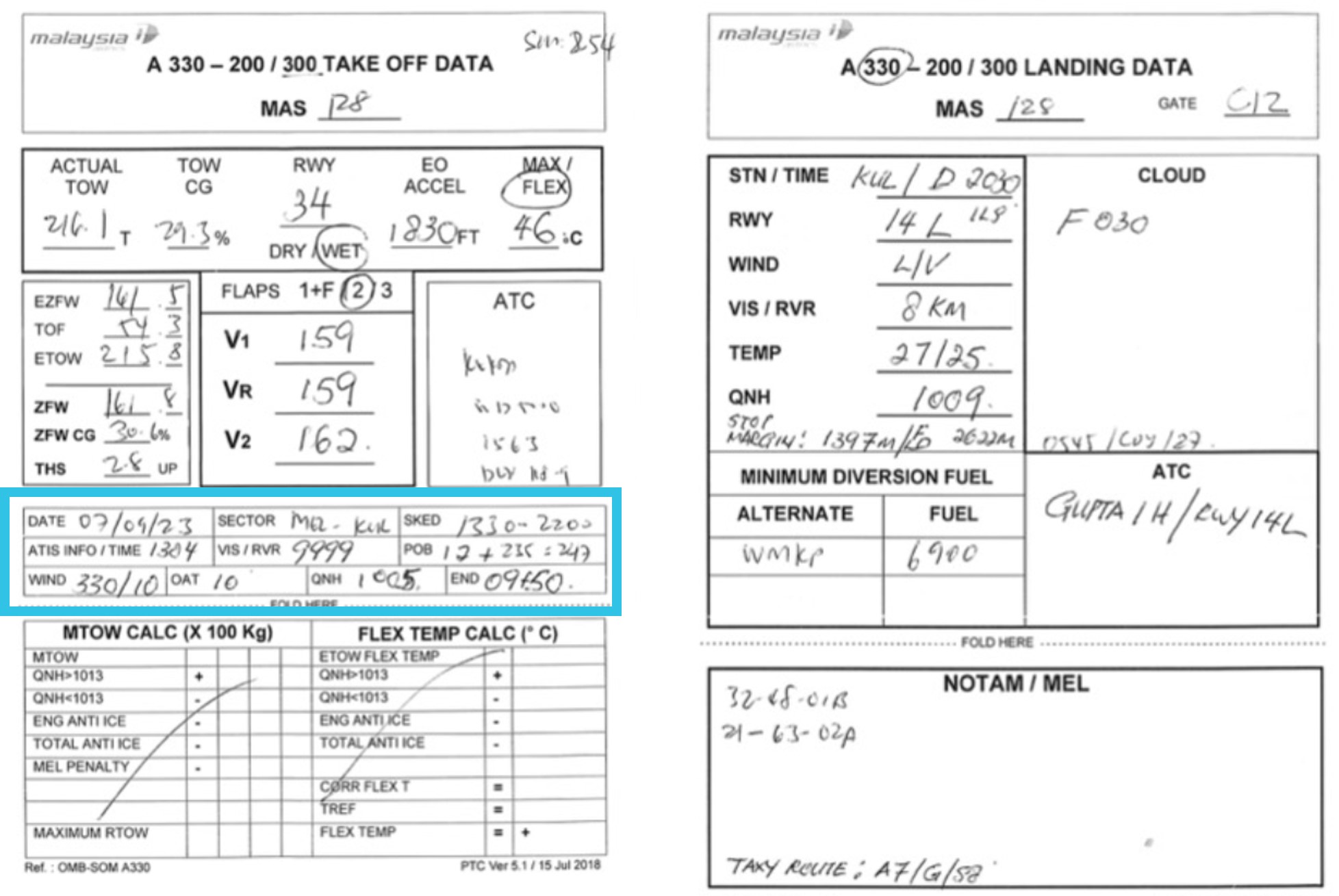
Source: MAB, modified by the ATSB
Figure 15: MH128 OFP excerpt showing recorded ATIS details
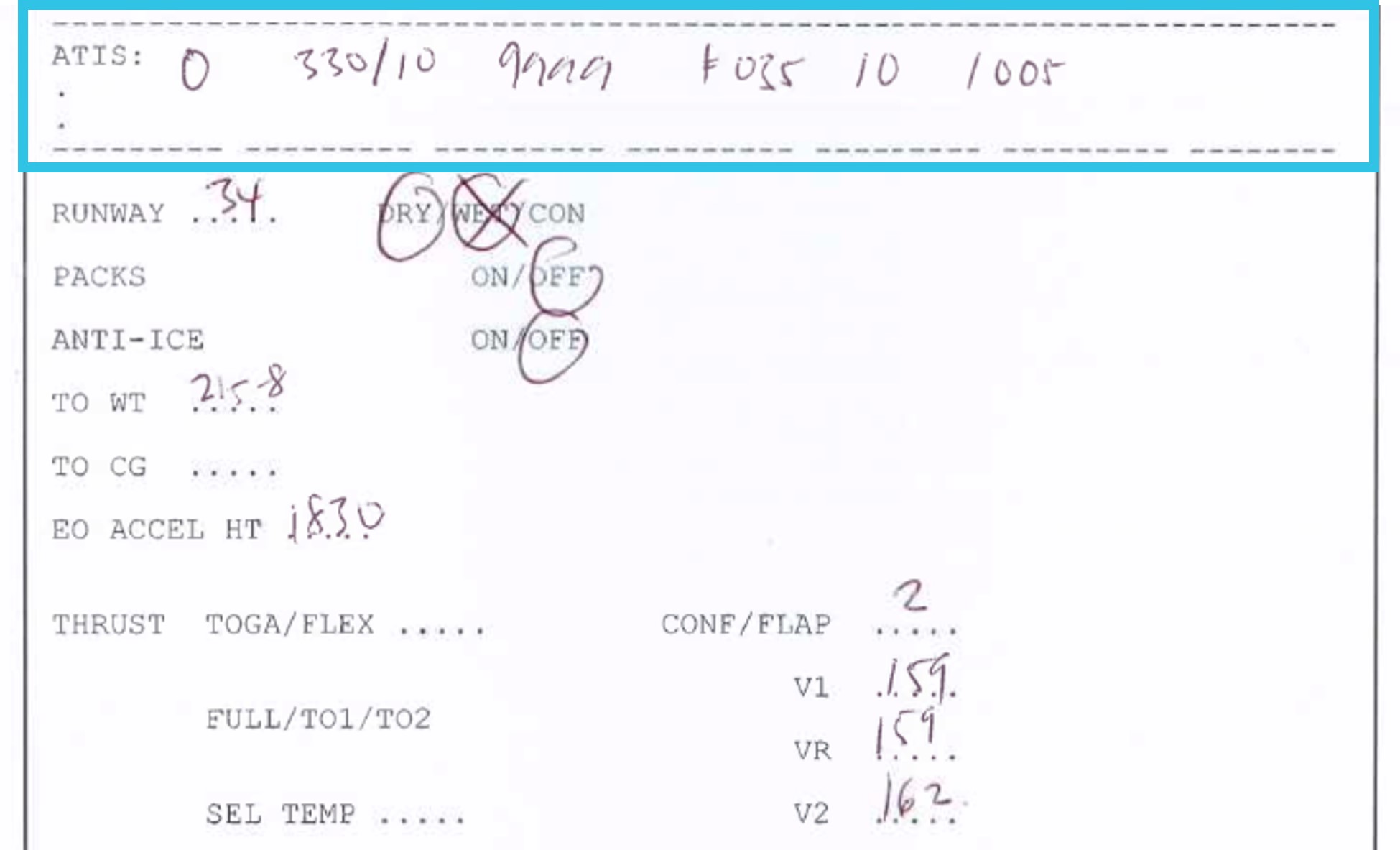
Source: MAB, modified by the ATSB
Access of ATIS information by BAV flight crew
Three ATIS versions (November, Oscar and Papa) were published during the BAV crew’s onboard flight preparation. The crew reported listening to ATIS November and Oscar, with the PM recording the ATIS details on the OFP (Figure 16). The runway in use and weather was recorded, but there was no record of essential aerodrome information regarding the impending displaced threshold (shortened runway) operations (from time 1235).
The BAV OFP had a dedicated space to record the departure weather. It did not specifically mention ATIS, and did not have specific space or prompt to record essential aerodrome information or runway distances.
Figure 16: QH083 OFP excerpt showing recorded ATIS details
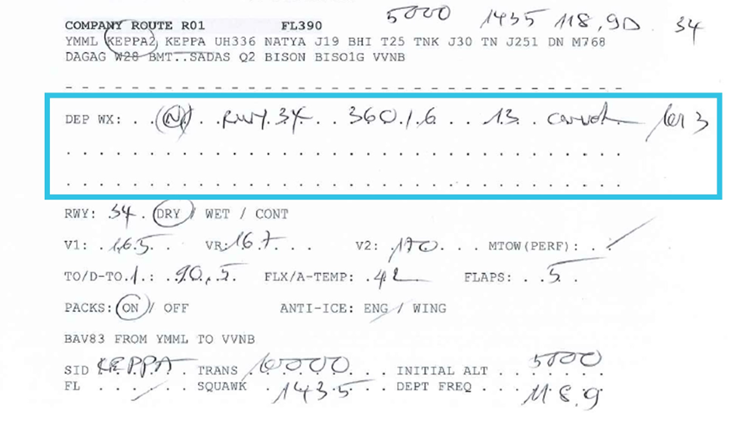
Source: BAV, modified by the ATSB
Aircraft operator information
ICAO guidance on operationally significant information
ICAO Doc 10153 Guidance on the preparation of an operations manual, stated that ‘the [aircraft] operator should ensure that operationally significant information is available to flight crew and other operational staff’. This was information on the adequacy of the facilities available and directly required for a flight and included, ‘notice giving information on the aeroplane performance that will be available on a particular runway which has temporarily shortened declared distances because of maintenance work.’
Flight dispatch information
Flight briefing packages for both MAB and BAV flight crews were prepared by each operator’s respective flight dispatch staff. ICAO Annex 6 Operation of Aircraft defined a flight operations officer/flight dispatcher as:
A person designated by the operator to engage in the control and supervision of flight operations, whether licensed or not, …who supports, briefs and/or assists the pilot-in-command in the safe conduct of the flight.
The following sections summarise the applicable procedures and operator observations in relation to the communication of reduced length runway information by each operator’s flight dispatchers to the respective flight crews.
Malaysia Airlines flight dispatch
The MAB flight dispatch manual listed the duties and responsibilities for company dispatchers and included:
- Checking field conditions and “NOTAMS” for current conditions of en-route and terminal facilities.
- Verifying maximum take-off, landing, and zero fuel weights for each flight segment.
- Initiate and disseminates any pertinent information to Flight Crew at stations that require attention.
- To highlight any significant information deemed important (e.g NOTAM) that may affect the safety and security of flight in the OFP[64] Remarks (Special Notes)[65] when preparing the BP [briefing package].
Regarding the flight dispatcher’s role in providing information on reduced length runways or changes relating to take-off or landing performance, MAB advised that:
The ‘special note’ section of the Operational Flight Plan (OFP) is intended for the flight dispatcher to insert details of any restrictions applied during the calculations of the Regulated Take-off Weight (RTOW) for each flight. This would include information on shortened runway, contaminated runway conditions (snow, slush or standing water), or aircraft technical defect impacting take-off (and landing) performance.
MAB reported that in preparing the flight briefing package for the subject occurrence, the flight dispatcher had correctly taken into account the reduced runway length when conducting their performance calculation. The dispatcher provided the reduced runway length NOTAM to the crew in the standard NOTAM list, however, because the expected aircraft weights were within the aircraft’s performance limitation accounting for the reduced runway length, the dispatcher did not highlight the reduced runway length NOTAM in the special notes section. Additionally, MAB advised that inclusion of this type of information in the special notes section was not routinely completed by the company’s flight dispatchers.
Bamboo Airways flight dispatch
The BAV flight dispatch manual required dispatchers to prepare and provide flight crew all related flight documents, information and data necessary for the safe conduct of the flight. This included ‘all concerning operational information’ and ‘any new or outstanding NOTAM which may affect the…en-route/destination and alternate airport conditions’.
Dispatchers were required to ensure that ‘airport conditions and ground facilities required for the flight are adequate for the type of operation’. This included checking the applicable NOTAMS for runways, taxiways, ramp areas and field conditions. Flight dispatchers were jointly responsible (with the pilot in command) for dispatching a flight by checking the OFP for errors and briefing with the flight crew.
Regarding the flight dispatcher’s role in providing information on reduced length runways or changes relating to take-off or landing performance, BAV advised that:
- The flight planning preparation instructions in the flight dispatch manual required the flight dispatcher to provide the crew with ‘any new or outstanding NOTAM.’ It did not explicitly require the dispatcher to highlight NOTAMs or changes in declared distances for the flight crew.
- At the time of the occurrence, there was no separate procedure or checklist to provide flight dispatchers with specific guidance about what to alert the flight crew about with regard to departure or performance conditions. However, it was generally expected that the dispatcher, as part of their training and standard operational practices, would communicate relevant updates such as NOTAMs and performance changes to ensure safe flight operations.
BAV reported that the occurrence flight dispatcher had completed the flight planning preparation and included the required reduced runway length NOTAM in the flight briefing package. It was reported that the dispatcher’s performance calculations using the reduced runway length restriction did not show any effect on the aircraft’s planned take‑off weight, and because of this, the dispatcher did not highlight the applicable NOTAM to the flight crew in the short briefing email.
Other operator-produced information
Information provided to flight crews by MAB
MAB issued a ‘fleet operations memo’ to all pilots on 30 November 2022, notifying them of the ongoing runway works at Melbourne Airport. The memo reproduced information contained in the APAM airline operator information brief for stage 4 of the works (taxiway Echo intersection), including an overview map, description of the works and operational impacts. The memo referred flight crew to the latest NOTAMs for effectivity times and requirements. MAB issued a second memo on 7 February 2023, highlighting Stage 8 of the works and the temporary displaced threshold for runway 16/34. This memo was not included in the flight crew briefing package for the occurrence flight.
The MAB investigation report into the occurrence noted that the runway work expanded over 13 months and that the memo highlighting stage 8 was issued 7 months prior to the occurrence. MAB identified that the elapsed time may have influenced the flight crew’s ability to recall the WIP information ahead of the occurrence flight.
MAB also noted that no ‘company NOTAMs’[66] were issued to remind the flight crew of the long-term runway works that would impact certain MAB flights into Melbourne. MAB commented that while a company NOTAM would have reminded the crew to refer to the works NOTAM, it remained the crew's responsibility to review the NOTAMs on every flight.
Information provided to flight crews by BAV
BAV had a recurring internal notice to airline personnel (INTAP) 21-033B titled ’Guidance of using temporary runway,’ which included instructions for flight crews and dispatchers when operating into certain airports where runway works were in progress (including Melbourne). Revision 25 was released on 8 September 2023 (one day after the MAB incident). The document specified the requirement to use the temporary runway distances, if valid, and to crosscheck the NOTAM, AIP and temporary runway data.
The front page of the INTAP had a special note for SYD (Sydney), as shown in Figure 17.
Figure 17: Note relating to Sydney Airport runway works
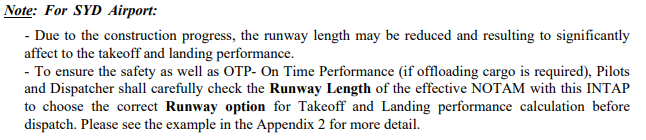
Source: BAV
There was no similar comment relating to the Melbourne works. The remainder of the document comprised a 4-page list of temporary runway data for 14 different airports, as available for selection in the Boeing onboard performance tool (OPT). The final page was an example of checking a NOTAM against the temporary runway data for Sydney Airport. The bottom of the first page of the INTAP had a green ‘Acknowledge’ button for individual crew members to register their awareness of the document when a new version was flagged.
BAV’s internal investigation noted receipt of the safety alert sent by APAM and the AIC. The report noted that the relevant runway information was already present in the OPT and most recent INTAP version, published on 8 September, and as such, it was decided not to update the INTAP for the new safety alert and AIC.
The INTAP was not included in the flight crew briefing package for the occurrence flight.
Flight crew responsibilities
MAB flight planning requirements
In relation to the responsibility of flight crew to review information relating to the airport and facilities, the MAB Airbus 330-323 Flight Crew Operations Manual standard operating procedures for flight preparation included a review of the weather, NOTAMS, the flight plan and operational requirements.
The PF was required to conduct a departure briefing, including the aircraft, aerodrome and fuel status, and runway information (including length, width and flaps selection).
BAV flight planning requirements
The BAV Flight Operations Manual procedures for flight preparations included that flight crew members were responsible for reviewing the operational flight plan, weather information and NOTAMS applicable to the en route phase of flight and to departure, destination and alternate airports.
The flight crew were required to conduct a departure briefing that included weather, runway condition, specific take-off procedure (if any) and any other relevant operational considerations.
Related occurrences
Reduced length runway operations
The following is a selection of previously investigated occurrences involving limited flight crew awareness of reduced length runway operations. Those findings or observations pertinent to this investigation are noted.
Brisbane Airport, Queensland, 30 November 2022 (AO-2022-064)
During take‑off at Brisbane Airport, a Boeing 737, VH-YFH, briefly entered and became airborne within a section of the runway that was closed due to the runway works. The aircraft completed the departure and continued to its destination.
The investigation found that due to a misunderstanding of a flight dispatcher note, the captain had dismissed an active NOTAM as not being relevant to their operation. While aware of the works, neither flight crew member had identified the significant reduction in TORA that was active during their take-off.
Additionally, NOTAMs were not reviewed on the prior approach to land at Brisbane, and the reduced runway length information in the ATIS was not identified or accounted for in the performance calculations for the landing or subsequent departure, despite confirmation of the ATIS identifier with ATC.
Darwin Airport, Northern Territory, 3 and 19 September 2021 (AO-2021-037)
The investigation examined 2 events where the flight crews of Boeing 737 aircraft, VH‑TIS and VH-YIC, each conducted displaced threshold approaches into runway 11 at Darwin Airport. However, at the time of the occurrences, it was the opposite end of the runway (RWY 29) that was operating with a displaced threshold, meaning the runway 11 threshold was unaffected. The 2 aircraft touched down 1,153 m and 932 m into the runway, respectively. Both aircraft managed to decelerate to a stop before the displaced threshold cones placed at the runway 29 displaced threshold.
The flight crews were each found to have misinterpreted the NOTAM information during pre-flight briefing and had also misinterpreted or did not comprehend the ATIS information prior to arrival.
Prague Airport, Czechia, 4 July 2012 (AAIB Bulletin 2/2013)
The pilots of an Airbus A319, G-EZDN, calculated take-off performance using the full length of runway 24 at Prague, when the available runway length was reduced by temporary works. The fight crew realised the error the during take-off roll as the aircraft approached the works at the temporary runway end. The crew rotated the aircraft at the correct speed, but much closer to the works than intended.
In their pre‑flight briefing package, the flight crew had noted a NOTAM for Prague Airport to the effect that the available length of runway 24 was temporarily reduced by works from 3,715 m to 2,500 m, but later forgot about it. The runway in use for take-off was runway 24; the pilots listened to the ATIS broadcast, but it was reportedly in heavily accented English. The pilots acknowledged ATIS receipt with ATC, but they did not detect the included information about the reduced runway length.
The pilot in command subsequently noted that there were no warnings from ATC or ground signage indicating that the runway length was reduced.
Changi Airport, Singapore, 30 May 2007 (AIB/AAI/CAS.039)
At about 0555 local time, the pilot of an Airbus A340, A40-LH, while taking off from runway 20C at Changi Airport, applied TOGA (take-off, go around) power and rotated at a high rate to expedite lift-off when he noticed the colour-coded centreline lights[67] indicating the proximity of the runway end. The crew had calculated the take-off performance based on the original TORA of 4,000 m as they were unaware of the temporary shortening of runway 20C to 2,500 m due to resurfacing works.
The airport had published a NOTAM and AIP supplement to inform operators of the works, however the NOTAM was missed by the dispatch office and the AIP supplement was reportedly not included in the flight briefing package. The flight crew reported that they did not receive a briefing on the shortened runway, however this was disputed by the flight dispatcher.
The flight crew had also not accessed the current ATIS, which indicated that the runway was operating at reduced length. The crew had given the previous ATIS identifier to ATC, which was not corrected. Despite this, the FO informed ATC that he would listen to the latest ATIS, but subsequently did not do so.
Illuminated information signs were used in an attempt to highlight the shortened runway. The existing TORA sign insert was replaced with the temporary runway length, and a yellow SHORTENED RUNWAY sign (Figure 18) was positioned on the opposite side of the runway to the taxiway entrance, where such a sign would not normally be located. The investigation report discussed that the flight crew did not recall seeing the signs, which was probably because they were not expecting a change to the take-off length. The report also noted that the amended TORA sign was ‘of the same size, font and colour indicating the shortened distance’ and that the sign ‘did not contain any attention‑getter to draw the crew’s attention to the reduced TORA’.
Figure 18: Shortened runway sign used at Changi Airport during resurfacing works
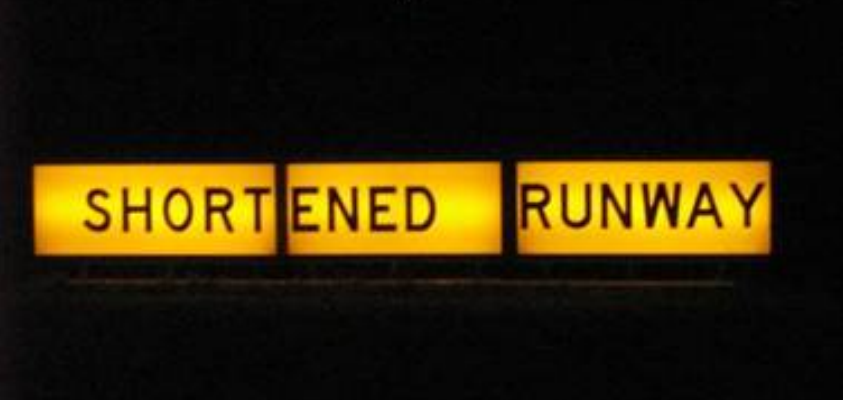
Source: AAIB Singapore
Among the immediate safety actions taken by Singapore ATC, was to ensure that all aircraft assigned to runway 20C were reminded of the reduced TORA by having air traffic controllers highlight the information to them during flight crew communications with both the clearance delivery and runway controllers.
Auckland Airport, New Zealand, 22 March 2007 (07-001)
The flight crew of a Boeing 777, A6-EBC, took off on a runway that had been reduced in length during a period of runway works. The flight crew believed that the full runway length was available and started the take-off with less engine thrust and flap than required. Vehicles were present on the runway, but due to the distance to the aircraft, the flight crew did not see them prior to commencing take-off.
During the take-off the flight crew saw the works vehicles and immediately applied full engine thrust. The aircraft became airborne approximately 190 m before the reduced runway end and cleared the height of the work vehicles by about 28 m.
The investigation report identified that the flight crew had the correct information about the reduced runway length and were aware of the likelihood of works due to their earlier NOTAM review for the flight to Auckland. However, they had developed a mindset of normal runway conditions due to their landing in Auckland, where the runway length restrictions had been temporarily removed. Additionally, it was identified that the flight crew did not fully scrutinise the ATIS information, which misleadingly included the phrase ‘normal operations’ to denote an operational condition unrelated to the reduced runway length.
Additionally, while not contributory, the pilots did not confirm the ATIS identifier with ATC and the controller did not challenge the omission.
Of note, the report found that:
ATIS broadcasts were the only normal means used to alert pilots to critical runway information, such as when length restrictions were in effect. Had another defensive layer been established that required controllers to use standardised, unambiguous phraseology to warn pilots whenever runway restrictions were in effect, the pilots’ mindset would likely have been broken.
New Zealand’s air traffic services provider (Airways) advised the New Zealand Transport Accident Investigation Commission (TAIC) that:
…within an hour after the occurrence it had issued an instruction to the Auckland control tower team stating, “All aircraft are to be advised by Delivery/Ground and Tower when reduced length operations are in use”
Auckland International Airport Limited advised TAIC that:
it has enhanced the apron tower procedures to ensure that pilots are always informed of any runway works or reduced runway length.
TAIC also issued a safety recommendation to:
Enhance ATS procedures so that controllers, in addition to what may be contained in ATIS, always unambiguously warn pilots when runway restrictions are in effect.
Manchester Airport, United Kingdom, 16 July 2003 (3/2006)
A Boeing 737, registered G-XLAG, was undertaking a flight from Manchester Airport to Kos, Greece. Runway 06L at Manchester was being operated at reduced length due to work-in-progress to remove rubber deposits at the far end of the runway.
The flight crew were unaware of the reduced runway length and could not see the works vehicle due to a slight crest in the middle of the runway. As a result, they conducted the take-off using a reduced thrust setting based on the normal runway length. As the aircraft passed the runway crest, the flight crew became aware of vehicles at its far end but, being close to their rotation speed, they continued to conduct a normal take-off. The aircraft passed within 17 m of a 4 m high vehicle.
The investigation identified that the flight crew had access to a NOTAM regarding the works, however the copilot did not check the departure airport NOTAMs, and while the captain intended to go through the NOTAMs once on the aircraft, this did not occur. Additionally, the copilot had listened to the ATIS broadcast and confirmed receipt with ATC. However, while the ATIS contained details about the weather, bird activity and the work-in-progress, the copilot only copied down details about the weather.
Pilot awareness or misunderstanding
The following examples do not relate to reduced length runways, but were significant examples relating to pilot awareness of a safety-critical runway condition.
Taiwan, 31 October 2000 (ASC-AAR-02-04-001)
Singapore Airlines flight SQ006, a Boeing 747-400 aircraft, registered 9V-SPK, mistakenly attempted to take off on a runway that was partially closed due to runway works at CKS Airport, Taoyuan, Taiwan. The aircraft was destroyed after colliding with construction equipment and runway construction pits, resulting in fatal injuries to 83 passengers and crew, and serious injuries to 39 passengers and crew, from the 179 total occupants.
The investigation report found that the flight crew were aware of the partial runway closure and that runway 05R was in use for taxi only. However, it was found that the flight crew did not sufficiently review the taxi route to runway 05L and lost situational awareness, resulting in take-off from the closed runway.
Among other factors, the investigation considered the visual cues that were available to the pilots. It was found that, despite poor weather, the crew should have been able to see the existing taxiway and runway lighting, marking and signage. However, the report also identified the airport had not installed runway closure markings away from the works area, at the entrance to runway 05R threshold, and were not required to in accordance with ICAO Annex 14. Additionally, there were no clear regulations for placement of warnings that a temporarily closed runway was available only for taxi operations. The report found that the lack of adequate warnings at the entrance to runway 05R ‘did not provide a potential last defence’ to prevent the crew from mistakenly entering the wrong runway.
San Francisco, United States, 7 July 2017 (NTSB/AIR-18/01)
Air Canada flight 759, an Airbus A320 aircraft, registered C-FKCK, was cleared to land on runway 28R at San Francisco International Airport, but mistakenly lined up with parallel taxiway C, where 4 other aircraft were on the taxiway awaiting take-off clearance. The occurrence aircraft descended to 100 ft (30 m) AGL and overflew the first aircraft on the taxiway. The crew then initiated a go-around and the aircraft reached a minimum altitude of 60 ft (18 m) over the second aircraft. There was no damage or injuries as a result of the occurrence.
Runway 28L was scheduled to close on the night of the occurrence due to construction work, however the investigation report found that the flight crew had a ‘lack of awareness’ about the runway closure and had an expectation that the airport would be operating in its normal runway configuration. Additionally, the 28L runway and approach lights had been turned off. This supported the crew’s assessment and contributed to the crew mistaking runway 28R for 28L and taxiway C for 28R.
A NOTAM was available to the flight crew, who had also requested ATIS information via ACARS,[68] which also included a reference to the NOTAM, indicating that the runway was closed. Additionally, runway 28L had a lighted, flashing ‘X’ signal, consistent with the regulatory requirement to indicate runway closure, however this was found to not have been effective in capturing the attention of flight crews.
The lighted “X” runway closure marker was not designed to address the possibility that a flight crew could misidentify a runway surface due to ineffective signalling of a runway closure. Although air traffic controllers can provide instructions to pilots about the closure of a runway, NOTAMs and ATIS broadcasts/messages are the primary means to inform pilots about runway closures. However, the information about runway closures provided in NOTAMs and ATIS broadcasts/messages is not necessarily a reliable means for ensuring that pilots are aware of the closure information. As previously stated, although the runway 28L closure on the night of the incident was indicated in NOTAM and ATIS information that the incident flight crew received, that information was not effective in preventing the flight crew from misaligning the airplane during the approach to runway 28R
The NTSB went on to identify a safety issue that there was a:
Need for more effective presentation of flight operations information to optimise pilot review and retention of relevant information.
The NTSB also noted:
The way information is presented can significantly affect how information is reviewed and retained because a pilot could miss more relevant information when it is presented with information that is less relevant. Although the NOTAM about the runway 28L closure appeared in the flight release and the ACARS message that were provided to the flight crew, the presentation of that information did not effectively convey the importance of the runway closure information and promote flight crew review and retention. Multiple events in the National Aeronautics and Space Administration’s aviation safety reporting system database showed that this issue has affected other pilots, indicating that all pilots could benefit from the improved display of flight operations information.
The investigation report referenced the reliability of communication via NOTAM and ATIS to a 2001 investigation involving a Boeing 757 that took off from a closed runway at Denver International Airport, Denver, Colorado. A system failure affected the availability of a NOTAM about the runway closure, and a controller cleared the aeroplane to take off from the closed runway. After that incident, the flight crew members stated that they were unaware that the runway was closed, and the captain did not recall if the runway closure information was included in the ATIS broadcast. As a result of the 2001 incident, the NTSB recommended that the FAA ‘require the use of physical devices or other means to clearly indicate to flight crews of arriving and departing aircraft that a runway is closed’ (A-03-5). In response, the FAA issued AC 150/5370-2F Operational Safety on Airports During Construction, ‘which indicated that airports should use physical devices or other means to indicate to flight crews that a runway is closed’.
Initiatives on temporary runway length changes
Federal Aviation Administration (FAA)
Airport Construction Advisory Council
In 2010, the United States Federal Aviation Administration (FAA) initiated the Airport Construction Advisory Council (ACAC),[69] which is a collaborative working group of industry stakeholders. The ACAC’s aim is to help identify hazardous situations during runway and taxiway construction projects and identify ways to mitigate the associated risk. The website contains relevant information, guidance material and checklists.
While only applicable in the United States, the FAA (through the ACAC) introduced additional risk controls for aircraft operations during aerodrome works and/or with reduced runway length. Of relevance to this investigation were modifications to ATC and ATIS phraseology, and the introduction of construction signage for WIP on the movement area, as discussed in the following sections.
Modified phraseology
In 2011, as a result of identified threats to flight operations from construction-related communication issues, the FAA introduced changes to ATC and ATIS phraseology where runways were temporarily shortened, to reduce the risk of pilots assuming that the runway in use was the published maximum length.
In the ATIS, the word ‘WARNING’ prefaced the runway number, and the word ‘shortened’ was included in the text of the message:
PHRASEOLOGY−
WARNING, RUNWAY (number) HAS BEEN SHORTENED, (length in feet) FEET AVAILABLE.
EXAMPLE−
“Warning, Runway One-Zero has been shortened, niner-thousand eight hundred and fifty feet available.”
Additionally, when the runway length was temporarily or permanently shortened, air traffic controllers state the word ‘shortened’ immediately following the runway number as part of line up and wait, and take-off clearances:
PHRASEOLOGY−
RUNWAY (number) SHORTENED, LINE UP AND WAIT.
RUNWAY (number) SHORTENED, CLEARED FOR TAKEOFF.
RUNWAY (number) AT (taxiway designator) INTERSECTION DEPARTURE SHORTENED, CLEARED FOR TAKEOFF.
EXAMPLEs−
“Runway Two-Seven shortened, line up and wait.”
“Runway Two-Seven shortened, cleared for takeoff.”
“Runway Two-Seven at Juliett, intersection departure shortened, cleared for takeoff.”
REFERENCE−
FAA Order JO 7210.3, Para 10-3-12, Airport Construction.
FAA Order JO 7210.3, Para 10-3-13, Change in Runway Length Due to Construction.
A July 2012 Flight Safety Foundation article: What’s on your runway[70] commented on the initial effect of modified phraseology from ATC and ACAC representatives:
…While providing on-site support during construction at Lafayette (Louisiana, U.S.) Regional Airport, ACAC representatives heard controllers report that pilots often follow up a clearance to land containing “shortened” with questions about the partial runway closure, such as “Which end is shortened and by how much?”
“These pilots said they did not know that the runway had been shortened until they heard our ‘Runway XX shortened’ phraseology,” [said a spokesman for the ACAC] ... “We also have received that feedback from other places. The tools that we have implemented are taking hold and have had an effect on enhancing safety.”
Similarly, numerous air carrier crews questioned ATC at San Francisco International Airport (SFO) about the state of the runway upon receiving their clearance to land with the “shortened” phraseology, “If our phraseology prompts them to ask these questions about what’s closed on that runway, that’s great,” [said the chairman of the ACAC]. “That’s exactly the kind of response that we were hoping for — an opportunity for clarification and increased awareness. Without the information exchange, I don’t think that pilots were always aware of partial closures that could affect aircraft performance and safety.”
Signage
FAA advisory circular AC 150/5370 Operational Safety on Airports During Construction provided guidance for airport operators to comply with Title 14 Code of Federal Regulations (CFR) Part 139, Certification of Airports. One of the principal changes of revision 2G (December 2017) was the introduction of guidance for the use of temporary orange construction signs. The purpose of the signs was to increase pilot situational awareness, where needed, of change conditions on the movement area. Use of the signs was optional for airport operators and included the guidance to ‘use temporary signs judiciously, striking a balance between the need for information and the increase in pilot workload.’ The AC included 3 permissible sign legends, which were (Figure 19):
1. CONSTRUCTION AHEAD,
2. CONSTRUCTION ON RAMP, and
3. RWY XX TAKEOFF RUN AVAILABLE XXX FT.
Figure 19: FAA approved construction sign legends
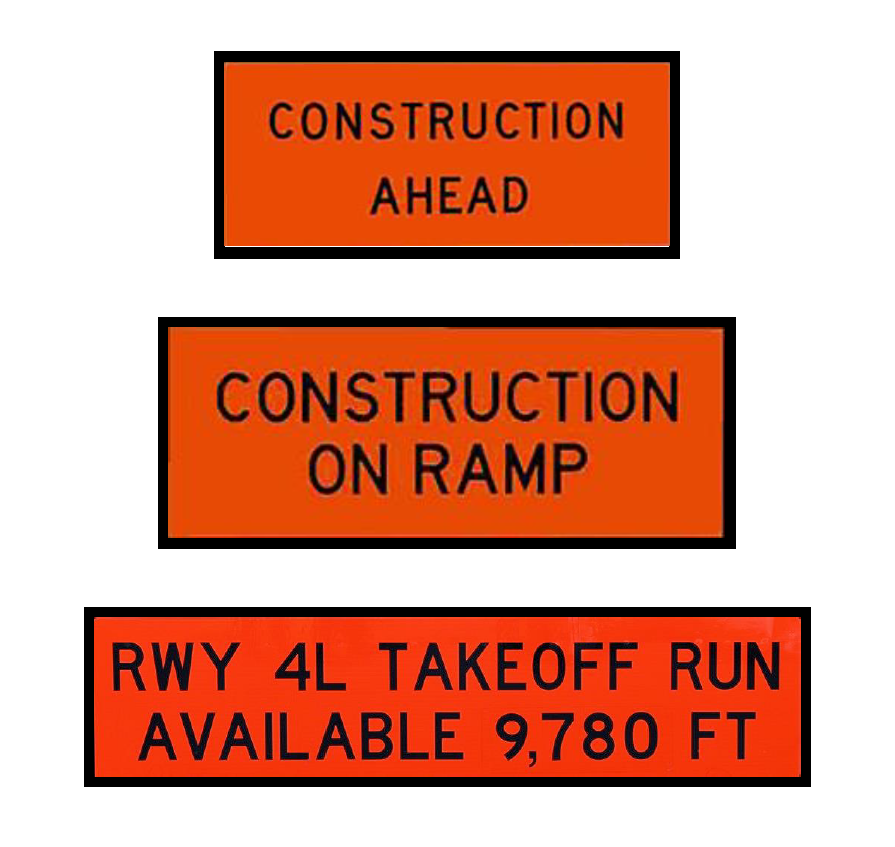
Source: FAA AC 150/5370-2G
International Civil Aviation Organization (ICAO)
In May 2023, ICAO distributed a State letter[71] for member states to comment on, concerning a consolidated package of proposed amendments to Annex 14 and PANS Aerodromes. The proposal from the ICAO Air Navigation Commission was recommended by the Aerodrome Design and Operations Panel working on behalf of ICAO and consisting of experts from a range of states.
Of note was the proposed introduction of mandatory orange unserviceability signs, of a design similar to that in use by the FAA, to indicate temporary changes to runway declared distances. ICAO included the following rationale for introduction of the signs:
Unserviceability signs as means of risk mitigation during temporary changes to the movement area (reduction in the runway length, reduction in the maximum allowable wingspan, taxiway closure or any other closure to the movement area) was assessed on several airports in Europe and in the United States. The results showed acceptance and comprehension by pilots, while also portraying safety benefits (decrease in the rate of misleading operations).
The new Standard pertaining to unserviceability signs, where there is an operational need to indicate temporary changes to runway declared distances, strongly mitigates the risk of using the wrong TORA value for take-off.
The provision of unserviceability signs where there is an operational need to indicate temporary changes to taxiways and aprons, is only a recommendation as the safety impact of such a change may not be as high as that of the use of a wrong TORA value.
Existing signs providing inadequate or misleading information as a consequence of temporary changes to the movement area shall be removed or obscured in order to avoid any confusion with the appropriate messages conveyed by unserviceability signs.
The ICAO Air Navigation Commission[72] noted that comments received in response to the proposal, in part, questioned the need for unserviceability signage:
…it is considered that the current measures to denote construction works (NOTAMS, AIP Supplements, ATIS, Instructions by ATC, use of information signs to denote reduced declared distances, use of unserviceability lights and markers) are considered adequate to mitigate the risks arising from the construction works.
In response, ICAO Air Navigation Commission stated that:
...although information is provided through the means, as described, safety occurrence records have indicated that aircrews can miss temporary runway closures and not be aware of the works in progress. There was an urgent need to develop provisions for the use of visual aids to denote temporary runway closure and any other temporary changes to the movement area of an operational aerodrome. The operational benefit of unserviceability signs and markings was validated by numerous experiments conducted in several States.
Global Action Plan for the Prevention of Runway Excursions (GAPPRE)
The Global Action Plan for the Prevention of Runway Excursions (GAPPRE)[73] was developed by an industry working group, coordinated by the Flight Safety Foundation and EUROCONTROL. It was aimed at identifying the most important actions required to address the risk of runway excursions. The document was published in May 2021.
Part 1 of the document contains recommendations, developed and validated by industry working groups, aimed at aircraft operators, air navigation service providers, aircraft manufacturers, regulators and ICAO. Part 2 of the document provides explanatory and guidance material and related best practices for the part 1 recommendations.
There were several recommendations for air navigation service providers that related to ‘the provision of safety critical information to flight crew.’ Of relevance, from the related guidance material (emphasis added):
It is incumbent on all personnel involved in the flow of “essential” information to ensure not only the quality of the data but also the integrity of the processes and procedures that ensure its onward transmission to ATS. ATS working together with partners, should ensure the timely provision and delivery of the information to flight crews to assist in their operational decision-making.
TORA and LDA for a particular runway may vary from those published for a variety of reasons (e.g., construction work or snow clearing operations, which may reduce the take-off and landing distances available). This ‘essential information’ must be made available to flight crews via an appropriate mechanism and format, in accordance with ICAO Annex 15, Aeronautical Information Services, ICAO Doc 4444 PANS ATM and ICAO Doc 10066 PANS AIM. In addition, the temporary reduction of the ‘declared distances’ should be included in the ATIS messages. Nonetheless, ATS may also consider it appropriate to provide this information in ‘real-time,’ even when the changes have been notified in aeronautical publications and/or ATIS/D-ATIS. At aerodromes, where ATIS is not available, ATS should proactively inform the flight crew by means of a radiotelephony (R/T) exchange of the reduced take-off and landing distances available.
Similarly, there were several GAPPRE recommendations for aircraft operators, regarding take-off performance and the use of EFBs. From the related guidance:
Use ‘highlighting or marking’ of relevant NOTAM information in flight preparation tools to make it easy for their flight crews to detect safety-relevant changes to runway data and ultimately detect errors in performance databases more easily.
Safety analysis
Runway excursions
The flight crews from each aircraft both reported some awareness of the works in progress (WIP) at Melbourne Airport (MEL), however none of the crew members recognised that the runway length was reduced, or that it was going to be reduced, at their time of departure.
Expecting a normal departure, the crews of both aircraft selected the pre-coded runway 34 full‑length option when entering take-off performance data into their respective performance tools. This returned an aircraft configuration incorporating reduced thrust (FLEX, or assumed temperature) settings that were incompatible with the significantly reduced runway length. While both the Airbus and Boeing performance tools had a pre‑coded reduced-length runway dropdown option (RWY 34 TMP/34-WIP) that was correct for the situation, neither crew associated the availability of this option with the potential for a reduced-length departure.
Both aircraft performed as expected for the selected configuration, but due to the shortened runway, they both reached the pre-determined rotation speed just prior to the temporary runway end and entered the runway end safety area (RESA) prior to lift-off. While individual crew members observed the unusually close runway end lights and questioned or discussed the proximity of works close to the runway end afterwards, this did not prompt a reflection at the time that they had known about and subsequently forgot to account for the shortened runway.
The flight crews’ actions in selecting the full-length runway represented an information error, in that it was a correct action for their incorrect understanding of the runway conditions. Essentially, had the flight crews recognised the reduced runway length, they would have almost certainly correctly selected the pre-coded runway 34 WIP options. Had they done so, performance calculations indicated that there would have been sufficient runway length for both aircraft to take off safely, even if a take-off had to be rejected for any reason.
Contributing factor The flight crews of both aircraft did not recognise that reduced runway length operations were in effect at the time of departure, and conducted reduced-thrust take‑offs based on the normal full runway length. This resulted in each aircraft taking off beyond the end of the shortened runway, in close proximity to active runway works. |
This analysis will examine the risk controls that were in place during the reduced runway length works, particularly relating to the communication of essential aerodrome information to flight crews and other mechanisms for alerting crews to the change in runway conditions. This included:
- notices to airmen (NOTAMs)
- automatic terminal information service (ATIS) and air traffic control (ATC) communications.
- internal communications to pilots from aircraft operators and their respective flight dispatchers
- aerodrome visual aids.
Notice to airmen (NOTAM)
NOTAMs are the primary mechanism for the timely communication of essential aerodrome information to flight crews and each flight crew member had received a copy of the relevant, ‘REDUCED RUNWAY LENGTH’ NOTAM in their respective flight briefing packs. While pilots have a responsibility to review this information during flight preparation, both occurrence flight crews had overlooked the applicable NOTAM in their respective reviews.
Missing or misunderstood NOTAM information was a factor in numerous previous aviation occurrences. As a procedural control that is reliant on the review and assimilation of often significant amounts of information, the effectiveness of NOTAM review is influenced by the format and presentation of that information. In these occurrences, the NOTAMs available to the crews exhibited some of the previously identified limitations or criticisms of NOTAM presentation. Most notably, the NOTAMs of operational significance, such as reduced-length runway information, were not highlighted (emphasised) or prioritised above less safety-critical information, such as a taxiway closure. This absence of distinction inherently made this information more likely to be overlooked.
That said, there were no other reported overrun occurrences during the displaced threshold works periods. This suggested that, despite any broader NOTAM effectiveness concerns, up to 30 departing flight crews each night had identified the hazard and used the correct runway length for their take-off data. While many of those were Australian pilots, likely flying regularly to Melbourne Airport, and therefore had some familiarity with the ongoing WIP, many of those flights would have involved foreign crews, who may have had minimal familiarity similar to that of the 2 occurrence crews.
Additionally, although part of a larger briefing package, the number of Melbourne Airport and/or runway NOTAMs was not so substantial that it would have been onerous for the occurrence crew members to review the individual items. The subject of the relevant NOTAM was also written clearly, without extensive abbreviations or acronyms that could have obscured its meaning. So, while acknowledging the identified issues with NOTAM presentation and their potential to have contributed to missed information, in these occurrences, there was a reasonable opportunity for the crew members to identify the reduced runway length through routine NOTAM review.
The crew members identified various factors that they believed influenced their respective NOTAM reviews. This included the expectation created as a result of ‘normal’ briefing advice and/or due to a focus on taxiway closures when on arrival the previous evening (in the case of the Malaysia Airlines Berhad (MAB) flight). Additionally, the Bamboo Airways Vietnam (BAV) crew noted the flight dispatcher’s briefing email, indicating no special NOTAMs in effect, and the distraction and time pressures created by the repeated aircraft power outages. These factors are discussed further below.
Contributing factor Acknowledging the known existing limitations of the NOTAM system, the NOTAM reviews by the flight crews of both aircraft were insufficient to identify that reduced runway length operations would be in effect during their respective departures. |
Bamboo Airways flight crew time pressures
Repeated aircraft power outages during flight preparation resulted in high workload for the BAV crew, as a result of having to troubleshoot the power issue and recommence the planning multiple times. It also led to an approximate 40-minute delay in their flight preparation.
The crew indicated that this contributed to a deviation from their normal procedure, which was to conduct an additional review of flight information on the flight deck closer to pushback. However, due to the flight preparation delays, they felt they did not have time to conduct this review. Instead, they relied on the information reviewed up to that point, which had not identified the shortened runway. This information included the flight dispatcher's 'no special effect' NOTAM briefing note, which likely contributed to the crew’s expectation of a normal take-off (see BAV flight dispatch).
The perceived time pressures also had the potential to influence the flight crew’s decision to depart without reviewing the revised ATIS information when prompted by ATC. However, that decision was probably also influenced by other factors, including the timing of that request (while lining up on the runway with another aircraft on approach behind them), the crew’s stated expectation of minor ATIS changes that would not affect their take-off, and by the crew’s existing ‘normal take-off’ mindset.
While the crew may not have detected the reduced runway length on a further review of the NOTAMs, deviating from their normal procedure removed the opportunity altogether.
Contributing factor The Bamboo Airways flight crew were delayed preparing the aircraft for departure due to recurring power outages. As a result of increased workload and perceived time pressure, the crew did not conduct an additional review of the NOTAMs after boarding the aircraft. |
Air traffic services provision of information
Flight crew assimilation and retention of ATIS information
Both flight crews had accessed at least one voice-ATIS version that included essential aerodrome information relating to the reduced runway length information. In the MAB event, the reduced runway length was in operation from the time the ATIS was accessed. For the BAV occurrence, ATIS November and Oscar (the 2 versions the flight crew accessed) both contained a statement about the impending reduced runway length, which was shortly after the scheduled departure time.
In both occurrences, the terms ‘reduced runway length’ and ‘displaced threshold’ in the ATIS should have been a prompt for the crews. In addition, the take-off run available (TORA) was also provided. While this value is not specifically required to perform the take-off performance calculations (due to the pre-configured runway options), recording it would have provided an opportunity to cross-reference the calculated take-off distance required with that available.
The reasons the individual crew members missed hearing the reduced runway length information from the voice-ATIS was not fully established. However, there will often be errors of perception where, for various reasons, not all pilots listening to a given ATIS will correctly hear all of the required information. This is illustrated by some of the previous occurrences highlighted in this report.
In these occurrences, each flight crew appeared to be focused on, and therefore only wrote down, the weather information necessary for the take-off performance calculations (omitting the ‘essential aerodrome information’). This attention focus was likely associated with the crews’ expectation of normal runway conditions, and given ATIS contains information not relevant to all crews (for example, approach details for crews preparing to take-off), this would have reduced the attention they gave to listening to the parts of the ATIS that they were not expecting to be relevant to their take-off. For example, the flight crews would not have expected to need the runway length values provided in the ATIS, as they did not need to enter runway length information in their performance tools. While it would be common to hear information in an ATIS that is not relevant to a particular flight, over time this would contribute to a pilot expectation that there will always be some ATIS information that is not relevant.
There are a number of studies (Kobayashi 2005, Kiewra 1989, Van der Weel and others 2024, Mueller and Oppenheimer 2014) demonstrating the positive effects on memory and learning when writing information down compared to simply hearing the information. This is especially true for handwriting (as opposed to typing), and when actively engaging with the material by paraphrasing (as opposed to copying verbatim). As such, had each crew member copied or paraphrased the essential aerodrome information when listening to the ATIS, it very likely would have increased their awareness of the reduced runway length.
In some circumstances, though not in the subject occurrences, ATIS can also be provided via data link (D-ATIS). This provides ATIS information in text format, which can eliminate errors associated with mishearing, allows pilots to review at their own pace and more readily reference the original again later. However, this method of information transfer is also not error-free, and still benefits from pilot engagement (copying or highlighting the information) to maximise understanding and memory retention.
While there was a general requirement for flight crews to review and brief on aerodrome information, neither operator provided a dedicated space or prompt on the relevant documents to record it. The provision of sufficient writing space, and categorisation of information, would help flight crews in assimilating and recording it.
Contributing factor When accessing the Automatic Terminal Information Service through voice-ATIS, the flight crews of both aircraft only recorded the standard information required for take-off performance calculations and did not notice the aerodrome information regarding the reduced runway length. |
Confirming ATIS receipt and currency
The Aeronautical Information Publication (AIP) requirement for flight crews to confirm ATIS identifier ‘on taxi request’ or ‘on first contact with ground, tower or approach’ was a standard practice, consistent with International Civil Aviation Organization (ICAO) Annex 11 and was also broadcast with the ATIS itself. However, in both occurrences, the ATIS identifier was not confirmed by the flight crew on taxi request and each time, this omission was not challenged by the respective ground controller. In the MAB occurrence, the ATIS was not confirmed by the crew at any time. In the BAV occurrence, the delivery controller (who was also the ground controller) did prompt the crew to confirm ATIS Oscar when providing airways clearance, but not on taxi request, after the ATIS had changed to Papa.[74] In each case, omitting the ATIS confirmation removed some assurance that the flight crews had obtained the most current aerodrome information.
Nevertheless, as mentioned above, both flight crews had accessed at least one ATIS version. For the MAB crew, the ATIS did not change, and had they been challenged to confirm ATIS receipt, they likely would have done so without further review. Similarly, the BAV crew partly recorded ATIS Oscar and confirmed its receipt with the delivery controller without recognising the reduced runway information. As such, while ATIS confirmation can be useful in alerting crews to information changes, doing so was unlikely to have influenced the flight crews’ awareness of the reduced runway length.
Other factor that increased risk On first contact with the Melbourne ground controller in both occurrences, the flight crews did not confirm ATIS identifier as required, and the ground controllers did not challenge the omission. This removed a level of assurance that the flight crews had received current flight planning information. |
Confirming flight crew understanding
The Manual of air traffic services (MATS) procedure for air traffic controllers to ‘transmit take-off or landing information to a pilot who has not notified receipt of current ATIS’ was consistent with the requirements of ICAO Annex 11 Air traffic services, which stated that ‘information contained in a current ATIS, the receipt of which has been acknowledged by the aircraft concerned, need not be included in a directed transmission to the aircraft.’ This operated on the assumption that if flight crews confirm (or acknowledge) ATIS receipt, then they will also have understood all of the information it contains (through their normal responsibility to review).
However, the responsibility for pilots to review all available flight information is a procedural control and is susceptible to human error. This susceptibility was illustrated by the subject and previous occurrences noted in this report where flight crews had accessed ATIS and in some of those instances confirmed the ATIS identifier with ATC as required, without having fully reviewed, or otherwise missed or misunderstood essential aerodrome information. Multiple previous occurrences show that while the requirement to confirm ATIS identifier or acknowledge ATIS receipt can assist with pilot awareness of information currency, it cannot provide assurance that flight crews have a full and correct understanding of the ATIS content.
Confirming this was the intention of the tower controller’s request to the BAV crew to confirm ATIS after they were lined up on the runway. However, that request had the same limitation as the existing requirement to confirm ATIS identifier, rather than directly confirming hazard awareness by querying the flight crew’s understanding of the runway being shortened.
The last-minute ATIS check should still have prompted the crew to stop and review the information. However, the BAV crew had a sense of urgency to depart, as they were already lined up on the runway ahead of an approaching aircraft, and the inclusion of only the ATIS version did not dispel the crew’s existing expectation that any ATIS changes would be just minor variations to what they knew. The crew were therefore comfortable enough to depart without it. As a result, it ultimately did not have any influence on the flight crew’s situational awareness, but more importantly, it was a missed opportunity for the BAV crew to ensure they had all of the relevant aerodrome information.
Contributing factor When lined up on the runway, the Bamboo Airways flight crew confirmed receipt of updated ATIS information without having accessed it. This was due to the flight crew's expectations that the ATIS change would not meaningfully affect their take-off. |
As noted above, the Airservices processes and procedures in relation to phraseology and communication of essential information to flight crews are based on ICAO standards and recommended practices. As stated in ICAO Doc 4444 Procedures for Air Navigation Services (PANS) Air Traffic Management (ATM):
Essential information on aerodrome conditions shall be given to every aircraft, except when it is known that the aircraft already has received all or part of the information from other sources…
Note.— “Other sources” include NOTAM, ATIS broadcasts, and the display of suitable signals.
To ‘receive’ information in this scenario would most reasonably be defined as ‘to get or learn’, or ‘to apprehend mentally’, since the purpose of communicating this information is to ensure that it is correctly understood and actioned. However, as discussed above, and despite the intent of the associated provisions, confirmation or acknowledgement of information version is not necessarily an acknowledgement of information understanding. As such, an air traffic controller can only assume but never know that essential aerodrome information has been received and understood by the flight crew, simply by knowing that a relevant ATIS (or NOTAM) has been supplied to an aircraft. This would also be true for the display of ‘suitable signals’ (signs or other visual aids), where their effectiveness is dependent on various factors, which are discussed below.
As a result, an air traffic controller could not be fully assured (‘it is known’) that essential aerodrome information has been received (comprehended) by ‘the aircraft’ (flight crew) from ‘other sources’ unless they directly confirm that information with pilots. However, there were no MATS procedures or ICAO standards and recommended practices to ensure this information transfer had occurred.
Some controllers at Melbourne Airport during the works were proactively using direct communication to directly confirm flight crew knowledge of the reduced length runway. The controllers could have done this using the standard WIP phraseology in the AIP, or through plain language, as appropriate. These actions, while not expressly required, were consistent with the MATS instruction for controllers to use their ‘best judgement and initiative’ to go outside of instructions ‘if the safety of an aircraft may be considered to be in doubt.’ Those controllers may not have specifically doubted the immediate safety of aircraft, but likely recognised the significance of the hazard and elected to have some additional assurance of flight crew understanding.
The risk associated with continuing operations during runway works – and the need for additional assurance – was recognised in the United States by the Federal Aviation Administration (FAA) in its 2011 decision to modify existing ATC communication procedures. The FAA noted that it was imperative ‘that pilots and operators are aware of messages they may hear/see on the ATIS and/or receive as part of their air traffic clearance’. As such, a ‘warning’ was added to ATIS messages, and the word ‘shortened’ added to runway numbers in line-up-and-wait and take-off clearances from controllers.
The Global Action Plan for the Prevention of Runway Excursions (GAPPRE, 2021) also provided guidance relating to the provision to flight crews of safety-critical information relating to changes in declared distances. Although the GAPPRE did not include formal recommendations for enhancing communications in this respect, the associated guidance stated that ‘ATS [air traffic services] may also consider it appropriate to provide this information in “real-time”, even when the changes have been notified in aeronautical publications and/or ATIS/D-ATIS’.[75] This statement recognises that flight crew awareness of safety-critical conditions via review of NOTAM and ATIS may not be completely effective, and that additional assurance could be gained through direct communication.
Enhancing ATC communications to address the risk associated with reduced runway length operations was also recommended by the New Zealand Transport Accident Investigation Commission (TAIC) in their 2007 Auckland occurrence investigation report (see Related occurrences) – that ATS procedures should be enhanced so that ‘controllers, in addition to what may be contained in ATIS, always unambiguously warn pilots when runway restrictions are in effect.’
There are limited specific examples to show the safety benefit of this type of direct communication: if a safety occurrence is averted through the use of a risk control, there is no feedback through an occurrence investigation to show that this happened. However, positive feedback was reported after the United States addition of the term ‘shortened’ to ATC clearances, where pilots did not know that the runway had been shortened until the controller directly advised them.
This does support a benefit in directly communicating safety‑critical information to pilots, even as a ‘last resort’ prompt when lining up on the runway. In the subject occurrences, noting that each of the flight crews had developed expectations or biases around the condition of the runway, both would likely have benefited from this kind of additional direct communication. It would have required each crew to respond to the hazard alert directly and provided additional assurance to ATC (above ATIS identifier confirmation) of the crew’s awareness of the exact nature of the hazard.
Contributing factor The Australian Aeronautical Information Publication requirement for flight crews to confirm automatic terminal information service (ATIS) identifier with air traffic control did not provide positive assurance that crews had received the information in full, which included essential information on aerodrome conditions, and there were no standard air traffic control, communication procedures for providing this assurance. (Safety issue) |
Contributing factor The International Civil Aviation Organization (ICAO) Annex 11 requirement for flight crews to confirm ATIS identifier with air traffic control did not provide positive assurance that crews had received the information in full, which included essential information on aerodrome conditions, and there were no standard air traffic control, communication procedures for providing this assurance. (Safety issue) |
Aircraft operator communications
In addition to the communication of essential aerodrome information via NOTAM and ATIS, an important part of the risk controls implemented by the airport operator, Australia Pacific Airports Melbourne (APAM), for the reduced runway length on take-off involved communication with stakeholders via the method of working plan (MOWP), aeronautical information circulars (AIC), safety alerts and consultation forums. The effectiveness of these communications to aircraft operators relied on those organisations receiving the information, actioning it in terms of determining suitability of conditions for their intended operations, and having robust procedures in place to ensure that the safety-critical information flowed down to flight crews. In these events, it was the information transfer to flight crews that was not effective.
The necessary information reached both of the occurrence aircraft operators, and both took action to disseminate the information through internal memos or notices to pilots. However, the information was not included as part of the flight briefing packages, and would have been received by the occurrence pilots well before they would have been preparing to fly to Melbourne. They were either disseminated some months before the occurrence flights, or in the case of the BAV notice, included temporary runway information for 14 different airports. Considering that individual international pilots often fly to a large number of different airports, these publications were unlikely to ensure that the information regarding the works or change in declared distances was front-of-mind for flight crews when operating into affected airports.
According to ICAO, the flight dispatcher’s role was in supporting, briefing and assisting flight crews in flight preparation and to provide relevant information for the safe conduct of a flight. The aircraft operators’ flight dispatchers were therefore key to ensuring that operationally significant information was communicated in an effective and timely manner.
In the subject occurrences, both dispatchers had taken the restriction into account during their respective preliminary performance calculations. However, because each aircraft was still able to depart at the expected weights, the dispatchers did not highlight the runway length NOTAM in the respective briefings to each flight crew.
Additionally, the BAV dispatcher’s briefing email, which indicated that there were no ‘special’ NOTAMs for the flight, was misleading. This very likely contributed to the crew’s expectation of a normal take-off, due to their reported increased reliance on any supplementary information the flight dispatchers had provided, as a result of their flight preparation delays.
The use of dispatchers does not diminish the flight crew’s immediate responsibility to review the provided flight information. However, this was a missed opportunity in both occurrences for the dispatchers to assist the flight crews by highlighting a safety-critical condition at a time and in a manner favourable to the crews’ flight preparation.
Contributing factor The flight dispatchers for both flights had accounted for the reduced runway length in their take-off performance calculations, but did not highlight this information to the flight crews. Additionally, in the case of VN-A819, the dispatcher included a misleading crew briefing note that indicated there were no significant NOTAMs for the departure. |
Aligned with the defined flight dispatcher role, both operators expected their dispatchers to directly communicate or draw flight crew attention to significant NOTAMs, including notes on aircraft performance calculations involving temporary changes in runway declared distances.
Despite this, the operators’ dispatchers were not always highlighting or alerting crews to changes in runway declared distances, indicating that the dispatchers may not have had a full appreciation of the types of operationally significant information required to be communicated in this manner.
The operators’ respective flight dispatch procedures and guidance would have influenced dispatcher decisions on what information to emphasise to crews. MAB had a requirement ‘to highlight [in the OFP] any significant information deemed important (e.g. NOTAM) that may affect the safety and security of flight’, and BAV had a requirement to provide the crew with ‘any new or outstanding NOTAM’ which may affect the flight and the dispatcher could (and did) add particular items of note in the accompanying email. However, neither of the operators were explicit in the types of significant information that should be directly communicated or otherwise highlighted to crews. This was essentially left to the discretion of the individual dispatcher.
While there was no explicit guidance, the operators indicated that their dispatchers should be aware of the types of information (including changes to departure or performance conditions) and mechanisms to provide it to flight crews as part of their initial and recurrent training. However, if the provision of operationally significant information was not being provided as expected, then it was likely that the operators’ respective training and/or guidance was not effective in ensuring sufficient awareness of this element of their duties.
Contributing factor Malaysia Airlines did not ensure that its flight dispatchers highlighted to flight crews all types of flight information most critical for flight safety. (Safety issue) |
Contributing factor Bamboo Airways did not ensure that its flight dispatchers highlighted to flight crews all types of flight information most critical for flight safety. (Safety issue) |
Available visual indications of runway works or length
Neither flight crew recalled seeing any indications that the runway length had changed or there was anything abnormal before commencing the take-off roll. The MAB crew further suggested that, had there been, it would likely have been of benefit in alerting them to the hazard they had missed in their review of the aeronautical information.
While not specifically intended to alert flight crews taking off from the shortened runway 34, there were differences in the normal arrangement of visual aids that could have provided an indication to the flight crews of a change in runway conditions. These included:
- the arrangement of temporary runway end lights and lighting form the works and works vehicles
- obscuring (covering) of the take-off run available (TORA) movement area guidance signs (MAGS) at the taxiway K runway holding point.
The ATSB estimated that the works lights were probably perceptible on line-up from the runway 34 threshold, however the distance of approximately 2,500 m would have made it problematic to resolve and accurately locate the lights in space (that is, it would not have been obvious that the lights were closer than the expected runway end). Furthermore, neither flight crew had recently flown to Melbourne Airport and were probably not familiar with the standard lighting conditions. This would have likely further limited the pilots’ ability to recognise that the runway and lighting picture was abnormal and associate the works lights with a runway hazard.
Similarly, the obscured (covered) TORA MAGS at the taxiway K holding point was unlikely to have been an obvious indication of the shortened runway. They would not have known that it was a TORA sign or why it was covered. There was no requirement for a TORA sign at the runway threshold, and the absence of one was unlikely to be recognised, or seen as significant, by flight crews. Operator pre-configuration of the runway length options in the Airbus and Boeing performance tools meant that neither of the occurrence crews had to identify or directly input a runway length figure. As such, even if the TORA MAGS had been present and amended with the actual runway length available, a revised TORA figure on a standard information sign would be unlikely to have disrupted the crew's mindset that the runway conditions were normal unless they specifically crosschecked the runway length.
Notably, the Part 139 (Aerodromes) Manual of Standards 2019 (Part 139 MOS) limited the type of signs that could be installed in this scenario; this is discussed in Supplemental visual aids.
The airport operator, Australian Pacific Airport Melbourne (APAM), considered installing a variable message sign as an additional risk control, but elected not to proceed due to concerns about its potential effectiveness. While variable message signs were not specifically referenced in the Part 139 MOS (as in ICAO Annex 14 Aerodromes, they would be permitted if they met the general MAGS design and construction requirements. This could be regarded as a missed opportunity to provide a supplemental visual aid for flight crews, however the potential effectiveness of any such sign would have depended on its conspicuity and message, as discussed in the following section. Similarly, had runway 16 been used for take-off for the occurrence flights, both aircraft would have taxied in relatively close proximity to the works and, more importantly, it would have resulted in an intersection departure which should have provided a more obvious indicator to the crew that they did not have the full runway length available.
However, with the take-offs commencing from the normal runway 34 location, there were no visual aids installed that would effectively alert flight crews to the reduced length runway when commencing take-off from the threshold of runway 34.
Contributing factor There were no visual aids installed that were designed to alert departing flight crews to the significant change in runway length. In addition, prior to commencing take-off, the flight crew of both aircraft did not see the runway works or equipment lights or did not recognise them as being associated with a reduction in runway length. |
Supplemental visual aids
The limitations of the existing risk controls, and the magnitude of potential consequences associated with maintaining aircraft operations during reduced length runway works (in this case, a runway excursion on take-off, resulting in near-collision between workers and vehicles), suggests that additional defensive layers are required to reduce the risk to as low as reasonably practicable. As noted above, direct communication from ATC to flight crews, where practical, can provide additional assurance of flight crew awareness of critical safety hazards. Similarly, dedicated signage, such as that proposed to be introduced into ICAO Annex 14, or other suitably conspicuous visual aids, can assist as a final defence by providing an indication of changes to the runway conditions where the runway would otherwise present as normal to flight crews. The need for such visual aids was noted in ICAO Air Navigation Commission Working Paper AN‑WP/9707:
…safety occurrence records have indicated that aircrews can miss temporary runway closures and not be aware of the works in progress. There was an urgent need to develop provisions for the use of visual aids to denote temporary runway closure and any other temporary changes to the movement area of an operational aerodrome.
As with modifications to standard radio phraseology, having non-standard signage at an airport increases the chances of misinterpretation or confusion. Accordingly, there were limited options available for airport operators to install visual aids such as signs. Both the Part 139 MOS and ICAO Annex 14 only permitted mandatory instruction or information signs in the movement area. Each document provided standard designs for a range of mandatory instruction and information signs. These included a sign for intersection departures, which did not apply to the occurrence take-offs from the runway 34 threshold.
The type of sign that would have been most helpful in these occurrences – one that directly indicated to pilots that a reduced take-off length was applicable for a threshold take-off – was not expressly provided for by either the Part 139 MOS or ICAO Annex 14. However, a textual interpretation of ICAO Annex 14, and by extension the Part 139 MOS, suggests that the list of permitted MAGS was not finite. This indicated that a fixed or variable sign with alternative messaging, but otherwise meeting the design requirements for a mandatory or information sign, could be permitted.
Even so, the conspicuity of signs within a given environment depends on factors[76], [77] such as the physical characteristics of size, colour, luminescence and contrast (with the scene), as well as the presence of flashing or animated content. It also depends on the location of the sign, and the attention and expectancy of the individual – for example, whether their attention is divided with concurrent tasks, or whether they are expecting to see a sign or a change in that location. This supports the findings from the investigation into the 2007 Changi, Singapore occurrence (see Related occurrences), where the replacement TORA, and supplementary SHORTENED RUNWAY, information MAGS were not effective in alerting the crew to the change in runway length. The investigation report attributed this to the absence of features to draw a pilot’s attention due to the fact that the temporary TORA MAGS was of the same size, font and colour as the one it replaced. Similarly, while the SHORTENED RUNWAY MAGS was not replacing an existing sign, it was the same colour and font as a standard information MAGS. It was also positioned in a location where a sign would not ordinarily be – where the crew may not have been expecting to see a change.
In relation to the physical characteristics, the proposed unserviceability signs under consideration for a future amendment to Annex 14 (and the ones currently used in the United States) had distinct benefits over standard movement area signage based on existing requirements. In the trials conducted at various airports in Europe and the United States, it was noted that the orange colour and lighting features enhanced the conspicuity of the signs, which increased the likelihood of getting the crew's attention. Noting part of ICAO’s rationale for the introduction of the signs, that ‘the results [of sign testing] showed acceptance and comprehension by pilots, while also portraying safety benefits ([a] decrease in the rate of misleading operations).’
The unserviceability sign testing and implementation rationale supports that the provision of this type of suitable, conspicuous visual aid during the subject occurrences would likely have drawn the flight crews’ attention to a condition of which they were otherwise unaware.
In summary, APAM had implemented the required and recommended risk controls for runway works, as existed at the time in the Part 139 MOS, and consistent with the standards and recommended practices of ICAO Annex 14. Had there been a requirement, recommendation or provision for supplemental risk controls in the form of visual aids, it was likely that APAM would have adopted it as part of its risk control strategy.
Contributing factor The Part 139 (Aerodromes) Manual of Standards 2019 did not recommend, or provide standardised options for, movement area guidance signs or other visual aids to provide enhanced flight crew situational awareness of temporary changes to the runway length available for take-off. (Safety issue) |
Contributing factor The International Civil Aviation Organization (ICAO) Annex 14 standards and recommended practices did not recommend, or provide standardised options for, movement area guidance signs or other visual aids to provide enhanced flight crew situational awareness of temporary changes to the runway length available for take-off. (Safety issue) |
Airport works risk management
The CASR required the operator of a certified aerodrome to ensure that works are ‘carried out in a way that that does not create a hazard to aircraft or cause confusion to pilots.’ However, a hazard is naturally created when modifying the standard operating environment at an airport, such as maintaining aircraft operations on a reduced length runway during the conduct of runway works. However, the complete closure of an aerodrome from service would cause significant impact and disruption to users. As a result, airport operators might prefer the more feasible option (permitted by the Part 139 MOS) of continuing operations while ensuring that works are conducted safely, without creating an ‘undue’ hazard to aircraft.
In fulfilling this obligation, APAM conducted a range of activities as set out by the Part 139 MOS, most notably a comprehensive MOWP. In accordance with the applicable requirements, APAM also performed a risk assessment for the ‘displaced threshold’ (shortened runway) works, which considered a range of potential consequences for aircraft operations and identified numerous and varied risk controls to mitigate the risk. The controls implemented by APAM were in accordance with the requirements of the Part 139 MOS, in that there were no required or recommended risk controls that were absent.
However, in documenting the risk, all the identified potential consequences associated with the reduced runway length works (including a runway incident or incursion, runway excursion/overrun, missed approach and operational interruption) were consolidated under a single displaced threshold hazard. As a result, it was not clear which specific scenario(s) were being considered or treated by specific risk controls.
For example, while a missed approach was identified as a possible outcome, the worst credible scenario associated with a missed approach was unlikely to be the same as for a runway excursion/overrun. Additionally, the mechanism or effectiveness by which each of the risk controls would mitigate each potential event or consequence was not detailed. Using the same example, appropriate visual aids for aircraft on approach to land could influence the likelihood of a missed approach or a runway excursion after landing, but have no influence on the likelihood of a runway excursion on take-off. From the documented risk assessment, it was unclear how this was taken into account in determining either the overall risk level or the specific risk of a runway excursion on take‑off.
Given the variety and significance of possible consequences being considered, the absence of recorded detail would have reduced the visibility and understanding of the effect of various risk controls, introduced uncertainties in evaluating the likelihood (since it is not clear which consequence was being considered), and, more broadly, limited a full understanding of the risk for analysts, reviewers and decision-makers. ISO 31010 - Risk management - Risk assessment techniques, recommends documenting risk assessments for these reasons.
Appropriately, APAM had also reviewed the risk after the first runway overrun and implemented (or attempted to implement, in the case of modified ATC phraseology) additional risk controls to ensure the risk was being managed as low as reasonably practical. In summary, APAM had made all of the necessary arrangements (that is, implemented the available risk controls) to ensure the works did not create an unacceptable hazard, however the implemented controls did not achieve the expected outcome. It was unlikely additional risk assessment documentation would have meaningfully influenced the decision-making or outcome in the subject occurrences. That said, the absence of detailed documentation had the potential to limit a full understanding of the risk and control effectiveness, which could influence risk acceptance, risk monitoring and review, and managing risk for future projects.
Other factor that increased risk Although APAM had identified and implemented all the required and recommended risk controls for the prevention of a runway excursion on take-off, the level of detail recorded for its risk assessment provided limited assurance that the risks were fully understood, and did not allow for effective re-evaluation of original risk control assumptions. |
Findings
ATSB investigation report findings focus on safety factors (that is, events and conditions that increase risk). Safety factors include ‘contributing factors’ and ‘other factors that increased risk’ (that is, factors that did not meet the definition of a contributing factor for this occurrence but were still considered important to include in the report for the purpose of increasing awareness and enhancing safety). In addition ‘other findings’ may be included to provide important information about topics other than safety factors. Safety issues are highlighted in bold to emphasise their importance. A safety issue is a safety factor that (a) can reasonably be regarded as having the potential to adversely affect the safety of future operations, and (b) is a characteristic of an organisation or a system, rather than a characteristic of a specific individual, or characteristic of an operating environment at a specific point in time. These findings should not be read as apportioning blame or liability to any particular organisation or individual. |
From the evidence available, the following findings are made with respect to the runway excursions on take-off involving Airbus A330-323, 9M-MTL, and Boeing 787-9, VN-A819, at Melbourne Airport, Victoria, on 7 and 18 September 2023.
Contributing factors
- The flight crews of both aircraft did not recognise that reduced runway length operations were in effect at the time of departure, and conducted reduced-thrust take‑offs based on the normal full runway length. This resulted in each aircraft taking off beyond the end of the shortened runway, in close proximity to active runway works.
- Acknowledging the known existing limitations of the NOTAM system, the NOTAM reviews by the flight crews of both aircraft were insufficient to identify that reduced runway length operations would be in effect during their respective departures.
- The Bamboo Airways flight crew were delayed preparing the aircraft for departure due to recurring power outages. As a result of increased workload and perceived time pressure, the crew did not conduct an additional review of the NOTAMs after boarding the aircraft.
- When accessing the Automatic Terminal Information Service through voice-ATIS, the flight crews of both aircraft only recorded the standard information required for take-off performance calculations and did not notice the aerodrome information regarding the reduced runway length.
- When lined up on the runway, the Bamboo Airways flight crew confirmed receipt of updated ATIS information without having accessed it. This was due to the flight crew's expectations that the ATIS change would not meaningfully affect their take-off.
- The Australian Aeronautical Information Publication requirement for flight crews to confirm automatic terminal information service (ATIS) identifier with air traffic control did not provide positive assurance that crews had received the information in full, which included essential information on aerodrome conditions, and there were no standard air traffic control communication procedures for providing this assurance. (Safety issue)
- The International Civil Aviation Organization (ICAO) Annex 11 requirement for flight crews to confirm ATIS identifier with air traffic control did not provide positive assurance that crews had received the information in full, which included essential information on aerodrome conditions, and there were no standard air traffic control communication procedures for providing this assurance. (Safety issue)
- The flight dispatchers for both flights had accounted for the reduced runway length in their take-off performance calculations, but did not highlight this information to the flight crews. Additionally, in the case of VN-A819, the dispatcher included a misleading crew briefing note that indicated there were no significant NOTAMs for the departure.
- Malaysia Airlines did not ensure that its flight dispatchers highlighted to flight crews all types of flight information most critical for flight safety. (Safety issue)
- Bamboo Airways did not ensure that its flight dispatchers highlighted to flight crews all types of flight information most critical for flight safety. (Safety issue)
- There were no visual aids installed that were designed to alert departing flight crews to the significant change in runway length. In addition, prior to commencing take-off, the flight crew of both aircraft did not see the runway works or equipment lights or did not recognise them as being associated with a reduction in runway length.
- The Part 139 (Aerodromes) Manual of Standards 2019 did not recommend, or provide standardised options for, movement area guidance signs or other visual aids to provide enhanced flight crew situational awareness of temporary changes to the runway length available for take-off. (Safety issue)
- The International Civil Aviation Organization (ICAO) Annex 14 standards and recommended practices did not recommend, or provide standardised options for, movement area guidance signs or other visual aids to provide enhanced flight crew situational awareness of temporary changes to the runway length available for take-off. (Safety issue)
Other factors that increased risk
- On first contact with the Melbourne ground controller in both occurrences, the flight crews did not confirm ATIS identifier as required, and the ground controllers did not challenge the omission. This removed a level of assurance that the flight crews had received current flight planning information.
- Although APAM had identified and implemented all the required and recommended risk controls for the prevention of a runway excursion on take-off, the level of detail recorded for its risk assessment provided limited assurance that the risks were fully understood, and did not allow for effective re-evaluation of original risk control assumptions.
Other findings
- The tower controller made an additional attempt to confirm the reduced runway length with the VN-A819 flight crew by requesting the ATIS identifier as the aircraft was lined up to take off. However, this ultimately had no effect on the crew’s recognition.
Safety issues and actions
Central to the ATSB’s investigation of transport safety matters is the early identification of safety issues. The ATSB expects relevant organisations will address all safety issues an investigation identifies. Depending on the level of risk of a safety issue, the extent of corrective action taken by the relevant organisation(s), or the desirability of directing a broad safety message to the Aviation industry, the ATSB may issue a formal safety recommendation or safety advisory notice as part of the final report. All of the directly involved parties were provided with a draft report and invited to provide submissions. As part of that process, each organisation was asked to communicate what safety actions, if any, they had carried out or were planning to carry out in relation to each safety issue relevant to their organisation. Descriptions of each safety issue, and any associated safety recommendations, are detailed below. Click the link to read the full safety issue description, including the issue status and any safety action/s taken. Safety issues and actions are updated on this website when safety issue owners provide further information concerning the implementation of safety action. |
Assurance of receipt of essential aerodrome information (Airservices Australia)
Safety issue number: AO-2023-043-SI-01
Safety issue description: The Australian Aeronautical Information Publication requirement for flight crews to confirm automatic terminal information service (ATIS) identifier with air traffic control did not provide positive assurance that crews had received the information in full, which included essential information on aerodrome conditions, and there were no standard air traffic control communication procedures for providing this assurance.
Assurance of receipt of essential aerodrome information (ICAO)
Safety issue number: AO-2023-043-SI-02
Safety issue description: The International Civil Aviation Organization (ICAO) Annex 11 requirement for flight crews to confirm automatic terminal information service (ATIS) identifier with air traffic control did not provide positive assurance that crews had received the information in full, which included essential information on aerodrome conditions, and there were no standard air traffic control communication procedures for providing this assurance.
Safety recommendation to the International Civil Aviation Organization (ICAO)
| The ATSB makes a formal safety recommendation, either during or at the end of an investigation, based on the level of risk associated with a safety issue and the extent of corrective action already undertaken. Rather than being prescriptive about the form of corrective action to be taken, the recommendation focuses on the safety issue of concern. It is a matter for the responsible organisation to assess the costs and benefits of any particular method of addressing a safety issue. |
Safety recommendation number: AO-2023-043-SR-01
Safety recommendation description: The Australian Transport Safety Bureau recommends that the International Civil Aviation Organization (ICAO) reviews Annex 11 standards and recommended practices for the inclusion of air traffic control communication procedures to provide increased assurance that flight crews have received information on safety-critical aerodrome conditions such as reduced runway length.
Flight dispatch procedures (Malaysia Airlines)
Safety issue number: AO-2023-043-SI-03
Safety issue description: Malaysia Airlines did not ensure that its flight dispatchers highlighted to flight crews all types of flight information most critical for flight safety.
Flight dispatch procedures (Bamboo Airways)
Safety issue number: AO-2023-043-SI-04
Safety issue description: Bamboo Airways did not ensure that its flight dispatchers highlighted to flight crews all types of flight information most critical for flight safety.
Reduced runway length visual aids (CASA)
Safety issue number: AO-2023-043-SI-05
Safety issue description: The Part 139 (Aerodromes) Manual of Standards 2019 did not recommend, or provide standardised options for, movement area guidance signs or other visual aids to provide enhanced flight crew situational awareness of temporary changes to the runway length available for take-off.
Reduced runway length visual aids (ICAO)
Safety issue number: AO-2023-043-SI-06
Safety issue description: The International Civil Aviation Organization (ICAO) Annex 14 standards and recommended practices did not recommend, or provide standardised options for, movement area guidance signs or other visual aids to provide enhanced flight crew situational awareness of temporary changes to the runway length available for take-off.
Safety action not associated with an identified safety issue
Additional safety action by the Australia Pacific Airports Melbourne
In October 2023, Australia Pacific Airports Melbourne (APAM) presented to the National Runway Safety Group (NRSG),[78] lessons learned from the nightly runway closures during the runway overlay project. Specifically, this highlighted the 2 subject runway excursions. Noting that their request for modified phraseology was declined after the first occurrence, APAM recommended that the NRSG decides if current phraseology is sufficient for high risk associated with displaced thresholds. APAM also recommended that the NRSG discuss possible visual enhancements for temporary runway ends.
APAM’s internal recommendations also included a review of alternate program staging for future projects for construction works on the runway intersections.
Glossary
| ACAC | Airport Construction Advisory Council |
| AEST | Australian Eastern Standard Time |
| AGL | Above ground level |
| AIC | Aeronautical information circular |
| AIP | Aeronautical information publication |
| APAC | Australia Pacific Airports Corporation |
| APAM | Australia Pacific Airports Melbourne |
| APU | Auxiliary power unit |
| ASDA | Accelerate stop distance available |
| ASDR | Accelerate-stop distance required |
| ATC | Air traffic control |
| ATIS | Automatic Terminal Information Service |
| ATM | Air traffic management |
| ATPL | Air transport pilot licence |
| ATS | Air traffic services |
| BAV | Bamboo Airways Vietnam |
| CASA | Civil Aviation Safety Authority |
| CASR | Civil Aviation Safety Regulations |
| CCTV | Closed-circuit television |
| CVR | Cockpit voice recorder |
| CWY | Clearway |
| EFB | Electronic flight bag |
| FAA | Federal Aviation Administration |
| FO | First officer |
| GAPPRE | Global Action Plan for the Prevention of Runway Excursions |
| ICAO | International Civil Aviation Organization |
| LDA | Landing distance available |
| LRST | Local runway safety team |
| MAB | Malaysia Airlines Berhad |
| MAGS | Movement area guidance sign |
| MATS | Manual of Air Traffic Services |
| MOS | Manual of standards |
| MOWP | Method of working plan |
| NRSG | National Runway Safety Group |
| NOTAM | Notice to airmen (or notice to air mission) |
| NTSB | National Transportation Safety Board, United States |
| OFP | Operational Flight Plan |
| OPT | Onboard performance tool |
| PANS | Procedures for air navigation services |
| Part 139 MOS | Part 139 (Aerodromes) Manual of Standards 2019, made under the Civil Aviation Safety Regulations (CASR) |
| PF | Pilot flying |
| PIC | Pilot in command |
| PM | Pilot monitoring |
| QAR | Quick access recorder |
| RA | Radio altitude |
| RESA | Runway end safety area |
| SWY | Stopway |
| TAIC | Transport Accident Investigation Commission, New Zealand |
| TMP | Temporary |
| TORA | Take-off run available |
| TODA | Take-off distance available |
| TOGA | Take-off, go-around |
| UTC | Coordinated Universal Time |
| WIP | Works in progress |
Sources and submissions
Sources of information
The sources of information during the investigation included:
- pilots of the occurrence flights
- duty tower controller for the 18 September occurrence
- Malaysia Airlines Berhad
- Bamboo Airways Vietnam
- Australia Pacific Airports Melbourne
- Civil Aviation Safety Authority
- Airservices Australia
- International Civil Aviation Organization
- CCTV footage of the occurrence flights
- recorded flight data from the occurrence aircraft.
References
Air Accident Investigation Bureau of Singapore. (2023, October 31). Investigation report AAI CAS.039: Runway excursion involving Boeing 737-800, 9V-MGC, at Singapore Changi Airport on 8 October 2022. Ministry of Transport, Singapore. https://www.atsb.gov.au/sites/default/files/documents/2026-09/AIBAAICAS.039%20.pdf
Air Accidents Investigation Branch. (2014, December 10). Aircraft accident report 3/2006: Serious incident to Boeing 737-86N, G-XLAG, at Manchester Airport on 16 July 2003. Department for Transport, United Kingdom. https://assets.publishing.service.gov.uk/media/5423022eed915d1371000b93/3-2006_G-XLAG.pdf
Airservices Australia. (2023, September 7). Aeronautical Information Publication Australia (Amendment No. 116).
Airservices Australia & Department of Defence. (Effective: 7 September 2023 to 29 November 2023). Manual of Air Traffic Services (Version 65.1).
Aviation Safety Council. (2002). Aircraft accident report AAR-02-04-001: Boeing 747-400 take-off from a closed runway, Taoyuan International Airport, Taiwan, 31 October 2000. https://www.ttsb.gov.tw/media/4252/sq006-executive-summary.pdf
Australian Transport Safety Bureau. (2024, November 5). Runway excursion involving Boeing 737-8FE, VH-YFH, Brisbane Airport, Queensland, 30 November 2022 (AO-2022-064). https://www.atsb.gov.au/sites/default/files/2024-11/AO-2022-064%20Final.pdf
Australian Transport Safety Bureau. (2023, February 14). Reduced landing distance available involving Boeing 737 aircraft VH-YIS and VH-YFC, Darwin Airport, Northern Territory, on 3 and 19 September 2021 (AO-2021-037). /publications/investigation_reports/2021/aair/ao-2021-037
Bullough, John D. (2017) Factors affecting sign visibility, conspicuity and legibility. Interdisciplinary Journal of Signage and Wayfaring, 1(2), 2-25.
Civil Aviation Safety Authority. (2007). Advisory Circular AC 139.C-20(0) – Safe Planning and Conduct of Aerodrome Works.
Civil Aviation Safety Authority. (2020). Part 139 (Aerodromes) Manual of Standards 2019 (Compilation No. 1, as amended to F2020L00931).
Federal Aviation Administration. (2017). Advisory Circular AC 150/5370-2G: Operational safety on airports during construction. U.S. Department of Transportation.
Federal Aviation Administration. (2023, April 20). Order JO 7210.3DD: Facility operation and administration. U.S. Department of Transportation.
International Civil Aviation Organization. (2021). Aerodrome Design Manual: Part 4 – Visual Aids (5th ed., Doc 9157). ICAO.
International Civil Aviation Organization. (2018). Annex 11 to the Convention on International Civil Aviation: Air Traffic Services (15th ed.). ICAO.
International Civil Aviation Organization. (2022). Annex 14 to the Convention on International Civil Aviation: Aerodromes – Volume I: Aerodrome design and operations (9th ed.). ICAO.
International Civil Aviation Organization. (2020). Procedures for Air Navigation Services – Aerodromes (PANS-Aerodromes) (Doc 9981) (3rd ed.). ICAO.
International Civil Aviation Organization. (2016). Procedures for Air Navigation Services – Air Traffic Management (PANS-ATM) (Doc 4444) (16th ed.). ICAO.
International Civil Aviation Organization. (2021). Guidance on the preparation of an operations manual (Doc 10153) (1st ed.). ICAO.
International Organization for Standardization. (2018). Risk management—Guidelines (ISO Standard No. 31000:2018).
International Organization for Standardization. (2019). Risk management—Risk assessment techniques (ISO Standard No. 31010:2019).
Kobayashi, K. (2005). What limits the encoding effect of note-taking? A meta-analytic examination. Contemporary Educational Psychology, 30(2), 242-262.
Kiewra, K. A. (1989). A review of note-taking: The encoding storage paradigm and beyond. Educational Psychology Review, 1(2), 147–172.
Mueller, P. A., & Oppenheimer, D. M. (2014). The pen is mightier than the keyboard: Advantages of longhand over laptop note taking. Psychological science, 25(6), 1159-1168.
National Transportation Safety Board. (2018). Aircraft incident report AIR-18/01: Taxiway overflight, Air Canada Flight 759, Airbus A320-211, C-FKCK, San Francisco, California, July 7, 2017. U.S. Department of Transportation. https://www.ntsb.gov/investigations/AccidentReports/Reports/AIR1801.pdf
Rosenkrans, Wayne, (2012, July 23). What’s on Your Runway? (Expanded Version), AeroSafety World. https://flightsafety.org/asw-article/whats-on-your-runway-expanded-version/
Transport Accident Investigation Commission. (2007, November 22). Incorrect thrust and configuration for take-off involving Boeing 777-300ER, A6-EBC, Auckland International Airport, 22 March 2007 (Report No. 07-001). https://www.taic.org.nz/sites/default/files/inquiry/documents/07-001.pdf
Van der Weel, F. R., & Van der Meer, A. L. (2024). Handwriting but not typewriting leads to widespread brain connectivity: a high-density EEG study with implications for the classroom. Frontiers in psychology, 14, 1219945.
Wickens, C. D., Helton, W. S., Hollands, J. G., & Banbury, S. (2021). Engineering psychology and human performance. Attention in perception and display space, 70-103
Submissions
Under section 26 of the Transport Safety Investigation Act 2003, the ATSB may provide a draft report, on a confidential basis, to any person whom the ATSB considers appropriate. That section allows a person receiving a draft report to make submissions to the ATSB about the draft report.
A draft of this report was provided to the following directly involved parties:
- pilots of the occurrence flights
- duty tower controller for the 18 September occurrence
- Malaysia Airlines Berhad
- Bamboo Airways Vietnam
- Australia Pacific Airports Melbourne
- Civil Aviation Safety Authority
- Airservices Australia
- Air Accident Investigation Bureau Malaysia
- Civil Aviation Authority of Vietnam
- International Civil Aviation Organization.
Submissions were received from:
- Australia Pacific Airports Melbourne
- Civil Aviation Safety Authority
- Airservices Australia
- Malaysia Airlines Berhad
- International Civil Aviation Organization.
The submissions were reviewed and, where considered appropriate, the text of the report was amended accordingly.
Appendices
Appendix A – APAM airline operator brief v6 excerpts
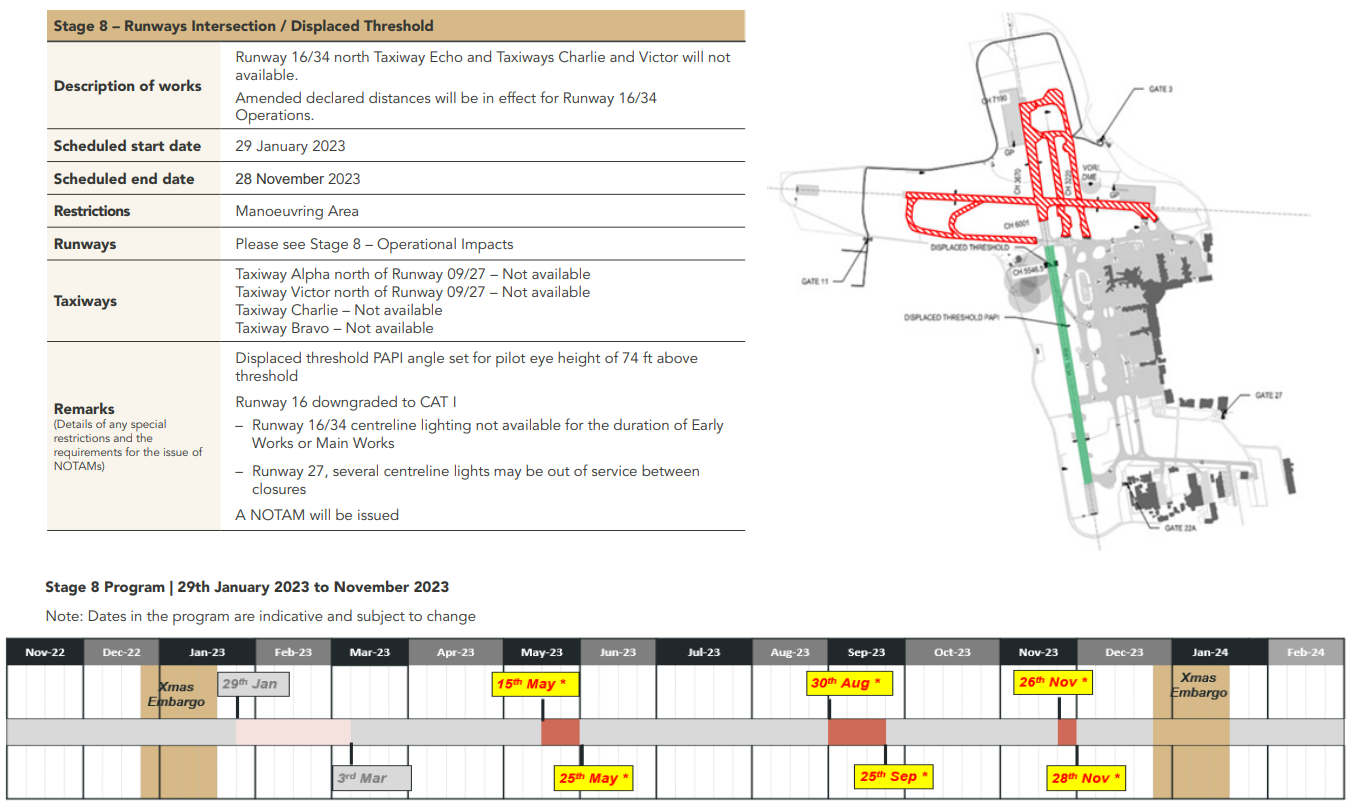
Source: Australia Pacific Airports Corporation
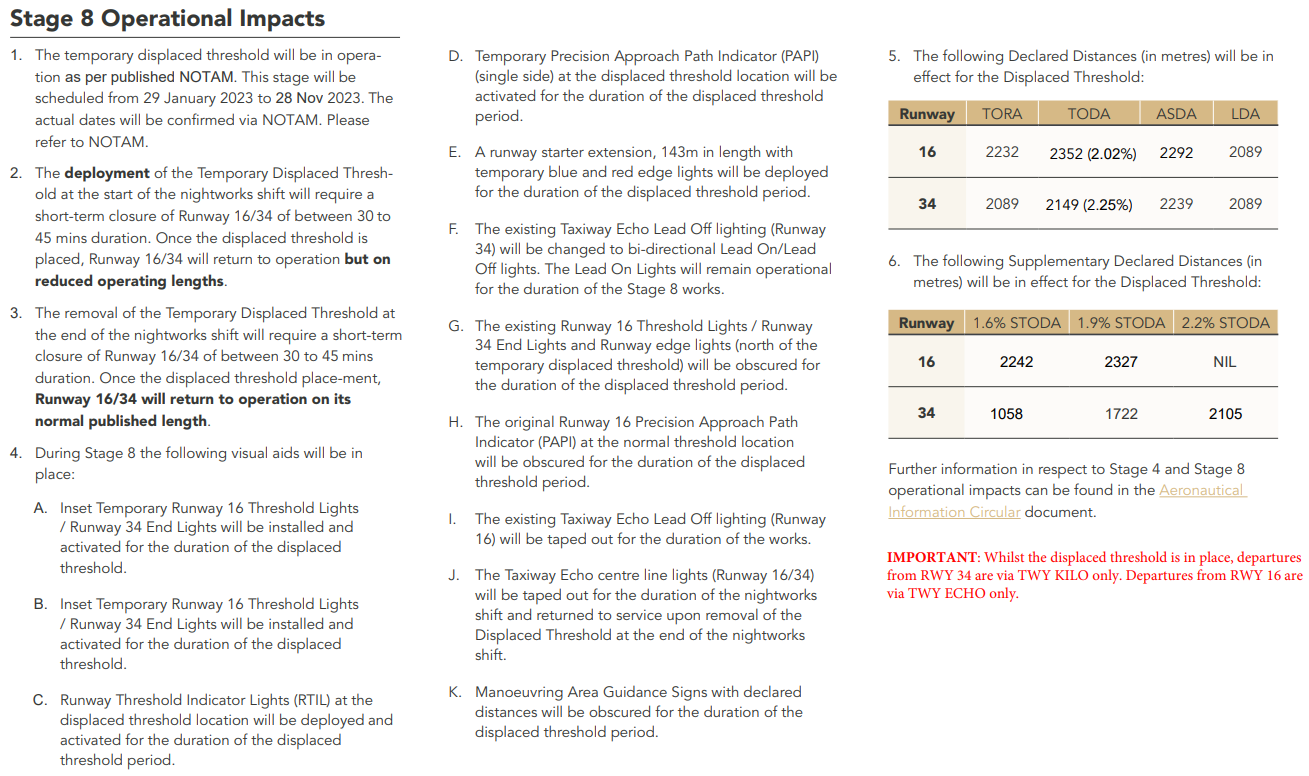
Source: Australia Pacific Airports Corporation
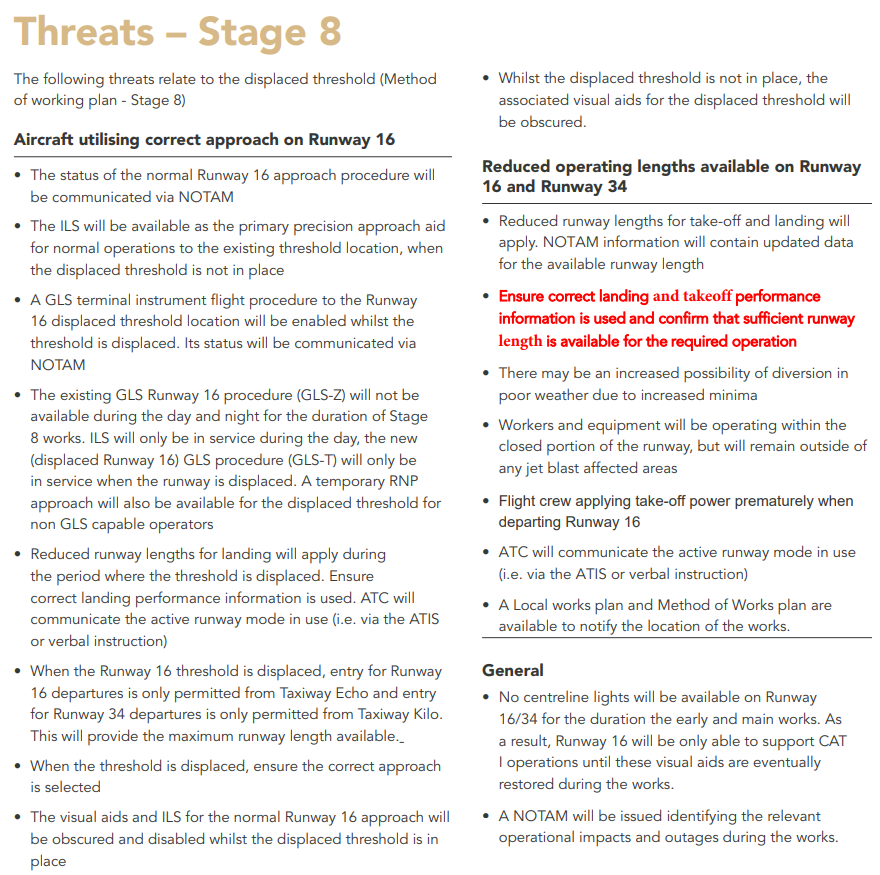
Source: Australia Pacific Airports Corporation
Appendix B – Hard copy NOTAMs excerpts
MAB departure runway NOTAMs (complete)
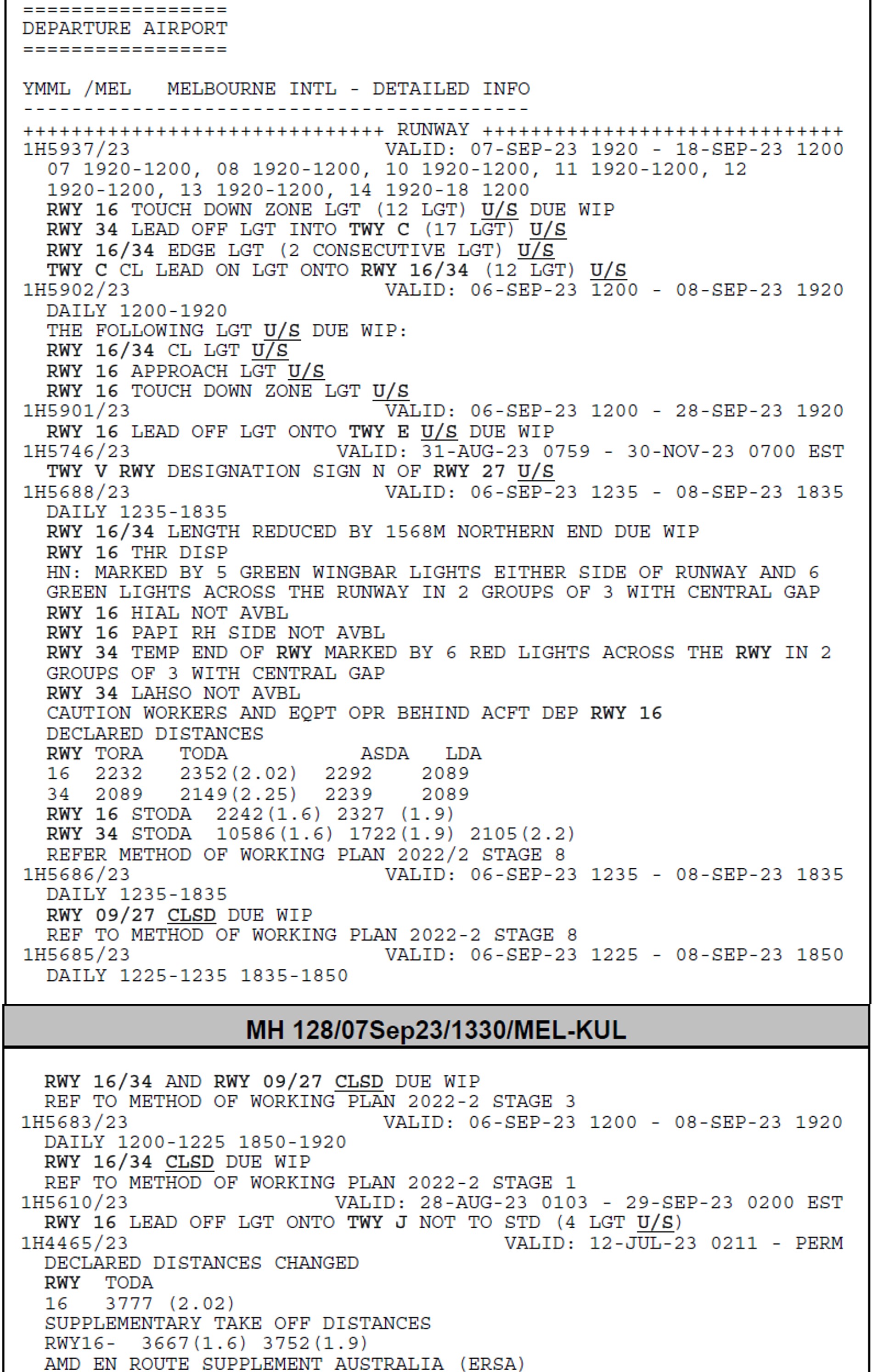
Source: Malaysia Airlines
BAV airport NOTAMs (page 1 of 3)
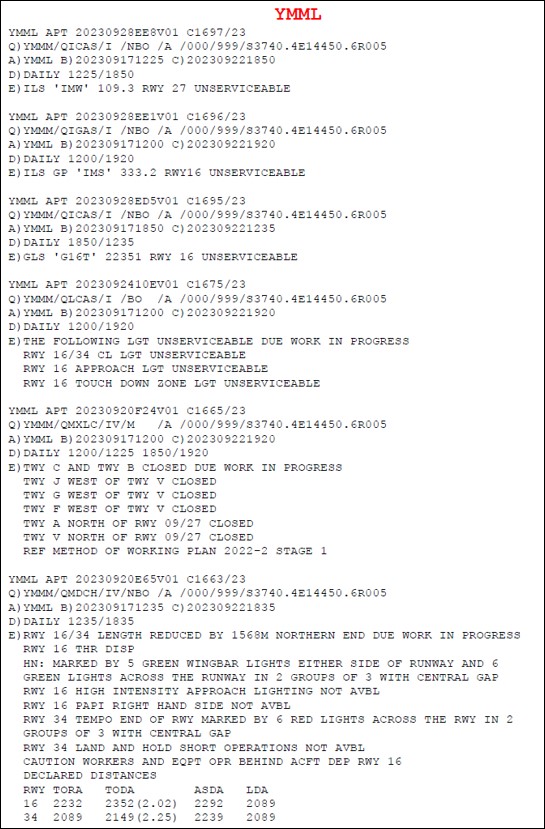
Source: Bamboo Airways
Purpose of safety investigationsThe objective of a safety investigation is to enhance transport safety. This is done through:
It is not a function of the ATSB to apportion blame or provide a means for determining liability. At the same time, an investigation report must include factual material of sufficient weight to support the analysis and findings. At all times the ATSB endeavours to balance the use of material that could imply adverse comment with the need to properly explain what happened, and why, in a fair and unbiased manner. The ATSB does not investigate for the purpose of taking administrative, regulatory or criminal action. About ATSB reportsATSB investigation reports are organised with regard to international standards or instruments, as applicable, and with ATSB procedures and guidelines. Reports must include factual material of sufficient weight to support the analysis and findings. At all times the ATSB endeavours to balance the use of material that could imply adverse comment with the need to properly explain what happened, and why, in a fair and unbiased manner. An explanation of terminology used in ATSB investigation reports is available here. This includes terms such as occurrence, contributing factor, other factor that increased risk, and safety issue. Publishing informationReleased in accordance with section 25 of the Transport Safety Investigation Act 2003 Published by: Australian Transport Safety Bureau © Commonwealth of Australia 2025 
Ownership of intellectual property rights in this publication Unless otherwise noted, copyright (and any other intellectual property rights, if any) in this report publication is owned by the Commonwealth of Australia. Creative Commons licence With the exception of the Commonwealth Coat of Arms, ATSB logo, and photos and graphics in which a third party holds copyright, this report is licensed under a Creative Commons Attribution 4.0 International licence. The CC BY 4.0 licence enables you to distribute, remix, adapt, and build upon our material in any medium or format, so long as attribution is given to the Australian Transport Safety Bureau. Copyright in material obtained from other agencies, private individuals or organisations, belongs to those agencies, individuals or organisations. Where you wish to use their material, you will need to contact them directly. |
[1] See Geoscience Australia: https://www.ga.gov.au/scientific-topics/astronomical/astronomical-defin….
[2] See Aircraft information.
[3] From the end of the temporary runway, the safety zone comprised a 150 m declared stopway, a 60 m gap, then a 240 m runway end safety area (RESA). The stopway included a 60 m clearway (TODA minus TORA). See Runway distance information.
[4] Lights designating the runway unserviceability area.
[5] Local time was Australian Eastern Standard Time (AEST), which is Coordinated Universal Time (UTC) +10 hours. Times in this report are AEST unless otherwise noted.
[6] Pilot flying (PF) and pilot monitoring (PM): procedurally assigned roles with specifically assigned duties at specific stages of a flight. The PF does most of the flying, except in defined circumstances such as planning for descent, approach and landing. The PM carries out support duties and monitors the PF’s actions and the aircraft’s flight path.
[7] Notice to airmen (NOTAM): A notice distributed by means of telecommunication containing information concerning the establishment, condition or change in any aeronautical facility, service, procedure or hazard, the timely knowledge of which is essential to personnel concerned with flight operations. See Notice to airmen (NOTAM).
[8] The briefing package, flight release or dispatch release contained pertinent information and expected conditions for the intended flight, including flight plan, weather reports, NOTAMs and other flight documents. In this case, it was originated by Malaysia Airlines flight dispatch.
[9] Electronic flight bag (EFB): an electronic device or set of devices containing applications used for flight planning, such as take-off performance calculations.
[10] See Take-off distances for a description of TORA, TODA, ASDA, and LDA.
[11] Automatic terminal information service: the provision of current, routine information to arriving and departing aircraft. In these occurrences, this was by means of continuous and repetitive artificial voice broadcasts. ATIS information is prefixed with a unique letter identifier and is updated either routinely or when there is a significant change to weather and/or operations. See Automatic terminal information service (ATIS).
[12] ATIS messages have an identifier in the form of a letter of the ICAO spelling alphabet, with consecutive ATIS messages in alphabetical order.
[13] QNH: the altimeter barometric pressure subscale setting used to indicate the height above mean seal level.
[14] Tower controllers manage arriving and departing aircraft from airports.
[15] Flight crews are required to give their current ATIS identifier when requesting taxi clearance under the Australian Aeronautical Information Publication (AIP).
[16] TOGA: Take-off / go-around, a thrust lever setting that applies maximum available thrust.
[17] The calculated rotation speed (Vr) was 159 kts.
[18] Recorded data showed an initial pitch rate of 2.1°/s, compared to the Airbus standard operating procedure of 3°/s.
[19] Air/ground data was recorded once per second and aircraft ground speed at take-off was 76 m per second. It was therefore possible for the main landing gear to have left the runway between 246 m and 170 m ahead of the works limit.
[20] Radio altitude is calibrated to record zero height above ground as the main landing gear touches the runway in typical landing attitude. The values in this report are corrected for the additional aircraft pitch angle on take-off which would introduce a small error due to the position of the radio antennae. Additionally, the A330 position data was recorded at 2 second intervals, which would also introduce a small uncertainty in the aircraft position and height, however, the relevant data point was adjacent to the works limit.
[21] According to Advisory Circular AC 139.C-09, a ‘displaced threshold’ refers to the displacement of the beginning of a runway. Stage 8 of the runway overlay works was typically referred to as ‘displaced threshold works’ as shorthand, even though the runway was affected in both directions. See Runway works project.
[22] See Works risk management .
[23] For this operator, these role titles are a general indication of each pilot’s technical role throughout the flight but do not restrict them to any one role. For example, the PIC or PM may control the aircraft at times.
[24] The briefing package, flight release or dispatch release contained pertinent information and expected conditions for the intended flight, including flight plan, weather reports, NOTAMs and other flight documents. In this case, the package was originated by Bamboo Airways flight dispatch.
[25] The NOTAM and ATIS information presented uses UTC time and has been converted to local time for this report, except where quoted. UTC is the preferred convention as it decreases the likelihood of errors during the conversion process.
[26] CAVOK (cloud and visibility OK): visibility, cloud and present weather better than prescribed values or conditions.
[27] The delay time was related to the flight crew commencement, re-commencement and normal expected completion of flight preparation activities, as opposed to a delay to the aircraft departure time.
[28] The delivery controller is responsible for issuing departure or en route flight clearances for flight crews.
[29] There was no requirement in Australia to do so, however some controllers elect to advise all aircraft of ATIS updates, including changes to pertinent operational information.
[30] The ground controller is responsible for coordinating aircraft movements on taxiways and apron areas. During the 18 September event, the same individual was fulfilling the delivery and ground controller roles.
[31] Weight off the main landing gear.
[32] Radio altitude is calibrated to record zero height above ground as the main landing gear touches the runway in typical landing attitude. The values in this report are corrected for the additional aircraft pitch angle on take-off which would introduce a small error due to the position of the radio antennas relative to the main landing gear. The 787 position data was recorded at 1‑second intervals, which would also introduce a small uncertainty in the aircraft position and height.
[33] Operator proficiency check (OPC): a flight review conducted in an approved aircraft type simulator. Pilots demonstrate and are assessed on their ability to safely conduct operations, including emergency procedures, for the aircraft type.
[34] Line check: a flight review conducted during normal flight operations to ensure the flight crew member is competent and safely performing flight tasks to the expected level.
[35] Pilots will use a split screen to allow for the review of 2 documents side-by-side. In this case the pilot was reviewing the list of airport NOTAMs alongside a detailed map of the aerodrome. While this allows for ease of cross-referencing, it halves the amount of screen available to display each document.
[36] See Runway distance information
[37] V speeds denote different phases of the take-off based on airspeed.
[38] Accelerate-stop distance required (ASDR) is the distance required to accelerate to the decision speed (V1) and assuming the pilot takes action to reject the take-off at V1, bring the aircraft to a stop.
[39] V1: the maximum airspeed at which a rejected take-off can safely be initiated in the event of an emergency.
[40] VR: the speed at which the rotation of the aircraft is initiated to take-off attitude.
[41] The aerodrome is certified to meet the requirements set out in the Part 139 (Aerodromes) Manual of Standards 2019.
[42] As a Member State, Australia aligns its rules with International Civil Aviation Organization (ICAO) standards and recommended practices (SARPs) defined in 19 annexes to the Convention on International Civil Aviation. ICAO also publishes Procedures for Air Navigation Services (PANS), with detailed procedures supporting the SARPs, and Docs (Documents) that include manuals, circulars, and guidance material to assist with the implementation and understanding of SARPs and PANS.
[43] A defined rectangular area on the ground or water under the control of the appropriate authority, selected or prepared as a suitable area over which an aeroplane may make a portion of its initial climb to a specified height.
[44] A defined rectangular area on the ground at the end of take-off run available prepared as a suitable area in which an aircraft can be stopped in the case of an abandoned take-off.
[45] The AC was removed from the CASA website in June 2023 as it was not consistent with the current version of the MOS. At the time of writing, a replacement advisory circular AC 139-C.15 Safe Planning and Conduct of Aerodrome Works was in development by CASA.
[46] The original text included several notes that have not been reproduced here.
[47] The LRST is a team of appropriate local representatives and stakeholders, including (but not limited to) the aerodrome operator, airlines or aircraft operators, aviation rescue and firefighting, pilot associations and ATC, who work together to improve runway safety at the aerodrome.
[48] ISO: International Standards Organisation.
[49] Attendees included airfield operations, standards manager, works manager, head of airfield, airline interface team and senior safety advisor.
[50] ATSB investigation numbers: AB-2019-006, AO-2020-034 and AO-2021-037 (see Related occurrences).
[51] Airside safety alert – No 160.
[52] INTAM: Internal Notice to Airmen.
[53] Aeronautical Information Circular (AIC): a notice containing information that does not qualify for the origination of a NOTAM or for inclusion in the AIP, but which relates to flight safety, air navigation, technical, administrative or legislative matters.
[54] CASA advised that the list is exhaustive; that is, there was no option for types of MAGS other than mandatory instruction signs and information only signs.
[55] AIP: Aeronautical Information Publication, published by Airservices.
[56] Intersection departure: a take-off from a point on a runway other than the designated threshold, usually at an intersection with a taxiway or runway.
[57] For a precision approach runway (including runway 34 at Melbourne), runway centreline and edge lighting is normally colour-coded from a certain distance, to warn pilots of the approaching runway end.
[58] Part 139 MOS 9.133: ‘A works limit light must have a light output that is clearly visible to a pilot approaching the works area but not so great that it creates a hazard.’
[59] Version 65.1, effective 7 September 2023 to 29 November 2023.
[61] Since the occurrence, BAV changed to a different EFB product and it was not possible to determine the extent to which any such notifications would have been presented to the flight crew at the time.
[62] A pre-departure take-off certificate, also referred to as a ‘take-off and landing data card,’ is a form for flight crews to enter flight information for quick reference.
[63] MEL is a document that allows for the operation of a specific aircraft under specific conditions with a particular item(s) of equipment inoperative at the time of dispatch for the intended flight. Despite the inoperative equipment, the aircraft still complies with its type design standards.
[64] The operator’s plan for the safe conduct of the flight based on considerations of aeroplane performance, other operating limitations and relevant expected conditions on the route to be followed and at the aerodromes concerned.
[65] A free text field in the OFP flight brief section that enabled the flight dispatcher to bring any pertinent flight information to the attention of the crew.
[66] Company NOTAMs were operator-created and used to convey essential information in a timely manner to its own flight operations personnel.
[67] Runway centreline lights are colour-coded along their normal length to alert flight crews nearing the end of the runway. Changi Airport had distance-coded runway centreline lights, that were adapted to the reduced runway length. These were not available at Melbourne airport during the subject occurrences.
[68] Aircraft Communications, Addressing and Reporting System is used for the transmission of short messages between ground stations and the aircraft.
[69] Federal Aviation Administration: https://www.faa.gov/airports/runway_safety/runway_construction
[71] State letter AN 4/1.1.58-23/33.
[72] ICAO Air Navigation Commission (2024) Final review of proposed amendments to Annex 14, volume i and consequential amendments to pans-aerodromes related to aerodrome design and operations stemming from the fourth meeting of the aerodrome design and operations panel. Working Paper AN-WP/9707.
[73] Flight Safety Foundation: https://flightsafety.org/toolkits-resources/gappre/.
[74] Although the tower controller proactively prompted the BAV flight crew about the ATIS later, during line up, the timing and other factors likely made this less effective than an earlier prompt would have been.
[75] Text-based digital transmission of ATIS via data link.
[76] Bullough, John D. (2017) Factors affecting sign visibility, conspicuity and legibility. Interdisciplinary Journal of Signage and Wayfaring, 1(2), 2-25.
[77] Wickens, C. D., Helton, W. S., Hollands, J. G., & Banbury, S. (2021). Engineering psychology and human performance.
[78] The National Runway Safety Group is chaired by CASA and is a hazard‑specific working group that facilitates state‑level visibility and continuous improvement in runway safety performance. It brings together industry stakeholders, including representatives from LRST, that have a common goal in enhancing runway safety.
Preliminary report
Report release date: 01/12/2023
| This preliminary report details factual information established in the investigation’s early evidence collection phase, and has been prepared to provide timely information to the industry and public. Preliminary reports contain no analysis or findings, which will be detailed in the investigation’s final report. The information contained in this preliminary report is released in accordance with section 25 of the Transport Safety Investigation Act 2003. |
The occurrences
Overview
Within an 11-day period in September 2023, the ATSB received two notifications of runway excursions during take-off at night from runway 34 at Melbourne Airport, Victoria. Runway 34, which was normally 3,657 m long, had been temporarily shortened by 1,568 m from the northern end, due to runway resurfacing works in progress (WIP) (Figure 1).
Figure 1: Melbourne Airport arrangement relating to the occurrences
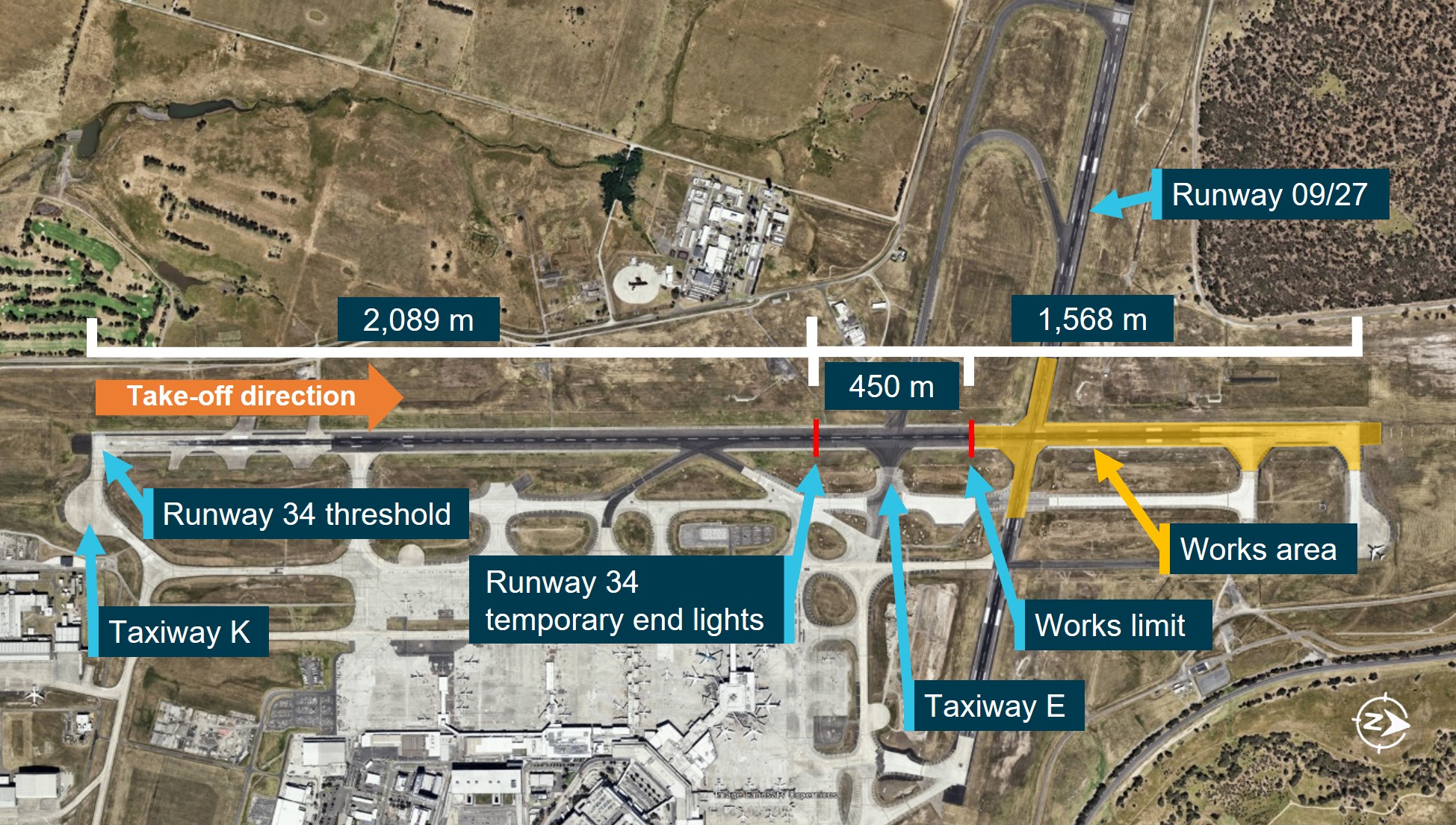
Source: Google Earth, annotated by ATSB
The flight crew of both aircraft did not identify that the shortened runway was in place and used the full length of runway 34 for their take-off performance calculations. As a result, the reduced‑thrust[1] engine settings used by both flight crews extended the take-off runs beyond the temporary runway end lights into a 450‑metre buffer[2] before the works limit line. The jet blast from each aircraft impacted runway unserviceability lights,[3] works lights and marker cones. Personnel were active in the works area at the time of both occurrences, however none were physically injured as a result. There was no damage to either aircraft, or injuries to passengers, and both continued with their planned flights.
9M-MTL, 7 September 2023
On the night of 7 September, a Malaysia Airlines Airbus A330-300, registered 9M‑MTL was scheduled for a 2330 local time[4] departure to fly as a scheduled passenger transport Melbourne to Kuala Lumpur, Malaysia as flight MH128. The first officer (FO) was the pilot flying (PF), and the captain was the pilot monitoring (PM).[5]
The same flight crew had flown into Melbourne via runway 34 the previous night at about 2030, on another A330-300 aircraft. When approaching Melbourne, the flight crew reported that they checked the NOTAMs,[6] which identified that taxiway E would be closed as a result of WIP that evening. Even though the NOTAM came into effect after they were scheduled to land, the crew contacted air traffic control (ATC), who confirmed that taxiway E could be used to vacate the runway. The aircraft landed without issue.
At around 2100 on 7 September, prior to leaving their hotel, the flight crew each downloaded an electronic copy of the flight briefing package.[7] Both crew indicated they went briefly through the flight plan, including weather and fuel, before travelling to the airport. After arriving at the airport check-in, the flight crew also picked up a hard copy of the briefing package and immediately proceeded through to the aircraft.
The flight crew arrived at the aircraft at about 2245 and reported commencing with the company standard operating procedures (SOP) and checklist to prepare for the flight. This included another review of the flight briefing package.
One of the NOTAMs in the briefing package (Figure 2) indicated that, at the time of the scheduled departure, runway 34 had the length reduced by 1,568 m from the northern end due to WIP. It also stated that the take-off run available (TORA) was 2,089 m. Both crew later stated that they were aware of the WIP as a result of checking the runway NOTAMs on approach to Melbourne the previous evening, but missed the NOTAM details while preparing for the occurrence flight. The FO reported going through the NOTAMs on their electronic flight bag (EFB)[8] and indicated that the split screen display may have affected their ability to detect the shortened runway. The captain recalled going ‘briefly’ through the NOTAMs.
Figure 2: Runway WIP NOTAM as presented in the 9M-MTL briefing package
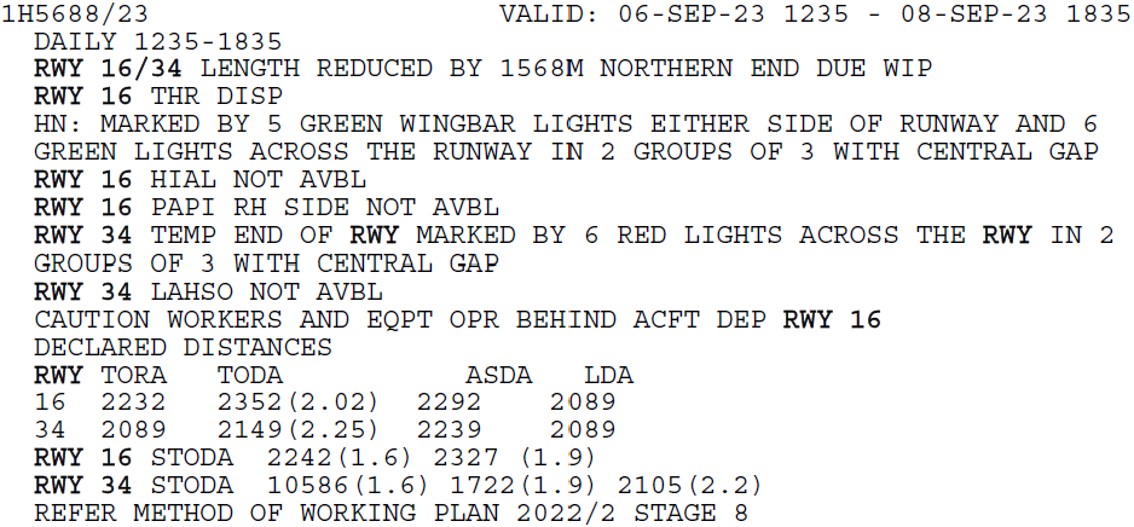
Note: times are in UTC. See Take-off distances for a description of TORA, TODA, ASDA, and LDA.
Source: Malaysia Airlines
Both crew reported listening to the automatic terminal information service (ATIS)[9] and writing down the key information. The FO filled out the operator’s predeparture take-off certificate,[10] which had spaces for the time the ATIS was accessed, along with weather information from the ATIS and other flight data. The version of the ATIS that the flight crew accessed was information Oscar[11] which stated ‘reduced runway length in operation’ and gave both the landing distance available (LDA) and the take-off run available (TORA) as 2,089 m. The ATIS audio was broadcast as follows:
The flight crew proceeded with independent performance calculations using the Airbus EFB software FlySmart. Neither of the crew recalled recognising, after listening to the ATIS, that the runway length was reduced and there were no notes relating to the runway length recorded on the predeparture take-off certificate. Both crew selected the full length of the runway for their independent calculations, which resulted in the selection of a reduced-thrust take-off. The FO reported then cross-checking the two sets of performance figures, which were the same.
ATC cleared the aircraft to push back from the gate at 2329 and the aircraft was subsequently cleared to taxi to holding point K (at taxiway K) at 2337. At 2343, ATC gave the aircraft clearance to line up on runway 34 and, about one minute later, cleared the aircraft for take-off. None of the communications between the flight crew and ATC mentioned the shortened runway, the works in progress or the current ATIS version, which had not changed since the flight crew accessed it.
The crew reported that, in accordance with the airline’s standard operating procedure, the FO (as PF) set the thrust and the captain then put a hand on the throttle levers. The captain reported that at approximately 100 kt, they observed that the runway end lights appeared ‘close’. The captain considered advancing the throttles to take-off/go-around (TOGA)[13] thrust, but elected not to, as they felt it may distract or startle the FO. The PF reported that they did not notice the lights.
Aircraft flight data showed that upon reaching the calculated rotation speed (VR) of 159 kt, approximately 75 m before the runway end, the aircraft rotated (weight off the nose landing gear), (Figure 3). Both crew recalled that the initial rate of rotation was slow[14] and was subsequently corrected. The data recorded weight off the main landing gear, after the end of the runway, approximately 170 m before the works limit line. The data recorded 21 ft (6.4 m) radio altitude (RA) as the aircraft crossed the works limit.
Figure 3: 9M-MTL take-off relative to runway works
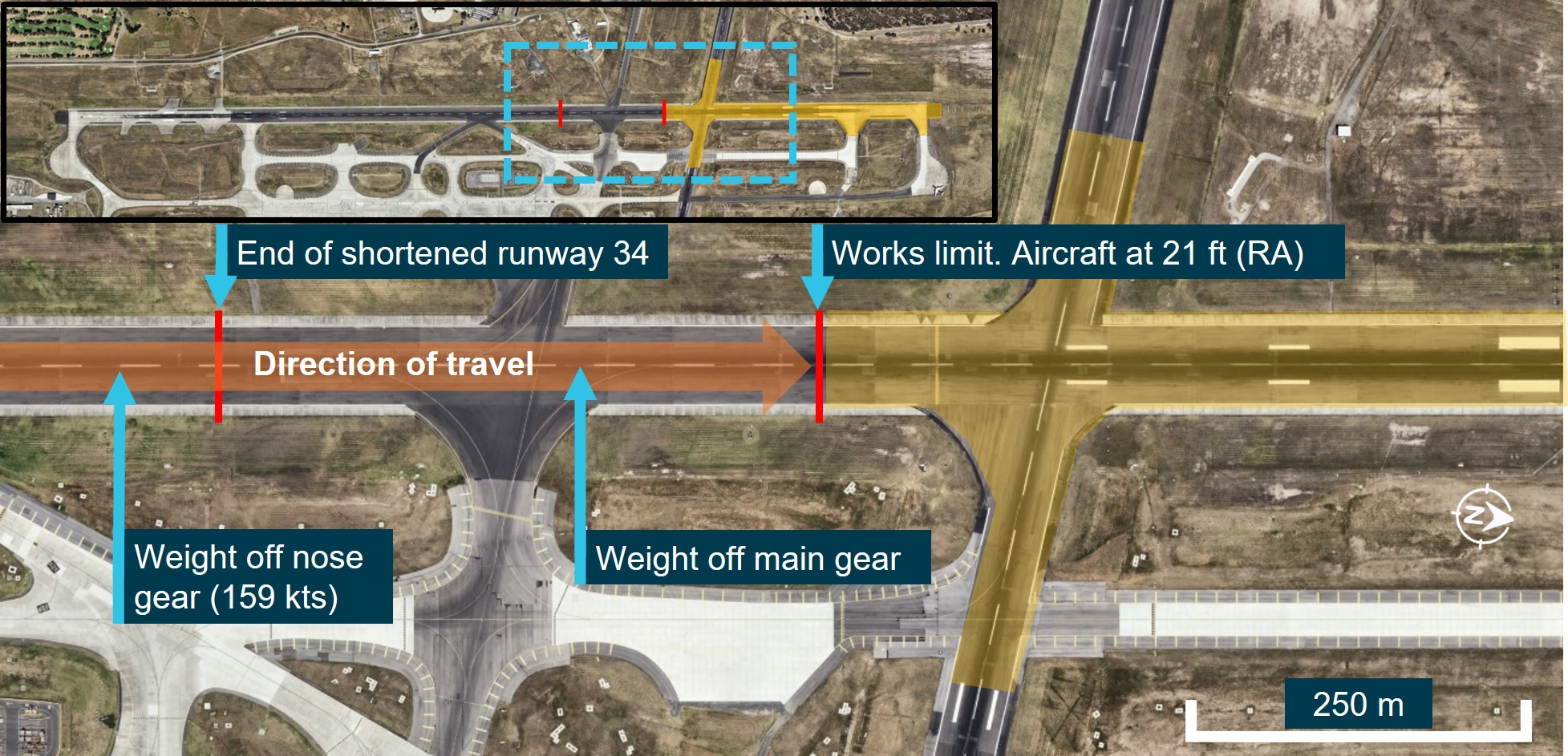
Source: Google Earth, annotated by ATSB
Once the aircraft was stabilised at 10,000 ft, the crew briefly discussed the proximity of the runway end lights during the take-off. There was no indication of any issue with the aircraft and no contact from ATC to indicate any issue, so the crew continued the flight to Kuala Lumpur.
The airport operator, Australian Pacific Airport Melbourne (APAM) reported that it ceased the runway overlay works the day after the occurrence, pending the outcome of its initial investigation. After a review of the existing risk assessment for displaced threshold runway works, APAM carried out a number of safety actions (see Safety action) and recommenced the works on 11 September.
There were no further incidents relating to the runway works reported until 18 September.
VN-A819, 18 September 2023
On 18 September 2023 at 2230, a Bamboo Airways Boeing 787-9 aircraft, registered VN-A819, was being prepared to depart Melbourne Airport for scheduled passenger transport flight QH83 to Hanoi, Vietnam. There were 3 flight crew, who were assigned the roles (according to the operator’s terminology) of pilot in command (PIC), PM, and PF.[15] For this flight, the PIC sat in the jump seat behind the pilots at the controls, the PM sat in the left pilot’s seat and the PF sat on the right.
The same flight crew had flown into Melbourne via runway 34 at around midday on 17 September, on another Boeing 787-9. At the time of this arrival there were no restrictions on the runway or taxiways.
At approximately 2000, prior to leaving their hotel, the flight crew reported downloading and reviewing the flight briefing package[16]. The aircraft had an inoperative auxiliary power unit (APU) and had one brake unit (of 8 total) deactivated. The crew then had an initial briefing on the planned flight while on the way to the airport.
The flight crew received a hard copy of the flight briefing package at the airport and later reported that additional review of the documents was conducted as a group. The flight dispatcher’s email to the crew, accompanying the briefing package, indicated that there was no special effect on the flight. The PIC reported that the NOTAMs were reviewed at this point and identified that the runway works NOTAM (essentially the same as the one for the first occurrence, shown in Figure 2) came into effect at 2235,[17] 5 minutes after the scheduled departure time (2230). The PIC recalled an intent to read the NOTAMS again when conducting the EFB performance calculations.
The PF and PM reported that after arriving at the aircraft, they obtained ATIS information November. This indicated that runway 16/34 was currently closed due to the runway works, that all runways would be closed from 2225, and from 2235 runway 34 would be operational with a displaced threshold. The relevant part of the ATIS was broadcast as:
As a result of the APU fault, external power was connected to the aircraft. The crew reported that the power disconnected halfway through flight planning, leaving the aircraft completely dark. Two further power outages resulted in an estimated 40-minute delay until power was stabilised, and a further 30 minutes to prepare the aircraft again. The PF and PM reported that they were experiencing a high workload at the time.
The PF recalled obtaining the up-to-date ATIS information, which had changed to information Oscar from 2220. It stated that runway 09/27 and runway 16/34 were closed due to WIP:
The flight crew did not recall recognising the runway closures from the ATIS and the PIC did not ultimately re-check the NOTAMs as originally intended.
At 2222 the crew requested flight clearance to Hanoi. In providing clearance, ATC advised the flight crew to expect to take off from runway 34 and that the ATIS information was now Oscar, which was acknowledged by the crew. At 2229, due to the APU fault, the crew requested to start one engine at the gate while connected to ground power, which was approved.
ATIS information Papa was broadcast from 2233, stating that the reduced runway length was in operation and provided the associated runway declared distances:
The flight crew did not access this ATIS version. At 2240, after starting one engine, the flight crew requested and received clearance to push back from the gate and, at 2246, received clearance to taxi to holding point K. About a minute later, ATC contacted the flight crew to advise that their transponder wasn’t showing on the radar, which the crew acknowledged and corrected.
The aircraft held for about 3 minutes at holding point K for incoming traffic and, at 2254 was cleared to line up on runway 34. A minute later, ATC asked the flight crew, ‘confirm you have information Papa’. The crew did not respond to the request.
About 25 seconds later, after engaging with another aircraft, ATC called VN-A819 again. Once acknowledged, ATC again asked the crew to ‘confirm you have ATIS information Papa’, to which the PM replied, ‘information Papa copy’. At 2256, on receipt of their response, ATC gave the flight take off clearance.
During post-occurrence interviews, the PF and PIC recalled that they recognised the ATIS version change from Oscar to Papa at this time, but they had not accessed information Papa. The crew indicated that their expectations around the ATIS change were normally to do with the QNH or wind and that any important change in the information would have been directly communicated by ATC rather than the ATIS. At the time of the question from ATC, the PF indicated they felt pressure already being lined up on the runway, with their traffic display showing an aircraft on approach a few miles out behind them.
Flight path data provided by Bamboo Airways identified the point of weight off the main landing gear as just past taxiway E (Figure 4). Based on witness reports and review of CCTV footage, Melbourne airport estimated the height over the works limit to be 3–5 m (10–16 ft).
Figure 4: VN-A819 take-off relative to runway works
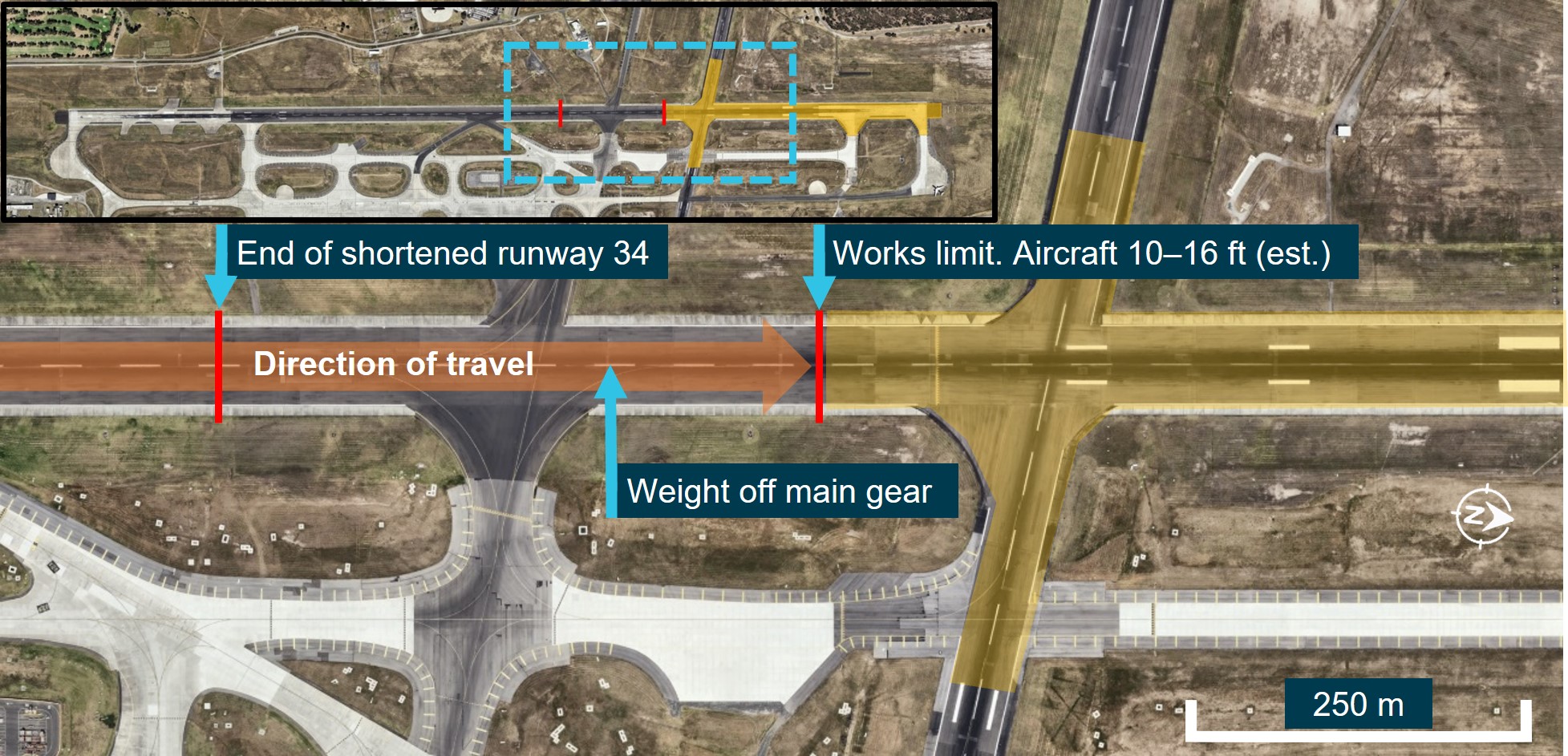
Flight path provided by Bamboo Airways. The point of rotation was not available at the time of writing.
Source: Google Earth, annotated by ATSB
During the take-off run, the flight crew observed that the runway end lights were much closer than normal. After take-off was completed, the crew discussed the proximity of the runway end lights. There was no indication of any fault with the aircraft and no contact from ATC to indicate any other issue. The crew therefore continued the flight to Hanoi.
After this occurrence, APAM ceased works for the remainder of the evening and, on the following day, cancelled any further displaced threshold works for the remainder of the runway overlay project.
Context
Personnel information
Preliminary examination of flight crew details indicated that all flight crew members held appropriate licenses and qualifications to conduct the respective flights. All flight crew members reported being adequately rested, having had at least 24 hours rest before commencing duty ahead of the occurrence flights.
During individual post-occurrence interviews with the ATSB, the flight crew from both aircraft recognised that they had not identified the runway shortening through the available NOTAMs or ATIS. The ATSB asked the flight crews if they had identified any additional opportunities that may have assisted in recognising that the shortened runway was in effect. The crews indicated that there would likely have been some benefit in additional cues to highlight the shortened runway length, including:
- Auditory cues, such as having their attention drawn specifically to the shortened runway when given various clearances.
- Visual cues, such as signage at the holding point, to highlight the WIP and shortened runway.
Aircraft information
Both the Airbus A330-300 (9M-MTL) and Boeing 787-9 (VN-A819) are wide-body (dual aisle) twin turbofan engine, long range, air transport operation aircraft. At the time of the occurrence:
- 9M-MTL had a take-off weight of 216.1 tonnes and no listed performance-related defects.
- VN-A819 had a take-off weight of 219.8 tonnes and the auxiliary power unit and one brake unit (of 8 total) was listed as inoperative.
Reduced-thrust or derated take-offs are a standard practice to reduce engine wear and overhaul costs when there is more take-off distance available than the aircraft safely needs. Flexible temperature (or FLEX in Airbus terminology) or assumed temperature (in Boeing terminology) settings achieve a reduced-thrust take-off to take advantage of the runway length available by using an artificially high ambient temperature value to limit engine thrust, resulting in longer take-off distances.
Both aircraft used electronic flight bag (EFB) systems for pre-flight performance calculations resulting in reduced-thrust take-offs. 9M‑MTL used the Airbus Flysmart (example shown in Figure 5) and VN-A819 used the Boeing Onboard Performance Tool.
Figure 5: 9M-MTL Airbus Flysmart performance comparison between Melbourne runway 34 full-length (centre of image) and reduced-length (right) under otherwise identical conditions
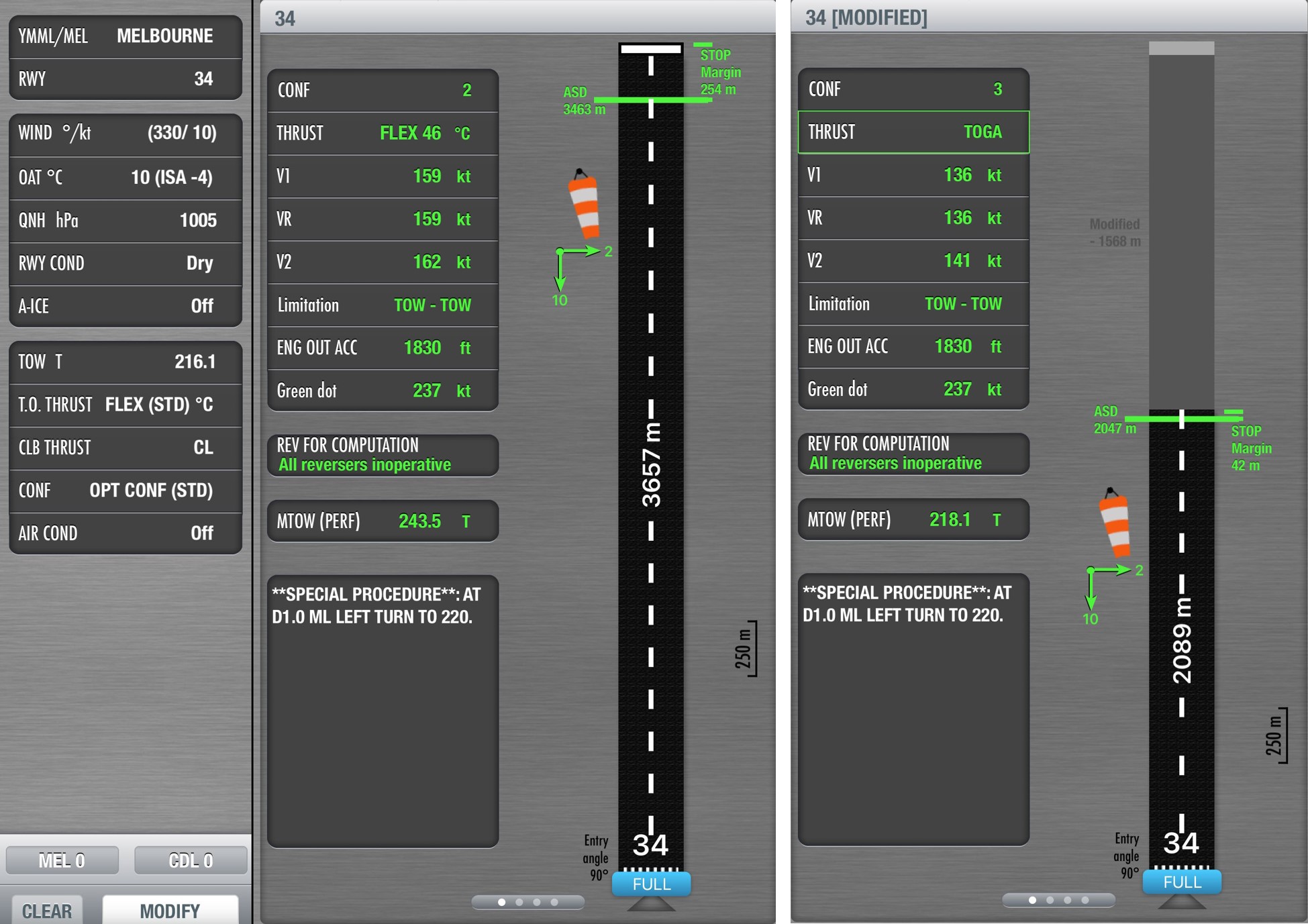
Green text from the top down includes: CONF (flaps setting), thrust, V speeds, and a reduced performance MTOW (maximum take-off weight at which the performance is achievable). The green bar on the runway diagram is the accelerate-stop distance required for the given scenario.
Source: Malaysia Airlines, modified by the ATSB
A comparison of the calculations made by the systems for a full-length and reduced-length runway applicable to each occurrence is shown in Table 1 (9M-MTL) and Table 2 (VN-A819). Using the full-length runway in the calculations resulted in a reduced thrust setting, reduced flaps setting and higher V speeds.[18]
Table 1: 9M-MTL Airbus Flysmart performance data comparison between Melbourne runway 34 full-length and reduced-length
| Runway 34 full length | Runway 34 reduced length |
Thrust: reduced-thrust 46 °C Flaps: 2 V1:[19] 159 kt VR: 159 kt ASDR:[20] 3,463 m | Thrust: TOGA Flaps: 3 V1: 136 kt VR: 136 kt ASDR: 2,047 m |
Table 2: VN-A819 Boeing Onboard Performance Tool data comparison between Melbourne runway 34 full-length and reduced-length
| Runway 34 full length | Runway 34 reduced length |
Thrust: reduced-thrust 42 °C Flaps: 5 V1: 165 kt VR: 166 kt ASDR: 3,500 m | Thrust: TOGA Flaps: 20 V1: 144 kt VR: 146 kt ASDR: 2,205 m |
Recorded information
Recorded data from the following sources was obtained by the ATSB:
- quick access recorder (QAR) from each aircraft
- ATC audio and surface movement radar
- closed-circuit television (CCTV) data from several cameras at Melbourne Airport.
Aerodrome information
Runway information
Melbourne Airport is operated by Australian Pacific Airport Melbourne (APAM). It operates without a curfew, 24 hours per day, 7 days per week and has 2 runways:
- 16/34, which is 3,657 m long
- 09/27, which is 2,286 m long.
Runway 16/34 crosses approximately through the middle of 09/27, at a point about 2,680 m from the runway 34 threshold.
Runway works
APAM commenced a runway overlay / resurfacing works project on 3 November 2022, scheduled to be completed in February 2024. APAM published details of the works through a method of working plan (MOWP; see Method of working plan), local works plan (LWP), NOTAMs, a 19-page airline operator brief, aeronautical information circulars (AIC),[21] and also held stakeholder consultation forums prior to and during the works.
Method of working plan
The Civil Aviation Safety Regulation (CASR) Part 139 Manual of Standards (MOS) Chapter 15, Aerodrome works, states that ‘the operator of a certified aerodrome must make all necessary arrangements to ensure that aerodrome works do not create a hazard to aircraft or cause confusion to pilots.’ The same section notes that ‘aerodrome works may be carried out without the closure of the aerodrome, provided safety precautions are adhered to.’ As part of works arrangements, the MOS required aerodrome operators develop a method of working plan (MOWP).
Accordingly, APAM developed the Runway Overlay Project MOWP, which was published on the Melbourne Airport website and distributed to a stakeholder list of airlines and other organisations, including Malaysia Airlines and Bamboo Airways.
The MOWP divided the works into 16 stages, with stage 8 of the works concerning the intersection of runways 16/34 and 09/27. The works plan involved closure of runway 09/27 and, to maintain an operational runway during the works, the runway 16 threshold was displaced, shortening the length of both runways (Figure 1).
Stage 8 of the works was the only one that had displaced threshold runway operations; it spanned three periods, with NOTAMs published to cover each:
- The first period ran from 23 January 2023 until 3 March 2023 for asphalt works. During that time, APAM recorded 3 minor or potential jet blast incidents from aircraft not correctly following the runway lead-on lights at taxiway E. There was also one occurrence where an aircraft backtracked into the runway end safety area (RESA) before departing, which resulted in jet blast on a work safety officer vehicle. APAM reported that they followed up with all of the operators involved.
- The second period was from 15 to 26 May 2023 for runway grooving works. There were no recorded occurrences relating to the displaced threshold during that period.
- The third period, containing the subject occurrences, commenced on 7 September 2023 for airfield ground lighting installation works. During this period, the displaced threshold operations commenced at 2235 each night and finished 6 hours later at 0435 the following morning.
Runway distances
The International Civil Aviation Organization (ICAO) promulgates standards and recommended practices which countries signatory to the Convention on International Civil Aviation (including Australia) are expected to follow. Annex 14 to the Convention contained standards and recommended practices for aerodrome design and operations. To standardise the reporting and calculation of runway distances, Annex 14 defined the following ‘declared distances’ (Figure 6):
- Take-off run available (TORA). The length of runway declared available and suitable for the ground run of an aeroplane taking off.
- Take-off distance available (TODA). The length of the take-off run available plus the length of the clearway (CWY),[22] if provided.
- Accelerate-stop distance available (ASDA). The length of the take-off run available plus the length of the stopway (SWY),[23] if provided.
- Landing distance available (LDA). The length of runway which is declared available and suitable for the ground run of an aeroplane landing.
Figure 6: Runway declared distances
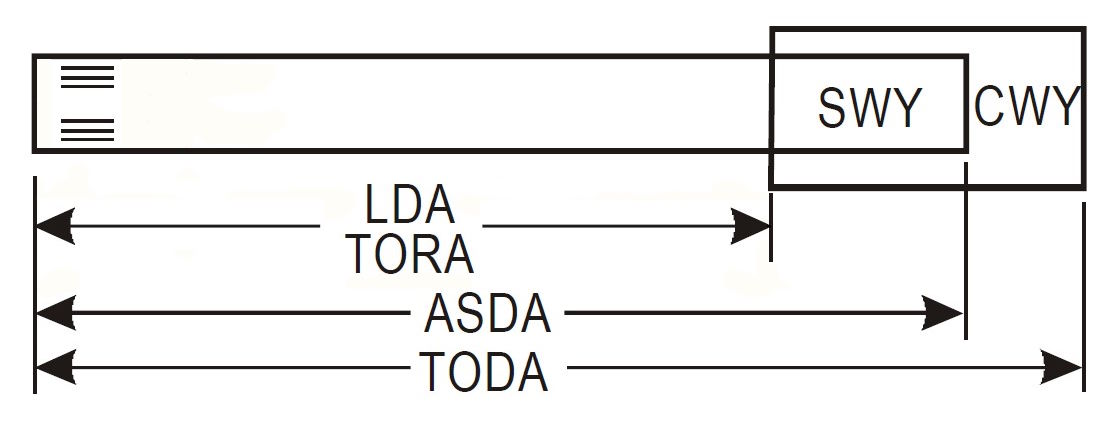
Source: ICAO Annex 14, modified by ATSB
Take-off run required (TORR), and landing distance required (LDR) are associated distances required by a particular aircraft at a certain weight, thrust setting, and configuration. Take-off distance required (TODR) is the distance required from commencement of the take-off run for the aircraft to reach 50 ft altitude. Accelerate-stop distance available (ASDR) is the distance required to accelerate to the decision speed (V1) and assuming the pilot takes action to reject the take-off at V1, bring the aircraft to a stop. Declared distances relevant to the subject occurrences are listed in Table 3.
Table 3: Melbourne runway 34 declared distances
| Declared distance type | Normal distance (m) | Distance (m) during stage 8 runway works |
| Take-off run available (TORA) | 3,657 | 2,089 |
| Take-off distance available (TODA) | 3,837 | 2,145 |
| Accelerate-stop distance available (ASDA) | 3,717 | 2,239 |
| Landing distance available (LDA) | 3,657 | 2,089 |
Visual aids
Aerodromes are required to have surface movement area guidance signs (MAGS) under certain conditions to provide guidance to aircraft and ground personnel. With regards to TORA MAGS the Part 139 MOS stated:
In this occurrence the departures were from the runway 34 threshold, and therefore did not represent an intersection departure or require a TORA MAGS. Despite this, a MAGS was ordinarily present at taxiway K indicating the TORA for the full length runway. During the runway works periods, airside safety officers covered up the existing MAGS daily, prior to commencement of the displaced threshold runway operations. There was no requirement to have a runway works or reduced runway length MAGS at the runway 34 threshold.
Aeronautical information
Aerodrome conditions
The Part 139 MOS required that, for works where an MOWP is issued, a NOTAM giving the time and date of the planned commencement of the works, or a planned change in works stage, must be requested. Similarly, Procedures For Air Navigation Services (PANS)-Aerodromes (ICAO Document 9981), which outlined several procedures for operating with runway lengths below the declared distances, one of which is for the aerodrome operator to:
In addition, PANS-Air Traffic Management (ICAO Document 4444), 7.5.3 Procedures for aerodrome control service stated:
Notice to airmen (NOTAM)
ICAO defines a notice to airmen (NOTAM) as a ‘notice distributed by means of telecommunication containing information concerning the establishment, condition or change in any aeronautical facility, service, procedure or hazard, the timely knowledge of which is essential to personnel concerned with flight operations’.
The Airservices Australia Aeronautical Information Publication (AIP) En Route (section 1.10 (1)) stipulated that ‘before beginning a flight, a pilot in command must study all available information appropriate to the intended operation and make a careful study of… location specific NOTAM for aerodromes.’
Automatic terminal information service (ATIS)
The AIP defined the automatic terminal information service (ATIS) as the provision of current, routine information to arriving and departing aircraft by means of continuous and repetitive broadcasts during the hours when the unit responsible for the service is in operation.
ATIS is a service broadcast over a dedicated radio frequency that provides operational information to aircraft operating in the vicinity of an airport, eliminating the need for a controller to broadcast the information repeatedly. It is normally accomplished through a voice recording, updated when conditions change.
Chapter 4 of ICAO Annex 11 Air Traffic Services outlined the standards related to ATIS, including, whenever Voice-ATIS and/or D-ATIS[26] is provided:
- the preparation and dissemination of the ATIS message is the responsibility of the air traffic services.
- aircraft must acknowledge receipt of the information upon establishing communication with the controller.
Additionally:
- Information contained in a current ATIS, the receipt of which has been acknowledged by the aircraft concerned, need not be included in a directed transmission to the aircraft…
AIP En Route 2.3.2 reflected these requirements in Australian airspace, stating:
When operating from a controlled aerodrome where ATIS is in operation, a pilot in command must obtain the ATIS prior to taxi, and advise ATC of the ATIS code when requesting taxi clearance.
Related occurrences
- On 30 November 2022, a Boeing 737 overran runway 19L at Brisbane Airport, Queensland on take-off. Runway 19L was operating with a reduced length due to works in progress. The aircraft briefly entered, and became airborne in, the section of the runway that was closed due to those runway works. The aircraft completed the departure and continued to its destination. The investigation is continuing (ATSB investigation (AO-2022-064).
- On 3 and 19 September 2021, the flight crews of Boeing 737 aircraft each conducted displaced threshold approaches into runway 11 at Darwin Airport, Northern Territory. The runway was shortened at the opposite end due to works in progress, meaning the runway 11 threshold was unaffected. The aircraft touched down 1,153 m and 932 m into the runway, respectively, but neither aircraft overran the runway. The flight crews were each found to have misinterpreted the NOTAM information during pre-flight briefing, and had also misinterpreted or did not comprehend the ATIS information prior to arrival (ATSB investigation AO-2021-037).
- On the afternoon of 22 March 2007, the flight crew of a Boeing 777 commenced take-off at Auckland Airport, New Zealand, where the runway length had been reduced during a period of runway works. The crew had accessed the relevant NOTAM and ATIS containing this information, however there were several factors identified that contributed to the flight crew’s belief that the full runway length was available. As such, they started the take-off with less engine thrust and flap than required. During the take-off the crew saw work vehicles in the distance on the runway and immediately applied full engine thrust. The aircraft became airborne approximately 190 m before the reduced runway end and cleared the height of the work vehicles by about 28 m. (Transport Accident Investigation Commission report 07-001)
- On the afternoon of 16 July 2003 the crew of a Boeing 737 were preparing to depart Manchester Airport, United Kingdom. The runway in use was operating at reduced length due to works in progress at the far end. It was found that although having accessed a NOTAM and ATIS concerning the works the flight crew were unaware of the reduced runway length. The works were also not visible due to the runway being over a slight rise. The crew commenced the take-off using a reduced thrust setting and as they crested the rise, they saw the works vehicles. At that stage, the aircraft was close to the rotation speed, so the crew continued the take-off. The aircraft cleared a 4-m high vehicle by a height of approximately 17 m. (Air Accidents Investigation Branch Report 3/2006)
Previous initiatives
- In 2010, the US Federal Aviation Administration (FAA) initiated the Airport Construction Advisory Council (ACAC),[27] which is a collaborative working group of industry stakeholders. The ACAC’s aim is to help identify hazardous situations during runway and taxiway construction projects and identify ways to mitigate the associated risk. The webpage contains information, guidance material and checklists.
- The Global Action Plan for the Prevention of Runway Excursions (GAPPRE)[28] is an industry working group coordinated by the Flight Safety Foundation and EUROCONTROL, aimed at identifying the most important actions required to address the risk of runway excursions. The GAPPRE cited an International Air Transport Association (IATA) report that between 2005 and the first half of 2019, 23 percent of accidents in IATA’s database involved a runway excursion, which was also the most frequent accident end-state.
The GAPPRE publication is available for download and contains recommendations, and associated guidance material and best practice information for aerodrome operators, air navigation service providers, aircraft operators, aircraft manufacturers, regulators and ICAO.
Safety action
Australian Pacific Airport Melbourne (APAM)
The day after the 7 September occurrence involving 9M-MTL, Australian Pacific Airport Melbourne (APAM) advised it ceased the runway overlay works, pending the outcome of its initial investigation. After a review of the existing risk assessment for displaced threshold runway works, APAM carried out the following safety actions:
- A Safety Alert was sent out to all airlines operating into Melbourne Airport. This included receiving read receipts and signed acknowledgement that they have received the alert. Airlines operating into the displaced threshold window were prioritised.
- Updates to the AIC and NOTAM stating all runway departures must be from Taxiway Kilo due to a shortened runway. AIC also included the key contents of the Safety Alert.
- APAM had requested for ASA [Airservices Australia] (Melbourne Tower) to amend take off phraseology to include that the runway was shortened, however this was declined as it was non-standard and too prescriptive.
APAM recommenced the works on 11 September.
Immediately following the 18 September occurrence involving VN-A819, APAM ceased the works for the remainder of that evening and, on the following day, APAM cancelled any further displaced threshold works for the remainder of the runway overlay project.
In addition, through its initial investigation, APAM made a number of internal recommendations. This included a review of alternate programs to achieve runway intersection works for future runway projects, and initiation of discussions with industry groups on improving visual aids and communication of information for shortened runway operations.
Malaysia Airlines
In response to the 7 September occurrence involving 9M-MTL, Malaysia Airlines reported that it:
- Issued a flight safety alert on 9 September 2023 to all flight crew, to notify of the occurrence, the shortened runway works and the significant difference in performance calculations for the full-length versus shortened runway lengths. Additionally, a notification was issued to flight crews, requiring acknowledgement that it had been read.
- Included a reminder in the company NOTAM about the Melbourne Airport runway 16/34 shortening.
- Included a special note in the operational flight plan for Melbourne to increase awareness of the shortened runway operations.
Bamboo Airways
In response to the 18 September occurrence involving VN-A819, Bamboo Airways advised that it:
- Raised awareness of this occurrence with all flight crews and dispatchers.
- Engaged with dispatchers to enhance NOTAM checking and required actions, and also to improve communication of flight information to crews.
Further investigation
To date, the ATSB has:
- interviewed the flight crews
- reviewed flight planning information for each flight
- reviewed initial investigation reports from the aircraft operators and airport operator
- reviewed the works planning documents
- reviewed NOTAM and ATIS information
- analysed recorded flight data from 9M-MTL
- reviewed CCTV footage
- analysed recorded ATC audio and surface movement radar data
- conducted an initial review of regulations, requirements and recommended practices for displaced threshold runway works
- conducted an initial review of related occurrences.
The investigation is continuing and will include further review and analysis of the above as well as:
- recorded flight data from VN-A819
- runway works planning and risk assessments
- mechanisms for the communication of safety-critical aeronautical information to air crews.
Should a critical safety issue be identified during the course of the investigation, the ATSB will immediately notify relevant parties so appropriate and timely safety action can be taken.
A final report will be released at the conclusion of the investigation.
Purpose of safety investigationsThe objective of a safety investigation is to enhance transport safety. This is done through:
It is not a function of the ATSB to apportion blame or provide a means for determining liability. At the same time, an investigation report must include factual material of sufficient weight to support the analysis and findings. At all times the ATSB endeavours to balance the use of material that could imply adverse comment with the need to properly explain what happened, and why, in a fair and unbiased manner. The ATSB does not investigate for the purpose of taking administrative, regulatory or criminal action. TerminologyAn explanation of terminology used in ATSB investigation reports is available here. This includes terms such as occurrence, contributing factor, other factor that increased risk, and safety issue. Publishing informationReleased in accordance with section 25 of the Transport Safety Investigation Act 2003 Published by: Australian Transport Safety Bureau © Commonwealth of Australia 2023 
Ownership of intellectual property rights in this publication Unless otherwise noted, copyright (and any other intellectual property rights, if any) in this report publication is owned by the Commonwealth of Australia. Creative Commons licence With the exception of the Coat of Arms, ATSB logo, and photos and graphics in which a third party holds copyright, this publication is licensed under a Creative Commons Attribution 3.0 Australia licence. Creative Commons Attribution 3.0 Australia Licence is a standard form licence agreement that allows you to copy, distribute, transmit and adapt this publication provided that you attribute the work. The ATSB’s preference is that you attribute this publication (and any material sourced from it) using the following wording: Source: Australian Transport Safety Bureau Copyright in material obtained from other agencies, private individuals or organisations, belongs to those agencies, individuals or organisations. Where you wish to use their material, you will need to contact them directly. |
[1] See Aircraft information.
[2] Comprising a 210 m clearway (incorporating a 150 m declared stopway) after the runway end, plus a 240 m runway end safety area (RESA). See Melbourne Airport runway works.
[3] Lights designating the runway unserviceability area.
[4] Local time was Australian Eastern Standard Time (AEST), which is Coordinated Universal Time (UTC) +10 hours. Times in this report are AEST unless otherwise noted.
[5] Pilot flying (PF) and Pilot monitoring (PM): procedurally assigned roles with specifically assigned duties at specific stages of a flight. The PF does most of the flying, except in defined circumstances such as planning for descent, approach and landing. The PM carries out support duties and monitors the PF’s actions and the aircraft’s flight path.
[6] Notice to Airmen (NOTAM): A notice distributed by means of telecommunication containing information concerning the establishment, condition or change in any aeronautical facility, service, procedure or hazard, the timely knowledge of which is essential to personnel concerned with flight operations. See Notice to airmen (NOTAM).
[7] The briefing package, flight release or dispatch release contains pertinent information and expected conditions for the intended flight, including flight plan, weather reports, NOTAMs and other flight documents. In this case originated by Malaysia Airlines flight dispatch.
[8] Electronic flight bag (EFB): an electronic device or set of devices containing applications used for flight planning, such as take-off performance calculations.
[9] Automatic terminal information service: The provision of current, routine information to arriving and departing aircraft by means of continuous and repetitive broadcasts. ATIS information is prefixed with a unique letter identifier and is updated either routinely or when there is a significant change to weather and/or operations. See Automatic terminal information service (ATIS).
[10] Also referred to as a ‘take-off and landing data card’. It is a form for flight crews to enter flight information for quick reference.
[11] ATIS messages are identified by a designator in the form of a letter of the ICAO spelling alphabet, with consecutive ATIS messages in alphabetical order.
[12] QNH: the altimeter barometric pressure subscale setting used to indicate the height above mean seal level.
[13] TOGA: Take-off / go-around, a thrust lever setting that applies maximum available thrust.
[14] Recorded data showed a pitch rate of 2.1 degrees per second, compared to the Airbus standard operating procedure of 3 degrees per second.
[15] For this operator, these role titles are a general indication of each pilot’s technical role throughout the flight but do not restrict them to any one role. For example, the PIC or PM may control the aircraft at times.
[16] Originated by Bamboo Airways flight dispatch.
[17] The NOTAM and ATIS information presented uses UTC time and has been converted to local time for this report. UTC is the preferred convention as it decreases the likelihood of errors during the conversion process.
[18] V speeds denote different phases of the take-off based on airspeed.
[19] V1: the maximum airspeed at which a rejected take-off can safely be initiated in the event of an emergency.
[20] ASDR: accelerate-stop distance required. See Runway distances.
[21] Aeronautical Information Circular (AIC): A notice containing information that does not qualify for the origination of a
NOTAM or for inclusion in the AIP, but which relates to flight safety, air navigation, technical, administrative or legislative matters.
[22] A defined rectangular area on the ground or water under the control of the appropriate authority, selected or prepared as a suitable area over which an aeroplane may make a portion of its initial climb to a specified height.
[23] A defined rectangular area on the ground at the end of take-off run available prepared as a suitable area in which an aircraft can be stopped in the case of an abandoned take-off.
[24] AIP: aeronautical information publication, published by Airservices.
[25] Intersection departure: a take-off from a point on a runway other than the designated threshold, usually at an intersection with a taxiway or runway.
[26] The provision of ATIS via continuous and repetitive voice broadcasts (Voice-ATIS), or via data-link (D-ATIS).
[27] Federal Aviation Administration: https://www.faa.gov/airports/runway_safety/runway_construction
[28] Flight Safety Foundation: https://flightsafety.org/toolkits-resources/gappre/
Occurrence summary
| Investigation number | AO-2023-043 |
|---|---|
| Occurrence date | 07/09/2023 |
| Location | Melbourne Airport |
| State | Victoria |
| Report release date | 11/11/2025 |
| Report status | Final |
| Investigation level | Systemic |
| Investigation type | Occurrence Investigation |
| Investigation status | Completed |
| Mode of transport | Aviation |
| Aviation occurrence category | Runway excursion, Jet blast / Prop / Rotor wash |
| Occurrence class | Serious Incident |
| Highest injury level | None |
Aircraft details
| Manufacturer | Airbus |
|---|---|
| Model | A330-323 |
| Registration | 9M-MTL |
| Serial number | 1395 |
| Aircraft operator | Malaysia Airlines |
| Sector | Jet |
| Operation type | Part 129 Foreign air transport operators |
| Departure point | Melbourne Airport, Victoria |
| Destination | Kuala Lumpur International Airport, Malaysia |
| Damage | Nil |
Aircraft details
| Manufacturer | The Boeing Company |
|---|---|
| Model | 787-900 |
| Registration | VN-A819 |
| Serial number | 62736 |
| Aircraft operator | Bamboo Airways |
| Sector | Jet |
| Operation type | Part 129 Foreign air transport operators |
| Departure point | Melbourne Airport, Victoria |
| Destination | Hanoi Noi Bai International Airport, Vietnam |
| Damage | Nil |