The ATSB is conducting a safety study into aerial firefighting in Australia to identify any systemic safety issues and other learning opportunities that could enhance the safety of aerial firefighting operations.
The safety study is divided into 4 parts:
Part A, AS-2021-015a, was published on 13 May 2026, and presents the key safety themes reported by interviewees. It does not contain findings. The goal of Part A is to better understand the aviation hazards interviewees faced, and the opportunities they could see to improve the safety of aerial firefighting operations.
Part B, AS-2021-015b, will present the results from a survey of NAFC-registered aerial firefighting pilots.
Part C, AS-2025-015c, will expand upon the ATSB statistical report AR-2020-022 and identify key trends in Australian aerial firefighting occurrences.
The final report, AS-2025-015, will present a synthesis of the conclusions in Parts A to C to identify any systemic safety issues and other learning opportunities that could enhance the safety of aerial firefighting operations.
Following several helicopter rotor wash incidents at hospital helicopter landing sites (HLSs) that resulted in injuries to nearby pedestrians, the ATSB compiled a list of similar incidents in the preceding 5 years. Analysis of the specific occurrences was conducted to identify the common factors, existing regulatory guidelines, and ways to mitigate the effect of rotor wash.
What the ATSB found
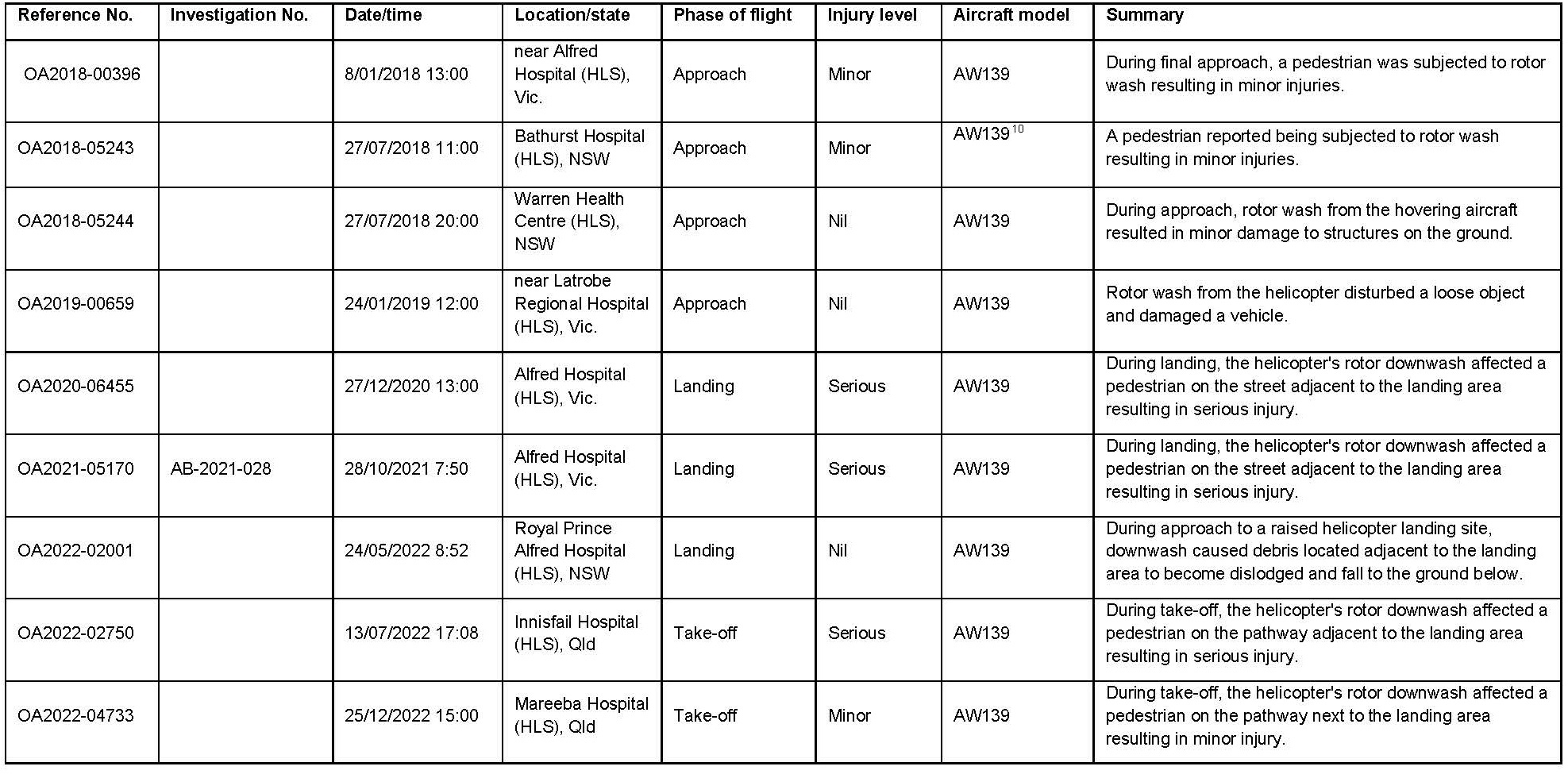
Of the 18 helicopter downwash incidents reported in the last 5 years, 9 were reported to have occurred at hospital HLSs. Of these, 6 occurrences resulted in injuries to pedestrians that were located within approximately 30 m of the HLS. Flight crew were not aware of the presence of pedestrians in all cases, and most flight crew were not aware of the incident at the time. Most, and possibly all of the injuries were sustained by pedestrians over the age of 75 after being exposed to rotor wash. All incidents involved AgustaWestland AW139 helicopters. If the recommended rotor wash exclusion area had been applied at each HLS, it would have reduced the risk of the pedestrians being injured.
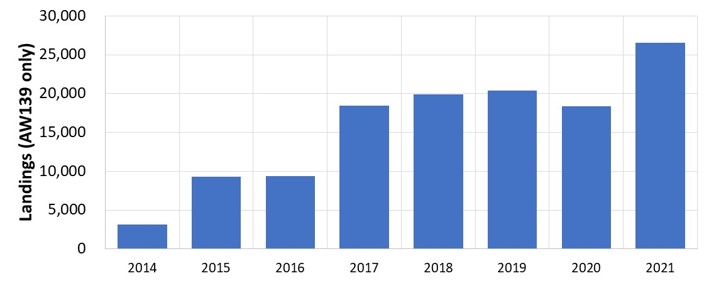
Key factors contributing to the effects of rotor downwash include the weight of the helicopter, the main rotor size, disc loading, prevailing wind, and the flightpath. There were no reported occurrences of rotor wash related injuries at hospital HLS prior to the significant increase in the utilisation of AW139 for medical transport operations from 2017.
As part of Civil Aviation Safety Regulations Part 133 (Australian air transport operations rotorcraft), helicopter operators are required to determine information about aerodromes and determine procedures for safe operations at aerodromes. The Civil Aviation Safety Authority does not currently regulate the design and operation of heliports, including hospital HLSs, where they are not an integral part of an aerodrome certified under Civil Aviation Safety Regulations Part 139 (Aerodromes). This means that the Civil Aviation Safety Authority does not provide any formal approval for, or assurance of, HLS operational standards. The Civil Aviation Safety Authority has produced guidance material for the operators of HLSs to design, maintain, and operate their facility to the standards of certified aerodromes.
What has been done as a result
Helicopter operators involved in these incidents reported taking corrective actions to mitigate the dangers of rotor wash, which included:
immediate cessation of operations to the HLS
selection of an alternate landing area
removal of hazards in the vicinity of the HLS
operational restrictions including the number of helicopters permitted on the HLS at one time and restrictions on flightpaths used during approach and departure
marshallers put in place for arrival and departure times.
The ATSB has issued the following Safety Advisory Notice (AD-2022-001-SAN-001) with this report:
The Australian Transport Safety Bureau strongly encourages operators of hospital helicopter landing sites, and helicopter medical transport operators using those landing sites, work together to review the adequacy of existing risk controls to ensure pedestrians are adequately protected from the increased rotor wash associated with larger helicopters.
Safety message
From the identified common factors associated with rotor wash incidents, the flightpath is the only element that can be managed by the pilot in accordance with the operator’s procedures. However, pilots may be unaware of the presence of pedestrians in the vicinity of a hospital HLS. To enable the continued safe use of these facilities, hospital HLS owners and helicopter operators should ensure pedestrians are not affected by rotor wash by implementing appropriate risk controls for their HLS in addition to the helicopter operating procedures. Controls may include physical barriers, warning devices such as sirens, lights, high visibility warning signs, painted lines on nearby public thoroughfare to alert pedestrians to the rotor wash danger area, an inspection schedule for the HLS facility and surrounding area, and establishing a closed-loop reporting system.
Following several incidents at hospital helicopter landing sites (HLSs) involving injuries to nearby pedestrians from helicopter rotor wash, the ATSB initiated a review of the number and type of helicopter downwash occurrences from 2018 to 2022. The following analysis of the specific occurrences was conducted to identify the common factors, existing regulatory guidelines, and ways to mitigate the effects of rotor wash.
Rotor wash is comprised of downwash, which is the vertical component of rotor wash produced by the main rotor blades that supports the helicopter in flight, and sidewash, which is the horizontal component of rotor wash. It is influenced by environmental conditions such as air density, temperature, and altitude. However, the key factors that determine the strength of rotor wash include:
weight of the helicopter – a heavier helicopter generally produces higher downwash speeds
main rotor size – a larger rotor disc area will lower the downwash speed but a larger rotor disc is usually associated with heavier helicopters that produce higher downwash speeds
disc loading – how much weight is being carried per unit area of the rotor blades
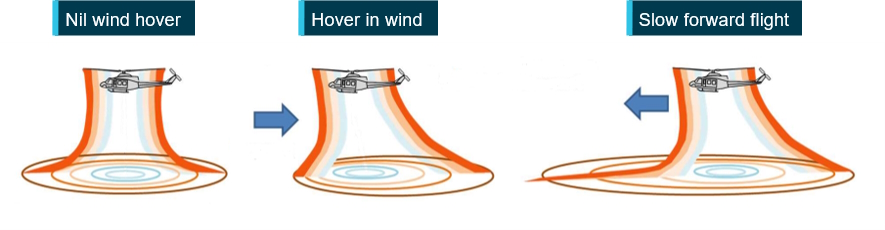
wind – the relative wind influences the movement of the rotor wash (Figure 1)
flightpath – rotor wash is concentrated underneath the helicopter as illustrated in Figure 1.
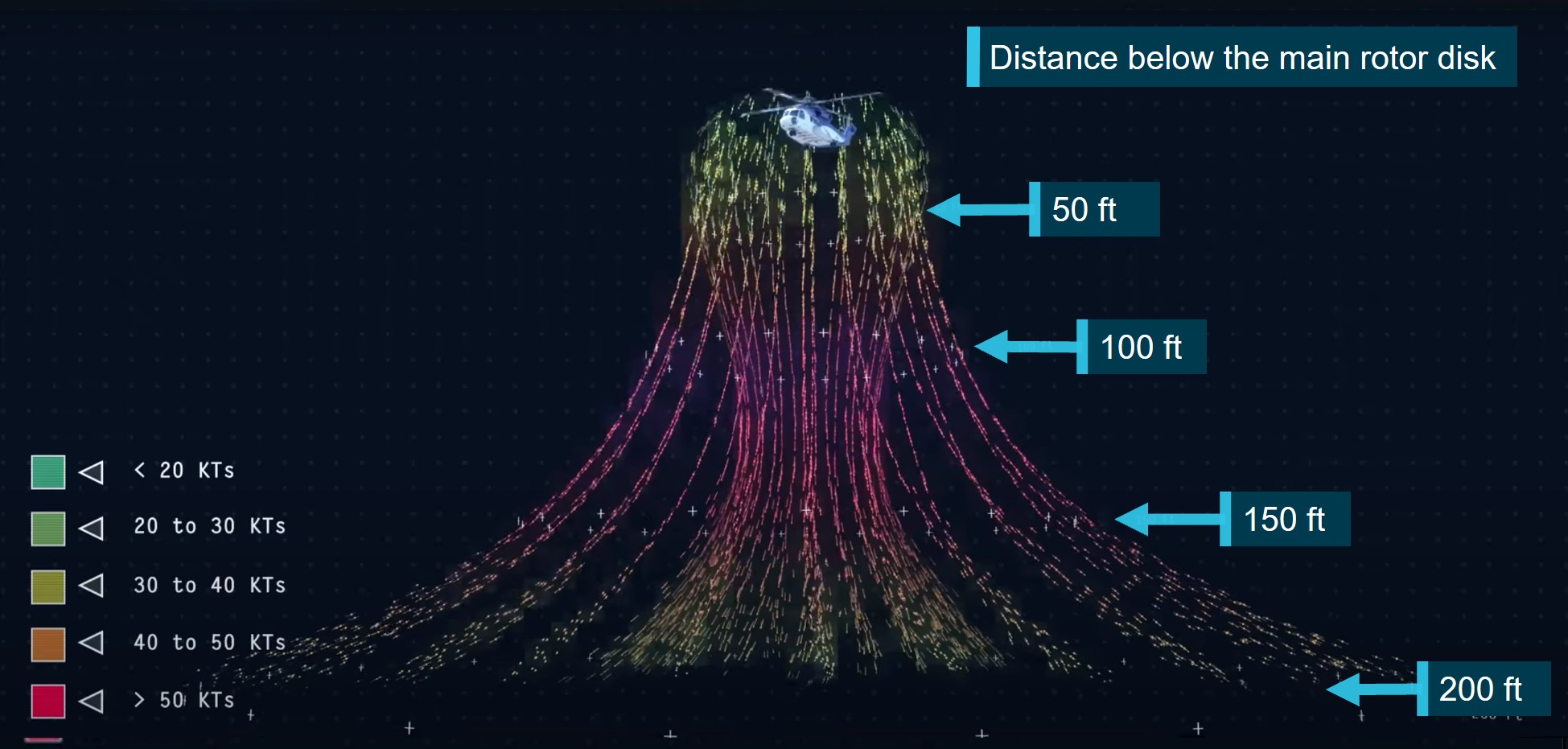
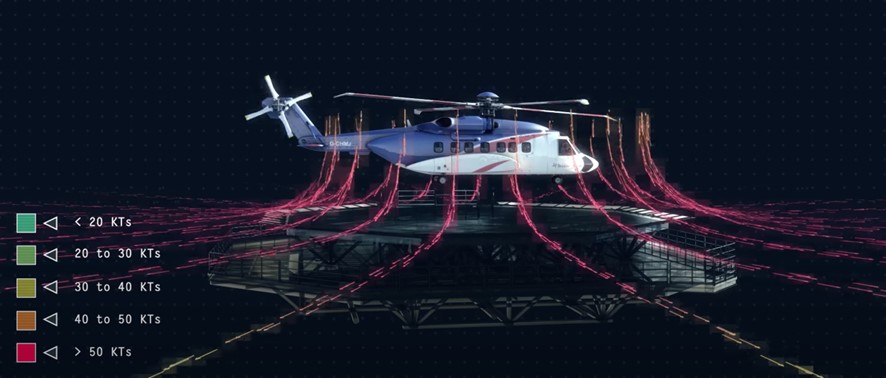
Mathematical modelling of rotor wash adjusted for the effects of open rotor flow from the main rotor blades by Airbus (2021) determined the highest velocity of this stream of air occurs from 1 to 3 rotor diameters below the rotor blades directly beneath the helicopter. Beyond this distance the high velocity airflow dissipates due to turbulence. Figure 2 is a British Petroleum model of the downwash velocities over a 200 ft vertical profile for a Sikorsky S92 helicopter. As the airflow comes under the influence of the terrain or a structure, there is a directional change and acceleration of the airflow as it transitions into sidewash as illustrated in Figure 3. Due to helicopter power requirements and the influence from the ground, rotor wash effects are most pronounced during hover, take-off, and landing where it can produce localised wind strengths greater than 100 km/h. The following figures show the rotor wash velocity in knots and a conversion table for km/h is provided at Appendix 1: Conversion tables.
Figure 2: Downwash profile of a Sikorsky S92 helicopter over 200 ft
Source: British Petroleum annotated by the ATSB
Figure 3: Sidewash profile of a Sikorsky S92 helicopter
Source: British Petroleum
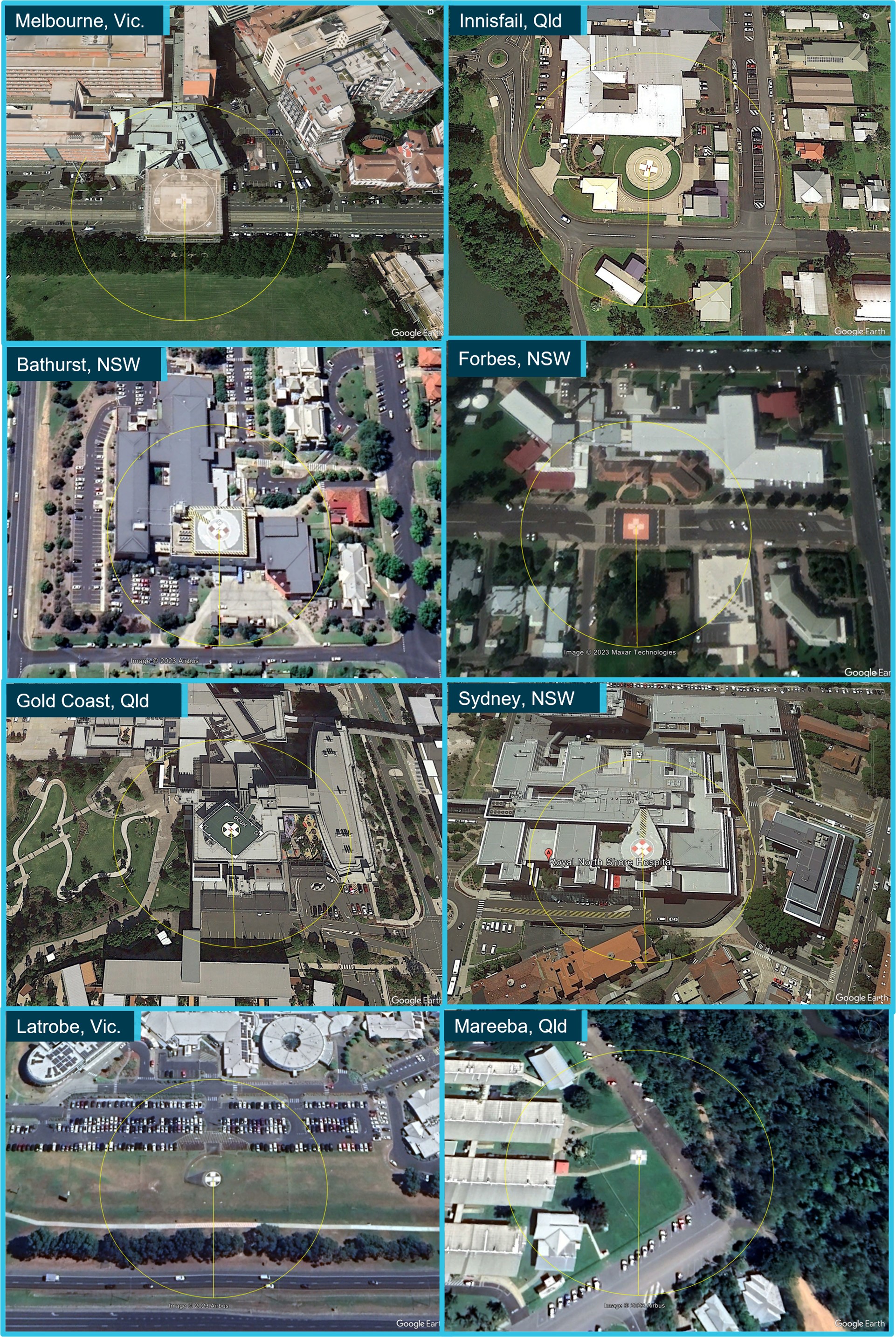
Many HLSs are located inside airports at ground level, isolated from people and structures. However, hospital HLSs are often located in built-up areas or at existing hospital facilities where space permits. In Australia, they are built on the top of high-rise hospital buildings, in carparks, in public ovals and above public roads as illustrated at Appendix 3: Area of consideration. Therefore, a hospital HLS may be in an area that exposes the public to the risk of being struck by rotor wash or struck by objects propelled or dislodged by rotor wash.
The effect of rotor wash on people has been the subject of several studies, with most agreeing that 80 km/h winds represent conditions that are ‘unsuitable for walking’, and 60 km/h winds are at the ‘threshold of danger’ for the average population (Jordan and others 2008). Jordan and others (2008) also considered the effect of rotor wash on the more vulnerable groups of the population and found that in people over the age of 50, roughly half were displaced by a gust of 40 km/h. Consequently, the International Civil Aviation Organization (ICAO) heliport design work group have been working on an amendment to Document 9261 – Heliport Manual, that will incorporate a 40 km/h rotor wash speed guidance into the document.[1]
Occurrence data
Introduction
A review of the ATSB National Aviation Occurrence Database found 18 helicopter rotor wash occurrences were reported between 2018 and 2022. Of these 18 occurrences, 9 were in the immediate vicinity of a hospital HLS. A summary of each of the 9 occurrences is provided in the following section and the occurrence data is available at Appendix 2: Occurrence data.
Of the 9 rotor wash occurrences at hospital HLS:
6 resulted in injuries, 3 resulted in serious injuries and 3 resulted in minor injuries
3 resulted in damage to third party property caused by debris.
Occurrences
ATSB occurrence OA2018-00396
On 8 January 2018 at about 1300 local time, an elderly pedestrian was walking along the footpath adjacent to the Alfred Hospital HLS, Victoria, as an AgustaWestland AW139 helicopter was on approach to land. The helicopter passed overhead the pedestrian and the rotor wash was reported to have blown the pedestrian across the path and into a wall. The pedestrian sustained minor injuries (bruising) and reported they were unaware of the possible strength of the rotor wash.
ATSB occurrence OA2018-05243
On 27 July 2018 at about 1100 local time, an AgustaWestland AW139 helicopter was on approach to land at the rooftop HLS at Bathurst hospital, New South Wales. As it passed over the corner of a carpark, a pedestrian was blown over sustaining minor injuries. This HLS was situated 4 stories above ground level. The height of the helicopter during the final approach would have been consistent with the height below the main rotor disc where the strongest downwash velocities would be experienced as described by Airbus Helicopters (2021) and illustrated with Figure 2.
ATSB occurrence OA2018-05244
On 27 July 2018 at about 2000 local time, the crew of an AgustaWestland AW139 was conducting a visual approach on night vision goggles to the Health Centre HLS in Warren, New South Wales. The crew conducted a straight in approach from the east, which involved overflying a nearby caravan park. As the helicopter approached the HLS, the crew detected a large flock of birds take-flight near the HLS and entered a hover. The crew maintained the hover at 200 ft above ground level for approximately 2 minutes to allow the birds to disperse. During this time, rotor wash was reported to have affected the trees in the caravan park below, with falling branches causing minor damage to caravan park buildings and equipment.
ATSB occurrence OA2019-00659
On 24 January 2019 at about 1200 local time, an AgustaWestland AW139 was on approach to land at the Latrobe Regional Hospital, Victoria. Rotor wash from the helicopter blew a traffic barricade into the side of a vehicle parked nearby. The vehicle sustained minor damage.
ATSB occurrence OA2020-06455
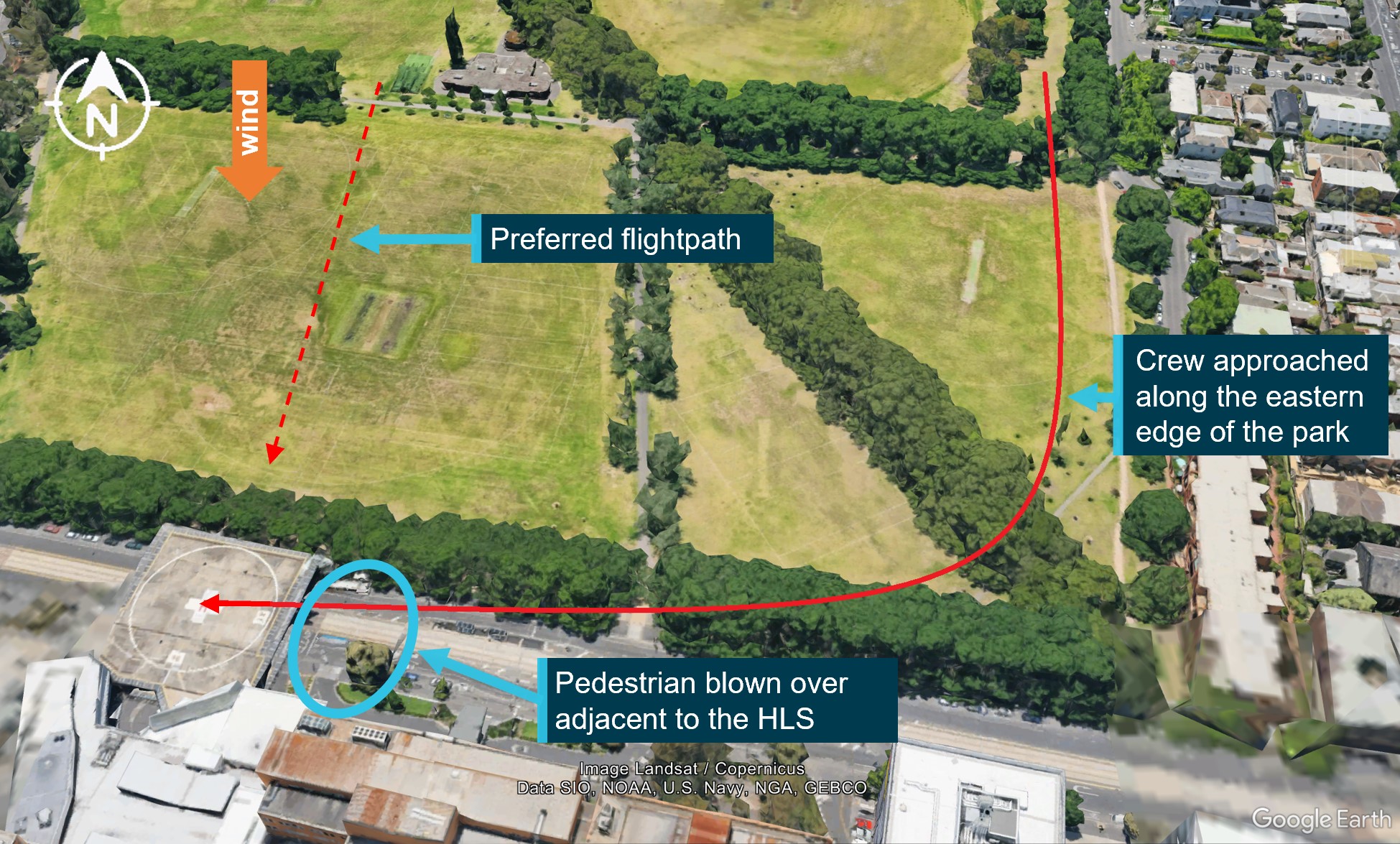
On 27 December 2020 at about 1300 local time, a pedestrian was walking along the footpath adjacent to the Alfred Hospital HLS as an AgustaWestland AW139 helicopter was on approach to land. The crew altered their approach to account for the 35-knot wind on the day by tracking along the nearby park before turning towards the HLS on late final (Figure 4). As the helicopter approached the HLS, the pedestrian was blown over and sustained a broken sacrum.
On 28 October 2021 at about 1550 local time, an AgustaWestland AW139 conducted an approach to land at the Alfred Hospital HLS. The crew approached the helipad from the west, using a steep approach profile aligned with Commercial Road. As the helicopter passed overhead a pedestrian walking on the footpath about 30 m west of the HLS,[2] the pedestrian was blown over by the rotor wash and sustained serious injuries (broken bones) (Occurrence Brief AB-2021-02).
ATSB occurrence OA2022-02001
On 24 May 2022 at about 0852 local time, an AgustaWestland AW139 was on approach to the Royal Prince Alfred Hospital, NSW. During approach to the elevated HLS, the doctor onboard observed a large piece of cloth blown up behind the helicopter. Further investigation revealed that multiple lengths of shade cloth, held in place by bricks, had been dislodged by the rotor wash. It was later discovered that some of the bricks used to retain the lengths of cloth had fallen 300 ft to the ground below, with one brick found in a café and another found in an area of the hospital grounds open to the public.
ATSB occurrence OA2022-02750
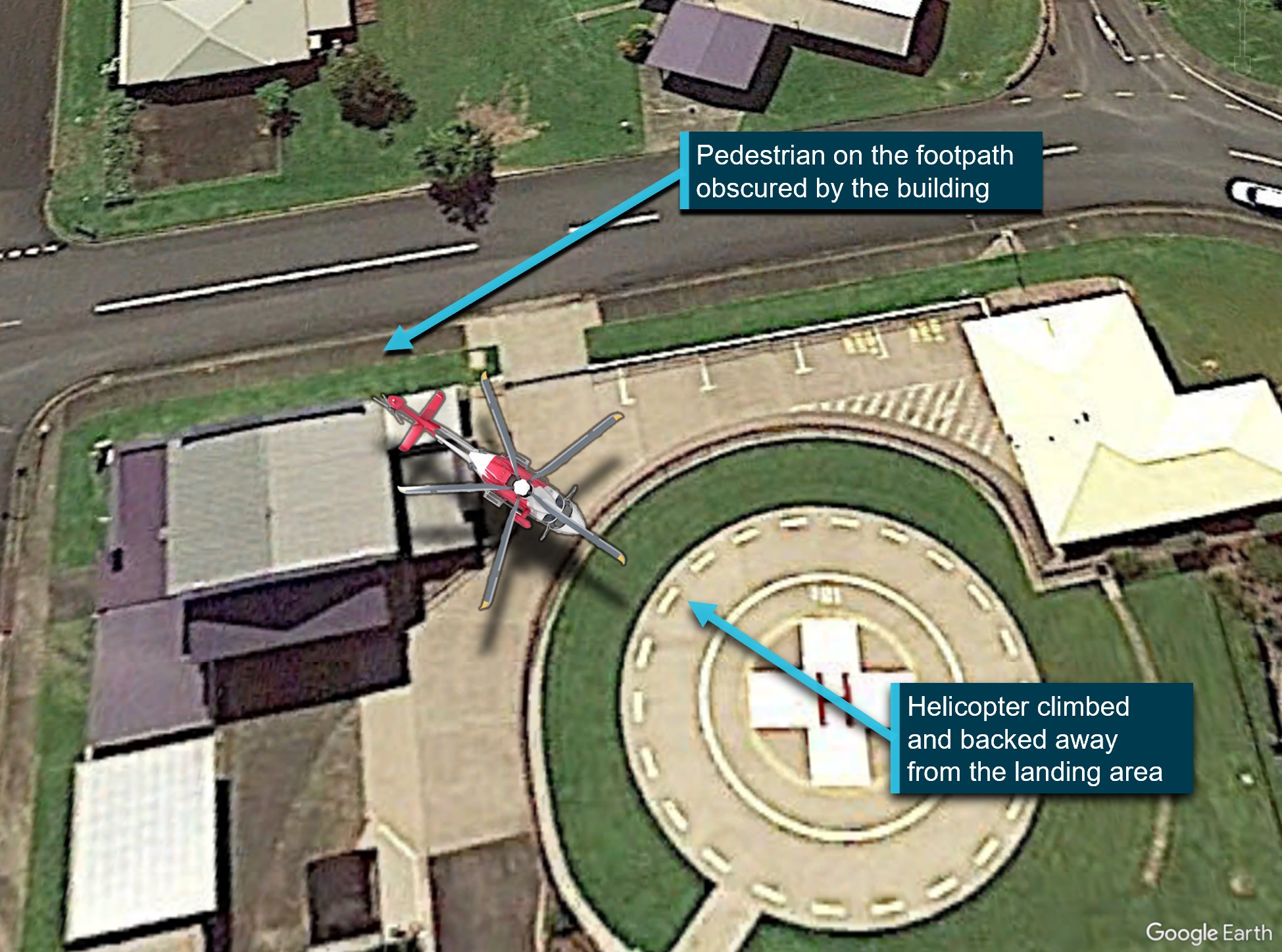
On 17 July 2022 at about 1708 local time, an AgustaWestland AW139 helicopter departed from the Innisfail Hospital HLS, Queensland. The standard departure required the helicopter to climb vertically and back away from the helipad slightly so the pilot could keep the landing area in sight in case of an abort before flying away (Figure 5). As the helicopter backed over the top of a hospital building towards the nearby roadway, a pedestrian walking on the adjacent footpath was blown over and sustained a serious head injury. The pedestrian was not visible to the crew from the helipad.
Figure 5: Approximate flight path based on operator report
Source: Google Earth annotated by the ATSB
ATSB occurrence OA2022-04733
On 25 December 2022 at about 1500 local time, the crew of an AgustaWestland AW139 commenced a take-off from the Mareeba Hospital HLS, Queensland. An elderly patient of the hospital was walking in the hospital grounds at the time and as the aircraft lifted into a low-level hover, they were blown over by the rotor wash. The patient fell to the ground and sustained minor head injuries. The crew observed the patient fall and aborted the take-off.
Medical helicopter operations and size
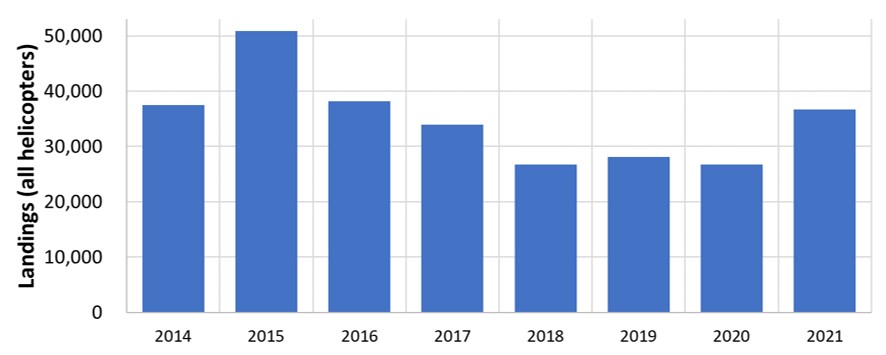
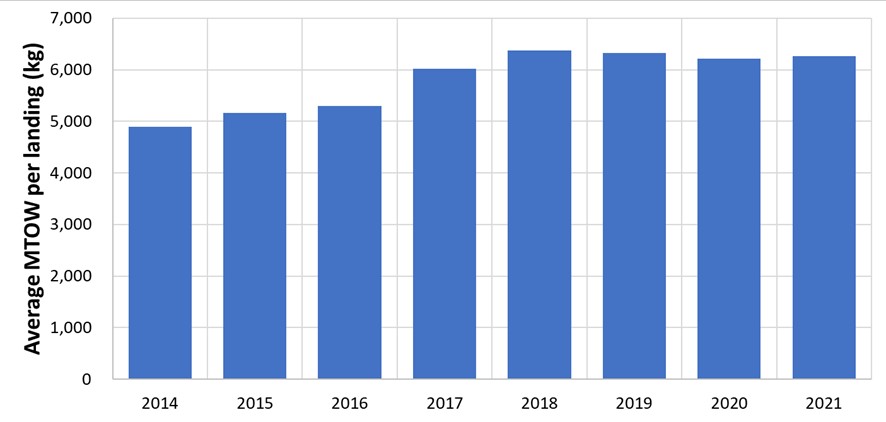
Analysis of medical transport operations (MTO) helicopter movements, from data obtained from the Bureau of Infrastructure and Transport Research Economics, indicates that the number of landings per year (Figure 6) remained relatively constant from 2014 through to 2021.
Figure 6: Number of medical transport landings 2014-21
Source: Bureau of Infrastructure and Transport Research Economics
Figure 8: Number of AW139 medical transport landing 2014-21
Source: Bureau of Infrastructure and Transport Research Economics
Common factors
Helicopter emergency medical service operations often involve time critical missions that require the crew to utilise landing areas within the grounds of hospitals. Analysis of the 9 identified occurrences found the following common factors:
most incident crews were unaware of the incident at the time of occurrence
there were no references to established rotor wash danger or exclusion areas[3]
in 5 out of the 6 injury-related events, the pedestrians age was reported to be 75 or greater, and in the 6th event, the pedestrian was reported to be using a walker
where the locations of injured pedestrians were reported, they were outside the HLS perimeter fence but within 30 m of the final approach and take‑off area (FATO) .[4]
In addition to the increase in helicopter mass, the capability of the AW139 permitted a greater number of vertical, backup, or lateral transition take-off and approach and landing options to the flight crew. The different ways the aircraft could be flown may have also been a contributing factor to the increase in rotor wash occurrences but could not be determined from the occurrence database.
Regulatory oversight and guidance
Australia
The Civil Aviation Safety Authority (CASA) does not regulate the design or operation of HLSs if they are not an integral element of an aerodrome certified under Part 139 of the Civil Aviation Safety Regulations (CASR) 1998. As hospital HLSs are not located at Part 139 certified aerodromes, CASA does not regulate their design or operation. In accordance with CASA Advisory Circular (AC) 139.R-01 v1.0 – Guidelines for Heliports – design and operation(Opens in a new tab/window), a HLS is an aerodrome intended to be used wholly or in part for the arrival, departure, and surface movement of helicopters and therefore, references to an aerodrome in this section below includes hospital HLSs.
Helicopters operating into and out of hospitals are generally medical transport operations. Medical transport operations (MTO) fall into the air transport rule set under CASR Part 133 – Australian air transport operations–rotorcraft. CASA advised the ATSB:
Part 133 requires the MTO operators to include in their exposition via regulation 133.170 of CASR procedures to determine information about aerodromes and via regulation 133.175 of CASR procedures for safety at aerodromes.
CASR 133.170 requires the MTO operator’s exposition to include information on the final approach and take‑off area (FATO) dimensions and directions for the pilot-in-command. This includes any limitations, special procedures, and restrictions the operator requires the flight crew to use at the aerodrome.
CASR 133.175 stated an operator’s procedures must include measures to ensure the safety of persons in the vicinity of the rotorcraft. The requirement to consider the effects of rotor wash is mentioned in part (b):
(b) procedures to determine the minimum distance that a person, animal or thing must be kept from the following to ensure the safety of the person, animal or thing:
(i) the rotorcraft while it is on the ground at an aerodrome with its rotors turning;
(ii) the movement area of an aerodrome while the rotorcraft is landing or taking off;
(iii) a hazard created by the downwash of the rotorcraft at an aerodrome.
In reference to CASR 133.175, CASA stated:
The assumption is these procedures and distances would also be communicated to any person responsible at a HLS location for third party person and property risk control measures, otherwise the operator would not be able to operate to the location and comply with their exposition.
the FATO and touchdown and lift-off area (TLOF)[6] are clear of all objects and animals likely to be a hazard to the helicopter, other than objects essential to the helicopter operation
no person is within 30 m of the closest point of a hovering or taxiing helicopter, other than persons who are essential to the safe conduct of the operation or the specific nature of the task and who are trained and competent in helicopter operational safety procedures
appropriate information from the owners and authorities is obtained to confirm the suitability of the HLS for the proposed operation.
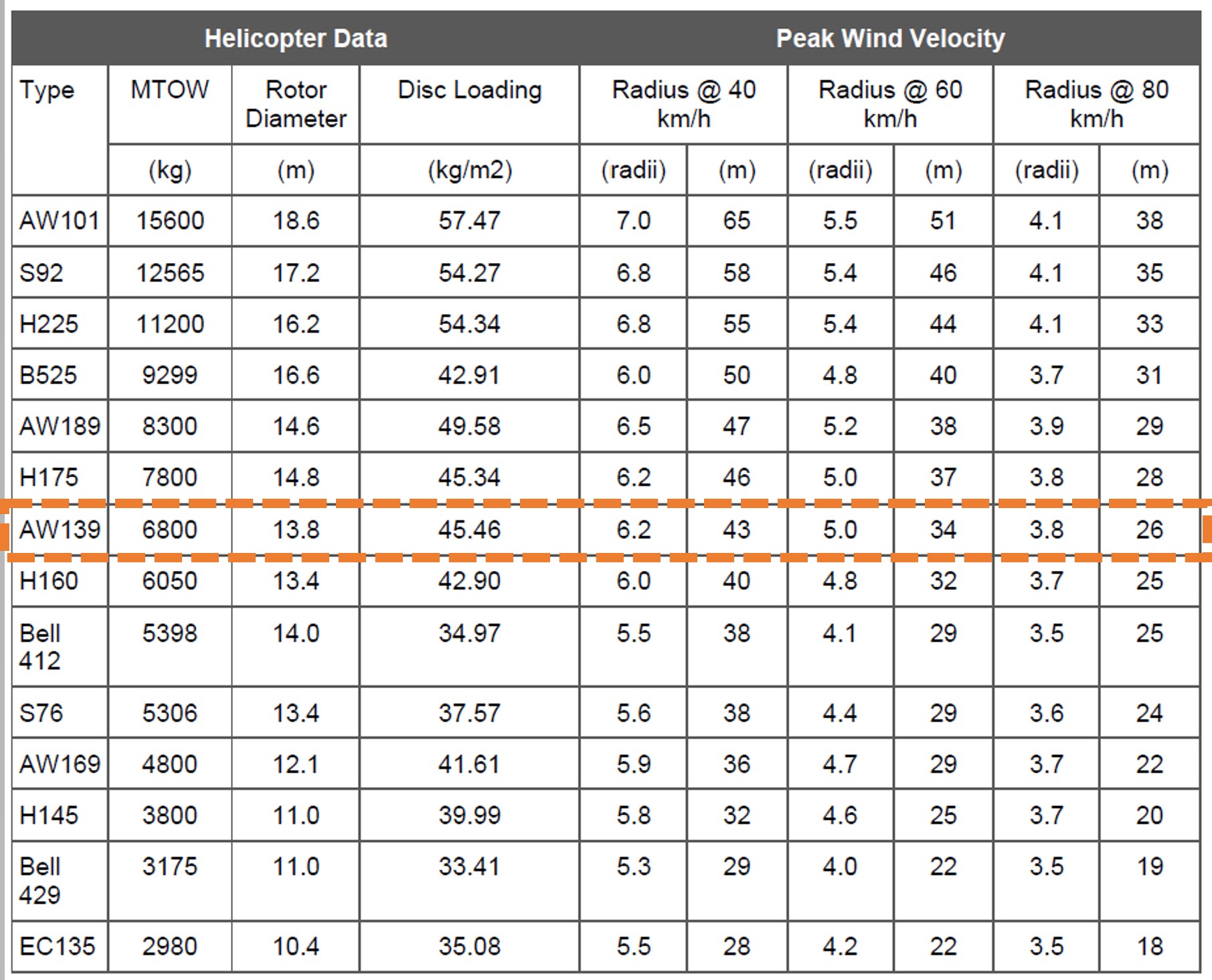
Data on rotor wash speeds has been incorporated into CASA AC 139.R-01 v1.0(Figure 9) and shows the distance from the centre of the helipad that rotor wash velocities of 40, 60 and 80 km/h can be expected for common helicopter types. The data is expressed both as a distance in metres, and as multiples of the main rotor disc radius. Figure 9 indicates that the associated strength of rotor wash increases with increased helicopter weight (MTOW). The AgustaWestland AW139, involved in all 9 rotor wash incidents described above, is highlighted and shows that beyond the recommended 30 m non-essential person exclusion area, rotor wash velocities can be expected to be between 60 and 80 km/h.
The ATSB contacted several foreign regulatory bodies to determine the oversight of hospital HLSs outside Australia. Responses were received from the United Kingdom Civil Aviation Authority (UK CAA) and Transport Canada. In addition, the guidance from the United States Federal Aviation Administration was reviewed. At the time of drafting this report the UK Air Accidents Investigation Branch had an active investigation into a fatality at the Derriford Hospital HLS, Plymouth, from a Sikorsky S92 helicopter rotor wash.
United Kingdom Civil Aviation Authority
The UK CAA advised the ATSB that every helicopter operator is responsible for approving a HLS and principal oversight by the CAA is through the review and acceptance of each operator’s operations manual landing site directory. They reported that where an elevated helipad is intended for use at night, a check flight will be conducted with the primary operator and thereafter cleared for other operators who will include it in their own landing site directory.
Hospital HLSs are not currently licensed in the UK and, with the emphasis in the Air Navigation Order (ANO) on licensing heliports only where scheduled public transport operations occur, there are only a handful of licensed heliports in the UK. New hospital HLS builds in the UK, since 2016, have been designed to the standards of UK Civil Aviation Publication (CAP) 1264 – Standards for helicopter landing areas at hospitals(Opens in a new tab/window), which incorporates sections on downwash guidance. Several recent new build HLSs, to meet a condition of their local planning authority process, have incorporated a downwash study at the pre-application stage, which takes account of the impact of rotor downwash on persons and property. However, this has been adopted by some projects as a good practice rather than as a regulatory requirement. At the time of publishing this report, it was reported that the UK CAA was poised for a further review of CAP 1264, including downwash guidance, pending the release of a final investigation report into a fatality at Derriford Hospital due to main rotor downwash from a helicopter arriving at the hospital HLS.
Utilising consultancy arrangements via their subsidiary organisation CAA International Limited, UK CAA offers a service to provide support to Hospital HLS new builds and refurbishments by undertaking feasibility studies and providing advice and support to National Health Service Trusts and their sub-contractors. CAA is currently rolling out Hospital Helipad Training Aviation Awareness courses for the benefit of Hospital HLS operational staff.
Transport Canada
Transport Canada advised that the requirement for certification is predicated in most cases on the location of the heliport being within the built-up area of a city or town, as mandated under Part 305(Opens in a new tab/window) of the Canadian Aviation Regulations 1996. Hospital HLSs may or may not meet this requirement. HLSs which are not required to be certified and whose operators wish to have the aerodrome registered and the information published in the Canada Flight Supplement, will fall under Canadian Aviation Regulation Part 301(Opens in a new tab/window), with respect to the location, markings, lighting, use and operation of the aerodrome. This differed from the available Australian guidance in that Canadian hospital HLS operators, who elected to comply with the Canadian Aviation Regulations, were required to ensure that certain minimum safety considerations were met.
Canadian Aviation Regulation 301.03(2) stated:
The Minister may refuse to register an aerodrome where the operator of the aerodrome does not meet the requirements of sections 301.05 to 301.09 [concerning warning notices, wind direction indicator, lighting, prohibitions, fire preventions] or where using the aerodrome is likely to be hazardous to aviation safety and, in such a case, shall not publish information with respect to that aerodrome.
Canadian Aviation Regulation 301.05 identified the following HLS operator responsibilities with regards to warning notices:
Where low-flying or taxiing aircraft at or in the vicinity of an aerodrome are likely to be hazardous to pedestrian or vehicular traffic, the operator of the aerodrome shall immediately:
(a) post notices warning of the hazard on any public way that is adjacent to the manoeuvring area; or
(b) where such a public way is not owned or controlled by the operator, inform the authorities responsible for placing markings on the public way that there is a hazard.
United States Federal Aviation Administration
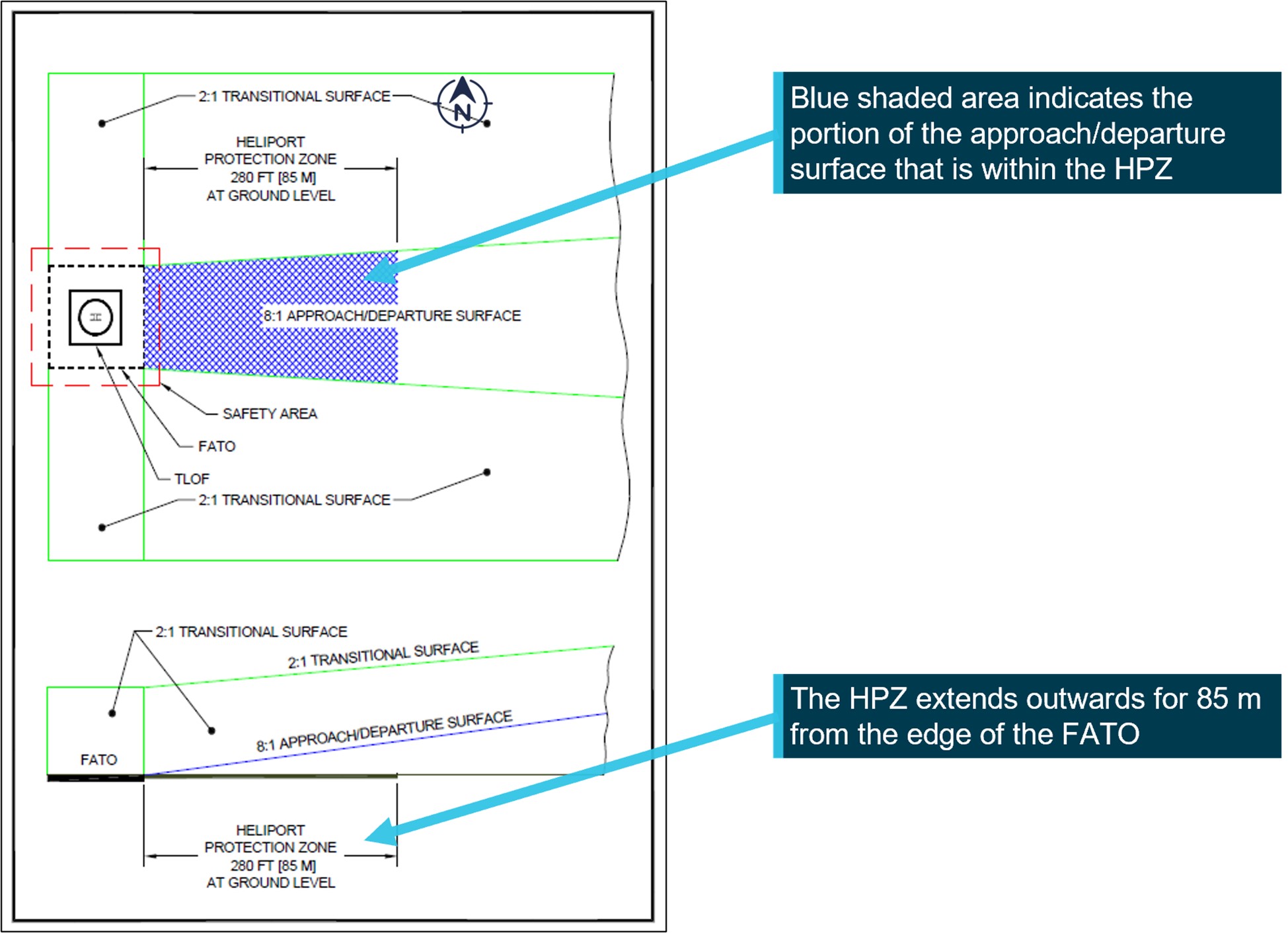
In the United States, the Federal Aviation Administration AC 150/5390-2D(Opens in a new tab/window) for heliport design recommended the establishment of a heliport protection zone (HPZ) for each approach/departure surface as illustrated in Figure 10. Starting at the edge of the FATO, the HPZ extends outwards underneath the flight path for 280 ft (85 m).
The HPZ is intended to enhance protection of people and property on the ground. This is achieved through heliport owner control over the HPZ. Such control includes clearing HPZ areas (and maintaining them clear) of incompatible objects and activities.
Source: United States Federal Aviation Administration
Managing the risk of rotor downwash at hospital HLS
Introduction
The recent increase in rotor wash incidents does not suggest that hospital HLSs are more dangerous now than they were previously, rather, the risk mitigation measures employed for previous generations of MTO helicopters are likely inadequate in managing the rotor wash hazard produced by the current generation of heavier MTO helicopters. The regulatory standards and guidance published by CASA indicate there is a shared responsibility between the HLS operator, the MTO operator, and the pilot-in-command for the safe conduct of operations to a hospital HLS.
Areas where the strength of rotor wash should be considered by hospital HLS operators, who want to comply with the Part 139 standards, should include:
public areas where pedestrians are likely to be walking
public roads and vehicle access areas
areas that contain unrestrained objects that could be propelled by rotor wash
buildings and other structures that may cause channelling and turbulence of the rotor wash.
Where the specifications cannot be met, CASA AC 139.R-01 recommends a risk assessment is conducted to identify any alternative mitigation measures to achieve an acceptable level of safety of helicopter operations at the HLS.
Understanding the risk
Where the locations of injured pedestrians were reported, they were outside the HLS perimeter fence but within 30 m of the FATO and inside the area CASA AC 91-29 recommended be kept clear of non-essential pedestrians. If the recommended rotor wash exclusion area had been applied at each HLS, it would have reduced the risk of the pedestrians being injured. However, based on the latest guidance published by CASA in AC 139.R-01 v1.0, and the research by Jordan and others (2008), the hazards associated with rotor wash at a hospital HLS should be considered further than 30 m, out to the 40 km/h rotor wash radius, to prevent injury to the elderly and vulnerable. For a HLS constructed at surface level, the distances published by CASA indicate the danger area[7]. However, for an elevated HLS, or HLS in the vicinity of structures, a rotor wash analysis should be considered to understand the nature of the risk. This can be explored with anemometers and wind vanes or with computational fluid dynamics to produce a plot of the HLS rotor wash danger area in accordance with the approach and departure flight paths for the design helicopter.[8]
Risk controls
While it is the responsibility of the HLS operator and MTO operator to identify what controls are necessary for safe operations, some generic risk controls for consideration may include an exclusion area, physical barriers, active controls, passive controls, MTO operating procedures, inspections, and a hazard reporting and tracking system as follows:
A HLS exclusion area should be in accordance with the danger area for the design helicopter as published in AC 139.R-01 v1.0, or as determined by a plot of the HLS rotor wash danger area. If this is not feasible, then an alternative strategy may need to be evaluated. Examples of hospital HLS sites in Appendix 3: Area of consideration are based on the guidance for an AgustaWestland AW139 as per Figure 11 below, which recommends an exclusion area based on a 66 m radius.
Physical barriers, such as fences and covered walkways, designed as safety barriers and/or security barriers to prevent inadvertent entry to the HLS, can provide protection to pedestrians and property from rotor wash.
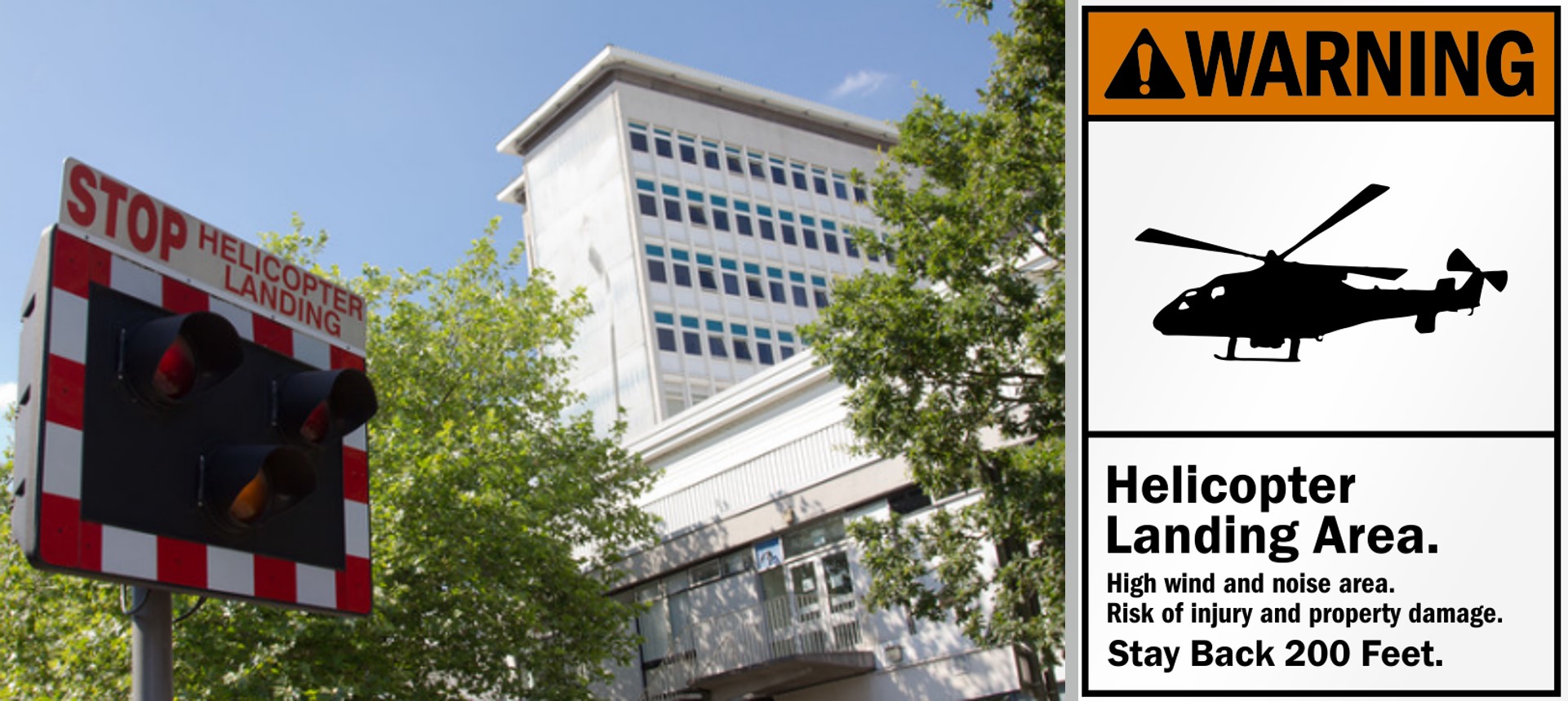
Active controls can be used during helicopter operations to alert pedestrians in or near the danger area with warning lights and alarms as per Figure 12. Marshallers can be employed to restrict pedestrian access during helicopter operations.
Passive controls should include warning signs and painted/marked paths to indicate the helicopter operations danger area to the public (Transportation Research Board, 2013).
An inspection schedule can identify and secure or remove loose objects and verify the condition and serviceability of the other controls, such as the signs and barriers.
Operating procedures in accordance with CASR 133.170, should include the approved approach and departure flight paths, alternate landing sites, and the location of the danger areas for pedestrians, so flight crew can make informed decisions.
A closed-loop reporting system should be available for flight crew to alert the MTO operator and HLS operator to hazards for tracking through to closure, including any temporary or permanent controls implemented to reduce the risk.
Figure 11: HLS rotor wash regions of consideration for an AgustaWestland AW139[9]
Source: ATSB
Figure 12: HLS warning device (left) and sign (right)
Source: alamy.com
Safety action
Safety advisory notice to helicopter medical transport operators and hospital helicopter landing site operators
The Australian Transport Safety Bureau strongly encourages operators of hospital helicopter landing sites, and helicopter medical transport operators using those landing sites, work together to review the adequacy of existing risk controls to ensure pedestrians are adequately protected from the increased rotor wash associated with larger helicopters.
Sources and submissions
Sources
Civil Aviation Safety Authority
Transport Canada
United Kingdom Civil Aviation Authority
References
Airbus Helicopters (2021). Safety Promotion Notice No. 3684-P-00 Noise and downwash considerations for ground operators. Airbus Helicopters
Civil Aviation Safety Authority (2022). Advisory Circular AC 91-29 v1.1 Guidance for helicopters – suitable places to take-off and land. Civil Aviation Safety Authority.
Civil Aviation Safety Authority (2022). Advisory Circular AC 139.R-01 v1.0 Guideline for heliports – design and operation. Civil Aviation Safety Authority.
Civil Aviation Safety Authority (2019). Part 139 (Aerodromes) Manual of Standards. Australian Government.
Federal Aviation Administration (2012). Advisory Circular AC 150/5390-2C–Heliport design Federal Aviation Administration.
International Civil Aviation Organisation (2021). Document 9261:Heliport manual. International Civil Aviation Organisation.
Jordan, S. C., Johnson T., Sterling M., and Baker, C. J. (2008) Evaluating and Modelling the Response of an Individual to a Sudden Change in Wind Speed, Building and environment, Vol. 43.
Under section 26 of the Transport Safety Investigation Act 2003, the ATSB may provide a draft report, on a confidential basis, to any person whom the ATSB considers appropriate. That section allows a person receiving a draft report to make submissions to the ATSB about the draft report.
A draft of this report was provided to the following directly involved parties:
Civil Aviation Safety Authority
United Kingdom Civil Aviation Authority
Transport Canada
Federal Aviation Administration
Submissions were received from:
Civil Aviation Safety Authority
United Kingdom Civil Aviation Authority
Transport Canada
The submissions were reviewed and, where considered appropriate, the text of the report was amended accordingly.
Appendix 1: Conversion tables
Table 1: Knots to kilometres per hour conversion table
kt
km/h
1
1.852
10
18.5
20
37.0
30
55.6
40
74.1
50
92.6
Table 2: Kilometres per hour to knots conversion table
Adapted from the guidance in AC 139.R-01. All images show a 66 m radius circle indicating the area that CASA recommended was kept clear of all loose objects and non-essential people.
Source: Google Earth annotated by the ATSB
[1] International Civil Aviation Organization Heliport design work group virtual seminar on the design and operation of heliports to provide States with updated tools based on the new amendments to Annex 14 Vol. II, updated ICAO guidance documents; and awareness of new measures.
[2]While AB-2021-028 reported this distance as 50 m west of the HLS, analysis of the details provided found that it was approximately 30 m from the HLS.
[3] Exclusion area: Term used to refer to an area from which non-essential personnel should be kept clear in accordance with AC 91-29 v1.1 and AC 139.R-01 v1.0.
[4] FATO: Final approach and take-off area. For the operation of a rotorcraft, means the area of the aerodrome:
1. from which a take-off is commenced or
2. over which the final phase of the approach to hover is completed.
[5] AC 91-29 v1.1: Supports the new Civil Aviation Safety Regulations and replaces operational information previously found in CAAP 92-2(2) and is referred to in AC139.R-01 v1.0. An advisory circular provides advice and guidance to illustrate a means, and not necessarily the only means, of complying with regulations.
[6] TLOF: Touchdown and lift-off area is the surface over which the touchdown and lift-off is conducted.
[7] Danger area: Term used to refer to an area where rotor wash velocities can be expected at or above speeds that may displace a person. (See section titled Rotor wash and Figure 9).
[8] From AC 139.R-01 v1.0: The design helicopter is a helicopter having the most demanding set of dimensions, the greatest maximum take-off weight and the most critical obstacle avoidance criteria. It may not be a single helicopter type but rather a combination of critical aspects from numerous helicopters that the heliport intends to serve.
[9] Touchdown and lift-off area (TLOF) is the surface over which the touchdown and lift-off is conducted.
Final approach and take-off area (FATO) for a rotorcraft, means the area of the aerodrome from which take-off is commenced; or, over which the final phase of the approach to hover is completed.
[10] Operator confirmed AW139 helicopter involved but was unable to confirm the registration of the aircraft.
Over the last decade there has been a noticeable reduction in the number of non-fatal and fatal accidents involving the worldwide commercial jet aircraft fleet. Despite this, runway excursions continue to remain prevalent, accounting for approximately a quarter of all incidents and accidents in air transport, and 96 per cent of all runway accidents. Runway excursions involve aircraft running off the end of the runway (overrun) or departing the side of the runway (veer-off).
A number of catastrophic runway excursions occurred across the world in 2007 and 2008, resulting in hundreds of fatalities and significant property damage in communities adjacent to the airport. This report, the first in a two-part series, provides a statistical picture of runway excursion accidents over a 10-year period - how frequently they occur, why they occur, and what factors contributed to those accidents.
A search of the Ascend World Aircraft Accident Summary identified 141 runway excursion accidents involving the worldwide commercial jet aircraft fleet between 1998 and 2007. Those accidents resulted in 550 fatalities. Of those 141 accidents, 120 occurred during the landing phase of flight. An in-depth analysis of those 120 accidents was conducted in order to identify the types of flight crew technique and decision-related, flight crew performance-related, weather-related, and systems-related factors that contribute to runway excursions.
Fortunately, Australia has not experienced a runway excursion accident of the severity of those seen overseas. However, given the proximity of Australia's major airports to urban residential and industrial areas, Australia is not immune. Since 1998, three excursions of Australian-registered commercial jet aircraft have been investigated by the Australian Transport Safety Bureau. While two of those incidents were relatively minor, one incident involving a runway overrun in Thailand resulted in substantial damage to the aircraft.
The air traffic control safety net fails when human errors go undetected and uncorrected. These operational errors are generally more likely to occur in circumstances such as very high or very low workload situations, or events involving complex coordination. Predisposing or underlying factors relating to the ATC operational environment can influence the frequency, and the consequences, of operational errors. System safety can be improved by the identification and rectification of these predisposing factors.
Information from air traffic controllers from each sector within the Brisbane AACC. together with the results of interviews with the management from the Northern District and Central Office Air Traffic Services Division formed the basis of this investigation.
The investigation identified a number of local factors associated with the task and the environment which may increase the probability of errors by individual controllers. Task related issues included the operation of VFR aircraft in the Brisbane Terminal Area, and the relationship between the AACC and Brisbane and Archerfield Control Towers. Also highlighted within the AACC was what is referred to in the report as the 'service ethos', or the tendency for air traffic controllers to provide an. individualised service to aircraft at the expense of a regularised traffic flow. The level of awareness of human performance capabilities and limitations among the controllers interviewed was found to be minimal.
At the time of the investigation, training was under way for the implementation of teams and for transition to ICAO airspace (which was deferred shortly after interviews with the controllers were completed). This placed a considerable training burden on the AACC and there was a strong view among the controllers that too many changes were being introduced into the ATS system in too short a time frame. In addition, it was apparent that the management view of what the changes involved differed markedly from the understanding held by the controllers. It seemed that the human factors aspects of the change process (i.e. those involving the controllers) were not addressed by management to the same extent as were the "mechanical" aspects such as procedural and technical changes. Consequently, the recommendation is made that ATS Division devotes more attention and resources to the processes and mediums by which it leads its workface employees through the change cycle.
The effective two-way flow of information within a system is an important determinant of the "safety health" of that system. The introduction of teams at the Brisbane AACC in early October 1993 was a major step in facilitating improved information flow to and from the workface. Nevertheless, at the middle management level, significant deficiencies were identified in the communication network. These were the geographic separation of the office of the Manager AACC from the AACC itself, and a similar separation between the third and some of the fourth level management officers. This latter aspect will largely be overcome in April 1994 when the city office relocates to the airport. However, a Jack of suitable building space has prevented the Manager AACC from being co-located with the AACC and there are currently no plans for such a move. The investigation concludes that this aspect should be reassessed as a matter of urgency.
Communication was also identified as an issue at the corporate level. Liaison between the various managerial levels seemed to work effectively with regard to local and national initiatives formulated in Central Office. However, feedback to the workface concerning projects in which controllers were involved usually occurred at the conclusion of a project. This may result in controllers feeling they have little commitment to development, despite the involvement of district office representation.
Commitment of the workforce is a prerequisite to successful change. Evidence seems to indicate that in some respects this has been lacking despite the resources committed by management to the orientation of controllers. Change in the Australian ATS environment is inevitable and ATS Division therefore needs to re-examine the processes and mediums through which it educates its employees with particular reference to the implementation process for TAAATS.
In 2016, through routine monitoring of safety occurrence data, the ATSB identified a potential safety issue regarding the high proportion of wake turbulence occurrences at Sydney Airport.
To identify the contributing factors to this higher rate of occurrences at Sydney, and the level of safety risk of wake turbulence occurrences at the airport, the ATSB initiated an Aviation Research investigation under the Transport Safety Investigation Act 2003.
View and download the AR-2017-011 research report here
This research commenced following receipt of correspondence suggesting that an increase in helicopter engine issues in northern Australia was potentially linked to a change to reduced lead content fuel in these areas. The Civil Aviation Safety Authority (CASA) advised the ATSB that, in December 2015, the colour and branding of fuel supplied to the northern region of Australia changed, from green Avgas 100/130 to blue Avgas 100LL (low lead). Although the maximum permissible lead content reduced with this change, CASA advised that the actual lead content of the supplied Avgas 100/130 fuel had already been below the maximum permitted by the Avgas 100LL standard prior to December 2015.
An analysis of safety occurrence records was conducted to identify if any significant changes to the number of reported engine failures or malfunctions had occurred following the introduction of Avgas 100LL. The analysis found that overall there had been no discernible increase in reported engine failures or malfunctions in northern Australia after the introduction of Avgas 100LL in December 2015. Specifically for helicopters with Lycoming piston engines, there was an increase in reported occurrences of engine failures or malfunctions since 2014, largely dominated by northern Australia. However, occurrence numbers are low so some year-to-year variation from chance alone is expected. Additionally, the increase did not align with the introduction of Avgas 100LL in December 2015.
Potential symptoms of the issues were reported as premature cylinder removals, and a high rate of exhaust valve and guide wear. The analysis found only one incident related to valve wear in northern Australia following the reported fuel change. However, the ATSB found a disproportionate number of engine failures or malfunctions in piston engine helicopters with unidentified failure mechanisms following the change to Avgas 100LL. Although it was not possible to eliminate the introduction of Avgas 100LL fuel as a potential factor in these engine failures, conclusive findings could not be drawn based on the available evidence.
In response to the concerns raised, the Northern Fuels Stakeholder Investigation Group was formed to investigate this issue further. Additionally, CASA has introduced airworthiness bulletin (AWB) 85-024 Issue 1, to raise awareness of an increasing incidence of premature exhaust valve and valve guide wear.
Note for the second edition: Since the publication of the ATSB report A safety analysis of remotely piloted aircraft systems 2012 to 2016 (AR-2017-016) in March 2017, the ATSB has observed a significant change in the trend of reported occurrences involving Remotely Piloted Aircraft Systems (RPAS). Contrary to the previous report, our most current forecasts predict the total number of RPAS occurrences reported to the ATSB in 2017 to be comparable to 2016.
Due to this new information and the lack of data present in the public arena, the ATSB opted to publish a new edition of the report detailing our current understanding of the implications to transport safety associated of RPAS activity in Australia. Data presented in this edition is current to the end of June 2017.
Why the ATSB did this research
The growth in the number of remotely piloted aircraft systems (RPAS) in Australia is increasing rapidly. This presents an emerging and insufficiently understood transport safety risk.
The ATSB aims through this report to present data and analysis to further understanding of the implications for transport safety associated with the continual growth of RPAS activity in Australia.
What the ATSB found
Although accurate assessments of the number of RPAS in Australia is not possible, using proxy data, it is clear that the number of RPAS in Australia is growing rapidly each year. Compared to 2016, there will be a possible doubling in the number of systems in Australia by the end of 2017.
In association with the level of growth, the number of RPAS‑related safety occurrences reported to the ATSB increased rapidly during the 2012 to 2016 period. However, the first half of 2017 saw significantly fewer occurrences than predicted given the previous data. Current forecasts—incorporating data up to the end of June 2017—predict the number of RPAS occurrences reported to the ATSB in 2017 to be comparable to 2016.
Over half of all occurrences from January 2012 to June 2017 involved near encounters with manned aircraft, almost three‑quarters occurred between January 2016 and June 2017. Most occur in capital cities, Sydney in particular, and above 1,000 ft above mean sea level (AMSL).
To date, there have been no reported collisions between RPAS and manned aircraft in Australia.
The next most common type of occurrence involved collisions with terrain, almost half of which results from a loss of control of the RPAS.
The consequences of collisions between RPAS and manned aircraft are not yet fully understood. World-wide, there have been five known collisions. Three of these resulted in no damage beyond scratches. However, one collision with a sport bi-plane in the United States in 2010 resulted in a crushed wing. Fortunately, the aircraft landed safely. Less fortunately, a Grob G 109B motor glider had a wing broken by an RPAS collision in 1997 in Germany, resulting in fatal injury to the two people on board.
Due to the rarity of actual collisions, there is limited data from which to draw conclusions regarding the possible outcomes. Laboratory testing and mathematical models produced by various agencies have been used in conjunction with abundant aircraft birdstrike data in an attempt to assess the probable consequences of a collision.
RPAS collisions with high capacity air transport aircraft can be expected to lead to an engine ingestion in about eight per cent of strikes. The proportion of ingestions expected to cause engine damage and engine shutdown will be higher than for bird ingestion (20 per cent of ingestions).
RPAS have the potential to damage a general aviation aircraft’s flight surfaces (wings and tail), which could result in a loss of control. Furthermore, a collision with a general aviation aircraft’s windscreen poses a high risk of penetration.
A collision with a helicopter’s windscreen poses a similar penetration risk. Any impact on a helicopter’s tail rotor could cause catastrophic failure of the rotor.
Safety message
The operation of remotely piloted aircraft is an emerging risk to transport safety that requires close monitoring as the popularity of these aircraft continue to rapidly grow.
This is the second in a series of research investigations looking at technical failures reported to the ATSB. This report reviews power plant problems affecting turboprop‑powered aircraft between 2012 and 2016.
By summarising power plant-related occurrences, this report provides an opportunity for operators to compare their own experiences with others flying the same or similar aircraft types, or aircraft using the same engines. By doing so, the ATSB hopes that the wider aviation industry will be able to learn from the experience of others.
What the ATSB found
A review of power plant‑related occurrences reported to the ATSB showed that there were 417 occurrences involving turboprop-powered aircraft between 2012 and 2016 (83 per year on average). The subset of occurrences involving operators whose flight hours were known consisted of 314 occurrences in the four years between 2012 and 2015 (79 per year on average). With a combined total of just over 1.4 million flight hours for these aircraft in this timeframe, this subset equates to approximately 2.2 occurrences every 10,000 flight hours.
The vast majority of all the 417 occurrences (96%) were classified as ‘low-risk rating’ occurrences with a low or no accident outcome, however, there were four classified as ‘medium-risk’ and three as ‘high-risk’. The three occurrences classified as high-risk occurrences all involved engine failures or malfunctions with forced/precautionary landings in single‑engine Cessna 208 (Caravan) aircraft. There were no occurrences classified as ‘very high-risk’.
The two occurrences in the set that resulted in any injury (both minor) were the result of engine failure or malfunctions and collision with terrain occurrences in aerial agricultural operations. The five occurrences classified as ‘accidents’ all involved aerial work operations, four in aerial agriculture and one in emergency medical services operations.
One aircraft type was found to have a rate of 13.9 power plant-related occurrences per 10,000 hours flown, more than double the rate of any other aircraft type. However, with only four occurrences between 2012 and 2015, the high rate is due to relatively very low flight hours for this aircraft. All four of these occurrences were classified as incidents (rather than accidents or serious incidents) and classified as low risk rating occurrences. Additionally, the sole operator of this aircraft type in Australia advised the ATSB that the fleet was retired in 2017 and replaced with a newer turbofan alternative.
Safety message
Timely and vigilant reporting of all technical problems is encouraged to ensure as much information as possible is collected so as to enable a better understanding of the failures. Of particular importance in technical occurrences are the follow-up reports from engineering inspections provided to the ATSB. These are often the only way that the root cause of the problem can be determined.
Aerial application operations encounter different risks compared to other aviation sectors because these pilots work at very low-levels. Working at these levels means that pilots encounter more hazards, such as powerlines, trees, and poles. When working at these levels, pilots have a high workload to navigate these hazards, and have a shorter reaction time if they encounter an issue and need to respond accordingly. Recent investigations by the ATSB have also highlighted the risks during an operation if the aircraft is overloaded, such as airframe damage. This is the second report in a series of publications on aerial application (including aerial spraying, spreading, and fire control). This report will cover accidents and serious incidents reported to the ATSB between May 2015 and April 2016 to coincide with the previous operational year.
What the ATSB found
Between May 2015 and April 2016, there were 29 accidents and serious incidents reported to the ATSB. Of these, 16 were accidents and 13 were serious incidents (near accidents). The most prevalent occurrence was wirestrike, comprising nearly 40 per cent of all occurrences (11 occurrences). Other types of accidents and serious incidents were engine failure or malfunction (6), collision with terrain (3), controlled flight into terrain (2), and runway excursions (2). Safety factors relating to human factors were most prevalent, in particular monitoring and checking, which contributed to 35 per cent of occurrences.
Safety message
Given the nature of these operations there are strategies to lower risks. The Aerial Application Association of Australia (AAAA) have published strategies in their pilots manual that can be applied to managing wirestrikes and engine failures. One strategy is planning. In regards to wirestrikes, planning involves knowing the location of wires in the area and organising the spraying pattern accordingly. Planning to manage the event of an engine failure includes noting potentially safe areas to land, such as open fields. Another strategy is to maintain focus during the task, such as continually reminding yourself of the presence of wires, and in the case of engine failure, focusing on following procedures will assist in avoiding further damage.
A number of unforecast weather episodes relating to flights into major Australian airports have led to unforeseen diversions, holding, and in some cases, landing below published safe limits. For example, on 18 June 2013, two flights encountered unforecast weather en route to Adelaide, South Australia, leading to a diversion to Mildura Airport, Victoria. Upon arrival, both encountered weather unsuitable for landing.
Aerodrome weather forecasts allow pilots and operators to develop a contingency plan during flight planning and en route (such as carrying additional fuel for holding or diversion) when there are indications of conditions potentially unsuitable for landing at the intended destination. Weather unsuitable for landing mostly involves thunderstorms, a low cloud base and/or low visibility, and to a lesser extent, strong winds.
This is the first report in a series covering Australian airports supporting regular passenger transport operations. The results will assist aircraft operators to focus on the highest risk seasons and times of day for weather reliability, facilitating better flight planning and support for pilots. They will also allow for more informed prioritisation of investment decisions about aircraft and aerodrome navigational equipment. This report focuses on Adelaide and Mildura Airports.
What the ATSB found
Weather conditions were reported as unsuitable for landing in about one in every 22 days at Adelaide Airport and one in 10 days at Mildura Airport. Considering the total time, episodes of weather below the landing minima were rare, accounting for only 0.23 per cent of the time at Adelaide and 0.99 per cent at Mildura.
It was very rare for forecasts not to provide sufficient indication of conditions unsuitable for landing (less than 0.1 per cent of all time). However, when weather conditions were unsuitable for landing, aerodrome forecasts (TAFs) did not provide sufficient indication of these conditions 13 per cent (Adelaide) and 9 per cent (Mildura) of that time. At Adelaide, using the shorter-term trend forecasts (TTF) alone, unsuitable conditions were not indicated 22 per cent of that time.
Taking into account aircraft traffic arrival patterns, an average of 15 (Adelaide) and four (Mildura) aircraft were expected to arrive during unforecast weather each year by these TAFs. For TTFs used alone at Adelaide, 27 aircraft were expected to be affected per year. Mornings had the most aircraft arrivals affected by unforecast weather, especially in June (Adelaide) or July (Mildura).
The potential impact on safety, measured by unexpected holding time required if a flight crew was unable to land due to unforecast weather varied considerably. Unexpected holding periods of 30 minutes or more were calculated in Adelaide mornings 53 per cent of the time when unsuitable conditions were not indicated by the TTF. For TAFs, this was 36 per cent of the time for Adelaide mornings, and 64 per cent of the time for Mildura mornings.
Retrieving the TAF closer to the intended landing time led to a lower incidence of insufficient indications of weather conditions that were unsuitable for landing, particular in the mornings. At Adelaide in the mornings, an increase of 2.3 aircraft arrivals per year were predicted during unexpected unsuitable conditions for every additional hour prior to arrival that a TAF is retrieved.
Safety message
In the morning at Adelaide and Mildura, it is relatively more important that forecasts are retrieved at the latest possible time (before the point where a diversion is no longer possible) prior to arrival. Using the alternate minima rather than landing minima for all decision making, both for pre-flight planning and in-flight, considerably improves the chances of not being exposed to unexpected unsuitable conditions for landing.