The Indonesian National Transportation Safety Committee (NTSC) is investigating an accident involving a Pacific Aerospace 750XL, PK-SNU, near Mozes Kilangin Airport, Timika, Mimika Regency, Indonesia, on 25 August 2025.
On approach to Mozes Kilangin Airport the engine failed resulting in the crew conducting a forced landing into a field about 300 m from the runway. The nose wheel collapsed resulting in substantial damage to the aircraft, the occupants were uninjured.
The NTSC requested assistance from the ATSB to recover data from the cockpit voice and data recorder. To facilitate this support and to provide the appropriate protections for the information, the ATSB appointed an accredited representative in accordance with paragraph 5.23 of the International Civil Aviation Organization Annex 13 and commenced an investigation under the Australian Transport Safety Investigation Act 2003.
The flight data from the CVFDR was successfully recovered and raw data provided to the NTSC for analysis in April 2026. The recorder was returned to Indonesia in May 2026.
Any enquiries relating to the investigation should be directed to the NTSC.
Occurrence summary
Investigation number
AA-2025-006
Occurrence date
25/08/2025
Location
Near Mozes Kilangin Airport, Timika, Mimika Regency, Indonesia
The Transport Accident Investigation Commission of New Zealand (TAIC) is investigating a serious incident involving an ATR 72-600, registration ZK-MVQ, at Nelson Airport, New Zealand, on 27 November 2025.
On approach to Nelson Airport the flight crew received a landing gear warning and conducted a go-around. The aircraft diverted to Auckland Airport and landed safely.
The TAIC has requested assistance and the appointment of an accredited representative from the ATSB. To facilitate this support and to provide the appropriate protections for the information, the ATSB appointed an accredited representative in accordance with paragraph 5.23 of Annex 13 to the Convention on International Civil Aviation and commenced an investigation under the Australian Transport Safety Investigation Act 2003.
TAIC is responsible for the investigation and release of the final investigation report regarding this accident. Any enquiries regarding the investigation should be addressed to TAIC.
The Transport Accident Investigation Commission of New Zealand (TAIC) is investigating a fuel‑related engine shutdown and diversion involving a Boeing 787-9, ZK-NZR, near Flinders Island, Tasmania, on 14 August 2025. The TAIC requested assistance from the ATSB.
To facilitate this support and to provide the appropriate protections for the information, the ATSB appointed an accredited representative in accordance with paragraph 5.23 of the International Civil Aviation Organization Annex 13 and commenced an investigation under the Australian Transport Safety Investigation Act 2003.
Any enquiries relating to the investigation should be directed to the TAIC.
On 1 September 2025, an Airbus Helicopters MBB BK177 D3, registered PK-RGH, collided with terrain in Mantewe District, Tanah Bumbu Regency, South Kalimantan, Indonesia. All 8 occupants were fatally injured, including 1 Australian citizen.
The Indonesian National Transportation Safety Committee (NTSC) is investigating this occurrence.
The NTSC has requested assistance from the ATSB to recover data from the cockpit voice and data recorder. To facilitate this support and to provide the appropriate protections for the information, the ATSB appointed an accredited representative in accordance with paragraph 5.23 of the International Civil Aviation Organization Annex 13 and commenced an investigation under the Australian Transport Safety Investigation Act 2003.
Any enquiries relating to the investigation should be directed to the NTSC.
The Civil Aviation Authority of Fiji (CAAF) commenced an investigation into an uncommanded release of an external load involving an Airbus Helicopters AS350B3, registered VH-UAK, near Nokoroula, Viti Levu, Fiji, on 1 September 2025. CAAF requested assistance and the appointment of an accredited representative from the ATSB.
To facilitate this support and to provide the appropriate protections for the information, the ATSB appointed an accredited representative in accordance with paragraph 5.18 of the International Civil Aviation Organization Annex 13 and commenced an investigation under the Australian Transport Safety Investigation Act 2003.
The CAAF has finalised its investigation. Accordingly, the ATSB has concluded its involvement in the investigation.
Any enquiries relating to the investigation should be directed to CAAF.
Occurrence Briefs are concise reports that detail the facts surrounding a transport safety occurrence, as received in the initial notification and any follow-up enquiries. They provide an opportunity to share safety messages in the absence of an investigation. Because occurrence briefs are not investigations under the Transport Safety Investigation Act 2003, the information in them is de-identified.
What happened
On 30 July 2025, at 0741 local time, an Australian-registered amphibious Air Tractor AT‑802, configured for firefighting and with 2 crew members on board, departed from Thessaloniki Airport Makedonia, Greece. The aircraft, along with 2 other company aircraft, was headed to a fire located about 40 km north of the airport. At about 20 km south of the fire location, all 3 aircraft commenced water scooping operations at Lake Koroneia.
The amphibious aircraft was designed to scoop water by lowering a retractable intake hole underneath the aircraft while skimming the surface of a body of water at high speed, using the forward motion to force water into the onboard tanks. Prior to scooping operations, pilots will conduct a visual inspection of the proposed scooping area to look for obstacles both on top of and submerged in the water.
The pilot conducted a water inspection and recalled that the water appeared murky and was difficult to see through. During water uplift, the crew of the aircraft reported hearing an impact and immediately initiated a climb to gain height.
The 2 accompanying aircraft flew alongside the Air Tractor to conduct a visual inspection and reported that the right float had dislodged from its mounts. All 3 aircraft made the decision to return to Thessaloniki Airport, with the pilot of the Air Tractor notifying air traffic control and declaring an emergency.
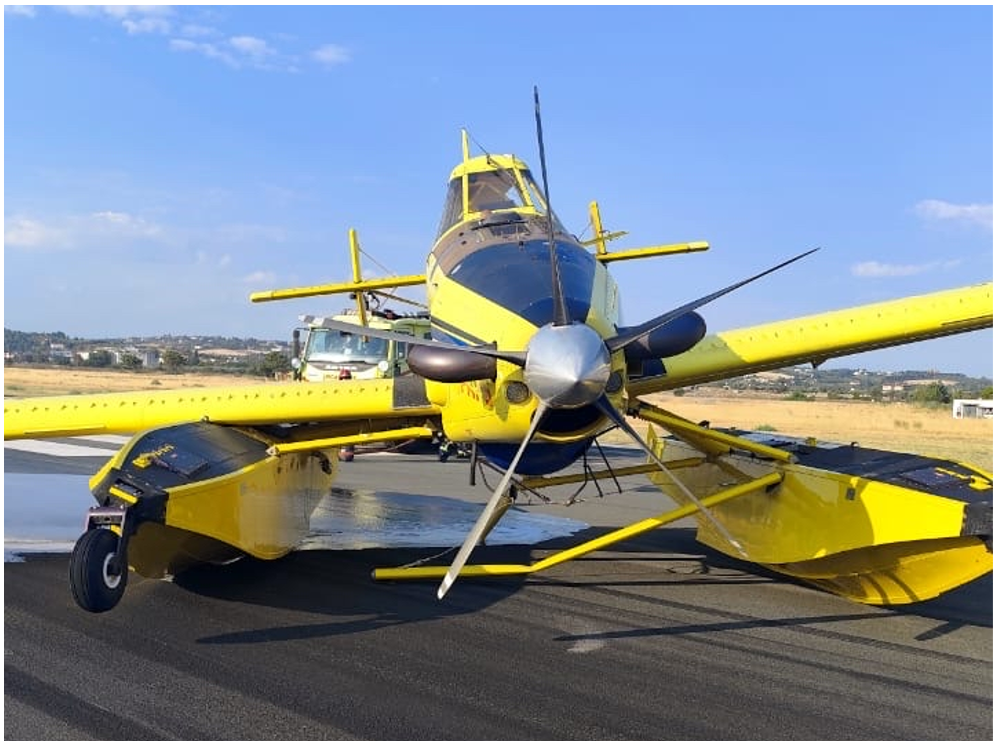
At 0817 the Air Tractor landed on runway 34, however the damaged right float struts were unable to support the weight of the aircraft, and it collapsed onto the right float after landing (Figure 1). The aircraft was subsequently stranded on the runway and emergency services attended. The crew members evacuated the aircraft without injury.
Following the accident, the pilot reported that all 3 aircraft had successfully completed water uplifts from the same location on the previous day. On this occasion, the pilot reported that the glassy water conditions[1] made it difficult to establish the aircraft's height above the water's surface, and the aircraft had hit a submerged object during the scooping run. Due to the risk of unknown hazards at this location, the operator sent a direction to all crew to suspend scooping operations from Lake Koroneia until further notice.
Figure 1: Damaged float struts led to collapse on landing
Source: Operator
Safety message
In murky water, obstructions may not always be visible and the potential for hitting submerged or partly submerged debris is an ever‑present hazard for such operations. Overflying the intended scooping area to scan for such obstacles is always good practice.
In this case, the crew’s quick actions to discontinue operations and pre‑organise emergency services at the airport for their arrival, decreased the risk of injury during their emergency landing.
The hazards that exist in conducting low‑level operations over water have long been recognised (ATSB, 2012) and include the risks of visual illusion and altered depth perception. These factors can make it difficult for pilots to accurately judge the height above water, especially over featureless or reflective surfaces. Flying over calm, glassy water is particularly dangerous, but even choppy water with a constantly varying surface interferes with normal depth perception. Regularly checking the altimeter and establishing smooth descent rates for water alighting during such operations can assist in raising safety margins.
About this report
Decisions regarding whether to conduct an investigation, and the scope of an investigation, are based on many factors, including the level of safety benefit likely to be obtained from an investigation. For this occurrence, no investigation has been conducted and the ATSB did not verify the accuracy of the information. A brief description has been written using information supplied in the notification and any follow-up information in order to produce a short summary report and allow for greater industry awareness of potential safety issues and possible safety actions.
[1]Glassy water can be present across a broad spectrum, from a mirror-like surface to rippled or wavy water, which reflects a distorted image. The reason it presents a challenge for pilots is that without texture on the surface of the water, it is more difficult to judge height.
Occurrence summary
Mode of transport
Aviation
Occurrence ID
AB-2025-036
Occurrence date
30/07/2025
Location
20 km north-north-east of Thessaloniki Airport Makedonia
State
International
Aviation occurrence category
Collision with terrain, Diversion/return, Ground strike, Landing gear/indication
The ATSB is investigating an engine malfunction involving Airbus A330-202, VH-EBQ, 1,370 km west-south-west of Los Angeles International Airport, United States of America, on 4 December 2024.
During the cruise phase of flight, a report of sparks coming from the right engine was received by the flight crew, who elected to return to Los Angeles Airport. During the descent, ‘bangs’ were heard accompanied by indication of a right engine compressor stall. The flight crew operated the engine at idle for the rest of the descent and landing in Los Angeles.
The ATSB released a preliminary report, which details factual information established in the investigation’s early evidence collection phase, on 8 May 2025. See below.
The final report has been drafted and is undergoing internal review to ensure the report adequately and accurately reflects the evidence collected, analysis, and agreed findings.
The final report will be released at the conclusion of the investigation. Should a critical safety issue be identified during the course of the investigation, the ATSB will immediately notify relevant parties, so that appropriate safety action can be taken.
Last updated:
Preliminary report
Report release date: 08/05/2025
This preliminary report details factual information established in the investigation’s early evidence collection phase, and has been prepared to provide timely information to the industry and public. Preliminary reports contain no analysis or findings, which will be detailed in the investigation’s final report. The information contained in this preliminary report is released in accordance with section 25 of the Transport Safety Investigation Act 2003.
The occurrence
Overview
On 4 December 2024, the ATSB was notified of an air-return involving a Qantas Airbus A330 aircraft, registered VH‑EBQ, operating a scheduled passenger flight from Los Angeles, United States of America, to Brisbane, Australia. During the cruise, sparks were observed coming from the right engine and the flight crew initiated a turnback to Los Angeles Airport. During the descent to the airport, ‘bangs’ were heard accompanied by indication of a right engine compressor stall.[1] The flight crew operated the engine at idle for the rest of the descent and landing in Los Angeles.
The previous flight and turnaround maintenance
Prior to the incident flight, the aircraft was operated on a scheduled passenger flight between Brisbane and Los Angeles. On 4 December 2024, at around 0120 UTC[2] and shortly after top of descent, the flight crew observed a high N2[3] vibration advisory for the right engine on the electronic centralized aircraft monitor.[4] In response, the flight crew operated the right engine at idle for the remainder of the flight. The aircraft landed in Los Angeles at 0153.
In preparation for the return flight to Brisbane, a licenced aircraft maintenance engineer (LAME) and an aircraft maintenance engineer (AME) assisted with the turnaround of the aircraft. When visually inspecting the right engine exhaust, both the AME and the LAME observed particles. The LAME carried out troubleshooting steps related to the right engine N2 vibration issue, which included consultation with the Qantas maintenance operation centre.[5] The troubleshooting activities culminated in the application of a minimum equipment list (MEL)[6] item for the right engine N2 vibration sensor. This meant that the N2 vibration readings for the right engine would not be available for flight crew on subsequent flights, until the component was replaced. The LAME subsequently released the aircraft for service at 0358.
The incident flight
The flight crew for the next scheduled flight of VH-EBQ from Los Angeles for Brisbane, consisting of a captain, a first officer, and 2 second officers, familiarised themselves with the aircraft status and became aware of the reported N2 vibration issue. Preparations for the flight continued and the aircraft departed Los Angeles at 0458. The flight crew later reported to the ATSB that they were not aware of the particles observed in the exhaust.
The flight crew reported that the take-off and initial climb appeared normal. They received a clearance from air traffic control (ATC) to climb to flight level (FL)[7] 320, and upon reaching FL 200, the first officer and one of the second officers, second officer A, left the flight deck for their allocated crew rest.[8] The captain and the other second officer, second officer B, remained on the flight deck. The captain made regular written observations of engine parameters, including fuel flow and exhaust gas temperature, with the intent that the readings might aid in troubleshooting possible engine issues.
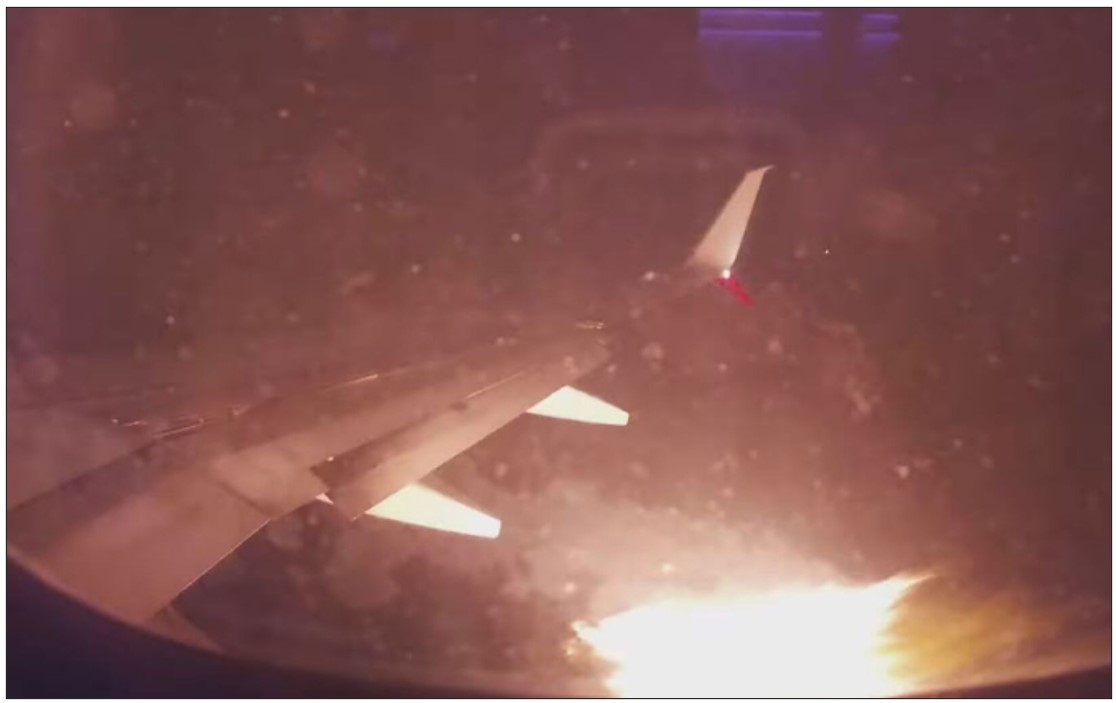
At about 0637, the remaining flight crew received further clearance from ATC to climb to FL 340. After top of climb, a passenger report of sparks emanating from the right engine was relayed to the flight crew by the cabin crew. Second officer B went to the passenger’s seat, observed the engine from the window, noted a couple of intermittent sparks, and returned to the flight deck to talk to the captain. The captain and second officer Balso reviewed video footage of the sparks recorded by the passenger during the climb (Figure 1).
Figure 1: Still image from passenger video showing sparks from right engine
Source: Qantas passenger, provided by Qantas, annotated by the ATSB
In response to the engine situation, the captain and second officer B decided that continuing to their destination, Brisbane, was no longer acceptable and it would be necessary to divert. The resting flight crew were recalled to the flight deck and the first officer assessed that, at that time, the aircraft was about 30 minutes from the equal time point[9] between Los Angeles and Honolulu. The flight crew initiated a rotation of cabin crew members to be positioned in the passenger’s seat to monitor the engine for sparks for the remainder of the flight.
When considering which airport to divert to, the flight crew consulted with the Qantas maintenance operations centre, reviewed the weather and NOTAMS[10] for alternate airports, and continued to monitor right engine performance. Although the right engine exhibited greater fuel consumption and exhaust gas temperature than the left engine, all indications, excluding the N2 vibration, which was disconnected, were within the normal range. The flight crew considered reducing the thrust setting on the right engine, but as the parameters indicated it was stable, the setting was left unchanged. The flight crew decided the most suitable airport to divert to was Los Angeles and the first officer made a PAN PAN call[11] and requested a diversion to Los Angeles from ATC through the controller pilot data link communication system.[12]
The flight crew initiated the diversion at about 0732 and shortly after, they requested a descent to FL 310 to reduce the load on the engine. By the time the aircraft reached FL 310, the intermittent sparks were observed to have stopped.
Following a period of observation where the engine parameters were stable and no additional sparks were observed, the captain elected to take a crew rest, with the intent of managing fatigue for the descent and landing into Los Angeles. During this time, the flight continued uneventfully and the remaining flight crew prepared for the landing. Activities included an assessment of the runway options and availability, re-assessment of the alternate airports, reviewing updated weather observations, review of the overweight and single-engine landing procedures, and performance checks.
Based on the cockpit voice recording, the captain returned to the flight deck at about 0942, prior to commencing the descent at 1003. The other 3 pilots had noted weather reports of fog developing in Los Angeles and, as a result, consulted the low visibility landing checklist. The flight crew completed the approach checklist at about 1023 and the overweight landing checklist at about 1024. At around 1027, while the aircraft was passing about 7,000 ft, the flight crew heard 3 loud bangs, which they attributed to the right engine based on observation of engine parameters. In response, the captain brought the right engine thrust lever to idle. Second officer B called ‘stall’ (meaning an engine compressor stall), which was confirmed by the captain. At the direction of the captain, the first officer radioed ATC to report that they had an issue with the engine and to request aircraft rescue and firefighting services attendance on landing.
At about 1029, to aid with management of the situation, the first officer radioed ATC to cancel the approach and request vectors, which the controller provided. The flight crew commenced the engine stall checklist from the Quick Reference Handbook. The last action item in the checklist was to slowly move the thrust lever forward. The flight crew elected to leave the engine at idle to minimise the likelihood of more disruptions. At about 1039, the first officer informed ATC that they were ready for the approach. After an uneventful landing, theaircraft exited the runway and came to a stop on the taxiway to allow rescue and firefighting services to visually inspect the engine. The flight crew completed the after-landing procedures while the engine was inspected. After assurance that no leaks, smoke, or damage was observed, the flight crew taxied the aircraft to the gate, where a normal disembarkation took place.
Following post-flight inspections, the right engine was removed from the aircraft and sent to a GE (General Electric) Aerospace technical facility for further examination.
Post-flight inspection
After the aircraft was repositioned to a maintenance hangar, borescope[13] inspections of the engine were carried out that identified:
metal debris in the exhaust
one missing high-pressure compressor blade, liberated at its root
one fractured high-pressure compressor blade, fractured about half-way up
damage to several high-pressure compressor blade tips
a stage 4 variable-stator-vane positioned 90° out of alignment
a fractured stage 4 variable-stator-vane lever arm (corresponding to the misaligned vane).
The aircraft was subsequently grounded, and the engine replaced before return to service on 16 December 2024.
Context
Flight crew information
The captain, first officer and second officers all held valid air transport pilot licences (aeroplane) and aviation medical certificates, and were appropriately qualified for the flight. All flight crew reported feeling well rested and alert when commencing duty.
The captain had about 16,700 hours of total flight experience, of which about 6,700 hours were on the Airbus A330. In the previous 90 days, the captain had flown about 160 hours on the A330. The first officer had about 7,300 hours of flight experience, of which about 1,000 hours were on the A330, with 153 hours flown in the previous 90 days. Second officer A had about 6,720 hours of flight experience, of which about 4,050 hours were on the A330, with 116 hours flown in the previous 90 days. Second officer B had about 5,200 hours of flight experience, of which about 3,500 hours were on the A330, with 78 hours flown in the previous 90 days.
Aircraft information
General
The Airbus A330-202 is a wide-body, twin-engine, long range, air transport aircraft. VH-EBQ was manufactured in France in 2011 and registered in Australia in the same year. The right engine had accumulated about 15,497 hours since its last overhaul.
Engine information
The aircraft was powered by 2 General Electric CF6-80E1 high-bypass turbofan engines. Engine modules include the fan and low-pressure compressor, the high-pressure compressor, combustion section, the high-pressure turbine, and the low-pressure turbine. N1 refers to the rotational speed of the fan, the low-pressure compressor and associated shaft. N1 is the primary indication of engine thrust. The N2 refers to the rotational speed of the high-pressure compressor, the high-pressure turbine, and associated shaft.
Vibration monitoring was achieved by the engine’s engine interface and vibration monitoring system. This system processes signals from 2 accelerometers, the number 1 bearing vibration sensor and the compressor rear frame vibration sensor, to obtain 2 vibration values for each N1 and N2 shafts. N1 vibrations are measured as a displacement in 1/1000 of an inch (mils), while N2 vibrations are measured as a speed in inch per second (ips). The N2 vibrations are displayed to the flight crew as a value between 0 and 10 units, which corresponded to a vibration between 0 and 3 ips on a linear scale. The highest reading observed during the descent into Los Angeles was 9.2 units.
Maintenance actions
Maintenance for the General Electric CF6-80E1 engines was conducted in accordance with the Airbus A330 Aircraft Maintenance Manual and Troubleshooting Manual. The engineering staff in Los Angeles consulted the Troubleshooting Manual task 77-32-00-810-829-A N2 Vibration Above Advisory During Descent, Top of Descent Vibration when addressing the reported vibration associated with the inbound flight.
The certifying LAME wrote in their logbook entry relating to the application of the minimum equipment list item for the N2 vibration, that:
on consultation with the inbound flight crew, they established that no physical vibration was felt in the airframe
the right engine main chip detector, inlet, and exhaust were inspected and deemed ‘OK’
the vibration readings were considered to be a faulty indication issue and not generated in response to genuine engine vibration
minimum equipment list item 77-07-02-07C was applied
Aircraft Maintenance Manual task 77-32-00-040-801-A to deactivate the remote charge converter was completed
Qantas maintenance operation centre was notified.
Maintenance history
On 27 November 2024, the right engine of the aircraft had a compressor stall during descent into Los Angeles. A subsequent engineering investigation identified faults associated with the right engine electrical control unit. Following the replacement of faulty parts, engineering personnel conducted engine inspections and ground runs where no further faults were detected. The aircraft subsequently flew 3 uneventful routes before the high N2 vibration was reported on descent into Los Angeles on 4 December 2024.
Recorded data
The aircraft was equipped with a cockpit voice recorder, which recorded audio from the flight deck, and quick access recorder, which recorded aircraft and engine performance data. The altitude of the aircraft and the N1 speed for both engines was extracted from the quick access recorder (Figure 2). The data showed that the engine speed for the left and right engines was consistent up until the time of the ‘bangs’ and compressor stall, around 1027. After this, the right engine was brought back to idle and the N1 speed remained around 33%.
Figure 2: Altitude and N1 speed for the right and left engines
Source: Qantas, annotated by the ATSB
Further investigation
To date, the ATSB has:
interviewed involved flight crew, maintenance engineers, and maintenance operation centre staff
obtained operator and manufacturer engineering procedures
obtained aircraft operating procedures
gathered engine maintenance records
collected recorded data, including from the cockpit voice recorder and quick access recorder
The investigation is continuing and will include further review and examination of:
communications between involved personnel
recorded data
maintenance procedures and records
material failure analysis conducted by GE Aerospace on relevant components of the engine.
A final report will be released at the conclusion of the investigation. Should a critical safety issue be identified during the course of the investigation, the ATSB will immediately notify relevant parties so appropriate and timely safety action can be taken.
Purpose of safety investigations
The objective of a safety investigation is to enhance transport safety. This is done through:
identifying safety issues and facilitating safety action to address those issues
providing information about occurrences and their associated safety factors to facilitate learning within the transport industry.
It is not a function of the ATSB to apportion blame or provide a means for determining liability. At the same time, an investigation report must include factual material of sufficient weight to support the analysis and findings. At all times the ATSB endeavours to balance the use of material that could imply adverse comment with the need to properly explain what happened, and why, in a fair and unbiased manner. The ATSB does not investigate for the purpose of taking administrative, regulatory or criminal action.
Terminology
An explanation of terminology used in ATSB investigation reports is available here. This includes terms such as occurrence, contributing factor, other factor that increased risk, and safety issue.
Publishing information
Released in accordance with section 25 of the Transport Safety Investigation Act 2003
Ownership of intellectual property rights in this publication
Unless otherwise noted, copyright (and any other intellectual property rights, if any) in this report publication is owned by the Commonwealth of Australia.
Creative Commons licence
With the exception of the Commonwealth Coat of Arms, ATSB logo, and photos and graphics in which a third party holds copyright, this report is licensed under a Creative Commons Attribution 4.0 International licence.
The CC BY 4.0 licence enables you to distribute, remix, adapt, and build upon our material in any medium or format, so long as attribution is given to the Australian Transport Safety Bureau.
Copyright in material obtained from other agencies, private individuals or organisations, belongs to those agencies, individuals or organisations. Where you wish to use their material, you will need to contact them directly.
[1]A stall in a turbine engine refers to a compressor stall. It is abnormal airflow resulting from the aerodynamic stall of aerofoils (compressor blades) within the compressor. Steady flow through the stages of a compressor occurs within a relatively narrow band of conditions. If the conditions inside a compressor go outside of this band due to an operating condition or a disturbance, the flow around the blades can break down in a manner known as a stall. In this instance, the blades would no longer effectively compress the air. If the breakdown of flow in a compressor stall is significant enough, the pressure change within the engine could be sufficient to reverse the flow through the compressor in a phenomenon known as a ‘surge’. A surge is often associated with a loud bang, or series of bangs, that can be heard in the aircraft.
[2]Coordinated Universal Time (UTC): the time zone used for aviation. Local time zones around the world can be expressed as positive or negative offsets from UTC. Los Angeles was UTC -8 hours meaning that 0120 UTC on 4 December 2024 was 1720 on 3 December 2024 Los Angeles time. Sydney was UTC +10 hours and Brisbane was UTC +11 hours.
[3]N2: N2 refers to the rotational speed of the engine’s high-speed spool, which consisted of the high-pressure compressor and the high‑pressure turbine.
[4]ECAM: Electronic centralized aircraft monitor (ECAM) is a system on Airbus aircraft for monitoring and displaying engine and aircraft system information to the pilots. In the event of a malfunction, it will display the fault and may also display the appropriate steps of the remedial action.
[5]The Qantas maintenance operation centre was a section of the Qantas integrated operations centre, which responded to services requests from all areas within the company and provided engineering information and support as required.
[6]The minimum equipment list (MEL) details the system, function, or equipment, which may be inoperative for flight and establishes limitations on the duration of, and conditions for, operation with an inoperative item. The application of an MEL to an item is the phraseology used when an aircraft is certified to fly with that item inoperative.
[7]Flight level: at altitudes above 10,000 ft in Australia, an aircraft’s height above mean sea level is referred to as a flight level (FL). FL 320 equates to 32,000 ft.
[8]Crew rest: All commercial flight crew have limits on how much they can work before taking time off. For long flights, the flight crew consists of more than 2 pilots allowing some pilots to rest mid-flight and the flight deck to remain fully staffed.
[9]The equal time point is when an aircraft is the same flying time from 2 potential en route diversion locations.
[10]NOTAMS: Notice to Airmen (NOTAM) is a notice filed with an aviation authority to alert pilots of potential hazards along a flight route or at a location that could affect the flight.
[11]PAN PAN: an internationally recognised radio call announcing an urgency condition which concerns the safety of an aircraft or its occupants but where the flight crew does not require immediate assistance.
[12]Controller pilot data link communication is a 2-way data-link system by which air traffic controllers can transmit non urgent strategic messages to an aircraft as an alternative to voice communications. The message is displayed on a flight deck visual display. The pilots are provided with the capability to respond to messages, to request/receive clearances and information, and to report information.
[13]A borescope is a slender optical periscope, usually incorporating illumination, capable of being inserted into narrow apertures to inspect interior of machinery.
[14]ADS-B is a system in which electronic equipment onboard an aircraft automatically broadcasts the precise location of the aircraft via a digital data link. The data can be used by other aircraft and air traffic control to show the aircraft’s position and altitude on display screens without the need for radar.
Occurrence summary
Investigation number
AO-2024-063
Occurrence date
04/12/2024
Occurrence time and timezone
06:40 UTC
Location
1,370 km west-south-west of Los Angeles International Airport, United States of America
State
International
Report release date
08/05/2025
Report status
Preliminary
Anticipated completion
Q1 2027
Investigation level
Defined
Investigation type
Occurrence Investigation
Investigation phase
Final report: Internal review
Investigation status
Active
Mode of transport
Aviation
Aviation occurrence category
Diversion/return, Engine failure or malfunction
Occurrence class
Incident
Highest injury level
None
Aircraft details
Manufacturer
Airbus
Model
A330-202
Registration
VH-EBQ
Serial number
1198
Aircraft operator
Qantas Airways Limited
Sector
Jet
Operation type
Part 121 Air transport operations - larger aeroplanes
Activity
Commercial air transport-Scheduled-International
Departure point
Los Angeles International Airport, United States of America
The Transport Accident Investigation Commission (TAIC) in New Zealand has commenced an investigation into an engine issue on a flight between Wellington, New Zealand and Sydney, Australia involving an Airbus A320-271N, registration ZK-NHA, on 1 December 2024.
During the flight the aircraft experienced an engine malfunction, and the aircraft was diverted to Auckland, New Zealand, where it landed safely. No crew or passengers were reported to have been injured.
The TAIC has requested assistance and the appointment of an accredited representative from the ATSB. To facilitate this support and to provide the appropriate protections for the information, the ATSB appointed an accredited representative in accordance with paragraph 5.23 of Annex 13 to the Convention on International Civil Aviation and commenced an investigation under the Australian Transport Safety Investigation Act 2003.
TAIC is responsible for the investigation and release of the final investigation report regarding this accident. Any enquiries regarding the investigation should be addressed to TAIC.
The Transport Accident Investigation Commission (TAIC) in New Zealand has commenced an investigation into an engine issue on approach involving a GIE Avions de Transport Régional ATR 72, ZK-MVL, near Wellington Airport, New Zealand on 1 September 2024.
During final approach, at about 300 feet, there was a low oil pressure caution, then an engine fault and engine fire warning for the aircraft’s left engine. The crew declared a mayday, landed safely and stopped on the runway. Airport emergency services attended promptly, and passengers and crew were evacuated on to the runway, with no serious injuries reported.
The TAIC has requested assistance and the appointment of an accredited representative from the ATSB.
To facilitate this support and to provide the appropriate protections for the information, the ATSB appointed an accredited representative in accordance with paragraph 5.23 of the International Civil Aviation Organization Annex 13 and commenced an investigation under the Australian Transport Safety Investigation Act 2003.
TAIC is responsible for the investigation and release of the final investigation report regarding this accident. Any enquiries regarding the investigation should be addressed to the TAIC via the contact details listed below:
Occurrence Briefs are concise reports that detail the facts surrounding a transport safety occurrence, as received in the initial notification and any follow-up enquiries. They provide an opportunity to share safety messages in the absence of an investigation. Because occurrence briefs are not investigations under the Transport Safety Investigation Act 2003, the information in them is de-identified.
What happened
Shortly after departure from Queenstown, New Zealand, at about 1800 local time on 17 June 2024, a Boeing 737-8FE aircraft, carrying 67 passengers and 6 crew, en route to Melbourne, Victoria, was observed with flames emanating from the number 2 engine (Figure 1). The flight crew, responding to instrumentation indicating engine damage, shut down the affected engine and diverted to Invercargill, New Zealand where the aircraft landed safely.
A subsequent maintenance inspection of the aircraft indicated evidence of a birdstrike. It was reported that one bird, believed to be a duck, had been ingested into the number 2 engine and a second duck had struck the aircraft. This caused substantial damage to the fan blade, this damage, coupled with the engine surging, required the engine to be replaced.
Figure 1: Photograph of fire emanating from engine of Boeing 737-8FE aircraft
Source: Channel 9 news.com
Safety message
Occurrences involving aircraft striking wildlife, particularly birds, continue to be the most common aviation occurrence reported to the ATSB. Birdstrikes are a potential safety risk to aircraft and aerodrome operators.
The ATSB has recently launched a new dedicated aviation wildlife strike occurrence dashboard, which aims to provide valuable information to pilots, aerodrome operators, aircraft operators, aviation regulators and other industry participants, to assist with understanding and managing the hazards associated with wildlife strikes. Importantly, the dashboard does not include any identifying information about pilots or aircraft.
Birdstrikes typically result in nil to minor damage to aircraft, and nil to minor injuries to occupants, however, severe and fatal accidents as a result of birdstrikes in small aircraft have occurred. Birdstrikes can occur during any phase of flight but are more common during the take-off and landing phases, due partly to the increased numbers of birds at lower heights. Aerodrome operators employ various measures to mitigate these occurrences and to control bird numbers, however, when a birdstrike does happen, pilots are ultimately required to deal with the consequences. This emphasises the importance of crew training and preparedness for in-flight emergencies to ensure the safety of the aircraft and its occupants. By following established procedures and prioritising effective communication, the outcomes associated with birdstrikes can be mitigated by pilots.
About this report
Decisions regarding whether to conduct an investigation, and the scope of an investigation, are based on many factors, including the level of safety benefit likely to be obtained from an investigation. For this occurrence, no investigation has been conducted and the ATSB did not verify the accuracy of the information. A brief description has been written using information supplied in the notification and any follow-up information to produce a short summary report and allow for greater industry awareness of potential safety issues and possible safety actions.
Occurrence summary
Mode of transport
Aviation
Occurrence ID
AB-2024-031
Occurrence date
17/06/2024
Location
3.7 km east-north-east of Queenstown Airport
State
International
Occurrence class
Serious Incident
Aviation occurrence category
Birdstrike
Highest injury level
None
Brief release date
30/08/2024
Aircraft details
Manufacturer
The Boeing Company
Model
737-8FE
Sector
Jet
Operation type
Part 121 Air transport operations - larger aeroplanes