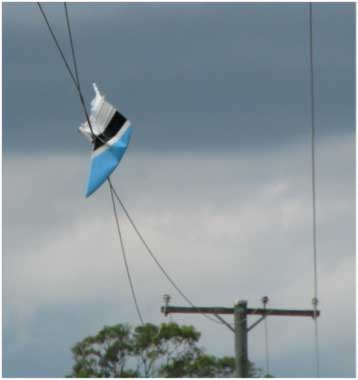
Wirestrike

Wirestrike - Rockwell 114, VH-CSH, Geelong (ALA), Victoria, on 25 September 2010

Summary

On 25 September 2010, the pilot of a Rockwell International 114 aircraft, registered VH-CSH, was conducting a private flight from Moorabbin, along the coast to Lorne, Victoria, then returning to the Geelong aircraft landing area (ALA), with one passenger on board.

The pilot had initially planned to land on runway 36 at Geelong, however on entering the circuit, the pilot observed that the wind direction was more conducive to a landing on runway 27. The pilot was aware that runway 27 had a displaced threshold due to powerlines under the approach path. Consequently, the pilot had planned to touch down just beyond the intersection of runway 09/27 and 18/36.

When on final approach, witnesses observed the aircraft ascend and then descend onto the high-voltage powerlines located east of the runway. The aircraft struck the powerlines and subsequently impacted the ground, just short of the airfield. The pilot sustained serious injuries, and the passenger sustained minor injuries. After the occupants exited the aircraft, it caught alight and sustained serious damage.

Research published by the ATSB in 2006 identified that, despite consideration at the flight planning stage, a reconnaissance of a proposed 'low-flying area', or maintaining a constant lookout, wires are often difficult to detect. The report highlighted that many pilots have a prior knowledge of the presence of wires before they strike them, indicating reasons, other than a lack of awareness, leads to wirestrike accidents and incidents occurring.

Occurrence summary

Investigation number AO-2010-071
Occurrence date 25/09/2010
Location Geelong (ALA)
State Victoria
Report release date 28/01/2011
Report status Final
Investigation level Short
Investigation type Occurrence Investigation
Investigation status Completed
Mode of transport Aviation
Aviation occurrence category Wirestrike
Occurrence class Accident
Highest injury level Serious

Aircraft details

Manufacturer Rockwell International
Model 114
Registration VH-CSH
Serial number 14004
Sector Piston
Operation type Private
Departure point Moorabbin Vic.
Destination Geelong Vic.
Damage Substantial

Wirestrike – Bell Helicopter 206L LongRanger III, VH-OSU, 37 km south-south-west of Latrobe Valley Airport, Victoria, on 20 May 2010

Summary

At about 1253 Eastern Standard Time on 20 May 2010, a Bell Helicopter 206L LongRanger III helicopter, registered VH-OSU, commenced forestry spraying operations about 37 km south-south-west of Latrobe Valley Airport, Victoria. At about 1354 the pilot commenced a final spray run that resulted in the helicopter's flightpath crossing a powerline that was known to the pilot. The helicopter contacted the wire, seriously damaging the helicopter's flight control system and main rotor mast, which likely rendered it uncontrollable. The helicopter subsequently impacted the ground. The pilot was fatally injured.

The investigation found that it was likely that the pilot failed to recall the existence of the wire. The inherent difficulty of visually detecting the wire, combined with the operating groundspeed, meant that the pilot would not have had sufficient time to avoid the wire after seeing it. An examination of the wreckage of the helicopter did not find any mechanical abnormalities that might have contributed to the accident.

No permanent or temporary high visibility devices were attached to the powerlines, nor were they required to be. The helicopter was not fitted with wirestrike protection system (WSPS) equipment, nor was it required to be by aviation regulation. The investigation was unable to determine if a WSPS might have altered the outcome of the wirestrike.

As a result of this accident, Energy Safe Victoria issued a wire safety alert to aerial work operators and infrastructure providers. The Australian Transport Safety Bureau (ATSB) issued a Safety Advisory Notice to Energy Networks Australia and operators and pilots that are involved in low-level operations. The notice suggested that, where wires exist in areas where low-level activity occurs, operators and pilots consider the need for any powerlines to be marked in accordance with AS 3891.2, 2008, Part 2: Marking of overhead cables for planned low level flying operations. In addition, the ATSB has published an educational report aimed at increasing awareness among low-level operators and those agencies organising such activities. The ATSB has also commenced a research investigation that seeks to more fully understand the wirestrike risk in Australia.

Occurrence summary

Investigation number AO-2010-033
Occurrence date 20/05/2010
Location 37 km SSW of Latrobe Valley Airport
State Victoria
Report release date 23/06/2011
Report status Final
Investigation level Systemic
Investigation type Occurrence Investigation
Investigation status Completed
Mode of transport Aviation
Aviation occurrence category Wirestrike
Occurrence class Accident
Highest injury level Fatal

Aircraft details

Manufacturer Bell Helicopter Co
Model 206
Registration VH-OSU
Serial number 51226
Sector Helicopter
Operation type Aerial Work
Damage Destroyed

Wirestrike - VH-JHR, Cessna 188 Agwagon, near Ayr, Qld, 10 April 2010

Discontinued report


Section 21 (2) of the Transport Safety Investigation Act 2003 (TSI Act) empowers the Australian Transport Safety Bureau (ATSB) to discontinue an investigation at any time. Section 21 (3) of the TSI Act requires the ATSB to publish a statement setting out the reasons for discontinuing an investigation.

On 10 April 2010, the ATSB commenced an investigation into a wirestrike that occurred at about 1737 Eastern Standard Time that day and involved a Cessna Aircraft Co. A188B/A1 Ag Truck aircraft, registered VH-JHR. The aircraft was being operated on an agricultural weed-spraying flight over a cane field that was located about 13km south-west of Ayr, Queensland. The aircraft was positioned to fly under powerlines that crossed the intended flight path at about 3.25 m above the top of the crop. The aircraft, which is about 3.6 m high, contacted the powerlines and severed the top of the aircraft's fin and rudder horn (Figure 1). Control of the aircraft was lost and it collided with terrain shortly afterwards in a steep, nose-down attitude. The pilot was fatally injured.

Figure 1: Power conductors and detached rudder horn

VH-JHR picture of tail

In the hours prior to the flight, witness, video and other information indicated that the pilot had consumed a quantity of alcohol. A postmortem examination subsequently indicated that the pilot had a high blood alcohol concentration.

The consumption of alcohol by pilots is regulated by Civil Aviation Regulation 256, which mandates that a person shall not:

  • while in a state of intoxication, enter any aircraft
  • act as, or perform any functions in preparation to act as a member of the operating crew of an aircraft within 8 hours of consuming alcohol
  • operate an aircraft if, by reason of having consumed alcohol (or other prescribed substances), that person's ability to operate the aircraft is impaired.


The ATSB safety research report titled Alcohol and Human Performance from an Aviation Perspective: A review' found that alcohol use by pilots was a major potential risk to flight safety. Of particular relevance, alcohol:

  • affects almost all forms of cognitive function, such as information processing, attention, vigilance, perception and reasoning
  • impairs registration, recall and the organisation of information, which leads to increased reaction times and increased errors
  • significantly impairs attention, especially in terms of tasks requiring sustained, selective or divided attention
  • adversely affects psychomotor performance, particularly on tracking tasks. Performance was found to suffer most when an unexpected or unanticipated event occurred.

The ATSB's primary focus is on enhancing safety with respect to fare-paying passengers and, in particular, those transport safety matters that may present a significant threat to public safety and are the subject of widespread public interest. The ATSB therefore needs to direct significant attention to identifying systemic failures in aviation, marine and rail mass public transport systems.

Many accidents involve the repetition of past occurrences, where the contributing factors are similar and the safety issues are well known. The ATSB has investigated a number of accidents in which the operating crew were affected by alcohol and the cognitive impairment likely as a result of alcohol consumption, and its effects on tasks such as flying and driving, are well known. Given that existing knowledge, and the pilot's decision to carry out the flight after consuming alcohol, the ATSB considered there was limited potential to enhance transport safety by continuing this investigation.

On that basis, the ATSB has elected to discontinue the investigation. However, the data collected in the course of the investigation may be used by the ATSB for future statistical analysis and safety research purposes.

Occurrence summary

Investigation number AO-2010-026
Occurrence date 10/04/2010
Location near Ayr
State Queensland
Report release date 16/07/2010
Report status Discontinued
Investigation level Systemic
Investigation type Occurrence Investigation
Investigation status Discontinued
Mode of transport Aviation
Aviation occurrence category Wirestrike
Occurrence class Accident
Highest injury level Fatal

Aircraft details

Manufacturer Cessna Aircraft Company
Model 188
Registration VH-JHR
Serial number 188-02366T
Operation type Aerial Work
Departure point Home Hill aerodrome
Destination Home Hill aerodrome

Wirestrike - McDonnell Douglas 369D, VH-PLJ, 13 km north of Murray Bridge, South Australia, on 19 November 2008

Preliminary report

Preliminary report released 5 January 2009

At about 1115 Central Daylight-saving Time on 19 November 2008, a pilot and two linesmen were operating a McDonnell Douglas 369D helicopter, registered VH-PLJ, to test a high-voltage powerline between Mannum and Mobilong, SA. While manoeuvring to test a conductor joint, the helicopter's main rotors struck a conductor and impacted the ground. One linesman was fatally injured and the other sustained minor injuries, while the pilot sustained serious injuries.

Summary

On the morning of 19 November 2008, the pilot of a McDonnell Douglas 369D helicopter, registered VH-PLJ, and two lineworkers were conducting airborne joint-testing operations on an electricity transmission line between Mannum and Mobilong, South Australia. Joint testing involves closely approaching the transmission line to check joints in transmission wires. At about 1150 Central Daylight-saving Time, when about 13 km north of Murray Bridge, the helicopter's main rotor blades contacted a transmission line conductor. The pilot lost control and the helicopter impacted the ground. One lineworker was fatally injured, the other lineworker received minor injuries and the pilot received serious injuries. The helicopter was seriously damaged.

The investigation found that the crew was not aware before the flight that there were transpositions (changes in the relative positions of individual wires) in the line and that they did not detect such a transposition during the approach for the joint test that led to the accident.

Following the occurrence, the helicopter operator amended the guidance for conducting joint-testing and expanded training and supervision of new crews. The powerline owner reviewed the risk profile of its airborne operations and revised a number of hazard treatment options. The powerline maintenance provider made a number of operational changes and contracted an external auditor to examine its operation. All of the recommendations from that audit were adopted by the maintenance provider.

In response to the failure of the recording lineworker's shoulder harness, the shoulder harness repair facility has upgraded relevant repair equipment and provided a replacement program for any incorrectly stitched harness in the operator's helicopter fleet. In addition, the Civil Aviation Safety Authority took action to have a number of seat belt harnesses recalled and examined. No issues were found with any of the seat belts that were examined, and they were able to be re-released without further rework.

Occurrence summary

Investigation number AO-2008-078
Occurrence date 19/11/2008
Location 13 km north of Murray Bridge
State South Australia
Report release date 09/12/2010
Report status Final
Investigation level Systemic
Investigation type Occurrence Investigation
Investigation status Completed
Mode of transport Aviation
Aviation occurrence category Wirestrike
Occurrence class Accident
Highest injury level Fatal

Aircraft details

Manufacturer McDonnell Douglas Corp.
Model 369
Registration VH-PLJ
Serial number 1280445D
Sector Helicopter
Operation type Aerial Work
Damage Substantial

Wirestrike - Bell Helicopter 206B JetRanger III, VH-CAP, 24 km north-north-east of Albury Aerodrome, New South Wales, on 23 June 2009

Summary

At about 1100 Eastern Standard Time on 23 June 2009, a Bell Helicopter Company 206B JetRanger III helicopter, registered VH-CAP commenced agricultural spraying operations at a property located 24 km north-north-east of Albury Aerodrome, New South Wales. At 1223 the pilot repositioned to commence an impromptu spray run that resulted in the helicopter flight path crossing a powerline that was known to the pilot.

The pilot reported that during the impromptu spray run, he was preoccupied with a request from the property owner to modify the planned spray sequence and forgot about the wire until he sighted it a short distance ahead. In response, the pilot initiated a climb to avoid the wire. He heard the helicopter contact the wire and felt the wire arrest the forward movement.

Although the helicopter was fitted with wire-strike protection system (WSPS) equipment, the wirestrike was outside the strike angle and cable span design parameters of the WSPS. The investigation was unable to determine whether the WSPS might have operated as intended, had the wire continued its initial movement towards the cutter blades before itself breaking.

The pilot's last recollection was seeing the ground rapidly approaching. He regained consciousness an unknown period of time later, still securely restrained in the wreckage. He managed to extricate himself and notify his ground crew. The pilot sustained minor injuries.

The investigation found that the inherent difficulty in visually detecting the wire, combined with the operating groundspeed required for chemical application meant that the pilot did not have sufficient time to avoid the wirestrike.

Although no safety issues were identified as a result of this investigation, the protection afforded by the pilot's helmet and the secure restraint offered by the pilot's four-point harness, probably prevented serious, if not fatal injury. Operators and crew would benefit from the consideration of the use of flying helmets, and when feasible, installation of four-point harnesses in their aircraft, particularly during inherently higher risk operations.

Occurrence summary

Investigation number AO-2009-030
Occurrence date 23/06/2009
Location 24 km NNE of Albury Aerodrome
State New South Wales
Report release date 14/10/2010
Report status Final
Investigation level Systemic
Investigation type Occurrence Investigation
Investigation status Completed
Mode of transport Aviation
Aviation occurrence category Wirestrike
Occurrence class Accident
Highest injury level Minor

Aircraft details

Manufacturer Bell Helicopter Co
Model 206
Registration VH-CAP
Serial number 2236
Sector Helicopter
Operation type Aerial Work

Wirestrike - 20 km north of Elliott, Northern Territory, on 10 November 2007, VH-WLQ, Cessna 172N

Summary

On 10 November 2007 at approximately 0830 Central Standard Time, a Cessna Aircraft Company 172N, registered VH-WLQ, with two pilots and a passenger on board departed Katherine, NT on a private, visual flight rules (VFR) flight to Tennant Creek. At about 1030, the aircraft struck a powerline which spanned the Stuart Highway 20 km north of Elliott. The aircraft's tail section was broken rearwards from the aft fuselage, rendering the aircraft uncontrollable and causing it to impact the highway in a steep nose-down attitude. The three occupants were fatally injured. The aircraft was destroyed.

There was no evidence of an aircraft or operational reason for the flight below 500 ft above ground level (AGL). Based on a lack of evidence to the contrary, the investigation concluded that the descent to, and flight at low level was probably as a result of a conscious decision by the pilots.

The investigation was unable to establish which of the pilots was flying the aircraft at the time of the accident.

Occurrence summary

Investigation number AO-2007-058
Occurrence date 10/11/2007
Location 20 km north of Elliott
State Northern Territory
Report release date 30/10/2008
Report status Final
Investigation level Systemic
Investigation type Occurrence Investigation
Investigation status Completed
Mode of transport Aviation
Aviation occurrence category Wirestrike
Occurrence class Accident
Highest injury level Fatal

Aircraft details

Manufacturer Cessna Aircraft Company
Model 172
Registration VH-WLQ
Serial number 17271888
Sector Piston
Operation type Private
Departure point Katherine, NT
Destination Tennant Creek, Northern Territory
Damage Destroyed

Wirestrike - Langkoop, Victoria, on 20 April 2009, VH-EZT, Robinson R44 Raven II

Summary

On 20 April 2009, a Robinson Helicopter Company R44 (Raven II) helicopter, registered VH-EZT (EZT), was conducting aerial spraying operations near Langkoop, Victoria. Spraying commenced at 0800 Central Standard Time with a load of 300 L of foliar fertiliser. There were two helicopters spraying the pine paddocks that morning and the operating crews were to break for lunch at about 1300 at a pre-arranged meeting place. Just prior to lunch, the pilot of EZT was tasked with a number of unplanned spray runs and a cleanup run to complete the morning's spraying. When the helicopter did not arrive at the pre-arranged meeting place, the pilot of the second helicopter commenced searching and located the wreckage of EZT in a paddock, near a powerline. The pilot of EZT was fatally injured.

Helicopter EZT contacted a powerline that intersected the northern half of the final spray paddock before colliding with the ground. An examination of the wreckage of the helicopter did not find any mechanical abnormalities that might have contributed to the accident.

Recorded data from the helicopter's satellite navigation system showed that after completing the planned spray runs, the pilot did not conduct a reconnaissance of the unfamiliar area to the south of the plantation to identify any hazards. A reconnaissance flight may have alerted the pilot to the presence of the previously-identified powerline.

The investigation found that an additional hazard identification check prior to the conduct of a cleanup run was not routinely practiced by the pilots, or monitored by the operator. In response to that safety issue, the operator has advised that they will enhance the wire avoidance procedures in their operations manual and mandate that an additional hazard identification check shall be completed prior to any cleanup run.

In addition, the investigation determined that there were no fluid quantity markings on the helicopter's spray tank, and that the spray system included unapproved modifications that increased the risk of overweight operations.

Occurrence summary

Investigation number AO-2009-017
Occurrence date 20/04/2009
Location Edenhope (ALA) 210 deg M 27 Km
State Victoria
Report release date 13/12/2010
Report status Final
Investigation level Systemic
Investigation type Occurrence Investigation
Investigation status Completed
Mode of transport Aviation
Aviation occurrence category Wirestrike
Occurrence class Accident
Highest injury level Fatal

Aircraft details

Manufacturer Robinson Helicopter Co
Model R44
Registration VH-EZT
Serial number 11443
Sector Helicopter
Operation type Aerial Work
Departure point 27 km SW Edenhope, Vic
Destination 27 km SW Edenhope, Vic
Damage Substantial

Wirestrike, 25 km west-north-west of Leongatha Aerodrome, Victoria, on 25 December 2008, VH-ROO, Cessna 172M

Summary

On 25 December 2008, at about 0845 Eastern Daylight-saving Time, a Cessna Aircraft Company 172M aircraft, registered VH-ROO, struck a powerline that was located on a property at Kernot, 25 km north-west of Leongatha Aerodrome, Vic.

The aircraft impacted the ground about 100 m from the powerline and caught fire. The pilot, who was the sole occupant, was fatally injured.

Examination of the wreckage did not identify any mechanical defects that would have affected the safe operation of the aircraft.

Occurrence summary

Investigation number AO-2008-082
Occurrence date 25/12/2008
Location 25 km WNW of Leongatha
State Victoria
Report release date 07/05/2009
Report status Final
Investigation level Systemic
Investigation type Occurrence Investigation
Investigation status Completed
Mode of transport Aviation
Aviation occurrence category Wirestrike
Occurrence class Accident
Highest injury level Fatal

Aircraft details

Manufacturer Cessna Aircraft Company
Model 172
Registration VH-ROO
Serial number 17266828
Sector Piston
Operation type Private
Departure point Woodleigh, Victoria
Destination Woodleigh, Victoria
Damage Destroyed

Wire Strike, Robinson R22 Beta, VH-HPY, Mataranka, Northern Territory, on 23 August 2008

Summary

On 23 August 2008, at about 1200 Central Standard Time, a Robinson Helicopter Company R22 Beta, registered VH-HPY, with a pilot and passenger on board, departed the sports ground at Mataranka, NT.

Witnesses reported that the helicopter was flying at about tree-top height when it struck powerlines before impacting the ground.

Bystanders were able to remove the seriously injured passenger from the wreckage; however, the pilot received fatal injuries. The helicopter was seriously damaged.

Examination of the wreckage did not identify any mechanical defects that would have affected the safe operation of the helicopter.

Occurrence summary

Investigation number AO-2008-058
Occurrence date 23/08/2008
Location Mataranka Township Aerodrome
State Northern Territory
Report release date 12/02/2009
Report status Final
Investigation level Systemic
Investigation type Occurrence Investigation
Investigation status Completed
Mode of transport Aviation
Aviation occurrence category Wirestrike
Occurrence class Accident
Highest injury level Fatal

Aircraft details

Manufacturer Robinson Helicopter Co
Model R22
Registration VH-HPY
Serial number 3047
Sector Helicopter
Operation type Private
Departure point Mataranka, NT
Destination Private property, 40 km NW of Mataranka
Damage Substantial

Wirestrike, Nelson, Victoria, on 24 December 2006, VH-ALO, Auster Aircraft Co. J1/A1

Preliminary report

Preliminary report released 8 February 2007

On 24 December 2006, the owner-pilot of an Auster Aircraft Company J1/A1 aircraft, registered VH-ALO, was intending to ferry the aircraft from a private airstrip at Nelson, Vic, to Akuna station S.A. The pilot was the sole occupant. At approximately 0930 Eastern Daylight-saving Time, the pilot commenced a take-off towards the west. Three people were standing between two hangars that were to the north of the airstrip, and they observed that the aircraft became airborne before it reached the taxiway leading from the hangars to the runway. When the aircraft was adjacent to the taxiway, it made a low-level right turn towards the hangars.

One witness, who was an experienced pilot, reported that the aircraft climbed suddenly just prior to striking a power line that was located on the airstrip side of the hangars. The aircraft then drifted over open space between the two hangers on a northerly heading; the left wing was seen to drop and the aircraft impacted the ground almost vertically. The pilot was fatally injured.

Summary

On 24 December 2006, an Auster J1/A1 aircraft, registered VH-ALO, departed from a private airstrip at Nelson Victoria with the pilot being the sole occupant on board.

During the initial climb out, the aircraft was observed making a low-level right turn towards two hangars where three people were standing to watch the departure.

The aircraft was observed striking powerlines. The aircraft impacted the ground inverted, at a steep angle. The pilot was fatally injured.

Occurrence summary

Investigation number 200607801
Occurrence date 24/12/2006
Location Nelson Aerodrome
State Victoria
Report release date 06/02/2008
Report status Final
Investigation type Occurrence Investigation
Investigation status Completed
Mode of transport Aviation
Aviation occurrence category Wirestrike
Occurrence class Accident
Highest injury level Fatal

Aircraft details

Manufacturer Auster Aircraft Ltd
Model J1
Registration VH-ALO
Sector Piston
Operation type Private
Departure point Nelson Vic.
Destination Wakerie SA