On 25 January 2017, a Jetstar Airways Airbus A320-232, registered VH-VGJ (VGJ), taxied for a scheduled passenger transport flight from Newcastle (Williamtown) Airport, New South Wales, to Brisbane Airport, Queensland. There were six crewmembers and 165 passengers on board the aircraft. The captain was the pilot monitoring and the first officer was the pilot flying.[1]
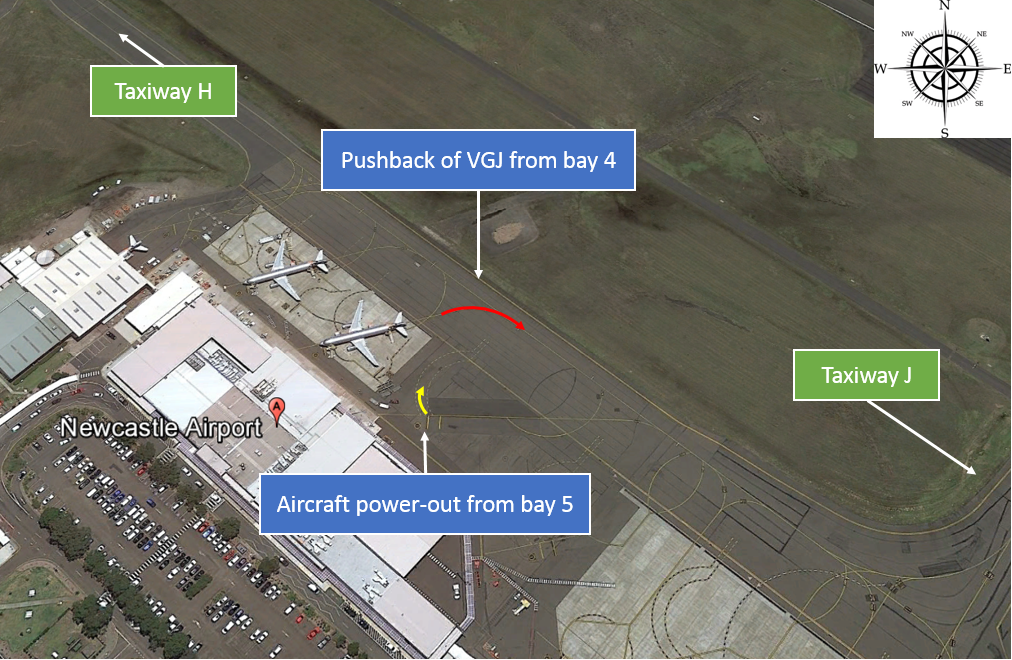
The aircraft parked at bay 4 at the Newcastle Airport terminal for passenger disembarkation and boarding (Figure 1). Bay 4 was a ‘pushback’ bay, which means that when the aircraft is ready for departure, the aircraft is pushed backwards from the parking bay by a tug under the supervision of a dispatcher. Another operator’s aircraft was parked on bay 5, to the left of VGJ. Bay 5 was a ‘power-out’ bay which means that on departure, aircraft taxi from the bay under their own power by turning sharply away from the terminal.
At about 1836 Eastern Daylight-savings Time (EDT), the crew of VGJ received a clearance from the surface movement controller to pushback, which placed VGJ to the right rear quarter of the aircraft parked on bay 5, and facing towards taxiway H (Figure 1). The dispatcher was walking beside the aircraft and was connected to the nose of VGJ by a headset for communications with the flight crew. The flight crew started the engines during the pushback in accordance with standard procedures. After the pushback was completed, the flight crew set the brakes, the tug disconnected and the dispatcher removed the nose wheel steering pin. [2] The flight crew then started their ‘after start flows’ (see: After start flows). After the tug disconnected from VGJ, the tug driver moved it to a position adjacent to the left wingtip of VGJ, facing towards the aircraft on bay 5.
At about 1838, the crew of the aircraft on bay 5 requested a clearance to taxi for departure. The surface movement controller questioned whether the aircraft could taxi to taxiway J and avoid VGJ.[3] The flight crew responded that they could. At this stage, the flight crew on board VGJ interrupted their ‘after start flows’ to monitor the other aircraft. The captain, seated in the left seat of VGJ, did not believe there was sufficient clearance for the other aircraft to turn around for taxiway J without a collision. The aircraft started to taxi from bay 5 in a right power-out turn, but stopped within a few metres.
When the tug driver observed the aircraft on bay 5 move towards them,[4] they moved the tug away from VGJ over to the terminal side of the apron, near bay 4, to remain clear of the other aircraft. Meanwhile the dispatcher assisting the aircraft on bay 5, had also moved from bay 5 towards bay 4 in order to monitor and signal wingtip clearance for the left wing of the aircraft conducting the power-out from bay 5.
Figure 1: Newcastle Airport apron
Source: Google earth, annotated by ATSB
Radio communications continued between air traffic control and the aircraft departing from bay 5, until it was confirmed that the aircraft would wait for VGJ before taxiing any further. The captain of VGJ, who was looking out the left window of the flight deck towards the bay 5 aircraft and the terminal, sighted their tug and a dispatcher near bay 4. They assumed that the dispatcher near bay 4 was their dispatcher, who had disconnected from their aircraft while they were monitoring the bay 5 aircraft movements and radio communications. At about 1840, the flight crew on board VGJ requested and received a clearance to taxi for runway 12 via taxiway H. The flight crew selected their taxi lights on, released the brakes and increased power.
The dispatcher for VGJ was still connected to the aircraft nose with their headset and waiting for their clearance from the flight crew to disconnect. They observed the taxi lights for VGJ illuminate, then they heard the engine noise increase, and then the aircraft started to taxi. They immediately disconnected their headset from the aircraft and moved clear to the left of the aircraft towards the terminal with the headset and the nose wheel steering pin. Once the dispatcher was clear of the aircraft, they turned around to display the nose wheel steering pin to the flight crew, but the captain was not looking towards them.
After start flows
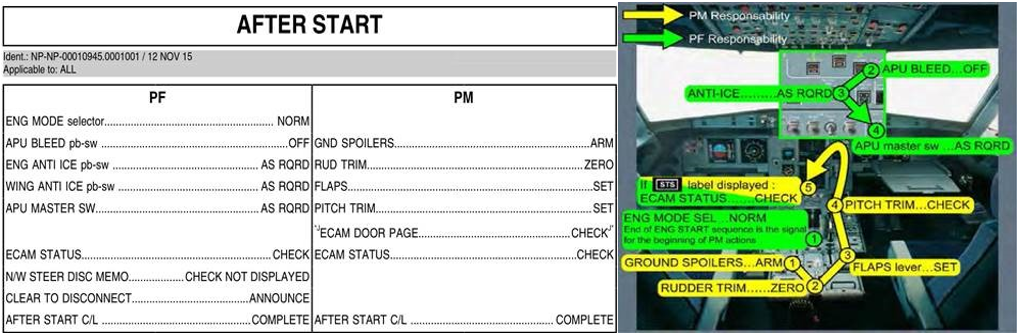
On completion of starting both engines, the flight crew conduct their ‘after start flows’, which are memory item checks split between the pilot flying and pilot monitoring (Figure 2). The second-to-last item for the pilot flying is the announcement to the dispatcher that they are clear to disconnect. After the dispatcher disconnects their headset from the aircraft, they walk clear of the aircraft and provide a ‘thumbs-up’ signal to the flight crew while holding up the nose wheel steering pin for the flight crew to sight. During the ‘after start flows’, the attention of the flight crew on board VGJ was diverted to the radio communications between the aircraft parked on bay 5 and the surface movement controller.
Figure 2: After start flows
Source: Operator
The last item on the ‘after start flows’ is for the flight crew to complete the challenge and response ‘after start checklist’, which is as follows:
ANTI ICE…AS RQRD
ECAM STATUS…CHECKED
PITCH TRIM…SET
RUDDER TRIM…ZERO
DISP CLRNCE…SIGHTED
The last item on the ‘after start checklist’ is confirmation that the dispatcher was sighted clear of the aircraft. The left seat or right seat pilot reports to the other pilot ‘dispatch clearance sighted’. In this serious incident, the terminal was on the left side of VGJ and therefore it was expected that the captain, in the left seat, would sight the dispatcher. The captain reported remembering sighting a dispatcher, but could not recall what was communicated on the flight deck between the flight crewmembers.
On completion of the ‘after start checklist’, the flight crew request taxi clearance and turn on the taxi light.
Tug movements
After the tug disconnected from the aircraft, the tug driver moved the tug clear of the aircraft and initially waited for the dispatcher near the left wingtip. The tug normally waited beside the aircraft to offer the dispatcher a lift and because the nose wheel steering pin is stowed in the tug when removed from the aircraft. However, when the bay 5 aircraft started to move, the tug moved from the left wingtip to the terminal building near parking bay 4.
Safety analysis
After VGJ was pushed-back from bay 4 and the flight crew had started their ‘after start flows’, their attention was diverted to a potential risk of collision associated with the taxi instructions and movement of an aircraft parked on bay 5. Following confirmation between the conflict aircraft and surface movement control that they would wait for VGJ, the captain of VGJ misidentified the dispatcher for the bay 5 aircraft as their own dispatcher. At this time, the tug, which would normally wait beside the departing aircraft for the dispatcher, had moved away from VGJ towards the terminal to avoid a conflict with the bay 5 aircraft. Therefore, the dispatcher sighted by the captain, was next to the tug used for the pushback of VGJ. This potentially provided an association between the tug and the dispatcher in the mind of the captain, who assumed the dispatcher had removed the nose wheel steering pin and moved away from the aircraft. The diversion of the flight crew’s attention away from their ‘after start flows’ probably resulted in the pilot flying not completing their memory items. This was not detected in the ‘after start checklist’ because the captain had misidentified the dispatcher for the bay 5 aircraft as the dispatcher for VGJ. Consequently, the dispatcher connected to VGJ was not cleared to disconnect prior to VGJ starting to taxi.
Findings
These findings should not be read as apportioning blame or liability to any particular organisation or individual.
The flight crew on board VGJ were distracted during their ‘after start flows’ by the radio communications between an aircraft parked on bay 5 and surface movement control, and the subsequent movement of that aircraft which had a potential risk of collision with VGJ.
The captain on board VGJ misidentified the dispatcher for the bay 5 aircraft as their own dispatcher, which resulted in VGJ starting to taxi without clearing the dispatcher to disconnect.
Safety message
Following this serious incident the captain reported that their most important lesson was distraction management. They considered either slowing down the ‘after start flows’ or re-starting the ‘flows’, before the ‘after start checklist’, as the most practical risk mitigation strategies.
Decisions regarding whether to conduct an investigation, and the scope of an investigation, are based on many factors, including the level of safety benefit likely to be obtained from an investigation. For this occurrence, a limited-scope, fact-gathering investigation was conducted in order to produce a short summary report, and allow for greater industry awareness of potential safety issues and possible safety actions.
Publishing information
Released in accordance with section 25 of the Transport Safety Investigation Act 2003
Ownership of intellectual property rights in this publication
Unless otherwise noted, copyright (and any other intellectual property rights, if any) in this report publication is owned by the Commonwealth of Australia.
Creative Commons licence
With the exception of the Coat of Arms, ATSB logo, and photos and graphics in which a third party holds copyright, this publication is licensed under a Creative Commons Attribution 3.0 Australia licence.
Creative Commons Attribution 3.0 Australia Licence is a standard form licence agreement that allows you to copy, distribute, transmit and adapt this publication provided that you attribute the work.
The ATSB’s preference is that you attribute this publication (and any material sourced from it) using the following wording: Source: Australian Transport Safety Bureau
Copyright in material obtained from other agencies, private individuals or organisations, belongs to those agencies, individuals or organisations. Where you wish to use their material, you will need to contact them directly.
On 7 December 2016, a Boeing 737-8FE aircraft, registered VH-YFT (YFT) was parked on bay 3 (Figure 1) at Hobart Airport, Tasmania, as the crew prepared to conduct Virgin Australia flight VA1531 to Sydney, New South Wales. The flight crew consisted of a captain and first officer, and a check captain seated in the jump seat between them.
Figure 1: Hobart Airport – aerodrome diagram
Source: Airservices Australia annotated by ATSB
At about 0945 Eastern Daylight-saving Time (EDT), another Virgin Australia Boeing 737-8FE aircraft, registered VH-VUP (VUP), landed at Hobart Airport and parked on bay 2, adjacent to and north of YFT. The bays required that the aircraft departs using a power-out taxi[1], as there were no tug facilities available at Hobart Airport.
By 0950, the flight crew of YFT had received the final load sheet[2] electronically via the aircraft communications addressing and reporting system (ACARS). Due to an issue with printing a copy of the load sheet on the ACARS printer, the crew requested, and received, a paper copy of the load sheet from the dispatcher.[3] This issue caused a slight delay in pre-flight preparations. After starting the engines, the captain gave the dispatcher the instruction to disconnect their headset from the aircraft, which the dispatcher did, then exchanged thumbs up to indicate all was clear. The dispatcher then walked to the left wingtip of the parked aircraft (VUP) and stood with their arms out and thumbs up to indicate YFT was clear of obstacles, particularly the wingtip of VUP.
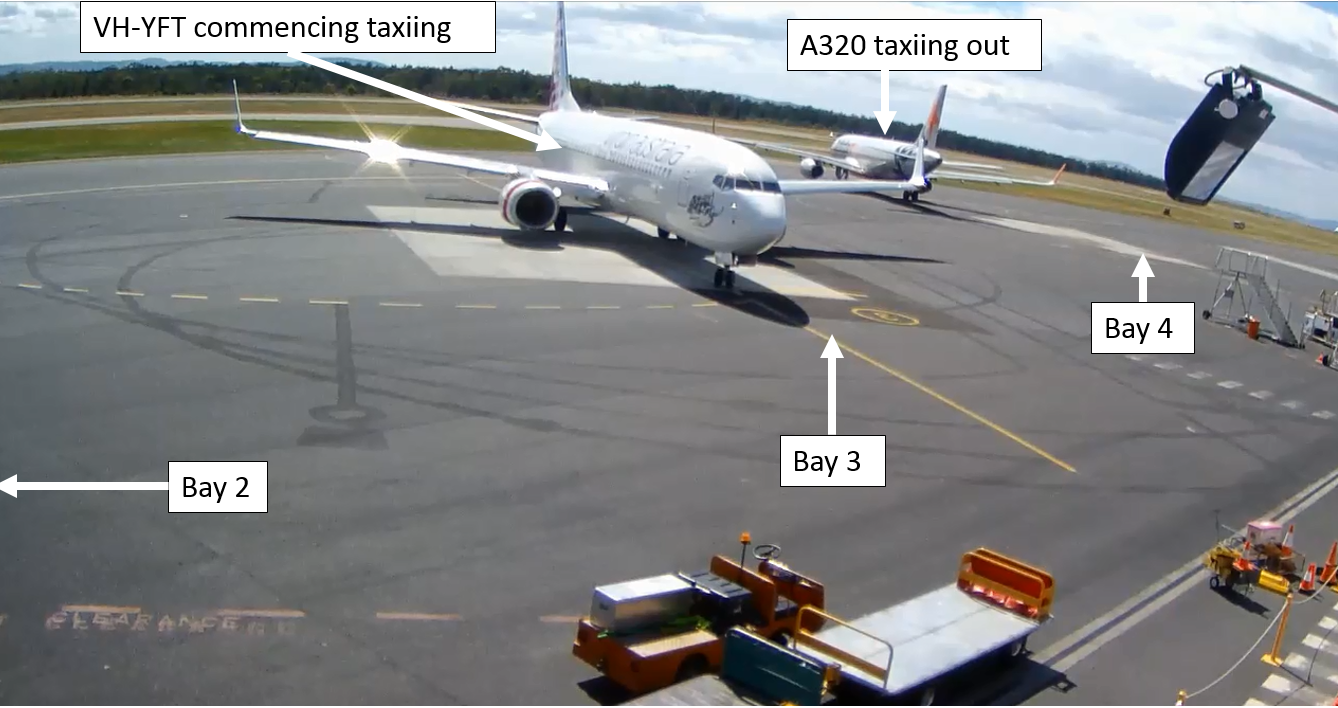
At 1012:12, the first officer of YFT contacted the Hobart surface movement controller (SMC) on Ground frequency and requested a clearance to taxi. The SMC then instructed the crew of an Airbus A320 aircraft that had commenced taxiing from bay 4, to vacate the apron area via taxiway H (Figure 2).
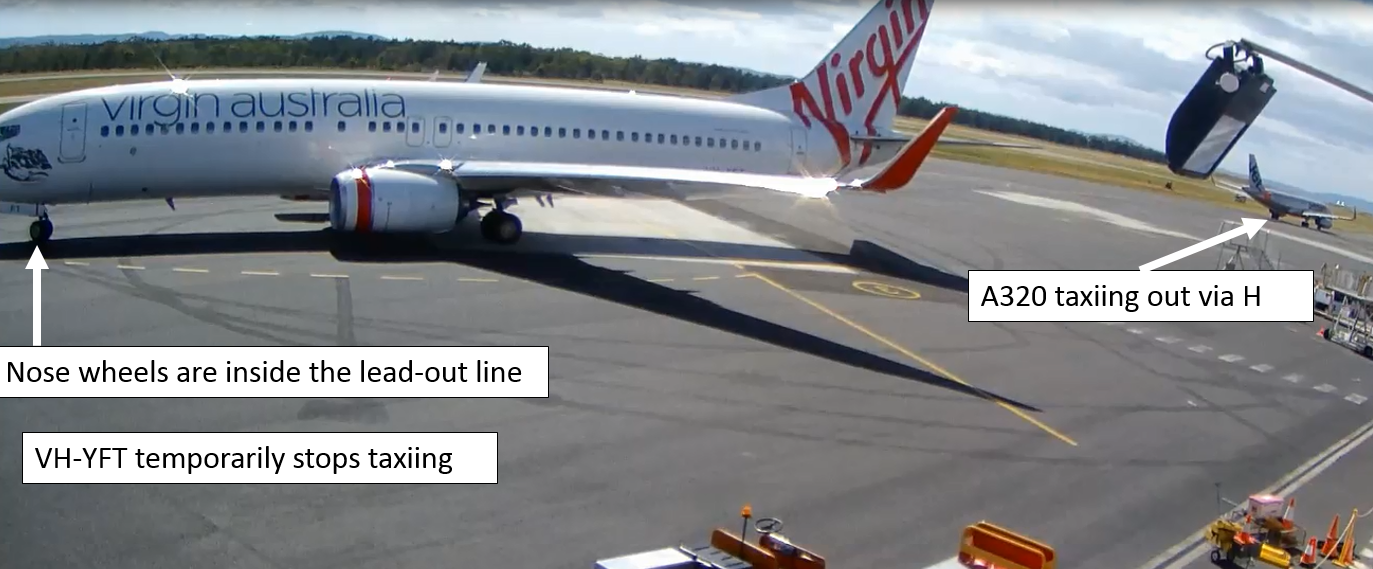
Figure 2: YFT starts taxiing from bay 3 at Hobart Airport
Source: Airport operator annotated by ATSB
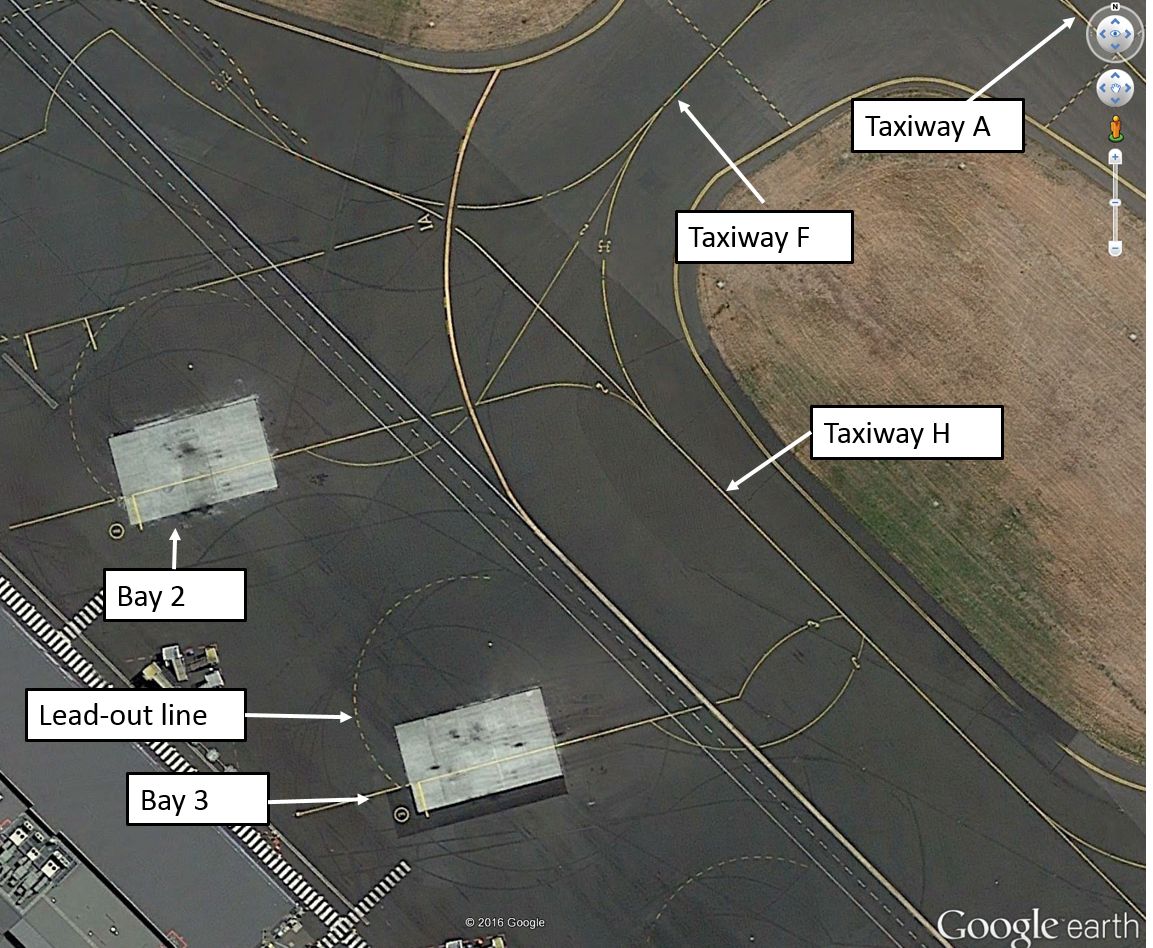
The SMC then advised the crew of YFT that the A320 on their ‘left hand side’ was taxiing out via H and that they were to follow that aircraft via H (and D) to holding point D for runway 30. The first officer read back ‘follow Jetstar A320 behind, behind him via hotel holding point delta runway 30’. At about 1013, the captain commenced turning the aircraft to the right, out of the bay, with the nose wheels just inside the marked lead-out line (Figure 3).
Figure 3: Hobart apron area showing the lead-out line on bay 3
Source: Google earth annotated by ATSB
At that time, another A320 aircraft had landed and was taxiing in towards the parking bays from the north. During the initial turn out of the parking position, the captain became aware of the inbound A320 on taxiway A and became uncertain as to which A320 the controller had instructed them to follow, and whether the inbound A320 would taxi past them via taxiway F. The first officer had also seen the A320 taxiing down A towards F and pointed it out to the captain.
The captain elected to stop the aircraft and clarify their taxi clearance. YFT stopped part way through the turn, about 90° from its parked position (Figure 4). At that time, the nose wheels were inside the lead-out line, and the aircraft was pointing towards the left wingtip of VUP.
Figure 4: YFT stopped taxiing during the turn out of bay 3
Source: Airport operator annotated by ATSB
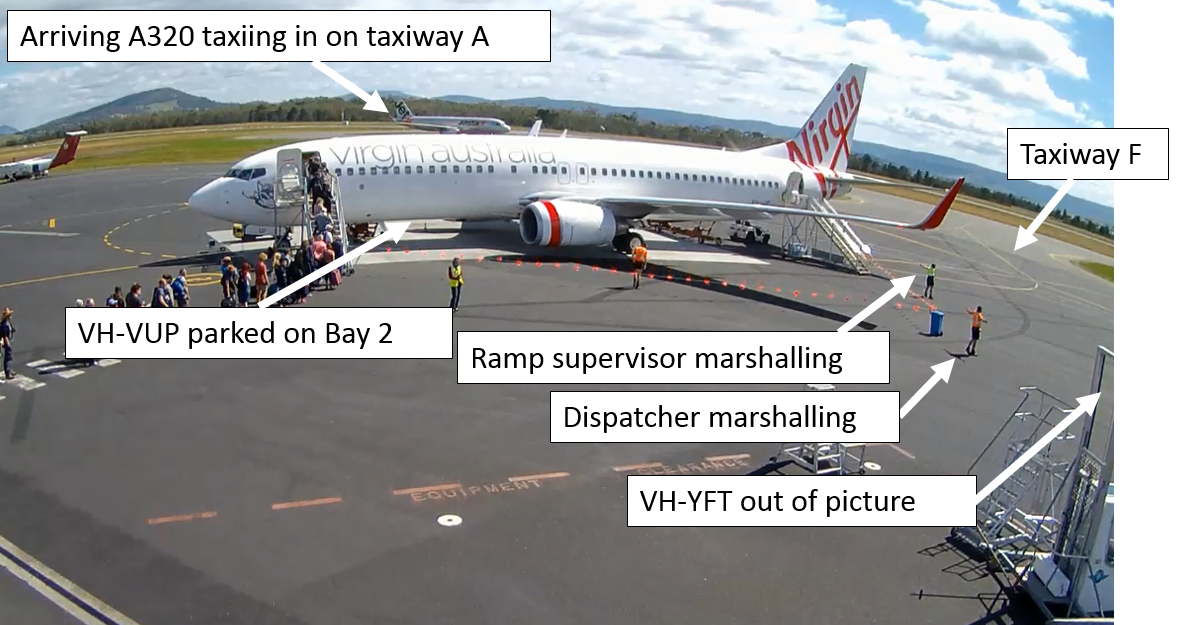
The ramp supervisor[4] was at the far side of the parked aircraft (VUP) preparing it for departure, when YFT stopped. The ramp supervisor saw that YFT had stopped during the turn out, which was unusual, therefore moved to a position near the dispatcher, who was at the left wingtip of VUP, to where they could communicate with the flight crew if required and have line of sight to check for wingtip clearance between the two aircraft (Figure 5).
Figure 5: VUP parked on bay 2 with ground crew marshalling and A320 inbound
Source: Airport operator annotated by ATSB
When YFT had stopped, the flight crew noticed that they had inadvertently omitted to write the automatic terminal information service (ATIS)[5] reference letter on their take-off data card. The first officer switched their radio to the appropriate frequency to listen to the ATIS, while the captain temporarily took over responsibility for communications with air traffic control (ATC) on Ground frequency.
At 1014:00, after seeing YFT stop during the turn, the SMC instructed the crew of YFT to ‘continue to taxi via taxiway H, you are number one to inbound traffic and the other traffic is well clear’. About 20 seconds later, after confirming the clearance with the captain (and switching the radio back from the ATIS to the Ground frequency), the first officer acknowledged the clearance with the call sign ‘Velocity 1531’.
By the time the first officer acknowledged the clearance, the captain had recommenced taxiing, while watching the A320 on taxiway A to make sure that it was going to hold its position. After stopping, the captain removed their hand from the tiller, which caused the nose wheels of YFT to centre. Therefore, the aircraft moved forwards in a near straight line for about 2 seconds and crossed the lead-out line, before the right turn resumed.
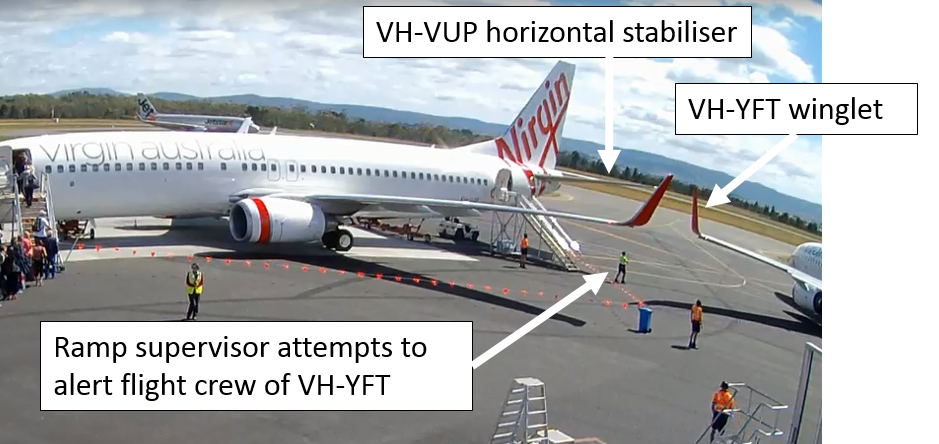
As the aircraft recommenced taxiing, the dispatcher initially observed the wingtips of the two aircraft clear each other. However, as YFT then tracked towards the tail of the parked aircraft as it started to turn, the ramp supervisor assessed that a collision between the left wingtip of YFT and left horizontal stabiliser of VUP was imminent. The ramp supervisor commented that they then lowered their arms towards a crossed position to show that clearance between the two aircraft was reducing,[6] and attempted (unsuccessfully) to make eye contact with the flight crew (Figure 6).
Figure 6: Collision imminent
Source: Airport operator annotated by ATSB
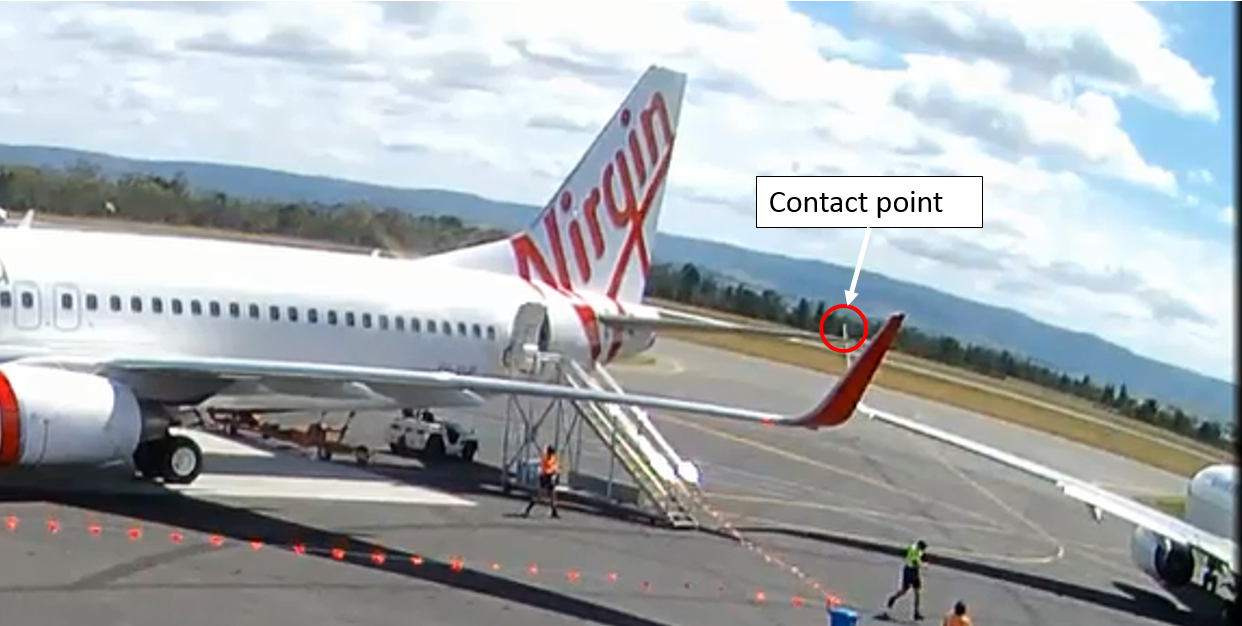
About 30 seconds after recommencing the taxi, as YFT continued to turn, the left wingtip collided with the horizontal stabiliser (tailplane) of VUP (Figure 7).
Figure 7: Contact between YFT left winglet and VUP left horizontal stabiliser
Source: Airport operator annotated by ATSB
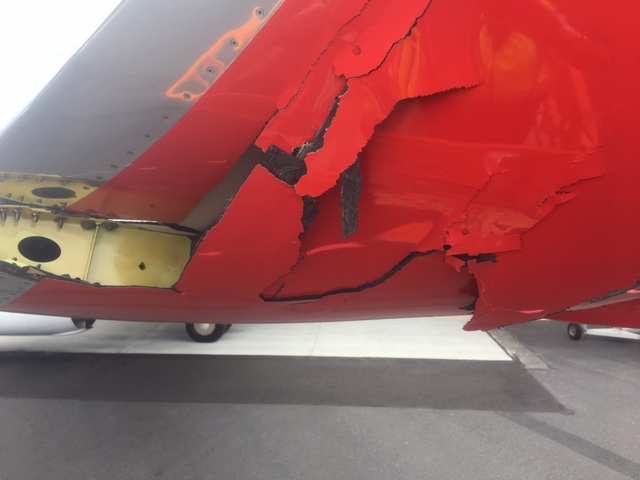
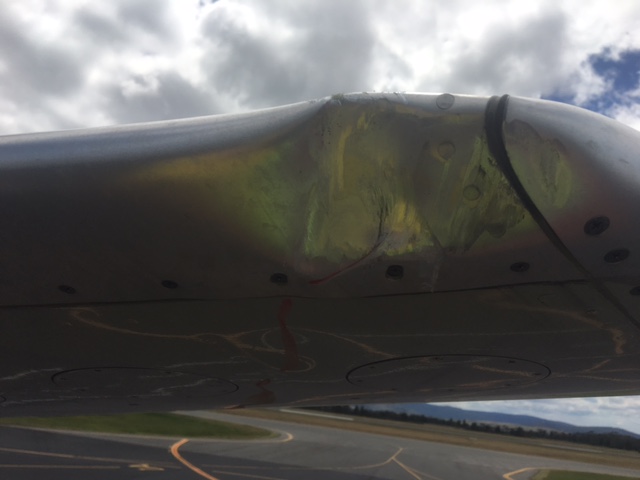
The winglet of YFT was damaged (Figure 8) as was the horizontal stabiliser of VUP (Figure 9). No one was injured.
Figure 8: Damage to YFT left winglet
Source: Aircraft operator
Figure 9: Damage to VUP left horizontal stabiliser
Source: Aircraft operator
Safety analysis
Parking bays
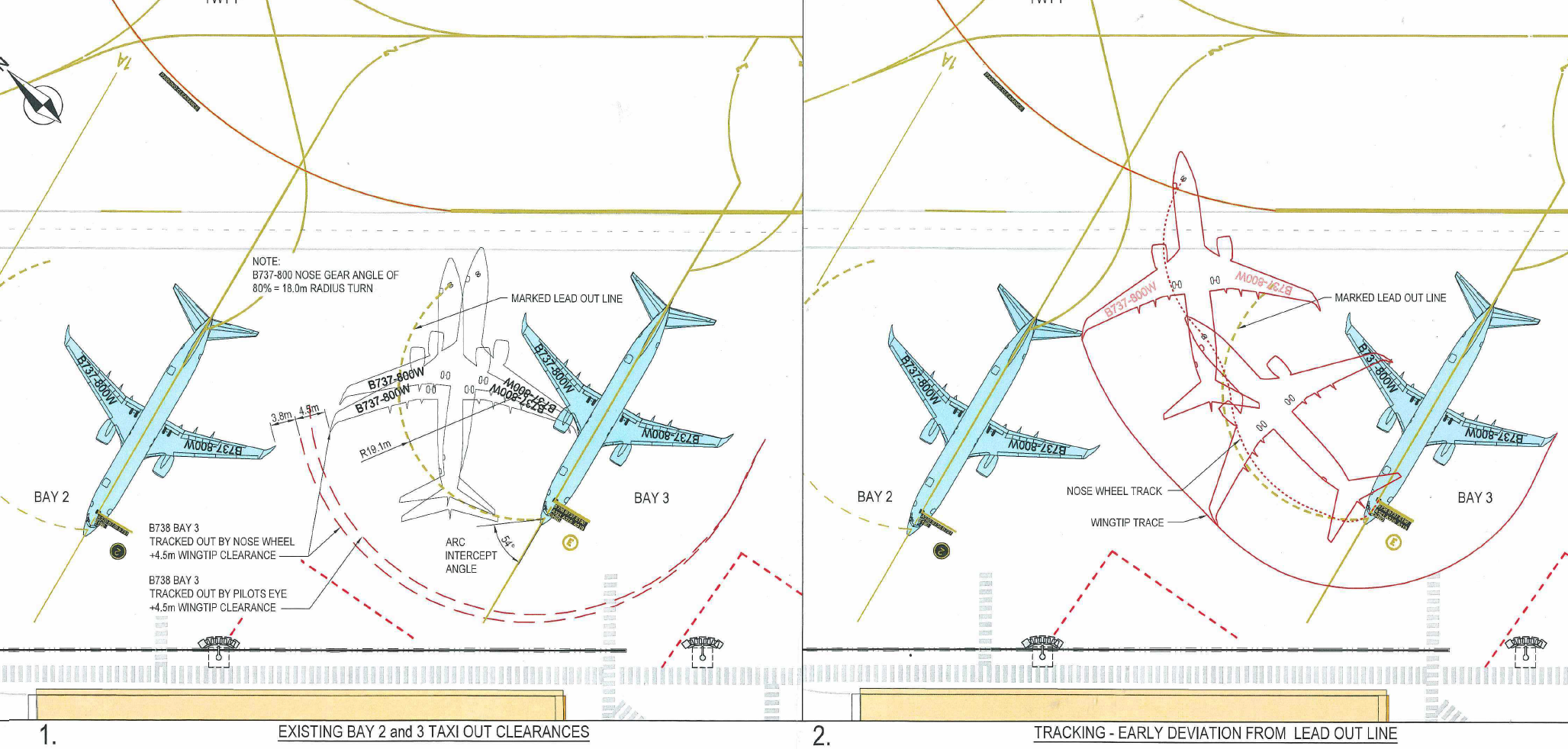
The Hobart Airport operator reported that the bays were surveyed regularly to ensure they met the required standards. The airport operator constructed a schematic diagram of the aircraft’s taxi path from the CCTV footage and the aircraft dimensions on the surveyed apron markings (Figure 10).
The flight crew commented that the design standard for the parking bays meant that they were far too close to be comfortably safe to conduct a power-out taxi when there is an aircraft in the adjacent bay. Furthermore, a bit more spacing between the bays may prevent a similar incident occurring. The captain also commented that consideration of operational acceptability criteria, in addition to technical design specifications, prior to the commissioning of any parking bay and its associated taxi guidance line would facilitate required changes to the bay and mitigate additional threats peculiar to the local environment.
The captain commented that the (power-out) bays in Hobart are not aligned at right angles to taxiway H. This tends to give a false sense of being clear of adjacent aircraft once the cockpit is well past the aircraft and heading towards taxiway H, as the wingtips are so far behind the flight deck and outside the normal viewing arc of the pilots.
Figure 10: Airport survey markings showing B737 aircraft taxi track with nose wheel on lead-out line (left) and approximate incident taxi path (right)
Source: Airport operator
Position of VUP
VUP was parked with the nose wheels approximately 450 mm aft of the stop mark on bay 2, and the main landing gear was offset longitudinally (relative to the aircraft’s heading on the bay) about 380 mm left of the bay centreline. These were well within allowed tolerances and the aircraft was assessed by ground crew to be parked in the correct position. The crew of VUP had been guided to the parking position by ground marshals.
However, the position of VUP’s tail slightly left of centreline and aft (measured after the accident), reduced the available clearance between the two aircraft.
Turning geometry
When the aircraft stopped, the nose wheels straightened, and the aircraft subsequently taxied outside the marked turning circle.
When the captain releases the tiller on a Boeing 737 aircraft[7] during taxi, it will tend to centre the nose-wheel steering and straighten the nose wheels. When the aircraft then starts to move, the captain cannot immediately turn the nose-wheel steering before the aircraft moves without considerable use of thrust and excessive load on the nose landing gear. As the aircraft starts to move forwards, the captain turns the tiller in the desired direction and the nose wheels will start to turn the aircraft.
When YFT stopped, the nose wheels were inside the lead-out line. If the nose wheels track on (or inside) the lead-out line, the wingtip will clear a correctly parked aircraft on the adjacent bay, but it is necessary to keep a continuous turn going. The check captain commented that if you stop the aircraft, particularly if it is heavy, a significant amount of thrust is required to then keep the aircraft on the line. The captain commented that they used caution with the thrust setting because of passengers boarding the aircraft on the adjacent bay. The check captain also stated that there was not a lot of manoeuvring room with ‘power-out’ bays. There is a risk that the aircraft has to go straight ahead for 2-3 m to get the turn going again and there is no allowance made for that in the geometry of the bay.
The captain commented that there is an inherent error in determining where the nose wheel is tracking in relation to a taxi guidance line, in the Boeing 737, during turns. The nose wheel is behind and laterally offset from the captain’s seating position. As such, its position in relation to the line can only be estimated. On power-out bays, flight crew cannot see the position of the aircraft on the lead-out line at any time.
After stopping, the captain could no longer see the lead-out line, which was then beneath and behind the cockpit. The aircraft taxied forward across the lead-out for about 1–2 seconds then turned to the right towards the H taxiway line. There was no marked line connecting the lead-out line with taxiway H.
Ground crew interpretation of taxi track
When the aircraft stopped, the dispatcher noticed that the nose wheels were inside the line, which was normally an indication that the aircraft would stay well clear of an aircraft parked on bay 2. The aircraft then proceeded for about 2 seconds at an angle that was not normal, and both the ramp supervisor and the dispatcher thought the aircraft may have been heading towards taxiway A via the exit (F) behind bay 2 rather than continuing to turn to the right and along the normal path onto taxiway H.
The dispatcher reported that they were not initially concerned about the aircraft’s track, because a bit of momentum was needed to turn the aircraft and get moving. When the wingtip of YFT taxied clear of the wingtip of VUP where the dispatcher was standing, they assumed the aircraft would continue turning and exit the bay, but instead it kept going towards the parked aircraft, which they commented was very unusual.
Communication between ground crew and flight crew
In accordance with normal procedures, the dispatcher unplugged their radio connection to the flight crew before the aircraft commenced taxiing.
The dispatcher commented that they were unsure as to why the aircraft had stopped during the turn, but assumed it was because the flight crew were communicating with ATC. The ground crew radios are not on the ATC frequency and therefore they cannot hear transmissions between ATC and flight crew.
When the aircraft stopped, the ramp supervisor moved to where they could see if the flight crew flashed the nose-wheel lights to indicate a reconnect (of ground-air crew radio communications) was required, but they did not. There were also no hand signals from the flight crew to indicate they needed to reconnect. The ramp supervisor is the only person in the ground crew with a ground-to-air licenced, hand-held radio, so they wanted to get into position to communicate with the flight crew if they requested a reconnect.
As the aircraft continued its turn off the bay, YFT’s wingtip clearance was decreasing due to its proximity to the tailplane of VUP, although it had safely cleared the wingtip of VUP. The dispatcher was then no longer in sight of the flight crew. The ramp supervisor was unable to make eye contact with the captain (seated in the left seat) and commented that the captain appeared to be looking directly forwards.
The ramp supervisor commented that they lowered their arms towards a crossed position to indicate reducing clearance, but that action was not apparent on the CCTV footage of the accident. The check captain commented that lowering of the arms to the crossed position as stated by the ramp supervisor was not shown in the operator’s manual as a procedure to show reduced wing tip clearance.
According to the manual, the correct signal for requiring the aircraft to stop was ‘arms repeatedly crossed above head (the rapidity of the arm movement should be related to the urgency of the stop (i.e. the faster the movement, the quicker the stop)’.
The captain commented that they had seen the thumbs up from the wing walker at the wingtip of the parked aircraft (the dispatcher) and the wing walker near the tailplane of the parked aircraft (the ramp supervisor). They were the only signals the captain sighted and assumed therefore that they were clear of the parked aircraft. If there was any doubt about their clearance from the parked aircraft, they would contact ground staff via radio on their company operations frequency and request assistance, but they did not have any doubt. They had received the all clear signal from the ground crew and thought that they were clear of the parked aircraft and safe to continue.
The captain commented that it would be better to have verbal communication with the marshallers all the way out of the parking bay to have immediate communication if the clearance is insufficient. A verbal warning would be an immediate trigger to stop.
Training
The check captain commented that they consider the turning bays at Hobart to be tight. When training new captains, they always encourage them to ensure that they apply sufficient tiller during the turn out, and that sufficient thrust is applied to keep the aircraft turning. In addition, they suggest using the technique of using slightly more thrust on the outside engine to assist in keeping the aircraft turning.
The check captain also stated that there was no standard procedure in the company for training captains to taxi the aircraft. Training captains instil the importance of using a minimum radius turn out of the bay, appropriate power application and tiller technique, and instruct how to go about requesting assistance with marshaller guidance. Captains are instructed on the visual (hand) signals and where there is any doubt about clearance, to rely on the marshaller and keep a good lookout. If unsure of the clearance from any obstacle, they should stop, but in a turn, it is also important to keep the turn going – if you do stop you potentially have a problem.
When taxiing out of a power-out bay, they try to turn inside the lead-out line to ensure adequate clearance.
Role of ground crew
The operator commented that at the time of the incident, although provision of ‘wing-walkers’ was included in the ground handling contract between the aircraft operator and ground handling provider at Hobart Airport, the ground personnel were not specifically trained in wing walking. The dispatcher and ramp supervisor had proactively positioned themselves at the wingtip and horizontal stabiliser of VUP to assist the flight crew in maintaining clearance between the two aircraft. Wing walking or marshalling was normal procedure for the ground crew at Hobart Airport and both ground crewmembers had substantial experience in doing so.
Once the wingtip of YFT had passed the wingtip of VUP, the dispatcher’s responsibility was over because the next marshaller (ramp supervisor) was in line and the dispatcher was then out of line of sight of the flight deck. There was not usually a marshaller positioned beyond the wingtip.
The dispatcher commented that normally once the aircraft was clear from that position on the wingtip, the dispatcher would give a salute or wave to the captain and they would acknowledge with a wave, but that did not happen on this occasion. The dispatcher commented that the captain appeared to be looking straight ahead towards the exit, or they may have been focused on the marshaller ahead (the ramp supervisor).
Attention and time pressure
The captain initially got the thumbs up from the dispatcher and the ramp supervisor. Immediately before the collision, the captain’s attention was on the inbound A320, and they did not see any indication from the ground crew of reducing clearance with VUP (nor was there any evidence of such on the CCTV footage).
The captain commented that during the turn out, their attention was divided between the wing walker, watching where the aircraft was going, listening to ATC, communicating with the first officer, maintaining situational awareness and being aware of other traffic in the area.
The captain also commented that they[8] had to rise at 0345 to commute to Sydney Airport for the flight and had not slept particularly well as the flight was a line check. There was some pressure to perform well having a check captain in the jump seat. However, the captain felt fit to operate the flight and did not feel tired.
While waiting for the final load sheet to come out on the aircraft communications addressing and reporting system (ACARS), they had a problem with the ACARS printer and had to unjam it as the scheduled departure time was approaching. They requested a hard copy of the load sheet from the dispatcher but were also able to get the printer fixed and printed the load sheet from the ACARS. This caused them a slight delay and they were ready to go about 2 minutes late (scheduled departure was 1010 and they released brakes at 1013). This created some time pressure.
Clearance and traffic disposition
The presence of two A320s led the captain to doubt their taxi clearance after they started taxiing. The operator commented that the first officer’s read back of the taxi clearance, where they stated the A320 ‘behind’ rather than to their left, may also have affected the captain’s perception of which of the two A320s they were to follow. Once the aircraft started to turn, the captain could not see the A320 taxiing out (via H) but was concerned about the one inbound. The captain wanted to confirm that the inbound aircraft was going to stop.
Normally the captain would clarify the clearance with the first officer, but the first officer was listening to the ATIS at the time.
Findings
These findings should not be read as apportioning blame or liability to any particular organisation or individual.
When the captain became aware of the incoming A320, they became uncertain of their clearance and stopped the aircraft to clarify.
The aircraft taxied outside the marked lead-out line after stopping and without the application of sufficiently increased thrust or tiller input this resulted in insufficient clearance from the parked aircraft. The captain was unable to see the aircraft’s position relative to the lead-out line after stopping and the line did not continue to intersect the taxiway ahead of the aircraft.
The bays were marked according to the standards, but the standards probably did not allow sufficient margin for non-normal situations, such as stopping during the turn.
There was no documented procedure for either flight or ground crew to follow in the case of an aircraft stopping during the turn or crossing the lead-out line.
The operator did not have a standard training syllabus or assessment criteria for teaching captains to taxi the aircraft.
There was no direct means of verbal communication between ground marshallers and the flight deck once the aircraft started taxiing, although the crew could contact the movement coordinator if required.
Wing walkers should remain in sight of the flight crew, but the captain did not see the ramp supervisor signal to indicate reducing clearance between the two aircraft. The captain’s attention was to the incoming A320.
Safety action
Whether or not the ATSB identifies safety issues in the course of an investigation, relevant organisations may proactively initiate safety action in order to reduce their safety risk. The ATSB has been advised of the following safety action in response to this occurrence.
Aircraft operator
As a result of this occurrence, the aircraft operator has advised the ATSB that they are taking the following safety actions:
Flight crew operational notice
The aircraft operator issued a flight crew operational notice (FCON)[9] which stated that:
When taxiing out of power-out bay, crew shall ensure the aircraft maintains the apron lead-out line until:
the end of the lead-out line; or
the lead-out line joins a taxiway centreline.
This may involve an exit turn of more than 180 degrees to assure clearance from adjoining bays.
Should the aircraft be stopped before completion of the entire turn to exit the apron, caution should be made when re-initiating movement to ensure the above requirements are maintained.
If at any time aircraft clearance cannot be assured, the aircraft should cease taxiing and request assistance.
Training and checking notice
The aircraft operator also issued a training and checking notice (TCN) that stated ‘All Check Captains and Training Captains are requested to ensure that wingtip geometry, turn markings, turn procedures and hazards are well understood by flight crew during line training and recurrent line checks’.
Flight crew information bulletin
The aircraft operator published a flight crew information bulletin (FCIB) for educational and standardisation purposes titled Wingtip Clearance Hazard and applicable to Boeing 737 aircraft. The FCIB included information about taxiing in accordance with lead-out lines, appropriate use of ground crew, images of Hobart and other airports used by the operator, and wing and tail turning geometry for the aircraft.
The FCIB stated:
In summary, it is recommended that taxi guidance lines be adhered to, whenever practical. Continued vigilance should be employed by crews in the monitoring of obstacles during ground manoeuvring.
If there is any doubt whatsoever regarding wingtip clearance, STOP and seek guidance.
Safety message
This incident highlights the importance of aircraft operators conducting a thorough risk assessment where ground movement is confined, particularly movements involving congested power-out bays. Effective risk assessments ensure that hazards are clearly identified and well understood, and that the associated risks are appropriately managed.
To manage clearance in congested areas, communication tools between ground and flight crew should be used where possible when ground crew are providing marshalling or wing walking assistance. Hand signals rely on constant visual contact, which cannot be guaranteed. Appropriate training of ground crew regarding the use of standard hand signals is required to ensure mutual understanding and communication between flight and ground crew.
Where possible, airport authorities should consider additional margins to accommodate unusual or irregular circumstances during taxiing.
Decisions regarding whether to conduct an investigation, and the scope of an investigation, are based on many factors, including the level of safety benefit likely to be obtained from an investigation. For this occurrence, a limited-scope, fact-gathering investigation was conducted in order to produce a short summary report, and allow for greater industry awareness of potential safety issues and possible safety actions.
Publishing information
Released in accordance with section 25 of the Transport Safety Investigation Act 2003
Ownership of intellectual property rights in this publication
Unless otherwise noted, copyright (and any other intellectual property rights, if any) in this report publication is owned by the Commonwealth of Australia.
Creative Commons licence
With the exception of the Coat of Arms, ATSB logo, and photos and graphics in which a third party holds copyright, this publication is licensed under a Creative Commons Attribution 3.0 Australia licence.
Creative Commons Attribution 3.0 Australia Licence is a standard form licence agreement that allows you to copy, distribute, transmit and adapt this publication provided that you attribute the work.
The ATSB’s preference is that you attribute this publication (and any material sourced from it) using the following wording: Source: Australian Transport Safety Bureau
Copyright in material obtained from other agencies, private individuals or organisations, belongs to those agencies, individuals or organisations. Where you wish to use their material, you will need to contact them directly.
On 5 October 2016, at about 1600 Western Standard Time (WST), a Boeing 717 (B717) aircraft, registered VH-NXN (NXN), was being operated by Cobham Aviation Services as QantasLink, on a scheduled passenger flight from Paraburdoo Airport to Perth, Western Australia. On board were the captain, first officer, three cabin crewmembers and 115 passengers.
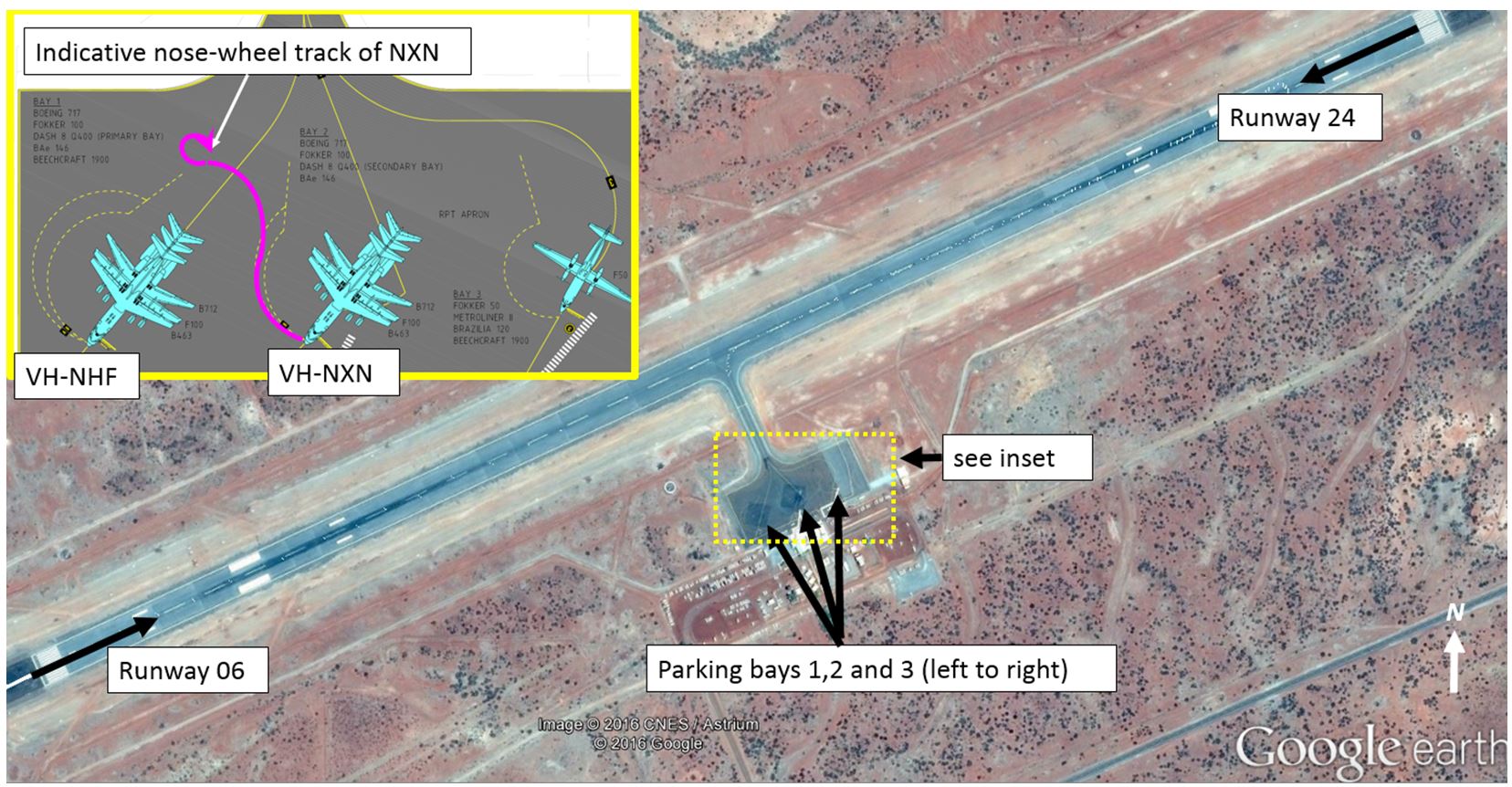
The aircraft had been parked on Bay 2 facing south-west towards the terminal building, and the flight crew planned to depart from runway 24 (Figure 1). The captain commenced taxiing, turning the aircraft around to the right in accordance with the normal taxi procedure. As the aircraft turned, the captain sighted a company B717 aircraft about to land on runway 06. The captain quickly assessed that due to limited apron space at Paraburdoo, they needed to taxi behind a Network Aviation Fokker F28 MK 0100 (F100) aircraft, registered VH-NHF (NHF), which was parked on Bay 1, also facing the terminal, to allow the inbound B717 room to pass and taxi to Bay 2, which they had just vacated.
Figure 1: Paraburdoo Airport showing runways and parking bays
Source: Google earth and aircraft operator – annotated by ATSB
After starting a left turn to taxi behind the F100, the captain was not confident there was sufficient clearance between the two aircraft, and asked the first officer to request a member of ground staff to come out as a ‘wing walker’.
An engineer for Network Aviation, who had been working on the F100, observed NXN taxiing. As NXN deviated from the painted taxi line, the engineer became concerned about the proximity of its left wingtip to the tail of the parked F100. As a result, as NXN taxied forward, the engineer checked the clearance between its wingtip and tail of the F100, and gave the captain the ‘thumbs up’ signal to indicate the aircraft was clear.[1] The captain assumed therefore that the aircraft was clear and continued taxiing around the back of the F100, then turned the aircraft sharply around to the right (Figure 1 insert). The aim was to leave enough room for the inbound B717 to taxi past, and then continue onto the taxiway once they were clear.
The engineer had expected NXN to taxi towards the runway rather than turning around the back of the F100. The engineer immediately assessed that the horizontal stabilisers of the two aircraft may collide, and tried to signal the captain to stop, but was near the wing of the aircraft and no longer in the captain’s sight. The engineer ran towards the front of the aircraft and waved to the captain to stop. The captain braked heavily. The crew did not feel a collision. Some hours later, it was determined that the horizontal stabiliser of NXN had slid under that of NHF, scraping the surface, and both aircraft sustained minor damage (Figure 2). The passengers and crew of NXN were not injured and no one was on board NHF.
Figure 2: Horizontal stabiliser of NXN under that of NHF
Source: Cobham Aviation Services
Airport facilities
Paraburdoo Airport had one taxiway from the runway to the apron area. There were three parking bays, but only two were suitable for F100 and B717 aircraft. Bay 1 was occupied by the F100, NHF, and NXN had been parked on Bay 2. It was also not possible for a B717 to turn around on the runway except at the thresholds due to pavement restrictions.
Captain comments
Awareness of inbound aircraft
NXN was a few minutes late for their scheduled departure and the inbound B717 arrived several minutes earlier than scheduled. There was no procedure for the aircraft operator to notify pilots of the potential for multiple aircraft (from that company) to be at Paraburdoo at the same time.
The captain (and first officer) of NXN reported that they did not hear the inbound or final calls from the crew of the inbound B717. This may have been because at about the time of the inbound calls, the crew of NXN were resolving loadsheet issues with ground staff.
The captain commented that the ground staff were busy due to the arriving B717, and did not alert the crew of NXN to its imminent arrival. Furthermore, a wing walker was not at the parking bay when NXN started taxiing, which was the normal procedure.
The crew of NXN reported that they were not aware of the arriving B717 until they commenced taxiing. While the inbound aircraft had landed on runway 06, the conditions necessitated a departure from runway 24 for NXN.
Non-normal taxi manoeuvre
The captain reported that they would normally conduct a right turn out of the parking bay and taxi the aircraft directly onto the taxiway leading to the runway. This was what the crew were expecting to do until they sighted the inbound B717, landing in the opposite direction to their planned take-off direction.
When the captain of NXN saw the other B717 about to land on runway 06, they thought they were going to be ‘boxed in’ and formulated a plan in ‘about 10 seconds’ for the two B717s to pass on the apron area. The captain needed to formulate a plan with limited time available due to parking space constraints and noting that B717-size aircraft could only conduct 180° turns at the runway thresholds. The captain assessed that the only way they could pass the incoming B717 was to taxi behind the parked F100.
The captain later realised that they could have taxied to the runway 06 threshold, turned there, and taxied back to the runway 24 threshold, but that would have added about 2 km to their taxi and therefore increased fuel required.
Engineer comments
The engineer gave the ‘thumbs up’ having assessed that the wingtip of NXN would not collide with the (tail of the) F100, but did not expect the captain to continue taxiing around the parked aircraft. The engineer was only trying to ensure the aircraft did not collide having assessed the potential for a collision. They had not intended to act as a ‘wing walker’, did not know what the captain’s intentions were, and had no means of communicating with the captain other than by hand signals.
By the time the engineer assessed that there was insufficient clearance between the horizontal stabilisers of the two aircraft, they were no longer in sight of the captain. The horizontal stabiliser of NXN slid under that of the F100 before the engineer was able to signal the captain to stop.
Ground crew resources
The flight crew could not visually confirm the relative position of the two aircraft due to the limited view from the flight deck. Ground handling agent staff would normally have been available to assist the crew, but their attention had shifted to management of the inbound company aircraft. The first officer was about to request a wing walker from the ground staff, when the engineer appeared and signalled the captain.
The crew would have considered the use of ground vehicles if they had been available, but there was no infrastructure such as a tug or tow bar available at Paraburdoo.
Safety analysis
Due to the inbound aircraft and tarmac constraints, the flight crew assessed that a non-standard taxi manoeuvre was necessary to allow the two B717 aircraft to pass.
There was no wing walker in position on the tarmac to provide the crew with a more timely warning of the proximity of the tail to the tail of the F100, and with whom the crew could communicate to discuss their intentions. The crew were about to request a wing walker because the captain was not certain they would be clear of the F100, when the engineer from another company appeared.
Although the engineer used a standard hand signal, the crew interpreted the ‘thumbs up’ to mean that both the wing tip and tail were clear. The crew had not communicated with the engineer until the engineer gave the signal.
The engineer did not anticipate the sharp right turn of the aircraft after it had apparently passed the F100. The engineer was not in a position to warn the crew about the position of the tail once the sharp right turn had commenced.
Findings
These findings should not be read as apportioning blame or liability to any particular organisation or individual.
The crew was unaware of the inbound company B717 until after taxi had commenced, then taxied on a non-standard path to accommodate entry of that aircraft onto the tarmac.
A ground handling agent wing walker was not in place to assist the crew as they taxied.
The inability to communicate verbally with the non-company engineer resulted in the crew interpreting the engineer’s thumbs up signal as meaning the entire aircraft was clear of the parked aircraft.
Decisions regarding whether to conduct an investigation, and the scope of an investigation, are based on many factors, including the level of safety benefit likely to be obtained from an investigation. For this occurrence, a limited-scope, fact-gathering investigation was conducted in order to produce a short summary report, and allow for greater industry awareness of potential safety issues and possible safety actions.
Publishing information
Released in accordance with section 25 of the Transport Safety Investigation Act 2003
Ownership of intellectual property rights in this publication
Unless otherwise noted, copyright (and any other intellectual property rights, if any) in this report publication is owned by the Commonwealth of Australia.
Creative Commons licence
With the exception of the Coat of Arms, ATSB logo, and photos and graphics in which a third party holds copyright, this publication is licensed under a Creative Commons Attribution 3.0 Australia licence.
Creative Commons Attribution 3.0 Australia Licence is a standard form licence agreement that allows you to copy, distribute, transmit and adapt this publication provided that you attribute the work.
The ATSB’s preference is that you attribute this publication (and any material sourced from it) using the following wording: Source: Australian Transport Safety Bureau
Copyright in material obtained from other agencies, private individuals or organisations, belongs to those agencies, individuals or organisations. Where you wish to use their material, you will need to contact them directly.
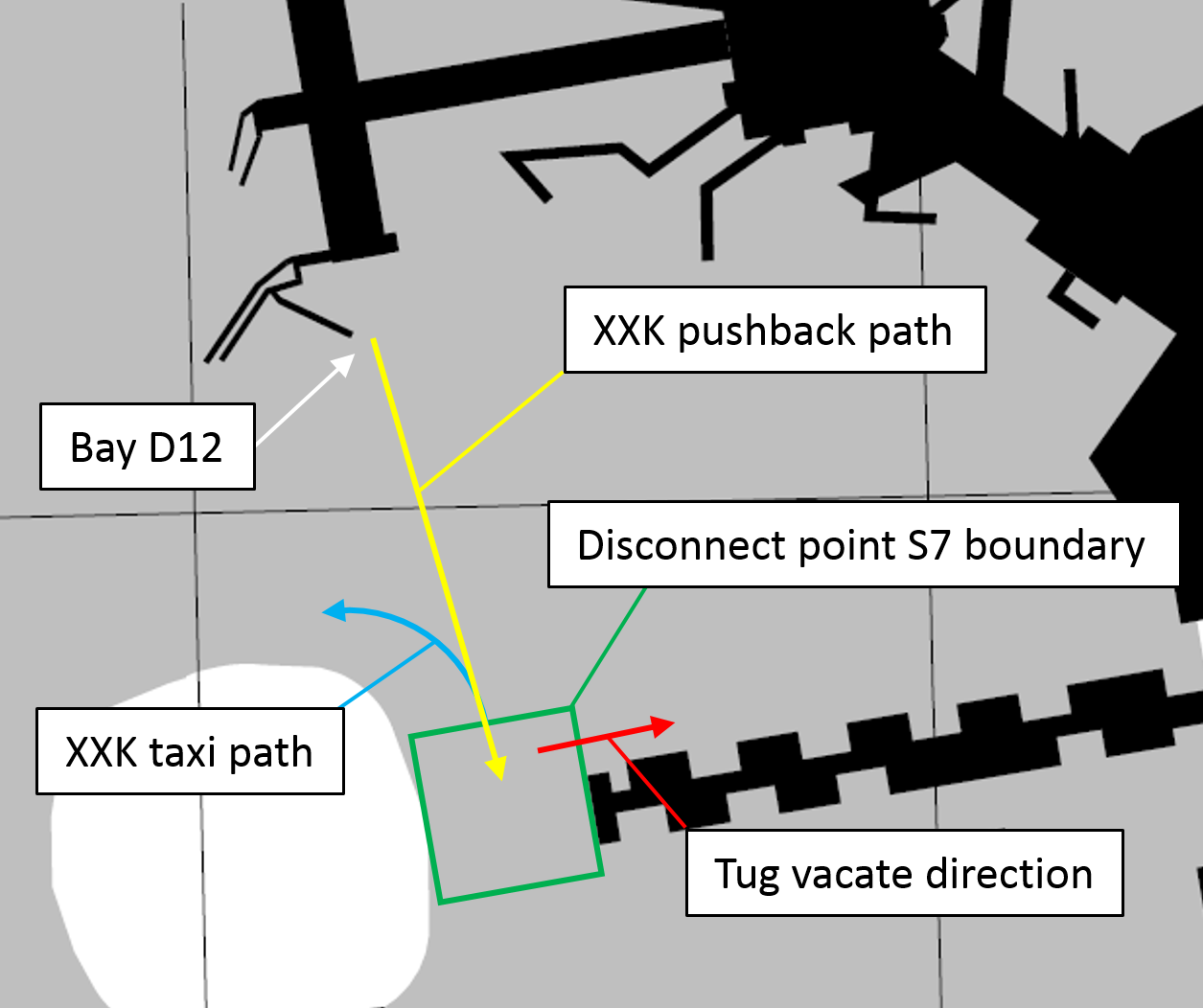
On 9 September 2016, at about 0005 Eastern Standard Time (EST), an AirAsia X Airbus A330-343X, registered 9M-XXK (XXK) pushed back[1] from gate D12 to disconnect point S7 (Figure 1) at Melbourne Airport, Victoria, to operate scheduled passenger flight D7213 to Kuala Lumpur, Malaysia. Although it was night-time, the apron was well lit by flood lights.
The aircraft maintenance engineer (AME) conducting the pushback was provided by a contracted company, the tug and tug driver were provided by a third company. Prior to commencing the pushback, the AME installed the nose gear steering bypass pin,[2] connected the tow bar to both the aircraft nose landing gear and the tug. During the pushback, as the tug moved the aircraft, the AME was seated in the tug. The AME was in continuous communication with the flight crew using a headset connected directly through a headset jack to the cockpit. During the pushback, the flight crew started one engine. After reaching disconnect point S7, the flight crew applied the park brake and started the second engine.
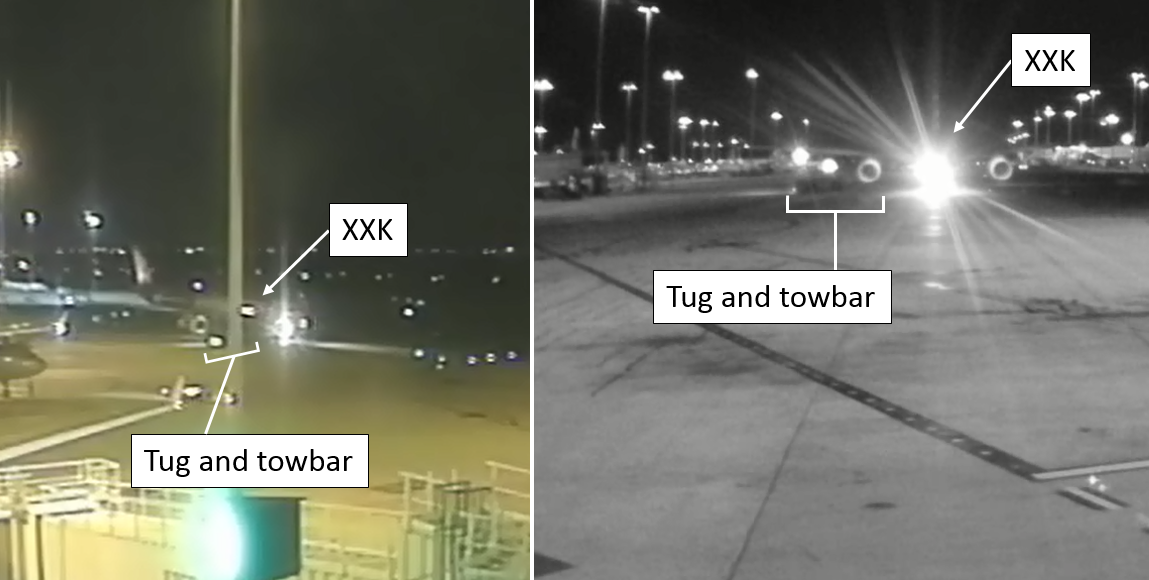
At 0008, after both engines were started, the AME disconnected the headset and tow bar from both the aircraft and the tug, the AME also removed the bypass pin. The tug driver turned the tug around to allow the AME to attach the tow bar to the rear of the tug. The tug driver then moved the tug and tow bar to a position forward of the aircraft’s right engine and visible to the first officer (Figure 2). The AME then walked to a position in front of the tug, and displayed the bypass pin to the first officer. The AME received a hand signal from the first officer confirming the first officer had sighted the bypass pin. Sighting the bypass pin was the final item on the flight crew’s after start checklist. The flight crew then contacted ATC and obtained a taxi clearance.
At 0009, the first officer confirmed to the captain that the AME and tug were clear, the captain then began to taxi. At this time, the AME was walking towards the left side of the tug, which remained parked forward of the aircraft’s right engine and wing. As the AME walked, they detected the aircraft’s taxi light illuminate and the aircraft begin to move. The AME then ran toward the tug door and alerted the tug driver to the aircraft movement.
Video footage of the incident shows the tug driver taking action to avoid a collision with the taxiing aircraft.
The flight departed without further incident.
Figure 2: Positions at commencement of aircraft taxi
Source: Melbourne Airport, modified by ATSB
Flight crew procedures
The flight crew procedures included the following steps:
After the pushback and engine start sequence is complete, the bypass pin must be sighted.
Once taxi clearance is obtained, the flight crew shall ensure both sides of the aircraft are clear prior to taxi.
Flight crew comments
The flight crew of XXK provided the following comments:
Both flight crew interpreted the AME displaying the bypass pin as meaning the tug and AME were clear, and it was safe to commence taxi.
The flight crew assumed that ATC providing the taxi clearance meant that ATC had confirmed the tug was clear of the aircraft.
The first officer observed the tug and AME to the right of the aircraft and assessed that they were clear of the right engine.
Aircraft maintenance provider procedures
The ground handling procedures include the following steps:
Once the tow bar is connected to the tow vehicle (after being disconnected from the aircraft), the tow vehicle must move away to an area that is visible to the flight crew.
At a suitable and safe distance from the aircraft, (the AME must) hold up the bypass pin to provide visual confirmation that it has been removed to the flight crew and give a ‘thumbs up’ signal indicating ‘clearance to proceed’. Once acknowledged by the flight crew, move away from the aircraft to a safe distance for the aircraft to taxi.
AME and tug driver comments
The tug driver and AME both commented that they expected the aircraft to remain stationary until they had moved clear of the S7 disconnect point boundary.
Airservices Australia safety bulletin
The AME and captain commented that they expected air traffic control (ATC) to confirm that the tug was clear of the aircraft and disconnect point S7 prior to providing a taxi clearance.
In 2015, ATC provider, Airservices Australia, identified some misinterpretation among pilots, airside drivers and ground crew regarding the responsibilities for collision avoidance on aerodrome movement areas and the services ATC provide to aircraft and/or vehicles operating on these areas. In response, on 12 November 2015, Airservices Australia released an Aeronautical Information Circular AIC (H32/15) and subsequently in 15 March 2016, this information was released as a safety bulletin, Safety of ground movement on a controlled aerodrome. The bulletin had been provided to the operators involved in this incident.
The bulletin contains the following information regarding operations on the apron and push-back approvals:
The pilot in command (with any assisting ground personnel) is responsible for avoiding collision on the apron. ATC push-back approvals and taxi clearances are only to regulate entrance to, and movement on, the taxiways and do not relate to movement on the apron areas.
When ATC issue approval for push-back or taxi clearance, they will only provide information about relevant known aircraft moving on the same apron. This information may be incomplete as ATC has limited knowledge (or visibility) of movements on the apron. Pilots must also obtain traffic information from assisting ground personnel and, where available, the apron service which may be established as a discrete service at some locations.
Safety analysis
The flight crew interpreted the AME showing the bypass pin at the end of the pushback sequence as notification that all vehicles and equipment were clear of the aircraft and it was safe to commence taxi. The ground crew expected that the flight crew would commence taxi only after all personnel and equipment had crossed the line demarcating the boundary of the S7 disconnect point. Both the flight crew and AME expected that the aircraft would not receive a clearance to taxi until ATC had confirmed that the tug and AME were clear. The misunderstandings by the parties involved during this sequence likely led to incorrect expectations of when the aircraft would begin taxi and the aircraft beginning to taxi prior to the tug moving clear.
The flight crew procedures required the flight crew to visually confirm that all ground equipment was clear of the aircraft prior to taxi. The first officer assessed that the tug and tow bar were clear of the right engine when they were not, although their perception may have been influenced by an expectation of them being clear given the communications with the AME and ATC providing taxi clearance.
Findings
This finding should not be read as apportioning blame or liability to any particular organisation or individual.
The flight crew and ground crew had differing understandings of procedures. These differing understandings led to different expectations of when the aircraft would commence taxi which resulted in the near collision.
The first officer incorrectly assessed the distance of the tug from the aircraft.
Safety message
Ground handling of large aircraft presents many safety risks and requires many separate operators to work closely together. Effective teamwork ensures safe and efficient ground operations.
This incident highlights the importance of separate operators working closely together and having procedures which are well harmonised. It is also important that these procedures are well understood and practiced by all individuals involved from the different operators to ensure all parties understand their role but also how their role interacts with other parties.
Also highlighted, is the importance of understanding the services provided by ATC. ATC provide separation between aircraft, personnel and equipment operating on manoeuvring areas. ATC do not separate aircraft from tugs and other ground personnel on apron areas such as disconnect point S7.
Decisions regarding whether to conduct an investigation, and the scope of an investigation, are based on many factors, including the level of safety benefit likely to be obtained from an investigation. For this occurrence, a limited-scope, fact-gathering investigation was conducted in order to produce a short summary report, and allow for greater industry awareness of potential safety issues and possible safety actions.
Publishing information
Released in accordance with section 25 of the Transport Safety Investigation Act 2003
Ownership of intellectual property rights in this publication
Unless otherwise noted, copyright (and any other intellectual property rights, if any) in this report publication is owned by the Commonwealth of Australia.
Creative Commons licence
With the exception of the Coat of Arms, ATSB logo, and photos and graphics in which a third party holds copyright, this publication is licensed under a Creative Commons Attribution 3.0 Australia licence.
Creative Commons Attribution 3.0 Australia Licence is a standard form licence agreement that allows you to copy, distribute, transmit and adapt this publication provided that you attribute the work.
The ATSB’s preference is that you attribute this publication (and any material sourced from it) using the following wording: Source: Australian Transport Safety Bureau
Copyright in material obtained from other agencies, private individuals or organisations, belongs to those agencies, individuals or organisations. Where you wish to use their material, you will need to contact them directly.
At about 2310 Eastern Standard Time (EST), a Hawker Beechcraft Corporation B300C, registered VH‑NAO (NAO), taxied at Sydney Airport, New South Wales (NSW) for a flight to Coffs Harbour, NSW to retrieve a patient. On board were the pilot and three medical staff. The weather was fine and clear.
The pilot made a taxi call and air traffic control (ATC) cleared NAO to taxi from the domestic 5 apron where the aircraft was parked, with a requirement to give way to an inbound company aircraft (taxiing to the domestic 5 apron) and hold short of taxiway delta.
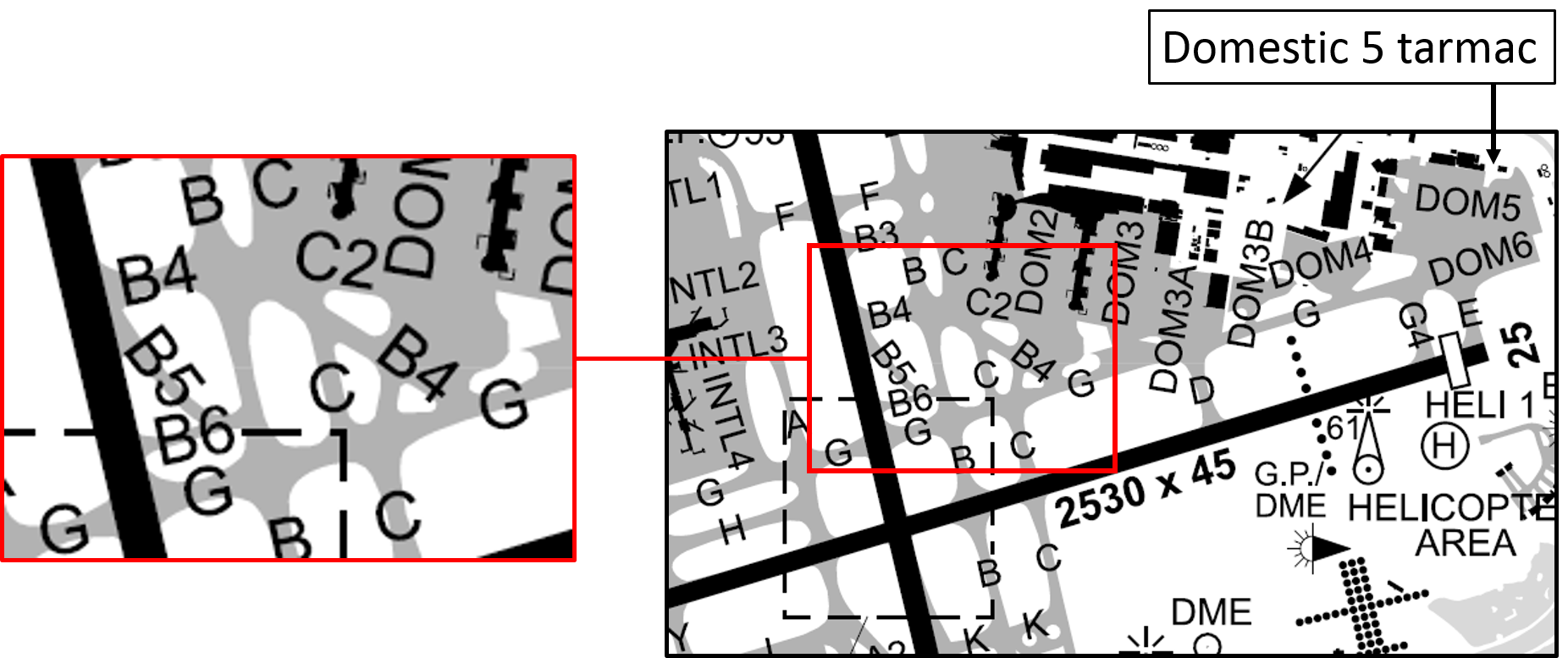
At about the time that NAO taxied, activities commenced in association with planned aerodrome works near the intersection of taxiways golf, charlie and domestic 2 (see Figure 1). Two work safety officers moved to the area in separate vehicles to establish the worksite. Establishment of the worksite included placement of red lights across affected taxiways and covering (taping over) existing green taxiway centreline and lead-in lighting. Placement of red lights and covering of existing lights was intended to delineate the closed areas of affected taxiways.
Figure 1: Excerpt from aerodrome chart showing the location of the relevant taxiways
Source: Airservices, modified by the ATSB
Other aerodrome works activities required the closure of runway 16R, north of golf. Associated with that work, the controller switched off the runway lights north of the intersection of the runway with golf. Additionally, runway 07/25 was closed.
Once the inbound company aircraft was clear, the pilot of NAO was given further taxi clearance. The cleared route was intended to take the aircraft around the worksite that was being established, and to approach runway 16R at the point from which the aircraft could depart. The pilot was cleared as follows:
…taxi golf, bravo 4, and then left at bravo to the golf holding point runway 16R, just to go around the worksite.
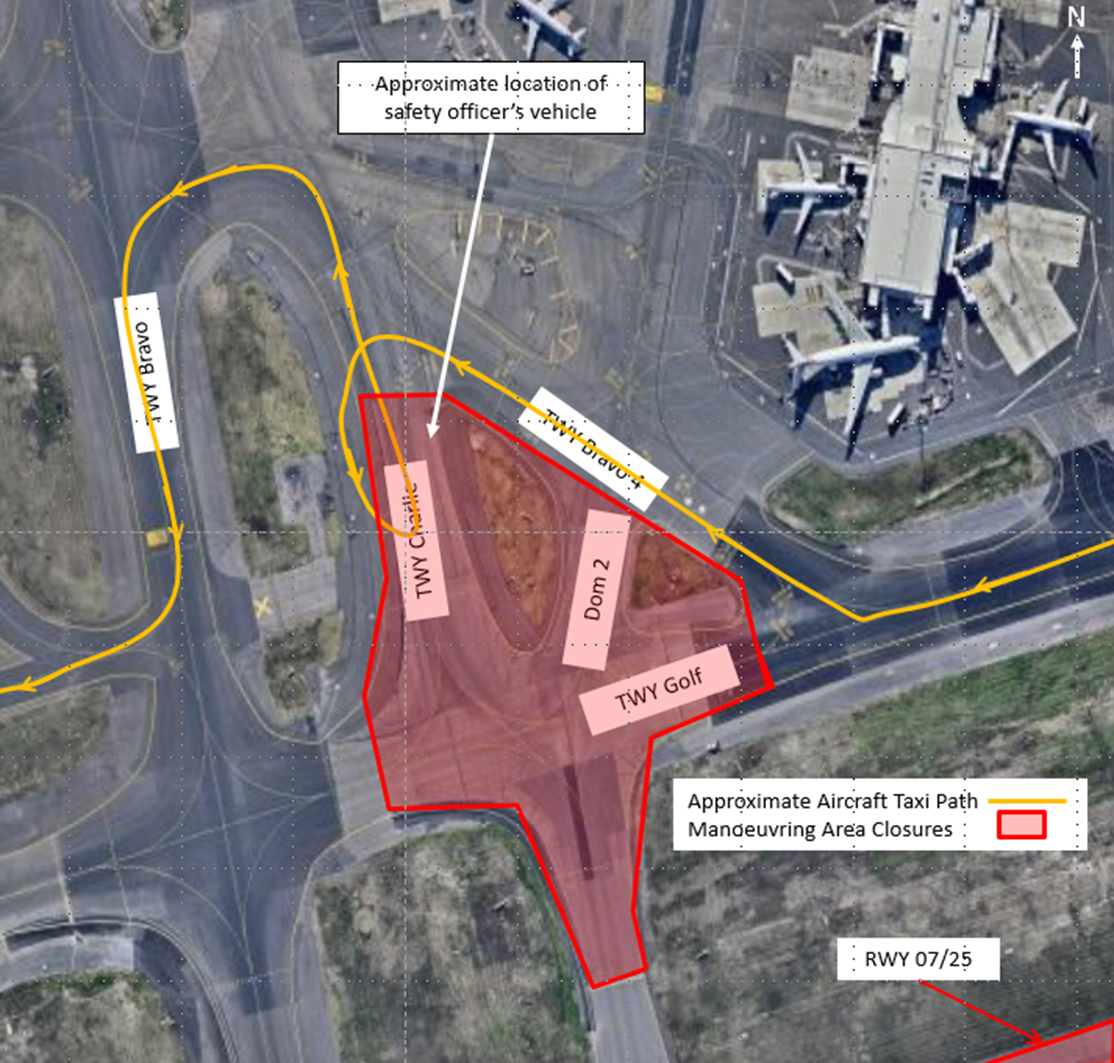
After placing red lights at the eastern and western ends of the worksite on golf, a safety officer moved to the northern end of the worksite on charlie. The safety officer parked the vehicle on the centreline of charlie, facing west across the taxiway, and commenced placing red lights across the taxiway between the position of the vehicle and where charlie meets bravo 4. By then, NAO was on bravo 4, and the safety officer was aware of the location and expected taxi route of the aircraft.
Soon after the safety officer commenced placing red lights across charlie, the pilot contacted ATC to confirm the instruction to turn left into bravo, then back onto golf. The controller advised the pilot that they were ‘just crossing charlie now, so bravo is just coming up on your left, about 50 m, and then you’ll be right into golf’. At that point, the pilot believed that they had already passed charlie, and were now required to make a sharp left turn into bravo, following the green taxiway lights.
The pilot turned left, believing that they were entering bravo, where in fact, the aircraft was entering charlie, in the area where the safety officer was in the process of placing red lights. As the pilot made the turn, they were not aware of the position of the safety officer, who by then had placed four of seven red lights across charlie. The safety offer saw that NAO had turned onto charlie and waved at the pilot believing that the aircraft would stop. The pilot did not report seeing the safety officer but saw the vehicle and manoeuvred the aircraft to the western side of the centreline to pass the vehicle. The left-wing tip of the aircraft passed about 2 to 3 m from the safety officer who moved further out the way as the aircraft passed. At the time, the vehicle warning beacon was operating, and the headlights were on. The safety officer was wearing a high visibility vest.
About ten seconds after advising the pilot of NAO that they were crossing charlie, and that bravo was a further 50 m ahead, the controller observed the aircraft turning into charlie. The controller immediately advised the pilot that the aircraft was heading towards the worksite and restated the requirement to ‘continue to the north-west on bravo 4, and then bravo will be on your left’. The pilot advised the controller that the situation was ‘confusing’ and that they would turn around. The controller informed the pilot that there were safety vehicles in the area that could provide assistance if required. The pilot declined that offer, and advised the controller that they would ‘just get round this one’, confirming that the safety vehicle on charlie was sighted.
The pilot made a 180 degree turn on charlie and headed north, back towards bravo 4. The safety officer saw that NAO was returning and moved the vehicle off the centre line. The pilot passed the vehicle and taxied onto bravo 4, before making a left turn onto bravo, as initially intended. The approximate taxi path of the aircraft and the position of the safety vehicle at the time the aircraft entered charlie are shown in Figure 2.
The pilot taxied southward on bravo, but turned right towards runway 16R on bravo 6, contrary to the clearance which was to taxi to the runway holding point on golf. ATC advised the pilot that the aircraft appeared to be entering bravo 6, and that golf was the taxiway ‘just to the south’.
With the aircraft on bravo 6, ATC checked with the safety officer managing the runway 16R closure to confirm that the aircraft could enter the closed part of the runway at that point without causing any concerns, to which the responsible safety officer replied ‘affirm’. The pilot asked ATC if they required the aircraft to reposition, but ATC was able to provide a clearance to enter the runway at the bravo 6 intersection. ATC cleared the aircraft to enter at bravo 6 and taxi south on the runway to the point at which golf intersects the runway (the runway was available for take-off south of that intersection). The aircraft taxied forward then took off from runway 16R without further incident.
Figure 2: Approximate aircraft taxi path and location of safety officer’s vehicle
Source: Aircraft operator, modified by the ATSB
Safety analysis
Aerodrome works
Aerodrome works on golf had been underway at Sydney aerodrome since early in 2016 and were undertaken during the aerodrome curfew period. Airservices Australia Aeronautical Information Circular (AIC)[1] H38/15 provided a summary of the works, including a statement that ‘operational restrictions will be advised by NOTAM’[2]. On the night of the occurrence, the relevant NOTAM came into effect at 1300 UTC (2300 EST), and included the following operational restrictions:
TWY RESTR DUE WIP
TWY G BTN TWY B AND TWY B4 NOT AVBL
TWY C BTN TWY B4 AND RWY 07/25 NOT AVBL
TWY DOM2 BTN TWY B4 AND TWY G NOT AVBL
Although the pilot was aware of the aerodrome works, they were unaware of this particular NOTAM.
Taxi route
The taxi route by which the pilot was cleared was uncommon. The pilot had considerable experience operating at Sydney, but could not recall having followed the taxi path previously, either during the day or at night. Under normal circumstances, the pilot would have expected to taxi to runway 16R via golf. At the time of the occurrence, taxi via golf was not available because of the works. Similarly, runway 07/25 was also unavailable for taxi.
Aerodrome lighting conditions and taxiway markings
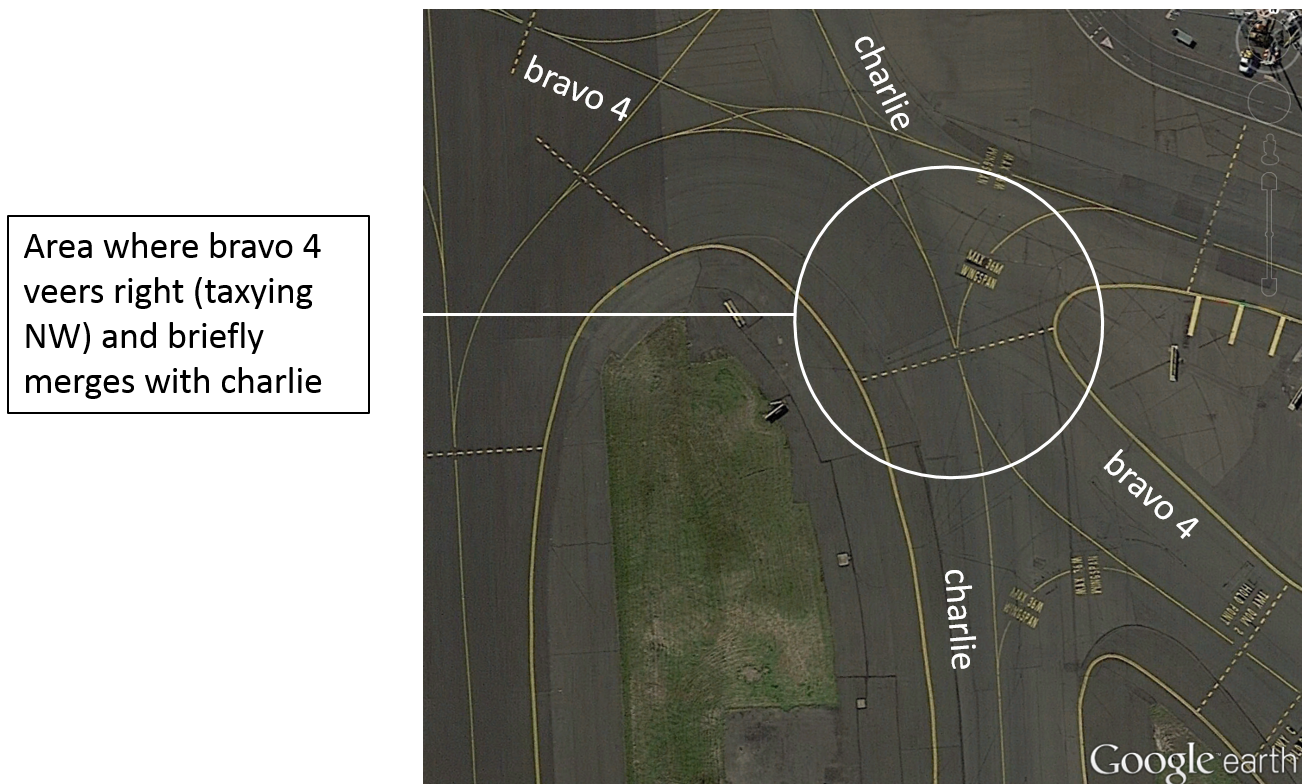
The taxi paths through the open space at the junction of bravo 4, charlie and charlie 2, are complex. Numerous guidance markings and lights complicate the area, and bravo 4 merges with charlie for a short distance as the two taxiways cross (Figure 3). A curve in bravo 4 as it meets charlie may have given the pilot the impression that the aircraft had arrived at the intersection of bravo 4 and bravo, being the point at which a sharp left turn was required. This expectation by the pilot may have been reinforced by the fact that the aircraft had just passed domestic 2, which the pilot may have misinterpreted as charlie.
The potentially confusing characteristics of the taxiway junction would have been exacerbated at night. At the time of the occurrence, additional vehicle lights were moving about the area, some steady (head/tail lights) and some flashing, and the partially established worksite lighting would have further complicated the environment. The pilot expected that some lights may have already been covered or turned off, which added to the potential for confusion over taxiway identification.
Figure 3: Taxiway intersection showing the area where bravo 4 veers right (taxying NW) and bravo 4 and charlie merge for a short distance
Source: Google earth, modified by the ATSB
At the time of the occurrence, the lead-in lighting to charlie and the charlie taxiway lighting had not yet been covered. This may have given the impression that the taxiway was still available, perhaps further reinforcing in the pilot’s mind that they had already passed charlie, and reached bravo. The taxiway signage was not affected by the works and was illuminated at the time of the occurrence. The pilot commented that their mental picture of the area was different to what they encountered at the time of the occurrence.
For similar reasons, as the pilot turned into bravo 6 (from bravo) to approach runway 16R, they were initially under the impression that they had reached golf.
Electronic charts
The operator had recently installed electronic charts (e‑charts) in the aircraft. Using GPS information, e‑charts can provide near real-time on-aerodrome positional information. At the time of the occurrence, the pilot was using paper charts, because they were more comfortable with paper charts and had not been trained in the use of e‑charts. The use of e‑charts was not mandated by the operator.
ATSB Comment
Continuing aircraft operations in the vicinity of a worksite while that worksite is only partially established, can be problematic. Operational considerations should be carefully balanced with the safety implications of allowing aircraft to continue to operate near a partially established worksite.
Under some circumstances, particularly where other complicating factors exist (such as poor ambient lighting conditions), it may be prudent to identify a transition period, and temporarily restrict aircraft movements until the worksite is fully established. The transition period would essentially be the time from which ATC release control of an area to a safety officer, until the safety officer then advises that establishment of the worksite is complete.
Airservices provided comment in relation to establishing a transition period, advising that the potential for a transition period to cause additional confusion around the availability of the work surface, or create additional disruption during times of high traffic levels would need to be taken into consideration. They consider the current process of instructing pilots with detailed taxi routes, as was the case in this occurrence, is effective. ATC will treat work areas as unavailable once an area is released to the work safety officer.
Findings
These findings should not be read as apportioning blame or liability to any particular organisation or individual.
The pilot was unaware of relevant taxiway closures until advised by ATC as part of their taxi clearance.
The pilot became confused about the position of the aircraft as they taxied past the worksite on bravo 4, probably due to a combination of factors, including:
The pilot was not familiar with the taxi route, and the taxi route took the aircraft through a complex junction of taxiways at night.
The worksite was only partially established (not all red lights were in place, and some existing taxiway lighting had yet to be covered).
The pilot was not familiar with the use of e‑charts, which may have assisted with their orientation under the circumstances.
Safety action
Whether or not the ATSB identifies safety issues in the course of an investigation, relevant organisations may proactively initiate safety action in order to reduce their safety risk. The ATSB has been advised of the following proactive safety action in response to this occurrence.
Aircraft operator
As a result of this occurrence, the aircraft operator has advised the ATSB that they are considering the following safety actions:
Implementation of a training program to cover some contributing factors identified in the internal company report dealing with the occurrence, including the use of e-charts and other similar technologies.
Development or acquisition of safety promotional material for staff, dealing with aircraft operations near worksites.
Safety message
This occurrence highlights the potential hazards involved when mixing aircraft operations with aerodrome works. The potential for misunderstanding or confusion is significant, particularly at night and in complex movement areas. The potential for confusion is further elevated when a worksite is in the process of being established. Relevant authorities are encouraged to carefully consider the risks involved and implement appropriate risk management strategies to minimise the likelihood of a misunderstanding or confusion.
Additionally, pilots are encouraged to stop and seek clarification from ATC if there is any doubt about the cleared taxi route. Similarly, ATC officers are encouraged to direct an aircraft to stop if they have any doubt about the intentions of the pilot, or there is any evidence that taxi instructions have been misunderstood. Timely and effective communication is essential to a shared understanding in a dynamic operational environment, particularly when the environment is complicated by unusual circumstances.
Decisions regarding whether to conduct an investigation, and the scope of an investigation, are based on many factors, including the level of safety benefit likely to be obtained from an investigation. For this occurrence, a limited-scope, fact-gathering investigation was conducted in order to produce a short summary report, and allow for greater industry awareness of potential safety issues and possible safety actions.
Publishing information
Released in accordance with section 25 of the Transport Safety Investigation Act 2003
Ownership of intellectual property rights in this publication
Unless otherwise noted, copyright (and any other intellectual property rights, if any) in this report publication is owned by the Commonwealth of Australia.
Creative Commons licence
With the exception of the Coat of Arms, ATSB logo, and photos and graphics in which a third party holds copyright, this publication is licensed under a Creative Commons Attribution 3.0 Australia licence.
Creative Commons Attribution 3.0 Australia Licence is a standard form licence agreement that allows you to copy, distribute, transmit and adapt this publication provided that you attribute the work.
The ATSB’s preference is that you attribute this publication (and any material sourced from it) using the following wording: Source: Australian Transport Safety Bureau
Copyright in material obtained from other agencies, private individuals or organisations, belongs to those agencies, individuals or organisations. Where you wish to use their material, you will need to contact them directly.
The Myanmar Accident Investigation Bureau (MAIB) are investigating an accident involving an Embraer Regional Jet, ERJ190-100 and an Avions Tolouse Regionale, ATR 72-600.
As part of its investigation, the MAIB initially requested assistance from the Australian Transport Safety Bureau (ATSB) in the download and analysis of the flight recorder from the Embraer.
Consistent with clause 5.23 of Annex 13 to the Convention on International Civil Aviation (ICAO Annex13), the ATSB appointed an accredited representative to assist the MAIB and initiated an investigation under the Transport Safety Investigation Act 2003.
The MAIB subsequently informed the ATSB that they had sought assistance elsewhere for the flight recorder download.
The ATSB has therefore discontinued the investigation.
Any requests for information regarding the occurrence should be addressed to:
Myanmar Accident Investigation Bureau First Floor, DCA HQ Building (B) Yangon 11021, Myanmar Tel: 951 533162 Fax: 951 53016 Email: ddmaib@dca.gov.mm
On 27 February 2015, the pilot of a Fletcher FU-24 aircraft, registered VH-KXT (KXT), and the pilot of a Gippsland GA-200 aircraft, registered VH-AGZ (AGZ), were conducting aerial agricultural operations on a property 13 km south-west of Cootamundra, New South Wales.
The pilots were using two runways, one aligned in approximately the 01/19 direction, and the other 06/24. Both of the aircraft were taking off from runway 06, however AGZ was landing on runway 24, and KXT was landing on runway 19. With both aircraft taking a similar amount of time to spread their fertiliser load, they were in an alternating sequence at the landing area.
After completing spreading one area, the pilot of AGZ reloaded and departed to locate the next paddock to be spread. It took about 5 minutes to determine the boundaries and commence spreading. At about 1015 Eastern Daylight-saving Time, as KXT was on final approach for runway 19, the pilot looked for AGZ on approach to runway 24, but did not see the aircraft. At about the same time, AGZ was on approach to land on runway 24 and the pilot looked for KXT approaching or on the runway, but did not sight that aircraft.
As KXT landed, the pilot was momentarily distracted as he observed the loader truck near the fence. AGZ was in the landing roll on runway 24 when the pilot sighted KXT about 10 m from his right wing. KXT was then in the landing roll on runway 19 and the pilot returned his gaze from the loader to the front of the aircraft, just as the propeller collided with the right wingtip and then the tail of AGZ.
Both aircraft sustained substantial damage and the pilots were not injured.
The pilot of KXT commented that this incident highlights the importance of a thorough briefing between pilots prior to commencing operations.
Whilst taxiing for departure, the pilot of VH-CLA noticed that the left brake was becoming progressively less effective. He attempted to slow the aircraft by closing the throttles and using the right brake with full left rudder application. However, this proved ineffective. As directional control was becoming difficult the pilot elected to turn the aircraft to the right onto the grassed area beside the taxiway. He applied right brake, but the aircraft turned rapidly through about 165 degrees and collided with VH-ILS which was following behind.
The pilot of VH-ILS reported he had lost sight of VH-CLA immediately prior to the collision due to condensation on the inside surface of the windscreen, and from watching another nearby aircraft.
Investigation later determined that the left brake piston seal was in poor condition and leaking, and the master cylinder was almost empty. There was an outstanding entry on the Maintenance Release to bleed the right brake.
The pilot was taxiing the aircraft for take-off. The taxiway runs adjacent to the verandah of the Wagin Aero Club. As the aircraft passed the Aero Club, a book that the pilot was using fell to the cockpit floor. The pilot reached down to retrieve the book and as a result his attention was distracted from control of the aircraft. The left wing, outboard leading edge, collided with a verandah post causing substantial damage.
The pilot was taxiing towards his parking spot along a narrow taxiway. He noticed a fuel tanker parked on the edge of the taxiway and moved to one side of the taxiway to avoid contact. Unfortunately, he did not allow sufficient room and the right wing, then the nose, struck the tanker.