Objects falling from aircraft

In-flight door failure involving Sling 4, about 11 km east of Dochra, New South Wales, on 15 December 2024

Occurrence Briefs are concise reports that detail the facts surrounding a transport safety occurrence, as received in the initial notification and any follow-up enquiries. They provide an opportunity to share safety messages in the absence of an investigation. Because occurrence briefs are not investigations under the Transport Safety Investigation Act 2003, the information in them is de-identified. 

What happened

On 15 December 2024, the pilot of an amateur built Sling 4 was conducting a local private scenic flight from Maitland Airport, New South Wales, with 2 passengers on board. At 1130 local time, while on descent passing through about 2,400 ft above mean sea level, the right gullwing door of the aircraft adjacent to the front passenger detached and separated from the fuselage. The pilot immediately reduced the aircraft’s speed and conducted a safe landing at Maitland Airport. There were no injuries to the pilot or passengers.

Post-incident inspection of the aircraft identified that the detached door had impacted the left elevator counterweight arm resulting in minor damage (Figure 1).

Figure 1: Damage to left elevator counterweight arm caused by impact from the detached door
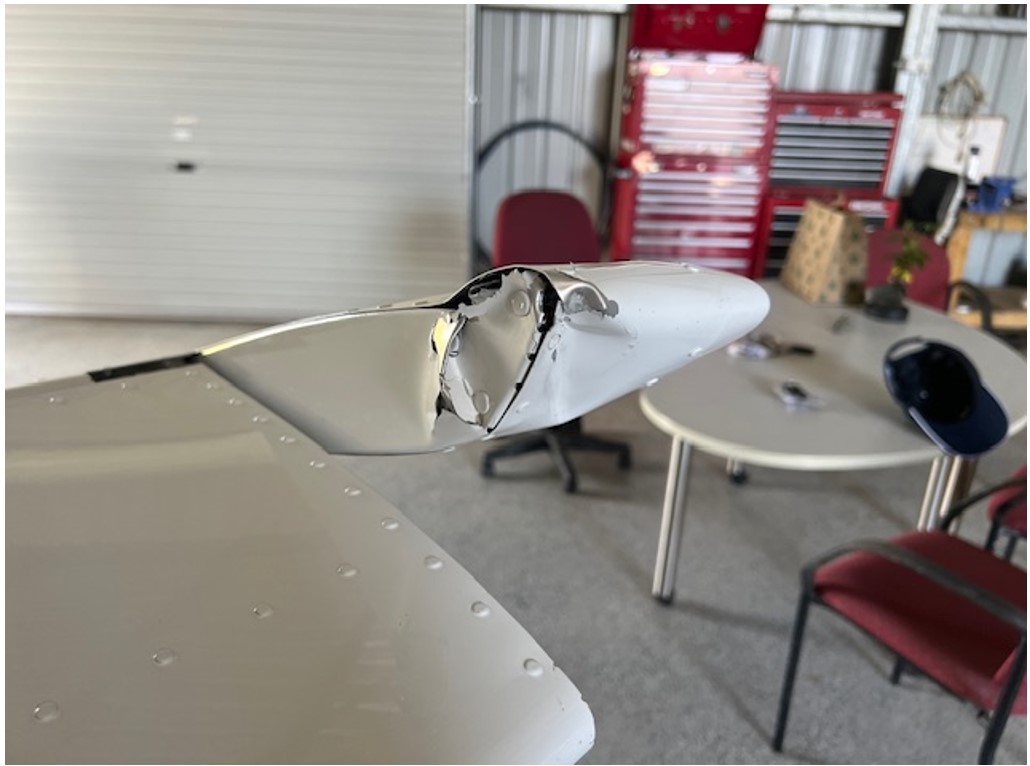
Figure 1: Damage to left elevator counterweight arm caused by impact from the detached door

Source: Owner of aircraft

The pilot advised that they had upgraded the standard door latch fittings with ones that had a larger post to provide increased strength and durability for more security (Figure 2).

Figure 2: Latching mechanism (pilot side shown, passenger side was identical)
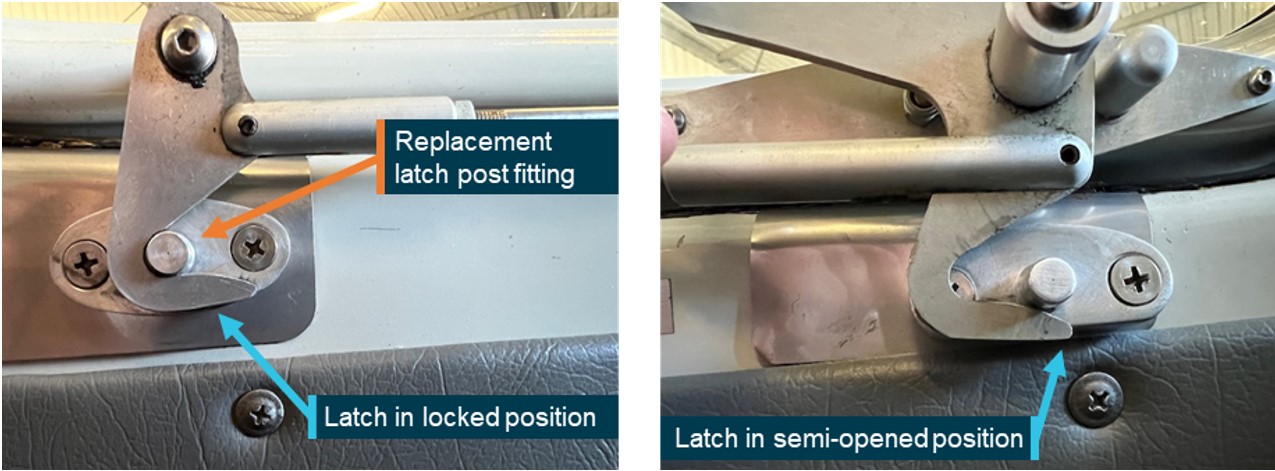
Figure 2: Latching mechanism (pilot side shown, passenger side was identical)

Source: Owner of aircraft

The passenger sitting beside the door during the descent described resting their arm on the door and reported that they unwittingly released the door latching mechanism. The airstream pressure exerted sufficient force to separate the open door from the aircraft. The location of the detached door remains unknown, however it is believed to have landed in an unpopulated area.

Safety message

The incident highlights the potential for inadvertent passenger actions to interfere with aircraft systems. Specific briefings for passengers seated next to doors to provide awareness of the door mechanisms before and during flight should be a part of standard operating procedures.

About this report

Decisions regarding whether to conduct an investigation, and the scope of an investigation, are based on many factors, including the level of safety benefit likely to be obtained from an investigation. For this occurrence, no investigation has been conducted and the ATSB did not verify the accuracy of the information. A brief description has been written using information supplied in the notification and any follow-up information in order to produce a short summary report and allow for greater industry awareness of potential safety issues and possible safety actions.

Occurrence summary

Mode of transport Aviation
Occurrence ID AB-2024-052
Occurrence date 15/12/2024
Location About 11 km east of Dochra
State New South Wales
Occurrence class Serious Incident
Aviation occurrence category Objects falling from aircraft
Highest injury level None
Brief release date 17/01/2025

Aircraft details

Manufacturer Amateur Built Aircraft
Model Sling 4
Sector Sport and recreational
Operation type Part 91 General operating and flight rules
Departure point Maitland, NSW
Destination Maitland, NSW
Damage Minor

Objects falling from aircraft involving a Eurocopter AS350, 6 km south-west of Stenhouse Bay, South Australia on 3 December 2024

Occurrence Briefs are concise reports that detail the facts surrounding a transport safety occurrence, as received in the initial notification and any follow-up enquiries. They provide an opportunity to share safety messages in the absence of an investigation. Because occurrence briefs are not investigations under the Transport Safety Investigation Act 2003, the information in them is de-identified. 

What happened

On the morning of 3 December 2024, a Eurocopter AS350 B2 helicopter was being used to conduct a series of passenger charter flights to transport contractors from Stenhouse Bay, South Australia to Althorpe Island Lighthouse, located approximately 12 km south-west across the water. After the first flight landed at the lighthouse, the 3 passengers on board disembarked and removed their equipment from the rear cargo compartment while the pilot remained onboard with the helicopter’s engine running.

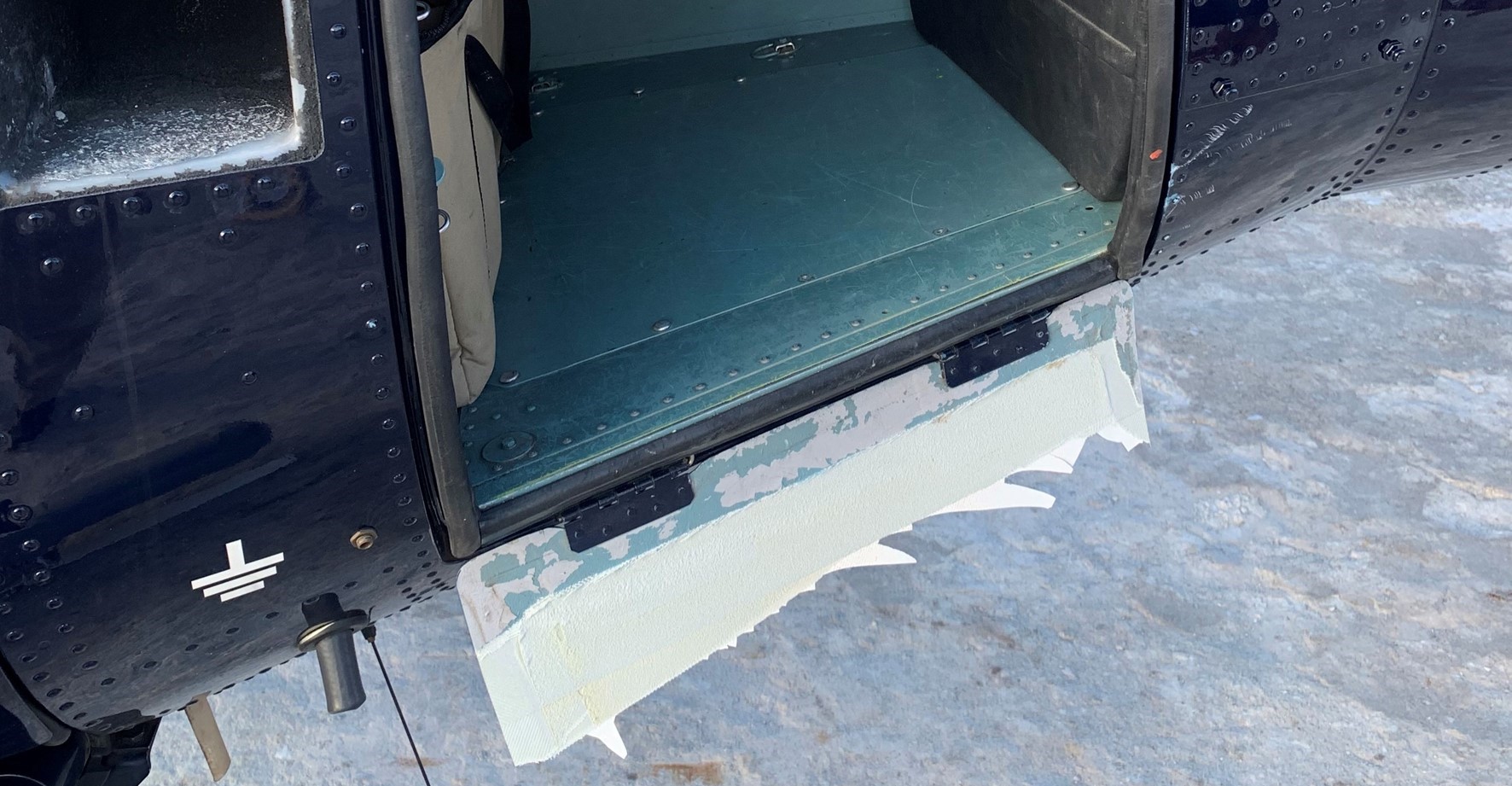
The helicopter then returned to Stenhouse Bay to collect the next group of passengers. Upon landing, the helicopter engine was shut down and the passengers proceeded to load their baggage into the rear cargo compartment. At this time, it was discovered that the rear cargo door appeared to have opened during the previous return flight and a large section was missing (Figure 1). The pilot inspected the helicopter, discovering some paint damage but no other signs of impact from the door. The missing section of the door was not recovered and it was unknown where during the flight it detached. 

The operator advised that the helicopter was not the one normally used for this service and that no indicator was available in the cockpit to indicate when the rear cargo door was not secured. Additionally, they reported that the passengers involved had been taking this flight regularly over the previous 6 months. The passenger who closed the cargo door prior to departure from the lighthouse later advised the operator that they had closed and latched the door, however the latch felt looser compared to the helicopter normally used. The pilot had conducted a daily brief with passengers prior to departure, however on this occasion the pilot did not brief the passengers about the operation of the cargo door.

Figure 1: Damage to cargo door

Figure 1: Damage to cargo door

Source: The operator

Safety action

The operator has advised that, as a result of the incident, pilots are now required to conduct a shutdown and full walkaround between all flights and will be adding specific items to their daily briefings. The operator has replaced the damaged door with a forward‑hinged door and will be installing a cargo door warning light in each of its AS350 helicopters.

Safety message

Prior to take-off, it is important that pilots conduct a pre-flight inspection that includes ensuring that all hatches, access ports, panels and fuel tanks are secured. Procedures introduced for operational efficiency such as boarding of passengers and loading of cargo while the engine is running can prevent this inspection being conducted, increasing the risk that a door or hatch is not closed correctly and will open during flight. 

About this report

Decisions regarding whether to conduct an investigation, and the scope of an investigation, are based on many factors, including the level of safety benefit likely to be obtained from an investigation. For this occurrence, no investigation has been conducted and the ATSB did not verify the accuracy of the information. A brief description has been written using information supplied in the notification and any follow-up information in order to produce a short summary report, and allow for greater industry awareness of potential safety issues and possible safety actions.

Occurrence summary

Mode of transport Aviation
Occurrence ID AB-2024-049
Occurrence date 03/12/2024
Location 6 km south-west of Stenhouse Bay
State South Australia
Occurrence class Incident
Aviation occurrence category Objects falling from aircraft
Highest injury level None
Brief release date 16/01/2025

Aircraft details

Manufacturer Eurocopter
Model AS350 B2
Sector Helicopter
Operation type Part 133 Air transport operations - rotorcraft
Departure point Althorpe Island, South Australia
Destination Stenhouse Bay, South Australia
Damage Minor

Objects falling from aircraft involving a Eurocopter AS350 B3, near Broken Hill Airport, New South Wales, on 5 July 2024

Occurrence Briefs are concise reports that detail the facts surrounding a transport safety occurrence, as received in the initial notification and any follow-up enquiries. They provide an opportunity to share safety messages in the absence of an investigation. Because occurrence briefs are not investigations under the Transport Safety Investigation Act 2003, the information in them is de-identified. 

What happened

On 5 July 2024, the pilot of a Eurocopter AS350 B3 was conducting an underslung load operation from Broken Hill Airport, New South Wales. After completing pre-flight inspections[1] of the aircraft, underslung load and cargo hook, the operator proceeded with a system test flight for an upcoming electromagnetic survey. Shortly after take-off, about 0935 local time, the underslung load released from the cargo hook and dropped about 6 m impacting the ground. There were no injuries to ground crew, no damage to aircraft or property and minimal damage to the underslung load.

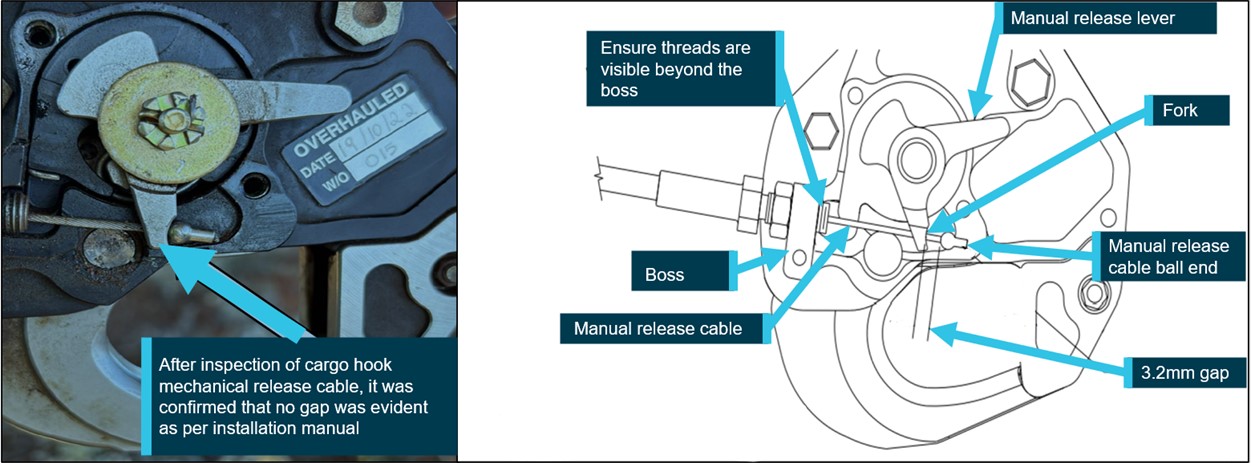
Post-incident inspection of the cargo hook identified that the manual release cable had insufficient clearance between the manual release cable ball end and the manual release lever fork (Figure 1).

When the pilot was increasing lift on the aircraft the manual release cable triggered and inadvertently initiated the manual release lever on the cargo hook, releasing the underslung load.

Figure 1: Cargo hook release mechanism

Figure 1: Cargo hook release mechanism

Safety action 

The operator immediately rendered the cargo hook as unserviceable and suspended underslung operations. After an engineering inspection, the operator proactively replaced the cargo hook.

Safety message

This incident highlights the importance of detail and accuracy during the installation process of the cargo hook. Underslung loads are a regular part of some helicopter operations, including survey flying, firebombing and aerial construction. The consequences of an uncommanded/inadvertent release of the underslung load has the potential for fatal consequences, damage to property or the load itself.

The required clearance of the manual release mechanism on the cargo hook is not visible during a pilot’s preflight inspection. Engineering organisations are encouraged to develop processes that ensure critical component installations are checked in duplicate by appropriate persons. 

Pilots are also encouraged to conduct a thorough inspection and testing of the cargo hook manual release system prior to conducting underslung load operations as part of their pre-flight inspection.

About this report

Decisions regarding whether to conduct an investigation, and the scope of an investigation, are based on many factors, including the level of safety benefit likely to be obtained from an investigation. For this occurrence, no investigation has been conducted and the ATSB did not verify the accuracy of the information. A brief description has been written using information supplied in the notification and any follow-up information in order to produce a short summary report, and allow for greater industry awareness of potential safety issues and possible safety actions.

[1] Inspection of the cargo hook included weak link and underslung load rigging equipment.

Occurrence summary

Mode of transport Aviation
Occurrence ID AB-2024-033
Occurrence date 05/07/2024
Location 0.8 km from Broken Hill Airport
State New South Wales
Occurrence class Incident
Aviation occurrence category Objects falling from aircraft
Highest injury level None
Brief release date 06/09/2024

Aircraft details

Manufacturer Eurocopter
Model AS350 B3
Sector Helicopter
Operation type Part 138 Aerial work operations
Departure point Broken Hill Airport, NSW
Destination Broken Hill Airport, NSW
Damage Nil

Object falling from aircraft involving a GippsAero GA-8, Fraser Island, Queensland, on 6 April 2023

Occurrence Briefs are concise reports that detail the facts surrounding a transport safety occurrence, as received in the initial notification and any follow-up enquiries. They provide an opportunity to share safety messages in the absence of an investigation.

What happened

On 6 April 2023 at about 16:15 local time, a GippsAero GA8 Airvan aircraft took off from an aeroplane landing area near Eli Creek on Fraser Island, Queensland, for a 30-minute scenic flight. On board were the pilot, a second pilot flying as a passenger in the right cockpit seat, and 2 passengers.

At about 16:40, while in a climb Northeast of Lake Wabby, the rear cabin door separated and fell from the aircraft. The pilot immediately flew toward the nearest aeroplane landing area on Seventy-Five Mile beach, north of Eurong Township, and landed without incident. The pilot and passengers were not injured. The door was not recovered.

Door departure history

There have been several reported instances of a cargo door departure in flight with the GA8 aircraft. Initial investigations indicated that excessive wear of the forward cargo door slide could have been a contributing factor. Further investigations identified that over rotation of the door handle may also lead to the door opening in flight.

GippsAero advised that the typical failure mode involves the front door slider disconnecting from its track, the front of the door popping outward, and airflow peeling the door off the side of the aircraft.

Service Bulletin

CASA Airworthiness Directive AD/GA8/3 Amendment 2 mandated compliance with Gipps-Aero Service Bulletin SB-GA8-2005-23, issue 3. Service Bulletin SB-GA8-2005-23 issue 3 introduced the mandatory modification to the cargo door guide assembly, and requirement for periodic cabin door inspections, for all GA8 and GA8-TC 320 aircraft.

SB-GA8-2005-23 issues 4 to 6 specify the mandatory requirement for inspection of the door operating rod and mechanism, replacement of the door handle with an integrated stop added, and embodiment of a centre cargo door rail aft stop modification.

Safety action

Other company GA8 aircraft were inspected prior to return to service with no abnormal wear reported. The company is working with GippsAero and revisiting all relevant Service Bulletins and Airworthiness Directives to help determine the cause of the failure and prevent a reoccurrence.

Safety message

Operators of GippsAero GA8 and GA8-TC 320 aircraft are reminded of the requirement to regularly inspect the cargo door slides and rails for excessive wear in accordance with CASA AD/GA8/3 Amendment 2 and SB-GA8-2005-23 issue 3.

GippsAero further recommends that SB-GA8-2005-23 issue 6 inspections are carried out, and the door rail stop is installed, and the latch modifications embodied, to increase reliability and safety of the door latch mechanism and reduce the likelihood of a recurrence of a door departing in-flight.

About this report

Decisions regarding whether to conduct an investigation, and the scope of an investigation, are based on many factors, including the level of safety benefit likely to be obtained from an investigation. For this occurrence, no investigation has been conducted and the ATSB did not verify the accuracy of the information. A brief description has been written using information supplied in the notification and any follow-up information in order to produce a short summary report and allow for greater industry awareness of potential safety issues and possible safety actions.

Occurrence summary

Mode of transport Aviation
Occurrence ID AB-2023-004
Occurrence date 06/04/2023
Location Fraser Island
State Queensland
Occurrence class Incident
Aviation occurrence category Objects falling from aircraft
Brief release date 15/06/2023

Aircraft details

Manufacturer GippsAero
Model GA8
Sector Piston
Operation type Part 135 Air transport operations - smaller aeroplanes
Departure point Eli Creek ALA, Fraser Island
Destination Eli Creek ALA, Fraser Island
Damage Minor

Doors involving a Piper PA-31-350, VH-STO, Sydney, New South Wales, on 27 July 1993

Summary

As the landing gear was retracted after take-off, the baggage door warning light illuminated and a noise consistent with a propeller strike was heard. The aircraft returned for a landing on runway 34, and on inspection the nose locker door was found open. A piece of baggage was missing. A bag was found on the runway and there was evidence of propeller slash marks on it. The pilot stated that he had checked the nose locker door prior to starting engines and it was locked. The door may have become unlocked due to baggage pressure on it. The lock has been replaced as a precautionary measure.

Occurrence summary

Investigation number 199302346
Occurrence date 27/07/1993
Location Sydney
State New South Wales
Report release date 29/03/1994
Report status Final
Investigation type Occurrence Investigation
Investigation status Completed
Mode of transport Aviation
Aviation occurrence category Objects falling from aircraft
Occurrence class Incident

Aircraft details

Manufacturer Piper Aircraft Corp
Model PA-31-350
Registration VH-STO
Sector Piston
Departure point Sydney NSW
Destination Unknown
Damage Minor

Elevator balance tab failure, Boeing 737-229, VH-OZX, Port Moresby, Papua New Guinea, on 31 December 2007

Preliminary report

Preliminary report released 27 February 2008

After departing Port Moresby, Papua New Guinea, at 0430 Coordinated Universal Time on 31 December 2007, the flight crew of a Boeing 737-229 aircraft, registered VH-OZX, being operated on a scheduled flight from Port Moresby to Brisbane, reported severe vibration through the airframe, resulting in a Mayday broadcast and return to Port Moresby.

A subsequent examination on the ground, found a section of the right elevator balance tab had detached and was missing. Preliminary examination of the tab indicated that a failure of one of the elevator tab hinge blocks had occurred.

Summary

After departing Port Moresby, Papua New Guinea, at 0406 Universal time, coordinated on 31 December 2007, the flight crew of a Boeing 737-229 aircraft, registered VH-OZX, operating a scheduled flight from Port Moresby to Brisbane, experienced severe vibration through the aircraft's airframe, resulting in the crew declaring a MAYDAY and returning to Port Moresby.

A subsequent examination found a section of the right elevator balance tab had detached and was missing. Examination of the remaining sections of the balance tab revealed that two attachment screws from one of the elevator balance tab hinge blocks had unwound, which led to the tab failure.

The investigation found that airframe vibration had been reported by the flight crew the day prior to the accident. On that occasion, a level I - General Inspection of the aircraft was conducted by a licensed aircraft maintenance engineer after the aircraft landed, with no defects found.

The aircraft manufacturer was aware that other operators had experienced in-flight vibration as a result of excessive wear in the elevator balance tab hinge and control linkages, and had issued a number of service bulletins (SBs) to address the issues. These SBs included SB737-55A1070, which directed operators to carry out detailed inspection of the elevator balance tabs, including checks for free-play, control rod wear and loose hinge screws.

As a result of this accident, the aircraft operator implemented a 'fleet campaign directive' requiring the immediate accomplishment of SB 737-55A1070 on all of its aircraft.

Occurrence summary

Investigation number AO-2008-001
Occurrence date 31/12/2007
Location Port Moresby
State International
Report release date 23/06/2009
Report status Final
Investigation level Systemic
Investigation type Occurrence Investigation
Investigation status Completed
Mode of transport Aviation
Aviation occurrence category Objects falling from aircraft
Occurrence class Accident
Highest injury level None

Aircraft details

Manufacturer The Boeing Company
Model 737
Registration VH-OZX
Serial number 21177
Sector Jet
Operation type Air Transport High Capacity
Departure point Port Moresby, PNG
Destination Brisbane, QLD
Damage Substantial

Tail rotor pitch link failure, near Hoxton Park Aerodrome, New South Wales, on 19 September 2008, VH-BUK, Eurocopter AS350 BA

Summary

On 19 September 2008, during a flight from Fitzroy Falls to Rosehill, NSW, the pilot of a Eurocopter AS350 BA helicopter, registered VH-BUK, experienced the onset of severe vibration within the tail rotor controls and made an emergency landing at Casula High School. Subsequent examination of the aircraft revealed that one of the tail rotor pitch change links had fractured, resulting in lateral movement of the tail rotor and damage to the tail boom and tail cone.

The pitch link had fractured from fatigue cracking that was the result of stresses induced in the link by excessive play in the heavily worn spherical bearing. It was probable that bearing wear outside of maintenance manual limits existed, but was not detected, during the most recent after last flight (ALF) inspection.

As a result of this occurrence, the helicopter manufacturer released Safety Information Notice (No. 2000-S-65) and the Civil Aviation Safety Authority released an Airworthiness Bulletin (AWB 27- 009) to remind operators, pilots and maintenance personnel of the requirements for ALF inspections for pitch link condition and bearing play.

Occurrence summary

Investigation number AO-2008-068
Occurrence date 19/09/2008
Location Hoxton Park Aerodrome SE M/6km
State New South Wales
Report release date 20/11/2009
Report status Final
Investigation level Systemic
Investigation type Occurrence Investigation
Investigation status Completed
Mode of transport Aviation
Aviation occurrence category Objects falling from aircraft
Occurrence class Accident
Highest injury level None

Aircraft details

Manufacturer Aerospatiale Industries
Model AS350
Registration VH-BUK
Serial number 2197
Sector Helicopter
Operation type Charter
Departure point Fitzroy Falls, NSW
Destination Rosehill Heliport, NSW
Damage Substantial

Loss of control, 21 km north-east of Mount Gambier, South Australia, on 20 December 2006, Kawasaki KH4, VH-LFK

Summary

On 20 December 2006, a Kawasaki KH4 helicopter lost collective pitch control and impacted terrain while performing agricultural aerial spray operations approximately 21 km NE of Mount Gambier, SA. The helicopter was substantially damaged, but the pilot was uninjured. When the accident site was surveyed, the main rotor mast and main rotor blade assembly were found to have separated from the helicopter. They were located a short distance away.

Examination of the wreckage revealed that the helicopter's main rotor mast thrust bearing had failed catastrophically in flight. That bearing was a critical item for safe operation and continued airworthiness of the KH4. It supported the full weight of the helicopter and transferred thrust loads generated by the main rotor blades during flight.

The investigation was unable to conclusively establish the factors that led to failure of the mast bearing. No evidence was found of manufacturing or material defects. Nor was there any evidence of improper installation procedures or maintenance practice. Based on the inspection of aviation databases in Australia and North America, the main rotor mast thrust bearing failure appears to be an isolated event for the KH4-series helicopter.

Despite the low probability associated with a mast bearing failure of this type, the consequences of such an event could have been fatal for the pilot onboard. This report has been provided to Australian operators and maintainers of Kawasaki KH4 and Bell 47G3 series helicopters as a future alert for this type of occurrence.

Occurrence summary

Investigation number AO-2006-006
Occurrence date 20/12/2006
Location 21 km NE Mount Gambier
State South Australia
Report release date 08/12/2008
Report status Final
Investigation level Systemic
Investigation type Occurrence Investigation
Investigation status Completed
Mode of transport Aviation
Aviation occurrence category Objects falling from aircraft
Occurrence class Accident
Highest injury level None

Aircraft details

Manufacturer Kawasaki Heavy Industries
Model 47
Registration VH-LFK
Serial number 2133
Sector Helicopter
Operation type Aerial Work
Departure point Mingbool, SA
Destination Mingbool, SA
Damage Substantial

Examination of a Failed Forward Door Attachment - Bell 212, VH-LHX

Analysis

ANALYSIS

The failure of the forward roller support was due to fatigue. Fatigue is a result of a materials defect and/or the loading conditions of a part. The forward door support proved to exhibit no inherent microstructural defects that would attribute to this failure, therefore, the magnitude and cyclic nature of the load are likely to have been contributing factors.

In this case it was not possible to establish the definitive reason for the failure of the part, as the entire door structure and the locating screws were not available for examination. However, the vibration and resonance of the support during routine use, and the thickness and deterioration of the paint layer applied to the support, are likely to have affected the function and performance of the door support over time.

CONCLUSION

4.1 Contributing factors

  1. Examination and analysis of the forward door attachment and the mating serrated plate identified the support failed in fatigue.

4.2 Other findings

  1. The forward door support proved to exhibit no inherent microstructural defects that would attribute to this failure.
  2. A reason for the fatigue failure was not able to be established as the entire door structure including locating screws was not available to complete the analysis.

Factaul Information

At 0825 local time on 10 March 2005, a Bell 212 helicopter with three crew and five passengers departed Wallaby landing zone near Moliana, East Timor to conduct an aerial survey of the island. Prior to the flight, the passengers requested that the cabin sliding doors be secured in the open position for better observation. At approximately 0935, while tracking along the coast at 90 KIAS at approximately 800 ft AGL, the flight crew reported that they experienced a bump to the helicopter similar to air turbulence. A subsequent control and instrument check did not reveal any problems. The rear crewmember then informed the pilot in command (PIC) that the right cabin sliding door had fallen off. The PIC elected to conduct a precautionary landing in a nearby field. Following the landing, damage to the right side of the tail boom and horizontal stabilizer was noted and the door recovered for examination.

The Australian Transport Safety Bureau examined the sliding door attachment hardware to determine if there were any pre-existing faults of the components.

Examination of the aircraft and wreckage revealed that the forward roller support of the passenger door had fractured. The part had no specified safe life.

1.1 Assembly information

Two parts were recovered from the forward door assembly, the forward roller support and the mating serrated plate.

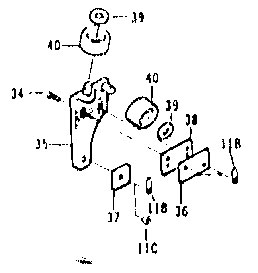
The forward roller support (35), illustrated in figure 1, is located inside the passenger compartment of the helicopter and is one of four roller attachments of the passenger door to the upper track. When the door is in the open position, this attachment carries the entire load of the passenger door. Elliptical holes through the support and its attachment to the mating serrated plate (38) via screws (34), allow the door to be located between the upper and lower roller tracks.

Figure 1: Forward Door Support Assembly.

Figure 1

1.2 Visual Examination

1.2.1 Forward Roller Support

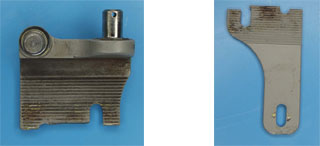
The forward roller support was recovered in two sections shown in figure 2 as A and B. The fracture of this part extended through the serrated area of the support, 45mm from the top of section A and intersecting with the elliptical locating holes. The support was painted with a chromate primer and a grey top coat, together approximately 100µm thick.

Figure 2: Section A of the forward roller support (left) and Section B of the forward roller support (right).

Figure 2

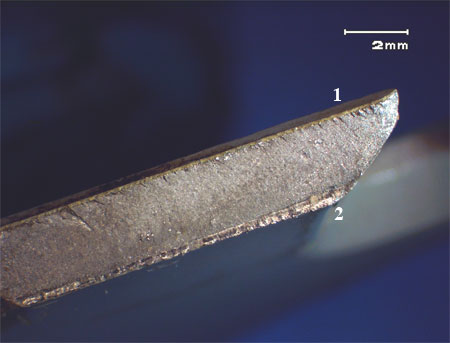
The fracture surface revealed striations and ratchet marks, consistent with fatigue failure. Part of the fracture surface of section B, shown in figure 3, reveals ratchet marks occurring at the serrated edge of the support (1) and final fracture at the back edge of the support (2). This is consistent along the entire fracture surface.

Figure 3: Fracture surface of section B, ratchet marks are visible at the serrated edge of the part (1) and the final fracture of the back edge of the part (2).

Figure 3

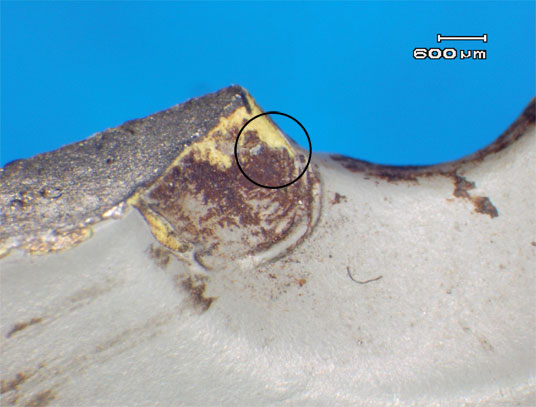
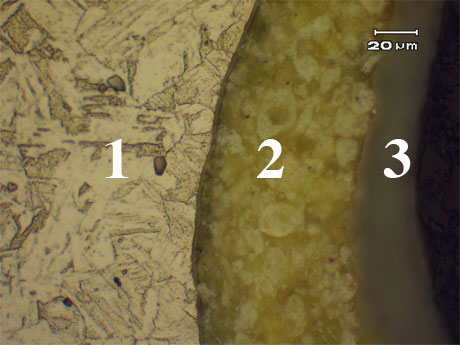
Iron oxide deposits were also observed on sections A and B. Location of the oxide coincided with the mating surfaces of the forward door assembly and the serrated plate and between the elliptical holes and the locating screws. Close examination of the elliptical holes revealed the paint layer was pleated as shown in (figure 4). The location of these pleats coincided with the positions of locating screws. Further deterioration of the paint layer was also observed in this area, leaving the yellow primer exposed.

Figure 4: Oxide products within the elliptical holes of section B. Note the top coat deterioration and pleating (circled) revealing the chromate primer layer (yellow).

Figure 4
1.2.2 The Serrated Plate

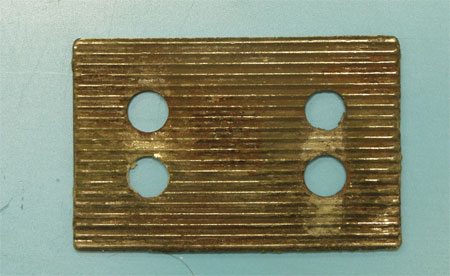
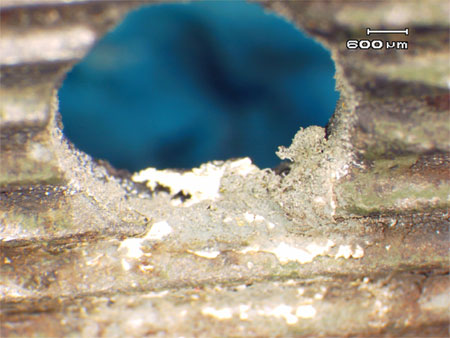
The serrated plate attachment, shown in figure 5, was not painted. Iron Oxide and fretting of the holes were observed, shown in figure 6.
The screws that attached the roller support and serrated plate to the passenger door were not recovered for this investigation.

Figure 5: The serrated plate.

Figure 5

Figure 6: Fretting around holes in the serrated plate. Iron oxide products are also visible.

Figure 6
1.3 Metallographic Examination

A segment of the forward roller support including the fracture surface and serrations was removed from section B. The representative sample was prepared and examined to characterise the materials general microstructure.

The material which exhibited magnetic properties, revealed a microstructure typical of a Precipitation Hardened (PH) Stainless Steel . PH Stainless Steels are often used in the aircraft and aerospace industries due to superior hardness and corrosion resistance.  The martensitic type microstructure revealed by this sample, shown in figure 7, is typical for this material.

Figure 7: Microstructure of the forward roller support material (10X magnification).

Figure 7

Figure 8: The metal (1), primer (2) and top coat layer (3) interfaces (10X magnification).

Figure 8

Vickers hardness tests were carried out using a 20kg load, a total of five tests returned a mean value of 323 HV. These hardness results are typical of PH stainless steels.

FRACTURE CHARACTERISATION

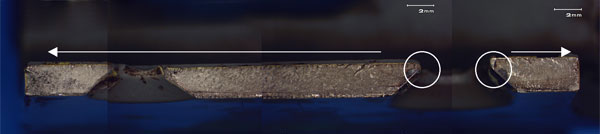
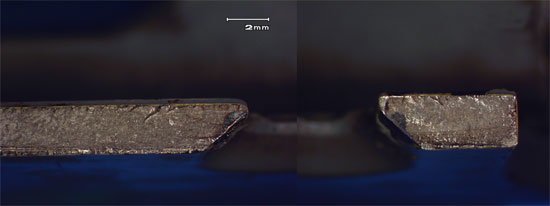
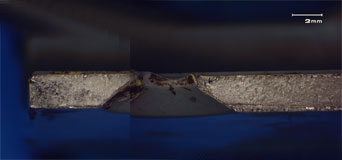
Using light microscopy, the fracture surface of section A revealed the part had failed in fatigue. Crack initiation was identified as occurring on both sides of the right screw hole, circled in figure 9, and more clearly shown in figure 10. Ratchet marks at the serrated edge of the support indicated that crack progression occurred in the direction arrowed in figure 9, and through the thickness of the part. Rapid, unstable fracture characterised by a brighter fracture surface was also observed, shown in figure 11.

Figure 9: Fracture surface of section A. Crack initiation sites are circled and crack propagation directions are indicated with arrows (6X magnification).

Figure 9

Figure 10: Crack initiation sites, section A (6X magnification).

Figure 10

Figure 11: Rapid, unstable fracture surface, section A. Note the brighter appearance of the fracture surface (6X magnification).

Figure 11

Summary

Technical Analysis Report No. 22/05

Occurence No. 200501155

Examination of a Failed Forward Door Attachment from a Bell 212 aircraft, registered VH-LHX, on 10 March 2005.

Occurrence summary

Investigation number 200501155
Occurrence date 10/03/2005
Location Wallaby near Moliana, East Timor
State International
Report release date 31/10/2005
Report status Final
Investigation type Occurrence Investigation
Investigation status Completed
Mode of transport Aviation
Aviation occurrence category Objects falling from aircraft
Occurrence class Technical Analysis
Highest injury level None

Aircraft details

Manufacturer Bell Helicopter Co
Model 212
Registration VH-LHX
Sector Helicopter
Operation type Charter
Departure point Wallaby near Molina, East Timor
Destination Bacau, East Timor
Damage Minor

de Havilland Canada DHC-6-200, VH-JEA

Safety Action

As a result of this occurrence, the aircraft operator obtained a revised engineering order specifying that the main cabin door open warning system be deactivated.  The modified system now provides the pilot with a warning should the nose locker door not be secured.

The aircraft operator also incorporated the required supplement, approving main door open or main door off operations, into the Aircraft Flight Manual.

Analysis

The pilot had experienced difficulty with securing the locker door on previous occasions as it could not be placed into a position that was flush with the fuselage. This created a potential for air flowing under the nose locker door to open it. Damage to the recovered components was not consistent with failure of the lock mechanism; however, failure of the other lock may not be discounted. Given the difficulty in securing the nose locker door, it is likely that it had not been properly secured prior to the occurrence flight.

The main cabin door/locker door warning annunciator was continuously illuminated and was therefore no longer effective as a warning. Consequently, the operational safety intent of the original door warning system design had been negated by the engineering for the modified door.

Factual Information

On 21 January 2005 at about 0830 Eastern Daylight-saving Time, a de Havilland Canada DHC6-200 Twin Otter aircraft, registered VH-JEA, was engaged in commercial skydiving operations at Wilton, NSW, with one pilot and 12 parachutists on board.

The pilot reported that while approaching the drop zone at flight level (FL) 140, he heard a loud noise and noticed the nose locker door detach from the front left side of the aircraft. The door passed in front of the right windscreen before contacting the right propeller. Windows on the right side of the aircraft cabin were broken by debris. The parachutists exited the aircraft and the pilot diverted to Bankstown Airport.

Although the engine indications appeared normal, the pilot suspected that the right engine had developed a vibration. He broadcast a PAN1 and shut down the engine as a precaution. Following the activation of local standby services at Bankstown, a single engine approach and landing was completed. There were no injuries.

An engineering examination found that damage to the aircraft was consistent with the pilots report. One of the two latches from the nose locker door was found inside the cabin. Damage to fibreglass material attached to the latch was consistent with the door having been torn by aerodynamic forces. The remainder of the nose locker door was not recovered. Examination of the latch and fibreglass material found no indication of a pre-existing defect.

On previous occasions the pilot had experienced some difficulty securing the door as it did not sit flush with the fuselage when in the locked position. He stated that because of this, he was careful about checking the aircraft nose locker door and believed, but could not be certain, that he had checked its security immediately prior to the flight.

During the flight, the main cabin door/locker door warning was continuously illuminated on the aircraft caution annunciator panel. The pilot disregarded the warning as it had been illuminated during previous flights when all doors and lockers had been closed and locked.

To facilitate parachute dropping operations, the main cabin door had been modified and replaced with a roller shutter door installation. The installation engineering order had been prepared by an organisation which held a Civil Aviation Safety Authority (CASA) instrument of approval under Civil Aviation Regulations (CAR) 1988 Regulation 35 (2). The instrument enabled the organisation to approve design modifications or repairs.  The engineering order stated:

This roller shutter door modification itself does not require a Flight Manual Supplement. There must however be present in the Flight Manual a section or Supplement approving door off/open operations.

The engineering order did not contain detail as to how the door warning system should be modified following the roller door installation. The installation was undertaken in accordance with the engineering order, with the result that the associated cabin door/locker door warning annunciator was continuously illuminated.

The Flight Manual section or supplement PSM 1-62-1A, approving main door open or main door off operations, could not be located.

The aircraft operations in support of skydiving activities, although an essential element of the commercial enterprise, were conducted as private operations. Consequently, the operator was not required to maintain any flight operations or flight standards manuals beyond that provided in the Twin Otter Aircraft Flight Manual. It was required to comply with the procedures and requirements of the Australian Parachute Federation and CASA as specified in a Deed of Agreement between the two organisations.

1  Urgency message follows (international signal)

Summary

On 21 January 2005 at about 0830 Eastern Daylight-saving Time, a de Havilland Canada DHC6-200 Twin Otter aircraft, registered VH-JEA, was engaged in commercial skydiving operations at Wilton, NSW, with one pilot and 12 parachutists on board.

Occurrence summary

Investigation number 200500222
Occurrence date 21/01/2005
Location Wilton, (ALA)
State New South Wales
Report release date 26/10/2005
Report status Final
Investigation type Occurrence Investigation
Investigation status Completed
Mode of transport Aviation
Aviation occurrence category Objects falling from aircraft
Occurrence class Incident
Highest injury level None

Aircraft details

Manufacturer De Havilland Canada/De Havilland Aircraft of Canada
Model DHC-6
Registration VH-JEA
Serial number 117
Sector Piston
Operation type Sports Aviation
Departure point Wilton NSW
Destination Wilton NSW
Damage Nil