Landing gear/indication

McDonnell Douglas MD 520N, VH-MPI

Significant Factors

  1. The drag brace bushing did not comply with the helicopter manufacturer's specifications.
  2. The drag brace bushing hole had a rough-surface finish.
  3. The drag brace bushing was not fitted using protective coating material.
  4. Fatigue cracking initiated in the bore of the drag brace bushing hole.
  5. The right rear strut fractured during the landing.


Technical Analysis

MD Helicopters, Model MD520N, VH-MPI, 21 June 2004

Examination brief

The right front and rear landing gear strut assemblies from the helicopter (without fairings) were submitted to the ATSB's Canberra Technical Analysis Laboratory for examination and analysis of the failures. The parts were identified as follows:

Front strut:91 - 369H 6001-42 D
Rev. 6 1-24-91
S/O. A0201132
Rear strut:PNo: 369H 6001-32

The front strut carried the identification as ink stencilled print on the elbow section of the assembly. The rear strut did not carry any permanent markings and was identified solely by reference to the attached tag.

Summary

The aircraft coordinated estimate RIGMI at 0338 UTC. The aircraft passed seven minutes late, nil details were passed on from the New Zealand control centre.

At about 0630 Eastern Standard Time on 21 June 2004, a MD Helicopters MD520N helicopter, registered VH-MPI, took off from Gladstone, Queensland, to transport a marine pilot to the deck of a bulk carrier ship that was preparing to enter Gladstone harbour. During the landing on the ship, the right landing gear struts fractured. The helicopter collapsed onto its right side and the main rotor blades struck the ship's deck. The helicopter was substantially damaged and the pilot and passenger exited the helicopter uninjured.

The pilot satisfied Civil Aviation Safety Authority (CASA) recency requirements and was familiar with both the helicopter and the mission to be flown. He reported that he had conducted over 100 deck landings and was familiar with landing on ships of the type involved in the occurrence.

The pilot reported that weather conditions were fine with a clear sky, temperature about 17 degrees Celsius, wind from the south-west at about 25 knots, and a slight sea state.

The ship had a number of large hatches aligned longitudinally along the deck. The pilot was using one of those hatches as a landing area. The hatch was of a suitable size to accommodate the helicopter and there were no obstructions in the vicinity of the landing area. The pilot reported that the ship was underway and steaming at about 10 knots. The ship sustained minor damage to the hatch from main rotor blade impact.

The helicopter was fitted with a fixed utility float installation system on the landing gear. The floats had been fitted to the helicopter in July 2001 in accordance with the instructions contained in a CAR 35 engineering approval. The helicopter manufacturer was not able to provide engineering advice on the effect that the float installation would have had on the helicopter.

The primary damage to the helicopter was confined to the landing gear; in particular, the right front and right rear struts, and the main rotor assembly. A metallurgical examination of the landing gear components identified an existing fatigue crack, emanating from the drag brace attachment lower hole in the strut, as an initiation site for the failure of the right rear strut. The fatigue crack was due to the fitment of a non-standard drag brace bushing to the rear landing gear strut. The drag brace bushing also was not fitted using protective coating material and would not have been provided with corrosion protection from the marine environment. The right front strut failed in gross overload. A copy of the technical analysis investigation report, BE200400015, is at Appendix A.

Examination of the helicopter's maintenance documentation revealed the following:

  • The helicopter had a valid maintenance release for the flight.
  • The landing gear fairing fillets were removed and the landing gear was visually checked for cracks and damage during 100-hourly/annual inspections. The last 100-hourly inspection prior to the occurrence was conducted on 3 June 2004.
  • Every 300 hours a landing gear inspection was carried out in accordance with the helicopter's maintenance manual. Those inspections required that the helicopter be jacked and the landing gear checked. Any elongated, enlarged or worn holes in the strut were to be repaired. The last 300-hourly inspection prior to the occurrence was conducted on 3 June 2004.
  • There were no CASA or US Federal Aviation Administration Airworthiness Directives applicable to the 520N helicopter that would have required an inspection of the affected area to check for defects such as cracking of the strut.
  • All required landing gear periodic and special inspections were carried out.
  • Other than routine inspections, no maintenance action had been conducted in the region of the failure.
  • No record could be found to indicate when the non-standard drag brace bushing had been fitted to the rear landing gear strut.

Occurrence summary

Investigation number 200402243
Occurrence date 21/06/2004
Location 30 km E Gladstone, Aero.
State Queensland
Report release date 06/06/2005
Report status Final
Investigation type Occurrence Investigation
Investigation status Completed
Mode of transport Aviation
Aviation occurrence category Landing gear/indication
Occurrence class Accident
Highest injury level None

Aircraft details

Manufacturer McDonnell Douglas Corp.
Model 520
Registration VH-MPI
Serial number LN026
Sector Helicopter
Operation type Aerial Work
Departure point Gladstone, QLD
Destination MV Energy Angel underway
Damage Substantial

Reims F406, ZK-VAF

Safety Action

Aircraft operator

As a result of this occurrence, the aircraft operator has advised that they have conducted a fleet wide inspection of all landing gear actuator locking devices to ensure they conform to the actuator manufacturer's specifications.

Aircraft Manufacturer

The aircraft manufacturer has advised that it intends to issue a 'mandatory' Service Bulletin, SB F406-56, which will instruct that only the correct landing gear actuator locking devices are to be fitted. The Service Bulletin will also require that strict compliance with the actuator manufacturer's requirements. In addition, the Nose Landing Gear maintenance requirements will be amended in the aircraft maintenance manual to emphasise the requirements of the actuator and control indication check.

Direction Generale de l'aviation Civile of France

The French Direction Generale de l'aviation Civile (DGAC) have advised the aircraft manufacturer that they intend to mandate the requirements of the aircraft manufacturer's Service Bulletin through the issue of an Airworthiness Directive.

Analysis

The incorrect adjustment of the NLG actuator microswitch would not have been readily apparent to pilots of the aircraft, due to the arrangement of the microswitch in series with the NLG overcentre microswitch. As such, all landing gear operation and indications would have appeared normal.

The flat washer installed on the nose gear actuator rod end was significantly different from, and mechanically inferior to, the OEM design intended item. The use of a flat washer on the assembly meant that the locking tang was exposed to considerable sideways loads when the lock nut was being tightened or loosened, as a result of friction between the mating surfaces producing a tendency for the washer to rotate. It is probable that these loads led to the premature failure of the washer tang and the loss of security. The absence of a mechanism for securing locking wire between the lock nut and washer was also anomalous and was further evidence that the use of the installed lock washer was inappropriate.

The lack of adequate security of the lock nut on the actuator rod end would allow the rod end to turn within the hydraulic actuator rod and change the rigged position of the actuator. If the rigging changed to the point where the actuator's internal mechanical locking mechanism was prevented from engaging every time the NLG was lowered, then, combined with external dynamic loads, it would be possible for the NLG to collapse.

Advice from the aircraft manufacturer confirmed that the installation of the incorrect NLG actuator rod-end locking device, combined with a incorrectly adjusted NLG actuator microswitch, could lead to a NLG collapse if the dynamic loads experienced during take-off overcame the overcentre mechanism of the NLG drag brace assembly.

Alternatively, the hydraulic landing gear system power is removed once all three landing gear downlock microswitches are activated. It is also possible that, with the nose landing gear actuator microswitch incorrectly adjusted to the `down and locked' position, hydraulic power was removed from the landing gear system after activation of the two main landing gear down lock microswitches. If this occurred prior to the NLG actuator internal locking devices engaging, the NLG may have been held in the down position by the overcentre mechanism of the drag brace assembly. Had this occurred, then external dynamic loads would be able to collapse the NLG.

From the supplied aircraft documentation, the investigation was unable to determine when the incorrect NLG actuator locking washer was installed or the NLG actuator microswitch was incorrectly adjusted.

Summary

On 22 August 2003, a Reims F406 aircraft, registered ZK-VAF, was being operated on a passenger charter flight from Darwin to Tindal, NT. At approximately 85-90 kts during the take-off roll, the nose landing gear (NLG) collapsed. The aircraft slid to a stop, the pilot shutdown the engines and all occupants evacuated the aircraft uninjured. Prior to this occurrence, on 2 and 19 June 2003, pilots reported difficulties obtaining a `down and locked' indication for the NLG. Maintenance actions rectified the problems at that time.

An examination of the aircraft following the NLG collapse revealed that no damage was evident to any NLG components, or the NLG attachment structure. The NLG rigging was checked and reported to be within tolerances. Damage to the aircraft included abrasion damage to the lower forward fuselage and NLG doors. Both propellers were substantially damaged from ground contact.

The NLG hydraulic actuator was removed from the aircraft for further examination by the ATSB and was taken to a specialist hydraulic facility for functional testing prior to disassembly. The actuator passed all required functional tests, however, it was noted that the integral microswitch had been incorrectly adjusted to the point that it did not obtain switchover during operation of the hydraulic actuator. The microswitch was effectively always providing a signal indicating that the actuator was `down and locked'. However, as the actuator microswitch was wired in series with the NLG overcentre microswitch on the aircraft, the landing gear indications would have appeared normal. The aircraft landing gear hydraulic system was powered during landing gear extension, however hydraulic power was removed once all three landing gear downlock microswitches were activated.

Disassembly of the NLG actuator revealed that all internal components were in good condition, with only minor wear evident. The actuator rod-end was noted to have an incorrect locking washer fitted. A detailed examination of the actuator components revealed that the installed locking washer did not conform to the part no. NAS 559-1 locking device specified by the actuator Original Equipment Manufacturer (OEM). Refer to Appendix A, Figure 1.

Comparison against Original Equipment Manufacturer component

An OEM locking device was obtained and compared against the installed washer. The OEM item was a key-like component and utilised a completely different mechanism for securing the assembly from the installed washer. The installed washer was placed between the rod-end and the lock nut and had a small tang that fitted into the rod-end shank keyway, but was not lockwired. The OEM item fitted into the keyway completely, lying underneath the lock nut and engaged with the slotted end of the actuator rod when the lock nut was tightened. The OEM item also provided for the installation of a locking wire between the drilled rod-end lock nut and the locking tab. Refer to Appendix A, Figure 2.

Damage to the installed washer

The washer that was installed to the rod-end assembly showed clear evidence of rotation against the underside of the lock nut and the actuator rod-end face. Two sides of the washer had been bent in opposing directions, against the respective flats of the nut and rod-end. The bent areas showed damage consistent with repeated manipulation and re-bending of the `tabs'. The small locking tang on the internal diameter of the washer had fractured, allowing the washer to freely rotate on the threaded rod-end shank. The fractured key tang was recovered from the rod-end keyway and cleaned to allow stereomicroscopic examination, which showed that the tang had broken away from the washer under sideways bending overload, such as would be produced by forces acting to twist the washer around the rod-end shank.

Occurrence summary

Investigation number 200303713
Occurrence date 22/08/2003
Location Darwin, Aero.
State Northern Territory
Report release date 24/06/2004
Report status Final
Investigation type Occurrence Investigation
Investigation status Completed
Mode of transport Aviation
Aviation occurrence category Landing gear/indication
Occurrence class Accident
Highest injury level None

Aircraft details

Manufacturer Reims Aviation S.A.
Model F406
Registration ZK-VAF
Serial number 0057
Sector Turboprop
Operation type Charter
Departure point Darwin, NT
Destination Tindal, NT
Damage Substantial

Cessna 310R, VH-COQ, Groote Eylandt Aerodrome, on 25 March 2003

Safety Action

Local safety action

The Civil Aviation Safety Authority has undertaken to assess the Australian fleet implications of the failure. They have also undertaken to develop advisory documentation or corrective actions as required, to address any safety of existing fleet issues that may be identified.

Analysis

The damage to the rod end was consistent with failure during the retraction of the landing gear after take-off at Gove. Disconnection of the left main gear from its push-pull tube meant that the gearbox was unable to extend or retract that gear. It also meant that the emergency gear extension was ineffective. Fatigue cracking within the rod eye section was the principal factor behind the separation of the push-pull tube and the subsequent failure of the landing gear to operate correctly.

The investigation was unable to determine why the rod end failed. It is possible that an increase in transmitted loads resulting from excessive system friction, system rigging problems or the failure of interrelated components could have contributed to the initiation of the rod end cracking.

The pilot was confronted with the high workload of maintaining control during night circuits and trouble shooting a landing gear malfunction. The night conditions meant that people on the ground were of limited help, at least initially, in determining the status of the landing gear. Landing the aircraft with the gear retracted allowed for some directional control during the landing slide and probably limited damage to the aircraft.

The release of the emergency exit on final approach had the potential to inflict serious damage to the tailplane with possible control problems resulting.

Summary

The pilot of a Cessna 310R made a night departure from Gove, NT, at 1900 Central Standard Time for Groote Eylandt, NT. After take-off he noticed two unusual thumps near the end of the landing gear retraction cycle. Normal landing gear up indications were observed and there were no unusual handling characteristics during the flight to Groote Eylandt.

The pilot reported that on arrival in the circuit area he selected the landing gear down. The landing gear operated but the left main landing gear down light did not illuminate at the end of the cycle. The pilot changed the down light bulb without change to the indication. He then cycled the landing gear by selecting up then down, which resulted in the left main and nose landing gear down lights not illuminating. The pilot spoke to ground personnel by radio and made a few low passes along the runway to allow them to observe and report on the condition and position of the landing gear. However, they were unable to see the position of the landing gear due to the darkness.

The pilot manoeuvred the aircraft in an unsuccessful attempt to free the landing gear. Further cycling of the landing gear and a manual landing gear extension were attempted without success. Emergency services, notified by air traffic services, attended and were able to provide enough illumination of the aircraft for observers to report that the nose gear was not extended, the left main gear was at an angle and the right gear appeared to be in the down position.

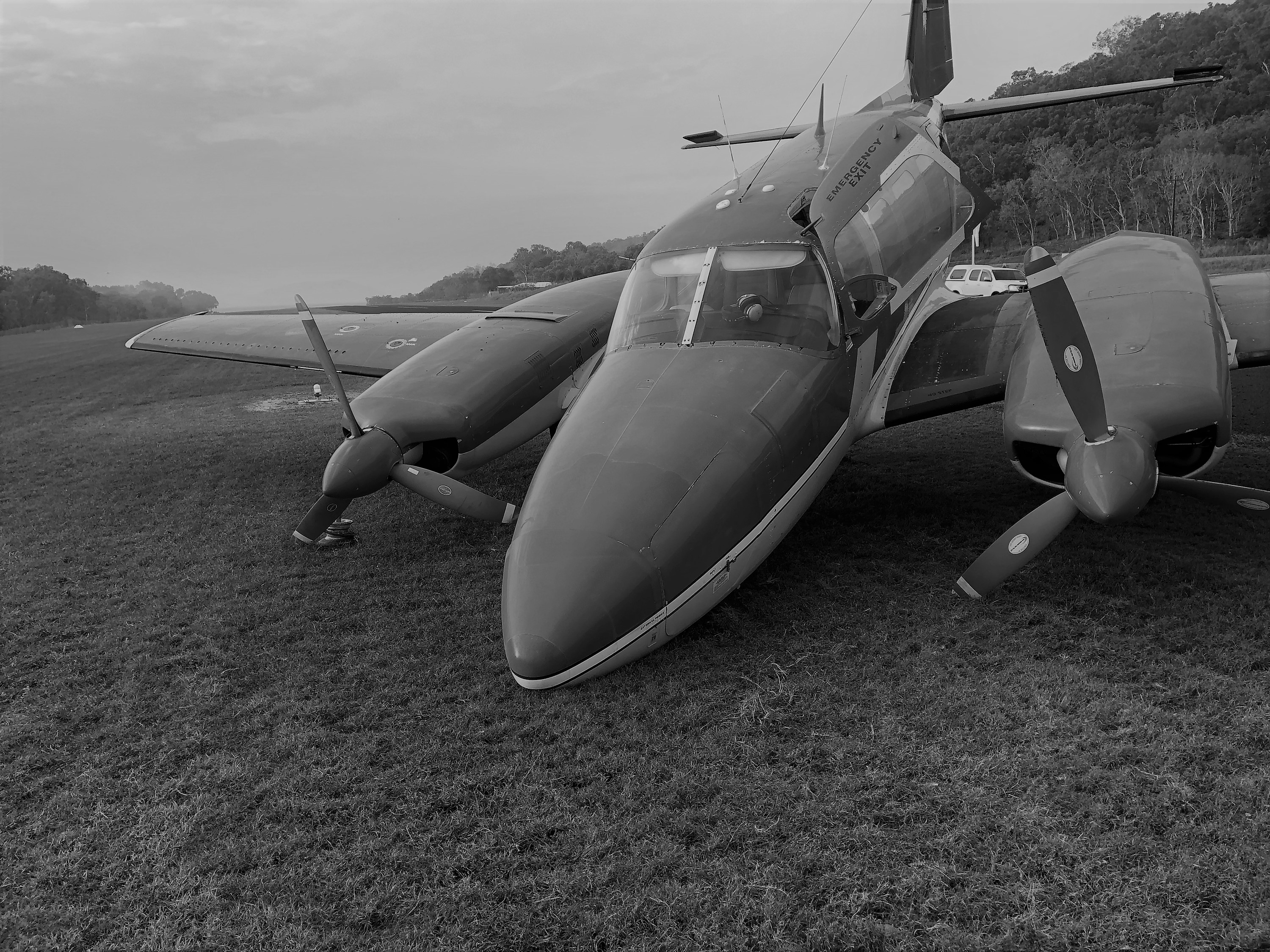
After consultation with a pilot on the ground and briefing the passengers, the pilot made an approach to runway 28 with the gear selected up and the flaps down. While on final approach the pilot unlatched the emergency exit and cabin door. The emergency exit, which consisted of the pilot's side window and associated frame, detached from the aircraft.

The aircraft made a smooth touchdown and slid on the runway. The pilot selected the mixture control to idle cut off and the fuel, magnetos, alternators and battery to off. The passengers exited through the cabin door and over the right wing and moved away from the aircraft. There was no fire, but the propellers and the underbelly of the aircraft were damaged.

Inspection of the aircraft by engineering personnel revealed that the rod end on the outer end of the left main gear inboard push-pull tube had separated, effectively disconnecting the left main landing gear assembly from the actuating mechanism.

Laboratory examination by the ATSB revealed that rod end separation had occurred under predominantly tensile forces after fracturing through one side of the eye section. Detailed examination of the fracture surfaces found characteristic evidence of fatigue cracking, originating from the outer corners of an integral lubrication port within the eye body. The examination found no evidence of any material or manufacturing defects having contributed to the failure.

There were no reports of previous landing gear problems.

The electro-mechanical landing gear system utilised a gearbox, driven by an electric motor, to turn two bellcranks that extended or retracted a push-pull tube to each landing gear assembly. A landing gear hand-crank provided an alternative manual means to drive the gearbox.

In the sub-section titled `EMERGENCY LANDING PROCEDURES', the Cessna 310R pilot's operating handbook (POH) specified unlatching of the cabin door prior to flare-out. However, there was no reference to in-flight unlatching of the emergency exit in any of the emergency checklists.

Occurrence summary

Investigation number 200301185
Occurrence date 25/03/2003
Location Groote Eylandt, Aero.
State Northern Territory
Report release date 11/08/2003
Report status Final
Investigation type Occurrence Investigation
Investigation status Completed
Mode of transport Aviation
Aviation occurrence category Landing gear/indication
Occurrence class Accident
Highest injury level None

Aircraft details

Manufacturer Cessna Aircraft Company
Model 310
Registration VH-COQ
Serial number 310R1643
Sector Piston
Operation type Charter
Departure point Gove, NT
Destination Groote Eylandt, NT
Damage Substantial

Boeing 747-422, N109UA, Melbourne Airport, on 7 March 2003

Summary

After the Boeing 747-400 aircraft, registered N109UA, landed on runway 27 at Melbourne Airport, the crew vacated the runway via taxiway M at the western threshold. They then entered taxiway E, parallel to runway 27. The crew reported that while taxiing eastward along taxiway E, the aircraft veered left of the taxiway centreline. The co-pilot, who was handling the aircraft, applied right tiller and pedal to correct the veer. When the aircraft began to move right of the centreline, the captain took control because he felt that the co-pilot's correction was not arresting the divergence. The captain applied a left correction and reported that he felt that the aircraft was not responding. When he applied additional left control input, the aircraft responded rapidly, and he was unable to stop the aircraft oversteering the centreline. The aircraft failed to respond to the captain's corrective actions, and he applied brakes. However, he was unable to stop the aircraft before the nose wheel and the left wing and body gear left the taxiway and became partially bogged in the grassed area beside the taxiway.

The operator reported that a post maintenance inspection of the nosewheel steering system found low cable tensions on the nose gear steering cables. Subsequent removal of the hydraulic nosewheel steering metering valve and laboratory examination by the component manufacturer found some anomalies but the valve was capable of normal steering operation. Although the low tension of the steering cables was considered a possible factor in the development of the occurrence, the reason for the loss of steering control was not positively determined.

Occurrence summary

Investigation number 200300698
Occurrence date 07/03/2003
Location Melbourne, Airport
State Victoria
Report release date 21/04/2004
Report status Final
Investigation type Occurrence Investigation
Investigation status Completed
Mode of transport Aviation
Aviation occurrence category Landing gear/indication
Occurrence class Incident
Highest injury level None

Aircraft details

Manufacturer The Boeing Company
Model 747
Registration N109UA
Sector Jet
Operation type Air Transport High Capacity
Departure point Sydney, NSW
Destination Melbourne, VIC
Damage Nil

Landing gear malfunction, Gates Learjet Corporation 36, Nowra, New South Wales, on 21 June 2021

Brief

Occurrence Briefs are concise reports that detail the facts surrounding a transport safety occurrence, as received in the initial notification and any follow-up enquiries. They provide an opportunity to share safety messages in the absence of an investigation.

What happened

At about 2000 local time on 21 June 2021, the crew of a Gates Learjet Corporation Model 36 aircraft taxied to depart from Nowra, New South Wales. During the taxi, the crew had difficulty turning the aircraft.

After take-off, the crew received an unsafe landing gear indication when the wheels were retracted and in response, elected to extend the landing gear. When the landing gear was extended, the crew observed a normal cockpit indication and returned the aircraft to Nowra. A fly-by inspection revealed that the nose landing gear, while extended, was oriented side on to the direction of travel. Upon touchdown the nose wheel quickly straightened, and the landing roll proceeded without further incident.

After the flight, maintenance engineers inspected the aircraft. Their assessment was that during landing gear retraction, the uplock roller failed to engage the uplock latch because the roller was facing downwards after rotating through 180º during taxi. Prior to landing, the nose wheel was reportedly oriented side-on to the direction of travel. This is likely to have occurred when the crew extended the landing gear and the centring mechanism attempted to correct the orientation of the nose wheel.

Figure 1 shows the normal operation of the nose wheel landing gear when it is retracted. The uplock roller attached to the lower portion of the nose wheel landing gear leg is captured by the uplock latch in the wheel well. This closes a switch which provides the crew with a landing gear up and locked indication in the cockpit.

Prior to the flight, the aircraft’s nose wheel landing gear steering was marked on the maintenance release[1] with a Minimum Equipment List[2] (MEL) entry to notify the crew of a known fault with the system. The crew had signed the maintenance release and were aware of the defect. This fault affected the pilots’ ability to manipulate the nose wheel, however, steering was still possible through the use of differential braking. The flight manual specified that while operating with degraded steering performance, tight turns were to be avoided. The difficulty the crew experienced while positioning for take-off is likely due to the castoring lower portion of the nose wheel landing gear arm rotating through 180º to face in the opposite direction.

Figure 1: Normal operation of the nose wheel landing gear uplock

Figure 1: Normal operation of the nose wheel landing gear uplock

Source: ATSB

Safety action

As a result of this occurrence, the operator has advised the ATSB that they have taken the following safety actions:

  • The crew were alerted to the potential risks of the nose wheel being reversed due to sharp turns and the likelihood of experiencing turning difficulties.
  • Procedures were introduced to manage a possible reversed nose wheel during taxi.
  • Updated guidance was provided regarding the positioning of aircraft for dispatch when nose wheel steering was unserviceable.
  • Engineering held a meeting to highlight the importance of correct strut servicing and the identification of potential traps or error points.

Safety message

This incident highlights the importance of adhering to manufacturers’ recommended operating procedures, especially those imposed by Minimum Equipment List conditions. The Civil Aviation Safety Authority publication

explains the intention of the MEL process.

Its purpose is not to encourage the operation of aircraft with inoperative equipment. Such operations are permitted only as a result of careful analysis of each item to ensure the required level of safety is maintained.

A thorough understanding of aircraft systems is required for a crew to accurately assess the effect a particular defect has on normal operations.

About this report

Decisions regarding whether to conduct an investigation, and the scope of an investigation, are based on many factors, including the level of safety benefit likely to be obtained from an investigation. For this occurrence, no investigation has been conducted and the ATSB did not verify the accuracy of the information. A brief description has been written using information supplied in the notification and any follow-up information in order to produce a short summary report and allow for greater industry awareness of potential safety issues and possible safety actions.

_________

  1. Maintenance release: an official document, issued by an authorised person as described in Regulations, which is required to be carried on an aircraft as an ongoing record of its time in service (TIS) and airworthiness status. Subject to conditions, a maintenance release is valid for a set period, nominally 100 hours TIS or 12 months from issue.
  2. Minimum equipment list: A document created specifically to regulate the continued operation of an aircraft with inoperative equipment under certain conditions or limitations. /a>

Occurrence summary

Mode of transport Aviation
Occurrence ID AB-2021-021
Occurrence date 21/06/2021
Location Nowra
State New South Wales
Occurrence class Incident
Aviation occurrence category Landing gear/indication
Brief release date 23/11/2021

Aircraft details

Manufacturer Gates Learjet Corp
Model 36
Sector Jet
Operation type Aerial Work
Departure point Nowra Aerodrome, New South Wales
Destination Nowra Aerodrome, New South Wales
Damage Nil

Landing gear malfunction involving an Aero Commander 500-S, Port Lincoln, South Australia, on 4 May 2020

Brief

Occurrence Briefs are concise reports that detail the facts surrounding a transport safety occurrence, as received in the initial notification and any follow-up enquiries. They provide an opportunity to share safety messages in the absence of an investigation.

What happened

On 4 May 2020, an Aero Commander 500-S was operating a freight charter flight from Port Lincoln Airport, South Australia with a single pilot on board. During initial climb, the pilot noticed that the landing gear unsafe light did not extinguish after the gear was retracted. The pilot contacted aerodrome ground crew to inspect the aircraft’s landing gear during a low-level fly-by. The ground crew, including an engineer, confirmed that the nose wheel was down but did not appear to be locked.

The pilot requested that emergency services attend the aerodrome for a return landing on runway 01, and continued troubleshooting in accordance with the operator’s standard operating procedures and the aircraft flight manual. The pilot conducted a touch-and-go landing on the rear wheels, which resulted in three green indication lights in the cockpit confirming the gear was down and locked. The crew subsequently conducted a further fly-by inspection where ground crew also confirmed the position of the nose landing gear. The aircraft then landed without further incident.

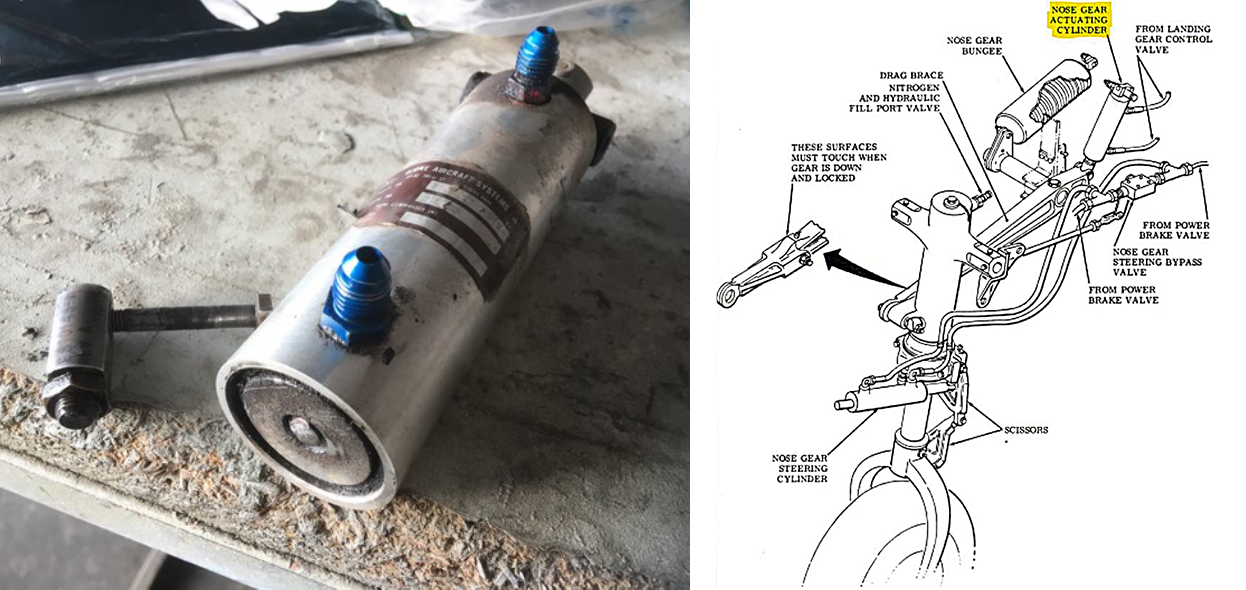
After an engineer inspected the landing gear, the aircraft taxied off the runway. An inspection of the landing gear system revealed that the nose gear actuator shaft had failed.

Figure 1: Failed nose gear actuator shaft

Figure 1: Failed nose gear actuator shaft.

Source: Aircraft operator

Safety action

As a result of previous similar occurrences, the aircraft operator has advised the ATSB that it has been conducting midlife inspections of the nose landing gear area, as well as additional testing of the actuator during overhauls. Additionally, their entire fleet of Aero Commander 500 aircraft has been fitted with underbelly skid blocks to support the nose in the event of a gear failure.

Safety message

This incident highlights the importance of effective cockpit scans for the early detection of any abnormal situations during flight. In this instance, the pilot identified the fault, took all precautionary measures and communicated clearly with ground crews resulting in a safe landing.

About this report

Decisions regarding whether to conduct an investigation, and the scope of an investigation, are based on many factors, including the level of safety benefit likely to be obtained from an investigation. For this occurrence, no investigation has been conducted and the ATSB did not verify the accuracy of the information. A brief description has been written using information supplied in the notification and any follow-up information in order to produce a short summary report, and allow for greater industry awareness of potential safety issues and possible safety actions.

Occurrence summary

Mode of transport Aviation
Occurrence ID AB-2020-019
Occurrence date 04/05/2020
Location Port Lincoln Airport
State South Australia
Occurrence class Incident
Aviation occurrence category Landing gear/indication
Highest injury level None
Brief release date 19/06/2020

Aircraft details

Manufacturer Aero Commander
Model 500-S
Sector Piston
Operation type Charter
Departure point Port Lincoln Airport, South Australia
Damage Nil

Landing gear failure involving Cessna 210L, at Hodgson Downs, Northern Territory, on 17 April 2019

Brief

Occurrence Briefs are concise reports that detail the facts surrounding a transport safety occurrence, as received in the initial notification and any follow-up enquiries. They provide an opportunity to share safety messages in the absence of an investigation.

What happened

On 17 April 2019 at 1300 Central Standard Time, the pilot of a Cessna 210L aircraft was conducting a chartered passenger flight between Tindal and Hodgson Downs, Northern Territory.

Once established in the circuit area at Hodgson Downs, the landing gear was selected down as the aircraft manoeuvred to land. The pilot confirmed that the gear was down by visually checking the undercarriage was extending, hearing that the gear pump had stopped and identifying three green lights indicating gear down. The pilot continued the approach and completed the pre-landing checks, which included checking the landing gear again on final.

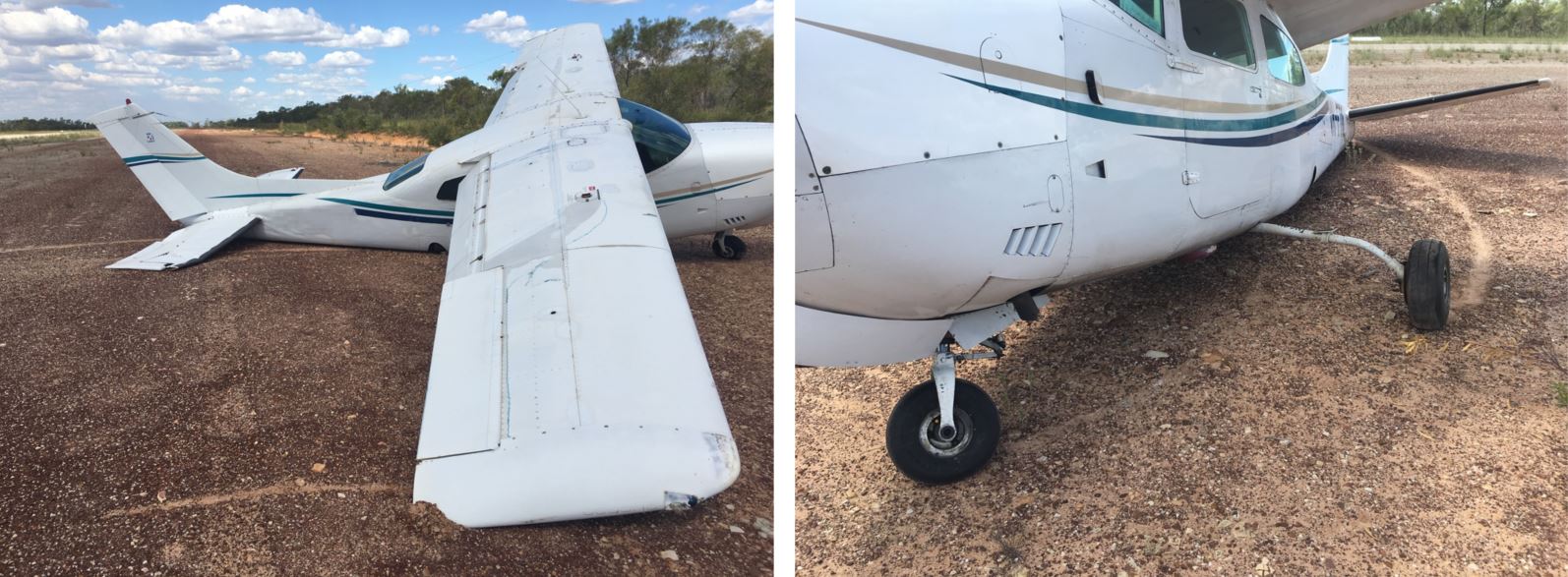
The landing roll felt normal until the aircraft slowed and more weight was applied to the landing gear, at which point the aircraft began to yaw to the right. The yaw was countered with rudder input, however the aircraft continued to yaw right and veered off the runway, coming to rest inside the flight strip.

Once the aircraft was shut down and secured, the pilot evacuated the passengers safely. No one was injured, however the aircraft sustained substantial damage.

Figure 1: Damage sustained to the aircraft after landing

Figure 1: Damage sustained to the aircraft after landing. Source: Operator

Source: Operator

Engineering Inspection

The engineering inspection revealed one of the gear down indication switches was jammed in the closed position. On L-model Cessna 210 aircraft, when all three switches (left main, right main and nose) are closed, the gear down light is illuminated and the gear pump will stop. Upon further inspection, it appeared the switch was jamming intermittently.

During this incident, the pilot reported that he had lowered the landing gear, completed all checks as appropriate and received three green undercarriage lights. It appeared from the visual check at the time of lowering that the gear was down and locked. It is likely that the left main gear and the nose gear locked before the right main gear, however due to the right main gear switch being stuck in the closed position, the light illuminated and the pump stopped before the right main gear had fully locked in the down position.

Safety action

As a result of this occurrence, the aircraft operator has advised the ATSB that they are taking the following safety actions:

The incident has been examined and debriefed with the pilot and company’s training captains.

A company-wide memo was released regarding the importance of the visual undercarriage checks on final approach. As part of ongoing updates to the company flight crew operating manual, a revised final approach procedure has been included to clearly specify that visual gear checks must be conducted on final approach as part of the ‘UNDERCARRIAGE’ item on the checklist.

Safety message

This incident highlights the importance of pilots being familiar with all aircraft systems. This allows them to be aware of the possible effects of the failure of an interacting or interrelated component in those systems and provides them with a greater understanding of the aircraft’s operation in both normal and emergency situations.

About this report

Decisions regarding whether to conduct an investigation, and the scope of an investigation, are based on many factors, including the level of safety benefit likely to be obtained from an investigation. For this occurrence, no investigation has been conducted and the ATSB did not verify the accuracy of the information. A brief description has been written using information supplied in the notification and any follow-up information in order to produce a short summary report, and allow for greater industry awareness of potential safety issues and possible safety actions.

Occurrence summary

Mode of transport Aviation
Occurrence ID AB-2019-015
Occurrence date 17/04/2019
Location Hodgson Downs
State Northern Territory
Occurrence class Accident
Aviation occurrence category Landing gear/indication
Highest injury level None
Brief release date 12/07/2019

Aircraft details

Manufacturer Cessna Aircraft Company
Model 210L
Sector Piston
Operation type Charter
Destination Hodgson Downs, Northern Territory
Damage Substantial

Landing gear failure involving British Aerospace Jetstream 32, Williamtown Airport, New South Wales, on 31 October 2018

Brief

Occurrence Briefs are concise reports that detail the facts surrounding a transport safety occurrence, as received in the initial notification and any follow-up enquiries. They provide an opportunity to share safety messages in the absence of an investigation.

What happened

On 31 October 2018 at 1300 Western Standard Time, the crew of a Jetstream Series 3200 aircraft was conducting a revenue passenger transport flight between Williamtown, New South Wales and Canberra, Australian Capital Territory. The crew comprised of a captain and a first officer. The captain was pilot flying (PF) and the first officer was pilot not flying (PNF).

Just after take-off from Williamtown, the landing gear was selected up. The nose wheel landing gear light remained green to indicate that it had not retracted. The two main landing gear did retract, but were slower than usual. The flight crew also heard unusual sounds as the landing gear attempted to retract.

The PF decided to conduct a return to Williamtown airport. The PF took over the radios from the PNF, and requested an amended 3,000 ft level off and to remain on the tower frequency, while the PNF conducted the after take-off checklist. The PF instructed the PNF to open the aircraft Quick Reference Handbook and find the checklist for gear locked down. During this time, the PF communicated with air traffic control, to request a circuit for a return to land at Williamtown.

On approach, the PNF selected gear down. The system did not respond to this selection, and the main gear did not extend. The PF instructed the PNF to check the circuit breaker (CB) for the gear, however the PNF could not reach the CB. The PF reset the CB, after which the main gear extended.

The crew then landed the aircraft without incident.

Engineering inspection

Following the incident, inspection of the landing gear revealed that a solenoid on the landing gear selector valve failed when the landing gear was selected up.

Safety message

This incident highlights the value of effective cockpit resource management in response to unexpected events. The PF effectively delegated multiple tasks to the PNF, which enabled the PF to focus on flying the aircraft and communicating with ATC. The PF effectively used the resources available to him in order to gather more information about the problems with the aircraft, by instructing the PNF to consult the Quick Reference Handbook. CASA outlines the importance of using available cockpit resources, and provides practical steps for doing so, in their Human Factors for Pilots booklet on Teamwork.

This incident also highlights the importance of effective pilot decision making to ensuring safe flight. The PF’s decision to return to Williamtown, soon after he had identified that the landing gear was not performing as expected, reduced the risk of the situation deteriorating. Flight crew are encouraged to identify the hazards and risks they encounter during flight, and to make control decisions to minimise those risks where possible. The FAA provides decision-making guidance to pilots in their Aeronautical Decision Making (ADM) training package.

Occurrence summary

Mode of transport Aviation
Occurrence ID AB-2018-119
Occurrence date 31/10/2018
Location Williamtown Airport
State New South Wales
Occurrence class Incident
Aviation occurrence category Landing gear/indication
Highest injury level None
Brief release date 29/04/2019

Aircraft details

Manufacturer British Aerospace
Model Jetstream Series 3200
Sector Jet
Operation type Air Transport Low Capacity
Departure point Williamtown, NSW
Destination Canberra, ACT
Damage Nil

Foreign object debris involving Piper PA-31, Palm Island, Queensland, on 27 November 2018

Brief

Occurrence Briefs are concise reports that detail the facts surrounding a transport safety occurrence, as received in the initial notification and any follow-up enquiries. They provide an opportunity to share safety messages in the absence of an investigation.

What happened

On 27 November 2018, a Piper PA-31 was operating a charter flight with one pilot and three passengers on board to Palm Island, Queensland.

After landing, the nose wheel tyre was punctured by foreign object debris (FOD)[1] on the runway. The nose wheel began to vibrate resulting in the pilot braking with caution and applying back pressure[2] to alleviate the pressure on the nose wheel. The rubber on the tyre started to disintegrate and the rim of the wheel dug into the soft asphalt, caused by the extremely hot conditions.

The tyre became caught between the rim and the fork of the nose gear, which acted as a brake and rudder causing the aircraft to veer to the right and off the runway resulting in a nose gear failure. The pilot shut down both engines to reduce the possibility of debris becoming projectiles and to minimise damage to the aircraft before both propellers struck the ground unpowered. 

A screw is suspected to have caused the tyre puncture as nuts and bolts were observed during the runway inspection after the occurrence.

Figure 1: Damage sustained to the aircraft after landing

Figure 1: Damage sustained to the aircraft after landing. Source: Operator

Source: Operator

Safety message

This occurrence highlights the importance of carrying out regular runway inspections as FOD has the potential to affect aircraft during critical phases of flight. Boeing, in Foreign Object Debris and Damage Prevention, estimate that FOD damage costs the aviation industry $4 billion per year.

All aerodromes are encouraged to have an active FOD management program in place. Aerodrome staff and pilots are reminded to keep an active lookout and retrieve any identified FOD before it becomes a hazard.

Further information about FOD management at aerodromes can be found on the Australian Airports Association website: Foreign object debris.

About this report

Decisions regarding whether to conduct an investigation, and the scope of an investigation, are based on many factors, including the level of safety benefit likely to be obtained from an investigation. For this occurrence, no investigation has been conducted and the ATSB did not verify the accuracy of the information. A brief description has been written using information supplied in the notification and any follow-up information in order to produce a short summary report, and allow for greater industry awareness of potential safety issues and possible safety actions.

__________

  1. Foreign object debris: Any object, live or not, located in an inappropriate location in the airport environment that has the capacity to injure airport or air carrier personnel and damage aircraft.
  2. Back pressure: The application of back pressure to the yoke to slowly raise the aircraft’s nose and increase its angle of attack.

Occurrence summary

Mode of transport Aviation
Occurrence ID AB-2018-130
Occurrence date 27/11/2018
Location Palm Island
State Queensland
Occurrence class Serious Incident
Aviation occurrence category Landing gear/indication
Highest injury level None
Brief release date 25/02/2019

Aircraft details

Manufacturer Piper Aircraft Corp
Model PA-31
Sector Piston
Operation type Charter
Destination Palm Island, Queensland
Damage Minor

Landing gear failure involving Cessna 210, near Katherine, Northern Territory, on 22 November 2018

Brief

Occurrence Briefs are concise reports that detail the facts surrounding a transport safety occurrence, as received in the initial notification and any follow-up enquiries. They provide an opportunity to share safety messages in the absence of an investigation.

What happened

On 22 November 2018 a Cessna 210 was conducting a freight charter flight to Kilarney Station, Northern Territory (NT). The pilot was the sole occupant on board.

During approach to Kilarney Station, the landing gear failed to extend. The pilot attempted to extend the landing gear using emergency procedures with no success. The pilot then decided to conduct a return to Tindal Airport, NT and contacted the chief pilot and engineer in-flight. After unsuccessfully conducting troubleshooting procedures, it was decided the pilot would have to conduct a wheels up landing at a private airstrip with a grass runway area near Katherine, NT.

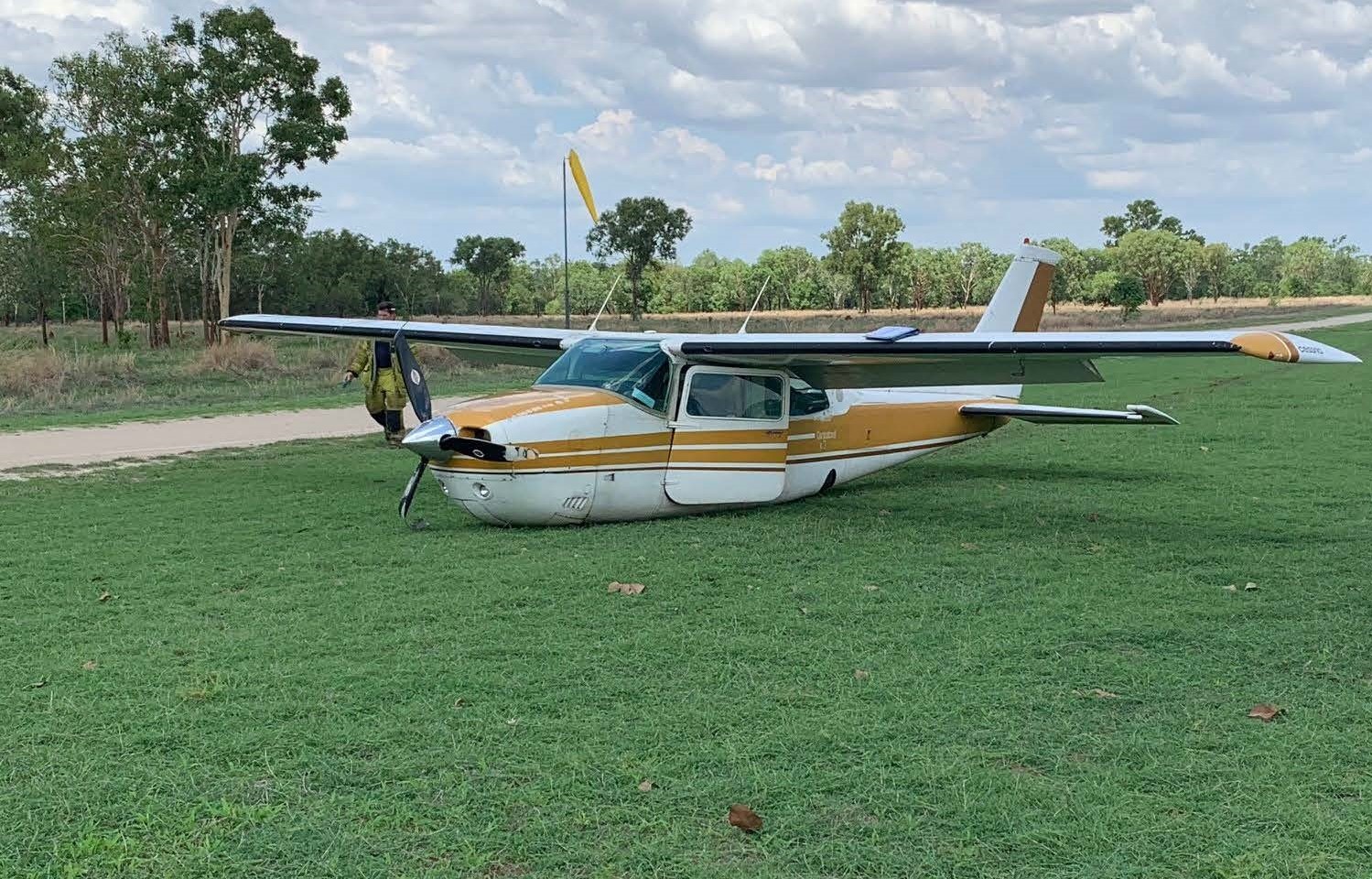
While the runway was prepared and emergency services were organised, the pilot entered a holding pattern to burn off fuel. At 1400 Central Standard Time, after multiple practice approaches, a wheels up landing was conducted on the grass strip resulting in a propeller strike and minor damage to the fuselage.

Engineering inspection

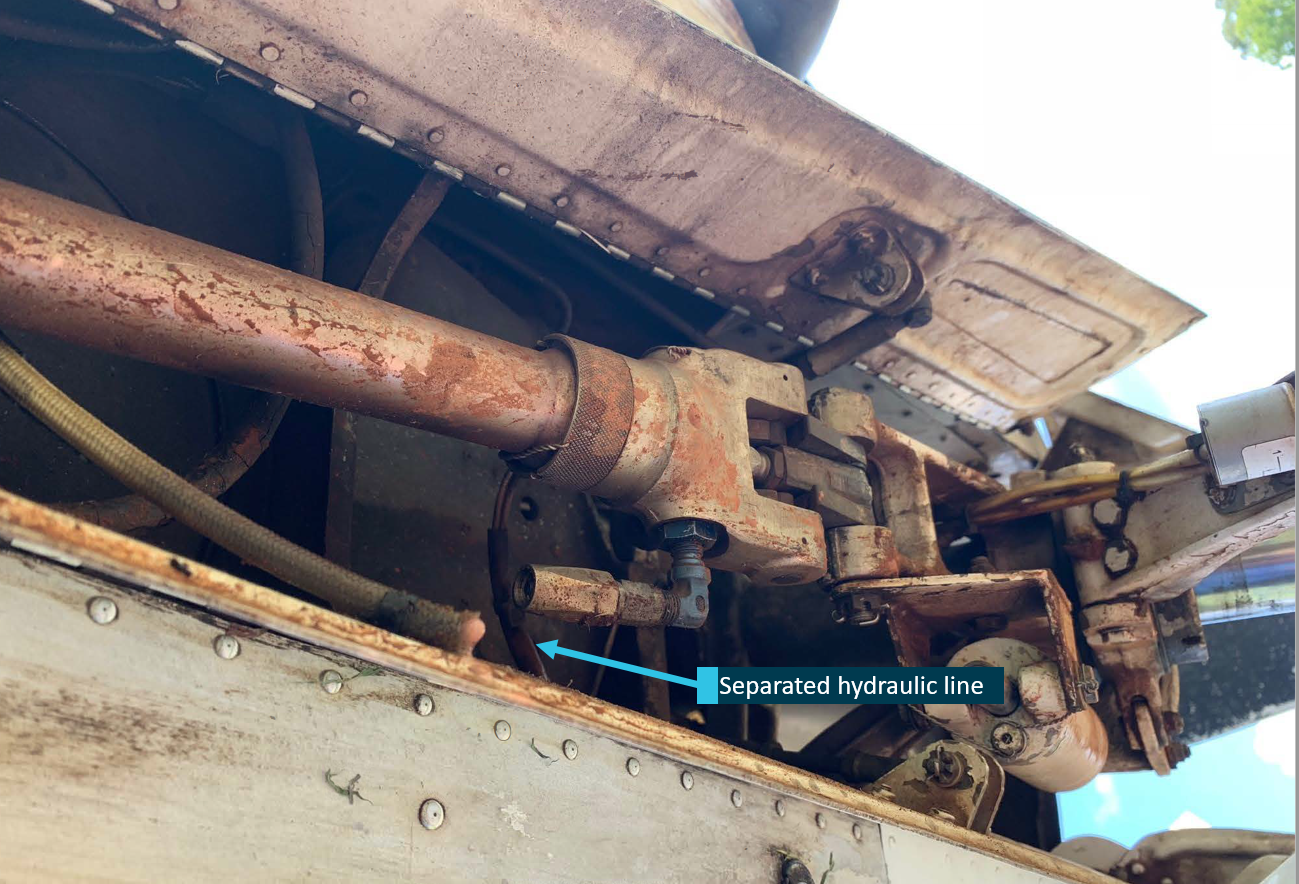
Following the incident, an inspection of the landing gear revealed that the hydraulic line connected to the nose wheel actuator had separated from its fitting. This subsequently resulted in a loss of hydraulic fluid in the gear down hydraulic line.

Figure 1: Damage sustained to aircraft after landing

Figure 1: Damage sustained to aircraft after landing. Source: Operator

Source: Operator

Figure 2: Broken hydraulic line from nose wheel actuator

Figure 2: Broken hydraulic line from nose wheel actuator. Source: Operator

Source: Operator

Safety message

Unanticipated failures can occur at any given time during flight. In this instance, the pilot took all appropriate actions by following non-normal procedures, communicating and coordinating with ground staff to conduct additional checks to assess the situation, and ensuring that he was well prepared for the wheels up landing resulting in a safe outcome.

This accident not only highlights the importance of comprehensive and periodic maintenance inspections, but also the importance of following emergency checklists and procedures and using every resource available to help resolve an issue.

About this report

Decisions regarding whether to conduct an investigation, and the scope of an investigation, are based on many factors, including the level of safety benefit likely to be obtained from an investigation. For this occurrence, no investigation has been conducted and the ATSB did not verify the accuracy of the information. A brief description has been written using information supplied in the notification and any follow-up information in order to produce a short summary report, and allow for greater industry awareness of potential safety issues and possible safety actions.

Occurrence summary

Mode of transport Aviation
Occurrence ID AB-2018-128
Occurrence date 22/11/2018
Location Near Katherine
State Northern Territory
Occurrence class Incident
Aviation occurrence category Landing gear/indication
Highest injury level None
Brief release date 22/01/2019

Aircraft details

Manufacturer Cessna Aircraft Company
Model 210
Sector Piston
Operation type Charter
Destination Kilarney Station, Northern Territory
Damage Minor