Landing gear/indication

Nose gear up landing involving Beech 76, 28 km south of Jandakot, Western Australia, on 12 September 2018

Brief

Occurrence Briefs are concise reports that detail the facts surrounding a transport safety occurrence, as received in the initial notification and any follow-up enquiries. They provide an opportunity to share safety messages in the absence of an investigation.

What happened

On 12 September 2018, the crew of a Beech Aircraft Corp 76 departed Jandakot, Western Australia to conduct a flight test with two crew members on board.

Just after take-off, the crew proceeded 28 km south of Jandakot, WA, operating under Visual Flight Rules[1] (VFR). Whilst in the local training area, the crew conducted some training manoeuvres, which also included three in-flight gear extensions. The first two gear extensions were performed without incident. During the third gear extension, the nose gear failed to extend and lock into place. The crew attempted to extend the gear using the emergency procedures checklist located in the aircraft’s flight manual. After completing the landing gear manual extension checklist (Figure 1), the crew were unable to extend the nose gear. This was confirmed by the nose gear light not being illuminated and by visual inspection in the form of a mirror located on the inside of the left engine cowling. The crew conducted a return to Jandakot, declared a PAN-PAN[2] call to Jandakot tower and instructed the Tower that they would be performing a nose gear up landing.

Air Traffic Control (ATC) acknowledged the PAN-PAN and instructed the crew to hold south of the airport to process all arriving traffic in anticipation that the runway would become unserviceable, and to give the crew time to attempt to extend the gear and prepare for their approach. The crew conducted a fly-by of the tower for a visual inspection of the landing gear. ATC confirmed that the nose gear was not extended. Emergency services and procedures were activated and the aircraft was holding in the circuit area

As the aircraft approached for landing, the crew completed the gear up landing checklist (Figure 2), which instructs them of the proper configuration the aircraft needs to be in to perform a gear up landing to minimise injury and damage to the aircraft. Prior to touching down on the runway, at about 200 ft above ground level, the crew pulled the engine throttles back to idle, the engine fuel mixtures to idle cut-off, the propeller pitch controls to feather and all electrical systems were turned off to prevent any damage to the engines, propellers and also to reduce the risk of a fire. As the main landing gear wheels touched down on the runway, the crew kept backpressure on the control column to keep the nose of the aircraft off the ground as long as possible and to slow the aircraft down. As the aircraft’s speed started to slow down, the nose slowly started to drop onto the runway and came in contact with the runway surface. The aircraft came to a complete stop shortly after. The crew disembarked the aircraft unharmed. The aircraft sustained minor damage to the nose section.

Engineering inspection

Following the incident, the inspection of the nose gear section revealed that the landing gear pivot bolts and leg pins on the landing gear doors were worn, which caused it to malfunction and prevented the doors from opening, therefore not allowing the nose gear to extend.

Figure 1: Landing gear manual extension checklist 
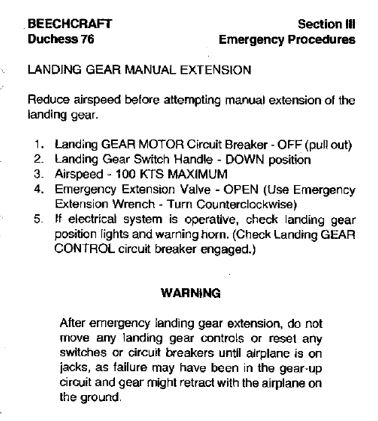
Figure 1: Landing gear manual extension checklist

Figure 2: Gear up landing checklist 
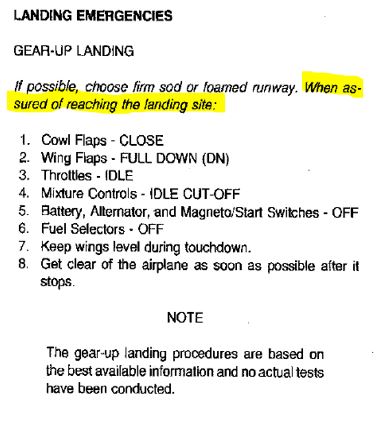
Figure 2: Gear up landing checklist

Safety message

Unanticipated failures can occur during flight. In this incident, although the aircraft was within the necessary distance from the runway to complete a nose gear up landing, it is safer to wait until the main landing gear has touched down on the runway before shutting down and feathering the engines. This is to ensure that if the aircraft has to go around or take-off again due to safety reasons or obstructions on the runway, the aircraft will have the necessary engine performance it requires to perform this task.

The crew, in this instance, took all possible precautions by following non-normal procedures, conducting additional checks to assess the situation, providing clear communications to ATC and returning the aircraft to land.

About this report

Decisions regarding whether to conduct an investigation, and the scope of an investigation, are based on many factors, including the level of safety benefit likely to be obtained from an investigation. For this occurrence, no investigation has been conducted and the ATSB did not verify the accuracy of the information. A brief description has been written using information supplied in the notification and any follow-up information in order to produce a short summary report, and allow for greater industry awareness of potential safety issues and possible safety actions.

__________

  1. Visual Flight Rules (VFR) - are a set of regulations under which a pilot operates an aircraft in weather conditions generally clear enough to allow the pilot to see where the aircraft is going. Specifically, the weather must be better than basic VFR weather minima.
  2. PAN-PAN - The radiotelephony message PAN-PAN is the international standard urgency signal that the crew on board an aircraft uses to declare that they have a situation that is urgent but, for the time being at least, does not pose an immediate danger to anyone's life or the aircraft itself.

Occurrence summary

Mode of transport Aviation
Occurrence ID AB-2018-111
Occurrence date 12/09/2018
Location 28 km South of Jandakot
State Western Australia
Occurrence class Serious Incident
Aviation occurrence category Landing gear/indication
Highest injury level Minor
Brief release date 20/12/2018

Aircraft details

Manufacturer Beech Aircraft Corp
Model 76
Sector Piston
Operation type Flying Training
Departure point 28 km South of Jandakot, WA
Damage Minor

Landing gear failure involving Beech 1900D, Cairns Airport, Queensland, on 18 July 2018

Brief

Occurrence Briefs are concise reports that detail the facts surrounding a transport safety occurrence, as received in the initial notification and any follow-up enquiries. They provide an opportunity to share safety messages in the absence of an investigation.

What happened

On 18 July 2018, at about 0620 Eastern Standard Time, a Beech Aircraft Corp B1900D was conducting a charter flight from Cairns Airport, Queensland (Qld) to Skardon River Airport, Qld with two crew and 16 passengers on board.

Just after take-off from Cairns, the landing gear was selected up. The landing gear did not retract and remained down and locked with all green lights illuminated. The crew conducted a return to Cairns and the aircraft landed without incident.

Engineering Inspection

Following the incident, inspection of the landing gear revealed that the landing gear motor circuit breaker in the undercarriage had been pulled the previous day during maintenance and was not reset before the access panel was re-fitted after maintenance was completed. As a result, when the landing gear was selected up, the undercarriage system could not operate without the circuit breaker being reset.

Safety action

As a result of this incident, the maintenance organisation has advised the ATSB that they are taking the following ongoing safety actions:

  • improving prescribed paperwork methods
  • providing further human factors training
  • conducting Efficiency-Thoroughness Trade-Off (ETTO) training[1]
  • conducting more regular tool box talks
  • providing safety and quality awareness training.

Safety message

Where an aircraft has been out of service for maintenance, it is important to verify the functionality of all critical aircraft components before returning it to service. These checks should be conducted in addition to the routine, pre-flight checks.

It is important that pilots remain aware that despite conducting comprehensive pre-flight checks, unanticipated failures can still occur during flight. In this situation, the flight crew took all possible precautions by following non-normal procedures, conducting additional checks to assess the situation, providing clear communications to ATC and returning the aircraft to land.

About this report

Decisions regarding whether to conduct an investigation, and the scope of an investigation, are based on many factors, including the level of safety benefit likely to be obtained from an investigation. For this occurrence, no investigation has been conducted and the ATSB did not verify the accuracy of the information. A brief description has been written using information supplied in the notification and any follow-up information in order to produce a short summary report, and allow for greater industry awareness of potential safety issues and possible safety actions.

__________

  1. Erik Hollnagel, ETTO principles and rules that are applicable to the working environment. They compare the difference between efficiency and safety.

Occurrence summary

Mode of transport Aviation
Occurrence ID AB-2018-093
Occurrence date 18/07/2018
Location Cairns
State Queensland
Occurrence class Incident
Aviation occurrence category Landing gear/indication
Highest injury level None
Brief release date 05/11/2018

Aircraft details

Manufacturer Beech Aircraft Corp
Model 1900D
Sector Turboprop
Operation type Charter
Departure point Cairns, Qld
Destination Skardon River, Qld
Damage Nil

Landing gear failure involving Piper PA-44-180, Jandakot Airport, Western Australia, on 23 February 2018

Brief

Occurrence Briefs are concise reports that detail the facts surrounding a transport safety occurrence, as received in the initial notification and any follow-up enquiries. They provide an opportunity to share safety messages in the absence of an investigation.

What happened

On 23 February 2018, at about 0933 Western Standard Time (WST), a Piper Aircraft Corp PA-44-180 was conducting a training flight from Jandakot Airport, Western Australia (WA) to Rottnest Island Airport, WA with two crew members on board.

During the approach to Rottnest Island, the landing gear was extended. The gear unsafe light illuminated during the extension process and turned off when the left and nose gear lights turned green to indicate they were locked, however, the right gear light did not illuminate. The crew conducted a missed approach and began to troubleshoot the issue during the return flight to Jandakot.

On approach to Jandakot, the crew followed the emergency gear extension procedure. The light for the right-hand gear did not illuminate to indicate the landing gear had locked, however the gear unsafe light remained off.

The crew requested a fly-by of the tower for a visual inspection of the landing gear. Air Traffic Control (ATC) reported that all three wheels appeared down, with no differences between left and right observed.

The crew requested emergency services to be on standby and once confirmed, made their final approach. On landing, the right landing gear collapsed, and the aircraft came to a stop to the right of the runway, at 90 degrees. ATC activated the crash alarm and full emergency procedures were conducted. The crew disembarked the aircraft unharmed.

Engineering inspection

Following the incident, inspection of the right-hand landing gear revealed that the gear actuator seals were not correctly functioning and that the pivots on the down lock mechanism were stiff. The faulty seals resulted in a loss of actuator pressure in the down position. When emergency procedures were followed for gear extension, the gear could not free fall and lock into position due to the resistance at the pivot. It was noted that retraction and free fall of the landing gear was tested during maintenance in November 2017 with no non-normal indications. However, the aircraft was not returned to service until February 2018, during which time it is suspected that the pivots became stiff.

Repairs to the aircraft were carried out in accordance with the aircraft maintenance manual to:

  • reseal the actuator with new O-rings
  • replace the down lock springs
  • dismantle, grease and reassemble the down locks.

Testing of the landing gear was conducted, and the aircraft was returned to service.

Safety message

Where an aircraft has been out of service for an extended period of time, it is important to verify the functionality of all critical aircraft components before returning it to service. These checks should be conducted in addition to the routine, pre-flight checks.

It is important that pilots remain aware that despite conducting comprehensive pre-flight checks, unanticipated failures can still occur during flight. In this situation, the flight crew took all possible precautions prior to landing by:

  • following non-normal procedures
  • conducting additional checks to assess the situation
  • providing clear communications to ATC.

About this report

Decisions regarding whether to conduct an investigation, and the scope of an investigation, are based on many factors, including the level of safety benefit likely to be obtained from an investigation. For this occurrence, no investigation has been conducted and the ATSB did not verify the accuracy of the information. A brief description has been written using information supplied in the notification and any follow-up information in order to produce a short summary report, and allow for greater industry awareness of potential safety issues and possible safety actions.

Occurrence summary

Mode of transport Aviation
Occurrence ID AB-2018-024
Occurrence date 23/02/2018
Location Jandakot
State Western Australia
Occurrence class Accident
Aviation occurrence category Landing gear/indication
Highest injury level None
Brief release date 17/05/2018

Aircraft details

Manufacturer Piper Aircraft Corp
Model PA-44-180
Sector Piston
Operation type Flying Training
Damage Substantial

Landing gear incident involving Raytheon Hawker 850XP, Gladstone Airport, Queensland, on 18 January 2018

Brief

Occurrence Briefs are concise reports that detail the facts surrounding a transport safety occurrence, as received in the initial notification and any follow-up enquiries. They provide an opportunity to share safety messages in the absence of an investigation.

What happened

On 18 January 2018, the pilot of a Raytheon Hawker 850XP was conducting a check and training exercise from Bundaberg, Queensland (Qld) with three crew on board.

The aircraft arrived at Gladstone airport, Qld at about 1140 Eastern Standard Time (EST). Part of the exercise involved the practice of a one engine inoperative approach and landing in which the pilot inadvertently applied the right hand (RH) brakes causing both RH tyres to lock up and the anti-skid to cease functioning. The aircraft came to a stop and the pilot slowly taxied the aircraft clear of the runway. The anti-skid on this aeroplane does not have locked wheel protection.

The post-flight inspection revealed both RH main landing gear tyres deflated.

Safety action

As a result of this incident, the operator advises that the pilot was debriefed and has since completed simulator training in the Hawker recurrent simulator.

About this report

Decisions regarding whether to conduct an investigation, and the scope of an investigation, are based on many factors, including the level of safety benefit likely to be obtained from an investigation. For this occurrence, no investigation has been conducted and the ATSB did not verify the accuracy of the information. A brief description has been written using information supplied in the notification and any follow-up information in order to produce a short summary report, and allow for greater industry awareness of potential safety issues and possible safety actions.

Occurrence summary

Mode of transport Aviation
Occurrence ID AB-2018-006
Occurrence date 18/01/2018
Location Gladstone
State Queensland
Occurrence class Incident
Aviation occurrence category Landing gear/indication
Highest injury level None
Brief release date 16/05/2018

Aircraft details

Manufacturer Raytheon Aircraft Company
Model Hawker 850XP
Sector Jet
Operation type Flying Training
Damage Minor