Landing gear/indication

Wheels-up landing involving Beechcraft King Air B200, VH-XDV, Williamtown Airport, New South Wales, on 13 May 2024

Final report

Report release date: 13/11/2024

Executive summary

What happened

On the morning of 13 May 2024, a Beechcraft King Air B200, registered VH-XDV and operated by Eastern Air Services was being used for a passenger transport flight from Williamtown Airport to Lord Howe Island, New South Wales. On board the aircraft were the pilot and 2 passengers. Shortly after the aircraft departed Williamtown, the landing gear malfunctioned and jammed in a partially retracted position. The pilot was unable to extend the gear using the emergency procedures.

After approximately 4 hours of holding the pilot completed a wheels-up landing at Williamtown Airport with emergency services standing by. The aircraft sustained minor damage from the landing incident. The pilot and passengers were uninjured.

What the ATSB found

The ATSB identified that during either the take-off roll or landing gear retraction sequence the steering link fractured from a pre-existing fatigue crack, resulting in a mechanical disconnect within the nose landing gear steering system.

When the landing gear retracted, the fractured steering link allowed the nose gear shimmy damper to contact the side of the wheel well and jam the nose landing gear in a partially retracted position. This prevented extension of the landing gear using the published emergency procedure, necessitating a wheels-up landing.

A review of the ATSB database did not identify any similar previous occurrences and no other failures of this type were identified by the aircraft manufacturer.

What has been done as a result

Eastern Air Services reported that in the days following the incident it conducted a maintenance inspection of the landing gear system on the other King Air B200 aircraft (registered VH-MVP) within its fleet. No defects were found. On 28 August 2024, VH-MVP underwent a scheduled maintenance check, during which the nose gear steering link was removed for an additional non‑destructive dye-penetrant crack inspection. No defects were found in the steering system of that aircraft. 

The operator further advised that it is reviewing its B200 maintenance program to consider including a non-destructive inspection of the steering link, which would be additional to the manufacturer’s existing maintenance requirements.

Safety message

The ATSB advises King Air B200 operators and maintainers that in this incident, fatigue‑related fracture of a steering link in the nose landing gear system led to the landing gear becoming inoperative. Although scheduled maintenance inspections required general inspection of the nose steering parts, the inspections did not call for a detailed inspection for cracks. 

This incident also highlights the value of aircraft system knowledge and resource management in resolving malfunctions and in-flight emergencies. The pilot established that the available fuel endurance allowed time to carefully consider the circumstances and attempted to resolve the issue. They engaged company personnel to provide system troubleshooting information and sought the assistance of the air traffic control personnel to inspect the aircraft.

The pilot also liaised with emergency services and prepared the passengers for the wheels‑up landing. This minimised the risk of injury and ensured the evacuation was conducted safely.


The investigation

Decisions regarding the scope of an investigation are based on many factors, including the level of safety benefit likely to be obtained from an investigation and the associated resources required. For this occurrence, a limited-scope investigation was conducted in order to produce a short investigation report, and allow for greater industry awareness of findings that affect safety and potential learning opportunities.

The occurrence

On the morning of 13 May 2024, a Beechcraft King Air B200, registered VH-XDV and operated by Eastern Air Services, was being prepared for a multi-sector passenger transport flight from Williamtown Airport, New South Wales. The flight was to transport 2 passengers from Williamtown to Lord Howe Island, with an intermediate stop at Port Macquarie to collect an additional 6 passengers. 

Both passengers boarded at Williamtown and at about 0830 local time the pilot taxied the aircraft from the departure bay to runway 30. A passenger video recording captured the pilot’s actions and cockpit area throughout the departure. No problems were identified with the aircraft during taxi. The recording also identified that, as the pilot retracted the landing gear during the initial climb, mechanical crunching noises were audible. As the aircraft continued to climb, the pilot commenced a right turn and noted that the red indicator lights on the landing gear control handle remained illuminated, signifying that the landing gear remained in transit or was not locked. 

The pilot then contacted air traffic control (ATC) and reported a landing gear indication fault. The pilot then cancelled their airways clearance to Port Macquarie and requested clearance from ATC to remain in the Williamtown circuit to complete functional checks of the landing gear system. 

The pilot was directed to operate in a southern circuit so that the aircraft would remain visible to the tower controller. The controller visually identified that the landing gear was partially retracted, which they conveyed to the pilot. In response, the pilot declared PAN PAN[1] and the controller initiated the airport emergency plan.[2] Additional controllers were then called to the tower to help manage the emergency. 

Emergency management and response

While in the Williamtown circuit, the pilot consulted the abnormal procedures contained in the flight crew operating manual to manually extend the landing gear (see the section titled Landing gear system and nose wheel steering). Only 2 or 3 pumps of the alternate extension lever could be achieved before maximum resistance was encountered. The lever had no effect on moving the gear to the down and locked position, despite additional force applied by the pilot. The red indicator lights on the gear handle also remained illuminated, which provided further indication that a malfunctioned had occurred.

At about 0930, while the aircraft was still in the circuit, the pilot confirmed the problem with ATC and that a wheels-up landing would be required. ATC then upgraded its response to a Level-1 emergency and notified the civil emergency services of the situation. An image of the aircraft as it flew overhead Williamtown Airport was recorded by an observer, it showed the landing gear partially retracted and the nose wheel tilted to the left (Figure 1). 

Figure 1: VH-XDV with landing gear partially retracted as it overflew Williamtown Airport

Figure 1: VH-XDV with landing gear partially retracted as it overflew Williamtown Airport

During a normal retraction cycle of the landing gear the nose wheel automatically centres. Source: Department of Defence

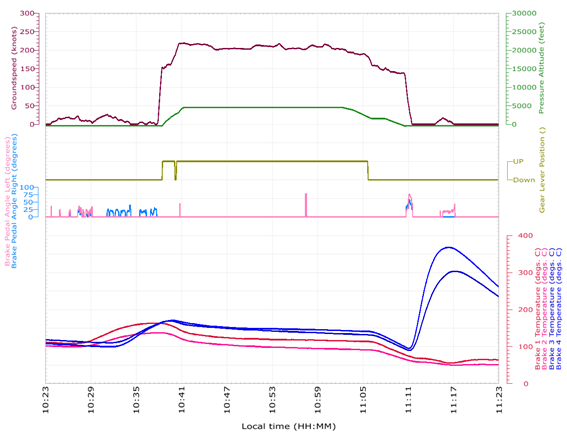
The pilot maintained a holding pattern in the southern circuit over Williamtown Airport for approximately 3 hours and 17 minutes. With rain approaching from the south, and a lowering cloud base, the pilot’s desire to remain in visual meteorological conditions[3] and consume additional fuel prompted them to track along the coastline to the north-east while the weather passed (see Figure 2 and the section titled Pilot’s commentary of the emergency). Upon arrival over Hawks Nest, ATC advised the pilot that the Williamtown Airport weather conditions had improved.

While the pilot positioned the aircraft at the instrument approach waypoint[4] for Williamtown Airport, the weather conditions deteriorated and the aircraft entered cloud and heavy rain. During this period the pilot identified that on landing the fuel quantity onboard the aircraft may reduce below the required final reserve.[5] ATC tower recordings identified that the pilot declared a MAYDAY FUEL[6] at 1206.

At 1219 with the gear still jammed in the partially retracted position, the aircraft touched down on runway 30 and came to a sliding stop after about 20 seconds. Airport rescue and firefighting and other waiting services were then cleared to attend and entered the runway. 

No injuries were sustained by the pilot or passengers on board. The aircraft sustained minor damage from the landing incident and there was no fire.

Figure 2: VH-XDV completed numerous circuits at Williamtown before transiting to Hawks Nest, then returning to Williamtown

Figure 2: VH-XDV completed numerous circuits at Williamtown before transiting to Hawks Nest, then returning to Williamtown

The aircraft track was obtained from the automatic dependent surveillance-broadcast data transmitted from the aircraft. Source: Google Earth, annotated by the ATSB

Context

Aircraft information

The Beechcraft King Air B200 is a pressurised, low-wing, twin turbine-engine aircraft with retractable landing gear. The aircraft had a certified maximum take-off weight of 
5,670 kg and could be flown by a single pilot. The aircraft, serial number BB-1100, was manufactured in the United States in 1982 and subsequently registered in Australia in 2008. Eastern Air Services had been the registered operator of the aircraft since February 2018.

Operator’s examination of the aircraft

The operator’s post-incident examination of the aircraft identified that it had sustained minor damage during the landing. Both main landing gear, the radio antennas and the underside airframe panels had been abraded. Additionally, both propellors had sustained rotational contact damage from striking the runway. 

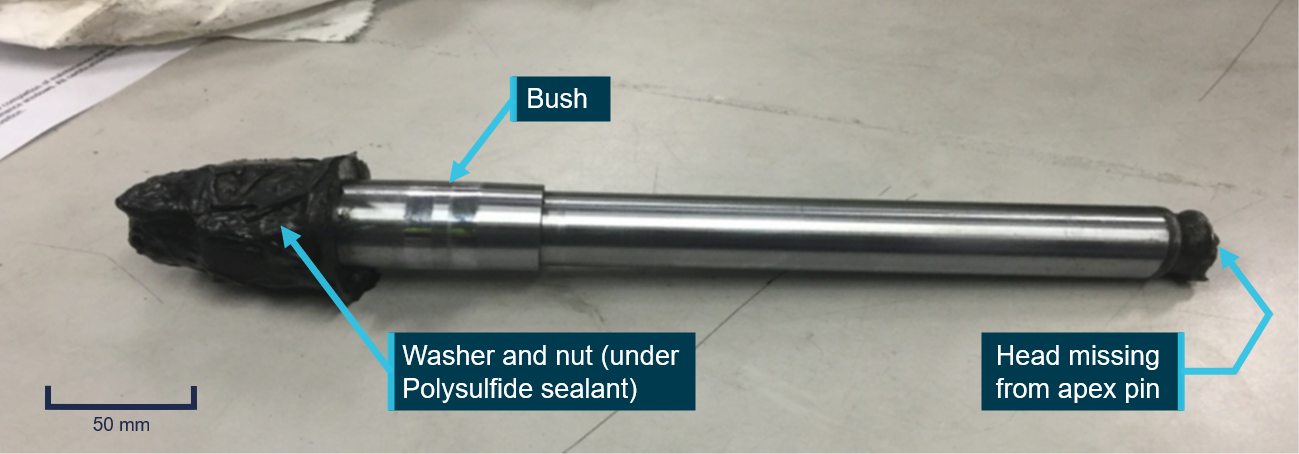
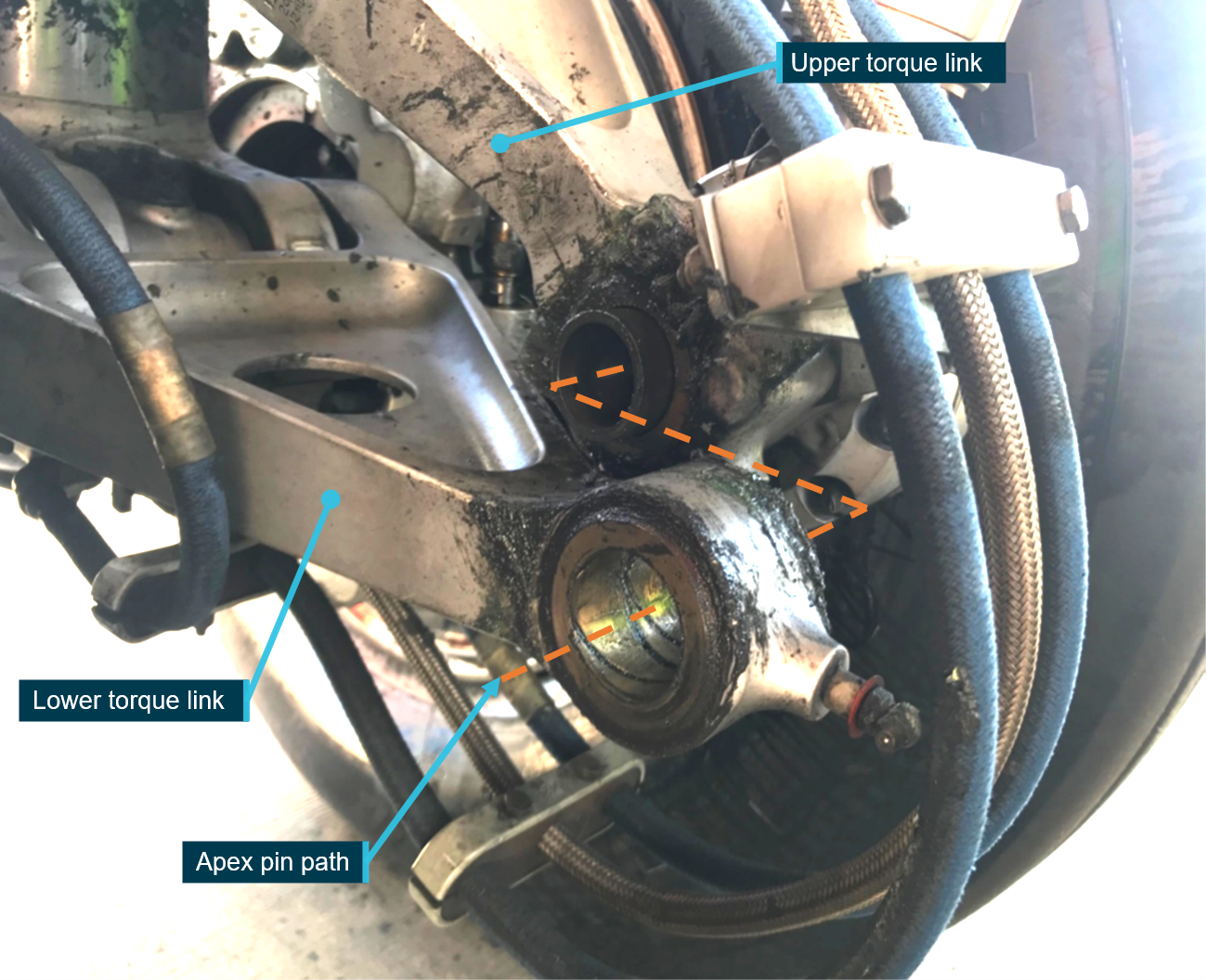
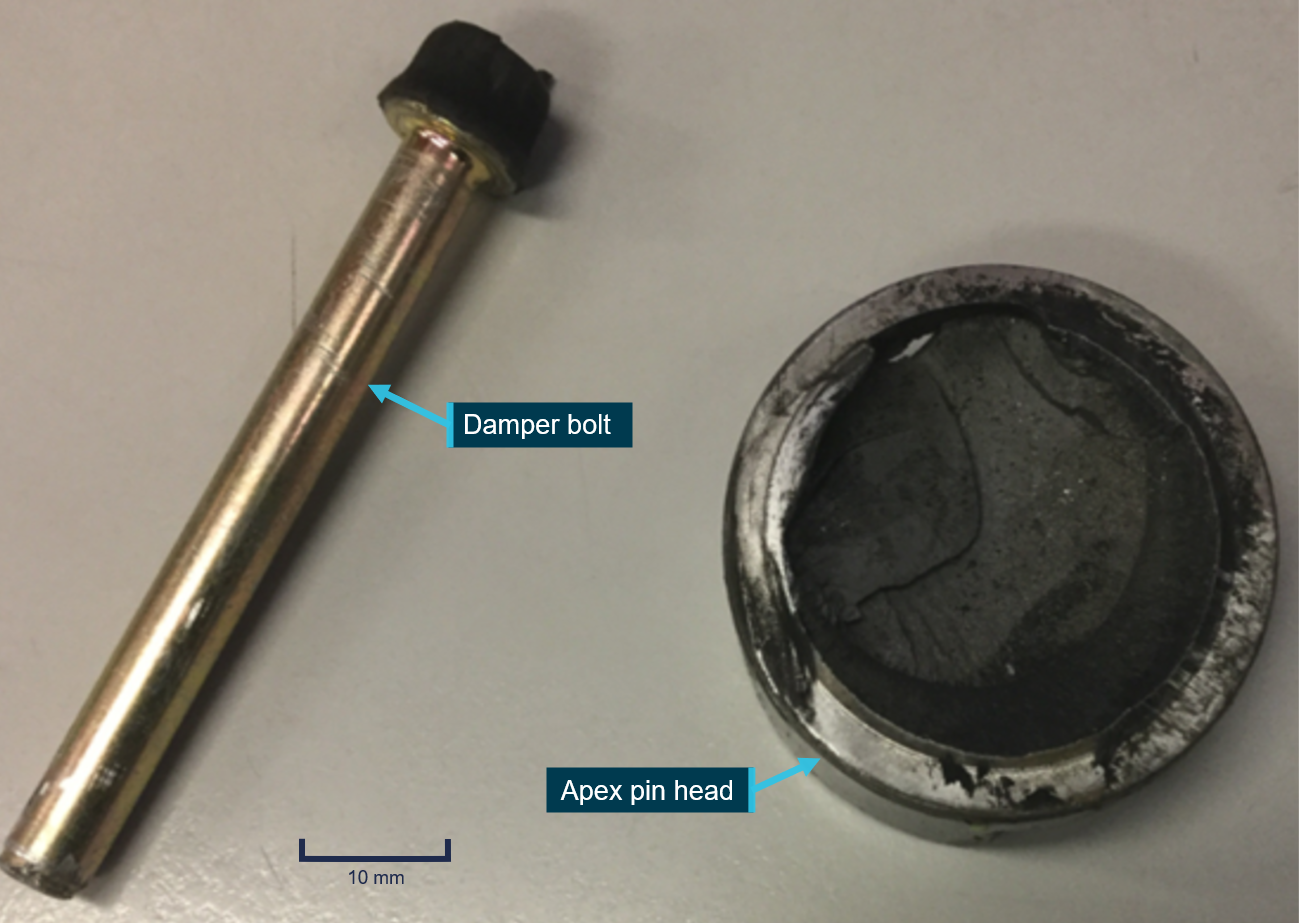
During their examination of the landing gear system, the operator identified that the shimmy damper that was attached to the nose gear leg had become bent and jammed against a door hinge within the wheel bay (Figure 3). A link in the nose steering system had also fractured, resulting in a disconnection between the pilots steering input and the nose landing gear (Figure 4). The steering barrel had bent where it connected to the steering link. The operator’s examination of the electrical system identified that a circuit breaker had opened during the incident flight. They commented that this had likely occurred automatically to prevent electrical overload of the landing gear system.

Following replacement of the fractured steering link, functional testing of the landing gear was completed as part of the operator’s fault-finding investigation. That testing showed that, under normal circumstances during a landing gear retraction sequence, the nose steering shimmy damper remained clear of all components of the wheel bay area. They further identified that the shimmy damper could only contact the wheel bay area if the nose wheel became mechanically disconnected from the steering system. That disconnection enabled the nose wheel to rotate left beyond its operational limit sufficiently for the shimmy damper to contact the undercarriage door bay area during the nose gear retraction sequence. 

The operator advised that there were no binding or other defects present in the remainder of the steering or landing gear components fitted to the aircraft. The operator also found that once the circuit breakers were reset, the landing gear system became electrically functional, allowing the gear to lower. One of those required circuit breakers was not accessible to the pilot in flight.

Figure 3: The nose landing gear tilted to the left with the shimmy damper jammed against a hinge in the undercarriage bay

Figure 3: The nose landing gear tilted to the left with the shimmy damper jammed against a hinge in the undercarriage bay

Source: Eastern Air Services, annotated by the ATSB

Figure 4: Damaged nose gear steering components

Figure 4: Damaged nose gear steering components

Source: Eastern Air Services, annotated by the ATSB

Landing gear system and nose wheel steering 

The aircraft has a mechanical landing gear system controlled through a landing gear control handle on the right side of the pilot’s centre panel. When the handle is positioned to either extend or retract the landing gear, an electric motor drives the landing gear gearbox assembly. The main landing gear actuators are driven by torque tubes from the gearbox. The nose gear is driven by a duplex chain from a sprocket on the gearbox torque shaft. Circuit breakers protect the system from electrical overload. 

Emergency manual extension of the landing gear is controlled by a floor‑mounted lever centrally located between the left and right pilot seats. When the lever is manually operated, the landing gear electric motor and gearbox drive mechanisms are overridden, allowing extension of the landing gear system. The following procedure for manual extension of the landing gear was listed in the King Air pilot operating handbook:

LANDING GEAR MANUAL EXTENSION (MECHANICAL SYSTEM)

1. Airspeed - ESTABLISH 130 KNOTS

2. Landing Gear Relay Circuit Breaker (Pilot's subpanel) - PULL

3. Landing Gear Control - DOWN

4. Alternate Engage Handle - LIFT AND TURN CLOCKWISE TO THE STOP TO ENGAGE.

5. Alternate Extension Handle - PUMP UP AND DOWN UNTIL THE THREE GREEN GEAR-DOWN ANNUNCIATORS ARE ILLUMINATED.

Note: Additional pumping when all three annunciators are illuminated could damage the drive mechanism and prevent subsequent electrical gear retraction.

If all three green gear-down annunciators are illuminated:

6. Alternate Extension Handle - DO NOT STOW (Proceed to step 8.)

Should the landing gear fail to extend, the next steps in the procedure stated:

If one or more green gear-down annunciators do not illuminate for any reason and a decision is made to land in this condition:

7. Alternate Extension Handle – CONTINUE PUMPING UNTIL MAXIMUM RESISTENCE IS FELT, EVEN THOUGH THIS MAY DAMAGE THE DRIVE MECHANISM

8. Landing Gear Controls – DO NOT ACTIVATE 

Nose wheel steering is through direct mechanical actuation of the linkages in the system from the rudder pedals that connect to an arm near the top of the nose gear shock strut (Figure 5). A spring mechanism in the steering barrel dampens the transmission of excessive shock loads to the rudder pedals. A strut-mounted roller engages with a centring ramp to automatically centre the nose wheel during retraction of the gear. 

Figure 5: King Air B200 nose steering system schematic 

Figure 5: King Air B200 nose steering system schematic

Source: Textron Aviation, annotated by the ATSB

Aircraft maintenance 

Scheduled maintenance for VH-XDV was based on a 200-hour phased inspection program, the details of which were specified by the aircraft manufacturer and contained within the King Air B200 maintenance manual. The operator’s maintenance records identified that a Phase-4 check was completed on 18 March 2024 at 18,298.4 hours. During that check the landing gear system was overhauled. Parts relating to the nose wheel steering were inspected but not replaced as their continued serviceability was based ‘on-condition’, rather than having a prescribed ‘life-limit’. On that basis the service life of the steering link was not required to be tracked and its service history was unable to be established. 

The Phase-4 inspection requirements listed in the maintenance manual for the nose gear components were non-specific and all parts were to be inspected for ‘wear damage and surface corrosion.’ For the steering linkage, it was required to be: 

STEERING LINKAGE - Inspect nose gear steering mechanism and attaching hardware for wear, damage and corrosion..

There was no specific requirement to inspect the steering link for cracks.

Pilot information 

The pilot held an air transport pilot licence (aeroplane), issued in September 2015, with a multi‑engine aeroplane instrument rating. In addition, they held a current grade 1 flight instructor rating and a multi-engine class flight test examiner rating. They reported approximately 8,500 hours total flying experience, of which 2,500 hours were accrued on the King Air B200. 

Pilot’s commentary of the emergency

After the pilot identified that the abnormal procedure for extending the landing gear was ineffective, they assessed that the fuel quantity on board the aircraft was sufficient to troubleshoot the malfunction and prepare for a wheels-up landing by completing or considering the following:

  • Throughout, the pilot remained focused on the aircraft fuel quantity and their intention was to land with about 600 lb of fuel remaining onboard. Their reasoning was that a significantly reduced fuel load would minimise the potential fire hazard on landing. They provided numerous status updates to ATC that included remaining fuel quantities.
  • They contacted the operator’s chief engineer on several occasions for technical advice and spoke with another pilot colleague to assist with planning the landing.
  • They relocated both passengers to the seats aft of the main spar nearer to the main cabin door then briefed them on its emergency operation.
  • They communicated with the airport fire and rescue personnel on the most suitable place on the runway to land the aircraft.
  • During the final approach to Williamtown Airport they configured the flaps to the approach setting and immediately prior to the aircraft contacting the runway surface, they depressurised the aircraft cabin, shut down both engines, set the propellors to fine pitch, and isolated the aircraft electrical system. Their reasoning was to minimise any potential for the aircraft to remain pressurised and reduce the likelihood of ignition of the fuel onboard after landing.
  • Upon tracking to the north-east to Hawks Nest, the pilot was cognisant that instrument meteorological conditions[7] might be entered during the approach back to Williamtown and requested an instrument approach for runway 30. The pilot recalled that the instrument approach required additional distance to be flown and estimated that it could result in the aircraft entering the 45-minute fixed reserve, which then prompted them to declare MAYDAY FUEL. 
Williamtown weather

When the aircraft was initially directed to the Williamtown southern circuit, the ATC controller estimated that the cloud base was between 2,000 ft and 2,500 ft AGL. Meteorological observations at Williamtown Airport identified that from 1130 through to 1400, rain showers and drizzle persisted. The ATC controller reported that during that period the cloud base began to lower, making it difficult to sight the aircraft.

In the minutes prior to the wheels-up landing, the meteorological observations indicated visibility greater than 10 km, drizzle in the vicinity of the airport, and a cloud amount of 1‍–‍2 oktas[8] at 1,300 ft AGL. 

Pilot guidance for wheels-up landing 

There was no specific guidance for a wheels-up landing published within the B200 operating handbook. The manufacturer advised that in this emergency situation, it would be expected that a pilot would use their aeronautical decision-making skills, training, knowledge of the aircraft, and knowledge of the situation to determine the best course of action.

The Airplane Flying Handbook produced by the United States Federal Aviation Administration (FAA) was intended to assist pilots to improve their flying proficiency and aeronautical knowledge. Chapter 18 of the Handbook, Emergency Procedures, provides generic advice to pilots for performing a gear up landing. The Handbook advised pilots to:

  • select an airport with fire and rescue facilities
  • request emergency equipment to stand by
  • select a smooth, hard runway surface rather than an unimproved grass strip
  • consider burning off excess fuel to reduce fire potential
  • consider that the safest course of action may be to land with all three gears in the retracted configuration.
ATSB component examination

The following parts of the damaged nose wheel steering system were removed from the aircraft by the operator and sent to the ATSB’s laboratory facilities in Canberra for metallurgical examination:

  • steering link
  • shimmy damper
  • steering barrel.

The ATSB’s visual examination of the shimmy damper identified that it had sustained bending of the centre shaft. The body of the shimmy damper also contained a significant gouge. The location of that damage was consistent with the operator’s reporting and the post‑occurrence photographs that the shimmy damper had become wedged against a door hinge in the nose wheel bay. 

The aircraft manufacturer indicated the steering link had been cast from an aluminium alloy, which was confirmed through chemical analysis of the part by the ATSB. General visual examination of the steering link fracture surfaces was followed by detailed high-magnification examination using a scanning electron microscope. A semi-circular feature was identified on the steering link fracture surface and its aspects were consistent with that of a pre-existing defect (Figure 6). Surface staining on the defect area was also consistent with the development of corrosion. 

High‑magnification imagery confirmed the presence of very fine crack progression striations throughout the defect area (Figure 7). The striations confirmed that a fatigue crack had progressed into the steering link prior to its complete fracture. 

The origin of the fatigue cracking was associated with a region of porosity at the component surface. The porosity was a manufacturing flaw that had been introduced during the casting process. The remainder of the fracture surface was comprised of brittle features produced during overstress of the steering link. 

Figure 6: A semi-circular pre-existing defect (labelled) was identified on both halves of the steering link fracture surface 

Figure 6: A semi-circular pre-existing defect (labelled) was identified on both halves of the steering link fracture surface

Source: ATSB

Figure 7: Microscopic striations (arrowed) were identified on the steering link fracture surface within the region of the pre-existing defect

Figure 7: Microscopic striations (arrowed) were identified on the steering link fracture surface within the region of the pre-existing defect

The above image was captured using a scanning electron microscope at x4,500 magnification. Source: ATSB

Other occurrences

The ATSB's aviation occurrence database was searched for landing gear malfunctions leading to a wheels-up landing involving King Air B200 aircraft between 2014‍–‍2024. No such instances were identified. There were, however, 130 records of a wheels-up landing for all aircraft types, none of which resulted in injuries or fire. 

The review of occurrence database records also identified 92 reports of 'gear unsafe' indications for the King Air B200. There was a broad range of reasons attributed for those indications, however, none of them led to a wheels-up landing. There were 12 instances where the emergency manual extension was required to be utilised and in each of those the landing gear was able to be extended. 

Additionally, the aircraft manufacturer (Textron Aviation) advised that it was not aware of other instances of this specific malfunction where the mechanical landing gear became jammed leading to a wheels-up landing. It was also unaware of other instances where fatigue cracks had been identified in steering links. 

Safety analysis

The ATSB identified that the aircraft was able to be steered by the pilot using the rudder pedals as it was taxied to the departure runway and during the take‑off roll. This indicated that the nose wheel steering system, including the steering linkage, was intact during the taxi and the initial stage of the take-off roll. 

ATSB’s laboratory examination of the steering components identified the presence of a fatigue crack on the fracture surfaces of the steering link that had initiated from a surface flaw. The pre‑existing, high-cycle fatigue crack was small in comparison to the overall steering link cross section, indicating that the final fracture likely occurred over a relatively short number of loading cycles.

The nature of the loading that resulted in the final fracture was not identified. However, casting alloys are generally regarded as having relatively low fracture toughness when compared with wrought alloys, predisposing them to brittle fracture. Additionally, it is generally the case that the increase in stress intensity from a pre-existing fatigue crack will lead to fracture at much lower stresses due to the inherently low fracture toughness of a casting alloy. 

As the pilot was able to conduct the take‑off without issue, the fracture of the steering link must have occurred either late in the take-off roll or as the gear was retracted. Once the steering link fractured, the nose wheel was able to rotate beyond its normal operational limits. In this instance, the nose wheel rotated significantly to the left. That movement led to the nose gear shimmy damper also rotating beyond normal limits sufficiently to become jammed against a door hinge within the nose wheel well. 

When the pilot consulted the procedures for a manual gear extension, their efforts were ineffectual because the shimmy damper had mechanically jammed the operation of that system. Despite numerous attempts, the pilot was subsequently unable to extend the landing gear using the published emergency extension procedure, necessitating a wheels‑up landing.

Findings

ATSB investigation report findings focus on safety factors (that is, events and conditions that increase risk). Safety factors include ‘contributing factors’ and ‘other factors that increased risk’ (that is, factors that did not meet the definition of a contributing factor for this occurrence but were still considered important to include in the report for the purpose of increasing awareness and enhancing safety). In addition ‘other findings’ may be included to provide important information about topics other than safety factors. 

These findings should not be read as apportioning blame or liability to any particular organisation or individual.

From the evidence available, the following findings are made with respect to the wheels-up landing involving a Beechcraft King Air B200, VH-XDV, at Williamtown Airport, New South Wales on 13 May 2024. 

Contributing factors
  • During the take-off roll or landing gear retraction sequence, the steering link fractured from a pre-existing fatigue crack, resulting in a mechanical disconnect within the nose landing gear steering system.
  • When the landing gear retracted, the fractured steering link allowed the nose gear shimmy damper to contact the side of the wheel well and jam the nose landing gear in a partially retracted position. This prevented extension of the landing gear using the published emergency procedure, necessitating a wheels-up landing.

Safety actions

Whether or not the ATSB identifies safety issues in the course of an investigation, relevant organisations may proactively initiate safety action in order to reduce their safety risk. All of the directly involved parties are invited to provide submissions to this draft report. As part of that process, each organisation is asked to communicate what safety actions, if any, they have carried out to reduce the risk associated with this type of occurrences in the future. The ATSB has so far been advised of the following proactive safety action in response to this occurrence. 
Safety action by Eastern Air Services

The operator reported that in the days following the incident, it conducted a maintenance inspection of the landing gear system on the other King Air B200 aircraft (registered VH‑MVP) within its fleet. No defects in the landing gear or steering system were found during that inspection. On 28 August 2024, further maintenance checks were completed on VH-MVP, including the removal of the nose gear steering link for non-destructive crack inspection. No defects were found. 

The operator further advised that it is reviewing its B200 maintenance program to consider including a non-destructive inspection of the steering link, which would be additional to the manufacturer’s existing maintenance requirements.

Sources and submissions

Sources of information

The sources of information during the investigation included:

  • the pilot of VH-XDV
  • Eastern Air Services
  • Bureau of Meteorology
  • Royal Australian Air Force – 453 Squadron
  • Textron Aviation
  • ADS-B data from the aircraft. 

References

United States Federal Aviation Administration, Airplane Flying Handbook FAA-H-8083-3C

Beechcraft King Air B200 Maintenance Manual

Beechcraft King Air B200 Pilot’s Operating Handbook

Submissions

Under section 26 of the Transport Safety Investigation Act 2003, the ATSB may provide a draft report, on a confidential basis, to any person whom the ATSB considers appropriate. That section allows a person receiving a draft report to make submissions to the ATSB about the draft report. 

A draft of this report was provided to the following directly involved parties:

  • the pilot of VH-XDV
  • Eastern Air Services
  • Royal Australian Air Force – 453 Squadron
  • Textron Aviation
  • Civil Aviation Safey Authority

Submissions were received from:

  • the pilot of VH-XDV
  • Eastern Air Services
  • Royal Australian Air Force – 453 Squadron

The submissions were reviewed and, where considered appropriate, the text of the report was amended accordingly.

Purpose of safety investigations

The objective of a safety investigation is to enhance transport safety. This is done through: 

  • identifying safety issues and facilitating safety action to address those issues
  • providing information about occurrences and their associated safety factors to facilitate learning within the transport industry.

It is not a function of the ATSB to apportion blame or provide a means for determining liability. At the same time, an investigation report must include factual material of sufficient weight to support the analysis and findings. At all times the ATSB endeavours to balance the use of material that could imply adverse comment with the need to properly explain what happened, and why, in a fair and unbiased manner. The ATSB does not investigate for the purpose of taking administrative, regulatory or criminal action.

Terminology

An explanation of terminology used in ATSB investigation reports is available here. This includes terms such as occurrence, contributing factor, other factor that increased risk, and safety issue.

Publishing information

Released in accordance with section 25 of the Transport Safety Investigation Act 2003

Published by: Australian Transport Safety Bureau

© Commonwealth of Australia 2024

Title: Creative Commons BY - Description: Creative Commons BY

Ownership of intellectual property rights in this publication

Unless otherwise noted, copyright (and any other intellectual property rights, if any) in this report publication is owned by the Commonwealth of Australia.

Creative Commons licence

With the exception of the Commonwealth Coat of Arms, ATSB logo, and photos and graphics in which a third party holds copyright, this report is licensed under a Creative Commons Attribution 4.0 International licence.

The CC BY 4.0 licence enables you to distribute, remix, adapt, and build upon our material in any medium or format, so long as attribution is given to the Australian Transport Safety Bureau. 

Copyright in material obtained from other agencies, private individuals or organisations, belongs to those agencies, individuals or organisations. Where you wish to use their material, you will need to contact them directly.

[1]     Alert phase: a situation where apprehension exists as to the safety of an aircraft and its occupants (this generally equates to a PAN PAN)

[2]     The Williamtown Airport emergency plan required on-base fire and ambulance services to respond within 30 seconds of the base alarm being raised.

[3]     Visual Meteorological Conditions (VMC): an aviation flight category in which visual flight rules (VFR) flight is permitted – that is, conditions in which pilots have sufficient visibility to fly the aircraft while maintaining visual separation from terrain and other aircraft.

[4]     AKLOL was an initial approach fix (waypoint) for instrument navigation to Williamtown Airport.

[5]     A turbine-engine aircraft that is operated under the instrument flight rules is required to carry 45 minutes of fuel to allow the aircraft to fly at holding speed, at 1,500 ft above the aerodrome elevation. This must be available at the completion of the flight.

[6]     The declaration of a FUEL MAYDAY is an internationally recognised procedure associated with the standards of the International Civil Aviation Organization and designed to assist in the management of aviation safety risks. As this is a distress message, the aircraft will be given priority to land. Where the PIC has calculated that the aircraft will land with less than the final reserve fuel, the flight crew must declare a situation of ‘emergency fuel’ by broadcasting MAYDAY MAYDAY MAYDAY FUEL.

[7]     Instrument meteorological conditions (IMC): weather conditions that require pilots to fly primarily by reference to instruments, and therefore under instrument flight rules (IFR), rather than by outside visual reference. Typically, this means flying in cloud or limited visibility.

[8]     Cloud amount is given in the international standard format. The terms used are FEW (few) to indicate 1‍–‍2 oktas, SCT (scattered) to indicate 3‍–‍4 oktas, BKN (broken) to indicate 5‍–‍7 oktas, OVC (overcast) to indicate 8 oktas.

Occurrence summary

Investigation number AO-2024-031
Occurrence date 13/05/2024
Location Williamtown Airport
State New South Wales
Report release date 13/11/2024
Report status Final
Investigation level Short
Investigation type Occurrence Investigation
Investigation status Completed
Mode of transport Aviation
Aviation occurrence category Landing gear/indication, Wheels up landing
Occurrence class Serious Incident
Highest injury level None

Aircraft details

Manufacturer Beech Aircraft Corp
Model B200
Registration VH-XDV
Serial number BB-1100
Aircraft operator Eastern Air Link Pty Ltd
Sector Turboprop
Operation type Part 135 Air transport operations - smaller aeroplanes
Departure point Williamtown Airport, NSW
Destination Port Macquarie Airport, NSW
Damage Substantial

Landing gear retraction deactivation and return involving a Boeing 787, VH-ZNH, near Sydney Airport, New South Wales, 21 June 2021

Final report

Safety summary

What happened

On 21 June 2021, a Boeing Company 787-9, registered VH-ZNH and operated by Qantas Airways, was prepared for a scheduled passenger flight from Sydney, New South Wales, to Perth, Western Australia. During initial climb, the flight crew selected the landing gear lever to UP. Shortly after, they received a warning, indicating that neither main landing gear had retracted to the ‘up and locked’ position. Despite consulting the aircraft’s electronic checklist, the flight crew were unable to resolve the retraction issue. The landing gear lever was then selected to DOWN, with positive gear extension indications, and the aircraft returned to Sydney for an uneventful landing.

What the ATSB found

The ATSB found that two of the five downlock pins, one in each main landing gear, had not been removed following towing of the aircraft to the domestic terminal aircraft bay. In addition, these gear pins were not identified during subsequent external inspections, prior to the departure. When the flight crew selected the landing gear to retract, the nose gear successfully retracted and locked in the up position. However, the two installed pins prevented any movement of the main landing gear. There was no damage to the main landing gear.

What has been done as a result

Following the occurrence, the operator distributed memos to engineering, flight and ramp crew, highlighting the quantity and location of the gear pins on the Boeing 787, and the importance of following the documented ramp, pre-flight and dispatch procedures.

The memo to engineering also emphasised the importance of checking the pin location, rather than relying on streamers for identification. In addition, training packages for engineering, ramp and flight crew were updated with additional detail. Further, the operator advised they were working to relocate the gear pin stowage to the flight deck, in line with other aircraft types, to enable ease of access to visually verify pin removal and stowage.

Safety message

‘Remove before flight’ streamers are a reminder to remove covers, or lockout devices, prior to flight. Failure to remove these devices and covers can prevent the functionality of certain aircraft systems. The streamers are subject to varying environmental conditions that can reduce their visibility.

Expectation can also affect identification of these warning devices. Put simply, the likelihood of detecting ‘remove before flight’ streamers is significantly reduced if they are not expected to be there. The same principle can also prevent the discovery of damaged and/or missing components.

The investigation

Decisions regarding whether to conduct an investigation, and the scope of an investigation, are based on many factors, including the level of safety benefit likely to be obtained from an investigation. For this occurrence, a limited-scope investigation was conducted in order to produce a short investigation report, and allow for greater industry awareness of findings that affect safety and potential learning opportunities.

The occurrence

Pre-flight ground operations

On the morning of 21 June 2021, a Boeing Company 787-9 (787), registered VH-ZNH (ZNH) and operated by Qantas Airways, was being prepared for a scheduled passenger flight from Sydney, New South Wales, to Perth, Western Australia. At about 0745 Eastern Standard Time,[1] ZNH was towed, by Qantas Engineering (engineering), from the aircraft parking location to domestic terminal bay 11. The tow crew on the ground consisted of the person in charge (PIC), two wing walkers and the tow‑motor driver.[2] On board the aircraft was a 787 licenced aircraft maintenance engineer (LAME), in the role of flight deck operator (FDO)[3] and an aircraft maintenance engineer (AME), who was undergoing informal general familiarisation training.

Upon arrival at bay 11, chocks were placed at the aircraft wheels and the tow‑motor was unhitched, to allow it to be used for another tow. The PIC removed the nose gear downlock pin (gear pin), then walked to the rear of the aircraft and removed one gear pin from the right main gear. At the same time, one of the wing walkers removed a gear pin from the left main gear.

The PIC and wing walker had not towed a 787 before and, as such, contacted the LAME via the aircraft intercom system, to enquire where the pins were stowed on this aircraft type. The AME, under instruction from the LAME, advised the PIC that the pins were stored in the electrical equipment centre (EEC) located just aft of the nose gear. The AME then relayed that the PIC could leave the removed pins on the nose gear and the LAME would stow them when the aerobridge[4] arrived and they could exit the aircraft.

Despite the offer to leave the pins on the nose gear, the PIC identified a short ladder nearby and opened the EEC. The ladder was of insufficient height to see into the pin stowage location, so the PIC felt around and physically identified pin stowage holes. After stowing the three gear pins, the PIC closed the EEC, returned the ladder and departed, with the wing walker, to conduct another tow.

Unavailability of an aerobridge operator resulted in the LAME and AME being unable to leave the aircraft for about 20 minutes. When the aerobridge was manoeuvred into place, at about 0810, the LAME and AME exited the aircraft via the associated stairs. The LAME noted that the nose gear pin had been removed. The LAME reported that they then looked down toward the main gear and did not identify any streamers associated with the gear pins (see the section titled Landing gear downlock pins).

As there were no gear pins on the nose gear, the LAME directed the AME to confirm the gear pins had been stowed in the EEC, utilising the same nearby ladder previously used by the PIC. The ladder height was again insufficient to allow the AME to see into the pin stowage area, but they were able to physically feel the presence of the pins. After closing the EEC panel and returning the ladder, the LAME and AME waited at the aircraft until a car arrived at about 0819, to take them to the engineering office. The LAME signed for the removal and stowage of the landing gear pins on the electronic and paper technical logs (tech log). The LAME then returned the paper tech log to the aircraft at about 0842.

The flight crew, who arrived at the aircraft at about 0900, consisted of the captain, the first officer and a second captain, who was filling the role of relief pilot.[5] The flight crew reviewed the tech log and noted the endorsement that the gear pins had been removed and stowed. As the third crew member, the relief pilot conducted the external inspection, between 0938 and 0945.

The relief pilot reported conducting the external inspection as per the flight crew operations manual (FCOM), with no anomalies identified, before returning to the flight deck to assist with the remainder of the pre‑flight preparations. The pre-flight, including landing gear system checks, were completed, with nil anomalies identified.

Aircraft dispatch for the 787 was conducted by two Swissport[6] ground crew, a supervisor and a crew member undergoing training, who arrived at ZNH about 1020. Once all ground services had been completed, the supervisor conducted the final external inspection prior to pushback. The supervisor reported checking all doors and panels were closed and secured, and no streamers were identified. The aircraft was pushed back at about 1025.

Occurrence flight

ZNH was cleared to depart via runway 16R,[7] initially heading to the south of the airport before making a westerly turn onto the planned route. The captain was the pilot flying (PF) and the first officer was the pilot monitoring (PM),[8] with the second captain (relief pilot) seated in the flight deck for take-off.

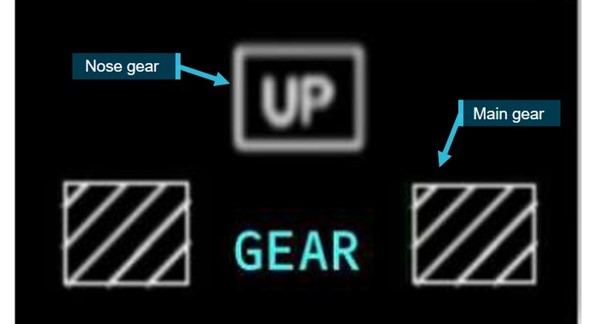
At about 1032, shortly after take-off and with the aircraft established in a positive climb, the PM positioned the landing gear selector to UP. Ten seconds after selecting the landing gear up, the crew received a GEAR DISAGREE caution on the Engine Indication and Crew Alerting System (EICAS) and an associated aural alert. The flight crew observed indications that the nose landing gear had retracted however, both main landing gear continued to display a grey crosshatch symbol, indicating that they remained ‘in transit’ (see the section titled Landing gear operation).

The flight crew configured the aircraft for safe operation with the landing gear extended in accordance with the operator’s procedures. The PF then requested the PM commence the GEAR DISAGREE EICAS procedure through the aircraft’s electronic checklist. The flight crew advised air traffic control (ATC) of a landing gear problem and then levelled the aircraft at an altitude of about 9,000 ft, away from the airport and over water, to troubleshoot the issue.

The PF, who reported experiencing a degree of startle upon receiving the initial GEAR DISAGREE EICAS message, asked the PM to read out the electronic checklist procedure again, to confirm it was fully understood.

On completion of the GEAR DISAGREE checklist, the main landing gear continued to indicate ‘in transit’. The flight crew discussed cycling the landing gear, selecting DOWN and then UP, to troubleshoot the issue however, due their proximity to the airport, they decided to return to Sydney.

The flight crew reported that guidance for the continued management of the abnormal gear indication from the electronic checklist and Quick Reference Handbook was limited to noting airspeed and fuel duration considerations, and therefore decided to extend the gear via the normal gear selection. They further agreed to select landing gear down earlier in the approach than they normally would, to allow sufficient time to assess and resolve any abnormalities, noting the substantial fuel endurance available, if required. The landing gear lever was then selected to ‘DOWN’ and the crew received a positive ‘green’ indication on the EICAS that confirmed all of the landing gear was ‘down and locked’.

The flight crew reported that ATC asked if they wanted emergency services to be on standby for the landing however, they advised that this was not required. This decision was based on the aircraft’s landing gear now indicating normal extension. At 1106, ZNH touched down on runway 16R, for an uneventful landing. The aircraft was taxied to bay 11, and engineering subsequently identified that two landing gear pins were still installed, one in each main gear.

Context

Landing gear operation

The gear retraction sequence commences when the landing gear lever is placed in the UP position. The EICAS landing gear position indication changes from a green DOWN indication to a white crosshatch in-transit indication. When the landing gear has retracted, and is being held in place by uplocks, the landing gear hydraulic system is automatically depressurised. At this point, no landing gear indications are displayed on the EICAS.

The normal transit time for gear retraction is approximately 10 seconds. If any landing gear is not up and locked after about 40 seconds, the EICAS caution message GEAR DISAGREE is displayed. The EICAS gear position indication then displays an expanded non‑normal format. The flight crew can then see which gear is UP, in‑transit, or DOWN (if the gear never unlocked from the down position). In this instance, the flight crew were presented with an UP indication for the nose gear and in-transit indications for each of the main gear (Figure 1).

Figure 1: EICAS expanded message indication, showing nose gear up and locked, and main gear 'in-transit' (crosshatched)

picture1-ao-2021-026.jpg

Source: Supplied, annotated by ATSB

The EICAS checklist ‘objective’ for GEAR DISAGREE included for the flight crew ‘to extend the gear using an alternate gear extension’. The checklist also had a note to not exceed the ‘gear extended speed limit’ and that flight with the gear extended would increase fuel consumption. The flight crew reported that, as the nose gear retracted without issue, they did not suspect normal gear operation was affected. Therefore, they elected to attempt normal gear extension, before considering alternate procedures. The normal gear extension was completed without issue.

Landing gear downlock pins

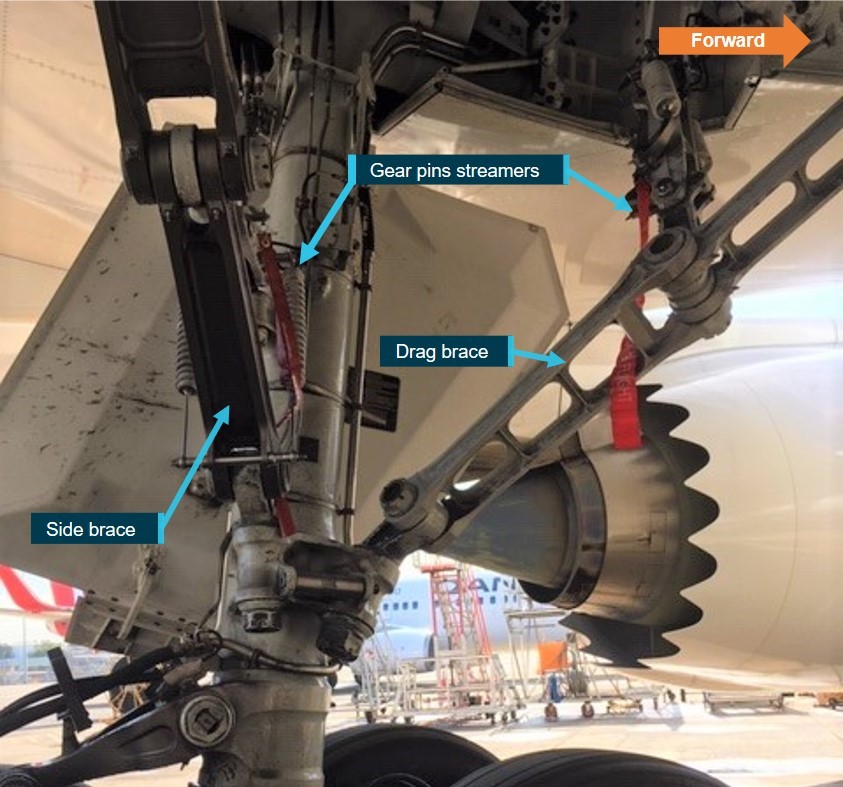
The landing gear downlock pins (gear pins) were installed to prevent inadvertent gear retraction during maintenance or towing operations. The 787 has five gear pins, one for the nose gear and two for each main landing gear (Figure 2).

Figure 2: Typical left main gear showing pins and streamers installed.

picture2-ao-2021-026.jpg

Source: Supplied, annotated by ATSB

The gear pin is a quick release style and has a ‘REMOVE BEFORE FLIGHT’ streamer attached via a split ring. The aircraft maintenance manual (AMM) contained procedures for installation and removal of the gear pins. The main gear pins are located above head height and the AMM procedures recommend a 1.83m (6 ft) ladder, be utilised for installation and removal.

If the aircraft was required to be operated with the landing gear locked in the extended position, for example for maintenance purposes, the gear pins were to be secured as per the AMM. In that instance, a bolt and nut were to be installed on the end of the pin, with a large washer located between the bolt and the pin quick-release, to ensure retention of the pin in the landing gear.

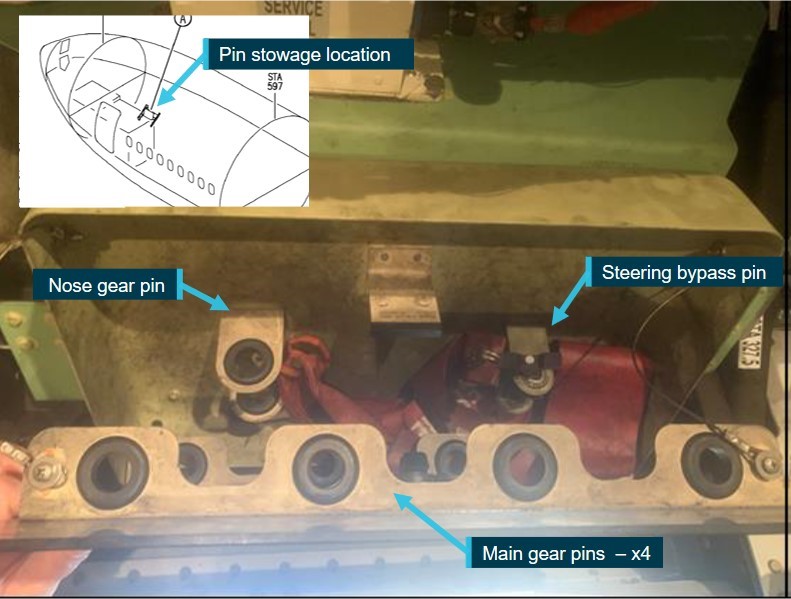
The gear pin stowage box was located in the EEC, just aft of the nose gear, and was attached to the aircraft structure (Figure 3). The hinged door, which had receptacles for the four main gear pins, tilted outwards from the top and included a lanyard to limit swing. The box portion contained two receptacles, one for the nose gear pin and one for the steering bypass pin.[9] Qantas engineering personnel reported that a ‘tall ladder’ was required to be able to see into the stowage box.

Figure 3: Gear pin stowage box showing hinged door with four main gear pin receptacles

picture3-ao-2021-026.jpg

Source: Supplied, annotated by ATSB

Airbus A330s and Boeing 737s were the aircraft types that Sydney Qantas engineering were most familiar with. These aircraft types have a total of 3 gear pins, one in the nose and one in each of the main gear. In addition, the gear pins on these aircraft types are stowed in the flight deck, readily accessible to flight and ground crew.

Gear pin streamers

Boeing advised that gear pins are classified as ground support equipment (GSE) and therefore not included in the type design of the aircraft. As a result, there is no minimum specifications, nor do they direct a maintenance or cleaning program.

Ground and flight crew described the streamers, of various aircraft types, as being different lengths and various states of cleanliness, which could reduce visibility in certain environmental and light conditions. Due to their installed location, the landing gear pin streamers were subject to contamination from oil, grease and grime. In addition, the streamers were known to wrap around the gear on occasion, particularly in wet and/or windy conditions.

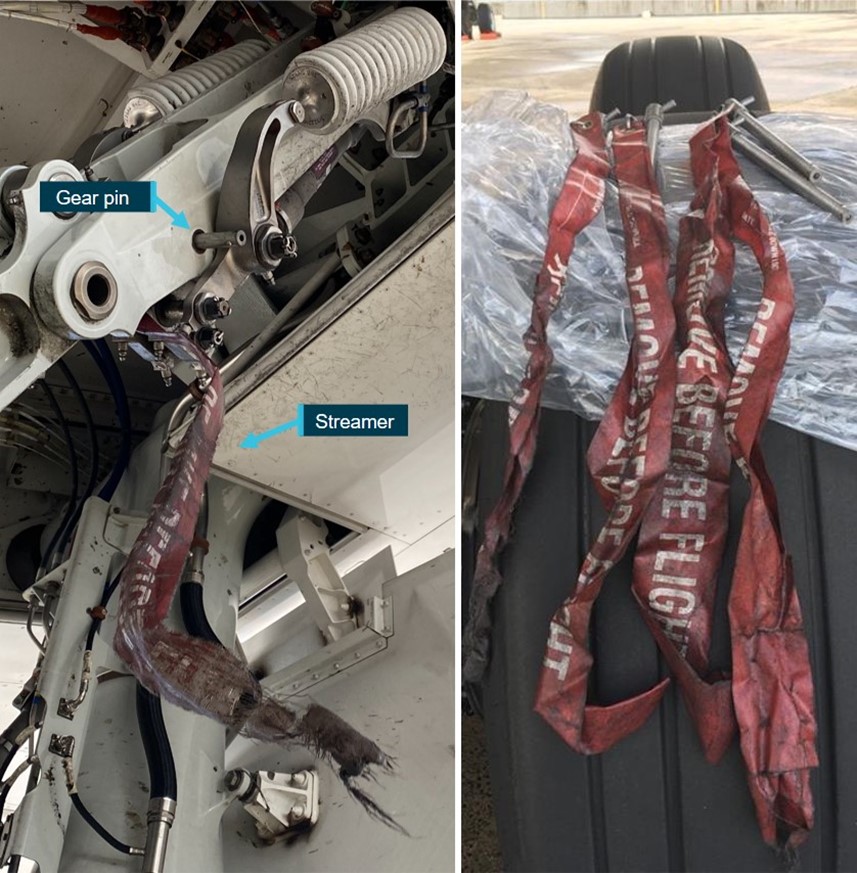
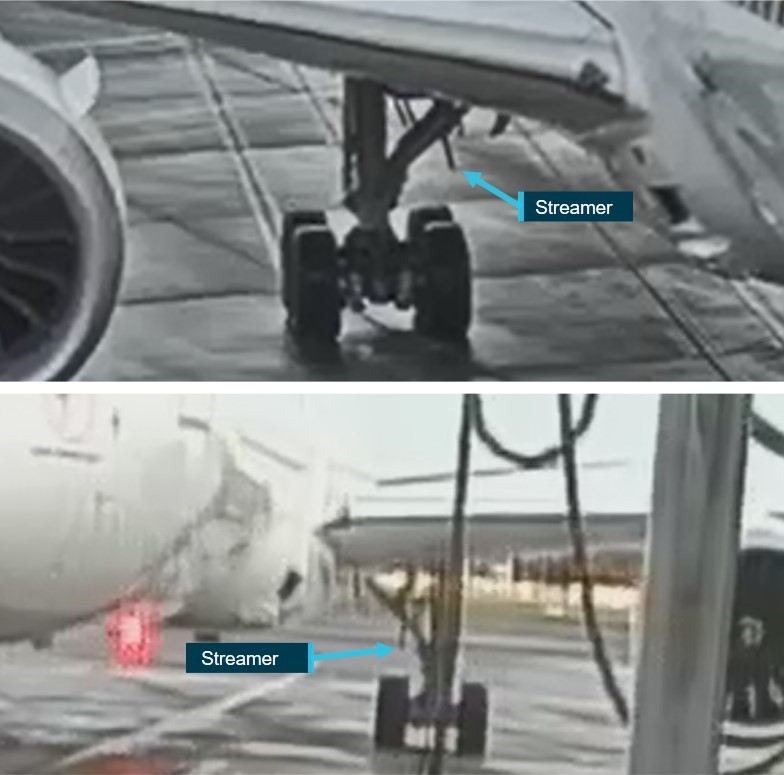
An image of one of the missed main landing gear pins, upon return to Sydney, showed it to be dull and frayed however, it’s condition prior to the flight could not be determined (Figure 4). Examination of ZNH’s gear pin streamers noted degraded condition, particularly with respect to the normal intensity of the high-visibility colour.

Figure 4: Gear pin identified on landing (left) and VH-ZNH gear pins (right).

picture4-ao-2021-026.jpg

Source: Supplied, annotated by ATSB

CCTV footage showed that, when ZNH was towed into bay 11, prior to the flight, one streamer on each main landing gear was visible (Figure 5). It was these streamers that were identified and removed by the tow crew. The footage showed the wing walker and the PIC, climb the rear tyre of each main gear[10] and remove a pin (with attached streamer) from the side braces. Streamers associated with the drag braces were not readily visible in the CCTV footage.

The footage also showed:

  • evidence of recent rain when the aircraft was being towed to bay 11, but good light conditions
  • some light rain at about the time the 787 LAME and AME, departed the flight deck, checked the EEC for the presence of pins and waited for a lift to the office
  • the tow crew and AME used a 0.9 m (3 ft) 3-step ladder to access the EEC
  • partly cloudy / sunny conditions when the relief pilot and dispatch crew conducted their respective external inspections, and during pushback.

Figure 5: VH-ZNH with visible main gear streamers

picture5-ao-2021-026.jpg

Source: Sydney Airport, annotated by ATSB

Procedures

Qantas engineering were responsible for aircraft towing operations, in accordance with the Towing section of the Qantas Engineering Procedures Manual. Section 7 Post aircraft tow, step 4 stated that it was either the tow crew PIC or the FDO’s responsibility to ‘remove and stow aircraft main and nose landing gear downlock pins’.

Swissport had been contracted by Qantas to carry out receipt and dispatch procedures for the 787, since its introduction in 2017. All other Qantas aircraft types had receipt and dispatch activities conducted by Qantas engineering at Sydney Airport. Qantas Ramp Operations Manual procedures were to be followed by Swissport staff, for receipt and dispatch of the 787. The aircraft dispatch procedure stated:

- Ensure the Steering By-pass pin is fitted

- Any landing gear downlock pins are also removed and stowed in the correct place

- Advise Engineering if Pitot covers are still present. Ensure they are removed prior to departure.

The section manage pins and covers identified:

There can be a total of five (5) downlock pins that can be fitted to the aircraft.

- One (1) nose gear downlock pin, and

- Up to Four (4) main gear downlock pins.

The ‘external inspection sequence’ included, ‘observe whether the main gear downlock pins have been removed’.

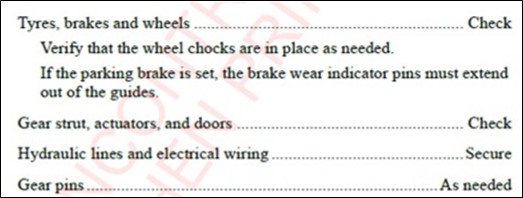
The flight crew were required to conduct their external inspection in accordance with the Qantas flight crew operations manual (FCOM) 787 Amplified procedures – exterior inspection. The section regarding the left and right main landing gear areas inspection included ‘gear pins – as needed’ (Figure 6)

Figure 6: FCOM external inspection of main gear areas

picture6-ao-2021-026.jpg

Source: Supplied

Awareness of five gear pins

Qantas ground crew

As a result of the COVID-19 pandemic travel restrictions, voluntary redundancies were offered to affected personnel. A subsequent restructure of Qantas engineering took place in February 2021, which resulted in certain engineers being transitioned into new roles, on new aircraft types.

Only one of the Qantas ground crew that spoke with the ATSB,[11] the 787 LAME, advised they were aware that the 787 had five gear pins. In addition, it was the first time towing a 787 for all the ground crew except the 787 LAME. One of the wing walkers was a LAME on the 737, 747 and Airbus 330 (A330), while the PIC and the AME being trained by the 787 LAME, held category A licences[12] on the A330.

Fight crew

All flight crew recalled undergoing computer-based training on external inspection procedures during their initial ground school (in 2018 and 2019), and then conducting an external inspection under supervision from a training captain, during initial flight‑line operations. Neither captain could specifically recall the number, nor exact location, of the main gear pins, from their training.

The first officer was aware of the five pins, due to their flying experience on the 767,[13] which had a similar design of landing gear to the 787. The previous flying experience of the two captains was on aircraft types that had three gear pins. In addition, the second captain (relief pilot) and first officer advised they had never seen pins installed, as they were typically removed before the flight crew conduct their external inspection. Further, the flight crew reported their process was to look for the streamers during their external inspection, as opposed to sighting the actual pin locations.

Swissport dispatch crew

The Swissport crew consisted of a trainer and trainee. The trainer had experience dispatching 787 aircraft for several airlines, they advised that they were aware of the five gear pins on the 787 and had occasionally seen gear pins and streamers installed, for example, when aircraft were under tow.

The Swissport trainee, while experienced in dispatching other aircraft types at another Australian airport, was undergoing Sydney familiarisation training. The trainee advised that ZNH was only the second 787 they had dispatched, the first being a few hours earlier that day. The trainee recalled being aware of the five pins, from their training however, had never seen the pins installed. Further, as the trainer had conducted the external inspections that day, the trainee had not specifically looked out for them.

Both Swissport crew reported their dispatch procedures were to check all ground equipment was clear and inspect the aircraft for security of doors and panels, and presence of any streamers. The Swissport crew would install the steering bypass pin when the tow‑motor was connected, and then remove it when the tow‑motor was disconnected, following pushback. The steering bypass pin was located near the nose gear pin. The trainer advised that, had the nose gear pin still been installed, it would have been an alert to check all the other gear pins had been removed. However, as the nose gear pin was not installed, the trainer concluded that all pins had been removed, as they had not encountered a situation where only some of the pins had been removed.

Procedure if gear pin streamers identified

Both the flight crew and Swissport dispatchers reported that, if they identified any streamers during their external inspection, they were to contact Qantas engineering, who would then remove the associated pin or cover. Further, all reported being aware of the possibility that streamers can become caught up in, or stuck to, the landing gear.

Similar occurrences

Boeing advised they had received reports from other operators of inadvertent departures with gear pins installed. As the gear pins are classified as GSE, this type of event was not required to be reported to Boeing and subsequently that were not able to give an accurate estimate of how often situations like this may have occurred. Further, Boeing advised that, from the reports they did have, they were not aware of any outcomes more serious than a ‘return‑to‑base for a safe landing’.

The investigation identified two similar events involving Australian-operated 787s, in 2014 and 2021, noting this type of occurrence was not required to be reported to the ATSB. In 2014, the aircraft had been dispatched, and gear pin streamers were noted by the crew of another taxiing aircraft. The aircraft returned to bay and two gear pins were located, one in each main gear. In this occurrence, the gear pin streamers were noted to be ‘dirty’, short in length and ‘not as visible as new’ streamers.

On 19 June 2021, at about 2205 local time, two gear pin streamers were identified by the second officer during the flight crew external inspection. This was despite the tech log being endorsed that the pins had been removed and stowed. The second officer’s report stated that, when inspecting the right main gear from the front, nothing abnormal was noted. The second officer then moved to the rear of the main gear and used their torch to check the gear pin location holes. At this point they observed a gear pin streamer wrapped up and stuck to the main gear leg.

The second officer reported that, due to the wet and windy conditions, the streamer had been caught up on the main gear and, in combination with low light, it was difficult to see. Before returning to the flight deck to notify engineering, the second officer identified a gear pin streamer on the left main gear. The pins were subsequently removed by engineering and the aircraft departed as scheduled.

Safety analysis

In this occurrence, multiple factors led to an aircraft departing configured such that the flight crew were unable to retract the main landing gear. Specifically:

  • The tow crew used the visible streamers to identify what they incorrectly believed were the only three gear pins installed the aircraft.
  • While the LAME was aware the 787 had five gear pins, they did not confirm all of them had been removed and stored before signing the tech log. Instead, the AME physically checked for the presence of pins without knowing the number to expect.
  • The ladder used to access the gear pin stowage location was not of sufficient height to allow visual confirmation of pin stowage. Sighting of ‘empty’ pin stowage receptacles would have provided a clear indication that not all pins had been removed from the landing gear.
  • The flight and dispatch crews conducted their external inspection with no expectation of finding streamers indicating gear pins were still installed. This was likely due to the tech log being endorsed and a belief that the gear pins had been removed by engineering personnel.
  • There was probably reduced visibility of the streamers, due to their degraded condition and the likelihood they were stuck on the gear, from a combination of grime and the recent wet and windy conditions.

Research has demonstrated that people are more likely to detect targets (such as gear pin streamers) when they are expected and less likely to detect targets that are not expected (Wickens and McCarley 2008). In addition, bias can occur when prior knowledge, combined with an expected outcome, influences decision making.

The tow crew were expecting to see the gear pin streamers, as they had just completed moving the aircraft. The tow crew then identified, and removed, three main landing gear pins, which was consistent with the aircraft types they had experience on. In contrast, as the gear pins were typically removed prior to the flight and dispatch crew external inspections, they were not expecting to see any gear pin streamers.

Findings

ATSB investigation report findings focus on safety factors (that is, events and conditions that increase risk). Safety factors include ‘contributing factors’ and ‘other factors that increased risk’ (that is, factors that did not meet the definition of a contributing factor for this occurrence but were still considered important to include in the report for the purpose of increasing awareness and enhancing safety). In addition ‘other findings’ may be included to provide important information about topics other than safety factors. 

These findings should not be read as apportioning blame or liability to any particular organisation or individual.

From the evidence available, the following finding is made with respect to the landing gear indication and return involving Boeing 787, VH-ZNH, near Sydney Airport, New South Wales, on 21 July 2021.

Contributing factor

  • Two of the five landing gear pins were not removed as per the operator’s procedures, nor identified by engineering, flight crew or dispatch during pre-departure checks. This resulted in the aircraft departing without the functionality to retract the main landing gear.

Safety actions

Whether or not the ATSB identifies safety issues in the course of an investigation, relevant organisations may proactively initiate safety action in order to reduce their safety risk. The ATSB has been advised of the following proactive safety action in response to this occurrence.

Safety action by Qantas Airways Ltd

Following the occurrence, Qantas considered the viability of a maintenance program for ‘remove before flight’ streamers. However, it was determined that enhanced training and procedures would have greater benefit in reducing the risk of a similar occurrence. In response to an internal investigation, Qantas has advised the ATSB of the following actions:

  • Release of memos to engineering, flight and ramp crew, highlighting quantity (five) and location (images) of gear pins on the 787, and the importance of following the documented procedures. The memo to engineering also emphasised the importance of checking the pin location, rather than relying on streamers. The memo to flight crew and ramp emphasised that engineering were to be contacted if any gear pins were identified, before continuing with the external inspection.
  • Updated training packages for engineering, ramp and flight crew.
  • Relocation of the pin stowage from the electrical equipment centre (EEC) to the flight deck, in line with other aircraft types, to enable ease of access to verify pin stowage.

Sources and submissions

Sources of information

The sources of information during the investigation included:

  • Qantas engineering personnel involved in the tow
  • Qantas flight crew
  • Swissport dispatch crew
  • Qantas Airways
  • Boeing

References

Wickens, C.D. and McCarley, J.S (2008). Applied attention theory. Boca Raton, FL: CRC Press.

Submissions

Under section 26 of the Transport Safety Investigation Act 2003, the ATSB may provide a draft report, on a confidential basis, to any person whom the ATSB considers appropriate. That section allows a person receiving a draft report to make submissions to the ATSB about the draft report.

A draft of this report was provided to the following directly involved parties:

  • Qantas, including the involved engineering and flight crew
  • Swissport, including dispatch crew
  • Boeing and the United States National Transportation Safety Board.

Submissions were received from:

  • Boeing
  • Qantas

The submissions were reviewed and, where considered appropriate, the text of the report was amended accordingly.

Purpose of safety investigations

The objective of a safety investigation is to enhance transport safety. This is done through:

  • identifying safety issues and facilitating safety action to address those issues
  • providing information about occurrences and their associated safety factors to facilitate learning within the transport industry.

It is not a function of the ATSB to apportion blame or provide a means for determining liability. At the same time, an investigation report must include factual material of sufficient weight to support the analysis and findings. At all times the ATSB endeavours to balance the use of material that could imply adverse comment with the need to properly explain what happened, and why, in a fair and unbiased manner. The ATSB does not investigate for the purpose of taking administrative, regulatory or criminal action.

Terminology

An explanation of terminology used in ATSB investigation reports is available here. This includes terms such as occurrence, contributing factor, other factor that increased risk, and safety issue.

Publishing information 

Released in accordance with section 25 of the Transport Safety Investigation Act 2003

Published by: Australian Transport Safety Bureau

© Commonwealth of Australia 2021

image_5.png

Ownership of intellectual property rights in this publication

Unless otherwise noted, copyright (and any other intellectual property rights, if any) in this report publication is owned by the Commonwealth of Australia.

Creative Commons licence

With the exception of the Coat of Arms, ATSB logo, and photos and graphics in which a third party holds copyright, this publication is licensed under a Creative Commons Attribution 3.0 Australia licence.

Creative Commons Attribution 3.0 Australia Licence is a standard form licence agreement that allows you to copy, distribute, transmit and adapt this publication provided that you attribute the work.

The ATSB’s preference is that you attribute this publication (and any material sourced from it) using the following wording: Source: Australian Transport Safety Bureau

Copyright in material obtained from other agencies, private individuals or organisations, belongs to those agencies, individuals or organisations. Where you wish to use their material, you will need to contact them directly.

__________

  1. Eastern Standard Time (EST): Coordinated Universal Time (UTC) + 10 hours.
  2. The PIC coordinates the tow with the ground crew via voice and hand signals, and with the flight deck via the aircraft intercom system. The wing walkers walk at each wing tip, monitor for clearance and can alert the PIC of impending danger, via hand signals or air horn.
  3. The Flight Deck Operator (FDO), is a LAME who is licenced on the aircraft type and is required to ensure correct aircraft configuration throughout the tow duration.
  4. Aerobridge – a moveable, elevated platform corridor connecting the aircraft to the terminal building.
  5. The relief pilot, in this instance, was on board to allow the first officer a rest period during the flight. This was to ensure the first officer remained within flight and duty requirements for their return flight to Sydney later that day. The two captains were ending their duty in Perth.
  6. Swissport provided ground services and cargo handling to Qantas, and other airlines, within Australia and globally.
  7. Runway numbering: the number represents the magnetic heading closest to the runway (runway 16 at Sydney Airport is oriented 168° magnetic) and R indicates the right most of two parallel runways.
  8. Pilot Flying (PF) and Pilot Monitoring (PM): procedurally assigned roles with specifically assigned duties at specific stages of a flight. The PF does most of the flying, except in defined circumstances; such as planning for descent, approach and landing. The PM carries out support duties and monitors the PF’s actions and the aircraft’s flight path.
  9. When the steering bypass pin is inserted, the steering hydraulics on the landing gear are bypassed. This allows the aircraft to be moved by tow motor, without having to deactivate the entire aircraft hydraulics.
  10. It was reported that ladders are typically not utilised for installation or removal of gear pins.
  11. The ATSB did not interview the second wing walker or tow motor driver as they were not directly involved with the gear pins removal and/or stowage.
  12. The category A licence gives the holder limited licensing privileges that are matched to the knowledge, competencies and assessments specified in the Civil Aviation Safety Regulations (CASR) Part 66 Manual of Standards for the category A licence.
  13. The 767 is no longer operated by Qantas.

Occurrence summary

Investigation number AO-2021-026
Occurrence date 21/06/2021
Location near Sydney Airport
State New South Wales
Report release date 16/11/2021
Report status Final
Investigation level Short
Investigation type Occurrence Investigation
Investigation status Completed
Mode of transport Aviation
Aviation occurrence category Landing gear/indication
Occurrence class Incident
Highest injury level None

Aircraft details

Manufacturer The Boeing Company
Model 787-9
Registration VH-ZNH
Serial number 36241
Aircraft operator Qantas Airways Ltd
Sector Jet
Operation type Air Transport High Capacity
Departure point Sydney Aerodrome
Destination Perth Aerodrome
Damage Nil

Landing gear wheel failure involving Saab 340, VH-ZLX, Adelaide Airport, South Australia, on 20 August 2019

Final report

Safety summary

What happened

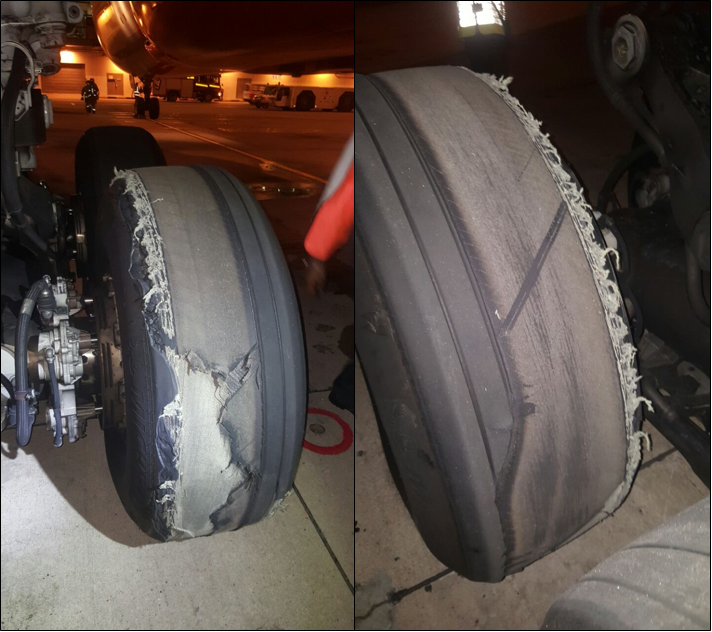
On 20 August 2019 a Regional Express, Saab Aircraft Company 340B, registration VH-ZLX, departed Adelaide, for a regular public transport flight to Port Lincoln, South Australia. During the post flight walk around, the first officer noted that the left main outboard landing gear tyre was deflated and that a piece of the wheel was missing.

Ground support personnel at Adelaide Airport subsequently located the missing section of wheel on the runway strip.

What the ATSB found

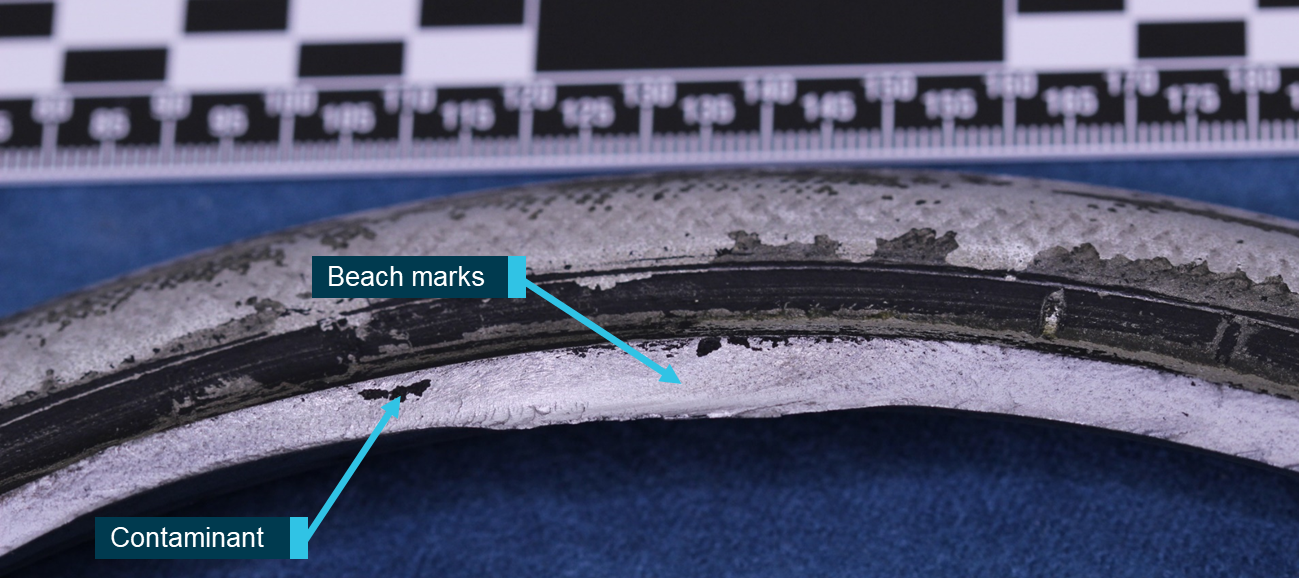
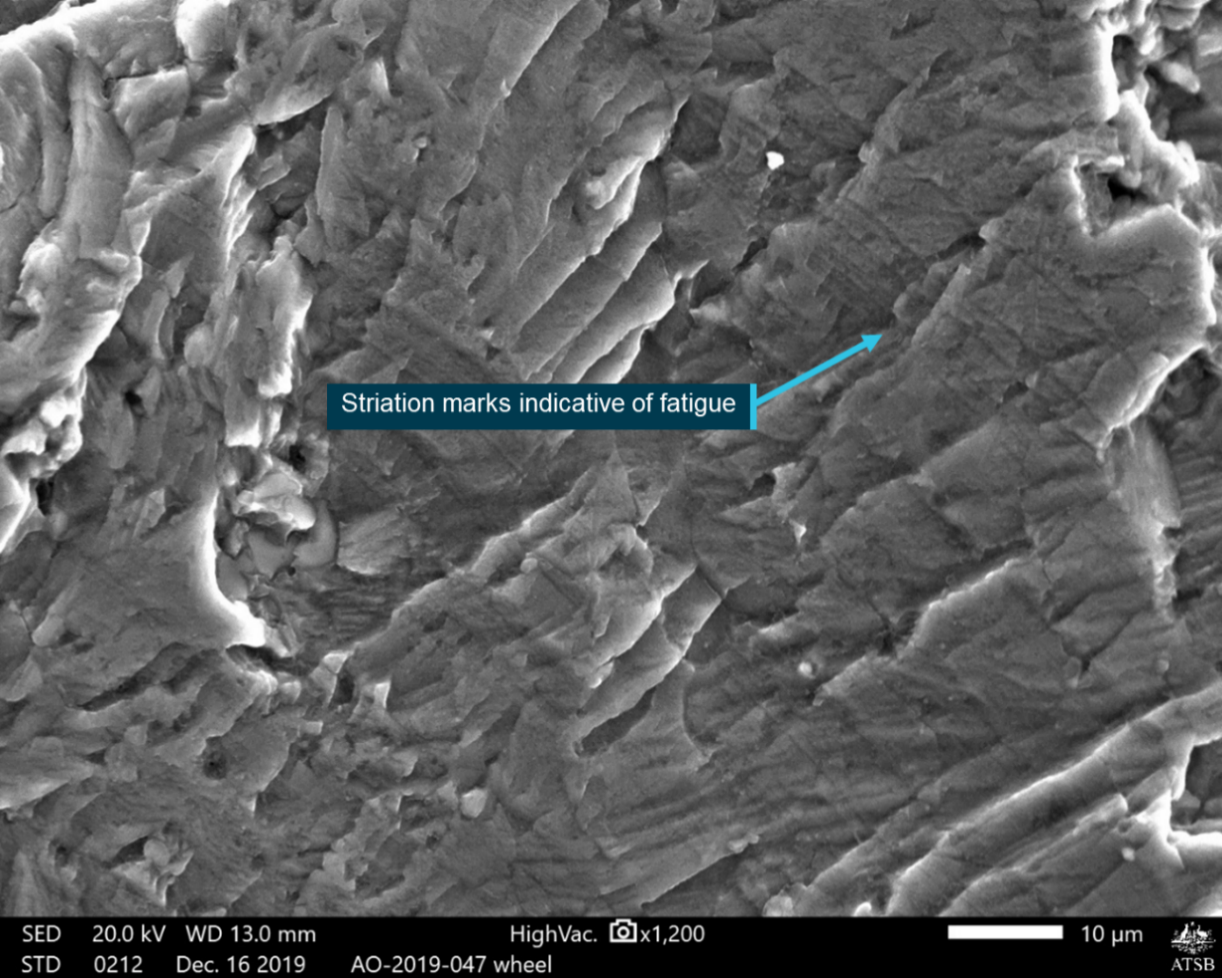
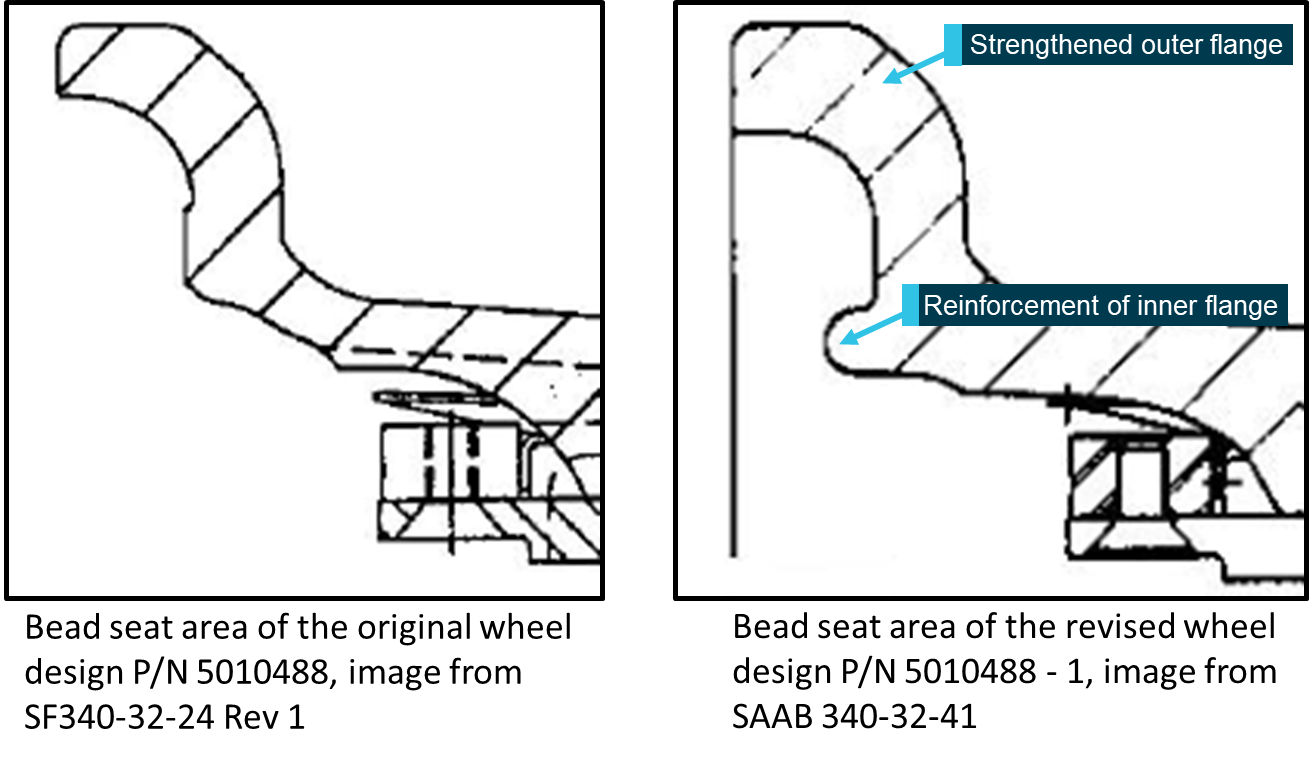
An area of fatigue cracking had initiated in the bead seat region of the wheel and progressed 86 mm around the circumference prior to final overstress fracture. Information obtained from the manufacturer and a previous ATSB investigation indicated that fatigue cracking of the bead seat area in this wheel type was a known issue with previously updated maintenance schedules and practices.

It was considered likely that the fatigue crack was present at the most recent maintenance visit, however, it had not been detected. Insufficient guidance in the operator’s maintenance procedures meant that inspections required by the component maintenance manual that might have identified the developing fatigue crack were not carried out.

What's been done as a result

The operator advised that, as a result of this incident, they have implemented new measures to prevent a recurrence. These include:

  • Updating wheel maintenance procedures to ensure that non normal inspections are identified and carried out.
  • Making the component maintenance manual for tyres more readily available to personnel by adding it to their engineering website.
  • Providing additional advisory material to maintenance personnel on the requirements of completing unserviceable tags to ensure that other maintenance personnel performing subsequent work fully understand the defect.
  • Providing additional training to personnel on wheel maintenance techniques.

Safety message

When situations or issues arise that do not fit into standard operating procedures, maintenance personnel should always be prepared to consult or request further guidance. This guidance can come from internal support materials, such as procedures, or external materials such as maintenance manuals or the manufacturer.

The occurrence

What happened

At approximately 1935 Central Standard Time[1] on 20 August 2019, a Regional Express, Saab Aircraft Company 340B, registration VH-ZLX (ZLX), departed Adelaide, South Australia for a regular public transport flight to Port Lincoln, South Australia. This was the last flight of the day for the aircraft and there were two flight crew, one cabin crew and 14 passengers on board. Following the landing in Port Lincoln, the first officer conducted an external inspection of the aircraft and noticed that the left main outboard landing gear tyre was deflated.

The crew reported no issues with aircraft handling during the take-off, landing or taxi phases of the flight. Additionally, none of the crew or passengers advised of any vibration or unusual noises during the flight.

On closer inspection of the wheel, the first officer noted that a piece of the wheel rim was missing (Figure 1). Ground staff were notified and the Port Lincoln aerodrome reporting officer (ARO) was contacted to conduct a runway inspection. The ARO’s inspection did not reveal any foreign object debris or damage to the runway.

The following morning, the operator dispatched engineers to replace the wheel and brake assembly. They informed the flight crew that the missing piece of wheel had been located on the runway strip at Adelaide Airport.

Context

Incident wheel history

The incident wheel was manufactured in 1995 and acquired by the operator in 2007. Since then, it had undergone 42 tyre changes, and 8 overhauls, the most recent of which was in October 2018. In the 10 months between this overhaul and the occurrence, it had accumulated 943 flight cycles on five different Saab 340B aircraft (Table 1).

The wheel’s removal from the first three aircraft was for routine tyre changes, with the tyres being worn to limit (WTL). Following its removal, the wheel was transported to the operator’s maintenance facility, inspected in accordance with the operator’s process, signed off as serviceable and returned to storage before transport and fitment to the next aircraft.

The removal from the fourth aircraft was due to a flat tyre. During a routine post flight inspection on 16 July 2019 the wheel was identified to be audibly leaking, maintenance personnel were notified and reported that when they arrived, the tyre was flat. As a result, both wheels in the set[2] were removed from the aircraft. The operator reported that prior to the occurrence flight the tyre pressure had been checked with a pressure gauge and was at the appropriate operating pressure before departure.

Table 1: Incident wheel maintenance history since previous overhaul

DateAircraftReason for
removal
Cycles since
wheel installation
Cycles since
wheel overhaul
11-10-2018 Wheel overhaulN/A0
21-12-2018VH-ZLJTyre change (WTL)276276
13-04-2019VH-OLLTyre change (WTL)230506
21-06-2019VH-ZXQTyre change (WTL)340846
16-07-2019VH-ZXKFlat tyre94940
21-08-2019
(occurrence)
VH-ZLXWheel failure3943

Source: Operator

Following removal of the wheel in July 2019, an ‘unserviceable’ tag was attached, and the wheel was returned to the operator’s maintenance facility. A standard tyre change form with the word ‘Repair’ hand‑annotated at the top of the form was used to document the maintenance. The form indicated that the following items were completed.

  • ‘General wheel check and inspection admin’
  • valve subassembly reinstallation and the wheel inflation
  • the post-inflation leak test[3], which found no evident leak.

Other items listed on the form, including visual inspection and non-destructive testing, were not performed as they were marked as ‘N/A’.

Following the leak check, the wheel was inflated to the recommended storage pressure and stored at the operator’s maintenance facility for approximately 1 month. On the day of the occurrence, the wheel was fitted to ZLX, and the aircraft conducted three flight cycles[4] before the rim section separated at Adelaide Airport.

Wheel examination

Following the incident, the wheel and tyre assembly, including the recovered segment, were provided to the ATSB for inspection.

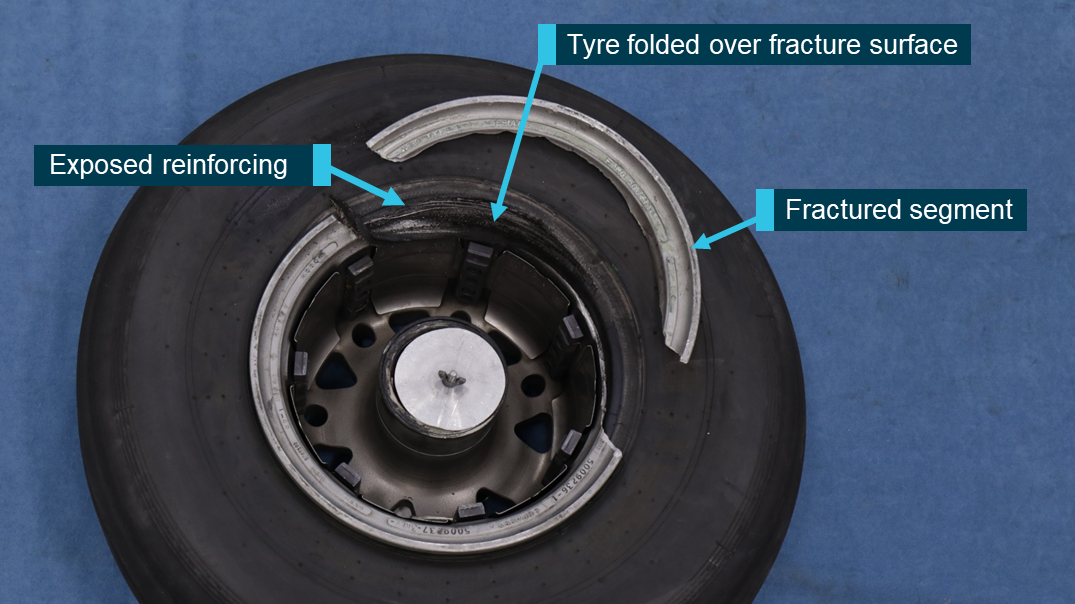
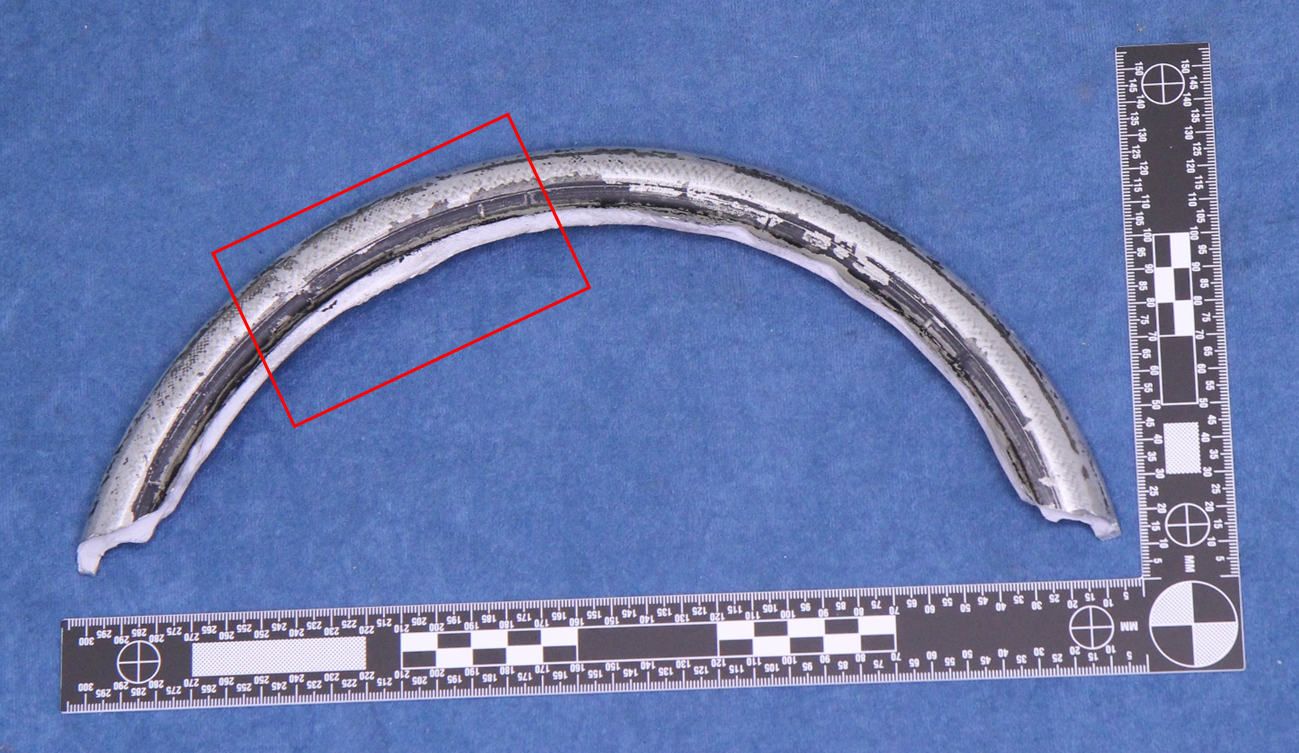
Initial inspections revealed that a section of the rim, comprising approximately one-half of the wheel’s circumference, had broken away with the fracture extending through the bead seat. The tyre had been damaged in the area of the fracture, with exposed steel reinforcing and some fractured wires. The tyre had folded over the fractured section of the rim and was caught on the edge of the rim (Figure 1).

Figure 1: Wheel in as-received condition

Figure 1: The wheel in the condition it was received by the ATSB.

Source: ATSB

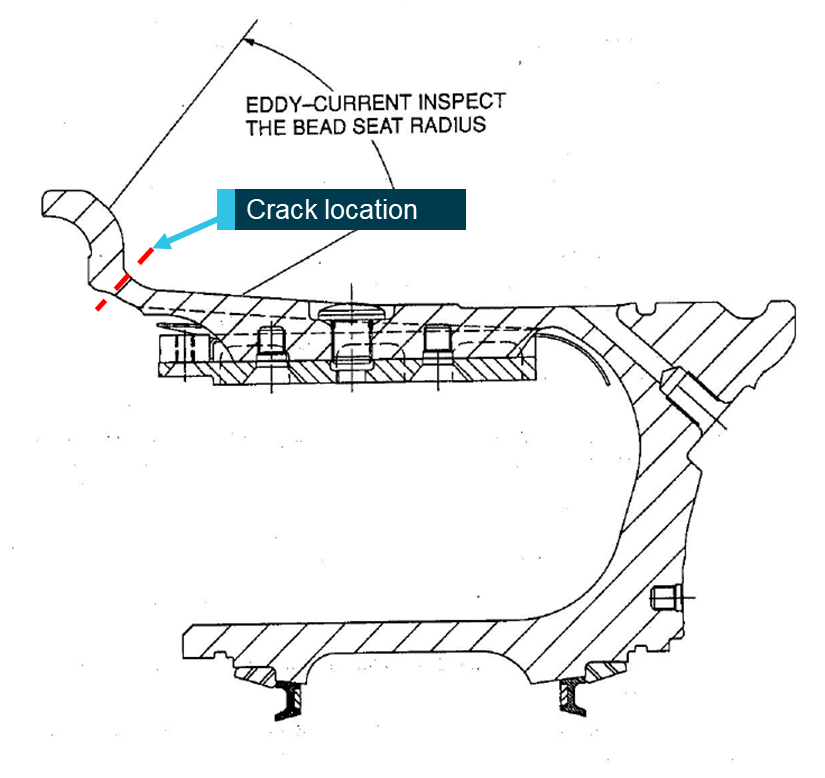
The tyre was removed, and the wheel disassembled to allow access to both sides of the fracture surface. The fracture followed a radial path through the wheel rim bead seat area (Figure 2).

Figure 2: Cross-section diagram of the wheel hub showing the location of the fracture

Figure 2: Cross-section diagram of the wheel hub showing the location of the fracture.
Source: Manufacturer, annotated by the ATSB

Source: Manufacturer, annotated by the ATSB

Beach‑marks consistent with fatigue crack progression were evident across both faces of the fracture surface (Figure 3 and 4). These markings extended radially from the internal bead seat radius surface towards the centre of the exposed fracture face. The beach-marks extended circumferentially around the rim for approximately 86 mm. While several potential fatigue initiation points were examined on both faces of the fracture, the exact origin could not be determined. The outer surfaces of the fracture, beyond the area of fatigue, were dull grey in colour and rough/fibrous in appearance. These features were consistent with a ductile overstress failure in a heat-treated aluminium alloy.

Figure 3: Excised portion of wheel rim with fatigue area highlighted

Figure 3: Excised portion of wheel rim with fatigue area highlighted.
Source: ATSB

Source: ATSB

Figure 4: Magnified view of fatigue area showing crack progression along the bead seat and evidence of tyre contamination on the fracture surface

Figure 4: Magnified view of fatigue area showing crack progression along the bead seat and evidence of tyre contamination on the fracture surface.
Source: ATSB

Source: ATSB

There was also black discolouration on the fracture surface. This was determined to be rubber debris from the tyre when it had been caught over the rim.

Scanning electron microscopy of the fracture surface revealed a relatively smooth fracture with evidence of non-uniform stepwise crack formation (Figure 5). This was further indication of a fatigue crack propagation through the material. Due to the non-uniform nature of the steps, it could not be determined how many cycles of fatigue had occurred before the overstress fracture.

Figure 5: Area of fatigue surface showing step-wise crack formation

Figure 5: Area of fatigue surface showing step-wise crack formation.
Source: ATSB

Source: ATSB

The examinations did not locate any corrosion or pre-existing manufacturing defects. Externally, there was no significant surface or mechanical damage to the fractured rim.

Wheel design

The wheel, serial number AUG 95-1523, was a part number (P/N) 5010488 main wheel assembly manufactured by the Aircraft Braking Systems Corporation (ABSC), now Meggitt Aircraft Braking Systems (MABS) in August 1995. The wheels were for use on a range of fixed and rotary wing aircraft including the Saab 340B.

Following a number of in‑service failures, in August 1994 ABSC identified an issue with the design of these wheels. These failures were attributed to fatigue crack development in the bead seat region of the wheel.

In order to ensure that cracks were detected prior to wheel failure, the manufacturer issued a service bulletin SF340-32-24, ‘SAAB 340 Main Wheel Sub Assembly 5009327 and 5009327-1’, which revised the required inspection and maintenance procedures for this wheel-type. The changes included non-destructive inspection, either eddy current or ultrasonic, at a series of locations around the wheel at each tyre change.

The inspection schedule for these wheels was introduced by service letter (SL) SL-GS-36.[5] The SL indicated that overhauls should be performed at maximum intervals of five tyre changes, or 1,500 flight cycles, whichever occurred first, nominally introducing an interval of approximately 300 flight cycles between each eddy current inspection. That interval was consistent with the maintenance history of the failed wheel.

In December 1995, the manufacturer released an updated design (P/N 5010488-1) that included additional reinforcement in the bead seat region. Figure 6 and 7 show the differences between the two designs. The new design could not be retrofitted to existing wheels. The manufacturer’s advice to operators in the service bulletin that introduced the new design (Saab 340-32-41) was that the older wheels (serial number OCT95-1606 and earlier) could be used until stock depletion, provided the necessary maintenance and inspection standards detailed in SLGS36 were maintained.

Figure 6: Diagrams showing the difference in the original and revised wheel designs

Figure 6: Diagrams showing the difference in the original and revised wheel designs.
Source: Manufacturer modified by the ATSB

Source: Manufacturer modified by the ATSB

Figure 7: Example of the difference between the old and new wheel designs

Figure 7: Example of the difference between the old and new wheel designs.
Source: Manufacturer modified by the ATSB

Source: ATSB

The manufacturer advised that they were not aware of any in service failures in the last 10 years and could not determine how many of the older wheel designs remained active, as they were not alerted to removal of wheels from service. The ATSB also reviewed defect reporting service (or equivalent) databases of the Civil Aviation Safety Authority, the United States Federal Aviation Administration and Transport Canada (Canadian Regulatory Authority) for reports of wheel failures. The jurisdiction of these agencies covers the majority of the aircraft with this wheel type. That review identified four reported wheel failures in the last 20 years and none in the last 10 years.

A search of the operator’s engineering database showed 38 wheels of the older design remained active in their fleet. In the 10 years prior to this occurrence, the operator has experienced one other in-service failure on their aircraft (see the section titled Previous occurrence) and 69 wheels of this type have been removed from service. It could not be determined if the removal of these wheels from service was due to the presence of fatigue cracks, as this level of detail was not recorded in the engineering database.

Component maintenance procedures

The component maintenance manual (CMM) outlined a range of different maintenance tasks that were to be carried out on this type of wheel (both the original and updated designs). It stated that, with the exception of the overhaul requirements already outlined, wheels were an ‘on condition’[6] part.

Three key procedures given in the CMM were for tyre change, overhaul and special cases.

Tyre change

The tyre change procedure was carried out when a tyre was worn to its tread limit. This involved recording the details about the wheel, dismantling the removable flange, removing the worn tyre, conducting a detailed visual inspection of the whole wheel assembly and non-destructive (eddy current or ultrasonic) inspection of specific areas.

Overhaul

At an overhaul, wheels had to undergo a full tyre change inspection plus eddy current, ultrasonic or fluorescent penetrant inspection of the whole wheel.

Special cases

‘Special cases’ inspections were required when the tyre had been operated with a flat or damaged tyre, or when the mating wheel[7] has been operated with a flat tyre.

In the case of a wheel operated with a flat tyre, the CMM required that the wheel undergo a careful visual inspection for damage, and a roundness check to ensure that the wheel was still circular. If the wheel was out of a specific tolerance, then it was to be replaced. There was no requirement for the wheel to undergo any non-destructive inspection in this process.

Operator’s maintenance process

The operator provided maintenance personnel with two different forms for carrying out the routine maintenance on wheels of this type, one for overhaul and another for tyre changes. The two forms specified the required tasks (as detailed in the CMM), and a location for each task to be signed off.

At the time of the occurrence, neither of these forms required personnel to confirm the reason for the tyre removal or if any additional maintenance actions, such as those outlined in the ‘special cases’ section, were required. There was no form for the special cases procedures.

A review of maintenance documentation indicated that non‑destructive inspections were carried out during the last overhaul of the occurrence wheel and during each subsequent tyre change conducted prior to the wheel failure. No cracking was identified during any of those inspections.

Previous occurrence

ATSB Investigation AO-2009-006

On 6 February 2009, a Regional Express Saab340B aircraft, registered VH-KDQ, landed at Sydney Airport following a regular public transport flight from Orange, New South Wales. During the post-flight inspection, the crew noted that that the aircraft’s left main outboard landing gear wheel was deflated and had sustained damage. Closer inspection by maintenance personnel revealed that a section of the wheel had fractured but remained attached to the wheel assembly.

The ATSB’s examination of the wheel found that it had failed due to a fatigue crack that had developed within the bead seat after initiating in the transition radius.

The failed wheel was a part 5010488 main wheel assembly manufactured by ABSC, serial number SEP92-0621 and, as discussed in the Wheel Design section, was more susceptible to this type of failure. The investigation reviewed the safety actions that had previously been put in place by both the manufacturer and the operator, finding them to be satisfactory.

Safety analysis

Component failure

Failure of the left main outboard landing gear wheel from Saab 340B aircraft, VH-ZLX, was a result of the fracture and separation of a section of the inner wheel rim adjacent to the tyre bead seat. The cracking and fracture was typical of a progressive fatigue cracking mechanism, which had initiated on the internal bead seat transition radius. In conventional pneumatically pressured wheel designs, the internal bead seat radius is typically a region of high bending stresses. As such, it is pre-disposed to the initiation and growth of fatigue cracking. Operational stresses arising from tyre flexure during taxi and landing can further contribute to this failure mechanism.

The bead seat radius fatigue cracking was a known issue with wheels of the original ABSC P/N 5010488. To improve the reliability of these wheel assemblies, the wheel manufacturer introduced updated inspection methods and tyre change or cycle limits between overhauls. To further address the issue, a revised wheel design (P/N 5010488-1) with features that strengthened the bead seat region of the wheel aimed at preventing fatigue failures was introduced. The failed wheel from VH-ZLX was of the original design.

Wheel inspection and crack development

Each time the non-destructive testing was conducted at a tyre change, no cracks were identified, and the wheel remained in service. Two scenarios were identified that could have accounted for the presence of the fatigue crack that initiated the failure:

  • the initiation and growth of the crack occurred rapidly, with the crack developing in the time since the last non-destructive inspection was carried out, or
  • a crack had initiated at the time of the last non-destructive inspection and was not detected.

The ATSB was not able to determine the crack growth rate that occurred in the wheel rim from the fracture surfaces. While rapid crack development could not be conclusively ruled out, for the following reasons the ATSB considered it probable that a crack had been present at the time of the last non‑destructive inspection but had not been detected:

  • The relatively large size of the fatigue area (86mm), compared to the relatively low number of flight cycles that had occurred (97) since the last eddy current inspection.
  • The nominal interval between eddy current inspections was 300 flight cycles, however, this failure occurred well before the next inspection was due. The very small number of reported failures in this wheel type in last 10 years indicated that the inspection interval generally appears adequate to capture cracks before they progressed to failure in service.
  • While it was possible that the wheel was operated for a short time with lower than recommended tyre pressure which could have influenced the crack growth rate, it was considered unlikely that it increased the growth rate enough to cause failure at one third of the nominal inspection interval.

Available forms

When the wheel was presented to the wheel bay following its removal from VH-ZXK, the personnel involved utilised the standard tyre change form to complete the inspection, noting on the form that this was not a standard tyre change, rather a ‘Repair’. Utilising the tyre change form, personnel signed for the ‘general wheel check and inspection admin’ task. This task did not include a visual inspection, as it was listed as a separate item on the form. When reinflated, the tyre retained pressure for the required 24 hours and so the tyre was not changed. As a result, a complete tyre change inspection, including non‑destructive inspection, was not performed.

As the wheel had been operated with a flat tyre, even if for a short time, it should have undergone the additional inspections outlined in the ‘Special cases’ section of the CMM. However, the documentation that maintenance personnel used did not identify this as a requirement, nor did it direct them to the CMM for further guidance in non-standard cases.

The ‘Special cases’ section of the CMM required a detailed visual inspection and roundness check to be carried out. The ATSB was unable to determine whether either of these inspections could have identified the crack. However, they would have been opportunities to determine that something was out of place and prompt further investigations. Although not required as part of the ‘Special cases’ section, had the wheel been subject to non-destructive inspection, the crack would have almost certainly been detected.

Findings

These findings, related to the landing gear wheel failure of Regional Express Saab 340B VH-ZLX, should not be read as apportioning blame or liability to any particular organisation or individual.

  • A fatigue crack initiated at the bead seat and led to the failure of the left outboard main landing gear wheel.
  • This wheel design was susceptible to fatigue cracking in the bead seat region.
  • It is probable that a fatigue crack was present at the time of the last non-destructive eddy current inspection but not detected.
  • The operator’s wheel maintenance forms did not adequately convey the inspection requirements for wheels operated with flat tyres. Subsequently, when the flat tyre was detected and the wheel brought in for maintenance, inspections that may have detected the crack were not carried out.

Safety action

Whether or not the ATSB identifies safety issues in the course of an investigation, relevant organisations may proactively initiate safety action in order to reduce their safety risk. The ATSB has been advised of the following proactive safety action.

Aircraft operator

The aircraft operator has advised the ATSB that in response to this incident they have updated several of the forms used for carrying out wheel maintenance. The forms now include additional steps to identify and treat wheels that fall into the ‘Special cases’ categories of the CMM and to ensure that all wheels in these categories undergo non-destructive inspection.

Additionally, they have made the tyre CMM more readily accessible to maintenance personnel, and disseminated advisory materials to ensure that the reason wheels are removed from service is correctly annotated on the unserviceable documentation. They have also provided retraining for a number of their staff in the correct wheel maintenance procedures.

Purpose of safety investigations

The objective of a safety investigation is to enhance transport safety. This is done through:

  • identifying safety issues and facilitating safety action to address those issues
  • providing information about occurrences and their associated safety factors to facilitate learning within the transport industry.

It is not a function of the ATSB to apportion blame or provide a means for determining liability. At the same time, an investigation report must include factual material of sufficient weight to support the analysis and findings. At all times the ATSB endeavours to balance the use of material that could imply adverse comment with the need to properly explain what happened, and why, in a fair and unbiased manner. The ATSB does not investigate for the purpose of taking administrative, regulatory or criminal action.

Terminology

An explanation of terminology used in ATSB investigation reports is available here. This includes terms such as occurrence, contributing factor, other factor that increased risk, and safety issue.

Publishing information 

Released in accordance with section 25 of the Transport Safety Investigation Act 2003

Published by: Australian Transport Safety Bureau

© Commonwealth of Australia 2020

image_5.png

Ownership of intellectual property rights in this publication

Unless otherwise noted, copyright (and any other intellectual property rights, if any) in this report publication is owned by the Commonwealth of Australia.

Creative Commons licence

With the exception of the Coat of Arms, ATSB logo, and photos and graphics in which a third party holds copyright, this publication is licensed under a Creative Commons Attribution 3.0 Australia licence.

Creative Commons Attribution 3.0 Australia Licence is a standard form licence agreement that allows you to copy, distribute, transmit and adapt this publication provided that you attribute the work.

The ATSB’s preference is that you attribute this publication (and any material sourced from it) using the following wording: Source: Australian Transport Safety Bureau

Copyright in material obtained from other agencies, private individuals or organisations, belongs to those agencies, individuals or organisations. Where you wish to use their material, you will need to contact them directly.

__________

  1. Central Standard Time (CST): Coordinated Universal Time (UTC) + 9.5 hours.
  2. The component maintenance manual stated that when one wheel in a dual wheel set was operated with a flat or damaged tyre, the other mating wheel must also undergo an inspection for damage due to potential for overload or other damage.
  3. Post-inflation leak check required the tyre to be inflated to operating pressure for 24 hours. The tyre was then pressure-tested and the pressure reduction was not permitted to exceed 10 per cent.
  4. Flight cycle: a completed takeoff and landing sequence.
  5. SL-GS-36 was first issued in July 1993. The most recent revision, version seven, was issued in January 2006.
  6. For ‘on condition’ components, maintenance is carried out as required rather than on a fixed schedule of flight cycles, time or operational hours.
  7. Mating wheel: the other wheel on the same part of the landing gear

Occurrence summary

Investigation number AO-2019-047
Occurrence date 20/08/2019
Location Adelaide Airport
State South Australia
Report release date 26/08/2020
Report status Final
Investigation level Short
Investigation type Occurrence Investigation
Investigation status Completed
Mode of transport Aviation
Aviation occurrence category Landing gear/indication
Occurrence class Incident
Highest injury level None

Aircraft details

Manufacturer Saab Aircraft Co.
Model 340B
Registration VH-ZLX
Serial number 340B-182
Aircraft operator Regional Express
Sector Turboprop
Operation type Air Transport Low Capacity
Departure point Adelaide, South Australia
Destination Port Lincoln, South Australia
Damage Minor

Landing gear failures involving a GA8 Airvan, VH-BFS, Fraser Island, Queensland, 24 August 2019 and 31 October 2019

Final report

Safety summary

What happened

In August and October 2019, a Gippsland Aeronautics GA8 Airvan (GA8) aircraft, registered VH‑BFS and operated by Air Fraser Island, sustained failures of the right main landing gear, with both occurrences occurring during landings on beach aeroplane landing areas (ALAs) on Fraser Island. Both landings were described as normal with no excessive loads.

On 24 August 2019, during the landing roll, and just prior to reaching taxi speed, the right main landing gear collapsed, resulting in minor damage to the aircraft as it came to a stop. There were no reported injuries to the pilot or passengers on board. On 31 October 2019, during the landing roll the right main wheel and axle separated from the landing gear at slow speed, resulting in minor damage. There were no reported injuries to the pilot (the only occupant).

What the ATSB found

The ATSB found it was probable that a number of the eight mounting bolts securing the right main landing gear had loosened and wound out, placing excessive loads on the remaining bolts. The remaining bolts eventually sheared, resulting in the gear leg collapsing during landing on 24 August 2019. Although the bolts not being securely fastened would have been apparent during one or more periodic inspections, recent maintenance had not detected any problems.

The ATSB found that because of low weld penetration from manufacture at the right main landing gear axle attach sleeve, it was likely that a fatigue crack formed and propagated undetected, eventually resulting in the axle failure on 31 October 2019. It was likely the axle cracks were present, and detectable visually, when last inspected 27 flight hours before the occurrence. In addition, the axle inspection area had surface contamination and corrosion that indicated the requirement for cleaning prior to inspection had not been conducted for an extended period, thereby decreasing the likelihood of identifying cracks by visual means. Furthermore, the requirement for a magnetic particle inspection of the axles had not been carried out, and was about 470 flight hours overdue at the time of the 31 October 2019 axle failure.

The operator’s aircraft experienced increased loads on the landing gear when routinely operating from beach ALAs up to 20–30 times daily, and they were subjected to a salt-laden and humid environment. With consideration of this context, the ATSB concluded that the operator did not place appropriate emphasis on ensuring the continuing airworthiness of the landing gear of its GA8 fleet.

What has been done as a result

Following the incidents, Air Fraser Island made changes to the control and conduct of maintenance on its aircraft. This included the appointment of a new head of aircraft airworthiness and maintenance control (HAAMC), the appointment of a quality assurance officer to audit the operator’s maintenance system, and changes to the personnel conducting maintenance.

Safety message

Operators routinely conducting operations to beach landing areas should consider the options available for improving the resilience of their landing gear. In particular, they should ensure that they are conducting the required inspections in accordance with the manufacturer’s maintenance schedule and procedures as a minimum standard. Improved and additional inspections should also be considered by operators when aircraft are frequently operated in challenging conditions.

The occurrence

Right main landing gear collapse (24 August 2019)

On 24 August 2019, a Gippsland Aeronautics GA8 Airvan (GA8), operated by Air Fraser Island and registered VH-BFS, conducted a local scenic flight over Fraser Island, Queensland. There was a pilot and five passengers on board.

On completion of the flight, the aircraft landed on a beach aeroplane landing area (ALA).[1] The landing was described as normal with no excessive loads. The pilot reported that, just prior to reaching taxi speed, the right main landing gear began to rotate towards the fuselage very slowly, and that the aircraft began to tilt to the right. This caused the aircraft to head toward the higher part of the beach before coming to a stop. The aircraft sustained minor damage and there were no reported injuries.

The operator’s licenced aircraft maintenance engineer (LAME) reported that the right main landing gear was no longer secured at its mount fitting by eight mount bolts, allowing it to rotate aft and upwards to a position where it could no longer support the aircraft (Figure 1). The aircraft was repaired and returned to service.

Figure 1: VH-BFS where it came to rest on 24 August, showing the right landing gear collapsed

VH-BFS where it came to rest on 24 August, showing the right landing gear collapsed

Source: Air Fraser Island, modified by the ATSB

Right main landing gear axle fracture (31 October 2019)

On 31 October 2019, VH-BFS was operated to Fraser Island to collect passengers returning to the mainland. The pilot[2] was the sole occupant.

The pilot reported that the landing was normal with no excessive loads. During the landing roll on the beach ALA, the right main landing gear wheel separated from the aircraft. There were no reported injuries. Following the flight, fuel was observed to be leaking from the right wing. Queensland Parks and Wildlife Service personnel were in attendance and attempted to manage the spill (Figure 2).

Figure 2: VH-BFS where it came to rest on 31 October, showing the right main wheel separated from the aircraft.

VH-BFS where it came to rest on 31 October, showing the right main wheel separated from the aircraft

Source: Queensland Police Service, modified by the ATSB

The operator’s LAME established that the right main landing gear had fractured at the axle, which is the attachment point for the main wheel to the landing gear. Another main landing gear assembly from the operator’s other GA8[3] was fitted to VH-BFS, and the nose wheel axle bolt was replaced. The aircraft was subsequently returned to service.

__________   

  1. The Air Fraser Island operations manual specified that beach aircraft landing areas were to be established in accordance with Civil Aviation Advisory Publication (CAAP) 92-1(1) (Guidelines for aeroplane landing areas). The CAAP recommended minimum physical characteristics of landing areas applicable to daytime operation of the GA8
  2. VH-BFS was flown by different pilots on 24 August and 31 October 2019  
  3. The operator’s other GA8, VH-BNX, was under maintenance at the time


Context

Operations on Fraser Island

Air Fraser Island primarily conducted scenic charter flights over Fraser Island, Queensland. This involved positioning aircraft from the mainland to Fraser Island in the morning and making multiple scenic flights daily from beach ALAs. The operator utilised two GA8 Airvans, a Cessna 172, and a Cessna 206 for these flights.

Since October 2017, the operator’s head of aircraft airworthiness and maintenance control (HAAMC) was a LAME who also maintained and certified their aircraft under a third-party maintenance approval.

The operator’s LAME advised that generally, each of their aircraft flew about 100 hours in a 7-week period and made 200–300 landings in that time. The operator’s safety manager advised that, on a busy day, pilots would conduct 20–30 take-offs and landings.

The majority of take-offs and landings were on beach ALAs that typically were below the high tide mark on sand that had been compacted by the receding tide. The physical characteristics of beach ALAs regularly exposed the aircrafts’ main landing gears to additional loads when compared to graded or sealed runways. The salt-laden and humid environment also increased the speed and severity of corrosion on the aircrafts’ metal components.

Aircraft information

General

The Gippsland Aeronautics GA8 Airvan (GA8) is a high-wing, all-metal, unpressurised aeroplane with a fixed tricycle landing gear. It has a single, reciprocating piston engine driving a constant speed propeller. The aircraft type first entered service in December 2000 and 262 aircraft were produced.

VH-BFS was manufactured and first registered in Australia in 2003. The aircraft had been in service with Air Fraser Island since that time. VH-BFS was being maintained in accordance with the GA8 service manual and held a current maintenance release at the time of both occurrences. At the time of the second occurrence (31 October 2019), VH-BFS had accumulated about 10,492 flight hours total time in service (TTIS).

Main landing gear and mounting description

The GA8 main landing gear legs were manufactured from machined and heat-treated 5160 steel tube. They passed through fittings in the fuselage main landing gear carry-through structure and then into mount fittings that were bolted to the main keel members. The legs were fixed to these fittings by eight NAS6606-12 close-tolerance bolts per side. These mount bolts screwed into a special nut, with eight threaded holes, and the special nut was nested inside the landing gear tubing. The main landing gear tubing incorporated a waisted section that was designed to twist when subjected to excessive loads, such as a runway overrun, rather than transmitting those loads to the airframe via the mounting bolts.

The manufacturer, Gippsland Aeronautics, advised that the original design for fixing the main landing gear leg into the mount fitting was with four mount bolts per side. During testing with this arrangement, the bolts were found to shear off (in overstress) from the forces placed upon them. The design was subsequently modified to have eight bolts before the aircraft type first entered service. The manufacturer was not aware of any subsequent failures of the bolts after the aircraft type entered service.

At manufacture, the eight mount bolts fixing each main landing gear leg, after being tightened to the correct torque, were secured in place with safety wire.

Safety wiring is a means of securing hardware (such as bolts) to prevent them from loosening during operation. Safety wiring is not a means of maintaining the torque of a bolt, but rather to prevent their disengagement. Safety wire is most commonly stainless steel, and after being threaded through pre-drilled holes in bolt heads, is twisted together either by hand or by using special pliers (Figure 3).

Figure 3: Examples of safety wiring of bolts

Examples of safety wiring of bolts

Source: US Federal Aviation Administration, modified by the ATSB

In-service experience showed that the GA8 landing gear mount bolts would loosen slightly due to the vertical and ratcheting forces on the main landing gear during take-off and landing. Access to the upper mounting bolts for removal, installation and safety wiring was limited by their proximity to the underside of the cabin floor (Figure 4).

Figure 4: GA8 main landing gear assembly showing the location of the mount fitting, mount bolts and axle

GA8 main landing gear assembly showing the location of the mount fitting, mount bolts and axle

Source: Gippsland Aeronautics, modified by the ATSB

Soon after the GA8 entered service, the manufacturer made a design change so that a bolt retaining cap was installed over the mount fitting that covered the eight bolt heads. When installed, the cap ensured that the bolts could not wind out of the special nut and the bolt heads no longer needed to be safety wired. The design change was incorporated on the production line and could be incorporated as a non-mandatory modification to aircraft in service.

VH-BFS had not been fitted with the retaining caps on its landing gear at the time of the first occurrence (24 August 2019). Following the occurrence, when the aircraft was being repaired, the operator fitted a retaining cap on the left landing gear. No retaining cap was fitted to the right landing gear.

Main landing gear axle description

The main landing gear axles were manufactured from 4130 steel tube that was machined and welded. They were fixed to the main landing gear with two bolts (Figure 5). The axles incorporated a torque plate to attach the brake callipers.

The design specifications for the main landing gear axle assembly were progressively improved from the time the aircraft entered service. From October 2009 they included references to an internal Gippsland Aeronautics welding procedure that was intended to improve the integrity of the welded region between the axle and landing gear tube.

In response to a GA8 operator sustaining an in-service failure from fatigue cracking of a main landing gear axle, Gippsland Aeronautics issued service bulletin SB-GA8-2016-169 (Inspection of the Main Undercarriage Axle Assembly) in 2016. The associated issue was that cracks had been found to form on the upper side of the axle on the inboard side of the brake torque plate (Figure 5).

Figure 5: GA8 main landing gear axle assembly inspection areas

GA8 main landing gear axle assembly inspection areas

Source: Gippsland Aeronautics, modified by the ATSB

As a result of the initial service bulletin inspections identifying cracks in some instances, the service bulletin was re-issued to make it mandatory.[4] The service bulletin was issued for a third time on 11 November 2016 to give operators time to comply with the non-destructive inspection requirements. That inspection was to be conducted no later than 11 February 2017 if the axle had accumulated 2,000 hours TTIS.

The ongoing inspection requirements in the SB included:

  • Part B - every 100 +/-10 flight hours, a detailed visual inspection of the external inspection area using at least 10x magnification and visual inspection internally
  • Part C - from 2,000 flight (axle) hours, and every 1,000 +/-10 hours afterwards, a magnetic particle inspection.[5]

In both cases the main wheel, brake calliper and torque plate required removal and the inspection areas had to be cleaned with solvent to ensure they were free of contaminants and corrosion prior to commencing the inspection. The service bulletin also stipulated that the aircraft logbooks had to be certified showing the completion of the service bulletin.

Another requirement of service bulletin SB-GA8-2016-169 was to report the results of inspections by completing the included document compliance notice and returning it to the manufacturer. Gippsland Aeronautics advised that of the 262 production aircraft, 10 compliance notices had been received. None of those notices were for inspections conducted on VH-BFS or the operator’s other GA8 aircraft (VH-BNX).

Recent scheduled maintenance

Periodic inspections of VH-BFS were certified as being carried out in accordance with the GA8 service manual at intervals of 100 +/- 10 hours or 12 months, whichever came first. They included the requirement to carry out a general inspection of the main landing gear attachment to the aircraft structure and, from 2016, a special inspection associated with SB-GA8-2016-169.

Recent periodic and special inspections were documented as being conducted on VH-BFS on:

  • 2 August 2019 at 10,263.7 hours TTIS (22 days and 61.8 flight hours before the landing gear collapse occurrence)
  • 15 September 2019 at 10,362.3 hours TTIS
  • 21 October 2019 at 10,464.5 hours TTIS (10 days and 27.4 hours before the axle fracture occurrence).
Right main landing gear history

The right main landing gear involved in both of VH-BFS occurrences in 2019 was fitted to the aircraft following another occurrence in 2009 where the right wheel and brake calliper separated in flight due to a previous axle failure (see Previous right main landing gear axle failure (21 June 2009) in this report for further details). Based on the available evidence, the ATSB was unable to establish if the replaced landing gear was new or a part-life item at the time it was fitted in 2009.

The operator’s LAME advised that they began carrying out maintenance on VH‑BFS in October 2017 at 9,125.1 hours TTIS. They stated that the previous maintenance provider informed them that all the required inspections had been carried out. The LAME also reported that they expected the SB-GA8-2016-169 magnetic particle inspection (MPI) requirement to be due at 10,025.1 hours TTIS (900 flight hours after taking over the maintenance), but about that time experienced issues with their computer-based maintenance scheduling. That resulted in the most recent MPI of the main landing gear axle, as required by SB-GA8-2016-169, not being carried out.

At the time of the axle fracture occurrence (31 October 2019), VH-BFS was about 470 flight hours overdue for that inspection based on the statement from the operator’s LAME. Further, the ATSB’s examination of the aircraft maintenance documentation did not identify any previous occasion when the axle had an MPI conducted, including the initial inspection that was to be carried out no later than February 2017. MPI inspections were carried out on the operator’s other GA8, VH-BNX, in July 2017.

Examination of recovered components

Main landing gear mounting hardware

Initial inspection by maintenance personnel

The worksheet completed for the recovery of the aircraft following the 24 August 2019 occurrence indicated that the bolts had sheared during landing and that an aircraft inspection was carried out. The LAME advised that:

  • three bolt remnants consisting of bolt heads and part of their shanks were found in the keel of the aircraft, safety wired together
  • the other five bolt heads with partial shanks were unable to be located, possibly lost during the repair activity
  • the special nut used to secure the landing gear leg was lost during the repair activity.

Therefore, only three bolt heads with partial shanks were available for inspection.

Detailed examination of the remaining mounting hardware

The ATSB conducted a technical examination of the three main landing gear mount bolt remnants that were recovered (Figure 6). A summary of the examination is as follows:

  • Manufacturing stamps and measurements indicated the bolts were the right type and fit for purpose.
  • There were no pre-existing defects with the bolts.
  • There was no evidence of cracking, and there were shear lips present on all three bolts. Their fracture surfaces were consistent with shear overstress[6] from a single event.

Dimensional examination of the bolt remnants showed it was likely that all three bolts were correctly tightened, and that the fractures occurred at the interface between the landing gear leg and its mount fitting.

There was no physical evidence provided to determine if the five missing bolts had sheared in the same way as the three bolts recovered, or if they had wound out of the special nut so that the three bolts provided had supported the landing gear shear loads.

Figure 6: The three recovered main landing gear mount bolt heads with partial shanks

The three recovered main landing gear mount bolt heads with partial shanks

Source: ATSB

Main landing gear axle assembly

Examination of photographs

Examination of photographs taken immediately after the main landing gear axle fracture occurrence on 31 October 2019 showed that significant amounts of pre-existing contamination existed at the axle inspection area, and that one of the mount guides on the brake calliper torque plate had broken off at an unknown time prior to the occurrence (Figure 7).

Figure 7: VH-BFS right main wheel, brake and axle taken just after 31 October 2019 occurrence

VH-BFS right main wheel, brake and axle taken just after 31 October 2019 occurrence

Source: Queensland Police Service, modified by the ATSB

Figure 8 shows dark and light areas across the axle fracture surface. Analysis of the photograph by materials failure specialists assessed the darkened areas as being pre-existing areas of fracture and the brighter areas, such as the area labelled as the ‘axle lower doubler’, were overstress in nature. Based on that evidence, the axle weld was cracked around about two thirds of the circumference. The remaining structure failed in overstress during the landing occurrence. 

Figure 8: VH-BFS right main landing gear axle failure taken just after 31 October 2019 occurrence

VH-BFS right main landing gear axle failure taken just after 31 October 2019 occurrence

Source: Queensland Police Service, modified by the ATSB

Detailed examination of the axle fracture

The right main landing gear leg and axle were provided to the ATSB for examination (Figure 9). A summary of that examination is as follows:

  • There was low weld penetration (less than 1 mm) in some areas.
  • The axle assembly was fractured in the area known to crack as described in SB-GA8-2016-169. However, smearing[7] and corrosion at the fracture surface prevented a determination on the degree of fatigue present prior to the occurrence.
  • The axle assembly lower doubler had failed in overstress.
  • There was paint missing on the leg and axle assembly with darker corrosion visible, likely present prior to the occurrence.
  • Corrosion pitting was present on the fracture surface opposite the doubler, suggesting pre-existing damage.
  • A secondary crack was found opposite the doubler, near the region of corrosion pitting.

Figure 9: VH-BFS right main landing gear axle after cleaning

VH-BFS right main landing gear axle after cleaning

Source: ATSB

Other noted defects

The ATSB identified that the right torque plate that located the brake calliper on the axle was significantly corroded and had a section of the brake calliper guide missing. The extent of the corrosion at the missing calliper guide indicated that it had been missing for an extended period.

Previous right main landing gear axle failure (21 June 2009)

On 21 June 2009, while travelling from Harvey Bay and during descent to Fraser Island, VH-BFS sustained a fracture of the right main landing gear axle assembly, resulting in separation of the wheel and brake calliper. The aircraft was diverted to Maryborough, Queensland, where it landed safely on the remaining portion of the axle.

To assist its investigation of the occurrence, the Civil Aviation Safety Authority (CASA) requested the assistance of the ATSB in the metallurgical examination of the fractured landing gear leg. The ATSB conducted that examination as an investigation under the Transport Safety Investigation Act 2003 (see AE-2009-045 for details).

The ATSB examination concluded the following [emphasis added]:

As a result of gross abrasion sustained during the aircraft landing, the amount of material lost from the leg attach fracture surfaces (including the doubler from the underside of the axle assembly) precluded an accurate determination of the failure mechanism.

Considering the assembly design, the fillet weld would likely have been the region of highest stress in the axle assembly and therefore, in the absence of material or manufacturing defects, it is probable that the fracture would have originated and progressed through the weld along its full path.

The onset of failure under low nominal stress conditions, that is, during flight, suggested a progressive or fatigue-type mechanism, rather than a gross transient overload event. However, there was no evidence of fatigue on the remaining fracture surface.

Future increased examination vigilance and possible enhanced inspections of the leg attach sleeve welds of other GA8 aircraft is suggested in view of the nature of the failure sustained.

__________

  1. As the operator was maintaining its GA8 aircraft in accordance with the manufacturer’s maintenance schedule, it was required to comply with additional maintenance requirements, such as mandatory service bulletins
  2. Magnetic particle inspection (MPI): a non-destructive inspection process for detecting flaws in ferrous metals. It requires specialist equipment and personnel who are trained and approved to carry out this work.
  3. Overstress failure: occurs when the loads applied to a component exceed the strength of its material. Shear overstress failures occur on a plain parallel to the direction of the applied loads.
  4. Deformation of the fracture surface that occurred as the axle failed.

Safety analysis

Introduction

On two occasions in 2019, while conducting a landing on a beach aeroplane landing area (ALA), VH-BFS sustained failures of the right main landing gear. In the first occurrence, the right landing gear collapsed, and in the second the right main wheel separated from the aircraft due to an axle fracture. There were no reported injuries from either occurrence.

This analysis will discuss the likely failure modes involved in each occurrence and maintenance issues that were identified during the investigation.

Right main landing gear collapse (24 August 2019)

Landing gear mount bolt shear forces

Figure 10 shows an illustration of the eight mount bolts that are designed to secure the landing gear to the airframe structure. The bolts pass through the airframe fitting, into the landing gear leg and then they are retained by a special nut with eight threaded holes. The illustration also indicates the point of intersecting forces or loads applied by the airframe against forces applied by the landing gear. These forces are in shear and the point of intersection is the location where the three provided bolts sheared in overstress.

Figure 10: Main landing gear leg, mount fitting and special nut

Main landing gear leg, mount fitting and special nut

Source: Gippsland Aeronautics, modified by the ATSB

Scenarios to explain the overstress failure of the recovered bolts

Technical analysis of the three provided landing gear mount bolt remnants were of the appropriate specification and they had no pre-existing defects. The fracture surfaces showed they had sustained an overstress failure due to shear loads.

The ATSB considered two possible scenarios with regards to the 24 August landing gear collapse:

  • the shear overstress failure of all eight mount bolts due to significant landing loads
  • the migration and release of five mount bolts that were not safety wired and the overstress failure of the three remaining bolts during normal landing loads.
Possible overstress failure of all eight bolts

The operator’s LAME indicated that all eight mount bolts had failed in shear overstress during the landing. Apart from the three sheared bolt head remnants, the LAME was unable to provide any additional photographic or physical evidence to support that scenario; instead reporting that the five other sheared bolt remnants and the special nut were lost during repair activity. The LAME was unable to recall the circumstances regarding the removal of the eight bolt shanks and their threaded portions during the repair activity, and their subsequent whereabouts was not supplied.

In a scenario where all eight bolts fail in shear overstress, their shanks and threaded portion should retain the special nut in the landing gear leg, and the bolt heads should still be safety wired together, at least in pairs. Evidence such as the five missing bolts, the remaining threaded bolt shanks, and the special nut would have provided supporting evidence to show that all eight bolts were fitted and secure at the time of the 24 August occurrence. However, the only supporting evidence was the LAME’s statement.

Possible migration of five unsecured bolts

Evidence to support the migration of five bolts that were not safety wired was as follows:

  • The aircraft manufacturer reported that there have not been any taxi, take-off or landing incidents or accidents where all the landing gear bolts had sheared in overstress.
  • The manufacturer designed the landing gear to twist and deform at a waisted section during hard landings before landing loads were significant enough to deform the airframe and shear the mount bolts. VH-BFS’s landing gear was not twisted at the waisted section and was refitted to the aircraft during the repair activity.
  • The manufacturer reported that, during pre-production testing, the original installation of four mount bolts would shear in overstress rather than deform the landing gear leg. Therefore, an aircraft with four or less bolts fitted would likely shear those bolts.
  • The landing was reported to have been normal with no excessive loads.
  • There was no physical or photographic evidence available to show that the five bolts had sheared in overstress.
  • The bolts examined were the correct type and fit for purpose.
ATSB analysis of the two scenarios

In the absence of a hard/abnormal landing, it would be unlikely for all eight mount bolts to fail in shear overstress provided they were all secured, the correct type, and fit for purpose. Further details about the recovery, repair and the replacement of parts requested by the ATSB was not forthcoming. Therefore, the ATSB could not assure itself that the LAME’s account was entirely accurate.

The ATSB considered that, based on the available evidence, it was probable that the landing gear was not secured by all eight bolts prior to landing. It was also considered probable some bolts were not safety wired to ensure that they could not migrate out during numerous landing and take-off cycles. The replacement of the landing gear in 2009 due to the previous axle failure was at least one point in time where the bolts were removed and refitted with the possibility that they were not resecured by safety wire.

Access to the upper mounting bolts for safety wiring is limited by their proximity to the underside of the cabin floor. However, removal of this requirement could have been accomplished by retrofitting a main landing gear mount bolt retaining cap.

Each periodic (100 hourly) inspection required the examination of the landing gear securing points, which included the eight mount bolts. It was estimated that at least six periodic (100-hourly) inspections were conducted on VH-BFS every year. Each of those inspections provided an opportunity to identify an underlying issue with the security of the landing gear before it progressed to the point of failure.

Right main landing gear axle fracture

Landing gear axle examination

Technical analysis of axle fracture surfaces showed that a fatigue crack formed and propagated undetected around two thirds of the axle circumference along the weld and eventually failed in a weakened state during a normal beach landing. Examination of the weld points on the axle indicated that there was a low weld penetration at the axle attach sleeve. A combination of low weld penetration, operations on uneven beach ALAs and high landing cycles in a highly corrosive environment may have increased the crack initiation and propagation rate. Corrosion pitting inside the fracture surfaces indicated that the crack had been present for a significant period of time.

The age of the right main landing gear from VH-BFS was not able to be established, however the low weld penetration at the axle attach sleeve suggests that it pre-dated the specification change in October 2009, when greater definition was added to the welding procedure by the aircraft manufacturer.  

Maintenance aspects related to the axle failure

The ATSB’s investigation into the axle failure of VH-BFS in 2009 recommended increased examination vigilance and possible enhanced inspections of the leg attach sleeve welds.

The manufacturer was aware of the possibility of fatigue cracks forming in axle attachment sleeves from the 2009 occurrence, and later in 2016 via in-service data gathered during the compilation of service bulletin SB-GA8-2016-169. The resulting mandatory requirements of this service bulletin were designed to identify fatigue cracks before they propagated to the point of failure. The fatigue cracking on the right axle of VH-BFS was located in the inspection area described in service bulletin SB-GA8-2016-169.

The service bulletin required detailed visual inspections in the area of the fatigue crack with a 10x magnifier every 100 hours, and a magnetic particle inspection (MPI) every 1,000 hours. The visual and MPI inspections required the removal of the main wheels, the brake callipers and torque plates for access, and the area had to be cleaned prior to inspection. Following each examination, a maintenance log entry was required to show that the examination was completed in accordance with the service bulletin and certified by appropriately licensed maintenance engineers.

Since February 2017, the aircraft had a periodic (100 hourly) inspection, which included the service bulletin, about every 7 weeks, with the last one being about 27 flight hours prior to the occurrence.

In accordance with the maintenance schedule, a calculation of aircraft hours and dates indicated that two MPIs should have been carried out on the aircraft since February 2017. The ATSB could not find any documented evidence to indicate that the initial MPI had been carried out, however an MPI was carried out on the operator’s other GA8 in July 2017. The operator’s LAME cited issues relating to maintenance scheduling software as a reason for the overrun of the second scheduled MPI.

Additionally, there was significant amount of pre-existing contamination at the axle inspection area. This indicated that required cleaning of the inspection area had not been conducted for an extended period, which reduced the likelihood of identifying cracks in the inspection area.

Each of the scheduled MPI and visual inspections represented an opportunity to identify a pre-existing crack in the axle area prior to failure. The ATSB concluded that a detectable crack would very likely have been present in the axle over numerous periodic inspection periods.

The operator was routinely operating from beach landing areas with increased loads on the landing gear, was aware of the axle failure of VH-BFS in 2009 and, later, the mandatory inspection requirements of SB-GA8-2016-169. However, it did not place appropriate emphasis on ensuring the continuing airworthiness of the landing gear of its GA8 fleet.

Landing gear maintenance procedures

Scheduled maintenance is designed to capture irregularities well before they can manifest into failures. More specifically, both issues that led to the landing gear failures involving VH-BFS were known to the aircraft manufacturer and had been mitigated by scheduled and special inspections. The ATSB considered that the manufacturer’s maintenance schedule, requirements and documentation, if followed correctly, were sufficient to identify the associated issues before they become incidents or accidents.

Operating aircraft on beach ALAs exposes them to increased loads on the landing gear, as well as also exposed the aircraft to sand and a salt-laden environment. Accordingly, operators conducting such operations on a routine basis should consider the options available for improving the resilience of their landing gear. In addition, they should ensure that all minimum maintenance inspections and requirements are being conducted at the specified frequency, and even consider whether to conduct them more frequently.

As a result of investigating these two occurrences, the ATSB identified that the relevant inspections of the landing gear did not appear to have been conducted at the inspection intervals required. More specifically:

  • Each 100 hourly / periodic inspection required the examination of the landing gear securing points, which included the eight mount bolts. It was estimated that at least six periodic (100-hourly) inspections were conducted on VH-BFS every year. Each of those inspections represented provided an opportunity to identify an underlying issue with the security of the landing gear before it progressed to the point of failure (on 24 August 2019).
  • Each of the scheduled visual and MPI inspections represented an opportunity to identify a pre-existing crack in the axle area prior to the failure (on 31 October 2019). However, the available evidence indicates two required MPIs since February 2017 were not conducted. In addition, a detectable crack would very likely have been present in the axle over numerous periodic inspection periods, and the amount of contamination in the axle inspection area meant that at least some of the visual inspections would not have been able to be effectively conducted.

The operator was aware of the previous axle failure involving its aircraft in 2009 and was aware of the service bulletin. Both occurrences involving VH-BFS highlight the importance of ensuring scheduled maintenance is carried out at the appropriate times and in accordance with the required maintenance data.

In summary, based on the available information, the ATSB concluded that the operator did not place appropriate emphasis on ensuring the continuing airworthiness of the landing gear of its GA8 fleet.

The manufacturer’s ability to improve maintenance requirements relies partly on the provision of in-service data for analysis. SB-GA8-2016-169 incorporated an ‘inspection result compliance notice’ and, from 262 production aircraft, there have been only 10 responses. This represented a missed opportunity for the manufacturer and operators to obtain important ongoing airworthiness information.

Findings

ATSB investigation report findings focus on safety factors (that is, events and conditions that increase risk). Safety factors include ‘contributing factors’ and ‘other factors that increased risk’ (that is, factors that did not meet the definition of a contributing factor for this occurrence but were still considered important to include in the report for the purpose of increasing awareness and enhancing safety). In addition, ‘other findings’ may be included to provide important information about topics other than safety factors.

Safety issues are highlighted in bold to emphasise their importance. A safety issue is a safety factor that (a) can reasonably be regarded as having the potential to adversely affect the safety of future operations, and (b) is a characteristic of an organisation or a system, rather than a characteristic of a specific individual, or characteristic of an operating environment at a specific point in time. 

These findings should not be read as apportioning blame or liability to any particular organisation or individual.

From the evidence available, the following findings are made with respect to the landing gear failures involving a GA8 Airvan, VH-BFS, on 24 August and 31 October 2019.

Contributing factors

  • It is probable that a number of the eight right main landing gear mount bolts had migrated out of the special nut undetected and over an extended period. The three remaining bolts failed in overstress, resulting in the gear leg collapsing during a normal beach landing on 24 August 2019.
  • Recent maintenance inspections specific to the security of the landing gear attachment had not detected issues related to the migration of the right main landing gear mount bolts. It is probable that the mount bolt migration would have been apparent during one or more inspections.
  • There was low weld penetration at the right main landing gear axle attach sleeve, which likely resulted in a fatigue crack forming, then propagating undetected and eventually failing during a normal beach landing on 31 October 2019.
  • It was likely the axle cracks were present, and detectable visually, when last inspected 27 flight hours before the 31 October 2019 occurrence.
  • The axle inspection area had surface contamination and corrosion that indicated the requirement for cleaning prior to inspection had not been conducted for an extended period, thereby decreasing the likelihood of identifying cracks by visual means.
  • The most recent mandatory service bulletin SB-GA8-2016-169 requirement for a magnetic particle inspection (MPI) of the axles had not been carried out and was about 470 flight hours overdue at the time of the 31 October 2019 axle failure.
  • The operator did not place appropriate emphasis on ensuring the continuing airworthiness of the landing gear of its GA8 fleet, although being aware of:
    • the increased loads on the landing gear when routinely operating from beach landing areas up to 20–30 times daily, and being subjected to a salt-laden and humid environment
    • the axle failure of VH-BFS in 2009
    • the mandatory inspection requirements of service bulletin SB-GA8-2016-169. (Safety issue)

Other factors that increased risk

  • Although not mandatory, the operator had not retrofitted main landing gear mount bolt retaining caps on the landing gear of VH-BFS. Such retaining caps would have prevented the possible scenario of the main landing gear mount bolts becoming loose and thereby reducing the integrity of the main gear leg.
  • A requirement of service bulletin SB-GA8-2016-169 was to report the results of inspections by completing the document compliance notice and returning it to the manufacturer. Of the 262 production aircraft, 10 compliance notices had been received. This represented a missed opportunity for the manufacturer and operators to obtain important ongoing airworthiness information.

Safety issues and actions

Central to the ATSB’s investigation of transport safety matters is the early identification of safety issues. The ATSB expects relevant organisations will address all safety issues an investigation identifies.

Depending on the level of risk of a safety issue, the extent of corrective action taken by the relevant organisation(s), or the desirability of directing a broad safety message to the aviation industry, the ATSB may issue a formal safety recommendation or safety advisory notice as part of the final report.

All of the directly involved parties were provided with a draft report and invited to provide submissions. As part of that process, each organisation was asked to communicate what safety actions, if any, they had carried out or were planning to carry out in relation to each safety issue relevant to their organisation.

Descriptions of each safety issue, and any associated safety recommendations, are detailed below. Click the link to read the full safety issue description, including the issue status and any safety action/s taken. Safety issues and actions are updated on this website when safety issue owners provide further information concerning the implementation of safety action.

Maintenance processes for landing gear

Safety issue number: AO-2019-045-SI-01

Safety issue description: The operator did not place appropriate emphasis on ensuring the continuing airworthiness of the landing gear of its GA8 fleet, although being aware of:

  • the increased loads on the landing gear when routinely operating from beach landing areas up to 20–30 times daily, and being subjected to a salt-laden and humid environment
  • the axle failure of VH-BFS in 2009
  • the mandatory inspection requirements of service bulletin SB-GA8-2016-169.

Sources and submissions

The sources of information during the investigation included the:

  • pilot of the occurrence flight and another pilot who conducted flights for the operator
  • chief pilot of Air Fraser Island
  • Civil Aviation Safety Authority
  • Queensland Police Service
  • aircraft manufacturer
  • maintenance organisation for VH-BFS at the time of the occurrences
  • witnesses
  • photographs taken on the day of the accident.

References

ATSB external investigation AE-2009-045, Engineering examination into the fractured main landing gear axle Gippsland Aeronautics GA-8 Airvan, VH-BFS, 21 June 2009, Australia.

Gippsland Aeronautics, Model GA8 service manual amendment 12, 15 May 2018.

Gippsland Aeronautics, Service Bulletin SB-GA8-2016-169 issue 3, Inspection of the Main Undercarriage Axle Assembly.

Federal Aviation Administration (1998), Advisory circular AC 43.43-1B, Acceptable methods, techniques, and practices – aircraft inspection and repair.

Submissions

Under section 26 of the Transport Safety Investigation Act 2003, the ATSB may provide a draft report, on a confidential basis, to any person whom the ATSB considers appropriate. That section allows a person receiving a draft report to make submissions to the ATSB about the draft report.

A draft of this report was provided to the following directly involved parties:

  • the pilots of the occurrence flights and another pilot who conducted flights for the operator
  • the chief pilot and safety manager of Air Fraser Island
  • the Civil Aviation Safety Authority
  • the aircraft manufacturer
  • the maintenance organisation for VH-BFS at the time of the occurrences.

The submissions were reviewed and, where considered appropriate, the text of the report was amended accordingly.

Purpose of safety investigations & publishing information

Purpose of safety investigations

The objective of a safety investigation is to enhance transport safety. This is done through:

  • identifying safety issues and facilitating safety action to address those issues
  • providing information about occurrences and their associated safety factors to facilitate learning within the transport industry.

It is not a function of the ATSB to apportion blame or provide a means for determining liability. At the same time, an investigation report must include factual material of sufficient weight to support the analysis and findings. At all times the ATSB endeavours to balance the use of material that could imply adverse comment with the need to properly explain what happened, and why, in a fair and unbiased manner. The ATSB does not investigate for the purpose of taking administrative, regulatory or criminal action.

Terminology

An explanation of terminology used in ATSB investigation reports is available here. This includes terms such as occurrence, contributing factor, other factor that increased risk, and safety issue.

Publishing information 

Released in accordance with section 25 of the Transport Safety Investigation Act 2003

Published by: Australian Transport Safety Bureau

© Commonwealth of Australia 2021

image_5.png

Ownership of intellectual property rights in this publication

Unless otherwise noted, copyright (and any other intellectual property rights, if any) in this report publication is owned by the Commonwealth of Australia.

Creative Commons licence

With the exception of the Coat of Arms, ATSB logo, and photos and graphics in which a third party holds copyright, this publication is licensed under a Creative Commons Attribution 3.0 Australia licence.

Creative Commons Attribution 3.0 Australia Licence is a standard form licence agreement that allows you to copy, distribute, transmit and adapt this publication provided that you attribute the work.

The ATSB’s preference is that you attribute this publication (and any material sourced from it) using the following wording: Source: Australian Transport Safety Bureau

Copyright in material obtained from other agencies, private individuals or organisations, belongs to those agencies, individuals or organisations. Where you wish to use their material, you will need to contact them directly.

Occurrence summary

Investigation number AO-2019-045
Occurrence date 24/08/2019
Location Fraser Island
State Queensland
Report release date 29/04/2021
Report status Final
Investigation level Defined
Investigation type Occurrence Investigation
Investigation status Completed
Mode of transport Aviation
Aviation occurrence category Landing gear/indication
Occurrence class Serious Incident
Highest injury level None

Aircraft details

Manufacturer Gippsland Aeronautics Pty Ltd
Model GA-8
Registration VH-BFS
Serial number GA8-03-035
Aircraft operator Air Fraser Island
Sector Piston
Operation type Charter
Departure point Oaks, Queensland
Destination Eurong, Queensland
Damage Minor

Landing gear malfunction involving Airbus A320, VH-VFN, Sydney Airport, New South Wales, on 1 August 2019

Final report

Safety summary

What happened

On the morning of 1 August 2019, an Airbus A320, registered VH-VFN, was being operated as a regular public transport flight by Jetstar Airways from Sydney, New South Wales to Gold Coast, Queensland. On departure the flight crew received multiple warnings of the undercarriage not retracting completely. Despite extending and retracting the undercarriage again, the issue remained.

Meanwhile, another aircraft identified an object on the ground while taxiing at Sydney Airport and reported the sighting to the Air Traffic Control (ATC) Ground controller. The controller arranged for the debris to be collected by an airport ground car. Upon retrieval, the object was determined to be an aircraft part that was subsequently identified as an A320 main landing gear component.

ATC notified the flight crew that an aircraft part had been found. In addition, Jetstar communicated to the flight crew that the part had not yet been positively identified and advised the crew to follow their procedures. When all appropriate checks were completed, the flight crew elected to return to land at Sydney.

When it was determined the part was an apex pin of a main landing gear torque link, Jetstar Line Maintenance was concerned about the aircraft landing with the defect and attempted to contact the aircraft via radio. However, by this time the aircraft was on final approach to land and therefore not monitoring the company radio frequency. While the landing was uneventful, further damage to the left main landing gear occurred including the loss of brakes and severing of electrical sensors.

What the ATSB found

The ATSB identified that the head of the apex pin on the left main landing gear torque link failed due to cyclic fatigue. This then allowed the shank portion of the apex pin to slide out of the torque link, permitting the main landing gear axle to rotate out of alignment. The misalignment stopped the undercarriage from retracting completely and caused further damage to main landing gear components and systems during the taxi, take-off, and landing. Despite this, the aircraft landed safely.

The fatigue failure of the apex pin was the result of a crack that initiated during the quench step of the heat treatment process at manufacture. The crack was not detected during the manufacturing inspections for reasons that could not be determined. It also remained undetected during subsequent maintenance, although cracking was not specifically inspected for.

The ATSB also identified that, despite the failed part and aircraft being positively identified by elements within Jetstar, a message was unable to be conveyed to the flight crew before they returned for landing. As such, they were unaware of the true nature of the undercarriage defect and the associated risks. The additional information would have improved crew decision making.

The investigation also found that the breakdown in communication was the result of localised factors specific to this occurrence and that Jetstar has procedures in place to ensure that accurate and timely information is passed to airborne flight crew.

Finally, to enable the aircraft to be moved on the ground after the occurrence, the failed apex pin was reinstalled and temporarily held in place. This had the potential to damage the material evidence and prevent identification of the failure mode.

What has been done as a result

Airbus issued an Alert Operator Transmission (AOT) requiring recall or inspection of 1,988 apex pins. As a result of these inspections, 19 pins were removed from service due to cracking. Additionally, EASA issued Airworthiness Directive 2020-0130 mandating AOT A32N018-20 Rev 1.

Safran Landing Systems revised the manufacturing process for the apex pin prior to this failure as a result of subsequent parts being found cracked. Furthermore, they generated a design guidance document related to undercuts in heat treated parts.

Jetstar clarified non-normal operational communication guidance for ground crews in the Airport Operations Manual. This included dedicated phraseology for gaining priority on airband frequencies to relay high priority messages.

Safety messages

In this incident, the flight crew made the decision to return and land after seeking and assessing information from ground personnel relating to the landing gear malfunction. However, additional information was still being gathered. This highlights the importance of ensuring that operational processes permit coordinated, accurate and timely flow of information between ground personnel and flight crew to assist airborne decision making.

For safety investigations, preservation of evidence is vital in determining the circumstances of the occurrence and identifying safety issues that may present a hazard to continued operations. Any person involved in aircraft operations are encouraged not to put evidence at risk of further damage.

The occurrence

On the morning of 1 August 2019, an Airbus A320, registered VH-VFN, was being operated as a regular public transport flight by Jetstar Airways (Jetstar) from Sydney, New South Wales to Gold Coast, Queensland. It was the first flight of the day for the flight crew and the third for the aircraft and cabin crew. The aircraft had previously been flown on a return flight between Sydney and the Gold Coast, landing in Sydney on runway 34R.[1]

At 1020 Eastern Standard Time,[2] the aircraft was pushed back and commenced taxiing to runway 34R (Figure 1). While the aircraft was taxied to the runway, the crew of a following aircraft reported to the Sydney East Ground Controller (Ground) that they had sighted an item on the ground at the intersection of taxiways B4 and C.[3] Ground then sent an airport ground car to investigate the item, who reported 3 minutes later that the foreign object debris (FOD)[4] had been retrieved. The FOD was a metallic component, later identified to be an apex pin of a main landing gear torque link (see the section titled Main landing gear strut and Figure 2).

Figure 1: Airport map – Sydney Kingsford Smith

Figure 1: Airport map – Sydney Kingsford Smith

Source: Airservices Australia, modified and annotated by the ATSB

At 1038, VH-VFN took off, and after retraction of the undercarriage, the flight crew received numerous messages on the electronic centralised aircraft monitoring (ECAM) system,[5] two of which were ‘L/G DOORS NOT CLOSED’ and ‘L/G GEAR NOT UPLOCKED’. The captain elected to continue the climb out over the sea. The flight crew informed air traffic control and requested vectors to an area where they could troubleshoot the problem. They then cycled the undercarriage to the extended and then retracted positions however, the issue remained.

At 1042, Ground simultaneously contacted two Jetstar aircraft taxiing for take-off. They were instructed to contact their engineering department as ‘one of the safety officers has found a large piece of metal at the juncture of Bravo 4 and Charlie and it is believed to be from a Jetstar 320…’.

Figure 2: Apex pin as recovered from taxiway

Figure 2: Apex pin as recovered from taxiway

Source: Jetstar Safety Department, annotated by the ATSB

At the same time, the Sydney Departures controller (Departures) informed the flight crew of VH‑VFN of a ‘large piece of metal’ found on a taxiway. The flight crew then told Departures they required a return to the airfield. In a follow up discussion a minute later, Departures informed the flight crew ‘they believe it might be a part of the landing gear’ to which the captain responded, ‘that would make sense’. Shortly after the aircraft entered a holding pattern off the coast.

At around 1048, a ‘hard stop’[6] order was placed on departing Jetstar aircraft by the company as a result of the discovery of the apex pin on the taxiway.

At 1054, Departures advised VH-VFN to expect an approach to runway 25 when they were ready, but the first officer (FO) requested runway 34L because they were unsure about the serviceability of the brakes.[7]  At this point, the FO confirmed that they had approximately 80 minutes of endurance.

In addition to the communication with Departures, the flight crew also contacted Jetstar’s Sydney line maintenance (Line Maintenance) via radio several times to discuss the landing gear issue. Around 1055, an engineer communicated to the flight crew that a part had been found but it had not been positively identified. They advised the crew to follow their standard operating procedures.

At 1059, believing there would be no further details from Line Maintenance, the aircraft left the holding pattern and was given vectors for an approach to land. The flight crew requested the airport’s emergency services be put on a local standby.[8]

Around this time, Line Maintenance concluded the part was an A320 main landing gear (MLG) torque link apex pin and the Line Maintenance Supervisor (LMS) raised their concern with the Maintenance Operations Centre (MOC) [9] about the aircraft landing with such a fault. The MOC sought more information from the LMS. However, by the time MOC agreed with the LMS’s concerns, the aircraft had safely landed.

At 1110, the aircraft landed and stopped on taxiway B9 (Figure 1) where it was inspected by the airport’s Aircraft Rescue and Fire Fighting service fire commander. During the radio conversation between the fire commander and the FO, the FO discussed having a landing gear issue and that the aircraft was pulling to the left. The fire commander indicated that from their position in the vehicle, there were no visible issues with the aircraft.

The aircraft was then taxied on taxiway B to just short of taxiway B4 where Line Maintenance personnel inspected the MLG. The inspection found the left MLG[10] torque link apex pin was missing along with two bolts from the associated damper unit (Figure 3). A brake hydraulic hose was also frayed to the point of allowing fluid to escape. The aircraft was then slowly towed to the gate.

Figure 3: Main landing gear torque link assembly upon landing

Figure 3: Main landing gear torque link assembly upon landing

Source: Jetstar Safety Department, annotated by the ATSB

After passenger disembarkation, the aircraft was to be towed to a hangar for inspection and repair. To reduce the potential for further damage, and as no spare apex pin was available, the failed pin was reinstalled and temporarily secured in place to ensure the landing gear stayed correctly aligned.

The following afternoon, the missing head of the apex pin and one damper bolt (Figure 4) were found by airport staff adjacent to the T3 intersection of runway 34R. Fifteen days later the second missing damper bolt was found during a routine FOD inspection of runway 34R.

Figure 4: A damper bolt and head of apex pin retrieved from runway 34R

Figure 4: A damper bolt and head of apex pin retrieved from runway 34R

Source: Jetstar Safety Department, annotated by the ATSB

__________

  1. Runway number: the number represents the approximate magnetic heading of the runway in tens of degrees. The runway identification may include L, R or C as required for left, right or centre.
  2. Eastern Standard Time (EST): Coordinated Universal Time (UTC) +10 hours.
  3. Taxiway intersection B4 and C is approximately 250 metres south of Gate 55.
  4. Foreign object damage or foreign object debris (FOD) is any article or substance, alien to an aircraft or system, which could potentially cause damage. The term FOD is used to describe both the foreign objects themselves and any damage attributed to them.
  5. Electronic Centralised Aircraft Monitoring (ECAM) is a system that monitors aircraft functions and relays their status to flight crew. It also produces messages detailing failures.
  6. A hard stop call is a term for stopping an aircraft departing due to operational or engineering issues associated with the flight, e.g. incomplete maintenance or paperwork.
  7. Runway 16R/34L is the longest runway available at Sydney airport. "> Runway 16R/34L is the longest runway available at Sydney airport."> Runway 16R/34L is the longest runway available at Sydney airport. a>
  8. Local standby and emergency standby are the two levels of readiness by Aircraft Rescue and Fire Fighting service for an aircraft that has indicated a problem prior to landing at an airport. Local standby is the lower of the two levels and indicates the landing should be uneventful but the aircraft has some form of defect. Rescue services attend with a lower level of equipment based on the airport emergency plan.
  9. The Maintenance Operations Centre (MOC) is Jetstar’s Continuing Airworthiness Management Organisation (CAMO) and covers Maintenance Watch and other engineering resources such as airport maintenance facilities.
  10. All further references in this report to ‘MLG’ are associated with the left main landing gear unless otherwise noted.

Context

Recorded data

Quick Access Recorder data

Quick Access Recorder (QAR) data (Figure 5) was retrieved from VH-VFN for the incident and prior flights. A review of the data from the previous two flights did not identify any anomalies.

Figure 5: Recorded data for the complete flight

Figure 5: Recorded data for the complete flight

During the initial climb on the incident flight, the aircraft did not successfully complete a full undercarriage retraction sequence, with the aircraft failing to sense the MLG up locks engaging and the gear doors closing. Approximately 90 seconds later the undercarriage extension/retraction was cycled with the landing gear being selected down successfully and then reselected up. Again, the aircraft failed to record a complete retraction of the MLG.

QAR data also showed that, on the taxi to the departure runway, left and right wheel brake applications were matched by temperature rises in the corresponding brakes. This was indicative of the brakes working correctly. On landing, despite application of both brakes, only the right wheel brake temperatures rose while the left brake temperatures continued to cool, implying the left wheel brakes were not functioning.

The aircraft manufacturer advised that an aircraft would remain directionally controllable at high speed due to the effectiveness of the fin and rudder, and at low speed with the nose wheel steering. With medium autobrake and the brakes of one wheelset failed, the calculated aircraft braking distance required increased from 1,360 m to 1,540 m. Sydney Kingsford Smith Airport runway 25 is 2,530 m and runway 34L is 3,962 m.

Electronic Centralised Aircraft Monitoring System data

The Electronic Centralised Aircraft Monitoring (ECAM) system displays messages to the crew via a dedicated interface and also sends the messages via the Aircraft Communications Addressing and Reporting System (ACARS)[11]to the operator’s Maintenance Watch.[12] The following ECAM messages related to the undercarriage were presented on the incident flight.

Table 1: ECAM Messages

PhaseDate & Time (Local)Title
05 – Lift Off01 Aug 19 – 1039L/G DOORS NOT CLOSED
05 – Lift Off01 Aug 19 – 1039L/G GEAR NOT UPLOCKED
06 – Cruise01 Aug 19 – 1039BRAKES RELEASED
06 – Cruise01 Aug 19 – 1106BRAKES ALTN BRK FAULT
06 – Cruise01 Aug 19 – 1106BRAKES RELEASED
08 – Touch Down01 Aug 19 – 1110L/G SYS DISAGREE
09 – 80kts01 Aug 19 – 1110BRAKES – N/WS MINOR FAULT

Source: Jetstar Safety Department. Only messages relevant to the undercarriage and wheel brake systems are listed here. Other messages that are not of a consequence to this incident were removed for clarity.

‘L/G DOORS NOT CLOSED’ is a high priority message whereas ‘L/G GEAR NOT UPLOCKED’ is a low priority message. Higher priority messages are listed and actioned first. The order of messages may have reinforced to the flight crew that the landing gear door was at fault. Instead, the landing gear door fault was most likely a consequence of the MLG failing to uplock due to the wheels not being in proper alignment.

While not providing specific information about the nature of the fault to the flight crew, the ‘BRAKES ALTN BRK FAULT’ message reflected the system sensing the damage to the left wheel brakes.

Aircraft information

The Airbus A320 is a twin-engine, narrow body transport category aircraft that seats up to 186 passengers (depending on configuration). VH-VFN was manufactured in 2013 and had completed 21,256 flight hours and 11,687 flight cycles.

Main landing gear strut

The aircraft has a conventional tricycle undercarriage arrangement. Each retractable main landing gear (MLG) consists of two wheels and brake assemblies, on a common axle centreline, one each side of the landing gear strut (Figure 6). Rotation of the oleo-pneumatic strut is constrained by a torque link on the forward side between the two wheels.

The apex pin of the torque link connects the upper and lower torque link. This allows rotational torque loads to be transmitted between the landing gear strut and axle, while allowing free vertical movement of the shock absorber contained within the strut.

Figure 6: MLG assembly and exploded torque link assembly

Figure 6: MLG assembly and exploded torque link assembly

Source: Airbus S.A.S. A320 series IPC Figure 32-11-11-52G (Sheet 1), modified by the ATSB

The apex pin also passes through a damper unit that attaches to the upper torque link. The head of the pin is protected from the environment by a rubber dust cap. The tail of the pin, nut, washer and locking pin assembly are protected by a coating of polysulfide sealant.

The upper and lower torque links also act as carriers for hydraulic brake hoses and an electrical harness connecting to equipment on the axles. Another link, known as the slave link, is fitted to the aft side of the strut and supports more hydraulic hoses and electrical wiring but is not designed to perform any anti-rotation function.

Aircraft damage

Detailed inspection of the aircraft MLG after the flight determined that, in addition to the failed apex pin, other items on the MLG were missing or damaged. These included:

  • three hydraulic hoses damaged or frayed by contact with the wheel rim, with one hose leaking
  • scoring damage to the apex damper unit following contact with the wheel rim and tyre, and two missing through bolts
  • scoring damage to wheels, tyres and brakes from contact with the upper torque link and damper unit
  • a cut wiring harness
  • bending of the slave link.

The tyre treads had evidence of diagonal scoring which indicated that the MLG had not remained aligned with the aircraft during the landing.

Apex pin

Manufacturing process

The apex pin was manufactured from high strength steel in 2012. During its manufacture, the pin was initially roughly machined to oversize, heat treated to improve mechanical properties, and then machined to final size. The final machining included providing an undercut relief radius between the shank and the head, and formation of the head shape. Subsequently, parts of the pin underwent plating and corrosion protection processes. The part was subject to various manufacturing inspections, including a magnetic particle inspection (MPI),[13]> which it passed (Manufacturer’s investigation).

Maintenance inspections

The MLG on the aircraft was last inspected in November 2017 as part of the aircraft’s maintenance program (AMP) 2C heavy maintenance inspection. During that assessment, the torque link was dissembled. The relevant inspection task required a check for excessive play in the hinge joints of the assembly, which it passed. The task did not require a visual or other non‑destructive inspection (NDI) of the apex pin. With Jetstar utilisation of VH-VFN, the 2C heavy maintenance inspections occurred approximately every 2.5 years and the pin had undergone this maintenance task twice.

The maintenance program also required the undercarriage to be overhauled every 10 years or 20,000 flight cycles (FC), whichever occurred first. The overhaul included disassembly of the undercarriage, with the apex pin inspected in detail and subject to an MPI if repaired. VH-VFN had yet to reach this overhaul requirement.

The apex pin had a life limit of 60,000 FC.

Pre-flight inspection

The first officer (FO) conducted the required pre-flight walkaround inspection for the incident flight which included the MLG wheels, tyres and strut. The FO did not report any anomalies with the inspection.

Licenced Aircraft Maintenance Engineers (LAME) were responsible for inspections of the aircraft on the first flight of every third day. The occurrence flight was the third flight of the day, so no formal inspection of the aircraft was carried out by a LAME.

Rectification action

Approximately two months prior to this occurrence, a European-operated A320 had an apex pin failure. Upon notification of both events, the landing gear manufacturer was advised, and an investigation launched. The pin was identified as being from the same manufacturing batch as the one installed on VH-VFN. This pin had accumulated 12,340 flight cycles. Due to the two pin failures, Airbus recalled the remaining 10 pins from this batch via individual contact with operators. Cracking was subsequently identified in five of those pins.

As a result, Airbus issued Alert Operators Transmission (AOT)[14] A32N018-20 to operators worldwide on 23 January 2020, which recalled two batches either side of the initial batch (48 pins). The affected pins were requested to be removed at the earliest opportunity. As a result of this action, 15 pins were found cracked.

On 27 April 2020, AOT A32N018-20 Rev 01 was issued to add inspections for a further 1,940 pins. Apex pins serial numbers added in this revision were requested to undergo an MPI at the operator’s maintenance facilities. This action was reviewed by the European Union Aviation Safety Agency (EASA), and on 8 June 2020 EASA issued Airworthiness Directive (AD) 2020‑0130, which mandated compliance with Airbus AOT A32N018-20 Rev 01.

In August 2020, as part of inspections required by EASA AD 2020-0130, Jetstar identified a total of 12 aircraft with apex pins, and one spare part, listed in the Airworthiness Directive that required inspection. Jetstar found one additional cracked apex pin during the conduct of these inspections. That pin had acquired 13,402 flight cycles and was listed in Appendix 4 of AOT A32N018-20 Rev 01. The serial number indicated it was manufactured prior to the other identified fractured pins.

The ATSB identified three other occurrences overseas where pins in service listed in Appendix 4 of AOT A32N018-20 Rev 01 had been found cracked and reported.

Manufacturer’s investigation

The failed apex pin shank and head from VH‑VFN, which had accumulated 11,687 flight cycles, were sent to the MLG manufacturer, Safran Landing Systems (Safran) for inspection and analysis.

Safran conducted an investigation that included a detailed examination of the fractured parts. It concluded the cracks were initiated during manufacture of the parts and the parts failed due to cyclic fatigue. The investigation reviewed both the manufacturing processes and inspections.

Manufacturing process

Safran determined that the small radius under the head of the initial machining introduced a stress concentration during a subsequent heat treatment quench hardening process,[15] that in some pins, resulted in the formation of a crack. The crack plane was found to align with the initial machined undercut (Figure 7). Despite a final machining process removing more material and providing a large relief radius under the head, some cracks were large enough so as not to be eliminated. Temper discolouration on the crack surface of some returned pins was indicative of the crack being initiated either during the quench process, or between the quench and temper steps of the heat treatment activities.[16]

In summary, Safran concluded the cracks were initiated during the manufacturing process and were not caused by environmental effects in service.

The vast majority of apex pins in service were inspected as part of the AD and found not cracked (Rectification action). Safran determined that this disparity was likely associated with manufacturing variations including tool sharpness, surface finish and quench bath temperature, even though those variations were within allowable limits.

In 2014, some apex pins were found cracked during a manufacturing inspection. With no evidence of prior inspection failures nor cracks being found in-service, no action was taken against parts already produced. However, in response to the defective batch, the initial radius under the head of the machined pin was increased.

Additionally, in 2018 the company generated a design guidance document for radii in high strength steel parts prior to heat treatment in response to inspection failures in different parts.

Figure 7: Crack location

Figure 7: Crack location

Source: Airbus S.A.S. modified by the ATSB

Manufacturing inspection

In accordance with Safran manufacturing procedures, apex pins underwent inspections during, and after, manufacture but before being released to service to ensure the part conformed to design specifications. Because the component was heat-treated to improve mechanical properties, the pin underwent an MPI. All pins in the occurrence batch passed the MPI inspection. That batch contained both pins that failed in service and five others subsequently found cracked.

The manufacturer’s investigation found that the inspector who conducted the MPI inspection on the batch of parts met qualifications, performance reviews, audits, eyesight requirements and had demonstrated their ability via MPI rejection of other parts. No personal circumstances were identified that may have influenced the ability of the inspector to detect cracked components and the organisation’s on time performance, capacity and production changes were also assessed with no unfavourable results. Part‑specific NDT technique and MPI process controls were also checked and found to conform to specification requirements.

Communications during the flight

Jetstar Operations Control Centre (JOCC) was responsible for the coordination and day‑to‑day running of the aircraft fleet. The JOCC used company HF frequencies and satellite communications to pass updated weather and operational changes to aircraft in flight. These means of communication were also used by flight crew to seek engineering support from the Maintenance Operations Centre (MOC) who had a Duty Technical Manager (DTM) at the JOCC.

Jetstar also utilised company VHF airband frequencies at major airports to pass operational information to crews of aircraft on the ground as well as those airborne in the local vicinity. Flight crew could also use this local VHF frequency to advise engineers at the airport of maintenance issues with their aircraft. Jetstar policy was that for any abnormal operations or delays, the JOCC would coordinate communications and be responsible for the company response. Thus, the JOCC was the primary point of contact in the event of any abnormal operations.

Flight crew could use company frequencies at certain times of the flight, however, during take-off and approach to land, sterile flight deck procedures[17] were in place and flight crew did not monitor company radio frequencies, nor use ACARS.

Communication timeline

The following timeline of the occurrence and the communications during the incident was developed from multiple sources, mainly telephone calls and ATC VHF radio call records. As the Jetstar company VHF radio calls were not recorded, the times are approximate.

Table 2: Timeline

EventTime (local) (hh:mm:ss)Elapsed Time (mm:ss)Time until Landing (mm:ss)
Apex pin detached from VH‑VFN10:24:40 *-45:54
FOD reported on taxiway C by the crew of a following aircraft10:25:591:1944:35
FOD picked up by airport ground personnel (Car 4)10:29:304:5041:04
A Jetstar aircraft crew informed Jetstar Engineering of FOD report10:30:00 *5:2040:34
VH-VFN take off10:38:2613:2032:08
Car 4 informed ATC of the nature of part found on taxiway. First indication the FOD was an aircraft part10:39:4415:0430:50
ATC asked taxiing aircraft JQ764 and JQ912 to contact their Engineering department10:42:0517:2528:29
ATC informed the crew of VH-VFN of an aircraft part found on the taxiway10:43:1818:3827:16
ATC informed the crew of VH-VFN that Qantas Engineering believed it was from the landing gear10:44:5020:1025:44
Part arrived at Jetstar Line Maintenance10:47:00 *22:2023:34
JQ912 indicated to ATC that they had been requested to return to the gate for an inspection10:49:1524:3521:19
JOCC representative, Duty Captain, Safety and Maintenance Watch group call started10:52:4928:0917:45
Jetstar Line Maintenance contacted Maintenance Operations Centre (separate to group call) to advise of part found and that the crew of VH‑VFN should be contacted10:59:00 *34:2011:34
VH-VFN commenced approach10:59:2434:4411:10
JOCC representative, Duty Captain, Safety and Maintenance Watch group call ended11:00:1435:3410:20
At the direction of the JOCC, Line Maintenance attempted to contact VH‑VFN via company frequency.11:05:00*40:2005:34
JOCC representative telephoned Sydney tower #111:08:0143:2102:33
JOCC representative telephoned Sydney tower #211:08:5244:1201:42
VH‑VFN landed11:10:3445:54-

* estimated

Sydney Airports Corporation Limited (SACL) Car 4 retrieved the FOD and took the part to Qantas Engineering, as the majority of aircraft using taxiway C were Qantas operated. Qantas Engineering identified the part as from an A320. As Qantas did not operate that aircraft type, they redirected SACL to Jetstar Engineering. The part subsequently arrived at Engineering about 23 minutes before VH-VFN landed.

Linking the two events

The ATC centre in Sydney linked the FOD to VH-VFN as they received information directly on both events, albeit through different controllers. This meant the crew of VH-VFN was informed an unidentified aircraft part had been found on the taxiway less than 5 minutes after the aircraft took off and only 3.5 minutes after the FOD was reported to ATC.

Information related to the discovery of the apex pin on the taxiway and VH-VFN’s MLG retraction issues were received by separate parts of Jetstar. The organisation only had a limited time to link the two events given VH-VFN would turn off direct communication channels with the company during the approach which commenced 11 minutes before the landing.

Four Jetstar personnel (Jetstar Operations, Safety, Maintenance Watch and the Duty Captain) had a group call to brief and troubleshoot the reasons for VH-VFN returning to the airport. From the ECAM messages automatically relayed from the aircraft to Maintenance Watch, they correctly identified that the failure of the MLG leg to uplock was the primary issue and that the gear door not closing was a consequence.

Given it was the third flight of the day, they ruled out gear pins[18]still being installed as a cause. They concluded, at 1100, no action was required until the aircraft landed. At that stage, this key group was unaware that the apex pin remnant had been found and been with Jetstar Line Maintenance for 13 minutes.

Shortly after the group call ended, Jetstar representatives made multiple attempts to contact VH‑VFN via company frequency which was indicative of the organisation successfully linking the two separate events.

Communication with aircraft

While airborne, the flight crew contacted Line Maintenance on the company VHF frequency at least twice. Line Maintenance informed the flight crew that a part had been found but it had not been positively identified. They further advised the flight crew to follow their procedures to manage the situation, which was in line with multiple Jetstar procedures manuals. The captain reported to the ATSB that they were frustrated that the part could not be identified.

The flight crew, having completed all checks, thinking that no further information from Line Maintenance would be forthcoming and believing it was only a gear door issue, initiated an approach for a return landing at Sydney Airport.

It was reported that contact with VH-VFN on the company VHF frequency was delayed in part due to reluctance to broadcast details over an open radio frequency. This was due the media and external persons often monitoring exchanges. It was mentioned in the company’s administration manual for personnel to be mindful of this fact.

Direct radio contact with VH-VFN was additionally complicated when the company frequency became congested due to the ‘hard stop’ call by Line Maintenance going out to taxiing aircraft. Multiple taxiing aircraft were using the frequency to determine the reason for the call back and requesting gates to return to.

By the time the JOCC, MOC and Duty Captain contacted the flight crew via Line Maintenance on the company VHF frequency regarding the criticality of the now identified part, the aircraft was on approach to land. Due to sterile flight deck procedures, the flight crew was no longer monitoring the company radio frequencies or ACARS messages. As a result, the only effective means of contacting the aircraft at that time was via ATC. ATC procedures permitted the passing of messages from the operator to the aircraft during times of an emergency however, an emergency had not been declared by the flight crew. JOCC personnel twice phoned the Sydney ATC, but no requests were made by JOCC to pass on safety critical information to the aircraft.

In response to this event, the operator advised it had clarified non-normal operational communication guidance for ground crews in the Airport Operations Manual. This included dedicated phraseology for gaining priority on airband frequencies to relay high priority messages.

__________

  1. Aircraft Communications Addressing and Reporting System is a digital datalink system for transmission of short messages between aircraft and ground stations via airband radio or satellite.
  2. Maintenance Watch – Most airlines have a group called Maintenance Watch. This is an engineering part of the organisation that actively monitors the airworthiness status of the company’s fleet, particularly aircraft flying. They monitor real-time aircraft data, including system warning messages, received by ACARS and arrange for aircraft swaps when aircraft become unserviceable. They also provide engineering expertise to the organisation and flight crew regarding the aircraft and its systems
  3. Magnetic Particle Inspection: is a non-destructive inspection (NDI) process for detecting surface and shallow subsurface discontinuities in ferromagnetic materials. The process puts a magnetic field into the part which is distorted by the discontinuity. The change in magnetic field is highlighted by ferrous particles applied to the surface either dry or in a wet suspension.
  4. An Alert Operators Transmission is Airbus service documentation that requires immediate, urgent or timely action to be taken by an operator to ensure the ongoing safe operation of affected aircraft. It is broadly equivalent to a Service Bulletin and is usually issued in response to a newly discovered service fault that may affect other operators.
  5. Quench hardening is a mechanical process in which steel and cast-iron alloys are strengthened and hardened. The part is heat soaked at an elevated temperature (800-900ºC), then rapidly cooled in water, oil or air to set certain crystalline structures, locking in favourable mechanical properties.
  6. Quenched parts are often tempered to reduce brittleness and increase low fracture toughness that may result from the quench hardening process. It involves reheating the part to a temperature lower than the quench step (200-700ºC) and slowly cooling to relieve internal stresses and permit some crystalline restructuring.
  7. A sterile flight deck environment incorporates procedures throughout safety critical phases of flight, such as take-off and approaches to landing, during which non-essential activities and communications by flight crew are not permitted.
  8. Gear pins – are pin inserted into key locations in the MLG retraction mechanism to ensure the undercarriage cannot be inadvertently retracted on the ground. Pins will be installed while the aircraft is on the ground overnight or in maintenance but not during a turnaround.

Safety analysis

Introduction

On departure from Sydney the Airbus A320 landing gear failed to completely retract. Faced with limited specific information on the nature of the malfunction, the flight crew made the decision to return to Sydney, landing safely. The ATSB found that the failure of the left main landing gear (MLG) torque link apex pin, which was found on a taxiway, allowed the wheels to rotate out of proper alignment. This stopped that landing gear from retracting and caused damage to other systems on the MLG.

This analysis will examine the reason for the apex pin failure along with the associated inspections and maintenance programs for identifying defects. In addition, it reviews the actions taken by the flight crew and ground-based support infrastructure during the incident.

The ATSB found the flight crew response to the incomplete undercarriage retraction and subsequent landing was conducted in a proficient manner.

Apex pin manufacturing

The apex pins were manufactured by initially machining an oversize profile, which was then heat treated and finally machined to size including a large relief radius under the pin head. The identification of temper scale on the crack face from the heat treatment was conclusive evidence that the crack found on the occurrence pin (and several others) was induced as part of the quenching process. The initiated cracks were large enough they were not completely removed by the subsequent machining process.

While it was established that the radius of the initial machining under the head was too small to prevent heat‑related cracking, most pins did not crack. It was concluded that another factor, or factors, were required, in combination with the size of the radius, to initiate a flaw. These factors included variations in cutting tool sharpness, undercut surface roughness and/or the quenching bath temperature, even though these features may have been within prescribed tolerances.

Manufacturing inspection

The manufacturer’s investigation of the post‑manufacturing inspections focused only on the initial batch of 12 pins, two of which had failed in service and five pins were subsequently found cracked. The review of the human factors and organisational elements of the company at the time could not determine why these cracks were not found in this batch during the routine non‑destructive testing (NDT) magnetic particle inspection (MPI).

Before the manufacturer’s investigation was completed, and as a result of the airworthiness directive, 15 pins were found cracked from adjacent batches and four pins found cracked from other batches. These additional pins indicate it was unlikely cracking in pins at manufacture was a one-off event. The identification of cracks in 2014 that resulted in a manufacturing change also indicates that it was possible for cracks to be identified at manufacture.

Torque link disconnect

Following initiation of a crack during manufacture, the head of the apex pin fractured from the shank due to cyclic fatigue. The exact time of this event could not be determined. This left the apex pin shank free to migrate from the MLG upper and lower torque links thereby allowing them to disconnect just after pushback from the gate. The apex pin shank was shed onto the taxiway approximately 250 m from the pushback position.

The consequence of the torque link disconnection during the taxi and take-off was the misalignment of the MLG. During the flight the MLG was retracted twice. In both cases, either the MLG failed to lock in the retracted position or the MLG did retract successfully but the aircraft failed to sense this, i.e. sensor failure. Given the potential for misalignment without the apex pin, incomplete retraction of the MLG was considered the most likely reason. That conclusion is reinforced by the Captain’s comment regarding the unusual airflow noise. Damage to other systems including the brake lines on the MLG was further evidence the wheel set rotated out of alignment, contacting the upper torque link and adjacent equipment.

Risk analysis conducted after the incident regarding the loss of brakes on one wheel set concluded that an aircraft would remain directionally controllable at high speed due to the effectiveness of the fin and rudder, and at low speed with the nose wheel steering. The braking distances were determined to have increased by approximately 10-15 per cent.

While the disconnected torque link reduced the directional stability and braking performance due to the misaligned axle and failed left brake set, the degradation was manageable, and the aircraft landed safely. The use of runway 25 would have been acceptable, however the crew’s choice to request and use the longer runway 34L was prudent.

Flight crew decision making

The failed apex pin was collected from the taxiway approximately 40 minutes prior to VH-VFN landing. Within 15 minutes of the part being collected from the taxiway, the crew were advised by ATC that the object was likely associated with an aircraft’s landing gear. At about this time, the pin was delivered to Jetstar Line Maintenance. While Line Maintenance were identifying the part, Jetstar Operations Control Centre (JOCC) was troubleshooting the reported landing gear ‘failure to uplock‘ issue with VH-VFN. Being unaware of the failed pin and based on information available to them, the JOCC determined the aircraft could be examined after landing.

After completing troubleshooting procedures, with no additional issues identified, the flight crew elected to return to Sydney Airport. During this time, the captain requested additional information on the part found on the taxiway from ATC and Jetstar however, at the time of those requests it had yet to be positively identified. While the flight crew perceived the issue to be associated with the landing gear door, they mitigated their limited information by requesting the longer runway and for emergency services to be on standby. In this instance, these measures were not required however, they were effective in enhancing safety for a landing with an unknown problem.

Communication

For airborne Jetstar aircraft, communication with the company was primarily received and coordinated by the JOCC through HF, ACARS or Satellite communication methods. For operational reasons, the company had a local company VHF frequency at many airports that flight crew could use to communicate with local ground and engineering staff for efficient running of the business.

While this was a valid and efficient secondary line of communication, the JOCC had no visibility of these communications. For this reason, Jetstar procedures required all entities of the company to inform the JOCC of diversions, delays, or defects. Any communications with airborne aircraft beyond normal routine operational messages were required to go through the JOCC/Duty Captain to ensure consistent and appropriate messages were passed to flying aircraft.

Messages to the flight crew before the formal identification of the part followed the operator’s procedures/policy of only passing factual information to the aircraft crew. Having considered the provided information, the crew elected to return to Sydney Airport. While that decision was reasonable in the context of what the crew knew, the aircraft had 80 minutes of fuel remaining and there was no immediate urgency to return to the airport. It also meant that JOCC and Line Maintenance had a significantly reduced timeframe to identify and determine the severity of the fault. As such, an opportunity was lost for the organisation to gain a more complete picture of the situation while the aircraft was still airborne.

The company procedures prevented troubleshooting advice and non-factual information being passed to the aircraft. The policy was based on prior experiences of non-standard technical advice and workarounds being passed to aircraft, sometimes with detrimental effect.[19] However, advice to the flight crew that people on the ground were working to identify the part and a suggestion that the aircraft continue to hold until that time, if able, would have been valuable to the crew on this occasion. The captain stated in an interview that had they known the identity of the part, they would have changed their approach to the landing preparations, including preparing the cabin for an emergency landing and enacting airport emergency procedures.

Jetstar policy and procedures required Line Maintenance to notify the JOCC when it was realised the part may be from an airborne aircraft despite Line Maintenance being in contact with the flight crew. As the aircraft was airborne, it was the JOCC’s responsibility to coordinate communication with VH-VFN. While that process was essential for ensuring accurate and coordinated information was passed to aircraft’s flight crew, on this occasion, a potential message to the aircraft was delayed while the part’s identity was clarified and confirmed by the JOCC.

Following positive identification that the detached pin created a potentially hazardous situation, ground personnel endeavoured to get a message to the flight crew. However, they were unable to contact them because the flight crew had started the approach to landing and, as per procedures, stopped monitoring the company frequency. Expeditious messaging to aircraft needs to be balanced with coordinated and accurate communication.

Failed apex pin temporarily reinstalled

Due to unavailability of spares, Jetstar temporarily reinstalled the failed apex pin shank into the torque link. This action was to enable safe towing of the aircraft to the maintenance hangar however, it had the potential to damage evidence on the fracture surface. At that time, the apex pin shank was the only piece of evidence available. Ultimately, the apex pin head was located, and analysis of both fracture surfaces determined the failure mechanism.

Notwithstanding unavoidable situations, where possible, preservation of evidence is vital in determining the circumstances of an occurrence and identifying safety issues that may present a hazard to continued operations.

__________

  1. ATSB AO-2018-056 Depressurisation and crew incapacitation, Boeing 737-376SF, VH-XMO

Findings

ATSB investigation report findings focus on safety factors (that is, events and conditions that increase risk). Safety factors include ‘contributing factors’ and ‘other factors that increased risk’ (that is, factors that did not meet the definition of a contributing factor for this occurrence but were still considered important to include in the report for the purpose of increasing awareness and enhancing safety). In addition, ‘other findings’ may be included to provide important information about topics other than safety factors.

Safety issues are highlighted in bold to emphasise their importance. A safety issue is a safety factor that (a) can reasonably be regarded as having the potential to adversely affect the safety of future operations, and (b) is a characteristic of an organisation or a system, rather than a characteristic of a specific individual, or characteristic of an operating environment at a specific point in time.

These findings should not be read as apportioning blame or liability to any particular organisation or individual.

From the evidence available, the following findings are made with respect to the landing gear malfunction involving Airbus A320, VH-VFN that occurred on departure from Sydney Airport on 1 August 2019.

Contributing factors

  • During the manufacture of the apex pin, the initial machined profile led to unintended stress concentrations at the quench stage of the material heat treatment process that resulted in the part cracking. The crack was not removed by the final machining process. (Safety issue)
  • Despite apex pins being subject to magnetic particle non-destructive inspections during manufacture, for reasons that could not be identified, this inspection did not detect the crack that was present in the occurrence pin.
  • The head of the apex pin failed due to cyclic structural fatigue, which led to disconnection of the left main landing gear (MLG) torque link. This left the MLG strut free to rotate out of fore/aft alignment.

Other factors that increased risk

  • The MLG brakes failed due to the strut rotating and a wheel contacting and fraying a hydraulic hose. This most likely occurred during take-off.
  • Despite the failed part and aircraft being positively identified by elements within Jetstar, a message was unable to be conveyed to the flight crew who returned for landing unaware of the true nature of the undercarriage defect and the associated risks. The additional information would have improved crew decision making.

Other findings

  • The undercarriage failed to fully retract by not engaging the gear uplocks and not permitting the gear doors to fully close. This was likely due to the wheels and axle being out of alignment.
  • The torque link disconnect, the consequential landing gear misalignment and brake failure had the potential to reduce directional control and braking performance on touchdown. However, the degradation was manageable, and the aircraft landed safely.
  • The failed apex pin was temporarily reinstalled by engineers to enable the towing of the aircraft off the taxiway and back to a gate for disembarkation. This had the potential to damage evidence on the fracture surface. At that time, the pin shank was the only piece of evidence available to understand the failure mechanism as the pin head had not yet been located.

Safety issues and actions

Central to the ATSB’s investigation of transport safety matters is the early identification of safety issues. The ATSB expects relevant organisations will address all safety issues an investigation identifies.

Depending on the level of risk of a safety issue, the extent of corrective action taken by the relevant organisation(s), or the desirability of directing a broad safety message to the aviation industry, the ATSB may issue a formal safety recommendation or safety advisory notice as part of the final report.

All of the directly involved parties were provided with a draft report and invited to provide submissions. As part of that process, each organisation was asked to communicate what safety actions, if any, they had carried out or were planning to carry out in relation to each safety issue relevant to their organisation.  

Descriptions of each safety issue, and any associated safety recommendations, are detailed below. Click the link to read the full safety issue description, including the issue status and any safety action/s taken. Safety issues and actions are updated on this website when safety issue owners provide further information concerning the implementation of safety action.

Crack initiated during manufacture

Safety issue number: AO-2019-039-SI-01

Safety issue description: During the manufacture of the apex pin, the initial machined profile led to unintended stress concentrations at the quench stage of the material heat treatment process that resulted in the part cracking. The crack was not removed by the final machining process.

Safety action not associated with an identified safety issue

Whether or not the ATSB identifies safety issues in the course of an investigation, relevant organisations may proactively initiate safety action in order to reduce their safety risk. The ATSB has been advised of the following proactive safety action in response to this occurrence.
Additional safety action Jetstar Airways

In response to this event, the operator advised it clarified non-normal operational communication guidance for ground crews in the Airport Operations Manual. This included dedicated phraseology for gaining priority on airband frequencies to relay high priority messages.

Glossary

ACARSAircraft communications addressing and reporting system
ADAirworthiness directive
AMPAircraft maintenance program
AOTAlert operator transmission
ARFFAircraft rescue and fire fighting
ATCAir traffic control
DTMDuty technical manager
EASAEuropean Union Aviation Safety Agency
ECAMElectronic centralised aircraft monitoring
FCFlight cycles
FOFirst officer
FODForeign object damage
Foreign object debris
JOCCJetstar Operations Control Centre
LAMELicenced aircraft maintenance engineer
LMSLine maintenance supervisor
MJOManager Jetstar Operations
MLGMain landing gear
MOCMaintenance operations centre
MPIMagnetic particle inspection
NDINon-destructive inspection
NDTNon-destructive testing
SACLSydney Airports Corporation Limited
QARQuick access recorder
VHFVery high frequency

Sources and submissions

Sources of information

The sources of information during the investigation included:

  • the captain of the incident flight
  • Jetstar Airways Pty Ltd
  • Airbus
  • Safran Landing Systems
  • Bureau d’Enquêtes et d’Analyses (France)
  • Airservices Australia
  • Sydney Airport Corporation Limited
  • recorded data from the Quick Access Recorder on the aircraft.

Submissions

Under section 26 of the Transport Safety Investigation Act 2003, the ATSB may provide a draft report, on a confidential basis, to any person whom the ATSB considers appropriate. That section allows a person receiving a draft report to make submissions to the ATSB about the draft report.

A draft of this report was provided to the following directly involved parties:

  • the flight crew
  • Jetstar Airways Pty Ltd
  • Airbus
  • Safran Landing Systems
  • Bureau d’Enquêtes et d’Analyses (France)
  • Civil Aviation Safety Authority

Submissions were received from:

  • a flight crew member
  • Jetstar Airways Pty Ltd
  • Airbus
  • Safran Landing Systems
  • Bureau d’Enquêtes et d’Analyses (France)

The submissions were reviewed and, where considered appropriate, the text of the report was amended accordingly.

Purpose of safety investigations & publishing information

Purpose of safety investigations

The objective of a safety investigation is to enhance transport safety. This is done through:

  • identifying safety issues and facilitating safety action to address those issues
  • providing information about occurrences and their associated safety factors to facilitate learning within the transport industry.

It is not a function of the ATSB to apportion blame or provide a means for determining liability. At the same time, an investigation report must include factual material of sufficient weight to support the analysis and findings. At all times the ATSB endeavours to balance the use of material that could imply adverse comment with the need to properly explain what happened, and why, in a fair and unbiased manner. The ATSB does not investigate for the purpose of taking administrative, regulatory or criminal action.

Terminology

An explanation of terminology used in ATSB investigation reports is available here. This includes terms such as occurrence, contributing factor, other factor that increased risk, and safety issue.

Publishing information

Released in accordance with section 25 of the Transport Safety Investigation Act 2003

Published by: Australian Transport Safety Bureau

© Commonwealth of Australia 2022

image_5.png

Ownership of intellectual property rights in this publication

Unless otherwise noted, copyright (and any other intellectual property rights, if any) in this report publication is owned by the Commonwealth of Australia.

Creative Commons licence

With the exception of the Coat of Arms, ATSB logo, and photos and graphics in which a third party holds copyright, this publication is licensed under a Creative Commons Attribution 3.0 Australia licence.

Creative Commons Attribution 3.0 Australia Licence is a standard form licence agreement that allows you to copy, distribute, transmit and adapt this publication provided that you attribute the work.

The ATSB’s preference is that you attribute this publication (and any material sourced from it) using the following wording: Source: Australian Transport Safety Bureau

Copyright in material obtained from other agencies, private individuals or organisations, belongs to those agencies, individuals or organisations. Where you wish to use their material, you will need to contact them directly.

Occurrence summary

Investigation number AO-2019-039
Occurrence date 01/08/2019
Location Sydney Airport
State New South Wales
Report release date 08/03/2022
Report status Final
Investigation level Defined
Investigation type Occurrence Investigation
Investigation status Completed
Mode of transport Aviation
Aviation occurrence category Landing gear/indication
Occurrence class Incident
Highest injury level None

Aircraft details

Manufacturer Airbus
Model A320-232
Registration VH-VFN
Serial number 5566
Aircraft operator Jetstar Airways
Sector Jet
Operation type Air Transport High Capacity
Departure point Sydney, New South Wales
Destination Gold Coast, Queensland
Damage Minor

Landing accident involving Van’s RV-6A, VH-ANU, William Creek ALA, South Australia, on 28 July 2019

Final report

Safety summary

What happened

On 28 July 2019, the pilot of a Van’s RV-6A aircraft, registered VH-ANU, conducted a private flight from Coober Pedy to William Creek aircraft landing area, South Australia. After touching down with the main gear first, the nose gear touched the runway momentarily. The pilot noted that although the nose gear lifted off after touchdown, the main gear stayed on the runway.

When the nose wheel made contact with the runway surface for the second time, the nose gear bent under the aircraft. The propeller struck the runway and the aircraft skidded on its nose, then flipped over and came to rest inverted.

The pilot sustained serious injuries and the passenger minor injuries. The aircraft was substantially damaged.

What the ATSB found

The ATSB found that during the landing sequence, the ground clearance of the nose gear fork or strut was reduced sufficiently to allow them to contact the runway surface. This initiated the damage to the nose gear and resulted in the aircraft becoming inverted.

Safety message

A reduction in the nose gear ground clearance during landing can result in the nose gear strut or fork impacting the runway and affect the structural integrity of the nose gear. In the tricycle variants of Van’s aircraft, the factors that can affect nose gear ground clearance include the dynamics of the landing, tyre pressure, weight over the nose gear, and runway condition and characteristics.

After-market devices fitted to this aircraft aimed at reducing the risk of a nose-gear collapse and aircraft inversion, did not prevent the accident.

The occurrence

What happened

On 28 July 2019, the pilot of a Van’s RV-6A aircraft, registered VH-ANU, conducted a private flight from Coober Pedy to William Creek aircraft landing area, South Australia. Due to the prevailing northerly winds of around 20 knots, the pilot elected to land on runway 03. That runway was unsealed, with a sand and gravel surface and was dry and in good condition on the day, with no significant imperfections.

At 1525 Central Standard Time (CST), the aircraft commenced its final approach. Based on the recorded data, the aircraft crossed the threshold at the recommended approach speed of 70 knots indicated airspeed (IAS) and slowed to 60[1] knots just before touching down with a rate of descent of about 140 feet per minute. This was consistent with the pilot’s recollection of the event.

The pilot reported and the recorded data confirmed that the main gear touched down first. Shortly afterwards, the nose gear touched the runway momentarily. The pilot noted that although the nose gear lifted off the runway, the main gear stayed down.

When the nose gear made contact with the runway surface for the second time, it bent under the aircraft. The propeller struck the runway and the aircraft skidded on its nose, then flipped over and came to rest inverted (Figure 1).

The pilot sustained serious injuries and the passenger minor injuries. The aircraft was substantially damaged.

During the accident sequence, no fractures were sustained by the nose gear strut or the fork. The principal deformation was the bending in the aft direction at the top of the strut, near the engine mount (Figure 2).

Figure 1: Accident site of VH-ANU

Figure 1: Accident site of VH-ANU. 
Source: South Australia Police

Source: South Australia Police

Figure 2: Damage sustained by the nose gear

Figure 2: Damage sustained by the nose gear.
Source: South Australia Police

Source: South Australia Police

Nose gear information

On 12 August 2005 in Alaska USA, a Van’s RV-9A aircraft nosed over during the landing roll and sustained substantial damage. In response, the US National Transportation Safety Board (NTSB) conducted an examination of the nose gear strut and fork from the Van’s Aircraft series RV-6A, -7A, -8A and -9A. The study examined data from 18 previous accidents and one incident, in which Van’s aircraft became inverted during landing. Several involved hard landings such as hard touchdowns, bounced landings (six), or landing in a slip. Several others involved off-field landings in rough terrain, hitting a ditch, or going down an embankment.

The study examined the strength of the nose gear and the possible effects of tyre pressure, engine weight, runway condition and some dynamic considerations that could affect nose gear clearance. The conclusions of the study were:

  • The nose gear strut had sufficient strength to perform its intended function.
  • In all cases examined, the landing gear struts and forks made contact with the runway surface, initiating the damage sequence.
  • Tyre pressure, engine weight over the nose gear, runway condition and the dynamics of the landing (including washboarding[2]) can affect the ground clearance and therefore the likelihood of the strut or fork contacting the runway surface.

In 2007, prior to the release of the NTSB Study, Van’s issued a mandatory Service Bulletin with a redesigned nose gear that provided greater ground clearance. VH-ANU was compliant with the Van’s Service Bulletin.

VH-ANU was also fitted with two after-market devices to the nose gear. One device was intended to increase the rigidity of the strut and transfer landing forces to the top of the strut near the engine mount. The second was a device intended to minimise the chances of the gear digging into the runway surface in the event that the strut came in contact with the runway.

Previous Australian Occurrences

A review of the ATSB occurrence database identified 49 nose gear collapses in Australian-registered, single-engine, piston-powered, fixed-wing aircraft between 2009 and 2018. Four of these occurrences involved Van’s Aircraft. Of the four, one resulted in serious injuries and was investigated by the ATSB (AO-2017-001). Due to the date range used, the current occurrence was not included.

Safety analysis

The ATSB reviewed the damage to the aircraft and found that the nose gear did not sustain a fracture through any of the major structural components (i.e. the nose gear strut or fork), but had deformed rearwards, under the aircraft. For this to have occurred, the ground clearance must have been sufficiently reduced so that the nose gear strut or fork made contact with the runway, imparting significant forces on the gear assembly and initiating the damage sequence.

The factors that affect the ground clearance during landing include the tyre pressure, engine weight, runway condition and dynamics of the landing. In this accident, the exact mechanism by which the gear made contact with the runway was not determined.

Findings

These findings should not be read as apportioning blame or liability to any particular organisation or individual.

  • During the landing sequence the nose gear fork or strut made contact with the runway surface and bent underneath the aircraft, causing it to become inverted.

Purpose of safety investigations

The objective of a safety investigation is to enhance transport safety. This is done through:

  • identifying safety issues and facilitating safety action to address those issues
  • providing information about occurrences and their associated safety factors to facilitate learning within the transport industry.

It is not a function of the ATSB to apportion blame or provide a means for determining liability. At the same time, an investigation report must include factual material of sufficient weight to support the analysis and findings. At all times the ATSB endeavours to balance the use of material that could imply adverse comment with the need to properly explain what happened, and why, in a fair and unbiased manner. The ATSB does not investigate for the purpose of taking administrative, regulatory or criminal action.

Terminology

An explanation of terminology used in ATSB investigation reports is available here. This includes terms such as occurrence, contributing factor, other factor that increased risk, and safety issue.

Publishing information 

Released in accordance with section 25 of the Transport Safety Investigation Act 2003

Published by: Australian Transport Safety Bureau

© Commonwealth of Australia 2020

image_5.png

Ownership of intellectual property rights in this publication

Unless otherwise noted, copyright (and any other intellectual property rights, if any) in this report publication is owned by the Commonwealth of Australia.

Creative Commons licence

With the exception of the Coat of Arms, ATSB logo, and photos and graphics in which a third party holds copyright, this publication is licensed under a Creative Commons Attribution 3.0 Australia licence.

Creative Commons Attribution 3.0 Australia Licence is a standard form licence agreement that allows you to copy, distribute, transmit and adapt this publication provided that you attribute the work.

The ATSB’s preference is that you attribute this publication (and any material sourced from it) using the following wording: Source: Australian Transport Safety Bureau

Copyright in material obtained from other agencies, private individuals or organisations, belongs to those agencies, individuals or organisations. Where you wish to use their material, you will need to contact them directly.

__________

  1. The stall speed of the aircraft with flaps extended was 42 knots.
  2. Washboarding or corrugation is the formation of periodic, transverse ripples in the surface of gravel and dirt roads.

Occurrence summary

Investigation number AO-2019-037
Occurrence date 28/07/2019
Location William Creek (ALA)
State South Australia
Report release date 12/02/2020
Report status Final
Investigation level Short
Investigation type Occurrence Investigation
Investigation status Completed
Mode of transport Aviation
Aviation occurrence category Landing gear/indication
Occurrence class Accident
Highest injury level Serious

Aircraft details

Manufacturer Amateur Built Aircraft
Model Van’s RV-6A
Registration VH-ANU
Serial number Q203
Sector Piston
Operation type Private
Departure point Coober Pedy, South Australia
Destination William Creek, South Australia
Damage Substantial

Technical Assistance to the AIC – Nose wheel collapse involving Quest Kodiak 100, P2-NTZ, Mibu Airstrip, Papua New Guinea, on 19 July 2018

Summary

On 19 July 2018, a Quest Kodiak 100 aircraft registered P2-NTZ experienced a nose wheel collapse during landing at Mibu Airstrip, Raicoast District, Padang Province, Papua New Guinea. The Papua New Guinea Accident Investigation Commission (AIC) is conducting an investigation into this occurrence.

As part of its investigation, the AIC requested technical assistance from the ATSB. The ATSB was asked to examine the fractured nose wheel fork to determine the failure mode and if there were any pre-existing defects. To facilitate this request, the ATSB initiated an external investigation under the provisions of the Transport Safety Investigation Act 2003.

The ATSB completed the component examination and found that the assembly fractured as a result of overstress with no evidence of pre-existing defect.

The PNG Accident Investigation Commission is responsible for and will administer the release of the final investigation report into this accident. Further information regarding the occurrence can be found at www.aic.gov.pg or specific enquiries should directed to infor@aic.gov.pg.

__________
The information contained in this web update is released in accordance with section 25 of the Transport Safety Investigation Act 2003 and is derived from the initial investigation of the occurrence. Readers are cautioned that new evidence will become available as the investigation progresses that will enhance the ATSB's understanding of the accident as outlined in this web update. As such, no analysis or findings are included in this update.

Occurrence summary

Investigation number AE-2018-060
Occurrence date 19/07/2018
Location Mibu Airstrip, Raicoast District, Padang Province, Papua New Guinea
State International
Report release date 18/12/2018
Report status Final
Investigation level Defined
Investigation type External Investigation
Investigation phase Final report: Dissemination
Investigation status Completed
Mode of transport Aviation
Aviation occurrence category Landing gear/indication
Occurrence class Accident

Aircraft details

Model Quest, Kodiak 100
Registration P2-NTZ
Sector Turboprop
Operation type Unknown
Damage Substantial

Lay-over landing involving Kavanagh Balloons E-240, VH-DUX, 18 km east of Essendon Airport, Victoria, on 2 April 2018

Final report

What happened

On 2 April 2018 at about 0615 Eastern Standard Time (EST), a Kavanagh Balloon E-240, registered VH-DUX, departed from Fawkner Park, Victoria (Vic), on a passenger charter flight to Westerfolds Park, Templestowe, Vic (Figure 1). On board the balloon were a pilot and 10 passengers. A second company balloon also departed around the same time.

Figure 1: Map showing take-off and landing locations

Figure 1: Map showing take-off and landing locations

Source: Google, annotated by ATSB

The evening before the flight, the pilots of both balloons reviewed the weather forecast for the flight. The forecast wind speed for the planned flight altitude was a 10–12 knot south-westerly. Using this information, the pilots elected to conduct the flight with Westerfolds Park as their target landing site.

On arriving at Fawkner Park on the morning of the flight, the pilots again reviewed the forecast and checked the actual wind speed and direction using a pibal.[1] The pilot of VH-DUX later reported the wind speed was a 7 knot south-westerly at ground level. Prior to the flight, the ground crew and the pilots gave the passengers several safety briefings. These briefings included what to expect during the take-off, flight and landing, and the required positions in the basket for these stages of flight. The pilot reported that given the conditions he expected to conduct a lay-over landing, during which the basket would tip and drag upon landing.

About 45 minutes into the flight, the pilot reduced altitude to allow the passengers a better view. The pilot later reported the wind at this point was about 10 knots at a height of about 200–300 ft above ground level, and noted a change in wind direction, to include a more westerly component. The pilot communicated with the pilot of the other balloon and determined that they would not be able to land at their target landing site of Westerfolds Park.

The pilot of VH-DUX then began looking for an alternate landing site along the now anticipated flight path, and identified Rosanna Golf Course as a suitable landing site.

In preparation for the landing, the pilot used the rotation vents[2] to orient the balloon so that the long side of the basket was across the direction of travel and the side with the cushions would touch first.

About five minutes before landing, the pilot informed the passengers that the basket might end up on its side and he instructed them to assume the proper landing position, which included:

  • standing shoulder to shoulder
  • knees slightly bent
  • feet together and flat on the floor
  • full back pushed against the cushions[3]
  • holding onto the handles.

The pilot later reported that all passengers adopted the correct position. About two minutes later, the pilot began descending the balloon slowly using the parachute vent.[4] At the beginning of the golf course, the pilot rapidly descended the balloon to land in the available space and the wind conditions, using the Lite Vent.[5] The balloon touched down and the pilot conducted a lay-over landing (Figure 2).

During the landing, one passenger sustained minor injuries and the aircraft was not damaged.

Figure 2: Balloon drag marks

Figure 2: Balloon drag marks

Source: Global Ballooning, annotated by ATSB

Aircraft loading details

The maximum passenger capacity of the balloon was 11 people. During the landing, the pilot and the passengers stood as shown in Figure 3, with the passengers facing the direction indicated by the white arrows.

Figure 3: Basket loading configuration

Figure 3: Basket loading configuration

Source: ATSB (not to scale)

The basket featured foam padding around the top bars and foam cushions for the passengers’ backs with handles for the passengers to hold (Figure 4). When positioned for landing, the passengers’ shoulders were roughly at the level of the top of the basket sides, or just below.

The passenger instruction cards were affixed to the interior of the basket (Figure 4).

Figure 4 Interior of basket

Figure 4 Interior of basket

Safety analysis

Prior to the flight, the pilot reviewed the weather forecast and noted that the wind conditions were high, but within acceptable limits. He elected to conduct the flight, considering that he may need to conduct a lay-over landing.

During the flight, the pilot noted that the wind strength was as forecast. He then prepared for a lay‑over landing and briefed the passengers in preparation.

During the landing, a passenger sustained a minor injury. The investigation could not determine the cause of the injury.

Findings

These findings should not be read as apportioning blame or liability to any particular organisation or individual.

  • Due to the expected wind conditions, the pilot conducted a lay-over landing, during which a passenger was injured.

Safety message

This incident underlines the importance of following the safety procedures and ensuring that all passengers fully understand the instructions. Due to the effective communication and briefings, the passengers were able to assume the correct landing position, which resulted in only one passenger suffering minor injuries.

The United States Federal Aviation Administration publication: Balloon Flying Handbook provides further information on high-wind landings and passenger briefings and management.

Purpose of safety investigations

The objective of a safety investigation is to enhance transport safety. This is done through:

  • identifying safety issues and facilitating safety action to address those issues
  • providing information about occurrences and their associated safety factors to facilitate learning within the transport industry.

It is not a function of the ATSB to apportion blame or provide a means for determining liability. At the same time, an investigation report must include factual material of sufficient weight to support the analysis and findings. At all times the ATSB endeavours to balance the use of material that could imply adverse comment with the need to properly explain what happened, and why, in a fair and unbiased manner. The ATSB does not investigate for the purpose of taking administrative, regulatory or criminal action.

Terminology

An explanation of terminology used in ATSB investigation reports is available here. This includes terms such as occurrence, contributing factor, other factor that increased risk, and safety issue.

Publishing information 

Released in accordance with section 25 of the Transport Safety Investigation Act 2003

Published by: Australian Transport Safety Bureau

© Commonwealth of Australia 2018

image_5.png

Ownership of intellectual property rights in this publication

Unless otherwise noted, copyright (and any other intellectual property rights, if any) in this report publication is owned by the Commonwealth of Australia.

Creative Commons licence

With the exception of the Coat of Arms, ATSB logo, and photos and graphics in which a third party holds copyright, this publication is licensed under a Creative Commons Attribution 3.0 Australia licence.

Creative Commons Attribution 3.0 Australia Licence is a standard form licence agreement that allows you to copy, distribute, transmit and adapt this publication provided that you attribute the work.

The ATSB’s preference is that you attribute this publication (and any material sourced from it) using the following wording: Source: Australian Transport Safety Bureau

Copyright in material obtained from other agencies, private individuals or organisations, belongs to those agencies, individuals or organisations. Where you wish to use their material, you will need to contact them directly.

__________

  1. Pibal – a small helium filled weather balloon that the pilots use to help assess the winds aloft.
  2. Two rotation vents on either side of the balloon envelope control the rotation of the balloon to left or right, for passenger viewing or for alignment when landing. The pilot operates these using rotation vent lines. The vents do not steer the balloon.
  3. This means that the passengers are facing away from the direction of travel. The pilot faced the direction of travel.
  4. The parachute vent (of the Lite Vent system) is for use inflight to allow a controlled release of hot air to initiate a descent or to arrest a climb.
  5. The Lite Vent is a centre-pull deflation vent that allows for a clear opening above and no restriction to airflow. This means that the balloon envelope empties much faster and the balloon is faster to stop.

Occurrence summary

Investigation number AO-2018-028
Occurrence date 02/04/2018
Location 18 km E Essendon Airport (Rosanna Golf Course)
State Victoria
Report release date 30/08/2018
Report status Final
Investigation level Short
Investigation type Occurrence Investigation
Investigation status Completed
Mode of transport Aviation
Aviation occurrence category Landing gear/indication
Occurrence class Serious Incident
Highest injury level Minor

Aircraft details

Manufacturer Kavanagh Balloons
Model E-240
Registration VH-DUX
Serial number E240-525
Aircraft operator Global Ballooning
Sector Balloon
Operation type Charter
Departure point Fawkner Park, Victoria
Destination Rosanna Golf Course, Victoria
Damage Nil

Tyre failure and flap asymmetry event involving Boeing 787, VH-VKA, near Singapore Changi Airport, Singapore, on 13 May 2017

Final report

What happened

On 13 May 2017, a Jetstar Airways Boeing 787-8 aircraft, registered VH-VKA, was being operated on a scheduled passenger service from Singapore Changi Airport, Singapore to Melbourne, Victoria. There were two flight crew, nine cabin crew and 231 passengers on board. The captain was designated as the pilot monitoring and the first officer (FO) was the pilot flying.[1]

At about 1325 Coordinated Universal Time (UTC),[2] the aircraft was pushed back from the departure gate at Singapore and the flight crew received taxi instructions for a departure from runway 20 Centre (20C). After a short taxi, the aircraft was lined up for departure at about 1332. The flight crew had set flaps 5 for departure with a calculated rotation speed (VR) [3] of 169 kt at the take-off weight of 191 t. Their planned acceleration altitude was 3,000 ft (the altitude at which the flaps would be retracted from flaps 5 to flaps 1).

The flight crew received air traffic control instructions for a standard instrument departure and the aircraft departed. At about 3,000 ft the FO called for flaps 1 and the captain set the flap lever to the flaps 1 setting. The flight crew then received an engine-indicating and crew-alerting system caution for FLAPS DRIVE, which indicated a fault with the wing flaps. The captain notified air traffic control of the fault, received a clearance to level the aircraft at 6,000 ft and completed the FLAPS DRIVE fault checklist actions. The aircraft entered a holding pattern at 6,000 ft and the captain elected to assume the role of pilot flying after the decision was made to return to Singapore.

While in the holding pattern, the flight crew completed their failure management briefing and briefed the cabin crew manager about the occurrence and their plan. The captain then made a public address to the passengers to inform them of the need to return to Singapore due to a technical issue with the flaps. The FO contacted the company to report their intentions, calculated the reference landing speed (VREF)[4] as 195 kt[5] at about 188 t[6] with flaps 1 selected and briefed the arrival procedure. The captain elected not to jettison excess fuel due to their proximity to other aircraft in the holding pattern, the landing distance required provided a sufficient safety margin, and the fact that the checklist did not require it.

The aircraft landed without incident and was taxied to the gate with emergency service vehicles in attendance. The captain noted on the engine-indicating and crew alerting system that there was a high brake temperature on one of the right landing gear brakes after landing and reported this to the engineering staff after shutdown. Before the flight crew exited the aircraft an engineering staff member entered the flight deck to report that they found damage to the left wing. This was followed by a report from a ground handling staff member that rubber debris was found on runway 20C (Figure 1). The captain annotated the FLAPS DRIVE fault and overweight landing with a ‘positive’[7] touchdown in the aircraft technical log.

Figure 1: Tyre debris on runway 20C

Figure 1: Map of the airport.

Source: ATSB (debris field locations courtesy Transport Safety Investigation Board, Singapore)

Aircraft flaps

The aircraft is fitted with inboard and outboard trailing edge flaps, and leading edge slats on each wing (Figure 2). The trailing edge flaps are used in conjunction with the leading edge slats to increase lift at lower speeds. The flap positions for the 787-8 are 0, 1, 5, 15, 20, 25 and 30 units. Take-off settings are 5, 15 and 20. Normal landing settings are 25 and 30.

Figure 2: Boeing 787 flap and slat system

Figure 2: Boeing 787 flap and slat system

Source: Copyright © Boeing. Reprinted with permission of The Boeing Company, modified by the ATSB

Power to move the flaps is provided by hydraulic or electric motors on a power drive unit (PDU), which turns flap torque tubes, which in turn operate geared rotary actuators (Figure 3). The geared rotary actuators extend or retract the flaps with their drive arms. The aircraft’s flight control electronics cabinets monitor the position of each section of flap for misalignment using four flap skew sensors. The flight control electronics cabinets shut down the flap drive system and send an engine-indicating and crew-alerting system message (FLAPS DRIVE) if a flap asymmetry is detected.

Figure 3: Boeing 787 flap drive system

Figure 3: Boeing 787 flap drive system

Source: Copyright © Boeing. Reprinted with permission of The Boeing Company, modified by the ATSB

Flaps drive fault procedure

The Boeing 787 flight crew operations manual indicated that the annunciation of FLAPS DRIVE is for a flap drive mechanism failure. Alternate flaps should not be used as asymmetry protection will not be provided. The ground proximity warning system should be set to flap override (to prevent nuisance warnings of incorrect flap configuration during the approach). The manual also stated that the flight management computer fuel predictions should not be used in this condition. If the fault occurred at flaps 5 or less, then the flap lever should be set to flaps 1 to ensure the slats are extended (Figure 2 and 3) and use the VREF for flaps 30 plus 40 kt for landing.

Flight data recorder

The flight data recorder provided the following key events (Table 1).

Table 1: Key events from the flight data recorder

TimeEvent
13:35Aircraft became airborne at about 180 kt
13:36Flap lever set in flaps 1 detent – flaps not in commanded position – leading edge/trailing edge surfaces in motion (about 3,500 ft pressure altitude)
13:36Flap asymmetry detected – flap drive system shutdown
13:36Flaps drive fault message (flap lever remains in flaps 1 position until after landing)
13:38Ground proximity warning system flap override set
14:16Touchdown at about 190 kt

Aircraft damage

Inspection of the aircraft found the number 6 wheel tyre tread had delaminated (Figure 4). Damage to the airframe included the left inboard wing panel (above the number 6 wheel) was punctured (Figure 5 left), an area of the trailing edge of the left inboard flap was cracked, and the left inboard flap torque tube was broken (Figure 5 right). A broken torque tube will interrupt the flap drive system for flaps outboard of the break. Consequently, a change in the flap setting will trigger a misalignment between the flap skew sensors.

Figure 4: Number 6 wheel tyre (left picture looking forward and the right looking rearwards)

Figure 4: Number 6 wheel tyre (left picture looking forward and the right looking rearwards)

Source: Operator

Figure 5: Punctured panel (left) and broken flap torque tube (right) (panel removed)

Figure 5: Punctured panel (left) and broken flap torque tube (right) (panel removed)

Source: Operator, modified by the ATSB

Forces on an aircraft tyre

Aircraft tyres are designed for intermittent operation in which they are accelerated to high speeds in short periods of time. While the acceleration of the tyre is higher on landing, the take-off speed is usually higher compared to landing. The sudden periods of acceleration generate high temperatures and centrifugal forces, and, because the tyre is pneumatic, this leads to compression, tensile and shear forces. Deflection of the tyre tread from contact with the runway surface distorts the tyre from the normal shape and sets up a traction wave in the tread. This leads to higher tensile forces on the outer plies than on the inner plies, which generates shear forces between the layers of ply (Figure 6). Aircraft tyres have a groundspeed rating, which was 235 MPH (about 204 kt) for the occurrence aircraft tyre.

Figure 6: Generic tyre construction

Figure 6: Generic tyre construction

Source: Michelin

Damaged tyre

The damaged tyre was Michelin part number M42202 for the Boeing 787, which was a replacement for the previous M42201. The damaged tyre and the number 5 wheel tyre (mate tyre) were returned to the tyre manufacturer for tyre analysis. The manufacturer’s report noted that 360° of tread was missing and the reinforcing plies were exposed and abraded in areas (Figure 7 left). There was shoulder step-wear and a crack along the serial side[8] shoulder (outboard of main landing gear truck) that had propagated through the tread reinforcing ply. There were no indications of rolling under low pressure.

Figure 7: Number 6 wheel tyre (left) and number 5 wheel tyre (right)

Figure 7: Number 6 wheel tyre (left) and number 5 wheel tyre (right)

Source: Michelin, modified by the ATSB

The manufacturer’s report concluded that the shoulder step-wear allowed for a raised tread rib, which was subjected to a lateral force strong enough to tear the tread rubber with continued use. The cracking ‘propagated through the tread reinforcing ply and generated the thrown tread as the consequence’ (Figure 7 left). The number 5 wheel tyre was found with cracking on the opposite serial side shoulder (inboard of main landing gear truck), which had started to propagate through the tread reinforcing ply (Figure 7 right). They concluded that chevron cutting around the tread of both tyres indicated that they had been operated on an aggressive runway surface.

When asked to clarify the reference to an ‘aggressive runway surface’, the manufacturer indicated that chevron cutting is linked to grooved runways. The forces required to accelerate the tyre to ground speed during the touchdown phase generate a tearing action, which results in the chevron cutting damage.

Tyre maintenance

The number 6 wheel tyre was received by the operator as a new tyre with a Civil Aviation Safety Authority authorised release certificate, dated 30 November 2016. The wheel assembly was installed on VH-VKA on 9 December 2016 and had accumulated 302 cycles at the time of the failure. The maintenance program inspection interval for the tyres included a general visual inspection on each arrival. The replacement interval for the tyre was ‘on-condition’.[9] The number 5 wheel tyre had accumulated 307 cycles at the time of the incident. Both tyres were below the average life for the operator’s use of these part numbers. The operator reported that this was their first occurrence of a tyre delamination on its 787 fleet.

On arrival at Singapore Changi Airport from the previous flight, the aircraft was subjected to an arrival check and a pre-departure service check. The checks were certified as satisfactory and completed at 1145 UTC. Item 1.2 on the arrival check included:

Inspect (General Visual) the Nose and Main Wheel Tyres IAW DMC-B787-A-32-45-04-00B-311A-A

Note: Ensure tyres have a sufficient life remaining for the intended flight/s, including the return to an Australian Port.

Item 1.1 of the pre-departure service check included an inspection of the nose and main wheels and tyres. However, this check was not required to be performed if the same maintenance person performed the arrival check within the previous 120 minutes and was certifying for both checks. Both checks had the same certifying person’s signature and stamp. The operator reported that the certification for the pre-departure service check was likely an acknowledgement that the tyre check was not required, rather than that it was performed.

The checks took place between 0910 and 1145. Sunset in Singapore on 13 May 2017 was about 1106.

The aircraft maintenance manual task (DMC-B787-A-32-45-04-00B-311A-A) for the general visual inspection of the tyres included the following instructions:

1. C. (1) (a) Examine the tyres for air leaks, abrasions, unusual worn areas, cuts, and flat spots.

1. C. (1) (c) Remove tyres that have the conditions that follow:

 - 1) Cuts or weather cracks in the grooves, the tread, shoulders or sidewalls that exceed the limits shown in Figure 2, Tyres General Visual Inspection.

 - 2) Blisters, bulges, or other signs of ply separation in the tread, shoulder or the sidewall area.

Michelin’s care and service instructions

Michelin’s aircraft tyre care and service manual, chapter 5, section 8.17 described a ‘thrown tread’ as the ‘partial or complete loss of the tread rubber.’ Potential causes include cuts. The manual stated:

Early signs of separations of internal components may appear as bulges, uneven wear, or localised rubber splits. It is important to remove tyres from service when any evidence of separation is first seen. During high-speed rotation, even small areas of separation can grow into partial or full tread rubber loss.

Chapter 5, section 7.2 indicated ‘removal criteria for normal wear is based on remaining tread rubber as determined by groove depth or exposure of textile/steel ply material’.

Operator’s flight data review

A comprehensive review of flight data was conducted to determine if operational techniques, such as lateral acceleration on take-off and touchdown, may have exposed the tyre to increased side load. No occurrences were noted for any of the operator’s aircraft in the 787 fleet.

Safety analysis

The flap drive fault the flight crew received on departure from Singapore Changi Airport was the result of the delamination of the number 6 wheel tyre tread during take-off. The airport operator found two debris fields on runway 20C, which was used for the take-off and landing. The delamination on take-off likely occurred at the southern end of the runway, when the tyre was at high speed, which provided sufficient energy for the tread to penetrate the left under wing panel and break a flap torque tube. The runway 20C northern debris field was likely the result of further tyre delamination on landing as a result of the touchdown and wheel acceleration.

The tyre manufacturer concluded that the tyre had operated over its life on a grooved runway surface, which generated chevron cutting damage. Before departure the aircraft tyres were certificated as inspected in accordance with the aircraft manufacturer’s general visual inspection requirements. While no faults were recorded for the arrival and pre-departure service checks, it was possible that the tyre shoulder was already subject to undercutting of the tread before departure. The arrival inspection likely occurred during daylight hours, but the aircraft may have been parked with the tyre tread positioned such that the initiation site was not visible to the inspector. However, this was not confirmed by the ATSB. However, the certification for the pre-departure service check was likely an acknowledgement that the tyre check was not required, rather than that it was performed.

When the flight crew moved the flap selector from the flaps setting of 5 to 1, the left inboard and outboard flaps were unable to move, due to the broken torque tube. The right flaps started to move, which generated a flap misalignment signal. The flight control electronics cabinets shut down the flap drive system in response to the misalignment and generated the FLAPS DRIVE fault message. The flight crew then completed the FLAPS DRIVE checklist. While the crew did not know about the tyre damage, the aircraft protective systems and crew actions allowed for a safe return and landing, despite the aircraft being overweight and at a higher-than-normal landing speed.

Findings

These findings should not be read as apportioning blame or liability to any particular organisation or individual.

  • The number 6 wheel tyre experienced shoulder step-wear, which led to cracking and undercutting of the tyre tread and a subsequent delamination of the number 6 tyre, which occurred in less than the normal average life cycles.
  • Debris from the delaminated tyre penetrated the left under wing panel and damaged the flap torque tube, resulting in an asymmetric flap condition when the flaps were commanded to retract.
  • When retracting the wing flaps, the crew received a flap drive fault indication, which resulted in a return to the departure airport and a high-speed overweight landing.
  • Following the damage to the flap torque tube, the aircraft protective systems operated as designed and the flight crew completed the checklist as published.

Safety action

Whether or not the ATSB identifies safety issues in the course of an investigation, relevant organisations may proactively initiate safety action in order to reduce their safety risk. The ATSB has been advised of the following proactive safety action in response to this occurrence.

Aircraft operator

As a result of this occurrence, the aircraft operator has advised the ATSB that they have taken the following safety action:

Quality notice

The operator issued a quality notice to their maintenance line stations and external maintenance organisations on the subject 787 Main Landing Gear Tyre Inspections (Shoulder Wear). The notice explained the incident and highlighted the inspection and tyre replacement requirements for tyre shoulder damage.

Flight standing order

The operator issued a flight standing order to their 787 pilots on the subject of Tyre Wear to highlight the shoulder area of the tyre as requiring extra attention during pre-flight inspections.

Safety message

Following the flaps drive fault message, the flight crew completed the appropriate checklist and landed at the nearest suitable airport without further incident. While the condition of the tyre and the exact fault with the flaps were unknown to the flight crew at the time of their decision-making, this occurrence highlights the importance of following failure management procedures.

Purpose of safety investigations

The objective of a safety investigation is to enhance transport safety. This is done through:

  • identifying safety issues and facilitating safety action to address those issues
  • providing information about occurrences and their associated safety factors to facilitate learning within the transport industry.

It is not a function of the ATSB to apportion blame or provide a means for determining liability. At the same time, an investigation report must include factual material of sufficient weight to support the analysis and findings. At all times the ATSB endeavours to balance the use of material that could imply adverse comment with the need to properly explain what happened, and why, in a fair and unbiased manner. The ATSB does not investigate for the purpose of taking administrative, regulatory or criminal action.

Terminology

An explanation of terminology used in ATSB investigation reports is available here. This includes terms such as occurrence, contributing factor, other factor that increased risk, and safety issue.

Publishing information 

Released in accordance with section 25 of the Transport Safety Investigation Act 2003

Published by: Australian Transport Safety Bureau

© Commonwealth of Australia 2017

image_5.png

Ownership of intellectual property rights in this publication

Unless otherwise noted, copyright (and any other intellectual property rights, if any) in this report publication is owned by the Commonwealth of Australia.

Creative Commons licence

With the exception of the Coat of Arms, ATSB logo, and photos and graphics in which a third party holds copyright, this publication is licensed under a Creative Commons Attribution 3.0 Australia licence.

Creative Commons Attribution 3.0 Australia Licence is a standard form licence agreement that allows you to copy, distribute, transmit and adapt this publication provided that you attribute the work.

The ATSB’s preference is that you attribute this publication (and any material sourced from it) using the following wording: Source: Australian Transport Safety Bureau

Copyright in material obtained from other agencies, private individuals or organisations, belongs to those agencies, individuals or organisations. Where you wish to use their material, you will need to contact them directly.

__________

  1. Pilot flying (PF) and Pilot monitoring (PM): procedurally assigned roles with specifically assigned duties at specific stages of a flight. The PF does most of the flying, except in defined circumstances; such as planning for descent, approach and landing. The PM carries out support duties and monitors the PF’s actions and the aircraft’s flight path.
  2. Coordinated Universal Time (UTC): the time zone used for aviation. Local time zones around the world can be expressed as positive or negative offsets from UTC.
  3. VR: the speed at which the rotation of the aircraft is initiated to take-off attitude. This speed cannot be less than V1 or less than 1.05 times VMCG. With an engine failure, it must also allow for the acceleration to V2 at a height of 35 ft at the end of the runway.
  4. The reference landing speed of an aircraft is that which it attains in a specified landing configuration during a stabilised approach to a screen height of 50 ft and is used to determine the landing distance for a manual landing.
  5. The captain commented that a typical VREF was about 145 kt.
  6. Maximum landing weight is 172 t.
  7. Following an overweight landing the captain is required to make an entry in the technical log to describe the touchdown as ‘smooth’, ‘positive’, ‘firm’, or ‘hard’, based on their own judgement.
  8. Serial side refers to the side with the tyre serial number.
  9. On-condition maintenance means an inspection/functional check that determines an item's performance and may result in the removal of an item before it fails in service.

Occurrence summary

Investigation number AO-2017-051
Occurrence date 13/05/2017
Location Changi Airport, Singapore
State International
Report release date 30/08/2017
Report status Final
Investigation level Short
Investigation type Occurrence Investigation
Investigation status Completed
Mode of transport Aviation
Aviation occurrence category Landing gear/indication
Occurrence class Serious Incident
Highest injury level None

Aircraft details

Manufacturer The Boeing Company
Model 787-8
Registration VH-VKA
Serial number 36227
Aircraft operator Jetstar Airways
Sector Jet
Operation type Air Transport High Capacity
Departure point Singapore
Destination Melbourne, Vic.
Damage Minor

Technical assistance to the TAIC New Zealand, emergency landing involving an ATR-72, ZK-MCY, on 9 April 2017

Summary

On 09 April 2017, an ATR 72 aircraft, registered ZK-MCY, experienced unsafe landing gear indications on approach to Nelson, New Zealand (NZ). The aircraft diverted to Palmerston North, NZ, where it made an emergency landing. During the landing roll the right main gear tyre burst and the aircraft was brought to a stop on the runway. An investigation into the circumstances of the accident is being conducted by the Transport Accident Investigation Commission (TAIC) of New Zealand.

The TAIC requested assistance from the Australian Transport Safety Bureau (ATSB) to download the aircraft’s cockpit voice recorder (CVR).

To facilitate this support and to provide the appropriate protections for the CVR information, the ATSB appointed an accredited representative in accordance with paragraph 5.23 of ICAO Annex 13 and commenced an investigation under the Australian Transport Safety Investigation Act 2003.

The New Zealand TAIC is responsible for releasing the final investigation report regarding this accident.

The TAIC can be contacted via: www.taic.org.nz

Occurrence summary

Investigation number AE-2017-042
Occurrence date 09/04/2017
Location Palmerston North, New Zealand
State International
Report release date 14/04/2017
Report status Final
Investigation level Defined
Investigation type External Investigation
Investigation status Completed
Mode of transport Aviation
Aviation occurrence category Landing gear/indication
Occurrence class Accident
Highest injury level None

Aircraft details

Manufacturer ATR-GIE Avions de Transport Régional
Model ATR-72-212A
Registration ZK-MCY
Aircraft operator Air New Zealand
Sector Turboprop
Operation type Air Transport High Capacity
Departure point Auckland, New Zealand
Destination Nelson, New Zealand
Damage Unknown