Fuel exhaustion

Fuel exhaustion involving a Robinson R22, VH-HEF, Walhallow Station, Northern Territory, on 23 May 1994

Summary

The helicopter was engaged on a cattle mustering, with several landings being made to open and close gates. On the accident flight the pilot noticed that the fuel gauge was indicating less fuel than expected, but he then became involved in mustering some troublesome cattle and the next time the gauge was checked it indicated empty. As the low fuel light had not illuminated the pilot decided to land as soon as he found a clearing, but about 30 seconds later the engine failed. The helicopter had been flying about 5 feet above the treetops at about 20-25 knots.

The pilot attempted to sideslip to the right into a slightly more open area but was unsuccessful and made an autorotational landing into the trees, the helicopter coming to rest upright suffering substantial damage.

Subsequent investigation revealed that the fuel filter bowl had been distorted, probably by a projection on the ground during one of the previous landings, allowing fuel to leak until the engine failed due to fuel exhaustion.

Occurrence summary

Investigation number 199401350
Occurrence date 23/05/1994
Location Walhallow Station
State Northern Territory
Report release date 26/08/1994
Report status Final
Investigation type Occurrence Investigation
Investigation status Completed
Mode of transport Aviation
Aviation occurrence category Fuel exhaustion
Occurrence class Accident

Aircraft details

Manufacturer Robinson Helicopter Co
Model R22
Registration VH-HEF
Sector Helicopter
Operation type Aerial Work
Departure point Walhallow Station NT
Destination Walhallow Station NT
Damage Substantial

Fuel exhaustion involving a Piper Pawnee PA-25, VH-SSO, near Bacchus Marsh, Victoria, on 18 May 2014

Summary

On 18 May 2014, the pilot of a Piper PA-25, registered VH-SSO, took off from Bacchus Marsh aeroplane landing area (ALA) with a glider in tow. During climb the pilot noticed a momentary engine power loss, following which the glider pilot released the tow rope. The pilot of the PA-25 immediately re-joined the circuit via the downwind leg. The engine responded normally to throttle inputs following the momentary power loss, but after the pilot turned onto the base leg of the circuit, the engine surged briefly then stopped. The pilot conducted a forced landing but the aircraft landed heavily and was substantially damaged. The pilot was uninjured. Subsequent inspection found that the aircraft fuel supply was exhausted.

The gliding club that operated the PA-25 used aircraft flight time to determine when a refuel was required. According to this system of fuel management, a refuel was required at 1284.1 hours flight time, but the flight time following the accident was almost 1284.9 hours. The pilot was familiar with this system, but it was ineffective in alerting the pilot of the need to refuel on this occasion. The aircraft was fitted with a warning light to alert pilots to a low fuel level condition, but the light did not illuminate during flight on this occasion.

The pilot was not expecting to fly on the day of the accident and did not follow his usual pre-flight routine, which normally included a physical check of the aircraft fuel state. The pilot may have been suffering from an elevated level of fatigue having had very little sleep during the evening prior to the accident.

In response to this accident, the Gliding Federation of Australia planned to remind all glider towing pilots of the importance of fuel management and fatigue awareness. This accident highlights the importance of careful attention to the fuel state of an aircraft, and the need for caution when usual pre-flight preparation is interrupted or abnormal. This accident also serves to remind pilots to carefully consider the possible effects of fatigue before engaging in flying operations.

Aviation Short Investigation Bulletin - Issue 35

Occurrence summary

Investigation number AO-2014-094
Occurrence date 18/05/2014
Location near Bacchus Marsh
State Victoria
Report release date 15/10/2014
Report status Final
Investigation level Short
Investigation type Occurrence Investigation
Investigation status Completed
Mode of transport Aviation
Aviation occurrence category Fuel exhaustion
Occurrence class Accident
Highest injury level None

Aircraft details

Manufacturer Piper Aircraft Corp
Model PA-25-235
Registration VH-SSO
Serial number 25-7405602
Sector Piston
Operation type Aerial Work
Departure point Unknown
Damage Substantial

Fuel starvation and forced landing involving, PA31, VH-OFF, near Aldinga ALA, South Australia, on 29 January 2014

Summary

On 29 January 2014, the pilot prepared PA31 registered VH-OFF for a private flight from Aldinga ALA to Kangaroo Island, South Australia.

To check the fuel quantities, the pilot entered the cockpit, turned on the master switch, and placed the left and right fuel selectors onto the Main tank (inboard) position. The gauge for each tank showed just under half full. He then placed each fuel selector onto the auxiliary (outboard) tank position, where the gauge indicated the right and left auxiliary tanks were each about a quarter full. He did not return the selectors to the main tanks. He estimated that refuelling the main tanks would allow sufficient fuel for the flight with over an hour in reserve. He exited the aircraft while it was refuelled and continued preparing for the flight

The pilot conducted his normal memory pre take-off checks; however on this flight he did not complete his usual final check of reaching down with his right hand to confirm the position of the fuel selectors.

During the take-off, just after rotation both engines began surging, there was a loss of power, and the aircraft yawed from side to side. As there were no warning lights, he retracted the landing gear in an attempt to get the aircraft to attain a positive rate of climb, so he could trouble shoot at altitude.

At about 50 ft, the pilot realised the aircraft was not performing so he selected a suitable landing area. He focussed on maintaining a safe airspeed and landed straight ahead.

The aircraft touched down and slid before coming to rest. The pilot and passenger exited the aircraft.

One of the safety concerns of the ATSB SafetyWatch is fuel mismanagement leading to exhaustion or starvation.

Aviation Short Investigations Bulletin - Issue 29

Occurrence summary

Investigation number AO-2014-017
Occurrence date 29/01/2014
Location near Aldinga (ALA)
State South Australia
Report release date 08/04/2014
Report status Final
Investigation level Short
Investigation type Occurrence Investigation
Investigation status Completed
Mode of transport Aviation
Aviation occurrence category Fuel exhaustion
Occurrence class Accident
Highest injury level None

Aircraft details

Manufacturer Piper Aircraft Corp
Model PA-31
Registration VH-OFF
Serial number 31-7812064
Sector Piston
Operation type Private
Departure point Aldinga, SA
Damage Substantial

Fuel exhaustion – Piper PA-23-250, VH-CAR, 28 km north-north-west of Cairns Airport, Queensland, on 3 November 1996

Report

The pilot declared a "Mayday", approximately 15 NM from runway 15 at Cairns. He advised "I think I've run out of fuel, going in". The aircraft ditched a short time later, 2 NM off the coast of Wangetti Beach.

All 5 persons on board were rescued safely.

FACTUAL INFORMATION

History of the flight

The pilot was to fly a normally aspirated PA23-250 (Aztec) aircraft from Cairns to Horn Island and to return in VH-CAR, a turbo-charged Aztec. Three non-paying passengers were to be carried on each flight. The flight from Cairns to Horn Island was conducted on 2 November and the return flight was planned for the afternoon of 3 November. The senior pilot at Horn Island tasked the pilot to divert to Bamaga to pick up a fare-paying passenger and transport him to Cairns. At that time the senior pilot explained to the pilot the changes to aircraft equipment requirements and other aspects related to the change of category from private to charter.

Prior to departure from Horn Island, the pilot obtained a briefing on some aspects of the operation of the aircraft, as this was the first time he had been tasked to fly the turbo-charged variant of the Aztec. The engine turbo system involved differences in engine handling, fuel flow and aircraft performance. The pilot refuelled the aircraft to full tanks. The aircraft departed from Horn Island at 1508 and after boarding the passenger at Bamaga, departed there at 1543. Fuel was drawn initially from the outboard tank in each wing. Both fuel gauge readings initially reduced evenly. The aircraft was flown at 9,000 ft with a ground speed of 135 kts until about Princess Charlotte Bay, when the ground speed increased to 140 kts. During the flight the pilot monitored all tank caps for evidence of leaking, as was his normal practice. No leaks were observed.

The aircraft was equipped with four fuel tanks, one located inboard and one outboard in each wing.  Fuel can be drawn from any of the four tanks to provide fuel to either engine by the use of two three-position selectors (inboard, outboard and off) and a cross-feed selector in the cockpit of the aircraft. It is normal for fuel to be drawn from either tank in each wing to feed the adjacent engine. There were two fuel gauges, one for each wing of the aircraft. The gauges indicate the fuel remaining in the tank which is selected on the cockpit fuel tank selector.

About 10 NM before the aircraft crossed the coast at the southern shore of Princess Charlotte Bay, the left engine began running roughly. This position was earlier than the pilot's intended fuel tank change point; however, he regained smooth engine operation by selecting the left inboard tank to feed fuel to the left engine. Prior to the engine running roughly, the left gauge had been reading between one-half and three-quarters full. The gauge indicated full when the inboard tank was selected. The right fuel selector was changed from right outboard to the right inboard tank about 10 minutes later, the time at which the pilot had expected to make that selection. Its gauge reading then changed from below one-quarter full to a full indication.

The flight continued uneventfully until about 50 NM from Cairns when, at 1825, the left engine again began to run roughly. The pilot reported that on this occasion he could only regain smooth operation by cross-feeding fuel from the right inboard tank. Both engines were then drawing fuel from the right inboard tank. He did not notice the left fuel gauge at that time but saw that the right gauge was indicating half-full. Shortly afterwards, the pilot initiated a descent from 9,000 ft.

At 1829, the pilot changed his radio frequency from the Cairns Centre frequency to Cairns Approach. During the initial contact with Cairns Approach he reported maintaining 7,000 ft and was told to expect an ILS approach for runway 15. He then requested minimum delay and was cleared to use maximum speed to the field. The recorded radar data indicated a speed reduction at 1838, when the aircraft was at 3,600 ft. Normal operational transmissions between the controller and pilot continued until 1839, when the pilot made a Mayday transmission during which he said "I think I'm out of fuel here. I'm just going over towards the coast". Radar contact was lost by the Cairns Approach controller at 1842, when the aircraft was descending through 1,000 ft with a ground speed of 84 kts. The controller subsequently calculated the last known position of the aircraft, a datum for search purposes, as a point on the 317 VOR radial at 13 NM from the Cairns DME site.

The pilot told the passengers to ensure that they were strapped in and to prepare for a ditching. He directed the front right seat passenger to unlock the aircraft's entry door and hold it ajar for the ditching. The pilot aligned the aircraft to ditch along the sea swell and did not extend the landing gear or flaps. Because he was concerned that he might hinder the evacuation of the passengers by the need to undo his seat belt, the pilot undid his seat belt prior to the ditching.

The ditching occurred about 1.5 km from shore, after which all occupants promptly vacated the aircraft. The pilot was dazed after his head struck the instrument panel, and was the last to leave the aircraft, assisted by a passenger. The survivors stayed together and commenced moving towards the shore. No life jackets were carried in the aircraft, nor were they required by legislation. After about 45 minutes in the water, two people decided to swim for shore ahead of the others. Soon after this a rescue helicopter located all the survivors about 500-600 m from shore and began rescue winching operations. The survivors determined the order in which each would be rescued, depending on their well-being at the time. During winching of the fourth person, an inflatable rescue boat operated by the Cairns Airport Rescue and Fire Fighting Service arrived at the scene and was able to rescue the remaining survivor.

The pilot and one passenger received minor injuries during the ditching. One passenger was injured during the winching operation. The other two passengers were not injured. The aircraft sank within minutes of the ditching.

Pilot in command

The pilot had been working as a flying instructor and held a Grade 2 instructor rating prior to commencing employment with the company as a Cairns-based pilot. He had recently gained a command instrument rating for multi-engine aircraft. The flying for the rating had included his Aztec aircraft type endorsement training. Before the trip to Horn Island, he had refamiliarised himself with aircraft handling procedures and had conducted simulated instrument approaches for Horn Island and Cairns, in the company's simulator. He believed that the indications provided by fuel gauges fitted to this category of aircraft were generally unreliable. The pilot was appropriately qualified to undertake the flight.

Operational aspects

The operator employed a chief flying instructor and a chief pilot at Cairns. The chief flying instructor was responsible for type conversion training as well as pilot check-and-training duties. A senior base pilot and a senior pilot were employed at Horn Island in addition to three other pilots. Flying statistics were forwarded to Cairns regularly; however, the operations at the two bases were conducted independently. New pilots employed at Horn Island usually commenced by flying the Aztec aircraft, progressing to other types as they gained additional experience. Each day's flying in the Torres Strait area was arranged by Horn Island staff on the previous day. The arrangements for the diversion to pick up the Bamaga passenger were also made on the day prior to the accident flight.

An air operators certificate (AOC) had been renewed to the operator on 26 June 1996 and was valid to 30 June 1997. An amendment to the AOC, to introduce a new aircraft type, had been promulgated on 11 September 1996. This revised AOC was also valid to 30 June 1997.

Operational surveillance of the operator by the Civil Aviation Safety Authority (CASA) had last been conducted on 16 January 1996, in accordance with planned schedules. Ramp checks of the operator had been conducted in accordance with CASA schedules, mainly in the Torres Strait area. No significant shortcomings had been detected during the various checks. The latest ramp check on the operator was conducted on 18 April 1996. The latest ramp check involving VH-CAR was conducted on 20 June 1995. Dangerous Goods inspections of the operator were conducted on 4 December 1995 and again on 23 July 1996.

VH-CAR was maintained by its owner, who was a licensed aircraft maintenance engineer based in north Queensland and not an employee of the operator. Surveillance of the maintenance organisation had been conducted early in 1996 because the owner had established the business under its own certificate of approval. No deficiencies likely to have contributed to the problems encountered during the accident flight were found.

Fuel system

The aircraft was fitted with four flexible rubber fuel cells, two in each wing outboard of the engines. Each cell was fitted with button-type fasteners on the bottom, and bayonet-type clips on the top side, to allow the cell to be attached to the wing structure. These fasteners were intended to retain the cell in its correct shape. As a result of tank material deterioration or problems with the tank venting system, these fuel cells can detach from their retaining points and become distorted. Such distortion can reduce the tank capacity, prevent fuel flow to the engine, and/or cause erroneous fuel gauge indications. Instructions for operation of the fuel system were contained in the aircraft flight manual and in the manufacturer's owner's handbook. The VH-CAR flight manual section on fuel management stated, in part, that "Crossfeed shall be used only to extend range after failure of one engine". Flight manuals for other Aztecs were checked and found to contain no such instruction. The pilot indicated that he had not read the flight manual for this aircraft. The investigation found nothing in the manufacturer's owner's handbook for this aircraft to indicate that crossfeed should not be used when both engines were operating. In fact, the owner's handbook gave instructions for the use of crossfeed to run both engines from one tank. A number of experienced pilots provided information to the investigation, indicating that the engines ran quite successfully when both were fed from one fuel tank, provided the manufacturer's procedures were followed. Tests conducted in 1979 by an experienced pilot, following an incident involving fuel crossfeeding in an Aztec, showed that it could take up to 17 seconds to restart an engine after fuel starvation.

The investigation team conducted an analysis of estimated fuel consumption. At the time of the first rough-running event, the left outboard tank should have been almost empty. When the right fuel tank selection was changed, its outboard tank should have been empty. On the second rough-running occasion, the left inboard tank should have contained about 78 L of fuel. At that time, when both engines began operating from the right inboard tank, the tank should have contained about 84 L of fuel. When both engines stopped some 13 minutes later, there should still have been 57 L of fuel in the right inboard tank.

Two passengers reported seeing smoke, mist or vapour coming from each engine during the flight. The pilot's attention was drawn to the matter, but he indicated that it was not of concern. The pilot could not recall this event during interview. The investigation was unable to discover any evidence of possible defects involving either engine.

The pilot said that no unserviceabilities which would have affected the aircraft's operational capability for the flight had been recorded in the maintenance release. He had been instructed by the senior base pilot on Horn Island to enter on the maintenance release any problems he discovered so that they could be corrected. Because of the apparent anomalous indications from the left fuel gauge experienced during the flight, the pilot intended recording the gauge as faulty upon his arrival in Cairns. He considered that the left gauge reading was too high on a number of occasions during the flight.

Examination of the aircraft maintenance records did not disclose any ongoing problem with the fuel system of this aircraft. All fuel system maintenance undertaken had been as a result of normal wear or airworthiness directive requirements. There was no record of recent maintenance work performed on the aircraft which could have had an influence on the problems encountered during the accident flight. The operator provided flying times and refuelling quantities for some months prior to the accident. Comparison of the hours flown and the fuel used did not reveal excessive fuel consumption rates, nor was there a trend towards high fuel consumption. 

Weather information

The general weather was such that most of the flight was conducted above cloud. Scattered cloud was encountered during the descent. Throughout the flight, a headwind component of about 20 to 25 kts was experienced. In the area of the ditching the surface wind was south-easterly at about 15 kts.

Communications

Communication and radar facilities operated normally throughout the period of the flight. Contact with the aircraft was lost at about 1,000 ft above sea level due to terrain shielding. The same problem hindered communications during the search and rescue operations.

The approach controller handling the aircraft provided prompt assistance when the pilot reported his problem. Telephone system congestion between Cairns and the Rescue Co-ordination Centre in Brisbane hindered communications between the parties. Steps have since been taken to provide additional capacity through another service provider should a similar problem occur. Air traffic controllers also experienced difficulty contacting the Queensland Emergency Services helicopter crew because they were using an outdated list of telephone numbers. The list has since been corrected.

The ditching

No ditching instructions were contained in the various publications relating to the operation of the aircraft. The pilot ditched the aircraft using information derived from prior discussions of the circumstances likely to be encountered in a ditching. He did not extend the flaps because he wanted to keep the aircraft attitude flat and was concerned about a possible "pitch-down and nose-dive" if the flaps contacted the water first. The propellers were not feathered after engine power was lost. During the latter stages of the flight, the pilot noticed an indicated airspeed of 80 kts. He was not aware of the airspeed at touchdown, nor was he trying to maintain a particular speed.

Search and rescue

The Queensland Emergency Services helicopter crew was available at its Cairns Airport base. In accordance with their procedures, a second pilot was required because the flight was likely to involve night winching over water. The departure for the accident location was delayed by about 5 minutes for the second pilot to arrive. The crew used the ditching position of the aircraft calculated by the approach controller as a datum for the search. The helicopter was equipped to conduct a visual search using the night sun searchlight. The crew commenced the search 1 NM before the datum and continued until 1 NM after the datum. Their intention was to search a small area either side of the likely position of the aircraft. Although the sun had set there was still some light from the west, and they elected to fly a reciprocal track further to the east in the hope that survivors might be silhouetted against the light. This was unsuccessful, so the next search leg was flown to reposition the helicopter at the datum. A reciprocal track towards the west was then flown as the start of a series of search patterns working from the search datum towards the coast. The survivors were found about half-way along that first search leg. A crewman was lowered to assist each survivor from the water and to supervise each winching aboard the helicopter. The first person to be winched aboard the helicopter was suffering from asthma and was given oxygen. The helicopter pilots, aware that the survivors might have difficulty countering the downwash from the main rotors, moved the helicopter away from the survivors during each winching operation.

Two inflatable boats crewed by Rescue and Fire Fighting Service (RFFS) staff from Cairns Airport arrived near the end of the helicopter winching activities. These boats carried only flotation devices (similar to inflatable rafts) for survivors of an aircraft ditching because the boats were intended to be operated within 2 km of the airport. On this occasion the boats were transported by road to a beach close to the search area before being launched. The last survivor was passed a life jacket from the helicopter so that he would have one to wear in the boat. 

ANALYSIS

Fuel system handling

Although the pilot considered that the left fuel gauge read higher than he had expected on a number of occasions, he did not perceive any trends in the fuel gauge indications, probably due to his mistrust of the accuracy of fuel gauges. However, had he consistently monitored the gauges, he may have recognised the need for earlier alternative action. Fuel system management by the pilot was in accordance with the operator's procedures, which were compatible with the manufacturer's owner's handbook. The first rough-running engine event took place to the north of Cooktown. Since the pilot needed to change tanks to correct the problem, and this was before his planned tank-change time, a landing at Cooktown to visually check the actual fuel state would have been prudent. Such a decision should have been reinforced by the left gauge indicating between one-half and three-quarters full. This was markedly different from the right gauge and much higher than the reading should have been for the elapsed flight time. The pilot continued towards Cairns, still satisfied that sufficient fuel remained. This decision was probably influenced by his opinion that fuel gauges in this category of aircraft were generally unreliable. When the second rough-running engine event occurred, the pilot should have become more concerned. He regained engine power by cross-feeding both engines from the right inboard tank. This situation was not planned, nor should it have been considered normal. Options to increase range were available. A reduction to long-range cruise power would have significantly reduced the fuel flow, and by maintaining 9,000 ft or 7,000 ft until much closer to Cairns, the aircraft's range could have been extended.

These options were not considered by the pilot. Examination of the aircraft logbooks and maintenance worksheets found no history of fuel system problems. The aircraft should have contained sufficient fuel for the flight plus company-required reserves. No trends or possible explanations for the fuel problem could be determined by the analysis of refuelling records for a number of months earlier, nor from an examination of the timings and circumstances described by the pilot. Consideration was given to a number of scenarios which could have led to the problems encountered on this flight:

1. One or more fuel tanks could have been deformed prior to the refuelling at Horn Island. This would have reduced tank capacity and may not have been noticeable during a visual inspection.

2. Tank venting problems during flight could have deformed one or more tanks, resulting in reduced fuel flow to the engines.

3. Fuel leakage could have developed during the flight. As the aircraft wreckage was not recovered, the reason for the loss of engine power could not be determined.

Survival aspects

The pilot's decision to release his seat belt prior to the ditching was unsound. He had not considered that he could be incapacitated by impact forces. Had he been injured more severely he may have been a considerable handicap to the egress of the other occupants from the aircraft.

SIGNIFICANT FACTORS

1. Fuel-flow interruptions involving the left engine were experienced on two occasions during the flight.

2. The pilot did not divert or take actions to minimise the effects of possible fuel starvation or exhaustion.

3. It is likely that both engines failed due to fuel starvation or exhaustion.

4. The pilot's head injuries resulted from his decision to not wear a seat belt during the ditching.

SAFETY ACTION

As a result of the investigation into this occurrence, the Bureau of Air Safety Investigation issued Safety Advisory Notice SAN970048 to Airservices Australia. The SAN highlighted the following deficiencies in the role and use of inflatable rescue craft in the rescue operations:

1. The rescue boats were designed and equipped to respond to an aircraft ditching within a distance of 1,000 m from the boundary of the airport. In this case they were operating some 12 NM from the airport. The rescue crews experienced radio communication problems with the control tower due to the distance from the aerodrome and the terrain between the ditching area and the aerodrome. Also the crews of the boats were not able to communicate with the police service. The police service is responsible for the coordination of all rescue services at the scene.

2. The boats were dispatched by the local RFFS district officer. There was no definitive policy in place at the time to cover the operation of the boats at this distance from the airport. No coordination was conducted between the crews of the inflatable boats and the Rescue Coordination Centre in Brisbane, which was responsible for the conduct of the search-and-rescue operation.

3. The survivor who was rescued by boat had been in the water for over one hour, and had removed most of his clothing in an attempt to remain afloat. The boat crew had no clothing or other material available for the survivor to prevent any further heat loss.

Occurrence summary

Investigation number 199603551
Occurrence date 03/11/1996
Location 28 km NNW Cairns Airport
State Queensland
Report release date 01/09/1997
Report status Final
Investigation type Occurrence Investigation
Investigation status Completed
Mode of transport Aviation
Aviation occurrence category Fuel exhaustion
Occurrence class Accident
Highest injury level Minor

Fuel exhaustion - Cessna 172, VH-PHV, near Dairy Creek, Western Australia, on 25 October 2011

Summary

On 25 October 2011, a Cessna Company Aircraft 172, registered VH-PHV, departed Dairy Creek Aeroplane Landing Area (ALA), Western Australia for a private local area flight. The pilot was the sole occupant of the aircraft.

The flight was conducted to inspect a number of paddocks on Bidgemia Station, about 35 minutes flight time from Dairy Creek ALA. Prior to departure the pilot determined there was 80 litres total fuel on-board and then used an estimate of 30 litres/hour for fuel burn calculations.

Once reaching the paddocks, the pilot conducted land and cattle inspections for about 2 hours and 40 minutes before the engine failed due to fuel exhaustion. The pilot conducted a forced landing, and the aircraft was seriously damaged after impacting with trees, however the pilot was not injured.

The pilot stated that he did not conduct a formal fuel plan prior to the flight. During the latter stages of the flight, the pilot experienced a higher workload and forgot to return to a landing area to refuel.

This accident highlights the vital importance of pre-flight planning. Pilots should ensure that every flight is appropriately planned with accurate flight times and fuel calculations. CASA recommends private, visual flight rules flights should plan for 45 minutes of fixed fuel reserves.

Occurrence summary

Investigation number AO-2011-138
Occurrence date 25/10/2011
Location near Dairy Creek
State Western Australia
Report release date 24/05/2012
Report status Final
Investigation level Short
Investigation type Occurrence Investigation
Investigation status Completed
Mode of transport Aviation
Aviation occurrence category Fuel exhaustion
Occurrence class Accident
Highest injury level None

Aircraft details

Manufacturer Cessna Aircraft Company
Model 172
Registration VH-PHV
Serial number 46069
Sector Piston
Operation type Private
Damage Substantial

Cessna R172K, VH-XPA, Bunbury, Western Australia, on 10 September 1990

Summary

Circumstances:

The pilot planned a short flight to Bunbury prior to boarding an international flight from Perth Airport that afternoon. He dipped the fuel tanks and checked the fuel gauge reading against the fuel calibration card, concluding that the aircraft contained about 70 litres of fuel, which was sufficient for the intended flight. Enroute to Bunbury, the pilot noticed that the fuel usage appeared higher than normal but did not take any action to remedy the situation, beyond leaning the mixture. The pilot noticed that both fuel tank indicators were approaching empty when he broadcast the inbound to Bunbury radio transmission. He was not concerned, as a check of the fuel gauge calibration card indicated that there were still 40 litres remaining. Eleven kilometres from Bunbury, the engine stopped and except for one brief burst of power would not restart. The pilot attempted to enter a forced landing pattern two or three times but had to change the selected landing area on each occasion due to a proliferation of power lines in the area. The aircraft eventually touched down on the bank of a river and overturned. A check of the aircraft found that eight and a half litres of fuel remained in the system, this was three and a half litres less than the published unusable fuel for the aircraft. Perusal of the aircraft records indicated that an error had been made during the latest fuel gauge calibration, and the fuel gauge calibration card was inaccurate. It is probable that the aircraft contained much less than 70 litres on DEPARTURE. The pilot sustained facial lacerations when the aircraft overturned on landing. He was not wearing the shoulder portion of the lap/sash seat belt. It is probable that there would have been no injuries if the complete belt had been worn.

Significant Factors:

The following factors were considered relevant to the development of the accident:

1. Inaccurate fuel gauge calibration chart.

2. Fuel exhaustion resulting in a forced landing on unsuitable terrain.

3. The pilot did not ensure that the complete seat belt was fastened.

Occurrence summary

Investigation number 199000100
Occurrence date 10/09/1990
Location Bunbury
State Western Australia
Report release date 21/08/1991
Report status Final
Investigation type Occurrence Investigation
Investigation status Completed
Mode of transport Aviation
Aviation occurrence category Abnormal engine indications, Forced/precautionary landing, Fuel exhaustion
Occurrence class Accident
Highest injury level Serious

Aircraft details

Manufacturer Cessna Aircraft Company
Model 172
Registration VH-XPA
Serial number R1722260
Sector Piston
Operation type Private
Departure point Jandakot WA
Destination Bunbury WA
Damage Substantial

Victa Airtourer 100, VH-MUQ, 8 km North of Sydney Airport NSW, 24 November 1987

Summary

The pilot had flown the aircraft from Archerfield to Sydney earlier in the morning. It was his first long flight in the aircraft since purchasing it four months previously. He reported that the fuel tank had been filled to capacity on the day prior to DEPARTURE from Archerfield, and during the flight he had used the correct mixture leaning technique. On arrival at Sydney the pilot calculated there was adequate fuel for the flight to Camden and noted that the fuel gauge indicated "10 gallons". Twelve minutes after takeoff the engine lost all power. The pilot was then forced to attempt a landing on a sports oval. The aircraft touched down in the centre of the oval and ran through the boundary fence and over an embankment before coming to rest. An inspection of the wreckage revealed that the engine had failed after all the usable fuel had been exhausted. The fuel tank was subsequently filled to capacity and it was found to hold only 119 litres, instead of the 132 litres specified in the Aircraft Flight Manual, although the pilot believed the tank capacity to be 159 litres. This reduction in tank capacity had been caused by creases in the bladder fuel tank, and it is also likely that the fuel gauge overread as a result of the creased bladder.

Occurrence summary

Investigation number 198702442
Occurrence date 24/11/1987
Location 8 km North of Sydney Airport
Report release date 01/12/1987
Report status Final
Investigation type Occurrence Investigation
Investigation status Completed
Mode of transport Aviation
Aviation occurrence category Fuel exhaustion
Occurrence class Accident
Highest injury level None

Aircraft details

Manufacturer Victa Ltd
Model 100
Registration VH-MUQ
Serial number 102
Operation type Private
Departure point Sydney NSW
Destination Camden NSW
Damage Substantial

Government Aircraft Factories N22C, VH-MSF, 4 km north of Porpoise Point, VTC Approach Point, on 4 January 2002

Summary

History of the flight

The pilot was conducting a charter flight in the Nomad N22C aircraft with 11 persons on board from Wanggoolba Aircraft Landing Area (ALA), Fraser Island to Coolangatta. During cruise flight at 1,000 ft, approximately 2 NM north of Porpoise Point, South Stradbroke Island, the pilot noticed a slight yaw to the left and felt the aircraft decelerate. He then saw that the left engine low oil pressure and generator warning lights had illuminated. While responding to the left engine failure, the pilot noted that both low fuel pressure warning lights had illuminated and that the right engine had failed. The pilot then conducted a successful forced landing straight ahead on the northern end of Main Beach, immediately south of the Gold Coast Seaway.

After arriving at the beach landing site, the owner/chief pilot and engineering personnel inspected the aircraft, during which it was noted that the left fuel gauges indicated 120 lbs and the right fuel gauges indicated 160 lbs fuel remaining. A small amount of fuel was visible in the left fuel tank from the left filler point and no fuel was visible in the right tank. The gradient of the beach resulted in the aircraft being slightly left-wing low. Operator personnel used jerry cans to add a total of 178 L of avtur to the aircraft and bled air from both the left and right fuel lines. The owner/chief pilot then flew the aircraft from the beach to Coolangatta.

After the aircraft arrived back at Coolangatta, engineers disconnected the fuel lines from the engine-driven fuel pumps and ran the electric fuel pumps until the low fuel pressure lights illuminated, indicating that fuel was no longer being pumped. The fuel debi-meter indicated that 192 lbs, or approximately 107 L of fuel had been recovered. The estimated fuel consumption for the flight from the beach to Coolangatta was approximately 40 L, leaving approximately 30 L of the 178 L added on the beach unaccounted for. The aircraft flight manual stated that total unusable fuel was 19 L. No evidence of a fuel leak was identified. Although Operator personnel conducted a comprehensive engineering inspection of the aircraft's fuel system, the missing fuel could not be accounted for.

The incident flight was the aircraft's first commercial flight following a period of maintenance work during which engineers had ground run the aircraft several times and the owner/chief pilot had conducted two test flights.

Fuel

Before departing Coolangatta on the first leg of the days flying, the pilot had noted the fuel gauge indications and calculated that he required 200 L to attain full tanks. He then asked the refueller to add 120 L to the left tank and 80 L to the right tank. The pilot did not mention to the refueller that he intended to depart with full fuel tanks. After the refuelling was completed, the pilot noted that the fuel gauges indicated full, however he did not visually check the contents of the fuel tanks. The refueller later stated that neither fuel tank was full after he had added the requested amount of fuel to each tank.

The aircraft fuel system included four usable fuel tanks, two in each wing. The two tanks in each wing were filled from a single filler point. There were four fuel gauges, one for each of the four usable fuel tanks. During refuelling, it took a little time for fuel to flow from the outboard tank to the inboard tank. When asked to fill the tanks, the refueller normally had to fill one side, then fill the other side before returning to each side in turn to top them up. The refueller later commented that on the morning of the occurrence flight, he was able to add the requested amount of fuel without having to return to each tank to top it up, confirming that the aircraft fuel tanks were not full after the requested amount of fuel had been added.

During the day, the pilot landed the aircraft on three occasions at aerodromes where additional fuel was available. Based on the assumption that the aircraft was full on departure from Coolangatta, the pilot believed that the aircraft carried sufficient fuel, including reserve fuel, to complete the flight from Wanggoolba ALA to Coolangatta.

Operator pilots usually recorded fuel added, fuel on board, flight times and fuel consumed (from debi-meter indications) on a daily flight sheet. About six months prior to the incident, the Operator began using flight sheets with a carbon copy page so that the previous day's flight details were available to the pilot. Normally, the fuel details on the previous day's flight sheet could have been compared with the fuel gauge indications to provide additional information to the subsequent pilot regarding the fuel on board the aircraft. However, the details of fuel consumption during the maintenance-related ground runs and test flights had not been recorded on a flight sheet. Therefore, that information was not available to the incident pilot during his pre-flight preparations.

The operator's operations manual, section 3.5, titled "Fuel Documentation" stated that before commencing each flight or flight segment, the pilot in command shall be personally responsible for...verifying, by means of fuel gauges and visually, the total fuel on board is sufficient for the flight...". The pilot stated that he had never visually checked fuel tank contents in the Nomad, or in the Cessna Caravan, the other aircraft type he flew for the operator. The chief pilot and other operator pilots said they did not always visually check the contents of aircraft fuel tanks during pre-flight inspections.

Pilot experience and training

The pilot had accumulated a total of about 2,750 hours flying experience, of which 70 hours was in the Nomad. The majority of his recent flying was in Cessna Caravan aircraft, in which he had accumulated about 1,500 hours. The operator considered that the Caravan was equipped with a fuel quantity indicating system that was more accurate than that installed in the Nomad.

The pilot had completed his Nomad endorsement training and ICUS (in command under supervision) training with the operator. In a general sense, endorsement training was designed to provide training in the systems and characteristics of the new aircraft type, while ICUS training was designed to train the pilot in the normal operations of the aircraft type, including pre-flight inspection procedures. The pilot did not recall any discussion during his Nomad endorsement training regarding the accuracy of the Nomad fuel quantity indicating system in comparison with the Caravan. The pilot indicated that he had always calculated the amount of fuel required to be added based on fuel gauge indications. He had used this procedure when flying both the Caravan and the Nomad, and while undergoing ICUS training on the Nomad.

Microbiological contamination

Inspections of the fuel tanks identified contamination with microbiological material. There was one fuel quantity transmitter unit in each of the four useable fuel tanks. All four transmitter units were contaminated by microbiological material. The transmitter units consisted of a float inside an aluminium tube. Fuel entered the tube through small holes in the bottom of the tube, and the level of the float was electrically sensed and transmitted to the fuel gauges in the cockpit. The amount of microbiological material in the fuel quantity transmitter units was sufficient to interfere with the flow of fuel into the tube and to affect the electrical circuits at the bottom of the tube.

Various species of bacteria and fungi can grow in aircraft fuel systems given suitable temperature conditions and the availability of water and essential nutrients. In particular, cladosporium resinae fungus can grow into a "mat" at water collection points, and corrode tank lining and structural components.

The aircraft manufacturer recommended that fuel tanks and fuel quantity transmitter units be cleaned every 1,800 hours time in service. The transmitter units in VH-MSF had been cleaned less than 1,000 hours prior to the occurrence. The operator's fuel supplier at Coolangatta added fuel system icing inhibitor (FSII) to the bulk fuel supply. FSII is an effective biocide in avtur if used continuously. The operator also added a biocide to the aircraft fuel tanks each month.

Occurrence summary

Investigation number 200200007
Occurrence date 04/01/2002
Location 4km N Porpoise Point, VTC Approach Point
State Queensland
Report release date 20/08/2002
Report status Final
Investigation type Occurrence Investigation
Investigation status Completed
Mode of transport Aviation
Aviation occurrence category Fuel exhaustion
Occurrence class Serious Incident
Highest injury level None

Aircraft details

Manufacturer Government Aircraft Factories
Model N22
Registration VH-MSF
Serial number N22B-69
Sector Turboprop
Operation type Charter
Departure point Wanggoolba Qld
Destination Coolangatta Qld
Damage Nil

Fuel Exhaustion - Cessna 404, VH-LAD, Emerald, Queensland, on 31 December 2010

Summary

On 31 December 2010 a Cessna Aircraft Company C404 Titan aircraft, registered VH-LAD, departed Alpha Airport, Queensland, to conduct two survey flights. Onboard the aircraft were the pilot and two navigators. The intention was to climb to a flight level of 16,000 ft, conduct two survey runs and then land at Emerald, Queensland. Nearing the completion of the first survey run, the pilot noticed a fluctuation in the left fuel flow and decided to land at Emerald. The pilot calculated that he still had 300 L of fuel onboard, but did not check the fuel gauges.

Shortly after, both engines failed, and the pilot lowered the landing gear. After securing both engines, the pilot reduced airspeed to 115 kts which gave a 1000 ft/min descent rate and at 14,000 ft the aircraft was 17 NM from Emerald. The pilot then transmitted a PAN call informing air traffic control of their position. With both propellers feathered the pilot made a forced landing at Emerald Airport. After landing, the pilot checked the aircraft fuel gauges which showed the tanks as empty.

In response to this occurrence, the aircraft operator implemented the following proactive safety actions:

  • This incident was raised as the topic of safety during the January 2011 internal safety meeting.
  • An emergency response plan has been developed, implemented and tested ensuring company management and staff can react quickly in the unlikely event of an incident or emergency
  • All aircrew are participating in an aviation approved crew resource training management course. Training records will be published in relevant pilot record files.
  • Fuel totalisers are scheduled for fitment in both 400 series Cessna aircraft operated by the company to provide a more accurate means of establishing fuel used and quantity remaining.
  • The operator's managing director has raised this serious safety incident, with the board of directors of the parent company and has taken steps to reinforce the existing proactive movement towards safety, implemented within both companies.

Occurrence summary

Investigation number AO-2011-002
Occurrence date 31/12/2010
Location near Emerald Aerodrome
State Queensland
Report release date 16/05/2011
Report status Final
Investigation level Short
Investigation type Occurrence Investigation
Investigation status Completed
Mode of transport Aviation
Aviation occurrence category Fuel exhaustion
Occurrence class Serious Incident
Highest injury level None

Aircraft details

Manufacturer Cessna Aircraft Company
Model 404
Registration VH-LAD
Serial number 4040224
Sector Piston
Operation type Aerial Work
Departure point Alpha, Qld
Destination Emerald, Qld
Damage Nil

Fuel exhaustion, 18 km south-west of Bundaberg Airport, Queensland, on 23 September 2005, VH-SEF, Fairchild Metro III

Preliminary report

On 23 September 2005, a Fairchild Metro III, registered VH-SEF, with 2 crew and 16 passengers on board, was being operated on a scheduled passenger service from Thangool, Qld, to Brisbane. At about 1942 Eastern Standard Time, when the aircraft was just north of the Gayndah non-directional beacon, the L XFER PUMP (left fuel transfer pump) warning illuminated. In accordance with company procedures, the crew selected the alternative fuel boost pump. However, the warning remained illuminated. The crew diverted the flight to Bundaberg. When the aircraft was about 10 NM from Bundaberg, the left engine failed. The crew conducted a single-engine visual approach and landing to Bundaberg aerodrome.

A maintenance engineer subsequently drained the aircraft fuel tanks, obtaining 2 L of fuel from the left tank, and 28 L from the right tank.

The Metro III fuel system consisted of two integral fuel tanks, located in the left and right wings. Each wing tank contained a hopper tank and two fuel boost pumps to provide fuel to the aircrafts engines. According to the Metro III Airplane Flight Manual, when a fuel boost pump was operating, activation of the fuel transfer pump warning indicated that there was 65 to 75 pounds (36 to 43 L) of fuel remaining in the respective tank.

The aircrafts fuel quantity indicating system consisted of five capacitance sensors and a temperature compensator in each wing tank. The capacitance values, adjusted for temperature, were transmitted to a dial-type fuel quantity gauge located in the cockpit, which displayed the quantity of fuel, in pounds, in each fuel tank. After the aircraft landed at Bundaberg, the fuel gauge indicated that there was approximately 400 pounds (227 L) of fuel in the left tank, and 300 pounds (170 L) in the right tank.

Prior to the occurrence flight, the aircraft had completed a scheduled passenger service from Brisbane to Thangool. Before departure from Brisbane, the pilot in command had been told that there was 850 pounds (483 L) of fuel on board the aircraft. He subsequently arranged for the aircraft to be refuelled with 642 L. The aircraft was not refuelled in Thangool.

The aircraft was fitted with a mechanical fuel totaliser, which recorded the quantity of fuel that had been consumed by the aircrafts engines. It was the operators practice for pilots to reset the totaliser to zero before each flight. The recorded totaliser values indicated that the total fuel consumed during the Brisbane to Thangool and Thangool to Bundaberg flights was 1,283 pounds (729 L).

Immediately before the flight from Brisbane to Thangool, the aircraft had been at an independent maintenance facility undergoing various maintenance actions, including the replacement of the aircrafts fuel gauge1. The maintenance organisation reported that the replacement fuel gauge was calibrated according to the aircraft manufacturers instructions before the aircraft was released for service.

Each fuel tank was also fitted with an optional direct-reading mechanical fuel level indicator called a magna-stick. A magna-stick was located on the underside of each wing, inboard of the engine nacelle, and consisted of a doughnut-shaped float inside the fuel tank, which was attached to a calibrated indicator stick. The magna-stick could be used to provide an indication of fuel quantity if the quantity in the tank was between approximately 30 and 160 US gallons (115 and 585 L).

Following the occurrence, the Civil Aviation Safety Authority (CASA) required the aircraft to be refuelled to full tanks before it was flown by day and without passengers to Brisbane for maintenance examination.

Safety Action

1. On 27 September 2005, CASA prescribed a temporary direction on the operator regarding the total fuel to be carried on all Metro aircraft flights. On 28 September 2005, CASA rescinded that direction and further directed the operator to amend the company Metro III operations manual with respect to the pre-flight procedure for the check of fuel on board. A copy of that procedure is at attachment A.

2. On 28 September 2005, CASA issued the following directions to the operator with regard to aircraft maintenance:

  • A formal fuel indication system inspection and calibration check was to be conducted on the operator's fleet of three Metro aircraft in the presence of a CASA airworthiness inspector. Plans for those activities were to be completed within five working days
  • Maintenance control manual procedures were to be developed for recording fuel related maintenance activities. Those procedures were to include provision for engineers to enter the maintenance fuel burn after engine runs and fuel system maintenance in the flight log or the maintenance log. Those procedures were to be communicated as a notice to pilots and to all relevant maintenance organisations. The procedures were to be included as a revision to the company's maintenance control manual.
  • Within the next 10 working days, the company's Metro system of maintenance relating to ATA2 Section 28 fuel indicating systems was to be reviewed in conjunction with CASA airworthiness inspectors.
  • Within the next 10 working days, the company's Metro minimum equipment list relating to ATA Section 28 fuel indication system defects was to be reviewed in conjunction with CASA airworthiness inspectors.

3. On 24 September 2005, the operator advised all Metro III flight crew of the contents of Standing Order #155 via emailed memo and individual telephone calls. On 28 September 2005, the operator issued company Standing Order #155, effective immediately, which amended its Metro III operations manual as follows:

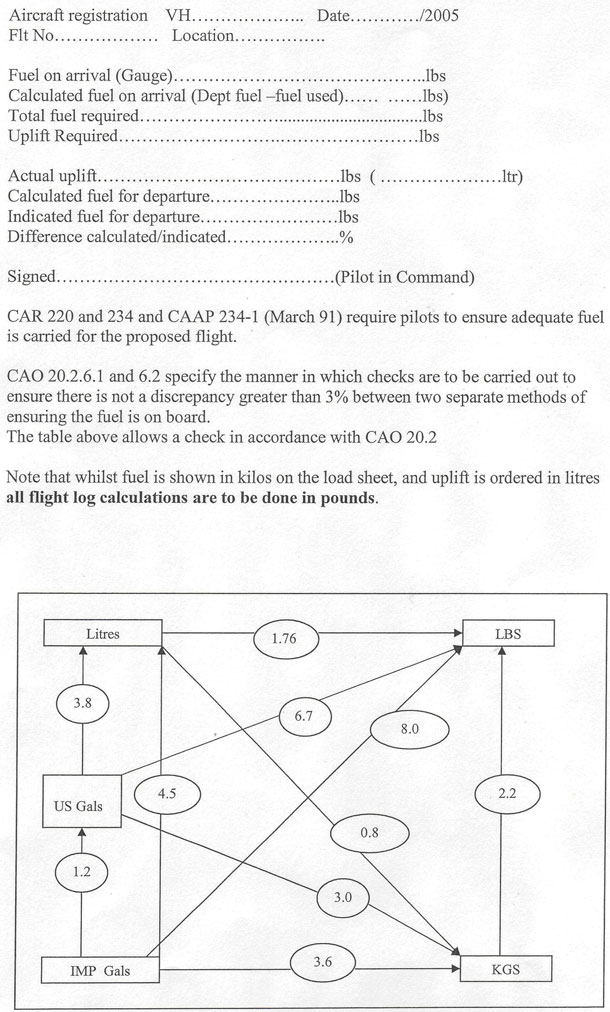
The following fuel checks must be carried out before every departure and or after every refuelling:

  1. A Magna-Stick Check must be carried out, and its reading noted (take at least 3 readings and use the lowest reading).
  2. This reading must then be compared to the gauge reading.
  3. If there is any discrepancy between the two, the Lower reading must be used for all fuel calculations and the Higher reading must be used for all weight and balance calculations.

Remember Magna-Sticks are only useful when fuel tanks are less than half full (2171 lbs) but have at least 201 lbs in them. Whenever possible, limited fuel loads to no more than 2170 lbs to allow an accurate Magna- Stick reading.

Accurate readings are obtainable only when the airplane is on a reasonably level ramp because the Magna-Stick indications depend upon the level of the fuel in the tank. Avoid inaccurate readings caused by binding of the indicator stick in its bushing by tapping the bottom surface of the wing around the Magna-stick as and before taking readings. Due to the slope of some of our parking bays (i.e. Armidale) accurate reading will not be obtained. Therefore, so long as there is no unexplained discrepancy between planned fuel remaining upon arrival and the actual fuel remaining upon arrival, the aircraft may depart without completing a Magna-Stick Check, provided a Magna-Stick Check is completed before departure from the next port that contains a level parking bay.

On Wednesday 28 September, the operator issued company Standing Order #156 as follows:

Effective immediately, before every departure the Pilot in Command MUST complete the attached form [see Attachment A]. The completed form MUST be returned with the FDL [flight deck log] at the completion of the days flying.

I would also like to remind all pilots of the obligation to carry out a 3% check before each flight as per CAO [Civil Aviation Order] 20.2.6.1.

If the difference is calculated exceed 3%, maintenance control must be notified before further flight.

With regard to the Metro, the procedures stated in Standing Order 155 must also be completed.

With regard to the CASA directions of 28 September on Metro aircraft maintenance, the operator reported that the following action had been taken:

  1. A notice to pilots and engineers was issued to direct engineering organisations that maintain the company's Metro aircraft to record fuel burns and uplifts in the captain's report area of the current FDL, in advance of a new style FDL being released.
  2. An internal task force was convened on 6 October 2005 to review, in conjunction with CASA, the company's system of maintenance and minimum equipment list for the Metro aircraft with regard to ATA Section 28 items.
  3. A notice was issued to pilots and engineers stating that the preferred method of calibration (complete system calibration) and not the alternative method (abbreviated method) was to be used whenever maintenance action that required fuel system calibration was conducted.
  4. A complete fuel indication system check and fuel system calibration was scheduled for completion on two of the company's Metro aircraft by 11 October 2005. Fuel system calibration of the occurrence aircraft would be undertaken once repairs had been completed. All calibration checks would be conducted in the presence of a CASA airworthiness inspector.

Attachment A: Procedure for pre-flight checks for fuel on board
 

aair200504768_001.jpg

1 The fuel gauge was a single display incorporating an indicator for each of the two fuel tanks.
2 A specification issued by the Air Transport Association of America that establishes a standard for the presentation of certain data produced by aircraft, engine, and component manufacturers, required for the support of their respective products.

Summary

At 1910 Eastern Standard Time on 23 September 2005, a Fairchild Industries Inc. Model SA227-AC (Metro III) aircraft, registered VH-SEF, departed Thangool on a scheduled flight to Brisbane, Qld. There were two pilots and 16 passengers on board. Approaching overhead Gayndah, the L XFER PUMP (left fuel transfer pump) amber caution light illuminated, indicating low fuel quantity. The fuel quantity indicator showed substantial fuel in the tanks. The crew completed the checklist actions but the light remained on so they diverted the flight to Bundaberg. About 18 km from Bundaberg, the left engine stopped. The crew subsequently completed a single-engine landing at Bundaberg.

Four pounds (2 L) of fuel was subsequently drained from the left tank, indicating that the left engine stopped because of fuel exhaustion. There was 49 lbs (28 L) fuel in the right tank, sufficient for about 10 minutes flight.

Faults were found in a number of components of the fuel quantity indicating system. The maintenance manual procedures for calibration of the fuel quantity indicating system had not been followed correctly on two occasions in the previous 10 days. The result was that the fuel quantity indicating system was over-reading.

The crew relied on the fuel quantity indicator to determine the quantity of fuel on the aircraft before the flight. That practice was common to most of the operator's crews. The fuel quantity management procedures and practices within the company did not ensure validation of the aircraft's fuel quantity indicator reading. There was also no system in place to track the aircraft's fuel status during and after maintenance.

Following the occurrence, the operator developed new procedures for fuel quantity management and the Civil Aviation Safety Authority made rule changes regarding fuel quantity measurement and verification for transport category aircraft.

Occurrence summary

Investigation number 200504768
Occurrence date 23/09/2005
Location 18 km SW Bundaberg, Airport
State Queensland
Report release date 29/10/2007
Report status Final
Investigation type Occurrence Investigation
Investigation status Completed
Mode of transport Aviation
Aviation occurrence category Fuel exhaustion
Occurrence class Serious Incident
Highest injury level None

Aircraft details

Manufacturer Fairchild Industries Inc
Model SA227
Registration VH-SEF
Serial number AC-641
Sector Turboprop
Operation type Air Transport Low Capacity
Departure point Thangool, QLD
Destination Brisbane, QLD
Damage Nil