Fuel exhaustion

Engine power loss, VH-OXY, Avions Pierre Robin R-2160

Analysis

Data contained in the engine manufacturer's operator's manual confirmed that, when operated at the power settings associated with the conduct of the manufacturer-recommended engine break-in flight, the engine was capable of using all of the 118 L of fuel confirmed by the pilot as available for the flight. The higher power settings reported as used by the pilot during the flight would have consumed even more fuel. That, and the lack of fuel in the aircraft's fuel tank, or of a significant spillage of fuel at the accident site, indicated that the engine failure was most probably the consequence of fuel exhaustion.

A visible fuel quantity warning light might have assisted the identification by the pilot of the developing low fuel quantity.

Factaul Information

Sequence of events

On 5 March 2005, at about 1240 Western Standard Time, an Avions Pierre Robin R-2160 aircraft, registered VH-OXY, was inbound to Jandakot Airport, WA. The flight was being conducted in the private category and the pilot was the sole occupant of the aircraft.

The pilot recalled that the aircraft was about 2 ½ NM west of the aerodrome and at an altitude of 1,200 ft when the engine suddenly lost power. The pilot was attempting to make an emergency landing on a residential street, when the outboard portion of the right wing collided with a suburban power pole. The aircraft rolled inverted before impacting the ground. The aircraft was substantially damaged. The pilot sustained minor injuries and vacated the aircraft without assistance. There was no spillage of fuel at the accident site and no post-impact fire. The maintenance personnel who attended the accident site inspected the aircraft's fuel tank and found that it did not contain any fuel.

An overhauled engine had just been fitted to the aircraft and the pilot reported that he was carrying out the engine manufacturer's procedure for engine break-in1. That procedure included that, after reaching cruise altitude, a pilot conducting the recommended 2.5 hours break-in flight should:

  • Reduce the engine power setting to 75% maximum rated for the first hour of the flight. Data contained in the engine manufacturer's operator's manual indicated that 75% power was obtained at 2,450 RPM, and that the fuel consumption at that power was about 38 L/hour.
  • Alternate the engine power between 65% and 75% during the second hour. The engine manufacturer's operator's manual indicated that 65% power was obtained at 2,350 RPM and resulted in a fuel consumption of about 34 L/hour.
  • Operate the engine at 100% power for 30 minutes, provided that the engine and aircraft are performing within the published operating manual specifications. Data extracted from the engine manufacturer's operator's manual indicated that 100% power would be achieved at 2,700 RPM and resulted in a fuel flow of about 53 L/hour.

Based on data contained in the engine manufacturer's operator's manual, it was estimated that the recommended engine break-in flight could have consumed between about 108 and 137 L of fuel.

The pilot reported that, during the engine break-in flight, he operated the aircraft's engine as follows:

  • between 2,500 and 2,600 RPM for the first 2 hours of the flight
  • at 2,700 RPM for the remainder of the flight before returning to Jandakot. The aircraft engine lost power 2 hours 41 minutes after take-off.

The pilot stated that he used a calibrated dipstick to dip the aircraft's fuel tanks prior to the flight, and that the tanks contained 118 L of fuel. He had expected the aircraft to use 35 L/hr, which was the standard fuel consumption used by the company for flight planning in that aircraft type.

The aircraft was equipped with an annunciator panel that included a warning light to indicate a low fuel quantity. However, black adhesive tape had been stuck over that panel, preventing the pilot's view of the low fuel quantity warning light. Neither the aircraft's owner/operator nor the relevant maintenance organisation could explain why the tape was stuck over the panel.

  1. First in-flight run of a newly overhauled engine.

Summary

At about 1240 Western Standard Time on 05 March 2005, an Avions Pierre Robin R-2160 aircraft, registered VH-OXY, crashed on a residential street, about 2 ½ NM west of Jandakot Airport, Western Australia.

The pilot reported that he was inbound to Jandakot when the engine suddenly lost power. The outboard portion of the right wing collided with a suburban power pole during the approach for the emergency landing and the aircraft rolled inverted and impacted the ground. The pilot, who was the sole aircraft occupant, sustained minor injuries and vacated without assistance. There was no spillage of fuel at the accident site and no post-impact fire. Personnel at the accident site inspected the aircraft’s fuel tank and observed that it did not contain any fuel.

The aircraft was on its first flight following maintenance, which had included the installation of an overhauled engine. During the flight the pilot completed the procedure for break-in of an overhauled engine. At the time of the accident, the aircraft had been airborne for 2 hours 41 minutes.

The circumstances of the engine failure were consistent with fuel exhaustion. Contributing to the fuel exhaustion were the higher than normal power settings, and therefore fuel consumption, associated with the conduct of the break-in flight.

Occurrence summary

Investigation number 200500993
Occurrence date 05/03/2005
Location 2 km W Jandakot, Aero.
State Western Australia
Report release date 13/06/2006
Report status Final
Investigation type Occurrence Investigation
Investigation status Completed
Mode of transport Aviation
Aviation occurrence category Fuel exhaustion
Occurrence class Accident
Highest injury level Minor

Embraer EMB-110P1, VH-BWC

Safety Action

On 2 December 2004, the operator advised that as a result of this serious incident, the following changes had been implemented:

  • Bandeirante flights operated by the company will be restricted to two-pilot operations
  • A company memo will be issued immediately and the operations manual amended to reflect the company's fuel verification process, which will require that verification must be obtained by cross checking the amount of fuel on the fuel docket with the amount of fuel on board the aircraft. If no receipt is found it will be assumed that no refuelling has taken place
  • The pilot's senior management and flying activities are being addressed.

On 17 December 2004 the operator advised that it had implemented, or was in the process of implementing, the following safety actions:

4.1.1 Informal communications between the company and the refuelling service provider.

4.1.2 Safety Actions

4.1.2.1 The operations manual will be amended to require direct, flight crew supervision of aircraft fuelling whenever practical. Direct supervision means being present throughout the fuel uplift, receiving the delivery docket in person and confirming the type of fuel, the fuel quantity and the distribution between fuel tanks.

4.1.2.2 The operations manual will be amended to require flight crews to confirm receipt of the delivery docket before departure and crosscheck expected fuel on board by a second independent means. Eg: Fuel uplifted crosschecked by visual inspection in tank or aircraft fuel gauges.

4.1.2.3 A memo has been issued implementing the requirements of 4.1.2.2, effective until amendments are included in the operations manual.

4.1.1 [4.2.1] Conflict between responsibilities for a single person acting in multiple roles of management, line pilot and aircraft owner.

4.2.2 Safety Actions

4.2.2.1 The company has permanently restricted the office of Chief Executive Officer to only participate in formal, two pilot flight operations. (Two pilot operations do not include the operation of single pilot aircraft with a safety pilot, endorsed on type or otherwise.)

4.2.2.2 Aircraft owners who also participate in flight operations must employ a maintenance controller to oversee maintenance allocations and to that end, company management should interact only with the maintenance controller about those aircraft.

4.2.2.3 The company requires aircraft owners to relinquish any active participation in the overseeing of their aircraft during all periods when the owners are rostered for flight operations.

4.2.2.4 Where an aircraft owner also holds a management position within the company that could see them interacting with flying staff about those aircraft, another senior management staff member (preferably the chief pilot) must be included in any such interaction.

4.3.1 Some Bandeirante pilots were operating under 2 different procedures, single and two pilot SOP's.

4.3.2 Safety Actions

4.3.2.1 The company has ceased all single pilot operations in the Bandeirante and removed the single pilot SOP's from its operations manual. The Bandeirante will be operated under the companies 2 pilot SOP's only.

4.3.2.2 All crew members operating under the company 2 pilot SOP's for the 1st time, will be required to complete a minimum of 10 sectors as co-pilot or ICUS using those SOP's, before acting as PIC in 2 crew operations.

4.3.2.3 As a part of retraining, the requirements of 4.3.2.2 will apply to the PIC in the incident, when reintroduced to flight operations.

4.3.2.4 The operations manual will be amended to include 4.3.2.2, and the policy will be transferred to the company's Check and Training Manual (currently being written) when it is approved and incorporated into the operations manual.


4.4.1 Inadequate Bandeirante checklist requirements regarding fuel quantity.

4.4.2 Safety Actions

4.4.2.1 The company has ceased all single pilot operations in the Bandeirante and removed the single pilot SOP's from its operations manual. The Bandeirante will be operated under the companies 2 pilot SOP's only.

4.4.2.2 The company's SOP's for the Bandeirante, are being amended to include a crosscheck of actual fuel on board with full required for flight as a part of the pre-takeoff briefing by the handling pilot.

4.4.2.3 The chief pilot held a briefing session with current Bandeirante crewmembers, reviewing the BWC incident and implemented changes, including those in 4.4.2.2.

4.5.1 Operations Manager and support staff have insufficient understanding of pilots' duties and responsibilities during pre-flight and flight turnaround periods.

4.5.2 Safety Actions

4.5.2.1 The company is amending its operations manual to require flight crews sign on a minimum of 1 hour prior to departure.

4.5.2.2 Operations are to allow a minimum of 45 minutes between flights when rostering turnarounds in Darwin, and a minimum of 1 hour between flights that require a flight crew to change aircraft and/or aircraft type.

4.5.2.3 The company is preparing theory course material covering basic aeronautical knowledge appropriate to the company's fleet and type of operation, which the operations manager will be required to complete. The course is also to include the requirements of CAO 48 flight and duty time limitations. The course will be assessable and able to be audited.

4.5.2.4 The company is preparing appropriate theory course material covering the company's fleet and operations, which check-in and support staff will be required to complete. The course will be assessable and able to be audited.

4.5.2.5 The company is progressively requiring the operations manager, and all flying operations support staff to read the company's' operations manual with an appropriate pilot designated to assist in its understanding. Operations staff must sign that they have read, understood and will comply with its contents.'

Summary

Sequence of events

At about 1659 Central Standard Time, on 29 November 2004, the right engine of an Embraer-Empresa Brasileira de Aeronutica, E110-P1 Banderiante, failed during the landing approach. The aircraft, registered VH-BWC, was being operated on a charter flight from Bathurst Island to Darwin, NT, with two crew1 and 18 passengers.

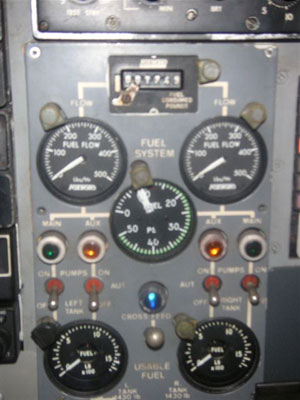
Instrument panel

The air traffic controller cleared the pilot to track via Lee Point for a right base for runway 29. The pilot reported that during the approach, about 6 NM from Darwin, he noticed that the right fuel pump warning light was flashing. Shortly after, the left fuel pump light flashed and he noticed that the fuel gauges were indicating empty. The pilot informed the controller that an engine was shutting down and requested and received a clearance to land on runway 18, which had about 5 kts downwind component. During the landing roll, the left engine also failed and both main landing gear tyres were damaged due to excessive brake application. There was no other damage and none of the occupants were injured.

The aircraft's fuel tanks were drained during the investigation, and were each found to contain about 3L of fuel. The aircraft's trip record sheet indicated that the fuel remaining prior to the last refuelling was 620 lbs and that 180 lbs had been added prior to the first flight of the day.2

The planned departure time from Darwin for the flight to Bathurst Island was 1600. At about 1500, the pilot ordered 450 lbs of fuel for the aircraft. The pilot held senior management responsibilities in the company and had been heavily distracted by those duties until after the planned departure time. He subsequently departed for Bathurst Island at 1610. The refueller was delayed and did not arrive at the operator's apron until after the aircraft had departed.

The pilot subsequently did not check the fuel quantity prior to departing from Darwin for Bathurst Island, and assumed that it had been refuelled. At the time of the incident the total fuel consumed since the last refuelling was 835 lbs.

The investigation found that the pilot in command omitted vital fuel quantity checks prior to departure from Darwin and again at Bathurst Island. The operator did not have a procedure to cross reference and verify that the required quantity of fuel had been added. The investigation determined that the lack of fuel verification procedures to confirm that the required fuel had been added, and the pilot's attention being diverted to management tasks, together contributed to this fuel exhaustion occurrence. The Bureau classified the occurrence as a serious incident due to the potential for a much worse outcome had the exhaustion occurred any earlier.

  1. The crew comprised a pilot in command and a flight attendant.
  2. The Bandeirante's fuel system records fuel quantity and usage in pounds (lbs). Fuel is ordered in litres. One litre of Jet A-1 fuel normally weighs 1.72 lbs, depending on the density of the fuel on the day.


Occurrence summary

Investigation number 200404700
Occurrence date 29/11/2004
Location 11 km N Darwin, Aero.
State Northern Territory
Report release date 24/12/2004
Report status Final
Investigation type Occurrence Investigation
Investigation status Completed
Mode of transport Aviation
Aviation occurrence category Fuel exhaustion
Occurrence class Serious Incident
Highest injury level None

Aircraft details

Manufacturer Embraer-Empresa Brasileira De Aeronautica
Model EMB-110
Registration VH-BWC
Serial number 110-261
Sector Turboprop
Operation type Charter
Departure point Bathurst Island, NT
Destination Darwin, NT
Damage Minor

Cessna 172P, VH-DBG

Safety Action

Local Safety Action

The operator advised that, following the occurrence, the aircraft involved was equipped with a new dipstick. An accuracy check was also conducted on the dipsticks fitted to other aircraft in the operator's fleet.

Analysis

The pilot was forced to land on a road when the useable fuel on board the aircraft had been consumed. The aircraft fuel quantity had been verified with an incorrect fuel dipstick that indicated unusable fuel as being useable fuel. The aircraft fuel gauges were capable of indicating fuel quantities that were consistent with the last fuel calibration card in the cockpit.

The incorrect markings on the dipstick accounted for a fuel discrepancy of 23 litres. The investigation could not determine the source of the remaining 20 litre fuel discrepancy.

Summary

The pilot had flown the Cessna 172 aircraft, registered VH-DBG, from Derby to Fitzroy Crossing earlier in the day. The pilot reported that, prior to departure from Derby, he had dipped the tanks using a dipstick, which displayed that there was 100 litres of fuel on board. After arrival at Fitzroy Crossing, the pilot added 44 litres of fuel to the aircraft. The pilot reported that he again used the dipstick to check the amount of fuel. He said that the dipstick displayed that there was 100 litres of fuel on board the aircraft.

The aircraft departed from Fitzroy Crossing and the pilot conducted a scenic flight on the return leg to Derby. As the aircraft was approaching Derby, cruising at 3000 ft, the engine began to splutter and then lost power. The pilot turned the aircraft towards a sealed road and, after transmitting a PAN call, conducted a forced landing onto a road. There were no reported injuries. The pilot reported that the flight time for the return flight was 1.8 hours. He also reported that he had leaned the mixture during the cruise portions of the flight in accordance with the engine manufacturer's operating manual. The ATSB did not attend the site, however the investigation was conducted with reference to information provided by the pilot in command, the operator and several other parties.

The pilot arranged for a licensed aircraft maintenance engineer to attend the aircraft on the road. The engineer reported that when he arrived at the aircraft and checked the fuel tanks, there was no useable fuel in either of the tanks. The pilot also reported that there was no useable fuel remaining in the fuel tanks. The engineer then checked the aircraft engine and fuel system and, after adding fuel, the aircraft was flown back to Derby with no reported problems.

Once the aircraft was back at Derby, further checks of the aircraft and its systems were conducted, with no reported defects found. The engineer reported that he added approximately 60 litres of fuel to each tank in 30 litre increments and found that the cockpit fuel gauges were showing quantities that were consistent with the fuel calibration card that was present in the cockpit.

A post occurrence flight plan of the proposed flight, in accordance with the company operations manual, revealed that the aircraft was required to carry 104 litres of fuel. With this amount of fuel onboard the aircraft, and a normal inflight fuel burn, there would have been 43 litres of fuel remaining in the aircraft at the point where the engine stopped.

The operator conducted an investigation into the circumstances of the occurrence. The operator's investigation found that the dipstick used by the pilot in command to check the fuel quantity incorrectly indicated unusable fuel as useable fuel. The amount of unusable fuel totalled 23 litres.

Occurrence summary

Investigation number 200400265
Occurrence date 22/01/2004
Location 19 km E Derby, Aero.
State Western Australia
Report release date 07/06/2004
Report status Final
Investigation type Occurrence Investigation
Investigation status Completed
Mode of transport Aviation
Aviation occurrence category Fuel exhaustion
Occurrence class Incident
Highest injury level None

Aircraft details

Manufacturer Cessna Aircraft Company
Model 172
Registration VH-DBG
Serial number 17274238
Sector Piston
Operation type Charter
Departure point Fitzroy Crossing, WA
Destination Derby, WA
Damage Nil

Kawasaki 47G3B-KH4, VH-JWZ

Safety Action

Local Safety Action

Following this occurrence the operator issued a notice to all company pilots about the correct technique for measuring the contents of the fuel tank. In addition, the company discontinued its policy of employing part-time relieving pilots at bases which were staffed by a single full-time pilot.

Significant Factors

  1. The pilot used an incorrect technique to dip the helicopter's fuel tank and consequently overestimated the fuel on-board.
  2. The helicopter operator had not advised the pilot of the change in method for measuring the fuel quantity with the new wooden dip stick.
  3. The pilot did not detect the discrepancy between the dip stick reading, the physical level of fuel contained in the tanks and the reading from the cockpit fuel gauge.
  4. The helicopter fuel log contained ambiguous entries which the pilot used to resolve the discrepancy between the incorrect dip stick reading and the fuel quantity recorded on completion of the previous day's flying.
  5. The helicopter was being flown with insufficient fuel to complete the flight.

Summary

The pilot was conducting a series of scenic charter flights in a Kawasaki KH4 helicopter and had already completed several flights during the morning. The pilot reported that he departed on a 30-minute scenic flight and had been airborne for about 25 minutes when the engine suddenly failed. At the time the of the engine failure the helicopter was flying 500 ft above ground level, about 2 NM north-west of the planned landing area. The pilot immediately lowered the collective control for the main rotor and entered an auto-rotative descent.

During the descent the pilot assessed that the helicopter could not safely reach a clearing to the south-west and manoeuvred to land in lightly timbered terrain. During the landing flare the tail rotor was reported to have struck the branches of a tree and the helicopter tipped forward before landing in a slight nose-down attitude. Damage to the tail rotor blades, main rotor mast, right front landing skid, VHF radio aerial and landing light was reported. The pilot and the two passengers did not report being injured.

The helicopter operator reported there was no mechanical reason for the loss of engine power and that fuel exhaustion may have contributed to the engine's loss of power. Approximately half a litre of AVGAS was recovered from the fuel tanks at the accident site and there was no obvious damage to the fuel system. Standard company policy required the pilot to ensure the helicopter carried enough fuel to complete the planned flight, plus an extra 20-minute fixed fuel reserve.

The pilot was a part-time employee of the helicopter operator and would relieve the full-time pilot, usually one day a week. He had been employed on this basis for approximately three months. The operator reported the recent replacement of the calibrated dip stick used to measure the fuel tank contents had contributed to the circumstances of the fuel exhaustion.

The original dip stick was a hollow calibrated hard-plastic tube and was the dip stick supplied by the helicopter manufacturer for dipping the fuel tanks. The tank contents were measured by inserting the dip stick diagonally into the tank, passing it through a hole in the tank baffle and then placing a finger over a small hole at the top of the dip stick. This would cause fuel to be trapped inside the tube, allowing the dip stick to be removed from the tank and reading of the tank contents against a graduated scale.

To ensure the plastic dip stick was inserted at the correct angle, two metal pins protruded from either side, near the top of the dip stick. These pins would rest on the fuel filler neck and ensured the fuel quantity could be measured consistently. Cracks in the plastic tube had made the dip stick ineffective for measuring the tank contents and the helicopter operator had recently replaced it with a wooden dip stick.

The new wooden dip stick had been calibrated to measure the fuel quantity when inserted almost vertically into the tank, without passing through the hole in the tank baffle. Using this technique had the advantage of restricting the angle at which the dip stick could be inserted into the tank and when correctly applied, would not cause large errors in measuring fuel quantity.

On the day of the accident, the pilot reported that he had used the new wooden dip stick for the first time. He had used the same technique to dip the fuel as he had been instructed to use with the original plastic dip stick. He was not aware that this method for measuring the fuel quantity was only valid when using the original manufacturer's supplied dip stick.

This had resulted in the pilot inserting the wooden dip stick into the tank at an oblique angle, passing through the tank baffle and resting on the tank bottom. This technique could result in a significant over estimation of tank contents. The pilot reported that he had not been advised of the change in method for dipping the tanks using the new dip stick, although he previously had used similar dip sticks on other models of helicopter.

The pilot reported that on the day of the accident, he had first dipped the fuel tanks during the daily inspection conducted prior to the first flight of the day. During this inspection, he detected a discrepancy with the helicopter's fuel log, where the closing figure from the previous days flying did not appear to match the reading he obtained from the tank dip. In trying to resolve this discrepancy, the pilot reviewed other entries in the fuel log and noticed what he believed was another similar discrepancy from the day before. With this discrepancy in mind, he elected to proceed on the basis that his dip of the tank was accurate. The pilot continued to over estimate the quantity of fuel contained in the tanks during subsequent dips of the tank.

The operator subsequently reported the pilot had misread the fuel log and there was no discrepancy. The investigation reviewed the calculations of the aircraft's hourly fuel consumption, which supported the accident pilot's interpretation of the entry in the fuel log for the day before the accident. It was not possible to further address this ambiguity or to determine positively what figure had been entered in the fuel log.

The operator did not have a policy for resolving discrepancies with fuel log entries and relied on the pilot using the dip stick to check the fuel quantity before confirming this reading with a visual check of the tank contents. The operator reported that all pilots were trained to verify dip stick readings using this method and that the tank contents could be seen through the opening of the filler neck. This figure would then be verified against the indications of the fuel gauge and the information contained in the aircraft fuel log. The pilot reported that he was not in the practice of making a visual check of the tank contents and he relied on the reading he obtained from the fuel dipstick as being the quantity contained in the tanks. He could not recall being instructed in the technique of comparing dipstick readings with a visual assessment of the tank contents during his training. The pilot did not detect any discrepancy between the fuel quantity measured using the dip stick and the readings from the cockpit fuel gauge. The investigation was unable to verify the apparent training discrepancy.

The pilot fuelled the helicopter twice on the day of the accident. Before the first flight of the day, 40 litres had been added and another 105 litres was added later that morning. The pilot estimated that when the engine failed, the helicopter had flown about 1-hour 25-minutes since the last refuelling. Based on information supplied to the investigation, it was likely the fuel tanks contained between 30 and 50 litres before the first flight of the day and between 25 and 35 litres before departing on the accident flight.

The pilot reported that he had been monitoring the fuel consumption by crosschecking the fuel gauge indications with readings obtained from the dip stick. However, he did not detect the critically low fuel level before he departed on the accident flight. It was also likely the fuel level was critically low on completion of the first flight of the day.

Contributing to the circumstances of the fuel exhaustion was the ambiguity with the fuel log entry from the previous day's flying. The pilot's relatively low-level of experience on this helicopter type and his employment status as a part-time relieving pilot had possibly contributed to his reliance on a dip stick reading to resolve the discrepancy with the helicopter's refuelling log.

Occurrence summary

Investigation number 200003056
Occurrence date 18/07/2000
Location 4 km NW EI Questro, (ALA)
State Western Australia
Report release date 03/08/2001
Report status Final
Investigation type Occurrence Investigation
Investigation status Completed
Mode of transport Aviation
Aviation occurrence category Fuel exhaustion
Occurrence class Accident
Highest injury level None

Aircraft details

Manufacturer Kawasaki Heavy Industries
Model 47
Registration VH-JWZ
Serial number 2108
Sector Helicopter
Operation type Charter
Departure point EI Questro Station WA
Destination EI Questro Station WA
Damage Substantial

Piper PA-31, VH-FMU

Summary

The pilot was tasked to convey six passengers from Brisbane to Miamba, about 165 NM WNW of Brisbane, and return. The aircraft was parked at Archerfield and the passengers were to be picked up at Brisbane Airport.

The aircraft operator had no formal system of recording the amount of fuel remaining in the aircraft at the end of each flight. Normally, the fuel state was discussed between the pilots of the previous and next flights. In this instance, however, the pilot did not speak to the person who last flew the aircraft. The pilot said that it was his practice to use the fuel gauges and the fuel gauge calibration chart to determine the amount of fuel in the aircraft.

The weather forecast obtained by the pilot indicated the 7,000 ft wind as 110 degrees at 15 kts, and the 5,000 ft wind as 120 degrees at 20 kts. The pilot calculated the following flight times and fuel requirements for the intended flights, assuming a fuel consumption rate of 140 lt per hour:

Archerfield - Brisbane 5 mins, 27 lt
Brisbane - Miamba 59 mins, 174 lt
Miamba - Brisbane 59 mins, 174 lt
Total 123 mins, 375 lt

Before the flight, the pilot obtained information about the destination airstrip and decided to have the aircraft refuelled to full main tanks (415 lt). The fuel gauges for the auxiliary tanks were indicating half full. Using the lesser of the aircraft flight manual and the fuel calibration card figures, the pilot assessed that the auxiliary tanks contained 147 lt. From this information, he calculated that the aircraft contained 562 lt of fuel - sufficient for about 4 hours of flight.

Because of air traffic control requirements and the prevailing weather conditions, the flight from Archerfield to Brisbane took about 30 minutes.

During the flight to Miamba, the pilot selected the auxiliary tanks for a period during cruise at 8,000 ft, but did not record the times when these selections were made. Flight duration was about 66 mins.

At Miamba, the pilot estimated (from the fuel gauges) that there was 280 lt fuel remaining for the return flight to Brisbane. At top of climb (7,000 ft) he again selected the auxiliary tanks. Because the gauge indications reduced faster than he anticipated towards empty, he allowed the auxiliary tanks to empty before re-selecting the main tanks. The pilot said that the fuel quantity gauges indicated about 1/8 when the auxiliary tanks were empty. Because of headwinds, the pilot descended to 5,000 ft to try to achieve a higher ground speed but to little effect. At that altitude, the aircraft was in cloud.

At about 30 nm from Brisbane, with the gauges indicating about 1/8, the pilot became concerned that there might not be sufficient fuel to complete the flight to Brisbane. He descended to 4,000 ft, again seeking a better ground speed. The pilot then elected to divert to Archerfield (which was closer) and told air traffic control that he did not wish to descend further until close to Archerfield. Shortly after being cleared to turn towards Archerfield, the left engine surged and then ceased operating. The pilot feathered the propeller and informed air traffic control that he required an immediate landing at Amberley. He did not declare an emergency.

Soon after the left engine failed, the aircraft flew clear of cloud and the pilot saw Amberley aerodrome. He conducted a straight-in approach to runway 15 at Amberley. He manually extended the landing gear with assistance from the passenger in the right control seat. The aircraft touched down about 5,000 ft along the runway and the pilot deliberately steered the aircraft off the runway edge on to grass late in the landing roll. There was no damage to the aircraft. The flight from Miamba had taken about 84 minutes. After refuelling, the engines operated normally.

Investigation revealed that the aircraft actually contained about 477 lt on start-up at Archerfield - 85 lt less than the pilot believed. That included 220 lt remaining from the previous flight, and 257 lt added during refuel. The aircraft operator said that his company used a rate of 150 lt per hour for flight planning purposes. Based on that figure, there was sufficient fuel on board the aircraft for about 190 minutes flight. From the total flight time of about 180 minutes, the aircraft had achieved an actual fuel usage rate of about153 lt per hour (allowing about 30 minutes ground operating time), close to the planning figure used by the operator. It is logical to conclude, therefore, that the engines performed normally during the flight, and that the fuel supply to the left engine was exhausted, causing it to cease operating. It is likely that the fuel supply to the right engine would also have been exhausted within a few minutes if the pilot had not shut the engine down.

The pilot said that, based on the handling notes for the aircraft, 126 lt fuel per hour would be consumed at 65 per cent engine power (31 inches MAP and 2,200 rpm). He had used a rate of 140 lt per hour in planning for the flight, which he considered more than adequate. Although the pilot's aeronautical experience was significant, over 90 percent of it was as a flying instructor on single engine aircraft. The pilot had little experience in charter operations. His experience on the aircraft type was also low.

Occurrence summary

Investigation number 200002018
Occurrence date 23/05/2000
Location 31 km N Amberley, (NDB)
State Queensland
Report release date 01/06/2001
Report status Final
Investigation type Occurrence Investigation
Investigation status Completed
Mode of transport Aviation
Aviation occurrence category Fuel exhaustion
Occurrence class Incident
Highest injury level None

Aircraft details

Manufacturer Piper Aircraft Corp
Model PA-31
Registration VH-FMU
Serial number 31-8212015
Sector Piston
Operation type Charter
Departure point Miamba, QLD
Destination Brisbane, QLD
Damage Nil

Piper PA-34-220T, VH-YSG

Significant Factors

  1. The pilot's fuel planning was based on incorrect fuel content and weight considerations.
  2. The pilot did not include the Sydney Harbour scenic flight in his flight planning.
  3. The pilot diverted from the recommended in-flight fuel management practices.


Analysis

The aircraft had been assessed as having 280 L of fuel on board prior to departure from Canberra, based upon the delivery pilot's calculation. ATSB calculations, using the operator's own fuel planning figures, indicated that the amount of fuel consumed during the 1.8 hour delivery flight from Tamworth would likely have equated to a fuel remaining figure of approximately 265 L. In addition, no allowance was able to be determined for the amount of fuel consumed during the engine ground runs at Tamworth, between the time of the last recorded refuel and the delivery flight. Accordingly, the actual fuel tank contents on departure from Tamworth for the delivery flight could not be accurately determined and would probably have been an amount less than the maximum useable.

While planning for the accident flight utilising a computer-based application, the pilot used an incorrect figure (465 L) with respect to total versus useable fuel tank contents (454 L). That led the pilot to include 11 L of fuel, which was unavailable for engine consumption. In addition, he omitted to plan an allowance for fuel consumption during the approximately 12-minute Sydney Harbour scenic flight. Using the operator's fuel consumption planning figure, this may have involved consumption of up to 20 L of additional fuel.

The pilot's use of the computer-based flight planning application included calculations for aircraft weight and balance. His utilisation of the full fuel planning figure in these calculations, instead of the assessed fuel load figure of 280 L, may have led to an erroneous perception that he would be overweight following embarkation of the five passengers at Bankstown, if he added fuel prior to take-off from either Bankstown or Canberra. Had the pilot used the assessed fuel tank content figure, he would have realised that he could have added fuel and remained within aircraft weight limitations.

The manufacturer's fuel usage figures are determined using a recommended technique for leaning of the fuel mixture supplied to the engines. During the accident flight, the pilot deviated from the recommended technique. That deviation would likely have increased the engine fuel consumption.

Technical investigation of the right engine indicated that it was capable of normal operation. Examination of the left engine indicated that it should still have supplied at least partial power in flight. The failure mode of the exhaust valve rocker stud and the bending of the inlet valve pushrod were examined in consultation with a representative of the engine manufacturer and engine overhaul specialists. Although an exact reason for the failure could not be determined, it is possible that the damage may have occurred following the loosening of one or both of the rocker pivot retaining nuts. As the nut(s) loosened during engine operation, the exhaust valve rocker would have lifted, preventing the exhaust valve from opening. During the valve overlap stage of the engine operating cycle, prior to the start of the induction stroke, the ignited and expanding combustion gasses may have been unable to escape through a now closed exhaust valve. That scenario would have greatly increased internal cylinder pressure which could have prevented the inlet valve opening and, consequently, resulted in the bending of the inlet valve push rod as it tried to move the valve. The damage to the inlet valve pushrod was also considered to have been consistent with the rotation of the engine with a "hydraulic lock" situation existing in the cylinder. Such a condition may occur in the cylinder if the engine was over primed prior to an engine start.

It is likely that the engine failures occurred as a result of fuel exhaustion.

Factual Information

The Piper PA34 Seneca III, took off from Canberra for Bankstown under the Visual Flight Rules (VFR). The pilot in command had planned to embark five passengers at Bankstown then to conduct a scenic flight around Sydney Harbour, proceed to Cessnock for lunch and return to Bankstown where he intended to disembark the passengers before returning to Canberra.

The flight to Bankstown was uneventful. On departure from Bankstown, the pilot proceeded southeast to the coast and then north, at low level, along the VFR coastal route to Manly. A delay was experienced at Manly, prior to turning south and entering Sydney Harbour. The Sydney Harbour scenic flight was then conducted, completing a circuit of the Harbour Bridge to Rushcutter's Bay loop. The pilot then returned to South Head and proceeded north via Aeropelican for a landing at Cessnock.

During the return flight, the pilot deviated west of the planned track in order to avoid severe weather that had been indicated on the aircraft's weather radar. Shortly after passing Brooklyn Bridge, which was the start point for the northern inbound VFR track to Bankstown, at an altitude of 2,500 ft, the pilot reported that the left engine suddenly stopped. The pilot reported that he then carried out the engine failure checks from memory, feathering the propeller. Approximately one minute later, the right engine began to gradually lose power, before stopping after approximately a further 20 seconds. The pilot reported that he then pushed all of the engine and propeller controls forward and attempted to restart the engines. That action resulted in the inadvertent unfeathering of the left propeller due to operation of the unfeathering accumulator.

The pilot conducted a forced landing into a treed area beside a main road. The aircraft struck the trees, rotated to the right and impacted the ground left wing forward. Four of the six occupants sustained serious injuries and the aircraft was destroyed.

Pilot information

The pilot was appropriately licensed for the flight and had accumulated a total of 270 hours flying experience with 14 hours on the aircraft type.

Flight and fuel planning

The aircraft arrived on the operator's flight line five days before the accident, after delivery from Tamworth. The technical log indicated that the last recorded refuel had been conducted at Tamworth on 13 March 2000. Between that time and the delivery flight to Canberra the aircraft had undergone a 15-minute dual engine run following a propeller change. The engine run included a period of one to one and a half minutes with both engines at full power. Prior to departure from Tamworth, the delivery pilot reported that he visually assessed the fuel tanks as full. Upon arrival at Canberra, the fuel tank content was assessed as 280 L, using flight time and fuel usage calculations.

The pilot planned the accident flight utilising a computer-based flight planning application. He did not plan for any aerial work at Sydney Harbour, despite having an intention to conduct a scenic flight in that location. Air Traffic Services (ATS) radar data indicated that the scenic flight duration was approximately 12 minutes. In addition, he planned the flight using figures for full fuel tanks, however he used the total fuel tank content figure of 465 L instead of the useable fuel tank content figure of 454 L. Further, he was aware that the aircraft had only an assessed 280 L of fuel on board and considered that that amount was sufficient for the flight from Canberra to Cessnock and for the return flight to Bankstown. He had decided not to add fuel prior to departure from Canberra due to a perception that the aircraft would be over Maximum Take-off Weight at Bankstown or Maximum Landing Weight at Cessnock, after the addition of the five passengers.

Fuel management

The pilot reported that he visually checked the fuel tank contents at Canberra before departure, with fuel just visible through the fuel cap opening. That quantity was then cross-checked with the aircraft fuel gauges and it appeared to agree with the previously calculated total. An attempt was also made to check the fuel tank contents using the aircraft's fuel dipstick, however, that was unsuccessful as the fuel level was well below the lowest graduated scale on the stick. The pilot reported that he again checked the fuel level on arrival at Bankstown. At that time the level was out of sight of the fuel caps, however, the total fuel remaining on the fuel gauges appeared to agree with his assessment. Prior to landing at Cessnock the fuel gauges were again checked, with the pilot considering that the indicated fuel level was what he expected from his mental calculations to allow for the return flight to Bankstown.

ATS radar data indicated a total flight time of 159 minutes from take-off at Canberra to the accident site. That figure did not include any allowance for ground taxi at Canberra, Bankstown and Cessnock. Using the operator's recommended fuel usage planning figure of 100 L per hour, 159 minutes flight time would have consumed 265 L of fuel.

The aircraft manufacturer's recommended engine fuel leaning procedure for cruise flight was detailed in Section 4 (Normal Procedures) of the Pilot's Operating Handbook, which stated:

"For 45, 55 and 65% power the mixture should be leaned to 25 [degrees] F rich of peak E.G.T. [Exhaust Gas Temperature] but not to exceed 1,650 [degrees] F E.G.T.", and "For maximum engine service life, cylinder head temperatures should be maintained below 420 [degrees] F..."

The pilot reported that he had been taught to lean the fuel mixture to the top of the green arc on the exhaust gas temperature gauge. The green arc on the gauge extended from 1,200 to 1,525 degrees F. He reported that during the accident flight he leaned the mixture according to that method, however he had subsequently enriched the mixture one or two graduations below the top of the green arc. Advice from the aircraft manufacturer and other Seneca III operators, indicated that that action may have increased the fuel flow by up to approximately 10 L per hour.

Approximately one litre of fuel was recovered from the aircraft wing tanks, however the fuel tanks had been substantially damaged during the impact sequence. There was no evidence of fuel leakage on the ground. Inspection of the fuel system components revealed no evidence of fuel contamination. The left engine fuel selector control was positioned at the OFF position and the right engine selector was positioned at ON.

Engine and fuel system information

Both engines had recently been overhauled and had flown 57.3 hours since fitment to the aircraft.

During the flight, a short time after passing Aeropelican, the pilot reported that the left engine had required increased throttle to maintain the selected manifold pressure. While taxying after landing at Cessnock the left engine appeared to idle slower than before and the alternator light flickered on and off. The light had extinguished when the pilot increased engine RPM. After vacating the aircraft, the pilot noticed evidence of an oil leak along the outboard side of the left engine cowling, on the underside of the left wing and on the left flap. A check of the left engine oil quantity revealed that the engine had used about half a quart during the flight. Confirmation with the operator by telephone indicated that the oil level was within tolerances. The source of the oil leak was not able to be located. The pilot reported that operation of both engines from departure at Cessnock to the point of engine failure appeared normal.

Technical investigation at the accident site revealed that the left engine number 4 cylinder exhaust rocker pivot was loose and that the rocker had contacted and holed the inside surface of the rocker cover. The forward rocker pivot-retaining stud had sheared flush with the surface of the head with evidence of a fatigue failure on the stud fracture surface. The number 4 cylinder inlet valve push rod had also failed close to the outboard tip of the rod. Detailed technical examination of both engines at an engine overhaul facility noted that the exhaust valve on the number 4 cylinder of the left engine remained closed during rotation of the crankshaft and the inlet valve on the same cylinder only opened a small amount. Both engines were then test run in an engine test cell. The test run of the right engine revealed no condition that would have contributed to the in-flight loss of power. The test run of the left engine indicated that it was capable of operation, however it's performance was affected by the damage evident on the number 4 cylinder's valve mechanism.

Occurrence summary

Investigation number 200001434
Occurrence date 25/04/2000
Location 13 km S Brooklyn Bridge, (VTC Check Point)
State New South Wales
Report release date 10/04/2002
Report status Final
Investigation type Occurrence Investigation
Investigation status Completed
Mode of transport Aviation
Aviation occurrence category Fuel exhaustion
Occurrence class Accident
Highest injury level Serious

Aircraft details

Manufacturer Piper Aircraft Corp
Model PA-34
Registration VH-YSG
Serial number 34-48020
Sector Piston
Operation type Private
Departure point Cessnock, NSW
Destination Bankstown, NSW
Damage Destroyed

Brantly International Inc B-2B, VH-BHY, Raymond Island, Victoria, on 2 March 2000

Safety Action

Local safety action

As a result of investigations into the circumstances of this accident the Bureau expressed concern to the helicopter manufacturer about aspects of the text in the Flight Manual relating to the Low Fuel Warning Indicator. These were:

  1. references to the remaining flight time from when the warning light first illuminates. The test of this system only determined a remaining fuel quantity. The remaining endurance was predicated on a fuel consumption that may differ from actual fuel consumption rates.
  2. the wording of the CAUTION could be misinterpreted and it should be made clear that flight is discontinued as soon as possible after the low fuel indicator lamp illuminates, and
  3. the importance attached to this information was better emphasised by a WARNING annotation, rather than a CAUTION.

Correspondence from the helicopter manufacturer, dated 18 October 2000, stated that they intend to incorporate these changes with an upgraded and reformatted Flight Manual within the next 12 months.

Significant Factors

  1. The pilot planned the flight using a fuel consumption rate that was significantly less than the actual consumption.
  2. There was no logging of fuel usage for the helicopter that would have alerted the pilot to the greater than planned consumption rates.
  3. The pilot did not check the actual fuel consumption.

Analysis

The circumstances leading to the loss of engine power were consistent with fuel exhaustion. The same consumption rate achieved on the flight from Bankstown to Moruya would have used all the helicopter's useable fuel in the elapsed flight time from Moruya to the accident site at Raymond Island.

The lack of any recorded fuel consumption checks meant that actual fuel consumption rates were not readily available to pilots flying the helicopter. This meant significant differences between planned and actual fuel consumption rates remained undetected. However, the quantity of fuel added at Moruya was greater than the planned fuel burn-off and should have alerted the pilot to the need for a check of the helicopter's actual fuel consumption. The remaining useable fuel at Moruya represented the minimum recommended allowance of 20 minutes fixed reserve. Any attempt to fly a greater distance under those conditions would have only been achieved by reducing the reserve fuel allowance.

The fuel consumption rate may have been masked by the reported anomalous fuel quantity indication. The reported 1/4 indication on the fuel gauge prior to the loss of engine power was just greater than the quantity that the pilot would have expected at his planned consumption rate. This may have reinforced his assessment of the actual fuel status and caused him to doubt the veracity of the low fuel warning.

Pilots of single-engine aircraft should always consider the possibility of an in-flight engine failure and its consequences. The engine failure occurred over water and at an altitude that did not permit an unpowered descent to a suitable land emergency landing site. This meant that the pilot was not in a position to conduct a forced landing without risk of damage to the helicopter and possible injury to its occupants. Evidence at the accident site suggested that contact with the tree canopy was not consistent with an autorotation landing that would have achieved minimum forward speed and rate of descent as recommended in the flight manual. Consequently, the attempted landing into the tree canopy did not achieve optimum conditions for survival.

Witnesses immediately initiated search and rescue action. However, had the helicopter not been seen just before descending into the trees, as might have been the case in more remote parts of the island, the consequences of not carrying an ELT may have been crucial to the survival of both the pilot and passenger.

Factual Information

History of the flight

The pilot and passenger were making a private flight in a Brantly two-place helicopter in accordance with the visual flight rules (VFR) from Bankstown to Lilydale with planned fuel stops at Moruya and Orbost. They departed Bankstown at 1100 ESuT and, following an uneventful flight to Moruya, refuelled the helicopter to full tanks at 1313. While on the ground at Moruya the pilot telephoned the fuel distributor at Orbost to confirm the availability of Avgas and was told that they did not hold any Avgas drum stock. The distributor suggested that he try Bairnsdale where Avgas was readily available. The pilot then elected to fly the extra distance to Bairnsdale after having determined that it was within the safe range of the helicopter and overfly Merimbula where fuel was readily available. At 1412 he departed Moruya with a planned endurance of 2 hours and 50 minutes.

The pilot monitored the progress of his flight by comparing the 10-minute time increments he had marked on his charts against an electronic timer attached to the instrument panel. The passenger reported that as they were approaching Bairnsdale she saw the low fuel warning light begin to flicker. The fuel gauge showed just above one quarter full. Shortly after, she saw the needle of the fuel gauge drop below the quarter full mark and the low fuel warning light stopped flickering and remained on. A few moments later the engine began to run roughly.

The pilot reported that soon after he saw the low fuel warning light illuminate, the engine lost power. He was flying at approximately 1,500 ft over water and turned toward Raymond Island, 7 NM east of Bairnsdale. He elected to land on the tree-covered shore rather than attempt to ditch the helicopter, which was not equipped with flotation gear or life jackets. He could not recall actioning any emergency drills.

At 1640 witnesses on Raymond Island reported seeing a helicopter approaching the southern shore of the island at low altitude with its engine running roughly and intermittently. As it passed low over bushland the engine was heard to cut out and the helicopter descended out of sight behind trees. A few seconds later witnesses heard the sound of two distinct impacts. They immediately commenced a search of the area and after 10 to 15 minutes located the wreckage of the helicopter in the undergrowth. The seriously injured occupants were administered first aid. Rescue and emergency personnel reported that there was no smell or evidence of fuel at the accident site and the injured passenger had told them the helicopter had run out of fuel.

Examination of the wreckage

The helicopter entered the tree canopy at moderate forward speed and travelled through the light timber and scrub for nearly 30 metres before contacting the ground, pitching forward and coming to rest inverted. Although damaged, one of the three main rotor blades was still attached to the rotor hub. The other two blades were shattered outboard of the secondary hinge and the fragments dispersed. Damage to the transmission and main rotor was consistent with no power being delivered to the rotor system. Examination of the wreckage and subsequent testing of components did not reveal any defect that would have contributed to the accident. The upper fuel cell was perforated during the accident sequence and the fuel plumbing damaged. The fuel system was drained and a small quantity of Avgas, approximately 50 mL, was found. The accuracy of the low fuel warning system could not be determined.

Pilot qualifications and experience

The pilot held a Special Pilot (Helicopter) Licence and a valid Class 1 medical certificate. The special licence validated his United States of America, Federal Aviation Administration (FAA) Commercial Helicopter Licence. He also held a United Kingdom Civil Aviation Authority Private Pilot's Licence (Helicopters). His total flying experience was 262 hours helicopter flight time of which 100 hours were on type. Prior to this flight, all but 10 hours of flight time on this type had been undertaken in the United Kingdom.

Fuel consumption and flight planning

A fuel gauge and engine instrumentation provided pilots with fuel flow information. Apart from this the only fuel consumption data provided to pilots was on a specification sheet published by the manufacturer of the helicopter. This listed a normal cruise fuel consumption of between 38 and 42 Litres per hour (LPH) at a power setting of 75 percent. The engine manufacturer's charts gave fuel consumption rates for the equivalent power from a lean limit of 43 LPH up to a "suggested high limit" of 52 LPH. The reason for the apparent difference in quoted fuel consumption rates was not able to be determined. The fuel consumption rate for the flight from Bankstown to Moruya was calculated to have been between 46 and 47 LPH. This was based on the flight time of 2 hours and 13 minutes. An accurate average fuel consumption rate for the helicopter was not possible because flying times and fuel records were incomplete. Only one pilot had established a consumption rate, reported to have been 48 LPH. Other pilots reported they had conservatively flown the helicopter for periods less than two hours and although they were unsure of actual consumption rates they thought that it was greater than 40 LPH.

The pilot had planned this flight using a fuel consumption rate of 40 LPH, a figure he had used for all his previous flying on the type. The flight from Bankstown to Moruya was the first extended flight he had undertaken in Australia. He had not checked the fuel consumption after refuelling at Moruya and used the same flight planned fuel consumption rate in his fuel calculations for the flight to Bairnsdale.

The helicopter was fitted with a manually operated vernier mixture control. The fuel flow gauge was graduated in US gallons per hour with a corresponding non-linear outer scale for the manifold air pressure (MAP) setting. The pilot reported that he had used a MAP setting of 21 inches of mercury and had adjusted the mixture in accordance with the flight manual procedure. The corresponding fuel flow indication for this power setting equated to 41.7 LPH. In contrast the estimated consumption rate of 47 LPH was equivalent to a MAP setting of 22.5 inches of mercury.

Fuel quantity indications and warnings

The helicopter had an electrically powered fuel gauge with graduations for each quarter of tank capacity. The calibration card showed that the 1/4 capacity graduation corresponded to a quantity of 29 L. Other pilots who had flown the helicopter reported that the gauge readings appeared to be inconsistent with fuel usage and that at lower fuel quantities they thought the gauge over-read.

A warning light provided the pilot with a low fuel quantity warning. The system was pneumatically operated and was independent of the fuel quantity indication system. The low fuel quantity warning light was designed to flash as the fuel level approached the 10 minute reserve. The length of flash became progressively longer until finally a steady red light appeared when approximately 5 minutes of flight time remained. The aircraft Flight Manual stated that flight should not be attempted beyond the first indication of the low fuel warning light. A few pilots reported that on occasions the low fuel warning light had illuminated intermittently during manoeuvring and in turbulence with low fuel quantities.

Autorotation technique

Autorotation facilitates a controlled descent and landing when engine power to the rotor system is removed, such as when an engine fails. The technique normally requires the helicopter to be flared toward the end of the approach in order to arrest its forward speed and use the energy stored in the rotor system to reduce the vertical speed and cushion the helicopter's touchdown. The flight manual recommended a speed of 48 kts for a power-off approach. It also stated that in the event of an engine failure over rough terrain "Increase angle of flare to reduce airspeed to near zero ground speed and allow helicopter to settle vertically".

Search and rescue

The pilot had not lodged flight details or nominated a Sartime, but had arranged for an operator at Bankstown to provide a SARWATCH. Although the pilot had nominated carriage of an Emergency Locator Transmitter (ELT) on his flight plan the aircraft was not equipped with one, nor had he carried a portable unit. Civil Aviation Regulation (CAR) 252A required the carriage of an ELT for this flight. The pilot later reported that he thought the aircraft had an ELT installed. An entry on the Maintenance Release stated "Carriage of ELT in accordance with CAR 252A - As Required".

Occurrence summary

Investigation number 200000765
Occurrence date 02/03/2000
Location Raymond Island
State Victoria
Report release date 15/11/2000
Report status Final
Investigation type Occurrence Investigation
Investigation status Completed
Mode of transport Aviation
Aviation occurrence category Fuel exhaustion
Occurrence class Accident
Highest injury level Serious

Aircraft details

Manufacturer Brantly International Inc
Model B-2
Registration VH-BHY
Serial number 2007
Sector Piston
Operation type Private
Departure point Moruya, NSW
Destination Bairnsdale, VIC
Damage Destroyed

Amateur Built Aircraft Lancair 235, VH-LWA

Summary

The pilot of the Lancair had built the aircraft as an owner-builder. He and his passenger had intended to fly from Perth, Western Australia to an airshow at Mangalore, Victoria. On the day prior to the accident, the aircraft arrived early in the afternoon at Aldinga, South Australia, where it was refuelled in preparation for the next leg of the flight. The pilot and passenger then stayed overnight with a friend. The following morning, the aircraft departed for Murray Bridge, South Australia in order to meet up with another aircraft for the remaining flight to Mangalore.

When the aircraft was 3 km to the north-east of Aldinga aerodrome, witnesses heard the engine surge and lose power. The aircraft was then seen to enter a spin and crash into a dry creek bed. Both occupants were fatally injured. The accident was not considered to be survivable.

Traces of aviation fuel were found on the ground at the accident site under the wing fuel tanks. There was no evidence that a significant quantity of fuel had been released during the impact. There had been no post-impact fire.

The investigation established that the aircraft had been refuelled the previous day at Aldinga to a capacity of approximately 80L. It was operating within weight and balance limitations, close to its maximum weight, and close to the aft limit of its centre of gravity. There was no evidence to suggest that the aircraft was not airworthy prior to the accident, nor was there any indication that either the pilot or the passenger had been incapacitated immediately before the accident.

The aircraft utilised three fuel tanks: one was located in each wing below the level of the engine, while the third fuel tank was located in the fuselage, above the level of the engine. The engine could be fed with fuel directly from any one of these.

It was the pilot's normal policy to use fuel from the fuselage tank when priming the carburettor prior to starting the engine, and then to select a wing fuel tank once the engine had been started. During the flight from Western Australia, only the wing fuel tanks had been filled at all refuelling ports except for Ceduna, where it was not possible to ascertain how the aircraft had been refuelled. Investigation revealed that at the time of the accident, the low-fuel warning light for the fuselage tank was illuminated, indicating that only a small quantity of fuel remained in that tank.

The investigation found that aviation fuel had been spilled on the ground, chemically burning the grass, at the aircraft's overnight parking location at Aldinga aerodrome. The shape of the burnt grass area was consistent with fuel having been spilled over the sides of a 20 L fuel drum. Police reported that fuel had been stolen on other occasions from aircraft at Aldinga aerodrome. A road near the aerodrome was regularly used for car racing, and it is possible that fuel was siphoned overnight from the aircraft's fuel tanks.

Damage to the aircraft systems precluded a determination of the fuel tank that was selected at the time of the accident. A lack of both fire damage and evidence of fuel spillage at the accident site indicated that there was only a small quantity of fuel in the aircraft at the time of the accident, despite the aircraft having been refuelled the previous day. It was not possible to ascertain if the engine lost power due to fuel exhaustion from a wing fuel tank, or if the fuselage tank had been selected prior to take-off and that that tank had become exhausted.

The reason for the aircraft entering a spin after the engine lost power could not be determined.

Occurrence summary

Investigation number 199901340
Occurrence date 02/04/1999
Location 3 km NE Aldinga Aero.
State South Australia
Report release date 21/12/1999
Report status Final
Investigation type Occurrence Investigation
Investigation status Completed
Mode of transport Aviation
Aviation occurrence category Fuel exhaustion
Occurrence class Accident
Highest injury level Fatal

Aircraft details

Manufacturer Amateur Built Aircraft
Model Lancair
Registration VH-LWA
Serial number W139
Sector Piston
Operation type Private
Departure point Aldinga, SA
Destination Murray Bridge, SA
Damage Destroyed

Bell 47J-2A, VH-THH

Summary

A Bell 47J helicopter was being ferried by two pilots from Lyndock SA to Kings Creek Station NT over a period of 3 days. Refuelling stops were planned for Port Augusta, Roxby Downs, Coober Pedy, Cadney Park if required, and Kulgera. Additional equipment was also carried, including a ground refuelling hose and pump unit, aircraft manuals, hand tools, additional engine oil, water, and seven 20 L jerry cans of fuel.

The flight was uneventful to Cooper Pedy where a flight plan was lodged nominating Cadney Park and Kulgera as landing points. The helicopter subsequently departed at about 0730. When it failed to arrive at Cadney Park or Kulgera, a search was initiated. The burnt-out wreckage of the helicopter was located 2 days later in flat, open, sparsely timbered country, about 1 NM south-west of Temptation Bore and approximately 152 NM from Coober Pedy, close to the direct track to Kulgera. The accident was not survivable.

At the time of the accident the weather was fine and clear, with a light breeze from the south-east, and a temperature in the vicinity of 30 degrees Celsius.

Examination of the wreckage did not reveal any pre-existing defects which may have contributed to the accident. An intense post-impact fire fuelled by the fuel from the jerry cans had consumed the cockpit and forward section of the tail boom. The engine displayed severe impact and external fire damage, but all internal components were intact, well lubricated, and capable of normal operation. The fire had destroyed the fixed emergency locator transmitter mounted on a bracket at the forward section of the tail boom. The remains of a hand-held emergency locator beacon were found in the debris of the burnt cockpit. The damage sustained by the main and tail rotor assemblies was consistent with the transmission system not being powered at the time of impact. The rotational velocity of the main and tail rotor assemblies was very low at impact and it was likely that the main rotor RPM was too low for a controlled descent. Damage sustained by the engine cooling fan indicated it was not rotating at impact. Some of the flight control systems had been consumed by the fire, but the remainder were correctly connected and functioned normally. The pilot's collective lever and cyclic control stick had separated during the impact. Both displayed bending overload failures but no fire damage was evident.

One main fuel tank had collided with a main rotor blade during the impact sequence. That tank was ruptured and deformed from collision with the blade, and contained a minute quantity of fuel, but displayed no evidence of fire damage. The other main fuel tank was ruptured and heavily sooted externally, but contained no fuel, and there was no evidence of fire internally. The remainder of the fuel system was too extensively damaged to determine if a fuel leak had existed during flight. Of the seven jerry cans, most were ruptured and heavily sooted externally. Fire and explosives experts' analyses determined that the main tanks contained only a small quantity of unusable fuel at impact. The intensity of the fire indicated that there was a substantial quantity of fuel in the jerry cans. Earth displaced from the impact craters made by the forward cockpit section and tailskid was consistent with the helicopter being in a nose-down attitude, with some forward velocity at impact.

Maintenance records for the helicopter indicated that it had been correctly maintained in accordance with an approved system of maintenance. The maintenance release was current, and there were no outstanding maintenance requirements.

Both pilots were appropriately licensed for the flight. The pilot flying at the time of the accident had about 350 hours of rotary wing flight time, but had limited experience on the Bell 47J type. The pilot in the rear seat had over 7,000 hours rotary wing flight time, but his logbook indicated that he had not operated the Bell 47 type since before September 1997.

The estimated weight and balance of the helicopter on departure from Coober Pedy indicated that the centre of gravity was within approved limits and its weight was within the authorised maximum take-off weight.

The investigation determined that the main fuel tanks of the helicopter and the seven additional 20 L jerry cans were full when it departed Lyndock. The fuel management between Lyndock and the final refuelling at Coober Pedy could not be determined. After refuelling at Coober Pedy on the evening before the accident flight, the helicopter was hover taxied to another area for overnight parking. The main tanks were therefore less than full at departure from Coober Pedy the next morning. The range of the helicopter with full main tanks was insufficient to reach Kulgera and it would have had to land en route to be refuelled from the jerry cans in order to reach its destination.

It was reported that the pilot in the rear seat had flown the route several times and was known to refuel at locations of high visibility. He had refuelled at Aston Hill, about 15 NM north-north-west of Cadney Park on previous occasions but there was no evidence to suggest that the helicopter had landed between Coober Pedy and the accident site on this occasion.

Calculations using the known fuel quantities purchased at the previous enroute refuelling stops, indicated that the range of the helicopter with full main tanks should have been sufficient to reach Temptation Bore. The pilot may have been planning to land and refuel at Temptation Bore, which would have been visible in the near distance when the engine stopped from fuel exhaustion. The reason the engine stopped from fuel exhaustion and why the helicopter then collided heavily with the ground in a nose low attitude, with the rotor system rotating well below the speed required for a controlled descent, could not be determined.

Occurrence summary

Investigation number 199901057
Occurrence date 07/03/1999
Location 282 km NNW Coober Pedy, Aero.
State Northern Territory
Report release date 17/03/2000
Report status Final
Investigation type Occurrence Investigation
Investigation status Completed
Mode of transport Aviation
Aviation occurrence category Fuel exhaustion
Occurrence class Accident
Highest injury level Fatal

Aircraft details

Manufacturer Bell Helicopter Co
Model 47
Registration VH-THH
Serial number 3711
Sector Helicopter
Operation type Aerial Work
Departure point Coober Pedy , SA
Destination Kulgera, NT
Damage Destroyed

Kawasaki G3B-KH4, VH-MTQ

Safety Action

The Bureau of Air Safety Investigation is monitoring the progress of a number of previously issued recommendations to the Civil Aviation Safety Authority. These recommendations relate to organisational checks conducted prior to the issue of an Air Operator's Certificate, on-going surveillance of AOC holders, and the training and checking procedures used to evaluate the proficiency of pilots engaged in fare-paying passenger flights.

The Bureau will also be conducting a review of aviation occurrences involving fuel starvation and exhaustion. A report of this review is due to be completed by July 1999.

Any safety output issued as a result of these deficiency analyses and review will be published in the Bureau's Quarterly Safety Deficiency Report.

Significant Factors

  1. The pilot used incorrect fuel planning data.
  2. The pilot did not fully understand the effects on fuel consumption of altitude and engine power settings.
  3. The engine failed because of fuel exhaustion.

Summary

The pilot had planned a flight from Cairns to Mt Mulligan, a distance of about 75 km, and return. Based on his flying experience on the helicopter, he assumed a fuel usage rate of 65 litres per hour. The helicopter was refuelled to full tanks (210 litres) before departure. The planned time interval to Mt Mulligan was 38 minutes, based on a true airspeed of 70 kts and a groundspeed of 80 kts. The expected groundspeed for the return flight was 60 kts.

The helicopter departed Cairns at about 1420 and arrived at Mt Mulligan 44 minutes later. The pilot then operated in the area for about 20 minutes before landing. He visually assessed the fuel contents as 136 litres before departing Mt Mulligan for Cairns at about 1620 EST. He advised air traffic services flight watch of a SARTIME of 1730. The cruising altitude was 3,000 ft. During the latter stages of the flight, when about 10 km west of Cairns, the pilot amended the SARTIME to 1740. He also had to divert south track because of cloud. At this time, the fuel contents gauge was indicating about one quarter full. A few minutes later, when the helicopter was about 3 km southwest of Cairns Airport, the engine lost power. The pilot successfully completed an emergency landing onto a suburban street.

Examination of the helicopter revealed that the fuel tanks contained 4.8 litres of fuel. (The manufacturer's data indicated that the unusable fuel quantity for the helicopter was about 8 litres.) After fuel was added to the tanks, the engine operated normally. No fault was found with any other system that might have caused the engine failure. Calculations indicated that the actual fuel usage rate was about 77 litres per hour. This was in line with data from the engine manufacturer that indicated a usage rate of 75-80 litres per hour for similar operations.

The pilot had not previously operated the helicopter on flights longer than 30 minutes or at altitudes above 2,000 ft and did not properly understand the relationship between operating altitude, power settings, and fuel consumption. This lack of understanding, combined with the fuel usage rate the pilot used in planning the flight, resulted in the fuel supply to the engine being exhausted before the flight reached its destination.

Occurrence summary

Investigation number 199702841
Occurrence date 02/09/1997
Location 3 km SW Cairns, Airport
State Queensland
Report release date 01/03/1999
Report status Final
Investigation type Occurrence Investigation
Investigation status Completed
Mode of transport Aviation
Aviation occurrence category Fuel exhaustion
Occurrence class Incident
Highest injury level None

Aircraft details

Manufacturer Kawasaki Heavy Industries
Model 47
Registration VH-MTQ
Serial number 2016
Sector Helicopter
Operation type Private
Departure point Mount Mulligan, QLD
Destination Cairns, QLD
Damage Nil