ACFT COLLIDED ON SIDE OF MOUNTAIN WHILST IN CLOUD.PLT REPORTED HE WAS CHANGING TRACK DUE WX & INDICATED HE WOULD TRACK TOWARDS REPORTEDLY CLEAR CONDITIONS WEST OF TRACK.ADVERSE WEATHER WAS FORECASTED.
CLRD TO ENTER CTA AT 8000'.PLT ADZ ACFT HAD LOST 2000' IN SEVERE TURBULENCE.REQUESTED RADAR ASSIST CLEAR OF HIGH TERRAIN;NOT AVAILABLE DUE INDUSTRIAL DISPUTE.LSALT FOR AREA 6700'.HAD CRASHED INTO HILL
SHORTLY AFTER TKOF ACFT STRUCK THE GROUND. ANALYSIS OF WRECKAGE FLD TO FIND ANY DEFECTS.PLT POSSIBLY FLD TO ADEQUATELY MONITOR ACFT PERFORMANCE AFTER TKOF.CO-PLT ALSO FLD TO MONITOR ACFT DURING IFR TKOF.
ACFT OBSERVED FLYING UP BLIND VALLEY TOWARDS THE STEEPLY RISING LIVERPOOL RANGES,THEN TO ENTER LOW CLOUD.IMPACTED SOUTHERN FACE OF RANGE.SITE 30 KM EAST OF PLANNED & REPORTED TR.WX AS FORECAST.
ACFT ON RETURN FLIGHT TO ANDADO,STRUCK AREA OF OPEN FLAT TERRAIN SLIGHT NOSE DOWN ABOUT WINGS LEVELATTITUDE.PILOT RESCUED BUT DIED 2 DAYS LATER OF CARDIAC ARREST.HAD HEART PROBLEMS.NO RECOLLECTIONS.
PLT CONTINUED FLT INTO WX IN WHICH HE WAS UNABLE TO MAINTAIN VIZ REFERENCE REQUIRED FOR HIM TO RETAIN CONTROL OF ACFT-ACFT IMPACTED GRND AT HIGH SPEED CONSISTENT WITH SPIRAL DIVE + CARTWHEELED 95M.
On 25 June 2015, at about 1111 Eastern Standard Time (EST), a de Havilland Canada DHC-2 amphibian[1] aircraft, registered VH-AWI (AWI), taxied at Hardy Lagoon aircraft landing area (ALA), Queensland, for a flight to Shute Harbour with the pilot and seven passengers on board.
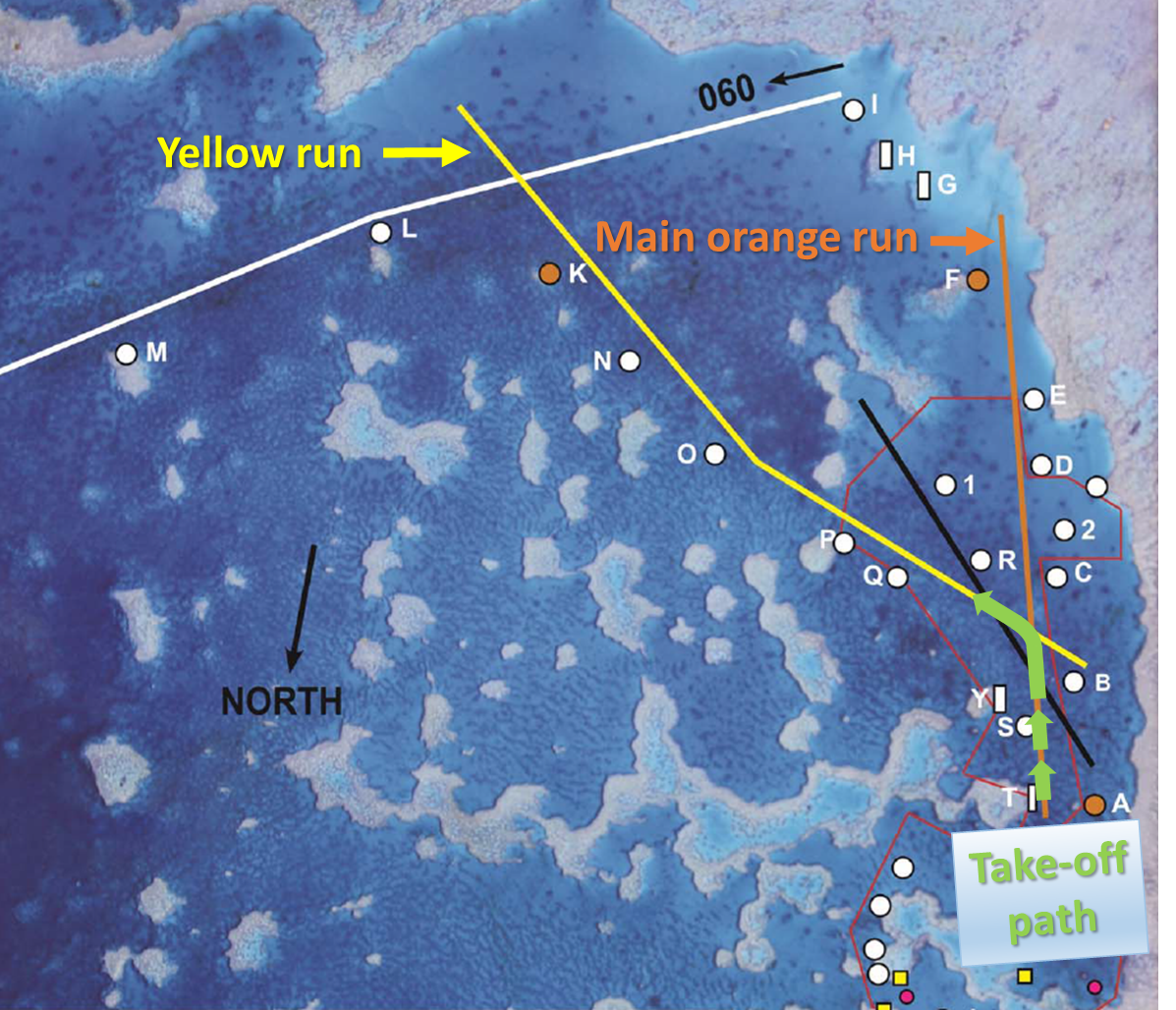
The Hardy Lagoon ALA had marker buoys to identify the location of the bommies[2] that were near each of the four take-off and landing areas. The main take-off run (orange run) to the south, started at buoy A, and continued onto buoys B, C, D, E, F (Figure 1, orange line). The take-off run to the east-south-east (yellow run), started at buoy B, and continued onto buoys Q, P, O, N, K (Figure 1, yellow line). As per company policy, the pilot elected to start the take-off at buoy A on the orange run and then turn onto the yellow run. This combination of take-off runs allowed the pilot the maximum take-off distance, for the aircraft’s take-off weight.
Figure 1: Hardy lagoon aircraft landing area.
Source: Aircraft operator, modified by the ATSB
The pilot taxied AWI to buoy A and lined up on the orange run. They then advanced the throttle slowly to commence the take-off. As AWI approached buoy B the engine was not at full power. The pilot commenced the turn onto the yellow run utilising the water rudders,[3] which were in the down position. Coming out of the turn the pilot retracted the water rudders and applied right rudder to stop the turn and line up on the yellow run.
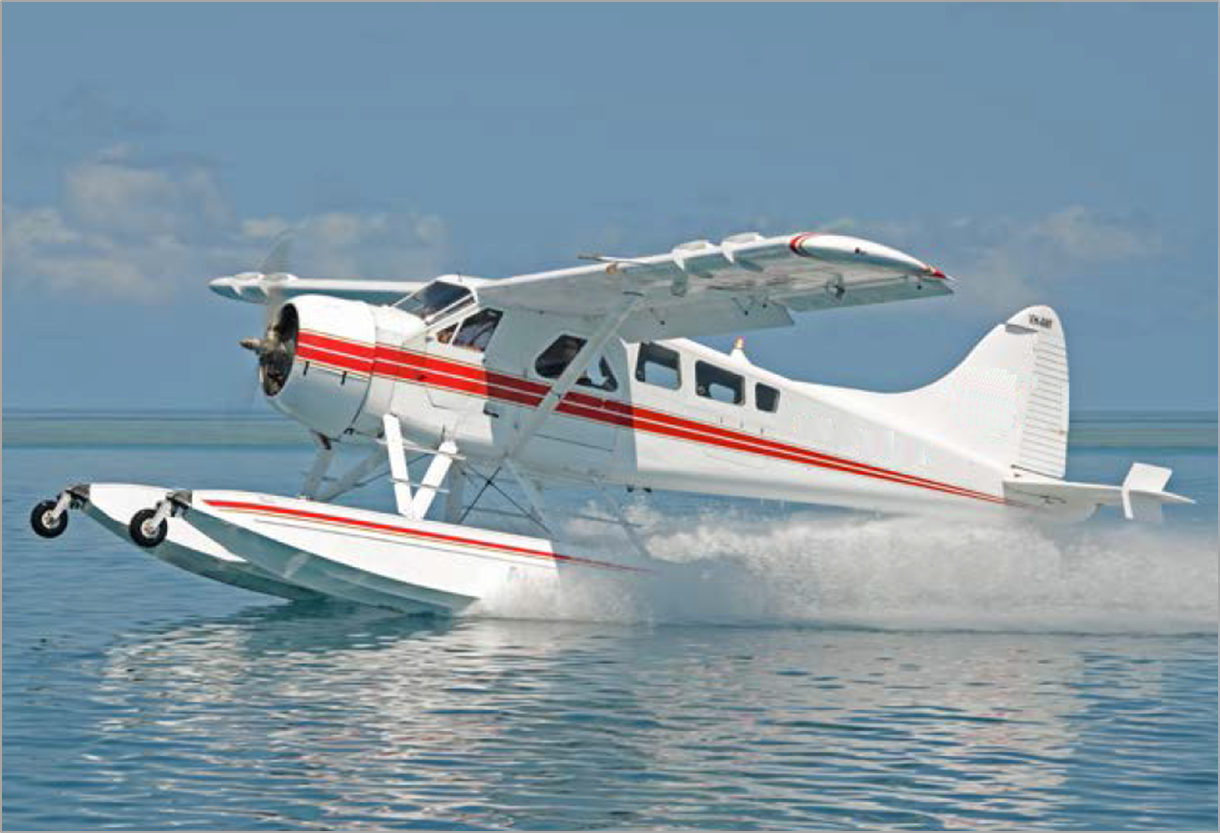
The pilot looked inside the cockpit to check the engine instrumentation and to see if the engine had reached full power. At this stage, the aircraft had not risen onto the step[4] (Figure 2). When the pilot looked outside again, they noticed that the nose of the aircraft had drifted too far to the left. The nose had lined up on the left side of the buoy Q, which marked the location of the Q bommie. The pilot attempted to apply more right rudder, but had already applied full right rudder. AWI then hit and passed over the Q coral reef bommie and the pilot closed the engine throttle. AWI continued moving forward and the pilot shut down the engine and lowered the flaps to help slow the aircraft. The left front float slid onto the P bommie and the aircraft came to a stop.
The pilot exited the aircraft and pushed the aircraft off the bommie, before re-entering the cockpit. When AWI had drifted far enough away from the bommie, the pilot restarted the engine and taxied the aircraft to a nearby moored boat, where the passengers disembarked.
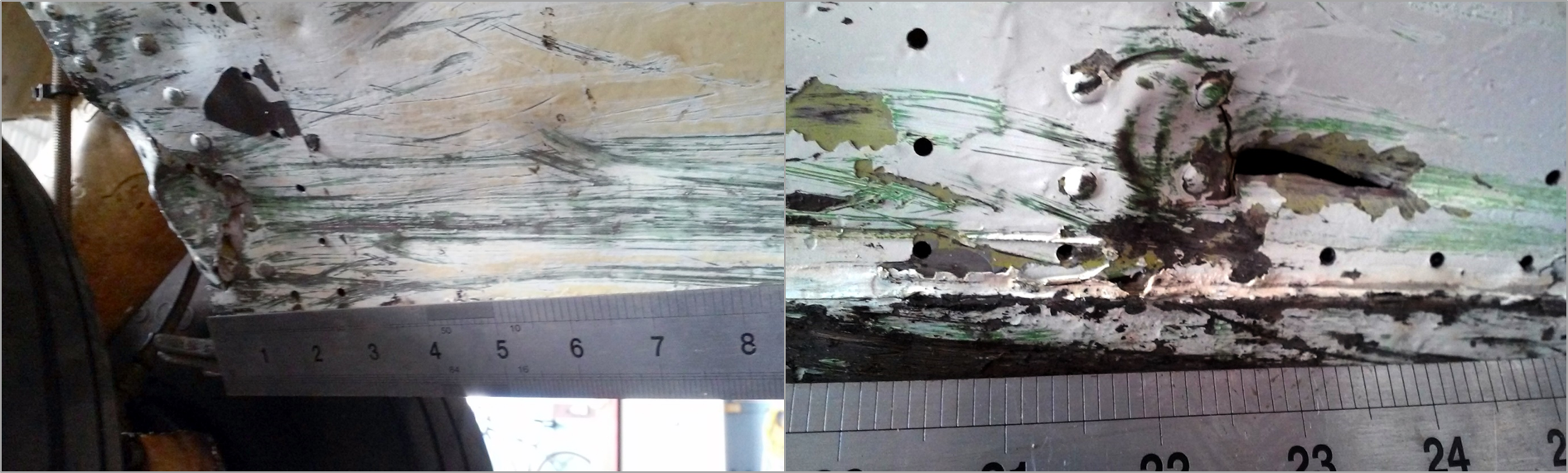
The pilot and seven passengers were uninjured and the aircraft sustained minor damage (Figure 3).
Figure 2: AWI conducting a water take-off (not the occurrence take-off). Note the high nose attitude, skids sitting up out of the water as the aircraft is ploughing through the water. AWI has not gained enough speed in the take-off to reach the step, where the nose would be lower and the aircraft would glide along the water on the floats.
Source: Aircraft operator, modified by the ATSB
Figure 3: Damage to AWI floats included two holes on the bottom side of each float compartment immediately forward of the wheel well.
Source: Aircraft operator
Attempt to reposition the aircraft
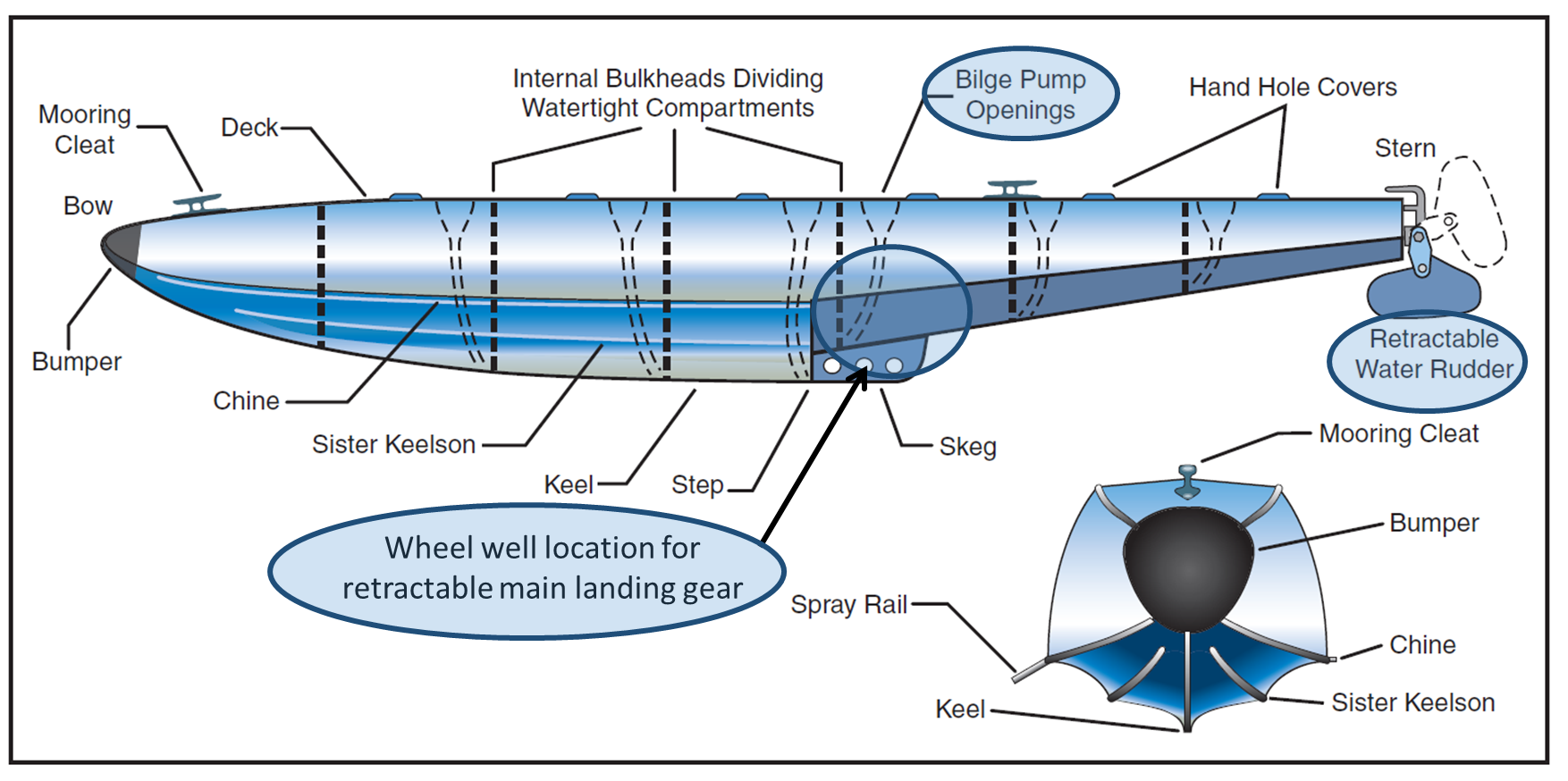
After consultation with the chief pilot, who was also at Hardy Lagoon, the pilot attempted a second take-off on the orange run, without any passengers on board. The pilot aborted the take-off at about buoy E, as the aircraft would normally be on the step at this point. The pilot taxied back to the moored boat, shut the aircraft down, and then pumped out water from the compartments in the floats (Figure 4). They then attempted another take-off on the orange run, again without success.
Figure 4: Example cross-section view of the float compartments. Note the bilge pump openings to remove water from the float compartments during the pre-flight inspection, the retractable water rudder used for directional control while taxiing and the location of the wheel well for the retractable main landing gear.
Source: Federal Aviation Administration, modified by the ATSB
Pilot comment
The pilot decided to use a combination of the orange and yellow run to give the maximum take-off distance. The pilot indicated that they did this because the aircraft was close to the maximum take-off weight and it was approaching low tide, so the coral reef bommies were more exposed.
The pilot reported a gentle breeze of about 8 kt from south-east and the water was smooth with small ripples. The wind direction was between the orange and yellow runs.
The pilot indicated that they did not advance the throttle as quickly as they would normally, due to a recent conversation with other another company pilot. The conversation was about managing the aircraft engine to ensure that the engine limits were not exceeded. In retrospect, the pilot thought that for the occurrence flight, the advancement of the throttle was too slow. Normally turning onto the yellow run the engine would be at full power.
Pilot experience
The pilot had a total time of about 904 hours, with 540 hours on the DHC-2 aircraft. Of their total time about 595 hours was on seaplanes, with 941 water landings and take-offs. The pilot had 34 landings at the Hardy Lagoon ALA, including 21 solo landings, and 13 under supervision. The pilot had last landed at the Hardy Lagoon ALA 32 days prior to the occurrence.
Operator comment
In light winds, where the pilot wanted additional take-off length, it was standard company procedure to start the take-off on the orange run and then to turn onto the yellow run. The aircraft had a payload of 440 kg, 10 kg under the company limit weight for the aircraft for take- off.
The chief pilot reported that the pilot had pumped out all the water from the floats prior to taxi on the occurrence flight.
Safety action
Whether or not the ATSB identifies safety issues in the course of an investigation, relevant organisations may proactively initiate safety action in order to reduce their safety risk. The ATSB has been advised of the following proactive safety action in response to this occurrence.
Aircraft operator
As a result of this occurrence, the aircraft operator has advised the ATSB that all company pilots will be made aware of the serious incident and conduct recurrent training on the Hardy Lagoon ALA.
Safety message
This serious incident illustrates that distractions can have a significant impact on flight safety. Distraction is a process, condition, or activity that takes a pilot’s attention away from the task of flying. Even a momentary deflection of attention away from the primary task can have adverse consequences.
The Federal Aviation Administration published a handbook Seaplane, skiplane, and float/ski equipped helicopter operations handbook, for pilots and is available from the FAA website. The handbook discuss the importance of the pilot planning an effective course of action, and mentally staying ahead of the seaplane.
The serious incident highlights the importance of pre-flight decision making and planning for emergencies and abnormal situations for the particular aerodrome. A thorough pre-flight self-brief covering the different emergency scenarios may help to minimise safety critical decisions during a high workload situation such as a take-off.
Decisions regarding whether to conduct an investigation, and the scope of an investigation, are based on many factors, including the level of safety benefit likely to be obtained from an investigation. For this occurrence, a limited-scope, fact-gathering investigation was conducted in order to produce a short summary report, and allow for greater industry awareness of potential safety issues and possible safety actions.
Publishing information
Released in accordance with section 25 of the Transport Safety Investigation Act 2003
Ownership of intellectual property rights in this publication
Unless otherwise noted, copyright (and any other intellectual property rights, if any) in this report publication is owned by the Commonwealth of Australia.
Creative Commons licence
With the exception of the Coat of Arms, ATSB logo, and photos and graphics in which a third party holds copyright, this publication is licensed under a Creative Commons Attribution 3.0 Australia licence.
Creative Commons Attribution 3.0 Australia Licence is a standard form licence agreement that allows you to copy, distribute, transmit and adapt this publication provided that you attribute the work.
The ATSB’s preference is that you attribute this publication (and any material sourced from it) using the following wording: Source: Australian Transport Safety Bureau
Copyright in material obtained from other agencies, private individuals or organisations, belongs to those agencies, individuals or organisations. Where you wish to use their material, you will need to contact them directly.
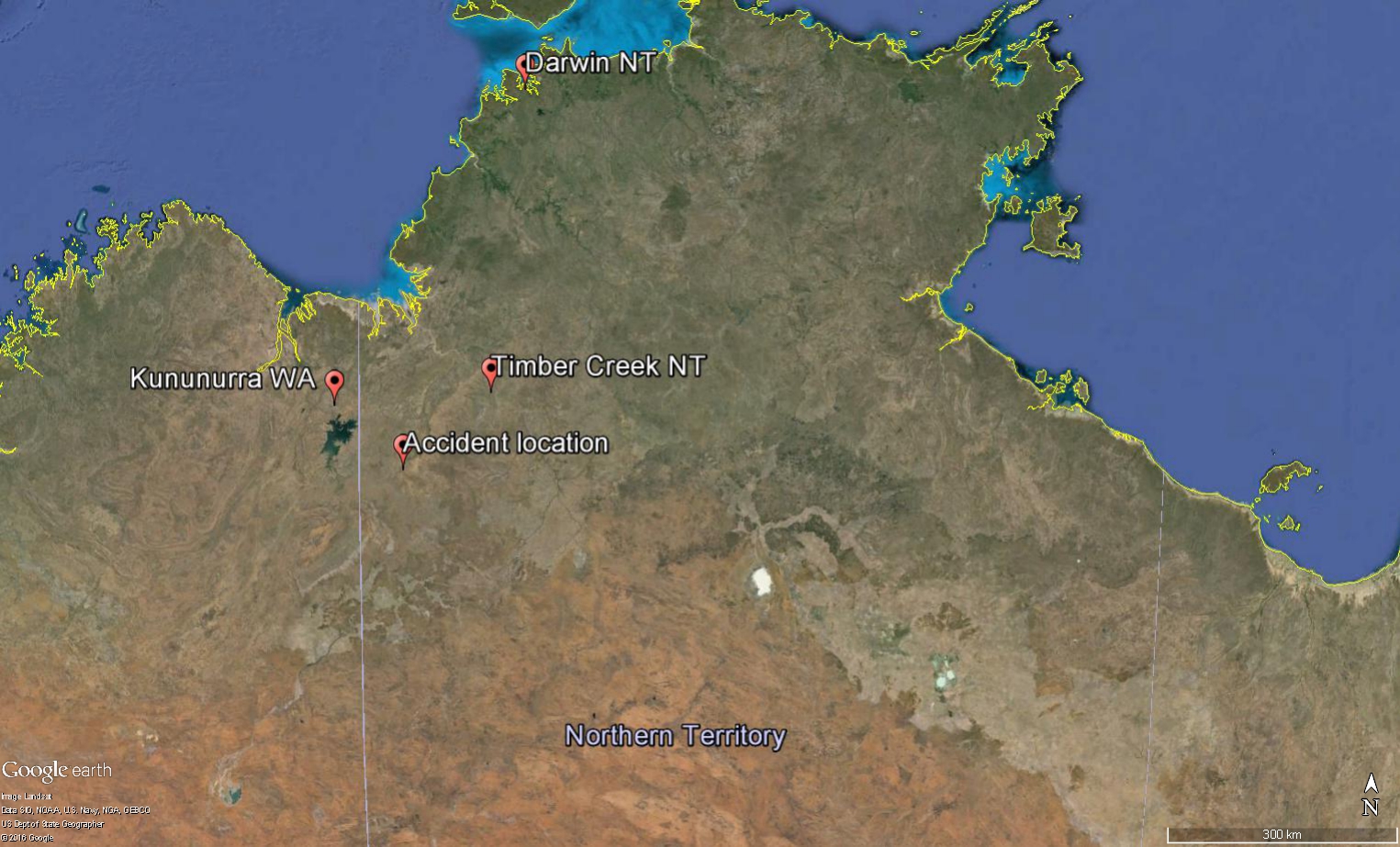
On 14 June 2015, the pilot of a Robinson Helicopter Company R44 helicopter, registered VH-KJJ, was conducting cattle mustering operations at Waterloo Station, about 154 km south-west of Timber Creek, Northern Territory. After refuelling from drum fuel supply, the helicopter took off and, a short time later, experienced a loss of engine power at low altitude. The loss of engine power was a result of fuel starvation due to contaminants introduced into the helicopter’s fuel system during the drum refuelling. The loss of engine power required the pilot to conduct an autorotation and forced landing.
For reasons that could not be determined, the pilot was unable to satisfactorily reduce the rate of descent before the helicopter impacted the ground heavily. The pilot survived the impact but later succumbed to their injuries. The helicopter was destroyed.
What the ATSB found
The ATSB identified that the operator did not have adequate procedures to ensure fuel quality during drum refuelling.
The pilot was overdue for a helicopter flight review for low-level helicopter mustering operations. This potentially reduced the pilot’s familiarity and proficiency with managing engine failures and autorotations from low altitude. Had the pilot been able to satisfactorily reduce the rate of descent before touchdown, the impact forces would have been reduced.
The helicopter was likely ‘hot refuelled’, meaning that as a pilot only operation, the pilot had to exit the helicopter to refuel while it was operating. This increased the risk of loss of control of the helicopter as the flight controls were unmonitored.
What's been done as a result
The operator has informed the ATSB that they now test fuel supplies with water detection paste, and have restricted any aviation fuelling activities to be performed by authorised personnel.
In addition, an operator trial of a filter monitor-type filter highlighted that, although filter monitors increased the probability of detecting water contamination while refuelling, operators should assess the suitability and practicality of the available filter monitors for their operations.
Safety message
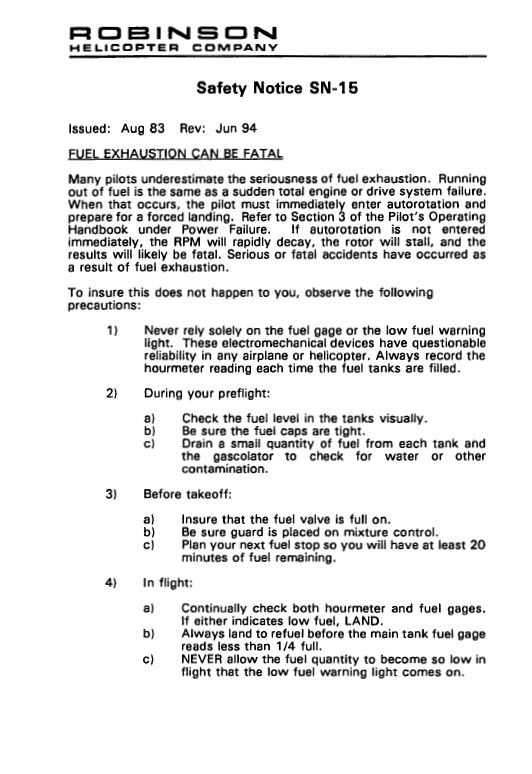
A number of defences are available to eliminate or significantly reduce the chance of using contaminated fuel from drum fuel supplies. These include:
application of appropriate aviation drum handling and storage methods
testing drum fuel supplies for contaminants prior to undertaking refuelling activities
use of filter monitors on drum hand pump supply lines
conducting fuel drains from aircraft after each refuel to ensure fuel quality.
In addition, the ATSB cautions pilots and operators to conduct hot refuelling in accordance with the aircraft flight manual and Civil Aviation Safety Authority regulations. Further, leaving the flight controls of an operating Robinson Helicopter Company R44 helicopter to conduct refuelling increases the risk of a loss of control.
Finally, this accident provides a timely reminder that the conduct of recurrent flight training allows pilots to practice and better respond to time critical emergencies such as those that occur from a low altitude.
The occurrence
On 14 June 2015, the pilot of a Robinson Helicopter Company R44 Raven 1 helicopter, registered VH-KJJ (KJJ), was conducting cattle mustering operations at Waterloo Station, about 154 km south-west of Timber Creek, Northern Territory (Figure 1). At about 0700 Central Standard Time[1], the pilot reportedly refuelled KJJ from the station’s main aviation gasoline (Avgas) fuel storage tank and conducted a daily inspection of the helicopter before commencing the days mustering activities.
Figure 1: Accident site location
Source: Google earth, modified by the ATSB
The mustering activities required two additional helicopters (Robinson R22 helicopters) to assist with drafting[2] cattle toward holding yards that were located about 19 km east-south-east of the Waterloo Station homestead. The pilots of the helicopters worked together to herd the cattle south along a dry creek bed that led toward the holding yards.
After operating the helicopter for about 3.5 hours, the pilot of KJJ radioed the R22 pilots to inform them of the need to refuel KJJ from a drum fuel supply that was close to the area of operation. This supply consisted of three 200 L Avgas fuel drums:
an older, rusty drum that had been refilled from the station’s main fuel supply prior to the mustering operations
a newer, undamaged drum that was also refilled from the station’s main fuel supply prior to the mustering operations
a third drum, on which the manufacturer’s bung seals were in place. These seals indicated that the drum had not been opened previously.
One of the R22 pilots responded by radio that as the drum fuel hand pump was on board their helicopter, they would refuel before KJJ. The R22 pilot reported using about 60 L of fuel from the oldest of the three fuel drums. About 10 minutes later the pilot of KJJ landed to refuel using most of the remaining fuel from that drum and a smaller quantity from the newer, undamaged drum. The third drum remained unopened after the refuels, with the manufacturer’s bung seals still in place.
A stockman, who was erecting the holding yards about 2 km south-east of the drum fuel supply, reported an awareness of the pilot of KJJ landing in the area of the drum fuel supply. The stockman confirmed being sure that the pilot landed to refuel the helicopter, although there was no-one near the landing area that observed the pilot refuelling KJJ.
The stockman indicated that, after spending about 5 minutes refuelling, the pilot of KJJ took off to the south to confirm the progress of the fencing activities at the holding yards. The pilot flew past the yards and reportedly continued south to check gates ahead of the cattle herd. The stockman at the holding yard recalled that the helicopter flew past at about 150 ft above ground level. This was broadly consistent with the aircraft’s height of about 190 ft as derived from altitude data downloaded from the helicopter’s global positioning system (GPS) equipment. The stockman also reported the engine noise of the helicopter as ‘normal’ and that the helicopter appeared to have been in normal flight at that time.
The stockman reported going back to work after the helicopter passed, only to be alerted seconds later by the ‘spluttering’ of the helicopter’s engine. Looking toward KJJ’s direction of travel, the stockman observed the helicopter in a nose-down attitude, just above the tree line. At about that time, they heard the pilot broadcast over the ultra-high frequency radio that KJJ’s engine had failed. The stockman recalled that the engine noise had stopped, which was followed shortly after by the sound of the helicopter impacting terrain.
The stockmen immediately drove to the accident site, which was located about 1 km south-east of the holding yard. The R22 pilots, who also heard the radio transmission, flew to that location. The stockman reported that on arrival at the site, the injured pilot was removed from the wreckage and comforted for about 2 hours until medical attention arrived.
The pilot later succumbed to their injuries. The helicopter was destroyed during the impact sequence.
The pilot held a Commercial Pilot (Helicopter) Licence and was endorsed on the Robinson Helicopter Company (Robinson) R44 (R44) helicopter. The pilot also held a valid Class 2 Aviation Medical Certificate.
The pilot’s total aeronautical experience at the time of the accident could not be determined as the pilot’s logbooks were incomplete. The last recorded entry was on 19 August 2013 and indicated a total of 6,592.5 flying hours, of which 214 hours were on R44 helicopters. The pilot also held a helicopter aerial stock mustering permission, sling approval and a low-level flying endorsement.
A review of the pilot’s training file identified that the pilot had satisfactorily completed a helicopter flight review on 25 March 2013. The review was conducted under Civil Aviation Regulation (CAR) 1988, Part 5 and included a Robinson R44 type endorsement. This authorised the pilot to conduct helicopter operations until the end of the flight review period on 31 March 2015.
The aerial mustering component of the pilot’s licence was valid if the pilot had completed at least 20 hours of aerial mustering in the previous 12 months. There was evidence that the pilot had likely completed at least 20 hours of aerial mustering in the previous 12 months. However, there was no evidence that the pilot conducted another flight review prior to the end of the flight review period.
Civil Aviation Safety Regulation 1998 (CASR) Part 61 was implemented on 1 September 2014, during the pilot’s flight review period. This meant that the competencies in the CASR Part 61 Manual of Standards (MOS) were required to be met if, after that time, the pilot completed a flight review for the ratings they held (seeTraining requirements).
Stockmen
A number of stockmen or station hands were employed on the cattle station to perform various tasks. This included general station work, drafting and cattle yarding. Occasionally, the stockmen worked to support aerial mustering operations by refuelling empty aviation gasoline (Avgas) fuel drums and relocating them close to the area of operations.
Prior to the accident, the pilot of VH-KJJ (KJJ) tasked one of the stockmen to reposition three full Avgas fuel drums from the station’s aircraft hangar for use in the muster. The stockman reported that two of the three drums selected from the hanger required refuelling from the station’s main Avgas fuel supply before repositioning.
The stockman that repositioned the drums reported that, although familiar with the operation of the main fuel supply bowser to refuel the drums, they were not aware of any particular refuelling process, or trained to inspect the empty stored drums for contaminants and damage. As such, the stockman loaded the three drums onto a transport truck and refuelled the two empty drums without inspection or fuel quality testing.
Aircraft information
General information
The Robinson R44 Raven 1 is a four-seat, single main and tail rotor helicopter powered by a six‑cylinder piston-engine and is equipped with skid-type landing gear. KJJ, serial number 1558, was manufactured in the United States in March 2006. First registered in Australia on 18 January 2012, KJJ had accumulated 1,009.9 flight hours total time in service at the time of the accident.
Maintenance history
The last recorded maintenance was a 100-hourly inspection at 916.4 hours total time in service on 24 February 2015 that resulted in the issue of a new maintenance release. Since that inspection, the helicopter had accumulated 93.5 hours. In that period:
one daily inspection was annotated on the maintenance release
there were no certifications for the required engine oil and filter changes in the helicopter’s logbook or maintenance release.
Meteorological information
Nearby stockmen and other pilots operating in the area reported that the temperature at the time of the accident was about 30 °C. They recalled that generally the weather conditions were fine with a light breeze. The pilots reported good flying conditions with little or no in-flight turbulence.
Recorded meteorological information at Kununnurra Airport, about 110 km to the north-west, indicated the temperature at 0900 was 28.7 °C with a relative humidity of 38 per cent. The wind was from the south-south-east at about 13 km/h and there was no recorded rain for the period.
Wreckage information
Accident site and wreckage information
The wreckage of the helicopter was located just beyond the bank of a dry creek bed in a relatively flat, sandy area that was surrounded by trees (Figure 2).
Damage to the engine, airframe and skids indicated that the helicopter impacted the ground in an upright, relatively flat attitude, with some forward movement and a high rate of descent. Calculations based on impact damage to trees located along the flight path indicated a final descent angle of about 40°.
The main rotor blades sustained penetrating damage to the blade skins, with little evidence of impact damage to their leading edges. Upward bending of the main rotor blades was also evident.
All of the critical helicopter components were accounted for at the site.
Figure 2: Accident site showing the surrounding terrain and wreckage distribution (looking south-east)
Source: ATSB
Functionality of the critical components was established. The two forward rotor drive vee-belts were intact and located in their respective upper and lower sheaves. The two rear rotor drive vee‑belts were located in the upper rear sheaves but were displaced from the lower sheaves, probably due to impact forces.
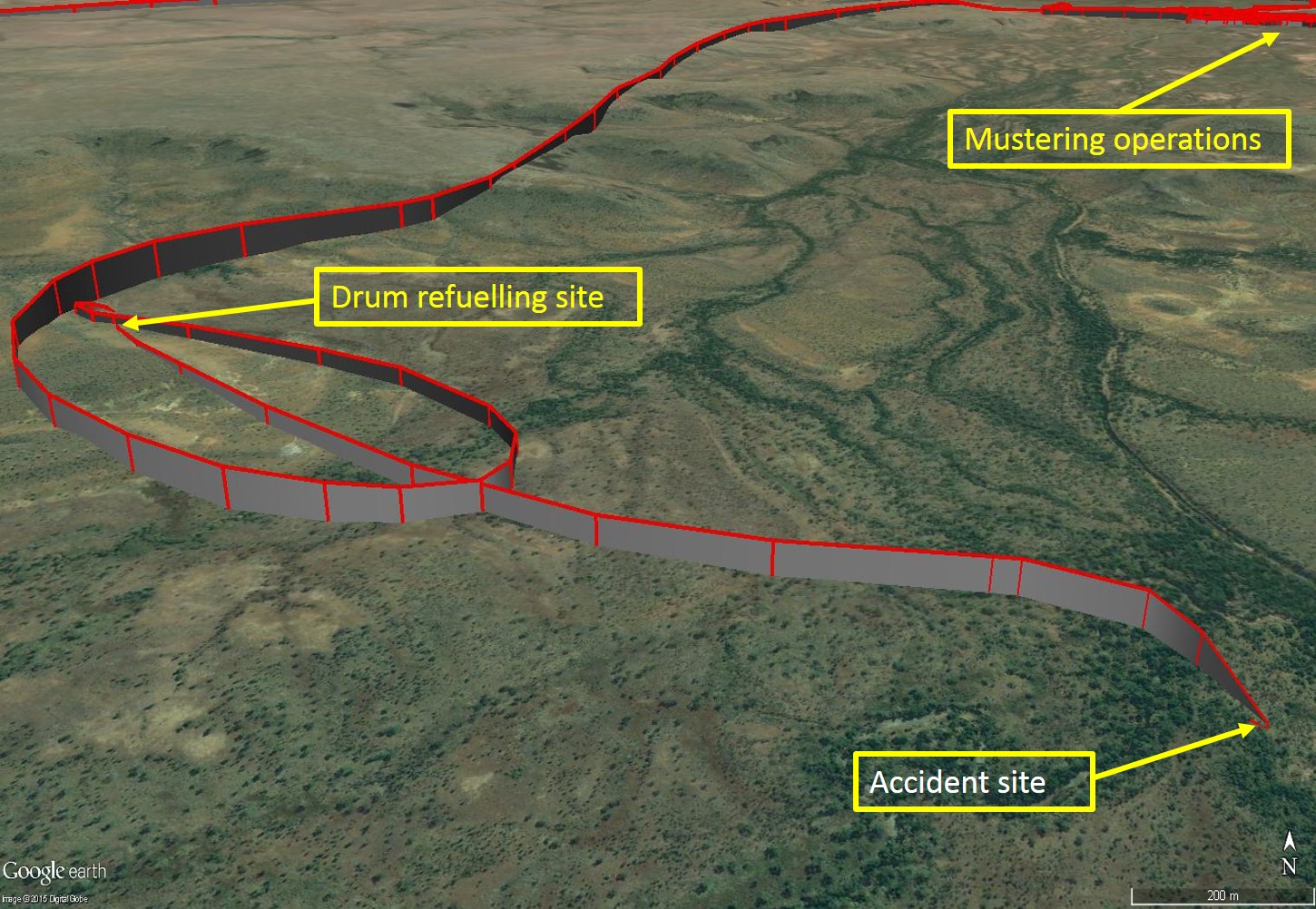
The helicopter’s GPS was recovered for further technical examination and download at the ATSB’s technical facilities in Canberra, Australian Capital Territory. The downloaded data provided information about the operation of the helicopter on the morning of the accident including the final flight path (Figure 3).
Figure 3: KJJ’s recorded GPS flight path, showing the helicopter’s track from the drum refuelling site to the accident site
Source: Google earth, modified by the ATSB
Engine examination
Other than impact damage, no mechanical defects or anomalies were noted that would have precluded normal engine operation. Evidence at the accident site indicated that the engine was not operating at the time of impact.
Aircraft fuel system
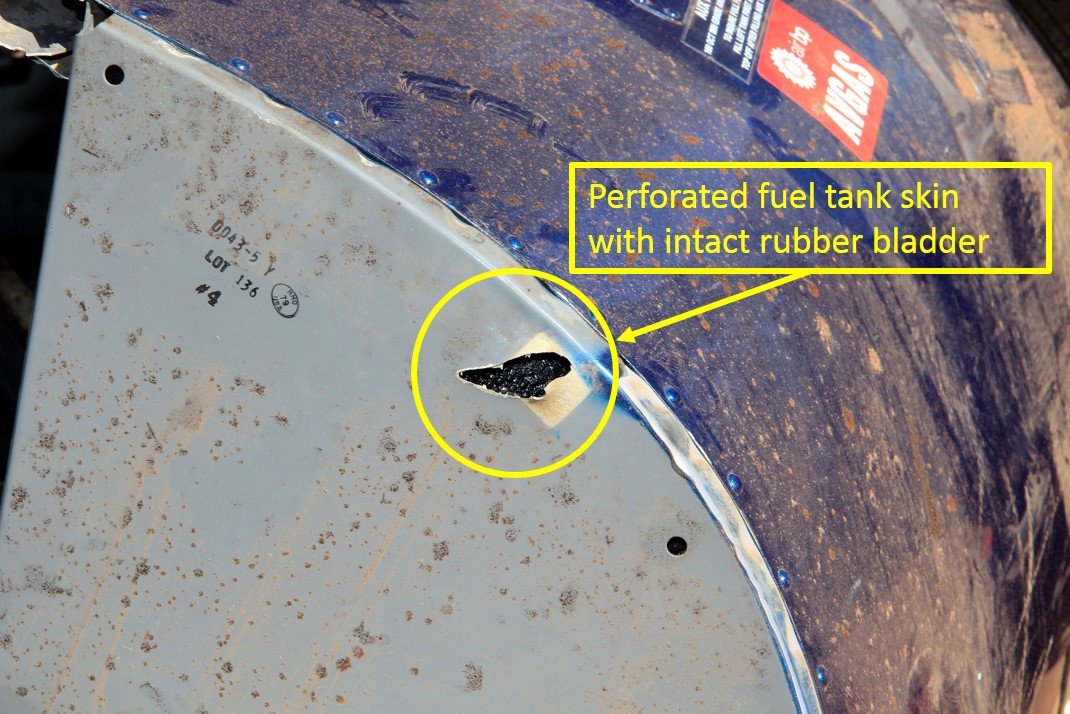
The R44 has two interconnected fuel tanks. The main fuel tank holds 112 L total useable fuel and the auxiliary fuel tank 64 L useable fuel. Both fuel tanks were fitted with fuel tank bladders, which remained intact despite the outer aluminium skin being perforated during the accident sequence (auxiliary tank shown at Figure 4). Both fuel tanks were almost full, consistent with the recent drum refuelling.
Figure 4: Perforated auxiliary fuel tank outer aluminium skin. Note the intact rubber bladder tank (circled in yellow)
Source: ATSB
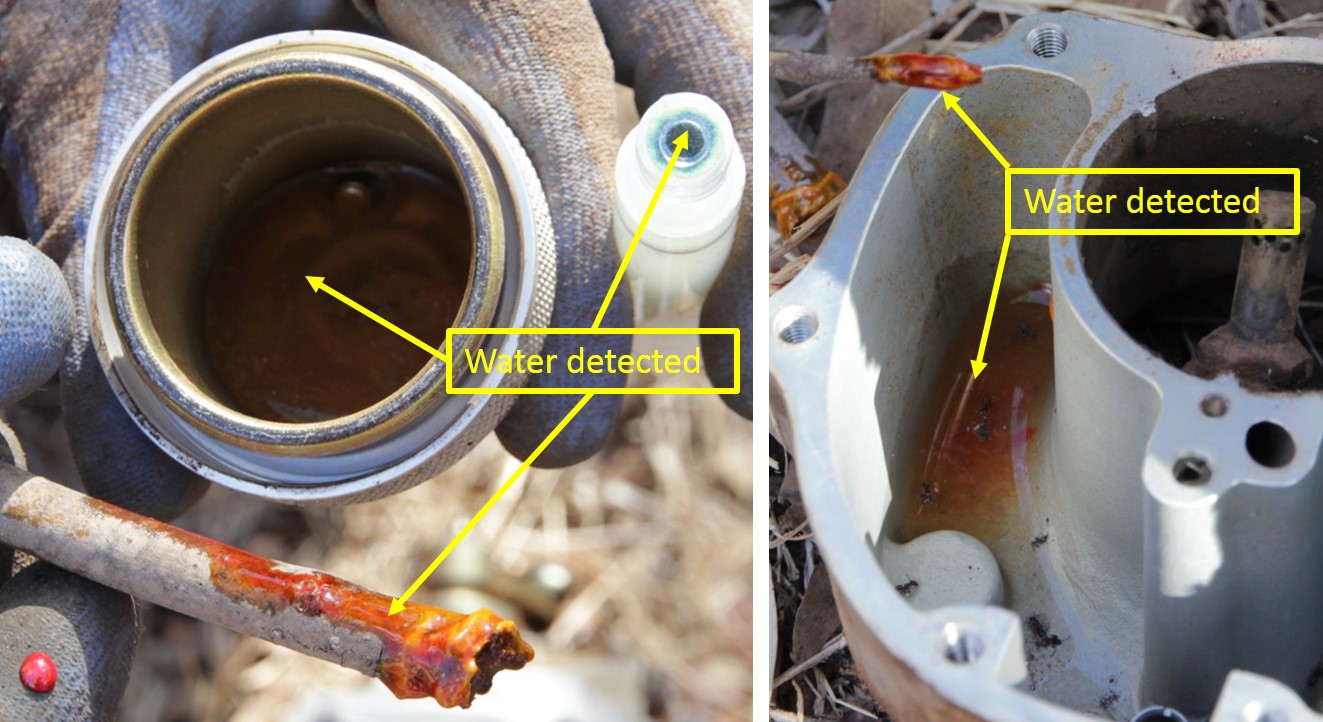
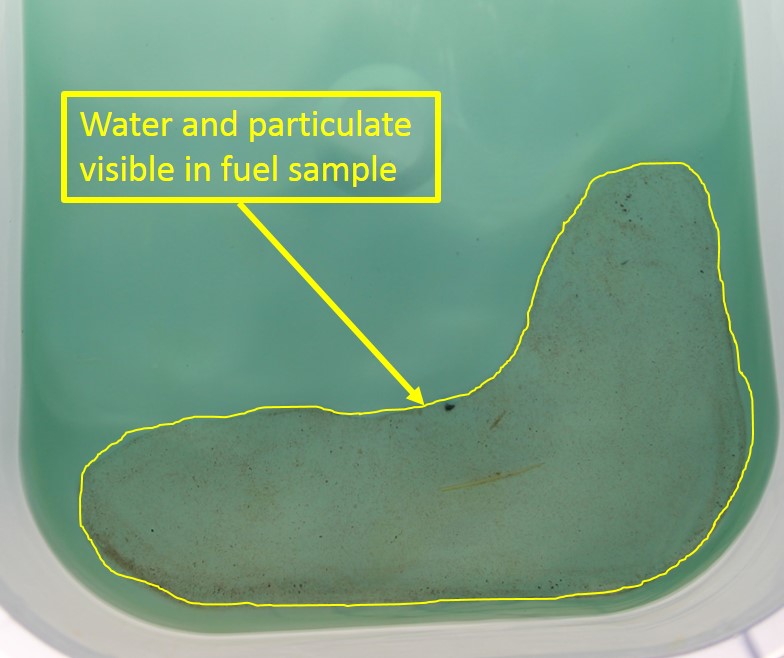
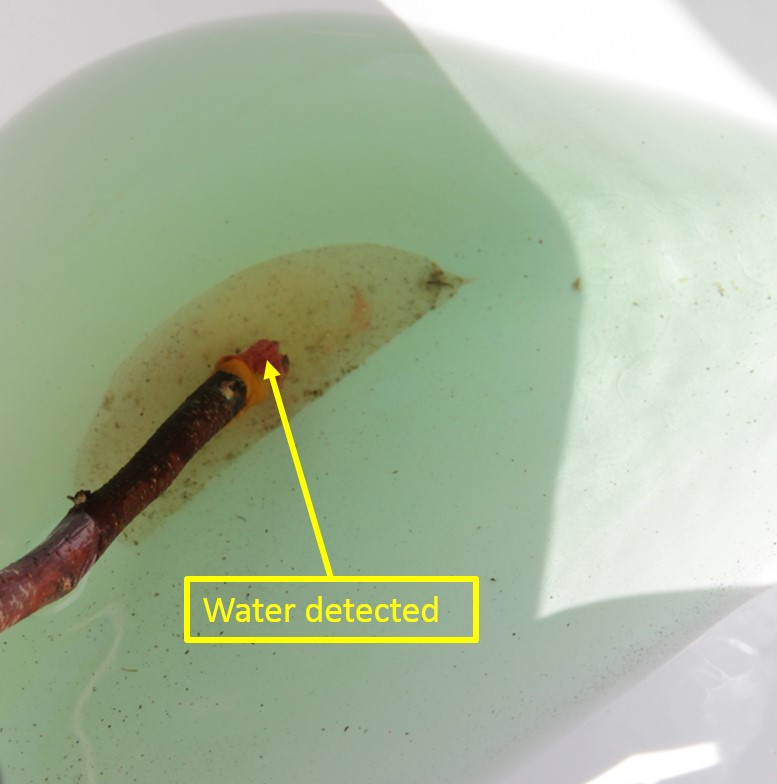
On-site samples from the helicopter’s gascolator (fuel strainer), carburettor and fuel tanks identified the presence of water and particulates (Figure 5 and Figure 6). Approximately 800 mL of water was drained from the auxiliary fuel tank and water was also siphoned from the main tank. Residual water remained in the tanks and could not be drained due to the crush damage to the fuselage. A fuel tank dip test with water detecting paste confirmed that a depth of about 3.5 cm of water remained in the lower areas of each tank.
Fuel samples that were able to be recovered from the helicopter’s fuel tanks were heavily contaminated with water and rust-like particles (Figure 6). This contamination was similar to that identified in the fuel sample taken from the older, rusted fuel drum that was first used by the pilot during the drum refuelling.
Figure 5: Gascolator (left) and carburettor (right) showing fuel contamination as indicated by the change in colour of the water detecting paste to red
Source: ATSB
Figure 6: Water and particulate matter identified in a fuel sample obtained from KJJ’s fuel tanks
Source: ATSB
Drum fuel supply
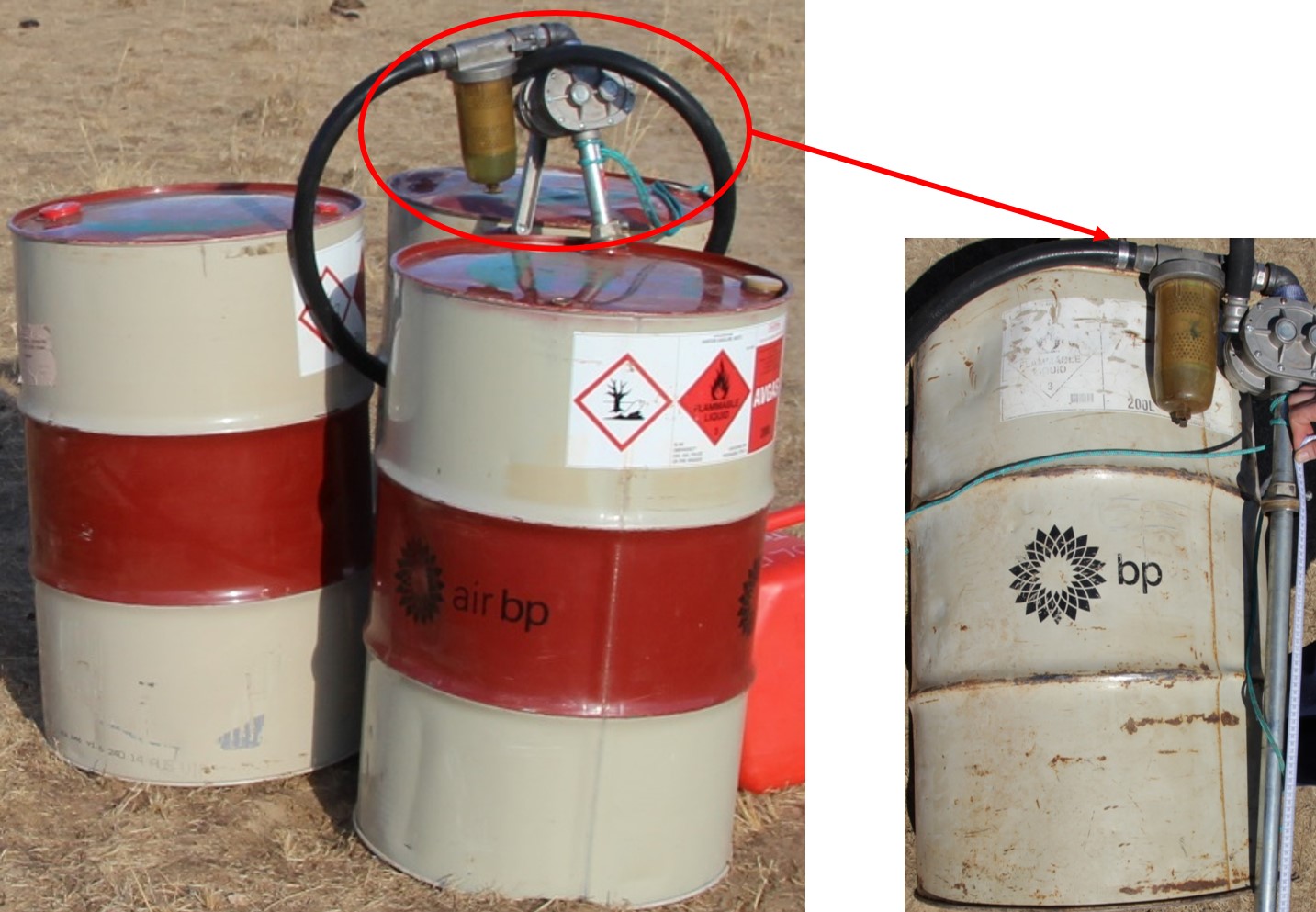
The three 200 L drums of Avgas that were relocated from the station’s aircraft hangar were found upright in an open paddock close to the mustering operations (Figure 7). The two open drums and their contents were examined by the ATSB to eliminate them as potential sources of fuel contamination. The drum fuel hand pump was found positioned in the newer of the two open drums.
The older, rusty and dented drum contained a mixture of about 6 L total of fuel, rust and water. The inside lining of that drum was heavily rusted and was considered not suitable for aviation use.
Water and particulate contamination was also identified in a sample of fuel taken from the fuel pump filter (Figure 8).
The second, newer-type drum used by the pilot of KJJ during the refuel was about 3/4 full of Avgas and contained negligible traces of water. Any water contamination was probably introduced from the hand pump after its use in the older, heavily-contaminated drum.
Negligible traces of water were identified in the station’s main Avgas fuel supply that was used by the stockman to refill the two drums.
Figure 7: Drum fuel supply with a close-up (right) of the older, rusty and dented Avgas fuel drum. The left picture shows the drum fuel hand pump positioned in the newer of the two open drums
Source: ATSB
Figure 8: Fuel sample from the drum fuel hand pump filter showing the change in colour of the water-detecting paste to red indicating water contamination
Source: ATSB
Operational information
Petroleum industry fuel management and handling guidance
A petroleum company in Australia reported that although they supplied aviation drum fuel to their regional distribution depots, the quality of the drum fuel could not be assured once it left the depot. This was reported to be a consequence of varying procedures surrounding the management of drum fuel once out of the control of the supplier.
General information about aviation drum fuelling was published by some petroleum companies in an effort to maintain fuel quality. The information was available online and was last updated in 2013. It provided information about drum storage, pump filter standards, drum refuelling and precautions. The publications reinforced that users of aviation drum fuel should ensure that:
the grade of drum and its labels are appropriate for the fuel it contains
the drum and drum linings are intact and of suitable quality prior to refilling
the drum contents are checked for water using a dipstick and water-detecting paste
an appropriate aviation grade filter (filter monitor preferred) and pump is used during the delivery of fuel to an aircraft
proper drum storage techniques are used.
Fuel filter monitors
Representatives from the petroleum industry advised that many companies involved with the supply of aviation fuel in Australia adopted the Joint Industry Group (JIG) and the Energy Institute (EI) standards. Those standards outlined the requirements for fuelling from drums, drum storage and the equipment required to ensure fuel quality during the refuelling process. This included filter standards. The relevant drum-refuelling standards at the time of the accident included JIG 4 and EI 1530 and EI 1583.
At the time of the accident, the Civil Aviation Safety Authority (CASA) was not aware of any fuel delivery filtration standard, however specific aircraft refuelling requirements were published that would provide a defence against fuel contamination (see the following section titled Aircraft refuelling requirements).
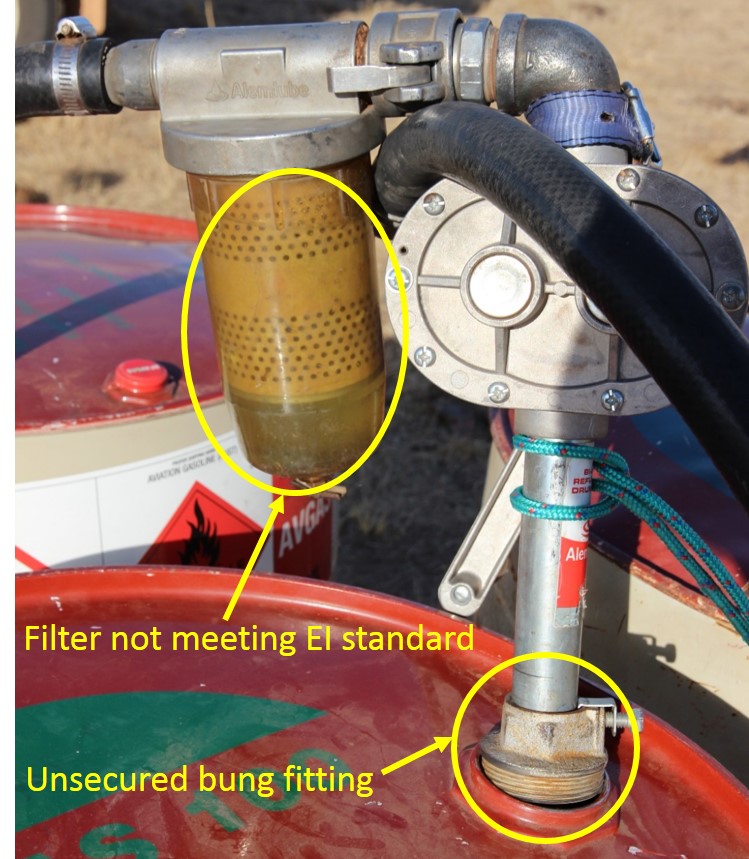
A number of filters were available for use with various fuel types. It was preferable to use filters meeting the EI standard for aviation fuel filters (EI 1583) during aircraft refuelling operations. Commonly used filter types included:
particulate only (particulate)
filter water separator
particulate/water absorbing (filter monitor).
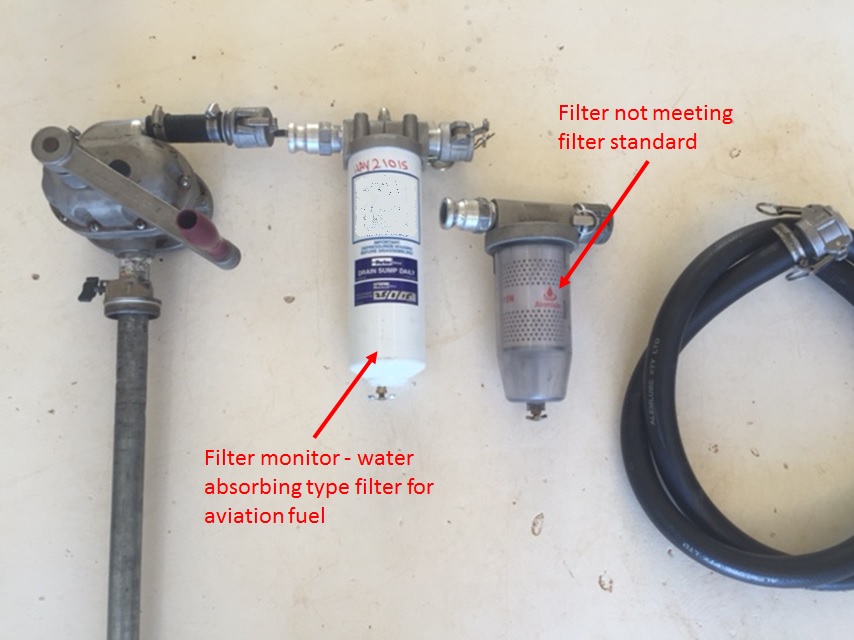
Figure 9 shows a particulate filter that has a relatively low particulate removal capability of about 10 µm. This filter type was used on the day of the accident and did not meet the requirements of EI 1583 or provide a suitable level of particulate screening during the helicopter refuelling. In addition, the filter did not have the capability to remove or separate water, although the ability to detect and remove water was not a requirement to meet the EI standard.
A filter monitor-type filter is also shown in Figure 9. This filter has a much higher capability to remove particulates than the particulate filter shown. It can also absorb any water present in aviation fuels, except that it is not recommended for use with fuel containing anti-icing additives. As water and/or particulates are absorbed within the filter, differential pressure increases and reduces the flow. The reduction in the flow depends on the level of contamination in the fuel.
An operator reported trialling the effectiveness of aviation fuel filter monitors for use with drum hand pumps. The operator’s trial identified that one type of filter monitor:
had a non-transparent filter housing that reduced the ability to observe any contamination
had non-standard thread fittings, making it difficult to adapt existing hand pump equipment
was not a screw-on-type filter, which made changing contaminated filters difficult
required re-priming after the drum hand pump unit was disassembled to facilitate transportation between drum fuel supply locations.
The operator indicated that, although the practicality of this particular type of filter monitor was not ideal, the effectiveness of the filter monitor-type filter to inhibit continued pumping of water‑contaminated fuel was beneficial.
The results of the operator’s test would suggest that it would be appropriate for individual operators to assess the suitability and practicality of the available filter monitors to their operations.
Figure 9: Examples of two types of filters used during drum refuelling. Note the off-white filter monitor (at left) meets the industry standard
Source: ATSB
Aircraft refuelling requirements
CASA Civil Aviation Order (CAO) 20.9, outlined the requirements for refuelling aircraft. Specifically, when refuelling using ground fuel stock (such as drum fuel), a pilot needed to ensure:
…that the aircraft is not flown unless the aviation fuel… complies with the specification and grade required or approved for the purpose by CASA.
and that:
All ground fuel stock shall be carefully checked for the presence of undissolved water before the fuelling operation is commenced.
Note 1 This precaution is particularly important when handling fuel from drum stocks.
Note 2 Attention is drawn to the necessity of using a positive method, such as suitable water detecting paste or paper, in testing for the presence of free water since sensory perceptions of colour and smell, if used alone, can be quite misleading…
and finally that:
All fuel shall be strained or filtered for the removal of free or suspended water and other contaminating matter before entering the aircraft tanks.
CAO 20.9 also stated that when fuelling an aircraft, all fuelling equipment and the aircraft needed to be bonded[3] to allow for dissipation of static electricity that may have been present and reduce the chance of a fire. The fuelling equipment used to refuel KJJ did not have a bonding wire for that purpose. Further, there were no fire extinguishers at the refuelling area in case of fire.
Operator’s refuelling processes
The operator maintained an 11,000 L Avgas bulk storage container at the station that was refilled on an as required basis. When needed, 200 L drums of Avgas were filled from the bulk storage and transported to the area of the mustering operation.
On the day of the accident, the pilots used another operator’s drum fuel hand pump. Although the filter attached to that pump was reported changed on a regular basis, it was not the correct type for use with aviation fuel in accordance with EI standard 1583 (see the previous section titled Fuel filter monitors). In addition, the drum fuel hand pump bung fitting was not threaded into the drum (Figure 10). When secured, that fitting provided a barrier to prevent dust from entering the opened drum and located the hand pump shaft while in use. Some pilots reported that they preferred not to secure the bung fitting to allow for movement of the hand pump inlet pick-up to the higher side of the drum.[4]
Operator fuel policy, procedures and practices
The ATSB could not identify any formal operator procedures for use in aerial mustering operations. This was consistent with the conduct of the muster as a private operation, which meant that there was no regulatory requirement for the operator to have an operations manual.
It was reported, however that the pilot replaced damaged or older fuel drums with new drum fuel stock supplied by the fuel distributer. Although there was evidence that new drum fuel supply was used, some older, damaged drums were in use at the time of the accident. It could be expected that an operations manual would help standardise procedures in relation to fuel management, refuelling and low-level helicopter operations among all personnel involved in those activities.
Figure 10: Drum refueling equipment used to refuel KJJ, showing the unsecured bung fitting
Source: ATSB
Risk of engine failure during mustering operations
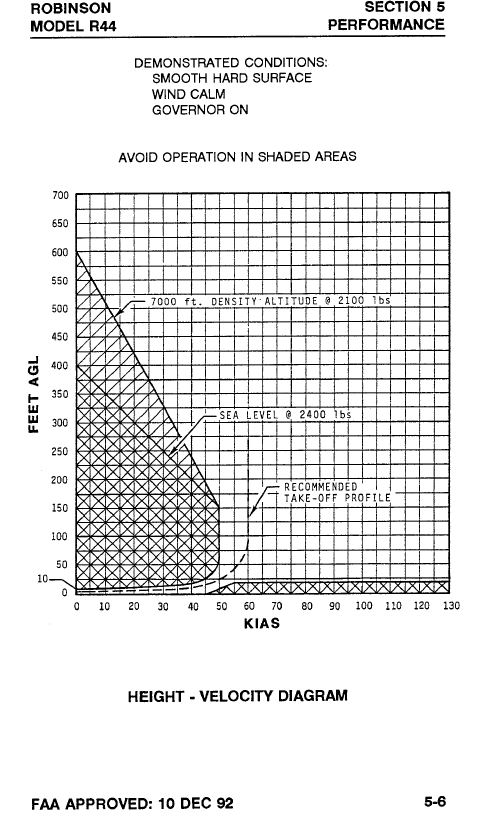
Mustering operations entail operations at low level and at varying airspeeds. Such operations increase the risk associated with loss of engine power. More specifically, under certain height and airspeed combinations, it can be difficult to perform a safe landing in the event of an engine failure.[5] At the time of KJJ’s engine failure, the helicopter was operated in an appropriate height‑velocity region. All else being equal, it might be expected that an appropriately-qualified pilot might normally conduct a successful autorotation to touchdown from that region (appendix B).
Training requirements
Helicopter pilot training standards and guidelines
Given the pilot attained their Commercial Pilot (Helicopter) Licence in 2000, the associated training would have been in accordance with the CASA Day Visual Flight Rules (VFR) Syllabus‑Helicopters. This syllabus was replaced from 1 September 2014 with the introduction of Civil Aviation Safety Regulation (CASR) Part 61, which incorporated a number of elements of the former Day VFR Syllabus-Helicopters.
A review of the Part 61 Manual of Standards (MOS) identified that for a flight review conducted after 1 September 2014, the pilot was required to demonstrate competency for the rating held. If the pilot held a low-level flight operational rating, this included:
dealing with emergencies
various helicopter handling techniques
handling and avoiding overpitching
low main rotor revolutions per minute (RPM).
The Flight Instructors Manual – Helicopter, which was published by CASA and the Civil Aviation Authority New Zealand, was a basic guide to elementary flight training. Although there was no specific guidance regarding overpitching, or low main rotor RPM avoidance and recovery in the manual, those areas were highlighted as key teaching points for instructors during autorotation, low-level and hazard-training exercises.
Civil Aviation Advisory Publication (CAAP) 5.81-1(1) titled Flight Crew LicencingFlight Reviews gave context to the value and limitations of a flight review and would have applied when the pilot last conducted their helicopter flight review. The CAAP suggested that although a flight review was required by the regulations, it was but one method that contributed to pilot proficiency and the safety of flight. Importantly, pilots were encouraged to continually identify hazards and manage the risks associated with their own aviation activities. This included regularly practicing piloting skills and actively applying threat and error management principles.
A flight review provided an opportunity for pilots to refresh their flying skills and knowledge, and to have an independent assessment of their abilities. It would be unrealistic to expect that all of a pilot’s skills and knowledge would be assessed during a flight review. However, it would be expected that a number of safety critical aspects that, if not managed appropriately, could elevate the risk of damage or injury to persons, should be assessed. These could be expected to include:
the management of engine failures leading to autorotation and forced landing
awareness and avoidance of adverse aerodynamic situations, such as rotor stall
management of emergencies.
application of threat and error management and human factors practice.
While the CAAP included useful information about flight reviews prior to the introduction of CASR Part 61, the MOS was the current document that detailed the units of competency and standards for flight reviews after 1 September 2014.
Special Federal Aviation Regulation No.73 Robinson R-22/R-44 Special Training and Experience Requirements was introduced by the United States Federal Aviation Administration in 1995. CASA has subsequently introduced many of the R-22/R-44 special training and experience requirements into the CASR Part 61 MOS.
The United States Special Federal Aviation Regulation that was current at the time of the accident required specific awareness training, aeronautical experience, endorsements, and flight reviews for pilots operating Robinson helicopters. Specifically, this training included:
enhanced training in autorotation procedures
engine rotor RPM control without the use of the governor
low rotor RPM recognition and recovery
the effects of low G[6] manoeuvres and proper recovery procedures.
Low-level flying
Prior to the introduction of CASR Part 61, Civil Aviation Regulation (CAR) 5 required pilots holding a flight crew licence to undertake a biennial flight review for each category of aircraft on their licence. Guidance as to what constituted an acceptable flight review was contained in CAAP 5.81 1 (1), which emphasised the importance of flight safety through the application of the standards stipulated in the Day VFR Syllabus. There was no mandated requirement for pilots to demonstrate low-level flying or mustering in a flight review under the CAR 5 regulations.
With the introduction of CASR Part 61, pilots were required to conduct a flight review for low-level flying every 12 months. However, CASA subsequently changed this requirement under Regulation 61.1060, instrument number CASA EX92/15 on 25 May 2015. This instrument increased the low‑level flight review requirement to 24 months.
Helicopter operation
Autorotation
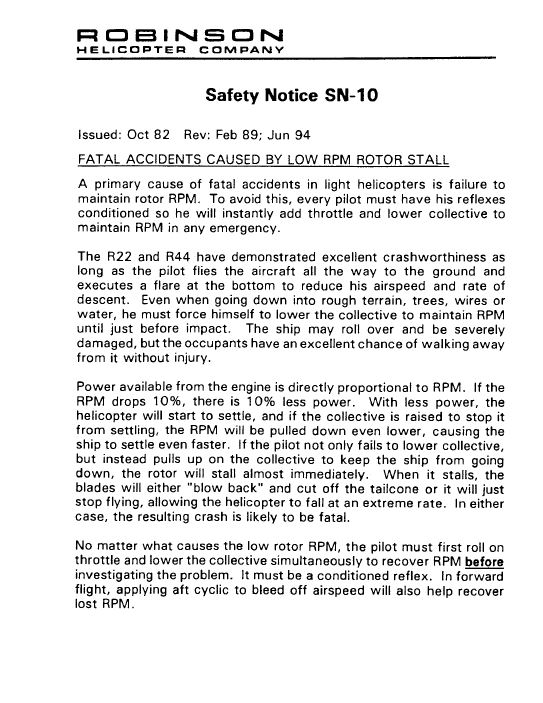
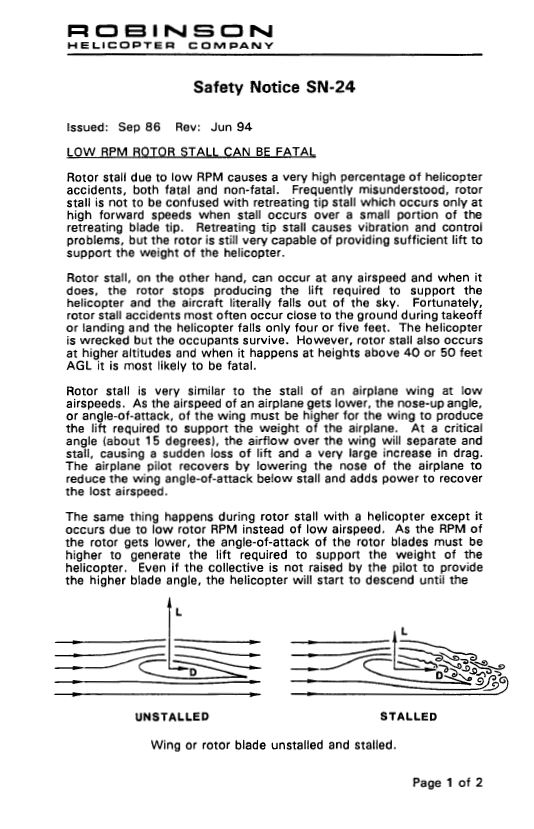
In the case of an engine failure, a helicopter pilot is required to immediately enter autorotation. This is achieved by lowering the collective lever[7] to reduce the drag generated by the main rotor blades and establishing the appropriate speed for the autorotative descent. Robinson stated that if autorotation is not entered immediately, the rotor RPM rapidly decays, the main rotor system stalls and the results are likely fatal.
As the helicopter descends, there is an upward flow of air through the main rotor system. This upward flow provides an autorotative force to create rotor thrust that, if properly managed, maintains rotor RPM throughout the descent and provides for a steady rate of descent. Amongst other factors, the rate of descent in autorotation is affected by the forward airspeed of the helicopter. If the airspeed is zero, the rate of descent will be high. The rate of descent reduces with increasing airspeed until reaching the minimum rate of descent airspeed. The rate of descent again increases with increased airspeed beyond the minimum rate of descent speed. If managed correctly, the pilot can maintain the rotor RPM within limits by manipulating the collective lever.
In general, autorotative descents are carried out at an optimum forward airspeed that approximates the minimum rate of descent airspeed. When landing from an autorotation:
Initially the forward airspeed is reduced by raising the nose of the helicopter (flaring) with aft cyclic.[8] This has the added benefit of reducing the ground speed and rate of descent and increasing (or recovering) the main rotor RPM.
At an appropriate height above the ground, the helicopter is established in the landing attitude with cyclic.
As the aircraft settles towards the ground, the pilot raises the collective lever to ‘cushion’ the aircraft onto the ground. Critically, this action decays the main rotor RPM and therefore rotational energy stored in the main rotor.
The final stages of an autorotation rely heavily on pilot judgement. In addition to the height and speed on entry into autorotation, factors such as uneven and/or wooded terrain, ploughed fields, the ambient conditions and the availability of suitable landing areas can all combine to affect the likelihood of a successful autorotation and touchdown.
If the pilot does not respond quickly and appropriately to a low rotor RPM situation, the main rotor RPM decreases further and the helicopter’s rate of descent increases. If the collective is maintained or raised further in an effort to decrease the rate of descent, the rotor RPM reduces to a point where the main rotor blades cone up.[9] The result is a loss of lift, an increased rate of descent and a further reduction in rotor RPM. The situation can rapidly deteriorate into a vicious cycle that culminates in the rotor blades effectively stalling and losing all lift. Once the blades are aerodynamically stalled, in-flight recovery is almost impossible.
The R44 helicopter is equipped with a low rotor RPM warning horn and caution light, which activates at 97 per cent main rotor RPM. The R44 pilot’s operating handbook (POH)[10] emergency procedure in response to the activation of the low RPM horn and associated caution light stated:
A horn and an illuminated caution light indicate that rotor RPM may be below safe limits. To restore RPM, immediately roll throttle on, lower collective and, in forward flight, apply aft cyclic. The horn and caution light are disabled when collective is fully down.
That procedure decreases main rotor blade pitch and reduces blade drag in an effort to increase rotor RPM. This may be counter instinctive to the pilot of a helicopter at low altitude.
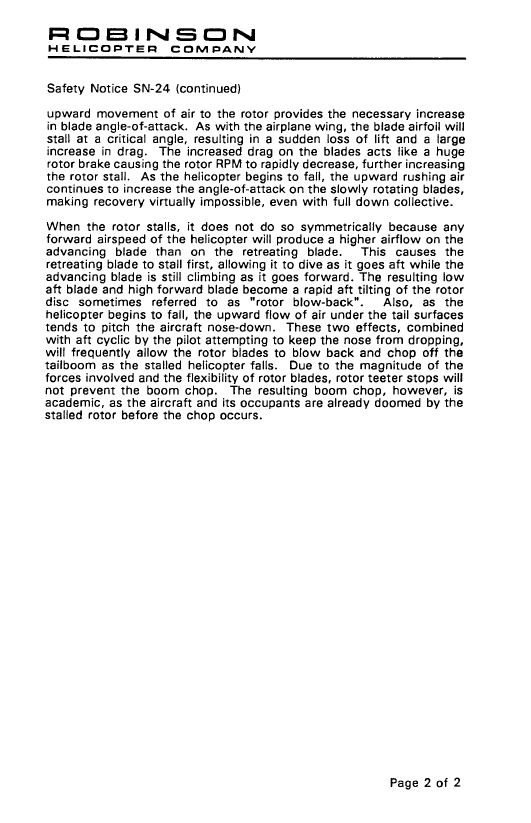
Robinson safety notices SN-10 FATAL ACCIDENTS CAUSED BY LOW ROTOR STALL and SN‑24 LOW RPM ROTOR STALL CAN BE FATAL discussed blade stall and the associated risks and recovery actions and were available for inclusion in owner/operators’ R44 POHs. These safety notices are reproduced at appendix A.
Hot refuelling
Although pilots were permitted to hot refuel[11] helicopters in accordance with Civil Aviation Amendment order (No. R11) 2004, the operator and pilot had a number of responsibilities to ensure the safety of operations. Schedule 1, Substitution of section 20.10 of the CAOs included that, before authorising the hot refuelling of a helicopter, the operator should satisfy themselves that it can be done safely by considering the:
the configuration of the helicopter and it’s engine or engines; and
the location of the components of the helicopter’s fuel system; and
the refuelling system or systems to be used and it’s or their components; and
the helicopter’s flight manual [POH].
Additionally, the operator was required to include appropriate procedures in their operations manual. As the operator was conducting the mustering operations under the Private Category, there was no requirement for an operations manual.
In relation to fuel testing, the regulations stipulated that the operator should ensure that the pilot in command inspected and tested the helicopter’s fuel system for the presence of water on completion of each hot refuelling. This was because there was no fuel quality audit program or system for monitoring the quality of fuel used by the helicopter.
Additional pilot responsibilities during hot refuelling included that, unless they were exempted under CAO 95.7, the pilot must remain at the controls of the helicopter while refuelling was carried out. Under that order, exiting an operating R44 helicopter to conduct refuelling was not a valid reason to leave the flight controls.
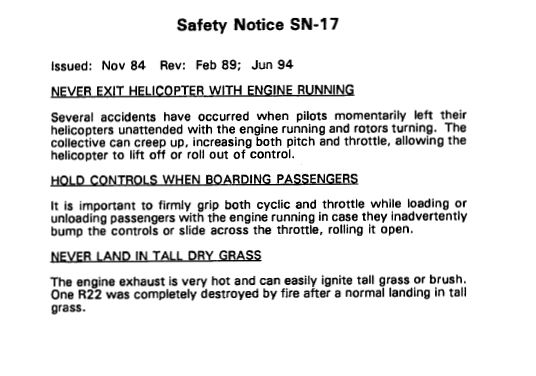
Safety notice SN-17 NEVER EXIT HELICOPTER WITH ENGINE RUNNING was included in the R44 POH and highlighted that a number of accidents have occurred when pilots momentarily left an operating helicopter (appendix A). The notice advised that, unmonitored, the collective lever could creep up, increasing pitch and throttle and allowing the helicopter to lift‑off without pilot control.
To prevent inadvertent upward movement of the collective lever, it was reported by a number of helicopter pilots that an elastic strap was commonly positioned over the lever. There was evidence that the pilot of KJJ may have used this technique while not at the controls of the helicopter during ground operations (Figure 11). However, no approval for this method of securing the flight controls was found in the helicopter’s maintenance documentation. In any case, the POH stipulated that pilots must not leave flight controls unattended while the helicopter is operating. Civil Aviation Regulation 138 Pilot to comply with requirements etc of aircraft’s flight manual etc required Australian pilots to comply with that requirement.
CASA flight safety article titled Don’t walk away and an ATSB safety investigation highlighted the risks associated with leaving flight controls unattended while the helicopter was still operating. They can be viewed at:
Figure 11: Elastic strap found positioned near the collective (such as reported used by some pilots to secure the collective lever)
Source: ATSB
Related fuel contamination occurrences
A search of the ATSB’s occurrence database revealed that in the 10-year period from 2004 there was an average of about three reported fuel contamination-related occurrences per year. A number of the occurrences identified issues with water bypassing the aircraft’s fuel tank cap seals after periods of rain or entering the fuel system during the refuelling process. In many cases, the effects of water contamination remained unnoticed until the aircraft experienced an in‑flight engine power loss requiring the pilot to conduct a forced landing or return to an aerodrome.
The following occurrence investigations that relate to fuel contamination are available from the ATSB website at www.atsb.gov.au:
At an altitude of approximately 200 ft above ground level, the instructor heard the engine noise reducing and observed the engine RPM decreasing. The instructor immediately assumed control, lowered the nose of the aircraft to maintain airspeed and performed a successful emergency landing.
Water contamination was identified in the post-accident fuel samples taken from the aircraft’s fuel filter and the right fuel tank. Surface rust on the right tank fuel cap receptacle indicated that water had most likely entered the system through that point during the heavy rainfall in the previous days. During that period, the aircraft was parked in the open. The water contamination was not identified during the pre-flight fuel drain check that was conducted by the instructor and witnessed by the student.
On 13 December 2010, at about 1500 Eastern Standard Time, a Robinson R22 Alpha helicopter, registered VH-FDL, departed the Georgetown aeroplane landing area, Queensland with one pilot and one passenger on board.
The pilot reported that, when 9 km to the north of Georgetown on descent from 1,000 ft above ground level and passing through 150 ft, engine power was applied before the engine spluttered twice. This was immediately followed by a decrease in engine RPM and the low rotor RPM warning horn sounding. The engine subsequently failed. The pilot reported that carburettor heat was not applied during the descent and the carburettor temperature was above the yellow arc.
The pilot regained control of the rotor RPM and conducted a forced landing. During the landing, the helicopter’s skids struck a tree. The left skid then contacted the ground and the helicopter cartwheeled. The pilot was not injured, however the passenger sustained serious injuries.
The subsequent examination of the helicopter’s engine and fuel system did not identify any anomalies. It was possible that the small amount of water that was found in the carburettor contributed to the reported engine failure.
The pilot commenced the take-off from an elevated, 700 m long gravel airstrip on the eleventh of 12 flights. During the take-off, the aircraft did not achieve the required take-off performance. In an attempt to become airborne before the end of the useable runway surface, the pilot elected to dump some of the chemical load and continued the take-off. The aircraft subsequently collided with terrain a short distance from the departure end of the airstrip.
The loader reported that the aircraft was refuelled at the airstrip from drums that were previously used to store aviation oil. The drums themselves were refuelled on the morning of the accident from a Geraldton, Western Australia fuel facility. Fuel sample tests of the drum stock fuel after the accident indicated higher-than-normal gum levels.
The pilot was reported to have refuelled the aircraft’s left wing tank from those drums three times prior to the accident. The investigation concluded that the quality of the fuel for the flight was not a factor.
It could not be determined why the fuel samples from the load truck’s fuel hose returned higher‑than‑recommended gum levels. However, the use by the pilot of fuel that was stored in disused aviation oil drums increased the risk that the fuel would not be suitable for the intended application.
The ATSB found that the aircraft departed controlled flight from which the pilot was unable to recover, leading to a collision with terrain. Based on the available evidence, it was not possible to determine the reasons for the loss of control.
The ATSB identified two aspects of the aircraft’s operation with the potential to affect safety. These were the use of an unapproved fuel mix and operation of the aircraft above its published maximum take-off weight.
Other research information
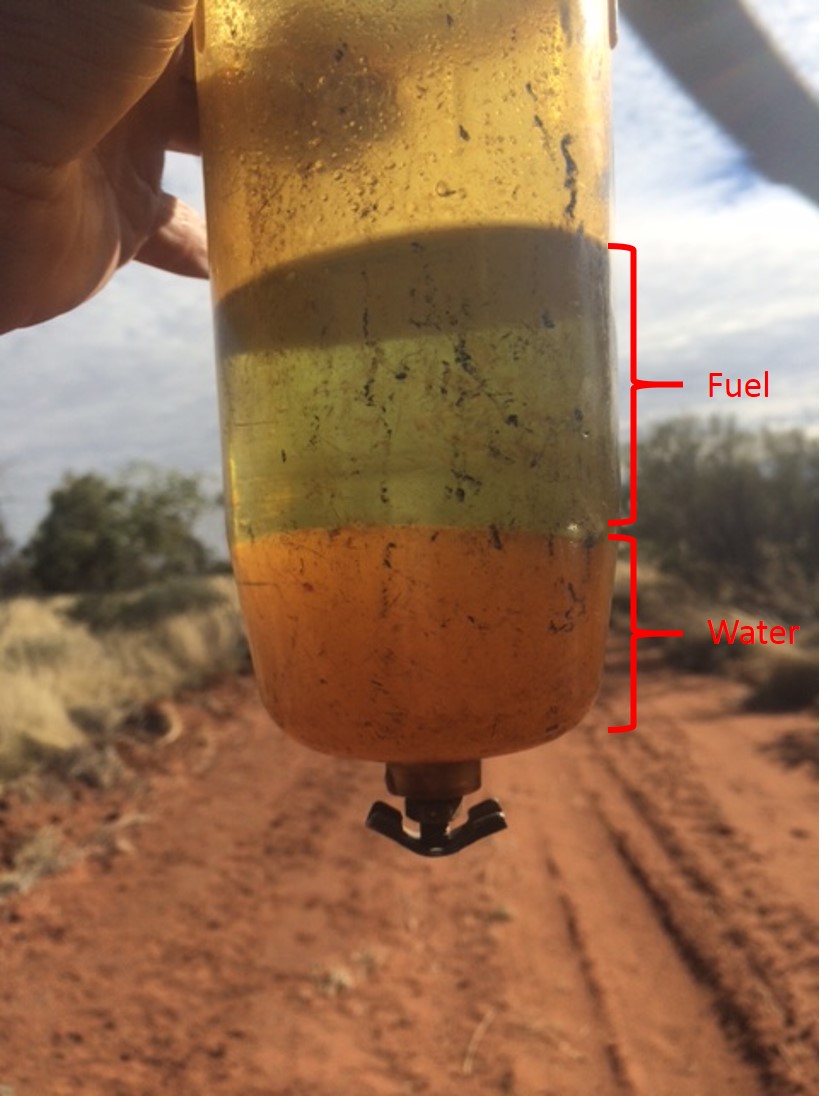
Although not captured in the ATSB’s occurrence database, it was reported by a number of pilots using aviation drum fuel supply in Australia that they often identified water contamination in their fuel drums. The water contamination was normally identified using water detecting paste prior to refuelling, or by visually inspecting the hand pump filter bowl during the refuelling process (Figure 12). It was also reported that pilots would normally inspect fuel samples taken from the aircraft’s fuel tanks after refuelling to confirm there was no contamination.
Figure 12: Unrelated example of a visual indication of water contamination in a fuel filter bowl
The pilot of VH-KJJ (KJJ) experienced a loss of engine power after a significant amount of water in the helicopter’s fuel system interrupted the flow of fuel to the engine. The engine lost power while the helicopter was in low-level cruise flight, a short time after refuelling from a local drum fuel supply.
In response to the loss of engine power, the pilot entered autorotation and attempted a forced landing in a largely timbered environment. The impact damage to the helicopter from the forced landing was consistent with a high rate of descent at touchdown, most likely due to low main rotor revolutions per minute (RPM) in the latter stages of the autorotation.
This analysis will examine the circumstances surrounding the fuel contamination and the autorotation in response to the loss of engine power. It will also highlight a number of important operational safety considerations in respect of fuel-handling practices and low-level helicopter operations.
Response to the engine failure
Entry into and conduct of the autorotation
On-site evidence and data recovered from the helicopter’s global positioning system equipment provided an understanding of the helicopter’s operation on the day of the accident and, in particular, during the final stages of flight. This did not include the degree or sequence of control inputs by the pilot after the loss of engine power. However, it was evident that the pilot entered autorotation, established an initial speed of about 70 kt and completed a slight turn to the south‑east. This was consistent with a turn towards the ultimate touchdown point. In response to a loss of engine power, helicopter pilots enter autorotation and normally turn into wind and select the most suitable landing area before planning their descent.
Evidence of coning of the main rotor blades was consistent with decreased main rotor energy. Although the reason for this loss of energy could not be determined, any loss of energy would have decreased the pilot’s ability to arrest the helicopter’s rate of descent. In addition, the wooded terrain and limited suitable landing areas would have increased the difficulty faced by the pilot.
Ultimately, for reasons that could not be established, but consistent with the difficulties faced by the pilot, the pilot was unable to satisfactorily reduce the rate of descent before impacting the ground. The heavier-than-normal forces experienced during the touchdown influenced the likelihood of survival from the autorotation.
Expectancy and training currency
The ATSB considered a range of factors that may have influenced the pilot’s ability to conduct a successful autorotation touchdown from the low-level cruise height. These included expectancy and skill decay.
Pilots expect certain abnormal events during flight review and proficiency checks, and they are generally well prepared to respond to those scenarios. Research has shown that performance is slower, less effective and more variable when an abnormal event is not expected (Casner and others 2013, Hendrickson and others 2006).
Engine failures and power loss from fuel contamination are rare events and therefore they are generally not expected. In this case, the pilot had probably refuelled on many occasions from drum fuel supply without experiencing adverse in-flight effects from fuel contamination. Further, the pilot was aware that another helicopter had just refuelled using the same fuel supply without any reported engine-related difficulties. This likely reinforced the pilot’s expectation that there would be no issues related to fuel contamination.
Low expectancy has been associated with many previous occurrences related to in-flight management of abnormal events. To help overcome these problems, pilots conduct regular flight reviews and proficiency checks to ensure they have, or can regain the operational skills to respond to those events.
In this case, the pilot had not conducted a flight review since March 2013. A flight review would likely have provided an opportunity for the pilot to practice low-level autorotation in response to simulated loss of engine power, and react to other risks associated with low-level mustering operations. In consequence of this lack of recency, the pilot’s skill managing in-flight emergencies could be expected to have deteriorated, influencing their ability to execute and successfully recover from an autorotation.
Operators should not underestimate the value of regular emergency procedure training, flight reviews and the continual assessment of operational threats and risks. Some emergencies, like a loss of engine power at low level, require prompt and appropriate action. Importantly, recurrent flight training allows mustering pilots to review their low-level operations to increase the available options in the event of an in-flight emergency.
Fuel handling practices
Proper management of ground fuel supplies and assurance of fuel quality throughout the refuelling process should not be understated. There have been many aviation occurrences where pilots have experienced in-flight difficulties relating to fuel starvation or exhaustion. This includes instances of fuel starvation from contaminated fuel.
While there was industry guidance available to operators about acceptable fuel standards and practices to help prevent fuel contamination, it was evident that the application of, and adherence to those standards varied across the aviation industry. In this case, the mustering operation was conducted as a private operation. Therefore, it did not require an operations manual that would have outlined the drum-fuelling procedures and necessary equipment. Although some newer-type drums were being used on the day of the accident, the operator’s reported procedure for renewing fuel drums did not include isolating damaged fuel drums from the main drum supply. This allowed the re-use of the damaged drum after refilling.
It was probable that most of the contamination was introduced into KJJ’s fuel system while refuelling from the older, rusted and damaged drum. This was consistent with the negligible amounts of water, rust or particulates identified in the operator’s other fuel supplies. The water and rust particulates in the old, rusted and dented drum may have resulted from its storage unused for a period in a hot and humid environment.
Previous ATSB aviation safety investigations have highlighted risks associated with the improper use of drums for storage of aviation fuel, and the absence of recommended aviation filters during refuelling operations. Although the regulations required pilots and operators to have a suitable means of testing fuel prior to and after filling an aircraft’s fuel tanks, it was evident that no robust procedure was in place for testing fuel at the time of the accident.
A number of issues were identified with the refuelling procedures and use of drum fuel that, if addressed, could have prevented, or provided an opportunity to detect water and particulate contamination in the drum stock. The ability to detect contamination in fuel using visual inspection and smell can vary. As a result, it is recommended that pilots check for the presence of water using a positive test method, such as water-detecting paste. In this case, visual detection of water may have been difficult because of the amber colour of the fuel filter bowl, turbid colour of the contamination and quantity of water in the fuel. The use of water‑detecting paste would have identified the contamination prior to refuelling the helicopter, indicating that the fuel was unsuitable for aviation use. It was therefore likely that during the last refuel, the pilot was unable to identify any visible water or particulates transferred into the helicopter’s fuel from the drum fuel stock. Alternately, the pilot did not test the fuel from the helicopter’s fuel tanks and gascolator after refuelling.
Pilots from the other helicopters operating on the same muster reported no contamination when their helicopters’ fuel tanks were examined after the accident. This was most likely due to their only using half of the older, damaged drum, along with their method of tilting the drum fuel pump toward the higher side of the drum. This meant that any contaminants were, if present, drained away from the fuel pump inlet. The pilot of KJJ used almost all of the remaining fuel in the older, rusted drum. This would require the pilot to position the fuel pump inlet at the base of the drum, near the water and particulate contamination.
The addition of a filter monitor would have provided another line of defence before the fuel entered KJJ’s fuel tanks. Used correctly, a filter monitor meeting the petroleum industry standard would have inhibited the pilot from pumping the contaminated fuel once water contacted the filter membrane, as the pilot would feel increased pressure or resistance. The associated difficulty pumping fuel through the filter would have alerted the pilot of the potential water contamination. It could be expected that this would most likely have prompted testing and subsequent removal of any contamination from the helicopter’s fuel tanks.
The use of a filter that met the petroleum industry standard would have reduced the size of particulate able to pass through the filter to as low as 1 µm. This compares with the larger 10 µm particulate size filtered by the filter that was used on the day of the accident. This would have minimised the amount of particulate identified in KJJ’s fuel tank, carburettor and gascolator.
The use of appropriate fuel pump filters (filter monitors) and checks of the helicopter’s fuel system would have increased the likelihood that the pilot would detect the contaminated fuel. The importance of operators having appropriate fuel handling and storage procedures to ensure fuel quality is also highlighted.
Hot refuelling
The timing of the refuel that was derived from the recorded global positioning system data suggested that the pilot of KJJ did not shutdown the helicopter prior to refuelling (hot refuelling). The time normally required for a refuel, compared to the time spent on the ground that day, was insufficient for completion of the:
helicopter shutdown and start-up procedures
the actual refuelling process.
While the R44 pilot’s operating handbook did not exclude hot refuelling, there were regulations that stipulated the responsibilities of operators and pilots during such refuelling processes. Of note, the operator was required to have an operations manual that set out the operational circumstances and procedures to ensure the safe refuelling of aircraft. As the helicopter was being operated privately that day, and therefore there was no operations manual, hot refuelling should not have been conducted. In addition, the R44 pilot’s operating handbook required the pilot to remain at the controls while the helicopter was operating.
Unmonitored helicopter flight controls with the rotors running, such as during hot refuelling, increases the risk of the helicopter unintentionally becoming airborne and subsequent injury to bystanders.
Findings
From the evidence available, the following findings are made with respect to the collision with terrain involving Robinson Helicopter Company R44, registered VH-KJJ, which occurred 153 km south-west of Timber Creek, Northern Territory on 14 June 2015. These findings should not be read as apportioning blame or liability to any particular organisation or individual.
Contributing factors
Following drum refuelling, fuel from the helicopter's fuel tanks and gascolator were likely not tested for the presence of contamination. This was a missed opportunity for the pilot to detect water and particulates introduced from the drum fuel supply.
The helicopter’s fuel system was contaminated with water and particulates during the drum refuelling, preventing a combustible fuel supply to the helicopter’s engine during flight and causing it to stop shortly after take-off.
During a low-level autorotation and forced landing, and for reasons that could not be determined, the pilot was unable to satisfactorily reduce the rate of descent before impacting the ground. The heavier-than-normal forces experienced during the touchdown influenced the likelihood of survival from the autorotation.
Other factors that increased risk
The operator did not have an effective procedure for testing and managing drum fuel supply, increasing the risk of fuel contamination from that supply.
The operator did not use a filter monitor that was recommended by the petroleum industry and was suitable for aviation use. Such a filter would have minimised the risk of water contamination during the drum refuelling.
The pilot had not completed the stipulated helicopter flight review for low-level helicopter operations. This likely influenced the pilot’s familiarity and proficiency with managing time‑critical emergencies that occur from a low altitude.
The unmonitored flight controls during the hot refuelling increased the risk of the helicopter unintentionally becoming airborne and injuring bystanders.
Sources and submissions
Sources of information
The sources of information during the investigation included:
the Civil Aviation Safety Authority
a number of helicopter training providers
a number of other helicopter operators
a petroleum company that supplied aviation drum fuel in Australia
a number of property station hands.
References
Casner, SM Geven, RW & Williams, RT 2013, ‘The effectiveness of airline pilot training for abnormal events’, Human Factors: The Journal of the Human Factors and Ergonomics Society, vol. 55, pp.477-485.
Hendrickson, SM Goldsmith, TE & Johnson, PJ 2006, ‘Retention of airline pilots’ knowledge and skill’, Proceedings of the Human Factors and Ergonomics Society 50th Annual Meeting, pp.1973‑1976.
Submissions
Under Part 4, Division 2 (Investigation Reports), Section 26 of the Transport Safety Investigation Act 2003 (the Act), the ATSB may provide a draft report, on a confidential basis, to any person whom the ATSB considers appropriate. Section 26 (1) (a) of the Act allows a person receiving a draft report to make submissions to the ATSB about the draft report.
A draft of this report was provided to the helicopter operators, the Civil Aviation Safety Authority and a petroleum company that supplied aviation drum fuel in Australia.
Submissions were received from the helicopter operators and a petroleum company that supplied aviation drum fuel in Australia. The submissions were reviewed and where considered appropriate, the text of the report was amended accordingly.
Appendices
Appendix A – Robinson Helicopter Company Safety Notices
Appendix B – R44 Height – Velocity Diagram
Purpose of safety investigations
The objective of a safety investigation is to enhance transport safety. This is done through:
identifying safety issues and facilitating safety action to address those issues
providing information about occurrences and their associated safety factors to facilitate learning within the transport industry.
It is not a function of the ATSB to apportion blame or provide a means for determining liability. At the same time, an investigation report must include factual material of sufficient weight to support the analysis and findings. At all times the ATSB endeavours to balance the use of material that could imply adverse comment with the need to properly explain what happened, and why, in a fair and unbiased manner. The ATSB does not investigate for the purpose of taking administrative, regulatory or criminal action.
Terminology
An explanation of terminology used in ATSB investigation reports is available here. This includes terms such as occurrence, contributing factor, other factor that increased risk, and safety issue.
Publishing information
Released in accordance with section 25 of the Transport Safety Investigation Act 2003
Ownership of intellectual property rights in this publication
Unless otherwise noted, copyright (and any other intellectual property rights, if any) in this report publication is owned by the Commonwealth of Australia.
Creative Commons licence
With the exception of the Coat of Arms, ATSB logo, and photos and graphics in which a third party holds copyright, this publication is licensed under a Creative Commons Attribution 3.0 Australia licence.
Creative Commons Attribution 3.0 Australia Licence is a standard form licence agreement that allows you to copy, distribute, transmit and adapt this publication provided that you attribute the work.
The ATSB’s preference is that you attribute this publication (and any material sourced from it) using the following wording: Source: Australian Transport Safety Bureau
Copyright in material obtained from other agencies, private individuals or organisations, belongs to those agencies, individuals or organisations. Where you wish to use their material, you will need to contact them directly.
On 19 February 2015, a Robinson R44 helicopter, registration ZK-IPY, collided with terrain 12 km south-west of Queenstown Airport, New Zealand.
The New Zealand Transport Accident Investigation Commission (TAIC) conducted an investigation into the circumstances of the accident. As part of its investigation, TAIC requested technical assistance from the ATSB. To protect any information supplied by TAIC to the ATSB, and the ATSB's investigative work to assist TAIC, the ATSB initiated an investigation under the Transport Safety Investigation Act 2003.
The ATSB has finalised its work in support of the TAIC investigation and TAIC is responsible for the release of the final investigation report. Any enquiries in respect of the TAIC investigation or release of the investigation report should, in the first instance, be directed to the TAIC at: www.taic.org.nz.
Transport Accident Investigation Commission Level 16 80 The Terrace PO Box 10323 Wellington, 6143 New Zealand
_________________
The information contained in this web update is released in accordance with section 25 of the Transport Safety Investigation Act 2003.
Occurrence summary
Investigation number
AE-2015-059
Occurrence date
19/02/2015
Location
12 km south-west of Queenstown Airport, New Zealand
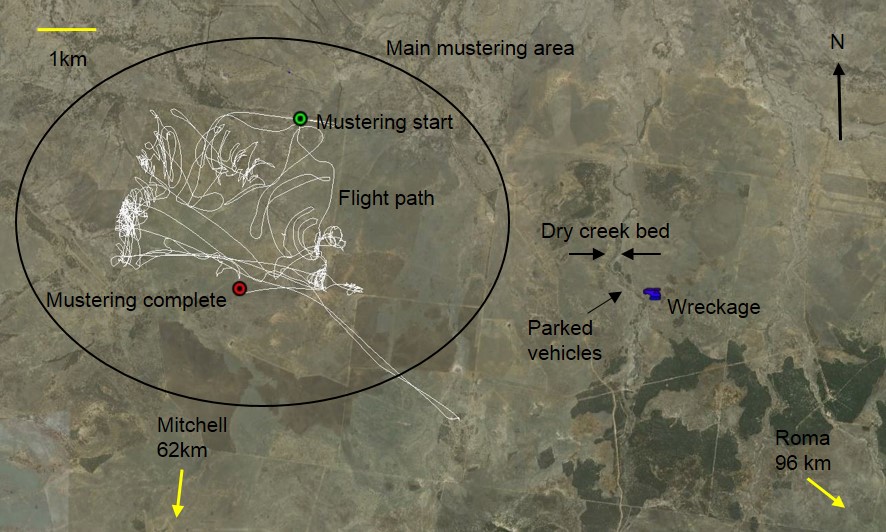
On 28 May 2015, the pilot of a Robinson 22 helicopter, registered VH-HRW, was engaged in aerial mustering operations about 63 km north-north-east of Mitchell, Queensland. Late in the afternoon the helicopter’s tail rotor struck the branch of a 7 m-high dead and defoliated tree, the pilot lost control of the helicopter and it collided with terrain. The helicopter was destroyed and the pilot, the sole occupant, was fatally injured.
What the ATSB found
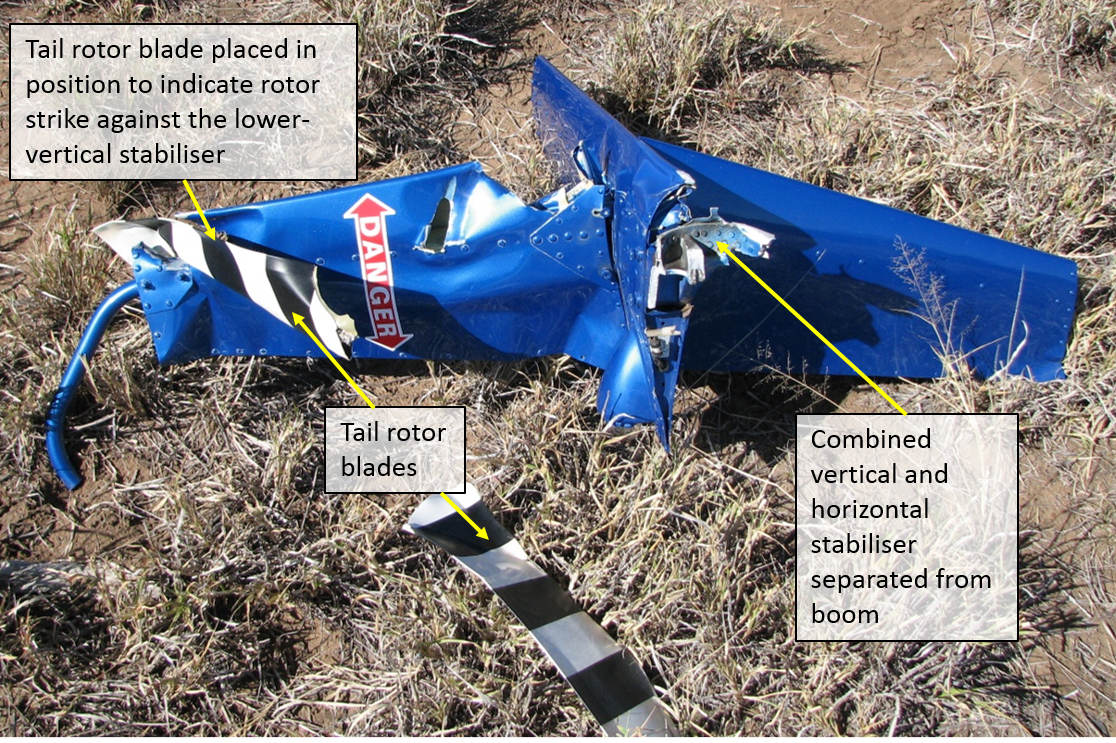
The ATSB found that the pilot was appropriately qualified and flying due west in a serviceable helicopter at low level. The sun was to the north-west and about 13°–15° above the horizon at that time. The helicopter’s tail rotor collided with the upper branch of an isolated tree. That collision separated a portion of the tail rotor blades, leading to the remainder of the tail rotor and the helicopter’s horizontal and vertical stabilisers and tail rotor gearbox also separating. The pilot could not control the helicopter and it collided with terrain.
Given the conditions, it is likely that sun glare and the darkened backdrop of a tree-lined dry creek bed affected the pilot’s vision and perception, and therefore ability to identify the isolated tree. Despite the pilot wearing a helmet that was fitted with sun visors, the ATSB could not determine whether the visors were lowered at the time. In any event, it is likely that the pilot did not see the tree, or misjudged its height and/or its distance from the approaching helicopter.
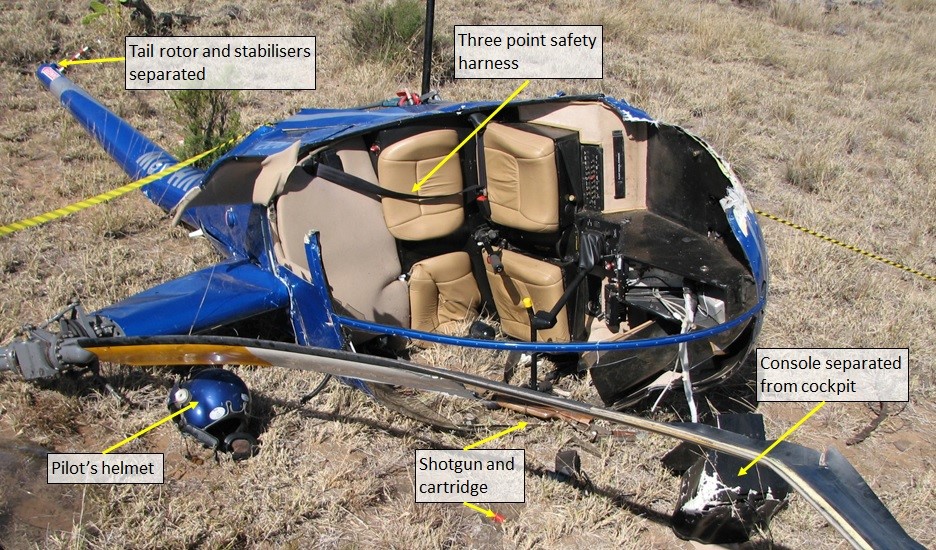
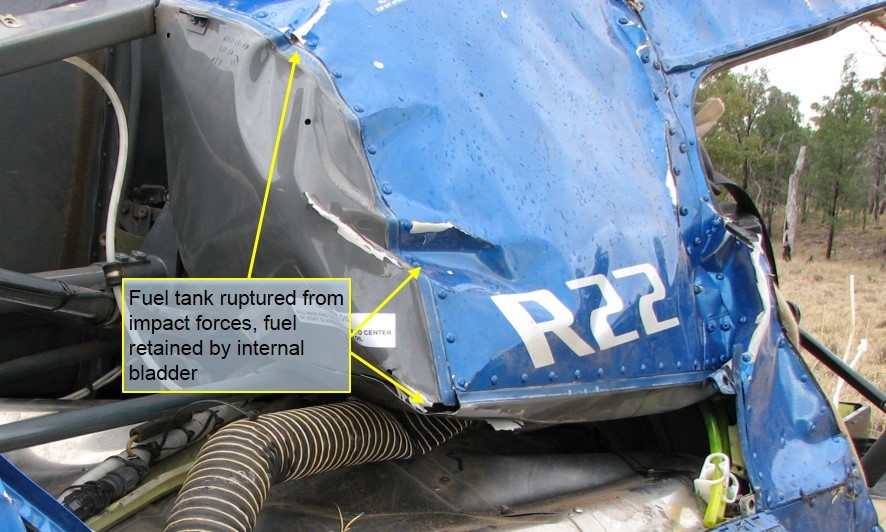
The ATSB did not identify any pre-existing mechanical defects and established that, at the time of the accident, the helicopter was likely serviceable. The helicopter was fitted with a three-point safety harness and bladder-type fuel tanks. These tanks decrease the risk of a post-impact, fuel-fed fire. Despite these additional safety features, and the safety benefits possible from the pilot wearing a helmet, the accident was not survivable due to impact forces. A number of unrestrained items in the cabin increased the risk of injury as a result of those forces.
Safety message
Low-level aerial mustering operations are an inherently high-risk activity. When conducting this type of operation, pilots need to consider the environmental conditions as part of their flight planning and operational risk assessment. The ATSB and the Civil Aviation Safety Authority have released a number of publications illustrating the risks associated with this type of operation that provide guidance and strategies for mitigating those risks.
The occurrence
On 28 May 2015, the pilot of a Robinson 22 helicopter, registered VH-HRW, was carrying out aerial mustering operations on a property about 63 km north-north-east of Mitchell, Queensland (Figure 1). One of the property owners reported that the pilot had previously conducted mustering activities at the property.
The pilot flew VH-HRW to the mustering area from his home base earlier that day. This entailed a flight of about 20 minutes. The majority of the mustering activity followed between 1032 and 1329 Eastern Standard Time[1].
One of the property owners reported that the pilot then had a long break and a meal with the property owners and a station hand. The afternoon’s activities were discussed during the meal. The plan for those activities included that, while flying back to his home base, the pilot would look for stray cattle and muster them towards a number of stationary vehicles. These vehicles were to be stationed to the west of the afternoon’s operating area.
After several minutes, the station hand unsuccessfully attempted to contact the pilot by ultra high frequency radio. The station hand then drove their vehicle in the direction that the helicopter had departed. After several more minutes, the station hand located the helicopter wreckage. An attempt was made to revive the pilot but without success.
Figure 1: Image showing the helicopter’s track (in white) during the morning’s mustering. This track was derived from data downloaded from the helicopter’s on-board Global Positioning System receiver. The location of the helicopter wreckage is shown (in blue) reference the townships of Roma and Mitchell
a Commercial Pilot (Helicopter) Licence that was issued in 2003
a Single Engine Helicopter rating
an Aerial Mustering Helicopter approval
a Civil Aviation Safety Authority (CASA) Aviation Medical Certificate.
A review of the pilot’s logbook and previous aircraft maintenance releases for VH-HRW showed that the pilot had accumulated about 1,170 flight hours in R22 helicopters prior to the accident.
Fatigue
Family and friends of the pilot provided a consolidated 72-hour history of the pilot’s activities prior to the accident. These were considered to be consistent with normal rural living. No activities that would be considered overly strenuous were identified and the pilot had adequate rest periods prior to, and on the day of the accident. The mustering activity on the day was not considered excessive.
Data downloaded from the helicopter’s Global Positioning System (GPS) receiver and witness accounts were reviewed to understand the pilot’s activities that day. This review showed that the pilot flew for about 3 hours and 20 minutes over a period of 7 hours. This included a stop to refuel and the previously-discussed rest period and lunch after completing the main mustering activity that morning.
Based on the recorded GPS data and witness statements, the ATSB concluded that it was unlikely pilot fatigue contributed to the accident.
Operations
The muster was coordinated with the property owners and a station hand and entailed the pilot using the helicopter to help ground personnel move the cattle to a holding point.
Recorded data from the helicopter’s GPS receiver indicated that the pilot commenced mustering at 1032 and completed the muster at 1329. This was consistent with the recollection of one of the witnesses. The muster was conducted over an area of about 16 km2 and could be expected to include turns and complex manoeuvres at low level to encourage cattle to move in the desired direction.
The station hand reported that, after lunch and resting, they observed the helicopter land on a property road shortly after it departed on the return flight to the pilot’s home base. The landing was to the west of a tree-lined dry creek. The pilot got out of the helicopter, opened a gate, got back in the helicopter, and then departed in an easterly direction.
The station hand and the property owner recalled separately that the 1600 radio news broadcast commenced on their vehicle’s radios at about that time.
The station hand, who reported being familiar with the helicopter, reported that when the helicopter departed from the road it sounded and appeared to be operating normally. That was the last recorded sighting of the helicopter prior to the discovery of the wreckage.
Wreckage information
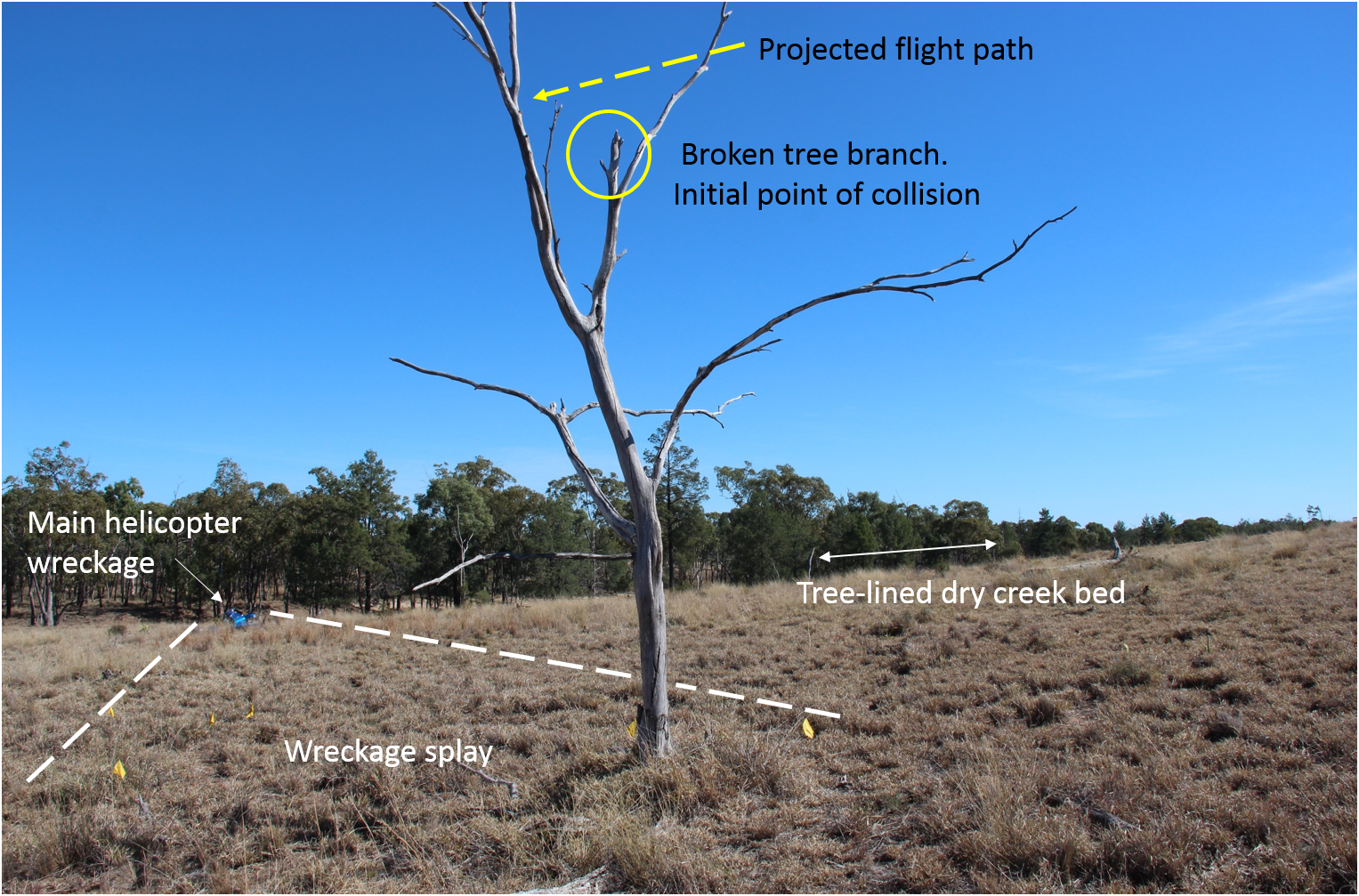
Examination of the helicopter wreckage and ground scars found that the tail rotor blades collided with the upper branch of an isolated, 7 m-high dead and defoliated tree (tree) that was about 100 m to the east of a tree-lined dry creek bed. The terrain sloped down towards the creek bed at about 2°–5° (Figure 2).
Figure 2: Helicopter flight path looking to the west. The estimated right-to-left flight path (indicated by a yellow dashed arrow) is derived from the impact point with the dead and defoliated tree and the position of the main helicopter wreckage
Source: ATSB
On contact with the tree, segments of the two tail rotor blades separated from the tail rotor. During the ensuing impact sequence, one of these blades struck the lower-vertical stabiliser, causing the combined vertical and horizontal stabilisers[2] and tail rotor gearbox to separate from the tail boom (Figure 3). The tail rotor blades, combined horizontal and vertical stabilisers and gearbox were collocated in close proximity to the tree.
Figure 3: Combined horizontal and vertical stabilisers and tail rotor blades after their separation from the helicopter. One of the two tail rotor blades has been placed against the lower-vertical stabilizer to demonstrate the impact point after the initial strike with the dead and defoliated tree
Source: ATSB
The remainder of the helicopter continued for an additional 40–50 m west of the tree, impacted terrain and pivoted on the remainder of the tail boom in a clockwise direction. Shortly after, the fuselage and main rotor blades collided with terrain.
During the accident sequence, the main rotor blade pitch links fractured in overload, consistent with the impact forces. One of the two rotor blades penetrated the acrylic glass canopy. The instrument console was dislodged from its mounting and ejected from the cockpit (Figure 4). The helicopter’s clock stopped at 1605, not inconsistent with the helicopter colliding with terrain about 5 minutes after it departed from the property road and the time taken by the station hand to locate the wreckage of the helicopter.
The main and auxiliary fuel tanks contained a significant quantity of fuel. A sample of that fuel was tested on-site and found to be adequate for continued flight. The fuel tanks sustained significant crushing and deformation damage. In addition, the tail rotor drive train flex plate[3] coupling penetrated the full thickness of the main aluminium tank. However, the internal fuel bladder was not punctured and did not leak (Figure 5). There was no fire.
Continuity of the main rotor drive train was established with evidence that, at impact, the engine was producing significant power. This included torsional deformation of the main and tail rotor drive shafts, chord wise scratching of the main rotor blades and absence of main rotor blade coning.
The ATSB established that, based on the on-site physical evidence, it was likely the helicopter was mechanically sound prior to colliding with the tree with no preexisting mechanical defects that may have contributed to the accident.
Figure 4: Helicopter wreckage, showing the ejected instrument console, damaged main rotor blade and destroyed canopy
Source: ATSB
Survivability
Helicopter equipment
The two seat bases in the R22 helicopter also serve as storage compartments for the helicopter. Constructed of aluminium, the seat ‘boxes’ are designed to absorb and limit the transfer of impact forces to the pilot and passenger in the event of an accident. Goods that do not impede that safety feature, and are within specific weight limits, can be placed inside the storage compartment.
The pilot’s seat base was found partially compressed, consistent with the absorption of vertical impact forces during the accident sequence. The pilot and passenger seat bases contained various stowed items that were within the manufacturer’s allowable weight limits. All items found at the accident site had been retained within the compartments.
During recent maintenance the helicopter was fitted with front-seat three-point safety harnesses. The pilot was wearing their three-point safety harness and, although fatally injured, was effectively restrained during the impact sequence.
Installation of bladder-type fuel tanks
During the recent maintenance, the helicopter was modified and fitted with bladder-type fuel tanks. These tanks reduce the risk of a post-impact, fuel-fed fire.
Figure 5: Ruptured aluminium main fuel tank. Note that the remaining fuel was retained by the internal fuel bladder
Source: ATSB
Personal equipment - aviation helmet
The pilot was wearing an aviation helmet built to the United States (US) military standard MILDTL-87174A that was fitted with yellow and dark grey sun visors. The visors could be raised and lowered by the pilot at two pivot points, one on each side of the helmet. The ATSB could not determine if either visor was being used at the time of the accident.
Impact damage was identified to the left and right sides of the helmet. The right side of the cockpit, above the door cut-out, had an impression consistent with the shape of the pilot’s helmet sun visor pivot point.
Loose/unrestrained items
Loose, or unrestrained items were recovered in and around the wreckage. The most significant items were a digital single-lens reflex camera, two shotguns and a bag of live ammunition. A witness reported that some pilots use shotguns during mustering operations and for feral animal control.
One of the shotguns collided with one of the main rotor blades during the impact sequence. Live cartridges were scattered throughout the wreckage and the digital single-lens reflex camera was severely disrupted.
Unrestrained or loose items are known to increase the risk of loss of flight control or injury during flight.
Medical and pathological information
Post-mortem examination and toxicology analysis of the pilot did not reveal any evidence of a physiological condition that may have contributed to the occurrence, nor any evidence of drug or alcohol use. The examining forensic pathologist reported that the pilot sustained fatal injuries that were consistent with the type of injuries encountered in a helicopter accident.
Meteorological information
According to the Bureau of Meteorology, at about 1500 the weather at Mitchell, about 63 km south-south-west of the accident site, included few[4] clouds with light south-westerly winds and a temperature of 26 °C.
Witnesses who were associated with the mustering operation reported that the flying conditions at the property were ‘very good’.
The pilot was flying in a westerly direction at the time of the accident. According to the Geoscience Australia website (see www.ga.gov.au), between 1600 and 1615 the sun was at an elevation of about 13°–15° above the horizon and at an azimuth[5] of about 301°–303°. That was, about 30° to the right of the helicopter’s westerly track.
Research
Aerial mustering
Aerial mustering is the use of aircraft to locate, direct and concentrate livestock. It involves operating in an inherently hazardous environment while the aircraft is manoeuvred close to obstacles at very low heights, usually below a height of 500 ft above the surface.
In 2015, CASA released a report titled Sector Risk Profile for the aerial mustering sector. The report showed that the Robinson R22 helicopter is the most common model of helicopter on the Australian register and that about 62 per cent of the total R22 hours flown has been in aerial mustering operations. The report also discussed the development of a CASA risk profile tool to take account of the risks associated with aerial mustering operations and the associated operating environment. The report stated that the purpose of the ‘aerial mustering risk profile’ was to:
…present a picture of the key risks and effects arising from the operations of the sector’s fleet of aircraft at a given point in time. CASA and selected industry sector participants developed the sector risk profile through a process in which risks were jointly identified, assessed and evaluated for treatment. When fully implemented these risk treatments should reduce the risk profile of the sector.
A study conducted by the ATSB in 2004 titled Light Utility Helicopter Safety in Australia found that between 1985 and 2003, of the 141 accidents involving the R22 helicopter, 102 occurred during aerial mustering. The majority of aerial mustering accidents involved collision with terrain, trees, man-made features or other obstacles.
Sun glare
Research has shown that environmental conditions can greatly hinder a pilot’s ability to perform visual tasks. One of the most serious conditions in aviation is glare. When flying in the presence of strong light, as in this case flying directly towards the west when the sun was at an elevation of 13°–15° above the horizon, light from the sun is scattered within the eye and onto the retina. This results in a loss of visual performance and is termed ‘disability glare’. The problems associated with disability glare are reported to increase with age.
Disability glare is exacerbated when objects are being viewed through media or atmospherics that scatter the light further than that occurring naturally in the eye. Such conditions include dirty windscreens, flying in haze and taking off or landing directly into the sun. Research has found that pilots experience difficulty perceiving distances and depth due to glare from bright lights. Bright light sources are also shown to lead to visual misperceptions of height and distance and a momentary flash blindness (Nakagawara et al, 2006). In addition, glare was reported to distract pilot’s ‘truthful’ perception. A study conducted on behalf of the US Federal Aviation Administration (Nakagawara et al, 2003) of the US National Transportation Safety Board aviation accident database found that during a 12-month period there were:
…130 accidents in which glare from natural sunlight was found to be a contributing factor. The majority of the events occurred during clear weather and atmospheric conditions (85%), and were associated with the approach/landing and take-off/departure phases of flight (55%).
The study concluded that:
Exposure to glare from natural sunlight has contributed to aviation accidents, primarily under optimal visual conditions. The majority of accidents occurred during flight maneuvres at low altitude in airspace congested with other aircraft or obstacles, such as trees, power lines, utility poles, and terrain.
Related occurrences
The ATSB has investigated numerous accidents where sun glare was found to be a contributing factor. A number of these accidents and investigation reports are listed below and are available from theATSB website:
AO-2009-018. Midair collision involving Robinson Helicopter Company R22 Betta II, registered VHHCB, 15 km south-east of Springvale Station, Western Australia on 5 May 2009.
AO-2012-107. Runway excursion involving Cessna 210N, registered VH-WPD, at Urapunga Aeroplane Landing Area (ALA), Northern Territory on 23 August 2012.
AO-2012-146. Controlled flight into water involving Robinson R22 helicopter, registered VHHOA, 89 km north-north-west of Innamincka ALA, South Australia on 31 October 2012.
AO-2013-178. Hard landing involving Grob G-115C2 aircraft, registered VH-ZIV, at Merredin ALA, Western Australia on 11 October 2013.
AO-2014-118. Aircraft separation issue involving a Skyfox CA25N aircraft, registered 243265 and a Piper PA-28 aircraft, registered VH-WJO, near Roma Airport, Queensland on 3 July 2014.
AO-2014-191. Collision with terrain involving an Air Tractor AT-502 aircraft, registered VHPTF, 45 km west of Moree Airport, New South Wales on 18 December 2014.
This analysis will examine the factors in the development of an accident involving a qualified pilot, who was carrying out mustering operations in an airworthy helicopter, in good weather. These factors include:
the position and elevation of the sun and its impact on the pilot’s ability to see and react to an isolated, dead and defoliated tree (tree) along the pilot’s track
the loss of a number of helicopter components as a result of the helicopter striking that tree and the resulting effect on the pilot’s ability to control the helicopter
a number of survivability considerations.
Development of the accident
Examination of the wreckage and accident site found that the helicopter struck an upper branch of an isolated, 7 m-high tree about 100 m to the east of a tree-lined dry creek bed. This resulted in the tail rotor blades separating from the tail rotor assembly, followed by the vertical and horizontal stabilisers and structure, then the tail rotor gearbox. Control of the helicopter was no longer possible and the helicopter collided with terrain coming to rest on the right side.
The main wreckage was located about 50 m west of the tree. This was consistent with the helicopter being in forward flight, rather than in the hover, and indicated the helicopter’s westerly direction of travel preceding the tree strike.
The pilot’s reported departure from the road coincided at the commencement of the 1600 radio news. The time taken for the station hand to attempt to contact the pilot by ultra high frequency radio and then search for the missing helicopter, and the helicopter’s clock stopping at 1605 were consistent, suggesting that the helicopter impacted terrain sometime between about 1605 and 1615. At that time, the sun was at an elevation of about 13°–15°above the horizon and about 30° to the right of track.
Given the westerly direction of travel and the ambient conditions, it was likely that the pilot was subjected to sun glare. The ATSB considered whether the helicopter’s main rotor down-wash would have produced significant airborne dust and other particles, exacerbating the pilot’s disability glare. However, given the helicopter’s forward motion, any particles would, if agitated, have been behind the helicopter’s position along the westerly flight path.
The pilot was wearing an aviation helmet fitted with two sun visors but the ATSB could not determine if either or both of the visors were in use at the time. Even so, while visors lessen glare, they do not reduce its effect under all circumstances. Compounding the pilot’s difficulty identifying and/or avoiding the tree, it was possible that the tree line to the west along the dry creek bed acted as a darkened backdrop, decreasing the salience of the isolated tree.
The ATSB concluded it was probable that, due to the effects of sun glare, the pilot either did not see or misjudged the distance to the tree, leading to the tree strike and subsequent loss of control and collision with terrain.
Survivability
Unrestrained items in the cabin, including shotguns, a bag of ammunition and a digital single-lens reflex camera, increased the risk of flight control interference during normal flight and injury to the pilot during the accident sequence. Despite this, the ATSB could not determine if the unrestrained items contributed to the accident or the pilot’s injuries.
The helicopter was fitted with bladder-type fuel tanks that did not rupture during the accident sequence, preventing fuel leakage and therefore reducing the risk of a post-impact fire. In addition, the pilot’s seat structure was compressed, consistent with its design to absorb impact forces during an accident.
The helicopter was also fitted with three-point safety harnesses, increasing the likelihood of effective restraint in the case of an accident. Moreover, the pilot was wearing an aviation-flying helmet to reduce the risk of injury in an accident.
Despite all of the above safety features, the pilot was fatally injured. This indicated that the impact forces were such that the accident was not survivable.
Findings
From the evidence available, the following findings are made with respect to the collision with terrain involving Robinson R22 helicopter, registered VH-HRW, which occurred about 63 km north-north-east of Mitchell, Queensland on 28 May 2015. These findings should not be read as apportioning blame or liability to any particular organisation or individual.
Contributing factors
Given the low-level flight into the afternoon sun, it was likely that due to sun glare, the pilot did not see or misjudged the height and/or distance to the dead and defoliated tree before the tree strike.
As a result of the tree strike, the tail rotor, combined vertical and horizontal stabilisers and tail rotor gearbox separated from the tail boom, rendering the helicopter uncontrollable and resulting in the collision with terrain.
Other factors that increased risk
Unrestrained items in the helicopter’s cabin increased the risk of control interference during normal flight and injury to the pilot during the accident sequence.
Other findings
The helicopter was modified to include bladder-type fuel tanks, which did not puncture. This prevented fuel escaping after the impact and reduced the risk of a post-impact, fuel-fed fire.
Sources and submissions
Sources of information
The sources of information during the investigation included the:
witness reports from a number of participants in the muster that day
results and findings of the ATSB’s on-site investigation.
References
Aviation Research and Analysis report – B2004/0292, Robinson R22 helicopter aerial mustering usage investigation, ATSB Transport Safety Investigation report.
Civil Aviation Safety Authority (2015). Sector Risk Profile for the aerial mustering sector.
Gibb R, Gray R, and Scharff L (2010), Aviation Visual Perception, Ashgate Publishing Limited: Surrey England, pp.72-74.
Nakagawara V, Wood K, and Montgomery R (2003), Natural Sunlight and its Association to Aviation Accidents: Frequency and Prevention, Civil Aerospace Medical Institute, Federal Aviation Administration.
Submissions
Under Part 4, Division 2 (Investigation Reports), Section 26 of the Transport Safety Investigation Act 2003 (the Act), the ATSB may provide a draft report, on a confidential basis, to any person whom the ATSB considers appropriate. Section 26 (1) (a) of the Act allows a person receiving a draft report to make submissions to the ATSB about the draft report.
A draft of this report was provided to the Civil Aviation Safety Authority, the maintenance provider and a number of the witnesses.
No submissions were received from those parties.
Purpose of safety investigations
The objective of a safety investigation is to enhance transport safety. This is done through:
identifying safety issues and facilitating safety action to address those issues
providing information about occurrences and their associated safety factors to facilitate learning within the transport industry.
It is not a function of the ATSB to apportion blame or provide a means for determining liability. At the same time, an investigation report must include factual material of sufficient weight to support the analysis and findings. At all times the ATSB endeavours to balance the use of material that could imply adverse comment with the need to properly explain what happened, and why, in a fair and unbiased manner. The ATSB does not investigate for the purpose of taking administrative, regulatory or criminal action.
Terminology
An explanation of terminology used in ATSB investigation reports is available here. This includes terms such as occurrence, contributing factor, other factor that increased risk, and safety issue.
Publishing information
Released in accordance with section 25 of the Transport Safety Investigation Act 2003
Ownership of intellectual property rights in this publication
Unless otherwise noted, copyright (and any other intellectual property rights, if any) in this report publication is owned by the Commonwealth of Australia.
Creative Commons licence
With the exception of the Coat of Arms, ATSB logo, and photos and graphics in which a third party holds copyright, this publication is licensed under a Creative Commons Attribution 3.0 Australia licence.
Creative Commons Attribution 3.0 Australia Licence is a standard form licence agreement that allows you to copy, distribute, transmit and adapt this publication provided that you attribute the work.
The ATSB’s preference is that you attribute this publication (and any material sourced from it) using the following wording: Source: Australian Transport Safety Bureau
Copyright in material obtained from other agencies, private individuals or organisations, belongs to those agencies, individuals or organisations. Where you wish to use their material, you will need to contact them directly.
Occurrence summary
Investigation number
AO-2015-055
Occurrence date
28/05/2015
Location
63 km north-north-east Mitchell (near Kilmorey Falls)