On 17 April 2018, the pilot of a Garlick Helicopters UH-1H, registered VH-HUE, was conducting long-line lifting operations near Talbingo in the Snowy Mountains region of New South Wales. While on approach to pick-up a load, the helicopter’s engine failed. During the subsequent forced landing, the helicopter collided with trees and a riverbed. The pilot sustained serious injuries and the helicopter was destroyed.
What the ATSB found
The ATSB found that the inner struts in the exhaust diffuser fractured leading to the engine failure. The fracture was the result of high-cycle metal fatigue, which had not been detected for at least 36 routine maintenance inspections prior to the accident. It was also established that the maintenance practices and processes were likely inadequate to detect the potential impending failure of safety critical components. These practices related to inspections, record keeping and trend monitoring.
Following the engine failure, the pilot had limited assurance that ground support personnel could vacate the clearing directly below the helicopter, necessitating a forced landing to a less suitable location. This was likely the result of a risk assessment for helicopter operations that did not consider the hazard of an emergency landing as the helicopter approached to hook-up a load.
The pilot was not wearing the upper torso restraint fitted to the helicopter during the flight. It was virtually certain that this resulted in the pilot sustaining serious head injuries when the aircraft collided with terrain. It was also identified that upper torso restraints were likely not routinely worn by a notable proportion of pilots conducting vertical reference flying operations in Australia. This was likely due to these restraints not being fit-for-purpose for the operations being conducted. The operations mainly related to aerial firefighting, and to a lesser extent, lifting operations.
Although not contributory, the ATSB also found that a screw-clamp was retrofitted to the firefighting retardant delivery hose, which likely prevented the release of the long-line during the forced landing. While this did not influence the outcome of the accident, this had the potential of becoming snagged in trees and increase the severity of the impact.
Further, the immediate response of the ground personnel to extinguish a small fire in the engine bay and assist the pilot with exiting the helicopter, likely reduced the risk of more severe injuries to the pilot.
What has been done as a result
Following the accident, the maintenance organisation was acquired by another company. They advised improvements were made to their maintenance procedures and processes. Those improvements included the implementation of a new computer-based maintenance system that was expected to provide greater assurance in maintenance performed and assist with trend monitoring for detecting anomalies. Further, vibration test equipment was purchased to allow greater ease in conducting required checks.
In addition, the company responsible for managing the site ground works convened a hazard assessment workshop with the helicopter operators where they reviewed the hazards and controls for mountain flying and lifting operations. This was to ensure alignment, and a common approach and understanding between all parties. A risk management plan was collated during this workshop for use in similar future operations.
Safety message
Purposeful visual inspections of safety critical components, and the routine review of documented maintenance records for trend monitoring and anomaly detection purposes provide a vital role in preventative aircraft maintenance. These aspects would have likely allowed anomalies to be identified and investigated prior to the engine failure occurring.
Helicopter lifting operations introduce additional risks to personnel working in their vicinity. In circumstances where there may be insufficient time to formulate a plan, such as an emergency landing from a low height and low speed, carefully considered and clearly communicated pre‑flight risk assessments provide an important mechanism to mitigate these risks.
Upper torso restraints provide an important defence to reduce the severity of injuries during an accident. This report highlights an elevated risk to pilots who are unable to effectively wear these restraints during some vertical reference operations, such as aerial firefighting and lifting. Further consideration of engineering innovations for these restraints could reduce the risk associated with this problem.
The occurrence
Preparation for lifting operations
On 17 April 2018, the pilot of a Garlick Helicopters UH-1H, registered VH-HUE (HUE), was to be conducting long-line lifting operations near Talbingo in the Snowy Mountains region of New South Wales. In the morning, the helicopter was prepared for flight at Tumut Airport, about 60 km north of the planned area of operation. Flight preparations involved a discussion between the pilot[1] and a contracted licenced aircraft maintenance engineer about the maintenance performed since the pilot had last flown the previous day. The pilot conducted a walk-around inspection of the helicopter, signed the maintenance release and conducted an engine run. Nothing abnormal was noted by the pilot or licenced aircraft maintenance engineer.
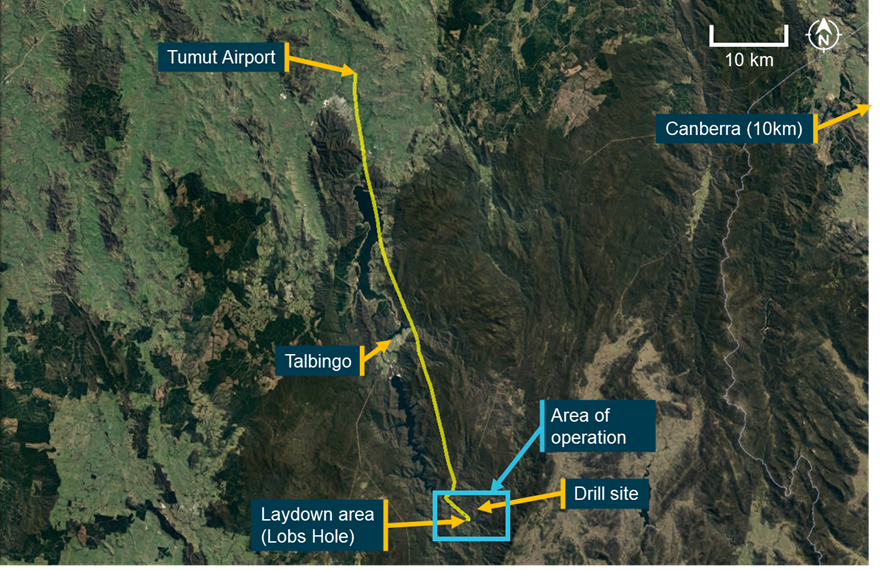
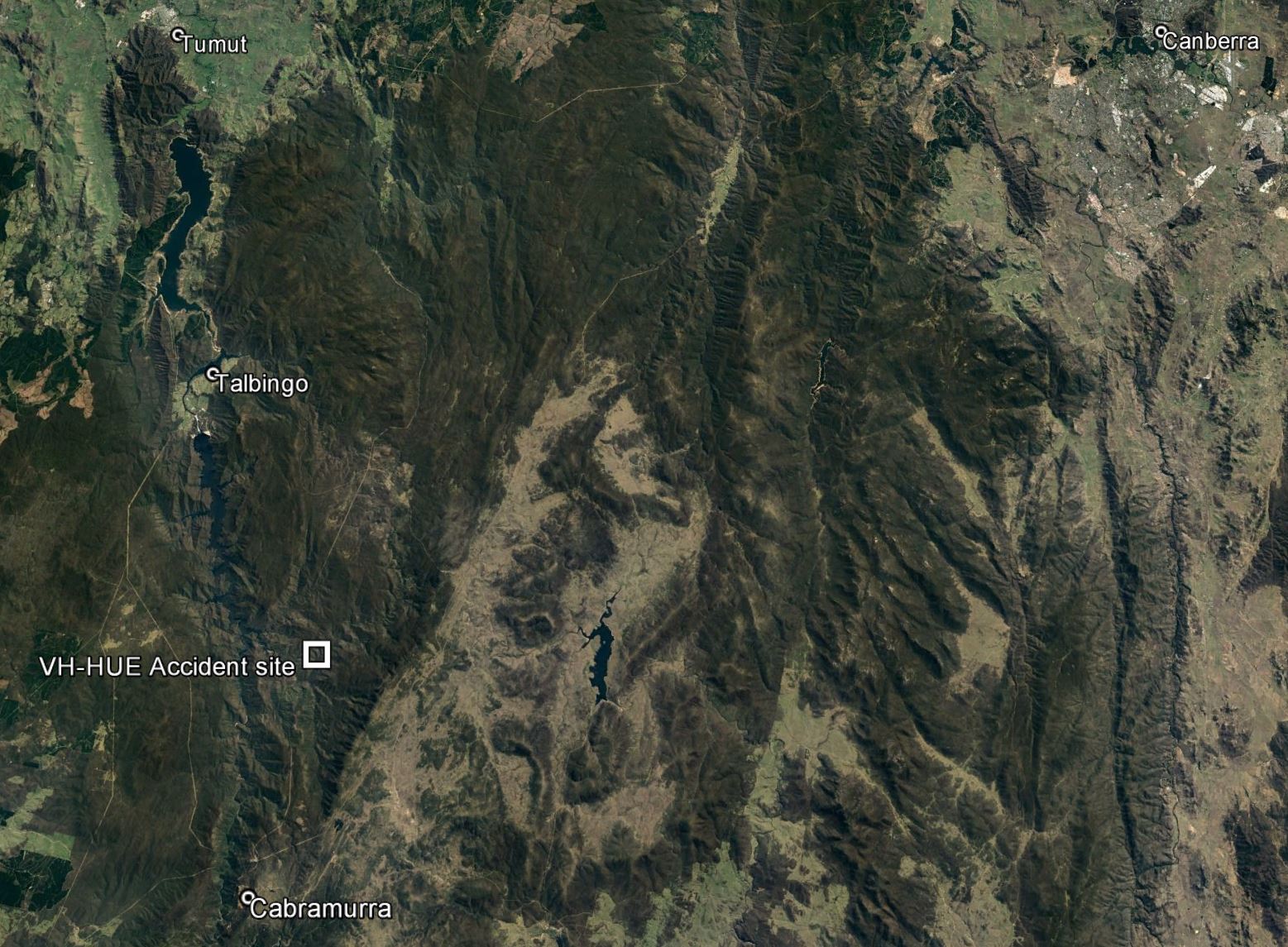
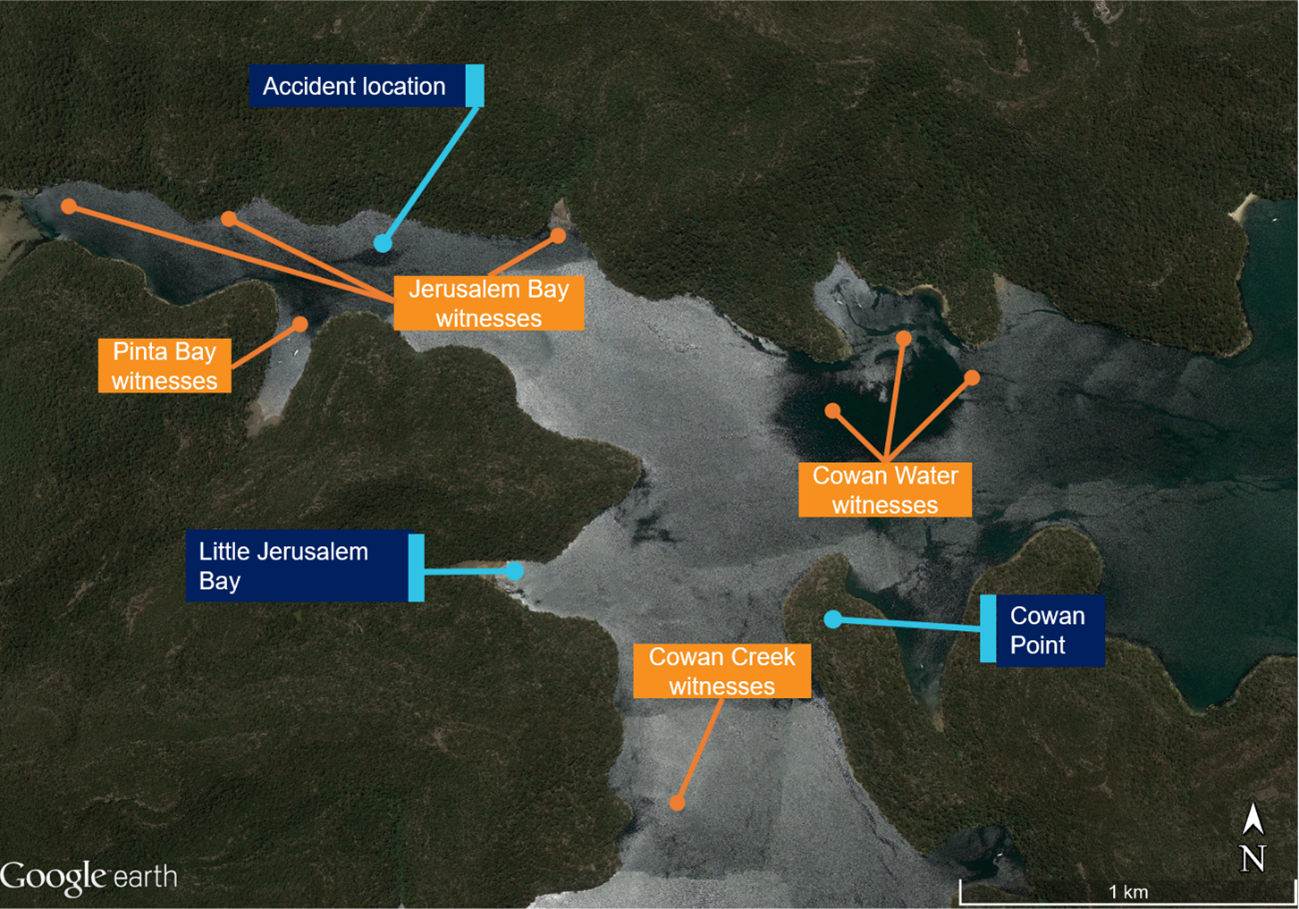
The helicopter departed Tumut Airport at about 0804 Eastern Standard Time,[2] for a positioning flight to a clearing 57 km south of Tumut, known as Lobs Hole, arriving at about 0837 (Figure 1). This location was used as the base of operations for the lifting work on the day, referred to as the ‘laydown area’. The operation was part of a proposed expansion of the Snowy Mountains Hydro‑electric Scheme, known as the Snowy 2.0 project. The planned work on the day involved using helicopters to relocate components of a de-constructed drill-rig used for geotechnical survey within the ‘area of operation’ shown in Figure 1.
Figure 1: Map showing morning repositioning flight and area of lifting operation
Source: Google Earth, annotated by the ATSB
The lifting operation involved HUE and two AS350 ‘Squirrel’ helicopters. HUE was to be utilised for heavier loads, and the Squirrels to be utilised for the lighter loads. Supporting the lifting operation on the ground at the drill site (location of the load hook-up) were two loadmasters, who had radio communications with the pilots. Three additional workers were also assisting with drill rig de-construction. Although these workers were not involved in the lifting operation, they remained at the drill site during lifting.
Conduct of lifting operations
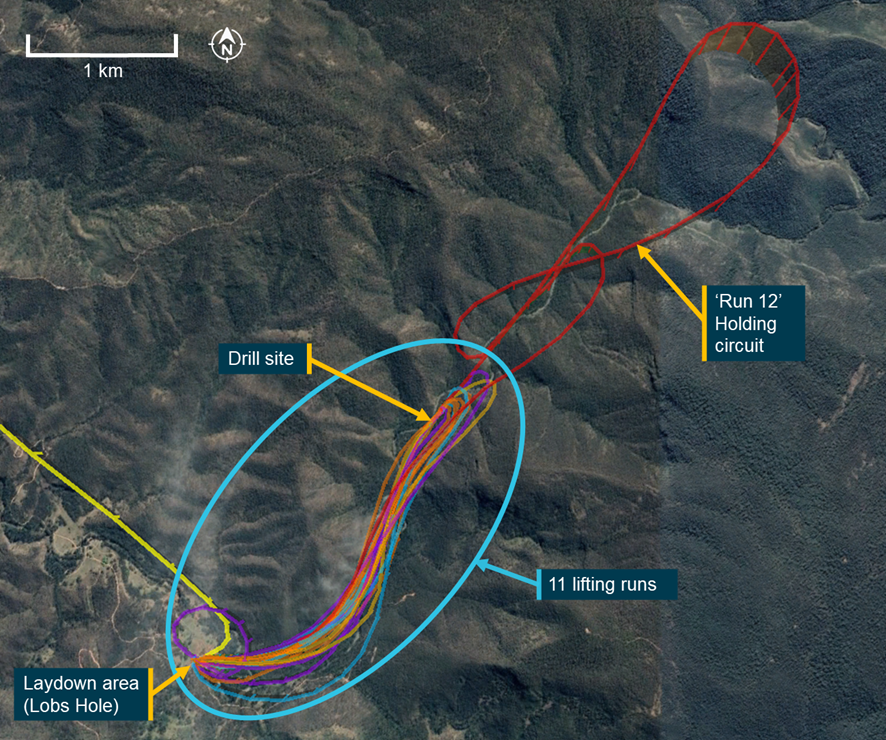
Lifting operations involving HUE commenced at 1308. Each run involved lifting drill-rig components from the drill site to the laydown area, before returning for the next lift. Each lift run, and return, was completed in about 5 minutes, with ground personnel preparing the next load between lifts. HUE had completed 11 lift runs (Figure 2), which the pilot reported were ‘uneventful’. At about 1414, the pilot positioned HUE for the twelfth run (Figure 2 red flight path), in order to lift the drill rig motor. As the helicopter approached for the twelfth lift, one of the loadmasters advised the pilot that more time was required to prepare the rigging and requested the pilot hold off for a short time. HUE entered a holding circuit about 700 m to the north-east prior to making a very slow approach toward the drill site (Figure 2 red flight path). The pilot recalled that the weather conditions were ideal, with a slight breeze and good visibility.
Figure 2: Map of lifting runs conducted
Source: Google Earth, annotated by the ATSB
While waiting for a radio clearance to lift the drill rig motor, the pilot recalled conducting a full system check, and that all instruments indicated the helicopter was operating in the normal range. At about 1415, the loadmaster requested the pilot approach the site in preparation for lifting the drill rig motor. As HUE approached overhead, the loadmaster informed the pilot that the rigging required re-checking. In order to minimise the rotor downwash on the people below, the pilot raised the collective to climb the helicopter, and the 100-foot long-line, above the tree canopy.
Engine failure and forced landing
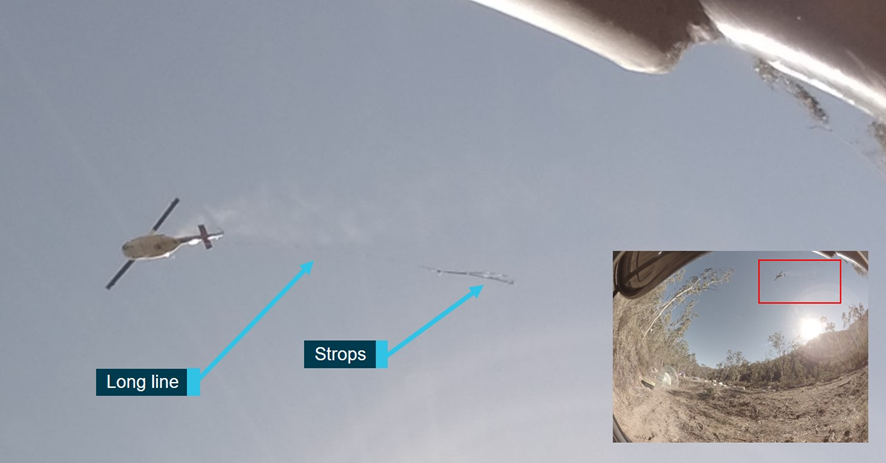
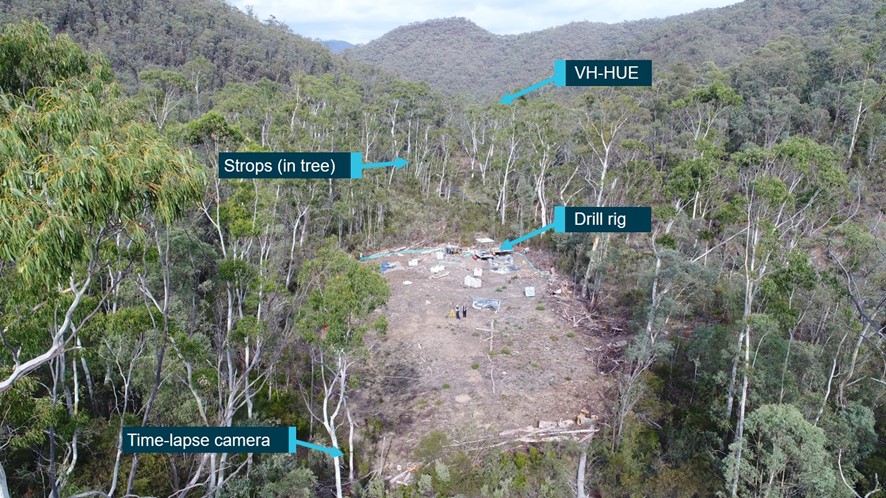
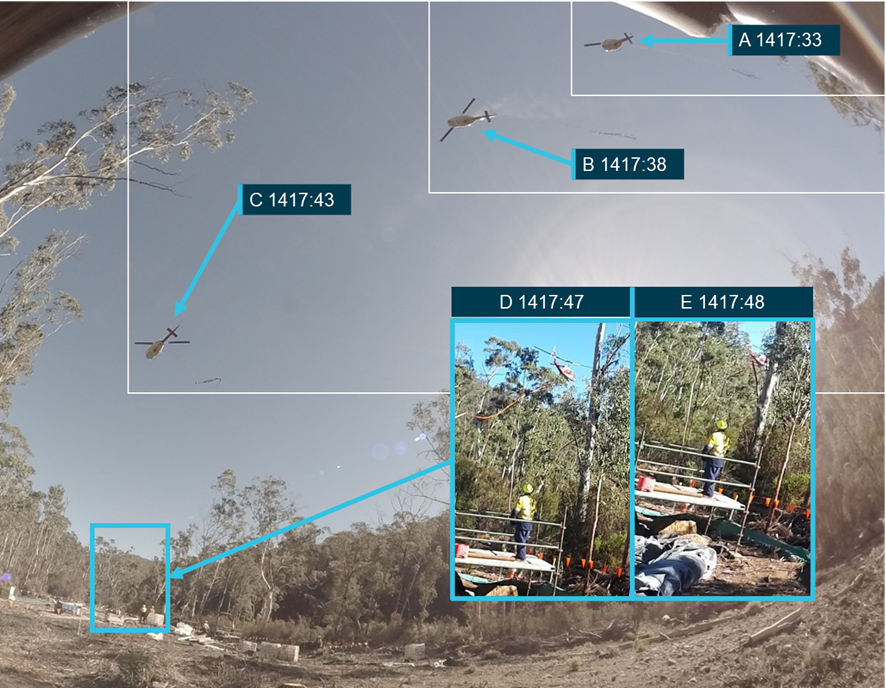
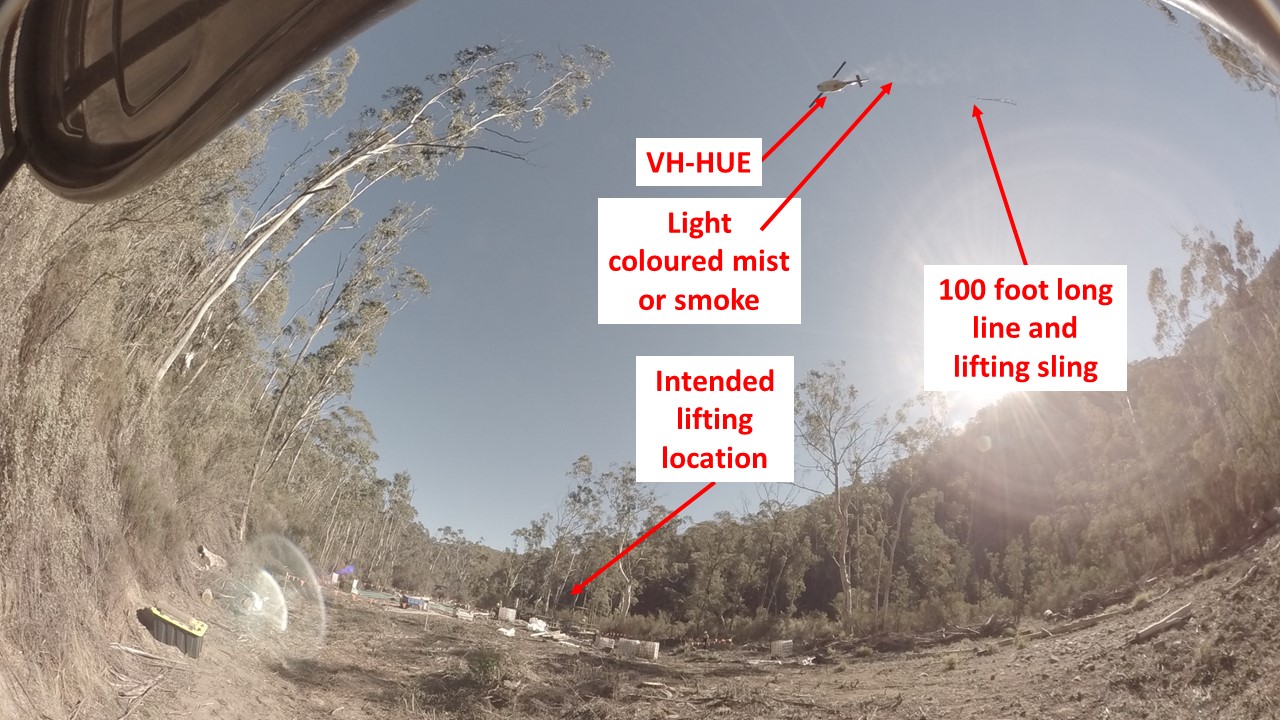
At about 1417, as the helicopter started to climb, the pilot heard a loud mechanical ‘screaming’ noise and started planning for a forced landing. Witnesses also reported seeing ‘smoke’ and some advised they heard a ‘bang’ at about the same time. Almost immediately, the pilot also heard an audible alarm, followed by a noticeable yaw and engine power loss. Time-lapse images from a camera mounted at the drill site showed a light-coloured gas or mist near the engine area of the helicopter (Figure 3).
Just prior to the engine failure, HUE was about 200 to 250 ft above ground level, with a forward airspeed of about 20 to 25 kt, based on global positioning system (GPS) data, eye-witness reports, and the pilot reporting flying into a slight headwind. From fuel-burn calculations by the ATSB, the weight of HUE was estimated at 2,900 kg at that time.
Figure 3: Light coloured gas or mist from the helicopter above the drill site
Source: GHD, annotated by the ATSB
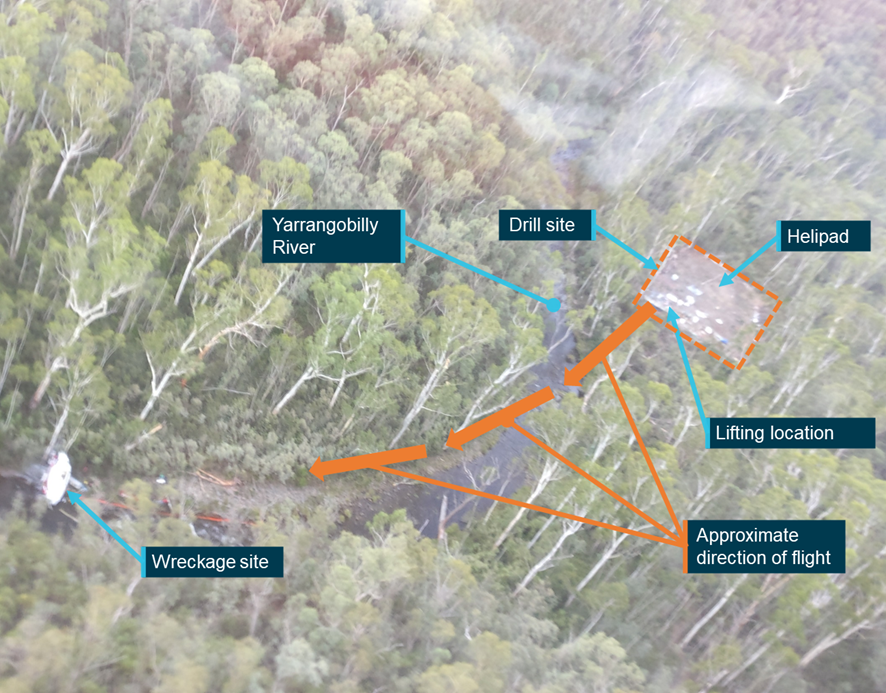
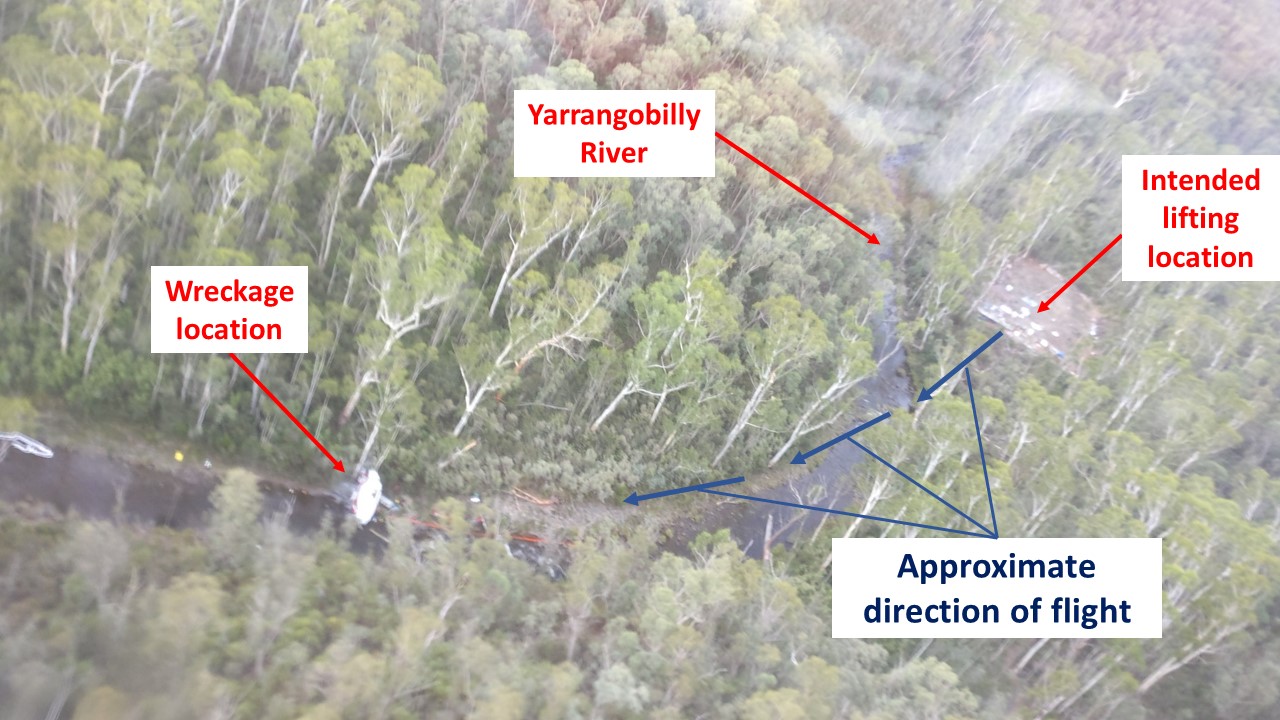
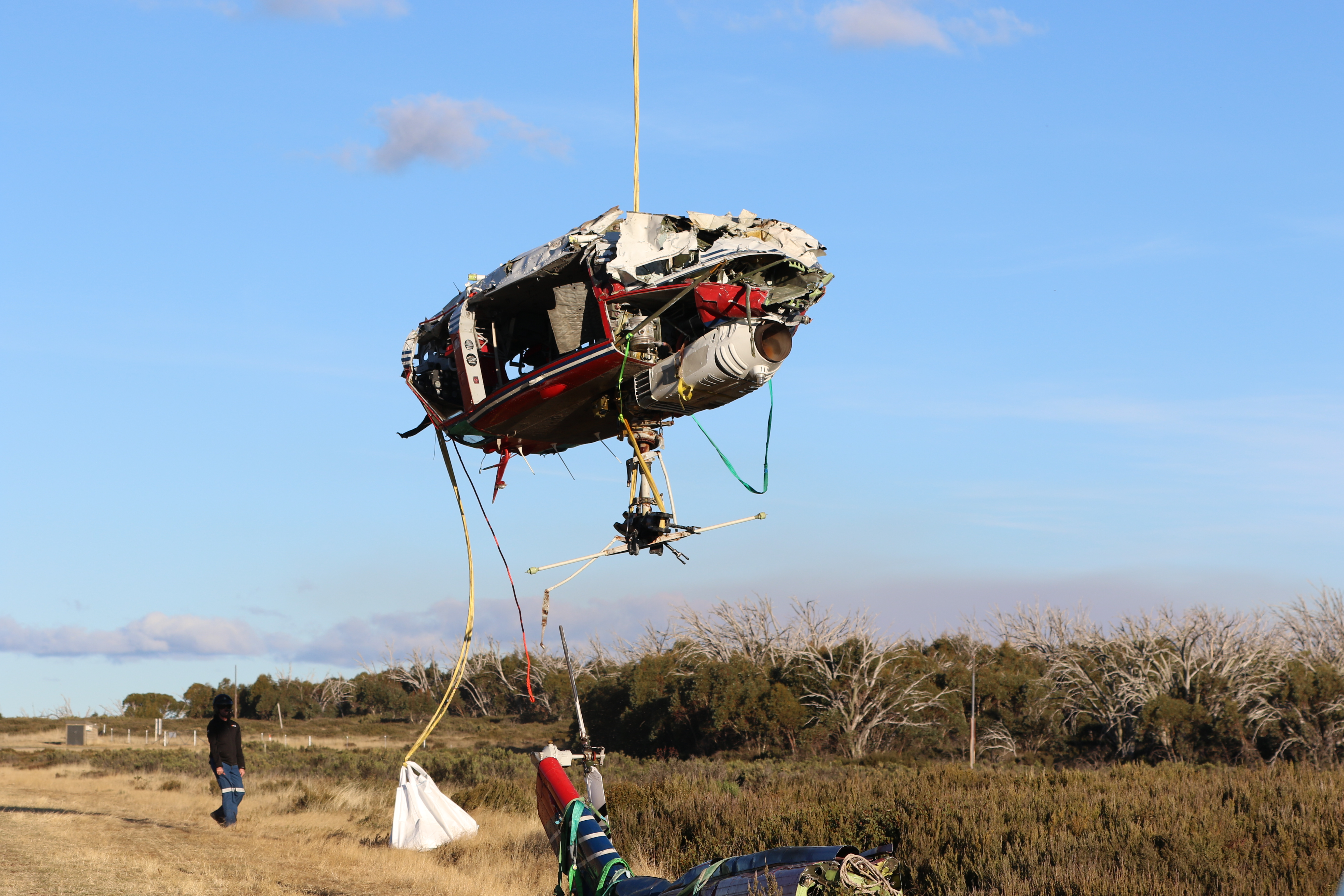
The pilot broadcast a ‘Mayday’[3] call and attempted to conduct the forced landing (autorotation) into the Yarrangobilly riverbed, south-west of the lifting area and the ground personnel. The workers observed the helicopter being turned to the south-west, away from the drill site.[4] They described the helicopter as appearing to ‘float’ over the trees, before descending quickly. Around this time, the pilot commanded jettison of the long-line and lifting strops. At interview, the pilot advised that the helicopter was flared prior to the impact with the second tree, but could not recall the remainder of the impact sequence until exiting the helicopter. The helicopter subsequently collided with trees and the riverbed (Figures 4 and 5). Ground personnel from the drill site immediately responded to the accident with fire extinguishers. They extinguished a small fire in the engine bay, removed the pilot from the wreckage, and performed first aid until emergency services arrived at 1520. The pilot sustained serious injuries and the helicopter was destroyed.
Figure 4: Forced landing flightpath showing drill site and helicopter wreckage
Source: New South Wales Rural Fire Service, annotated by the ATSB
The pilot held a Commercial Pilot Licence (Helicopter) and current Class 1 Aviation Medical Certificate. In addition, the pilot held a low-level operational rating, with endorsements for helicopter sling-load. The pilot had accumulated more than 9,000 hours total aeronautical experience, predominantly in helicopters. In the previous 30 and 90 days, the pilot had flown 43.4 and 154 hours respectively. The pilot reported being well rested for the day of the accident.
Meteorological information
The meteorological conditions from witness reports and drill site time-lapse camera footage throughout the period of lifting operations indicated clear sky and light winds. The wind conditions recorded by a Bureau of Meteorology automatic weather station about 45 minutes after the accident at Cabramurra (18 km away), were 11 km/h (6 kt) from the west, consistent with reports from the accident pilot.
Helicopter information
General
The UH-1H helicopter was developed by Bell Helicopters as a military utility helicopter for the United States (US) Army. The accident helicopter was manufactured in 1965. The helicopter had a two-blade main rotor and two-blade tail rotor and was powered by a military variant of the Honeywell Aerospace (formally Lycoming Engines) T53-L-13B turboshaft engine. Several organisations were authorised by the US Federal Aviation Administration (FAA) to convert surplus US military helicopters for civilian operations. Garlick Helicopters Inc. was the holder of the type certificate for this helicopter, which was US-registered as N2220Y, when it entered civilian operations.
VH-HUE (HUE) was first registered in Australia in December 2002 and was operated by one owner, until it was purchased by the current owner in January 2011. At entry in Australia, HUE had accumulated 8,017.3 hours and had ‘no record of accident’. In 2006, HUE was transferred to the restricted ‘special purpose’ category, due to the limited ongoing maintenance technical support. This category included agricultural operations, forest and wildlife conservation, and firefighting, and only persons who were ‘directly associated with the special purpose’ could be carried. HUE was issued with a special certificate of airworthiness[5] in July 2008.
Weight and balance
The ATSB calculated that HUE was very likely below the maximum take-off weight and within centre of gravity limits for all flights on the day of the accident. This included the 11 previous lift runs. Furthermore, fuel-burn calculations and the presence of a considerable amount of fuel at the accident site indicated there was sufficient fuel on board, about 270 kg, to conduct the lifting operations at the time of the accident.
Continued airworthiness
The logbook statement for HUE indicated that it was to be maintained in accordance with the Garlick Helicopters Inc. Instructions for Continued Airworthiness (ICA) Report GH-H13WE-CA1H. which stated:
FAA [Federal Aviation Administration] type certified civil engines and FAA approved civil appliances…must be serviced, maintained, inspected, and repaired in accordance with the applicable manufacturer’s maintenance manuals, or manufacturer’s Instructions for Continued Airworthiness or this TC Holder’s Instructions for Continued Airworthiness.
Therefore, HUE’s engine was to be maintained as per the US Army technical publications.
Wreckage and impact information
Examination of the trees on the side of the river opposite to the drill site revealed multiple broken branches resulting from the tips of the main rotor blades. Based on the path of broken branches and witness accounts, the helicopter’s descent path from this point became much steeper. The helicopter descended with the main rotor blades striking tree branches to the right of the helicopter prior to striking and severing a tree (the main impact tree) about 11 m up from its base, and 30 m from the initial tree strike. Audio analysis by the ATSB of the tree strikes from the phone of an eye‑witness was used to calculate a mean groundspeed of 45 kt, and vertical speed of about 2,000 feet per minute during this phase of flight. The flight path suggested that the pilot probably maintained control of the helicopter until one of the main rotor blades broke apart from impacting the tree.
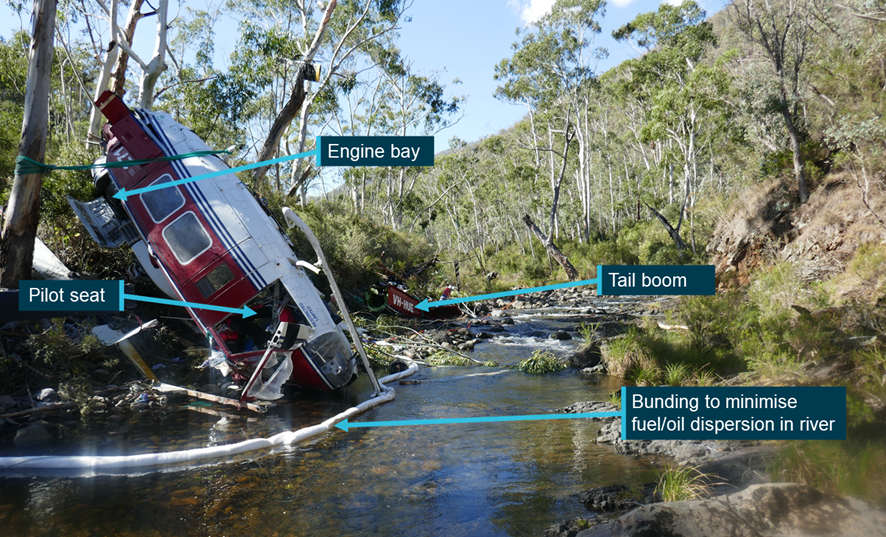
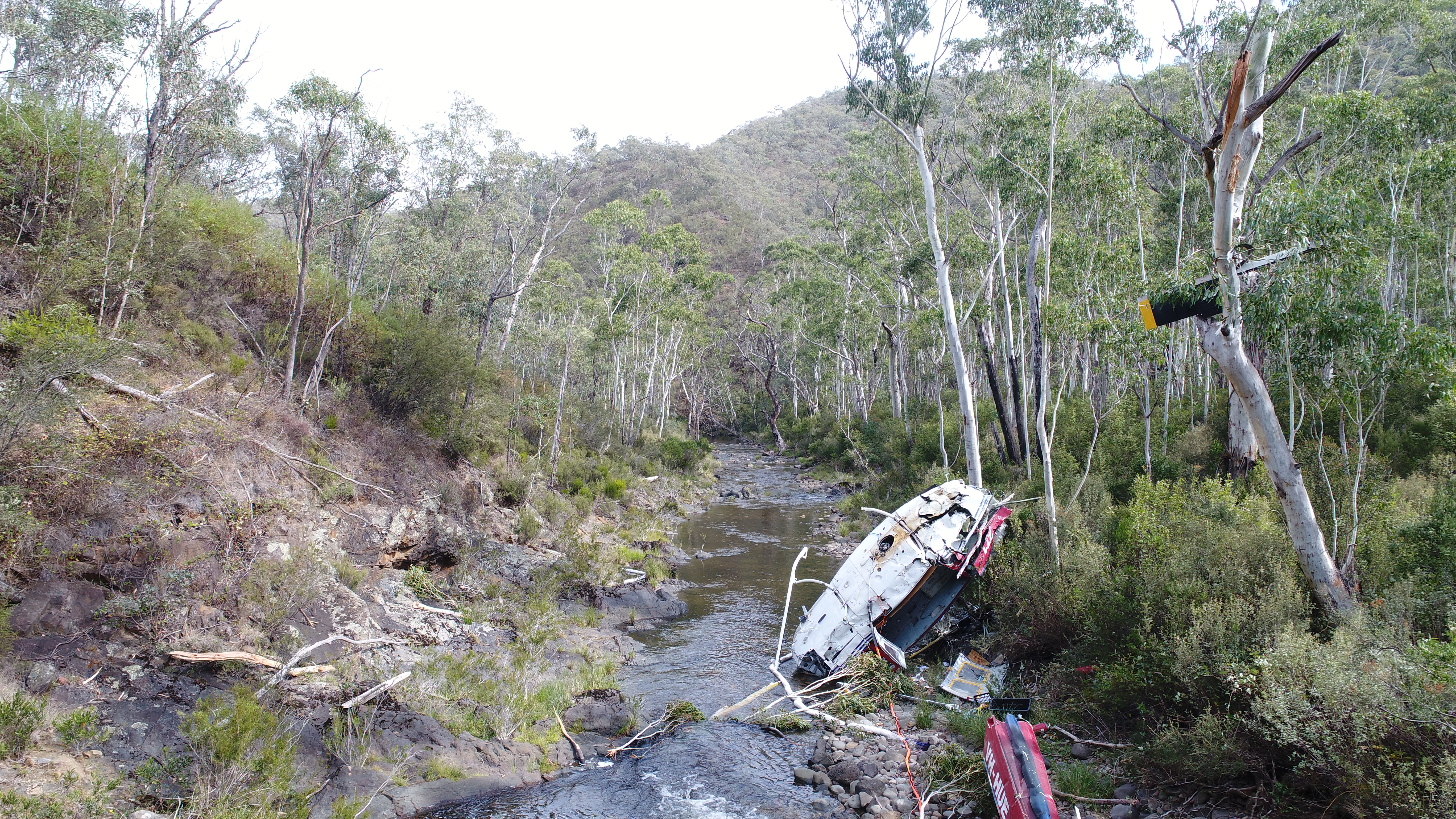
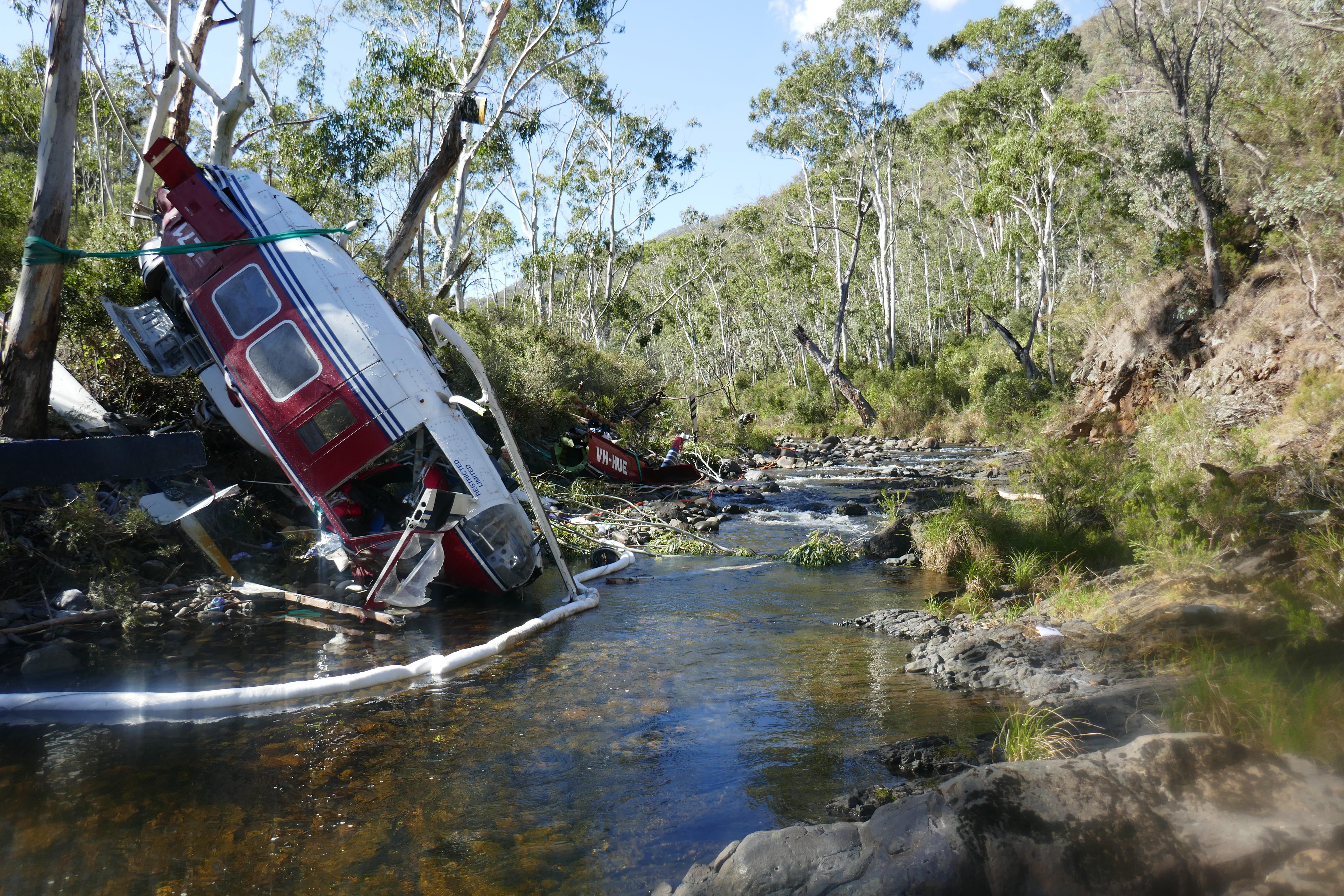
Examination of the wreckage and ground impact marks indicated that the helicopter had impacted the ground in a nose high, slightly right side down attitude. The tail boom of the helicopter struck the ground during the impact, detaching from the fuselage. The landing gear assembly showed evidence of deflection during the main impact of the fuselage with the ground. The helicopter likely bounced off the skids, leading to the fuselage coming to rest in a nose low, slightly inverted position (Figure 5).
Figure 5: Helicopter wreckage showing nose of helicopter in Yarrangobilly River
Note: Wreckage of VH-HUE looking upstream toward the drill site, showing the nose of the helicopter and pilot’s seat. Source: ATSB
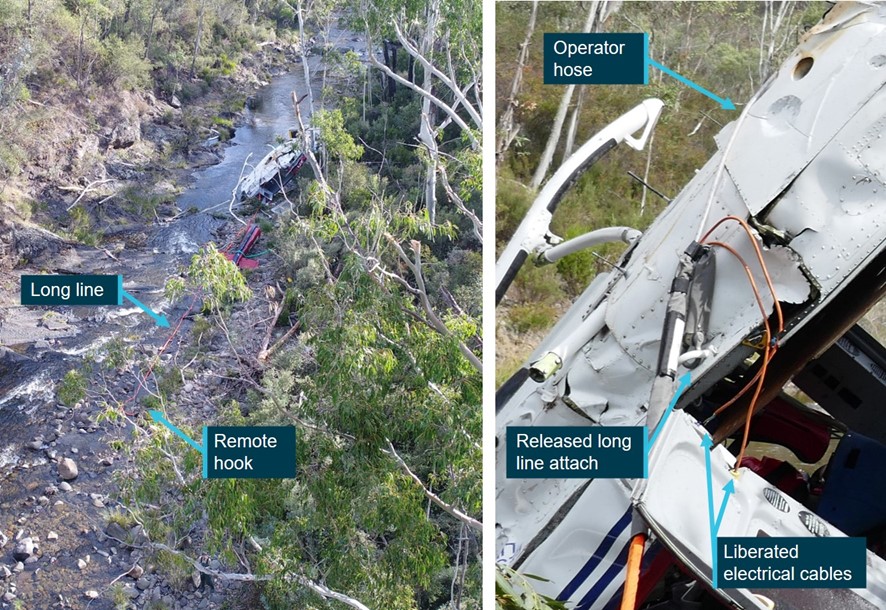
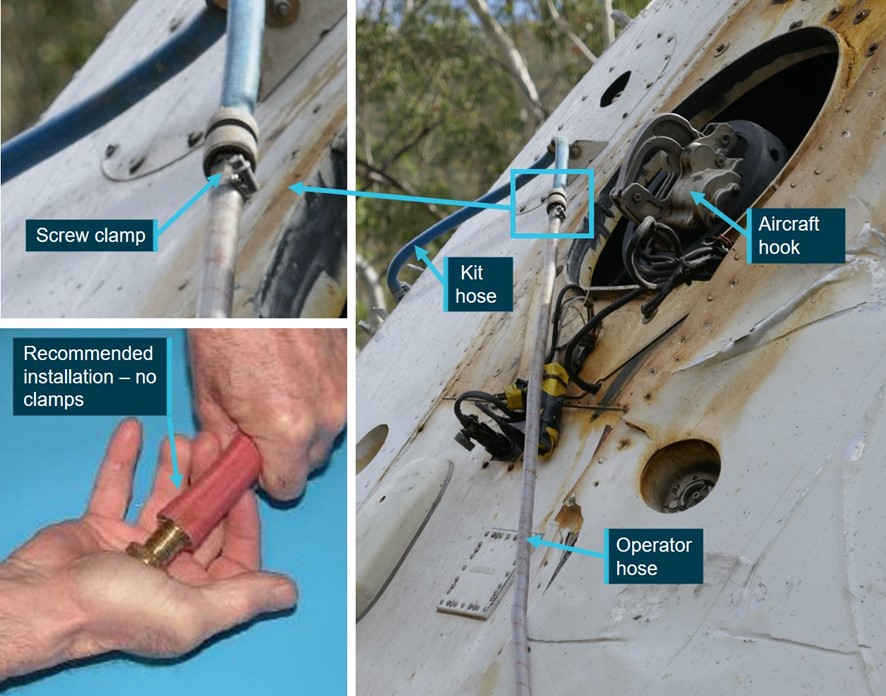
For the lifting operations on the day of the accident, a 100 ft/30 m long-line was being used, with lifting strops attached at the remote hook. The site and wreckage examination revealed that, during the accident sequence, the long-line had detached from the belly hook, and the strops had released from the remote hook. This indicated that the long-line and strops were likely jettisoned during the accident sequence, as per emergency procedures. Although the pilot could not recall jettisoning the load, photographs confirmed that both the long-line and strops were attached to these hooks prior to the emergency, and the long-line did not appear to have snagged on any trees during the accident sequence. However, the long-line remained tethered to the fuselage due to the Sacksafoam hose line, which had failed to separate (refer to section titled Retention of the long-line) (Figure 6).
Figure 6: Failed to detach long line
Source: ATSB
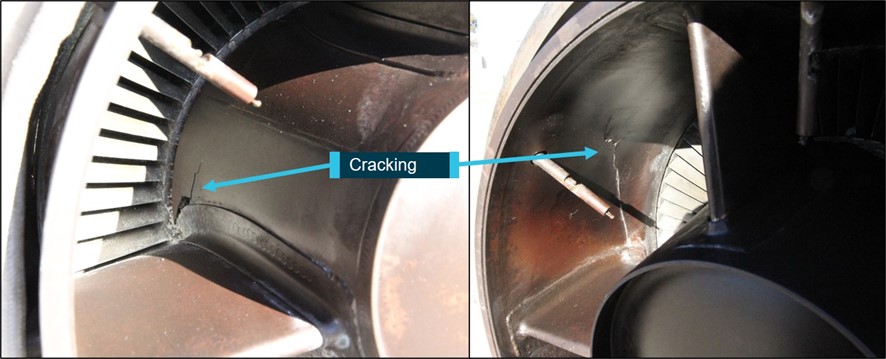
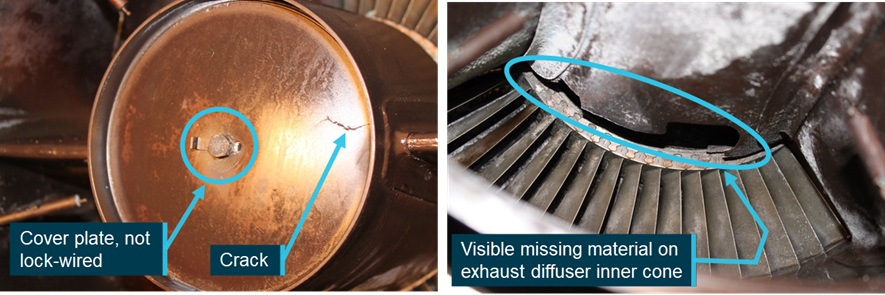
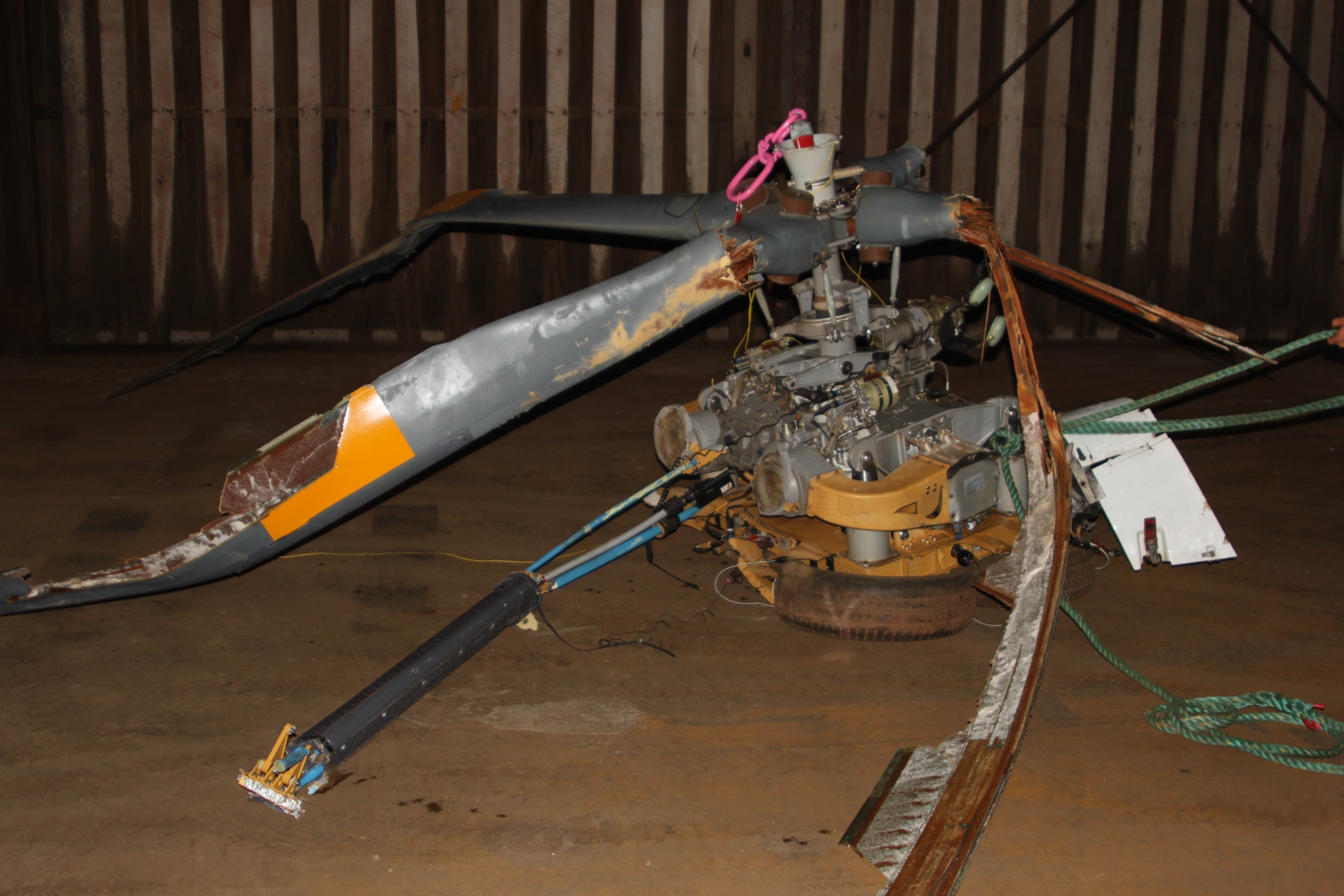
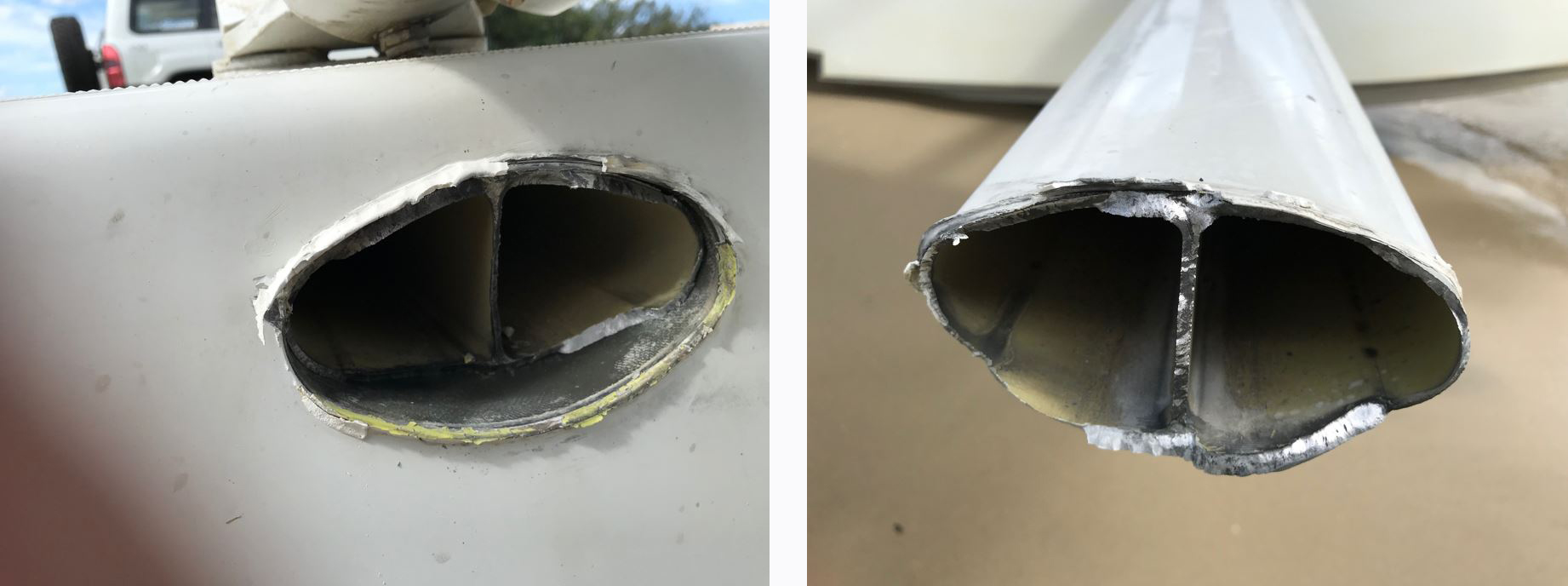
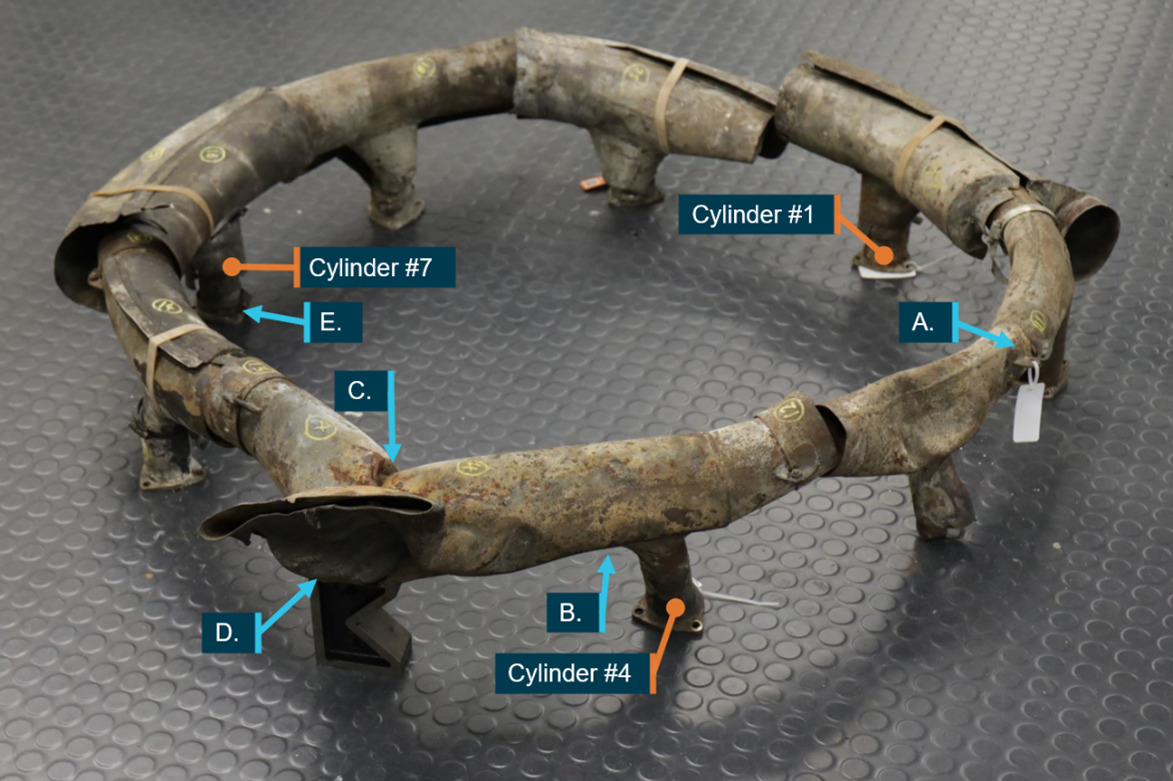
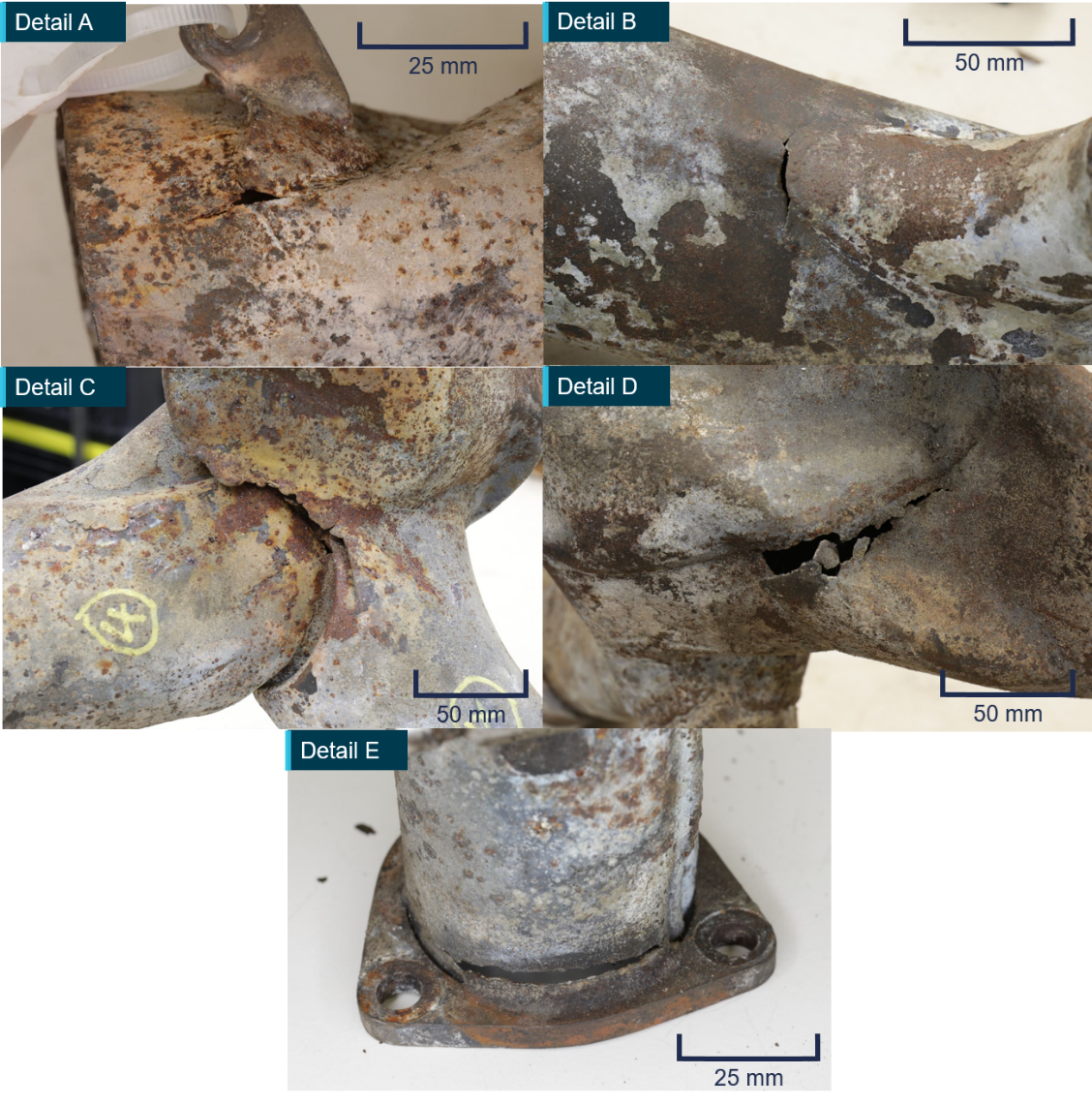
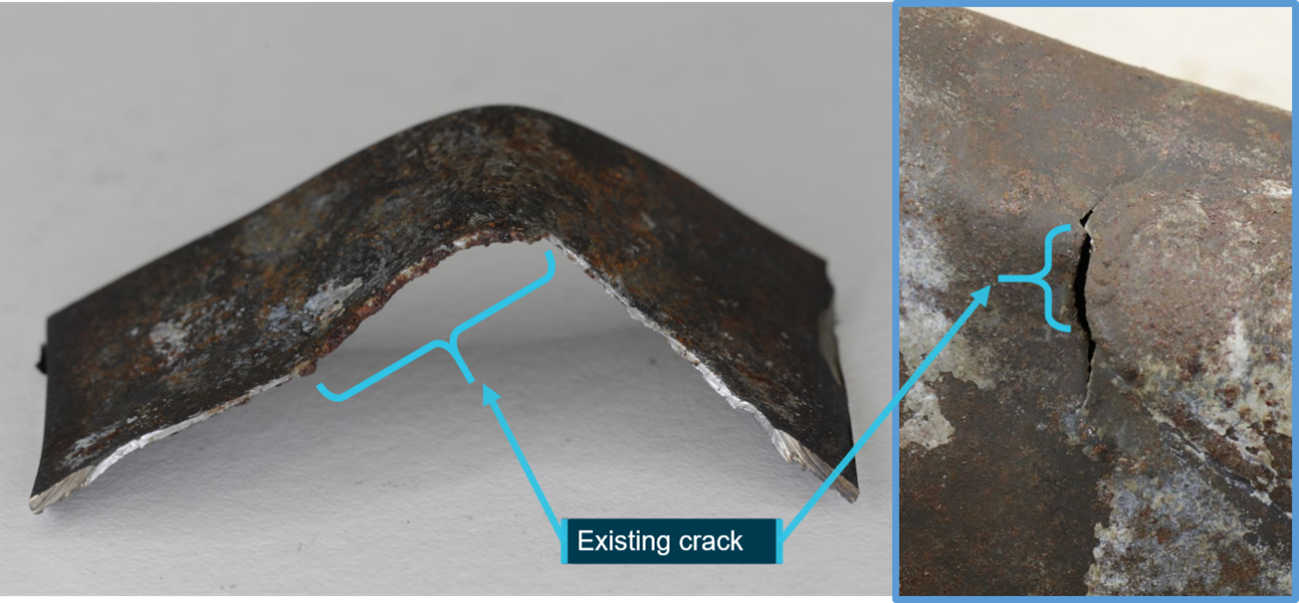
During the examination of the wreckage, the ATSB identified cracking and material loss visible in the exhaust diffuser area (Figure 7 and Figure 8). In addition, the exhaust diffuser cover attachment bolt was not lock-wired, as required by the US Army maintenance manual applicable to HUE (Figure 8). Examination of the engine, including the exhaust diffuser assembly is discussed in the next section.
Figure 7: Visible cracking in the exhaust diffuser area
Source: ATSB
Figure 8: Diffuser area, unsecured cover plate, cracking and missing material
Source: ATSB
Engine examination and maintenance
Examination
Exhaust diffuser strut cracking
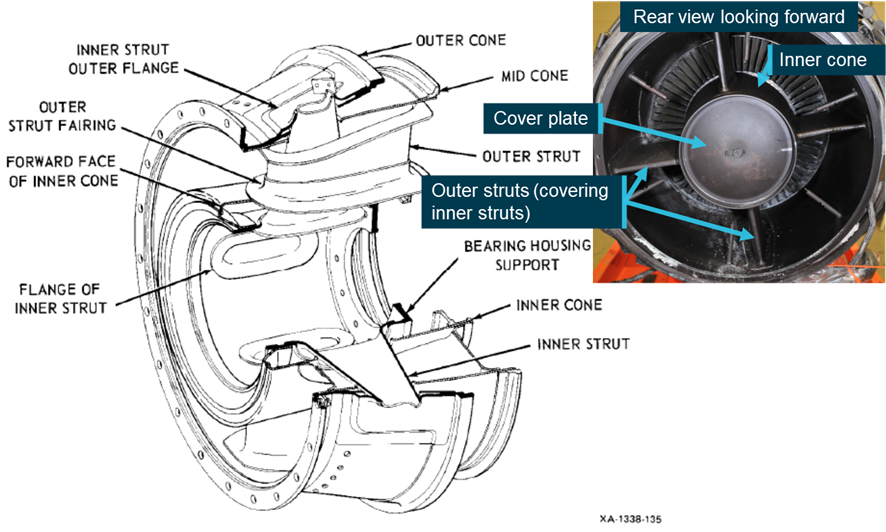
The engine was shipped to Honeywell’s facilities in Phoenix, Arizona, in the US and underwent a teardown examination under the supervision of a representative from the US National Transportation Safety Board. The purpose of the examination was to identify the technical failure mechanism, or mechanisms of the engine failure. This included a detailed examination of the exhaust diffuser assembly illustrated in Figure 9.
Figure 9: Exhaust diffuser assembly schematic and photograph (inset)
Source: Honeywell, modified by the ATSB
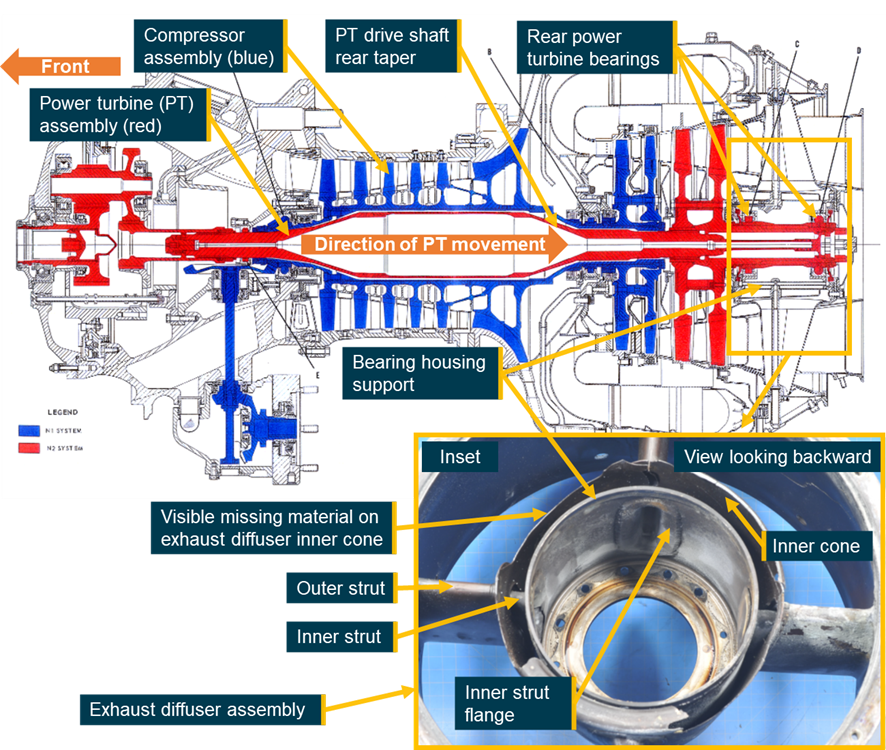
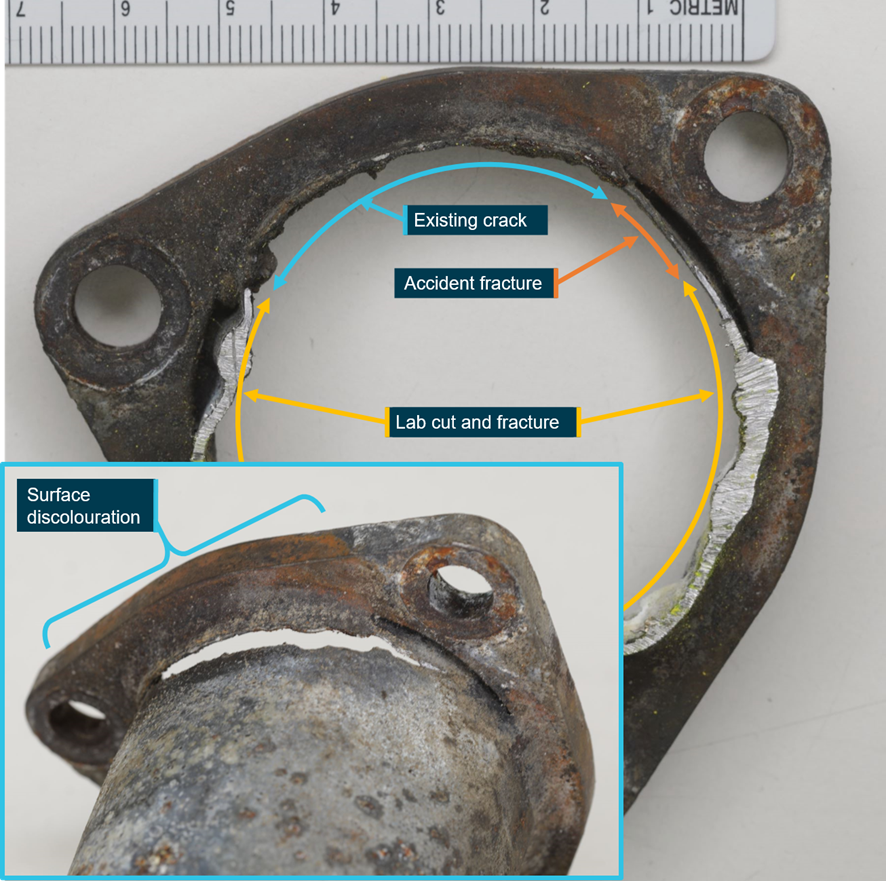
The Honeywell engine teardown identified extensive fatigue cracking in the exhaust diffuser inner struts (Figure 10 inset). The inner struts were a critical engine component that supported the rear of the power turbine assembly through the number 3 and number 4 bearings (Figure 10). Note for reference that Figure 10 (inset) shows missing material in the exhaust diffuser inner cone also shown in Figure 8. Honeywell identified the location of the cracking for each of the four inner struts:
two of the four inner struts were separated around the full circumference of the inner strut flange welds
another strut exhibited cracking around most of the circumference of the inner strut flange welds, although the inner strut remained attached to the inner cone by a small welded section
one strut was separated through the strut with no visible weld separations.
The analysis by Honeywell determined that the cracking in the inner struts resulted in the complete loss of structural integrity of the four struts. This led to the power turbine assembly moving rearward, indicated by the arrow labelled ‘direction of PT movement’ in Figure 10. The rearward movement was sufficient for the rear tapered section of the power turbine drive shaft (labelled ‘PT drive shaft rear taper’) to contact the adjacent rear shaft of the compressor assembly, highlighted in blue. Due to the compressor and turbine assemblies rotating in opposite directions, the contact resulted in considerable friction, and deformation of the rear compressor shaft. This led to the compressor assembly contacting the walls of the engine case.
Figure 10: Illustration of T53 engine and exhaust diffuser inner cone (inset)
Source: Honeywell, modified by the ATSB
Considering the contact between the tapered section of the drive shaft and the compressor assembly, Honeywell reported that, ‘by design, this was the most critical section for inter-shaft clearance of the counter-rotating components. Rapid frictional heating is imminent once the rub condition is established. All damage, therefore, is considered secondary to the fatigue cracking of the exhaust diffuser struts’.
High-cycle fatigue
Regarding the material analysis of the exhaust diffuser housing, Honeywell identified that:
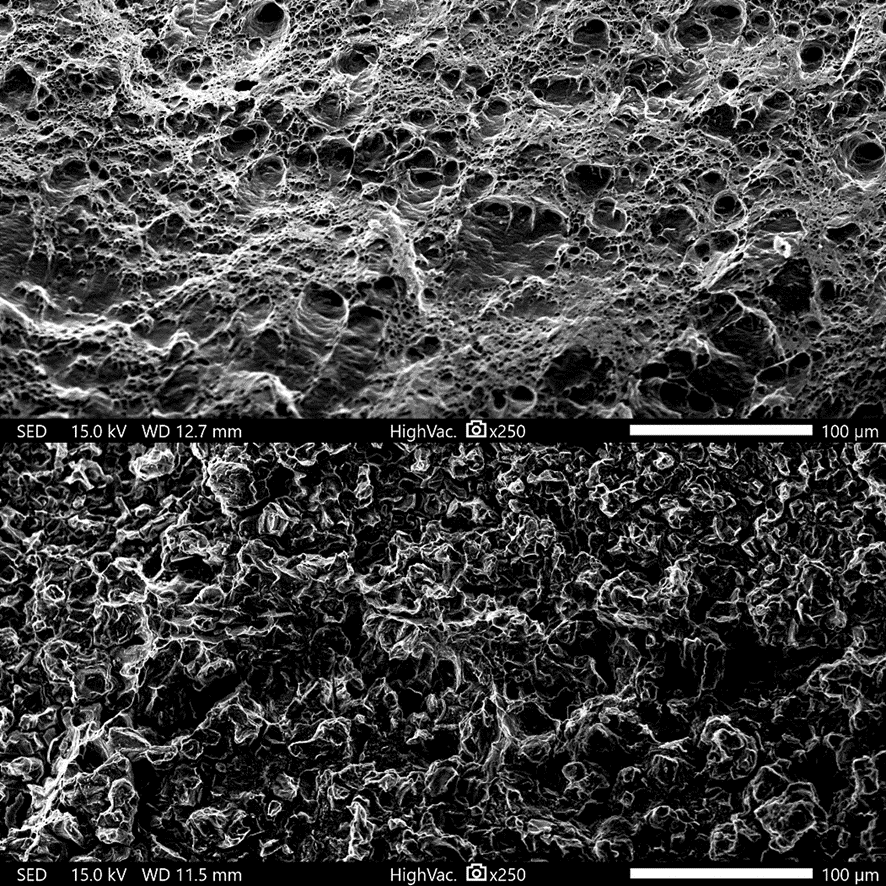
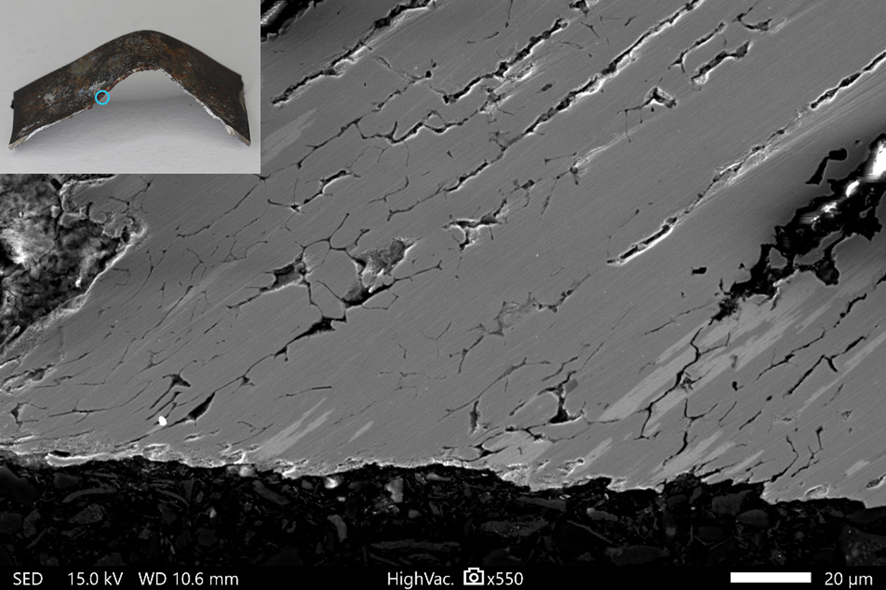
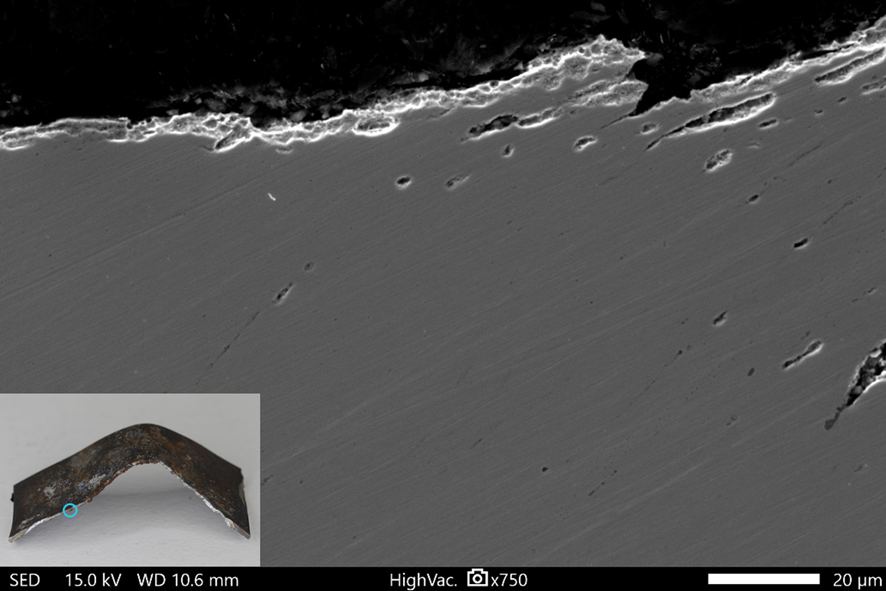
the cracking in the strut/inner cone weld joints resulted from high-cycle fatigue emanating from multiple initiation sites along the inner edge of the weld bead, which was likely driven by power turbine vibration
no material anomalies were observed
the chemistry of the exhaust diffuser housing was indicative of the manufacturer’s specified material
the measured hardness of the strut, inner cone, and weld bead indicated that the assembly was heat treated subsequent to welding, as specified.
Honeywell reported that ‘the exact initiation locations [of the fatigue cracks] were unable to be determined due to secondary smearing damage’. Further, due to the post-accident damage to the engine and airframe structure, the ATSB concurred that it was not possible to determine the source of the power turbine vibration.
Visible indications of cracking
Honeywell advised that they have had some previous experience with cracking on exhaust diffuser assemblies. Specifically, they indicated that:
Empirical evidence suggests that the cracking develops and propagates over a considerable period of time, i.e. hundreds of operational hours. Therefore, it is believed that the exhaust diffuser cracking and material loss from the inner cone would have been visible during the most recent Phase Inspection performed 20.8 hours before the accident. Visual indications of cracking were likely present during the preceding phase inspection(s) as well. An investigation to assess and rectify the exhaust diffuser cracking would have necessitated the removal from service of the exhaust diffuser.
This indicated that cracking and missing material on the inner cone of the exhaust diffuser, as observed by the ATSB after the accident, was likely visible during maintenance inspections prior to the accident. Further, Honeywell stated:
During the previous 40 years, this is only the third reported incident of exhaust diffuser strut cracking that developed sufficiently to cause an engine malfunction in Honeywell’s experience with the T53 series engine. Typical experience for the T53 is that removal of the exhaust diffuser for observed cracking will necessitate off-engine inspections and repairs to the inner struts, as required.
This indicated an expectation that if the visible cracking in the exhaust diffuser was identified, removal of the exhaust diffuser would be required. Subsequent inspections would have led to the identification of the cracking in the inner struts.
Maintenance arrangements for VH-HUE
HUE had been maintained by Encore Aviation (Encore) since March 2016. Encore was a CASA‑authorised maintenance organisation established in 2002 and provided maintenance to a variety of fixed and rotary-wing aircraft. Encore incorporated another maintenance organisation in 2017. The chief engineer of Encore at the time of the accident was from the organisation prior to incorporation. Encore was then acquired by another company in March 2019 (1 year after the accident). The role of chief engineer changed to another person at about this time, due to retirement.
Field maintenance
The services provided for HUE included field maintenance, when requested by the operator. The chief engineer at the time of the accident advised that, when a licenced aircraft maintenance engineer (LAME) was providing field maintenance for HUE, the LAME would perform the daily inspection. This arrangement was intended to relieve a pilot of extended duty, outside of their flying requirements.
With respect to daily maintenance performed by the pilot, the pilot reported doing ‘fuel and oils, so walk around doing all the inspections…normal stuff…but I don’t actually do any maintenance because I travel everywhere with an engineer [LAME]’. This included the expectation by the pilot that the daily inspection, which included the requirement for an inspection of the exhaust diffuser housing, was conducted by the LAME. The LAME who provided field support for HUE reported that ‘they generally completed the greasing requirements’[6] and the pilot conducted the daily inspection. This LAME also advised that they had carried out a daily inspection on occasion, when specifically requested by the pilot. A review of records identified the LAME’s signature on a maintenance release daily inspection for HUE, dated in November 2017. The pilot reported that the LAME had conducted a compressor wash and greasing prior to the flight on the morning of the accident.
Phase inspections
The two most recent phase inspections, in January and April 2018, were conducted in the hangar by different LAMEs at Encore. The chief engineer reported that HUE was maintained in accordance with the US Army technical publication requirements, which were last updated in 2010.
Exhaust diffuser inspections
Inspection requirements
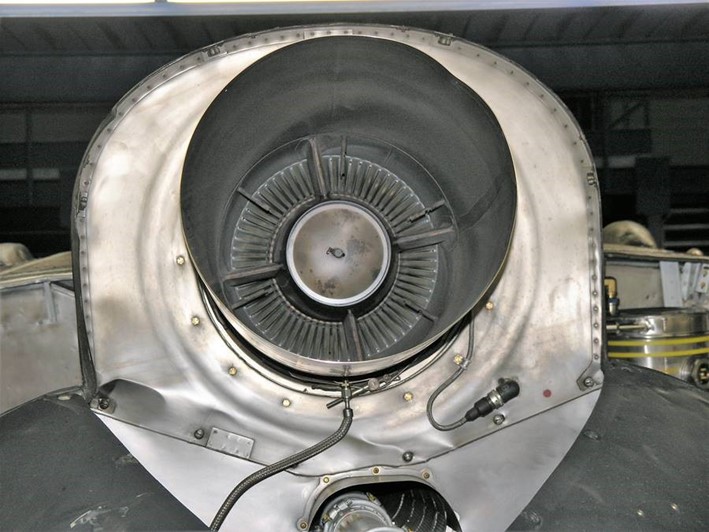
The tailpipe and exhaust diffuser could be readily accessed via a ladder (Figure 11). Inspection of this area was typically carried out with the aid of a bright torch and mirror. A borescope could also be utilised if closer inspection was warranted.
Figure 11: Typical exhaust, showing accessibility for inspection
Source: Honeywell
The US Army technical publications included the following inspection requirements for the exhaust area, including the diffuser (Table 1).
Table 1: US Army exhaust area inspection requirements
Engine combustion chamber housing, exhaust diffuser, support cone, fire shield, firewall gaskets and seal, and tailpipe for cracks, dents and burned or buckled areas
Daily – prior to the first flight of the day
Phased maintenance checklist (‘phase inspection’)
Engine exhaust tailpipe for cracks, dents and burned or buckled areas
Perform a daily inspection at the completion of the phase check
Every 150 hours
Recent exhaust diffuser inspection opportunities
In consideration of Honeywell’s comment that the exhaust diffuser cracking was likely visible at the previous two ‘phase inspections’, the ATSB examined the potential opportunities for detection. In 2018, HUE underwent phase inspections on 11 January and 1 April. Following each of these inspections, a new maintenance release was issued. From 11 January 2018 to the accident flight, a review of the maintenance release records showed 34 daily inspections, certified by four different people. It was permissible for these certifications to be made by the pilot in command, another pilot licenced to fly the helicopter or an appropriately qualified LAME. In addition to the pre-flight and phased maintenance inspections, maintenance records indicated another eight separate maintenance visits to the maintainer had occurred in the 4 months prior to the accident. The helicopter had accumulated 171 flight hours in this period.
Vibration checks
Rotating components, in the airframe and engine, are the primary source of vibration in helicopters. Maintaining vibration levels within manufacturer-specified limits is essential in enabling components to be functional for their projected life limit. If excessive vibration continues over time, the wear on components will increase exponentially to the point of failure. In addition, this vibration can affect the fatigue life of stationary components.
US Army vibration requirements applicable to HUE
The US Army engine maintenance manual required an engine vibration test be conducted following certain maintenance actions, including:
any maintenance that required removal and reinstallation of an engine for any reason
when excessive engine vibration was suspected
when more than 20 per cent of the total number of compressor blades were repaired to maximum limits.
Vibrations levels at specified engine revolutions per minute (RPMs) were to be recorded on the US Army Engine Vibration Test Data Sheet (vibration data sheet) applicable to the helicopter. The data sheet also detailed the maximum permissible vibration for each parameter. For HUE, a maximum vibration level of 2.5 inches per second applied to the majority of the tested parameters.
Maintenance records on vibration checks
Encore advised that, up to the time of the accident, they did not use the US Army vibration data sheet or keep physical records of vibration test data. Instead, they relied on the vibration test equipment internal memory storage for maintaining a record of the test results. However, during the investigation, Encore reported that their equipment suffered a major failure that required its return to the manufacturer for repair, resulting in a loss of all the stored data.
A review of the maintenance records identified that the engine had been removed from the helicopter for repairs from foreign object damage and re-installed on 12 November 2016, 417 hours prior to the accident. A vibration check had been conducted at that time. The certification indicated the vibration was ‘within limits’, however, no vibration data had been recorded. In addition, associated maintenance worksheets were not available as Encore did not retain these records beyond 24 months.[7] In accordance with the US Army engine maintenance manual, a re‑check of the vibration was required at 500 and 1,000 hours’ time-in-service. However, the engine had not accumulated 500 hours prior to the accident.
The engine logbook indicated that, on 1 April 2018, the top axial compressor half had been removed from the engine to repair minor foreign object damage to multiple compressor rotor blades. This was recorded as having been conducted in accordance with the US Army maintenance manual. However, there was insufficient information recorded by maintainers in HUE’s maintenance records to determine if a vibration check was required in this instance. Specifically, it was unclear if more than 20 per cent of blades required repair to maximum limits, which would have triggered the US Army requirement for a vibration test. Regardless, the engine logbook did not include any indication that a vibration check had been carried out.
Guidance for record keeping and trend monitoring
Trend monitoring in this investigation refers to the process of evaluating historical data to identify anomalies that may indicate an emerging technical failure of the engine. This process is generally considered to be in-line with industry best practice as a method to identify underlying problems before a safety incident occurs, such as the engine failure of HUE. This is supported by guidance produced by Civil Aviation Advisory Publication 30-04 Certificates of approval – Maintenance organisations, which set out the procedures that CASA would expect an authorised maintenance provider to have in place ‘to ensure that aviation safety is not compromised’. This publication stated that, part of an organisation’s quality system should detail ‘procedures for monitoring the other quality indicators such as facility malfunction reports, incidents, occurrences, maintenance errors, complaints and defects’.
The US Army engine maintenance manual, Section 1-73 General troubleshooting, provided a general statement with respect to identifying the source of failures, referred to as ‘general troubleshooting’, stating:
It is essential to have a thorough knowledge of specified fuel flow, oil pressure, exhaust gas temperature and other important specifications of normal engine operation to discover troubles. Having a record of prior trouble and work performed is essential when troubleshooting.
Although this advice did not specify requirements for vibration trend monitoring, it noted the general importance of recording prior work and ‘trouble’ encountered. In summary, these documents present ‘defect reporting’ and ‘record keeping’ as important sources of information for the effective management of continued airworthiness.
Review of Encore Aviation maintenance practices
VH-HUE replacement of engine related components
HUE’s maintenance records indicated that the power turbine (N2) tachometer generator[8] had been replaced four times: 29 August 2017 (10,060.0 aircraft hours), 27 November 2017 (10,146.4 hours), 11 January 2018 (10,200.3 hours) and 16 January 2018 (10,204.9 hours). The records did not detail the exact nature of each unserviceability. On 1 March 2018 (10,304.3 hours) the drive assembly for the tachometer generator was replaced, recorded in the maintenance logs as ‘suspect’. Again, there was no indication that further evaluation, such as a vibration check, had been conducted following any of these maintenance actions.
VH-HUE phase inspection documentation
The ATSB reviewed the worksheets and logbook entries for the phase inspections for HUE that were completed on 11 January and 1 April 2018. Inconsistencies were found in certification requirements including inspection items not certified as ‘completed’ or ‘not applicable’, and no indication of reference data. Therefore, it could not be established if these specific inspections were, or were not, performed.
Surveillance findings
From 24 October to 1 November 2018, CASA conducted a surveillance event of Encore and released a report documenting their findings. The surveillance was triggered by CASA becoming aware of a Cessna 172 (C172), maintained by Encore that had:
…significant defects and corrosion relating to inspections that should have been identified as part of SIDS [supplemental inspection documents] inspections.[9] The aircraft had been maintained by Encore Aviation and it was clear that significant anomalies related to execution of the mandatory inspections had occurred….
The CASA surveillance report noted that the C172 had been grounded while undergoing maintenance at another maintenance organisation to correct the ‘significant defects and corrosion’. This aircraft was operated by a company offering flight training, and it was expected that it was primarily used for this purpose. As a result of the surveillance, CASA issued three findings, applicable to the C172 and two Cessna 310 (C310) aircraft also maintained by Encore, which identified:
maintenance releases had been issued for certain aircraft, when all required maintenance had yet to be completed
tasks had been certified as complete when not all items within that task had been performed as per the maintenance instructions
various examples of certifications not containing reference data: using a stamp rather than a signature and missing date information.
The certifications identified in the report had been made between June 2016 and April 2018. Findings documented for the C172 aircraft included significant corrosion found in the area of the forward spar of the horizontal stabiliser and trim bracket, with cracking identified in the trim bracket. The horizontal stabiliser is considered a single point of failure for the aircraft, with failure expected to lead to an unrecoverable loss of control. Furthermore, the aircraft maintenance release was issued without a required inspection on the wing root rib being certified in the worksheets or aircraft logbook. This inspection was for the purpose of corrosion detection using non-destructive testing. In addition, CASA identified that the aircraft maintenance release was issued without a required engine mount inspection being performed.
The two C310 aircraft were operated by a company providing charter and aeromedical flights. Findings on these aircraft indicated that inspections on critical aircraft components were not performed, specifically relating to the elevator torque tube, wing lower rear spar carry through, wing lower front spar root, horizontal stabiliser spar attachments and engine support beam. These are all areas representing potential single points of failure leading to loss of control if any of these components failed in-flight.
Alternate options for continuing airworthiness
The Honeywell Aerospace (Honeywell) type-certified equivalent engine is designated the T5313B. The T53-L-13B engine is the military variant, as denoted by the ‘L’ in the model designation. Honeywell advised both engine types are ‘very similar, if not the same. The difference is that Honeywell owns the design and ICA [Instructions for Continued Airworthiness] responsibility for the commercial / type certified version, whereas the US Army is responsible for the design and ICA for the military variant’.
In 2010, Honeywell published a service bulletin T53-0173 R1 to owner/operators, where military variants could be ‘upgraded’ at overhaul, to align with civil standards. Honeywell had identified that ‘maintenance of T53 engines under the US Army and foreign military systems are not equivalent to standards of Honeywell Aerospace. Differences between the maintenance concepts exist in cycle counting, parts procurement, engine assembly tolerances, and general maintenance practices’. While not required by regulations, this ‘upgrade’ would have enabled the engine fitted to HUE to be maintained to Honeywell technical publications, which were routinely updated to represent current best practices. In contrast, the US Army publications had not been updated since 2010, as far as could be determined.[10]
Honeywell vibration maintenance requirements
The Honeywell T53-L-13B engine maintenance manual required a vibration check to be conducted upon installation into the airframe and after ‘repair/replacement of major components’, including:
after compressor blade replacement or compressor blade repair or blending
when excessive engine vibration was suspected.
Honeywell advised that, in 2008, they ‘undertook some actions to ameliorate the risk of exhaust diffuser cracking. Specifically, the power turbine component balance process was enhanced and the vibration limits reduced’. This was initially incorporated at the engine overhaul level (from the factory). These reduced limits were subsequently incorporated in the maintenance manual (T53-L-13B) in 2015. The maximum permissible limits, at specified parameters, were now 1.3 and 1.7 inches per second. In contrast, as noted above, the US Army manual limits were 2.5 inches per second. In addition, the Honeywell maintenance manual required a vibration check after any compressor blade repair, in contrast to the US Army requirement of more than 20 per cent.
Compared to the US Army requirements applicable to HUE, the Honeywell maintenance requirements were more stringent with respect to engine vibration inspections. Although not required, upgrading HUE to this standard may have provided additional opportunities for the detection of emerging engine problems.
Conduct of the forced landing
Height-velocity diagram restrictions
A successful forced landing in a single-engine helicopter can only be achieved if the helicopter has sufficient energy to achieve its required landing deceleration and touch down configuration, and the pilot has sufficient time to initiate a recovery to this configuration. The height-velocity envelope shows the combinations of height above the ground and forward velocity (airspeed), which have been demonstrated by flight test to allow, and which are also predicted to not allow, the pilot to complete a safe landing after an engine failure. These combinations of height and airspeed are primarily for use during the take-off or landing manoeuvre or when manoeuvring at low level, such as in long-line operations.
For single-engine helicopters, the height-velocity envelope for complete power failure must be established by the manufacturer at the time of certification. When constructed in the aircraft flight manual, the height-velocity envelope typically delineates areas that represent safe combinations of airspeed and height, and areas that represent combinations of airspeed and height that should be avoided. The avoid areas are specific to the helicopter design and are normally associated with increasing height and slow or no airspeed flight (hover as is the case with long lining) and low height with high airspeed.
The US Federal Aviation Administration (2019) also stated that:
As the airspeed increases without an increase in height, there comes a point at which the pilot’s reaction time would be insufficient to react with a flare in time to prevent a high speed, and thus probably fatal, ground impact.
Conversely, an increase in height without a corresponding increase in airspeed puts the aircraft above a survivable un-cushioned impact height, and eventually above a height where rotor inertia can be converted to sufficient lift to enable a survivable landing. This occurs abruptly with airspeeds much below the ideal autorotative speed (typically 40–80 knots). The pilot must have enough time to accelerate to autorotation speed in order to autorotate successfully; this directly relates to a requirement for height.
The nature of the long-line operation required HUE to enter the avoid area during the load hook‑up and unhook sequences. Further, comparing the height, airspeed and weight to the height-velocity diagram applicable to HUE established that it was likely within the avoid area at the time of the engine failure. This indicated that the pilot had limited options to manoeuvre following the engine failure.
Pilot decision-making and forced landing
The pilot reported that there were personnel working in and around the drill site when the helicopter was on approach to hook-up the load (the drill site also included a helipad). This was supported by time-lapse images from the drill site, which confirmed ground personnel moving in and around the drill site, including this approach. Consequently, when the engine failed, the pilot attempted to autorotate[11] the helicopter clear of the drill site and towards the river to keep clear of ground personnel. When asked where the pilot would have conducted the forced landing if the drill site was assured to be clear of personnel, the pilot reported that the drill site (Figure 12) would have been used. Figure 12 also shows the high trees and generally inhospitable terrain surrounding the drill site.
Figure 12: Drill site looking in direction of flight
Source: ATSB
The GPS data, time-lapse images (location shown in Figure 12), supplied camera footage from eyewitnesses and witness statements were evaluated to determine the sequence of events from the engine failure to the collision with terrain. At 1417:33, the helicopter was observed approaching the drill site (indicated by Figure 13 ‘A’). Following the loss of engine power (Figure 13 ‘B’), the aircraft started descending and began to accelerate (Figure 13 ‘C’). As the helicopter approached the line of trees at the end of the clearing, the helicopter had accelerated to about 40 kt and was close to the height of the tree canopy (Figure 13 ‘D’ and ‘E’). Around this time, GPS flight data indicated a notable shallowing of the descent profile.
The shallowing descent path was consistent with witness reports describing the helicopter as appearing to ‘float’ over the trees, and that it was not descending quickly until over the trees. Comparison of this glide performance with the published performance charts for HUE revealed this ratio was shallower than the autorotation range performance based on the speed and rate of descent. The pilot reported that, during this time the main rotor speed (RPM) became low. Audio analysis[12] by the ATSB using witness phone footage established that the main rotor speed was about 214 RPM as the helicopter passed over the first line of trees, about two-thirds below the optimal speed of 314 RPM. This suggested that the pilot increased collective pitch of the rotor system to avoid the line of trees prior to reaching the gap in the canopy created by the river below. The pilot stated during interview that the helicopter’s rotor system carried a lot of inertia, and as a result, elected to fly over the trees, knowing that the rotor speed would decay. The pilot’s response was consistent with guidance in the US Army operator’s manual, which stated that a ‘landing in trees should be made when no other landing area is available’. The reduction in rotor speed is a concern during an autorotation as this equates to energy available in the rotor system. As a result, the energy available to arrest the descent rate during landing or to cut through tree branches was reduced.
Lifting operations
Helicopter lifting operations were utilised to demobilise the drill site due to the remote location of the site and to minimise the environmental impact within the Kosciuszko National Park. Consequently, helicopters involved in the lifting operation were required to operate over terrain that was generally not suitable to make a safe landing.
Organisational information
There were four organisations working together during the lifting operation on the day of the accident. GHD Limited (GHD), another geotechnical company contracted by GHD, Heli Surveys and O’Driscoll Aviation. Ground-based geotechnical survey works at the drill site were coordinated by GHD Limited, in conjunction with the geotechnical company (geotechnical crew). GHD was contractually responsible to Snowy Hydro for the safety management of all works to be conducted at relevant sites.
Helicopter operations were led by Heli Surveys. They had a contractual arrangement with Snowy Hydro to provide helicopter services to support the drilling sites at the direction of GHD. In turn, GHD were contractually responsible for ‘liaison and coordination’ with Heli Surveys. As some loads exceeded the capability of Heli Surveys, they sub-contracted O’Driscoll Aviation (HUE) to lift these heavier loads.
GHD reported to the ATSB that they were responsible for safety management for works on the ground and Snowy Hydro were ultimately responsible for the risk management of all operations, both in the air and on the ground. Snowy Hydro reported that GHD were the principal contractor for all operations and therefore, it was their understanding that GHD were responsible for the risk management activities.
The works on the day of the accident followed the completion of a geotechnical survey at the drill site and involved helicopter lifting of all the main drill rig components to the laydown area. This involved three geotechnical workers deconstructing the drill rig and two load-masters from Heli Surveys, with GHD managing the aviation component of the operation. This included preparation of loads for helicopter lifting, providing direction to the helicopter pilots via radio communications, and hooking up loads.
Lifting operations risk assessment and toolbox talk
The pilot reported attending a meeting, referred to as a ‘toolbox talk’, that involved all ground personnel and pilots prior to the lifting operation. The toolbox talk was led by representatives from GHD and Heli Surveys. This discussion included the loads to be lifted by each helicopter and safety considerations. Heli Surveys reported that part of the safety considerations included discussion of a ‘sterile zone’. This sterile zone was reported as being:
…an area where all personnel on the ground are to avoid at all times. This is usually the area on the opposite side of the aircraft to where the pilot sits. The reason for this “zone” is to give the pilot an area to land in if a forced landing is required. Although the area might not be clear of obstacles, the pilot can be confident it is clear of people on the ground.
Further, as part of these discussions, all crew, including the pilot of HUE, signed a ‘pre‑work assessment’ form indicating attendance at the meeting and compliance with the Safe Work Methods Statement. Part of the purpose of the form was to:
…discuss the planned activities and hazards and modify [Safe Work Method Statements] (SWMSs) if required.
GHD, in consultation with Heli Surveys, developed a ‘helicopter operations hazard identification’ register, referred to hereafter as the ‘risk management plan’. According to GHD, this represented the safe work method statement referred to in the ‘pre-work assessment’ form, that applied on the day of the accident. GHD were reliant on Heli Surveys providing subject matter expertise to identify aviation related hazards, risks and controls. Neither of these documents were provided to the pilot before the day of the accident for review, however, the pilot was aware of the general procedures having previously worked with Heli Surveys. A sample of the risk management plan is reproduced in Table 2, noting that only an extract of one assessment is shown for illustrative purposes only.
Table 2: Reproduced sample from risk management plan
Job step
Identified hazards
Mechanism /pathway of harm
Initial risk level (A-D)
Control measures
Residual risk level
Control measures/responsibility for implementation
General site works
Unfit for work
No induction
…
B
Project induction
…
D
…
Safety Management Plan
All Personnel
The risk management plan identified hazards that were assigned an ‘initial risk level’ (Table 2). The specific ‘mechanism’ or ‘pathway’ was also recorded. Control measures were then listed, in order of preference, before being assigned a ‘residual risk level’. The risk management plan consisted of key operational activities grouped into a ‘Job step’, which included general site works (shown in Table 2), driving to site, pre-flight actions, passenger embarkation/disembarkation, mountain flying, ground operations and aircraft refuelling. Some of the job steps identified several pathways of harm to ground personnel during load-lifting as:
Ground operations: ‘Load not slung correctly’, ‘Load not correctly packaged’, and ‘Slung load out of control or not flying correctly’. Controls for this were related to having a lifting plan and ensuring the plan and long-line rigging was correct.
Mountain flying:
‘Lifting loads over buildings/people and wires’, which involved the pilot ’determining the most appropriate flight path away from obstructions and people etc’. Falling trees/branches caused by downwash were also considered for the load drop-off site. However, these controls related to the helicopter with an attached load or at the drop-off site.
‘Aircraft collision with spectators, objects, animals, during take-off and landing’. This had the associated risk control of ‘spectators are to be kept clear by ground personnel. If no ground personnel are present and spectators cause undue risk, an alternative landing site must be found’.
The hazard of an ‘emergency situation’ was also included in the risk management plan. Controls for this stated:
Each emergency situation is different and requires a unique set of procedures. All procedures set out in the Pilots Operating Handbook and the Flight Manual must be followed.
However, there were no control measures that explicitly addressed the risk to people underneath the helicopter for that hazard.
Despite the above, there was no specific job step for load-lifting operations in the risk management plan. Further, the risk management plan did not consider the risks to ground personnel when the helicopter was on approach to pick-up a load, which was where the engine failure occurred.
Retention of the long-line
In the days prior to the accident flight, the pilot was involved in bush firefighting operations on behalf of the New South Wales Rural Fire Service (NSW RFS). Equipment utilised during firefighting operations consisted of a long-line, connected to the helicopter belly-mounted hook. A Bambi Bucket was connected to the remote hook, at the base of the long-line. The remote hook worked independently to the belly hook and was powered by an electrical cable attached to the long-line (depicted in Figure 6). A Sacksafoam kit, which was used to provide a precise quantity of fire-retardant foam to the Bambi Bucket, was also fitted.
The Sacksafoam kit used in HUE consisted of a case located in the helicopter, which delivered the foam to the bucket via a hose. The kit included a short hose and junction, that reached from the case, around the fuselage, to the aircraft hook area. The helicopter operator then supplied the remaining length of hose required to deliver the foam to the bucket itself. An orange protective sheath held the second length of hose, electrical cables, and long-line together along the length of the line.
It was identified that a screw clamp (Figure 14) and barbed fitting had been utilised at the Sacksafoam-to-operator hose junction, located near the aircraft hook assembly. This was in contrast with the installation manual, which required the hoses to be connected via a barbed connector, without the use of clamps. The purpose of the barbed connector was to allow the hose to disconnect in the event of the long-line and bucket being released by the pilot from the belly hook in an emergency. It was this ‘clamped’ hose that prevented the complete release of the long-line from HUE.
The pilot reported that the screw-clamp had been fitted (Figure 14), in addition to the barbed fitting, to prevent the hose from ‘popping’, and leaking corrosive foam from the hose junction.
Figure 14: Operator hose with screw clamp installed
Source: ATSB and SEI Industries, annotated by the ATSB
Survival aspects
Pilot injuries
The pilot was wearing a helmet and lap-belt on the accident flight. During the impact sequence, the pilot sustained serious injuries, including a fractured right eye socket and nose. In addition, the pilot also suffered ligament damage surrounding the ribs, and ligament and tendon damage around both ankles and left knee.
Post-accident response
After witnessing the accident, video footage showed four of the workers at the drill site gathering fire extinguishers and immediately moving in the direction of the helicopter before the sound of the impact. One of the loadmasters stayed at the drill site and called for help via satellite telephone and radio. Upon arrival at the accident site (Figure 5), the first responders noticed fuel leaking down the outside of the fuselage. Fire was also observed in the area of the engine bay and fire extinguishers were deployed toward this area to extinguish the fire. Meanwhile, two workers assisted the pilot, who was unable to exit the wreckage, with moving safely away from the helicopter before commencing first aid.
The pilot of another helicopter (supporting the Snowy 2.0 project), who heard the Mayday call, flew to the drill site and dropped off three additional workers to assist. These workers gathered additional first aid supplies and assisted with rescue coordination. A third helicopter (also supporting the project) arrived at the site about 24 minutes after the accident, with two medical personnel. About 2 hours after the accident, the injured pilot was winched from the site and transported to hospital.
Liveable space
Measurements of the floor pan against published dimensions revealed no detectable deformation in the area where the pilot was sitting. This included the area of the floor pan from the position of the rudder pedals to the rear of the pilot’s seat. Furthermore, the wreckage examination did not reveal evidence of any intrusions to the occupied area. Therefore, the area occupied by the pilot did not appear to have been compromised during the accident.
Cockpit interior damage
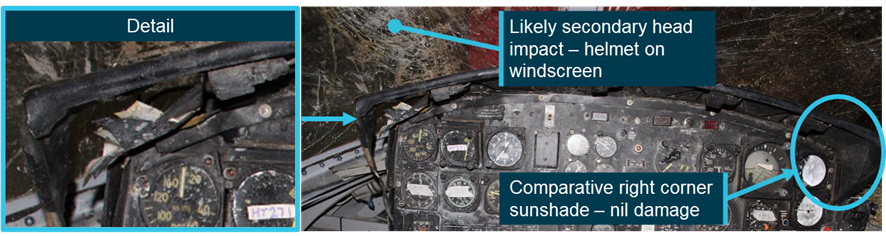
The left side of the instrument panel and sunshade were damaged, consistent with being pushed forward from within the cabin in front of the pilot’s seat (Figure 15). For comparison, the right-side dash panel was undamaged. Although the windscreen exhibited extensive cracking, a localised concentration of damage was present in front of the left pilot seat, the position occupied by the pilot. The damage to the cockpit and injuries sustained were consistent with the pilot’s upper torso flailing forward during the accident sequence, sufficient for the pilot’s helmet and face to strike the instrument panel sunshade and windscreen.
Figure 15: Interior instrument panel sunshade and windscreen damage adjacent to pilot
Source: ATSB
Occupant protection systems
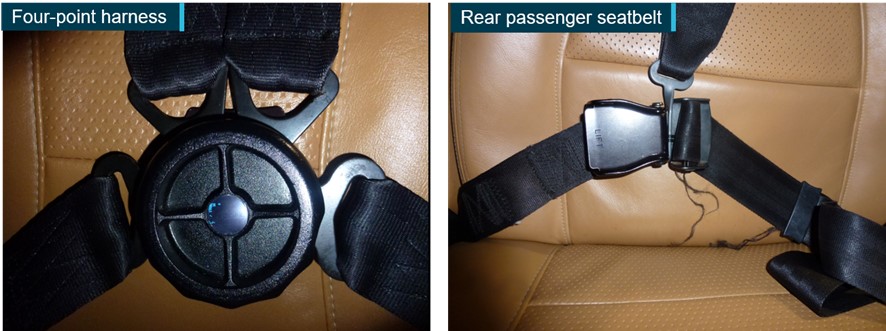
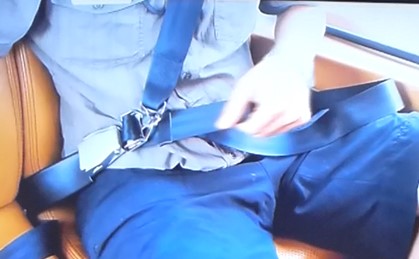
The pilot’s seat was fitted with a 4-point lap-belt and shoulder harness on an inertia reel. However, the shoulder harness (upper torso restraint (UTR)) was not worn. The pilot stated that, due to the nature of the long-line operations, it was not possible to use the shoulder harness and lean left into the door bubble-window to view the long-line and maintain the helicopter position for load hook-up and unhook operations. The helicopter was not fitted with energy absorbing seats designed to minimise vertical accelerations during impact, although this did not appear to influence the pilot injuries.
Flail analysis
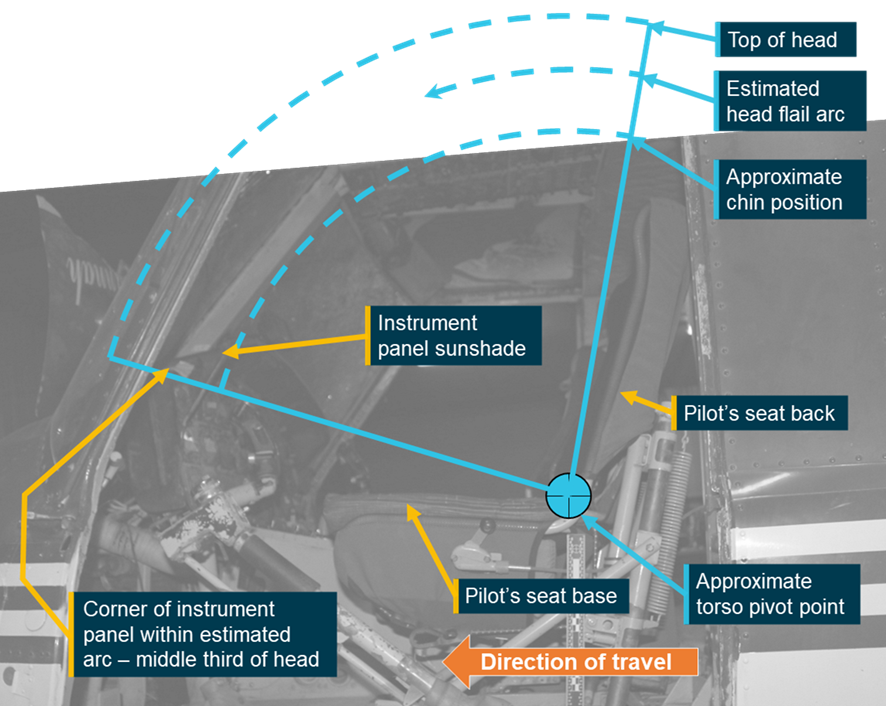
The ATSB estimated the extent of pilot upper torso movement while restrained by the lap-belt worn at the time of the accident. This was focussed on backward horizontal accelerations leading to the pilot flailing forward. Two independent methods were adopted. The first assumed a circular arc traversed by the pilot’s head. The second method, derived from an empirical study by Young, J.W. (1967), was scaled for the sitting height (94 cm) of the accident pilot. The second method also provided an assessment of the probable movement a UTR was worn by the pilot.
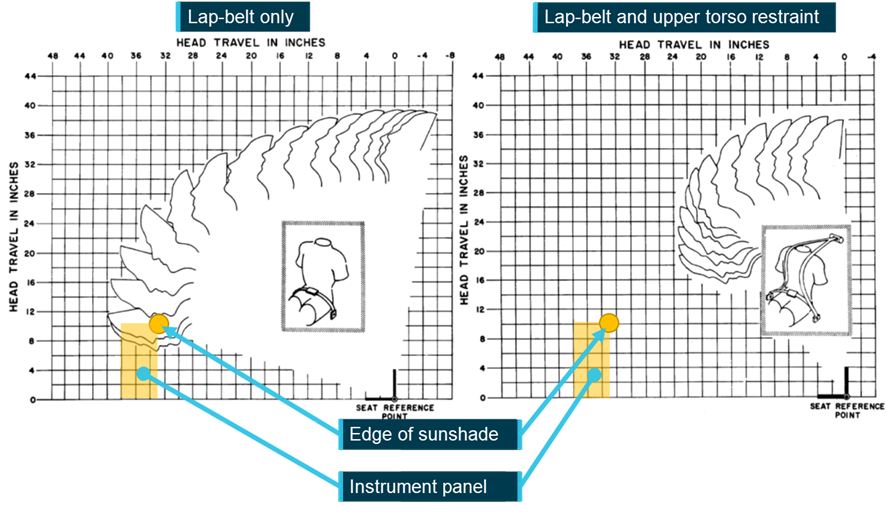
Figure 16 shows a head forward flail circular arc, which indicated that the pilot’s head could contact the instrument panel and windscreen if restrained only by the lap-belt. Projections indicated the middle third of the pilot’s head aligned with the instrument panel and sunshade.
Figure 16: Pilot seat and cockpit side view with circular arc based on pilot sitting height
Source: ATSB
Young’s (1967) study compared the effectiveness of lap-belts combined with various UTRs and lap-belt only. This study found that there was a significant difference in forward and downward motion between using any shoulder harness and lap-belt compared to wearing only a lap-belt. This was based on head kinematics recorded in the vertical plane for a dummy weighing 82 kg and a sitting height of 97 cm, on a sled travelling at about 45 km/h prior to impact. Using the results of this study, assessments were performed by the ATSB to indicate the range of forward movement of the accident pilot for two scenarios – with, and without the use of a UTR (Figure 17).
The left diagram of Figure 17 shows the empirical projections of the dummy wearing a lap-belt only (from Figure 4 of Young (1967)) intersecting the approximate location of the instrument panel and sunshade. In contrast, the right diagram shows considerable distance between all dummy projections and the instrument panel (Figure 11 of Young (1967)). These results were consistent with the instrument panel damage and injuries sustained by the pilot.
Figure 17: Comparison of lap-belt and UTR effectiveness, with approximate location of HUE instrument panel and sunshade
Source: Young (1967), annotated by the ATSB
Upper torso restraint use
Benefits of upper torso restraint use
When correctly worn, UTRs form an important part of the occupant protection system in aircraft, and the benefits in reducing the likelihood and severity of injuries is well established. A significant benefit of correctly fitted UTRs is the minimisation of body movement to prevent the body striking the aircraft structure in lateral and longitudinal impacts, as established by Young (1967). There is also evidence to suggest that UTRs may assist to align the spine in an anatomically ideal position during vertical impacts (Laananen, D.H., 1983, as cited in Coltman, 1985).
Research into previous helicopter accidents revealed no serious or fatal injuries in a sample of longitudinal-type impacts where occupants wore a UTR, ‘even at very high velocities’ (Coltman et al., 1985). In comparison, occupants not wearing a UTR were found to consistently sustain severe or fatal injuries at longitudinal impact speeds above 25 km/h, indicating the effectiveness of UTRs in preventing impact injuries to the head and torso. These findings are supported by accidents in fixed-wing aircraft, in which the US National Transportation Safety Board (2011) found that pilots who used lap-belts only were nearly 50 per cent more likely to be seriously or fatally injured compared with those who wore lap-belts with UTRs.
Vertical reference flying in Australia
Long-line operations, as was being conducted in this instance, require the pilot to rotate their upper torso so they can look out and down through a bubble-window, during the load hook-up and unhook stages of the flight. This type of operation is referred to as vertical reference flying.
The most significant proportion of vertical reference flying operations were expected in firefighting operations, with more than 20,000 firefighting flights conducted in Australia in 2018.[13] Some of these flights may not require vertical reference flying techniques, such as fire spotting, and firefighting using integrated tanks and a snorkel. However, a significant number of these flights are likely to be vertical reference flying. In addition, about three-quarters of firefighting flights were conducted using single-engine helicopters. Firefighting operations were the majority of the flying performed by the pilot of HUE.
Vertical reference flying techniques are also used for construction sling-load work, similar to the accident flight. About 3,000 flights per year were recorded for construction sling-load work in 2018, mostly involving single‑engine helicopters.
Utilisation of upper torso restraints
Investigated occurrences
To identify the state of UTR use during vertical reference flying operations, a review of investigated aviation safety occurrences was conducted. This involved searching the ATSB’s aviation occurrence database and for comparison, the website of the Transportation Safety Board of Canada (TSB). The TSB were selected due to Canada being known to have a considerable amount of vertical reference flying activity. Australian investigations were identified using a regular expressions-based[14] search for terms commonly indicating the conduct of vertical reference flying. Canadian investigation records were identified by a text search for ‘long line operations’. These records were then manually verified as vertical reference flying operations and reviewed for evidence of UTR use.
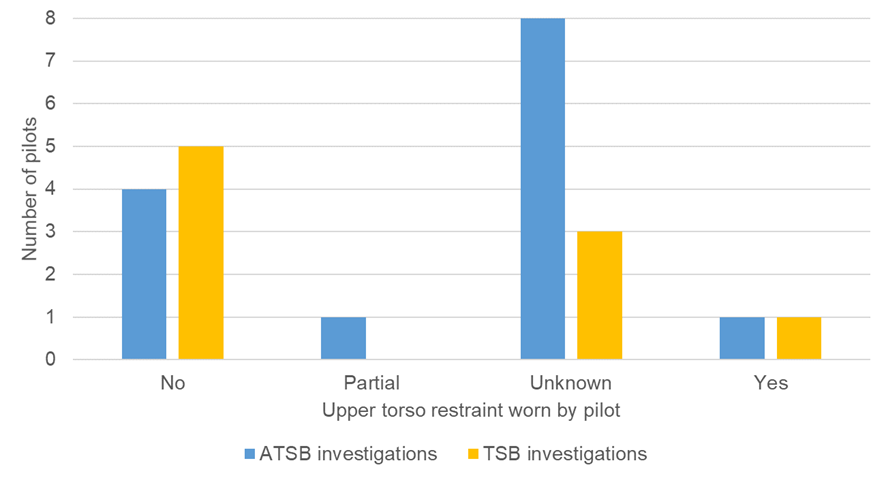
At least[15] 14 Australian and 9 Canadian investigations involved the conduct of vertical reference flying operations between January 2000 and June 2020 (Figure 18). From the 14 Australian investigations it was found that 4 pilots confirmed they did not wear their UTR (recorded as ‘No’ in Figure 18), 1 partially wore it (recorded as ‘Partial’), 1 did wear it, and 8 were unknown. For the partially worn case, it was found that the UTR provided no benefit due to it being incorrectly worn. Therefore, where the use of UTR was determined,[16] it was found that 67 per cent (4/6) of pilots were not wearing their UTR, and 83 per cent (5/6) when considering cases where the UTR was not effectively worn. This result was consistent with known cases in Canadian investigations. When considering all investigated occurrences (including unknown cases), at least one-third of pilots conducting vertical reference flying were not correctly wearing a UTR.
The confirmation from several pilots in Australian investigations that they were not wearing their UTR was consistent with the physical restriction it would impose on rotating the upper torso for vertical reference flying. This was supported by one of the TSB investigations that stated ‘as is typical with many pilots involved in vertical reference flying, the pilot did not use the shoulder restraint system provided’ (TSB report A08P0265).
Figure 18: Number of pilots in ATSB and TSB investigations involving vertical reference flying by upper torso restraint use, January 2000 to June 2020
Source: ATSB
Industry experiences
The ATSB held a meeting with the Australian Helicopter Industry Association (AHIA) to discuss the issue of UTR use for vertical reference flying in light of investigation findings.
In general, investigations identified factors such as cockpit dimensions and seatbelt design probably contributed to the lack of UTR use by pilots conducting vertical reference operations. For example, ‘Most helicopters are not designed or certified to accommodate vertical reference external load operations; however, these operations are very common and pilots fly in this higher‑risk environment without proper safety-restraint devices’ (TSB report A05P0103). When these findings were reviewed by the AHIA, it was generally agreed that this practice was probably adopted due to the sideways leaning required by the pilot during vertical reference flying, rather than for reasons of comfort.
During the meeting with AHIA, the limitations of the accident helicopter were discussed. Helicopters such as HUE were expected to present greater challenges to vertical reference flying due to the distance between the pilot seat and door, coupled with an older-style seat-belt webbing being fitted. This was despite having a number of modifications to assist leaning into the bubble‑window to look down, such as some of the cockpit instruments being duplicated and mounted on the door. It was reported that, despite these modifications, the design of the harness inertia lock release mechanisms were generally insufficient to allow pilots to lean outside without a work-around, even if fitted with modern harnesses. One such reported work-around was wearing the UTR, but slipping one strap underneath the arm to aid leaning out and prevent the belt pressing into the pilot’s neck.
The consensus from the AHIA representatives was that the previous and current investigation findings were generally consistent with their collective experience. It was agreed that lack of UTR use or wearing the UTR differently to that recommended, was a commonly adopted practice during vertical reference flying. Specifically, due to the UTR impeding a pilot’s ability to effectively conduct vertical reference flying operations. This was expected to affect multiple helicopter types frequently used in long-line operations that were not initially designed for this purpose. However, they also acknowledged there was no readily available market solution.
Solutions for restraint in vertical reference operations
A small number of helicopter models are specifically designed for vertical reference flying. These helicopters allow the pilot to conduct vertical reference flying while being fully restrained. However, these helicopters were expected to form a small proportion of vertical reference operations in Australia.
The ATSB was also aware of a number of innovations to assist in the conduct of vertical reference flying. These innovations were available to be retrofitted to helicopter models not specifically designed for regular vertical reference operations. For example, the fitment of light-weight webbing. It was reported that light weight and low friction webbing of these seatbelts would probably assist with vertical reference flying. However, these seatbelts were generally fitted within the existing guide mechanisms on the helicopter. As a result, it was expected that work‑around solutions, such as tucking the seat-belt under the arm were likely to still be required.
Reports have also been received about tilting seats fitted to some helicopters. These allow the pilot to remained fully harnessed, with the entire seat assembly tilting outside the helicopter structure to allow vertical reference flying. The accident pilot reported that these seats were limited for taller pilots. At the time of writing, it could not be ascertained how many, if any, of these systems were used in Australia.
Injuries associated with damaging vertical reference flying accidents
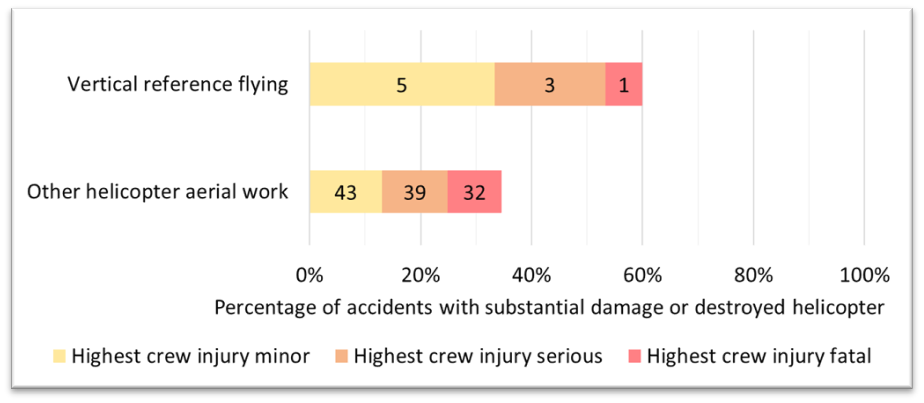
A short study was conducted by the ATSB to evaluate the possible influence of UTR use on accident-related injuries sustained during vertical reference flying operations. This involved comparing the proportion of accidents with injuries between vertical reference flying and the mean of all other helicopter aerial work, where the helicopter was substantially damaged or destroyed. These accidents were intended to represent scenarios where the flight crew would have experienced significant in-cockpit accelerations.
From the sample, it was found that flight crew were significantly more likely to receive an injury in a vertical reference flying accident where the helicopter was substantially damaged or destroyed compared to the mean of all other helicopter aerial work. It was identified that for two of these, including this accident, head injuries were likely sustained or made more severe due to improper, or lack of UTR use. While it was possible that these injuries contributed to the difference in the proportion of injuries between the two groups, this was unable to be determined as the nature of injuries or UTR usage in other aerial work was not known. This supports the need for further research in this area. Further results, including the methodology for this study can be found in Appendix A – Injuries associated with vertical reference flying compared to other aerial work operations.
While conducting long-line lifting operations near Talbingo in the Snowy Mountains region of New South Wales, VH-HUE (HUE) experienced an engine failure. During the subsequent forced landing, the helicopter collided with trees and a riverbed. The pilot sustained serious injuries and the helicopter was destroyed.
This analysis will discuss the factors contributing to the engine failure, including the maintenance procedures and practices that were in place at the time and the opportunities to identify the developing engine issue. It will also examine the limited options available for the forced landing, increasing the severity of the impact, and the risk management planning for personnel working near or underneath the helicopter in the event of an emergency landing. The limited ability for pilots to wear an upper torso restraint (UTR) during long-line operations will also be reviewed. Further, the retention of the helicopter long-line during the accident sequence, and the positive influence of ground personnel in recovering the pilot and reducing the potential severity of injuries are also discussed.
Engine exhaust diffuser inner strut fractures
While on approach for the twelfth lifting operation of the day, the pilot heard a mechanical ‘screaming’ noise, followed immediately after by a complete loss of engine power. The ATSB’s wreckage inspection identified cracking and missing material in the engine exhaust diffuser housing. Further examination of the engine by the manufacturer revealed extensive fatigue cracking led to the failure of the exhaust diffuser inner struts, which position the power turbine shaft. The loss of internal support resulted in interference between the power turbine shaft and compressor shaft, and subsequent failure of the engine.
Engine inspections
Following their examination of the engine, the manufacturer concluded that the cracking in the exhaust diffuser area was likely visible in at least the previous two phased maintenance inspections, which was at least 171 flying hours before the accident. Furthermore, 34 daily inspections had also been certified during this period. Another eight separate visits to the helicopter maintainer had also occurred during this time.
The phased maintenance inspections were typically conducted in a hangar by a licenced aircraft maintenance engineer (LAME) and involved a detailed inspection of the engine, where a higher level of scrutiny was expected. The daily inspection could be conducted and certified by a LAME or a pilot. This required a visual examination of the exhaust diffuser area, generally conducted in the field using a ladder, torch and mirror, which should have been sufficient to identify the cracks. However, there was a difference in understanding between the pilot and LAME as to who was responsible for conducting the daily inspections on HUE when in the field. Therefore, it was likely that the exhaust diffuser area daily inspection was not completed for all, or part of the period they were operating together with HUE.
Had the missing material and cracking been identified in any of these inspections, it would be reasonable to expect that further investigation of the exhaust diffuser would have been conducted. This would have typically involved removal of the engine for examination at an overhaul facility. However, for reasons that could not be determined, the missing material and visible cracking in the exhaust diffuser area was likely present, but not identified in either the phased or daily inspections, prior to propagating to the point of failure.
Maintenance practices and processes
The engine manufacturer concluded that the cracking in the exhaust diffuser would have been visible at the last phase inspection about 20 hours prior to the accident and likely visible at the preceding inspection about 171 hours before. These inspections were performed at Encore Aviation by two different LAME’s, neither of whom detected the cracking or the missing material. Similarly, another aircraft maintained by Encore Aviation was found to have significant defects and corrosion in critical components, which were not identified during routine maintenance, but were detected by another organisation. Also, two other aircraft that were used for passenger-carrying operations did not have inspections performed on critical components.
In addition to routine maintenance inspections, trend monitoring provides another mechanism for identifying engine deterioration, and the malfunction of engine components and accessories. In this case, the United States Army technical publication detailed when vibration checks were to be conducted on the engine type fitted to HUE and the maximum permissible limits. When adhered to, these should enable a component to reach its expected service life.
A vibration check had been conducted when the engine was installed in late 2016 and was recorded as being ‘within limits’. However, the actual vibration levels were not documented. Rather, the maintenance organisation’s standard practice was to rely on the internal memory in the test equipment for retaining a record of these values, which were subsequently deleted when the machine failed. While compressor blade repairs were conducted in early 2018, there was insufficient information available in the maintenance documents to establish if a vibration check was required and/or if one was conducted. Irrespective, this data could have been used as a baseline figure for comparison with future vibration checks to assist with trend monitoring. This was particularly relevant in this case given that the cracking resulted from high-cycle fatigue likely from excessive vibration of the power turbine.
The investigation also noted that an engine component associated with the power turbine assembly supported by bearings in the exhaust diffuser was replaced four times over a period of about 150 flying hours. In addition, the drive between the same engine component and the power turbine was also replaced during this time. The maintenance records did not detail the exact nature of each unserviceability, which provided limited information for identifying trends to detect anomalies. Therefore, it could not be established if this was also related to power turbine vibrations. Regardless, the repetitive replacement of a component should be cause for further investigation as trend monitoring has been shown to enable early detection of developing issues.
In addition to the above, the ATSB’s review of the 2018 maintenance records for HUE found inconsistencies in the documentation with regard to certification requirements. Likewise, following an audit in late 2018, the Civil Aviation Safety Authority also identified discrepancies regarding incomplete documentation and tasks being certified as completed although some had not been completely performed, covering the period 2016 to 2018. They subsequently issued three findings to the maintenance organisation.
While the ATSB was unable to review Encore Aviation’s operating procedures, the above demonstrates short comings in their maintenance practices and processes relating to inspections, record keeping and trend monitoring. Therefore, as was the case for HUE, it was unlikely that they were sufficient to detect the potential impending failure of safety critical components.
Forced landing
The lifting operation was being conducted over remote and mountainous terrain, with the drill site, that included a helipad, as the only clear area for a landing. On the day of the accident, ground personnel were observed moving in and around the drill site, including when HUE was on approach for the twelfth load. Therefore, when the engine failed, the pilot was not assured that the drill site was clear of personnel underneath. Consequently, out of concern for these people, the pilot moved HUE away from the drill site towards a river, which required the helicopter to clear a line of trees.
To clear the drill site and trees, the pilot had to reduce the rate of the autorotative descent, which resulted in sacrificing main rotor speed for range. Any loss of rotor speed will reduce the energy available for the rotor blades to cut through trees and arrest the rate of descent before contact with the ground. The helicopter subsequently impacted trees, leading to a complete loss of control before impacting the riverbed about 250 m away from the drill site. The combination of these factors likely contributed to the severity of the impact.
Alternatively, if the pilot was assured that ground personnel were clear of, or able to clear the drill site following the engine failure, the drill site and associated cleared area may have provided a suitable area for a forced landing. The option of a suitable forced landing site within the normal autorotation range profile would have allowed the pilot to use the stored rotor energy to conduct a normal autorotative landing and significantly reduce the risk of serious injuries.
Risk assessment for lifting operations
While the GHD risk management plan considered ground personnel during load lifting and take-off or landing, it did not capture hazards associated with the approach to, and during load hook-up. Consequently, the hazard of personnel being struck by the helicopter was not identified in this plan for the accident phase of flight. Similarly, risk controls in the event of an emergency did not specifically address the risk to personnel working near or underneath the helicopter. This indicated that, following an engine power loss, the documented plan would require the pilot in command to conduct the emergency landing, while also communicating with ground personnel to ensure they were clear of the drill site, which included the load pick-up area.
In this case, the pilot and witness statements, and time-lapse imagery, showed that the situation developed rapidly, with little time for decision-making and coordination. Although, it was reported that ‘sterile zone’ protocols were discussed, these were not documented in the risk management plan, despite other hazards and controls being identified. Therefore, a pre‑established plan detailing the actions and expectations of the pilot and ground personnel in the event of an emergency during this phase of flight would have been more ideal. This could have been achieved during a hazard identification workshop and documented in the risk management plan. This would have provided a prompt for the briefing on the day during the ‘toolbox talk’ and acted as an additional reference to those involved in the lifting operation.
Snowy Hydro contracted several organisations in support of the Snowy 2.0 project for the ground-based survey works and helicopter support. While the roles of each organisation were clear, there appeared to be a misunderstanding as to who was responsible for safely integrating the ground and air operations. This likely resulted in less oversight of the overall operation than was intended. This may have influenced the risk management plan not being sent to the accident pilot prior to the ‘toolbox talk’, which may have provided further opportunity to explicitly capture certain aspects of the load‑lifting operation.
Preplanning for an emergency situation is a critical component of risk management. For HUE, none of the controls in the risk management plan addressed the hazard of an emergency landing when on approach for load pick-up. As a result, this plan did not provide assurance to the pilot that ground personnel would be clear of the area if a forced landing at the drill site was required. This likely resulted in the pilot’s decision to attempt the forced landing away from the drill site to a less suitable location.
Upper torso restraint
The pilot was not wearing a UTR at the time of the accident as it interfered with the vertical reference flying that was being conducted. Consequently, the collision resulted in the pilot flailing forward at the waist and the pilot’s face impacting the instrument panel. The impact with the panel resulted in the pilot sustaining serious facial injuries. Although wearing a helmet probably reduced the potential for non‑facial head injuries, the helmet did not provide facial protection for the impact with the panel.
If the UTR fitted to the helicopter had been worn by the pilot, this would have significantly reduced the forward flailing motion of the pilot’s torso. Flail analysis of the potential torso movement with a UTR revealed it was virtually certain that the pilot’s face would not have struck the panel and therefore, would not have sustained the associated facial injuries. However, the ATSB noted that there appeared to be very limited after-market solutions currently available to the problem of vertical reference flying with a correctly worn UTR.
Upper torso restraints in vertical reference flying
In the last 21 years, from the ATSB investigations in which the use of a UTR was known, it was found that 83 per cent of pilots involved in vertical reference flying accidents were not effectively wearing the UTR, including the accident pilot. This was consistent with investigations from Canada and the experience of local industry members, who reported that it was a common practice for the UTR to be either partially worn or not at all.
In a short study of accidents where the helicopter was substantially damaged or destroyed, it was found to be significantly more likely for injuries to occur during vertical reference flying compared with the mean for other helicopter aerial work. This included two accidents where the head injuries were likely incurred from improper or lack of UTR use. This was consistent with the available literature, where it was found that wearing a lap-belt and UTR considerably reduced the likelihood of a fatal or serious injury to pilots in the event of an accident. In contrast, wearing a lap‑belt only significantly increased the chances of pilots sustaining upper body injuries. Therefore, the lack of use of the UTR was considered to be a large reduction in safety margins. Since most vertical reference flying in Australia is conducted for firefighting activities, this is currently the sector with the greatest exposure.
Therefore, based on investigation findings and reported industry experience, it was likely that UTRs were not routinely worn by a notable proportion of pilots during vertical reference flying. They were considered unlikely fit-for-purpose due to of the pilot’s inability to effectively view the long-line underneath the helicopter. This problem likely extended across the Australian helicopter industry and was not specific to the accident pilot or helicopter type.
Sacksafoam hose attachment
In response to the engine failure, the pilot attempted to jettison the long-line and strops from the helicopter. This opened the airframe mounted belly hook, which released the long-line, and the remote hook at the end of the long-line (via the electrical cable), which jettisoned the lifting strops. However, the wreckage examination established that the long‑line, which remained tethered by the Sacksafoam hose, did not fully detach from the helicopter. The fitment of a screw-clamp, installed by the pilot for firefighting operations in addition to the barbed connector, likely prevented the separation of the operator hose from the Sacksafoam hose. In turn, this prevented the long‑line from completely detaching. Although the retained lifting equipment did not contribute to the collision with terrain in this instance, it presented a snagging hazard, which increased the risk of a higher severity occurrence.
Emergency response
Prior to the sound of the helicopter impact, members of the ground personnel departed the drill site, with fire extinguishers and a first aid kit, and headed in the direction of the accident site. They assisted the pilot out of, and away from the helicopter, where medical aid could be administered. In addition, they extinguished a small fire in the engine bay, mitigating the risk of this, combined with leaking fuel, developing into a fuel-fed fire. These actions likely reduced the risk of more severe injuries to the pilot.
Findings
ATSB investigation report findings focus on safety factors (that is, events and conditions that increase risk). Safety factors include ‘contributing factors’ and ‘other factors that increased risk’ (that is, factors that did not meet the definition of a contributing factor for this occurrence but were still considered important to include in the report for the purpose of increasing awareness and enhancing safety). In addition, ‘other findings’ may be included to provide important information about topics other than safety factors.
Safety issues are highlighted in bold to emphasise their importance. A safety issue is a safety factor that (a) can reasonably be regarded as having the potential to adversely affect the safety of future operations, and (b) is a characteristic of an organisation or a system, rather than a characteristic of a specific individual, or characteristic of an operating environment at a specific point in time.
These findings should not be read as apportioning blame or liability to any particular organisation or individual.
From the evidence available, the following findings are made with respect to the collision with terrain involving a Garlick Helicopters UH-1H, VH-HUE, 24 km south-east of Talbingo, New South Wales, on 17 April 2018.
Contributing factors
On approach for a long-line lifting operation, the inner struts of the engine exhaust diffuser fractured as a result of fatigue cracking, which led to a complete loss of engine power.
The fatigue cracks in the exhaust diffuser were likely present, but not detected in at least 34 daily and 2 phased maintenance inspections.
Encore Aviation's maintenance practices and processes related to inspections, record keeping and trend monitoring, were likely inadequate to detect the potential impending failure of safety critical components. (Safety issue)
The pilot did not have assurance that ground support personnel could vacate the drill site in an emergency. As a result, although the engine failed close to the cleared area, the pilot conducted the forced landing to a less suitable location, increasing the severity of impact forces during the subsequent collision with terrain.
GHD's documented risk assessment for helicopter operations did not consider the hazard of an emergency landing at the drill site. This increased the risk that ground personnel were not clear of the load pick-up area in the event an emergency landing was required. (Safety issue)
The upper torso restraint fitted to the pilot's seat was not worn during the long-line operations, which virtually certainly resulted in the pilot sustaining serious head injuries from the collision with terrain.
Upper torso restraints were likely not routinely worn by a notable proportion of pilots conducting vertical reference flying operations in Australia, as they were likely not fit-for-purpose, increasing the risk of serious injury in the event of an accident.
Other factors that increased risk
A screw-clamp was retrofitted to the firefighting retardant delivery hose, which prevented the long-line from being released from the helicopter during the emergency.
Other findings
The immediate response of the ground personnel to extinguish a small fire and assist the pilot to exit the helicopter, likely reduced the risk of more severe injuries to the pilot.
Safety issues and actions
Central to the ATSB’s investigation of transport safety matters is the early identification of safety issues. The ATSB expects relevant organisations will address all safety issues an investigation identifies.
Depending on the level of risk of a safety issue, the extent of corrective action taken by the relevant organisation(s), or the desirability of directing a broad safety message to the aviation industry, the ATSB may issue a formal safety recommendation or safety advisory notice as part of the final report.
All of the directly involved parties were provided with a draft report and invited to provide submissions. As part of that process, each organisation was asked to communicate what safety actions, if any, they had carried out or were planning to carry out in relation to each safety issue relevant to their organisation.
Descriptions of each safety issue, and any associated safety recommendations, are detailed below. Click the link to read the full safety issue description, including the issue status and any safety action/s taken. Safety issues and actions are updated on this website when safety issue owners provide further information concerning the implementation of safety action.
Safety issue description: Encore Aviation's maintenance practices and processes related to inspections, record keeping and trend monitoring, were likely inadequate to detect the potential impending failure of safety critical components.
Safety issue description: GHD's documented risk assessment for helicopter operations did not consider the hazard of an emergency landing at the drill site. This increased the risk that ground personnel were not clear of the load pick-up area in the event an emergency landing was required.
Glossary
AC
Advisory circular
AHIA
Australian Helicopter Industry Association
BITRE
Bureau of Infrastructure, Transport and Regional Economics
CAAP
Civil Aviation Advisory Publication
CASA
Civil Aviation Safety Authority
EST
Australian eastern standard time
FAA
United States Federal Aviation Administration
GPS
Global positioning system
ICA
Instructions for Continued Airworthiness
KNOTS
Nautical miles per hour
LAME
Licenced aircraft maintenance engineer
N2
Rotational speed of the power turbine
NSW RFS
New South Wales Rural Fire Service
NTSB
United States National Transportation Safety Board
PT
Power turbine
QCPM
Quality Control and Procedures Manual
RPM
Revolutions per minute
SIDS
Supplemental Inspection Documents
SMS
Safety management system. A systematic approach to organisational safety encompassing safety policy and objectives, risk management, safety assurance, safety promotion, third party interfaces, internal investigation and SMS implementation.
SWMS
Safe Work Method Statement
TSB
Transportation Safety Board of Canada
US
United States
UTC
Coordinated Universal Time
UTR
Upper torso restraint
Sources and submissions
Sources of information
The sources of information during the investigation included:
accident witnesses
Airservices Australia
the Bureau of Meteorology
the Bureau of Infrastructure, Transport and Regional Economics
the Civil Aviation Safety Authority
Encore Aviation
GHD Limited
Honeywell Aerospace
the pilot of the accident flight and another pilot who conducted flights for the operator
recorded data from the GPS unit on the aircraft
Snowy Hydro Limited.
References
Civil Aviation Safety Authority (2007). Safety Management Systems: An Aviation Business Guide, Canberra, Australia.
Coltman, J.W. Bolukbasi, A.O. Laananen, D.H. (1985). Analysis of Rotorcraft Crash Dynamics for Development of Improved Crashworthiness Design Criteria, DOT/FAA/CT-85/11, US Department of Transportation, Federal Aviation Administration.
National Transportation Safety Board (2011). Airbag Performance in General Aviation Restraint Systems, Safety Study, NTSB/SS-11/01, Washington, D.C.
Young J.W. (1967). Functional Comparison of Basic Restraint Systems. Federal Aviation Administration, Office of Aviation Medicine Report No. AM 67-13.
Submissions
Under section 26 of the Transport Safety Investigation Act 2003, the ATSB may provide a draft report, on a confidential basis, to any person whom the ATSB considers appropriate. That section allows a person receiving a draft report to make submissions to the ATSB about the draft report.
A draft of this report was provided to the following directly involved parties:
Australian Helicopter Industry Association
Bureau of Infrastructure, Transport and Regional Economics
Bureau of Meteorology
chief engineer
Civil Aviation Safety Authority
Encore Aviation
field-based LAME
Garlick Helicopters
GHD Limited
Heli Surveys Pty Limited
Honeywell Aerospace
Mulligan Geotechnical Pty Ltd
pilot
Snowy Hydro Limited
United States National Transportation Safety Board.
Submissions were received from:
Australian Helicopter Industry Association
Bureau of Infrastructure, Transport and Regional Economics
Bureau of Meteorology
Civil Aviation Safety Authority
Encore Aviation
Garlick Helicopters
GHD Limited
Heli Surveys Pty Limited
Honeywell Aerospace
pilot
Snowy Hydro Limited.
The submissions were reviewed and, where considered appropriate, the text of the report was amended accordingly.
Appendices
Appendix A – Injuries associated with vertical reference flying compared to other aerial work operations
This Appendix documents a short study conducted by the ATSB to provide further context of the relative exposure to injury during vertical reference flying operations to complement the analysis related to occupant protection systems. The objective of this study was to identify the chances of receiving an injury during an accident when conducting vertical reference flying compared to the mean of all other aerial work operations. To achieve this, statistical assessments comparing proportions of injuries to damage between groups were performed. The characteristics of injuries sustained are also discussed.
Methodology
Records from the ATSB’s occurrence database were extracted for review. Two groups of interest were identified in the study: vertical reference flying operations; and all remaining helicopter aerial work operations. To identify vertical reference flying operations, records were extracted when terms indicating fire control or other sling-load operations were identified. Preliminary results were then manually verified to include only those operations likely to involve long-line operations. The following fire control helicopter operations were excluded from these results: helicopters using integrated tanks drawing water through a snorkel (not using a fire bucket); winching or transporting fire control crews; and reconnaissance and fire spotting.
Only occurrences where the helicopters were substantially damaged or destroyed (accidents) were selected for analysis. These were selected as an indicator of significant whole of airframe accelerations. Consequently, it was expected that people on board were more likely to have experienced significant accelerating forces during impact that may lead to injuries. Accidents where the pilot experienced larger forces were also more likely to require the fitted restraint systems to mitigate injury risk. These accidents typically involved collisions with terrain or hard landings into clear and unsuitable areas.
A small number of vertical reference flying accidents were identified where substantial damage occurred, such as a tail rotor collision with a water bucket on the ground, where minimal accelerations were anticipated. However, these were included in this analysis to allow a fairer comparison with other aerial work operations where the damage was not characterised.
Results
Comparisons of injury proportions with other aerial work
Between 2000 and 2019, 15 accidents[17] were identified involving vertical reference flying where the helicopter was substantially damaged (13 accidents) or destroyed (2 accidents). Over the same period, 329 damaging accidents were identified for remaining aerial work operations.
The relative likelihood of accidents with injuries is shown in Figure A1 in comparison to the mean of all remaining aerial work operations (percentage of accidents where injuries occurred when the helicopter was substantially damaged or destroyed). Values were calculated based on the highest injury sustained to a flight crew member[18], meaning that each accident was only counted once.
Figure A1: Percentage of accidents with substantial damage or helicopter destruction by highest crew injury for vertical reference flying and other helicopter aerial work, 2000 to 2019
One fatal, three serious and five minor highest injury accidents with substantial damage or airframe destruction occurred for vertical reference flying, equating to 60 per cent (9/15) for this operation. In contrast, about 35 per cent (114/329) of all other helicopter aerial work accidents with the same damage categories resulted in injuries. The mean for all other helicopter aerial work produced a significantly lower percentage of accidents with injuries in comparison to vertical reference flying.[19] Considering only serious and minor injury accidents as an indication of known survivable impacts, the difference was also significant between vertical reference operations and all other helicopter aerial work.[20] This indicated that it was very likely that the chances of an injury were higher during vertical reference flying, than the mean of all other aerial work, in survivable impacts.
Injury characteristics
To identify the possible injury mechanisms, the characteristics of injuries sustained by specific body area were examined for each of the nine injury-related vertical reference flying accidents. This was also compared to known usage of upper torso restraints (UTRs). A limiting factor was that injuries were not known for the remaining all other aerial work operations. As a result, it was not possible to establish if differences existed between injury severity mechanisms, such as lack of UTR use, between the two groups.
Head injuries were identified in four accidents involving vertical reference flying. Upper torso restraints were not worn by two of these pilots: this accident (AO-2018-031) and a non‑survivable accident (AO-2018-057). Another head injury occurred when the UTR was worn loosely (AO-2009-076). In the two survivable accidents, the lack of use, or incorrect use of the UTR probably increased the severity of the injuries leading to facial fractures and hospitalisation.
It was uncertain how the fourth head injury occurred, with investigation (200300011) concluding that this probably resulted from striking the helicopter door frame or being struck in the helmet by the main rotor blade. However, it was unable to be determined if the pilot was wearing a UTR.
The serious injury accident involving spinal fractures (AO-2009-081) likely resulted from vertical acceleration forces through the seat during impact, following descent into trees. In this accident, the utilisation of the UTR was not examined, and it was not recorded if these restraints were worn. However, it was not expected that these would have prevented the serious back injuries sustained by the pilot in this case. Smalls cuts and scratches were reported in two minor injury accidents with one including seatbelt bruising and ligament or tendon damage on the pilot’s left shoulder from the UTR. The nature of the two other minor injuries were not recorded.
In summary, two of the three survivable accidents (including this accident) with head injuries likely resulted from the pilot’s head striking the airframe structure. In these two cases, investigations found that this was related to the lack of use, or incorrect use of UTRs.
Conclusion
In conclusion, it was found to be significantly more likely to receive an injury during vertical reference flying compared to the mean of all other helicopter aerial work activities. Two of the three survivable impacts with head injuries during vertical reference flying accidents were likely made more severe due to limited or no UTR use. Although it was possible that these injuries contributed to the difference between the proportion of injuries between the two groups, this was unable to be determined as the nature of injuries or UTR usage in other aerial work was not known. This supports the need for further research in this area.
The objective of a safety investigation is to enhance transport safety. This is done through:
identifying safety issues and facilitating safety action to address those issues
providing information about occurrences and their associated safety factors to facilitate learning within the transport industry.
It is not a function of the ATSB to apportion blame or provide a means for determining liability. At the same time, an investigation report must include factual material of sufficient weight to support the analysis and findings. At all times the ATSB endeavours to balance the use of material that could imply adverse comment with the need to properly explain what happened, and why, in a fair and unbiased manner. The ATSB does not investigate for the purpose of taking administrative, regulatory or criminal action.
Terminology
An explanation of terminology used in ATSB investigation reports is available here. This includes terms such as occurrence, contributing factor, other factor that increased risk, and safety issue.
Publishing information
Released in accordance with section 25 of the Transport Safety Investigation Act 2003
Ownership of intellectual property rights in this publication
Unless otherwise noted, copyright (and any other intellectual property rights, if any) in this report publication is owned by the Commonwealth of Australia.
Creative Commons licence
With the exception of the Coat of Arms, ATSB logo, and photos and graphics in which a third party holds copyright, this publication is licensed under a Creative Commons Attribution 3.0 Australia licence.
Creative Commons Attribution 3.0 Australia Licence is a standard form licence agreement that allows you to copy, distribute, transmit and adapt this publication provided that you attribute the work.
The ATSB’s preference is that you attribute this publication (and any material sourced from it) using the following wording: Source: Australian Transport Safety Bureau
Copyright in material obtained from other agencies, private individuals or organisations, belongs to those agencies, individuals or organisations. Where you wish to use their material, you will need to contact them directly.
Preliminary report
Report release date: 06/06/2018
This preliminary report details factual information established in the investigation’s early evidence collection phase and has been prepared to provide timely information to the industry and public. Preliminary reports contain no analysis or findings, which will be detailed in the investigation’s final report. The information contained in this preliminary report is released in accordance with section 25 of the Transport Safety Investigation Act 2003.
On 17 April 2018, the pilot of a Garlick Helicopter UH-1H, registered VH-HUE, was conducting long-line lifting operations near Talbingo in the Snowy Mountains region of New South Wales. This operation was part of a proposed expansion of the Snowy Mountains Hydro-electric Scheme, known as the Snowy 2.0 project. The onsite ground crew consisted of two loadmasters, who had VHF/UHF radio communications with the helicopter, and three additional workers.
Figure 1: Accident location of VH-HUE
Accident site location approximately 24 km SSE of Talbingo Township. Source: Google Earth
After completing a number of earlier lifts, the pilot was positioning the helicopter to lift the motor of a drill rig. As the helicopter approached, the load master advised by radio that he needed some more time to prepare the rigging for the next lift and requested that the pilot to hold off for a short time. The pilot repositioned the helicopter approximately 700 metres north-east and maintained a hover while waiting for clearance to commence a forward approach to the intended lift. The pilot recalled that weather conditions were ideal in the valley with a slight breeze and good visibility (Figure 2). Wind observations[1] recorded approximately 45 minutes later at Cabramurra (18 km away), were 11 km/hr from the west.
While waiting for radio clearance to lift the drill rig motor, the pilot recalled that he had time to conduct a full systems check and that all instruments indicated the helicopter was operating in the normal range. At about 1415 EST, the load master requested the pilot approach the site in preparation for lifting the drill rig motor. As the pilot approached overhead, the load master radioed to the pilot that he wanted to re-check the rigging and to temporarily delay the approach. In order to minimise the rotor downwash on the people below, the pilot raised the collective to climb the helicopter, and the 100 foot long-line, above the tree canopy.
As the helicopter started to climb, the pilot heard a loud mechanical ‘screaming’ noise, and he started making plans for an emergency landing. Almost immediately, the pilot also heard an audible alarm, followed by a noticeable yaw. Around this time, a light-coloured gas or mist was evident near the engine area of the helicopter (Figure 2).
Figure 2: Light coloured gas or mist from helicopter prior to accident
A light-coloured mist or smoke is visible trailing from the helicopter in this photograph taken near the time of the ‘Mayday’ call. Source: GHD.
The pilot elected to conduct the emergency landing in the Yarrangobilly Riverbed, south-west of the lifting area and workers. Concurrently, the pilot transmitted a ‘Mayday’ call over the radio. The ground workers observed the helicopter turn to the south-west, away from the lifting site and descend toward the river. The helicopter subsequently collided with the riverbed. Two areas along the flight path with broken tree branches were identified, consistent with being struck by the helicopter main rotor blades.
The pilot, who was wearing a helmet and secured in a lap belt, sustained serious injuries and the helicopter was destroyed.
Figure 3: Accident site showing drill pad and helicopter wreckage
Drill pad shown in top right of photo including path of helicopter shown. Source: GHD.
At interview, the pilot advised he had flared the helicopter prior to the impact with the second tree but could not recall the remainder of the impact sequence until exiting the helicopter. Examination of the wreckage and ground impact marks indicated that the helicopter had impacted the ground in a nose high, slightly right side down attitude. During the impact with terrain, the tail boom of the helicopter detached from the fuselage. The fuselage then came to a rest inverted and nose low a short distance away, balancing on the main rotor head assembly.
Figure 4: Helicopter wreckage in Yarrangobilly River
Wreckage of VH-HUE looking downstream away from the drill pad, in the approximate direction of flight. Source: ATSB
Post-accident response
Four of the workers on the ground gathered fire extinguishers and immediately moved in the direction of the helicopter. One of the loadmasters stayed at the lifting site and called for help via satellite telephone and radio.
The four workers travelled on foot down river to access the accident site. Upon arrival, fuel was visible leaking down the outside of the fuselage. Some smoke was also observed in the area and, due to concerns of a potential fire in the engine bay, fire extinguishers were deployed toward this area to mitigate this risk. Meanwhile, two workers assisted the pilot to exit the helicopter and supported him in moving upstream, safely away from the wreckage, before commencing first aid.
The pilot of another helicopter (also operating in support of the Snowy 2.0 project), heard the Mayday call, flew to the lifting site, and dropped off three additional workers to assist. These workers gathered additional first aid supplies to help provide first aid to the injured pilot and also assisted with rescue coordination. As communication was limited from the site, the pilot of the helicopter took off and climbed the helicopter to relay messages from the ground by flight radio and UHF. This pilot remained overhead for the duration of the rescue efforts and medical extraction of the pilot.
The pilot of a third helicopter (also conducting Snowy 2.0 operations) had also become aware of the accident. This helicopter flew to Cabramurra to transport Snowy Hydro medical support workers to the accident site. Upon arrival at the accident site, the two medical personnel, consisting of a nurse and paramedic, commenced further medical treatment of the injured pilot.
During this time, a medical helicopter was deployed from Canberra to lift the pilot from the site. Approximately 2 hours after the accident, the injured pilot was winched from the accident site and transported to a Canberra hospital.
The immediate rescue efforts of the ground workers afforded the best opportunity to assist the pilot escaping the helicopter, conduct first aid and mitigate the risk of a serious fire.
While the helicopter was destroyed, the fuselage remained unaffected by fire (Figure 5).
Figure 5: Helicopter wreckage showing nose of helicopter in Yarrangobilly River
Wreckage of VH-HUE looking upstream toward the drill pad, showing the nose of the helicopter and pilot’s seat. Source: ATSB
Ongoing investigation
Due to the unstable nature of the wreckage, on-site examination was limited. Consequently, the helicopter was lifted from the accident site (Figure 6) and transported by road to a secure hangar for further examination.
Figure 6: Helicopter wreckage lifted to Cabramurra aircraft landing area
Wreckage of VH-HUE being lowered by an s-61 ‘Sea-King’ to Cabramurra ALA for transfer to a secure hangar. Source: ATSB
The ATSB investigation is continuing and will include the following:
Examination of the fuselage, flight and engine instruments, controls and linkages, engine and auxiliary components, and the pilot occupied space.
Technical failure mechanisms for the engine and/or drive train
Cabin safety and survivability factors
Helicopter maintenance history
Acknowledgements
The ATSB wishes to thank the significant contribution of the following organisations and their staff: New South Wales Rural Fire Service, Snowy Hydro Limited, GHD and Jindabyne Landscaping. These organisations assisted with transport to the accident site and operational support during the investigation process. The ATSB also acknowledges the support of Encore Aviation, Charles Taylor Adjusting, Heli Survey Jindabyne and Coulson Helicopters in supporting the lifting of the helicopter wreckage from the accident site.
______________ The information contained in this web update is released in accordance with section 25 of the Transport Safety Investigation Act 2003 and is derived from the initial investigation of the occurrence. Readers are cautioned that new evidence will become available as the investigation progresses that will enhance the ATSB's understanding of the accident as outlined in this web update. As such, no analysis or findings are included in this update.
Purpose of safety investigations
The objective of a safety investigation is to enhance transport safety. This is done through:
identifying safety issues and facilitating safety action to address those issues
providing information about occurrences and their associated safety factors to facilitate learning within the transport industry.
It is not a function of the ATSB to apportion blame or provide a means for determining liability. At the same time, an investigation report must include factual material of sufficient weight to support the analysis and findings. At all times the ATSB endeavours to balance the use of material that could imply adverse comment with the need to properly explain what happened, and why, in a fair and unbiased manner. The ATSB does not investigate for the purpose of taking administrative, regulatory or criminal action.
Terminology
An explanation of terminology used in ATSB investigation reports is available here. This includes terms such as occurrence, contributing factor, other factor that increased risk, and safety issue.
Publishing information
Released in accordance with section 25 of the Transport Safety Investigation Act 2003
Ownership of intellectual property rights in this publication
Unless otherwise noted, copyright (and any other intellectual property rights, if any) in this report publication is owned by the Commonwealth of Australia.
Creative Commons licence
With the exception of the Coat of Arms, ATSB logo, and photos and graphics in which a third party holds copyright, this publication is licensed under a Creative Commons Attribution 3.0 Australia licence.
Creative Commons Attribution 3.0 Australia Licence is a standard form licence agreement that allows you to copy, distribute, transmit and adapt this publication provided that you attribute the work.
The ATSB’s preference is that you attribute this publication (and any material sourced from it) using the following wording: Source: Australian Transport Safety Bureau
Copyright in material obtained from other agencies, private individuals or organisations, belongs to those agencies, individuals or organisations. Where you wish to use their material, you will need to contact them directly.
On 21 March 2018, a Eurocopter EC120B helicopter, registered VH-WII and operated by Whitsunday Air Services, departed Hamilton Island Airport, Queensland on a charter flight to Hardy Reef. On board were the pilot and four passengers.
The pilot conducted the approach to the pontoon landing site at Hardy Reef into wind. During the approach, the pilot slowed the helicopter to allow birds to disperse. The pilot was then planning to yaw the helicopter left into the intended landing position, and there was about 20 kt crosswind from the right of the intended position.
When the helicopter was yawing left into position, just over the pontoon, the pilot noticed a message illuminate on the helicopter’s vehicle engine multifunction display (VEMD), and elected to conduct a go-around. During the go-around, after the helicopter climbed to about 30–40 ft, there was a sudden and rapid yaw to the left. In response to the unanticipated rapid yaw, the pilot lowered the collective but was unable to recover the situation.
In the limited time available after the unsuccessful action to recover from the rapid left yaw, the pilot did not deploy the helicopter’s floats and conduct a controlled ditching. The helicopter collided with the water in a near-level attitude, with forward momentum and front-right corner first. Almost immediately, the helicopter rolled to the right and started rapidly filling with water. The pilot and two of the three rear seat passengers evacuated from the helicopter with minor injuries. Although the impact forces were survivable, the other two passengers were unconscious following the impact and did not survive the accident.
The helicopter sank and, associated with unfavourable weather conditions in the days following the accident, subsequent searches were unable to locate and recover the helicopter.
What the ATSB found
Although none of the possible VEMD messages required immediate action by the pilot, the pilot considered a go-around to be the best option given the circumstances at the time.
During the go-around, the helicopter continued yawing slowly to the left, and the pilot very likely did not apply sufficient right pedal input to correct the developing yaw and conduct the go-around into wind. The helicopter then continued yawing left, towards a downwind position, until the sudden and rapid yaw to the left occurred. In response to the rapid yaw, it is very likely that the pilot did not immediately apply full and sustained right pedal input.
The operator complied with the regulatory requirements for training and experience of pilots on new helicopter types. However, the ATSB found the operator had limited processes in place to ensure that pilots with minimal time and experience on a new and technically different helicopter type had the opportunity to effectively consolidate their skills on the type required for conducting the operator's normal operations to pontoons. In this case, the pilot of the accident flight had 11.0 hours experience in command on the EC120B helicopter type, and had conducted 16.1 hours in another and technically different helicopter type during the period of acquiring their EC120B experience. Associated with this limited consolidation on the EC120B, it is likely that the pilot was experiencing a high workload during the final approach and a very high workload during the subsequent go-around.
In addition to limited consolidation of skills on type, the ATSB found that the safety margin associated with landing the helicopter on the pontoon at Hardy Reef was reduced due to a combination of factors, each of which individually was within relevant requirements or limits. These factors included the helicopter being close to the maximum all-up weight, the helicopter’s engine power output being close to the lowest allowable limit, the need to use high power to make a slow approach in order to disperse birds from the pontoon, and the routine approach and landing position on the pontoon requiring the pilot to turn left into a right crosswind (in a helicopter with a clockwise-rotating main rotor system).
The ATSB also identified that the passengers were not provided with sufficient instructions on how to operate the emergency exits and the passenger seated next to the rear left sliding door (emergency exit) was unable to locate the exit operating handle during the emergency, and as a result the evacuation of passengers was delayed until another passenger was able to open the exit. The nature of the handle’s design was such that its purpose was not readily apparent, and the placard providing instructions for opening the sliding door did not specify all the actions required to successfully open the door.
The investigation also identified safety factors associated with the operator’s use of passenger-volunteered weights for weight and balance calculations, the operator’s system for identifying and briefing passengers with reduced mobility, bird hazard management at the pontoons, and passenger control at the pontoons.
What has been done as a result
In July 2019, the helicopter manufacturer released a safety information notice about unanticipated left yaw in helicopters with a clockwise-rotating main rotor system. The notice provided detailed advice regarding the circumstances where unanticipated yaw can occur and the importance of applying full opposite right pedal if it occurs. The notice also stated that, for helicopters with a clockwise-rotating main rotor system, to prefer (as much as possible) yaw manoeuvres to the right, especially in performance-limited conditions.
Following the accident, the operator implemented several additional processes for pilots transferring to new helicopter types and for operations at pontoons. This included pilots conducting only into-wind operations at pontoons until they had obtained 20 hours on type. The operator also introduced a safety management system (SMS), revised processes for obtaining accurate passenger weights, and introduced training for pilots in how to avoid birds and how to inspect blades following a birdstrike.
In addition, the operator revised their pre-flight safety briefing video and passenger-briefing cards to include all types of seatbelts and instructions on how to operate all emergency exits and address other matters. The Civil Aviation Safety Authority (CASA) revised its passenger safety briefing guidance, which now contains information specific to helicopter operators. The Civil Aviation Safety Regulation (CASR) Part 133 Manual of Standards applicable to helicopter operators also requires that passengers seated in an emergency exit row are briefed about what to do when an exit is required to be used. In addition, all passengers must be verbally briefed on the location of exits and the brace position.
Safety message
This accident and many other previous accidents demonstrate the importance of pilots having experience in the helicopter type when faced with unfamiliar situations in performance-limited conditions. Operators, as part of their safety management processes, should consider skill consolidation during and following the in command under supervision (ICUS) phase and provide as much consolidation as possible to reduce the risk of transitioning to a new aircraft type. This is particularly relevant for types with significant differences to those a pilot has previously flown and for operations with reduced safety margins.
Operators are also encouraged to build safety margins into their operations, to minimise the risk of performance-limited conditions during critical phases of flight, and provide pilots the best opportunity to succeed.
Industry understanding of yaw control problems in helicopters is always developing. Pilots and operators should identify and avoid situations that present potential for loss of yaw control in their helicopter type. This could include planning approaches that can be rejected by turning with the torque of the helicopter (for example, if crosswind turns are required when landing, conduct turns to the right in a helicopter with a clockwise-rotating main rotor system).
In the event of a loss of yaw control at low height and airspeed, pilots need to follow the immediate actions specified by the relevant helicopter manufacturer (which typically include immediately applying full opposite pedal input).
For helicopter flights over water, given the risk of inversion, capsize and disorientation following a ditching, it is imperative that passenger safety briefings include how to operate the passenger’s seatbelt and the location and operation of the emergency exits. In addition, for operators and pilots of EC120B aircraft, passengers in the rear of the helicopter should be specifically briefed about the location of the operating handle and the three actions required to open the rear left sliding exit: pull the handle up, push the door out, and slide the door back.
The occurrence
Overview
On 21 March 2018, a Eurocopter[1] (Airbus Helicopters) EC120B helicopter, registered VH-WII, was operated by Whitsunday Air Services[2] on a scenic charter flight under visual flight rules (VFR) from Hamilton Island, Queensland, to a helicopter landing site (HLS) on a pontoon at Hardy Reef, Queensland (Figure 1). On board were a pilot and four passengers.
On approach to the pontoon, when the helicopter was just above the pontoon surface and yawing left into the intended landing position, the pilot initiated a go-around. After climbing to about 30–40 ft, the helicopter yawed suddenly and rapidly to the left. The pilot’s control inputs did not arrest the yaw, and the helicopter impacted the water in a near-level attitude with forward momentum, front-right corner first, before rolling inverted.
The front left passenger and rear middle passenger did not survive, and the other three occupants received minor injuries. The helicopter sank and could not be recovered.
Events prior to the flight
On the morning of 21 March 2018, the passengers departed Hamilton Island on a cruise to Hardy Reef. About 1 hour into the tour, the vessel experienced engine problems and returned to Hamilton Island, arriving at about 1300.[3]
The passengers made enquiries about helicopter flights to and from the reef as an alternative and booked a flight with Whitsunday Air Services to depart Hamilton Island at 1430.
The pilot of the allocated flight was in the process of conducting another flight with other passengers in VH-WII. During that return flight from Hardy Reef, not long after take-off, the pilot was notified by the operator of the additional allocated flight to the reef, scheduled for 1430. The pilot advised the operator that the next flight could not be commenced until later, as the current flight would not be arriving back at Hamilton Island until about 1450.
Prior to arriving back at Hamilton Island, the operator provided the pilot with a total passenger weight for the next flight, and the pilot used this for weight and balance calculations and fuel planning for the next flight. The pilot also advised the operator about a high amp draw during the previous start (at Hardy Reef). This prompted the pilot to request that a portable auxiliary power unit (APU) be loaded onto the helicopter at Hamilton Island for the next flight.
Figure 1: Planned scenic flight path from Hamilton Island to Hardy Reef (Reefworld) and return
Source: Google Earth, annotated by the ATSB
Passenger briefing and loading
The group of four passengers arrived at the operator’s Hamilton Island terminal to complete check-in at about 1415. Following check-in, the passengers watched a passenger safety video in the terminal lounge. At about 1445, a guest liaison officer fitted the group with life jackets.
The helicopter arrived back at Hamilton Island Airport at 1447 and staff members unloaded the previous group of passengers with the rotors turning. The pilot re-positioned the helicopter to refuel, with 69 L of fuel uploaded by an assisting staff member; another staff member loaded an APU into the baggage compartment. While these duties were underway, the pilot was told over the radio to hurry as the passengers for the next flight had been waiting for some time.
At 1455, the pilot positioned the helicopter back at the operator’s helipad to accept the new group of passengers. The guest liaison officer and an assisting pilot escorted the passengers out onto the tarmac. The pilot remained at the controls of the helicopter and the passengers were ‘hot loaded’,[4] consistent with the operator’s normal practices.
The pilot and the assisting pilot noticed that the front left passenger had a brace on their right arm and appeared to have difficulty getting into the helicopter and putting on their headset. The rear middle passenger also required assistance, and one of the other passengers assisted this passenger into the helicopter.
Once the passengers were inside the helicopter, the guest liaison officer and the assisting pilot fastened the passengers’ seatbelts and put on their headsets. The guest liaison officer then checked that all doors and the baggage compartment were secure, and signalled to the pilot that the helicopter was ready for departure. The pilot provided the passengers with a short briefing and the helicopter departed Hamilton Island at about 1501.
Approach to Hardy Reef pontoon
The pilot reported that the operator’s standard scenic flight path around Hamilton Island and out to Hardy Reef was conducted. This involved cruising at an altitude of 1,000 ft to Whitehaven Beach before climbing to 1,500 ft when flying to Heart Reef and then Hardy Reef (Figure 1). The pilot noted that the weather was fine and clear during the flight.
The operator had two pontoon landing sites at Hardy Reef, each with two helicopter aiming points. As there were already two helicopters parked on the pontoon closest to Reefworld (the main tourist centre), the pilot planned to land on the furthest pontoon, and position the helicopter such that another of the operator’s helicopters, following a few minutes behind, could also land on the pontoon. Consistent with the operator’s normal practice, the pilot intended to land on the upwind end of the pontoon.
The operator required pilots to fly a north-west track along Hardy Reef and descend into a circuit for landing on a pontoon. The pilot recalled following the operator’s normal processes during the descent and approach to the pontoon. This involved the pilot commencing descent from 3 NM (5.6 km) from the pontoon. They then contacted the operator at about 1530 by radio to cancel the SARTIME,[5] before overflying Reefworld to alert staff to the imminent arrival of guests. The pilot then conducted a right circuit for landing at the pontoon (Figure 2).
Figure 2: Pilot recollection of approach to Hardy Reef pontoon
Source: Google Earth, annotated by the ATSB
At about 1535, the pilot flew the downwind leg of the circuit at 500 ft. During this leg, they confirmed the wind direction at the pontoon by sighting a small flag on Reefworld, and assessed the wind to be about 15–20 kt from the south-east (see also Meteorological conditions). The pilot also completed the required pre-landing checklist tasks, including turning off the air-conditioning to reduce load on the engine during landing.
The pilot stated that, from the turn onto final approach, everything looked normal; there were no indications of any issues as the helicopter descended through 100 ft while slowing from 40 kt.
The pilot recalled setting up the approach with a headwind component. As per the operator’s normal practice for landing at the pontoon, the pilot’s intention was to make a left turn to land crosswind when at the pontoon. This would enable the helicopter to land perpendicular to the long axis of the pontoon, which was at a heading of about 55–60° (Figure 3).
The transition to a crosswind landing simultaneously involved slowing the helicopter as much as possible to encourage birds on the pontoon to disperse. This required the use of sufficient power to come to a high hover in a 20 kt crosswind while ensuring controllability.
Figure 3: Planned approach with left turn to a crosswind landing
Source: ATSB
Go-around
Pilot recall
The pilot reported that the final approach to the pontoon looked normal. As the helicopter neared the pontoon, the front left passenger asked about the birds on the pontoon. At about the same time, the pilot noticed a message on the vehicle engine multifunction display (VEMD). The pilot recalled that, when these events occurred, the helicopter (pilot eye height) was about 20 ft above the water and at an airspeed of 10–15 kt. The front of the helicopter was over the pontoon and the pilot had commenced, but not completed, the left turn onto the intended landing heading. They subsequently estimated that the left turn had reached about 20–30° from the intended landing heading.
The pilot stated that this was a high workload period, and they were feeling ‘pretty busy’, so to enable them to troubleshoot the reason for the VEMD message they decided to go around. As their priority was flying the aircraft, they did not answer the passenger’s question. The pilot recalled telling the passengers ‘She doesn’t like this, we might give it another go’ when initiating the go-around.
The pilot reported applying take-off power by lifting the collective[6] to increase the helicopter’s height and pushing the cyclic[7] forward to increase the forward speed during the go-around. They recalled that, after commencing the go-around, the engine power was most likely at or close to the red band (maximum take-off power) (see VEMD and first limit indicator). The pilot was trying to climb away from the pontoon and water as efficiently as possible, and it was a slow climb out.
The pilot’s initial statement and interviews did not indicate which direction the helicopter was flying during the go-around. The pilot subsequently stated that the intended go-around path was into wind (to the right) and believed that the helicopter had been flown into wind.
Passenger recall
The passengers recalled that the helicopter came close to or possibly touched down on the pontoon and then the pilot made a comment similar to ‘this is not going to work’ and the helicopter abruptly started climbing.
The rear right passenger recalled that, during the climb, the helicopter commenced a left turn. The passenger described the manoeuvre as a ‘U-turn’, thinking that the helicopter was going to land on the other (downwind) end of the pontoon from the opposite direction.
The passenger in the rear left seat recalled that as the helicopter rose from the pontoon it jerked anticlockwise (left). The passenger also thought that the pilot was turning left to approach to land on the pontoon from the other direction, but thought the pilot was intending to land on the same end of the pontoon as the first attempted landing.
During the downwind leg and final approach, the rear right passenger (seated directly behind the pilot) was taking photographs out of the right-side window, and the last two photographs were taken when the helicopter was close to the pontoon at about 1537 (Figure 4). A detailed analysis of these photographs indicated that:
The first image (image 0620) was taken when the camera (passenger eye height) was about 15 ft above the water; this equated to the helicopter’s skids being about 7 ft above the pontoon deck. The helicopter’s nose was over the pontoon and at a heading of about 62–72° (slightly right of the intended landing heading of 55–60°).
The second image (image 0621) was taken 8 seconds later, and the helicopter (passenger eye height) had climbed to about 30–40 ft above the water. The helicopter had rotated further to the left and was now oriented at least 10–20° left, but potentially anywhere from 10–60° left, of the orientation of the first image.
Further details and analysis of these photographs are provided in Appendix A.
Loss of control and collision with water
The pilot reported that, when the helicopter was at about 40 ft above the water, following a slow climb, and travelling at about 35–40 kt, they heard and felt a ‘thud’ through the helicopter controls (cyclic and pedals), and the helicopter immediately yawed suddenly and sharply to the left.
The surviving passengers could not recall hearing any noticeable noises or feeling anything unusual during the go-around. They did recall that, a short while after the helicopter lifted and had turned to the left, the helicopter suddenly jerked sharply left and then spun rapidly in that direction.
The pilot reported attempting to fly out of the turn by increasing airspeed and following the helicopter’s nose to the left, while simultaneously lowering the collective to arrest the sudden, unanticipated and rapid yaw to the left. The pilot recalled that the rotation slowed but did not stop, and the helicopter descended towards the water. The pilot’s initial statement and interviews did not mention the anti-torque pedal positions; the pilot subsequently could not recall the exact details but indicated a significant amount of right pedal input would have been applied.
Figure 4: Unedited Images 0620 and 0621, taken by the rear right passenger during the go-around
Source: Passenger on board VH-WII
Recognising a collision with water was inevitable, the pilot attempted to flare and level the helicopter before impact. The pilot stated that there was insufficient time to brief the passengers or activate the helicopter’s floats prior to impact, and consequently the floats were not inflated.
Figure 5 shows the estimated locations of the helicopter during the go-around and subsequent collision with water, based on the passenger’s photographs and interviews with the pilot and passengers.[8]
Figure 5: Estimated helicopter flight path during the go-around (based on photograph analysis and passenger interviews)
Source: ATSB
Evacuation
The pilot reported that the helicopter was near level when it collided with the water. Almost immediately after impact, the helicopter rolled to the right and began to fill with water and, after a short time, became inverted.
The pilot also recalled that, following the collision, the helicopter filled with water very quickly. In response, they grabbed the pilot seat, as was required in helicopter underwater escape training (HUET),[9] and then grasped the handle of the front right door.
The pilot reported trying to exit the helicopter by using the normal door handle; however, they could not get the door open, and then their hand was (inadvertently) kicked away by a passenger. The pilot undid their four-point harness and, holding onto their seat, unwrapped the headset cord that was around their neck, and then operated the emergency jettison handle on the front right door.
The rear left passenger reported initially having difficulty removing their seatbelt. They also reported being unable to find the handle to operate the rear left sliding door and started punching the left side window to try to escape. This passenger advised that their upper body was above the water level during this period.
The rear right passenger reported becoming disorientated after impact and braced to kick out a window. At that stage, the right side of the helicopter was submerged, and the passenger recalled managing to take a breath before searching for a way to get out. While searching for something to hold onto across the cabin, this passenger found the handle of the rear left sliding door by touch. They opened the exit, which at that stage was above the water.
The rear left and rear right passengers evacuated the helicopter and assisted the rear middle passenger from the helicopter. They recalled that the rear middle passenger and the front left passenger appeared to be ‘unconscious’ throughout this period.
During the evacuation, neither of the surviving passengers had removed their life jackets from their wearable pouches. The pilot instructed them to put their life jackets on and inflate them. In addition, the pilot activated the personal locator beacon that was located in the pilot’s life jacket and handed it to the rear right passenger, who had managed to get onto the underside of the now inverted helicopter.
Emergency response
Before the helicopter impacted the water, a staff member situated at Reefworld had heard the helicopter fly past and later sighted it at about 20 m (65 ft) above the water and about 50 m from the pontoon. The staff member also noted that the helicopter was flying into wind. Consistent with normal procedures, seeing the helicopter near the pontoon prompted the staff member to take a passenger transfer vessel (known as a rail boat) to meet the passengers at the pontoon. About 30 seconds after sighting the helicopter, the staff member could no longer see or hear it, and thought at the time it may have conducted a go-around.
As the Reefworld rail boat approached the pontoon, the staff member saw the helicopter inverted in the water with the skids showing and a person wearing a yellow life jacket in the water. The staff member initiated an emergency response.
After the rail boat arrived at the helicopter, the rear left passenger and the pilot assisted the incapacitated rear middle passenger onto the vessel and commenced resuscitation. The pilot returned to the water, retrieved the rear right passenger from on the helicopter, and assisted them onto the rail boat.
The pilot then attempted to extract the front left passenger from inside the helicopter but could not locate that passenger. The pilot then realised they were entering through the rear left sliding door, rather than the front left door. They opened the front left door, undid the passenger’s four-point harness and manoeuvred the passenger out of the helicopter and onto the rail boat, with the assistance of others.
The passengers and pilot were taken on the rail boat to the Reefworld pontoon, where staff members and an off-duty medical doctor continued resuscitation efforts on both the front left and rear middle passengers for a number of hours. A rescue helicopter with further medical personnel arrived about 2 hours after the accident.
The front left and rear middle passengers did not survive the accident. The pilot and the other two passengers received minor injuries.
The helicopter inverted soon after impact and, without the floats inflated, it sank. Associated with unfavourable weather conditions in the days following the accident, subsequent searches were unable to locate and recover the helicopter.
The pilot held a valid Commercial Pilot Licence (Helicopter), issued in June 2011, with a class rating for single-engine helicopters. At the time of the accident, they had a total flying experience of 1,363.6 hours, with 1,201.4 hours as pilot in command.
Prior to starting with the operator, the majority of the pilot’s experience was in agricultural operations, conducting low-level aerial surveys in Robinson 44 (R44) helicopters as well as operations in Bell 206 helicopters. In addition, the pilot also held the following endorsements and ratings:
Hughes 269 helicopter
night visual flight rules (NVFR)
grade 3 instructor
sling load operations
aerial application.
The pilot joined Whitsunday Air Services in August 2017. After a period of induction and flying in command under supervision (ICUS), the pilot completed a proficiency check with the chief pilot on the R44 on 28 August 2017 and then commenced passenger charter flights as pilot in command of R44 aircraft from Hamilton Island to the Hardy Reef pontoons, as well as scenic flights from the pontoons. On 15 December 2017, the pilot completed a proficiency check with the chief pilot on the Bell 206L3 and was cleared to undertake passenger charter operations for the operator in the Bell 206L3.
In relation to the EC120B, the pilot:
obtained a rating for the helicopter type from an external training provider on 7 March 2018, paid for by the operator
conducted 5.5 hours ICUS with one of the operator’s senior pilots during 11–13 March 2018
completed a proficiency check (0.6 hours) with the chief pilot on 13 March 2018, after which the pilot was cleared to undertake passenger charter operations for the operator in the EC120B.
The check to line with the chief pilot covered various operational aspects, but it did not include, nor was it required to include any pontoon landings or practice emergencies.[10] The pilot’s last helicopter flight proficiency check, which included practice emergencies, was the flight review conducted as part of the EC120B type rating training.
The pilot obtained a certificate of competency in emergency procedures for the EC120B type aircraft on 13 March 2018. The proficiency test included, but was not limited to, procedures related to passenger briefings, ditching and emergency evacuation of the aircraft.
In addition to conducting passenger charter flights, the pilot was acting in the position of senior base helicopter pilot, which involved maintaining various aircraft records and other administrative tasks.
Experience on the EC120B
During the period after obtaining the EC120B rating on 7 March (3.6 hours), the pilot alternated between flying Bell 206L3 and EC120B helicopters, accumulating 16.1 hours in the Bell 206L3 and 11.0 hours in the EC120B (including 5.5 hours ICUS). Further details are provided in Table 1.
Table 1: Pilot hours in the weeks prior to the accident (including type-rating training)
During 7 months with the operator, the pilot had landed on the pontoons at Hardy Reef over 270 times, mostly in the Bell 206L3. A review of the operator’s flight logs indicated that the pilot had conducted nine landings on pontoons in the EC120B, with passengers on board, prior to the accident flight. These included six pontoon landings ICUS, and the last pontoon landing was conducted on the morning of the accident.
The pilot’s flights for obtaining an EC120B rating were conducted in a relatively light helicopter (that is, with an instructor but no passengers on board). The pilot’s first six pontoon landings in an EC120B were conducted in VH-HIL and ICUS, with a relatively heavy helicopter (another pilot and three passengers). The next two were also conducted in VH-HIL, the first with four passengers and a starting fuel load of 45 per cent, and the second with two passengers and a starting fuel load of 64 per cent. The ninth landing was conducted in VH-WII on the day of the accident with four passengers and a starting fuel load of 67 per cent (see Operator’s loading procedures and practices). The accident flight was conducted with four passengers and a starting fuel load of about 50 per cent (see Weight and balance).
The pilot of the accident flight and other pilots reported that VH-WII had less engine power than the operator’s other EC120B helicopter (VH-HIL). Prior to and after obtaining an EC120B rating, the pilot was conducting pontoon landings using Bell 206L3 helicopters, which have more available power than an EC120B.
The EC120B was the pilot’s first helicopter type where the main rotor rotated in a clockwise direction. It was also the pilot’s first helicopter type with a Fenestron rather than a conventional tail rotor (see Fenestron tail rotor).
The pilot reported having conducted a go-around in the EC120B but could not recall if this was during normal operations or during the type rating training. They recalled conducting a go-around once in the Bell 206L3 during approach to a pontoon.
Medical information and recent history
The pilot held a valid class 1 aviation medical certificate, which was valid until 25 May 2018. The certificate required distance vision correction to be worn while flying and have reading correction available. No significant medical concerns were noted in the pilot’s recent aviation medical examinations, and the pilot reported no medical issues.
The operator’s pilots were usually rostered to work 5 days on and 2 days off. The pilot of the accident flight was rostered off duty on 18–19 March, although they conducted a short ferry flight on 19 March to relocate VH-WII from Shute Harbour to Hamilton Island on its return from maintenance. On 20 March, the pilot conducted 1.7 hours in a Bell 206L3.
The operator’s pilots stated that they normally started work at about 0800 and finished when the last aircraft had returned, and hangar duties were complete. Due to additional duties as acting senior base helicopter pilot, the pilot of the accident flight normally finished work at about 1900.
The pilot reported being well rested and had been sleeping normally in the days leading up to the accident. On 21 March, they had a normal breakfast before starting work at about 0800. During the day, the pilot had muesli bars and a few litres of water.
The pilot’s second flight to Hardy Reef on the day of the accident was at short notice and commenced at 1501, after the 1430 departure time arranged by the operator with the passengers. However, the pilot reported not feeling pressured during the flight and that no short cuts were taken to make up time.
According to Civil Aviation Order (CAO) 48.0 (Flight time limitations – General), a tour of duty was defined as:
the period between the time a flight crew member commences any duties associated with his or her employment prior to making a flight or series of flights until he or she is finally relieved of all such duties after the termination of such flight or series of flights and includes reserve time at the airport.
The operator’s operations manual did not include a definition of the tour of duty. Amongst other requirements, the manual stated that a normal tour of duty would be 11 hours (maximum 8 hours flight time) and that there would be at least 9 hours rest period (including the hours 2200 to 0600) prior to a tour of duty. It also stated:
For planning purposes, a minimum allowance of 45 minutes shall be added before the scheduled departure time and 15 minutes after the anticipated duty time finish to allow for pre-flight and post-flight activities.
The pilot logged duty time (or tour of duty) each day as being from about 45 minutes prior to their first flight until 15 minutes after their last flight. The additional duty performed prior to the 45 minutes before the first flight and more than 15 minutes after their last flight was not included in the pilot’s recorded duty times. The ATSB noted that, although the recorded duty times did not include all the pilot’s work-related activity (which was not consistent with good fatigue management practice), the full duty times still appeared to be within the limits set by CAO 48.1 (Flight time limitations – pilots) and there was minimal potential for fatigue to have existed at the time of the accident.[11]
Aircraft information
General information
The EC120B is a five-seat, light utility helicopter, powered by a single turboshaft engine. It has a 3-bladed main rotor head and a Fenestron anti-torque tail rotor. The helicopter was certified under the European Joint Aviation Regulations in 1997.
At the time of the accident, there were 24 EC120B helicopters on the Australian civil aircraft register, including two operated by Whitsunday Air Services: VH-HIL and VH-WII (the helicopter involved in the accident).
VH-WII was manufactured in France in 2009 and was first registered in Australia on 18 February 2010. It had accumulated about 1,415 hours total time in service. Whitsunday Air Services had operated the helicopter since 19 May 2015.
VH-WII had a current certificate of registration and certificate of airworthiness. Although the original copy of the current maintenance release was on board the helicopter and was therefore unable to be viewed by the ATSB, the maintenance provider supplied copies of the maintenance release paperwork. The last periodic inspection (required every 100 flight hours or every 12 months) was completed on 24 January 2018. Since then, the helicopter had accrued about 60 hours flight time.
The pilot who flew the aircraft on 21 February 2018 reported that the starter was drawing a high current on engine start and the vehicle and engine multifunction display (VEMD) was supplying a spurious reading of the main rotor RPM. The helicopter was flown to a maintenance facility on 14 March where the starter generator was replaced on 16 March.
The pilot of the accident flight was the only pilot who flew the helicopter following the 16 March maintenance. This included the 0.3 hour ferry flight from the maintenance facility to Hamilton Island on 19 March and the first flights from Hamilton Island to Hardy Reef and return on 21 March, which arrived back at Hamilton Island at 1447.
The pilot stated that the only problem with the helicopter during these flights on 21 March was when the starter generator drew a larger than expected current from the battery during the engine start at Hardy Reef. Although it was within limits, the pilot needed to ensure the helicopter would not be stranded at the pontoon on the next flight, and therefore requested a portable auxiliary power unit (APU) be loaded on to the helicopter. The APU would provide back-up battery power to start the helicopter, if required, at the pontoon.
Flight controls
The helicopter had standard primary flight controls; that is, cyclic, collective, and tail rotor anti-torque pedals. It was equipped with a single hydraulic system, which assisted main rotor movement through three hydraulic servos. The tail rotor was not hydraulically assisted.
Pilot controls for the front left seat were removed and this seat was used as a passenger seat only.
Fenestron tail rotor
The EC120B was equipped with a Fenestron tail rotor or fan-in-fin system (Figure 6). The vertical fin was designed to take the load off the tail rotor in cruise flight and was larger than those found on helicopters with a conventional tail rotor. The fin was paired with a 0.75 m diameter, eight-bladed tail rotor.[12] The tail rotor was mounted on stators integrated into the vertical fin.
These features combined to change the aerodynamics of the tail rotor, and the relative effectiveness of the anti-torque pedals for a given range of movement, when compared with helicopters with a conventional tail rotor (see Aircraft handling characteristics).
Because the tail rotor blades were located within a circular duct, they were less likely to strike people or objects. The helicopter manufacturer advised that the fairing around the Fenestron protected it from a direct impact with a bird, and that it had no record of a birdstrike to a Fenestron tail rotor. In addition to the EC120B, Fenestrons were also present on the manufacturer’s other aircraft, such as the EC130, EC135, EC145T2 and AS365.
Figure 6: Fenestron tail rotor compared to a conventional tail rotor
Source: ATSB and supplied
VEMD and first limit indicator
The vehicle and engine multi-function display (VEMD) presented information on various vehicle and engine parameters. Figure 7 shows the location of the VEMD and caution warning panel (CWP) on the console of the EC120B. If a pilot was looking out the front of the helicopter, the VEMD would be in their bottom left peripheral vision.
The VEMD had three main phases of operation:
ground mode (prior to engine start),
flight mode (engaged after the pilot started the helicopter and the gas producer climbed to 60 per cent).
shutdown.
During ground mode, the three dials of the engine page (gas producer speed, engine temperature and torque output) were shown in the upper window. During flight mode, the first limit indicator (FLI) was displayed. The VEMD computed and displayed the FLI by processing data from the three separate sensors. Instead of the pilot monitoring the three dials separately, the FLI presented this as a single gauge (on the flight page). The pilot could still monitor the individual engine parameters using a scroll button on the collective to select the engine page.
Figure 7: VEMD and CWP
Source: ATSB
The FLI included markings related to relevant power limitations, as shown in Figure 8. The gauge up to the start of the yellow bar at 9.6 indicated the range of power that the pilot could use during normal operations. Beyond the maximum continuous power of 9.6 was the yellow range, which denoted take-off power. This range ran up to 10.0 (maximum take-off power) and the pilot was permitted to use power in that range for no more than 5 minutes. The pilot was not permitted to intentionally use power above 10.0, which was denoted by the red line on the gauge. Inadvertent use in this range did not carry a maintenance requirement if the incursion lasted less than 5 seconds and did not exceed 10.8, which was marked by the red triangle.
Figure 8: Flight limit indicator (FLI) showing power limitations
Source: Airbus Helicopters
To ensure the accuracy of displayed information, the VEMD computed data in two lanes. Each lane took an input and made calculations based on the helicopter’s current state and operating limits. The two lanes compared their results and, if the lanes agreed, the VEMD displayed the information. If the lanes disagreed, the VEMD displayed a message to the pilot. Depending on which parameter the lanes disagreed on, the FLI could fail and the VEMD revert to displaying the individual engine gauges from the engine page (Figure 9).
Figure 9: VEMD showing flight page, engine page and location of message display
Source: ATSB
The VEMD could display messages concerning the function of the VEMD itself, or engine and vehicle parameters (Figure 9). For example, it would display a message if a parameter was approaching a limit, and that parameter was not currently displayed on the VEMD. Table 2 identifies the possible VEMD messages that could occur in the flight phase.
The VEMD also recorded the messages displayed. The unit’s memory allowed it to store 256 of the most recent failures, the last 32 overlimits and the last 8 power checks. If the unit was able to be recovered, then it is likely that the displayed message would have been identified.
Table 2: VEMD messages
There were no VEMD messages that indicated an emergency or required immediate action by the pilot, unless the message was accompanied by a warning on the helicopter’s CWP.
As the VEMD relied on a wide array of sensors, both digital and analogue, it could be associated with faults from time to time. Maintenance documentation showed that the VEMD unit installed in VH-WII had recently (January 2018) presented problems by indicating erroneous high main rotor RPM. Troubleshooting was carried out by maintenance personnel with no faults identified.
The pilot of the accident flight recalled the following in relation to the VEMD just prior to initiating the go-around:
a message was displayed
the screen changed from the FLI page to the engine page (but did not go blank)
no alarms were heard or displayed on the CWP
maximum take-off power was used and no limits were exceeded.
The passengers also reported that they heard no alarms and saw no obvious warning lights during the go-around.
It could not be determined for certain which VEMD message was displayed just prior to the initiation of the go-around. However, based on the available information it is most likely that the message was one of the following:
FLI FAILED - - - > CHECK PARAM
GENE PARAM OVERLIMIT
VEH PARAM OVERLIMIT
ENG PARAM OVERLIMIT.
As already noted, some VEMD messages could be accompanied by an alarm and a warning message on the CWP. It is also possible that one of the engine parameters could have gone into the yellow range, resulting in a VEMD message but not triggering a warning on the CWP. An EC120B subject matter expert advised that the gas producer (Ng) would likely be the first limit met.
In summary, in the absence of other warnings, no immediate action was required by the pilot in response to the VEMD message, regardless of which message was displayed.
Engine performance
The EC120B is powered by a single Turbomeca Arrius 2F gas turbine engine. The engine in VH‑WII was the original engine installed at manufacture and had accrued about 1,415 hours total time in service. The engine manufacturer’s time between overhaul period for the engine fitted to VH-WII was 3,000 hours.
A Filter Development Corporation (FDC) Aerofilter series 1120 inlet barrier filter (IBF) was installed on the helicopter at 102.4 hours, under a supplemental type certificate approved by the US Federal Aviation Administration (FAA). An IBF is utilised to protect engine components from erosion and damage, especially in salty and dusty environments. Although an IBF performs a useful role, it also restricts airflow to an engine, reducing the engine’s performance.
To monitor the overall condition of the engine, engine health checks were routinely conducted. During such checks, the recorded figures could be plotted manually or calculated automatically by the VEMD.[13] The results would give a power (torque) margin (displayed as TRQ MARGIN and expressed as a percentage) and a temperature margin (displayed as T4 MARGIN and expressed in °C). These provided a measurable tolerance of the actual engine power available, compared to the power of a minimum specification engine, for a given set of parameters. The engine health check was satisfactory if the torque margin was positive and the temperature margin was negative.
The results of an engine health check could also be plotted consecutively on a graph to enable trend monitoring of the engine performance to be achieved. Such a graph provided a visual picture of any degrading power figures over time.
Regular engine health checks on VH-WII were performed in flight during normal operations by the operator’s pilots and during routine maintenance. The power checks recorded by the pilots did not include environmental data to enable accurate plotting. The power checks carried out during maintenance were recorded and did include sufficient data to enable plotting. The operator did not collate and plot the results of power checks for engine trend monitoring purposes.
Figure 10 shows the engine performance data for torque margin retrieved from the operator’s maintenance documentation and plotted by the ATSB. As indicated in the figure, there was a gradual decline in engine performance over the life of the engine. The torque margin, with IBF fitted, dropped below 0 per cent on two occasions (March 2017 and January 2018).
Figure 10: Plotted engine power checks for VH-WII showing degrading engine power
Source: ATSB
The ATSB asked the IBF manufacturer what maintenance action was required to be taken if a power check result was below the minimum required by the rotorcraft flight manual (RFM). The IBF manufacturer advised that, in accordance with the rotorcraft flight manual supplement (RFMS) section on engine performance:
the first time a power check result is ‘BAD’ [torque margin below 0 per cent], maintenance action is supposed to be performed. However, the action may only be in the form of inspections and troubleshooting steps. Operators are then permitted to add a correction of 1.3 per cent and reduce aircraft performance per the RFMS.
The RFMS stated that if the IBF was determined to be the cause of the power to fall below the specified limits, then it was permissible to continue operating using the performance limitations and adding the 1.3 per cent correction.
The IBF manufacturer confirmed that adding 1.3 per cent to the performance results provided a more accurate picture of engine health. However, reductions in hover in ground effect[14] (HIGE) gross weight, hover out of ground effect (HOGE) gross weight, and rate of climb were required when this torque margin correction was used.[15]
Prior to Whitsunday Air Services acquiring VH-WII, the previous maintenance organisation had performed a series of troubleshooting procedures in March 2015 when the torque margin dropped to just above 0 per cent (Figure 10), and it determined that the filter was the cause of the low torque margin.
After the change of ownership, the new maintenance organisation continued to add the 1.3 per cent correction to the torque margin to obtain the corrected figures on each power check, including those with a torque margin below 0 per cent.
The maintenance provider’s most recent power check was performed at the periodic inspection on 24 January 2018. The results indicated a torque margin of -0.2 per cent. The maintenance organisation added the 1.3 per cent correction, resulting in an adjusted torque margin of 1.1 per cent. No additional troubleshooting or maintenance actions were conducted and, according to the IBF manufacturer, no such actions were required.
The helicopter manufacturer advised that it did not support the use of data from the VEMD’s power check function to assess the effective torque margin with an aftermarket IBF fitted. It also stated that the IBF manufacturer had not activated a technical agreement with the helicopter manufacturer for the development and certification of the IBF.
Fuel
The helicopter had two crashworthy fuel bladder tanks with a total capacity of 410.5 L and a useable capacity of 406 L.
The pilot reported wanting to keep the helicopter fuel load relatively low, given their inexperience on the helicopter type. They therefore had the helicopter refuelled to about 50 per cent capacity prior to the accident flight, or about 204 L of useable fuel.[16] This included 69 L of fuel added at Hamilton Island just prior to the flight.
The operator’s flight records showed that VH-WII consumed Jet A1 turbine fuel (avtur) at a rate of about 128 L/hour during the flights between Hamilton Island and Hardy Reef, whereas the operator’s other EC120B helicopter consistently consumed about 120 L/hour. The pilot reported using 120 L/hour for fuel planning for the accident flight.
The flight time for the journey from Hamilton Island to Hardy Reef was planned to be 36 minutes, and therefore the pilot was expecting a total fuel burn of 72 L. This meant that on landing at Hardy Reef there would be about 132 L of useable fuel remaining. This was sufficient fuel to allow for the required fuel reserve (20 minutes plus 10 per cent flight time) and other fuel planning requirements.
Prior to the accident flight, the helicopter was refuelled from a fixed facility at Hamilton Island Airport. Five of the operator’s other aircraft refuelled from the same facility on 21 March 2018, with no problems identified. The helicopter was also previously refuelled (the night before the accident flight) from the same facility.
The chief pilot advised that the operator had pre-positioned jerry cans containing avtur and avgas at the pontoon if a ‘top-up’ was required or if there was a requirement for emergency fuel. The fuel contained in the jerry cans was not intended to be used as planned fuel.
The daily flight records for the operator’s two EC120B helicopters showed that the helicopters were refuelled from the jerry cans on a routine though not daily basis. This was often conducted if the helicopter was used for short scenic flights at the pontoons prior to returning to Hamilton Island. VH-WII was last refuelled from these jerry cans with 60 L of fuel on 14 March 2018.
The average fuel load on departure for the trip from Hamilton Island to Hardy Reef in the operator’s EC120B aircraft with four passengers over the previous month was 66.3 per cent (269 L). The pilot reported expecting to add fuel from the jerry cans at the pontoon for the return flight, given the lower-than-normal fuel load taken for the flight over.
Weight and balance
The basic empty weight of the helicopter (including unusable fuel) was 1,155.30 kg and the maximum all-up weight was 1,715 kg.
The pilot conducted pre-flight weight and balance calculations on a mobile device with an application designed for that purpose. The mobile device was unable to be recovered, and the data was not stored remotely. The pilot recalled that the helicopter was well within the relevant weight and balance limitations.
The pilot was able to recall some of the figures used in the weight and balance calculations, and some of these figures were obtained from other sources. An estimate of the helicopter’s weight based on the pilot’s recalled figures is as shown in Table 3. With regard to these figures:
The pilot was supplied a total weight for the four passengers of 301 kg prior to arriving at Hamilton Island, and was provided with their individual weights on a passenger manifest after arriving at Hamilton Island. These were the passengers’ volunteered or self-declared weights.
The pilot believed that the passengers had two or three small bags, which were placed in the baggage compartment, and believed that the portable APU was about 5 kg. However, the weight the pilot used for baggage could not be determined.
The pilot recalled that there was about 50 per cent fuel on board (or 161.2 kg) after refuelling. After allowing for a small amount of fuel burn for taxiing and then operating on the ground to load passengers, the amount of fuel on board would have been slightly lower at take-off (about 48 per cent or 156.2 kg).
The ATSB recalculated the helicopter’s weight using the weights of the two deceased passengers determined during post-mortem examinations, the weights of the other occupants based on their statements, the weight of the passengers’ baggage based on descriptions provided by the surviving passengers, the weight of life jackets and headsets, and the weight of the portable APU based on information about the model supplied by the operator. These calculations showed that the helicopter was about 25 kg above the maximum all-up weight at take-off at Hamilton Island, and about 27 kg below the maximum all-up weight at the time of the go-around at Hardy Reef.
One of the differences between the pilot’s estimates and the ATSB estimates was with the passenger weights, with one of the passenger’s weighing 10 kg more at post-mortem than their volunteered weight. The other major differences related to the weight of the portable APU being 13.6 kg (8.6 kg more than the pilot’s estimate) and the passenger’s baggage and other items not being effectively considered (18.7 kg total), including 9.5 kg in the cabin (which included about 4 kg for life jackets and headsets).
Further information regarding the operator’s processes for determining a helicopter’s weight, including the weights of passengers, is provided in Helicopter loading information.
Table 3: Pilot estimated and ATSB estimated weights (kg)
As the take-off weight was greater than 1,715 kg, standard flight manual charts could not be used to determine performance. Instead, the charts from the flight manual supplement External Load Transport “Cargo Sling” were used to determine centre of gravity limits and out of ground effect hover performance, as these charts extended to a maximum all-up weight of 1,800 kg.[17] Using these charts, VH-WII was within centre of gravity limits for external load operations at 1,745.8 kg (take-off). On arrival at Hardy Reef, the helicopter was also within centre of gravity limits.
Helicopter performance planning
The pilot reported that, while manoeuvring close to the ground on the apron at Hamilton Island for the 1501 take-off, the FLI showed the helicopter power used was at the first red marker (denoting maximum take-off power, Figure 8), and they were able to slowly turn the helicopter into wind. This description implies that maximum power was required to hover at the 15 ft elevation of Hamilton Island Airport in similar meteorological conditions to those that existed at the pontoon.
The manufacturer provided performance charts to assess the ability to hover in ground effect (HIGE) and hover out of ground effect (HOGE). Water and mesh surfaces do not provide the same level of ground effect as solid surfaces. Therefore, to hover at a mesh pontoon over water would require using the HOGE performance charts, as they were more conservative and the only available alternative.
Performance charts in the flight manual (for external load) stated that at 1,745.8 kg an EC120B helicopter should have been able to hover at a pressure altitude of up to 1,800 ft. When arriving at the pontoon at 1,685.1 kg, an EC120B helicopter should have been able to hover at a pressure altitude of about 3,000 ft.[18] Based on these figures, the helicopter should have had sufficient performance to conduct operations at the pontoons.
Although flight manual charts are used to determine performance, they cannot replicate the actual conditions at the time of the accident. Such charts are based on nil wind conditions, whereas the pontoon had a crosswind of 20 kt, which provides translational lift.[19] The manufacturer also advised that a crosswind implies a certain amount of extra power is necessary to ensure controllability (see also Effect of direction of approach and landing).
Aircraft handling characteristics
Role of anti-torque pedals
The main rotor on the EC120B rotated clockwise, consistent with many helicopters manufactured in Europe. In contrast, the main rotor of the R44, Bell 206 and most helicopters manufactured in North America rotated in an anti-clockwise direction.
As the main rotor is driven from a central point, a torque reaction causes the fuselage of the helicopter to yaw in the opposite direction to the main rotor’s rotation (Figure 11). In the case of the EC120B, this torque reaction means the helicopter will yaw to the left with power applied. The force to resist the yaw is produced by the tail rotor. Tail rotor thrust can be increased by pushing the right anti-torque pedal to force the nose to the right.
Figure 11: Direction of blade rotation for the EC120B
Source: ATSB
When a pilot demands power from the engine to generate lift, the torque reaction and yaw to the left will increase. The heavier the helicopter, the higher the power required to generate sufficient lift. Therefore, the pilot will need more right pedal to prevent unwanted yaw.
With experience in a helicopter, pilots learn to automatically apply the exact amount of pedal required, and will anticipate and adjust the amount of pedal, for any given power setting. Pilots require a period of repetition and practice to develop this automatic process.
In helicopters with counterclockwise-rotating main rotor systems (such as the R44 or Bell 206L3), as power is increased the nose will yaw to the pilot’s right. Therefore, the pilot must divert power to the tail rotor with the left pedal to keep the aircraft straight.
When pilots transition from one type of helicopter to another, an automatic pedal input may produce undesirable results. A common solution to this problem is for pilots to initially look outside the helicopter for visual cues of yaw and apply the appropriate pedal input to maintain the desired heading. This reduces the chance of an incorrect input yet increases the time taken to make an appropriate pedal input.
In cruise flight, the pilot can expect the vertical fin to provide some of the thrust required to counteract the torque reaction from the main rotors. The faster the helicopter travels, the greater the thrust generated by the fin. At lower speeds the fin’s effectiveness is reduced, and use of the anti-torque pedals becomes more important.
Fenestron tail rotor
Fenestron tail rotors are used mainly on French-designed helicopters, which have clockwise-rotating main rotors. They are less commonly found on helicopters with counterclockwise-rotating main rotor systems.
In 2005, Eurocopter released Service Letter 1673-67-04 (Reminder concerning the YAW axis control for all helicopters in some situations).[20] The service letter reminded pilots that Fenestron tail rotors required significantly more pedal travel then conventional tail rotors when transitioning from forward flight to a hover. It stated:
With a Fenestron, when changing from cruise flight to hover flight, be prepared for a significant movement of the foot to the right. Insufficient application of pedal would result in a leftward rotation of the helicopter during the transition to hover.
Figure 12, from Service Letter 1673-67-04, shows the pedal input required for both a conventional and Fenestron tail rotor.
Figure 12: Relative pedal travel for conventional and Fenestron tail rotors
Source: Eurocopter
The European Aviation Safety Agency (EASA), in its Operational Evaluation Board (OEB) report of the EC120B in 2012 (see European requirements for an EC120B additional type rating), stated:
- …conventional tail rotors work more in cruising flight, as the fins surfaces are smaller. For the Fenestron, in cruise flight, the fins are designed to release anti-torque…
- Fenestron requires greater pedal travel entering hover, but is not less efficient once in hovering.
- Avoid high rate of turn during ground manoeuvres (e.g. 360°), particularly to the left, since you would need a great pedal travel, and therefore a big amount of power to stop the motion, leading to a risk of over-torque [of the engine].
Manufacturer’s guidance on unanticipated yaw (2005)
The helicopter manufacturer’s 2005 Service Letter 1673-67-04, issued for helicopters with clockwise-rotating main rotors, stated (with emphasis as per the original document):
The analysis of the causes of severe helicopter incidents or accidents leads EUROCOPTER to issue a few reminders as regards YAW axis control in some flight situations.
1 - BACKGROUND
Various events which occurred during flight near the ground and at very low speed in light wind conditions on aircraft fitted either with conventional tail rotors or with Fenestrons, took place as follows:
From hover flight at take-off at very low speed, the Pilot initiates a left turn a few meters above the ground by applying yaw pedals towards the neutral position: the aircraft starts its rotation which increases until the Pilot attempts to stop it by applying the RH yaw pedal.
In the various cases which resulted in the loss of yaw axis control, the action applied to the RH yaw pedal was not enough (amplitude/duration) to stop rotation as quickly as the Pilot wished.
As the aircraft continues its rotation, the Pilot generally suspects a (total or partial) tail rotor failure and decides either to climb to gain speed or to get closer to the ground…
The investigations carried out following such events have never revealed any defect as regards flight controls and tail rotor assembly.
Furthermore, given their altitude and weight conditions the tail rotors were far from their maximum performance limits.
Guidance in the service letter included:
In a quick leftward rotation, if the Pilot attempts to counteract this rotation by applying the RH yaw pedal up to a position corresponding to that of hover flight, the aircraft will not decelerate significantly!
In this situation, immediate action of significant amplitude applied to the RH yaw pedal must be initiated and maintained to stop leftward rotation. Never hesitate to go up to the RH stop.
Any delay when applying this correction will result in an increase in rotation speed…
…any intentional manoeuvre to initiate leftward rotation in hover flight conditions or at very low speed, must be performed through a moderate action on the LH yaw pedal!
Manufacturer’s guidance on unanticipated yaw (2019)
Airbus Helicopters issued Safety Information Notice 3297-S-00 (Unanticipated left yaw (main rotor rotating clockwise), commonly referred to as LTE) in July 2019. Although not available at the time of the accident involving VH-WII, this notice outlined a detailed explanation of the phenomenon of unanticipated yaw due to insufficient pedal application. The full notice is provided in Appendix B, and details of some related accidents are provided in Appendix C.
The notice defined unanticipated yaw as an ‘uncommanded rapid yaw rate which does not subside of its own accord’. The notice also stated:
Unanticipated yaw is a flight characteristic to which all types of single rotor helicopter (regardless of anti-torque design) can be susceptible at low speed, dependent usually on the direction and strength of the wind relative to the helicopter…
Where this type of unanticipated yaw situation is encountered, it may be rapid and most often will be in the opposite direction of the rotation of the main rotor blades (i.e. left yaw where the blades rotate clockwise). Swift corrective action is needed in response otherwise loss of control and possible accident may result.
However, use of the rudder pedal in the first instance may not cause the yaw to immediately subside, thus causing the pilot to make inadequate use of the pedal to correct the situation because he suspects that it is ineffective when, in fact, thrust capability of the tail rotor available to him remains undiminished. "Loss of tail rotor effectiveness" is not, therefore, a most efficient description as it wrongly implies that tail rotor efficiency is reduced in certain conditions.
Figure 13 (from the safety information notice) described areas of yaw stability and instability and the effect of different responses to an unanticipated yaw. The green region represents an area of stability, in which the helicopter, if disturbed, will return to its original heading. The red shaded areas show instability, in which the helicopter, if disturbed, will continue to rotate away from its original heading. The boundary of instability begins with wind from 60° (front right).
The graphed lines in Figure 13 represent pedal positions (vertical axis) against relative wind direction (horizontal axis). More specifically:
The blue line corresponds to the pedal position required to maintain the same heading when in a hover; a pedal position above the blue line will rotate the helicopter to the right, and a pedal position below the blue line will rotate it to the left.
The black arrows show that when the right pedal moves back, when in the area of stability, the nose turns left, and the pedal requirement reduces to meet the new pedal position. Once passing into the unstable region, the pedal requirement remains higher than the anti-torque pedal input.
The red line shows that if the pedal position then remains static, the helicopter will continuously rotate to the left.
The orange line depicts a slow but large advance of the right pedal. Under that condition, the pedal input requirement outpaces the actual pedal position and yaw control is not restored until the helicopter reaches the zone of stability. With the requirement outpacing the pedal input, the pilot may believe the tail rotor is not producing thrust, and conduct a response to a tail rotor emergency rather than apply full right pedal input.
The green line depicts what the manufacturer wants the pilot to do if unanticipated left yaw is encountered; use full right pedal without delay. This will return yaw control to the pilot in the shortest time possible.
Figure 13: Recovery from unanticipated yaw
Source: Airbus Helicopters
The safety information notice highlighted that full right pedal was necessary for diagnosing a potentially more serious problem of loss of tail rotor thrust:
Only full right pedal input will make the required difference and enable the pilot to identify whether he is experiencing unanticipated yaw or full loss of tail rotor thrust (due to malfunction) and, as a result, enable him to take the most appropriate action.
The notice also discussed the nature of unanticipated yaw when the helicopter was performance limited. It stated:
In pure hover, about 10% of the total power is spent on the tail rotor. Applying full right pedal can more than triple the tail rotor power consumption. When the helicopter is power-limited (engine or [main rotor gearbox] torque limit), it is possible that full pedal cannot be reached while staying inside the helicopter's performance limitations.
This means that, at a certain point if maximum take-off power is reached, a pilot will not be able to use the right pedal without exceeding engine limitations. The manufacturer went on to say:
If the power is available, applying full right pedal means an over-torque resulting in only maintenance actions rather than loss of control and possible accident…
The manufacturer’s guidance also provided a summary of how to avoid unanticipated yaw and what to do if it occurred:
- Take particular care when wind comes from the right side or forward-right quadrant. Do not fly unnecessarily in those conditions.
- Prefer, as much as possible, yaw maneuvers to the right, especially in performance-limited conditions. It is easier to monitor the torque demand at the start of the maneuver than when responding to an abrupt unanticipated yaw.
- To make a yaw maneuver, apply a low angular rate of turn and closely monitor it. Yaw acceleration will be more obvious than during an aggressive maneuver.
- If unanticipated yaw occurs, react immediately and with large amplitude opposite pedal input. Be ready to use full pedal, if necessary. Do not limit yourself to what you feel sufficient, your feeling can be wrong. Never bring the pedal back to neutral before the yaw is stopped.
Operator guidance on unanticipated yaw
The operator’s operations manual included a section on unanticipated yaw, which stated:
UNANTICIPATED YAW
Will usually occur in slow or hovering flight and again usually in tail wind or rear quarter tail wind conditions.
If sudden unanticipated yaw occurs the recommended recovery technique is:
- Apply full opposite pedal.
- Apply forward cyclic to gain airspeed and if possible reduce collective to unload the effort required at the tail rotor and to ensure that it is operating in a cleaner airflow.
- If altitude permits, reduce power.
If operations require flight at or near the hover the pilot should plan an escape route, preferably into wind to account for unexpected yaw.
Other guidance on unanticipated yaw
Guidance material on loss of tail rotor effectiveness (LTE) or unanticipated yaw has also been published by several regulatory authorities and other organisations. For example, the US Federal Aviation Administration issued Advisory Circular AC 90-95 (Unanticipated right yaw in helicopters) in December 1995. The document, written about helicopters with counterclockwise-rotating main rotor systems, stated:
Unanticipated right yaw, or loss of tail rotor effectiveness (LTE), has been determined to be a contributing factor in a number of accidents in various models of U.S. military helicopters…[and] several civil helicopter accidents wherein the pilot lost control. In most cases, inappropriate or late corrective action may have resulted in the development of uncontrollable yaw. These mishaps have occurred in the low-altitude, low-airspeed flight regime while maneuvering, on final approach to a landing, or during nap-of-the-earth tactical terrain flying…
LTE is a critical, low-speed aerodynamic flight characteristic which can result in an uncommanded rapid yaw rate which does not subside of its own accord and, if not corrected, can result in the loss of aircraft control…
…Flight operations at low altitude and low airspeed in which the pilot is distracted from the dynamic conditions affecting control of the helicopter are particularly susceptible to this phenomena…
There is greater susceptibility for LTE in right turns [left turns for helicopters like the EC120B with clockwise rotating main rotors]. This is especially true during flight at low airspeed since the pilot may not be able to stop rotation. The helicopter will attempt to yaw to the right [left for the EC120B]. Correct and timely pilot response to an uncommanded right yaw is critical [left yaw for the EC120B]. The yaw is usually correctable if additional left pedal is applied immediately [right pedal for the EC120B]. If the response is incorrect or slow, the yaw rate may rapidly increase to a point where recovery is not possible.
The AC noted that the problem could be exacerbated by factors such as high weight and low airspeed, as well as rapid power applications.
The US National Transportation Safety Board issued a safety alert in 2017 regarding unanticipated yaw or LTE events.[21] It included the following statements:
In helicopters, loss of tail rotor effectiveness (LTE), or unanticipated yaw, is an uncommanded rapid yaw that does not subside of its own accord. LTE can occur in all single-engine, tail rotor-equipped helicopters at airspeeds lower than 30 knots and, if uncorrected, can cause the pilot to lose helicopter control, potentially resulting in serious injuries or death…
Due to safety concerns, training for LTE is rarely done in an actual helicopter. Simulators allow pilots to practice recovery; however, the element of surprise—and the rapid yaw that pilots may experience when the helicopter encounters LTE in flight—is difficult to realistically achieve in some simulators…
During the 10-year period from 2004 to 2014, the … [NTSB] investigated 55 accidents involving LTE…
Unanticipated yaw accidents
Appendix C provides details of 16 unanticipated yaw accidents from a number of countries with published investigation reports involving helicopters with a Fenestron and main rotor blades that rotated clockwise in the period from 2008–2019. Accidents were only included if they occurred at low airspeed (during landing, take-off or manouvering) and no technical problems with the helicopter were known to be associated with the loss of control.
A common feature of several of these accidents was that the pilot had a low level of experience on the helicopter type (with six having 15 hours or less and another two having about 24 hours on type). Of these eight pilots, one had more than 1,000 hours total helicopter experience, two had more than 500 hours total experience and two had more than 300 hours total experience. Other features common to multiple accidents included the helicopter being in an intentional left turn prior to the rapid yaw, and the helicopter climbing prior to the rapid yaw (or the pilot lifting the collective during the rapid yaw).
Effect of direction of approach and landing
The operator’s normal practice was for the first helicopter to arrive at a pontoon to conduct an approach to the upwind end of the pontoon, into wind, then turn left to land with a right crosswind (as per Figure 3). This practice was the same regardless of whether the helicopter’s main rotor rotated clockwise (EC120B and EC130) or counterclockwise (R44 and Bell 206). The second helicopter to arrive at the pontoon would land into wind (with no left turn required).
The operator stated that winds of 20 kt were ‘very routine’ at the pontoons, and that with a 20 kt wind, a helicopter would have translational lift and therefore more main rotor thrust for less power. In addition, the operator stated that a right crosswind for an EC120B/EC130 would take advantage of weathervane effect[22] to reduce tail rotor thrust and reduce the risk of LTE. The helicopter manufacturer noted that a crosswind also implied that use of a certain amount of extra power was necessary to ensure controllability. The net effect of these complex interactions is not able to be readily determined.
As noted above (Manufacturer’s guidance on unanticipated yaw (2019)), the manufacturer recommended in 2019 for helicopters such as the EC120B to make yaw manoeuvres to the right (as much as possible), especially in performance-limited conditions, due to the risk of unanticipated yaw when making yaw manoeuvres to the left.
The Civil Aviation Safety Authority (CASA) advised that the importance of conducting turns at low airspeed on the ‘power pedal’ (in this case the right pedal, turning opposite to the torque reaction) is taught early in helicopter pilot training. It noted that the CASA Helicopter Flight Instructor Manual (issue 3, March 2012) stated the following in a section on air/ground taxi and hovering turns:
Describe the techniques for making hovering turns, and stress the following points:
The effects of weathercocking must be taken into account.
There can be problems with yaw control and a need for increased power when the helicopter is downwind, or crosswind, in strong wind conditions…
In strong or gusty wind conditions, a turn away from into the wind should be in the opposite direction to the torque reaction (i.e. to the left in a helicopter with a counter-clock turning rotor). In this way it is possible to ensure that there is sufficient tail rotor control available. If control limits are reached at this stage, a safe return to into-wind is easily accomplished.
No turns or any movements from the hover should be initiated until the helicopter is settled in an accurate hover at the required RPM and power setting…
Accordingly, CASA advised that, on this occasion with a helicopter such as an EC120B (with a main rotor that rotated clockwise), the pilot should have conducted an approach that resulted in a final right turn into a left crosswind.
Figure 14 demonstrates that for an EC120B turning left into a right crosswind results in a smaller input on the right pedal, which means the helicopter can be landed with less total power. The trade-off is that, if a pilot is working near the limits of the helicopter’s available power, and unanticipated left yaw develops during the turn, the pilot may not have enough right pedal available to counteract it. There is no simple escape route, and a recovery may require the pilot to exceed an engine limitation.
In contrast, for an EC120B turning right into a left crosswind using the right pedal, the power demand is higher. However, it is easier to monitor that power demand. If a pilot is reaching the limits of the pedal or power available, the helicopter will simply tend to yaw left into wind, and into an area of stability. Or, if the pilot needs to respond to an unanticipated yaw, the pilot can use left pedal input, which reduces the power required, to turn the helicopter towards an into-wind escape route without exceeding any limitations.
Figure 14: Difference between left and right crosswind recovery actions
Source: Airbus Helicopters, annotated by the ATSB
Indicative pedal positions during approach and go-around
Using data provided by Airbus Helicopters,[23] and the probable position of the helicopter determined during photographic analysis (Appendix A), the ATSB estimated the right pedal position required to manage the heading of the helicopter during various points of an approach and go-around at Hardy Reef (Figure 15).
Figure 15: Indicative pedal position required during the approach and go-around (probable flight path)
Source: Airbus Helicopters, ATSB
When interpreting this figure, note that the pedal position was derived from data for a static helicopter in varying wind conditions. For example, the model for a helicopter hovering in a 40 kt headwind was used as a proxy for the helicopter approaching into wind at 40 kt airspeed. The dynamic event presented would require additional power for the management of rotational energy in the helicopter, and changing acceleration of the airframe which is not accounted for here.
The pedals are connected to each other and pivot in concert; as one pedal goes forward the other comes back. A setting of 50 per cent means the pedals are level with each other, and a setting of more than 50 per cent indicates that right pedal is further forward than left. Moving the right pedal forward increases thrust at the tail rotor, demanding more power from the engine.
In terms of the five positions shown in the figure:
If approaching the pontoon into wind, as the helicopter slows through 40 kt airspeed, the pedal position required to keep the nose straight (current heading) would be 55 per cent, or slightly right forward. As the helicopter needs to slow approaching the pontoon, the power must be increased to control the rate of descent. Without additional input on the right pedal, the helicopter would begin to yaw left.
At 45° into wind and slowing to less than 20 kt, the pedal position required to keep the nose straight would increase to 66 per cent. By using less than 66 per cent, a pilot could allow the nose to turn to the left to start lining the helicopter up with the intended landing position on the pontoon.
Slowing to a hover over the pad at a heading of about 062° and still yawing left, the pedal position required to arrest the left yaw would increase to more than 75 per cent, with 75 per cent then required to maintain a heading of about 062°. This position corresponds to the boundary of instability with respect to yaw (see Figure 12). If the pedal input was less than 75 per cent, the helicopter would continue to yaw to the left, into the instability zone. From that point, the requirement for right pedal could outpace a pilot’s input, increasing the right pedal requirement further as the helicopter continued to yaw. (Note that, from about this position, the pilot of VH-WII initiated the go-around, during which the helicopter was at maximum take-off power.)
With a crosswind from the right, and the helicopter still yawing left, the required right pedal input to keep the nose straight would be more than 62 per cent, with 62 per cent then required to maintain the heading. A larger input would be required to overcome the left turn and bring the nose to the right into wind. If at this point the helicopter was at maximum take-off power, further application of right pedal would not be available (without exceeding engine limitations or ceasing the climb).
The loss of airspeed experienced by a helicopter turning into a downwind position at low speed increases the power requirement, and the required right pedal input to keep the nose straight (arrest the left turn) would be about 76 per cent. If the use of right pedal was limited by the available power during the initial phase of the go-around, there would not be enough power for a recovery of the left yaw at this point without exceeding engine limitations.
Tail rotor control failure
In relation to tail rotor control failures, the EC120B flight manual stated:
The helicopter will yaw to the left with a rotational speed depending on the amount of power and the forward speed set at the time of the failure.
The appropriate response differed for three different phases of flight:
hover in ground effect
hover out of ground effect
cruise flight.
Hover in ground effect meant within a height of one rotor diameter from the ground. For the EC120B this was 10 m (33 ft). Within this height, the pilot should close the throttle, negating the torque yet causing the helicopter to sink due to loss of power. The pilot should then use remaining rotor energy to cushion the helicopter onto the ground by raising the collective.
In hover out of ground effect (above 10 m or 33 ft) or at cruise airspeeds, the manual required the pilot to reduce collective (as height allowed) and use forward cyclic to achieve the best rate of climb speed, Vy, which was about 65 kt. Following that, the pilot should conduct an autorotative landing. This required selecting a landing site and landing without power as soon as possible.
At the point the yaw accelerated, the helicopter had low airspeed and height of about 40 ft. Neither of these options were ideally suited to the height and configuration VH-WII was in.
Pilot information related to aircraft handling
Prior to obtaining an EC120B rating, the pilot of the accident flight had only operated helicopter types with a counterclockwise-rotating main rotor system. The pilot indicated in interview that they had received limited information in relation to the specific actions to be taken in the event of unanticipated left yaw in the EC120B. The pilot stated not being aware of, or made aware of, the manufacturer’s 2005 Service Letter 1673-67-04, including the content regarding use of the Fenestron anti-torque system.
An instructor from the training organisation that provided the pilot with the EC120B rating advised that, while the Eurocopter Service Letter 1673-67-04 was not provided to students, the content about power and anti-torque pedal management was included in the training syllabus and discussed with students as part of the type training. The instructor also advised that instead of focusing on the different pedal input required for European helicopters, the students were encouraged to look outside of the helicopter into the middle distance so that they can get a ‘feel’ for the aircraft. The instructor recalled that in terms of this pilot’s performance during training, and the control of aircraft yaw, no concerns were identified, and the pilot was observed to be looking outside of the helicopter.
The operator’s chief pilot said that the EC120B was not a powerful helicopter and, when operating at high power settings due to high weight, excessive use of the right pedal could ‘spike the engine’. That is, a sudden spike in demand when the helicopter was operating at full power could exceed engine limitations and damage the aircraft.
Following the pilot’s check to line with the chief pilot on 13 March 2018, the chief pilot noted on the check form that the pilot needed to be gentle on the pedals. The chief pilot advised that all new EC120B pilots were coached the same way, and the same comment could be found on many of the check ride records for those pilots.
The pilot of the accident flight also stated that the EC120B was not a powerful helicopter. The pilot noted that the EC120B’s differences to the R44 and Bell 206L3, in reference to their handling characteristics for approaches into Hamilton Island and at the pontoons, had been discussed informally among the operator’s pilots but there had been no formal guidance provided. In addition, the pilot thought that the information in the Safety Information Notice 3297-S-00, issued by Airbus Helicopters in 2019 (after the accident), would have been valuable as it warned of the effects of prematurely releasing the pedal as opposed to holding the pedal at full right travel.
During the investigation, a number of experienced helicopter pilots advised the ATSB that the EC120B appeared to have less available power relative to its size compared to similar types.
Wreckage information
Following the accident, ATSB investigators interviewed witnesses who were on board the helicopter and witnesses who had observed the helicopter drifting away from where it had collided with the water before it sank. There were no reports from the helicopter’s occupants or the first responders of debris around the helicopter (either from the helicopter or from potential foreign objects such as birds) before it sank.
An underwater search for the helicopter was conducted by the Queensland Police Service (QPS) on 26 and 27 March 2018 using side scan sonar radar based on the available information from witnesses and with consideration given to the tide, current and weather at the time of the accident. That search identified a target at a depth of about 60 m, adjacent to Hardy Reef. The target appeared to be consistent with a human-made object.
Shortly after the search, a cyclone passed through the region and weather and sea conditions were not conducive to continuing search operations. Several weeks later, the QPS conducted another search at the same location and again identified a target that appeared consistent with a human-made object.
The ATSB contracted a professional salvage company that had remotely operated underwater vehicle (ROV) capabilities, suitable to conduct visual identification and capable of attaching a suitable line to facilitate recovery. On 6 May 2018, the ROV was deployed to the target area. The search did not identify the helicopter or a human-made object. The search was further expanded around the target area, but the helicopter was not located. Given the likely degradation to the helicopter over time and the lack of recording devices on board, the ATSB decided that the search would be discontinued.
On about 20 June 2018, personal items belonging to one of the passengers were recovered from a beach at Cape Flattery, Queensland, about 660 km north-west of Hardy Reef. This finding further demonstrated the large potential area where the wreckage may have been distributed.
Helicopter landing site information
General information
A helicopter landing site (HLS) is essentially any area intended for use for the arrival or departure of helicopters. The operator had multiple HLSs on helidecks, commonly referred to as pontoons.
Outside of HLSs at licensed aerodromes, there were no specific regulatory requirements in relation to a HLS. Civil Aviation Regulation (CAR) 92 (Use of aerodromes) required that, in effect, an aircraft not land or take-off from any place unless:
having regard to all the circumstances of the proposed landing or take-off (including the prevailing weather conditions), the aircraft can land at, or take-off from, the place in safety.
The method of determining the applicable circumstances was not specified.
To assist operators in determining appropriate criteria for the development of both onshore and offshore HLSs, CASA provided the following Civil Aviation Advisory Publications (CAAPs):
CAAP 92-2(2) (Guidelines for the establishment and operation of onshore helicopter landing sites) published in February 2014
CAAP 92-4(0) (Guidelines for the development and operation of offshore helicopter landing sites, including vessels) published in January 2013.
The operator’s operations manual stated:
the minimum standard for a landing area shall meet the recommended minimum physical characteristics... for a standard HLS, as specified in CAAP 92-2(1),[24] except where a Company pilot has received approval from the Chief Pilot to use a particular Basic HLS. The pilot in command shall be solely responsible for the safe operation at a Basic HLS…
CAAP 92-2(1) recommended criteria for three types of HLS:
basic HLS, for use on a short-term basis by day
standard HLS, for use for all types of operations, both day and night
offshore HLS, a landing area on an offshore resource platform or resource ship.
Appendix 7 of the operations manual specified minimum dimensions of a standard HLS for each helicopter type in the operator’s fleet. For an EC120B, this included a landing and take-off area of at least 4.1 m x 4.8 m, a ground effect area of 10 m diameter, a final approach and take-off area of 23.1 m diameter, and an approach and departure path width of 40 m.
Location of the Hardy Reef pontoons
The channel between Hook Reef and Hardy Reef, known locally as The River, harboured five platforms; Reefworld, a permanent floating platform that was used as a facility for snorkelling and dive tours, and four other platforms on pontoons. The two pontoons at the northern end of the group were owned by the operator and used as HLSs. The operator was responsible for maintaining both pontoons.
The northern pontoon (pontoon 2) was the intended landing site of VH-WII. Its position could vary depending on the tidal current, and it was located about 600 m north-north-west of the Reefworld pontoon at the time of the accident (Figure 16).
An examination of satellite photos from Google Earth and other sites showed that the pontoon’s position moved a significant amount due to tide and wind. To determine its exact position and orientation at the time of the accident, the ATSB analysed photographs taken by the rear right passenger during the downwind legs of the circuit and at about the time of the go-around. This analysis found that the pontoon was oriented with its long axis heading about 145–150° and therefore the intended landing position (perpendicular to the long axis) being on a heading of about 55–60° (see also Appendix A).
Composition and layout
The pontoon the pilot was intending to land on was 8.54 m wide and 21.96 m long. It had a wooden and carbon fibre surface and was supported by two buoyancy tanks. The pontoon sat 1.10 m above the water when unloaded, decreasing to 0.45 m above the water when loaded. The buoyancy tanks were fastened at one end to a single point swing mooring, allowing the pontoon to align itself with wind and the tidal current.
The pontoon had two touchdown-marking circles, one at each end. The circles had a diameter of 4 m and were painted with lines 0.25 m wide, with a letter ‘H’ painted inside the circle. There was a fuel storage structure positioned in the centre of the platform, which contained jerry cans of avgas and avtur (Figure 17).
Figure 17: Picture taken from operator’s HLS register showing the pontoon layout and hazards
Source: Operator
Overall, the pontoon met the general requirements of CAR 92 and was consistent with the guidance for a basic HLS. It was not consistent with all the guidance for an offshore HLS or standard HLS, nor was that guidance directly applicable to the pontoons used by the operator.
The pontoon was positioned in open water, provided suitable, obstacle free approach and departure paths, and the landing/lift-off area exceeded the minimum dimensions of 4.1 m x 4.8 m for a standard HLS for an EC120B. However, the pontoon did not provide a ground effect area (with 10 m diameter required). Being a mesh surface over open water, ground effect would be reduced to a point that a pilot could not rely on it for performance.
The operator’s other pontoon at Hardy Reef was an older pontoon and had a solid wooden surface. This provided more ground effect compared to the mesh surface pontoon. It also made it more susceptible to slipping hazards associated with bird excreta.
Helicopter landing site hazards
CAO 82.1 (Conditions on Air Operator’s Certificates authorising charter operations and aerial work operations) stated that a charter operator utilising helicopters was required to provide:
a catalogue of heliports and helicopter landing sites in the area of operations showing, in diagrammatic form, location by co-ordinates or in reference to prominent geographic features or nearest navigation aid, direction of approach and departure paths, dimensions of the approach and take-off areas, ground effect area(s), nature and slope (if any) of the surfaces, elevation above sea level, hazards in the area, any restrictions or specific conditions relating to the use of the particular site and the name, and method, of contacting the owner or controlling authority.
The operator maintained a HLS register[25] which outlined the required information for the pontoons at Hardy Reef. Hazards identified and documented in the register included:
birds
a railing located on the edge of the pontoon
two 1 m x 1.5 m boxes in the centre of the pontoon (that is, the fuel storage structure) (Figure 16).
A landing restriction was also in place when passengers were walking around on the pontoon.
The operator’s operations manual outlined the operational factors to be considered when operating to a HLS. As part of the requirements and guidance, it stated:
Adequate precautions shall be taken by the pilot to ensure that objects, animals and persons not essential to the immediate operation are clear of the total area of the … HLS during approach and take-off operations. In any event, the pilot of a Company aircraft shall not approach, take-off or manoeuvre within 30 metres of animals or persons not essential to the immediate operation.
The pilot and surviving passengers reported that there were a significant number of birds on the pontoon during the helicopter’s final approach. Further details about the bird hazard at Hardy Reef is provided in Bird population at Hardy Reef.
Approaches to the pontoons
The operator’s HLS register for the Hardy Reef pontoons at the time of the accident advised that the pontoons were on a swing mooring and the approach path should be into wind or at 45°, parking on the pontoon at 90°.
The operator’s operations manual did not provide any information regarding the stable approach criteria or decision points for its helicopter operations. The operator’s pilots stated that their normal decision point (in terms of determining whether the approach was stable or a missed approach was required) would be at about 200 ft above mean sea-level on final approach. Pilots also stated that go-arounds were rarely required.
Leaving the controls of the helicopter at the pontoon
Pilots reported that it was common practice at the pontoons, once the helicopter had landed and with engine running and rotors turning, for them to leave the controls to provide a passenger safety briefing and escort passengers from and to the helicopter. The pilots would ensure that the friction locks[26] ] were engaged and would brief passengers about safety around the helicopter prior to embarking or disembarking the helicopter.
CAR 225 (Pilots at controls) required one pilot to be at the controls of an aircraft from the time at which the engine or engines is or are started prior to a flight until the engine or engines is or are stopped at the termination of a flight. CAO 95.7 (Exemption from provisions of the Civil Aviation Regulations 1988 – helicopters) provided relief from the requirements of CAR 225, when certain conditions were met. These included:
(b) the helicopter is fitted with a serviceable means of locking the cyclic and collective controls; and
(d) the pilot considers that his or her absence from the cockpit is essential to the safety of the helicopter or of the persons on, or in the vicinity of, the helicopter…
The operator’s operations manual stated that pilots had to remain at the controls of a helicopter whenever an engine was running, except in the following situations:
(i) passengers are embarking or disembarking at a location where no person other than the pilot is available to brief and or assist the passengers;
(ii) an inspection of the helicopter is required while the engine is running;
(iii) securing seat belts, doors, baggage doors or other equipment.
If a pilot elected to exit a helicopter while the engine was running, the following conditions applied:
(i) exiting the helicopter with the engine running is not prohibited by the Aircraft Flight Manual or by safety literature issued by the helicopter manufacturer;
(ii) the helicopter is on firm, level and dry surface without any surface protrusions and the area meets the requirements of a standard HLS;
(iii) the helicopter is at ground idle;
(iv) all control locks are serviceable and before the pilot leaves the helicopter, the collective pitch control is down and locked and the cyclic control is centred and locked;
(v) the helicopter is parked into wind and the wind strength does not exceed 15 knots;
(vi) the pilot shall proceed no further than 5 metres of the helicopter to complete his/her duties;
(vii) the helicopter is loaded within its normal C of G limits.
The pilot’s operating handbook for the Robinson R44, a type commonly used by the operator, stated at Safety Notice 17:
NEVER EXIT THE HELICOPTER WITH THE ENGINE RUNNING
The flight manual for the Bell 206L3 in reference to engine shutdown procedures stated:
1.4 Pilot – Remain at flight controls until rotor has come to a complete stop.
Airbus Helicopters in Safety Information Notice 2727-S-00, issued in 2014, stated:
This document updates the information provided in Service Letter 1788-62-06. This Service Letter was originally issued in 2006 after several accidents occurred when pilots left their aircraft operating on the ground, unattended, with the rotors turning. Unfortunately, there have been several further accidents since then, and one such accident involved a fatality.
Helicopter certification regulations do not address the situation where an operating helicopter is left unattended on the ground i.e., without a qualified pilot at the controls. This situation is governed rather by rules which can vary greatly depending upon policies and procedures deemed acceptable by the appropriate airworthiness authority. Because it is not the responsibility of Airbus Helicopters to define such policies or procedures, Airbus Helicopters will remove the following wording from all applicable aircraft Flight Manuals: “Unless otherwise specified in applicable operational rules, one pilot should be at the controls as soon as the rotors turn until flight ends and the rotors are fully stopped.”
Although this wording will be removed from the applicable aircraft Flight Manuals, Airbus Helicopters continues to believe that leaving a helicopter operating on the ground without a qualified pilot at the controls can be dangerous. This situation can result in damage to the helicopter and/or to other property, serious bodily injury, or death. Consequently, Airbus Helicopters maintains that safety is greatly enhanced if there is always a qualified pilot at the controls of a helicopter whenever it is operating and the rotors are turning…
Because airworthiness authorities can authorize the operation of helicopters on the ground without a qualified pilot at the controls, we urge all operators to seek guidance from the appropriate authorities before conducting such operations. Airbus Helicopters, however, continues to believe that a qualified pilot should always be at the controls of the helicopter when the rotors start to turn until the flight ends and the rotors are fully stopped.
CASA advised the ATSB that a friction lock was not a suitable locking mechanism for the purpose of the CAO 95.7 exemption to CAR 225, and that leaving the controls to brief and embark passengers or disembark passengers was not a sufficient safety-related reason to leave the controls while the rotors were turning.
Meteorological conditions
The aerodrome forecast (TAF) for Hamilton Island (72 km south-south-west of Hardy Reef) issued at 1001 on 21 March 2018 and valid from 1000, forecast wind 130° at 22 kt, visibility more than 10 km, scattered cloud at 2,500 ft, light showers with rain, and temperature 27 °C. It also indicated there could be periods of variable wind gusting to 28 kt, showers with rain and broken cloud at 1,500 ft. A subsequent forecast issued at 1402 and valid from 1600 was the same, except that the wind was forecast to be 24 kt.
The area forecast for the area including Hardy Reef was similar to the TAF. The coastal waters forecast for the Mackay Coast was also similar, and indicated south-easterly winds at 15–20 kt, increasing to 20–25 kt in the afternoon, with seas 1.0–1.5 m increasing to 1.5–2.0 m offshore about midday.
There was no recorded weather data at Hardy Reef. Recorded data from nearby locations for the time 1530 included:
Hamilton Island Airport: wind 130° at 24 kt, visibility more than 10 km, broken cloud at 2,600 ft, temperature 26 °C and dewpoint 23 °C
Creal Reef (135 km south-east of Hardy Reef): wind 140° at 23 kt, temperature 27 °C
Mackay Airport (153 km south of Hardy Reef): wind 140° at 18 kt, visibility more than 10 km, scattered cloud at 2,300 ft, temperature 28 °C and dewpoint 23 °C.
The forecasts and recorded observations were consistent and indicated that, at the time of the accident, the wind in the area of Hardy Reef was from the south-east with a speed of about 24 kt (45 km/h), the outside air temperature was 27 °C, and visibility was more than 10 km. There was some scattered cloud and light rain showers in the area.
The pilot and passengers reported passing through a rain shower between Whitehaven Beach and Hardy Reef, however the flight was smooth and there was no problem with visibility (Figure 18, see also images in Appendix A). A review of images taken by the passenger when close to the pontoon indicated that the sea state was consistent with wind conditions of 17–27 kt.
The pilot recalled estimating that the wind at Hardy Reef (using a flag on Reefworld) was south-easterly at 15–20 kt, with scattered cloud at 2,000 ft.
Based on all the available information, the ATSB estimated the wind at Hardy Reef to be about 20 kt from the south-east at the time of the accident.
Figure 18: Unedited photographs taken by a passenger on board the accident flight, showing weather conditions
Source: Passenger on board VH-WII
Organisation and management information
Overview
Whitsunday Air Services, trading as Hamilton Island Air, conducted tourist charter flights to various locations on the Great Barrier Reef. In April 2015, the Civil Aviation Safety Authority (CASA) reissued its Air Operator’s Certificate (AOC) for 3 years. The AOC authorised charter operations in a variety of aeroplane (fixed-wing) and helicopter types.
The operator utilised two fixed bases, Hamilton Island and Hayman Island. It operated a fleet of 15 helicopters and five fixed-wing aircraft, carrying an average of about 50,000 passengers per year.
The operator’s helicopter fleet comprised four types:
Robinson R44
Bell 206L3 (LongRanger)
EC120B
The operator employed 20 pilots in total, with separate senior base pilots responsible to the chief pilot for the helicopter and fixed-wing operations.
Safety management
The Civil Aviation Act 1988 outlined general requirements for AOC holders. These included:
[Section 28BE (1)] The holder of an AOC must at all times take all reasonable steps to ensure that every activity covered by the AOC, and everything done in connection with such an activity, is done with a reasonable degree of care and diligence...
CAOs outlined additional general requirements for charter operators, including CAO 82.0 (Air Operators’ Certificates – applications for certificates and general requirements) and CAO 82.1 (Conditions on Air Operator’s Certificates authorising charter operations and aerial work operations).
CASA provided guidance material to operators about safety management from 1998. In 2002, it published a notice of proposed rule making (NPRM) for Civil Aviation Safety Regulation (CASR) Part 119, which proposed detailed requirements and guidance for a safety management system (SMS). CASA subsequently encountered delays with the implementation of Part 119 and SMS requirements. SMS requirements were subsequently introduced in 2009 for regular public transport operators in CAO 82.3 applicable to low-capacity RPT operators and CAO 82.5 applicable to high-capacity RPT operators. SMS requirements for charter operators were not finalised until December 2018, with the introduction of CASR Part 119 (Australian air transport operators – Certification and management), to commence in December 2021.
Because Whitsunday Air Services was not conducting regular public transport operations, there was no requirement for it to have a safety management system (SMS) and the operator did not have an SMS. The operator had appointed a safety manager; however, at the time of the accident this person was yet to receive training or direction to be able to undertake the role.
The operator did not have a formal incident or hazard reporting system, or a means of monitoring trends involving incidents, hazards or events over time. Interviews with various staff members indicated that pilots were to manage safety on an individual basis, although they were encouraged to report safety concerns to the relevant senior base pilot or the chief pilot. There were no safety meetings involving pilots or other mechanisms to capture safety risks aside from verbally reporting to more senior members of the organisation.
The chief pilot reported that there were no significant risks involved with conducting operations and landing at the pontoons, and the operator had not undertaken a formal risk assessment in relation to any aspect of these operations. The chief pilot also advised that the operator had landed at the pontoons over 5,000 times since it started operations and that the chief pilot had significant experience operating to pontoons. The procedures utilised by the operator were developed by the chief pilot, discussed with other pilots, and demonstrated to trainee pilots during ICUS flights.
Training, experience and consolidation on helicopter type
Training requirements for a new helicopter type
Different helicopters exhibit wide variations in complexity and handling characteristics. Therefore, under the Civil Aviation Safety Regulation (CASR) Part 61 (Flight crew licensing) category of helicopters, aircraft type ratings were required. Without stipulating a specific number of hours, a type rating for a new type required that sufficient training had been undertaken to provide a pilot with knowledge and practical experience of the characteristics of the new type. To be issued an aircraft type rating a pilot had to demonstrate competency during a flight review in that aircraft.
The training and flight review were expected to cover the core competencies listed by CASA in the Part 61 Manual of Standards. These were:
operating the aircraft’s navigation and operation systems
conducting all normal, abnormal and emergency flight procedures for the aircraft
applying the operational limitations
flight planning procedures
weight and balance requirements
applying aircraft performance data.
European requirements for an EC120B type rating
EASA released an operational evaluation board (OEB) report in 2012 that analysed the type rating syllabus for the EC120B provided by Eurocopter Training Services. The syllabus had previously been approved by the French aviation regulator (Direction générale de l'aviation civile or DGAC).
The OEB made recommendations for a minimum training syllabus for the EC120B, as outlined in Table 4.
Table 4: EASA recommended syllabus for the EC120B rating
Requirements for pilot experience and consolidation on a helicopter type
CAO 82.0 outlined minimum pilot experience requirements for different types of aircraft for charter operations. For a single-engine helicopter being operated under VFR during the day, the required period in command or acting in command under supervision (ICUS) was 5 hours. If the pilot already had the required period of 5 hours on another type of single-engine helicopter, this could be reduced to 3 hours.
CAO 82.1 outlined some obligations in relation to operating different aircraft types. It stated:
The operator must ensure that:
(a) the operations manual contains current and appropriate operating information, procedures and instructions (the specific instructions) for each aircraft type and model operated; and
(b) before a pilot operates an aircraft, the chief pilot is satisfied that the pilot:
(i) is competent to operate the aircraft in accordance with the specific instructions for the aircraft type and model; and
(ii) understands the differences in each model of the aircraft type operated by the operator…
There were no specified requirements for a pilot to consolidate their experience on a helicopter type beyond the minimum ICUS experience. That is, there were no requirements for a pilot to not fly other helicopter types while obtaining their ICUS experience on the new type. There were also no requirements after a pilot had obtained their ICUS experience to obtain a specified amount of experience on the type within a defined period, or to not fly other helicopter types until they had achieved a specified level of experience.
The required experienced levels for passenger charter operations in single-engine helicopters was broadly similar in other countries such as the United States, Canada and New Zealand. In addition, there were no requirements for consolidating experience on a helicopter type in any of these countries.
Consolidation requirements on other aircraft types
The only types of operations with specific consolidation requirements were operations in large transport aircraft.
For example, in the United States, for air transport operations conducted in large aeroplanes under Part 21 of the Federal Aviation Regulation (FARs), FAR 121.432 defined consolidation as ‘…the process by which a person through practice and practical experience increases proficiency in newly acquired knowledge and skills’. FAR 121.434 outlined consolidation requirements. These included, for the pilot in command or second in command of a new aircraft type acquiring ‘…at least 100 hours of line operating flying time for consolidation of knowledge and skills … within 120 days’ after completing a proficiency check. If the pilot conducted flying on another of the operator’s aircraft types during this period, they had to conduct refresher training on the new aircraft type.
New Zealand had similar requirements to the United States for air transport operations involving large aeroplanes. The New Zealand Civil Aviation Rules Part 121 required that a pilot complete 100 hours experience (or 75 operating cycles) on a new aircraft type within 120 days for consolidation and must ‘operate exclusively during the consolidation period on the one aeroplane type...’.
The United States and New Zealand had no similar requirements under Part 135 of their regulations for on demand or charter operations. Following an accident involving a Bombardier Learjet 60 aeroplane in 2008 being used for Part 135 operations,[27] the National Transportation Safety Board (NTSB) noted the absence of such requirements. Its report into the accident stated:
A PIC who is not yet confident in commanding a new type of airplane may not respond quickly enough or appropriately in an abnormal situation…
The NTSB is concerned that when a pilot switches between two types of airplanes before the pilot has accrued much experience on either airplane, the pilot may lose proficiency in the newly acquired knowledge and skills…
Minimum levels of operating experience help ensure that, when a pilot transitions to a new type of airplane, the pilot obtains the experience needed in that airplane to gain knowledge of the airplane’s particular systems and handling characteristics and to develop skills in flying it. The consolidation of knowledge and skills through operating experience helps the pilot build confidence in flying the new airplane, which is particularly important for the PIC [pilot in command]. The NTSB notes that the cockpit environments and the duties of the dual-pilot flight crews of Part 135 on-demand operations are similar to those of Part 121 operations and often use comparably sophisticated aircraft. The NTSB concludes that, because Part 135 does not require that pilots in on-demand turbojet operations have a minimum level of experience in airplane type, the pilots may lack adequate knowledge and skills in that airplane.
Consequently, the NTSB issued the following recommendation to the Federal Aviation Administration (FAA):
Require that pilots who fly in 14 Code of Federal Regulations (CFR) Part 135 operations in an aircraft that requires a type rating gain a minimum level of flight time in that aircraft type, similar to that described in 14 CFR 121.434, taking into consideration the unique characteristics of Part 135 operations, to obtain consolidation of knowledge and skills. (A-10-58)
Due to a lack of progress with a response from the FAA, the recommendation was classified as Closed – Unacceptable action in 2017.
The European Union also had requirements related to pilots flying more than one aircraft type stated in the flight crew (FC) sub-part of the organisation requirements for air operations (ORO). Part ORO.FC.240 (Operation on more than one type or variant) stated that:
(a) The procedures or operational restrictions for operation on more than one type or variant established in the operations manual and approved by the competent authority shall cover:
(1) the flight crew members’ minimum experience level;
(2) the minimum experience level on one type or variant before beginning training for and operation of another type or variant;
(3) the process whereby flight crew qualified on one type or variant will be trained and qualified on another type or variant; and
(4) all applicable recent experience requirements for each type or variant.
In terms of (a)(3), the acceptable means of compliance (AMC) stated that for multi-pilot aeroplane types:
before commencing training for and operation of another type or variant, flight crew members should have completed 3 months and 150 hours flying on the base aeroplane, which should include at least one proficiency check…[28]
after completion of the initial line check on the new type, 50 hours flying or 20 sectors should be achieved solely on aeroplanes of the new type rating …
The AMC also stated that, for helicopters with a maximum take-off weight of more than 5,700 kg, or with a maximum operational passenger seating configuration of more than 19:
a minimum of 3 months and 150 hours experience on the type or variant should be achieved before the flight crew member should commence the conversion course onto the new type or variant …
28 days and/or 50 hours flying should then be achieved exclusively on the new type or variant …
Operator requirements for training, experience and consolidation on new helicopter types
The chief pilot of Whitsunday Air Services reported that the operator recruited pilots that met the following minimum requirements:
500 hours in helicopters
100 hours in command of the R44
pass of a pre-employment check flight with a senior member of the operator’s executive team (who carried examiner privileges)
helicopter underwater escape training (HUET).
Once inducted, a new pilot would learn the tour routes, including landing on pontoons, with existing pilots before being checked to line by the chief pilot.
The chief pilot also stated that, at the chief pilot’s discretion, every pilot would spend at least 1 year operating the R44 before moving on to any other type, regardless of pre-existing type endorsements. They would then undergo a graduated process of qualifying them for the operator’s operations on other types that were more complex; typically the Bell 206L3, then the EC120B followed by the EC130. Type training was conducted by external providers, either locally at Shute Harbour or with a training provider based at Moorabbin Airport, Victoria.
The operator’s operations manual stipulated that the minimum requirements for a pilot in command of a single pilot helicopter, in addition to the type of class rating, were 5 hours in command or in command under supervision (ICUS). Following ICUS, the chief pilot would conduct a check to line and, if successful, the pilot would be cleared to conduct charter operations as pilot in command on the new type.
The operator did not have any additional requirements for consolidation on any of its helicopter types, including the EC120B. As noted in previous sections, there was no specific regulatory requirements for additional consolidation activities.
Other information about consolidation on aircraft type
The pilot of the accident flight reported that one of the instructors who provided the pilot’s EC120B type rating advised that a 30-day period of operating the helicopter with heavy loads (as opposed to the normal light loads during flight training) was advisable after obtaining the type rating. The pilot also noted that on the day of the accident they felt they were unfamiliar with the helicopter and that this unfamiliarity, combined with distractions, made them feel ‘very busy’ during the final approach and go-around sequence.
The ATSB identified two other operators that conducted passenger charter flights to reef pontoons but only one of these operators utilised EC120B helicopters. That operator stated that it was common practice for it to include a period of consolidation for pilots. That operator also advised that it had set the following, albeit informal, limitations:
at least 20 consecutive hours on the helicopter type, on top of type rating and ICUS flying
an unofficial procedure that involved applying a weight restriction of 50–100 kg below the maximum take-off weight for a period of up to 2 weeks.
An independent EC120B subject matter expert was also consulted about consolidation activities. This expert’s background was in marine pilot transfers. They noted that, because of the nature of that activity and the associated training requirements for that activity, pilots would have the opportunity to fly the EC120B exclusively following a type rating. They also noted that most pilots in that environment transitioning to the EC120B also had previous experience on other helicopters with a clockwise-rotating main rotor system (such as the AS350).
Whitsunday Air Services advised that it was not aware of any operators using consolidation requirements after a check to line on a new helicopter type, such as a minimum number of consecutive hours on type or reduced weights, and industry training specialists it had consulted were also not aware of such practices.
The Transportation Safety Board of Canada recently conducted a safety study of passenger charter operations in Canada.[29] The report (released in 2019) noted that some operators only provided training to the level required in the regulations, however others provided training beyond the requirements to address needs and/or to derive benefits that mitigated risk in their operation. It also noted that while there were specialised training requirements for certain operations, such as night flying, there was no requirement for other specialised flying such as mountain flying or coastal flying. The same situation applied in Australia.
Helicopter loading information
Loading requirements and guidance
Civil Aviation Regulation (CAR) 235 (Take-off and landing of aircraft etc) stated that a pilot in command must not allow an aircraft to take off if its gross weight exceeded its maximum take-off weight (MTOW), and that the load of the aircraft should be distributed so that the centre of gravity of the aircraft was within the limitations specified in the aircraft’s flight manual. The MTOW is also known as referred to as maximum all-up weight (MAUW) in helicopter operations.
CAR 235 did not specifically require that passengers and baggage be weighed. However, Civil Aviation Advisory Publication (CAAP) 235-1(1) (Standard Passenger and Baggage Weights) provided advisory information about methods to use for determining passenger and baggage weights. It recommended:
Because the probability of overloading a small aircraft is high if standard weights[30] are used, the use of standard weights in aircraft with less than seven seats is inadvisable. Load calculations for these aircraft should be made using actual weights arrived at by weighing all occupants and baggage.
Other regulatory agencies provided guidance that was similar but they also provided guidance for other methods of determining passenger weights in situations where passengers were not physically weighed to obtain their actual weight. This included adding a specified allowance when using a passenger’s volunteered weight.
For example, the New Zealand Civil Aviation Rule 135.303 (Goods, passenger and baggage weights) required air transport operators of small aircraft (including helicopters) to establish a passenger’s weight by one of three methods: actual weights (by measuring), standard weights pre-determined by the operator, or by ‘a weight that is declared by the passenger plus an additional 4 kg for every passenger’.
Transport Canada provided the following guidance in Advisory Circular (AC) 703-004 (Use of segmented passenger weights by commercial air operators under subpart 703 of the Canadian Aviation Regulations), which applied to aeroplanes with a seating capacity of nine passengers or less:
(a) Actual Weight: When reference to passenger weight, means the weight derived by actually weighing of each passenger just prior to boarding the flight... This weight the allowances [sic] for personal clothing and carry-on baggage are required to be added and the resultant value shall be used as the passenger’s weight. Where weighing scales are not available or serviceable, or a passenger refuses to be weighed the following may be used in lieu of actual weight:
(i) Volunteered Weight: means weight obtained by asking the passenger for their weight, adding 4.5 kg (10 lb) to the disclosed weight then adding the allowances for personal clothing and carry-on baggage and using the resultant value as the passenger’s weight; or
(ii) Estimated Weight: means where actual weight is not available and volunteered weight is either not provided or is deemed to be understated; the operator may make a reasonable estimate of the passenger’s weight, then add the allowances of personal clothing and carry-on baggage and use the resultant value as the passenger’s weight.
The US FAA Advisory Circular (AC) 120.27E (Aircraft weight and balance control) stated that operators could determine an ‘actual weight’ of a passenger using two different methods
1. Weighing each passenger on a scale before boarding the aircraft… or
2. Asking each passenger his or her weight. An operator should add to this asked (volunteered) weight at least 10 pounds [4.5 kg] to account for clothing. An operator may increase this allowance for clothing on certain routes or during certain seasons, if appropriate.
NOTE: If an operator believes that the weight volunteered by a passenger is understated, the operator should make a reasonable estimate of the passenger’s actual weight and add 10 pounds.
Operator’s loading procedures and practices
The operator’s operations manual stated:
Load calculations for all Company operated aircraft will be made using actual weights for all passengers, baggage and cargo carried.
It is the responsibility of the pilot in command not to exceed the maximum weights specified for the aircraft in use
The occurrence flight was one of several standard scenic flights offered by the operator. The operator reported that a maximum total passenger weight had been determined for each helicopter type (which was detailed on the manifest) and that this weight was used by the guest liaison officers to allocate passengers to the different helicopter types. If the total passenger weight was greater than that permitted, this would trigger the guest liaison officer to allocate the passengers to a different helicopter. For the EC120B, the maximum total weight of the passengers was limited to 350 kg.
Although the operations manual referred to ‘actual weights’, the operator’s practice differed from how this concept was described in Australian and some overseas regulatory advisory publications described above. The operator advised that passengers volunteered their weights at the time they booked the flights, and these weights were recorded on the flight manifest by a guest liaison officer. The chief pilot advised that there was no documented procedure; however, if the guest liaison officer, other staff member or the pilot noticed an obvious discrepancy between a passenger’s volunteered weight and their perceived actual weight then the passenger was to be weighed. The guest liaison officer would generally make an assessment first and, if there was no issue, the pilot had the opportunity to make an assessment either in the terminal or as the passengers approached the helicopter (in the case of hot loading).
The operator had calibrated scales available at the terminal at Hamilton Island and on board the Cruise Whitsundays vessel for weighing passengers whose volunteered weight appeared to be inaccurate.
Although there was a section on the manifest to provide baggage weights, this had not been completed for VH-WII on the day of the accident. The guest liaison officer recalled that they were able to carry all of the bags themselves to load them into the baggage compartment so believed that there was not too much.
Although not documented, the chief pilot advised that they would generally allow 20 kg for baggage in the baggage compartment, and when providing a weight and balance estimate following the accident had used this figure.
As noted in Weight and balance, the accident flight departed with about 48 per cent fuel (156 kg), pilot (85 kg), four passengers (312 kg) and passenger baggage and the portable APU (28 kg), and was about 25 kg over the maximum all-up weight. For the first flight of the day in VH-WII from Hamilton Island to Hardy Reef, the volunteered weights for the four passengers totalled 276 kg and the fuel load was about 67 per cent. Allowing 20 kg for baggage and other items in the baggage compartment and the cabin, the maximum all-up weight was about 1,751 kg (36 kg above the maximum all-up weight). It is possible that the weight of the baggage and other items was less than 20 kg (but unlikely to be significantly less), and it is also possible that some of the passengers’ weights were different to their volunteered weights (more likely higher than the volunteered weights than lower).
The ATSB did not obtain passenger weights or estimate the maximum all-up weight for other flights. However, it noted the following information:
A review of the daily flight records over the previous month for the operator’s two EC120B aircraft found that flights from Hamilton Island to Hardy Reef commonly departed with four passengers. For such flights, the fuel load ranged from 45–80 per cent, with an average of 66 per cent (268 L), which equated to 212 kg (51 kg more than the accident flight).
Recent figures from the Australia Bureau of Statistics noted that, in 2011–2012, the average weight of an Australian male was 86 kg and an Australian female was 71 kg. Therefore, a passenger load of two adult male passengers and two adult female passengers from Australia would be expected to be 314 kg. Passengers from other countries may have different average weights, and children would generally weigh less.
The minimum fuel load that could be used to allow the EC120B helicopter to conduct a flight from Hamilton Island to Hardy Reef and return was 190 L (47 per cent, or about 150 kg). The ATSB estimated that the maximum passenger load that could be taken from Hamilton Island with sufficient fuel to allow a return flight without refuelling at the pontoon was about 304 kg.[31]
Bird hazard management
Helicopter birdstrikes in Australia
The operator’s pilots reported that birds were a common hazard at Hardy Reef. Following the accident, the pilot of VH-WII stated that they believed that a birdstrike was the reason for the helicopter’s rapid yaw to the left during the go-around. Consequently, the ATSB considered relevant information related to birdstrikes and bird hazard management.
The Transport Safety Investigation Regulations 2003 provide a list of matters required to be reported to the ATSB. One routine reportable matter is a collision with an animal, including a bird, for:
all air transport operations (including regular public transport or charter operations)
aircraft operations other than air transport operations when the strike occurs on a licensed aerodrome.
The regulations stated that the reporting requirements applied to matters occurring during the period between when an aircraft is being prepared for take-off and ending when all passengers and crew have disembarked.
Between 2008 and 2017, 16,626 birdstrike occurrences were reported to the ATSB. Of those, 1.8 per cent (301 occurrences) involved helicopters.[32] Details of these birdstrikes included the following:
Of the 301 occurrences, 107 (36 per cent) involved helicopters in the normal category (maximum all-up weight less than 3,150 kg), 137 (46 per cent) involved helicopters in the transport category (more than 3,150 kg), 46 (15 per cent) involved helicopters manufactured for the military, and the category was unknown for the remaining 11 helicopters (4 per cent).
For the 284 occurrences where the phase of flight was known, 44 (15 per cent) occurred while the helicopter was standing with rotors turning, 24 (8 per cent) while the helicopter was taxiing or hovering, 24 (8 per cent) during take-off, 28 (10 per cent) during initial climb, 67 (24 per cent) in climb, cruise or descent, 31 (11 per cent) during manoeuvring/airwork, 52 (18 per cent) during approach, and 14 (5 per cent) during landing.
For the 252 occurrences (involving 253 birds) where the part of the helicopter hit by the bird(s) was known, there were 5 strikes (2 per cent) to the tail rotor, 4 (2 per cent) to the tail area (tail fin, vertical stabiliser or horizontal stabiliser), 148 (58 per cent) to the main rotor, 50 (20 per cent) to the windscreen, and 46 (18 per cent) to other parts of the helicopter’s fuselage or airframe.
Of the 301 occurrences, 44 (15 per cent) resulted in some damage, including 3 which occurred to the tail rotor (7 per cent), 4 to the tail area (9 per cent), 12 to the main rotor (27 per cent), 14 to the windscreen (32 per cent) and 10 to other parts of the helicopter’s fuselage or airframe (23 per cent).[33]
Four birdstrikes resulted in an accident. More specifically, 3 of the 5 birdstrikes to a tail rotor resulted in an accident (see also below) and 1 of the 148 strikes to a main rotor resulted in an accident. All four of these accidents involved normal category helicopters (R22 or R44).
The part of the helicopter struck by the bird varied depending on the phase of flight or flight activity. More specifically:
For the 44 strikes when the helicopter was standing with rotors turning, 42 strikes occurred to the main rotor (95 per cent), 1 to the tail rotor (2 per cent) and 1 to the tail area (2 per cent).
For the 62 strikes during landing, take-off, taxi and hover, the part hit was known in 51 cases, including 42 to the main rotor (82 per cent), 1 to the tail rotor (2 per cent), 0 to the tail area, 3 to the windscreen (6 per cent) and 5 to other parts of the fuselage or airframe.
For the 67 strikes during climb, cruise or descent, the part hit was known in 59 cases, including 10 to the main rotor (17 per cent), 1 to the tail rotor (2 per cent), 2 to the tail area (3 per cent), 32 to the windscreen 54 per cent), and 14 to other parts of the fuselage or airframe.
Of the 5 birdstrikes to a tail rotor, none involved helicopters with a Fenestron.[34] Details of these birdstrikes included:
An R22 tail rotor was reported to be struck at 40 ft (during approach) by a large bird (type not reported),[35] resulting in a loud bang, nose down attitude and collision with terrain with substantial damage.
An R22 tail rotor was reported to be struck at 15 ft and low airspeed (during aerial mustering) by a large bird (brush turkey), resulting in vibration and yaw and a firm landing (after which a grass fire destroyed the helicopter).
An R44 was reported to be struck by a medium-sized bird (whistling kite) at 200 ft and 60 kt, resulting in a loud bang and right yaw, failure of the tail rotor gearbox, and an emergency landing with substantial damage.
An R44 tail rotor was reported to be struck by a medium-sized bird (kookaburra) while the helicopter was standing with rotors turning, resulting in no damage to the helicopter.
An AW139 tail rotor was reported to have been struck by a small bird while the helicopter was taxiing, resulting in no damage to the helicopter.
Overall, of the 107 strikes involving normal category helicopters, 4 hit the tail rotor and 2 hit the tail area (overall 6 per cent). Of the 137 strikes involving transport helicopters, 1 hit the tail rotor and 2 hit the tail area (overall 2 per cent).
Helicopter birdstrikes overseas
A recent report by the US FAA (2017) provided data on birdstrikes involving civil helicopters in the United States during 2009–2016. For helicopters certified under Part 27 of the US Federal Aviation Regulations (normal category or maximum all-up weight up to 3,175 kg), there were 1,233 occurrences, with some strikes recorded as involving a bird hitting multiple parts of a helicopter. Most occurrences involved strikes to the windshield (47 per cent) or main rotor (30 per cent), with 4 per cent to the tail rotor or empennage.[36] For helicopters certified under Part 29 (transport category), there were 333 occurrences. Most occurrences involved strikes to the windshield (40 per cent) or main rotor (23 per cent), with 3 per cent to the tail rotor or empennage. Therefore, in terms of hits to the tail rotor or tail area, the US data was comparable to the Australian data for both normal and transport category helicopters.
As noted in Fenestron tail rotor, the EC120B manufacturer advised that it had no reports of a birdstrike to a tail rotor in any helicopter with a Fenestron tail rotor. However, there have been reports of other foreign objects affecting Fenestron tail rotors. Investigated occurrences involving such objects have noted that they typically result in significant vibration and/or noise.[37]
Bird population at Hardy Reef
The pontoons at Hardy Reef were in a Marine National Park zone, and all birds within the Great Barrier Reef Marine Park were protected. The large number of birds that habituated the pontoons at Hardy Reef was a known hazard (Figure 19, see also Helicopter landing site hazards). The three main bird species that routinely landed and rested on the pontoons at Hardy Reef were:
brown booby, weight to 1.3 kg and wingspan to 1.4 m (large)
crested tern, weight to 0.4 kg and wingspan to 1.3 m (medium)
common noddy, weight to 0.2 kg and wingspan to 0.9 m (medium).
The number of birds utilising the pontoons as a resting place varied according to the season (with numbers increasing during the wet season from November to April) and the tide. At low tide, the birds were generally absent from the pontoons feeding on exposed reef, and as the tide rose they would use the pontoons as a resting place. Therefore, there was some ability to predict the prevalence given the time of year and the tide. At the time of the accident, it was mid-tide and in the wet season.
Figure 19: Still images showing bird population at Hardy Reef pontoons
Excerpts from a video file taken 1036 on 26 March 2018 at about mid-tide.
Source: ATSB
Birdstrikes at or near Hardy Reef
Between the period 2008–2017, there was only two birdstrikes at Hardy Reef reported to the ATSB. One involved a floatplane during take-off, and the other involved a helicopter. The birdstrike to the helicopter involved an R44 and occurred on a pontoon just after the helicopter had landed. A small bird was reported to have impacted the main rotor blades resulting in no damage to the helicopter (except small scratches to the paint). As a result, the pilot contacted their operator, and the decision was made to suspend all commercial operations until the blade inspection could be conducted by a licenced aircraft maintenance engineer (LAME).
There were two other reported birdstrikes involving helicopters reported in the Hamilton Island area, including one at Hamilton Island Airport (bird flew into R44 tail rotor while helicopter standing with rotor turning) and one at Shute Harbour (an R44 striking a large bird during the climb resulting in minor damage to the fuselage).
Operator’s procedures for avoiding birdstrike
The operator’s operations manual covered birdstrikes and birdstrike avoidance, and stated:
Birds pose a major problem to aircraft in parts of the country at various times of the year.
General advice on bird hazard management in the manual required pilots to:
Where possible avoid areas of high bird concentration. Little can be done to make the aircraft more obvious except for displaying all possible lights…
While most birds will dive to avoid an aircraft, their behaviour is unpredictable and unless ground staff are available to disperse them, it may be prudent to delay arrival or departure until they have moved on.
The operations manual also stated that:
Adequate precautions shall be taken by the pilot to ensure that objects, animals and persons not essential to the immediate operation are clear of the total area of the … HLS during approach and take-off operations. In any event, the pilot of a Company aircraft shall not approach, take-off or manoeuvre within 30 metres of animals or persons not essential to the immediate operation.
The operations manual defined animals to include birds.
The operator advised that it was not possible to reduce the number of birds on the pontoons at Hardy Reef, and instead pilots would slow down and hover near the pontoon at the bottom of the approach to allow the birds time to disperse.
Hovering over water requires good power margins. Pilots reported that they would assess whether or not they had enough power to wait for the birds on approach to the pontoon. If the power margins were low, the pilot would manage this by progressing the helicopter at the slowest rate possible.
Pilots reported that the birds were habituated to both the pontoon and the helicopters, and some birds would remain as the helicopter approached. Birds that stayed on the pontoon would generally be grounded there as the downwash of the helicopter thwarted their ability to generate lift. Birds that were airborne would fly away from the helicopter. Pilots also reported that birds often returned to the pontoon while the helicopter was on the pad with rotors turning.
Operator’s birdstrike frequency and reporting
As noted in Helicopter birdstrikes in Australia, all birdstrikes involving helicopters conducting charter operations had to be reported to the ATSB, including if the helicopter was standing with the rotors turning before or after a flight or between flights. The operator’s operations manual stated:
Any bird strike must be reported to ATSB using the Aviation Bird & Animal Strike Notification form.
During the period 2008–2017, there were no reports of birdstrikes to the ATSB involving the operator’s helicopter fleet.
During interviews, the operator’s pilots indicated that almost all pilots had experienced at least one birdstrike, almost always while the helicopter was standing on the pontoon with the main rotors turning. The chief pilot advised experiencing at least one birdstrike and that the operator’s helicopters would have birdstrikes once or twice a year. Other pilots provided similar estimates of the rate of birdstrikes, with one pilot indicating that there were probably more strikes each year. None of the pilots was aware of any birdstrikes that had resulted in any damage to a helicopter.
The chief pilot advised that they did not expect pilots to report birdstrikes to the ATSB unless the helicopter was airborne at the time and damage to the aircraft had resulted. The operator did not know how many birdstrikes had occurred to its helicopters at Hardy Reef, or other locations, as they did not keep any record of birdstrikes (unless there was damage).
As noted in Helicopter birdstrikes in Australia, 44 of the helicopter birdstrikes between 2008–2017 involved helicopters that were standing with rotors turning. Some of these involved helicopters that were standing on pontoons similar to those used by Whitsunday Air Services. None of these 44 birdstrikes resulted in any known helicopter damage.
Maintenance requirements following a birdstrike
The EC120B manufacturer’s aircraft maintenance manual (AMM) work card 05-50-00, 6-3 Steps to be Taken After Impact on Blades - Main Rotor Blades described an impact as including:
a. Impact on a blade when the rotor turns is defined as when something hits a blade with sufficient force to cause the rotor speed to decrease suddenly.
b. Impact on a blade when the rotor is stopped is defined as when something hits a blade during a ground operation.
It further stated:
An important hit is defined as an impact on the leading edge rotor in rotation.
A light hit is defined as an impact on the trailing edge or leading edge when rotor is at standstill.
If an important hit occurred, the maintenance inspection actions included but were not limited to:
1. Remove the damaged main rotor blade(s) (AMM 62-11-00,4-1).
2. Do the check of the damage main rotor blade(s) (AMM 62-11-00,6-1).
The same two initial steps were also required for a light hit.
The ATSB asked the helicopter manufacturer how a pilot could determine that, when the rotors were turning, that the rotor speed had decreased enough to warrant an inspection following a birdstrike. The manufacturer advised that due to the difficulties of a pilot reliably determining a decrease in rotor speed, the impact should initially be considered as an important hit. If no damage was identified during the blade inspection, the event could then be treated as a light hit. Based on this approach, the inspection for damage was to be carried out by a LAME due to the nature of the inspections involved.
The manufacturer advised that in relation to the tail rotor, due to the shrouded Fenestron design, it was protected from impact when stationary. If an impact occurred with the tail rotor blades in rotation, AMM work card 05-50-00, 6-4 Steps to be Taken After Impact on the Tail Rotor Blades required a detailed inspection to be carried out by a LAME.
As previously noted, the helicopter operator also operated R44 and Bell 206L3 helicopters to the pontoons. The inspection requirements for the R44 included:
For a tail rotor strike, the required maintenance actions were to be performed by a LAME.
For a main rotor blade strike the initial visual inspection could be performed by a pilot; if evidence of trailing edge buckling or bending was found then this was classified as a sudden stoppage and subsequent inspections had to be performed by a LAME.
The inspection requirements for the Bell 206L3 included:
For a tail rotor or main rotor blade strike, if a sudden stoppage occurred with sufficient inertia to cause rapid deceleration then maintenance actions were to be performed by a LAME.
If sudden stoppage could not be determined, a pilot could inspect the tail rotor or main rotor blades to determine damage; if visible damage was present, the required maintenance action had to be determined with the assistance of a LAME and possibly the manufacturer on a case-by-case basis.
Partly due to the remote nature of its pontoons, the operator required pilots to inspect the helicopter following a birdstrike. If the pilot was satisfied that there was no visible damage, they would fly the helicopter to a base with engineers available to carry out further inspections.
There was no specific guidance provided to pilots in the operations manual about the inspection requirements when an actual or potential sudden stoppage or significant rotor speed decrease occurred due to a birdstrike. The pilots did not have access to equipment such as a ladder or step to be able to assess visible damage to the helicopter’s blades at the pontoon.
Survival factors information
Cabin layout
VH-WII had a standard cabin configuration for the EC120B with five seats. Pilot controls for the front left seat were removed and this seat was used as a passenger seat only. Figure 20 shows the inside of VH-WII.
Figure 20: Interior of VH-WII showing cabin layout
Source: Operator
Normal and emergency exits
General exit requirements
The EC120B aircraft had three doors, all of which could be used as both normal and emergency exits. These included a front right door, front left door and rear left sliding door (Figure 21).
Figure 21: Cabin plan layout showing exit locations
Source: ATSB
At the time the EC120B was certified,[38] its exits were assessed as meeting the requirements of the (European) Joint Aviation Regulation (JAR) 27.807 (Emergency exits). At the time of certification, this regulation stated:
(a) Number and location. Rotor-craft with closed cabins must have at least one emergency exit on the opposite side of the cabin from the main door.
(b) Type and operation. Each emergency exit prescribed in paragraph (a) of this section must--
(2) Be readily accessible, require no exceptional agility of a person using it, and be located so as to allow ready use, without crowding, in any probable attitudes that may result from a crash;
(3) Have a simple and obvious method of opening and be arranged and marked so as to be readily located and operated, even in darkness…
The ATSB requested information from the manufacturer about how it had been determined that the exits met the requirement to have a ‘simple and obvious method of opening’. The manufacturer advised:
By design the right and left front doors and sliding door are considered as emergency exits according to JAR 27.807. They can be opened easily from the inside and from the outside by only a simple and obvious action using the dedicated handles... There are also some markings and placards on door which described the procedure to open and close the door easily.
Operation of the exits
For normal operation, the front left and front right doors were hinged and opened outwards when their operating handle located inside was pulled upwards. These doors also each had an emergency jettison mechanism that could be used to completely release the door from the airframe. The operation of the jettison system required removing a perspex protective cover then pulling a handle (Figure 22) towards the ceiling; these actions released the pins that secured the door to the airframe and allowed the door to fall outwards.
Figure 22: Location and operation of the emergency jettison handle
Source: ATSB
The rear left sliding door did not have an emergency jettison mechanism; it was operated in the same way for normal operation and emergency operation. The interior operating handle for the sliding door was the same type as the operating handle used when normally operating the two front doors from the inside.
The ATSB examined the rear left sliding doors on three EC120B helicopters. It found in each case that to open the door from the inside required three actions:
pull the operating handle upwards
push the door outwards
slide the door towards the rear of the helicopter.
If outward force was not applied (after lifting the handle), then the door could not be slid backwards, regardless of how much effort was applied during the sliding motion.
The manufacturer confirmed that outward pressure was required before the door could be slid rearwards. However, the manufacturer also stated that the rear attachment fittings of the door had spring-loaded pins that eased the door opening by shifting the door outwards when the handle was pulled up, although it noted that this spring effect may not be as strong as would be expected. In addition, the manufacturer advised that a ‘push out door’ effect was facilitated with a ‘normal’ operation of the door using ‘one continuous motion’. The manufacturer also subsequently stated its opinion that, if a passenger lifted the handle and then tried to slide the door rearwards without success, they would then naturally tend to push the door outwards before sliding the door rearwards
After receiving the manufacturer’s advice, the ATSB examined three additional EC120B helicopters.[39] The ATSB found the same results as its previous tests. The rear left sliding door could not be opened unless the occupant applied outward force after the handle was lifted up. This was the same regardless of whether the outward force was applied as a distinct action or as part of one continuous action when trying to open the door. The amount of force required to push the door out, before sliding the door rearwards, did not require exceptional effort.
Several experienced helicopter pilots, independent of the manufacturer and the operator, advised the ATSB that the EC120B rear left sliding door was a difficult helicopter door for passengers to open, in terms of understanding what to do rather than in terms of the force required. In addition, they had to specifically brief passengers of the need to push the door out (after the handle was pulled up and before the door was slid backwards).
The helicopter manufacturer advised that the EC130B4 door had a similar design and operation as the EC120B. The ATSB examined one EC130B4, and found there was a similar difficulty in opening the rear left sliding door, but less force was required to open the door. The manufacturer noted that a range of factors could influence the force required to open any particular door.
Visibility of the operating handles
As stated in General exit requirements, exits were required to be arranged and marked so that they could be readily located and operated even in darkness. In addition, JAR 27.1557 (Miscellaneous markings and placards) stated:
(d) Emergency exit placards. Each placard and operating control for each emergency exit must be red. A placard must be near each emergency exit control and must clearly indicate the location of that exit and its method of operation.
The handles for the emergency release mechanisms on the front doors of the EC120B were red (Figure 21). EASA advised that, in the case of the rear left sliding door, there was no requirement for the operating handle to be a different colour to its surrounding, and that the position of the handle was indicated by the placard.
The operating handle for the rear left sliding door and the normal operating handle for the front two doors were flush with the surrounding door trim when in the closed position. The handles and the surrounding trim could be the same or different colours, depending on the interior chosen by the helicopter owner.
VH-WII’s doors had a dark grey trim with black operating handles that were recessed into a black surrounding casing, similar to that shown in Figure 23.
Figure 23: EC120B interior showing the operating handles of the rear left sliding door and front right door
The above photographs are of another Australian registered EC120B, which had a similar trim colour to the accident helicopter.
Source: ATSB
Marking and instructions
As noted above, JAR 27.1577 outlined requirements for emergency exit placards, stating they must be red and ‘indicate the location of that exit and its method of operation’.
The helicopter manufacturer noted that FAA Advisory Circular AC 27-1 (Certification of normal category rotorcraft) provided guidance for meeting certification requirements. The manufacturer noted that in line with this guidance:
…the rear left sliding door does not have an emergency jettison mechanism and is operated, in a normal or emergency situation, in the same “simple” and “obvious” way… There is no need for further information than the existing “PULL UP TO OPEN” placard as would be the case for an exit only used in an emergency such as the jettison of a door or window where the complete procedure is indicated on the placards.
In terms of the instructions for the operating handle of the rear left sliding door and the two front doors, the manufacturer’s EC120B flight manual required that a placard stating ‘PULL UP TO OPEN, PUSH DOWN TO LOCK’ be placed next to the handle (Figure 24, top half). The emergency jettison mechanism for the two front doors had a different placard (Figure 24, bottom half).
Figure 24: Placard requirements as described in the EC120B flight manual
Source: Helicopter manufacturer
Civil Aviation Safety Regulation (CASR) Part 90 (Additional airworthiness requirements) outlined airworthiness requirements for Australian aircraft that were additional to the type certification basis. CASR 90.130 (External doors) required the following information to be clearly marked on the inside of a door:
(a) the location of the handle, and
(b) the operating instructions for the handle; and
(c) the position of the handle when the door is properly locked, or another way of showing when the door is properly locked.
CASR 90.135 (Emergency exits) also required:
Instructions showing how to open the emergency exit must be clearly marked on:
(a) the inside of each emergency exit; and
(b) if an emergency exit can be opened from the outside—on the outside of the emergency exit.
Colour of placards and markings
As noted in JAR 27.1557, emergency exit placards were required to be in red. The helicopter manufacturer stated that the EC120B’s type design included the placards in the following colours:
left door jettison instruction – red marking, white background
right door jettison instruction – red marking, white background
left sliding door opening instruction – red marking, white background
left sliding door ‘EXIT’ label – red marking on phosphorescent background.
Such placards were provided with a new EC120B helicopter, and if parts were ordered from the manufacturer’s parts catalogue. The manufacturer advised that any change to the design of these markings was a change in type design, and required a certification process by the party making the change.
The helicopter manufacturer advised the ATSB that, as the rear left sliding was an emergency exit, this placard was required to be red text on a white background, like those in Figure 25. The manufacturer also advised that, because the use of the normal operating handles of the front two doors was not the means of emergency operation, the placards for the operating handles on those doors could be any colour.
For the task of replacing a placard, the EC120B maintenance manual referred to the EC120B flight manual. The flight manual showed the basic design of the placards, but it did not provide detail about the colour required for each placard. The manufacturer advised that the nature of the flight manual content could not be used as a reason for unapproved alteration of the design after delivery. The required placards were listed in the parts catalogue, but the descriptions in the parts catalogue also did not describe the colour of the placards (nor were they required to do so).
Figure 25: Manufacturer’s exit markings for the EC120B rear left sliding door
The above photographs are of another Australian registered EC120B, with emergency exit placards in the required colour scheme.
Source: ATSB
The ATSB examined the exit and door operating placards inside several EC120B helicopters and found a number of inconsistencies relating to the colour and placement of the instructions for the rear left sliding door. For example, the operator’s other EC120B, VH-HIL (Figure 26), had markings on the rear left sliding door that had the correct wording but were not in the manufacturer’s colour scheme (that is, red text on a white background). All three doors had the same colour placards (black text on a silver background). The same situation was found in one of the other five EC120B helicopters inspected by the ATSB.
Photos of VH-WII indicated that the placards for the normal operation of the front doors were placed just above the handle and were white text on a black background (Figure 27). No photo showing the rear left sliding door placard was available.
Figure 26: Emergency exit markings on rear left sliding door in VH-HIL
Source: ATSB
The emergency operation of the front two doors required the doors be jettisoned using the specific handle for that purpose. The manufacturer stated that the perspex cover of the jettison handles were to be marked with the words ‘REMOVE COVER AND PULL TO JETTISON’ (Figure 23). The cover also had an arrow that showed the direction to pull the handle (Figure 23).
The EC120B helicopters examined by the ATSB all had appropriate placards for the jettison handle of the front doors, including VH-WII (Figure 26).
The EC120B flight manual did not include an ‘EXIT’ sign placard. The information about placement of the ‘EXIT’ placards was contained in the parts catalogue only. Internal photos of VH‑WII obtained by the ATSB showed ‘EXIT’ signs above the front exits, which had white text on a red background.
Figure 27: Photograph of VH-WII front right exit, showing the location of the normal and emergency (jettison) exit handles
Source: Image supplied, modified by the ATSB
Seatbelts
There were two different types of seatbelts in the EC120B:
The two front seats, including the pilot seat, had a four-point harness, which included a shoulder restraint on both sides and a lap belt (Figure 28 left). Turning the rotating buckle released the harness.
The rear passenger seats had an upper torso restraint (single diagonal shoulder restraint) and a lap belt (Figure 28 right). Lifting up the buckle released the seatbelt. The seatbelt operation was the same as on most large passenger aircraft.
Figure 28: Seatbelt mechanisms on EC120B VH-HIL front seats (left) and rear seats (right)
Source: ATSB
Passenger safety briefings
Regulatory requirements
Civil Aviation Order (CAO) 20.11 (Emergency & lifesaving equipment & passenger control in emergencies) stated an operator shall ensure all passengers are provided with an oral safety briefing before each take-off. The briefings were required to include (among other things) the use and adjustment of seatbelts, the location of emergency exits and the use of floatation devices (where applicable). There was no requirement to orally brief on the operation of the emergency exits. There was also no requirement to brief the brace position.
Civil Aviation Advisory Publication (CAAP) 253-2(0) (Passenger safety information: Guidelines on content and standard of safety information to be provided to passengers by aircraft operators) provided general guidance to operators about the content and presentation of information provided in both oral and written briefings. However, it did not include any specific information in the context of helicopter operations.
Before engine start, the pilot in command shall ensure that all hand baggage and other loose articles are safely stowed and that all passengers are clearly and audibly briefed in relation to the following:
a). name of the crew;
b). the use of seatbelts…and the appropriate method of fastening and adjustment. Also recommending that passengers keep their seatbelts fastened at all times in case of unexpected turbulence;
c). no smoking requirements…;
d). location and method of operation of the emergency exits including doors and other openings that could be used for that purpose;
e). the procedures that will be followed in the event of an emergency evacuation of the aircraft;
f). where applicable, the location of the life jackets or life rafts;
g). the restrictions on the operation of personal electronic devices in flight;
h). general details of flight time and other pertinent information.
The manual indicated that both pilots and authorised ground staff could conduct the safety briefings. There was no requirement to brief about the brace position prior to flight.
In most circumstances, prior to the pilot conducting a pre-safety briefing, the operator utilised a generic safety briefing video. The video informed passengers of the following safety information:
the use and adjustment of one type of seatbelt
the use of the headset on board the aircraft
the instructions on when to remove the headset and seatbelts
an instruction not to open the doors of the aircraft on arrival (as this would be done by crew members)
the location and use of the life jacket
the appropriate times to talk to the pilot
other hazards specific to helicopters, such as not stepping on the floats and the correct way to approach the aircraft.
There was no demonstration of the aircraft exits in the video; however, the video advised passengers that the pilot would demonstrate the exits and that passengers should pay close attention to the demonstration.
There was no reference in the operator’s documented procedures to the safety briefing video; however, the video was played to passengers in the lobby of the operator’s terminal at Hamilton Island or during an accommodation transfer bus trip. The operator also reported having the video available in multiple languages.
The video included instructions on using one common aviation type seatbelt with an over-the-shoulder upper torso restraint (Figure 29). As there were a number of seatbelt variants, the operator’s procedure required the pilot to instruct passengers on any seatbelt differences when the passengers reached the aircraft.
The chief pilot advised that, if the passengers did not see the video for any reason, such as when departing from the pontoon on their initial flight, the pilot would provide the information contained in the video in their safety briefing. When this occurred, it would include the use of and demonstration of the life jacket.
Figure 29: Still image of the aircraft seatbelt shown in the operator’s safety briefing video
Source: Operator
Regardless of whether the passengers had seen the video or if the helicopter was being hot loaded, the chief pilot advised that the pilot must cover all parts of the briefing as documented in the operator’s operations manual.
In addition to the pre-flight briefing and consistent with guidance material, the operator’s operations manual contained procedures for several in-flight emergencies, and some of these required the pilot to tell passengers to adopt a brace position. No guidance was provided in the manual regarding appropriate brace positions for passengers wearing different types of seatbelts.
Passenger briefing practices
Interviews of the operator’s personnel found that, after passengers had viewed the video, it was typical for the guest liaison officer and other staff to assist the passengers into the aircraft, fit their seatbelts, and assist them with their headsets. They would also take any passenger baggage and load it into the baggage compartment.
Personnel who loaded passengers onto aircraft stated that, after they loaded the passengers and fastened their seatbelts, they did not brief the passengers on how to use the seatbelts. They also did not provide any briefing on how to use the doors. They advised that the pilots would cover any information not covered in the video.
Pilots reported that, in a hot-loading scenario, they would brief the passengers once they were wearing their headsets inside the aircraft. Several pilots stated they would cover how to operate both the doors and the seatbelts during their safety briefing. Some pilots reported that, because the rotors were turning and they could not leave their seats, it was not always possible for them to physically show the passengers how to operate the doors or show them the unfastening and fastening of their seatbelts. One pilot advised that they would physically show the use of the front left seatbelt.
In comparison, when the engines were shut down, the pilots would collect the passengers from inside the terminal and brief the passengers at the helicopter. Pilots reported that, when they conducted this briefing at the helicopter, the passengers were physically shown the operation of the doors and the pilot assisted them with their seatbelts.
The pilot of the accident flight reported that they had only ever hot loaded passengers in the EC120B. They also reported being aware of a requirement to tell the passengers how to identify and use the helicopter doors, and would advise passengers that their emergency exit was the door closest to them and they were operated by lifting the handles up. The pilot stated that everything else was covered in the passenger safety briefing video, and they did not normally brief about how to operate the seatbelts. They did advise passengers not to talk during the initial stages when the pilot would be talking on the radio and that they would get back to them as soon as the helicopter was airborne.
Interviews with a number of the operator’s pilots, including the chief pilot, confirmed that the emergency operation of the front exits of the EC120B (use of the jettison handle) was not communicated to passengers during a pilot’s briefing. This was to prevent inadvertent operation during normal operations, which could cause damage to the helicopter door. This information was instead provided on the safety briefing card.[40]
Briefing for the accident flight
The rear left passenger had not previously flown in a helicopter before, and the rear right passenger had only flown in a helicopter many years before.
The pilot of the accident flight stated that they did not specifically point out the helicopter’s doors to the passengers but provided their normal briefing (see above). The surviving passengers did not recall the pilot making any mention of the doors.
The pilot, loading personnel and the surviving passengers did not recall anyone briefing the front left passenger regarding how to release or operate the four-point harness.
As indicated in The occurrence -Loss of control and collision with water, the pilot advised they had no time after the sudden left yaw started to conduct a briefing or warn the passengers that the helicopter would impact the water. The pilot also indicated that they had no time to direct the passengers to adopt the brace position.
Safety briefing cards
CAO 20.11 only required a safety briefing card for regular public transport and passenger charter flights in aircraft with a seating capacity of more than six (including crew). Although not required, the operator had chosen to have a briefing card available on each of its aircraft types, including the EC120B.
The operator provided the ATSB with a copy of a safety briefing card that was in use at the time of the accident (Figure 30). The card depicted was used for the EC120B, however the content on the card referred to the EC130 type helicopter, which has seven seats in its basic configuration, but the same type of life jacket, similar exit location, and similar exit operation as the EC120B.
Figure 30: Front page of the safety briefing card used by the operator for the EC120B helicopter
Source: Operator
The briefing card contained information in two languages and included pictorials. As well as information about how to safely approach and leave the helicopter, it included written instructions about the brace position. More specifically:
IN AN EMERGENCY
In the event of an emergency landing adopt the brace position. If you can reach the seat in front of you, cradle your head against it. If you can’t reach the seat in front, put your head down and hug your knees.
This information was appropriate for passengers wearing a lap belt only (that is, not wearing an upper torso restraint or four-point harness as in the EC120B helicopter). At the time of the accident, CASA had not published specific guidance for brace positions, including for helicopter occupants. However, other organisations, such as Transport Canada and the US Federal Aviation Administration (FAA), had recently published guidance, including for helicopter occupants. For upper torso restraints, Transport Canada recommended to adopt an erect brace position with either the hands placed on the knees or holding the front edge of the seat (diagonal restraint) or arms crossed over the chest (four-point restraint) and the chin tucked down, resting on the sternum or in the space created between the arms.[41] The FAA offered similar advice, however it advised that it was not recommended to hold onto any part of the restraint system.[42]
The operator’s briefing card also included information about operating the doors:
DOOR OPERATION
Normal door operations – lift black latch and then either push door open or slide door backwards.
EMERGENCY DOOR OPERATION
To jettison doors (front doors only) – Break plastic tab and pull lever in direction of arrow (which is always towards the roof of the aircraft)
There was text referring to the seatbelt, however this simply stated that the seatbelt was to be worn at all times.
The operator reported that safety briefing cards were available on VH-WII. The pilot could not recall if there were cards present on the helicopter, and they did not refer to any cards in their briefing. The surviving passengers did not recall seeing a safety briefing card.
Passengers requiring additional assistance in an emergency
CAO 20.11 required that a person requiring special attention because of illness, age or other temporary or permanent disability or incapacitation be ‘given an individual briefing appropriate to the needs of the person in the procedures to be followed in the event of emergency evacuation’.
In terms of identifying persons that required special assistance, CAO 20.16.3 (Air service operations – carriage of persons) stated:
14.1 The operator of an aircraft must, as much as possible, identify any person on the aircraft who requires assistance due to sickness, injury or disability.
14.2 The operator and pilot in command of an aircraft must ensure that any person who requires assistance due to sickness, injury or disability is not seated where he or she could obstruct or hinder access to any emergency exits.
14.3 If a person who requires assistance due to sickness, injury or disability is carried on an aircraft, the operator and pilot in command must:
(a) take all reasonable precautions to prevent hazards to other persons on the aircraft; and
(b) ensure that there are procedures in place to enable particular attention to be given to any such passenger in an emergency; and
(c) ensure that individual briefings on emergency procedures are given to any such person in accordance with Civil Aviation Order 20.11.
The operator’s procedure reiterated the regulatory requirements, in so far as it required the pilot in command to identify as much as possible (during loading) any person that due to sickness, injury or disability may require additional assistance. It also required that this person be briefed as per the requirements of the CAO.
The operator’s pilots and other staff reported that they carried passengers with special needs on their charter flights to Hardy Reef, and the chief pilot advised that in some cases this was the only way less mobile passengers could see the Great Barrier Reef. Although not documented, the operator’s expectation was that passengers would provide information on any special requirements during the booking process. There was no prompt for passengers to provide this information during the booking process.
In terms of advice to pilots about passengers with special requirements, some pilots reported that they would be advised by radio prior to the flight, and others said that any special requirements would be noted on the flight manifest or, if there was someone with a less serious impairment, they would notice when the passenger got to the aircraft. Ground staff advised that they would assess the passenger on sight, if they had not received any special requests during booking.
The passengers on the accident flight did not report that they were unfit or required any special assistance. However, the passenger seated in the front left seat was wearing a brace on their right arm, which was due to an injury obtained during the days prior to the accident. The pilot and other staff members recalled that this passenger had a noticeable right arm impairment and that it took some additional time for the passenger to get into the helicopter and put their headset on. Neither the pilot or other staff members provided this passenger with any additional briefing regarding their four-point harness or the operation of the front left door.
Staff members also noted that the rear middle passenger was slow walking out to the helicopter, and needed some assistance getting into the helicopter, but that this passenger’s movement seemed appropriate for their age.
Life jackets
The life jackets worn by the passengers were a twin chamber pouch type life jackets manufactured by Eastern Aero Marine (EAM). They met the Australian requirements for constant-wear life jackets.
The life jackets were fitted around the waist of the passengers prior to departure, and they were designed to be able to be removed from the pouch and donned with one hand. The passengers received information about how to use their life jackets in the pre-flight safety video. The pilot wore a vest-style constant-wear life jacket, which contained a personal locator beacon in a pouch.
Emergency floats
CAO 20.11 paragraph 5.3.1 required:
A single engine helicopter engaged in passenger carrying charter operations shall be equipped with an approved flotation system whenever the helicopter is operated beyond autorotative gliding distance from land…
The EC120B was not certified for ditching. However, the helicopter could be fitted with an emergency floatation system to aid with keeping the helicopter upright and in adequate trim to permit a safe and orderly evacuation.
VH-WII was fitted with a Dart Aerospace emergency floatation system. This aftermarket system was installed in accordance with an FA approved supplemental type certificate. The floats were designed to be used in the case of an emergency landing on water.
The floats were not automatic and needed to be armed (by removing a locking pin) and then activated via a trigger on the collective handle (Figure 31). Activation of the system released compressed helium, which inflated the float assemblies attached to the skids of the helicopter. The inflation took about 3 seconds.
Source: ATSB and DART Aerospace installation instructions, annotated by the ATSB
The pilot of the accident flight reported that their normal practice was to arm the system (remove the pin) when loosening the friction locks on the controls at the start of a flight, and to replace the pin when fastening the friction locks again after landing.
The pilot recalled removing the pin at the start of the accident flight. They also stated that they knew how to activate the floats but did not have time to do so during the accident sequence.
Ditching or emergency landing on water
The flight manual supplement for the float system fitted to VH-WII required the floats to be inflated before contact with water in the event of an emergency landing. The supplement instructed pilots to conduct a normal or an autorotative landing to the water into wind with a touchdown speed of 10 kt.
The emergency procedures section of the operator’s operations manual contained the actions and considerations for flight crew in the event of a ditching. Among other things, these included:
Flight crew should never take for granted that people already know how to exit a helicopter no matter how much care has been taken in the passenger briefing…
The pilot should keep commands simple and concise, since it is likely that passengers will cease to listen much beyond the initial order to evacuate…
Ensure you know the location of, and how to use, ALL exits... If possible, allow passengers to practice opening the exit(s) before engine start up.
Being underwater and possibly upside down can cause orientation problems. Once the movement and turbulence of the ditching has subsided, then you may still need to help passengers establish positive situational awareness so that they can determine up from down…
Locate the exits in relation to your seatbelt buckle. If the exit is on your right while upright, then it will still be on your right in the event the helicopter comes to rest inverted. No matter how disorienting an accident, as long as your seatbelt is fastened, your relationship to the exit(s) remains the same…
Documented were additional instructions if the helicopter began to roll before all occupants had evacuated, which included:
a). take a normal breath as the helicopter begins to roll and locate the seat belt buckle;
b). remain strapped in until all motion has ceased;
c). locate the door handle or emergency exit handle relative to the seat buckle;
d). release the seatbelt and open door/emergency exit;
e). evacuate by following your hand out the exit;
f). locate the ELB [emergency locator beacon] and activate immediately.
In addition, the operator’s procedures stated:
If the helicopter lands controlled or uncontrolled into the water, attempt to activate the pop out floats if the helicopter is so equipped;
(i) If float activation is unsuccessful, the helicopter may float for a short period of time or sink, depending on the damage caused to the cabin area during the ditching.
(ii) If float activation is successful, or the helicopter has fixed floats, there exists a high probability that the helicopter will float either upside down or on its side:
therefore, passenger extraction is not only necessary, but paramount in all situations.
The passengers on the accident flight were loaded into the helicopter while the rotors were turning and did not have an opportunity to practice operating the exits. The passengers advised that they did not receive any information about how to evacuate if the helicopter landed on water, aside from the use of the life jacket and that the helicopter had an emergency pop-out float system.
Helicopter underwater escape training (HUET)
Helicopters that ditch onto water usually roll inverted and then rapidly sink, due to the weight of the engine(s) being at the top of the helicopter, close to the main rotor. HUET is a training course that utilises a simulator to train crewmembers in underwater escape procedures. The training incorporates scenarios that involve escape from a helicopter cabin that has submerged and inverted in water, including operating various types of exits. The training also covers the use of life jackets in such scenarios.
There was no regulatory requirement for pilots of passenger charter flights to have undertaken or maintain currency in HUET. The operator required pilots to have a current HUET qualification at the commencement of employment, however there was no requirement to then complete the training on an ongoing basis. The operator used a pilot’s HUET qualification to fulfil a regulatory requirement in CAO 20.11 for pilots to demonstrate proficiency in the use of a life jacket in water. Following that demonstration, and as per the CAO requirements, the pilots would demonstrate the use of the life jacket without being required to do so in water.
The pilot of the accident flight had completed HUET prior to being employed by the operator. To maintain currency, they had organised and completed a HUET course in August 2017. That HUET course was a generic course that covered a range of subject matter including the use of life-saving equipment such as life jackets. The life jackets utilised in the course were the same as those provided to passengers in larger airlines, which was different to the constant-wear vest type life jacket used by the pilot.
Research related to passenger escape from a helicopter
Research conducted by Brooks and others (2008) showed that key factors reducing survival rates in civilian helicopter accidents into water were:
inadequate pre-flight briefings
very little warning time for preparation before the accident
inadequate breath holding ability in cold water
darkness and disorientation
difficulty locating and jettisoning exits
hampered escape due to debris.
One of the recommendations from the research was that crew and passengers be briefed on what to expect if a helicopter lands on water; that is, that it will likely invert, capsize and sink, and they should be prepared to make an underwater escape with very little warning.
In 1998, the Canadian Safety of Air Taxi Operations Task Force (SATOPS), which was formed within Transport Canada, produced a report on the air taxi sector.[43] The report contained a similar recommendation and suggested industry action, namely:
a recommendation that Transport Canada develop a brochure outlining underwater egress procedures that air operators can provide to their passengers and clients
industry action that required floatplane pilots and helicopter pilots operating over water to include information on underwater egress procedures in the passenger briefing.
Following the recommendation, Transport Canada developed brochures TP12365 Seaplane/Floatplane - A Passenger's Guide and TP4263B Safety around Helicopters designed to be used for briefing passengers travelling on floatplanes and helicopters. Both brochures covered information about what to do in emergencies including a ditching and the brace position. Although both brochures covered the topic, the floatplane brochure contained more detailed information about underwater egress.
Other research has indicated the importance of the brace position and emergency exit illumination to increase the chances of survival when landing on water in a helicopter. For example, Brooks (1989) highlighted that the brace position increases survival by:
reducing the strike envelope of the arms, legs, and head on the cabin contents
stabilising the survivor in the seat and minimising disorientation during and immediately after impact (particularly during an accident with smoke/fire or sudden in-rushing water)
(specifically for underwater escape) minimising the profile of the body to in-rushing water, which further increases disorientation
presenting a smaller human target area to flying debris
providing the survivor with a good physical reference from which to rapidly re-orient and rationally consider what escape path to take.
Although training and briefings that explain what to do if the helicopter lands on water and the cabin submerges can greatly reduce egress fatalities, it cannot entirely solve the problems of darkness, disorientation, and lack of visibility through bubbles and debris. At the time of the Brooks paper (1989), there had been considerable research on underwater lighting, however manufacturers and operators were yet to implement any changes as a result. Research by Ryack and others (1986) concluded that the smallest back-lit letter readable underwater at night was 3 inches (7.6 cm) high. During bright daylight underwater, the smallest printed black letters on a metallic background that could be read were 2.25 inches (5.7 cm) high. Overall, the researchers concluded it was not feasible to use printed instructions underwater.
Other research by Kinney and others (1967) found that the optimum colours for marking hatches/exits were:
fluorescent orange for rivers, harbours and other turbid bodies of water, with non-fluorescent colours of good visibility being white, yellow, orange and red
fluorescent green and orange for coastal waters of mediocre clarity and white, with yellow and orange being the best non-fluorescent
fluorescent green and white for clear waters.
The most difficult colours to see were grey and black.
In November 2020, EASA released a comprehensive report that comprised a literary review on the topic of helicopter underwater escape, consolidating previous research. The report highlighted the problems that can be experienced during underwater escape and reinforced that issues still existed that had not been adequately addressed. These included but were not limited to a recommended brace position for helicopter occupants utilising upper torso restraints, disorientation, and problems associated with visibility under water and emergency exit useability.[44]
Medical and pathological information
Passenger background information
The passenger seated in the front left seat was 65 years old. They were taking a number of medications at the time of the accident, including some that may cause drowsiness. Aside from the pre-existing right arm injury, that occurred 2 days prior to the accident, the passenger was reportedly fit and well.
The rear middle passenger was 79 years old. They were reported to have had a heart condition, which required the use of medication.
As noted in The occurrence -Evacuation, both of these passengers were reported to be unconscious after the impact and after they were assisted from the helicopter.
Post-mortem examination
The post-mortem examination reports stated that the ‘direct cause’ of death for the front left passenger and the rear middle passenger was drowning, with the ‘antecedent cause’ for both passengers being a helicopter accident. Another antecedent cause for the front seat passenger was a head injury (to the left side of the head). The post-mortem examination of the rear middle passenger also noted that they had ischaemic heart disease (including severe coronary artery atheroma and evidence of a previous heart attack).[45]
The deceleration forces did not exceed human tolerance and the structure (survivable space) remained relatively intact. Given these circumstances, the ATSB engaged an aviation medical expert to review the available information to determine if the injuries sustained by the deceased passengers affected their ability to escape.
The medical expert found that the head injury sustained by the front left passenger was of sufficient force to have led to unconsciousness. The injury was very likely sustained during the impact sequence, and more likely from contact with the door or door pillar rather than the instrument console. The expert also noted that, had the passenger been conscious, the effect of the head injury, the pre-existing arm injury and medications used by this passenger would have also influenced their ability to egress the helicopter.
With regard to the rear middle passenger, the medical expert noted that the passenger had sustained an injury to the left side of the head, although noted that it was less likely that they were rendered unconscious by that injury. They also stated that advanced stage coronary artery disease would have put this passenger at very significant risk of a heart attack when confronted with the emergency. The expert indicated that both the head injury and the coronary artery disease could have contributed to the passenger drowning.
Regulatory oversight
The Civil Aviation Safety Authority (CASA) was responsible, under the provisions of Section 9 of the Civil Aviation Act 1988, for the safety regulation of civil aviation in Australia and of Australian aircraft outside of Australia. Section 9(1) stated the means of conducting the regulation included:
(c) developing and promulgating appropriate, clear and concise aviation safety standards;
(d) developing effective enforcement strategies to secure compliance with aviation safety standards…
(e) issuing certificates, licences, registrations and permits;
(f) conducting comprehensive aviation industry surveillance, including assessment of safety‑related decisions taken by industry management at all levels for their impact on aviation safety…
The two primary means of oversighting a specific operator’s aviation activities were:
assessing applications for the issue of or variations to its AOC and associated approvals (including approvals of key personnel)
conducting surveillance of its activities, including level 1 surveillance events (such as systems audits) and level 2 surveillance events of shorter duration and narrower scope (such as site inspections and ramp checks).
Detailed discussion of CASA’s processes for oversighting passenger charter operators for the period up to 2017 was provided in a recent ATSB report into a fatal Cessna 172 accident.[46] That report (released in October 2019) identified that, although the Cessna 172 operator’s primary activity since July 2009 was passenger charter flights to beach aeroplane landing areas (ALAs), regulatory oversight by CASA had not examined the operator’s procedures and practices for conducting flight operations at these ALAs. The ATSB investigation also identified the following safety issue:
The Civil Aviation Safety Authority’s procedures and guidance for scoping a surveillance event included several important aspects, but it did not formally include the nature of the operator’s activities, the inherent threats or hazards associated with those activities, and the risk controls that were important for managing those threats or hazards.
The ATSB issued a safety recommendation (AO-2017-005-SR-026) to CASA in October 2019 to address the safety issue, and this recommendation was closed in March 2020 after CASA outlined the safety actions it had taken and was taking to address the issue. A similar safety issue was also previously identified in another ATSB investigation.[47]
During the period from 2013 until the time of the 21 March 2018 accident involving VH-WII, CASA conducted two scheduled level 1 surveillance events of Whitsunday Air Services (fixed wing and helicopter operations combined). These events were conducted in 2014 and 2017, with the latter being a ‘health check’ conducted in December 2017. CASA also conducted several level 2 surveillance events. One of the level 2 surveillance events was in response to a specific accident,[48] two events in response to complaints, and others were conducted when interviewing candidates for the position of head of aircraft airworthiness and maintenance control. None of the surveillance events specifically examined the following topics:
helicopter operations to the pontoons at Hardy Reef
bird hazard management at Hardy Reef
passenger loading and safety briefings.
The surveillance events and authorisation holder performance indicator questionnaires completed by CASA inspectors about twice per year did not identify any significant concerns in relation to the operator.
Just prior to landing on a pontoon at Hardy Reef, the pilot of an EC120B helicopter, registered VH‑WII, decided to conduct a go-around. During the go-around, the helicopter yawed unexpectedly and rapidly to the left. Although the pilot attempted to arrest the yaw, this was not successful. The helicopter descended and impacted the water. It then rolled to the right and the cabin submerged.
This analysis first considers factors that reduced the flight’s safety margin. It then discusses the decision to conduct a go-around when in close proximity to the pontoon, the execution of the go-around, potential explanations for the rapid yaw to the left, and the pilot’s response to the rapid yaw. It also discusses contextual factors that potentially influenced the pilot’s performance during this period.
In addition, the analysis discusses a number of additional safety factors identified during the investigation, which relate to pilot training and consolidation, aircraft loading, and management of bird hazards. Given that this was a survivable accident, but two of the five occupants did not survive, the analysis also discusses a number of aspects related to survival factors.
Factors influencing the flight’s safety margin
A number of factors combined to reduce the safety margin associated with conducting the flight to the pontoon, particularly if a go-around was initiated very late in the approach.
Firstly, there was a reduced power margin available to the pilot on the final approach to the pontoon. This was due to:
The aircraft was overweight on departure from Hamilton Island.
The helicopter’s engine power output was close to the lowest allowable limit for the helicopter type.
The pilot was required to use high power to make a slow final approach in order to disperse birds from the pontoon.
In summary, the helicopter was probably at or close to maximum continuous power towards the end of the approach, in a helicopter that many pilots have stated has less available power than similar types. Ithe pilot pulled power to the red line (maximum take-off power) when they decided to go around, increasing the torque and, with it, the amount of right pedal required.
Secondly, consistent with the operator’s normal practice, the pilot was attempting to conduct a left turn onto the intended landing position at the pontoon, with the wind being about 20 kt from the right of the intended position. The operator advised that a left turn into the right crosswind reduced the magnitude of right pedal input (and therefore power) required when making the turn. However, the disadvantage of turning left into a right crosswind for a helicopter with a main rotor that rotated clockwise is the reduced availability of an into wind escape route after the turn had commenced.
In its 2019 safety information notice, the helicopter manufacturer advised against conducting left turns at low airspeed, especially in performance limited conditions. The right crosswind landing with a left turn to the intended landing position increased susceptibility of an unanticipated left yaw if the left turn was not effectively controlled. If this left yaw continued toward a downwind position, there was a significant risk of a sudden increase in rate of turn and loss of control.
Finally, although legally qualified to conduct the flight, the pilot was inexperienced on the helicopter type, and the opportunity provided for consolidating their skills on the helicopter type was limited (see Pilot experience and consolidation on the EC120B below).
Overall, with the exception of departing Hamilton Island over the maximum allowable weight, these factors were within the relevant regulatory requirements or limits for the flight, and it is noted that some of these factors may be a common feature of many helicopter operations. However, the combination of these factors in this case resulted in a reduced safety margin for the final approach and landing, and particularly for a go-around at a late stage in the approach. If the combination of these factors (or many of these factors) had not existed, then it is likely that the pilot would have been able to more effectively manage the landing and conduct a go-around (if required).
Go-around
Decision to go-around
The pilot reported experiencing a high workload during the final approach. When a message appeared on the vehicle engine multifunction display (VEMD) the pilot decided to conduct a go-around to allow time to diagnose the problem.
The pilot recalled that they had commenced the left turn to the intended landing position and the helicopter was about 20 ft above the water (pilot eye height) and just over the pontoon when the VEMD message occurred. They stated there were no problems with the position or performance of the helicopter at that time. Analysis of a photograph taken by the rear right passenger (image 0620) indicated the helicopter reached a height of about 15 ft above water (passenger eye height), with the helicopter’s skids just over the edge of the pontoon and at a height of about 7 ft above the pontoon deck. Both passengers also reported that the helicopter had come close to or possibly touched the pontoon prior to the go-around.
Although the exact nature of the VEMD message could not be determined, none of the possible VEMD messages required immediate action. Accordingly, if the helicopter was in an appropriate position to continue the landing, the ideal option at that stage would have been to continue the landing.
Nevertheless, the decision to conduct a go-around is understandable and justified if a pilot believes that any element of the system, including the helicopter, the landing site or even the pilot, is not correctly configured or will not remain correctly configured for landing. A go-around is considered a normal procedure and, although it is not often required, with appropriate training, planning and preparation it should not result in increased risk.
The operator’s pilots stated that the normal decision point for continuing a landing would be at about 200 ft above mean sea-level on final approach. At 200 ft, if a missed approach or go-around was required, the airspeed and altitude of the helicopter would allow the pilot to comfortably achieve best rate of climb speed (Vy) and establish a controlled positive rate of climb in the desired heading, within the power margins available.
With enough height, a go-around conducted prior to arrival at the pad could be made without an increase in power required. By allowing the helicopter to accelerate to reach Vy by descending, aerodynamic properties of the helicopter can be used to reduce the power required to fly away.
In this case the go-around did not commence until the helicopter was just over the pontoon and had commenced the left turn in a right crosswind. At this point, achieving Vy and a positive rate of climb required significantly more power and aircraft management.
Execution of the go-around
When the pilot made the decision to go-around, they were in the process of turning the helicopter left into the intended landing position, with the helicopter at a low height and airspeed and with a right crosswind. The pilot’s intended go-around path was to the right and into wind.
However, the available evidence indicates that the helicopter continued to yaw to the left after the go-around was initiated. More specifically:
The pilot estimated the helicopter being about 20–30° right of the intended landing heading when the VEMD message occurred, and they decided to initiate the go-around.
Analysis of the photograph taken by the rear right passenger when the helicopter was close to the pontoon (image 0620) showed that the helicopter was oriented about 0–15° right of the intended landing heading. This indicates the helicopter had yawed further left than the pilot’s estimated position when the go-around was initiated.
The passengers both reported that the helicopter was yawing to the left as it was climbing during the initial stages of the go-around. Their impression was that the pilot was turning around to land on the pontoon from the other side.
Analysis of another photograph taken by the rear right passenger (image 0621) showed that the helicopter had yawed further left at least 10–20°, and up to 60°, as well as climbed, during the 8 seconds after image 0620 was taken.
To conduct a go-around into wind from a position with low height, low airspeed, a right crosswind, high all-up weight and limited available power, would require forward-right cyclic input to drive the main rotor into wind, which would be the desired direction of travel. With power limiting the amount of right pedal available, that manoeuvre would expose the helicopter to airflow from the right, causing the cabin to tip to the right. It is probable that this would have been perceivable to those on board as an uncomfortable slide to the right on their seat as the helicopter climbed away in unbalanced flight. This was inconsistent with the passengers’ recollections.
The helicopter was not recovered and could not be examined. However, based on the available information, there was no indication that a technical fault with the helicopter or its relevant systems contributed to the ongoing left yaw during the initial stages of the go-around.
The most likely reason for the helicopter yawing left during the go-around was the pilot applying insufficient right pedal input during this period, and the contextual conditions were conducive to this being the case. More specifically:
The pilot reported that the go-around was conducted by climbing away from the pontoon. To climb would have required the use of increased power, which would have resulted in an increased rate of left yaw unless the pilot applied significant right pedal input (requiring even more power).
The pilot reported keeping the power at or close to maximum take-off power during the go-around, and therefore they had limited power available to correct the yaw. As the helicopter kept yawing further left, it would have reached the point where applying sufficient right pedal to arrest the yaw and then yaw right would have meant exceeding engine limitations. Based on the available evidence, there were no indications an exceedance occurred after the go-around was initiated.
Arresting the left yaw required the pilot to promptly apply significant right pedal input of more than 75 per cent. The pilot’s description of events did not include mention of applying significant right pedal input during the initiation of the go-around sequence (and prior to the rapid yaw to the left). It is also worth noting that the pilot had recently been advised by the chief pilot to be gentle on the pedals to avoid exceeding engine limitations.
There have been several previous accidents where pilots have not applied sufficient right pedal input during left turns at low height and low airspeed in EC120B or similar helicopters, resulting in an unanticipated developing yaw to the left (and ultimately a rapid left yaw and loss of control). In many of these accidents, the pilots involved had a low level of experience on the helicopter type or similar types with a Fenestron, similar to the pilot involved in this accident.
Associated with their low level of experience on the helicopter type, the pilot was experiencing a very high workload during the go-around sequence, which could have contributed to a delay in applying sufficient right pedal input or the ability to control the helicopter (see also Factors influencing pilot performance below).
In summary, during the go-around from just above the pontoon, with about a 20 kt crosswind from the right, the helicopter yawed slowly to the left while climbing, and the pilot very likely did not apply sufficient right pedal inputs to correct the developing yaw while attempting to direct the helicopter into wind.
The investigation could not fully explain why the pilot believed the helicopter turned to the right during the go-around, inconsistent with the other available evidence. A person’s memory about a sequence of events during a serious incident or accident can be affected by a range of factors, including their workload, the complexity of the events, the pace at which the events occur and interference from other sequences of events that may occur before and after the sequence of interest. Even if many of the events are recalled, the memory of the sequence in which they occurred may not be accurate (Davis 2001).
Rapid left yaw
Nature of the rapid left yaw
The pilot and passengers all reported that, soon after the go-around commenced, the helicopter yawed suddenly and rapidly to the left. The passengers reported that this occurred after the helicopter had climbed and yawed some way to the left. The pilot recalled that it occurred when the helicopter reached about 40 ft above the water and had an airspeed of about 35–40 kt.
The pilot reported hearing and feeling a thud through the helicopter’s controls at the same time the helicopter yawed suddenly to the left. The passengers did not report hearing or feeling anything distinctive at the time.
The ATSB considered a range of potential explanations for the rapid yaw to the left, including:
birdstrike or other foreign object damage to the tail rotor
technical failure
developing yaw due to insufficient right pedal input.
Birdstrike or other foreign object damage to the tail rotor
There were undoubtedly many birds present on the pontoon during the helicopter’s approach. The ATSB also notes that the pilot believed that, in hindsight, the thud and sudden yaw was indicative of a birdstrike to the tail rotor. In relation to this scenario:
If a birdstrike had resulted in the sudden yaw, it would have had to cause significant damage and/or blockage to the tail rotor or related parts. The tail rotor on the EC120B rotates at around 4,500 RPM, and any significant damage to a blade or other part of the tail rotor system is likely to lead to noticeable ongoing vibrations and noise rather than only a single ‘thud’.
Birdstrikes involving tail rotors are rare events, with only about 5 per cent of strikes occurring to the tail rotor or tail area, and not all such strikes resulting in an effect on helicopter operation. Furthermore, according to Airbus Helicopters, Fenestron tail rotors, with their smaller, enclosed rotor, are designed to reduce the likelihood of birds or other foreign objects from contacting the tail rotor. The manufacturer also stated that there had been no reports of a birdstrike to a Fenestron tail rotor.
A slow-moving helicopter is less likely to hit (or be hit by) a bird than a faster moving helicopter, particularly the parts of the helicopter than can easily be seen by a bird, such as the fin surrounding the Fenestron as opposed to the rotating main rotor. The pilot reported that the sudden yaw to the left occurred when the helicopter had an airspeed of 35–40 kt. However, it should be noted that the pilot based this estimate of airspeed on their perception of travel over the water rather than using the airspeed indicator. The pilot’s perception of airspeed may have occurred when the helicopter was travelling downwind with a tailwind of up to 20 kt.
None of the helicopter’s occupants reported seeing a bird approach the helicopter during the go-around or seeing any evidence of a bird having been hit by the tail rotor. However, even if a birdstrike to the tail rotor occurred, there would not always be visible indications to the occupants within the helicopter, particularly if they were then exposed to an emergency event that diverted their attention.
There were no reports from the helicopter’s occupants or the first responders of debris around the helicopter before it sank. However, it is acknowledged that those involved would have had their attention focussed on the rescue during this period.
The investigation could not determine what led to the ‘thud’ perceived by the pilot. It is possible that it was something associated with the rapid left yaw, such as shifting cargo or baggage, or potentially an unrelated event.
In addition to birds, other foreign objects could be ingested into the tail rotor system and lead to a rapid left yaw. A small number of such events have occurred with helicopters with a Fenestron. However, they typically produce other noticeable symptoms to a pilot (such as loud noises or vibration). In addition, a foreign object would more likely be ingested closer to the ground than where the helicopter was when the rapid yaw occurred.
Without being able to examine the helicopter, it is not possible to completely rule out a birdstrike. However, based on the available evidence, the ATSB considers that it is unlikely that a birdstrike or other foreign object impact with the tail rotor resulted in the helicopter’s rapid left yaw.
Technical failure
The helicopter was not recovered and could not be examined. However, a review of the helicopter’s maintenance records indicated there had been no significant problems with the helicopter that would affect engine power or control of direction. Two recent items of maintenance, the generator replacement and VEMD sensor inspection, would not have potential to affect the helicopter in a way that control would be lost.
In addition, there were no reports of any other noticeable problems related to the helicopter’s engine power or control of direction during the flight or at the time of the accident. None of the pilot or passenger accounts reported any warning lights, alarms or other noises that might be expected with a critical component failure (or any caution lights indicating the potential for a component failure). As already noted, the thud reported by the pilot was not reported by the passengers, and was not accompanied by any other symptoms.
Failures or malfunctions of the tail rotor system could result in a rapid left yaw. However, any such failure that would produce a rapid left yaw would most likely also be associated with other symptoms, such as vibrations and noises (potentially before and after the failure). There was also no indication reported by the pilot of a problem with the anti-torque pedals being jammed or loose, which would occur with some types of failures involving the tail rotor system.
In addition, an engine failure would have more than likely resulted in a rapid yaw to the right due to the direction of the rotation of the main rotor blades (as well as various warning or caution messages).
Overall, based on the available information, there was no indication that a technical failure or malfunction with the helicopter or its relevant systems contributed to the rapid left yaw experienced during the go-around. However, without being able to examine the helicopter, it is not possible to completely rule out such a scenario.
Developing yaw due to insufficient right pedal input
As already discussed, based on the passenger’s accounts and photographic analysis, the helicopter was yawing left following commencement of the go-around. The helicopter’s nose would have continued going left unless the pilot promptly applied significant right pedal input, and the right pedal input required would have kept increasing as the situation deteriorated. If the helicopter reached a downwind position, then a sudden, rapid acceleration in yaw to the left would have occurred; the nature of which would be similar to that described by the pilot and passengers.
Although the available photographs showed that the helicopter had yawed left during the go-around sequence, there were no photographs taken after image 0621 and therefore no images that showed the helicopter reached a downwind position before the rapid yaw. However, the passengers’ impressions were that the pilot was attempting to approach the pontoon from the other side, which is consistent with the helicopter yawing towards a downwind position.
When compared to other scenarios such as birdstrike or a technical failure of the tail rotor, it is very likely that the reason for the rapid left yaw was that the pilot did not apply sufficient right pedal input during the go-around, resulting in an ongoing left yaw until the helicopter was heading downwind.
Response to the rapid left yaw and loss of control
The correct response to an unanticipated rapid yaw is to apply full opposite right pedal. The operator’s procedure was consistent with this requirement, as was guidance provided by the training organisation that conducted the pilot’s type rating training.
Similarly, guidance information provided by the helicopter manufacturer advised pilots to apply immediate and significant right pedal and not hesitate to apply full right pedal input if required. The manufacturer’s subsequent guidance issued in 2019 acknowledged that, in a power-limited situation, applying full right pedal would likely lead to an over-torque of the helicopter’s engine, but such a situation would be preferable to a loss of control.
The pilot stated that, although they could not specifically recall their anti-torque pedal inputs, they believed they would have applied significant right pedal following the rapid left yaw. However, as noted above, full right pedal input would have been required to arrest the yaw and regain control. If full right pedal input had been immediately applied and sustained, then it is likely that the yaw would have subsided, and an engine limitation would have been exceeded. Overall, the ATSB concluded that it was very likely that the pilot did not apply immediate, full and sustained right pedal input in response to the rapid left yaw.
It is possible that the pilot did not apply full right pedal input as they wanted to avoid over-torquing the engine. It is also possible that by this stage the pilot considered that applying right yaw was having limited effect.
In contrast to procedures and guidance, the pilot reported attempting to fly out of the turn by increasing airspeed and following the helicopter’s nose to the left, while simultaneously lowering the collective to arrest the sudden, unanticipated and rapid yaw to the left. At the time the pilot probably believed it was possible to fly out of the spin that ensued. If the helicopter could be accelerated away to a cruise speed, the vertical fin would provide thrust, and the requirement for right pedal would be reduced. This would bring the helicopter back under control. However, although lowering the collective will slow the turn, this can only be done if there is a sufficient height to recover (or if intending to land or ditch). When the collective was lowered the rotation slowed, but did not stop, and the helicopter descended towards the water.
In the very limited time available after recognising that they were going to contact the water, the pilot attempted to flare and level the helicopter. The pilot did not conduct a controlled ditching by closing the throttle to further reduce the yaw, deploying the helicopter's floats, and cushioning the landing by lifting the collective. If such actions had been conducted, they would have resulted in a more controlled entry into the water and a possible reduction in passenger injury; if the floats had deployed, the helicopter may still have rolled to the side and inverted but it would not have sunk.
Factors influencing pilot performance
Pilot experience and consolidation on the EC120B
There was no evidence to indicate that the pilot’s performance during the approach, go-around and response to the rapid left yaw emergency was affected by fatigue, a medical issue or similar factors. Although the passengers had been waiting for some time prior to the departure from Hamilton Island, there was also no indication that the pilot was experiencing a notable amount of time pressure prior to or during the flight. However, the investigation examined in detail the potential effects of experience and consolidation of skills, workload, time pressure and surprise.
Acquiring new skills, such as learning to fly a new aircraft type, requires training and practice. As the amount of experience increases, generally a person’s proficiency will increase, and performing tasks will become more automated and require less attention or mental resources (Wickens and others 2015, Stothard and Nicholson 2001). The person will then have more capacity to monitor situations and perform other tasks, and respond to unusual, abnormal or emergency situations.
Many factors can influence the processes of consolidating and then retaining skills. In general, the more practice the better, and the shorter the time interval between practicing a task and performing a task then the better the performance. Skills are also better retained if they are ‘overlearned’, rather than practiced just to the level of being proficient (Arthur and others 1998).
Another potential aspect that can influence the development of proficiency is interference from other similar tasks. In general, being experienced on one helicopter type will provide some transfer of training benefit when developing skills on a new helicopter type. However, in some cases previous experience can delay the development of some skills (known as proactive interference), as can conducting previously-learned tasks between learning a new task and then performing that task again (known as retroactive interference) (Wickens and others 2015).
In this case, the pilot had a significant amount of experience on the R44 and Bell 206L3 helicopter types, and significant experience landing on the operator’s pontoons, before transitioning to the EC120B type. The pilot had also met the minimum requirements for obtaining the EC120B rating (including 3.6 hours flight time) and for conducting passenger charter flights, including 5.6 hours in command under supervision (ICUS). The accident occurred soon after obtaining the rating and ICUS, minimising the potential for skill decay.
However, the pilot had accumulated only 11.0 hours in command on the EC120B. Although the pilot would have achieved some level of consolidation of many aspects of flying the EC120B during this period, the amount of consolidation would have been reduced by conducting 16.1 hours on Bell 206L3 helicopters during the same period. Some of the notable differences between the helicopters were the main rotors blades rotating in a different direction, the Fenestron on the EC120B, and the nature of the electronic displays and VEMD on the EC120B. Although the pilot had done nine previous landings on pontoons in an EC120B during this period, not all of these would have involved a left turn into a right crosswind.
Overall, the pilot’s ability to conduct normal operations in the helicopter would have been developing through practice, although some tasks would have still required more conscious effort than a pilot who had more experience on type. In addition, the pilot’s ability to respond to various unusual, abnormal or emergency situations would have been less well developed, and they would still have had less spare mental processing capacity during some tasks.
The pilot reported being unfamiliar with the helicopter type and was experiencing a high workload in the period leading up to the decision to go-around, and this workload would have been very high during the go-around. Workload refers to the interaction between a specific individual and the demands associated with the tasks they are performing. In this case, the workload was associated with the pilot’s limited consolidation on type and the nature of the task demands (and the safety margin available) at the time.
High workload leads to a reduction in the number of information sources an individual will search, and the frequency or amount of time these sources are checked (Staal 2004). It can result in an individual’s performance on some tasks degrading, tasks being performed with simpler or less comprehensive strategies, or tasks being shed completely (Wickens and others 2015).
In this case, when the VEMD message appeared just prior to landing, the pilot was probably still at the stage of having to process all such messages consciously in order to determine their significance. They had not previously been exposed to a VEMD message in flight, and could not promptly and fully interpret its significance. A pilot with more experience or consolidation on type, and therefore more spare capacity or experiencing less workload, would have probably recognised that the message was not important and they could have landed rather than go around.
The pilot’s limited level of consolidation on the EC120B also probably contributed to problems during the go-around. Although go-arounds are considered a normal procedure, they are rarely performed tasks, particularly when conducted very close to landing. Although the pilot recalled conducting one go-around in an EC120B, it is unlikely that it was conducted in the same type of situation as occurred during the accident flight.
One specific aspect of the pilot’s transition to the EC120B may have affected the go-around response. The pilot reported that when flying the EC120B, when close to the ground, they were managing pedal settings by sight (noting the effects each pedal input made while looking outside the helicopter). For a go-around to be conducted most efficiently and effectively, a pilot must anticipate the pedal displacement required for the go-around and apply the correct amount of pedal before waiting to see the noticeable secondary effect of the collective input. However, it is known that people will revert to previously learned responses under time pressure or stress (Stahl 2004). Accordingly, it is possible that the pilot may have used previously learned responses for the R44 and Bell 206L3 for a go-around and initially applied left pedal inputs before realising the problem (visually) and then applying right pedal input. Any delay in applying the correct pedal input would have exacerbated a developing yaw situation.
In summary, although the pilot had met the relevant requirements for conducting the flight, their low level of experience on the EC120B and having to fly another (and technically different) type while accumulating this experience contributed to them having a low level of consolidation on the helicopter type. This limited consolidation contributed to the pilot having a high workload during the final approach and a very high workload during the go-around. This would have limited their capacity to detect and assess any problem during the go-around, and also probably influenced the fluency or proficiency with which specific control actions were conducted.
Stress, time pressure and surprise
Associated with the rapid yaw to the left, it is likely that the pilot was experiencing stress and time pressure. In addition to the effects of high workload noted above, some commonly reported effects of stress and/or time pressure include focusing on cues that are perceived to be the most salient or threatening (Burian and others 2005, Wickens and others 2015). Working memory and the ability to perform complex calculations is impaired (Burian and others 2005), and the ability to retrieve facts (or ‘declarative knowledge’) from long term memory is affected (Dismukes and others 2015). People can also act more impulsively (Dismukes and others 2007).
In this particular case, it is likely that the pilot did not have a full understanding of the helicopter’s situation when the rapid left yaw occurred. Based on their recollection of the event sequence, the pilot may have been unaware that the helicopter was entering a downwind position and was still travelling at a slow airspeed.
Related to stress and time pressure are the concepts of surprise and expectancy. In general, if a person is not expecting an emergency or abnormal event to occur, their response to the situation will often be slower and more variable. This effect has been demonstrated in several research studies involving experienced pilots (for example, Casner and others 2013, Landman and others 2017), and is more likely to occur to pilots who have less experience with a particular situation.
In addition to the general effects of stress, time pressure and surprise, there is often probably an influence associated with a pilot knowing that ditching a helicopter will lead to adverse outcomes, such as the submersion of the helicopter and potentially rolling inverted even with the floats deployed in open water. They may instinctively believe (often incorrectly) that following the nose around and attempting to fly out of the spin from a low height will have no or fewer adverse outcomes.[49]
In relation to adverse outcomes, research has shown that when a person is faced with two options that are framed as losses (or with adverse outcomes), they tend to be risk seeking (Kahneman 2011). That is, rather than selecting a loss option that is certain but has a low loss magnitude, people will tend to select a loss option with less likelihood but higher loss magnitude. However, research on the extent to which time pressure influences the tendency to be risk seeking for losses is unclear, and there has been very little research that has examined the influence of this risk seeking tendency in emergency situations.
In summary, the pilot was undoubtedly faced with a very difficult situation. They had limited options available, all of which were likely to result in some adverse consequences, and very limited time to make a decision. Ultimately, the decision to try and fly out of the yaw by following the nose to the left was probably not the option with the lowest risk. However, the pilot’s decision making during the event was consistent with the known effects of stress, time pressure and surprise on human performance.
Operator’s processes for transitioning pilots to new helicopter types
There were no specific regulatory requirements for the operator to have provided any additional consolidation after the pilot achieved the minimum ICUS time. For many types of transitions to a new single-engine helicopter type, and for many operations, further consolidation may not be necessary. However, for some types of transitions and operations, further consolidation would be effective in reducing safety risk.
As previously discussed, a number of other factors combined to reduce the safety margin associated with conducting an approach to a right crosswind landing at the pontoon for an EC120B, particularly in this case given the higher-than-normal weight of the helicopter. In addition, given the nature of the differences between the EC120B and the pilot’s previous types, combined with the type of operation, further consolidation would have helped increase the safety margin available.
It is important to recognise that the operator had a system for ensuring pilots had significant experience landing on pontoons with the R44 before progressing to the Bell 206L3, and then progressing to the EC120B and then EC130. However, the process of transitioning to the EC120B still provided an elevated risk. Many pilots who had undertaken the same transition were probably vulnerable to problematic handling if they encountered an unexpected event at a critical time or had to go around during a right crosswind landing.
This elevated risk could have been reduced in many different ways, such as providing a dedicated period of only flying the EC120B before flying other types again, flying a certain period with reduced weights (and higher safety margins), and/or flying a dedicated period with into wind landings. The investigation identified that another operator which conducted similar types of operations had incorporated such consolidation activities into its operations for pilots transitioning to an EC120B. Although that operator’s consolidation processes were informal, they indicate the potential for operators to introduce processes, in addition to the minimum regulatory requirements, to reduce the risk of an identified (and identifiable) hazard.
In summary, the operator had limited processes in place to ensure pilots with minimal time and experience on a new and technically different helicopter type had the opportunity to effectively consolidate their skills on the type required for conducting the operator's normal operations to pontoons. This limitation resulted in the pilot of the accident flight having a low level of consolidation on the EC120B when attempting to conduct a task that already had a minimal safety margin due to a number of other factors.
The extent to which air transport operators of small aircraft are utilising consolidation activities above the minimum regulatory requirements, either formally or informally, was not determined in this investigation. There was no regulatory guidance available for determining appropriate levels of consolidation for pilots, and it would be very difficult to specify such levels as they would need to vary for different type transitions in different contexts.[50] Nevertheless, this accident has demonstrated the importance of operators, as part of their safety management processes, considering skill consolidation during and following the ICUS phase and providing as much consolidation as possible to reduce the risk of transitioning to a new aircraft type. This is particularly relevant for types with significant differences to those a pilot has previously flown and for operations with reduced safety margins.
Loading procedures and practices
Flying a helicopter overweight can lead to early degradation of aircraft components but can also lead to problems with helicopter control in flight. Inaccurate load calculations and subsequent weight differential can lead to a situation where the performance of an aircraft is below what would otherwise be expected.
In this case, the helicopter was about 25 kg over the maximum all-up weight on take-off from Hamilton Island. It was within its maximum all-up weight limit on arrival at the pontoon and at the time of the accident but was close to its limit. Although a 25-kg lighter helicopter would have improved the safety margin and assisted the pilot with managing the go-around at the pontoon, it is not possible to state that this by itself would have prevented the accident.
Contributing to the helicopter being overweight at take-off was the use of passenger-volunteered weights for weight and balance calculations. The passengers had been asked by the operator to provide their weights when booking. The operator had calibrated scales available to weigh passengers and baggage at Hamilton Island and another base. However, the operator’s process was to only weigh passengers if the guest liaison officer noticed a discrepancy when the passengers checked in, or the pilot noticed a discrepancy when the passengers arrived at the helicopter. However, in situations where passengers were hot loaded (as in the case of the accident flight), pilots only received individual passenger weights after the passengers were boarding the helicopter. The opportunity for the pilot to make a reliable assessment was therefore limited.
Research has found that people tend to underestimate the weights of themselves and others. Further, people are less accurate at estimating the weight of others than they are of themselves.[51] This can make it challenging for staff to detect a discrepancy between a passenger’s volunteered weight and their actual weight on the day of a flight. In this case, one of the passengers weighed 10 kg more than their volunteered weight. A similar situation occurred with another recent accident in Australia,[52] and the use of volunteered weights is common in charter operations in Australia.
At the time of the accident there was no regulatory requirement in Australia for operators of smaller charter aircraft to weigh passengers and their baggage, although guidance in Civil Aviation Advisory Publication (CAAP) 235‑1(1) stated that was the best method for small aircraft. Guidance provided by regulatory authorities in other countries was similar. However, regulatory agencies in other countries (such as New Zealand, Canada and the United States) also provided guidance on the use of passenger-volunteered weights, which was an accepted or alternative method to obtain actual weights. These regulatory authorities either required or recommended that, when passenger-volunteered weights were used, operators added 4 or 4.5 kg to the weight provided. Comparatively, there was no such guidance in the Australian CAAP.
In addition to the passenger weights, the weight of baggage and other items was not effectively considered for the accident flight. The chief pilot advised that they normally used a standard amount of 20 kg to account for such items, but the pilot did not appear to use such an allowance for the accident flight. If such a margin was used, it would have effectively allowed for all the baggage and other items, except for the 13.6 kg portable APU, which the pilot estimated to be only 5 kg.
The ATSB did not conduct a detailed examination of the weight at take-off of the operator’s other flights. However, the previous flight conducted in the helicopter from Hamilton Island also probably departed Hamilton Island above the maximum all-up weight, with a weight similar to the accident flight. Given that the operator conducted many EC120B flights with four passengers and more fuel than the accident flight from Hamilton Island to Hardy Reef, it is likely that many of these flights were close to the maximum all-up weight on take-off. In addition, guest liaison personnel were able to allocate passengers with a combined weight of 350 kg to the EC120B, significantly more than the accident flight. Therefore, the operator needed a robust system to ensure that its consideration of passenger and baggage weights was effective.
In summary, although the operator had calibrated scales available for use at two of their check-in locations, they were not routinely used to ascertain actual passenger and/or baggage weights. Instead, the operator's personnel relied on passenger-volunteered weights (without an additional allowance) and only weighed passengers when the volunteered weights were perceived to be inaccurate. A more robust system would be to actually weigh the passengers and their baggage, and, when this could not be achieved, adding a reasonable allowance to each volunteered weight.
Bird hazard management
As already noted, it is unlikely that the helicopter’s rapid left yaw and loss of control was related to a birdstrike to the tail rotor. However, there were undoubtedly many birds present on the pontoon during the helicopter’s approach. Depending on tides and seasonal factors, this problem also existed for a significant proportion of the operator’s operations, which presented a hazard that needed to be managed. However, the operator had not conducted a formal risk analysis of the hazard to ensure that appropriate risk controls were identified and then their effectiveness could be monitored.
Ideally the best way to minimise risk is to eliminate the hazard, and it is recognised that in this case there was no practicable option for removing the birds. Instead, the operator was relying on pilots approaching the pontoons slowly in order to disperse as many birds as possible. Such a practice increased pilot workload and the helicopter power required at a critical phase of flight, reducing the safety margin. Formal consideration of such aspects could have enabled the operator to consider whether its risk controls for such operations, including pilot consolidation on type, were therefore appropriate.
Based on the information provided by pilots, birdstrikes probably occurred at the operator’s Hardy Reef pontoons multiple times per year. It seems that most (if not all) of them involved birds impacting the main rotors when a helicopter was standing on the pontoon with rotors turning. In general, such birdstrikes involve less risk than in other phases of flight (particularly if they involve small birds). However, some risk was still present, which was exacerbated by the practice of the operator’s pilots of leaving the helicopter controls to escort passengers on the pontoon from and to the helicopter with the rotors turning.
Unfortunately, the operator’s actual number or rate of birdstrikes could not be determined as the operator kept no records of these occurrences. It therefore had limited awareness of how many had occurred, the nature of any patterns or trends, or the effectiveness of any mitigators that were being applied. By not recording and analysing such occurrences, the operator therefore reduced its ability to accurately assess the ongoing hazard associated with birdstrikes at the pontoons.
The operator also did not ensure birdstrike occurrences were reported to the ATSB, even though there was a requirement under the Transport Safety Investigation Regulations 2003 to report any such occurrences involving passenger charter flights, and the operator’s operations manual also reinforced the reporting requirement. This limited the ability of other agencies to be aware of the potential hazard and any associated trends. Limitations with the operator’s reporting processes also restricted the ability of the regulator to be aware of the significance of the hazard when it was conducting its oversight activities.
In addition to problems with risk assessment and recording and analysing birdstrike occurrences, there were also potential limitations with the operator’s maintenance practices following a birdstrike at the pontoon. The EC120B manufacturer advised that if there was a sudden decrease in main rotor speed due to a birdstrike or other impact then an inspection must be carried out by a licenced aircraft maintenance engineer (LAME). Similar procedures were applicable to the Bell 206L3, whereas the procedures for the R44 only required inspection by a LAME if visual damage was identified.
The operator relied on pilots conducting inspections following any birdstrike at the pontoons. However, pilots did not have any ladders or steps available at the pontoons, which would be required to conduct a full inspection of a helicopter’s main rotor blades. In addition, even though birdstrikes were not an infrequent occurrence, there was no guidance in the operator’s operations manual for pilots to conduct visual inspection tasks and consider what to do if they could not be certain whether a sudden stoppage had occurred (for example, if they were not at the helicopter controls at the time).
In summary, there was often a significant number of birds located on the pontoons at Hardy Reef used by the operator. However, the operator did not have a process to systematically manage the risk of birdstrikes. It had not conducted a formal risk assessment of the hazard, was not effectively documenting and analysing its birdstrike occurrences, and had provided limited guidance to pilots about what to do if an actual or suspected birdstrike occurred.
Emergency exit design and placarding
The ability for a passenger to quickly and easily identify the location of the nearest or most suitable exit, identify the location of the handle for operating the exit, and be able to open the exit, is critical in an emergency. This is especially important in a helicopter accident on water where it is likely that the helicopter will invert, and the cabin will become submerged.
Research supports the importance of a door design that allows a person to identify how to use a door without the use of signs or placards (Norman 2013), and accordingly the operating handle for an emergency exit should be designed so that it is easy to identify and the method of operating a door is obvious. Norman noted the problems with many types of doors, and noted the following when discussing the usability of car door handles:
…The outside door handles of most modern automobiles are excellent examples of design. The handles are often recessed receptacles that simultaneously indicate the place and mode of action. Horizontal slits guide the hand into a pulling position; vertical slits signal a sliding motion. Strangely enough, the inside door handles for automobiles tell a different story. Here, the designer has faced a different kind of problem, and the appropriate solution has not yet been found. As a result, although the outside door handles of cars are often excellent, the inside ones are often difficult to find, hard to figure out how to operate, and difficult to use.
The rear left sliding door of the EC120B was classified as an emergency exit, and certification requirements stated that emergency exits had to have ‘a simple and obvious method of opening’. However, the ATSB identified several concerns with the design of this door, including:
The design of the recessed handle meant that, for many people, it would not be intrinsically recognisable as a handle. It was also not similar to handles that most passengers would be used to (such as those on most road vehicles), particularly for a door that requires a sliding action.
The handle was the same colour as its surrounding and was generally not a salient colour. In some helicopters, such as VH WII, the handle and its surrounding were also a similar colour as the door trim, making it more difficult to determine the purpose of the components.
The location of the handle was indicated by the nearby placement of a placard, which had red text on a white background. Although such a placard may help a passenger locate a handle (and overcome the problems listed above) in some situations, the helicopter was often used with inexperienced helicopter passengers on overwater flights. There were no additional features to make the handle distinctive, such as emergency lighting to show the location of the handle or the use of a salient colour, particularly in darkness and/or underwater.
The door required three actions to open it from the inside: pull the handle up, push the door outwards, and then slide the door back. The ATSB’s examination of six EC120B helicopters found that all three actions were required, regardless of whether they were done as distinct, separate actions or applied in one continuous movement. If the second action (push the door out) did not occur, the door would not open.
When a vehicle door is required to be slid instead of opened inwards or outwards, the handle will generally be positioned and/or oriented such that the required actions are intuitive. However, the handle on the EC120B rear left sliding door was operated by pulling it up (which was the same as for the normal operating handles of the two front doors); the nature of the handle did not indicate the other actions required to open the sliding door.
The placard next to the operating handle stated ‘PULL UP TO OPEN’ and ‘PUSH DOWN TO LOCK’. Although this placard clearly specified the first action required for opening the door, there was nothing in the placard or the nature of the door or handle’s design that indicated it was a sliding door and there was a need to push the door out before sliding it rearwards.
The ATSB acknowledges that the EC120B’s exits were certified as meeting the relevant regulatory requirements at the time, and that the manufacturer believes that the door is simple and obvious to operate. The manufacturer has also advised that, in its opinion, users will naturally tend to push the door out if they are having difficulty sliding the door rearwards after they have lifted the handle. Although this may occur in some cases, the ATSB notes that, when people are under high levels of stress, they will often tend to persevere or continue with an action or plan of action (Wickens and others 2013). In addition, the ATSB also notes that independent, experienced helicopter pilots have identified that, based on their experience, the EC120B rear sliding door is a difficult helicopter door for passengers to open (in terms of how to open the door rather than the force required).
There is no doubt that passengers on such aircraft should be briefed about how to operate the emergency exit nearest to them. Nevertheless, passengers may not always pay attention to or recall the content of safety briefings when required, and any such briefing will be much more effective if a door is simple and obvious to use.
Overall, based on the available evidence, the ATSB has concluded that the rear left sliding door was not simple and obvious to use, particularly for a person who has not been specifically instructed about all the required actions.
In the case of this accident involving VH-WII, the rear left sliding door was initially not submerged; therefore, it was the most suitable emergency exit for the passenger sitting next to that door, as well as others in the rear of the helicopter. However, the passenger seated in the rear left seat (next to the exit) reported actively searching for but not being able to locate the door’s operating handle, and therefore could not open the door. The ATSB was not able to confirm whether the placard for the rear left sliding door of VH-WII was the appropriate colour and in the required location; the operator’s other EC120B helicopter had a placard that was not in the manufacturer’s required colour scheme (that is, red text on white background).
After a period of time, the rear right passenger found the door handle, by touch, when searching for something to hold on to. They were then able to open the door, and they reported having no difficulty opening the door. However, the ATSB notes that this passenger would have been in an unusual position when trying to open the door; that is, out of their seat in a helicopter on its right (lower) side reaching upwards to the left door. A passenger in a normal seated position next to the exit could have significant difficulty trying to open the door unless they knew and remembered to push the door out before sliding, regardless of how much effort they applied.
In summary, there were multiple aspects of the design of the rear left sliding door on the EC120B that increased the difficulty of both locating and using the door’s operating handle. In this case, the design limitations contributed to the delay in the rear seat passengers being able to locate the operating handle, and therefore exit the helicopter.
Passenger safety briefings
Briefing about exits
Research shows that drowning is the greatest risk in a helicopter accident into water. This is because it is likely that the helicopter will invert and the cabin will be submerged. Except for operations involving marine pilots or the offshore oil and gas industry, passengers on charter flights over water are rarely briefed on the specifics of what is likely to happen and what they should do in a helicopter ditching. However, if people are provided with correct and complete information, including a briefing on the exit, its location, and orientating themselves before take-off, their survival rate will likely be increased. This was supported by recommendations issued in a recent Transport Canada report that passengers be provided with a special briefing or briefing leaflet if they were going to be travelling on an overwater flight in a helicopter. The actions required in an accident on water, particularly in a helicopter, need to be swift and without hesitation. Having no knowledge of what to do puts people at risk if an emergency was to occur.
At the time of the accident, there was no specific regulatory requirement for an operator of an aircraft with six or less persons on board to provide information to passengers about how to operate the exits. For those with over six persons, the operation of the exit only had to be covered in a safety briefing card. Research conducted by the National Transportation Safety Board (NTSB)[53] and the ATSB[54] found that passengers tend not to look at the safety briefing card, and even if passengers do look at the card not all of them will understand the instructions provided. The NTSB also found that passengers believed that the safety briefing should include information on how to operate the exits and escape slides (when fitted). As it cannot be guaranteed that a passenger will attend to and understand the information provided on a safety briefing card, it should only be used as a supplement to the oral briefing and not the primary source of safety information provided.
The passengers on the accident flight had viewed the operator’s safety briefing video prior to flight and had therefore seen much of the legally required information in the video. However, this video did not include any information about the exits.
Due to conflicting reports, the ATSB could not determine if the operator’s passenger safety briefing cards were located on VH-WII on the day of the accident. Even if the passengers had reviewed the briefing card, the information contained on the card would not have provided the passengers with information about the location of the exit operating handles in the context of the helicopter. Reference to the exits on the card only showed the handles and did not show where they were located. All the required actions to operate the rear left sliding door exit were also not on the briefing card.
The operator’s operations manual required pilots to ensure that passengers were briefed on how to locate and operate the exits. The section of the manual on ditching also advised pilots to allow passengers to practice opening the doors before engine start up (which was not applicable to flights when passengers were hot loaded). However, the operator provided no instructions to pilots about what actions to advise passengers about how to open the rear left sliding door.
The pilot of the accident flight reported that they normally only briefed passengers on the location of the exits and that the method of opening the handles was to lift the handles. They did not specifically point to the location of the handles or ensure that passengers could open the exits. Although some of the operator’s other pilots stated that they would normally brief passengers on how to use the normal operating handles (lifting up to open), passengers were not shown how to open the doors and this instruction would not generally be sufficient to ensure passengers could open the rear left sliding door (that is, explaining the need to pull the operating handle up, push the door outwards and slide it back). Passengers were also not briefed on the emergency jettison operation for the front doors.
Pilots reported that passengers were normally hot loaded. They also reported that their briefing procedure when the rotors were not turning included physically showing the passengers how to operate the exit and the seatbelts. If such a practice was used by ground personnel when passengers were hot loaded, it would have assisted the surviving passenger seated next to the rear left exit to find the operating handle more easily.
The information contained in the operator’s manual in relation to what to do in a ditching would have been beneficial to the passengers prior to the flight, as when an emergency occurs there is generally little or no time to provide additional instruction. On this occasion the helicopter rolled right immediately after impact and instructions to the passengers were not possible.
With regard to the accident flight, there were conflicting accounts about the briefing the pilot provided; the pilot stated that the passengers were advised that the doors could be opened by lifting the handle and the passengers could not recall receiving any information. Regardless, the location of the handles were not specifically pointed out to the passengers, and the passengers were also not instructed in all the actions required to open the door.
In summary, ensuring that passengers are provided with a briefing on how to open the emergency exits is very important in the event of an emergency, particularly for an aircraft such as the EC120B when the location of the door handles is not obvious and the method for opening the rear left sliding door after lifting the handle is not obvious. However, the passengers on the accident flight did not receive specific information about the location of the operating handles of the emergency exits on the day of the accident, or how to open the door.
Briefing about seatbelts
In addition to being able to open exits in the emergency, it is vital that passengers are able to undo their seatbelts in an emergency. It was a regulatory requirement and an operator requirement for personnel to ensure passengers were briefed on how to use their seatbelts.
Although the passenger safety video included information on one type of seatbelt (consistent with that used in the rear seats of the helicopter), the mechanism shown was completely different and not relevant to the front left passenger’s four-point harness. The release mechanism for the front left seatbelt was relatively simple, however it would generally not be one that most passengers would have encountered before, unless they were from an aviation background.
Ultimately, the front left passenger was never briefed on how to use their four-point harness, significantly increasing the risk of them not being able to evacuate the helicopter in a timely manner (if they were conscious). It is acknowledged that in an emergency when a quick exit is required (particularly when orientated upside down or sideways and/or in the dark), even if a passenger is briefed on a particular task, they may still have difficulty performing the task.
For example, the rear left passenger also advised that they had some difficulty operating their seatbelt and they had been provided with instruction in the video about this seatbelt, and they would have used a similar seatbelt before on airline aircraft. Nevertheless, ensuring passengers are briefed is essential, and this is even more important when the seatbelt is different to what a passenger may be used to. Ideally each passenger should be asked to demonstrate that they know exactly how to release their seatbelt, particularly for overwater flights.
Briefing about the brace position
All the occupants on the accident flight were wearing upper torso restraints (over the shoulder harnesses), which provide protection against head and upper body injuries, primarily for forward-facing impacts. The three surviving occupants had no head injuries, while the two that were unable to escape had head injuries: one severe (front left passenger) and one minor (rear middle passenger). Although there are several complicating factors, it is likely that the front passenger’s head injury significantly compromised their ability to escape and the rear passenger’s head injury may have affected their ability to a lesser degree.
There was no requirement at the time of the accident for the operator to brief passengers about the brace position, and no such briefing was provided. The brace position on the operator’s safety briefing card used on the EC120B depicted passengers bending forward. However, as the EC120B was fitted with upper torso restraints in both the front and the rear, this depicted brace position would not have been the most appropriate. Rather, a suitable brace position would have involved remaining in an upright erect position with the arms either crossed across the body, placed in the lap or holding onto the edge of the passenger’s seat, and the chin lowered to the passenger’s chest.[55]
The investigation could not determine what positions the front left or rear middle passengers adopted at the time of impact. There was also insufficient information available to determine whether a protective brace position, if adopted, would have prevented their head injuries.
Nevertheless, ensuring passengers of all air transport flights are provided with briefings that include the brace position is important for reducing future risk. This is particularly the case for aircraft seats without upper torso restraints, but is still relevant when seats are fitted with upper torso restraints. A recent ATSB investigation report has noted that the Civil Aviation Safety Authority (CASA) has now required that the passenger safety briefing for all air transport flights include the brace position.[56]
Passengers with reduced mobility
The passenger in the front left of the helicopter had an obvious arm injury indicated by an arm brace. However, this passenger was not asked about what assistance might be required in an emergency. Such an individual briefing would ensure that a crewmember has been made aware of any special needs of the passenger in an emergency. As the pilot and the passenger on this occasion had not verbalised a plan of what to do, they were less prepared if an emergency was to occur.
If the front left passenger had maintained an ability to escape following the impact, the injury to their arm would mean that they might have had more difficulty operating the seatbelt mechanism and/or exiting the helicopter. Without speaking to the passenger about the best way to assist in an emergency, the extent of any limitation or assistance required was not assessed.
The operator’s written procedure for the briefing of passengers with reduced mobility was consistent with the regulatory requirements. However, if a passenger had an impairment or illness and this had not been self-disclosed or was not obvious, the operator would not routinely provide a briefing or inquire about any additional assistance required. The operator was relying on the passenger self-reporting a requirement to staff members. This meant that, in the case of the passengers on the day of the accident who were unaware that they should disclose any information, the passengers were treated as if no injury existed.
Passenger movement around the pontoons
The ATSB investigation identified that it was common practice for the operator’s pilots to leave the controls of their helicopter, while the rotors were turning and the friction locks were applied, to escort passengers to and from the helicopter on the pontoons. The operator’s process at the time allowed this to occur in certain conditions, such as the helicopter being parked into wind and the wind strength not exceeding 15 kt (conditions that were not common at the pontoons).
Although not related to this accident, such a practice is associated with risks to the passengers, including passengers being (briefly) in the helicopter without the pilot, the potential for birds or wind to destabilise the rotor system as it is turning, and the friction locks not being fully effective, or the collective control is moved resulting in the helicopter moving around the pontoon in an uncontrolled manner. Leaving the controls is considered a hazardous practice and should not be a practice that is adopted to gain efficiencies during turn-around or to minimise shutdowns and restarts. The preferred option should always be to have a pilot at the controls whenever the engine is running and the rotors are turning.[57]
CASA did permit the practice whereby a pilot could leave the controls of the helicopter while the rotors are turning in certain circumstances. This included if the practice was essential for safety to the helicopter or persons in the vicinity. CASA clarified that this exemption did not include the loading and unloading of passengers under normal circumstances. This practice was also not consistent with the requirements and/or guidance from helicopter manufacturers.
Regulatory oversight on helicopter operations
Previous ATSB reports have noted that regulatory oversight processes will always have constraints in their ability to detect problems. In particular, there is restricted time and limited resources available for these activities. Regulatory surveillance by CASA is therefore a sampling exercise, and cannot examine every aspect of an operator’s activities, nor identify all the limitations associated with these activities.
Nevertheless, in two previous investigations, the ATSB noted that CASA’s processes for scoping surveillance events did not formally include the nature of the operator’s activities, the inherent threats or hazards associated with those activities, and the risk controls that were important for managing those threats or hazards.
In the case of Whitsunday Air Services, CASA had undertaken a significant number of surveillance events in the years leading up to the March 2018 accident. CASA was aware that a significant part of the operator’s operations involved overwater helicopter flights to reef pontoons. Such operations over water would typically be associated with significant hazards that had to be effectively controlled. However, none of CASA’s surveillance events focussed on topics such as helicopter operations at the pontoons, bird hazard management, passenger safety briefings, and passenger control at the pontoons.
Given that the underlying problem associated with the scoping of surveillance events was extensively discussed in a recent ATSB investigation (AO-2017-005), further discussion was not considered necessary in this report. As noted above, as part of that investigation, the ATSB issued a safety recommendation (AO-2017-005-SR-026) to CASA in October 2019, and this recommendation was closed in March 2020 after CASA outlined the safety actions it had taken and was taking to address the issue. In addition, the Australian National Audit Office (ANAO) commenced an audit in April 2021 into planning and conduct of CASA’s surveillance activities.
ATSB investigation report findings focus on safety factors (that is, events and conditions that increase risk). Safety factors include ‘contributing factors’ and ‘other factors that increased risk’ (that is, factors that did not meet the definition of a contributing factor for this occurrence but were still considered important to include in the report for the purpose of increasing awareness and enhancing safety). In addition ‘other findings’ may be included to provide important information about topics other than safety factors.
Safety issues are highlighted in bold to emphasise their importance. A safety issue is a safety factor that (a) can reasonably be regarded as having the potential to adversely affect the safety of future operations, and (b) is a characteristic of an organisation or a system, rather than a characteristic of a specific individual, or characteristic of an operating environment at a specific point in time.
These findings should not be read as apportioning blame or liability to any particular organisation or individual.
From the evidence available, the following findings are made with respect to the loss of control and collision with water involving a Eurocopter EC120B, registered VH-WII, that occurred at Hardy Reef, 69 km north-north-east of Hamilton Island Airport, Queensland, on 21 March 2018.
Contributing factors
The safety margin associated with landing the EC120B helicopter on the pontoon at Hardy Reef was reduced due to a combination of factors, each of which individually was within relevant requirements or limits. In addition to the pilot’s low level of experience and consolidation on the helicopter type, these factors included:[58]
The helicopter was close to the maximum allowable weight.
The helicopter's engine power output was close to the lowest allowable limit for the helicopter type.
The pilot was required to use high power to make a slow approach in order to disperse birds from the pontoon.
Consistent with the operator’s normal practice, the pilot was intending to turn left into a 20 kt right crosswind when landing (in a helicopter with a clockwise-rotating main rotor system). Although a left turn required less power than a right turn, it increased the susceptibility of an unanticipated left yaw if the left turn was not effectively controlled.
While yawing the helicopter left into the intended landing position, the pilot elected to conduct a go-around; during this go-around from just above the pontoon, the helicopter yawed slowly to the left, and the pilot very likely did not apply sufficient right pedal to correct the developing yaw or conduct the go-around into wind.
Following a period of ongoing yaw to the left (towards a downwind position), there was a sudden and rapid yaw to the left.
In response to the unanticipated rapid yaw to the left, the pilot lowered the collective and it is very likely that they did not immediately apply full and sustained opposite (right) pedal input.
In the limited time available after the unsuccessful action to recover from the unanticipated rapid left yaw, the pilot did not deploy the helicopter’s floats and conduct a controlled ditching.
The pilot had 11.0 hours experience in command on the EC120B helicopter type and had conducted 16.1 hours in another and technically different helicopter type (Bell 206L3) during the period of acquiring their EC120B experience, limiting their ability to consolidate skills on the new type.
Associated with their limited consolidation on the helicopter type, the pilot was experiencing a high workload during the final approach and a very high workload during the subsequent go-around.
Although the operator complied with the regulatory requirements for training and experience of pilots, it had limited processes in place to ensure pilots with minimal time and experience on a new and technically different helicopter type had the opportunity to effectively consolidate their skills on the new type to the level required for conducting the operator's normal operations to pontoons. (Safety issue)
Other factors that increased risk
Due to an inaccurate assessment of passenger weights and cargo, the helicopter was about 25 kg over the maximum all-up weight on departure from Hamilton Island.
Although the operator had calibrated scales available for use at two of their check-in locations, they were not routinely used to ascertain actual passenger and/or baggage weights. Instead, the operator's personnel relied on passengers’ volunteered weights (without an additional allowance) and only weighed passengers when the volunteered weights were perceived to be inaccurate. (Safety issue)
There was often a significant number of birds located on the pontoons at Hardy Reef used by the operator. However, the operator did not have a process to systematically manage the risk of birdstrike. For example:
The operator had not conducted a formal risk assessment of the bird hazard at the pontoons.
The operator did not record birdstrike occurrences, which reduced its ability to accurately assess the ongoing hazard associated with birdstrikes at the pontoons. Birdstrike occurrences were also not notified to the ATSB (as required).
The operator did not provide guidance or appropriate equipment to enable pilots to effectively conduct visual inspections following an actual or suspected birdstrike at the pontoons. (Safety issue)
Although the passengers were shown a safety briefing video, and the pilot provided a short safety briefing in the aircraft:
The passengers were not provided information on the location of the exit operating handles or all the key steps required to open the emergency exits.
The passenger in the front left seat was not provided any information on how to use their seatbelt (a four-point harness).
The front left passenger was wearing a brace on their arm and was observed having difficulty boarding the helicopter by multiple staff, but they did not receive any additional briefing information about what to do in an emergency.
The passenger seated next to the rear exit was unable to locate the exit operating handle during the emergency, and as a result the evacuation of passengers was delayed until another passenger was able to open the exit.
There was no requirement for operators of passenger transport flights in aircraft with six or less seats to provide passengers with a verbal briefing, or written briefing material, on the method for operating the emergency exits. (Safety issue)
Due to multiple factors, the design of the rear left sliding door (emergency exit) on the EC120B helicopter was not simple and obvious to use unless the occupant was provided with specific instructions about how to operate the exit. In particular:
the door required three actions to open (pull handle up, push door out, slide door back), and the second action was not indicated in either the design of the handle or the placard next to the handle
the design of the inside handle was such that its purpose may not have been readily apparent to many users. (Safety issue)
The operator’s system used to identify passengers with reduced mobility and/or required additional safety briefing information relied on passengers self-reporting a problem. (Safety issue)
It was common practice for the operator’s pilots to leave the controls of their helicopter, while the rotors were turning and the friction locks applied, to escort passengers to and from the helicopter. (Safety issue)
Although the operator’s primary helicopter activity was conducting charter flights to pontoons at Hardy Reef, regulatory oversight activity by the Civil Aviation Safety Authority had not specifically examined the operator’s procedures and practices for conducting operations to these helicopter landing sites.
Central to the ATSB’s investigation of transport safety matters is the early identification of safety issues. The ATSB expects relevant organisations will address all safety issues an investigation identifies.
Depending on the level of risk of a safety issue, the extent of corrective action taken by the relevant organisation(s), or the desirability of directing a broad safety message to the aviation industry, the ATSB may issue a formal safety recommendation or safety advisory notice as part of the final report.
All of the directly involved parties were provided with a draft report and invited to provide submissions. As part of that process, each organisation was asked to communicate what safety actions, if any, they had carried out or were planning to carry out in relation to each safety issue relevant to their organisation.
Descriptions of each safety issue, and any associated safety recommendations, are detailed below. Click the link to read the full safety issue description, including the issue status and any safety action/s taken. Safety issues and actions are updated on this website when safety issue owners provide further information concerning the implementation of safety action.
Safey issue description: Although the operator complied with the regulatory requirements for training and experience of pilots, it had limited processes in place to ensure pilots with minimal time and experience on a new and technically different helicopter type had the opportunity to effectively consolidate their skills on the type required for conducting the operator's normal operations to pontoons.
Requirements for verbally briefing passengers on emergency exits
Safety issue description: There was no requirement for operators of passenger transport flights in aircraft with six or less seats to provide passengers with a verbal briefing, or written briefing material, on the method for operating the emergency exits.
Safety issue description: Due to multiple factors, the design of the rear left sliding door (emergency exit) on the EC120B helicopter was not simple and obvious to use unless the occupant was provided with specific instructions about how to operate the exit. In particular:
the door required three actions to open (pull handle up, push door out, slide door back), and the second action was not indicated in either the design of the handle or the placard next to the handle
the design of the inside handle was such that its purpose may not have been readily apparent to many users.
Safety issue description: The operator’s system used to identify passengers with reduced mobility and/or required additional safety briefing information relied on passengers self-reporting a problem.
Safety issue description: Although the operator had calibrated scales available for use at two of their check-in locations, they were not routinely used to ascertain actual passenger and/or baggage weights. Instead, the operator's personnel relied on passengers’ volunteered weights (without an additional allowance) and only weighed passengers when the volunteered weights were perceived to be inaccurate.
Safety issue description: There was often a significant number of birds located on the pontoons at Hardy Reef used by the operator. However, the operator did not have a process to systematically manage the risk of birdstrike. For example:
The operator had not conducted a formal risk assessment of the bird hazard at the pontoons.
The operator did not record birdstrike occurrences, which reduced its ability to accurately assess the ongoing hazard associated with birdstrikes at the pontoons. Birdstrike occurrences were also not notified to the ATSB (as required).
The operator did not provide guidance or appropriate equipment to enable pilots to effectively conduct visual inspections following an actual or suspected birdstrike at the pontoons.
Safety issue description: It was common practice for the operator’s pilots to leave the controls of their helicopter, while the rotors were turning and the friction locks applied, to escort passengers to and from the helicopter.
Safety action not associated with an identified safety issue
Whether or not the ATSB identifies safety issues in the course of an investigation, relevant organisations may proactively initiate safety action in order to reduce their safety risk. All of the directly involved parties are invited to provide submissions to this draft report. As part of that process, each organisation is asked to communicate what safety actions, if any, they have carried out to reduce the risk associated with this type of occurrences in the future. The ATSB has so far been advised of the following proactive safety action in response to this occurrence.
Additional safety action by Whitsunday Air Services
Update to training of pilots and ground personnel
In January 2019, the operator advised the ATSB about the introduction of an additional requirement for pilots to complete an emergency procedures quiz every 3 months covering various procedures documented in the operations manual and flight manual and specific to the helicopter types that they fly.
Prior to the accident, ground personnel including guest liaison officers were trained in accordance with the operator’s operations manual, however this was not formalised and there were no assessment requirements for these personnel documented. The operator advised in January 2019 that it had now formalised these processes, with a requirement for a ‘ground handling proficiency check’.
Recruitment processes for flight crew
The operator advised in January 2019 that they had added an additional requirement for new pilots entering the organisation to undertake aptitude testing, including a personality profile. Set levels are to be met in certain areas of the testing, with those found to be unsuitable, not progressed into a position with the organisation.
Revised passenger safety briefing
Following the accident, Whitsunday Air Services revised its passenger safety briefing video to include all types of seatbelts (including the four-point harness) and the location and operation of the emergency exits on all of their helicopter types. The operator also updated its passenger safety briefing cards, which included brace position suitable for use when utilising an upper torso restraint as well as all of the information contained in the safety briefing video.
The operator also advised that the revised passenger briefing videos are utilised at the operator’s two fixed bases and for the passengers who are returning from the Hardy Reef pontoons. In circumstances where the video is unavailable, the operator carries a demonstration life jacket for briefing purposes. In addition, the operator confirmed that pilots are trained to physically brief passengers on the operation of the aircraft seatbelts and the emergency exits.
HUET training
In February 2021, the operator advised that all pilots on all aircraft types were now required to undertake recurrent helicopter underwater escape training (HUET) courses.
Additional safety action by Civil Aviation Safety Authority
In December 2018, CASA issued Civil Aviation Safety Regulation (CASR) Part 133, applicable to air transport operations in helicopters. In December 2020, the Part 133 Manual of Standards (MOS) came into effect. It required that pilots operating flights, that required life jackets to be carried, to undertake HUET during initial training and at intervals no more than 3 years.
Additional safety action by Airbus Helicopters
Airbus Helicopters issued Safety Information Notice 3297-S-00 (Unanticipated left yaw (main rotor rotating clockwise), commonly referred to as LTE) in July 2019. This notice outlined a detailed explanation of the phenomenon of unanticipated yaw due to insufficient pedal application. In addition, the notice provided detailed advice regarding the circumstances where unanticipated yaw can occur and the importance of applying full opposite right pedal if it occurs. The notice also stated that, for helicopter with a clockwise-rotating main rotor system, to prefer (as much as possible) yaw manoeuvres to the right, especially in performance-limited conditions. The full notice is provided in Appendix B.
The sources of information during the investigation included:
the pilot and surviving passengers
the operator and the chief pilot of Whitsunday Air Services
the Civil Aviation Safety Authority
the Queensland Police Service
the helicopter manufacturer
the maintenance organisation for VH-WII
Airservices Australia
some of the operator’s other helicopter pilots
Microflite training organisation
other EC120B operators
Cruise Whitsundays
photographs taken on the day of the accident.
References
Arthur W, Bennett W, Stanush PL & McNelly TL 1998, ‘Factors that influence skill decay and retention: A quantitative review and analysis’, Human Performance, vol. 11, pp.57-101.
Brooks, CJ, McDonald CV, Donati L & Taber MJ (2008), ‘Civilian helicopter accidents into water: Analysis of 46 Cases, 1979-2006’, Aviation, space, and environmental medicine, vol. 79, pp.935-940.
Burian BK, Barshi I & Dismukes K 2005, The challenge of aviation emergency and abnormal situations, National Aeronautics and Space Administration Technical Memorandum NASA/TM-2005-213462.
Casner SM, Geven RW & Williams RT 2013, ‘The effectiveness of airline pilot training for abnormal events’, Human Factors: The Journal of the Human Factors and Ergonomics Society, vol. 55, pp.477-485.
Davis D 2001, ‘Foibles of witness memory for traumatic / high profile events’, Journal of Air Law and Commerce, vol. 66, pp.1421-1549.
Dismukes RK, Berman BA & Loukopoulos LD 2007, The limits of expertise: Rethinking pilot error and the causes of airline accidents, Ashgate Aldershot UK.
Dismukes RK, Goldsmith TE & Kochan JA 2015, Effects of acute stress on aircrew performance: Literature review and analysis of operational aspects, National Aeronautics and Space Administration Technical Memorandum NASA/TM-2015-218930.Kahneman D 2011, Thinking, fast and slow, Allen Lane London.
Landman A, Groen EL, van Passen VV, Bronkhorst AW & Mulder M 2017, ‘The influence of surprise on upset recovery performance in airline pilots’, The International Journal of Aviation Psychology, vol. 27, pp.2–14.
Norman, D 2013, The design of everyday things, Basic Books New York.
Ramos E, Lopes C., Oliveira A, & Barros H 2009, ‘Unawareness of weight and height – the effect on self-reported prevalence of overweight in a population-based study’, The Journal of Nutrition, Health & Aging, vol. 13, pp.310–314.
Reed D & Price R 1998, ‘Estimates of the heights and weights of family members: accuracy of informant reports’, International Journal of Obesity, vol. 22, pp.827–835.
Ryack BL, Luria SM & Smith PF 1986, ‘Surviving helicopter crashes at sea: a review of studies of underwater egress from helicopters’, Aviation Space, and Environmental Medicine, vol. 57, pp. 603–609.
Sahyoun NR, Maynard LM, Zhang XL & Serdula MK 2008,’ Factors associated with errors in self-reported height and weight in older adults’, The Journal of Nutrition, Health & Aging, vol. 12, pp.108–115.
Shapiro JR & Anderson DA 2003, ‘The effects of restraint, gender, and body mass index on the accuracy of self-reported weight’, International Journal of Eating Disorders, vol. 34, pp.177–180.
Staal MA 2004, Stress, cognition, and human performance: A literature review and conceptual framework, National Aeronautics and Space Administration Technical Memorandum NASA/TM-2004-212824.
Stothard C & Nicholson R 2001, Skill acquisition and retention in training: DSTO support to the army ammunition study, Defence Science and Technology Organisation, report DSTO-CR-0218.
Wickens CD, Hollands JG, Banbury S & Parasuraman R 2013, Engineering psychology and human performance, 4th edition, Pearson Boston, MA.
Submissions
Under section 26 of the Transport Safety Investigation Act 2003, the ATSB may provide a draft report, on a confidential basis, to any person whom the ATSB considers appropriate. That section allows a person receiving a draft report to make submissions to the ATSB about the draft report.
A draft of this report was provided to the following directly involved parties:
the pilot of the accident flight
the operator (Whitsunday Air Services)
the helicopter manufacturer (Airbus Helicopters) and the French Bureau d’Enquêtes et d’Analyses pour la sécurité de l’aviation civile (BEA)
the Civil Aviation Safety Authority (CASA).
Submissions were received from the pilot, the operator, the helicopter manufacturer/BEA and CASA. The submissions were reviewed and, where considered appropriate, the text of the report was amended accordingly.
Appendices
Appendix A – Analysis of photographs taken during flight
Introduction
During the helicopter’s downwind leg, base leg, approach and go-around, the rear right passenger took five photographs. All of the photographs were taken by a Canon EOS 6D Mark II digital SLR camera with a Canon EF 24–70 mm f/2.8 II USM lens. Details of these photographs are summarised in Table A1.
Table A1: Image details
Image
Local time
Description
0617
1535:03
On the downwind leg, taken through the right-side window; shows reef features and the northern pontoon (Figure A1). Focal length 38 mm.
0618
1535:19
During the turn on to base leg, taken through the right-side window; shows reef features, the sky, rainbow, southern pontoon and Reefworld (Figure A2). Focal length 35 mm.
0619
1535:45
On the base leg, taken through the front windscreen over the pilot’s shoulder; shows the northern and southern pontoons. Insufficient clarity for analysis. Focal length 24 mm.
0620
1536:36
Close to and over the northern pontoon, taken through the right-side window; shows the sky, a rainbow, reef and part of the northern pontoon (Figure A3). Focal length 25 mm.
0621
1536:44
During the go-around, taken through the right-side window; shows the sky, rainbow and reef features. No part of northern pontoon is visible (Figure A4). Focal length 44 mm.
The information in Table A1 includes details from the image exchangeable image file format (EXIF) data for the image number, time and focal length of each image. The EXIF data times have been converted into local time from the time zone from where the passenger rented the camera for the trip. Based on a comparison with other sources, they were considered a reasonable approximation of the actual times. The photographs are reproduced in Figures A1 though A5 below.
The ATSB conducted a detailed analysis of the photographs to establish the northern pontoon position and orientation, and the helicopter position and orientation at the time of the last two photographs.
The passenger reported that they intended to photograph the rainbow with the last two images (0620 and 0621). Between the first and the second image, the passenger was adjusting the camera position to minimise reflections from the helicopter’s windows. The passenger recalled that both images were taken prior to the helicopter commencing the sharp (uncontrolled) yaw to the left, which occurred a short time after the helicopter had commenced climbing away from the pontoon. The two images were taken 8 seconds apart and contain similar parts of the sky and reef features.
Figure A1: Image 0617 showing northern pontoon
Source: Helicopter passenger
Figure A2: Image 0618 showing southern pontoon and Reefworld
Source: Helicopter passenger
Figure A3: Image 0619 showing both pontoons
Source: Helicopter passenger
Figure A4: Image 0620 taken when close to and over the northern pontoon
Source: Helicopter passenger
Figure A5: Image 0621 showing similar reef features and sky as image 0620
Source: Helicopter passenger
Overhead images from Google Earth were used to match, locate and measure reef features (Figure A6). In some cases, the camera’s sensor dimensions, image size in pixels, and the recorded lens focal length setting were used to calculate angles from the camera’s optical axis (assumed to be the centre of the image) to visible features.
Figure A6: Overhead image from Google Earth showing reef features used in image analysis
Source: Google Earth, annotated by ATSB
The images showed low level cumulus clouds to the west and good visibility. A broad rainbow to the west indicated light rain in that direction, although there was no rain apparent in the immediate vicinity of the helicopter. The sea state indicated a wind speed and direction that was consistent with weather forecasts and observations.
Pontoon position
The ATSB reviewed satellite images from Google Earth and other sources, and also reviewed the location of the northern pontoon as recorded by the Queensland Police Service and the ATSB in the days after the accident. These sources indicated that the pontoon’s location moved with the effects of tide and wind, consistent with the nature of its single mooring. No other images or information about the pontoon’s location close to the time of the accident could be obtained.
To estimate the position of the pontoon at the time of the accident, the ATSB used image 0617, which showed the pontoon in the channel and some of the reef on each side. The pontoon’s relative position between pairs of reef features was established using straight lines (Figure A7), and its absolute position was determined by aligning the same features in overhead photographs using Google Earth. This analysis focused on the southern (upwind) end of the pontoon, which was the end being used by the pilot for the intended landing.
Figure A7: Reef feature pairs (orange circles) and crossing lines used to locate the northern pontoon’s position
Source: Google Earth and ATSB
Pontoon orientation
The northern pontoon’s orientation was estimated using a variety of methods. The best source of information was image 0617. The long edges of the pontoon were well defined, but their orientation could not be directly referenced with straight lines to identifiable reef features. The short edges of the pontoon were not as well defined but could be directly oriented to reef features. By comparing the pontoon’s edges with the angles of lines between identifiable reef features it was estimated that the short edges were aligned at about 55° (to the nearest 5°).
A similar approach to analysing the southern pontoon in image 0618 indicated that pontoon’s short edge was oriented at about 60° (to the nearest 5°), and an analysis of the northern pontoon in image 0620 using perspective lines indicated an orientation of about 60° (to the nearest 5°). It is likely that both pontoons were orientated fairly similarly.
Overall, the ATSB estimated that the orientation of the short edge of the pontoon was about 55–60° and the long edge was therefore oriented about 145–150°. This was broadly consistent with the expected alignment of the pontoon’s long axis with the wind and the fact that at the time of the accident the tide was close to midway between high tide and low tide (minimising the effect of tidal flow on the pontoon’s orientation).
Images of the pontoon and helicopter position throughout this report use a pontoon orientation of 58°. Helicopter position over pontoon in image 0620
The shape and dimensions of the grid pattern on the pontoon were used to perform perspective analysis of image 0620 (constructing parallel lines that converge to a vanishing point and using properties of those lines to establish the camera’s position relative to them). This established the camera’s location and orientation relative to the pontoon. This information was also used to verify the estimated pontoon orientation.
Using this method, the camera position in image 0620 was estimated to be about:
7 m from the south-east edge of the pontoon (nearest short edge)
1 m from the north-east edge of the pontoon (nearest long edge)
15 ft above the water and 12 ft above the pontoon deck.
Using the likely camera position within the helicopter, the helicopter’s position was estimated to be as shown in Figure A8. The camera was estimated to be about 5 ft above the helicopter’s skids. Therefore, the helicopter’s skid height was estimated to be about 7 ft above the pontoon deck (10 ft above the water). The estimated orientation of the helicopter is discussed below.
Figure A8: Estimated helicopter position and orientation relative to the pontoon
Source: ATSB. Helicopter plan view: Richard Ferriere.
Camera orientation for images 0620 and 0621
Images 0620 and 0621 showed a rainbow to the west. The centre of a rainbow is always in the opposite direction to the sun from the observer’s position, so the sun’s position at that time can be used to determine the direction in which the camera is pointing.
At the time, the sun’s azimuth was 285.5°, so the centre of the rainbow was at 105.5° relative to the camera. The angle from the camera’s optical axis to the rainbow in image 0620 was 12° to the left, which meant that the camera was oriented to about 117°. The angle from the camera’s optical axis to the rainbow in image 0621 was 4° to the right, which meant that the camera was oriented to about 102°.
Camera orientation relative to the helicopter in images 0620 and 0621
A pillar was visible on the left of image 0620 and was identified as the pillar between the front and rear windows on the right side of the helicopter. Colour enhancement of the image showed a clear reflection of the pilot’s head, the central windscreen pillar, and the rotor brake lever above and between the front seats (Figure A9).
Figure A9: Colour enhancement of image 0620, rotated to level the horizon, showing reflections and window pillar used to estimate helicopter orientation
Source: Passenger photograph, modified by the ATSB
Analysis of the relative angles to those objects provided a limited range of possible camera angles relative to the helicopter, which was confirmed during tests involving another EC120B helicopter. The ATSB concluded that the camera was probably oriented 45°–55° to the right of the helicopter’s longitudinal axis.
Since the camera was oriented to a heading of about 117°, the helicopter was therefore probably aligned to 62–72° at the time image 0620 was taken. Given that the pontoon’s short edge was oriented 55–60°, this meant that the helicopter was oriented slightly to the right of the intended heading for landing when the image was taken.
As noted above, the passenger moved the camera to minimise the amount of reflection when taking images of the rainbow. Image 0620 shows a significant amount of reflection whereas image 0621 shows no reflection. The image also did not show a pillar between windows.
Tests conducted involving another helicopter found that image 0621 had to be taken through the window that was right of the pillar shown in image 0620. EXIF data showed it was also taken with a longer focal length (44 mm compared to 25 mm), and therefore had a narrower field of view.
After considering these aspects, tests conducted involving another EC120B helicopter indicated that image 0621 had to have been taken with the camera oriented more than 35° to the right of the helicopter’s longitudinal axis to avoid the pillar.
However, it was not possible to take images near this angle without a clear reflection being in the image. Further testing indicated that the camera was probably oriented at least 50° to the right of the helicopter’s longitudinal axis in order to eliminate any reflection. This meant that, at the time image 0621 was taken, with the camera oriented to a heading of about 102°, the helicopter was probably oriented to the left of 52°. This was at least 10–20° left of the helicopter’s orientation of 62–72° in image 0620 taken 8 seconds earlier.
The helicopter could have turned further left during this period. ATSB trials indicated that it was difficult for a person in the rear-right seat to take a steady, well-aimed photograph out the side window with a comparable camera with the camera pointing more than about 90° to the right of the helicopter’s longitudinal axis. Therefore, the camera could have been oriented anywhere between 50° to 90° right of the helicopter’s longitudinal axis. This meant that the helicopter could have rotated anywhere from 10° to 60° further left during the 8-second period between images 0620 and 0621.
Helicopter position in images 0620 and 0621
Image 0620 captured a strip of reef in the distance. By vertically stretching this part of the image and enhancing the colours, the ATSB were able to identify several reef features (Figure A10).
Figure A10: Rotated, vertically-stretched and colour-enhanced portion of image 0620
The black bar to the left is the window pillar. Arrows show location of some of the reef features that were used throughout the analysis.
Source: Passenger photograph, modified by the ATSB
By applying several analysis methods that used the feature locations from Google Earth and their relative locations in the image, the ATSB confirmed that the camera location matched the previously estimated pontoon location and estimated helicopter position relative to the pontoon. These analysis methods included:
mapping features that aligned along the camera’s optical axis in an overhead view, providing a line along which the camera must have been located
identifying and mapping features located near the edges of the image, and comparing with the camera’s field of view
geometric analysis to determine the azimuth and elevation from the camera to each of the identified reef features and then overlaying the azimuth angles on the overhead view
alignment of the rainbow with identified reef features.
Figure A11 shows the estimated absolute position of the helicopter using these analysis methods for image 0620 (in orange), as well as the estimated absolute position and orientation of the pontoon using methods described earlier in this appendix.
The helicopter’s location at the time of image 0620 (when the helicopter was over the pontoon) was close to the position of the pontoon that was estimated from image 0617).
Figure A11: Representation of estimated helicopter and pontoon locations at the time of image 0620 (blue) and helicopter location at the time of image 0621 (orange)
It is not possible to show the combined results of the analyses in a simple way or with a high degree of accuracy. Accordingly, the diagram is intended as representative only.
Source: ATSB and Google Earth
Image 0621 was taken at a longer focal length and greater height than image 0620, so the reef features were clearer (Figure A12). This image was analysed using the same methodologies as for image 0620, as well as the following additional analyses:
perspective analysis, similar to that used to determine the helicopter’s position relative to the pontoon in image 0620 but using reef features
alignment of various reef features, which permitted limits to be placed on the helicopter’s position
comparison of the alignments with image 0620 to establish any relative movement
use of the inscribed angle theorem to plot several possible camera loci based on the observed angle between feature pairs.
Figure A12: Vertically stretched and colour-enhanced portion of image 0621
Arrows show location of some of the reef features that were used throughout the analysis.
Source: Passenger photograph and ATSB.
The better feature definition of image 0621 enabled the investigation to establish a somewhat smaller area for the helicopter’s position than for image 0620 (see the blue area in Figure A11). At the time image 0621 was taken, the helicopter was probably within the northern part of the area established for image 0620. These analyses indicate that the helicopter took a northerly or north-easterly track in the 8 seconds between when the two images were taken.
Helicopter height in images 0620 and 0621
Trigonometric analysis of the depression angles from the horizon to the identified features and the estimated distances to the features indicated that the camera was 6–12 ft above sea level at the time of the first image. Compared with the likely more accurate height estimates from perspective analysis of the pontoon grid (15 ft), trigonometric analysis gave a slightly lower height. This could be due to the inherent uncertainties of this method (the angles involved are less than 1° and highly susceptible to error).
To correct for systemic effects, the relative depression angles were compared between images 0620 and 0621 and indicated that the second image was probably taken at a height about 2.2 times that of the first, or 33 ft above sea level. A least-squares fit of the depression angles indicated that the probable height of the camera at the time image 0621 was taken was 30–40 ft above sea level.
Summary
In summary, analysis of image 0620 indicated that it was taken when the helicopter was probably:
at a location within or close to the blue shape in Figure A11
about 15 ft above sea level or 12 ft above the pontoon (camera height) with the helicopter’s skids about 10 ft above sea level and 7 ft above the pontoon
oriented on a heading of 62–72°.
Analysis of image 0621, taken about 8 seconds after image 0620, indicated that it was taken when the helicopter was probably:
at a location within or close to the yellow shape in Figure A11
north and/or east of the location where image 0620 was taken (about 10–25 m depending on track)
higher than at the time of the first image, with the camera height about 30–40 ft above sea level and the skid height about 25–35 ft above sea level
oriented 10–60° to the left of the orientation of the helicopter at the time of image 0620.
Appendix B – Airbus Helicopters Safety Information Notice
Appendix C – Unanticipated yaw occurrences
Introduction
There have been a significant number of accidents resulting from unanticipated yaw, or loss of tail rotor effectiveness (LTE), in helicopters at low height and low airspeed. For example, the United States National Transportation Safety Board (NTSB) stated in its 2017 safety alert that, during the 10-year period from 2004 to 2014, it investigated 55 accidents involving LTE. The safety alert provided details of three of these accidents, including one that occurred during a go-around.
Unanticipated yaw accidents have occurred involving many helicopter types. A wide range of factors can be involved in the development of an accident involving unanticipated yaw, and there was insufficient data available to reliably compare the rate of unanticipated yaw accidents on different helicopter types.
The ATSB reviewed its database, the NTSB database and other sources to identify unanticipated yaw accidents with published investigation reports involving helicopters with a Fenestron and main rotor blades that rotated clockwise in the period from 2008–2019. Accidents were only included if they occurred at low airspeed (during landing, take-off or manouvering) and no technical problems with the helicopter were known to be associated with the loss of control.
The following sections include details from 16 accidents that were identified. A common feature of several of these accidents was that the pilot had a low level of experience on the helicopter type (with six having 15 hours or less and another two having about 24 hours on type). Of these eight pilots, one had more than 1,000 hours total helicopter experience, two had more than 500 hours total experience and two had more than 300 hours total experience. Other features common to multiple accidents included the helicopter being in an intentional left turn prior to the rapid yaw, and the helicopter climbing prior to the rapid yaw (or the pilot lifting the collective during the rapid yaw).
Accident involving EC120B at Enniskillen, Ireland, on 25 June 2019
The EC120B helicopter rolled on to its side during take-off, resulting in substantial damage to the helicopter and no injuries.
The UK Air Accidents Investigation Board (AAIB) report stated:
The helicopter was parked on the apron adjacent to the fuel installation where it had just been refuelled to full tanks. … the pilot performed the pre-takeoff checks and raised the collective pitch lever. He led with right yaw pedal but, as the helicopter became light on the skids, it started to yaw to the left. Due to the close proximity of the fuel storage tanks, he applied left cyclic control to move the helicopter to the left away from them, but the helicopter continued to yaw to the left. After yawing through 360°, the helicopter lost height with the left skid contacting the apron. The helicopter rolled about the left skid and the main rotor contacted the ground and debris was scattered over a wide area. The helicopter continued to yaw through another 90° about the tail before rolling onto its right side…
Over the preceding weekend the pilot had been flying a Robinson R44 helicopter on which the main rotor blades turn anticlockwise when viewed from above. The EC120 main rotor blades turn in the opposite direction ie clockwise when viewed from above. The pilot was aware of this difference and the way it affects the use of the yaw pedals: raising the collective pitch lever in the Robinson requires increasing amount of left pedal to counter the rotor torque, but in the EC120 increasing amounts of right pedal are required. The pilot believed that during the initial phase of applying collective lever, he had used insufficient right yaw pedal, allowing the helicopter to yaw left, and the application of additional right pedal did not then reduce the yaw rate.
The pilot had 395 hours total flight time, including 13 flight hours on the EC120B.
Accident involving Cabri G2 at Pierrevert, France, on 31 January 2019
The Cabri G2 helicopter collided with terrain and rolled, resulting in injuries to the two occupants and the helicopter was destroyed.
The French Bureau d’Enquêtes et d’Analyses pour la sécurité de l’aviation civile (BEA) report stated:
The pilot, accompanied by a passenger … [was] bound for a helipad located on a golf course in Pierrevert (Alpes-de-Haute-Provence). After passing south of his destination, he flew east before heading towards the helipad. He did not overfly the helipad but made a wide right turn to land facing the northwest. On final, at a height of about 30 m, the helicopter suddenly began yawing to the left. The helicopter rotated several times losing height, then hit the ground and rolled over…
The examinations of the flight controls, the main rotor, the Fenestron and the governor did not identify any failures that contributed to the accident…
Over the period 2008-2018, the BEA has identified 12 occurrences involving GUIMBAL Cabri G2 helicopters and uncontrolled departures in yaw. Of these, at least three occurrences mentioned insufficient right pedal input by the pilot and at least two events indicated inappropriate reactions by the pilot, who pulled on the collective lever.
The risk of experiencing an uncontrolled departure in yaw is similar with a conventional tail rotor or a Fenestron. However, with a Fenestron, the response curve is different and the amount of pedal deflection is greater…
The meteorological conditions estimated by Météo-France at the accident site were as follows: mean wind of 3 knots from 060°, gusts from the north-east less than 10 knots near the ground.
While approaching from the west, it is likely that the pilot saw the helipad and headed southward so that he could fly back towards the helipad in a west facing direction. Having already landed on this helipad, it is probable that he wanted to directly assess the factors required to make a decision about landing (air safety, ground safety, power, wind, approach path, etc.) while making a 360° turn, and then line up for final. This practice restricted his ability to evaluate the strength and direction of the wind and his choice of existing approach paths. On final, he did not modify his flight path to avoid flying over tall trees even though the environment allowed him to do so. At this point, he was flying at a low airspeed, out-of-ground effect, with a crosswind from the right with a tailwind component. These conditions were conducive to an uncontrolled departure in yaw.
The pilot had 244 total flight hours and 15 hours on the Cabri G2. His other experience was on R22 and R44 helicopters.
Accident involving EC130 at Mansfield, Australia, on 19 January 2019
The helicopter rolled on its side during take-off, resulting in substantial damage to the helicopter and minor injuries to the pilot. The ATSB report stated:
On the morning of 19 January 2019, a Eurocopter EC130 helicopter, registered VH-YHS, conducted a private flight from Moorabbin Airport to an authorised landing area (ALA) near Mansfield, Victoria with the pilot and two passengers on board. A return flight to Moorabbin was planned for later that afternoon.
At about 1500… the pilot and passengers boarded the helicopter at the ALA for the return flight. The pilot prepared for take-off and lifted off the helicopter more rapidly than he normally did. As the helicopter became airborne, it began to rotate counter-clockwise (yaw to the left). The pilot tried to control the yaw but the helicopter quickly turned through 360° and, unable to control it, he made a decision to land the helicopter.
The left skid of the descending helicopter subsequently contacted the ground, resulting in a rolling movement that led to the main rotor blades striking the ground…
The investigation did not identify any airworthiness issues with the helicopter and it was considered that the loss of control was not attributable to a mechanical issue. It was also determined that the prevailing light winds did not contribute to the loss of control.
The pilot reported that he did not lift the helicopter into a balanced hover, and tried controlling its yaw mainly with the cyclic control instead of through the full application of opposing right, tail rotor pedal. Management of unanticipated yaw in helicopters with shrouded tail rotors (Fenestron) is the subject of the manufacturer’s guidance and learnings from similar accidents.
The pilot had 315 total flight hours, including 227 hours on the EC130.
Accident involving EC130 at Mullen, United States, on 3 August 2018
The EC130 helicopter collided with terrain while manouvering, resulting in a serious injury to a passenger and substantial damage to the helicopter.
The NTSB report stated:
The private pilot reported that he was approaching a golf course to survey a potential landing area when, during a left turn, the helicopter experienced a loss of tail rotor effectiveness. He stated that he added right pedal and eventually full right pedal to counter the rotation without success. The helicopter impacted the ground, which resulted in substantial damage to the main rotor and fuselage. Parametric data recovered from an onboard recorder showed that the left turn tightened in radius and that both the groundspeed and airspeed decreased during the turn. The left yaw rate increased rapidly as the helicopter entered the downwind portion of the turn. The cockpit image recorder captured the pilot applying a slight right pedal input during the onset of the left yaw, followed by his improper left pedal input that remained until ground impact. There was no evidence of mechanical malfunctions or failures with the helicopter that would have precluded normal operation. The left yaw would likely have been arrested had the pilot applied adequate and correct antitorque pedal when the yaw first started…
The pilot's inadequate and incorrect antitorque pedal application during a tight, decelerating turn downwind, which resulted in a loss of yaw control.
The pilot had 212.5 hours total flight time, including 193.8 hours on the EC130, and 80.2 hours total time as pilot in command.
Accident involving EC120B at Länna, Sweden, on 11 July 2018
The EC120B collided with terrain during take-off, resulting in substantial damage.
The Swedish Accident Investigation Authority published an English summary, which stated:
The flight started from a site for helicopter operations at Länna south of Stockholm. The helicopter had previously been moved out from a nearby hangar and was placed on a so-called helicopter dolly. A wheel loader that had been used during the move was parked less than seven metres in front of the helicopter.
The pilot had planned to make the take-off with a distinct liftoff to get off from the dolly and to reduce the risk of sliding off it. The pilot has stated, that just before the take-off, he felt some uncertainty about the characteristics of the helicopter type. He has further stated that he raised the collective lever while he pressed on the left control pedal.
During the take-off, the helicopter immediately began to move forward, and at the same time started to turn rapidly to the left. According to the pilot, the helicopter rotated to the left around its yaw axis one and a half turn and then the tail section collided with the parked wheel loader. The pilot lowered the collective lever and after rotating an additional 360 degrees, the helicopter struck the ground and finally stopped near a hangar…
The pilot had limited experience of the helicopter type and had only 2 hours of flight time during the last 90 days. He had his previous main experience from another helicopter type where the direction of rotation of the main rotor cause a torque, which at take-off, needs to be compensated with pedal pressure on the left control pedal, in contrary to the current type where the torque needs to be compensated by means of the right control pedal.
The site had limited obstacle clearance and the fact that the helicopter was placed on a helicopter dolly meant that the take-off had a relatively high degree of difficulty. Nothing in the investigation indicates that a technical issue with the helicopter could have contributed to the accident. The accident was caused by the pilot’s compensation with the control pedals during the take-off was done in such way that the helicopter's yaw to the left came to be increased instead of being counteracted. This resulted in loss of control of the helicopter.
The pilot’s limited experience of the helicopter type and his low flight trim [time] contributed to the accident. The limited obstacle clearance, which was caused by a wheel loader being parked near the helicopter, contributed to the extent of the damage.
The pilot had 567 total flight hours and 7 hours on the EC120B. Most of his other experience was on Bell 206 helicopters.
Accident involving EC120B at Skogn airport, Norway on 25 May 2018
The EC120B helicopter rolled over during landing, resulting in substantial damage.
The Accident Investigation Board Norway (AIBN) published an English summary, which stated:
The helicopter came out of control in connection with landing. It rotated uncontrolled before it ended up on the side, after the left skid had first hit the ground.
There were two people on board. The commander was uninjured while the passenger suffered minor cuts. The helicopter was substantially damaged. Examinations of the helicopter have not revealed technical findings that can explain the loss of control.
The Accident Investigation Board Norway finds it probable that the phenomenon of Loss of Tail rotor effectiveness (LTE) may have occurred after the commander failed to correct the helicopter using the right pedal. The AIBN believes that the commander's low experience level contributed to the situation, which was not interrupted in time.
Additional information from the full report (in Norwegian) included:
The pilot had 143 total flight hours and 8 flight hours on the EC120B (3 hours in command). The pilot’s other experience was on the R44.
The pilot reported applying full right pedal input to oppose the left yaw and then lifted the collective, which required additional power and increased the yaw to the left.
Accident involving Cabri G2 at Waikawa Beach, New Zealand, on 24 August 2017
The Cabri G2 collided with terrain, resulting in substantial damage and injuries to the two occupants.
The New Zealand Civil Aviation Authority (CAA) report stated:
On the day of the accident the instructor was conducting two training flights to demonstrate the effects of controls. The accident occurred while conducting the second flight…
The pilots evaluated the conditions and landing area, conducting two overhead circuits upon arrival. The instructor took control of the aircraft to execute the approach to a hover…
As the helicopter neared the airspeed at which translational lift would be lost, the instructor briefed the student that the right pedal should be applied early to keep the nose aligned with the landing direction and that they must anticipate a left yaw during the transition to a hover.
Prior to establishing a hover, the helicopter developed a rapid left yaw rate. The instructor pilot was unable to arrest the yaw rate and regain control of the helicopter, and the aircraft struck the ground…
As the yaw rate developed, the instructor pilot likely increased collective pitch to abort the approach and initiate a climb. The increase in main rotor pitch created a higher demand for anti-torque thrust, resulting in an increased left yaw rate. As the instructor pilot attempted to stabilise the helicopter the cyclic inputs caused the aircraft to accelerate to the left-rear in relation to the intended approach track.
The instructor pilot did not make the appropriate control inputs to effectively prevent or arrest the left yaw rate as the aircraft transitioned from cruise to hovering flight, resulting in a loss of control and impact with terrain…
The characteristics of Fenestron-equipped aircraft are significantly different from that of a conventional tail rotor. The thrust created by the Fenestron is adequate, and the amount of pedal input required by the pilot is much larger and must be applied more rapidly than what is required for a conventional anti-torque system…
The accident occurred on a VMC approach to a clear, unimproved landing area in favourable conditions.
The instructor pilot had 623 total flight hours and 23.6 hours on the Cabri G2.
Accident involving EC120B at Courchevel, France on 1 July 2016
The EC120B helicopter collided with terrain, and the helicopter was destroyed.
The French BEA published an English summary, which stated:
During final approach, at a height of 10 m, the pilot lost control of the helicopter in yaw. The helicopter struck the ground and turned over onto its right side.
Additional information from the full report (in French) included:
The pilot had 170 total flight hours, including 160 hours on the EC120B.
No problems were identified with the helicopter.
The chosen approach path resulted in the helicopter operating without ground effect, with slow airspeed and with a tailwind component.
When the helicopter yawed to the left, the pilot tried to counteract the movement. While the helicopter was already at the power limit, the pilot requested more power by full right pedal. The pilot also increased application of the collective, which required power.
Accident involving Cabri G2 at Beaumont, United States, on 3 January 2016
The Cabri G2 helicopter collided with terrain during a hover taxi, resulting in substantial damage to the helicopter but no injuries to either of the occupants.
The NTSB report stated:
According to the private pilot, after completing a local area flight, he was hover-taxiing the helicopter to the ramp on about a 065-degree heading. Once the helicopter was clear of the taxiway, the helicopter encountered a small wind gust, which the pilot classified as a "tailwind." He corrected the helicopter's subsequent left rotation by applying about one-quarter of right tail rotor pedal and noted that the airspeed was about 20 knots and the altitude was about 10 ft.
About 1 second later, the helicopter encountered another more significant wind gust. The pilot noted that he applied full right tail rotor pedal but that the helicopter continued to rotate left and that he then "nudged" the cyclic to the right to "follow the left spin out" and regain control. The pilot was able to stop the forward momentum of the helicopter; however, the left skid contacted the ground, and the helicopter rolled left and impacted terrain.
The pilot reported that there were no preimpact mechanical failures or malfunctions with the airframe or engine that would have precluded normal operation and that he considered this a loss of tail rotor effectiveness event. The pilot reported that the wind at the airport at the time of the accident was from 220 degrees at 14 knots gusting to 24 knots. It is likely that the pilot did not maintain a nose-into-the-wind position and that, when the helicopter began to settle with power, it lost tail rotor effectiveness.
The National Transportation Safety Board determines the probable cause(s) of this accident to be: The pilot's inadequate compensation for wind during a hover-taxi and his failure to maintain helicopter control due to a loss of tail rotor effectiveness.
The pilot had 62 hours total flight time and 24 hours total time as pilot in command. This experience included 24 hours total time on the Cabri G2, including 17 hours as pilot in command.
Accident involving EC130 at Megève Airport, France on October 2015
The EC130 helicopter collided with the ground during take-off, and the collision destroyed the helicopter and resulted in four serious injuries and two minor injuries.
The BEA investigation report stated:
During the morning, the pilot made several “Mont Blanc” sightseeing flights with the same helicopter from Megève altiport. During take-off for the fourth flight and as for the previous flights, he stabilized the helicopter in hover in the ground effect and then began to rotate it to the left around its yaw axis in order to face the climb-out path.
During this manoeuvre, the pilot lost the yaw control of the aircraft, which turned several times on itself before crashing below a slope adjacent to the take-off area…
The effect of the travel of the rudder pedals on the yaw control is different depending on whether the helicopters are fitted with a conventional tail rotor or a fenestron. The shrouded tail rotor of the EC130 is of the fenestron type.
When hovering, full travel on the right rudder pedal has more effect on helicopters equipped with a fenestron than on those equipped with a conventional tail rotor.
To counteract a fast left yaw rotation with a fenestron, it is necessary to apply a sharp input to the right rudder pedal and maintain the movement until the rotation stops…
The pilot stated that there was no wind on the Megève altiport at the time of the accident. This was confirmed by the position of the windsock on a photograph taken at the time of take-off…
After stabilizing the helicopter in hover in the ground effect, the pilot was unable to stop or slow down the left rotation he had initiated to orient the aircraft towards its climb-out path.
The investigation did not bring to light any technical element that might explain it.
The pilot had 300 flight hours in helicopters, including 9.5 hours on the EC130, 74 hours on the AS350 (which also has a clockwise-rotating main rotor and a conventional tail rotor), and the remainder on R22 and R44 helicopters. The pilot had renewed his AS350/EC130 type rating on an AS350 helicopter the previous day.
Based on video evidence, the investigation noted that on previous take-offs the pilot rotated the helicopter 120° in the hover before increasing forward speed, whereas the accident flight the left turn continued beyond 120°, rapidly turning a further 240° in the next 3 seconds (at about 80° per second). As part of the investigation, a flight in a helicopter of the same type in similar conditions was undertaken, and it was found that pushing the right pedal to 70 per cent of its travel stopped a yaw rate of 100° per second to the left in 3 seconds.
Accident involving EC130 at Dubai, The United Arab Emirates, on 22 January 2014
The EC130 helicopter collided with terrain during take-off, resulting in significant damage to the helicopter and serious injuries to the two occupants.
The UAE Air Accident Investigation Sector report stated:
On 22 January 2014, an Airbus Helicopters EC-130B4 Aircraft, registration A6-DYR, operated by Helidubai impacted the heliport during departure to Dubai International Airport (OMDB) from the Atlantis Palm hotel heliport.
The Aircraft had operated six passenger tourist flights over Dubai prior to the positioning flight from the Atlantic Palm heliport to the Dubai Air Wing fixed operating base (FOB) at OMDB. The final flight of each day was a positioning flight from the heliport to the Operator’s FOB at OMDB.
The departure was normally a coastal departure along the Palm, inbound to OMDB. The flight required lifting to a hover position, a pedal turn to a northerly heading, and a standard climbing departure from the heliport…
On lift-off, the Pilot simultaneously pulled power into the climb while applying continuous left pedal, turning the Aircraft counter clockwise (to the left). This turn continued past the optimal northerly heading for departure, with the Aircraft turning rapidly counter clockwise.
The turn rate accelerated, increasing to approximately 180° per second at a height of approximately 22 meters (72 feet) above the heliport.
The Aircraft then descended rapidly, pitching forward, while continuing in a counter clockwise turn prior until impact with the heliport. The Aircraft impacted the heliport vertically, with a level attitude, minimal forward speed, with approximately 5° nose down attitude and a rapid rate of descent (ROD), until impact.
The pilot had 2,425 hours total flight time, including 276.5 hours on the helicopter type.
Accident involving EC120B at Ballina, Australia, on 8 December 2013
The EC120B helicopter rolled on to its side during landing, resulting in substantial damage to the helicopter.
The ATSB report stated:
On 8 December 2013, … [an EC120B] helicopter, registered VH-VMT, departed from a property 16 km north of the Ballina/Byron Gateway Airport, New South Wales for a local flight. On board the helicopter were the pilot and two passengers.
At about 1555, the helicopter returned to the property from the north, overflew and approached to land on a heading of about 340º. The pilot reported that the wind was from the north, at about 20 kt.
When about 3 ft above ground level, the pilot reported that he entered the hover with an airspeed of less than 10 kt and with full engine power selected. Immediately after, the helicopter began to yaw to the left. The pilot applied right anti-torque pedal to counteract the yaw and reduced the engine power to idle. The helicopter continued to yaw left and the pilot applied full right anti-torque pedal, but was unable to arrest the rotation. The helicopter rotated left about 90° before the left skid lowered and contacted the ground. It continued to rotate and rolled onto its right side. The helicopter was substantially damaged and the pilot and passengers were able to evacuate uninjured…
The pilot had 550 total flight hours, including 280 hours on the EC120B. The pilot reported that they had recently been operating an AS350 helicopter, which required less anti-torque pedal input than the EC120B.
Accident involving Cabri G2 at Kemble, United Kingdom, on 26 October 2011
The Cabri G2 helicopter landed heavily, resulting in substantial damage to the helicopter and no injuries.
The UK Air Accidents Investigation Board (AAIB) report stated:
The helicopter was approaching to land at Cotswold Airport (Kemble) after a short flight to the north of the airfield. The pilot rejoined the circuit left-hand downwind for Runway 26; the wind was from 200° at 17 kt. He turned finals to the south of the runway and, as he passed the airfield boundary, turned the helicopter into wind. However, during the final stages as he levelled off at about 5 feet, the helicopter started to yaw gently to the left. The pilot continued applying right yaw pedal but, as it reached about 45-60° to the wind direction, the yaw rate increased dramatically and he pulled the collective to clear the ground. As anticipated, this increased the yaw rate and the helicopter turned through about three to six complete revolutions, during which time he checked that he was applying the correct pedal input. The engine then stopped…
The pilot stated that he believed that “slow application of right yaw pedal” was the cause of the accident… It is understood that no pre-impact mechanical anomalies were found after inspection.
The pilot had 1,850 hours total flight time, including 6 hours on the Cabri G2.
Accident involving EC120B at Redhill, United Kingdom, Ireland, on 4 June 2011
The EC120B helicopter rolled on to its side during take-off, resulting in substantial damage to the helicopter and no injuries.
The UK Air Accidents Investigation Board (AAIB) report stated:
The helicopter was hover taxiing towards its allocated landing pad beside a hangar. The wind at the time was described as north-easterly at 9 kt, gusting to 21 kt. The pilot stated that as he approached the landing pad he applied left yaw pedal to turn left. The helicopter responded but continued to turn beyond the desired heading. The pilot applied right pedal in an attempt to stop the turn, but the helicopter continued to rotate at an increasing rate until control was lost. The right skid contacted the ground, causing the helicopter to roll onto its right side and the main rotors to strike the ground.
The pilot believed the initial left turn had allowed the helicopter’s tail to be pushed by the wind, rotating it further and more rapidly than intended. He applied insufficient right yaw pedal to compensate, allowing the rate of turn to accelerate sufficiently for control to be lost.
The pilot had 126 hours total flight time, including 41 flight hours on the EC120B.
Accident involving EC130 at Deer Isle, United States, on 1 August 2009
The EC130 helicopter was substantially damaged during a forced landing.
The NTSB report stated:
The helicopter departed a private yacht and was flying along an island shoreline at approximately 400 feet above mean sea level when the pilot entered an out-of-ground effect hover and initiated a left-pedal turn. The helicopter started turning faster than commanded, and the pilot was unable to regain control. The helicopter subsequently lost altitude and impacted the water. Prior to impacting the water, the pilot deployed the emergency skidmounted floats to prevent sinking. According to the pilot, "the accident was totally pilot error with no mechanical malfunction." Examination of the wreckage confirmed no evidence of any mechanical malfunction or failure…
The National Transportation Safety Board determines the probable cause(s) of this accident to be:
The pilot's loss of directional control during an out-of-ground-effect hover.
The pilot had 680 total flight hours in rotorcraft, and 55 hours on the EC130.
Accident involving Aerospatiale/Westland SA 341G Gazelle at Rudding Park, United Kingdom, on 26 January 2008
The SA 341G Gazelle helicopter collided with terrain, fatally injuring the two occupants.
The UK Air Accidents Investigation Board (AAIB) report stated:
The pilot, who was experienced in fixed-wing aircraft but newly-qualified in helicopters, was undertaking a helicopter flight with a passenger, in gusty wind conditions. He was seen flying slowly, at a low level, near a chalet he owned in the grounds of an hotel when the aircraft was seen to spin around, before pitching up and falling to the ground, fatally injuring the two occupants…
It is considered likely that, at the time of the accident, the pilot was trying to observe his chalet in the grounds of the hotel. In doing so, however, he had placed the helicopter in a precarious position with a strong blustery wind adversely affecting the controllability of the aircraft whilst flying at a low forward airspeed…
In the absence of any significant technical defect, it is considered that the pilot lost control of the helicopter in yaw due to the strength, direction and gusty nature of the wind acting on the aircraft whilst flying at low forward airspeed. It is likely that in the attempt to recover the situation the pilot also lost control in pitch, causing the helicopter to pitch up severely before falling into the trees and impacting the ground.
Because of the lack of detailed recorded flight data and the fact the pilot died in the accident, it has not been possible to define causal factors beyond the pilot’s loss of control of the helicopter. However, it is considered that the main contributing factors to this accident were the pilot’s lack of experience and probable inadequacies in his training…
Loss of tail rotor effectiveness currently forms part of the PPL(H) training syllabus; this is difficult to demonstrate in the air and thus relies upon theoretical briefing in the classroom. Some helicopter types, including the Gazelle, are considered particularly vulnerable to this phenomenon and this theoretical knowledge should, reasonably, be tested in the ground school theory exam…
The AAIB stated also included the following statements:
The Gazelle has a fenestron, or ‘fantail’, which is a shrouded fan, enclosed inside the vertical tail fin. Eurocopter’s Service Letter 1673-67-04, issued in February 2005, describes how, when transitioning from cruise to hover flight, a larger yaw pedal control input is required for a fenestron-tailed helicopter compared to a conventional tail rotor. Also noted in this Service Letter is that, if the wind is coming from the left or from behind, it will increase the rotation speed of the helicopter and hence more right rudder pedal is required to counteract this effect…
The AAIB has investigated seven previous occurrences to civil Gazelle helicopters involving loss of yaw control, the last being on 8 May 2005 (EW/C2005/05/01). A recurring factor is a lack of pilot experience.
The Gazelle tail fin is considerably larger than most non‑fenestron-equipped helicopters, making the execution of a spot turn a challenge due to the weathercock effect in windy conditions…
The pilot had 853 hours total flight time, of which 56 hours were in helicopters, including 46 hours on the helicopter type (most conducted with an instructor on board).
Glossary
AAIB
Air Accidents Investigation Board
AC
Advisory Circular
ALA
Aeroplane landing area
AMC
Acceptable means of compliance
AMM
Aircraft maintenance manual
AOC
Air Operator’s Certificate
APU
Auxiliary power unit
ATSB
Australian Transport Safety Bureau
BEA
French Bureau d’Enquêtes et d’Analyses pour la sécurité de l’aviation civile
CAAP
Civil Aviation Advisory Publication
CAO
Civil Aviation Order
CAR
Civil Aviation Regulation
CASA
Civil Aviation Safety Authority
CASR
Civil Aviation Safety Regulation
CWP
Caution warning panel
EASA
European Aviation Safety Agency
EST
Eastern Standard Time
FAA
Federal Aviation Administration
FAR
Federal Aviation Regulation
FLI
First limit indicator
HIGE
Hover in ground effect
HLS
Helicopter landing site
HOGE
Hover out of ground effect
HUET
Helicopter underwater escape training
IBF
Inlet barrier filter
ICUS
In command under supervision
JAR
Joint Aviation Regulation
LAME
Licenced aircraft maintenance engineer
LTE
Loss of tail rotor effectiveness
MAUW
Maximum all-up weight
MOS
Manual of Standards
MTOW
Maximum take-off weight
NPRM
Notice of proposed rule making
NTSB
National Transportation Safety Board
OEB
Operational Evaluation Board
QPS
Queensland Police Service
RFM
Rotorcraft flight manual
RFMS
Rotorcraft flight manual supplement
ROV
Remotely-operated underwater vehicle
SAR
Search and rescue
SARTIME
Search and rescue time
SMS
Safety management system
UTC
Coordinated Universal Time
VEMD
Vehicle engine multifunction display
VFR
Visual flight rules
WAS
Whitsunday Air Services
Purpose of safety investigations
The objective of a safety investigation is to enhance transport safety. This is done through:
identifying safety issues and facilitating safety action to address those issues
providing information about occurrences and their associated safety factors to facilitate learning within the transport industry.
It is not a function of the ATSB to apportion blame or provide a means for determining liability. At the same time, an investigation report must include factual material of sufficient weight to support the analysis and findings. At all times the ATSB endeavours to balance the use of material that could imply adverse comment with the need to properly explain what happened, and why, in a fair and unbiased manner. The ATSB does not investigate for the purpose of taking administrative, regulatory or criminal action.
Terminology
An explanation of terminology used in ATSB investigation reports is available here. This includes terms such as occurrence, contributing factor, other factor that increased risk, and safety issue.
Publishing information
Released in accordance with section 25 of the Transport Safety Investigation Act 2003
Ownership of intellectual property rights in this publication
Unless otherwise noted, copyright (and any other intellectual property rights, if any) in this report publication is owned by the Commonwealth of Australia.
Creative Commons licence
With the exception of the Coat of Arms, ATSB logo, and photos and graphics in which a third party holds copyright, this publication is licensed under a Creative Commons Attribution 3.0 Australia licence.
Creative Commons Attribution 3.0 Australia Licence is a standard form licence agreement that allows you to copy, distribute, transmit and adapt this publication provided that you attribute the work.
The ATSB’s preference is that you attribute this publication (and any material sourced from it) using the following wording: Source: Australian Transport Safety Bureau
Copyright in material obtained from other agencies, private individuals or organisations, belongs to those agencies, individuals or organisations. Where you wish to use their material, you will need to contact them directly.
Occurrence summary
Investigation number
AO-2018-026
Occurrence date
21/03/2018
Location
Hardy Reef pontoon, 72 km north‑north‑east of Hamilton Island, Whitsundays
On 14 January 2018, a Pioneer International Flightstar amateur-built aircraft, recreational registration 10-0780, collided with terrain near Emerald, Queensland. The pilot was fatally injured.
In response to this accident, Recreational Aviation Australia (RAAus) commenced an investigation. As part of its investigations, RAAus requested technical assistance from the ATSB to conduct:
metallurgical examination of a portion of the aircraft’s flight controls and part of the left wing structure
audio and video analysis of the accident flight from an onboard recording device.
To protect the information supplied by RAAus to the ATSB and the ATSB's investigative work to assist RAAus, the ATSB initiated an investigation under the Transport Safety Investigation Act 2003.
The ATSB has concluded its examinations and has provided the results of that work to RAAus on 10 April 2019. This completed the ATSB’s support of the RAAus investigation.
Any enquiries relating to the accident investigations should be directed to RAAus at: www.raa.asn.au.
On the night of 14 March 2018, Heli-Aust Whitsundays Pty Ltd was operating a twin-engine EC135 P2+ helicopter, registered VH-ZGA, on a flight from its base at Port Hedland, Western Australia. This flight, conducted under the night visual flight rules, was to position the helicopter for a marine pilot transfer (MPT) from an outbound bulk carrier.
The pilot in command was a company instructor who was supervising line training with a recently recruited pilot. Earlier in their rostered shift, the pilot under supervision had passed a line check for day MPT and, having a total of 10 MPT flights, was approved for day operations. The instructor then introduced the pilot under supervision to night MPT operations and they completed 2 night MPT flights.
At 2330 local time, the helicopter was lifted off and climbed on track to the outer markers of the shipping channel (C1/C2), about 39 km from the port. Although the weather was suitable for the flight, there was no moonlight, and artificial lighting in the vicinity of C1/C2 was limited. Consequently, the approach to the ship was conducted in a degraded visual cueing environment that increased the risk of disorientation.
From a cruise altitude of 1,600 ft, the pilot under supervision descended the helicopter to join a right circuit around the carrier at the specified circuit height of 700 ft. During the base segment the helicopter’s altitude started to increase, reaching 850 ft soon after completing the turn onto final at an airspeed of about 70 kt. Although the helicopter was higher than the target height of 500 ft, a consistent descent was not established, and the helicopter remained above the nominal descent profile.
When the helicopter was about 300 m from the landing hatch, it was descending through 500 ft at a rate of about 900 ft/min. At about this point, a go‑around was initiated, but the helicopter descended to about 300 ft before a positive climb rate was achieved.
The helicopter was turned downwind for another approach and subsequently reached 1,100 ft. A descent was then initiated without coupling a vertical navigation mode of the autopilot. This was not consistent with standard operational practices and significantly increased the attentional demands on both pilots and associated risk of deviation from circuit procedure.
During the downwind and base segment of the circuit, the pilots did not effectively monitor their flight instruments and the helicopter descended below the standard circuit profile at excessive rate with decaying airspeed. Neither pilot responded to the abnormal flight path or parameters until a radio altimeter alert at 300 ft.
The instructor responded to the radio altimeter alert, reducing the rate of descent from about 1,800 ft/min to 1,300 ft/min. This response was not consistent with an emergency go-around and did not optimise recovery before collision with water.
After the unexpected and significant water impact in dark conditions, the helicopter immediately rolled over, and the cabin submerged then flooded. The instructor escaped through an adjacent hole in the windscreen and used flotation devices until rescued; however, the pilot under supervision was unable to escape the cockpit and did not survive.
What the ATSB found
In the context of a line training flight carried out in a degraded visual cueing environment, the ATSB found that a combination of factors contributed to the abnormal flight path and ineffective go-around. Firstly, the instrument panel was configured for single-pilot operation, which had a detrimental effect on the capacity of an instructor or training/check pilot to monitor the flight path and take over control if required.
In addition, the instructor had not been able to ensure that previous circling approaches flown in degraded visual cueing environments were consistent with the operator's standard operating procedures (SOPs), which probably limited the support provided to the pilot under supervision on the occurrence flight. As a related risk factor, the instructor did not report the previous deviations from SOPs or take other preventive/corrective action.
These limitations on the instructor’s capacity were coincident with the introduction of the pilot under supervision to night MPT operations without any day MPT consolidation or preparatory night flying. Given the pilot under supervision was transitioning from a different helicopter type and operational environment, this contributed to high cognitive workload for both pilots and increased the risk of sustained flight path deviations.
The ATSB also identified a number of other factors that increased the risk of the MPT operation. This included the pilot under supervision probably experiencing a level of fatigue known to adversely influence performance, due to a combination of limited sleep in the 48 hours prior to the accident and extended wakefulness on the day of the accident.
In addition, the operator's fatigue risk management system (FRMS) relied extensively on a sleep reporting spreadsheet (sleep log), and multiple pilots on multiple occasions had entered unrealistic or inaccurate sleep times, and there were limited effective controls in place to assure that the sleep times being entered by pilots was accurate. The ability of pilots to identify fatigue risks was also undermined by coding errors in the sleep log. At a higher level, the operator's FRMS did not describe the roster pattern or night shifts worked by line pilots based at Port Hedland, and the operator did not conduct a formal risk assessment of the roster prior to commencing MPT operations at Port Hedland.
In relation to the operator’s processes and procedures for MPT, the ATSB found there was a lack of assurance that personnel proficiency and helicopter equipment were suitable for the conduct of training at night in degraded visual cueing environments. In addition, the circuit and approach procedures for MPT did not minimise pilot workload or specify stabilised approach criteria with a mandatory go-around policy.
The operator rostered the pilot under supervision for MPT flying without ensuring that helicopter underwater escape training (HUET) had been completed in accordance with the operations manual. Although the pilot under supervision had completed HUET in 2009 and 2011, the lack of recency reduced their preparedness for escaping the helicopter following submersion.
The installed emergency locator transmitter (ELT) was not secured to the required primary load carrying structure of the helicopter, which increased the risk of non-activation during an accident.
Finally, although the operator’s primary helicopter activity was conducting MPTs, regulatory oversight activity by the Civil Aviation Safety Authority had not specifically examined the operator’s procedures and practices for conducting approaches and landings to ships at night in degraded visual cueing environments.
What has been done as a result
The operator carried out a safety investigation and introduced revised:
training and checking specifications for MPT to address flight instrumentation, instructor/training/check pilot assurance, and pilot induction process
MPT circuit procedures with defined stable approach criteria
a fatigue risk management system for pilots, including modified tools.
The operator also:
added emergency breathing system to pilot life jackets
introduced a requirement for HUET every 2 years
ensured ELT mounting conformance in its helicopter fleet.
The Civil Aviation Safety Authority (CASA) checked that MPT operators were complying with their own requirements for HUET recency and assessed the operator’s arrangements for crew scheduling and fatigue management at Port Hedland. As part of the new regulations introduced in December 2021, CASA clarified the guidance material regarding equipment requirements for training, checking and testing in aircraft designed for single pilot operation.
Safety message
The risks associated with marine pilot transfer operations in a degraded visual cueing environment are generally higher than conventional passenger-carrying activities and may require additional measures for safety assurance. Operators who conduct specialised flying are advised to assess the suitability of their pilot training/checking system and procedures for critical phases of flight. These should address flight path management, including the use of automation, stabilised approach criteria, and mandatory go-around requirements.
Flight crew fatigue is an insidious problem that is difficult to predict for each individual on an ongoing basis and can have subtle effects that undermine performance of critical tasks. Management of fatigue risk is a shared responsibility between operators and pilots and relies on sound principles, effective systems, and accurate recording.
Although the crashworthiness of helicopters is improving, there is an inherent tendency to roll and invert after a ditching or collision with water. Helicopter underwater escape training (HUET) provides familiarity with a crash environment and confidence in an emergency. Interviews with survivors from helicopter accidents requiring underwater escape frequently mention they considered that HUET had been very important in their survival. Training provided reflex conditioning, a behaviour pattern to follow, reduced confusion, and reduced panic.
From a regulatory perspective, the operator had demonstrated compliance with the standard requirements. However, if regulations do not have specific applicability to specialised operations, any safety-related audit of operators should assess the management of mission-specific hazards.
The occurrence
During the evening of 14 March 2018, a Eurocopter Deutschland GMBH[1] EC135 P2+ (EC135) helicopter, registered VH-ZGA, was being operated by Heli-Aust Whitsundays Pty Limited [2] on a series of marine pilot transfer (MPT) flights at Port Hedland, Western Australia. The helicopter was being operated from the heliport located at the port and the flights flown under the visual flight rules (VFR) in the charter operational category.[3]
These flights were normally conducted as a single-pilot operation. However, in this case, a pilot recently employed by the operator (pilot under supervision), who had not previously conducted MPT flights at night from Port Hedland, was flying the helicopter under the supervision of a company instructor pilot. Both pilots had been rostered for the night duty period (1800–0600 Western Standard Time).[4]
A total of 5 MPT flights were scheduled that evening and into the early morning of the next day. The first 2 flights were to transfer marine pilots from the port onto inbound bulk carriers[5] at the anchorage pilot boarding ground, about 9 NM (17 km) north of the heliport. The first transfer was completed during daylight and the helicopter landed back at the heliport just before sunset. The second transfer departed for the pilot boarding ground just after sunset. The 3 subsequent flights were to transfer marine pilots back to port from outbound bulk carriers near the end of the shipping channel at marine navigation beacons Charlie 1 (C1) and Charlie 2 (C2), about 21 NM (39 km) north-north-west of the heliport (Figure 1).
The first 3 MPT flights were completed without any reported incident. During the fourth scheduled transfer and on approach to the bulk carrier Squireship at C1/C2 to pick up the marine pilot, the helicopter crew initiated a go-around because the approach path had become too steep and began positioning the helicopter for another approach. During that manoeuvring, the helicopter descended and collided with the water.
The helicopter capsized immediately on impact and the cockpit flooded with water. The wreckage floated for a short time before sinking. The instructor pilot escaped from cockpit and was rescued a short time later. The location of the other pilot was unknown, and a search continued throughout the night and into the following days. On 17 March 2018, the helicopter wreckage was located on the seabed and the missing pilot was found inside the cockpit.
Figure 1: Chart showing relevant features at the seaport of Port Hedland
Source: Port Hedland electronic navigational chart produced by The Australian Hydrographic Office, modified by the ATSB
Departure from Port Hedland and transit to C1/C2
After completing the third transfer, the pilots did not shut down the helicopter due to the short turnaround prior to departing for the fourth transfer. At about 2330, the pilot under supervision lifted off from the heliport, set course for C1/C2 and climbed to an altitude of 1,600 ft.
At 2337, the helicopter was about 7 NM (13 km) south-south-east of the bulk carrier and the pilot under supervision established radio contact with the marine pilot on board the vessel. The marine pilot provided operational information to the helicopter crew, which included the direction and speed of the relative wind[6] across the vessel’s deck, which was 90° left of the bow at 15 kt (28 km/h) and clearance was provided for the helicopter to land. That wind direction necessitated an approach to the bulk carrier’s landing hatch from its starboard (right) side.
The marine pilot on board the bulk carrier recalled that the wind was light and there was no moon. Stars were visible and the lights of helicopter were seen as it approached the vessel. Data broadcast by the helicopter’s Automatic Dependent Surveillance Broadcast (ADS-B) equipment[7] and the bulk carrier’s Automated Identification System (AIS)[8] indicated that descent from cruise altitude commenced about 1,500 m from the vessel.
The instructor recalled[9] that as the helicopter approached the vessel, it was well-lit, with floodlighting of the deck and accommodation quarters. The weather conditions were described as fine, with no cloud, rain or obstructions to visibility.
Figure 2 depicts the track of VH-ZGA as it was manoeuvred in the vicinity of the bulk carrier. ADS‑B and derived data at the alphabetically labelled points ‘A’ to ‘L’ is summarised in Table 1. Figure 3 graphically depicts the ADS-B and derived data while VH-ZGA was being operated in vicinity of the bulk carrier.
Figure 2: Manoeuvring of VH‑ZGA in the vicinity of Squireship
This figure shows a representation of the flight path derived from ADS-B data recorded while VH-ZGA was being operated in the vicinity of Squireship. The white helicopter track is derived from positions recorded by Airservices Australia ADS-B receivers. Where that data was not available, positions recorded by the FlightRadar24 internet server were utilised and represented as the yellow flight path.[10] Data relevant to the annotated labels A to L is presented in Table 1 and marked as labelled index points in Figure 3. The light blue dots represent the AIS position of the bulk carrier recorded by the Australian Maritime Safety Authority receiver at corresponding times during the approaches of VH‑ZGA. The bulk carrier was 288 m in length, with the AIS position 248 m from the vessel’s bow.
Source: ATSB
Table 1: ADS-B and derived data, associated with the flight path of VH-ZGA depicted in Figure 2
Position
Time (WST)
Estimated range to landing hatch (m)
Derived airspeed (kt)[1]
Groundspeed (kt)
Altitude (ft)[2]
Geometric altitude rate of change (ft/min)
A
2341:37
-
83
91
1,200
-513
B
2342:21
-
85
98
722
-576
C
2343:02
2,300
78
82
722
-64
D
23:43:44
2,075
68
62
825
+194
E
23:44:29
925
50
48
775
-256
F
23:45:05
275
31
30
525
-894
G
2345:27
-
78
78
325
0
H
2346:13
-
59
72
1,100
+831
L
2347:13
1,775
77
83
822
-896
[1] Airspeed has been derived from ADS-B recorded groundspeed and ground track using the wind velocity and atmospheric pressure recorded by meteorological equipment at a nearby channel marker and corrected for temperature. Where significant, the airspeed calculation has been adjusted for the effect of the descent flight path vector. [2] Altitude is either geometric altitude or pressure altitude reported in the ADS-B data set, corrected for atmospheric pressure. Geometric altitude is reported in increments of 25 ft, pressure altitude in increments of 100 ft.
Figure 3: VH-ZGA derived airspeed, altitude and geometric altitude rate of change in vicinity of C1/C2
Graphical summary of aggregated ADS-B and derived data, while VH-ZGA was in the vicinity of the bulk carrier during the accident flight. The airspeed of the helicopter is derived from the ADS-B groundspeed and ground track using the wind velocity and atmospheric pressure recorded by meteorological equipment at a nearby channel marker and corrected for temperature. The helicopter altitude is derived from the ADS-B geometric altitude and the independently measured pressure altitude, adjusted for surface pressure. The geometric altitude is reported in 25 ft increments, the pressure altitude is reported in 100 ft increments. The geometric altitude rate of change was broadcast by the helicopter’s ADS-B equipment, in increments of 6.25 ft/min. Breaks in the continuity of the data indicate periods where ADS‑B broadcasts were not being received. The labelled time markings correspond with the positions depicted in Figure 2 and Table 1.
Source: ATSB
First approach
The pilot under supervision positioned the helicopter for the approach and landing by flying a circuit around the vessel in a clockwise direction. The helicopter passed about 600 m astern of the bulk carrier while descending through a geometric altitude[11] of about 1,400 ft, at about 450 ft/min and at an airspeed estimated to be reducing through 87 kt.[12]
During the descent, the geometric altitude rate of change reported by the helicopter’s ADS-B equipment was about 500 ft/min, consistent with the upper mode of the automatic flight control system (AFCS - see the section titled Autopilot and stability augmentation system) being engaged in the altitude acquire (ALT.A) mode. After passing astern the vessel, the helicopter was turned right to circle around and position for the final approach.
The ADS-B data indicated the pilot under supervision levelled the helicopter at about 700 ft above the water during the downwind leg of the circuit, before it climbed slightly during the base leg of the circuit. The instructor recalled that the pilot under supervision completed the pre‑landing checklist, which included the arming the helicopter’s emergency flotation system.
At 2343:44, the helicopter was still climbing slightly as it was being turned onto final approach, with the airspeed reducing gradually through about 68 kt. The geometric altitude was increasing through 825 ft and the helicopter was about 2,000 m from the bulk carrier’s landing hatch. During the initial stages of final, the wind drift angle was estimated to be about 6° right. As the airspeed reduced, the size of the drift angle increased. ADS-B data indicated that, soon after the final track was established, the helicopter reached 850 ft then started to descend on the final approach. At this time, the helicopter was approximately 1,600 m from the landing hatch at an airspeed of about 60 kt.
The instructor recalled that the AFCS remained engaged until the helicopter was aligned on the final approach. The ‘upper’ autopilot modes were then decoupled, and the helicopter passed through the ‘entry gate’ with an airspeed of 50–60 kt at 500 ft.
The ADS-B data indicated that during the first 45 seconds of the descent, the helicopter’s geometric altitude reduced by 125 ft (commencing from 850 ft), before the descent rate gradually started to increase. At 2345:05, the helicopter was about 275 m from the landing hatch on the deck of the bulk carrier, descending through a geometric altitude of about 525 ft at a rate of about 900 ft/min. The airspeed gradually reduced to about 31 kt with a wind drift angle of about 19° right.[13]
The airspeed then began to increase, which was consistent with the recollection of the instructor that a missed approach (go-around) was commenced because of the steepening approach angle to the vessel. During the initial stages of the go-around, the airspeed continued to increase but the helicopter continued to descend, at a gradually reducing rate. The change in the ADS-B pressure altitude during this period was broadly consistent with the changes indicated by the ADS‑B geometric altitude and geometric altitude rate of change.[14]
Second approach
At 2345:14, the instructor radioed the marine pilot and said, ‘We’ll just have a second go at that, be with you shortly’. The ADS-B data indicated that, at that stage, the helicopter was passing overhead the deck of the vessel at about 375 ft, descending at about 500 ft/min and the airspeed was increasing through 60 kt. Soon after, the airspeed increased to about 80 kt and a positive rate of climb was established (325 ft altitude) and within a further 10 seconds, the geometric altitude rate of change was greater than +1,000 ft/min. The instructor recalled that a standard missed approach was flown, the AFCS upper modes were recoupled, and preparations commenced to make another approach. The helicopter was climbing through 700 ft when the crew turned the helicopter right, to position for another approach.
The available ADS-B data indicated that the helicopter reached an altitude of about 1,100 ft early on the downwind leg of the circuit. The airspeed reduced to about 60 kt during the final stages of the climb but started to increase again to about 75 kt as the helicopter flew downwind and commenced a descent. The instructor advised that the helicopter’s emergency flotation system remained armed from the previous approach, and that with the floats armed, the maximum airspeed limitation was 80 kt. Figure 4 depicts the track of VH-ZGA as it was repositioned for another approach. The ADS-B and derived data at the alphabetically labelled points ‘H’ to ‘R’ is summarised in Table 2. Figure 5 graphically depicts the ADS-B and derived data while VH-ZGA was being repositioned for the second approach.
Figure 4: VH-ZGA flight profile during the second approach
This figure shows a representation of the flight path derived from ADS-B data recorded while VH-ZGA was being operated in the vicinity of Squireship. The white helicopter track is derived from positions recorded by Airservices Australia ADS-B receivers. Where that data was not available, positions recorded by the FlightRadar24 internet server were utilised and represented as the yellow flight path. Data relevant to the annotated labels H to R is presented in Table 2 and marked as labelled index points in Figure 5.
Source: ATSB
Table 2: ADS-B and derived data, associated with the flight path of VH-ZGA depicted in Figure 4
Position
Time (WST)
Derived airspeed (kt)[1]
Groundspeed (kt)
Altitude (ft)[2]
Geometric altitude rate of change (ft/min)
H
2346:13
59
72
1,100
+831
I
2346:23
61
73
1,122
+704
J
2346:45
74
86
1,122
-512
K
2346:51
77
89
1,022
-832
L
2347:13
77
83
822
-896
M
2347:19
67
69
722
-1,088
N
2347:25
53
50
522
-1,024
O
2347:30
40
32
475
-1,344
P
2347:36
34
22
300
-1,794
Q
2347:45
30
21
75
-1,406
R
2347:49
30
22
22
-1,280
[1] Airspeed has been derived from ADS-B recorded groundspeed and ground track using the wind velocity and atmospheric pressure recorded by meteorological equipment at a nearby channel marker and corrected for temperature. The airspeed derived from ADS-B groundspeed can slightly under-read at high rates of climb/descent due to the extra distance flown by the helicopter through the air, when compared to the horizontal distance used by the GPS receiver to calculate the speed across the ground. The size of that error increases as the rate of change in altitude increases and/or the groundspeed reduces. For this table, the derived airspeed has been adjusted for any effect of that climb/descent vector. [2] Altitude is either geometric altitude or pressure altitude reported in the ADS-B data set, corrected for atmospheric pressure. Geometric altitude is reported in increments of 25 ft, pressure altitude in increments of 100 ft.
The airspeed started reducing again on late downwind and the descent continued. As the crew commenced the base turn, the airspeed was reducing through about 77 kt and the helicopter was passing through about 800 ft. Flight data also indicated that the rate of descent increased and exceeded 1,000 ft/min.
At 2347:25, the helicopter was part-way through the base turn and about 1,900 m east of the bulk carrier. The ADS-B data indicated that both the helicopter’s altitude and airspeed continued to reduce, while the rate of descent remained about 1,000 ft/min (see Table 2 and Figure 5).
Figure 5: VH-ZGA derived airspeed, altitude, geometric altitude rate of change and derived heading during second circuit
Graphical summary of aggregated ADS-B recorded data and parameters derived from that dataset, during the second circuit of the bulk carrier and during the final descent. The airspeed of the helicopter is derived from the ADS-B groundspeed and ground track using the wind velocity and atmospheric pressure recorded by meteorological equipment at a nearby channel marker and corrected for temperature. The helicopter altitude cross-references the ADS-B geometric altitude and the independently measured pressure altitude, adjusted for surface pressure. The geometric altitude is reported in 25 ft increments, the pressure altitude is reported in 100 ft increments. The geometric altitude rate of change was broadcast by the helicopter’s ADS-B equipment, in increments of 6.25 ft/min. Breaks in the continuity of the data indicate periods where ADS‑B broadcasts were not being received. The labelled time markings correspond with the positions depicted for the helicopter in Figure 4 and Table 2.
Source: ATSB
The instructor recounted the following events on the second approach:
the helicopter was turned inbound on the final approach
the pilot under supervision reduced power/torque to commence the descent and again soon after.
The instructor recalled pointing out the descent rate to the pilot under supervision, requested an increase in power and was satisfied that the necessary correction was being made.
By contrast, a review of ADS-B data identified that, at about this time (2347:30), the helicopter was still about 1,900 m east of the bulk carrier, on a south-westerly track and not turning towards the vessel. On that track, the bulk carrier was to the right of the helicopter’s nose, with the lights of Port Hedland and the vessels at anchor to the left. The altitude and airspeed continued to reduce, and the rate of descent was about 1,300 ft/min and increasing.
From the deck of the vessel, the marine pilot could see the helicopter’s anti‑collision strobe light[16] and the green navigation light on the right side of the helicopter. The marine pilot did not recall seeing the red navigation light on the left side of the helicopter, nor any light from the helicopter’s steerable searchlight which was normally used during the final stages of the approach to illuminate the landing area. The marine pilot became concerned about the helicopter’s approach path and assessed that the helicopter was descending low on the horizon compared to observations of other flights.
The instructor recalled hearing the radio altimeter annunciating ‘check altitude, check altitude’. The radio altimeter was programmed to make this annunciation when the radio altitude reached the preselected altitude. The operator’s standard procedure was to set a radio altitude of 300 ft prior to take-off. The instructor recalled immediately taking over control of the helicopter and announcing to the pilot under supervision that they were conducting a missed approach (go‑around). The instructor did not remember hearing any alarms or other alerts from the helicopter’s warning systems.
The ADS-B data indicated that at a geometric altitude of 300 ft, the rate of descent was between 1,725 and 1,794 ft/min, the derived airspeed was about 34 kt and the altitude derived from the ADS-B reported pressure altitude was about 322 ft.
Soon after, the helicopter collided with the water surface. The ADS-B data indicated that about 12 seconds elapsed between the radio altimeter alert at 300 ft and the water contact. In that time the rate of descent reduced to about 1,280 ft/min while the airspeed remained about 30 kt.
The marine pilot watched the helicopter as it descended and recalled seeing a splash of water lit by a flash from the helicopter’s strobe light. Returning immediately to the bridge of the bulk carrier, the marine pilot alerted the port authority.
Post-accident
The instructor recalled that the cockpit immediately flooded with water and being submerged before being able to take a full breath of air. While still strapped in the seat, the instructor tried to operate the emergency door jettison, but had difficulty recalling the jettison action and did not believe that the door had released. The instructor then felt around and identified an alternative exit pathway through a break in the left front windscreen and kept hold of that opening using their left hand.
The instructor unsuccessfully attempted to unplug the helmet communications cord from the overhead console. Consequently, the instructor released the chinstrap and removed the helmet before releasing the seat belt. As recounted by the instructor, both hands were used to pull through the opening in the windscreen to escape the cockpit.
After vacating the cockpit, and while still underwater, the instructor identified and pulled one of the 2 inflation toggles on their personal flotation device. The chamber inflated normally and assisted the instructor to reach the surface. The instructor had no recollection or awareness of the other pilot’s location, movement, or actions in the cockpit after the water collision.
After reaching the surface, the instructor saw the helicopter was still afloat but inverted and then clung onto the helicopter’s left landing skid. The instructor could not see the pilot under supervision and was unsure of their location. The helicopter’s emergency flotation system had not automatically deployed on collision with water and inversion of the fuselage.
After a short time, the instructor remembered that the helicopter’s 2 life rafts[17] could be deployed using handles mounted on the underside of the rear cross-tube of the helicopter’s landing skids. The instructor pulled one of those handles and a life raft inflated and deployed from each landing skid. The life raft deploying from the left landing skid was trapped under the skid and unusable. The life raft from the right landing skid deployed normally and the instructor boarded that raft. The instructor recalled that the helicopter floated for a period of time before sinking, with the pilot under supervision still unaccounted for.
The crew of a surface vessel recovered the instructor from their life raft about 1 hour after the accident. The instructor had sustained only minor injuries.
The search for the missing pilot and wreckage continued during the night and over the next 2 days. A vessel mobilised by the port authority commenced a sonar search of the seabed. On 17 March 2018 that vessel located the helicopter wreckage, approximately 675 m north-north-west of the last received ADS-B position. The helicopter was substantially intact and resting on its right side on the seabed in about 20 m of water. Divers from the Western Australia Police Force located the missing pilot in the helicopter cockpit.
The pilot under supervision obtained a commercial pilot licence (helicopter) in 2005 and air transport pilot licence (helicopter) in 2014. When these licences were transitioned to the equivalent Civil Aviation Safety Regulations (CASR) Part 61 qualifications in August 2015, they included a helicopter night VFR rating and helicopter multi-engine helicopter instrument rating, endorsed for conduct of 2-dimensional (2D) instrument approach operations and limited to non‑pilot in command duties.[18]Table 3 provides an outline of the pilot’s operating history.
Table 3: Pilot under supervision operating history
Year
Operating history
2005
Flight training for commercial pilot’s licence with R22, R44 and Bell B206 type endorsements
2006–2009
Aerial work and charter operations with associated entity of occurrence operator; primarily in remote areas, including some tourist flights to/from ships
2010
Transferred to predecessor of occurrence operator [1] at Mackay, Queensland – endorsed on Bell 222 (co-pilot) and EC135 types
2010–2011
Marine pilot transfer (MPT) flying as co-pilot on BH222/430 night/IFR and pilot in command on B206 and EC135 day/VFR. Last EC135 flight of this period was in October 2011.[2]
2012–2014
Joined a different operator at an inland base - remote area flying in B206L helicopters in support of the resource industry.
2015
Overseas travel seeking flying work. Nil recorded flight time.
2016
Re-joined B206L operator for inland remote area operations. Night vision imaging system (NVIS) rating issued in B206L type.
2016–2018
Tours of duty at inland base – on standby to operate medical evacuation flights from remote areas at night in B206L helicopters utilising NVIS.
2018
Recruited to operate EC135 on MPT flights from Port Hedland (non-NVIS)
[1] Although this was the same air operator’s certificate (AOC) held by the occurrence operator, it was held by a different corporate entity.
[2] The flight reviews for the EC135 type rating and BH222/430 type rating expired on 31 August 2014. The flight review for the co‑pilot multi-engine helicopter instrument rating (2D) expired on 31 May 2012.
According to the operator’s electronic flight crew records, the pilot under supervision had logged a total experience of 4,057 flight hours, consisting of 3,666 hours single engine and 391 hours multi‑engine. Most of the multi-engine experience was co-pilot with 85 hours as pilot in command of EC135 helicopters. When dual and supervised flying was taken into account, the pilot’s total EC135 experience was 106.4 hours. The only night flying in the EC135 was 1.9 hours on the night of the accident.
Total night experience was recorded as 318 flight hours, which included 269 hours as co-pilot. Total instrument flying time was 117 hours consisting of 112 hours as co-pilot and 5 hours in a simulator.
In the 12 months prior to re‑joining the MPT operator, the pilot under supervision operated B206L helicopters for a total of 27.5 hours. This included 22.9 hours of night flying with 18.4 hours using a night vision imaging system (NVIS). The last night flight of this period was an NVIS proficiency check on 15 February 2018.
The operator’s chief pilot recruited the pilot under supervision in mid-February 2018 to fill a short‑notice vacancy in the pilot group operating from Port Hedland. This selection process was informal and based in part on the pilot under supervision holding an EC135 endorsement with sufficient experience to satisfy the contract requirement for a minimum 100 hours flying experience on the EC135 type. Other considerations for the chief pilot were previous MPT flying for the operator in 2011 and recent night flying experience in remote areas using NVIS. The chief pilot was aware that the pilot under supervision had been engaged in an emergency response role for the previous 3 years, which limited hours flown during that period.
Between 5 and 7 March 2018, the pilot under supervision was at the operator’s base in Mackay, Queensland for the initial induction and ground training process. Then, on 8 March 2018, the pilot under supervision travelled to Port Hedland for EC135 operational training.
Proficiency check and flight review status
All of the CASR Part 61 ratings were subject to periodic operational proficiency checks or flight reviews. Operator records and Civil Aviation Safety Authority (CASA) flight crew licencing data indicated that the pilot under supervision had completed the proficiency checks and reviews in Table 4.
Table 4: Previous operator checks or reviews with pilot under supervision
Date
Proficiency check or flight review
Expiry
4 September 2016
Night VFR flight review – B206L
30 September 2018
15 February 2018
NVIS rating Grade 2 proficiency check – B206L
28 February 2019
Immediately following the night VFR flight review conducted by the previous operator on 4 September 2016, training started for the NVIS rating. Most of the subsequent flying for this operator utilised NVIS.
The flight instructor (for the previous operator) who supervised the pilot under supervision on a practice NVIS flight the night before the proficiency check on 15 February 2018 recorded that instrument flying (when required) was well flown but some procedures, such as radio broadcasts, downwind checks, and airspeed versus groundspeed checks, were not consistently applied. Overall, the standard of NVIS operations was considered to be improving. No comments were recorded for the successful NVIS check conducted by a company flight instructor/examiner the following night.
The instructor on the accident flight supervised 3.5 hours of EC135 flying by the pilot under supervision at Port Hedland on 10 and 11 March 2018 as revision for type-specific normal and emergency procedures. A helicopter type knowledge examination was also completed. For the combined EC135 flight review and VFR base check on 12 March 2018, the pilot under supervision operated to the pilot boarding ground, C1/C2 and Port Hedland Airport for 2.5 hours. The instructor recorded that normal circuits and various emergency procedures were conducted to a satisfactory standard. Having completed 6 hours of EC135 flying, the pilot under supervision was considered by the instructor to be ready for line training (supervised MPT) operations, starting the next day (13 March). No practice instrument or night flying was carried out during this pre-line training phase.
The operator was required to carry out periodic emergency procedures training in accordance with Civil Aviation Order (CAO) 20.11 and they also carried out initial and recurrent non-technical skills (NTS) training. The chief pilot assessed the pilot under supervision’s knowledge of emergency procedures applicable to the EC135 on 5 March 2018 and found it to be suitable.
According to the operator’s operations manual, pilots engaged in MPT were required to complete helicopter underwater escape training (HUET) at 3-year intervals. The pilot under supervision completed initial HUET in February 2009 and a second course in May 2011, with the training organisation recommending that training was valid through to 2013. Survival aspects associated with HUET are addressed in section Helicopter underwater escape training.
Marine pilot transfer experience
According to the operator’s electronic flight crew records, the pilot under supervision had conducted 253 deck landings by day and 76 deck landings by night. These figures included legacy data from 2010 and 2011 when deck or ship landings and offshore experience was recorded by a different method or not recorded at all. As such, the actual number of ship landings might have been higher.
It is likely that the pilot’s night deck landings were carried out while operating as co-pilot for BH222/430 MPT flights. One of the captains for this operation advised the ATSB that these night flights were to ships about 110 NM (204 km) offshore from Mackay. The co-pilot was required because the helicopters were not equipped with an autopilot.
The standard practice was for the captain to carry out the ship landing with the co-pilot in a supporting role. If the conditions were suitable, captains might allow the co-pilot to carry out a ship landing to gain experience, though these were generally not recorded.
The pilot under supervision commenced line training for Port Hedland MPT day operations on 13 March and night operations on 14 March 2018. Information about those activities and the relevant associated events are contained in the section Preliminary activities at Port Hedland in March 2018.
Medical information
The pilot under supervision held a Class 1 civil aviation medical certificate that was issued without restriction, valid to 18 April 2018. A review of CASA medical records did not identify any pre-existing condition or underlying health issue potentially relevant to the circumstances of the accident. The CASA records did not indicate the use of any prescription or over the counter medications. The pilot under supervision’s partner also indicated that the pilot was not experiencing any significant medical issues.
Police divers recovered the pilot under supervision from the cockpit of the helicopter. At the time of recovery, the pilot was not secured by the seat belt or wearing a helmet (see Survivability aspects - Helmets, communication cords and seat belts).
A post-mortem examination conducted by a forensic pathologist on behalf of the South Hedland Coroner did not identify any preceding pathology or injury. The pathologist’s post-mortem report indicated that it was not possible to ascertain the cause of death due to the elapsed time between the accident and location of the helicopter wreckage; only limited toxicology analysis was able to be performed.
Recent history
The pilot under supervision’s partner said the pilot normally slept about 9 hours each night, from about 2100 to 0630–0700. The operator’s pilots were required to record their hours of sleep and duty (in 1-hour blocks) in a sleep log (described in section Sleep logs). To develop a timeline of the periods the pilot was probably working and had opportunity to sleep,[19] the ATSB reviewed the pilot’s sleep log and other available information. This included the recorded times of phone calls and text messages, the content of text messages, and the recorded times that the pilot accessed the operator’s Port Hedland facility.
Based on the available information, key points included:
The pilot under supervision woke early on 8 March to travel from Mackay to Port Hedland. A text message[20] indicated check-in for a flight at Mackay by 0500 Eastern Standard Time (0300 Western Standard Time).[21] Another text message indicated the pilot obtained a small amount of sleep during the day.
The pilot under supervision performed various tasks (with no flying duty) on 9 and 10 March and then various tasks including some flying on 11 and 12 March. The available evidence indicated normal sleep periods during the nights of 8 to 11 March.
During the morning of 12 March, the pilot under supervision received a night VFR flight planning assessment to complete prior to conducting planned night flying on 14 March. In text messages, the pilot expressed some concern regarding the completion of the assessment as their personal study notes were not in Port Hedland. There were indications the pilot did some reading for the assessment during the evening of 12 March.
On 13 March, the pilot under supervision was rostered on a day shift (that is, from 0600–1800) to conduct MPT operations with the instructor. The first flight was scheduled for 0615 and, as indicated in text messages, the pilot under supervision planned to start work at 0430. Building access records indicated arrival at the operator’s premises at 0417, which correlated with a wake time of 0330. At 0413 the pilot sent a text message indicating they did not have a good sleep. The estimated sleep opportunity on the night of 12 March was about 5.5 hours.
Text messages indicated the pilot under supervision left work at 1820 on 13 March, which meant completion of a duty period up to 14 hours duration.[22] The content of text messages indicated it had been a long day and the pilot was feeling ‘stuffed’. Flight records indicated that 9 MPT flights were conducted.
On 14 March (the day of the accident), the pilot under supervision was rostered for a night shift (1800–0600) to conduct the second session of MPT operations with the instructor. Text messages indicated that, ‘as expected’ the pilot was awake at 0600 (with a weary face emoticon) and had slept well but wished it was for a longer period. The estimated sleep opportunity on the night of 13 March was 9 hours.
Later on 14 March, the pilot under supervision indicated an intention to rest that afternoon, ‘if I get this flight plan done’, referring to the night VFR flight planning assessment. Other text messages indicated a degree of stress or frustration associated with completing the assessment. That afternoon, there were further messages stating that the assessment was completed and an attempt to sleep was unsuccessful. Another text message indicated that the last (and third) scheduled flight that night was at 0130, which was accompanied by a grimacing emoticon. Building access records and text messages indicated that the pilot returned to the operator’s port facility at 1609, prior to the start of the night shift.[23]
The instructor recalled that, after completing the first 2 flights on the evening of 14 March, the pilot under supervision was advised to refuel the helicopter, conduct a daily maintenance inspection, and then take advantage of a break in the MPT schedule to retire to the nearby accommodation. Building access records and text messages showed the pilot under supervision left the operator’s premises at about 2000 and returned at about 2152. The instructor described this arrangement to the ATSB as providing the pilot under supervision with an opportunity to relax and did not believe the pilot under supervision needed to, or would, sleep in this time.
In summary, the available information indicated that the pilot under supervision obtained significantly less than their normal amount of sleep on the night of 12 March and, although they slept longer on 13 March, this was not as much sleep as they would have liked. At the time of the accident on 14 March (2348), the pilot under supervision had probably slept for at most 6 hours in the previous 24 hours and 12.5 hours in the previous 48 hours and had been awake for about 18 hours.
The instructor recalled that the pilot under supervision appeared ‘normal’ on the day of the accident and held no concerns about the pilot under supervision’s fitness for duty. There were no other available reports about the pilot under supervision’s alertness on the day of the accident.
The pilot under supervision’s partner recalled that the pilot was happy to be working for the operator and was feeling good about their performance on the initial flights and the feedback provided by the instructor. The partner also recalled that the pilot was concerned about having enough time to complete the night line check prior to the instructor leaving Port Hedland on 16 March. The partner recalled the pilot saying their hotel accommodation was noisy, including at night, and there were some difficulties with sleep.
Personnel information – flight instructor
Licence, rating, and general operating experience
The instructor held an air transport pilot licence in the aeroplane and helicopter categories with a multi-engine instrument rating and night VFR rating in both categories. Additional ratings included a grade 1 flight instructor rating for aeroplanes and helicopters and flight examiner rating for helicopter licences and ratings, including night VFR and EC135 ratings. Table 5 provides an outline of the instructor’s licences and ratings.
Table 5: Sequence of the instructor’s licence and rating issue
Year
Licence and rating issued
1992
Commercial pilot licence (aeroplane)[1]
2000
Commercial pilot licence (helicopter)
2006
Grade 1 aeroplane instructor rating[1]
2007
Air transport licence (aeroplane)[1]
2009
Air transport licence (helicopter)
2009
Grade 1 helicopter instructor rating
2012
Multi-engine helicopter instrument rating
2014
EC135 type rating
2015
Started with EC135 operator
2016 – 2018
EC135 MPT and flight training/assessing
[1] At the time of the occurrence the instructor was not maintaining the aeroplane licences and ratings.
Prior to starting with the operator in 2015, the instructor was chief pilot and chief flying instructor of a flying school that provided CASR Part 61 flight training and reviews for the operator.
According to the operator’s electronic flight crew records, the instructor had logged a total of 6,285 hours experience consisting of 2,114 hours aeroplane and 4,171 hours helicopter. Most of the helicopter experience was light single-engine helicopters ranging from R22 to AS350 Squirrel types.
Total multi-engine helicopter experience was 758 hours consisting of 41 hours AS355 twin squirrel and 717 hours EC135. As pilot in command of EC135 helicopters, the instructor logged 467 hours by day and 188 hours by night. A further 62 hours were training or checking under the supervision of an instructor.
Of the total 703 hours night experience, 100 hours were aeroplane and 603 hours were helicopter. Most of this helicopter time was various single-engine types with 200 hours EC135.
Total instrument time was 499 hours, consisting of 234 hours in a simulator and 265 hours flight time. That instrument flight time was divided into 93 hours aeroplane and 172 hours helicopter, including 54 hours EC135.
The instructor’s pilot’s logbook showed total instructional experience of nearly 4,000 hours consisting of 1,700 hours aeroplane and 2,250 hours helicopter. Instructional experience included EC135-specific instruction of 164 hours by day and 48 hours by night.
Proficiency check and flight review status
All of the CASR Part 61 ratings were subject to periodic operational proficiency checks or flight reviews. Based on CASA records, the instructor had completed the checks and reviews that were relevant to the occurrence (see Table 6).
Table 6: Instructor’s proficiency checks and flight reviews
Date
Proficiency check or flight review
Expiry
24 May 2016
Night VFR flight review – EC135
24 May 2018
24 May 2016
Flight instructor proficiency check – EC135
31 May 2018
27 October 2016
Multi-engine helicopter/EC135 type flight review (with IPC)
31 October 2018
7 June 2017
Instrument proficiency check (IPC)
30 June 2018
8 June 2017
Flight examiner proficiency check (EPC)
30 June 2019
Based on records and interviews with flight examiners, the instructor had demonstrated compliance with the requirements of the various Part 61 proficiency checks and flight reviews. The ATSB noted that the recent EPC in June 2017 was carried out in a company EC135, VH‑ZGP, which was configured with an instrument panel that allowed for 2-pilot IFR operation.
The instructor advised that the flying and knowledge assessments were carried out in a wide variety of environments and flight regimes by experienced and qualified personnel. According to the instructor, at no stage was any significant deficiency identified and there was no evidence of inconsistent flying or varying commitment to flight safety.
The instructor’s logbook indicated that the flight instructor proficiency check (May 2016) was completed in VH-ZGZ. That helicopter did not have flight instruments at the instructor’s seating position. The logbook entry indicated the flight was flown by day and included multi-engine operations and emergencies.
The operator reported that it had not checked the instructor’s proficiency flying from the left seat of an EC135 equipped with a single set of flight instruments situated diagonally across the cockpit from the instructor seating position, in degraded visual environments.
Operator-managed training and assessing status
In addition to the CASR Part 61 checks and reviews, the following flight training and checks were recorded as carried out on behalf of the operator. All except the first check were within expiry dates at the time of the occurrence (see Table 7).
Table 7: Instructor’s additional checks and assessments
Date
Training, proficiency check or flight review
Expiry
9 September 2015
Helicopter underwater escape training
9 September 2018
6 March 2017
Instructor standardisation check – EC135 (day)
6 March 2018
15-17 March 2017
Refresher training in emergencies – EC135 simulator (day)[1]
Not applicable
17 March 2017
Base check – EC135 (day)[2]
17 March 2018
5 April 2017
MPT line check – EC135 (night)
5 April 2018
25 May 2017
Human factors flight operations refresher training
25 May 2019
17 July 2017
CAO 20.11 emergency procedures assessment – EC135
17 July 2018
16 August 2017
CFIT/ALAR recency
16 August 2018
[1] This refresher training was conducted by the helicopter manufacturer at their factory simulator centre in Germany.
[2] Recorded in the operator’s recency database.
Based on records and interviews, the instructor had demonstrated conformance to the requirements of the various training and assessments. However, there was anomalous information about the MPT line check flight conducted on 5 April 2017.
That flight was a night flight to Pacific Treasure at the pilot boarding ground then to Shandong Zheng Tong at C1/C2. The chief pilot recorded this flight as a line check of the instructor, but the instructor recorded the same flight as fulfilling the requirements of a night VFR flight review of the chief pilot. The ATSB queried both pilots about the anomaly about 3 years after the occurrence.
Neither pilot could recall any specific details about the flight and could not definitively account for the anomaly. In retrospect, the chief pilot considered it was a line check of the instructor (as pilot controlling the helicopter from the right seat) and the flight review certified by the instructor was based on the chief pilot as pilot in command of that night VFR flight. The instructor advised the ATSB that applicants for a night VFR flight review were required to demonstrate helicopter handling, including manoeuvring with reference to instruments, before the review could be certified complete.
To resolve this anomaly, the ATSB obtained and analysed the ADS-B data for the flight on 5 April 2017. This was compared to ADS-B data for all MPT flights conducted at night by the chief pilot and instructor, respectively, at Port Hedland in January 2018. The ADS-B data for the flight on 5 April 2017 is presented in graphical and tabular form at Appendix C.
Data for the flight on 5 April 2017 showed that circling to both ships was conducted at about 1,000 ft, which was higher than the specified circuit height of 700 ft. Additionally, on both approaches the derived airspeed through 500 ft was about 40 kt, which was lower than the specified 60 kt for the ‘finals gate’.
When that data was compared with data for previous night flights conducted by the chief pilot and instructor at Port Hedland in January 2018, there was a higher correlation with the flights conducted by the instructor. Given the data for the flight on 5 April 2017 was consistent with a typical MPT operation and had a higher correlation with flights conducted by the instructor, the ATSB assessed that the flight was more consistent with a line check than a night VFR flight review. Based on the available information, ATSB was unable to further resolve the anomalous records for this flight.
Marine pilot transfer experience
The instructor was inducted into the marine pilot operation in August 2015 and received EC135 revision training with a flight review. After a month of operating a B206 helicopter and supervising some IFR training on a flight training device, the instructor completed further EC135 revision flying and began EC135 MPT operations under supervision. Over a 3-month period, the instructor conducted a mix of MPT as pilot in command under supervision, flight reviews and other training with company pilots.
On 4 January 2016, the chief pilot conducted a day line check with the instructor from the Mackay (Hay Point) base. The chief pilot recorded the instructor completed 6 ship landings and flew the EC135 well. Based on a satisfactory standard, the instructor was cleared to line for day MPT from Hay Point.
After being cleared to line, the instructor conducted 42 ship landings in daylight conditions, including 7 as pilot in command under supervision. From 11 February 2016, night line training started.
On 8 March 2016, the chief pilot conducted a night line check with the instructor from Hay Point. The chief pilot recorded in the check report that the instructor achieved a sound standard, with comments about lift-off technique, standard call‑outs, ship overflight, and positioning for into-wind approaches. The instructor was also reminded to keep the approach to the vessel relatively steep in case of an engine failure. On completion of the check the instructor had conducted 13 night ship landings and was cleared to line for night MPT.
After being fully checked to line, the instructor was engaged in MPT operations and continued to conduct some flight training and assessments under the approval of the associated flying school.
A review of the operator’s electronic flight crew records and the instructor’s logbooks covering the period 1 January 2017 to the date of the accident, indicated about 370 hours had been flown, mainly in the EC135 type. Of those hours, about 270 were completed in the role of instructor/examiner, which would have been consistent with operations from the left seat.
During that same period, about 180 ship landings were recorded, with about half of those being conducted on night operations. Of the night ship landings, about 30 were in the role of instructor/examiner, consistent with operations from the left seat.
The operator’s electronic flight crew records indicate that the instructor had completed a total of about 450 ship landings. Those records also indicated for the EC135, a total of about 160 hours of day instructing and about 50 hours of night instructing.
For operations at Port Hedland, a total of 10 night flights to C1/C2 were identified, with 3 flown from the right (command) seat in January 2018 and the 7 remaining flights in the role of instructor/examiner from the left seat during April 2017 and March 2018.
Previous night operations at Port Hedland
The ATSB obtained the ADS-B data for the instructor’s transfer flights conducted in January 2018. In addition to the 3 night flights to C1/C2, the instructor conducted 2 night flights to the pilot boarding ground. The data for the 5 night approaches, all in the early morning of 8 January 2018, is presented in graphical, and tabular form at Appendix B.
Moonrise on 7 January 2018 was at 2314 and moonset at 1131 the next day with about 60% of the moon’s visible disc illuminated. For the 5 flights, the moon would have been above the horizon and moving in an arc between 34° and 64° altitude.
An analysis of satellite imagery and meteorological data conducted by the Bureau of Meteorology indicated a large area of scattered to broken stratus cloud (covering between a quarter to almost all of the sky) offshore from Port Hedland with a cloud base estimated to be about 1,200 ft.
With broken stratus cloud and the moon still relatively low in the eastern part of the sky, conditions below the cloud base would have been generally dark, with some patches where the moonlight may have penetrated the cloud layer to illuminate the sea surface. Depending on the angle of approach, the reflection of moonlight on clouds may have been visible. If the stratus cloud was scattered, there would have been better illumination of the sea surface.
The ATSB noted the following:
On each arrival the instructor conducted a circuit of the vessel to position for final approach.
Other than the first approach, altitude on downwind was inconsistent and non-conforming with the operator’s procedures. Analysis of the ADS-B data indicated that an autopilot upper mode was not used for vertical navigation during operation in the circuit.
Other than the first approach, the rate of descent on base was higher than industry practice.
Other than the first approach, when established on final approach the helicopter height and airspeed did not conform to the operator’s final gate parameters.
The final approach profile was not consistent and on the fourth approach, the rate of descent exceeded the operator’s limit for continuing the final approach below 300 ft.
On the second and fourth approaches, the final approach profile was corrected soon after 300 ft, which correlated with the radio altimeter warning.
Although there was a partial moon, surface illumination was probably attenuated by cloud.
Operations above 1,200 ft, during climb, cruise and descent, might have been affected by cloud.
The ATSB noted that the chief pilot was also carrying out leave relief flying in Port Hedland at the same time and was not advised of any anomalies. Additionally, no report was submitted to the operator’s safety management system.
Medical information
The instructor held a Class 1 civil aviation medical certificate that was valid until 2 October 2018. The certificate required the instructor have reading correction available while exercising licence privileges. Consistent with this restriction, the instructor was wearing prescription spectacles for reading correction.
The instructor said that glasses were always worn when flying. These were bifocal with a focal point customised to the distance from the right-side pilot seat to the instrument panel of the EC135.
There were no other restrictions on the instructor’s medical certificate and the instructor said that there had been no recent illness.
Recent history
The instructor travelled to Port Hedland on 5 March 2018 and was nominally rostered from 0900–1700 between 6 and 15 March. These shifts primarily related to the instructor’s role as head of training and checking and included training and checking flights for other pilots based at Port Hedland. Conducting those tasks would require both day and night operations and the instructor was expected to manage their duty activities during that period and comply with the operator’s fatigue risk management system (FRMS). Information about the operator’s FRMS is discussed in the section Operator’s fatigue risk management system.
The ATSB reviewed the instructor’s sleep log and other available information to determine likely hours of duty and sleep opportunity in the days leading up to the accident. The ATSB observed numerous anomalies when comparing the recorded sleep times in the instructor’s sleep log against other information (see section Review of data in sleep logs). Based on the available information, key points included:
The instructor had a sleep opportunity of about 7–8 hours during each night from 5 to 8 March.
On 9 to 11 March, the instructor conducted work tasks, including training flights, in the afternoon and evening. There were sleep opportunities of about 5 hours, 6.5 hours and 7.5 hours over those 3 nights.
On 12 March, the instructor conducted work tasks from about 1200 to 1900 and recorded sleep in the sleep log from 2200 on 12 March to 0600 the following morning. However, building access records indicated the instructor arrived at the operator’s premises at 0430 and, therefore, had probably been awake before 0400. It is likely there was a sleep opportunity of about 5.5–6 hours, assuming sleep from 2200 as recorded.
On 13 March, the instructor was rostered for MPT operations with the pilot under supervision from 0600–1800. The instructor arrived at work at 0430 and was still onsite until at least 1917. The sleep log indicated a sleep period from 2200 until 0600 on 14 March (8 hours), though it was unclear whether the instructor had recorded these times (as these were the default values included in the sleep log tool). Phone records indicated the instructor was awake from about 0530 on 14 March, and probably had an overnight sleep opportunity of about 7.5 hours.
When interviewed a few days after the accident, the instructor recalled sleeping well on the night of 13 March and waking late in the morning of the day of the accident. The instructor followed their normal routine and advised of sleeping in bed from about 1400–1600 in preparation for the night shift starting at 1800. Phone records showed no activity from about 1100 to 1600, although a draft email was saved at about 1500 in the afternoon.[24] Accordingly, it is possible the instructor obtained some sleep in the afternoon. The instructor arrived at work at 1648.
In summary, the available information indicates that the instructor had restricted sleep opportunity (5–6.5 hours) on the nights of 9, 10 and 12 March. There were opportunities for 7.5 hours sleep on each night of 11 and 13 March, with a reported 2 hours additional sleep during the day on 14 March. At the time of the accident on 14 March (2348), the instructor had probably slept at most 7.5 hours in the previous 24 hours, and 13.5hours in the previous 48 hours, assuming 2 hours sleep during the day of 14 March as reported.
None of the pilots the ATSB spoke to described seeing the instructor on the night of the accident, although one pilot recalled seeing the instructor on the day before the accident and being concerned about their level of fatigue. According to that pilot, the instructor had red, tired-looking eyes with the appearance of ‘burning the candle at both ends.’ The instructor recorded a relatively high fatigue evaluation at or near the end of the day on 13 March (see section Pilot self-assessments of fatigue).
When interviewed by the ATSB a few days after the accident, the instructor reported feeling alert prior to starting work on the day of the accident. A self-rated fatigue level at the time of the accident was between 2 and 3 out of 7[25]. Immediately prior to the accident flight, the instructor was not feeling completely fresh but did feel rested due to the sleep achieved during the day.
The chief pilot at the time of the occurrence advised that the 14‑hour duty period on 13 March was not normal and was not in accordance with the operator’s FRMS. Pilots were expected to start duty about 30-45 minutes before a scheduled lift-off and to complete their duty within 12 hours unless there was a split shift. The chief pilot noted that it was common for pilots to stay at the office for social reasons after a shift finished, so all the time at the office did not necessarily correspond to duty time.
Helicopter information
General information
The EC135 P2+ helicopter is a light multi-purpose twin-engine helicopter manufactured by Eurocopter Deutschland GMBH. The occurrence helicopter (serial number 777) was built in 2009 and imported into Australia from the United States (US) and registered as VH-ZGA in early 2017. The helicopter was maintained in accordance with the manufacturer’s continuous maintenance program.
At the time of the occurrence, the total time in service of the helicopter was 3,739 hours and time in service since last maintenance was 24.2 hours. Although the maintenance release was not with the helicopter when it was recovered from the seabed, there was no report of any defects prior to the occurrence. Furthermore, a general review of the maintenance records did not identify any anomalies.
The helicopter was powered by 2 Pratt & Whitney PW 206 B2 engines that were equipped with full authority digital engine control (FADEC) systems. When both engines were operating, the 5‑minute take-off torque limit[26] for each engine was 78% and maximum continuous was 69%. Adherence to these limits was dependent on pilot inputs (through the collective control). In an engine inoperative situation, up to 128% torque was available from the operating engine for up to 30 seconds, followed by 125% torque for 2 minutes.
Torque from the engines was transferred by the main transmission to a hydraulically-controlled 4‑bladed rigid main rotor. Antitorque was provided by a Fenestron-type system.
For maintenance purposes, data was transmitted by the electronic engine control (EEC) unit to the data collection unit (DCU) for each engine. Data was only recorded by the DCUs when parameter thresholds were exceeded.
The operator’s 2 EC135 helicopters based at Port Hedland were fitted with aftermarket single-pilot IFR kits in accordance with a supplemental type certificate (STC) approved by the US Federal Aviation Administration. This STC was generally installed to optimise the utility of the helicopter for special mission operations such as aeromedical. The STC was not required for the MPT operation and had no significant effect on the conduct of routine MPT flights. The helicopter was fitted with dual flight controls.
The helicopter cabin incorporated a hinged door adjacent to each pilot seating position and a sliding door on either side of the rear cabin for passenger access. An optional door jettisoning kit was installed that allowed the pilot door hinge pins to be released in an emergency. To jettison the door in accordance with the placard, the pilot was required to open the door (via normal open/close handle) then push the jettison lever downwards.
The helicopter was also equipped with an emergency flotation system[27] that comprised skid‑mounted inflatable floats. The floats could be either manually or automatically activated. Manual activation used a mechanical handle mounted on the pilot’s cyclic control. Automatic activation was via operation of a water immersion switch. Electrical power was required to initiate inflation of the automatic inflation mechanism. The helicopter was also equipped with 2 life rafts that could be manually deployed using a cockpit handle or external handles fitted to either side of the rear cross‑tube of the landing skids.
VH‑ZGA and other EC135 helicopters in the operator’s fleet were not fitted with a helicopter terrain awareness and warning system (HTAWS). An enhanced ground proximity warning system (EGPWS) was available from the manufacturer as an option. At the time of the occurrence, and writing, HTAWS was not required for the category of helicopter and type of operation.
Autopilot and stability augmentation system
The helicopter was equipped with an automatic flight control system (AFCS) supplied by the manufacturer as an option. This system enabled single-pilot operations in instrument meteorological conditions.
The AFCS consists of 3 independent elements: stability augmentation system (SAS), pitch damper, and 3-axis autopilot system. Each element operated as part of an integrated system according to programmed control laws and pilot selectable modes. The AFCS was selected ON for normal operations.
Stability augmentation was provided by a yaw SAS and pitch and roll SAS. These systems computed yaw rate and used attitude sensor data to drive actuators connected in series or parallel to the pedal and cyclic flight control circuits. In the default condition, feedback was provided to each pilot’s cyclic control.
Pitch damping utilised computed rate data to control an actuator within the cyclic pitch circuit. When the autopilot was operative, it directly commanded movement of the pitch damping actuator.
The autopilot system comprised the autopilot module (APM) and autopilot mode selector (APMS), which was located on the centre console panel. The APM was interfaced with multiple flight state data sources, SAS sensors and actuators.
In typical operation, the pilot selected the autopilot ON before take-off, which engaged the default automatic trim mode (A.TRIM). This basic autopilot function provided attitude hold that allowed ‘hands-off’ operation for reduced pilot workload. If A.TRIM was selected off, the system entered an autopilot SAS mode requiring ‘hands-on’ operation and some autopilot modes were not available.
When operating in the A.TRIM mode, the pilot could make adjustments to pitch and roll attitude by manipulating the cyclic control (Figure 6) in one of 3 ways. First, the pilot could simply override the A.TRIM control inputs to move the cyclic as required. On pilot release of cyclic input, the (unchanged) trim forces would return the cyclic and associated attitude to the pre-input values. This method could be used for short term attitude adjustments.
Second, the pilot could press and hold the force trim release (FTR) switch on the cyclic grip while moving the cyclic as required. Actuation of the FTR switch opened the actuator clutches and removed resistance to cyclic movement. When the switch was released, the actuator clutches closed and the A.TRIM was synchronised to the current cyclic position and associated attitude. Use of this method for significant and sustained attitude adjustments was common.
Finally, the pilot could manipulate the 4-way BEEP TRIM switch to ‘slew’ the attitude reference at 2–4° per second (depending on airspeed and axis). Without further pilot input, the helicopter would change attitude smoothly to the new reference. This was the preferred method for small attitude changes or fine adjustments.
Figure 6: Cyclic grip switch arrangement (side and front view)
Source: EC135 Approved Rotorcraft Flight Manual
In addition to the basic autopilot mode, when the helicopter was at or above 65 kt airspeed, the AFCS allowed the pilot to engage ‘upper’ modes:
altitude (ALT), to maintain the current barometric altitude
heading (HDG), to select, intercept, and maintain a magnetic heading
airspeed (IAS), to maintain the airspeed at the reference value
altitude acquire (ALT.A), to acquire and perform an automatic level-off to capture a selected barometric altitude
vertical speed (V/S), to maintain the vertical speed at the reference value
various other modes used during en route navigation and instrument approaches.
The active upper mode(s) were displayed to the pilot on the primary flight display (PFD) by a green upper axis mode label and illumination of the corresponding push-button on the APMS panel.
Another mode, go-around (GA), could be selected on the collective grip. Depending on the software version, this acquired and maintained an airspeed of 75 kt or acquired and held a vertical speed of 1,000 ft/min. In VH-ZGA the installed software had a vertical speed target parameter.
When operating in upper modes other than IAS, the minimum height limit was specified as 500 ft above ground level (AGL). If an upper mode was engaged and airspeed reduced below 60 kt, all upper modes of the AFCS were inhibited except IAS mode (minimum airspeed 40 kt). When this occurred, an amber DECOUPLE caution illuminated on the cockpit cautions and advisories display (CAD) and the label on the PFD was replaced by a flashing green box for 10 seconds before extinguishing. There was no audible warning to indicate decoupling of upper modes.
For complete disengagement of the SAS and AFCS, the pilot could select the SAS/AP CUT switch on the cyclic grip. To re-engage SAS and pitch damper functions, the pilot could manipulate the 4-way P&R/P-D/YRST switch on the cyclic grip. If the pilot wanted to cancel all upper modes, actuation of the APMD DCPL switch on the cyclic grip resulted in reversion to A.TRIM mode.
Instrument panel configuration
One of the features of the single-pilot IFR STC was modification of the instrument panel to extend the panel to the right of the helicopter with variation to type and location of avionics and instrumentation. The panel of VH-ZGA is shown in Figure 7 and for comparison an exemplar of the standard instrument panel fitted to the operator’s other EC135 helicopters is shown in Figure 8. Note: although the avionics and instrument layout for the 2 Port Hedland-based EC135 helicopters was similar, the panel in VH-ZGA retained panel area to the left of the centre console and the panel in VH-ZGZ was truncated to the left of the centre console.
In both non-standard instrument panels, the PFD and navigation display (ND) were both offset to the right (relative to the standard location) by the width of the displays. A further variation was installation of an integrated standby attitude module in place of the set of analogue standby instruments in the standard configuration.
Figure 7: Single-pilot IFR instrument panel fitted to VH-ZGA
Source: Helicopter operator
Figure 8: Operator’s EC135 standard instrument panel
Source: Reproduced with permission
Primary flight display
The PFD and ND fitted to each of the Port Hedland-based EC135s were SMD 45H multifunction colour displays designed for helicopters. These units were described as a high resolution, 4 x 5 inches (102 x 127 mm), active-matrix liquid crystal display. Brightness of the display was pilot adjustable. A typical display layout is shown at Figure 9.
As shown below, all of the critical flight information was presented on the PFD with conventional representation of attitude and digital representations of airspeed and altitude as scrolling vertical tapes. Other information such as AFCS mode and navigational data was usually presented with cautions/warnings related to non-normal equipment status.
An airspeed trend indicator aligned with the airspeed value predicted in 5 seconds. Vertical speed was indicated by the position of a white bar relative to an analogue scale and an associated numerical value to indicate the vertical rate in hundreds of feet. Above 2,000 ft/min in either climb or descent, the white bar was at full-scale deflection and did not provide an accurate analogue indication. In that circumstance and with the white bar at full-scale deflection, the numerical value correctly indicated the vertical rate.
Radio altimeter height information was depicted relative to ground/water level on the altitude tape, by a brown coloured terrain symbol (radio height zero). Radio height was displayed as a digital readout on the lower part of the attitude ball when within 500 ft of the surface. Above 500 ft of the surface, the radio height was also displayed within 500 ft of the selected decision height. The radio height was also displayed as a tape style readout on the right side of the ND. Magnetic heading was shown at the bottom of the PFD on a linear scale, which represented the arc of a circle.
Figure 9: Typical SMD 45H configured as primary flight display
Typical depiction of flight parameters on a SMD 45H configured as primary flight display. The information displayed indicates the helicopter is in a slight nose-up pitch attitude, descending through an altitude of 6,900 ft at 300 ft/min and an airspeed of 129 kt. The green symbols at the top of the display indicate that the AFCS IAS and HDG upper modes are active. The radio altimeter decision height has been set to 300 ft. The decision height flag is displayed on the on the attitude ball, with the radio height (220 ft) displayed below. The level of terrain relative to the helicopter’s current altitude is depicted on the altimeter scale.
Source: Eurocopter EC135 training manual, modified by the ATSB
A range of guidance material for the design and certification of aircraft states that key flight parameters (such as attitude, altitude and airspeed) should be placed within a pilot’s primary field of view, which is normally defined as being within 15° horizontally each side of straight ahead. This area corresponds to the highest visual acuity and can be searched with minimal or no head movement, and information placed outside of the primary field of view may not be detected as quickly (Yeh and others 2016).
Aircraft certification requirements for normal category rotorcraft stated that each flight and navigation instrument must be ‘easily visible’ to the pilot. Accordingly, the Federal Aviation Administration (FAA) Advisory Circular 27-1B (Certification of normal category rotorcraft) have recently defined this as meaning that high priority information and primary flight information should be displayed in the primary field of view (defined as 15° each side of straight ahead).[28]
The PFD’s location on VH-ZGA was in the primary field of view for a right-seat pilot and was located at about 57° to the right of straight ahead for a left-seat pilot. The PFD was located about 800 mm away from a right-seat pilot and about 1,120 mm away from a left-seat pilot.
A range of factors can affect the readability of alphanumeric characters, including their size. Various sources recommend a minimum height of 24 minutes of visual angle for aircraft environmental conditions (Yeh and others 2016). This equated to a minimum height on a right-side PFD of about 5.6 mm for a right-seat pilot and 7.8 mm for a left-seat pilot. The size of the numerals on the altitude display were about 8 x 4 mm for the major numbers (to indicate the thousands of feet) and 6 x 3 mm for the minor numbers (to indicate the hundreds of feet). When viewed from a significant angle, the width of the numerals would also appear smaller. Significantly, when operating below 1,000 ft, the major number displayed zero and the minor number indicated the helicopter’s altitude, in hundreds of feet. Consequently, for a pilot sitting in the left seat and using the PFD on the right side of the cockpit, the altitude indication when operating below 1,000 ft was smaller than the minimum size commonly recommended for readability.
During the initial interview with the ATSB a few days after the accident, the instructor said the standby flight instruments in VH-ZGA were small, and the primary flight instruments were the best for flying. The instructor said that the primary instruments were clearly visible from the left seat, but there was an increase in workload associated with looking outside, looking inside, and looking across the cockpit. In that context, the instructor preferred to have their own set of primary flight instuments. When interviewed again in early 2020, the instructor advised of difficulty viewing vertical speed information, including at night over water while trying to transition to a missed approach. To the instructor, this was because the vertical speed indicator was at the far side of the right-seat pilot’s PFD.
The ATSB spoke to other EC135 pilots who had experience flying from the left seat, but in helicopters equipped with a single set of primary flight instruments. The chief pilot from the time of the accident said that a pilot in the left seat had a good view of the primary flight instruments to preform the task of monitoring the helicopter’s flight path, but that in an emergency recovery situation, it would be difficult not having your own instruments to use. The head of training and checking appointed to the operator after the accident said that you could not read the displayed information (such as airspeed, rate of descent and altitude) as clearly with the primary flight instruments across the other side of the cockpit. The operator no longer conducted training and checking in helicopters that were not equipped with primary flight instruments at the instructor’s seating position. Other EC135 pilots with experience flying from the left seat considered that for night operations, and at other times when operating in degraded visual environments, it was important to have primary flight instruments at the instructor’s seating position.
Standby attitude module
The 2 helicopters based at Port Hedland were each equipped with a MD302 standby attitude module mounted in a central location relative to both pilots. The 2-inch (51 mm) format digital displays (Figure 10) presented an attitude indicator with heading numerals and an adjacent set of scrolling tape indicators with windows for airspeed and altitude data. This module was installed to satisfy the night VFR and IFR requirement for a backup set of flight instruments. Note: the arrangement of the instrument display screens in VH-ZGA and VH-ZGZ were transposed, with the attitude indicator displayed on the right screen and the airspeed and altimeter on the left screen.
On the right edge of the module, rate of climb/descent was represented by a magenta altitude trend bar adjacent to the moving altitude scale. The trend bar was anchored to the central fixed altitude pointer and expanded up if climbing (as per example) or down if descending, by an amount proportional to the rate of vertical change. At the upper or lower end of the bar, respectively, the adjacent increment/figure was the projected altitude if the current vertical trend was maintained for a 6-second period.
For 500 ft/min rate of descent, the trend bar would expand downward to indicate 50 ft less than the indicated altitude, which was equivalent to 25% of the lower-half scale. Those parameters would double for 1,000 ft/min. In this occurrence, when VH-ZGA was passing 300 ft with a descent rate of 1,700 ft/min, the trend bar would have extended down by 170 ft (85% of the lower-half scale) to be adjacent to 130 ft.
The standby attitude module was located about 840 mm from a left-seat pilot, about 38° to the right of straight ahead. The instructor reported difficulty viewing the vertical speed information, describing the standby vertical speed information as tiny and badly lit.
Standard standby instrumentation
The standby instruments installed in the operator’s standard EC135 helicopters were an airspeed indicator, attitude indicator, and altimeter (Figure 11). These were conventional analogue instruments classified as 3 1/8 inch (80 mm). Note there was no vertical speed indicator (VSI).
The central panel display system (CPDS) comprised a vehicle and engine multifunction display (VEMD) and CAD. On the upper screen of the VEMD, the first limit indicator (FLI) page was normally selected to display key engine parameters digitally and represent the limiting parameter as an analogue pointer (Figure 12). Other data such as mast moment[29] and messages was also presented.
Operationally, the FLI provided an easily interpreted scale and guide for engine/torque settings.
Figure 12: Typical first limit indicator page
Typical depiction of the helicopter’s FLI page on the CPDS, extracted from the helicopter manufacturer’s EC135 P2+ flight manual. In this example, the digital readout indicates that the left and right engines are producing 78% torque and the adjacent solid white rectangles denote that these are the first-reached limits being displayed by the analogue FLI needles. Although the small split in needle indication illustrates the existence of 2 needles (indicating the torque produced by each engine), the position of the needle for the right engine is not representative of the torque indicated by the corresponding digital readout. For a normal-indicating situation where both engines were producing 78% torque, the 2 needles would both be aligned and pointing to the index mark at 10 and the corresponding red line radial denoting the 5-minute, 2 engine take-off power limit. Operation of the engines within in the yellow arc was limited to 5 minutes. A countdown timer on the face of the FLI indicated the time remaining at the relevant limit. The bottom of the yellow arc (index mark 9) denotes the 2-engine maximum continuous power (69% torque).
Source: Eurocopter EC135 P2+ flight manual
Internal lighting
Instrument lighting
The helicopter was equipped with instrument lighting for night operation. A 3-position switch on the overhead console panel controlled the lighting with selections for DAY, NIGHT and NVG [night vision goggle], together with an adjacent dimmer rheostat control. When selected to NVG, the lighting was modified to minimise the amount of NVG-sensitive illumination (such as near infrared) for optimum imaging in low-light environments.
After recovery of the wreckage to Port Hedland, the overhead console switch for instrument lighting was found in the NVG position and the dimming rheostat set close to fully dimmed. Although the instrument lighting selector was set to the NVG position, there was no evidence that the visible light range of the instrument lighting was insufficient for unaided night operations.
The SMD 45H primary flight display, VEMD, and CAD displays were fitted with brightness dimmer controls. All of these displays were compatible for use with NVIS.
Helicopter emergency egress lights
The helicopter was not fitted with helicopter emergency egress lights (HEEL). Although the cockpit overhead switch panel was fitted with a switch position and markings for that system, there was no switch installed at that location. There was no regulatory requirement for provision of emergency exit egress lighting.
When installed, the HEEL system was designed to automatically activate and assist occupants in an emergency to locate the door opening/jettison handles and exits, using illuminated markings and lighting for the emergency exits and operating handles. Green strip lights surrounded the doors used as emergency exits, green strip lights at the corners of the emergency exit windows and orange lights near the door opening/jettison handles.
Although there was no HEEL system installed, each exit and the relevant operating handles displayed the required placards and markings.
External Lighting
Controllable search/landing light
A steerable search/landing light was installed on the helicopter’s lower front fuselage and retracted flush with the fuselage when not in use. Switches on each collective control enabled either pilot to select the light ON/OFF and control the direction of the beam.
After recovery of the wreckage to Port Hedland, the right search/landing switch was found in the ON position and the left in the OFF position. Pilots conducting MPT operations reported that the controllable searchlight was effective during the later stages of final approach and was used to illuminate the landing area/hatch.
Nose-mounted traffic identification light
The helicopter was fitted with a nose-mounted traffic identification light that could be selected to ON (steady illumination) or PULSE (flashing illumination). This light was controlled by a switch on the overhead panel. After recovery of the wreckage to Port Hedland, the selector switch was found in the OFF position.
Position lights, anti-collision light and strobe lights
The helicopter was equipped with position, anti-collision and strobe lights. The position lights were steady red, green and white lights. The white light was mounted on the tail of the helicopter, the red light was mounted on the left horizontal stabiliser and the green light mounted on the right horizontal stabiliser. The anti-collision light was a flashing red light on the tip of the helicopter’s tail and the strobes were flashing white lights on the tip of each horizontal stabiliser.
After recovery of the wreckage to Port Hedland, the position and anti-collision lights were found in the ON position and the strobes were OFF. That configuration was consistent with a night VFR operation when operating close to reflective surfaces, to reduce potential disorientation.
Although the marine pilot who witnessed the accident advised that the water impact was partially illuminated by a strobe light, the as‑found position of the steerable search/landing light and strobe switches could indicate the light flash at impact was water being illuminated by the downward-pointing search/landing light.
Communication
The instructor and pilot under supervision were both wearing flight helmets, equipped with a boom microphone and headphones. The pilots and any passengers wearing a headset could communicate with each other using an intercom system. The intercom system could be either voice or push-button activated, with the mode selected on each audio controller panel located in the centre console between the seats.
The communication jack on the left (instructor) side of the cockpit was fitted with a quick-release, short-length break-away connector. Although that connector was still plugged into to the cockpit jack following the helicopter’s recovery from the water, the instructor’s flight helmet had been recovered from the search area the morning after the accident.
After recovery of the helicopter to Port Hedland, the ATSB noted the switch positions on the audio controller panels. Both intercom selectors were found selected to voice activation and the instructor’s audio switch was selected to NORMAL. However, the pilot under supervision’s audio switch was selected to ISO/EMERG.
Each audio switch was toggled between the 2 positions with a simple forward/rearward movement. Given the location of the panel and the switch being unguarded, the ATSB considered that the switch could have been unintentionally moved during the accident sequence or prior to recovery. However, there was no damage to the audio controller panel and no significant variations between the other switches on each respective panel to indicate that this had occurred.
If the audio switch had been selected to ISO/EMERG during the flight, from that point onwards there would have been no intercom communication between the instructor and pilot under supervision. The instructor did not advise of any communication difficulties; so, in this scenario, the instructor might have issued instructions to the pilot under supervision that were not heard or complied with.
Helicopter manufacturer’s operating procedures
The helicopter manufacturer’s aircraft flight manual (AFM) for the EC135 specified operational limitations and checks to ensure that systems were properly configured for normal flight and a selection of emergency and malfunction conditions.
The AFM specified pre-landing checks of instruments, warnings, and cabin security and recommended landing procedure from 50 ft AGL. No procedures were provided for circling approaches or night operations, and none were required by regulation.
Simulator training provided by Airbus Helicopters to the instructor was oriented to general operation of the EC135 and the management of emergencies.
Meteorological and environmental conditions
Meteorological information
The Bureau of Meteorology (BoM) reported light, variable winds, generally below 10 kt (19 km/h) during the day and night of the accident. There was little to no cloud present and no rain.
The port operator’s meteorological equipment and hydrographic sensors recorded that the surface wind conditions in the vicinity of the pilot boarding ground (PBG) and the C2 channel marker, were generally westerly flows, with the wind strength increasing slightly as the evening progressed. The maximum wind gust recorded during each of the 10-minute intervals was less than 3 kt (6 km/h) above the average wind for the period. The BoM grid point wind and temperature (GPWT) forecast for 2300 predicted similar wind speeds at the 1,000 ft and 2,000 ft levels, with a minor change in wind direction. The GPWT wind direction and speed forecast for 1,000 ft, were generally consistent with the 10-minute average winds recorded at the channel markers (Table 8).
Table 8: Average recorded wind velocity and GPWT forecast
Time (WST)
10-minute average W/V recorded near PBG (deg True/kt)
10-minute average W/V recorded at C2 (deg True/kt)
2300 WST GPWT forecast wind, 1,000 ft (deg True/kt)
2300 WST GPWT forecast wind, 2,000 ft (deg True/kt)
2300
245/08
251/08
270/08
300/06
2310
246/08
247/08
-
-
2320
243/09
250/10
-
-
2330
194/10
256/10
-
-
2340
237/12
255/10
-
-
2350
230/12
253/11
-
-
Data from a Waverider buoy in the vicinity of C2 around the time of the accident indicated a swell wave height of 0.29 m at 10 second intervals and a sea wave height of 0.19 m at 8.3 second intervals.[30] The combined result of swell and sea height would have produced total wave heights of less than 0.4 m. The sea temperature was 30.6 °C.
Hydrographic data from the port authority’s equipment at C2 recorded a near surface current of 0.2 kt (370 m/hr) running in a north-north-westerly direction.
Sunset and moon information
Sunset at Port Hedland on 14 March 2018 was 1822 and the end of civil twilight[31] (last light) was 1845. Civil nautical twilight[32] was 1910 and astronomical twilight[33]1936. The moon was a waning crescent, rising at Port Hedland at 0356 on 15 March, with about 0.14% of the visible disk illuminated. As a result, dark night conditions existed after civil nautical twilight for all flights away from sources of artificial lighting.
Artificial/cultural lighting
In the vicinity of Port Hedland there were significant areas of flood lighting associated with ground infrastructure, which included industrial facilities, port infrastructure and lighting associated with suburban areas. During offshore operations, this lighting would have been in the distance, to the south of the pilot boarding ground and to the south-south-east of the C1/C2 channel markers.
Overall, the location of the C1 and C2 channel markers, about 21 NM (39 km) north-west of Port Hedland, meant there was very little environmental lighting in the vicinity. Pilots who were experienced in MPT operations from Port Hedland said C1/C2 was very dark at night.
Vessels at anchor
At the time of the accident, there were 17 vessels anchored at the eastern anchorage, awaiting access to the port. At night, those vessels were illuminated by their deck flood lighting. The anchorage was just over half-way between the C1/C2 channel markers and Port Hedland. Figure 13 depicts the relationship between the flight path of VH-ZGA, vessels at anchor and another vessel underway (Ormond) at the time of the accident.
The instructor told the ATSB that the visual environment made the approach to vessels at C1/C2 very challenging, and the channel marker lights did not assist with navigation. The instructor said that, other than lights on the target ship (Squireship), there were no visual references and the ship effectively appeared as a single light source.[34]
Following the go-around, the instructor may not have been able to sight the target ship for brief periods, due to the location of the other pilot and window posts.
Figure 13: ADS-B flight path for VH-ZGA, including relative position of Port Hedland, vessels at anchor and vessels underway at the time of the accident.
This image shows the helicopter flight path during the accident flight and the surface track of the departing bulk carrier in vicinity of C1/C2. Also shown is the position of the bulk carrier, Ormond underway along the shipping channel at the time of the accident, together with the vessels at anchor.
Source: Port Hedland electronic navigational chart produced by The Australian Hydrographic Office, modified by the ATSB
Wreckage recovery and examination
Wreckage disposition
The helicopter was found on the seabed, on the right side of its fuselage in about 20 m of water (Figure 14). Video recorded by police divers showed all doors in the closed position. Almost all the left main cockpit windscreen was missing, with some perspex remaining in the lower section behind the instrument panel and around the sides of the frame. The left chin window had also broken. The right main cockpit windscreen and right chin window were intact.
Figure 14: Sonar image of helicopter resting on its right side
Source: Pilbara Ports Authority and contractors working on their behalf
The left cockpit door (adjacent to the instructor) was visible in the initial police dive footage (Figure 15). The door’s operating handle was in the closed position and the latch pins were holding the rear edge of the door flush with the fuselage. The front of the door was slightly ajar from the door frame and the 2 hinge pins had been retracted, consistent with the position of the door’s emergency jettison handle that appeared to be in the DOWN position.
The right cockpit door (adjacent to the pilot under supervision) was not visible in the initial police dive footage because of the disposition of the helicopter on the seabed. After the first attempt to lift the helicopter, the orientation of the helicopter changed, and subsequent dive footage showed the door was securely attached with the door operating handle in the closed position.
Figure 15: Image of instructor’s cockpit door captured from police dive video, showing deployment of the door’s emergency jettison system and a partial door release
This image shows the helicopter as found on the seabed, on the right side of its fuselage. The instructor’s cockpit door (left) is shown with the forward hinge pins retracted and the door’s front edge slightly ajar from the fuselage. The door operating handle used for normal door operation is still in the closed position and the latching mechanism is holding the rear edge of the door closed.
Source: Western Australia Police Force dive video, annotated by the ATSB
Wreckage recovery
The Pilbara Ports Authority and their contractors recovered the helicopter wreckage from the seabed during 18 and 19 March 2018 (Figure 16). The wreckage was moved into secure storage where it was examined by the ATSB.
Figure 16: VH-ZGA being lifted onto the dock
Source: ATSB
Wreckage examination
The helicopter was substantially intact, although the main rotor head and transmission gearbox separated from the airframe during the recovery.
Three of the main rotor blades sustained significant damage near their blade roots during water impact and one of the main rotor blades had struck the upper surface of the helicopter tail boom. The flexible coupling of the main gearbox drive output shaft had sheared. The Fenestron blades exhibited evidence of rotational damage.
A review of police dive footage indicated that the main rotor transmission deck was damaged during the initial water impact, with the main gearbox and main rotor assembly tilting in a forward‑of‑centre position and tearing through the surrounding cowling panels. The disrupted transmission deck structure was most probably the result of reactive forces during the water impact of a powered main rotor system. Additional damage to the helicopter transmission deck, gearbox and rotor assembly and associated systems was sustained during the wreckage recovery.
Figure 17: Main rotor blades and main transmission, showing damage in vicinity of the blade roots
Source: ATSB
Damage to the engine compressors and associated housings indicated that both engines were rotating at impact. To the extent possible, due to the nature of the accident damage and wreckage recovery, continuity of the flight controls was established.
The left cockpit door (adjacent to the instructor) detached from the fuselage during the recovery operation and was not located. It was confirmed that the emergency door jettison handle was in the DOWN (release) position and the safety wire to the instructor’s handle was broken.
The right cockpit door (adjacent to pilot under supervision) had been opened during the recovery operation, indicating that there was no defect with the latching mechanism. It was confirmed that the door’s hinge pins were engaged, and the emergency door jettison handle was in the UP (secured) position with intact safety wire.[35]The emergency jettison for that door was functionally tested and found to operate normally.
The helicopter’s emergency flotation system had not deployed. Examination of the panel-mounted cockpit arming switch was consistent with the switch being in the armed position. The immersion switch for the automatic inflation system was functionally tested and found to operate normally. The immersion switch required to be submerged in water for several seconds before the circuit closed to enable the automatic deployment of the flotation system. Electrical continuity was demonstrated between the circuit breaker panel, the immersion switch and the linear actuator. Inspection of the actuator indicated that neither an automatic nor manual inflation had been initiated. The linear actuator was functionally tested and found to be capable of normal operation.
Electronic component examination
The ATSB recovered various electronic components from the helicopter engines and airframe to assess the data stored in their non-volatile memory. This data included information about system conditions and faults, typically used for maintenance and troubleshooting purposes. The units recovered included the:
electronic engine control (EEC) for each engine
data collection unit (DCU) for each engine
cockpit warning unit (WU)
cautions and advisories display (CAD)
vehicle and engine multifunction display (VEMD).
ATSB investigators removed the required logic boards from the WU, CAD and VEMD at the ATSB technical facilities. Arrangements were then made for the French Bureau d’Enquêtes et d’Analyses (BEA) to complete the specialised cleaning and drying of components, prior to attempting the data recovery on behalf of ATSB.
The logic boards for the WU,[36] CAD[37] and VEMD[38] were dispatched from Canberra on 29 May 2018 as an international air freight consignment but were lost in transit. Extensive checking and investigation by the freight provider to locate the tracked consignment was unsuccessful. Consequently, any information stored on these components could not be retrieved for analysis.
The DCU and EEC for each engine were shipped to the Transport Safety Board (TSB) of Canada on 28 March 2018 to enable specialised desalination, cleaning and drying of components in preparation for the data download attempt. The data recovery task was successful, and data was obtained from each of the components.
Analysis of the data stored in the DCU indicated that both engines were coupled to the main transmission and operating when the DCU recordings were made. The recordings were associated with events occurring to the helicopter engines as a consequence of the water impact. The recorded values for some parameters may have been affected by structural integrity or system degradation due to the impact forces. The speed of the main rotor was not a parameter provided to the DCU.
The first event recorded to the left engine’s DCU was because of the engine control governing on the maximum fuel flow rate. At this time, the left engine torque was at 61.4% and the ‘cross-talk’ torque for the right engine was 48.9%. The split between the torque recorded for the left and right engines can be attributed to the variability in the events happening to the engines, the main rotor, and the engine to transmission connections. At the time of that recording, the power turbine was rotating at 99.1%, the gas generator at 81.6%, measured gas temperature 615.3 °C and the collective lever raised to 33.8°.[39]
The first event recorded to the right engine’s DCU was a consequence of the engine control governing on the minimum fuel flow rate. At that time, the right engine torque was at 38.2% and the ‘cross-talk’ torque for the left engine was 43.7%. At the time of that recording, the power turbine was rotating at 93.1%, the gas generator at 81.7%, measured gas temperature 605.8 °C and the collective lever at 82.6°.
Relevant engine limitations specified in the AFM indicated that for 2 engine operation, take-off power was 78% torque each engine, for a limit of 5 minutes and maximum continuous power 69% torque each engine. The maximum speed for the gas generator was 98.7% for take-off power and 97.4% maximum continuous maximum power. The relevant limit for the power turbine outlet temperature was 869 °C and 835 °C respectively.
Those limits would be indicated on the first limit indicator (see the section titled Central panel display system) as ‘10’ for the 5-minute take-off power setting and ‘9’ for maximum continuous power.
Although the data stored in the DCU indicated engine power significant to demonstrate the operation of both engines, that data did not represent a power setting consistent with a go-around or emergency application of power.
Operator organisational information
Operator history
In 2016, the helicopter operator successfully tendered to provide helicopter services for the transfer of marine pilots at Port Hedland, Western Australia. The contract required provision of helicopters and pilots commencing 1 April 2017. For the contracted services, the operator based 2 EC135 P2+ helicopters at Port Hedland and 8 helicopter pilots, who operated on a rotating 3‑week fly-in/fly-out touring roster.
The initial staffing for the Port Hedland contract comprised 4 pilots recruited from the outgoing helicopter contractor, 3 pilots transferred from the operator’s other bases and a recently re‑recruited pilot. The previous contractor had conducted MPT operations using single‑engine EC120 helicopters. As part of their induction at the new company, the 4 pilots from the previous contractor were provided ground school training and an endorsement to operate the EC135.[40]
Air Operator’s Certificate
At the time of the accident, the operator held an air operator’s certificate (AOC) issued by the Civil Aviation Safety Authority on 18 December 2017 and due to expire on 31 August 2019. This certificate authorised airwork and charter operations utilising a variety of helicopters including the EC135 type and flying training in accordance with CASR Part 142 for EC135 type ratings. An approval certificate issued in accordance with CASR Part 141 allowed for flight training for various licences and ratings.
Chief pilot information
As the holder of an AOC authorising aerial work and charter, the operator was required to appoint a chief pilot subject to approval by CASA. The chief pilot at the time of the occurrence had been in that role since nomination and approval in 2013.
At the time of nomination, the chief pilot held an air transport pilot licence (helicopter) and multi‑engine helicopter instrument rating. Total helicopter flying experience was recorded as 3,957 hours including 1,832 hours multi-engine and 1,365 hours multi-crew. Total night experience was recorded as 1,072 hours and total instrument flight as 440 hours. The chief pilot did not have any flight instructing qualifications or experience and this was not a requirement.
The assigned CASA inspector completed the internal checklist for approval of a chief pilot. This recorded that the desktop assessment, interview, and briefing were conducted with a satisfactory result. As part of the interview process, the CASA inspector assessed knowledge of applicable regulations and observed a MPT flight.
The ATSB noted that as part of the CASA assessment, the chief pilot was requested to outline the induction process for a new pilot including the type of proficiency check conducted prior to releasing a new pilot to line operations. There was no requirement for an assessment of the chief pilot’s capability to conduct a proficiency check or flight training and none was conducted during the approval process.
Safety management system
At the time of the occurrence, charter operators were not required to have a formalised safety management system (SMS). In this case the operator had voluntarily implemented a SMS, so the ATSB carried out a limited-scope review for context.
The operator issued version 5 of their SMS manual in November 2017. This outlined the safety function and defined the policy, activities, and assessments that were aimed at proactive and reactive management of risk. A group safety manager was employed to maintain the system with support from base safety officers and the participation of all company personnel. Reporting and recording could be done through operational management software.
According to the SMS manual, the operator intended to identify areas of vulnerability to human performance limitations and address these with non-technical skills training. This included external computer-based courses: controlled flight into terrain/approach-and-landing accident reduction, crew resource management, and human factors for helicopter flight crews and internal training on fatigue risk management.
Overall, the SMS records showed that safety meetings were taking place regularly and matters were being reported and generally addressed. Development of fatigue risk management and fatigue concerns were a consistent theme. Safety investigations had been conducted in response to damage from heliporter[41] use (initially undetected) and in‑flight detachment of an engine cowling.
A hazard and risk register was maintained to record the risk of a number of potential events before and after mitigation were assessed. This addressed flight operations and other aspects of the operation such as engineering and work health and safety. As a ‘living’ electronic document, a version history was not recorded.
The SMS specified annual safety surveys,[42] which were completed in February 2015, January 2017, and January 2018. As the survey methodology changed after 2015, only the results of the 2 later surveys were considered. There were 16 respondents in 2017 and 35 in 2018 but the number of potential respondents for each survey was not recorded.
Both surveys comprised questions that addressed the operator’s management of safety and effectiveness of safety reporting. The responses in both surveys were consistently positive for all of the questions except for the question about confidence that staff would report events and actions with potential for damage or injury/death. In 2017, all of respondents recorded ‘Yes’ but in 2018, 66 % of the respondents recorded ‘Yes’ and 34 % recorded ‘No’. Some of the ‘No’ responses were associated with the heliporter damage incident that was initially unreported.
There were no records kept of the following activities specified in the SMS manual or referenced in safety meetings:
flight operations audit
risk assessment for helicopter operations (recorded as ongoing)
data trend analysis.
The operator maintained a change log with reference to various plans for the transition into the Port Hedland operation by April 2017. In relation to MPT, there was nothing to indicate that night VFR operation in a degraded visual cueing environment (see the section titled Flightpath management) or the offshore environment was recorded as a specific threat and subject to formal risk assessment and mitigation. There was also no recorded risk assessment as to the suitability of the single-pilot IFR helicopters (VH-ZGA and VH-ZGZ) for night VFR training and checking at Port Hedland.
External audits
In May 2017, an aviation consulting organisation conducted an operational and technical safety audit of the operator’s Port Hedland base on behalf of a mineral resource company. Audit scope included organisational, operational, and engineering elements defined by the resource company. No major non-conformances were reported by the auditors.
For flights at night and/or under the IFR that carried resource company personnel, it was recommended that the operator conduct the flights with 2 pilots or request a dispensation from the company. Given the helicopters based at Port Hedland were not equipped with weather radar, it was recommended that the operator seek a dispensation. The ATSB noted that the recommendation for 2 pilots for flights at night and/or under the IFR in helicopters was based on the resource company requirement for a safety pilot rather than for a 2-pilot operation.
In June 2018 (3 months after the occurrence), the operator contracted an aviation consulting company to carry out an audit in accordance with the basic aviation risk standard (BARS)[42] offshore helicopter operations safety performance requirements. This was the inaugural BARS offshore audit for the operator and was conducted at Mackay Airport. Further information related to the BARS audit is provided in the section titled Non-regulatory guidance – Flight Safety Foundation.
The BARS audit did not identify any Priority-1 safety critical findings, although a number of Priority-2 findings were reported. One of those findings related to an inappropriate policy for use of automation and another related to absence of a mandatory go‑around requirement for unstabilised approaches. Another finding related to the absence of a documented procedure for radio altimeter alerts.
Surveillance audits carried out by CASA are detailed in a following section.
Operations manual guidance
Regulatory guidance for operations manuals
The Civil Aviation Safety Authority was empowered to provide directions as to operations manual content and provided guidance to industry in the form of civil aviation advisory publication (CAAP) 215-1, as revised. Operators were required to ensure that operations manuals contained the necessary information, procedures, and instructions for safe conduct of operations. This included provision of standard operating procedures (SOPs) and a framework for training and checking.
For each section of a manual, CASA set out a typical structure with headings to be addressed by the operator and explanations of the required information. Under the sub-heading of VFR flight at night, CASA noted that in conditions of no visual horizon or insufficient visual cues (ground lighting), aircraft should be equipped for instrument flight and flown by an IFR-qualified pilot.
In the approach and landing section, operators were advised to provide general approach and landing precautions, including stabilised approach criteria. Operators were then advised to set out the company policy and procedures relating to joining and flying in the circuit, airspeed and altitude limitations and operations with strong crosswinds.
Marine pilot transfer was listed as a special operation that required procedures and specifications in accordance with CAO 95.7.3. This was an exemption to allow single-engine helicopters to be engaged in charter at night for the purpose of transferring marine pilots, subject to equipment, crewing, and training conditions.
Guidance relating to training and checking was referenced to Civil Aviation Regulation (CAR) 217 and CASR Part 61 (for flying schools). Operators were required to describe the selection, recent experience and completion standards for training and checking personnel.
Regulator guidance and recommended practices for night VFR operations
As part of the transition to CASR Part 61 flight crew licencing, CASA published an advisory circular to provide advice and guidance to illustrate a means, but not necessarily the only means, of complying with the regulations related to the night VFR rating. The ATSB identified the following extracts that were relevant to this occurrence:
Night visual flight rules (NVFR)
CASA strongly recommends that NVFR operations take place only in conditions that allow the pilot to discern a natural visual horizon or where the external environment has sufficient cues for the pilot to continually determine the pitch and roll attitude of the aircraft.
Even if visual reference is available at night, it can often be misleading and can further disorient a pilot attempting to fly visually. Integrating visual and basic instrument flying is essential when flying at night under VFR.
Aeronautical and underpinning knowledge - Instrument flying
Night operations require proficiency in instrument flight (IF).
Instrument flying skills are intrinsic to night flying; therefore, it is also desirable that IF proficiency be demonstrated before commencing actual night flying.
Hazards and risks
The ability to discern objects and terrain, together with their availability, is referred to as the ‘visual cueing environment’ and is related to the amount of natural and manmade lighting available, and the contrast, reflectivity, and texture of surface terrain and obstruction features.
A degraded visual cueing environment exists when high visual cueing conditions are not present (i.e. in conditions where the ability to discern objects and terrain is compromised).
Operations in a degraded visual cueing environment result in a perceived degradation in the effective rotorcraft handling qualities. The degraded handling qualities result in a substantial increase in pilot workload just to control the rotorcraft, leaving little excess workload capacity to maintain adequate situational awareness. This workload can easily exceed 100 percent of the pilot’s capacity, a situation which significantly increases the probability of a serious error.
In order to conduct operations safely and legally at night in a rotorcraft, the visual cueing environment must be accounted for in the planning and execution of NVFR rotorcraft operations.
The primary defence against sensory illusions during instrument flight in an aeroplane is to ignore the physical sensations and to maintain orientation by reference to the flight instruments. Attempting to use external visual reference at night can cause further confusion. Correct instrument scanning technique uses the flight attitude indicator (i.e. artificial horizon) in place of the natural horizon as the primary source of attitude information. Performance instruments, air-speed indicator (ASI), altimeter (ALT) indicator and vertical speed indicator (VSI) are used to confirm that the attitude being maintained is providing the desired aircraft performance.
Controlled flight into terrain is the result of a loss of situational awareness and is a significant problem worldwide both in NVFR and IFR operations. The common factor in this type of accident is that, due to the pilot's lack of awareness of either the horizontal or the vertical position of the aircraft, it is flown into the ground or water under full control.
The advisory circular also addressed threat and error management (TEM), risk management, human fatigue, situational awareness, task management, and decision-making.
Non-regulatory guidance – Flight Safety Foundation
Introduction
The Flight Safety Foundation produced BARS documents that specified a framework of safety performance goals necessary to assure safe offshore helicopter operations. This framework supplemented national and international regulations and was applied to contract specifications. The following standards have been extracted from the documents issued in May 2021, and slightly edited.
This information has been included to present industry best practice at the time of writing the investigation report for comparative analysis and safety education purposes.
Competency
To ensure safety critical personnel are competent to fulfill their duties by having appropriate training, qualifications, knowledge, skill and experience:
The aircraft operator must have an appropriate procedure for the initial selection of flight crew that considers aptitude and compatibility.
Where agreed by the company, the aircraft operator may use Competency Based Training in lieu of minimum experience requirements if the training program has been evaluated and meets the requirements of Flight Safety Foundation Offshore Safety Performance Requirements Flight Crew Competency Based Training Framework.
Flight crew must receive annual training to the standards of the responsible regulatory authority with two flight checks annually (or every six months for long term contracted operations). The flight checks must include an annual instrument rating renewal (where applicable), proficiency or base check (non-revenue) and a route check (revenue-flight permissible).
Flight crew members are to conduct training in suitable Flight Simulation Training Devices (FSTD) every 6 months.
Before commencing flight duties in a new location on long-term contract, all flight crew must receive a documented line check that includes orientation of local procedures and environment when these differ from their previous operating location.
Check and training procedures should include the syllabuses and procedures for initial training and approval and the processes for conducting periodic training, evaluation and ongoing standardization of check and training personnel, supported by appropriate training records.
Continuous monitoring of stabilized criteria should be required during all approaches.
Flight path management
To ensure a safe flight path with early identification of deviations and timely corrective action:
Aircraft operators must define procedures for critical phases of flight operations (inclusive of taxi, takeoff, cruise, approach and landing). This must include applying stabilized approach procedures that consider energy state for all flights. Aircraft operators must include no-fault, mandatory go-around requirements in the operations manual.
The Aircraft operator should conduct a gap analysis between its procedures and each revision of the HeliOffshore Flightpath management [recommended practice], identifying and justifying any differences to the [recommended practice].
Aircraft operators are encouraged to develop and implement a policy for mandatory, internal reporting of occurrences involving aircraft destabilization and any go-around. Tracking of such reports, alongside FDM analysis, within the aircraft operator’s SMS will assist with the identification of possible specific risks or considerations that may exist in the conduct of approaches.
Information from the HeliOffshore Flightpathmanagement [recommended practice] is presented in the next section.
Effective use of automation
To ensure the maintenance of controlled flight:
An autopilot or automatic flight control system must be fitted. This must be a four-axis system for multi-engine helicopters unless risk assessed and endorsed by a competent aviation specialist.
The aircraft operator must have an automation policy that ensures the appropriate use of automation to reduce cockpit workload. Specific consideration should be given to automation training requirements to ensure all protection modes are fully understood.
Surface/obstacle conflict
To prevent an airworthy helicopter in the control of flight crew flying into the ground (or water):
All offshore helicopters must be equipped with at least one radio altimeter (RADALT) with dual displays (including analogue indication), with a visual alert and automated voice alerting device (AVAD) capability. The aircraft operator must have procedures for any user adjustable AVAD features and for actions to be taken by the flight crew in the event of an alert.
Non-regulatory guidance – HeliOffshore
Flightpath management
HeliOffshore is a global association of the offshore helicopter industry and a forum for expert collaboration about safety. One of their publications is Flightpath Management (FPM) Recommended Practice for Oil and Gas Passenger Transport Operations (Version 2). The FPM guidance is intended to eliminate offshore helicopter approach incidents by expanding on the airline industry’s adoption of stabilised approach principles. The content in this section is adapted from the FPM and has been included to present industry best practice at the time of writing the investigation report for comparative analysis and safety education purposes.
The recommended practice incorporates the key elements considered fundamental for stabilised helicopter approaches, including energy state, monitoring procedures, and use of automation.
The guidance notes that the use of standard repeatable approach profiles enhances the ability of crews to monitor and detect deviations. Three examples of standardised offshore approaches (when established on the final approach track) were provided:
A defined 5° profile from 500 ft circuit height to landing decision point (typically 40 ft above deck height) with simple distance-height calculations at 0.2 NM/100 ft increments (Figure 18)
Stabilisation criteria for 0.5 NM (926 m) from destination then up to committal point with crew call-outs
A fully coupled approach at a consistent approach speed to 300 ft, maintained while reducing speed by selection of a suitable nose up attitude. Stabilised point was 0.5 NM (926 m), with further descent initiated when the final descent profile was intercepted (Figure 19).
Figure 18: Example 1, defined 5° profile
Source: HeliOffshore, Flightpath Management (FPM) Recommended Practice for Oil and Gas Passenger transport Operations, Version 2.0. September 2020
Figure 19: Example 3, day DVE (degraded visual (cueing) environment) or night offshore approach
Source: HeliOffshore, Flightpath Management (FPM) Recommended Practice for Oil and Gas Passenger transport Operations, Version 2.0. September 2020
In day visual meteorological conditions (VMC, see the following section), any of the above approaches can be flown with primary reference to a standard ‘sight picture’. However, offshore approaches at night or in a day DVE may require a more formalised structure of gates and checkable parameters. Operators were advised to consider 0.5 NM (926 m) as the stabilised gate for an offshore approach and to define criteria that required a go-around if the approach became unstable between the gate and committal point. As this was a relatively high-risk phase, continuous monitoring of energy state parameters - power setting, airspeed, and rate of descent – with standardised call-outs for multi-crew operations was necessary.
HeliOffshore considered that crews have a strong tendency to continue approaches despite deviations, and missed approaches are often mismanaged. In that context, operations manuals should have clear simple guidance on how to conduct go-arounds. This should be supported by training, so crews are prepared to apply take-off power, adjust pitch to accelerate to VTOSS[43] then VY,[44] and track to avoid obstacles. As flight in instrument meteorological conditions (IMC) can be more difficult at low airspeeds, training for these conditions with consideration of automation is good practice.
The guidance for monitoring procedures related to the use of detailed briefings and standard call‑outs in a multi-crew environment. An approach briefing was recommended for every landing to address the details of the approach and management of the helicopter. A discussion of the possibilities that may lead to a go-around and briefing of the procedure was recommended. Pilots were advised to make deviation calls as soon as one was observed, and all such calls should be acknowledged and acted upon immediately.
Safe and effective use of automation is an important principle. For offshore approaches at night or in a DVE, a straight-in approach and landing is preferred. If a circling approach is unavoidable, it shall be flown coupled in 4-axes/3-cue automation with the pilot adjusting ALT, HDG and IAS through beep trims while maintaining visual cues until the committal point. The use of automation should be integrated in the specified approach profiles.
As previously outlined, the autopilot/AFCS in VH-ZGA was designed for 3-axis function above 60 kt and was not approved for operations below 500 ft AGL. While, the autopilot could be used for the downwind and base phases of circling, it was not recommended for a constant-angle decelerating final approach from 500 ft.
Stabilised approach guidance
In accordance with revisions to legacy guidance, the last suitable point to ensure that final landing configuration was selected and verified was 1,000 ft AGL. From that point, the helicopter should be transitioned to the specified speed and power settings to be stabilised by 500 ft. Although 500 ft was a suitable point to verify stable approach criteria, a go-around was not mandatory if the helicopter was not yet stable when attaining this altitude.
For offshore approaches, the final gate was defined as 0.5 NM (926 m) from the installation or 300 ft above the landing site elevation. The approach criteria should be checked just before reaching the gate and if identified as ‘stabilised’ the approach could continue. If the helicopter was ‘Not stabilised’ by this point (or later became unstable), the response was to ‘go-around’ immediately.
An approach was considered stabilised when the following conditions existed:
the helicopter was in the correct landing configuration
the helicopter was on the correct flight path within tolerances that could be maintained using angles of bank and rates of descent within stabilised limits
airspeed was fixed for an instrument approach or appropriate to the distance to go for visual approaches
rate of descent was no greater than 700 ft/min
steady power setting relative to conditions
bank angle variation was less than 20°
within navigational tolerances for an instrument approach.
Regulatory framework for night operations
General conditions
In Australia, night flying could be conducted under the night visual flight rules (night VFR) or instrument flight rules (IFR). Some operators conducting specialised operations also had approval to utilise night vision imaging systems (NVIS) for enhancement of pilot vision at night.
To operate a helicopter under the night VFR in uncontrolled airspace, the following conditions applied:
visual meteorological conditions (VMC) – flight visibility of 5,000 m or greater and clear of cloud (below 3,000 ft above mean sea level)
when at or below 2,000 ft above the ground or water, navigation by reference to ground or water
forecast conditions indicate that the flight can be conducted in VMC at not less than the lowest safe altitude (LSALT) - defined as 1,000 ft above the highest obstacle within 10 NM (19 km) either side of the planned track
provision for an alternate aerodrome or helicopter landing site if:
more than scattered cloud below 1,500 ft and visibility less than 8 km was forecast for the destination
approved navigation not available.
On arrival, descent below the LSALT was permitted when the aircraft was established within 3 NM (5.5 km) of the destination and the approach for a landing was predicated on visual manoeuvring in continuous VMC.
Pilot qualification and experience requirements
To operate a flight under the night VFR, the pilot is required to hold a night VFR rating. This is granted when a pilot meets the following requirements:
holds a private, commercial or air transport pilot licence
meets the requirements for granting of at least one night-VFR endorsement
records 10 hours of aeronautical experience at night in an aircraft or approved flight simulation training device (including 5 hours dual cross-country flight time at night under the VFR in an aircraft)
passes the night-VFR flight test.
The requirements for a helicopter night VFR endorsement were similar to the associated rating and specified 3 hours of dual flight, 1 hour of solo night circuits, and at least 3 hours of dual instrument time.
A flight test for a night VFR rating included an approach and landing at an aerodrome remote from ground lighting and a go-around procedure. In addition, the candidate was required to perform instrument flying in full panel and limited panel configurations, including recovery from 2 different unusual attitudes in either configuration.
The holder of a night VFR rating was authorised to conduct a flight under the VFR at night if the following recency conditions were satisfied:
successful completion of an applicable flight review, flight test, or operator proficiency check in applicable aircraft within the previous 24 months
one take-off and landing at night or competency assessment in previous 6 months
if flight involves carriage of passengers – 3 take-offs and landings in applicable aircraft with previous 90 days.
Night flying competency standards
The competency standards for night VFR ratings were specified in the CASR Part 61 manual of standards. These included instrument flying, visual approaches, and go‑arounds (missed approaches).
A night VFR rated pilot required the skills and knowledge to perform normal flight manoeuvres and recover from unusual attitudes with reference to both full and limited instrument panels. Essentially, pilots were required to apply their knowledge of scan techniques and attitude/power requirements to interpret the instruments and carry out various normal manoeuvres such as descending and turning. For full instrument panel manoeuvres, pilots were expected to achieve, and maintain, a specified flight path while operating within defined flight tolerances.
Limited instrument panel manoeuvres were defined as non-normal situations without reference to the primary attitude indicator/display, the primary heading indicator/display, or reliable airspeed indications. In those cases, pilots were expected to use secondary (standby) instruments to carry out normal manoeuvres to achieve the nominated performance.
Recovery from upset and unusual attitudes in simulated IMC was a requirement with a full instrument panel and a limited instrument panel. Unusual attitude training and assessment conducted in aircraft was limited to daylight conditions for safety reasons.
A visual approach in the night VFR context was primarily the conduct of a traffic pattern around a runway for a landing. The circuit entry and pattern were required to be performed visually with reference to the runway environment and a safe altitude maintained by reference to aircraft instruments and runway lighting. Helicopter operation was specifically addressed in relation to take-off only.
The night VFR competency standards included the conduct of an approach and landing at an aerodrome remote from extensive ground lighting.
Discontinuation of an approach in the night VFR context was known as a go-around and in the instrument rating context as a missed approach. During a visual approach at night, the pilot was required to recognise the need for a go-around and to conduct it from any point on base and final approach legs.
Flight review
An applicant for a night VFR rating flight review is required to demonstrate relevant knowledge, including the use of instrument systems and operations below lowest safe altitude. For the flight assessment, the applicant was required to conduct an operation at night under the VFR and perform manoeuvres within specified tolerances. At a professional level, the general helicopter tolerances for altitude was +/- 100 ft and for airspeed was +/- 5 kt.
The practical flight standards referenced the competency standards as described in the previous section and specified that some elements were not required for a flight review. These non‑required items included operations to an aerodrome remote from ground lighting and engine failure after take-off. Some other elements such as flight planning and ‘manage hazardous weather conditions’ were not required if addressed in a flight review within the previous 24 months.
Helicopter equipment requirements
At the time of the occurrence, CASA specified the minimum equipment requirements for helicopters in CAO 20.18. The instruments required for night VFR included the basic VFR flight instruments plus an attitude indicator (with redundancy), heading indicator, and vertical speed indicator. For operations onto vessels or platforms at sea by night, an instantaneous vertical speed indicator was also required.
If a night VFR flight involved flights over land or water where the helicopter attitude could not be maintained by use of visual external surface cues (such as ground or celestial lighting), an approved autopilot system/stabilisation system or a qualified 2-pilot crew was required. For all IFR operations, an approved autopilot system/stabilisation system was required.
At the time of the occurrence, there were no requirements for helicopters to be equipped with an EGPWS or HTAWS.
Revised regulatory framework for marine pilot transfer (night operations)
From December 2021, MPT operations were authorised under a CASR Part 138 aerial work certificate and conducted under the general operating and flight rules contained in CASR Part 91, with addition or variation of those rules according to Part 138.
For night VFR operations under CASR Part 91, the general conditions such as VMC, navigation, and minimum altitude requirements remained the same as the previous regulations. The pilot qualification and experience requirements for a night VFR rating (CASR Part 61) also remained unchanged.
CASR Part 91 and Part 138 stated that any required equipment must be visible, and usable, from the pilot’s seat. The equipment requirements for rotorcraft night VFR and IFR were essentially the same as those specified in CAO 20.18. This included an ongoing requirement for an autopilot/stabilisation system for all IFR or single-pilot night VFR in conditions where the attitude could not be maintained by use of visual external cues (ground lighting and/or celestial illumination).
All operators conducting aerial work under CASR Part 138 were required to manage crew fatigue in accordance with existing rules and conduct risk assessment and mitigation processes. An operator who conducted MPT flights was also required to have a training and checking system and safety management system if currently required or according to deferral criteria.
The holder of a CASR Part 138 aerial work certificate could carry 1 or 2 passengers on VFR flights at night in multi-engine rotorcraft such as the EC135 type, subject to certain conditions. Carriage of 3 to 9 aerial work passengers in VFR flights at night was conditional on the use of multi-engine rotorcraft with equipment for flight under the IFR and/or in an approved NVIS operation. If marine pilots were winched to and from ships at night, the pilot in command was required to use NVIS for the operation.
An EGPWS or HTAWS was not required for CASR Part 138 aerial work operations.
Operator’s standard operating procedures
Introduction
As an AOC holder, the operator produced an operations manual to promulgate general policy and standardised procedures for EC135 MPT flights from bases at Gladstone, Mackay (Hay Point), and Port Hedland. The version of the operations manual current at the time of the accident was issued by the operator on 28 February 2018.
For operations to ships at sea, the operator specified requirements for flight planning, helicopter performance, shipboard landing areas, with instructions for various phases of an MPT flight. The standard operating procedures (SOPs) relevant to the occurrence are addressed in the following section.
The operator referred pilots to the respective Aircraft Handbook and Approved Flight Manuals for normal and emergency procedures. If any procedures required clarification these were addressed in the operations manual.
Circuit, approach, and landing procedures
Ships were generally underway when helicopter landings and take-offs occurred and there were no guidance systems to assist the helicopter pilots make their approaches to the ship. As such, pilots were required to descend, approach and land in visual meteorological conditions.
The SOPs for day and night approaches to ships at sea were essentially the same and both were conducted as visual manoeuvres. The following extract from the operations manual pertained to offshore night approaches:
Once the ship has been identified and the aircraft is established within the circling area, an approach may be commenced.
An approach to the ship will be made using normal circuit flying techniques (downwind 700 ft at 70‑80 kts). Aim to roll out on ‘final’ - with a headwind component at 500 ft AMSL with a 60 kt ground speed, and so as to position the ship upwind and within a sector 30°–45° degrees either side of the aircraft (the final ‘window’), so a normal (7°) approach sight picture is obtained.
For the EC135 type specifically:
Position the helicopter at a finals ‘gate’ of 500 ft above the landing site at 65 kt.
From this position, carry out a constant angle reducing speed sight picture approach to an [out of ground effect] hover position abeam the ship.
The extract pertaining to offshore night approaches continued:
In the event that visual reference with the ship is lost during the approach, the aircraft shall be established in the climb and a go-around within the circling area to LSALT/MSA initiated. The aircraft should be navigated so as to remain clear of other ships. Once at LSALT/MSA and visual reference has been re-established, an approach may be recommenced.
Further instructions were provided for the downwind, base, and final segments of the circuit without differentiating between day and night operations:
Downwind is to be flown at 700 ft AMSL and 70/80 kt. Judicious use of the aircraft’s navigational instruments should be employed to help maintain situation awareness. For example, the OBS/CDI in combination with the HDG bug may be particularly useful for circuit orientation.
On the base leg descent from downwind altitude to the final gate altitude of 500 ft should be achieved. The aircraft should be turned so as to position the ship in the final ‘window’. Descent below 500 ft should not commence until the aircraft is established into wind and aligned on the final approach path. In two-pilot operations, the pilot not flying was to assist the pilot flying.
Aim to roll out on ‘final’ with a headwind component at 500 ft AMSL with a 60 kt ground speed. On achieving the final ‘gate’, a constant angle approach is made to the over water termination area or FATO. The pilot is to ensure that the aircraft’s radar is in standby mode, the landing light is switched on and the floats are armed.
The operator also provided the following general advice for pilots conducting approaches to ships:
Turns below 500 ft AGL are not permitted while the pilot flying (PF) is controlling the aircraft by reference to flight instruments.
The chief pilot advised that circuit procedures for MPT operations were developed from past practice and the 700 ft circuit height provided a terrain clearance buffer at one of the locations. For operations at Port Hedland, the chief pilot had no objection to a local practice that abbreviated the circuit pattern (such as straight-in approach) according to the inbound track and final approach alignment based on relative wind at the ship.
Ship night approach and landing
The chief pilot advised that ship night approaches and landing were challenging and prospective MPT pilots required training to develop their judgement of descent profiles. Once pilots were established on the final approach track (not below 500 ft or above 60 kt groundspeed), they were expected to commence a descent according to the guidelines summarised in Table 9.
Table 9: Nominal descent parameters on final approach
Altitude
Groundspeed
Rate of descent
500 ft
60 kt reducing
500 ft/min
400 ft
40 kt
400 ft/min
300 ft
30 kt
300 ft/min
200 ft
20 kt
Reducing
100 ft
Reducing
Reducing
The chief pilot advised that the approach angle gradually steepened so that at 300 ft the helicopter was basically beside the ship and the helipad was visible in the chin bubble (lower window). From 300 ft, indicated by the radio altimeter, the pilot would generally be committed to carry out the landing. The EC135 could be operated with assured one engine inoperative performance that allowed a go-around in almost all phases.
For night approaches where there was no moon and no local illumination (black-hole approach), the chief pilot expected MPT pilots to maintain a continuous scan pattern of ‘airspeed/height/rate of descent/ship’ to ensure that all of the parameters were reducing. The chief pilot stated that, in general, it was better to be slower rather than faster to avoid a flare that could result in an overshoot. However, there had been occasions during training when pilots had been affected by night visual illusions and slowed the helicopter to no forward speed while still descending.
Stabilised approach criteria
Under the operations manual heading of ‘Stabilised approach criteria’, the operator specified the following:
(a) Broadcast your intentions on the appropriate frequency;
(b) Complete the downwind checks …;
(c) A normal sight picture to the landing area shall be established below 500 ft;
(d) The approach shall be stabilised below 300 feet with a decelerating disc attitude and airspeed …;
(e) The PIC shall ensure that obstacle clearance is maintained and compliance with CASR’s in relation to occupied buildings;
(f) A lookout shall be maintained throughout the approach;
(g) Curved approaches are permitted, however all approaches shall be terminated with a headwind component.
In the context of final approach in day or night conditions, the operator provided the following guidance for offshore operations:
When airspeed is below 30 kt, rates of descent in excess of:
(a) 500 ft/min should be avoided; and
(b) If a 700 [ft]/min (or higher) ROD should occur, a go-around should be conducted.
No guidance was provided for airspeeds above 30 kt or other parameters such as bank angle, pitch angle or engine torque. The chief pilot advised that pilots were expected to go-around when a landing was not feasible. In most cases pilots could recover from a below-profile approach but a go-around was necessary when high and close to the ship.
Missed approach/go-around
In the context of offshore operations, the operator provided the following guidelines for missed approaches:
Circumstances may arise in which an approach must be discontinued. In these circumstances, either pilot may call “Missed Approach” and issue the following instructions to the PF:
“Pull in climb/cruise power”
“Establish positive ROC”
“Maintain Vy until above 500 ft”
“At 500 ft adjust attitude for 80 knots”
“Level out at LSALT”.
The PF will then re-adjust for climb power and speed and fly the missed approach procedure. The PIC will re-assess the next approach.
If at any stage there is a requirement for the pilot in command to take over the controls, he/she will call “taking over” and the co-pilot will confirm “handing over”. The pilot in command will take control of the aircraft.
Use of automation
The operator specified that the EC135 flight director or upper modes of the 3-axis autopilot may be engaged at the pilot’s discretion after take-off above 500 ft AGL. No guidance regarding use of the autopilot in the circuit was provided in the operations manual.
The chief pilot advised the ATSB that for MPT operations in degraded visual environments, including at night, pilots were trained to use the upper modes of the autopilot until established on final approach at 500 ft and not below 60 kt. The autopilot interface was considered easy to use and capable of reducing pilot workload. From the chief pilot’s perspective, unless large and rapid flight path changes were required, there was higher risk and no benefit when operating without the autopilot (above 500 ft) in degraded visual cueing environments.
For manoeuvring in a normal circuit, the chief pilot expected pilots to use the beep trim as the primary means to command the autopilot. The use of force trim release was usually limited to momentary activation to quickly reset trim references. Based on initial and recurrent training and assessing conducted by the chief pilot, pilots were using the automation to manage the flight path without difficulty.
The instructor advised that, in general, ‘the autopilot needs to be on from 500 ft after take-off to 700 ft established in final approach’ and they were ‘very strict on use of the autopilot, especially in low visibility conditions’. However, the instructor also advised that, in benign conditions, if pilots chose to select the ‘autopilot off as they got to the circuit area, that’s a decision that they would make but would be accountable for.’
Night VFR
The operations manual specified that the pilot in command of a company helicopter operating under the night VFR shall hold a current night VFR rating and meet the standard recency requirements. This comprised 3 circuits or a flight test at night within the previous 90 days.
There was no other substantive content applicable to MPT operations at night.
Two-pilot operation
The occurrence flight was conducted as a single-pilot operation under supervision of a second pilot. Extracts of the operator’s SOPs for 2-pilot operations are provided for comparison and reference.
For operations that required 2 pilots, the operator specified roles, coordination protocols, and deviation criteria. One of the pilots operated as the flying pilot (FP) to manipulate the controls or manage the autopilot while the other pilot was the non-flying pilot (NFP). The NFP was required to assist the FP in any way necessary to allow the FP to concentrate on physically flying the helicopter.
At any stage of the flight if the FP failed to maintain control of the helicopter within accepted tolerances the NFP was required to bring the deviation to the attention of the FP. If corrective action was not initiated by the third call, the NFP was to take over control saying, ‘Taking Over’ and the other pilot would then relinquish control saying ‘Handing Over’.
In the context of offshore operations, on downwind the NFP should at all times maintain visual reference with the ship and should assist the FP by calling out any required HDG or speed changes. Then, on base, the NFP was to assist the FP by calling out the required final HDG. During final approach, the NFP was to concentrate on the helicopter’s instruments and call out airspeed, altitude, and vertical speed.
The operator specified significant deviation call outs during flight in IMC including the following:
IAS +/- 10 KIAS
altitude +/- 100 ft (+50 ft, -0 ft on final)
rate of descent greater than 1,000 ft/min on final approach.
Absent procedures
Without implying any non-conformance, the ATSB noted that the operator did not specifically address the following topics in the operations manual:
operations in degraded visual cueing environments
use of radio altimeter
unusual attitudes/energy states
spatial disorientation
controlled flight into terrain (CFIT)/Approach and landing accident reduction (ALAR) considerations.
The chief pilot advised that the risk of operating in degraded visual environments at night was controlled by the VMC requirements, use of automation, and application of instrument flying skills. Pilots were also trained to set the radio altimeter warning to 300 ft for approaches to ships. As these controls applied to all operations at night in VMC, there was no specific reference to degraded visual cueing environments in the operations manual.
The chief pilot also considered that the identification of, and recovery from, unusual attitudes was part of CASR Part 61 training and assessment and was therefore not addressed in the operations manual. Spatial disorientation and CFIT/ALAR were addressed in periodic online training provided by the operator.
Operator pilot training and assessing
Overview of pilot competency requirements
As the holder of a certificate that authorised charter and aerial work operations, the operator was subject to a number of general conditions. Some of these related to establishing and maintaining the competence of flight crew.
The operator provided charter and aerial work services and was not required to provide a CASA‑approved training and checking organisation. Nevertheless, CAO 82.0 and CAO 82.1 imposed obligations on the operator in relation to the competence of flight crew.
Before a pilot could operate a helicopter type and model, there was a requirement for the chief pilot to be satisfied that the pilot was competent to operate in accordance with the specific instructions provided in the operations manual and pilot operating handbook or AFM. Stated CAO 82.0 responsibilities of a chief pilot included monitoring operational standards, maintaining training records and supervising the training and checking of flight crew. A chief pilot was not allowed to delegate training and checking duties without the written approval of CASA.
Additional requirements applied to operators that conducted training and assessment related to licences, ratings, and endorsements issued in accordance with CASR Part 61. For flight training up to commercial pilot level (other than integrated training), an approval in accordance with CASR Part 141 was required. For other types of flight training, such as granting of a type rating, an approval in accordance with CASR Part 141 or 142 was required.
Management of line pilot competence
The operator specified training and checking requirements to ensure that company pilots met and maintained a high standard of knowledge and expertise in the overall operation of company operated helicopters. These specifications in part 4 of the operations manual were intended to satisfy the regulatory and corporate requirement to carry out internal operational checking of pilots within the guidelines of CAO 82.0. Extracts from Part 4 of the operations manual included:
Duties and responsibilities
The chief pilot is responsible to higher management to ensure appropriate training and checking procedures are in place.
As authorised by CAO 82.0 Appendix 1 the Chief Pilot is responsible for: …
Ensuring that all Company employed pilots undergo training and checking at intervals not exceeding 12 months;
The training and checking requirements are to be used to induct pilots for Company operations.
Selection and experience requirements for training and checking personnel
Training and checking personnel will be selected and approved by the Chief Pilot after consultation with the General Manager.
The Chief Pilot shall ensure that any instructor designated for training and checking duties has the appropriate operational experience, endorsements (including winch and sling) and ratings prior to being approved for training and checking duties.
Training and Checking duties on Company helicopters, both multi-engine and single engine, for pilots involved in MPT operations, may only be conducted by Check Pilots who have received the specific approval of the Chief Pilot. These pilots shall hold a current instructor rating with multi-engine training approval as well as a current command instrument rating.
Training and approval of training and checking personnel
Additional training for qualified instructors approved after selection should not be necessary.
The Chief Pilot or his/her delegate shall conduct the routine Base and Line Checks on all Company approved training and checking pilots conducting multi-engine or MPT operations.
Induction and training requirements
A pilot on joining the Company, will be briefed by the Chief Pilot on Company operating and administrative procedures. The pilot shall also be checked on the type/types of aircraft he/she will be rostered to fly.
All pilots employed by the Company will undergo air training or flight evaluation prior to commencing normal line operations.
Training syllabi and checking programs
Training Syllabi are located in “Air Maestro”[45]at the Forms Register under the control of the Chief Pilot.
All company pilots are to undergo two proficiency checks in each calendar year. The two checks shall be:
(a) Base check which may include the renewal of a Command Instrument rating, and
(b) Line check.
The base check will be directed to basic flying skills, aircraft handling, knowledge, and practice of emergency procedures.
The line check will be a normal revenue flight of at least two sectors, one of which should be at night if the pilot’s duties include night operations. The Initial Line Check shall be completed at the conclusion of ICUS (in command under supervision) flying.
Ship operational training
Multi-engine helicopters by day: Ten ICUS landing and take-offs
Multi-engine helicopters by night: Ten ICUS landing and take-offs
Demonstrate competence in all aspects of offshore operations to the satisfaction of the Chief Pilot or his/her delegate or an approved Check Pilot.
The forms in Air Maestro listed criteria for different phases of flight with provision to record the applicable assessment and comments.
The chief pilot, who did not hold an instructor rating, advised that the qualifications, experience, and approvals of the head of operations (as defined in CASR Part 141/142) and other instructors was considered to be suitable for the conduct of operator-specific training and assessing.
Flight training and assessment activity
From 1 November 2017, the operator held authorisations to conduct flight training in accordance with CASR Part 141/142 and the CASA-approved exposition,[46]This included flight training for night VFR ratings, instrument ratings, and EC135 type ratings.
In a parallel structure to the charter/airwork operation, the instructor in this occurrence was the head of operations (HOO) for the CASR Part 141/142 organisation and reported to the chief executive officer. Any flight instructors and examiners operating under the approvals reported to the HOO. The chief pilot was nominated as the operations officer to liaise with the HOO for rostering of instructors, helicopter allocation, and program changes.
To ensure that standardised training was delivered safely by competent and qualified instructors, the HOO managed an internal training and checking system. This system provided for annual refresher training for human factors/non-technical skills (HF/NTS) training and annual standardisation and proficiency (S&P) checking.
The S&P checks included a review of each instructor’s competency to deliver long and pre-flight briefings and flight instruction in accordance with the applicable syllabus and lesson plans. Between CASR Part 141/142 approval and the occurrence, the instructor conducted S&P checks on a line pilot/instructor and an external flight instructor/examiner. There was no record of the instructor undergoing a S&P check in the previous 12 months.
According to the pilot’s logbook, the last instructor standardisation check was carried out by an external instructor on behalf of the contracted flying school on 6 March 2017. This expired on 6 March 2018, 8 days before the occurrence. The last standardisation check was carried out in an EC135 equipped with dual flight instruments.
A key function of the CASR Part 141/142 organisation was to conduct flight reviews and proficiency checks with company pilots for maintenance of their Part 61 licences and ratings. For that function, reference was made to the CASR Part 61 manual of standards. There was no reference to base or line training/checks in the Part 141/142 exposition.
Summary observations
Although the CAO 82.0/82.1 and CASR Part 141/142 processes operated in parallel with different functions and accountabilities, in practice the chief pilot relied on the HOO and other instructors from the CASR Part 141/142 organisation to carry out type-specific base checks and some line training/checks.
Outside of CAR 217, there were no standards or guidance in support of the requirements for the chief pilot to be satisfied that the pilot was competent and for monitoring of operational standards. In the absence of training and checking system requirements, the operator mimicked aspects of CAR 217 and CAO 82.1 manual requirements without addressing training schedules, management of ICUS, or instructor competency in relation to supervision of MPT operations.
Although it was just over 12 months since the instructor’s last recorded S&P check (required annually), that check was oriented to generic CASR Part 61 requirements and was not considered to be significant.
To differentiate the operator’s management of pilot competence from a CAR 217 training and checking system, the term ‘training/assessing’ is used throughout the report.
Preliminary activities at Port Hedland in March 2018
Based on the arrival date at Port Hedland following initial training at the operator’s Mackay base, 10 consecutive days were available to complete the pilot under supervision’s operational EC135 training followed by a couple of non-rostered days. From that point (21 March), the pilot under supervision was rostered for day and night MPT operations for the balance of the 3‑week roster cycle.
The instructor travelled to Port Hedland on 5 March 2018 to conduct scheduled flight reviews and proficiency checks with the established line pilots, along with operational induction of the pilot under supervision. Although the chief pilot had allowed nearly 3 weeks overall for the instructor to complete those tasks, the roster showed the instructor had leave scheduled for the weekend at the end of the second week. As the training and assessing progressed, the instructor discussed the possibility that if the tasks could be completed by the end of the second week, a return to Port Hedland after weekend leave would not be required.
On the first duty day at Port Hedland, the instructor utilised the operator’s flight training device at the heliport for 1.3 hours of instrument time that included various instrument approaches. Between 6 and 11 March, the instructor conducted various flight reviews and proficiency checks with 5 of the established line pilots.
One of the line pilots did not meet the requirements of a night VFR flight review conducted by the instructor on Saturday 10 March. In consultation with the chief pilot, that pilot was withdrawn from rostered night duties. To fill the resulting roster gap, the instructor was rostered for a day duty on Tuesday 13 March and the next vacant night duty starting on evening of Wednesday 14 March.
For the remainder of the day (10 March) and during the 2 following days the instructor supervised some local EC135 flying by the pilot under supervision. That included general familiarisation flying, a helicopter type flight review, and base check. No practice instrument or night flying was carried out during this pre-line training phase.
On the afternoon of Monday 12 March, the instructor emailed the chief pilot in Mackay, Queensland with a plan to complete training and checking commitments at Port Hedland by Friday morning. To accomplish this, the instructor intended to fly with the pilot under supervision in accordance with the following schedule:
Monday (12 March): completion of EC135 refresher training including base check and helicopter (EC135 type rating) flight review
Tuesday (13 March): normal day shift line operations including any remaining helicopter flight review items
Wednesday (14 March): night line operations on normal roster
Thursday (15 March): night line check and night flight review
The chief pilot replied shortly afterwards with affirmation of the plan.
Based on recent experience and flight reviews/checks with the previous operator, the pilot under supervision met the regulatory requirements for night VFR operations. The ATSB noted that the flying for the previous operator was carried out in single-engine B206L helicopters equipped with analogue instrumentation and was conducted with the assistance of night vision imaging systems. As the previous operator’s B206L helicopters were not equipped with an autopilot or stabilisation augmentation system, the flight path was managed directly through continuous pilot control inputs.
Line training – session 1
Consistent with the schedule advised by the instructor to the chief pilot on 12 March, line training for day operations started early on 13 March 2018 with flight to a ship with a landing and take-off, possibly demonstrated by the instructor. A further 8 landings to a mix of inbound and outbound ships were conducted by the pilot under supervision of the instructor.
As recorded by the instructor, the pilot under supervision improved significantly with practice to consistently operate to a ‘good solid standard’ and was competent and safe. The instructor considered that at that stage, the pilot under supervision ‘just needs practice doing the transfers so the process was more automatic.’ Total flight time was recorded as 6.4 hours and the pilots were on duty for about 14 hours.
Line training – session 2
The instructor and pilot under supervision were rostered for the normal night duty on 14 March 2018 to continue line training. Although night duty nominally started at 1800, the pilot under supervision was at the operator’s port facility at various times during the day to complete induction-related tasks. The pilot under supervision then returned to the port facility at about 1610 to prepare for the flights scheduled that evening followed by the instructor at about 1650.
Five transfer flights were scheduled for the shift: the first 2 with marine pilots to the pilot boarding ground then 3 to pick up marine pilots from outbound ships near C1/C2. The first flight departed at 1753 and returned to the heliport at 1813. This flight, in daylight, was counted as the tenth MPT operation for the pilot under supervision, who was assessed by the instructor as performing to a solid standard and was recommended for day VFR MPT approval.
The second flight of the shift departed the heliport at 1859 (about 15 minutes after last light) and returned to the heliport at 1924. Operator records indicated that, following this flight, the pilot under supervision fully refuelled the helicopter. The instructor recalled that the pilot under supervision also conducted a daily inspection on VH-ZGA, preparatory to certifying the daily inspection for the next day’s flying.
After completion of those activities, the instructor suggested the pilot under supervision return to the nearby accommodation for a break prior to the next flight. The instructor remained at the heliport, to complete administrative tasks.
The third flight departed the heliport at 2252 and picked up a marine pilot from an outbound ship near C1/C2. During the flight back to Port Hedland, another marine pilot scheduled to be picked up from the next bulk carrier radioed the crew of VH-ZGA and amended their pick-up time to 2345. Consequently, on arrival at Port Hedland at 2327, the marine pilot was disembarked with the engines running to enable a quick turnaround.
Flight data review
For context and comparative analysis, the ATSB obtained the automatic dependent surveillance broadcast (ADS-B) and automatic identification system (AIS) data for the line training flights preceding the occurrence flight. A preliminary review of the data for the 9 ship approaches during the day on 13 March 2018 and first flight (during daylight) on the accident day did not identify anything that was inconsistent with the instructor’s assessment.
Data for the second and third line training flights on 14 March, both conducted at night, is presented in graphical and tabular form at Appendix A.
Meteorological conditions for both flights were similar to the occurrence flight. Although the second flight (of the shift) departed about 15 minutes after last light, the transit, circuit and landing on the carrier was completed before nautical twilight. As such, some scattered and diminishing light might have been evident on the western horizon.
The second flight departed the heliport at 1859 to transfer a marine pilot to an inbound bulk carrier (Anangel Explorer) at the pilot boarding ground. The initial descent from cruise altitude appeared to have been initiated using an upper vertical navigation mode. However, as the descent continued and the helicopter approached to pass abeam the bulk carrier, the rate of descent increased above 1,000 ft/min before an abrupt transition to level the helicopter at 700 ft. The helicopter was then manoeuvred around the ship at about 700 ft until established on final approach about 1,700 m from the landing hatch at 55 kt. In general, the final approach was conducted at a consistent angle with steady deceleration and a rate of descent varying between 0–450 ft/min.
The third flight departed the heliport at 2252 and tracked to C1/C2 to pick up a marine pilot from an outbound bulk carrier (Cape Aster). Descent was conducted at about 500 ft/min and continued as the helicopter circled the ship until it was levelled at 550 ft. While the helicopter was turning onto final approach about 1,500 m from the landing hatch, it started descending again and the airspeed reduced through 60 kt. The descent and reduction in airspeed continued to about 275 ft at 38 kt, about 700 m from the landing hatch.
As the approach continued, the helicopter climbed to 375 ft, with airspeed reducing through 35 kt about 300 m from the ship. The helicopter then descended to 150 ft at up to 1,000 ft/min with airspeed reducing to 15 kt. This descent rate then reduced to 300 ft/min while maintaining about 15 kt. The helicopter landed on the bulk carrier at about 2307.
Summary observations
The pilot under supervision was involved in 10 MPT operations during daylight and was assessed by the instructor as competent.
The instructor transitioned the pilot under supervision from day to night line training without any further day flying or preparatory night or instrument flying.
The second flight of the shift, and first line training conducted at night, was to the pilot boarding ground. Although the transition to circuit height was abrupt, the base turn and final approach generally conformed to the operator’s procedures and parameters for ship approaches.
The third flight of the shift was to C1/C2. Circuit height and descent profile on final approach did not conform to the operator’s procedures and parameters for ship approaches. Additionally, the conduct of the 2 night circuits was not consistent with use of a vertical upper mode of the autopilot.
Fatigue risk management
Operator’s fatigue risk management system
The operator managed the risk of fatigue-related incidents and accidents using a fatigue risk management system (FRMS) as an alternative compliance method for the flight and duty limitations prescribed in CAO 48.1 (Flight time limitations – pilots). The use of the operator’s FRMS as a compliance method was based on a CASA-issued exemption under subsection 4 of CAO 48.0. The exemption was issued by CASA in September 2014 and, in April 2017, it was extended to 30 April 2018.[47] The conditions applicable to the exemption required the flight and duty limits to be included in the company operations manual. The exemption also required the operator and each flight crew member to comply with the fatigue limits specified in the FRMS manual. The change record in the FRMS manual showed no updates since April 2014.
The operator’s FRMS described a system of shared responsibility, with pilots required to ensure they had sufficient sleep and were not impaired by fatigue prior to commencing flying duties. A key component of the operator’s FRMS was the requirement for each pilot to maintain a sleep log, which tracked the extent to which their sleep and duty time was within specified limits (see below).
The FRMS also prescribed rostering rules including a maximum duty period of 12 hours, a maximum flying time of 10 consecutive hours, a maximum 4 consecutive night shifts, and a maximum 100 duty hours in a 14-day roster period. A duty period could be extended by the chief pilot if a task was underway, although that was limited to 1 hour for day VFR operations and 2 hours for 2-pilot crews.
As part of the FRMS, pilots received fatigue awareness training and training regarding the operation of the FRMS. The fatigue awareness training included a description of the causes of fatigue and advised that fatigue was very difficult to self-diagnose and could only be prevented by achieving sufficient sleep.
Roster pattern at Port Hedland
The roster for line pilots at Port Hedland included days that were allocated as duty, off duty or standby. The FRMS defined duty as any task that a pilot was ‘required to carry out associated with the business of the operator’. Off duty was defined as time ‘free of all duties associated with any type of employment’, and standby was defined as periods where a pilot was required to be available for a duty period.
The rosters for Port Hedland pilots typically followed a set pattern, beginning with travel to Port Hedland followed by a series of 4-day blocks comprising:
a day of standby
a day shift (0600–1800)
a night shift (1800–0600, commencing 24 hours after the end of the day shift)
a day off duty.
Pilots were rostered on for 3 weeks, in which they would normally have about 4 or 5 day shifts and 4 or 5 night shifts. Time during a day shift, night shift or standby period was only considered as duty time if the pilot conducted a flight duty or other task associated with their employment.
The operator’s FRMS was produced prior to the commencement of MPT work at Port Hedland, with the manual stating that all operations would normally be based in Mackay and Gladstone. The manual also showed rosters for IFR and day VFR operations that were conducted at those bases. These roster patterns involved 14-day periods containing blocks of 4.5 days continual 24‑hour standby for IFR pilots (commencing at 0600), and 5 days continual day shifts for VFR pilots (from 0600–1800).
The roster worked by the Port Hedland base pilots was not described in the FRMS manual. There were no updated fatigue management procedures for any of the operational differences between Port Hedland and the other bases. The operator had suitable air-conditioned rest facilities at its Port Hedland base where pilots could sleep during a day shift or night shift. In addition, the residential units generally used by the pilots were situated only a short distance from the operator’s facility at the port. Each pilot would typically have access to their own 2-bedroom unit during their tour.
The FRMS manual included a discussion of the assessment of risk associated with different types of tasks. For MPT tasks, there was a discussion of risk for IFR tasks (2 pilots at night, single pilot by day) and day VFR tasks (single pilot), but no discussion of single pilot night VFR tasks. In terms of IFR tasks, the manual stated:
The route is fixed and the location of the ship and the base are also fixed, the details of the ship (nationality, size, hatch number for landing and weather) are known and communication with the ship exists. The major risk may be fatigue impairment leading from consecutive night operations, particularly those flown between the times of 10 PM to 6 AM which conflict with the circadian rhythm. The task is assessed as an M category task [moderate risk] …
The company does not expect a Pilot to fly for more than four consecutive late night operations …
Sleep logs
Under the FRMS, pilots were required to obtain the sleep necessary for flight duties. The manual stated:
A flight crew member will require between 6 and 8 hours sleep per night to satisfy his needs. The exact amount of sleep is dependent on the individual’s physiology. While it is desirable that the flight crew member has had that sleep before undertaking duty he may undertake duty in accordance with the PSWR …
PSWR is a rule that sets out the minimum sleep requirements before any duty may be performed. Duty may be performed in accordance with this rule with less than the normal sleep for a forty eight hour period. The rule states that the amount of ‘useful wakefulness’ that occurs is equal to the amount of sleep in the preceding 24 hours and the 24 hours before that. The minimum sleep needed prior to starting duty in a twenty four hour period is 5 hours and in a forty eight hour period 12 hours ...
During night operations it is unlikely that flight crew will gain all their normal sleep-in daylight hours. Flight crew members should therefore consider extending their normal sleep in a duty period between the hours of 6 PM and 6 AM in one of the following ways. They should gain a duty-free period of four hours in which they have some sleep or alternatively a nap, preferably for up to two hours, while remaining on duty. It is up to the flight crew member to ensure that in a period of night duty he has the sleep required for the duty to be performed and if this does not occur, he is to inform the tasking officer.
Further information regarding the prior sleep wake rule (PSWR) and prior sleep wake model (PSWM) is provided in Appendix E.
Pilots recorded their hours of sleep and duty using a Microsoft Excel spreadsheet known as a ‘sleep log’. The sleep log was developed by a consultancy group and was programmed to identify fatigue risk based on the PSWR as well as the operator’s maximum duty period of 12 hours. Pilots coded each hour of every day (or each cell) as either sleep (S, coloured grey), duty (D, coloured light blue) or flying (F, coloured dark blue). Other time awake but not on duty or flying was left or recorded as blank (light yellow). A separate spreadsheet in the same Excel file also required pilots to record their actual flight and duty times after each shift.
The FRMS manual stated that the sleep logs should be ‘maintained in an up-to-date state on a daily basis’. It also stated:
The sleep to be recorded is any sleep. That means dozing for ten minutes to a sleep break of five hours. The period that is recorded is entirely up to you, for example if you wake up and make a toilet visit this period should not be detracted from the sleep period. On the other hand, if you are lying in bed with your eyes closed and your mind in neutral that should not be recorded as sleep …
The sleep log tool provided some additional guidance. It instructed pilots to record times as duty from ‘notice to move’ (for a flying task) until back in resting accommodation (after a flying task), and record flight times using the engine operating time from the helicopter flight log, rounded to the nearest full hour.
The sleep log pre-loaded the hours of 2200–0600 each day as sleep, and pilots had to overwrite these times if they intended to record them as awake (blank), duty or flying.
When data was being entered, the sleep log automatically highlighted cells in various colours if a relevant rule was breached. More specifically:
If a pilot recorded less than 5 hours sleep in the 24 hours prior, or less than 12 hours sleep in the previous 48 hours, cells would highlight red.
If a pilot recorded being awake for more than the sleep in the sum of the previous 24 hours and 48 hours, cells would highlight orange (see also later this section).
If a pilot recorded 9 or more hours consecutive duty, the 13th and subsequent hours after the start of the duty period would highlight yellow.[48]
Figure 20 shows 2 examples of simulated sleep and work information recorded in the sleep log. In the top image, the pilot recorded 4 hours sleep in the 24 hours to 0600 on 21 March, and 10 hours in the 48 hours to that time. As a result, all cells after 0600 highlighted red. In the bottom image, the addition of 1 hour sleep between 0600 and 0600 removed the red alerts, since the pilot now had recorded 5 hours sleep in the previous 24 hours.
Figure 20: Exemplar sleep log
Using simulated data, the ATSB observed that the sleep log tool was highly transparent and easy to modify. When entering sleep, duty and flying into the sleep logs, it was obvious when a rule had been breached or would be breached. Similarly, it was obvious what a pilot could do to change the recorded data to remove or prevent cells being highlighted.
The ATSB also determined that the rule embedded in the sleep log associated with extended wakefulness (and orange highlighting) contained a coding error; it counted both the sleep in the previous 24 hours and the total sleep in the previous 48 hours, and therefore it double-counted sleep in the period 25–48 hours prior to the relevant point in time. As a result, a pilot sleeping 8 hours a night would need to be awake for over 24 hours before this rule identified a fatigue risk, whereas the intended function of the rule was to identify fatigue risk after 16 hours. In other words, it was very unlikely that pilots could trigger an orange alert when entering in their normal range of sleep and other times.
Review of data in sleep logs
Sleep log information recorded by pilot under supervision
The ATSB reviewed the sleep log information recorded by the pilot under supervision and compared it to other information, including phone records and the operator’s building access records. Table 10 shows the sleep and duty times reported by the pilot under supervision in their sleep log for the period 8 March to 14 March 2018. Table 10 also shows times where the ATSB identified the pilot was probably sleeping and working, based on other sources of information.
The recorded sleep times were considered accurate unless other information indicated that the pilot was not asleep. However, it is noted that recorded sleep times are in 1-hour blocks, and sleep could have commenced any time within the first 1-hour block and ceased any time within the last 1-hour block.
Table 10: Pilot under supervision recorded sleep log and related information (click for larger image)
Colour-shaded cells show sleep and wake recorded by the pilot under supervision. Periods of sleep are shaded grey, periods of work (including flying) are shaded blue and other periods of wakefulness are shaded white. The pilot under supervision did not record any work for 14 March and the reported sleep time probably reflected the sleep log pre-filled sleep periods. Text-filled cells show the times of sleep and work determined by the ATSB based on various sources. Periods of potential sleep are shown by the letter ‘S’, and work-related duty are shown by the letter ‘D’.
The pilot under supervision commenced recording data in the sleep log for the night of 8 March (after arriving at Port Hedland). The most notable anomaly between the recorded times in the sleep log and other information occurred on 13 March. The pilot recorded sleeping until 0500, before working from 0600 to 1800. However, building access records showed the pilot arrived at work at 0417 and would have awoken before 0400. Text messages indicated the pilot left work at 1820.
The pilot under supervision’s sleep log showed recorded sleep from 2100 on 13 March until 0600 on the day of the accident, with no entries for duty that day and sleep recorded from 2200 that night. This was consistent with the pre-loaded default hours of sleep. It is probable the pilot did wake at about 0600 given text messages sent that morning and had not yet updated the sleep log during 14 March. The pilot under supervision was doing additional work for an assessment during the day on 14 March (included in Table 10). There was probably additional study on the night of 12 March, but this has not been included in the table as the time involved is unknown.
Given the sleep recorded on the 12, 13 and 14 of March, had the sleep logs been configured correctly for the PSWR extended wakefulness rule, any non-sleep times after 2200 on 14 March would have produced an orange alert. As the pilot had not removed the pre-loaded default sleep from the night of 14 March, no alert would have been produced even if the sleep log tool had been coded correctly.
Sleep log information recorded by instructor
Sleep log information recorded by the instructor was also compared to other sources of information (Table 11). The instructor’s phone records showed several calls made and messages sent during the hours recorded as sleep, and the building access records showed a number of instances where the instructor was at work after the reported duty finish time. Overall, this showed the instructor probably obtained less sleep and worked more than was recorded in the sleep log.
Table 11: Instructor recorded sleep log and related information
Colour-shaded cells show sleep and wake recorded by the instructor. Periods of sleep are shaded grey, periods of work (including flying) are shaded blue and other periods of wakefulness are shaded white. Text-filled cells show the times of sleep and work determined by the ATSB based on various sources. Periods of potential sleep are shown by the letter ‘S’, and periods of work are shown by the letter ‘D’.
On the nights starting 8, 10 and 11 March, the instructor recorded a period of 12 hours sleep[49] and on the night of 7 March recorded a period of 11 hours sleep. Available information from phone records indicated that the instructor woke significantly earlier than recorded on these and other days. More specifically, on the 5 nights of 7 to 11 March, the recorded sleep period extended until 0900, 1100, 1100, 1000 and 1000, and phone records indicated the instructor was awake at 0630, 0900, 0700, 0600 and 0700 respectively. On another trip to Port Hedland in January 2018, the instructor recorded one period of 14 hours sleep and one period of 16 hours sleep. On each of these occasions phone records indicated the sleep period was much less than recorded.
As with the pilot under supervision, there was inconsistency between the sleep log and other information on 13 March. The instructor reported sleeping to 0600 then working from 0600 until 1800. However, building access records showed the instructor entered the operator’s premises at 0430 and remained at work until at least 1917, longer than the 1800 recorded. The instructor had not yet recorded any information in the sleep log for 14 March.
The analysis of the instructor’s activities was complicated due to the nature of some of the recorded phone information. There were instances of very long phone calls between the instructor and their partner, including late at night. For example, one recorded phone call started at 1907 on 12 March and ended at 0400 on 13 March. The ATSB asked the instructor (in late 2020) about the long phone calls. The instructor explained that, around the time of the accident, they sometimes fell asleep while on the phone with their partner. Although unable to recall if this had occurred on 12 March, the instructor said they would not have gone flying if awake all of the previous night. For the purpose of fatigue analysis, the ATSB assumed the phone call on the night of 12 March ended prior to the instructor’s recorded sleep time start of 2200.[50]
Information recorded by other pilots
The ATSB reviewed the sleep logs completed by the operator’s other pilots based at Port Hedland from late 2017 through to the date of the accident (14 March 2018). There were no instances of pilots recording flight or duty times when the sleep logs identified a fatigue risk (that is, there were no flight or other duties reported in highlighted cells).
The ATSB recalculated the data for the extended wakefulness rule, to correct the coding error in the sleep log tool. After this correction, there were 55 instances of pilots reporting either flying or other duties when they had been awake for longer than the sum of their recorded sleep in the prior 48 hours.
The ATSB compared the sleep, work and rest times reported by pilots with other information about pilots’ probable activities. Operational records from the company’s 2 helicopters showed which pilot flew each flight and building access records showed when each pilot opened doors to the operator’s premises at Port Hedland. This analysis showed pilots recorded sleep on their sleep logs when they could not have been sleeping. Excluding data associated with the pilot under supervision and the instructor:
There were 32 instances when a recorded sleep period significantly overlapped (greater than 10 minutes) with times the pilots were recorded entering the operator’s premises. Of these, 7 instances involved a probable sleep loss of 1 hour or more, and the maximum sleep loss was 8 hours.
There were 11 instances of pilots recording a sleep period when flight records showed they had been flying a helicopter.
There were 23 instances involving 6 different pilots where a continuous period of 12 or more hours sleep was recorded.
If the pilots had not recorded these periods as sleep, in some instances the sleep logs would have highlighted subsequent duty times as being a fatigue risk. In other instances, no fatigue risk would have been identified due to the problem with the coding of the extended wakefulness rule.
The ATSB did not obtain phone records of the operator’s pilots, apart from the 2 pilots involved in the accident. It is possible that there were other instances of sleep misreporting that were not identified in the building access and operational records.
The ATSB reviewed pilot rosters for March 2018 and compared the rostered shifts with the times of duty and non-duty recorded in the pilots’ sleep logs. This showed that pilots sometimes worked during their standby days. The sleep logs also showed that pilots often recorded having sleep during the first few hours of a rostered shift, finished duty prior to the end of the rostered shift, or obtained a mid-shift nap, presumably depending on the operational requirements as dictated by the shipping schedule. It was unusual for pilots to record 12 hours of consecutive duty
Pilot self-assessments of fatigue
The FRMS manual stated that pilots should self-assess their levels of fatigue and:
If when asked to perform duty a flight crew member feels that he is unable to do so in that he does not comply with the standards set out in this FRMS or he does not feel rested enough to undertake duty he is to inform the tasking officer of the situation. In doing so he is to recognise that his decision is totally supported by the CEO [chief executive officer] in that it complies with the procedures of the FRMS.
In addition, pilots were required to record self-assessments of fatigue in the Excel file (in a separate spreadsheet to the sleep log). These evaluations were based on a scale from 0% to 100%, as summarised in Table 12. They were required to be completed at the end of a shift (termed a ‘mission’ in the sleep log).
Table 12: Fatigue ratings used in sleep logs
Fatigue evaluation
Description
0%
Just awake and well rested
>33%
Tired but feel ok to take on a new mission
>66%
Too fatigued to accept another mission. Assessed as bearing too much risk on fatigue related errors.
100%
Dead tired. Very fatigued. Need sleep.
Following the duty on 13 March, the instructor reported a fatigue rating of 60%, which was higher than recorded on previous days (previous highest being 40%). The pilot under supervision reported a rating of 30%, higher than the 10% recorded for all previous days. The instructor and the pilot under supervision recorded duty periods of 11.8 and 12.0 hours, respectively, however both records substantially understated the times the pilots were at work.
Between December and March 2018, there were several instances of pilots recording ratings of 70 to 90%. However, as these were recorded at the end of their shifts, the operational meaning of such ratings was unclear (as the pilots would not generally be assigned any additional tasks after the end of their assigned shift).
Fatigue occurrence reporting and monitoring
The FRMS manual stated:
A flight crew member is to inform the Chief Pilot of his inability to undertake duty because of illness, fatigue or because he has not met the requirements of this system…
In other words, if a pilot felt fatigued, they were to advise the chief pilot. In addition, if they had recorded less sleep than required by the PSWR, they were to inform the chief pilot and they were also, under the FRMS, ‘not available to undertake duty’.
In simple terms, if a pilot had a red or orange alert in their sleep log, they were not able to fly or conduct duty during that time. If this occurred, the chief pilot was required to ‘find a suitable flight crew member who can perform the duty, pass the task to another operator or cancel the task’.
The FRMS manual did not provide any allowance for exceedances of the PSWR and there was no guidance regarding types of mitigators to consider for different types or levels of exceedance of the PSWR.
The FRMS manual stated that the chief pilot was responsible for continually monitoring the operation of the FRMS, and was to ‘review and initial pilots’ sleep logs and flight and duty records at least once per week’. There were no records of any such review and approval having been conducted.
The FRMS stated that pilots should submit fatigue occurrence reports to the chief pilot after an ‘adverse event’, so the chief pilot could review factors such as recent sleep. The ATSB sought records for the operator for fatigue occurrence reports during 2016–2018. There was one report, which was submitted in September 2016 and related to a pilot based in Mackay being unable to achieve sufficient rest. This report was closed in January 2017 with no action taken. There was no indication in the records for this event that there were factors in common with the accident involving VH-ZGA.
Pilot perceptions of the roster and use of sleep logs
During discussions with the ATSB after the accident, some of the operator’s pilots expressed their opinion that the sleep logs were an insufficient tool that did not accurately capture fatigue risk. Pilots felt that a key deficiency in the sleep logs was how easy the system was to manipulate. Pilots could see in real-time the effects of adding and removing periods of sleep and duty, and therefore it was easy to identify how to prevent fatigue alerts (or violations of the PSWR) from being generated in the logs.
Several pilots described perceiving implicit and explicit pressures to adjust the data they recorded in sleep logs to prevent any fatigue alerts. One pilot told the ATSB that if they submitted a sleep log showing a fatigue alert, the chief pilot would tell them to ‘make it work’. Another pilot described adjusting their sleep log to appease management and described an anecdote of another pilot being pressured to do the same. Other pilots described similar implicit and explicit pressures for adjusting their sleep logs to prevent fatigue alerts, including feeling that if they reported as unfit for duty they could lose their jobs.
Some of the operator’s pilots told the ATSB they perceived that the line pilot roster at Port Hedland created difficulties for achieving sufficient restorative sleep. Pilots described finding it difficult to sleep following the end of a night shift at 0600, particularly later in the morning and into the early afternoon. Pilots said that they were sometimes only able to achieve a couple of hours sleep in these situations but reported longer sleeps in the sleep logs to avoid generating fatigue alerts. The pilots said that if they recorded their actual sleep following these night shifts, the sleep log would show fatigue alerts towards the end of a subsequent night shift (in cases where they were required to work 2 night shifts in a row due to limited pilot availability).
Some pilots also believed the fatigue (mission) evaluations were of limited value, explaining that they found it very difficult to put a percentage figure on their level of fatigue. These pilots perceived there was an expectation that they would ensure their self-assessed fatigue was below the threshold 66% value.
The chief pilot (at the time of the accident) advised the ATSB that pilot concerns about the operator’s rostering pattern related to comparisons with the pattern used by previous operator at Port Hedland. The pilots who had been employed by the previous operator wanted to return to a 12-12 (midnight to midday/midday to midnight) roster and the previous fatigue management system (using FAID, see next section). However, this was not compatible with the new operator’s systems, which continued to be utilised.
After 12 months, the new operator was going to trial 12-12 rosters and turned on the FAID function of the flight management software to evaluate it. The chief pilot advised the ATSB that, before the trial, pilots were required to operate in accordance with the operator’s FRMS and that was the context for telling pilots ‘to make it work’. The chief pilot advised that pilots were not pressured (implicitly or explicitly) to adjust their sleep logs or given any indication that they could lose their jobs if they were fatigued.
The chief pilot advised that they did an evaluation of the 12-12 roster and noted various concerns, including:
If pilots did not get any significant sleep before midnight, they were rostered until midday, working in the Port Hedland heat.
Every flying shift was within the core hours of sleep 2200–0600.
With the existing roster, the pilots were doing a normal day shift, then a night shift finishing at 0600, then a day off. This seemed to be less fatiguing than every shift within the core hours of sleep.
Towards the end of the shift, the pilots would have been operating in the window of circadian low. If they were doing 12-12 they still would have been operating within this period but with sunrise and morning heat to work through.
Use of a biomathematical model of fatigue
A biomathematical model of fatigue (BMMF) uses mathematical algorithms to predict the effect of different patterns of work on measures such as subjective fatigue, sleep or the effectiveness of performing work. Each model uses different types of inputs and produces different types of outputs, and each model is based on many assumptions and has limitations. The models are designed to be one element of a system for evaluating and comparing work rosters (see Civil Aviation Safety Authority 2014, Dawson and others 2011, Gander and others 2011).
Many transport organisations include a BMMF as part of their FRMS, and the FAID [51] BMMF has been widely used in the Australian rail and aviation industries since the early 2000s. It uses hours of work (start time and end time) as its inputs, and it produces a score based on an algorithm that considers the effects of the length of the duty periods, time of day of the duty periods, and the amount of work over the previous 7 days (Roach and others 2004). The higher the FAID score, the higher the potential for fatigue.[52]
The operator’s FRMS did not include the use of a BMMF to evaluate roster patterns or recorded duty times. However, pilots reported that, up until a few months prior to the accident, the operator provided them with access to FAID scores associated with their recorded duty times and predictions for future shifts. Some pilots advised the ATSB that they believed the FAID scores provided them with a more objective indication of fatigue risk, and were less easy to manipulate, than the sleep and duty times recorded in the sleep log.
Some pilots recalled some FAID scores showed a high level of fatigue exposure associated with the Port Hedland roster, particularly when there was reduced pilot numbers. These pilots told the ATSB that access to the FAID scores was removed when concerns about the scores and the implication of excessive fatigue associated with the roster were brought to the attention of the operator’s management.
The operator advised that access to FAID was provided for ‘comparison information to test relevance of predicted work practices ...’, which some of the Port Hedland pilots were requesting. The operator rejected the implication that removal of FAID was intended to hide fatigue risk.
The ATSB used FAID to analyse a standard Port Hedland pilot roster (including a 12-hour day shift, a 12-hour night shift and then 2 days with no duty assigned over multiple weeks). This analysis predicted a FAID score of 79 towards the end of each night shift, with the scores being above 60 from about 0300 each night shift and above 70 from about 0430 each night shift.[53] This analysis assumed a pilot was on duty for the full length of their shifts (which would be very rare), and it also assumed that a pilot was not allocated work tasks on their standby day (which occurred to some extent).
The ATSB conducted further FAID analysis using the reported hours of duty from all line pilots based at Port Hedland during March 2018, which incorporated self-reported napping and shift start and finish times as recorded in the sleep log. With one exception, this analysis did not indicate that there were systemic issues in the fatigue exposure associated with the patterns of work of the line pilots.
In October 2021, the ATSB received documents relating to the operator’s application for CASA approval of an FRMS trial under CAO 48.1 Instrument 2019. These documents included a ‘scientific safety case’, which stated
Recently, a whole year of flight duty and flight time data were subjected to analysis for the Gladstone and Port Hedland operations ... For the Port Hedland operation there was a median of 4 flights per flight duty period and a total of 2.99hrs of actual duty time (including all flight time and an allowance for daily pre-flight and end of shift activities).
These flight and duty data were subjected to bio-mathematical modelling using the FAID Quantum software. Across both datasets there were no instances of a FAID score greater than 60 in either operation, suggesting an overall low level of inherent fatigue-related risk. The FAID Quantum model indicated that for less than two percent of duty periods flight crew were predicted to have obtained less than five hours sleep in the prior 24 hours. This predicted exposure to instances of restricted sleep is less than observed in datasets from objective monitoring of flight crew internationally and again demonstrates an inherently low level of fatigue-related risk.
The ability to obtain sleep during the 12-hour duty periods is an important consideration that significantly lowers the inherent risks associated with long duty periods, especially at night. Within the Heli-Aust Whitsundays operation, all flight crew have access to suitable sleeping accommodation when on duty, and evidence suggests that this is utilised during breaks between taskings.
The ATSB notes that the duty times included in this analysis were only associated with flying activities and did not include other duty. The analysis was also based on duty times from a different period of time and may not have reflected the situation that existed in March 2018.
FRMS internal reviews
The FRMS manual stated that the chief pilot should produce a written review of the FRMS every 12 months. The ATSB sought records of internal reviews of the FRMS over the period 2016–2018; the operator advised that no review had been conducted.
Records from the operator’s safety meetings noted the following:
In October 2017, concerns were raised about the consistency of pilots recording of duty times across the helicopter records, Air Maestro and the sleep logs.
In December 2017, the deputy chief pilot noted that they had received feedback about the duty period and sleep cycle ‘one pilot is following’ and stated that they had adjusted the roster and would continue to monitor. The deputy chief pilot also said that ‘pilots are reminded that if they are fatigued, then they should not fly and ensure they notify the General Manager’.
In January 2018, the deputy chief pilot said the operator was trialling a new roster at Port Hedland.
In February 2018, the chief pilot noted ‘Fatigue concerns with the roster for Port Hedland was closed out and has now reopened due to ongoing feedback. A risk assessment is being carried out on the current PH roster.’
The ATSB sought clarification from the operator about the roster trial and risk assessments alluded to in the safety meeting minutes from early 2018. The operator advised that, although there was consideration of a roster pattern of shifts starting at 0000 and 1200, no trial was commenced.
Other occurrences
Introduction
As a standard practice, ATSB investigations research other occurrences with similar themes as a reference for analysis and, in particular, identification of risk factors and assessment of safety issues. A search for this type of occurrence – inadvertent descent during a visual approach at night in a degraded visual (cueing) environment (DVE) involving a helicopter – did not yield any results in the ATSB database.
The ATSB has investigated occurrences involving VFR operations at night in a DVE, including the loss of control involving AS355F2 (Twin Squirrel), VH-NTV, in outback South Australia on 18 August 2011.[54] During departure, the pilot became spatially disoriented[55] for reasons that included workload and absence of an autopilot. Following this event, CASA enhanced guidance for night VFR operations and required an autopilot or second pilot for air transport operations at night.
Three occurrences outside of Australia, detailed below, were identified that featured a visual approach or visual element of an instrument approach in a DVE. Although these were 2-crew IFR operations and 2 involved larger helicopters, the same hazards were present in the operating environment.
Nova Scotia, Canada Sikorsky S-92A
The Transportation Safety Board of Canada (TSB) investigated an inadvertent descent during a visual approach involving a Sikorsky S-92A on 24 July 2019 in the Nova Scotia region. This was a 2‑pilot operation under the IFR carrying 11 passengers from Halifax to a fixed offshore facility. The following information is adapted from TSB safety investigation report A19A0055. Instrumental to the investigation was data recovered by the TSB from multi-purpose flight recorders (including voice), health and usage monitoring system, and flight management system computers. This data was integrated with ADS-B and satellite-based flight-following services.
On arrival at the facility the crew attempted 2 instrument approaches, but low cloud and poor visibility prevented a landing. During the second missed approach, the flight crew exited cloud at about 300 ft and sighted the helideck above the fog layer. The crew levelled at 500 ft and after assessing the conditions manoeuvred for a visual approach.
The helicopter rolled out on final approach 0.6 NM (1.1 km) from the facility at 500 ft, which was above the cloud layer with forward visibility of about 5 km. Shortly afterwards, the pilot flying disengaged altitude hold and held the cyclic trim release button to manually fly the approach. At about the same time the pilot flying lowered the collective to descend. (The angle to the helideck was 7.1°, which was steeper than the company’s standard 4.7° approach angle.)
As the approach progressed, the pitch attitude increased to 17°, the airspeed decreased below 40 kt, and the rate of descent was 670 ft/min and increasing. Although the pilot monitoring called the pitch attitude through 15°, neither pilot was aware of the increasing rate of descent, low engine torque setting, or increasing sideslip.
By 250 ft, all forward motion had been lost and the rate of descent was 1,200 ft/min and increasing with a large sideslip angle (lateral groundspeed of 18 kt. The pilot flying realised the helicopter was getting low and applied moderate then high engine torque. At the same time the rate of descent increased to 1,800 ft/min and helicopter descended below helideck elevation (174 ft). Both pilots recognised the helicopter was in fog and a go-around was initiated.
As the helicopter descended through 100 ft the water was sighted and by 70 ft the collective was raised to the full up position. A significant over-torque occurred accompanied by low main rotor RPM (with alert) and when the helicopter was at 40 ft it yawed uncontrollably to the right for 2 rotations. Due to the low rotor RPM, the main generators dropped offline and various electrical systems including the AFCS and some flight displays were depowered.
The crew arrested the descent within 13 ft of the water in reduced visibility due to fog.
Under control of the captain, the helicopter was then climbed and accelerated with high power settings and increasing main rotor RPM. The helicopter reached 1,350 ft then began descending and accelerating while the crew were trying to engage the AFCS. Initially unnoticed by the crew, the airspeed increased to 148 kt while descending through 650 ft at 1,700 ft/min. This descent was arrested at about 500 ft and the helicopter climbed for a return to Halifax where conditions would allow a visual approach.
Of the 18 findings issued by the TSB, the following were of particular relevance:
[The operator’s] standard operating procedures provided flight crew with insufficient guidance to ensure that approaches were being conducted in accordance with industry-recommended stabilized approach guidelines.
The pilots experienced attentional narrowing due to increased workload while attempting a non‑standard offshore visual approach in a degraded visual environment. This led to a breakdown in the pilots’ instrument cross-check, which prevented the timely recognition that the approach had become unstable.
Depressing and holding the cyclic trim release button, while operating in a degraded visual environment, increased pilot workload and contributed to control difficulties that resulted in an unstable approach that developed into vortex ring state.
If manufacturers’ flight manuals and operators’ standard operating procedures do not include guidelines for the use of the cyclic trim release button, it could lead to aircraft control problems in a degraded visual environment due to the sub-optimal use of the automatic flight control system.
Prerow, Germany BK117
The German Federal Bureau of Aircraft Accident Investigation (BFU) investigated an accident during night hoist training to a sea rescue vessel at sea near Prerow, Germany, involving a BK117 C-1 helicopter on 28 February 2014. This was a 2-pilot operation under the night VFR with a hoist operator and emergency physician onboard. The following information is adapted from BFU investigation report 3X006-14.
The sea rescue vessel was a relatively small ship with minimal lighting and there was no cultural lighting in the vicinity. It was a dark night due to light rain and no moonlight.
On arrival, the first approach was terminated because of low visibility and late identification of the ship. The co-pilot (in the left seat) then conducted a tight left circuit to the ship. That circuit and all of the subsequent manoeuvring in the vicinity of the ship was conducted manually.
After 3 hoist exercises to the ship were completed, the pilot in command (in the right seat) flew away from the ship and conducted a left circuit for another approach. During the approach the crew lost sight of the ship and by the time it was resighted the helicopter had inadvertently climbed. The pilot in command discontinued the approach and manoeuvred for another left circuit at 500 ft.
Based on directions from the co-pilot, the PIC turned onto base, decelerated, and descended. As the helicopter descended through 150 ft with an airspeed about 35 kt, the co-pilot advised the PIC to turn. The PIC called ‘150’ and at the same time the radio altimeter annunciated ‘decision height’ (pre-selected to 100 ft). The co-pilot acknowledged ‘150’ then the PIC called ‘100’ followed by an exclamation from the hoist operator. Within 3 seconds the helicopter impacted the water. The co-pilot was the only survivor.
The helicopter was equipped with a combined cockpit voice recorder (CVR) and flight data recorder (FDR). A plot of the FDR data showed that in the 20-second period before impact, the airspeed reduced from about 45 kt to less than 10 kt while the aircraft turned through 60° and descended 200 ft.
The BFU identified the following factors as immediate causes:
little experience of the crew regarding the applicable procedures at night over sea
the approach deviated from the described approach procedure
in regard to the altitude, the airspeed, and the rate of descent, the approach was not stabilised
the descent was commenced prior to being on final approach and without visual contact with the ship
insufficient monitoring of the flight instruments
loss of situational awareness in combination with loss of control
non-reaction to visual and audio altitude warnings of the radio altimeter.
The BFU also identified 6 systemic causes including:
insufficient company specifications for the use of the flight attitude stabilising functions of the autopilot system during approaches and departures and in traffic circuits above sea
lack of go-around criteria for a non-stabilised approach
lack of aviation regulations for offshore helicopter flight operations in Germany
insufficient assessment of the operator’s procedures by the responsible supervising authority.
Based on the operator’s implemented and planned safety actions, the BFU refrained from issuing safety recommendations to the operator. When the report was published in March 2016, the following safety recommendation (BFU 25/2015) was still in effect:
The LBA (German Civil Aviation Authority) should ensure that Operators conducting VFR-Night approaches to sparsely lit landing sites should specify practical and detailed procedures in their handbooks that are appropriate to the special demands of this type of operation, and which specify systematic, consistent and comprehensive use of the resources available to the conduct of the flight.
Sumburgh, United Kingdom Super Puma
The United Kingdom (UK) Air Accidents Investigation Branch (AAIB) investigated an accident during an instrument approach in the Shetland Islands region of Scotland involving a Eurocopter AS332 L2 Super Puma on 23 August 2013. This was a 2‑pilot operation under the instrument flight rules carrying 16 passengers from an offshore platform in the North Sea to Sumburgh Airport for a refuelling stop. The following information is adapted from AAIB aircraft accident report 1/2016.
On arrival at Sumburgh, the crew conducted a non-precision approach in cloud that at the airport was reported to have a base of 300 ft with reduced visibility in mist. The approach was flown with the autopilot in 3-axes with vertical speed (V/S) mode, which required the pilot flying to operate the collective pitch control manually to control the helicopter’s airspeed. The role of pilot not flying was monitoring the helicopter’s vertical flight path against the published approach vertical profile and seeking the external visual references necessary to continue with the approach and landing.
The procedures permitted the crew to descend to a height of 300 ft, the minimum descent altitude (MDA) for the approach, at which point a level-off was required if visual references had not yet been acquired.
Although the approach vertical profile was maintained initially, insufficient collective pitch control input was applied by the pilot flying to maintain the approach profile and the target approach airspeed of 80 kt. This resulted in insufficient engine power being provided and the helicopter’s airspeed reduced continuously during the final approach. Control of the flight path was lost, and the helicopter continued to descend below the MDA. During the latter stages of the approach the helicopter’s airspeed decreased below 35 kt and a high rate of descent developed.
The decreasing airspeed went unnoticed by the pilots until a very late stage, when the helicopter was in a critically low energy state. The pilot flying’s attempt to recover the situation was unsuccessful and the helicopter struck the surface of the sea approximately 2 NM (3 km) west of Sumburgh Airport. It rapidly filled with water and rolled inverted but was kept afloat by the flotation bags which had deployed. Four of the passengers did not survive.
Of the 6 causal and contributory findings issued by the AAIB, the following were relevant:
The helicopter’s flight instruments were not monitored effectively during the latter stages of the non‑precision instrument approach. This allowed the helicopter to enter a critically low energy state, from which recovery was not possible.
The operator’s SOP for this type of approach was not clearly defined and the pilots had not developed a shared, unambiguous understanding of how the approach was to be flown.
The operator’s SOPs at the time did not optimise the use of the helicopter’s automated systems during a Non-Precision Approach.
The AAIB advised that the commander’s decision to fly the non-precision approach using a reducing airspeed meant that there were 2 parameters changing during the approach. These were: a) the vertical speed, controlled through the autopilot, and b) the airspeed, controlled through manual collective pitch adjustment. This method increased the risk that any significant period of inattention to either parameter would lead to an undesired approach profile.
In relation to the finding that the appropriate flight instrument displays were not being monitored adequately in the latter stages of the approach, the AAIB advised that improved pilot training may be beneficial, and several research projects have been undertaken which have identified a need for revised training in pilot instrument scan techniques.
A number of recommendations were issued by the AAIB to address safety issues associated with the findings and other themes such as provision of operational information, flight data monitoring, helicopter terrain awareness warning systems (HTAWS), onboard image recording, and survivability.
Research and additional occurrences associated with night operations
Research has shown that pilots engaging in simulated ship-borne landing operations experienced significantly degraded visual cues during night conditions, with a reduced ability to make corrections to attitude and horizontal and vertical translational rates. Pilots experienced higher workload and more control inputs were needed to perform the task than in good visual conditions (Wang and others, 2013).
Perceptual difficulties posed by navigation to single-source maritime lights have also been described in investigations of accidents involving night approaches to oil platform helidecks. Excerpts from these include:
A difficulty which is relevant to approaches to platforms and ships at night, is that these may be the only light source in an otherwise totally dark environment. A single light source phenomenon has long been recognised by the aviation community as one which contributes nothing to the pilot's judgement of distance. …The usual effects of this phenomenon are that the pilot is deprived of the visual cues normally associated with daylight vision. These are: the relationship of the object to the horizon; the relationship to other objects and the surface texture between the aircraft and the object in view, and the use, for ranging, of the angle subtended at the viewer's eye by the object, because: (a) the absolute size of the object is uncertain, and (b) the judgement of this angle when it is very small is difficult.[56]
In dark, overcast conditions, it is likely that some cues were degraded or absent. For example, without a distinct horizon the assessment of pitch attitude and approach angle (by reference to the depression of the deck below the horizon) would be compromised. Without textural cues in the ground plane (in this case the sea surface), judgement of pitch attitude and approach angle by inference from textural perspective would also be compromised, as would the appreciation of the range to the deck. The illuminated deck would have provided limited cues to roll attitude and, by reference to its apparent size, to range. The crew’s judgement of range and rate of closure to the platform would have improved as they approached the platform, but, initially, this would be relatively insensitive.[57]
Survival aspects
Helicopter underwater escape training
Helicopter underwater escape training (HUET) has been in use around the world since the 1940s and is considered best practice in the overwater helicopter operating industry. HUET is designed to improve survivability after a helicopter ditches or impacts into water. Research of such accidents has shown that occupants who survive the initial impact will likely have to make an in-water or underwater escape, as helicopters usually rapidly roll inverted post-impact due to the position and mass of the engine/s, transmission and main rotor system. The research has also shown that drowning is the primary cause of death following a helicopter accident into water.
Fear, anxiety, panic and inaction are the common behavioural responses experienced by occupants during a helicopter accident. In addition to the initial impact, in-rushing water, disorientation, entanglement with debris, unfamiliarity with seat belt release mechanisms and an inability to reach or open exits have all been cited as problems experienced when attempting to escape from a helicopter following an in-water accident.[58]
HUET involves a module (replicate of a helicopter cabin and fuselage) being lowered into a swimming pool to simulate the sinking of a helicopter. The module can rotate upside down and focuses students on bracing for impact, identifying primary and secondary exit points, egressing the wreckage and surfacing. HUET is normally part of a program of graduated training that builds in complexity, with occupants utilising different seating locations, exits and visibility (via the use of ‘blackout’ goggles). This training is conducted in a controlled environment with safety divers in the water.
HUET is considered to provide individuals with familiarity with the crash environment and confidence in their ability to cope with the emergency situation.[59] Interviews with survivors from helicopter accidents requiring underwater escape frequently mention they considered that HUET was very important in their survival. Training provided reflex conditioning, a behaviour pattern to follow, reduced confusion, and reduced panic.[60]
Like other highly procedural and complex skills, if underwater escape is infrequently practiced, skill decays rapidly.[61] In a UK Civil Aviation Authority (2014) safety review of offshore public transport in helicopters for the oil and gas industries, it was noted that although the frequency of refresher HUET is presently every 4 years in the UK, this is widely regarded by experts as being inadequate.[62]
In Australia, CAO 95.7.3 required all flight crew engaged in MPT operations in single-engine helicopters to have completed a HUET course. The CAO had no requirement for recurrent training and there was no regulatory requirement for multi-engine flight crew conducting MPT to complete HUET.
CASA advised the ATSB that updates to CAO 95.7.3 (made in 1992) were delayed a number of years in anticipation of new flight operations regulations that eventually became effective in December 2021. According to CASA, in the intervening period, it assessed the operations manual content of operators who conducted overwater operations to assess how effectively they were addressing the risks associated with the operation. If required, CASA could issue directions to an operator utilising CAR 215 or an operator could elect to include those requirements in its operations manual.[63]
Operator HUET requirements
Part 4 of the operator’s operations manual (Training and Checking) required all pilots engaged in overwater (offshore) operations to have completed a HUET course with an approved provider during the previous 3-year period. The manual indicated that the chief pilot could extend that period for an individual pilot if circumstances arise which preclude that training being done within the 3-year period. In that situation, the period of extension was to be specified at the appropriate time and would normally not exceed 6 months. The training was to be rescheduled as soon as practicable and a note was required to be made in the pilot’s records.
The pilot under supervision had last completed HUET in May 2011, which was outside the operator’s 3-year recurrent training period. On 6 March 2018, the operator’s chief pilot booked a HUET course for the pilot under supervision but did not make any note of the extended interval in the pilot’s records. The training, scheduled for 24 April 2018, was a full-day course with a Brisbane-based training provider.
The chief pilot reported that there was pressure from the operator’s management to replace a pilot (assigned to Port Hedland) that had recently resigned. As the chief pilot considered this was not a normal circumstance, and the operations manual allowed for an extension (not normally more than 6 months), the chief pilot applied the extension until the next available HUET course. (This was equivalent to an extension of 3 years and 11 months.)
The instructor had completed HUET within the last 3 years. The operator also provided the ATSB with records of HUET course information for 24 other company pilots, all of who had completed their HUET training within the required period.
There were also procedures included in Part 3 of the operator’s operations manual (Aerodromes and Routes) that specified HUET requirements for various bases. At the operator’s Hay Point base, a HUET course was required every 2 years, but could be extended to 3 years at the discretion of the chief pilot. Other bases included the requirement for a HUET course before conducting night transfers of marine pilots but specified no other requirements in terms of recurrency or training requirements for day operations. The operations manual required all pilots and marine pilots at the Port Hedland base to have completed a HUET course before conducting night transfers.
The conflicting information contained in the operations manual had potential to confuse personnel as to the operator’s requirements for HUET. That ambiguity could result in a situation where personnel were complying with the requirements contained in one part of the operations manual, but inadvertently breaching a requirement contained in another part of the manual.
Emergency breathing systems
Underwater escape from a flooded cabin is a recognised hazard after an accident or ditching on water and where the cabin becomes submerged. In that situation, occupants of the helicopter typically have a very short timeframe to complete the necessary actions to assure their survival. Those actions include orientating themselves in the cabin relative to their emergency exit pathway, correctly operating and opening the emergency exit, releasing their seat belt, escaping cabin and swimming to the surface.
The time available to escape a flooded cabin can be extended using a compressed air emergency breathing system (EBS). These systems vary in design and capacity but are usually carried on the occupant’s life jacket/personal flotation device and provide a small quantity of supplemental air for use during their escape.[64]
EBS are critical for survival in situations where the occupant’s likely escape time exceeds their breath hold capability/capacity. Factors affecting breath hold capability includes the temperature of the water and the suddenness of immersion, particularly when the occupant does not have opportunity to take a full breath as the cabin floods. EBS are commonly used in larger passenger-carrying transport category helicopters operating over-water in hazardous environments, where there are a relatively large number of passengers to evacuate the cabin through the available emergency exits.[65]
In 2013, the United Kingdom’s Civil Aviation Authority published a report on the experimental work conducted in support of developing a technical standard for helicopter EBS.[66] The draft technical standard identified ‘Category A’ EBS for use in water impact accidents with little or no warning and which could be deployed underwater. Those systems should be capable of being fully deployed with one hand in less than 12 seconds following submersion.
In 2020, the European Union Aviation Safety Agency published a literature review relating to helicopter evacuation and underwater escape and identified gaps in research and provided recommendations for future research.[67] The literature review noted various research studies measuring time for occupants to escape from a helicopter cabin to vary from 15 to 25 seconds, depending on conditions. In addition, the literature review identified a study of offshore workers that measured breath holding times in air and water. In water at 25°C, the overall breath-hold time ranged from 6 to 120 seconds, with a median time of 37 seconds.
There were no Australian regulatory requirements that specified EBS as emergency equipment for occupant use in an underwater escape from a helicopter cabin.
Requirement for recurrent training in emergency procedures at the time of the accident
At the time of the accident, CAO 20.11 specified requirements for crews to complete periodic training in emergency procedures and specific to the type of aircraft being operated. As discussed in the Pilot information section, both the instructor and pilot under supervision had completed this training within the required period.
Relevant to the pilot under supervision was the CAO 20.11 check completed during their company induction 5 March 2018. Although this training included operation of the emergency exits, that training did not include any actual activation of the emergency exits using the door jettison system. However, having recently competed that training the pilot under supervision should have been familiar with the location of the door jettison handle and the correct sequence for operating the door.
In addition to the CAO 20.11 training, the chief pilot had completed the company induction checklist with the pilot under supervision. That checklist included a section titled survival at sea and the item titled HUET procedures had been ticked. The application of that item would have been limited to a check of theoretical knowledge and discussion of the HUET procedure and not an application of the practical skills and/or procedures.
Revised regulatory requirements
New flight operations regulations introduced in December 2021 authorised MPT operations under a CASR Part 138 aerial work certificate, to be conducted under the general operating and flight rules in CASR Part 91 with addition or variation of those rules according to CASR Part 138.
The CASR Part 138 manual of standards (MOS) specified that for flights in helicopters where life jackets and life rafts were required to be carried, flight crew members were required to have training, including an in-water practical component, in:
ditching procedures
use of life jackets and life rafts (as required)
underwater escape.
The MOS specified that training in relation to life jackets, life rafts or underwater escape was to occur at intervals of not more than 3 years.
At the time of the accident, there was no regulatory standard that required crews of multi-engine helicopters flying over water to have completed underwater escape training. However, a requirement existed in the company operations manual for this training to be completed.
Helmets, communication cords and seat belts
Minutes from an operator safety meeting in October 2017 documented that VH‑ZGA and VH‑ZGZ required helmet/headset communication cords to be connected directly to the airframe connector jacks. The meeting minutes identified that in a ditching scenario, those communication cords could impede occupant egress unless they were pulled directly to disconnect the helmet from the airframe. To address this potential issue, short connector leads were to be provided to connect headsets/helmets to the airframe and improve the cord’s breakaway capability.
The instructor recalled being unable to disconnect their helmet communication cord from the overhead console after the water impact, so had unfastened their helmet chinstrap and discarded the helmet during their cockpit escape. This helmet was recovered with the communications cord still attached. Inspection of the helicopter wreckage found that the short breakaway connector remained connected to the instructor’s connector jack in the overhead console.
Police divers located the pilot under supervision in the cockpit of the helicopter, with the 4‑point seat belt unfastened. The pilot’s helmet was located in the cockpit with the chinstrap unfastened. The helmet’s communication cord was plugged into an extension connected to the overhead console. Although there was no short breakaway connector fitted at the overhead console, the extension cord provided similar functionality.
Lifejackets/personal flotation devices
The instructor and pilot under supervision were each wearing a lifejacket/personal flotation device equipped with survival equipment that included a 406 MHz personal locator beacon (PLB) and distress flares. Inflation of the lifejacket/personal flotation device was via a toggle pull that activated a compressed gas cylinder for inflation. The lifejacket/personal flotation device was equipped with 2 gas cylinders and 2 separate buoyancy chambers.
The instructor activated their PLB about 10-minutes after the accident, and that signal was detected by the satellite detection system at 2358. Encoded with the distress signal was the identification of the PLB, together with a GPS distress location. That information was received by the Australian Joint Rescue Coordination Centre (JRCC) at 0000 on 15 March 2018.
The instructor also used several flares from their lifejacket/personal flotation device to signal their position to the responding surface vessels. Two flares were initially deployed and were followed by a third when a bulk carrier appeared to be turning towards their direction. The instructor recalled deploying a fourth flare to mark their position as a launch got closer to their position. The port authority’s daily log included an entry at 0010, with vessels at the scene sighting 2 distress flares.
The lifejacket/personal flotation device worn by the pilot under supervision was uninflated and the inflation system had not been activated. That was consistent with procedures used for escaping underwater, where the lifejacket/personal flotation device is not activated inside the cabin due to the potential for the increased buoyancy to prevent escape.
Emergency locator transmitter
The helicopter was fitted with a battery-operated Artex 406-N HM emergency locator transmitter (ELT) capable of transmitting a unique digitally-encoded distress alert signal from an external antenna on the upper fuselage. On this model of ELT, the unit’s GPS position was also encoded in the signal. The ELT was designed to activate automatically when the helicopter was subjected to g-forces consistent with an accident.[68] It could also be manually activated using a switch mounted on the lower left side of the cockpit centre instrument panel.
About 50 seconds after activation, the ELT would transmit its first 0.5 second burst of digital data on 406 MHz and then repeat a transmission of data approximately every 50 seconds. Those signals could be detected by Cospas-Sarsat satellites, which would then be processed to the relevant search and rescue agency to coordinate a rescue response.
The Cospas-Sarsat satellites did not detect any post-impact transmissions from VH-ZGA, which indicated that the ELT did not activate, or activated without transmitting an effective signal. Examination of the ELT found that the battery compartment and internal electronics had been affected by water ingress and it was not possible to measure battery voltage as an indicator of ELT status. It was however noted that the ELT’s batteries were not due for replacement until August 2018 and the ELT was not waterproof or designed to operate under water. Irrespective of ELT activation, the almost immediate immersion of the ELT antenna would have attenuated any transmission.
The ATSB also identified that the ELT was mounted on the PELICAN[69] rack attached to the avionics deck in the rear passenger cabin. Guidelines issued by the Radio Technical Commission for Aeronautics (RTCA)[70] indicated that for proper operation in an accident, ELTs shall be installed to primary aircraft load carrying structures, such as trusses, bulkheads, longerons, spars, or floor beams.
The helicopter manufacturer advised the ATSB that the PELICAN rack was not an integral or primary load carrying structure and, as such, was not a suitable location for installing an ELT. The helicopter manufacturer confirmed that ELTs at airframe manufacture would be installed to the load carrying structures on the cockpit floor, adjacent to the pilot seat. A review of the available VH-ZGA’s maintenance documentation did not identify any supplemental type certificate, field approval or similar engineering assessment that approved the installation of the ELT to the PELICAN rack.
During the investigation, the ATSB advised the helicopter operator of the potential issue associated with the PELICAN rack mounting method of the ELT. A check of other helicopters in their fleet identified one other helicopter with a similarly mounted ELT, which was subsequently relocated to the cockpit floor, adjacent the pilot seat.[71]
A review of the helicopter’s maintenance records identified that the ELT was installed in July 2009, as part of emergency medical service modifications while the helicopter was on the United States’ aircraft register.[72]
In addition to the airframe mounted fixed ELT, a portable GME MT403G Emergency Position Indicating Radio Beacon (EPIRB) was fitted in the rear passenger cabin. The EPIRB unit activated automatically on water immersion or if not water immersed, it could be manually activated. This model of EPIRB would also transmit a distress signal encoded with the units GPS position. The battery expiration date was September 2023. This unit was found in its cabin mount and had activated on water immersion. The JRCC did not receive any distress signal from this EPIRB during the night of the accident.
Regulatory oversight and approvals
Regulatory framework
The Civil Aviation Safety Authority (CASA) was responsible, under the provisions of Section 9 of the Civil Aviation Act 1988, for the safety regulation of civil aviation in Australia and of Australian aircraft outside of Australia. Section 9(1) stated the means of conducting the regulation included:
(c) developing and promulgating appropriate, clear and concise aviation safety standards;
(d) developing effective enforcement strategies to secure compliance with aviation safety standards…
(e) issuing certificates, licences, registrations and permits;
(f) conducting comprehensive aviation industry surveillance, including assessment of safety‑related decisions taken by industry management at all levels for their impact on aviation safety
The 2 primary means of oversighting a specific operator’s aviation activities were:
assessing applications for the issue of or variations to its AOC and associated approvals (including approvals of key personnel)
conducting surveillance of its activities, including level 1 surveillance events (such as systems audits) and level 2 surveillance events of shorter duration and narrower scope (such as site inspections and ramp checks).
Previous occurrences and regulatory oversight
Detailed discussion of CASA’s processes for oversighting passenger charter operators for the period up to 2017 was provided in an ATSB report into a fatal Cessna 172 accident.[73] That report (released in October 2019) identified that, although the Cessna 172 operator’s primary activity since July 2009 was passenger charter flights to beach aeroplane landing areas (ALAs), regulatory oversight by CASA had not examined the operator’s procedures and practices for conducting flight operations at these ALAs. The ATSB investigation also identified the following safety issue:
The Civil Aviation Safety Authority’s procedures and guidance for scoping a surveillance event included several important aspects, but it did not formally include the nature of the operator’s activities, the inherent threats or hazards associated with those activities, and the risk controls that were important for managing those threats or hazards.
The ATSB issued a safety recommendation (AO-2017-005-SR-026) to CASA in October 2019 to address the safety issue, and this recommendation was closed in March 2020 after CASA outlined the safety actions it had taken, and was taking, to address the issue. A similar safety issue had been previously identified in another ATSB investigation.[74]
CASA oversight processes were also addressed in the ATSB investigation of a loss of control and collision with water involving a Eurocopter EC120B at Hardy Reef, Queensland on 21 March 2018.[75] The ATSB found that although the operator’s primary helicopter activity was conducting charter flights to pontoons at Hardy Reef, regulatory oversight activity by CASA had not specifically examined the operator’s procedures and practices for conducting operations to these helicopter landing sites.
Pre-occurrence audits
As part of this investigation, CASA provided records of regulatory activities carried out in relation to the operator during the 5-year period prior to the occurrence and up to the end of 2019. The ATSB reviewed these records with a focus on flight operations.
CASA conducted 5 audit or check events between 25 July 2013 and 21 February 2018. The 2 events conducted in 2013 were not applicable to the contemporary operating entity so were not considered.
The most recent audit prior to the occurrence (21 February 2018) was a Level-1 health check of the operator within a defined scope, including crew scheduling, operational standards, authorised activities, and operational support systems. It involved sampling documentation, interviewing key personnel, and reviewing some of the operator’s systems and processes at the operator’s main office in Mackay.
The auditors found that both the chief pilot and head of operations demonstrated adequate control of the flying operations and a high operational standard was expected and maintained. Crew scheduling appeared to be operating and effective. For operational standards, the auditors assessed the system that tracked qualification expiry dates and sampled induction records. They identified that the chief pilot was not licenced for one of the helicopter types on the operator’s approval and this type was subsequently removed from the approval.
The surveillance report noted that crew scheduling ‘appeared to be operating and effective’. CASA advised that this activity did not raise any concerns regarding the operator’s rostering practices or its flight and duty periods. It also noted that the Port Hedland base roster and flight and duty records were not specifically examined. There was no indication in the surveillance report that the operator’s FRMS manual was reviewed.
Prior audits/checks in 2016 and 2017 identified 2 non-compliances that were not directly related to flight operations. An observation issued in September 2016 noted that the level of control the operator had over its functions was limited in the area of chief pilot duties as there was no management process followed to support the chief pilot’s working practices. The operator was not required to respond to observations.
Post-occurrence audits
Following the occurrence, CASA conducted a national desktop audit of helicopter underwater escape training (HUET) for AOC holders conducting MPT operations. On 22 August 2018, CASA recorded that the operator was compliant with their 3-year HUET requirement for all of their MPT pilots.
Between 18 and 20 September 2018, CASA carried out a Level-2 operational check of the operator with a site inspection at Port Hedland in response to concerns raised by pilots about crew scheduling and fatigue management. The surveillance report stated that ‘the surveillance focussed on safety, training and scheduling practices’ of flight crew, and concluded that the operator’s ‘crew scheduling and safety management procedures were found to be suitable and effective in managing fatigue’. The surveillance report also stated that key management personnel were interviewed and the operator’s FRMS manual was referenced. CASA advised that the surveillance activity involved reviewing pilot rosters for the previous 3 months and next 2 months and copies of reported and identified flight and duty breaches in the past 6 months.
Three further Level-2 events were maintenance related or administrative.
Other surveillance events
During the Level-1 health check conducted on 21 February 2018, the auditors compiled an authorisation holder performance indicator (AHPI) questionnaire with input from the chief pilot and the head of operations. This form listed standard questions about scope of operations, organisational stability, and exposure to 2 risks - challenging environments and extension of working hours beyond limits. Based on the responses, the overall risk was recorded as low.
As noted by the auditors, the respondents advised that the 3 highest risks were vessel landings, drones (collision), and weather. There was no further reference to MPT operations and no provision for the associated risk controls to be identified and assessed.
The preceding AHPI in August 2017 produced a similar result. No other preceding AHPIs were available for the contemporary operating entity.
Post-occurrence AHPI results varied in the first 12 months with some higher risk scores associated with maintenance control concerns. Subsequent AHPI scores were lower with notes indicating organisational stability and CASA’s confidence in operational personnel.
Following the occurrence, CASA carried out a regulatory and safety review with reference to the regulatory posture to the operator and any safety action or learning derived from the occurrence. This did not identify any requirements for immediate action or significant learnings. Some minor improvements to processes were identified and a national sector campaign to audit HUET compliance in the MPT sector was initiated.
Application for approvals under CASR Part 141/142 and CAR 217
In September 2016, the operator submitted applications to CASA for flying school activities under CASR Parts 141/142 and training and checking approval under CAR 217.
The operator developed the various elements of their CASR Part 141/142 exposition/manual during 2017 with feedback and guidance from the assigned CASA personnel. In October 2017, CASA personnel assessed that the operator was compliant with the applicable requirements. The AOC was re‑issued (effective 1 November 2017) with approval to conduct CASR Part 142 flying training activities for the singe-engine helicopter class and EC135 type ratings.[76] The operator was also granted a CASR Part 141 flight training certificate for the single-engine class and various ratings such as night VFR and instrument ratings. CASA assessed that the instructor was acceptable for the position of head of operations for the CASR Part 142.
From a CASA perspective, the operator did not develop the CAR 217 application during 2017. In January 2018, the operator applied to CASA for a permission under CAR 217 to train and check aircrew and flight crew that would be involved in EC135 winch operations for MPT. The operator followed up with a proposed training manual based on the existing volume-4 of the operations
The operator was contracted to provide helicopter transfers of marine pilots to and from ships at any time of the day or night according to the Port Hedland shipping schedule. These marine pilot transfer flights (MPT) were carried out as charter flights under the day/night visual flight rules (VFR) in twin-engine EC135 helicopters equipped for single-pilot instrument flight rules (IFR) operations. Night vision imaging systems were not required, nor utilised by the operator.
In this occurrence, VH-ZGA descended into the ocean during a positioning flight at night to Squireship, about 20 NM (37 km) offshore. This flight was the third line training flight at night as part of the operator’s process to induct a recently employed pilot into day and night operations at Port Hedland. This pilot was acting as pilot in command under the supervision of a company instructor pilot.
As was standard for this helicopter type, the EC135 was not equipped with a flight data recorder or cockpit voice recorder. In the absence of that data, the ATSB sought data from other sources, including GPS-based automatic dependent surveillance broadcast (ADS-B) data and the surviving pilot. When the ADS-B data was processed and analysed, it indicated that during circling and before final approach, the vertical component of the flight path and airspeed was abnormal for a period leading up to the accident. The surviving pilot was unable to recall specific details of the pre‑accident sequence.
Based on the derived flight path and contextual information such as environmental conditions, operator procedures, and operational capability, the ATSB identified 8 safety factors that contributed to the occurrence and 10 factors that, while not influential in the development of the accident, increased operational risk. These included 5 safety issues that related to helicopter equipment and operator processes, including fatigue management.
Safety issues not related to fatigue management were identified and addressed by the operator soon after the occurrence. Additionally, regulatory changes introduced following the occurrence, although not in response to it, imposed further requirements on MPT operations that will be categorised as aerial work carrying passengers.
This part of the report presents the evidence and arguments that relate to the identified findings. It also details consideration of concerns about aspects of the MPT operation reported to the ATSB that did not have any direct links to the occurrence or any related safety issues.
Local operational conditions
To operate a helicopter at night in accordance with the night visual flight rules (night VFR) while below 3,000 ft above mean sea level (AMSL), pilots were required to be clear of cloud and in sight of ground or water with visibility greater than 5 km. In addition, the Civil Aviation Safety Authority (CASA) strongly recommended that night VFR operations only take place in conditions that allowed the pilot to discern a natural visual horizon, or where the external environment had sufficient cues for the pilot to continually determine the pitch and roll attitude of the helicopter. This was actually a requirement unless the helicopter was equipped with an autopilot/stabilisation system or was a 2-pilot operation.
For the approach and landing to Squireship, there was no cloud or other atmospheric factor to reduce visibility below night VFR minima, but the visual cueing environment was degraded by the dark night conditions (low celestial lighting) and the scarcity of cultural lighting in the offshore environment. In preparation for arrival of the helicopter, the external lighting of Squireship would have been maximised and provided local illumination greater than a single point light source. Although this was useful as a visual reference point for a circuit and as a sight picture for profile management on final approach, it would not have provided sufficient visual cues to determine the helicopter’s pitch and roll attitude throughout the circuit.
Although Squireship was being operated near low intensity lighting associated with marking of the shipping channel, this would have provided only limited visual cues. Furthermore, as Squireship was underway at 12–13 kt, the relationship between the channel markers to the ship landing area was not constant and therefore of limited value as references for a circuit. Similarly, while there were a number of other illuminated ships in the Port Hedland area, these would have provided little to no visual assistance to the pilots.
Operations in a degraded visual cueing environment increases the difficulty of a pilot’s task in terms of continually maintaining awareness of the helicopter’s position, and therefore increases workload. Research by the FAA (Hoh, 1990) has shown that operations in a degraded visual environment result in a degradation of the effective handling qualities … due to a loss of the ability of the pilot to adequately perceive fine-grained detail in the visual environment. The degraded handing qualities result in a substantial increase in pilot workload simply to control the helicopter. This leaves very little excess workload capacity to maintain situational awareness (i.e., awareness of distances and rates with respect to obstacles and the ground)
As the helicopter was equipped with an integrated autopilot/stabilisation system, and the pilots held the appropriate ratings, the circuit and approach to the ship in a degraded visual cueing environment was within the allowable operational parameters. However, manoeuvring safely in this environment at low altitudes was highly demanding and required a high level of instrument flying proficiency integrated with visual flying skills, adherence to procedures, and effective use of automation.
Although pilot workload was generally high in these conditions, it was probably higher for both pilots during the occurrence flight because this was the third flight in the planned sequence of 10 line training flights at night and it was only the second night MPT to C1/C2. In the operational context, as the pilot under supervision had not yet passed a line check, the instructor was required to monitor the helicopter flight path and provide guidance/support as required. Additionally, there were factors discussed later that negated the effectiveness of the instructor.
Contributing factor
During the positioning flight for the third supervised marine pilot transfer at night, circling in the vicinity of outbound bulk carrier Squireship was conducted in a degraded visual cueing environment, with associated increases in pilot workload and risk of disorientation.
Management of automation during visual circling
Introduction
The helicopter was equipped with a stability augmentation system (SAS) and 3-axis autopilot that provided basic attitude hold and pilot-selectable ‘upper’ modes to control airspeed, heading/track, altitude, and vertical speed. In the default SAS mode, the system would hold the last commanded attitude until the pilot made an adjustment by moving the cyclic - with or without force trim release (FTR) - or using the BEEP TRIM switch. If the helicopter was above both an airspeed of 60 kt and 500 ft above the ground or water, the pilot could engage an upper mode(s) to achieve a flight path within specified parameters.
Although the operator did not have a documented procedure for the management of automation during MPT operations, the chief pilot advised pilots to operate with an upper mode engaged during circling at night until the helicopter passed the ‘finals gate’ (500 ft and 60 kt) on final approach. The instructor similarly advised the ATSB that such use of automation was standard practice and would have been implemented on the occurrence flight.
However, as there was no recorded data of automation selections and the instructor recalled limited specific detail of its use, the ATSB sought to characterise the management of automation by analysing the ADS-B data.
First circuit and go-around
Analysis of the ADS-B data identified that the first inbound descent to Squireship was at a steady rate of 500 ft/min and the helicopter levelled at 700 ft in the vicinity of the ship. This was consistent with engagement of the autopilot in a vertical upper mode. Due to a gap in the data, it was not possible to characterise autopilot use in the first part of the downwind segment of the circuit.
By about mid-downwind, data points indicated that the circuit altitude was steady. During the base segment, the helicopter climbed slightly and was about 825 ft turning onto final approach, which was contrary to the SOPs that required a descent from circuit height and join final approach at 500 ft. This indicates that an upper vertical mode was probably no longer engaged, and pilot control inputs were not effective to manage the flight path of the helicopter.
Provided airspeed was maintained above 60 kt, the ALT.A (altitude acquire) autopilot mode was capable of managing the descent from 700 ft to 500 ft during the base turn, and this was the operator’s recommended method until the helicopter was through the ‘finals gate’ and positioned for a continuous descent on the nominated descent profile.
Although the helicopter was about 300 ft higher than the target for commencing the final approach, an effective descent rate was not achieved, and the helicopter remained high on profile. When the helicopter was 275 m from the landing hatch (at about 500 ft and 31 kt), the airspeed started to increase, consistent with initiation of a go-around. However, a further 175 ft was then lost over a 22-second period before a positive rate of climb was established. This height loss in the early stages of the go-around was not consistent with recommended practices that prioritised a climb to a safe altitude. The instructor advised the ATSB that the autopilot was engaged during the climb phase of the go-around and the data supported that recollection.
Sustained deviations from the specified flight path on final approach and height loss in the go‑around can be associated with decrements in visual perception, instrument scan, and/or helicopter handling. The human factors aspects of these potential factors are addressed in a later section.
On final approach, handling of the helicopter by the pilot under supervision would have been influenced by the ongoing transition from a different type of helicopter, including interaction with the SAS. Any of the 3 available methods to adjust the helicopter’s attitude could have been applied on final approach depending on operational imperatives such as the rate, magnitude, and duration of the intended attitude change. Given there was no recorded data or applicable observation, it was not possible to establish the method of attitude adjustment used.
Despite that, as the Transportation Safety Board of Canada found in relation to the S‑92A occurrence in Nova Scotia, use of FTR in a degraded visual environment can increase pilot workload and contribute to control difficulties and an unstable approach. If that occurred, it would have compounded the high workload of the pilot under supervision that was associated with transition from a different helicopter type without the benefit of automation.
Second circuit
By the time the helicopter reached 1,100 ft in the go-around, the helicopter was being turned onto the downwind segment of a circuit to position for another approach in the same orientation to the ship as the first approach. About 30 seconds later the helicopter was on descent. The rate of descent developed quickly to 800–900 ft/min, steadied at about that rate for about 30 seconds, then increased further as the helicopter turned onto a base segment and descended through 500 ft.
Assuming the target circuit altitude was 700 ft in accordance with the operator’s standard operating procedures (SOPs) and consistent with the first circuit, the descent below circuit altitude and the high descent rate (above 500 ft/min) were not consistent with use of ALT.A or other vertical upper mode. This was contrary to the instructor’s recollection that the autopilot was used for circling. However, the ATSB also noted that the instructor did not advise of any confirmatory details, such as specific mode selection and annunciation or conforming flight path. It is therefore possible that the instructor assumed that the expected operator’s autopilot practices were implemented.
In the context of high workload associated with the transition from a go-around to another circuit in a degraded visual cueing environment, it is possible that operating in the default SAS mode rather than making upper mode selections was considered to be easier. Another possibility is that the vertical autopilot mode might have been perceived as unsuitable to manage the intended flight path due to the required higher than usual rate of descent. A further possibility is that either or both pilots incorrectly thought that a vertical mode had been engaged but did not identify the contrary indications such as mode annunciation and abnormal flight path.
The observed general practice during the circuits of previous line training flights (10 by day and 2 by night) was to manage vertical navigation in the pre-final phases with autopilot rather than pilot control inputs. However, it was also noted that the instructor conducted 5 night circuits in January 2018 without apparent use of an autopilot vertical mode to manage the flight path in the circuit prior to joining final approach.
If an autopilot vertical mode such as ALT.A had been used to capture and hold the circuit altitude of 700 ft then descend to 500 ft, the accident would almost certainly have been averted. While there was insufficient evidence to determine why a vertical mode was not selected during the final descent, the potential influence of pilot fatigue and the operator’s circuit procedures are considered later in the analysis.
Contributing factor
Following a circuit, missed approach, and climb to 1,100 ft, a descent was initiated without coupling a vertical navigation mode of the autopilot. This was not consistent with standard operational practices and significantly increased the attentional demands on both pilots and the associated risk of deviation from circuit procedure.
Inadvertent descent below 500 ft
Abnormal flight path and associated parameters
As the helicopter descended through 500 ft, the descent rate increased above 1,000 ft/min while the airspeed reduced below 50 kt. This occurred while the helicopter was turning right from the downwind onto base segment of the circuit, about 1,950 m from Squireship.
The descent rate continued to build rapidly, and the airspeed reduced further, but neither of these significantly abnormal parameters appear to have been detected by either the pilot under supervision or the instructor. According to the instructor, activation of the radio altimeter alert at 300 ft was the first prompt to take over control and initiate a go-around. At about this time the ADS-B data showed the rate of descent was about 1,700 ft/min and the airspeed was just above 30 kt.
Although the instructor advised the ATSB that the helicopter was on final approach before the descent into water, this was not consistent with the position and heading/track of the helicopter as it descended below 500 ft during the base turn. Based on the orientation of the helicopter relative to Squireship, it is likely that the instructor’s view of the ship (from the left seat) was obstructed as it was in the approximate 2‑o’clock position relative to the helicopter nose. The disparity between the instructor’s recollection of helicopter position and the flight data indicates a level of disorientation during the sequence and/or mis‑remembering after the event.
The instructor did not recall any communication with the pilot under supervision regarding the relative position of Squireship during the second circuit. Seated on the right side of the helicopter, the pilot under supervision had relatively unobstructed views of the ship during the right circuit and could be expected to periodically reference Squireship for circuit position information. It is possible to detect changes in height and vertical trend by observing movement of the ship relative to cabin features. For example, during a descent with a consistent attitude, the vertical position of Squireship would have moved up relative to the windscreen or cockpit windows. This, however, would have been low resolution information, disrupted by changes to pitch/roll attitude and attenuated by distance from the ship. Seated on the left side of the helicopter, the instructor’s view of the ship would probably have been obstructed for brief periods.
Irrespective of how the 2 pilots perceived the relative position of the helicopter, it was not tracking toward the ship at any stage of the second circuit. In that context, the SOP was to not descend below 500 ft and not reduce airspeed below 60 to 65 kt. Both pilots were presumably aware of the importance of these limits, especially for night operations, but seemingly did not identify the deviation.
When the descent rate exceeded 500 ft/min and continued to increase, it was outside the industry practice for circling at night over water below 1,000 ft. The descent rate of 1,000 ft/min when the helicopter was passing 500 ft was double the rule-of-thumb amount for descent rate proportional to height. At the maximum descent rate of 1,700 ft/min, passing 300 ft, the helicopter was descending at 5 times more than the rule-of-thumb figure (300 ft/min). As discussed further in a later section, the operator did not specify rate‑of‑descent parameters for operations above 30 kt.
Operational requirements
After the missed approach and climb to 1,100 ft, a descent was required to circuit height and the pilots might have intended a relatively high rate of descent to ensure they were not high on final approach. In that context, the physical (vestibular) sensations associated with the very high descent rates would not have provided a reliable cue for detection of the abnormal flight path.
To manoeuvre an aircraft in a degraded visual cueing environment, the pilot must consistently scan the flight instruments and assimilate pitch and roll information, combined with reference to other instrument indications - airspeed, altitude, rate of descent, heading – according to operational priorities. Visual circling also requires periodic reference to the landing area and any visible terrain features for position information, possibly supplemented by GPS data. These actions are required whether the pilot is controlling the aircraft manually or through autopilot selections. This is a complex information processing task that generally requires a high level of aircraft handling skill and instrument flying proficiency.
To manage the flight path of a helicopter through control inputs, the pilot manipulates power/torque (main rotor thrust) through the collective control in combination with selection of attitude (pitch and roll) through the cyclic control. In simple terms, for a given power/torque, the cyclic input will influence airspeed and rate of climb/descent (see Appendix D for further detail).
Role of pilot under supervision
While the pilot under supervision had held an EC135 type rating for a number of years, experience on that type was not substantial and none of it was recent. This was addressed by refresher training and a type rating flight review on arrival at Port Hedland. After 10 ship landings by day, the pilot under supervision was approved by the instructor for day MPT operations.
As the holder of a night VFR rating and current flight review, the pilot under supervision was considered competent to operate at night in visual meteorological conditions. Although this was a necessary qualification for the MPT operation, further training was required to prepare pilots for the inherent challenges and risks of ship landings and take-offs in an offshore environment at night.
In recent night flying for a previous operator using night vision imaging systems (NVIS), the pilot under supervision had demonstrated instrument flying proficiency as part of normal NVIS flying and simulated system failure conditions. However, due to the enhancement provided by NVIS, the previous flying provided relatively fewer opportunities to maintain proficiency in the integration of instrument and unaided visual data while operating in degraded visual cueing environments.
Since leaving the previous operator, the only night or instrument flying conducted by the pilot under supervision was on the night of the occurrence. The ADS-B data showed that the pilot under supervision was able to conduct the circuits on the previous 2 night flights and on arrival at Squireship, but was having difficulty maintaining the helicopter on a constant-angle final approach.
In the early stages of the transition from previous night operations over land using NVIS to unaided night VFR over water, the relative absence of visual cues might have had a disorienting effect during circling and approach with associated increase to workload. The pilot under supervision was also transitioning from previous operation with analogue instruments to an integrated digital display, which required a different type of scan and more effort (initially) to interpret the data. In addition, considering the pilot was now operating a helicopter with different handling characteristics and equipped with a complex autopilot/stabilisation system, manoeuvring the helicopter was likely demanding during the transition period.
In combination, these factors probably led to a relatively high workload associated with the transition to night operations that would have affected the capability of the pilot under supervision to manage the flight path and monitor critical parameters. Significantly, in a degraded visual cueing environment, a high level of attention to the primary flight display is required to detect and correct abnormal operation.
In addition to high workload, diversion of attention or inattention might have occurred for the following reasons:
disproportionate attention to the limited visual cues
lower intensity monitoring of flight instruments on the (incorrect) basis that an autopilot vertical mode was engaged
instructor communication about the first approach, go-around, and next approach.
During the process of adapting to unaided night VFR it is possible that the pilot under supervision was seeking visual cues that were not available without the enhancement provided by NVIS. Alternatively, the lack of visual cues might have reinforced the need for reliance on instrument flying in the circuit. The pilot under supervision’s successful manoeuvring of the helicopter with reference to the ships in the 2 preceding night flights and first approach to Squireship supports that latter as circling would have required the use of flight instruments.
From the ADS-B data it is apparent that the autopilot was not engaged in a vertical upper mode but could have been engaged in a lateral mode. If that was the case, the pilots might have associated this with a fully coupled condition and not been aware of the mode status. Complicating identification of an uncoupled upper mode is the default SAS mode that will hold the last commanded attitude. Although there is a mode annunciation on the PFD, this might not be a specific item of the routine instrument scan and was not in the primary field of view of the instructor.
Given the lack of detail in the instructor’s recollection, it is not clear if the instructor provided feedback to the pilot under supervision after the first approach and go-around with advice for the next approach. Such feedback would be consistent with the instructor’s training role and the operational imperative to land off the second approach. However, the as-found intercom selection would have isolated the pilot under supervision from the attentional demands of any feedback, depending on when that selection was made.
From the available information it was not possible to determine if any of these elements diverted the attention of the pilots during the second approach to the ship.
Role of flight instructor
The instructor held an instructor rating, night VFR rating and instrument rating with CASA approvals to train and examine pilots for those ratings. In regard to the EC135 helicopter, the instructor held the type rating and CASA approval to issue the rating. As such, the pilot was qualified to conduct, instruct, and assess night and instrument flight from the right or left seat of EC135 helicopters. Based on these qualifications and MPT experience, the instructor met the operator requirements for a training and checking pilot.
In addition to CASR Part 61 requirements, the operator required a base check and line check every 12 months to ensure that pilots were able to operate the EC135 type and conduct MPT in accordance with SOPs. Based on the operator’s pilot records, the instructor was within the validity periods of both checks but there was contradictory information about the last line check. The ATSB analysed all of the available information and concluded that the instructor was probably line checked on 5 April 2017 but there were variations from SOPs that were not recorded.
Since that check the instructor had been operating EC135 helicopters in a mix of line flying and flight training/assessing, including a number of ship landings by day and night. The ATSB analysed the ADS-B data for the instructor’s previous night MPT flights at Port Hedland in January 2018 and identified deviations from SOPs by the instructor.
Having operated EC135 helicopters for about 2.5 years, the instructor was familiar with the format of the integrated digital displays. Although this was an advantage, the 2 EC135 helicopters at Port Hedland were single-pilot variants with modified instrument panel/consoles and flight instrument configuration. For the instructor in the left seat, this could undermine monitoring effectiveness, especially at night. The instrument panel configuration is addressed further in a later section.
During line training for a single-pilot operation, the instructor was the pilot in command but generally not directly involved in operation of the helicopter. This role is primarily to support a pilot with the appropriate licences, ratings, and experience to acquire the knowledge and develop the skills specific to the operation. To do that effectively, the instructor needed to monitor the flight path and critical parameters, alert the pilot under supervision to any sustained deviations from SOPs, and provide advice before, during, and after the flight. Critically, if the pilot under supervision was unable to operate the helicopter within acceptable parameters, the instructor was expected to intervene and take over control before a dangerous situation developed.
As outlined previously, conduct of the line training role in the context of the non-conforming first approach, go-around, and descending transition into the second approach was intrinsically high workload for the pilot under supervision. For the Grade 1 instructor and flight examiner it should have been significantly less so, especially in the context that their role provided the key assurance of safety.
Diversion of attention or inattention might occur in this operational context for the following reasons:
disproportionate attention to, or over reliance on, limited visual cues
lower intensity monitoring on (incorrect) basis that autopilot vertical mode engaged
communication with pilot under supervision about go-around and next approach
lower intensity monitoring on basis that pilot under supervision was controlling the helicopter.
In the context of higher workload associated with reference to the primary flight display, the instructor might have prioritised visual cues over instrument data. This might be correlated with the instructor account that the helicopter was on final approach when the water impact occurred. Additionally, when the instructor was flying at Port Hedland in January 2018, altitude maintenance at night was less consistent when the pilot lost sight of the ship during circling.
The instructor advised the ATSB that it was standard practice to use the autopilot including vertical mode until reaching the final ‘gate’. However, as the flying at Port Hedland in January 2018 showed, this does not appear to have been consistently applied. For the instructor in the left seat, the autopilot mode annunciation was also not salient and probably not part of a normal scan.
As discussed in the previous section, it is not clear when the instructor might have been providing feedback on the first approach and go-around with advice for the next approach. If there was difficulty communicating with the pilot under supervision as a result of the intercom selection, this would have been distracting and possibly delayed corrective action.
From the instructor’s perspective, the pilot under supervision was controlling the helicopter until the radio altimeter alert at 300 ft. On that basis and given the pilot under supervision had conducted the 3 previous downwind/base segments at night without apparent problems, the instructor might have been less attentive to the primary flight display or standby instruments during this phase of flight.
Consideration of influence
It is apparent from the right turn onto base late in the sequence that lateral control inputs were being applied. Some reference to the primary flight display or standby attitude indicator might be expected during this manoeuvre but neither pilot identified the excessive descent rate. This suggests a loss of situation awareness and possibly some level of disorientation that also had implications for the recovery actions discussed in the next section.
In line training for a single-pilot operation, the pilot under supervision operates the helicopter as if in command and the supervisory pilot (as pilot in command) monitors, advises, and intervenes as required. When circling at night in a degraded visual cueing environment during a line training flight, both pilots were required to apply instrument flying skills integrated with reference to any relevant visual cues.
If the operational roles for line training were maintained down to 300 ft, as related by the instructor, the implication is that there was a breakdown in the instrument scan of both pilots. For this analysis, this is considered as the default scenario (1).
As discussed, the workload was high for both pilots in their default roles, but their individual qualifications and experience should have been sufficient for either pilot to detect the abnormal flight path. Given their qualifications and experience, this was especially true of the instructor. This infers that both pilots were diverted from, or otherwise inattentive to the primary task of instrument flying, for reasons that could be independent or interrelated. Fatigue as a factor potentially affecting the performance of both pilots is considered later.
In an alternative scenario (2), if the instructor had taken over control of the helicopter after the first approach, the pilot under supervision would not be obligated to monitor the primary flight display. As such, management of the flight path would rely on the instructor, and 2 of the factors to be considered later – instrument panel configuration and capability in degraded visual cueing environments – might have affected the capacity of the instructor to control the flight path.
The ATSB acknowledges that the instructor recalled taking over 300 ft and the ADS-B data shows a partial recovery from that point. However, the instructor did not recall the sequence of events in detail, and recollection of circuit position before the impact was incorrect. Given memory of an event can be distorted by various factors, the ATSB considered the conditions that related to scenario 2.
In principle, the scenario in which the instructor takes over control to relieve the pilot under supervision after the go-around has instructional advantages. By taking over, the instructor can provide feedback with a demonstration of technique and desired outcome while allowing the pilot under supervision to rest, observe and assimilate information.
A further consideration for the instructor is the time available to transfer the marine pilot from Squireship to the port then return to C1/C2 to pick up the marine pilot from the following outbound ship. The shipping schedule did not allow for any additional flying time so after the missed approach, there was an operational imperative to land off the next approach. In that context, it would generally be an advantage for an MPT-qualified instructor to take over control. However, on this occasion the instructor might have considered that workload associated with cross-cockpit instrument scanning, and prior experience in a degraded visual cueing environment nullified the advantages of taking over. And, if the instructor felt fatigued, the monitoring task might have been considered less risk than controlling the helicopter.
The ATSB noted a correlation between the second circuit around Squireship and the instructor’s previously observed actions when flying at Port Hedland to not use a vertical upper mode in the circuit with high descent rates developing during the base turn. This suggests that instructor might have been flying the helicopter during the second circuit but was inconclusive.
The ATSB considered that the evidence related to who was flying the helicopter during the second circuit was ambiguous. Irrespective of who was controlling the helicopter, the prime responsibility of the instructor as pilot in command was to ensure the safety of the flight.
Contributing factor
During the downwind and base segment of the circuit, the pilots did not effectively monitor their flight instruments and the helicopter descended below the standard circuit profile at excessive rate with decaying airspeed. Neither pilot responded to the significantly abnormal flight path or parameters until the radio altimeter alert at 300 ft.
Radio altimeter alert and pilot response
When the radio altimeter alert activated at 300 ft the rate of descent was about 1,700–1,800 ft/min and the airspeed was about 34 kt. As related by the instructor, that alert was the prompt to take over control and conduct a missed approach (go-around). Despite that, by 200 ft, the descent rate was still about 1,700 ft/min then reduced to about 1,300 ft/min at water impact.
Without intervention, the rate of descent would have continued to build and the impact with water may not have been survivable. Although the action reported by the instructor had a positive effect by reducing the rate of descent, the ATSB considered the range of potential actions and outcomes in the accident scenario.
Setting the radio altimeter alert to 300 ft for every approach was intended to be an aural and visual cue for a nominal committal height. Initiation of a missed approach as reported by the instructor implied an awareness that the flight path was abnormal and outside the operator’s stabilised approach criteria (rate of descent exceeding 700 ft/min when operating below 30 kt airspeed). However, the instructor was unable to recall any critical details that might have been derived from the flight instruments or external reference during this phase and the collision with water was unexpected.
The time interval from the radio altimeter alert at 300 ft to water impact was about 12 seconds. From 300 ft, if a nominal reaction time of 4 seconds and descent rate of 1,700 ft/min was applied, the helicopter would have descended an additional 100 ft before pilot inputs were made. This was not reflected in the data, which showed the descent rate stabilised by 200 ft. As such, the pilot response time was shorter, or the helicopter response was almost instantaneous. In either case, the instructor was able to make further inputs during the 7-second period between 200 ft and the water surface.
The ATSB considered the potential for vortex ring state (see Appendix D) to have prevented recovery prior to water contact. However, a review of ADS‑B data identified that the application of collective reduced the rate of descent, so that was considered unlikely.
With both engines operating, the EC135 had a significant surplus of engine power/torque that could be applied through the collective to reduce the descent rate. At the request of the ATSB, Airbus Helicopters replicated the accident scenario in an EC135 simulator and found that the helicopter could be recovered from as low as 100 ft if the appropriate go-around procedures were carried out.
The data collection units (DCUs) for each engine recorded a set of parameters in response to the main rotor impact with the water and engine ingestion of water. Given the high descent rate and rapid inversion of the helicopter, it is likely that the data was recorded early in the accident sequence and is an indicator of engine operation immediately before the impact.
The data indicates that both engines were operating normally up to the collision with water and were not operating at or near maximum power/torque when those parameters were recorded. This is not consistent with optimisation of the performance of the helicopter, as would be expected for a go-around, especially in an emergency situation. This could have reflected the instructor’s disorientation at the time and/or missed approach technique.
The ATSB did not have any comparative data that included a missed approach conducted by the instructor but the missed approach immediately preceding the accident was supervised by the instructor. Although the ADS-B data indicates a missed approach was initiated at 500 ft, the helicopter descended to 325 ft over a period of 22 seconds before a climb was achieved, contrary to standard practice that prioritised obstacle clearance. If that technique was applied to the subsequent missed approach, recovery was unlikely.
It is instructive to look at the flight data from the 5 January 2018 night flights - where the instructor was flying during line operations - for 2 related reasons. Firstly, on 2 of those approaches, the rate of descent exceeded the specified parameters and the instructor recovered without conducting a go-around. Secondly, the data suggests that initiation of some flight path corrections and recoveries were coincident with the routine radio altimeter alert at 300 ft.
It is therefore possible that the instructor responded to the radio altimeter alert in a manner consistent with the pattern evident in the comparison flights in January 2018. That is, collective input was consistent with a profile correction rather than a go-around. The ATSB also identified that the instrument layout in the helicopter probably hampered the instructor’s response following the radio altimeter alert. This is discussed further in a following section.
The radio altimeter alerting function is recognised as an effective risk control for controlled flight into terrain/water. By setting the alert for 300 ft, the operator was conforming to a standard industry practice that appeared to be effective in almost all cases. The ATSB is unaware of a safety case for increasing the height of this alert, although some operators prescribed an additional alert at 500 ft.
Contributing factor
The instructor responded to the radio altimeter alert, reducing the rate of descent from about 1,800 ft/min to 1,300 ft/min, but this response was not consistent with an emergency go-around and did not optimise recovery before collision with water.
Survival scenario and outcomes
Survival scenario
Both pilots were equipped with the standard safety equipment including flight helmets and inflatable personal flotation devices with distress flares and personal locator beacons. At the time of the occurrence the operator did not provide emergency breathing system (EBS) for MPT pilots and was not required to do so. The helicopter was equipped with an emergency floatation system and life rafts.
The instructor advised the ATSB that the collision with water was unexpected, and there was no indication that the pilot under supervision was aware of the helicopter trajectory and impending collision with water. As such, there was no opportunity to attenuate the impact forces (abrupt pitch and/or power changes) and the pilots were not mentally or physically prepared for immersion in the sea.
Although the helicopter descended into the water in a relatively level attitude, it immediately inverted as a consequence of its trajectory at impact, reaction to the main rotor blades striking the water, and its inherently high centre of gravity. The distortion to the transmission deck and the force of water during the impact sequence fractured the left main cockpit windscreen and left cockpit chin window, which flooded the cockpit.
The helicopter was fitted with an emergency flotation system, that was capable of both automatic and manual inflation. Although the system was armed in accordance with the SOPs, the floats did not automatically inflate when the helicopter entered the water. There were no system defects and non-activation was attributed to rapid inversion of the helicopter. Float inflation was not manually selected and it is unlikely that post-impact inflation would have altered the survival outcomes as, even without activation, the helicopter remained afloat for a time period in excess of that required to exit the cabin.
Immediately following the impact sequence, the pilots were strapped in their seats within the inverted helicopter cabin that had quickly flooded with sea water. The helicopter was not equipped with emergency egress lighting and electrical power was probably lost during the accident sequence. Consequently, the pilots were in total darkness and probably experiencing shock from the sudden and unexpected onset of the dynamic impact sequence. In a very challenging survival situation, the initial flotation of the helicopter, sea state, and relatively warm water were advantageous.
However, without air to breathe in the flooded cabin, survival was dependent on escaping the cabin in a critically short time period. Pilots (and passengers) engaged in offshore operations are generally trained to do this by:
orienting themselves in the cabin relative to their emergency exit
operating the emergency exit
releasing their seat belt while retaining a fixed reference point
exiting the cabin and swimming to the surface.
Both pilots were seated next to access doors that functioned as their respective emergency exits. These doors could be fully released from the fuselage by operating the door handle then pushing the jettison lever downwards. The seat belt was released by rotation of the latch.
Neither of the pilot doors had been opened and the left door (instructor side) jettison lever was the only door handle/lever that had been operated to release the hinges. Both seat belts were undamaged and unlatched. The ATSB found that the door mechanisms and seat belts were capable of normal operation.
Instructor escape
Although aware of the jettison lever and door release process, following immersion the instructor was unable to operate the door and did not recall operating the jettison lever. This was not consistent with the recommended practice to identify then operate the emergency exit but was not critical on this occasion.
The instructor advised that the hole in the windscreen was located and the seat belt was released while holding onto the edge of the opening. After being initially restrained by the helmet cord, the instructor managed to swim out and to the surface. The sequence of identifying the exit then releasing the seat belt was consistent with the recommended practice.
From the instructor’s perspective, helicopter underwater escape training (HUET), last carried out in September 2015, helped with the escape and previous diving experience at night probably helped with orientation in the flooded cabin. One of the elements of the annual Civil Aviation Order (CAO) 20.11 check carried out with the instructor in July 2017 was operation of the emergency exits.
Pilot under supervision non-survival
The pilot under supervision did not escape and was later recovered from the cockpit area of the submerged helicopter. As the instructor did not recall any awareness of the pilot under supervision post‑impact, there was limited information about the pilot’s non-survival.
Based on the unfastened seat belt and helmet, and absent any intervention by the instructor, the pilot under supervision was conscious post-impact and had attempted to escape. Non-operation of the door handle or jettison lever for the adjacent exit door indicated that the pilot under supervision was probably disoriented and/or unable to recall or carry out the first 2 steps of the recommended escape sequence. Locating and operating the door handle and jettison handle before releasing the seat belt is essential for maintaining orientation.
At some point, the pilot under supervision might have realised that the instructor had escaped and attempted to follow the same exit path. If the pilot under supervision found the left door on the instructor’s side was still closed, it would have been disorienting, and might account for operation of the jettison lever.
The pilot under supervision had last completed a HUET course in 2011, which was well outside the operator’s requirements for MPT pilots to complete the course at 3-year intervals. This was identified as a safety factor and is addressed later in this section. Having completed the CAO 20.11 check conducted by the chief pilot on 5 March 2018, the pilot under supervision should have been familiar with operation of the EC135 emergency exits and been reminded of recommended underwater escape practices.
Contributing factor
After the unexpected and significant water impact in dark conditions, the helicopter immediately rolled over and the cabin submerged then flooded. The instructor escaped through an adjacent hole in the windscreen and used flotation devices until rescued but the pilot under supervision was unable to escape the cockpit and did not survive.
Helicopter underwater escape training
The chief pilot was aware that the pilot under supervision had not completed HUET in the previous 3 years and had arranged for a course as soon as possible. This was scheduled in the month following the planned line training at Port Hedland. Although the training and checking section of the operations manual allowed the chief pilot to extend the period between HUET courses, any extension was not expected to be more than 6 months. The ATSB noted that the operator’s requirements for HUET varied according to the base of operations, which was potentially confusing, but not a factor in this occurrence.
Marine pilot transfer operations are predominantly over water and often conducted in challenging offshore conditions. By utilising multi-engine helicopters, the operator reduced the risk of a ditching but as this occurrence shows, it did not preclude an inadvertent descent into the water and underwater survival scenario. The ATSB noted that the operator only required HUET for night MPT at Port Hedland, which reflected a higher risk profile than day MPT.
To ensure that pilots were able to manage emergencies in the EC135 type, the operator provided periodic CAO 20.11 checks that included operation of the emergency exits. These checks were primarily knowledge assessments and did not provide opportunities to practice skills in simulated emergencies. Although the recent CAO 20.11 check would have beneficial to the pilot under supervision and provided an opportunity to rehearse HUET procedures with touch drills, this was not considered to be sufficient to reduce the risk of offshore operations.
HUET is widely accepted as a necessary and effective risk control for offshore operations. Through exposure to simulated underwater escape scenarios including an inverted cabin in darkness, pilots (and passengers) are better prepared to implement the recommended procedures in adverse conditions.
Having completed HUET on 2 occasions, the pilot under supervision would have been aware of the principles and challenges of underwater survival. However, the ability to recall the procedures and carry them out after a sudden and unexpected impact sequence and in adverse conditions would been diminished by their lack of recency.
Given the lack of information about the post-impact capability and actions of the pilot under supervision, it was not possible to establish if HUET conducted with the preceding 3 years would have made a difference to the outcome. Despite that, based on the value ascribed to HUET by the offshore industry and the benefit claimed by the instructor in this occurrence, the lack of HUET recency was a factor that increased the risk of disorientation and non-survival.
This issue was discussed in the ATSB preliminary report and a safety advisory notice was issued.
Other factor that increased risk
The operator rostered the pilot under supervision for marine pilot transfer flying without ensuring that helicopter underwater escape training (HUET) had been completed in accordance with the operations manual. Although the pilot under supervision had completed HUET in 2009 and 2011, the lack of recency reduced preparedness for escaping the helicopter following submersion.
Instrument panel configuration
Context
In the context of this occurrence, development of the abnormal flight path was associated with insufficient attention to key parameters displayed on the primary flight display (PFD) or standby flight instruments. One of the factors that could have affected the pilots’ capacity to monitor the flight path and parameters in a degraded visual cueing environment was the instrument panel configuration of the 2 EC135 helicopters based at Port Hedland.
Instead of a centrally-oriented instrument panel with duplicated PFDs/navigation displays (NDs), the instrument panels of VH-ZGA and VH-ZGZ were oriented asymmetrically to the default pilot‑flying position (right seat) with the single set of displays offset to the right of the forward-view centreline. As a related variation from a standard EC135, the standby flight instruments were not the standard analogue set but a digital MD302 standby attitude module.
For the pilot under supervision in the right seat, the offset PFD/ND was adjacent to the standard position and not considered to be a disadvantage for instrument flying. However, when flying a visual approach, the pilot in the right seat had a more restricted external field of view relative to the typical panel. Although pilots generally adjusted to this and there was no evidence it was non‑compliant with certification guidance, it could have contributed to the inconsistent descent profiles of the 2 previous approaches. However, given the abnormal flight path occurred in the phase of flight where instrument reference rather than visual cues required most attention, the panel/console configuration was not considered to have affected the pilot under supervision.
The instructor advised that when operating from the left seat in VH-ZGA and VH-ZGZ, the PFD was the preferred source of flight information because of the relative size and brightness of the digital display. From instructing and assessing in the left seat of the standard EC135s and flying from the right seat of all of the operator’s EC135s, these displays were familiar. The instructor advised that the PFD in VH-ZGA was clearly visible from the left seat and allowed the monitoring role to be performed but cross-cockpit scanning increased workload and duplicate displays in a co-pilot panel were preferred. The instructor also advised of experience with cross-cockpit monitoring of instruments during earlier flying as an aeroplane instructor.
After further consideration, the instructor emphasised the high workload associated with addition of the cross-cockpit scan and their inside/outside scanning pattern. The instructor recalled that on the second approach to Squireship (after the radio altimeter alert occurred at 300 ft), the transition to the PFD and assessment of vertical speed was very difficult. For the instructor, opportunities to identify the rate of descent were limited by the ‘unreadability’ of the altitude trend bar on the standby instrument indication and location of the vertical speed indicator on the far (right) side of the PFD.
Overall, the instructor considered the instrument configuration to be compliant with regulations, consistent with industry practice, and suitable for most operations. However, in the context of the occurrence flight, the instructor found the operation to be difficult and considered that the outcome would probably have been averted if a primary flight display had been located in a co-pilot panel.
Use of the primary flight display
An advantage of cross-cockpit reference to the PFD as advised by the instructor was access to a large format attitude indicator. Even if this advantage was attenuated by higher workload associated with cross-cockpit scanning, operationally significant changes to helicopter attitude were probably detectable from the left-seat position.
Although the digital integrated presentation of primary flight information with other parameters is generally an advantage, this was not necessarily the case for cross-cockpit scanning. The ATSB considered contextual and explanatory factors that might have undermined the advantages of a PFD.
Firstly, the presentation of airspeed and altitude information on digital flight displays differs from analogue displays by utilising a scrolling-tape scale and a fixed pointer rather than a fixed scale and a radial-action pointer. In relative terms, the digital indications provide less salient visual cues to airspeed and altitude trends with more reliance on reading of figures. Although the instructor was familiar with this presentation, in the cross-cockpit scanning and high workload context, the airspeed and altitude information might have been less accessible to quick-glance interpretation.
Secondly, the ability of the instructor to read the airspeed and altitude indicators on the primary flight display from the left seat would have been affected to some extent by the luminosity of the display. Given the general instrument lighting was found on the lowest setting, it is likely that the PFD luminosity was also on a low setting, consistent with standard practice in dark night conditions. This might have further affected the readability of the presented data.
Finally, the instructor’s previous instructional experience in light aeroplanes was not equivalent to the complexity of the EC135 MPT operation and the instructor had limited experience in the left seat at night in VH‑ZGA or VH‑ZGZ. Of those 7 flights, in 2017 there were 2 MPT check flights to the anchorage and 2 non-MPT rating-related flights. In 2018, as part of the current Port Hedland roster period, there were 2 MPT check flights at night with experienced pilots then the line training flights prior to the accident flight.
If those 7 flights are filtered according to MPT operations in a degraded visual cueing environment, the result is one flight – the one before the accident flight. On that basis, the capability of the instructor to monitor the offset primary flight display from the left seat had not been fully exercised until the night of the accident. The risk management and organisational aspects of this is addressed in a later section.
Alternative source of primary flight information
Given the challenges inherent in monitoring the offset PFD from the left seat, the ATSB considered the utility of the MD302 standby attitude module as an alternative source of flight information for the instructor.
Consistent with its purpose, the module provided the critical flight information required for instrument flying in case the PFD failed. An advantage of this module in the context of this occurrence was the relatively accessible position within a secondary field-of-view reference either seat.
The main disadvantage of the module was the size of the 2 adjacent displays relative to a PFD, Given the module was certified for use as standby instrumentation and the instructor advised that their prescribed vision correction was suitable for EC135 panels, there was no apparent reason for the information to be inaccessible. However, the instructor described the indication of vertical speed (altitude trend bar) as unreadable.
Although increased workload and slower interpretation of detailed information might be expected with reference to smaller displays, the rate of movement of the altitude tape and extension of the altitude trend indicator would have been salient cues to the abnormal flight path. As with most instrument flying skills, assimilation of information is improved by familiarity with the representation of normal and abnormal conditions on a particular display.
With duplicated primary flight instrument displays in the standard EC135s, the instructor did not have any reason to refer to the standby instruments during training and assessment conducted in those models. And from the limited instructing or assessing experience at night in VH-ZGA and VH-ZGZ, it can be inferred that the instructor had limited opportunity to become familiar with this type of standby instrument.
Instrument and night‑rated pilots are required to periodically demonstrate their capability to operate in normal and abnormal conditions with reference to a ‘partial panel’, which are generally the flight instruments that continue to function after a primary system failure. As these exercises had been carried out by the instructor in standard EC135s and in an artificial checking environment, they were not representative of the occurrence conditions and it is unlikely that partial panel exercises had any relevant effect.
In the context of this occurrence, it is unclear if the outcome would have been different if the instructor had referenced the standby instrument module instead of the offset primary flight display.
Influence and risk
The instructor assessed that the configuration of the instrument panel and workload associated with cross-cockpit reference to the PFD was a factor in the abnormal flight path and recovery actions. For additional perspectives on the potential influence of the instrument panel configuration, the ATSB conducted a comparative analysis with reference to various certification and regulatory criteria and consulted expert pilots.
The ATSB consulted a range of certification criteria and industry association advice that applied to the positioning of flight instruments relative to the seat positions approved for flight crew. As the EC135 variant was configured for single-pilot IFR operation from the right seat, it was not required to satisfy any instrumentation standards for the left seat occupant. For the comparative analysis, the ATSB considered the extent to which the left cockpit seat conformed to the certification criteria or industry association advice for essential flight crew.
In general, the certification guidance advised that primary flight information was to be in front of each pilot so that it was readily or easily visible. Based on measurements of the other EC135, VH‑ZGZ, the angle between the left‑seat centreline and the primary flight display was 57°. This was not within or near the primary field of view (15° each side of straight ahead), although allowed the instructor to view the primary flight display with a moderate head turn to the right.
Although not addressed directly by certification guidance, viewing distance was considered by comparison with recommendations for the size of characters on displays. When viewed from the left seat position, the smaller numerals on the altimeter tape indicating 100 ft increments were below a commonly recommended height. This was critical when the helicopter was below 1,000 ft.
From an Australian regulatory perspective, VH-ZGA was suitably equipped for the night operation in visual conditions being conducted and for single-pilot IFR. In the absence of a second 5-inch attitude indicator (or other CASA-approved attitude indicator for primary use), it was not equipped for IFR helicopter operations requiring 2 pilots.
Practically, line training for offshore ship landings in a degraded visual cueing environment required both pilots to exercise a high level of instrument flying skill. Those demands were exacerbated by transitioning the pilot under supervision from day to night line training without a consolidation period. Given the similarities between IFR helicopter operations requiring 2 pilots and the line training scenario, the single-pilot panel configuration probably increased relative risk.
Further to the certification/regulatory aspects, the ATSB sought the perspectives of experienced EC135 pilots who had conducted training and assessing in VH-ZGA or VH-ZGZ. The only person with substantive experience was the chief pilot who advised that night line training and assessment was carried out in those variants before the occurrence without any perceived high risk. The chief pilot added that although the instrument panel configuration was considered suitable for monitoring line operations from the left seat, it was not suitable for controlling the helicopter from the left seat. The ATSB noted that after the accident the operator discontinued training/checking in the remaining EC135 variant, VH-ZGZ.
In summary, the ATSB considered that the configuration of the EC135 variant instrument panel disadvantaged the instructor and increased the risk of ineffective monitoring. When occurrence‑specific factors were taken into account, the lack of an accessible high-resolution integrated display of primary flight information probably exacerbated the effect of those factors and contributed to the abnormal flight path and water collision.
Contributing factor
The instrument panels fitted to VH-ZGA and the operator's other EC135 helicopter at Port Hedland were equipped for single-pilot operation under the instrument flight rules. When used for flight training or checking in a degraded visual cueing environment, this configuration has a detrimental effect on the ability of an instructor or training/check pilot to monitor the helicopter's flight path and take over control if required. (Safety issue)
The ATSB considered the CAO 20.18 equipment requirements as a risk control related to this contributing factor.
To be operated at night in visual conditions but without external cues for pitch and roll, the helicopter was required to be equipped with an autopilot or be operated by 2 pilots. The occurrence flight was a supervised single-pilot operation, and the helicopter was equipped with an autopilot. As such, if the pilot controlling the helicopter had utilised the autopilot to advantage while circling the ship, consistent with the CAO 20.18 requirement, the risk of an inadvertent descent would have been greatly reduced. The occurrence flight was not a 2-pilot operation in the conventional sense, so there was no procedural crew coordination and, in normal operation, no requirement for the instructor to control the helicopter from the left seat. As such, there was no regulatory requirement for the helicopter to be equipped with co-pilot flight instruments.
Although the absence of a PFD in the instructor’s primary field of view was an influential factor in this occurrence, the ATSB was not aware of any similar occurrences where this was identified as a factor. As helicopters are often equipped with suitable instrumentation for 2-pilot operation and the relative risk of operations varies, the exposure of the helicopter industry to this risk was difficult to quantify.
The ATSB considers that although CAO 20.18 did not address the equipment requirements for the pilot in command of line training for single-pilot operations, there was insufficient evidence to find that this was a safety issue.
Irrespective of specific regulations, operators are required to identify and mitigate risks, as the operator did after the occurrence. As such, the ATSB makes the following safety observation.
Safety observation
For any operation that relies on the instrument flying skills of a second pilot, consideration should be given to the adequacy of flight instrumentation for that pilot.
Instructor role
Introduction
As previously stated, since the pilot under supervision had not received any preparatory night flying and was conducting the third of 10 planned MPT operations at night, conformance and safety of the operation was heavily reliant on the instructor as pilot in command.
The ADS-B data for flights on the night of the accident indicated that the first 2 approaches to ships at C1/C2 and the go-around were not conducted in accordance with the operator’s SOPs. This indicated that both pilots were having difficulty in their respective roles with respect to flight path management.
The instructor held the necessary qualifications for MPT operations at night in the EC135 type and held a multi-engine helicopter instrument rating. Although the instructor’s proficiency had been checked at the applicable intervals, and no significant deficiencies were identified, the scope of these checks did not include specialist skills such as MPT.
To manage line training generally, the instructor was required to apply knowledge of instructional technique, helicopter systems, and SOPs. For the purpose of training pilots for MPT operations, the instructor also required skill to manage flight paths in degraded visual cueing environments both manually and via the helicopter’s automation. In the early stages of training, the instructor was typically required to apply the requisite knowledge and skill from the left seat to provide pre-emptive advice and feedback to the pilot under supervision with intervention as required for safety.
The Grade-1 instructor had substantial training and assessing experience from the left seat of helicopters and there was no indication of any significant deficiencies related to the knowledge requirements of line training. For the EC135 specifically, the instructor had recorded 164 hours of day instructing and 48 hours of night instructing.
Although instructional qualifications and experience are generally beneficial, these are oriented to the competency standards for CASR Part 61 licences and ratings rather than conduct of specialist operations. Line training and assessing was also carried out by the chief pilot who was not an instructor. As such, flight instructing qualifications and experience was by itself neither necessary nor sufficient for the line training role.
Marine pilot transfer experience
The instructor had been operating EC135 helicopters on MPT operations and flight training/assessing for 2.5 years. This was initially in the Hay Point and Gladstone areas, with the addition of Port Hedland in the year prior to the occurrence. By the time of the occurrence, the instructor had recorded 450 ship landings in day and night conditions. Most of those ship landings were conducted as pilot in command, controlling the helicopter from the right seat.
Given the occurrence was to an outbound ship at Port Hedland and this offshore operation was relatively more demanding at night than some of the other MPT flying conducted by the instructor, the ATSB reviewed the instructor’s experience at night in the Port Hedland area.
The ATSB found that the instructor had limited experience at Port Hedland, having been involved in 10 landings to outbound ships near C1/C2 at night, including 3 single-pilot operations as pilot in command (flying the helicopter from the right seat). These 3 landings were conducted during a night shift in January 2018, along with 2 ship landings to inbound ships at the pilot boarding ground. Although there was moon illumination on those occasions, due to cloud the flights were probably conducted in degraded visual cueing environments.
A review of ADS-B data for the 5 flights in January 2018 identified inconsistent altitude maintenance with varying rates of descent in the circuit. When the helicopter developed abnormal rates of descent on some of the (final) approaches there was a correction towards the nominal 7° flight path, in some cases this correlated with the radio altimeter alert at 300 ft. This indicated that the instructor was finding it difficult to maintain a stable flight path and conform to the SOPs. The ATSB noted that the instructor was controlling the helicopter from the right seat with a PFD in the primary field of view, which might account for the flight path corrections.
In the normal course of line flying or line training/assessing, the instructor did not conduct ship landings from the left seat. There was no record of this occurring, although the instructor indicated that the first line training flight by day and first line training flight by night with the pilot under supervision might have been such occasions. As a training/assessing pilot, the instructor had the opportunity to observe landings to ships at night conducted by experienced MPT pilots.
Line check and flight review/check
The primary means for the operator to ensure that the instructor was proficient at night MPT operations was via initial and ongoing annual night line checks. As MPT pilots were required to hold a night VFR rating and some pilots also held an instrument rating, the flight review and proficiency check for those ratings were also important risk controls for night operations.
According to operator records, the instructor had completed the initial line check at night on 8 March 2016 and a subsequent check at night on 5 April 2017. The chief pilot who conducted both checks recorded that the instructor’s flying was satisfactory on both checks involving a total of 3 ship landings at night.
There was contradictory information about the flight on 5 April 2017 that was recorded by the chief pilot as a line check at night of the instructor and by the instructor as a night VFR flight review of the chief pilot. Although there was insufficient information to conclusively resolve the discrepancy, the ATSB considered it more likely that the instructor was controlling the helicopter, and the flight was probably a line check as recorded by the chief pilot.
Given the line check in 2017 was the most recent check and was carried out at night from Port Hedland with an approach to ships at the pilot boarding ground and near C1/C2, this was considered to be a relevant indicator of the instructor’s MPT proficiency at the time of the accident, noting there may have been some change in the intervening 12 months.
For the flight conducted by the instructor and chief pilot on 5 April 2017, the conditions were suitable for night VFR and there was substantial moonlight (elevation 53° with 68 % of the visible disk illuminated). ADS-B data showed that the approach profiles were generally consistent but circling to both ships was conducted at about 1,000 ft, which was higher than the specified circuit height of 700 ft. And on both approaches the airspeed through 500 ft was about 40 kt, which was lower than the specified 60 kt for the ‘finals gate’.
Based on the flight data review, the ATSB considered that the instructor (as the likely pilot controlling the helicopter) did not demonstrate a capability to operate in accordance with the SOPs at night in relatively favourable night VFR conditions. The chief pilot advised there were no concerns about the instructor’s ability to conduct night MPT operations, and there was no evidence that the instructor identified or addressed those variations. Although a link between the demonstrated level of SOP conformance and a prospective inadvertent descent, such as in the occurrence, was not clear at the time, this check did not provide any assurance that the instructor was proficient at night MPT, especially in a degraded visual cueing environment.
Having completed a night VFR flight review in May 2016 and instrument proficiency check in June 2017, the instructor was within the respective validity period of both ratings. To satisfy either review/check the instructor was required to demonstrate instrument flying capability and recovery from unusual attitudes with full and partial panel. There were no indications of any performance decrements in these areas.
While the night VFR rating was necessary and the instrument rating was advantageous for night MPT, the data review of the instructor’s flight on 5 April 2017 indicated that those qualifications alone were not sufficient to ensure that the instructor was proficient at visual circling at night in degraded visual cueing environments. The ATSB also noted that the flight review and proficiency check were oriented to conventional helicopter operation with circuits and instrument approaches at aerodromes.
Contributing factor
When operating at Port Hedland in degraded visual cueing environments, the instructor had not been able to ensure that circling approaches were consistent with the operator's standard operating procedures. This probably limited the support provided to the pilot under supervision on the occurrence flight and, in combination with other factors, probably contributed to the abnormal flight path and partial recovery.
Safety reporting
Following analysis of the ADS-B data from the night flights conducted by the instructor in January 2018, the instructor was presented with the data and asked about any recollections about those flights. Noting that it was 3 years since those flights, the instructor did not recollect anything about flights from Port Hedland during that roster period.
The chief pilot advised the ATSB that the instructor did not report any significant variations from SOPs or seek any related training. Similarly, no report was identified in the operator’s reporting system. Assuming that the instructor was aware of the SOPs and related variations on those flights in January 2018, it is not clear why a report was not made, or a remedy was not sought. The instructor advised that if those flights had been knowingly flown out of tolerance, they would have been reported and remedial training would have been sought.
According to the safety management system manual, safety hazards and deficiencies such as deviation from SOPs were to be reported through the electronic system accessible via the internet. It was intended that these hazards and deficiencies would be investigated, corrected, and discussed by the safety committee. A key feature of the operator’s ‘Just Culture’ policy was the differentiation of various types of normal human error from intentional non-compliances, with guidance that implied, but did not guarantee, nil disciplinary action for the former.
Over the 3 years the safety management system was operating, there was evidence that the reporting of occurrences and safety hazards was improving, and issues were being addressed. None of these reports involved pilots self-identifying concerns about their proficiency so there was no comparative example. A safety survey reportedly conducted in February 2018 would have been a useful reference for safety culture, but the results could not be located. There was no record of a safety survey in 2017 or 2016.
As the head of operations for the CASR Part 141/142 organisation and nominal head of training and checking, the instructor was partly accountable for the flight standards of the operator’s pilots. As such, it was presumably difficult to self‑report any performance issues or to objectively assess the associated risk.
Over the 3 years the safety management system was operating, there was evidence that the reporting of occurrences and safety hazards was improving, and issues were being addressed. None of these reports involved pilots self-identifying concerns about their proficiency so there was no comparative example. The ATSB considered the safety surveys conducted in 2017 and 2018 as indicators of the operator’s safety culture. Although the surveys did not indicate any systemic issues, the lack of information about survey response rates, and the survey methodology, did not allow a conclusion to be reached.
Other factor that increased risk
Although the instructor was flying when significant deviations from standard operating procedures occurred during night approaches in January 2018, these were not reported to the operator or otherwise addressed by the instructor.
Pilot training and assessment
Line training arrangements
Prior to line training, the instructor provided the pilot under supervision with refresher flying on the EC135 type and assessed this satisfied the requirements of a type rating flight review. This review of normal and abnormal procedures was consistent with the operator’s requirements for a new pilot.
On the first day of line training (the day before the accident), the pilot under supervision was involved in 9 ship landings and was controlling the helicopter for at least 8 of those. At the end of the session, the instructor assessed that the pilot under supervision was competent and safe, and just needed practice for more familiarity in MPT operations.
Line training continued the next day with a ship landing/take-off in the early evening. The instructor counted this as the tenth ship landing/take-off by day and a conforming line check. At this point, the instructor considered the pilot under supervision complied with the operator’s requirement for 10 landing/take-offs as pilot in command under supervision and was competent for line operations by day. There were no contrary indications in the related ADS-B flight data.
Consistent with the schedule emailed to the chief pilot 2 days before, the instructor then transitioned the pilot under supervision into night MPT operations on the next flight. Given the instructor considered that the pilot under supervision was competent for day MPT, there was no policy or procedural impediment to proceeding with the night line training. As such, continuation of the training was at the discretion of the instructor and chief pilot, who did not identify this as a significant risk.
The first landing/take-off at night was to a ship inbound from the pilot boarding ground near the anchorage. It is possible that the instructor conducted this approach. After a 2‑hour rest period, the next flight was to an outbound ship nearing C1/C2 at the end of the shipping channel followed by a quick turnaround for the occurrence flight to the outbound Squireship.
It is apparent from the ADS-B data that the pilot under supervision had been progressively adapting to day MPT operations in the EC135 but was having some difficulties with the introduction of night approaches. This could be anticipated, given the pilot under supervision was transitioning from the Bell 206L to the EC135 helicopter with different handling characteristics, more complex systems with automation, and digital presentation of flight data.
Although these factors were present during day operations, the increased reliance on flight instruments and the higher workload associated with a degraded visual cueing environment would have exacerbated their effects. The transition from flying at night using night vision imaging systems to unaided night VFR in an offshore environment was an additional challenge and potentially disorienting.
Although previous MPT and EC135 experience was an advantage for the pilot under supervision, this was attenuated by the 7-year time interval, relatively low EC135 hours, and limited ship landings/take-offs as pilot flying at night. Overall flying experience in the previous 3 years was predominantly at night but consisted of a relatively low amount of flying hours.
In that context, and consistent with training for pilot licences, it is advisable for instruction to be provided in stages with intervening consolidation periods. That allows the trainee to practice a defined set of unfamiliar skills and reach a certain level of expertise before further complexity and workload is introduced. As a precaution, exposure to more demanding environmental conditions can be controlled to further manage the risk.
As a Grade 1 instructor, the instructor would have been familiar with the principles of training consolidation. The instructor was aware that these principles had been applied to the MPT operation because the chief pilot had arranged for the instructor (after joining the operator) to consolidate day MPT before being introduced to night MPT.
With a deficit of 2 pilots representing 25% of the normal roster group, there was an operational imperative for the pilot under supervision to be trained and cleared for line flying as soon as practicable. In the short term, there was also a requirement for the operator to assign a substitute pilot to the duties originally assigned to a suspended pilot, until that pilot was cleared back to line operations. It is likely that the short notice scheduling of night line training that included the occurrence flight was influenced by both of these factors.
There was another incentive for the pilot under supervision to be trained and cleared for line flying as soon as practicable. If the instructor completed the line training before flying out of Port Hedland for leave over the weekend, there would be no need to return for the remaining days of the rostered duty.
Commercial imperatives and personal incentives are an unavoidable element of the operational environment. In general, operators manage the risks associated with these potential influences by establishing an operational framework that includes SOPs and a safety management system. To ensure conformance and safe outcomes, operators will select and train suitably qualified personnel, then assign duties according to experience level, with an appropriate level of support and ongoing supervision.
If the pilot under supervision was given the opportunity to consolidate day MPT operations after the requisite 10 ship landings, night operations could then have been introduced with lower cognitive workload for both pilots and reduced risk of abnormal flight paths. In the context of this occurrence, this would have provided roster relief for the 0600 to 1800 day period and released an experienced pilot to carry out night flights. As another benefit, in the short term at least, the risk of fatigue for the pilot under supervision would have been lower.
A period of general night flying prior to starting night line flying would also have allowed the pilot under supervision to become more familiar with the digital instrumentation and practice instrument flying in that helicopter type. A pilot will typically learn more effectively from a graduated introduction to more demanding environmental conditions and complex procedures with the added benefit of lower operational risk.
Line training was a key element in the operator’s management of the risks associated with offshore ship landings/take-offs in day and night conditions. Although line training is often carried out on an opportunity basis and requires adjustment to individual capabilities, the specification of a staged training schedule with competency criteria assists the effective management of risk.
Contributing factor
The pilot under supervision was introduced to line flying at night in a degraded visual cueing environment immediately after completion of the minimum-required 10 ship landings by day and without any preparatory night flying. Given the pilot under supervision was transitioning from a different helicopter type and operational environment, the lack of consolidation contributed to high cognitive workload for both pilots and increased the risk of sustained flight path deviations.
Management of pilot training and assessing
Prior to joining the operator, the instructor was chief flying instructor for a flying school associated with the operator and held an EC135 type rating with minimal operational experience. Between August and November 2015, the instructor was inducted into the operation and completed EC135 familiarisation training and a multi-engine instrument proficiency check.
The instructor then operated as an EC135 line pilot for MPT operations on the east coast and carried out some rating proficiency checks and flight reviews as Grade-1 instructor or flight examiner. In March 2017, an external instructor conducted an EC135 instructor standardisation related to licences/ratings and instructors from Airbus helicopters provided further type-related training.
In April 2017, the chief pilot carried out a night line check at Port Hedland with the instructor in the command seat. The chief pilot recorded that the check including one ship landing/take-off carried out satisfactorily near C1/C2. It should be noted that the conditions were not challenging.
In June 2017, a CASA flight examiner evaluated the instructor’s EC135 type and instrument proficiency as the pilot controlling the helicopter in the right command seat then flight examiner proficiency as supervising pilot from the left seat. These were found to be satisfactory and the ratings were renewed/revalidated.
None of the proficiency checks to renew the various CASR Part 61 ratings were oriented to MPT operations and were not intended for that purpose. The function of the line check was to assess proficiency in MPT operations from the right command seat. As a result, the capability of the instructor to supervise MPT operations from the left seat had not been assessed. Also, when training or supervising qualified pilots, there was generally limited need for the instructor to take over control from the left seat.
The appointment of pilots to conduct training or checking was at the discretion of the chief pilot. A company pilot who held an instructor rating with multi-engine training approval, command instrument rating, other applicable endorsements/ratings, and with appropriate operational experience could be approved for training/checking duties. No further training/checking of the instructors was considered necessary by the operator unless the chief pilot identified a specific requirement.
At the time of the occurrence, the operator was approved to conduct flight training and reviews or checks for licences/ratings in accordance with CASR 141/142. The instructor was the nominated head of operations, which was equivalent to the prior role of chief flying instructor in the previous regulatory regime and was on the same organisational level as the chief pilot.
The operator did not maintain a CASA-approved training and checking organisation in accordance with CAR 217, which was not a requirement for charter operations such as MPT. Any flight training or assessment other than CASR 141/142 was carried out as a function of the air operator’s certificate as determined by the operator. Although CAR 217 only applied to the operator if CASA issued a direction, the guidance provided for training and checking organisations is a useful reference.
One of the key components of a CAR 217 organisation is the selection, training, and maintenance of continued competency of training and checking personnel. This is closely related to another component that addressed quality assurance audits and the over-sight of the standards of check pilots.
Although the operator prescribed minimum qualifications, applicable experience, and chief pilot discretion for pilots selected to carry out the AOC-related training and assessment, there was no process to train or assess the initial or ongoing role-competency of those pilots. In an environment where the instructor was the CASA-approved head of operations for the operator’s CASR Part 141/142 organisation and a CASA-approved flight examiner, expertise in those domains was presumed to be sufficient for related elements in similar domain.
Other factor that increased risk
The operator's training and assessing procedures for marine pilot transfer operations did not provide assurance that pilot under supervision experience, helicopter instrumentation, and instructor capability were suitable for line training at night in a degraded visual cueing environment. (Safety issue)
Circuit and approach procedures
Circuit profile and parameters
For operations to ships by day or night, the operator specified a downwind segment at 700 ft above the water and 70–80 kt airspeed, then a turn through 180° on the base segment with combined descent and deceleration to intercept final approach at 500 ft and 60 kt groundspeed ('final gate'). Further descent and deceleration were contingent on the disposition of the helicopter relative to the ‘sight picture’ for a nominal 7° profile.
To carry out a descent while decelerating and turning requires a high rate of information processing with skilful coordination of controls. If that manoeuvre is carried out at night in a degraded visual cueing environment, the processing and skill demands increase further. Compared to a level constant-speed turn, this pilot workload increases the likelihood of an abnormal flight path. When this manoeuvring is in the vicinity of 500 ft (above water), the consequences of any attentional or skill deficits are likely to be significant.
For airspeeds above 60 kt, the upper modes of the autopilot were available to manage the altitude, vertical speed, and heading of the helicopter. However, the pilot was still required to closely monitor the airspeed and rate of descent and could expect to adjust the power/torque as the airspeed varied and the target altitude was reached. By nominating 60 kt as the ‘final gate’ airspeed, the operator did not provide a buffer for any inadvertent airspeed loss during the turn. If the airspeed decayed below 60 kt, the upper modes disengaged, and the helicopter would not necessarily hold the selected altitude (subject to power/torque).
In the company’s east coast operations, there was a contract requirement to overfly the ship on arrival to allow the pilot to inspect the landing site and was the default procedure when the Port Hedland operation started in March 2017. To conduct this arrival procedure in a degraded visual cueing environment at night, the pilot transitions from instrument flying for the ship overflight and visual inspection then back to predominantly instrument flying for the circuit with reference to the ship lights for positioning. Transitions between instrument and visual flying contribute to pilot workload and increase the risk of disorientation.
Straight-in approaches minimise manoeuvring at low level prior to final approach and were preferred by the experienced line pilots at Port Hedland and the chief pilot as more efficient with less risk at night. For offshore approaches at night, HeliOffshore recommended a straight-in approach and landing rather than a circuit (see the section titled Non-regulatory guidance – HeliOffshore).
Although straight-in approaches were allowed by the operations manual, the description of the circuit procedure in the manual suggested that it was the default method. The instructor considered that to be the case and had generally conducted circuits when operating at Port Hedland in January 2018. It is acknowledged that a circuit may be required for various reasons, such as a transition from inbound track to landing direction and after a go-around so related training and assessment is required.
No specific risk assessment was carried out for the Port Hedland operation and the operator did not perceive that it was significantly different to the existing operations.
Automation procedures and practices
One of the contributing factors to this accident was operation of the helicopter on the second circuit without a vertical navigation mode engaged. This was not consistent with standard or expected practice and was an absent risk control for inadvertent descent and controlled flight into terrain/water.
The chief pilot advised that pilots were trained to keep the upper modes engaged until passing the ‘final gate’ and descending below 500 ft on the nominal 7° profile to the ship. From that point onwards, the pilot was required to make manual inputs as the upper automation modes were unavailable below 60 kt. Although this was considered to be the default practice, use of the autopilot and mode selection was effectively at the discretion of the pilot in command.
Following the occurrence, the instructor advised that use of the autopilot upper modes in the circuit was standard practice but did not recall any detail about autopilot use in the circuits around Squireship prior to the occurrence. As noted earlier, when the instructor was flying at Port Hedland in January 2018 the variation in circuit altitude indicated that a vertical upper mode was not used.
Although engagement of the upper modes of the 3-axis autopilot could reduce workload, the pilot was still required to adjust engine power/torque to control parameters such as airspeed or rate of descent. This is a complex coordination task when manoeuvring in accordance with the operator’s circuit procedure in a degraded visual cueing environment. If the pilot is not familiar with the autopilot interface and/or the helicopter is in a dynamic flight state, the high short-term workload associated with managing the autopilot modes might be perceived as a disadvantage.
That said, it is in high workload conditions that the autopilot provides significant safety benefit. The regulatory requirement for the helicopter to be fitted with an autopilot/stabilisation system when operated single-pilot in a degraded visual cueing environment underscores this point.
In addition, the Flight Safety Foundation and HeliOffshore provided standards and guidance to the helicopter offshore industry that specified the provision of a 4-axis (or 3-axis if risk assessment allowed) autopilot with policies/procedures to ensure appropriate use. This included integration of automation in specified approach profiles with coupling of approaches until the committal point. Although the autopilot in VH-ZGA was not usable below 500 ft, it could be used in a circling approach until visual cues were available on final approach.
Another consideration for EC135 operations is pilot interaction with the stabilisation system when the upper modes are not engaged. One advantage of the system is reduced pilot workload because the helicopter will hold an attitude that is selected by the pilot. Although this provides an element of autopilot operation, the pilot was required to manipulate engine power/torque and modulate attitude through movement of the cyclic with/without force trim switch or beep trim.
In their investigation of a Sikorsky S-92A accident in the Nova Scotia region, the Transportation Safety Board of Canada (TSB) addressed use of the cyclic trim release button, which is equivalent to force trim release. It found that depressing and holding the cyclic trim release button, while operating in a degraded visual environment, increased pilot workload and contributed to control difficulties that resulted in an unstable approach that developed into vortex ring state.
Although any use of force trim release in this occurrence was not recorded and was undetermined, this was a potential factor that increased risk. The ATSB noted the TSB caution that: if manufacturers’ flight manuals and operators’ standard operating procedures do not include guidelines for the use of the cyclic trim release button, it could lead to helicopter control problems in a degraded visual environment due to the sub-optimal use of the automatic flight control system. HeliOffshore recommended that when flying a circling approach in a coupled autopilot mode, adjustment of the flight path should be through beep trim until the committal height.
By not specifying that the autopilot upper modes were to be used in the circuit as a standard procedure, the operator did not minimise the risk of disorientation.
Stabilised approach criteria
As the helicopter descended during the second circuit to Squireship, the rate of descent developed to be about 1,700–1,800 ft/min passing 300 ft and the airspeed had reduced to about 30 kt at 75 ft. This was an unstabilised aircraft state that was well outside industry practices.
Specification of stabilised approach criteria is an important risk control for prevention of controlled flight into terrain. It provides clear guidance as to operational boundaries and is designed to assist a pilot or crew to identify and correct unsafe conditions or carry out a go-around. At the time of the occurrence, CASA guidance for operations manuals (CAAP 215-1(3.2) Operations Manuals) simply listed stabilised approach criteria as an item to be addressed.
According to recommended practices developed by HeliOffshore, pilots should select the final landing configuration by 1,000 ft and aim to be stabilised by 500 ft. If the helicopter was not stabilised by 0.5 NM (926 m) or 300 ft above the landing site, an immediate go-around was required. To be stabilised, the helicopter was required to be on the correct flight path at an appropriate speed with rate of descent no greater than 700 ft/min.
In the operations manual under the heading of stabilised approach criteria, the operator provided general advice for conducting an approach and conditions to be avoided when the airspeed was below 30 kt. If the rate of descent exceeded 700 ft/min (when the airspeed was below 30 kt), the pilot was expected to conduct a go-around.
Although this maximum rate of descent was consistent with the HeliOffshore figure, the correlation with low airspeed and lack of other criteria provided limited utility as the decision point for a go‑around. In MPT operations the ships were generally moving, and pilots were required to judge distance to the ship from visual cues. As such, 300 ft above the landing site could be used as the decision point for continuation of the approach or a go-around.
Given the helicopter was not on final approach and the pilots did not detect the exceedance of the operator’s descent rate/airspeed criteria, the absence of criteria recommended by HeliOffshore was not considered to a contributing factor in this occurrence. However, without such criteria it is more difficult for pilots to identify and avoid unsafe conditions or to respond appropriately.
This could be a factor in the deviations from normal procedures observed in ADS-B data when the instructor was flying at Port Hedland in January 2018, and the non-reporting of these to the operator.
In this occurrence, the deviations from normal practices were significant and it is unlikely that either pilot would have attempted to continue the approach if they had been aware of the abnormal flight path. Nevertheless, the provision of stabilised approach criteria would have conditioned pilot attention and response to critical parameters.
Other factor that increased risk
The operator’s circuit and approach procedures for marine pilot transfer operations did not minimise pilot workload or provide the recommended stabilised approach criteria with mandatory go-around policy. These procedures could allow a combination of conditions that increased the risk of a sustained abnormal flight path and collision with terrain/water. (Safety issue)
Fatigue and fatigue management
General background
As discussed in Task requirements, there were elements of the crew’s performance during the accident flight that related to their monitoring of flight parameters such as altitude, vertical speed and airspeed. The helicopter’s deviation from the intended flight path and target parameters was not identified or corrected by the pilots.
The accident occurred during the late evening and at a time when the pilot under supervision had been awake for an extended period, which followed-on from a long duty period involving both pilots the previous day. In that context, the investigation considered the potential effect of fatigue on the performance of the pilots.
Instructor fatigue level
Most people need at least 7 hours of sleep each day to achieve optimum levels of alertness and performance, and research has shown that restricting sleep to 6 hours or less a night over several nights will result in significant performance decrements (Banks and Dinges 2007, Watson and others 2015b).
Based on the available information, the instructor probably had a restricted sleep opportunity (5–6.5 hours) during the nights of 9, 10 and 12 March (and only 7.5 hours on 11 March), and may have achieved less sleep than the available opportunity. There was also an early start on 13 March then a long work day (at work from 0430 to 1917). Overall, at times during this period the instructor was probably experiencing a level of fatigue known to adversely influence performance.
On the night of 13 March, the instructor had a maximum sleep opportunity of 7.5 hours, reported 2 hours sleep during the day on 14 March, and felt rested prior to commencing work that afternoon. Although the workload involved in the MPT tasks at night would have been significant, the instructor had an opportunity for rest breaks between each of the tasks during the evening of 14 March. The time of day of the accident flight was not during the window of circadian low, though also was not during a time of day associated with maximum levels of alertness.
The ATSB analysis of the instructor’s sleep times was complicated by inconsistencies between the recorded sleep times in the instructor’s sleep log, and other information which indicated the instructor was awake when sleep had been recorded. Although the ATSB was able to construct a probable timeline for some of the instructor’s sleep opportunities, for other times (including the sleep on the night of 13 March), the analysis was more reliant on the sleep times recorded by the instructor.
Based on the available information, there was insufficient evidence to establish whether the instructor was affected by fatigue at the time of the accident, though it is likely they were experiencing a level of fatigue in previous days.
Pilot under supervision fatigue level
It was reported the pilot under supervision typically slept for 9 hours per night. Although there appeared to have been sufficient sleep opportunity for the period from 8 to 11 March, there was only 5.5 hours sleep opportunity on the night of 12 March. There was also an early start on 13 March then a long work day. Although the pilot under supervision had 9 hours sleep opportunity on the night of 13 March, no sleep was obtained during the next day. So, at the time of the accident, the pilot under supervision had probably slept for at most 6 hours in the previous 24 hours and 12.5 hours in the previous 48 hours, and had been awake for about 18 hours.
A significant amount of research has shown that a person’s performance starts to decline after 16–18 hours of extended wakefulness (Dawson and others 2021). According to the prior sleep wake rule (PSWR) threshold for extended wakefulness used by the operator, the pilot under supervision should not have conducted any work after 2100.
The quality of sleep will also influence the risk of fatigue and reduced alertness. A text message indicated the pilot under supervision did not sleep well on the night of 12 March. Although the pilot indicated sleeping well on the night of 13 March, they also indicated they did not get sufficient sleep. Sleep quality and quantity are also affected by stress and anxiety (Kim and Dimsdale, 2007), including the stress associated with completing exams (Zunhammer and others 2014). The pilot had reported being concerned about completing the night VFR flight planning assessment. Although there was not sufficient evidence to determine the degree to which the pilot was worried about this, and therefore its potential impact on their sleep, it possibly affected the quality and quantity of the actual sleep obtained on 12 and 13 March
Given the pilot under supervision’s restricted sleep in the previous 48 hours, and the significant time awake before the accident, combined with evidence the pilot was sometimes not sleeping well, the ATSB determined that the pilot under supervision was probably experiencing a level of fatigue known to adversely influence performance.
Although the pilot under supervision was probably experiencing fatigue, it was not possible to reliably determine the extent to which this fatigue contributed to the accident. As described in Inadvertent descent below 500 ft, the ATSB could not establish to a satisfactory standard of certainty which pilot was controlling the helicopter after the go-around. If the pilot under supervision was not flying, the effects of any fatigue-related impairment may not have significantly contributed to the occurrence, given the responsibilities then assumed by the instructor.
If the pilot under supervision was controlling the helicopter after the first circuit go-around, then the fatigue they probably experienced would have reduced their ability to cope with and respond to the conditions encountered during the accident flight. However, other factors, including the dark night conditions and the pilot under supervision’s low level of experience and recency in dark night MPT operations, and the associated workload, would also have affected the pilot under supervision’s ability to manage the go-around and subsequent circuit. Although fatigue increased the risk of the pilot making errors, the extent to which the errors could have occurred even without fatigue was difficult to determine.
Other factor that increased risk
Due to a combination of limited sleep in the 48 hours prior to the accident and extended wakefulness on the day of the accident, the pilot under supervision probably experienced a level of fatigue known to adversely influence performance.
Sleep log recording discrepancies
Although there was insufficient evidence to conclude whether fatigue contributed to this accident, the ATSB’s analysis did identify patterns of work and sleep associated with an increased risk of fatigue. These included the restricted sleep both pilots had on the night of 12 March, and the long day both pilots worked on 13 March.
It is acknowledged that these problems occurred during the context of training a new pilot rather than routine line operations. However, neither of the pilot’s sleep logs accurately reflected their sleep or work on these days. During the course of the investigation, other pilots raised concerns about the effectiveness of the operator’s fatigue risk management system (FRMS) and the validity of the sleep log approach based on the prior sleep wake model (PSWM). The ATSB therefore examined the effectiveness of the FRMS and, in particular the design and usage of the sleep log.
The operator’s FRMS required pilots ensure they had sufficient sleep prior to commencing a duty period, with sufficient sleep being defined in terms of the rules described by the PSWR. Pilots were required to record sleep and duty in a sleep log, which was designed to help pilots identify if they had achieved sufficient sleep by highlighting circumstances where a pilot would not meet the requirements of the PSWR. In essence, the sleep log provided the primary means of ensuring that pilots were sufficiently rested prior to conducting an MPT task.
It is understandable that knowing how much sleep a pilot had in the previous 24 and 48 hours can play a very useful role in determining their fatigue level and fitness for duty. This information can be particularly relevant for rosters involving night shifts and with no pre-defined hours of duty but with some duty likely to be required each allocated shift. It is relatively simple information to record and tailored to each individual’s circumstances.
There are some general caveats to consider when using prior sleep wake information within an FRMS (see also Appendix E). For example, individuals have different sleep needs, and sleep patterns prior to the last 48 hours can influence a person’s level of fatigue. As well as the quantity of sleep and hours awake, a range of other factors can also influence fatigue and alertness, such as the quality of sleep, time of day, type of work and frequency of rest breaks, all of which need to be monitored and/or managed.
In addition, there were significant problems associated with the implementation of the PSWR by the operator. These included:
The PSWR values used by the operator were the standard thresholds proposed by Dawson and McCullough (2005). These authors also stated that different thresholds would be appropriate depending on the risk profile of the tasks being performed or their susceptibility to fatigue-related error. However, the operator’s FRMS did not discuss the risk profile of single pilot night VFR MPT operations. It would be reasonable to expect that such operations have a higher risk profile than many other types of work tasks.
The operator’s guidance for using the sleep logs encouraged pilots to record any sleep. Given that sleep and duty was only recorded in 1-hour blocks, this effectively resulted in pilots rounding sleep up and over-estimating the amount of sleep they had obtained.
According to the FRMS manual, any exceedance of the PSWR (as recorded in a pilot’s sleep log) meant that a pilot could not undertake any duty. Depending on a range of factors, there can be some cases where small exceedances of PSWR thresholds may have minimal effect, and could be managed with the use of appropriate mitigators.
There was no explicit means of recording sleep quality, or at least noting problematic sleep quality, in the sleep log.
The operator also (and reasonably) encouraged pilots to sleep before and between MPT tasks when on shift. However, there was no discussion in the FRMS manual.[77]
More importantly, the major limitation of applying the PSWR as the primary means of determining a pilot’s fitness for work is that it relies upon accurate sleep information. Inaccurate recording of sleep would fundamentally devalue the potential of the approach to manage fatigue, and when pilots are recording the sleep information there are a range of potential factors that can affect how this information is recorded.
In this case, the instructor (and to some extent the pilot under supervision) over-reported their hours of sleep and under-reported their hours of duty in the days before the accident. The ATSB also observed multiple other pilots misreporting hours of sleep and duty on multiple occasions. This primarily included many instances of pilots recording long sleep periods of 12 hours or more, which research would suggest should be rare, even when workers have significant breaks between shifts (for example, Roach and others 2003). In addition, there were many cases where pilots recorded sleep when other information indicated they were awake. The effect of the misreporting was that the sleep logs did not show the increased fatigue risk associated with problematic hours of work and sleep.
The operator’s FRMS stated that pilots were to report if they felt fatigued and unable to fly, or if their recorded sleep and duty within the sleep log did not meet the requirements of the PSWR. The FRMS also stated that such reporting would be ‘totally supported’ by management. Evidence from some of the operator’s pilots, however, indicated that they perceived implicit and explicit pressure to ensure that they recorded sleep and duty that did not exceed the PSWR thresholds. Pilots reported feeling pressured to ‘make the roster work’, by recording incorrect information.
The simplicity of the PSWR rule set and the design of the sleep log meant it was obvious to pilots what they needed to do to clear fatigue alerts, and when they had reported enough sleep to enable them to conduct a task. Pilots could simply adjust the sleep log values until fatigue alerts disappeared, and pilots reported doing exactly that. In this way, the nature of the sleep logs facilitated any pilot who was motivated to record a pattern of sleep that allowed them to complete the duty allocated to them.
These experiences and perceptions of the operator’s pilots are consistent with the results of an ATSB survey on the fatigue experiences of Australian commercial pilots.[78] This survey showed that most pilots never removed themselves from duty due to fatigue, and that most pilots who did remove themselves from duty perceived this left a negative impression with management. The results also showed that almost half of the pilots surveyed said they were either ‘not comfortable’ reporting as unfit for duty due to fatigue or were only ‘rarely’ comfortable to make this assessment.
It is apparent that problems with inaccurate sleep recording had been occurring for some time prior to the accident. Although the FRMS required the chief pilot to review sleep records, there was no evidence available to show that this had occurred, nor any other oversight activity undertaken to determine the accuracy of the sleep and wake data recorded in the sleep logs. Had the operator compared recorded sleep times with flight records, or queried any sleeps longer than 12 hours, this may have provided an opportunity to identify inaccurate sleep recording and address fundamental issues associated with the operator’s application of the PSWR within its FRMS.
The use of the operator’s FRMS as an alternative method to comply with the flight and duty time limitations prescribed in CAO 48.1 was based on a CASA-issued exemption under subsection 4 of CAO 48.0. The operator’s FRMS did not include the use of a biomathematical model of fatigue (BMMF), which is often used as a key component in many FRMSs that do not include restrictive flight and duty time limits. Instead, the FRMS primarily relied on pilots using the PSWR and recording sleep information to determine their own fitness for duty.
As evidenced by this investigation, an FRMS that fundamentally relies on the PSWM has challenges than need to be carefully managed. Such an approach also fundamentally relies on the fidelity of sleep information. Unless the FRMS can facilitate accurate recording of sleep information, and actively assure that the information is accurate, then additional means of managing fatigue risk will also be required.
Other factor that increased risk
The operator's fatigue risk management system relied extensively on a sleep reporting spreadsheet (sleep log) that was based on the prior sleep wake model, and the spreadsheet had a transparent rule set that made the recorded data easy to modify to achieve results that met the operator’s minimum sleep and wake requirements. In the context of perceived pressure to present as fit for duty, multiple pilots on multiple occasions had entered unrealistic or inaccurate sleep times and there were limited effective controls in place to assure that the sleep times being entered by pilots was accurate. (Safety issue)
Sleep log coding error
The sleep log spreadsheet contained a coding error for the PSWR ‘extended wakefulness’ rule. In effect, it double counted the sleep in the period 25–48 hours prior to the specific time, and therefore increased the allowed period of extended wakefulness for several hours in most situations. The consequence of this error was that the sleep log would not highlight circumstances where a pilot was awake for greater than their sleep in the previous 48 hours.
The spreadsheets also pre-loaded the hours of 2200 to 0600 as sleep for all days. A pilot anticipating a night shift would need to clear the pre-loaded sleeps from that night to identify the times in which they would not have sufficient rest.
The ATSB considered the influence of the sleep log coding error and pre-loaded sleep on the fatigue experienced by the pilot under supervision. A correctly coded spreadsheet may have provided the pilot under supervision with an additional prompt that they would not have sufficient rest when operating late on the night of the accident, which may have further encouraged them to attempt to sleep prior to the accident flight. However, messages sent to the pilot’s partner indicate that, even without this prompt, the pilot wanted to have a nap on the day of the accident, but was unsuccessful in their attempt to rest.
Other factor that increased risk
The sleep log tool used by the operator contained a coding error and it also pre-loaded sleep periods of future nights by default. This combination of factors reduced the likelihood pilots would identify fatigue risks associated with insufficient sleep and extended wakefulness. (Safety issue)
Port Hedland pilot roster change management
The operator’s FRMS had not been updated since 2014, prior to the start of undertaking MPT contract work at Port Hedland in April 2017. Consequently, the rosters described in the FRMS manual were not directly applicable to the work conducted in Port Hedland. That is, they did not include a roster pattern involving a day shift (0600–1800) followed by a night shift (1800–0600), with the potential for additional day or night shifts as required. Because the FRMS did not describe the rosters worked by Port Hedland pilots, this limited the ability of the operator to identify and manage the attendant fatigue-related risks.
In addition, as already discussed, the night shifts at Port Hedland involved single pilot operations under the night VFR. This risk profile for single pilot night operations was not discussed in the FRMS manual. The only night operations with assessments were those involving 2-pilot crews under IFR.
The timing of the Port Hedland night shifts meant that, towards the end of the shift, pilots would be operating in the window of circadian low, or the time of day associated with the lowest level of alertness. In addition, if pilots conducted 2 night shifts in a row, they would potentially be sleeping during the day between the shifts, which was likely to result in restricted sleep quantity and quality.
Analysis of the hours worked by Port Hedland line pilots indicated that, in most cases, they were not associated with significant risks due to the nature of the MPT schedule. Nevertheless, there were risks that needed to be carefully assessed and managed, with relevant controls outlined in the FRMS manual.
A new operational environment with a different roster pattern would generally meet the criteria for a significant change that required risk management. However, there was no evidence of the operator having used a biomathematical model or other means for assessing the roster, or during ongoing oversight of the suitability of that roster. The absence of a formal consideration of the fatigue implications the Port Hedland contract work significantly impaired the ability of the operator to identify and mitigate any attendant risks.
Other factor that increased risk
The operator's fatigue risk management system did not describe the roster pattern or night shifts worked by line pilots based at Port Hedland, and the operator did not conduct a formal risk assessment of the roster prior to commencing marine pilot transfer operations at Port Hedland.
Installation of emergency location transmitters
During the investigation the ATSB noted that the ELT was mounted to the PELICAN rack in the rear of the cabin. The helicopter manufacturer did not mount the ELT in that position and did not consider the PELICAN rack to be structural or load carrying. As such, the installation was inconsistent with the Radio Technical Commission for Aeronautics (RTCA) guidelines.
The ELT was installed as part of the emergency medical service modifications before the helicopter was imported into Australia. The ATSB did not locate any documentation to show that the PELICAN rack had been assessed and approved as a suitable location for installation of crash activated equipment such as an ELT.
An ELT is designed to automatically activate when the unit is subjected to forces in excess of threshold values. If the ELT is not mounted to primary structure, impact forces can be attenuated by mechanisms such as distortion or separation of the secondary structure.
In this occurrence, the vertical impact forces were almost certainly within the range for automatic activation of the emergency locator transmitter (ELT) but the Cospas-Sarsat satellites did not receive any transmissions from the helicopter. However, if the ELT had activated, the transmissions would have been attenuated by the rapid inversion of the helicopter and submersion of the antenna so non receipt of transmissions was not necessarily indicative of ELT non-activation. Due to water ingress damage to the ELT, the ATSB was unable to measure battery voltage as an indicator of ELT operation.
Given the ATSB was unable to establish if the ELT activated, the ATSB was also unable to determine if the mounting of the ELT on non-primary structure had a negative effect on ELT activation. Nevertheless, the ATSB is concerned about the potential for incorrectly mounted ELTs to not activate during accidents with associated delays to search and rescue.
Consequently, the ATSB advises operators of aircraft with a non-standard ELT installations to verify conformance with RTCA guidelines to ensure the maximum probability of automatic activation in an accident.
Other factor that increased risk
The ELT was mounted to the PELICAN rack in the rear of the EC135 cabin rather than to primary load carrying structure, which increased the risk of non-activation during an accident.
Regulatory oversight
Previous ATSB reports have noted that regulatory oversight processes will always have constraints in their ability to detect problems such as restricted time and limited resources. Due to resource constraints, regulatory surveillance by CASA is by necessity sample‑based and cannot examine every aspect of an operator’s activities, nor identify all the limitations associated with these activities.
Nevertheless, in 3 investigation reports released in the last 4 years, the ATSB noted that CASA’s processes for scoping surveillance events did not formally include the nature of the operator’s activities, the inherent threats or hazards associated with those activities, and the risk controls that were important for managing those threats or hazards.
In the 3 years prior to this occurrence involving VH-ZGA in March 2018, CASA recorded 3 surveillance events related to the operator without identifying any significant operational safety concerns. As the surveillance event in 2017 was a desktop assessment of a limited range of airworthiness documentation, MPT operations were out of scope.
The defined scope of the ‘Level 1 Health Check’ carried out 3 weeks before the occurrence included operational standards and authorised activities, but there is no indication that the auditors considered the efficacy of risk controls for MPT operations. This was similarly the case for the ‘Level 1 Systems Audit’ in 2016.
The ATSB noted that the CASA auditors in 2016 had observed there was no management process to support the chief pilot’s working practices. There was no requirement for the operator to address this observation and no indication that the operator responded. In any event, CASA auditors in February 2018 noted that the chief pilot and head of operations demonstrated adequate control of the flying operations.
Post-occurrence, CASA checked that MPT operators were complying with their own requirements for HUET recency and assessed the operator’s arrangements for crew scheduling and fatigue management at Port Hedland. No safety concerns were identified. The regulatory and safety review carried out by CASA in response to the occurrence did not identify any requirements for immediate action or significant learnings.
In addition to time and resource constraints that inhibit scope and sampling, auditing is generally carried out with reference to criteria such as regulatory material and operator manuals. As there were no specific regulations for twin-engine MPT operations, the operator’s manuals were the primary references for any audit of the MPT operation. An assessment of the suitability of the operator’s procedures could be referenced to best practice guidelines.
The German Federal Bureau of Aircraft Accident Investigation (BFU) investigated a BK117 helicopter accident that occurred during circling for an approach to a vessel on a dark night. The BFU found that in the context of no regulations for offshore helicopter flight operations in Germany, the operator’s procedures and assessment by the supervising authority were insufficient.
BFU safety recommendation 24/2015 stated that the German Civil Aviation Authority should ensure that operators conducting night VFR approaches to sparsely lit landing sites should specify practical and detailed procedures in their handbooks that are appropriate to the special demands of this type of operation, and which specify systematic, consistent and comprehensive use of the resources available to the conduct of the flight.
In relation to this occurrence, the operator’s process for line training was not under CAR 217 or CASR Part 141/142 and there was limited criteria for CASA assessments of that process. However, with the introduction of new regulations applicable to MPT operations, the operator will be required to provide a training and checking system with defined standards.
Another element of regulatory oversight was application of the authorisation holder performance indicator (AHPI) questionnaire. Although the operator responded that ship landings were one of its highest risks and they operated in challenging environments, this had no apparent effect on surveillance priorities or risk assessment.
Given that the underlying problem associated with the scoping of surveillance events was extensively discussed in recent ATSB investigations (AO-2017-005 and AO-2018-026), further discussion was not considered necessary in this report. As part of the earlier investigation, the ATSB issued a safety recommendation (AO-2017-005-SR-026) to CASA in October 2019, and this recommendation was closed in March 2020 after CASA outlined the safety actions it had taken and was taking to address the issue. In addition, the Australian National Audit Office (ANAO) commenced an audit in April 2021 into planning and conduct of CASA’s surveillance activities.
Other factor that increased risk
Although the operator’s primary helicopter activity was conducting marine pilot transfers, regulatory oversight activity by the Civil Aviation Safety Authority had not specifically examined the operator’s procedures and practices for conducting approaches and landings to ships at night in degraded visual cueing environments.
ATSB investigation report findings focus on safety factors (that is, events and conditions that increase risk). Safety factors include ‘contributing factors’ and ‘other factors that increased risk’ (that is, factors that did not meet the definition of a contributing factor for this occurrence but were still considered important to include in the report for the purpose of increasing awareness and enhancing safety). In addition ‘other findings’ may be included to provide important information about topics other than safety factors.
Safety issues are highlighted in bold to emphasise their importance. A safety issue is a safety factor that (a) can reasonably be regarded as having the potential to adversely affect the safety of future operations, and (b) is a characteristic of an organisation or a system, rather than a characteristic of a specific individual, or characteristic of an operating environment at a specific point in time.
These findings should not be read as apportioning blame or liability to any particular organisation or individual.
From the evidence available, the following findings are made with respect to the collision with water involving EC135 P2+ helicopter, VH-ZGA, 37 km north-north-west of Port Hedland, Western Australia, on 14 March 2018.
Contributing factors
During the positioning flight for the third supervised marine pilot transfer at night, circling in the vicinity of outbound bulk carrier Squireship was conducted in a degraded visual cueing environment, with associated increases in pilot workload and risk of disorientation.
Following a circuit, missed approach, and climb to 1,100 ft, a descent was initiated without coupling a vertical navigation mode of the autopilot. This was not consistent with standard operational practices and significantly increased the attentional demands on both pilots and associated risk of deviation from circuit procedure.
During the downwind and base segment of the circuit, the pilots did not effectively monitor their flight instruments and the helicopter descended below the standard circuit profile at excessive rate with decaying airspeed. Neither pilot responded to the significantly abnormal flight path or parameters until the radio altimeter alert at 300 ft.
The instructor responded to the radio altimeter alert, reducing the rate of descent from about 1,800 ft/min to 1,300 ft/min, but this response was not consistent with an emergency go-around and did not optimise recovery before collision with water.
After the unexpected and significant water impact in dark conditions, the helicopter immediately rolled over and the cabin submerged then flooded. The instructor escaped through an adjacent hole in the windscreen and used flotation devices until rescued but the pilot under supervision was unable to escape the cockpit and did not survive.
The instrument panels fitted to VH-ZGA and the operator's other EC135 helicopter at Port Hedland were equipped for single-pilot operation under the instrument flight rules. When used for flight training or checking in a degraded visual cueing environment, this configuration has a detrimental effect on the ability of an instructor or training/check pilot to monitor the helicopter's flight path and take over control if required. (Safety issue)
When operating at Port Hedland in degraded visual cueing environments, the instructor had not been able to ensure that circling approaches were consistent with the operator's standard operating procedures. This probably limited the support provided to the pilot under supervision on the occurrence flight and, in combination with other factors, probably contributed to the abnormal flight path and partial recovery.
The pilot under supervision was introduced to line flying at night in a degraded visual cueing environment immediately after completion of the minimum-required 10 ship landings by day and without any preparatory night flying. Given the pilot under supervision was transitioning from a different helicopter type and operational environment, the lack of consolidation contributed to high cognitive workload for both pilots and increased the risk of sustained flight path deviations.
Other factors that increased risk
The operator rostered the pilot under supervision for marine pilot transfer flying without ensuring that helicopter underwater escape training (HUET) had been completed in accordance with the operations manual. Although the pilot under supervision had completed HUET in 2009 and 2011, the lack of recency reduced preparedness for escaping the helicopter following submersion.
Although the instructor was flying when significant deviations from standard operating procedures occurred during night approaches in January 2018, these were not reported to the operator or otherwise addressed by the instructor.
The operator's training and assessing procedures for marine pilot transfer operations did not provide assurance that pilot under supervision experience, helicopter instrumentation, and instructor capability were suitable for line training at night in a degraded visual cueing environment. (Safety issue)
The operator’s circuit and approach procedures for marine pilot transfer operations did not minimise pilot workload or provide the recommended stabilised approach criteria with mandatory go-around policy. These procedures could allow a combination of conditions that increased the risk of a sustained abnormal flight path and collision with terrain/water. (Safety issue)
Due to a combination of limited sleep in the 48 hours prior to the accident and extended wakefulness on the day of the accident, the pilot under supervision probably experienced a level of fatigue known to adversely influence performance.
The operator's fatigue risk management system relied extensively on a sleep reporting spreadsheet (sleep log) that was based on the prior sleep wake model, and the spreadsheet had a transparent rule set that made the recorded data easy to modify to achieve results that met the operator’s minimum sleep and wake requirements. In the context of perceived pressure to present as fit for duty, multiple pilots on multiple occasions had entered unrealistic or inaccurate sleep times and there were limited effective controls in place to assure that the sleep times being entered by pilots was accurate. (Safety issue)
The sleep log tool used by the operator contained a coding error and it also pre-loaded sleep periods of future nights by default. This combination of factors reduced the likelihood pilots would identify fatigue risks associated with insufficient sleep and extended wakefulness. (Safety issue)
The operator's fatigue risk management system did not describe the roster pattern or night shifts worked by line pilots based at Port Hedland, and the operator did not conduct a formal risk assessment of the roster prior to commencing marine pilot transfer operations at Port Hedland.
The ELT was mounted to the PELICAN rack in the rear of the EC135 cabin rather than to primary load carrying structure, which increased the risk of non-activation during an accident.
Although the operator’s primary helicopter activity was conducting marine pilot transfers, regulatory oversight activity by the Civil Aviation Safety Authority had not specifically examined the operator’s procedures and practices for conducting approaches and landings to ships at night in degraded visual cueing environments.
Other findings
There was insufficient evidence to establish whether the instructor was affected by fatigue at the time of the accident, though it is likely they were experiencing a level of fatigue in previous days.
There was no evidence of any helicopter defects or anomalies.
When the helicopter was recovered, the right audio controller was found in the pilot isolate configuration and it was not possible to establish if this occurred before, during, or after the impact sequence. If pre-impact, this would have prevented effective communication between the pilots and potentially influenced the occurrence.
Safety issues and actions
Central to the ATSB’s investigation of transport safety matters is the early identification of safety issues. The ATSB expects relevant organisations will address all safety issues an investigation identifies.
Depending on the level of risk of a safety issue, the extent of corrective action taken by the relevant organisation(s), or the desirability of directing a broad safety message to the aviation industry, the ATSB may issue a formal safety recommendation or safety advisory notice as part of the final report.
All of the directly involved parties were provided with a draft report and invited to provide submissions. As part of that process, each organisation was asked to communicate what safety actions, if any, they had carried out or were planning to carry out in relation to each safety issue relevant to their organisation.
Descriptions of each safety issue, and any associated safety recommendations, are detailed below. Click the link to read the full safety issue description, including the issue status and any safety action/s taken. Safety issues and actions are updated on this website when safety issue owners provide further information concerning the implementation of safety action.
Configuration of instrument panel for instructor or training/check pilot in degraded visual cueing environments
Safety issue description: The instrument panels fitted to VH-ZGA and the operator's other EC135 helicopter at Port Hedland were equipped for single-pilot operation under the instrument flight rules. When used for flight training or checking in a degraded visual cueing environment, this configuration has a detrimental effect on the ability of an instructor or training/check pilot to monitor the helicopter's flight path and take over control if required.
Operator’s training and assessing procedures for marine pilot transfer operations in degraded visual cueing environments
Safety issue description: The operator's training and assessing procedures for marine pilot transfer operations did not provide assurance that pilot under supervision experience, helicopter instrumentation, and instructor capability were suitable for line training at night in a degraded visual cueing environment.
Operator’s circuit and approach procedures for marine pilot transfer operations and criteria for achieving a stabilised approach
Safety issue description: The operator’s circuit and approach procedures for marine pilot transfer operations did not minimise pilot workload or provide the recommended stabilised approach criteria with mandatory go-around policy. These procedures could allow a combination of conditions that increased the risk of a sustained abnormal flight path and collision with terrain/water.
Use of sleep reporting spreadsheet and potential for modification of data input to meet operator’s minimum requirements
Safety issue description: The operator's fatigue risk management system relied extensively on a sleep reporting spreadsheet (sleep log) that was based on the prior sleep wake model, and the spreadsheet had a transparent rule set that made the recorded data easy to modify to achieve results that met the operator’s minimum sleep and wake requirements. In the context of perceived pressure to present as fit for duty, multiple pilots on multiple occasions had entered unrealistic or inaccurate sleep times and there were limited effective controls in place to assure that the sleep times being entered by pilots was accurate.
Risk controls associated with pilots identifying fatigue risks associated with insufficient sleep and extended wakefulness
Safety issue description: The sleep log tool used by the operator contained a coding error and it also pre-loaded sleep periods of future nights by default. This combination of factors reduced the likelihood pilots would identify fatigue risks associated with insufficient sleep and extended wakefulness.
Additional safety action
Additional safety action by Heli-Aust Whitsundays Pty Limited
The operator advised the ATSB of the following additional safety actions taken following the accident:
The operator has equipped all personal flotation devices (life jackets) used by pilots with an emergency breathing system (EBS).
The operator relocated the emergency locator transmitter installed in VH-ZGZ from the PELICAN rack to primary load carrying structure (cockpit floor, adjacent the pilot seat).
Newly recruited pilots are required to complete training in helicopter underwater escape (HUET) and use of EBS prior to commencing flight training/operations.
All pilots are required to complete recurrent HUET and proficiency using EBS every 2 years, with an extension of up to 6 months in accordance with the operations manual.
With the support of its customer, the operator has introduced night vision imaging systems (NVIS) to the Port Hedland marine pilot transfer operation.
With the support of their customer, the operator has supplied the Port Hedland base with 2 Airbus Helicopters H135 equipped with the Helionix avionics suite. This includes terrain avoidance capabilities and a 4-axis autopilot.
Additional safety action by the Civil Aviation Safety Authority
The Civil Aviation Safety Authority advised the ATSB of the following additional safety actions taken following the accident:
CASA conducted a national desktop audit of helicopter underwater escape training (HUET) for AOC holders conducting MPT operations.
In September 2018, CASA carried out a Level-2 operational check of the operator with a site inspection at Port Hedland in response to concerns raised by pilots about crew scheduling and fatigue management. The surveillance report concluded that the operator’s ‘crew scheduling and safety management procedures were found to be suitable and effective in managing fatigue’.
Previously issued safety advisory notice
Safety advisory notice to all helicopter operators engaged in overwater operations
In May 2018, concurrent with the publication of the preliminary report, the ATSB issued the following safety advisory notice to all overwater helicopter operators.
The Australian Transport Safety Bureau advises helicopter operators involved in overwater operations of the importance of undertaking regular HUET for all crew and regular passengers to increase their survivability in the event of an in-water accident or ditching.
Glossary
°C
Degrees Celsius
2D
Two-dimensional instrument approach procedure
AAIB
Air Accidents Investigation Branch (UK)
ADS-B
Automatic dependent surveillance broadcast
AFCS
Automatic flight control system
AFM
Aircraft flight manual
AGL
Above ground level
AHPI
Authorisation holder performance indicator
AIS
Automated identification system (marine shipping)
ALA(s)
Aeroplane landing area(s)
ALT
Altitude
ALT.A
Altitude acquire
ALAR
Approach and landing accident reduction
AMSA
Australian Maritime Safety Authority
AMSL
Above mean sea level
ANAO
Australian National Audit Office
AOC
Air operator’s certificate
APM
Autopilot module
APMS
Autopilot mode selector
ASI
Airspeed indicator
ATC
Air traffic control
A.TRIM
Automatic trim
ATSB
Australian Transport Safety Bureau
AVAD
Automated voice alerting device
AWB
Airworthiness bulletin
BARS
Basic aviation risk standard
BEA
Bureau d’Enquêtes et d’Analyses (France)
BFU
Bundesstelle für Flugunfalluntersuchung (Germany)
BoM
Bureau of Meteorology
BMMF
Biomathematical model of fatigue
C1
Charlie 1, marine navigation beacon
C2
Charlie 2, marine navigation beacon
CAAP
Civil aviation advisory publication
CAD
Cautions and advisories display
CAO
Civil Aviation Order
CASA
Civil Aviation Safety Authority
CAR
Civil Aviation Regulation
CASR
Civil Aviation Safety Regulation
CEO
Chief executive officer
CFIT
Controlled flight into terrain
Cospas-Sarsat
Space system for the search of vessels in distress - Search and rescue satellite-aided tracking
CPDS
Central panel display system
CVR
Cockpit voice recorder
DAR
Digital aircraft recorder
DCU
Data collection unit
DVE
Degraded visual (cueing) environment
EBS
Emergency breathing system
EEC
Electronic engine control
EFIS
Electronic flight information system
EGPWS
Enhanced ground proximity warning system
ELT
Emergency locator transmitter
EPC
(Flight) examiner proficiency check
EPIRB
Emergency position indicating radio beacon
FAA
Federal Aviation Authority (US)
FADEC
Full authority digital engine control
FAID
Fatigue audit InterDyne
FATO
Final approach and take-off area
FCOM
Flight crew operations manual
FDR
Flight data recorder
FLI
First limit indicator
FP
Flying pilot
FPM
Flightpath management (HeliOffshore publication)
FRMS
Fatigue risk management system
FSAG
Fatigue safety advisory group
FSTD
Flight simulation training device
FTL
Fatigue tolerance level
FTR
Force trim release
ft
Feet
ft/min
Feet per minute
FO
First officer
GA
Go-around
GA
Geoscience Australia
GAMA
General aviation manufacturers association
GPS
Global positioning system
GPWT
Grid point wind and temperature
HDG
Heading
HEEL
Helicopter emergency egress lights
HF/NTS
Human factors/non-technical skills
HOO
Head of operations
HTAWS
Helicopter terrain awareness and warning system
HUET
Helicopter underwater escape training
IAS
Indicated airspeed
ICAO
International Civil Aviation Organization
ICUS
In command under supervision
IF
Instrument flight
IFR
Instrument flight rules
IMC
Instrument meteorological conditions
IPC
Instrument proficiency check
JAR
Joint Aviation Requirements
JRCC
Joint Rescue Coordination Centre (Australia)
KIAS
Knots indicated airspeed
kt
Knot
LBA
Luftfahrt-Bundesamt (Germany)
LSALT
Lowest safe altitude
MDA
Minimum descent altitude
m
Metres
mm
Millimetres
MMI
Mast moment indicator
MOS
Manual of Standards
MPT
Marine pilot transfer
MSA
Minimum safe altitude
ND
Navigation display
NFP
Non-flying pilot
NM
Nautical mile
NTS
Non-technical skills
NTSB
National Transportation Safety Board (United States of America)
NVFR
Night visual flight rules
NVG
Night vision goggle
NVIS
Night vision imaging system
PBG
Pilot boarding ground (marine)
PELICAN
Packing equipment line for integrated concept of avionic nouvelle (new avionics)
PF
Pilot flying
PFD
Primary flight display
PIC
Pilot in command
PICUS
Pilot in command, under supervision
PLB
Personal locator beacon
PSWM
Prior sleep wake model
PSWR
Prior sleep wake rule
RADALT
Radio altimeter
ROD
Rate of descent
RPM
Revolutions per minute
RTCA
Radio Technical Commission for Aeronautics
S&P
Standardisation and proficiency
SAN
Safety advisory notice
SAS
Stability augmentation system
SMS
Safety management system
SOP(s)
Standard operating procedure(s)
STC
Supplemental type certificate
TEM
Threat and error management
TSB
Transport Safety Board (Canada)
US
United States (of America)
UTC
Universal coordinated time
V/S
Vertical speed
VEMD
Vehicle and engine multifunction display
VFR
Visual flight rules
VMC
Visual meteorological conditions
VSI
Vertical speed indicator
VTOSS
Take-off safety speed
VY
Best rate of climb speed
WST
Western standard time
WU
Warning unit
Sources and submissions
Sources of information
The sources of information during the investigation included the:
instructor pilot of the accident flight
pilot under supervision’s next of kin and pilot under supervision’s partner
helicopter operator (Heli-Aust Whitsundays Pty Limited), including management personnel, safety personnel and flight crew
Bundesstelle für Flugunfalluntersuchung (BFU), the German Federal Bureau of Aircraft Accident Investigation
helicopter manufacturer (Airbus Helicopters Deutschland GmbH)
Transportation Safety Board of Canada (TSB)
engine manufacturer (Pratt & Whitney Canada)
Bureau d’Enquêtes et d’Analyses (BEA)
Civil Aviation Safety Authority (CASA) and personnel who worked for CASA during the period prior to the accident
Airservices Australia
Australian Maritime Safety Authority (AMSA)
flight examiners and flight instructors who had flown with the flight crew of the helicopter
Pilbara Ports Authority (PPA) and their contractors
marine pilots who flown with the helicopter crew and/or witnessed the accident
Bureau of Meteorology (BoM)
Western Australia Police Force
References
Dawson D and McCulloch K (2005) ‘Managing fatigue: it's about sleep’, Sleep Medicine Reviews, 9:365–80.
Dorrian J, Sweeney M and Dawson D (2011) ‘Modeling fatigue-related truck accidents: Prior sleep duration, recency and continuity’, Sleep and Biological Rhythms, 9:3–11.
Hoh R (1990) The effects of degraded visual cueing and divided attention on obstruction avoidance in rotorcraft, Technical report DOT/FAA/RD-90/40, Federal Aviation Administration.
Kim EJ and Dimsdale JE (2007) ‘The effect of psychosocial stress on sleep: a review of polysomnographic evidence’, Behavioral Sleep Medicine, 5:256–78.
National Transportation Safety Board 2011, Airbag performance in general aviation restraint systems, Safety Study NTSB/SS-11/01.
Rupert A, McGrath B, Mortimer B and Brill JC (2020) Multisensory cueing to resolve helicopter drift detection in DVE. Paper presented at the Vertical Flight Society’s 76th Annual Forum and Technology Display.
Sprajcer M, Thomas MJH, Sargent C, Crowther MW, Boivin DB, Wong IS, Smiley A and Dawson D (2022) ‘How effective are fatigue risk management systems (FRMS)?’, Accident Analysis and Prevention, 165:106398.
Thomas MJW and Ferguson SA (2010) ‘Prior sleep, prior wake, and crew performance during normal flight operations’, Aviation, Space, and Environmental Medicine, 81:665–670.
Van Dongen H, Maislin G, Mullington JM and Dinges DF (2003) ‘The cumulative cost of additional wakefulness: dose-response effects on neurobehavioral functions and sleep physiology from chronic sleep restriction and total sleep deprivation, Sleep, 26:117–126.
Wang Y, White M, Owen I, Hodge S, and Barakos G (2013) ‘Effects of visual and motion cues in flight simulation of ship-borne helicopter operations’, CEAS Aeronautical Journal, 4:385–396.
Watson NF, Badr MS, Belenky G, Bliwise DL, Buxton OM, Buysse D, Dinges DF, Gangwisch J, Grandner MA, Kushida C, Malhotra RK, Martin JL, Patel SR, Quan SF and Tasali E (2015a) ‘Recommended amount of sleep for a healthy adult: A joint consensus statement of the American Academy of Sleep Medicine and Sleep Research Society’, Sleep, 38:843-844.
Watson NF, Badr MS, Belenky G, Bliwise DL, Buxton OM, Buysse D, Dinges DF, Gangwisch J, Grandner MA, Kushida C, Malhotra RK, Martin JL, Patel SR, Quan SF and Tasali E (2015b), ‘Joint consensus statement of the American Academy of Sleep Medicine and Sleep Research Society on the recommended amount of sleep for a healthy adult: methodology and discussion’, Journal of Clinical Sleep Medicine, 11:931-952.
Williamson A, Lombardi D A, Folkard S, Stutts J, Courtney TK and Connor J L (2011) ‘The link between fatigue and safety’, Accident Analysis and Prevention, 43:498–515.
Yeh M, Swider C, Yong JJ and Donovan C (2016) Human factors considerations in the design and evaluation of flight deck displays and controls, Technical report DOT/FAA/TC-16/56, Federal Aviation Administration.
Submissions
Under section 26 of the Transport Safety Investigation Act 2003, the ATSB may provide a draft report, on a confidential basis, to any person whom the ATSB considers appropriate. That section allows a person receiving a draft report to make submissions to the ATSB about the draft report.
A draft of this report was provided to the following directly involved parties:
chief pilot of the helicopter operator at the time of the accident
Civil Aviation Safety Authority (CASA)
Airservices Australia (ASA)
Australian Maritime Safety Authority (AMSA)
Bundesstelle für Flugunfalluntersuchung (BFU), the German Federal Bureau of Aircraft Accident Investigation and their advisers (including the helicopter manufacturer, Airbus Helicopters Deutschland GmbH)
Transportation Safety Board of Canada (TSB) and their advisers (including the engine manufacturer Pratt & Whitney Canada)
United States’ National Transportation Safety Board (NTSB).
Submissions were received from:
CASA
BFU
TSB
the instructor pilot
the helicopter operator, incorporating comments also from the chief pilot at the time of the accident
the family of the pilot under supervision (as a party with an involvement).
The submissions were reviewed and, where considered appropriate, the text of the report was amended accordingly.
Appendices
Appendix A - 14 March 2018, flights preceding the accident flight
First night flight
The first night flight was to embark a marine pilot to the inbound bulk carrier Anangel Explorer at the pilot boarding ground. The helicopter departed the heliport at about 1859. This was about 15 minutes after last light and the sun’s illumination of the nautical horizon was decreasing.
The flight was conducted under night visual flight rules (night VFR) procedures and helicopter was flown to the pilot boarding ground at about 1,600 ft. This was consistent with procedures for night operations, flying en route at or above the lowest safe altitude[79] (LSALT).
The crew of VH-ZGA initiated descent from cruise altitude when the helicopter was about 2 NM (3.7 km) south of the bulk carrier. The rate of change of geometric altitude broadcast by the helicopter’s ADS‑B equipment indicated an initial descent rate of about 400 ft/min at an estimated airspeed [80] of about 85 kt. After about 30 seconds, the descent rate progressively increased, accompanied by a slight reduction in the airspeed. The descent rate continued to increase and exceeded 1,000 ft/min when the helicopter was about 1 NM (1.9 km) south of the bulk carrier, descending through 1,250 ft at an airspeed of about 80 kt.
Figure 21 depicts the flight path flown in vicinity of the bulk carrier. ADS-B and derived data at the alphabetically labelled points ‘A’ to ‘F’ is depicted in Table 13. Figure 22 graphically depicts the ADS‑B and derived data during the approach.
Figure 21: ADS-B data for VH-ZGA, during a night approach to Anangel Explorer at the pilot boarding ground, during the early evening of 14 March 2018
Representation of recorded track data during the first night flight, to transfer a marine pilot to Anangel Explorer at the pilot boarding ground. This flight was conducted at night, under night VFR procedures. The white track is positions of VH-ZGA recorded by the ASA ADS-B receivers, the yellow track is positions recorded on the FlightRadar24 internet server. The annotated labels A to F correspond to the ADS-B helicopter position relative to the bulk carrier’s landing hatch, as derived from shipping data recorded by the Australian Maritime Safety Authority. Data relevant to the annotated labels for VH-ZGA is presented in Table 13 and marked as labelled index points in Figure 22. The bulk carrier was 289 m in length.
Source: ATSB
Table 13: ADS-B and derived data, associated with the flight path of VH-ZGA depicted in Figure 21
Position
Time (WST)
Estimated range to landing hatch (m)
Derived airspeed (kt)[1]
Groundspeed (kt)
Altitude (ft)[2]
Geometric altitude rate of change (ft/min)
A
1905:25
2,238
84
87
1,400
-831
B
1906:04
740
82
87
725
-1,344
C
1907:03
1,957
65
77
684
-
D
1907:25
1,894
53
52
684
-
E
1908:12
788
49
44
450
-381
F
1908:42
375
32
26
300
-319
[1] Airspeed has been derived from ADS-B recorded groundspeed and ground track using the wind velocity and atmospheric pressure recorded by meteorological equipment at a nearby channel marker and corrected for temperature.
[2] Altitude is either geometric altitude or pressure altitude reported in the ADS-B data set, corrected for atmospheric pressure. Geometric altitude is reported in increments of 25 ft, pressure altitude in increments of 100 ft.
The ADS-B data indicated that the helicopter was levelled out at about 700 ft as it passed approximately 450 m abeam the bulk carrier on the downwind leg. The helicopter was about 1,200 m astern of the vessel at an altitude of about 700 ft, when it was turned right to make the base turn and position for final approach.
The turn onto final approach was completed about 1,900 m from the bulk carrier’s landing hatch at an altitude of about 700 ft and an airspeed of about 55 kt.
Figure 22: VH-ZGA derived airspeed, ADS-B reported altitudes and geometric altitude rate of change during the first night approach at the pilot boarding ground
Graphical summary of aggregated ADS-B and derived data during the evening of the accident, while VH-ZGA was being operated in vicinity of Anangel Explorer as it approached the pilot boarding ground, in night conditions under the night VFR. The airspeed of the helicopter is derived from the ADS-B groundspeed and ground track using the wind velocity and atmospheric pressure recorded by meteorological equipment at a nearby channel marker and corrected for temperature. The helicopter altitude cross-references the ADS-B geometric altitude and the independently measured pressure altitude, adjusted for surface pressure. The geometric altitude is reported in 25 ft increments, the pressure altitude is reported in 100 ft increments. The geometric altitude rate of change was broadcast by the helicopter’s ADS-B equipment, in increments of 6.25 ft/min. Breaks in the continuity of the data indicate periods where the ADS‑B broadcasts were not being received. The labelled time markings correspond with the positions depicted for the helicopter in Figure 21 and Table 13.
Source: ATSB
After embarking the marine pilot to the bulk carrier, the crew flew VH-ZGA back to the heliport and landed at about 1924 and the pilot under supervision refuelled the helicopter. Due to the break in the shipping schedule, the pilot under supervision went back to their nearby accommodation, the instructor remained at the heliport to complete administrative tasks.
Second night flight
The second night flight was to disembark a marine pilot from the bulk carrier Cape Aster at C1/C2. The pilot under supervision arrived back at the heliport at about 2150 to prepare for the flight. The crew departed in the helicopter from the heliport just after 2250, set course for C1/C2 while climbing to 1,600 ft.
At 2257 the pilot under supervision made a radio transmission to the marine pilot on-board the departing bulk carrier. The marine pilot provided operational information relevant for the helicopter’s landing, which included the relative wind direction 60° left of the vessel’s bow at 8 kt and cleared the helicopter to land.
Recorded ADS-B data indicated that the crew of the helicopter established a descent from cruise altitude about 1.3 NM (2.4 km) from the bulk carrier and the rate of descent was about 500 ft/min.
Figure 23 depicts the flight path flown by the crew of the helicopter in vicinity of the bulk carrier. ADS-B and derived data at the alphabetically labelled points ‘A’ to ‘G’ is depicted in Table 14. The ADS-B and derived data is graphically depicted in Figure 24.
Figure 23: ADS-B data for VH-ZGA, during a night approach to Cape Aster as it approached C1/C2, which was the flight immediately prior to the accident flight
Representation of recorded track data during the second night flight, to disembark a marine pilot from Cape Aster at C1/C2. This flight was conducted at night, under night VFR procedures. The white track is positions of VH-ZGA recorded by the ASA ADS-B receivers. The annotated labels correspond to the ADS-B helicopter position relative to the bulk carrier’s landing hatch, as derived from shipping data recorded by the Australian Maritime Safety Authority. Data relevant to the annotated labels for VH-ZGA is presented in Table 14 and marked as labelled index points in Figure 24. The bulk carrier was 292 m in length.
Source: ATSB
Table 14: ADS-B and derived data, associated with the flight path of VH-ZGA depicted in Figure 23
Position
Time (WST)
Estimated range to landing hatch (m)
Derived airspeed (kt)[1]
Groundspeed (kt)
Geometric altitude (ft)
Geometric altitude rate of change (ft/min)
A
2303:39
-
81
90
1,000
-513
B
2304:15
-
78
87
750
-194
C
2304:46
1,478
83
83
550
0
D
2305:23
1,603
60
56
500
-381
E
2306:00
805
40
46
300
-194
F
2306:29
421
36
39
375
+319
G
2306:54
155
21
22
200
-1,025
[1] Airspeed has been derived from ADS-B recorded groundspeed and ground track using the wind velocity and atmospheric pressure recorded by meteorological equipment at a nearby channel marker and corrected for temperature.
The helicopter passed about 600 m astern of the bulk carrier descending through an altitude of about 1,200 ft, at a descent rate of about 500 ft/min and the airspeed was reducing through 100 kt. The helicopter was then turned right to orbit the vessel and position for the final approach. During the orbit of the vessel, the crew levelled the helicopter at about 550 ft.
The helicopter was turned onto final approach, approximately 1,500 m from the bulk carrier. During that turn, the helicopter’s altitude reduced, and the airspeed decreased below 60 kt. Over the next minute, the altitude continued to reduce. The helicopter descended to about 275 ft, at a range of approximately 700 m from the bulk carrier’s landing hatch, then the helicopter’s altitude started to gradually increase. Over the next 25 seconds, the helicopter’s altitude increased 100 ft while the range to the landing hatch continued to reduce.
When the helicopter was about 300 m from the landing hatch, the helicopter’s altitude was about 375 ft with the airspeed reducing through 35 kt. However, as the airspeed reduced through 30 kt, the geometric altitude rate of change then began to increase. As the airspeed continued to reduce the descent rate then increased, and during a 10-second period the altitude of the helicopter reduced from 300 to 150 ft at a rate of descent exceeding 700 ft/min and the airspeed reducing from 20 to 15 kt.
The descent towards the landing hatch was continued and by about 125 ft, the indicated geometric altitude rate of change had reduced below 300 ft/min, with an airspeed of about 15 kt. The helicopter landed on the bulk carrier about 2307 and the marine pilot was disembarked from the vessel.
Figure 24: VH-ZGA derived airspeed, ADS-B reported altitudes and geometric altitude rate of change during a night approach to Cape Aster at C1/C2
Graphical summary of aggregated ADS-B and derived data during the evening of the accident, while VH-ZGA was being operated in the vicinity of Cape Aster as it approached the C1/C2 channel markers, in night conditions under the night VFR. The airspeed of the helicopter is derived from the ADS-B groundspeed and ground track using the wind velocity and atmospheric pressure recorded by meteorological equipment at a nearby channel marker and corrected for temperature. The helicopter altitude cross-references the ADS-B geometric altitude and the independently measured pressure altitude, adjusted for surface pressure. The geometric altitude is reported in 25 ft increments, the pressure altitude is reported in 100 ft increments. The geometric altitude rate of change was broadcast by the helicopter’s ADS-B equipment, in increments of 6.25 ft/min. Breaks in the continuity of the data indicate periods where ADS‑B broadcasts were not being received. The labelled time markings correspond with the positions depicted for the helicopter in Figure 23 and Table 14.
Source: ATSB
Appendix B – Night flights conducted by instructor at Port Hedland during January 2018
The following flights were conducted by the instructor while providing a period of leave relief during early January 2018. During the early morning of 8 January 2018, a series flights were flown at night under visual flight rules (night VFR) procedures and during which 5 marine pilot transfer (MPT) flights were conducted.
For the first transfer, the helicopter departed from the heliport at 0152 and transited to Shandong Ren He at the pilot boarding ground. Figure 25 depicts the flight path flown by the helicopter in vicinity of the bulk carrier. ADS-B and derived data at the alphabetically labelled points ‘A’ to ‘E’ is depicted in Table 15. The ADS-B and derived data is graphically depicted in Figure 26. On arrival, the helicopter flew past the ship and then circled at 800 ft to join final approach at 600 ft and 60 kt. The descent profile on final approach was not constant, with the descent rate varying between 0 and 1,000 ft/min (Figure 26).
Figure 25: ADS-B data for VH-ZGA, during a night approach to Shandong Ren He at the pilot boarding ground (first transfer)
Representation of ADS-B data (FlightRadar24) while VH-ZGA was being operated by the instructor at night under the night VFR in vicinity of Shandong Ren He as it approached the pilot boarding ground. Data relevant to the annotated labels A to E is presented in Table 15 and marked as labelled index points in Figure 26.
Source: Google Earth, annotated by the ATSB
Table 15: ADS-B and derived data, associated with the flight path of VH-ZGA depicted in Figure 25
Position
Time (WST)
Estimated range to landing hatch (m)
Derived airspeed (kt)[1]
Groundspeed (kt)
Derived altitude (ft)[2]
Geometric altitude rate of change (ft/min)
A
0204:28
-
99
99
1,013
-512
B
0204:55
-
84
106
813
-192
C
0205:29
1,450
60
53
713
-512
D
0206:09
700
54
38
513
-512
E
0206:25
475
43
26
313
-640
[1] Airspeed has been derived from ADS-B recorded groundspeed and ground track using the wind velocity and atmospheric pressure recorded by meteorological equipment at a nearby channel marker and corrected for temperature.
[2] Altitude has been derived from ADS-B recorded pressure altitude using the atmospheric pressure recorded by meteorological equipment at a nearby channel marker.
Figure 26: Derived airspeed, ADS-B reported altitudes and geometric altitude rate of change during a night approach to Shandong Ren He at the pilot boarding ground (first transfer)
Graphical summary of FlightRadar24 ADS-B and derived data while VH-ZGA was being operated by the instructor at night under the night VFR in vicinity of Shandong Ren He as it approached the pilot boarding ground. The airspeed of the helicopter is derived from the ADS‑B groundspeed and ground track using the wind velocity and atmospheric pressure recorded by meteorological equipment at a nearby channel marker and corrected for temperature. The helicopter altitude cross-references the ADS-B geometric altitude (where available) and the independently measured pressure altitude, adjusted for surface pressure. The geometric altitude is reported in 25 ft increments, the pressure altitude is reported in 100 ft increments. The geometric altitude rate of change was broadcast by the helicopter’s ADS-B equipment, in increments of 6.25 ft/min. Breaks in the continuity of the data indicate periods where ADS‑B broadcasts were not being received. The labelled time markings correspond with the positions depicted for the helicopter in Figure 25 and Table 15.
Source: ATSB
The flight to conduct the second transfer departed from the heliport at 0230 to pick up a marine pilot from the departing vessel Hebei Triumph, near C1/C2. Late in the transit the helicopter climbed to 2,200 ft then descended at up to 2,000 ft/min to circuit height. Late downwind it climbed to 900 ft then descended in the base turn at up to 1,500 ft/min with reducing airspeed to turn final below 500 ft and 30 kt. The descent profile on final approach was not stable, with the descent rate and airspeed decay moderating after 300 ft (see Figure 27, Table 16 and Figure 28).
Figure 27: ADS-B data for VH-ZGA, during a night approach to Hebei Triumph at C1/C2 (second transfer)
Representation of ADS-B data (ASA) while VH-ZGA was being operated by the instructor at night under the night VFR in vicinity of Hebei Triumph as it approached C1/C2. Data relevant to the annotated labels A to G is presented in Table 16 and marked as labelled index points in Figure 28.
Source: Google Earth, annotated by the ATSB
Table 16: ADS-B data and derived data, associated with the flight path of VH-ZGA depicted in Figure 27
Position
Time (WST)
Estimated range to landing hatch (m)
Derived airspeed (kt)[1]
Groundspeed (kt)
Geometric altitude (ft)
Geometric altitude rate of change (ft/min)
A
0242:00
-
75
96
725
+319
B
0242:27
-
64
67
950
+575
C
0242:46
-
63
46
700
-1,600
D
0242:58
-
44
26
450
-1,150
E
0243:09
975
28
14
300
-638
F
0243:37
725
35
31
475
+256
G
0244:01
475
28
21
300
-450
[1] Airspeed has been derived from ADS-B recorded groundspeed and ground track using the wind velocity and atmospheric pressure recorded by meteorological equipment at a nearby channel marker and corrected for temperature. Where relevant, the airspeed calculation has been adjusted for any effect of the descent flight path vector.
Figure 28: Derived airspeed, ADS-B reported altitudes and geometric altitude rate of change during a night approach to Hebei Triumph at C1/C2 (second transfer)
VFR in vicinity of Hebei Triumph as it approached C1/C2. The airspeed of the helicopter is derived from the ADS-B groundspeed and ground track using the wind velocity and atmospheric pressure recorded by meteorological equipment at a nearby channel marker and corrected for temperature. The helicopter altitude cross-references the ADS-B geometric altitude and the independently measured pressure altitude, adjusted for surface pressure. The geometric altitude is reported in 25 ft increments, the pressure altitude is reported in 100 ft increments. The geometric altitude rate of change was broadcast by the helicopter’s ADS-B equipment, in increments of 6.25 ft/min. Breaks in the continuity of the data indicate periods where ADS‑B broadcasts were not being received. The labelled time markings correspond with the positions depicted for the helicopter in Figure 27 and Table 16.
Source: ATSB
The third and fourth transfers were conducted consecutively during the third flight that morning. A marine pilot was transferred to an inbound vessel (Stella Tess) at the pilot boarding ground and the helicopter was then flown to collect a marine pilot from a departing vessel (China Fortune) at C1/C2.
The helicopter departed the heliport at 0305 and the transit to the pilot boarding ground was flown at 1,100 ft, which was below the lowest safe altitude (LSALT) for conducting flight at night under the VFR. After flying past the inbound vessel at 1,100 ft, the helicopter entered a climb (of maximum 900 ft/min) for about 30 seconds then descended in the circuit at between 400–500 ft/min. The entry into the climb would have occurred soon after the instructor lost visual reference with the vessel (see Figure 29, Table 17 and Figure 30).
Late in the base turn, the helicopter was still at 1,000 ft with rate of descent of about 900 ft/min and a derived airspeed of about 85 kt. The descent profile on final approach varied between 9–18° (short final) with a variable descent rate moderating from mid-final.
Figure 29: ADS-B data for VH-ZGA during a night approach to Stella Tess at the pilot boarding ground (third transfer)
Representation of ADS-B data (ASA) while VH-ZGA was being operated by the instructor at night under the night VFR in vicinity of Stella Tess as it approached the pilot boarding ground. Data relevant to the annotated labels A to G is presented in Table 17 and marked as labelled index points in Figure 30.
Source: Google Earth, annotated by the ATSB
Table 17: ADS-B data and derived data, associated with the flight path of VH-ZGA depicted in Figure 29
Position
Time (WST)
Estimated range to landing hatch (m)
Derived airspeed (kt)[1]
Groundspeed (kt)
Geometric altitude (ft)
Geometric altitude rate of change (ft/min)
A
0312:11
-
92
106
1,050
0
B
0312:27
-
87
111
1,200
+575
C
0312:47
-
96
111
1,200
-450
D
0313:12
1,800
84
70
1,000
-894
E
0313:32
1,350
75
59
700
-831
F
0313:46
975
58
42
500
-575
G
0314:40
325
38
21
300
-513
[1] Airspeed has been derived from ADS-B recorded groundspeed and ground track using the wind velocity and atmospheric pressure recorded by meteorological equipment at a nearby channel marker and corrected for temperature. Where relevant, the airspeed calculation has been adjusted for any effect of the descent flight path vector.
Figure 30: Derived airspeed, ADS-B reported altitudes and geometric altitude rate of change during a night approach to Stella Tess at the pilot boarding ground (third transfer)
Graphical summary of aggregated ADS-B and derived data while VH-ZGA was being operated by the instructor at night under the night VFR in vicinity of Stella Tess as it approached the pilot boarding ground. The airspeed of the helicopter is derived from the ADS-B groundspeed and ground track using the wind velocity and atmospheric pressure recorded by meteorological equipment at a nearby channel marker and corrected for temperature. The helicopter altitude cross-references the ADS-B geometric altitude and the independently measured pressure altitude, adjusted for surface pressure. The geometric altitude is reported in 25 ft increments, the pressure altitude is reported in 100 ft increments. The geometric altitude rate of change was broadcast by the helicopter’s ADS-B equipment, in increments of 6.25 ft/min. Breaks in the continuity of the data indicate periods where ADS‑B broadcasts were not being received. The labelled time markings correspond with the positions depicted for the helicopter in Figure 29 and Table 17.
Source: ATSB
After disembarking the marine pilot to the vessel at the pilot boarding ground, the helicopter departed and climbed to 2,000 ft for the transit to China Fortune, which was approaching C1/C2. The helicopter commenced descent as it approached the vessel, joining the circuit at an altitude of about 900 ft mid downwind. Before and during the base turn there was a slight climb then descent increasing to 1,350 ft/min turning finals. This transitioned into a climb of 500 ft/min then a descent at 1,100 ft/min at around 300 ft and about 40 kt airspeed. The descent profile on final approach continued to be unstable (see Figure 31, Table 18 and Figure 32).
Figure 31: ADS-B data for VH-ZGA, during a night approach to China Fortune at C1/C2 (fourth transfer)
Representation of ADS-B data (ASA) while VH-ZGA was being operated by the instructor at night under the night VFR in vicinity of China Fortune as it approached C1/C2. Data relevant to the annotated labels A to H is presented in Table 18 and marked as labelled index points in Figure 32.
Source: Google Earth, annotated by the ATSB
Table 18: ADS-B and derived data, associated with the flight path of VH-ZGA depicted in Figure 31
Position
Time (WST)
Estimated range to landing hatch (m)
Derived airspeed (kt)[1]
Groundspeed (kt)
Geometric altitude (ft)
Geometric altitude rate of change (ft/min)
A
0327:23
-
87
80
1,000
-638
B
0327:44
-
78
86
875
+194
C
0328:15
1,575
60
77
950
-513
D
0328:29
1,275
55
56
700
-1,344
E
0328:38
1,100
46
45
500
-1,088
F
0329:02
800
37
36
450
+575
G
0329:29
425
41
25
300
-1,088
H
0329:43
300
21
19
150
0
[1] Airspeed has been derived from ADS-B recorded groundspeed and ground track using the wind velocity and atmospheric pressure recorded by meteorological equipment at a nearby channel marker and corrected for temperature. Where relevant, the airspeed calculation has been adjusted for the effect of the descent flight path vector.
Figure 32: Derived airspeed, ADS-B reported altitudes and geometric altitude rate of change during a night approach to China Fortune at C1/C2 (fourth flight)
Graphical summary of aggregated ADS-B and derived data while VH-ZGA was being operated by the instructor at night under the night VFR in vicinity of China Fortune as it approached C1/C2. The airspeed of the helicopter is derived from the ADS-B groundspeed and ground track using the wind velocity and atmospheric pressure recorded by meteorological equipment at a nearby channel marker and corrected for temperature. The helicopter altitude cross-references the ADS-B geometric altitude and the independently measured pressure altitude, adjusted for surface pressure. The geometric altitude is reported in 25 ft increments, the pressure altitude is reported in 100 ft increments. The geometric altitude rate of change was broadcast by the helicopter’s ADS-B equipment, in increments of 6.25 ft/min. Breaks in the continuity of the data indicate periods where ADS‑B broadcasts were not being received. The labelled time markings correspond with the positions depicted for the helicopter in Figure 31 and Table 18.
Source: ATSB
The fourth flight (transfer 5) departed the heliport at 0355 to pick up a marine pilot from Iron Pilbara near C1/C2. The helicopter overflew the ship at 1,375 ft on descent and joined the circuit to be 1,250 ft by mid downwind. As the helicopter descended in the base turn the descent rate briefly reached 1,700 ft/min at about 700 ft then reduced back to level flight to be established on final approach at 375 ft and airspeed below 40 kt. The descent profile flown during base and final was unstable (see Figure 33, Table 19 and Figure 34).
Figure 33: ADS-B data for VH-ZGA, during a night approach to Iron Pilbara at C1/C2 (fifth transfer)
Pilbara as it approached C1/C2. Data relevant to the annotated labels A to G is presented in Table 19 and marked as labelled index points in Figure 34.
Source: Google Earth, annotated by the ATSB
Table 19: ADS-B and derived data, associated with the flight path of VH-ZGA depicted in Figure 33
Position
Time (WST)
Estimated range to landing hatch (m)
Derived airspeed (kt)[1]
Groundspeed (kt)
Geometric altitude (ft)
Geometric altitude rate of change (ft/min)
A
0409:10
-
92
113
1,275
-381
B
0409:48
-
51
36
1,000
-1,025
C
0410:02
-
54
34
700
-1,600
D
0410:12
-
49
32
500
-1,088
E
0410:38
1,075
36
19
375
-63
F
0411:20
525
36
27
300
-381
G
0411:40
350
24
16
150
+256
[1] Airspeed has been derived from ADS-B recorded groundspeed and ground track using the wind velocity and atmospheric pressure recorded by meteorological equipment at a nearby channel marker and corrected for temperature. Where relevant, the airspeed calculation has been adjusted for any effect of the descent flight path vector.
Figure 34: Derived airspeed, ADS-B reported altitudes and geometric altitude rate of change during a night approach to Iron Pilbara at C1/C2 (fifth transfer)
Graphical summary of aggregated ADS-B and derived data while VH-ZGA was being operated by the instructor at night under the night VFR in vicinity of Iron Pilbara as it approached C1/C2. The airspeed of the helicopter is derived from the ADS-B groundspeed and ground track using the wind velocity and atmospheric pressure recorded by meteorological equipment at a nearby channel marker and corrected for temperature. The helicopter altitude cross-references the ADS-B geometric altitude and the independently measured pressure altitude, adjusted for surface pressure. The geometric altitude is reported in 25 ft increments, the pressure altitude is reported in 100 ft increments. The geometric altitude rate of change was broadcast by the helicopter’s ADS-B equipment, in increments of 6.25 ft/min. Breaks in the continuity of the data indicate periods where ADS‑B broadcasts were not being received. The labelled time markings correspond with the positions depicted for the helicopter in Figure 33 and Table 19.
Appendix C – Line check flight or night VFR rating flight conducted 5 April 2017
Figure 35: ADS-B data for VH-ZGA, during a night approach to Pacific Treasure at the pilot boarding ground
Representation of ADS-B data (ASA) while VH-ZGA was being operated at night under the night VFR in vicinity of Pacific Treasure as it approached the pilot boarding ground. On board the helicopter was the instructor and the operator’s chief pilot. The flight was recorded as either a line check for the instructor or a night VFR flight review for the chief pilot. Data relevant to the annotated labels A to F is presented in Table 20 and marked as labelled index points in Figure 36.
Source: Google Earth, annotated by the ATSB
Table 20: ADS-B and derived data, associated with the flight path of VH-ZGA depicted in Figure 35
Position
Time (WST)
Estimated range to landing hatch (m)
Derived airspeed (kt)[1]
Groundspeed (kt)
Geometric altitude (ft)
Geometric altitude rate of change (ft/min)
A
1923:04
-
92
97
1,075
+63
B
1923:48
-
72
73
1,050
0
C
1924:15
2,150
78
82
900
-256
D
1924:39
1,275
59
62
725
-706
E
1924:57
850
38
40
500
-769
F
1925:36
275
27
29
300
0
[1] Airspeed has been derived from ADS-B recorded groundspeed and ground track using the wind velocity and atmospheric pressure recorded by meteorological equipment at a nearby channel marker and corrected for temperature.
Figure 36: Derived airspeed, ADS-B reported altitudes and geometric altitude rate of change during a night approach to Pacific Treasure at the pilot boarding ground
Graphical summary of aggregated ADS-B and derived data while VH-ZGA was being operated at night under the night VFR in vicinity of Pacific Treasure as it approached the pilot boarding ground. On board the helicopter was the instructor and the operator’s chief pilot. The airspeed of the helicopter is derived from the ADS-B groundspeed and ground track using the wind velocity and atmospheric pressure recorded by meteorological equipment at a nearby channel marker and corrected for temperature. The helicopter altitude cross-references the ADS-B geometric altitude and the independently measured pressure altitude, adjusted for surface pressure. The geometric altitude is reported in 25 ft increments, the pressure altitude is reported in 100 ft increments. The geometric altitude rate of change was broadcast by the helicopter’s ADS-B equipment, in increments of 6.25 ft/min. Breaks in the continuity of the data indicate periods where ADS‑B broadcasts were not being received. The labelled time markings correspond with the positions depicted for the helicopter in Table 20 and Figure 35.
Source: ATSB
Figure 37: ADS-B data for VH-ZGA, during a night approach to Shandong Zheng Tong at C1/C2
Representation of ADS-B data (ASA) while VH-ZGA was being operated at night under the night VFR in vicinity of Shandong Zheng Tong as it approached C1/C2. On board the helicopter was the instructor and the operator’s chief pilot. The flight was recorded as either a line check for the instructor or a night VFR flight review for the chief pilot. Data relevant to the annotated labels A to E is presented in Table 21 and marked as labelled index points in Figure 38.
Source: Google Earth, annotated by the ATSB
Table 21: ADS-B data and derived data, associated with the flight path of VH-ZGA depicted in Figure 37
Position
Time (WST)
Estimated range to landing hatch (m)
Derived airspeed (kt)[1]
Groundspeed (kt)
Geometric altitude (ft)
Geometric altitude rate of change (ft/min)
A
1936:01
1,575
105
109
1,250
-575
B
1937:14
2,425
77
77
1,000
-319
C
1937:39
1,550
65
67
700
-575
D
1938:13
725
40
39
500
-513
E
1938:54
325
28
25
300
-256
[1] Airspeed has been derived from ADS-B recorded groundspeed and ground track using the wind velocity and atmospheric pressure recorded by meteorological equipment at a nearby channel marker and corrected for temperature.
Figure 38: Derived airspeed, ADS-B reported altitudes and geometric altitude rate of change during a night approach to Shandong Zheng Tong at C1/C2
Graphical summary of aggregated ADS-B and derived data while VH-ZGA was being operated at night under the night VFR in vicinity of Shandong Zheng Tong as it approached C1/C2. On board the helicopter was the instructor and the operator’s chief pilot. The airspeed of the helicopter is derived from the ADS-B groundspeed and ground track using the wind velocity and atmospheric pressure recorded by meteorological equipment at a nearby channel marker and corrected for temperature. The helicopter altitude cross-references the ADS-B geometric altitude and the independently measured pressure altitude, adjusted for surface pressure. The geometric altitude is reported in 25 ft increments, the pressure altitude is reported in 100 ft increments. The geometric altitude rate of change was broadcast by the helicopter’s ADS-B equipment, in increments of 6.25 ft/min. Breaks in the continuity of the data indicate periods where ADS‑B broadcasts were not being received. The labelled time markings correspond with the positions depicted for the helicopter in Table 21 and Figure 37.
Source: ATSB
Appendix D – Principles of helicopter operation
Basic helicopter aerodynamics
Acting on any aircraft in flight are the primary forces of thrust/drag and lift/weight. For helicopters in powered forward flight, the upward force generated by the main rotor (rotor thrust) simultaneously provides the vertical lift component and propulsive component in varying ratios according to the tilt angle of the main rotor. The degree to which the vertical component exceeds weight (and any g‑loading) will influence the rate of climb/descent and the extent to which the propulsive component exceeds drag will influence acceleration. Figure 39 depicts the 4 primary forces acting on a helicopter in flight.
Figure 39: Four primary forces acting on a helicopter in forward flight
The pilot (or autopilot in some cases) controls the total quantity of main rotor thrust by raising or lowering the collective control to increase/decrease blade pitch with associated increase/decrease of engine power (measured as torque in turbine helicopters). At the same time, the pilot controls the tilt angle of main rotor thrust by moving the cyclic control to selectively change blade pitch and consequently helicopter attitude and direction. Rotation of the main rotor produces a torque reaction which is controlled by the pilot through pedals that alter the pitch of the tail rotor or output of alternative anti-torque mechanism.
Basic helicopter performance
In normal operation, helicopter performance can be limited by high gross weight (mass) and low air density (high altitude and/or high temperatures). Given these factors were not present in this occurrence, the primary influence on in-flight performance was airspeed, manoeuvring, and applied engine power/torque. Although wind is a potential effect on performance, this was generally not a significant factor in the approach phase for this occurrence.
Airspeed is a function of the attitude of the helicopter and applied engine power/torque. The amount of engine power/torque required to maintain a specific airspeed or accelerate/decelerate is related to total drag that varies according to airspeed. (Figure 40) At the lowest point of the total drag curve, the power required is at a minimum and the corresponding airspeed is defined as best rate of climb speed (Vy). Therefore, as a helicopter decelerates through Vy, the power required will progressively reduce then start to increase.
Manoeuvres can have 3 inter-related effects on performance with relatively higher power requirements. Any increase to g-loading is equivalent to an increase in weight and tilting of the rotor will reduce the lift component of main rotor thrust. An increase in anti-torque demand requires additional engine power/torque.
To manage the flight path of a helicopter effectively, the pilot anticipates the engine power/torque requirements for that phase of flight, coordinates the flight control inputs (or commands the autopilot), and monitors performance in case further adjustments are required. If engine power is insufficient, the adverse effect on airspeed and vertical speed (rate of descent) can be compounding.
Vortex ring state
If the flight path, airspeed, and rate of descent of a helicopter is mismanaged, an abnormal condition known as vortex ring state (VRS) can develop. When this occurs, the helicopter descends into air already affected by the main rotor downwash, which significantly impairs main rotor efficiency and thrust. In VRS flight conditions, any further application of power/torque will accelerate the downwash and increase the rate of descent with uncommanded pitch and roll.
Main rotor design
The twin-engine EC135 helicopter was designed with a 4-bladed hinge-less and bearing-less main rotor known as a ‘rigid’ system. Rotor blade movement in all axes is enabled by an inboard flexbeam.
The single-engine B206L helicopter was designed with a 2-bladed teetering‑head main rotor system known as a ‘semi-rigid’ system. This allows the main rotor to flap (move up/down) as an assembly.
As a consequence, the handling characteristics of the 2 helicopters were different. In general terms, the EC135 type was relatively more sensitive to control inputs than B206 types.
Appendix E – Research relevant to the prior sleep wake model
Introduction of the prior sleep wake model
Dawson and McCullough (2005) outlined a series of levels associated with fatigue-risk trajectory (Figure 41). To effectively manage fatigue risk, they stated that a fatigue risk management system (FRMS) should develop appropriate controls at each of the levels. In particularly, they noted that, in addition to prescribing hours of service (HOS) limits, an organisation should also specify controls in terms of prior sleep and wake.
Figure 41: Fatigue-risk trajectory from Dawson and McCullough (2005)
Dawson and McCullough stated:
… we would suggest that knowledge of the frequency distribution of prior sleep and wake could form a rational basis for determining the level of fatigue an individual is likely to experience within a given shift. Furthermore, there is potential for both individuals and organizations to use this information as the basis for rational decision making with respect to fatigue-related risk …
As a starting point for this decision, we suggest that a rational FRMS should be based on prior sleep and wake rules, linked to an evaluation of the adequacy of prior sleep and wake. The reasons for this are straightforward:
Unlike subjective estimates of fatigue, prior sleep and wake are observable and potentially verifiable determinants of fatigue;
Prior sleep and wake provide a way of integrating individual and organizational measures of fatigue (levels 1 and 2) since systems-based approaches can deal with probabilistic estimates of sleep and wakefulness, and individual employees can make clear determinations of individual amounts of actual prior sleep and wakefulness; and
Prior sleep and wake measures can be set or modified according to the risk profile associated with specific tasks or workgroups.
The authors also proposed an algorithm, known as the prior sleep wake model (PSWM), which stated that fitness for work could be determined by specifying appropriate values for sleep obtained in the last 24 hours, sleep obtained in the last 48 hours, and the length of time awake until the end of work.
With regard to sleep within 24 hours, Dawson and McCullough (2005) stated:
Following a single night of sleep loss, it would appear that there is little evidence of a clinically significant reduction in any measure of sleepiness/ alertness until TIB [time in bed] is reduced below 6 h. Most measures show significant clinical levels of sleepiness once TIB is reduced to 4 h. Between 6 and 4 h there is some debate based on the measure used (i.e. psychomotor vigilance, reaction time or more complex cognitive tasks); and the degree to which the task is engaging or boring ...
…it is unlikely that individuals would be significantly impaired at most common work tasks until obtained sleep fell below 5 h in the preceding 24. There are a number of caveats to this conclusion …
With regard to sleep over longer periods, the paper reviewed several studies involving multiple nights of sleep restriction. These included studies by Belenky and others (2003) and Van Dongen and others (2003) that demonstrated a dose-response relationship; as the extent of sleep restriction per day increased and as the number of days of sleep instruction increased, then the extent of the performance deficits increased.
Overall, based on their review of relevant research available at the time, Dawson and McCullough (2005) concluded:
We can extrapolate from this data to conclude that it is unlikely that prior to commencing work an individual obtaining less than 5 h sleep in the prior 24 and 12 h sleep in the prior 48 h and who is awake for longer than the amount of sleep in the prior 48 h is likely to be unimpaired at a level consistent with a safe system of work.
In defining this threshold we caution readers that particular occupational tasks may well be more susceptible to fatigue-related error or the consequences of fatigue-related error are so severe as to require threshold values greater than we have specified. Furthermore, these initial values should be viewed as a starting point and subject to revision in the light of actual workplace experience.
Subsequent research
In 2015, the American Academy of Sleep Medicine and Sleep Research Society developed a consensus recommendation for the amount of sleep needed by adults (Watson and others 2015a). It stated that adults should sleep 7 hours or more per night on a regular basis to promote optimal health. It also stated that sleeping less than 7 hours per night was associated with impaired performance, increased errors and greater risk of accidents.
In further discussion, Watson and others (2015b) stated:
Research findings show two consistent cognitive performance dynamics relative to 8 hours TIB for sleep: (1) The shorter the sleep duration, the greater the cognitive performance deficits; and (2) the longer the exposure to sleep restriction, the greater the cognitive deficits. Thus, the less sleep obtained, and the longer this continues, the more quickly cognitive deficits become evident. Self-reported sleepiness does not show the latter dynamic and therefore cannot be used to track increasing performance deficits. In addition, total sleep duration per 24 hours is the critical factor relative to performance, since split-sleep schedules also show the same sleep dose-response effects. Finally, the adverse effects of limited sleep time are especially severe at circadian times when sleep propensity is high …
In summary, Level I evidence demonstrates that cognitive performance involving vigilance attention, cognitive processing speed and working memory, as well as physiological sleep propensity and drowsy driving are all sensitive to sleep duration below 7 hours.
Although less than 7 hours sleep can have a adverse effect on performance (for most individuals), determining exactly how much sleep is necessary to achieve a minimum or appropriate level of alertness and performance has been a subject of debate. As stated above, Dawson and McCullough (2005) proposed 5 hours sleep in 24 and 12 hours sleep in 48 as minimum operational limits. Other research has indicated that more sleep may be appropriate.
For example, Thomas and Ferguson (2010) found the occurrence of crew errors was higher, and performance at managing threats was poorer, during flights when a flight crew included a captain with less than 6 hours sleep or a first officer with less than 5 hours sleep. Road safety research has also shown that 5–6 hours sleep is associated with significantly more risk of an accident than 7–8 hours sleep (Williamson and others 2011).
One study specifically examined the most suitable PSWM values to predict involvement in fatigue-related truck accidents (Dorrian and others 2011). This study found that using the standard PSWM values (5 hours in 24 / 12 hours in 48) correctly classified 65% of accidents. However, using a modified model (6.5 hours / 8 hours) provided a slightly better prediction (71%), and a model using only sleep in the last 24 hours (6.5 hours) provided even better results (75%). The authors noted that, based on their results, the 5-hour value for the last 24 hours may not be conservative enough.
Dawson and others (2021) reviewed relevant laboratory research studies into the effects of restricted sleep in the previous 24 hours conducted since the Dawson and McCullough (2005) paper. It concluded:
While it appears that there are some effects of 6 h sleep and/or sleep opportunities on next-day cognitive performance, these differences tend to be small in magnitude and are inconsistent in the literature. When sleep is restricted to five hours during a laboratory-based protocol, findings are very consistent. Significant performance decrements after ~5 h prior sleep have been seen in measures such as distractibility …, reaction time, and sustained attention…, and increases in both errors of commission and omission ... This is in line with much of the pre-2005 literature, which demonstrates heightened performance decrements with one night of ~5 h sleep ...
Research into sleep duration of 4 h has indicated that there is a very significant likelihood that all individuals will be impaired in a number of cognitive domains…
The paper also noted some road safety research which indicated that drivers who had obtained 5–6 hours sleep had increased accident risk or poorer driver performance compared to drivers who obtained more sleep.
Dawson and others (2021) also reviewed extended wakefulness research, noting there was limited research available to support the PSWM rule for extended wakefulness when it was developed in 2005. They noted that several studies since 2005 had shown cognitive performance begins to degrade after 16–18 hours of wakefulness, with performance deteriorating further as the duration of wakefulness increased.
Additional information
Although specifying minimum levels of prior sleep before conducting work has significant merit, there are a range of other aspects to consider when applying risk controls based on the PSWM. For example, individuals vary in terms of their sleep needs. In addition, restricted sleep prior to the previous 48 hours can also have some influence on a person’s level of alertness (albeit not as much as the previous 24 or 48 hours).
A range of factors other than the quantity of sleep can also influence fatigue, such as the quality of sleep, time of day and the extent to which rest breaks during work tasks are available and used. The type of work tasks being performed is also critically important and, as indicated by Dawson and McCullough, some types of safety-critical tasks should probably use different PSWM thresholds.
In terms of the time of day, the adverse effects of limited sleep are exacerbated at times of day when sleep propensity is higher, such as during the window of circadian low (Watson and others (2015b). In addition, most of the research into the effect of restricted sleep is based on sleep occurring during the night. The extent to which the same PSWM rules should apply to sleep occurring during the day is unclear. As noted by Dawson and McCullough (2005):
While it is true that when sleep is attempted at an inappropriate circadian time it is typically reported as more disrupted and shorter and subjects report the sleep to be less satisfying, the relationship between neurobehavioral performance recovery and sleep duration and quality are typically confounded.
Another key aspect to consider when applying the PSWM is the accuracy of sleep information. Some research has shown that people generally overestimate the amount of sleep they obtain (Lauderdale and others 2008, Jackson and others 2018). People also underestimate the impact of several days of sleep restriction (Banks and Dinges 2007, Watson and others 2015b), and therefore may not recognise the importance of accurately reporting sleep information.
More importantly, within a work context, there are many factors that can influence how people will report information such as their amount of sleep. Depending on the consequences of what they report, employees may be more likely to overestimate the amount of sleep they obtain. The ATSB is not aware of any published research that has examined the accuracy of reported sleep information in the context of an FRMS that uses the PSWM.
Applications of the PSWM
Prior sleep and wake information is used in by many organisations as part of an FRMS (Sprajcer and others 2022), and the ATSB is aware of many aviation and rail organisations who have integrated the PSWM into their fatigue management processes. This has generally been as an additional type of risk control to the use of minimum hours of work requirements and a biomathematical model of fatigue (BMMF) to evaluate planned work schedules. In some cases, the use of the PSWM has only been required when considering an extension or change to a planned work schedule. In other cases, the PSWM information has been provided to employees as educational information for them to evaluate their own fitness for work.
In many cases, the application of the PSWM involved allocating points depending on the extent of any exceedance of the 24-hour, 48-hour and extended wakefulness rules. This individual fatigue likelihood score (IFLS) was then compared with a table of listed score ranges that specified likely fatigue-related symptoms and, more importantly, mandatory and/or optional risk controls to implement to manage the risk associated with the overall score. This approach typically allocated more points for every hour of exceedance of the 24-hour rule than the other rules.
Most applications of the PSWM use the default values stated by Dawson and McCullough (2005). However, some applications use higher thresholds, such as 6 hours sleep in the last 24 hours and 13 hours sleep in the last 48 hours.
Prior to the current investigation, the ATSB had not encountered an FRMS which required operational personnel to record their sleep and wake information and for an organisation to use that information to determine fitness for duty in accordance with the PSWM. The ATSB is not aware of any published research evaluating the effectiveness of an FRMS based primarily on using the PSWM to determine whether operational personnel are fit for duty.
The objective of a safety investigation is to enhance transport safety. This is done through:
identifying safety issues and facilitating safety action to address those issues
providing information about occurrences and their associated safety factors to facilitate learning within the transport industry.
It is not a function of the ATSB to apportion blame or provide a means for determining liability. At the same time, an investigation report must include factual material of sufficient weight to support the analysis and findings. At all times the ATSB endeavours to balance the use of material that could imply adverse comment with the need to properly explain what happened, and why, in a fair and unbiased manner. The ATSB does not investigate for the purpose of taking administrative, regulatory or criminal action.
Terminology
An explanation of terminology used in ATSB investigation reports is available here. This includes terms such as occurrence, contributing factor, other factor that increased risk, and safety issue.
Publishing information
Released in accordance with section 25 of the Transport Safety Investigation Act 2003
Ownership of intellectual property rights in this publication
Unless otherwise noted, copyright (and any other intellectual property rights, if any) in this report publication is owned by the Commonwealth of Australia.
Creative Commons licence
With the exception of the Coat of Arms, ATSB logo, and photos and graphics in which a third party holds copyright, this publication is licensed under a Creative Commons Attribution 3.0 Australia licence.
Creative Commons Attribution 3.0 Australia Licence is a standard form licence agreement that allows you to copy, distribute, transmit and adapt this publication provided that you attribute the work.
The ATSB’s preference is that you attribute this publication (and any material sourced from it) using the following wording: Source: Australian Transport Safety Bureau
Copyright in material obtained from other agencies, private individuals or organisations, belongs to those agencies, individuals or organisations. Where you wish to use their material, you will need to contact them directly.
Preliminary report
Report release date: 03/05/2018
This preliminary report details factual information established in the investigation’s early evidence collection phase and has been prepared to provide timely information to the industry and public. Preliminary reports contain no analysis or findings, which will be detailed in the investigation’s final report. The information contained in this preliminary report is released in accordance with section 25 of the Transport Safety Investigation Act 2003.
The occurrence
On 14 March 2018, at about 2330 Western Standard Time,[1] an Eurocopter Deutschland GMBH EC135 P2+ helicopter, registered VH-ZGA and operated by Heli-Aust Whitsundays Pty Limited,[2] departed Port Hedland Heliport,[3] Western Australia to collect a marine pilot from a departing bulk carrier and transfer that person back to Port Hedland.
The flight was being conducted in the charter category, at night under the Visual Flight Rules (VFR). A pilot recently employed by the operator was flying the helicopter, under the supervision of a company training and checking pilot.
At about 2348, while the helicopter was being operated in the vicinity of the bulk carrier, it descended and collided with the water. The training and checking pilot escaped from the helicopter and was rescued a short time later. The location of the other pilot was unknown, and a search continued throughout the night and into the following day. On 17 March 2018, the helicopter wreckage was located on the seabed and the missing pilot was found inside.
This update provides an initial summary of the occurrence circumstances and initial investigation activities.
Background and sequence of events
The operator of the helicopter was contracted by the port operator to transfer marine pilots to and from ships that were berthing and departing Port Hedland. The marine pilots were responsible for the safe navigation of those vessels to and from the port.
Although the helicopters were usually operated on a single-pilot basis, the two pilots had been rostered to fly together on a series of flights during the late afternoon on 14 March 2018, and continuing their duty into that night and the following morning. These flights were the recently employed pilot’s (pilot under check) first night-time marine pilot transfer flights at Port Hedland. The training and checking pilot was the pilot in command and was sitting in the left (copilot) seat of the cockpit. He was supervising the pilot under check, who as the handling pilot for the flights, was seated in the right (pilot) seat of the cockpit. Both seating positions were fitted with fully functioning flight controls.
Marine pilots were normally delivered by helicopter to arriving vessels at the boarding ground for the anchorage. When departing, marine pilots were usually collected from vessels in vicinity of the Charlie One (C1) and Charlie Two (C2) channel markers, about 20 NM north-west of Port Hedland.
During the earlier part of evening, the helicopter crew had completed three flights transferring marine pilots. Two of those flights were at night, one to the anchorage boarding ground to an inbound bulk carrier and the later one to a departing bulk carrier at C1/C2. Soon after that flight arrived back at the heliport and the marine pilot had disembarked, the helicopter pilots departed to collect another marine pilot from C1/C2, on what was to be the accident flight.
Figure 1 depicts Port Hedland, the shipping channel and the location of the channel marker at C2.
Figure 1: Map showing Port Hedland, the shipping channel and Charlie 2
Source: Pilbara Ports Authority, annotated/modified by ATSB.
The surviving pilot, who was the training and checking pilot, reported that the flights had proceeded normally and that the first two night flights had been without incident. During night operations, it was standard procedure to use the helicopter’s autopilot during climb, cruise and descent and it would remain engaged until the helicopter was stabilised on final approach, with the landing vessel in sight.
The training and checking pilot recalled that the outbound vessel was sighted and was well-lit with floodlighting of the deck and accommodation quarters. The weather conditions were fine, with no cloud, rain or obstructions to visibility. The wind, relative to the deck of the ship was reported to be ‘red 090, 15 kt’, meaning the environmental wind when combined with the forward motion of the ship, was 15 kt from a relative direction, 90 degrees left of the ship’s bow. That wind direction necessitated an approach to the vessel from its right side, with the helicopter flying a right-direction circuit to land. A circuit was flown around the bulk carrier and the pre-landing checklist was completed, including the arming of the helicopter’s emergency flotation system.
The training and checking pilot reported that the approach continued such that the helicopter was aligned on the final approach. The autopilot ‘upper’ modes were decoupled[4] and the helicopter passed through the ‘entry gate’[5] with an airspeed of 50‑60 kt at 500 ft. Soon after, that approach was discontinued when both pilots agreed that the approach path had become too steep to continue.
The marine pilot awaiting the transfer had sighted the helicopter approaching the vessel. He recalled that there was not a lot of wind, there was no moon but there were stars visible in the sky. The navigation of the shipping channel had been completed and control had been handed back to the ship’s crew. After observing the helicopter circle the vessel, he saw the helicopter again fly past the left side of the vessel, consistent with joining the circuit to land on the deck and he started to make his way down the internal stairwell to the ship’s deck.
After the first approach, the training and checking pilot reported a standard missed approach was flown, the autopilot upper modes were recoupled, and the helicopter was set-up to make another approach. The training and checking pilot recalled that on the second approach, the helicopter was turned inbound on the final approach, the autopilot upper modes were decoupled, they again passed through the entry gate and the deck of the ship was in sight. He recalled that the pilot under check had reduced the power to commence the descent, and again soon after. The training and checking pilot pointed out the descent rate and requested an increase in power and was satisfied that the necessary correction was being made.
By the time the marine pilot had reached the deck of the ship, he could see the helicopter’s anti-collision strobe lights, along with the green navigation light on the right side of the helicopter. He did not recall seeing the red navigation light on the left side of the helicopter, nor the steerable searchlight used by the crew of the helicopter to illuminate the deck of the ship for landing. The marine pilot became concerned about the helicopter’s approach path and assessed that the helicopter was descending low on the horizon compared to previous flights.
The training and checking pilot next recalled hearing the radio altimeter annunciating ‘check altitude, check altitude’. The radio altimeter was programmed to make this annunciation when the radio altitude reduced below the preselected altitude. It was the operator’s standard procedure to set a radio altitude of 300 ft prior to take-off. He stated that he immediately called that he was taking over control of the helicopter and was making a missed approach. He did not recall any alarms or other alerts from the helicopter’s warning systems. Soon after, the helicopter collided with the water surface and the cabin immediately flooded and submerged.
The marine pilot had continued to watch the helicopter as it descended towards the water. He recalled seeing a splash of water, that was lit by a flash from the helicopter’s strobe light and immediately returned to the bridge to commence alerting action with the port authority.
The recorded ground track of the helicopter outbound from the heliport and to the accident site is shown at Figure 2 and the final ground track in vicinity of the vessel can be seen in Figure 3.
Figure 2: Ground track of the helicopter to collect the marine pilot
The helicopter was fitted with Automatic Dependent Surveillance Broadcast (ADSB equipment). That equipment enabled air traffic services and other pilots to track aircraft without using conventional ground-based radar installations. The signals transmitted by the ADSB equipment can also be received and recorded by other specialised ground-based receivers, such as those operated by flight tracking websites. Those receivers are situated at numerous locations around the world and feed data to centralised computer servers and accessed using internet browsers and other utilities. The image displays the server recorded ADSB ground track for the helicopter as it travelled to collect the marine pilot. Source: Background image GoogleEarth, overlaid with FlightRadar24 ADSB track data, annotated by ATSB.
Figure 3: Ground track of the helicopter in vicinity of the departing bulk carrier
The image displays the helicopter’s ADSB ground track and pressure altitude (to the nearest 100 ft) while operating in vicinity of the departing bulk carrier. The positions of the distress signal from the PLB and the helicopter wreckage are also depicted. Note that the ADSB data points are not at regular fixed-time intervals. The vessel location was broadcast by its automatic information system (AIS). Source: Background image GoogleEarth, overlaid with FlightRadar24 ADSB data, AIS data from Pilbara Ports Authority and annotated by ATSB.
The training and checking pilot recalled that he did not have time to take a breath before the cockpit flooded with water. He was submerged in the helicopter and still strapped into his seat. He tried to operate the emergency door jettison but had difficulty remembering the action and did not believe that the door had released. He felt around in front of him and to the left identified an alternative exit pathway and used his left hand to keep hold of that pathway. Using his right hand, he attempted to unplug his helmet communications cord. The cord did not easily disconnect, so using the same hand, he released the helmet chinstrap and removed the helmet. He also used his right hand to release his harness, then placed that hand on the opposite side of the exit pathway and using both hands, pulled himself through that opening to escape the cockpit. After vacating the cockpit and still underwater, he felt for the inflation toggle on his personal flotation device (PFD) and activated one chamber. The chamber inflated normally and took him to the surface.
After reaching the surface, the training and checking pilot saw the helicopter was still afloat but inverted, so he clung onto the helicopter’s left landing skid. He did not see the other pilot and was unsure of his location. The helicopter emergency flotation system had not automatically activated during the initial collision with water and inversion of the fuselage. After a short time, he recalled that the helicopter’s life rafts could be deployed using manual deployment handles mounted on the underside of the helicopter’s rear skid cross-tubes. He activated one of these handles and two life rafts deployed. The life raft that deployed from the left helicopter skid was trapped under the skid. The life raft from the right helicopter skid deployed normally and he boarded that raft. The training and checking pilot recalled that the helicopter floated for a period of time before sinking.
The training and checking pilot also remembered that his PFD was equipped with a personal locator beacon (PLB) and he activated it. The PFD was also equipped with distress flares, and he used these to visually signal his position.
Nearby vessels responded during the initial stages and as did vessels from the port. The initial response was focussed on the distress position indicated by the PLB and the sighting of the flares. The training and checking pilot was recovered from his life raft about 1 hour after the ditching. He had sustained minor injuries.
A surface search for the missing pilot and wreckage was initiated and continued during the night and the next two days. A seabed sonar search of the area also commenced with a hydrographic survey vessel. The helicopter wreckage was identified on the seabed on 17 March 2018 (see Figure 4 and Figure 5). It was substantially intact and resting on its right side in about 20 m of water.
Figure 4: Sonar image of helicopter resting on the seabed, on its right side
Source: Pilbara Ports Authority and contractors working on their behalf.
Figure 5: Sonar image of helicopter resting on the seabed, on its right side
Source: Pilbara Ports Authority and contractors working on their behalf.
Divers from the Western Australia Police Force located the missing pilot in the cockpit of the helicopter. At the time of recovery, he was not wearing his helmet, his harness was unfastened, and his PFD had not been deployed.
Video taken by the police divers during their initial dives on the wreckage indicated that the emergency jettison for the left copilot’s door had been activated, but with the door still remaining with the fuselage. The front left cockpit Perspex windshield was broken.
Wreckage recovery
The Pilbara Ports Authority and their contractors commenced action to recover the helicopter, with the assistance of the police divers. The ATSB placed a Protection Order on the helicopter wreckage and provided the necessary permissions to recover the helicopter and transfer into secure storage.
The helicopter wreckage was recovered from the seabed during 18 and 19 March 2018 (Figure 6). The wreckage was moved into the secure storage area where it was examined by the ATSB.
Figure 6: Helicopter wreckage being lifted onto the dock
Source: ATSB.
Pilot information
Training and checking pilot
The training and checking pilot held a Civil Aviation Safety Authority (CASA)-issued Part 61 Air Transport Pilot Licence – Helicopter (ATPL(H)) and an Air Transport Pilot Licence - Aeroplane. Relevant checks recorded in his company recency record indicated for helicopters:
an instrument proficiency check on 7 June 2017
a low-level flight review on 14 October 2016
an instructor rating on 24 May 2016
a flight examiner rating on 8 June 2017
a multi-engine helicopter flight review and EC135 biennial flight review on 27 October 2016
a base check on an EC135 on 17 March 2017
simulator training H135 on 17 March 2017
CAO 20.11 training on EC135 on 17 July 2017
a line check on 5 April 2017
a night VFR review on 24 May 2016
Class 1 pilot medical, valid to 2 October 2018.
The training and checking pilot had last completed helicopter underwater escape training (HUET) on 9 September 2015.
Records indicated that the training and checking pilot had flown to Port Hedland on 5 March 2018 and had been rostered to fly through to 15 March 2018, before flying out from Port Hedland on 16 March 2018. The training and checking pilot had been completing flight reviews and checks on a number of the company pilots in Port Hedland, in addition to a number of days flying with the pilot under check during the accident flight.
Pilot under check
The pilot under check held a CASA-issued Part 61 ATPL(H). Relevant checks recorded in his company recency record indicated:
a low-level flight review on 16 August 2016
a base check on an EC135 on 12 March 2018
CAO 20.11 training on EC135 on 5 March 2018
a night VFR review on 4 August 2016
Class 1 pilot medical, valid to 18 April 2018.
The pilot under check had last completed HUET on 9 February 2009.
Records indicated that the pilot under check had completed company induction in Mackay the week prior to the accident and had flown to Port Hedland on 9 March 2018. Those records indicated he was continuing training in Port Hedland until 18 March 2018 and due to commence line operations at Port Hedland from 20 March 2018.
Meteorological information
Meteorological and hydrographic information in vicinity of the accident site was routinely recorded by the Pilbara Ports Authority ‘Metocean’ equipment. That information comprised data on the sea state, tidal movements, wind velocity and atmospheric pressure.
During the late evening, light seas and a gentle ebbing tide (less than 1 kt) was being recorded in vicinity of the C2 beacon, the closest recording site to the accident location.
At 2350, the wind was about 11 kt from 253 degrees, with gusts to 13 kt. The atmospheric pressure was 1008.5 hPa.
Last light on 14 March 2018 at Port Hedland was 1845. The moon was a waning crescent with 9 per cent of the visible disk illuminated. The moon had set at Port Hedland at 1619 and was due to rise again at 0356 on 15 March 2018. Consequently, there was no visible moon at the time of the accident.
Helicopter information
The helicopter was powered by two Pratt & Whitney PW 206 B2 engines, both with digital engine control (FADEC) systems. The power from the engines was transferred to the main rotor blades by the main transmission, a two-stage flat design gearbox.
The helicopter was equipped with a four-bladed, hydraulically-controlled rigid main rotor. Antitorque was provided by a Fenestron-type system.
The helicopter cabin had two hinged doors for the pilot and copilot seating positions and two sliding doors on either side of cabin. Each of the hinged doors had the ability to jettison the door via pins securing the door hinges to the fuselage. Each of the rear sliding doors had a pop-out emergency exit.
The helicopter was equipped with a three-axis autopilot and a stability augmentation system. Instrumentation fitted to the helicopter cockpit included an integrated primary flight display, a navigation display and a cockpit warning panel. There was also a central panel display system, that comprised the vehicle and engine multifunction and; cautions and advisories displays.
The helicopter was equipped with an emergency flotation system[6] that comprised skid-mounted inflatable floats. The floats could be manually or automatically activated. Manual activation was using a mechanical handle on the pilot’s cyclic control. Automatic activation was via operation of a water immersion switch. Electrical power was required to initiate inflation of the automatic inflation mechanism. The helicopter was also equipped with two life rafts that could be manually deployed using a cockpit handle or external handles fitted to the cross-tubes of the helicopter’s landing skids.
Wreckage examination
The helicopter was substantially intact, although the hub of the main rotor and the main transmission had separated from the airframe during the recovery.
Several of the main rotor blades had sustained significant damage near their blade roots during water impact and one of the blades of the main rotor had struck the helicopter tail boom. The flexible coupling of the main gearbox drive output shaft had sheared. The tail rotor blades of the Fenestron antitorque system exhibited evidence of rotational damage.
Figure 7 illustrates the separated main transmission and the damage to some of the helicopter’s main rotor blades.
Figure 7: Main rotor blades and main transmission, showing damage in vicinity of the blade roots
Source: ATSB.
The compressors and compressor housings for both engines showed evidence of engine rotation at impact. To the extent possible due to the nature of the accident damage, continuity of the flight controls was established.
The right cockpit door (pilot under check) was still attached to the airframe and the lock wire for the emergency door jettison was still intact. The emergency jettison for that door was functionally tested and was found to operate normally. The left cockpit door (training and checking pilot) did not remain attached to the airframe during recovery. The lock wire to the emergency jettison handle had been broken and the handle was in the forward (release) position.
The helicopter’s emergency flotation system had not been deployed. Examination of the panel-mounted cockpit arming switch was consistent with the switch being in the armed position. The immersion switch for the automatic inflation system was functionally tested and found to be operating normally. Electrical continuity was demonstrated between the circuit breaker panel, the immersion switch and the servo actuator. Examination of the actuator indicated that neither an automatic or manual inflation had been initiated.
The ATSB recovered various electronic components from the helicopter engines and airframe to assess the non-volatile memory contents. Those units included the:
electronic engine control for each engine
data collection unit for each engine
cockpit warning panel
cautions and advisories display
vehicle and engine multifunction display.
The ATSB also recovered the linear actuator for the helicopter’s emergency flotation system and the flotation arm switch.
Helicopter underwater escape training
Helicopter underwater escape training (HUET) has been in use in one form or another around the world since the 1940s and is considered best practice in the overwater helicopter operating industry. HUET is designed to improve survivability after a helicopter has ditched or impacted into water. Research of accidents into water has shown that occupants who survive the initial impact will likely have to make an in-water or underwater escape, as helicopters usually rapidly roll inverted post-impact. The research has also shown that drowning is the primary cause of death following a helicopter accident into water.
Fear, anxiety, panic and inaction are the common behavioural responses experienced by occupants during a helicopter accident. In addition to the initial impact, in-rushing water, disorientation, entanglement with debris, unfamiliarity with harness release mechanisms and an inability to reach or open exits have all been cited as problems experienced when attempting to escape from a helicopter following an in-water accident.[7]
HUET involves a module (replicate of a helicopter cabin and fuselage) being lowered into a swimming pool to simulate the sinking of a helicopter. The module can rotate upside down and focuses students on bracing for impact, identifying primary and secondary exit points, egressing the wreckage and surfacing. HUET is normally part of a program of graduated training that builds in complexity, with occupants utilising different seating locations and exits. This training is conducted in a controlled environment with safety divers in the water.
HUET is considered to provide individuals with familiarity with the crash environment and confidence in their ability to cope with the emergency situation.[8] Interviews with survivors from helicopter accidents requiring underwater escape frequently mention they considered that HUET had been very important in their survival. Training provided reflex conditioning, a behaviour pattern to follow, reduced confusion, and reduced panic.[9]
Like other highly procedural and complex skills, if underwater escape is infrequently practiced, skill decays rapidly.[10] In a UK Civil Aviation Authority (2014) safety review of offshore public transport in helicopters for the oil and gas industries, it was noted that although the frequency of refresher HUET is presently every four years in the UK, this is widely regarded by experts as being inadequate.[11]
In Australia, Civil Aviation Order 95.7.3 required all flight crew engaged in marine pilot transfers in single-engine helicopters to have completed a HUET course. The order has no requirement for undertaking periodic refresher training. There was no regulatory requirement for multi-engine flight crew to have completed a HUET course. However, requirements for HUET and periods for recurrent requalification were often stipulated in the operator’s operations manual.[12]
Operator HUET requirements
The operator’s operations manual required all pilots engaged in overwater (offshore) operations to have completed a HUET course with an approved provider during the previous 3-year period. The manual indicated the chief pilot could extend that period for an individual pilot if circumstances arise which preclude that training being done within the 3-year period. In that situation, the period of extension was to be specified at the appropriate time and would normally not exceed 6 months. The training was to be rescheduled as soon as practicable.
Part 3 of the company operations manual in relation to Port Hedland required all pilots and marine pilots to have completed a HUET course before conducting night transfers.
As indicated above (see section Pilot information), the last HUET completed by the pilot under check (who had recently joined the operator) was in 2009 and was outside the operator’s 3-year recurrent training period. On 6 March 2018, the operator’s chief pilot had booked a HUET course for the pilot under check. The training was scheduled for 24 April 2018, a full-day course with a Brisbane-based training provider. The training and checking pilot had completed HUET within the last 3 years.
The operator provided the ATSB with records of HUET course information for 24 other company pilots, all of whom had completed their HUET training within the required period.
Proposed regulations
The proposed Civil Aviation Safety Regulation Part 133 will apply to Australian air transport operations involving rotorcraft (helicopters, gyroplanes or powered-lift aircraft) that undertake charter passenger or cargo operations under subregulation 206 (1) (b) of the Civil Aviation Regulations 1988. A consultation draft of those regulations were made available in June 2012 and the period for receipt of comment closed in August 2012.
The consultation draft issued in June 2012 included the proposal, for all flights where life rafts were required to be carried, that flight crew members had successfully completed training in ditching procedures, underwater escape procedures, and use of life rafts within the previous 3 years.
The CASA website indicated that the draft regulation was being updated prior to a subsequent public consultation, which is planned for mid-2018.
The Australian Transport Safety Bureau advises helicopter operators involved in overwater operations of the importance of undertaking regular HUET (helicopter underwater escape training) for all crew and regular passengers to increase their survivability in the event of an in-water accident or ditching.
Ongoing investigation
The ATSB investigation is continuing and will include the following:
Factors associated with the survivability of the accident.
Various factors associated with the operation of the helicopter during dark night conditions under the VFR.
Pilot qualifications, training, experience, recency and medical information.
Operator policies and procedures for training and checking, including normal and emergency procedures.
Helicopter underwater escape training requirements.
Analysis of contents of the non-volatile memory from the recovered electronic components.
Testing of components from the helicopter’s emergency flotation system.
Helicopter maintenance history.
Operator policies and procedures for management of fatigue and duty time.
The ATSB will continue to consult with the engine and airframe type-certificate holders. In accordance with the provisions of ICAO Annex 13, the Transportation Safety Board of Canada have been provided status as accredited representative to the ATSB investigation as State of Design and Manufacture of the helicopter’s engines. The German Federal Bureau of Aircraft Accident Investigation have been provided status as accredited representative to the ATSB investigation as State of Design and Manufacture of the helicopter type.
Acknowledgements
The ATSB would like to acknowledge the significant assistance provided during the initial investigation response by the Pilbara Ports Authority, their contractors and volunteer agencies and the Western Australia Police Force.
_____________
The information contained in this preliminary report is released in accordance with section 25 of the Transport Safety Investigation Act 2003 and is derived from the initial investigation of the occurrence. Readers are cautioned that new evidence will become available as the investigation progresses that will enhance the ATSB's understanding of the accident as outlined in this report. As such, no analysis or findings are included.
Purpose of safety investigations
The objective of a safety investigation is to enhance transport safety. This is done through:
identifying safety issues and facilitating safety action to address those issues
providing information about occurrences and their associated safety factors to facilitate learning within the transport industry.
It is not a function of the ATSB to apportion blame or provide a means for determining liability. At the same time, an investigation report must include factual material of sufficient weight to support the analysis and findings. At all times the ATSB endeavours to balance the use of material that could imply adverse comment with the need to properly explain what happened, and why, in a fair and unbiased manner. The ATSB does not investigate for the purpose of taking administrative, regulatory or criminal action.
Terminology
An explanation of terminology used in ATSB investigation reports is available here. This includes terms such as occurrence, contributing factor, other factor that increased risk, and safety issue.
Publishing information
Released in accordance with section 25 of the Transport Safety Investigation Act 2003
Ownership of intellectual property rights in this publication
Unless otherwise noted, copyright (and any other intellectual property rights, if any) in this report publication is owned by the Commonwealth of Australia.
Creative Commons licence
With the exception of the Coat of Arms, ATSB logo, and photos and graphics in which a third party holds copyright, this publication is licensed under a Creative Commons Attribution 3.0 Australia licence.
Creative Commons Attribution 3.0 Australia Licence is a standard form licence agreement that allows you to copy, distribute, transmit and adapt this publication provided that you attribute the work.
The ATSB’s preference is that you attribute this publication (and any material sourced from it) using the following wording: Source: Australian Transport Safety Bureau
Copyright in material obtained from other agencies, private individuals or organisations, belongs to those agencies, individuals or organisations. Where you wish to use their material, you will need to contact them directly.
On 4 March 2018, the pilot of a Cessna 206 floatplane, registered VH-LHQ (LHQ), operated by Cloud 9 Seaplanes, was due to pick up two passengers from a park next to Sea World Resort at Southport Broadwater, Queensland, for a short charter flight to Stradbroke Island.
At about 0845 Eastern Standard Time,[1] the pilot arrived at the aircraft’s base and conducted a pre-flight inspection. At about 1000, he conducted a 6-minute positioning flight from LHQ’s base to Southport Broadwater, where he was due to collect the passengers. No problems or defects were identified during the pre-flight inspection or the positioning flight.
At about 1030, prior to the passengers boarding the floatplane, the pilot briefed them on the safe entry and exit procedures. The passengers boarded LHQ and, at about 1040, the pilot began taxiing. During the taxi, the pilot completed the passenger safety briefing. As part of the briefing, the passengers were shown the location of their life jackets and the location and operation of the emergency exits. To ensure the passengers understood how to operate the emergency exit, the pilot asked the passenger in the rear seat to practice opening the exit.
The floatplane had a relatively long taxi to avoid a large boat travelling south. After the boat passed, the pilot taxied to the eastern side of the western channel (Figure 1), passing over the boat’s wake.
Figure 1: Approximate aircraft taxi and take-off path
Source: Google maps, annotated by ATSB
Shortly after, the pilot applied take-off power. The take-off run was normal and the pilot put the aircraft on the step.[2] The pilot reported that take-off run was a little bumpy, due to the wakes of some speedboats in the vicinity, but he did not consider it out of the ordinary. At about 30 kt, the aircraft started to ‘wobble’ from side-to-side. Moments later, the nose pitched down and the propeller contacted the water. In response, the pilot pulled back the power and mixture and attempted to steer the aircraft in a straight line – there was little steering control.
The aircraft came to a stop about 300 m from the shore. The pilot reminded the passengers of how to put on their life jackets, before he got out of the aircraft to assess the floats for damage. He found the front spreader bar of the floats had fractured but the floats were intact. As they were intact, he decided not to evacuate the passengers. No one had been injured.
The pilot then deployed and secured the floatplane’s anchor. About a minute after the occurrence, a parasailing boat whose occupants had witnessed the accident came alongside the aircraft. The passengers were transferred to the boat and taken ashore.
After another couple of minutes, a voluntary marine rescue boat arrived at the scene, and arranged to tow the substantially damaged aircraft onto a nearby beach (Figure 2).
Figure 2: The damaged Cessna 206 aircraft
Source: Operator
Floats
The aircraft was equipped with Aerocet seaplane floats. These floats incorporated composite float hulls, separated by two aluminium spreader bars and mounted to the aircraft with aluminium struts. Flying wires stabilised the mounting to the aircraft, and the spreader bars were attached to a socket inside the float.
The manufacturer provided an inspection regime for the floats, which included 25, 100 and 200‑hour inspections. The maintenance manual included repair procedures for minor damage and information on when the manufacturer should be consulted about damage and repairs. The floats did not have a service life limitation and operated ‘on condition’.
The maintenance manual, however, did indicate that ‘exceptional inspections’ were necessary to identify possible damage to the floats. The manual listed the following scenarios that could make such inspections necessary:
Landing on grass or other runway
Harsh landings
Impact with submerged objects
Suspected damage during tie-down or mooring, such as from wind or wave action
Excessive water during pump-out or pre-flight inspection
The floats were installed new in June 2016, after the operator acquired LHQ. At the time of the accident, the floats had about 370 hours in service. The maintainer had conducted a visual inspection of the floats 22 hours prior to the accident – no defects to the spreader bar were identified. The operator stated that he always carried out a visual inspection of the floats during the aircraft’s daily wash. The aircraft was last washed the day prior to the accident. No defects were identified during the wash or pilot’s walk around on the morning of the accident.
After the accident, the spreader bars were inspected and a fatigue crack was identified in the front spreader bar that had propagated to the point of failure. The failure was located about 3.5 cm inside the float so the fatigue crack was not visible (Figure 3). Cracks were also identified extending from the boltholes of the rear spreader bar. It could not be determined if these were a result of the accident or were pre-existing.
Figure 3: Front spreader bar fatigue failure located within the float
Source: Operator
The spreader bars were returned to the manufacturer for further analysis. As a result of that analysis, the manufacturer reported that there was ‘no apparent autogenous condition such as occlusions in the base material. It appears that repeated overloading of the float structure occurred leading to cracking in a difficult to detect location.’
Previous failure
In October 2015, the operator found a fatigue crack in a spreader bar in a similar location during his daily inspection on another set of Aerocet C206 floats. In that instance, the crack extended outside the floats and was detectable. The crack had extended to about 50 per cent of the spreader bar. The operator reported that failure to the manufacturer and provided the Civil Aviation Authority (CASA) with a defect report.
The manufacturer stated that no other operator had reported similar failures.
Operating environment
After the accident, the operator identified a number of factors that may have increased the stresses on the floats. These included:
Conducting a high number of 5-minute scenic flights that increased the number of take-off and landing cycles per flying hour.
When the seaplane is beached at Sea World resort, due to the angle of the beach, large boat wakes can hit the seaplane at a 45-degree angle. This results in the floats and spreader bars shuddering.
During take-off and landing at Sea World and Couran Cove, cross wakes (two boat wakes colliding) can cause large waves and create a bumpy ride and excessive bounce and stress on the float hardware.
Retrieval of the seaplane at the end of the day sometimes caused the seaplane to rock on the boat ramp when the plane was being loaded onto the trailer.
Safety analysis
During the take-off of LHQ, the floats’ front spreader bar fractured. This resulted in the floats separating forward of the floatplane’s centre of gravity and its propeller impacting the water.
The float system was designed and constructed with the spreader bar attached to a fitting within the float. This resulted in a section of the spreader bar that could not be visually inspected as it was also within the float. In this accident, the fatigue crack was located in that internal section of the spreader bar, which meant that it was not possible to visually identify it during normal operation and maintenance.
The operator had previously identified a fatigue crack in a spreader bar on another aircraft. In that instance, the crack had extended outside of the float and been identified prior to structural failure.
The operating environment increased stresses on the float assembly due to the short flights increasing the take-off and landing cycles per flight hour as well as increasing the amount of taxiing time per flight hour. This increased flight frequency, along with operating in a high water traffic environment, increased the loading on the floats.
Findings
These findings should not be read as apportioning blame or liability to any particular organisation or individual.
During the take-off roll, the floatplane’s front spreader bar fractured resulting in the floats separating and the aircraft pitching down sufficiently for the propeller to contact the water.
The origin of the fracture was a fatigue crack in the spreader bar section located inside the float, which meant routine visual inspections could not have detected the crack.
Frequent, short flights in an area of high-water traffic exposed the floats and associated structure to high cyclic loading and stresses, increasing the likelihood of material fatigue.
Safety action
Whether or not the ATSB identifies safety issues in the course of an investigation, relevant organisations may proactively initiate safety action in order to reduce their safety risk. The ATSB has been advised of the following proactive safety action in response to this occurrence.
Cloud 9 Seaplanes
The aircraft operator advised the ATSB that they had taken the following safety actions as a result of this occurrence:
Proactive safety action
A borescope will be used to inspect spreader bars at intervals of 100 service hours.
In addition to the 25 hourly inspection, the floats and hardware will be inspected while the floatplane is on the water. This will help to determine if there is any play in the fittings and hardware.
Passenger loading has moved from Sea World Resort, to a location with a beach with less exposure to boat wake.
Passengers and ropes will be used to keep the plane at a 90-degree angle to the water at all times when boat wakes are present. This will reduce uneven loading on the floats.
A review of the take-off and landing areas and times will be carried out, to reduce rough and bouncy landings.
The number of 5-minute scenic flights will be minimised to reduce the number of take‑off and landing cycles.
The end of day procedure will be modified to reduce stresses on the floats when loading the seaplane onto the storage trailer.
Safety message
Scheduled maintenance inspections and the pilot’s daily inspection are a central element of the continuing airworthiness of the aircraft. However, continuing airworthiness also relies on inspections that allow the identification of damage, so that parts can be repaired or replaced prior to failure. In addition, where a structure may have experienced excessive loads (for example, hard landings) additional inspections may be required.
As was the case in this accident, it is important that defects are reported to regulators and aircraft manufacturers because they depend on accurate data to ensure the ongoing continued airworthiness of the aircraft. Defects reported to CASA through the Defect Report Service (DRS) system, and to the manufacturer, provide the opportunity for fleet trend monitoring and allow issues to be identified and rectified.
About this report
Decisions regarding whether to conduct an investigation, and the scope of an investigation, are based on many factors, including the level of safety benefit likely to be obtained from an investigation. For this occurrence, a limited-scope, fact-gathering investigation was conducted in order to produce a short summary report, and allow for greater industry awareness of potential safety issues and possible safety actions.
Publishing information
Released in accordance with section 25 of the Transport Safety Investigation Act 2003
Ownership of intellectual property rights in this publication
Unless otherwise noted, copyright (and any other intellectual property rights, if any) in this report publication is owned by the Commonwealth of Australia.
Creative Commons licence
With the exception of the Coat of Arms, ATSB logo, and photos and graphics in which a third party holds copyright, this publication is licensed under a Creative Commons Attribution 3.0 Australia licence.
Creative Commons Attribution 3.0 Australia Licence is a standard form licence agreement that allows you to copy, distribute, transmit and adapt this publication provided that you attribute the work.
The ATSB’s preference is that you attribute this publication (and any material sourced from it) using the following wording: Source: Australian Transport Safety Bureau
Copyright in material obtained from other agencies, private individuals or organisations, belongs to those agencies, individuals or organisations. Where you wish to use their material, you will need to contact them directly.
On 9 October 2017, a Jonker Sailplanes CC JSIC 18/21 sailplane, registered VH-IBS, collided with terrain near Boggabilla, NSW. The pilot sustained fatal injuries.
The Gliding Federation of Australia (GFA) requested assistance from the ATSB to download information from an avionics unit on-board the sailplane, on the accident flight.
The GFA sent the avionics unit (the unit) to the ATSB facilities in Canberra. The unit was a LXNAV LX900. The device was badly damaged, with damage to the internal electronic circuit board. A micro-SD card, which was attached to the main circuit board, was also cracked (Figure 1). This micro-SD card contained the flight data.
Figure 1: Micro-SD card recovered from the avionics unit with the crack highlighted inside the red box
Source: ATSB
The micro-SD card was x-rayed, which confirmed damage to the internal electrical connections (Figure 2).
Figure 2: X-ray of micro-SD card with the crack highlighted inside the red box
Source: ATSB
The ATSB was unable to recover any data from the micro-SD card. A report documenting the ATSB’s work was provided to the GFA.
Any enquiries in relation to the investigation should be directed to the GFA.
______________ The information contained in this web update is released in accordance with section 25 of the Transport Safety Investigation Act 2003 and is derived from the initial investigation of the occurrence. Readers are cautioned that new evidence will become available as the investigation progresses that will enhance the ATSB's understanding of the accident as outlined in this web update. As such, no analysis or findings are included in this update.
On 31 January 2018, a Cessna U206G, registered VH-WZX, was operated by Bush Pilots Australia for a charter passenger scenic flight from Apollo Bay Airfield, Victoria. The scenic flight was over the Twelve Apostles Marine National Park, Victoria, and return to Apollo Bay. There were a pilot and five passengers on board.
At about 1515 Eastern Daylight-saving Time (EDT), the flight returned to Apollo Bay. The pilot observed the windsock indicating the wind direction as varying between a south-westerly and a south-easterly and elected to use runway 27 for landing, as this provided an uphill slope.
Runway 27 was a 740 m long and 6 m wide sealed runway. A grass fly-over area adjoined the sealed runway along its northern edge (Figure 1). The runway had an overall uphill slope of 2 per cent, however, the slope was not constant along the runway. The first half of the runway had little gradient. About halfway along the runway, the slope increased, before increasing further over about the final quarter of the runway. The runway ended on the upslope of a hill. About 35 m from the end of the runway, the airfield boundary was defined by a wire fence. Beyond the fence, the slope gradient reduced over clear ground for about 80 m until reaching the top of the hill. The ground then descended into a valley.
Figure 1: Western end of runway 27
The figure shows the western end of runway 27. The sealed runway and grass fly-over area along with the fence and impacted tree are annotated. Source: Operator, annotated by ATSB
The pilot assessed the wind strength to be about 5–10 kt with gusts up to 15 kt and anticipated a left crosswind during the landing. The pilot conducted a normal approach and positioned the aircraft on the final approach leg at a speed of about 70 kt, with full flap selected.
The aircraft touched down in the normal touch down zone and bounced. The aircraft floated, and the pilot used a slight increase in power to stabilise the aircraft to complete the landing. The aircraft continued to float along the runway and drifted right, over the adjacent grass fly-over area, and a passenger reported that the aircraft bounced a second time. With about one quarter of the runway remaining, the aircraft touched down on the grass and again bounced.
Assessing that insufficient runway length remained to complete the landing, the pilot elected to conduct a go-around (Figure 2). The pilot applied full power and recalled the aircraft nose pitched up to a high attitude. The pilot observed that the aircraft did not climb away from the rising ground as expected, and as the aircraft passed the end of the runway at low height, he retracted the flaps one stage to 20 degrees in an attempt to improve climb performance. The aircraft did not climb sufficiently to clear the airfield boundary fence and the left undercarriage leg struck the fence, sustaining minor damage, including fracturing the brake line.
Figure 2: Overview of the attempted landing and go-around
The figure shows an overview of runway 27, approximate locations of significant events during the incident landing and go-around are annotated. Source: Google earth, annotated by ATSB
After striking the fence, the aircraft continued flying. The upslope on the hill reduced and then the ground started to descend into a valley. The pilot advised that the climb performance degraded and he elected to retract the flaps a further stage to 10 degrees. The flap retraction resulted in a significant loss of lift and the aircraft descended. The pilot identified trees in front of the aircraft and banked the aircraft right to turn away from a larger group of trees. While turning, the right wingtip struck the canopy of a single tree positioned about 225 m beyond the end of runway 27.
After impacting the tree, the aircraft accelerated over the descending terrain and then began to climb. The pilot then completed a left circuit for runway 27 and landed without further incident.
No persons were injured during the incident and the aircraft sustained minor damage to the left main landing gear and right wing (Figure 3).
Figure 3: Damage to VH-WZX
The figure shows the damage to the right wing (left) and left main undercarriage (right).
Source: Operator, annotated by ATSB
Aircraft loading
The aircraft was fitted with five passenger seats and had a maximum take-off weight of 1,633 kg.
The incident flight was one of two similar flights booked on the day by a group of nine passengers, five women and four men. The operator and a passenger both commented that the average weight of the men was notably heavier than the women. The pilot elected to load the four men along with one woman on the first flight, leaving the remaining four women for the second flight.
Prior to the first flight, the pilot fuelled the aircraft to a total of 180 L and anticipated using 40 L (29 kg) of fuel on each flight. He did not plan to refuel the aircraft after the first flight.
The pilot calculated the weight and balance for the incident flight using the actual weights of the occupants and determined the aircraft to be within weight and balance limits with a take-off weight of 1,622 kg.
The incident flight departed with a combination of a heavier passenger load and higher fuel load than that planned for the second flight.
Aircraft information
The Cessna U206G aircraft flight manual provides a target speed range of 65 kt to 75 kt for landing.
The manual also contained the following guidance for conducting a go-around:
In a balked landing (go-around) climb, the wing flap setting should be reduced to 20 degrees immediately after full power is applied. After all obstacles are cleared and a safe altitude and airspeed[1] are obtained, the wing flaps should be retracted.
Pilot comments
The pilot of the aircraft provided the following comments:
The target speed for the approach was 70 kt, however, the pilot could not recall the speed of the aircraft during the late stages of the approach and at the commencement of the flare.
The floating after the initial touchdown and bounce may have been caused by a wind change or excessive speed.
After the second bounce, he did consider attempting to stop the aircraft, but assessed that insufficient runway remained and elected to go-around.
Operator comment
The operator of the aircraft provided the following comments:
While the flight was within weight and balance limits, the passenger load should have been distributed more evenly across the two flights. This would have increased available aircraft performance and operational margins.
The manufacturer’s target speed of 80 kt for flap retraction during a go-around could only be achieved with a light aircraft weight.
Safety analysis
After the initial bounce and the aircraft’s right-drift off the sealed runway, the pilot did not commence a go-around. The aircraft continued to float over the grass fly-over area until, with about a quarter of the runway remaining, the aircraft again bounced before the pilot elected to go‑around.
After commencing the go-around, the pilot did not immediately follow the go-around procedure to retract the flaps to the 20-degree positon as directed by the aeroplane flight manual. It is likely this, combined with the upslope of the runway and the heavy load of the aircraft, prevented the aircraft from climbing sufficiently to clear the airfield boundary fence.
After the aircraft struck the fence, the pilot did not follow the correct go-around procedure and raised the flaps to 10 degrees before allowing the aircraft speed to increase and ensuring all obstacles had been cleared. The flap retraction resulted in a loss of lift which led to the aircraft descending and impacting the canopy of a tree 225 m beyond the airfield boundary fence.
Findings
These findings should not be read as apportioning blame or liability to any particular organisation or individual.
The go-around commenced late during the landing and the pilot did not immediately follow the go-around procedure. These factors, combined with the heavy aircraft weight and rising terrain, reduced obstacle clearance and the aircraft struck the airfield boundary fence.
After the aircraft struck the fence, the go-around procedure was not followed and the flaps were retracted to the 10-degree setting. Following the flap retraction, the aircraft descended and struck the canopy of a tree.
Safety action
Whether or not the ATSB identifies safety issues in the course of an investigation, relevant organisations may proactively initiate safety action in order to reduce their safety risk. The ATSB has been advised of the following proactive safety action in response to this occurrence.
Aircraft operator
As a result of this occurrence, the aircraft operator has advised the ATSB that they are taking the following safety actions:
Change to procedure
For scenic flights requiring runway 27 at Apollo Bay for departure or arrival, the maximum take-off weight has been restricted to 1,563 kg.
Safety message
This incident underlines the importance of electing to commence a go-around early when the approach and landing deviate from the plan and a safe landing cannot be assured.
The recovery from floating is dependent upon the amount of floating and the effect of any crosswind, as well as the amount of runway remaining. Since prolonged floating utilizes considerable runway length, it must be avoided especially on short runways or in strong crosswinds. If a landing cannot be made on the first third of the runway, or the airplane drifts sideways, execute a go-around.
The Civil Aviation Authority of New Zealand publication: Mountain Flying provides further guidance for pilots operating into airfields where runway slope and surrounding terrain are significant considerations:
Always have a clearly defined decision point where you can go-around if you are not happy that a safe landing is achievable.
Also highlighted is the importance of following the correct procedure once a go-around has been commenced. Following the correct procedure is critical in ensuring that the aircraft can achieve maximum climb performance and obstacle clearance.
Chapter eight of the Airplane Flying Handbook provides the following guidance for managing the aircraft’s configuration during the go-around.
After the descent has been stopped, the landing flaps are partially retracted or placed in the take-off position as recommended by the manufacturer. Caution must be used in retracting the flaps. Depending on the airplane’s altitude and airspeed, it is wise to retract the flaps intermittently in small increments to allow time for the airplane to accelerate progressively as they are being raised. A sudden and complete retraction of the flaps could cause a loss of lift resulting in the airplane settling into the ground.
About this report
Decisions regarding whether to conduct an investigation, and the scope of an investigation, are based on many factors, including the level of safety benefit likely to be obtained from an investigation. For this occurrence, a limited-scope, fact-gathering investigation was conducted in order to produce a short summary report, and allow for greater industry awareness of potential safety issues and possible safety actions.
Publishing information
Released in accordance with section 25 of the Transport Safety Investigation Act 2003
Ownership of intellectual property rights in this publication
Unless otherwise noted, copyright (and any other intellectual property rights, if any) in this report publication is owned by the Commonwealth of Australia.
Creative Commons licence
With the exception of the Coat of Arms, ATSB logo, and photos and graphics in which a third party holds copyright, this publication is licensed under a Creative Commons Attribution 3.0 Australia licence.
Creative Commons Attribution 3.0 Australia Licence is a standard form licence agreement that allows you to copy, distribute, transmit and adapt this publication provided that you attribute the work.
The ATSB’s preference is that you attribute this publication (and any material sourced from it) using the following wording: Source: Australian Transport Safety Bureau
Copyright in material obtained from other agencies, private individuals or organisations, belongs to those agencies, individuals or organisations. Where you wish to use their material, you will need to contact them directly.
On 20 January 2018, the pilot of a Cessna 182P aircraft, registered VH-TSA, departed The Vale Airstrip, Sheffield, for a private airfield at Tomahawk, Tasmania. On arrival, the pilot conducted a number of orbits prior to approaching the runway. The aircraft touched down more than halfway along the runway before bouncing several times. In response, the pilot commenced a go‑around but the aircraft collided with a tree beyond the end of the runway and impacted the ground. The passenger was fatally injured, and the pilot sustained serious injuries. The aircraft was substantially damaged.
What the ATSB found
The ATSB identified that the selected approach direction exposed the aircraft to a tailwind that significantly increased the groundspeed on final approach and resulted in insufficient landing distance available. Additionally, the final approach path was not stable. In combination with the tailwind, that resulted in the aircraft being too high and fast with a bounced landing well beyond the runway threshold.
Finally, the go-around was initiated at a point from which there was insufficient distance remaining for the aircraft to climb above the tree at the end of the runway in the landing flap configuration and tailwind conditions.
Safety message
The ATSB reminds pilots of the importance of obtaining all relevant information about the local conditions, including wind direction and strength, prior to commencing an approach to an aerodrome. While a windsock is not required for all aircraft landing areas, it provides a simple visual means for pilots to assess the wind direction and strength.
This accident highlights the importance of conducting a standard approach to an aerodrome. This enables assessment of the environmental and runway conditions and allows checks to be completed in a predictable manner. When approaching a non-controlled aerodrome, pilots are required to join a leg of the circuit and, if joining on final, to establish the aircraft on final approach at least 3 NM from the runway threshold to ensure a stable approach path. If a safe landing cannot be assured, a pilot should initiate a go-around early, and ensure the aircraft is configured in accordance with the operating handbook.
The occurrence
On 20 January 2018, at about 1645 Eastern Daylight-saving Time,[1] a Cessna 182P aircraft, registered VH-TSA (TSA), departed The Vale Airstrip, Sheffield, Tasmania for a private airfield at Tomahawk, 146 km to the east‑north‑east (Figure 1). The private flight was conducted under the visual flight rules[2] at 3,500 ft above mean sea level (AMSL). On board were the pilot occupying the front left seat and a passenger (also a qualified pilot), seated in the front right seat.
The pilot broadcast on the multicom frequency (126.7 MHz) when the aircraft was 10 NM (19 km) from, and inbound to, Tomahawk. Recorded data showed that the aircraft commenced descent from its cruising altitude at 1712. The pilot stated that airfield was hard to identify visually and that he sighted it after descending to about 1,000 ft AMSL. There was no windsock at the airfield to identify the wind speed and direction. The pilot reported that he anticipated that the wind would be from the same north‑westerly direction encountered during the flight, and therefore decided to land towards the north-west.
On arrival at Tomahawk, the pilot conducted a number of orbits to the right and left in the vicinity of the airfield (Figure 2). He reported that he manoeuvred the aircraft in that manner prior to approaching the runway because the aircraft was too high, and its groundspeed was faster than normal, for the approach.
Figure 1: Recorded aircraft track
Source: AvPlan data – annotated by ATSB
The pilot stated that he felt some pressure to land due to the weather, with clouds at about 1,400 ft and light showers of rain in the area. Additionally, it was later than their original estimated arrival time of 1700. He was aware that the passenger had advised the airfield owner that their arrival time would be closer to 1730.
At about 1720, the airfield owner saw and heard the aircraft operating south-east of the airfield. A second witness, who was standing between the house and airfield, saw the aircraft approaching the runway heading in a westerly direction.
The airfield owner was working outside at the time the aircraft arrived. He was also a pilot, and reported that he was concerned that the pilot of TSA was attempting to land the aircraft towards the west, which would result in a tailwind he estimated to be about 15 kt. In response, the airfield owner drove his vehicle onto the runway towards the approaching aircraft, with headlights on and hazard lights flashing, in an attempt to communicate to the pilot to abort the landing. The pilot reported that he thought the driver was indicating where to land, and so he continued the approach. Having determined that the pilot intended to continue the landing, the airfield owner vacated the runway.
Tyre marks on the grass identified that the aircraft first touched down 433 m beyond the runway threshold, with 284 m of runway remaining. Subsequent wheel marks showed that the aircraft then bounced several times, with the last wheel marks visible on the runway 161 m before a 7 m high tree, located on rising terrain 36 m beyond the end of the runway. The pilot reported that, following the bounced landing, the passenger instructed him to initiate a go‑around. In response, he applied full power and recalled that the engine appears to have responded normally.
The aircraft started to climb, however it collided with a branch of the tree 5.6 m above the ground. The impact damaged the right wing, and the aircraft then collided with terrain and came to rest on its right side (Figures 2 and 3). The passenger sustained fatal injuries and the pilot was seriously injured. The aircraft was substantially damaged.
Figure 2: Accident site facing west, showing the tree branch struck by the aircraft’s right wing and the rising terrain in the background
Source: Tasmania Police
Pilot information
The pilot held a current Private Pilot (Aeroplane) Licence issued by the Civil Aviation Safety Authority on 17 February 2016, a single‑engine aeroplane class rating and a manual propeller pitch control design feature endorsement, as required for operation of VH‑TSA.
The pilot also held a Class 2 Aviation Medical Certificate valid until 8 November 2019 with the restriction of vision correction. In conjunction with a flight review conducted on 18 December 2017, the pilot had successfully completed an operational check of his vision following eye surgery.
The pilot had about 560 hours total aeronautical experience and 46.7 hours on the Cessna 182P.
The passenger also held a current Private Pilot (Aeroplane) Licence and Class 2 Aviation Medical Certificate, and had about 1,280 hours total aeronautical experience.
The pilot and passenger had conducted many flights together around Australia. Although the passenger had been the pilot in command for the majority of those flights, both had exposure to operating at remote and unfamiliar airfields. They had also completed a bush pilots training course. Additionally, at his flight review two months prior to the accident, the pilot had conducted a simulated forced landing, in which he demonstrated his ability to select an appropriate landing site.
Aircraft information
The Cessna Aircraft Company 182P is a four-seat, high‑wing, single-engine aircraft equipped with fixed tricycle landing gear. The aircraft was powered by a Teledyne Continental Motors O-470-S engine and fitted with a McCauley two-blade, constant-speed propeller, model 2A34C203.
VH-TSA was a 1976-model 182P aircraft, recorded as being manufactured in the United States in 1977. It was first registered in Australia in 1978 and registration was transferred to the current operator in 2012. The aircraft’s total time in service was 6,160 hours. The engine had exceeded the manufacturer’s recommended time between overhauls but was permitted to continue in service and was assessed by the maintainer as serviceable at the last 100-hourly scheduled maintenance at 6,064 hours on 15 February 2017.
The aircraft was operated in the private category and was loaded within its weight and balance limitations on the day of the occurrence.
Aerodrome information
An aerodrome is defined as an area of land or water that is intended for use for the arrival, departure or movement of aircraft. The airfield in Tomahawk was a privately owned, non‑controlled aircraft landing area and met the definition of an aerodrome. The prepared grass surface of the east-west runway was 717 m long, orientated in a direction of 281° magnetic, and had a short grass surface. The runway sloped down towards the west at an average slope of 1.5° for the first 500 m, and was then level. There was rising ground at both ends of the runway and a tree about 7 m high on the rising ground at the western end (Figure 3).
A shorter runway heading 050°/230° magnetic intersected the main runway just east of its midpoint. White plastic markers indicated the eastern and western thresholds and the crossing runway intersection.
There was no windsock at the airfield and one was not required to be there. The Civil Aviation Safety Authority (CASA) Civil Aviation Advisory Publication CAAP 92-1(1) – Guidelines for aeroplane landing areas paragraph 8.7 stated:
A method of determining the surface wind at a landing area is desirable. A windsock is the preferred method.
Although there was no windsock, other means were available by which the pilot could assess the local wind. These included the ability to observe the water surface pattern on several waterholes in the circuit area, including the dam adjacent to the runways depicted in Figure 3, or a comparison of airspeed versus GPS groundspeed during the final approach.
The CAAP referred to the requirements of Civil Aviation Regulation 92 (1), which detailed that a pilot shall not land an aircraft unless, having regard to all circumstances, including the prevailing weather conditions, the aircraft can land at the place in safety.
A document containing information pertaining to the airfield was found in the cockpit. The document depicted the runways as 11/29 725 m in length and 24/06 400 m in length. There was no text adjacent to the ‘windsock’ section, nor was there any mention of rising terrain or a tree to the west of the runway, reducing the runway’s effective length. The following text was under ‘Special procedures and remarks’:
runway 29/11 slopes down to the north-west
pilot to ensure the landing area is suitable
taxi on marked runways
slight undulations on runways
short strip 400 m rising to the north slightly
both strips are ok for use in each direction.
Figure 3: Airfield looking in the landing direction (west) from runway threshold, showing dam surface. Note: image was taken 2 days after the accident, in a westerly wind
Source: ATSB
Landing distance required
CAAP 92-1(1) stated that ‘a runway length equal to or greater than that specified in the aeroplane’s flight manual…is required’. Additionally, paragraph 5.2 of the CAAP recommended that a 15 per cent factor safety factor be applied to required runway lengths.
Based on the landing distance chart in the Pilot’s Operating Handbook (POH), the total distance required for the Cessna 182P to clear a 50 ft obstacle when landing at sea level pressure altitude in nil wind, on short dry grass at 30°C was 1,648 ft (502 m). Therefore, in nil wind conditions, there was sufficient length available for a landing on the runway used by the pilot.
While landings are normally conducted into wind to reduce the groundspeed and landing distance required, it is possible to conduct landings with a limited tailwind. The POH stated that a 50 per cent increase in landing distance was required with a tailwind up to 10 kt. In this instance, that equated to a required distance of 2,472 ft (753 m). Therefore, if the POH guidance was followed, the longest available runway length at the airfield was too short for landing with a 10 kt tailwind.
Approach to land
A stabilised approach is one in which the pilot maintains a constant descent angle to the aiming point for landing on the runway. The advantages of conducting such an approach is that it enables the pilot to:
configure the aircraft for landing and complete all checks
assess the local environmental and runway conditions, including the wind speed and direction
reduce their workload, particularly at unfamiliar aerodromes.
CAAP 166-01 Operations in the vicinity of non-controlled aerodromes, stated that:
The turn onto final approach should be completed 500 ft above the aerodrome elevation. This will allow sufficient time for the majority of aircraft to fly a stabilised approach and landing.
Where a pilot is unfamiliar with the aerodrome layout, or when its serviceability, wind direction, wind speed or circuit direction cannot be ascertained prior to arrival, an overfly procedure should be used.
Aircraft must join the circuit (or avoid the circuit – i.e. when overflying).
When conducting a straight-in approach, the aircraft must be established on final not less than 3 NM from the runway threshold.
Pilots are required to determine the wind velocity and runway in use prior to conducting a straight-in approach.
Only minor corrections to speed and flight path, to maintain a stable approach, should be required within 3 NM on final.
CASA recommends that pilots join the circuit on crosswind (midfield) or downwind leg.
Pilots who choose to join on base should do so only if they have determined a number of factors including the wind direction and speed.
Analysis of the recorded flight track information identified that the pilot of TSA did not join a leg of the circuit or establish the aircraft on final approach from at least 3 NM.
Conduct of a go-around
The POH stated that for a go‑around or 'Balked Landing', the wing flap setting should be reduced to 20° immediately after full power is applied.
The pilot reported that the passenger stated she ‘would get the flaps,’ during the go‑around and he assumed that she had selected the flap lever to the 10° position. Examination of the wreckage identified that, while the flap lever was in that position in the cockpit after impact, measurement of the flap actuator showed that the flaps were still in the fully extended position. Given that discrepancy, the ATSB concluded that either the lever had not been selected up for sufficient time to enable the flaps to start to retract before the aircraft collided with the tree, or the lever moved during the accident sequence.
The aircraft is required by Civil Aviation Order 20.7.4.9.1 to climb at a minimum of 3.2 per cent in the landing configuration, that is, with the flaps extended 40°. To out-climb the tree, the top of which was 7 m high, at that minimum gradient with the flaps extended, the pilot would have had to commence the go‑around 224 m before the tree in nil wind conditions. A go-around conducted with a tailwind reduces the angle of climb and therefore increases the distance required to out‑climb obstacles. The last wheel contact marks were 160 m before the impacted tree.
Data provided to the ATSB by the aircraft manufacturer identified that the aircraft type was capable of out-climbing a 7 m tree from 160 m in nil wind when flown in the landing configuration (full flap) and within 3 kt of the aircraft’s best angle of climb speed (59 kt indicated airspeed). However, with a 15 kt tailwind, the remaining distance was insufficient to climb 7 m in the landing configuration at any airspeed.
Weather information
Weather forecast
A report provided to the ATSB by the Bureau of Meteorology (BoM) detailed that several layers of cloud were forecast in the Tomahawk area around the time of the accident. These included scattered[3] altocumulus and altostratus above 10,000 ft, scattered cumulus and stratocumulus with bases between 2,500 and 4,000 ft, and broken stratus with bases between 1,000 and 2,000 ft with isolated showers of rain.
The BoM also identified that, due to a strong temperature inversion at about 4,500 ft AMSL, there were westerly winds above that level, with an easterly sea breeze below it. An extract of the forecast grid point wind and temperature chart valid for the flight is depicted in Figure 4.
The Tomahawk area is located in the top right grid and shows the wind at 1,000 ft above mean sea level (AMSL) was forecast to be from 110° true[4] at 19 kt and temperature 16°C. In the top centre grid, where the aircraft was en route from Sheffield to Tomahawk at 3,500 ft, the forecast wind at 5,000 ft AMSL was from 280° true at 23 kt and temperature 18°C.
The terminal aerodrome forecast (TAF) for Devonport Airport, 124 km from Tomahawk on a north-facing coastline, indicated a northerly wind of 9 kt.
Figure 4: Grid point wind and temperature chart showing en route and destination forecast
Source: Bureau of Meteorology annotated by ATSB
Actual conditions
The actual conditions at Tomahawk around the time of the accident were consistent with the forecast. Witnesses reported an easterly wind of 15 to 20 kt at the time of the accident. There was high overcast cloud and the pilot reported encountering some lower-level cloud with a base of about 1,400 ft and some showers in the vicinity of the destination airfield. An experienced pilot who had operated numerous times at the airfield reported that the location was frequently affected by a sea breeze.
Pilot’s weather assessment
The pilot reported having obtained the weather forecast prior to departure, including the area forecast and the TAF for Devonport. He reported that he did not identify the forecast difference in wind direction between 5,000 and 1,000 ft and commented that he found the grid point wind and temperature graphical information provided by the BoM more difficult to interpret than the text format used until November 2017. Information about interpreting the new format forecasts is available on the BoM website.
Recorded flight data
The aircraft was not equipped with a flight data or cockpit voice recorder and neither was it required to be. However, the aircraft was fitted with a GPS capable of recording flight data. The aircraft’s track was also recorded on a personal device carried in the aircraft. A review of the data recorded on the device identified that the aircraft cruised on a direct track from The Vale to Tomahawk at 3,500 ft AMSL at a groundspeed between 136 and 150 kt.
During the descent from 3,500 ft, the groundspeed reduced in a manner consistent with both a reduction in power and the aircraft passing through a wind change from a westerly to an easterly direction. After the aircraft descended to about 900 ft AMSL, the pilot conducted a number of orbits on approach to the airfield. While conducting those orbits during the last 4 minutes of the flight, the aircraft’s altitude and groundspeed varied before the descent to land.
To estimate the aircraft’s airspeed from the recorded groundspeed, the ATSB applied a 15 kt easterly wind to the approach data. This showed that the airspeed varied between about 60‑100 kt throughout the approach (Figure 5).
The last data for the flight was recorded at 1731.
Figure 5: Approach data showing altitude, groundspeed and derived airspeed based on a 15 kt easterly wind
Source: ATSB
Wreckage and impact information
Examination of the accident site and aircraft wreckage indicated that the aircraft’s right wing struck the branch of a tree 5.6 m above, and about 36 m beyond, the end of the runway.
The right wing strut fractured on contact with the tree and separated from the aircraft. The wing failed, but remained connected to the fuselage. The aircraft subsequently rolled to the right and pitched nose-down. The propeller and the front of the engine struck the ground and the aircraft rotated about the impact point before coming to rest on its right side. During the impact sequence, the left wing strut fractured at the fuselage and the left wing came to rest on top of the right wing (Figure 5).
Fuel leaked from aircraft’s ruptured wing fuel tanks, but there was no fire.
Examination of the aircraft did not identify any pre-existing faults and the pilot reported that the aircraft, including the engine, was operating normally at the time of the accident. The bending and impact marks on the propeller blades indicated that the engine was producing significant power when the blades struck the ground.
The right flap detached following impact with the tree and the left flap was extended. The flap actuator extension indicated that the flaps were in the fully extended position of 40°.
The lap sash and shoulder strap of both seatbelts were fastened at impact.
Figure 5: Damage to VH-TSA
Source: ATSB
Survivability
The passenger’s seat was found in the fully forward and raised position, and the occupant was seated with a supplemental cushion (also called a booster seat) behind her back and one on the seat base. The United States Federal Aviation Administration (FAA) reported that as supplemental cushions are considered ‘carry-on’ items, they are not regulated.
When the FAA certifies a seat, a specific seat reference point (SRP) is identified, which relates the seat structure to the Anthropomorphic Test Dummy position during certification. If a manufacturer wants to alter the cushion on the seat it must maintain the SRP within an established tolerance, otherwise the seat will have to be re-certificated. When the occupant adds a supplemental cushion it moves them away from the nominal position, which changes how they flail with respect to their surroundings, as well as where their body is relative to the installed restraints.
In this accident, the effect of the supplemental cushions moved the occupant’s body upwards and forwards. This put her at an increased risk of impacting the surrounding structure during the accident sequence. The use of supplemental cushions can also affect the occupant’s vertical acceleration relative to the seat structure increasing the risk of spinal injury. It could not be determined if this alteration from the nominal seating position increased the severity of the injuries sustained.
By adding supplemental cushions, a short-statured pilot increases their flail envelope,[5] which increases their injury potential. However, without the supplemental cushion they may have reduced visibility or may not be able to operate the flight controls effectively.
The pilot identified the predominantly westerly tailwind at the cruising altitude while the aircraft tracked east‑north‑east towards an airfield in Tomahawk. However, the easterly local surface wind at the airfield, although forecast, was not identified.
The pilot reported that before landing at an aerodrome, he normally overflew and assessed the windsock then joined the circuit depending on the direction of the wind. However, on this occasion there was no windsock available. While a windsock provides a simple visual means to assess wind strength and direction (and is the preferred method recommended by the Civil Aviation Safety Authority), there were a number of other means by which the pilot could have assessed the wind prior to commencing the approach. These included:
interpretation of the wind‑effect on the surface of a nearby dam or vegetation
a comparison of the airspeed with the GPS‑derived groundspeed during a stabilised segment of flight associated with either an upwind or downwind circuit leg or long final approach.
The pilot had previously demonstrated his ability to assess local wind conditions, without a windsock, while conducting a simulated forced landing as part of a flight review. On this occasion however, the landing runway was selected in anticipation of a similar westerly wind direction to that encountered during cruise. The resultant approach direction exposed the aircraft to about a 15 kt tailwind, which significantly increased the groundspeed on final approach and resulted in a manufacturer‑calculated landing distance in excess of that available. It also significantly reduced the available climb gradient in the event of a go-around.
The pilot was unfamiliar with the airfield and also reported the presence of low cloud and reduced ambient lighting conditions on arrival at Tomahawk. He also stated that arrival time was later than planned. It is possible that these factors may have influenced the approach preparation and conduct.
Unstable approach and go‑around
On arrival at Tomahawk, the pilot conducted a number of orbits south-east of the airfield at varying height and airspeed rather than joining the circuit or conducting a straight-in approach. This manoeuvring reduced the stability of the final approach and the opportunity for the pilot to assess the local wind conditions via a comparison of airspeed and GPS groundspeed.
The pilot recalled realising just prior to landing that the groundspeed was higher than the airspeed – indicative of a tailwind. Despite that, a go-around was not conducted at that point and the aircraft touched down over halfway along the prepared runway surface, with insufficient remaining runway to come to a stop.
Following a number of subsequent bounces, the pilot assessed that the aircraft was not going to be able to stop before the end of the runway. In response, he increased the power and raised the aircraft’s nose to go-around but the flaps were not altered from the landing configuration. This reduced the aircraft’s climb performance and, combined with the tailwind, led to insufficient distance remaining for the aircraft to climb above the tree at the end of the runway. The aircraft’s wing struck the tree and was damaged to the extent that the aircraft became uncontrollable. The aircraft then rolled to the right, pitched nose-down and collided with the terrain.
Findings
From the evidence available, the following findings are made with respect to collision with terrain involving Cessna Aircraft Company 182P, registered VH-TSA, that occurred at Tomahawk, Tasmania on 20 January 2018. These findings should not be read as apportioning blame or liability to any particular organisation or individual.
Contributing factors
The selected approach direction exposed the aircraft to a tailwind that significantly increased the groundspeed on final approach and resulted in insufficient landing distance available.
The pilot did not conduct a stabilised approach, which combined with the tailwind, resulted in the aircraft being too high and fast and a bounced landing well beyond the runway threshold.
From the point at which the go-around was initiated, there was insufficient distance remaining for the aircraft to out-climb the tree at the end of the runway in the landing flap configuration and tailwind conditions.
Other factors that increased risk
There was no windsock at the airfield to enable a simple visual assessment of the wind strength and direction.
Sources and submissions
Sources of information
The sources of information during the investigation included
the pilot of VH-TSA
several pilots operating in the local area
the airfield owner
AvPlan
Airservices Australia
the Civil Aviation Safety Authority
the United States National Transportation Safety Board
Textron Aviation
References
Rolfe ST& Barsom JM 1977, Fracture and fatigue control in structures, applications of fracture mechanics, Prentice-Hall New Jersey, pp. 414-440.
Submissions
Under Part 4, Division 2 (Investigation Reports), Section 26 of the Transport Safety Investigation Act 2003 (the Act), the Australian Transport Safety Bureau (ATSB) may provide a draft report, on a confidential basis, to any person whom the ATSB considers appropriate. Section 26 (1) (a) of the Act allows a person receiving a draft report to make submissions to the ATSB about the draft report.
A draft of this report was provided to the pilot, the airfield owner, the aircraft manufacturer, the Civil Aviation Safety Authority and the United States National Transportation Safety Board and Federal Aviation Administration.
Submissions were received from the airfield owner and the Federal Aviation Administration. The submissions were reviewed and where considered appropriate, the text of the report was amended accordingly.
Purpose of safety investigations
The objective of a safety investigation is to enhance transport safety. This is done through:
identifying safety issues and facilitating safety action to address those issues
providing information about occurrences and their associated safety factors to facilitate learning within the transport industry.
It is not a function of the ATSB to apportion blame or provide a means for determining liability. At the same time, an investigation report must include factual material of sufficient weight to support the analysis and findings. At all times the ATSB endeavours to balance the use of material that could imply adverse comment with the need to properly explain what happened, and why, in a fair and unbiased manner. The ATSB does not investigate for the purpose of taking administrative, regulatory or criminal action.
Terminology
An explanation of terminology used in ATSB investigation reports is available here. This includes terms such as occurrence, contributing factor, other factor that increased risk, and safety issue.
Publishing information
Released in accordance with section 25 of the Transport Safety Investigation Act 2003
Ownership of intellectual property rights in this publication
Unless otherwise noted, copyright (and any other intellectual property rights, if any) in this report publication is owned by the Commonwealth of Australia.
Creative Commons licence
With the exception of the Coat of Arms, ATSB logo, and photos and graphics in which a third party holds copyright, this publication is licensed under a Creative Commons Attribution 3.0 Australia licence.
Creative Commons Attribution 3.0 Australia Licence is a standard form licence agreement that allows you to copy, distribute, transmit and adapt this publication provided that you attribute the work.
The ATSB’s preference is that you attribute this publication (and any material sourced from it) using the following wording: Source: Australian Transport Safety Bureau
Copyright in material obtained from other agencies, private individuals or organisations, belongs to those agencies, individuals or organisations. Where you wish to use their material, you will need to contact them directly.
Preliminary report
Report release date: 23/02/2018
This preliminary report details factual information established in the investigation’s early evidence collection phase and has been prepared to provide timely information to the industry and public. Preliminary reports contain no analysis or findings, which will be detailed in the investigation’s final report. The information contained in this preliminary report is released in accordance with section 25 of the Transport Safety Investigation Act 2003.
Sequence of events
On 20 January 2018, at about 1645 Eastern Daylight-saving Time,[1] a Cessna 182P aircraft, registered VH-TSA, departed The Vale airstrip, Sheffield, Tasmania, for a private flight to a private airstrip at Tomahawk, Tasmania. The flight was a distance of 79 NM, tracking to the east‑north‑east at 3,500 ft above mean sea level (AMSL) and was conducted under the visual flight rules.[2] On board were the pilot occupying the front left seat and a passenger (also a qualified pilot), seated in the front right seat.
The pilot broadcast on the Multicom frequency when the aircraft was 10 NM from, and inbound to, the destination airstrip. Recorded data showed that the aircraft commenced a descent from its cruising altitude of 3,500 ft at 1712. The pilot reported that he sighted the airstrip after descending to about 1,000 ft AMSL. There was no windsock at the airstrip. The pilot anticipated that the wind would be from the same north‑westerly direction they reported encountering during the flight, and therefore decided to land towards the north-west.
The pilot conducted a number of orbits (Figure 1) and later reported manoeuvring the aircraft prior to approaching the runway because the aircraft was too high and its groundspeed was faster than normal for the approach.
Figure 1: Recorded aircraft track
Source: AvPlan data – annotated by ATSB
At about 1720, a witness at the property saw and heard the aircraft operating south-east of the airstrip. A second witness, who was standing between the house and airstrip, then saw the aircraft approaching the runway heading in a westerly direction.
One of the witnesses was concerned that the pilot was attempting to land the aircraft towards the west, with a tailwind estimated to be about 15 kt. He drove his vehicle onto the runway towards the approaching aircraft, with headlights on and hazards lights flashing, in an attempt to communicate to the pilot to abort the landing.
The pilot thought the driver was indicating where to land and continued the approach. As the aircraft continued towards him, the driver vacated the runway.
Tyre marks on the grass showed that the aircraft first touched down 433 m beyond the runway threshold, with 284 m of runway remaining. The aircraft bounced several times along the airstrip before the pilot initiated a go-around, applying full power, to which the engine appears to have responded normally. The pilot reported raising the aircraft’s nose and the aircraft commenced climbing, however it collided with a tree and terrain beyond the end of the runway. The aircraft came to rest on its right side (Figures 2 and 3).
The passenger sustained fatal injuries and the pilot was seriously injured. The aircraft was substantially damaged.
Figure 2: Accident site of Cessna 182P aircraft, VH-TSA
Source: ATSB
Pilot information
The pilot held a current Private Pilot (Aeroplane) Licence issued by the Civil Aviation Safety Authority on 17 February 2016, a single‑engine aeroplane class rating, and a manual propeller pitch control design feature endorsement, as required for the flight.
The pilot also held a Class 2 Aviation Medical Certificate valid until 8 November 2019 with restrictions, including that vision correction must be worn and reading correction was to be available while exercising the privileges of the licence. In conjunction with a flight review conducted on 18 December 2017, the pilot had successfully completed an operational check of his vision following eye surgery.
The pilot had about 560 hours total aeronautical experience.
The passenger also held a current Private Pilot (Aeroplane) Licence and Class 2 Aviation Medical Certificate. The passenger had about 1,280 hours total aeronautical experience.
Aircraft information
The Cessna Aircraft Company 182P is a four-seat, high‑wing, single-engine aircraft equipped with fixed tricycle landing gear. The aircraft was powered by a Teledyne Continental Motors O-470-S engine and fitted with a McCauley two-blade, constant-speed propeller.
VH-TSA, serial number 182-64969, was a 1976-model 182P aircraft, recorded as being manufactured in the United States in 1977. It was first registered in Australia in 1978 and registration was transferred to the current operator in 2012. The aircraft’s total time in service was 6,160 hours.
The aircraft was operated in the private category.
Airstrip
The runway was 717 m long, orientated in a direction of 281° magnetic, and had a short grass surface. The runway sloped down towards the west at an average slope of 1.5° for the first 500 m, and was then level. A shorter runway heading 050°/230° intersected the main runway just east of its midpoint. White plastic markers indicated the eastern and western thresholds and the crossing runway intersection. There was no windsock at the airstrip.
Weather
The aircraft tracked east-north-east to Tomahawk, and the pilot reported having a westerly tailwind of 18 kt during the cruise. At the landing airstrip, witnesses reported an easterly wind of about 15 kt at the time of the accident. There was high overcast cloud.
Recorded data
The aircraft was not equipped with a flight data or cockpit voice recorder, nor was it required to be. However, the aircraft was fitted with a GPS that could record data. The aircraft’s track was also recorded on a personal device carried in the aircraft (Figure 1). The last data for the flight was recorded at 1731.
Wreckage and impact information
Examination of the accident site and aircraft wreckage indicated that the aircraft’s right wing struck the branch of a tree 5.6 m above and about 36 m beyond the end of the runway.
The right wing strut fractured and separated from the aircraft and the wing failed, but remained connected to the fuselage. The aircraft subsequently rolled to the right and pitched nose-down. The propeller and the front of the engine struck the ground and the aircraft rotated about the impact point before coming to rest on its right side. During the impact sequence, the left wing strut fractured at the fuselage and the left wing came to rest on top of the right wing (Figure 3).
Fuel leaked from aircraft’s ruptured wing fuel tanks, but there was no fire.
Examination of the aircraft did not identify any pre-existing faults and the pilot reported that the aircraft, including the engine, was operating normally at the time of the accident. The bending and impact marks on the propeller blades indicated that the engine was producing significant power when the blades struck the ground.
The right flap detached following impact with the tree and the left flap was extended. The flap actuator extension indicated that the flaps were in the fully extended position – 40° flap.
The lap sash and shoulder strap of both seatbelts were fastened at impact.
Figure 3: Damage to VH-TSA
Source: ATSB
Continuing investigation
The investigation is continuing and will include examination of the following:
electronic data
aircraft and site survey data
forecast and actual weather conditions
pilot qualifications and experience
survivability.
___________ The information contained in this web update is released in accordance with section 25 of the Transport Safety Investigation Act 2003 and is derived from the initial investigation of the occurrence. Readers are cautioned that new evidence will become available as the investigation progresses that will enhance the ATSB's understanding of the accident as outlined in this web update. As such, no analysis or findings are included in this update.
Purpose of safety investigations
The objective of a safety investigation is to enhance transport safety. This is done through:
identifying safety issues and facilitating safety action to address those issues
providing information about occurrences and their associated safety factors to facilitate learning within the transport industry.
It is not a function of the ATSB to apportion blame or provide a means for determining liability. At the same time, an investigation report must include factual material of sufficient weight to support the analysis and findings. At all times the ATSB endeavours to balance the use of material that could imply adverse comment with the need to properly explain what happened, and why, in a fair and unbiased manner. The ATSB does not investigate for the purpose of taking administrative, regulatory or criminal action.
Terminology
An explanation of terminology used in ATSB investigation reports is available here. This includes terms such as occurrence, contributing factor, other factor that increased risk, and safety issue.
Publishing information
Released in accordance with section 25 of the Transport Safety Investigation Act 2003
Ownership of intellectual property rights in this publication
Unless otherwise noted, copyright (and any other intellectual property rights, if any) in this report publication is owned by the Commonwealth of Australia.
Creative Commons licence
With the exception of the Coat of Arms, ATSB logo, and photos and graphics in which a third party holds copyright, this publication is licensed under a Creative Commons Attribution 3.0 Australia licence.
Creative Commons Attribution 3.0 Australia Licence is a standard form licence agreement that allows you to copy, distribute, transmit and adapt this publication provided that you attribute the work.
The ATSB’s preference is that you attribute this publication (and any material sourced from it) using the following wording: Source: Australian Transport Safety Bureau
Copyright in material obtained from other agencies, private individuals or organisations, belongs to those agencies, individuals or organisations. Where you wish to use their material, you will need to contact them directly.
On 21 December 2017, the pilot of a Gregory S. Browning Zodiac 601XL departed Shelbyville Municipal Airport, Tennessee on a flight to Wifferdill Airport, Chapmansboro, Tennessee. A short time later, witnesses in the vicinity of Chapmansboro reported hearing a loud ‘boom’ similar to a crash. The aircraft was found in an open field in an upright position with substantial damage. The pilot, the only person on board, sustained fatal injuries. The National Transportation Safety Board (NTSB) of the United States commenced an investigation into the occurrence.
As Australia is the State of Manufacture of the engine, the ATSB requested to be appointed as an accredited representative to the NTSB investigation in accordance with clause 5.18 of Annex 13 to the Convention on International Civil Aviation Aircraft Accident and Incident Investigation. An ATSB investigator was appointed as accredited representative to the NTSB on 8 January 2018. To facilitate support to the NTSB investigation, the ATSB also initiated an investigation under the Australian Transport Safety Investigation Act 2003.
On the afternoon of 31 December 2017, the pilot and five passengers of a de Havilland Canada DHC-2 Beaver floatplane, registered VH-NOO, boarded the aircraft for a return charter flight from Cottage Point to Rose Bay, New South Wales. Shortly after take-off, the aircraft conducted a 270° right turn in Cowan Water and then entered Jerusalem Bay, below the height of the terrain. The aircraft stopped climbing, continued along the bay and then made a very steep right turn. The aircraft’s nose then dropped and the aircraft collided with the water. All on board were fatally injured and the aircraft destroyed.
What the ATSB found
The ATSB found that some of the circumstances regarding the accident were unexpected given the nature of the operations and the pilot’s significant level of experience. Specifically, the aircraft entered a known confined area (Jerusalem Bay) below the height of the terrain, with no need to be operating in the bay; the aircraft did not continue to climb despite being in the climb configuration; the aircraft was capable of turning within the bay, it could have been turned earlier, and there was sufficient distance remaining to land at the position of the steep turn; and a steep turn was performed at low‑level and at a bank angle in excess of what was required. It was established that pilot control column and rudder inputs were necessary to travel at least half-way through the final steep turn as observed. However, the propeller was at a ‘lower power condition’. The aircraft likely aerodynamically stalled, with insufficient height to effect a recovery before colliding with the water. Further, the front seat passenger was regularly taking photographs, but stopped during the turn in Cowan Water, and it was very likely the middle right passenger was unrestrained at impact.
Toxicology results identified that the pilot and passengers had higher than normal levels of carboxyhaemoglobin in their blood. This was almost certainly due to elevated levels of carbon monoxide (CO) in the aircraft cabin. The ATSB’s wreckage examination established that several pre-existing cracks in the exhaust collector ring, very likely released exhaust gas into the engine/accessory bay, which then very likely entered the cabin through holes in the main firewall where three bolts were missing from the magneto access panels. In addition, the examination also found that the in situ bolts used by the operator’s external maintenance provider to secure the panels were worn, and were a combination of modified AN3-3A bolts and non-specific bolts.
A 27 minute taxi, with the pilot’s door ajar, before the passengers boarded likely exacerbated the pilot’s elevated carboxyhaemoglobin level. As a result, the pilot would have almost certainly experienced effects such as confusion, visual disturbance and disorientation. Consequently, it was likely that this significantly degraded the pilot's ability to safely operate the aircraft.
The ATSB established that, although not required, the aircraft was fitted with a disposable CO chemical spot detector, which was likely not effective on the accident flight due to sun bleaching. Commonly used in general aviation, these types of detectors have known limitations and can be unreliable at detecting CO in the cabin. Further, they are a passive device that relies on the pilot regularly monitoring the changing colour of the sensor to detect elevated levels of CO. In contrast, electronic active warning CO detectors are designed to attract the pilot’s attention through auditory and/or visual alerts, so are more likely to be effective.
While inexpensive and readily available, there was no regulatory requirement from the Civil Aviation Safety Authority for piston-engine aircraft to carry a CO detector with an active warning. Similarly, other international investigation agencies have made safety recommendations to aviation regulators to mandate the carriage of active detectors. However, despite the ongoing threat CO exposure poses to aircraft occupants, these recommendations have not been accepted. Consequently, the ATSB has recommended that the Civil Aviation Safety Authority consider mandating the carriage of active warning CO detectors in piston-engine aircraft with a maximum take-off weight less than 5,700 kg. In addition, while the aircraft carried a passive CO detector, Sydney Seaplanes had no mechanism for monitoring the serviceability of the detectors to their aircraft at the time.
The ATSB has identified a safety issue relating to the lack of requirements to fit recording devices in commercial air transport (passenger‑carrying) aircraft with a maximum take-off weight less than 5,700 kg. Given that recent advancements in lightweight recording devices have made this technologically and economically more feasible, the ATSB has recommended that the International Civil Aviation Organization and the Civil Aviation Safety Authority consider mandating the fitment of such devices.
Although not contributory, the ATSB also identified that the recommended standard passenger weights specified in Civil Aviation Advisory Publication 235‑1(1) Standard passenger and baggage weights did not accurately reflect the average weights of the current Australian population. Further, while volunteered passenger weights were commonly used by the operator and others in the charter industry, there was no regulatory advice on how these should be applied.
What has been done as a result
In July 2020, the ATSB issued two safety advisory notices to aircraft maintainers, operators and owners of piston-engine aircraft. The first notice reminded maintainers of the importance of conducting detailed inspections of exhaust systems and firewalls, with consideration for potential CO exposure. The second notice strongly encouraged operators and owners to install a CO detector with an active warning to alert pilots to the presence of elevated levels of CO in the cabin. If not provided, pilots were encouraged to carry a personal CO detection and alerting device.
In addition, as a result of this investigation, the Civil Aviation Safety Authority released the related airworthiness bulletin AWB 02-064 in July 2020 and 19 October 2020 Preventing Carbon Monoxide Poisoning in Piston Engine Aircraft.
Related to the consideration of CO exposure, the operator has implemented a range of measures and amended the DHC-2 system of maintenance, including:
The operator’s aircraft have been fitted with active electronic CO detectors.
The check of the serviceability of the CO detectors has been incorporated into the monthly emergency equipment checklist.
Directing its new maintenance provider that the removal and installation of the main firewall access panels must be classified as a critical maintenance operation task and will require certification by a licensed aircraft maintenance engineer and a conformity inspection.
Directing its new maintenance provider that following maintenance activities on the engine exhaust system or use of the main firewall access panels, the test for the presence of CO must be conducted.
An inspection of the magneto access panels, and CO testing has been incorporated into the 100-hourly ‘B’ check inspection.
The operator also recommended that their external training provider include a CO module as part of their human factors training for all pilots. This has since been incorporated and is provided to other operators undertaking this training. Following the accident, and prior to recommencing DHC‑2 flights on 31 January 2018, the operator installed a stall warning system to their other DHC-2 aircraft. In addition, GPS tracking devices to provide real-time positioning information and flight data were installed in all their aircraft. Further, the operator’s pilots completed helicopter underwater escape training.
The operator recognised that it was impractical for them to weigh passengers immediately before a flight. However, they now include an additional 5 kg allowance on volunteered passenger weights when establishing the aircraft’s weight and balance.
Safety message
This accident highlights the insidious danger CO exposure poses to aircraft occupants. It reinforces the importance of conducting a thorough inspection of piston-engine exhaust systems and the timely repair or replacement of deteriorated components. In combination with the assured integrity of the firewall, this decreases the possibility of CO entering the cabin.
Further, the use of an attention attracting CO detector provides pilots with the best opportunity to detect CO exposure before it adversely affects their ability to control the aircraft or become incapacitated. Operators and owners of piston-engine aircraft are strongly encouraged to install a CO detector with an active warning to alert pilots to the presence of elevated levels of CO in the cabin. If not provided, pilots are encouraged to carry a personal CO detection and alerting device.
Recording devices have long been recognised as an invaluable tool for investigators in identifying the factors behind an accident, and their contribution to aviation safety is irrefutable. Such systems were generally only fitted and mandated on larger aircraft. However, advancements in technology have led the way for more cost-effective, self-contained image, audio and flight data recording systems accessible to all aircraft. This accident highlights the benefits of having these devices fitted to passenger-carrying aircraft with a maximum take-off weight less than 5,700 kg.
Summary video
The occurrence
Flight from Rose Bay to Cottage Point
On 31 December 2017, at about 1045 Eastern Daylight-saving Time,[1] five passengers arrived via water‑taxi at the Sydney Seaplanes terminal, Rose Bay, New South Wales (NSW) for a charter fly‑and‑dine experience to a restaurant at Cottage Point on the Hawkesbury River. Cottage Point is about 26 km north of Sydney Harbour in the Ku‑ring-gai Chase National Park, a 20 minute floatplane flight from Rose Bay. At about 1130, prior to boarding the aircraft, the passengers received a pre-flight safety briefing.
At about 1135, the pilot and five passengers departed the Rose Bay terminal for the flight to Cottage Point via the northern beaches coastal route, in a de Havilland Canada DHC-2 Beaver floatplane, registered VH-NOO and operated by Sydney Seaplanes. The flight arrived at Cottage Point just before midday and the passengers disembarked. The pilot then conducted another four flights in VH-NOO between Cottage Point and Rose Bay.
Taxi at Cottage Point prior to accident flight
The pilot arrived at Cottage Point at about 1353. After securing the aircraft at the pontoon and disembarking passengers from that flight, the pilot walked to a kiosk at Cottage Point for a drink and food. At about 1415, the pilot received a phone call from the operator via the kiosk, asking the pilot to move the aircraft off the pontoon, which could only accommodate one aircraft at a time. This was to allow the pilot of the operator’s other DHC-2 aircraft (VH-AAM) to pick-up other restaurant passengers. The pilot of VH-NOO immediately returned to the aircraft and taxied away from the pontoon into Cowan Creek. The operator’s records indicated that VH-AAM arrived at the pontoon and shut down the engine at about 1419, and subsequently departed at about 1446. The pilot of VH-NOO returned to the pontoon after having taxied in Cowan Creek with the engine running for up to 27 minutes, while waiting for the other aircraft. During the taxi, closed‑circuit television footage from a private residence at Cottage Point showed VH-NOO at 1444, with the pilot’s door ajar.
After shutting down the aircraft, the pilot briefly went into the restaurant[2] to see if the passengers were ready to leave, and then returned to the aircraft.
Return flight to Rose Bay
The return flight to Rose Bay, scheduled to depart at 1500, provided sufficient time for the passengers to meet a previously booked water-taxi to transport them from Rose Bay to their hotel at 1545.
At about 1457, the passengers commenced boarding the aircraft and at around 1504, the aircraft had commenced taxiing toward the designated take-off area in Cowan Creek. At about 1511, the aircraft took off towards the north-north-east in Cowan Creek, becoming airborne shortly before passing Cowan Point (Figure 1).
Figure 1: Photographs taken by the passenger in the front right seat through the front windscreen while taxiing to the designated take-off area (left) and shortly after take-off (right)
Note: Images from passenger camera captured at 1504:39 (left) and 1511:45 (right).
Source: Passenger camera, annotated by the ATSB
The aircraft climbed straight ahead before commencing a right turn into Cowan Water. A witness, who was travelling east in a boat on the northern side of Cowan Water, photographed the aircraft passing over a location known as ‘Hole in the wall’ (Figure 2). These photographs indicated that the aircraft was turning to the right with a bank angle of 15-20°. Witnesses observed the right turn continue above Little Shark Rock Point and Cowan Water (Figure 3).
Figure 2: Witness photographs showing the aircraft turning near the Hole in the wall
Source: Images provided by witness captured at about 1512:08, annotated by the ATSB
The last photograph taken by the passenger was when the aircraft was heading in a southerly direction towards Cowan Bay (Figure 3). At that time, the aircraft was estimated to be at an altitude of about 30 m (98 ft).[3]
Figure 3: Cottage Point area and approximate initial flight path
Source: ATSB
Shortly after the turn in Cowan Water, several witnesses observed the aircraft heading directly towards and entering Jerusalem Bay flying level or slightly descending, below the height of the surrounding terrain (Figure 3 and Figure 4). Witnesses also reported hearing the aircraft’s engine and stated that the sound was constant and appeared normal.
About 1.1 km after entering Jerusalem Bay, near the entrance to Pinta Bay, multiple witnesses reported seeing the aircraft flying along the southern shoreline before it suddenly entered a steep right turn[4] at low-level. Part-way through the turn, the aircraft’s nose suddenly dropped before the aircraft collided with the water, about 95 m from the northern shore and 1.2 km from the end of Jerusalem Bay (Figure 4). The aircraft came to rest inverted and with the cabin submerged. A number of people on watercraft who heard or observed the impact, responded to render assistance. Those people could not access the (underwater) aircraft cabin. The entire tail section and parts of both floats were initially above the waterline, but about 10 minutes later had completely submerged. The pilot and five passengers received fatal injuries.
Figure 4: Approximate flight path in Jerusalem Bay
The pilot’s logbook combined with the operator’s records showed a total flying experience of about 10,762 hours up until 30 December 2017. In the previous 90 and 30 days, the pilot had flown about 147 and 61 hours respectively. In the 72 hours before the day of the accident, he had flown 8.7 hours, all of which were in the Cessna 208 (amphibian). On 31 December, prior to the accident flight, he had flown about 2 hours,[5] all in VH-NOO (Table 1).
Pilot’s licence
The pilot commenced flying in Canada in 1997 and obtained his Canadian Commercial Pilot (Aeroplane) Licence in 1998. He also attained his multi-engine rating in 1998, floatplane endorsement and instrument ratings in 1999, and later his Air Transport Pilot (Aeroplane) Licence.
On 4 May 2012, the Civil Aviation Safety Authority (CASA) first issued the pilot with an Australian Commercial Pilot (Aeroplane) Licence. On return to Australia after working as a pilot overseas for about 3 years, CASA reissued the pilot with the licence on 21 March 2017, following a flight review and proficiency check. The pilot held the following ratings and endorsements:
single and multi-engine aeroplane class ratings
floatplane, manual propeller pitch control, gas turbine engine, and retractable undercarriage design feature endorsements
multi‑engine instrument rating.
The pilot’s current CASA licence, found in the wreckage, was annotated indicating that he had conducted a single-engine aeroplane flight review on 29 June 2017, which was valid to 30 June 2019. The pilot held the appropriate licence, endorsements and ratings to conduct the flight.
The pilot held an Australian Class 1 Aviation Medical Certificate valid until 6 March 2018 and he was reported to have a high standard of health and fitness (refer to section titled Medical and pathological information).
At the time of the accident, the pilot also held valid Canadian and Republic of Maldives Airline Transport Pilot (Aeroplane) Licences.
Floatplane experience
The pilot’s logbook showed that the majority of his flying experience, at least 9,000 hours, was on floatplanes. He had experience on a number of float-equipped aircraft including the Cessna 172, 182, 185, 206 and 208, and the de Havilland Canada DHC-2 and DHC‑6. A summary of the pilot’s floatplane experience is below.
From 2000 to 2002, commenced flying the Cessna 185 in Canada on a regular basis and conducted two flights in the DHC-2.
In 2003, regularly flew the Cessna 206.
Late-2004 to mid-2005, copilot on the DHC-6 in the Republic of Maldives.
In 2007, returned to Canada flying the DHC-2 and Cessna 182. This included flying over high terrain, and operating to and from alpine lakes.
From December 2011 to April 2014, with Sydney Seaplanes flying DHC-2 aircraft. The pilot accrued about 447 hours on VH-NOO and 351 hours on VH-AAM (the operator’s other DHC‑2).
From mid-2014 to 2017, copilot and captain on the DHC-6 in the Republic of Maldives.
In May 2017, recommenced with Sydney Seaplanes, accruing about 88 hours on VH‑NOO, 24 hours on VH-AAM, and about 269 hours on the Cessna 208 amphibious aircraft by the date of the accident (31 December 2017).
Training and checking
The operator was not required by the regulations to provide a training and checking organisation. However, after the cessation of their regular public transport service between Rose Bay and Newcastle, they maintained this approval and subsequently re-applied when it expired in October 2017. As a result, the operator’s training and checking regime included annual and biannual checks. The operator’s records indicated that, on his return to Australia in May 2017, the pilot successfully completed training and checks on the DHC-2 and Cessna 208 amphibious aircraft.
The operator’s records of checks conducted showed the pilot had completed the following.
Training and checks
Pilot induction training, which included a theory and flight component.
Engineering, data and performance questionnaires for each aircraft type, which assessed his knowledge of each aircraft, including the amphibious aspects of the Cessna 208.
Operator proficiency check flight to a number of locations, including Cottage Point. The flight included emergency actions such as simulated engine failures after take-off and during cruise. The pilot was rated highly.
Authorised landing area (ALA) authorisation check for various locations, including Cottage Point. This check assessed the pilot’s preparation for the flight; route knowledge; consideration for wires, water depths/channels, tidal effects; and awareness of en route facilities such as communications and emergency services. The check indicated a high standard of proficiency.
Low-level manoeuvring proficiency check where the pilot was assessed as being at a high standard. This included:
manoeuvring at low-level after take-off and before landing.
Non-technical skills training in communication, situational awareness, decision making and workload management.
Civil Aviation Order 20.11 emergency procedures training on both the DHC-2 and Cessna 208.
Additional training
The pilot had completed a flight crew dangerous goods and non-dangerous goods course, engine compressor/turbine water wash course, fuel barge training, and a CASA alcohol and other drugs ‘managing risk’ training module. In addition, the pilot completed human factors flight operations refresher training in October 2017, which included subjects on information acquisition and processing; decision making; health, fatigue and stress; and operator incidents.
Carbon monoxide awareness
The CASA syllabus and standards for the obtainment of a Private Pilot (Aeroplane) Licence and Commercial Pilot (Aeroplane) Licence have long included the requirement for pilots to be aware of 'the sources, symptoms, effects and treatment of carbon monoxide poisoning'. Similarly, this was also a requirement by Transport Canada. Therefore, it was very likely that the pilot would have been aware of this hazard.
Cottage Point flight experience
According to the operator’s estimates, the pilot had significant experience operating at Cottage Point, having conducted at least 780 return flights there. The majority of these flights were in the DHC-2 aircraft. As such, the pilot was likely very familiar with the area and the routes between Cottage Point and Rose Bay.
On the day of the accident, the pilot had conducted seven flights in VH-NOO. This comprised two scenic flights over Sydney and five flights between Rose Bay and Cottage Point including one positioning flight without passengers (Table 1).
Table 1: Pilot's prior flights in VH-NOO on 31 December 2017
Departure time
Departure location
Route/destination
Flight time (minutes)
Persons on board
1000
Rose Bay
Sydney North
30
7
1100
Rose Bay
Sydney Highlights
15
7
1130
Rose Bay
Cottage Point
15
6
1200
Cottage Point
Rose Bay
15
3
1230
Rose Bay
Cottage Point
15
3
1300
Cottage Point
Rose Bay
15
1
1330
Rose Bay
Cottage Point
15
5
Source: Sydney Seaplanes
Operator observations of pilot’s approach to safety
The operator’s Chief Pilot stated that the pilot had good aircraft handling skills and was conservative with his decision-making. A previous Chief Pilot for the operator also indicated that, while he had not flown with the pilot, he was a reliable, steady operator who did not take risks, and had a very strong attitude to safety. The pilot was described by his work colleagues as being:
very diligent and methodical
very meticulous, always correcting small things
a safe pilot who had all the experience behind him; he had no issues with grounding an aircraft and was safety ‘conscientious’.
72-hour history
The pilot’s specific personal routine in the 3 days prior to the accident was unknown as he lived in shared accommodation. However, a friend of the pilot reported that the pilot’s daily routine was regimented and consistent. The pilot exercised regularly, ate healthily, and would usually go to bed around 2100 on a work night. The friend further indicated that the pilot’s work schedule generally commenced between 0700 and 0800, and finished between 1700 and 1800. The pilot also attended the gym every 2-3 days.
Between 24 and 27 December, the pilot was rostered off work, but on the 27th he volunteered to fly to Proserpine, Queensland to pick up parts for the damaged Cessna 208 (refer to section titled Previous incident). He then flew in the 3 days leading up to the accident. His roster indicated that he had been on duty between 0800 and 1530 on 28 December, 0800 and 1330 on 29 December, and 1330 and 1830 on 30 December.
At about 0630 on the morning of the accident, the pilot phoned a long-term friend in Canada, whom he spoke to regularly. The friend reported that the conversation was normal and positive, and the pilot talked about his future personal and career plans.
On 31 December, the pilot was rostered for duty from 0900 to 1700, with his first flight scheduled for 1000. Work colleagues and persons at the Cottage Point restaurant and kiosk who conversed with the pilot prior to the accident flight and throughout the day reported that he appeared normal, up-beat and happy. This was consistent with comments received from passengers who flew with the pilot earlier and from photographs taken of the pilot throughout the day. The pilot was scheduled for another return flight to Cottage Point following the accident flight. That flight was scheduled to depart Cottage Point at 1600.
Previous incident
On the afternoon of 23 December 2017, the accident pilot was landing an amphibious Cessna 208 at Rose Bay when the aircraft encountered unexpected boat wake. The aircraft momentarily became airborne before impacting the water in a nose-low attitude. There were nil injuries, but the aircraft sustained damage to the landing gear and floats, rendering it unserviceable.
The operator’s internal review found that the incident was the result of ‘bad luck’. The area was busy with boat traffic, which limited the landing opportunities, and the choppy water conditions made it difficult to detect boat wake. While the incident was considered beyond the control of the pilot, a line check was conducted with the chief pilot on 28 December 2017. The Chief Pilot stated that the pilot operated and managed the flight to a high standard and complied with the relevant standard operating procedures and approved him for a return to line flying. In addition, the operator distributed an email to all staff detailing the incident and providing additional guidance on operating in rough water conditions with significant boat traffic.
When discussing the incident with the operator, the pilot expressed disappointment and regret regarding the event and the associated damage sustained to the aircraft. However, the operator reported that they had emphasised to the pilot that the event could have occurred to any of their pilots and that there would not be any consequences. Further, the chief pilot and other company pilots all indicated that the incident did not appear to adversely affect the pilot. Similarly, the pilot's long-term friend, with whom he spoke to on the morning of the accident, also stated that they had discussed the incident, and he did not believe that the pilot was concerned.
While there was some increase in the pressures for the operator having one aircraft out of service during the busiest time of the year, they managed this by re-scheduling, cancelling or moving passengers to other aircraft. They also had additional flights on their other C208 with ‘split’ shifts, having one pilot fly the aircraft in the morning and another in the afternoon. There was no evidence to indicate that this placed additional pressures on the pilot, or that it otherwise influenced the accident.
When interviewing the operator following the accident involving VH-NOO, they advised the ATSB about the above incident. It was established they had not initially reported the incident to the ATSB due to a misunderstanding in the reporting requirements for this particular event but recognised in hindsight that it should have been notified. However, it had been immediately reported to CASA. The ATSB noted that the reporting requirements, as detailed in the Transport Safety Investigation Regulations 2003, were included in their operations manual. Further, the operator had notified the ATSB of an event that occurred in 2019.
Aircraft information
General
VH-NOO was a float-equipped de Havilland DHC-2 Beaver, a predominantly all-metal high-wing aircraft manufactured in 1963 and first registered in Australia in 1964 (Figure 5). The DHC-2 was originally designed and manufactured by de Havilland Canada, but Viking Air Ltd has been the type certificate holder since 2006.The aircraft was powered by a Pratt & Whitney ‘Wasp Junior’ R-985 nine‑cylinder, single‑row, air‑cooled radial engine, which drove a Hartzell HC‑B3R30-4B three‑blade propeller.
Figure 5: de Havilland Canada DHC-2 Beaver floatplane, registered VH-NOO
Source: Sydney Seaplanes
The DHC-2 was designed and certified to carry one pilot and seven passengers in a three-row configuration. The front row seats were fitted with lap-sash seatbelts, where the lap portion attached to the seats and the shoulder (sash) belts attached to the aircraft structure through an inertia reel. The middle and rear seats were fitted with lap only seatbelts. The three lap belts on the middle row bench seat attached to the seat structure while the rear bench-seat lap belts attached to the aircraft floor structure.
The original undercarriage was removed and EDO model 679-4930 floats, auxiliary vertical fins and a water rudder steering system were fitted to the aircraft in 1999.
Ventilation to the VH-NOO cabin was via circular snap vents in both front fixed side windows, and by opening the pilot and front right sliding windows. The window position was secured by a friction lock mechanism. Two vents were installed in the rear cabin roof above the passenger seats (Figure 6). The aircraft was not fitted with ventilation louvres in the roof at the front of the cabin, which, according to Airag Aviation Services were standard fitment on DHC-2 aircraft. The aircraft did not have a cabin heating system.
Figure 6: VH-NOO cabin ventilation
Source: Sydney Seaplanes, annotated by the ATSB
Maintenance history
General maintenance
Apart from daily inspections, all maintenance was conducted by an external CASA approved maintenance organisation, Airag Aviation Services. The aircraft’s logbook statement indicated that it was maintained in accordance with the operator’s system of maintenance, approved by CASA. This program consisted of daily inspections; engine, airframe and float checks every 50 hours (‘A check’); engine and airframe ‘periodic’ inspections every 100 hours or 6 months (‘B check’); numerous other specialised inspections; and the requirement to comply with the appropriate airworthiness directives and Civil Aviation Orders.
A periodic inspection (100-hourly) of the aircraft was completed on 6 November 2017 and certified by a licensed aircraft maintenance engineer. At that time, other inspections and rectifications were carried out. To allow access for this work, the rudder, elevators and horizontal stabiliser were removed and subsequently refitted. A scheduled engine change was also carried out at this time and the corresponding inspection/s were certified by a licensed aircraft maintenance engineer. The replacement engine had been previously fitted to VH-AAM.
While fitted to VH-AAM, and with about 95 hours time‑in‑service since it was last overhauled, metal contamination was detected in the engine. The engine was disassembled, inspected and reassembled by an Federal Aviation Administration approved repair station in the United States (US) with nil defects evident. The repair station advised that insufficient cleaning of the engine at the last overhaul may have been the reason for the suspected metal contamination. The engine was test run satisfactorily before being returned and fitted to VH-NOO.
The current maintenance release was issued on 9 November 2017 at 21,786.6 hours total time‑in‑service.
On 11 December 2017, an ‘A Check’ was carried out and certified by a licensed aircraft maintenance engineer.at 21,835.9 hours total time-in-service. This check, conducted on the water, involved inspections of the engine including an oil change, airframe, floats and their associated components. Two minor additional maintenance items were carried out at this time, consisting of minor propeller leading edge repairs and rectification of a leak in the engine fuel primer system. The associated maintenance worksheets did not identify any further defects. At the time of the accident, the aircraft had flown 85.9 hours since the engine change and had a total time‑in‑service of 21,872.5 hours.
Engine exhaust system inspections
The DHC-2 engine exhaust system (collector ring) consisted of seven segments, each of which connected to the cylinder exhaust port on the engine by an integral elbow and flange. The segments terminated in a ‘Y’ piece, which connected to the exhaust ports of cylinders number 4 and 5, and to the exhaust tailpipe (Figure 7). Exhaust gases were expelled through this tailpipe on the lower, right side of the engine bay.
Each of the segments were joined using connecting sleeves (slip joints). These were a friction-fit join, which permit individual segment maintenance. They were designed to expand with heat when the exhaust system reaches operating temperature, effectively sealing the joints. A licensed aircraft maintenance engineer (LAME) from the maintenance organisation reported that the slip joints were generally not completely sealed.
Figure 7: DHC-2 exhaust collector ring
Source: Viking Air, annotated by the ATSB
The exhaust system for the DHC-2 was an ‘on-condition’ component and therefore its time‑in‑service was not tracked. The maintenance schedule for the aircraft required a periodic inspection of the entire exhaust system at the ‘B’ check or every 12 months. In addition to this, a scheduled inspection of the exhaust collector ring segments under the carburettor heater muff (cylinders number 6, 7, 8 and 9) was required under a CASA airworthiness directive (
) every 150 flight hours. According to the DHC-2 maintenance manual, minor cracks in the segments could be repaired by welding. However, if further cracking developed from these repair welds, the segment was to be replaced. It was also recommended that, if major breaks, cracks other than minor, or burning was detected, the segment should be replaced, and no attempt should be made to carry out the repair.
The maintenance organisation advised that this inspection was performed at every 100‑hourly, in conjunction with the ‘B’ check. The aircraft’s maintenance records indicated that this inspection was certified completed in November 2017 as part of the engine change. This included certification for:
an overhaul of the exhaust system and heater muff assembly (as stated in the engine build‑up worksheets), which the maintenance organisation advised consisted of a thorough inspection
fitment of new exhaust flange gaskets
fitment of new exhaust ring and heater muff assembly locknuts.
The records did not indicate that any cracks had been identified, or repairs to the exhaust system were performed at that time. However, it was noted that the ‘Y’ section was replaced in June 2015, with one from another aircraft (history unknown).
Engine firewall and inspection
The firewall is a fireproof wall between the engine/accessory bay and aircraft cabin. The aircraft was fitted with both a main firewall between the accessory bay and cabin, and then an accessory firewall between the accessory and engine bays. The main firewall was fitted with two panels, to allow easy access to the magnetos from within the cabin under the instrument panel (Figure 8). This provided for adjustment and/or maintenance of the magnetos with the engine installed. A gasket was bonded to each panel, and the panel was to be secured to the main firewall using four hex-head AN3-3A[7] (AN3) bolts (as specified by Viking Air) into a self-locking metal nut plate. There was no requirement by the manufacturer for the bolts to be torqued to a specific value and therefore, they were to be assembled as per standard airframe practice using proper judgment to avoid a collapsed fitting, but to ensure a tight joint.
An inspection of the main firewall for cracks and structural damage was required to be completed at the ‘B’ check. The maintenance records indicated that this was completed in November 2017. The access panels may have been used during the engine change. However, the LAME reported that the magnetos were already fitted to the engine prior to it being re-installed. Also, there was no indication that the magnetos were adjusted at that time or up to the time of the accident. Further, the maintenance organisation reported that the panels were generally only used for magneto maintenance rather than during an engine change.
It was noted that the left magneto was replaced in April 2017 and the right magneto was replaced in November 2016. The LAME indicated that the left magneto panel disturbance was on 8-9 June 2017 as a report of rough running engine attributed to a left magneto issue. The LAME also commented that the magnetos were not always inspected at a ‘B’ check, unless an issue was reported by one of the operator’s pilots. Sydney Seaplanes reported that all magneto maintenance was performed by the maintenance organisation, Airag Aviation Services.
On 28 September 2020, in response to the draft report, Airag Aviation Services indicated that there were other openings in the main firewall including those for mechanical engine controls. The ATSB noted that the openings for mechanical controls in the main firewall used a fire seal to minimise gaps and prevent the ingress of gases into the cabin.
Figure 8 shows the location of the magneto access panels in an exposed main firewall and is not representative of a main firewall in use.
Figure 8: DHC-2 main firewall with magneto access panels removed
Source: Sydney Seaplanes, annotated by the ATSB
Carbon monoxide detector
While not required, the aircraft was fitted with a disposable carbon monoxide (CO) chemical spot detector (refer to section titled Carbon monoxide information). The detector was affixed to the instrument panel, to the left of the pilot, and below the suction gauge (Figure 9).
The detector had a shelf-life of 3 years when unopened, but once removed from its packaging it had a useful life of 12 months. The detector fitted to the aircraft had a use-by date of 1 April 2018, written on the reverse side of the card.
Figure 9: Carbon monoxide detector fitted to VH-NOO
Source: Previous passenger
The operator advised that their usual practice was to annotate the installation date on the face of the detector in permanent ink, in the space provided (‘date opened’). They further advised that this date was their reference to determine the detectors serviceability and they replaced them as recommended by the manufacturer, during a scheduled maintenance event before the 1-year expiry date. However, no other records of fitment or monitoring of the detector was used by the operator.
Previous accident
On 15 November 1996, the aircraft was involved in a fatal accident.[8] At that time, the aircraft was registered as VH-IDI and configured for aerial agriculture operations including a fixed undercarriage for land-based operations.
The aircraft was rebuilt in 1999, during which the floats were fitted, converting it from a landplane to a floatplane. A Certificate of Airworthiness was issued and the aircraft re-entered service in December 1999, initially as VH-IDI and then registered as VH-NOO, in February 2000. Sydney Seaplanes acquired the aircraft in 2006. There was nothing to indicate the previous accident or the rebuild of this airframe 18 years prior had any connection with this accident.
Aircraft system controls
The location of the key aircraft system controls in VH-NOO are detailed below (Figure 10).
Engine controls: The propeller (left), throttle (middle) and mixture levers (right) were located in the engine control quadrant on the top of the pedestal. A friction control lock was located below each lever.
Flight control system: The flight control system on the DHC-2 is conventionally operated by a control column and rudder pedals. VH-NOO was fitted with a single control column and dual rudder controls. The upper portion of the control column, including the hand wheel, could be positioned in front of either the balance of the aircraft e left (pilot) seat, or ‘thrown-over’ for use by a copilot in the right seat. This could be done during level cruising flight without disturbing the balance of the aircraft by unlatching the throw-over lock, which held it in position, and rotating the top portion of the control column from left to right. Rudder pedals were placed in front of the left and right forward seats, the left side having ‘toe pedals’ on the top for brake application (no longer required after float conversion) (Figure 11).
Trim system: Trim tabs were fitted to the elevator and rudder, which could be adjusted through hand wheels on the cockpit roof.
Flaps: The wing flap selector, UP and DOWN, and hydraulic hand pump were located between the front seats. Intermediate positions of the flaps were made by moving the selector to either the UP or DOWN position and then pumping the hand pump until the desired flap position (‘FULL’, ‘LAND’, ‘TOFF’ and ‘CLIMB’) was shown on an indicator located above the instrument panel.
Fuel system: The aircraft was fitted with three fuel tanks (front, centre and rear) under the cabin floor. Fuel was fed to the engine from a single tank, with a selector located to the left of the instrument panel to control which tank fed fuel to the engine. The quantity in each tank was presented to the pilot on an indicator in the centre instrument panel. The aircraft was also fitted with optional ‘long range’ fuel tanks in each wingtip, which fed the forward tank under the action of gravity. The operator reported that they very rarely used the wingtip tanks.
Figure 10: VH-NOO cockpit showing the aircraft system controls
Source: Sydney Seaplanes, annotated by the ATSB
Figure 11: VH-NOO rudder and flap controls
Source: DHC-2 flight manual, annotated by the ATSB
Stalling
An aircraft’s wing is said to be ‘aerodynamically stalled’ when the airflow over the wing separates from the wing; that is, the airflow no longer follows the contour of the top surface of the wing. This results in a rapid loss of lift, which balances the weight of the aircraft, and the aircraft will rapidly descend. Unless the nose is held up, an aerodynamic stall will also normally result in the nose of the aircraft pitching down.
The characteristics of the aerodynamics of an aircraft wing are such that the airflow will separate and the wing stall when the angle of attack (the relative angle between the wing and the approaching airflow) reaches a critical value. Aerofoils of the type used on aircraft such as the DHC-2, typically stall at angles of attack of around 12-16°.
Most small aircraft do not have an instrument that indicates the aircraft’s angle of attack. However, the angle of attack at which the stall occurs may be referenced to an equivalent airspeed. The airspeed at which a stall will occur is not fixed to a single value, and varies depending upon the flap setting, aircraft weight and load factor.[9]The stall speeds for an aircraft are typically presented in the Aircraft Flight Manual. As the load factor increases with bank angle in a level turn,[10] the stall speeds are normally presented in relation to the bank angle.
The primary control for angle of attack is the aircraft’s elevator. Pulling back on the control column will increase the angle of attack and pushing forward will decrease the angle of attack. Recovery from a stall normally requires that the nose of the aircraft be lowered (pitched down) by reducing the back force on the control column and moving it forward.
The DHC-2 flight manual stated that the aircraft’s stall speed with nil and landing flaps selected was 60 mph (52 kt) and 45 mph (39 kt) respectively. The manual specifically stated that:
In tight turns, flight load factors may reach the limit loads, and may also increase the danger of an unintentional stall.
Figure 12 shows how the stall speed and load factor increase with the angle of bank with nil flap. The stall figures presented in ‘kt’ (in red) have been annotated by the ATSB.
Figure 12: Load factors and stall speed with increased angle of attack
Source: DHC-2 flight manual, annotated by the ATSB
Under the controlled conditions of certification, the DHC-2 stall was described as being gentle. Specifically, the DHC-2 flight manual stated that:
The stall is gentle at all normal conditions of load and flap and may be anticipated by a slight vibration, which increases as flap is lowered. The aircraft will pitch if no yaw[12]is present. If yaw is permitted, the aircraft has a tendency to roll. Prompt corrective action must be initiated to prevent the roll from developing.
However, the stalling characteristics were more abrupt in a steep turn. Further, and similar to other aircraft, stalling under power in a steep turn could trigger an incipient spin with little to no indications of an impending stall (Transportation Safety Board of Canada, 2017). In addition, less than ideal conditions such as wind turbulence and unintended sideslip may aggravate the stall characteristics resulting in larger roll angles and increased altitude loss. Further, a pilot may not immediately recognise the condition if an aircraft is unintentionally stalled, and an altitude loss of more than 100 ft may result (Transportation Safety Board of Canada, 2011).
A series of flight tests conducted in 1995 by Aeronautical Testing Service Inc. (reported by Transportation Safety Board of Canada, 2018) also found that the stall characteristics of the DHC‑2 were considered acceptable with a forward centre of gravity. However, with an aft centre of gravity, for a power-on stall, the characteristics were considered to be unacceptable by Aeronautical Testing Services. Similarly, the US Federal Aviation Administration also described the stall characteristics with a forward centre of gravity as being docile and predictable. Conversely, for an aft condition it was unstable and unpredictable, and often unrecoverable at low altitude.
The Transportation Safety Board (TSB) of Canada‘s investigation into a loss of control and collision with water involving a DHC-2 in November 2009 (A09P0397) discussed the stall characteristics of the aircraft. Specifically, they mentioned flight tests that had been conducted in 1992 and the results indicated that:
...When a wheel-equipped aircraft was stalled at a 30º bank angle, it pitched nose down and rolled both into and out of the turn. The maximum roll was 50º. The maximum altitude loss was 100 feet before a pilot, using the proper technique, regained controlled flight. The test pilot noted that the Beaver [DHC-2] displayed little or no pre-stall warning buffet.
The fact that the pre-stall buffet may not provide pilots with adequate warning of an impending stall was also highlighted in the TSB’s investigation into a DHC-2 floatplane accident in 2012 (A12O0071).
Stall warning
A stall warning system is independent of the pilot’s recognition of inherent aerodynamic qualities near the stall, such as buffeting, and provides a clear and distinguishable warning of an impending stall, aurally and/or visually.
During certification of the DHC-2 in the 1940s, a stall warning system was not included as it was considered that the aerodynamic buffeting near the stall was a clear and distinctive warning of an impending stall. As a result, the Canadian regulations (which referenced the British Civil Airworthiness Requirements) did not require an artificial stall warning system to be installed. However, current Canadian regulations, which apply only to newly designed aircraft, now require those aircraft to incorporate a stall warning system.
In relation to the stalling accident of a DHC-2 in British Columbia in 2016, the TSB (Transportation Safety Board of Canada, 2017) highlighted that:
To reduce the risk of losing control of the aircraft, the pilot must have an immediate, clear indication of an impending stall: immediate because it is urgent, and clear to prevent any possibility of mistaking the impending stall for another type of event…
Recommendations for fitment of a stall warning system
In 2008, following a 2007 DHC-2 accident in Alaska, the US Federal Aviation Administration recommended to Transport Canada (the certifying authority) the fitment of stall warning systems to all DHC-2 aircraft. While Transport Canada acknowledged the value of this recommendation, they indicated that these systems ‘were unlikely to be installed on existing DHC-2s without regulatory amendment’.
In mid-2014, Viking Air published a non-mandatory technical bulletin for the fitment of a stall warning system on DHC-2 aircraft. At the same time, Transport Canada issued a civil aviation safety alert (CASA 2014-02) providing information on the safety benefits of these systems. The alert also recommended that all owners and operators install artificial stall warning systems in those aircraft not originally equipped with such. However, in response, the system was installed on only four of the 223 commercially operated Canadian-registered DHC-2 aircraft (Transportation Safety Board of Canada, 2017).
Further, the TSB’s investigation (A15Q0120) into a 2015 DHC-2 accident highlighted the elevated risk of stalling at low altitude and recommended that Transport Canada require all commercially operated DHC-2 aircraft in Canada be equipped with a stall warning system (recommendation A17-01). Transport Canada agreed in principle with the recommendation and recognised that:
…stalls encountered during critical phases of flight often lead to disastrous consequences. Although the historical accident rate does not indicate that there is any particular stall-related problem with the DHC-2 Beaver when it is flown within its certified envelope, the installation of an Artificial Stall Warning System can enhance operational safety.
They further stated that:
Mandating the installation of a stall warning system on all commercially operated DHC-2 aircraft in Canada will require further study, evaluation, and justification by TC. In 2018, the department will initiate an in-depth examination of the issue, particularly to determine how many accidents would have been prevented by a functioning artificial stall warning system. Following this evaluation the department will determine the most effective means of addressing the risks underpinning this recommendation and then outline its plan and consult industry stakeholders.
By March 2019, Transport Canada had reviewed the TSB’s aviation occurrence database and identified 120 DHC-2 accidents between 2001 and 2016. Of these, 13 involved a stall in the accident sequence. In August 2019, a panel of experts in flight operations and flight testing was convened to examine the 13 accidents. From this, they identified only four where an artificial stall warning device may have been helpful in preventing the accident. They also noted that:
…the study demonstrated that in specific configurations, the DHC-2 provides little natural warning of an impending stall. In these configurations, even with a stall warning system installed, a stall occurs and gives the pilot little to no time to react and recover.
However, in the light of the panel's findings, Transport Canada 'determined that there is insufficient justification to proceed with mandating the installation of a stall warning system on all commercially-operated DHC-2 aircraft in Canada'. Although they will continue to recommend the voluntary installation of such systems as per Civil Aviation Safety Alert 2014-02.
At the time of the accident, VH-NOO was not fitted with a stall warning system and was not required to under Australian regulations.
Pre-flight checks – 31 December 2017
The majority of piston-engine aircraft have dual ignition systems, that is, two sets of spark plugs, where each set is supplied with electrical power from an associated magneto (normally designated ‘left’ or ‘right’). During ground testing prior to a flight, each magneto is switched off in turn to ascertain if either magneto is equally capable of sustaining ignition at typical in-flight power settings. For the DHC-2, the magneto drop when the engine operation on a single magneto (either left or right) is checked, should be no more than 100 revolutions per minute (rpm), with a maximum differential between the magnetos of 40 rpm in the case of the DHC-2.
The operator’s chief pilot reported that, when a magneto drop in excess of 100 rpm was experienced, it was common practice to run the engine at a moderate power setting for a few minutes and then re‑checked. If the drop was within limits, the flight could continue. However, if it remained in excess of the limits, maintenance personnel would be contacted. This was consistent with their operations manual, which indicated that pilots were not authorised to conduct maintenance on the magnetos, and was subsequently confirmed with the operator on 13 October 2020.
The operator’s pilots and a subject matter expert all mentioned that it was not uncommon for the DHC-2 to experience ‘wet’ magnetos from moisture such as rain, humidity or washing the aircraft. By running the engine as described by the chief pilot, the moisture would typically burn off and the magnetos would function as normal.
At 0954 on the morning of the accident, the accident pilot sent a text message to one of the dockhands indicating 'NOO left mag dropping 150'.[13]The chief pilot, who was not at work on that day, also had a missed call from the pilot, but he did not leave a message and there were no additional communications from the pilot regarding the issue. Further, maintenance personnel were not contacted. Therefore, there was no evidence to indicate that the issue had not been rectified by the pilot and operations from then on were considered to be normal. The pilot who flew the aircraft the day before, also recalled experiencing a minor magneto drop in excess of the allowable limit during his engine ground test. This was rectified by running the engine at a moderate power setting as described above.
Meteorological information
Bureau of Meteorology
The nearest Bureau of Meteorology automatic weather station (AWS) was located at Terrey Hills, about 11 km south-south-east of Jerusalem Bay.[14]Another AWS was located at Gosford about 22 km north-north-east of Jerusalem Bay.[15]At 1500 on the day of the accident, the Terrey Hills AWS recorded the wind at 13 km/h (about 7 kt) from the north-east and a temperature of 23.2 °C.
The Gosford station recorded the wind at 20 km/h (about 11 kt) from the east-north-east and a temperature of 23.8 °C. The Bureau of Meteorology analysed the meteorological conditions in the accident area and advised that:
The forecast low-level winds at 1400 and 1700 showed that the winds near the surface were from the east, north-east at about 15 kt, moving around to the north.
Weather radar imagery showed there was no rain in the area.
Based on the height and orientation of the terrain in Jerusalem Bay, and the assumption that the wind flow was from the north-east at about 10-15 kt, the wind would have been flowing over the hills into the bay. Based on the wind strength, it was reasonable to assume that moderate turbulence due to orography would have been unlikely. However, light turbulence could not be discounted.
Bureau of Meteorology tidal recordings at the Ku-ring-gai Yacht Club (near Cottage Point), stated that it was low tide at 1400 indicating that the tide was in-coming (rising) at the time of the accident.
Other pilot observations
The pilot of VH-AAM, who departed Cottage Point shortly before VH-NOO, stated that the conditions were considered standard and estimated the wind was from the north-east at about 15‑20 kt, with an occasional gust. The water conditions were not choppy, and no white caps were visible.
Interpretation of passenger photographs
The ATSB sought the opinion of several experienced floatplane pilots on the meteorological conditions based on the photographs taken by the passenger on board VH-NOO (Figure 1). Those pilots estimated that the conditions were:
A 15-18 kt breeze on the water and was considered to be a standard day.
The wind was 12-15 kt from the north, north-north-east. The wind was coming over the hills and onto the water, and you would expect some gusting and very minor windshear. The cloud was at 1,500 ft or higher.
The wind was 10-15 kt, possibly up to 20 kt. There was overcast cloud,[16]probably at 3,000‑4,000 ft.
Witness observations
Witnesses in several locations (detailed below) provided varying accounts of the environmental conditions at the time of the accident, in particular, that relating to the wind conditions. It was possible that these differences were related to their position, local terrain-induced turbulence effects, boat wake, or possibly their experience on the water.
Cottage Point
Personnel at Cottage Point reported that the wind was ‘fairly strong’, about 15 kt from the north‑east. Another commented that it was not that windy and the aircraft were sitting comfortably on the pontoon outside the restaurant. A witness also at Cottage Point observed the aircraft take‑off and reported that the wind was ‘suddenly very gusty’.
Cowan Water
Witnesses positioned in more open waters (Cowan Water), reported some variability in the wind and water conditions. They described the wind ranging between gentle to very windy, and from the north-east at 10 kt to 25 kt. A witness positioned at Cottage Rock (Figure 3), reported that the
wind was from the east and there was a ‘strong blustery breeze’ at an estimated 20 kt gusting to 25 kt. He suggested that the aircraft could have been buffeted by the winds along the take-off path. The overall conditions were described as a sunny, warm day, with some cloud cover and good visibility.
With regard to the water conditions, some witnesses commented that it was reasonably calm while others reported that it was choppy and there were some whitecaps visible.
Jerusalem Bay
Witnesses positioned in Jerusalem Bay and Pinta Bay also indicated that it was a sunny, warm day, with some cloud cover and good visibility. The wind was from the north-east and was funnelling directly into Jerusalem Bay. This would have resulted in the aircraft experiencing a tailwind at the time it entered Jerusalem Bay.
The wind strength reported was variable, ranging from a ‘slight breeze’ to being ‘extremely windy’, and estimated to be between 5 kt and 22 kt. Some witnesses commented that the wind was constant, while others indicated that it was gusting, with one estimate of gusts up to 24-27 kt.
As Jerusalem Bay was more protected, the water conditions in the bay were calmer in comparison to Cowan Water.
Communications and radar data
It was common practice for the operator’s pilots to make radio broadcasts when departing Cottage Point, to alert other aircraft in the immediate vicinity of their presence and intentions.
A review of Airservices Australia audio recordings of the applicable air traffic control frequency between 1430 and the time of the accident did not identify any radio calls, either routine or emergency, broadcast by the pilot of VH-NOO. The first broadcast heard from the pilot of the operator’s other DHC-2 (VH-AAM), which departed Cottage Point about 10 minutes prior to VH‑NOO, was when he was in the Pittwater and northern beaches area. However, given the low altitude of the aircraft, any calls made while on the water, or while below the level of the surrounding terrain, would likely have been shielded by the local terrain and not picked up by the Airservices Australia receivers. Further, by the time VH‑NOO was taking-off, the pilot of VH‑AAM was on a different radio frequency and did not hear any radio calls from VH-NOO.
Within the cabin, all of the occupants wore headsets. The pilot wore a noise-cancelling headset[17] with a microphone so that he could make radio calls and talk to the passengers. The passenger headsets were not fitted with microphones; they could listen to the pilot, but could not communicate with him or broadcast externally. If the passengers wanted to communicate, they had to talk above the engine noise or tap the pilot on the shoulder to gain his attention.
A review of the Airservices surveillance data did not identify any radar returns in the vicinity, most likely due to terrain shielding. The lowest radar return observed in that area at other times was 700 ft. Airservices advised that there was nil notice to airmen[18] relevant to the area of operation leading up to, and on the day of the accident.
Recorded information
On board recording devices
Recording devices on VH-NOO
VH-NOO, which had a maximum take-off weight of 2,309 kg, was not equipped with either a cockpit voice recorder (CVR) or a flight data recorder (FDR), nor was it required to be. Further, there was no video equipment fitted to the aircraft, which may have been used to record the passengers’ experience of the flight.
Regulatory requirements
International Civil Aviation Organization (ICAO) Annex 6 Operation of aircraft[19] has recommendations and standards for the fitment of recorders to small aeroplanes (maximum take‑off weight less than 5,700 kg) used for commercial air transport. These, however, apply only to turbine-engine powered aircraft and those certificated after January 2016. Amendments to Annex 6 since 2012 have included additional provisions for the fitment of lightweight flight recorders including airborne image recording systems. Although ICAO has not recommended the fitment of lightweight recorders to commercial small aeroplanes without turbine engines, guidance in Annex 6 is that lightweight recorders can be used to fulfil this purpose.
The CASA requirements[20] for the fitment of recorders to small aircraft similarly only applies to turbine‑powered aircraft. They did not require the fitment of an FDR to any aircraft with a maximum take-off weight less than 5,700 kg, and required the fitment of a CVR to aircraft below 5,700 kg only if they were:
pressurised; and
turbine-powered by more than one engine; and
of a type certificated in its country of manufacture for operation with more than 11 places (seats); and
issued with its initial Australian Certificate of Airworthiness after 1 January 1988.
As none of these applied to VH-NOO, the aircraft was not required to be fitted with recording devices.
Historical perspective
On 10 June 1960, a Fokker F-27 aircraft, registered VH-TFB and operated by Trans Australia Airlines, was on a scheduled passenger service from Brisbane to Mackay in Queensland. When at Mackay, the crew attempted two approaches, but these were aborted due to low visibility conditions. However, on the third attempt to land, air traffic control advised the crew that they were cleared for a visual approach, but no further communications were received from the crew. About 5 hours later, aircraft wreckage was found floating on the ocean about 9 km from the airport. All 29 occupants were fatally injured.
The subsequent board of inquiry was unable to come to any definite conclusions as to what had contributed to the accident. However, they recommended that all aircraft the size of the F-27 and larger be fitted with flight data recorders. The Federal Government implemented this recommendation the following year. Australia was one of the first countries to introduce this requirement.
The benefits of onboard recording devices have long been recognised internationally as an invaluable tool for investigators in identifying the factors behind an accident and assisting with the identification of important safety issues.
Standards, practices and specifications for lightweight recorders
The retrofit of traditional crash protected flight recorders to lighter aircraft (below 5,700 kg) is costly and technically difficult. The Transportation Safety Board (TSB) of Canada noted in its investigation report (A11W0048) into a 2011 accident involving a de Havilland DHC-3 Otter:
Commercially operated aircraft weighing less than 5700 kg are usually not fitted at manufacture with the system infrastructure required to support an FDR, and conventional FDRs would require expensive modifications in order to be installed in this category of aircraft. Several affordable, stand-alone, lightweight flight recording systems that can record combined cockpit image, cockpit audio, aircraft parametric data, and/or data-link messages, and that require minimal modification to the aircraft to install, are currently being manufactured…
To address this, ICAO has developed guidance for lightweight recorders[21]in Annex 6 as an alternative to traditional FDR and CVR in smaller aircraft. ICAO refers to the specifications applicable to lightweight flight recorders in the European Organisation for Civil Aviation Equipment (or EUROCAE) document, Minimum Operational Performance Specifications for Flight Recording Systems (ED 155). This document defines:
….. the minimum specification to be met for aircraft required to carry lightweight flight recording systems [in Annex 6] which may record aircraft data, cockpit audio, airborne images or data-link messages in a robust recording medium primarily for the purposes of the investigation of an occurrence (accident or incident). It is applicable to robust on-board recording systems, ancillary equipment and their installation in aircraft.
…a combination of audio, data and cockpit image recordings will provide air safety investigators with the necessary information to better define the facts, conditions and circumstances of an occurrence, and to broaden the scope of the vitally important human factor aspects of investigations. Additionally, image recordings can capture other cockpit information that would otherwise be impractical or impossible to record.
Recent technological advancements have meant that airborne image recorders with additional capabilities are available on the market requiring only aircraft power to be connected. Devices with a compact high-resolution camera and microphone can be fitted under the cockpit ceiling. These devices can also contain a GPS receiver, electronic gyroscopes and accelerometers. The audio, video, location, attitude and acceleration information is recorded in a crash resistant memory and replicated on a removable memory card.
In addition to ICAO Annex 6 and EUROCAE ED-155, CASA also allowed operators to fit a lightweight recording device.
, Airworthiness approval of avionic equipment, provided guidance and information on the fitment of this type of ‘required’ and ‘non‑required’ equipment, which included the ED-155 specifications.
Relevant ATSB investigations
A number of accident investigations undertaken by the ATSB, including a loss of control, controlled flight into terrain, and impact with water, have resulted in undetermined findings. This is generally the result of no physical evidence indicating a technical problem with the aircraft combined with the lack of witness and recorded data evidence. The availability of recorded data would have likely provided information about the events that led to the development of these accidents, and thereby possibly allowed for timely and appropriate safety action. Summaries of these are provided in Appendix C – On board recording devices. However, more recently, the ATSB’s investigation into a collision with terrain involving a Cessna 441 aircraft, near Renmark, South Australia in 2017 (ATSB investigation
The limited recorded flight information available to the investigation prevented a full analysis of the handling aspects and cockpit communications, this in turn restricted the extent to which the factors contributing to the accident could be analysed and the potential for identification of safety issues and areas for safety improvement.
Similarly, the TSB have also commented that there were ‘numerous [Canadian] examples of accident investigations involving small aircraft that were hampered by the lack of flight recorder data’.[22]However, there have been recent examples of investigations where the use of recording devices, although not crash protected, have greatly assisted in determining the contributing safety factors and ultimately the identification of safety issues. Examples have included a GoPro, mobile phone and camera. These accidents involved an aircraft structural failure, engine power loss and main rotor speed decay, and are summarised in Appendix C – On board recording devices.
Recommendations for the fitment of lightweight recording devices
On 28 July 2004, a Piper PA-31T Cheyenne aircraft, registered VH-TNP, with one pilot and five passengers, on a private, instrument flight rules flight from Bankstown, NSW to Benalla, Victoria collided with terrain 34 km south-east of Benalla. All occupants were fatally injured, and the aircraft was destroyed (ATSB investigation
The experienced pilot was familiar with the aircraft and its navigation and autoflight systems and had flown this route at least once a week. Despite this, the flight did not follow the usual route, but diverted south along the coast before tracking inland.
The ATSB noted that this investigation was severely hampered by the extent of destruction of the aircraft and the lack of recorded or other evidence. In particular, the investigation could not reconcile how a pilot would continue navigation by GPS with the alerts and warnings provided by the GPS receiver and the instrument indications.
The aircraft’s allowable take-off weight was 4,082 kg and it was not required to be fitted with an onboard recording device. However, the investigation noted that:
Australian regulations requiring the carriage of an FDR and/or a CVR have not changed since 1988. During the interim period, advances in technology have resulted in solid-state recorders that are smaller, lighter, use less power and require less maintenance than those manufactured before 1988. In that time there has been considerable change to US and European requirements for the carriage of recording devices and the US National Transportation Safety Board (NTSB) has included improved recorder systems on its ‘Most Wanted’ list for many years. At least one large US general aviation aircraft manufacturer has indicated that it may incorporate recording devices in its aircraft as standard equipment.
The report also cited a number of previous ATSB accident investigations involving multi-engine aircraft that were limited by a lack of factual information that onboard recording devices would have otherwise provided. These investigations involved a Beech 200, VH-FMN (
Therefore, on 02 Feb 2006 as a result of the Benalla accident, the ATSB recommended that CASA ‘review the requirements for the carriage of on-board recording devices in Australian registered aircraft as a consequence of technological developments’ (R20060004). The CASA response to the recommendation on 23 November 2008 advised.
As you would be aware, there has been extensive liaison between CASA and the ATSB on this matter over the last twelve months. I can now advise that CASA has completed its cost benefit analysis (CBA). The CBA results confirm CASA's initial view that there is no justification to mandate the carriage of recording devices in smaller aircraft. The analysis considered 7 categories of small aeroplane operations, from Low Capacity RPT and Charter, down to aerial work, business and private operations and did not find fitment justified on safety grounds.
CASA believes that the safety regulator's focus should be on passenger carrying operations and preventing accidents by fitment of new generation technologies such as Airborne Collision Avoidance: Systems, Terrain Avoidance and Warning Systems and Automatic Dependent Surveillance Broadcast equipment, rather than mandating fitment of OBR devices to assist in determining the cause of an accident.
The CBA determined that the industry was unlikely to make this investment on its own accord. The use of quick access recorders by larger airlines provides considerable economic and business benefits which outweigh the costs involved. With the recent emergence of low cost and light weight recorders for small aircraft it is expected that the take up of recorders may gather momentum over the next couple of years once suppliers become more active in the market and prices come down. In the interim, CASA will be monitoring voluntary fitment of OBRs.
The need for onboard recording devices in other than large aircraft has also been recognised by other investigation agencies, who have made various recommendations for these devices to be fitted. These agencies have included the US National Transportation Safety Board, Transportation Safety Board of Canada, United Kingdom (UK) Air Accidents Investigation Branch (AAIB), European Union Aviation Safety Agency and New Zealand Transport Accident Investigation Commission. Appendix C – On board recordingdevices details the reasoning for, and a summary of these recommendations.
Passenger camera
During the aircraft wreckage examination, a Canon EOS 40D digital single-lens reflex camera (DSLR) containing a compact flash (CF) memory card was found inside the cabin (Figure 13). The camera with an intact strap was found embedded in the mud on the ceiling of the inverted cabin. The camera was identified as belonging to the front right seat passenger.
Figure 13: Passenger camera as found in the aircraft (left) and CF card removal (right)
Source: ATSB
The memory card was cleaned and dried before X‑ray examination. Corrosion was identified and the card was unable to be read. The memory and controller chips were transplanted onto a donor memory card circuit board and successfully downloaded. The memory card contained 412 images.
The images included several taken before leaving Rose Bay but did not include any photographs from the flight from Rose Bay to Cottage Point. Photographs were also taken while the passengers were at Cottage Point and when boarding the aircraft for the return flight.
The last series of photographs on the memory card were consistent with having been taken from the front right passenger seat. This contained 22 photographs taken during the taxi, take-off and initial climb, through either the front windscreen or the front right passenger window. Nine of those photos were taken while airborne over a period of 39 seconds.[23]
The last three photographs on the memory card were through the front windscreen with the aircraft in a right bank. The final photograph was when the aircraft was over Cowan Water and heading south towards Cowan Bay.
ATSB assessment of passenger photograph locations
The recovered passenger photographs were analysed by the ATSB using commercial camera tracking software[24] to estimate the position and altitude of the aircraft when each photograph was taken (Figure 14). The timing and location of the images was consistent with the two photographs taken by a witness on the river (Figure 2). The image positions were similar to NSW Police Force (the police) forensic imaging estimates[25] with the exception of the final photograph (412). The ATSB estimated that this photograph was taken at a more southerly position more towards Cowan Bay.
In addition, the images indicated that the aircraft initially climbed to an altitude of about 135 ft, but by the time of the last photograph, the aircraft had descended to about 98 ft.
Figure 14: Images taken by the front right seat passenger following take-off from Cottage Point during the accident flight, and used in the flightpath estimation
Source: Passenger camera, annotated by the ATSB
Table 2 details the timing and respective camera setting for each photograph taken by the passenger, and the estimated location of the aircraft (latitude, longitude and altitude).
Table 2: Camera setting, photograph direction, timing, location and altitude for comparison photographs
Using the information in Table 2, an approximate flight path was developed for the portion of the flight where camera images were available (Figure 15).
Figure 15: Estimated flight path derived from passenger images
Source: Google earth, annotated by the ATSB
Pilot and passengers’ mobile phones
The pilot’s mobile phone was found in the aircraft cabin, but the information on this phone was unable to be downloaded due to the extent of damage. A mobile phone belonging to a middle row passenger and one belonging to a rear seat passenger were recovered from the riverbed at the initial impact location. Data was able to be extracted from those passenger’s phones. Images
taken at Rose Bay just prior to boarding VH-NOO were correlated with the operator’s closed‑circuit television footage from the Rose Bay terminal and the front seat passenger’s DSLR camera. This established the timings of events from the DSLR camera. Photographs taken of the passengers on board the aircraft at 1502 were used to identify their seating positions. No photographs were taken on the phones during the accident flight.
Images of the pilot’s door ajar while engine operating
Examination of photographs taken by passengers on earlier flights at 1041 and 1202 (Figure 16) showed the aircraft with the pilot’s door ajar and window closed while the engine was operating when the aircraft was just commencing taxi. Closed-circuit television footage that captured the aircraft for a ten second period heading south during the 27-minute taxi along Cowan Creek immediately prior to the accident flight similarly showed the pilot’s window closed and door ajar (Figure 16). There were no images from the accident flight that indicated the position of the pilot’s door during the taxi.
Other company DHC-2 pilots advised that their routine was to open their sliding window rather than having the door ajar when ventilation in the cabin was required before take-off. Sydney Seaplanes indicated that taxiing with the door ajar was common practice in light non-airconditioned aircraft, especially in summer.
Figure 16: Pilot’s door ajar and window closed during previous flights and extended taxi just prior to accident flight
Source: VH-NOO passengers and resident of Cottage Point, annotated by the ATSB
Images of passenger door while engine operating
Examination of photographs taken by the passenger on the accident flight during the taxi and when airborne showed the aircraft with the passenger door and side window closed. Similarly, an 11 second segment of the closed-circuit television footage of the aircraft during the 27-minute taxi north along Cowan Creek immediately prior to the accident flight showed the passenger’s door and window closed.
Wreckage and impact information
Wreckage distribution
Witnesses observed the aircraft impact the water banked to the right in a nose-down attitude. The right-wing tip and both float tips impacted the water first. The left wing and float tips separated from the fuselage and the aircraft became inverted. The left wing, shattered windscreen, mobile phones and float tips were found on the riverbed about 95 m from the northern shoreline of Jerusalem Bay, indicating that this was likely close to the initial impact location. The right-wing tip fuel tank and right front passenger door separated on impact and were recovered from the river surface.
The right wing and remainder of the floats remained with the inverted and partially submerged main fuselage, attached only by the control cables and strut structure. During the period when the main wreckage was floating, it drifted<[28]about 75 m west into Jerusalem Bay before sinking near the entrance to Pinta Bay.
Figure 17: Location of the initial impact (circled) with the windscreen/left wing (1) and fuselage/tail/right wing floats (2) locations on the riverbed
Source: Google earth, annotated by the ATSB
Aircraft recovery
The aircraft came to rest on the floor of Jerusalem Bay. The main wreckage, comprising the cabin, tail, engine, floats and right wing was located near the entrance to Pinta Bay, 120 m from the northern shoreline at a depth of about 14 m and had been marked with a buoy by first responders. A significant quantity of fuel leaked from the aircraft and was observed in the water (Figure 18).
Figure 18: VH-NOO accident location in Jerusalem Bay (image taken 30 minutes after the accident)
Source: NSW Police Force, annotated by the ATSB
On 4 January 2018, the aircraft was recovered from the river during three ‘secure and lift’ operations under the supervision of the ATSB. These operations, undertaken by the police diving unit and a barge operated crane crew, retrieved:
the main sections of both aircraft floats and the right wing
the main fuselage including the engine, propeller, cabin and tail section
the left wing.
The police conducted further diving operations at the initial impact location to retrieve the remaining aircraft debris and items on‑board.
Aircraft wreckage
The aircraft was transported to secure facilities at Bankstown Airport for further examination by the ATSB. A representative from the aircraft type certificate holder also attended. Examination of the aircraft wreckage indicated that (Figure 19):
all major sections of the aircraft structures were recovered
the front of the aircraft and float tips had been significantly damaged by upward and backward impact deformation
both wings and the floats had separated from the fuselage
both wing front spars had fractured in overload
the right wing tip was substantially more damaged than the left wing tip and was consistent with contacting the water first
the outboard section of the right wing had significant leading edge compression and upward bending deformation
flight control continuity[29] was established, indicating no evidence of flight control disconnection issues prior to impact
the throw-over control column was positioned on the left (pilot’s) side
while the engine control quadrant was distorted, the throttle lever was found in the full aft ‘closed’ position, although it could not be discounted that this occurred during the impact sequence
the fuel was selected to the centre tank and all fuel filler caps were found secured
the oil filler cap in the cabin was not found in the wreckage,[31]there was no evidence of oil residue in the immediate vicinity, and the oil pressure gauge needle showed evidence of being in the normal range at impact
the right front passenger door had separated
the left front pilot door window snap vent was found in the partially open position
the aircraft cabin was fitted with a disposable CO chemical spot detector affixed to the instrument panel; there was no ‘date opened’ annotated on the front of the detector
there was no evidence of a birdstrike or collision with an object prior to take-off or in-flight
there was no evidence of an in-flight break-up or pre-impact structural damage
no foreign objects were found obstructing the rudder pedals or the control column.
Figure 19: Wreckage examination
Source: ATSB
Aircraft attitude at impact
The damage to the aircraft suggested that the aircraft entered the water with the aircraft body at a high angle of attack[1] relative to the direction of travel (Figure 20).
Figure 20: Aircraft descending with a high angle of attack
Source: CASA (2016), annotated by the ATSB
This high angle of attack was consistent with an aerodynamic stall and was evident by:
Deformation of the nose area indicated that the engine and forward fuselage was deformed upward by about 13° (Figure 21). Wrinkling in the fuselage skins around the rear doors and windows also indicated significant upward bending of the forward fuselage (Figure 21).
Figure 21: Engine and forward fuselage deformation post-accident (top) with pre‑accident nose to rear fuselage angle (bottom)
Source: ATSB (upper) and image provided by previous passenger (lower)
The right-wing tip leading edge impact damage indicated a considerable upward pressure relative to the wing chord on impact. The wing tip indicated deformation of approximately 23° upwards (Figure 22).[32]
Figure 22: Right wing tip leading edge deformation (view from outboard)
Source: ATSB
Wrinkles seen in the right-wing skins indicated an upwards force was applied to the outboard wing at impact.
Deformation of the inboard right wing leading edge and spar failure indicated a large pressure generated at the wing/fuselage intersection consistent with an aircraft sideslip at impact.
Aircraft configuration
The examination found that the flap actuator was extended to 13.375 inches (Figure 23), which was consistent with ‘climb’ flap of 15° (Figure 23 and Table 3) and the amount of flap visible in the witness photographs (Figure 2). The flap setting noted during the initial climb on a previous flight matched the setting observed in the witness photographs.
The rudder trim was selected to the right, indicative of normal operations in this aircraft type.[33] The elevator trim was in a neutral position, consistent with normal operations for the aircraft near the maximum take-off weight.[34]
Figure 23: Flap actuator
Source: ATSB
Table 3: Flap actuator measurements and corresponding flap settings
The engine and propeller examinations were conducted at separate maintenance facilities under ATSB supervision. The organisation that carried out the repairs/overhaul of the engine (Covington Aircraft) also attended the engine examination. These examinations did not identify any pre‑existing damage or conditions that may have contributed to the accident. Specifically, the examinations identified that:
damage to the front of the engine casing was consistent with the aircraft impacting the water in a nose-down attitude
an engine crank case crack (Figure 24) was consistent with impact damage
some of the supercharger section impeller intermediate drive gear teeth had sheared in overload, which was consistent with the engine producing power at the time of the collision with water
examination of the magnetos found damage consistent with immersion in salt water, which precluded function tests from being conducted; however, there was no evidence of any pre‑existing defects
one propeller blade had slight forward bending at the tip, then mid-span rearward bending, which was typically consistent with the engine driving the propeller at impact
one propeller blade had damage to the leading edge that corresponded with impact damage to the forward portion of one of the engine cylinders (Figure 24) and was rotated in such a manner that suggested a broken pitch link; this indicated that the propeller was being driven by the engine at the time of impact.
Advice received from the propeller manufacturer indicated that the damage observed was consistent with the propeller rotating under power at the time of impact, but at a ‘lower power condition’. They further indicated that this may not necessarily represent the power condition when the aircraft departed controlled flight as it could not be discounted that the throttle had been manipulated after this time. The exact power setting on impact was unable to be quantified.
Figure 24: Damage to the engine and propeller, oriented upside down
Source: ATSB
Examination of engine exhaust system
Following advice from the NSW State Coroner concerning CO exposure of the aircraft occupants in March 2020 (refer to section titled Medical and pathological information), the engine exhaust system was removed from the aircraft and examined at the ATSB’s technical facilities in Canberra. A summary of the main findings from the examination is provided below, for full details refer to Appendix D – Engine exhaust system (manifold) materials examination report.
The scope of the examination included a visual inspection of the exhaust system (manifold) to identify any areas of cracking, fracture or other defects. In addition, selected exhaust sections were sectioned and microscopically examined to determine if any cracking existed prior to the accident.
The visual examination identified that some of the exhaust segments, particularly from cylinders number 3 through to 5, were significantly deformed as a result of the impact. Four cracks or partial fractures were identified on these segments and selected for more detailed examination. There was one partial fracture away from this area, adjacent to the welded flange connection to the number 7 cylinder exhaust port, which was also further examined. The identified fractures are labelled A to E in Figure 25.
Figure 25: VH-NOO exhaust segments and location of exhaust tailpipe on aircraft (inset)
Note: Image includes carburettor heat muff. Cylinders numbered clockwise. Labels A through E shows location of fractures examined. Source: ATSB and passenger, annotated by the ATSB
The Y-segment (D) had been repaired or re-manufactured, but the extent to which the repairs may have influenced the observed cracking could not be determined. Further, it was worth noting that the extent of the exhaust deformation meant that all of the cracks identified were wider (more ‘open’) than they would have been pre-accident.
The exhaust segments were sectioned and fractured in the ATSB laboratory to allow the identified fracture surfaces to be microscopically examined. Most of the fracture surfaces had two visibly‑distinct regions, where one region exhibited significantly more surface contamination or oxidation. The newer fracture region was considered to have occurred during the impact sequence, while the more contaminated fracture surface represented a crack that existed prior to the accident.
All of the cracks had emanated from corrosion adjacent to welded locations, likely due to sensitisation of the steel during normal operations. At least one of these cracks, at the number 7 cylinder exhaust flange, resulted in exhaust gases leaking into the engine bay. This was evident by the discolouration of the area adjacent to the crack and through chemical analysis of the fracture surface contamination, which was consistent with fuel combustion by-product (Figure 26).
While it was assessed that cracks were present, which pre-dated the accident, the age of the cracks or the speed at which they developed was not able to be determined.
In addition, there did not appear to be any obvious exhaust gas (CO) leakage at the slip joints, however, the examination was limited by the corroded and/or discoloured condition of the exhaust segments.
Figure 26: Cylinder 7 exhaust flange (detail E)
Source: ATSB
Examination of the magneto access panels
The engine main firewall was examined, and the two magneto access panels were identified as a potential pathway for CO to enter the cabin. Both panels were found to be installed in the main firewall. The left panel had minor impact damage, while the right panel had significant distortion and impact damage (Figure 27).
Each panel was found to only have two of their four bolts installed, which resulted in four 3/16-inch (4.76 mm) diameter holes in the main firewall. The number of bolts fitted to the panels was further confirmed with photographs of the main firewall taken in January 2018 during the initial aircraft examination. This showed four bolts were missing from the panels at that time.
The nutplate at the 9 o‘clock position on the right panel was missing but was later found on the cabin floor with the threaded portion of a bolt/screw in situ. The distortion to this panel and adjacent main firewall at this position was indicative of the bolt having been installed at the time of impact. Therefore, it was determined that the right panel had only one bolt missing at the time of the impact.
The number, condition and type of hardware securing the panels to the main firewall is discussed below.
Figure 27: VH-NOO main firewall to aircraft cabin with magneto access panels highlighted
Source: ATSB and Viking Air, annotated by the ATSB
Left (pilot’s) magneto access panel
Two bolts were installed at the 4 and 10 o’clock positions (when viewed from the cabin looking forward) in the left access panel, while the other two bolts were missing. One bolt (10 o’clock) was consistent with an AN3 bolt but fitted with a ‘butterfly’ modification welded to the hex head. The other bolt (4 o’clock) was an unidentified wing-head screw, with a narrowed (necked) shank (Figure 28). The gasket was present and bonded to the panel but was noted to be in a deteriorated condition.
The installed bolts were tested in the missing bolt nutplates. They were able to be screwed all the way down by hand, however, there was little or no friction torque present in the nut. A new AN3 bolt was also tested and was able to be wound in by several threads before the resistance required the use of a spanner to be correctly tightened. Based on this, it was reasonable to conclude that the installed bolts were worn and the nutplates for the missing bolts were functional.
On 28 September 2020, in response to the draft report, Airag Aviation Services advised the ATSB that the left magneto access panel was positioned with the cut-out[36]in the incorrect orientation (Figure 27). They further stated that the panel ‘would never have been installed in such manner by itself’. However, a LAME from the maintenance organisation reported that a panel installed upside down would still ‘sit flat’.
Right side magneto access panel
Two bolts were installed at the 3 and 6 o’clock positions in the right access panel and two other bolts were missing from the 9 and 12 o’clock positions. As discussed above, it was established that only the bolt in the 12 o’clock position was missing at the time of the impact. The bolt in the 3 o’clock position was consistent with an AN3 bolt, with a ‘butterfly’ modification welded to the head. The other bolt (6 o’clock) was a stainless-steel Phillips-head screw, similar to those used on the aircraft’s instrument panel. The gasket was installed, however, it was in a deteriorated condition.
The installed bolts and a new AN3 bolt were tested in the missing bolt nutplate, with the same result as identified for the left panel.
Figure 28: Magneto access panels, attaching hardware and gaskets
Source: ATSB
Magneto access panel bolt modifications
A LAME from Airag Aviation Services advised that the Phillips-head screw was fitted to the right magneto access panel when the aircraft was at Rose Bay to ‘fill a hole’ and that they had intended to replace this at a later stage. The LAME reported that, when they needed to replace the bolts, they would source them from surplus bolts in their toolbox. They further stated that AN3 bolts were available in stock.
The LAME also advised that the maintenance organisation utilised AN3 bolts but had added the ‘butterfly’ head to assist with the fitment and removal of the bolts in the magneto access panels. Specifically, these bolts were used so they only had one item in their hand at any time, which minimised the possibility of losing the spanner in a confined space. They would then either tighten the bolt by hand or use a spanner for the final ‘nip up’ (torque). This modification was reportedly quite prevalent on aircraft used in the aerial agricultural industry. Viking Air advised they are ‘not aware of a situation where a “Wing Head” [‘butterfly’] bolt may be used in substitution for an AN-3 hex bolt’.
A modified AN3 bolt was tested to determine if a standard 3/8” spanner could be utilised for the final torque. The spanner could be used to tighten the bolt on two of the three sides, but it did not fit onto the third due to the modification (Figure 29).
Figure 29: Spanner accessibility on AN3 modified bolt
Source: ATSB
Magneto access panel bolts on other aircraft
The magneto access panels of three other DHC-2 aircraft currently, or most recently maintained by the same maintenance organisation as VH-NOO, were inspected on an opportunity basis in 2020. Through direct observation and from photographic evidence, the ATSB found that:
One aircraft had one bolt missing and one loose on the left access panel, while all the bolts were in place on the right panel. The bolts in situ for both panels were unmodified AN3 bolts. At the time the aircraft was observed by the ATSB, it had flown about 36 hours since the last maintenance inspection was conducted. That inspection included replacing the left magneto.
For the second aircraft, the ATSB only observed the left panel on the aircraft and noted that one bolt was missing. The remaining bolts had all been modified.
While the third aircraft had been sold and transported to Canada, it was reported that nil maintenance had been performed in the intervening period. Photographic evidence showed that the panels were fitted with a combination of unmodified AN3 bolts and one machine screw. Further, one bolt was missing from each panel and one screw was broken.
Figure 30: Magneto access panel on exemplar DHC-2 aircraft with two 4.76 mm diameter holes (circled) following bolt removal
Source ATSB
Fuel testing
Fuel samples were collected by the police from the operator’s refuelling point at Rose Bay. The fuel was tested by the ATSB for the presence of water, with nil indications found. A visual inspection did not identify any particulate matter in the fuel. In addition, there were no reports of fuel quality concerns with the operator’s other DHC-2 aircraft utilising the same fuel source.
Witness observations
A number of witnesses were interviewed by the ATSB and the police, including two who were positioned in Cowan Creek, nine in Cowan Water, 11 in Pinta Bay and 13 in Jerusalem Bay. Figure 31 shows the approximate locations of these witnesses, and the following provides a description of those observations. Note that these observations may have been influenced by the physical location of the witness, the environmental conditions, the short time frame within which the accident occurred, and their knowledge of aircraft operations.
Figure 31: Approximate location of witnesses
Note: In some circumstances, multiple witnesses were positioned at each point annotated on the map.
Source: Google earth, annotated by the ATSB
Aircraft stability
Cowan Creek and Cowan Water
Of the nine witnesses located on Cowan Water, two did not observe the turn, but four reported that it was performed smoothly, and the aircraft appeared normal and in control. Similarly, the two witnesses in Cowan Creek also reported that the aircraft appeared to be in a stable condition. Some of these witnesses relied on their previous observations of floatplanes for comparison. However, the three remaining witnesses on Cowan Water described the aircraft as:
When the witness first saw the aircraft, it was just south of Little Jerusalem Bay, it was a ‘little bit shaky’, which he considered normal as it was very windy. However, when the aircraft went overhead, it was flying smoothly.
The witness observed the aircraft flying towards him from the direction of Jerusalem Bay and it appeared normal. However, when the aircraft was near Cowan Point, it conducted a near vertical manoeuvre, likened to a stunt aircraft. The aircraft appeared to lose airspeed, rolled right, came down and then levelled off at about 10 m above the water. The aircraft then continued into Jerusalem Bay and appeared normal. In the distance, he observed the aircraft conduct a similar turn, before impacting the water.
While moving west in a small vessel, the witness observed the aircraft flying up from Cottage Point. Shortly after, he saw the aircraft conduct a ‘sharp’, ‘hasty’ right turn, which he believed was not normal from his previous observations. The turn was described as being aggressive and a bit turbulent rather than smooth or gentle. The witness considered that maybe the winds conditions had affected the aircraft. It then flew into Jerusalem Bay and ‘looked fine’.
Variation between witness reports is common and expected and is affected by several factors (such as the angle of observation, opportunity to observe, focus of attention, familiarity with aviation operations, expectations, and elapsed time before reporting among other reasons). As such, it was likely that the normal turn reported by the majority of witnesses was most accurate.
Jerusalem Bay
In Jerusalem Bay, 6 of the 13 witnesses observed the aircraft flying along the bay while only 2 of the 11 witnesses in Pinta Bay saw the aircraft just prior to the steep turn was commenced. All of these witnesses reported that the aircraft appeared normal and in control. Specifically, the aircraft was described as:
Being reasonably level and there did not appear to be anything unusual, there were no abrupt movements and it appeared to be in control.
Flying in a straight line, and there was nothing unusual.
Appearing normal and in trim.
Multiple witnesses stated that it was being manoeuvred smoothly and there were no sudden movements.
There were no indications suggesting that the aircraft was experiencing difficulties.
Looking normal until it made the turn, it was flying relatively straight.
Level and did not appear to be landing; it was not all over the place and there were no indications to suggest that there were any issues.
One witness was positioned on the northern side of Jerusalem Bay, but to the east of the accident location. That witness reported that, from his previous floatplane observations, the aircraft appeared normal, and there was nothing untoward. It was in control and was ‘perfectly stable’. He thought that the aircraft was intending to fly over the terrain at the end of the bay, although it did not appear to climb any higher. Several other witnesses had also considered that the aircraft was intending to climb above the terrain at the end of the bay.
Aircraft flight path
After the turn in Cowan Water was conducted, 13 witnesses saw the aircraft entering and flying along Jerusalem Bay, of which eight reported that it was maintaining straight‑and‑level. Two witnesses specifically stated that the aircraft was not climbing, while one witness believed it was either level or slightly descending. Two other witnesses who were travelling north up from the Cottage Point area observed the aircraft tracking to the west from Cowan Point into Jerusalem Bay. They both had an unobstructed side-on view of the aircraft and reported that it was descending at a slow steady angle, as if there was an intention to land.
Of those witnesses who observed the aircraft flying along Jerusalem Bay, 10 were able to comment on where the aircraft was positioned in the bay. From this, seven witnesses indicated that it was positioned on the southern side of the bay. Two witnesses reported that it was in the middle, while one stated it was on the northern side.
Height above the water
There was some disparity in the witness observations regarding the height of the aircraft above the water.[37] Of all the witnesses interviewed, 22 were able to provide an estimate of the aircraft’s height. Eleven stated that the aircraft was between 10 and 50 m (33-164 ft) above the water, while three indicated it was 100 m or more (above 328 ft). Where witnesses referenced the surrounding
terrain, six stated that the aircraft was between half-way and up to the top of the terrain, while two mentioned that it was either at, or above the terrain height.[38]
One witness was positioned on the northern side of Jerusalem Bay, and slightly west of Pinta Bay. Using their knowledge of the height of similar terrain in the area, the witness estimated that the aircraft was 30-50 m above the water. The witness further stated that the aircraft remained level or descended slightly. When it reached Pinta Bay, there was a yacht in the bay with a 15 m mast, and the aircraft was only slightly higher than that, about 25 m off the water.
The two witnesses who had an unobstructed side-on view of the aircraft flying west while they were travelling north from Cottage Point reported that the aircraft was 10-15 m above the water or half-way up Shark Rock Point (Figure 4).
Engine sound
Two witnesses in Cowan Water, and 15 in Jerusalem and Pinta Bays heard the aircraft and indicated that the engine sound was loud, it was revving hard, but it remained constant. It was not misfiring, fluctuating or spluttering and there were no indications to suggest that the aircraft was in trouble. Witnesses who had previously observed floatplanes also indicated that the sound was normal.
An eyewitness on a vessel not hear anything due to the wind. However, a family member on the nearby shore commented that she heard the aircraft and then the engine stopped, and 1‑2 seconds later, she heard the impact. Another witness also mentioned that for a split second before the impact it went quiet.
Steep turn in Jerusalem Bay
Of the 24 witnesses located in Jerusalem and Pinta Bays, nine did not observe the aircraft conduct the steep turn, three did not describe the extent of the turn, but the remaining 12 reported that it was a sudden steep turn, with a bank angle up to 80-90°.[39] Of those 12 witnesses, seven were in a suitable location to indicate that the aircraft had flown at least half-way through the turn before the nose dropped. Specifically, they described their observations as:
Could see the underneath of the aircraft and it appeared shaped like a red cross.
During the turn, the nose of the aircraft 'looked pretty level'. The aircraft then became obscured by the headland, at which time the wing tips were straight up and down, and the aircraft was about halfway through the turn.
The aircraft banked 'hard', about 90° and could only see the floats and wings.
The witnesses initially heard an aircraft and then turned to observe the underside of the aircraft; it was horizontal and in a 90° turn.
When the aircraft was abeam Pinta Bay, it suddenly banked steeply right at an angle of about 80° and commenced a U-turn. When about half-way through the turn, the aircraft began to lose height and the turn appeared to tighten slightly. The aircraft then appeared to ‘slide out of the air’. When about 130-140° through the turn, the right wing impacted the water.
The wings were initially in a near vertical position and then half-way through the turn, the nose lowered, at which point he realised the aircraft was in trouble.
Medical and pathological information
Pilot-related information
Aviation medical examinations
The pilot’s aviation medical records were provided by Transport Canada for the period 2008 to 2014. Overall, these examinations found that the pilot’s respiratory, cardiovascular and neurological systems were all normal, and that he was fit and healthy. Further, the records indicated that there was no family history of cardiovascular disease or hypertension.
The pilot’s Australian medical records were provided by CASA for the issue of his Class 1 Aviation Medical Certificate in 2012, 2013, 2014 and 2017. This also included a medical assessment from the Republic of Maldives. Similar to the above, the pilot was assessed as being fit and healthy, and there was no family history of heart disease under the age of 60 years. The records further stated that the pilot had:
never experienced chest pain, palpitations or high blood pressure
not been diagnosed with ischaemic[40]or coronary heart disease
never experienced symptoms of shortness of breath or coughing up blood
never had frequent severe headaches, head injury, unconsciousness, fits, faints, blackouts, funny turns, dizziness, tremors or weakness of the limbs.
Electrocardiograms
As part of the pilot’s annual medical examinations, he was required to have specialist tests dependent on his age. For example, on initial issue for a Class 1 medical, CASA required the pilot to have audio and eye examinations, an electrocardiogram (ECG),[41]and serum lipids (cholesterol) and blood glucose testing. Thereafter, an ECG was required at 25, 30, 32, 34, 36 and 38 years of age. Between 40-80 years an ECG was required yearly.
Most of the ECGs performed showed that the pilot had sinus bradycardia, which was a slower than normal heart rate typically resulting from good physical fitness, taking medications, or from a heart blockage. Hafeez et al. (2020) stated that sinus bradycardia was an ‘incidental finding’ in many healthy adults and was commonly found in athletes. Similarly, the Harvard Medical School (2019) also indicated that, bradycardia:
…even as low as 50 beats per minute, can be normal in athletes and other people who are physically active. In these people, regular exercise improves the heart’s ability to pump blood efficiently, so fewer heart contractions are required to supply the body’s needs.
However, it was also noted that bradycardia can also be a form of heart-rate abnormality. Those who do experience symptoms may present with fatigue, exercise intolerance, light headedness, dizziness, syncope (fainting or sudden temporary loss of consciousness) or presyncope (a feeling of light headedness), worsening of anginal symptoms, worsening of heart failure or cognitive slowing. However, the majority of individuals with sinus bradycardia do not experience symptoms (Hafeez et al., 2020).
Several of the pilot’s ECG tracings were reported with a range of abnormalities. This is usually due to the nature of embedded algorithms in ECG recording devices designed to generate automated ECG reports. Subsequent reviews of these reported ‘abnormalities’ by cardiologists deemed these ECG tracings to be within normal limits (and therefore acceptable for medical
certification to fly). In addition, in 2016, the pilot underwent an echocardiogram,[42] a stress test[43] and magnetic resonance imaging (MRI)[44]of the heart. The results of these were examined by a specialist who determined that the pilot was fit for all types of duties and training.
The ATSB engaged an aviation medical specialist who reviewed the above records and considered them to be unremarkable.[4] He also concluded that there was nothing identifiable in the pilot’s family history that raised any concerns about the pilot’s medical fitness.
General health
A review of some of the pilot’s personal medical records determined there was nothing of significance and there were no indications that he was taking any prescription medications. It was further established that the pilot exercised regularly, attended the gym every 2-3 days, and was considered to be very fit.
With regard to drinking and eating on the day of the accident, the pilot was observed in the morning filling up his water bottle. Further, after returning to Cottage Point at about 1400, the pilot went to the kiosk and purchased a coffee and food. A muesli bar wrapper was also found on the pilot. There was no evidence to indicate any concerns with regard to the pilot’s general health.
Post-mortem and toxicology results
A full post-mortem examination and toxicological analysis was performed on the pilot.[46] That examination established that he received fatal injuries sustained during the impact sequence. There was no evidence found to indicate that he had suffered from any pre-existing medical condition that would have contributed to the accident. Further, the initial toxicology results did not identify any substance that could have impaired the pilot’s performance (refer to section titled Supplemental toxicological testing for carbon monoxide exposure).
The ATSB’s aviation medical specialist reviewed the post-mortem findings and determined that the neuropathological and histological examinations of the pilot’s vital organs (including the heart and brain) did not identify any natural disease that could have caused or contributed to the accident.
The specialist also noted that there were no fractures to the pilot’s upper and lower extremities such as the hands and feet. However, the specialist could not say with certainty if this suggested that the pilot did not have his hands and feet on the controls at the time of the impact. Further, the nature of the injuries suggested that the pilot was alive at the time of the impact, although it was not possible to determine if he was conscious or unconscious. There were also indications that the pilot was wearing a lap-sash style seatbelt.
The examination further identified that the pilot had a thyroid condition. However, the pilot’s family were not aware of him having had any indicators of such a condition and he had never mentioned displaying any of the symptoms.
The results of the examination also suggested that the pilot possibly had mild dehydration, however, the clinical significance of this was uncertain.
In addition, when compared with the front seat passenger, the aviation medical specialist stated that the pilot’s injuries were more severe, possibly due to his proximity to the control column.
Cardiologist review
After reviewing the pilot’s aviation medical records, post-mortem and initial toxicology results, the ATSB’s aviation medical specialist concluded that there were no indications of a pre‑existing condition that could have caused or contributed to the accident. However, he was of the opinion that sudden cardiac death or cardiac incapacitation remained a possibility. Consequently, the ATSB engaged a specialist cardiologist to examine the pilot’s aviation medical records, ECGs, and post-mortem results.
The cardiologist concluded that, although the pilot’s ECGs showed an incomplete right bundle branch block,[47] this was quite a common finding in healthy people. Further, a number of cardiac conditions were able to be excluded from the ECG results, and overall, the ECGs and the medical records were considered to be those of a healthy individual. In addition, although the echocardiogram conducted in 2016 suggested mild right ventricular dilatation, the subsequent MRI did not show any abnormalities with the right ventricle. The exercise stress test, echocardiogram and MRI findings were all considered normal.
The cardiologist reviewed the pilot’s post-mortem and found no abnormalities with the heart to suggest a sudden incapacity.
In an attempt to identify any genetic patterns known to be associated with sudden cardiac death, analysis of the pilot’s post-mortem DNA was conducted. The results of that genetic analysis were negative, and the cardiologist indicated that they were not useful in deciding or diagnosing any pathological condition causing sudden cardiac death.
Passenger-related information
Post-mortem and toxicology results
Limited post-mortem examinations were performed on the passengers along with toxicological analysis. The post-mortem examinations of the passengers established that they had succumbed to either the injuries sustained during the impact, or a combination of the injuries and subsequent immersion. The initial toxicology results for all the passengers were insignificant (refer to section titled Supplemental toxicological testing for carbon monoxide exposure).
There were indications that the front seat passenger was wearing a lap-sash seat belt at the time of the impact. As mentioned above, the ATSB’s aviation medical specialist also noted that this passenger had received lesser injuries when compared with the pilot.
There were no visible indications on both the middle row passengers regarding the presence of seatbelts (refer to section titled Seatbelt positions). The middle row left seat passenger had also sustained a significant skull fracture during the impact. The ATSB’s aviation medical specialist indicated that this most likely resulted from being restrained by a lap belt only and subsequent hyperflexion into the pilot’s seat or possibly the pilot during the initial stages of the impact sequence. The right seat passenger did not sustain similar injuries.
The injuries received by the rear seat passengers were consistent with wearing lap-style seat belts.
Medical history
A review of the passengers’ medical histories was conducted based on medical records obtained by the police and information provided by the next-of-kin. The eldest passenger was a diabetic, and was taking medication for this, and for cholesterol and blood pressure. Otherwise, this passenger was considered to be in good health. Overall, there were no apparent pre‑existing conditions that could have been expected to result in an in-flight medical event with the passengers.
In addition, the next-of-kin advised that one of the passengers was a regular smoker. Another passenger was also considered a social smoker, but it was very unlikely that this passenger would have smoked while at the restaurant.
Supplemental toxicological testing for carbon monoxide exposure
Test results
The ATSB was of the understanding that testing for carbon monoxide (CO) exposure was conducted as part of the initial toxicology examinations performed on the aircraft’s occupants. However, during the internal review process of the draft investigation report, the ATSB’s aviation medical specialist recommended that this be confirmed with NSW Health Pathology on behalf of the NSW State Coroner. The ATSB were subsequently advised that CO testing was not part of the standard toxicological testing. As such, testing of the occupants retained blood samples was conducted and the results provided in March 2020. Those results found that the pilot, and the youngest and eldest passengers had 11, 10 and 9 per cent respectively of carboxyhaemoglobin (COHb) in their blood. The other three passengers each had 4 per cent COHb.
The levels of COHb detected in relation to the occupants’ seating position within the aircraft cabin are shown in Figure 32. The significance of these results is discussed further in the section titled Physical symptoms and cognitive performanceeffects of carbon monoxide exposure.
Figure 32: Occupant seating positions and associated COHb levels
Source: ATSB
Regarding the levels identified in the two passengers, the forensic pathologist assisting the NSW Coroner indicated that children have a higher metabolic rate and breathe at a faster rate. Therefore, the youngest occupant would have likely taken more breaths in the same period of time as the adults. Similarly, the eldest occupant may have also been breathing at a faster rate for medical reasons or was less conditioned. In which case, this passenger would have likely been more affected by CO at lower levels than an otherwise healthy adult.
Reliability and validity of the testing
As the testing was conducted about 2 years after the accident, the reliability and validity of the blood samples and subsequent results were considered. The ATSB engaged a forensic and aviation pathology specialist to review the results of the CO testing, referred to forensic toxicology senior scientists at NSW Health Pathology, and received correspondence from the police who consulted their forensic pharmacologist.
NSW Health Pathology advised that they had used sodium dithionite to treat the post-mortem blood samples prior to the CO testing, to avoid potential methaemoglobin interference.[48] The police pharmacologist also stated that, given that sodium dithionate was used, and the samples contained preservatives to reduce bacterial contamination effects, any changes to the blood CO levels were likely minimal. The ATSB’s forensic specialist also concluded that the test results were very likely accurate, given the preservation of the samples and the stability of COHb.
Further, NSW Health Pathology also noted that there has been many international studies on the stability of CO in clinical and post-mortem blood samples. The results of those studies have indicated that there is an insignificant change in CO concentration over 2 years, regardless of the preservation or storage method used (Ghanem et al., 2012; Kunsman et al., 2000).
In addition, NSW Health Pathology conducted an internal validation of their testing equipment and determined a measurement of uncertainty of CO analysis in blood of up to 5 per cent. For a COHb of 10 per cent, this would result in a maximum error of 0.5 per cent COHb. That is, 10 per cent COHb ± 0.5 per cent. The COHb levels detected in the occupants and associated measurement of uncertainty is shown in Table 4.
Table 4: Occupant COHb levels, error values, and adjusted levels
Occupant COHb level (%)
Error (%)
Adjusted occupant COHb level (%)
11
0.55
10.45-11.55
10
0.5
9.5-10.5
9
0.45
8.55-9.45
4
0.2
3.8-4.2
Source: ATSB
Medical specialist reviews
ATSB’s forensic and aviation pathology specialist
The ATSB’s forensic and aviation pathology specialist reviewed the results of the CO testing and amended post-mortem reports. Taking into account the circumstances of the accident, the specialist concluded that:
Given the elevated levels of COHb found in the pilot (11 per cent) and two of the passengers (10 and 9 per cent), it was very likely that CO was present in the aircraft cabin.
The physical symptoms and cognitive effects of CO exposure generally start to occur at COHb levels of around 10 per cent. This includes headaches, nausea, dizziness, confusion, and disorientation. These will become more severe with increasing COHb levels and duration. In this case, the pilot was almost certainly experiencing some, if not all of these.
The passengers with 9 and 10 per cent COHb saturation levels were are also likely experiencing symptoms, possibly distracting the pilot.
While the elevated levels were not fatal, they were certainly capable of resulting in pilot incapacitation[49] in the form of headaches, nausea, confusion, disorientation, and visual disturbance.
There were no other medical factors identified that would have resulted in pilot incapacitation.
The pathological findings indicated that the pilot was alive at the time of impact, but not necessarily conscious.
The passengers with 4 per cent COHb saturation levels were unlikely to have been experiencing any physical symptoms.
The finding of 4 per cent COHb found in the smoker was of less significance as they may usually have had elevated levels similar to this. However, it was also possible that this was due to CO exposure from within the cabin.
The observed difference in COHb levels for the six occupants may have been related to their seating positions with regard to the source of CO and airflow patterns within the cabin, as well as their smoking history.
NSW Police forensic pharmacologist
As part of the police investigation into the accident, they consulted their forensic pharmacologist regarding the CO levels detected in the occupants. The pharmacologist concluded that, at a COHb concentration up to about 11 per cent, the potential physical symptoms could include headache, breathlessness, weakness and confusion. However, it was likely that the pilot would not have displayed any obvious symptoms, although it could not be completely discounted that some confusion and impairment of complex psychomotor skills would have been experienced. It was also possible that the pilot may have had adverse effects such as decreased vigilance, impaired visual perception and manual dexterity.
The pharmacologist further noted that the CO levels of the occupants may have differed due to their seating positions in relation to the source of CO and the individual’s susceptibility to CO, which can vary depending on their health.
Observations of previous passengers
The passengers who last flew with the pilot arrived at Cottage Point at about 1353. Those passengers reported that there was no indication that the pilot was experiencing any obvious symptoms or effects of CO exposure. They specifically stated that the pilot was articulate and animated when talking about his flying experiences. In addition, they also indicated that they did not experience any of the common physical symptoms associated with CO exposure such as nausea, dizziness, headaches and shortness of breath.
Observations of pilots who recently flew VH-NOO
A company pilot who flew the aircraft in the days leading up to the accident reported that he did not notice anything out of the ordinary. Similarly, another pilot indicated that he did not believe he experienced any of the typical symptoms or effects associated with CO exposure.
Survivability
The ATSB’s aviation medical specialist concluded that, given the extent of the impact forces and injuries sustained, it was very likely that the pilot and passengers would have been rendered unconscious as a result of the impact. This, combined with the severity of their injuries, meant that an underwater escape would not have been possible.
Survivability aspects
Pre-flight passenger brief
Closed-circuit television footage (video only) showed that, prior to boarding VH-NOO at Rose Bay, the passengers received a pre-flight safety briefing at the aircraft boarding pontoon. The operator stipulated that the following was to be included in the briefing:
Seatbelts: Instructions on how to fasten, adjust, and release the seat belt, and that they were to be worn at all times throughout the flight while seated.
Emergency exits: The location of the emergency exits, which in the DHC-2 was the two doors at the front of the aircraft and two in the middle row. The brief would also detail the location and use of the door handles. Specifically, that the middle row exit door handles were located behind the seats. Noting they would have to reach behind and alongside the seat to access the handle, also accessible to the rear seat passengers. Once passengers were seated inside the aircraft, the importance of locating the door handle was emphasised.
Life jackets: A demonstration on how to correctly wear the life jacket, for it to be fastened around the waist over the seat belt, and to be worn at all times. The brief also discussed how to operate the life jacket in the event of an emergency and not to inflate the jacket until outside the aircraft.
Single-pilot operations: Detail the requirement of the passenger occupying the front (copilot) seat not to interfere with the controls during the flight.
Safety briefing cards: Safety briefing cards were located in the seat pockets and described the location and operation of safety equipment.
Other safety equipment and considerations: The location of motion sickness bags, first aid kits, fire extinguishers and survival equipment. Passengers were to be advised that headsets were provided for noise protection, electronic devices were permitted for use during the flight, the proper stowage of hand luggage under the seats, and smoking was not permitted.
Search and rescue response
The aircraft collided with the water just before 1514,[50]came to rest inverted and was partially submerged, with the tail and floats remaining visible above the waterline. Witnesses on nearby vessels immediately responded to render assistance. A number of those people dived into the water to access the cabin. However, they indicated that the aircraft was too deep, visibility was poor, and there did not appear to be any movement inside the aircraft.
A number of witnesses contacted the emergency services, who were en route to the accident within 10 minutes. In the meantime, as the aircraft was sinking, witnesses attached a buoy and rope to the tail to mark the accident location. The aircraft became completely submerged at 1526.
At 1532, the water police arrived, followed shortly after by Marine Rescue, and the rescue helicopter at 1541. A police dive team reached the accident site at 1636 and subsequently located the aircraft at a depth of 13.7 m. All occupants were recovered from the aircraft by early evening on the day of the accident.
Seatbelt positions and life jackets
One passenger was located in the front right seat next to the pilot, two passengers were on the bench seat in the middle row and two passengers in the rear bench seat.
The police divers found the pilot in his seat, but he was recovered without having to release his seatbelt. The front passenger, two passengers in the rear seat, and the passenger in the middle row left seat were found with their seatbelt clasps fastened. The police were uncertain if the middle row right passenger had his seatbelt fastened.
The ATSB reviewed the police dive video in an attempt to establish the state of the middle row right passenger’s seatbelt before the removal of the occupants from the cabin. The video showed that, when the divers first arrived at the aircraft, an unfastened seatbelt (buckle end) was observed moving freely in the water near the right cabin door. This seatbelt was associated with the middle row seat. As the left seat passenger’s seatbelt was still fastened, this seatbelt was either from the middle or right seat. However, the ATSB’s wreckage examination established that the seatbelt for the middle seat was not long enough to reach the right cabin door. Therefore, the unfastened seatbelt observed was that from the middle row right seat.
All occupants had their life jackets fitted and none had been inflated.
Crashworthiness
Survival of occupants in an aircraft accident requires tolerable deceleration forces, the continued existence of a liveable space inside the cabin, a restraint system to prevent injuries, and a means of escape and subsequent rescue for the occupants.
Impact severity
Impact severity increases with both impact speed and impact angle. Witnesses reported a steep flight path angle following the nose drop during the steep turn.
The US National Transportation Safety Board’s (NTSB) general aviation crashworthiness project provided guidance on the factors affecting the impact forces and indicated that differences in speed during an impact had a direct effect on the survivability of the impact. The guidance stated that the upper limit speed for survivable accidents was 60‑70 feet per second (fps).
Although it can be difficult to accurately estimate the bank angle of an aircraft by observation only, if the lower limit of the bank angle during the turn was 60° and the aircraft was configured with climb flaps, the aircraft had an airspeed that was at least the stall speed of the aircraft. This would provide a lower limit on the potential impact speed.
The stall speed decreases with the use of flaps. The flight manual did not list the stall speed for the aircraft configured with climb flaps, but did for a 1g stall with landing flaps. The 1g stall speed with landing flaps at maximum gross weight was listed as 45 mph, which was 75 per cent of the flaps up stall speed of 60 mph (52 kt). Using this same proportion for a 60° bank angle stall speed of 105 mph (refer Figure 12), the stalling speed at 60° bank angle when configured with landing flaps was estimated to be 0.75 x 105 = 79 mph (115 fps, 69 kt). Thus, the speed at impact was likely to be at least 115 fps. From Table 3, the climb and landing flap configurations are 15° and 50° flap deflection, respectively. Thus, the stall speed with climb flaps would be closer to the flap up stall speed than the landing flap stall speed, indicating that the speed at impact was likely to be even higher than the landing flap estimate.
Therefore, the accident impact speed was in the order of twice that considered to be a survivable impact, and hence, this accident was not considered to have been survivable.
Occupant restraint system
The pilot and front row passenger seats were both fitted with lap and shoulder restraints (three‑point lap‑sash seatbelts). The remaining six passenger seats were fitted with lap belts only. There was no regulatory requirement for the fitment of upper body restraints to other than the front row of seats for aircraft built before December 1986.[51]The passenger seats and seat attachment fittings had last been inspected on 6 November 2017 as per the requirements of CASA airworthiness directive
The ATSB’s examination of the occupant restraint system found:
Front row: Both front row seats had broken away from their floor attachment points and the shoulder harness upper attachment points had failed in overload. The seatbacks were significantly deformed in a forward direction, indicative of contact from both middle row seat occupants.
Middle row: The lap belts in the middle row were relatively undamaged and remained attached to the seat. The bench seat had separated from the floor as a result of overload of the seat‑to‑floor attachment points. The damage was indicative of a progressive failure from left to right (Figure 33). Damage to the seat indicated that, on the left side, the seat had collapsed vertically then forward, consistent with the seat being occupied. The seat collapse and subsequent twisting would have resulted in the feet separating from all three floor attachment points on the left side. The right seat support structure did not display evidence of collapsing in a vertical direction.
Rear row: The rear row seat base support tube had broken and the attachment points for the seatbelts being used had failed in overload.
The occupants’ seat attachment and restraint overload failures indicated that the impact forces had exceeded the design limitations. These failures meant that the occupants would not have been sufficiently restrained during the final stages of the impact sequence.
Figure 33: Middle row seats showing structural damage and seatbelts
Source: ATSB
Organisational and management information
Sydney Seaplanes
Sydney Seaplanes had been operating since 2005. Based out of Rose Bay, they conduct scenic flights around the Sydney area, and fly to numerous restaurants and accommodation in the region, with approximately 27,000 passengers travelling per year. At the time of the accident, they had five aircraft: two DHC-2, two Cessna 208’s, and one Cessna 206.
Air operator’s certificate
A CASA air operator’s certificate (AOC) was re-issued to the operator on 25 June 2015, valid until 30 June 2018. The AOC schedule stipulated that the operator was authorised to conduct charter operations in the Cessna 208 and single-engine piston aircraft with a maximum take-off weight less than 5,700 kg, such as the DHC-2. In addition, for operations conducted in the authorised aircraft types above, the operator was permitted to conduct amphibious operations and operate aircraft fitted with float alighting gear.
Subsequent to the accident, the operator’s AOC was re-issued on 19 June 2018, valid until 30 June 2021, with the same provisions stipulated above.
CASA surveillance
On 19 September 2017, CASA had conducted an on-site audit of the operator, which included an examination of both airworthiness and flying operations, and an observation flight on the DHC‑2. The Civil Aviation Safety Authority found the operator to be compliant with the regulations and the activities observed were very efficiently conducted in a professional and confident manner. No safety concerns were raised by CASA as a result of their surveillance.
Airag Aviation Services
Airag Aviation Services (previous known as Aerial Agriculture Pty. Ltd.) has been operating since the 1950s and have been maintaining DHC-2 aircraft since that time. They held a valid CASA Certificate of Approval. Based at Bankstown Airport, their work primarily consisted of maintenance inspections, modifications, repairs, and restorations.
On 18 October 2017, CASA conducted an on-site audit of Airag Aviation Services. While the primary purpose of the audit was to introduce new CASA personnel, no findings were issued at that time.
Civil Aviation Safety Authority post-accident regulatory and safety review
Following the accident, CASA conducted a regulatory and safety review. The review found no evidence to suggest that the operator and maintenance provider were non‑compliant with the provisions of their respective AOC and Certificate of Approval. The review did not identify any immediate action that CASA considered in the interests of aviation safety.
Passenger information
VH-NOO passengers
The passengers were international visitors from the UK. Family members provided the police with a summary of the passengers’ background and character. From this, it was apparent that they were well-educated, highly respected individuals and were a close-knit family. Staff at the restaurant at Cottage Point also reported that there was nothing untoward in the passengers’ behaviour, and they were well-mannered, quiet and happy customers. This was consistent with photographs of the passengers taken while at Cottage Point. Further, a family member who regularly flew gliders reported that the male passengers had not shown any particular interest in flying.
Passenger route deviation requests
The operating pilots reported that any requests from passengers to deviate off their standard flight path were predominately from locals wanting to see their house rather than international passengers. Further, the pilots stated that they would be accommodating if it was along the flight path, but they would not deviate too far off track.
With regard to the accident pilot, the operator indicated that it would have been uncharacteristic for the pilot to deviate off track at the request of a passenger. They specifically noted that, several
weeks prior to the accident, the pilot had conducted a flight with one of the operator’s owners. The owner had requested that the pilot deviate from the standard flight path, however, he declined and continued with the flight as scheduled.
Pilot-passenger area
The operator’s pilots and other DHC-2 pilots reported that they had never been physically interfered with by a passenger, either intentionally or accidentally, sufficient to affect the operation of the aircraft. They also indicated that there was sufficient room in the cockpit for the pilot to operate the aircraft without issue. While it was noted that a pilot had to reach down in between the seats to manipulate the flap selector and hydraulic hand pump, there was adequate room to do this. A reconstruction flight carried out by the police (refer to section titled Steep turns) also identified that there was sufficient space between the pilot and front seat passenger to operate without interference.
General passenger conduct and medical events
The operator’s pilots indicated that they generally had no issues with the conduct of passengers, particularly from Cottage Point and they had never observed any aggressive behaviour.
Regarding in-flight medical events, if a passenger had motion sickness, they would consider landing. If a passenger experienced a serious medical issue, they would continue to a location such as Palm Beach or even Rose Bay where emergency services were more readily available.
Operational information
Cottage Point departure
Cottage Point is located at the junction of Cowan Creek, and Coal and Candle Creek in the Ku‑ring-gai Chase National Park, about 26 km north of Sydney Harbour. Cottage Point was considered one of the operator’s most popular destinations, which was about a 20 minute flight from Rose Bay.
The operator’s authorised landing area (ALA) register provided their pilots with details on each of the locations they operated to, including Cottage Point. This included information such as the recommended approach, go‑around and departure paths; environmental considerations; passenger facilities; and any limitations or potential hazards such as weather, wires, water depths/channels, tidal effects etc. The purpose of the register was to supplement a thorough inspection and assessment of the alighting area by the pilot prior to landing or departing.
Figure 34 shows the recommended flight paths for Cottage Point from the operator’s ALA register. The blue hatching and crossed‑lines represent the take-off area and departure paths respectively, while the approach paths and landing areas are shown in red. Specifically relating to the accident flight, the recommended take-off area was to the north-east of Cottage Point. After take-off, the initial departure path was to follow the river to the north-east passing Cowan Point.
Figure 34: Cottage Point diagram of the recommended initial departure paths from the ALA register
Source: Sydney Seaplanes, annotated by the ATSB (blue labels)
There was no specified route from Cottage Point to Rose Bay, but operating pilots indicated that there were several common routes used (Figure 35):
One option was to continue tracking east along Cowan Water to the coast and then head south.
Another, depending on the aircraft’s climb performance, was to continue east along Cowan Water to Refuge and America Bay, and then track to the south-east over the terrain.
An alternative was to conduct a reversal turn in Cowan Water and follow the waterway back towards Cottage Point and depart via Coal and Candle Creek.
Company pilots that had conducted the reversal turn indicated that, to ensure that the required terrain clearance was achieved, they only did this when the aircraft’s weight was low or there were no passengers on board. They would also typically conduct the turn when in the vicinity of Fishermans or Hallets Beach. One of the company pilot's also reported previously observing the accident pilot conduct a right reversal turn in Little Jerusalem Bay and a left turn near Hallets Beach.
Another floatplane operator, who was not flying on the day, reported that he had performed this turn to the east of Jerusalem Bay near Little Shark Rock Point. On the day of the accident, Airservices Australia surveillance data showed that the pilot of VH-AAM (once) and the pilot of VH-NOO (twice) had returned via Coal and Candle Creek.[52] Photographs and video footage taken by passengers on one of these flights earlier in the day showed that the pilot of VH-NOO had conducted a reversal turn over Cowan Creek near Yeomans Bay. The second flight was a positioning flight without passengers from Cottage Point to Rose Bay.
There were no departure routes via Jerusalem Bay.
Figure 35: Cottage Point reported common departure paths to the north-east
Source: Google earth, annotated by the ATSB
The ALA register noted that there was limited VHF (very high frequency) radio communications in the Cottage Point area due to terrain shielding and that a relay of broadcasts may be possible using overflying aircraft. In addition, if the wind conditions exceeded 30 kt, the ALA was considered unusable.
Jerusalem Bay
General description
Jerusalem Bay is part of the Cowan Water, Hawkesbury River waterway (Figure 36). The bay is surrounded by the Ku-ring-gai Chase National Park and is popular with recreational boaters. It is about 2.3 km long, 600 m wide at its entrance, and progressively narrows with the terrain rising steeply to an elevation above 200 m (650 ft). On both the northern and southern banks, the terrain rises steeply with peaks of 200 m (650 ft). The distance from the accident site to the end of Jerusalem Bay at water level was about 1.2 km.
Figure 36: Jerusalem Bay topographic map (top) and image taken from drone footage looking west to the end of Jerusalem Bay (bottom)
Source: NSW Government Spatial Services, annotated by the ATSB (upper) and NSW Police Force (lower)
About 1 km into the bay on the southern shore is Pinta Bay. The elevation along the southern escarpment between Cowan Creek and Pinta Bay ranged from 54 m (177 ft) in the vicinity of Shark Rock Point to 67 m (220 ft) towards Pinta Bay (Figure 37).
Figure 37: Elevation profile of southern escarpment along Jerusalem Bay
Flying in Jerusalem Bay
Sydney Seaplanes personnel indicated that there was no operational need for the aircraft to be in the bay. The bay was not on their standard flight path and the terrain rose faster than the aircraft could climb. In addition, there was nothing in Jerusalem Bay from a sightseeing perspective.
The pilot’s work colleagues stated that the pilot was well aware of the bay and that it was a ‘dead end’ with high terrain. They further indicated that, if for some reason they flew into the bay, even with the tailwind, the conditions were suitable for landing. The chief pilot also advised that the DHC-2 only required about 200 m within which to land.
In terms of activity in the bay, one pilot reported that he had landed in the bay once before on a private flight. He further indicated that the only time he would fly down the bay was when coming from Berowra Waters to Cottage Point, where he would descend from the west into the bay and then land south in the Cottage Point area. He did note having previously seen a private ultralight floatplane in Jerusalem Bay.
Similarly, another floatplane operator indicated that he had landed and taken off in the bay possibly 4‑5 times dropping off/picking up people from a boat. However, he also stated that there was no operational reason to be flying in the bay when operating from Cottage Point.
Multiple witnesses who were familiar with floatplane operations in the area reported they had never observed an aircraft in Jerusalem Bay before. Some specifically stated that they had:
seen aircraft flying above the terrain
observed an aircraft drop people off in Pinta Bay
seen aircraft normally track east toward the ocean
not seen them flying that low before.
Vessel traffic in Jerusalem Bay
Witness reports and images taken as they approached the aircraft indicated that there were no vessels or obstructions in the main waterway. Vessels in Jerusalem Bay were either anchored on the northern shoreline, at the far end of the bay, or in Pinta Bay.
Weight and balance
Weight and balance for the flight
In accordance with the operator’s booking procedures, the passengers provided their individual weights at the time of booking the flight, about 4 weeks prior to the accident, which totalled 452 kg. The operator’s records showed that these weights were used by the pilot on the day of the flight to determine the pre-flight weight and balance. The pilot’s calculations indicated that the aircraft was below the maximum take-off weight of 2,309 kg when departing Cottage Point. The operator and ATSB independently calculated the aircraft’s take-off weight using the passenger supplied weights, and by estimating the fuel on board and baggage weights. The seating positions were ascertained from a review of the passenger photographs. Both confirmed that the calculated aircraft weight was below the maximum take-off weight and within the centre of gravity limits.
As part of the post-mortem process, the occupants were weighed. These weights were greater than those volunteered by the passengers. The forensic pathologist assisting the NSW State Coroner advised the ATSB that variations such as wet clothing, the life jacket, and the effects of immersion in water could account for no more than 5 kg additional per occupant. Taking this into consideration, the combined passenger weights for the flight (totalling 478 kg) were underestimated by at least 26 kg. It was noted that the difference between the pilot’s weight used for the pre-flight weight and balance calculation, and the post-mortem weight was 3kg. However, for consistency, the 5 kg was taken into account. Based on these revised occupant weights, the aircraft was found to be just below the maximum take-off weight when departing Cottage Point and the centre of gravity was at 283.5 kg.mm/1,000, which was within the forward (72 kg.mm/1,000) and aft (360 kg.mm/1,000) limits.
Volunteered passenger weights
The Civil Aviation Safety Authority’s Civil Aviation Advisory Publication (CAAP) 235-1(1), Standard passenger and baggage weights, provided guidance on the use of standard passenger weights (refer to section titled Standard passenger weights below) or actual weights obtained by weighing all the occupants. Further, the publication advised the use of actual rather than standard passenger weights in aircraft with less than seven seats to avoid overloading.
Other regulatory authorities allowed alternative means regarding the determination of passenger weights. For example, the Civil Aviation Authority of New Zealand (2011) required operators to establish a passenger’s weight by one of three methods: actual weights, standard weights pre-determined by the operator, or by ‘a weight that has been declared by the passenger plus an additional allowance of 4 kg’.
The US Federal Aviation Administration (2019) indicated that an operator may determine actual weights by weighing each passenger on a scale prior to the flight or asking each passenger for their weight and adding at least 10 lbs (4.5 kg) to account for clothing. They further stipulated that this allowance may further be increased dependant on the route or during certain seasons, such as winter.
Similarly, Transport Canada (2019) defined ‘actual weight’ as the weight derived by actually weighing a passenger just prior to boarding the flight. However, under certain circumstances, ‘volunteered’ or ‘estimated’ weights could be used. These were defined as:
(ii) Volunteered Weight: means weight obtained by asking the passenger for their weight, adding 4.5 kg (10 lb) to the disclosed weight then adding the allowances for personal clothing and carry-on baggage and using the resultant value as the passenger’s weight; or
(iii) Estimated Weight: means where actual weight is not available and volunteered weight is either not provided or is deemed to be understated; the operator may make a reasonable estimate of the passenger’s weight, then add the allowances of personal clothing and carry-on baggage and use the resultant value as the passenger’s weight.
As the DHC-2 had a seating capacity of eight, standard weights could have been used based on the Civil Aviation Advisory Publication guidance; however, the operator elected to use a more representative measure of weights, those supplied (volunteered) by the passengers. The operator did not routinely weigh the passengers prior to a flight. However, staff would conduct a visual assessment of a passenger’s weight during check-in and if they had any doubt, they would then weigh them using scales available at their Rose Bay terminal. For the accident flight, the volunteered passenger weights totalled 452 kg. If a minimum allowance of 4‑4.5 kg per passenger was applied, this would have resulted in a total weight of 472-474.5 kg.
The operator reported that they believed the use of volunteered passenger weights was common practice in the charter industry.
Standard passenger weights
When discussing the purpose of standard passenger weights, CASA’s advice stated that:
The use of the standard passenger weights will, in most cases, ensure that the gross weight of the aircraft does not exceed the maximum take-off weight or the maximum landing weight of the aircraft.
‘To keep the probability of overloading within acceptable limits’, CASA provided a sliding scale of standard passenger weights based on the general Australian population (Figure 38). This scale was grouped by an aircraft’s maximum seating capacity (including the crew) and differentiated between men and women. With regard to the most recent population weights, the Australian Bureau of Statistics (2018) National Health Survey found that the Australian adult male and female had average weights of 87 kg and 72 kg respectively. These weights were similar to the standard weights specified by CASA for an aircraft with a capacity of 7-9 seats (highlighted in
Figure 38). However, as the number of seats increased, the standard weights became more underestimated when compared with the survey.
Figure 38: CASA standard passenger weights
Source: CASA
If the operator had elected to use these standard weights for the accident flight (highlighted weights in Figure 38), the total passenger weight would have been 373 kg. This was 79 kg less than the weights volunteered by the passengers, and 105 kg less than the actual weights from weighing.
Aircraft performance calculations
Using an indicated airspeed consistent with a normal climb flap configuration, and taking into account the wind conditions, the ATSB estimated the groundspeed from during the turn in Cowan Water, entering Jerusalem Bay, and to the final turn. This was then used to estimate the time interval between these points as the:
time from when the last passenger photograph was taken to entering Jerusalem Bay was about 23 seconds
time from entering the bay until the commencement of the steep turn was about 24 seconds.
Therefore, the total time from the last passenger photograph to the commencement of the steep turn in Jerusalem Bay was about 47 seconds.
From the photographs taken by the passenger in the front seat and altitude estimates established by the ATSB and police (refer to section titled ATSB assessment of passenger photograph locations), the ATSB determined that the aircraft’s average rate‑of‑climb was between 200-240 feet per minute (fpm). Using this, and the time estimates above, if the aircraft had continued to climb after the initial turn in Cowan Water, it should have been about 390-430 ft (119-131 m) above the water at the commencement of the steep turn in Jerusalem Bay. This would have been above the highest point along the southern escarpment, which was 220 ft (67 m).
Radius of turn estimates
At the position where the initial turn in Cowan Water was conducted there was a width of about 760 m available in which to turn the aircraft over water (Figure 39). The ATSB estimated that for the 380 m radius turn, at an indicated airspeed of 70-80 kt, the minimum angle of bank required was 20-25°. Witness photographs of the aircraft early in the turn indicated that the angle of bank at that time was about 15-20°.
At the location of the steep turn in Jerusalem Bay, there was a width of about 320 m available in which to manoeuvre over water (Figure 39). This 160 m radius turn would have required a minimum angle of bank of 41-49° to complete the turn at 70-80 kt. If the aircraft’s speed was higher, the angle of bank required would have also increased.
Of note, the ATSB were advised by an experienced pilot that, following the accident involving VH‑NOO, they had completed a turn in a DHC‑2 with two occupants, under controlled conditions[53] in the vicinity of Pinta Bay without incident.
Figure 39: Radius of turn in Jerusalem Bay (left) and Cowan Water (right)
Source: Google earth, annotated by the ATSB
Steep turns
When an aeroplane is flying straight-and-level, the total lift is directed vertically up and balances the weight of the aeroplane, which is directed towards the Earth (Figure 40 left). However, when an aeroplane is banked in a level turn, lift produced by the wing needs to balance both the weight and provide the force to turn the aeroplane. The lift produced by the wings acts perpendicular to the wing, so when banked, the vertical component needs to balance the weight of the aeroplane and the horizontal component turns the aeroplane, balancing the centrifugal force (Figure 40 right). As the weight of the aeroplane does not change, the vertical component remains constant, requiring the total lift to be greater than the amount for straight‑and‑level flight. If the lift is not increased, the aeroplane will turn due to the horizontal component, but the aeroplane will descend as the vertical component does not balance the weight of the aeroplane. As the angle of bank increases, the lift required to maintain a constant altitude also increases, requiring the pilot to apply back pressure on the elevator control.
Figure 40: Basic loads on an aeroplane during a level turn
Source: Federal Aviation Administration (2016)
When a pilot deflects the ailerons to bank the aeroplane, both lift and drag are increased on the raised wing and decreased on the lower wing. As a result, the aeroplane will yaw opposite to the direction of turn. To counter this, rudder (through manipulating the rudder pedals) and aileron inputs (rotating the control column wheel left or right) are applied simultaneously in the direction of turn, thereby producing a coordinated turn.
Steep turns are typically performed at bank angles between 45° and 60° and require the appropriate application of engine power and increasing elevator back pressure (aft movement of the control column) to maintain altitude and airspeed during the turn. This was consistent with the comments provided by the operator’s pilots regarding steep turns in the DHC-2. They further emphasised the importance of ensuring that the aircraft was coordinated. Some also indicated that they did not believe the DHC-2 could maintain an 80-90° angle of bank turn.
Another experienced DHC-2 pilot reported that steep turns were very docile, and the aircraft was relatively stable. However, it would require a significant amount of aft control pressure to maintain altitude. If aft control pressure was not applied, the aircraft would descend through the turn. Any turn above 45° angle of bank would require an increase in engine power, possibly climb power and above up to maximum continuous power to maintain airspeed and altitude.
Viking Air also indicated that, if aft movement on the control column was released during a turn, the aircraft would lose altitude. This was demonstrated in a reconstruction flight conducted by the police in VH-AAM. In that flight, the chief pilot was flying the aircraft and commenced a 60° angle of bank right turn. The chief pilot then removed his hands from the control column and the aircraft very quickly went into a nose down attitude and descended.
In addition, several experienced DHC-2 pilots specifically mentioned the amount and coordinated use of rudder when banking the DHC-2. One noted that it, in a turn, it was ‘almost impossible to fly the DHC‑2 accurately and safely without using the rudder’. He also stated that it would be possible to fly the aircraft without using the rudder, but the aircraft would become ‘terribly’ uncoordinated and would get close to a stall-spin situation.
Stalling
Stall accident statistics
The US Aircraft Owners and Pilots Association Air Safety Institute (2017) reviewed 2,015 stalling accidents that occurred in the US between 2000 and 2014 and found that ‘unintended stalls continue to be among the most common triggers of fatal accidents in light airplanes’. Specifically, the research found that, while pilots are taught to recognise, avoid and recover from a stall, they accounted for almost 25 per cent of the fatal accidents over the reporting period. An ‘overwhelming majority’ of unintended stalls involved personal flights, while they accounted for only 7 per cent of all commercial accidents. However, the study found that the number of stall accidents had reduced over the 15-year period.
With regard to survivability, the research found that aircraft altitude was known with reasonable certainty in 545 of the accidents. Of those accidents where the stall occurred at or below 50 ft, about 15 per cent resulted in fatalities. However, between 50 and 100 ft, about 50 per cent resulted in fatalities.
DHC-2 stall related occurrences
A search of the ATSB’s database since 2003 found nil stall-related DHC-2 occurrences similar to the circumstances of the accident flight involving VH-NOO. However, TSB Canada had previously investigated numerous DHC-2 accidents where a stall had been involved in the accident sequence.[54] A summary of those accidents are contained in Appendix B – Transportation Safety Board of Canada investigated DHC-2 stall occurrences. Two particular accidents with similar characteristics to this accident were identified.
In October 2016, a DHC-2 was being operated on a flight in British Columbia, Canada with a pilot and four passengers on board. About 24 minutes into the flight, the aircraft collided with terrain. The TSB’s investigation (A16P0186) found that the pilot had commenced a turn away from the hillside and as the angle of bank increased, the stall speed also increased, and the aircraft subsequently stalled. The aircraft was not equipped with a stall warning system. That investigation also cited a number of other stall-related DHC-2 accidents between 1998 and 2015 where a stall warning system was not fitted.
In a 2015 accident (A15Q0120) a DHC-2 was on a 20-minute sightseeing flight with the pilot and five passengers. When on the return trip at 110 ft above ground level, the aircraft stalled in a steep turn. The aircraft descended vertically and collided with terrain. A review of the GPS data found that the increase in the aircraft’s angle of bank reduced the turn radius from 400 ft (122 m) to 275 ft (84 m), and the airspeed increased from 73 mph (63 kt) to 85 mph (74 kt) during the turn. When at an angle of bank of about 50° mid-turn, the airspeed reduced to 60 mph (52 kt), the aircraft had climbed to 175 ft and then it stalled.
Control of the aircraft from the front right seat
The aircraft was configured such that the aircraft could be controlled by a copilot from the front right seat. Normally, to operate from the front right seat requires that the upper portion of the control column, including the hand wheel, be placed in front of the right seat using the throw-over mechanism. However, the ATSB examined what level of control a front right seat occupant may have without the control column being moved from in front of the pilot.
The operator’s pilots reported that it was relatively easy for a person in the front right seat to manipulate the pilot’s controls to roll the aircraft left and right. However, it would be more challenging for that person to apply forward and aft movements on the control to change the aircraft’s pitch attitude.
Another experienced floatplane pilot commented that a strong person could manipulate the controls from the front right seat. Similarly, a person in the middle row of seats could reach over and manipulate the controls. That pilot also stated that, if the aircraft was appropriately trimmed, someone could possibly fly the aircraft in a straight-and-level position.
Carbon monoxide information
What is carbon monoxide?
Carbon monoxide is a colourless, odourless and tasteless gas. It is the by-product of the incomplete combustion of carbon containing materials, but is often associated with other gases
that do have an odour or colour. The Agency for Toxic Substances and Disease Registry (2012) stated that CO is produced from both human-made and natural sources, including from:
the exhaust gases from vehicles, recreational watercraft and boats
gas appliances, furnaces, wood burning stoves and fireplaces
tobacco smoke, whether as a smoker or through passive smoking
fuel-powered small engines and tools.
When inhaled, CO is absorbed into the bloodstream where it readily binds with the haemoglobin to form carboxyhaemoglobin or COHb. The binding affinity of CO for haemoglobin is 200-300 times more stronger than that for oxygen. Therefore, CO reduces the oxygen carrying capacity of the blood. In turn, this decreases the release of oxygen to the tissues, directly affecting those parts of the human physiology that rely on oxygen to function properly, such as the heart, brain and central nervous system.
An individual’s COHb levels increase as the duration and intensity of the CO exposure increases. Carbon monoxide has a half-life of 5-6 hours when at normal oxygen concentrations and 30-90 minutes when 100 per cent oxygen is administered (Kunsman et al., 2000). Baselt (2014) also indicated that the half-life for a resting adult at sea level was 4-5 hours, but this may be reduced to about 80 minutes with the administration of pure oxygen.
The amount of CO present can be determined by measuring either the CO levels in the ambient air or the COHb concentration in blood. The measuring devices available for aviation use and the significance of the COHb concentrations are discussed below (refer to sections titled Carbon monoxide detectors and Physical symptoms and cognitive performance effects of carbon monoxide exposure respectively).
Carbon monoxide in aircraft
In aviation, the most common source of CO is from the exhaust gases of piston-engine aircraft. While these engines produce the highest concentration of CO, turbine engines also contain CO (European Union Aviation Safety Agency, 2020).
In 2009, the results of a comprehensive study conducted by the Wichita State University on behalf of the US Federal Aviation Administration (FAA) regarding the detection and prevention of CO exposure in general aviation aircraft was published (Hossein Cheraghi et al., 2009). The purpose of the research was to identify protocols to alert users to the presence of elevated levels of CO in an aircraft cabin, and to evaluate the inspection methods and maintenance practices with consideration of CO.
The study interrogated the NTSB’s safety database to identify occurrences related to CO exposure. Of the 71,712 accidents recorded between 1962 and 2007, 62 accidents (0.09 per cent) were directly related. The source of the CO exposure could be determined in 63 per cent of these, which were attributed to the muffler,[55] exhaust or heater systems, or a combination of these, although the muffler system was the most prevalent. In addition, the data revealed that a similar number of accidents occurred across the seasons throughout the year. While muffler and heater system-related cases were more prevalent in the colder seasons, the source of a large number of cases in summer were undetermined.
Overall, it was recognised that a significant hazard could result when there was a failure in the exhaust system of a piston engine. Similarly, Slusher (1964) as cited in Lacefield (1982), indicated that, ‘although engine exhaust failures in general aviation aircraft were not frequent, in 70 per cent of the failures, a CO hazard was created in the cabin atmosphere’.
Engine exhaust system failures
While the design of piston-engine exhaust systems can differ between aircraft manufacturers and models, there are a large number of connections that are fundamentally common, which can potentially become fatigued or fail. These include welded joints, and bolts or clamps that connect tubes.
The FAA (Hossein Cheraghi et al., 2009) noted that there were several factors that can lead to the deterioration of an exhaust system: piston-engines operate at varying revolutions per minutes, from idle to maximum take-off power, which can result in vibration-type fatigue; and the high temperature and corrosive effect of piston-engine exhaust can result in thermal fatigue or corrosion. In turn, these can result in the fatigue of welded and clamp joints, or failure of exhaust system components.
Engine exhaust system inspections
A manufacturer’s instructions for continued airworthiness requires routine maintenance inspections of exhaust systems. For general aviation aircraft, this is commonly performed through a visual inspection. However, as highlighted by the Civil Aviation Safety Authority (2020), the useable life of the exhaust system is typically ‘centred on an “on condition” maintenance inspection philosophy and as such requires increased vigilance with ageing exhaust components’.
The NTSB has previously expressed concerns regarding the number of CO-related fatal accidents that occurred soon after routine maintenance inspections had been performed. However, it was recognised that it can be difficult to visually detect cracks or subtle imperfections, particularly at welded joints. The design of an exhaust may also make it challenging to visually inspect the interior for corrosion and cracks, without having to disassemble the system. Further, a crowded engine bay can make it difficult to conduct a thorough inspection without having to remove engine components (Hossein Cheraghi et al., 2009).
The FAA’s research (Hossein Cheraghi et al., 2009) found that inadequate maintenance and inspections of engine exhaust systems (and mufflers) were associated with a considerable number of CO-related accidents. The NTSB also cited a number of service difficulty reports where exhaust system failures were identified after being disassembled and pressure tested, even though they had been recently inspected. This supports the notion that, visual inspections alone may be difficult and may not necessarily detect pre-existing imperfections. However, it is also important to recognise that (Hossein Cheraghi et al., 2009):
Even if the exhaust system is intact without leaks during an inspection, it is possible that a crack or failure simply occurs soon after inspection.
Of note, the FAA (Federal Aviation Administration, 1972) and Transport Canada (2019) have also indicated that it is good practice to supplement these regular inspections with functional testing using a CO detector, both on the ground and in-flight. This was considered a reliable test that could be accomplished without having to disassemble aircraft components, and would provide an indication as to the extent of CO contamination. In particular, this could enhance the effectiveness of maintenance activities by ensuring that any repairs or modifications performed involving the firewall, and/or exhaust or heating systems, has been appropriately actioned and not introduced damage that could increase the risk of CO exposure.
Ingress into the aircraft cabin
The CO produced by a piston engine is dispersed into the atmosphere, away from the aircraft, through the exhaust system. However, cracks, holes or poorly fitted components in this system can result in exhaust gases, including CO, leaking into the engine bay. As most piston-engine aircraft cabins are heated by air that has been circulated around the exhaust system, this can result in CO rich exhaust gases entering the cabin through the heating system. The highest risk is in winter, when the use of the cabin heating system is more frequent, and the windows and vents are closed.
Likewise, inadequately sealed firewalls, and poor sealing of the cabin and other critical areas of the fuselage such as degraded door and window seals, also provide potential pathways for CO to enter the aircraft cabin. Further, it is crucial that any modifications and access panels installed on engine firewalls for maintenance purposes, be re‑sealed and secured correctly following any maintenance activities (Civil Aviation Safety Authority, 2020).
In addition to breaches in the firewall, anecdotal reports suggest that having the door ajar while on the ground is another potential pathway, including:
In 2019, the ‘FLYER’ magazine (a UK magazine for general aviation pilots) tested four digital CO detectors using a Cessna 182 aircraft, at altitude and on the ground. While ground testing, they noted:
It’s worth noting that while we were doing the exterior exhaust test, while the rest of the units were located on the passenger seat in the cabin with the door ajar, it was evident the CO level increased as slipstream pushed exhaust into the cabin…
Similarly, in a reply to the US Aircraft Owners and Pilots Association (2014) article on CO, a pilot discussed the digital CO detector fitted to their aircraft and made the following comment:
It’s amazing how sensitive it is, and how much CO I find I’m sucking when taxiing my Bonanza with the door ajar.
As part of the FAA’s study into the detection and prevention of CO exposure (Hossein Cheraghi et al., 2009), the ambient CO levels of several single-engine aircraft used for training purposes were monitored over a 12 month period. The aircraft were fitted with several digital detectors, which were placed in locations based on the potential pathways for CO to enter the cabin. The measurements were downloaded on a weekly basis, at which time the detectors were recalibrated. In addition, the pilots were required to complete a questionnaire for each flight, which captured the nature and duration of the flight, if the heating system and fresh air vents were used, if the windows were open and for what duration, and time taken to complete each ‘flight procedure’ (e.g. taxiing to the run-up area, conducting the run-up checks, taxiing to the runway etc.). The results of those tests indicated that:
Monitoring ambient levels of CO during flights of GA [general aviation] aircraft indicated the presence of CO in the cabin when the aircraft was on the ground as well as in the air. Examining the procedures carried out before aircraft take-off showed that most of the ground CO exposure events happened during taxiing before take-off and after landing, particularly when the windows were open.
Normal levels of carbon monoxide
Hampson et al. (2007) indicated that there were differing views regarding the correlation between COHb levels and a patient's presenting clinical picture, citing various publications. For example, Piantadosi wrote '…the correlation between clinical deficits and measured COHb level is quite weak'. In contrast, Ilano et al. identified that, '…in general, the severity of the observed symptoms correlates roughly with the observed levels of COHb…'. Similarly, The Merck Manual Professional Edition stated that 'Symptoms tend to correlate well with the patient's peak blood carboxyhemoglobin levels'.
Further, when comparing the COHb levels detected in individuals, Rathore & Rein (2016) highlighted that it was important to note that ‘both the concentration and length of time are key distinguishing factors. It is vital to note however that individuals exposed to the same source simultaneously can exhibit differing levels of COHb’. Taking this into consideration, when discussing the normal levels of CO contained in an individual’s blood, the ATSB’s forensic and aviation pathology specialist stated that:
Normal levels of carbon monoxide in non-smokers are less than 2-3%. Smokers may have elevated levels around 3-5% or even as high as 9%, depending on number of cigarettes smoked and time since last cigarette smoked.
The police forensic pharmacologist reported similar levels, where a non-smoker’s maximum COHb level would be around 5 per cent, while smokers could have levels up to 10 per cent and up to 16 per cent for heavy smokers. Multiple medical studies were also cited, including:
A study of deaths in NSW, which found a CO range of 1-10 per cent, with most cases between 3-6 per cent.
A study of banked blood reported the average COHb level was 0.78 per cent. Of those samples, 10.3 per cent had COHb levels of 1.5 per cent or more, and the highest level was 12 per cent.
Another study found that 45 per cent of non-smoking blood donors had COHb levels more than 1.5 per cent, up to 6.9 per cent depending on their location.
Busch (2015) investigated the extent of CO exposure on Norwegian Sea King rescue pilots who were frequently subjected to engine exhaust. The crew were monitored for exposure to exhaust fumes and clinical symptoms of CO over 2 weeks. The study found that 64 per cent of the crews experienced subjective exposure to engine exhaust. Clinical symptoms of CO was reported in 8.6 per cent of cases, which included exhaustion, headache and nausea.
Although toxic levels of COHb were not reached, about one-third of the post-flight levels were outside the normal range (greater than 4 per cent), with a maximum of 7 per cent. The study also concluded that exposure to engine fumes was more common during open cargo door operations.
Other medical and aviation sources discussed the typical levels of CO expected in individuals. While there was some variability in the levels considered normal, the COHb levels for non‑smokers are generally less than 3 per cent, but up to about 10 per cent for smokers. Specifically, these included:
The Agency for Toxic Substances and Disease Registry (2012) stated that all individuals are exposed to CO at varying levels through the inhalation of air and the typical COHb level for a non‑smoker is 0.5-1.5 per cent. They also noted that urban locations with high automobile usage tend to have greater atmospheric levels of CO when compared with rural or remote areas.
Carel (1998), cited by Science Direct, indicated that normal urban dwellers may have up to 0.5 per cent COHb, but smokers may have 5-10 per cent.
According to Hawkins (1993), as a baseline, a non-smoker has about 1-3 per cent COHb in the blood, while a smoker has about 4‑10 per cent, depending on how much they smoke.
Ghanem et al. (2012) stated that the 'Measurement of COHb level is necessary as it is believed to be the only established marker for proper diagnosis of CO poisoning. Confirmation is done by reporting elevated COHb level more than 2% for non-smokers and more than 10% in smokers’.
Safe Work Australia (n.d.) discussed the distribution of CO in the environment and COHb in the general population. They indicated that the typical COHb saturation levels without occupational exposure was 0.4-0.7 per cent for endogenous production;[56] 5-6 per cent for smokers consuming one packet per day, increasing up 20 per cent for cigar smokers; up to 5 per cent for commuters on urban highways (in the US); and 3‑5 per cent when exposed to a certain amount of methylene chloride.[57]
Baselt (2014), citing Stewart et al. (1974), indicated that the COHb average in urban non‑smokers was 1-2 per cent and 5-6 per cent for smokers. It was also noted that atmospheric conditions of 50, 100 and 200 parts per million (ppm) equated to 8, 16 and 30 per cent COHb levels respectively.
Elevated COHb levels are used to confirm a clinical diagnosis of CO exposure, and in some instances, assess the severity of poisoning. Hampson et al. (2007) stated that elevated levels of COHb, greater than 2 per cent and 9 per cent for non-smokers and smokers respectively, 'strongly suggests exposure to exogenous CO and supports a clinical diagnosis of CO poisoning'.
Carbon monoxide concentrations
The concentration of CO in the air is represented as parts per million (ppm). According to Safe Work Australia (n.d.), the maximum recommended exposure to CO over an 8 hour period is 30 ppm. Short-term excursions above this are permitted to 60 ppm for no more than 60 minutes total exposure, 100 ppm for 30 minutes, and 200 ppm for 15 minutes. However, short-term excursions should never exceed 400 ppm.
There are several graphical representations showing the relationship between COHb levels, exposure time and CO concentration (ppm) (Figure 41). While there is a noticeable disparity between the two graphs, the results indicate that, to attain a COHb level of 11 per cent (as found in the pilot) in about 30 minutes (the minimum exposure time for the pilot accounting for the 27 minute taxi prior to, and the taxi on the accident flight), this required a CO concentration of at least 500 ppm. According to the Occupational Safety and Health Administration as cited in Lacefield et al. (1982), exposure to concentrations between 500‑1,000 ppm could result in ‘the development of headache, tachypnea (rapid breathing), nausea, weakness, dizziness, mental confusion and in some instances, hallucinations, and may result in brain damage’. The ATSB recognised that the pilot may have been exposed to CO on previous flights that day for up to 200 minutes when the engine was running. A cumulative CO exposure time would require lower CO concentration levels to achieve the same COHb.
Figure 41: Relationship between COHb levels, CO exposure time and concentration
Source: Peterson and Stewart (1975) as cited by the Agency for Toxic Substances and Disease Registry (2012) (left) and Thakur (2019) (right), modified by the ATSB to represent possible exposure time for the pilot and passengers and COHb levels detected.
Physical symptoms and cognitive performance effects of carbon monoxide exposure
Typical effects experienced
It is well recognised that ‘the reaction to a given blood level of COHb is extremely variable’ and will result in differing physiological effects (World Health Organization, 1999; Lacefield et al., 1982). These effects may also vary depending on the length of exposure and concentration of CO in the environment; that is, rapid high exposure or prolonged at a lesser amount. Baselt (2014) noted that, if the COHb ‘concentrations are attained rapidly by exposure to high levels of CO, the resulting physiological effects are not as intense as if the concentrations are attained gradually’. Further, the UK Civil Aviation Authority (2020) stated that:
The physiological effects of CO poisoning are cumulative and take a very long time to disperse. Even a low level of CO ingestion, below the level that causes immediate physical symptoms, will cause a progressive reduction in blood oxygen levels which will reduce pilot performance and potentially cause permanent damage to the brain, heart and nervous system. It is therefore a mistake to assume that a cockpit contaminated with very low levels of CO is acceptable.
Irrespective, most researchers are willing to accept that some level of deterioration in psychomotor function will occur at COHb levels from about 3 per cent (Hawkins, 1993).
The police forensic pharmacologist indicated that while there are generally ‘no symptoms of toxicity’ at COHb levels below 10 per cent, studies have shown that COHb concentrations at or below 10 per cent can adversely affect an individual’s ability to perform complex tasks, such as operating an aircraft. Specifically, COHb levels between 5-7.6 per cent can produce significant decrements in vigilance, while levels between 5-17 per cent can impair visual perception, manual dexterity, ability to learn and the performance of complex sensorimotor tasks. The adverse health effects of corresponding COHb levels have been shown simply by the Agency for Toxic Substances and Disease Registry in Figure 42.
Figure 42: Adverse health effects of CO
Source: Agency for Toxic Substances and Disease Registry, annotated by the ATSB
There is a significant amount of literature on CO and the effects at varying COHb levels. The following references indicate that the occupants of VH-NOO with the most elevated levels (11, 10 and 9 per cent) would have experienced physical symptoms and cognitive performance effects with adverse consequences, these include:
Numerous studies have shown the adverse effects of CO exposure on the functioning of the central nervous system. Referring to multiple sources, Hawkins (1993) noted that a decrease in vigilance task performance can occur at COHb levels of 2‑4 per cent, and it has been shown experimentally that there are reductions in visual discrimination and the judgement of time intervals with 4-5 per cent.
Safe Work Australia (n.d.) mentioned that the World Health Organization, US National Institute for Occupational Safety and Health, and the Swedish National Board of Occupational Safety
and Health all agreed that at COHb levels between 5-10 per cent, behavioural effects have been found on the performance of tasks requiring vigilance, and on reaction time.
The World Health Organization (1999) indicated that COHb levels below 10 per cent were not usually associated with symptoms. However, between a broad range of 10-30 per cent, neurological symptoms may be experienced, such as headaches, dizziness, weakness, nausea, confusion, disorientation and visual disturbances.
Research reported by Lacefield et al. (1982) has shown that COHb levels less than 12 per cent had no effect on psychomotor performance, but detrimental effects on visual perception were observed. Further, behavioural testing suggested that time discrimination, visual vigilance, choice response tests, visual evoked responses, and visual discrimination thresholds may be altered at COHb levels below 5 per cent.
Citing previous research, Baselt (2014) stated that a number of studies have shown that COHb levels less than 10 per cent can adversely affect a person's ability to perform complex tasks. Levels between 15-25 per cent often result in dizziness and nausea.
According to the Federal Aviation Administration (n.d.) and Safe Work Australia (n.d.), the physical symptoms for the COHb levels observed in the pilot and passengers (9-11 per cent) may typically include tightness across the forehead and a slight headache. However, given that these are relatively mild in nature, occupants may disregard these symptoms and not necessarily associate them with CO exposure.
The terms ‘symptom’ and ‘effects’ are often used interchangeably to describe the consequences of CO exposure. However, the authoritative literature considers these to be two distinct categories: observable physical symptoms and cognitive functions (Table 5).
Table 5: Adverse cognitive effects and observable physical symptoms from CO exposure
Cognitive effects
ability to learn
performance of complex sensorimotor tasks
confusion
reaction times
disorientation
time discrimination
judgement
vigilance
manual dexterity
visual disturbances
neurological impairment
Observable physical symptoms
decreased exercise stamina
nausea
dizziness
weakness
headaches
Comparison with altitude hypoxia
Hawkins (1993) compared the effects of oxygen deprivation from smoking-induced CO exposure (anaemic hypoxia) to that of altitude hypoxia. By definition, anaemic hypoxia is the result of a decrease in the oxygen-carrying capacity of the blood, while altitude hypoxia is a reduction in the oxygen tension (partial pressure) in the arterial blood. While it is noted that there are slight variations in these two types of hypoxia, hypoxia can be generally defined as decreased amounts of oxygen in organs and tissues, less than the physiologically ‘normal’ amount (International Civil Aviation Organization, 2012).
Based on Figure 43 (McFarlane (1953) as cited in Hawkins (1993)), a COHb of 11 per cent at sea level is the equivalent of a physiological altitude of about 12,000 ft. To put this into context, the effects typically experienced at 10,000 ft and 12,000 ft as a result of altitude hypoxia are (International Civil Aviation Organization, 2012):
10 000 ft: The atmosphere provides a blood oxygen saturation of approximately 89 per cent. After a period of time at this level, the more complex cerebral functions such as making mathematical computations begin to suffer. Flight crew members must use oxygen when the cabin pressure altitudes exceed this level.
12 000 ft: The blood oxygen saturation falls to approximately 87 per cent and in addition to some arithmetical computation difficulties, short-term memory begins to be impaired and errors of omission increase with extended exposure.
Figure 43: Effects of CO on altitude tolerance
Source: McFarland (1953) as cited in Hawkins (1993), modified by the ATSB
Tests and research
Following notification to ATSB in March 2020 that the occupants had elevated levels of CO, a further inspection of the stored aircraft was conducted to determine the likely source and ingress of CO into the cabin. This included a detailed examination of the engine exhaust system (collector ring assembly) and firewall, including the two magneto access panels. In addition, the CO detector fitted to the aircraft was also examined for serviceability and specific CO testing was carried out using an exemplar DHC-2 aircraft.
Examination of VH-NOO carbon monoxide detector
On the type of disposable CO chemical spot detector fitted to VH-NOO, the chemical spot sensor of a serviceable detector is the same colour as the outer ring, in this case, orange (Figure 44 – middle right). When exposed to CO, the sensor darkens to grey/black (Figure 44 – lower right). A lighter-coloured sensor relative to the outer ring indicates that the sensor is sun bleached (refer to section titled Limitations of disposable chemical spot detectors.
The detector fitted to VH-NOO was examined after the accident and was found to be a light beige colour; lighter than the comparative orange outer ring (Figure 44 ‑ top right). It was noted that the detector had been immersed in fuel‑contaminated saltwater for 4 days following the accident, which may have influenced its condition.
However, photographs taken by passengers earlier in the day (at 1116, 1202 and 1330) showed that the detector was the same colour as that observed post-accident, with the spot a lighter colour than the outer ring (Figure 44). The last image of the detector taken at 1330, although not of a high quality, showed the same. A darkened spot to indicate the presence of CO was not evident at that time.
In addition, both the ATSB’s examination and the review of the passenger photographs noted that the ‘date opened’ was not annotated on the front of the detector. In order to establish when the detector was fitted to the aircraft, the operator examined photographs previously taken by their company pilots. From this, it was estimated that the detector was fitted in April 2017.
The operator advised that, although the CO detector had been fitted to the aircraft for 8 months, it had been inside a hangar for half this time (July – November 2017) and reportedly not subjected to sunlight. In addition, the operator indicated they were following the manufacturer’s instructions for use and did not expose the detector to any cleaning chemicals They were also aware that it could be used for 12 months after opening.
Figure 44: VH-NOO CO detector during the earlier flights on the accident day (time 1116, 1202 and 1330) and post‑accident (top right), compared with a new detector (middle right) and a detector exposed to CO (lower right)
Source: ATSB and passengers, annotated by the ATSB
Carbon monoxide testing on an exemplar DHC-2
In May 2020, the operator offered the ATSB the use of a DHC-2 aircraft at Moruya Airport, NSW to conduct testing of CO levels in the cabin. The key purpose of the test was to establish if an exhaust leak combined with a breach in the main firewall could result in CO entering the aircraft cabin, and if variations in ventilation conditions could exacerbate this. The intent was not to replicate the exact conditions of the accident flight. A summary of that testing is provided below and for full details refer to Appendix E – Report on carbon monoxide testing on an exemplar DHC-2.
A number of scenarios were performed to progressively and safely introduce deviations from the normal baseline CO levels. These included a combination of removing bolts from the magneto access panels in the main firewall; introducing smoke (using a smoke generator), followed by exhaust gases into the engine and accessory bays;[58]and configuring the pilot’s door, snap vent[59] and window. The front passenger door and window remained closed during the tests.
The aircraft was towed to an open grass area on the airport and orientated to provide a right quartering headwind,[60] similar to the prevailing wind conditions during the taxi of the accident flight. The aircraft remained stationary on a trailer during the testing, with the engine generally being run at idle power and the propeller at 500-700 rpm.
The CO levels were measured from within the cabin using several calibrated electronic CO detectors. To ensure a safe working environment for participants with regard to CO exposure during the tests, detector alarms were set to the occupational exposure limits stipulated by Safe Work Australia (n.d.). When the CO levels approached the 15 minute exposure limit of 200 ppm, the testing was discontinued.
Baseline
A baseline CO level in the cabin was determined with all magneto access bolts in place, no breaches in the firewalls, and the pilot’s door, window and vent closed. As there was evidence to indicate that the pilot would tend to have the door ajar rather than the window open when the engine was running prior to take-off, the window open CO readings are not discussed.
The engine was initially run at 500 rpm (idle) and the detector alarmed soon after the engine start (at 30 ppm), but the CO level then stabilised at 10 ppm. When the pilot’s window, vent or door was opened, or the engine speed was increased, there was a minimal change in the CO levels, which remained below the alarm level (Table 6 first column).
In preparation for a simulated exhaust leak, a smoke test was conducted using the baseline conditions described above to provide a visual indication of airflow in the cabin. A smoke generator[61] was held inside the gap in the engine cowling and the CO level in the cabin peaked at 55 ppm. Some smoke was visible in the cabin when the smoke generator was held on the left side of the engine. The highest CO readings were in the front seats, with decreasing levels toward the rear of the cabin.
Table 6: Results of the CO testing
Primary condition Engine at idle speed
Position of pilot’s door, window vent
CO concentration (ppm)
CO levels at pilot’s seat
Baseline Access panel bolts in place
Door and vent closed
10
Steady state ppm
Door closed with vent open
18
Door ajar
8
Access panel bolts removed Nil exhaust leak
Door and vent closed
30
Maximum ppm
Door closed with vent open
34
Door ajar
15
Access panel bolts removed
Exhaust leak into engine bay
Door closed
60
Door ajar
>100
Access panel bolts removed Exhaust leak into accessory bay
Door closed
144
Door ajar
<144
Access panel bolts in place
Exhaust leak into accessory bay
Door closed
28
Door ajar
<28
Source: ATSB
Access panel bolts removed
After establishing a baseline, the next test involved assessing how much CO would enter the cabin if two bolts on each magneto access panel were removed. When removed, the CO readings with the door and vent closed, and then the door closed but the vent open, increased above the baseline levels reaching a maximum value of 34 ppm. However, with only the door ajar, the level was similar to the baseline (Table 6).
A second smoke generator test was then carried out with the door closed and vent open. The amount of smoke in the cabin was noticeably higher than the first test. Having the pilot’s door ajar drew even more smoke into the cabin through the bolt holes in the access panel.
Exhaust leak simulation
An engine exhaust leak was then simulated by feeding a small diameter hose from the exhaust tailpipe, initially into the engine bay and then into the accessory bay (Figure 45). The CO concentration level measured at the outlet of the simulated exhaust leak exceeded 500 ppm.
With the magneto access panel bolts removed and the simulated exhaust leak in the engine bay, the detector reached the second alarm level (60 ppm) with the door closed. This then increased quickly above 100 ppm when the pilot’s door was ajar (Table 6). The levels were highest in the pilot’s footwell adjacent to the holes in the firewall and were less in the middle and rear rows. With the simulated exhaust leak in the accessory bay, the CO level quickly increased to 144 ppm, again highest in the pilot’s footwell. The CO levels reduced slightly with the pilot’s door ajar (Table 6). When the magneto access panel bolts were reinstalled with the simulated exhaust leak remaining in the accessory bay, the CO concentration level dropped considerably to 28 ppm with the pilot’s door closed. With the door ajar the CO levels reduced slightly (Table 6).
Figure 45: Simulated exhaust leak into the engine bay (left) and the accessory bay (right)
Source: ATSB
This testing demonstrated that either the simulated exhaust leak or missing magneto access panel bolts did not result in high levels of CO in the cabin in isolation. However, the simulated exhaust leak in combination with missing magneto access panel bolts resulted in elevated CO levels in the cabin. The CO was more evident at the pilot’s position and was exacerbated when the pilot’s door was ajar with a simulated exhaust leak source in the engine bay. The CO levels reduced markedly in the cabin (by more than 80 per cent) when the access panel bolts were reinstalled with the exhaust leak remaining. The door position in this configuration did not adversely affect the CO levels.
Carbon monoxide detectors
Due to the characteristics of CO, it has no inherent warning properties and is therefore, generally very difficult to detect. Aircraft occupants are often unaware that they have been exposed, and that their physical and mental functions have been degraded (Transport Canada, 2019). While the initial aircraft design and continuing airworthiness requirements are the foundations for preventing CO exposure, they are not always effective, so a third barrier is needed to alert pilots to the presence of CO in cabin (Air Accidents Investigation Branch, 2020).
Types of detectors available for aviation use
The FAA (Hossein Cheraghi et al., 2009) conducted an extensive literature review and assessment of CO detector technology available for aviation use. This research identified that CO detectors generally fall into five categories based on the sensor type. These are:
Disposable chemical spot detectors: The most common detector used in general aviation is the disposable CO chemical spot detector. These devices are small, widely available, and are inexpensive. They are normally mounted on a card that can be attached to the instrument panel without the need to be professionally installed or can be worn by the pilot on an identification badge or neck-lanyard (Civil Aviation Authority, 2013). The sensor mimics the effect of CO on haemoglobin and changes colour to black in the presence of CO by (Downunder Pilotshop, n.d.):
These simple detectors are pieces of cardboard with a small orange-coloured circle in the middle. If there is a high-level of carbon monoxide in the vicinity, the circle changes colour from orange to black. This happens as a direct result of chemistry. The detector circle is gritty and sand-like; it is silica gel impregnated with a catalyst made from chemicals that include palladium and molybdenum salts…
When carbon monoxide touches the detector, it's oxidized by the chemical salts on the strip and turns into carbon dioxide. The chemicals on the strip are simultaneously reduced and change colour to black. The strip also contains a chemical salt made from a transition metal such as iron, nickel or copper. Once the carbon monoxide is removed, this metal salt steals some oxygen from the air and changes the catalyst back to its original chemical form—so the detector spot changes colour back to orange again...
Spot detectors have a number of limitations (refer to section titled Limitations of disposable chemical spot detectors below). Further, spot detectors merely provide a qualitative warning and have no mechanism for actively alerting the pilot to the presence of the CO in the aircraft cabin. As such, they offer the lowest level of protection against CO exposure.
Electrochemical detectors: Electrochemical detectors use the principles of a fuel cell. When CO is present, a chemical reaction is measured within the sensor, which creates an electrical output that is directly related to the amount of CO in the immediate environment. This will trigger an alarm at certain CO concentrations and time periods. These types of detectors are considered the most accurate and reliable devices for detecting elevated levels of CO. They are generally small and portable, have a low power consumption, are single‑gas units, and can be used over a wide range of temperatures. However, cross-sensitivity with other gases may occur and potentially result in inaccurate readings of CO exposure.
Biomimetic detectors: Similar to the chemical spot detector, the biomimetic sensor mimics the effects of CO on haemoglobin. If CO is present, the gel-coated disc changes colour (darkens). When the light sensor detects this change in colour, an alarm activates. Again, comparable to the spot detector, they are simple to use, are cost effective and are portable due to their low power consumption. However, they can be easily contaminated by the ambient conditions, and the time between obtaining data from the sensor to displaying it on the detector is generally slow. In reverse, this means that the sensor takes a reasonable amount of time to re-set, even up to 48 hours.
Infrared detectors: Infrared sensors measure the specific wavelength of CO. When CO is present, resistance in the circuit is increased, which triggers an alarm. These detectors are generally manufactured for portable and fixed use, require less frequent calibration compared with other sensors, may operate in environments where no oxygen is present, and provide high levels of sensitivity and accuracy. However, the sensor units are typically made to detect several types of gases and single-gas units are uncommon.
Semiconductor detectors: Semiconductor sensors use an electrically powered sensing element and a thin layer of tin oxide placed over a ceramic base. The presence of CO reduces the electrical resistance and the circuit closes. An integrated circuit monitors this change and will trigger an alarm. While they have a long useful life, they also have a number of limitations that reduces the reliability, accuracy and portability of this type of detector. They can be adversely affected by the ambient conditions, they require sufficient oxygen to operate, power consumption is high reducing portability, and stability and repeatability is poor.
To be most effective, an appropriate CO detector should provide reliable, early warning of elevated levels of CO in the cabin. The purpose of an alerting system is to direct the pilot’s attention to a non‑normal operating condition that requires their awareness. This allows a pilot to respond appropriately and in a timely manner (Federal Aviation Administration, 2010). According to Parasuraman, (1987) as cited in Tsang et al. (2003):
Alarms and alerts are pervasive and, if not heeded appropriately, can lead to adverse situations. Such alarms have been installed in aircraft because humans are not very good at monitoring infrequently occurring events because of declines in vigilance…
The disposable CO chemical spot detector, as fitted to VH-NOO on the accident flight, was a passive device that relied on the pilot regularly monitoring the changing colour of the detector to show elevated levels of CO. In contrast, electronic active CO detectors are designed to attract the pilot’s attention through auditory and/or visual alerts when CO levels are elevated, so pilots are more likely to notice an elevated CO level. These are now inexpensive and readily available. This was recently recognised by the Civil Aviation Safety Authority and highlighted in Coronial proceedings for a mid-air collision between Cessna 152 aircraft and Guimbal Cabri G2 helicopter in the UK in 2017 (refer to section titled Civil Aviation Authority of New Zealand occurrences (2018).
Finally, the fitment of placards designed to change colour when exposed to CO may not necessarily provide adequate warning to the pilot and passengers of the elevated levels of CO within the cabin. More modern devices which include audible and improved visual warnings are more suited to detect and warn cabin occupants of the elevated levels of CO….small electronic personal devices are available at relatively affordable prices, these devices allow for continual monitoring of CO levels with audible and visual warnings when escalated CO levels are detected…(Civil Aviation Safety Authority, 2020).
There are a range of active CO detectors available that use audible, visible or vibration warnings when pre-determined CO levels are exceeded. These have the notable advantage of actively engaging the pilot’s attention and are accordingly more likely to be more effective than the ‘spot-type indicators (Buckinghamshire Council Coroner’s Service, 2019).
Limitations of disposable chemical spot detectors
The manufacturers of disposable chemical spot detectors are openly transparent about the limitations of these types of devices. For example, the ATSB purchased the same detector that was fitted to VH‑NOO at the time of the accident and noted that the back of the detector and the associated packaging detailed the limitations as (Figure 46):
the shelf life for the unopened package is 3 years; a use by date is also provided on the packaging
do not remove the detector from the packaging until ready for use and replace after 12 months
the reaction time is slightly faster when damp and slightly slower when dry
if the spot gradually turns darker or bleaches out over time, the detector should be replaced; harsh direct sunlight will tend to bleach out the indicator spot and shorten the useful life
the detector will be damaged by the presence of halogens, ammoniac, chlorine, cleansers, solvents, sewer gas, cat litter boxes, and diesel engines
not intended as a life-saving device
recommended as a supplemental detector in combination with an electronic alarm for household use.
Aside from highlighting the useful life of the detector, none of the above limitations were specified on the front of the detector for pilot awareness when the detector has been attached to the aircraft cabin.
Figure 46: Exemplar disposable CO chemical spot detector
Source: ATSB
The Civil Aviation Safety Authority, Federal Aviation Administration, and pilot shops that sell the detectors also publicly recognised the limitations of disposable chemical spot detectors as:
… Spot detector manufacturers indicate the useful life of a spot detector to range between 30 and 60 days, and thus necessitate replacement on a frequent basis…spot detectors merely change colour in the presence of CO and are not capable of actively alerting the pilot of the presence of CO in the cabin. Manual visual inspection is necessary to determine if the sensor indicates the presence of CO; however, CO exposure determination is subject to pilot interpretation (Hossein Cheraghi et al., 2009).
…If the aircraft is only fitted with the placard type CO indicator, the operator should ensure the placard is placed in the field of view of the pilot, is regularly checked to ensure that the placard is not time expired, and that the indicator is not faded from ultraviolet exposure or contamination (Civil Aviation Safety Authority, 2020).
It appears that many pilots of GA [general aviation] aircraft use spot detectors due to their low absolute cost on an individual sensor basis...However, spot detectors provide slow reaction (i.e., slow, gradual change in colour) when exposed to CO and are easily contaminated by aromatic cleaners, solvents, and other chemicals that are routinely used in aircraft maintenance. Once contaminated, it is difficult to distinguish whether the change in colour is due to contamination or to actual CO exposure. Also, spot detectors cannot distinguish between acute and chronic exposures to CO, as a change in colour simply signifies that CO is present, with no regard to dose…Different dose levels may warrant different actions (e.g., high acute exposure levels may require immediate attention, while low-level chronic exposure may allow more time to react)…spot detectors are also susceptible to discoloration over time, thus providing the potential for false positive readings (Hossein Cheraghi et al., 2009).
There are available, in general aviation, paper discs, impregnated with a chemical that reacts and changes colour in relation to the concentration of carbon monoxide. The colour may be compared to a printed scale. Under strict laboratory conditions this system is capable of detecting hazardous levels of carbon monoxide but when used to monitor cabin air it has proven unreliable because of interference from sunlight, varying humidity, other gases and cigarette smoke (Federal Aviation Administration, 1972).
The disadvantage is that these detectors don't sound an alarm: you have to keep looking at them to notice that the colour has changed. These strip detectors have to be replaced every 3-6 months depending on the environment you’re using them in; an expiration date is on every package (Downunder Pilotshop, n.d.).
Similarly, the Civil Aviation Authority of New Zealand, Avweb, the (US) Aircraft Owners and Pilots Association and Guardian Avionics have all published articles exploring the advantages and limitations of the varying types of CO detectors available for aviation use. Specifically, they made the following comments when discussing the disposable chemical spot detector:
…Though they are better than nothing, most pilots don’t realize that these have a useful life of only 30 to 60 days – so whether you fly the aircraft or not, you have to change these cards 6-12 times a year! (Guardian Avionics, 2018).
These cards do have a downside, in that all of the currently available products have a limited life in service. While the chemical reaction that causes the spot to darken is nominally reversible, in practice most units discolour over time. The instructions that come with the unit will state the in-service life of the particular product. They typically range from one to 18 months, depending on the cost of the unit… towards the end of the stated in-service life, most of these detectors start to show significant darkening or discoloration. This could pose a dilemma to the pilot who isn’t sure whether the colour observed is due to the age of the detector, or is a result of the presence of CO. It therefore pays to replace the units whenever discoloration is apparent, or the stated life, whichever comes first (Civil Aviation Authority of New Zealand, 2004).
…chemical spots are extremely vulnerable to contamination from all sorts of aromatic cleaners, solvents, and other chemicals that are routinely used in aircraft maintenance. Read the fine print on these things, and you’ll learn that the detectors will be inactivated and damaged by the presence of ammonia, chlorine, iodine, bromine, and nitrous gases. It doesn’t take much, either. One brand of spot detector actually warns that the ammonia produced by the presence of a cat litter box in the home may render the detector unusable! What’s worse, there’s not necessarily any warning that the detector has been contaminated. The bottom line is that you might easily be flying around with an inoperative detector (because it’s too old or contaminated) and not know it. In some ways, that’s worse than not having a detector at all (Busch, 2003 (Avweb)).
These things often remain stuck on the instrument panel for years, providing a dangerous false sense of security. What’s worse, there’s no warning that the detector is outdated or has been contaminated—in some ways, that’s worse than not having a detector at all (Aircraft Owners and Pilots Association, 2014).
Another advantage these units [electronic detectors] have over the spot type is that they generally have a shorter reaction time, and they can indicate the presence of CO much more quickly than the spot type. They can also show when the ambient CO level has decreased (eg, from turning off the heater), while the spot type take some time to return to the original colour (Civil Aviation Authority of New Zealand, 2004).
…Even when fresh, chemical spot detectors are incapable of detecting low levels of CO. They’ll start turning colour at 100ppm, but so slowly and subtly that you’ll never notice it. For all practical purposes, you’ll get no warning until concentrations rise to the 200 to 400 ppm range, by which time you’re likely to be too impaired to notice the colour change (Aircraft Owners and Pilots Association, 2014).
But even more dangerous, these chemical detectors are incapable of detecting low levels of CO, which when exposed to for longer durations, can cause major symptoms (Guardian Avionics, 2018).
These units are also passive, which means they won’t explicitly warn you about CO – you have to look at them. This means that they have to be part of your regular cycle of instrument scan or airmanship checks. The unit should also be located in the cockpit in an easily seen, prominent location. The expiry date of the unit should be clearly marked on it (Civil Aviation Authority of New Zealand, 2004).
In consideration of the popularity of disposable CO chemical spot detectors in general aviation and the above limitations, the ATSB issued a safety advisory notice (AO-2017-118-SAN-002) on 3 July 2020. The purpose of the notice was to strongly encourage operators and owners of piston‑engine aircraft to install a CO monoxide detector with an active warning to alert pilots to the presence of elevated levels of CO in the cabin. If not provided, pilots were encouraged to carry a personal CO detection and alerting device.
Location of detectors in the aircraft cabin
The UK AAIB investigation into a fatal accident in January 2019 involving a Piper Malibu aircraft registered N264DB concluded that the pilot was probably affected by CO poisoning (refer to section titled Aircraft Owners and Pilots Association (2020). While it established that the aircraft was not fitted with an active CO detector, it was possible that a spot detector was being carried,[62] although it would have been out-of-date. Despite this, the investigation determined that the position of the detector in front of the right (copilot) seat would have been of little use in alerting the pilot in the left seat to the presence of elevated levels of CO in the cabin, particularly when flying at night. This was also emphasised by Hossein Cheraghi et al. (2009), who not only indicated that it was essential to place the detector in a position that allowed for the early and consistent detection of CO, but also in the pilot’s field of view so that they could be alerted to the presence of CO.
Regulatory requirements for carbon monoxide detectors
Civil Aviation Safety Authority Civil Aviation Order 20.18 details the minimum instrumentation and equipment requirements for aircraft, in this case, for charter aircraft being operated under visual flight rules. In addition to other instruments and indicators specified in the aircraft flight manual, this included instruments such as airspeed, altimeter, direct reading magnetic compass or remote indicating compass and a standby, accurate timepiece, turn and slip, and outside air temperature indicators. The Civil Aviation Order also mentioned other instruments such as recording equipment, automatic dependent surveillance broadcast systems and mode-S transponders. However, there was no requirement to carry a CO detector.
This was also recognised by CASA in the issue of airworthiness bulletin 02-064 Issue 1, on 3 July 2020, and 02-064 Issue 2 on 19 October 2020. The purpose of this bulletin was to advise owners, operators and aircraft engineers of the dangers of potential CO poisoning via leaking exhaust systems and breaches in engine firewalls. Specifically, it was noted that:
CASA strongly recommends pilots wear personal CO detectors. As not all aircraft are required to have CO detectors fitted, small electronic personal devices are readily available at affordable prices. These devices allow for continual monitoring of CO levels with audible and visual warnings when escalated CO levels are detected.
The absence of a regulatory requirement for the carriage of CO detectors was also highlighted by the UK AAIB investigation into a fatal accident in January 2019 involving a Piper Malibu aircraft registered N264DB (refer to section titled Aircraft Owners and Pilots Association (2020). The investigation report stated that:
…there is no requirement for GA [general aviation] aircraft to be fitted with a CO detector. Instead, it is the owner’s/pilot’s discretion as to whether they fit or carry a detector in the aircraft.
…many manufacturers have chosen to fit detectors to new aircraft. However, this is not a mandatory requirement and will not address the large fleet of ageing piston engine aircraft.
The CAA [UK Civil Aviation Authority], EASA [European Union Aviation Safety Agency] and the FAA have all produced a specification for CO detectors and EASA has introduced a standard modification to make it easier for pilots to fit them to their aircraft; however, there is no requirement for pilots to do so.
As a result of this accident, the AAIB made safety recommendations to the UK, US and European Union aviation regulators mandating the carriage of active CO detectors. Likewise, the French Bureau d’Enquêtes et d’Analyses pour la Sécurité de l’Aviation Civile (BEA) and US NTSB have previously made similar recommendations to their respective regulators. However, to-date, these recommendations have not been accepted. A summary of these recommendations and the regulators response is detailed in Table 7.
Table 7: Investigation recommendations for the carriage of CO detectors
Agency
Year
Safety recommendation
Regulator response
AAIB
2020
That the FAA, the European Union Aviation Safety Agency, and CAA [Civil Aviation Authority] require piston-engine aircraft, which may have a risk of CO poisoning to have a CO detector with an active warning to alert pilots to the presence of elevated levels of CO.
The safety recommendation remains open awaiting further work by the authorities.
NTSB
2004
To the FAA: Require the installation of CO detectors meeting the standards developed as a result of Safety Recommendation A‑04‑27 in all single-engine reciprocating‑powered aircraft with forward-mounted engines and enclosed cockpits that are already equipped with any aircraft system needed for the operation of such a CO detector.
The FAA responded that, as the proper inspection and maintenance of mufflers and exhaust system components is the primary method of preventing CO contamination, they considered that installing a CO detector was not necessary to correct an unsafe condition…
BEA
2002
The BEA recommended that the DGAC [Direction générale de l'aviation civile] require the presence of a CO on general aviation aircraft.
This recommendation was addressed through the European Union Aviation Safety Agency, who indicated that, although the safety risk from CO ingress into the cabin of general aviation aircraft existed, the number of accidents where CO poisoning was determined as the root cause remained low compared to other root causes categories. CO detectors were also available on the market and as such many operators already make use of them, even though there was no rule requiring the installation of CO detectors. The Agency considered that this issue may be treated by other means than by the creation of a new rule…
AAIB
2002
In the absence of it being mandatory for all piston-engine aircraft to carry a CO detector, the Civil Aviation Authority [CAA] should vigorously promote that all such aircraft should have a current CO detector fitted to facilitate an early warning of the presence of the gas.
This recommendation was accepted by the CAA.
AAIB
2002
The Civil Aviation Authority [CAA] should develop an appropriate recognised performance specification against which CO detectors can be assessed and approved, with the eventual aim of mandating their use on all piston engine aircraft.
The CAA undertook a feasibility study to determine whether an appropriate airworthiness specification could be developed that would allow for a practicable and cost-effective CO detector for aviation use. The study proposed an update to the standard that addressed the use of CO detectors.
Of note, the Civil Aviation Authority of New Zealand Civil Aviation Rules (section 91.509) stated that a powered aircraft with an airworthiness certificate (other than a powered glider), must be equipped with a means for 'indicating the presence of carbon monoxide in the cabin if the aircraft is fitted with an exhaust manifold cabin heater or a combustion cabin heater'. While this was only related to aircraft fitted with cabin heating systems, it is recognition of the significant risk that CO exposure can have on aircraft occupants.
The marine experience
In addition to the aircraft cabin, the potential dangers of CO exposure have also been recognised in other enclosed spaces such as caravans, boat cabins and even tents. Of particular note, in 2016, two people onboard a yacht in Sydney were exposed to CO from a stove that was used to keep them warm. One of the occupants received fatal injuries, with a COHb level of 60 per cent. The subsequent NSW State Coroner's inquest recognised the challenges with establishing the prevalence of CO-related events but noted that 'it is clear that there is a large potential risk in the leisure industry'. A such, the Coroner made the following recommendation to the Minister for Roads, Maritime and Freight:
It became clear during the course of the inquest that the potential danger of carbon monoxide poisoning is somewhat unknown or under-estimated in the recreational boating field. There is no requirement for carbon monoxide alarms in cabins and clear warning stickers attached to appliances are not mandatory.
Urgent consideration of the introduction of legislation to mandate carbon monoxide alarms in all recreational and leisure craft and vehicles with sealable cabins, including sailing and motor vessels, caravans and motor homes, that have potential carbon monoxide sources such as fuel burning heating and cooking appliances. These alarms should conform to an appropriately developed minimum standard…
Interestingly, the inquest noted legislative changes in Minnesota (US) in 2016 in response to the fatality of a child on a family boat. The state introduced mandatory hard-wired, marine-certified CO detectors in boats with enclosed cabins.
Similar occurrences
Exposure to elevated levels of CO has been identified as a contributing factor in numerous aviation accidents involving piston-engine aircraft. The FAA Civil Aeromedical Institute (Lacefield et al., 1982) conducted a toxicological study of samples from 4,072 pilots that were fatally injured in a general aviation accident. The results of that study found that only 0.5 per cent of the accidents were the result of pilot incapacitation from CO exposure. Similarly, as previously mentioned, an FAA study into the detection and prevention of CO exposure in general aviation aircraft found that only 62 of the 71,712 accidents (about 0.09 per cent) in the NTSB’s safety database, between 1962 and 2007, were directly related to CO exposure.
While these statistics show that a fatal accident involving CO is rare, the AAIB (2020) highlighted that it was possible there may be more occurrences, but these have gone undetected for several reasons. These include: toxicological testing was not conducted, evidence of CO exposure was masked by a post-impact fire, or mechanical evidence was destroyed during the accident sequence.
Further, as noted by Lacefield et al. (1982), ‘not all in-flight exposures to CO result in accidents’. Pilots may overlook or dismiss the onset of symptoms and not even consider an association to CO exposure, a hazard that is very difficult to detect (NTSB, 2017a). Likewise, Hampson et al. (2007) indicated that, as the signs and symptoms of CO exposure were non-specific, it was likely that many more cases were unsuspected or attributed to other causes, and therefore, have gone undiagnosed. It is also challenging to establish how often exhaust systems are repaired or replaced, or breaches in firewalls are detected. While the prevalence of these types of occurrences will never be accurately known, the following summaries provide insight into the nature of these types of events. It is acknowledged that, although the aircraft involved in the events below may be fitted with varying heating and ventilation systems, the potential for CO exposure in any piston-engine aircraft still exists. Of note, a search of the ATSB’s safety occurrence database did not identify any reports involving DHC-2 aircraft.
On 23 September 2020, the pilot of a Piper PA-28 aircraft departed Moree, NSW for a private ferry flight to Tamworth. Shortly after take-off, the pilot started to experience dizziness, breathlessness and a warm feeling in the chest. The pilot conducted a visual scan and observed that the CO chemical spot detector was gradually getting darker.
The pilot opened the air vents and storm window and returned to Moree. A subsequent medical examination determined that the pilot had a COHb level of 1 per cent. The investigation is ongoing.
CASA defect report (Piper PA-28)
On 01 September 2020, during the taxi and run-ups in a Piper PA-28 aircraft, the smell of exhaust fumes were observed in the cockpit and the CO detector was darker than usual. An examination of the aircraft's exhaust system and firewall was conducted, with nil defects founds. In addition, it was determined that the CO detector fitted to the aircraft was in a 'poor condition' and was subsequently replaced.
Post-flight testing using an electronic CO detector during engine run-ups confirmed the presence of 'excessive CO' in the cabin. Interestingly, when the aircraft was stationary and positioned into wind, less than 10 ppm was observed on the detector. However, when the wind was at 90° to the aircraft, the CO levels within the cabin increased to 40 ppm. The wing and fuselage lower air vents were subsequently sealed, and another CO test performed, with nil detection observed at various power settings and wind directions.
CASA defect report (Victa Airtourer 115)
On 26 August 2020, the owner of a Victa Airtourer 115 had asked their maintenance organisation to install a CO detector. Subsequent to this, on departure, the pilot reported that the CO detector alarmed. A post-flight inspection using a handheld CO detector established an 'unacceptable' CO level of 125 ppm in the cabin. The engine muffler, and boots/seals fitted to the throttle push pull rod in the firewall, and flaperon and centre flap were all replaced. After this, the CO level was deemed acceptable.
On 22 December 2019, while carrying out aerial work in the region of Sellicks Beach, South Australia, the pilot and two crew members of the Cessna 172 aircraft became ill, with symptoms including vomiting, light-headedness, dizziness, and loss of feeling in limbs. At that time, the flight had been conducted for about 4 hours through smoke from bushfires in the region.
The pilot observed that the aircraft’s disposable CO chemical spot detector was displaying two black dots, indicating exposure to CO. The pilot subsequently landed the aircraft safely at Parafield. The crew underwent a medical examination and blood samples were taken about 3 hours after the initial symptoms were experienced. The results of those tests showed two crew members having 1.2 per cent COHb levels and the third with 1 per cent. This was reported to be mildly elevated, above the normal expected range of 0.4-0.7 per cent. The investigation is ongoing.
ATSB occurrence (201600006)
During the cruise, the pilot of a Cessna 210 aircraft, reported feeling ‘a bit disorientated’. This continued for the remainder of the flight, although the pilot was aware of the aircraft’s location with reference to the GPS. After landing, the pilot opened the window and door, after which the pilot’s head started to clear and became ‘less brain foggy’. The pilot reported still feeling unwell in the stomach. At the suggestion of the aircraft owner and engineer, the pilot was checked for CO exposure. The tests revealed that the pilot had a ‘small amount of CO poisoning’. It was reported
that the potential source of CO was a loose exhaust manifold. The aircraft was not fitted with a CO detector.
ATSB occurrence (200001850)
During the climb after take-off, the pilot in command of a Mooney M20J aircraft, smelt a trace of exhaust fumes in the cabin. The aircraft heater was confirmed off and full cabin fresh air was selected. The pilot in command and pilot under training felt nauseous and developed a headache. The crew elected to return to Bankstown and landed without further incident.
The source of the crew discomfort was moderate CO poisoning. The aircraft's CO detector had indicated the presence of CO and the pilot in command had undertaken a blood test after the flight, which confirmed the presence of CO in the pilot's bloodstream. Company engineers could not establish how the engine exhaust fumes entered the cabin. Furthermore, company engineers were unable to find any faults with the aircraft. The aircraft was re-equipped with multiple CO detectors and the problem had not re-occurred since the engineering examination.
The pilot of a Cessna 172 aircraft departed Orange, NSW at 0620 for a flight to Charleville, Queensland, and climbed to 6,500 ft. The weather was fine and sunny, but very cold so the pilot pulled the heater control to full on. After passing Bollon, 120 NM (222 km) south-east of Charleville, the pilot tuned to the Charleville non-directional beacon[63] and noted that the needle rotated to indicate straight ahead.
The pilot recalled passing a strip about 25-30 NM (46-56 km) from Charleville and made a mental note that they could land there if the weather deteriorated. The pilot then started to think about the descent and turning the heater down. It appeared that the pilot then lost consciousness. The pilot regained consciousness and observed the aircraft descending through 1,000 ft, at a rate of about 1,000 ft per minute.
The pilot reported pulling back on the control yoke and saw the horizon come into view. The pilot banked the aircraft hard left, and the engine coughed. The pilot then noticed what looked like a very long airstrip ahead and landed. After landing, the pilot noticed the time was 1230 and realised that the estimated time of arrival for Charleville had been about 1100. The pilot reported feeling cold and nauseous, and having an aching head.
The pilot eventually fixed his position about 150 NM (278 km) north-west of Charleville. After repairing the aircraft radio, the pilot was able make contact with an overflying jet aircraft late the next day and was rescued.
Examination of the aircraft’s cabin heating system revealed a large amount of exhaust build-up in the scat hose leading to the cabin heat selector valve. The muffler was badly cracked around the outlet port and had a white soot stain around it. It was concluded that the pilot may have been affected by CO, which entered the cabin via the cracked outlet port of the muffler.
ATSB occurrence (199101931)
While returning to Bankstown from a training flight in a Piper PA-28-181 aircraft, the pilot’s vision became blurred and started feeling nauseous. The pilot was unable to comply with air traffic control instructions, but landed safely. It was determined that the pilot had experienced CO poisoning. The aircraft was examined and a tear was found in an air vent hose.
ATSB occurrence (198803648)
The pilot of a Cessna 172 aircraft reported experiencing severe headaches and nausea during the flight. The aircraft had recently been painted and the 100-hourly maintenance inspection
conducted. However, a sealing boot on the nose wheel steering rod had failed, allowing CO gases to enter the aircraft cabin.
ATSB occurrence (198404934)
The pilot of a Piper PA-32 aircraft reported feeling discomfort and sickness. It was determined that an unauthorised modification to the aircraft’s ventilation/heating system allowed CO to enter the aircraft cabin.
In June 2020, an article was published by an instructor recalling his experience with CO exposure during an instrument training flight. During the flight, the instructor reported that the strong and gusty winds were occasionally pushing exhaust fumes into the cabin and he noticed a 'breeze' in the cabin despite the doors and vents being closed.
The training included turns, which the instructor reported students would often become dizzy and be exacerbated by turbulence. While conducting the exercises, the student mentioned that he was feeling a 'little dizzy' and asked to take a break. The instructor had considered CO, even though the chemical spot detector positioned on the instrument panel in plain view was normal. Despite this, they opened the window and overhead vent. As the instructor also felt a little dizzy, they elected to return to the airport.
On the return flight, the student mentioned that he was 'feeling off and was struggling to find the runway'. The CO detector, which was new, still showed no change. The instructor landed the aircraft and taxied off the runway; the student then taxied to the hangar. The instructor reported feeling more dizzy. After shutting down the aircraft, the student stumbled while exiting and was wobbling. The instructor placed the student onto his back, who started to shake lightly. The instructor also reported that his own feet were numb from the ankles down, and his hands and lips felt the same. He also developed a headache, which lasted all night. The student later told the instructor that he was struggling to understand the instruments on the return flight and could not recall taxiing back to the hangar or shutting down.
Testing established that the instructor and student had 19 and 26 per cent COHb levels respectively. The source of the CO was a hole in the muffler. The instructor specifically stated that:
This wasn't easy to recognize, especially with a brand-new carbon monoxide detector saying we were safe…If you smell fumes and you are dizzy, get back to the airport. It took 15 minutes from the time the dizziness started to the point where one of us couldn’t function. Another 10 minutes, and we both would have been unconscious on our way back to the airport.
On 21 January 2019, the pilot and passenger departed Nantes Airport, France in a Piper PA-46 Malibu aircraft, for a commercial flight to Cardiff Airport, UK. The flight was conducted under visual flight rules and the planned route would fly overhead Guernsey.
When about 13 NM (24 km) south of Guernsey, the pilot asked air traffic control for a clearance to descend to remain in visual meteorological conditions. About 10 minutes later, the pilot asked for a further clearance to descend. The aircraft’s last secondary radar return was observed about 4 minutes after this call. No further radio calls were made by the pilot. A subsequent search for the aircraft was commenced and the main wreckage was located in the water at a depth of 68 m, about 22 NM (41 km) north-north-west of Guernsey.
The passenger was recovered from the wreckage, but the pilot could not be located. The post‑mortem results of the passenger showed a COHb level of 58 per cent. However, as the passenger and pilot were sitting in the same cabin, it was considered likely that the pilot would have also been exposed to similar levels of CO. This would have likely impaired the pilot’s ability to control the aircraft during the later stages of flight.
The AAIB’s investigation report also referred to another fatal accident involving a Piper PA-28 aircraft, where the toxicology results of the four occupants ‘showed that individual levels of COHb can vary between individuals occupying a compartment contaminated with CO’.
It was reported by the person who managed the aircraft that it was fitted with a ‘strip detector’ located on the right side of the instrument panel in front of the right seat. However, the investigation noted that there were no aircraft records to substantiate this.
Barriers for reducing carbon monoxide exposure
When discussing the measures for reducing the risk to CO poisoning, the AIIB noted that regulators mandate two barriers for preventing CO exposure: ‘initial design’ and ‘regular in‑service inspections’. While many aircraft manufacturers are installing CO detectors in new aircraft, it was not mandatory. The AAIB recognised that:
There is considerable evidence that the second barrier, regular inspections, is not entirely effective. Not only is it difficult to carry out a thorough inspection of all the exhaust components in the crowded engine compartment, it is possible that a mechanic will miss a small crack or subtle signs of a leak. This was noted in Service Difficulty Reports where exhaust systems passed a visual inspection but then failed a pressure test. Moreover, corrosion and erosion occur from the inside of the exhaust system and can be difficult to detect without first dismantling the system.
…It would be difficult for regulators to mandate detailed inspections for the wide range of GA [general aviation] aircraft and exhaust systems currently in service. Moreover, it has been seen from other events that cracks and faults can initiate at any time. While periodic inspections can help reduce the risk, they will not catch every event.
As the existing two barriers to prevent CO poisoning (design and inspections) are not always effective, there is a need for a third barrier to alert pilots to the presence of CO in the cabin in time to take effective action. Low cost warning devices are readily available, and their carriage is actively encouraged by the regulators.
On 9 November 2018, a private pilot, student pilot and two passengers of a Piper PA-28-236 aircraft, departed Le Mars, Iowa, US on a cross-country flight to Osceola. The purpose of the flight was for the private pilot to transport the other occupants for a hunting trip.
When about 40 NM (74 km) west of Des Moines International Airport, air traffic control observed the aircraft squawking the emergency transponder code of ‘7700’. Air traffic control established contact with the student pilot on board the aircraft, who reported that they were diverting as the pilot was having a ‘heart attack’. Other pilots in the vicinity were also in contact with the student pilot who indicated that they were intending to land at Guthrie Regional Airport. However, the aircraft did not land as expected and an alert notice was issued. The wreckage was located the following morning, south of the airport. The four occupants received fatal injuries and the aircraft was destroyed.
Examination of the wreckage identified a 2 inch-long crack in the engines aft exhaust muffler. Further, the inner surface of the muffler heat shroud was coated in sooty tan and grey coloured deposits. Similar deposits were also detected on the inner surface of the cabin heat hose that ducted air from the shroud to the cabin heat distributor box assembly.
Toxicology testing of the occupants revealed elevated levels of COHb.
Civil Aviation Authority of New Zealand occurrences (2018)
While conducting an instrument flight rules flight, the instructor and student pilot of a Diamond DA 40 aircraft, observed the CO detector illuminate four times. This was cross-checked with the standby detector, which had not discoloured. Both crew reported experiencing light headedness, and a reduction in cognition and coordination. In accordance with the Quick Reference Handbook, the crew turned the cabin heat off, and opened the air vents and emergency windows. The
indication continued to occur multiple times during the flight. With the assistance of air traffic control, the aircraft was landed safely.
The subsequent maintenance inspection identified a hole in the scat ducting, linking the exhaust shroud to the heater valve box. While not confirmed, this was considered the possible source of the CO exposure.
On 17 November 2017, while conducting training flights near Waddesdon, Buckinghamshire, UK, a Cessna 152 aircraft and Guimbal Cabri G2 helicopter collided mid-air. All four occupants received fatal injuries. The post-mortem results noted that the instructor of the Cessna 152 had an elevated level of COHb of 24 per cent, while the student had less than 5 per cent COHb. The investigation concluded that:
Exposure prior to flight is considered unlikely given the probable elapse of at least several hours since exposure, together with the rate of half-life decay of 4 to 5 hours. These factors would require the COHb to have been at a level considered to be incapacitating and clearly discernible to self or others in the period leading up to the accident flight. Also, there is no evidence to suggest an incapacitating exposure to CO in the one hour before the accident flight as the effects would have been apparent prior to commencement of that flight. It is more likely therefore that the exposure was as a result of a short survival period post-accident, as concluded in the toxicological report.
The subsequent Coronial proceedings (Buckinghamshire Council Coroner’s Service, 2019) into the accident not only raised concerns with the see-and-avoid procedure, but also considered the requirement for carrying CO detectors:
Although it could not be demonstrated that exposure to Carbon Monoxide prior to or during flight played a part in the implementation of “See and Avoid” or the collision, evidence demonstrated that it is not mandatory for light aircraft such as were involved in this collision to carry any Carbon Monoxide monitors or warning devices, notwithstanding their potential availability.
Given the regular service requirements for such craft and the possible limitations in identifying hairline cracks or hidden defects in aircraft exhaust and heating systems, there remains a risk that pilots and passengers may be exposed to Carbon Monoxide in such craft which might directly put them at risk of death or might put the craft at risk of collision or accident carrying with that the inherent risk of death.
In response to the Coroner’s concern, the Civil Aviation Authority (n.d.) (CAA) indicated that the potential for CO contamination in small aircraft was addressed through the regulations that related to aircraft design, manufacture and operation. Specifically:
Aircraft design: The European Union Aviation Safety Agency promulgated design requirements specific to cockpit contamination measures. These also addressed the required levels for ventilation, the maximum acceptable CO concentration allowed in the cabin, and the design of heating systems with a view to preventing CO contamination. The code did not require CO detectors to be fitted.
Maintenance: The continuing airworthiness requirements and recommendations require exhaust systems to be inspected in accordance with the manufacturer’s instructions. These inspections varied from a physical inspection, to a physical inspection with partial disassembly, internal inspection and pressure testing. The CAA noted that they have released publications that provide guidance on this topic.
Operation: The CAA also noted that the CO detectors could be fitted to UK-registered aircraft as ‘standard’ changes’, which removed the need for ‘direct authority involvement’, and allowed detectors to be fitted without the associated time and cost. Essentially, CO detectors were not mandatory, but could be used at the pilot/owner’s discretion. However, the CAA noted that, while aircraft certification requirements should minimise the likelihood of CO contamination, the maintenance of sometimes notably high-utilised aircraft means that contamination may occur.
Notwithstanding the above, the CAA indicated to the Coroner that this was an opportunity for them to review the available guidance material for the prevention of CO contamination.
On 2 February 2017, the pilot of a Mooney M20C, reported using the aircraft’s heater throughout the day, and having experienced a headache and stomach ‘butterflies’ at the end of the first flight. The headache subsided for the second flight, but returned after landing. Before the third flight, the pilot expedited his time on the ground, started the engine and sat in the aircraft while completing pre-flight preparations. While taxiing to the runway, the pilot still had a headache and experienced another episode of ‘butterflies’. The symptoms were more intense than previously experienced, but subsided. By the time they reached the runway, the pilot felt ‘good’ and ‘hyper focussed’. The pilot performed the engine run-up and take-off checklist three to four times, before air traffic control ‘snapped’ the pilot out of repeating the checklist.
The flight departed and the pilot experienced more ‘butterflies’ during the climb out. The last action the pilot remembered was receiving a clearance from air traffic control to climb to 6,000 ft on a heading of 240°. The pilot attempted to contact air traffic control twice after this, but on the wrong frequency. Radar data showed the aircraft climbing above 12,000 ft and off course. The aircraft continued to fly until it ran out of fuel and collided with terrain. The pilot survived the accident and regained consciousness afterwards. After exiting the aircraft, the pilot reported feeling very weak and had difficulties walking.
The examination of the aircraft found that the cabin heat was on. Further, the exhaust muffler had several cracks, one of which contained soot/exhaust deposits on the fracture surface, indicating it was pre-existing. This crack allowed exhaust gases to enter the cabin.
The morning following the accident, the pilot’s blood was drawn for CO testing. The results indicated, at that time the pilot had a COHb level of 13.8 per cent. Taking into account the half-life of CO of about 4‑5 hours, with a patient breathing ambient air at sea level, the pilot’s level at the time of the accident was at least 28 per cent.
A New Zealand Civil Aviation Authority article detailed an incident involving an instructor and student pilot on a cross-country flight in winter. During the flight, the instructor elected to turn back to the north due to adverse weather conditions ahead. After completing the turn, the instructor performed a routine check, which involved scanning the instrument panel. When doing so, the instructor noticed that the 'dot' on the CO detector had turned grey since the last check was performed about 15 minutes prior, when it was the normal 'yellowish hue'. In response, the cabin air and heat controls were shut off and upper vents opened.
As the surrounding area was covered in snow, an immediate landing could not be conducted. The instructor monitored his and the student's condition for symptoms of CO exposure, with none apparent. The aircraft was subsequently landed without incident. A post-flight inspection found that the exhaust shroud had come loose and chafed through the exhaust pipe. This resulted in exhaust gases entering the cabin through the heating system. The article specifically noted that:
The cockpit CO detector had worked as intended, but it was the instructor’s vigilance that saved the day. By including the CO detector in his scan (it was positioned close to the ammeter), he noticed the problem within 15 minutes, and his prompt corrective actions and subsequent monitoring of both crew for symptoms quite possibly averted a major accident.
New Zealand Transport Accident Investigation Commission (97-012)
On 11 June 1997, a Beechcraft BE58 Baron twin-engine aircraft, registered ZK-KVL, was being operated on a night freight flight from Palmerston North, New Zealand to Christchurch. The aircraft disappeared from air traffic services radar and the wreckage was located in the Tararua Ranges. The pilot, who was the sole occupant, was fatally injured.
During the cruise and while maintaining 10,000 ft, the radar data showed the aircraft initially remained on track for a short period, before veering to the left. This amended track was maintained for about 1 minute, before the aircraft veered further left. Again, this track was maintained briefly before turning sharply to the right. The aircraft's altitude and ground speed began to decrease and the turn steepened. Shortly after, the aircraft spiralled toward the ground at a high rate of descent before the radar return was lost. The investigation determined that the aircraft had probably encountered severe in-flight icing at 10,000 ft, in the area of a convective cell, resulting in a loss of control.
Toxicology testing during the post-mortem examination found:
…an unexpected level of a carboxy haemoglobin (carbon monoxide) of 14%...The expected level for a person not exposed to carbon monoxide is significantly less than 1%.
The pilot was a non-smoker, and no evidence of exposure to carbon monoxide prior to the flight could be established, such as fumes from the exhaust system of his car. A blood carboxy haemoglobin level of 14% is consistent with an inspired air carbon monoxide concentration of at least 3000 parts per million, whereas under normal circumstances the carbon monoxide concentration in inspired air is infinitesimal.
Based on the established sequence of events and toxicology results, the investigation concluded that:
Another explanation for the aircraft drifting off track, considered likely given the results of the post‑mortem toxicological tests, was the impaired cognitive functioning of the pilot due to the presence and narcotic effects of carbon monoxide. The pilot probably experienced significant mental impairment in the last five to ten minutes of the flight, due to inhalation of carbon monoxide which had entered the cabin of the aircraft and caused a significant rise in the carbon monoxide concentration. This may have caused drowsiness, confusion and loss of situational awareness, of variable but progressive intensity. The pilot was unlikely to have suffered total incapacitation or been rendered unconscious by the carbon monoxide, during the early stages of its onset, and it is probable that he remained conscious at least until the aircraft departed from normal flight. The presence of carbon monoxide, and its symptoms, would probably have been unrecognised by the pilot.
Having eliminated other possible causes it was most likely that the source of inspired carbon monoxide was cabin air contaminated by fumes from a defective combustion type cabin heater. Such a defect could have included combustion tube failure (of the type covered by the AD) or exhaust erosion.
…The potential carbon monoxide affects may have contributed to mistakes of: flying outside the design requirements of the aircraft; continuing in conditions conducive to icing; electing not to use escape options available.
As a result of this accident, the Commission recommended that the Director of Civil Aviation (of the Civil Aviation Authority):
Review the likely safety benefits of the installation of suitable carbon monoxide detection devices in the cabins of aircraft which have potential for an ingress of carbon monoxide, with a view to making the installation of such devices mandatory in appropriate circumstances.
In response, the Civil Aviation Authority accepted the recommendation and indicated that this would be included in the rule making process for the next amendment to the relevant rule.
Historical occurrences
A carbon monoxide experience
The New Zealand Civil Aviation Authority (1997) cited an incident that was published by the UK CAA in 1996. The article recounted the experience of a pilot who was on a private flight with his wife in their Mooney aircraft, when they experienced CO exposure. Prior to this flight, the pilot had reported that the cabin air ducts were not delivering fresh air and, although turned off, the heater was providing warmth. This was to be fixed at a later stage.
On the evening of the incident, the occupants were conducting a test flight after having some maintenance performed on the engine. During the flight, they felt 'much greater heat than before, with a smell of engine'. The pilot elected to return to Shobdon airfield, but soon realised that he was having 'serious difficulties' and his wife was 'clearly in trouble'.
While the pilot was aware of the effects of CO exposure, he indicated that experiencing them first hand was 'another matter'. The pilot was a psychologist, and following the incident, documented his mental processes during the event as follows:
Firstly, I felt distant to operations, and nauseous, and I began to have doubts whether I was really in the plane or was only dreaming. Part of me just wanted to sleep more than anything else in the world, but at the same time a little voice inside told me we were dying of CO poisoning, but I could not quite remember why.
But all I wanted to do was sleep and carry on dreaming. I began to try to determine whether it really was a dream or was this real — and frankly got more and more confused — and I became obsessed with this problem… I gave up on this and decided that I would carry on with the scenario whether it was real or not — nothing worried me by then, my thoughts came from a long way off.
So Shobdon [airport] was in sight, tried the radio but it was after closing, and somehow I prepared for a direct join on long final. Here routine took over and the right things got done without thinking — which was now almost impossible.
There was a 15 knot crosswind and somehow I knew things did not look right... Without thinking I went around, did a circuit on automatic, fighting extreme nausea, and this time made a good touchdown. I do not remember the taxi back and can only pick up the thread when we were fully stopped, neatly parked at engineering. My wife could not stand and looked awful, and I was unable to exit the plane for some time. We recovered enough to get home three hours later.
A subsequent engineering inspection found that the source of CO was from two cracks in the aircraft's engine exhaust system, 'which were not able to be seen with the naked eye'. The pilot also reflected on his experience and concluded that:
Its effect removes urgency, and one just is unable to assimilate reality. One experiences what could be described as an altered state of conscious awareness, rapidly moving to coma.
… Original thinking and problem solving is impossible.
So we all read about human performance, but words in books cannot ever have the impact of experience. This is a problem that can happen to most aircraft at any time. I guess that quite a few unexplained accidents could be put down to this. Be prepared.
By the detector [CO detector], place a check list of procedure should this deadly gas be detected. If you are overcome, you will not be able to remember what to do.
While the CO saturation levels of the occupants was unknown, the pilot's recollection of events provided invaluable insight regarding the adverse effects of CO exposure on cognitive functions.
Carbon monoxide, silent killer
In 2014, the Aircraft Owners and Pilots Association (US) published an article titled ‘Carbon monoxide, silent killer’. The article listed a number of fatal accidents and close calls, where CO was either a known contributing factor or was suspect. Some of these included:
January 1999: A Cessna 206, operated by the US Customs Service, collided with water on a night training flight. The pilot survived, but had no recollection of what occurred. There was sufficient COHb found in the pilot’s blood that Customs considered CO poisoning as a contributing factor. As a result, Customs purchased industrial electronic CO detectors for their single‑engine Cessna fleet. They subsequently discovered that many of the aircraft had issues with CO in the cabin.
Mid-December 1997: The pilot of a new Cessna 182 was ferrying the aircraft from the factory to a buyer in Germany. During the flight, the pilot fell ill and suspected CO poisoning. The pilot successfully landed and an examination of the aircraft found that the exhaust muffler had been manufactured with defective welds. Subsequent pressure testing by Cessna identified that 20 per cent of the new 172 and 182 mufflers in inventory had leaky welds.
6 December 1997: The pilot of a Piper Comanche 400 fell asleep at the controls. The aircraft continued for another 250 NM (463 km), before running out of fuel. The aircraft glided for a soft wings‑level collision with terrain. The pilot survived the accident. Toxicological testing identified that the pilot had a COHb level of 27 per cent. It was considered almost certain that this level was higher at the time of the accident.
17 January 1997: The experienced pilot and mother, who was a low-time private pilot, departed on a 2 hour flight in a Piper Dakota. While en route, the mother contacted air traffic control to advise that the pilot had passed out. Air traffic control attempted to provide assistance, however, the mother also lost consciousness. The aircraft subsequently collided with terrain and both occupants received fatal injuries. Toxicological tests revealed that the pilot and mother had 43 per cent and 69 per cent COHb levels respectively.
October 1994: The student pilot of a Cessna 150 returned from a solo cross-country flight complaining of headache, nausea and difficulties walking. The pilot was hospitalised and testing revealed elevated levels of CO, which required 5 1/2 hours of oxygen therapy. An inspection of the aircraft identified a crack in an improperly repaired muffler.
April 1994: About 15 minutes after take-off, the Cessna 182 was observed deviating from headings, altitudes and air traffic control instructions. The pilot reported blurred vision, headaches, nausea, laboured breathing, and difficulties staying awake. The aircraft subsequently collided with terrain, but the pilot survived. The aircraft examination found numerous small leaks in the exhaust system. The pilot also tested positive to CO after 11 hours of oxygen therapy.
July 1991: The student pilot and passenger were conducting a pleasure flight when the aircraft was observed to turn into a valley, into an area of mountainous terrain. The aircraft collided with the terrain and both occupants were fatally injured. The pilot had a COHb level of 20 per cent.
August 1990: About 15 minutes into the flight, a Cessna 150 collided with water. Toxicological tests established that the pilot had a COHb level of 21 per cent.
February 1984: The pilot of a Beech Musketeer aircraft reported to air traffic control that they were unsure of their position. Air traffic control attempted to assist, but a passenger reported that the pilot was unconscious. The aircraft subsequently collided with terrain and all four occupants were fatally injured. Toxicological testing identified that they had COHb levels of 24, 22, 35 and 44 per cent.
March 1983: After levelling off at 9,600 ft, the right front seat passenger of a Piper PA-220-150 aircraft became nauseous, vomited and fell asleep. The pilot also began to feel sleepy and lost consciousness. A passenger in the back seat attempted to take control of the aircraft. During the emergency landing, the aircraft hit a fence, but none of the occupants were injured. Multiple cracks and leaks were found in the exhaust muffler. The NTSB concluded that the pilot had become incapacitated due to CO poisoning.
Shortly after take-off from Cottage Point, New South Wales, VH-NOO was observed by witnesses to conduct a 270° right turn in Cowan Water and then enter Jerusalem Bay. The aircraft stopped climbing, continued along the bay for about 1.1 km, and then made a very steep right turn. During the turn, the nose dropped, the aircraft descended and collided with the water. The six occupants were fatally injured, and the aircraft was destroyed.
After boarding the aircraft, the front right seat passenger had taken 22 photographs during an 8-minute period through the side window and front windscreen. In particular, nine were taken after the aircraft became airborne until the photographs stopped part way through the right turn in Cowan Water. Due to a lack of recorded information, it could not be established if the passenger had decided not to take any more photographs or if they had stopped due to a situation in the cabin.
This analysis will examine the occupant’s supplemental toxicology test results with regard to their exposure to carbon monoxide (CO), how this likely affected the pilot, and influenced the development of the accident. In particular, why the aircraft did not continue to climb, entered Jerusalem Bay, and stalled during a steep turn. The likely source of CO exposure and ingress into the aircraft’s cabin will also be discussed. The varying types of CO detectors available for aviation use and their limitations will also be reviewed, along with the regulatory requirements regarding the carriage of these, and the effectiveness of the detector fitted to VH-NOO.
Further, it will examine the varying methods used for determining passenger weights, survivability aspects, and the state of a passenger’s seatbelt. It will also consider the benefits of recorded flight data as an invaluable tool in identifying the factors behind an accident.
Entry into Jerusalem Bay
The aircraft was flown into Jerusalem Bay, a known ‘dead-end’, at a height below the surrounding terrain. Further, the wreckage examination found that the aircraft was in the climb configuration and the engine was operating. However, according to witnesses, it appeared that the aircraft did not climb after the turn in Cowan Water, but rather, it was either level or had descended. The ATSB’s analysis of the passenger photographs also indicated that the aircraft had slightly descended during the turn in Cowan Creek. If the aircraft had continued to climb, it should have been above the height of the immediate terrain when the steep turn was conducted, rather than below.
According to the operator’s pilots and the authorised landing area register, Jerusalem Bay was not one of the departure routes from Cottage Point. Further, examination of the route from Cottage Point to Rose Bay found that there was no apparent operational advantage by using Jerusalem Bay as a departure route. Using such a route would increase the flight distance and time and limit the amount of time and space available to climb the aircraft above the surrounding terrain. There were no known sightseeing opportunities in the bay and there were no reasons identified for the passengers to request that route. As such, there was no operational reason for the aircraft to have entered Jerusalem Bay during the flight.
Stall at low altitude
The pilot was significantly experienced and completed steep turns and stalling exercises in the DHC-2, 7 months prior to the accident. Steeps turns are generally conducted at bank angles no more than 60°, but witnesses reported that the turn in Jerusalem Bay was at an estimated angle of bank of 80-90°. Comments from the operator’s pilots indicated that it was unlikely that the aircraft would have been able to maintain this bank angle. Despite this, and noting the limitations associated with witness observations, the turn was greater than the estimated bank angle required of less than 50° to conduct the turn.
The ATSB’s wreckage examination established that the angle measured from the deformation of the engine and forward fuselage was consistent with a high angle of attack when the aircraft impacted the water. This, combined with the sudden change in aircraft state observed by witnesses, where the nose of the aircraft suddenly pitched down, was consistent with the aircraft aerodynamically stalling. Given the altitude of the aircraft when it stalled during the steep turn, there would have been insufficient height to effect a recovery.
Elevated levels of carbon monoxide in the aircraft cabin
The supplementary toxicology results indicated that the pilot and two of the passengers (the youngest and eldest) had 11, 10 and 9 per cent carboxyhaemoglobin (COHb) in their blood, while the remaining passengers had 4 per cent. Of note, in consideration of the duration from when the blood samples were collected and the CO testing was undertaken, advice from forensic specialists indicated that the samples were reliable and the subsequent test results were valid.
There is a considerable amount of literature available, and studies that have been conducted, examining CO exposure. While the research shows some variability in what was considered to be the normal endogenous production of CO without occupational exposure, generally less than 3 per cent COHb saturation was considered normal for non‑smokers. For smokers, levels up to 10 per cent, or even more were expected. Therefore, from this, and advice received from both the ATSB’s and NSW Police Force (the police) forensic specialists, the occupants COHb levels were considered higher than normal. In particular, the pilot and two of the passengers had more elevated levels.
After becoming aware that the occupants had elevated levels of COHb concentrations in their blood, the ATSB assessed the potential sources of CO that both the pilot and passengers would have been collectively exposed to. The following common sources were considered, but were discounted:
The temperature on the day did not necessitate heating inside the restaurant and the doors to the outside area were open. In addition to this, the pilot was only momentarily inside the restaurant and would not have been exposed to any heating sources.
While it was noted that one of the passengers was a regular smoker, photographic evidence showed that the pilot, who was a non-smoker, had returned to the aircraft before the passengers had left the restaurant. Consequently, there were no opportunities for the pilot to be exposed to passive smoking.
Having excluded the above sources, the only other common source was the aircraft, in particular, the aircraft cabin. It was conceivable that, when the passengers boarded the aircraft, the cabin was already contaminated with CO from the 27-minute taxi immediately prior. Although it was possible that some CO would have dispersed from within the cabin when the right rear door was opened for boarding. As only one door was opened, there would not have been a complete flushing of the existing air inside the cabin during the boarding.
Aircraft occupants exposed to the same source of CO may have different levels of COHb concentrations due to their seating position in relation to the CO source, airflow patterns in the cabin, and the individual’s susceptibility or smoking history. Further, as the duration and intensity of the CO exposure increases, COHb levels will increase.
The pilot had the highest level of COHb at 11 per cent, consistent with a longer and/or higher exposure. In this case, the pilot was seated in close proximity to a breach in the firewall (refer to section titled Engine firewall and inspection). In addition, shortly before the accident flight, the pilot had been taxiing alone with the engine running and his door ajar for up to 27 minutes. This, combined with the taxi time on the accident flight, would have very likely exacerbated the pilot’s exposure. It was also likely that the pilot had been exposed to CO during previous flights that day, although there was insufficient information available to determine the extent to which this would have occurred.
For the two passengers with 10 and 9 per cent COHb, advice from the forensic pathologist indicated that their faster breathing rate would account for their higher levels of COHb when compared with the other passengers. Also, one of the passengers was a known smoker and the COHb level of 4 per cent may have been normal. However, given that the other occupants had all been subjected to CO, it was reasonable to deduce that this passenger had also been exposed from CO within the aircraft cabin. Therefore, for all the occupants to have been exposed, it was almost certain that there was elevated levels of CO in the aircraft cabin.
Pilot affected by carbon monoxide exposure
Based on no adverse witness comments regarding the pilot's behaviour, it was conceivable that the pilot was not displaying any obvious physical symptoms of CO exposure prior to the accident flight. However, authoritative research has shown, that at the pilot’s COHb saturation level of 11 per cent, adverse neurobehavioral and cognitive effects were likely present. This was consistent with the advice received from the ATSB’s forensic specialist, who concluded that the pilot would have almost certainly experienced effects such as confusion, visual disturbance and disorientation. Similarly, the police forensic specialist indicated that the pilot may not have had any observable physical symptoms, but may have been experiencing some decreased vigilance, impaired visual perception and manual dexterity. These cognitive effects may have been subtle, and therefore, not obvious to the pilot as being associated with CO exposure.
According to the International Civil Aviation Organization (2012), ‘To pilot an aircraft requires the utilization of a complex set of physical and cognitive skills. Interference with any aspect of these skills and their coordination may have serious personal and public safety consequences’. Specifically, these skills may include effects on perceptual-motor skills, spatial abilities, working memory, attentional performance, processing flexibility, planning/sequencing abilities, alertness, reaction time, coordination, decision making/reasoning, and situational awareness (Front, 2017).
Entering Jerusalem Bay
During the flight, the front seat passenger was regularly taking photographs, but stopped halfway through the turn in Cowan Water. This was coincident with the climb ceasing, although the aircraft was in the climb configuration. The aircraft was then turned towards and entered Jerusalem Bay.
The pilot was very experienced operating from Cottage Point, having reportedly flown at least 780 flights to/from this location. As such, he very likely had a detailed knowledge of the area and would have been aware of the risks of flying in Jerusalem Bay. Therefore, it was very unlikely that the pilot would have intentionally flown into the bay without significant reason. Despite this, the aircraft was flown into, and some distance along the bay. There were no indications that the pilot was attempting to out climb the terrain or land, although there was sufficient distance remaining to land at the position of the steep turn.
The above series of established events were unusual given the nature of operations and were consistent with the pilot having a degradation in performance. These could be plausibly explained by the pilot experiencing adverse effects from CO exposure. Specifically, it was likely that a combination of the effects of confusion, disorientation, impaired situational awareness and visual perception significantly degraded the pilot’s ability to safely navigate the aircraft over Cowan Water, particularly at low-level.
Alternative scenarios for entering Jerusalem Bay
In further support of the likely influence of CO exposure, the ATSB had considered and discounted a number of other possible scenarios to explain why the aircraft entered Jerusalem Bay. These are discussed below and include whether there was an engine or structural issue with the aircraft, if the passengers had requested a deviation into the bay, if the meteorological conditions were
adverse, if the pilot had a pre-existing medical condition (not related to CO exposure), or if the pilot became distracted during the turn in Cowan Creek.
Issue with the aircraft
Witness observations and photographs of the aircraft shortly before the accident indicated there were no apparent issues with the structural integrity of the aircraft, nor were there any indications of mechanical issues with the engine. This was confirmed by the ATSB’s wreckage examination, where no pre-existing issues were identified with the aircraft that would have precluded normal operation and would explain the apparent lack of climb performance.
Operationally, if a mechanical issue had affected the aircraft’s performance, there was sufficient opportunities for the pilot land in Cowan Creek, or even near the entrance to Jerusalem Bay. Despite this, there were no indications that the pilot had configured, or descended the aircraft in a way consistent with an intention to land.
Route deviation request
The ATSB had considered if the passengers had requested a route deviation into Jerusalem Bay. However, this was deemed very unlikely and was discounted due to the following reasons:
There were no known points of interest in the bay from a sightseeing perspective.
It would be uncharacteristic for the pilot to deviate from the normal routes.
The passengers had not taken any photographs after the turn in Cowan Water, which would seem inconsistent if they had specifically requested to go into the bay.
While no immediate time pressure was identified, the pilot was scheduled to conduct another return flight to Cottage Point and the passengers had to return for a pre-booked water-taxi.
The operator’s other pilots indicated that any route deviation requests from passengers were predominantly from local residents and that they would not significantly deviate off track.
Meteorological conditions
Witnesses in different locations provided varying descriptions of the environmental conditions at the time of the accident. However, the Bureau of Meteorology observations and analysis of the conditions, the observations of the other pilot who had departed shortly before VH-NOO, and the interpretation of the passenger’s photographs all indicated that the conditions were suitable for floatplane operations and were not considered adverse. Therefore, there was no evidence to indicate that the weather conditions contributed to the development of the accident.
Pilot’s medical information
The pilot had a valid aviation medical certificate with an extensive medical history. While abnormalities were identified in some of the pilot’s electrocardiograms, including sinus bradycardia, this was attributed to his high level of physical fitness rather than from a heart irregularity or taking medication. Further, the pilot's medical records indicated that he had not reported displaying any of the typical symptoms associated with sinus bradycardia. This was consistent with medical literature, which stated that symptoms would not typically be experienced by most individuals with sinus bradycardia. Despite this, consideration of the ECG results by the authorities and relevant specialists indicated they were within normal limits and no issues were identified. A specialist cardiologist consulted by the ATSB also noted evidence of an incomplete right bundle branch block in the pilot’s heart, however, this was commonly found in healthy people. Otherwise, no medical conditions were identified in the pilot’s medical records, in his family history, or through genetic testing post‑accident.
On the day of the accident, the pilot had spoken with a close friend in the morning and conversed with work colleagues and persons at Cottage Point during the day and immediately prior to the flight. They all reported that there was nothing out of the ordinary and he appeared normal, suggesting he was well. Similarly, passenger observations from an earlier flight and photographs of the pilot throughout the day, including in the minutes before departure, suggested the same.
While the pilot’s post-mortem indicated a mild level of dehydration, the outside air temperature was not excessive, and he was observed throughout the day with drinks. He was also eating and drinking just prior to the 27-minute taxiing flight. Therefore, there was no evidence to suggest that the pilot's general health on the accident day was degraded.
Passenger physical interference
The ATSB considered if a passenger had interfered with the pilot during the right turn in Cowan Water sufficient to adversely affect his operation of the aircraft. However, there was nothing untoward with regard to the passengers’ behaviour prior to the flight and it would have been uncharacteristic for them to interfere with the operation of the aircraft without reason.
If the pilot had to operate the flap lever in between the two front seats, it may be possible for the front seat passenger to inadvertently knock the pilot. However, the witness photograph of the aircraft flying near the Hole in the Wall showed that the flaps had already been placed into the climb setting, which was earlier in the turn. Generally, there was sufficient space for the pilot to operate the aircraft without interference and none of the DHC-2 pilot’s interviewed had experienced physical interference from a passenger sufficient to prevent them from flying.
Additionally, there were no findings in the post-mortem examination to indicate that the pilot’s injuries were from a source other than the impact. Therefore, there was no evidence to indicate that the pilot was incapacitated, either intentionally or inadvertently, by a passenger.
Aircraft stability
Of the seven witnesses who observed the turn conducted in Cowan Water, five reported that the aircraft appeared normal and in control. Two witnesses had commented that the turn was ‘sharp’ or was similar to a vertical manoeuvre. However, witnesses who observed the aircraft flying along Jerusalem Bay reported that the aircraft seemed normal and in control, and there were no indications to suggest that they were experiencing difficulties.
While the single throw-over control column was found to be still in the pilot position, comments provided by experienced DHC-2 pilots indicated that it would be easy to manipulate the control left and right (for turning) from the front right seat, but it would be challenging to move it forward and aft (for lowering/raising the nose). However, another pilot also indicated that, if the aircraft was trimmed, a passenger could possibly fly the aircraft in a straight-and-level situation. This may make it difficult to differentiate if the pilot or a passenger was in control. Despite this, there was evidence to indicate that someone with aircraft knowledge (the pilot) was in control of the aircraft during the final turn.
Passenger seatbelt
The police were uncertain if the middle row right passenger had his seatbelt fastened prior to his removal from the aircraft. However, the ATSB established that his seatbelt was unfastened at the time of impact based on the following:
An unfastened seatbelt was observed on the right side of the aircraft prior to the removal of the occupants. The location of that seatbelt was consistent with being that for the middle row right seat passenger.
The middle row left seat displayed substantially more damage than the right seat. In particular, the left seat had collapsed vertically, which was consistent with the left seat passenger being restrained to the seat at the time of the impact. However, the same damage was not observed on the right seat, which suggested that the right seat passenger had not been restrained at the time of impact.
Although the post-mortem examinations for both middle row passengers showed no evidence to indicate the presence of seatbelts, the left seat passenger was found with his seatbelt fastened. Both passengers had a similar degree of injuries. However, the left seat passenger had sustained a significant head injury most likely from hyperflexion during the initial stages of the impact sequence while being restrained by a lap belt. No such injury was observed on the right seat passenger.
The passengers had received a pre-flight safety brief prior to departing Rose Bay and would have been aware of the requirement to keep their seatbelt fastened at all times throughout the flight. Further, given the pilot’s diligence, it was very unlikely that he would have taken off without ensuring that all the occupants were restrained. Therefore, it was very unlikely that the right seat passenger was not wearing a seatbelt from the start of the flight, but rather, unfastened it sometime during the flight.
However, this passenger had a COHb saturation level of 9 per cent. As the pilot was likely experiencing adverse effects from CO exposure, it was reasonable to conclude that this passenger was also experiencing the same. As the passenger was very likely not restrained at the time of the impact, this may suggest that he was either responding to his own adverse effects or was rendering assistance to the other passenger or pilot. Despite this, without recorded information from within the cabin, this could not be determined.
Pilot distraction
Distractions can occur unexpectedly, during any phase of flight, but when they have contributed to a safety occurrence they have most often resulted in an incident rather than an accident (ATSB, 2006). The ATSB examined whether a major distraction had temporarily diverted the pilot’s attention away from the task of flying, resulting in the aircraft inadvertently entering Jerusalem Bay. While not a definitive list, the following potential sources of distraction were considered:
Passengers conversing with the pilot: It would have been challenging for the passengers to communicate with the pilot during the flight as he was wearing a noise cancelling headset and the passengers did not have microphones. While they could attract his attention by either yelling or tapping him on the shoulder, this would unlikely create a distraction of sufficient duration to result in the pilot losing awareness of his location and flightpath.
Passenger behaviour: A general understanding of the passengers’ characters and witness observations prior to the flight indicated that there were no concerns with their behaviour. There was no evidence from the flight to indicate otherwise.
Passenger medical event from a pre-existing condition: From their medical history, there did not appear to be any pre-existing conditions with the passengers that would have resulted in an in‑flight medical event. However, if this had occurred, it was considered unlikely that it would have distracted the pilot to such an extent that he temporarily lost awareness of their location and flightpath. Additionally, it would seem more plausible that if there was a medical emergency, the pilot would immediately land or fly to a location where access to medical services were readily available.
Avoidance of another aircraft: There were no other aircraft operating in the immediate area to distract the pilot.
An issue with the aircraft: As discussed above, there was no evidence of any issues with the aircraft. Had there been an issue that distracted the pilot, there was opportunity, even once in Jerusalem Bay, to land on the water.
In addition, the ATSB estimated that the time between when the last photograph was taken to entering Jerusalem Bay was about 23 seconds, and a further 24 seconds until the steep turn was commenced. Therefore, if the pilot had been distracted for any of the above reasons during the initial turn, there should have been sufficient time for him to respond to the distraction and react appropriately, such as landing or turning earlier.
Nevertheless, the supplementary toxicology results indicated that two of the passengers had more elevated levels of COHb, similar to that confirmed for the pilot. The ATSB’s forensic and aviation pathology specialist indicated that these passengers were likely experiencing effects from the CO exposure, and as such could have distracted the pilot. However, without recorded evidence from within the cabin, it was not possible to determine if the aircraft entered Jerusalem Bay as a result of the pilot experiencing effects from CO exposure only, or a combination of this and the passenger’s distracting the pilot.
Steep turn and subsequent stall
The principles of flight dictate that it is necessary to increase the angle of attack of the wing when banking into a turn by increasing aft back pressure on the control column, and to increase engine power to maintain altitude and airspeed during the turn. This was supported by the operator’s pilots and the police reconstruction flight where it was demonstrated that, if back pressure was not applied for a steep turn, the aircraft very quickly went into a nose down situation. In addition, the application of rudder is required to ensure the turn is coordinated. According to several DHC-2 pilot’s, this was a crucial aspect for the DHC-2 aircraft. One pilot even noted that the aircraft would almost be impossible to fly accurately and safely in the turn without the use of rudder.
Over half of the witnesses in Jerusalem Bay who saw the steep turn reported that the aircraft was at least halfway through the turn before the nose suddenly dropped. As the aircraft likely made it part-way through the steep turn rather than rapidly descend into the water earlier, this likely indicated that there was some level of aft back pressure and rudder input being applied by the pilot. However, in contrast, there were no notable indications of an increase in engine power during the turn, which would be expected.
In addition, according to the propeller manufacturer, the damage observed to the propeller was consistent with a ‘lower power condition’. While the exact power setting could not be quantified, this, combined with the possibility that the throttle may have been in the closed (low power) position suggests that someone with aircraft knowledge was attempting to respond to this situation. This would also be consistent with two witnesses who reported that the engine sound went quiet immediately before the aircraft impacted the water. However, these reports were contradictory with the remainder of the witnesses who indicated that the sound was loud and constant until the impact.
The pilot had significant experience operating the DHC-2 and had the skill to safely conduct a 60° angle of bank turn. Despite this, the low-level steep turn was conducted in excess of what was required, and what the aircraft was capable of performing. It would seem very unlikely that an experienced and diligent pilot would knowingly conduct such a manoeuvre and significantly increase the risk of stalling. These actions were consistent with a pilot controlling the aircraft, but with a deterioration in performance. Specifically, this would have included a level of confusion, and degradation in coordination, manual dexterity, alertness, reaction time, and visual disturbance. Therefore, it was likely that the CO exposure had a detrimental effect on the pilot’s ability to accurately and safely operate the aircraft.
Source of carbon monoxide
Research has shown that the most common sources of CO exposure in aircraft are attributed to the engine exhaust systems (including the muffler). The ATSB’s wreckage examination found that some of the exhaust manifold segments were significantly deformed as a result of the accident. A number of cracks or partial fractures were identified on these segments and selected for further examination. The detailed materials examination found that the manifold was cracked in several locations prior to the accident. The cracks had allowed exhaust gases to leak into the engine and accessory bays. The largest crack, in an exhaust flange, showed discolouration adjacent to, and matching the length of the observed crack. This discolouration was considered to be the result of exhaust gases escaping through the crack during engine operation, supporting that the crack was pre‑existing.
The exhaust system was last inspected visually in November during the 100-hourly ‘B’ check, about 2 months prior to the accident. At that time, the aircraft’s maintenance records did not specifically mention any repairs being conducted on the exhaust system. However, research has
shown that visual inspections may not always be effective and that it can be difficult to detect cracks or subtle imperfections. The design of an exhaust system and densely-packed engine/accessory bay potentially make this task even more so challenging. However, it should be recognised that cracks may occur soon after the inspection. While the ATSB’s material examination identified pre-existing cracking on the exhaust, the age of the cracks or the speed at which they developed was not able to be determined. Therefore, it was not possible to establish if the cracks would have been visible at the last routine maintenance inspection.
While the ATSB noted the potential for leakage of exhaust gases from the slip joints, the joints should not leak when at operating temperatures. In addition, the ATSB's examination of the exhaust segments was unable to identify any obvious leakage, although the deteriorated condition of the joints was noted. Therefore, there was no evidence to indicate that there was exhaust (CO) leakage from these joints, in addition to that from the pre-existing cracks on the exhaust collector ring.
Despite this, irrespective of how frequently a CO-related event occurs, there is an increased risk of exposure whenever there is an exhaust system failure. In this case, it was very likely that the several pre-existing cracks in the exhaust collector ring were the source of the elevated CO level in the aircraft cabin.
Ingress of carbon monoxide into the aircraft cabin
Exhaust cracks and firewall breach
While exhaust cracks can result in exhaust gases leaking into the engine and accessory bays, previous occurrences have shown that cabin heating systems and inadequately sealed firewalls are potential pathways for CO to enter the aircraft cabin. As the aircraft was not fitted with a heating system, the ATSB focused on the firewall. The ATSB found a breach in the firewall; three bolts in total were missing from the two magneto access panels. The combined area of the missing three bolts (each with 4.76 mm diameter) was 53 mm2. Photographs from the initial wreckage examination shortly after the accident also showed the same three bolts were missing at that time. Testing conducted by the ATSB on an exemplar DHC-2 aircraft using a smoke generator and simulated exhaust leak placed in both the engine and accessory bays showed smoke and CO entering the cabin through the bolt holes.
The rapid flow of air (and exhaust gases) through the bolt holes was considered to be a consequence of the pressure differential between the engine/accessory bay and the cabin through available ingress paths. During engine operation, the propeller forces air into the engine and accessory bays increasing the pressure relative to the aircraft cabin. Therefore, if there is a breach in the main firewall between the accessory bay and the cabin, then air will flow from the accessory bay into the cabin. If the air contains exhaust gases (CO) this will flow into the cabin.
It was possible some CO ingress could also have been via a combination of the panel being incorrectly orientated and the deteriorated condition of the gasket. The ATSB did not identify any other breaches in the firewall. However, due to damage sustained in the accident it could not be determined with absolute certainty that other breaches existed.
Extended taxi and door ajar
Photographs from an earlier flight and closed‑circuit television footage during the 27-minute taxi shortly before the accident, showed the pilot’s door ajar. This taxi was considerably longer than normal. During testing, the ATSB found that, with the exhaust leak into the engine bay, having the pilot’s door ajar increased the flow of exhaust gases into the cabin through the bolt holes.
Therefore in summary, it was likely that the pre-existing cracks in the exhaust combined with the breach in the firewall from the missing bolts allowed elevated levels of CO to enter the cabin. The amount of CO in the cabin would have likely been exacerbated by the pilot’s door being ajar on the prolonged taxi, and likely from the accident flight.
Reliability of disposable carbon monoxide chemical spot detectors
Disposable CO chemical spot detectors are commonly used in general aviation, most likely due to their cost, size and availability. While spot detectors provide some level of protection against CO exposure, the benefits are far outweighed by the limitations. As previously discussed, detector manufacturers, aviation regulators and industry groups have all recognised the shortcomings of these types of detectors. However, more importantly, these devices are passive and do not actively alert the pilot to the presence of elevated levels of CO in the cabin. Rather, they rely on the pilot regularly monitoring the detector for a change in colour. This, in combination with the commonly known limitations, reduces the effectiveness of the detector as an alerting device.
For the accident flight, while the chemical spot detector was positioned on the instrument panel within the pilot’s field of view, the effectiveness of the detector was likely reduced due to sun bleaching. However, the pilot would not have been actively alerted to the presence of elevated levels of CO in the cabin. Therefore, given the subtlety of some of the physical symptoms and cognitive effects of CO exposure, there was no trigger for the pilot to take immediate action to reduce the risk of further CO exposure to those on board, before adversely affecting the pilot’s ability to safety operate the aircraft.
Of note, there may have been additional opportunities for CO to be detected prior to the accident flight. Such as the 27-minute taxi flight conducted by the pilot shortly beforehand or flights earlier in the day. Even flights undertaken by other pilots in the days leading up to the accident may have provided other occasions for CO exposure to be detected early if an active alerting device had been carried.
No regulatory requirement for carbon monoxide detectors
As recognised by the United Kingdom Air Accidents Investigation Branch (2020), the two existing barriers for preventing CO exposure, aircraft design and maintenance, may not always be effective. Therefore, a third barrier that actively alerted pilots to the presence of elevated levels of CO in the cabin to allow for an early response is required.
As a result of this investigation, the Civil Aviation Safety Authority now strongly recommends pilots wear personal CO detectors, which are now widely available and inexpensive (refer to airworthiness bulletin AWB 02-064 Issue 2). However, at the time of writing, there was no regulatory requirement for any type of detector to be carried. Consequently, it was up to the operator and/or pilot’s discretion to carry such a device.
This was particularly important when operating piston-engine aircraft that have higher concentrations of CO in the exhaust gases. In this case, VH-NOO was fitted with a passive disposable chemical spot detector. As previously discussed, this type of detector is commonly used in general aviation for a number of reasons, but has a number of known limitations and relies on the pilot regularly monitoring the changing colour of the sensor to show elevated levels of CO.
Several overseas investigation agencies have made safety recommendations to their respective aviation regulators to mandate the carriage of active CO detectors. However, despite the ongoing threat CO exposure poses to aircraft occupants and the potential fatal consequences, these recommendations have not been accepted to-date.
If there had been a requirement for VH-NOO to be fitted with a CO detector that actively engaged the pilot’s attention, it was likely the pilot would have been alerted to the presence of CO. This would have provided the pilot time to take mitigating action.
Magneto access panels bolts
The bolts fitted to the magneto access panels, as specified by Viking Air, were to be AN3-3A type bolts with a hex head. However, the ATSB's examination established that the bolts in situ were a combination of modified AN3 bolts or non-specified bolts. The maintenance provider indicated that these bolts were used for ease of installation or fitted on an opportune basis. Further, the in-situ bolts could be wound all the way into the missing bolt nutplates by hand. This was in contrast to a new AN3-3A bolt, which required the use of a spanner to install. This indicated that the in-situ bolts were worn.
In addition, it was possible that the modified AN3 bolts could not be completely tightened in some cases using an appropriate tool. This was dependant on the location and orientation of the bolt in the panel when fitted to the aircraft.
It was unknown if the missing bolts were installed when the magnetos were last replaced in late 2016 and early 2017. However, it was conceivable that these bolts could have come loose during operations and created a pathway for CO to enter the cabin. Since the missing bolts were not available for examination, it could not be established if these bolts were also worn, modified, or non-specified.
Carbon monoxide detector not effective
As previously discussed, it is widely accepted that disposable CO chemical spot detectors have limitations, one of which includes bleaching from harsh direct sunlight. The manufacturer of the same detector fitted to the aircraft explicitly stated that it should be replaced if such damage occurs. Photographic evidence from earlier flights showed that the spot sensor was light in colour, distinct from the surrounding orange ring. This indicated that the sensor was sun bleached. In addition, the ATSB’s wreckage examination also found the spot sensor was light in colour, consistent with the photographic observations. Although it was recognised that the detector had been immersed in salt water, it was considered likely that the effectiveness of the detector was reduced on the accident flight.
If the pilot had referenced the detector during the extended taxi or accident flight, it likely would have provided a false reading. This removed an opportunity for the pilot to respond to the non‑normal operating condition in a timely manner, thereby reducing the risk of CO exposure to those on board. However, it was unknown if the pilot routinely monitored the detector during a flight. Further, given that the aircraft was in a ‘critical’ phase of flight (take-off flight path), it was not unreasonable to consider that the pilot would have been focused on flying the aircraft within the confines of the terrain rather than checking the detector. Therefore, it could not be established if this ineffective risk control contributed to the pilot’s performance being significantly degraded due to CO exposure.
Monitoring the serviceability of carbon monoxide detectors
Although there was no regulatory requirement for the use of CO detectors, the operator proactively fitted disposable chemical spot detectors to their aircraft. However, the ATSB’s wreckage examination and photographic evidence from earlier flights, showed that the 'date opened' had not been annotated on the detector. Upon enquires from the ATSB regarding the fitment date of the detector installed in VH-NOO, the operator relied on photographic evidence from company pilots to establish an approximate time of fitment. As such, the operator had no mechanism to routinely monitor the useful life and condition of the detectors. This was a missed opportunity to identify and replace the detector fitted to VH-NOO, which was found to be sun bleached within the useful life of 12 months stipulated by the manufacturer.
If there was a monitoring schedule in-place, it was plausible that an effective detector would have been fitted for the accident flight.
Use of volunteered passenger weights
The operator did not generally weigh passengers prior to a flight, but rather, relied on weights volunteered at the time of booking. The operator did not apply allowances to these weights to account for variability since the measurements were taken, and if used, the accuracy of the scales used by the passengers. However, staff would reportedly conduct a visual assessment during check-in and if they had any doubt, they would then weigh them. Research has found that people tend to underestimate the weights of themselves and others. Further, people are less accurate at estimating the weight of others than they are of themselves.[64] This can make it challenging for staff to detect a discrepancy between a passenger’s volunteered weight and their actual weight on the day of the flight.
For the accident flight, the weights were volunteered about 4 weeks prior. Those weights, when compared with the post-mortem derived weights, were underestimated by at least 26 kg. While the operator was attempting to use a more representative measure, by not applying an allowance to the volunteered weight, or weighing passengers prior to the flight, this increased the risk of overloading. While not contributory, in this case, the aircraft was marginally underweight, but closer to the aircraft maximum take-off weight than realised at the time.
Regulatory advice for establishing passenger weights
The Civil Aviation Safety Authority (CASA) guidance advised that passenger weights could be determined by either using the suggested standard weights or actual weights obtained prior to a flight. However, CASA’s advice did not provide any guidance on the use of volunteered passenger weights. This method was also recognised internationally, with other regulatory agencies allowing the use of volunteered passenger weights, and they were reportedly in common use in the aviation industry, particularly for charter operations. However, in those countries where guidance was provided on the use of volunteered weights, they stipulated the inclusion of an allowance to account for weight variations. For the accident flight, if a volunteered weight with an allowance had been used, the individual passenger weights would have been similar to the factored post-mortem (actual) weights.
The CASA guidance provided a sliding scale for standard passenger weights based on aircraft seating capacity, gender and age. At the smallest seating capacity (7-9 seats), the standard adult passenger weights were closely aligned with the average weights for the Australian population (in 2018). However, as the seating capacity increased, the passenger weight decreased and deviated from the Australian average. At the extreme of the scale (more than 500 seats), the standard weights underestimated the population weights by 7 per cent for males and 9 per cent for females. Therefore, the CASA suggested passenger weights did not accurately reflect the average weights of the current population.
In the case of the accident flight, if the operator had elected to use the standard passenger weights, the pre-flight weight and balance calculation would have underestimated the actual total passenger weight by 105 kg. This would have indicated that the aircraft was even more so under the maximum take‑off weight but would have had no effect as no other passengers, fuel or baggage were required for the flight. However, in other situations, underestimating passenger weights could increase the risk of unknowingly overloading an aircraft by the loading of additional passengers, fuel and/or baggage up to the maximum take-off weight.
Lack of recorded flight data
While there was no regulatory requirement for the aircraft to be fitted with a cockpit voice recorder or flight data recorder, this investigation, and other past investigations, have shown that the absence of such devices has hampered the determination of the factors that contributed to the accident. This has potentially resulted in the non-identification of important safety issues, which will then continue to present a hazard to current and future passenger carrying operations. In addition, investigations necessarily take considerable more time in an attempt to reach a conclusion when there is a lack of recorded data, and also a lack of physical and/or witness evidence to help determine the contributing factors.
In contrast, other investigations where there has incidentally been some form of recording device on board (such as a GPS device, mobile phone or video camera) have included valuable information in determining the factors involved in the accident. Although they have undoubtedly shown the benefits of having a recording device in any form, they are not designed to withstand the impacts and potential fires associated with aircraft accidents and any benefit is often by chance. Even in this investigation, the recovery of photos from the passenger’s camera and phones provided the little evidence that was available.
Mandatory flight data recording devices have long been recognised as an invaluable tool for investigators in identifying the factors behind an accident and their contribution to aviation safety is irrefutable. Traditionally, such systems were generally only fitted on larger aircraft and retrofitting crash protected flight recorders to lighter aircraft was costly and technically difficult. However, advancements in technology have led the way for more cost-effective, self-contained flight data recording systems and airborne image recorders to be accessible to all aircraft. As a result, the International Civil Aviation Organization has developed standards for lightweight recorders and airborne image recorders, and the Civil Aviation Safety Authority has included guidance in an advisory circular. However, neither organisation has mandated their fitment in commercial passenger-carrying operations using aircraft with a maximum take-off weight less than 5,700 kg.
There are a large number of commercial passenger-carrying operations conducted in aircraft that do not require the fitment of flight recorders, such as this one. This means that there is a reasonable potential for further unresolved accident investigations for these type of operations, which poses a significant limitation to the improvement of safety in this sector of commercial aviation.
Survival aspects
The post-mortem examinations identified that the occupants died as a result of their injuries and immersion in water. There were a number of factors identified that limited the survivability of this accident. The estimated speed during the impact was in the order of twice that considered survivable. The forces generated during the impact sequence were sufficient for the seats and restraints to become detached from the aircraft structure, which effectively reduced the liveable space within the cabin. Additionally, the ATSB’s aviation medical specialist determined that it was very likely that the impact rendered the passengers unconscious, affecting their ability to escape from the aircraft, which was rapidly filling with water.
Although members of the public who witnessed the accident were on site within minutes of the impact, the rate at which the aircraft sank prevented them from rendering assistance. This also meant that emergency services, who had to travel to an area with limited accessibility, were unable to provide life-saving services.
Due to the combination of all of these factors, the accident was not considered to have been survivable.
Central to the ATSB’s investigation of transport safety matters is the early identification of safety issues. The ATSB expects relevant organisations will address all safety issues an investigation identifies.
Depending on the level of risk of a safety issue, the extent of corrective action taken by the relevant organisation(s), or the desirability of directing a broad safety message to the aviation industry, the ATSB may issue a formal safety recommendation or safety advisory notice as part of the final report.
All of the directly involved parties were provided with a draft report and invited to provide submissions. As part of that process, each organisation was asked to communicate what safety actions, if any, they had carried out or were planning to carry out in relation to each safety issue relevant to their organisation.
The initial public version of these safety issues and actions are provided separately on the ATSB website, to facilitate monitoring by interested parties. Where relevant, the safety issues and actions will be updated on the ATSB website as further information about safety action comes to hand.
From the evidence available, the following findings are made with respect to the collision with water involving de Havilland Canada, DHC-2 aircraft, registered VH-NOO that occurred in Jerusalem Bay (Hawkesbury River), New South Wales on 31 December 2017.
Contributing factors
The aircraft entered Jerusalem Bay, a known confined area, below terrain height with a level or slightly descending flight path. There was no known operational need for the aircraft to be operating in the bay.
While conducting a steep turn in Jerusalem Bay, it was likely that the aircraft aerodynamically stalled at an altitude too low to effect a recovery before colliding with the water.
It was almost certain that there was elevated levels of carbon monoxide in the aircraft cabin, which resulted in the pilot and passengers having higher than normal levels of carboxyhaemoglobin in their blood.
Several pre-existing cracks in the exhaust collector ring, very likely released exhaust gas into the engine/accessory bay, which then very likely entered the cabin through holes in the main firewall where three bolts were missing.
A 27 minute taxi before the passengers boarded, with the pilot’s door ajar likely exacerbated the pilot’s elevated carboxyhaemoglobin level.
It was likely that the pilot's ability to safely operate the aircraft was significantly degraded by carbon monoxide exposure.
Disposable chemical spot detectors, commonly used in general aviation, can be unreliable at detecting carbon monoxide in the aircraft cabin. Further, they do not draw a pilot's attention to a hazardous condition, instead they rely on the pilot noticing the changing colour of the sensor.
There was no regulatory requirement from the Civil Aviation Safety Authority for piston‑engine aircraft to carry a carbon monoxide detector with an active warning to alert pilots to the presence of elevated levels of carbon monoxide in the cabin. (Safety issue)
Other factors that increased risk
It was likely that the effectiveness of the disposable carbon monoxide chemical spot detector fitted to the aircraft was reduced due to sun bleaching.
Although detectors were not required to be fitted to their aircraft, Sydney Seaplanes had no mechanism for monitoring the serviceability of the carbon monoxide detectors. (Safety issue)
The in situ bolts used by the maintenance organisation to secure the magneto access panels on the main firewall were worn, and were a combination of modified AN3-3A bolts and non‑specific bolts. This increased the risk of the bolts either not tightening securely on installation and/or coming loose during operations.
The operator relied on volunteered passenger weights without allowances for variability, rather than actual passenger weights obtained just prior to a flight. This increased the risk of underestimating passenger weights and potentially overloading an aircraft.
The standard passenger weights specified in Civil Aviation Advisory Publication (CAAP) 235‑1(1) Standard passenger and baggage weights did not accurately reflect the average weights of the current Australian population. Further, the CAAP did not provide guidance on the use of volunteered passenger weights as an alternative to weights derived just prior to a flight.
Australian civil aviation regulations did not mandate the fitment of flight recorders for passenger-carrying aircraft under 5,700 kg. Consequently, the determination of factors that influenced this accident, and other accidents, have been hampered by a lack of recorded data pertaining to the flight. This has likely resulted in the non‑identification of safety issues, which continue to present a hazard to current and future passenger-carrying operations. (Safety issue)
Annex 6 to the Convention of International Civil Aviation did not mandate the fitment of flight recorders for passenger-carrying aircraft under 5,700 kg. Consequently, the determination of factors that influenced this accident, and numerous other accidents have been hampered by a lack of recorded data pertaining to the flight. This has likely resulted in important safety issues not being identified, which may remain a hazard to current and future passenger carrying operations. (Safety issue)
Other findings
It was very likely that the middle row right passenger did not have his seatbelt fastened at the time of impact, however, the reason for this could not be determined.
The accident was not survivable due to the combination of the impact forces and the submersion of the aircraft.
The pilot had no known pre-existing medical conditions that could explain the accident.
Safety issues and actions
Central to the ATSB’s investigation of transport safety matters is the early identification of safety issues. The ATSB expects relevant organisations will address all safety issues an investigation identifies.
Depending on the level of risk of a safety issue, the extent of corrective action taken by the relevant organisation(s), or the desirability of directing a broad safety message to the aviation industry, the ATSB may issue a formal safety recommendation or safety advisory notice as part of the final report.
All of the directly involved parties were provided with a draft report and invited to provide submissions. As part of that process, each organisation was asked to communicate what safety actions, if any, they had carried out or were planning to carry out in relation to each safety issue relevant to their organisation.
Descriptions of each safety issue, and any associated safety recommendations, are detailed below. Click the link to read the full safety issue description, including the issue status and any safety action/s taken. Safety issues and actions are updated on this website when safety issue owners provide further information concerning the implementation of safety action.
No regulatory requirement for carbon monoxide detectors
Safety issue number: AO-2017-118-SI-01 Safety issue description: There was no regulatory requirement from the Civil Aviation Safety Authority for piston‑engine aircraft to carry a carbon monoxide detector with an active warning to alert pilots to the presence of elevated levels of carbon monoxide in the cabin.
No monitoring for carbon monoxide detector serviceability
Safety issue description: Although detectors were not required to be fitted to their aircraft, Sydney Seaplanes had no mechanism for monitoring the serviceability of the carbon monoxide detectors.
Fitment of recording devices in light aircraft – Civil Aviation Safety Authority
Safety issue description: Australian civil aviation regulations did not mandate the fitment of flight recorders for passenger-carrying aircraft under 5,700 kg. Consequently, the determination of factors that influenced this accident, and other accidents have been hampered by a lack of recorded data pertaining to the flight. This has likely resulted in the non‑identification of safety issues, which continue to present a hazard to current and future passenger-carrying operations.
Fitment of recording devices in light aircraft - International Civil Aviation Organization
Safety issue description: Annex 6 to the Convention of International Civil Aviation did not mandate the fitment of flight recorders for passenger-carrying aircraft under 5,700 kg. Consequently, the determination of factors that influenced this accident, and numerous other accidents have been hampered by a lack of recorded data pertaining to the flight. This has likely resulted in important safety issues not being identified, which may remain a hazard to current and future passenger carrying operations.
Sources and submissions
Sources of information
The sources of information during the investigation included:
Australian Bureau of Statistics. (2018). How healthy is the typical Australian? Retrieved from https://bit.ly/3a8SzAC
Australian Transport Safety Bureau. (2016). Pilot incapacitation occurrences 2010-2014 (AR‑2015-096). Retrieved from /publications/2015/ar-2015-096/
Australian Transport Safety Bureau. (2006). Dangerous distraction: An examination of accidents and incidents involving pilot distraction in Australia between 1997 and 2004 (B2005/0324). Retrieved from /publications/2005/distraction_report/
Baselt, R.C. (2014). Disposition of Toxic Drugs and Chemicals in Man (10th ed) Seal Beach: Biomedical Publications.
Campman, S.C. & Luzi, S.A. (2007). The sensitivity and specificity of control surface injuries in aircraft accident fatalities. The American Journal of Forensic Medicine and Pathology, 28(2), 111‑115.
European Union Aviation Safety Agency. (2020). Carbon Monoxide (CO) Risk in Small Aeroplanes and Helicopters (safety information bulletin 2020-01). Retrieved from https://ad.easa.europa.eu/ad/2020-01
Ghanem, A. A. E., Rahman, R. H. A., & Shabka, O. A. (2012). Stability of Carboxyhaemoglobin in Blood Samples at Different Periods and Temperatures: A Forensic and Toxicological Tool for Diagnosis. Journal of Clinical Toxicology, 2, 144. doi:10.4172/2161-0495.1000144.
Gradwell, D. & Rainford, D.J. (Eds.). (2016). Ernsting’s Aviation and Space Medicine (5th ed). Boca Raton, FL: CRC Press.
Guardian Avionics. (2018). Carbon Monoxide: The Silent Danger in the Cockpit…Protect Yourself This Winter with CO Detectors for Aviation from Guardian Avionics.
Hampson, N.B. & Hauff, N.M. (2007). Carboxyhemoglobin levels in carbon monoxide poisoning: do they correlate with the clinical picture?. The American Journal of Emergency Medicine, 2008(26), 665-669.
Hawkins, F. H. (1993). Human Factors in Flight (2nd ed.). Aldershot, England: Ashgate Publishing.
Hossein Cheraghi, S., Jorgensen, M. J. & Myose, R. Y. (2009). Detection and prevention of carbon monoxide exposure in general aviation aircraft (DOT/FAA/AR-09/49).
International Civil Aviation Organization. (2018). Annex 6 to the Convention on International Civil Aviation. Operation of Aircraft – Part I – International Commercial Air Transport (10th ed.). Montreal, Canada: International Civil Aviation Organization.
International Civil Aviation Organization. (2018). Annex 6 to the Convention on International Civil Aviation. Operation of Aircraft – Part II – International General Aviation – Aeroplanes (9th ed.). Montreal, Canada: International Civil Aviation Organization.
Kunsman, G. W., Presses, C. L., & Rodriguez, P. (2000). Carbon Monoxide Stability in Stored Postmortem Blood Samples. Journal of Analytical Toxicology, 24, 572-578.
Lacefield, D. J., Roberts, P. A., & Grape, P. M. (1982). Carbon monoxide in-flight incapacitation: An occasional toxic problem in aviation (FAA-AM-82-15). Oklahoma City, Oklahoma: Federal Aviation Administration.
National Transportation Safety Board. (1985). Safety Report – General aviation crashworthiness project: Phase two – Impact severity and potential injury prevention in general aviation accidents. Retrieved from https://www.ntsb.gov/safety/safety-studies/Documents/SR8501.pdf
National Transportation Safety Board. (1985). Safety Report – General aviation crashworthiness project: Phase III – Acceleration loads and velocity changes of survivable general aviation accidents. Retrieved from https://www.ntsb.gov/safety/safety-studies/Documents/SR8502.pdf
Newman, D.G. (2007). Pilot incapacitation: Analysis of medical conditions affecting pilots involved in accidents and incidents – 1 January 1975 to 31 March 2006 (B20060170). Retrieved from /publications/2007/b20060170/
Ramos, E., Lopes, C., Oliveira, A., & Barros, H. (2009). Unawareness of weight and height – the effect on self-reported prevalence of overweight in a population-based study. The Journal of Nutrition, Health & Aging, 13 (4), 310-314.
Reed, D. & Price, R. (1998). Estimates of the heights and weights of family members: accuracy of informant reports. International Journal of Obesity, 22, 827-835.
Sahyoun, N. R., Maynard, L. M., Zhang, X. L. & Serdula, M. K. (2008). Factors associated with errors in self-reported height and weight in older adults. The Journal of Nutrition, Health & Aging, 12(2), 108-115.
Shapiro, J. R. & Anderson, D. A. (2003). The effects of restraint, gender, and body mass index on the accuracy of self-reported weight. International Journal of Eating Disorders, 34, 177-180.
Transportation Safety Board of Canada (2018). Loss of control and collision with terrain: de Havilland DHC-2 (Beaver), C-GEWG, Laidman Lake, British Columbia, 11 nm E (A16P0180). Retrieved from http://www.tsb.gc.ca/eng/rapports-reports/aviation/
Transportation Safety Board of Canada (2017). Loss of control and collision with terrain: Air Saguenay (1980) inc., de Havilland DHC-2 Mk. 1 (Beaver), C-FKRJ, Tadoussac, Quebec, 7 nm N (A15Q0120). Retrieved from http://www.tsb.gc.ca/eng/rapports-reports/aviation/
Transportation Safety Board of Canada (2013). Loss of control and collision with water: Cochrane Air Service, de Havilland DHC-2 Mk.1, C-FGBF, Lillabelle Lake, Ontario (A12O0071). Retrieved from http://www.tsb.gc.ca/eng/rapports-reports/aviation/
Transportation Safety Board of Canada (2011). Loss of control - collision with water: Seair Seaplanes Ltd., de Havilland DHC-2 MK 1(Beaver) C-GTMC, Lyall Harbour, Saturna Island, British Columbia (A09P0397). Retrieved from http://www.tsb.gc.ca/eng/rapports-reports/aviation/
Tsang, P. S. & Vidulich, M. A. (2003). Principles and practice of aviation psychology. Mahwah, New Jersey: Lawrence Erlbaum Associates, Inc.
Under section 26 of the Transport Safety Investigation Act 2003, the ATSB may provide a draft report, on a confidential basis, to any person whom the ATSB considers appropriate. That section allows a person receiving a draft report to make submissions to the ATSB about the draft report.
A draft of this report was provided to the following directly involved parties:
Airag Aviation Services
Sydney Seaplanes
Civil Aviation Safety Authority
Viking Air
Transportation Safety Board of Canada
Covington Aircraft
United States National Transportation Safety Board
United Kingdom Air Accidents Investigation Branch
ATSB aviation medical specialists
NSW State Coroner
NSW Police forensic pharmacologist.
Submissions were received from:
Airag Aviation Services
Sydney Seaplanes
Civil Aviation Safety Authority
United Kingdom Air Accidents Investigation Branch
ATSB aviation medical specialists.
The submissions were reviewed and, where considered appropriate, the text of the report was amended accordingly.
Appendices
Appendix A - Summary of the pilot’s medical records and electrocardiogram examinations
Year
Country
Summary of records and electrocardiogram examinations
2007
Canada
Some abnormality of heart rhythm, but an exercise electrocardiogram (ECG) was normal (declared by the pilot in his 2008 and 2012 medical examinations).
April 2008
Canada
The ECG showed sinus bradycardia. The pilot was assessed as ‘safe to fly’.
April 2009
Canada
No ECG was performed. It was noted that the pilot ran three times per week and attended the gym. The pilot was assessed as being ‘fit’.
April 2010
Canada
It was noted that the pilot ran three times per week. The ECG was ‘within normal limits’, with sinus bradycardia observed. The pilot was assessed as being a ‘healthy pilot’ and ‘fit’.
April 2011
Canada
No ECG was performed; the pilot was assessed as being a ‘healthy pilot’.
March 2012
Australia
The ECG showed sinus bradycardia without other abnormalities. After descending and ascending three storeys by stairs, twice over, the pilot’s pulse increased and was regular. It was concluded that the slow pulse rate probably reflected the pilot’s high level of physical fitness.
March 2013
Australia
No ECG was performed. There was no irregularity in the character of the pilot’s pulse or any abnormality in his cardiovascular system.
July 2013
Canada
It was noted that the pilot ran twice weekly and attended the gym. The pilot’s ECG was found to be ‘abnormal’, with sinus bradycardia and right axis-consider right ventricular hypertrophy[65] reported. The pilot was assessed as being ‘fit’.
March 2014
Australia
There was no irregularity in the character of the pilot’s pulse or any abnormality in his cardiovascular system. The ECG reported a septal infarct,[66] but it was concluded the pilot was fit and healthy, and exercised four times per week and that the ECG tracing was an automated reporting artifact and not indicative of any pathology of the heart. The ECG was also assessed by a cardiologist and deemed to be within normal limits.
September 2014
Canada
It was noted that the pilot ran for 30 minutes, three times per week. An ECG was performed and the pilot was found to have a ‘borderline rhythm’ and marked sinus bradycardia. The pilot was assessed as being ‘fit’.
September 2016
Maldives
An echocardiogram, a stress test and magnetic resonance imaging (MRI) of the heart were undertaken. The echocardiogram reported a mildly dilated right ventricle, but was otherwise considered normal. An MRI was performed and was reported as being unremarkable, with an atrial septal defect[67] excluded. The stress test showed the pilot had good effort tolerance and was negative for any inducible ischaemia. The overall results were examined by a specialist who determined that the pilot was fit for all types of duties and training.
March 2017
Australia
The physical examination found there were no overt signs of neurological disease, and no abnormalities in the pilot’s cardiovascular and respiratory systems. There were no significant abnormalities detected on the ECG and it was assessed by the Civil Aviation Safety Authority’s consultant cardiologist to be within normal limits.
Appendix B - Transportation Safety Board of Canada investigated DHC-2 stall occurrences
Appendix C - On board recording devices
ATSB investigations with undetermined findings
The below is a selection of aircraft accident investigations with undetermined findings. These involved aircraft commonly used for passenger-carrying operations predominantly with a maximum take-off weight less than 5,700 kg, which the investigation would have benefited greatly from access to data from a recording device.
This accident involved an aircraft with a maximum take-off weight greater than 5,700 kg and was fitted with a flight data recorder, but an unserviceable cockpit voice recorder. However, it showed how a lack of recorded and/or physical evidence can hinder the investigation progress and findings.
On 7 May 2005, a Fairchild Aircraft Inc. SA227-DC Metro 23 aircraft with two pilots and 13 passengers, was being operated on a regular public transport service from Bamaga to Cairns, Queensland, with an intermediate stop at Lockhart River. The aircraft impacted terrain on a heavily timbered ridge, about 11 km north‑west of the Lockhart River aerodrome. At the time of the accident, the crew was conducting a non-precision approach to runway 12. The aircraft was destroyed and there were no survivors. The investigation concluded that the accident was almost certainly the result of controlled flight into terrain, that is, an airworthy aircraft under the control of the crew was flown unintentionally into terrain, probably with no prior awareness by the crew of the aircraft's proximity to terrain.
While the flight data recorder provided tracking and altitude information for the aircraft, the cockpit voice recorder had malfunctioned. The investigation report stated that:
Some factors will never be known due to the absence of cockpit voice recorder information and witnesses, as well as the destruction of the aircraft.
The lack of CVR data significantly hindered the investigation’s ability to conclusively determine the precise sequence of events leading up to the collision with terrain.
On 19 January 2006, a Beech Aircraft Corp 58 Baron aircraft, departed Darwin Airport, Northern Territory, on a charter flight to McArthur River Mine aerodrome. On board were the pilot and one passenger. During the flight, the pilot advised air traffic control of his expected arrival time at McArthur River Mine. The aircraft was observed to fly overhead the aerodrome at a normal circuit height, and it appeared to be tracking to a mid to late downwind position for a landing. The aircraft did not land at the aerodrome at the expected arrival time and a search was commenced.
The wreckage was located about 4 km east of the aerodrome. The aircraft impacted the ground inverted in a steep nose-down attitude. The wreckage was consistent with a loss of control situation, but the reason for the loss of control could not be determined.
On 16 December 2013, the pilot and passenger of a de Havilland DH82A (Tiger Moth) aircraft were conducting a commercial joy flight (including aerobatics) in the Gold Coast area, Queensland. While conducting the aerobatics, the left wings failed and the aircraft descended steeply, impacting the water about 300 m from the eastern shoreline of South Stradbroke Island. As a result of this investigation, seven safety issues were identified.
The aircraft was fitted with two video cameras to record the flight. One camera was not recovered, but the other camera, which was mounted in the front cockpit position facing rearwards, was located and recovered from the accident site. The video started before take-off and stopped about 10 seconds prior to the impact with the water. The investigation report stated that:
The recovery of the video recording device and successful download of the data was pivotal in the ATSB’s understanding of the left lower wing failure in this accident. Interpretation of the data informed the ATSB’s understanding of the:
weather conditions at the time
duration of the flight and aerobatic manoeuvres preceding the failure
nature of those aerobatic manoeuvres
failure sequence.
The increasing prevalence of all manner of aircraft, engine and other systems and personal recording devices is well known. The availability and utility of the on-board video equipment in this case reaffirms the need for investigators to be open to the presence to these types of equipment, and to recover them for possible later download and analysis of the recorded data.
On 10 January 2017, the pilot and three passengers of a Cessna 172, registered VH-WTQ, were on a charter flight to a beach aeroplane landing area in Queensland. The pilot was conducting an airborne inspection of the landing area when, at about 60 ft above mean sea level, the aircraft’s engine had a sudden power loss. After performing initial checks, the pilot elected to conduct a significant left turn towards the beach. During the turn, the aircraft impacted the beach with little or no control and a significant descent rate. As a result of this investigation, eight safety issues were identified.
The passenger in the front right seat recorded a video of the entire flight on a mobile phone. The footage provided continuous video and audio information throughout the entire flight. The footage primarily included views outside the aircraft, but also included some footage of inside the aircraft, including occasional footage of the cockpit instruments. Specifically, the footage provided data on the aircraft’s indicated airspeed, vertical speed indications, engine rpm, altitude, attitude, and some of the cockpit control settings. The footage was also used to conduct an audio analysis of engine and propeller speeds throughout the flight.
On 17 January 2018, a Robinson R44 helicopter, registered VH-HGX, departed from the Yulara Town helipad, Northern Territory for a 15-minute scenic flight with one pilot and three passengers on board. Shortly after take-off, and while flying over trees, the helicopter’s engine speed and main rotor speed began to decay. The low rotor speed warning horn activated. In response, the pilot advanced the throttle, but was unable to recover the rotor speed, which continued to decay. About 30 seconds after departing, the pilot broadcast a mayday call and conducted an emergency landing.
A rear seat passenger provided video footage for the first 17 seconds of the flight. This allowed the ATSB to establish the sequence of events with regard to the helicopter’s performance during the take-off and the activation of the warning horn. It further allowed the ATSB to analyse specific parameters such as the airspeed, engine power settings and rotor speed in an attempt to identify what led to the decay.
Recommendations for the fitment of lightweight recording devices
United States National Transportation Safety Board
On 27 July 2007, two news helicopters collided mid-air while manoeuvring in Phoenix, Arizona (AAR0902). The investigation determined that both pilots’ failed to see-and-avoid the other helicopter. While some air traffic control data and audio/video streams were available, the amount of useful information from these was limited. The investigation recognised that:
If recorder systems that captured cockpit audio, images, and parametric data had been installed on the accident helicopters, the recorders would have enabled Safety Board investigators to determine additional information about the accident scenario, including the helicopters‟ precise locations altitudes, headings, airspeeds, engine performance, and other systems information. It is also possible that recorded images could have shown the proximity of one helicopter to another and any obstruction that might have prevented a pilot from seeing another helicopter. The Safety Board concludes that recorder systems that captured cockpit audio, images, and parametric data would have significantly aided investigators in determining the circumstances that led to this accident.
It was further noted that, at the time of the investigation, the EUROCAE ED-155 specification was being progressed and several helicopter manufacturers were developing digital imaging recorders. These ‘developments in incorporating data recording, as well as audio and image recording, into more affordable flight recorder systems for smaller aircraft are significant’. As a result of this investigation, the following recommendations to the Federal Aviation Administration (FAA) were made:
The Safety Board believes that the FAA should require the installation of a crash-resistant flight recorder system on all newly manufactured turbine-powered, nonexperimental, nonrestricted-category aircraft that are not equipped with an FDR and are operating under 14 CFR Parts 91, 121, or 135.
The Safety Board also believes that the FAA should require all existing turbine-powered, nonexperimental, nonrestricted-category aircraft that are not equipped with a CVR [cockpit voice recorder] and are operating under 14 CFR Parts 91, 121, or 135 to be retrofitted with a crash-resistant flight recorder system. The crash-resistant flight recorder system should record cockpit audio, a view of the cockpit environment to include as much of the outside view as possible, and parametric data per aircraft and system installation, all to be specified in EUROCAE [European Organisation for Civil Aviation Equipment] document ED-155…
In addition to the above accident, the National Transportation Safety Board (NTSB) have had a number of other investigations involving turbine-powered helicopters where a lack of crash‑resistant or crash-protected flight recording systems have hindered their understanding of the circumstances of the accident. Unfortunately, this meant that potential safety issues were left unaddressed. On 2 June 2020, the NTSB recommended (ASR-20-04) that major helicopter manufacturers install crash-resistant flight recorder systems that capture cockpit audio and images with a view of the cockpit environment on new turbine-powered helicopters. Further, the NTSB also recommended that manufacturers provide a means for installing the same equipment on existing turbine-powered helicopters. Specifically, the NTSB stated that:
The NTSB is concerned that the persistent lack of requirement for TSO [technical standards order]-compliant crash-resistant recorders and the FAA’s ineffective actions to encourage voluntary compliance for such equipage continue to hinder fully developed analyses of causal and contributing factors in investigation of accident and incidents involving helicopters not equipped with a crash-resistant recorder system. Further, the accidents that we have investigated in which the helicopter had a recorder on board have allowed us to identify critical safety issues.
The NTSB concludes that the routine installation of crash-resistant flight recorder systems on newly manufactured and existing helicopters is necessary to identify and mitigate risks to public safety. The NTSB also concluded that the routine installation of crash-protected cockpit image recorders on newly manufactured and existing helicopters is necessary to identify and understand flight crew actions within the cockpit. The NTSB further concludes that, given the FAA’s inability for more than 20 years to require the installation of TSO-compliant recorders and its sole reliance on voluntary programs proven to be ineffective to encourage such installations, manufacturers should voluntarily install this equipment.
Transportation Safety Board of Canada
On 31 March 2011, the pilot of a de Havilland DHC-3 Otter departed on a daytime flight to the Rackla airstrip, Yukon. About 19 minutes after take-off, the aircraft emergency locator transmitter beacon activated. The aircraft was subsequently located on a hillside. The investigation (A11W0048) determined that the aircraft had experienced a catastrophic loss of control and in‑flight breakup. However, as there was insufficient factual information available, the reason for the loss of control could not be established.
While the aircraft was not fitted with or required to be fitted with a cockpit voice recorder or flight data recorder, if such recordings were available, the identification and communication of safety deficiencies to advance transportation safety may have been possible. The investigation highlighted that:
The benefits of recorded flight data in aircraft accident investigations are well known and documented. Flight recorders have been considered primary tools in large aircraft accident investigations for decades. Currently, CVRs and FDRs [flight data recorder] are considered the most comprehensive methods of capturing large amounts of flight data for accident investigation purposes. Investigation reports involving aircraft not equipped with flight recorders occasionally contain data downloaded from GPS, engine monitors, or other non-crash–protected non-volatile memory sources in lieu of flight recorder data, and radar data. Investigation reports that are able to use data from flight recorders as well as from non-flight–recorder sources that contain non-volatile memory are higher quality and more likely to identify safety deficiencies than reports that do not.
Commercially operated aircraft weighing less than 5700 kg are usually not fitted at manufacture with the system infrastructure required to support an FDR, and conventional FDRs would require expensive modifications in order to be installed in this category of aircraft. Several affordable, stand-alone, lightweight flight recording systems that can record combined cockpit image, cockpit audio, aircraft parametric data, and/or data-link messages, and that require minimal modification to the aircraft to install, are currently being manufactured…
The investigation also commented that there were ‘numerous examples of accident investigations involving small aircraft that were hampered by the lack of flight recorder data’. As a result of this accident, the following recommendation was made:
The Department of Transport work with industry to remove obstacles to and develop recommended practices for the implementation of flight data monitoring and the installation of lightweight flight recording systems by commercial operators not currently required to carry these systems.
In addition to the above accident, on 13 October 2016, a Cessna Citation 500 aircraft departed on a private night flight to Calgary/Springbank Airport, Alberta. While on climb, passing through 8,600 ft above mean sea level, the aircraft made a tight right turn and then entered a steep descending turn to the right until it collided with terrain. The investigation (A16P0186) determined that the aircraft departed controlled flight for undetermined reasons. As per the above accident, the aircraft was not equipped with, or required to be fitted with a flight data recorder, a cockpit voice recorder, or any other lightweight recording device. The investigation reinforced that:
Following a fatal accident with no survivors or witnesses, an investigation may never be able to determine the exact causes and contributing factors unless the aircraft is equipped with an on-board recording device. The benefits of recorded flight data in aircraft accident investigations are well known and documented.
Currently, flight data recorders (FDRs) and cockpit voice recorders (CVRs) are considered the most comprehensive methods of capturing large amounts of flight data and can assist investigators in determining the reasons for an accident. FDRs record information such as altitude, airspeed, heading, and other aircraft parameters, many times per second. CVRs record radio transmissions and ambient cockpit sounds, such as pilot voices, alarms, and engine noises.
As seen in the previous accidents, critical flight and voice data was not available, which limited the opportunity to identify safety issues. Consequently, another recommendation was made to the Department of Transport to require the mandatory fitment of lightweight flight recording devices for commercially and privately operated aircraft that are not currently required to carry these systems.
United Kingdom Air Accidents Investigation Branch
On 30 March 2008, a Cessna Citation 500 aircraft departed Biggin Hill, Kent, in the United Kingdom, on a private flight to Pau, France. Shortly after take-off, the crew initiated a return to Biggin Hill after reporting an engine vibration. While returning, the aircraft descended, and the crew reported a major power problem just prior to impacting the side of a house. The two flight crew and three passengers were fatally injured.
The aircraft was not equipped with either a flight data recorder (FDR) or cockpit voice recorder (CVR) and nor was it required by regulations. However, the accident investigation (AAR 3/2010) concluded that the lack of recorded data meant that they were ‘short of critical information which could have provided further insight and a clearer understanding of the factors leading to the loss of the aircraft’. It was further noted that the International Civil Aviation Organization (ICAO) Flight Recorder Panel had provided proposals to the ICAO Air Navigation Commission to consider mandating or recommending the fitment of recorders in this category of aircraft. As a result, the Air Accidents Investigation Branch issued a safety recommendation (2010-016) for ICAO to adopt the Flight Recorder Panel’s proposals for the installation of flight recorders on turbine engine-powered aircraft with a maximum take-off weight of 5,700 kg or less.
European Union Aviation Safety Agency
While related to small helicopters, the European Union Aviation Safety Agency published a safety information bulletin (2019-15) in November 2019 highlighting the ‘potential safety enhancement that can be achieved through this equipment’. They recommend that all owners and operators consider installing a flight data recorder (either crash-protected or lightweight) and that type certificate holders provide the equipment as part of a helicopter’s basic configuration or have an option for in-service retrofit.
New Zealand Transport Accident Investigation Commission
On 19 February 2015, a Robinson R44 helicopter was returning to Queenstown, New Zealand from a training flight when it broke-up in-inflight. The two occupants were fatally injured. The New Zealand Transport Accident Investigation Commission’s investigation (AO-2015-002) into the accident determined that the helicopter broke up in-flight when one of the main rotor blades struck the cabin, which was caused by a phenomenon known as mast bumping. However, they were unable to conclusively determine what initiated or contributed to the mast bump event. They further highlighted that the causes and circumstances of these type of accidents are ‘unlikely to be fully understood until a means of recording cockpit imagery and/or other data is made available’. The investigation report further stated that:
There have been many other fatal mast bump accidents involving Robinson helicopters in New Zealand and around the world that have gone largely unexplained. It is difficult to identify the lessons from an accident and make meaningful recommendations to prevent similar accidents if the underlying causes cannot be determined. This is a serious safety issue that the industry will need to address.
A remedy for the lack of reliable data concerning specific accidents is to record flight data and cockpit video. At present ICAO standards do not require flight data recorders to be installed in small and medium helicopters. However, lightweight and affordable recorders are available and are installed as standard equipment in some helicopters. In addition, technical means are available for detecting, and therefore recording, the positions of flight and engine controls on helicopter types that have previously been unsuited for the collection of digital data.
As a result of this investigation, the Commission recommended that the Ministry of Transport promote, through ICAO, ‘the need for cockpit video recorders and/or other forms of data capture in the cockpits of certain classes of helicopter’.
Appendix D - Engine exhaust system (manifold) materials examination report
Introduction
Following the results of the supplementary toxicology reports, which identified that the occupants had been exposed to carbon monoxide (CO), a further examination of the aircraft wreckage was conducted. From this, and a review of other evidence, the ATSB determined that the aircraft’s engine was the only source of CO common to both the pilot and passengers. Therefore, the aircraft’s accident-damaged exhaust system was examined for evidence of pre-existing fractures, cracks or holes that may have contributed to the elevated levels of CO.
Scope
The scope of the examination was to conduct a visual inspection of the exhaust system (manifold) to identify areas of cracking, fracture or other defects. In addition, selected exhaust sections were sectioned and microscopically examined to determine if any of the cracking existed prior to the accident.
Examination
Visual examination
The exhaust segments and carburettor heat muff were laid out as they were removed from the engine (Figure 47). The outside section of the number 6 cylinder heat muff was not present for examination.
Some of the exhaust segments, especially from cylinders number 3 through 5, were significantly deformed as a result of accident damage. Four cracks or partial fractures were identified on these segments and selected for more detailed examination. There was one partial fracture away from this area, adjacent to the flanged connection to the cylinder exhaust port. The identified fractures are labelled A to E in Figure 47 and detailed in Figure 48.
Figure 47: Exhaust segments from VH-NOO, including carburettor heat muff.
Note: Cylinders numbered clockwise. Labels A through E shows location of fractures examined. Source ATSB
Figure 48: Detailed images of fractures identified in Figure 47 (scale approximate)
Source: ATSB
The identified fractures were associated with localised deformation from impact forces during the aircraft’s collision with water. The most significant deformation was to the Y-segment (Figure 48 detail C and D) and the number 3 cylinder segment. To the extent that could be determined,[68]the fracture surfaces matched, indicating there was no significant material missing or holing of the exhaust.
Three of the exhaust segments were sectioned and lab-fractured to allow fractures B, D and E to be examined in detail.
Fracture E
The as-examined fracture at the number 7 cylinder exhaust flange extended approximately one-third of the way around the pipe circumference. Notably, the crack extended past the bolt hole (Figure 49 inset, top right), and after sectioning it was noted that there were two visibly-distinct fracture regions. The largest region exhibited a significant amount of surface contamination, whereas the small region adjacent to the bolt hole was significantly cleaner (or ‘newer’) in appearance.
There were also differences in the fracture morphology between the two regions. The newer region showed considerable necking (or narrowing) of the material thickness, and dimpled rupture on the fracture surface, which was evidence of ductile overstress (Figure 50). The existing crack surface showed intergranular fracture and no evidence of ductility. The marked difference fracture
morphology and surface contamination build-up indicated that the cleaner fracture likely occurred during the accident sequence, whereas the more contaminated fracture surface represented a crack that existed prior to the accident.
The newer fracture region was only visible on the right side (as pictured) of the existing crack. The left side of the crack deviated as it approached the seam weld adjacent to the bolt hole (shown as a localised bulge in the wall thickness), and progressed towards the flange, along the weld line. This allowed the crack to open up without any additional fracture on the existing crack plane.
The existing crack was adjacent to and aligned with the position of the flange-to-pipe fillet weld. The outer surface of the flange in this region was discoloured, which was not observed on any of the other exhaust flanges.
Figure 49: Cylinder number 7 exhaust flange crack (detail E)
Source: ATSB
Figure 50: Scanning electron microscope images of cylinder number 7 exhaust flange crack fracture surfaces
The fracture at B similarly showed significant variation in the level of contamination of the fracture surface (Figure 51). As above, there was also significant variation in the fracture morphology between the two regions. The contaminated region experiencing an intergranular failure, and the areas outside of this showing ductile rupture. Following the same logic as above, this indicated that the area of fracture following the weld line existed prior to the accident.
Fracture D in the Y-segment was predominantly ductile overstress, comprising only localised areas of through-thickness corrosion. This suggested there was no significant pre-existing cracking in this area.
Figure 51: Crack B fracture surface showing the extent of pre-existing cracking
Source: ATSB
Chemical analysis
Several samples of the collector ring material were subjected to semi-quantitative chemical analysis by energy dispersive spectroscopy (EDS). Results showed that the base material was consistent with AISI type 321 stainless steel, which is commonly used for aircraft exhaust manifolds.
Analysis was also conducted on the fracture surface E contamination. Among the elements identified was a significant concentration of lead. Lead was not normally attributed with manufacture of the exhaust manifold, but is a by-product of the combustion of lead-containing fuels used in general aviation.
Corrosion
All of the fractures were located adjacent to welds and the components had significant surface corrosion, especially around fractures C and D in the Y-segment. Thickness measurements, using a point micrometer, found the material adjacent to these fractures was up to 30 per cent thinner than the parent metal, measured away from the fractures.
Cross sections of material were taken from fracture B, one with pre-existing cracking and a second with the newer fracture surface. The sections were mounted, ground and polished for metallographic examination. The specimen was examined in the as-polished state. The fracture surfaces considered to be pre-existing showed evidence of intergranular corrosion and cracking (Figure 52). These features were not present in the corresponding microstructure at the newer fractured edge.
Previous exhaust repair
The Y-segment had been repaired or re-manufactured, as it contained additional seam welds, and excess material remained internally at the juncture between the #4 exhaust riser and the collector ring. The Y-segment was replaced with that from a different engine in June 2015. The history prior to that was not examined.
Figure 52: Fracture B as-polished metallographic sections through the fracture surface of the existing crack (top) and accident fracture (bottom) - note difference in intergranular features
Source: ATSB
Discussion
While at least one of the fractures was predominantly ductile overstress, occurring almost entirely as a result of impact forces, a number of the crack surfaces exhibited distinct differences in the fracture surface morphology. This indicated that the fractures occurred by different mechanisms. The different levels of surface contamination indicated the fractures also occurred at different times. Combining these features indicated that the cracks with the greater level of contamination pre-dated the accident, while the fractures newer in appearance likely occurred as a result of impact forces. Additionally, the detection of lead in the fracture surface contamination of the number 7 exhaust flange was consistent with fuel combustion by-product. This was also the most likely reason for the discolouration of the flange and therefore indicative of exhaust gases passing through the crack.
The 321 stainless steel used in the exhaust construction was suitable for the intended purpose. The elevated temperatures experienced by the exhaust manifold under normal operation, over an extended period of time, likely resulted in sensitisation[69] of the steel. Sensitisation tends to primarily affect the weld heat-affected zone, which was consistent with the location of the existing cracking, as well as the surface corrosion and localised thinning of the material. The sensitisation allowed for preferential corrosion and weakening of the material at the grain boundaries, which then made them susceptible to intergranular cracking.
While it was determined that cracks were present that pre-dated the accident, the age of the cracks or the speed at which they developed was not determined. Additionally, the two-stage fractures and extent of the exhaust deformation meant that all of the cracks identified were significantly wider (more ‘open’) than they would have been pre-accident, which would have affected the extent to which exhaust gases were able to pass through.
Conclusion
The following is a summary of the findings made during examination of the engine exhaust manifold from the DHC-2 Beaver, VH-NOO:
Cracks existed in the exhaust manifold prior to the accident. At least one of these allowed exhaust gases to leak into the engine bay.
The exhaust manifold cracking was likely due to sensitisation of the steel during normal operation.
The material used in the construction of the exhaust manifold was appropriate for the purpose.
Appendix E - Report on carbon monoxide testing on an exemplar DHC-2
Introduction
Following the receipt of the occupants’ carbon monoxide (CO) toxicology results in March 2020, the ATSB’s re-examination of the aircraft identified a likely source and method of ingress into the cabin. In order to test this hypothesis, the operator offered the ATSB the use of their DHC-2 aircraft and a pilot for CO testing purposes. The testing was undertaken in Moruya, New South Wales, on 20 May 2020, where the aircraft was stored due to the COVID-19 lockdown.
Scope
While maintaining a high level of safety for participants, the purpose of the test was:
to ascertain if an exhaust leak could result in CO entering the aircraft cabin
establishing a baseline CO level in the cabin
compare the CO levels under varying conditions to the baseline levels - these comprised an exhaust leak, magneto access panel bolts (each 4.826 mm diameter) missing from the main firewall, and the pilot’s door ajar with the passenger door closed
The intent of the testing was not to replicate the exact conditions of the accident flight.
Participants
There were seven participants present at the testing:
two ATSB senior transport safety investigators who coordinated and directed the testing
a DHC-2 pilot provided by the operator
an experienced DHC-2 licensed aircraft maintenance engineer and apprentice from an independent maintenance facility
a representative from the operator and a local floatplane facility who provided additional logistical assistance.
Pre-testing briefing
The ATSB investigators provided the participants with background information on the accident and the proposed test schedule under the provisions of the Transport Safety Investigation Act 2003.
The participants discussed the most appropriate method for conducting the tests. This included the use of smoke generators to simulate a visible ‘exhaust leak’. In addition, the licensed aircraft maintenance engineer indicated that removing a connecting sleeve from the exhaust would not likely create a sufficient leak. Rather, it would be more appropriate to have an extension hose from the exhaust tailpipe into the engine and accessory bay cowlings.
The ATSB also provided a safety briefing with respect to the relative toxicity of CO levels, based on published data. It was agreed that if the readings reached the maximum recommended exposure levels and continued to rise, the testing would cease and the occupants would immediately exit the aircraft.
Testing
Test conditions
The testing was to be performed with the aircraft stationary and engine running at idle (approximating taxi engine speed).The aircraft was towed to a section of grass on the airport (Figure 53), with its nose oriented to provide a quartering headwind, similar to the wind direction on the day of the accident. The aircraft had not been started for 3 months and was therefore started and run for several minutes to warm it up prior to the commencement of the test.
Figure 53: Exemplar DHC-2 used for testing
Source ATSB
Prior to the commencement of testing, it was noted that the aircraft was missing one bolt from the left access panel and another was loose. A new AN3-3A bolt was sourced and fitted before testing began.
Three calibrated multi-gas detectors were used, one in each of the front, middle and rear rows. Each test was performed until the participants were satisfied that the CO levels on the detectors had reached a steady state – with no further fluctuations.
Test schedule
The test schedule measured the CO levels in the cabin under a combination of the following conditions:
a baseline aircraft
bolts removed from the magneto access panels in the main firewall
simulated exhaust leak in the engine and accessory bays
the pilot’s door closed/ajar and all other doors closed
pilot snap vent and window open/closed.
Results
Baseline
For the baseline condition, the engine was run at idle power (~500 rpm) with all doors, windows, and window ventilation snap vents closed. The CO detector alarmed in the front row, soon after the engine start, but then dissipated shortly after. The CO levels in parts per million (ppm) for the baseline condition is presented in Table 8.
Table 8: Carbon monoxide levels for baseline aircraft
Cabin location
Steady state CO (ppm)
Maximum value CO (ppm)
Front row
10
35
Middle row
5
10
Rear row
2
7
Source: ATSB
The following test examined variations in the position of the pilot’s door and window snap vents with all the passenger doors and windows closed. The highest reading occurred in the front row with the pilot’s door closed and snap vent open. The results are shown in Table 9.
No significant change in the CO level was observed when the pilot’s window was opened. In addition, the engine speed was increased to 1,500 rpm, with an increase in the CO level of about 2 ppm.
Table 9: Carbon monoxide levels for baseline aircraft with variations in ventilation
Cabin location
Door open, snap vent closed Steady state CO (ppm)
Door closed, snap vent open Steady state CO (ppm)
Front row
8
18
Middle row
2
7-13
Rear row
0
6-12
Source: ATSB
A smoke generator was then attached to an extendable pole and held inside the engine bay cowling on both sides of the engine (Source: ATSB Figure 54). A smoke test was conducted in the baseline condition with the pilot door closed and window snap vent open (Table 10). The highest reading was achieved in the front row and decreased towards the rear of the cabin.
Table 10: Smoke test conducted with door closed and snap vent open
Smoke generator location
Maximum CO (ppm)
Engine bay right side
10
Engine bay left side
55
Source: ATSB
Figure 54: Application of smoke into the engine bay through the cowling
Source: ATSB
Magneto access panel bolts removed
Two bolts from each access panel were then removed (Source: ATSB Figure 55) to represent the condition known at the time of the accident. At the time of the CO testing, it was considered that four bolts were not in place at the time of the accident. This was later assessed to be three bolts, with two not in place on the pilot’s side panel.
The remaining baseline conditions were re-tested. In this case, having the snap vent open produced a slightly higher result than having the pilot’s door and vent closed. Having the door open reduced the CO levels (Table 11).
Table 11: Carbon monoxide levels with bolts removed
Cabin location
Door and vent closed Maximum CO (ppm)
Door closed, vents open Maximum CO (ppm)
Door open Maximum CO (ppm)
Front row
30
34
15
Middle row
14
18
12
Rear row
7
12
8
Source ATSB
Figure 55: Magneto access panel during testing with bolts removed
Source: ATSB
A second smoke test was then conducted with the bolts removed and the snap vent open. The amount of smoke in the cabin was observed to be noticeably greater than the first test (Figure 56). With the pilot’s door slightly ajar, more smoke was drawn into the cabin.
Figure 56: Cockpit during smoke test with bolts removed
Source: ATSB
Exhaust leak
An exhaust leak was then simulated by extending a small diameter hose from the exhaust tailpipe into the engine bay in front of the accessory firewall (Figure 57). The CO concentration level was measured at the outlet of the simulated exhaust ‘leak’ and was found to be greater than 500 ppm.
The amount of CO detected with the pilot’s door closed was highest at the pilot’s position (maximum of 60 ppm). This increased to over 80 ppm when the door was ajar. This was likely due to differences in air pressure between the cabin (low pressure) and the engine bay (high pressure), which increased the flow of exhaust gases through the holes into the cabin (Table 12).
Table 12: Carbon monoxide levels for simulated exhaust leak in engine bay, bolts removed
Cabin location
Door closed Steady state CO (ppm)
Door ajar CO (ppm)
Left seat
55 – 60 (footwell)
80 (steady) >100 (max)
Right seat
32
-
Source: ATSB
The simulated exhaust leak was then moved to the accessory bay, in between the accessory and main firewalls (Figure 57). Even higher CO levels were detected in the pilot’s side footwell with the door closed (144 ppm), compared with the right side at chest height (48 ppm). However, when the pilot’s door was ajar the CO concentration levels reduced slightly.
Figure 57: Simulated exhaust leak into the engine bay (left) and the accessory bay (right)
Source: ATSB
Table 13: Carbon monoxide levels for simulated exhaust leak in accessory bay, bolts removed
Cabin location
Door closed Maximum CO (ppm)
Door ajar Maximum CO (ppm)
Left seat
144 (footwell)
< 144
Right seat
48 (chest height)
< 48
Source: ATSB
The magneto access panel bolts were then reinstalled with the simulated exhaust leak remaining in the accessory bay. The CO concentration level was considerably lower at 28 ppm with the pilot’s door closed. With the door ajar the CO levels reduced slightly.
Table 14: Carbon monoxide levels for simulated exhaust leak in accessory bay, bolts reinstalled
Cabin location
Door closed Maximum CO (ppm)
Door ajar Maximum CO (ppm)
Left seat
28
<28
Source: ATSB
Conclusion
This testing demonstrated that either the simulated exhaust leak or magneto access panel bolts not being in place did not result in high levels of CO in the cabin in isolation. However, in combination these resulted in elevated CO levels in the cabin. The CO was more evident at the pilot’s position and was exacerbated when the pilot’s door was ajar and the simulated exhaust leak source was in the engine bay. The CO levels reduced markedly in the cabin (by more than 80 per cent) when the access panel bolts were reinstalled with the exhaust leak remaining. The door position in this configuration did not adversely affect the CO levels.
Airag Aviation Services comments
On 28 September 2020, in response to the draft report, Airag Aviation Services advised the ATSB that they had concerns regarding the validity of the testing. Largely, these were related to:
The test was not representative of the operational and environmental conditions of the accident flight.
There was no comparison with other piston-engine aircraft.
The testing should have compared the CO levels before and after engine start.
The simulated exhaust leak would not have been representative of the size of the leak in VH‑NOO.
The testing was not representative of the ventilation effects of the engine and accessory bay cowlings.
The flow of air and exhaust gases in the accessory bay were not considered.
The difference in air pressure between the cabin and accessory bay at higher power settings than that experienced during taxiing.
While the ATSB noted these concerns, as detailed above, the purpose of the testing was to establish if CO from an exhaust leak could enter the aircraft cabin under varying conditions, rather than replicate the exact accident flight. Of note, Airag Aviation Services did not conduct independent testing to verify the above.
Purpose of safety investigations & publishing information
Purpose of safety investigations
The objective of a safety investigation is to enhance transport safety. This is done through:
identifying safety issues and facilitating safety action to address those issues
providing information about occurrences and their associated safety factors to facilitate learning within the transport industry.
It is not a function of the ATSB to apportion blame or provide a means for determining liability. At the same time, an investigation report must include factual material of sufficient weight to support the analysis and findings. At all times the ATSB endeavours to balance the use of material that could imply adverse comment with the need to properly explain what happened, and why, in a fair and unbiased manner. The ATSB does not investigate for the purpose of taking administrative, regulatory or criminal action.
Terminology
An explanation of terminology used in ATSB investigation reports is available here. This includes terms such as occurrence, contributing factor, other factor that increased risk, and safety issue.
Publishing information
Released in accordance with section 25 of the Transport Safety Investigation Act 2003
Ownership of intellectual property rights in this publication
Unless otherwise noted, copyright (and any other intellectual property rights, if any) in this report publication is owned by the Commonwealth of Australia.
Creative Commons licence
With the exception of the Coat of Arms, ATSB logo, and photos and graphics in which a third party holds copyright, this publication is licensed under a Creative Commons Attribution 3.0 Australia licence.
Creative Commons Attribution 3.0 Australia Licence is a standard form licence agreement that allows you to copy, distribute, transmit and adapt this publication provided that you attribute the work.
The ATSB’s preference is that you attribute this publication (and any material sourced from it) using the following wording: Source: Australian Transport Safety Bureau
Copyright in material obtained from other agencies, private individuals or organisations, belongs to those agencies, individuals or organisations. Where you wish to use their material, you will need to contact them directly.
Interim report
Report release date: 20/12/2018
This interim report details factual information established in the investigation’s evidence collection phase and has been prepared to provide timely information to the industry and public. Interim reports contain no analysis or findings, which will be detailed in the investigation’s final report. The information contained in this interim report is released in accordance with section 25 of the Transport Safety Investigation Act 2003.
The occurrence
Flight from Rose Bay to Cottage Point
On 31 December 2017, at about 1115 Eastern Daylight-saving Time,[1] five passengers arrived via water-taxi at the Sydney Seaplanes Terminal, Rose Bay, New South Wales (NSW) for a charter fly‑and‑dine experience to Cottage Point. Prior to departing, the passengers received a pre-flight safety briefing.
Shortly after 1130, the pilot and five passengers departed Rose Bay for the flight to Cottage Point via the northern beaches coastal route in a de Havilland Canada DHC-2 Beaver floatplane, registered VH-NOO and operated by Sydney Seaplanes. The flight arrived at Cottage Point just before midday and the passengers disembarked. The pilot then conducted another four flights to/from Cottage Point in VH-NOO before returning to pick up the passengers.
Return flight to Rose Bay
As scheduled, at about 1500, the pilot and passengers boarded the aircraft for the return flight to Rose Bay.[2] The passengers had booked a water-taxi to transport them from Rose Bay at 1545 to their hotel. The passenger occupying the front right seat next to the pilot was taking photographs through the front and right-side windows during the flight (refer to section titled Passenger camera).
Figure 1: Pilot and passenger locations on return flight to Rose Bay
Source: VH-NOO safety card, modified by ATSB
The passenger photographs showed that, at about 1505, the aircraft commenced taxiing toward the designated take-off area in Cowan Creek as per the operator’s authorised landing area (ALA) procedure (refer to section titled Cottage Point departure) (Figure 2). At about 1512, the aircraft had become airborne and was at an altitude of about 43 ft[3] above the water, approaching Cowan Point.
Figure 2: Passenger photograph taken through the front windscreen while taxiing to the designated take-off area (left) and shortly after becoming airborne (right)
Note: Image from CF card, Canon EOS 40D camera captured at ≈15:04:44 (000391.JPG[4] and ≈15:11:50 (000404.JPG). Source: ATSB
The aircraft climbed straight ahead for about 2 km before commencing a right turn into Cowan Creek, heading towards the main Hawkesbury River, at a bank angle estimated to be about 20°. A witness on the river who was travelling across Cowan Creek towards Hallets Beach provided the ATSB with photographs (Figure 3) of the aircraft turning near the Hole in the Wall (Figure 4).
Figure 3: Witness photographs showing the aircraft turning near the Hole in the Wall
Source: Image provided by witness captured at ≈15:12:13 (IMG_3244.JPG, IMG_3245.JPG), annotated by the ATSB
The right turn was observed to continue above Little Shark Rock Point and Cowan Creek (Figure 4). The last photograph taken by the passenger was near Little Shark Rock Point, with the aircraft heading in a southerly direction towards Cowan Bay (refer to Figure 12 in section titled Passenger camera). At that time, the aircraft was estimated to be at an altitude of 175 ft.
The aircraft was observed by several witnesses to then head directly towards Jerusalem Bay at an altitude below the height of the surrounding terrain (Figure 4 and Figure 5). Several witnesses reported hearing the aircraft’s engine and stated that the sound was constant and appeared normal.
Shortly after entering Jerusalem Bay, numerous witnesses reported seeing the aircraft suddenly enter a steep[5] right turn and the aircraft’s nose suddenly drop before the aircraft collided with the water in a near vertical position. The aircraft came to rest inverted and with the cabin submerged. Witnesses reported the entire tail section and parts of both floats were initially above the waterline. The aircraft took over 10 minutes to completely submerge. A number of witnesses who heard or observed the impact responded to render assistance. All six occupants received fatal injuries.
Figure 4: Cottage Point area, established flight path and accident location
Source: Google earth, modified by the ATSB from passenger images and witness interviews
VH-NOO travelled about 1.75 km from the end of the right turn near Little Shark Point to the steep right turn in Jerusalem Bay.
Figure 5: Cottage Point area with Jerusalem Bay entry viewed from Cowan Creek
Source: CAMTAS International P/L (map), NSW Police Force (inset), annotated by ATSB
Context
Pilot information
The pilot’s logbook combined with the operator’s records showed a total flying experience of about 10,762 hours up until 30 December 2017. The majority of this experience was on floatplanes; estimated to be at least 9,000 hours. In the previous 90 days, the pilot had flown about 147 hours, and in the previous 30 days the pilot had flown about 61 hours.
Pilot’s licence
The pilot commenced flying in Canada in 1997 and obtained his Canadian Commercial Pilot (Aeroplane) Licence in 1998. He also attained his multi-engine rating in 1998, floatplane endorsement and instrument ratings in 1999, and later his Air Transport Pilot (Aeroplane) Licence.
On 4 May 2012, the Civil Aviation Safety Authority (CASA) first issued the pilot with an Australian Commercial Pilot (Aeroplane) Licence. On return to Australia after working as a pilot overseas for about 3 years, CASA reissued the pilot with the licence on 21 March 2017 following a flight review and proficiency check. The pilot held single‑engine and multi-engine aeroplane class ratings; and floatplane, manual propeller pitch control, and retractable undercarriage design feature endorsements; and a multi‑engine instrument rating. The pilot’s current CASA licence, found in the wreckage, was annotated indicating that he had obtained a gas turbine engine design feature endorsement on 16 June 2017 and conducted a single-engine aeroplane flight review on 29 June 2017, valid to 30 June 2019. A regulatory and safety review conducted by CASA found that the pilot was qualified to conduct the flight.
The pilot held an Australian Class 1 Aviation Medical Certificate valid until 6 March 2018 and he was reported to have a high standard of health and fitness.
At the time of the accident, the pilot also held valid Canadian and Republic of Maldives Airline Transport Pilot (Aeroplane) Licences.
Floatplane experience
The pilot’s logbook showed that he had experience on a number of float-equipped aircraft including the Cessna 172, 182, 185, 206 and 208, and the de Havilland Canada DHC-2 and DHC‑6. A summary of the pilot’s floatplane experience is below.
In 2000-2002, the pilot commenced flying the Cessna 185 on a regular basis and conducted two flights in the DHC-2. In 2003, the pilot regularly flew the Cessna 206.
From late 2004 to mid-2005, the pilot was flying in The Republic of Maldives as a copilot on the DHC-6. In 2007 the pilot returned to Canada and continued flying floatplanes, which included the DHC-2 and Cessna 182.
Between December 2011 and April 2014, the pilot flew with Sydney Seaplanes. During this time, the pilot accrued about 447 hours on VH-NOO and 351 hours on the operator’s other DHC-2 aircraft.
From mid-2014 to 2017, the pilot primarily flew in The Republic of Maldives as a copilot and captain on the DHC-6.
In May 2017, the pilot recommenced with Sydney Seaplanes. He accrued about 88 hours on VH-NOO, 24 hours on their other DHC-2 aircraft, and about 269 hours on the Cessna 208 amphibious aircraft.
Training and checking
On return to Australia in May 2017, the operator’s records indicated the pilot completed the following training and checks on the DHC-2 and Cessna 208 amphibious aircraft.
Training and checks on the DHC-2
On 2-3 May 2017, the pilot completed pilot induction training, which included a theory and flight component.
On 3 May 2017, the pilot completed the operator’s DHC-2 engineering, data and performance questionnaire, which assessed the pilot’s knowledge of the aircraft.
On 5 May 2017, the pilot completed:
An operator proficiency check flight to a number of locations including Cottage Point. The flight included emergency actions such as engine failures after take-off and during cruise. The pilot was rated highly.
An ALA authorisation check for various locations including Cottage Point. This check assessed the pilot’s preparation for the flight; route knowledge; consideration for wires, water depths/channels, tidal effects; and awareness of en route facilities such as communications and emergency facilities. The check indicated a high standard of proficiency.
The low-level manoeuvring proficiency check, which the pilot was assessed as being at a high standard. This included:
level steep turns in the cruise configuration
climbing steep turns in the take-off configuration
descending steep turns in the landing configuration
missed approach/go-around
stall and recovery in the approach configuration
manoeuvring at low-level after take-off and before landing.
Non-technical skills training in communication, situational awareness, decision making and workload management.
Training and checks on the Cessna 208 (amphibious)
On 16 June 2017, the pilot completed the operator’s Cessna 208 amphibian endorsement systems questionnaire.
In May-June 2017, the pilot successfully completed training, which included areas on pre-flight preparations, landing operations, water operations, airwork (medium level turns, steep turns, climbing/descending normal and steep turns, stalling in various aircraft configurations), and emergencies such as engine failures and ditching etc.
On 29 June 2017, the pilot completed an operator proficiency check.
On 27 July 2017, the pilot completed the ALA authorisation and low-level manoeuvring proficiency checks. Of note, the pilot was assessed as being at a high standard.
On 20 June 2017, the pilot completed the engine compressor/turbine water wash course.
Additional training
The pilot had completed a flight crew dangerous goods and non-dangerous goods course, human factors flight operations refresher training, fuel barge training, and a CASA alcohol and other drugs ‘managing risk’ training module. In addition, the pilot had completed Civil Aviation Order 20.11 emergency procedures training on both the DHC-2 and Cessna 208 aircraft on 5 May 2017.
Cottage Point flight experience
According to the operator’s estimates, the pilot had flown at least 780 flights to/from Cottage Point. CASA’s post-accident regulatory safety review also determined that the pilot was familiar with the area in which the accident occurred.
On the day of the accident, the pilot had conducted seven flights in VH-NOO. This included two short scenic flights over Sydney Harbour, four flights to/from Cottage Point, and one positioning flight without passengers from Cottage Point to Rose Bay. The accident flight was a return flight to Rose Bay.
72-hour prior history
The pilot’s personal routine in the 3 days prior to the accident was unknown; however, a friend reported that the pilot’s daily routine was regimented and consistent. The pilot would exercise regularly, eat healthily, and would usually go to bed around 2100 on a work night. The friend further indicated that the pilot’s work schedule generally commenced between 0700-0800 and finished at 1700-1800.
Between 24-27 December, the pilot had time off work. He then flew in the 3 days leading up to the accident. The pilot’s first flight on 31 December (day of the accident) was scheduled for 1000. Work colleagues and persons at Cottage Point who conversed with the pilot prior to this flight and throughout the day reported that he appeared normal, up-beat and happy.
At about 0630 on the morning of the accident, the pilot phoned a long-term friend in Canada, whom he spoke to regularly. The friend reported that the conversation was normal and positive, and the pilot talked about his future personal and career plans.
Aircraft information
The float-equipped DHC-2 Beaver is a predominately all-metal high-wing aircraft designed to carry one pilot and seven passengers. VH-NOO was manufactured in 1963 and first registered in Australia in 1964 (Figure 6). Viking Air (Canada) has been the type certificate holder since 2006. The aircraft was powered by a Pratt & Whitney ‘Wasp Junior’ R-985 nine‑cylinder, single‑row, air‑cooled radial engine, which drove a Hartzell HC-B3R30-4B three‑blade propeller. The aircraft was operated in the visual flight rules day charter category and had a current maintenance release, issued on 9 November 2017 at 21,786.6 hours total time-in-service.
Figure 6: de Havilland Canada DHC-2 Beaver floatplane, registered VH-NOO
Source: Sydney Seaplanes
Maintenance history
The aircraft’s logbook statement indicated that it was being maintained in accordance with the operator’s approved system of maintenance. This program consisted of daily inspections, engine checks every 50 hours (‘A check’), engine and airframe ‘periodic’ inspections every 100 hours or 6 months (‘B check’), numerous other specialised inspections, and the requirement to comply with the appropriate airworthiness directives and Civil Aviation Orders.
A periodic inspection of the aircraft was completed on 6 November 2017 and a new maintenance release was issued. A scheduled engine change was also carried out at this time. The replacement engine had been originally fitted to the operator’s other DHC-2, VH-AAM. At about 95 hours’ time‑in‑service on VH-AAM, metal contamination was detected. The engine was disassembled, inspected and reassembled by a maintenance organisation in the United States with nil defects evident. The maintenance organisation advised that insufficient cleaning of the engine at the last overhaul may have been the reason for the suspected metal contamination. The engine was test run satisfactorily before being returned and fitted to VH-NOO. At that time, other inspections and rectifications were carried out. To allow access for this work, the rudder, elevators and horizontal stabiliser were removed and subsequently refitted.
On 11 December 2017, an ‘A Check’ was carried out at 21,835.9 hours total time-in-service. This check involved inspections on the engine, the floats and their associated components. Two minor additional maintenance items were carried out at this time, consisting of the propeller leading edge being dressed and a leak in the primer system being rectified. The associated worksheets did not identify any further defects.
Previous accident
The ATSB investigated a fatal accident involving the same aircraft, then configured for aerial agriculture operations including a fixed undercarriage. That accident occurred on 15 November 1996. The aircraft was rebuilt in 1999 and converted to a floatplane. A Certificate of Airworthiness was issued and the aircraft re-entered service in December 1999, initially as VH-IDI and then registered as VH-NOO, in February 2000. Sydney Seaplanes acquired the aircraft in 2006. There was nothing to indicate the rebuild 18 years before had any connection with this accident.
Aircraft system controls
The location of the key aircraft system controls in VH-NOO are detailed below (Figure 7).
Engine controls: The propeller (left), throttle (middle) and mixture levers (right) were located in the engine control quadrant on the top of the pedestal. A friction control lock was located below each lever.
Flight control system: The flight control system on the DHC-2 is conventionally operated by a control column and rudder pedals (Figure 7). VH-NOO was fitted with a single control column on the pilot’s side and dual rudder controls. The rudder pedals on the copilot’s position were as per standard fitment (Figure 8). The upper portion of the control column, including the hand wheel could be ‘thrown-over’ for use by a copilot in the right seat. This could be done during level cruising flight without disturbing the balance of the aircraft. A bolt at the hinge point of the control column locked the hinged upper portion of the column in position.
Trim system: Trim tabs were fitted to the elevator and rudder, which could be adjusted by the pilot by manipulating hand wheels on the cockpit roof.
Flaps: The wing flap selector, UP and DOWN, and hydraulic hand pump were located on the right side of the pilot’s seat. Intermediate positions of the flaps were made by moving the selector to either the UP or DOWN position and then pumping the hand pump to the desired position shown on an indicator (‘FULL’, ‘LAND’, ‘TOFF’ and ‘CLIMB’) located above the instrument panel.
Fuel system: The aircraft was fitted with three fuel tanks in the fuselage (front, centre and rear) and a supplementary fuel tank in each wingtip. The operator reported that they very rarely used the wingtip tanks. The tank selector was located to the left of the instrument panel.
Figure 7: VH-NOO cockpit showing the aircraft system controls
Source: Sydney Seaplanes, annotated by the ATSB
Figure 8: VH-NOO rudder and flap controls
Source: DHC-2 Beaver Flight Manual, annotated by the ATSB
Environmental information
Bureau of Meteorology
The nearest Bureau of Meteorology automatic weather station (AWS) was located at Terrey Hills, about 11 km south-south-east of Jerusalem Bay. Another AWS was located at Gosford about 22 km north-north-east of Jerusalem Bay. At 1500 on the day of the accident, the Terrey Hills AWS recorded the wind at 13 km/h (about 7 kt) from the north-east. The Gosford station recorded the wind at 20 km/h (about 11 kt) from the east-north-east. The Bureau of Meteorology analysed the meteorological conditions in the accident area and advised that:
The forecast low-level winds at 1400 and 1700 showed that the winds near the surface were from the east, north-east at about 15 kt, backing around to the north.
Weather radar imagery showed there was no rain in the area.
Based on the height and orientation of the terrain in Jerusalem Bay, and the assumption that the wind flow was from the north-east at about 10-15 kt, the wind would have been flowing over the hills into the bay. Based on the wind strength, it was reasonable to assume that moderate turbulence due to orography would have been unlikely. However, light turbulence could not be discounted.
Bureau of Meteorology tidal recordings at the Ku-ring-gai Yacht Club (near Cottage Point), stated that it was low tide at 1400 indicating that the tide was in-coming at the time of the accident.
Other pilot observations
The pilot who departed Cottage Point shortly before VH-NOO stated that the conditions were considered standard and estimated the wind was from the north-east at about 15-20 kt, with an occasional gust. The water conditions were not choppy, and no white caps were visible.
Witness observations
Witnesses positioned in Jerusalem Bay generally indicated that the wind was directly into the bay at various strengths, which would have resulted in the aircraft experiencing a tailwind at the time the aircraft entered Jerusalem Bay. A detailed review of the witness observations in both Cowan Creek and Jerusalem Bay is being finalised and will be included in the ATSB’s final investigation report.
Interpretation of passenger photographs
The ATSB sought the opinion of several experienced floatplane pilots on the meteorological conditions based on the photographs taken by the passenger on board VH-NOO (Figure 2). Those pilots estimated that the conditions were:
A 15-18 kt breeze on the water and was considered to be a standard day.
The wind was 12-15 kt from the north, north-north-east. The wind was coming over the hills and onto the water, and you would expect some gusting and very minor wind shear. The cloud was at 1,500 ft or higher.
The wind was 10-15 kt, possibly up to 20 kt. There was overcast[6] cloud, probably at 3,000‑4,000 ft.
Communications
A review of Airservices Australia audio recordings of the applicable air traffic control frequency between 1430 and the time of the accident found nil radio calls broadcast by the pilot. However, given the low altitude of the aircraft, any calls made would have been shielded by the terrain. A review of the surveillance data did not identify any radar returns in the vicinity, most likely due to terrain shielding. The lowest radar return observed in that area at other times was 700 ft. Airservices advised that there was nil notice to airmen[7] relevant to the area of operation leading up to, and on the day of the accident.
It was common practice for the operator’s pilots to make radio broadcasts when departing Cottage Point, to alert other aircraft in the immediate vicinity of their presence and intentions. The operator’s other DHC-2 had departed Cottage Point about 10 minutes prior to VH-NOO. The first broadcast heard from that pilot was when he was in the Pittwater and northern beaches area. Further, by the time VH-NOO had taken off, the pilot of the other aircraft was on a different radio frequency and did not hear any radio calls from VH-NOO.
Within the cabin, all of the occupants wore headsets. The pilot’s headset had a microphone so that he could make radio calls and talk to the passengers. The passenger headsets were not fitted with microphones; they could listen to the pilot but could not communicate with him or broadcast externally. If the passengers wanted to communicate, they had to talk above the engine noise.
Recorded information
Passenger camera
During the aircraft examination, a Canon EOS 40D digital single-lens reflex camera (DSLR) containing a compact flash (CF) card was found inside the cabin (Figure 9). The camera was identified as belonging to the front right seat passenger.
Figure 9: Passenger camera as found in the aircraft (left) and CF card removal (right)
Source: ATSB
The CF card (Sandisk 32 GB Extreme PRO 160 MB/s) was cleaned and dried before X‑ray examination. Corrosion was identified and the card was unable to be read directly by the ATSB’s standard card reader. The four memory chips and one controller chip were removed from the CF card and transplanted onto a donor CF card circuit board.
The CF card contained 362 images for a total of 1.30 GB. A forensic reader was used to extract an additional 50 images to total 412 images of 1.46 GB.
Five[8] photographs were taken while the passengers boarded the aircraft at Cottage Point at about 1457. An additional 22[9] photographs were taken during the taxi and after becoming airborne from Cottage Point along Cowan Creek, from 1505 to 1512. These were taken through either the front windscreen or the front right passenger window. Nine[10] of these photographs were taken while airborne over a 39-second interval. The last photograph on the CF card (412) was through the front windscreen with the aircraft in a right bank over Little Shark Rock Point heading south towards Cowan Bay (Figure 12).
The NSW Police Force (police) Forensic Imaging section conducted a re-enactment flight to establish the aircraft’s location and altitude at the time each of the passenger photographs were taken. This was done by matching the focal length and aperture setting using a DSLR camera on board the police helicopter over Cowan Creek. Figure 10, Figure 11 and Figure 12 show a comparison of the passenger (top) and forensic imaging (bottom) photographs taken as the flight progressed.
Figure 10: Comparison photographs for CF card images 405 (looking forward) and 406 (looking forward)
Source: NSW Police Force, annotated by ATSB
Figure 11: Comparison photographs for CF card images 407 (looking right) and 408 (looking right)
Source: NSW Police Force, annotated by ATSB
Figure 12: Comparison photographs for CF card images 410 (looking right) and 412 (looking forward)
Source: NSW Police Force, annotated by ATSB
Table 1 details the respective camera setting for each photograph taken by the passenger, and the aircraft’s location (latitude and longitude) and altitude established by the police.
Table 1: Camera settings, locations and altitude for comparison photograph
Photograph
Aperture
Focal length
Time hh:mm:ss
Estimated Latitude
Estimated Longitude
Estimated Altitude
405
f/20
17mm
15:11:50
33.599550°S
151.215141°E
43 ft
406
f/18
17mm
15:11:57
33.598109°S
151.216812°E
77 ft
407
f/16
17mm
15:12:07
33.595871°S
151.218732°E
140 ft
408
f/14
41mm
15:12:13
33.594448°S
151.219963°E
140 ft
410
f/14
41mm
15:12:23
33.593285°S
151.222965°E
175 ft
412
f/14
41mm
15:12:29
33.593329°S
151.225653°E
175 ft
Source: ATSB and NSW Police Force
Using the information in Table 1, a flight path model was developed for the portion of the flight where camera images were available (Figure 13 and Figure 14).
Figure 13: View towards Jerusalem Bay of flight path developed from passenger images
Source: NSW Police Force, Google earth, annotated by the ATSB
Figure 14: View towards Hawkesbury River of flight path developed from passenger images
Source: NSW Police Force, Google earth, annotated by the ATSB
Passenger mobile phone
A passenger’s Apple iPhone 5s was recovered on 12 January 2018 from Jerusalem Bay by the police. The phone was repaired by the police State Electronic Evidence Branch and the contents of the phone examined. An image taken prior to boarding VH-NOO at Rose Bay and images taken on board the aircraft at 1502 were used to correlate the time of the front seat passengers DSLR camera and to identify the passenger seating positions.
On the release of the preliminary factual report on 31 January 2018, the ATSB appealed for more witnesses to the flight of VH-NOO. As a result, a witness contacted the police and ATSB to provide an eyewitness account of the flight path and the images of VH-NOO as seen at Figure 3.
Wreckage recovery and examination
Recovery
The aircraft came to rest upside down on the floor of Jerusalem Bay. The wreckage was located near the entrance to Pinta Bay (Figure 15) at a depth of about 14 m. A significant quantity of fuel leaked from the aircraft and was observed in the water. On 4 January 2018, the aircraft was recovered from the water, where it was established that both wings and floats had become separated from the fuselage with the left wing located about 75 m East of the main wreckage (fuselage, tail, engine, floats and right wing). The aircraft was retrieved during three ‘secure and lift’ operations undertaken by the NSW Police Diving Unit and a barge operated crane crew. These were:
the main sections of both aircraft floats and the right wing
the main fuselage including the engine, propeller and tail section
the left wing.
The police conducted further diving operations to retrieve the remaining aircraft debris and items on-board at the time of impact.
Figure 15: VH-NOO accident location in Jerusalem Bay
Source: NSW Police Force, annotated by the ATSB
Aircraft wreckage
The aircraft was transported to secure facilities at Bankstown Airport, NSW for further examination by the ATSB. Examination of the aircraft wreckage indicated that (Figure 16):
all major sections of the aircraft structures were recovered
there was no evidence of a birdstrike or collision with an object prior to take-off or in-flight
there was no evidence of an in-flight break-up or pre-impact structural damage
there was no evidence of a pre-existing aircraft defect
the front of the aircraft and float tips had been significantly damaged
both the wings and floats had separated from the fuselage during the impact sequence
both wing front spars had fractured in overload
damage was consistent with the aircraft being slightly right wing down when colliding with the water and the fuselage then likely cartwheeled span-wise, to the right
there was flight control continuity throughout, indicating no evidence of flight control issues[11]
the throw-over control column was positioned on the pilot’s side
the fuel was selected to the centre tank and all fuel filler caps were found secured
the cabin carbon monoxide detector in the cockpit showed nil indication of gas
there was no cockpit voice or flight data recorder (nor was there a regulatory requirement for an aircraft this size to be fitted with them)
there was no commercial video recording equipment fitted to the aircraft.
Figure 16: Wreckage examination
Source: ATSB
Aircraft configuration
The examination found that the flap actuator was extended to 13 3/8” (Figure 17), which according to the aircraft maintenance manual wing flap settings, was consistent with ‘climb’ flap of 15° being selected. The rudder trim was selected to the right, indicative of normal operations in this type of aircraft, and the elevator trim was neutral, consistent with normal operations for a ‘full load’.
Figure 17: Flap actuator
Source: ATSB
Fuel testing
Fuel samples were collected by the police from the operator’s refuelling point at Rose Bay. The fuel was tested by the ATSB for the presence of water, with nil indications found. A visual inspection did not identify any particle matter in the fuel. In addition, there were no reports of fuel quality concerns with the operator’s other DHC-2 aircraft utilising the same fuel source.
Engine and propeller examinations
The engine and propeller examinations were conducted at separate maintenance facilities under ATSB supervision. These examinations did not identify any pre-existing damage or conditions that may have contributed to the accident. Specifically, the examinations identified that (Figure 18):
damage was consistent with the aircraft impacting the water in a steep nose-down attitude
some of the supercharger section impeller intermediate drive gear teeth had sheared in overload, which was consistent with the engine producing power at the time of the collision with water
one propeller blade had forward bending at the tip, then mid-span rearward bending, which was consistent with the engine driving the propeller at impact
one propeller blade had damage that corresponded to impact damage on one of the engine cylinders, indicative of the propeller rotating as the impact forces bent it backward the propeller was rotating under power but likely at less than full power.
Figure 18: Damage to the engine and propeller, oriented upside down
Source: ATSB
Operational information
Cottage Point departure
Cottage Point is located at the junction of Cowan Creek, and Coal and Candle Creek in the Ku‑ring-gai Chase National Park, about 26 km north of Sydney Harbour. Cottage Point was considered one of the operator’s most popular destinations, which was about a 20‑minute flight from Rose Bay.
The operator’s authorised landing area (ALA) register provided their pilots with details on each of the locations they operate to, including Cottage Point. This included information such as the recommended approach, go‑around and departure paths; environmental considerations; passenger facilities; and any limitations or potential hazards such as weather, wires, water depths/channels, tidal effects etc. The intent of the register was to supplement a thorough inspection and assessment of the alighting area by the pilot prior to landing or departing.
Figure 19 shows the recommended flight paths for Cottage Point. The blue hatching and crossed‑lines respectively represent the take-off area and departure paths, while the approach paths and landing areas are shown in red. Specifically relating to the accident flight, the recommended take-off area was to the north-east of Cottage Point. After take-off, the departure path was to follow the river to the north-east passing Cowan Point.
The register also noted that there was limited very high frequency communications in the Cottage Point area due to terrain shielding. However, a relay of any radio broadcasts may be possible using overflying aircraft. In addition, it also stated that, if the wind conditions exceeded 30 kt, the ALA was considered unusable.
Figure 19: Cottage Point diagram of the recommended flight paths from the ALA register
Source: Sydney Seaplanes, annotated by the ATSB
A review of the standard departure from Cottage Point typically taken by the other pilots is being finalised for inclusion in the ATSB’s final investigation report. This will specifically examine the departure path and aircraft configuration. Further, an assessment of any applicable video from previous passengers, the standard flight conducted by the operator and recorded by the police, expert opinion of the passenger photographs, and witness observations on the day of the accident will be included in the report.
Weight and balance
The aircraft’s weight and balance at the time of departure from Cottage Point was estimated using the pilot’s weight from a previous trip record, passenger weights provided at the time of booking the flight, baggage weights from the aircraft wreckage, and the fuel load determined from re‑fuelling and trip records. The seating positions were ascertained from a review of the passenger photographs. The calculations established that the aircraft’s take-off weight was between 2,297 kg and 2,309 kg. The aircraft’s maximum take-off weight was 2,309 kg. Based on these estimates, and using the operator’s loading systems, the aircraft was within the forward and aft centre of gravity limits.
Organisational and management information
Sydney Seaplanes
Sydney Seaplanes has been operating since 2005. Based out of Rose Bay, they conduct scenic flights around the Sydney area, and fly to numerous restaurants and accommodation in the region, with 27,000 passengers travelling per year. At the time of the accident, they had five aircraft, two DHC-2, two Cessna 208’s, and one Cessna 206.
Air operator’s certificate
A CASA air operator’s certificate (AOC) was re-issued to the operator on 25 June 2015, valid until 30 June 2018. The AOC schedule stipulated that the operator was approved to conduct charter operations only (passenger and cargo) and was authorised to operate the Cessna 208 in this category. Further, the operator was authorised to conduct charter operations in single-engine piston aircraft with a maximum take-off weight less than 5,700 kg, such as the DHC-2, other than amateur built or kit-built aircraft. This was limited to Australian registered aircraft in Australian territory.[12] In addition, for operations conducted in the authorised aircraft types above, the operator was permitted to conduct amphibious operations and operate aircraft fitted with float alighting gear.
Subsequent to the accident, the operator’s AOC was re-issued on 19 June 2018, valid until 30 June 2021, with the same provisions stipulated above.
CASA surveillance
On 19 September 2017, CASA conducted an on-site audit of Sydney Seaplanes, which included an examination of both airworthiness and flying operations, and an observation flight on the DHC‑2. CASA found the operator to be compliant and the activities observed were very efficiently conducted and in a professional and confident manner, with nil non-compliance notices or observations issued.
CASA post-accident regulatory and safety review
Following the accident, CASA conducted a regulatory and safety review. The review found no evidence to suggest that the operator and maintenance provider were non‑compliant with the provisions of their respective AOC and Certificate of Approval. The review did not identify any immediate action that CASA should consider in the interests of aviation safety.
Safety action
Whether or not the ATSB identifies safety issues in the course of an investigation, relevant organisations may proactively initiate safety action in order to reduce their safety risk.
The ATSB has been advised of the following proactive safety action taken by Sydney Seaplanes in response to this accident.
Immediately following the accident, Sydney Seaplanes suspended operations. They resumed operations in their Cessna 208 amphibious aircraft on 15 January 2018, with an interim provision of having two crew on board. The company did not resume operations in the DHC-2 aircraft until they were satisfied that there was no mechanical failure or fuel contamination that contributed to the accident of VH-NOO.
All pilots received re-currency training on all the frequently used ALA’s.
All pilots completed refresher helicopter underwater escape training.
All aircraft have been fitted with GPS tracking devices, which provide real-time positioning information and flight data.
Ongoing investigation
As part of the investigation, the ATSB has interviewed Sydney Seaplanes’ pilots and management, a considerable number of witnesses, and several floatplane experts; conducted a detailed examination of the aircraft and reviewed the maintenance history; analysed information from photographic footage taken during the accident flight and on previous flights; and engaged an aviation medical specialist. The ATSB investigation is continuing and will include consideration of the following:
the flight path taken on the day of the accident compared with the standard departure from Cottage Point typically taken by the other pilots
finalise witness information
the pilot’s health and medical history
occupant egress and survivability
aircraft performance and handling characteristics
similar occurrences in Australia and internationally and associated safety recommendations
fitment of lightweight flight recording systems (Eurocae document ED-155) for passenger operations in aircraft with a maximum take-off weight less than 5,700 kg.
Once the draft report has been completed, directly involved parties (DIPs) will be offered the opportunity to review and comment on the factual accuracy of the report. The final report will be released following the review of any DIP submissions. The ATSB will bring any safety issues identified during the course of the investigation to the attention of those affected and seek safety action to address the issue.
_____________
The information contained in this interim factual report is released in accordance with section 25 of the Transport Safety Investigation Act 2003 and is derived from the initial investigation of the occurrence. Readers are cautioned that new evidence will become available as the investigation progresses that will enhance the ATSB's understanding of the accident as outlined in this report. As such, no analysis or findings are included.
Purpose of safety investigations
The objective of a safety investigation is to enhance transport safety. This is done through:
identifying safety issues and facilitating safety action to address those issues
providing information about occurrences and their associated safety factors to facilitate learning within the transport industry.
It is not a function of the ATSB to apportion blame or provide a means for determining liability. At the same time, an investigation report must include factual material of sufficient weight to support the analysis and findings. At all times the ATSB endeavours to balance the use of material that could imply adverse comment with the need to properly explain what happened, and why, in a fair and unbiased manner. The ATSB does not investigate for the purpose of taking administrative, regulatory or criminal action.
Terminology
An explanation of terminology used in ATSB investigation reports is available here. This includes terms such as occurrence, contributing factor, other factor that increased risk, and safety issue.
Publishing information
Released in accordance with section 25 of the Transport Safety Investigation Act 2003
Ownership of intellectual property rights in this publication
Unless otherwise noted, copyright (and any other intellectual property rights, if any) in this report publication is owned by the Commonwealth of Australia.
Creative Commons licence
With the exception of the Coat of Arms, ATSB logo, and photos and graphics in which a third party holds copyright, this publication is licensed under a Creative Commons Attribution 3.0 Australia licence.
Creative Commons Attribution 3.0 Australia Licence is a standard form licence agreement that allows you to copy, distribute, transmit and adapt this publication provided that you attribute the work.
The ATSB’s preference is that you attribute this publication (and any material sourced from it) using the following wording: Source: Australian Transport Safety Bureau
Copyright in material obtained from other agencies, private individuals or organisations, belongs to those agencies, individuals or organisations. Where you wish to use their material, you will need to contact them directly.
This preliminary report details factual information established in the investigation’s early evidence collection phase and has been prepared to provide timely information to the industry and public. Preliminary reports contain no analysis or findings, which will be detailed in the investigation’s final report. The information contained in this preliminary report is released in accordance with section 25 of the Transport Safety Investigation Act 2003.
Sequence of events
On 31 December 2017, at about 1500[1] Eastern Daylight-saving Time,[2] the pilot and five passengers of a de Havilland Canada DHC-2 Beaver floatplane, registered VH-NOO and operated by Sydney Seaplanes, departed Cottage Point on a charter flight to Rose Bay, New South Wales.
The operator reported that the aircraft’s expected and standard flight path[3] after departing Cottage Point was to climb initially to the north then turn right along Cowan Creek toward the main body of the Hawkesbury River, until sufficient altitude was gained to fly above terrain and return to Rose Bay (Figure 1). While the exact take-off path from Cottage Point has yet to be established, the aircraft was observed by witnesses to enter Jerusalem Bay (Figure 1). The aircraft was observed to enter the bay at an altitude below the height of the surrounding terrain (Figure 2). Several witnesses also reported hearing the aircraft’s engine and stated that the sound was constant and appeared normal.
Shortly after entering Jerusalem Bay, numerous witnesses reported seeing the aircraft suddenly enter a steep[4] right turn and the aircraft’s nose suddenly drop before the aircraft collided with the water in a near vertical position. The aircraft came to rest inverted and with the cabin submerged. Witnesses reported the entire tail section and parts of both floats were initially above the waterline. The aircraft took over 10 minutes to completely submerge. A quantity of fuel was also observed in the water. A number of witnesses who heard or observed the impact responded to render assistance. All six occupants received fatal injuries.
Figure 1: Cottage Point area, standard flight path and accident location
Source: Google earth, modified by the ATSB
Figure 2: Cottage Point area with Jerusalem Bay entry viewed from Cowan Creek
Source: Camtas International Pty Ltd
Pilot information
The pilot held a current Commercial Pilot (Aeroplane) Licence that was last reissued by the Civil Aviation Safety Authority (CASA) on 21 March 2017 following a flight review and proficiency check. He also held a Republic of Maldives Airline Transport Pilot Licence. The pilot held a Class 1 Aviation Medical Certificate valid until 6 March 2018 and he was reported to have a high standard of health.
A copy of the pilot’s CASA licence provided by the operator indicated that he held single-engine and multi-engine aeroplane class ratings, and floatplane, manual propeller pitch control, and retractable undercarriage design feature endorsements.
The pilot’s last ratings (flight review and proficiency check) were issued on 11 March 2017. The ratings comprised a multi‑engine aircraft flight review and instrument proficiency check (valid until 31 March 2019 and 31 March 2018 respectively). The pilot’s logbook also indicated that he had completed a gas turbine engine design feature endorsement on 16 June 2017 and conducted a single-engine aircraft flight review on 29 June 2017 (valid until 30 June 2019). Information provided by the operator indicated that the pilot had a total flying experience of more than 10,000 hours, of which about 9,000 hours were on floatplanes.
The pilot had been employed by Sydney Seaplanes from 2011 to 2014 and then relocated overseas. On return to Australia in May 2017, the operator’s records indicated that the pilot had completed the following checks and training:
pilot induction training
a DHC-2 engineering, data and performance questionnaire
a Cessna 208 Caravan (C-208) amphibian endorsement systems questionnaire
an aircraft proficiency check on the DHC-2 and C-208
a low-level manoeuvring check on the DHC-2 and C-208
an authorised landing area check flight in the DHC-2 and C-208, which included Cottage Point
Civil Aviation Order 20.11 emergency procedures training on the DHC-2 and C-208
a flight crew dangerous goods and non-dangerous goods acceptance course
CASA alcohol and other drugs ‘managing risk’ training module
non-technical skills training in communication, situational awareness, decision making and workload management as part of the operator’s safety management system
fuel barge training
a C-208 compressor/turbine water wash course.
Aircraft information
The float-equipped DHC-2 Beaver is a predominately all-metal high-wing aircraft designed to carry one pilot and seven passengers. VH-NOO was manufactured in 1963 and first registered in Australia in 1964 (Figure 3). Viking Air (Canada) has been the type certificate holder since 2006. The aircraft was powered by a Pratt & Whitney ‘Wasp Junior’ R-985 nine‑cylinder, single‑row, air-cooled radial engine, which drove a Hartzell HC-B3R30-4B three‑blade propeller. The aircraft was operated in the charter category.
A periodic inspection of the aircraft was completed on 6 November 2017 and a new maintenance release was issued. A scheduled engine change was also carried out at this time. The installed engine had recently been inspected and test run by a maintenance organisation in the United States and had about 95 hours’ time-in-service at fitment.
Figure 3: de Havilland Canada DHC-2 Beaver floatplane, registered VH-NOO
Source: Sydney Seaplanes
Previous accident
The ATSB investigated a fatal accident involving the same aircraft, then configured for aerial agriculture operations including a fixed undercarriage, which occurred on 15 November 1996, resulting in the fatality of the sole occupant. The aircraft was subsequently repaired, issued with a Certificate of Airworthiness and re-entered service, registered as VH-NOO, in 2000. Sydney Seaplanes acquired the aircraft in 2006.
Environmental information
The nearest Bureau of Meteorology automatic weather station (AWS) was located at Terrey Hills, about 11 km south-south-east of Jerusalem Bay. Another AWS was located at Gosford about 22 km north-north-east of Jerusalem Bay. At 1500 on the day of the accident, the Terrey Hills AWS recorded the wind at 13 km/h (about 7 kt) from the north-east. The Gosford station recorded the wind at 20 km/h (about 11 kt) from the east-north-east. Witnesses positioned in Jerusalem Bay generally indicated that the wind was directly into the bay at various strengths,[5] which would have resulted in the aircraft experiencing a tailwind at the time the aircraft entered Jerusalem Bay.
The water depth at the wreckage location was 14.5 m. Bureau of Meteorology tidal recordings at the Ku-ring-gai Yacht Club (near Cottage Point), stated that it was low tide at 1400 indicating that the tide was in-coming at the time of the accident.
Wreckage recovery and examination
On 4 January 2018, the aircraft was recovered from the water, where it was established that both wings and floats had become separated from the fuselage (Figure 4). The aircraft was retrieved during three ‘secure and lift’ operations undertaken by the New South Wales Police Force Diving Unit and a barge operated crane crew. These were:
the main sections of both aircraft floats and the right wing
the main fuselage including the engine, propeller and tail section
the left wing.
The Police conducted further diving operations to retrieve the remaining aircraft debris and items on-board at the time of impact.
The aircraft was transported to secure facilities for further examination. Initial examination of the aircraft wreckage indicated:
all major sections of the aircraft structures were recovered
no evidence of a birdstrike or collision with an object prior to take-off or in-flight
no evidence of an in-flight break-up or pre-impact structural damage
the front of the aircraft and float tips had been significantly damaged
both the wings and floats had separated from the fuselage during the impact sequence
damage to wings was consistent with the aircraft being banked to the right at the time of impact
flight control continuity throughout, indicating no evidence of flight control issues[6]
the flaps were in the ‘climb’ position of 15 ± 1 degrees
there was no cockpit voice or flight data recorder (nor was there a regulatory requirement for an aircraft this size to be fitted with one)
there was no commercial video recording equipment fitted to the aircraft.
The engine, propeller and a number of aircraft components have been retained by the ATSB for further examination.
Figure 4: VH-NOO recovery from Jerusalem Bay
Source: ATSB
Fuel testing
Fuel samples were collected by the New South Wales Police Force from the operator’s refuelling point at Rose Bay. The fuel was tested by the ATSB for the presence of water, with nil indications found. A visual inspection did not identify any particle matter in the fuel. In addition, there were no reports of fuel quality concerns with the operator’s other DHC-2 aircraft utilising the same fuel source. The remainder of the fuel samples have been retained by the ATSB for further testing if required.
Sydney Seaplanes safety action
Whether or not the ATSB identifies safety issues in the course of an investigation, relevant organisations may proactively initiate safety action in order to reduce their safety risk. The ATSB has been advised of the following proactive safety action taken by Sydney Seaplanes in response to this accident.
Immediately following the accident, Sydney Seaplanes suspended operations. They resumed operations in their C-208 amphibious aircraft on 15 January 2018, with an interim provision of having two crew on board.
The maintenance status of all aircraft has been reviewed, with all maintenance actions found to have been carried out as required.
All pilots and operations personnel completed threat and error management training.
All pilots completed ground training on low-level flying and wind shear.
Prior to commencing charter flights, all pilots will be re-checked in accordance with the operator’s proficiency standards. This will include additional low-level and stall training.
Ongoing investigation
The ATSB investigation is continuing and will include consideration of the following:
engine, propeller and aircraft component examinations
flight and engine control positions
aircraft maintenance history
obtaining and evaluating witness information
pilot qualifications, experience and medical information
impact sequence
survivability
aircraft performance and handling characteristics
aircraft weight and balance
operator policies and procedures
stall warning systems
nature of seaplane operations
environmental influences
sources of recorded information
similar occurrences in Australia and internationally.
The ATSB will continue to consult the engine and airframe type certificate holders, and utilise the expertise of the Seaplane Pilots Association of Australia. Accredited representatives from the Transportation Safety Board (TSB) of Canada and the United States National Transportation Safety Board (NTSB) have been appointed to participate in the investigation. A representative from the United Kingdom (UK) Air Accident Investigation Branch (AAIB) has been appointed as an expert to the investigation team under the same provisions. The AAIB will provide liaison with the passenger’s next-of-kin, citizens in the UK.
Acknowledgements
The ATSB acknowledges the support of the New South Wales (NSW) Police Force, Marine Area Command and Police Diving Unit; NSW Fire and Rescue, specialised operations and firefighting units from Metropolitan East 2; NSW National Parks and Wildlife Service; Sydney Metro Airports and those involved with the recovery of VH-NOO.
_____________
The information contained in this preliminary report is released in accordance with section 25 of the Transport Safety Investigation Act 2003 and is derived from the initial investigation of the occurrence. Readers are cautioned that new evidence will become available as the investigation progresses that will enhance the ATSB's understanding of the accident as outlined in this report. As such, no analysis or findings are included in this update.
Purpose of safety investigations
The objective of a safety investigation is to enhance transport safety. This is done through:
identifying safety issues and facilitating safety action to address those issues
providing information about occurrences and their associated safety factors to facilitate learning within the transport industry.
It is not a function of the ATSB to apportion blame or provide a means for determining liability. At the same time, an investigation report must include factual material of sufficient weight to support the analysis and findings. At all times the ATSB endeavours to balance the use of material that could imply adverse comment with the need to properly explain what happened, and why, in a fair and unbiased manner. The ATSB does not investigate for the purpose of taking administrative, regulatory or criminal action.
Terminology
An explanation of terminology used in ATSB investigation reports is available here. This includes terms such as occurrence, contributing factor, other factor that increased risk, and safety issue.
Publishing information
Released in accordance with section 25 of the Transport Safety Investigation Act 2003
Ownership of intellectual property rights in this publication
Unless otherwise noted, copyright (and any other intellectual property rights, if any) in this report publication is owned by the Commonwealth of Australia.
Creative Commons licence
With the exception of the Coat of Arms, ATSB logo, and photos and graphics in which a third party holds copyright, this publication is licensed under a Creative Commons Attribution 3.0 Australia licence.
Creative Commons Attribution 3.0 Australia Licence is a standard form licence agreement that allows you to copy, distribute, transmit and adapt this publication provided that you attribute the work.
The ATSB’s preference is that you attribute this publication (and any material sourced from it) using the following wording: Source: Australian Transport Safety Bureau
Copyright in material obtained from other agencies, private individuals or organisations, belongs to those agencies, individuals or organisations. Where you wish to use their material, you will need to contact them directly.