

Final report
Report release date: 04/09/2025
Investigation summary
What happened
On 4 March 2025, the livestock carrier Al Messilah experienced a loss of main engine propulsion while under pilotage into the Port of Fremantle, Western Australia. An initial loss of propulsion occurred near the entrance to the Inner Harbour and was temporarily resolved. However, the engine failed again shortly after, leaving the ship without propulsion while transiting the Inner Harbour. With tug assistance, the ship was manoeuvred safely to berth.
What the ATSB found
The ATSB found that the main engine failures were caused by a malfunction of the main air distributor’s servo piston within the engine’s pneumatic control system.
The ATSB also found that the ship’s planned maintenance system did not provide enough detail to track maintenance schedules, and did not have a specific maintenance item to record the maintenance activities on the main engine pneumatic system. In addition, the main air distributor components, the main engine pneumatic system, and the engine control air system dryer were not maintained in accordance with the manufacturer's guidelines.
The ATSB also identified that the Fremantle Pilots’ operational practice of using very high frequency (VHF) channel 8 for communication with Fremantle vessel traffic service (VTS) during Inner Harbour transits was not consistent with the port procedures and prevented effective radio communication.
What has been done as a result
Following the incident, the ship’s manager arranged for the engine manufacturer’s service team to attend the ship during its subsequent port call at Khor Fakkan anchorage, United Arab Emirates, where a full overhaul of the main engine pneumatic manoeuvring system was completed. In addition, a comprehensive review of the ship’s planned maintenance system was initiated, with 27 corrective actions identified and prioritised for implementation.
Fremantle Pilots endeavoured to improve communication protocols and is actively working with Fremantle Port Authority to review and update existing practices. This includes benchmarking against best practices at other Australian ports and providing feedback on the port information guide.
Safety message
This occurrence highlights the importance of a comprehensive and well-documented planned maintenance system (PMS) to ensure the reliability of critical machinery, particularly systems that directly affect a ship’s manoeuvrability and safety.
Ship managers and operators are reminded to:
- regularly update PMS documentation to reflect manufacturer-recommended service intervals and procedures, with complete and traceable maintenance records.
- provide appropriate training to ensure crew competency in the operation and maintenance of critical systems, including pneumatic controls.
The incident also highlights the need to follow established communication protocols during emergencies to support timely and effective coordination.
The occurrence
On the morning of 4 March 2025, the livestock carrier Al Messilah was waiting to enter the Port of Fremantle, Western Australia, after departing from Shuwaikh, Kuwait on 2 February 2025.
The ship was boarded by a pilot at the inner pilot boarding ground to guide the ship to North quay berth 2 in the Fremantle Inner Harbour for loading operations (Figure 1). The master‑pilot exchange was completed with no defects reported regarding the main engine. During the transit 2 tugs, Svitzer Redhead and Svitzer Falcon, were in attendance, with Svitzer Redhead made fast at the port quarter and Svitzer Falcon at the port shoulder.
The pilotage proceeded routinely until 0741 local time,[1] when the ship's stern was abeam 1/A buoys at the Inner Harbour entrance channel. At this point, with the ship travelling at 10 knots and heading 084° true course, the main engine stopped while running at slow AHEAD. The pilot alerted both tugs, ordering Svitzer Redhead to shorten up (to prepare to push on the ship) and Svitzer Falcon to stand by to lay back.
Figure 1: Inner Harbour Fremantle
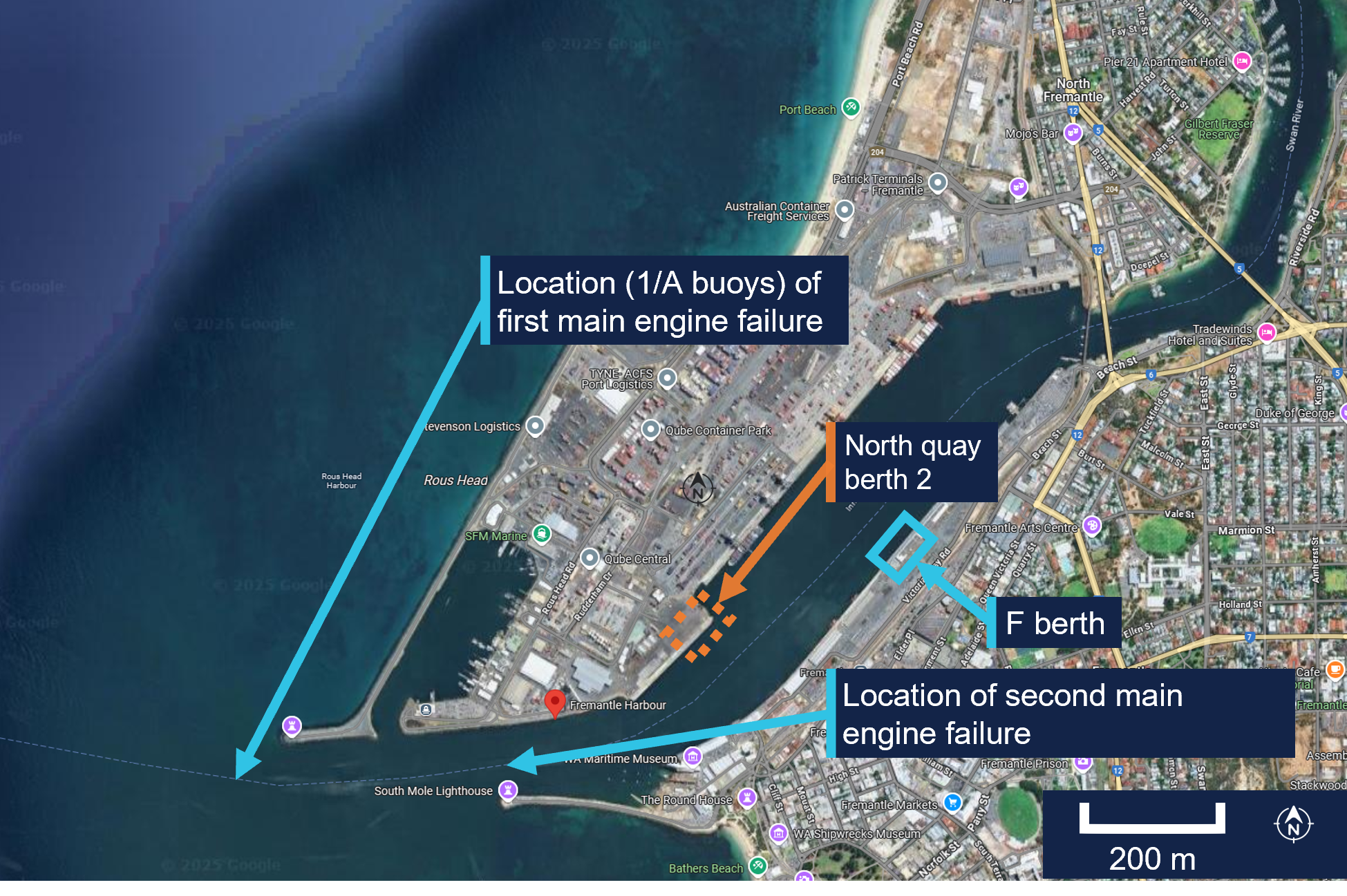
Source: Google maps, annotated by the ATSB
Meanwhile, the master coordinated with the engine control room to restart the main engine. The chief engineer, who was in the engine control room at the time, observed that just prior to the engine stopping, the AHEAD and ASTERN indicator light began flickering between directions. They then took manual control of the engine from the bridge to the engine control room and attempted to restart it in both AHEAD and ASTERN directions. After initial checks, the engine was started in AHEAD and the pilot was advised to only use the engine in the AHEAD direction.
At 0744, after passing South Mole and prior to reaching the wheel-over point (Figure 1), the main engine was back online with slow AHEAD engaged. The pilot attempted to contact vessel traffic service (VTS) on channel 8 to provide detail of the engine stoppage, but received no response. The pilot then contacted VTS on channel 12 and asked the VTS operator to switch to channel 8. On channel 8, the pilot notified VTS of the main engine issues and requested monitoring, subsequently advising VTS, ‘we’re all good’.
As they were saying this to VTS, the engine failed a second time and could not be restarted. With the ship continuing under its own momentum, the pilot gave instructions to the helmsman to ensure the ship turned to enter the Inner Harbour. The pilot also instructed Svitzer Redhead, which remained connected at the port quarter, to push at minimum power to assist the turn and to maintain the ship in the centre of the harbour.
With the engine still failed, the pilot attempted to contact VTS on channel 8 twice at 0752, to inform them of the engine failure and discuss contingency berthing options but received no response. A follow-up call was made to VTS via mobile phone, which also went unanswered. The pilot then contacted the mooring team leader on channel 8 to enquire about available berths, but the call could not be established.
The pilot subsequently established contact with the team leader via mobile phone and advised them that the engine had failed, and they may need to berth where they could. The team leader confirmed that D and F berths were vacant but advised against berthing between them due to a known misalignment of the wharf.
By 0757, as the ship passed north quay berth 2 (Figure 1), the crew were able to restart the main engine with dead slow AHEAD engaged. The ship then continued to F berth with the engine at dead slow AHEAD with no further issues. The ship was all fast at 0835.
Context
Al Messilah
The ship Al Messilah was built by the Hashihama Shipbuilding Company in Japan in 1980. It was converted into a livestock carrier in 1997 by Meyer Werft in Germany. At the time of the incident, it was owned, managed, and operated by the Kuwait Livestock Transport & Trading Company, and was classed with Lloyd's Register. The ship regularly traded between Fremantle, Australia, and Shuwaikh, Kuwait.
The ship had an overall length of 185.85 metres and a beam of 32.0 metres. It had a gross tonnage of 38,988 and a deadweight of 12,900 tonnes at a draught of 9.024 metres.
The ship was equipped with a Mitsui B&W 9L67GFC main engine that delivered 12,356 kW through a fixed pitch propeller. In ballast condition, the ship's manoeuvring speeds were 6.2 knots at dead slow AHEAD and 8.2 knots at slow AHEAD.
Crew
Al Messilah was manned with 57 personnel and all crew members held the required qualifications and endorsements for their respective positions.
The deck department comprised the master and 5 officers, including 2 chief mates, a second mate, a third mate and a radio officer. The master held an Egyptian master's certificate of competency re-issued in 2023 and had 6 years experience in the rank, including 14 months on board Al Messilah. The chief officer had 11 years of experience in the rank and had served on board for 3 months.
The engineering department included the chief engineer, a second engineer and 2 third engineers. The chief engineer held a Singapore‑issued certificate of competency as a marine chief engineer, issued in 2021, and had previously served on the ship on multiple occasions, completing 6 months on board during the current tenure. The second engineer held an Egyptian certificate of competency re‑issued in 2024, with 9 years experience in the rank and a total of 27 months served on the ship.
Fremantle Pilots
Fremantle Pilots (FP) was a privately owned company that had provided continuous contracted pilotage services within the Port of Fremantle since 1994. FP was reported to pilot about 3,500 ship movements annually.
The experienced pilot assigned to Al Messilah held an unrestricted licence as a port pilot, issued by Fremantle Ports, and a master mariner’s certificate of competency issued by the Australian Maritime Safety Authority (AMSA). They had been on this ship for pilotage on multiple occasions in the past.
Main engine control and starting sequence
Control of the main engine was available from the bridge using the engine order telegraph (telegraph) handle[2] on the bridge manoeuvring console, from the engine control room, and locally at the engine. The engine was directly coupled to a fixed‑pitch propeller. To reverse the direction of propeller thrust, the engine was required to be stopped and then restarted in the opposite direction.
When this was required, after the engine was stopped, the engine telegraph was moved to the AHEAD or ASTERN position. Valve 87 (see the section titled Pneumatic system and Figure 2) then directed control air though the appropriate line (AHEAD or ASTERN) to the main air distributor (see the section titled Main air distributor). It also provided air to the intensifier booster of the camshaft reversing mechanism (see the section titled Camshaft reversing mechanism booster), positioning them for the commanded operation.
To start the main engine, it was initially turned using starting air. Once the engine speed reached a predefined threshold, the starting air was stopped and fuel introduced. The engine speed automatically adjusted to match the speed set by the bridge controls.
Pneumatic system
The main engine’s pneumatic system (Figure 2) used compressed air, referred to as control air, at a working pressure of 7 kg/cm². This air came from the main air bottles, which store air at 30 kg/cm². A pressure‑reducing valve lowered the pressure to the required level. To meet the manufacturer’s air quality standards, the system also included a control air dryer.
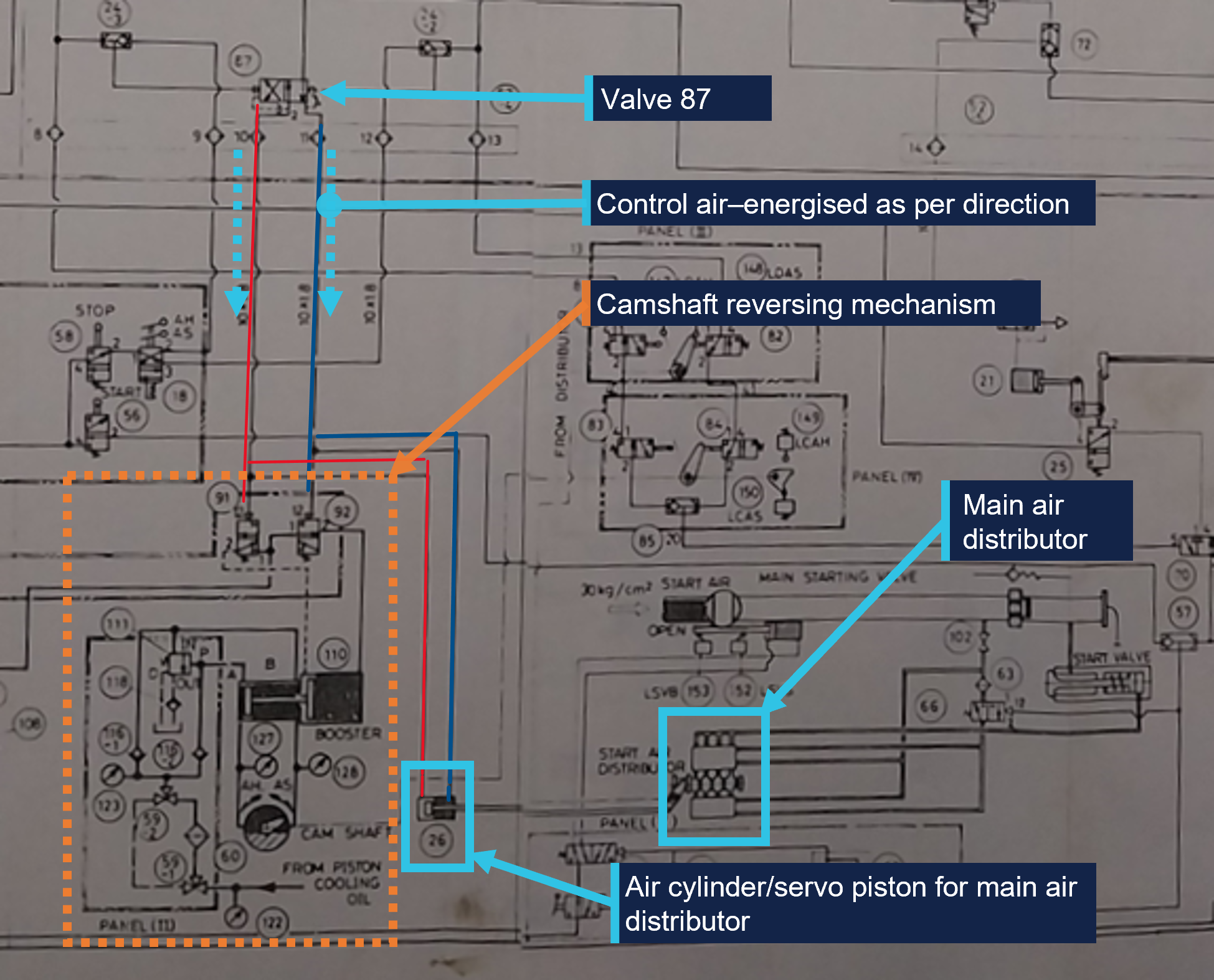
The blue line is showing the path of the control air in the AHEAD line and the red line is showing the path of the control air in the ASTERN line. Source: Ship’s manager, annotated by the ATSB
Components
Main air distributor
Control air supplied through valve 87 was directed to either the AHEAD or ASTERN line and acted on the servo piston (Figure 3). This piston moved the main engine air distributor into the correct position for the selected direction. The distributor then directed high-pressure air to each cylinder’s start air valve to initiate engine rotation. By adjusting the firing order (timing and sequence of air delivery to the cylinders), the distributor ensured the engine was started and rotated in the intended direction.
Figure 3: Main air distributor
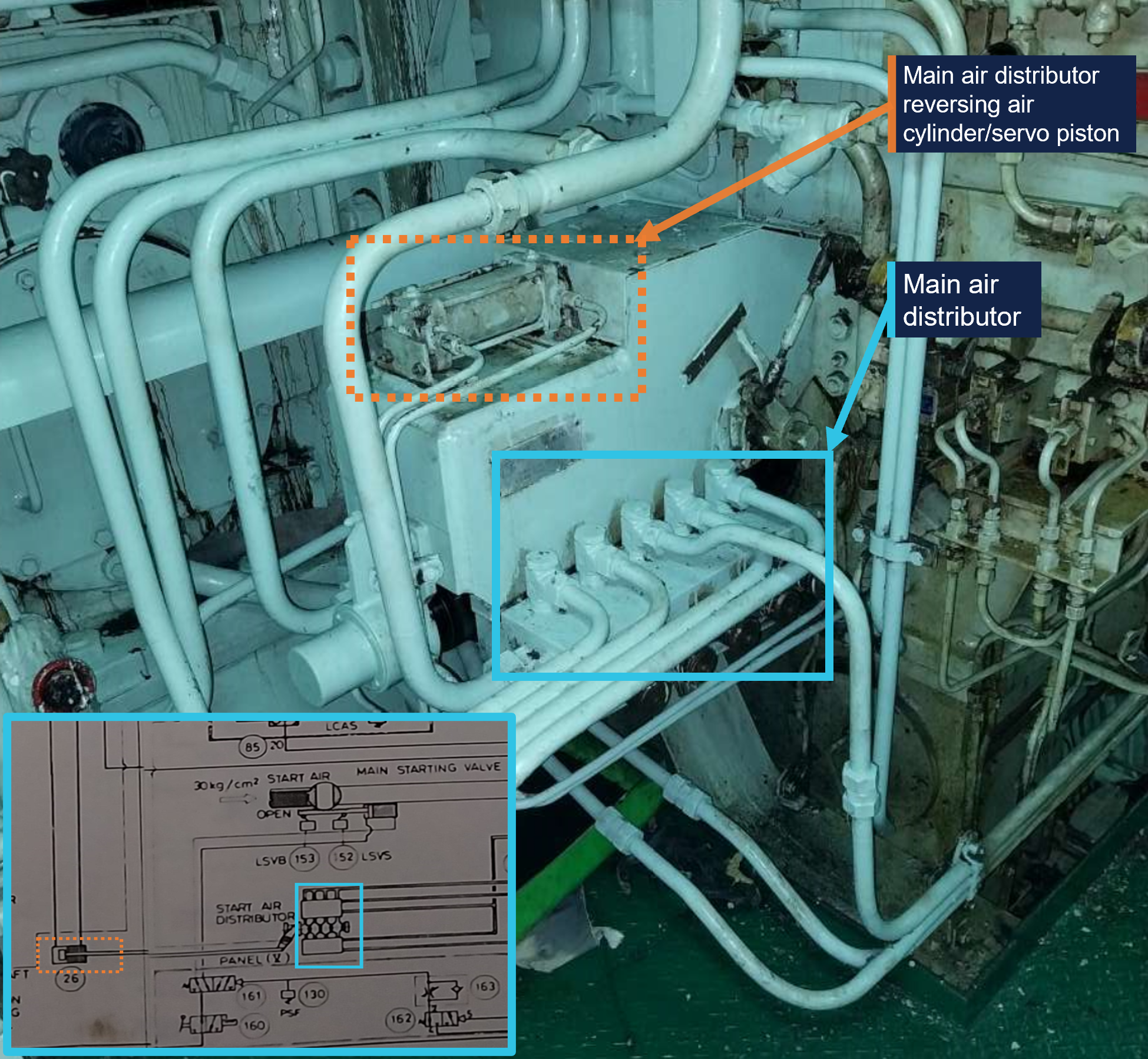
Source: Ship’s manager, annotated by the ATSB
Camshaft reversing mechanism booster
At the same time as being directed to the distributor, the control air acted on the camshaft reversing mechanism intensifier booster (Figure 2) to change the camshaft’s position to match the selected engine direction. This resulted in a change to the timing of the fuel injection and exhaust valve operation, allowing the engine to run in the required direction.
Shipboard maintenance procedures
As part of its safety management system, the ship manager advised that they implemented standard procedures across all ship and shore operations. This included manuals covering company procedures, fleet instructions, and safety management. The system included general procedures, with the key procedure for main engine maintenance summarised as follows:
- The company maintains machinery and equipment according to rules, manufacturer guidance, and risk assessments. If needed, stricter internal standards are applied.
- Spare parts and tools are provided promptly. Maintenance records are kept up to date and checked both on board and ashore. Senior staff carry out regular inspections, and critical equipment is maintained.
Planned maintenance system
The fleet instructions manual on board Al Messilah included the procedures for planned maintenance, including key steps for maintaining the main engine, summarised as follows:
- Before starting any maintenance or repair work, crew must carry out a risk assessment and record it in the maintenance workbook. They must follow the manufacturer’s instructions for all machinery, equipment, and systems. If needed, planned maintenance can be done earlier than scheduled, but it should not be delayed beyond the recommended time.
- Planned maintenance is to be carried out as per the schedule laid out by the company for each ship. The chief engineer must closely monitor the system and report the status to head office on a monthly basis.
- Any main engine maintenance to be carried out must first be discussed at the shipboard management meetings, where the decision will be made as to when the work will be undertaken. Hours between checks/overhaul of main engine and auxiliary engine components should be reported from the month‑ending statement of main engine and auxiliary engine running hours forms.
On board maintenance practices and records
The ship’s planned maintenance system (PMS) was monitored using a PMS form that referenced various main engine components (Figure 4). The maintenance tasks were scheduled at predefined intervals, as shown in the PMS form.
While the PMS identified the required maintenance tasks, there were no accompanying task‑specific job cards or procedural breakdown guides available to guide crew through each activity. Instead, records of completed maintenance were kept in a handwritten logbook, which did not include detailed descriptions of the condition of the component, work performed, or parts replaced.
As of the end of February 2025, the main engine had accumulated 259,438.5 running hours, with 298.5 hours recorded during that month.
Figure 4: Planned maintenance system for main engine
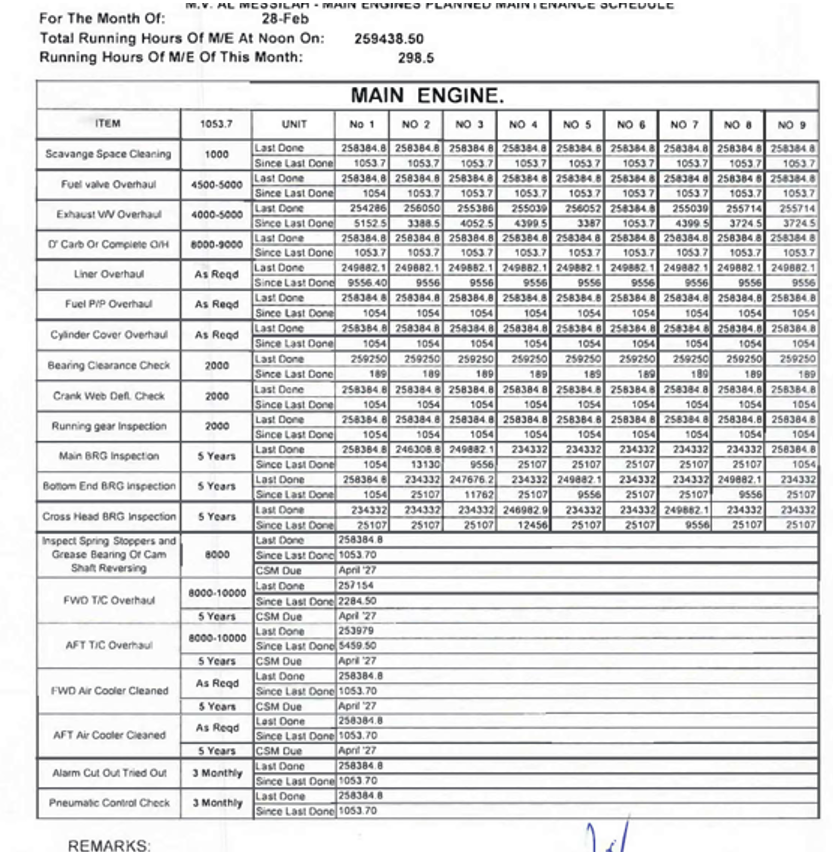
Source: Ship’s manager, annotated by the ATSB
On board maintenance
Pneumatic system maintenance requirements
The engine manufacturer initially recommended overhauling the pneumatic control system every 8,000 hours of engine operation. However, in 2001 this guidance was superseded by a service letter, introducing a time-based maintenance approach.
This updated maintenance guidance required that all non-metallic components and O‑rings in the pneumatic system’s valves were to be renewed every 2 years.
The ATSB did not identify any evidence that the maintenance of the pneumatic system was recorded in the PMS or that the updated time-based maintenance requirement had been included.
Control air dryer maintenance requirements
The maintenance procedures for the control air dryer stated that the unit must be kept clean and that the filter of the automatic condensate drain should be cleaned monthly under normal conditions and weekly in dusty environments.
The control air dryer was replaced in 2021, however no further related maintenance records were provided.
Engine manoeuvring system
The operator had one record of maintenance conducted on the engine manoeuvring and control system, which included part of the pneumatic system. This was done on 14 September 2024 and showed that the following work was completed:
- pneumatic vales 91, 92 and 93 overhauled and refitted
- pneumatic valves 166 and 87 renewed
- turning gear and local manoeuvring stand valves – O-rings replaced
- main engine stop cylinder overhauled
- limit switches lubricated
- grease points regreased
- 7 bar and 30 bar line filters opened.
The last recorded maintenance by the part manufacturer was in 1994, the year prior to the current owner purchasing the ship. Following the occurrence, the ATSB contacted the main engine manufacturer to clarify the maintenance requirements for components of the engine’s pneumatic system. The manufacturer advised that there were no formal maintenance recommendations for these components, and that maintenance practices were left to the discretion of the ship’s management.
Maintenance training standards
The ship’s master reported that the engineering crew on board had not received training specific to the maintenance of the main engine pneumatic systems.
Post‑incident engine inspection
During maintenance conducted after the incident, it was identified that the seals on the servo piston of the main air distributor reversing cylinder had disintegrated.
The affected seals were subsequently replaced by shipboard personnel once the ship was safely moored alongside (Figure 5).
Subsequent to notification of the incident by the ship’s master, the Australian Maritime Safety Authority (AMSA) boarded the ship and issued a deficiency under the Navigation Act 2012. In response, the ship’s management arranged for the attendance of the engine manufacturer to repair and verify the integrity of the main engine control system while the ship remained berthed.
Verification of the repairs and functionality of the main engine control system was conducted by the ship’s classification society.[3] At the end of this process, the classification society issued an actionable item requiring the main engine manoeuvring system to be serviced in accordance with the manufacturer’s recommendations at the earliest opportunity. A due date of 6 June 2025 was assigned for completion of this action.
AMSA subsequently closed the deficiency prior to the ship’s departure from port on 6 March 2025. No further deficiencies were issued at that time, as the classification society committed to ongoing monitoring of the outstanding item.
When the ship arrived at Khor Fakkan anchorage in the United Arab Emirates, the ship manager arranged for a complete overhaul of the main engine pneumatic system. The engine maker’s service team attended the ship on 11 April 2025, inspected, and overhauled the entire pneumatic manoeuvring system, including all of the pneumatic valves.
Figure 5: Main air distributor reversing cylinder/servo piston with new seals
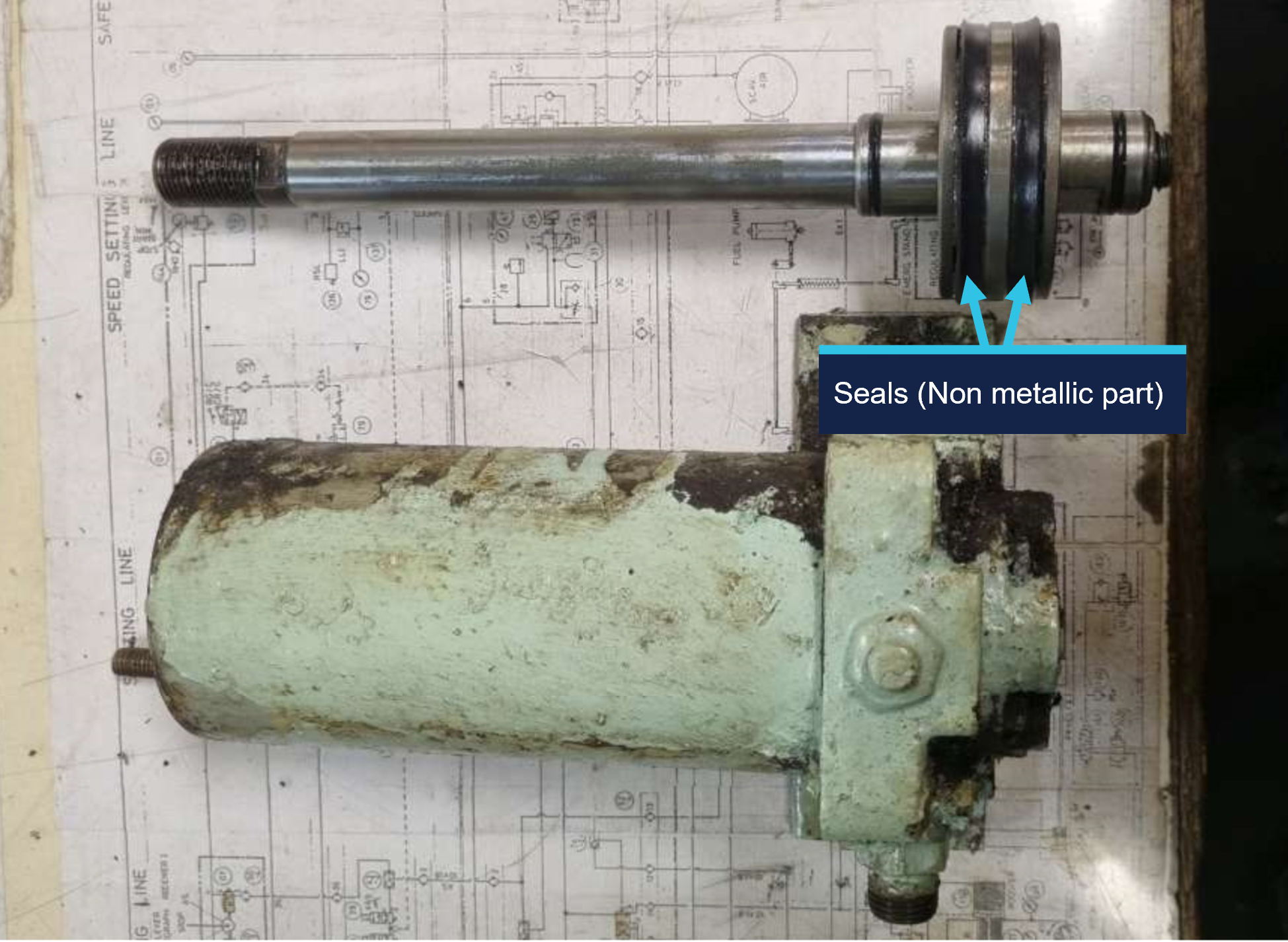
The image shows the piston after the seals had been replaced. Source: Ship’s manager, annotated by the ATSB
Communication protocols at Fremantle Ports
Fremantle Ports’ communication protocols, as outlined in the Port Information Guide (2018), Harbour Master’s Instruction HM02/18, and the VTS Operational Procedures (2022), designated very high frequency (VHF) channel 12 as the primary channel for VTS communications, with channel 8 reserved for tug operations.
Fremantle Pilots advised that during pilotage, it was standard practice to use channel 8 in the Inner Harbour and it expected this channel to be monitored by pilots, tugs, line boats mooring teams and VTS. It further stated that, while channel 12 was monitored continuously on the ship’s VHF radio, the communications specific to the ship movement and pilotage were carried out on the dedicated channel 8, to which the pilot’s VHF was switched during transit through the Inner Harbour. They advised that the use of channel 8 ‘avoids the need for parties (particularly the pilots, the tugs and VTS) to have to switch between channels during operation’.
Subsequent incidents
Following this incident, during the ship’s next port visit in April 2025, there was a complete electrical power loss and black smoke emission from the engine room. It was revealed that the generator had failed. This was likely due to the degradation of the electrical cable insulation due to continuous relative movement caused by poor securing, leading to a short circuit in the system.
Additionally, multiple safety-related deficiencies were identified during a harbour master inspection on 28 April 2025, including:
- unsafe mooring arrangements
- corroded and unserviceable equipment
- poor housekeeping and safety protocols.
These systemic shortcomings, along with the failure to report key incidents such as a mooring line parting and onboard fire, led the harbour master to deem the ship unfit for further port calls. As a result, Al Messilah was officially banned from returning to the Port of Fremantle by the harbour master until a satisfactory corrective action plan with objective evidence is presented to Fremantle Ports for review. As the ship only transits through the Port of Fremantle, this effectively banned it from entering Australia.
Safety analysis
Introduction
On 4 March 2025, the livestock carrier Al Messilah lost propulsion while entering the Port of Fremantle with a pilot on board. The main engine stopped once while the ship was entering the harbour and failed a second time as the ship entered the Inner Harbour.
This analysis focuses on the circumstances of the incident, specifically examining the cause of the engine failures, the ship’s planned maintenance system (PMS) and the operator’s maintenance practices. It will also discuss the communication issues encountered during the emergency.
Engine failures
The investigation found that degraded seals inside the servo piston allowed control air to leak between the AHEAD and ASTERN chambers of the reversing air cylinder. This leakage introduced air into the ASTERN line of the camshaft reversing mechanism. This likely resulted in the system not being able to maintain the control air pressure needed to fully actuate and hold the camshaft in the AHEAD position. The camshaft then likely moved to an indeterminate position, which misaligned the fuel injection and exhaust valve timing. The resulted in the engine misfiring and stopping.
After the failure, the engine could only be restarted in the AHEAD direction. The position of the degraded seals at the time likely allowed sufficient pressure in the AHEAD line to enable this.
Contributing factor While entering the Port of Fremantle, the main engine failed twice, most likely due to a failure of the seals in the servo piston of the main air distributor. |
Ship manager’s planned maintenance system
The planned maintenance system (PMS) was contained on a form which listed the required intervals between maintenance activities. However, the PMS did not include job instructions or inspection criteria. In addition, there was no documentation of the condition of the component, nor the spares consumed during inspections or overhauls.
As a result, the PMS system lacked the detail required to track maintenance of critical components. On a ship, where there is a changeover of personnel, it is essential that maintenance systems have enough information to ensure the oncoming crew know what maintenance has been completed.
The ATSB could find no records of the maintenance activities on the main engine pneumatic system.
Contributing factor The Kuwait Livestock Transport & Trading Company's planned maintenance system did not provide enough detail to track maintenance schedules, and did not have a specific maintenance item to record the maintenance activities on the main engine pneumatic system. (Safety issue) |
Preventive maintenance of main engine pneumatic components
In addition, the PMS had not incorporated the engine manufacturer’s service letter for the pneumatic system. This likely led to the manufacturer’s recommendation for biennial servicing of non-metallic components and pneumatic control elements not being completed. There was also no evidence that the ship’s maintenance crew had been trained in how to maintain the system. In addition, the engine maker or its authorised service engineers had not attended the ship to service the pneumatic manoeuvring system since before the ship ownership was transferred to the current owner.
The records provided by the ship’s manager also contained no entries for maintenance of the reversing air cylinder main air distributor.
A new control air dryer had been installed in 2022. However, there were no records to indicate that the crew had maintained or inspected the dryer in accordance with the manufacturer’s instructions since that date. Given the ship’s regular trade between Fremantle and ports in Kuwait with consistently high humidity, failure to maintain the air dryer increased the risk of moisture ingress. Moisture in the control air can cause internal corrosion, degrade seals and impair valve performance, particularly during frequent directional changes.
Following the incident, the engine maker’s service team inspected and overhauled the complete pneumatic manoeuvring system, including all of the pneumatic valves.
Contributing factor The main air distributor components, the main engine pneumatic system, and the engine control air system dryer were not maintained in accordance with the manufacturer's guidelines. |
Communication protocols at Fremantle Ports
Fremantle Ports’ formal protocols designated VHF channel 12 as the primary channel for vessel traffic service (VTS) communications, with channel 8 reserved for towage operations. However, Fremantle Pilots routinely use channel 8 for pilotage communications during Inner Harbour transits, expecting it to be monitored by all involved parties, including VTS.
During the Al Messilah incident, the pilot switched VTS communications from channel 12 to channel 8 to report a main engine failure. However, as channel 8 was not formally designated or assured for continuous VTS monitoring, the pilot’s subsequent attempts to contact VTS on channel 8 during the engine failure were unsuccessful. This in turn led to delayed emergency coordination.
This deviation from established protocol reduced communication reliability at a time when radio communication was essential.
Other factor that increased risk The Fremantle Pilots’ operational practice of using VHF channel 8 for communication with Fremantle VTS during Inner Harbour transits was not consistent with the port procedures and prevented effective communication. (Safety issue) |
Findings
ATSB investigation report findings focus on safety factors (that is, events and conditions that increase risk). Safety factors include ‘contributing factors’ and ‘other factors that increased risk’ (that is, factors that did not meet the definition of a contributing factor for this occurrence but were still considered important to include in the report for the purpose of increasing awareness and enhancing safety). In addition, ‘other findings’ may be included to provide important information about topics other than safety factors. Safety issues are highlighted in bold to emphasise their importance. A safety issue is a safety factor that (a) can reasonably be regarded as having the potential to adversely affect the safety of future operations, and (b) is a characteristic of an organisation or a system, rather than a characteristic of a specific individual, or characteristic of an operating environment at a specific point in time. These findings should not be read as apportioning blame or liability to any particular organisation or individual. |
From the evidence available, the following findings are made with respect to the loss of propulsion while entering the Port of Fremantle involving Al Messilah, 2 km from Fremantle, Western Australia, on 4 March 2025.
Contributing factors
- While entering the Port of Fremantle, the main engine failed twice, most likely due to a failure of the seals in the servo piston of the main air distributor.
- The Kuwait Livestock Transport & Trading Company's planned maintenance system did not provide enough detail to track maintenance schedules, and did not have a specific maintenance item to record the maintenance activities on the main engine pneumatic system. (Safety issue)
- The main air distributor components, the main engine pneumatic system, and the engine control air system dryer were not maintained in accordance with the manufacturer's guidelines.
Other factors that increased risk
- The Fremantle Pilots’ operational practice of using VHF channel 8 for communication with Fremantle VTS during Inner Harbour transits was not consistent with the port procedures and prevented effective communication. (Safety issue)
Safety issues and actions
Planned maintenance system
Safety issue number: MO-2025-001-SI-01
Safety issue description: The Kuwait Livestock Transport & Trading Company's planned maintenance system did not provide enough detail to track maintenance schedules, and did not have a specific maintenance item to record the maintenance activities on the main engine pneumatic system.
Port radio communication
Safety issue number: MO-2025-001-SI-02
Safety issue description: The Fremantle Pilots’ operational practice of using VHF channel 8 for communication with Fremantle VTS during Inner Harbour transits was not consistent with the port procedures and prevented effective communication.
Glossary
| AMSA | Australian Maritime Safety Authority |
| FP | Fremantle Pilots |
| FPA | Fremantle Port Authority |
| PMS | Planned maintenance system |
| PPU | Portable pilot unit |
| SMS | Safety management system |
| VHF | Very high frequency |
| VTS | Vessel traffic service |
Sources and submissions
Sources of information
The sources of information during the investigation included the:
- pilot of the ship at the time of incident
- operator and the ship staff of ship Al Messilah
- Fremantle Pilots
- service engineer
- recorded data from the portable pilot unit
- Fremantle Ports.
Submissions
Under section 26 of the Transport Safety Investigation Act 2003, the ATSB may provide a draft report, on a confidential basis, to any person whom the ATSB considers appropriate. That section allows a person receiving a draft report to make submissions to the ATSB about the draft report.
A draft of this report was provided to the following directly involved parties:
- Kuwait Livestock Transport & Trading Company
- Fremantle Pilots
- Fremantle Ports harbour master
- operating crew on board Al Messilah
- Kuwait Marine Investigation Department
- Lloyd’s register of shipping
- Australian Maritime Safety Authority.
Submissions were received from:
- Kuwait Livestock Transport & Trading Company
- Fremantle Pilots
- Fremantle Ports harbour master
- Australian Maritime Safety Authority.
The submissions were reviewed and, where considered appropriate, the text of the report was amended accordingly.
Purpose of safety investigationsThe objective of a safety investigation is to enhance transport safety. This is done through:
It is not a function of the ATSB to apportion blame or provide a means for determining liability. At the same time, an investigation report must include factual material of sufficient weight to support the analysis and findings. At all times the ATSB endeavours to balance the use of material that could imply adverse comment with the need to properly explain what happened, and why, in a fair and unbiased manner. The ATSB does not investigate for the purpose of taking administrative, regulatory or criminal action. TerminologyAn explanation of terminology used in ATSB investigation reports is available here. This includes terms such as occurrence, contributing factor, other factor that increased risk, and safety issue. Publishing informationReleased in accordance with section 25 of the Transport Safety Investigation Act 2003 Published by: Australian Transport Safety Bureau © Commonwealth of Australia 2025 
Ownership of intellectual property rights in this publication Unless otherwise noted, copyright (and any other intellectual property rights, if any) in this report publication is owned by the Commonwealth of Australia. Creative Commons licence With the exception of the Commonwealth Coat of Arms, ATSB logo, and photos and graphics in which a third party holds copyright, this report is licensed under a Creative Commons Attribution 4.0 International licence. The CC BY 4.0 licence enables you to distribute, remix, adapt, and build upon our material in any medium or format, so long as attribution is given to the Australian Transport Safety Bureau. Copyright in material obtained from other agencies, private individuals or organisations, belongs to those agencies, individuals or organisations. Where you wish to use their material, you will need to contact them directly. |
[1] Local time was Western Standard Time (WST), which is Coordinated Universal Time (UTC) +8 hours. It was noted that discrepancies existed between the ship’s bell book, engine movement log, and time stamp on portable pilot unit (PPU) recording provided by Fremantle Pilots.
[2] An engine order telegraph is a communications device on the ship’s bridge used to generate a change in engine speed or direction.
[3] A ship classification society is an organisation that establishes and maintains technical standards for the construction and operation of ships.
Occurrence summary
| Investigation number | MO-2025-001 |
|---|---|
| Occurrence date | 04/03/2025 |
| Location | 2 km from Fremantle |
| State | Western Australia |
| Report release date | 04/09/2025 |
| Report status | Final |
| Investigation level | Defined |
| Investigation type | Occurrence Investigation |
| Investigation status | Completed |
| Mode of transport | Marine |
| Marine occurrence category | Machinery failure |
| Occurrence class | Incident |
| Highest injury level | None |
Ship details
| Name | Al Messilah |
|---|---|
| IMO number | 7924425 |
| Ship type | Livestock |
| Flag | Kuwait |
| Manager | Kuwait Livestock Transport & Trading Company |
| Departure point | Kuwait |
| Destination | Fremantle, Australia |