International

Birdstrike and inflight vibration involving Boeing 747-438 ER, VH-OEH, near San Francisco International Airport, United States, on 6 October 2016

Final report

Report release date: 29/06/2017

Safety summary

What happened

On 6 October 2016, a Boeing 747-438 ER, registered VH-OEH and operated by Qantas International, departed San Francisco International Airport, United States, for a flight to Sydney, Australia. Soon after departure and during the climb, the crew became aware of an abnormal vibration in the area of the left over-wing door. There were no cockpit indications or associated procedures to manage the observed vibration. Consequently, the flight crew were required to use their professional judgement to assess its impact on the flight. The crew utilised available crew resources and maintenance expertise to troubleshoot and assess that the flight could safely continue to Sydney.

What the ATSB found

The ATSB found that during departure from San Francisco International airport, and unbeknown to the flight crew, the aircraft sustained impact damage from a birdstrike. The birdstrike sheared a landing gear door strut resulting in the door not closing. That in turn led to turbulent airflow and in‑cabin vibration.

What’s been done as a result

While the birdstrike resulted in a landing gear door not closing, the overall impact on the flight was minimal. Larger doors that have the potential to cause damage have warning systems to indicate if they have not operated as selected.

There was no additional wear or damage to any of the landing gear components. The landing gear door strut was replaced and the aircraft returned to service.

Safety message

This occurrence highlights that, even with the assistance of sophisticated technology and systems, flight crew may experience situations that can only be managed using their professional judgement.

In this case, the flight crew utilised the support of both on-ground maintenance personnel and cabin crew to methodically troubleshoot the source of the vibration and assess that the flight could be safely continued to the destination airport.


The occurrence

At about 2335 local time on 6 October 2016, a Boeing 747-438 ER, registered VH-OEH and operated by Qantas International, departed San Francisco International Airport, United States, for a flight to Sydney, Australia. The flight crew reported that the night departure was uneventful.

Soon after take-off, the cabin services manager (CSM) was contacted via the aircraft interphone system by a cabin crew supervisor seated near door L3 (Figure 1). The supervisor advised the CSM that there was vibration and louder than normal cabin noise in their area. The CSM recalled that following receipt of that advice from the supervisor, they also became aware of the increased noise.

A training captain seated in the flight deck, also reported being aware of a louder than normal noise during the climb. The captain under training was new to the aircraft type and therefore did not notice the additional noise.

As the aircraft approached top of climb, and after the flight crew had turned off the fasten seatbelts sign, the CSM contacted the flight crew to report the additional noise/vibration. As indications on the flight deck were normal, the second officer was sent to investigate the source of the vibration.

The second officer inspected several sections of the cabin in consultation with the CSM and other flight attendants. They concluded the magnitude of the vibration was largest near door L3 (rows 47-49, seats ABC) and that it was considerably noisier than normal. The CSM recalled that the second officer suspected the vibration may have been due to a landing gear door seal. Unlike other large passenger aircraft, VH‑OEH did not have installed video cameras that permitted the crew to view external parts of the aircraft. In any event, the night conditions may have hampered visual examination of the landing gear area on this occasion. The second officer returned to the flight deck and briefed the other flight crew.

About 2 hours into the flight, the flight crew contacted the company’s maintenance operational control (MOC) centre via satellite phone seeking technical assistance to identify the source of vibration. The flight crew relayed the relevant information to the duty manager, a senior aircraft engineer, who then asked additional questions to assist with the diagnosis. The MOC duty manager advised the crew that it could be a gear door seal or wing-to-body seal as they were located in that area.

The MOC duty manager subsequently checked the:

  • aircraft history for any similar faults/reports, of which there were none
  • relevant aircraft system diagrams to ascertain what systems were located near door L3 and capable of generating the reported vibration/noise
  • relevant maintenance manual section covering possible sources of airframe vibrations.

The flight crew, in consultation with the MOC duty manager and cabin crew, then systematically went through a process of trying to isolate the source of the vibration/noise.

That process included isolation and/or consideration of:

  • the aircraft air-conditioning packs
  • the air recirculation fans
  • re-selection of the landing gear handle to the UP position
  • checking toilets for possible vacuum leaks.

That troubleshooting was unable to isolate the source of vibration and noise. The flight crew requested that the cabin crew continue to monitor the vibration/noise and to advise them of any change. As the aircraft was otherwise performing normally, the flight was continued.

About 4.5 hours into the flight and with no reported change to the vibration/noise levels, the training captain left the flight deck to personally assess the vibration and assessed that it was still quite noisy. Consequently, the flight crew again made contact with the MOC to seek further technical input. They asked the duty manager what other aircraft systems were in the L3 door area. The duty manager advised that there were hydraulics and centre fuel tank transfer pumps. While the crew could not isolate the hydraulics, the transfer pumps were OFF.

The duty manager advised the crew that maintenance services were available at the now nearby Honolulu Airport, Hawaii and enquired if the crew wished to divert. The crew advised the MOC that they did not intend to divert at that stage. The training captain reported to the ATSB that, as the aircraft was otherwise performing normally, it was not considered necessary to divert from the original destination.

The flight crew, with the assistance of the cabin crew, continued to monitor the vibration (which remained constant) and the flight continued to Sydney. They also remained in contact with the MOC.

Figure 1: Aircraft schematic showing location of door L3 (circled red) and other services
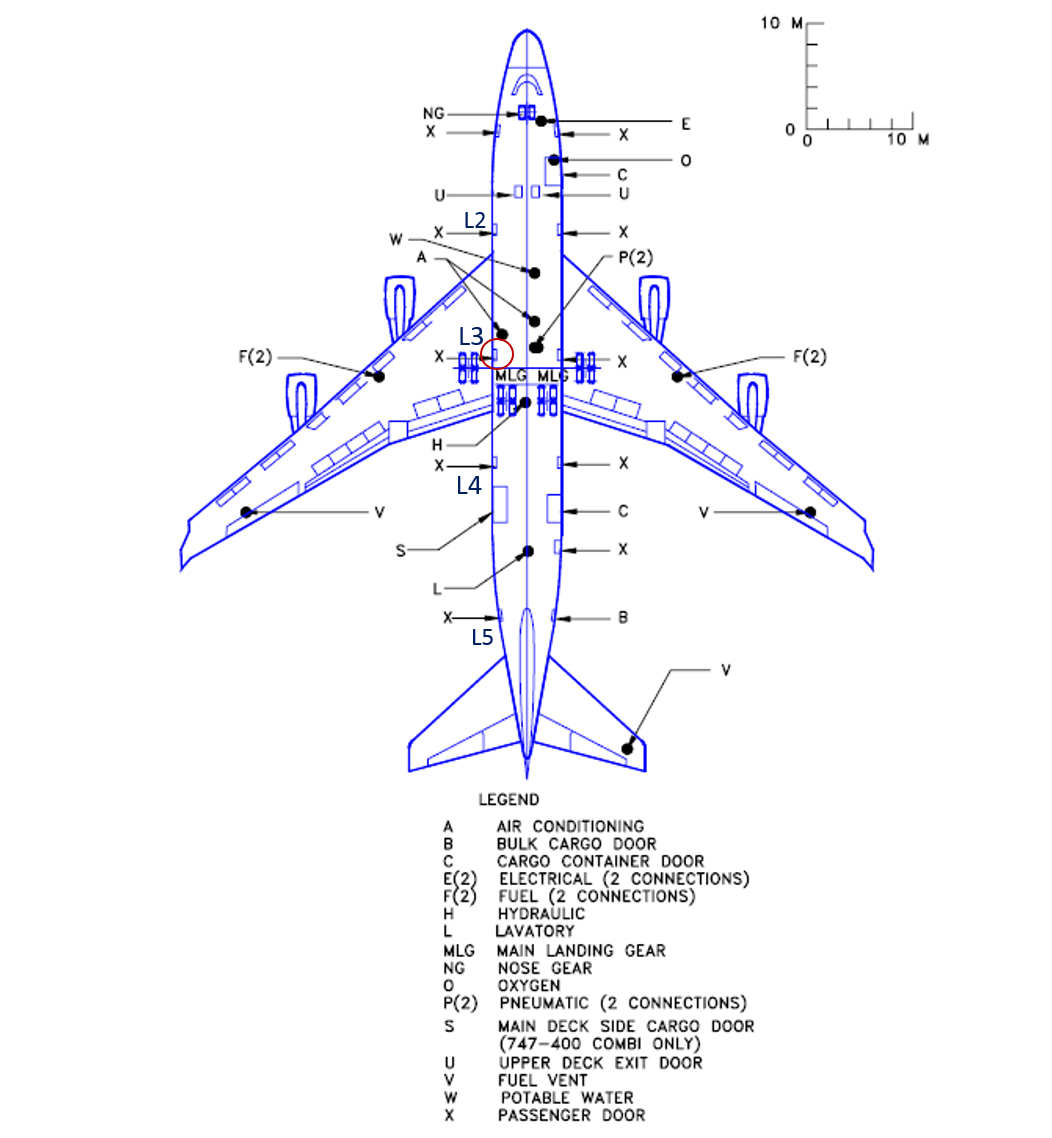
Figure 1: Aircraft schematic showing location of door L3 (circled red) and other services

Source: Boeing Commercial Airplanes

The CMS reported that the vibration and noise persisted up until the landing gear was extended during the approach into Sydney. The cabin crew did not receive any comments about the vibration or noise from the passengers.

After landing, ground engineers inspected the aircraft and immediately identified a protruding landing gear seal and initially thought this was the source of the vibration. On closer examination they observed that a rod, which normally attaches a small outboard landing gear door to the body landing gear shock strut (Figure 2), was sheared at the door attachment point as a result of a birdstrike.

Despite the door not being closed during the flight, there was no additional wear or damage. The attach rod was replaced, and the aircraft returned to normal service, with no further vibration or noise reported.

Figure 2 Main landing gear doors showing location of affected door and attach rod.
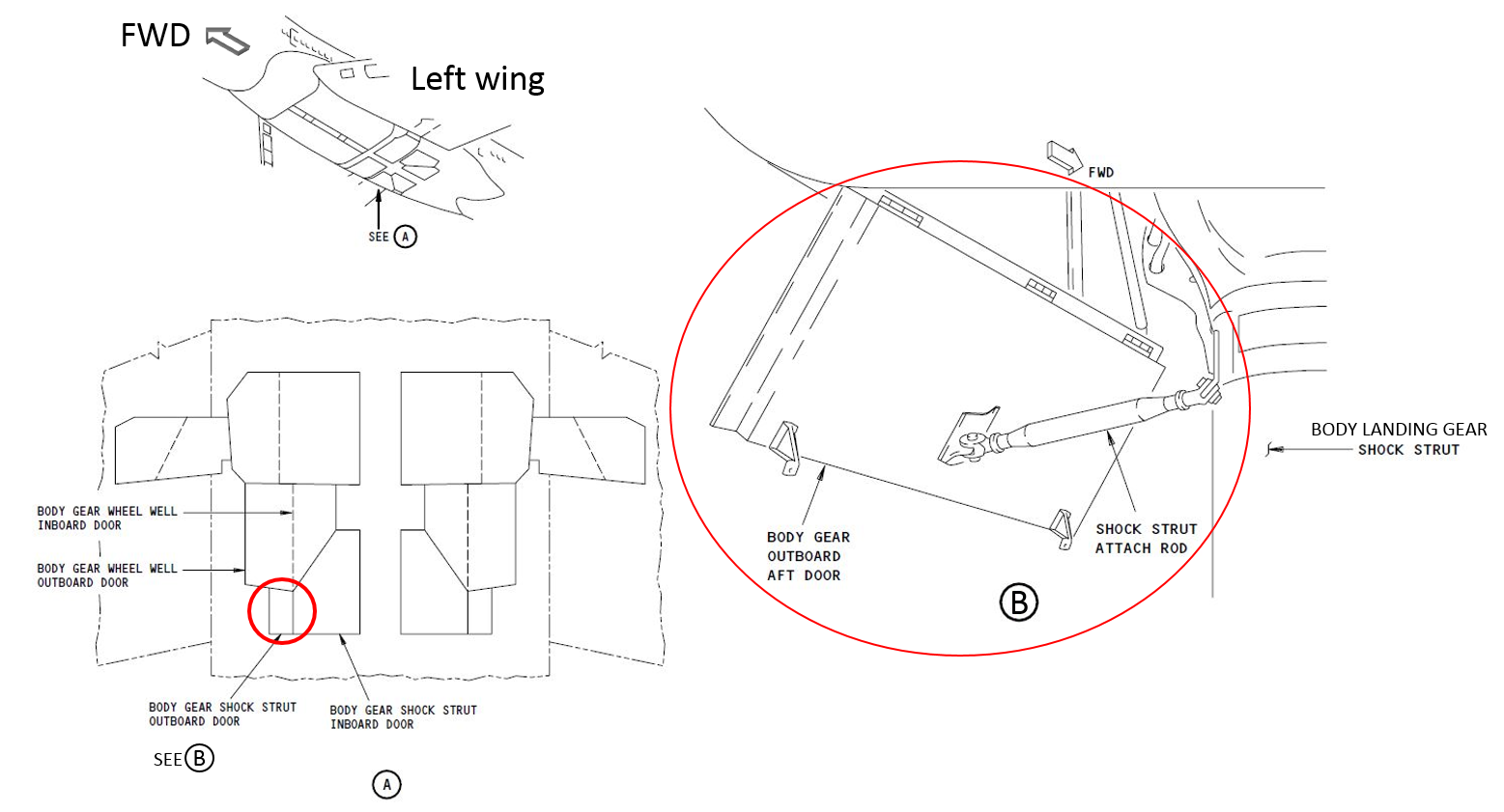
Figure 2 Main landing gear doors showing location of affected door and attach rod.

Source: Boeing Commercial Airplanes

Safety analysis

Due to the physical size of the aircraft and the night departure, the birdstrike was not detected by the flight crew or ground personnel. Given the vibration was first noticed following retraction of the landing gear, it could be argued that the vibration was therefore directly related to the landing gear. However, all indications were that the landing gear had retracted normally. In addition, as there is significant additional noise and vibration while the landing gear is extended, it is equally plausible that this noise may have been masking something unrelated to the landing gear.

While the training captain was aware of some additional noise during the climb, all flight deck indications were normal including those for the landing gear. Due to sterile cockpit procedures, that limited other than emergency communications during critical phases of flight, the first indication that there was something abnormal was when the cabin services manager contacted the flight deck.

Once the nature and location of the vibration had been established, the flight crew proceeded to make use of all available resources to try and identify the source of the vibration and its implication for the continuation of the flight. In consultation with both maintenance operational control and cabin crew, the crew systematically isolated systems capable of generating the vibration. While they were unable to identify the source of the vibration, the flight crew established that it was constant and that the aircraft was otherwise performing normally. In the absence of any abnormal flight deck indications or relevant checklist, the decision to continue the flight was therefore at the discretion of the flight crew based on their professional judgement.

The landing gear system on the Boeing 747 uses a combination of hydraulics and attach rods to extend/retract both the landing gear and the associated doors. Proximity switch sensors located on both the landing gear and the hydraulically operated doors provide the flight crew with indications of both normal and abnormal operation. Small doors that are attached by rods directly to the landing gear, do not have proximity sensors as they normally open and close with the landing gear.

The discovery of the sheared attach rod, evidence of a birdstrike, and the reported in-flight vibration, is consistent with the aircraft having sustained a birdstrike during the departure and while the landing gear was extended. Due to the sheared attach rod, the associated landing gear door would not have closed resulting in residual turbulence and vibration being generated in the area of door L3. The lack of an associated proximity sensor meant that the flight crew were unaware that the door was not closed.

Findings

From the evidence available, the following findings are made with respect to the birdstrike and inflight vibration involving Boeing 747, registered VH-OEH near San Francisco International Airport, United States on 6 October 2016. These findings should not be read as apportioning blame or liability to any particular organisation or individual.

Contributing factors

  • During departure from San Francisco International airport, and unbeknown to the flight crew, one of the main landing gear door struts sustained impact damage from a birdstrike that resulted in the associated landing gear door not closing.

Other findings

  • The noise and vibration experienced in the cabin was due to turbulent airflow associated with the un-closed landing gear door.
  • The absence of cockpit indications and/or associated procedures to manage the observed vibration meant that the flight crew were required to use their professional judgement to assess its impact on the flight. The crew utilised available crew resources and maintenance expertise to troubleshoot and assess that the flight could safely continue to the destination airport.

Sources and submissions

Sources of information

  • The sources of information during the investigation included the:
  • flight crew
  • cabin crew
  • maintenance personnel
  • aircraft operator and manufacturer.

Submissions

  • Under Part 4, Division 2 (Investigation Reports), Section 26 of the Transport Safety Investigation Act 2003 (the Act), the ATSB may provide a draft report, on a confidential basis, to any person whom the ATSB considers appropriate. Section 26 (1) (a) of the Act allows a person receiving a draft report to make submissions to the ATSB about the draft report.
  • A draft of this report was provided to the aircraft operator, flight crew, cabin services manager, maintenance operational control duty manager and the Civil Aviation Safety Authority (CASA).
  • Submissions were received from CASA, the aircraft operator and maintenance personnel. The submissions were reviewed and where considered appropriate, the text of the report was amended accordingly.

Purpose of safety investigations

The objective of a safety investigation is to enhance transport safety. This is done through: 

  • identifying safety issues and facilitating safety action to address those issues
  • providing information about occurrences and their associated safety factors to facilitate learning within the transport industry.

It is not a function of the ATSB to apportion blame or provide a means for determining liability. At the same time, an investigation report must include factual material of sufficient weight to support the analysis and findings. At all times the ATSB endeavours to balance the use of material that could imply adverse comment with the need to properly explain what happened, and why, in a fair and unbiased manner. The ATSB does not investigate for the purpose of taking administrative, regulatory or criminal action.

Terminology

An explanation of terminology used in ATSB investigation reports is available here. This includes terms such as occurrence, contributing factor, other factor that increased risk, and safety issue.

Publishing information

Released in accordance with section 25 of the Transport Safety Investigation Act 2003

Published by: Australian Transport Safety Bureau

© Commonwealth of Australia 2017

image_5.png

Ownership of intellectual property rights in this publication

Unless otherwise noted, copyright (and any other intellectual property rights, if any) in this report publication is owned by the Commonwealth of Australia.

Creative Commons licence

With the exception of the Coat of Arms, ATSB logo, and photos and graphics in which a third party holds copyright, this publication is licensed under a Creative Commons Attribution 3.0 Australia licence.

Creative Commons Attribution 3.0 Australia Licence is a standard form licence agreement that allows you to copy, distribute, transmit and adapt this publication provided that you attribute the work.

The ATSB’s preference is that you attribute this publication (and any material sourced from it) using the following wording: Source: Australian Transport Safety Bureau

Copyright in material obtained from other agencies, private individuals or organisations, belongs to those agencies, individuals or organisations. Where you wish to use their material, you will need to contact them directly.

Occurrence summary

Investigation number AO-2016-135
Occurrence date 06/10/2016
Location Near San Francisco International Airport, United States
State International
Report release date 29/06/2017
Report status Final
Investigation level Defined
Investigation type Occurrence Investigation
Investigation status Completed
Mode of transport Aviation
Aviation occurrence category Airframe - Other
Occurrence class Incident
Highest injury level None

Aircraft details

Manufacturer The Boeing Company
Model 747-438
Registration VH-OEH
Serial number 32912
Aircraft operator Qantas Airways
Sector Jet
Operation type Air Transport High Capacity
Departure point San Francisco, United States
Destination Sydney, New South Wales
Damage Minor

Accredited representative to the United States National Transportation Safety Board investigation of the collision with terrain involving Fokker DR-1, registered N83WR, at Fulshear, Texas, United States, on 3 October 2016

Summary

On 8 October 2016 the ATSB was advised that the United States National Transportation Safety Board (NTSB) had commenced an investigation into a collision with terrain involving a Fokker DR-1 aircraft, registered N83WR. Initial investigation by the NTSB indicated that the aircraft experienced a partial engine power loss shortly after take-off.

As Australia is the State of Manufacture of the engine, on 11 October 2016 the ATSB requested to be appointed as an accredited representative to the NTSB investigation in accordance with clause 5.18 of Annex 13 to the Convention on International Civil Aviation Aircraft Accident and Incident Investigation. An ATSB investigator was appointed as accredited representative to the NTSB investigation on 12 October 2016. To facilitate support to the NTSB investigation, the ATSB also initiated an investigation under the Australian Transport Safety Investigation Act 2003.

The NTSB determined the probable cause of the accident. Details are available on the NTSB website at https://www.ntsb.gov/_layouts/ntsb.aviation/brief.aspx?ev_id=20161006X61204&key=1

Any enquires relating to the investigation should be directed to the NTSB at : www.ntsb.gov

Occurrence summary

Investigation number AE-2016-133
Occurrence date 03/10/2016
Location Fulshear, Texas, USA
State International
Report release date 03/06/2017
Report status Final
Investigation level Defined
Investigation type External Investigation
Investigation phase Final report: Dissemination
Investigation status Completed
Mode of transport Aviation
Aviation occurrence category Collision with terrain
Occurrence class Accident
Highest injury level None

Aircraft details

Manufacturer Amateur Built Aircraft
Model Fokker DR-1
Registration N83WR
Sector Sport and recreational
Operation type Sports Aviation
Departure point Fulshear, Texas
Damage Substantial

Engine shut down involving Boeing 787, VH-VKK, about 370 km north of Guam, on 6 August 2016

Final report

Report release date: 14/12/2016

What happened

On the evening of 6 August 2016, Jetstar Airways flight JQ12, a Boeing 787 aircraft, registered VH-VKK, departed from Tokyo, Japan on a scheduled passenger transport flight to the Gold Coast, Queensland. On board the aircraft were two flight crew, nine cabin crew and 309 passengers.

The aircraft was pushed back from the gate at Narita Airport, Tokyo, at 1133 UTC.[1] About two hours into the flight, the flight crew received an engine indication and crew alerting system (EICAS) message ELEC GEN DRIVE R2, which indicated a fault with the number 2 generator in the right engine. The flight crew performed the checklist actions for that fault, which included disconnecting the number 2 generator drive from the engine driven accessory gearbox (AGB) and starting the auxiliary power unit to supplement the aircraft electrical power with the auxiliary power unit driven generators.

About 30 minutes later, cruising at FL 400,[2] the secondary engine instruments appeared[3] on the flight crews’ multi-function displays and the flight crew detected there was a low oil quantity indication for the right engine. While the flight crew investigated the engine indications, another EICAS message annunciated, ENG OIL PRESS R, which indicated low oil pressure in the right engine. The flight crew performed the checklist actions for low oil pressure in the right engine. The right engine auto-throttle was switched off and the right engine thrust lever retarded to idle. The low oil pressure EICAS message momentarily cleared before it returned again, and the flight crew shut down the right engine in accordance with the checklist procedures.

The captain identified Guam Airport as the nearest suitable airport, about 370 km to the south of their position. They made a PAN[4] call to Guam air traffic control, who provided them with a clearance to manoeuvre as required for a landing at Guam Airport. The flight crew sent a message using the aircraft communications addressing and reporting system to their operations control that they were diverting the aircraft to Guam. They descended the aircraft to FL 220 due to single engine performance limitations and diverted around some weather as they tracked towards Guam Airport. The captain reported that they made an uneventful one engine landing on runway 24 at about 1520 UTC.

After the aircraft vacated the runway, the captain held the aircraft on the taxiway to allow the airport emergency services to inspect the engine before they taxied the aircraft to the arrival gate. The aircraft was shut down at the arrival gate without further incident.

Maintenance findings

When the engine cowls were opened for the initial inspection there was a large quantity of oil found throughout the engine and a considerable amount of metallic debris found within the engine oil system. A data download of the engine was performed and the results were sent to GE Aviation, the engine manufacturer, for review. GE Aviation provided options for returning the aircraft to service, of which Jetstar determined an engine change was the most expeditious.

Engine manufacturer findings

GE Aviation found there was no history or shift in oil system parameters except for the chip count[5] on this flight. Chips are detected and recorded by the engine debris monitoring system (DMS), within the engine oil system.

On the incident flight, the right engine oil system started to detect chips from about one hour into the flight. The chip count reached seven when the crew were alerted to disconnect the number 2 generator. At 1415 a status message was generated for ENG OIL DMS R, which indicated the chip count for the right engine had reached eight.

Between 1415 and 1419 the chip count reached 11, there was a rapid loss of engine oil, a momentary spike in vibration from the engine number 1 bearing, and the EICAS message to the flight crew reporting low engine oil pressure. The engine was shut down and the aircraft landed about 52 minutes later.

Engine driven gearboxes

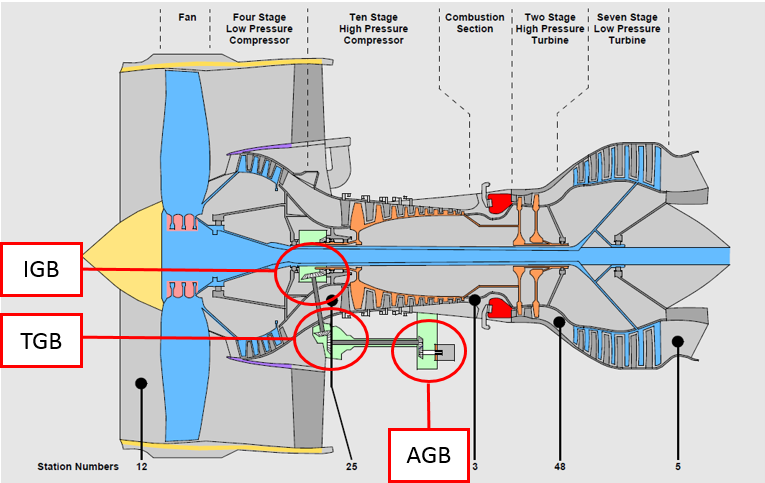
Engine rotation is transmitted to an inlet gearbox (IGB) with a radial driveshaft, which connects to a transfer gearbox (TGB). The TGB transmits the engine speed to the AGB via a horizontal driveshaft (Figure 1). The AGB drives the accessories necessary for engine operation and other aircraft services, such as the generators for the aircraft electrical system. The engine oil system provides lubrication, cooling and removes debris from the gearboxes.

Figure 1: Engine driven gearboxes

Figure 1: Engine driven gearboxes

Source: Boeing, annotated by ATSB

Transfer gearbox damage

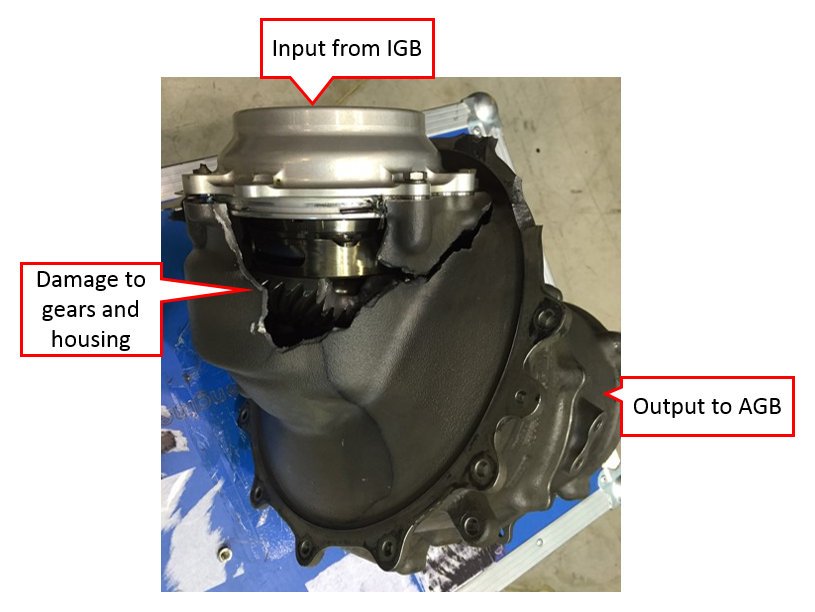
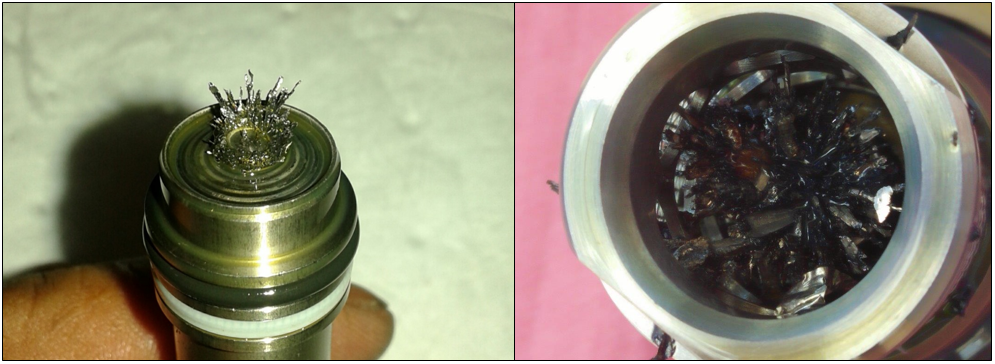
On inspection, the TGB housing was found to be fractured (Figure 2). The TGB oil screen was found with metallic debris and the engine oil DMS sensor was found with metallic debris (Figure 3). The manufacturer’s inspection of the TGB failure indicated it was consistent with a known failure mode of the TGB described in their service bulletin (SB) 72-0298.

Figure 2: Transfer gearbox damage

Figure 2: Transfer gearbox damage

Source: Jetstar Airways

Figure 3: DMS sensor and TGB oil screen metallic debris

Figure 3: DMS sensor and TGB oil screen metallic debris

Source: Jetstar Airways

GE Aviation service bulletin 72-0298

GE Aviation SB 72-0298 revision 0, dated 31 March 2016, is applicable to all GEnx‑1B engines, which were the engines fitted to VH-VKK at the time of the incident. The SB introduces a new transfer gearbox (TGB) configuration. According to the SB:

Pre-modified TGBs have a radial bevel gear with potential resonance modes (see Resonance) in the engine operating range. Excitation of resonance modes may lead to a gear fracture, which can result in engine oil loss and an in-flight shut down. The SB modification introduces a new damper ring groove to the radial bevel gear and a damper ring to mitigate the excitation of the resonance modes.

GE Aviation recommended the compliance periods for the SB in Table 1 below, which are based upon the number of cycles since new (CSN) for the TGB as of 31 March 2016.

Table 1: SB 72-0298 compliance

Cycles Since New (CSN) as of 31 March 2016Compliance period from 31 March 2016
TGB less than 300 CSN12 months
TGB between 300 and 1,000 CSN10 months
TGB greater than 1,000 CSN8 months

Jetstar management of service bulletin 72-0298

The SB related modifications for the Jetstar 787 fleet was managed with a risk profile developed by GE Aviation. The risk profile had four levels of risk for TGB failures, which depended on a number of engine operating factors in addition to the TGB CSN. Jetstar responded to the SB terminating action by immediately sourcing additional post-modification units from the manufacturer and prioritised the TGB modification in accordance with the order of highest to lowest TGB risk until the incident flight. The incident engine TGB was identified as the lowest risk (based on lowest CSN, limited in-service operational data and GE Aviation recommendations) for the Jetstar fleet at the time of the incident.

The incident engine TGB had 181 CSN at the time of the incident and therefore the compliance date to complete the SB for this engine was 31 March 2017. The engine modification to comply with the SB for the incident engine was scheduled for 31 December 2016.

Resonance

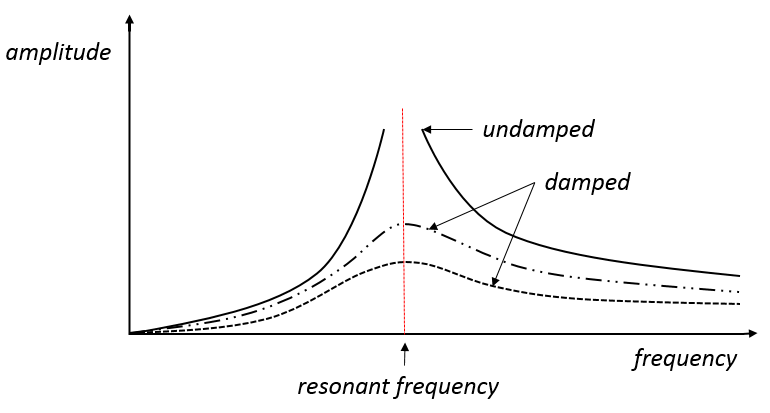
All machinery have a natural frequency of vibration. If a particular abnormality in the machinery generates a forced vibration, which vibrates in-phase and at the same frequency as the natural frequency of vibration, then the energy will magnify. The frequency at which this occurs is known as the resonant frequency (Figure 4). If there is insufficient damping present at the resonant frequency, then the amplitude of the vibrations will increase with each cycle. Excessive movement of components with high energy can cause a catastrophic failure of the machinery.

Figure 4: Resonant frequency for damped and undamped vibration

Figure 4: Resonant frequency for damped and undamped vibration

Source: ATSB

Jetstar Airways extended diversion time operations

Twin engine turbine aeroplanes are normally restricted to operating on routes where if an engine fails or is shut down in-flight, the aircraft is within 60 minutes flight time, at the cruise speed for one engine inoperative, to a suitable airport. Extended diversion time operations (EDTO) permit the Boeing 787 to operate on routes which are further than the 60 minutes flight time in the event of an engine in-flight shut down (IFSD). EDTO approval for an operator is subject to the continuous monitoring of the engine IFSD rate.

For the Jetstar Boeing 787 fleet the EDTO approval at the time of the incident was for up to 180 minutes, which required a target IFSD rate of not greater than 0.02 per 1,000 flight hours. Prior to the incident flight, Jetstar were operating at a rolling 12 month IFSD rate of 0 per 1,000 flight hours, which increased to 0.0096 post-incident. Jetstar have performed several unscheduled engine changes on their 787 fleet since introduction into service, but no changes prior to the incident flight related to the fault condition identified in SB 72-0298.

ATSB comment

The ATSB notes that the failure of the TGB and loss of oil is a potential failure mode known to the engine manufacturer and operator. This condition is under risk management through the service bulletin process and the operator was within the compliance period at the time of the incident. Prior to the incident flight, the incident TGB was assessed as being in the lowest risk profile for the operator’s fleet.

Safety action

Whether or not the ATSB identifies safety issues in the course of an investigation, relevant organisations may proactively initiate safety action in order to reduce their safety risk. The ATSB has been advised of the following proactive safety action in response to this occurrence.

Jetstar Airways

In light of the incident, Jetstar amended their TGB modification schedule in order to prioritise at least one engine TGB on each aircraft airframe in their fleet at the earliest opportunity (known as depairing or decoupling). The fleet was completely depaired from 26 August 2016. Jetstar completed the modification programme for their fleet in November 2016.

Safety message

This incident highlights the importance of flight crew complying with checklist actions when dealing with a fault condition. Inflight, the crew did not have knowledge of the extent of the damage to the engine TGB. However, by following their training and checklist procedures, they reduced the risk of a potential escalation of the fault.

Short Investigations Bulletin - Issue 55

About this report

Decisions regarding whether to conduct an investigation, and the scope of an investigation, are based on many factors, including the level of safety benefit likely to be obtained from an investigation. For this occurrence, a limited-scope, fact-gathering investigation was conducted in order to produce a short summary report, and allow for greater industry awareness of potential safety issues and possible safety actions.

Publishing information 

Released in accordance with section 25 of the Transport Safety Investigation Act 2003

Published by: Australian Transport Safety Bureau

© Commonwealth of Australia 2016

image_5.png

Ownership of intellectual property rights in this publication

Unless otherwise noted, copyright (and any other intellectual property rights, if any) in this report publication is owned by the Commonwealth of Australia.

Creative Commons licence

With the exception of the Coat of Arms, ATSB logo, and photos and graphics in which a third party holds copyright, this publication is licensed under a Creative Commons Attribution 3.0 Australia licence.

Creative Commons Attribution 3.0 Australia Licence is a standard form licence agreement that allows you to copy, distribute, transmit and adapt this publication provided that you attribute the work.

The ATSB’s preference is that you attribute this publication (and any material sourced from it) using the following wording: Source: Australian Transport Safety Bureau

Copyright in material obtained from other agencies, private individuals or organisations, belongs to those agencies, individuals or organisations. Where you wish to use their material, you will need to contact them directly.

__________

  1. Coordinated Universal Time (abbreviated UTC) is the time zone used for civil aviation. Local time zones around the world can be expressed as positive or negative offsets from UTC.
  2. At altitudes above 10,000 ft in Australia, an aircraft’s height above mean sea level is referred to as a flight level (FL). FL 400 equates to 40,000 ft.
  3. The secondary engine instruments are only displayed when an abnormal condition is detected.
  4. An internationally recognised radio call announcing an urgency condition which concerns the safety of an aircraft or its occupants but where the flight crew does not require immediate assistance.
  5. Chip count refers to metallic debris detected within the engine oil system, which may be a leading indicator of machinery failure. Chip count indicates the number of metal chips detected by the debris monitoring system.

Occurrence summary

Investigation number AO-2016-095
Occurrence date 06/08/2016
Location Guam International Airport, N 370 km
State International
Report release date 14/12/2016
Report status Final
Investigation level Short
Investigation type Occurrence Investigation
Investigation status Completed
Mode of transport Aviation
Aviation occurrence category Engine failure or malfunction
Occurrence class Incident
Highest injury level None

Aircraft details

Manufacturer The Boeing Company
Model 787-8
Registration VH-VKK
Serial number 36237
Sector Jet
Operation type Air Transport High Capacity
Damage Nil

Technical assistance to the Safety Investigation Board of Pakistan, relating to an engine failure and runway excursion, involving a Beechcraft 1900D, AP-BII, Karachi, Pakistan, on 18 March 2016

Summary

The Safety Investigation Board (SIB) of the Pakistan Civil Aviation Authority is investigating an engine failure and runway excursion involving a Beechcraft 1900D aircraft, registered AP-BII that occurred on 18 March 2016. On 4 August 2016, the SIB requested the appointment of an ATSB investigator as accredited representative to the SIB investigation in accordance with clause 5.23 of Annex 13 to the Convention on International Civil Aviation Aircraft Accident and Incident Investigation.

The SIB requested the ATSB accredited representative to oversight a technical examination of the aircraft’s engine at a maintenance facility in Brisbane, Queensland. To facilitate this support, the ATSB initiated an investigation under the Australian Transport Safety Investigation Act 2003.

On 6 January 2017, the SIB advised the ATSB that, as all investigation work within Australia had now been completed, ATSB assistance was no longer required.

The SIB is responsible for, and will administer the release of the final investigation report into the occurrence involving AP-BII. Any enquiries regarding the SIB investigation should, in the first instance, be directed to the:

Safety Investigation Board
Pakistan Civil Aviation Authority
CAA Office Complex
Lethrar Road
Rawalpindi
Pakistan 

Phone: +92 51 44 72750
Fax:      +92 51 44 72754
Email:   psib@caapakistan.com.pk

The information contained in this web update is released in accordance with section 25 of the Transport Safety Investigation Act 2003.

Occurrence summary

Investigation number AE-2016-094
Occurrence date 18/03/2016
Location Karachi, Pakistan
State International
Report release date 27/01/2017
Report status Final
Investigation level Defined
Investigation type External Investigation
Investigation status Completed
Mode of transport Aviation
Aviation occurrence category Engine failure or malfunction
Occurrence class Accident
Highest injury level Unknown

Aircraft details

Manufacturer Beech Aircraft Corp
Model 1900D
Registration AP-BII
Serial number Unknown
Sector Turboprop
Operation type Air Transport Low Capacity
Departure point Karachi, Pakistan
Damage Substantial

Technical assistance to the PNG Accident Investigation Commission, collision with terrain involving Britten-Norman Islander, P2-SBC, Kiungra Airport, Papua New Guinea, on 13 April 2016

Summary

On 13 April 2016, a Pilatus Britten Norman Turbine Islander (BN-2T) twin-turboprop aircraft, registered P2-SBC, departed from Tekin, West Sepik Province for Kiunga, in Western Province, Papua New Guinea (PNG). A pilot and 11 passengers were onboard the aircraft. While on approach to land, the aircraft impacted heavily into terrain, approximately 1,200m west of the runway. The aircraft was destroyed and there were no survivors.

The Accident Investigation Commission (AIC) of Papua New Guinea conducted an investigation into the accident in accordance with their obligations as the State of Occurrence under Annex 13 to the Convention on International Civil Aviation. The AIC requested technical assistance from the Australian Transport Safety Bureau (ATSB) to examine items recovered from the aircraft, including cockpit instruments and personal electronic devices. In providing this support, the ATSB commenced an external investigation under the Transport Safety Investigation Act 2003.

The ATSB has completed its examination of the recovered items. The results of the instrument examination along with a copy of the recovered data from the electronic devices was provided to the AIC.

The AIC has released the final investigation report into this accident, which is available at www.aic.gov.pg. Specific enquiries related to this accident should be addressed to the AIC by email at infor@aic.gov.pg, or in writing to:

Chief Executive Officer
Accident Investigation Commission
PO Box 1709   
Boroko, NCD
Papua New Guinea

Occurrence summary

Investigation number AE-2016-043
Occurrence date 13/04/2016
Location Kiungra airport, Papua New Guinea
State International
Report release date 28/03/2017
Report status Final
Investigation level Defined
Investigation type External Investigation
Investigation status Completed
Mode of transport Aviation
Aviation occurrence category Collision with terrain
Occurrence class Technical Analysis
Highest injury level Fatal

Aircraft details

Manufacturer Britten Norman
Model BN-2T
Registration P2-SBC
Sector Turboprop
Operation type Air Transport Low Capacity
Departure point Oksapmin, Papua New Guinea
Destination Kiungra, Papua New Guinea
Damage Destroyed

Technical assistance to CASA in the examination of Gippsland Aeronautics GA-8 main landing gear axle fractures

Report

Report release date: 29/11/2016

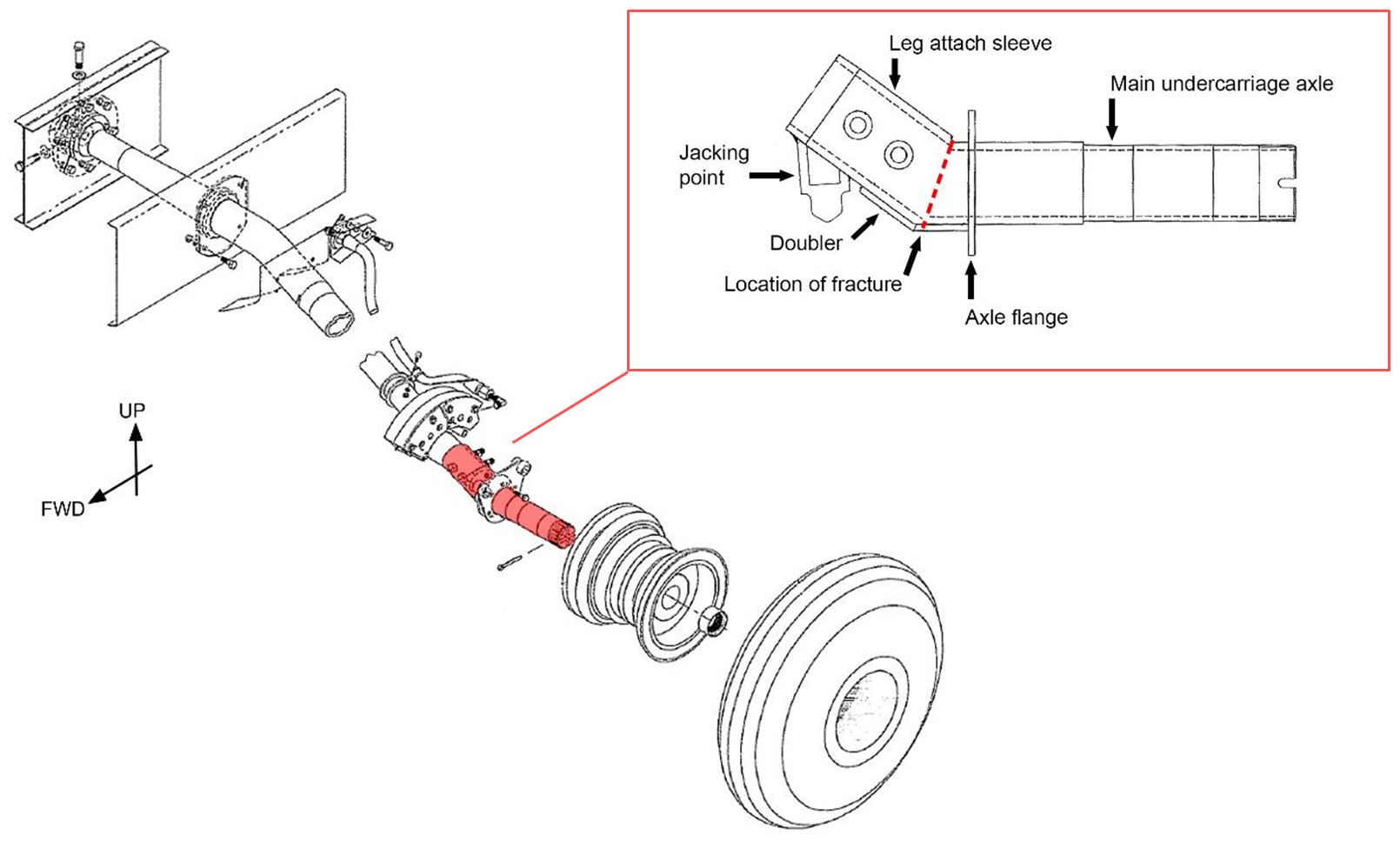
On 7 April 2016, a GippsAero GA8-TC 320 Airvan (GA8) aircraft, registered P2-MFM, was being flown from Kiunga to Yehibi, Papua New Guinea. Shortly after touch-down and around 140m into the landing roll, the wheel and axle assembly from the left main landing gear leg separated from the aircraft. The pilot was able to bring the aircraft to a controlled stop.

Subsequent inspection of the right landing gear leg from P2-MFM found that it was cracked in the welded region of the axle assembly. Inspections of other aircraft in the operator's GA8 fleet, identified that numerous main landing gear legs were cracked in the same location.

The Civil Aviation Safety Authority (CASA) commenced an airworthiness investigation into the circumstances surrounding this issue. CASA requested technical assistance from the Australian Transport Safety Bureau (ATSB) to conduct a detailed metallurgical examination of the main landing gear axles from P2-MFM. To facilitate this assistance, the ATSB initiated an external investigation under the provisions of the Transport Safety Investigation Act 2003.

The ATSB has completed its examinations. Fatigue cracking and fracture was associated with marginal weld penetration between the landing gear parts and was influenced by the manufacturer's original welding processes. The manufacturer revised the assembly drawing in 2009, including enhancements to the welding procedure, such that the latest axle design is likely to have improved fatigue endurance. The ATSB was not aware of any instances of cracking of axles manufactured to the latest revision.

On 7 June 2016, the manufacturer released service bulletin SB-GA8-2016-169 (Issue 1) that recommended inspections of the axle area be conducted at service intervals not exceeding 110 hours.

A report detailing the ATSB's examination and findings was provided to CASA, the aircraft operator and the aircraft manufacturer, on 6 October 2016. Enquiries relating to the investigation should be directed to CASA on 131 757.

Figure 1: GA8 main landing gear, wheel and brake assembly showing the location of cracking and fracture on the axle assembly.

Figure 1:  GA8 main landing gear, wheel and brake assembly showing the location of cracking and fracture on the axle assembly. Source: GippsAero / modified by ATSB

Source: GippsAero / modified by ATSB

Occurrence summary

Investigation number AE-2016-045
Occurrence date 06/05/2016
Location Yehibi, Papua New Guinea
State International
Report release date 29/11/2016
Report status Final
Investigation level Defined
Investigation type External Investigation
Investigation status Completed
Mode of transport Aviation
Aviation occurrence category Landing gear/indication
Occurrence class Incident
Highest injury level None

Aircraft details

Manufacturer Gippsland Aeronautics Pty Ltd
Model GA-8
Registration P2-MFM
Sector Piston
Departure point Kiunga, Papua New Guinea
Destination Yehibi, Papua New Guinea
Damage Minor

Technical Assistance to the Myanmar Accident Investigation Bureau - ERJ 190-100, XY-AGQ and ATR-72-600, XY-AIP, Dawei Airport, Myanmar, 25 June 2016

Discontinued

The Myanmar Accident Investigation Bureau (MAIB) are investigating an accident involving an Embraer Regional Jet, ERJ190-100 and an Avions Tolouse Regionale, ATR 72-600.

As part of its investigation, the MAIB initially requested assistance from the Australian Transport Safety Bureau (ATSB) in the download and analysis of the flight recorder from the Embraer.

Consistent with clause 5.23 of Annex 13 to the Convention on International Civil Aviation (ICAO Annex13), the ATSB appointed an accredited representative to assist the MAIB and initiated an investigation under the Transport Safety Investigation Act 2003.

The MAIB subsequently informed the ATSB that they had sought assistance elsewhere for the flight recorder download.

The ATSB has therefore discontinued the investigation.

Any requests for information regarding the occurrence should be addressed to:

Myanmar Accident Investigation Bureau
First Floor, DCA HQ Building (B)
Yangon 11021, Myanmar
Tel: 951 533162
Fax: 951 53016
Email: ddmaib@dca.gov.mm

Occurrence summary

Investigation number AE-2016-083
Occurrence date 26/06/2016
Location Dawei Airport, Myanmar
State International
Report release date 24/03/2017
Report status Discontinued
Investigation level Defined
Investigation type External Investigation
Investigation status Discontinued
Mode of transport Aviation
Aviation occurrence category Taxiing collision/near collision
Occurrence class Serious Incident
Highest injury level None

Aircraft details

Manufacturer Embraer-Empresa Brasileira De Aeronautica
Model 190-100
Registration XY-AGQ
Sector Jet
Damage Unknown

Aircraft details

Manufacturer ATR-GIE Avions de Transport Régional
Model 72-600
Registration XY-AIP
Sector Turboprop
Damage Unknown

Accredited representative to the Indonesian National Transportation Safety Committee investigation of the damage sustained by ATR 72 aircraft, registered PK-WGL

Summary

On Monday 27 June 2016, the Indonesian National Transportation Safety Committee (NTSC) commenced an investigation into damage sustained by ATR 72 aircraft, registered PK-WGL. Initial examination of this damage suggested similarities with that found on an Australian-registered ATR 72, registered VH-FVR, which is being investigated by the ATSB (see ATSB investigation AO-2014-032 at ATSB website). On 29 June 2016, the NTSC requested the appointment of an ATSB accredited representative to the NTSC investigation in accordance with clause 5.23 of Annex 13 to the Convention on International Civil Aviation Aircraft Accident and Incident Investigation. This was a result of the ATSB’s experience with the ATR during investigation AO-2014-032 and an accredited representative was appointed to the NTSC investigation that day. To facilitate this support, the ATSB initiated an investigation under the Australian Transport Safety Investigation Act 2003.

The ATSB has completed their role in assisting the Indonesian NTSC.

The NTSC is responsible for, and will administer the release of the final investigation report into the occurrence involving PK-WGL. Any enquiries regarding the NTSC investigation should, in the first instance, be directed to the:

National Transportation Safety Committee
Ministry Of Transportation Republic Of Indonesia
Transportation Building 3rd Floor
Jalan Medan Merdeka Timur No. 5
Jakarta Pusat 10110
Indonesia

Phone:  +62 21 384 7601
Email:  knkt@dephub.go.id

Website: http://knkt.dephub.go.id/knkt/ntsc_home/ntsc.htm

The schedule is the responsibility of the investigating state.

Occurrence summary

Investigation number AE-2016-069
Occurrence date 27/06/2016
Location Indonesia
State International
Report release date 19/02/2020
Report status Final
Investigation level Defined
Investigation type External Investigation
Investigation status Completed
Mode of transport Aviation
Occurrence class Technical Analysis

Personal electronic device fire in-flight involving Boeing 747, VH-OJS, 500 km west-north-west of John F. Kennedy International Airport, United States, on 21 June 2016

Final report

Report release date: 28/09/2016

What happened

On 21 June 2016, a Qantas Airways Boeing 747-438 aircraft, registered VH-OJS, operated flight QF11 from Los Angeles, California, United States to New York, New York, United States.

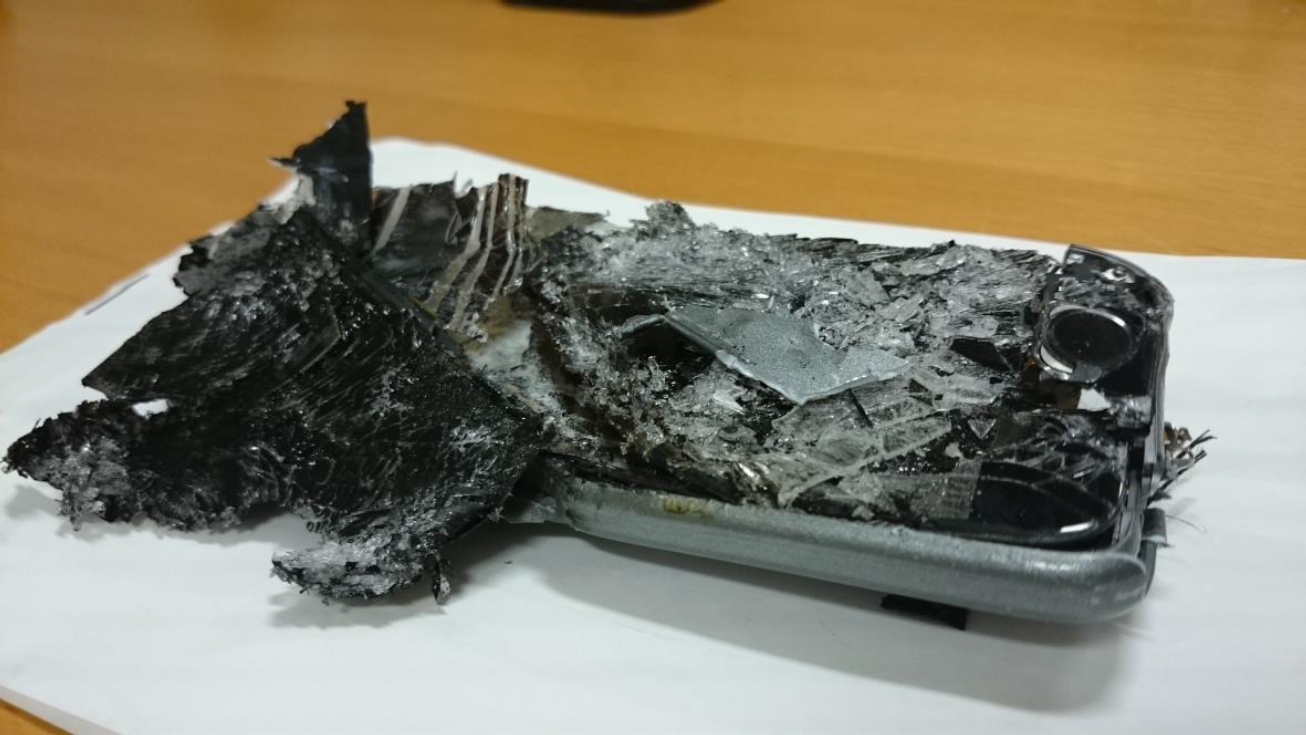
At about 0700 Coordinated Universal Time (UTC), a cabin crewmember responded to a request for assistance from a passenger seated in business class seat 3A. The passenger advised the crewmember of a missing personal electronic device (PED). The PED was identified as containing a lithium type battery. The crewmember, along with the passenger, searched around the seat for the missing PED. While searching, the seat position was moved. As the seat moved, the passenger in the next seat observed the PED within the seat mechanism. The seat was then inadvertently moved, resulting in the PED being crushed (Figure 1). The crushed PED immediately began hissing and emitting smoke. Moments later, the PED ignited. A second crewmember then initiated the basic fire drill.

The second crewmember obtained a fire extinguisher, and as they proceeded toward seat 3A, they advised a third crewmember of the incident and requested assistance. This crewmember also obtained a fire extinguisher and proceeded toward seat 3A. The customer service manager (CSM) and another crewmember observed the activity and also followed, providing additional support.

When the cabin crewmembers carrying fire extinguishers arrived at seat 3A, they observed an orange glow emanating from the seat. A crewmember discharged a fire extinguisher into the seat, extinguishing the glow. At this time, the CSM acted as a communicator with the flight crew to inform them and keep them updated on the incident.

After confirming the PED fire had been extinguished, the cabin crew attempted to remove the PED in order to place the device in water, in accordance with lithium type battery fire procedures. The PED could not be removed without further damage and risk of fire. Therefore, the cabin crew elected to leave the device in place and position a crewmember with a fire extinguisher near seat 3A for the remainder of the flight. About 10–15 minutes after the incident, this crewmember identified further heat coming from the crushed PED. They again discharged the fire extinguisher onto the PED, eliminating the heat.

After confirming the incident was contained, the CSM advised the captain that the situation was under control. The captain discussed the incident with the first officer and considered the event had been dealt with appropriately. The flight proceeded to New York and landed about 40 minutes later without further incident.

Two passengers reported feeling unwell after the event, but it was unclear if this was as a result of the incident. The aircraft seat sustained minor damage.

Figure 1: Crushed PED after removal from seat

Figure 1: Crushed PED after removal from seat

Source: Qantas

Cabin crew comment

The responding cabin crewmember commented that the provision of designated storage close to the charging port could assist in preventing PEDs entering seat structure.

Passenger comment

The passenger in seat 3A commented that the amenities pack provided to passengers in this seat type could be changed to include PED storage. This could assist preventing PEDs entering the seat structure.

Operator investigation report

The aircraft operator investigated the incident and provided a copy of their investigation report to the ATSB. The report included the following:

A review of reported events revealed 22 similar occurrences of trapped or crushed PEDs. Seven of these occurrences resulted in smoke and/or heat being produced. This incident was the first event to result in fire.

  • The investigation determined that the likely area for the PED to intrude into the seat mechanism was adjacent to the seat belt anchor point. This area becomes more exposed as the seat reclines towards the flat position.
  • Mesh netting within the seat structure is designed to capture objects that fall behind the seat. Damage to seat 3A consisted of an approximate 5 cm melt area to this mesh netting. There was no other damage noted to the seat structure.

Lithium battery thermal runaway

The United States Federal Aviation Administration (FAA) document Safety alert for operators SAFO 09013: Fighting fires caused by lithium type batteries in portable electronic devices, and the associated document SAFO 09013 Supplement, detail the risk of thermal runaway in lithium type batteries:

  • Lithium batteries are capable of ignition and subsequent explosion due to overheating. Overheating may be caused by shorting, rapid discharge or overcharging. Overheating results in thermal runaway, which is a chemical reaction within the battery causing the internal temperature and pressure to rise. The result is the release of flammable electrolyte from the battery and, in the case of disposable lithium batteries, the release of molten burning lithium. Once one battery cell goes into thermal runaway, it produces enough heat to cause adjacent battery cells to also go into thermal runaway. This produces a fire that repeatedly flares up as each battery cell in turn ruptures and releases its contents.

SAFO 09013 Supplement also details the following information on fighting fires caused by lithium type batteries:

  • Relocate passengers away from the device.
  • Utilise a halon, halon replacement, or water fire extinguisher to prevent the spread of the fire to adjacent battery cells and materials.
  • Pour water, or other non-alcoholic liquid, from any available source over the cells immediately after knockdown or extinguishment of the fire.
  • Only water or other non-alcoholic liquid can provide sufficient cooling to prevent re-ignition and/or propagation of the fire to adjacent batteries. Water, though it may react with the tiny amount of lithium metal found in a disposable battery, is most effective at cooling remaining cells, stopping thermal runaway and preventing additional flare-ups. Significant cooling is needed to prevent the spread of fire to additional cells in a battery pack.

Safety action

Whether or not the ATSB identifies safety issues in the course of an investigation, relevant organisations may proactively initiate safety action in order to reduce their safety risk. The ATSB has been advised of the following proactive safety action in response to this occurrence.

Seat manufacturer

As a result of this occurrence, the aircraft operator has advised the ATSB that the seat manufacturer is developing design solutions to prevent ingress of PEDs into the seat structure.

Aircraft operator

The aircraft operator has advised the ATSB that they are taking the following safety actions:

Changes to passenger briefings

An enhanced passenger briefing has been released to include:

If you lose your electronic devices at any time, it’s important you don’t move your seat as this could severely damage your device and may be a fire hazard. Please contact a crew member who will be able to recover your device.

A cabin crew service brief has been released which includes:

Passenger announcement to remind passengers not to move seats when devices have been lost.

Individual interactions between cabin crew and passengers when preparing the bed to include a discussion to raise passenger awareness of the possibility that the PED could be crushed if it is lost during the flight.

Establishment of working group

A working group has been established to develop further solutions for this issue.

Safety message

This incident serves as an excellent example of an effective response to an emergency situation. The cabin crew quickly implemented the basic fire drill procedure. This defined the roles and responsibilities of the responding crew, enabling a rapid and coordinated response to the incident using all available resources. As a result, the incident was quickly and effectively contained. The effective implementation of this procedure also ensured the flight crew were kept informed as the situation developed.

This incident also highlights the hazards of transporting lithium-ion battery powered PEDs aboard aircraft. The Civil Aviation Safety Authority has released information on the safe carriage of lithium type battery powered devices aboard aircraft in the web page: Travelling safely with batteries and pamphlet: Is your luggage safe?

Aviation Short Investigations Bulletin- Issue 52

About this report

Decisions regarding whether to conduct an investigation, and the scope of an investigation, are based on many factors, including the level of safety benefit likely to be obtained from an investigation. For this occurrence, a limited-scope, fact-gathering investigation was conducted in order to produce a short summary report, and allow for greater industry awareness of potential safety issues and possible safety actions.

Publishing information 

Released in accordance with section 25 of the Transport Safety Investigation Act 2003

Published by: Australian Transport Safety Bureau

© Commonwealth of Australia 2016

image_5.png

Ownership of intellectual property rights in this publication

Unless otherwise noted, copyright (and any other intellectual property rights, if any) in this report publication is owned by the Commonwealth of Australia.

Creative Commons licence

With the exception of the Coat of Arms, ATSB logo, and photos and graphics in which a third party holds copyright, this publication is licensed under a Creative Commons Attribution 3.0 Australia licence.

Creative Commons Attribution 3.0 Australia Licence is a standard form licence agreement that allows you to copy, distribute, transmit and adapt this publication provided that you attribute the work.

The ATSB’s preference is that you attribute this publication (and any material sourced from it) using the following wording: Source: Australian Transport Safety Bureau

Copyright in material obtained from other agencies, private individuals or organisations, belongs to those agencies, individuals or organisations. Where you wish to use their material, you will need to contact them directly.

Occurrence summary

Investigation number AO-2016-066
Occurrence date 21/06/2016
Location 500 km WNW of John F. Kennedy International Airport, United States
State International
Report release date 28/09/2016
Report status Final
Investigation level Short
Investigation type Occurrence Investigation
Investigation status Completed
Mode of transport Aviation
Aviation occurrence category Fire
Occurrence class Serious Incident
Highest injury level None

Aircraft details

Manufacturer The Boeing Company
Model 747-438
Registration VH-OJS
Serial number 25564
Aircraft operator Qantas Airways Limited
Sector Jet
Operation type Air Transport High Capacity
Departure point Los Angeles, United States
Destination New York, United States
Damage Minor

Smoke event involving Airbus A380, VH-OQD, about 1,500 km west-south-west of Dallas-Fort Worth Airport, United States, on 16 May 2016

Final report

Report release date: 25/08/2016

What happened

On 15 May 2016, a Qantas Airways Airbus A380 aircraft, registered VH-OQD, operated flight QF7 from Sydney, New South Wales to Dallas-Fort Worth, Texas, United States.

About two hours prior to the aircraft’s arrival in Dallas-Fort Worth, a passenger alerted the cabin crew to the presence of smoke in the cabin. The cabin crew then initiated the basic fire drill procedure.

Two of the cabin crew proceeded to the source of the smoke with fire extinguishers. At the same time, the customer services manager (CSM) made an all stations emergency call on the aircraft interphone to alert flight crew and other cabin crew to the presence of smoke.

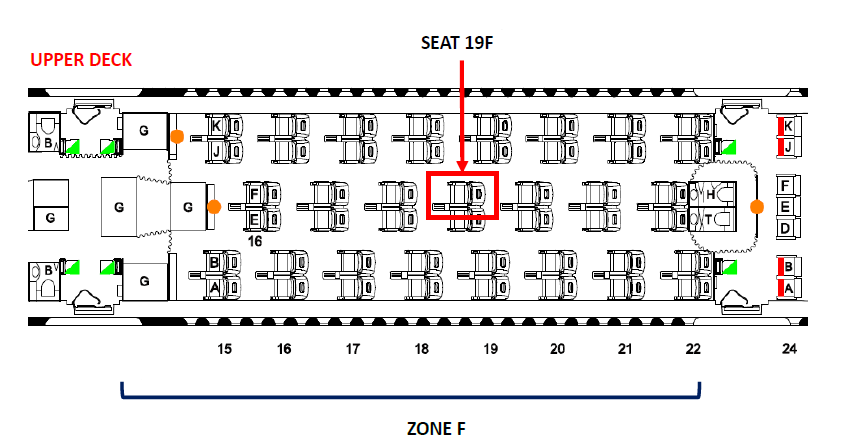
The cabin crew located the source of the smoke at seat 19F, in Zone F, on the upper deck (Figure 1). The crew removed the seat cushions and covers from seat 19F while the CSM turned off the power to the centre column of the seats. When the seat was further dismantled, the crew found a crushed personal electronic device (PED) wedged tightly in the seat mechanism. The cabin crew assessed that the crushed PED contained a lithium battery.

Figure 1: Cabin diagram showing the seat from where the smoke emanated

Cabin diagram showing the seat from where the smoke emanated

Source: Qantas, modified by ATSB

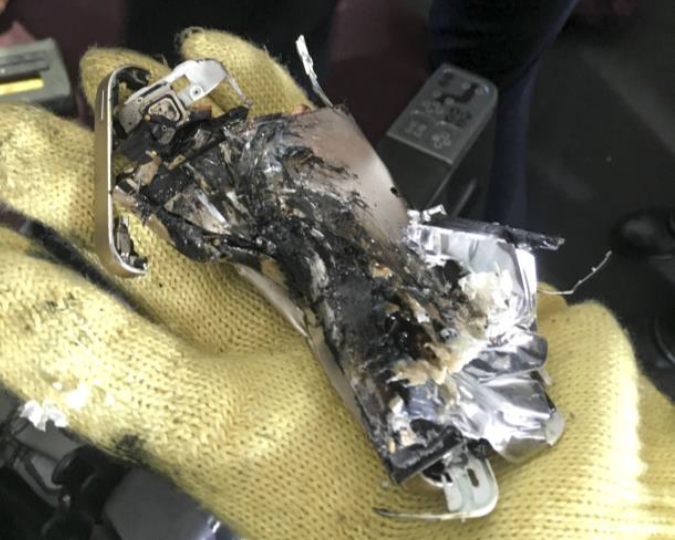
By that time, the PED was no longer emitting smoke, however, a strong acrid smell remained in the cabin. The crew then manoeuvred the seat and freed the PED (Figure 2). The crew placed the PED in a jug of water, which was then put in a metal box and monitored for the remainder of the flight.

The flight crew did not receive any abnormal indications or warnings.

No passengers were injured, and the aircraft was not damaged in the incident.

Figure 2: Crushed PED after removal from seat

Crushed PED after removal from seat

Source: Qantas

Operator comments

The aircraft operator commented that it has been estimated over one billion lithium batteries are transported by air every year, with potentially hundreds carried on single sectors on large aircraft. As such, both cabin crew and passenger education remains a key component to managing these events. Raising passenger awareness of the potential hazards of PEDs commences at check-in, through to the pre-flight safety demonstration, and aims to minimise the risk of PED thermal runaway events.

Qantas Airlines’ basic fire drill is based on a teamwork approach, with the division of duties between three central crew and as many supporting crew as available and required. This division of duties allocates the responsibilities of fighting the fire, retrieving equipment and ensuring lines of communication with the flight deck remain uninterrupted.

ATSB comment

Similar occurrences

The ATSB has received 17 notifications of similar incidents of lithium battery thermal events in aircraft over the past 6 years.

The ATSB investigation AO-2014-082 details an example where a short circuit between lithium batteries initiated a fire in an aircraft cargo hold.

Safety message

This incident provides an excellent example of an effective response to an emergency situation. The crew were able to quickly implement the basic fire drill procedure which defined the roles and responsibilities of the responding crew. This enabled a rapid and coordinated response to the smoke event using all available resources. The effective implementation of this procedure also ensured the flight crew were kept informed as the situation developed.

This incident also highlights the hazards of transporting lithium-ion battery powered PEDs. The Civil Aviation Safety Authority web page Travelling safely with batteries and pamphlet Is your luggage safe? provide information on the safe carriage of lithium-ion batteries and lithium-ion powered devices aboard aircraft.

Aviation Short Investigations Bulletin - Issue 50

About this report

Decisions regarding whether to conduct an investigation, and the scope of an investigation, are based on many factors, including the level of safety benefit likely to be obtained from an investigation. For this occurrence, a limited-scope, fact-gathering investigation was conducted in order to produce a short summary report, and allow for greater industry awareness of potential safety issues and possible safety actions.

Publishing information 

Released in accordance with section 25 of the Transport Safety Investigation Act 2003

Published by: Australian Transport Safety Bureau

© Commonwealth of Australia 2016

image_5.png

Ownership of intellectual property rights in this publication

Unless otherwise noted, copyright (and any other intellectual property rights, if any) in this report publication is owned by the Commonwealth of Australia.

Creative Commons licence

With the exception of the Coat of Arms, ATSB logo, and photos and graphics in which a third party holds copyright, this publication is licensed under a Creative Commons Attribution 3.0 Australia licence.

Creative Commons Attribution 3.0 Australia Licence is a standard form licence agreement that allows you to copy, distribute, transmit and adapt this publication provided that you attribute the work.

The ATSB’s preference is that you attribute this publication (and any material sourced from it) using the following wording: Source: Australian Transport Safety Bureau

Copyright in material obtained from other agencies, private individuals or organisations, belongs to those agencies, individuals or organisations. Where you wish to use their material, you will need to contact them directly.


Occurrence summary

Investigation number AO-2016-051
Occurrence date 16/05/2016
Location 1,500 km WSW of Dallas/Fort Worth Airport, USA
State International
Report release date 25/08/2016
Report status Final
Investigation level Short
Investigation type Occurrence Investigation
Investigation status Completed
Mode of transport Aviation
Aviation occurrence category Smoke
Occurrence class Serious Incident
Highest injury level None

Aircraft details

Manufacturer Airbus
Model A380-842
Registration VH-OQD
Serial number 0026
Aircraft operator Qantas
Sector Jet
Operation type Air Transport High Capacity
Departure point Sydney, New South Wales
Destination Dallas, United States of America
Damage Nil