Engine nacelle strike and continued operation involving Boeing 737-8FE, VH-YIW, Faleolo Airport, Apia, Samoa on 23 April 2016
Final report
Safety summary
What happened
On 23 April 2016, a Virgin Australia Boeing 737-8FE aircraft, registered VH-YIW, operated as VA91 from Auckland, New Zealand to Faleolo Airport in Apia, Samoa, with the intent to conduct a return flight that day. The departure from Apia was planned to be completed before the arrival of an approaching tropical cyclone.
During the landing on runway 08, while correcting for a left drift from the runway centreline, the aircraft touched down in a nose-down, right wing-low attitude. This resulted in the right engine nacelle contacting the runway. The flight crew were not aware the nacelle strike had occurred, as the landing, while firm, was not assessed by the flight crew to be outside of normal landing parameters.
What the ATSB found
The ATSB identified that due to heavy rain, darkness and limited visual cues, the flight crew did not detect the aircraft's banked, nose-low attitude immediately prior to landing. Additionally, the subsequent routine flight crew and engineering inspections did not identify damage to the nacelle over the aircraft’s next four flights.
It was also found that the pilot flying was probably experiencing a level of fatigue that has been demonstrated to adversely influence performance.
What's been done as a result
Following this occurrence, the operator modified its aircraft external inspection procedures for flight crew and engineering staff. The flight crew training material was updated to reflect the inspection procedures in the flight crew operating manual, which stated that crew shall inspect the underside of engine nacelles. This action was supported by an internal flight operations update issued on 29 April 2016, re-emphasising that exterior inspections were to be conducted in accordance with the flight crew operating manual’s procedures.
The engineering daily inspection task card for pre‑flight inspections before extended operations was strengthened by issuing engineering technical advisories including the requirement to conduct checks of the underside surfaces of the engine nacelles during normal operation and also when there was indication of an increased likelihood of a nacelle strike on landing.
The operator also identified and implemented a number of improvements in the management of hazards associated with significant events, including cyclones.
Safety message
Detecting airframe damage, particularly to the underside of the engines, can be difficult due to the location not being within normal visual reference. Airframe damage in this location is more likely to be detected by thorough visual inspections of the lowest parts of the airframe before flight and during daily inspection.
While checking for damage in this inconspicuous location can be difficult, and influenced by an expectation that no damage is present, flight crew and engineers are reminded that damage can occur without flight crew awareness.
Safety issues and actions
Whether or not the ATSB identifies safety issues in the course of an investigation, relevant organisations may proactively initiate safety action in order to reduce their safety risk. The ATSB has been advised of the following proactive safety action in response to this occurrence.
Virgin Australia Airlines Pty. Ltd.
The operator has modified its training in relation to flight crew external inspections to include a specific visual inspection of the underside of engine nacelles, as per the procedure outlined in the flight crew operations manual.
The operator has also modified the procedures for engineering external daily inspections to include a specific visual inspection of the underside of engine nacelles.
International roaming on the Virgin Australia International fleet has been introduced to enable automatic downland of QAR data immediately after shutdown at all Australian and International Airports.
Context
Aircraft information
General information
VH-YIW is a Boeing 737-8FE (B737) aircraft, powered by two wing‑mounted CFM-56-7B24/3, high bypass turbofan engines. In its configuration at the time of the occurrence, it was capable of carrying 176 passengers, and 6 crew.
Damage to aircraft
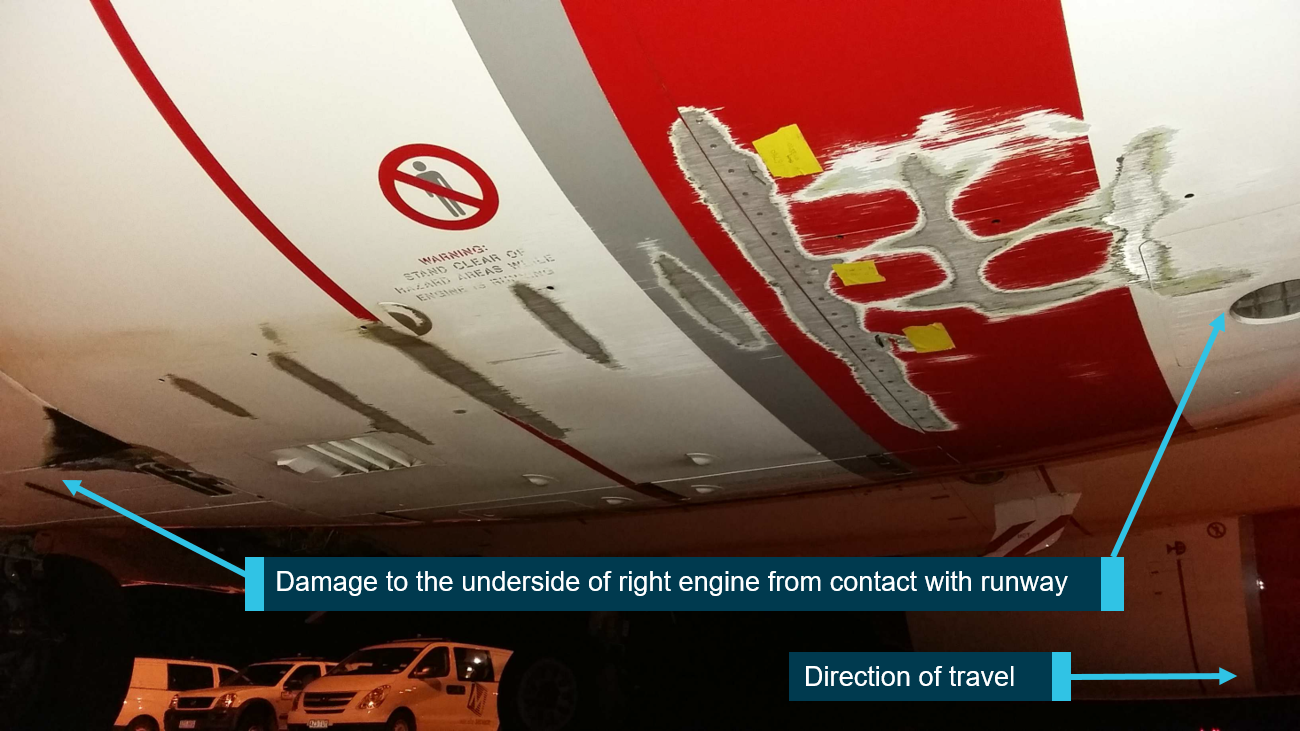
The right engine nacelle was damaged by briefly contacting the runway during the touchdown in an incident known as a ‘nacelle strike’ (Figure 1). The landing gear tyres also sustained some lateral or sideways wear damage during the event. Detailed inspection of the right engine identified that the:
- lower right engine nacelle skin was holed by abrasion damage
- lower surfaces of the right engine fan and reverser cowlings were damaged
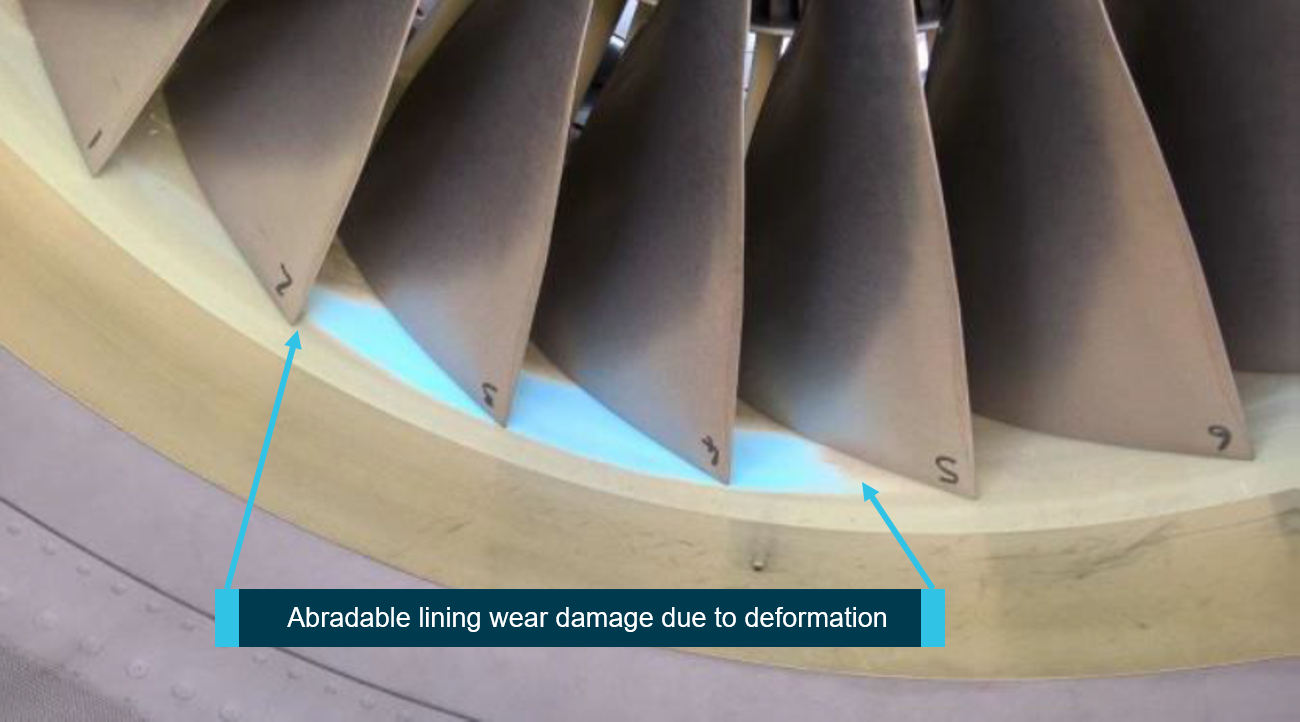
- right engine fan path abradable lining was worn (Figure 2).
Figure 1: VH-YIW No. 2 engine nacelle
Source: Operator’s investigation report, annotated by the ATSB.
Figure 2: VH-YIW right engine abradable lining.
The blue area shows where the rotating engine blades have contacted the abradable lining
Source: Operator’s investigation report, annotated by the ATSB.
The operator requested a design engineer to report on the potential damage. The report stated:
…the very minimal damage to the inner liner indicates that the energy of the impact was primarily absorbed by the cowl structure buckling as the initial contact occurred.
The design engineer’s report also concluded that:
…the continued flight with damage to the engine cowling posed no critical aerodynamic, structural or mechanical safety risk to the aircraft.
Personnel information
Qualifications and experience
The captain held an Air Transport Pilot Licence (Aeroplane) and had a total of about 10,000 hours’ flying experience, of which about 6,000 were on the Boeing 737 aircraft. The captain commenced flying with the operator in 2003 and held a valid class 1 aviation medical certificate.
The first officer (FO) held an Air Transport Pilot Licence (Aeroplane) and had a total of about 5,300 hours’ flying experience, of which about 1,100 were on Boeing 737 aircraft. The FO commenced flying with the operator in 2007 and held a valid class 1 aviation medical certificate.
Both flight crew had operated to Apia on many occasions, including at night and in rain.
Recent history
Both the captain and the first officer were based in Auckland. They both had the same duty periods during 20–24 April 2016, as indicated in Table 1. All times in this section are specified in the local time for the flight crew, which was or New Zealand Standard Time (NZST).[4]
Table 1: Actual duty time information for the flight crew for the period 20–24 April 2016
|
Date |
Work activity |
Duty start |
Duty end |
Duty time |
Time free (of duty) |
|
20 Apr 2016 |
Day off |
||||
|
21 Apr 2016 |
Day off |
||||
|
22 Apr 2016 |
Auckland–Apia–Auckland |
1510 |
0205 |
10.9 hours |
13.2 hours |
|
23 Apr 2016 |
Auckland–Apia (pod strike) |
1510 |
2300 |
7.8 hours |
15.0 hours |
|
24 Apr 2016 |
Apia–Auckland |
1400 |
2050 |
6.8 hours |
Source: Virgin Australia, modified by the ATSB.
The crew conducted flights from Auckland to Apia and return on the 22 April. Originally, they were scheduled to operate the flight from Auckland to Apia on 23 April, then overnight at Apia before operating a flight from Apia to Sydney on 24 April. Due to the approaching cyclone, the crew were unsure whether the flight on 23 April would be cancelled or their schedule would be changed to include a return flight (same as 22 April). After they awoke on 23 April they were advised that they would be conducting the same schedule as 22 April.
The flight to Apia on 23 April landed at 2007 NZST. The return flight was postponed due to the weather conditions and the crew stayed the night in Apia and operated the return flight to Auckland the next day.
The captain reported that he normally had 6–7 hours’ sleep a night and he had been sleeping normally up until the night of 22 April, after their flight arrived back in Auckland at 0135 on 23 April. On that night he reported getting 3–4 hours’ sleep (uninterrupted), waking at about 0700 because he often found it difficult to sleep beyond his normal waking time. He stated that he felt ‘okay’ during the flight to Apia on the 23 April.
The first officer reported that he normally had 7–8 hours’ sleep a night and slept normally in the nights prior to the 23 April flights, waking at about 1000 that morning after 7 hours’ sleep (uninterrupted). He said he felt alert at the beginning and towards the end of the flight to Apia on the 23 April, and okay during the middle part of the flight.
Both crew assessed that they were fit and appropriately rested to conduct the flight on 23 April. They also both reported eating normally prior to and during the flight.
The operator’s fatigue risk management system (FRMS) included the use of a biomathematical model and other processes to assess to suitability of planned duty periods. The minimum length of time off duty at home base was 12 hours, and the maximum planned duty period for a duty period with two sectors starting during 1300–1759 was 12.25 hours.
As part of its FRMS, flight crew could also take a short period of controlled rest at their flight deck seats during flights (for flights of over 3 hours under specified conditions). Neither pilot could recall taking a controlled rest during the flights on 22 or 23 April. Both pilots said they had previously used controlled rest on other flights to ensure they were alert on approach.
Meteorological information
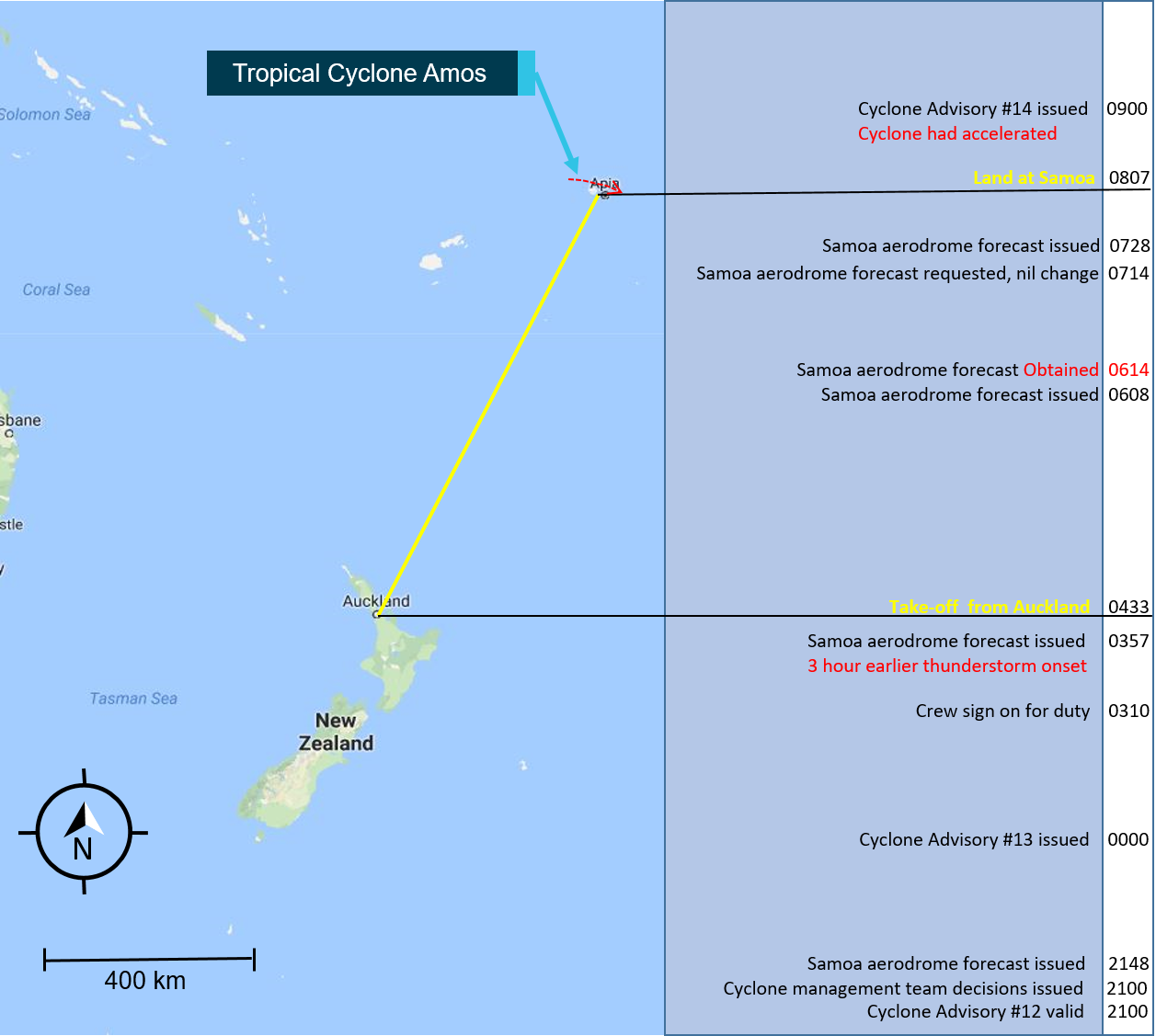
A summary of the available and obtained weather information is shown in Figure 3.
Figure 3: Image of the flight and the weather information available at different times
Source: Google maps, annotated by the ATSB
Information available prior to the flight
The operator was aware of TC Amos, and had been monitoring its progress to assess its effect on company operations. The United States joint typhoon warning center (JTWC) issued advisory information (commonly known as ‘advisories’) at 1200 and 2100 on 22 April, and at 0000 and 0900 on 23 April. These advisories were numbered eleven to fourteen respectively.
The weather forecasts contained in the advisories had minor changes between the sequential forecasts, with the last being the most significant. Advisory No. 11, issued at 1200 on 22 April, forecast that TC Amos would be a category three cyclone located to the west of Samoa, and would be still approaching the island after the planned return flight had departed from Apia.
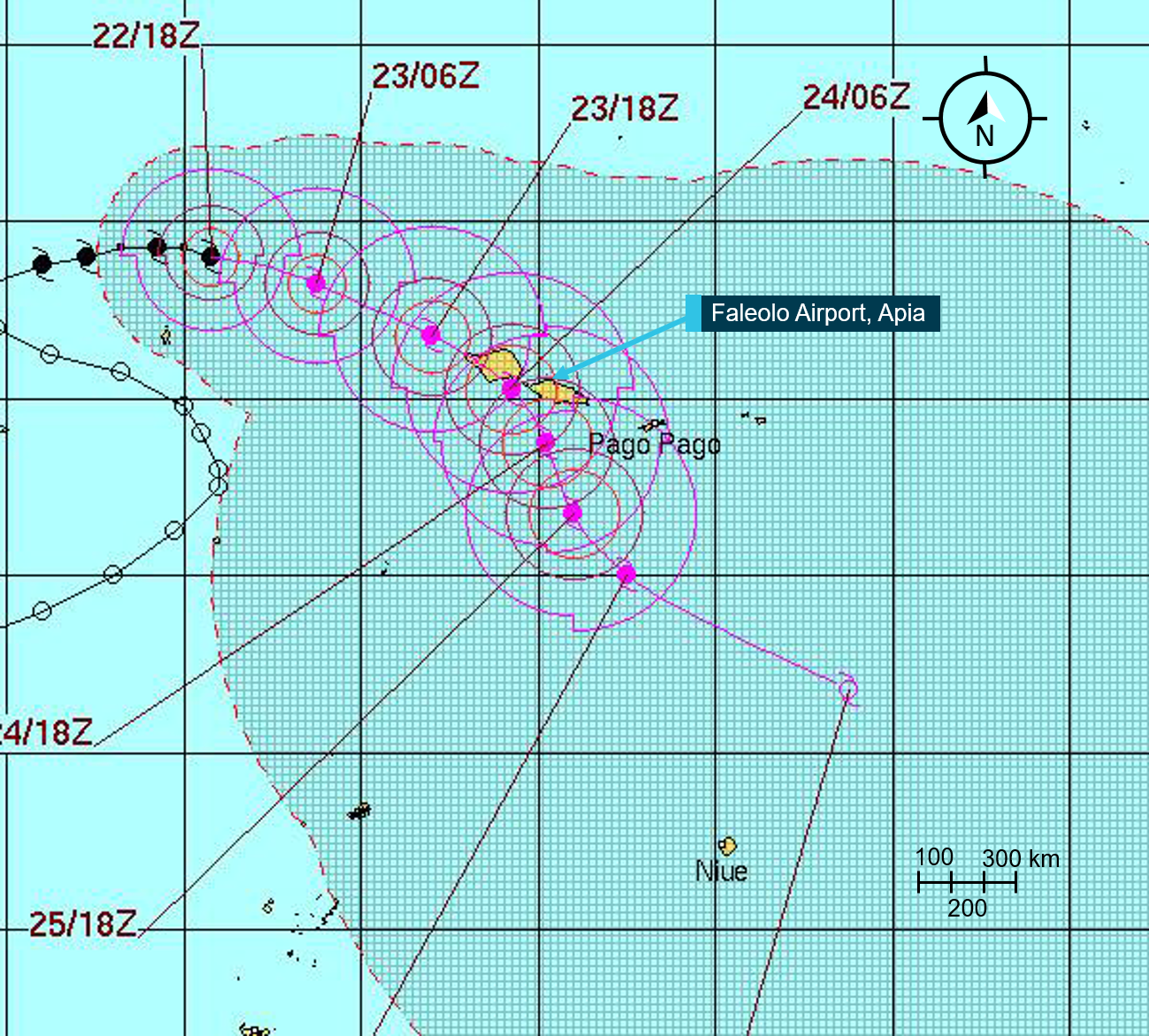
Advisory No. 12 was issued nine hours later, at 2100 on 22 April (Figure 4). It detailed that the tropical cyclone may turn right and pass to the south of Samoa and that TC Amos was due to pass the island at 0600 on 24 April, about one day after the proposed flights. However, the forecast expressed uncertainty on the direction of this turn. The advisory stated the next advice would be in 6 hours’ time, at 0300 on 23 April.
Based on the information from Advisory No. 12, the operator’s cyclone management team (CMT) convened and made operational decisions about flights that could be affected by TC Amos. The occurrence flight was planned on the basis that VH-YIW would have departed from Apia before the cyclone had a significant impact on the airport. All other flights to Apia were cancelled until after the cyclone’s passage, and overflying aircraft could not use Apia as a flight planning alternate airport.
Prior to departure, the flight crew were provided with a briefing package including information from Advisory No. 12. The package included information on the weather system associated with TC Amos, which was forecast to start influencing Samoa and the surrounding region during the time of the flight. The package indicated that for the estimated time of arrival for VH-YIW, the centre of TC Amos would be approximately 260 km west of Faleolo airport with forecast crosswinds at the airport expected to be about 20 kt (within the aircraft’s operational limit).
Figure 4 : JTWC Cyclone Advisory No. 12, issued 2100 on 22 April – the forecast provided to the flight crew. The four-digit number gives the date and hours in UTC (Z) when the cyclone was forecast to be in that location. The concentric circles are isotachs - lines of constant wind speed surrounding the cyclone
Source: JTWC, annotated by the ATSB.
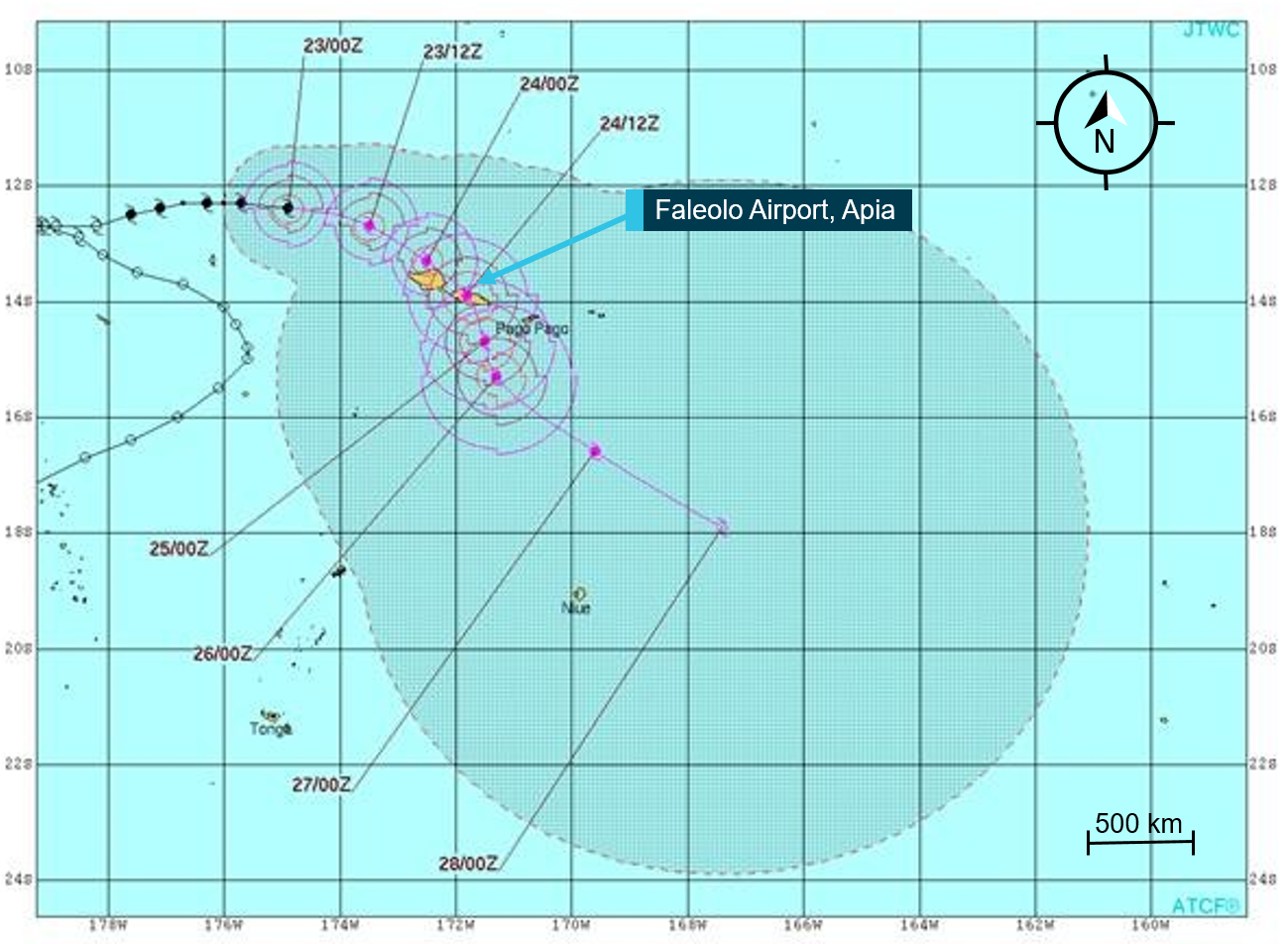
The flight crew did not receive Advisory No. 13, issued at 0000. This forecast expected the cyclone would pass 80 km closer to Apia at about the same time as forecast in the previous advisory, with a 10 kt reduction in peak intensity, still providing adequate time for the return flight to be completed (Figure 5). Advisory No. 13 was assessed by the CMT as not altering any operational requirements and consequently was not passed to the flight crew.
At the time of the planned flights into and out of Samoa during the evening of 23 April, bands of heavy rain were expected in the vicinity of the airport, however the winds were forecast to be within the aircraft’s operational limitations.
Figure 5: JTWC Cyclone Advisory No: 13, issued 0000 23 April – the last forecast issued before the incident
Source: JTWC, annotated by the ATSB.
In-flight information
The aircraft took off from Auckland at 0433 and landed at Apia at 0807.
During the pre-flight briefing, the crew received the aerodrome forecast for Faleolo Airport. The forecast was issued on 22 April at 2148, and was valid from 0000 for the next 24 hours, unless it was amended or updated. Aerodrome forecasts are issued at scheduled times, or in response to significant weather changes. The aerodrome forecast issued at 2148 was re-issued at 0357 and was updated several times before the aircraft landed at 0807.
Forecast conditions, visibility reduction associated with rain showers and thunderstorms, required the operator to carry sufficient fuel to continue to an alternate aerodrome, and the carriage of holding fuel.
After departing Auckland, the flight crew obtained an amended aerodrome forecast. This forecast required the same operational restrictions, however identified the onset of possible thunderstorms to start three hours earlier than previously expected, at 0900.
The flight crew contacted Faleolo tower inflight and obtained the observed weather conditions from the controller prior to landing.
Information that became available after the flight
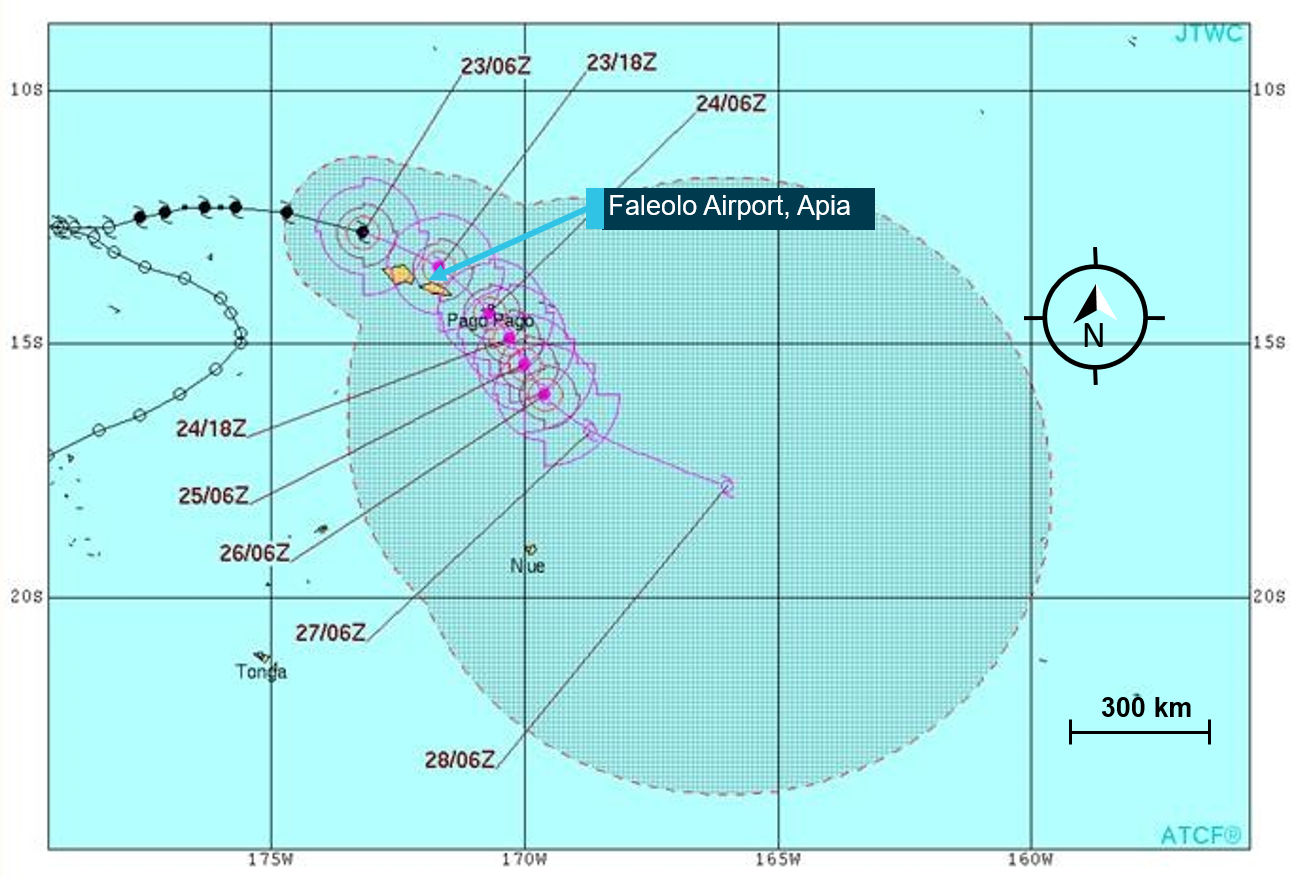
Cyclone Advisory No: 14 was issued at 0900 and advised that the cyclone was now moving twice as fast as previously forecast and was about 170 km west north-west of Apia at the time of landing.
Advisory 14 also detailed that TC Amos was expected to pass about 25 km north of Apia 14 hours earlier than first predicted (Figure 6). The forecast also indicated the airport would be exposed to sustained winds over 64 kt on the following morning (24 April) as the cyclone passed close by.
Figure 6: JTWC Cyclone Advisory No: 14, issued 0900 on 23 April – issued after landing
Source: JTWC, annotated by the ATSB.
Communication
During the flight, the crew requested and received numerous weather updates from the operator’s flight following service via the aircraft communication, addressing and reporting system.
The flight crew reported initial difficulty contacting air traffic control (ATC) at Faleolo tower using very high frequency radio. They were subsequently able to make contact with ATC using high frequency radio just prior to the top of descent. ATC provided surface observations at the airport to the crew, who asked to be updated on any weather changes throughout the descent.
The crew also coordinated with ATC for a missed approach clearance to FL140[5], instead of the normal 4,000 ft. This change was reportedly made to facilitate a diversion to Nadi if it became necessary.
Aerodrome information
General information
Faleolo runway 08/26, is about 3,000 m long and 45 m wide with 7 m sealed shoulders on each side. The control tower is located to the south of the parking apron at the eastern end of the runway. The runway has edge lighting, which was considered to be ‘quite bright’ by the occurrence flight crew, and runway centre-line lighting was not installed. There is a 150 m stop‑way before the threshold of the runway and the runway has a marked downhill slope from the threshold to about halfway along the runway, descending 49 ft.
Runway 08 was reportedly prone to what is referred to as ‘black hole effect’ at night (see the section titled Black hole approach). This phenomenon is particularly relevant when aircraft approach airports at night over the sea or unlit terrain.
The runway was equipped with a precision approach path indicator that provides vertical approach path information for crew as guidance to their height in relation to the runway.
Runway damage
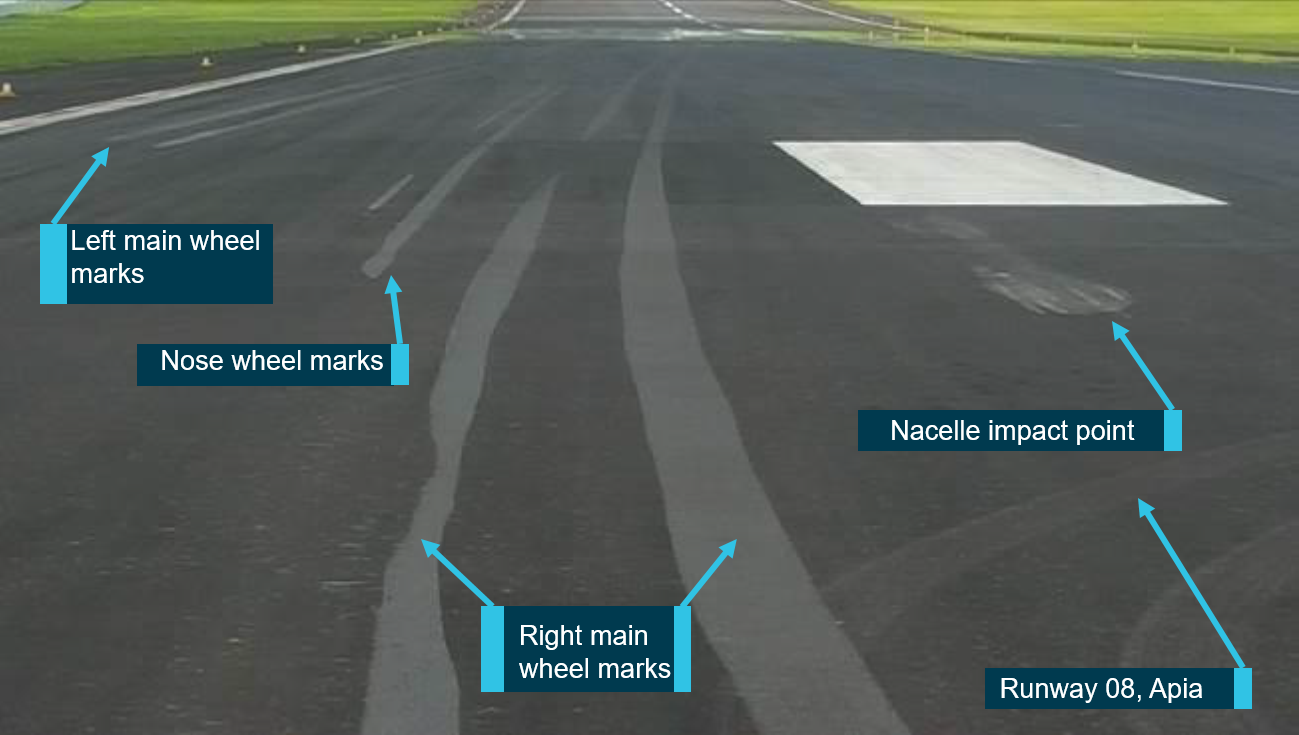
During landing, the aircraft first contacted the runway at about 834 m along and to the left of the centreline of runway 08. The right main undercarriage was first to touch down, followed by the nose wheels, and then the left main undercarriage.
Recorded aircraft data indicated that the aircraft landed with a 5° yaw to the right, greater than10° of right roll, and nose-down attitude of more than 2°.
The impact damage visible on the runway due to contact with the nacelle was mostly due to paint transfer over a relatively localised area, and consisted only of superficial damage to the runway surface (Figure 7).
Figure 7: Runway 08 surface marks and nacelle paint transfer
Source: Operator, annotated by the ATSB
Flight recorders
The aircraft was equipped with a flight data recorder (FDR) and cockpit voice recorder (CVR). Due to the elapsed flight time between the occurrence and its detection, the CVR was overwritten. However, the occurrence was able to be downloaded from the FDR and analysed by the ATSB.
The FDR recorded that the autopilot was disengaged at 260 ft above ground level (AGL) and at about 240 ft AGL, the Take-Off Go-Around (TOGA) function was activated (which the flight crew reported as inadvertent), followed by the auto-throttle disconnection. The auto-throttle remained disengaged for the remainder of the flight.
Data indicated that the aircraft began to drift left of the centreline at about 20 ft AGL. At touchdown, the maximum recorded bank angle was 10.3° right wing-low, and the recorded pitch angle was about 2.5° nose-down. The corresponding vertical acceleration at touchdown was 1.95 G.
The recorded wind speed reduced from about 36 kt at 300ft AGL to about 22 kt at touchdown. The crosswind wind limits of the aircraft were not exceeded throughout the approach and landing. The recorded data also showed that the aircraft did not exceed the stable approach criteria during the approach and landed in the expected touchdown area, albeit laterally displaced to the left of the centreline.
Maintenance information
Engineering inspections
The aircraft was required to undergo a daily inspection and an additional ‘extended range operations’ inspection when the planned flight was more than 60 minutes’ flying time (at ‘one engine inoperative’ speed) away from the nearest airport suitable for emergency landing.
Daily inspection
The daily inspection task card required that an engineer perform:
…a visual check of the following components for obvious signs of damage, and indications of bird‑strike or foreign object damage...
The subsequent list included the:
…inlet cowl inner and outer surfaces.
Additionally, if other damage was found, the engineer was required to compare the damage with the limits in the applicable detailed inspection procedure. Following this event, the operator strengthened its inspection procedures. On 4 May 2016, the operator issued technical advisories to expand on this inspection item. The advice stated:
To fully achieve the inlet cowl outer surfaces inspection engineers must do a visual check on the underside surfaces of the inlet cowl.
The advisory was updated with more detail on 24 May 2016.
Extended range operations inspection
A different external inspection was also conducted using a different inspection schedule before every extended operations flight. Flights between Australia or New Zealand and Samoa were classified as extended range operations.
The extended range operations inspection includes an external walk around. This item required the engineer to ’carry out a walk around check for airframe condition and obvious damage by visually inspecting from the ground, and paying attention’ to a list of aircraft components, including engine inlets and fan blades.
Flight crew inspections
Flight crew are required to conduct a pre-flight external visual inspection before flight. This inspection is to ensure the aircraft is in sound operating condition from the previous flight and to identify any potential flight safety hazards.
Flight crew conduct pre-flight inspections in accordance with a documented procedure. The Flight Crew Operations Manual provided the procedure for the external inspection. This includes a diagram with the inspection sequence and the items to be inspected at each area of the aircraft. Following a nacelle strike in Dublin, Ireland in 2009 where the nacelle damage was not detected for the next two sectors, the aircraft manufacturer updated the inspection procedures.
Subsequently, the operator’s documented procedure in its Flight Crew Operations Manual was amended in October 2011 to include, for each engine, ‘Exterior surfaces (including the bottom of the nacelles)’.
The documented procedure was also supported by pilot training material that was intended to provide practical instruction on how to implement the procedure. However, the pilot training material had not been updated to include the specific requirement to inspect the bottom of the nacelles for damage.
Following the occurrence, the operator’s flight crew exterior inspection training package was updated to reflect the 2011 amendment in the Flight Crew Operations Manual, including the requirement to inspect the bottom of the nacelles.
Post-incident inspections
Two engineering daily inspections, one separate engineering extended range operations inspection, and two pre-flight inspections were carried out following the incident. Subsequent to this, various flight crew and engineers also inspected the aircraft during the pre-flight, daily and extended range operations inspections for the following three sectors.
The nacelle damage was not detected until the analysis of flight data prompted a subsequent inspection, about ten operating hours after the strike occurred.
Organisational information
Cyclone management team
The operator had a process, including a documented procedure, to activate its cyclone management team (CMT) if a cyclone was forecast to be within 370 km of an airport that would be used within the next 24 hours. The procedure also provided guidance on assessing the suitability of a landing airport in regard to the forecast wind strength.
During the CMT meeting at 2100 on 22 April, the team considered the identified risks to the operation. They determined that the flight was operationally safe with a number of added risk mitigators.
Following this occurrence, the operator identified and implemented a number of improvements in the management of hazards associated with significant events, including cyclones.
Flight dispatch and following
Prior to departure, flight crew are required to obtain all relevant operational information and are required to obtain inflight updates to ensure they have accurate and up to date information to assist with operational decision-making.
The operator maintained a flight dispatch and flight following function in which relevant operational information was collected and provided to flight crew.
Flight dispatch
Flight dispatch prepared and submitted operational flight plans on behalf of flight crew, who received an operational flight-briefing package before flight. The Group Operations Manual suite contained the Flight Dispatch Policy Manual. This contained guidance material and procedures for the Flight dispatch team to provide the following functions:
- acquisition, collation and evaluation of NOTAM, meteorological and other operational information in support of flight-planning activities
- The evaluation of navigational, meteorological, aircraft performance and flight-planning-related operational factors specifically associated with the dispatch and continuation of ‘extended range operations’
- The provision of verbal pre-flight briefings and briefing updates to the flight crew of individual flights (upon request), to supplement the standard briefing documentation routinely provided to the crews.
Flight following
Flight following services were provided primarily to enhance and contribute to the safety of a flight. The occurrence flight met the criteria to receive a flight following service, including the provision of operationally critical information, such as that associated with tropical cyclones.
Flights that included sectors with extended diversion times had extra requirements, including special procedures for flight dispatch, the operations controller and the flight following function. Flight following is defined as an operational information service provided jointly by the duty operations controller and flight dispatcher to provide advice and information to assist in the safe and efficient conduct of extended range operations, including the provision of advice and information at the request of the captain, either before or during flight.
The occurrence flight was an extended range operation and as such, the flight dispatch division was also responsible for plotting current information on tropical cyclones on a display to assist with flight planning and flight following and to continually monitor and evaluate relevant operational information to assess its impact on extended range operations. Information on non-normal variances which may impact the continuation of the flight under extended range operations procedures shall be promptly communicated to the captain.
Approach to land
Go-around manoeuvre
The flight crew were required to maintain a stabilised approach from 1,000 ft above the aerodrome elevation until touchdown. If the approach became unstable during this segment, the crew were required to conduct the missed approach procedure.
The crew had planned, prepared and were ready to conduct a missed approach at Apia. They had briefed that if they initiated a missed approach procedure, the aircraft would be diverted to Nadi, Fiji instead of conducting another approach.
In the last four seconds of the approach, the flight path deviated sufficiently to require multiple flight control inputs to keep the aircraft on the desired flight path for landing.
The operator’s flight procedures stated that during this phase of flight:
…should it become apparent that the aircraft will touch down significantly short of the touch down aiming point, or beyond the end of the touch down zone (1000 m/3000 ft from the threshold or first third of the runway, whichever is less), the pilot flying shall initiate a go-around.
The aircraft remained within the touch down zone and over the runway prior to runway contact. A go-around was not required unless initiated by the flight crew at their discretion. The crew reported that they believed that the aircraft remained within the stabilised approach criteria for landing and were comfortable to continue to land.
Spatial disorientation
In 2007, the ATSB published a report An overview of spatial disorientation as a factor in aviation accidents and incidents.[6] The report identified several types of visual illusions that may impact a pilot’s ability to land an aircraft safely.
Runway shape and slope illusions
At a given altitude and distance from a runway, the slope of a runway will affect the amount of runway visible to a pilot. For a down-sloping runway such as Apia, this will result in less of the runway being visible. Pilots may perceive this lack of visibility as the flight path being below the correct approach path and as a result, the pilot may fly a higher-than-normal approach to achieve the runway visibility that would be present on a level runway.
Both flight crew identified this runway as having a significant down slope, which increased the difficulty of landing at Samoa. They also reported heavy rain on approach, which did affect visibility. However, both crew had a high level of experience operating into this airport and did not report any issues relating to the slope or visibility of this approach.
Black hole approach
A black hole approach is a term used by pilots to characterise an approach path at night with no visual cues between the aircraft and the intended runway on final approach to land. Black hole illusion occurs when darkness and an absence of visual cues, such as lights, may induce a false perception of altitude and/or attitude.
When the environment along the approach path is dark, with only the distant runway or airport lights providing visual stimuli, an illusory or false sense of height and/or attitude may be perceived. The absence of peripheral visual cues provides a false illusion of height to the pilot, often resulting in the inadvertent reaction to fly the aircraft lower than the normal approach path.
Runway centre line illumination
Runway lighting and, in particular, runway centre line and touchdown zone lighting accentuate approach rate cues and height appreciation. Runway 08 at Apia, did not have centre line lighting.
Bright runway lights may create the impression of being closer to the runway (hence on a steeper glide path). The crew reported that the runway lighting at the airport was particularly bright.
These visual illusions may affect a pilot’s ability to judge the correct time to initiate a flare to land.
Related occurrences
A number of similar nacelle strike events have been identified involving Boeing 737 aircraft. The conditions were not the same in all the occurrences, but they all had environmental phenomena present that increased pilot workload during landing.
Air Accident Investigation Unit Ireland investigation report No. 2011-007 Engine pod strike, Dublin Airport, Ireland, on 19 November 2009
On 19 November 2009, at 1245 UTC, a Boeing 737-8AS aircraft, registered EI-DAI was operating a scheduled flight from Rome’s Ciampino airport, Italy, to Dublin, Ireland. The weather at Dublin was forecast to be blustery during the day. The first officer (FO) was the pilot flying and the captain was the pilot monitoring.
On the leg to Dublin, a full briefing was carried out including flap selection, runway length with regard to flap setting, the landing chart and windshear. At Dublin the aircraft joined the approach traffic sequence for landing. There was a strong wind from the southwest, which the captain estimated as 70 kt at 3,000 ft. The captain rechecked the limits after the control tower provided a wind report and concluded that it was within limits. Although conditions were blustery the captain reported that the approach was normal given the conditions and the aircraft was configured ahead of normal and flown with plus 15 kt added due to wind.
At about 300 ft the aircraft was slightly left of the localiser. The captain called this out and the FO corrected it promptly. The captain said that the approach was normal until about 25 ft when the left wing dropped due to the wind. The captain assisted the FO with a control input.
According to the captain’s report, the aircraft was now steady on profile and a flare was initiated; the aircraft did not seem to descend and at this point the captain closed the thrust levers. Simultaneously, the left wing dropped again as the aircraft descended to the runway. The captain said that the aircraft landed quite benignly albeit with the left wing low. The captain reported that at no stage did he or the FO suspect ground contact.
Subsequently, a different crew operated the aircraft on the next two sectors to and from Poland. On arrival back in Dublin, the captain for these Polish sectors learned that a member of the public had reported the earlier nacelle scrape.
Transportation Safety Board of Canada investigation report A05A0161, wing ground strike, Halifax Airport, Canada, on 25 December 2005
On 25 December 2005, at 1924 Atlantic Standard Time,[7] A Boeing 737-700 aircraft, registered C‑GWJF, was on a scheduled passenger flight from Toronto, Ontario, to Halifax, Nova Scotia. About 10 minutes before landing, the crew was advised that another aircraft had just landed on runway 14, and that the pilots of that aircraft had reported that they had the runway lights visual at 250 ft above ground level (AGL). This was 50 ft above the decision height for the ILS approach to Runway 14.
Just before touchdown on runway 14 in low-visibility conditions, the aircraft rolled right and moved toward the right side of the runway. The aircraft then rolled to the left, and the left wing struck the runway. None of the passengers or crew members were injured, and the aircraft taxied to the terminal.
The aircraft touched down firmly on the left main landing gear at about 2,500 ft from the runway threshold, between the centreline and the right edge of the runway, with 16° of left bank. Concurrently, the left wing contacted the runway surface for about 0.5 second. The left main landing gear strut then extended to nearly full length, and the left bank increased to 18°. The left wing contacted the runway again for approximately 2 seconds, and simultaneously, the aircraft heading deviated left to 136°, or 8° left of the runway heading.
The aircraft settled onto both main landing gears five seconds after the left main gear made contact, approximately 3,550 ft beyond the runway threshold. After the nose gear touched down, heavy wheel braking was used to slow the aircraft. Eight seconds after nose gear touchdown, after being prompted, the pilot flying applied reverse thrust on both engines. Deployment of reverse thrust occurred approximately 5,300 ft beyond the runway threshold. The aircraft slowed to taxi speed with approximately 500 ft of runway remaining. The aircraft taxied uneventfully to the assigned gate at the terminal.
United Kingdom Air Accidents Investigation Branch investigation EW/2009/02/08, engine pod strike, Leeds Bradford Airport, UK, on 21 February 2009
On 21 February 2009, at 1401 UTC, a Boeing 737-33A aircraft, registered G-CELD, was landing on Runway 32 at Leeds Bradford Airport. As the aircraft approached the flare, at about 30 ft AGL, a speed loss of 10 kt occurred. The captain called ’speed slow’ and placed his hand near the throttles, with the FO applying a small amount of power.
The captain then felt the aircraft sink so applied a ’handful of power’, covering the FO’s hands as he did so, adding ’you’ll need more than that’. At some point after this, the FO thought he heard the captain say ’I have control’ to which he responded by taking his hands off the controls in accordance with the company standard operating procedures. The FO added that his ’feet remained on the rudder pedals as there was no time to remove them’. Both pilots then recalled a pronounced wing drop to the right, immediately prior to the aircraft touching down.
G-CELD encountered windshear at about 30 ft AGL and became unstable in the flare. As a result, and unbeknown to the crew at the time, the right engine nacelle contacted the runway. Inspection of the runway revealed a 15 m scrape mark on the threshold, with associated paint matching G‑CELD’s engine cowling.
An aftercast was obtained from the Meteorological Office. It stated that it was likely that there was no abnormal wind flow regime although the wind was strong and gusty. The gustiness was not abnormal, but reductions in speed of 10 to 15 kt over a short period of time/distance were likely.
United Kingdom Air Accidents Investigation Branch investigation EW/2009/11/09, Engine pod strike, Bristol Airport, UK, on 19 November 2009
On 19 November 2009, at 2124 UTC, a Boeing 737-8AS aircraft, registered EI-DAL, was on a scheduled flight from Dublin, Ireland to Bristol Airport. The crew were both based at Bristol and aware of the local conditions prevalent during strong crosswind approaches and landings on runway 27. The captain was the pilot flying, the runway surface was dry and it was dark.
During the landing flare, the captain de‑crabbed the aircraft at 15 ft and closed the thrust levers at about 10 ft. The aircraft experienced a wing drop to the left, which the captain corrected, quickly followed by a more severe wing drop to the right as the right main landing gear touched down.
Although the crew did not believe an engine had contacted the runway, the captain said to the FO he would have a look after they shut down.
The company engineers observed the landing and mentioned that it looked ’pretty scary’ and considered that the wingtip may have made contact with the runway. Whilst the passengers were disembarking, the engineers inspected the aircraft and found damage under the right engine. The damage was confined to the engine cowl and thrust reverser duct.
__________
- New Zealand Standard Time (NZST): Coordinated Universal Time (UTC) + 12 hours.
- Flight level: at altitudes above 10,000 ft in Australia, an aircraft’s height above mean sea level is referred to as a flight level (FL). FL 140 equates to 14,000 ft.
- Available at www.atsb.gov.au
- Atlantic Standard time (AST): Coordinated Universal Time (UTC) - 4 hours
The occurrence
On 23 April 2016, a Virgin Australia Boeing 737-8FE aircraft, registered VH-YIW, was operating a scheduled passenger service as flight VA91 from Auckland, New Zealand to Faleolo Airport, Apia, Samoa. Due to tropical cyclone Amos (TC Amos) being predicted to arrive in the vicinity of Samoa in the early hours of the following morning, the operator planned for VH-YIW to conduct a return flight on the same day, using the same flight crew. The captain was the pilot flying and the first officer was the pilot monitoring.[1]
Before the flight, TC Amos was west of Samoa, moving eastward. At 2100 Coordinated Universal Time,[2] about seven and a half hours before the planned take-off, the operator’s cyclone management team (CMT) reviewed the weather information associated with the cyclone, and determined that the flight could continue with additional risk mitigation in place. Specifically, the aircraft was required to carry maximum fuel, to allow for 60 minutes’ holding fuel at Samoa and for possible diversion to an alternate landing at Nadi, Fiji. Furthermore, engineering coverage was required at Samoa, or an engineer had to be carried on board from Auckland.
Three hours later, at 0000, a new cyclone advisory was issued. There was no significant change to the cyclone forecast based on the new advisory. However, the updated information was not used when planning the flight, nor was it assessed by the CMT. The aerodrome forecast indicated that a night landing could be still be safely conducted at Apia.
The flight departed from Auckland at 0433. During the flight, the crew sought and received regular weather updates from the operator’s flight following service[3] (flight following). As part of the updates received, the crew obtained terminal area forecasts and meteorological aerodrome reports for Apia. The crew were not provided with the cyclone advisory that was issued at 0000, although it was assessed by flight following and available to the crew on request.
While planning for the descent, approach and landing, the crew decided they would not commence the descent until they had received a weather report from the aerodrome tower controller. The crew reported difficulty contacting the tower through standard very high frequency radio, and eventually made contact using the high frequency radio and obtained a weather report. Based on that report, the crew decided they would conduct one approach and if they could not land, they would divert to Nadi.
During the approach, the crew reported observing heavy rainfall on the aircraft’s weather radar display. The crew also reported that the conditions were not as turbulent as previously expected. On approach to land, the crew established visual reference with runway 08 at about 700 ft above ground level, and continued the approach. The captain disconnected the autopilot at 260 ft and then inadvertently activated the take-off/go-around (TOGA) function. He immediately realised, corrected this action and then deactivated the auto throttle as originally planned.
After about 20 seconds of manual flying on final approach, the aircraft started to drift left. The aircraft touched down about six seconds later. During those six seconds, both flight crew became aware of the aircraft’s left drift and the captain manoeuvred the aircraft to return to the runway centreline. At 0807, the aircraft landed on the right main landing gear wheels first, followed by the nose wheels, then the left main gear wheels. Flight data indicated that the aircraft was not pitched nose-up to flare for landing before touchdown. The crew taxied to the terminal and discussed the landing.
The weather conditions remained within the aircraft’s operating limitations, and were therefore suitable, during the approach and landing. While neither crew reported that it was a hard landing, the first officer considered it firmer than normal and consequently checked the landing data. Having only been informally shown how to access this information, the first officer recalled identifying the touchdown as 1.45 G landing with a 10° right roll. This alleviated his concerns of a hard landing and he communicated this to the captain.
Unknown to the crew, the right engine nacelle had briefly made contact with the runway during the landing and sustained damaged. There were no reported injuries as a result of the occurrence.
In preparation for the return flight, the captain and the engineer both conducted independent external pre-flight aircraft inspections in the heavy weather conditions. During this time, the weather deteriorated further and the crew postponed the return flight until the next day. The following day, and with a significant improvement in the weather, the captain and the engineer both conducted separate external pre-flight checks of the aircraft in preparation for the day’s flying. Neither inspection detected the right engine nacelle damage.
At least four separate external visual inspections were conducted on the aircraft between landing at Apia, and taking off the next day. No external airframe damage was detected or reported from either the crew or engineer before it departed.
Two days later, the operator’s flight data section detected the aircraft had encountered a designated hard landing with a significant angle of bank at Apia. Delays in uploading the data to the operator’s flight data system occurred due to the operator not having immediate data download capabilities at overseas ports. This data was uploaded on return of the aircraft from its overseas sectors to Australian ports. This, coupled with an Australian public holiday, meant a further day’s delay before the information was interpreted by the operator’s maintenance watch function. Subsequently, maintenance watch required the aircraft to undergo inspection on arrival from Port Moresby, Papua New Guinea into Brisbane, Queensland on 26 April.
Following the conduct of four sectors after the Apia landing, damage to the right engine nacelle was detected. Additional inspection identified lateral wear damage on the outer right landing gear tyre.
__________
- Pilot Flying (PF) and Pilot Monitoring (PM): procedurally assigned roles with specifically assigned duties at specific stages of a flight. The PF does most of the flying, except in defined circumstances; such as planning for descent, approach and landing. The PM carries out support duties and monitors the PF’s actions and the aircraft’s flight path.
- Coordinated Universal Time (UTC): the time zone used for aviation. Local time zones around the world can be expressed as positive or negative offsets from UTC. UTC is used throughout this report as the described events occurred across more than one time zone.
- Flight following is a ground-based operational information support service provided to all Virgin Australia flights
Findings
From the evidence available, the following findings are made with respect to the engine nacelle strike and continued operation involving a Boeing 737-8FE, registered VH-YIW and operated by Virgin Australia Airlines Pty. Ltd. that occurred at Faleolo Airport, Apia, Samoa on 23 April 2016. These findings should not be read as apportioning blame or liability to any particular organisation or individual.
Contributing factors
- The aircraft drifted left during short final in heavy rain on an approach at night. The pilot flying started to correct the drift, however the aircraft was not flared and the wings were not level as it touched down. This led to the nose and right wing being low, resulting in an engine nacelle strike.
- Due to heavy rain, darkness and limited visual cues, the flight crew did not detect the aircraft's banked, nose-low attitude immediately prior to landing which increased the likelihood of an engine nacelle strike.
- The operator’s pre-flight external inspection procedure mandated that flight crew check under the engine nacelle for damage. This was not routinely done by flight crew and not included in the flight crew training material.
- Although the operator had a maintenance task card for daily inspections of the Boeing 737, it did not contain a specific requirement to inspect underneath the engine nacelle. This contributed to the damage to the right engine nacelle not being identified during in post-occurrence maintenance inspections.
Other factors that increased risk
- Due to limited sleep in the previous 24 hours, the captain was probably experiencing a level of fatigue that has been demonstrated to adversely influence performance.
Safety analysis
Introduction
The flight departed Auckland with an approaching tropical cyclone in the vicinity of Apia. At the time of departure, the effects of the tropical cyclone where not expected to adversely impact the safety of the flight.
The approach to land was conducted within the aircraft’s operational limitations at night and in heavy rain. During the touch down, the right engine nacelle momentarily contacted the runway.
Damage from the runway contact to the engine nacelle was not detected after landing or during any of the pre-flight and engineering inspections for four subsequent sectors.
The following analysis examines the weather information provided to the flight crew and the human factors associated with the approach leading to the nacelle strike. It further examines the visual inspection methods that should have provided opportunities to detect the aircraft damage.
Flight briefing and monitoring
TC Advisory No. 13 was not provided to the flight crew prior to departure or during the flight. The operator’s flight following service was in receipt of Advisory No. 13, which was available if requested by the crew.
However, the updated information contained in Advisory No. 13 did not contain any significant change from the previous forecast and was not deemed by flight following to contain operationally critical information and therefore was not actively provided to the flight crew. The flight crew utilised requested aerodrome forecasts and observed weather reports from Apia air traffic control to prepare the aircraft for landing in Samoa.
Human factors aspects
Fatigue
Fatigue can have a range of adverse influences on human performance, including slowed reaction time, decreased work efficiency, reduced motivational drive, increased variability in work performance and more lapses or errors of omission (Battelle Memorial Institute 1998), as well as various effects on decision making (Harrison and Horne 2000).
Sleep is vital for recovery from fatigue, with both the quantity and quality of sleep being important. Most people need at least 7–8 hours of sleep each day to achieve maximum levels of alertness and performance. Research has shown that obtaining less than 5 hours’ sleep in the previous 24 hours is inconsistent with a safe system of work (Dawson and McCulloch 2005), with some research indicating less than 6 hours sleep can increase risk (Thomas and Ferguson 2010, Williamson and others 2011). In addition to sleep, a number of other factors can influence fatigue levels, including time of day, time awake and the nature of work activities.
In this case, the captain reported having 3–4 hours’ sleep the night before the occurrence flight, and he had been awake for 13 hours at the time of the engine nacelle strike occurrence. He also stated that he did not feel fatigued, but most people generally underestimate their level of fatigue (Battelle Memorial Institute 1998). The first officer had significantly more sleep prior to the occurrence flight.
Overall, primarily due to restricted sleep in the previous 24 hours, it is likely the captain was experiencing a level of fatigue during the occurrence flight likely to have a demonstrated effect on performance. However, there was insufficient evidence to conclude he was experiencing a significant level of fatigue. In addition, it is difficult to conclude that the captain’s performance during the landing was influenced by fatigue. Other factors, such as reduced visual cues and environmental conditions, can explain the handling events, and the environmental conditions and context during the approach is likely to have elevated the crew’s arousal level.
The occurrence at Apia occurred during the first of two flights scheduled for the flight crew that day. Had the duty period proceeded as planned, it is likely that both flight crew would have been experiencing a higher level of fatigue towards the end of the second flight. However, both flight crew may have been able to enhance their alertness during that flight by taking controlled rest.
Overall, the flight crew’s scheduled flights on 23 April met the requirements of the operator’s fatigue risk management system. Nevertheless, this occurrence highlights the importance of ensuring that both flight crew and an operator adequately consider a flight crew member’s circumstances before extending duty periods.
Workload
Workload refers to the interaction between a specific individual and the demands associated with the tasks that they are performing. High workload leads to a reduction in the number of information sources an individual will search, and the frequency or amount of time these sources are checked (Staal 2004). It can result in an individual’s performance on some tasks degrading, tasks being performed with simpler or less comprehensive strategies, or tasks being shed completely (Wickens and Hollands 2000). An individual’s capacity to manage task demands at any point in time can be affected by a wide range of factors such as experience, training, task recency, familiarity with a situation and fatigue.
Neither pilot reported the workload during the approach as being too high to manage. They briefed for the approach and were actively monitoring the weather conditions, and they addressed the increased requirements for radar scanning successfully. However, final approach is normally known as a period of high workload for pilots, particularly at night. In this case, the workload was further increased by the changing weather conditions. The difficulty in communications with the tower, the crosswind, manual control of the aircraft and the potential influence of fatigue also added to this workload.
When the captain mistakenly selected take-off/go-around (TOGA) from the throttle controls instead of auto thrust disconnect, it had the effect of removing the flight director. This momentarily left the flight crew without a simple representation of pitch and bank angle guidance. With reduced visual cues due to the night-time conditions, rain and increasing crosswind on touchdown, the last 100 ft of the approach likely required the crew’s full attention to deal with the situation. Although the flight crew’s workload was undoubtedly higher than normal, the available evidence is not consistent with it being beyond the crew’s capabilities, and it is not possible to conclude that their elevated workload reduced their handling of the aircraft or their subsequent awareness of a nacelle strike.
Post-flight awareness of damage
The flight crew were aware that the landing had been non-standard and, after discussion with the captain, the FO obtained recorded data from the maintenance section of the on-board flight management computer. The FO’s interpretation of the data indicated that the landing had been conducted within normal parameters.
During the post-event investigation, the operator found that flight crew were not specifically instructed on how to interpret this data. Consequently, the FO did not understand the limitations in how the data was displayed, which led the flight crew to believe the landing was within acceptable limits, and alleviated any concerns they may have had with the landing. As a result, the flight crew did not alert the maintenance engineer of an increased likelihood of a hard landing or possible runway contact with the airframe.
Damage detection
Flight crew conduct an external inspection of the aircraft before every flight. As part of these inspections, the engines and surroundings are required to be examined. This includes an explicit requirement to inspect the underside of the nacelles for damage. This requirement was added to the operator’s procedures in 2011, adding to a previous requirement in 2005 to check that the engine exterior was not damaged.
At the time of the occurrence, however, the operator’s flight crew training package did not reflect the specific requirement to check for this damage. The captain conducted the planned return sector pre‑flight inspection at night, in heavy rain and wind. Although the environmental conditions were not optimal, the captain considered the inspection to be adequate. However, the flight did not proceed due to the weather and departed the next day, after an additional pre‑flight inspection, when conditions had eased. No flight crew inspections for the next four flights were effective in detecting the nacelle damage. Consistent with other occurrences investigated by the ATSB, this may have been influenced by an expectation that no damage was present. The operator has since amended its pilot training package to include the specific requirement to inspect the underside of the engine nacelles.
Additionally, a licensed engineer was required to conduct an external inspection before the first flight of a day and conduct a separate external inspection using a different inspection schedule before an aircraft conducted an extended range twin-engine operations (ETOPS) flight. Neither the daily external inspection, nor the ETOPS external inspection specifically required the underside of the nacelle to be visually inspected. Engineers were required to carry out a visual check of various components for ‘obvious signs of damage’. This included the inlet cowl outer surfaces and the abradable shroud.
While the lower surfaces of the nacelle were not specifically mentioned, the inspection requirements were broad in their requirements and not specific in their intent. This may have led to engineers not specifically inspecting under the engine nacelles. Since the occurrence, a specific requirement to inspect the nacelles’ underside has been added to engineers’ procedures.
A combination of rain, wind, and the position of the damage provided significant environmental challenges during the visual inspection.
Due to the positioning of the engines on a B737, the space between the underside of the nacelle and the ground is between 470 mm and 600 mm high, depending on the aircraft weight. While it is easy to inspect and access the sides of the nacelles, examining the underneath is more difficult. Tests by the operator showed that even when crouching down to view the underside of the nacelle from 2 m away, the area of damage was not visible. This meant anyone examining underneath the nacelle would have to be positioned close to the ground to obtain an adequate view of the area and any potential damage. No additional equipment, such as mirrors or waterproof clothing, were issued to flight crew to facilitate this level of inspection.
Sources and submissions
Sources of information
The sources of information during the investigation included:
- the flight crew of VH-YIW
- Virgin Australia Airlines Pty. Ltd.
- the flight data recorder from VH-YIW
- United States Joint Typhoon Warning Center
- United States National Transportation Safety Board.
References
Battelle Memorial Institute 1998, An overview of the scientific literature concerning fatigue, sleep, and the circadian cycle, Report prepared for the Office of the Chief Scientific and Technical Advisor for Human Factors, United States Federal Aviation Administration.
Dawson D & McCulloch K 2005, ‘Managing fatigue: It’s about sleep’, Sleep Medicine Reviews, vol. 9, pp. 365–380.
Harrison H & Horne JA 2000, ‘The impact of sleep deprivation on decision making: A review’, Journal of Experimental Psychology, vol. 6, pp. 236–249.
Staal MA 2004, Stress, cognition, and human performance: A literature review and conceptual framework, National Aeronautics and Space Administration Technical Memorandum NASA/TM‑2004-212824.
Thomas MJW & Ferguson SA 2010, ‘Prior sleep, prior wake, and crew performance during normal flight operations’, Aviation, Space, and Environmental Medicine, vol. 81, pp. 665–670.
Wickens CD & Hollands JG, 2000, Engineering psychology and human performance, 3rd edition,
Prentice-Hall International Upper Saddle River, NJ.
Williamson A, Lombardi DA, Folkard S, Stutts J, Courtney TK & Connor JL 2011, ‘The link between fatigue and safety’, Accident Analysis and Prevention, vol. 43, pp. 498–515.
Submissions
Under Part 4, Division 2 (Investigation Reports), Section 26 of the Transport Safety Investigation Act 2003 (the Act), the Australian Transport Safety Bureau (ATSB) may provide a draft report, on a confidential basis, to any person whom the ATSB considers appropriate. Section 26 (1) (a) of the Act allows a person receiving a draft report to make submissions to the ATSB about the draft report.
A draft of this report was provided to the flight crew, Virgin Australia Airlines Pty. Ltd. and the Civil Aviation Safety Authority.
Submissions were received from Virgin Australia Airlines Pty Ltd. The submissions were reviewed and, where considered appropriate, the text of the report was amended accordingly.
Purpose of safety investigations & publishing information
Purpose of safety investigationsThe objective of a safety investigation is to enhance transport safety. This is done through:
It is not a function of the ATSB to apportion blame or provide a means for determining liability. At the same time, an investigation report must include factual material of sufficient weight to support the analysis and findings. At all times the ATSB endeavours to balance the use of material that could imply adverse comment with the need to properly explain what happened, and why, in a fair and unbiased manner. The ATSB does not investigate for the purpose of taking administrative, regulatory or criminal action. TerminologyAn explanation of terminology used in ATSB investigation reports is available here. This includes terms such as occurrence, contributing factor, other factor that increased risk, and safety issue. Publishing informationReleased in accordance with section 25 of the Transport Safety Investigation Act 2003 Published by: Australian Transport Safety Bureau © Commonwealth of Australia 2023 Ownership of intellectual property rights in this publication Unless otherwise noted, copyright (and any other intellectual property rights, if any) in this report publication is owned by the Commonwealth of Australia. Creative Commons licence With the exception of the Coat of Arms, ATSB logo, and photos and graphics in which a third party holds copyright, this publication is licensed under a Creative Commons Attribution 3.0 Australia licence. Creative Commons Attribution 3.0 Australia Licence is a standard form licence agreement that allows you to copy, distribute, transmit and adapt this publication provided that you attribute the work. The ATSB’s preference is that you attribute this publication (and any material sourced from it) using the following wording: Source: Australian Transport Safety Bureau Copyright in material obtained from other agencies, private individuals or organisations, belongs to those agencies, individuals or organisations. Where you wish to use their material, you will need to contact them directly. |
Occurrence summary
| Investigation number | AO-2016-042 |
|---|---|
| Occurrence date | 23/04/2016 |
| Location | Faleolo International Airport |
| State | International |
| Report release date | 30/06/2020 |
| Report status | Final |
| Investigation level | Systemic |
| Investigation type | External Investigation |
| Investigation phase | Final report: Dissemination |
| Investigation status | Completed |
| Mode of transport | Aviation |
| Aviation occurrence category | Ground strike |
| Occurrence class | Serious Incident |
| Highest injury level | None |
Aircraft details
| Manufacturer | The Boeing Company |
|---|---|
| Model | 737-8FE |
| Registration | VH-YIW |
| Serial number | 40700 |
| Aircraft operator | Virgin Australia International Airlines |
| Sector | Jet |
| Operation type | Air Transport High Capacity |
| Departure point | Auckland, New Zealand |
| Destination | Apia, Samoa |
| Damage | Minor |