While the helicopter was flying at about 60 knots and 400 feet above the ground, the pilot heard a loud bang. The helicopter yawed slightly, and the pilot felt an airframe vibration. As the pilot reduced airspeed and initiated a descent, he saw the red fire warning light illuminated and realised that the engine had failed. After a successful autorotative landing, the pilot extinguished several small scrub fires under the helicopter tail boom. These fires were ignited by hot metal ejected from the engine. He also extinguished a small oil fire in the engine bay. The engine failure resulted from the failure of the intermediate gear/pinion in the reduction gearbox. The gear failed due to fatigue cracking which commenced at an overstress crack. This crack, plus similar cracks found in the root of five adjacent gear teeth, probably occurred as a result of main rotor blade strikes which occurred when the helicopter rolled over during a ground run approximately 765 hours time-in-service earlier. After this earlier rollover accident, the reduction gearbox was inspected and returned to service in accordance with the Turbomeca Arriel 1 Engine Maintenance Manual. The engine manufacturer is aware of two other total ruptures of intermediate gears of the same modification status as was fitted in the reduction gearbox of VH-HRR. Eight more failures of intermediate gears of a later modification status have been detected by pilots, without ensuing engine failures, because of warning lights triggered by metal particles on an electric magnetic plug.
Significant Factors:
The following factors were considered relevant to the development of the accident
1. VH-HRR experienced a rollover accident involving main rotor blade strikes approximately 765 hours time-in service previously.
2. Engine maintenance manual inspection requirements do not necessarily require overhaul or crack testing of a reduction gearbox after main rotor strikes/sudden stoppages.
3. Fatigue cracking commenced at an overstress crack on the intermediate gear within the reduction gearbox.
Recommendations:
It is recommended that the CAA liaise with the engine manufacturer to consider the desirability of incorporating more stringent inspection requirements in the engine maintenance manual to detect cracks in components after rotor blade strikes/sudden stoppages. RESPONSE TO S The CAA has been in contact with the engine manufacturer (Turbomeca) and the relevant certification authority (DGAC) with respect to reduction gearbox failures. Turbomeca intends to be more precise in the wording of the Engine Maintenance Manual concerning inspections to be carried out after rotor blade strikes/sudden stoppages.
Occurrence summary
Investigation number
199001167
Occurrence date
04/12/1990
Location
Strahan
State
Tasmania
Report release date
02/03/1992
Report status
Final
Investigation type
Occurrence Investigation
Investigation status
Completed
Mode of transport
Aviation
Aviation occurrence category
Engine failure or malfunction, Transmission and gearbox
The pilot reported that while cruising at about 600 ft AGL, he heard a loud noise and the helicopter shook violently. He initiated autorotation and helicopter landed heavily a short time later. Both occupants escaped with minor injuries.
Subsequent investigation revealed that the transmission torsion coupling had broken, and two steel back up pins had sheared. The transmission failure had caused complete loss of torque to the main rotor. The tail rotor and gear box showed no evidence of pre -impact damage.
Soon after lifting off, the helicopter yawed suddenly to the right. There was no response to rudder inputs by the pilot, but he was able to hold the helicopter in a level attitude as it descended to the ground. The main rotor blades came into contact with the boom and both skids were bent during the ground impact. The pilot was able to safely exit the aircraft. Later examination found that the rear most section of the tail rotor drive shaft had disconnected at the tail rotor gearbox input.
The helicopter had undergone a maintenance check which included changing both forward and aft coupling assemblies of the main driveshaft and the forward boot assembly. Prior to release for service, vibration monitoring tests were carried out on the ground and during flight. On the final flight, whilst climbing to 4,000 ft in preparation for a descent test, the maintenance crew observed an increase in longitudinal vibration of the main driveshaft. On reaching 4,000 ft, there was a noticeable grinding noise and all power to the main rotor was lost. Following the driveshaft failure, the pilot carried out an autorotation into the only available open field. The field initially appeared flat but as the helicopter approached the ground level, the pilot saw that it was undulating and sloped upwards in the direction of his approach. The pilot was unable to correct for this in time to avoid a heavy landing.
A coupling is fitted to each end of the driveshaft. Each coupling is a splined unit packed with grease as a lubricant between its inner and outer components. A rubber boot assembly bolts to the outer coupling to contain the grease as the assembly rotates. An O-ring packing is retained in a groove in the boot as a seal between the boot and the outer coupling.
Investigation found that the main driveshaft forward coupling assembly had failed. The outer coupling remained intact, but the splines of the inner coupling had failed. A metallurgical examination determined that, though the coupling had probably met manufacturing specification, it had been subjected to high temperature which resulted in weakening of the core material underlying the nitrided zone. The splines were then unable to transmit the applied torque to the outer coupling and failed from overload. The associated rubber boot assembly had disintegrated, its attaching bolts were loose, and the locking wires were broken. There was some charred debris in the O-ring groove of the boot, which was probably the remains of the O-ring which formed the seal between the boot and the coupling. The grease lubricant, normally retained in the coupling by the boot assembly, had been ejected and was spattered over the driveshaft well.
The forward boot assembly had been requisitioned from stock under the existing part number. However, the boot had been modified by the manufacturer, given a new part number, and issued as a replacement part. The modification included securing the grease dam in the boot assembly by a process known as roll staking. This process consisted of mechanically removing material from the O-ring groove wall and rolling it to lock the dam in position. The operation modified the O-ring groove profile so that steps were formed in the inner circumference of the groove. There was no information provided by the manufacturer to advise maintenance personnel of the modification.
ANALYSIS
The failure of the driveshaft coupling was consistent with a failure of the O-ring. This provided an open path for the grease to be ejected by centrifugal action as the driveshaft rotated at its operating speed of 6,000 RPM. Failure of the O-ring would immediately reduce the torque on the attachment bolts. It is likely that the ensuing vibration resulted in failure of the locking wire. The loss of the grease resulted in overheating of the coupling gears which eventually failed and all power to the main rotor was lost.
Maintenance personnel, unaware of the modification to the O-ring groove, probably allowed the O-ring to be pinched between the boot and the coupling during assembly. Bolt torque would have appeared normal but during operation the O-ring would fret between the mating surfaces until it failed, leaving a path for the grease to escape.
SIGNIFICANT FACTORS
The manufacturer did not provide adequate details of the modification to maintenance personnel.
Maintenance personnel, unaware of the modification to the boot, probably allowed the O-ring to be pinched when the boot was mated to the coupling during assembly.
SAFETY ACTION
The Bureau of Air Safety Investigation made the following recommendations to the Civil Aviation Safety Authority and to Bell Helicopter Textron Inc on 23 January 1997:
"R960155
"The Bureau of Air Safety Investigation recommends the Civil Aviation Safety Authority advise all Bell Helicopter
412 operators in Australia of the potential, during installation, for the O-ring (PN 204-040-691-003) to sag in the
O-ring groove of the (PN 212-040--688-003) coupling and hence, become pinched between it and the (PN 212-040-176-101) boot assembly. This would allow a path for the grease lubricant to escape due to the centrifugal forces acting on the driveshaft during its normal operation, thereby causing the coupling to overheat and fail." "R960156
"The Bureau of Air Safety Investigation recommends that Bell Helicopter Textron Inc. include a cautionary note in the relevant section of the Bell 412 maintenance manual (BHT-412-CR&O, at 63-9 ASSEMBLY-MAIN DRIVE
SHAFT), warning of the possibility for the O-ring to sag during installation in the replacement PN
212-040-176-101 boot assemblies and hence, allow the potential for pinching to occur between the boot and coupling assemblies. This would allow a path for the grease lubricant to escape due to the centrifugal forces acting on the driveshaft during its normal operation, thereby causing the coupling to overheat and fail."
On 12 October 2011, the pilot of a Robinson R22 helicopter, registered VH-JNP, was performing aerial work near Saxby Downs in Queensland, when he heard a rattling noise behind the cabin and noted that the clutch light had illuminated. The pilot opened the clutch actuator circuit breaker and, at the same time, noted a burning rubber smell, prompting him to make an immediate precautionary landing and shut down the helicopter.
What the ATSB found
The problems with the helicopter’s drive system were traced to the clutch assembly where a group of MS21042L-4 locking nuts on the drive belt upper sheave had cracked and fractured. This premature nut failure had stemmed from the likely embrittling effect of residual hydrogen generated during the cadmium electroplating process applied during manufacture. The nut failures consequently led to a series of mating part failures and a breakdown of the clutch assembly, producing the symptoms experienced by the pilot and prompting the precautionary landing.
Importantly, after recognising the aural and visual warnings of problems developing with the helicopter’s drive system, the pilot followed the required emergency procedures and made an immediate and safe precautionary landing. Taking this prompt, prescribed action limited the damage sustained and very likely prevented a more serious outcome.
What was done as a result
At the time of this occurrence, the brittle failure of MS21042L-series nuts was an emerging airworthiness issue and several associated safety actions had already been implemented. In August 2011, 2 months before this occurrence, the helicopter manufacturer issued Service Letters alerting owners, operators and maintenance personnel to the potential for cracking of MS21042L-series self-locking nuts and requiring the immediate replacement of any cracked nuts found during inspections. The service letters had been issued in response to reports of cracked nuts being discovered on Robinson and other helicopter types.
On 12 October 2011 (the date of this occurrence), the Australian Civil Aviation Safety Authority (CASA) issued an Airworthiness Bulletin (AWB 14-002), alerting pilots and maintenance personnel of the need to closely monitor the condition of high-strength steel hardware (such as these nuts) with a view to identifying any failures that may have resulted from hydrogen-induced cracking.
On 4 April 2012, the manufacturer of the specific MS21042L-series nuts in question issued a Technical Quality Notice Bulletin, addressing in detail many procedural improvements that were being introduced to reduce the potential for hydrogen-related failures of this nut type.
Safety messages
A potentially serious accident was avoided by the prompt actions of the pilot, who recognised the symptoms of a drive system malfunction and promptly followed the emergency procedure requirements by landing immediately.
This occurrence highlights the importance of maintained vigilance during pre-flight and maintenance inspections, where close attention must be paid to the condition of all components within the helicopter’s critical flight systems. It also highlights the importance of pilots and maintenance personnel remaining attentive to the release of any information regarding new or emerging airworthiness issues that may affect the safety of their flight operations.
On 9 May 2011, the pilot of a Robinson Helicopter Company R22 Beta II helicopter, registered VH-DSD, was conducting mustering operations 83km north-west of Julia Creek, Queensland. The helicopter was operating in close proximity to the ground when drive to the rotor system was lost resulting in a high rate of descent at the point of impact. The pilot was fatally injured.
What the ATSB found
The ATSB found that the two v-belts that transfer torque from the engine to the rotor system had failed. The damage to the forward v-belt indicated that it had partially dislodged from the drive sheave, resulting in significant damage to the belt. At some point the v-belt fragmented, compromising the redundancy of the belt-drive system. Once the rear v-belt failed, all drive to the rotors was lost. As a result of the drive failure and operating conditions at the time, the pilot was faced with the need to conduct an autorotative landing from a low altitude and at minimal speed. As a consequence, there was limited time for the pilot to recognise the condition, respond accordingly, and for the autorotation to develop. This situation resulted in a high rate of descent at the point of impact.
What has been done as a result
Although no organisational or systemic issues that might adversely affect the future of aviation operations were identified, the importance of the correct installation and maintenance of the drive system and v-belts in R22 helicopters, and their operation within the stipulated power limits was reaffirmed. ATSB safety advisory notice AO-2011-060-SAN-001, which was issued as part of the preliminary factual report into this occurrence, reinforced the need for continued vigilance by operators and maintenance organisations regarding the routine inspection of the R22 drive system.
Safety message
Pilots and operators should pay particular attention to the installation, maintenance, and inspection of R22 drive belts and other components of the helicopter’s drive system. In the event of an aircraft malfunction, pilot proficiency in emergency situations and particularly autorotations is especially important.
Preliminary report
Preliminary report released 6 July 2011
This preliminary report details factual information established in the investigation’s early evidence collection phase and has been prepared to provide timely information to the industry and public. Preliminary reports contain no analysis or findings, which will be detailed in the investigation’s final report. The information contained in this preliminary report is released in accordance with section 25 of the Transport Safety Investigation Act 2003.
On 9 May 2011 a Robinson Helicopter Company R22 Beta II helicopter (R22), registered VH-DSD (DSD), was conducting mustering operations about 85 km north-west of Julia Creek, Queensland in conjunction with another R22 helicopter. A third R22 was operating independently about 15 km away. At about 1445 Eastern Standard Time, the pilot of DSD made a radio transmission indicating that a problem had occurred and that he was unable to continue flying.
The other pilots flew to the area and discovered the wreckage of DSD and that the pilot, the sole occupant had been fatally injured.
Examination of the wreckage revealed that a drive belt had broken. Two belt fragments were found about 60 m from the main wreckage.
Although the circumstances of the accident are still under investigation, the Australian Transport Safety Bureau has, in the interest of transport safety, issued a Safety Advisory Notice stressing the need for continued vigilance by operators and maintenance organisations during the routine inspection of the R22 helicopter's drive system. The attention of pilots is also drawn to the requirement to operate the helicopter within the flight manual limits; specifically, those related to manifold air pressure.
On 25 September 2007, a Robinson Helicopter Company R22 Beta II helicopter was conducting a stock survey flight in the vicinity of Doongan Station, WA. On board the helicopter were the pilot and one passenger.
After about 5 to 10 minutes into the flight, the passenger notified the pilot that he detected a strong burning smell. The pilot landed in a clear area adjacent to a nearby road to inspect the helicopter and elected to keep the helicopter engine running. Both the pilot and passenger visually inspected the helicopter, focussing on the two rubber drive belts that transfer power to the rotor system.
Following the inspection and discussion of the drive belt serviceability, the pilot elected to continue the flight to Doongan Station, while the passenger elected to walk along the road towards the station, until met by a vehicle which was to be sent back by the pilot for him.
After walking about 11 km along the road in the direction of the station, the passenger saw smoke and flames and, upon reaching the source of the smoke, discovered the wreckage of the helicopter adjacent to the road. The helicopter had been destroyed by impact forces and a post-impact fire. The pilot was fatally injured. The post-impact fire started a bushfire which continued for several days. The investigation is continuing.
Summary
On 25 September 2007 at about 0600 Western Standard Time, a Robinson Helicopter Company R22 Beta II helicopter, registered VH-HCN, departed under the visual flight rules (VFR) from Doongan Station in the Kimberley region of Western Australia. The purpose of the flight was to conduct a stock survey in the vicinity of the station. On board the helicopter were the pilot and one passenger.
About 5 to 10 minutes into the flight, the passenger detected a rubber-like burning smell, combined with a smell he associated with hot metal. The passenger informed the pilot who immediately landed the helicopter in a clear area adjacent to a nearby road. The pilot visually inspected the helicopter with the engine and rotor turning, and remarked that one of the rotor system drive belts appeared to be damaged. The pilot decided to return the helicopter to the station, while the passenger elected to remain at the landing site and await recovery by motor vehicle.
The passenger watched the helicopter take off and, owing to the calm conditions, continued to hear the engine noise of the helicopter for some time. The passenger reported hearing variation in the engine noise before it ceased abruptly. In response, the passenger began walking along the road in the direction of the station and discovered the wreckage of the helicopter adjacent to the road. The helicopter had been destroyed by impact forces and fire and the pilot had been fatally injured.
The investigation determined that the helicopter's main rotor system drive belts probably failed or were dislodged, resulting in a loss of drive to the rotor system that necessitated an autorotative landing over inhospitable terrain. The investigation also identified a number of safety factors relating to unsafe decision making, including the operation of the helicopter beyond the allowable weight and centre of gravity limits, as well as evidence of the recent use of cannabis by the pilot.
As a result of this accident, and a number of other similar events that were identified during this investigation, the Australian Transport Safety Bureau has commenced a Safety Issue investigation to determine if there are any design, manufacture, maintenance or operational issues that increase the risk of a failure of the rotor system drive belt in the R22 helicopter.
Early in the investigation, consultative briefings were held between the Civil Aviation Safety Authority (CASA) and the ATSB. As a result of those briefings, CASA wrote to all Bell 206 operators on 11 August 2004, to raise awareness among those operators who had KAflex driveshafts installed in their helicopters of the ongoing inspection and maintenance requirements, and the warnings listed in the STC. This was done to ensure that operators using KAflex driveshafts incorporated the STC requirements into the appropriate periodic maintenance schedules and flight manuals for the affected helicopter on the Australian civil register.
Manufacturer safety action
Throughout the investigation, the manufacturer worked cooperatively with the ATSB to address the deficiencies identified. The manufacturer has advised that to date they have:
Changed the STC manual and included advice on the correct use of the historical service card. These changes, when approved, will be distributed as a revised Service Instruction to all operators using the STC
Reviewed the layout of the historical service card to determine if the format can be amended to include a section specifically for 1500-hourly helicopter inspections
Included warning notices in the flight manual supplement for the helicopter about red dust residue and turning fasteners
Advised that, although they intended the daily inspection of the KAflex shaft to be a maintenance personnel action, the flight manual supplement would be produced for incorporation into the approved flight manual (AFM) for use by aircrew operating helicopters that have the STC incorporated.
Because the format of the historical service card, STC wording and AFM supplement are US Federal Aviation Administration approved, any changes made to these documents will be submitted to that regulator for final approval.
Operator safety action
The operator advised that the company had manufactured and was fitting a stainless-steel placard to the engine firewall which would be in clear view when personnel opened the inspection panel. This placard would be adjacent to the KAflex driveshaft and would read "KAflex Driveshaft - Daily Inspection" and list the STC warning and inspection requirements. This placard would be fitted to any helicopter operated by the company that is fitted with a KAflex shaft or to any helicopter subsequently retrofitted with one.
The operator also advised that they would introduce and use a supplementary logbook for the driveshaft and that it would always accompany the aircraft logbooks. They would also instigate a program to highlight to company flight and maintenance personnel the differences between KAflex and non-KAflex equipped machines and the consequent maintenance and inspection requirements.
The Bureau will continue to monitor all proposed actions taken to prevent similar occurrences and subsequent evidence to address the deficiencies, when received, will be published on the ATSB website.
Analysis
The KAflex shaft had been fitted in accordance with the published requirements in the supplemental type certificate (STC) about 6 years, or 4,112.35 flying hours, prior to the occurrence. As far as could be determined, no certifications had been made that the shaft had been inspected in accordance with the STC inspection requirements during that period.
There was no flight manual supplement supplied as part of the STC, which would have alerted pilots to the specific inspection requirements and the significance of red dust production. As well as the daily inspection requirements for the shaft, the supplement did not include the warning not to disturb the bolts and to reject a shaft that showed evidence of turning of the fasteners.
The STC documents supplied with the shaft were not kept with the current helicopter logbook, although it was readily available. The retention of the STC documents in the archived logbook, instead of the current logbook, meant that the STC inspection requirements were overlooked and consequently not actioned by maintenance personnel. That resulted in the STC inspection requirements not being included as part of the routine or scheduled maintenance paperwork packages when they were assembled for release to service maintenance events.
The historical service record card for the shaft could not be located and had not been included in the helicopter records as required by the manufacturer in the STC accomplishment instructions. The minimal reference made to the card in the STC could easily have lead to the card being overlooked. When an example of the card was obtained, the appropriate location for the certification of maintenance activities was not readily apparent. The lack of a specific area on the card to certify completion of maintenance may have also contributed to the non-use of the card by maintenance personnel, including the 1500-hourly inspection certification in the airframe logbook. Also, inclusion of these inspection certifications in the airframe logbook could lead to the certification history for a driveshaft being lost if a driveshaft was subsequently moved from one helicopter to another. When overhaul became due, this service history would also have been unavailable to the manufacturer when the shaft and accompanying historical service card were returned to them.
The shaft failure had been initiated by fretting type movement at a flex frame bolted joint. This progressed until the joint failed, resulting in the gross overload failure of the remaining frames. That movement, in its early stages, should have been detectable by the presence of the red dust or loose bolted joints described in the STC inspection warnings. Had the maintenance and operating personnel been aware of the STC inspection schedules, they would have had a better understanding of the significance of the red dust and its ramifications.
Although the operator submitted that his personnel would have detected red dust had it been present around the flex frame joints, the wear pattern evident on the flex frame joint in Figure 1 was consistent with the flex frame fastener being loose for a period of time prior to the failure. The loose bolted joints were not detected. In this occurrence, the loss of bolted joint integrity may have progressed past the point where dust production may occur.
Summary
At 1702 central standard time on 14 June 2004, a Bell Helicopter Company 206B(II) Jetranger, registered VH-PHF, was being operated for a medical evacuation from Deep Well, NT, to Alice Springs. About 5 NM south-west of Alice Springs Airport, while cruising at 500 ft above ground level at 100 kts, the pilot felt a vibration and heard a loud bang accompanied by a reduction in main rotor torque. The pilot immediately placed the helicopter into an autorotative descent and broadcast a MAYDAY1 to the Alice Springs Air Traffic Control aerodrome controller. The pilot landed the helicopter in a clearing and the five occupants were uninjured.
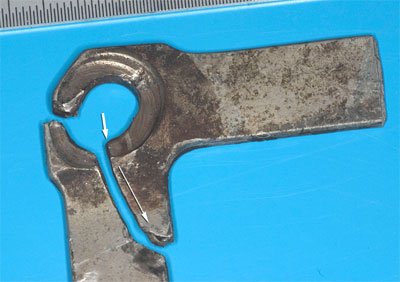
Initial inspection of the helicopter by the operator revealed that the KAflex2 driveshaft between the engine free-wheeling unit and the main transmission had failed. The failed shaft and its components were removed from the helicopter and forwarded to the Australian Transport Safety Bureau (ATSB) for metallurgical examination. The examination found that the failures had occurred in the arms of the web elements, with all of the fractures typical of gross-overload failure from either a single or small number of cycles. Of significant interest was the separation of one of the flex frame unions (see Figure 1). This section showed evidence of wear and deformation consistent with looseness of the bolted joint fastener. Fatigue cracking had initiated from the bore or worn surfaces of the frame and propagated radially away from the hole, intersecting the side of the frame and freeing the connection.
Figure 1: Worn fastener bore and fracture in flex frame. Arrows indicate the point of fatigue crack initiation and the direction of propagation.
Maintenance history
The helicopter's Maintenance Release was valid until 27 November 2004 or 12,351.80 hours in service, whichever occurred first. At the time of the failure, the helicopter had 12,168.25 hours in service. The operator had responsibility for the maintenance of the helicopter, which was conducted under a valid Certificate of Approval. The helicopter was operated in the Normal category, Day VFR.
The helicopter was maintained as a Class B type aircraft, with the airframe maintenance conducted in accordance with the manufacturer's prescribed maintenance procedures. In this instance, the Bell Helicopter Textron Company 206 Maintenance Manual BHT-206A/B-SERIES-MM-1 was identified in the Logbook Statement as the primary documentation. However, the driveshaft manufacturer's documentation was not identified as required supplemental documentation in that statement. The inspection schedule worksheets for maintenance were copied, for use by the maintenance personnel, directly from the airframe manufacturer's manuals. No supplemental maintenance inspection sheets were incorporated into any of the maintenance worksheet packages that specifically identified maintenance actions to be performed for the KAflex driveshaft.
The helicopter underwent a 300-hourly inspection for the issue of a maintenance release at Moorabbin, Victoria on 27 November 2003. No entries were recorded on the maintenance release with regard to any daily or periodic inspection requirements specific to the KAflex driveshaft.
Main driveshaft
The Jetranger was delivered with a proprietary designed main driveshaft. The driveshaft, which comprised a spherical coupling at either end of a torque shaft, was designed to transmit power from the engine freewheeling unit output adapter to the main transmission input quill. The engine's output shaft speed was around 6,000 RPM3 during helicopter operation. The application of power and flight and ground loads all contributed to drive line misalignment during operation. The spherical coupling design compensated for that misalignment under normal operating conditions. The main driveshaft was subject to ongoing monitoring through heat sensitive temperature indicators that detected overheating caused by inadequate lubrication, wear, or excessive misalignment of the drive train elements. Periodic maintenance of the driveshaft included disassembly, inspection and lubrication in accordance with the Bell Helicopter Textron Company 206 Maintenance Manual, to ensure the continuing airworthiness of the driveshaft.
On 19 January 1998, at 8,055.9 hours aircraft total time in service, the Bell manufactured engine-to-transmission driveshaft in the helicopter had been replaced with a KAflex unit. The new driveshaft was designed to replace the proprietary unit and had been marketed as providing reduced maintenance, longer time between overhauls, and greater reliability.
The Kamatics Corporation web page advised:
Helicopter flight manoeuvres generate high misalignment between the engine and the transmission, which must be accommodated by the connecting driveshaft. Such driveshafts, which rotate at speeds over 6000 RPM, often incorporate grease lubrication and seals. Designs of this type are susceptible to loss of lubrication, which results in overheating and possible failure, a major safety concern.
The KAflex driveshaft is a mechanical drive coupling which requires no lubrication or seals, and transmits power while accommodating high angular misalignment and length change through the use of flexible rectangular frames. These frames are bolted together at the corners in a truss-like arrangement, which are attached to shaft end fittings to allow for drop-in installation in the drive line. A fail-safe feature enables the coupling to continue to transmit power even in the unlikely event of a failure in a load carrying member.
KAflex driveshafts are custom designed for specific applications and selected because they offer superior, maintenance-free performance with extended 'on condition' service-life, resulting in unequalled reliability, increased readiness and cost effectiveness. They are supplied both as individual couplings and as complete driveshafts.
The KAflex driveshaft had been fitted in accordance with Kamatics Corporation supplemental type certificate (STC) SH 7767SW. The helicopter was then ground run and test flown with no defects found. While the KAflex driveshaft remained fitted to the helicopter, the requirements of airworthiness directive (AD)/Bell 206/79 Amdt 14 were no longer applicable to the helicopter.
The STC documentation stipulated that, upon completion of the modifications and installation of the shaft, the historical service record was to be completed, applicable logbook entries made and the card to be kept with the aircraft logbooks. At the completion of its recommended time in service between overhauls, the shaft and the completed historical service card would be returned to the manufacturer for overhaul. While an entry in the helicopter's logbook was made for the installation of the KAflex shaft into the helicopter, no historical service record was found in the helicopter's logbooks pertaining to the shaft.
Maintenance and inspection
A copy of the STC was kept with the archived helicopter logbooks and worksheets, in a separate binder to the current helicopter logbook binder. Both binders were located at the operator's main office. The STC was available to the engineers maintaining the helicopter, but it was not identified by them as a document that they would need to refer to routinely in their maintenance activities.
Although the STC and the manufacturer's website stated that the driveshaft was 'maintenance free' Sections 3 and 4 of the STC detailed the inspection and maintenance regime that the manufacturer expected to be performed while the driveshaft was in service. Section 3 of the STC detailed pre-flight, 100-hourly and 1,500-hourly inspections that were to be performed throughout the 6,000 hour service life5 of the shaft. The inspection advice described examination of the flex frames for the production of 'red dust' showing up as a red metallic residue. Section 3 also contained requirements for a 6,000 hour inspection (which it referred to as maintenance requiring return to the manufacturer) and conditional inspections after specific events, such as an overtorque, an overspeed, a sudden stoppage, a hard landing or a lightning strike. Section 3 also contained the following bold type warning with regard to flex frame attachment hardware:
WARNING DO NOT disturb or tighten flex frame nuts or bolts. Evidence of turning fasteners by wrench or other means is cause for rejection.
Section 4 of the STC listed maintenance requirements for the driveshaft. That information stated that there was no periodic maintenance requirement for the KAflex driveshaft.
The operator's managing director stated that at no time did any of his personnel detect the production of red dust residue on the shaft. He also advised that had there been red dust production around the flex frame joints, his personnel would have detected it and prevented the failure. The manufacturer stated that red dust is usually produced in the initial stage of loss of integrity of the bolted joints, but noted that this was not always the case and operators should be vigilant with regard to inspection for loose bolted joints.
From the time of installation of the shaft on 19 January 1998 to the time of the occurrence on 14 June 2004, there were no entries detailing the conduct of periodic or 1,500-hourly inspection certification requirements of the KAflex driveshaft in the helicopter's logbooks, or in the worksheets for maintenance for the issue of a maintenance release. This represented the 4,112.35 hours in service for the KAflex driveshaft. However, there was no stipulation in the STC Section 3 instructions to require certification for the completion of the inspections detailed in that section.
There was also no amendment insert in the helicopter's flight manual for the daily inspection as described in the STC, Section 3 - DAILY INSPECTION BEFORE FIRST FLIGHT OF THE DAY. There was also no stipulation in the STC that the flight manual should be amended in order to make that information readily available to the pilot.
When interviewed, the pilot in command was asked to describe the execution of a daily inspection of the helicopter. While a detailed explanation was given to the interviewer, at no time was the driveshaft manufacturer's warning caveat mentioned or alluded to by the pilot. As this is a bold type warning in the manufacturer's documentation, it should have been a recall item readily identified during this discourse.
Historical service record
There was minimal reference made to the historical service record in the STC. A copy of the card was obtained from the local Australian distributor for KAflex. There was no provision on the card for certification of the 100-hourly and 1,500-hourly inspections. The historical service record card had not been incorporated into the maintenance records for the helicopter as required by the manufacturer in the accomplishment instructions of the STC.
1International radio broadcast for urgent assistance. 2A proprietary name for a driveshaft manufactured by a Unites States company, Kamatics Corporation. 3Output shaft speed at 100% main rotor RPM. 4AD/Bell 206/79 Amdt 1 detailed the inspection and installation of a Visual Aid Overheat Indicator on a Bell manufactured main input drive shaft assembly. It was later cancelled as those requirements were incorporated into the 100-hourly maintenance servicing requirements. 5At the time of shaft installation, the STC stipulated a 4,000 hour service life. Service Instruction 2348 Revision "E" dated September 1999 extended this service life to 6,000 hours between overhauls.
On 28 September 2003, a Robinson Helicopter Company model 22 helicopter (R22) registered VH-UXF was engaged in aerial mustering operations with another R22 helicopter registered VH-AOP. The helicopters were operating in an area 93 km south of Derby, Western Australia. The pilot of UXF returned from a refuelling stop and had been in the mustering area for about 30 minutes when the pilot of AOP noted that he had not heard any radio transmissions from the pilot for about 10 minutes. He commenced a search and soon after, located UXF at the edge of a claypan.
The pilot landed close to UXF in order to assist the two occupants. After isolating the helicopter's electrical system, he attempted to comfort and provide first aid to them. However, because of the apparent nature and extent of their injuries, he decided to seek medical assistance from Derby.
About 80 minutes later, the pilot returned to the scene of the accident with a doctor from Derby. The doctor determined that, in the intervening period, both occupants of UXF had succumbed to their injuries.
WA Coroner
ATSB response to WA Coroner
On 29 September 2010, the Western Australia Deputy State Coroner, Ms Evelyn Vicker, handed down her findings in the inquest into two deaths arising from a Robinson R22 helicopter accident that occurred on 28 September 2003 near Derby in Western Australia. The ATSB had previously investigated this accident and published its finding on the ATSB website: ATSB investigation 200304074. The Coroner fully agreed with the ATSB's findings.
The ATSB's key findings in the helicopter accident were: 1. The failure of the A166 clutch shaft, involving torsional fatigue cracking, which was due to the inappropriate assembly of the shaft to the A907 yoke. a. a non approved jointing compound was used during the assembly; and b. the bearing blocks were installed over the painted yoke surface
2. A loss of main rotor drive which was most likely to have occurred at a combination of height and speed that was insufficient to enable the pilot to conduct a successful auto rotation.
Two recommendations from the Coroner affect the ATSB:
Recommendation 3
CASA [Civil Aviation Safety Authority] seek input from the ATSB as to the reasonableness of mandatory inspection of both yoke and clutch shaft attachments in helicopters operating at low height for evidence of fretting in view of the fact this seems to have been a factor in failure of the A166 component in an R22 in 1992, 2003 and 2005.
ATSB Response:
The ATSB wishes to draw attention to the safety actions on page 10 of the ATSB's accident investigation report. As a result of an ATSB recommendation on 6 November 2003, CASA issued Airworthiness Directive AD/R22/51 which mandated inspections of the A166 shaft to A907 yoke on all R22 helicopters operating in Australia.
CASA also issued AD/R44/019 on 28 November 2003, mandating the same inspection on those R44 helicopters that had the C166 shaft to C907 yoke disassembled since installation at the factory.
On 7 May 2009 the Airworthiness Directives were cancelled by CASA because the instructions contained in them with respect to mandatory inspections were introduced by Robinson Helicopters into the maintenance manuals for the R22 and R44 models.
The ATSB has been advised by CASA:
"In light of the fact that the relevant maintenance manuals were updated to adequately reflect the maintenance practices required by the ADs, it was considered that the ADs were no longer required and they were subsequently withdrawn.
The ADs were no longer considered necessary because person's performing maintenance on Australian Aircraft are required to do so in accordance with the instructions contained in the applicable approved maintenance data (which includes the manufacturer's maintenance manual) - see r.42V of the Civil Aviation Regulations 1988."
The review of the maintenance manuals for the R22 and R44 helicopters in light of this accident and the findings of the ATSB led CASA to the conclusion that there was a heightened risk of improper maintenance practices being employed in the assembly of the clutch shafts in these types of helicopter. CASA addressed this risk by promulgating the ADs which were later adopted by the Robinson Helicopter Company. CASA considers that this risk is now adequately addressed via the amendments which have now been made to the manufacturer's maintenance manuals for both helicopter types."
The ATSB notes that it is normally CASA that would make an assessment as to the reasonableness of the implementation of a specific recommendation after a safety issue has been identified. In this instance the ATSB issued the initial recommendation on 6 November 2003. The ATSB is satisfied with CASA's response that the inspection requirement to address improper maintenance practices is contained in the Robinson Maintenance Manuals and mandated through the application of regulation 42V of the Civil Aviation Regulations 1988.
Recommendation 5
ATSB continue to circulate relevant investigation findings to the industry to remind operators and maintenance engineers manufactures recommendations are made for sound technical reasons.
ATSB Response:
The ATSB wishes to draw attention to section 12AA of the Transport Safety Investigation Act 2003 (TSI Act) which outlines that the ATSB's function is to improve transport safety through means that include: - Identifying factors that have contributed to transport safety matters; - Identifying factors that might affect transport safety; - Communicating those factors to relevant sectors of the transport industry and the public.
Through its investigation and research and analysis activities the ATSB is committed to fostering safety awareness, knowledge and action. During the course of an ATSB investigation or research project the ATSB works with the relevant sectors of the industry to encourage safety action as safety issues are identified. The final report is always published on the ATSB's website and hard copies made available as required. Further, the ATSB regularly issues media releases and alerts to provide notification of the Bureau's activities.
Education materials are also supported and issued by the ATSB.
Cooperation with Coroners
ATSB investigations are conducted with the objective of providing findings that can be used to improve transport safety in the future. Coronial Inquests are a separate process to the ATSB investigation and they are usually supported by their own investigation and brief of evidence. However, as Inquests also have the objective of seeking to prevent a death occurring again, the ATSB provides cooperation through the explanation of the ATSB's findings in its report. The ATSB appreciates the interest of Coroners in working with the ATSB in the interests of improving future safety.
Questions concerning the inquest findings should be directed to the Coroner's Court in Western Australia: Western Australian Coroner's Court Level 10 Central Law Courts 501 Hay Street PERTH WA 6000