On 29 May 2006, an Australian registered and operated Boeing Co. 747-400 was taxiing at New York, John F Kennedy (JFK) Airport. During the aircraft's final turn into its allocated parking bay, the right wingtip contacted a blast fence, resulting in damage to the outboard end of the right wing. An investigation was conducted by the US Federal Aviation Administration in conjunction with the US National Transportation Safety Board and the Australian Transport Safety Bureau.
On 2 February 2006 at approximately 1308 Eastern Daylight-saving Time, a US registered Boeing Company 747-422 (747) aircraft was taxiing for departure at Melbourne Airport, Vic. At the same time, a Boeing Company 767-338ER (767) aircraft was stationary on taxiway Echo and waiting in line to depart from runway 16. The tail section of the 767 was protruding into taxiway Alpha while it was stationary on taxiway Echo awaiting a clearance to enter the runway.
The pilots of the 747 received a clearance to taxi, which included a taxi route from the international apron to the holding point on taxiway Bravo, for a departure from runway 16, via taxiways Uniform then Alpha. The pilot in command of the 747 deviated from the taxi clearance issued by the surface movement controller and turned the 747 right into taxiway Echo, to pass behind the 767. The left wing tip of the 747 collided with the right horizontal stabiliser of the 767 as the 747 crew attempted to manoeuvre behind the 767.
The taxiway dimensions and markings at Melbourne Airport complied with international standards and were suitable for use by the aircraft types involved in the occurrence.
The 747 crew was aware of the 767, and chose to pass behind it rather than wait on taxiway Alpha until the 767 was no longer obstructing the taxiway. The decision by the pilot in command of the 747 to deviate off the centreline of taxiway Alpha and taxi behind the 767 did not comply with the taxi clearance issued by the SMC. It was based on his assessment that it was safe to do so. The pilot in command of the 747 misjudged the distance between the wingtip of the 747 and the right horizontal stabiliser of the 767, which resulted in the collision.
As a result of this occurrence, the aircraft operator advised the ATSB that it had initiated a number of immediate safety initiatives to prevent a recurrence, including:
Issuing a notice to all contracted ground handling staff requiring that the correct controller/PPU combination be cross checked by two staff members prior to push back operation commencing. It was intended that process would no longer be required once the long term actions have been implemented.
A reassessment of all PPU operators was carried out by a manufacturer approved trainer. This training and assessment was documented in accordance with the contracted company procedures.
Permission from the flight crew must be obtained prior to connecting PPUs to aircraft (in addition to asking for the park brake to be set). This is designed to reinforce the connection between connecting the PPU to the aircraft and the need for the park brake to be set.
The engine of the PPUs is to be stopped after connection to the aircraft and started prior to push back using the remote control. This ensures that the first remote control command is not a commanding movement.
Lockable boxes are to be installed on the PPUs to house the remote control units. The controllers remain with the PPU at all times.
PPUs and controllers have been colour coded and large numbers placed on the PPUs to allow quick visual identification.
The PPU manufacturer is to be asked to consider an engineering solution that prohibits the use of the incorrect remote control being used to inadvertently move an aircraft.
The function of the remote control communication indicator lights is to be included in training syllabi and procedure documentation.
The newly fitted test button on the remote control is utilized as a safeguard by requiring the operator to test the remote communication prior to beginning each push back operation.
Consideration be given to requesting the manufacturer to change the control logic to require the test button to be used in the period shortly before the push or pull button action.
Summary
The Australian Transport Safety Bureau did not conduct an on-scene investigation of this occurrence. The report presented below was prepared principally from information supplied to the Bureau.
REPORTED INFORMATION
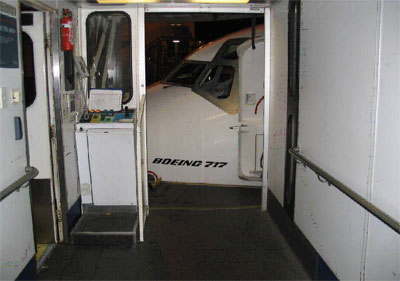
At 1855 on 21 June 2004, a Boeing 717-200 aircraft, registered VH-VQB, was being prepared for departure at gate 49 at Sydney Airport. At the same time, another company Boeing 717-200 aircraft, registered VH-VQE, was being prepared for departure at the adjacent gate 53.
Both aircraft had been prepared for pushback and had remote control Power Push Units (PPU) positioned on the respective aircraft main landing gear. VQB was in the final stages of preparation for departure with all ground service equipment clear of the aircraft, all passengers on-board and seated with door 1 Left (L1) open and the aerobridge connected to the aircraft. The cabin service manager was completing documentation in the aircraft near door L1, and two customer service officers were located on the aerobridge.
VQE was ready for departure ahead of schedule and the flight crew received a pushback clearance. They then advised the ground crew that the aircraft was 'clear to push'. A push back was commenced by a ground crewmember, using a hand-held remote control unit, however the PPU did not respond to the ground crew's command to commence reversing. The ground crewmember, initially believing the remote control unit battery was discharged, replaced the battery and attempted a second pushback without success.
At the time the command to pushback was sent to the PPU attached to VQE at gate 53, VQB began to move rearwards at gate 49. The flight crew of VQB, sensing the unexpected movement, immediately applied the aircraft brakes; however, the aircraft had moved rearward more than a metre. As the aircraft moved, the two customer service officers in the aerobridge became unsteady on their feet and a flight attendant in the aircraft galley received a minor scratch on one arm. Once the aircraft was stopped and secured, all passengers were disembarked through door 1 Right using portable stairs.
A subsequent examination of the aircraft revealed that VQB had been damaged as a result of contact between the aircraft and the aerobridge. The left angle of attack vane was bent, there was some minor skin damage around the angle of attack vane mounting and the L1 door trim was damaged. The damage was repaired and the aircraft was returned to service the following day.
Aircraft Ground Handling
Ground handling services for the aircraft operator were provided by a contracted ground handling agent. The agent owned and operated the PPUs and trained staff in their operation. The PPUs were attached to the aircraft main landing gear and provided motive force for aircraft pushback without the need for a towbar. The PPUs were activated via a hand-held remote control unit. The remote control units had an operating range of approximately 100 metres and were digitally encoded to ensure that the remote control unit would only operate its assigned PPU. The two PPUs and controllers used by the operator in Sydney were marked with matching serial numbers and two amber lights would illuminate on the PPU when any remote control button was pushed, signifying that the PPU was the one being activated.
At the time of the occurrence, the ground handling crews for gates 49 and 53 had inadvertently obtained the incorrect remote control units for their respective PPUs prior to the commencement of aircraft pushback.
Occurrence Briefs are concise reports that detail the facts surrounding a transport safety occurrence, as received in the initial notification and any follow-up enquiries. They provide an opportunity to share safety messages in the absence of an investigation.
What happened
On 30 July 2022, at about 1632 local time, the pilot of a Bell 206L LongRanger was relocating the helicopter from the fuel bowser to the operator’s parking area on the north-east side of a hangar at Newman Airport, Western Australia.
While lining up with marking aids on the taxiway, the pilot directed their attention towards a nearby parked helicopter to the right to ensure adequate clearance from the Bell 206L’s main rotor blade. As the pilot moved the 206L forward into the parking bay, there was a loud bang. The pilot reported there was no loss of control or abnormal movement after the sound and continued to land and shut down the helicopter without further incident.
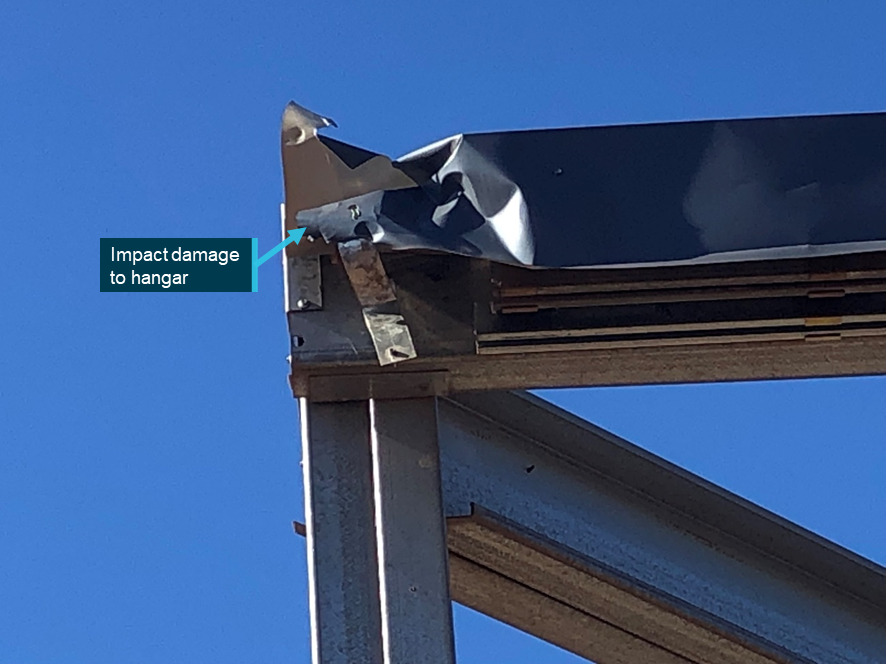
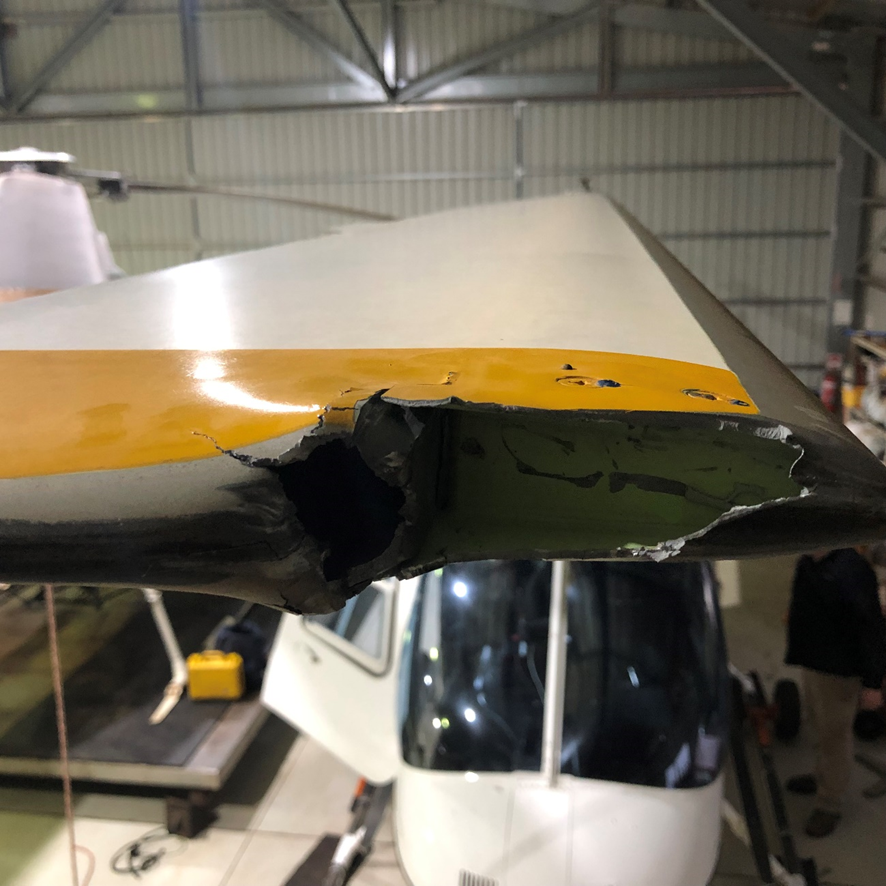
During the post-flight inspection, it was identified that one main rotor blade had contacted the end of the gantry which supports the sliding doors of the hangar (Figure 1). The helicopter sustained minor damage to the rotor blade tip cap spanning about 10 cm (Figure 2).
Figure 1: Damage to hangar gantry
Source: Operator, annotated by the ATSB
Figure 2: Damage to main rotor blade
Source: Operator
Safety action
The operator has advised that it suspended helicopter operations around the apron area where the incident occurred, pending the outcomes of an internal investigation into the incident.
The operator will also review the risk analysis of the apron parking in the vicinity of the hangar and assess the current helicopter parking configuration.
Safety message
The FAA helicopter flying handbook[1](2022) advises that when taxiing near hangars or obstructions, the distance between the rotor blade tips and obstructions is difficult to judge.
To reduce collision risk, operators should consider human limitations in assessing the hazards and ensure crews maintain situational awareness of the aircraft’s established safe distance for separation from all objects during taxi.
Risk assessments on apron parking areas should be reviewed periodically to re-evaluate risks and mitigations.
About this report
Decisions regarding whether to conduct an investigation, and the scope of an investigation, are based on many factors, including the level of safety benefit likely to be obtained from an investigation. For this occurrence, no investigation has been conducted and the ATSB did not verify the accuracy of the information. A brief description has been written using information supplied in the notification and any follow-up information in order to produce a short summary report and allow for greater industry awareness of potential safety issues and possible safety actions.
Occurrence Briefs are concise reports that detail the facts surrounding a transport safety occurrence, as received in the initial notification and any follow-up enquiries. They provide an opportunity to share safety messages in the absence of an investigation.
What happened
On 25 August 2021 at 1115 local time, a pilot and engineer were conducting an engine ground run of a Bombardier Challenger 600 aircraft on the apron at Essendon Airport, Victoria. The aircraft was privately owned/operated and had not conducted any flights since 2017.
The nosewheel was chocked, with the left seat foot brakes applied instead of the required parking brake due to previous issues with releasing the park brake. The Challenger’s two turbofan engines were successfully started with normal system indications, and the power levers moved to the low idle position. The power levers were then moved to the high idle position for a short time and then back to low idle, after which the aircraft moved forward and rolled over the chocks.
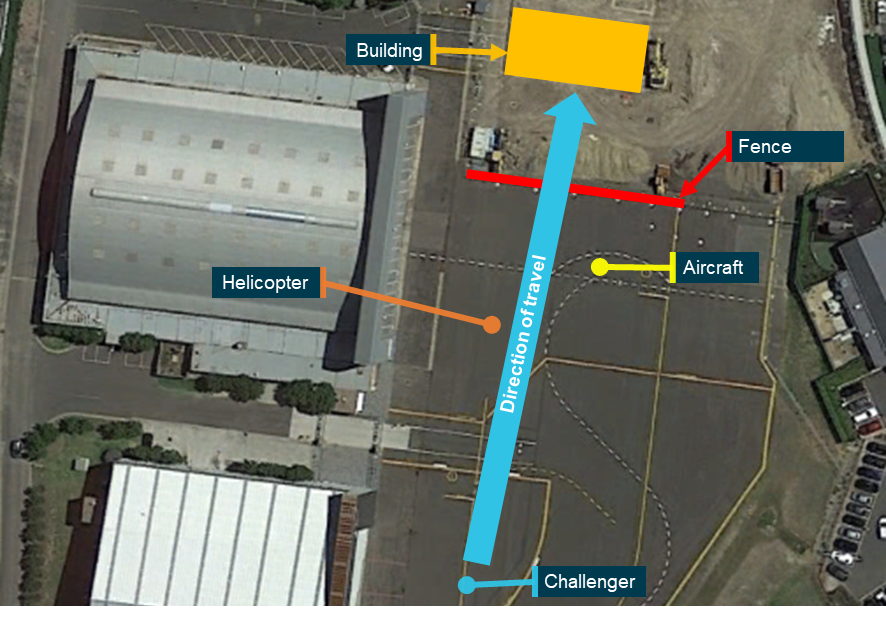
The pilot was applying pressure onto the left seat foot brakes, and tried pumping them, but the aircraft continued to move forward. The pilot then tried using the rudder pedals to steer toward a grass area off the apron without success. The Challenger hit a parked helicopter and another parked aircraft before rolling through a perimeter fence and colliding with a building (Figure 1), bringing the Challenger to rest about 30 seconds after it started to roll.
Figure 1: Challenger path
Source: Google Earth, annotated by the ATSB
The pilot shut down the left engine by moving its power lever to the idle cut-off position. The right engine power lever could not be moved into the cut-off position, so the pilot activated the right engine’s fire extinguishing system, which successfully shut down the engine. The pilot and engineer then exited the aircraft.
The aircraft received substantial damage to the nose, wing leading edge, and winglets. Post‑accident testing of the Challenger’s brake system could not be performed due to hydraulic system damage from the accident.
Safety action
The pilot and engineer are considering the use of additional chocks during aircraft ground running.
Safety message
It is important to follow all operational procedures during engine ground runs, especially those related to securing the aircraft from moving. Positioning the aircraft away from obstacles during the ground run, for example at an airport’s run-up area, can also reduce the risk of colliding with obstacles should the aircraft unexpectedly roll. If this occurs, flight and maintenance crew must be prepared to initiate emergency actions, such as engaging brake systems and immediately shutting down engines.
After an extended period of inactivity, it is important to conduct full system checks before operating an aircraft.
About this report
Decisions regarding whether to conduct an investigation, and the scope of an investigation, are based on many factors, including the level of safety benefit likely to be obtained from an investigation. For this occurrence, no investigation has been conducted and the ATSB did not verify the accuracy of the information. A brief description has been written using information supplied in the notification and any follow-up information in order to produce a short summary report, and allow for greater industry awareness of potential safety issues and possible safety actions.
Occurrence Briefs are concise reports that detail the facts surrounding a transport safety occurrence, as received in the initial notification and any follow-up enquiries. They provide an opportunity to share safety messages in the absence of an investigation.
What happened
On 25 March 2021, at about 2130 Eastern Daylight-saving Time,[1] following a rostered day of flying duties, the pilot of the Diamond DA42 aircraft commenced taxiing at Bankstown Airport, New South Wales, for a session of night circuits to maintain currency.
After the aircraft had rolled forward slightly, the pilot noticed they had left their iPad on the apron and decided to retrieve it before proceeding any further. The pilot engaged the park brake with both engines running and exited the cockpit onto the aircraft’s wing. While the pilot was on the wing, the aircraft moved forward, causing the pilot to lose balance and fall backwards onto the tarmac. The pilot sustained minor hand and leg injuries.
The parking area had a slight decline and the aircraft rolled down the slope. The right wing struck a hangar, and the aircraft went through a perimeter fence, resulting in minor damage to the wing tip and various panels around the nose section of the aircraft.
The pilot reported being unable to regain entry to the cockpit as it rolled away. Once the aircraft had stopped moving, the pilot entered the cockpit and shut down the engines before securing the aircraft.
Park brake
Operation of the park brake is achieved by applying pressure to the toe brake pedals and moving the park brake selector down until it catches. This traps the hydraulic fluid in the brake units and the wheel brakes stay on. The pilot reported being unsure if sufficient pressure was applied to the brake pedals when activating the park brake. The operator advised that following the incident, the park brake was checked and reported to be serviceable.
Fatigue
The pilot reported that at the time of the incident they had been awake for 17 hours. The ATSB publication Fatigue experiences and culture in Australian commercial air transport pilots references studies that found periods of extended wakefulness increase the risk of experiencing a level of fatigue demonstrated to adversely affect performance.
Safety action
As a result of this occurrence, the operator advised the ATSB that the company has introduced a refresher course for all flying staff regarding fatigue management and responsibilities.
Safety message
A more appropriate course of action would have seen the pilot shut down the engines before securing the aircraft with the park brake and then exiting the aircraft to retrieve the iPad from the apron. Lapses in decision making can result from extended periods of wakefulness. The ATSB SafetyWatch highlights the broad safety concerns that come out of our investigation findings and from the occurrence data reported to us by industry. One of the safety concerns is Fatigue.
About this report
Decisions regarding whether to conduct an investigation, and the scope of an investigation, are based on many factors, including the level of safety benefit likely to be obtained from an investigation. For this occurrence, no investigation has been conducted and the ATSB did not verify the accuracy of the information. A brief description has been written using information supplied in the notification and any follow-up information in order to produce a short summary report, and allow for greater industry awareness of potential safety issues and possible safety actions.
Occurrence Briefs are concise reports that detail the facts surrounding a transport safety occurrence, as received in the initial notification and any follow-up enquiries. They provide an opportunity to share safety messages in the absence of an investigation.
What happened
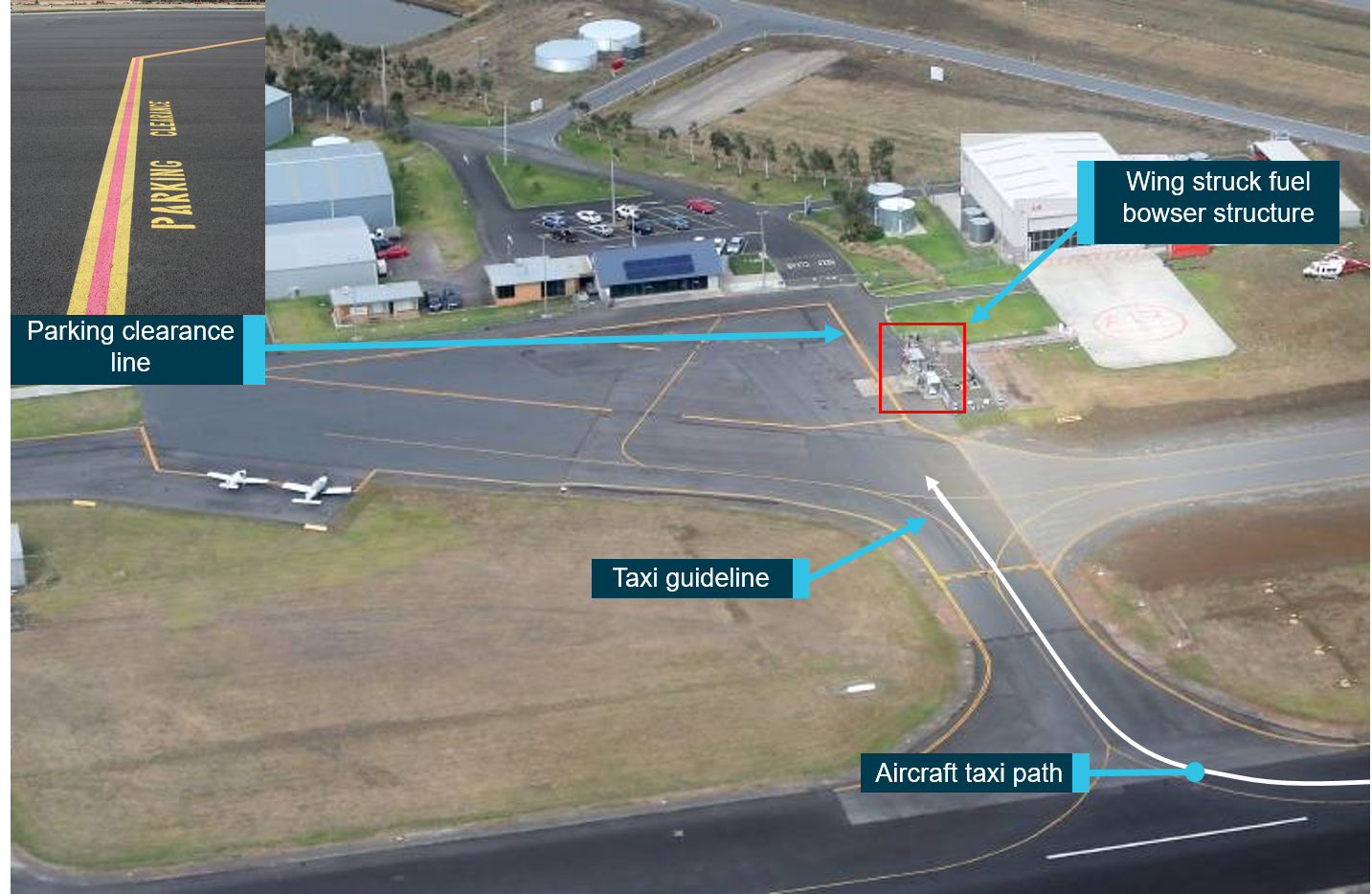
On 18 July 2020, at about 1000 Eastern Standard Time, a Piper PA-28 was taxiing to vacate the runway at Warrnambool Airport, Victoria. As the aircraft vacated the runway, the pilot proceeded towards the fuel bowser and aligned the aircraft on what was thought to be a taxiway guideline for the apron in front of the fuel bowser. As the aircraft slowed, it suddenly veered right and came to a stop. The right wing had contacted the shelter housing the fuel bowser, with further inspection revealing a dent in the leading edge of the wing. The pilot had mistaken the parking limit line for a taxi guideline marking and positioned the aircraft too far to the right, resulting in a collision with the structure as the aircraft approached the bowser (see Figure 1).
Figure 1: Warrnambool Airport apron markings
Source: Google annotated by the ATSB
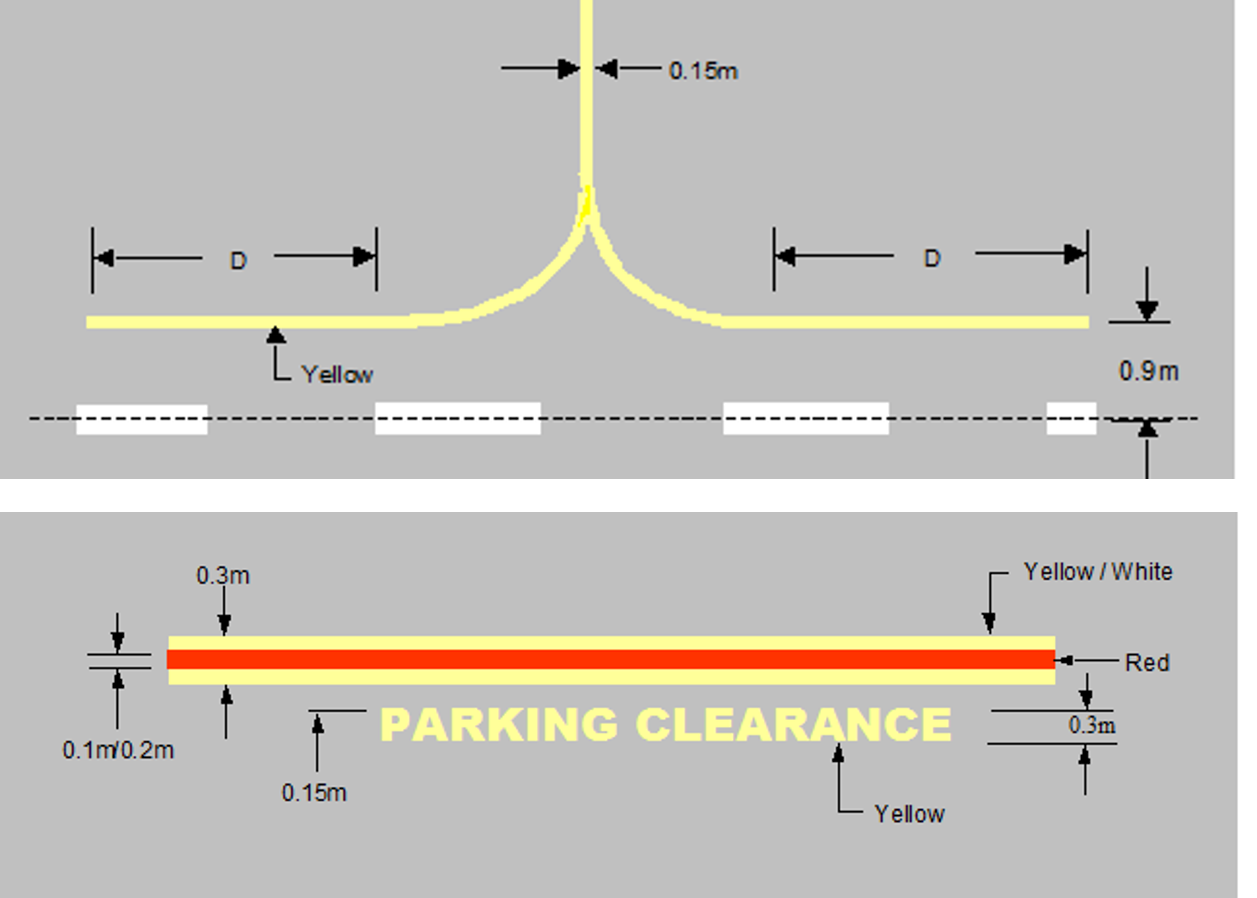
As depicted in Figure 2 from the Manual of Standards Part 139 – Aerodromes Volume 1: Chapter 8, limit markings differ in presentation from taxi guideline markings. Taxi guidelines consist of a single solid yellow line, whereas parking limit lines consist of two solid yellow lines surrounding a solid red line with the words ‘Parking Clearance’ appearing at regular intervals. A list of markings and their meanings are available to pilots in the Aeronautical Information Publication (AIP) AD 1.1 4.10.
Figure 2: Apron markings – taxi guideline marking and parking clearance line
Source: Manual of Standards Part 139 - Aerodromes
Safety message
This incident reinforces the importance of maintaining situational awareness[1], a good lookout while taxiing and a familiarity with apron markings.
About this report
Decisions regarding whether to conduct an investigation, and the scope of an investigation, are based on many factors, including the level of safety benefit likely to be obtained from an investigation. For this occurrence, no investigation has been conducted and the ATSB did not verify the accuracy of the information. A brief description has been written using information supplied in the notification and any follow-up information in order to produce a short summary report, and allow for greater industry awareness of potential safety issues and possible safety actions.
Occurrence Briefs are concise reports that detail the facts surrounding a transport safety occurrence, as received in the initial notification and any follow-up enquiries. They provide an opportunity to share safety messages in the absence of an investigation.
What happened
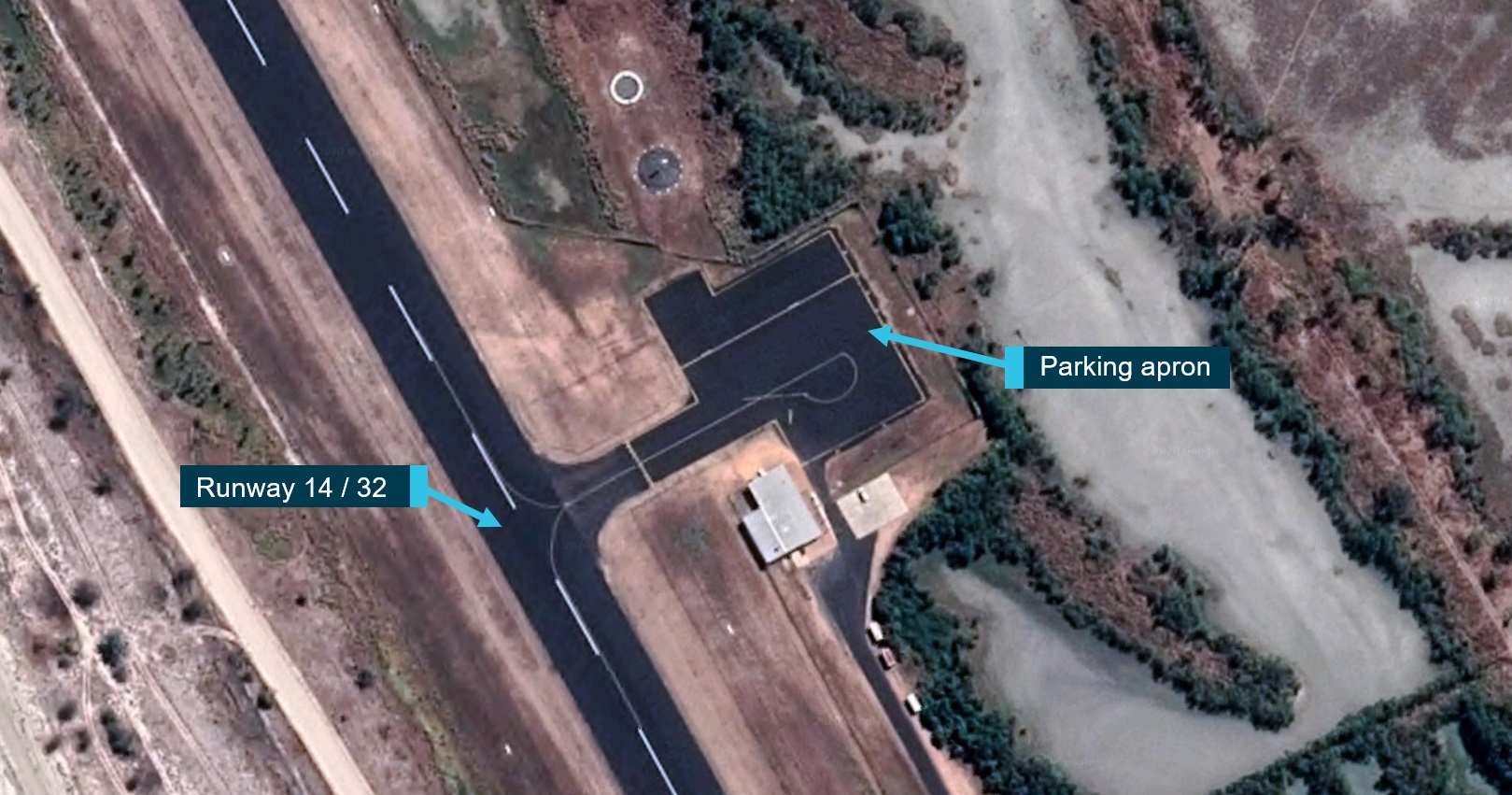
On 16 April 2020 at about 1300 Eastern Standard Time, an ATR 42-300 was taxiing to park on the apron at Pormpuraaw Airport, Queensland (Figure 1). The pilot of the ATR was aware that a de Havilland DHC-8 was due to arrive and with this in mind, was manoeuvring the aircraft to allow sufficient clearance for the parking of both aircraft on the limited apron area available.
During the manoeuvre, the right wingtip contacted a frangible flood light pole situated on the perimeter of the apron. The light pole gave way as designed. Initial contact was with the aircraft’s right navigation light’s perspex cover which cracked and became dislodged. Upon further inspection, a small dent was also identified on the leading edge of the right aileron control horn.
Figure 1: Pormpuraaw Airport, Queensland
Source: Google Earth, annotated by the ATSB
Safety message
This incident reinforces the importance of maintaining situational awareness and a good lookout while taxiing, particularly in circumstances when the manoeuvring area available is restricted or confined by infrastructure or other obstacles.
About this report
Decisions regarding whether to conduct an investigation, and the scope of an investigation, are based on many factors, including the level of safety benefit likely to be obtained from an investigation. For this occurrence, no investigation has been conducted and the ATSB did not verify the accuracy of the information. A brief description has been written using information supplied in the notification and any follow-up information in order to produce a short summary report, and allow for greater industry awareness of potential safety issues and possible safety actions.
Occurrence Briefs are concise reports that detail the facts surrounding a transport safety occurrence, as received in the initial notification and any follow-up enquiries. They provide an opportunity to share safety messages in the absence of an investigation.
What happened
On 29 April 2018, at 1330 Eastern Standard Time (EST), a Cessna 172N commenced taxiing on the southern apron at Archerfield, Queensland, in preparation for take-off. At the same time, a fuel truck was fuelling a Cessna 172S to the left side of the taxiway. As the Cessna 172N taxied past, the leading edge of the left wing contacted the fuel truck. The Cessna 172N was immediately stopped and the engine was shut down. Damage to the windscreen of the truck and leading edge of the Cessna 172N’s left wing was identified upon inspection. The Cessna 172N was then pushed clear of the taxiway.
A flying competition and social event was in progress, resulting in higher than normal air and foot traffic in the aerodrome vicinity. Visibility was good, with scattered cloud and a light southerly breeze.
Figure 1: Damage post incident, to the Cessna 172N and fuel truck
Decisions regarding whether to conduct an investigation, and the scope of an investigation, are based on many factors, including the level of safety benefit likely to be obtained from an investigation. For this occurrence, no investigation has been conducted and the ATSB did not verify the accuracy of the information. A brief description has been written using information supplied in the notification and any follow-up information in order to produce a short summary report, and allow for greater industry awareness of potential safety issues and possible safety actions.
Occurrence Briefs are concise reports that detail the facts surrounding a transport safety occurrence, as received in the initial notification and any follow-up enquiries. They provide an opportunity to share safety messages in the absence of an investigation.
What happened
On 10 March 2018, at about 1600 Eastern Standard Time (EST), an Agusta AW139 helicopter was ground-taxiing to its parking area when it struck a maintenance work stand with the main rotor blades. At the time of the impact, the helicopter was being positioned short of the refuelling area to allow another aircraft to utilise it.
The helicopter was travelling at a slow walking pace when the impact occurred. The impact was felt as a vibration through the rotor system and had no effect on the fuselage or forward movement. The crew conducted a normal shutdown.
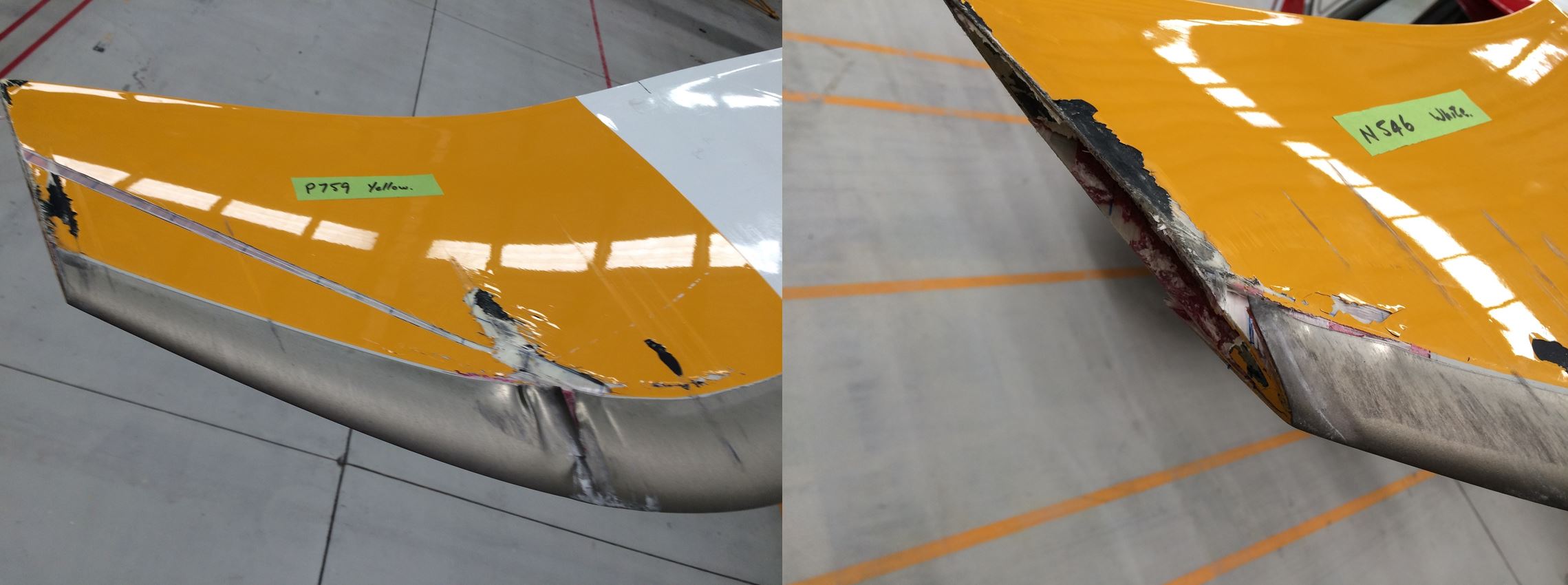
Post-flight, engineers inspected numerous components of the helicopter. Damage was isolated to the tip cap assemblies of the main rotor blades (Figure 1).
Figure 1: Damage to main rotor blades
Source: Owner
Safety message
Even when operating in familiar environments, flight crew need to remain vigilant for potential hazards in the area and maintain a good look out to ensure distances from obstacles are maintained.
About this report
Decisions regarding whether to conduct an investigation, and the scope of an investigation, are based on many factors, including the level of safety benefit likely to be obtained from an investigation. For this occurrence, no investigation has been conducted and the ATSB did not verify the accuracy of the information. A brief description has been written using information supplied in the notification and any follow-up information in order to produce a short summary report, and allow for greater industry awareness of potential safety issues and possible safety actions.