The ATSB is investigating an engine fuel starvation event involving a Piper PA-32R-301, registered VH-LPW, about 9 km south of Bacchus Marsh Aerodrome, Victoria, on 1 May 2026.
While in cruise at 8,000 ft during a flight from Stawell Airport, Victoria, to Essendon Airport, the engine began running roughly. The pilot actioned emergency procedures including switching fuel tanks and diverted the aircraft to Bacchus Marsh where the aircraft landed without further incident. The investigation is continuing.
The evidence collection phase of the investigation will involve interviewing the pilot, examination of maintenance records, reviewing any recorded data, and the collection of other relevant information.
A final report will be released at the conclusion of the investigation. Should a critical safety issue be identified during the course of the investigation, the ATSB will immediately notify relevant parties, so that appropriate safety action can be taken.
Last updated:
Occurrence summary
Investigation number
AO-2026-076
Occurrence date
01/05/2026
Occurrence time and timezone
06:16 UTC
Location
About 9 km south of Bacchus Marsh Aerodrome
State
Victoria
Report status
Pending
Anticipated completion
Q4 2026
Investigation level
Short
Investigation type
Occurrence Investigation
Investigation phase
Evidence collection
Investigation status
Active
Mode of transport
Aviation
Aviation occurrence category
Fuel starvation, Stall warning
Occurrence class
Incident
Highest injury level
None
Aircraft details
Manufacturer
Piper Aircraft Corp
Model
PA-32R-301
Registration
VH-LPW
Serial number
32R-8113095
Aircraft operator
Fly2Health
Sector
Piston
Operation type
Part 91 General operating and flight rules
Activity
Commercial air transport-Non-scheduled-Other non-scheduled commercial air transport
The ATSB is investigating a collision with tree involving a GippsAero GA8 Airvan, VH-WSU, at Lindeman Island, Queensland, on 8 March 2026.
During landing on soft and wet ground, the wheels slid and the pilot applied full power to conduct a go-around. The aircraft became airborne after the end of the runway and the landing gear contacted a tree, resulting in substantial damage. The aircraft was flown with reduced performance to Shute Harbour due to the runway condition at Lindeman Island being deemed unsuitable.
The ATSB has commenced the examination and analysis of the initial evidence collected. Further investigation will involve interviewing witnesses and involved parties, examination of maintenance records, retrieving and reviewing recorded data, and the collection of other relevant information.
A final report will be released at the conclusion of the investigation. Should a critical safety issue be identified during the course of the investigation, the ATSB will immediately notify relevant parties, so that appropriate safety action can be taken.
Occurrence summary
Investigation number
AO-2026-065
Occurrence date
08/03/2026
Occurrence time and timezone
14:35 Eastern Australia Standard Time
Location
Lindeman Island
State
Queensland
Report status
Pending
Anticipated completion
Q3 2026
Investigation level
Short
Investigation type
Occurrence Investigation
Investigation phase
Examination and analysis
Investigation status
Active
Mode of transport
Aviation
Aviation occurrence category
Collision with terrain, Control issues, Diversion/return, Missed approach, Stall warning
Occurrence class
Accident
Highest injury level
None
Aircraft details
Manufacturer
Gippsland Aeronautics Pty Ltd
Model
GA8
Registration
VH-WSU
Serial number
GA8-17-244
Aircraft operator
Wave Air
Sector
Piston
Operation type
Part 135 Air transport operations - smaller aeroplanes
Activity
Commercial air transport-Non-scheduled-Joyflights / sightseeing charters
At about 1507, the crew commenced descent into Merimbula. As icing conditions were expected during the descent, the first officer (pilot monitoring) selected the engine and wing anti-ice ON. This also activated the ice speed system, which reduced the stall warning angle of attack activation angle.
At about 1514, the crew commenced a visual approach to runway 21 at Merimbula and selected flaps to 20 degrees for the landing. During the approach in turbulent conditions, the airspeed reduced and the stall warning activated.
The captain then re‑established the required approach flight path and speed, continued the approach and the aircraft landed without further incident. The aircraft was not damaged and there were no injuries during the incident.
What the ATSB found
The ATSB found that during an approach, in turbulent conditions, the captain reduced engine power to flight idle to avoid an inadvertent flap overspeed. Due to the autopilot mode active at the time, the reduced thrust resulted in a continuous reduction in airspeed that required pilot intervention to prevent activation of the stall warning system.
Due possibly to distraction associated with the windscreen wiper setting, the airspeed continued to reduce undetected by the crew until the stall warning activated at a higher than normal margin above the stall speed.
Safety message
The approach and landing phases of a flight can have substantially increased workload when compared to other phases. Effective monitoring of aircraft and approach parameters, including performance associated with autopilot modes, and management of any distractions during these phases is essential to ensuring that an approach is safely completed.
The investigation
Decisions regarding the scope of an investigation are based on many factors, including the level of safety benefit likely to be obtained from an investigation and the associated resources required. For this occurrence, a limited-scope investigation was conducted in order to produce a short investigation report, and allow for greater industry awareness of findings that affect safety and potential learning opportunities.
The occurrence
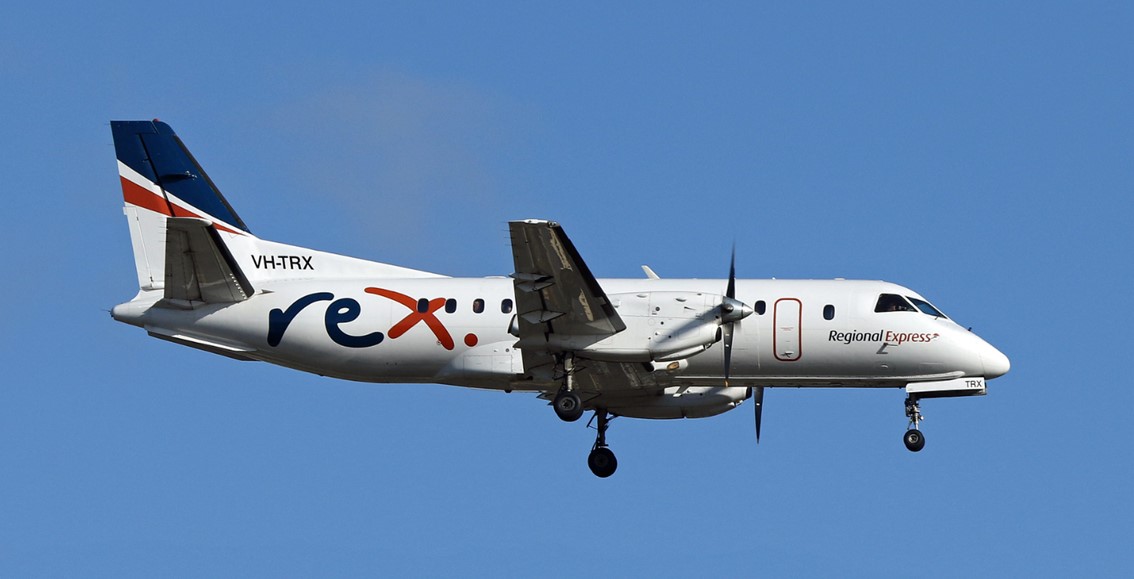
At 1432 on 8 June 2023, a Regional Express Saab 340, registered VH-TRX (Figure 1), departed Sydney, New South Wales for an air transport flight to Merimbula, New South Wales with 3 crewmembers and 22 passengers on board.[1] The captain was acting as pilot flying, and the first officer as pilot monitoring.[2]
At 1507, the crew descended the aircraft from the cruising level of flight level 180.[3] As icing conditions were expected during the descent, the first officer selected the engine and wing anti-ice ON. This also activated the ice speed system, which reduced the stall warning angle of attack[4] activation angle and required the addition of 10 kt to the 116 kt landing reference airspeed[5] (see the section titled Approach speeds).
The crew elected to conduct a visual approach to runway 21 at Merimbula while using the required navigation performance instrument approach for lateral tracking to a 16 NM straight-in final approach leg.
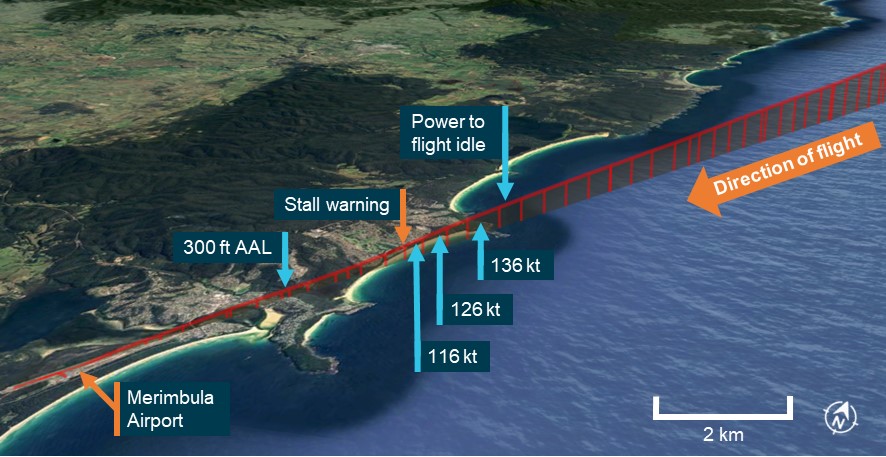
During the approach, at 1517 with the autopilot engaged in the vertical speed mode,[6] the first officer selected flaps to 20° for the landing. At 1518:45, as the aircraft descended below 1,164 ft above mean sea level in turbulent conditions and at a speed of 143 kt, the captain reduced power to flight idle to prevent an inadvertent exceedance of the 165 kt maximum flap speed. A few seconds later, at 1518:54, speed reduced below 136 kt, the minimum speed for that segment of the approach (see the section titled Approach speeds).
The power remained at flight idle, and speed continued to reduce as the approach continued (Figure 2) with the engine anti-ice and ice speed systems selected on. The aircraft then entered a rain shower, and the captain asked the first officer to turn on the windscreen wipers. The first officer asked if they should be set to low or high and the captain asked for the high setting. The wiper activation was then delayed as the turbulence prevented the first officer from quickly making the required selection. At about the same time, with power still at flight idle, the aircraft encountered increased turbulence and at 1519:21, at a speed of 109 kt, the stall warning activated.
The captain responded to the stall warning by reducing the aircraft’s pitch attitude and increasing engine power and 4 seconds after the stall warning activated, speed increased above 116 kt. At 1519:29, speed increased above 126 kt and 5 seconds later increased above the minimum segment speed of 136 kt. The aircraft also descended below the desired approach path. The captain identified the low approach profile and reduced the descent rate to re‑establish the desired path.
The first officer then called for a missed approach to be conducted. The captain acknowledged the first officer’s call but elected to continue the approach because:
the approach profile had been quickly re‑established
the runway and visual approach guidance system[7] was in sight
they assessed that a missed approach would take the aircraft ‘back up into the weather’.
At 1519:55, the aircraft descended below 300 ft above aerodrome level (AAL), the stabilised approach check height for the visual approach. At that time, the approach was stable and remained so until the aircraft landed at 1520:36. The aircraft was not damaged and there were no injuries during the incident.
Context
Crew details
The captain held an air transport pilot licence (aeroplane) and class 1 aviation medical certificate. The captain had over 20,000 hours of flying experience, of which over 13,000 hours were on the Saab 340.
The first officer held a commercial pilot licence (aeroplane) and class 1 aviation medical certificate. The first officer had 1,419 hours of flying experience, of which 172 hours were on the Saab 340.
The ATSB found no indicators that the flight crewmembers were experiencing a level of fatigue known to affect performance.
Stall warning system
The stall warning and identification system fitted to the Saab 340B included:
2 independent stall warning computers
2 angle of attack (AOA) sensors – one mounted on each side of the fuselage
an aural alerting system
a stick shaker device on each control column that provided a physical warning of an impending aerodynamic stall in the form of vibrations and an aural clacker sound when activated
a stick pusher device that applied forward force to the control column to reduce aircraft AOA when a stall condition was identified
a visual alerting system.
The aural alert system and stick shaker devices normally activated at 12.5° AOA while the visual alert and stick pusher activated at 19° AOA.
Operations in icing conditions
Airframe icing occurs when water droplets (cloud or liquid precipitation) at temperatures below their freezing point (supercooled) freeze on impact with aircraft surfaces. Icing conditions are only present in temperatures between 0°C and -40°C, with the highest risk of icing occurring between 0°C and -15°C. An accumulation of ice on an aircraft increases both drag and weight, reduces thrust and reduces the stall angle of attack (increases the aerodynamic stall speed). This results in smaller stall margins than for a clean (free of ice) aircraft.
The stall warning activation occurred 7 minutes after the aircraft descended out of icing conditions and, at that time, both flight crewmembers noted that the aircraft was free of ice.
The ice speed system fitted to VH-TRX compensated for possible ice accumulation by lowering the stall warning stick shaker/aural alert activation AOA by about 6°. The visual alert and stick pusher activation AOA remained unchanged.
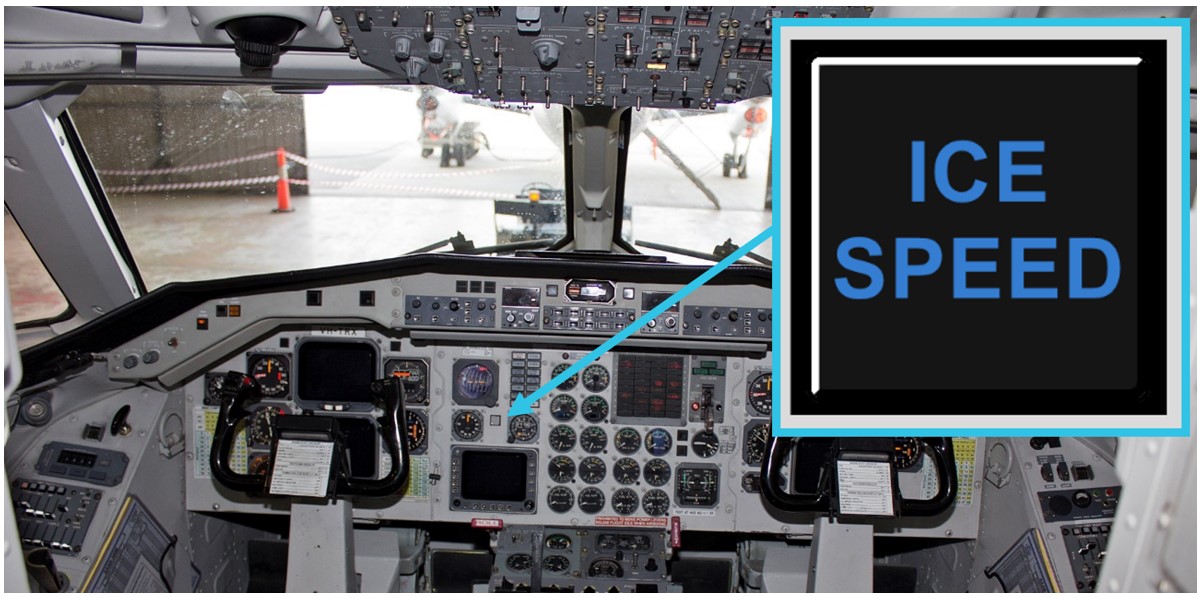
The system was activated by selecting either (or both) engine anti-ice systems on and was indicated by the illumination of a blue ICE SPEED push button on the instrument panel (Figure 3). Once activated, the ice speed system remained active even if the engine anti-ice system was subsequently selected off and needed to be deselected separately.
Figure 3: The flight deck of VH-TRX showing the ice speed system indicator
Source: Regional Express
The operator’s Flight Crew Operating Manual (FCOM) required that the ice speed system remain active for 5 minutes after leaving icing conditions or until the aircraft was free of ice, whichever occurred later. The manual also included the following caution:
Failing to increase reference speeds when the ice speed status light is illuminated reduces the margin to a stall warning indication. A stall warning may be triggered if the landing reference speed has not been corrected when the ice speed status light is illuminated.
Recovery from stall warning or stall
The FCOM for the SAAB 340 included the following procedure for recovery from a stall warning or stall:
The recommended procedure when recovering from a stall warning (stick shaker or natural buffeting) or stall in a clean or iced-up aircraft is to lower the nose approximately 5 degrees or as commanded by the stick pusher (if not restricted by proximity to ground), simultaneously apply Max power and if required roll the wings level.
This procedure also provided mandatory actions to be taken when a stall was identified:
In recovering from a low-level stall, or stall with gear or flap extended, apply standard go around procedures once a minimum of reference speed + 10 (+ 20 in icing) or stall/warning speed + 30kts is attained. Consider the possibility of a secondary stall.
The base calculated reference speed for the approach was 116 kt. As the ice speed system was active, 10 kt was required to be added to the reference speed to provide the adjusted reference speed of 126 kt to be used by the crew for the landing.
For the final approach, until the 300 ft stabilisation check height, the crew was required to maintain a speed between 10 kt above the adjusted reference speed (136 kt) and 160 kt.
Meteorology
The approach was conducted in visual meteorological conditions and moderate turbulence.
At 1500, 19 minutes before the incident, the Bureau of Meteorology automatic weather station at Merimbula Airport recorded the temperature as 15° Celsius and the wind as 2 kt from 257° magnetic. Cloud cover was recorded as scattered[8] at 5,808 ft above mean sea level (AMSL), broken at 6,708 ft AMSL and overcast at 8,308 ft AMSL. Visibility was recorded as greater than 10 km in light rain.
Table 1: Merimbula Airport recorded wind observations
Time
Wind direction
1 minute wind speed (kt)
1 minute wind gust (kt)
15:05
north-west
2.9
2.9
15:06
north-west
2.9
4.1
15:07
north-west
2.9
4.1
15:08
north-west
4.1
4.1
15:09
north-west
4.1
4.1
15:10
west-north-west
4.1
5.1
15:11
west-north-west
6.0
7.0
15:12
west
8.0
9.9
15:13
west
11.1
14.0
15:14
west
9.9
13.0
15:15
west
8.9
13.0
15:16
west
8.0
9.9
15:17
west
8.9
12.1
15:18
west-north-west
6.0
7.0
15:19
west-north-west
7.0
8.9
15:20
west-north-west
6.0
7.0
15:21
north-west
5.1
7.0
15:22
north-west
7.0
8.0
15:23
north-west
5.1
7.0
15:24
north-west
5.1
6.0
15:25
north-north-west
5.1
6.0
At 1530, 11 minutes after the incident, the temperature was recorded as 14° Celsius and the wind as 6 kt from 297° magnetic. Cloud cover was recorded as scattered at 3,308 ft AMSL, scattered at 5,608 ft AMSL and scattered at 7,008 ft AMSL. Visibility was recorded as greater than 10 km in light rain.
Recorded data
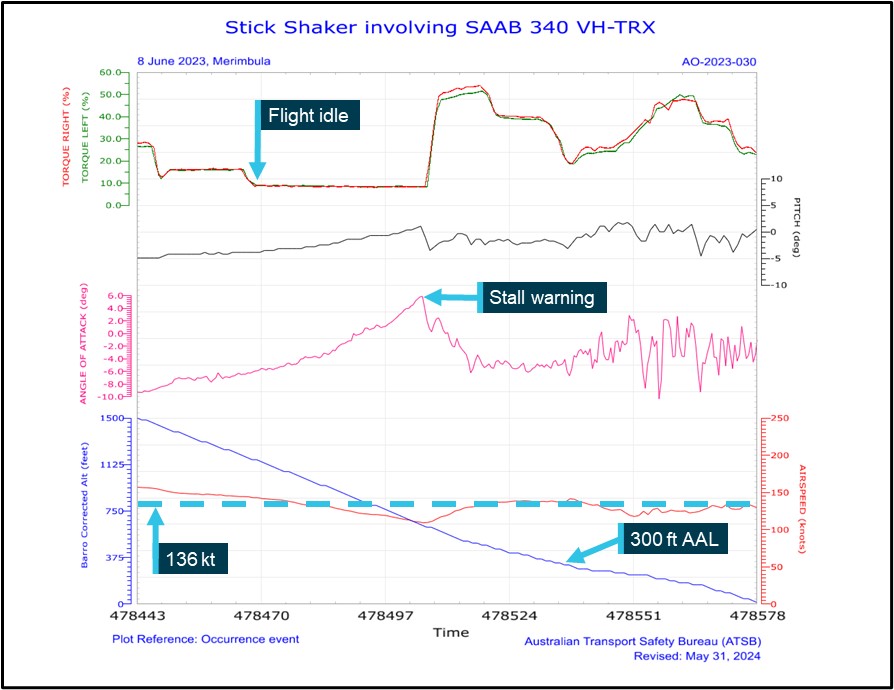
Analysis of flight data from VH-TRX’s flight data recorder showed that power was reduced to flight idle at 15:18:45, as the aircraft descended through 1,164 ft AMSL. Following the power reduction, the aircraft’s speed began reducing while the autopilot increased the aircraft pitch angle and wing AOA to maintain the selected descent rate. Nine seconds after the power reduction, speed reduced below 136 kt. A further 11 seconds later, speed reduced below 126 kt and 11 seconds after that, at 15:19:16, speed reduced below the base reference speed of 116 kt.
At 15:19:21, while descending though 636 ft AMSL and 34 seconds after power was reduced to flight idle, the speed slowed to 109 kt. The AOA increased to 5.9° and the stall warning activated for 1 second (Figure 4). At the same time the autopilot automatically disconnected.
Figure 4: Graphical representation of recorded flight data
Source: ATSB
Following the stall warning, the recorded angle of attack reduced by 5.6° within 2 seconds and power increased to about 50% torque within 4 seconds. At 15:19:35, 14 seconds after the stall warning, the speed increased above 136 kt and power began to be reduced to the normal approach power setting. The recorded data showed the descent rate reduced from the 830 ft per minute rate, recorded before the stall warning activation (with autopilot engaged), to about 450 ft per minute.
Audio data from the cockpit voice recorder was not available.
Decision to continue the approach
Following the stall warning activation, the first officer called for a missed approach to be conducted. The captain acknowledged the first officer’s call but elected to continue the approach.
The stall warning occurred when the aircraft was free of ice and at a height of 628 ft above the aerodrome elevation,[9] 328 ft above the stabilised approach check height of 300 ft AAL. The lowest speed recorded was 109 kt (27 kt below the minimum required speed), 21 kt above the calculated stall speed of 88 kt. Following the stall warning, the captain, acting as pilot flying, added sufficient power to increase speed above the minimum required for that phase of the approach.
The aircraft also descended below the required approach path. The captain recognised that the aircraft was low and commenced correcting it. As the aircraft descended below 300 ft AAL, it remained slightly below profile until regaining the approach path shortly after.
The actions defined in the operator’s FCOM procedure for recovery from a stall warning (see the section titled Recovery from stall warning or stall) were recommended and not mandatory. At low level, a missed approach was only mandatory in the case of an identified stall. Therefore, the captain’s actions did not contravene the operator’s procedures. Additionally, the operator’s procedures provided a mechanism for the first officer to escalate the situation if they disagreed with the captain’s decision to continue the approach.
The captain’s stated reason for the decision to continue was that the approach was restabilised, the runway and visual approach guidance system was visible, and a go-around would take the aircraft ‘back into the weather’. Therefore, the captain assessed that continuing the approach was the safest decision. The ATSB assessed that this decision was reasonable given the information available to the captain at the time and did not unduly increase risk to the flight.
Similar occurrences
In 2013, the ATSB research report Stall warnings in high capacity aircraft: The Australian context 2008 to 2012 identified that 245 stall warnings in high capacity aircraft had been reported between 2008 and 2012 in Australia. Almost all of those were low risk events of momentary duration and were responded to promptly and effectively by the flight crew to maintain control of the aircraft. However, there were also several higher risk incidents where stick shaker activation occurred on approach to land when aircraft were in a low speed, high AOA configuration. In these cases, the risk of a stall developing was increased by a lack of awareness of decreasing airspeed and increasing AOA prior to the stall warning, probably due to increased flight crew workload during this phase of flight. None of the reported occurrences resulted in an actual stall.
Safety analysis
During the descent and prior to the approach, the aircraft descended through icing conditions and the crew activated the engine anti-ice system. This also activated the ice speed system, which reduced the stall warning angle of attack activation angle. The approach was then commenced within 5 minutes of leaving icing conditions. Therefore, the ice speed system was still active as the approach commenced (as per the operator’s procedure). However, by the time of the occurrence the aircraft was operating in clear conditions and an ambient temperature well above freezing and there was no ice on the aircraft. This meant that the stick shaker/aural warning associated with an approaching stall was set to activate at an AOA of only 6° rather than the normal trigger AOA of 12.5°. That is, at a greater airspeed margin than normal above an actual (ice free) stall.
As the approach continued in turbulent conditions with the autopilot engaged, the captain, concerned that the turbulence may lead to an inadvertent exceedance of the flap limit speed, reduced power to flight idle and the aircraft speed started reducing. Due to the selected autopilot mode, the reduced thrust led to the aircraft pitch angle and wing angle of attack being automatically increased to maintain the selected descent rate. Significantly, this resulted in a further ongoing speed reduction that required pilot intervention to prevent activation of the stall warning system. While the power was selected to flight idle, the aircraft entered a rain shower and turbulence, likely associated with a gust front that was recorded passing over Merimbula Airport at about that time. At about that time, the captain asked the first officer to turn on the windscreen wipers followed by a brief discussion about the desired wiper setting.
The windscreen wiper setting discussion and subsequent minor delay in enacting the request possibly distracted the crew from effectively monitoring the airspeed and they did not identify that the speed had reduced significantly below the 136 kt minimum speed for that segment of the approach. This deceleration continued until the speed reduced to 109 kt and the stall warning system activated at the reduced ice speed system angle of attack.
The crew responded by recovering the aircraft, continuing the approach and landed the aircraft without further incident.
Findings
ATSB investigation report findings focus on safety factors (that is, events and conditions that increase risk). Safety factors include ‘contributing factors’ and ‘other factors that increased risk’ (that is, factors that did not meet the definition of a contributing factor for this occurrence but were still considered important to include in the report for the purpose of increasing awareness and enhancing safety). In addition ‘other findings’ may be included to provide important information about topics other than safety factors.
These findings should not be read as apportioning blame or liability to any particular organisation or individual.
From the evidence available, the following findings are made with respect to the stall warning activation involving a Saab 340, VH-TRX, 5 km north of Merimbula Airport, New South Wales on 8 June 2023.
Due possibly to distraction associated with the windscreen wiper setting, the airspeed continued to reduce undetected by the crew until the stall warning activated at a higher‑than‑normal margin above the stall speed.
Sources and submissions
Sources of information
The sources of information during the investigation included:
Regional Express
the flight crew
Bureau of Meteorology
recorded flight data from VH-TRX.
References
ATSB aviation research investigation report AR-2012-172, Stall warning in high capacity aircraft: The Australian context, Australia.
Submissions
Under section 26 of the Transport Safety Investigation Act 2003, the ATSB may provide a draft report, on a confidential basis, to any person whom the ATSB considers appropriate. That section allows a person receiving a draft report to make submissions to the ATSB about the draft report.
A draft of this report was provided to the following directly involved parties:
Regional Express
the flight crew
Civil Aviation Safety Authority.
Submissions were received from:
Regional Express
the captain.
The submissions were reviewed and, where considered appropriate, the text of the report was amended accordingly.
Purpose of safety investigations
The objective of a safety investigation is to enhance transport safety. This is done through:
identifying safety issues and facilitating safety action to address those issues
providing information about occurrences and their associated safety factors to facilitate learning within the transport industry.
It is not a function of the ATSB to apportion blame or provide a means for determining liability. At the same time, an investigation report must include factual material of sufficient weight to support the analysis and findings. At all times the ATSB endeavours to balance the use of material that could imply adverse comment with the need to properly explain what happened, and why, in a fair and unbiased manner. The ATSB does not investigate for the purpose of taking administrative, regulatory or criminal action.
Terminology
An explanation of terminology used in ATSB investigation reports is available here. This includes terms such as occurrence, contributing factor, other factor that increased risk, and safety issue.
Publishing information
Released in accordance with section 25 of the Transport Safety Investigation Act 2003
Ownership of intellectual property rights in this publication
Unless otherwise noted, copyright (and any other intellectual property rights, if any) in this report publication is owned by the Commonwealth of Australia.
Creative Commons licence
With the exception of the Coat of Arms, ATSB logo, and photos and graphics in which a third party holds copyright, this publication is licensed under a Creative Commons Attribution 3.0 Australia licence.
Creative Commons Attribution 3.0 Australia Licence is a standard form licence agreement that allows you to copy, distribute, transmit and adapt this publication provided that you attribute the work.
The ATSB’s preference is that you attribute this publication (and any material sourced from it) using the following wording: Source: Australian Transport Safety Bureau
Copyright in material obtained from other agencies, private individuals or organisations, belongs to those agencies, individuals or organisations. Where you wish to use their material, you will need to contact them directly.
[1]The flight was operated under Civil Aviation Safety Regulations Part 121 (Air transport operations - larger aeroplanes).
[2]Pilot Flying (PF) and Pilot Monitoring (PM): procedurally assigned roles with specifically assigned duties at specific stages of a flight. The PF does most of the flying, except in defined circumstances; such as planning for descent, approach and landing. The PM carries out support duties and monitors the PF’s actions and the aircraft’s flight path.
[3]Flight level: at altitudes above 10,000 ft in Australia, an aircraft’s height above mean sea level is referred to as a flight level (FL). FL 180 equates to 18,000 ft.
[4]Angle of attack is the relative angle between the chord line of the wing and the approaching airflow.
[5]All further reference to ‘speed’ should be read as airspeed.
[6]In the vertical speed mode, the autopilot adjusted the pitch of the aircraft to maintain a selected vertical speed.
[7]Runway 21 at Merimbula was equipped with a precision approach path indicator (PAPI) lighting system.
[8]Cloud cover: in aviation, cloud cover is reported using words that denote the extent of the cover – ‘scattered’ indicates that cloud is covering between a quarter and a half of the sky, ‘broken’ indicates that more than half to almost all the sky is covered, and ‘overcast’ indicates that all the sky is covered.
[9]The threshold elevation of runway 21 at Merimbula was 8 ft.
Occurrence summary
Investigation number
AO-2023-030
Occurrence date
08/06/2023
Location
5 km north of Merimbula Airport
State
New South Wales
Report release date
14/08/2024
Report status
Final
Investigation level
Short
Investigation type
Occurrence Investigation
Investigation status
Completed
Mode of transport
Aviation
Aviation occurrence category
Stall warning
Occurrence class
Incident
Highest injury level
None
Aircraft details
Manufacturer
Saab Aircraft Co.
Model
340B
Registration
VH-TRX
Serial number
340B-287
Aircraft operator
Regional Express Pty Ltd (Rex)
Sector
Turboprop
Operation type
Part 121 Air transport operations - larger aeroplanes
On the afternoon of 6 July 2021, a Saab 340B aircraft, registered VH-ZLJ, departed Perth Airport for a scheduled passenger flight to Albany, Western Australia, with two flight crew, one cabin crew, and 16 passengers on board.
At about 1623, while climbing through an altitude of 6,000 ft, and before entering icing conditions, the crew activated the engine anti-ice and wing de-ice systems. Shortly afterwards, caution lights illuminated indicating a fault in the de-ice system. After levelling off at 7,000 ft, the crew actioned the relevant abnormal checklist, but the caution lights remained on. In response, the flight crew requested a descent to 5,000 ft to exit icing conditions and decided to return to Perth.
During the descent, the captain handed over control of the aircraft as pilot flying to the first officer. Over the next 2.5 minutes, air traffic control (ATC) communicated with the flight crew on multiple occasions, issuing a series of vectors and requesting flight information. As the aircraft was levelling off at 5,000 ft under autopilot control, ATC instructed the crew to make a right turn. About 20 seconds after beginning the turn, the aircraft’s aerodynamic stall warning stick shakers activated. The first officer initiated the stall recovery procedure before the captain took control as pilot flying to complete the recovery. The aircraft returned to Perth, landing at 1642.
What the ATSB found
The ATSB found that the aircraft’s right wing inboard de-ice boot probably delaminated shortly before encountering icing conditions, triggering the de-ice system fault that led to the flight crew’s decision to return to Perth.
During the return, the pilot flying became task saturated due to high workload and did not notice the aircraft’s reducing airspeed, which was also missed by the pilot monitoring due to a focus on other tasks until the stick shaker activated. The crew managed the recovery from the potential stall condition effectively and the aircraft returned safely to Perth.
What has been done as a result
The aircraft operator has amended flight crew training simulator sessions and related training material to include flight at minimum manoeuvring speeds – minimum airspeeds that provide a margin above a stall during aircraft manoeuvring.
Safety message
This stick shaker activation incident highlights that during periods of high workload, where there is an increased chance of making mistakes or errors, flight crews should prioritise monitoring critical flight parameters. Effective communication can help flight crew recognise a situation when their workload is becoming overwhelming, and consequently better manage the situation – for instance, giving themselves more time to complete the required tasks by discontinuing an approach, or deferring air traffic control requests appropriately.
The investigation
Decisions regarding whether to conduct an investigation, and the scope of an investigation, are based on many factors, including the level of safety benefit likely to be obtained from an investigation. For this occurrence, a limited-scope investigation was conducted in order to produce a short investigation report, and allow for greater industry awareness of findings that affect safety and potential learning opportunities.
The occurrence
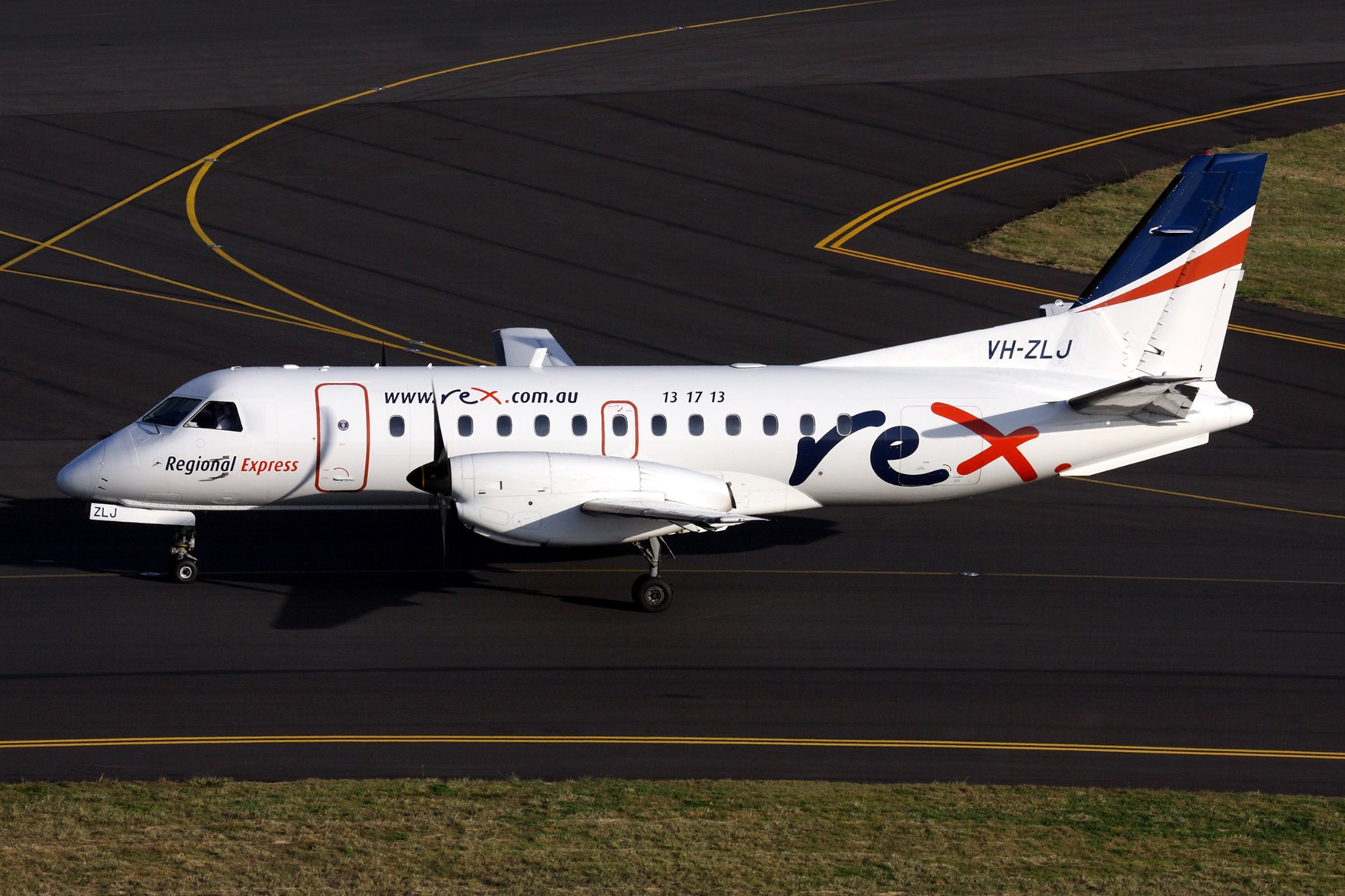
At 1619 Western Standard Time[1] on 6 July 2021, a Saab 340B aircraft, registered VH-ZLJ (Figure 1) and operated by Regional Express, departed Perth Airport for a scheduled passenger flight to Albany, Western Australia, carrying 16 passengers. The crew comprised the captain (pilot flying),[2] the first officer (pilot monitoring) and one cabin crewmember.
Figure 1: VH-ZLJ
Source: Supplied
At about 1623, the aircraft was climbing through 6,000 ft above mean sea level (AMSL) with the autopilot engaged. Consistent with operator procedures, the flight crew activated the engine anti‑ice and wing de-ice systems as the aircraft was entering icing conditions. Shortly afterwards, an ice protection master caution light, and TIMER light illuminated, indicating a fault in the de-ice system (see the section titled Airframe de-ice system). Soon after, the flight crew requested, and received, a clearance from air traffic control (ATC) to level off at 7,000 ft to avoid icing conditions. They then began actioning the TIMER light on abnormal checklist.
At 1629 the flight crew requested, and received, a diversion from ATC to avoid storm cells. Despite the crew actioning the checklist, the TIMER light remained on during the wing inboard de‑ice boot cycle, so at 1630 they commenced a descent to 5,000 ft to exit icing conditions. Shortly afterwards, the crew notified ATC that they would return to Perth.
During the subsequent descent, the captain handed over control of the aircraft as pilot flying to the first officer. Over the next 2.5 minutes, ATC communicated with the flight crew on eight separate occasions, issuing a series of radar vectors and flight information requests. At about 1632, the aircraft was levelling off at 5,000 ft with the autopilot engaged when ATC instructed the crew to make a right turn. About 20 seconds after beginning the turn, the aircraft’s aerodynamic stall warning stick shakers activated (see the section titled Stall warning system). The first officer initiated the stall recovery procedure before the captain took control as pilot flying to complete the recovery.
The aircraft returned to Perth without further incident, landing at 1642.
Context
Flight crew
The captain held an Air Transport Pilot Licence (Aeroplane), and had 4,695 hours of flying experience, of which over 4,474 hours were on the Saab 340B. The captain made the following comments and observations about the incident.
The decision to return to Perth was based on the de‑ice system fault indication, the low freezing level along the route and no engineering support at the destination (Albany).
As pilot monitoring during the descent from 7,000 ft to 5,000 ft, the captain notified the operator and communicated with the cabin crew and passengers regarding preparation for the return to Perth.
During the descent their workload was relatively high, but the captain recalled feeling comfortable handling it at the time. However, in hindsight the captain felt that they did not monitor the first officer appropriately or focus enough attention on the aircraft’s airspeed and engine power levels.
The first officer held a Commercial Pilot Licence (Aeroplane), and had 605 hours of flying experience, of which over 386 hours were on the Saab 340B. The first officer made the following comments and observations about the incident.
After taking over as pilot flying, the first officer became overly focussed on complying with ATC clearances since:
the captain was occupied and not available to perform standard clearance cross-checks
they were aware of previous instances of flight crew’s deviating from clearances because only one pilot had acknowledged them.
The focus on ATC clearances, in combination with managing related communications, caused the first officer to feel ‘task saturated’[3] and that the workload was ‘very high’.
The first officer believed that the task saturation resulted in their instrument scan breaking down and not paying sufficient attention to the airspeed and engine power settings.
The flight crew could have better managed the workload by giving themselves more time to complete tasks.
The ATSB found no evidence to indicate either flight crew were experiencing a level of fatigue known to affect performance.
Meteorological information
The relevant graphical area forecast indicated a freezing level of about 8,000 ft at Perth, reducing to about 6,000 ft at Albany. Moderate showers with broken[4] cloud from 2,500 ft to above 10,000 ft, severe icing above 6,000 ft, and moderate turbulence below 7,000 ft were also forecast.
The flight crew reported rain and storm cells in the Perth Airport area and encountered occasional cloud at 7,000 ft, where the outside air temperature was 4° C (icing conditions).
Airframe de-ice system
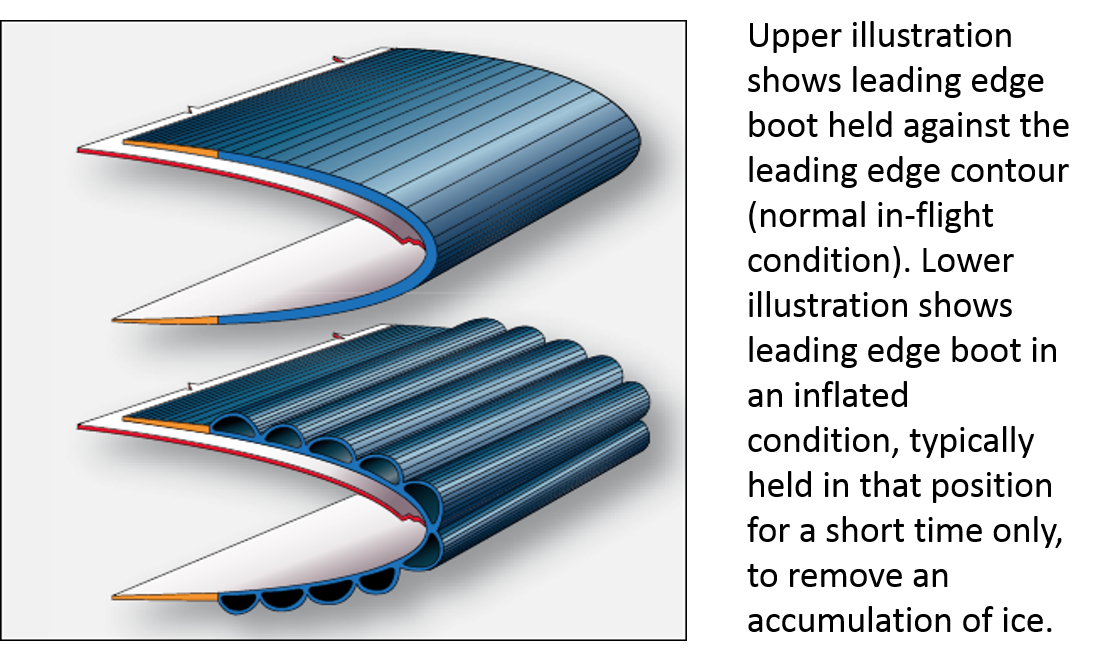
The aircraft’s airframe de-icing system consisted of inflatable boots, located on the leading edges of the vertical and horizontal stabiliser, and the inboard and outboard section of the wings. The boots were rapidly inflated, using engine bleed air, to crack any accumulated ice and then deflated. A timer control unit regulated the boot inflation cycles in a sequence – stabiliser, outboard wing, and then inboard wing. Sensors monitored the boot cycles, and a TIMER light would illuminate together with an ice protection master caution light if a fault was detected with the de‑ice system.
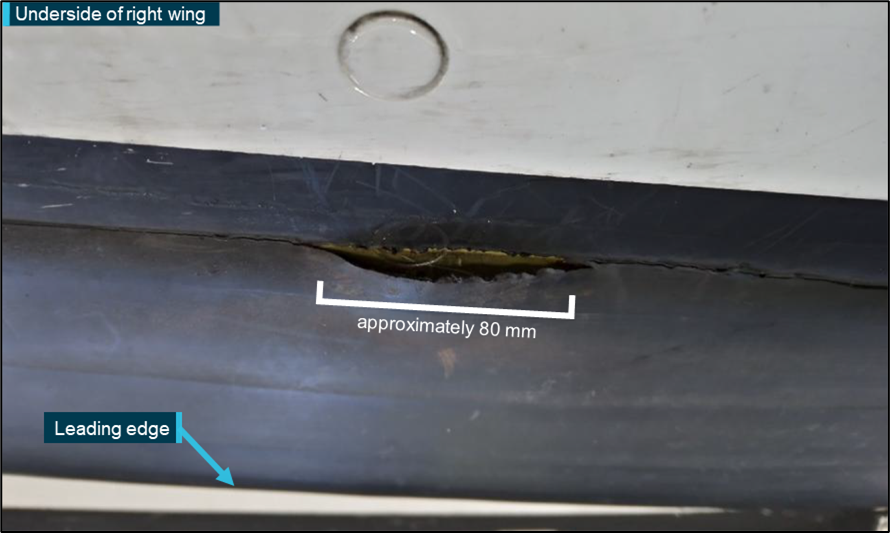
Post-flight examination of the de-ice system revealed a delamination in the right wing inboard de‑ice boot on the underside of the wing (Figure 2). The aircraft operator stated that this was probably caused by an internal stitching failure, resulting in the loss of system pressure. The boot was replaced and the de-ice system was subsequently tested serviceable. The ATSB reviewed the aircraft’s maintenance history related to the de-ice system and found it compliant with the required maintenance.
Figure 2: Right wing inboard boot delamination
Source: Operator, annotated by ATSB
Stall warning system
The stall warning and identification system fitted to the Saab 340B included:
two independent stall warning computers
two angle of attack (AOA) sensors – one mounted on each side of the fuselage
stick shaker device on each control column that provided a physical warning of an impending aerodynamic stall in the form of vibrations and aural clacker sound when activated
stick pusher device that applied forward force to the control column to reduce aircraft AOA when a stall condition was identified.
The AOA activation level for the aircraft’s stall warning system was dependent on flap position, engine anti-ice operation, and airframe de-ice operation. Flight in icing conditions required the operation of engine anti-ice and boot de-ice systems. Accumulation of ice and/or operation of the wing boot de-ice system alters the stall characteristics of the wings. This was compensated for by the stall warning system activating the stick shaker at a lower AOA (earlier) when the aircraft was configured for flight in icing conditions. The stick pusher AOA activation was unchanged. There was no indication in the cockpit of the AOA, but if an AOA sensor activation level was exceeded, the stick shaker and aural clackers activated, and the autopilot (if engaged) disengaged. If the AOA sensor values increased further, the stick pusher was activated.
Post-flight testing revealed that the left AOA sensor triggered the stall warning systems about 1 or 2° earlier than the specified parameters. The left AOA sensor was replaced, and the stall warning system was successfully tested. The ATSB identified that the aircraft’s maintenance history related to the stall warning system was compliant with the required maintenance.
Recorded data
Data from the aircraft’s flight data recorder was downloaded, but the aircraft manufacturer identified that some data parameters (AOA and elevator angle) had been corrupted.
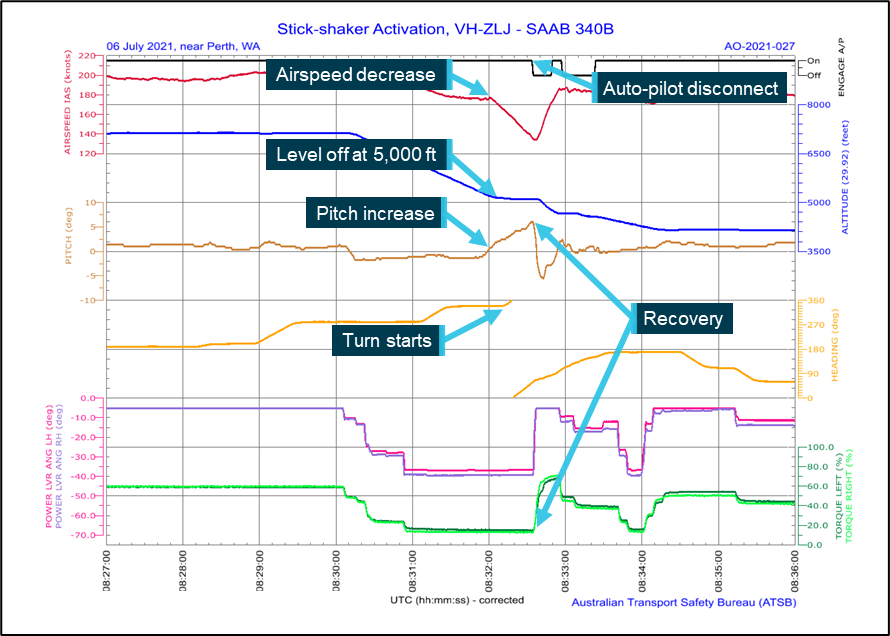
Figure 3 shows verified flight data for certain recorded parameters at the time of the incident. The data shows that during level flight at 7,000 ft, engine power was at about 60% torque. During the descent to 5,000 ft, engine power was reduced by the flight crew to about 15% torque. After levelling off at 5,000 ft, engine power remained at that level, however the aircraft’s pitch angle increased, while the airspeed decreased. The pitch increase and airspeed reduction continued after the turn was commenced. About 20 seconds later, the autopilot disconnected, and the flight crew initiated the stall recovery.[5] Altitude lost during recovery was about 450 ft.
The investigation could not determine which AOA sensor triggered the stick shaker, but the flight data was consistent with the aircraft approaching a stalled condition, so the early triggering of the left AOA sensor did not affect the outcome.
Figure 3: VH-ZLJ flight data
Source: ATSB
Similar occurrences
In 2013, an ATSB research report[6] identified that 245 stall warnings in high capacity aircraft had been reported between 2008 and 2012 in Australia. Almost all of those were low risk events of momentary duration and were responded to promptly and effectively by the flight crew to maintain control of the aircraft. However, there were also several higher risk incidents where stick shaker activation occurred on approach to land when aircraft were in a low speed, high AOA configuration. In these cases, the risk of a stall developing was increased by a lack of awareness of decreasing airspeed and increasing AOA prior to the stall warning, probably due to increased flight crew workload during this phase of flight. None of the reported occurrences resulted in an actual stall.
Safety analysis
Shortly after the aircraft departed Perth, the flight crew received cockpit indications of a de-ice system fault. The fault was probably triggered by a delaminated de-ice boot on the underside of the right wing that failed during its inflation cycle shortly before encountering icing conditions. With a low freezing level and forecast icing conditions along the planned route, the de-ice fault indication led to the flight crew’s decision to return to Perth.
While manoeuvring towards Perth, engine power was reduced to descend the aircraft from 7,000 ft to 5,000 ft. However, when the aircraft levelled off at 5,000 ft, engine power was not increased. Consequently, as the airspeed reduced due to the low engine power, the autopilot maintained the selected altitude (5,000 ft) by pitching the nose up, increasing the AOA and reducing the airspeed further. This condition went unnoticed until one of the AOA sensors reached the level required for stick shaker activation.
The first officer, the pilot flying in the time leading up to the stick shaker activation, probably became task saturated while managing flying tasks (changing flight state to descend, level flight and turn) as well as communicating with, and following ATC instructions. This task saturation reduced the attention that the first officer paid to managing the airspeed and engine power. At that time, the captain (pilot monitoring) was also not monitoring these key parameters due to a focus on other communication tasks related to the return to Perth. The crew’s reduced awareness of airspeed resulted in the potential stall going unnoticed until the stick shaker activated.
In addition, during that rapid sequence of events, neither pilot recognised the first officer’s high workload and task saturation. Consequently, no attempt was made to alleviate the situation, for example by discontinuing the approach or deferring ATC requests for information until the aircraft was straight and level. Such actions would have provided additional time and opportunity for the crew to refocus on flight instruments and key parameters.
Findings
ATSB investigation report findings focus on safety factors (that is, events and conditions that increase risk). Safety factors include ‘contributing factors’ and ‘other factors that increased risk’ (that is, factors that did not meet the definition of a contributing factor for this occurrence but were still considered important to include in the report for the purpose of increasing awareness and enhancing safety). In addition ‘other findings’ may be included to provide important information about topics other than safety factors.
These findings should not be read as apportioning blame or liability to any particular organisation or individual.
From the evidence available, the following findings are made with respect to the stick shaker activation involving Saab 340B, VH-ZLJ, 30 km south-west of Perth Airport, Western Australia on 6 July 2021.
Contributing factors
The aircraft’s right wing inboard de-ice boot probably delaminated shortly before encountering icing conditions, triggering the de-ice system fault that led to the flight crew’s decision to return to Perth.
The pilot flying became task saturated due to high workload and did not notice the reducing airspeed, which was also missed by the pilot monitoring due to a focus on other tasks until the stick shaker activated.
Safety actions
Whether or not the ATSB identifies safety issues in the course of an investigation, relevant organisations may proactively initiate safety action in order to reduce their safety risk. The ATSB has been advised of the following proactive safety action in response to this occurrence.
Safety action by Regional Express
Regional Express has amended flight crew training simulator sessions and related training material to include flight at minimum manoeuvring speeds – minimum airspeeds that provide a margin above a stall during aircraft manoeuvring.
Note: Saab advised the ATSB that it intended to follow-up with Regional Express to obtain further details on the out of limits AOA vane and the delaminated de-ice boot.
Sources and submissions
Sources of information
The sources of information during the investigation included:
the flight crew
Regional Express
Saab
Airservices Australia
Bureau of Meteorology.
References
ATSB aviation research investigation report AR-2012-172, Stall warning in high capacity aircraft: The Australian context, Australia.
Submissions
Under section 26 of the Transport Safety Investigation Act 2003, the ATSB may provide a draft report, on a confidential basis, to any person whom the ATSB considers appropriate. That section allows a person receiving a draft report to make submissions to the ATSB about the draft report.
A draft of this report was provided to the following directly involved parties:
Regional Express, including flight crew
Saab
Civil Aviation Safety Authority
Airservices Australia.
Submissions were received from Regional Express, and the flight crew. The submissions were reviewed and, where considered appropriate, the text of the report was amended accordingly.
Purpose of safety investigations
The objective of a safety investigation is to enhance transport safety. This is done through:
identifying safety issues and facilitating safety action to address those issues
providing information about occurrences and their associated safety factors to facilitate learning within the transport industry.
It is not a function of the ATSB to apportion blame or provide a means for determining liability. At the same time, an investigation report must include factual material of sufficient weight to support the analysis and findings. At all times the ATSB endeavours to balance the use of material that could imply adverse comment with the need to properly explain what happened, and why, in a fair and unbiased manner. The ATSB does not investigate for the purpose of taking administrative, regulatory or criminal action.
Terminology
An explanation of terminology used in ATSB investigation reports is available here. This includes terms such as occurrence, contributing factor, other factor that increased risk, and safety issue.
Publishing information
Released in accordance with section 25 of the Transport Safety Investigation Act 2003
Ownership of intellectual property rights in this publication
Unless otherwise noted, copyright (and any other intellectual property rights, if any) in this report publication is owned by the Commonwealth of Australia.
Creative Commons licence
With the exception of the Coat of Arms, ATSB logo, and photos and graphics in which a third party holds copyright, this publication is licensed under a Creative Commons Attribution 3.0 Australia licence.
Creative Commons Attribution 3.0 Australia Licence is a standard form licence agreement that allows you to copy, distribute, transmit and adapt this publication provided that you attribute the work.
The ATSB’s preference is that you attribute this publication (and any material sourced from it) using the following wording: Source: Australian Transport Safety Bureau
Copyright in material obtained from other agencies, private individuals or organisations, belongs to those agencies, individuals or organisations. Where you wish to use their material, you will need to contact them directly.
On 7 April 2017, a Qantas Airways Boeing 747-438, registered VH-OJU, was operated as scheduled passenger flight QF29 from Melbourne, Victoria, to Hong Kong International Airport, in the Hong Kong Special Administrative Region of the People's Republic of China. On board were 17 crew and 347 passengers.
While descending toward Hong Kong International Airport, air traffic control instructed the flight crew to hold at waypoint BETTY.
When entering the holding pattern, the aircraft’s aerodynamic stall warning stick shaker activated a number of times and the aircraft experienced multiple oscillations of pitch angle and vertical acceleration. During the upset, passengers and cabin crewmembers struck the cabin ceiling and furnishings.
A lavatory smoke alarm later activated, however, the cabin crew determined the smoke alarm to be false and silenced the alarm. The aircraft landed at Hong Kong International Airport without further incident. Four cabin crewmembers and two passengers suffered minor injuries during the incident and the aircraft cabin sustained minor damage.
What the ATSB found
The ATSB found that while planning for the descent, the flight crew overwrote the flight management computer provided hold speed. After receiving a higher than expected hold level, the flight crew did not identify the need to re-evaluate the hold speed. This was likely because they were not aware of a need to do so, nor were they aware that there was a higher hold speed requirement above FL 200. Prior to entering the hold, the speed reduced below both the selected and minimum manoeuvring speeds. The crew did not identify the low speed as their focus was on other operational matters.
The ATSB also found that due to a desire to remain within the holding pattern and a concern regarding the pitch up moment of a large engine power increase, the pilot flying attempted to arrest the rate of descent prior to completing the approach to stall actions. In addition, the pilot monitoring did not identify and call out the incomplete actions. This resulted in further stall warning stick shaker activations and pilot induced oscillations that resulted in minor injuries to cabin crewmembers and passengers.
Additionally, the operator provided limited guidance for hold speed calculation and stall recovery techniques at high altitudes or with engine power above idle. This in turn limited the ability of crew to retain the necessary manual handling skills for the recovery.
What’s been done
In response to the occurrence, the operator updated flight crew training lesson plans and commenced retraining of flight crew in more complex stall recovery events. The operator also amended the Boeing 747-400, 787 and 737 flight crew training manuals and updated flight crew ground school lesson plans to ensure standardisation of training.
Safety message
Balancing competing attention or decision demands can interrupt trained flight crew responses leading to procedures not being completed in full, particularly so if flight crews are not receiving comprehensive and regular training in the application of these skills.
Comprehensive theory and practical training can ensure that flight crews have a complete understanding of aircraft systems and maintain effective manual handling skills. This training should provide flight crew with the knowledge to correctly configure the aircraft’s automatic flight systems and manual handling skills to respond adequately to in-flight upsets.
Safety issues and actions
The safety issue identified during this investigation is listed in the Findings and Safety issues and actions sections of this report. The ATSB expects that all safety issues identified by the investigation should be addressed by the relevant organisation(s). In addressing those issues, the ATSB prefers to encourage relevant organisation(s) to proactively initiate safety action, rather than to issue formal safety recommendations or safety advisory notices.
All of the directly involved parties were provided with a draft report and invited to provide submissions. As part of that process, each organisation was asked to communicate what safety actions, if any, they had carried out or were planning to carry out in relation to each safety issue relevant to their organisation.
Descriptions of each safety issue, and any associated safety recommendations, are detailed below. Click the link to read the full safety issue description, including the issue status and any safety action/s taken. Safety issues and actions are updated on this website when safety issue owners provide further information concerning the implementation of safety action.
Safety issue description: The operator provided flight crew with limited training and guidance in stall prevention and recovery techniques at high altitudes or with engine power above idle.
Re-evaluating hold speeds for a change in altitude
Safety issue description: The operator provided flight crew with limited training and guidance relating to the need for crew to re-evaluate their holding speed for a change in altitude (specifically above flight level 200).
Proactive safety action
The operator reviewed the training and guidance provided to other Boeing aircraft types in its fleet, the 787 and 737, and made the following changes:
Training and guidance
The operator amended recurrent lesson plans for the 787 and 737 fleets to incorporate more complex stall warning recovery events. The operator also updated lesson plans and distributed educational material to all flight crews.
The operator amended the 787 and 737 flight crew training manuals relating to hold speed selection to provide enhanced holding pattern information to flight crew. They also updated ground school lesson plans and information to ensure standardised flight crew training and ensure holding pattern training was adequately addressed during flight crew training.
The occurrence
On 7 April 2017, a Qantas Airways Boeing 747-438, registered VH-OJU, operated as scheduled passenger flight QF29 from Melbourne, Victoria, to Hong Kong International Airport, in the Hong Kong Special Administrative Region of the People's Republic of China. On board were 17 crew and 347 passengers. The captain operated as pilot flying and the first officer as pilot monitoring.[1]
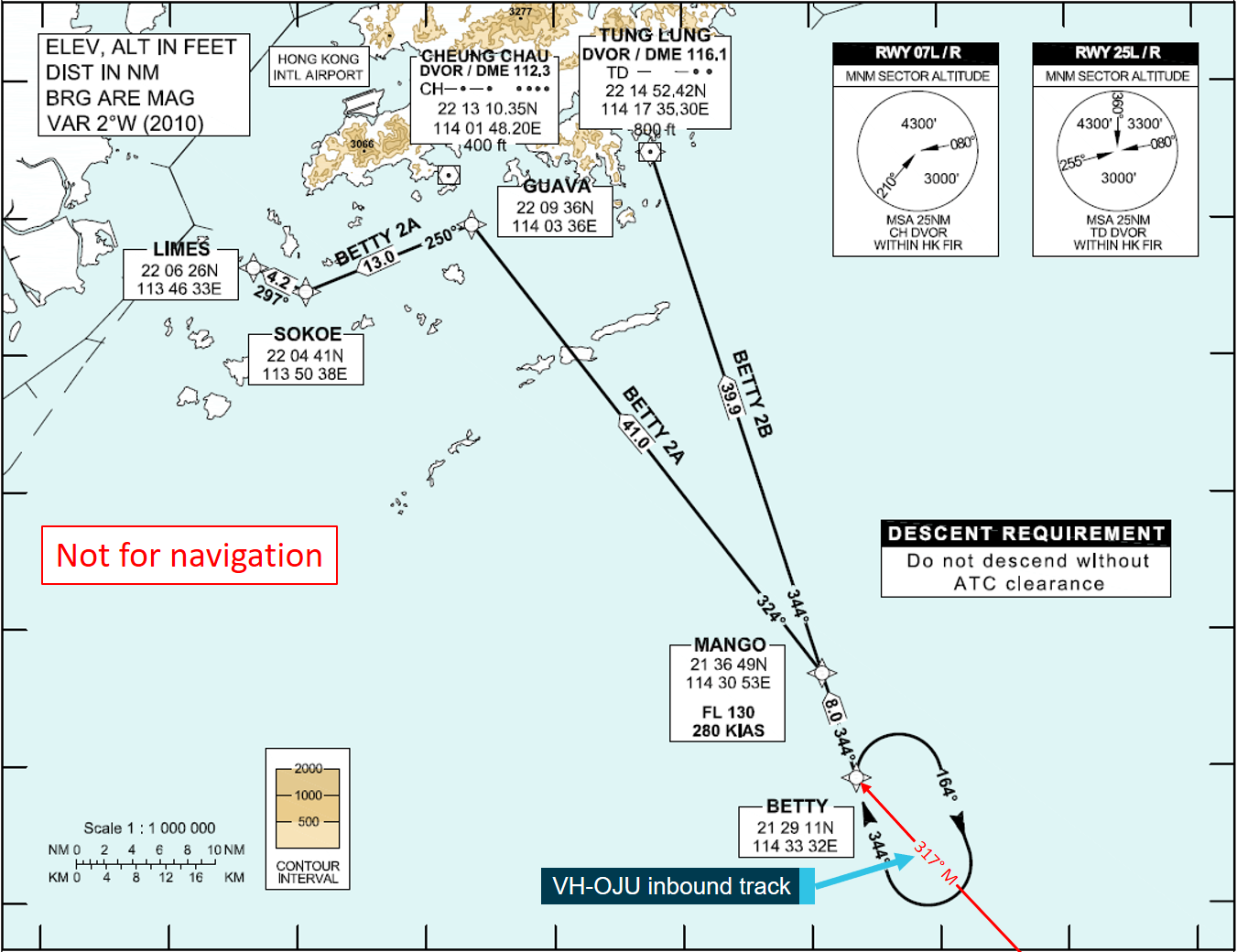
At about 1745 Hong Kong Time (HKT),[2] in daylight, the aircraft descended toward waypoint[3] BETTY (Figure 1) with the autopilot engaged in lateral navigation (LNAV) and vertical navigation (VNAV) modes,[4] and the autothrottle engaged. As the aircraft descended from flight level (FL) 300,[5] the customer service manager (CSM) (following direction from the flight crew) advised the passengers to prepare for landing and fasten seatbelts, however, at this time, the fasten seatbelt sign was not illuminated.
Figure 1: BETTY 2A standard arrival route chart extract
The figure shows the position of the BETTY hold along with the inbound track of VH-OJU. Source: Hong Kong CAD, annotated by ATSB
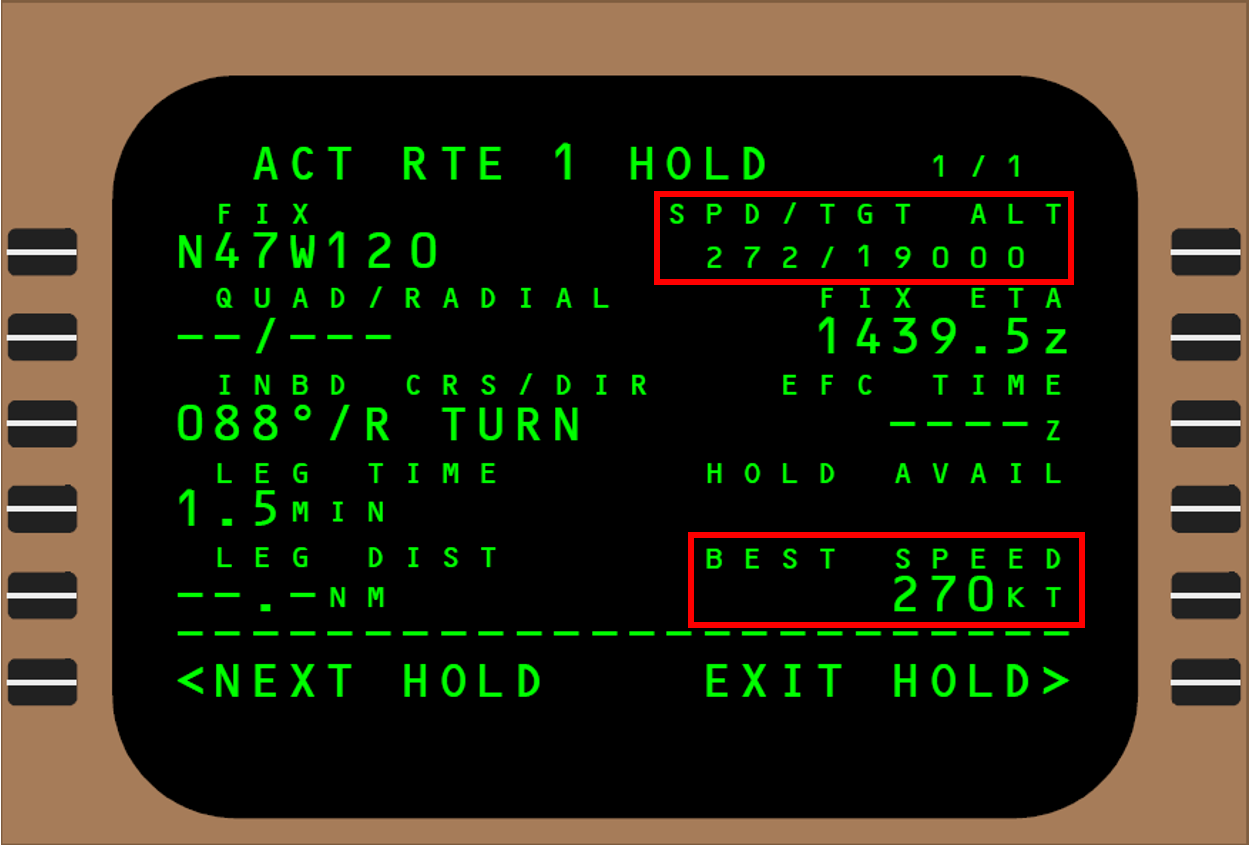
The flight crew anticipated that air traffic control (ATC) would direct them to hold at waypoint BETTY, at about FL 150 to FL 160, and they used the aircraft flight management computer (FMC) to plan for the hold. The FMC provided a calculated target hold speed (Figure 2) of 223 kt at FL156, which was the FMC-calculated crossing level at waypoint BETTY. The crew verified this calculated speed by comparing it to the flaps-up manoeuvring speed (see Hold speed below) using a heuristic of adding 80 kt to the flaps-30 landing reference speed of 143 kt, resulting in 223 kt.[6] The captain asked the first officer to input 225 kt above FL 150 as the target hold speed.
Figure 2: Example of the FMC route hold page with the target speed and the best speed highlighted
The FMC route hold page, showing the best speed indication (representative and not indicating incident data). Source: Operator, annotated by ATSB
Prior to crossing BETTY, ATC descended the aircraft from FL 300 in steps. This positioned the aircraft above the planned descent profile. As the aircraft approached BETTY at FL 230, ATC instructed the flight crew to descend to FL 220 and hold at BETTY. The flight crew then entered 22,000 ft in the autopilot altitude selection window, which directed the FMC VNAV function to level at FL 220. However, the flight crew did not adjust the target hold speed in alignment with the higher-than-expected hold level. The flight crew later reported that they were not aware of a higher speed requirement for holding above FL 200.
At this time, service in the aircraft’s forward cabin had been completed. The CSM, along with other cabin crewmembers from the forward sections, moved towards the rear of the aircraft to assist with preparing the rear cabin for landing. This led to more cabin crewmembers than normal being in the rear cabin.
While descending towards BETTY, the aircraft’s speed reduced below both the target speed of 225 kt and the minimum manoeuvring speed, which was indicated on the pilot’s flight display (PFD) as the top of an amber band (see Figure 5 in Operational information below).
At this time, the captain was reviewing the Hong Kong approach documentation and the first officer was looking out to the right of the aircraft in an attempt to identify aircraft traffic in the vicinity of the holding pattern. As a result, the captain and first officer did not identify the reducing speed. The second officer later reported observing the speed reducing close to, but not below, the selected speed of 225 kt.
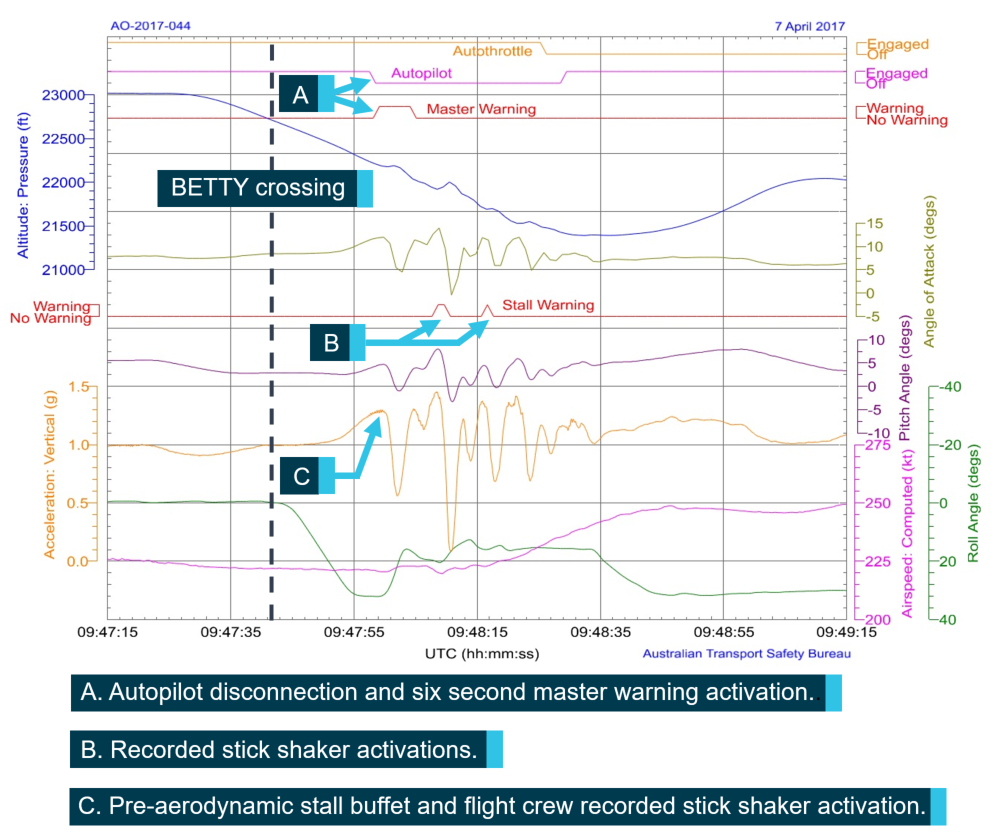
At 1747:42, the flight data showed that the aircraft crossed BETTY at a speed of 222 kt, while descending through FL 227, with engine power at idle. The aircraft then began a right turn to enter the holding pattern. While still turning, the aircraft descended through FL 222 and the pitch angle[7] began to increase as the autopilot prepared to level the aircraft at FL 220. Three seconds later, at 1747:59, the aircraft’s bank angle increased to a maximum of 32 degrees, its speed reduced to 220 kt and the aircraft began experiencing pre-aerodynamic stall buffeting.[8] The flight crew reported the stick shaker also activated, although the recorded flight data does not show a stick shaker activation at this time. The captain also later commented that he did not recall seeing the stall warning indication approaching the indicated speed on the PFD (see Stall warning activation speed below).
After the onset of the buffeting, flight data shows the autopilot was disconnected, most likely by the captain. The captain then pushed forward on the control column to reduce the aircraft’s pitch angle and reduced the aircraft’s bank angle. Due to a desire to remain within the protected airspace of the holding pattern, the captain did not roll to wings level as recommended by the operator’s approach to stall recovery procedure (see Figure 7 in Stall warning recovery procedure below). The captain also did not disconnect the autothrottle as required by the procedure, however, he manually advanced the thrust levers. Due to concerns regarding an excessive increase in pitch resulting from a large power increase,[9] he increased the engine power from about 37 per cent to about 73 per cent N1.[10]
The first officer observed the captain’s actions and was satisfied that the appropriate actions had been undertaken. He did not identify, and therefore did not call out, that the stall recovery procedure had not been completed. As a result of the captain’s actions, the aircraft accelerated slightly, the buffeting stopped and the aircraft continued descending.
Six seconds later, at 1748:05, the aircraft descended through FL 220, the speed increased to the selected 223 kt and the thrust reduced. At the same time, the captain pulled back on the control column to increase the pitch angle to prevent further descent. Four seconds later, the stick shaker activated. In response, the captain again pushed forward on the control column to reduce the aircraft’s pitch angle and increased thrust slightly. The stick shaker deactivated and the aircraft continued descending. As the aircraft descended through FL 218, the captain pulled back on the control column to increase the pitch angle and the stick shaker again activated. In response, the captain again pushed forward on the control column to reduce pitch angle and the stick shaker deactivated. At about this time, the seatbelt sign was selected on.
Over the next nine seconds, the captain disengaged the autothrottle, increased power to greater than 90 per cent N1 and increased the selected speed to 252 kt. The oscillations reduced and the aircraft continued accelerating.
At 1748:31, the aircraft levelled off at FL 214 and the speed was increasing through 238 kt toward the selected speed. At about this time, the first officer alerted the captain that the aircraft had descended below the cleared level. In response, the captain asked the first officer to request a lower level from ATC, who immediately cleared the flight crew to descend to FL 210. The autopilot was then re-engaged in VNAV and LNAV modes with 21,000 ft in the altitude window of the mode control panel. However, as the altitude selector was not activated, 22,000 ft remained as the commanded altitude and the aircraft commenced climbing to FL 220.
As the aircraft climbed, ATC contacted the flight crew to confirm that they were descending to FL 210. The flight crew confirmed that they were descending and activated the 21,000 ft altitude selection. The aircraft then descended to FL 210 and re-joined the BETTY holding pattern. During the event, there was no loss of separation with any aircraft.
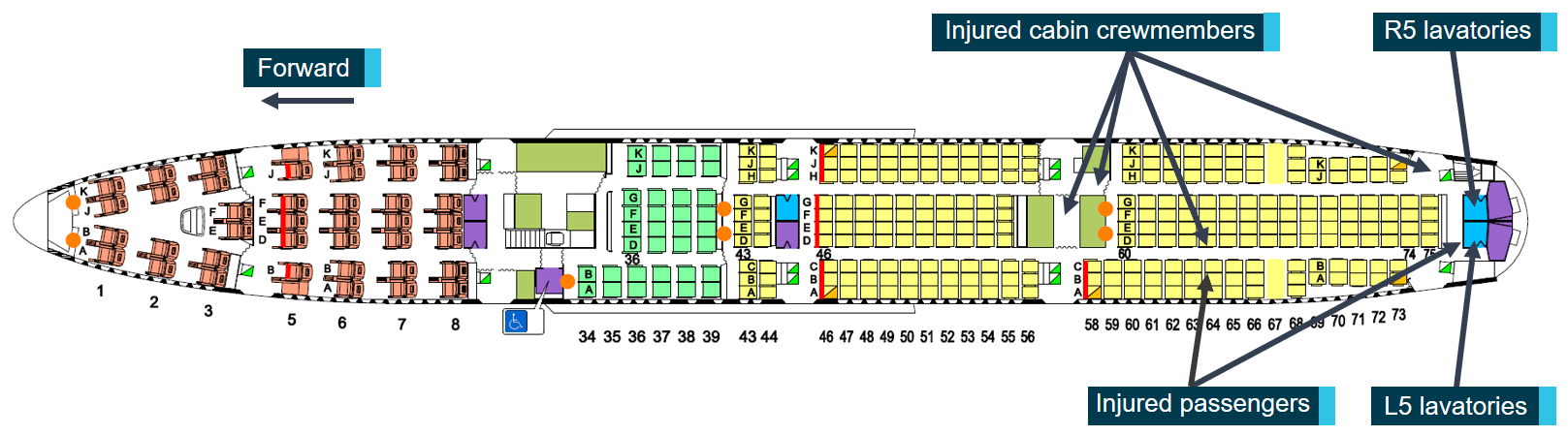
During the pilot-induced oscillations, the CSM, who was standing in the left aisle in the vicinity of rows 63 and 64 (Figure 3), struck the cabin ceiling before falling on a seat armrest, sustaining injuries. Five other cabin crewmembers also struck the ceiling, with three sustaining injuries. A passenger located in an L5 lavatory struck the cabin ceiling landing on the lavatory seat, resulting in minor injuries and damage to the lavatory fittings. A passenger in seat 63C who did not have her seatbelt fastened, was also injured.
Figure 3: VH-OJU main deck layout
The figure shows the aircraft main deck layout. The locations of the injured cabin crewmembers, injured passengers and L5 and R5 lavatories are identified. Source: Operator
After the aircraft stabilised, the CSM was alerted to the injured passenger in the L5 lavatory. The CSM provided assistance to this passenger and then conducted the call back procedure.[11] During the call back procedure, cabin crew advised the CSM of further injured passengers and cabin crewmembers.
As the aircraft tracked on the outbound leg of the holding pattern, the lavatory smoke alarm activated and the flight crew received a lavatory smoke alarm warning. The captain asked the first officer to request a priority landing from ATC. ATC immediately cleared the flight directly to Hong Kong International Airport.
The cabin crewmembers established that the smoke alarm originated at the R5 lavatories and that there was no evidence of smoke, fire or fumes. The CSM reported to the flight deck that they believed the smoke alarm to be a false alarm caused by the lavatory damage.
While approaching Hong Kong International Airport, the smoke alarm activated a further six times. The cabin crewmembers determined that these alarms were also false. The aircraft landed without further incident.
Four cabin crewmembers and two passengers received minor injuries during the incident and the aircraft cabin sustained minor damage.
The captain held an Air Transport Pilot Licence (Aeroplane), a multi-engine command instrument rating and a Class 1 Aviation Medical Certificate. The captain had over 24,000 hours of flying experience, of which over 10,000 hours were on the Boeing 747.
First officer
The first officer held an Air Transport Pilot Licence (Aeroplane), a multi-engine command instrument rating and a Class 1 Aviation Medical Certificate. The first officer had over 16,000 hours of flying experience, of which over 5,000 hours were on the Boeing 747.
The investigation assessed whether the captain or first officer were experiencing a level of fatigue known to have an effect on performance. The ATSB found no indicators that increased the risk of either crew experiencing this level of fatigue.
Second officer
The second officer held an Air Transport Pilot Licence (Aeroplane), a multi-engine command instrument rating and a Class 1 Aviation Medical Certificate. The second officer had over 8,000 hours of flying experience, of which over 5,000 hours were on the Boeing 747.
Meteorological information
As the aircraft entered the holding pattern, the aircraft recorded wind direction was 268°M and speed was 41 kt. The flight crew reported visual meteorological conditions with slight haze prevailed at the time of the occurrence.
The flight crew also reported experiencing smooth conditions prior to, and throughout, the event. There was little to no recorded turbulence. The ATSB therefore concluded that turbulence did not contribute to the pre-aerodynamic stall buffeting or stick shaker activations.
Aircraft information
Autopilot holding with LNAV/VNAV active
When holding with LNAV active, the FMC tracks the holding pattern targeting a 25-degree bank angle up to a limit of 30 degrees of bank angle. The FMC computes holding patterns with constant radius turns based on the current wind and commanded speed.
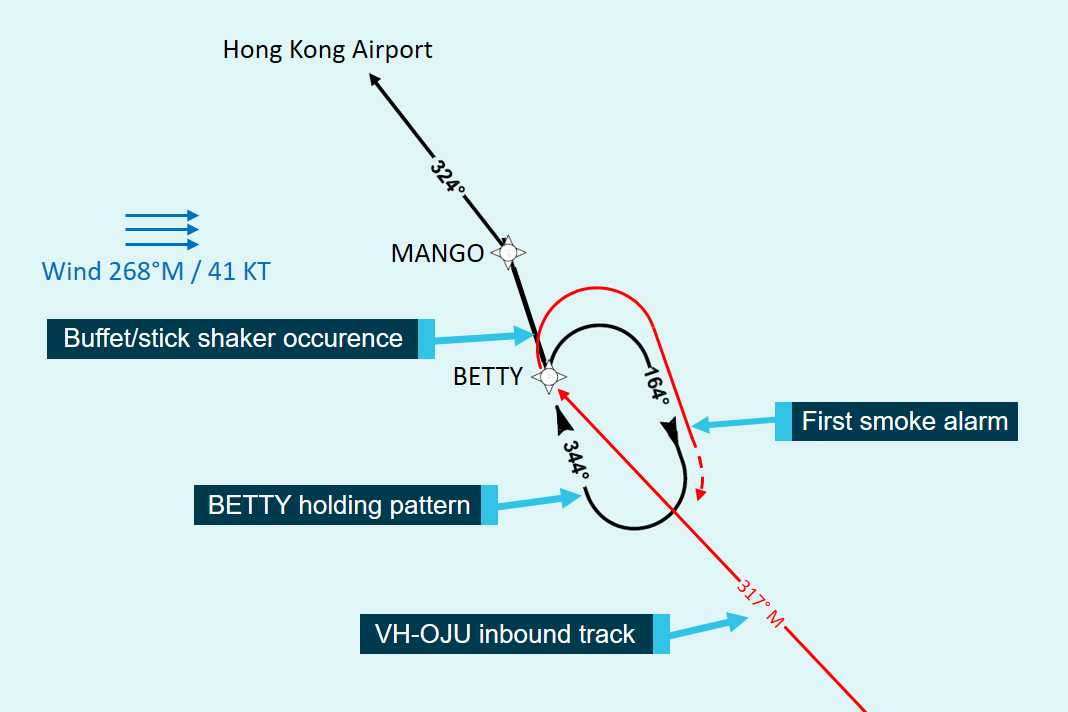
The aircraft tracked 317°M as it crossed BETTY (Figure 4) and began a right turn, through a total of 207°, to track 164°M for the outbound leg of the pattern.
As the aircraft turned, the wind direction moved to a relative position behind the aircraft, increasing the aircraft’s ground speed. The increased ground speed required a greater bank angle to achieve the targeted turn radius and outbound track spacing. The first officer also later commented that when the holding entry required a turn in excess of 180°, the autopilot would initially command a bank greater than 30 degrees.
The aircraft manufacturer commented that the autopilot has the capability to increase bank angle beyond the FMC commanded angle. The manufacturer further commented that it was not unusual that the increasing ground speed led the autopilot to increase bank angle with an overshoot up to 32 degrees to achieve the FMC target turn radius and outbound track spacing.
Figure 4: BETTY holding pattern
The figure shows the BETTY holding pattern along with the recorded wind conditions, the approximate track of VH-OJU as it entered the holding pattern and the locations of the buffet/stick shaker occurrence and first smoke alarm. Source: Hong Kong Civil Aviation Department, annotated by ATSB
Operational information
Hold speed
The FMC calculated target hold speed and target level are based on the aircraft’s gross weight and programmed VNAV descent profile (see Figure 2). Below FL 150, this speed is based upon the flaps 30 landing reference speed with the addition of a speed increment. The speed increment varies with aircraft weight and is designed to provide a manoeuvre margin[12] equivalent to a level turn at 40 degrees angle of bank or 1.3 G of vertical acceleration.
Above FL 200, the FMC calculated hold speed corresponds to the minimum drag speed.[13]
Between FL 150 and FL 200 the FMC target hold speed is calculated using a linear interpolation between the speeds calculated for FL 150 and FL 200.
The FMC also calculates best speed, which is displayed on the hold page (see Figure 2). The operator’s flight crew operations manual (FCOM) contained the following guidance on the best speed function on the hold page of the FMC:
Displays best holding speed for airplane gross weight, altitude, and flap setting.
The displayed best speed may be different to the target hold speed in the hold planning stage as the hold may be planned using an altitude different to the current altitude. If no target speed is selected, the FMC will select the best speed.
The aircraft manufacturer provided the following advice regarding the hold speed for this event:
At 22,000 feet, the optimum holding pattern airspeed would have been approximately 240 knots based upon the event gross weight.
For holding when hold speeds are not available from the FMC, the operator’s flight crew training manual (FCTM) provided the following guidance:
Recommended holding speeds can be approximated by using the following guidance until more accurate speeds are obtained from the quick reference handbook:
- Flaps up manoeuvre speed approximates the minimum fuel burn speed and may be used at low altitudes[14] (approximated by adding 80 kt to the calculated flaps 30 landing reference speed)
- If the FMC calculated hold speed is not available, when holding above FL 200 recommended holding speeds can be approximated by adding 100 kt to the calculated flaps 30 landing reference speed.
Following the above guidance would have provided an approximate hold speed of 243 kt.
The programmed VNAV descent profile crossed BETTY at FL 156. The FMC calculated a target hold speed of 223 kt at FL 156 for holding at BETTY. When ATC instructed the flight crew to hold at FL 220, the captain instructed the first officer to input a target speed of 225 kt at or above FL 150 into the FMC.
While hold speed data was available from the FMC, the flight crew were not aware that a different speed was required above FL 200 and used speed data for FL 156 for holding at FL 220.
Flight crew high altitude hold speed knowledge and training
The flight crew reported that in practice they used the flaps up manoeuvring speed and then added an arbitrary buffer when selecting a hold speed. This is contrary to the FCTM guidance, and there was no other operator or manufacturer guidance recommending this procedure or the size of the buffer to be used. The investigation found that the flight crew were not aware of the function, or use of, the best speed in the hold page of the FMC.
The operator provided training for flight crew on holding patterns and speeds during ground school training prior to the commencement of operations on the aircraft type and during recurrent operational training.
The operator reported that there were no documented training exercises where a holding pattern was conducted at high altitude (above FL 200). Holding patterns were generally conducted at lower levels prior to commencing a landing approach.
Minimum manoeuvre speed
The aircraft’s FMC calculated minimum manoeuvre speed provides 0.3 G of margin above the onset of pre-aerodynamic stall buffet. This is equivalent to a level turn at 40 degrees angle of bank or 1.3 G of vertical acceleration.
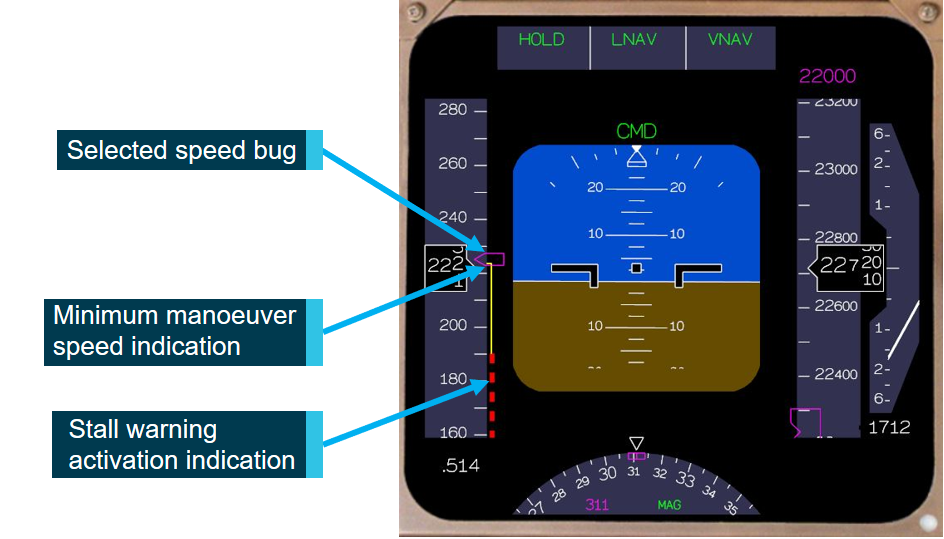
The minimum manoeuvre speed is indicated by the top of an amber band on the speed tape of the PFD (Figure 6: Figure 5). When operating at a speed within the amber band, reduced manoeuver capability exists.
Figure 5: Representation of the primary flight display as the aircraft crossed BETTY
This figure shows a representative presentation of the primary flight display as the aircraft crossed BETTY, derived from recorded flight data. The minimum manoeuver speed amber band and selected speed bug are annotated. Source: ATSB
Stall warning activation speed
The speed at which the aircraft’s stall warning system would activate was indicated on the PFD as a red dashed line (see Figure 5 above).
This indication was dynamic and moved in accordance with various factors such as aircraft configuration, gross weight and aircraft manoeuvring. This provided the flight crew with a real-time indication of the stall warning activation speed.
Recorded flight data
Flight data was available from the flight data recorder and the quick access recorder.
Figure 6: Graphical representation of quick access recorder data
The figure shows a graphical representation of recorded flight data from stick shaker incident significant points of the occurrence are annotated. Source: ATSB
The aircraft manufacturer reviewed the flight data and determined that during the stick shaker occurrence, the aircraft did not enter a stall. The manufacturer provided the following analysis:
For the 747-400, at the event flight condition, the estimated maximum vane angle of attack before stall is achieved would be approximately five degrees.[15] During this occurrence, the highest recorded vane angle of attack was approximately -0.5 degrees, resulting in significant margin to the estimated maximum vane angle of attack when stick shaker activated.
The recorded data did not show a stick shaker activation at the time the autopilot disconnected,[16] as described by the flight crew. At this time, the recorded vane angle of attack reached a value about 0.3 degrees below the estimated angle for stick shaker activation. However, as the stick shaker activation parameters are recorded at a rate of one sample per second, it is possible that the stick shaker activated momentarily and was not captured by the flight recorders.
The recorded vertical acceleration at the time of the initial buffet and possible stick shaker activation was 1.29 G. The maximum vertical acceleration value recorded during the occurrence was 1.45 G, the minimum recorded value was 0.09 G.
Stall recovery procedures and training
Stall warning recovery procedure
The aircraft was fitted with a stick shaker device to provide warning to the flight crew that the aircraft was approaching an aerodynamic stall. When activated, the stick shaker vibrated both control columns, providing an aural and tactile warning indication.
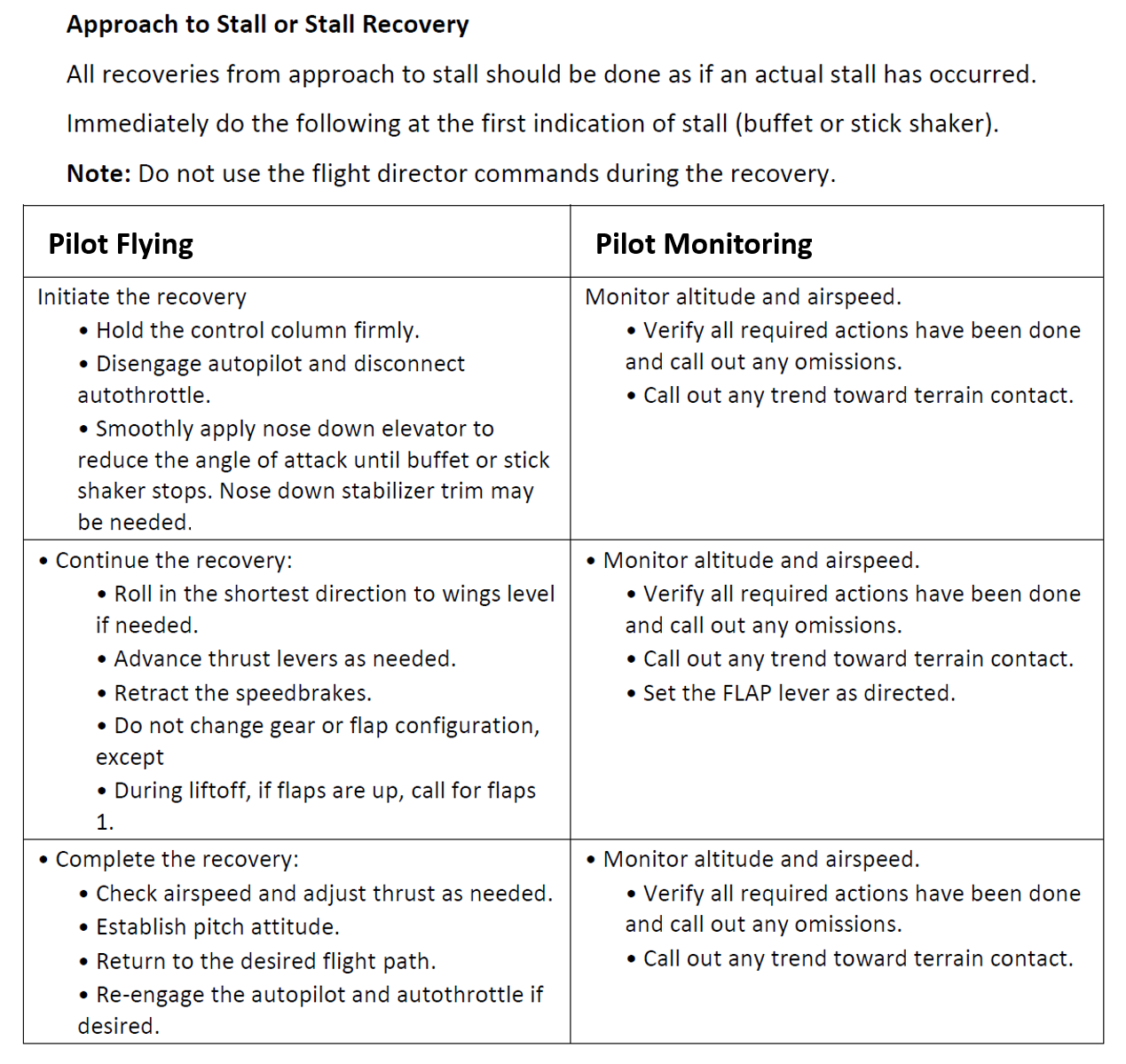
The operator procedures included the ‘approach to stall or stall warning’ procedure. In case of a stall warning, the procedural steps to be followed are shown in Figure 7:
Figure 7: Approach to stall or stall recovery procedure
Source: Operator
The recorded data showed that during the recovery after the initial buffet and possible stick shaker activation, the captain did not disconnect the autothrottle. While he reduced the bank angle, he did not level the wings or advance the thrust levers as needed to effect recovery. Nor were these actions completed during the second and third recovery attempts.
The autothrottle was not disconnected and the thrust levers were not advanced as needed to effect recovery until the fourth oscillation. After this increase in thrust, speed increased sufficiently for the captain to arrest the descent and stabilise the aircraft without further stick shaker activations.
During the oscillations, the first officer did not identify or call out the incomplete actions, as required by the procedure.
Approach to stall and stall recovery training
The operator provided approach to stall and stall recovery training to flight crew during type conversion training and their recurrent operational training in accordance with manufacturer recommendations and as approved by the Civil Aviation Safety Authority. Each flight crew member had undergone this training on multiple occasions, exposing them to various stall recovery scenarios.
The stall recovery scenario conducted in the most recent exercise was simulated with the aircraft:
configured with landing gear down and flaps 20
positioned on the downwind leg of a circuit (about 1,500 ft above ground level)
weight of 266,000 kg.
During the exercise, a first officer, as pilot flying, closes the thrust levers while in level flight just before turning onto the base leg of the circuit. The crew should recover at first stall indication, using the correct recovery procedure. The exercise was then repeated with the captain as pilot flying.
The captain last underwent this training on 4 April 2017, three days prior to the incident flight. The first officer had last undergone stall recovery training in October 2014 and the second officer in February 2017.
The scenarios all commenced with the crew reducing the engine power to idle prior to the stick shaker activating, and all recoveries were initiated with engine power at idle.
In their internal investigation report, the operator provided the following analysis of the stall recovery training:
The investigation could not find any trained scenarios that approximated the conditions experienced by QF29; that is; stick shaker activation while manoeuvring at altitude. By limiting stick shaker recovery to non-realistic scenarios, with considerable lead in time giving Flight Crew ample opportunity to prepare for the forthcoming manoeuvring, there is limited exposure to the complexity of the required recovery actions at altitude in real life scenarios…
…Further enhancing stick shaker recovery by including realistic scenarios, during training may provide increased exposure for Flight Crew of the relationship between control column movement and true airspeed, preventing further Flight Crew over-controlling events brought about by startle effect.
Smoke alarm activations
The ATSB could not determine the reason why the smoke alarms in the R5 lavatory activated after the upset. However, the lavatories at R5 and L5 shared a ventilation system and it may have been that dust, from the lavatory fittings detaching in the L5 lavatory, activated the R5 smoke alarm.
During the smoke alarm activations, cabin crewmembers responded appropriately and acted in accordance with procedures. Additional crewmembers in the rear aircraft cabin also supported the response to the smoke alarm.
This research report reviewed 245 stall warnings and stall warning system events reported to the ATSB over a 5-year period (2008–2012). The ATSB identified 33 serious and higher risk incidents in which a stall warning occurred, and in several cases the stall warning speed was higher than normal (due to a higher vertical acceleration (G) factor in a turn, or an incorrect reference speed switch setting). The report contained the following safety message:
Stall warnings occur in normal operations, and are normally low risk events. In Australia, even the most serious events have not resulted in a loss of control, and have been effectively managed by flight crew to prevent a stall from occurring. To avoid higher risk stall warning events, pilots are reminded that they need to be vigilant with their awareness of angle of attack and airspeed.
The sources of information during the investigation included the:
Operator
Boeing (manufacturer)
Aircraft crew
Hong Kong Civil Aviation Department
References
Australian Transport Safety Bureau (ATSB). (2013). Stall warnings in high-capacity aircraft: The Australian context 2008 to 2012. Canberra ATSB.
Ebbatson, M., Harris, D., Huddlestone, J. and Sears, R., 2010, The relationship between manual handling performance and recent flying experience in air transport pilots, Ergonomics, pp.268-277
Hasleback, A., Kirchner, P., Schubert, E. and Bengler, K., 2014, A flight simulator study to evaluate manual flying skills of airline pilots, Proceedings of the Human Factors and Ergonomics Society 58th Annual Meeting, pp.11-15
Landman, A., Groen, E., van Paassen, MM., Bronkhorst, AW. and Mulder, M., 2017, The Influence of Surprise on Upset Recovery Performance in Airline Pilots, The International Journal of Aerospace Psychology, 27:1-2, 2-14
Orlady, HW., and Orlady, LM., 1999, Human Factors in Multi-Crew Flight Operations, Ashgate Publishing Limited, Aldershot, England
Reason, J., 2008, The Human Contribution: Unsafe acts, accidents and heroic recoveries, Ashgate Publishing Limited, Surrey, England
Rivera, J., Talone, AB., Boesser, CT., Jentsch, F. and Yeh, M, 2014, Startle and Surprise on the Flight Deck: Similarities, Differences, and Prevalence, Proceedings of the Human Factors and Ergonomics Society 58th Annual Meeting, pp.1047-1051
Wickens, CD. and McCarley, JS., 2008, Applied Attention Theory, CRC Press, Florida, USA
Submissions
Under Part 4, Division 2 (Investigation Reports), Section 26 of the Transport Safety Investigation Act 2003 (the Act), the Australian Transport Safety Bureau (ATSB) may provide a draft report, on a confidential basis, to any person whom the ATSB considers appropriate. Section 26 (1) (a) of the Act allows a person receiving a draft report to make submissions to the ATSB about the draft report.
A draft of this report was provided to the flight crew, customer service manager, Qantas, the Civil Aviation Safety Authority, and Boeing.
Any submissions from those parties were reviewed and where considered appropriate, the text of the draft report was amended accordingly.
Findings
From the evidence available, the following findings are made with respect to the stick shaker activation event involving Boeing 747, VH-OJU, that occurred 110 km SE of Hong Kong International Airport (BETTY IFR), on 7 April 2017. These findings should not be read as apportioning blame or liability to any particular organisation or individual.
Safety issues, or system problems, are highlighted in bold to emphasise their importance. A safety issue is an event or condition that increases safety risk and (a) can reasonably be regarded as having the potential to adversely affect the safety of future operations, and (b) is a characteristic of an organisation or a system, rather than a characteristic of a specific individual, or characteristic of an operating environment at a specific point in time.
Contributing factors
After overwriting the hold speed in the flight monitoring computer, the flight crew did not identify the need to re-evaluate the hold speed for the higher than expected hold level.
Prior to entering the hold, the aircraft’s speed reduced below both the selected and minimum manoeuvring speeds. The crew did not identify that the aircraft was operating below these speeds.
The reduced speed coincided with the turn to enter the holding pattern and the level capture. These factors resulted in pre-aerodynamic stall buffeting and probable stick shaker activation.
The pilot flying attempted to arrest the rate of descent prior to completing the approach to stall actions. The pilot monitoring did not identify and call out the incomplete approach to stall recovery actions. These combined actions led to pilot induced oscillations and further stick shaker activations.
The operator provided flight crew with limited training and guidance in stall prevention and recovery techniques at high altitudes or with engine power above idle. (Safety issue)
The passenger in seat 63C was not wearing a seatbelt at the time of the stick shaker activations.
Other safety factor
The operator provided flight crew with limited training and guidance relating to the need for crew to re-evaluatetheir holding speed for a change in altitude (specifically above flight level 200). (Safety issue)
Safety analysis
Identification of necessity to recalculate hold speed
Prior to arriving at BETTY, the VNAV profile in the flight management computer (FMC) calculated holding at between FL 150 and FL 160. When selecting a target speed, the flight crew verified the FMC provided speed by comparing the speed to the flaps up manoeuvre speed calculation. However, the flight crew training manual advised that the flaps up manoeuvring speed guaranteed at least full manoeuvre capability, to stall warning activation at low altitudes. The flight crew were not aware of the requirement to use a different speed calculation verification for altitudes above FL 200.
Had the crew recalculated the hold speed for FL 220 using the flight management computer, it would have provided a target hold speed of 240 kt. In this case, the flight crew likely did not have an adequate understanding of how the FMC calculated the target hold speed. They also did not understand the use of the best speed provided on the hold page in the FMC. Using best speed would have provided the crew with a hold speed for the actual aircraft weight, altitude and configuration at that time. Orasanu (2010) outlines that decision errors in aviation are often a result of a lack of knowledge:
[They] typically are not slips or lapses in carrying out an intention, but errors of intention itself (Norman, 1981). The decision maker acts according to his/her understanding of the situation, and the source of error is in the decision maker’s knowledge base or in the process of reaching a decision.
The selection of an incorrect hold speed resulted in the aircraft entering the hold with a selected speed 15 kt below the required speed. Using the best speed in the FMC hold page or recalculating the hold speed using the FMC for the higher level would have resulted in the use of a speed which provided sufficient margin to prevent a stick shaker activation.
Absence of hold speed re-evaluation procedure
Neither the operator or aircraft manufacturer provided procedures or guidance which stated that a hold speed was required to be re-evaluated for a change in hold level when a speed was selected in the FMC during the planning stage of a descent. Therefore, the flight crew did not have the requisite knowledge to identify the need to re-evaluate the selected speed.
Reason (2008) explains that decision errors, such as not re-evaluating the hold speed, can be as a result of a ‘failure to detect a signal or problem’, and are more likely under conditions including ‘when the person did not expect to find a problem in that location…’. Detecting a problem, or an absence of an action can be particularly difficult when there are no cues to identify an issue. In this case, there was no procedural prompt for the flight crew to re-evaluate the speed for the higher level and select the correct speed. Therefore, the need to re-evaluate the hold speed relied on the crew’s knowledge of the higher speed requirement above FL 200.
This resulted in the remaining protections against a low-speed condition being the minimum manoeuvring and stall warning activation speed indications on the pilot’s flight display. At the time the speed reduced below both the selected speed and the minimum manoeuvring speed, the flight crew’s attention was focussed on other operational matters resulting in the crew not identifying the reduced speed.
In summary, a requirement to re-evaluate the speed for the higher than planned hold level would likely have provided the crew with a prompt to reselect the speed, which in turn would provide an adequate margin above the minimum manoeuvring speed.
Crew recognition of low speed prior to entering the hold
As the aircraft entered the holding pattern, the delay in the autothrottle system detecting and effecting changes in aircraft speed allowed the speed to reduce to 220 kt—below both the selected speed of 225 kt and the minimum manoeuvring speed of 223 kt.
These speeds, along with the stall warning activation speed were displayed on the PFD, but the flight crew did not detect that the speed had reduced as their attention was on other operational tasks. Reason (2008) outlines why focusing one’s attention on one task can be to the detriment of noticing other important tasks:
…attention is a limited resource. Direct it at one thing and it is withdrawn from another. When attention is ‘captured’ by something unrelated to the task at hand, actions often proceed unintentionally along some well-trodden pathway: strong habit intrusions.
Not noticing a visual indication well within one’s visual scan can be a common outcome to a crew’s attention being focused elsewhere, as explained by Wickens and McCarley (2008):
Change blindness…occurs when an observer fails to detect an event (e.g. discreet change) in the environment around him…[and is a] failure to notice that something is different from what it was…How do lapses occur? Very often, [change blindness] is a failure of attention. Data indicate that changes are likely to go unnoticed if they are not attended when they occur…[i.e.] if the observer is looking away…
It can be difficult to detect discreet changes, even with visual indicators of limits (i.e. speed bug on the PFD) in view of the crew, when attention is on other operational matters. In turn, this reduced the likelihood that they could detect an undesirable aircraft condition.
Pre-aerodynamic stall buffet and probable stick shaker activation
As the aircraft turned to enter the holding pattern, the bank angle increased and the aircraft began to transition from descent to level flight. The effects of these manoeuvres combined to increase the vertical acceleration and wing angle of attack. The increasing angle of attack initiated pre-aerodynamic stall buffeting.
At this time, although it was not recorded on the flight data, all flight crewmembers reported a stick shaker activation. The recorded angle of attack also indicated that a stick shaker likely occurred. The manufacturer advised that an activation of less than one second in duration may occur without being captured in the flight recorder data.
Pilot induced oscillations and cabin injuries
At the time of the initial buffeting and probable stick shaker activation, the captain commenced the approach to stall and stall recovery actions required within the operating procedures. However, after this, a number of the other actions required by procedures were not completed, including the following:
due to a desire to remain within the protected airspace of the holding pattern, the wings were not levelled
the autothrottle was not disconnected
due to the captain’s concern regarding the pitch up moment resulting from a large engine power increase, engine power was not manually increased sufficiently to effect recovery
the first officer assessed that the actions had been completed correctly and did not identify or therefore call out the missed actions.
After the captain did not complete the approach to stall recovery procedure, the aircraft entered a series of pilot induced oscillations during which the crew’s premature attempts to arrest the rate of descent without increasing power as needed and before the speed had increased sufficiently, resulted in a further two stick shaker activations. After a fourth oscillation (during which the flight crew did not recall a stick shaker activation and an activation was not recorded), the engine power was increased sufficiently to accelerate the aircraft to enable the flight crew to complete the recovery.
The ATSB considered whether the captain’s performance was affected by a startle response, which is defined by Landman and others (2017) as a ‘physiological reaction to a highly salient stimulus’ (e.g., sudden, intense, or threatening; Rivera, Talone, Boesser, Jentsch, & Yeh, 2014). Rivera and others (2014) add that it disrupts ‘cognitive processing and can negatively influence an individual’s decision making and problem-solving abilities’. They outline that the reaction can result in the following:
Studies have determined that motor response performance following a startling stimulus is disrupted for approximately 0.1 s to 3 s for simple tasks (May & Rice, 1971; Sternbach, 1960; Thackray, 1965)…In more complex motor tasks…startle may impact performance for up to 10 s following a loud intensity signal (Thackray & Touchstone, 1970).’
Rivera and others (2014) also stated that ‘one must also consider the time to cognitively recover after a startling stimulus’. Within this same reference citing Bürki-Cohen (2010), they outline the difference between startle and surprise.
…there are distinctive conceptual, behavioural, and physiological differences between the startle reflex and the surprise emotion.
In contrast to startle, which always occurs as a response to the presence of a sudden, high-intensity stimulus, surprise can be elicited by an unexpected stimulus or by the unexpected absence of a stimulus. Surprise can be described as a combination of physiological, cognitive, and behavioural responses, including increased heart rate, increased blood pressure, an inability to comprehend/analyze, not remembering appropriate operating standards, “freezing”…
In this case, it was not determined as to whether the tactile stimulus of the stick shaker and the aural alert was sufficient to elicit a startle response. However, the reaction of the captain in undertaking the initial approach to stall recovery did not largely appear to be adversely affected, as most actions were completed and the omitted or incomplete actions resulted from deliberate decisions. When then considering the continuation of the recovery steps, he was also able to outline the reasons for his actions, which do not necessarily demonstrate a negative influence on his decision making or problem-solving abilities.
With respect to the first officer, he perceived that the absence of his call-outs required of the pilot monitoring position (including not calling out any omissions during the recovery continuation and completion) were a result of experiencing the startle effect. Given that the approach-to-stall recovery actions overall were completed in about 10 seconds, this is possible. However, there was insufficient evidence to determine whether his was a response to a sudden, high-intensity stimulus. His reaction may appear more consistent with surprise, whereby there was a cognitive mismatch between new information and expectations, especially as he had no expectation of stick shaker activation.
The recorded flight data shows that during the oscillations, the aircraft underwent significant variations in vertical acceleration. The pilot-induced oscillation occurred at a time when the fasten seat belt sign was not illuminated and cabin crewmembers were standing in the rear cabin, completing the cabin preparation for landing. The variations in vertical acceleration resulted in several cabin crewmembers and passengers impacting the cabin ceiling and furnishings, sustaining minor injuries. The impact of occupants to the cabin ceiling and furnishings resulted in damage to these furnishings, in particular an L5 lavatory. This damage resulted in the L5 and R5 lavatory smoke alarm activations.
Limited guidance in high altitude manual handling and stall recovery training
All flight crew undertook simulator training exercises as part of a cyclic training schedule. The most recent exercise undertaken by the crew included an approach to stall recovery scenario exercise, which was simulated at low altitude and with the aircraft configured with flaps and landing gear extended. In this instance, the simulated aircraft response would be markedly different to that of an aircraft operating at higher altitudes (such as FL 200 and above) and with the landing gear and flaps retracted.
In this case, the flight crew had undergone this cyclic training exercise, including the captain who completed the training three days prior to the occurrence. In addition, after the event, they could recall the correct recovery actions indicating that the training was effective in providing the crew with the required knowledge to effect the recovery.
However, this training exercise did not familiarise the crew with the manual handling of the aircraft at higher altitudes. Hasleback (2014) states:
From [a pilot’s initial training onwards], pilots are faced with automation induced skill degradation (Balfe, Wilson, Sharples, & Clarke, 2012), caused by the automation taking over the responsibility for tasks previously performed by the human operators (Parasuraman & Riley, 1997).
There are ways to overcome this. In a study examining the relationship between pilot manual handling performance and recency, Ebbatson (2009) outlined that ‘significant relationships are identified between pilots’ recent flying experience and their manual control strategy’. Hasleback and others (2014) summarised this study to show that ‘recent flight practice including manual flying occurring a few weeks prior to the experiment had more influence on the measured performance than flight hours accumulated over a pilot’s entire career’.
Orlady and Orlady (1999) explain the importance of including manual handling exercises in training:
Using today’s automation more efficiently does not mean that today’s pilots do not need all of the old skills and knowledge… They need all of the old skills plus the new skills required by the automation…Manual skills must be a part of any recurrent or transition training and checking program in addition to the emphasis given to the proper use of the automatics.
In this case, the opportunity for flight crew to practice their high-altitude manual handling skills was limited, which in turn limited the ability of flight crews to retain the necessary manual handling skills for stall recovery at higher altitudes. As a result, the flight crew did not adequately respond to the initial buffet and probable stick shaker activation, leading to the in-flight upset.
Use of seatbelts
Prior to the occurrence, the cabin crewmembers prepared the cabin for arrival at Hong Kong. This included an announcement to fasten seatbelts, however, at this time, the fasten seatbelt sign was not illuminated.
At the time of the in-flight upset, a passenger was located in the L5 lavatory and cabin crewmembers were in the rear cabin preparing for arrival. During the upset, the aircraft cabin was subject to large variations in vertical acceleration. Due to the unexpected nature of the event, neither the cabin crewmembers or the passenger in the L5 lavatory, who did not have a seatbelt available, were seated and secured at the time of the event. As a result, four cabin crewmembers and the passenger in the L5 lavatory sustained minor injuries.
A passenger seated in seat 63C did not have their seatbelt fastened. During the upset, this passenger impacted cabin furnishings and sustained minor injuries. Other seated passengers did have seatbelts fastened and as a result were not injured.
In-flight upsets, while rare, can have the potential to cause injuries. Evidence from this incident along with other incidents demonstrates that while seated, keeping a seatbelt fastened and secure significantly reduces the likelihood of being injured during an upset.
Purpose of safety investigations & publishing information
Purpose of safety investigations
The objective of a safety investigation is to enhance transport safety. This is done through:
identifying safety issues and facilitating safety action to address those issues
providing information about occurrences and their associated safety factors to facilitate learning within the transport industry.
It is not a function of the ATSB to apportion blame or provide a means for determining liability. At the same time, an investigation report must include factual material of sufficient weight to support the analysis and findings. At all times the ATSB endeavours to balance the use of material that could imply adverse comment with the need to properly explain what happened, and why, in a fair and unbiased manner. The ATSB does not investigate for the purpose of taking administrative, regulatory or criminal action.
Terminology
An explanation of terminology used in ATSB investigation reports is available here. This includes terms such as occurrence, contributing factor, other factor that increased risk, and safety issue.
Publishing information
Released in accordance with section 25 of the Transport Safety Investigation Act 2003
Ownership of intellectual property rights in this publication
Unless otherwise noted, copyright (and any other intellectual property rights, if any) in this report publication is owned by the Commonwealth of Australia.
Creative Commons licence
With the exception of the Coat of Arms, ATSB logo, and photos and graphics in which a third party holds copyright, this publication is licensed under a Creative Commons Attribution 3.0 Australia licence.
Creative Commons Attribution 3.0 Australia Licence is a standard form licence agreement that allows you to copy, distribute, transmit and adapt this publication provided that you attribute the work.
The ATSB’s preference is that you attribute this publication (and any material sourced from it) using the following wording: Source: Australian Transport Safety Bureau
Copyright in material obtained from other agencies, private individuals or organisations, belongs to those agencies, individuals or organisations. Where you wish to use their material, you will need to contact them directly.
At about 1300 Central Standard Time on 17 May 2015, the pilot of a Raytheon B200, registered VH-ZCO, taxied at Darwin Airport for a flight to Jabiru, in the Northern Territory. The flight was an aeromedical retrieval flight, with a doctor and flight nurse on board. The weight of the aircraft was just under the maximum permitted take-off weight. The weather conditions were fine and clear, with a light breeze from the north-east.
The pilot positioned the aircraft at the intersection of taxiways U1 and E2 to complete pre-flight run-up checklist procedures. During the first flight of the day, the operator’s run-up checklist procedures included a check to confirm that the wing and horizontal stabiliser de-ice system was serviceable. The wing and horizontal stabiliser de-ice system includes pneumatically inflatable boots fitted to the leading edges of those surfaces (see later description for more detail). The pilot recalled that all run-up checks were normal, including the wing and horizontal stabiliser de-ice system check. Following completion of the run-up checklist procedures, the pilot taxied to the holding point on taxiway E2 before departing from that intersection on runway 11 (Figure 1).
Figure 1: Excerpt from Darwin Airport aerodrome chart showing the approximate location where run-up checklist procedures were carried out and the intersection from which the aircraft commenced take-off
Source: Airservices Australia, additions by the ATSB
The take-off was initiated with the flaps retracted, consistent with the operator’s normal procedures for a take-off under the prevailing conditions. The take-off proceeded normally up to the point that the aircraft reached decision speed[1] and the pilot rotated the aircraft to the take-off pitch attitude. At that point, the pilot noticed that the aircraft did not ‘unstick’[2] as readily as normally expected. At about the same time, the pilot recalled that the stall warning horn sounded.[3] The pilot continued with the take-off and the aircraft lifted off, but it was not climbing or accelerating as efficiently as normal. Despite the relatively poor performance, the pilot was able to build speed slowly by holding the aircraft in ground effect.[4]
After achieving a positive rate of climb, the pilot retracted the landing gear. As the aircraft continued a shallow climb, the pilot carefully balanced airspeed and rate of climb as the stall warning horn continued to sound intermittently. After passing about 200 ft above ground level, the pilot was able to reduce the pitch attitude to allow the aircraft to accelerate further. Beyond that point, the stall warning horn no longer sounded.
Satisfied that the aircraft had reached a safe altitude, the pilot inspected the wings in an attempt to ascertain the reason for the poor take-off performance and stall warning. At that point, the pilot noticed that the right wing de-ice boots appeared to be inflated. Due to the position of the sun, the pilot was unable to immediately ascertain if the boots on the left wing were also inflated. Nonetheless, the pilot was confident that the inflated condition of the wing de-ice boot (or boots) explained the poor performance and stall warning. The pilot immediately cycled the wing and horizontal stabiliser de-ice system control switch in an attempt to deflate the boots, but cycling the switch appeared to have no effect.
As the aircraft continued to accelerate, the pilot noticed that aileron control forces were abnormally light. The pilot surmised that light aileron control forces were the result of a disturbance in the airflow over the wing associated with the inflated leading edge de-ice boot (or boots). As the aircraft turned and its orientation changed with respect to the position of the sun, the pilot was able to clearly see that the boots on the left wing were also inflated.
The pilot advised air traffic control that a return to Darwin was necessary. Air traffic control initially asked the pilot if runway 36 was acceptable, but uncertain about aircraft performance and noting a crosswind on runway 36, the pilot indicated a preference for runway 11 (runway 11 is substantially longer than runway 36). The pilot was subsequently cleared by air traffic control to make a circuit for runway 11.
Given concerns regarding aircraft performance and control, the pilot elected to land with approach flap[5] selected, and added 20 kt to the approach reference speed. Making the approach at this speed allowed the pilot to comply with the operator’s stabilised approach criteria, while providing increased confidence with respect to aircraft performance and controllability.
The pilot had no difficulty handling the aircraft during the circuit and landing, but noted that substantially more power than normal was required to hold the desired speed. The stall warning horn remained silent throughout the approach and landing. The pilot landed without further incident and taxied to the aircraft parking position. The wing de-ice boots remained inflated until the engines were shut down.
Subsequent inspection by engineering staff found that the wing de-ice boots inflated again during an engine ground run, without having been selected. The boots returned to normal operation when the wing and horizontal stabiliser de-ice system control switch was cycled.[6] Numerous subsequent system tests (in accordance with the relevant maintenance manual) found that the wing and horizontal stabiliser de-ice system functioned normally, and the aircraft was returned to service. The operator also advised CASA of the occurrence.
Raytheon B200 wing and horizontal stabiliser de-ice system
On the Raytheon B200, the leading edge of the wings and the horizontal stabiliser can be protected from an accumulation of ice by inflatable boots. The wing has an inner boot between the fuselage and engine nacelle, and an outer boot that extends from outboard of the engine nacelle. The boots are normally held down by a vacuum, and only inflated when an appropriate selection is made by the pilot. The boots are inflated by pneumatic pressure, and expand in a manner intended to shed any accumulated ice (Figures 2 and 3). Regulated high-pressure engine bleed air supplies pressure and a vacuum source for the wing and horizontal stabiliser de-ice system.
Figure 2: Pneumatic leading edge de-ice boot (representation) in the normal (deflated) condition and the inflated condition
Source: FAA, description added by the ATSB
Figure 3: Inflated Raytheon B200 wing leading edge de-ice boot
Source: Aircraft operator
The wing and horizontal stabiliser de-ice boots are operated by a three-position switch, spring-loaded to the centre OFF position (Figure 4). When the switch is selected to the DEICE CYCLE SINGLE (up) position, the wing boots are inflated for 6 seconds, followed by the horizontal stabiliser boots, which are inflated for 4 seconds to complete the cycle. The switch must be selected up again to commence another cycle. When the switch is selected to the MANUAL (down) position, the wing and horizontal stabiliser boots inflate simultaneously, and remain inflated while the switch is held in the MANUAL position. When the switch is released back to the centre OFF position, the boots deflate.
Figure 4: Raytheon B200 ice protection panel (typical) – wing and horizontal stabilizer de-ice control switch highlighted
Source: FAA
Apart from a visual inspection of the de-ice boots, there are no direct indications of the status of the boots available to the pilot. Aircraft pneumatic system gauges provide an indirect indication of boot function by indicating a momentary reduction in pneumatic pressure (and momentary needle movement on the gyro suction gauge) as pressure is redirected, but there is nothing that directly alerts the pilot to an inflated boot condition.
Where required by the operator’s checklist procedures, the wing and horizontal stabiliser de-ice system is checked by selecting the switch to the up position, and monitoring pneumatic pressure (momentary decrease) and boot inflation for a single cycle. The switch is then held in the down position to check system operation in the manual mode, again expecting the boots to inflate with a corresponding momentary decrease in pneumatic pressure.
The aircraft flight manual includes a warning to pilots not to cycle the de-ice boots during take-off. The manual does not expand on the reasons for the warning, but it probably relates substantially to degradation in the aerodynamic qualities of the wing and horizontal stabiliser associated with inflated leading edge boots, and the associated impact on aircraft performance and control.
Pilot comments
The pilot believed that the wing de-ice boots probably remained inflated following the wing and horizontal stabiliser de-ice system check, and that the inflated condition of the boots went unnoticed following the check. The pilot could recall completing the checklist procedures as normal, by monitoring the pneumatic pressure gauges and the status of the wing boots during the check, but not specifically confirming that the wing boots had deflated following the check. The pilot also noted that even though the checklist procedure did not specifically call for confirmation that the wing de-ice boots had deflated following the check, it was normal practise to check them.
The pilot also commented that if the wing de-ice boots did remain inflated following the wing and horizontal stabiliser de-ice system check, a number of circumstantial factors may have increased the likelihood that their inflated condition went unnoticed. These factors included:
The orientation of the aircraft with respect to the position of the sun (at the time the checks were completed) was such that the status of the wing de-ice boots may not have been readily apparent without a concentrated inspection.
The taxi from the point where the pilot completed the run-up checklist procedures to the holding point of the runway was relatively short (see Figure 1). A short taxi following the run-up checks reduced the likelihood that inflated wing de-ice boots would have been noticed during a normal lookout while taxiing.
Flying conditions were such that it was unlikely that the wing and horizontal stabiliser de-ice system would be required during the flight. This may have reduced the intensity of the pilot’s focus on the wing and horizontal stabiliser de-ice system check, and reduced the likelihood that the inflated condition of the wing de-ice boots would be noticed at the completion of the check.
Safety action
Whether or not the ATSB identifies safety issues in the course of an investigation, relevant organisations may proactively initiate safety action in order to reduce their safety risk. The ATSB has been advised that following this incident, the operator issued a safety bulletin to company B200 pilots, drawing their attention to the incident and highlighting the importance of checking that the wing de-ice boots deflate following a cycle of the de-ice system.
Safety message
Pilots operating Raytheon B200 or similar aircraft, fitted with pneumatic wing and horizontal stabiliser de-ice boots, are encouraged to take particular care when inspecting the boots during the system function check. Pilots are cautioned that the status of the boots may not be immediately obvious under some conditions, and that a concentrated inspection may be necessary. This may require the assistance of an external observer to assist with monitoring the status of the de-ice boots, particularly the boots fitted to the leading edge of the horizontal stabiliser which may not be visible from the cockpit.
Any aerofoil leading edge contamination, damage or distortion has the potential to significantly adversely affect aircraft performance and handling qualities, and aerodynamic stall characteristics. This incident highlights the significance of the manufacturer’s warning not to cycle the de-ice boots during take-off.
The objective of a safety investigation is to enhance transport safety. This is done through:
identifying safety issues and facilitating safety action to address those issues
providing information about occurrences and their associated safety factors to facilitate learning within the transport industry.
It is not a function of the ATSB to apportion blame or provide a means for determining liability. At the same time, an investigation report must include factual material of sufficient weight to support the analysis and findings. At all times the ATSB endeavours to balance the use of material that could imply adverse comment with the need to properly explain what happened, and why, in a fair and unbiased manner. The ATSB does not investigate for the purpose of taking administrative, regulatory or criminal action.
Terminology
An explanation of terminology used in ATSB investigation reports is available here. This includes terms such as occurrence, contributing factor, other factor that increased risk, and safety issue.
Publishing information
Released in accordance with section 25 of the Transport Safety Investigation Act 2003
Ownership of intellectual property rights in this publication
Unless otherwise noted, copyright (and any other intellectual property rights, if any) in this report publication is owned by the Commonwealth of Australia.
Creative Commons licence
With the exception of the Coat of Arms, ATSB logo, and photos and graphics in which a third party holds copyright, this publication is licensed under a Creative Commons Attribution 3.0 Australia licence.
Creative Commons Attribution 3.0 Australia Licence is a standard form licence agreement that allows you to copy, distribute, transmit and adapt this publication provided that you attribute the work.
The ATSB’s preference is that you attribute this publication (and any material sourced from it) using the following wording: Source: Australian Transport Safety Bureau
Copyright in material obtained from other agencies, private individuals or organisations, belongs to those agencies, individuals or organisations. Where you wish to use their material, you will need to contact them directly.
On 12 March 2014, at about 0920 Eastern Daylight-savings Time, an Airbus A320 aircraft, registered VH-VQY, departed Melbourne, Victoria on a ferry flight to Darwin, Northern Territory, with a captain and first officer on board.
After about 5 minutes in the cruise at FL 360, the captain temporarily left the cockpit. When abeam Mildura, Victoria, the first officer received a clearance from air traffic control (ATC) to climb to FL 380.
Approaching FL 380, at about FL 373, the first officer observed the airspeed increase and the airspeed trend indicator approaching the maximum operating Mach number (MMO). He attempted to reduce the airspeed by selecting the speed back to M 0.76 however he observed the airspeed and the trend continue to increase. The first officer reduced the thrust to idle, which disconnected the autothrust, in an attempt to reduce the airspeed. He extended the speed brake and disconnected the autopilot to adjust the pitch attitude of the aircraft in an attempt to maintain the selected altitude.
When at about FL 383, the first officer re-engaged the autothrust, and returned the thrust levers to the climb detent. He applied forward pressure on the sidestick to lower the nose attitude of the aircraft in an attempt to recapture FL 380.
The aircraft then descended and the airspeed slowed below the VLS speed. The first officer then applied rearward pressure on the sidestick in an attempt to regain FL 380 and reduced the thrust levers towards idle but short of idle stop position. The application of back pressure increased the aircraft’s angle of attack. At the Alpha Protection speed, the Alpha Floor function activated.
This incident provides a reminder of flight crew of highly automated aircraft, to understand the implication of the intended and actual level of automation applied.
On 7 September 2013, an Airbus A320, registered VH-VFJ, was on descent into Auckland, New Zealand via a Required Navigation Performance (RNP) approach to runway 23L. During the later stages of their descent, the crew managed the aircraft speed to meet an Air Traffic Control request and according to applicable company speed restrictions.
The auto-flight system sequenced to final approach mode passing about 4,200 ft, but exited final approach mode when the crew subsequently levelled the aircraft approaching 3,000 ft. The crew levelled the aircraft to reduce speed to comply with a company speed restriction of 210 kt maximum below 3,000 ft. Having slowed sufficiently, subsequent manipulation of the auto-flight system resulted in the inadvertent engagement of open climb mode, which resulted in an increase in engine thrust and aircraft acceleration.
Attempting to avoid exceeding the limiting speed applicable to the existing aircraft configuration, the captain retarded the thrust levers to the idle stop, inadvertently disconnecting the auto-thrust system. The crew resumed the approach, unaware that the auto-thrust system was disconnected, and therefore no longer controlling aircraft speed. As the aircraft continued to decelerate, soon after the final stage of flap was selected for landing, the Flight Management Guidance System generated a low energy warning. As the crew was responding to the low-energy warning, alpha-floor auto-thrust mode engaged. The crew accelerated the aircraft to approach speed using manual thrust control, and was able to continue the approach for an uneventful landing.
The operator’s investigation into the incident found that, among other things, there may be some commonly held misunderstandings with respect to some aspects of instrument approach procedures, particularly their application to RNP approaches. The operator planned to communicate relevant procedural information to flight crew, with appropriate explanatory information, and communicate with flight crew regarding procedural requirements associated with auto-flight system mode awareness and speed monitoring. The operator also planned to include more guidance in appropriate documentation dealing with transfer of aircraft control between flight crew.
This incident highlights the need for robust and clear instrument approach and auto-flight system management procedures. It also highlights the need for consistent attention to aircraft auto-flight modes and energy state.
On 1 March 2011, a QantasLink Bombardier Inc DHC-8-315, registered VH-TQL, was conducting a regular public transport flight from Tamworth Airport to Sydney Airport, New South Wales. The crew were conducting a Sydney runway 16 left (16L) area navigation global navigation satellite system (RNAV(GNSS)) approach in Vertical Speed (VS) mode. The aircraft's stick shaker stall warning was activated at about the final approach fix (FAF). The crew continued the approach and landed on runway 16L.
The stick shaker activated at a speed 10 kts higher than was normal for the conditions. The stall warning system had computed a potential stall on the incorrect basis that the aircraft was in icing conditions. The use of VS mode, as part of a line training exercise for the first officer, meant that the crew had to make various changes to the aircraft's rate of descent to maintain a normal approach profile.
On a number of occasions during the approach the autopilot pitched the aircraft nose up to capture an assigned altitude set by the pilot flying. The last recorded altitude capture occurred at about the FAF, which coincided with the aircraft not being configured, the propeller control levers being at maximum RPM, and the power levers at a low power setting. This resulted in a continued speed reduction in the lead-up to the stick shaker activation.
Each factor that contributed to the occurrence resulted from individual actions or was specific to the occurrence. The Australian Transport Safety Bureau is satisfied that none of these safety factors indicate a need for systemic action to change existing risk controls. Nevertheless, the operator undertook a number of safety actions to minimise the risk of a recurrence.
In addition, the occurrence highlights the importance of effective crew resource management and of the option of conducting a go-around should there be any doubt as to the safety of the aircraft. Transport Canada, which regulates the aircraft manufacturer, advised that it will publish a summary of this occurrence and recommend that operators consider using it in their scenario-based crew resource management training programs.
On 13 October 2010, a Boeing 717-200 (717), registered VH-NXD, was being operated by Cobham Aviation Services Australia, on a scheduled passenger flight from Perth to Kalgoorlie, Western Australia. On board were 97 passengers, three cabin crew and two flight crew.
During the approach to land on runway 29 at Kalgoorlie Airport, the stick shaker activated. The copilot, who was the pilot flying, reduced the aircraft's pitch angle and continued the turn onto final. About a minute later, the approach was no longer stabilised, and the flight crew conducted a go-around. On the second approach to land and after turning onto final, the copilot noted that the aircraft was below the required profile. As the copilot increased the aircraft's pitch attitude, the stick shaker activated for about 2 seconds. Following recovery actions, a go-around was conducted. The third approach was conducted by the pilot in command at an airspeed that was about 15 kts higher than the previous approaches.
The investigation found that the stick shaker activations were primarily a result of an incorrect approach speed. The approach speed generated by the flight management system (FMS) was based on a landing weight that was 9,415 kg less than the aircraft's actual weight. Prior to departure, the flight crew had inadvertently entered the aircraft's operating weight in lieu of the aircraft's zero fuel weight (ZFW) into the FMS. The data entry error also influenced the aircraft's take-off weight (TOW) in the FMS. The error went unnoticed and did not manifest as an operational problem until the approach into Kalgoorlie.
The investigation identified several organisational issues that had the potential to adversely affect the safety of future operations. Those issues related to the format of the aircraft load sheet, the verification check by the flight crew of the TOW against the load sheet and the lack of an independent validation check of the FMS-generated landing weight. In response, the operator has made a number of enhancements to the format of the 717 load sheet, the FMS weight data entry and verification procedures, the weight validation checks and the 717-simulator training in respect of recovery from stick shaker activation.