Smoke

Hydraulic leak involving Boeing 787, 9V-OFG, Melbourne Airport, Victoria, on 8 September 2016

Final report

What happened

On 7 September 2016 at 1720 UTC,[1] Scoot Airline flight TZ026, a Boeing 787 aircraft, registered 9V‑OFG, departed Singapore on a scheduled passenger transport flight to Melbourne, Victoria.

Flight TZ026 made an approach to Melbourne Airport runway 34 and landed without incident at 0021 UTC on 8 September 2016. During the landing roll, the flight crew used maximum reverse thrust in order to vacate runway 34 at Taxiway F (Figure 1). After the aircraft exited the runway onto Taxiway F, air traffic control (ATC) instructed the flight crew to change radio frequency to the ATC Ground frequency. The surface movement controller (SMC) then provided the flight crew with their taxi instructions.

The flight crew proceeded to taxi the aircraft from Taxiway F, right onto Taxiway T, then another right onto Taxiway A. As they started to taxi down Taxiway A, they heard a comment on the Ground frequency about smoke. The flight crew were unsure if the comment was in reference to their aircraft, so they queried the SMC. The SMC responded that flight TZ026 had smoke coming from their right engine. The captain elected to stop the aircraft on the taxiway and request an inspection from the aviation rescue and fire-fighting (ARFF) services.

Figure 1: Aircraft ground track at Melbourne Airport
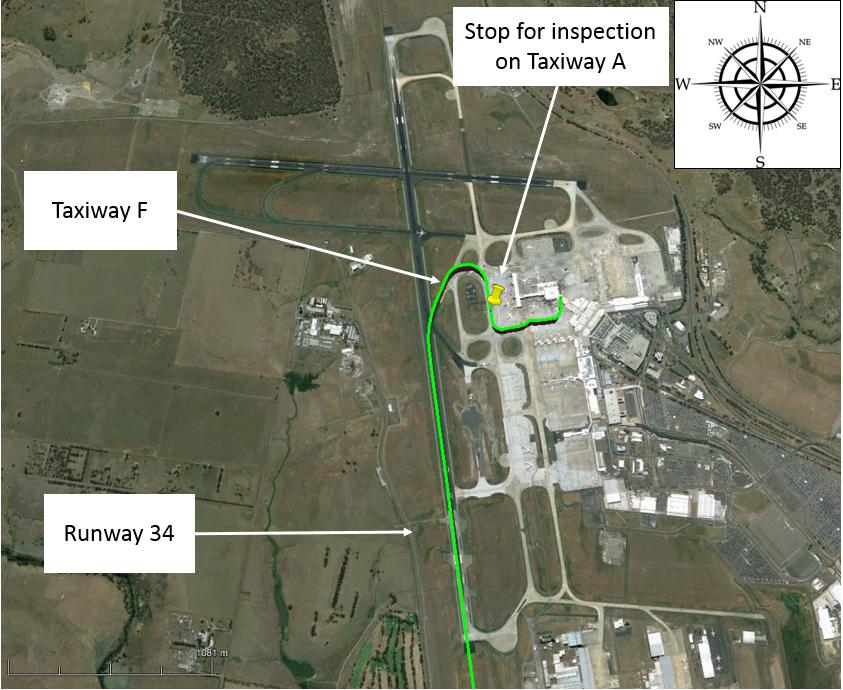
Figure 1: Aircraft ground track at Melbourne Airport

Source: Google earth, annotated by ATSB

The ARFF vehicles arrived in front of the aircraft on Taxiway A and an ARFF officer communicated their observations of the right engine to the SMC. The SMC directed the flight crew to monitor the frequency in use by the ARFF. Consequently, the flight crew heard the ARFF officer report to the SMC that the smoke they saw ‘appeared to be normal’. The aircraft captain was aware that the aircraft engines can emit smoke from the engine oil system and cross-checked their engine indications. There were no abnormal indications present and therefore the captain elected to taxi the aircraft to their allocated parking bay and conduct a normal shut down with ARFF in attendance. The aircraft was shut down without further incident.

Maintenance fault finding

After the passengers had disembarked, the captain informed one of the company maintenance engineers that smoke had been observed coming from the right engine after landing, but all engine indications were normal. The engineer conducted a general visual inspection of the engine and reported to the captain that there was no obvious sign of a fault. The captain documented the incident in the aircraft technical log and signed-off duty.

During the turn-around inspection, another company maintenance engineer noted that the right hydraulic system was at the refill level. The engineer conducted leak checks on the right hydraulic system and found a damaged hydraulic hose in the right engine pylon hydraulic bay (Figures 2 and 3). The damaged hose was located downstream of the right engine thrust reverser stow line.

Figure 2: Location of aircraft hydraulic systems and leak
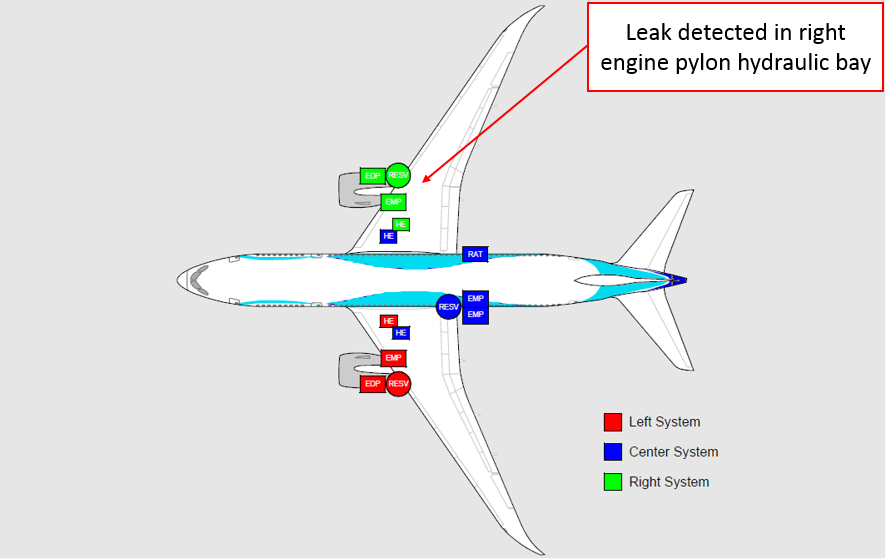
Figure 2: Location of aircraft hydraulic systems and leak

Source: Boeing, annotated by ATSB

Figure 3: Location of hydraulic hose
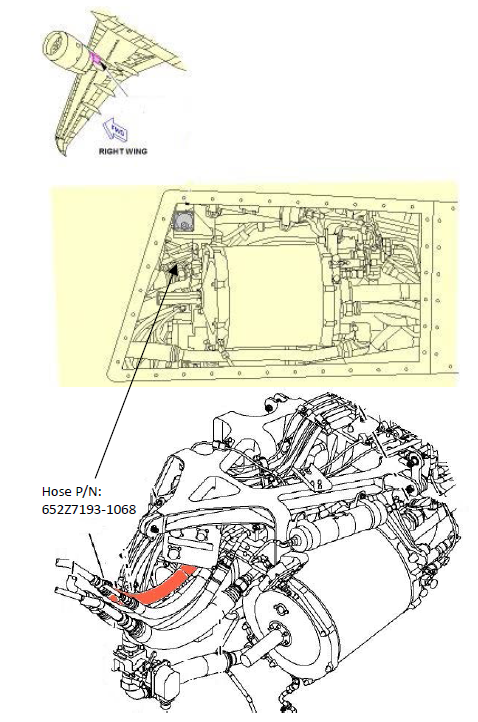
Figure 3: Location of hydraulic hose

Source: Boeing

Flight data recorder

The engine thrust reversers are electrically controlled, but hydraulically powered systems. The right hydraulic system powers the right engine thrust reverser and the left system powers the left engine thrust reverser. Flight data recorder information indicated that the three hydraulic systems were at the same quantity when the aircraft landed. When the thrust reversers were applied to assist braking, the left and right hydraulic system quantities reduced, as required, to power the thrust reverser actuators. However, when the thrust reversers were stowed only the left hydraulic system returned to the normal quantity. The right system quantity continued to reduce, which was consistent with a leak in the hydraulic system.

Aircraft manufacturer findings and recommendations

The failed hose was part of the thrust reverser retraction circuit and is otherwise isolated during flight. The thrust reverser circuit is the only location where this part is installed on the aircraft. Boeing note that the leak has previously been observed either as drip from the aft fairing of the engine pylon after flight, or during landing as a mist sprayed from the engine exhaust during thrust reverser retraction. Boeing has advised operators to heighten their awareness of the issue, and in the event of an observed leak at the aft pylon fairing module, to check the incident part number hose for a rupture. Boeing has recorded several in-service failures of this part number hose and investigated the fault with the part manufacturer.

Engine manufacturer findings

During development testing of the engine, the manufacturer, Rolls Royce, identified the potential for a visible white-coloured mist from the engine oil breather to occur at any stage of engine operation. They stressed that this is a normal characteristic of the engine, which is a result of incomplete air/oil separation, and ‘does not represent an increase in engine oil consumption.’

Aircraft captain comments

The captain noted that during the inspection from the ARFF services, the flight crew were asked by the SMC to monitor the ARFF frequency, but they were not allocated a discrete frequency for communications with ATC. This resulted in interruptions from other traffic using Ground frequency for routine communications and at times the captain felt they could not immediately relay information to ATC.

Airservices comments

Airservices noted the captain’s comment regarding the need for a discrete frequency. This is currently not standard practice and has the potential to create confusion for ATC at times of high workload. The use of a published frequency can aid in situational awareness for other operators and ARFF services throughout the emergency.

Safety analysis

Hydraulic leak

During the turn-around inspection of the aircraft, the right hydraulic system fluid level was found to be low due to a ruptured hydraulic hose. This hydraulic hose is only installed in the engine thrust reverser retraction circuit and is otherwise isolated inflight. The flight data indicated that the reduction of fluid in the right hydraulic system, consistent with a hydraulic fluid leak, coincided with the thrust reverser retraction after landing.

Engine smoke

At the time that the aircraft stopped for a visual inspection by ARFF, what was reported as smoke appears to be mist emanating from the vicinity of the engine oil breather (Figure 4). The presence of mist is consistent with the Boeing investigation into the failures of the affected hydraulic hose that indicates a rupture of this hose. However, the location of the mist suggests the source could have been (by itself or in addition to the hydraulic fluid) due to the engine oil breather. This is because the mist was also consistent with what Rolls Royce had previously noted as a visible white-coloured mist that can be observed emanating from the engine oil breather as a result of incomplete air/oil separation.

Figure 4: Aircraft stopped for inspection
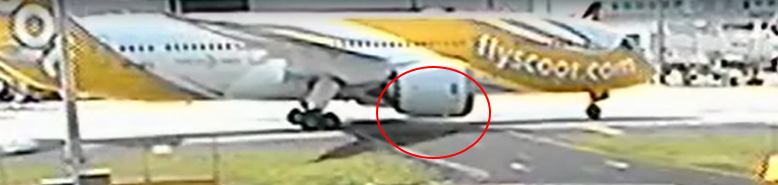
Figure 4: Aircraft stopped for inspection

Source: Melbourne Airport

Findings

These findings should not be read as apportioning blame or liability to any particular organisation or individual.

  • The hydraulic hose in the right engine thrust reverser retraction circuit ruptured when the right engine thrust reverser was retracted on landing.
  • The reported engine smoke was probably mist from the right hydraulic system leaking hydraulic fluid into the engine exhaust, or mist from the engine oil breather as a result of incomplete air/oil separation, or a combination of both conditions.

Safety action

Whether or not the ATSB identifies safety issues in the course of an investigation, relevant organisations may proactively initiate safety action in order to reduce their safety risk. The ATSB has been advised of the following proactive safety action in response to this occurrence.

Aircraft manufacturer

As a result of this occurrence and previous occurrences, Boeing has advised the ATSB they have taken the following safety action:

A ‘capture and control in production’ process was introduced. This process has identified and screened out defective parts. Their own investigation has identified the likely root causes of the failures and identified the population of hoses affected. They have communicated recommended actions to aircraft operators, which describes how to identify and replace potentially affected hoses.

Aircraft Operator

As a result of this occurrence, Scoot Airlines has advised the ATSB they are taking the following safety action:

As per the aircraft manufacturer’s recommendations, a 787 fleet check was conducted, potentially affected hoses identified, and replacement hoses ordered.

Safety message

At each stage during this incident: after the aircraft had landed, when the engineering inspection detected a low hydraulic system fluid level, and subsequently when the manufacturer received the failed part, the exact nature of the problem was unclear. However, at each stage, precautionary action was taken to investigate the problem, which mitigated the risk to the safety of personnel and serviceability of the aircraft.

Short Investigations Bulletin - Issue 55

Purpose of safety investigations

The objective of a safety investigation is to enhance transport safety. This is done through:

  • identifying safety issues and facilitating safety action to address those issues
  • providing information about occurrences and their associated safety factors to facilitate learning within the transport industry.

It is not a function of the ATSB to apportion blame or provide a means for determining liability. At the same time, an investigation report must include factual material of sufficient weight to support the analysis and findings. At all times the ATSB endeavours to balance the use of material that could imply adverse comment with the need to properly explain what happened, and why, in a fair and unbiased manner. The ATSB does not investigate for the purpose of taking administrative, regulatory or criminal action.

Terminology

An explanation of terminology used in ATSB investigation reports is available here. This includes terms such as occurrence, contributing factor, other factor that increased risk, and safety issue.

Publishing information 

Released in accordance with section 25 of the Transport Safety Investigation Act 2003

Published by: Australian Transport Safety Bureau

© Commonwealth of Australia 2016

image_5.png

Ownership of intellectual property rights in this publication

Unless otherwise noted, copyright (and any other intellectual property rights, if any) in this report publication is owned by the Commonwealth of Australia.

Creative Commons licence

With the exception of the Coat of Arms, ATSB logo, and photos and graphics in which a third party holds copyright, this publication is licensed under a Creative Commons Attribution 3.0 Australia licence.

Creative Commons Attribution 3.0 Australia Licence is a standard form licence agreement that allows you to copy, distribute, transmit and adapt this publication provided that you attribute the work.

The ATSB’s preference is that you attribute this publication (and any material sourced from it) using the following wording: Source: Australian Transport Safety Bureau

Copyright in material obtained from other agencies, private individuals or organisations, belongs to those agencies, individuals or organisations. Where you wish to use their material, you will need to contact them directly.

__________

  1. Coordinated Universal Time (UTC): the time zone used for aviation. Local time zones around the world can be expressed as positive or negative offsets from UTC. Singapore local time is UTC +8 and Melbourne Eastern Standard Time (EST) is UTC +10.

Occurrence summary

Investigation number AO-2016-114
Occurrence date 08/09/2016
Location Melbourne Airport
State Victoria
Report release date 14/12/2016
Report status Final
Investigation level Short
Investigation type Occurrence Investigation
Investigation status Completed
Mode of transport Aviation
Aviation occurrence category Smoke
Occurrence class Incident
Highest injury level None

Aircraft details

Manufacturer The Boeing Company
Model 787-8
Registration 9V-OFG
Serial number 37123
Aircraft operator SCOOT
Sector Jet
Operation type Air Transport High Capacity
Departure point Singapore
Destination Melbourne, Vic.
Damage Nil

Smoke event involving Airbus A380, VH-OQD, about 1,500 km west-south-west of Dallas-Fort Worth Airport, United States, on 16 May 2016

Final report

What happened

On 15 May 2016, a Qantas Airways Airbus A380 aircraft, registered VH-OQD, operated flight QF7 from Sydney, New South Wales to Dallas-Fort Worth, Texas, United States.

About two hours prior to the aircraft’s arrival in Dallas-Fort Worth, a passenger alerted the cabin crew to the presence of smoke in the cabin. The cabin crew then initiated the basic fire drill procedure.

Two of the cabin crew proceeded to the source of the smoke with fire extinguishers. At the same time, the customer services manager (CSM) made an all stations emergency call on the aircraft interphone to alert flight crew and other cabin crew to the presence of smoke.

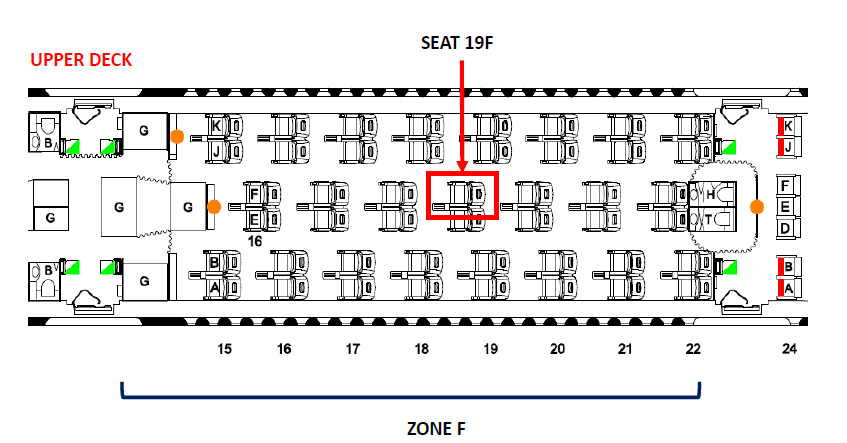
The cabin crew located the source of the smoke at seat 19F, in Zone F, on the upper deck (Figure 1). The crew removed the seat cushions and covers from seat 19F while the CSM turned off the power to the centre column of the seats. When the seat was further dismantled, the crew found a crushed personal electronic device (PED) wedged tightly in the seat mechanism. The cabin crew assessed that the crushed PED contained a lithium battery.

Figure 1: Cabin diagram showing the seat from where the smoke emanated

Cabin diagram showing the seat from where the smoke emanated

Source: Qantas, modified by ATSB

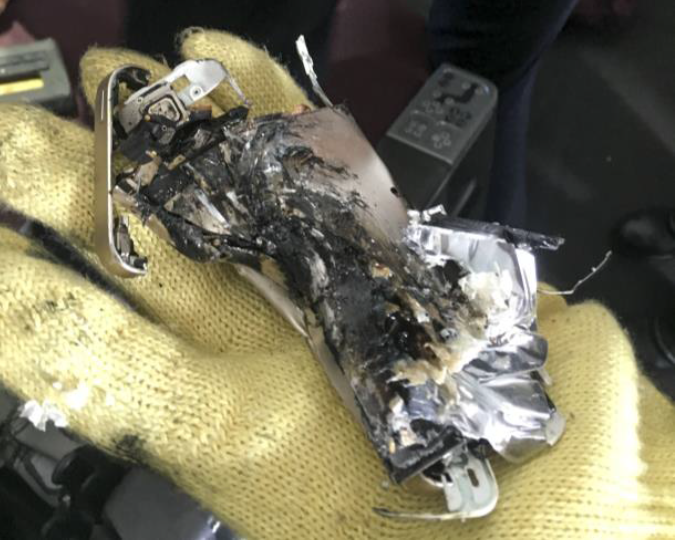
By that time, the PED was no longer emitting smoke, however, a strong acrid smell remained in the cabin. The crew then manoeuvred the seat and freed the PED (Figure 2). The crew placed the PED in a jug of water, which was then put in a metal box and monitored for the remainder of the flight.

The flight crew did not receive any abnormal indications or warnings.

No passengers were injured, and the aircraft was not damaged in the incident.

Figure 2: Crushed PED after removal from seat

Crushed PED after removal from seat

Source: Qantas

Operator comments

The aircraft operator commented that it has been estimated over one billion lithium batteries are transported by air every year, with potentially hundreds carried on single sectors on large aircraft. As such, both cabin crew and passenger education remains a key component to managing these events. Raising passenger awareness of the potential hazards of PEDs commences at check-in, through to the pre-flight safety demonstration, and aims to minimise the risk of PED thermal runaway events.

Qantas Airlines’ basic fire drill is based on a teamwork approach, with the division of duties between three central crew and as many supporting crew as available and required. This division of duties allocates the responsibilities of fighting the fire, retrieving equipment and ensuring lines of communication with the flight deck remain uninterrupted.

ATSB comment

Similar occurrences

The ATSB has received 17 notifications of similar incidents of lithium battery thermal events in aircraft over the past 6 years.

The ATSB investigation AO-2014-082 details an example where a short circuit between lithium batteries initiated a fire in an aircraft cargo hold.

Safety message

This incident provides an excellent example of an effective response to an emergency situation. The crew were able to quickly implement the basic fire drill procedure which defined the roles and responsibilities of the responding crew. This enabled a rapid and coordinated response to the smoke event using all available resources. The effective implementation of this procedure also ensured the flight crew were kept informed as the situation developed.

This incident also highlights the hazards of transporting lithium-ion battery powered PEDs. The Civil Aviation Safety Authority web page Travelling safely with batteries and pamphlet Is your luggage safe? provide information on the safe carriage of lithium-ion batteries and lithium-ion powered devices aboard aircraft.

Aviation Short Investigations Bulletin - Issue 50

Purpose of safety investigations

The objective of a safety investigation is to enhance transport safety. This is done through:

  • identifying safety issues and facilitating safety action to address those issues
  • providing information about occurrences and their associated safety factors to facilitate learning within the transport industry.

It is not a function of the ATSB to apportion blame or provide a means for determining liability. At the same time, an investigation report must include factual material of sufficient weight to support the analysis and findings. At all times the ATSB endeavours to balance the use of material that could imply adverse comment with the need to properly explain what happened, and why, in a fair and unbiased manner. The ATSB does not investigate for the purpose of taking administrative, regulatory or criminal action.

Terminology

An explanation of terminology used in ATSB investigation reports is available here. This includes terms such as occurrence, contributing factor, other factor that increased risk, and safety issue.

Publishing information 

Released in accordance with section 25 of the Transport Safety Investigation Act 2003

Published by: Australian Transport Safety Bureau

© Commonwealth of Australia 2016

image_5.png

Ownership of intellectual property rights in this publication

Unless otherwise noted, copyright (and any other intellectual property rights, if any) in this report publication is owned by the Commonwealth of Australia.

Creative Commons licence

With the exception of the Coat of Arms, ATSB logo, and photos and graphics in which a third party holds copyright, this publication is licensed under a Creative Commons Attribution 3.0 Australia licence.

Creative Commons Attribution 3.0 Australia Licence is a standard form licence agreement that allows you to copy, distribute, transmit and adapt this publication provided that you attribute the work.

The ATSB’s preference is that you attribute this publication (and any material sourced from it) using the following wording: Source: Australian Transport Safety Bureau

Copyright in material obtained from other agencies, private individuals or organisations, belongs to those agencies, individuals or organisations. Where you wish to use their material, you will need to contact them directly.


Occurrence summary

Investigation number AO-2016-051
Occurrence date 16/05/2016
Location 3,000 km WSW of Dallas/Fort Worth Airport, USA
State International
Report release date 25/08/2016
Report status Final
Investigation level Short
Investigation type Occurrence Investigation
Investigation status Completed
Mode of transport Aviation
Aviation occurrence category Smoke
Occurrence class Serious Incident
Highest injury level None

Aircraft details

Manufacturer Airbus
Model A380-842
Registration VH-OQD
Serial number 0026
Aircraft operator Qantas
Sector Jet
Operation type Air Transport High Capacity
Departure point Sydney, NSW
Destination Dallas, USA
Damage Nil

Smoke event involving a Cirrus SR22T, VH-EPG, 44 km west of Bendigo Airport, Victoria, on 19 May 2015

Final report

What happened

On 19 May 2015, the pilot of a Cirrus SR22T aircraft, registered VH-EPG (EPG), planned to conduct a flight from Moorabbin to Mildura, Victoria, under the instrument flight rules (IFR) with one passenger. At about 0812 Eastern Standard Time (EST), the aircraft departed Moorabbin Airport, and the pilot conducted a climb to flight level (FL) 180.[1] During the climb, the pilot selected the de-ice system on, which then remained on for about 20 minutes. After levelling off at FL180, the pilot switched off the de-ice system.

About 5 minutes later, the pilot received an ‘ALT AIR OPEN’ alert on the primary flight display (PFD). The alternate air caution indicated a blockage, probably due to ice, of the induction air intake to the engine. The alternate air then routed unfiltered air to the engine. Soon after the alert illuminated, light brown smoke entered the cabin through the cabin air vents. The pilot attempted to determine the source of the smoke. All engine parameters, exhaust gas, turbo and engine temperatures were normal, the electrical system was functioning normally and no circuit breakers had popped. The source of the smoke appeared to be forward of the engine panel, with no flames or external smoke visible.

The pilot assessed the probable cause of the smoke to be a turbocharger issue and elected to conduct a descent. The pilot also commenced preparations for a possible diversion to the nearest airport. At about 0848, the pilot requested a descent to FL140 and air traffic control (ATC) cleared the aircraft to descend to FL150, due to traffic. When the pilot reduced power for the descent, the smoke cleared. However, after reaching FL150, the pilot resumed cruise power and the smoke reappeared. This added to the pilot’s assessment that there was a turbocharger leak. The Cirrus recommendation for a suspected turbocharger leak was to descend and land as soon as possible, which the pilot followed.

At about 0852, the pilot declared a PAN[2] and requested further descent and a diversion to Bendigo, Victoria. Passing FL140 on descent, the separation between EPG and a SAAB 340 aircraft was 4.2 NM. That distance was less than the required separation standard for that airspace, of 5 NM. The controller issued a turn to the SAAB to re-establish the required separation. The pilots of both aircraft were aware of each other.

During the descent, the smoke evaporated, but a moist brown residue was depositing on the windscreen reducing the visibility. To try to clear the windscreen, the pilot turned on the cabin heated air, and fan up to full (‘3’). Turning on the cabin air had the effect of drawing in more contaminant, which was condensing and increasing the deposit on the windscreen.

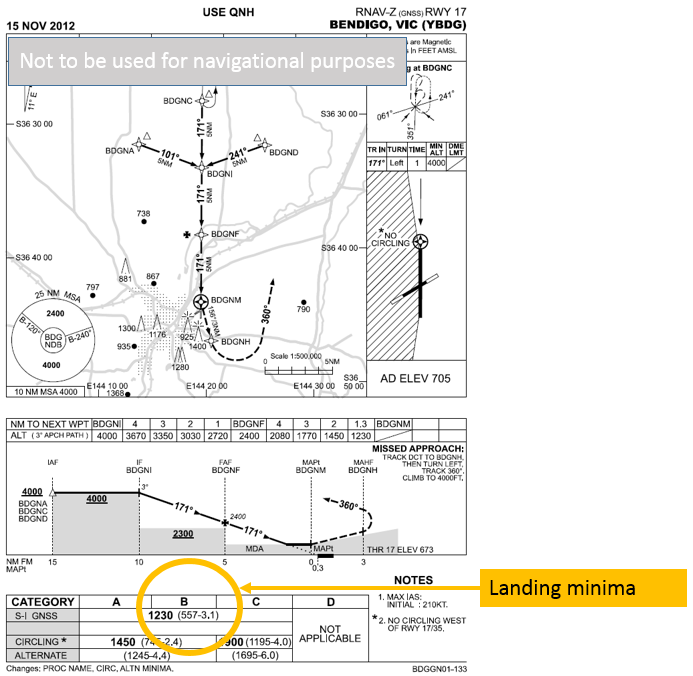
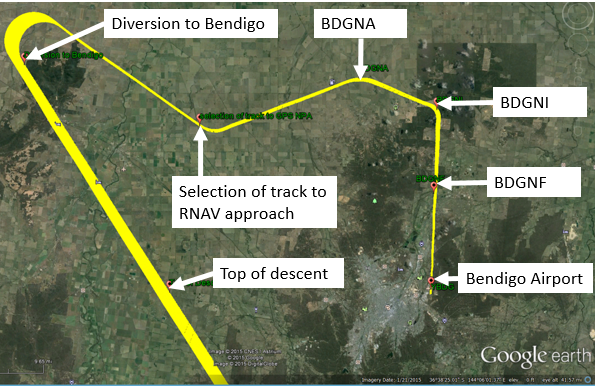
The pilot selected the radio navigation (RNAV) global navigation satellite system (GNSS) approach to runway 17 at Bendigo Airport (Figure 1). They then conducted the descent and approach using the autopilot and the flight director. At about 0904, the aircraft turned left to track towards the initial approach fix for the RNAV approach procedure (Figure 2). The aerodrome weather information service (AWIS) at Bendigo was reporting cloud below the minima.[3] Despite the weather conditions, the pilot elected to continue the approach. The pilot based the decision to continue on their assessment of a turbocharger leak. The pilot also considered the smoke that increased with power increase and the potential for catastrophic engine failure or fire.

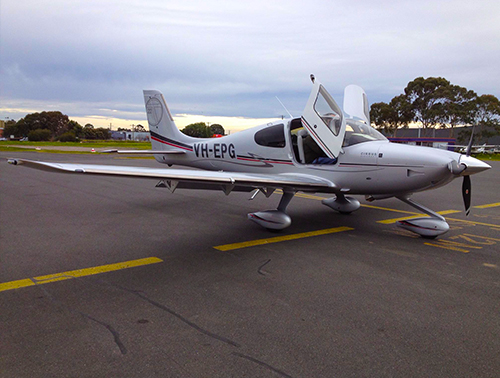
VH-EPG Source: Fly Cirrus

VH-EPG Source: Fly Cirrus

The pilot switched on the runway lights. Bendigo Airport did not have approach lighting available.

Figure 1: RNAV-Z (GNSS) approach for runway 17 Bendigo

Figure 1: RNAV-Z (GNSS) approach for runway 17 Bendigo

Source: Airservices Australia

After arriving at the final approach fix ‘BDGNF’, the autopilot disengaged and the pilot took over manual control of the aircraft. No vertical profile guidance was available to the pilot from the navigation system. They reported being in heavy rain, and that visibility through the windscreen was obscured by the contamination. The pilot could see the runway lights through the contaminated windscreen and rain, but reported difficulty in identifying the exact location of the ground. The aircraft was clear of cloud, but in rain, and the pilot estimated the visibility to be about 2 km. The flight data indicated that the aircraft’s rate of descent in this section of the approach reached about 1,200 ft per minute.

When on final approach to runway 17, about 0.6 NM from the runway threshold, the pilot suddenly sighted a row of trees. The pilot immediately conducted a climb to avoid them, and estimated that the aircraft cleared the trees by a few feet. The pilot then landed the aircraft on the runway threshold. The pilot and passenger were uninjured and the aircraft was not damaged.

Figure 2: Aircraft track showing diversion to Bendigo and RNAV approach

Figure 2: Aircraft track showing diversion to Bendigo and RNAV approach

Source: Google earth and flight data, annotated by the ATSB

Pilot comments

The pilot stated that the emergency and abnormal checklists were electronic and built into the aircraft system. If engine compartment fire is suspected, the actions are to set throttles to idle, select mixture to cut-off, and select the fuel to off. The recommendation is then to conduct an emergency descent and land immediately, and to not deploy the aircraft parachute (Cirrus airframe parachute system – CAPS). However, if there is no power available and the aircraft is in instrument meteorological conditions (IMC), the recommended action is to deploy the CAPS. The pilot stated that the ambiguity on whether or not to deploy the CAPS when you have a suspected engine compartment fire in IMC may need to be addressed.

In addition, the pilot commented that:

  • Because they had the windscreen heat on in the freezing conditions, the residue condensed and deposited on the windscreen.
  • Their workload was not too high because of familiarity with the aircraft (over 1,200 hours on type) and the avionics available.
  • They did not have vertical profile information after the final approach fix (FAF) but have subsequently upgraded the Integrated Modular Avionics – Perspective software. This version of the software now provides a Baro-VNAV approach. That mode option provides vertical navigation guidance.
  • The pilot considered the option to continue to Mildura, where the weather was better, but that would have required another 1.5 hours of flying. With the smoke increasing as they increased power, the pilot elect to divert to Bendigo.
  • They were using oxygen due to the requirements of operating at flight levels. The aircraft was fitted with a carbon monoxide warning which did not activate.
  • The aircraft was fitted with an infra-red camera to aid visibility outside the aircraft in poor weather conditions. The pilot had not switched the camera on during the incident flight, but subsequently used the camera in reduced visibility conditions. The pilot believed that the improved vision provided by the camera would have assisted from the final approach fix to the landing at Bendigo.

Weather

The weather at Bendigo at the time included heavy rain, visibility less than 2 km, cumulus cloud with base about 500 ft above ground level, and temperature 14 °C.

Engineering report

After the incident, an engineering inspection found the following sequence had occurred to create smoke in the cockpit and residue on the windscreen:

De-icing fluid from the Anti-Ice System had pooled in the aircraft cowling. For propeller de-icing, the fluid is distributed from a slinger ring mounted to the spinner backing plate, to rubber boots at the root end of the propeller blades. The engineer found a partial blockage of the slinger ring nozzle, which disrupted the flow spray pattern. This had caused one of the propeller deice fluid lines to spray fluid into the cowling and engine compartment, and reduced flow to the propeller.

When the alternate air source opened, the engine intake allowed the air/de-ice fluid vapour mixture through the induction system to the turbo/intercooler system. The engine compartment air had therefore drawn in the de-ice fluid and compressed it in the intercooler.

The heated cabin air was drawn from fresh air on the right cowl, and heated air from the intercoolers. The cabin air drew in the de-ice fluid and was distributed into the cabin. Due to the cold outside air temperature and the selection of warm air onto the windscreen, the moisture condensed onto the windscreen. Contamination on the inside of the window was found to be moisture contamination with deice fluid residue.

The engineer was unable to capture the foreign material that had blocked the slinger ring nozzle, but after the line was blown clear and the system flushed, operation was returned to normal. The system has a strainer and filters which have a two-year life and without trapping the blockage material they were unable to report whether the item was internal or external of the nozzle as it dislodged easily from the discharge nozzle.

There were no faults found with the turbocharger – no leaks, no cracks, and no obvious concern of fire risk.

Cirrus Aircraft in the United States advised that they were not aware of any previous examples of de-icing fluid entering the cabin via the alternate air box. The engineer and pilot queried whether there was a risk of spontaneous combustion, as the de-ice fluid was flammable, compressed in the engine and then vaporised. Cirrus Aircraft responded that the fluid could not spontaneously combust as:

  • the auto-ignition temperature (ignition by heat) of the de-ice fluid is 770 degrees Fahrenheit (410 oC)
  • the flash point (ignition by spark or flame) for the de-ice fluid is 220 degrees Fahrenheit (104 oC)
  • the air temperature entering the intercooler is around 550 degrees Fahrenheit (288 oC)
  • the de-ice fluid in the warm air entering the intercooler is well below the auto-ignition temperature of the de-ice fluid and no spark or flame is found in the induction system.

Cirrus instructor comment

A certified Cirrus instructor advised the ATSB that the Bendigo RNAV could be flown in VS mode using the appropriate power settings without pilot intervention. This should be done rather than manually overriding the vertical speed mode to reduce pilot workload and maintain the optimal vertical profile.

Flight data analysis

The ATSB analysed the aircraft flight data and noted the following.

The aircraft was fitted with a Garmin GFC-700 autopilot system. The recorded data indicated the aircraft was flown with the autopilot engaged and controlling both pitch and roll modes until the aircraft descended to about 1,100 ft barometric altitude and was about 1.1 NM from touchdown.

The aircraft followed the published RNAV approach lateral path, passing over the published waypoints. The recorded data showed that the roll control mode was made by using GPS information, which resulted in very precise lateral tracking.

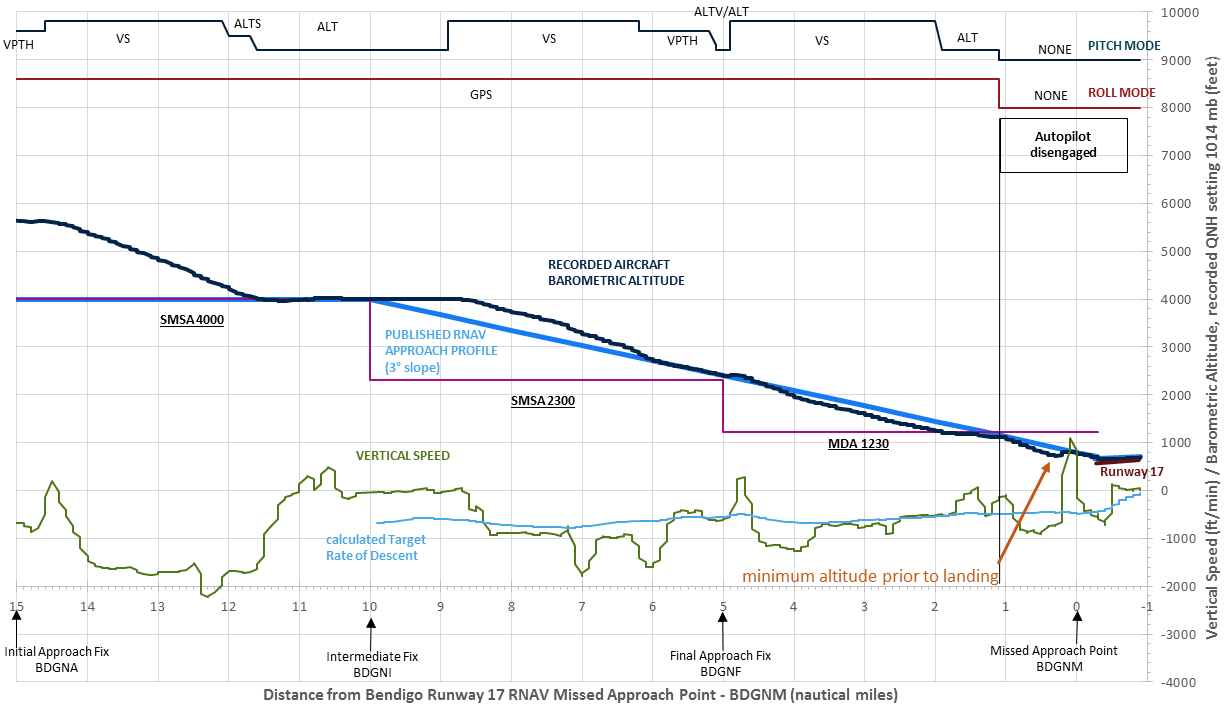
The vertical profile recorded by the aircraft systems showed significant variation both above (about 350 ft high) and below (about 120 ft low) the 3° approach path angle shown in the published RNAV procedure (black line in Figure 3). The aircraft pitch modes during the approach were predominantly vertical speed with altitude capture hold and vertical path also becoming active. The aircraft recorded vertical speed was plotted in comparison with a target rate of descent calculated using the recorded groundspeed (light blue line in Figure 3).

Descent from sector minimum safe altitude of 4,000 ft was initiated using vertical speed as the pitch mode. The aircraft was above the published approach profile when the descent began (black line in Figure 3). The aircraft recorded a vertical speed of about 900 ft per minute. At about 6.2 NM from the missed approach point, as the aircraft was descending through 2,900 ft, the pitch mode changed to vertical path. The rate of descent reduced and the aircraft followed the published descent profile to about 5.1 NM, where the pitch mode changed to VNAV target altitude capture and then altitude hold (recorded barometric altitude of 2,393 ft, FAF published altitude 2,400 ft) modes at the final approach fix. About 8 seconds after altitude hold mode became active the pitch mode changed to vertical speed. The rate of descent increased to about 1,200 ft per minute and the aircraft descended below the published approach profile. The rate of descent reduced to a value similar to the calculated target rate of descent at 9:13:28, as the aircraft was passing through about 2,000 ft. This rate of descent was maintained until 9:14:26 when the pitch mode changed to altitude hold (recorded barometric altitude 1,235 ft, MDA 1,230 ft) at about 1.9 NM from the missed approach point.

The autopilot was disengaged at 9:14:59, about 1.1 NM from the missed approach waypoint, ‘BDGNM’. Following the autopilot disengaging, the rate of descent increased and the aircraft reached a barometric altitude of about 715 ft at 9:15:33, about 0.3 NM from ‘BDGNM’. The aircraft then proceeded to pitch up, to about 15°, and climbed to about 810 ft. The aircraft regained the published approach path angle and continued the approach to land at Bendigo Airport. The estimated touchdown was about 9:15:57, on the runway threshold – about 0.3 NM beyond the missed approach point), and the barometric altitude recorded was about 670 ft.

Figure 3: Comparison of recorded aircraft altitude and published approach procedure vertical profile

Figure 3: Comparison of recorded aircraft altitude and published approach procedure vertical profile

Source: Aircraft flight data analysed by the ATSB

ATSB Comment

The checklist in the aircraft’s pilot operating handbook for Smoke and Fume Elimination included selecting Air Conditioner to OFF and if the source of smoke and fumes was forward of the firewall forward selecting Airflow to OFF. Following these selections may have prevented the contaminant condensing on the windscreen during the approach.

Safety message

This incident provides an excellent example of challenges that may be involved in pilot decision making processes. The pilot was faced with an emergency situation and poor weather conditions. The decision to continue an approach in marginal conditions led to very quick action needed to avoid trees on the final approach. Pilots are encouraged to think through such scenarios in advance, which may assist with their decision making if confronted with similarly challenging circumstances. Following published checklists, particularly in emergency situations is important to enable pilots to identify the issue and to resolve it.

The Federal Aviation Authority handbook includes a chapter on Aeronautical Decision-Making. The American AOPA Air Safety Foundation Safety Advisor, Decision making for pilots, stated that effective decision making begins with anticipation – thinking about what could go wrong before it actually does.

Aviation Short Investigations Bulletin - Issue 43

Purpose of safety investigations

The objective of a safety investigation is to enhance transport safety. This is done through:

  • identifying safety issues and facilitating safety action to address those issues
  • providing information about occurrences and their associated safety factors to facilitate learning within the transport industry.

It is not a function of the ATSB to apportion blame or provide a means for determining liability. At the same time, an investigation report must include factual material of sufficient weight to support the analysis and findings. At all times the ATSB endeavours to balance the use of material that could imply adverse comment with the need to properly explain what happened, and why, in a fair and unbiased manner. The ATSB does not investigate for the purpose of taking administrative, regulatory or criminal action.

Terminology

An explanation of terminology used in ATSB investigation reports is available here. This includes terms such as occurrence, contributing factor, other factor that increased risk, and safety issue.

Publishing information 

Released in accordance with section 25 of the Transport Safety Investigation Act 2003

Published by: Australian Transport Safety Bureau

© Commonwealth of Australia 2015

image_5.png

Ownership of intellectual property rights in this publication

Unless otherwise noted, copyright (and any other intellectual property rights, if any) in this report publication is owned by the Commonwealth of Australia.

Creative Commons licence

With the exception of the Coat of Arms, ATSB logo, and photos and graphics in which a third party holds copyright, this publication is licensed under a Creative Commons Attribution 3.0 Australia licence.

Creative Commons Attribution 3.0 Australia Licence is a standard form licence agreement that allows you to copy, distribute, transmit and adapt this publication provided that you attribute the work.

The ATSB’s preference is that you attribute this publication (and any material sourced from it) using the following wording: Source: Australian Transport Safety Bureau

Copyright in material obtained from other agencies, private individuals or organisations, belongs to those agencies, individuals or organisations. Where you wish to use their material, you will need to contact them directly.

__________

  1. At altitudes above 10,000 ft in Australia, an aircraft’s height above mean sea level is referred to as a flight level (FL). FL 180 equates to 18,000 ft.
  2. An internationally recognised radio call announcing an urgency condition which concerns the safety of an aircraft or its occupants but where the flight crew does not require immediate assistance.
  3. Specified meteorological conditions of cloud ceiling and visibility. In order for an aircraft to land at an aerodrome, the actual weather conditions need to be at or above the landing minima.


Occurrence summary

Investigation number AO-2015-058
Occurrence date 19/05/2015
Location Bendigo Airport, west 44 km
State Victoria
Report release date 07/10/2015
Report status Final
Investigation level Short
Investigation type Occurrence Investigation
Investigation status Completed
Mode of transport Aviation
Aviation occurrence category Smoke
Occurrence class Incident
Highest injury level None

Aircraft details

Manufacturer Cirrus Design Corporation
Model SR22T
Registration VH-EPG
Serial number 0269
Sector Piston
Operation type Private
Departure point Moorabbin, Vic.
Destination Mildura, Vic.
Damage Nil

Smoke involving a Cessna 210L, VH-KJL, Bundaberg, Queensland, on 24 July 1993

Summary

The pilot reported that smoke was entering the cockpit and that it was accompanied by a burning smell. Subsequently most of the electrical system failed. The aircraft was diverted to Bundaberg and landed without further incident. Examination of the aircraft by maintenance engineers found that the electrical system had been subjected to a high voltage situation and significant damage had been caused to the avionics.

The DME (Distance Measuring Equipment) was found to have been the source of the smoke and probably the burning smell. The aircraft is equipped with a high voltage warning light and the engineers found that it illuminated as soon as power was applied to the electrical system. The pilot reported that the light did not illuminate in flight.

Occurrence summary

Investigation number 199302224
Occurrence date 24/07/1993
Location Bundaberg
State Queensland
Report release date 30/10/1993
Report status Final
Investigation type Occurrence Investigation
Investigation status Completed
Mode of transport Aviation
Aviation occurrence category Diversion/return, Smoke
Occurrence class Incident

Aircraft details

Manufacturer Cessna Aircraft Company
Model 210L
Registration VH-KJL
Sector Piston
Departure point Archerfield QLD
Destination Town of 1770 QLD
Damage Minor

Smoke involving a Piper PA-31-350, VH-XLA, Sydney Aerodrome, New South Wales, on 24 November 1999

Summary

The Tower controller observed some smoke emanating from VH-XLA on departure from runway 16R. The Tower controller informed the pilot of the smoke and consequently, the pilot conducted a precautionary circuit and landing without further incident. 

The engine continued to deliver full power and there were no abnormal engine indications from the cockpit engine instruments. A full emergency was declared and the aerodrome was closed. The emergency co-ordination was hampered by problems with the common crash call (CCC) line between the Tower and the Terminal Operations Controller (TOC). After an uneventful landing, XLA taxied back to the terminal area under an aerodrome fire services escort. The pilot shutdown the aircraft and there was no sign of fire or damage to the left engine. 

A replacement aircraft was sent to Sydney to retrieve the six passengers. A post-flight engineering inspection of the left engine revealed a partially blocked fuel injector nozzle and a default overly rich fuel mixture. During the ground run, a minor puff of black smoke emanated from the left engine at full power. This is not an uncommon consequence of a slightly rich mixture. A company LAME cleaned the fuel injector nozzle. As a further pre-cautionary measure, the fuel control unit was also changed. The left engine operated normally after these items had been actioned. This occurrence also revealed that the CCC to the TOC did not function which delayed the aircraft pre-crash co-ordination. 

The TOC end of the CCC is the responsibility of the airport operator. The circuit commissioning was a 4 wire system at the airport operator's request. The other subscribers to the CCC had complied with this 4 wire circuit system. A telecommunications company was then sub-contracted to perform maintenance on this line for the airport operator. The telecommunications company had then altered the line circuit arrangement to a 2 wire system without apparently informing or co-ordinating this change with the airport operator and Airservices. The new 2 wire system was found to be incompatible with the Airservices 4 wire system. This lack of inter-agency co-ordination has resulted in an inability to efficiently co-ordinate relevant pre-crash taskings in a timely manner. 

As a result of this occurrence, this problem has been resolved. Airservices has modified its' end of the line to a 2 wire system. The airport operator and Airservices now use fully compatible 2 wire circuit systems to communicate between the Tower and the TOC. This emergency communications system has been tested and is now fully functional.

Occurrence summary

Investigation number 199905547
Occurrence date 24/11/1999
Location Sydney Aerodrome
State New South Wales
Report release date 05/01/2000
Report status Final
Investigation type Occurrence Investigation
Investigation status Completed
Mode of transport Aviation
Aviation occurrence category Smoke
Occurrence class Incident

Aircraft details

Manufacturer Piper Aircraft Corp
Model PA-31-350
Registration VH-XLA
Sector Piston
Departure point Sydney NSW
Destination Cowra NSW
Damage Nil

Smoke involving a de Havilland Canada DHC-8-315, VH-JSQ, 172 km south of Moomba Aerodrome, South Australia, on 5 May 1998

Summary

While returning to Adelaide from Moomba, the crew of a Dash 8 detected smoke coming from around the weather radar. They immediately turned off the equipment, donned oxygen masks and made a PAN call requesting RFF services to be placed on standby. To dissipate the smoke, the crew requested a descent to 10,000 feet where the aircraft was depressurised and the forward outflow valve was opened. After ensuring that there was no smoke or flame coming from the radar unit, the crew made the decision to continue to their destination and briefed the passengers accordingly. Upon arrival in Adelaide the aircraft made a normal approach and an uneventful landing. The flight attendants were later sent for medical attention due to the effects of smoke inhalation. Maintenance investigation by the operator traced the fault to the radar indicator unit. This was replaced and the aircraft returned to service.

Occurrence summary

Investigation number 199801584
Occurrence date 05/05/1998
Location 172 km south of Moomba Aerodrome
State South Australia
Report release date 27/05/1998
Report status Final
Investigation type Occurrence Investigation
Investigation status Completed
Mode of transport Aviation
Aviation occurrence category Smoke
Occurrence class Incident

Aircraft details

Manufacturer De Havilland Canada/De Havilland Aircraft of Canada
Model DHC-8-315
Registration VH-JSQ
Sector Turboprop
Operation type Charter
Departure point Moomba SA
Destination Adelaide SA
Damage Nil

Smoke involving a Boeing 737-376, VH-TJD, Canberra Aerodrome, Australian Capital Territory, on 25 October 1995

Summary

While the aircraft was descending to land at Canberra the forward toilet smoke detector activated, the flight deck smoke annunciate light illuminated and a small amount of smoke was visible on the flight deck. The flight attendant confirmed there was no evidence of fire in the toilet. A slight haze was visible in the cabin with wisps emanating from the air-conditioning vents. The crew continued with the landing and a normal disembarkation ensued.

Oil was found to be dripping from the engine which was removed for rectification. The number 1 air/oil seal was found to have delaminated allowing engine oil to permeate into the air-conditioning ducts. The seal had previously been repaired at the manufacturer's facility. After this incident the operator determined to use only newly manufactured seals and introduced an in-situ pressure test of the seal.

Occurrence summary

Investigation number 199503616
Occurrence date 25/10/1995
Location Canberra Aerodrome
State Australian Capital Territory
Report release date 22/10/1996
Report status Final
Investigation type Occurrence Investigation
Investigation status Completed
Mode of transport Aviation
Aviation occurrence category Smoke
Occurrence class Incident

Aircraft details

Manufacturer The Boeing Company
Model 737-376
Registration VH-TJD
Sector Jet
Operation type Air Transport High Capacity
Departure point Melbourne Vic
Destination Canberra ACT
Damage Nil

Smoke involving a Beech Aircraft Corp 200, VH-XRF, Winton Aerodrome, Queensland, on 8 September 1995

Summary

After take-off at approximately 150 ft above ground level, smoke began to enter the cabin. This was immediately followed by a popping sound and the right engine failed. The pilot shut down the engine, made a Mayday call, and landed the aircraft safely on the departure runway.

Later examination of the engine found that the compressor section had moved rearward and seized. Initial inspection suggests a failure of a compressor bearing support. The engine was later removed and forwarded to the manufacturers overhaul facility in the United States of America.

Occurrence summary

Investigation number 199502947
Occurrence date 08/09/1995
Location Winton Aerodrome
State Queensland
Report release date 07/06/1996
Report status Final
Investigation type Occurrence Investigation
Investigation status Completed
Mode of transport Aviation
Aviation occurrence category Smoke
Occurrence class Incident

Aircraft details

Manufacturer Beech Aircraft Corp
Model 200
Registration VH-XRF
Sector Turboprop
Operation type Air Transport Low Capacity
Departure point Winton
Destination Townsville
Damage Minor

Smoke involving a Boeing 737-377, VH-CZD, Cairns Aerodrome, Queensland, on 3 August 1995

Summary

As the passengers were boarding, a sudden power surge was indicated by way of relay lights and instrument flags flashing on and off. A flight attendant indicated there was smoke coming from the rear galley area. The crew immediately turned off the galley power switch and all aircraft power and advised all passengers to disembark in an orderly fashion. The first officer then proceeded to the rear of the aircraft with a fire extinguisher, however it was not required.

Later examination found that both the rear galley circuit breakers had popped. The cause for the smoke was traced to a fault in the main three phase coupling plug. A section of the female to male coupling plug had short circuited and burnt. The coupling was replaced and the aircraft returned to service.

Occurrence summary

Investigation number 199502464
Occurrence date 03/08/1995
Location Cairns Aerodrome
State Queensland
Report release date 31/08/1995
Report status Final
Investigation type Occurrence Investigation
Investigation status Completed
Mode of transport Aviation
Aviation occurrence category Smoke
Occurrence class Incident

Aircraft details

Manufacturer The Boeing Company
Model 737-377
Registration VH-CZD
Sector Jet
Operation type Air Transport High Capacity
Damage Nil

Smoke involving a Socata TB-10, VH-YTD, Coonabarabran, New South Wales, on 15 February 1994

Summary

Shortly after carrying out a touch-and-go landing, at night on runway 29, a loud 'chuffing' sound was heard. Safety checks were begun, but the cockpit commenced to fill with smoke with no obvious sign of fire. Fresh air vents were closed, and a close circuit was carried out for a normal landing.

It was subsequently found that a number of exhaust pipe slip joint bolts were missing. One exhaust pipe had become detached and the escaping hot exhaust gases had burnt through the lower cowling.

Safety Action

As a result of the investigation into this and other similar occurrence (OASIS 9201731), the Bureau of Air Safety Investigation met with the Civil Aviation Authority Airworthiness (Powerplants) staff and discussed the apparent deficiencies with the exhaust clamping arrangements.

The CAA researched the available data and located a SOCATA Service Bulletin (SB), SB 10-073-78, which had been released in January 1994. The CAA subsequently isssued Aerospatiale (SOCATA) TB9, TB10 and TB20 Airworthiness Directives (ADs) AD/TB10/20, AD/TB10/21 and AD/TB20/27 effective 26 May 1994 mandating compliance with the manufacturers SB within 50 hours of time of service.

This prompt action by the CAA, in full consultation with the Bureau of Air Safety Investigation, obviated the need for any formal safety output.

Occurrence summary

Investigation number 199400441
Occurrence date 15/02/1994
Location Coonabarabran
State New South Wales
Report release date 11/08/1994
Report status Final
Investigation type Occurrence Investigation
Investigation status Completed
Mode of transport Aviation
Aviation occurrence category Smoke
Occurrence class Incident

Aircraft details

Manufacturer SOCATA-Groupe Aerospatiale
Model TB-10
Registration VH-YTD
Sector Piston
Operation type Flying Training
Departure point Tamworth NSW
Destination Coonabarabran NSW
Damage Minor