Runway incursion

Runway incursion, at Sydney Airport, on 30 September 2004

Summary

Sequence of events

On 30 September 2004, at approximately 0920 Eastern Standard Time, a Sydney Airport Corporation works safety officer (WSO) drove a vehicle across runway 07/25 at Sydney airport. The driver did not receive a clearance from air traffic control (ATC) to enter the runway. The WSO was leading a works party consisting of a total of four vehicles, all of which crossed the runway.

Although the runway was not active at the time of the occurrence, a clearance to cross or to enter a non-active runway was still required to be obtained from ATC. The WSO later reported that she was aware that the runway was not active, but that a clearance to cross a non-active runway was required.

The WSO was authorised to drive on all airside areas of Sydney airport. That included an authorisation to operate on, and cross, runways and taxiways in accordance with airport procedures.

The WSO reported that:

  • She was familiar with runway and taxiway signage and markings
  • At the time of the occurrence she was training another works safety officer who was a passenger in the vehicle
  • She had only received about 4 hours of sleep the night before the shift
  • The weather at Sydney airport at the time of the occurrence was below visual meteorological conditions and raining.

The investigation concluded that the WSO may have been fatigued. Weather conditions at the time of the occurrence and training officer duties may also have exacerbated the situation.

Occurrence summary

Investigation number 200403720
Occurrence date 30/09/2004
Location Sydney, Aero.
State New South Wales
Report release date 24/12/2004
Report status Final
Investigation type Occurrence Investigation
Investigation status Completed
Mode of transport Aviation
Aviation occurrence category Runway incursion
Occurrence class Incident
Highest injury level None

Aircraft details

Manufacturer No Aircraft Involved
Damage Nil

British Aerospace Plc BAe 146-100, VH-NJV, Sydney Airport, NSW, 22 September 2003

Summary

Preliminary investigation was undertaken into a category 4 occurrence involving a BAE 146 aircraft and a tug vehicle towing an aircraft at Sydney Airport. The ATSB has terminated the investigation based on evidence gathered that identified a misunderstanding had occurred due to poor communication. There was no safety benefit to be gained from continuing the investigation.

Status: Downgraded the occurrence to category 5 and investigation discontinued.

Occurrence summary

Investigation number 200304119
Occurrence date 22/09/2003
Location Sydney, Airport
Report release date 22/09/2003
Report status Discontinued
Investigation type Occurrence Investigation
Investigation status Discontinued
Mode of transport Aviation
Aviation occurrence category Runway incursion
Occurrence class Incident
Highest injury level None

Aircraft details

Manufacturer British Aerospace
Model BAe 146
Registration VH-NJV
Operation type Air Transport High Capacity
Damage Nil

Boeing 737-377, VH-CZK

Safety Action

Local safety action

Following the occurrence the contractor, in conjunction with the airport operator, implemented the following measures:

  1. Installed additional stanchions at Delta to delineate the route.
  2. Conducted a number of all-staff briefings to remind them of the need for vigilance.
  3. Introduced a procedure whereby a safety officer would attend and control works traffic at taxiway Delta when required to do so for aircraft movements on the RAAF apron.
  4. The contractor arranged for their safety manager to spend a part of each day on-site to assess and monitor safety aspects.

Significant Factors

  1. The route for work vehicles across taxiway Delta was not marked.
  2. The truck driver was probably distracted and fatigued by the task demands.
  3. The truck driver was unaware of his position on the work site.
  4. Taxiway Foxtrot and Delta were similar parallel taxiways between taxiway Alpha and runway 35/17.

Analysis

The plans developed by the airport operator and contractor did not adequately address the use of taxiway Delta by both aircraft and works vehicles during the day. The plan relied on work staff to remember that the taxiway was also available for aircraft use. Consequently, route markers were not used across taxiway Delta, leaving a gap in the markers defining the work area and site route. That was a fail unsafe situation.

It is possible that the truck driver was fatigued as he was near the end of his shift and had not had a break for several hours. The level of possible fatigue combined with the competing demands, to remain vigilant and to complete numerous tasks, may have caused the truck driver to approach information overload and reduce his overall performance, or to make a slip or lapse type error. A reduction in vigilance and awareness of the environment, combined with the driver's preoccupation with watching the approaching aircraft and the absence of any visual cues to indicate that he was entering an active taxiway, were probably the main reasons for him not recognising that he was turning onto Delta instead of taxiway Foxtrot.

If the works plan had included traffic management procedures for taxiway Delta during the day and had the route marking been continued across the taxiway, it is likely that the situation would have been prevented.

Summary

A Boeing 737-377 (B737) was inbound to Canberra for a landing on runway 35. The crew had established the aircraft on the extended runway centreline from 10 NM (18.5 km). At approximately 4 NM the aerodrome controller (ADC) instructed the crew that they were clear to land. As the aircraft was about 1.85 km from the runway threshold, the ADC saw a truck enter taxiway Delta. Taxiway Delta was approximately 1427 m from the threshold of runway 35. The ADC considered that the truck was unlikely to stop and instructed the crew to go around. The crew acknowledged the instruction and conducted a missed approach, a left circuit and then landed.

The driver of the truck had entered the runway strip without a clearance and had not complied with procedures. Later analysis of recorded radar data showed that the B737 had descended to 310 ft above the aerodrome elevation during the approach and go around.

Air traffic control

The air traffic control tower operating positions faced south-south-west, overlooking the Royal Australian Air Force (RAAF) Fairbairn aircraft apron, the intersection of the runways and the runway 35 threshold. The tower had three operating positions: ADC, tower coordinator (COORD) and surface movement controller (SMC). The ADC operating position was situated on the north-western end of the console with the COORD to the left and then the SMC position on the south-eastern end of the console. All positions were staffed at the time of the occurrence. The COORD and SMC saw the truck approaching and enter the apron from the south before turning left onto taxiway Delta. The ADC was conducting the final scan of runway 35 prior to the B737 landing when the SMC advised that the truck was going to enter the runway. Simultaneously, as the COORD suggested to the ADC to instruct the crew to go around, the ADC issued the instruction to the B737 crew.

The SMC saw the truck stop on taxiway Delta, after crossing the holding point and entering the runway strip, and then reverse as the B737 went around. The SMC notified an airport safety officer who then drove to Delta and spoke to the truck driver.

Runway 35/17

Runway 35/17 was bounded by the runway strip that was an area around the runway, up to 75 m either side of the runway centre line and included the runway clearways that extend 60 m from the thresholds. The purpose of the runway strip was to reduce the risk of damage to aircraft inadvertently running off the runway and to protect them when flying over it during take-off, landing or missed approaches. Gable markers indicated the limit of a runway strip. On taxiways the limit of a runway strip was marked as a holding point. A clearance from air traffic control was required before personnel, vehicles or machinery could enter a runway strip. Personnel, vehicles or machinery were normally excluded from a runway strip when a runway was in use or a pilot had a clearance that enabled an aircraft to use the runway.

Runway 35/17 was 45 m wide and the position the truck reached before stopping could not be accurately established. Reports from the driver and witnesses indicated that the truck reached a position somewhere between 35 m to 65 m from the runway centreline.

Canberra airport works

Canberra airport was halfway through a period of major works to construct:

- 7.5 m shoulders on runway 35/17;
- a turning node on the northern end of runway 35/17;
- drains along runway 35/17; and
- widened turn fillets at runway/taxiway intersections for runway 35/17.

The works also included the replacement of runway lights.

The airport operator had awarded the contract to a company that had recently completed similar major works at another capital city airport. That company was the prime contractor (contractor) and the task was scheduled for completion by 31 August 2001. Planning was fast tracked to meet the schedule and both the airport operator and the contractor believed it was achievable. The truck driver's company was a sub-contractor to the contractor.

Management of the works site was a joint responsibility between the airport operator and contractor. The contractor was responsible for managing the works area while the airport operator was responsible for managing the interaction of works and airport activities.

A method of work plan (MOWP) was prepared by the airport operator and was provided to the contractor to assist in the development of their work method statement and project management plan. The airport operator reviewed the project management plan. The MOWP detailed how areas would be delineated to ensure airport users and contractor activities did not conflict. The airport operator also arranged for aeronautical information circular (AIC) H7/01 to be issued on 14 June 2001. The AIC detailed the scope of the work during the four work stages, operational restrictions required during each stage and advised that the dates and times of activation of each stage would be advised by a notice to airmen (Notam). The AIC included draft Notams for each stage.

The contractor was working on stages 1 and 2. The MOWP stated that taxiway Delta would be unavailable during stage 2 between 2200 Eastern Standard Time and 0600 (overnight hours). The MOWP did not have any restrictions on the use of taxiway Delta during the period from 0600 to 2200 (daylight and early evening hours). Seven Notams, that described the work stages and the operational restrictions, were current at the time of the occurrence. Those Notams were in accordance with the MOWP except there was no Notam regarding taxiway Delta overnight.

The airport operator prepared and conducted a site induction brief for the contractor and associated sub-contractor staff prior to commencing the work. That briefing included aspects of site safety including movement of persons and vehicles, "no-go" areas, contractor vehicle routes and that contractor staff were to comply with any directions from an airport safety officer. Following the initial induction, the contractor assumed responsibility for ensuring that all persons employed on the works underwent a one hour induction briefing and that copies of the induction brief were made available to staff. The contractor was also responsible for maintaining a record of the staff who had been briefed. Those records indicated that the truck driver had received an induction brief on 27 June 2001. The truck driver later reported that he was aware of the need for vigilance when working on the airport and had often consulted the maps provided that detailed approved routes for works vehicles and staff.

Effect of the works on runway 35/17

A displaced threshold for runway 17 had been imposed to enable work on the northern end of runway 35/17. Taxiway Alpha, parallel to the runway and taxiway Foxtrot that linked Alpha and the runway were both closed to aircraft operations for this stage. The runway 17 displaced threshold was located south of taxiway Foxtrot.

The contractor had implemented a new route for works vehicles for the current stage of works. The route had been used for 10 days by trucks to cart soil from the runway 17 undershoot (at the northern end of the runway 35/17) to an area outside the airport at the south-western end (adjacent to the southern end of the runway 35/17). That route was marked with stanchions and used taxiways Foxtrot and Alpha, across the intersection of Alpha/Delta and the RAAF apron, along a gravel road parallel to runway 30, around the eastern end of runway 30 and then along the perimeter fence to the dump area. The route was sign posted with a speed restriction of 40 kph with a reduction to 25 kph in the area near the runway 30 threshold.

The segment of the route across the intersection of taxiway Delta and the RAAF apron was not marked. The contractor considered that the gap in markers at Delta was sufficiently small for staff to appreciate route continuation, and that the intersection was referred to in the induction brief and was marked on the maps. Taxiway Delta remained open to enable aircraft to use the RAAF apron. There was no restriction on vehicles crossing taxiway Delta but generally drivers of vehicles stopped or slowed when approaching that taxiway to check for aircraft before continuing.

Truck driver

The truck driver had been on the site for five weeks and generally worked a 12-hour day. Prior to the week of the occurrence he had had four days leave as a result of rain that prevented work being carried out. He had little previous experience of operating on airports. He had worked from 0700 to 1900 Eastern Standard Time on Monday, 0630 to 1730 on Tuesday and had started at 0600 on the day of the occurrence. The truck driver was supervising two work teams. One team was at the northern end of runway 35/17, while the other team was working outside the eastern runway strip near the intersection of runways 35/17 and 30/12. He started the team at taxiway Alpha near the northern end of runway 35 and then commenced a task himself at about 1700 in the northern area. Shortly after, he received a request to provide equipment to the team near the runway intersection. He drove to the north-western boundary of the airport to get the equipment and then travelled via the northern and eastern route to the team's location. He delivered the equipment and was returning to the northern area when he drove onto taxiway Delta and entered the runway strip.

The truck driver reported that he had a lot on his mind at the time. His last break had finished at 1330. The truck driver knew that he had insufficient time in which to complete the job he had started and that he had to supervise the clean up by his teams before finishing work that afternoon. He had been warned to watch for aircraft and consequently, whenever he was crossing a taxiway, would check for aircraft. As he turned onto taxiway Delta he was watching the approaching B737 through the passenger's window of the truck but thought he was turning onto the northern works area via taxiway Foxtrot. He became aware that there were no markers in the area and that he was on the wrong taxiway. He stopped the truck and reversed as quickly as possible off taxiway Delta back onto taxiway Alpha. The truck driver reported that he had used the designated route about 25 times previously on the day of the occurrence.

Occurrence summary

Investigation number 200103433
Occurrence date 01/08/2001
Location Canberra, Aero.
State Australian Capital Territory
Report release date 21/01/2002
Report status Final
Investigation type Occurrence Investigation
Investigation status Completed
Mode of transport Aviation
Aviation occurrence category Runway incursion
Occurrence class Incident
Highest injury level None

Aircraft details

Manufacturer The Boeing Company
Model 737
Registration VH-CZK
Serial number 23663
Sector Jet
Operation type Air Transport High Capacity
Departure point Sydney, NSW
Destination Canberra, ACT
Damage Nil

Piper PA-31-350, VH-XLB

Summary

The pilot of a Navajo Chieftain was intending to take off on runway 34L from the intersection of taxiway B 10 at Sydney, at night. A Saab 340 had been cleared to depart prior to the Chieftain. Another Saab 340 was on final approach to land on the same runway.

Once the departing Saab had been cleared to take off, the arriving Saab was cleared to land. The pilot of the Chieftain was then given a conditional clearance to line up on the runway, behind the landing aircraft. In the same transmission, the pilot was also given instructions regarding the direction of turn and heading to adopt after becoming airborne.

The pilot of the Chieftain heard the line-up clearance and the after take-off instructions, but did not hear the condition that he should line up behind the landing aircraft. The pilot read back the instructions he had heard to the controller, however, the controller did not notice that the condition on the line-up clearance was not read back to him. The Chieftain then commenced to line up on the runway. The pilot saw an aircraft on final approach to runway 34L as he lined up, and was expecting an immediate take-off clearance from the controller. The crew of the Saab noticed an aircraft on the runway and, after contacting the tower, commenced a go-around from a height of approximately 35 ft, overflying the stationary Chieftain at a height of about 150 ft.

The Civil Aviation Safety Authority recommends in Aeronautical Circular H12/95, that if an aeroplane is fitted with strobe lighting it should be turned on before entering an active runway. The pilot of the Chieftain believed that he had done so. However, neither the controller nor other flight crew recalled seeing the strobe lights of the Chieftain.

Although the conditional take-off instruction was correctly issued by the controller, the read-back of the clearance by the pilot was incomplete, which was not detected by the controller. When the Chieftain then entered the active runway it is possible that the pilot did not switch on the strobe lights, reducing the likelihood of the crew of the approaching Saab, and the controller, seeing the aircraft on the runway. The subsequent go-around of the Saab was initiated when the crew saw the aircraft on the runway. For undetermined reasons the controller did not notice by normal visual scan, or by reference to the surface movement radar, that the Chieftain had already entered the runway, contrary to its assigned clearance.

Occurrence summary

Investigation number 199902415
Occurrence date 14/05/1999
Location Sydney, Aero.
State New South Wales
Report release date 28/09/1999
Report status Final
Investigation type Occurrence Investigation
Investigation status Completed
Mode of transport Aviation
Aviation occurrence category Runway incursion
Occurrence class Incident
Highest injury level None

Aircraft details

Manufacturer Piper Aircraft Corp
Model PA-31
Registration VH-XLB
Serial number 31-7852104
Sector Piston
Operation type Air Transport Low Capacity
Departure point Sydney, NSW
Destination Unknown
Damage Nil

Aircraft details

Manufacturer Saab Aircraft Co.
Model 340
Registration VH-LPI
Serial number 340A-151
Sector Turboprop
Operation type Air Transport Low Capacity
Departure point Unknown
Destination Sydney, NSW
Damage Nil

Runway incursion involving Boeing 747-400 and FAC Safety Vehicle, at Sydney (Kingsford Smith) Airport, New South Wales, on 24 May 1993

Summary

At 2015 hours on 24 May 1993 PH-BFA, a Boeing 747-400 aircraft, was hearing touchdown on runway 07 at Sydney (Kingsford Smith) Airport, having received a clearance to land from air traffic control. At the same time, a Federal Airports Corporation safety vehicle, Car 9, was conducting a search for reported debris on a portion of taxiway 'A' near runway 07.

During the search, the vehicle crossed the taxi holding position markings and entered the 07 runway strip. The crew of PH-BFA observed this incursion and carried out a go-around manoeuvre from a low altitude. It was determined that the safety officer in Car 9 had inadvertently crossed the holding point as a result of not seeing the holding point lighting/markings provided at the intersection of taxiway 'A' and runway 07.

Occurrence summary

Investigation number 199301481
Occurrence date 24/05/1993
Location at Sydney (Kingsford Smith) Airport
State New South Wales
Report release date 20/07/1994
Report status Final
Investigation type Occurrence Investigation
Investigation status Completed
Mode of transport Aviation
Aviation occurrence category Runway incursion
Occurrence class Incident
Highest injury level None

Aircraft details

Manufacturer The Boeing Company
Model 747
Registration PH-BFA
Sector Jet
Operation type Air Transport High Capacity
Departure point Bangkok, Thailand
Destination Sydney, NSW
Damage Nil

Runway incursion involving a Bombardier DHC-8 and a Boeing 737, Brisbane, Queensland, on 9 April 2018

Brief

Occurrence Briefs are concise reports that detail the facts surrounding a transport safety occurrence, as received in the initial notification and any follow-up enquiries. They provide an opportunity to share safety messages in the absence of an investigation.

What happened

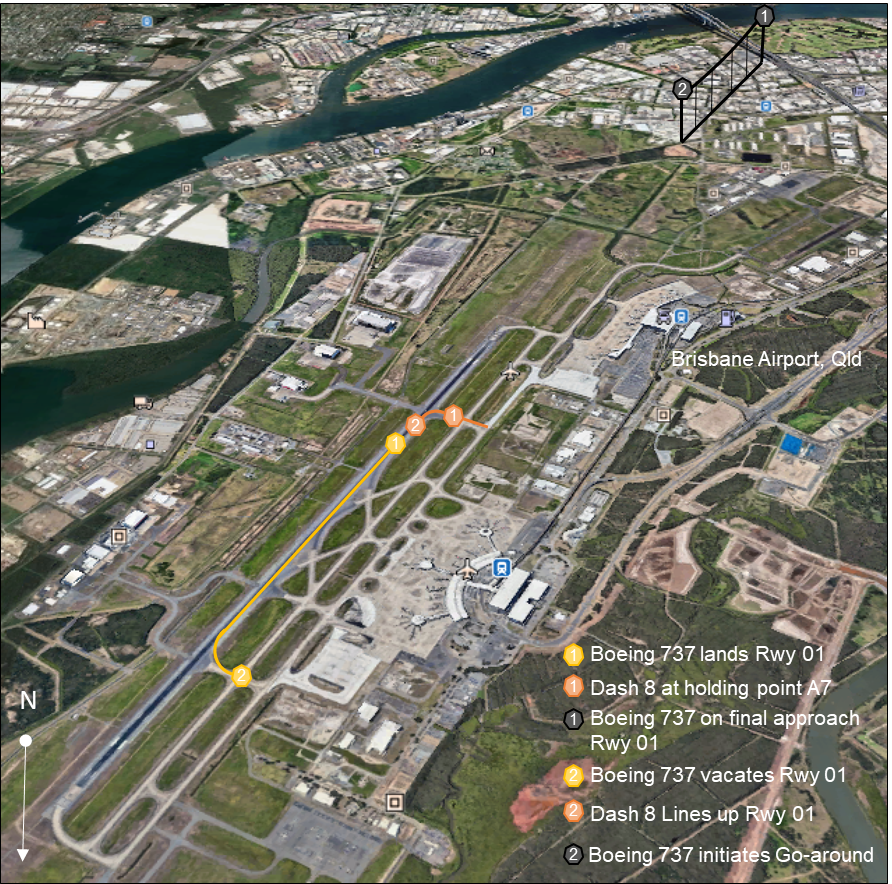
On 9 April 2018, while on taxi for departure at Brisbane Airport, Qld, Air Traffic Control (ATC) instructed the crew of a Bombardier DHC-8 to hold short of runway 01. After a Boeing 737 landed, the DHC-8 entered and lined up on the runway in preparation for departure, without a clearance, whilst another Boeing 737 was on short final.

ATC provided the 737 on final approach a clearance to land at around 500 ft. ATC then issued a conditional clearance for the DHC-8 to line up behind the 737 on short final. The DHC-8 crew informed the tower by radio that they were already occupying runway 01 and were ready for departure.

ATC subsequently instructed the Boeing 737 on short final to conduct a go-around[1] from about 300 ft. Departure instructions were provided and the Boeing 737 was transferred to the approach frequency for another approach to land. A short time later, ATC provided the DHC-8 with a clearance for take-off.

Figure 1: Sequence of events relating to aircraft movements at Brisbane Airport 

Figure 1: Sequence of events relating to aircraft movements at Brisbane Airport. Source: Background image Google Earth; annotated/modified by ATSB

Source: Background image Google Earth; annotated/modified by ATSB

Airservices Australia investigation

An occurrence review conducted by Operational Risk and Assurance, indicated that the runway incursion had not been detected by ATC and that the second Boeing 737 was cleared to land whilst the runway was occupied.

The occurrence review indicated that although the conflict had not been identified by ATC, that when recognised, the actions taken to recover the situation were appropriately managed.

Safety message

Maintaining situational awareness is imperative for both pilots and ATC in busy operational environments. Effective situational awareness is the timely and accurate perception of information pertaining to a situation, comprehension of that current situation and projection of what may occur in the future based on this information.

The risk of runway incursions and other separation events can be minimised through good communication. This incident highlights the importance of:

  • ATC and flight crews using correct phraseology
  • ATC and pilots challenging instructions which they have not heard or understood fully
  • pilots looking carefully for aircraft or other hazards before entering an active runway.

About this report

Decisions regarding whether to conduct an investigation, and the scope of an investigation, are based on many factors, including the level of safety benefit likely to be obtained from an investigation. For this occurrence, no investigation has been conducted and the ATSB did not verify the accuracy of the information. A brief description has been written using information supplied in the notification and any follow-up information in order to produce a short summary report, and allow for greater industry awareness of potential safety issues and possible safety actions.

__________

  1. To abandon the landing and make a fresh approach [Cambridge Aerospace Dictionary]

Occurrence summary

Mode of transport Aviation
Occurrence ID AB-2018-049
Occurrence date 09/04/2018
Location Brisbane Airport
State Queensland
Occurrence class Incident
Aviation occurrence category Runway incursion
Highest injury level None
Brief release date 19/12/2018

Aircraft details

Manufacturer Bombardier Inc
Model DHC-8
Sector Turboprop
Operation type Air Transport High Capacity
Departure point Brisbane Airport, Qld
Damage Nil

Aircraft details

Manufacturer The Boeing Company
Model 737
Sector Jet
Operation type Air Transport High Capacity
Destination Brisbane Airport, Qld
Damage Nil

Runway incursion involving a Cessna 404 and a Cessna 210M at Port Keats Airfield, Northern Territory, on 28 February 2018

Brief

Occurrence Briefs are concise reports that detail the facts surrounding a transport safety occurrence, as received in the initial notification and any follow-up enquiries. They provide an opportunity to share safety messages in the absence of an investigation.

What happened

On 28 February 2018, at 0917 Central Standard Time (CST), a Cessna 210M commenced its take-off run on runway 34 at Port Keats, Northern Territory (NT) for departure to Bathurst Island, NT. At this time, a Cessna 404 was also at Port Keats, taxiing to depart for Darwin, NT, from the same runway.

The 404 entered runway 34 while the 210 was in the take-off run resulting in the pilot of the 210 rejecting their take-off, stopping approximately 50 m from the 404. The 404 taxied clear of the runway and the 210 repositioned and departed without further incident.

The pilot of the 404 reported that while the 210 was taxiing for runway 34, they were awaiting traffic information from air traffic control (ATC). The pilot of the 404 made a taxi call on the Port Keats common traffic advisory frequency (CTAF) which the pilot of the 210 reported hearing prior to broadcasting that they were rolling for take-off. It was during this rolling broadcast that ATC contacted the pilot of the 404. This radio call required repeating of information twice due to transmission difficulties. As a result, the pilot of the 404 did not hear the pilot of the 210 making the rolling call.

Prior to entering runway 34, the pilot of the 404 reported scanning the circuit area, presuming the 210 had already departed. They reported that they had not focused on the runway environment during the scan.

Safety message

ATSB SafetyWatch

According to ATSB publication A pilot's guide to staying safe in the vicinity of non-controlled aerodromes (AR-2008-044(1)) and the associated research report Safety in the vicinity of non-towered aerodromes (AR-2008-044(2)), runway incursions are amongst the most common occurrences at non-towered aerodromes.

Both publications highlight common errors leading to conflicts in operations at or near non-towered aerodromes and strategies are discussed to assist pilots to ensure that safe operations are always maintained.

About this report

Decisions regarding whether to conduct an investigation, and the scope of an investigation, are based on many factors, including the level of safety benefit likely to be obtained from an investigation. For this occurrence, no investigation has been conducted and the ATSB did not verify the accuracy of the information. A brief description has been written using information supplied in the notification and any follow-up information in order to produce a short summary report, and allow for greater industry awareness of potential safety issues and possible safety actions.

Occurrence summary

Mode of transport Aviation
Occurrence ID AB-2018-027
Occurrence date 28/02/2018
Location Port Keats Airfield
State Northern Territory
Occurrence class Incident
Aviation occurrence category Runway incursion
Highest injury level None
Brief release date 20/04/2018

Aircraft details

Manufacturer Cessna Aircraft Company
Model 404
Sector Piston
Operation type Charter
Damage Nil