Runway excursion

Recovery and Analysis of Cockpit Voice Recorder; McDonnell Douglas Corp. MD-82; PK-LMW; Surabaya, Indonesia

Summary

On 4 March 2006, McDonnell Douglas Corporation MD-82, registered PK-LMW, was operating a flight from Denpasar to Surabaya, Indonesia. The aircraft was cleared to land on runway 10 with the reported wind calm and the runway wet. During the landing roll, the aircraft veered to the right resulting in a runway excursion.

The National Transportation Safety Committee (NTSC) of Indonesia was responsible for investigating this occurrence. On 8 March 2006 the NTSC requested assistance from the Australian Transport Safety Bureau (ATSB) in the recovery and analysis of information from the flight data recorder and cockpit voice recorder.

In accordance with clause 5.23 of Annex 13 to the Convention on International Civil Aviation, the ATSB appointed an Accredited Representative to assist the NTSC and initiated an investigation under the Transport Safety Investigation Act 2003.

The NTSC is responsible for releasing the final investigation report regarding this occurrence.

National Transportation Safety Committee
Ministry Of Transportation Republic Of Indonesia
Transportation Building 3rd Floor
Jalan Medan Merdeka Timur No. 5
Jakarta Pusat 10110
Indonesia

Phone  :  +62 21 384 7601
Email    :  knkt@dephub.go.id

Website: http://knkt.dephub.go.id/knkt/ntsc_home/ntsc.htm


Occurrence summary

Investigation number 200601392
Occurrence date 04/03/2006
Location Surabaya Aero, Indonesia
State International
Report release date 26/06/2007
Report status Final
Investigation type External Investigation
Investigation status Completed
Mode of transport Aviation
Aviation occurrence category Runway excursion
Occurrence class Incident
Highest injury level None

Aircraft details

Manufacturer McDonnell Douglas Corp.
Model MD-82
Registration PK-LMW
Serial number 49443
Operation type Air Transport High Capacity
Departure point Denpasar, Indonesia
Destination Surabaya, Indonesia
Damage Substantial

NTSC Assistance: McDonnell Douglas Corp. MD-82, Makassar, Indonesia, PK-LMJ

Summary

On 18 January 2006, McDonnell Douglas Corporation MD-82, registered PK-LMJ, was operating a flight from Ambon to Makassar, Indonesia. The aircraft was cleared to land on runway 31 and the reported wind direction was 260 degrees at 20 kts. Heavy rain was reported, and the runway was wet. During the landing roll the aircraft veered to the left resulting in a runway excursion.

The National Transportation Safety Committee (NTSC) of Indonesia was responsible for investigating this occurrence. On 27 January 2006, the NTSC requested assistance from the Australian Transport Safety Bureau (ATSB) in the recovery and analysis of information from the flight data recorder (FDR). The Executive Director of the ATSB approved the request.

In accordance with clause 5.23 of Annex 13 to the Convention on International Civil Aviation, the ATSB appointed an Accredited Representative to assist the NTSC and initiated an investigation under the Transport Safety Investigation (TSI) Act 2003.

The NTSC is responsible for publishing a final investigation report regarding this occurrence.

National Transportation Safety Committee 
Ministry Of Transportation Republic of Indonesia 
Transportation Building 3rd Floor
Jalan Medan Merdeka Timur No. 5
Jakarta Pusat 10110
Indonesia

Phone  :  +62 21 384 7601
Email    :  knkt@dephub.go.id

Website: http://knkt.dephub.go.id/knkt/ntsc_home/ntsc.htm

Occurrence summary

Investigation number 200600958
Occurrence date 18/01/2006
Location Makassar, Indonesia
State International
Report release date 23/04/2007
Report status Final
Investigation type Occurrence Investigation
Investigation status Completed
Mode of transport Aviation
Aviation occurrence category Runway excursion
Occurrence class Incident
Highest injury level None

Aircraft details

Manufacturer McDonnell Douglas Corp.
Model MD-82
Registration PK-LMJ
Serial number 49262
Sector Jet
Operation type Air Transport High Capacity

Rejected take-off, Piper PA-31-350, VH-PRJ

Analysis

The investigation considered a number of possible factors that could have resulted in the elevator control system difficulties reported by the pilot. Those factors included: mechanical interference in the system, control lock insertion, an excessive nose-down trim setting or nose-down autopilot inputs.

The investigation found no pre-existing defects or mechanical interference within the elevator control system that could have contributed to the pilot encountering resistance in the system while rotating the aircraft during the take-off roll.

The control lock was found in the cockpit stowage pocket after the accident, and it did not display indications of having been inserted in the locking collar during the impact sequence. However, given the nature of the damage to the aircraft, the elevator control system may not have sustained damage and stresses sufficient to mark or deform an inserted control lock.

The elevator trim setting was found to be close to the normal take-off setting of about three rotations of the trim wheel back from the full nose-down position. It is unlikely that the trim setting would have significantly changed during the impact sequence and the investigation concluded that the elevator trim was probably set within the range suitable for take-off.

The pilot could not recall whether the autopilot engagement light was illuminated during the take-off roll. However, if the autopilot had been engaged, the pilot should have been able to override any system inputs and move the elevator controls during rotation.

Accordingly, on the evidence available to the investigation, it was not possible to establish the reason for the significant resistance to the pilot's nose-up inputs.

The pilot's decision to reject the take-off was an appropriate response to the difficulties experienced in rotating the aircraft. The normal accelerate-stop distance chart indicated that if certain conditions were met, the aircraft could have been stopped by the end of the runway. However, the aircraft over ran the runway by 162 m resulting in occupant injuries and aircraft damage.

The rolling take-off with slow application of power extended the actual accelerate-stop distance required, as the chart figure was based on take-off power being set before brakes release. The rejection of the take-off at a speed between 90 and 100 kts would have also extended that accelerate-stop distance, which was predicated on 88 kts.

While the investigation was unable to determine the actual time interval between the attempted rotation and the initiation of the rejected take-off, the rate of power reduction and the amount of braking during the rejected take-off, these factors would have had a significant influence on the accelerate-stop distance.

Pilots operating this type of aircraft can be conditioned in normal operations to gradually reduce power to decrease engine wear and applying minimum braking to reduce tyre and brake wear. While this may be appropriate during normal operations, the pilot of the accident aircraft may have adopted a similar technique during the rejected take-off. The dark conditions may also have contributed to the accident by making it more difficult for the pilot to determine the amount of remaining runway available for stopping the aircraft.

Australian Transport Safety Bureau comment

The risk of runway overruns resulting from rejected take-offs can be reduced by setting maximum power before brakes release, regular practice in performing rejected take-offs and conducting pre-take-off safety briefings that include recalling the actions of the rejected take-off procedure and considering the specific operational requirements of the runway to be used.

This occurrence also highlights the critical importance of pilots checking that the flight controls are capable of full and free operation prior to commencing the take-off roll.

Factual Information

Sequence of events

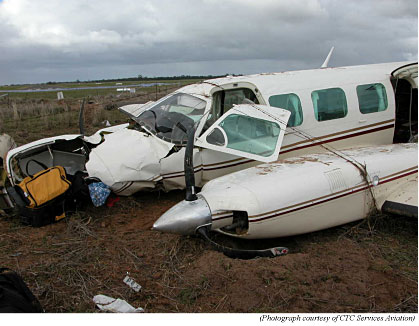
On 25 July 2005, at about 1835 Eastern Standard Time, a Piper Aircraft Corporation PA-31-350 (Chieftain) aircraft, registered VH-PRJ, overran runway 27 at Nhill aerodrome following a rejected night take-off. The aircraft was being operated on an instrument flight rules charter flight to Charlton, Vic, with the pilot and three passengers on board. The pilot and passengers sustained injuries during the overrun and the aircraft was substantially damaged (Figure 1).

Figure 1: Wreckage of aircraft with runway in the background

aair200503586_001.jpg

Earlier that day, the pilot had flown the aircraft from Essendon to Ouyen and then to Nhill, arriving at about 1500. During the stopover at Nhill, the pilot secured the flight controls by inserting a lock pin in the control column.
The pilot stated that, when he started and warmed the engines at about 1700, he removed the lock from the control column and that it was reinserted after the engines were shut down. The passengers arrived at the aerodrome at about 1820 and boarded soon afterwards.

The pilot reported that, during the pre-flight preparation at Nhill, he set the elevator trim to the take-off position by winding the trim wheel to about three rotations back from the full nose-down position. The pilot recalled removing the lock from the control column prior to starting the engines for departure.

The pilot stated that he usually checked the flight controls for full and free movement while backtracking on a runway but he could not recall whether he performed that check when backtracking on runway 27 at Nhill. Part B of the operator's Operations Manual included a series of checklists to be used during operation of the aircraft. The 'Start Up' and 'Pre takeoff' checklists included checking full and free movement of the flight controls.

A witness, located in a house adjacent to the western perimeter of the aerodrome, reported that he observed the aircraft taxi to the eastern end of the runway and commence the take-off roll but lost sight of the aircraft as it moved along the runway.

The pilot stated that the take-off roll was from a rolling start with power being slowly applied until engine turbo-charger output stabilised. At about 90 kts indicated air speed, the pilot attempted to rotate the aircraft but encountered resistance to rearward movement of the control column. He decided to reject the takeoff because the aircraft speed at the time was below his nominated decision speed of 100 kts. The pilot reported that he then reduced the engine power to idle and applied maximum braking.

The aircraft overran the runway, passed through the airport boundary fence, continued across a public road, and passed through another fence before coming to a stop in a paddock about 162 m beyond the end of the runway. An inspection of the runway revealed a skid mark from the aircraft's right tyre, which commenced 65 m before the end of the runway.

After the aircraft came to a stop, the pilot exited the aircraft via the crew door, assisted the passengers to evacuate the aircraft through the rear cabin door and marshalled them to an area away from the aircraft. A passenger then used a mobile phone to contact emergency services, who attended the scene soon after.

The aircraft

A subsequent inspection of the aircraft revealed that there were no pre-existing defects in the elevator control system and elevator trim system or evidence of interference with the elevator surfaces. The elevator trim setting was found to be three and a half rotations of the trim wheel from the full nose-down position.

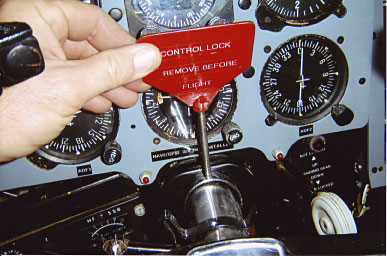
Between flights, the aircraft elevators and ailerons were locked with a removable control lock (Figure 2). The lock was a 10 cm long pin with a red plastic warning tag which was inserted through the control column and a locking collar that was attached to the instrument panel. There were no external control locks fitted.

The Australian Transport Safety Bureau was advised that the control lock was found in a cockpit stowage pocket after the accident. An inspection of the lock shaft did not reveal any witness marks or deformation caused by the lock being left in the locking collar during the impact sequence.

Figure 2: View of control lock partially removed from control column

aair200503586_002.jpg

The aircraft was fitted with a Bendix Altimatic V FD-1 autopilot system. The autopilot controller panel was located on the centre cockpit pedestal behind the engine controls. Engagement of the autopilot system was accomplished by pressing the AP ENGAGE BUTTON, located on the left side of the controller panel. The button would illuminate when the autopilot was engaged.

The pilot could not recall whether any buttons were illuminated on the autopilot controller prior to, or during, the take-off roll. The system was designed to allow a pilot to momentarily override an autopilot input to the flight controls.

The main landing gear wheel brakes were serviceable and did not exhibit any indications of overheating.

Aircraft performance

The take-off weight and centre of gravity of the aircraft were within limits for the flight.

The approved Aircraft Flight Manual (AFM) contained take-off distance and accelerate-stop distance performance charts for both normal and short field takeoffs. The investigation calculated the take-off performance of the aircraft using the following aerodrome and meteorological information:

  • runway length 1,000 m with a bitumen surface
  • runway slope 0.8 per cent down to the west
  • wind 300 degrees true, 10 kts gusting to 13 kts
  • no rainfall recorded during the previous three hours.

The normal take-off distance chart indicated that with take-off power being set before brakes release, the prevailing weather conditions and a take-off weight estimated by the investigation to be 2,941 kg, the aircraft would have a take-off distance of about 644 m from brakes release to 50 ft. With application of the 1.24 factor specified in Civil Aviation Order 20.7.4 for charter operations, the take-off distance required was 799 m, which was within the length of runway 27.

The normal accelerate-stop distance charts were based on take-off power being set before brakes release, wing flaps retracted, a paved, level and dry runway surface, and an 'abort' (reject) speed of 88 kts indicated air speed. The chart allowed for a failure recognition time of 3 seconds. If the pilot technique in applying take-off power differed from that stated on the accelerate-stop chart, the distance to perform the accelerate-stop manoeuvre would be more than the chart derived figure. Provided the takeoff was rejected at 88 kts, the chart indicated that, under the conditions prevailing at the time of the accident, the accelerate-stop distance was about 845 m, which was within the length of runway 27.

The aircraft manufacturer's procedure for a rejected takeoff was included in the emergency procedure for an engine failure during a normal takeoff at or below 85 kts. That procedure specified that the engine throttles were to be immediately closed and brakes applied as required to stop straight ahead.

Summary

On 25 July 2005, at about 1835 Eastern Standard Time, a Piper Aircraft Corporation PA-31-350 (Chieftain) aircraft, registered VH-PRJ, overran runway 27 at Nhill aerodrome following a rejected night take-off. The aircraft was being operated on an instrument flight rules charter flight to Charlton, Vic, with the pilot and three passengers on board. The pilot and passengers sustained injuries during the overrun and the aircraft was substantially damaged.

The pilot stated that the take-off roll was from a rolling start with power being slowly applied until engine turbo-charger output stabilised. At about 90 kts indicated air speed, the pilot attempted to rotate the aircraft but encountered resistance to rearward movement of the control column. He decided to reject the takeoff because the aircraft speed at the time was below his nominated decision speed of 100 kts. The pilot reported that he then reduced the engine power to idle and applied maximum braking.

A subsequent inspection of the aircraft revealed that there were no pre-existing defects in the elevator control system and elevator trim system or evidence of interference with the elevator surfaces.

The investigation considered a number of possible factors that could have resulted in the elevator control system difficulties reported by the pilot. Those factors included: mechanical interference in the system, control lock insertion, an excessive nose-down trim setting or nose-down autopilot inputs.

Occurrence summary

Investigation number 200503586
Occurrence date 25/07/2005
Location Nhill, Aero.
State Victoria
Report release date 30/06/2006
Report status Final
Investigation type Occurrence Investigation
Investigation status Completed
Mode of transport Aviation
Aviation occurrence category Runway excursion
Occurrence class Accident
Highest injury level Serious

Aircraft details

Manufacturer Piper Aircraft Corp
Model PA-31
Registration VH-PRJ
Serial number 31-7305064
Sector Piston
Operation type Charter
Departure point Nhill, Vic
Destination Charlton, Vic
Damage Substantial

Runway excursion, Boeing 727, 9L-LEK, Brisbane Airport, Queensland, on 25 January 2005

Safety Action

As a result of this occurrence, the operator advised the Australian Transport Safety Bureau that it had replaced both nosewheel steering cables with stainless steel cables. Stainless steel has a higher resistance to corrosion than carbon steel.

Factual Information

On 25 January 2005, a Boeing 727-51C aircraft, registered in Sierra Leone as 9L-LEK, was being operated on a non-scheduled positioning flight from Cairns to Brisbane, Queensland. The crew, which comprised the pilot in command, copilot and flight engineer, were supported by an aircraft maintenance engineer (a passenger) for away from base maintenance. The copilot was the handling pilot for the flight.

Approaching Brisbane, the aircraft was cleared for an instrument landing system approach to runway 01 at Brisbane Airport. There was a 15 kts gusting crosswind from the east. The crew reported that they had visual contact with the runway at about 1,000 ft altitude and flew a stabilised approach to a normal touchdown at about 1606 eastern standard time. The wing spoilers and thrust reversers deployed normally.

The copilot said that as the speed reduced through 100 kts, the aircraft was tending to veer right and that, approaching 80 kts, he had maximum left rudder applied to maintain the aircraft tracking on the runway centreline. Nosewheel steering is controlled by the rudder pedals and by a steering wheel on the pilot in command's side panel. When the copilot is flying the aircraft, it is normal procedure as the aircraft slows during the landing roll for the pilot in command to take control of the aircraft to manoeuvre it using the nosewheel steering wheel. In accordance with normal procedures, the pilot in command took control of the aircraft at about 80 kts. As the copilot relinquished control, he informed the pilot in command that he had maximum left rudder applied.

aair200500302_001.jpg

The pilot in command said that when he placed his hand on the nose wheel steering wheel, it felt very loose as he turned the wheel left to maintain the aircraft on the runway centreline. However, there was no response to the steering wheel inputs and, despite the use of differential main wheel braking, he was unable to prevent the aircraft veering right and running off the runway at a speed of between 60 and 70 kts. The aircraft came to rest about 40 m from the runway edge, and was undamaged.

An examination of the nosewheel steering system revealed that one of the carbon steel nosewheel steering cables, linking the steering wheel to the nose gear steering valve, had failed approximately 2.35 m from the ball end. That location was within the forward fuselage section above the nose wheel where the cables were hidden from view and not readily accessible.

A subsequent specialist examination of the failed cable indicated that approximately 70 percent of the cable strands at the failure location exhibited characteristics of severe aqueous corrosion1. The remaining strands showed decreased diameter due to corrosion and had failed under applied tensile loads.

The aircraft had a total time in service of 54,200 hours and 48,000 flight cycles2. The operator advised that the most recent maintenance check on the aircraft was an 'A' check completed in December 2004 and the last 'C' check on the aircraft in December 2003. The operator also advised that, in its maintenance system for the aircraft, the nose wheel steering cable was an 'on condition' item and that, during a 'C' check, there was a requirement to conduct a visual inspection of the cable.

1 Aqueous corrosion is an electrochemical process by which metals or alloys are oxidised in the presence of solutions containing water. Corrosion rates are significantly affected by environmental conditions such as temperature, humidity, and oxygen availability.
2 A flight cycle is a completed take-off and landing sequence.

Summary

On 25 January 2005, a Boeing 727-51C aircraft, registered in Sierra Leone as 9L-LEK, was being operated on a non-scheduled positioning flight from Cairns to Brisbane, Queensland.

Occurrence summary

Investigation number 200500302
Occurrence date 25/01/2005
Location Brisbane, Aerodrome
State Queensland
Report release date 26/07/2005
Report status Final
Investigation type Occurrence Investigation
Investigation status Completed
Mode of transport Aviation
Aviation occurrence category Runway excursion
Occurrence class Incident
Highest injury level None

Aircraft details

Manufacturer The Boeing Company
Model 727
Registration 9L-LEK
Sector Jet
Operation type Air Transport High Capacity
Departure point Cairns, QLD
Destination Brisbane, QLD
Damage Nil

Beech Aircraft Corp 200C, VH-NTH

Summary

On 23 March 2004, shortly after take-off from Katherine, NT, the left main landing gear of the Beech 200 aircraft, registered VH-NTH, did not retract. The flight continued to Darwin with the landing gear extended. During approach to Darwin airport the pilot advised air traffic control that he could not obtain a green `down and locked' indication for the left main landing gear and declared an emergency prior to landing. During touchdown, the left main landing gear collapsed, and the aircraft slewed off the runway. Both occupants evacuated the aircraft with no injuries.

The aircraft operator's maintenance organisation examined the aircraft and found that the left main landing gear drive shaft had severed as a result of fretting against a bleed air duct clamp tail. The bleed air duct clamp (jubilee clamp) had been fitted to the aircraft during an aircraft refurbishment program in September 2003. The jubilee clamp tail had been fastened in close proximity to the landing gear drive shaft. Subsequently, the jubilee clamp tail had come into close contact with the drive shaft, leading to severe wear of the drive shaft section and eventual failure.

As a result of the issues identified with this occurrence, the aircraft operator has conducted a fleet-wide examination of all similar aircraft to ensure adequate clearance exists between bleed air clamps and landing gear drive shafts.

The operator has submitted a major defect report to the Australian Civil Aviation Safety Authority and intends to notify the manufacturer of a number of deficiencies noted in the aircraft maintenance manual.

Occurrence summary

Investigation number 200401024
Occurrence date 23/03/2004
Location Darwin, Aero.
State Northern Territory
Report release date 21/04/2004
Report status Final
Investigation type Occurrence Investigation
Investigation status Completed
Mode of transport Aviation
Aviation occurrence category Runway excursion
Occurrence class Accident
Highest injury level None

Aircraft details

Manufacturer Beech Aircraft Corp
Model 200
Registration VH-NTH
Serial number BL-012
Sector Turboprop
Operation type Aerial Work
Departure point Katherine, NT
Destination Darwin, NT
Damage Substantial

Runway excursion, Darwin Airport, Boeing 737-376, VH-TJB, on 19 February 2003

Recommendation

Operator

Following this incident, the aircraft operator standardised approach procedures across all aircraft types in their mainline fleet.

Recommendation

The aircraft's deviation from the runway centreline during the final stages of the flight was undetected and uncorrected by the pilot. This could indicate that the visual cues available during the final stages of flight were insufficient for the pilot to safely land the aircraft. Significantly, the pilot did not recognise that those visual cues had diminished to such a point where he was unable to control the lateral position of the aircraft over the landing runway.

Accordingly, the Australian Transport Safety Bureau makes the following recommendation.

Recommendation R20040090: Department of Defence

The Australian Transport Safety Bureau recommends that the Department of Defence (airport infrastructure owner) and Darwin International Airport Pty Ltd (civilian facilities operator) consider installation of centreline lighting and touchdown zone lighting, consistent with CASA recommended practices on runways wider than 50 m.

Analysis

Standard company procedures required a monitored approach in the weather conditions prevailing at Darwin for the aircraft's approach and landing. The approach was conducted at night and in conditions of rain and reduced visibility.

The aerodrome controller had selected the runway 29 HIAL and HIRL to a higher intensity than recommended in MATS for the initial setting given the prevailing weather conditions. Although this selection assisted the crew to acquire the HIAL and HIRL at an earlier stage of the approach, the apparent intensity of those lights increased significantly as the aircraft approached the runway. The crew did not realise that the lights were too bright until the aircraft was passing overhead the HIAL and consequently, did not request a lower intensity selection.

The aircraft commenced deviating from the extended runway centreline about 7 seconds after the autopilot was disengaged and as the HIAL was starting to disappear from the pilot's view. Associated with this deviation were control inputs by the pilot in command, including a left rudder pedal command and a right wing down control wheel input that resulted in the aircraft entering a cross-controlled sideslip to the right as the aircraft approached the runway. These control inputs were not conventional for the environmental conditions.

The control inputs made by the pilot in command during the final stages of flight altered the aircraft's flight path across the ground and directly contributed to the aircraft's deviation from the runway centreline. The control wheel inputs for right roll resulted in the deployment of the right wing's flight spoilers during the final 70 ft of the descent. This increased the drag on the right wing, reduced the lift produced by that part of the aerofoil section and consequently, increased the rate of descent. The investigation could not determine the reason for the rudder and aileron inputs made by the pilot in command.

The data derived by kinematic analysis by the aircraft manufacturer was consistent with other available sources of environmental wind data.

The pilot in command did not detect the aircraft's increasing lateral displacement from the runway centreline. He considered that he had sufficient visual reference to complete the landing. However, during the final seconds prior to touchdown, it was possible that he encountered an abnormal situation where few reliable visual cues were available for determining the aircraft's position relative to the centreline of the runway.

The nature of the available visual cues increased the difficulty for the pilot in command to detect the aircraft's increasing displacement from the runway centreline. This included a wet runway surface with a probable lack of surface definition, painted runway markings that were less conspicuous on a wet runway at night, a lack of touchdown zone lighting/centreline lighting on a runway that was wider than normal and the possibility that the HIRL was glaring on the wet windscreen. The investigation concluded that the presence of centreline lighting would have increased significantly the nature of the visual cues available and would have assisted the pilot to recognise the developing sideslip and lateral deviation from the runway centreline.

The lack of a positive flare, a marginal reduction in headwind component and deployment of the right wing's flight spoilers during the final stages of the approach contributed to the high rate of descent at touchdown. The wider runway would have provided an unfamiliar set of cues for judging the flare height. The lack of runway surface definition would have increased the difficulty for the pilot to estimate the height of the aircraft above the runway and possibly had contributed to the lack of a positive landing flare. This was also coupled with a different flap setting from that routinely used during landing.

The aircraft was sideslipping to the right at the point of touchdown. The excursion from the runway was not preventable due to the sideslip and the proximity of the aircraft to the edge of the runway. There was no evidence to indicate that standing water, or adhesion of tyres on the wet runway surface, were factors in the excursion from the runway.

During the final stages of the approach, the copilot was monitoring various parameters. He did not detect the increasing displacement of the localiser or make any call for correction prior to touchdown. The size of indicated deviation, together with the other instruments being monitored, made this an unlikely deviation to detect.

The investigation concluded that the presence of runway centreline lighting would have increased the visual cues available to the pilot and assisted with his recognition of the developing sideslip and lateral deviation from the centreline.

Summary

History of the flight

On 19 February 2003, a Boeing Company 737-376 (737) aircraft, registered VH-TJB, landed on runway 29 at Darwin. The aircraft touched down close to the right edge of the runway and ran off the sealed runway surface. The handling pilot returned the aircraft back to the runway during the landing roll. There were no reported injuries to either the passengers or crew. The aircraft sustained minor damage.

The aircraft was operating a scheduled public transport passenger service between Adelaide and Darwin, with six crew and 79 passengers. The approach was conducted at night and in conditions of reduced visibility due to rain. The automatic terminal information service1 (ATIS) reported 6,000 m visibility at the aerodrome.

The runway was wet and the previous landing aircraft had reported that the braking action on the runway was good. The aerodrome controller had selected the high intensity approach lighting (HIAL) and high intensity runway lighting (HIRL) to Stage 6 (maximum intensity). The visual approach slope indicator system (T-VASIS)2 was operating. Due to the weather conditions, the crew elected to perform a monitored approach3 and configured the aircraft with flap4 40, and the autobrake5 set to 3.

Initial approach

Consistent with company procedures, the copilot was the handling pilot for the initial stage of the monitored approach and provided input to the aircraft's automatic flight management system. The pilot in command monitored the progress of the approach and attempted to establish visual reference with the runway. The aircraft was flown with both autopilots engaged and coupled to the instrument landing system (ILS) for runway 29. The threshold reference speed6 (Vref) for a flap 40 landing was 131 kts.

Analysis of data from the aircraft's flight data recorder (FDR) confirmed the aircraft was configured for landing prior to reaching the outer marker7 (OM) and that the approach parameters were stable. The pilot in command recalled that the aircraft crossed the OM and was at an altitude of approximately 1,000 ft when the HIAL became visible. At the decision altitude8 (DA) he could clearly see the approach lighting and runway lights and decided to continue the approach and land the aircraft. Consistent with company procedures for the monitored approach, the pilot in command became the handling pilot for the remainder of the approach and landing. The aircraft's landing lights were 'ON' during the final approach and landing.

Final approach

The FDR indicated that the autopilot was disengaged approximately 2 to 3 seconds after passing the DA and about 20 seconds prior to touchdown. At the time of autopilot disengagement, the aircraft was established on the localiser and glide slope, maintaining a heading of 283 degrees magnetic (deg M) and was about 200 ft above the height of the runway threshold (HAT). The aircraft's flight path deviated above glide path following disengagement of the autopilot.9

About 6 seconds after the autopilot was disengaged, the FDR recorded a control wheel input that resulted in a slightly right wing low bank attitude and then application of left rudder. The combined effect of those control inputs altered the aircraft's heading to the left, but introduced a sideslip to the right and a corresponding angle of drift. The localiser deviation recorded on the FDR indicated that the aircraft started to drift right of the extended runway centreline about 13 seconds before touchdown. Application of left rudder and roll attitude that was predominantly right wing low continued to the point of touchdown, by which time the aircraft's heading was about 7 degrees left of the aircraft's ground track and the localiser deviation indicated 0.57 dots 'fly left'.10 The control wheel inputs resulted in deployment of the right wing's flight spoilers11 during the final 70 ft of descent.

The pilot in command recalled that during the final stages of the approach, he could see the runway lights along the full runway length and was satisfied that he had the required visual reference to continue the approach. He recalled that rain was streaming across the windscreen and that the wipers were operating. As the aircraft descended into the touchdown zone he observed that the runway surface was very dark and there was a lack of surface definition. He recalled shifting his gaze from the runway aim point to the cues available at the far end of the runway to judge the height for the landing flare. The pilot in command recalled hearing the synthesised calls of altitude from the aircraft's radar altimeter, which occurred at radar altitudes of 50 ft, 30 ft and 10 ft.

The pilot in command recalled that he did not detect any anomalies with the aircraft's approach path during the final stages of flight and was unaware that the aircraft had commenced to sideslip as it approached the runway. The copilot recalled that he did not detect any anomalies with the aircraft's flight path as he monitored the various flight instruments during the final stages of the approach.

The FDR recorded a backing of the wind direction and a gradual increase in wind speed during the 11 seconds prior to touchdown. Although this change in wind velocity represented an increasing left crosswind component as the aircraft approached the runway, this occurred after the aircraft had commenced the sideslipping manoeuvre.

Touchdown and landing roll

The pilot in command recalled that, due to the wet runway surface, he intended to make a firm touchdown on the runway. During the final stages of the flight, the aircraft's pitch attitude increased from about 2 to 3.2 degrees nose-up. Analysis of data from the FDR indicated that the aircraft touched down with a descent rate of approximately 600 ft/minute and a vertical deceleration of 2.3 g.12 Information contained in the operator's manuals indicated that the normal descent rate for touchdown should be about 150 ft/minute, with a nose-up pitch attitude of between 4 and 6 degrees.

The pilot in command recalled that immediately after touchdown, he brought his view back down the runway and saw that the runway edge lights were tracking down the windscreen centre frame. He immediately realised that they were close to the right edge of the runway and heard the aircraft wheels strike runway lights. Corrective control inputs returned the aircraft to the runway centreline and the aircraft completed the rollout.

Marks on the runway and data from the FDR provided further information on the touchdown and landing roll. Touchdown occurred approximately 520 m from the threshold of runway 29, at a computed airspeed of 127 kts (a ground speed13 of about 128 kts). The right main landing gear was about 1.4 m inside the edge of the runway and the aircraft was sideslipping to the right. The right main landing gear departed the runway about 590 m from the threshold, at a ground speed of about 124 kts. The left main landing gear departed the runway about 760 m from the threshold, at a ground speed of about 111 kts. Corrective control inputs by the pilot had returned all wheels to the runway by about 1,130 m from the threshold. At the maximum point of excursion, the right main gear was about 7 m from the edge of the runway and the left main gear was about 2 m from the edge of the runway.

The pilot in command taxied the aircraft clear of the runway. Although there were no abnormal cockpit indications about the landing gear, he requested a precautionary inspection of the aircraft's landing gear by the airport's emergency rescue and fire fighting service before taxiing to the terminal.

Damage to the aircraft

During the landing roll, five runway edge lights were struck by the aircraft's landing gear. Examination of the aircraft revealed damage to the tyres and impact damage to the intakes and fan sections of each engine, mainly associated with the ingestion of runway light fragments. There was also minor damage to the surfaces of the wing flaps. Significant quantities of grass had accumulated in the vicinity of the main wheel brake packs and had also contaminated the wing flaps.

Runway 29 ILS

Runway 29 was equipped with a Category 1 ILS, which enabled pilots to make instrument approaches in conditions of low cloud and reduced visibility. The ILS consisted of a 3-degree glide slope and a localiser aligned on a track of 285 deg M. The relevant instrument approach procedure required the pilot to have visual reference with the runway threshold or approach lighting at the DA (290 ft pressure altitude, which was 209 ft HAT), with at least 800 m visibility. If the visibility subsequently reduced below landing minima, a missed approach was required. The aerodrome's ILS was operating normally at the time of the incident.

Runway 29 physical environment

Runway 29 was 3,354 m long and 60 m wide. The central 45 m of the runway was grooved to assist with wet-runway braking characteristics and tyre adhesion. The runway was not equipped with centreline lighting or touchdown zone lighting, nor was this required for runways equipped with a Category 1 ILS. However, the Manual of Standards (MOS) - Part 139 Aerodromes issued by the Civil Aviation Safety Authority (CASA) recommended provision of centreline lighting on runways where the width between runway edge lights was greater than 50 m.14 The runway touchdown zone and centreline were marked on the runway. These markings were relatively well defined and provided contrast against the dark runway surface during daylight conditions and on a dry runway surface.

At 60 m wide, Runway 29 was significantly wider than other Australian runways15 used by the operator's 737 fleet. As a consequence, the visual cues and runway perspective available to the pilot to complete an approach and landing on runway 29, were different from those normally available.

The average longitudinal slope of runway 29 was 0.2%, with two distinct crests along the runway. The runway crests obstructed portions of the runway and altered the pilot's view of the runway during the final stages of the approach and during the landing flare.

Runway 29 approach lighting

The intensity16 of the runway's HIAL and HIRL was selected by the aerodrome controller. These had each been set to intensity setting Stage 6 at some point before the 737 crew commenced their approach. The 737 had crossed the OM when the controller transmitted that the HIAL was selected to the maximum setting. The pilot in command of the 737 acknowledged this transmission.

The Manual of Air Traffic Services (MATS) indicated that the initial intensity of the HIAL/HIRL should be set according to the prevailing visibility and ambient light conditions. At night and for the ATIS reported visibility of 6,000 m, MATS indicated an initial setting of Stage 1. Variations to these settings could then be made at the pilot's request. Stage 2 was to be set at night with visibility greater than 4,000 m, but less than 5,000 m, Stage 3 with visibility greater than 2,000 m, but less than 4,000 m and Stage 4 when the visibility was not greater than 2,000 m.

Stage 6 was the maximum intensity for the HIAL/HIRL and MATS indicated that setting should be made during the day when visibility was less than 2,000 m.

Both the pilot in command and copilot recalled the intensity of the lights as they approached and overflew the HIAL. The copilot reported glancing outside during the final approach while the autopilot was still engaged, but after the DA and recalled seeing bright HIAL lights with a black empty area behind and thinking that the HIAL was too bright during the later stages of the approach. The pilot in command reported that, although HIAL set to Stage 6 helped with the early acquisition of the runway environment during the approach, the HIAL appeared brighter as they got closer to the field and the intensity was slightly uncomfortable as they flew overhead. By the time he realised that the lights were too bright, the aircraft was passing overhead the HIAL and it was too late to request the controller to select a lower intensity setting.

Meteorological information

A monsoonal squall line had recently moved through the Darwin area from the west-south-west, but was clear of the airport at the time of the occurrence. There were no thunderstorms in the vicinity of the aerodrome.

While the 737 was on descent and manoeuvring to intercept the final approach, a heavy shower of rain passed overhead the aerodrome and the controller broadcast that the visibility at the aerodrome had reduced to 4,000 m. The pilot in command of the 737 reported his position at the OM and requested an update on the visibility at the aerodrome. The controller indicated that the visibility from the tower was approximately 5,000 m. After landing, the pilot in command reported to the controller that visibility around 3,000 m was experienced during the approach.

Data from the Bureau of Meteorology's (BOM) Low-Level Windshear Alerting System (LLWAS) did not record any significant wind gusts in the period immediately preceding the aircraft's arrival at the runway threshold. The anemometer closest to the threshold of runway 29 recorded westerly wind between 5 and 9 kts at the time the aircraft landed.

Data from the BOM's automatic weather station recorded various parameters on a minute by minute basis. During the minute that the aircraft touched down, the recorded average wind was 250 deg T at 7 kts and 0.2 mm of rainfall was recorded. No rainfall was recorded during each minute either side of the minute during which the aircraft was landed.

Monitored approach procedure

The operator required that a monitored approach be performed when visibility was below 5,000 m and/or low cloud existed at the destination aerodrome. The procedure required the copilot to fly the aircraft (or provide input to the automatic flight control system) with reference to the flight instruments during the initial part of the approach. The pilot in command was required to monitor the progress of the approach and assess the visual reference available to complete the landing.

The pilot in command was responsible for deciding if sufficient visual reference was available to land the aircraft and became the handling pilot for the final phase of the approach and landing. The copilot was required to monitor the flight instruments and ensure that the parameters of the subsequent approach remained stable. He was also required to call out deviations outside approach tolerances until the point of touchdown. If visual reference with the landing runway was subsequently lost, the pilot in command was required to commence a missed approach.

The copilot reported that during the final stages of the approach, while monitoring the flight instruments, he did not detect any localiser deviation outside approach tolerances. He became aware of the aircraft's proximity to the runway's edge as he looked up from the instrument panel immediately following touchdown. The FDR indicated that the displacement of the localiser was about dot 'fly left' at the point of touchdown.

Use of autoland

The aircraft was equipped for autoland operations that permitted operations onto runways equipped with a Category 2 or Category 3 ILS. In addition, the operator permitted autoland operations on other approved runways when the weather conditions were above the minima for Category 1 operations. The operator had not approved autoland operations for runway 29 at Darwin.

Landing configuration

Due to the wet runway the crew had elected to perform a flap 40 landing. This reduced the threshold reference speed (Vref) and the possibility of the tyres dynamically hydroplaning17 on any standing water on the runway surface. A flap 40 landing required a slightly flatter attitude at touchdown when compared with the more routinely used flap 30 landing.

Technical crew information

The pilot in command was an experienced 737 check and training captain and had logged 17,906 hours aeronautical experience, which included 8,930 hours on the 737. The copilot had transferred from another aircraft type and had recently been endorsed on the 737. At the time of the incident, he was completing line training under the supervision of the check and training captain.

Both pilots held valid medical certificates. The pilot in command required reading glasses for near vision, but distance vision was reported to be normal. A post-incident ophthalmic examination revealed no other anomalies with the pilot in command's vision.

Both crew had signed on in Melbourne earlier on the day of the incident and had completed a sector to Adelaide. At the time of the incident, both had been on duty for about 6 hours 40 minutes and awake for approximately 16 hours. Both crew members had been free of duty for a period of 42 hours prior to signing on. They both reported being well rested prior to commencing duty.

Environmental conditions and relevant human factors

The investigation analysed the extent to which a number of environmental conditions could have altered the visual cues available for the pilot in command to complete the landing. This included an assessment of the available visual cues, the possible existence of visual illusions during the final stages of the approach and other factors such as rain on the windscreen, movement of the wipers and the effect of glare from the HIAL/HIRL.

The crew reported that they applied rain repellent to each windscreen during the approach. The copilot recalled that the pilot in command had requested the wipers to be set to 'high' during the final stages of the approach.

The analysis of the available visual cues during the final stages of the approach indicated:

  • that the runway's HIAL lighting started to disappear from view (under the cockpit glare shield) about 23 seconds before touchdown
  • the final bar of HIAL lights disappeared from view about 12 seconds prior to touchdown
  • the runway threshold lights disappeared from the pilot's view about 10 seconds before touchdown and from this point of the approach, the pilot in command was required to judge the aircraft's lateral position over the runway surface using the runway edge lights
  • a portion of runway lights would have disappeared behind the second crest of the runway about 4 seconds before touchdown and another portion of runway lights would have disappeared behind the first runway crest about 2 seconds before touchdown.18

The available visual cues were changing during the finals stages of flight and their salience depended on several factors. These included the extent to which individual runway lights may have glared on the wet windscreen and provided an indistinct reference set for judging the aircraft's increasing lateral displacement from the runway centreline. Other contributing factors may have included the action of the wiper blades across the windscreen and the effects of glare from the HIRL.

Data supplied by the operator

The investigation examined information from the operator's Flight Operations Quality Assurance (FOQA) database. This information was collected routinely from aircraft equipped with a quick access recorder and analysed for the purpose of monitoring the aircraft's performance during the landing approach. Around the time of the incident, this data was being expanded to monitor the accuracy of the aircraft touchdown.

A review of the available 737 data for approaches to runway 29 at Darwin from 2003 through to mid 2004, revealed that the mean average of daylight touchdowns was slightly further from the centreline when compared with night touchdowns, but that the standard deviation for these touchdowns was marginally larger at night.

FDR analysis by the aircraft manufacturer

At the request of the Australian Transport Safety Bureau, the aircraft manufacturer provided additional analysis of the data from the FDR. The manufacturer confirmed that the aircraft was cross-controlled19 during the manual portion of flight and that this had resulted in the development of a sideslip. Of particular significance, the manufacturer noted that the environmental wind data recorded by the FDR was not reliable during sideslipping flight. Kinematic20 analysis of various FDR parameters indicated that the environmental crosswind component remained near zero during the final stages of flight and did not indicate any significant increase in crosswind component as recorded by the raw FDR data. The kinematic analysis also indicated a 5 kt reduction in headwind component during the final stages of flight.

1 An automated transmission indicating the prevailing weather conditions at the aerodrome and other relevant operational information for arriving and departing aircraft.
2 The T-VASIS consisted of high intensity lights on either side of the runway, in proximity to where the glide path for the instrument landing system intersects the runway. That provided visual approach slope guidance for pilots, and included a transverse bar of four lights on either side of the runway.
3 A monitored approach is a reduced visibility procedure where one pilot will fly the aircraft with reference to flight instruments, while the other pilot monitors the approach and assesses the visibility conditions. The procedure is fully explained later in this report.
4 Flap 40 is the maximum flap extension, which results in a lower approach/touchdown speed. This reduces the required landing distance and also the possibility of aircraft tyres dynamic hydroplaning on runways affected by standing water.
5 The autobrake system has four landing settings, 1, 2, 3 and Max, and selects the desired deceleration rate for landing.
6 The threshold reference speed is for a specific landing weight and flap configuration and is published by the aircraft manufacturer.
7 The outer marker is a navigation aid associated with the final approach fix for the runway 29 ILS approach procedure and is on the extended runway centreline, approximately 3.8 NM from the threshold.
8 The decision altitude for the runway 29 ILS procedure was 290 ft. This was 209 ft above the height of the threshold of runway 29.
9 This was probably a consequence of nose-up trim applied by the autopilot during the final stages of automatic flight.
10 Localiser deviation is indicated on a display marked with dots. An indication of dot 'fly left' represents the aircraft displaced to the right of the runway centreline.
11 Roll control for the aircraft was provided by ailerons and flight spoilers on each wing. The flight spoilers would begin to deploy at about 10 degrees rotation of the control wheel.
12 g - Acceleration due to Earth gravity, international standard value being 9.80665 m/s2, assumed at standard sea level.
13 Ground speed is the aircraft speed relative to the ground, whereas airspeed is a relative velocity between an aircraft and the surrounding air.
14 That was consistent with the recommended practices of the International Civil Aviation Organization (ICAO).
15 Most runways used by the operator's 737 fleet were 45 m wide.
16 Intensity of the HIAL/HIRL for 6-stage lighting, was 100% (Stage 6), 30% (Stage 5), 10% (Stage 4), 3% (Stage 3), 1% (Stage 2) and 0.3% (Stage 1) of the maximum lighting intensity. Changes of these magnitudes were required for the human eye to detect that a change in intensity had occurred.
17 Dynamic hydroplaning is a condition where standing water prevents tyre contact with the runway surface and results in a lack of traction between the tyre and the runway surface.
18 These lights normally provide visual cues to assist the pilot judge the landing flare.
19 Application of flight control movements in the opposite sense to those in normal turns or manoeuvres.
20 A branch of physics that deals with the motion of a body without reference to force and mass.

Occurrence summary

Investigation number 200300418
Occurrence date 19/02/2003
Location Darwin Airport
State Northern Territory
Report release date 04/03/2005
Report status Final
Investigation type Occurrence Investigation
Investigation status Completed
Mode of transport Aviation
Aviation occurrence category Runway excursion
Occurrence class Serious Incident
Highest injury level None

Aircraft details

Manufacturer The Boeing Company
Model 737
Registration VH-TJB
Serial number 24296
Sector Jet
Operation type Air Transport High Capacity
Departure point Adelaide, SA
Destination Darwin, NT
Damage Minor

Boeing 737-800, VH-VOE

Summary

A Boeing 737-800, registered VH-VOE, was being operated on a scheduled flight between Brisbane and Darwin. The crew conducted a VOR/DME arrival to Runway 29 at Darwin International Airport. The runway had a temporarily displaced threshold. The aircraft touched down an estimated 1016 m from the departure end of the runway, at about 23:35 Central Standard Time. During the landing roll, the aircraft overran the runway and came to a stop approximately 44 m into the 90 m runway end safety area. There were no injuries, and the aircraft was not damaged. Air Traffic Control was not aware that the aircraft had overrun the runway. Consequently, emergency response services were not contacted.

Runway overruns feature prominently in accidents involving western-built transport category jet aircraft. Long and/or fast landings were factors in these occurrences. In this occurrence, a high approach speed led to a long landing and overrun situation. The pilot in command continued with an unstabilised approach and did not go around as required by company standard operating procedures. The copilot did not announce that the approach was unstable and instruct the pilot in command to go around. Throughout the approach, there were various cues available to both crewmembers to indicate that the approach was unstable and that a go-around was required.

Overall, there were a number of safety issues identified during the course of the investigation. Those issues included: a non-precision approach at night that was conducive to illusions; a displaced threshold that limited the landing distance available; crew resource management problems; aircraft handling difficulties; an underdeveloped landing approach risk assessment by the crew and a safety management system that had yet to incorporate the flight data monitoring programmes advocated by the International Civil Aviation Organization and industry associations. As part of the relatively new operator's maturation process, the operator has developed a number of measures that are being implemented over the short, medium and longer terms to improve the training of crews, and the capability of the operator's safety management system.

Related Documents: | Media Release |

Occurrence summary

Investigation number 200202710
Occurrence date 11/06/2002
Location Darwin, Aero.
State Northern Territory
Report release date 16/03/2004
Report status Final
Investigation type Occurrence Investigation
Investigation status Completed
Mode of transport Aviation
Aviation occurrence category Runway excursion
Occurrence class Serious Incident
Highest injury level None

Aircraft details

Manufacturer The Boeing Company
Model 737
Registration VH-VOE
Sector Jet
Operation type Air Transport High Capacity
Departure point Brisbane, QLD
Destination Darwin, NT
Damage Nil

Airbus A340-300, B-2380

Summary

The Airbus A340-300 was on a flight from Shanghai (Pudong International Airport) to Sydney (Kingsford-Smith) Airport. The co-pilot was the handling pilot. During the flight, the crew observed there was low fluid quantity in the Green hydraulic system and they witched off the Green system engine-driven and electric pumps. As the Airbus was manoeuvred for the approach to runway 16R at Sydney, the crew extended the landing gear by gravity extension. The crew reported that the landing was normal, and that engines number 2 and 3 thrust reverses were deployed after touchdown. Directional control was maintained with rudder, however, as the aircraft was decelerated through approximately 30 kts, directional control was suddenly lost. He applied full manual braking, but the aircraft was yawed rapidly to the right, and came to rest on a heading of approximately 280T, which was about 120 degrees off runway heading. The main landing gear wheels remained on the sealed surface of the runway, however, the nose wheels were on the grasses area adjacent to the runway, approximately 16 m beyond the runway edge. None of the passengers or crew was injured.

The investigation revealed that a crack in the number one engine EDP case led to the loss of the Green system hydraulic fluid. However, this was not a factor contributing to the final loss of directional control of the aircraft. The flight data revealed that the engine number one thrust lever was inadvertently advanced after the pilot in command took control of the aircraft. The rapid manner in which it was advanced, suggests there may have been some confusion between the pilot in command and the co-pilot at the time of the takeover of control. In the process of taking control, it is likely that the pilot in command placed his right hand on the thrust levers before the co-pilot could completely relinquish his control of them, and that the subsequent advancement of thrust lever number one was a result of this confusion. As the aircraft began to veer rapidly tot eh right, the crew's attention was substantially diverted by the unexpected and sudden loss of control of the aircraft. with their attention so diverted, none of the crew would have been initially aware of the engine number one thrust lever position, and that the engine was delivering substantial asymmetric thrust that contributed to the loss of control.

Occurrence summary

Investigation number 200005030
Occurrence date 01/11/2000
Location Sydney, Aero.
State New South Wales
Report release date 07/11/2001
Report status Final
Investigation type Occurrence Investigation
Investigation status Completed
Mode of transport Aviation
Aviation occurrence category Runway excursion
Occurrence class Serious Incident
Highest injury level None

Aircraft details

Manufacturer Airbus
Model A340
Registration B-2380
Serial number CES561
Sector Jet
Operation type Air Transport High Capacity
Departure point Pudong Shanghai
Destination Sydney, NSW
Damage Minor

Runway excursion, Boeing 747-438, VH-OJH, Bangkok Airport, Thailand, on 23 September 1999

Final report

Report release date: 26/04/2001

Executive summary

Overview

On 23 September 1999, at about 2247 local time, a Qantas Boeing 747-438 aircraft registered VH-OJH (callsign Qantas One) overran runway 21 Left (21L) while landing at Bangkok International Airport, Thailand. The overrun occurred after the aircraft landed long and aquaplaned on a runway which was affected by water following very heavy rain. The aircraft sustained substantial damage during the overrun. None of the three flight crew, 16 cabin crew or 391 passengers reported any serious injuries. 

The Aircraft Accident Investigation Committee of Thailand delegated the investigation to the Australian Transport Safety Bureau (ATSB) on 18 November 1999. In accordance with this delegation, the ATSB conducted the investigation according to the standards and recommended practices of Annex 13 to the Convention on International Civil Aviation and the Australian Air Navigation Act 1920, Part 2A. 

In terms of overall accident statistics, runway overruns are a relatively common event. Of the 49 accidents involving western-built high-capacity jet aircraft reported during 1999, 11 were landing overruns. Landing overruns typically occur when the runway is wet or contaminated and/or the aircraft is high and fast during final approach.


The accident flight (see part 1) 

The first officer was the handling pilot for the flight. The crew elected to use flaps 25 and idle reverse as the configuration for the approach and landing, in accordance with normal company practice (since December 1996). 

At various stages during the approach to runway 21L, the crew were informed by air traffic control that there was a thunderstorm and heavy rain at the airport, and that visibility was 4 km (or greater). At 2240, a special weather observation taken at Bangkok airport noted visibility as 1,500 m and the runway visual range (RVR) for runway 21 Right (21R) as 750 m. 

The Qantas One crew was not made aware of this information, or the fact that another aircraft (callsign Qantas 15) had gone around from final approach at 2243:26. At 2244:53, the tower controller advised that the runway was wet and that a preceding aircraft (which landed at approximately 2240) reported that braking action was ‘good’. The Qantas One crew noted no effect from the weather until visibility reduced when the aircraft entered very heavy rain as it descended through 200 ft on late final approach. The aircraft then started to deviate above the 3.15 degree glideslope, passing over the runway threshold at 169 kts at a height of 76 ft. Those parameters were within company limits. (The target speed for the final approach was 154 kts, and the ideal threshold crossing height was 44 ft.) 

When the aircraft was approximately 10 ft above the runway, the captain instructed the first officer to go around. As the first officer advanced the engine thrust levers, the aircraft’s mainwheels touched down (1,002 m along the 3,150 m runway, 636 m beyond the ideal touchdown point). The captain immediately cancelled the go-around by retarding the thrust levers, without announcing his actions. Those events resulted in confusion amongst the other pilots, and contributed to the crew not selecting (or noticing the absence of) reverse thrust during the landing roll. Due to a variety of factors associated with the cancellation of the go-around, the aircraft’s speed did not decrease below the touchdown speed (154 kts) until the aircraft was 1,625 m or halfway down the runway.

The investigation established that, during the landing roll, the aircraft tyres aquaplaned on the water-affected runway. This limited the effectiveness of the wheelbrakes to about one third of that for a dry runway. In such conditions and without reverse thrust, there was no prospect of the crew stopping the aircraft in the runway distance remaining after touchdown. The aircraft overran the 100 m stopway (at the end of the runway) at a speed of 88 kts, before stopping 220 m later with the nose resting on an airport perimeter road. 

The depth of water on the runway when the aircraft landed could not be determined but it was sufficient to allow dynamic aquaplaning to occur (i.e. at least 3 mm). The water build up was the result of heavy rain on the runway in the preceding minutes, and possibly because the runway was ungrooved. 

During the examination of the performance of the aircraft on the runway, it became evident that the flaps 25/idle reverse thrust landing procedure used by the crew (and which was the ‘preferred’ company procedure) was not appropriate for operations on to water-affected runways. The appropriate approach/landing procedure was flaps 30/full reverse thrust. This had the characteristics of a lower approach speed, of being easier to fly in terms of speed control and runway aim point (for most company pilots), and of providing maximum aerodynamic drag after touchdown when the effectiveness of the wheelbrakes could be reduced because of aquaplaning. Had this configuration been used, the overrun would most probably have been avoided. 

As with other company B747-400 pilots, the crew had not been provided with appropriate procedures and training to properly evaluate the potential effect the Bangkok Airport weather conditions might have had on the stopping performance of the aircraft. In particular, they were not sufficiently aware of the potential for aquaplaning and of the importance of reverse thrust as a stopping force on water-affected runways.

Significant active failures 

Significant active failures associated with the accident flight were: 

  • The flight crew did not use an adequate risk management strategy for the approach and landing. In particular, they did not consider the potential for the runway to be contaminated by water, and consequently did not identify appropriate options and/or landing configurations to deal with the situation. That error was primarily due to the absence of appropriate company procedures and training. 
  • The first officer did not fly the aircraft accurately during the final approach. 
  • The captain cancelled the go-around decision by retarding the thrust levers. 
  • The flight crew did not select (or notice the absence of) idle reverse thrust. 
  • The flight crew did not select (or notice the absence of) full reverse thrust. 
  • The runway surface was affected by water. 
Significant inadequate defences 

Significant inadequate defences associated with Qantas Flight Operations Branch activities were: 

  • Company-published information, procedures, and flight crew training for landing on water-affected runways were deficient. 
  • Flight crew training in evaluating the procedural and configuration options for approach and landing was deficient.
Post-accident events and cabin safety issues (see part 2) 

The main areas of damage to the aircraft were the lower forward fuselage, the nose and right wing landing gear and landing gear bays, and the engines. Numerous cabin fittings dislodged during the accident sequence. As a result of the nose landing gear collapsing rearwards and upwards into the lower fuselage, the cabin passenger address system and the interphone system for communications between the flight deck and the cabin became inoperable. 

No evidence of fire was found during the post-accident examination of the aircraft. 

After the aircraft came to a stop, the flight crew initiated a process of gathering information from the cabin concerning the extent of the aircraft damage. The failure of the passenger address and cabin interphone systems was a major hindrance to the crew’s efforts to assess the situation in the cabin. Some important information regarding the cabin environment and the external condition of the aircraft did not reach the flight crew. In addition, there were gaps in the information available to the flight crew, the possible significance of which was not considered by them in deciding whether or not to keep the passengers on the aircraft. The captain assessed that the appropriate response was to wait for outside assistance and then conduct a precautionary disembarkation, rather than initiate an immediate evacuation. 

Normal radio communications between the aircraft and the control tower were lost for a few minutes after the aircraft came to a stop. Additionally, the aircraft could not be seen from the tower because of the reduced visibility and the emergency response vehicles were restricted to sealed surfaces by the wet conditions. These issues contributed to the emergency response vehicles arriving at the aircraft about 10 minutes after the accident. 

Approximately 20 minutes after the accident, the crew initiated a precautionary disembarkation from the right side of the aircraft using the emergency escape slides. Although the disembarkation was achieved largely without incident, there were arguably sufficient ‘unknowns’ concerning the condition of the aircraft, and possible related hazards, for an earlier evacuation to have been conducted. 

Significant active failures 

Significant active failures associated with the post-accident events were: 

  • The cabin interphone and passenger address systems became inoperable (due to impact damage). 
  • The flight crew did not consider all relevant issues when deciding not to conduct an immediate evacuation. 
  • Some crewmembers did not communicate important information during the emergency period. 
Significant inadequate defences 

Significant inadequate defences associated with Qantas Flight Operations Branch activities were: 

  • Procedures and training for flight crew in evaluating whether or not to conduct an emergency evacuation were deficient. 
  • Procedures and training for cabin crew in identifying and communicating relevant information during an emergency were deficient

Another significant deficiency involved the aircraft cabin interphone and public address system. The redundancy provided by the normal and alternate cabin interphone and public address systems in B747-400 aircraft was compromised because some components for both systems were co-located in the same relatively damage-prone position in the lower fuselage aft of the nosewheel. Aircraft design standards in the USA and Europe currently contain no requirements for system redundancy in this sense. The report includes a recommendation to the FAA and JAA regarding this deficiency. 

Organisational factors: Qantas (see part 3) 

The ATSB investigation examined the processes of the Qantas Flight Operations Branch for any systemic organisational issues that may have allowed the deficiencies mentioned above to occur. That examination included a detailed review of the company’s introduction of the flaps 25/idle reverse procedure, as well as company procedures and training relating to water-affected runways. The aim of the new procedure was to reduce costs (e.g. brake maintenance, noise levy charges at Sydney Airport, and thrust reverser maintenance) without affecting safety levels. Examination of the project development process revealed that a proper risk assessment of the new procedure was not undertaken, and that other important considerations were overlooked. There were also significant deficiencies in the manner in which the company implemented and evaluated the new procedures. 

Overall, the investigation identified five deficiencies related to the organisational processes of the Qantas Flight Operations Branch:

  • The processes for identifying hazards were primarily reactive and informal, rather than proactive and systematic. 
  • The processes to assess the risks associated with identified hazards were deficient. 
  • The processes to manage the development, introduction and evaluation of changes to operations were deficient. 
  • The design of operational procedures and training was over-reliant on the decision making ability of company flight crew and cabin crew and did not place adequate emphasis on structured processes. 
  • The management culture was over-reliant on personal experience and did not place adequate emphasis on structured processes, available expertise, management training, and research and development when making strategic decisions. 
Organisational factors: Civil Aviation Safety Authority (see part 4) 

Significant latent failures associated with CASA’s regulatory operations were: 

  • The regulations covering contaminated runway operations were deficient. 
  • The regulations covering emergency procedures and emergency procedures training were deficient. 
  • The surveillance of airline flight operations was deficient. 

In June 1997, CASA began developing a systems-based approach to surveillance because of deficiencies with the previous approach (which focussed on the end products of the aviation system). However, the new system had not reached maturity at the time of the accident. In 1998 and 1999, there were serious shortfalls in CASA’s planned product-based surveillance of Qantas flight operations. However, because of the significant limitations in the effectiveness of product-based audits to identify the type of systemic and organisational deficiencies highlighted during this investigation, it was unlikely that a higher level of surveillance activity would have revealed these deficiencies. 

Safety action 

(see part 5) 

On 5 December 2000, Qantas advised that all deficiencies identified during the investigation and highlighted in this report either had been, or were being, addressed. Qantas Flight Operations Branch had introduced substantial changes and was examining further changes to its management policies and procedures in the following areas: 

  • operational training and procedures 
  • hazard identification 
  • risk assessment 
  • change management 
  • design of procedures and training programs 
  • management decision-making processes 

Some of these changes were in progress in the period before the accident. The ATSB raised a number of safety analysis deficiency notices (SADNs) concerning Qantas operations as a result of the investigation. Four of these SADNs remained open pending advice from the company on the progress of their change activities. 

CASA was also in the process of making substantial changes to its surveillance processes and the Australian aviation safety regulations. Many of these changes were in progress at the time of the accident. The ATSB made four recommendations where it considered that there remained safety matters that were yet to be adequately addressed.

Download the final report PDF to read the investigation report in full.

Occurrence summary

Investigation number 199904538
Occurrence date 23/09/1999
Location Bangkok, Airport, Thailand
State International
Report release date 26/04/2001
Report status Final
Investigation type Occurrence Investigation
Investigation status Completed
Mode of transport Aviation
Aviation occurrence category Runway excursion
Occurrence class Accident
Highest injury level Minor

Fokker F28-1000 Aircraft VH-FKA, Broome Airport WA, 17 January 1974

Summary

At approximately 0338 hours Western Standard Time (WST) on 17 January 1974, Fokker Fellowship F-28-1000 aircraft, registered VH-FKA, overran Runway 10 during a landing at Broome Airport, Western Australia, and became bogged in soft earth. The aircraft was engaged in operating a Regular Public Transport flight and was carrying fifty-six passengers. No one was injured and the damage incurred by the aircraft was minor.

Occurrence summary

Investigation number 197406015
Occurrence date 17/01/1974
Location Broome Airport
Report release date 10/12/1975
Report status Final
Investigation type Occurrence Investigation
Investigation status Completed
Mode of transport Aviation
Aviation occurrence category Runway excursion
Highest injury level None

Aircraft details

Manufacturer Fokker B.V.
Model F28
Registration VH-FKA
Operation type Air Transport High Capacity
Departure point Port Hedland
Destination Broome
Damage Minor