On 16 May 2014, a DA40 aircraft, registered VH-CGT departed Bankstown Airport, New South Wales, for the local training area. On board the aircraft were an instructor and student.
Once the training area exercises had been completed, CGT returned to Bankstown, with the student conducting the landing. The instructor reported the landing as satisfactory, but felt the student was still not flaring the aircraft sufficiently, prior to touchdown. He authorised the student to conduct four practice solo circuits.
With the weather CAVOK and minimal wind, the student commenced the first solo circuit. The initial, crosswind and downwind legs were reported as normal. Maintaining 80 knots on base, the turn onto final was between 600 and 700 ft.
The approach was steeper than usual, and as the student commenced the flare, it was evident that the aircraft was still too high above the ground. The student initiated a go-around. Almost immediately, the aircraft tail struck the runway. The aircraft rolled rapidly to the left and stalled. It then turned further left and continued across the taxiway and through a wire perimeter fence. The student was uninjured but the aircraft sustained substantial damage.
The flying school has reviewed the training emphasis related to control input during go-around procedures, and stabilised approaches. It is also amending the selection process for intake to the flying program.
On 30 April 2014, the pilot of a Cessna 172 aircraft, registered VH-MKQ, was conducting a private flight from Launceston to a landing site about 13 km south-west of Launceston, Tasmania. Prior to departing Launceston, the pilot completed two circuits with stop-and-go landings, and confirmed the brakes were operating normally.
After a flight of about 6 minutes, the aircraft arrived overhead the landing site and the pilot overflew four times to assess the field. The pilot then conducted the approach as planned, however, when on final, he determined that the aircraft was too high and too fast to land so he conducted a go-around.
On the second approach, the pilot established the aircraft on final, with full flap selected, and slightly lower and slower than the previous approach. The wheels touched down at the pilot’s selected point, and the aircraft bounced slightly. The pilot applied the brakes, and the aircraft began to decelerate, however, as he increased the pressure on the brakes, the brakes locked up and the aircraft continued towards a fence.
The pilot selected the fuel mixture to idle cut-off and the engine stopped. The aircraft collided with the fence and the nose landing gear entered a ditch. The aircraft nosed over and came to rest inverted. The aircraft was substantially damaged, and the pilot was uninjured.
This incident highlights the importance of considering all of the factors when assessing a landing area. The stopping distance required by an aircraft may vary considerably depending on the surface conditions.
On 30 March 2014, a Cirrus SR22, registered VH-SRI, was being operated to conduct a private flight from Tyabb to Great Lakes Airfield, Victoria with the pilot and one passenger on board. The flight was conducted in visual meteorological conditions.
During the cruise, the pilot assessed the wind at the airfield to be from the north-west and elected to land on runway 31, a shorter gravel runway, instead of the sealed longer runway 26 as initially planned.
The pilot reported that the approach and landing was normal. The aircraft touched down on the runway at the first white gable marker at about 1320 Eastern Daylight-saving Time. As the aircraft passed the intersection with runway 26/08, the pilot realised that the aircraft was not slowing quick enough to stop in the remaining runway available and so applied the brakes harder. The aircraft departed the end of the runway, went through the airport boundary fence and came to rest on a road. The pilot turned off the fuel and all switches and exited the aircraft with the passenger. The pilot and passenger were uninjured and the aircraft was substantially damaged.
The accident highlights the importance of thorough pre-flight planning to minimise safety critical decisions in flight, maintaining situational awareness, applying an appropriate safety margin to the landing distance including obstacle clearance and climb if a go around is required, confirming the runway length and wind direction prior to landing.
On 19 March 2014, the pilot of a Cessna 150M aircraft, registered VH-EAV, conducted a local flight from Tyabb aeroplane landing area (ALA), Victoria, with one passenger on board.
At about 1545 Eastern Daylight-savings Time (EDT), the aircraft returned to Tyabb. The pilot overflew the aerodrome and observed that the windsock was indicating a south-easterly wind at about 15 kt, and elected to use the grass runway parallel to, and to the left of, runway 17.
The pilot reported that the aircraft was slightly higher than usual on approach and it encountered some minor turbulence. When at about 100 ft above ground level, the aircraft drifted and yawed sharply to the right. The pilot used left rudder to align the aircraft with the runway centreline. The aircraft touched down about 300 m beyond the runway threshold.
The aircraft veered off the runway to the left, rolled down the slope to the eastern side, and collided with a tyre marking the location of a drain. The aircraft continued into the culvert and the nose landing gear subsequently collapsed. The propeller struck the ground, resulting in substantial damage and the aircraft came to rest on the grass.
After the accident, the pilot observed the windsock veering from the south-south-east to south-south-west and reported that windshear may have contributed to the incident.
The pilot reported that there were a number of clues indicating a possible go-around situation: the aircraft was high and long on the approach; the aircraft moved to the right prior to the flare for landing; and the aircraft was not aligned with the runway centreline prior to touchdown.
This incident is a reminder to pilots to be go-around ready.
On 19 February 2014, at about 1030 Eastern Daylight-savings Time, a Beech A36 (Bonanza) aircraft, registered VH-EUB, departed Lilydale aeroplane landing area (ALA), Victoria, for a training flight, with an instructor and pilot-under-instruction on board.
While the crew were completing training exercises in the local area, a storm cell with heavy rain passed over the airport. The pilot then broadcast an inbound call and returned to Lilydale, joining downwind for a landing on runway 18 Left (18 L). The pilot conducted pre-landing checks and confirmed that the brakes had pressure. He observed that the windsock indicated runway 18. The aircraft arrived over the runway threshold about 50 ft above ground level at about 85 kt indicated airspeed. This was slightly higher and faster than an optimal approach.
The aircraft touched down about 250-300 m along the runway and the pilot applied the brakes, however the aircraft did not decelerate. The instructor took over the control of the aircraft and commenced applying the brakes, then releasing and reapplying them. The brakes remained ineffective at gaining traction. At this stage the instructor assessed that it was too late to commence a go-around, and that the aircraft was aquaplaning on the wet runway.
With less than 100 m of runway remaining, the pilot and instructor both applied right rudder in an attempt to steer the aircraft away from an embankment located about 20 m beyond the end of the runway. The aircraft rotated 90° to the right and continued to slide in the direction of the runway. The aircraft came to rest on top of the embankment and the left main landing gear collapsed.
After exiting the aircraft, the instructor observed that the wind had veered and that a tailwind may have contributed to the incident.
This incident highlights the importance of conducting a go-around as soon as landing conditions appear unfavourable.
On 23 January 2014, at about 1520 EST, a Fairchild SA226 aircraft, registered VH-OGX, departed Thangool for a charter flight to Archerfield, Queensland. En-route, the pilot received the current Automatic Terminal Information Service (ATIS) for Archerfield, which indicated cloud at 800 ft and that the runway was ‘wet’.
At about 1615, the pilot commenced an instrument approach to Archerfield. Approaching the western boundary of the aerodrome, the pilot sighted the runway and circled at 900 ft above ground level before approaching to land on runway 10 Left. When lined up on final, the aircraft was to the right of the extended runway centreline and the pilot elected to conduct a go-around.
The second circle was still tight, due to low cloud to the west of the runway, and the pilot reported that the aircraft was about 30 to 50 m right of the extended runway centreline when on final. It was raining heavily as the aircraft touched down close to the runway centreline and about 300 m beyond the runway threshold. The pilot reported that as the wheels touched down, the aircraft commenced sliding towards the right, possibly due to aquaplaning. The aircraft veered off the right side of the runway and onto the grass. The aircraft then slid along the runway and veered off to the left side. The left main landing gear entered the grass and the aircraft came to rest at an angle to the runway.
A runway inspection revealed standing water on the right side of the runway near the threshold. This incident highlights the importance of conducting a go-around as soon as landing conditions appear unfavourable.
On 19 October 2013, an ATR-42-320F cargo aircraft (registered P2-PXY) with three persons on-board was substantially damaged following a high-speed rejected takeoff and subsequent runway overrun at Madang Airport, Papua New Guinea.
An investigation of the occurrence is being undertaken by the Accident Investigation Commission (AIC) of Papua New Guinea, in accordance with Papua New Guinea's obligations as the State of Occurrence under Annex 13 to the Convention on International Civil Aviation.
The aircraft was fitted with a cockpit voice recorder (CVR) and a separate flight data recorder (FDR). The AIC requested assistance from the Australian Transport Safety Bureau (ATSB) in the download and analysis of information from both recorders. In accordance with paragraph 5.23 of Annex 13, the ATSB appointed an Accredited Representative to assist the AIC and commenced an investigation under the Australian Transport Safety Investigation Act 2003.
After removal from the aircraft, the recorders were transported by an AIC officer to the ATSB’s technical facilities in Canberra, Australia, and were received on 22 October 2013.
The CVR and FDR were successfully downloaded and it was confirmed that both recorders had recorded the accident sequence. The recorders were returned to the AIC on 23 October 2013 together with a copy of the downloaded CVR audio files, FDR plots and data listings.
The PNG AIC is responsible for the final investigation report into this accident. Any enquiries regarding the AIC investigation should be directed to:
On 8 July 2013, an Avions de Transport Regional ATR72-212A, operated by Virgin Australia Regional Airlines Pty Ltd (VARA) and registered VH-FVY, touched down at Moranbah Airport, Queensland. During the landing roll, the aircraft changed direction a number of times. At one point, the aircraft departed the right side of the runway. One passenger reported a minor injury. The aircraft was not damaged as a consequence of the runway excursion.
What the ATSB found
During the landing roll, the rudder and nose wheel steering control inputs over corrected the heading deviations, leading to the runway excursion. Furthermore, the positioning of the rudder pedals could have contributed to the captain inadvertently over-controlling the rudder to counter the aircraft yaw.
What's been done as a result
As a result of this occurrence, VARA released Safety Message SAM-ATR-004/13. The safety message advised pilots of the hazards associated with crosswind landings. In addition, VARA has included this scenario as part of its regular simulator training programme.
Safety message
This occurrence highlights the importance of the correct cockpit set-up and use of correct control inputs during the landing roll, especially at high speed. Correct positioning of primary flight controls can reduce the risk of inadvertent control inputs.
Appendices
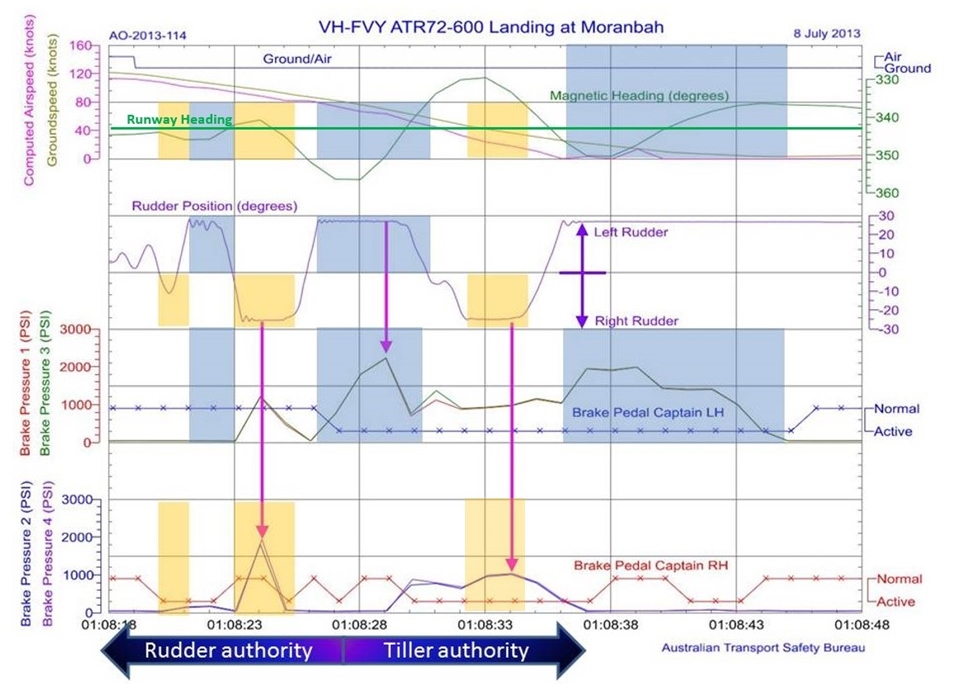
Appendix A - Recorded flight data
Safety actions
Whether or not the ATSB identifies safety issues in the course of an investigation, relevant organisations may proactively initiate safety action in order to reduce their safety risk. The ATSB has been advised of the following proactive safety action in response to this occurrence.
Proactive safety action taken by Virgin Australia Regional Airlines Pty Ltd
As a result of this occurrence and Virgin Australia Regional Airline Pty Ltd’s internal investigation, a safety alert message SAM-ATR-004/13 was promulgated internally that highlighted the risks associated with inadvertent application of wheel brake during touchdown.
Virgin Australia Regional Airline Pty Ltd also implemented a review of flight crew feet position during landing through its training staff and included training to manage the risks of runway excursions during landing in its training programme.
Safety analysis
Introduction
VH-FVY had a number of heading variations of increasing magnitude shortly after touchdown on runway 34 at Moranbah. The aircraft momentarily departed the runway before being recovered by the flight crew. This analysis discusses the factors that influenced the aircraft’s directional stability during the landing, leading to a runway excursion.
Crosswind landing technique
The occurrence happened at the end of the second flight in a series of sectors by the same flight crew that day. The landing was the first landing of the day that required crosswind control input during the touchdown and rollout. The captain commenced applying the expected control inputs to manage a crosswind landing.
After touchdown, wheel brakes are not normally applied until the aircraft is first slowed by aerodynamic drag created by the propellers at higher landing speeds. However, small rudder control inputs are applied to maintain directional control at the higher speeds during the touchdown and initial rollout.
Directional control during the landing rollout
Following a small rudder input after touchdown, the captain applied a sequence of full rudder inputs to correct a number of heading changes during the landing roll. These inputs were initially applied at a high airspeed, when rudder forces are highly effective for turning the aircraft.
Directional control is primarily achieved by rudder and nose wheel steering as the aircraft slows. There were some short, asymmetric wheel brake applications during the landing roll. However, this would have a relatively minor effect on directional control, compared with the effectiveness of the rudder and nose wheel steering inputs.
The captain’s rudder inputs were not reduced until the aircraft had reached the intended heading. The turns therefore overshot the runway heading for the next three corrections as the aircraft slowed.
Pilot induced oscillations occur ‘when the pilot unintentionally commands an increasing series of control corrections in opposite directions…each one in an attempt to counteract the aircraft’s response to the previous input’ and result in an over correction in the opposite direction (Harris, 2011). They occur due to ‘a mismatch between the frequency of the pilot’s inputs and the response frequency of the aircraft’ and ‘…are a product of a large response lag in the system…’ (Harris, 2011). Management of such oscillations can be achieved through a number of strategies. These include varying the sensitivity of aircraft controls at the design stage as well as pilot training, which highlights the importance of not over controlling the aircraft.
As the aircraft slowed through about 80 kt airspeed, the captain followed normal procedures and used the tiller to control the aircraft’s direction via nose wheel steering.
During the occurrence, directional control was not regained until the aircraft had reached a relatively low airspeed.
Rudder pedal adjustment
The captain normally checked and adjusted the rudder pedal neutral position to ensure the angle of his foot on the rudder pedals enabled unrestricted control of both rudder and wheel brakes. On the morning of the occurrence, the captain did not recall adjusting the rudder pedal position.
Despite this, there was no reason for the rudder pedal position to have been moved between the occurrence flight and the flights on the previous day. Those flights were operated by the same crew. Furthermore, an inappropriate rudder pedal adjustment would be expected to be detected during the flight control check performed before take-off. However, the captain recalled unusual muscular feedback when operating the rudder pedals during the occurrence flight. This recollection could be explained by the rudder pedal position being different than that normally applied by the captain, or by the rudder reaching its mechanical stops. A different rudder pedal position could have contributed to the captain inadvertently over-controlling the rudder to counter the aircraft yaw.
Context
Personnel information
The flight crew flew the aircraft from Brisbane to Gladstone on the previous afternoon. The aircraft and the flight crew remained at Gladstone overnight.
Captain
The captain had a total aeronautical experience of about 5,000 hours, of which about 4,500 hours was on the aircraft type. The captain reported being on duty for 4.5 hours at the time of the occurrence. They did not report any fatigue-related concerns associated with the occurrence flight.
First officer
The first officer (FO) had a total aeronautical experience of about 2,600 hours, of which about 1,800 hours was on the aircraft type. The FO also reported being on duty for 4.5 hours at the time of the occurrence. The FO did not report any fatigue-related concerns associated with the occurrence flight.
Aircraft information
Wheel braking system and tyre marks
The wheel brakes for each main landing gear are applied by pressing the top of the respective rudder pedal. This allows for differential braking across the aircraft.
The wheel brake system is designed to prevent the wheels from locking up in order to retain wheel brake effectiveness for slowing the aircraft. This is achieved through the following functions:
Touchdown protection – this prevents activation of the wheel brakes until there is weight on the wheels after landing and:
- either 5 seconds have elapsed
- or the wheels have attained a rotational speed of 35 kt or more.
Anti-skid protection – this operates on the wheels at speeds above 10 kt via the normal braking system. The system relieves brake pressure on wheels that have stopped rotating to the point of incipient wheel lock.
Locked wheel protection – this protection operates on the wheels at speeds above 23 kt. If a wheel is rotating at less than half the speed of the corresponding wheel on the opposite side of the aircraft, the protection system relieves brake pressure on that wheel. This allows the slowing wheel to rotate faster and retain symmetrical deceleration.
Aircraft examination
After the occurrence and prior to departure from Moranbah, the aircraft was subjected to a range of engineering assessments. The assessments were nominated by the aircraft manufacturer to ensure the aircraft was serviceable. These checks found no evidence of damage to the aircraft as a result of the occurrence.
No defects or aircraft conditions were identified that could have contributed to the directional instability during the landing roll.
Meteorological information
The forecast and reported wind on arrival at Moranbah indicated a 15 kt crosswind from the right. This crosswind was well within the normal crosswind landing capabilities of the aircraft.
Airport information
Moranbah Airport is an uncontrolled airport with one runway, servicing regional airlines and local general aviation traffic. The runway was 30 m wide and 1,524 m long, which was adequate for a normal approach and landing in this aircraft.
The landing at Moranbah was the first landing of the day where it was necessary to apply crosswind landing technique.
Aircraft handling
Crosswind landing and deceleration technique
The aircraft landed at Moranbah with a crosswind from the right. The recommended ATR72 technique for a right crosswind landing involved the application of left rudder and a small amount of right roll. These control inputs aligned the landing gear with the direction of movement over the runway immediately before touchdown.
Once an aircraft touches down in a crosswind, the weather-cocking effect of the fin is controlled by maintaining the applied rudder input. In this case, left pedal.
After touchdown, the aircraft is normally decelerated aerodynamically during the first part of the landing roll. This is done by adjusting the propeller pitch so that the propellers create high aerodynamic drag. Propeller pitch is adjusted symmetrically to support deceleration and is not used to provide directional control.
As the aircraft slows, the propeller aerodynamic drag becomes less effective and wheel brakes are progressively applied to achieve the desired rate of deceleration.
Directional control is initially maintained using rudder inputs. This method works well while the aircraft is moving fast enough for the rudder’s aerodynamic forces to be effective. As the aircraft slows, directional control is maintained using steering inputs to the nose wheel. The steering inputs are controlled by the tiller in the cockpit.
Directional control during the landing at Moranbah
Shortly after touchdown, a small, quick rudder input was applied that made the aircraft turn slightly right. Following that, changes in direction were corrected by the application of full rudder that in each case initiated a rapid turn. As each turn was corrected, the rudder control input was not reduced until after the aircraft had reached the runway heading. At that point, opposite full rudder input was then applied, and the turn was reversed. After the initial turn, each subsequent turn was larger for the next three corrective turns as the aircraft slowed to taxi speed (see the section Touchdown and rollout).
During the third turn, the aircraft slowed through 80 kt. At that time, the captain relinquished control of the control yoke to the FO and then used the tiller to control the nose wheel steering. As the aircraft slowed further, the rudder became less effective for controlling the aircraft’s direction. The captain reported sensing the rudder’s decreasing effectiveness from the reducing force needed on the rudder pedals.
The two largest heading changes happened when the aircraft was at a speed where the rudder and the nose wheel steering were available to the captain. However, as the nose wheel steering control inputs are not recorded, it was not possible to determine which input had the greatest influence on controlling the aircraft’s direction.
Flight recorders
Approach
Data obtained from the aircraft’s flight recorder showed the control inputs immediately before touchdown at Moranbah. At that time, the aircraft was flying 3°–4° right wing-low and with 5°–10° left rudder applied. These control inputs changed the aircraft heading 1°–2° left to align the landing gear with the direction of movement over the runway (appendix A).
Touchdown and rollout
Recorded data indicated that neither brake was depressed during the touchdown sequence, although left rudder was being used.
Two seconds after touchdown, the left rudder input changed to a small right rudder input for less than 1 second. At the same time, a very small amount of right wheel brake pressure was applied. There was no indication that asymmetric wheel brake had a significant influence on directional control. The aircraft yawed right by less than 2°.
The right yaw was controlled by the application of full left rudder at 100 kt airspeed for about 2 seconds. The aircraft yawed left until beyond the runway centre-line.
Full right rudder was then applied at 90 kt airspeed, which stopped the left yaw. However, the aircraft then started a faster right yaw.
There was a momentary application of wheel brakes, with more brake pressure applied to the right landing gear. Again, there was no indication that asymmetric wheel brake had a significant influence on directional control. About 3 seconds later, after the aircraft had turned past the runway heading, full left rudder was applied at 80 kt airspeed. The right yaw was stopped after a 15° heading change.
During the next 4 seconds with full left rudder application, the aircraft yawed left through the runway heading. During this time, the aircraft continued right, departing the runway for a short period. The left wheel brake was increasingly applied until the aircraft passed through the runway heading. From then, symmetrical wheel braking was applied to the wheel brakes.
After the 4-second period and the aircraft had turned past the runway heading, rudder input was changed from full left to full right over 2 seconds at about 40 kt airspeed. The left yaw stopped after a 26° left heading change. The aircraft had slowed to about 40 kt ground speed by this time.
The aircraft then yawed 20° right as the aircraft slowed to a taxi speed. Full left rudder input was then applied and the left wheel brake pressure increased while the right wheel brake pressure reduced to zero.
Engine power was applied symmetrically to both engines throughout the landing sequence.
Tests and research
Tyre marks
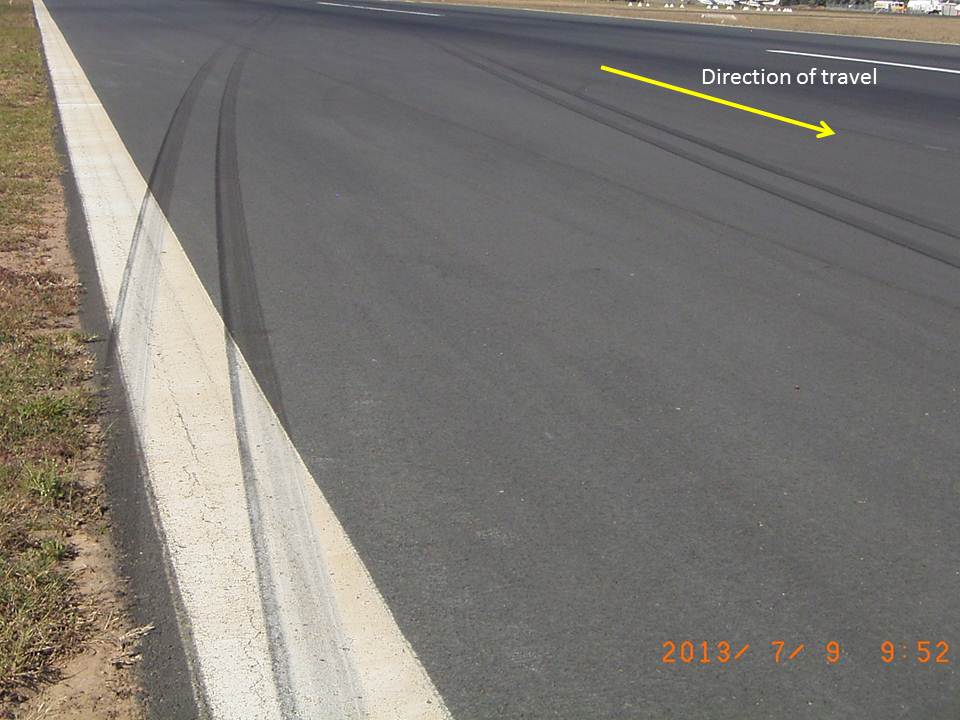
An examination of the runway tyre marks was carried out. Striation marks running in the same direction as the tyre marks indicated that the main wheels were braking. However, the tyres were approaching their limits of adhesion.
There was no evidence of any oblique striation patterns. This indicated that there was sufficient friction available to overcome the cornering forces exerted at the tyre/runway interface.
The darker edges on the outside of the turn indicated a shift of the weight to the outside of the tyres. There was no indication that any of the wheels locked up. This indicated the correct operation of the aircraft anti-skid system (Figure 2).
Figure 2: Runway tyre marks
The four tyre marks preceding the runway excursion were produced by the main landing gear.
They indicated:
hard wheel braking was applied
the braking did not exceed the limits of adhesion on any tyre
the aircraft was turning left exerting more force on the outside-right of the tyre
at least one wheel left the runway surface and rolled onto the adjacent grass.
Source: Moranbah Airport, modified by the ATSB
Additional information
Rudder pedal position adjustment
The captain stated that the rudder pedal position was adjustable fore and aft and that he normally adjusted the rudder pedal position on the first flight in a particular aircraft. This meant that normally the rudder position needed to be adjusted forward to suit his size.
The captain’s preferred rudder pedal position enabled rudder control inputs using the heel of his feet with his feet in a natural position. The captain reported that in this position he operated the rudder with his heels off the floor. This ensured that inadvertent force would not be applied to the top of the rudder pedal by the balls of the feet. When the captain operated the wheel brakes, he moved the balls of his feet to the top of the rudder pedals.
The captain did not recall adjusting the rudder pedal position before departing Gladstone. However, the captain and first officer flew the aircraft on the day before and the pedals were likely still in the captain’s preferred position after the flights that day.
Related occurrences
On 5 October 2005, an ATR72 that was operated by a different operator departed the runway during a landing roll at Queenstown Airport, New Zealand. In that incident, the aircraft touched down without incident, but was then exposed to a strong crosswind gust that exceeded the aircraft’s maximum crosswind limit. The aircraft turned and continued its landing roll on the grass adjacent to the runway. Forecasts and observations at Queenstown immediately before the landing did not indicate the potential for a crosswind that exceeded the aircraft’s maximum crosswind limit.
In 2008, the ATSB produced two research reports related to runway excursions. One encompassed a worldwide review, and the other provided an Australian perspective. Between them, they identified a number of risks that can increase the likelihood of a runway excursion. The reports also identified tools for mitigating the risk. However, the identified risks were not relevant to this occurrence.
The occurrence
On the morning of 8 July 2013, the crew of an ATR-GIE Avions de Transport Regional ATR72-212A (ATR72), registered VH-FVY and operated by Virgin Australia Regional Airlines Pty Ltd, commenced their tour of duty in Gladstone, Queensland. The crew were scheduled to fly from Gladstone to Brisbane, on to Moranbah and then back to Brisbane. The captain was the pilot flying[1] for the first two sectors.
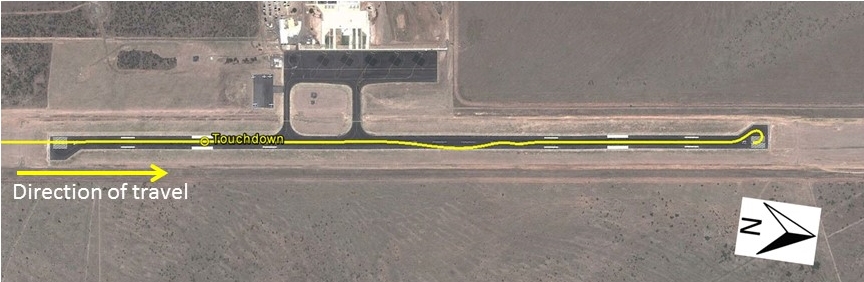
During the flight to Moranbah, the crew obtained the current weather forecast. The forecast indicated a crosswind of about 15 kt (28 km/h) from the right at 110 °(M) on arrival. At 1108 Eastern Standard Time[2], the aircraft touched down on runway 34[3] at 112 kt or 207 km/h airspeed (about 110 kt or 204 km/h ground speed). The aircraft was rolled slightly right by the crew to counter the crosswind. As the ground speed slowed through 100 kt, the crew felt the aircraft veer to the right. The aircraft was returned to the centre-line by the captain applying rudder input. As the aircraft reached about 80 kt the captain handed over the control yoke to the first officer while maintaining directional control with the nose wheel steering tiller. Shortly after, the aircraft turned right again and departed the runway. The captain regained directional control as the aircraft approached 20 kt (37 km/h) (Figure 1 and appendix A).
One passenger reported receiving a minor injury during the occurrence. That injury was consistent with a ‘whiplash’ from lateral acceleration.
Subsequent examination found no aircraft damage. Runway tyre marks associated with the landing showed that at least one of the right main landing gear wheels had departed from the runway.
Figure 1: Aircraft path along runway 34 during the landing roll
The aircraft’s path during the touchdown and landing roll are derived from recorded flight data, and matched the runway tyre marks.The aircraft touched down in the correct location and the changes in direction did not start immediately. The aircraft had a number of larger changes in direction before slowing to taxi speed before the end of the runway.
The sources of information during the investigation included:
Virgin Australia Regional Airline Pty Ltd (VARA)
the flight crew of VH-FVY
a number of passengers
the aircraft’s Digital Flight Data Recorder.
References
Harris, D 2011, Human performance on the flight deck. Ashgate Publishing Ltd, Surrey, England.
Submissions
Under Part 4, Division 2 (Investigation Reports), Section 26 of the Transport Safety Investigation Act 2003, the ATSB may provide a draft report, on a confidential basis, to any person whom the ATSB considers appropriate. Section 26 (1) (a) of the Act allows a person receiving a draft report to make submissions to the ATSB about the draft report.
A draft of this report was provided to the flight crew, VARA, the Bureau d'Enquêtes et d'Analyses, ATR and the Civil Aviation Safety Authority.
Submissions were received from the flight crew, VARA and ATR. The submissions were reviewed and where considered appropriate, the text of the report was amended accordingly.
Findings
From the evidence available, the following findings are made with respect to the runway excursion involving ATR72-212A, registered VH-FVY, at Moranbah Airport, Queensland on 8 July 2013. These findings should not be read as apportioning blame or liability to any particular organisation or individual.
Contributing factors
Consistent with pilot-induced oscillations, the captain's rudder and nose wheel steering inputs overcorrected heading deviations during the landing roll.
Other findings
The landing required crosswind control input, which was applied.
Purpose of safety investigations & publishing information
Purpose of safety investigations
The objective of a safety investigation is to enhance transport safety. This is done through:
identifying safety issues and facilitating safety action to address those issues
providing information about occurrences and their associated safety factors to facilitate learning within the transport industry.
It is not a function of the ATSB to apportion blame or provide a means for determining liability. At the same time, an investigation report must include factual material of sufficient weight to support the analysis and findings. At all times the ATSB endeavours to balance the use of material that could imply adverse comment with the need to properly explain what happened, and why, in a fair and unbiased manner. The ATSB does not investigate for the purpose of taking administrative, regulatory or criminal action.
Terminology
An explanation of terminology used in ATSB investigation reports is available here. This includes terms such as occurrence, contributing factor, other factor that increased risk, and safety issue.
Publishing information
Released in accordance with section 25 of the Transport Safety Investigation Act 2003
Ownership of intellectual property rights in this publication
Unless otherwise noted, copyright (and any other intellectual property rights, if any) in this report publication is owned by the Commonwealth of Australia.
Creative Commons licence
With the exception of the Coat of Arms, ATSB logo, and photos and graphics in which a third party holds copyright, this publication is licensed under a Creative Commons Attribution 3.0 Australia licence.
Creative Commons Attribution 3.0 Australia Licence is a standard form licence agreement that allows you to copy, distribute, transmit and adapt this publication provided that you attribute the work.
The ATSB’s preference is that you attribute this publication (and any material sourced from it) using the following wording: Source: Australian Transport Safety Bureau
Copyright in material obtained from other agencies, private individuals or organisations, belongs to those agencies, individuals or organisations. Where you wish to use their material, you will need to contact them directly.
On the evening of 22 February 2013, the crew of a Regional Express Saab 340B aircraft, registered VH-ZRL, were conducting a scheduled passenger service from Sydney to Taree, New South Wales.
During the approach to Taree, the crew monitored the weather conditions, with the crosswind initially observed as 50 kt when at about 6,000 ft, although it decreased as the aircraft descended.
At about 700 800 ft above ground level (AGL), the crew became visual with the runway. The crew assessed the approach and determined that it was suitable for landing. At that time, the crew reported that the wind was fluctuating and light rain was experienced.
At about 1904, the aircraft touched down. Immediately after, the crew reported that the aircraft was subjected to a wind gust, which caused the left wing to lift slightly and the aircraft to weathercock to the left, into wind. Reverse thrust had been selected after touchdown.
The aircraft veered left toward the runway edge and the captain assumed control of the aircraft. He applied right rudder, but the aircraft did not respond. As the aircraft’s airspeed decreased, the captain also applied right brake, with no effect. He then simultaneously commenced nose wheel steering using the tiller. As the captain believed that the nose wheel steering was ineffective, he elected to apply asymmetric thrust by reducing the amount of reverse thrust on the left engine and increasing reverse thrust on the right engine. The aircraft commenced moving to the right. The aircraft slowed and was taxied to the parking area.
After shutdown, using a torch, the FO then conducted a post flight inspection, with nil damage found.
The next day, the aircraft returned to Sydney, at which time maintenance personnel conducted an inspection of the aircraft and observed damage to the left propeller blades. All four blades had sustained stone damage predominantly on the back (reverse) of the blades.
Weather can behave in an unpredictable manner, particularly when unfavourable conditions exist. While this incident highlights the adverse effects weather can have on aircraft operations, it also emphasises the impact of complacency and interruptions/distractions.
On 30 December 2012, a Cessna 210 aircraft registered VH-DQI (DQI) was returning to Broome from Cape Leveque WA. On board were the pilot and five passengers. The aircraft was part of a two aircraft scenic tour of the area.
Early in the take-off run, the aircraft veered to the left, and the pilot applied right rudder. With the aircraft about 1 metre left of the runway centreline he continued the take-off. At about 45 knots the aircraft again veered to the left. The pilot attempted to re-align the aircraft with full right rudder, but DQI did not respond. As he retarded the throttle and applied the brakes, the aircraft’s left wing clipped trees along the edge of the airstrip and DQI swung almost 90 degrees, striking the right wing on the ground. One passenger sustained a minor injury, and the aircraft was substantially damaged.
The Chief Pilot reported extensive washout on the edge of the airstrip had contributed to the accident. He also used the occurrence as an educational opportunity for all staff pilots.