

Final report
Report release date: 31/03/2016
Safety summary
What happened
On 8 July 2013, an Avions de Transport Regional ATR72-212A, operated by Virgin Australia Regional Airlines Pty Ltd (VARA) and registered VH-FVY, touched down at Moranbah Airport, Queensland. During the landing roll, the aircraft changed direction a number of times. At one point, the aircraft departed the right side of the runway. One passenger reported a minor injury. The aircraft was not damaged as a consequence of the runway excursion.
What the ATSB found
During the landing roll, the rudder and nose wheel steering control inputs over corrected the heading deviations, leading to the runway excursion. Furthermore, the positioning of the rudder pedals could have contributed to the captain inadvertently over-controlling the rudder to counter the aircraft yaw.
What's been done as a result
As a result of this occurrence, VARA released Safety Message SAM-ATR-004/13. The safety message advised pilots of the hazards associated with crosswind landings. In addition, VARA has included this scenario as part of its regular simulator training programme.
Safety message
This occurrence highlights the importance of the correct cockpit set-up and use of correct control inputs during the landing roll, especially at high speed. Correct positioning of primary flight controls can reduce the risk of inadvertent control inputs.
The occurrence
On the morning of 8 July 2013, the crew of an ATR-GIE Avions de Transport Regional ATR72-212A (ATR72), registered VH-FVY and operated by Virgin Australia Regional Airlines Pty Ltd, commenced their tour of duty in Gladstone, Queensland. The crew were scheduled to fly from Gladstone to Brisbane, on to Moranbah and then back to Brisbane. The captain was the pilot flying[1] for the first two sectors.
During the flight to Moranbah, the crew obtained the current weather forecast. The forecast indicated a crosswind of about 15 kt (28 km/h) from the right at 110 °(M) on arrival. At 1108 Eastern Standard Time[2], the aircraft touched down on runway 34[3] at 112 kt or 207 km/h airspeed (about 110 kt or 204 km/h ground speed). The aircraft was rolled slightly right by the crew to counter the crosswind. As the ground speed slowed through 100 kt, the crew felt the aircraft veer to the right. The aircraft was returned to the centre-line by the captain applying rudder input. As the aircraft reached about 80 kt the captain handed over the control yoke to the first officer while maintaining directional control with the nose wheel steering tiller. Shortly after, the aircraft turned right again and departed the runway. The captain regained directional control as the aircraft approached 20 kt (37 km/h) (Figure 1 and appendix A).
One passenger reported receiving a minor injury during the occurrence. That injury was consistent with a ‘whiplash’ from lateral acceleration.
Subsequent examination found no aircraft damage. Runway tyre marks associated with the landing showed that at least one of the right main landing gear wheels had departed from the runway.
Figure 1: Aircraft path along runway 34 during the landing roll
The aircraft’s path during the touchdown and landing roll are derived from recorded flight data, and matched the runway tyre marks.The aircraft touched down in the correct location and the changes in direction did not start immediately. The aircraft had a number of larger changes in direction before slowing to taxi speed before the end of the runway.
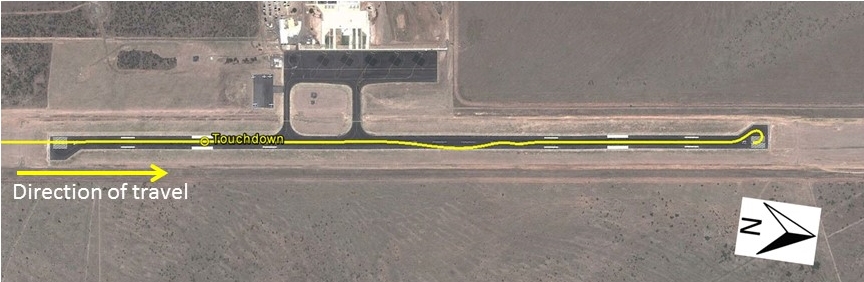
Source: Google earth, modified by the ATSB
__________
- Pilot flying (PF) and Pilot monitoring (PM) are procedurally-assigned roles with specifically-assigned duties at specific stages of a flight. The PF does most of the flying, except in defined circumstances; such as planning for descent, approach and landing. The PM carries out support duties and monitors the PF’s actions and aircraft flight path.
- Eastern Standard Time (EST) was Coordinated Universal Time (UTC) + 10 hours.
- Runways are named by a number representing the magnetic heading of the runway.
Context
Personnel information
The flight crew flew the aircraft from Brisbane to Gladstone on the previous afternoon. The aircraft and the flight crew remained at Gladstone overnight.
Captain
The captain had a total aeronautical experience of about 5,000 hours, of which about 4,500 hours was on the aircraft type. The captain reported being on duty for 4.5 hours at the time of the occurrence. They did not report any fatigue-related concerns associated with the occurrence flight.
First officer
The first officer (FO) had a total aeronautical experience of about 2,600 hours, of which about 1,800 hours was on the aircraft type. The FO also reported being on duty for 4.5 hours at the time of the occurrence. The FO did not report any fatigue-related concerns associated with the occurrence flight.
Aircraft information
Wheel braking system and tyre marks
The wheel brakes for each main landing gear are applied by pressing the top of the respective rudder pedal. This allows for differential braking across the aircraft.
The wheel brake system is designed to prevent the wheels from locking up in order to retain wheel brake effectiveness for slowing the aircraft. This is achieved through the following functions:
- Touchdown protection – this prevents activation of the wheel brakes until there is weight on the wheels after landing and:
- either 5 seconds have elapsed
- or the wheels have attained a rotational speed of 35 kt or more.
- Anti-skid protection – this operates on the wheels at speeds above 10 kt via the normal braking system. The system relieves brake pressure on wheels that have stopped rotating to the point of incipient wheel lock.
- Locked wheel protection – this protection operates on the wheels at speeds above 23 kt. If a wheel is rotating at less than half the speed of the corresponding wheel on the opposite side of the aircraft, the protection system relieves brake pressure on that wheel. This allows the slowing wheel to rotate faster and retain symmetrical deceleration.
Aircraft examination
After the occurrence and prior to departure from Moranbah, the aircraft was subjected to a range of engineering assessments. The assessments were nominated by the aircraft manufacturer to ensure the aircraft was serviceable. These checks found no evidence of damage to the aircraft as a result of the occurrence.
No defects or aircraft conditions were identified that could have contributed to the directional instability during the landing roll.
Meteorological information
The forecast and reported wind on arrival at Moranbah indicated a 15 kt crosswind from the right. This crosswind was well within the normal crosswind landing capabilities of the aircraft.
Airport information
Moranbah Airport is an uncontrolled airport with one runway, servicing regional airlines and local general aviation traffic. The runway was 30 m wide and 1,524 m long, which was adequate for a normal approach and landing in this aircraft.
The landing at Moranbah was the first landing of the day where it was necessary to apply crosswind landing technique.
Aircraft handling
Crosswind landing and deceleration technique
The aircraft landed at Moranbah with a crosswind from the right. The recommended ATR72 technique for a right crosswind landing involved the application of left rudder and a small amount of right roll. These control inputs aligned the landing gear with the direction of movement over the runway immediately before touchdown.
Once an aircraft touches down in a crosswind, the weather-cocking effect of the fin is controlled by maintaining the applied rudder input. In this case, left pedal.
After touchdown, the aircraft is normally decelerated aerodynamically during the first part of the landing roll. This is done by adjusting the propeller pitch so that the propellers create high aerodynamic drag. Propeller pitch is adjusted symmetrically to support deceleration and is not used to provide directional control.
As the aircraft slows, the propeller aerodynamic drag becomes less effective and wheel brakes are progressively applied to achieve the desired rate of deceleration.
Directional control is initially maintained using rudder inputs. This method works well while the aircraft is moving fast enough for the rudder’s aerodynamic forces to be effective. As the aircraft slows, directional control is maintained using steering inputs to the nose wheel. The steering inputs are controlled by the tiller in the cockpit.
Directional control during the landing at Moranbah
Shortly after touchdown, a small, quick rudder input was applied that made the aircraft turn slightly right. Following that, changes in direction were corrected by the application of full rudder that in each case initiated a rapid turn. As each turn was corrected, the rudder control input was not reduced until after the aircraft had reached the runway heading. At that point, opposite full rudder input was then applied, and the turn was reversed. After the initial turn, each subsequent turn was larger for the next three corrective turns as the aircraft slowed to taxi speed (see the section Touchdown and rollout).
During the third turn, the aircraft slowed through 80 kt. At that time, the captain relinquished control of the control yoke to the FO and then used the tiller to control the nose wheel steering. As the aircraft slowed further, the rudder became less effective for controlling the aircraft’s direction. The captain reported sensing the rudder’s decreasing effectiveness from the reducing force needed on the rudder pedals.
The two largest heading changes happened when the aircraft was at a speed where the rudder and the nose wheel steering were available to the captain. However, as the nose wheel steering control inputs are not recorded, it was not possible to determine which input had the greatest influence on controlling the aircraft’s direction.
Flight recorders
Approach
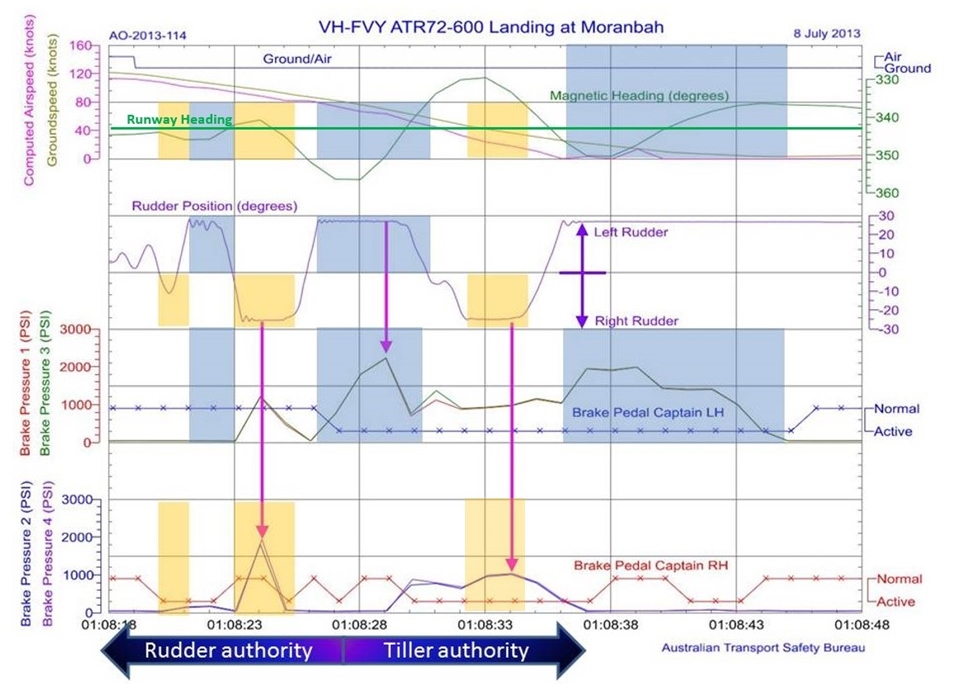
Data obtained from the aircraft’s flight recorder showed the control inputs immediately before touchdown at Moranbah. At that time, the aircraft was flying 3°–4° right wing-low and with 5°–10° left rudder applied. These control inputs changed the aircraft heading 1°–2° left to align the landing gear with the direction of movement over the runway (appendix A).
Touchdown and rollout
Recorded data indicated that neither brake was depressed during the touchdown sequence, although left rudder was being used.
Two seconds after touchdown, the left rudder input changed to a small right rudder input for less than 1 second. At the same time, a very small amount of right wheel brake pressure was applied. There was no indication that asymmetric wheel brake had a significant influence on directional control. The aircraft yawed right by less than 2°.
The right yaw was controlled by the application of full left rudder at 100 kt airspeed for about 2 seconds. The aircraft yawed left until beyond the runway centre-line.
Full right rudder was then applied at 90 kt airspeed, which stopped the left yaw. However, the aircraft then started a faster right yaw.
There was a momentary application of wheel brakes, with more brake pressure applied to the right landing gear. Again, there was no indication that asymmetric wheel brake had a significant influence on directional control. About 3 seconds later, after the aircraft had turned past the runway heading, full left rudder was applied at 80 kt airspeed. The right yaw was stopped after a 15° heading change.
During the next 4 seconds with full left rudder application, the aircraft yawed left through the runway heading. During this time, the aircraft continued right, departing the runway for a short period. The left wheel brake was increasingly applied until the aircraft passed through the runway heading. From then, symmetrical wheel braking was applied to the wheel brakes.
After the 4-second period and the aircraft had turned past the runway heading, rudder input was changed from full left to full right over 2 seconds at about 40 kt airspeed. The left yaw stopped after a 26° left heading change. The aircraft had slowed to about 40 kt ground speed by this time.
The aircraft then yawed 20° right as the aircraft slowed to a taxi speed. Full left rudder input was then applied and the left wheel brake pressure increased while the right wheel brake pressure reduced to zero.
Engine power was applied symmetrically to both engines throughout the landing sequence.
Tests and research
Tyre marks
An examination of the runway tyre marks was carried out. Striation marks running in the same direction as the tyre marks indicated that the main wheels were braking. However, the tyres were approaching their limits of adhesion.
There was no evidence of any oblique striation patterns. This indicated that there was sufficient friction available to overcome the cornering forces exerted at the tyre/runway interface.
The darker edges on the outside of the turn indicated a shift of the weight to the outside of the tyres. There was no indication that any of the wheels locked up. This indicated the correct operation of the aircraft anti-skid system (Figure 2).
Figure 2: Runway tyre marks
The four tyre marks preceding the runway excursion were produced by the main landing gear.
They indicated:
- hard wheel braking was applied
- the braking did not exceed the limits of adhesion on any tyre
- the aircraft was turning left exerting more force on the outside-right of the tyre
- at least one wheel left the runway surface and rolled onto the adjacent grass.
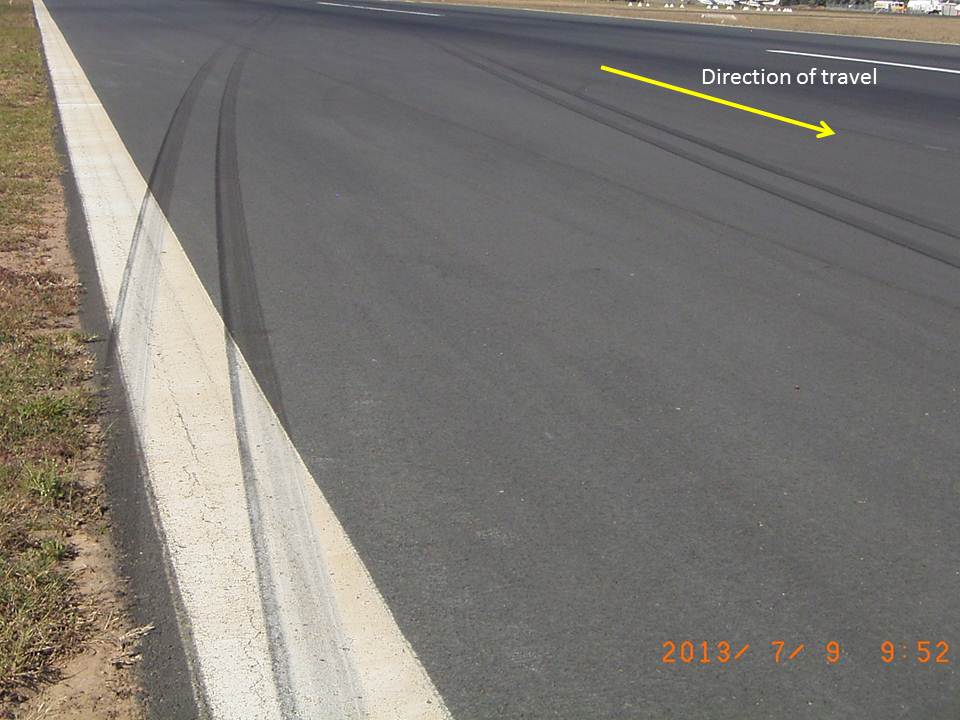
Source: Moranbah Airport, modified by the ATSB
Additional information
Rudder pedal position adjustment
The captain stated that the rudder pedal position was adjustable fore and aft and that he normally adjusted the rudder pedal position on the first flight in a particular aircraft. This meant that normally the rudder position needed to be adjusted forward to suit his size.
The captain’s preferred rudder pedal position enabled rudder control inputs using the heel of his feet with his feet in a natural position. The captain reported that in this position he operated the rudder with his heels off the floor. This ensured that inadvertent force would not be applied to the top of the rudder pedal by the balls of the feet. When the captain operated the wheel brakes, he moved the balls of his feet to the top of the rudder pedals.
The captain did not recall adjusting the rudder pedal position before departing Gladstone. However, the captain and first officer flew the aircraft on the day before and the pedals were likely still in the captain’s preferred position after the flights that day.
Related occurrences
On 5 October 2005, an ATR72 that was operated by a different operator departed the runway during a landing roll at Queenstown Airport, New Zealand. In that incident, the aircraft touched down without incident, but was then exposed to a strong crosswind gust that exceeded the aircraft’s maximum crosswind limit. The aircraft turned and continued its landing roll on the grass adjacent to the runway. Forecasts and observations at Queenstown immediately before the landing did not indicate the potential for a crosswind that exceeded the aircraft’s maximum crosswind limit.
ATSB research reports AR-2008-018 (1) and (2)
In 2008, the ATSB produced two research reports related to runway excursions. One encompassed a worldwide review, and the other provided an Australian perspective. Between them, they identified a number of risks that can increase the likelihood of a runway excursion. The reports also identified tools for mitigating the risk. However, the identified risks were not relevant to this occurrence.
Safety analysis
Introduction
VH-FVY had a number of heading variations of increasing magnitude shortly after touchdown on runway 34 at Moranbah. The aircraft momentarily departed the runway before being recovered by the flight crew. This analysis discusses the factors that influenced the aircraft’s directional stability during the landing, leading to a runway excursion.
Crosswind landing technique
The occurrence happened at the end of the second flight in a series of sectors by the same flight crew that day. The landing was the first landing of the day that required crosswind control input during the touchdown and rollout. The captain commenced applying the expected control inputs to manage a crosswind landing.
After touchdown, wheel brakes are not normally applied until the aircraft is first slowed by aerodynamic drag created by the propellers at higher landing speeds. However, small rudder control inputs are applied to maintain directional control at the higher speeds during the touchdown and initial rollout.
Directional control during the landing rollout
Following a small rudder input after touchdown, the captain applied a sequence of full rudder inputs to correct a number of heading changes during the landing roll. These inputs were initially applied at a high airspeed, when rudder forces are highly effective for turning the aircraft.
Directional control is primarily achieved by rudder and nose wheel steering as the aircraft slows. There were some short, asymmetric wheel brake applications during the landing roll. However, this would have a relatively minor effect on directional control, compared with the effectiveness of the rudder and nose wheel steering inputs.
The captain’s rudder inputs were not reduced until the aircraft had reached the intended heading. The turns therefore overshot the runway heading for the next three corrections as the aircraft slowed.
Pilot induced oscillations occur ‘when the pilot unintentionally commands an increasing series of control corrections in opposite directions…each one in an attempt to counteract the aircraft’s response to the previous input’ and result in an over correction in the opposite direction (Harris, 2011). They occur due to ‘a mismatch between the frequency of the pilot’s inputs and the response frequency of the aircraft’ and ‘…are a product of a large response lag in the system…’ (Harris, 2011). Management of such oscillations can be achieved through a number of strategies. These include varying the sensitivity of aircraft controls at the design stage as well as pilot training, which highlights the importance of not over controlling the aircraft.
As the aircraft slowed through about 80 kt airspeed, the captain followed normal procedures and used the tiller to control the aircraft’s direction via nose wheel steering.
During the occurrence, directional control was not regained until the aircraft had reached a relatively low airspeed.
Rudder pedal adjustment
The captain normally checked and adjusted the rudder pedal neutral position to ensure the angle of his foot on the rudder pedals enabled unrestricted control of both rudder and wheel brakes. On the morning of the occurrence, the captain did not recall adjusting the rudder pedal position.
Despite this, there was no reason for the rudder pedal position to have been moved between the occurrence flight and the flights on the previous day. Those flights were operated by the same crew. Furthermore, an inappropriate rudder pedal adjustment would be expected to be detected during the flight control check performed before take-off. However, the captain recalled unusual muscular feedback when operating the rudder pedals during the occurrence flight. This recollection could be explained by the rudder pedal position being different than that normally applied by the captain, or by the rudder reaching its mechanical stops. A different rudder pedal position could have contributed to the captain inadvertently over-controlling the rudder to counter the aircraft yaw.
Findings
From the evidence available, the following findings are made with respect to the runway excursion involving ATR72-212A, registered VH-FVY, at Moranbah Airport, Queensland on 8 July 2013. These findings should not be read as apportioning blame or liability to any particular organisation or individual.
Contributing factors
Consistent with pilot-induced oscillations, the captain's rudder and nose wheel steering inputs overcorrected heading deviations during the landing roll.
Other findings
The landing required crosswind control input, which was applied.
Safety actions
Whether or not the ATSB identifies safety issues in the course of an investigation, relevant organisations may proactively initiate safety action in order to reduce their safety risk. The ATSB has been advised of the following proactive safety action in response to this occurrence.
Proactive safety action taken by Virgin Australia Regional Airlines Pty Ltd
As a result of this occurrence and Virgin Australia Regional Airline Pty Ltd’s internal investigation, a safety alert message SAM-ATR-004/13 was promulgated internally that highlighted the risks associated with inadvertent application of wheel brake during touchdown.
Virgin Australia Regional Airline Pty Ltd also implemented a review of flight crew feet position during landing through its training staff and included training to manage the risks of runway excursions during landing in its training programme.
Sources and submissions
Sources of information
The sources of information during the investigation included:
- Virgin Australia Regional Airline Pty Ltd (VARA)
- the flight crew of VH-FVY
- a number of passengers
- the aircraft’s Digital Flight Data Recorder.
References
- Harris, D 2011, Human performance on the flight deck. Ashgate Publishing Ltd, Surrey, England.
Submissions
Under Part 4, Division 2 (Investigation Reports), Section 26 of the Transport Safety Investigation Act 2003, the ATSB may provide a draft report, on a confidential basis, to any person whom the ATSB considers appropriate. Section 26 (1) (a) of the Act allows a person receiving a draft report to make submissions to the ATSB about the draft report.
A draft of this report was provided to the flight crew, VARA, the Bureau d'Enquêtes et d'Analyses, ATR and the Civil Aviation Safety Authority.
Submissions were received from the flight crew, VARA and ATR. The submissions were reviewed and where considered appropriate, the text of the report was amended accordingly.
Appendices
Appendix A - Recorded flight data
Purpose of safety investigationsThe objective of a safety investigation is to enhance transport safety. This is done through:
It is not a function of the ATSB to apportion blame or provide a means for determining liability. At the same time, an investigation report must include factual material of sufficient weight to support the analysis and findings. At all times the ATSB endeavours to balance the use of material that could imply adverse comment with the need to properly explain what happened, and why, in a fair and unbiased manner. The ATSB does not investigate for the purpose of taking administrative, regulatory or criminal action. TerminologyAn explanation of terminology used in ATSB investigation reports is available here. This includes terms such as occurrence, contributing factor, other factor that increased risk, and safety issue. Publishing informationReleased in accordance with section 25 of the Transport Safety Investigation Act 2003 Published by: Australian Transport Safety Bureau © Commonwealth of Australia 2016 
Ownership of intellectual property rights in this publication Unless otherwise noted, copyright (and any other intellectual property rights, if any) in this report publication is owned by the Commonwealth of Australia. Creative Commons licence With the exception of the Coat of Arms, ATSB logo, and photos and graphics in which a third party holds copyright, this publication is licensed under a Creative Commons Attribution 3.0 Australia licence. Creative Commons Attribution 3.0 Australia Licence is a standard form licence agreement that allows you to copy, distribute, transmit and adapt this publication provided that you attribute the work. The ATSB’s preference is that you attribute this publication (and any material sourced from it) using the following wording: Source: Australian Transport Safety Bureau Copyright in material obtained from other agencies, private individuals or organisations, belongs to those agencies, individuals or organisations. Where you wish to use their material, you will need to contact them directly. |
Occurrence summary
| Investigation number | AO-2013-114 |
|---|---|
| Occurrence date | 08/07/2013 |
| Location | Moranbah Airport |
| State | Queensland |
| Report release date | 31/03/2016 |
| Report status | Final |
| Investigation level | Defined |
| Investigation type | Occurrence Investigation |
| Investigation status | Completed |
| Mode of transport | Aviation |
| Aviation occurrence category | Runway excursion |
| Occurrence class | Serious Incident |
| Highest injury level | Minor |
Aircraft details
| Manufacturer | ATR-GIE Avions de Transport Régional |
|---|---|
| Model | ATR72 |
| Registration | VH-FVY |
| Serial number | 1073 |
| Aircraft operator | Virgin Australia Regional Airlines |
| Sector | Turboprop |
| Operation type | Air Transport High Capacity |
| Departure point | Brisbane, Queensland |
| Destination | Moranbah, Queensland |
| Damage | Nil |