Propeller/rotor malfunction

Embraer EMB-120 ER, VH-FNQ

Summary

As the pilot of the Brasilia was applying take-off power, a nickel leading edge erosion strip separated from one of the left propeller blades. The strip then bounced off the tarmac under the aircraft and struck the right propeller blades. The engines were shut down and all passengers disembarked safely.

The propeller blades had completed a total of 17,161 hours in service. The last repair work including the fitment of the nickel sheath protective strips took place approximately 2,100 hours prior to the incident.

The erosion strip was recovered and was forwarded for specialist metallurgical examination. This examination confirmed that the erosion strip had separated due to loss of adhesion at the adhesive to sheath interface.

The propeller blade and the failed portions of the nickel sheath were returned to the manufacturer for detailed examination including investigation of the procedures used to perform the nickel sheath replacement. It was found that the sheath had been bonded using an approved adhesive AF111. Inspection of the nickel sheath showed that the surface had been prepared correctly prior to the adhesive being applied. Examination of the blade and nickel sheath showed the cause of the separation to be cracking of the sheath-to-blade bond joint. Spectrum analysis of the adhesive showed the presence of silicone.

The investigation determined that this contamination was introduced during the bonding process. Review of the process showed that an adhesive tape containing silicone had been used, and this is considered to be the most likely cause of the introduction of silicone.

The propeller manufacturer has reviewed its procedures associated with this process. Improvements have been identified and are being incorporated into the manufacturer's Component Maintenance Manuals.

Occurrence summary

Investigation number 199805073
Occurrence date 13/11/1998
Location Bundaberg, Aero.
State Queensland
Report release date 06/09/1999
Report status Final
Investigation type Occurrence Investigation
Investigation status Completed
Mode of transport Aviation
Aviation occurrence category Propeller/rotor malfunction
Occurrence class Incident
Highest injury level None

Aircraft details

Manufacturer Embraer-Empresa Brasileira De Aeronautica
Model EMB-120
Registration VH-FNQ
Serial number 120-054
Sector Turboprop
Operation type Air Transport Low Capacity
Departure point Bundaberg, QLD
Destination Brisbane, QLD
Damage Minor

Mitsubishi Aircraft Int MU-2B-30, VH-UZB

Safety Action

As a result of this occurrence, the Bureau of Air Safety Investigation is investigating a perceived safety deficiency. The deficiency identified relates to inspection periods and processes used to inspect Hartzell propeller pilot tube bores.

Any recommendation issued as a result of this deficiency analysis will be published in the Bureau's Quarterly Safety Deficiency report.

Summary

The aircraft was operating a night freight operation from Brisbane to Sydney. While cruising at flight level (FL) 130 in visual conditions, the crew reported a loud bang and the right engine suddenly ran down. When the crew were about to feather the propeller, the blades were found to be already in the feathered position, and one of the blades was missing. As the aircraft handling was normal, and after considering a diversion to Bankstown, the pilot in command elected to continue to Sydney due to the availability of emergency services, which were placed on standby. The aircraft subsequently made a safe approach and landing on runway 34L.

A post-flight inspection revealed substantial damage to the engine and its mountings. The rear turbine bearing oil supply line had failed and the subsequent loss of oil pressure had resulted in the propeller auto-feathering. The right wingtip fuel tank attachments were loose and the fuel tank could be moved by hand.

The propeller blade had failed about 96 mm from the blade butt. An analysis of the failure surface determined that the failure was the result of fatigue. Fatigue cracking had initiated at the end of the blade pilot tube bore in the region of smallest section thickness on the thrust side of the blade. The cracking did not appear to be associated with any discrete mechanical or corrosion damage.

The propeller is overhauled every 3,000 hours. The last overhaul was in November 1994, 790 hours prior to the accident. During the overhaul the blade pilot tube bore was inspected using the dye penetrant inspection process as required by Airworthiness Directive AD/PHZL/48. Examination of the fracture surface features and an assessment of the rate of crack growth indicated that a region of fatigue cracking, approximately 12 mm in length and 6 mm in depth, was present at the time of the overhaul. However, compounds containing calcium had contaminated this region, reducing the ability of the dye to penetrate the cracks.

Occurrence summary

Investigation number 199701986
Occurrence date 20/06/1997
Location 222 km N Sydney, Aero.
State New South Wales
Report release date 01/02/1999
Report status Final
Investigation type Occurrence Investigation
Investigation status Completed
Mode of transport Aviation
Aviation occurrence category Propeller/rotor malfunction
Occurrence class Accident
Highest injury level None

Aircraft details

Manufacturer Mitsubishi Aircraft Int
Model MU-2
Registration VH-UZB
Serial number 528
Sector Turboprop
Operation type Charter
Departure point Brisbane, Qld
Destination Sydney, NSW
Damage Substantial

Beech Aircraft Corp A23A 'Musketeer', VH-MJA, 52 km ESE Scone NSW, 13 May 1976

Summary

Propeller blade failed when aircraft IFR in cloud over mountains. Intergranular corrosion on blade front.

Occurrence summary

Investigation number 197601498
Occurrence date 13/05/1976
Location 52 km ESE Scone
Report release date 25/01/1977
Report status Final
Investigation type Occurrence Investigation
Investigation status Completed
Mode of transport Aviation
Aviation occurrence category Propeller/rotor malfunction
Occurrence class Accident
Highest injury level Fatal

Aircraft details

Manufacturer Beech Aircraft Corp
Model 23
Registration VH-MJA
Operation type Private
Departure point Coffs harbour NSW
Destination Bankstown NSW
Damage Destroyed

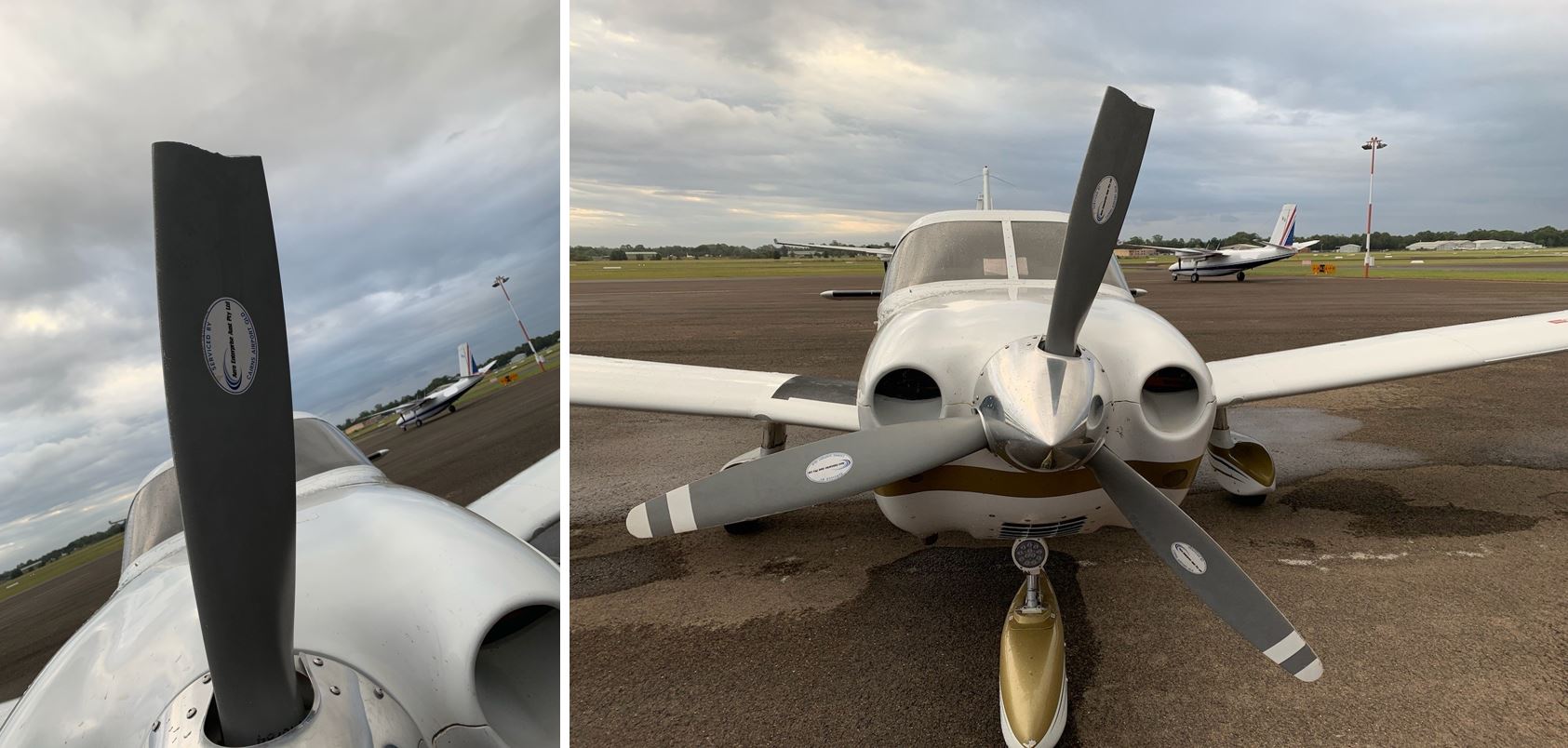
Propeller failure involving Piper PA-32, Bankstown Airport, New South Wales, on 21 February 2019

Brief

Occurrence Briefs are concise reports that detail the facts surrounding a transport safety occurrence, as received in the initial notification and any follow-up enquiries. They provide an opportunity to share safety messages in the absence of an investigation.

What happened

On 21 February 2019, a Piper PA-32 6XT departed Orange, New South Wales (NSW) to conduct a private flight to Bankstown, NSW with two crew on board. During approach, at approximately 900 ft above mean sea level at Warwick Farm, the crew detected a vibration. The crew declared a PAN-PAN[1] to Bankstown tower requesting priority landing. The tower cleared the crew for a straight in approach to runway 11L. The aircraft landed without incident and taxied to parking.

The post-flight inspection revealed the cause of the vibration was due to a 20 cm section missing from one of the propellers. Following the incident, the engineer suspects the likely cause of the propeller section breaking off was due to a stone chip, which developed into a crack as a result of engine operation, which caused stress on the propeller, which subsequently resulted in the propeller failing during flight.

Figure 1: Missing propeller section

Missing propeller section of Piper PA-32

Source: Pilot in Command

Safety message

It is important that pilots remain aware that despite conducting comprehensive pre-flight checks, unanticipated failures can still occur during flight. The crew, in this instance, took all possible precautions by following non-normal procedures, providing clear communications to ATC and landing the aircraft as soon as possible.

About this report

Decisions regarding whether to conduct an investigation, and the scope of an investigation, are based on many factors, including the level of safety benefit likely to be obtained from an investigation. For this occurrence, no investigation has been conducted and the ATSB did not verify the accuracy of the information. A brief description has been written using information supplied in the notification and any follow-up information in order to produce a short summary report, and allow for greater industry awareness of potential safety issues and possible safety actions.

__________

  1. PAN-PAN - The radiotelephony message PAN-PAN is the international standard urgency signal that the crew on board an aircraft uses to declare that they have a situation that is urgent but, for the time being at least, does not pose an immediate danger to anyone's life or the aircraft itself.

Occurrence summary

Mode of transport Aviation
Occurrence ID AB-2019-009
Occurrence date 21/02/2019
Location Bankstown Airport
State New South Wales
Occurrence class Incident
Aviation occurrence category Propeller/rotor malfunction
Highest injury level None
Brief release date 29/04/2019

Aircraft details

Manufacturer Piper Aircraft Corp
Model PA-32-301XTC
Sector Piston
Operation type Private
Departure point Orange, NSW
Destination Bankstown, NSW
Damage Minor

Engine RPM governor failure involving Robinson R44, abeam Brisbane, Queensland, on 15 June 2018

Brief

Occurrence Briefs are concise reports that detail the facts surrounding a transport safety occurrence, as received in the initial notification and any follow-up enquiries. They provide an opportunity to share safety messages in the absence of an investigation.

What happened

On 15 June 2018, at 1050 Eastern Standard Time, a Robinson R44 conducting a charter flight experienced an engine RPM governor[1] failure.

The charter was for a scenic tour of Brisbane, Queensland. On board the helicopter was a pilot and three passengers. Halfway through the flight at an altitude of 1,000 ft, the rotor RPM began to decay and the low rotor RPM horn[2] sounded. The pilot applied a low rotor RPM recovery technique[3] of lowering the collective and increasing the throttle. The aircraft descended to 800 ft before climbing back to 1,000 ft.

The pilot explained what was happening to the passengers who remained calm, then made a PAN[4] call to Air Traffic Control (ATC). ATC cleared a route for the aircraft to return direct to the airport. The pilot was not certain of the cause of the drop in RPM. Rather than turning off the governor as the flight manual instructs for governor failure, he elected to manually control engine RPM by overriding the clutch in the governor.

The aircraft’s magnetos had undergone a 500 hour service immediately prior to the scenic charter flight. An engineering inspection following the incident flight found that a problem with the tachometer points of the magneto[5] caused the governor to read a higher RPM than existed and wind down the throttle, subsequently slowing the rotor system.

Safety message

The right hand magneto provides a signal to the engine RPM governor. The tachometer points that provide the signal must be set precisely to avoid governor issues. In response to reports of governor malfunction between service intervals, Robinson issued service letter SL-62 stating, “Strict adherence to published magneto maintenance practices is essential for proper governor operation”. The service letter also refers to governor trouble-shooting advice in the aircraft maintenance manual.

In the normal course of operation, prior to the failure, the pilot had identified two potential forced landing areas, and during trouble-shooting the pilot steered the helicopter to maintain access to open ground. The pilot also alerted ATC and other aircraft in the vicinity to the problem by declaring PAN. This is another important element in managing an abnormal situation, which brings support to a pilot when they need it. On this occasion, the pilot had correctly determined that it was not necessary to land the helicopter as soon as possible. However, they had created options that allowed for doing so if required.

About this report

Decisions regarding whether to conduct an investigation, and the scope of an investigation, are based on many factors, including the level of safety benefit likely to be obtained from an investigation. For this occurrence, no investigation has been conducted and the ATSB did not verify the accuracy of the information. A brief description has been written using information supplied in the notification and any follow-up information in order to produce a short summary report, and allow for greater industry awareness of potential safety issues and possible safety actions.

__________

  1. Engine RPM Governor – This system senses engine RPM and makes adjustments to the throttle control to maintain a constant engine RPM, which leads to a constant rotor RPM in flight.
  2. Low rotor RPM horn – Maintaining correct rotor RPM is critical to sustained rotary wing flight. The low rotor RPM horn alerts the pilot to a reduction in rotor RPM. In the Robinson R44 it alerts the pilot if rotor RPM decays below 97%.
  3. Low rotor RPM recovery technique – For minor decay of rotor RPM, the pilot will lower the collective control, reducing aerodynamic drag on the rotor blades. Simultaneously they will open the throttle to increase the engine RPM providing increased drive to the rotor system.
  4. PAN call – Transmitted as “pan-pan” it is an internationally recognised distress call that alerts others to a problem aboard the aircraft that is currently less urgent than mayday.
  5. Magneto – A magneto is a device that provides a self-generated charge to the spark plugs of a piston engine. Two magnetos operate on the engine of an R44 and the engine’s right hand magneto provides the signal to the governor.

Occurrence summary

Mode of transport Aviation
Occurrence ID AB-2018-082
Occurrence date 15/06/2018
Location Brisbane
State Queensland
Occurrence class Incident
Aviation occurrence category Propeller/rotor malfunction
Highest injury level None
Brief release date 17/12/2018

Aircraft details

Manufacturer Robinson Helicopter Co
Model R44 Raven II
Sector Helicopter
Operation type Charter
Departure point Brisbane, Queensland
Damage Nil

Propeller malfunction involving Bombardier DHC-8, Cairns, Queensland, on 22 August 2018

Brief

Occurrence Briefs are concise reports that detail the facts surrounding a transport safety occurrence, as received in the initial notification and any follow-up enquiries. They provide an opportunity to share safety messages in the absence of an investigation.

What happened

On 22 August 2018, at 1235 Eastern Standard Time, a Bombardier DHC-8 departed Cairns, Queensland (Qld) for a regular public transport flight to Moranbah, Qld.

During initial climb between 600 ft and 1,000 ft, the crew detected severe engine surging. The crew identified the no. 2 engine as the affected engine and shut it down. The crew completed the relevant checklists, declared a PAN PAN[1] and continued climb to 7,000 ft. The crew then returned the aircraft for landing on runway 33 at Cairns.

Engineers replaced the propeller control unit and the over speed governor and returned the aircraft to service.

About this report

Decisions regarding whether to conduct an investigation, and the scope of an investigation, are based on many factors, including the level of safety benefit likely to be obtained from an investigation. For this occurrence, no investigation has been conducted and the ATSB did not verify the accuracy of the information. A brief description has been written using information supplied in the notification and any follow-up information in order to produce a short summary report, and allow for greater industry awareness of potential safety issues and possible safety actions.

__________

  1. PAN PAN: an internationally recognised radio call announcing an urgency condition which concerns the safety of an aircraft or its occupants but where the flight crew does not require immediate assistance.

Occurrence summary

Mode of transport Aviation
Occurrence ID AB-2018-103
Occurrence date 22/08/2018
Location Cairns
State Queensland
Occurrence class Incident
Aviation occurrence category Propeller/rotor malfunction
Highest injury level None
Brief release date 21/11/2018

Aircraft details

Manufacturer Bombardier Inc
Model DHC-8-402
Sector Turboprop
Operation type Air Transport High Capacity
Departure point Cairns, Qld
Destination Moranbah, Qld
Damage Nil

Propeller malfunction involving DJI Matrice 600, Byron Bay, New South Wales, on 20 January 2018

Brief

Occurrence Briefs are concise reports that detail the facts surrounding a transport safety occurrence, as received in the initial notification and any follow-up enquiries. They provide an opportunity to share safety messages in the absence of an investigation.

What happened

On 20 January 2018, a remotely piloted aircraft (RPA) was being operated on a training exercise over water off Wategos Beach near Byron Bay, New South Wales.

At about 1318 Eastern Daylight-saving Time (EDT),[1] while maintaining 100 ft above ground level, the crew detected a propeller malfunction on one of the RPA’s six propellers. The crew elected to conduct a precautionary landing of the RPA into the water about 200 m offshore. The RPA operator indicated that this was in accordance with their emergency procedures for a propeller malfunction in order to reduce the risk to the beach-going public.

The RPA was recovered from the water and inspected by the operator. The initial inspection indicated that bolts fastening the propeller to the motor unit had failed. Figure 1 shows the failed bolts (left) along with a picture of a non-damaged propeller assembly (right). The RPA has been sent back to the manufacturer for further examination.

Figure 1: Failed bolts that secure the RPA propeller to motor (left) and example of an undamaged propeller and motor assembly (right)

Failed bolts that secure the RPA propeller to motor (left) and example of an undamaged propeller and motor assembly (right)
Source: RPA operator, modified by the ATSB

Safety message

The ATSB’s research report A safety analysis of remotely piloted aircraft systems 2012 to 2016: A rapid growth and safety implications for traditional aviation found that, there has been rapid growth in the number of RPA systems in Australia. This incident highlights the importance of contingency planning for RPA operations. While the manufacturer indicated that, for this RPA configuration, control could be maintained in the event of a single propeller failure, a loss of a control surface would result in a degradation of performance. In this case, the crew identified the reduced performance and acted accordingly by landing the RPA offshore, thereby reducing the risk to third parties.

The Civil Aviation Safety Authority has published guidance on the operation of RPA’s in the advisory circular, Remotely piloted aircraft systems – licencing and operations. Section 4.6 specifically states that, procedures to be followed in the event of an engine/propeller failure should be in place and included in the RPA system mission plan.

About this report

Decisions regarding whether to conduct an investigation, and the scope of an investigation, are based on many factors, including the level of safety benefit likely to be obtained from an investigation. For this occurrence, no investigation has been conducted and the ATSB did not verify the accuracy of the information. A brief description has been written using information supplied in the notification and any follow-up information in order to produce a short summary report, and allow for greater industry awareness of potential safety issues and possible safety actions.

__________

  1. Eastern Daylight-saving Time (EDT): Coordinated Universal Time (UTC) + 11 hours.

Occurrence summary

Mode of transport Aviation
Occurrence ID AB-2018-011
Occurrence date 20/01/2018
Location 3 km, ENE from Byron Bay
State New South Wales
Occurrence class Serious Incident
Aviation occurrence category Propeller/rotor malfunction
Highest injury level Minor
Brief release date 06/04/2018

Aircraft details

Model DJI - Matrice 600
Sector Remotely piloted aircraft
Operation type Aerial Work
Damage Minor