Loss of control

ES 57 Kingfisher Glider, VH-GNW, Big Talbingo Mountain, NSW, 16 January 1969

Summary

The pilot and an assistant had rigged a launching device which utilized a bungee assembly of motor tyre tubes, and a vehicle and cable to launch a glider over the slope of Big Talbingo Mountain. It was intended that when the glider was released, sustained acceleration was to be obtained by the vehicle and cable moving away from the glider. The weather conditions were favourable with the glider facing into a wind of 10-15 knots. The assistant positioned the vehicle such that the slack in the system was taken up before he spoke to the pilot who was now in the cockpit and who briefed him again on the required procedure. The vehicle was driven away, stretching the bungee assembly, but at a speed too slow to sustain acceleration of the glider after automatic release. The pilot was aware of the situation, but was committed to the launch and when further movement of the vehicle automatically released the cable retaining the glider, the launch commenced and the glider moved forward without continuing to accelerate and rolled over the edge of the clearing. The left wing dropped and the aircraft continued to sink until it struck the rocky cliff face. The launching system, modified from one used previously by the pilot, was untried and the procedures to be used had not been practised.

Occurrence summary

Investigation number 196901125
Occurrence date 16/01/1969
Location Talbingo
Report release date 22/06/1970
Report status Final
Investigation type Occurrence Investigation
Investigation status Completed
Mode of transport Aviation
Aviation occurrence category Loss of control
Occurrence class Accident
Highest injury level Serious

Aircraft details

Manufacturer Edmund Schneider Limited
Model ES-57
Registration VH-GNW
Operation type Gliding
Departure point Big Talbingo Mountain
Destination Talbingo Airstrip
Damage Substantial

Cessna 182C, VH-BIG, South of Hughenden Qld, 27 September 1969

Summary

On the morning of the accident the pilot flew the aircraft from Glenrelgh Station to Hughenden, a distance of 63 nautical miles and arrived at approximately 1000 hours. During the course of the day he consumed a quantity of alcohol. The pilot, who was not qualified for instrument flight, planned to return to Glenreigh that evening but, although last light at Glenrelgh was at 1844 hours, he did not depart Hughenden until 1810 hours and made a planned landing at Peronne Station some 10 minutes later. At about 1825 hours the pilot departed on the 43 nautical mile flight to Glenreigh Station and arrived over the airstrip at about the end of daylight. The aircraft was seen to circle over the strip and make an approach Into the south east with the landing lights Illuminated. A vehicle had been positioned at the side of the north western end of the strip so as to Illuminate the landing area with Its headlights. When the aircraft was almost at the touch down point at the north western end of the strip, the engine power increased and the aircraft climbed away. It made a left hand turn as though to continue around and make another approach. However, when flying above the almost featureless terrain In a position some 2700 feet to the north east of the strip, the aircraft entered a steep dive, crashed to the ground and immediately caught fire. The pilot had been undergoing medical treatment involving tranquilislng and sedative drugs and the possibility exists that this medication interacted with the alcohol consumed to further impair the ability of the pilot.

Occurrence summary

Investigation number 196900024
Occurrence date 27/09/1969
Location Glenreigh Station, Hughenden
Report release date 18/06/1970
Report status Final
Investigation type Occurrence Investigation
Investigation status Completed
Mode of transport Aviation
Aviation occurrence category Loss of control
Occurrence class Accident
Highest injury level Fatal

Aircraft details

Manufacturer Cessna Aircraft Company
Model 182
Registration VH-BIG
Operation type Private
Departure point Peronne Station
Destination Glenreigh Station
Damage Destroyed

Loss of control Meta Sokol L40, VH-DUT, Mundubbera Qld, 5 October 1969

Summary

While cruising in level flight the engine, without warning, commenced to vibrate severely. Engine instrumentation remained normal and a magneto check was satisfactory. The vibration increased rapidly to such a degree that the pilot had no alternative but to close the throttle fully and carry out a forced landing. The aircraft was over very rough terrain and the only field available was 1,580 feet in length with trees to 70 feet high at one end and to 20 feet high at the other. The approach was made towards the taller timber, with the wheels down and half flap in a cross wind of about 10 knots from the left. After touching down the pilot realized that the aircraft would overrun the available area and he immediately initiated a turn to the right. Because of the speed and the rough surface, the aircraft skidded sideways and the undercarriage collapsed. The aircraft performance chart indicates that an actual distance of 1,740 feet is required to stop the aircraft from a height of 50 feet when using full flap under the conditions existing at the time of the landing.

Occurrence summary

Investigation number 196900026
Occurrence date 05/10/1969
Location 22 miles SW Mundubbera
Report release date 04/02/1971
Report status Final
Investigation type Occurrence Investigation
Investigation status Completed
Mode of transport Aviation
Aviation occurrence category Loss of control
Occurrence class Accident
Highest injury level None

Aircraft details

Manufacturer Czechoslovak Automobile & A/C
Model L40
Registration VH-DUT
Operation type Private
Departure point Roma
Destination Maryborough
Damage Substantial

Piper PA28-180, VH-PIL, Hughenden Qld, 9 February 1969

Summary

When the aircraft arrived over Hughenden it descended to a height of about 400 feet over houses on the southern and north-eastern areas of the town, then climbed slightly and flew at a low height across the town towards the golf course. The aircraft, on two occasions, flew at a height of about 300 feet over the golf course, in the vicinity of the club house, then climbed, circled to the left and descended to a very low height over a group of people who were playing golf. The aircraft then climbed steeply to approximately 200 feet at which height the pilot apparently lost control of the aircraft and it stalled, yawed sharply and dived to the ground. The Initial impact was taken on the nose and starboard main wheel and the aircraft skidded for a distance of 169 feet before coming to rest.


Occurrence summary

Investigation number 196900003
Occurrence date 09/02/1969
Location Hughenden
Report release date 21/10/1969
Report status Final
Investigation type Occurrence Investigation
Investigation status Completed
Mode of transport Aviation
Aviation occurrence category Loss of control
Occurrence class Accident
Highest injury level Serious

Aircraft details

Manufacturer Piper Aircraft Corp
Model PA-28
Registration VH-PIL
Operation type Private
Departure point Peronne, 21 miles south, Hughenden
Destination Hughenden
Damage Destroyed

Loss of control, Guimbal Cabri G2, Redcliffe Airport, Queensland, on 28 April 2021

BRIEF

Occurrence Briefs are concise reports that detail the facts surrounding a transport safety occurrence, as received in the initial notification and any follow-up enquiries. They provide an opportunity to share safety messages in the absence of an investigation.

What happened

On 28 April 2021, at 0830 Eastern Standard Time,[1] a flight instructor and student pilot were conducting circuit training in a Guimbal Cabri G2 helicopter at Redcliffe Airport, Queensland.

The student completed one circuit before the instructor took over control of the helicopter to demonstrate another circuit. The instructor reported the controls felt slightly unusual and initially thought that may be due to the crosswind or their own control inputs at the time. The instructor turned the helicopter onto the crosswind then downwind legs of the circuit, before levelling off at 800 ft.

When the instructor attempted to level the helicopter, it did not respond to cyclic inputs and initially maintained the angle of bank (about 20° to the right), before a small increase in angle of bank and a significant nose-down pitch. The cyclic was full aft and left and the helicopter did not respond to instructor inputs.

The helicopter entered a nose-down descending right turn and the instructor broadcast a MAYDAY[2] call. While moving the cyclic, the instructor regained control of the helicopter and conducting a shallow approach back to the airfield with no further control issues.

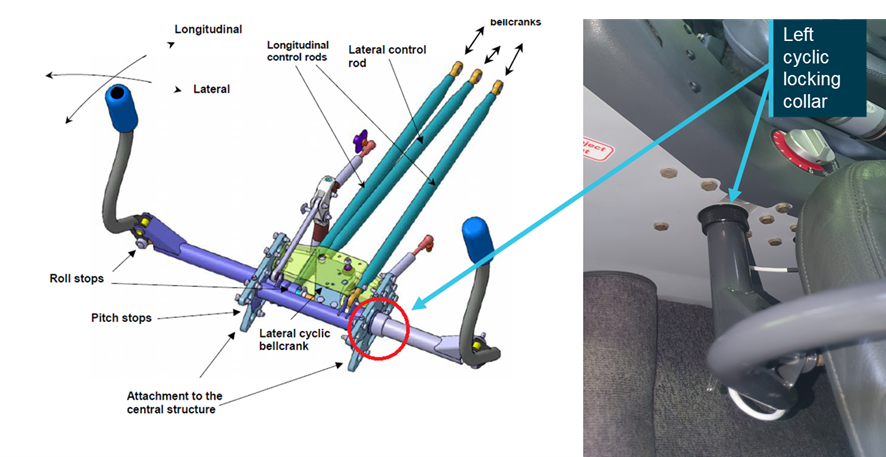
Post-flight inspection of the helicopter revealed the left cyclic locking collar was not secure, allowing the cyclic to disengage (Figure 1). The dual controls had been removed and reinstalled the previous day for a private flight. The position of the left cyclic locking collar was not noted prior to the flight and the right side cyclic was serviceable throughout.

Figure 1: Dual controls showing the left cyclic control locking collar

Dual controls showing the left cyclic control locking collar

Source: Aircraft operator

Safety action

As a result of this occurrence, the aircraft operator advised the ATSB of the following proposed safety action:

  • removal and installation of dual controls by engineers instead of pilots
  • redesign of the dual control sign in/out register to mitigate confusion
  • consider dual check sign-off for installation of dual controls
  • raising a company safety alert to highlight the importance of removing distraction while engaged in safety critical tasks.

The operator assessed that the pilot installing the dual controls may have been distracted, as they were concurrently explaining the installation process to another pilot.

Safety message

This occurrence reinforces the importance of a thorough inspection of all visible flight control components and attachment points following maintenance and before flight.

About this report

Decisions regarding whether to conduct an investigation, and the scope of an investigation, are based on many factors, including the level of safety benefit likely to be obtained from an investigation. For this occurrence, no investigation has been conducted and the ATSB did not verify the accuracy of the information. A brief description has been written using information supplied in the notification and any follow-up information in order to produce a short summary report, and allow for greater industry awareness of potential safety issues and possible safety actions.

__________

  1. Eastern Standard Time (EST) was Coordinated Universal Time (UTC) + 10 hours.
  2. MAYDAY: an internationally recognised radio call announcing a distress condition where an aircraft or its occupants are being threatened by serious and/or imminent danger and the flight crew require immediate assistance.

Occurrence summary

Mode of transport Aviation
Occurrence ID AB-2021-015
Occurrence date 28/04/2021
Location Redcliffe
State Queensland
Occurrence class Serious Incident
Aviation occurrence category Loss of control
Highest injury level None
Brief release date 02/06/2021

Aircraft details

Manufacturer Guimbal
Model Cabri G2
Sector Helicopter
Operation type Flying Training
Departure point Redcliffe, QLD
Destination Redcliffe,QLD
Damage Nil

Loss of control and collision with terrain, Cessna 172S, White Gum (ALA), Western Australia, on 18 April 2021

Brief

Occurrence Briefs are concise reports that detail the facts surrounding a transport safety occurrence, as received in the initial notification and any follow-up enquiries. They provide an opportunity to share safety messages in the absence of an investigation.

What happened

On 18 April 2021, the pilot of a Cessna 172S aircraft was conducting a private flight from Jandakot Airport to White Gum aeroplane landing area (ALA), Western Australia with two passengers on board. Prior to departure, the pilot provided a safety briefing to the passengers including instructing the front seat passenger to remain clear of the aircraft flight controls.

After landing, the front seat passenger accidentally pushed the left rudder pedal causing the aircraft to veer left off the runway toward trees. The pilot attempted to steer to the right by applying right rudder, which was unsuccessful. The pilot then initiated a go-around. As power was increased, the aircraft turned further left, resulting in the left-wing colliding with a tree. The aircraft rotated through 180° before coming to rest (Figure 1). The two passengers sustained minor injuries and the aircraft was substantially damaged.

Figure 1: Accident site

Accident site

Source: Aircraft operator

Safety message

This accident highlights the importance of the passenger in the front seat of a dual control aircraft remaining clear of the flight controls (Figure 2). If there is any doubt about a passenger being able to comply with briefing instructions, consideration should be given to seating them in the rear seat.

Figure 2: Cessna 172 dual controls

Cessna 172 dual controls

Source: pinterest.dk

About this report

Decisions regarding whether to conduct an investigation, and the scope of an investigation, are based on many factors, including the level of safety benefit likely to be obtained from an investigation. For this occurrence, no investigation has been conducted and the ATSB did not verify the accuracy of the information. A brief description has been written using information supplied in the notification and any follow-up information in order to produce a short summary report, and allow for greater industry awareness of potential safety issues and possible safety actions.
Occurrence summary

Mode of transport Aviation
Occurrence ID AB-2021-012
Occurrence date 18/04/2021
Location White Gum (ALA),
State Western Australia
Occurrence class Accident
Aviation occurrence category Loss of control
Brief release date 17/05/2021

Aircraft details

Manufacturer Cessna Aircraft Company
Sector Piston
Operation type Private
Departure point Jandakot, Western Australia
Destination White Gum (ALA), Western Australia
Damage Substantial

Loss of control involving a Robinson R22, Jandakot, Western Australia, on 1 October 2020

Brief

Occurrence Briefs are concise reports that detail the facts surrounding a transport safety occurrence, as received in the initial notification and any follow-up enquiries. They provide an opportunity to share safety messages in the absence of an investigation.

What happened

On 1 October 2020, an instructor and student pilot in a Robinson R22 helicopter were conducting exercises in the helicopter training area at Jandakot Airport, Western Australia. In the pre-flight brief, the plan for the flight was to conduct some revision circuits and then cover flight control emergency recovery procedures. Having completed the circuit revision portion of the flight, the instructor demonstrated and monitored the student successfully completing the first of the practice emergency procedures.

At about 1145 Western Standard Time, the instructor assessed that the wind had increased to about 20 kt and the conditions were therefore unsuitable to continue the lesson. The instructor informed the student that they would conclude the training at that point. The student lifted the helicopter into the hover in preparation to return to the parking area.

While hovering 3 ft above the ground, there was a momentary uncommanded yaw to the right and the instructor questioned the student as to the cause. The aircraft then commenced a further uncommanded and uncontrolled right yaw and the instructor took over the controls. The yaw continued and the helicopter rapidly went through 2 to 3 rotations. The instructor assessed that the situation was unrecoverable, closed the throttle and raised the collective[1] to cushion the helicopter onto the ground. This resulted in a heavy landing and substantial damage to the airframe, however, no injuries to the student or instructor (Figure 1).

Figure 1: The helicopter in situ after the heavy landing

Figure 1: The helicopter in situ after the heavy landing.
Source: Airport operator

Source: Airport operator

Safety action

As a result of this occurrence, the operator has advised the ATSB that a staff safety meeting was conducted following the heavy landing incident and prior to resumption of flight training activities, with the focus on mitigating future risks during hovering operations. The instructor and student also completed additional training.

Safety message

This incident is a reminder for instructors to be aware of, and respond quickly to, situations that develop during training. These may be due to the student’s limited experience, decision-making, aircraft performance limitations or changing weather conditions, which pose risks to the safe conduct of the flight.

About this report

Decisions regarding whether to conduct an investigation, and the scope of an investigation, are based on many factors, including the level of safety benefit likely to be obtained from an investigation. For this occurrence, no investigation has been conducted and the ATSB did not verify the accuracy of the information. A brief description has been written using information supplied in the notification and any follow-up information in order to produce a short summary report, and allow for greater industry awareness of potential safety issues and possible safety actions.

__________

  1. Collective: a primary helicopter flight control that simultaneously affects the pitch of all blades of a lifting rotor. Collective input is the main control for vertical velocity.

Occurrence summary

Mode of transport Aviation
Occurrence ID AB-2020-045
Occurrence date 01/10/2020
Location Jandakot Airport
State Western Australia
Occurrence class Accident
Aviation occurrence category Loss of control
Highest injury level None
Brief release date 29/10/2020

Aircraft details

Manufacturer Robinson Helicopter Co
Model R22
Sector Helicopter
Operation type Flying Training
Departure point Jandakot Airport, Western Australia
Destination Jandakot Airport, Western Australia
Damage Substantial

Loss of control involving a Robinson R22 helicopter, near Tindal, Northern Territory, on 14 June 2020

Brief

Occurrence Briefs are concise reports that detail the facts surrounding a transport safety occurrence, as received in the initial notification and any follow-up enquiries. They provide an opportunity to share safety messages in the absence of an investigation.

What happened

On 14 June 2020 at approximately 1600 Central Standard Time, the pilot of a Robinson R22 helicopter was conducting mustering operations on a property near Tindal Airport, Northern Territory.

The pilot was attempting to herd a number of cattle into a yard, which was proving difficult as the cattle were not moving as required. The pilot decided to land the helicopter behind the cattle to encourage them to move forward, and selected a landing site on a graded road bordered on either side by trees. The pilot was confident that the dust would be minimal in the selected landing area and planned to use a direct-to-the-ground approach to reduce the potential of creating a dust cloud and a possible brownout condition.[1]

As the helicopter descended below 3 ft, an excessive amount of dust was raised from the landing area and the helicopter immediately became fully enveloped by the dust cloud. The pilot elected to reject the landing and commenced a climb, but as all visual references were lost and there were obstacles close by, the pilot quickly decided to put the helicopter on the ground as soon as possible.

The pilot lowered the collective[2] and the helicopter contacted the ground with an amount of left lateral movement resulting in a rollover. The helicopter came to rest on its side sustaining substantial damage (Figure 1). The pilot was uninjured in the accident.

Figure 1: Helicopter post-accident

Figure 1: Helicopter post-accident.
Source: Operator

Source: Operator

Pilot comments

The pilot commented that normally a request for ground personnel assistance to herd the cattle would have been made, however as one of the ground personnel was recently injured the pilot was reluctant to ask for help. The pilot also advised that the mustering job had been delayed to late in the day, and therefore self-induced time pressure to complete the task existed. On reflection, the pilot advised the ATSB that these considerations may have influenced the decisions made on the day.

Brownout condition

The brownout phenomenon can lead to accidents during helicopter take-off and landing operations in arid / desert terrain. Dust clouds created by the rotor downwash during near-ground flight can result in the pilot losing visual reference. This increases the risk of the helicopter colliding with the ground and other obstacles, as well as dynamic rollover due to sloped, uneven terrain or uncommanded aircraft movement due to spatial disorientation.

There are several factors that affect the probability and severity of brownout:

  • aircraft weight / rotor disk loading
  • soil composition
  • wind
  • approach speed and angle.

Safety message

This accident highlights the importance of selecting a suitable landing area and the best approach path and landing technique for the surrounding environment. This includes consideration of appropriate escape routes when faced with an unexpected situation such as a brownout condition. Pilots should also always maintain situational awareness of environmental factors like wind direction, obstacles and surface conditions in order to mitigate risk and avoid an unfavourable situation.

About this report

Decisions regarding whether to conduct an investigation, and the scope of an investigation, are based on many factors, including the level of safety benefit likely to be obtained from an investigation. For this occurrence, no investigation has been conducted and the ATSB did not verify the accuracy of the information. A brief description has been written using information supplied in the notification and any follow-up information in order to produce a short summary report, and allow for greater industry awareness of potential safety issues and possible safety actions.
__________

  1. Brownout condition: is an in-flight visibility restriction due to dust or sand in the air. In a brownout, the pilot cannot see nearby objects which provide the outside visual references necessary to control the aircraft near the ground.  This can cause spatial disorientation and loss of situational awareness leading to an accident.
  2. Collective: a primary helicopter flight control that simultaneously affects the pitch of all blades of a lifting rotor. Collective input is the main control for vertical velocity.

Occurrence summary

Mode of transport Aviation
Occurrence ID AB-2020-024
Occurrence date 14/06/2020
Location Near Tindal Aerodrome
State Northern Territory
Occurrence class Accident
Aviation occurrence category Loss of control
Highest injury level None
Brief release date 27/07/2020

Aircraft details

Manufacturer Robinson Helicopter Co
Model R22 Beta II
Sector Helicopter
Operation type Aerial Work
Departure point Property near Tindal, Northern Territory
Damage Substantial

Loss of control involving a Robinson R44 helicopter, Townsville Airport, Queensland, on 23 April 2020

Brief

Occurrence Briefs are concise reports that detail the facts surrounding a transport safety occurrence, as received in the initial notification and any follow-up enquiries. They provide an opportunity to share safety messages in the absence of an investigation.

What happened

On 23 April 2020, the student pilot of a Robinson R44 helicopter was returning to Townsville Airport, Queensland, from a solo training navigation exercise.

As the pilot returned the helicopter to the parking position near the hangar and was in the process of landing from the hover, he momentarily lost directional yaw control. At this time, one of the helicopter’s skids was in contact with the ground while the collective[1] was in a raised position. This resulted in an unstable airframe that commenced a roll about the skid.

Despite the efforts of the pilot to recover, the helicopter continued to rollover and came to rest on its side resulting in substantial damage. The pilot was uninjured in the accident.

Figure 1: Helicopter post-accident

Figure 1: Helicopter post-accident.
Source: Townsville Airport

Source: Townsville Airport

Figure 2: Helicopter’s bent tail boom and broken main rotor blade

Figure 2: Helicopter’s bent tail boom and broken main rotor blade.
Source: Townsville Airport

Source: Townsville Airport

Helicopter static and dynamic rollovers

Static rollover occurs when a helicopter is pivoted about one of its landing skids or wheels and the helicopter’s centre of gravity passes outside the in-contact skid or wheel. Once in this position, removal of the original force that raised the helicopter to that angle will not stop the helicopter from rolling further. This angle is termed the ‘static rollover angle.’

A rotors-running helicopter resting with one landing skid or wheel on the ground may, without appropriate pilot input, commence rolling. Under certain circumstances, this roll cannot be controlled and the helicopter rolls over. This condition is known as ‘dynamic rollover’ and is a function of the interaction between the:

  • horizontal component of the total rotor thrust (or lift) acting about the point of ground contact
  • weight of the aircraft, initially acting between the helicopter’s skid landing gear or wheels. This second, counter-rolling moment decreases the greater the roll.

Recovery from dynamic rollover is by smoothly lowering the collective lever while controlling any tendency to roll in the opposite direction with cyclic[2] to re-establish the helicopter’s weight evenly on the ground. In general, the application of smooth collective inputs is more effective in avoiding rollover issues than using the cyclic control.

Safety message

This accident highlights the importance of smooth and controlled flight control inputs in the critical phases of flight. While a helicopter is in contact with the ground and before its full weight is applied to the landing gear, it is subject to various influences such as the possibility of a rollover. A thorough understanding of the principles of, and contributing factors to, both static and dynamic rollover and the recovery methods are essential to conducting safe helicopter lift-offs and landings.

About this report

Decisions regarding whether to conduct an investigation, and the scope of an investigation, are based on many factors, including the level of safety benefit likely to be obtained from an investigation. For this occurrence, no investigation has been conducted and the ATSB did not verify the accuracy of the information. A brief description has been written using information supplied in the notification and any follow-up information in order to produce a short summary report, and allow for greater industry awareness of potential safety issues and possible safety actions.

__________

  1. Collective: a primary helicopter flight control that simultaneously affects the pitch of all blades of a lifting rotor. Collective input is the main control for vertical velocity.
  2. Cyclic: a primary helicopter flight control that is similar to an aircraft control column. Cyclic input tilts the main rotor disc, varying the attitude of the helicopter and hence the lateral direction.

Occurrence summary

Mode of transport Aviation
Occurrence ID AB-2020-015
Occurrence date 23/04/2020
Location Townsville Airport
State Queensland
Occurrence class Serious Incident
Aviation occurrence category Loss of control
Highest injury level None
Brief release date 09/06/2020

Aircraft details

Manufacturer Robinson Helicopter Co
Model R44 II
Sector Helicopter
Operation type Flying Training
Destination Townsville Airport, Queensland
Damage Substantial

Loss of control involving a DR-107 One Design, Narromine Airport, New South Wales, on 30 July 2019

Brief

Occurrence Briefs are concise reports that detail the facts surrounding a transport safety occurrence, as received in the initial notification and any follow-up enquiries. They provide an opportunity to share safety messages in the absence of an investigation.

What happened

On the afternoon of 30 July 2019, a local pilot and owner of a DR-107 One Design amateur-built aircraft[1] commenced flying activities at Narromine Airport, New South Wales. At about 1415 Eastern Standard Time, while conducting aerobatics, the pilot experienced degraded rudder control. The pilot elected to land immediately on runway 22. On landing, the left rudder pedal/cable mechanism collapsed, the aircraft veered to the right of the runway and ground looped,[2] colliding with a nearby gable marker. The pilot sustained minor injuries, and the aircraft was substantially damaged.

Post-Accident Inspection

Immediately following the accident, the aircraft owner conducted a detailed inspection of the left rudder pedal assembly, including the rudder cable, pedal and the surrounding areas for damage. The pilot discovered that the nut and bolt (with split pin) fastener, connecting the left rudder pedal to the rudder cable, had failed (Figure 1). The left rudder pedal was extended to the maximum forward position (Figure 2). The subsequent walk-around inspection identified additional external damage to the lower side of the forward fuselage, the left-wing tip and the left landing gear.

Figure 1: Left rudder pedal assembly – looking forward

ab2019026_figure-1.png

Source: Aircraft owner & pilot

Figure 2: Expanded view – underneath left-hand side heel/foot rest

Figure 2: Expanded view – underneath left-hand side heel/foot rest. Source: Aircraft owner & pilot

Source: Aircraft owner & pilot

Safety message

In this incident, the pilot recognised a potential flight control failure while inflight, and successfully recovered the aircraft to the ground as soon as he was able. Aerobatic flying can produce significant stress to flight control mechanisms. This occurrence reinforces the need to complete a diligent pre-flight inspection of all visible flight control components/attachment points, and to act promptly, yet conservatively in the event of any flight control malfunction.

About this report

Decisions regarding whether to conduct an investigation, and the scope of an investigation, are based on many factors, including the level of safety benefit likely to be obtained from an investigation. For this occurrence, no investigation has been conducted and the ATSB did not verify the accuracy of the information. A brief description has been written using information supplied in the notification and any follow-up information in order to produce a short summary report, and allow for greater industry awareness of potential safety issues and possible safety actions.

__________

  1. Amateur-built aircraft: an aircraft, the major portion of which; has been fabricated and assembled by a person, or persons who undertook the construction project solely for their own education or recreation.
  2. Ground-loop: a violent, uncontrolled horizontal rotation of an aircraft while landing, taking off, or taxiing.

Occurrence summary

Mode of transport Aviation
Occurrence ID AB-2019-026
Occurrence date 30/07/2019
Location Narromine Airport
State New South Wales
Occurrence class Accident
Aviation occurrence category Loss of control
Highest injury level Minor
Brief release date 05/09/2019

Aircraft details

Manufacturer Amateur Built Aircraft
Model DR-107 One Design
Sector Piston
Operation type Private
Departure point Narromine Airport, NSW
Damage Substantial